WO2017159499A1 - 新規微生物及びその作成方法 - Google Patents
新規微生物及びその作成方法 Download PDFInfo
- Publication number
- WO2017159499A1 WO2017159499A1 PCT/JP2017/009268 JP2017009268W WO2017159499A1 WO 2017159499 A1 WO2017159499 A1 WO 2017159499A1 JP 2017009268 W JP2017009268 W JP 2017009268W WO 2017159499 A1 WO2017159499 A1 WO 2017159499A1
- Authority
- WO
- WIPO (PCT)
- Prior art keywords
- novel microorganism
- mutant
- strain
- biofilm
- producing
- Prior art date
- Legal status (The legal status is an assumption and is not a legal conclusion. Google has not performed a legal analysis and makes no representation as to the accuracy of the status listed.)
- Ceased
Links
Images


Classifications
-
- C—CHEMISTRY; METALLURGY
- C12—BIOCHEMISTRY; BEER; SPIRITS; WINE; VINEGAR; MICROBIOLOGY; ENZYMOLOGY; MUTATION OR GENETIC ENGINEERING
- C12N—MICROORGANISMS OR ENZYMES; COMPOSITIONS THEREOF; PROPAGATING, PRESERVING, OR MAINTAINING MICROORGANISMS; MUTATION OR GENETIC ENGINEERING; CULTURE MEDIA
- C12N1/00—Microorganisms; Compositions thereof; Processes of propagating, maintaining or preserving microorganisms or compositions thereof; Processes of preparing or isolating a composition containing a microorganism; Culture media therefor
-
- A—HUMAN NECESSITIES
- A01—AGRICULTURE; FORESTRY; ANIMAL HUSBANDRY; HUNTING; TRAPPING; FISHING
- A01H—NEW PLANTS OR NON-TRANSGENIC PROCESSES FOR OBTAINING THEM; PLANT REPRODUCTION BY TISSUE CULTURE TECHNIQUES
- A01H5/00—Angiosperms, i.e. flowering plants, characterised by their plant parts; Angiosperms characterised otherwise than by their botanic taxonomy
- A01H5/10—Seeds
-
- C—CHEMISTRY; METALLURGY
- C12—BIOCHEMISTRY; BEER; SPIRITS; WINE; VINEGAR; MICROBIOLOGY; ENZYMOLOGY; MUTATION OR GENETIC ENGINEERING
- C12N—MICROORGANISMS OR ENZYMES; COMPOSITIONS THEREOF; PROPAGATING, PRESERVING, OR MAINTAINING MICROORGANISMS; MUTATION OR GENETIC ENGINEERING; CULTURE MEDIA
- C12N1/00—Microorganisms; Compositions thereof; Processes of propagating, maintaining or preserving microorganisms or compositions thereof; Processes of preparing or isolating a composition containing a microorganism; Culture media therefor
- C12N1/20—Bacteria; Culture media therefor
-
- C—CHEMISTRY; METALLURGY
- C12—BIOCHEMISTRY; BEER; SPIRITS; WINE; VINEGAR; MICROBIOLOGY; ENZYMOLOGY; MUTATION OR GENETIC ENGINEERING
- C12N—MICROORGANISMS OR ENZYMES; COMPOSITIONS THEREOF; PROPAGATING, PRESERVING, OR MAINTAINING MICROORGANISMS; MUTATION OR GENETIC ENGINEERING; CULTURE MEDIA
- C12N15/00—Mutation or genetic engineering; DNA or RNA concerning genetic engineering, vectors, e.g. plasmids, or their isolation, preparation or purification; Use of hosts therefor
- C12N15/09—Recombinant DNA-technology
Definitions
- This disclosure relates to a novel microorganism and a method for producing the same.
- Biofertilizers are attracting attention as fertilizers other than chemical fertilizers.
- Biofertilizer contains live useful microorganisms, and by supplying useful microorganisms in the rhizosphere of the plant and inside the roots, it can supply nutrients to the host plant and improve the utilization efficiency of nutrients in the soil. By doing so, the growth of the plant is promoted.
- Root rhizobia is known as a useful microorganism for supplying nutrients to plants, but it is difficult to use rhizobia except for legumes.
- fungi are known which form mycorrhiza such as arbuscular mycorrhizal fungi. It has been studied to improve the plant's nutrient intake efficiency and water intake efficiency by causing the arbuscular mycorrhizal fungus to coexist with the plant, and improve the production amount (see, for example, Patent Document 1).
- the use of microorganisms belonging to the genus Bacillus has also been studied (see, for example, Patent Document 2).
- JP 2008-522932 A Japanese Patent Laying-Open No. 2015-113374 JP 2006-016386 A JP 2004-222551 A
- biofertilizers have the following problems.
- Useful microorganisms that are biofertilizers are used by being directly applied to soil or inoculating plant roots or seeds.
- there are many microorganisms in the soil so even if useful microorganisms are transferred from the outside, colonization and growth of the transferred useful microorganisms are suppressed by competition with existing microorganisms in the soil. . For this reason, the conventional biofertilizer cannot demonstrate sufficient effect.
- the problem of the present disclosure is to realize a novel microorganism having excellent characteristics as a biofertilizer and a method for producing the same.
- the first aspect of the novel microorganism of the present disclosure is a Pseudomonas lysolytic bacterium that decomposes a sparingly soluble phosphorus compound into phosphoric acid, and is a mutant lacking the function of the PP_4484 protein.
- the mutant may be a transposon mutant.
- a second aspect of the novel microorganism of the present disclosure is a phosphorolytic bacterium that degrades a sparingly soluble phosphorus compound into phosphoric acid, and is a Pseudomonas sp. MT-5 strain (accession number NITE BP-02215) that has the ability to create a biofilm. is there.
- a biofilm containing the novel microorganism of the present disclosure is attached to the surface.
- One aspect of the method for producing a novel microorganism of the present disclosure includes a step of obtaining a mutant strain by introducing a mutation into a phosphorolytic bacterium of the genus Pseudomonas that degrades a poorly soluble phosphorus compound into phosphate, Screening a strain having a higher film-forming ability than a wild strain.
- a strain lacking the PP_4484 protein function can be selected in the screening step.
- the phosphorolytic bacterium can be Pseudomonas putida.
- the phosphorolytic bacterium can be Pseudomonas sp. P-451 strain (Accession number NITE BP-02205).
- a transposon mutation in the step of introducing a mutation, can be introduced using E. coli MC4100 / pMAR2xT7 as a transposon donor and E. coli HB101 / pRK2013 as a transposon helper. .
- a novel microorganism prepared by the method of preparing a novel microorganism of the present disclosure is cultured together with the seed at a temperature of 20 ° C. or more and 35 ° C. or less, and a biofilm is formed on the seed surface. Let it form.
- a novel microorganism having excellent characteristics as a biofertilizer and a method for producing the same can be realized.
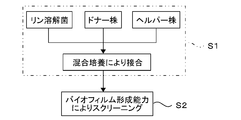
- FIG. 1 is a flowchart showing a method of creating a new microorganism according to an embodiment.
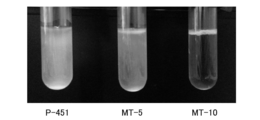
- FIG. 2 is a photograph showing the state of biofilm formation.
- FIG. 3 is a photograph showing the state of biofilm formation.
- FIG. 4 is a graph showing changes in the phosphoric acid concentration in the culture solution.
- Phosphoric acid is an essential nutrient necessary for plant growth and is supplied in large quantities to the soil as fertilizer.
- phosphorus easily binds to metal ions or the like in the soil and changes to a poorly soluble compound that cannot be used directly by plants, the utilization efficiency of phosphorus supplied as fertilizer is not high.
- Phospholytic bacteria can decompose poorly soluble phosphorus compounds such as calcium phosphate into a phosphoric acid state that can be used by plants. For this reason, if phosphorus-soluble bacteria can be made to grow in the rhizosphere of a plant and a poorly soluble phosphorus compound in soil can be decomposed
- the phosphorus-lytic bacteria compete with indigenous microorganisms present in the soil, and thus die immediately. The same applies to other useful microorganisms as well as phosphorus-lytic bacteria.
- microorganisms such as bacteria form a biofilm to protect themselves.
- a biofilm is a complex of a microorganism itself and an extracellular polysaccharide produced by the microorganism, and an environment suitable for the survival of the microorganism is constructed in the biofilm. For this reason, it is considered that the formation and growth in soil can be promoted by forming a biofilm on useful microorganisms such as phosphorus-lytic bacteria.
- various studies have been conducted on suppressing the formation of biofilms as a sanitary problem, but there is little research on promoting the formation of biofilms.
- biofilms can be activated by increasing the absolute number of microorganisms.
- sufficient biotechnology can be achieved in a state where the absolute number of microorganisms is small. It is important that the film is formed.
- the present inventors have found that by introducing a transposon mutation into a useful microorganism such as a phosphorolytic bacterium, a mutant having a greatly increased biofilm-forming ability can be obtained. It has been found that by using a mutant having a high biofilm forming ability, the amount of useful microorganisms attached to the seed surface can be improved, and the survival rate of useful microorganisms in the soil is improved.
- the mutant of this embodiment can be created as follows. As shown in FIG. 1, first, in step S1, a phosphorolytic bacterium, a donor strain, and a helper strain are mixed and cultured to obtain a mutant in which a transposon mutation is introduced. Next, in step S2, mutants are screened to select mutants with high biofilm forming ability.
- Pseudomonas genus phosphorolytic bacterium As the host into which the transposon mutation is introduced, a Pseudomonas genus phosphorolytic bacterium can be used.
- Pseudomonas sp. P-451 (hereinafter referred to as P-451) isolated by the present inventors can be used.
- P-451 is located in the National Institute for Product Evaluation and Technology Patent Microorganisms Depositary (NPMD: Address: 2-5-8, Kazusa Kamashi, Kisarazu City, Chiba Prefecture, 292-0818, Japan).
- Deposit number ⁇ ⁇ ⁇ NITE P-02205) was deposited on February 19, 2016, and on February 27, 2017, an application was made for transfer to an international deposit based on the Budavest Convention.
- P-451 is a phosphorolytic bacterium having a high ability to solubilize poorly soluble phosphorus compounds.
- P-451 is a bacterium isolated from soil, and is estimated to be Pseudomonas putida from the result of partial sequence identification of 16S rRNA.
- E. coli MC4100 / pMAR2xT7 can be used as the donor strain, and for example, E. coli HB101 / pRK2013 can be used as the helper strain.
- the conjugation can be performed by mixing a host, a donor strain, and a helper strain, inoculating on an agar medium, and culturing.
- conjugating it is preferable to liquid-culture the host, donor strain, and helper strain, and then mix three types of bacteria to prepare a mixed bacterial solution and inoculate it on an agar medium.
- Each resistant antibiotic is preferably added to the liquid culture medium. In this way, the purity of the bacteria can be ensured.
- chloramphenicol can be used as a resistant antibiotic for P-451
- gentamicin can be used as a resistant antibiotic for E. coli MC4100 / pMAR2xT7
- kanamycin as a resistant antibiotic for E. coli HB101 / pRK2013 Can be used.
- the ability of the mutant to form a biofilm can be evaluated by quantifying the amount of biofilm adhering to the culture vessel after culturing the fungus in a liquid medium.
- the liquid medium is preferably a medium not added with NaCl.
- the culture is preferably performed at a temperature of 25 ° C. or higher and 30 ° C. or lower for 24 hours or longer and 72 hours or shorter. From the viewpoint of accurate evaluation, the culture is preferably stationary culture.
- the biofilm can be quantified using the crystal violet staining method shown in the Examples.
- a mutant having a high biofilm-forming ability a mutant having a baofilm-forming ability of 5 times or more is preferable, and a mutant having a capacity of 10-fold or more is more preferable as compared to a wild strain into which no transposon mutation has been introduced.
- the thing whose solubilization ability of a hardly soluble phosphorus compound is more than a wild strain is preferable, and a thing higher than a wild strain is more preferable.
- a mutant strain in which the solubilizing ability of the hardly soluble phosphorus compound is greater than that of the wild strain and the biofilm forming ability is improved a strain lacking the function of the PP_4484 protein which is an ABC transporter is preferable.
- MT-5 Pseudomonas sp. MT-5 (hereinafter referred to as MT-5) is preferable.
- MT-5 (MTMD: Address: 2-5-8, Kazusa Kamashichi, Kisarazu City, Chiba Prefecture, 292-0818, Japan), MT-5 (National Institute of Technology and Evaluation) Deposited on March 3, 2016 as deposit number NITE P-02215), and applied for transfer to the international deposit under the Budapest Treaty on February 27, 2017.
- the deposit number after transfer is NITE BP-02215.
- the solubilization ability of a poorly soluble phosphorus compound can be evaluated by the method described in the Example.
- the plant to which the mutant of this embodiment is attached is not particularly limited, and may be any of grains, vegetables, flower buds, fruit trees, and the like. Since the phosphate produced by degradation of the mutant is absorbed from the root, it is preferable that the mutant is attached to the root of the plant in a state of forming a biofilm. In addition, by attaching a biofilm containing the mutant of the present embodiment to the surface of the seed, the mutant can be spread to the roots that have rooted.
- the biofilm containing a mutant of the present embodiment can be easily attached to the surface of a plant by, for example, culturing the mutant with seeds or the like. Moreover, it can carry out by immersing a plant in the culture solution which culture
- the seeds to which the biofilm containing the mutant of the present embodiment is attached are buried in the soil so that the mutant that exists at high density around the seed is a poorly soluble phosphorus compound such as calcium phosphate in the soil around the seed.
- a poorly soluble phosphorus compound such as calcium phosphate in the soil around the seed.
- the biofilm spreads around the root. Since the phosphoric acid produced by the mutant is absorbed by the plant as a nutrient, the growth of the plant can be promoted.
- the mutant exists in the form of a biofilm, and because it has established advantageous living conditions for existing microorganisms in the soil, it is easy to settle in the soil and is highly effective as a biofertilizer. It can be demonstrated.
- mutants can also be obtained by deleting genes using, for example, genome editing techniques.
- Genome editing can be performed using a polypeptide containing a plurality of nuclease subunits composed of a DNA binding domain and a DNA cleavage domain, such as TALEN (TALE Nuclease) and ZFN (Zinc Finger Nuclease).
- TALEN TALE Nuclease
- ZFN Zinc Finger Nuclease
- it can also carry out using RNA induction type nucleases, such as CRISPR / Cas system.
- Bacterial strain As a host, a phosphorolytic bacterium P-451 (Accession No. NITE BP-02205) isolated from the natural environment was used. E. coli MC4100 / pMAR2xT7 was used as a donor strain for transposon mutation. E. coli HB101 / pRK2013 was used as a helper strain. Donor strains and helper strains were sold from the Department of Molecular Biology, Massachusetts General Hospital (185 Cambridge St., CPZN7250 Boston, MA 02114).
- LB Medium used Luria-Bertini
- the composition of the LB agar medium was 10 g / L for polypeptone, 5 g / L for yeast extract, 10 g / L for NaCl, and 15 g / L for agar.
- the LB liquid medium was 10 g / L polypeptone, 5 g / L yeast extract, and 10 g / L NaCl.
- an LB (-NaCl) medium obtained by removing NaCl from the LB medium in order to remove the influence of NaCl on the biofilm was used.
- the culture solutions of P-451, E. coli MC4100 / pMAR2xT7, and E. coli HB101 / pRK2013 were transferred 1.0 mL each to a 1.5 mL microtube, and using a centrifuge (manufactured by KUBOTA, 3700), Centrifuged at 20,000 g for 1 minute at room temperature. After centrifugation, the supernatant was discarded, sterilized distilled water was added to each tube to suspend it, and it was centrifuged again. Thereafter, the supernatant was removed once again, and the three tubes were suspended with 1 mL of sterile distilled water. The suspension was inoculated on an LB agar medium and cultured overnight at 28 ° C. in an incubator to perform conjugation.
- the cells on the LB agar medium were collected using a sterilized spreader and suspended in 10 mL of sterilized distilled water. The collected cell suspension was diluted 100 to 1,000 times, and 100 ⁇ L was inoculated on LB agar medium.
- chloramphenicol which is a resistant antibiotic of P-451
- gentamicin which is a resistant antibiotic of a donor strain
- the biofilm forming ability of the mutant obtained in (3) was evaluated, and a mutant having high biofilm forming ability was selected.
- a 96-well polyethylene terephthalate microplate was used for the measurement of the biofilm forming ability.
- LB liquid medium excluding NaCl LB (-NaCl) liquid medium
- the master plate was also inoculated when suspended in the microplate.
- the master plate was an LB agar medium containing 20 ⁇ g / mL chloramphenicol and 90 ⁇ g / mL gentamicin.
- the microplate is provided with a well of the wild strain P-451 as a control group with the mutant and a well of only the LB (-NaCl) liquid medium not inoculated for background correction. It was.
- LB -NaCl
- the microplate was cultured at 28 ° C. for 24 hours using an incubator. After culturing, the absorbance at 620 nm (OD 620 value) was measured. When measuring the OD 620 value, background correction was performed using the value of the LB (-NaCl) liquid medium as a blank.
- the OD 620 value of each variant the value obtained by normalizing the OD 620 value as a wild strain, which is a control group, and the floating bacteria of each mutant.
- the medium on the microplate was removed and the plate was washed 3 times with tap water. Then, 200 ⁇ L of 0.1% (w / v) crystal violet aqueous solution was added to each well and allowed to stand at room temperature for 30 minutes to stain the biofilm adhered in the well. After dyeing, the crystal violet aqueous solution was removed, washed three times with tap water, and decolorized by adding 200 ⁇ L of 95% (v / v) ethanol. Thereafter, the absorbance (OD 540 value) at 540 nm was measured using an absorbance plate reader (manufactured by TECAN, SUNRISE Remote R).
- the amount of suspended bacteria after the culture was almost the same as that of P-451 which is a wild strain except for MT-10.
- the amount of suspended bacteria was about half that of P-451, which is thought to be due to the increase of bacteria present in the biofilm and the reduction of suspended bacteria.
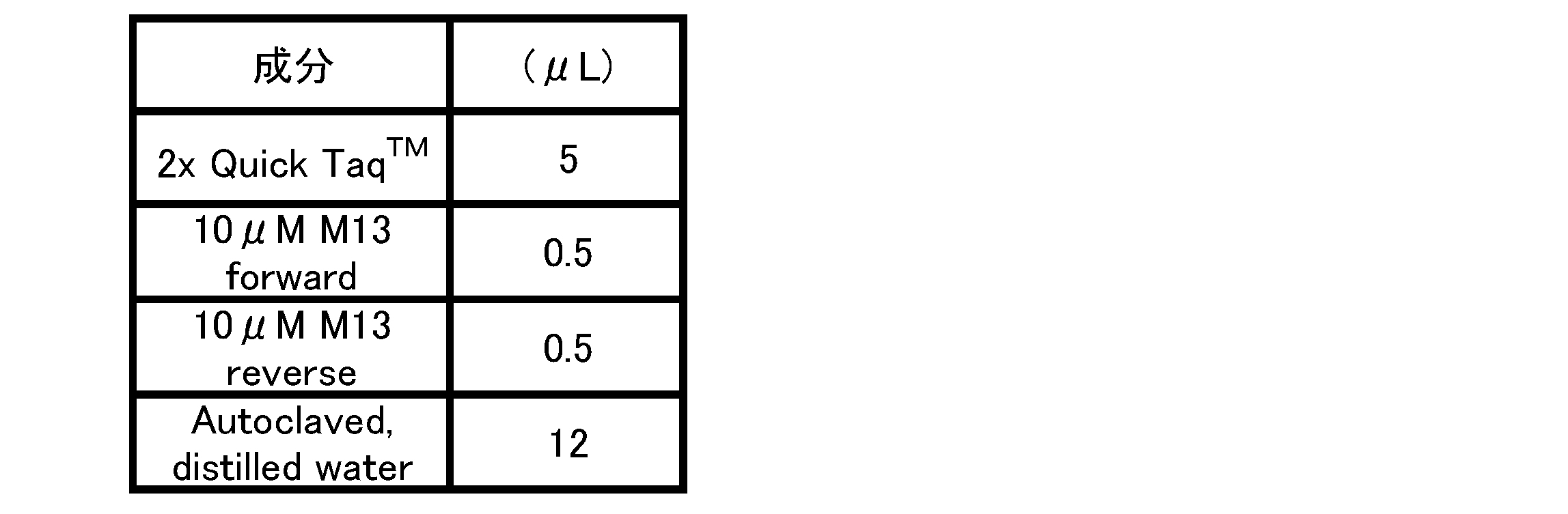
- Mutants MT-5 and MT-10 were cultured on LB agar medium, single colonies were scraped with a sterile toothpick, and suspended in a 1.5 mL microtube containing 50 ⁇ L of sterile distilled water. The tube was placed in a block incubator and heated at 100 ° C. for 10 minutes for lysis. The tube containing the lysate was centrifuged at 15,000 g for 5 minutes, and the supernatant was transferred to a new tube. Next, the 1st PCR mixed solution shown in Table 2 was prepared and applied to the PCR apparatus under the conditions of 95 ° C. for 2 minutes (95 ° C. for 30 seconds, 47 ° C. for 45 seconds, 72 ° C. for 1 minute) ⁇ 30 times. PCR is an abbreviation for Polymerase Chain Reaction and is a polymerase chain reaction.
- the 2nd PCR mixture shown in Table 3 was prepared and applied to the PCR apparatus at 95 ° C. for 2 minutes (95 ° C. for 30 seconds, 45 ° C. for 30 seconds, 72 ° C. for 1 minute) ⁇ 30 times. .
- the PCR product was recovered using a commercially available DNA fragment recovery kit (manufactured by RBC BIOSCIENCE, HiYield Gel / PCR DNA Fragments Extraction Kit) as follows. After staining, the target band was cut out while illuminating with a UV lamp, and placed in a 1.5 mL microtube. DF Buffer (500 ⁇ L) was placed in a tube and heated at 55 ° C. for about 10 minutes to completely dissolve the gel. This was all injected into a column connected to a connection tube and centrifuged at 10,000 g for 30 seconds. The solution in the connection tube was discarded, 600 ⁇ L of Wash Buffer was added, and centrifuged at 10,000 g for 30 seconds.
- DF Buffer 500 ⁇ L
- connection tube was discarded again, and centrifuged again at 10,000 g for 3 minutes to dry the column.
- connection tube was replaced with a 1.5 mL microtube, and 5 ⁇ L of Elution Buffer was added to the center of the column.
- the PCR product was recovered by centrifugation again at 10,000 g for 30 seconds.
- PCR product was ligated as follows using a commercially available PCR product cloning kit (Promega, pGEM-T Easy ⁇ Vector Systems). 2 ⁇ Rapid Ligation Buffer 2.5 ⁇ L, T4 DNA Ligase (3 Weiss Units / ⁇ L) and pGEM-T Easy Easy Vecter (17 ng / ⁇ L) 0.5 ⁇ L, distilled water 0.5 ⁇ L, and recovered PCR product was mixed with 1.5 ⁇ L and allowed to stand at room temperature for 1 hour. Next, 55 ⁇ L of competent cells of E. coli TOP10 strain and 1 ⁇ L of ligation product were injected into a cuvette for electroporation.
- a commercially available PCR product cloning kit Promega, pGEM-T Easy ⁇ Vector Systems. 2 ⁇ Rapid Ligation Buffer 2.5 ⁇ L, T4 DNA Ligase (3 Weiss Units / ⁇ L) and pGEM-T Easy Easy Vecter (17 ng / ⁇ L)
- a colony PCR solution shown in Table 4 was prepared, and 5 tubes were prepared for each type of sample.
- a single colony of the medium is scraped with a micropipette with a 2 ⁇ L tip, inoculated into 100 ⁇ g / mL ampicillin-containing LB agar medium for the master plate, and suspended in the previously prepared PCR tube to prepare a PCR mixture It was created.
- the PCR mixture was applied to the PCR apparatus under the conditions of 96 ° C. for 2 minutes, (95 ° C. for 30 seconds, 55 ° C. for 30 seconds, 68 ° C. for 1 minute) ⁇ 35 times.
- plasmids were generated as follows.
- the culture solution was put in a 1.5 mL tube and centrifuged at 20,000 g for 1 minute, and the supernatant was discarded.
- 200 ⁇ L of PD1 Buffer was added to the tube, and then 200 ⁇ L of PD2 Buffer was added and gently mixed by inverting 5 times.
- 300 ⁇ L of PD3 Buffer buffer was added and mixed by inverting 10 times, followed by centrifugation at 20,000 g for 3 minutes.
- the supernatant was put into a column, a connection tube was attached, and the mixture was centrifuged at 20,000 g for 30 seconds. The supernatant was discarded, 400 ⁇ L of W1 Buffer was injected into the column, centrifuged again, the supernatant was discarded, 600 ⁇ L of Wash Buffer was added, and the mixture was centrifuged at 20,000 g for 30 seconds. Thereafter, the tube was centrifugated and dried at 20,000 g for 3 minutes with the connection tube emptied. The connection tube was replaced with a 1.5 mL tube, 10 ⁇ L of Elution Buffer was added to the center of the column, and centrifuged at 20,000 g for 3 minutes to collect the purified plasmid.
- the collected solution was measured for absorbance at 260 nm (OD 260 value) and absorbance at 280 nm (OD 280 value) using a microspectrophotometer (Thermo scientific, Nano Drop 2000), and the concentration of the collected plasmid was calculated. did.
- the purified plasmid was added to a Sequencing PCR solution (containing 1 ⁇ L of 5 ⁇ M primer, 0.5 ⁇ L of 5 ⁇ Buffer) so that the purified plasmid was 200 to 400 ng / mg.
- the DNA sequence of the adjacent region of the transposon inserted into the genomic DNA of MT-5 was CAACCTGTTATTGATGGCAAAGGCCAGGCAGGCACAGAACGTTGCGCTGGACAGCCACGGCCAGAAG.
- the amino acid sequence deduced from this DNA sequence has 85.71% homology with the amino acid sequence of PP_4484 protein, an ABC transporter of Pseudomonas putida, and the transposon mutation introduction site in MT-5 is PP_4484 It was the 88th amino acid residue of protein (232aa). Therefore, MT-5 is a mutant lacking the function of PP_4484 protein which is an ABC transporter. MT-5 is presumed to have improved biofilm formation ability due to the loss of ABC transporter gene due to the loss of transport of any substance that affects biofilm formation.
- DNA sequences of the flanking regions of the transposon inserted into the genomic DNA of the MT-10 was Titieishieitishijitishitieishijijijishishitititijijishishieieishijijishijishijieishititishieishitijieitijititishijieieijijishijitieishishishishieieititieishishishijijieishieishitishijishijishititishitijijishieieijitijijitijijieishieieieishieitishieijijitieieieishieitishititishitieishieishijishieishishieishijishishishishitijishijishijishijititijieitijishijitijieieijijititishijijishieishijishitijishieijieijieishitishijishitijishieijieijieishitishijishitijishieijieijieishish
- the amino acid sequence deduced from this DNA sequence has 97.3% homology with the amino acid sequence of PP_4702 protein, which is an Acetyl-CoA synthase of Pseudomonas putida, and the transposon mutation introduction site in MT-10 is ,
- the 310th amino acid residue of PP_4702 protein (644aa). Therefore, MT-10 is a mutant lacking the function of PP_4702 protein which is an Acetyl-CoA synthase.
- MT-10 is presumed that the gene related to Acetyl-CoA synthase was deficient, resulting in decreased control of protein function and decreased ability to synthesize fatty acids, promoted cell aggregation, and increased biofilm-forming ability.
- the bacterial suspension was added to a 10 mL test tube containing 2 mL of LB (-NaCl) liquid medium so that the OD 600 value was 0.05. Thereafter, the test tube was statically cultured at 28 ° C. for 24 hours. This was repeated three times each.
- Photographs were taken after incubation, and morphological features were observed with the naked eye.
- the OD 600 value of the culture solution was measured with a spectrophotometer.
- the bacterial suspension was added to a 50 mL Erlenmeyer flask containing 20 mL of NBRIP liquid medium to adjust the OD 600 value to 0.05.
- the culture was shaken at 120 rpm for 10 days using a bioshaker. Each strain was cultured twice, and this was repeated 3 times for a total of 6 times for each strain.
- the phosphoric acid concentration in the culture solution was quantified every 48 hours.
- the phosphorus concentration was measured by the molybdenum blue method.
- 100 ⁇ L of the culture solution was collected and diluted in a 1.5 mL tube containing 900 ⁇ L of sterile distilled water. Subsequently, the tube was centrifuged at 20,000 g for 5 minutes.
- 0.8% of 2.5% ammonium molybdate, 0.8 mL of 6N sulfuric acid, and 89 mg of ascorbic acid are added to make 8 mL with distilled water, and the absorbance at 820 nm using a spectrophotometer (OD 820 value).
- OD 820 value spectrophotometer
- the phosphoric acid concentration in the culture broth greatly increased after the start of the culture. This indicates that the calcium phosphate in the culture broth was solubilized in any strain. Thereafter, the phosphoric acid concentration in the culture broth gradually decreased in any strain. This is due to the bacteria consuming phosphoric acid. From the second day to the tenth day, the phosphoric acid concentration in MT-5 and MT-10 culture broth was slightly higher than that in P-451, and the ability of MT-5 and MT-10 to solubilize phosphorus was shown to be equal to or better than P-451.
- the strain used for the coating was cultured on an LB agar medium, a single colony was scraped with a sterilized toothpick, and each was precultured on an LB liquid medium.
- the culture solution was dispensed in 1 mL portions into a 1.5 mL microtube, and then centrifuged with a centrifuge at 20,000 g for 2 minutes, the supernatant was removed, and 1 mL of sterile distilled water was added and stirred. This was repeated twice to wash the cells.
- the culture solution was removed and 30 mL of sterile distilled water was injected. After stirring, distilled water was removed, and this was repeated 5 times to remove bacteria not attached to the seeds. Thereafter, the cultured seeds were ground using a sterilized mortar. The ground seed was suspended in 10 mL of sterile distilled water and poured into a 15 mL tube. This was done for each of the three seeds. Moreover, it repeated twice from preculture. Thereafter, the number of bacteria was measured by a dilution plate method.
- LB agar medium containing 20 ⁇ g / mL chloramphenicol was used for the wild strain P-451, and mutants MT-5 and MT-10 were 20 ⁇ g / mL chloramphenicol and 90 ⁇ g / mg.
- LB agar medium containing gentamicin was used.
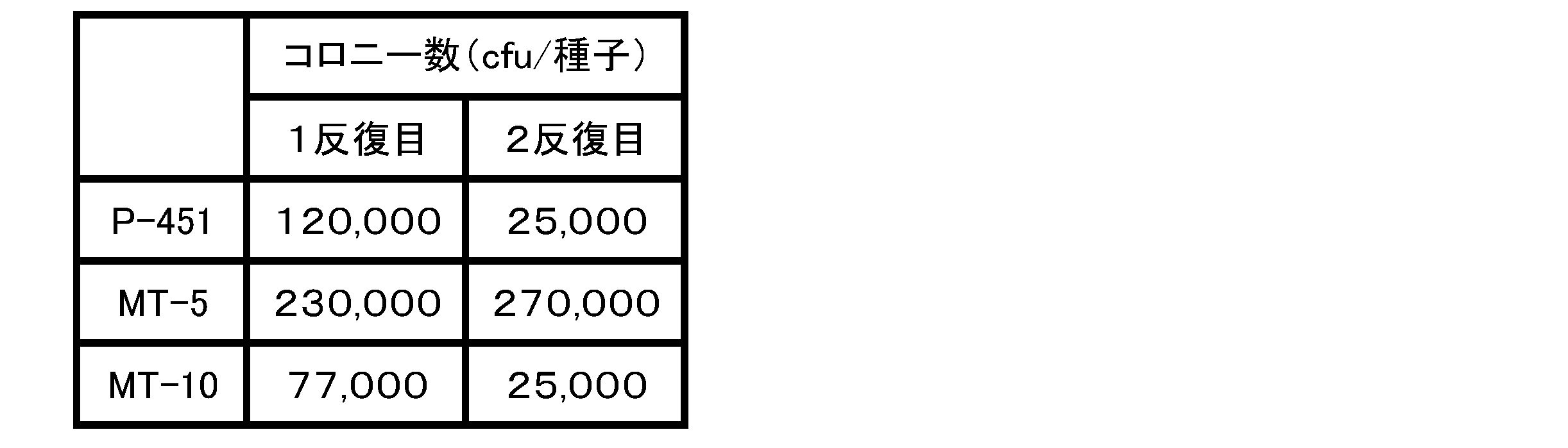
- the number of colonies per seed of MT-5 in the first iteration was 230000 cfu
- the number of colonies of MT-10 was 77000 cfu
- the number of colonies of P-451 was 120,000 cfu.
- the number of colonies of MT-5 in the second repeat was 270000 cfu
- the number of colonies of MT-10 was 25000 cfu
- the number of colonies of P-451 was 25000 cfu.
- a significant difference in the number of colonies was observed between MT-5 and P-451, and MT-5 was attached to the plant surface more than P451. It was shown to be easy.
- no significant difference in the number of colonies was observed between MT-10 and P-451 in both the first and second iterations.
- novel microorganism of the present disclosure has high phosphorus solubilization ability and biofilm formation ability, and is useful as biofertilizer and the like.
Landscapes
- Life Sciences & Earth Sciences (AREA)
- Health & Medical Sciences (AREA)
- Engineering & Computer Science (AREA)
- Chemical & Material Sciences (AREA)
- Genetics & Genomics (AREA)
- Bioinformatics & Cheminformatics (AREA)
- Organic Chemistry (AREA)
- Zoology (AREA)
- Biotechnology (AREA)
- Wood Science & Technology (AREA)
- Biomedical Technology (AREA)
- General Engineering & Computer Science (AREA)
- Biochemistry (AREA)
- General Health & Medical Sciences (AREA)
- Microbiology (AREA)
- Virology (AREA)
- Tropical Medicine & Parasitology (AREA)
- Medicinal Chemistry (AREA)
- Physiology (AREA)
- Developmental Biology & Embryology (AREA)
- Botany (AREA)
- Environmental Sciences (AREA)
- Physics & Mathematics (AREA)
- Biophysics (AREA)
- Molecular Biology (AREA)
- Plant Pathology (AREA)
- Micro-Organisms Or Cultivation Processes Thereof (AREA)
Abstract
新規微生物は、難溶性リン化合物をリン酸へ分解するPseudomonas属のリン溶解菌であり、PP_4484タンパク質の機能を欠失した変異体である。
Description
本開示は、新規微生物及びその作成方法等に関する。
作物生産においては、多量の化学肥料が用いられている。しかし、近年、多量の化学肥料を用いることによる問題が数多く指摘されており、化学肥料以外の肥料が求められている。
化学肥料以外の肥料として、バイオ肥料が注目されている。バイオ肥料とは、生きた有用微生物を含有し、植物の根圏や根の内部で有用微生物を増殖させることにより、宿主植物に栄養分を供給したり、土壌中の栄養分の利用効率を向上させたりすることにより、植物の生育を促進するものである。
植物に栄養分を供給する有用微生物として根粒菌が知られているが、マメ科植物以外では、根粒菌の利用は困難である。他の有用微生物として、アーバスキューラー菌根菌等の菌根を形成するが菌類が知られている。アーバスキューラー菌根菌を植物と共生させることにより、植物の栄養摂取効率及び水分摂取効率等を向上させ、生産量を向上させることが検討されている(例えば、特許文献1を参照。)この他、バチルス属の微生物を用いることも検討されている(例えば、特許文献2を参照。)。
しかしながら、従来のバイオ肥料には以下のような問題がある。バイオ肥料である有用微生物は、直接土壌中に散布したり、植物の根又は種子等に接種したりして用いられている。一般的に土壌中には多数の微生物が存在しているため、外部から有用微生物を移入したとしても、土壌中の既存の微生物との競合により、移入した有用微生物の定着や増殖は抑制される。このため、従来のバイオ肥料は十分な効果を発揮できていない。
有用微生物の土壌中での定着率を向上させることを目的として、有機キャリアを使用することが検討されている(例えば、特許文献3を参照。)。また、微生物の着生率を向上させることを目的として、植物に電子線照射を行うことが検討されている(例えば、特許文献4を参照。)。しかし、これらの方法も土壌中における既存の微生物との競合を抑え、バイオ肥料としての効果を増大させる効果は十分ではなく、バイオ肥料として優れた特性を有する新規の微生物が求められている。
本開示の課題は、バイオ肥料として優れた特性を有する新規微生物及びその作成方法を実現できるようにすることである。
本開示の新規微生物の第1の態様は、難溶性リン化合物をリン酸へ分解するPseudomonas属のリン溶解菌であり、PP_4484タンパク質の機能を欠失した変異体である。
本開示の新規微生物の第1の態様において、変異体はトランスポゾン変異体とすることができる。
本開示の新規微生物の第2の態様は、難溶性リン化合物をリン酸へ分解するリン溶解菌であり、バイオフィルム作成能力を有するPseudomonas sp.MT-5株(受託番号 NITE BP-02215)である。
本開示の種子の一態様は、本開示の新規微生物を含むバイオフィルムが表面に付着している。
本開示の新規微生物の作成方法の一態様は、難溶性リン化合物のリン酸へ分解するPseudomonas属のリン溶解菌に、変異を導入して、変異株を得る工程と、変異株のうち、バイオフィルム形成能力が野生株よりも高い株をスクリーニングする工程とを備えている。
本開示の新規微生物の作成方法の一態様は、スクリーニングする工程において、PP_4484タンパク質の機能が欠失した株を選択するようにできる。
新規微生物の作成方法の一態様において、リン溶解菌は、Pseudomonas putidaとすることができる。
新規微生物の作成方法の一態様において、リン溶解菌は、Pseudomonas sp.P-451株(受託番号 NITE BP-02205)とすることができる。
新規微生物の作成方法の一態様は、変異を導入する工程において、トランスポゾンドナーとしてE.coli MC4100/pMAR2xT7を用い、トランスポゾンヘルパーとしてE.coli HB101/pRK2013を用いて、トランスポゾン変異を導入することができる。
本開示の種子の作成方法の一態様は、本開示の新規微生物の作成方法により作成した新規微生物を種子と共に、20℃以上、35℃以下の温度で培養して、種子の表面にバイオフィルムを形成させる。
本開示によれば、バイオ肥料として優れた特性を有する新規微生物及びその作成方法を実現できる。
リン酸は植物の生育に必要な必須栄養素であり、肥料として土壌に大量に供給されている。しかし、リンは土壌中において金属イオン等と容易に結合して、植物が直接利用できない難溶性の化合物に変化するため、肥料として供給されたリンの利用効率は高くない。リン溶解菌は、リン酸カルシウム等の難溶性のリン化合物を、植物が利用できるリン酸の状態に分解できる。このため、リン溶解菌を植物の根圏に着生させ、土壌中の難溶性のリン化合物を分解させることができれば、リンの利用効率を向上させることができる。しかし、リン溶解菌は、直接土壌に散布したり、植物の根に接種したりしても、土壌中に存在する土着の微生物と競合するため、すぐに死滅してしまう。これは、リン溶解菌に限らず他の有用微生物においても同様である。
一般に細菌等の微生物は、自らを保護するためにバイオフィルムを形成する。バイオフィルムは、微生物自身と、微生物が生成する細胞外多糖との複合体であり、バイオフィルム内には微生物の生存に適した環境が構築される。このため、リン溶解菌等の有用微生物にバイオフィルムを形成させることにより、土壌中における着生及び増殖を促進できると考えられる。しかし、バイオフィルムは衛生上の問題としてその形成を抑制することについては種々の研究が行われているが、その形成を促進することについての研究はほとんどない。
一般に、微生物の絶対数を増やすことにより、バイオフィルムの形成を活発化させることができるが、既存の微生物との競合が生じている状態においては、微生物の絶対数が少ない状態において、十分なバイオフィルムの形成が行われることが重要である。また、バイオフィルムの形成に必要な成分の供給量を増やすことも考えられるが、既存の微生物との競合が生じている状態においては、既存の微生物の活動も活発化されるため、競合状態を解消することができない。
本発明者らは、リン溶解菌等の有用微生物にトランスポゾン変異を導入することにより、バイオフィルム形成能力が大幅に増大した変異体が得られることを見出した。バイオフィルム形成能力が高い変異体を用いることにより、種子表面等への有用微生物の付着量を向上でき、土壌中における有用微生物の生存率が向上することを見出した。
本実施形態の変異体は、以下のようにして作成することができる。図1に示すように、まず、工程S1において、リン溶解菌と、ドナー株と、ヘルパー株とを混合培養することにより、接合させ、トランスポゾン変異を導入した変異体を得る。次に、工程S2において、変異体をスクリーニングして、バイオフィルム形成能力が高い変異体を選択する。
トランスポゾン変異を導入する宿主は、Pseudomonas属のリン溶解菌を用いることができ、例えば、本発明者らが単離した、Pseudomonas sp. P-451(以下P-451という。)を用いることができる。P-451は、独立行政法人製品評価技術基盤機構特許微生物寄託センター(NPMD:住所:〒292-0818 日本国千葉県木更津市かずさ鎌足2-5-8、120号室)に、P-451(受託番号 NITE P-02205)として2016年2月19日に寄託され、2017年2月27日にブダベスト条約に基づく国際寄託へ移管申請され、移管後の受託番号はNITE BP-02205である。P-451は、難溶性のリン化合物を可溶化する能力が高いリン溶解菌である。P-451は、土壌中から単離された菌であり、16S rRNAの部分配列同定の結果から、Pseudomonas putidaと推定される。ドナー株には、例えばE.coli MC4100/pMAR2xT7を用いることができ、ヘルパー株には、例えばE.coli HB101/pRK2013を用いることができる。
接合は、宿主と、ドナー株と、ヘルパー株とを混合して、寒天培地に接種し、培養することにより行うことができる。接合を行う際には、宿主と、ドナー株と、ヘルパー株とをそれぞれ液体培養した後、3種類の菌を混合して混合菌溶液を作成し、これを寒天培地に接種することが好ましい。このようにすれば、3種類の菌のそれぞれについて、必要量を満たすことが容易にできる。液体培養の培地には、それぞれの耐性抗生物質を添加することが好ましい。このようにすれば、菌の純度を確保することができる。
次に、回収した寒天培地上の菌を、宿主の耐性抗生物質とドナー株の耐性抗生物質とを含む培地により培養することにより、接合によりトランスポゾン変異が導入された変異体を得ることができる。
なお、P-451の耐性抗生物質としてクロラムフェニコールを用いることができ、E.coli MC4100/pMAR2xT7の耐性抗生物質としてゲンタマイシンを用いることができ、E.coli HB101/pRK2013の耐性抗生物質としてカナマイシンを用いることができる。
変異体のバイオフィルム形成能力は、菌を液体培地により培養した後、培養容器に付着したバイオフィルムの量を定量することにより評価することができる。液体培地はNaClを添加していない培地とすることが好ましい。培養は、25℃以上、30℃以下の温度で、24時間以上、72時間以下とすることが好ましい。正確な評価をする観点から、培養は静置培養とすることが好ましい。バイオフィルムの定量は、実施例において示すクリスタルバイオレットによる染色法を用いることができる。
バイオフィルム形成能力が高い変異体として、トランスポゾン変異を導入していない野生株と比べて、5倍以上のバオフィルム形成能力を有する変異株が好ましく、10倍以上の変異株がより好ましい。また、難溶性リン化合物の可溶化能力が野生株以上であるものが好ましく、野生株よりも高いものがより好ましい。難溶性リン化合物の可溶化能力が野生株以上で、バイオフィルム形成能力が向上した変異株として、ABCトランスポータであるPP_4484タンパク質の機能が欠失した株が好ましい。中でも、Pseudomonas sp. MT-5(以下MT-5という。)が好ましい。MT-5は、独立行政法人製品評価技術基盤機構特許微生物寄託センター(NPMD:住所:〒292-0818 日本国千葉県木更津市かずさ鎌足2-5-8、120号室)に、MT-5(受託番号 NITE P-02215)として2016年3月3日に寄託され、2017年2月27日にブダペスト条約に基づく国際寄託へ移管申請され、移管後の受託番号はNITE BP-02215である。なお、難溶性リン化合物の可溶化能力は、実施例に記載した方法により評価することができる。
本実施形態の変異体を付着させる植物は、特に限定されず、穀物、野菜、花卉及び果樹等のいずれであってもよい。変異体が分解により産生したリン酸は、根から吸収されるため、変異体はバイオフィルムを形成した状態で植物の根に付着させるようにすることが好ましい。また、種子の表面に本実施形態の変異体を含むバイオフィルムを付着させておくことにより、発根した根に変異体を拡がらせることができる。
本実施形態の変異体含むバイオフィルムは、例えば、変異体を種子等と共に培養することにより容易に植物の表面に付着させることができる。また、変異体を培養してバイオフィルムを形成させた培養液中に植物を浸漬したり、この培養液を植物の表面に塗布又は噴霧したりすることにより行うことができる。
本実施形態の変異体を含むバイオフィルムを付着させた種子を土壌中に埋めることにより、種子の周りに高密度で存在する変異体が、種子の周りの土壌中のリン酸カルシウム等の難溶性リン化合物をリン酸に分解する。さらに、発根すると、根の周りにもバイオフィルムが拡がる。変異体が生成したリン酸は、栄養素として植物に吸収されるため、植物の生育を促進できる。また、変異体はバイオフィルムの状態となって存在しており、土壌中の既存の微生物に対して有利な生存条件が構築されているため、土壌中に定着しやすく、バイオ肥料として高い効果を発揮することができる。
本実施形態において、トランスポゾン変異を用いて変異体を得る方法を示した。しかし、例えばゲノム編集技術を用いて遺伝子を欠失させることにより変異体を得ることもできる。ゲノム編集は、例えばTALEN(TALE Nuclease)やZFN(Zinc Finger Nuclease)等のDNA結合ドメインとDNA切断ドメインからなるヌクレアーゼサブユニットを複数含むポリペプチドを用いて行うことができる。また、CRISPR/Casシステム等のRNA誘導型ヌクレアーゼを用いて行うこともできる。
本発明は、上記の実施形態に限定されるものではなく、本発明の技術的思想の範囲内で、種々変更して実施することができる。以下に、本発明について実施例を用いてさらに詳細に説明する。これらの実施例は例示であり、本発明は以下の実施例に限定されない。
(1)使用菌株
宿主として、自然環境中から単離したリン溶解菌P-451(受託番号 NITE BP-02205)を用いた。トランスポゾン変異のドナー株としてE.coli MC4100/pMAR2xT7を用いた。ヘルパー株として、E.coli HB101/pRK2013を用いた。ドナー株及びヘルパー株はDepartment of Molecular Biology, Massachusetts General Hospital (185 Cambridge St., CPZN7250 Boston, MA 02114)より分譲された。
宿主として、自然環境中から単離したリン溶解菌P-451(受託番号 NITE BP-02205)を用いた。トランスポゾン変異のドナー株としてE.coli MC4100/pMAR2xT7を用いた。ヘルパー株として、E.coli HB101/pRK2013を用いた。ドナー株及びヘルパー株はDepartment of Molecular Biology, Massachusetts General Hospital (185 Cambridge St., CPZN7250 Boston, MA 02114)より分譲された。
(2)使用培地
寒天培地にはLuria-Bertini(以下、LBという。)寒天培地を用い、液体培養培地にはLB液体培地を用いた。LB寒天培地の組成は、ポリペプトンを10g/L、酵母エキスを5g/L、NaClを10g/L、寒天を15g/Lとした。LB液体培地は、ポリペプトンを10g/L、酵母エキスを5g/L、NaClを10g/Lとした。
寒天培地にはLuria-Bertini(以下、LBという。)寒天培地を用い、液体培養培地にはLB液体培地を用いた。LB寒天培地の組成は、ポリペプトンを10g/L、酵母エキスを5g/L、NaClを10g/L、寒天を15g/Lとした。LB液体培地は、ポリペプトンを10g/L、酵母エキスを5g/L、NaClを10g/Lとした。
バイオフィルム形成能力の評価試験には、NaClのバイオフィルムへの影響を除くためにLB培地からNaClを取り除いたLB(-NaCl)培地を使用した。
なお、以下の実施例において使用した培地及び器具類は全て滅菌処理して用いた。
(3)トランスポゾン変異の導入
-80℃の超低温冷凍庫内で保存した菌株をLB寒天培地に植菌し、インキュベーター(アズワン社製、ETTAS EI-600B)を用いて28℃で一晩培養した。その後、LB寒天培地から滅菌した爪楊枝でシングルコロニーをかき取り、10mLのLB液体培地の入った50mL三角フラスコに直接移し、バイオシェーカー(タイテック社製、BR-40LF)を用いて28℃、115rpm、16~18時間の条件下で振とう培養を行った。培養は、それぞれの菌株の耐性抗生物質を添加した条件で行うことができる。
-80℃の超低温冷凍庫内で保存した菌株をLB寒天培地に植菌し、インキュベーター(アズワン社製、ETTAS EI-600B)を用いて28℃で一晩培養した。その後、LB寒天培地から滅菌した爪楊枝でシングルコロニーをかき取り、10mLのLB液体培地の入った50mL三角フラスコに直接移し、バイオシェーカー(タイテック社製、BR-40LF)を用いて28℃、115rpm、16~18時間の条件下で振とう培養を行った。培養は、それぞれの菌株の耐性抗生物質を添加した条件で行うことができる。
P-451、E.coli MC4100/pMAR2xT7、及びE.coli HB101/pRK2013の培養液を1.0mLずつ、それぞれ1.5mLマイクロチューブに移し、遠心分離機(KUBOTA社製、3700)を用いて、20,000gで、1分間、室温にて遠心した。遠心後、上澄みを捨て、各チューブに滅菌した蒸留水を加えて懸濁し、再び遠心機にかけた。その後、もう一度上澄みを取り除き、1mLの滅菌蒸留水で3つのチューブを懸濁した。その懸濁液をLB寒天培地に接種し、インキュベーターで28℃、一晩培養し、接合を行った。
培養後、滅菌したスプレッダーを用いてLB寒天培地上の菌体を回収し、滅菌蒸留水10mLに懸濁した。回収した菌体の懸濁液を100~1,000倍に希釈し、100μLをLB寒天培地に接種した。LB寒天培地には、P-451の耐性抗生物質であるクロラムフェニコール及びドナー株の耐性抗生物質であるゲンタマイシンを、それぞれ20μg/mL及び90μg/mLとなるように添加した。これをインキュベーターで28℃、一晩培養した。これにより、約1200種類の変異体株が得られた。このうちの10個の変異体株をトランスポゾン変異を導入した変異体MT-1からMT-10として選択して次の実験に用いた。
(4)バイオフィルム形成能力の評価
(3)において得られた変異体のバイオフィルム形成能力を評価し、バイオフィルム形成能力が高い変異体を選択した。バイオフィルム形成能力の測定には、96穴のポリエチレンテレフタラート製マイクロプレートを用いた。NaClを除いたLB液体培地(LB(-NaCl)液体培地)を1ウェルに150μLずつ入れ、(3)において得られた変異体のコロニーを滅菌爪楊枝でかき取り、マイクロプレートのウェルに懸濁した。マイクロプレートに懸濁する際に、マスタープレートにも植菌を行った。マスタープレートは、20μg/mLのクロラムフェニコールと90μg/mLのゲンタマイシンとを含むLB寒天培地とした。マイクロプレートには変異体のウェルだけではなく、変異体との対照区として野生株P-451のウェルと、バックグラウンド補正用の何も接種しないLB(-NaCl)液体培地のみのウェルとを設けた。なお、MT-9及びMT-10については、1/5濃度のLB(-NaCl)液体培地を用いた。
(3)において得られた変異体のバイオフィルム形成能力を評価し、バイオフィルム形成能力が高い変異体を選択した。バイオフィルム形成能力の測定には、96穴のポリエチレンテレフタラート製マイクロプレートを用いた。NaClを除いたLB液体培地(LB(-NaCl)液体培地)を1ウェルに150μLずつ入れ、(3)において得られた変異体のコロニーを滅菌爪楊枝でかき取り、マイクロプレートのウェルに懸濁した。マイクロプレートに懸濁する際に、マスタープレートにも植菌を行った。マスタープレートは、20μg/mLのクロラムフェニコールと90μg/mLのゲンタマイシンとを含むLB寒天培地とした。マイクロプレートには変異体のウェルだけではなく、変異体との対照区として野生株P-451のウェルと、バックグラウンド補正用の何も接種しないLB(-NaCl)液体培地のみのウェルとを設けた。なお、MT-9及びMT-10については、1/5濃度のLB(-NaCl)液体培地を用いた。
マイクロプレートをインキュベーターを用いて28℃で、24時間培養した。培養後に620nmにおける吸光度(OD620値)を測定した。OD620値を測定する際には、LB(-NaCl)液体培地の値をブランクとしてバックグラウンド補正を行った。各変異体のOD620値を、対照区である野生株のOD620値を1として規格化した値を、各変異体の浮遊菌量とした。
この後、マイクロプレートの培地を取り除き、水道水で3回洗浄した。その後、0.1%(w/v)クリスタルバイオレット水溶液を各ウェルに200μLずつ加え、室温で30分間静置して、ウェル内に付着したバイオフィルムの染色を行った。染色後、クリスタルバイオレット水溶液を取り除き、水道水で3回洗浄し、95%(v/v)エタノールを200μL添加して脱色を行った。この後、吸光プレートリーダー(TECAN社製、SUNRISE Remote R)を用いて540nmにおける吸光度(OD540値)を測定した。OD540値を測定する際には、LB(-NaCl)液体培地のみを入れたウェルの値をブランクとしてバックグラウンド補正を行った。各変異体のOD540値を、対照区である野生株のOD540値を1として規格化した値を、各変異体のバイオフィルム形成能力とした
表1に示すように、MT-2を除いてバイオフィルム形成能力の向上が認められた。中でも、MT-4からMT-6及びMT-10の4つの変異体において、野生株であるP-451の10倍以上のバイオフィルム形成能力を示した。
表1に示すように、MT-2を除いてバイオフィルム形成能力の向上が認められた。中でも、MT-4からMT-6及びMT-10の4つの変異体において、野生株であるP-451の10倍以上のバイオフィルム形成能力を示した。
培養後の浮遊菌量は、MT-10を除いて、ほぼ野生株であるP-451と同じになった。MT-10において、浮遊菌量がP-451の半分程度となったが、これは、バイオフィルム内に存在する菌が増加し、浮遊状態の菌が減少したことによると考えられる。

(5)トランスポゾン変異により欠損した遺伝子の同定
変異体MT-5及びMT-10について遺伝子の欠損部位を評価した。変異体MT-5及びMT-10をLB寒天培地で培養し、滅菌爪楊枝で単一コロニーをかき取り、50μL滅菌蒸留水の入った1.5mLマイクロチューブに懸濁した。そのチューブをブロックインキュベーターに入れ100℃、10分の条件で加熱し、溶菌させた。溶菌液の入ったチューブを15,000g、5分の条件で遠心機にかけ、上澄みを新しいチューブに移した。次に、表2に示す1st PCR混合液を用意しそれを95℃2分間、(95℃30秒間、47℃45秒間、72℃1分間)×30回の条件でPCR装置にかけた。なお、PCRとは、Polymerase Chain Reactionの略称であり、ポリメラーゼ連鎖反応である。
変異体MT-5及びMT-10について遺伝子の欠損部位を評価した。変異体MT-5及びMT-10をLB寒天培地で培養し、滅菌爪楊枝で単一コロニーをかき取り、50μL滅菌蒸留水の入った1.5mLマイクロチューブに懸濁した。そのチューブをブロックインキュベーターに入れ100℃、10分の条件で加熱し、溶菌させた。溶菌液の入ったチューブを15,000g、5分の条件で遠心機にかけ、上澄みを新しいチューブに移した。次に、表2に示す1st PCR混合液を用意しそれを95℃2分間、(95℃30秒間、47℃45秒間、72℃1分間)×30回の条件でPCR装置にかけた。なお、PCRとは、Polymerase Chain Reactionの略称であり、ポリメラーゼ連鎖反応である。
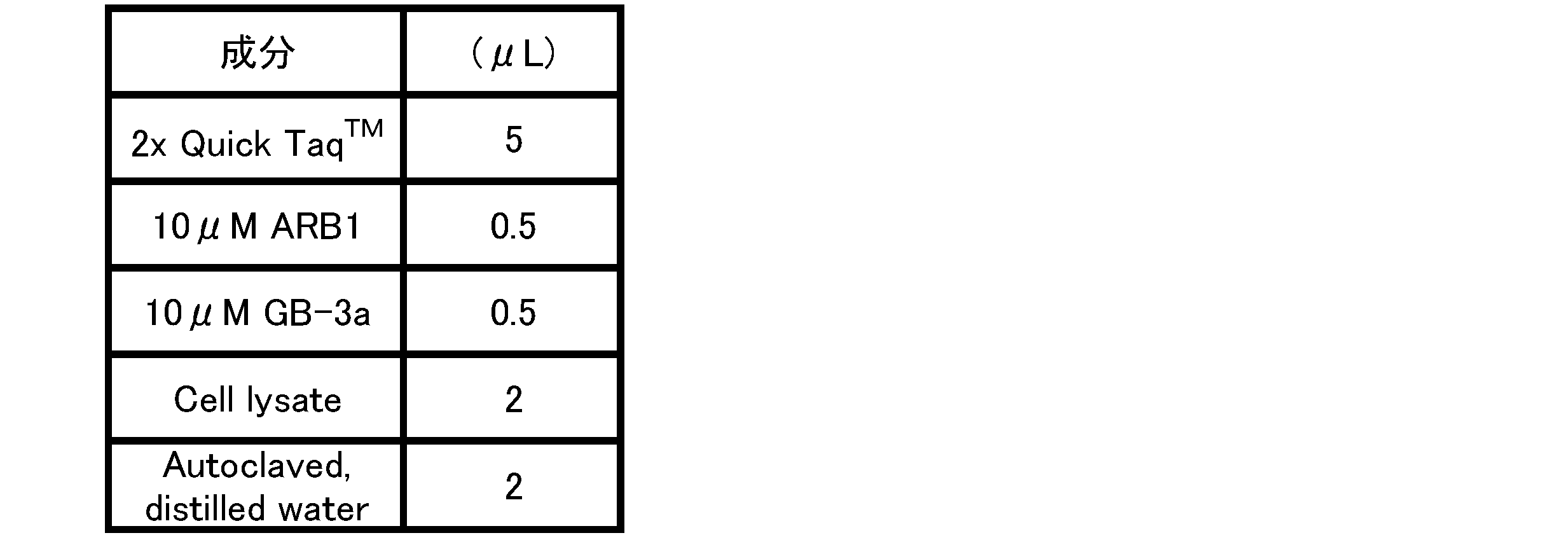
1st PCR産物を用いて、表3に示す2nd PCR混合液を調整し、95℃2分間、(95℃30秒間、45℃30秒間、72℃1分間)×30回の条件でPCR装置にかけた。
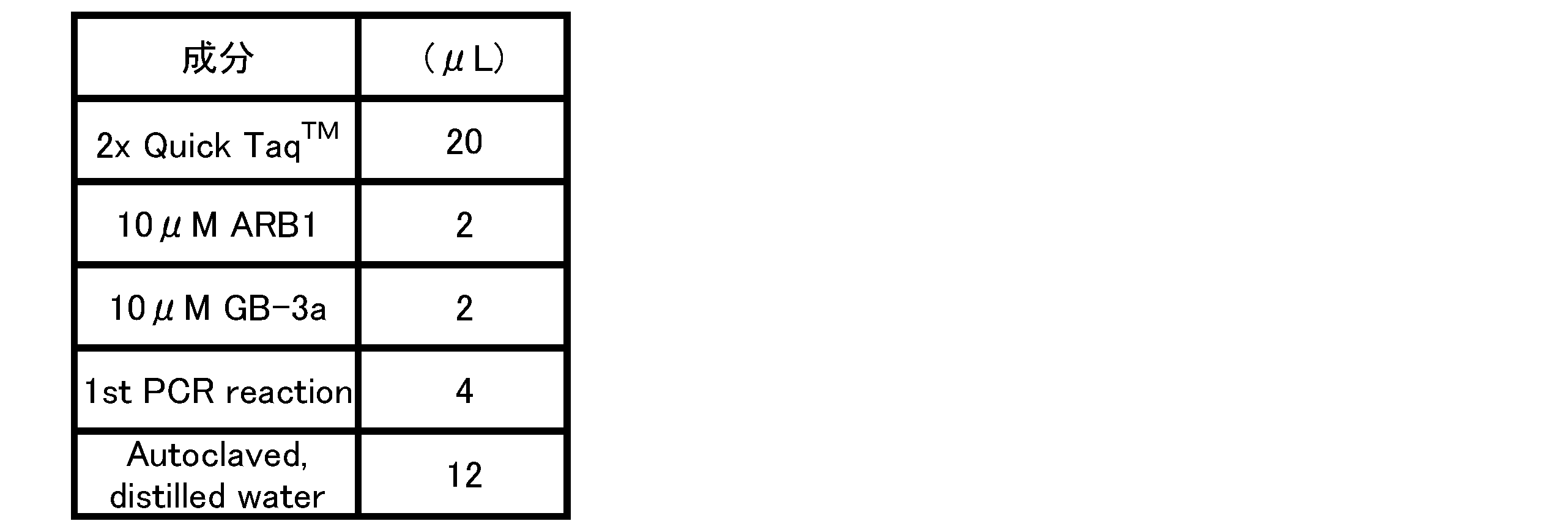
次に2nd PCR産物を0.5×TAE-バッファーで作成した0.8%(w/v)アガロースゲルを用いて電気泳動装置(アドバンスバイオ社製、Mupid-2 plus)を用いて、100Vで30分間電気泳動を行い、1μg/μLの臭化エチジウム中で20分間振とうして染色した。
この後、市販のDNA断片回収キット(RBC BIOSCIENCE社製、HiYield Gel/PCR DNA Fragments Extraction Kit)を用いて、以下のようにしてPCR産物の回収を行った。染色後、UVランプで照らしながら目的のバンド部分を切り取り、1.5mLのマイクロチューブに入れた。DF Buffer500μLをチューブに入れ、55℃で約10分間温めてゲルを完全に溶解させた。これを、コネクションチューブにつないだカラムに全て注入し10,000gで30秒間遠心分離した。コネクションチューブにある液を捨て、Wash Bufferを600μL入れて10,000gで30秒間遠心分離した。その後、再びコネクションチューブにある液を捨て、再度10,000gで3分間遠心分離し、カラムを乾燥させた。コネクションチューブを1.5mLマイクロチューブに付け替え、カラムの中心にElution Bufferを5μL添加した。再度10,000g、30秒で遠心分離し、PCR産物を回収した。
次に、市販のPCR産物のクローニングキット(Promega社製、pGEM-T Easy Vector Systems)を用いて、以下のようにしてPCR産物のライゲーションを行った。2×Rapid Ligation Bufferを2.5μLと、T4 DNA Ligase(3 Weiss Units/μL)及びpGEM-T Easy Vecter(17ng/μL)を0.5μLと、蒸留水を0.5μLと、回収したPCR産物を1.5μLとを混合し、室温で1時間静置した。次に、エレクトロポレーション用のキュベットに大腸菌TOP10株のコンピテントセルを55μL及びライゲーション産物を1μL注入した。これにエレクトロポレーション装置(Bio Rad社製、E.coliパルサー)を用いて1.25V、1秒でパルスを加えて、形質転換を行った。パルスを加えた後、キュベットに500μLのLB溶液を加えて混合し、懸濁液を1.5mLチューブに移した。チューブを横向きにし、バイオシェーカーを用いて1時間、37℃で培養した。その後、100μg/mLのアンピシリンを添加したLB寒天培地に培養液を200μL撒いて、インキュベーターで37℃、16時間培養した。
表4に示すコロニーPCR溶液を調製し、サンプル1種類につき5チューブずつ用意した。培地の単一コロニーを、2μLチップを付けたマイクロピペットでかき取り、マスタープレート用の100μg/mLのアンピシリン入りLB寒天培地に接種すると共に、先に調製したPCR用チューブに懸濁してPCR混合液を作成した。PCR混合液は、96℃2分、(95℃30秒、55℃30秒、68℃1分)×35回の条件でPCR装置にかけた。PCR後、電気泳動を行い、目的のバンドが出たコロニーをマスタープレートから滅菌した爪楊枝でかき取り、100μg/mLのアンピシリン入りLB液体培地に接種した。これを、バイオシェーカーを用いて120rpm、37℃、16時間培養した。
次に、市販のプラスミド分離キット(RBC BIOSCIENCE社製、HiYield Plasmid Mini Kit)を用いて、以下のようにしてプラスミドの生成を行った。培養液を1.5mLチューブに1.5mL入れて、20,000g、1分間の条件で遠心分離し、上澄みを捨てた。チューブにPD1 Bufferを200μL入れ、続いてPD2 Bufferバッファーを200μL加えて静かに5回転倒混和した。5分間静置した後、PD3 Bufferバッファーを300μL加えて10回転倒混和させ20,000g、3分間の条件で遠心分離した。上澄み液をカラムに入れ、コネクションチューブを取り付けて20,000g、30秒間の条件で遠心分離した。上澄み液を捨てカラムにW1 Bufferを400μL注入し、再び遠心分離をして上澄み液を捨て、Wash Bufferを600μL入れて20,000g、30秒間の条件で遠心分離した。その後、コネクションチューブを空にした状態で20,000g、3分間の条件で遠心分離して乾燥させた。コネクションチューブを1.5mLチューブに付け替えて、カラムの中心にElution Bufferを10μL添加し、20,000g、3分間の条件で遠心分離をし、精製したプラスミドを回収した。
回収した溶液を極微量分光光度計(Thermo scientific社製、Nano Drop 2000)を用いて260nmの吸光度(OD260値)と280nmの吸光度(OD280値)を計測し、回収したプラスミドの濃度を算出した。
1.5mLチューブに、精製したプラスミドと、1μLの10倍濃縮高塩濃度緩衝液(10×Hバッファ)と、0.5μLの制限酵素(EcoRI、15U/μL)とを入れ、蒸留水を加えて10μLとした。プラスミドの濃度は200nm/mgとなるようにした。これを37℃で2時間培養後、電気泳動用色素(6×Loading Dye)を3μL混合し、6.5μLを電気泳動した。制限酵素により、目的のバンドが出ているか確認した。
SequencingPCR溶液(5μM primer 1μL、5×Buffer 0.5μLを含む)に精製したプラスミドが200~400ng/mgになるよう加えた。チューブの蓋の内側に2μLの蒸留水を添加し、静かに蓋を閉め、96℃1分、(96℃10秒、50℃10秒、60℃4分)×35回の条件でPCR装置にかけた。
PCR後のチューブに蒸留水を3μL加え、1.5mLチューブに移した。そこにNaOAC(pH8.0、3M)を1μL、EDTA(0.5M)を加えて攪拌し、100%エタノールを40μL加えてさらに攪拌した。15分間遮光して静置した後、20,000gで15分間遠心分離し、上澄みを取り除き、70%エタノールを100μL加えた。そして15,000gで5分間遠心分離し、上澄みを取り除き、遮光状態で蓋を開けてエタノールを除いた。
広島大学構内の自然科学研究センター遺伝子科学研究開発部でサンプルの塩基配列を調査し、決定した塩基配列をBLASTプログラムでNCBIのデータベース、Pseudomonas Genome DBと比較して欠損した遺伝子の同定を行った。
この結果、MT-5のゲノムDNAに挿入されたトランスポゾンの隣接領域のDNA配列は、CAACCTGTTATTGATGGCAAAGGCCAGGCAGGCACAGAACGTTGCGCTGGACAGCCACGGCCAGAAGであった。このDNA配列より推定されるアミノ酸配列は、Pseudomonas putidaのABCトランスポータであるPP_4484タンパク質のアミノ酸配列と85.71%の相同性を有しており、MT-5におけるトランスポゾン変異の導入部位は、PP_4484タンパク質(232aa)の88番目のアミノ酸残基であった。このことから、MT-5はABCトランスポータであるPP_4484タンパク質の機能を欠失した変異体である。MT-5は、ABCトランスポータ遺伝子の欠損により、バイオフィルム形成に影響を与える何らかの物質が輸送されなくなり、バイオフィルム形成能力が向上したと推定される。
また、MT-10のゲノムDNAに挿入されたトランスポゾンの隣接領域のDNA配列は、TTACATCGTCTACGGGCCTTTGGCCAACGGCGCGACTTCACTGATGTTCGAAGGCGTACCCAATTACCCGGACACCTCGCGCTTCTGGCAAGTGGTGGACAAACATCAGGTAAACATCTTCTACACCGCACCCACCGCCCTGCGCGCGTTGATGCGTGAAGGTTCGGCACCGCTGCAGAGCACCTCGCGCAAAAGCCTGCGTCTGCTCGGCAGCGTTGGCGAGCCAATCAACCCGGAAGCCTGGGAGTGGTACTTCGAAGAGGTGGGCCAGAAGCGTTGCCCCATCGTCGACACCTGGTGGCAGACCGAGACCGGCGGCATCATGCTCACGCCGCTACCGGGTGCTCAAAAGCTCAAGCCCGGGTGCGCCACCCAGCCGATGTTCGGTGTGCAACCGGTGCTACTGGACGAAAAAGGCAAGCTGATCGAAGGCCCGGGCGCCGGTCTGCTGGTGATCAAGGCCAGCTGGCCCGGGCAGATCCGCAGCGTCTATGGTGACCACCAGCGCATGGTCGACACCTACTTCAAACCCATGCCCGGCTACTACTTCACCGGCGATGGCGCCCGCCGCGACGCTGATGGCGATTACTGGATCACCGGCCGCATCGACGATGTCATCAATGTCTCCGGCCACCGCATCGGCACCGCCGAGGTGGAAAGCGCGCTGであった。
このDNA配列より推定されるアミノ酸配列は、Pseudomonas putidaのAcetyl-CoA合成酵素であるPP_4702タンパク質のアミノ酸配列と97.3%の相同性を有しており、MT-10におけるトランスポゾン変異の導入部位は、PP_4702タンパク質(644aa)の310番目のアミノ酸残基であった。このことから、MT-10はAcetyl-CoA合成酵素であるPP_4702タンパク質の機能を欠失した変異体である。MT-10はAcetyl-CoA合成酵素に関する遺伝子が欠損した結果、タンパク質機能のコントロールの低下や、脂肪酸合成能の低下が生じ、菌体の凝集が促進され、バイオフィルム形成能力が上昇したと推測される。
(6)バイオフィルムの形態観察
変異体MT-5及びMT-10のバイオフィルムを、形態的に観察した。変異体MT-5及びMT-10並びに野生株P-451をLB寒天培地で培養し、単一コロニーを滅菌した爪楊枝でかき取り、それぞれLB液体培地で前培養した。培養液を1.5mLマイクロチューブに1mLずつ分注した後、遠心分離機にて20,000g、2分間の条件で遠心分離をし、上澄みを取り除き、1mLのLB(-NaCl)液体培地を加えて攪拌した。これを2回繰り返して菌体の洗浄を行った。2mLのLB(-NaCl)液体培地が入った10mL試験管にOD600値が0.05となるように菌懸濁液を添加した。その後試験管を28℃で、24時間静置培養を行った。これをそれぞれ3反復ずつ行った。
変異体MT-5及びMT-10のバイオフィルムを、形態的に観察した。変異体MT-5及びMT-10並びに野生株P-451をLB寒天培地で培養し、単一コロニーを滅菌した爪楊枝でかき取り、それぞれLB液体培地で前培養した。培養液を1.5mLマイクロチューブに1mLずつ分注した後、遠心分離機にて20,000g、2分間の条件で遠心分離をし、上澄みを取り除き、1mLのLB(-NaCl)液体培地を加えて攪拌した。これを2回繰り返して菌体の洗浄を行った。2mLのLB(-NaCl)液体培地が入った10mL試験管にOD600値が0.05となるように菌懸濁液を添加した。その後試験管を28℃で、24時間静置培養を行った。これをそれぞれ3反復ずつ行った。
培養後に写真撮影を行い、肉眼により形態的特徴を観察した。また、培養液のOD600値を分光光度計によって測定した。
図2及び図3に示すように、変異体MT-5及びMT-10並びに野生株P-451のいずれにもバイオフィルムの形成が確認された。変異体MT-5及びMT-10においては、野生株P-451と比べて、真横から見た際に明確に厚いバイオフィルムが確認できた。一方、MT-5及びP-451が形成したバイオフィルムの表面は滑らかであるのに対し、M-10が形成したバイオフィルムの表面には、皺が形成されており、MT-5及びP-451とは異なる形態を示した。また、OD600値は、P-451が2.7であったのに対し、MT-5では0.6であり、MT-10では0.2であった。MT-5及びMT-10においては、P-451と比べてバイオフィルムが明確に成長し、菌体がバイオフィルム内に取り込まれていることが確認された。
(7)リン酸カルシウム可溶化能力の評価
トランスポゾン変異を導入した変異体MT-5及びMT-10のリン酸カルシウム可溶化能力を野生株であるP-451と比較した。定量的なリン酸カルシウム分解能力の測定法はNautiyalの測定法(Nautiyal CS (1999) FEMS Microbiology Letters 170:265-270)を採用した。変異体MT-5及び野生株P-451を寒天培地で培養し、単一コロニーを滅菌した爪楊枝でかき取り、それぞれLB液体培地で前培養した。
トランスポゾン変異を導入した変異体MT-5及びMT-10のリン酸カルシウム可溶化能力を野生株であるP-451と比較した。定量的なリン酸カルシウム分解能力の測定法はNautiyalの測定法(Nautiyal CS (1999) FEMS Microbiology Letters 170:265-270)を採用した。変異体MT-5及び野生株P-451を寒天培地で培養し、単一コロニーを滅菌した爪楊枝でかき取り、それぞれLB液体培地で前培養した。
培養液を1.5mLマイクロチューブに1mLずつ分注した後、遠心分離機にて20,000g、2分間の条件で遠心分離をし、上澄みを取り除き、表5に示すNational Botanical Research Institute's phosphate(NBRIP)液体培地を1mL加えて攪拌した。これを2回繰り返して菌体の洗浄を行った。
次に、NBRIP液体培地を20mL入れた50mL三角フラスコに菌懸濁液を添加してOD600値が0.05になるよう調整した。バイオシェーカーを用いて120rpm、10日間振とう培養した。それぞれの菌株につき2反復分の培養を行い、これを各3反復行い、合計で各菌株につき6反復行った。

培養中、48時間毎に培養液中のリン酸濃度を定量した。リン濃度の測定はモリブデンブルー法により行った。培養液を100μL採取し、滅菌蒸留水900μLを入れた1.5mLチューブにて希釈した。続いてチューブを20,000g、5分間の条件で遠心分離した。培養液の上澄み10μLに、2.5%モリブデン酸アンモニウム0.8mL、6N硫酸0.8mL、アスコルビン酸89mgを加え、蒸留水により8mLとし、分光光度計を用いた820nmの吸光度(OD820値)を測定した。予め、既知濃度のリン酸を含む溶液を用いて作成した検量線によりOD820値からリン酸濃度を算出した。
図4に示すように、MT-5及びMT-10並びにP-451のいずれにおいても、培養液中のリン酸濃度は、培養を開始した後に大きく上昇した。これは、培養液中のリン酸カルシウムが、いずれの菌株においても可溶化されたことを示している。その後、いずれの菌株においても、培養液中のリン酸濃度は緩やかに低下した。これは、細菌がリン酸を消費したことによる。2日目から10日目まで、MT-5及びMT-10の培養液においてP-451の培養液よりもリン酸濃度が若干高くなっており、MT-5及びMT-10のリン可溶化能力はP-451と同等以上であることが示された。
(8)被覆種子の作成
植物への菌の付着について検討した。菌を付着させる植物には、イネ(ヒノヒカリ)の種子を用いた。種子は、60℃のお湯に30秒間浸漬した後、2.5%(v/v)次亜塩素酸ナトリウム溶液の入ったビーカーに入れ、スターラーで20分間攪拌することで殺菌処理を行った。その後、10分毎に滅菌水で洗うことを3回繰り返し、次亜塩素酸ナトリウムを取り除いた。殺菌処理をした種子は、100mL三角フラスコに15粒ずつ入れた。 被覆に用いる菌株はLB寒天培地で培養し、単一コロニーを滅菌した爪楊枝でかき取り、それぞれLB液体培地で前培養した。培養液を1.5mLマイクロチューブに1mLずつ分注した後、遠心分離機にて20,000g、2分間の条件で遠心分離をし、上澄みを取り除き、1mLの滅菌蒸留水を加えて攪拌した。これを2回繰り返して菌体の洗浄を行った。
植物への菌の付着について検討した。菌を付着させる植物には、イネ(ヒノヒカリ)の種子を用いた。種子は、60℃のお湯に30秒間浸漬した後、2.5%(v/v)次亜塩素酸ナトリウム溶液の入ったビーカーに入れ、スターラーで20分間攪拌することで殺菌処理を行った。その後、10分毎に滅菌水で洗うことを3回繰り返し、次亜塩素酸ナトリウムを取り除いた。殺菌処理をした種子は、100mL三角フラスコに15粒ずつ入れた。 被覆に用いる菌株はLB寒天培地で培養し、単一コロニーを滅菌した爪楊枝でかき取り、それぞれLB液体培地で前培養した。培養液を1.5mLマイクロチューブに1mLずつ分注した後、遠心分離機にて20,000g、2分間の条件で遠心分離をし、上澄みを取り除き、1mLの滅菌蒸留水を加えて攪拌した。これを2回繰り返して菌体の洗浄を行った。
洗浄を行った後、OD600値が0.05となるように、LB(-NaCl)液体培地で希釈を行い、これを種子を入れた三角フラスコに10mL加えた。この後、インキュベーターにより28℃で、24時間静置培養を行った。
培養後、培養液を取り除き、滅菌蒸留水を30mL注入した。攪拌後、蒸留水を取り除き、これを5回繰り返し、種子に付着していない菌を除去した。この後、培養後の種子を滅菌したすり鉢を使ってすり潰した。すり潰した種子を10mLの滅菌蒸留水に懸濁し、15mLのチューブに注入した。これを3粒の種子についてそれぞれ行った。また、前培養から2反復行った。この後、希釈平板法によって菌数を測定した。菌数測定の際に、野生株P-451は20μg/mLクロラムフェニコールを含むLB寒天培地を使用し、変異体MT-5及びMT-10は20μg/mLクロラムフェニコールと90μg/mgゲンタマイシンを含むLB寒天培地を使用した。
表6に示すように、1反復目のMT-5の種子1粒あたりのコロニー数は230000cfuであり、MT-10のコロニー数は77000cfuであり、P-451のコロニー数は120000cfuであった。2反復目のMT-5のコロニー数は、270000cfuであり、MT-10のコロニー数は25000cfuであり、P-451のコロニー数は25000cfuであった。1反復目、2反復目のいずれにおいても、MT-5とP-451との間には、コロニー数に有為な差が認められ、MT-5は、P451よりも植物の表面に付着させやすいことが示された。一方、1反復目、2反復目のいずれにおいても、MT-10とP-451との間には、コロニー数に有為な差は認められなかった。
本開示の新規微生物は、リンの可溶化能力及びバイオフィルムの形成能力が高く、バイオ肥料等として有用である。
Claims (10)
- 難溶性リン化合物をリン酸へ分解するPseudomonas属のリン溶解菌であり、PP_4484タンパク質の機能を欠失した変異体である、新規微生物。
- 前記変異体は、トランスポゾン変異体である、請求項1に記載の新規微生物。
- 難溶性リン化合物をリン酸へ分解するリン溶解菌であり、バイオフィルム作成能力を有するPseudomonas sp.MT-5株(受託番号 NITE BP-02215)である、新規微生物。
- 請求項1~3のいずれか1項に記載の新規微生物を含むバイオフィルムを表面に付着させた、種子。
- 難溶性リン化合物のリン酸へ分解するPseudomonas属のリン溶解菌に、変異を導入して、変異株を得る工程と、
前記変異株のうち、バイオフィルム形成能力が野生株よりも高い株をスクリーニングする工程とを備えた、新規微生物の作成方法。 - 前記スクリーニングする工程において、PP_4484タンパク質の機能が欠失した株を選択する、請求項5に記載の新規微生物の作成方法。
- 前記リン溶解菌が、Pseudomonas putidaである、請求項5又は6に記載の新規微生物の作成方法。
- 前記リン溶解菌が、Pseudomonas sp.P-451株(受託番号 NITE BP-02205)である、請求項5又は6に記載の新規微生物の作成方法。
- 前記変異を導入する工程において、トランスポゾンドナーとしてE.coli MC4100/pMAR2xT7を用い、トランスポゾンヘルパーとしてE.coli HB101/pRK2013を用いて、トランスポゾン変異を導入する、請求項5~8のいずれか1項に記載の新規微生物の作成方法。
- 請求項5~9のいずれか1項に記載の新規微生物の作成方法により作成した新規微生物を種子と共に、20℃以上、35℃以下の温度で培養して、種子の表面にバイオフィルムを形成させる、バイオフィルム被覆種子の作成方法。
Priority Applications (1)
| Application Number | Priority Date | Filing Date | Title |
|---|---|---|---|
| JP2018505856A JP6952349B2 (ja) | 2016-03-16 | 2017-03-08 | 新規微生物及びその作成方法 |
Applications Claiming Priority (2)
| Application Number | Priority Date | Filing Date | Title |
|---|---|---|---|
| JP2016052879 | 2016-03-16 | ||
| JP2016-052879 | 2016-03-16 |
Publications (1)
| Publication Number | Publication Date |
|---|---|
| WO2017159499A1 true WO2017159499A1 (ja) | 2017-09-21 |
Family
ID=59851506
Family Applications (1)
| Application Number | Title | Priority Date | Filing Date |
|---|---|---|---|
| PCT/JP2017/009268 Ceased WO2017159499A1 (ja) | 2016-03-16 | 2017-03-08 | 新規微生物及びその作成方法 |
Country Status (2)
| Country | Link |
|---|---|
| JP (1) | JP6952349B2 (ja) |
| WO (1) | WO2017159499A1 (ja) |
Cited By (1)
| Publication number | Priority date | Publication date | Assignee | Title |
|---|---|---|---|---|
| CN112322535A (zh) * | 2020-11-09 | 2021-02-05 | 广东省微生物研究所(广东省微生物分析检测中心) | 一种解磷假单胞菌及其应用 |
Citations (1)
| Publication number | Priority date | Publication date | Assignee | Title |
|---|---|---|---|---|
| WO2010018210A1 (en) * | 2008-08-14 | 2010-02-18 | Bio-Iliberis Research And Development S.L. | Microorganism capable of solubilizing phosphate and iron and its applications |
Family Cites Families (1)
| Publication number | Priority date | Publication date | Assignee | Title |
|---|---|---|---|---|
| US20120129693A1 (en) * | 2009-05-28 | 2012-05-24 | Takashi Ano | Seed having inoculated with bacterial bilfilm |
-
2017
- 2017-03-08 JP JP2018505856A patent/JP6952349B2/ja active Active
- 2017-03-08 WO PCT/JP2017/009268 patent/WO2017159499A1/ja not_active Ceased
Patent Citations (1)
| Publication number | Priority date | Publication date | Assignee | Title |
|---|---|---|---|---|
| WO2010018210A1 (en) * | 2008-08-14 | 2010-02-18 | Bio-Iliberis Research And Development S.L. | Microorganism capable of solubilizing phosphate and iron and its applications |
Non-Patent Citations (5)
| Title |
|---|
| AKIHIRO UEDA, YUYO DOJO SAIKIN NO BIOFILM KEISEI O KAISHITA SHOKUBUTSU HYOMEN ENO TEICHAKUNO NO KAIZEN, vol. 27, 2013, pages 59 - 60 * |
| DATABASE Database 4 March 2016 (2016-03-04), BELDA, E. ET AL., XP055423068, Database accession no. NP - 746595 * |
| KENJI OKANO ET AL.: "Biseibutsu ni yoru Nan'yosei Phosphate Yokai Kiko no Kaimei(l) Calcium Phosphate", PROCEEDINGS OF THE ANNUAL MEETING OF JAPAN SOCIETY FOR BIOSCIENCE , BIOTECHNOLOGY, AND AGROCHEMISTRY, 2015, pages 1294 * |
| MIZUKI NAKANO ET AL.: "Transposon Hen'i ni yoru Nan'yosei Phosphorus Kayoka Saikin no Biofilm Keisei Noryoku no Kojo", ABSTRACTS OF THE ANNUAL MEETING, pages 43 * |
| UEDA, A. ET AL.: "Characterization of the Ability to Form Biofilms by Plant-Associated Pseudomonas Species", CURRENT MICROBIOLOGY, vol. 70, 2015, pages 506 - 513, XP035455352 * |
Cited By (2)
| Publication number | Priority date | Publication date | Assignee | Title |
|---|---|---|---|---|
| CN112322535A (zh) * | 2020-11-09 | 2021-02-05 | 广东省微生物研究所(广东省微生物分析检测中心) | 一种解磷假单胞菌及其应用 |
| CN112322535B (zh) * | 2020-11-09 | 2021-07-27 | 广东省科学院微生物研究所(广东省微生物分析检测中心) | 一种解磷假单胞菌及其应用 |
Also Published As
| Publication number | Publication date |
|---|---|
| JP6952349B2 (ja) | 2021-10-20 |
| JPWO2017159499A1 (ja) | 2019-01-31 |
Similar Documents
| Publication | Publication Date | Title |
|---|---|---|
| Zhao et al. | Antagonistic endophytic bacteria associated with nodules of soybean (Glycine max L.) and plant growth-promoting properties | |
| Govindarajan et al. | Effects of the inoculation of Burkholderia vietnamensis and related endophytic diazotrophic bacteria on grain yield of rice | |
| Jha et al. | Endophytic colonization of Typha australis by a plant growth‐promoting bacterium Klebsiella oxytoca strain GR‐3 | |
| Lin et al. | The actinobacterium Microbacterium sp. 16SH accepts pBBR1-based pPROBE vectors, forms biofilms, invades roots, and fixes N2 associated with micropropagated sugarcane plants | |
| CN110167350A (zh) | 确定的微生物组合物 | |
| Eslahi et al. | Influence of recombinant Trichoderma strains on growth of bean (Phaseolus vulgaris L) by increased root colonization and induction of root growth related genes | |
| EP3659440B1 (en) | Plant growth promoting microorganism and enzymes for soil biogenic cycles | |
| WO2023092654A1 (zh) | 治理汞污染的真菌、生物菌剂及应用和除汞方法以及鉴定治理汞污染能力真菌的方法 | |
| Świątczak et al. | The effect of seed bacterization with Bacillus paralicheniformis 2R5 on bacterial and fungal communities in the canola rhizosphere | |
| Castaldi et al. | Use of halotolerant Bacillus amyloliquefaciens RHF6 as a bio-based strategy for alleviating salinity stress in Lotus japonicus cv Gifu | |
| Kuzmina et al. | Characterization of the novel plant growth-stimulating strain Advenella kashmirensis IB-K1 and evaluation of its efficiency in saline soil | |
| Mukherjee et al. | Characterization of a potent plant growth promoting fungal strain Aspergillus fumigatus MCC 1721 with special reference to indole-3-acetic acid production | |
| Villanueva et al. | Plant growth promoter collection of Gluconacetobacter diazotrophicus from northern coast of Peru | |
| Mani et al. | Halophilic Phosphate-Solubilizing microbes (Priestia megaterium and Bacillus velezensis) isolated from Arabian sea seamount sediments for plant growth promotion | |
| JP2016531589A (ja) | 単離されたストレプトマイセス属の細菌 | |
| JP6952349B2 (ja) | 新規微生物及びその作成方法 | |
| JP2019064930A (ja) | 耐塩性改善用組成物及び植物体の生育方法 | |
| JP2024522828A (ja) | 窒素固定微生物の活性を増加するための相乗作用的微生物株 | |
| Hussein et al. | Amino-cyclopropane-1-carboxylate deaminase (ACCD) producing yeasts improved salinity tolerance of Triticum aestivum L. | |
| CN109517756B (zh) | 一株海洋解磷巨大芽孢杆菌及其应用 | |
| CN116891809B (zh) | 一株亚洲假单胞菌及微生物菌剂和应用 | |
| Lan et al. | ISOLATION AND IDENTIFICATION OF INDOLE ACETIC ACID PRODUCING BACTERIA FROM THE COASTS OF BEN TRE AND TRA VINH PROVINCES. | |
| EP3049540B1 (fr) | Utilisations en agriculture d'une nouvelle bactérie du genre streptomyces | |
| EP3728622A1 (en) | Biosurfactant production | |
| CN100417719C (zh) | 有助于农作物生长的假单孢菌RRj228及含有该菌株的微生物制剂 |
Legal Events
| Date | Code | Title | Description |
|---|---|---|---|
| WWE | Wipo information: entry into national phase |
Ref document number: 2018505856 Country of ref document: JP |
|
| NENP | Non-entry into the national phase |
Ref country code: DE |
|
| 121 | Ep: the epo has been informed by wipo that ep was designated in this application |
Ref document number: 17766500 Country of ref document: EP Kind code of ref document: A1 |
|
| 122 | Ep: pct application non-entry in european phase |
Ref document number: 17766500 Country of ref document: EP Kind code of ref document: A1 |