WO2017150723A1 - ステロールの製造法 - Google Patents
ステロールの製造法 Download PDFInfo
- Publication number
- WO2017150723A1 WO2017150723A1 PCT/JP2017/008586 JP2017008586W WO2017150723A1 WO 2017150723 A1 WO2017150723 A1 WO 2017150723A1 JP 2017008586 W JP2017008586 W JP 2017008586W WO 2017150723 A1 WO2017150723 A1 WO 2017150723A1
- Authority
- WO
- WIPO (PCT)
- Prior art keywords
- sterol
- sterols
- acid
- algae
- culture
- Prior art date
- Legal status (The legal status is an assumption and is not a legal conclusion. Google has not performed a legal analysis and makes no representation as to the accuracy of the status listed.)
- Ceased
Links
Images

Classifications
-
- A—HUMAN NECESSITIES
- A61—MEDICAL OR VETERINARY SCIENCE; HYGIENE
- A61K—PREPARATIONS FOR MEDICAL, DENTAL OR TOILETRY PURPOSES
- A61K36/00—Medicinal preparations of undetermined constitution containing material from algae, lichens, fungi or plants, or derivatives thereof, e.g. traditional herbal medicines
- A61K36/02—Algae
-
- C—CHEMISTRY; METALLURGY
- C07—ORGANIC CHEMISTRY
- C07J—STEROIDS
- C07J1/00—Normal steroids containing carbon, hydrogen, halogen or oxygen, not substituted in position 17 beta by a carbon atom, e.g. estrane, androstane
-
- C—CHEMISTRY; METALLURGY
- C07—ORGANIC CHEMISTRY
- C07J—STEROIDS
- C07J13/00—Normal steroids containing carbon, hydrogen, halogen or oxygen having a carbon-to-carbon double bond from or to position 17
-
- C—CHEMISTRY; METALLURGY
- C07—ORGANIC CHEMISTRY
- C07J—STEROIDS
- C07J17/00—Normal steroids containing carbon, hydrogen, halogen or oxygen, having an oxygen-containing hetero ring not condensed with the cyclopenta(a)hydrophenanthrene skeleton
-
- C—CHEMISTRY; METALLURGY
- C07—ORGANIC CHEMISTRY
- C07J—STEROIDS
- C07J5/00—Normal steroids containing carbon, hydrogen, halogen or oxygen, substituted in position 17 beta by a chain of two carbon atoms, e.g. pregnane and substituted in position 21 by only one singly bound oxygen atom, i.e. only one oxygen bound to position 21 by a single bond
-
- C—CHEMISTRY; METALLURGY
- C07—ORGANIC CHEMISTRY
- C07J—STEROIDS
- C07J51/00—Normal steroids with unmodified cyclopenta(a)hydrophenanthrene skeleton not provided for in groups C07J1/00 - C07J43/00
-
- C—CHEMISTRY; METALLURGY
- C07—ORGANIC CHEMISTRY
- C07J—STEROIDS
- C07J63/00—Steroids in which the cyclopenta(a)hydrophenanthrene skeleton has been modified by expansion of only one ring by one or two atoms
-
- C—CHEMISTRY; METALLURGY
- C07—ORGANIC CHEMISTRY
- C07J—STEROIDS
- C07J7/00—Normal steroids containing carbon, hydrogen, halogen or oxygen substituted in position 17 beta by a chain of two carbon atoms
-
- C—CHEMISTRY; METALLURGY
- C07—ORGANIC CHEMISTRY
- C07J—STEROIDS
- C07J9/00—Normal steroids containing carbon, hydrogen, halogen or oxygen substituted in position 17 beta by a chain of more than two carbon atoms, e.g. cholane, cholestane, coprostane
-
- C—CHEMISTRY; METALLURGY
- C12—BIOCHEMISTRY; BEER; SPIRITS; WINE; VINEGAR; MICROBIOLOGY; ENZYMOLOGY; MUTATION OR GENETIC ENGINEERING
- C12N—MICROORGANISMS OR ENZYMES; COMPOSITIONS THEREOF; PROPAGATING, PRESERVING, OR MAINTAINING MICROORGANISMS; MUTATION OR GENETIC ENGINEERING; CULTURE MEDIA
- C12N1/00—Microorganisms; Compositions thereof; Processes of propagating, maintaining or preserving microorganisms or compositions thereof; Processes of preparing or isolating a composition containing a microorganism; Culture media therefor
- C12N1/12—Unicellular algae; Culture media therefor
-
- C—CHEMISTRY; METALLURGY
- C12—BIOCHEMISTRY; BEER; SPIRITS; WINE; VINEGAR; MICROBIOLOGY; ENZYMOLOGY; MUTATION OR GENETIC ENGINEERING
- C12P—FERMENTATION OR ENZYME-USING PROCESSES TO SYNTHESISE A DESIRED CHEMICAL COMPOUND OR COMPOSITION OR TO SEPARATE OPTICAL ISOMERS FROM A RACEMIC MIXTURE
- C12P33/00—Preparation of steroids
-
- C—CHEMISTRY; METALLURGY
- C12—BIOCHEMISTRY; BEER; SPIRITS; WINE; VINEGAR; MICROBIOLOGY; ENZYMOLOGY; MUTATION OR GENETIC ENGINEERING
- C12P—FERMENTATION OR ENZYME-USING PROCESSES TO SYNTHESISE A DESIRED CHEMICAL COMPOUND OR COMPOSITION OR TO SEPARATE OPTICAL ISOMERS FROM A RACEMIC MIXTURE
- C12P7/00—Preparation of oxygen-containing organic compounds
- C12P7/02—Preparation of oxygen-containing organic compounds containing a hydroxy group
Definitions
- the present invention relates to algae that produce sterols and a method for producing sterols using the algae.
- Sterols are steroid derivatives having a hydroxyl group at the C-3 position and are found in various organisms such as animals, plants and fungi. Sterols are produced, for example, by extraction from biological resources that contain those sterols. Moreover, what produces sterols, such as cholesterol, is known in the Labyrinthula which are heterotrophic algae (nonpatent literature 1).
- An object of the present invention is to provide an algae that produces sterol and a method for producing sterol using the algae.
- the present invention can be exemplified as follows. [1] Culturing an algae selected from the group consisting of AJ7867 strain (FERM BP-22304) and its derivatives in a medium; Recovering sterols from algal bodies produced by the culture, A method for producing a sterol, comprising: [2] The method, wherein the sterol is one or more sterols selected from the group consisting of animal sterols, plant sterols, and fungal sterols.
- the sterol is cholesterol, 7-dehydrocholesterol, glycolic acid, taurocholic acid, cholic acid, estradiol, estrone, ethinylestradiol, estriol, dehydroepiandrosterone, methylandrostenediol, 5 ⁇ -pregnane-3 ⁇ , 20 ⁇ -diol, Pregnenolone, chenodeoxycholic acid, dehydrocholic acid, dihydroxycholesterol, digitoxigenin, desmosterol, lasosterol, stigmasterol, ⁇ -sitosterol, brassicasterol, campesterol, diosgenin, oleanolic acid, betulinic acid, ursolic acid, hecogenin, salsasapogenin , Isofucosterol, avenasterol, ⁇ 7-stigmastenol, ⁇ 7-campestenol, fucos Roll, monkey gas Te roll is one or more sterols selected from
- the sterol is cholesterol.
- the algae is an Aurantiochytrium algae having a base sequence represented by SEQ ID NO: 3.
- a method for producing a sterol comprising: [7] The method, wherein the sterol is one or more sterols selected from the group consisting of animal sterols, plant sterols, and fungal sterols.
- the sterol is cholesterol, 7-dehydrocholesterol, glycolic acid, taurocholic acid, cholic acid, estradiol, estrone, ethinylestradiol, estriol, dehydroepiandrosterone, methylandrostenediol, 5 ⁇ -pregnane-3 ⁇ , 20 ⁇ -diol, Pregnenolone, chenodeoxycholic acid, dehydrocholic acid, dihydroxycholesterol, digitoxigenin, desmosterol, lasosterol, stigmasterol, ⁇ -sitosterol, brassicasterol, campesterol, diosgenin, oleanolic acid, betulinic acid, ursolic acid, hecogenin, salsasapogenin , Isofucosterol, avenasterol, ⁇ 7-stigmastenol, ⁇ 7-campestenol, fucos Roll, monkey gas Te roll is one or more sterols selected from
- the algae is an algae selected from AJ7867 strain (FERM BP-22304) and its derivatives.
- the algae of the present invention has high sterol production ability.
- the algae of the present invention may have one sterol-producing ability or may have two or more sterol-producing ability.
- the algae of the present invention may be, for example, algae selected from AJ7867 strain (FERM BP-22304) and its derivatives.
- AJ7867 shares were entrusted to the Patent Biological Depositary Center (Postal Code 292-0818, Kisarazu Kazusa Kamashi 2-5-8, Room 120, Chiba, Japan) on January 8, 2016 Deposited under the number FERM P-22304. Thereafter, the AJ7867 strain was transferred to an international deposit under the Budapest Treaty on December 22, 2016, and was given the accession number FERM BP-22304.
- the AJ7867 strain is considered to be related to the Aurantiochytrium genus by molecular phylogenetic analysis using the 18S rDNA sequence as an index.
- the base sequence of 18S rDNA of AJ7867 strain is shown in SEQ ID NO: 3. That is, the algae of the present invention may be algae such as auranthiochytrium algae having the base sequence shown in SEQ ID NO: 3, for example.
- the algae of the present invention is specifically an algae selected from, for example, AJ7867 strain (FERM BP-22304) and its derivative strain, and may have the base sequence shown in SEQ ID NO: 3.
- the algae of the present invention are specifically algae selected from, for example, the AJ7867 strain (FERM BP-22304) and its derivative strains, and may be auranthiochytrium algae.
- the alga of the present invention is an algae selected from, for example, the AJ7867 strain (FERM BP-22304) and its derivative strain, and has the base sequence shown in SEQ ID NO: 3 It may be what is.
- derived strain refers to a strain constructed with the AJ7867 strain as a parent strain (ancestor strain) and having a sterol-producing ability equal to or higher than that of the parent strain (ancestral strain).
- the derivative strain may be bred by artificial modification, for example.
- Artificial alteration includes alteration by genetic engineering techniques and alteration by mutation treatment. Mutation treatments include X-ray irradiation, UV irradiation, and N-methyl-N′-nitro-N-nitrosoguanidine (MNNG), ethylmethanesulfonate (EMS), and methylmethanesulfonate (MMS). ) And the like.
- stock may arise naturally, for example in the case of use of a parent strain (ancestor strain).
- parent strain ancestor strain
- examples of such derivative strains include mutant strains that are naturally generated when the AJ7867 strain is cultured.
- a derivative strain may be constructed by one type of modification or by a combination of two or more types of modification.
- the induced strain has a sterol production ability equal to or higher than that of the parent strain” means that when the induced strain is cultured in a medium, the sterol is produced (ie accumulated) when the parent strain is cultured under the same conditions per dry weight of algal bodies. It may mean producing (accumulating) sterols in an amount of 70% or more, 80% or more, 90% or more, or 95% or more of the amount.
- the derivative strain has, for example, a total sterol amount of 2.5% (w / w-DCW) or more, 2.7% (w / w-DCW) or more, 3.0% (w / w-DCW) or more, Alternatively, sterol may be generated (accumulated) in an amount of 3.3% (w / w-DCW) or more.
- the derivative strain is, for example, in an amount of 1.2% (w / w-DCW) or more, 1.5% (w / w-DCW) or more, or 2.0% (w / w-DCW) or more. Cholesterol may be generated (accumulated).
- the derivative strain is, for example, 0.95% (w / w-DCW) or more, 1.0% (w / w-DCW) or more, or 1.1% (w / w-DCW) or more.
- Stigmasterol may be generated (accumulated). “% (W / w-DCW)” indicates the percentage of the weight of an object (such as sterol) relative to the dry alga body weight (DCW).
- the culture conditions are not particularly limited as long as the algae of the present invention can sufficiently grow. Examples of such culture conditions include the culture conditions described below. Specific examples of such culture conditions include the culture conditions described in the examples.
- the amount of sterol can be measured, for example, by a method described later.
- the “sterol amount” means an amount converted to the weight of free sterol unless otherwise specified.
- Steprol is a general term for steroid derivatives having a hydroxyl group at the C-3 position.
- Step 2 is a general term for compounds having a cyclopentanohydrophenanthrene ring skeleton.
- sterol is a general term for compounds having a cyclopentanohydrophenanthrene ring skeleton having a hydroxyl group at the C-3 position.
- the basic skeleton of sterol that is, a cyclopentanohydrophenanthrene ring skeleton having a hydroxyl group at the C-3 position is represented by the following formula (1).
- Sterols may have various substituents in the basic skeleton. Typical substituents that sterol has include a methyl group at the C-10 position, a methyl group at the C-13 position, and an alkyl group at the C-17 position.
- the alkyl group may be, for example, linear, branched or cyclic, and may be saturated or unsaturated.
- the cyclopentanohydrophenanthrene ring skeleton may contain one or more double bonds.
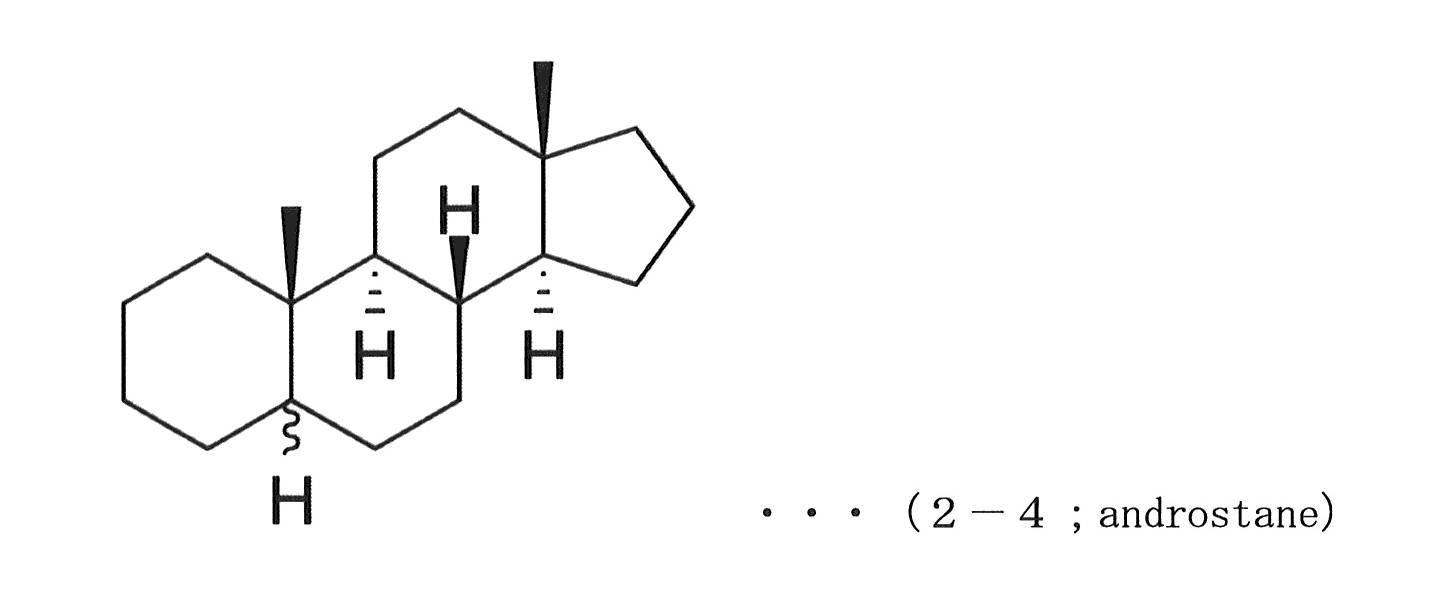
- Typical skeletons possessed by steroids include cholestane, cholane, pregnane, androstane, and estrane. These representative steroid skeletons are respectively represented by the following formulas (2-1) to (2-5). That is, typical sterols include compounds having a skeleton having a hydroxyl group introduced at the C-3 position of the steroid skeleton represented by the following formulas (2-1) to (2-5).
- sterols examples include animal sterols, plant sterols, and fungal sterols.
- Animal sterols”, “plant sterols” and “fungal sterols” refer to sterols found in animals, plants and fungi, respectively.
- the “plant” mentioned here includes algae.
- animal sterols include cholesterol, 7-dehydrocholesterol, glycolic acid, taurocholic acid, cholic acid, estradiol, estrone, ethinylestradiol, estriol, dehydroepiandrosterone, methylandrostenediol, 5 ⁇ -pregnane-3 ⁇ , 20 ⁇ -diol , Pregnenolone, chenodeoxycholic acid, dehydrocholic acid, dihydroxycholesterol, digitoxigenin, desmosterol, lasosterol.
- Plant sterols include stigmasterol, ⁇ -sitosterol, brassicasterol, campesterol, diosgenin, oleanolic acid, betulinic acid, ursolic acid, hecogenin, sarsasapogenin, isofucosterol, abenasterol, ⁇ 7-stigmastenol, ⁇ 7-campestenol, fucosterol, salgasterol can be mentioned.
- ergosterol As the fungal sterol, ergosterol can be mentioned.
- sterols examples include cholesterol and stigmasterol. More particularly, sterols include cholesterol.
- Sterols can exist in the form of, for example, a free form, a fatty acid ester form, a glycoside form, and the like. That is, “sterol” may mean a free sterol, a sterol fatty acid ester, a sterol glycoside, or a mixture thereof, unless otherwise specified.
- the algae of the present invention can be used, for example, for the production of sterols. That is, the method of the present invention is a method for producing sterol, comprising culturing the algae of the present invention in a medium and recovering sterol from the algal bodies produced by the culture.
- “algae” refers to algae cells obtained by culturing algae in a medium. In the method of the present invention, one sterol may be produced, or two or more sterols may be produced.
- the medium to be used is not particularly limited as long as the algae of the present invention can grow and sterols are produced.
- a normal medium used for culturing heterotrophic algae such as Labyrinthula can be used.
- the medium may contain a component selected from a carbon source, a nitrogen source, a phosphoric acid source, a sulfur source, and other various organic and inorganic components as necessary.
- Specific examples of the medium include GPY medium (Example) prepared with 0 to 1 ⁇ artificial seawater.
- the carbon source examples include glucose, fructose, sucrose, lactose, galactose, xylose, arabinose, waste molasses, starch hydrolysate, biomass hydrolyzate and other sugars, and organic acids such as acetic acid and citric acid. Alcohols such as ethanol, glycerol and crude glycerol, and fatty acids.
- one type of carbon source may be used, or two or more types of carbon sources may be used in combination.
- the nitrogen source include ammonium salts such as ammonium sulfate, ammonium chloride, and ammonium phosphate, organic nitrogen sources such as peptone, yeast extract, meat extract, soybean protein degradation product, ammonia, and urea. Ammonia gas or ammonia water used for pH adjustment may be used as a nitrogen source. As the nitrogen source, one kind of nitrogen source may be used, or two or more kinds of nitrogen sources may be used in combination.
- the phosphoric acid source examples include phosphates such as potassium dihydrogen phosphate and dipotassium hydrogen phosphate, and phosphate polymers such as pyrophosphoric acid.
- phosphates such as potassium dihydrogen phosphate and dipotassium hydrogen phosphate
- phosphate polymers such as pyrophosphoric acid.
- the phosphoric acid source one type of phosphoric acid source may be used, or two or more types of phosphoric acid sources may be used in combination.
- the sulfur source include inorganic sulfur compounds such as sulfate, thiosulfate, and sulfite, and sulfur-containing amino acids such as cysteine, cystine, and glutathione.
- the sulfur source one kind of sulfur source may be used, or two or more kinds of sulfur sources may be used in combination.
- organic and inorganic components include, for example, inorganic salts such as sodium chloride and potassium chloride; trace metals such as iron, manganese, magnesium and calcium; vitamin B1, vitamin B2, vitamin B6 and nicotine Examples include vitamins such as acid, nicotinamide, and vitamin B12; amino acids; nucleic acids; and organic components such as peptone, casamino acid, yeast extract, and soybean protein degradation products containing these.
- inorganic salts such as sodium chloride and potassium chloride
- trace metals such as iron, manganese, magnesium and calcium
- vitamin B1, vitamin B2, vitamin B6 and nicotine include vitamins such as acid, nicotinamide, and vitamin B12; amino acids; nucleic acids; and organic components such as peptone, casamino acid, yeast extract, and soybean protein degradation products containing these.
- vitamins such as acid, nicotinamide, and vitamin B12
- amino acids amino acids
- nucleic acids amino acids
- organic components such as peptone, casamino acid, yeast extract, and soybean
- Culture conditions are not particularly limited as long as the algae of the present invention can grow and sterols are produced.
- the culture can be performed under normal conditions used for culture of heterotrophic algae such as Labyrinthula.
- Cultivation can be performed using a liquid medium.
- a liquid medium may be directly inoculated with the algae of the present invention cultured in a solid medium such as an agar medium, or a seed culture of the algae of the present invention in a liquid medium.
- the medium may be inoculated. That is, the culture may be performed separately for seed culture and main culture. In that case, the culture conditions of the seed culture and the main culture may or may not be the same.
- the amount of the alga of the present invention contained in the medium at the start of culture is not particularly limited.
- the main culture may be performed, for example, by inoculating 1-50% (v / v) of the seed culture solution in the main culture medium.
- Culture can be performed by batch culture, fed-batch culture, continuous culture, or a combination thereof.
- the medium at the start of the culture is also referred to as “initial medium”.
- a medium supplied to a culture system (fermentor) in fed-batch culture or continuous culture is also referred to as “fed-batch medium”.
- supplying a feeding medium to a culture system in fed-batch culture or continuous culture is also referred to as “fed-batch”.
- cultivation is performed by dividing into seed culture and main culture, for example, both seed culture and main culture may be performed by batch culture. Further, for example, seed culture may be performed by batch culture, and main culture may be performed by fed-batch culture or continuous culture.
- Culture can be performed, for example, under aerobic conditions.
- the aerobic condition means that the dissolved oxygen concentration in the liquid medium is 0.33 ppm or more, which is the detection limit of the oxygen membrane electrode, and preferably 1.5 ppm or more.
- the oxygen concentration may be controlled to, for example, about 5 to 50%, preferably about 10% of the saturated oxygen concentration.
- culture under aerobic conditions can be performed by aeration culture, shaking culture, agitation culture, or a combination thereof.
- the pH of the medium may be, for example, pH 3 to 10, preferably pH 4.0 to 9.5. During the culture, the pH of the medium can be adjusted as necessary.
- the pH of the medium is various alkaline or acidic substances such as ammonia gas, aqueous ammonia, sodium carbonate, sodium bicarbonate, potassium carbonate, potassium bicarbonate, magnesium carbonate, sodium hydroxide, calcium hydroxide, magnesium hydroxide, hydrochloric acid, sulfuric acid, etc. Can be adjusted.
- the culture temperature may be, for example, 20 to 35 ° C, preferably 25 ° C to 35 ° C.
- the culture period may be, for example, 10 hours to 120 hours.
- the culture may be continued, for example, until the carbon source in the medium is consumed or until the activity of the algae of the present invention is lost. By culturing the algae of the present invention under such conditions, algal bodies containing sterols are produced.
- Sterols can be collected from algal cells as appropriate. That is, sterols can be extracted from algal bodies and recovered. Algal bodies may be used for extraction of sterol while contained in the medium, or may be collected from the medium and then used for extraction of sterol.
- the algal bodies that is, the culture medium containing the algal bodies and the algal bodies recovered from the culture medium may be appropriately subjected to treatments such as dilution, concentration, freezing, thawing, and drying, and then subjected to sterol extraction. These treatments may be performed alone or in appropriate combination. These treatments can be appropriately selected according to various conditions such as the type of sterol extraction method.
- the method for recovering the algal cells from the medium is not particularly limited, and for example, a known method (Grima, E. M. et al. 2003. Biotechnol. Advances 20: 491-515) can be used.
- algal bodies can be recovered from the culture medium by methods such as natural sedimentation, centrifugation, and filtration. At that time, a flocculant may be used.
- the collected algal bodies can be appropriately washed using an appropriate medium.
- the collected alga bodies can be appropriately resuspended using an appropriate medium.
- Examples of the medium that can be used for washing and suspension include an aqueous medium (aqueous solvent) such as water and an aqueous buffer, an organic medium (organic solvent) such as methanol, and a mixture thereof.
- aqueous medium such as water and an aqueous buffer
- organic medium organic solvent
- the medium can be appropriately selected according to various conditions such as the type of sterol extraction method.
- the method for extracting sterol is not particularly limited, and for example, a known method can be used.
- a technique for example, a technique of extracting lipids from general algae can be mentioned.
- Specific examples of such methods include organic solvent treatment, ultrasonic treatment, bead crushing treatment, acid treatment, alkali treatment, enzyme treatment, hydrothermal treatment, supercritical treatment, microwave treatment, electromagnetic field treatment, and compression treatment. Is mentioned. These methods can be used alone or in appropriate combination.
- the organic solvent used for the organic solvent treatment is not particularly limited as long as it can extract sterols from algal bodies.
- the organic solvent include alcohols such as methanol, ethanol, 2-propanol, butanol, pentanol, hexanol, heptanol, and octanol, ketones such as acetone, ethers such as dimethyl ether and diethyl ether, methyl acetate, and ethyl acetate. Such as esters, alkanes such as n-hexane, and chloroform.
- Examples of lipid extraction methods using organic solvents include the Bligh-Dyer method and the Folch method.
- the organic solvent one kind of organic solvent may be used, or two or more kinds of organic solvents may be used in combination.
- the pH of the alkali treatment is not particularly limited as long as it is a pH at which sterols can be extracted from algal cells.
- the pH of the alkali treatment is usually pH 8.5 or higher, preferably pH 10.5 or higher, more preferably pH 11.5 or higher, and pH 14 or lower.
- the temperature for the alkali treatment is usually 30 ° C. or higher, preferably 50 ° C. or higher, more preferably 70 ° C. or higher.
- the temperature of the alkali treatment may be preferably 120 ° C. or lower.
- the alkali treatment time may be usually 10 minutes or longer, preferably 30 minutes or longer, more preferably 50 minutes or longer.
- the alkali treatment time may be preferably 150 minutes or less.
- An alkaline substance such as NaOH or KOH can be used for the alkali treatment.
- the recovery of the extracted sterol can be performed by a known method used for separation and purification of compounds. Examples of such a method include an ion exchange resin method and a membrane treatment method. These methods can be used alone or in appropriate combination.
- the collected sterol may contain components such as algal bodies, medium components, moisture, components used for extraction processing, and metabolic byproducts of the algae of the present invention in addition to sterols.
- the sterol may be purified to the desired degree. Sterol purity is, for example, 1% (w / w) or higher, 2% (w / w) or higher, 5% (w / w) or higher, 10% (w / w) or higher, 30% (w / w) It may be 50% (w / w) or more, 70% (w / w) or more, 90% (w / w) or more, or 95% (w / w) or more.
- the type and amount of sterol can be determined by a known method used for detection or identification of a compound. Examples of such a method include HPLC, LC / MS, GC / MS, and NMR. These methods can be used alone or in appropriate combination.
- the recovered sterol may be, for example, free sterol, sterol fatty acid ester, sterol glycoside, or a mixture thereof.
- a free sterol can also be produced by hydrolysis. Hydrolysis can be carried out by a conventional method.
- sterol fatty acid esters can be hydrolyzed enzymatically by esterases
- sterol glycosides can be hydrolyzed enzymatically by glycosidases.
- Sterol can be used for various purposes.
- the use of sterol is not particularly limited.
- the sterol can be used, for example, as it is, alone or in combination with other components, or as a raw material for other components.
- Applications of sterols include food additives, feed additives, health foods, pharmaceuticals, pharmaceutical raw materials, chemical products, chemical raw materials, cosmetic ingredients, and cosmetic raw materials.
- Examples of feed include livestock feed and aquatic feed.
- Example 1 Acquisition of a sterol accumulating strain of Labyrinthula A sample of leaf septic containing water from a river in Okinawa was collected. An appropriate amount of pine pollen (collected in Miyazaki Prefecture) was added to the sample and allowed to stand at room temperature for 8 days. Penicillin G calcium and streptomycin sulfate were added to 0.1 ⁇ Raihimani preservation medium (Nissui) prepared with 0.5 ⁇ artificial seawater to a final concentration of 50 mg / L, respectively, and final concentrations of 2 mg / L and 0.01 mg / L, respectively.
- Raihimani preservation medium Nisui
- ⁇ 1 x artificial seawater composition > NaCl 30 g KCl 0.7 g MgCl 2 ⁇ 6H 2 O 10.8 g MgSO 4 ⁇ 7H 2 O 5.4 g CaCl 2 ⁇ 2H 2 O 1 g 1000 ml of ultrapure water
- Example 2 Molecular phylogenetic analysis of sterol-accumulating strains
- the 18S rDNA region of the 18S rDNA region was amplified using the universal primer for 18S rDNA region amplification (SEQ ID NOs: 1 and 2) of Labyrinthula.
- SEQ ID NOs: 1 and 2 the universal primer for 18S rDNA region amplification
- Molecular phylogenetic analysis was performed using the base sequence as an index.
- the nucleotide sequence of the 18S rDNA region of the AJ7867 strain determined is shown in SEQ ID NO: 3.
- each node indicates the support rate by 1000 bootstrap re-sampling.
- the AJ7867 strain was related to the Aurantiochytrium genus, so the strain was named Aurantiochytrium sp. AJ7867.
- Example 3 Sterol production culture
- the sterol production ability of the AJ7867 strain was compared using the Thraustochytrium sp. ATCC26185 strain, which is an existing sterol production strain of Labyrinthula, as a control strain.
- Vitamin B1 (Nacalai) with AJ7867 strain and ATCC26185 strain in 0.2 ⁇ Raihimani preservation medium (Nissui) prepared with 0.5 ⁇ artificial seawater so that the final concentrations are 2 mg / L, 0.01 mg / L and 0.01 mg / L, respectively.
- the cells on the plate medium were scraped into 6 platinum ears, inoculated into a 300 ml baffled Erlenmeyer flask containing 30 ⁇ mL of GPY medium prepared with 0.25 x artificial seawater of the following composition, culture temperature 25 ° C, stirring 120 rpm (Rotary), and cultured for 24 hours. 5 ml of the obtained culture solution is inoculated into a 500 ml baffled Erlenmeyer flask containing 45 ml of GTY medium prepared with 0.25 x artificial seawater, and cultured for 51 hours at a culture temperature of 25 ° C and stirring of 120 rpm (rotary). It was.
- GPY medium ⁇ Composition of GPY medium> (A ward) Glucose 20 g / L (B ward) Polypeptone 10 g / L Yeast extract 5 g / L (C ward) Vitamin B1 2 mg / L Vitamin B2 0.01 mg / L Vitamin B12 0.01 mg / L (District D) MES 8.79 g / L
- the B section was adjusted to pH 6.0 using HCl, and then the A section was autoclaved at 120 ° C. for 10 minutes with no pH adjustment. In the D section, pH was adjusted to 6.0 with NaOH, and then in the C section, the pH was not adjusted and the filter filtration was performed. After the A and B sections were cooled to room temperature, the 4 sections were mixed.
- ⁇ Composition of GTY medium> (A ward) Glucose 50 g / L (B ward) Tryptone 10 g / L Yeast extract 5 g / L (C ward) Vitamin B1 2 mg / L Vitamin B2 0.01 mg / L Vitamin B12 0.01 mg / L (District D) MES 8.79 g / L
- the B section was adjusted to pH 6.0 using HCl, and then the A section was autoclaved at 120 ° C. for 10 minutes with no pH adjustment. In the D section, pH was adjusted to 6.0 with NaOH, and then in the C section, the pH was not adjusted and the filter filtration was performed. After the A and B sections were cooled to room temperature, the 4 sections were mixed.
- lipid was extracted from the obtained precipitate using the Bligh-Dyer method to obtain a lipid extract.
- a fatty acid methylation kit Nacalai
- the obtained hexane layer was applied to gas chromatography to quantify each sterol.
- the dry algal body weight (DCW) was calculated by centrifuging 0.5 ml of the culture solution and drying the obtained precipitate at 50 ° C. for 3 days, and then subtracting the weight of the Eppendorf tube from the weight measurement value.
- the present invention provides algae that produce sterols. Sterols can be produced using the algae.
Landscapes
- Chemical & Material Sciences (AREA)
- Organic Chemistry (AREA)
- Health & Medical Sciences (AREA)
- General Health & Medical Sciences (AREA)
- Life Sciences & Earth Sciences (AREA)
- Engineering & Computer Science (AREA)
- Biotechnology (AREA)
- Wood Science & Technology (AREA)
- Zoology (AREA)
- Genetics & Genomics (AREA)
- Microbiology (AREA)
- Bioinformatics & Cheminformatics (AREA)
- General Engineering & Computer Science (AREA)
- Biochemistry (AREA)
- Botany (AREA)
- Natural Medicines & Medicinal Plants (AREA)
- Chemical Kinetics & Catalysis (AREA)
- General Chemical & Material Sciences (AREA)
- Medicinal Chemistry (AREA)
- Mycology (AREA)
- Pharmacology & Pharmacy (AREA)
- Biomedical Technology (AREA)
- Tropical Medicine & Parasitology (AREA)
- Alternative & Traditional Medicine (AREA)
- Medical Informatics (AREA)
- Cell Biology (AREA)
- Virology (AREA)
- Epidemiology (AREA)
- Animal Behavior & Ethology (AREA)
- Public Health (AREA)
- Veterinary Medicine (AREA)
- Preparation Of Compounds By Using Micro-Organisms (AREA)
- Micro-Organisms Or Cultivation Processes Thereof (AREA)
- Medicines Containing Plant Substances (AREA)
- Steroid Compounds (AREA)
Abstract
ステロールを生成する藻類およびそれを利用したステロールの製造法を提供する。AJ7867株(FERM BP-22304)およびその誘導株等のステロール生成能を有する藻類を培養し、得られた藻体からステロールを回収することにより、ステロールを製造する。
Description
本発明は、ステロールを生成する藻類およびそれを利用したステロールの製造法に関する。
ステロールは、C-3位に水酸基を有するステロイド誘導体であり、動物、植物、真菌等の各種生物において見出される。ステロールは、例えば、それらステロールを有する生物資源からの抽出により製造されている。また、従属栄養藻類であるラビリンチュラ類の中にはコレステロール等のステロールを生産するものが知られている(非特許文献1)。
Weete JD, et al., Lipids and ultrastructure of Thraustochytrium sp. ATCC 26185., Lipids. 1997 Aug;32(8):839-45.
本発明は、ステロールを生成する藻類およびそれを利用したステロールの製造法を提供することを課題とする。
本発明者は、上記課題を解決するために鋭意研究を行った結果、ステロールを生成する新規な藻類を自然界から見出し、本発明を完成させた。
すなわち、本発明は以下の通り例示できる。
[1]
AJ7867株(FERM BP-22304)およびその誘導株からなる群より選択される藻類を培地で培養すること、
前記培養により生成した藻体からステロールを回収すること、
を含む、ステロールを製造する方法。
[2]
前記ステロールが、動物ステロール、植物ステロール、および真菌ステロールからなる群より選択される1種またはそれ以上のステロールである、前記方法。
[3]
前記ステロールが、コレステロール、7-デヒドロコレステロール、グリコール酸、タウロコール酸、コール酸、エストラジオール、エストロン、エチニルエストラジオール、エストリオール、デヒドロエピアンドロステロン、メチルアンドロステンジオール、5β-プレグナン-3α,20α-ジオール、プレグネノロン、ケノデオキシコール酸、デヒドロコール酸、ジヒドロキシコレステロール、ジギトキシゲニン、デスモステロール、ラソステロール、スチグマステロール、β-シトステロール、ブラシカステロール、カンペステロール、ジオスゲニン、オレアノール酸、ベツリン酸、ウルソール酸、ヘコゲニン、サルササポゲニン、イソフコステロール、アベナステロール、Δ7-スチグマステノール、Δ7-カンペステノール、フコステロール、サルガステロール、エルゴステロールからなる群より選択される1種またはそれ以上のステロールである、前記方法。
[4]
前記ステロールが、コレステロールである、前記方法。
[5]
前記藻類が、配列番号3に示す塩基配列を有するオーランチオキトリウム(Aurantiochytrium)属藻類である、前記方法。
[6]
配列番号3に示す塩基配列を有するオーランチオキトリウム(Aurantiochytrium)属藻類を培地で培養すること、
前記培養により生成した藻体からステロールを回収すること、
を含む、ステロールを製造する方法。
[7]
前記ステロールが、動物ステロール、植物ステロール、および真菌ステロールからなる群より選択される1種またはそれ以上のステロールである、前記方法。
[8]
前記ステロールが、コレステロール、7-デヒドロコレステロール、グリコール酸、タウロコール酸、コール酸、エストラジオール、エストロン、エチニルエストラジオール、エストリオール、デヒドロエピアンドロステロン、メチルアンドロステンジオール、5β-プレグナン-3α,20α-ジオール、プレグネノロン、ケノデオキシコール酸、デヒドロコール酸、ジヒドロキシコレステロール、ジギトキシゲニン、デスモステロール、ラソステロール、スチグマステロール、β-シトステロール、ブラシカステロール、カンペステロール、ジオスゲニン、オレアノール酸、ベツリン酸、ウルソール酸、ヘコゲニン、サルササポゲニン、イソフコステロール、アベナステロール、Δ7-スチグマステノール、Δ7-カンペステノール、フコステロール、サルガステロール、エルゴステロールからなる群より選択される1種またはそれ以上のステロールである、前記方法。
[9]
前記ステロールが、コレステロールである、前記方法。
[10]
前記藻類が、AJ7867株(FERM BP-22304)およびその誘導株から選択される藻類である、前記方法。
[11]
AJ7867株(FERM BP-22304)およびその誘導株から選択される藻類。
[12]
配列番号3に示す塩基配列を有するオーランチオキトリウム(Aurantiochytrium)属藻類である、前記藻類。
[13]
配列番号3に示す塩基配列を有する、オーランチオキトリウム(Aurantiochytrium)属藻類。
[1]
AJ7867株(FERM BP-22304)およびその誘導株からなる群より選択される藻類を培地で培養すること、
前記培養により生成した藻体からステロールを回収すること、
を含む、ステロールを製造する方法。
[2]
前記ステロールが、動物ステロール、植物ステロール、および真菌ステロールからなる群より選択される1種またはそれ以上のステロールである、前記方法。
[3]
前記ステロールが、コレステロール、7-デヒドロコレステロール、グリコール酸、タウロコール酸、コール酸、エストラジオール、エストロン、エチニルエストラジオール、エストリオール、デヒドロエピアンドロステロン、メチルアンドロステンジオール、5β-プレグナン-3α,20α-ジオール、プレグネノロン、ケノデオキシコール酸、デヒドロコール酸、ジヒドロキシコレステロール、ジギトキシゲニン、デスモステロール、ラソステロール、スチグマステロール、β-シトステロール、ブラシカステロール、カンペステロール、ジオスゲニン、オレアノール酸、ベツリン酸、ウルソール酸、ヘコゲニン、サルササポゲニン、イソフコステロール、アベナステロール、Δ7-スチグマステノール、Δ7-カンペステノール、フコステロール、サルガステロール、エルゴステロールからなる群より選択される1種またはそれ以上のステロールである、前記方法。
[4]
前記ステロールが、コレステロールである、前記方法。
[5]
前記藻類が、配列番号3に示す塩基配列を有するオーランチオキトリウム(Aurantiochytrium)属藻類である、前記方法。
[6]
配列番号3に示す塩基配列を有するオーランチオキトリウム(Aurantiochytrium)属藻類を培地で培養すること、
前記培養により生成した藻体からステロールを回収すること、
を含む、ステロールを製造する方法。
[7]
前記ステロールが、動物ステロール、植物ステロール、および真菌ステロールからなる群より選択される1種またはそれ以上のステロールである、前記方法。
[8]
前記ステロールが、コレステロール、7-デヒドロコレステロール、グリコール酸、タウロコール酸、コール酸、エストラジオール、エストロン、エチニルエストラジオール、エストリオール、デヒドロエピアンドロステロン、メチルアンドロステンジオール、5β-プレグナン-3α,20α-ジオール、プレグネノロン、ケノデオキシコール酸、デヒドロコール酸、ジヒドロキシコレステロール、ジギトキシゲニン、デスモステロール、ラソステロール、スチグマステロール、β-シトステロール、ブラシカステロール、カンペステロール、ジオスゲニン、オレアノール酸、ベツリン酸、ウルソール酸、ヘコゲニン、サルササポゲニン、イソフコステロール、アベナステロール、Δ7-スチグマステノール、Δ7-カンペステノール、フコステロール、サルガステロール、エルゴステロールからなる群より選択される1種またはそれ以上のステロールである、前記方法。
[9]
前記ステロールが、コレステロールである、前記方法。
[10]
前記藻類が、AJ7867株(FERM BP-22304)およびその誘導株から選択される藻類である、前記方法。
[11]
AJ7867株(FERM BP-22304)およびその誘導株から選択される藻類。
[12]
配列番号3に示す塩基配列を有するオーランチオキトリウム(Aurantiochytrium)属藻類である、前記藻類。
[13]
配列番号3に示す塩基配列を有する、オーランチオキトリウム(Aurantiochytrium)属藻類。
以下、本発明を詳細に説明する。
<1>本発明の藻類
本発明の藻類は、高いステロール生成能を有する。本発明の藻類は、1種のステロールの生成能を有していてもよく、2種またはそれ以上のステロールの生成能を有していてもよい。
本発明の藻類は、高いステロール生成能を有する。本発明の藻類は、1種のステロールの生成能を有していてもよく、2種またはそれ以上のステロールの生成能を有していてもよい。
本発明の藻類は、例えば、AJ7867株(FERM BP-22304)およびその誘導株から選択される藻類であってよい。
AJ7867株は、2016年1月8日に、独立行政法人製品評価技術基盤機構 特許生物寄託センター(郵便番号292-0818、日本国千葉県木更津かずさ鎌足2-5-8 120号室)に、受託番号FERM P-22304の下に寄託された。その後、AJ7867株は、2016年12月22日にブダペスト条約に基づく国際寄託に移管され、受託番号FERM BP-22304が付与されている。AJ7867株は、18S rDNA配列を指標とした分子系統解析により、オーランチオキトリウム(Aurantiochytrium)属と類縁関係にあると考えられる。AJ7867株の18S rDNAの塩基配列を配列番号3に示す。すなわち、本発明の藻類は、例えば、配列番号3に示す塩基配列を有する、オーランチオキトリウム属藻類等の藻類であってもよい。
本発明の藻類は、具体的には、例えば、AJ7867株(FERM BP-22304)およびその誘導株から選択される藻類であって、配列番号3に示す塩基配列を有するものであってもよい。また、本発明の藻類は、具体的には、例えば、AJ7867株(FERM BP-22304)およびその誘導株から選択される藻類であって、オーランチオキトリウム属藻類であるものであってもよい。本発明の藻類は、より具体的には、例えば、AJ7867株(FERM BP-22304)およびその誘導株から選択される藻類であって、配列番号3に示す塩基配列を有するオーランチオキトリウム属藻類であるものであってもよい。
上記「誘導株」とは、AJ7867株を親株(祖先株)として構築された株であって、且つ、親株(祖先株)と同等以上のステロール生成能を有するものをいう。誘導株は、例えば、人為的な改変により育種されたものであってよい。人為的な改変としては、遺伝子工学的手法による改変や、突然変異処理による改変が挙げられる。突然変異処理としては、X線の照射、紫外線の照射、ならびにN-メチル-N'-ニトロ-N-ニトロソグアニジン(MNNG)、エチルメタンスルフォネート(EMS)、およびメチルメタンスルフォネート(MMS)等の変異剤による処理が挙げられる。また、誘導株は、例えば、親株(祖先株)の使用の際に自然に生じたものであってもよい。そのような誘導株としては、例えば、AJ7867株を培養する際に自然に生じた変異株が挙げられる。誘導株は、1種の改変により構築されてもよく、2種またはそれ以上の改変の組み合わせにより構築されてもよい。
「誘導株が親株と同等以上のステロール生成能を有する」とは、誘導株を培地で培養した際に、藻体乾燥重量当たり、親株を同条件で培養した際に生成(すなわち蓄積)するステロール量の、70%以上、80%以上、90%以上、または95%以上の量でステロールを生成(蓄積)することを意味してよい。誘導株は、例えば、総ステロール量として、2.5%(w/w-DCW)以上、2.7%(w/w-DCW)以上、3.0%(w/w-DCW)以上、または3.3%(w/w-DCW)以上の量でステロールを生成(蓄積)してもよい。また、誘導株は、例えば、1.2%(w/w-DCW)以上、1.5%(w/w-DCW)以上、または2.0%(w/w-DCW)以上の量でコレステロールを生成(蓄積)してもよい。また、誘導株は、例えば、0.95%(w/w-DCW)以上、1.0%(w/w-DCW)以上、または1.1%(w/w-DCW)以上の量でスチグマステロールを生成(蓄積)してもよい。なお、「%(w/w-DCW)」とは、乾燥藻体重量(DCW)に対する対象物(ステロール等)の重量のパーセンテージを示す。培養条件は、本発明の藻類が十分に生育できるものであれば特に制限されない。そのような培養条件としては、後述する培養条件が挙げられる。また、そのような培養条件として、具体的には、実施例に記載の培養条件が挙げられる。ステロール量は、例えば、後述する手法により測定できる。なお、「ステロール量」とは、特記しない限り、遊離型のステロールの重量に換算した量をいう。
「ステロール」とは、C-3位に水酸基を有するステロイド誘導体の総称である。
「ステロイド」とは、シクロペンタノヒドロフェナントレン環骨格を有する化合物の総称である。
すなわち、「ステロール」とは、具体的には、C-3位に水酸基を有するシクロペンタノヒドロフェナントレン環骨格を有する化合物の総称である。ステロールの基本骨格、すなわちC-3位に水酸基を有するシクロペンタノヒドロフェナントレン環骨格、を下記式(1)に示す。

ステロールは、上記基本骨格において種々の置換基を有していてよい。ステロールが有する代表的な置換基としては、C-10位のメチル基、C-13位のメチル基、C-17位のアルキル基が挙げられる。アルキル基は、例えば、直鎖状でも分岐鎖状でも環状でもよく、飽和でも不飽和でもよい。また、シクロペンタノヒドロフェナントレン環骨格は、1またはそれ以上の二重結合を含んでいてもよい。
ステロイドが有する代表的な骨格としては、コレスタン(cholestane)、コラン(cholane)、プレグナン(pregnane)、アンドロスタン(androstane)、エストラン(estrane)が挙げられる。これら代表的なステロイド骨格をそれぞれ下記式(2-1)~(2-5)に示す。すなわち、代表的なステロールとしては、下記式(2-1)~(2-5)に示すステロイド骨格のC-3位に水酸基が導入された骨格を有する化合物が挙げられる。



ステロールとしては、動物ステロール、植物ステロール、真菌ステロールが挙げられる。「動物ステロール」、「植物ステロール」、「真菌ステロール」とは、それぞれ、動物、植物、真菌において見出されるステロールをいう。なお、ここでいう「植物」には、藻類も包含される。
動物ステロールとしては、コレステロール、7-デヒドロコレステロール、グリコール酸、タウロコール酸、コール酸、エストラジオール、エストロン、エチニルエストラジオール、エストリオール、デヒドロエピアンドロステロン、メチルアンドロステンジオール、5β-プレグナン-3α,20α-ジオール、プレグネノロン、ケノデオキシコール酸、デヒドロコール酸、ジヒドロキシコレステロール、ジギトキシゲニン、デスモステロール、ラソステロールが挙げられる。
植物ステロールとしては、スチグマステロール、β-シトステロール、ブラシカステロール、カンペステロール、ジオスゲニン、オレアノール酸、ベツリン酸、ウルソール酸、ヘコゲニン、サルササポゲニン、イソフコステロール、アベナステロール、Δ7-スチグマステノール、Δ7-カンペステノール、フコステロール、サルガステロールが挙げられる。
真菌ステロールとしては、エルゴステロールが挙げられる。
ステロールとしては、特に、コレステロールやスチグマステロールが挙げられる。ステロールとして、さらに特には、コレステロールが挙げられる。
ステロールは、例えば、遊離型、脂肪酸エステル型、配糖体型等の形態で存在し得る。すなわち、「ステロール」とは、特記しない限り、遊離型のステロール、ステロール脂肪酸エステル、ステロール配糖体、またはそれらの混合物を意味してよい。
<2>本発明の藻類の利用
本発明の藻類は、例えば、ステロールの製造に利用できる。すなわち、本発明の方法は、本発明の藻類を培地で培養すること、および前記培養により生成した藻体からステロールを回収すること、を含む、ステロールを製造する方法である。なお、本発明において、「藻体」とは、藻類を培地で培養して得られる藻類の細胞をいう。本発明の方法においては、1種のステロールが製造されてもよく、2種またはそれ以上のステロールが製造されてもよい。
本発明の藻類は、例えば、ステロールの製造に利用できる。すなわち、本発明の方法は、本発明の藻類を培地で培養すること、および前記培養により生成した藻体からステロールを回収すること、を含む、ステロールを製造する方法である。なお、本発明において、「藻体」とは、藻類を培地で培養して得られる藻類の細胞をいう。本発明の方法においては、1種のステロールが製造されてもよく、2種またはそれ以上のステロールが製造されてもよい。
使用する培地は、本発明の藻類が増殖でき、ステロールが生産される限り、特に制限されない。培地としては、例えば、ラビリンチュラ類等の従属栄養藻類の培養に用いられる通常の培地を用いることができる。培地は、炭素源、窒素源、リン酸源、硫黄源、その他の各種有機成分や無機成分から選択される成分を必要に応じて含有してよい。培地として、具体的には、例えば、0~1×人工海水で調製したGPY培地(実施例)が挙げられる。
炭素源として、具体的には、例えば、グルコース、フルクトース、スクロース、ラクトース、ガラクトース、キシロース、アラビノース、廃糖蜜、澱粉加水分解物、バイオマスの加水分解物等の糖類、酢酸やクエン酸等の有機酸類、エタノール、グリセロール、粗グリセロール等のアルコール類、脂肪酸類が挙げられる。炭素源としては、1種の炭素源を用いてもよく、2種またはそれ以上の炭素源を組み合わせて用いてもよい。
窒素源として、具体的には、例えば、硫酸アンモニウム、塩化アンモニウム、リン酸アンモニウム等のアンモニウム塩、ペプトン、酵母エキス、肉エキス、大豆タンパク質分解物等の有機窒素源、アンモニア、ウレアが挙げられる。pH調整に用いられるアンモニアガスやアンモニア水を窒素源として利用してもよい。窒素源としては、1種の窒素源を用いてもよく、2種またはそれ以上の窒素源を組み合わせて用いてもよい。
リン酸源として、具体的には、例えば、リン酸2水素カリウム、リン酸水素2カリウム等のリン酸塩、ピロリン酸等のリン酸ポリマーが挙げられる。リン酸源としては、1種のリン酸源を用いてもよく、2種またはそれ以上のリン酸源を組み合わせて用いてもよい。
硫黄源として、具体的には、例えば、硫酸塩、チオ硫酸塩、亜硫酸塩等の無機硫黄化合物、システイン、シスチン、グルタチオン等の含硫アミノ酸が挙げられる。硫黄源としては、1種の硫黄源を用いてもよく、2種またはそれ以上の硫黄源を組み合わせて用いてもよい。
その他の各種有機成分や無機成分として、具体的には、例えば、塩化ナトリウム、塩化カリウム等の無機塩類;鉄、マンガン、マグネシウム、カルシウム等の微量金属類;ビタミンB1、ビタミンB2、ビタミンB6、ニコチン酸、ニコチン酸アミド、ビタミンB12等のビタミン類;アミノ酸類;核酸類;これらを含有するペプトン、カザミノ酸、酵母エキス、大豆タンパク質分解物等の有機成分が挙げられる。その他の各種有機成分や無機成分としては、1種の成分を用いてもよく、2種またはそれ以上の成分を組み合わせて用いてもよい。
培養条件は、本発明の藻類が増殖でき、ステロールが生産される限り、特に制限されない。培養は、例えば、ラビリンチュラ類等の従属栄養藻類の培養に用いられる通常の条件で行うことができる。
培養は、液体培地を用いて行うことができる。培養の際には、本発明の藻類を寒天培地等の固体培地で培養したものを直接液体培地に接種してもよく、本発明の藻類を液体培地で種培養したものを本培養用の液体培地に接種してもよい。すなわち、培養は、種培養と本培養とに分けて行われてもよい。その場合、種培養と本培養の培養条件は、同一であってもよく、そうでなくてもよい。培養開始時に培地に含有される本発明の藻類の量は特に制限されない。本培養は、例えば、本培養の培地に、種培養液を1~50%(v/v)植菌することにより行ってよい。
培養は、回分培養(batch culture)、流加培養(Fed-batch culture)、連続培養(continuous culture)、またはそれらの組み合わせにより実施することができる。なお、培養開始時の培地を、「初発培地」ともいう。また、流加培養または連続培養において培養系(発酵槽)に供給する培地を、「流加培地」ともいう。また、流加培養または連続培養において培養系に流加培地を供給することを、「流加」ともいう。なお、培養が種培養と本培養とに分けて行われる場合、例えば、種培養と本培養を、共に回分培養で行ってもよい。また、例えば、種培養を回分培養で行い、本培養を流加培養または連続培養で行ってもよい。
培養は、例えば、好気条件で行うことができる。好気条件とは、液体培地中の溶存酸素濃度が、酸素膜電極による検出限界である0.33ppm以上であることをいい、好ましくは1.5ppm以上であることであってよい。酸素濃度は、例えば、飽和酸素濃度の5~50%、好ましくは10%程度に制御されてもよい。好気条件での培養は、具体的には、通気培養、振盪培養、撹拌培養、またはそれらの組み合わせで行うことができる。培地のpHは、例えば、pH3~10、好ましくはpH4.0~9.5であってよい。培養中、必要に応じて培地のpHを調整することができる。培地のpHは、アンモニアガス、アンモニア水、炭酸ナトリウム、重炭酸ナトリウム、炭酸カリウム、重炭酸カリウム、炭酸マグネシウム、水酸化ナトリウム、水酸化カルシウム、水酸化マグネシウム、塩酸、硫酸等の各種アルカリ性または酸性物質を用いて調整することができる。培養温度は、例えば、20~35℃、好ましくは25℃~35℃であってよい。培養期間は、例えば、10時間~120時間であってよい。培養は、例えば、培地中の炭素源が消費されるまで、あるいは本発明の藻類の活性がなくなるまで、継続してもよい。このような条件下で本発明の藻類を培養することにより、ステロールを含有する藻体が生成する。
ステロールは藻体から適宜回収することができる。すなわち、藻体からステロールを抽出して回収することができる。藻体は、培地に含まれたままステロールの抽出に供してもよく、培地から回収してからステロールの抽出に供してもよい。また、藻体は、すなわち藻体を含む培地や培地から回収された藻体は、適宜、希釈、濃縮、凍結、融解、乾燥等の処理に供してから、ステロールの抽出に供してもよい。これらの処理は、単独で、あるいは適宜組み合わせて行ってもよい。これらの処理は、ステロールの抽出法の種類等の諸条件に応じて適宜選択することができる。
藻体を培地から回収する手法は特に制限されず、例えば公知の手法(Grima, E. M. et al. 2003. Biotechnol. Advances 20: 491-515)を利用できる。具体的には、例えば、自然沈降、遠心分離、濾過等の手法により、藻体を培地から回収することができる。また、その際、凝集剤(flocculant)を利用してもよい。回収した藻体は、適当な媒体を用いて適宜洗浄することができる。また、回収した藻体は、適当な媒体を用いて適宜再懸濁することができる。洗浄や懸濁に利用できる媒体としては、例えば、水や水性緩衝液等の水性媒体(水性溶媒)、メタノール等の有機媒体(有機溶媒)、およびそれらの混合物が挙げられる。媒体は、ステロールの抽出法の種類等の諸条件に応じて適宜選択することができる。
ステロールを抽出する手法は特に制限されず、例えば公知の手法を利用できる。そのような手法としては、例えば、一般的な藻類から脂質を抽出する手法が挙げられる。そのような手法として、具体的には、例えば、有機溶剤処理、超音波処理、ビーズ破砕処理、酸処理、アルカリ処理、酵素処理、水熱処理、超臨界処理、マイクロ波処理、電磁場処理、圧搾処理が挙げられる。これらの手法は、単独で、あるいは適宜組み合わせて利用することができる。
有機溶剤処理に用いられる有機溶剤は、藻体からステロールを抽出できるものであれば特に制限されない。有機溶剤としては、例えば、メタノール、エタノール、2-プロパノール、ブタノール、ペンタノール、ヘキサノール、ヘプタノール、オクタノール等のアルコール類、アセトン等のケトン類、ジメチルエーテル、ジエチルエーテル等のエーテル類、酢酸メチル、酢酸エチル等のエステル類、n-ヘキサン等のアルカン類、クロロホルムが挙げられる。有機溶剤による脂質の抽出法としては、Bligh-Dyer法やFolch法が挙げられる。有機溶剤としては、1種の有機溶剤を用いてもよく、2種またはそれ以上の有機溶剤を組み合わせて用いてもよい。
アルカリ処理のpHは、藻体からステロールを抽出できるpHであれば特に制限されない。アルカリ処理のpHは、通常にはpH 8.5以上、好ましくはpH 10.5以上、さらに好ましくはpH 11.5以上であってよく、pH 14以下であってよい。アルカリ処理の温度は、通常には30℃以上、好ましくは50℃以上、さらに好ましくは70℃以上であってよい。アルカリ処理の温度は、好ましくは120℃以下であってよい。アルカリ処理の時間は、通常には10分以上、好ましくは30分以上、さらに好ましくは50分以上であってよい。アルカリ処理の時間は、好ましくは150分以下であってよい。アルカリ処理には、NaOHやKOH等のアルカリ性物質を利用することができる。
抽出したステロールの回収は、化合物の分離精製に用いられる公知の手法により行うことができる。そのような手法としては、例えば、イオン交換樹脂法や膜処理法が挙げられる。これらの手法は、単独で、あるいは適宜組み合わせて用いることができる。
回収されたステロールは、ステロール以外に、藻体、培地成分、水分、抽出処理に用いられた成分、本発明の藻類の代謝副産物等の成分を含んでいてよい。ステロールは、所望の程度に精製されていてよい。ステロールの純度は、例えば、1%(w/w)以上、2%(w/w)以上、5%(w/w)以上、10%(w/w)以上、30%(w/w)以上、50%(w/w)以上、70%(w/w)以上、90%(w/w)以上、または95%(w/w)以上であってよい。
ステロールの種類および量は、化合物の検出または同定に用いられる公知の手法により決定することができる。そのような手法としては、例えば、HPLC、LC/MS、GC/MS、NMRが挙げられる。これらの手法は、単独で、あるいは適宜組み合わせて用いることができる。
回収されるステロールは、例えば、遊離型のステロール、ステロール脂肪酸エステル、ステロール配糖体、またはそれらの混合物であってよい。また、ステロールが脂肪酸エステル型または配糖体型で存在する場合、加水分解により遊離型のステロールを生成することもできる。加水分解は常法により実施できる。例えば、ステロール脂肪酸エステルはエステラーゼにより、ステロール配糖体はグリコシダーゼにより、それぞれ酵素的に加水分解できる。
ステロールは、種々の用途に利用できる。ステロールの用途は特に制限されない。ステロールは、例えば、そのまま単独で、あるいは他の成分と配合して、あるいは他の成分の原料として、利用できる。ステロールの用途としては、食品添加物、飼料添加物、健康食品、医薬品、医薬原料、化成品、化成品原料、化粧品成分、化粧品原料が挙げられる。飼料としては、畜産飼料や水産飼料が挙げられる。
以下、本発明を実施例により更に具体的に説明する。
〔実施例1〕ラビリンチュラのステロール蓄積株の取得
沖縄県の川の水を含んだ葉の腐敗物のサンプルを採取した。サンプルに松の花粉(宮崎県で採取)を適量添加し、室温で8日間静置した。0.5×人工海水で調製した0.1×ライヒマニ保存用培地(ニッスイ)に終濃度がそれぞれ50mg/LとなるようにペニシリンGカルシウムやストレプトマイシン硫酸塩を加え、さらに終濃度がそれぞれ2mg/L、0.01mg/L、0.01mg/LとなるようにビタミンB1(ナカライ)、ビタミンB2(ナカライ)、及びビタミンB12(ナカライ)を加えた培地のプレートに、前記静置後のサンプルを100μl播種した。各々のプレートを、28℃で4日間培養し、得られたコロニーを同培地で画線分離し、コロニーの純化を実施した。このようにして取得した株をAJ7867株と命名した。尚、1×ライヒマニ保存用培地(ニッスイ)と1×人工海水の組成は以下のとおりである。
沖縄県の川の水を含んだ葉の腐敗物のサンプルを採取した。サンプルに松の花粉(宮崎県で採取)を適量添加し、室温で8日間静置した。0.5×人工海水で調製した0.1×ライヒマニ保存用培地(ニッスイ)に終濃度がそれぞれ50mg/LとなるようにペニシリンGカルシウムやストレプトマイシン硫酸塩を加え、さらに終濃度がそれぞれ2mg/L、0.01mg/L、0.01mg/LとなるようにビタミンB1(ナカライ)、ビタミンB2(ナカライ)、及びビタミンB12(ナカライ)を加えた培地のプレートに、前記静置後のサンプルを100μl播種した。各々のプレートを、28℃で4日間培養し、得られたコロニーを同培地で画線分離し、コロニーの純化を実施した。このようにして取得した株をAJ7867株と命名した。尚、1×ライヒマニ保存用培地(ニッスイ)と1×人工海水の組成は以下のとおりである。
<1×ライヒマニ保存用培地(ニッスイ)の組成>
酵母エキス 8.5 g
ペプトン 8.5 g
グルコース 11 g
リン酸二水素カリウム 2.0 g
トマトジュース末 3.7 g
ポリソルベート80 1.0 g
寒天 15 g
超純水 1000 ml
酵母エキス 8.5 g
ペプトン 8.5 g
グルコース 11 g
リン酸二水素カリウム 2.0 g
トマトジュース末 3.7 g
ポリソルベート80 1.0 g
寒天 15 g
超純水 1000 ml
<1×人工海水の組成>
NaCl 30 g
KCl 0.7 g
MgCl2・6H2O 10.8 g
MgSO4・7H2O 5.4 g
CaCl2・2H2O 1 g
超純水 1000 ml
NaCl 30 g
KCl 0.7 g
MgCl2・6H2O 10.8 g
MgSO4・7H2O 5.4 g
CaCl2・2H2O 1 g
超純水 1000 ml
〔実施例2〕ステロール蓄積株の分子系統解析
上記のようにして単離されたAJ7867株について、ラビリンチュラの18S rDNA領域増幅用ユニバーサルプライマー(配列番号1、2)を用いて、18S rDNA領域の塩基配列を指標とした分子系統解析を行った。配列決定したAJ7867株の18S rDNA領域の塩基配列を、配列番号3に示す。既知のラビリンチュラ類の18S rDNA領域の塩基配列のアラインメント・ファイル(Mayumi Ueda, et al., Seasonal dynamics of culturable thraustochytrids (Labyrinthulomycetes, Stramenopile) in estuarine and coastal waters., Aquatic Microbial Ecology. 2015 ;74:187-204)に上記の配列番号3を含めてアラインメントし系統解析を行った。系統解析は、MEGA 6.06を使用し、Tamura & Nei modelを適用した近隣結合(NJ)法により行った。なお、アラインメントによるギャップが含まれたサイトは、系統解析に含めていない。得られた系統樹を図1に示す。図中、各ノードの数値は、1000回のbootstrap re-samplingによる支持率を示す。この結果、AJ7867株はオーランチオキトリウム属と類縁関係にあることが明らかになったため、同株をAurantiochytrium sp. AJ7867株と命名した。
上記のようにして単離されたAJ7867株について、ラビリンチュラの18S rDNA領域増幅用ユニバーサルプライマー(配列番号1、2)を用いて、18S rDNA領域の塩基配列を指標とした分子系統解析を行った。配列決定したAJ7867株の18S rDNA領域の塩基配列を、配列番号3に示す。既知のラビリンチュラ類の18S rDNA領域の塩基配列のアラインメント・ファイル(Mayumi Ueda, et al., Seasonal dynamics of culturable thraustochytrids (Labyrinthulomycetes, Stramenopile) in estuarine and coastal waters., Aquatic Microbial Ecology. 2015 ;74:187-204)に上記の配列番号3を含めてアラインメントし系統解析を行った。系統解析は、MEGA 6.06を使用し、Tamura & Nei modelを適用した近隣結合(NJ)法により行った。なお、アラインメントによるギャップが含まれたサイトは、系統解析に含めていない。得られた系統樹を図1に示す。図中、各ノードの数値は、1000回のbootstrap re-samplingによる支持率を示す。この結果、AJ7867株はオーランチオキトリウム属と類縁関係にあることが明らかになったため、同株をAurantiochytrium sp. AJ7867株と命名した。
〔実施例3〕ステロール生産培養
AJ7867株のステロール生産能の評価のために、既存のラビリンチュラのステロール生産株であるThraustochytrium sp. ATCC26185株を対照株として、ステロール生産能の比較を行った。
AJ7867株のステロール生産能の評価のために、既存のラビリンチュラのステロール生産株であるThraustochytrium sp. ATCC26185株を対照株として、ステロール生産能の比較を行った。
AJ7867株とATCC26185株を、0.5×人工海水で調製した0.2×ライヒマニ保存用培地(ニッスイ)に終濃度がそれぞれ2mg/L、0.01mg/L、0.01mg/LとなるようにビタミンB1(ナカライ)、ビタミンB2(ナカライ)、及びビタミンB12(ナカライ)を加えた培地のプレートに播種し、25℃で60時間培養した。そのプレート培地上の細胞を6白金耳分掻き取り、下記組成の0.25×人工海水で調製したGPY培地30 mLを入れた300ml容量バッフル付の三角フラスコに植菌し、培養温度25℃、撹拌120rpm(ロータリー)にて、24時間培養を行った。得られた培養液を0.25×人工海水で調製したGTY培地45mlを入れた500ml容量バッフル付の三角フラスコに5ml植菌し、培養温度25℃、撹拌120rpm(ロータリー)にて、51時間培養を行った。
<GPY培地の組成>
(A区)
グルコース 20 g/L
(B区)
ポリペプトン 10 g/L
酵母エキス 5 g/L
(C区)
ビタミンB1 2 mg/L
ビタミンB2 0.01 mg/L
ビタミンB12 0.01 mg/L
(D区)
MES 8.79 g/L
B区はHClを用いてpH6.0に調整した後、A区はpH無調整にて、それぞれ120℃で10分オートクレーブした。D区はNaOHを用いてpH6.0に調整した後、C区はpH無調整にて、それぞれフィルター濾過を行った。A区とB区を室温に冷却後、4区を混合した。
(A区)
グルコース 20 g/L
(B区)
ポリペプトン 10 g/L
酵母エキス 5 g/L
(C区)
ビタミンB1 2 mg/L
ビタミンB2 0.01 mg/L
ビタミンB12 0.01 mg/L
(D区)
MES 8.79 g/L
B区はHClを用いてpH6.0に調整した後、A区はpH無調整にて、それぞれ120℃で10分オートクレーブした。D区はNaOHを用いてpH6.0に調整した後、C区はpH無調整にて、それぞれフィルター濾過を行った。A区とB区を室温に冷却後、4区を混合した。
<GTY培地の組成>
(A区)
グルコース 50 g/L
(B区)
トリプトン 10 g/L
酵母エキス 5 g/L
(C区)
ビタミンB1 2 mg/L
ビタミンB2 0.01 mg/L
ビタミンB12 0.01 mg/L
(D区)
MES 8.79 g/L
B区はHClを用いてpH6.0に調整した後、A区はpH無調整にて、それぞれ120℃で10分オートクレーブした。D区はNaOHを用いてpH6.0に調整した後、C区はpH無調整にて、それぞれフィルター濾過を行った。A区とB区を室温に冷却後、4区を混合した。
(A区)
グルコース 50 g/L
(B区)
トリプトン 10 g/L
酵母エキス 5 g/L
(C区)
ビタミンB1 2 mg/L
ビタミンB2 0.01 mg/L
ビタミンB12 0.01 mg/L
(D区)
MES 8.79 g/L
B区はHClを用いてpH6.0に調整した後、A区はpH無調整にて、それぞれ120℃で10分オートクレーブした。D区はNaOHを用いてpH6.0に調整した後、C区はpH無調整にて、それぞれフィルター濾過を行った。A区とB区を室温に冷却後、4区を混合した。
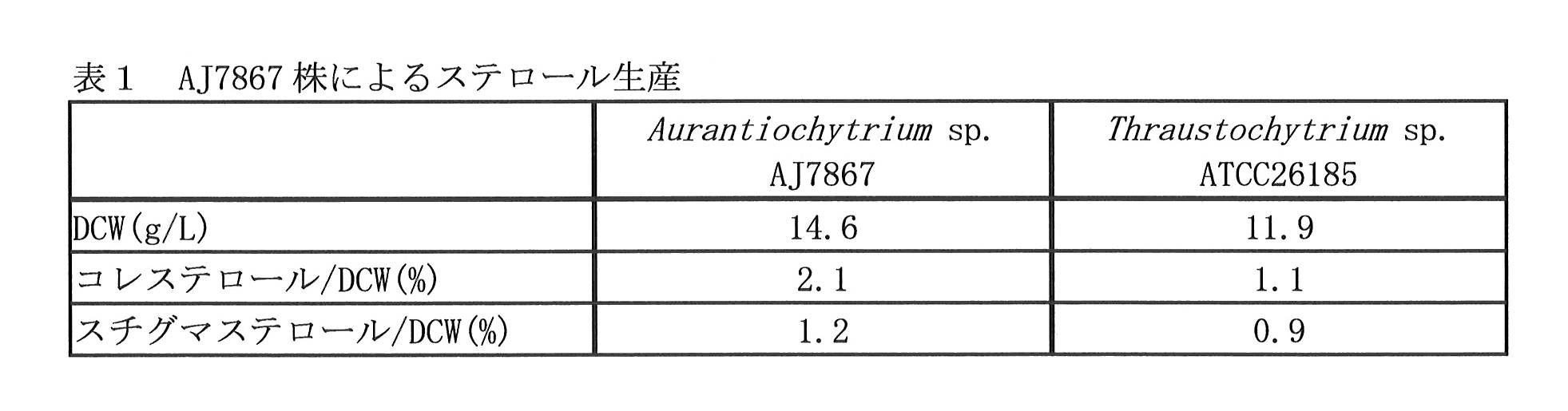
培養終了後、培養液0.5mlを遠心分離し、得られた沈殿物からBligh-Dyer法を利用して脂質の抽出を行い、脂質抽出物を得た。脂質抽出物中のステロールエステルを加水分解するために、脂肪酸をメチル化する一方でステロールエステルを加水分解できる脂肪酸メチル化キット(ナカライ)を用いた。得られたヘキサン層をガスクロマトグラフィーにアプライして各ステロールの定量を実施した。また、乾燥藻体重量(DCW)は、培養液0.5mlを遠心分離し、得られた沈殿物を50℃で3日間乾燥させた後に重量測定した値からエッペンチューブの重量を差し引いて算出した。結果を表1に示す。結果、AJ7867は、ATCC26185よりもDCWが1.23倍高いことに加えて、コレステロール/DCW(%)とスチグマステロール/DCW(%)もATCC26185よりもそれぞれ1.9倍と1.3倍高いことが示された。
本発明により、ステロールを生成する藻類が提供される。当該藻類を利用してステロールを製造することができる。
<配列表の説明>
配列番号1、2:プライマー
配列番号3:AJ7867株(FERM BP-22304)の18S rDNA領域の塩基配列
配列番号1、2:プライマー
配列番号3:AJ7867株(FERM BP-22304)の18S rDNA領域の塩基配列
Claims (13)
- AJ7867株(FERM BP-22304)およびその誘導株から選択される藻類を培地で培養すること、
前記培養により生成した藻体からステロールを回収すること、
を含む、ステロールを製造する方法。 - 前記ステロールが、動物ステロール、植物ステロール、および真菌ステロールからなる群より選択される1種またはそれ以上のステロールである、請求項1に記載の方法。
- 前記ステロールが、コレステロール、7-デヒドロコレステロール、グリコール酸、タウロコール酸、コール酸、エストラジオール、エストロン、エチニルエストラジオール、エストリオール、デヒドロエピアンドロステロン、メチルアンドロステンジオール、5β-プレグナン-3α,20α-ジオール、プレグネノロン、ケノデオキシコール酸、デヒドロコール酸、ジヒドロキシコレステロール、ジギトキシゲニン、デスモステロール、ラソステロール、スチグマステロール、β-シトステロール、ブラシカステロール、カンペステロール、ジオスゲニン、オレアノール酸、ベツリン酸、ウルソール酸、ヘコゲニン、サルササポゲニン、イソフコステロール、アベナステロール、Δ7-スチグマステノール、Δ7-カンペステノール、フコステロール、サルガステロール、エルゴステロールからなる群より選択される1種またはそれ以上のステロールである、請求項1に記載の方法。
- 前記ステロールが、コレステロールである、請求項1に記載の方法。
- 前記藻類が、配列番号3に示す塩基配列を有するオーランチオキトリウム(Aurantiochytrium)属藻類である、請求項1~4のいずれか1項に記載の方法。
- 配列番号3に示す塩基配列を有するオーランチオキトリウム(Aurantiochytrium)属藻類を培地で培養すること、
前記培養により生成した藻体からステロールを回収すること、
を含む、ステロールを製造する方法。 - 前記ステロールが、動物ステロール、植物ステロール、および真菌ステロールからなる群より選択される1種またはそれ以上のステロールである、請求項6に記載の方法。
- 前記ステロールが、コレステロール、7-デヒドロコレステロール、グリコール酸、タウロコール酸、コール酸、エストラジオール、エストロン、エチニルエストラジオール、エストリオール、デヒドロエピアンドロステロン、メチルアンドロステンジオール、5β-プレグナン-3α,20α-ジオール、プレグネノロン、ケノデオキシコール酸、デヒドロコール酸、ジヒドロキシコレステロール、ジギトキシゲニン、デスモステロール、ラソステロール、スチグマステロール、β-シトステロール、ブラシカステロール、カンペステロール、ジオスゲニン、オレアノール酸、ベツリン酸、ウルソール酸、ヘコゲニン、サルササポゲニン、イソフコステロール、アベナステロール、Δ7-スチグマステノール、Δ7-カンペステノール、フコステロール、サルガステロール、エルゴステロールからなる群より選択される1種またはそれ以上のステロールである、請求項6に記載の方法。
- 前記ステロールが、コレステロールである、請求項6に記載の方法。
- 前記藻類が、AJ7867株(FERM BP-22304)およびその誘導株から選択される藻類である、請求項6~9のいずれか1項に記載の方法。
- AJ7867株(FERM BP-22304)およびその誘導株から選択される藻類。
- 配列番号3に示す塩基配列を有するオーランチオキトリウム(Aurantiochytrium)属藻類である、請求項11に記載の藻類。
- 配列番号3に示す塩基配列を有する、オーランチオキトリウム(Aurantiochytrium)属藻類。
Applications Claiming Priority (2)
| Application Number | Priority Date | Filing Date | Title |
|---|---|---|---|
| JP2016041180A JP2019068741A (ja) | 2016-03-03 | 2016-03-03 | ステロールの製造法 |
| JP2016-041180 | 2016-03-03 |
Publications (1)
| Publication Number | Publication Date |
|---|---|
| WO2017150723A1 true WO2017150723A1 (ja) | 2017-09-08 |
Family
ID=59744083
Family Applications (1)
| Application Number | Title | Priority Date | Filing Date |
|---|---|---|---|
| PCT/JP2017/008586 Ceased WO2017150723A1 (ja) | 2016-03-03 | 2017-03-03 | ステロールの製造法 |
Country Status (2)
| Country | Link |
|---|---|
| JP (1) | JP2019068741A (ja) |
| WO (1) | WO2017150723A1 (ja) |
Cited By (1)
| Publication number | Priority date | Publication date | Assignee | Title |
|---|---|---|---|---|
| WO2019078359A1 (ja) * | 2017-10-19 | 2019-04-25 | 味の素株式会社 | ステロールの製造法 |
Citations (2)
| Publication number | Priority date | Publication date | Assignee | Title |
|---|---|---|---|---|
| US20060160203A1 (en) * | 1992-10-16 | 2006-07-20 | Martek Biosciences Corporation | Process for the heterotrophic production of microbial products with high concentrations of omega-3 highly unsaturated fatty acids |
| JP2017073998A (ja) * | 2015-10-14 | 2017-04-20 | 味の素株式会社 | ステロールの製造法 |
-
2016
- 2016-03-03 JP JP2016041180A patent/JP2019068741A/ja active Pending
-
2017
- 2017-03-03 WO PCT/JP2017/008586 patent/WO2017150723A1/ja not_active Ceased
Patent Citations (2)
| Publication number | Priority date | Publication date | Assignee | Title |
|---|---|---|---|---|
| US20060160203A1 (en) * | 1992-10-16 | 2006-07-20 | Martek Biosciences Corporation | Process for the heterotrophic production of microbial products with high concentrations of omega-3 highly unsaturated fatty acids |
| JP2017073998A (ja) * | 2015-10-14 | 2017-04-20 | 味の素株式会社 | ステロールの製造法 |
Non-Patent Citations (3)
| Title |
|---|
| NAKAZAWA, ATSUSHI ET AL.: "TLC screening of thraustochytrid strains for squalene production", JOURNAL OF APPLIED PHYCOLOGY, vol. 26, 2014, pages 29 - 41, XP055374842 * |
| WANG, G.: "Characterization of Lipid Components in Two Microalgae for Biofuel Application", J OURNAL OF THE AMERICAN OIL CHEMISTS' SOCIETY, vol. 89, no. 1, January 2012 (2012-01-01), pages 135 - 143, XP019995521 * |
| WEETE, J. D. ET AL.: "Lipids and Ultrastructure of Thraustochytrium sp. ATCC 26185", LIPIDS, vol. 32, no. 8, 1997, pages 839 - 845, XP009077836 * |
Cited By (3)
| Publication number | Priority date | Publication date | Assignee | Title |
|---|---|---|---|---|
| WO2019078359A1 (ja) * | 2017-10-19 | 2019-04-25 | 味の素株式会社 | ステロールの製造法 |
| JPWO2019078359A1 (ja) * | 2017-10-19 | 2021-01-07 | 味の素株式会社 | ステロールの製造法 |
| JP7205480B2 (ja) | 2017-10-19 | 2023-01-17 | 味の素株式会社 | ステロールの製造法 |
Also Published As
| Publication number | Publication date |
|---|---|
| JP2019068741A (ja) | 2019-05-09 |
Similar Documents
| Publication | Publication Date | Title |
|---|---|---|
| US7259005B2 (en) | Microorganism having ability to convert sterol into androst-4-ene-3, 17-dione/androsta-1,4-diene-3, 17-dione and preparation method and use thereof | |
| Horinouchi et al. | Identification of 9α-hydroxy-17-oxo-1, 2, 3, 4, 10, 19-hexanorandrost-6-en-5-oic acid and β-oxidation products of the C-17 side chain in cholic acid degradation by Comamonas testosteroni TA441 | |
| WO2017065293A1 (ja) | ステロールの製造法 | |
| US4397946A (en) | Process for preparing androstane steroids | |
| JP2017073998A (ja) | ステロールの製造法 | |
| WO2019078359A1 (ja) | ステロールの製造法 | |
| JP2019068741A (ja) | ステロールの製造法 | |
| CN101402928A (zh) | 微生物转化植物甾醇为单产雄甾二烯二酮的菌株 | |
| CN104694609A (zh) | 一种植物甾醇转化为雄烯二酮转化效率的提高方法 | |
| CN104419646B (zh) | 一株能生物合成1,2‑二氢睾内酯(testololactone)的简单青霉及合成方法 | |
| US4175006A (en) | Composition of matter and process | |
| CH661940A5 (de) | Verfahren zur herstellung von steroiden. | |
| CN107267419B (zh) | 一种生产4-hp的菌株及高产量4-hp的制备方法 | |
| CN104403974A (zh) | 一株高产雄甾-4-烯-3,17-二酮的植物甾醇转化菌株的选育 | |
| CN105734105A (zh) | 分支杆菌促进植物甾醇转化为9α-羟基雄烯二酮的方法 | |
| US4214052A (en) | Process for preparing 9α-OH BN alcohol | |
| US4226936A (en) | Process for preparing 9α-OH BN alcohol | |
| KR820001188B1 (ko) | 스테로이드 알코올의 제조방법 | |
| JPS6250118B2 (ja) | ||
| JPS6251116B2 (ja) | ||
| JP2020031572A (ja) | ステロールの製造法 | |
| US4223092A (en) | Process for preparing 9α-OH BN acid methyl ester | |
| US4221868A (en) | Process for preparing 9α-OH testosterone | |
| CN116034165A (zh) | 制备熊胆酸的微生物方法 | |
| JPS608120B2 (ja) | 微生物による化合物の製法 |
Legal Events
| Date | Code | Title | Description |
|---|---|---|---|
| NENP | Non-entry into the national phase |
Ref country code: DE |
|
| 121 | Ep: the epo has been informed by wipo that ep was designated in this application |
Ref document number: 17760185 Country of ref document: EP Kind code of ref document: A1 |
|
| 122 | Ep: pct application non-entry in european phase |
Ref document number: 17760185 Country of ref document: EP Kind code of ref document: A1 |
|
| NENP | Non-entry into the national phase |
Ref country code: JP |