WO2017150371A1 - 組織損傷治療剤 - Google Patents
組織損傷治療剤 Download PDFInfo
- Publication number
- WO2017150371A1 WO2017150371A1 PCT/JP2017/007069 JP2017007069W WO2017150371A1 WO 2017150371 A1 WO2017150371 A1 WO 2017150371A1 JP 2017007069 W JP2017007069 W JP 2017007069W WO 2017150371 A1 WO2017150371 A1 WO 2017150371A1
- Authority
- WO
- WIPO (PCT)
- Prior art keywords
- myd88
- amino acid
- inhibitor
- cells
- acid sequence
- Prior art date
- Legal status (The legal status is an assumption and is not a legal conclusion. Google has not performed a legal analysis and makes no representation as to the accuracy of the status listed.)
- Ceased
Links
Images






Classifications
-
- A—HUMAN NECESSITIES
- A61—MEDICAL OR VETERINARY SCIENCE; HYGIENE
- A61K—PREPARATIONS FOR MEDICAL, DENTAL OR TOILETRY PURPOSES
- A61K9/00—Medicinal preparations characterised by special physical form
- A61K9/06—Ointments; Bases therefor; Other semi-solid forms, e.g. creams, sticks, gels
-
- A—HUMAN NECESSITIES
- A61—MEDICAL OR VETERINARY SCIENCE; HYGIENE
- A61K—PREPARATIONS FOR MEDICAL, DENTAL OR TOILETRY PURPOSES
- A61K35/00—Medicinal preparations containing materials or reaction products thereof with undetermined constitution
- A61K35/12—Materials from mammals; Compositions comprising non-specified tissues or cells; Compositions comprising non-embryonic stem cells; Genetically modified cells
- A61K35/28—Bone marrow; Haematopoietic stem cells; Mesenchymal stem cells of any origin, e.g. adipose-derived stem cells
-
- A—HUMAN NECESSITIES
- A61—MEDICAL OR VETERINARY SCIENCE; HYGIENE
- A61K—PREPARATIONS FOR MEDICAL, DENTAL OR TOILETRY PURPOSES
- A61K45/00—Medicinal preparations containing active ingredients not provided for in groups A61K31/00 - A61K41/00
-
- A—HUMAN NECESSITIES
- A61—MEDICAL OR VETERINARY SCIENCE; HYGIENE
- A61K—PREPARATIONS FOR MEDICAL, DENTAL OR TOILETRY PURPOSES
- A61K47/00—Medicinal preparations characterised by the non-active ingredients used, e.g. carriers or inert additives; Targeting or modifying agents chemically bound to the active ingredient
- A61K47/30—Macromolecular organic or inorganic compounds, e.g. inorganic polyphosphates
- A61K47/42—Proteins; Polypeptides; Degradation products thereof; Derivatives thereof, e.g. albumin, gelatin or zein
-
- A—HUMAN NECESSITIES
- A61—MEDICAL OR VETERINARY SCIENCE; HYGIENE
- A61L—METHODS OR APPARATUS FOR STERILISING MATERIALS OR OBJECTS IN GENERAL; DISINFECTION, STERILISATION OR DEODORISATION OF AIR; CHEMICAL ASPECTS OF BANDAGES, DRESSINGS, ABSORBENT PADS OR SURGICAL ARTICLES; MATERIALS FOR BANDAGES, DRESSINGS, ABSORBENT PADS OR SURGICAL ARTICLES
- A61L27/00—Materials for grafts or prostheses or for coating grafts or prostheses
-
- C—CHEMISTRY; METALLURGY
- C07—ORGANIC CHEMISTRY
- C07K—PEPTIDES
- C07K14/00—Peptides having more than 20 amino acids; Gastrins; Somatostatins; Melanotropins; Derivatives thereof
Definitions
- the present invention relates to a therapeutic agent for tissue damage and the like.
- Living tissue can be damaged in various diseases and the course of treatment thereof.
- skin tissue, muscle tissue, bone tissue, or the like is damaged due to trauma, bed slip, or the like, or the tissue is artificially damaged during surgery.
- Treatment of these tissue damages is usually performed by protecting the damaged site and promoting natural healing.
- regeneration of this tissue damage can be promoted by locally administering mesenchymal stem cells to the damaged site (Non-patent Documents 1 and 2).
- QOL patient quality of life
- an inflammatory reaction usually occurs at the damaged site, followed by cell migration to the damaged site, cell division, production of extracellular matrix, etc., and finally the tissue is reconstructed.
- the first inflammatory reaction is important, and if this is inhibited by any factor, it is said that the period until healing is prolonged.
- Interleukin-1 receptor type 1 is a type of receptor with interleukin-1 (IL-1) as a ligand, and signals downstream via intracellular adapter molecules such as MyD88. It is known to control the expression of genes related to inflammatory reaction, immune reaction, cell proliferation and the like. These signal pathways are called Toll-like receptor pathways and play an important role in inducing inflammation.
- An object of the present invention is to provide a therapeutic agent for tissue damage that can further promote regeneration of tissue damage.
- the present inventor surprisingly reduced the expression level or function of IL-1R1 or MyD88, thereby migrating mesenchymal stem cells to the damaged site and It has been found that proliferation can be promoted and further regeneration of tissue damage can be promoted. Furthermore, it has also been found that these effects are enhanced by using mesenchymal stem cells in combination. As a result of further research based on these findings, the present inventor has completed the present invention.
- the present invention includes the following embodiments: Item 1. A therapeutic agent for tissue damage comprising at least one selected from the group consisting of an IL-1R1 function inhibitor, an IL-1R1 expression inhibitor, a MyD88 function inhibitor, and a MyD88 expression inhibitor.
- Item 2. Item 2. The tissue damage therapeutic agent according to Item 1, further comprising a scaffold.
- Item 3. Item 3. The tissue damage therapeutic agent according to Item 2, wherein the scaffold is a gel or porous material of a biocompatible material.
- Item 4. Item 4. The tissue damage therapeutic agent according to Item 2 or 3, wherein the scaffold is fibrin gel.
- Item 6. Item 6.
- the tissue damage therapeutic agent according to Item 5 wherein the mesenchymal stem cells are mesenchymal stem cells derived from a tissue to be treated.
- Item 7. Item 7. The tissue damage therapeutic agent according to any one of Items 1 to 6, further comprising a growth factor.
- the tissue damage therapeutic agent according to any one of Items 1 to 7, comprising at least one selected from the group consisting of an IL-1R1 function inhibitor and a MyD88 function inhibitor.
- Item 9. Item 9. The tissue damage therapeutic agent according to any one of Items 1 to 8, wherein the tissue is bone tissue.
- An oligopeptide comprising the following amino acid sequence (i) or (j) and having MyD88 dimerization inhibitory activity: (I) In order from the N-terminal side, a scaffold binding sequence, an enzyme cleavage sequence, a membrane permeation sequence, an amino acid sequence in which the amino acid sequence shown in SEQ ID NO: 18 or 19 is arranged, or (j) the amino acid sequence of (i) above An amino acid sequence in which one or several amino acids are substituted, deleted, added or inserted.
- Item 13 A method for treating tissue damage, comprising administering at least one selected from the group consisting of an IL-1R1 function inhibitor, an IL-1R1 expression inhibitor, a MyD88 function inhibitor, and a MyD88 expression inhibitor.
- Item 14 At least one drug selected from the group consisting of an IL-1R1 function inhibitor, an IL-1R1 expression inhibitor, a MyD88 function inhibitor, and a MyD88 expression inhibitor for the treatment of tissue damage.
- Item 15. Use of at least one drug selected from the group consisting of an IL-1R1 function inhibitor, an IL-1R1 expression inhibitor, a MyD88 function inhibitor, and a MyD88 expression inhibitor for the manufacture of a tissue damage therapeutic agent.
- Item 16 Use of at least one drug selected from the group consisting of IL-1R1 function inhibitor, IL-1R1 expression inhibitor, MyD88 function inhibitor, and MyD88 expression inhibitor for the treatment of tissue damage.
- the present invention includes the following embodiments: Item 12.
- a method for treating tissue damage comprising administering at least one selected from the group consisting of an IL-1R1 function inhibitor, an IL-1R1 expression inhibitor, a MyD88 function inhibitor, and a MyD88 expression inhibitor.
- Item 13 At least one agent selected from the group consisting of an IL-1R1 function inhibitor, an IL-1R1 expression inhibitor, a MyD88 function inhibitor, and a MyD88 expression inhibitor for use as a tissue damage treatment agent.
- a therapeutic agent for tissue damage can be provided. Furthermore, at least one promoter selected from the group consisting of proliferation and accumulation of mesenchymal stem cells can also be provided. By using these, tissue damage can be efficiently treated in a shorter period of time.
- FIG. 1 It is a graph which shows the micro CT analysis result at the time of using the MyD88 knockout mouse of Example 1.
- the vertical axis (Coverage (%)) is the average value of the ratio of the area of the damaged part in the circle (damage recovery rate) to the area of the damaged part range (circle with a diameter of 5 mm) at the time of damage (n ⁇ ) 6) is shown.
- “wt” indicates a case where a wild type mouse is used
- “Myd88 ⁇ / ⁇ ” indicates a case where a MyD88 knockout mouse is used.
- the bar at the top of each column indicates the standard deviation, and “***” indicates that the P value is less than 0.001.
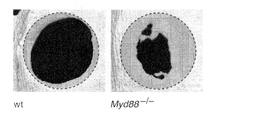
- FIG. 3 is a photograph showing the results of micro CT analysis in Example 1 using MyD88 knockout mice.
- “wt” indicates a case where a wild-type mouse is used
- “Myd88 ⁇ / ⁇ ” indicates a case where a MyD88 knockout mouse is used.
- the circle drawn with a dotted line shows the range of the damaged part at the time of damage (circle with a diameter of 5 mm).
- white areas indicate areas where bone tissue exists, and black areas indicate areas where bone tissue does not exist.
- the vertical axis (Coverage (%)) is the average value of the ratio of the area of the damaged part in the circle (damage recovery rate) to the area of the damaged part range (circle with a diameter of 5 mm) at the time of damage (n ⁇ ) 6) is shown.
- “wt” indicates the case where a wild type mouse is used
- “Il1r1 ⁇ / ⁇ ” indicates the case where an IL-1R1 knockout mouse is used.
- the bar at the top of each column indicates the standard deviation
- “***” indicates that the P value is less than 0.001.
- 2 is a photograph showing the results of micro CT analysis in Example 1 using IL-1R1 knockout mice.
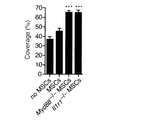
- the vertical axis (Coverage (%) is the average value of the ratio of the area of the damaged part in the circle (damage recovery rate) to the area of the damaged part range (circle with a diameter of 5 mm) at the time of damage (n ⁇ ) 6) is shown.
- FIG. 6 is a graph showing the results of flow cytometry in Example 3.
- wt indicates that a mesenchymal stem cell derived from a wild type mouse is used
- Il1r1 ⁇ / ⁇ indicates that a mesenchymal stem cell derived from an IL-1R1 knockout mouse indicates “Myd88 ⁇ / ⁇ ”.
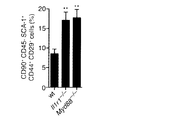
- FIG. 6 is a graph showing the flow cytometry result of Example 4.
- “wt” indicates a case where a wild type mouse is used
- “Il1r1 ⁇ / ⁇ ” indicates a case where an IL-1R1 knockout mouse is used
- Myd88 ⁇ / ⁇ ” indicates a case where a MyD88 knockout mouse is used.
- the bar at the top of each left column indicates the standard deviation, and “**” indicates that the P value is less than 0.01.
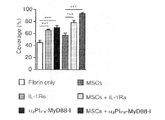
- 10 is a graph showing the micro CT analysis results of Example 5.
- “Fibrin only” indicates that when nothing is added to the polymerized fibrin matrix
- “IL-1Ra” indicates that when an IL-1R1 inhibitor is added
- “ ⁇ 2 -PI 1-8 -MyD88-I” indicates When a MyD88 inhibitor is added
- “MSCs” is added when a mesenchymal stem cell is added
- “MSCs + IL-1Ra” is added when a mesenchymal stem cell and an IL-1R1 inhibitor are added
- “MSCs + ⁇ 2 -PI 1-8 -MyD88- “I” shows the case where mesenchymal stem cells and MyD88 inhibitor are added.
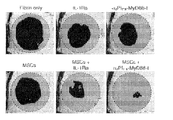
- Example 5 is a photograph showing the results of micro CT analysis of Example 5.
- “Fibrin only” indicates that when nothing is added to the polymerized fibrin matrix
- “IL-1Ra” indicates that when an IL-1R1 inhibitor is added
- “ ⁇ 2 -PI 1-8 -MyD88-I” indicates When a MyD88 inhibitor is added
- “MSCs” is added when a mesenchymal stem cell is added
- “MSCs + IL-1Ra” is added when a mesenchymal stem cell and an IL-1R1 inhibitor are added
- “MSCs + ⁇ 2 -PI 1-8 -MyD88- "I” shows the case where mesenchymal stem cells and MyD88 inhibitor are added.
- the circle drawn with a dotted line shows the range of the damaged part at the time of damage (circle with a diameter of 5 mm).
- white areas indicate areas where bone tissue exists, and black areas indicate areas where bone tissue does not exist.
- a is a graph showing the micro CT analysis results of Example 6
- b is a photograph showing the micro CT analysis results of Example 6.
- “Fibrin” is added to the polymerized fibrin matrix
- “FGF-2”, “PDGF-BB” and “BMP-2” are “P” when these growth factors are added.
- “” Indicates a case where a MyD88 inhibitor is added
- “PDGF-BB + P” and “BMP-2 + P” indicate a case where a MyD88 inhibitor and a growth factor are added.
- the bar at the top of each column indicates the standard deviation, and “***” indicates that the P value is less than 0.001.
- identity of amino acid sequences means the degree of amino acid sequences of two or more comparable amino acid sequences with respect to each other. Therefore, the higher the identity of two amino acid sequences, the higher the identity or similarity of those sequences.
- the level of amino acid sequence identity is determined, for example, using FASTA, a sequence analysis tool, using default parameters.
- FASTA a sequence analysis tool
- the algorithm BLAST by Karlin and Altschul Karlin and Altschul (KarlinS, Altschul SF. “Methods for assessing the statisticalsignificance of molecular sequence features by using general scoringschemes” Proc. Natl Acad Sci USA. 87: 2264-2268 (SF), Karlin, Sul.
- conservative substitution means that an amino acid residue is substituted with an amino acid residue having a similar side chain.
- substitution with amino acid residues having basic side chains such as lysine, arginine, histidine and the like is a conservative substitution technique.
- amino acid residues having acidic side chains such as aspartic acid and glutamic acid
- amino acid residues having uncharged polar side chains such as glycine, asparagine, glutamine, serine, threonine, tyrosine and cysteine
- Amino acid residues having non-polar side chains such as isoleucine, proline, phenylalanine, methionine, tryptophan
- amino acid residues having ⁇ -branched side chains such as threonine, valine, isoleucine
- aromas such as tyrosine, phenylalanine, tryptophan, histidine
- substitutions between amino acid residues having a family side chain are conservative substitutions.
- Tissue damage therapeutic agent mesenchymal stem cell proliferation promoter, mesenchymal stem cell accumulation promoter
- This invention relates to IL-1R1 function inhibitor, IL-1R1 expression inhibitor, MyD88 function inhibitor, and MyD88 expression inhibitor Proliferation of mesenchymal stem cells and mesenchymal stem cells containing at least one selected from the group consisting of these (in the present specification, these may be collectively referred to as “active ingredients of the present invention”).
- An accelerator and an agent for promoting mesenchymal stem cell accumulation are provided. Hereinafter, these will be described.
- IL-1R1 interleukin-1 receptor type 1
- IL-1R1 interleukin-1 receptor type 1
- IL-1R1 is an IL expressed by cells (especially mesenchymal stem cells) present in or around the damaged site to be treated There is no particular limitation as long as the function of -1R1 can be suppressed.
- the “cells present at the damaged site” include not only cells originally present at the damaged site of the living body but also cells added from outside the living body (for example, cells contained in the drug of the present invention (especially mesenchymal system).
- the concept also includes stem cells)).
- “Suppressing IL-1R1 function” means, for example, directly acting on IL-1R1 to inhibit signal transduction via IL-1R1, more specifically, acting directly on IL-1R1, It means to suppress the production of cytokines (for example, IL-6, CCL2, CXCL1, CXCL2, etc.) by (for example, IL-1 ⁇ ).
- cytokines for example, IL-6, CCL2, CXCL1, CXCL2, etc.
- the IL-1R1 that is the target of function suppression is IL-1R1 that is expressed by cells present in or around the damaged site that is the target of treatment. Therefore, depending on the species from which the cells are derived, the species from which IL-1R1 is derived also changes. Examples of the biological species include various mammals such as humans, monkeys, mice, rats, dogs, cats, and rabbits.
- human IL-1R1 includes a protein (NCBI Reference Reference Sequence: NP_000868.1, NP_001275635.1) having the amino acid sequence shown in SEQ ID NOS: 1-2, and mouse IL-1R1 has a sequence.
- proteins NCBI Reference Sequence: NP_001116854.1, NP_032388.1 having the amino acid sequences shown in Nos. 3-4.
- IL-1R1 may be partially deleted due to physiological processing as long as its function is not impaired.
- IL-1R1 accepts ligands (eg IL-1 ⁇ ) and induces downstream signal transduction to promote cytokine production (eg IL-6, CCL2, CXCL1, CXCL2 etc.) As long as it has (activity), it may have mutations such as amino acid substitution, deletion, addition, and insertion.
- the mutation preferably includes substitution, more preferably conservative substitution, from the viewpoint that the cytokine production promotion mediating activity is less likely to be impaired.
- IL-1R1 include proteins described in (a) below and proteins described in (b) below: (A) a protein comprising the amino acid sequence shown in any of SEQ ID NOs: 1 to 4, and (b) consisting of an amino acid sequence having 85% or more identity with the amino acid sequence shown in any of SEQ ID NOs: 1 to 4. And at least one selected from the group consisting of proteins having cytokine production promotion mediating activity.
- the identity is preferably 90% or more, more preferably 95% or more, and still more preferably 98% or more.
- the presence or absence of cytokine production promotion mediating activity can be determined according to or according to a known method. For example, cytokines produced by contacting a ligand (eg IL-1 ⁇ ) of IL-1R1 with a cell (especially a mesenchymal stem cell) in which the test protein is expressed on the cell membrane (eg IL-6, If the amount of CCL2, CXCL1, CXCL2, etc.) is greater than the amount of cytokine similarly measured using cells that do not express the test protein, it can be determined that the test protein has a cytokine production promotion mediating activity it can.
- a ligand eg IL-1 ⁇
- a cell especially a mesenchymal stem cell
- the amount of CCL2, CXCL1, CXCL2, etc. is greater than the amount of cytokine similarly measured using cells that do not express the test protein, it can be determined that the test protein has a cytokine production promotion mediating activity it can.
- (b ′) one or more amino acids are substituted, deleted, added, or inserted into the amino acid sequence represented by any one of SEQ ID NOs: 1 to 4. And a protein having an activity of promoting cytokine production.
- the plurality is, for example, 2 to 85, preferably 2 to 30, more preferably 2 to 10, even more preferably 2 to 5, More preferably, it is 2 or 3.
- IL-1R1 function inhibitor examples include IL-1R1 antagonists, neutralizing antibodies, and the like, and when these are proteins, their expression vectors.
- IL-1R1 antagonists include endogenous IL-1R antagonists (IL-1 receptor antagonist (IL-1Ra)); anakinra, rilonacept and the like that are commercially available as IL-1 receptor antagonists.
- endogenous IL-1R antagonists are preferable from the viewpoint of more reliably exerting a tissue damage treatment effect.
- endogenous IL-1R antagonists for example, endogenous IL-1R antagonists derived from various mammals such as humans, monkeys, mice, rats, dogs, cats, rabbits and the like can be employed. Among them, an endogenous IL-1R antagonist of a species to be treated for tissue damage is preferable.
- endogenous IL-1R antagonists derived from various species are known.
- a human endogenous IL-1R antagonist a protein comprising the amino acid sequence shown in SEQ ID NOs: 5 to 8 (NCBI Reference Reference Sequence: NP_000568.1, NP_776214.1, NP_776215.1, NP_776213.1)
- mouse endogenous IL-1R antagonists include proteins having the amino acid sequences shown in SEQ ID NOs: 9 to 11 (NCBI Reference Sequence: NP_001034790.1, NP_001153034.1, NP_112444.1) and the like.
- the endogenous IL-1R antagonist may have mutations such as amino acid substitution, deletion, addition and insertion as long as it has IL-1R1 antagonist activity.
- the mutation preferably includes substitution, more preferably conservative substitution, from the viewpoint that the IL-1R1 antagonist activity is more difficult to be impaired.
- Preferred specific examples of the endogenous IL-1R antagonist include the protein described in the following (c) and the protein described in the following (d): (C) a protein comprising the amino acid sequence shown in any of SEQ ID NOs: 5 to 11, and (d) an amino acid sequence having 85% or more identity with the amino acid sequence shown in any of SEQ ID NOs: 5 to 11 And at least one selected from the group consisting of proteins having IL-1R1 antagonist activity.
- the identity is preferably 90% or more, more preferably 95% or more, and still more preferably 98% or more.
- the presence or absence of IL-1R1 antagonist activity can be determined according to or according to a known method.
- cytokines for example, IL-6, CCL2, CXCL1, CXCL2, etc.
- a test substance for example, mesenchymal stem cells
- a ligand for example, IL-1 ⁇
- (d ′) one or more amino acids are substituted, deleted, added, or inserted into the amino acid sequence shown in any of SEQ ID NOs: 5 to 11. And a protein having a T-cadherin binding ability.
- the number is, for example, 2 to 25, preferably 2 to 10, more preferably 2 to 5, and further preferably 2 or 3.
- the endogenous IL-1R antagonist may be chemically modified as long as it has IL-1R1 antagonist activity.
- the endogenous IL-1R antagonist may be any one of a carboxyl group (—COOH), a carboxylate (—COO ⁇ ), an amide (—CONH 2 ) and an ester (—COOR) at the C-terminus.
- R in the ester for example, a C 1-6 alkyl group such as methyl, ethyl, n-propyl, isopropyl, n-butyl; for example, a C 3-8 cycloalkyl group such as cyclopentyl, cyclohexyl; C 6-12 aryl groups such as ⁇ -naphthyl; C 7- such as phenyl-C 1-2 alkyl groups such as benzyl and phenethyl; ⁇ -naphthyl-C 1-2 alkyl groups such as ⁇ -naphthylmethyl; 14 aralkyl group; pivaloyloxymethyl group is used.
- a C 1-6 alkyl group such as methyl, ethyl, n-propyl, isopropyl, n-butyl
- a C 3-8 cycloalkyl group such as cyclopentyl, cyclohexyl
- a carboxyl group (or carboxylate) other than the C-terminus may be amidated or esterified.
- ester in this case, for example, the above-mentioned C-terminal ester or the like is used.
- the amino group of the N-terminal amino acid residue is protected with a protecting group (for example, a C 1-6 acyl group such as C 1-6 alkanoyl such as formyl group, acetyl group, etc.).
- a protecting group for example, a C 1-6 acyl group such as C 1-6 alkanoyl such as formyl group, acetyl group, etc.
- N-terminal glutamine residues that can be cleaved in vivo, pyroglutamine oxidized, substituents on the side chain of amino acids in the molecule (eg —OH, —SH, amino group, imidazole) Group, indole group, guanidino group, etc.) protected with an appropriate protecting group (for example, C 1-6 acyl group such as C 1-6 alkanoyl group such as formyl group, acetyl group, etc.), or sugar chain Also included are complex proteins such as so-called glycoproteins to which is bound.
- substituents on the side chain of amino acids in the molecule eg —OH, —SH, amino group, imidazole) Group, indole group, guanidino group, etc.
- an appropriate protecting group for example, C 1-6 acyl group such as C 1-6 alkanoyl group such as formyl group, acetyl group, etc.
- complex proteins such as so-called glycoprotein
- the endogenous IL-1R antagonist may have a known protein tag added as long as it has IL-1R1 antagonist activity.
- protein tags include histidine tags, FLAG tags, GST tags, and the like.
- the endogenous IL-1R antagonist may be in the form of a pharmaceutically acceptable salt with an acid or base.
- the salt is not particularly limited as long as it is a pharmaceutically acceptable salt, and both an acidic salt and a basic salt can be adopted.
- acidic salts include inorganic acid salts such as hydrochloride, hydrobromide, sulfate, nitrate, and phosphate; acetate, propionate, tartrate, fumarate, maleate, apple Organic acid salts such as acid salts, citrate salts, methanesulfonate salts, paratoluenesulfonate salts; amino acid salts such as aspartate salts and glutamate salts.
- basic salts include alkali metal salts such as sodium salts and potassium salts; alkaline earth metal salts such as calcium salts and magnesium salts.
- the endogenous IL-1R antagonist may be in the form of a solvate.
- the solvent is not particularly limited as long as it is pharmaceutically acceptable, and examples thereof include water, ethanol, glycerol, acetic acid and the like.
- An endogenous IL-1R antagonist can be obtained from a transformant containing a polynucleotide encoding an endogenous IL-1R antagonist according to a known method, for example, chemical synthesis, purification from mammalian cells or tissues (eg, serum). It can be obtained by purification of When obtained by purification from a transformant, the transformant is not particularly limited as long as it is a cell capable of expressing an endogenous IL-1R antagonist from a polynucleotide encoding the endogenous IL-1R antagonist. Various cells such as bacteria, insect cells, mammalian cells, etc. can be used.
- insect cells for example, Sf cells, MG1 cells, High Five TM cells, BmN cells and the like are used.
- Sf cells for example, Sf9 cells (ATCC CRL1711), Sf21 cells and the like are used.
- animal cells examples include monkey COS-7 cells, monkey Vero cells, Chinese hamster cells CHO, mouse L cells, mouse AtT-20 cells, mouse myeloma cells, rat GH3 cells, and human FL cells.
- IL-1R1 neutralizing antibody refers to an antibody having the property of inhibiting IL-1R1's cytokine production promotion mediated activity by binding to IL-1R1.
- the antibody includes a part of the above antibody having antigen binding properties such as a polyclonal antibody, a monoclonal antibody, a chimeric antibody, a single chain antibody, or a fragment generated by a Fab fragment, a Fab expression library, or the like.
- the antibody of the present invention also includes an antibody having an antigen binding property to a polypeptide consisting of at least continuous amino acid sequence of IL-1R1, usually 8 amino acids, preferably 15 amino acids, more preferably 20 amino acids.
- the antibody is preferably an antibody having an antigen-binding property with respect to the amino acid sequence of the IL-1R1 ligand (preferably IL- ⁇ ) binding site, from the viewpoint that neutralizing activity can be more reliably exhibited.
- the ligand (preferably IL- ⁇ ) binding site of IL-1R1 is known, and based on this known information, such an antibody can be produced.
- the antibodies of the present invention can also be produced according to these conventional methods (Current protocol in Molecular Biology, Chapter 11.12 to 11.13 (2000)).
- an oligopeptide having a partial amino acid sequence of IL-1R1 using IL-1R1 expressed and purified in Escherichia coli according to a conventional method or according to a conventional method Can be synthesized to immunize non-human animals such as rabbits, and obtained from the sera of the immunized animals according to a conventional method.
- IL-1R1 which is used as an immunizing antigen for the production of antibodies, is based on known gene sequence information. DNA cloning, construction of each plasmid, transfection into a host, culture of transformants, and the transfer of proteins from the culture. It can be obtained by a recovery operation. These operations are based on methods known to those skilled in the art or methods described in the literature (Molecular Cloning, T.Maniatis et al., CSH Laboratory (1983), DNA Cloning, DM. Glover, IRL PRESS (1985)). Can be done.
- a recombinant DNA capable of expressing a gene encoding IL-1R1 in a desired host cell is prepared, introduced into the host cell, transformed, and the transformant is cultured.
- a protein as an immunizing antigen for producing the antibody of the present invention can be obtained.
- the partial peptide of IL-1R1 can also be produced by a general chemical synthesis method (peptide synthesis) in accordance with known gene sequence information.
- the antibody of the present invention may be prepared using an oligopeptide having a partial amino acid sequence of IL-1R1.
- the oligo (poly) peptide used for the production of such an antibody does not need to have a functional biological activity, but desirably has the same immunogenic properties as IL-1R1.
- An oligo (poly) peptide preferably having this immunogenic property and consisting of at least 8 amino acids, preferably 15 amino acids, more preferably 20 amino acids in the amino acid sequence of IL-1R1 can be exemplified.
- Such an antibody against an oligo (poly) peptide can also be produced by enhancing the immunological reaction using various adjuvants depending on the host.
- adjuvants include, but are not limited to, Freund's adjuvant, mineral gels such as aluminum hydroxide, and surfaces such as lysolecithin, pluronic polyol, polyanions, peptides, oil emulsions, keyhole limpet hemocyanin and dinitrophenol.
- Active substances, human adjuvants such as BCG (Bacille Calmette-Guerin) and Corynebacterium parvum are included.
- the expression vector comprises a polynucleotide comprising a promoter sequence and a coding sequence (and optionally a transcription termination signal sequence) such as an IL-1R1 antagonist, neutralizing antibody.
- the expression vector is not particularly limited, and examples thereof include plasmid vectors such as animal cell expression plasmids; virus vectors such as retroviruses, lentiviruses, adenoviruses, adeno-associated viruses, herpes viruses, and Sendai viruses.
- plasmid vectors such as animal cell expression plasmids
- virus vectors such as retroviruses, lentiviruses, adenoviruses, adeno-associated viruses, herpes viruses, and Sendai viruses.
- the promoter is not particularly limited, and examples thereof include CMV promoter, EF1 promoter, SV40 promoter, MSCV promoter, hTERT promoter, ⁇ actin promoter, CAG promoter and the like.
- the expression vector may contain other elements that the expression vector can contain.
- other elements include a replication origin and a drug resistance gene.
- the drug resistance gene is not particularly limited. For example, chloramphenicol resistance gene, tetracycline resistance gene, neomycin resistance gene, erythromycin resistance gene, spectinomycin resistance gene, kanamycin resistance gene, hygromycin resistance gene, puromycin resistance gene, etc. Is mentioned.
- the expression vector can be easily obtained according to a known genetic engineering technique. For example, it can be prepared using PCR, restriction enzyme cleavage, DNA ligation technology, and the like.
- IL-1R1 expression inhibitor can reduce the amount of IL-1R1 expressed in cells (especially mesenchymal stem cells) present at or around the damaged site to be treated As long as it is not particularly limited.
- the definitions of “cells present at the site of injury” and “inhibit IL-1R1 function” are the same as those described above in “2-1-1. IL-1R1 function inhibitor”.
- IL-1R1 that is subject to expression suppression is the same as IL-1R1 in “2-1-1. IL-1R1 function inhibitor” above.
- IL-1R1 expression inhibitor examples include IL-1R1-specific siRNA, IL-1R1-specific miRNA, IL-1R1-specific antisense nucleic acid, and expression vectors thereof.
- IL-1R1-specific siRNA is not particularly limited as long as it is a double-stranded RNA molecule that specifically suppresses the expression of a gene encoding IL-1R1.
- the siRNA is preferably 18 or more bases, 19 or more bases, 20 or more bases, or 21 or more bases in length, for example.
- the siRNA preferably has a length of 25 bases or less, 24 bases or less, 23 bases or less, or 22 bases or less. It is assumed that the upper limit value and the lower limit value of the siRNA length described here are arbitrarily combined.
- the lower limit is 18 bases
- the upper limit is 25 bases, 24 bases, 23 bases, or 22 bases
- the lower limit is 19 bases
- the upper limit is 25 bases, 24 bases, 23 bases, or 22 bases
- Length lower limit is 20 bases
- upper limit is 25 bases, 24 bases, 23 bases, or 22 bases
- lower limit is 21 bases
- upper limit is 25 bases, 24 bases, 23 bases, or 22
- a length that is a base is assumed.
- the siRNA may be shRNA (small hairpin RNA).
- shRNA can be designed so that a part thereof forms a stem-loop structure. For example, if the sequence of a certain region is a sequence a and the complementary strand to the sequence a is a sequence b, these sequences are present in a single RNA strand in the order of sequence a, spacer, and sequence b. And can be designed to be 45-60 bases in total.
- the sequence a is a sequence of a partial region of the base sequence encoding IL-1R1 to be a target, and the target region is not particularly limited, and any region can be a candidate.
- the length of the sequence a is 19 to 25 bases, preferably 19 to 21 bases.
- the IL-1R1-specific siRNA may have an additional base at the 5 'or 3' end.
- the length of the additional base is usually about 2 to 4 bases.
- the additional base may be DNA or RNA, but the use of DNA may improve the stability of the nucleic acid. Examples of such additional base sequences include ug-3 ', uu-3', tg-3 ', tt-3', ggg-3 ', guuu-3', gttt-3 ', ttttt-3 Examples include, but are not limited to, ', uuuuuu-3'.
- SiRNA may have a protruding portion sequence (overhang) at the 3 ′ end, and specifically includes those to which dTdT (dT represents deoxyribonucleic acid) is added. Further, it may be a blunt end (blunt end) without end addition.
- the siRNA may have a different number of bases in the sense strand and the antisense strand, for example, “aiRNA” in which the antisense strand has a protruding sequence (overhang) at the 3 ′ end and the 5 ′ end. be able to.
- a typical aiRNA has an antisense strand consisting of 21 bases, a sense strand consisting of 15 bases, and has an overhang structure of 3 bases at each end of the antisense strand.
- the target sequence of the IL-1R1-specific siRNA is not particularly limited, in one embodiment, the target sequence is from the 5′-UTR and the start codon to about 50 bases, and from a region other than the 3′-UTR. It is desirable to select.
- a sense strand having a 3 'terminal overhang of TT or UU at 19-21 bases after AA (or NA), a sequence complementary to the 19-21 bases and TT or A double-stranded RNA consisting of an antisense strand having a 3 ′ end overhang of UU may be designed as an siRNA.
- siRNA short hairpin RNA
- an arbitrary linker sequence for example, about 5-25 bases
- the sense strand and the antisense strand are combined with each other. It can be designed by linking via a linker sequence.
- siRNA and / or shRNA can be searched using search software provided free of charge on various websites. Examples of such sites include the following. SiRNA Target Finder provided by Ambion (Http://www.ambion.com/techlib/misc/siRNA_finder.html) Insert design tool for pSilencer (R) Expression Vector (http://www.ambion.com/techlib/misc/psilencer_converter .html) GeneSeer provided by RNAi Codex (http://codex.cshl.edu/scripts/newsearchhairpin.cgi).
- the siRNA is synthesized by synthesizing a sense strand and an antisense strand of a target sequence on mRNA with a DNA / RNA automatic synthesizer, denatured at about 90 to about 95 ° C. for about 1 minute in an appropriate annealing buffer, It can be prepared by annealing at about 30 to about 70 ° C. for about 1 to about 8 hours. It can also be prepared by synthesizing a short hairpin RNA (shRNA) serving as a precursor of siRNA and cleaving it with a dicer.
- shRNA short hairpin RNA
- IL-1R1-specific miRNA is optional as long as it inhibits translation of the gene encoding IL-1R1.
- miRNA miRNA
- the miRNA may pair with the 3 'untranslated region (UTR) of the target and inhibit its translation, rather than cleaving the target mRNA like siRNA.
- the miRNA may be any of pri-miRNA (primary miRNA), pre-miRNA, and mature miRNA.
- the length of miRNA is not particularly limited, the length of pri-miRNA is usually several hundred to several thousand bases, the length of pre-miRNA is usually 50 to 80 bases, and the length of mature miRNA is usually 18 ⁇ 30 bases.
- the IL-1R1-specific miRNA is preferably a pre-miRNA or a mature miRNA, more preferably a mature miRNA.
- Such IL-1R1-specific miRNA may be synthesized by a known method or purchased from a company that provides synthetic RNA.
- IL-1R1-specific antisense nucleic acid is a nucleic acid comprising a base sequence complementary to or substantially complementary to the base sequence of mRNA of a gene encoding IL-1R1, or a part thereof, and is specific to the mRNA. It is a nucleic acid having a function of suppressing IL-1R1 protein synthesis by forming and binding an ideal and stable duplex.
- the antisense nucleic acid may be any of DNA, RNA, and DNA / RNA chimera.
- the antisense nucleic acid is DNA
- the RNA DNA hybrid formed by the target RNA and the antisense DNA is recognized by the endogenous RNase H and causes selective degradation of the target RNA.
- the target sequence may be not only the sequence in mRNA but also the sequence of the intron region in the initial translation product of IL-1R1 gene.
- the intron sequence can be determined by comparing the genomic sequence with the cDNA base sequence of the IL-1R1 gene using a homology search program such as BLAST or FASTA.
- the target region of the IL-1R1-specific antisense nucleic acid is not limited in length as long as the antisense nucleic acid hybridizes and as a result, translation into the IL-1R1 protein is inhibited.
- the IL-1R1-specific antisense nucleic acid may be the entire sequence or partial sequence of mRNA encoding IL-1R1.
- an oligonucleotide consisting of about 10 to about 40 bases, particularly about 15 to about 30 bases is preferred, but is not limited thereto.
- 5 ′ end hairpin loop of IL-1R1 gene 5 ′ end untranslated region, translation start codon, protein coding region, ORF translation stop codon, 3 ′ end untranslated region, 3 ′ end palindromic region or A 3 ′ end hairpin loop or the like can be selected as a preferred target region of the antisense nucleic acid, but is not limited thereto.
- IL-1R1-specific antisense nucleic acids not only hybridize with the mRNA and initial transcripts of the IL-1R1 gene to inhibit translation into proteins, but also bind to these genes, which are double-stranded DNA, to form a triplex. It may be one that forms a strand (triplex) and can inhibit transcription to RNA (antigene).
- nucleotide molecules constituting the IL-1R1-specific siRNA, IL-1R1-specific miRNA, and IL-1R1-specific antisense nucleic acid are stable (chemical and / or anti-enzyme) and specific activity (with RNA).
- Various chemical modifications may be included to improve (affinity).
- the phosphate residue (phosphate) of each nucleotide constituting the antisense nucleic acid is chemically modified, for example, phosphorothioate (PS), methylphosphonate, phosphorodithionate, etc. It can be substituted with a phosphate residue.
- PS phosphorothioate
- methylphosphonate methylphosphonate
- phosphorodithionate etc. It can be substituted with a phosphate residue.
- the base moiety pyrimidine, purine
- a part of nucleotide molecules constituting siRNA or miRNA may be replaced with natural DNA.
- IL-1R1-specific siRNA, IL-1R1-specific miRNA, IL-1R1-specific antisense nucleic acid, etc. determine the target sequence of mRNA or early transcript based on the cDNA sequence or genomic DNA sequence of IL-1R1 gene However, it can be prepared by synthesizing a complementary sequence using a commercially available DNA / RNA automatic synthesizer. In addition, any of the above-described antisense nucleic acids containing various modifications can be chemically synthesized by a known method.
- the expression vector of IL-1R1-specific siRNA, IL-1R1-specific miRNA, or IL-1R1-specific antisense nucleic acid is the same as the expression vector in “2-1-1. IL-1R1 function inhibitor” above. is there.
- a promoter of the expression vector a polII promoter can be used as in the above “2-1-1. IL-1R1 function inhibitor”, but in order to perform transcription of a short RNA accurately, It is preferable to use a polIII promoter.
- the polIII promoter include mouse and human U6-snRNA promoter, human H1-RNase P RNA promoter, human valine-tRNA promoter and the like.
- IL-1R1-specific ribozyme in a narrow sense, means RNA having an enzymatic activity to cleave nucleic acid, but in this specification, DNA is also included as long as it has sequence-specific nucleic acid cleaving activity.
- the most versatile ribozyme nucleic acid is self-splicing RNA found in infectious RNA such as viroid and virusoid, and hammerhead type and hairpin type are known.
- the hammerhead type exhibits enzyme activity at about 40 bases, and several bases at both ends (about 10 bases in total) adjacent to the part having the hammerhead structure are made complementary to the desired cleavage site of mRNA. By doing so, it is possible to specifically cleave only the target mRNA.
- This type of ribozyme nucleic acid has an advantage that it does not attack genomic DNA because it uses only RNA as a substrate.
- the target sequence is single-stranded by using a hybrid ribozyme linked to an RNA motif derived from a viral nucleic acid that can specifically bind to an RNA helicase.
- ribozymes when used in the form of expression vectors containing the DNA that encodes them, they should be hybrid ribozymes in which tRNA-modified sequences are further linked in order to promote the transfer of transcripts to the cytoplasm. [Nucleic Acids Res., 29 (13): 2780-2788 (2001)].
- MyD88 function inhibitor is not particularly limited as long as it can suppress the function of MyD88 expressed by cells (particularly mesenchymal stem cells) present in or around the damaged site to be treated.
- the “cells present at the damaged site” include not only cells originally present at the damaged site of the living body but also cells added from outside the living body (for example, cells contained in the agent of the present invention (especially mesenchymal system).
- the concept also includes stem cells)).
- “Suppressing the function of MyD88” means, for example, directly acting on MyD88 to inhibit signal transduction via MyD88, more specifically acting directly on MyD88 (for example, by binding to MyD88. It means inhibiting the production of cytokines (eg IL-6, CCL2, CXCL1, CXCL2, etc.) by a ligand (eg IL-1 ⁇ ) by inhibiting dimerization).
- cytokines eg IL-6, CCL2, CXCL1, CXCL2, etc.
- a ligand eg IL-1 ⁇
- MyD88 which is the target of function suppression, is MyD88 in which cells present in or around the damaged site to be treated are expressed. Therefore, depending on the species from which the cells are derived, the species from which MyD88 is derived also changes. Examples of the biological species include various mammals such as humans, monkeys, mice, rats, dogs, cats, and rabbits.
- the amino acid sequences of MyD88 derived from various species are known. Specifically, for example, a protein consisting of the amino acid sequence shown in SEQ ID NOs: 12 to 16 as human MyD88 (NCBI Reference Reference Sequence: NP_001166037.1, NP_001166040.1, NP_001166039.1, NP_001166038.1, NP_002459.2) Examples of the mouse MyD88 include a protein having the amino acid sequence shown in SEQ ID NO: 17 (NCBI Reference Sequence: NP_034981.1). In addition, MyD88 may have been partially deleted through physiological processing as long as its function is not impaired.
- MyD88 ultimately promotes production of cytokines (eg, IL-6, CCL2, CXCL1, CXCL2, etc.) by mediating signal transduction caused by binding of ligands (eg, IL-1 ⁇ ) to IL-1R1
- cytokines eg, IL-6, CCL2, CXCL1, CXCL2, etc.
- ligands eg, IL-1 ⁇
- the mutation preferably includes substitution, more preferably conservative substitution, from the viewpoint that the cytokine production promotion mediating activity is less likely to be impaired.
- MyD88 include proteins described in (e) below and proteins described in (f) below: (E) a protein comprising the amino acid sequence shown in any of SEQ ID NOs: 12 to 17, and (f) an amino acid sequence having 85% or more identity with the amino acid sequence shown in any of SEQ ID NOs: 12 to 17 And at least one selected from the group consisting of proteins having cytokine production promotion mediating activity.
- the identity is preferably 90% or more, more preferably 95% or more, and still more preferably 98% or more.
- the presence or absence of cytokine production promotion mediating activity can be determined according to or according to a known method. For example, cytokines produced by contacting IL-1R1 ligands (eg IL-1 ⁇ ) with cells (especially mesenchymal stem cells) in which the test protein is expressed in the cells (eg IL-6, If the amount of CCL2, CXCL1, CXCL2, etc.) is greater than the amount of cytokine similarly measured using cells that do not express the test protein, it can be determined that the test protein has a cytokine production promotion mediating activity it can.
- IL-1R1 ligands eg IL-1 ⁇
- cells especially mesenchymal stem cells
- the amount of CCL2, CXCL1, CXCL2, etc. is greater than the amount of cytokine similarly measured using cells that do not express the test protein, it can be determined that the test protein has a cytokine production promotion mediating activity it can.
- (f ′) one or more amino acids are substituted, deleted, added, or inserted into the amino acid sequence shown in any of SEQ ID NOS: 12 to 17. And a protein having an activity of promoting cytokine production.
- the plurality is, for example, 2 to 25, preferably 2 to 10, more preferably 2 to 5, and further preferably 2 or 3.
- MyD88 function inhibitor examples include MyD88 inhibitor, neutralizing antibody and the like, and further, when these are proteins, their expression vectors.
- the MyD88 inhibitor is not particularly limited, and a known inhibitor can be used.
- Examples of MyD88 inhibitors include MyD88 dimerization inhibitors.
- MyD88 dimerization inhibitors are commercially available as peptides, and these can be widely used in the present invention.
- Preferable specific examples of the MyD88 dimerization inhibitor include the following oligopeptide (oligopeptide 1).
- An oligopeptide comprising the following amino acid sequence (g) or (h) and having MyD88 dimerization inhibitory activity: (G) an amino acid sequence shown in SEQ ID NO: 18 or 19, or (h) an amino acid sequence in which one or several amino acids are substituted, deleted, added or inserted into the amino acid sequence shown in SEQ ID NO: 18 or 19 .
- SEQ ID Nos: 18 and 19 are known sequences as MyD88 dimerization inhibitory sequences.
- the oligopeptide 1 may have other amino acid sequences in addition to the amino acid sequence (g) or (h).
- Other amino acid sequences are not particularly limited, and examples include membrane permeation sequences, enzyme cleavage sequences, and scaffold binding sequences. Among these, a membrane permeation arrangement is preferable.
- oligopeptide 1 As a more preferred embodiment of the oligopeptide 1, the following oligopeptide (oligopeptide 2) can be mentioned.
- An oligopeptide comprising the following amino acid sequence (i) or (j) and having MyD88 dimerization inhibitory activity: (I) In order from the N-terminal side, a scaffold binding sequence, an enzyme cleavage sequence, a membrane permeation sequence, an amino acid sequence in which the amino acid sequence shown in SEQ ID NO: 18 or 19 is arranged, or (j) the amino acid sequence of (i) above An amino acid sequence in which one or several amino acids are substituted, deleted, added or inserted.
- Oligopeptide 2 can exhibit the effect of the present invention more efficiently by combining with the scaffold described in “2-2.
- the scaffold binding sequence is not particularly limited as long as it is an amino acid sequence that can bind to the scaffold, and can be appropriately selected from known sequences according to the type of scaffold.
- ⁇ 2 -plasmin inhibitor N-terminal sequence for example, the 1st to 8th amino acid sequence on the N-terminal side (SEQ ID NO: 20: NQEQVSPL)
- the amino acid sequence represented by SEQ ID NO: 28 YRGDTIGEGQQHHLGG
- amino acid sequence represented by SEQ ID NO: 29 LRGDGAKDV
- amino acid sequence represented by SEQ ID NO: 30 LRGKKKKG
- amino acid sequence represented by SEQ ID NO: 31 LNQEQVSPLRGD
- amino acid sequence represented by SEQ ID NO: 32 GAKDV
- An amino acid sequence represented by SEQ ID NO: 33 (KKKK), an amino acid sequence represented by SEQ ID NO: 34 LNQEQVSPLGYIGSR
- an amino acid sequence represented by SEQ ID NO: 35 LNQEQ
- the scaffold is collagen, the amino acid sequence represented by SEQ ID NO: 39 (GVMGF), the amino acid sequence represented by SEQ ID NO: 40 (GAOGLRGGAGPOGPEGGKGAAGPOGPO), the amino acid sequence represented by SEQ ID NO: 41 (KGHRGF), represented by SEQ ID NO: 42 And an amino acid sequence represented by SEQ ID NO: 43 (GXXGER), an amino acid sequence represented by SEQ ID NO: 44 (GTGXR), an amino acid sequence represented by SEQ ID NO: 45 (GPGXR), and the like.
- GVMGF amino acid sequence represented by SEQ ID NO: 39
- SEQ ID NO: 40 GOGLRGGAGPOGPEGGKGAAGPOGPO
- the amino acid sequence represented by SEQ ID NO: 41 KGHRGF
- SEQ ID NO: 42 And an amino acid sequence represented by SEQ ID NO: 43 (GXXGER), an amino acid sequence represented by SEQ ID NO: 44 (GTGXR), an amino acid sequence represented by SEQ ID NO: 45 (GPGXR), and
- the enzyme cleavage sequence is not particularly limited as long as it is an amino acid sequence that is recognized and cleaved by a protease present at the site of tissue damage, and known sequences can be widely used.
- a protease that is activated in association with an inflammatory reaction due to tissue damage is used.
- examples of such protease include matrix metalloprotease, plasmin, stromelysin, stromelysin elastase, collagenase, tPA, uPA and the like.
- Examples of the enzyme cleavage sequence include the amino acid sequence represented by SEQ ID NO: 21 (VPMSMRGG) which is a plasmin / matrix metalloprotease cleavage sequence, and the amino acid sequence (LIKMKP) represented by SEQ ID NO: 46 which is a plasmin cleavage sequence.
- SEQ ID NO: 49 PFELRA
- SEQ ID NO: 50 which is a collagenase cleavage sequence
- PHYGRSGG tPA cleavage sequence
- oligopeptide 2 is cleaved at the damaged site, and a peptide (oligopeptide 3) containing a transmembrane sequence and a MyD88 dimerization inhibitory sequence (SEQ ID NO: 18, 19, etc.) Release from the scaffold.
- the enzyme cleavage sequence is a sequence that is cleaved by a protease that is activated in association with an inflammatory reaction, the protease is activated at the site of tissue damage (usually accompanied by an inflammatory reaction). It becomes possible to release peptide 3 from the scaffold more efficiently.
- the membrane permeation sequence is not particularly limited as long as it is a sequence capable of imparting cell membrane permeability to oligopeptide 3 released from the scaffold, and known sequences can be widely used.
- Examples of the membrane permeation sequence include the amino acid sequence represented by SEQ ID NO: 22 derived from Antennapedia (RQIKIWFQNRRMKWKK), the amino acid sequence represented by SEQ ID NO: 25 derived from HIV-1 Tat (GRKKRRQRRRPPQ), and the sequence number 26 derived from transportan Amino acid sequence (GWTLNSAGYLLGKINLKALAALAKKIL), amino acid sequence shown by SEQ ID NO: 27 (AAVALLPAVLLALLP) derived from membrane transport sequence (MTS), amino acid sequence shown by SEQ ID NO: 53 (KRPAAIKKAGAQAKKK), amino acid sequence shown by SEQ ID NO: 54 (AGYLLGKINLKALAALAKKIL) , Amino acid sequence shown by SEQ ID NO: 55 (RRRRRR), amino acid sequence shown by SEQ
- oligopeptide 3 By adding a membrane permeation sequence, oligopeptide 3 can be introduced into the cell, and can exhibit MyD88 dimerization inhibitory activity.
- the plurality is, for example, 2 to 4, preferably 2 to 3, more preferably 2.
- the mutation preferably includes substitution, more preferably conservative substitution, from the viewpoint that the MyD88 dimerization inhibitory activity is less likely to be impaired.
- the length of the oligopeptide is not particularly limited as long as it is a general length as an oligopeptide.
- the length is, for example, 5 to 50 amino acid residues, preferably 7 to 45 amino acid residues.
- the presence or absence of MyD88 dimerization inhibitory activity can be determined according to or according to a known method.
- cytokines for example, IL-6, CCL2, CXCL1, CXCL2, etc.
- a test substance for example, mesenchymal stem cells
- a ligand for example, IL-1 ⁇
- the MyD88 dimerization inhibitor may be chemically modified as long as it has MyD88 dimerization inhibitory activity.
- the C-terminus may be any of a carboxyl group (—COOH), a carboxylate (—COO ⁇ ), an amide (—CONH 2 ), and an ester (—COOR).
- R in the ester for example, a C 1-6 alkyl group such as methyl, ethyl, n-propyl, isopropyl, n-butyl; for example, a C 3-8 cycloalkyl group such as cyclopentyl, cyclohexyl; C 6-12 aryl groups such as ⁇ -naphthyl; C 7- such as phenyl-C 1-2 alkyl groups such as benzyl and phenethyl; ⁇ -naphthyl-C 1-2 alkyl groups such as ⁇ -naphthylmethyl; 14 aralkyl group; pivaloyloxymethyl group is used.
- a C 1-6 alkyl group such as methyl, ethyl, n-propyl, isopropyl, n-butyl
- a C 3-8 cycloalkyl group such as cyclopentyl, cyclohexyl
- the carboxyl group (or carboxylate) other than the C terminus may be amidated or esterified.
- ester for example, the above-mentioned C-terminal ester or the like is used.
- the amino group of the N-terminal amino acid residue is a protecting group (for example, a C 1-6 acyl group such as C 1-6 alkanoyl such as formyl group, acetyl group, etc.).
- substituents on the side chain of amino acids in the molecule for example, —OH, —SH, amino group, An imidazole group, an indole group, a guanidino group, etc.
- an appropriate protecting group for example, a C 1-6 acyl group such as a C 1-6 alkanoyl group such as a formyl group or an acetyl group
- complex proteins such as so-called glycoproteins with chains attached.
- the MyD88 dimerization inhibitor may have a known protein tag added as long as it has MyD88 dimerization inhibitory activity.
- protein tags include histidine tags, FLAG tags, GST tags, and the like.
- the MyD88 dimerization inhibitor may be in the form of a pharmaceutically acceptable salt with an acid or base.
- the salt is not particularly limited as long as it is a pharmaceutically acceptable salt, and both an acidic salt and a basic salt can be adopted.
- acidic salts include inorganic acid salts such as hydrochloride, hydrobromide, sulfate, nitrate, and phosphate; acetate, propionate, tartrate, fumarate, maleate, apple Organic acid salts such as acid salts, citrate salts, methanesulfonate salts, paratoluenesulfonate salts; amino acid salts such as aspartate salts and glutamate salts.
- basic salts include alkali metal salts such as sodium salts and potassium salts; alkaline earth metal salts such as calcium salts and magnesium salts.
- the MyD88 dimerization inhibitor may be in the form of a solvate.
- the solvent is not particularly limited as long as it is pharmaceutically acceptable, and examples thereof include water, ethanol, glycerol, acetic acid and the like.
- the MyD88 dimerization inhibitor is transformed according to known methods, for example, chemical synthesis, purification from mammalian cells or tissues (eg, serum, etc.), and a polynucleotide containing a MyD88 dimerization inhibitor-encoding polynucleotide. It can be obtained by purification from the body.
- the transformant is not particularly limited as long as it is a cell capable of expressing a MyD88 dimerization inhibitor from a polynucleotide encoding a MyD88 dimerization inhibitor.
- Various cells such as bacteria such as Escherichia coli, insect cells, and mammalian cells can be used.
- insect cells for example, Sf cells, MG1 cells, High Five TM cells, BmN cells and the like are used.
- Sf cells for example, Sf9 cells (ATCC CRL1711), Sf21 cells and the like are used.
- animal cells examples include monkey COS-7 cells, monkey Vero cells, Chinese hamster cells CHO, mouse L cells, mouse AtT-20 cells, mouse myeloma cells, rat GH3 cells, and human FL cells.
- MyD88 neutralizing antibody refers to an antibody having the property of inhibiting the cytokine production promotion mediated activity of MyD88 by binding to MyD88.
- the mode of the antibody is the same as the mode of the antibody in the above “2-1-1. IL-1R1 function inhibitor”.
- the antibody is preferably an antibody having an antigen-binding property with respect to an amino acid sequence necessary for dimerization of MyD88 from the viewpoint that neutralization activity can be more reliably exhibited.
- the amino acid sequence necessary for MyD88 dimerization is known, and such antibodies can be produced based on this known information.
- these expression vectors are the same as the expression vectors in “2-1-1. IL-1R1 function inhibitor” above.
- MyD88 expression inhibitor is not particularly limited as long as it can reduce the amount of MyD88 expressed by cells (especially mesenchymal stem cells) present in or around the damaged site to be treated.
- the definitions of “cells present at the injury site” and “suppressing MyD88 function” are the same as those in the above “2-1-3. MyD88 function inhibitor”.
- MyD88 which is the target of expression suppression, is the same as defined in “2-1-3. MyD88 function inhibitor” above.
- MyD88 expression inhibitor examples include MyD88-specific siRNA, MyD88-specific miRNA, MyD88-specific antisense nucleic acid, and expression vectors thereof. These aspects are the same as those described above in “2-1-2. IL-1R1 expression inhibitor”.
- the active ingredient of the present invention can promote the regeneration of tissue damage.
- the active ingredient of the present invention can promote the migration of mesenchymal stem cells to the damaged site and the proliferation of the cells. Therefore, the active ingredient of the present invention can be used as a tissue damage therapeutic agent, a mesenchymal stem cell proliferation promoter, or a mesenchymal stem cell accumulation promoter.
- target tissues of the drug of the present invention are not particularly limited. Since the active ingredient of the present invention can promote the accumulation of mesenchymal stem cells at the site of injury and further promote the proliferation of mesenchymal stem cells, it can promote the repair of these various tissues.
- Specific examples of the target tissue include bone tissue, muscle tissue, adipose tissue, endothelial tissue, epithelial tissue and the like, preferably bone tissue.
- the target organism of the drug of the present invention is not particularly limited, and examples thereof include various mammals such as humans, monkeys, mice, rats, dogs, cats and rabbits.
- the drug of the present invention preferably further contains a scaffold from the viewpoint that the effect of the active ingredient of the present invention can be exhibited more efficiently.
- the scaffold is not particularly limited as long as it can slow down the diffusion rate of the active ingredient of the present invention.
- the scaffold is preferably a gel or porous body of a biocompatible material. Examples of biocompatible materials include fibrin, hydroxyapatite, chitosan, various extracellular matrix components (for example, collagen, proteoglycan, hyaluronic acid, fibronectin, laminin, elastin, etc.), synthetic polymers, and the like.
- fibrin gel is particularly preferable. The production of fibrin gel can be performed according to or according to a known method.
- the content can be appropriately adjusted according to the size of the damaged site.
- the content is, for example, about 5 to 500 ⁇ L, preferably about 10 to 200 ⁇ L, more preferably about 20 to 100 ⁇ L when the range of the damaged site is a circle having a diameter of 5 mm.
- the drug of the present invention preferably further contains mesenchymal stem cells from the viewpoint that the effect of the active ingredient of the present invention can be exhibited more efficiently.
- the tissue derived from mesenchymal stem cells is not particularly limited, and may be various tissues such as bone tissue (particularly bone marrow), adipose tissue, placental tissue, human body tissue, and dental pulp. From the viewpoint that the effect of the present invention can be exhibited more efficiently, it is desirable that the derived tissue is the same tissue as the tissue to be treated. For example, if the tissue to be treated is bone tissue, it is desirable that the mesenchymal stem cells contained in the agent of the present invention are bone tissue-derived mesenchymal stem cells.
- the number of cells can be appropriately adjusted according to the size of the damaged site.
- the number of cells is, for example, 1 ⁇ 10 4 to 1 ⁇ 10 8 cells, preferably 1 ⁇ 10 5 to 3 ⁇ 10 7 cells, more preferably when the damaged site is a circle having a diameter of 5 mm. It is about 5 ⁇ 10 5 to 8 ⁇ 10 6 cells, more preferably about 1 ⁇ 10 6 to 4 ⁇ 10 6 cells.
- the drug of the present invention preferably further contains a growth factor from the viewpoint that the effect of the active ingredient of the present invention can be exhibited more efficiently.
- the growth factor is not particularly limited as long as it is a protein that can promote cell growth and / or differentiation.
- growth factors include FGF (preferably FGF2), PDGF (preferably PDGF-BB), BMP (preferably BMP2), EGF, IGF, TGF, NGF, BDNF, VEGF, G-CSF, GM-CSF, EPO , TPO, HGF, NT3 and the like, preferably FGF (preferably FGF2), PDGF (preferably PDGF-BB), BMP (preferably BMP2) and the like.
- the content can be appropriately adjusted according to the size of the damaged site.
- the content is, for example, about 0.01 to 100 ⁇ g, preferably about 0.1 to 10 ⁇ g, and more preferably about 0.3 to 5 ⁇ g when the range of the damaged site is a circle having a diameter of 5 mm.
- the drug of the present invention can contain any additive in addition to the above components.
- the additive is not particularly limited as long as it is a pharmaceutically acceptable ingredient.
- a base a carrier, a solvent, a dispersant, an emulsifier, a buffer, a stabilizer, an excipient, a binder
- examples include disintegrants, lubricants, thickeners, moisturizers, colorants, fragrances, and chelating agents.
- the drug of the present invention can be used in appropriate dosage forms such as tablets, pills, powders, solutions, injections, suspensions, emulsions, powders, granules, in usage (in vitro or in vivo) and administration forms.
- dosage form such as a capsule can be employed.
- the content of the active ingredient of the present invention in the drug of the present invention can be appropriately adjusted according to the type of active ingredient, the size of the damaged site, and the like.
- the content can be, for example, 0.0001 to 95% by weight, preferably 0.001 to 50% by weight.
- Examples of the route of administration of the drug of the present invention include local administration, enteral administration, parenteral administration and the like. More specific administration routes include dermal administration, enema administration, oral administration, intravenous administration, intramuscular administration, subcutaneous administration, intraosseous administration, transmucosal administration, intraperitoneal administration and the like. From the viewpoint that the effects of the present invention can be exhibited more efficiently, the administration route of the drug of the present invention is preferably local administration, and the drug of the present invention is preferably a preparation for local administration suitable for local administration.
- Example 1 Promotion of regeneration of bone damage by IL-1R1 or MyD88 knockout Test mouse (wild type mouse C57BL / 6, IL-1R1 knockout mouse (Immunity 11, 115-122 (1999)), and MyD88 knockout mouse ( Immunity 11, 115-122 (1999))) was physically damaged, and the degree of subsequent regeneration was evaluated. Specifically, it was performed as follows.
- ⁇ 1-1 Creation of a calvarial injury model> Test mice 10-12 weeks old were anesthetized with isoflurane. The parietal hair was removed and a longitudinal incision was made to expose the skull bone tissue. Two injuries (5 mm in diameter) were created in the parietal bone on each side of the sagittal suture using a drill.
- the damaged site was washed with physiological saline, and on the dura mater, a polymerized fibrin matrix (40 ⁇ L / damaged site, 10 mg / mL fibrinogen (manufactured by Enzyme Research Laboratories), 2 U / mL thrombin (manufactured by Sigma-Aldrich), It was covered with 5 mM calcium chloride, 25 ⁇ g / mL aprotinin (Roche), 2 ⁇ 10). The soft tissue was closed with sutures, and tramadol was administered subcutaneously as an analgesic (100 mg / kg).
- Example 1-1 The skull injury model mouse prepared in Example 1-1 was bred for 4 weeks according to a conventional method, and then the skull was scanned with a micro CT scanner (manufactured by SCANCO Medical, microCT 40). In the scanned image, the periphery of the damaged site was surrounded by a circle having a diameter of 5 mm (the range of the damaged site at the time of damage), and the ratio of the area of the damaged playback site to the area of the circle (damage recovery rate) was obtained.
- Example 2 Effect of IL-1R1 or MyD88 knockout on bone damage regeneration by mesenchymal stem cells
- Example 1 except that mesenchymal stem cells are further added to the polymerized fibrin matrix (2 ⁇ 10 6 cells / injured site). Were tested in the same manner.
- Example 3 Promotion of proliferation of mesenchymal stem cells by IL-1R1 or MyD88 knockout
- IL-1R1 or MyD88 knockout mouse were administered to the damaged site.
- the subsequent cell growth rate was evaluated. Specifically, it was performed as follows.
- ⁇ 3-1 Administration of mesenchymal stem cells>
- mesenchymal stem cells are collected from the bone marrow of wild-type mouse C57BL / 6, IL-1R1 knockout mouse, and MyD88 knockout mouse and labeled with carboxyfluorescein succinimidyl ester (CSFE, Life Technologies) did.
- a calvarial injury model was prepared in the same manner as in Example 1-1, except that the obtained labeled mesenchymal stem cells were further added to the polymerized fibrin matrix (2 ⁇ 10 6 cells / injured site).
- the obtained labeled mesenchymal stem cells were cultured using an ⁇ -MEM medium having an FBS concentration of 1%.
- ⁇ 3-2 Evaluation of cell growth rate>
- the skull injury model mouse prepared in Example 3-1 was bred for 7 days according to a conventional method, and then the matrix around the damaged site was collected. From the obtained matrix, cells were separated according to a conventional method and suspended in 10 mL of a flow cytometry buffer.
- the non-proliferation control was cultured for 7 days according to a conventional method, and then the cells were detached from the plate and suspended in a flow cytometry buffer.
- the CSFE fluorescence intensity of each cell in these cell suspensions was measured by flow cytometry (BD GACSCanto II, manufactured by BD Bioscience), and the median value was determined. Since CSFE fluorescence intensity is inversely proportional to cell proliferation, the lower the median CSFE fluorescence intensity, the faster the cell proliferation rate.
- Example 4 Promotion of accumulation of mesenchymal stem cells at the injury site by IL-1R1 or MyD88 knockout Accumulation of mesenchymal stem cells at the injury site of wild-type mouse C57BL / 6, IL-1R1 knockout mouse, and MyD88 knockout mouse Evaluated. Specifically, it was performed as follows. A calvarial injury model was prepared in the same manner as in Example 1-1 except that mouse PDGF-BB was further added to the polymerized fibrin matrix (1 ⁇ g / injured site). The prepared skull injury model mice were bred for 7 days according to a conventional method, and then the matrix around the injury site was collected. Cells were separated from the resulting matrix according to conventional methods.
- the isolated cells were treated with antibodies against various mesenchymal stem cell markers (1/200 dilution, manufactured by Biolegend) (anti-mouse CD29, anti-mouse Ly-6A / E (Sca-1), anti-mouse CD90.1, anti-mouse Immunostaining was performed by treatment with a flow cytometry buffer containing CD45.2, anti-mouse CD44) for 15 minutes. After washing the cells with a flow cytometry buffer solution, the mesenchymal stem cell-like cells (CD90 + , CD45 ⁇ , Sca-1 + , and so on) are analyzed by flow cytometry (BD GACSCanto II, manufactured by BD Bioscience). CD44 + and CD29 + cells) were measured. The higher the ratio, the more mesenchymal stem cells accumulated at the damaged site.
- Example 5 Acceleration of bone damage regeneration by IL-1R1 or MyD88 inhibitor Additional IL-1R1 inhibitor or MyD88 inhibitor was added to the polymerized fibrin matrix (IL-1R1 inhibitor: 1 ⁇ g / injury site, MyD88 inhibitor: 4 ⁇ g / injury site) Or mesenchymal stem cells were further added (2 ⁇ 10 6 cells / injured site), and the breeding period after preparation of the injury model was set to 8 weeks. All the test mice are wild-type mice.
- IL-1R1 inhibitor mouse IL-1Ra (manufactured by R & D Systems), which is an endogenous antagonist of mouse IL-1R, was used.
- MyD88 inhibitors ⁇ 2 -plasmin inhibitor sequence (fibrin binding sequence) ( ⁇ 2 -PI 1-8 , NQEQVSPL (SEQ ID NO: 20)), plasmin / matrix metalloprotease sensitive sequence (VPMSMRGG (sequence) No.
- IL-1R1 permeation sequence derived from Antennapedia / Homeobox
- RQIKIWFQNRRMKWKK SEQ ID NO: 22
- RQIKIWFQNRRMKWKK SEQ ID NO: 22
- RQIKIWFQNRRMKWKK SEQ ID NO: 22
- RDVLPGTCVNS MyD88 inhibitory peptide sequence
- a peptide consisting of (SEQ ID NO: 24) was designed, synthesized by commissioning from Gene Script, and then dialyzed with HEPES buffer (20 mM HEPES, 150 mM NaCl, pH 7.5). Both IL-1R1 inhibitor and MyD88 inhibitor can inhibit IL-1R1 / MyD88 pathway and suppress cytokine secretion by treating cells with IL-1 ⁇ .
- the degree of increase in the damage regeneration rate due to the addition of the inhibitor was significantly higher when the mesenchymal stem cells were added than when the mesenchymal stem cells were not added.
- Example 6 Promoting regeneration of bone damage by combination with a growth factor Further growth factor (FGF-2, PDGF-BB, or BMP-2: 1 ⁇ g / damage site) is added to the polymerized fibrin matrix, or to these. Further, a test was conducted in the same manner as in Example 1 except that a MyD88 inhibitor was added (MyD88 inhibitor: 4 ⁇ g / injured site), and the breeding period after preparation of the injury model was 8 weeks. All the test mice are wild-type mice.
- FGF-2, PDGF-BB, or BMP-2 1 ⁇ g / damage site
Landscapes
- Health & Medical Sciences (AREA)
- Life Sciences & Earth Sciences (AREA)
- Chemical & Material Sciences (AREA)
- Medicinal Chemistry (AREA)
- General Health & Medical Sciences (AREA)
- Veterinary Medicine (AREA)
- Animal Behavior & Ethology (AREA)
- Epidemiology (AREA)
- Public Health (AREA)
- Pharmacology & Pharmacy (AREA)
- Immunology (AREA)
- Organic Chemistry (AREA)
- Proteomics, Peptides & Aminoacids (AREA)
- Cell Biology (AREA)
- Developmental Biology & Embryology (AREA)
- Biomedical Technology (AREA)
- Biophysics (AREA)
- Engineering & Computer Science (AREA)
- Transplantation (AREA)
- Biotechnology (AREA)
- Virology (AREA)
- Zoology (AREA)
- Oral & Maxillofacial Surgery (AREA)
- Inorganic Chemistry (AREA)
- Gastroenterology & Hepatology (AREA)
- Biochemistry (AREA)
- Hematology (AREA)
- Genetics & Genomics (AREA)
- Molecular Biology (AREA)
- Dermatology (AREA)
- Medicines Containing Material From Animals Or Micro-Organisms (AREA)
- Medicines That Contain Protein Lipid Enzymes And Other Medicines (AREA)
- Materials For Medical Uses (AREA)
- Medicinal Preparation (AREA)
- Peptides Or Proteins (AREA)
- Micro-Organisms Or Cultivation Processes Thereof (AREA)
Abstract
組織損傷治療剤を提供すること。 IL-1R1機能抑制剤、IL-1R1発現抑制剤、MyD88機能抑制剤、及びMyD88発現抑制剤からなる群より選択される少なくとも1種を含有する、組織損傷治療剤。
Description
本発明は、組織損傷治療剤等に関する。
生体組織は、種々の疾患、その治療過程等において、損傷を受け得る。例えば、外傷、床ずれ等によって皮膚組織、筋肉組織、骨組織等が損傷したり、手術時に人為的に組織が損傷される。これらの組織損傷の治療は、通常、損傷部位を保護し、自然治癒を促すことにより行われている。また、間葉系幹細胞を損傷部位へ局所投与することにより、この組織損傷の再生を促進できることも知られている(非特許文献1及び2)。ただ、感染症リスク、患者のQOL(Quality Of Life)等の観点から、組織損傷の再生をより促進できる手段の開発が望まれている。
組織損傷の治癒過程においては、通常、まず損傷部位における炎症反応が起こり、それに続いて損傷部位への細胞の遊走、細胞分裂、細胞外マトリックスの産生等が引き起こされ、最後に組織が再構築されるという経過を辿る。この過程においては、最初の炎症反応が重要であり、これが何らかの要因で阻害されると、治癒までの期間が長くなるといわれている。
インターロイキン-1受容体タイプ1(IL-1R1)は、インターロイキン-1(IL-1)をリガンドとする受容体の1種であり、MyD88等の細胞内アダプター分子を介して、下流にシグナルを伝達し、炎症反応、免疫反応、細胞増殖等に関する遺伝子群の発現を制御することが知られている。これらのシグナル経路は、Toll様受容体経路といわれており、炎症誘導において重要な役割を果たしている。
Cell Stem Cell 17, July 2, 2015, 11-22.
Acta Pharmacologica Sinica (2013) 34: 747-754.
本発明は、組織損傷の再生をより促進することができる組織損傷治療剤を提供することを課題とする。
本発明者は上記課題に鑑みて鋭意研究をした結果、驚くべきことに、IL-1R1又はMyD88の発現量又は機能を低下させることによって、損傷部位への間葉系幹細胞の遊走及び該細胞の増殖を促進でき、さらには組織損傷の再生を促進できることを見出した。さらに、これらの効果が、間葉系幹細胞を組み合わせて用いることによって、増強されることをも見出した。本発明者は、これらの知見に基づいてさらに研究を進めた結果、本発明を完成するに至った。
即ち、本発明は、下記の態様を包含する:
項1. IL-1R1機能抑制剤、IL-1R1発現抑制剤、MyD88機能抑制剤、及びMyD88発現抑制剤からなる群より選択される少なくとも1種を含有する、組織損傷治療剤.
項2. さらにスキャフォールドを含有する、項1に記載の組織損傷治療剤.
項3. 前記スキャフォールドが生体適合材料のゲル状体又は多孔質体である、項2に記載の組織損傷治療剤.
項4. 前記スキャフォールドがフィブリンゲルである、項2又は3に記載の組織損傷治療剤.
項5. さらに間葉系幹細胞を含有する、項1~4のいずれかに記載の組織損傷治療剤.
項6. 前記間葉系幹細胞が、治療対象組織由来の間葉系幹細胞である、項5に記載の組織損傷治療剤.
項7. さらに成長因子を含有する、項1~6のいずれかに記載の組織損傷治療剤。
項8. IL-1R1機能抑制剤及びMyD88機能抑制剤からなる群より選択される少なくとも1種を含有する、項1~7のいずれかに記載の組織損傷治療剤.
項9. 前記組織が骨組織である、項1~8のいずれかに記載の組織損傷治療剤.
項10. 組織損傷部位への局所投与用製剤である、項1~9のいずれかに記載の組織損傷治療剤.
項11. IL-1R1機能抑制剤、IL-1R1発現抑制剤、MyD88機能抑制剤、及びMyD88発現抑制剤からなる群より選択される少なくとも1種を含有する、間葉系幹細胞の増殖及び集積からなる群より選択される少なくとも1種の促進剤.
項12. 下記(i)又は(j)のアミノ酸配列を含み、且つMyD88二量体化阻害活性を有する、オリゴペプチド:
(i)N末端側から順に、スキャフォールド結合配列、酵素切断配列、膜透過配列、配列番号18又は19に示されるアミノ酸配列が配置されたアミノ酸配列、又は
(j)上記(i)のアミノ酸配列に対して1又は数個のアミノ酸が置換、欠失、付加又は挿入されたアミノ酸配列。
項13. IL-1R1機能抑制剤、IL-1R1発現抑制剤、MyD88機能抑制剤、及びMyD88発現抑制剤からなる群より選択される少なくとも1種を投与することを含む、組織損傷の治療方法。
項14. 組織損傷の治療のための、IL-1R1機能抑制剤、IL-1R1発現抑制剤、MyD88機能抑制剤、及びMyD88発現抑制剤からなる群より選択される少なくとも1種の薬剤。
項15. 組織損傷治療剤の製造のための、IL-1R1機能抑制剤、IL-1R1発現抑制剤、MyD88機能抑制剤、及びMyD88発現抑制剤からなる群より選択される少なくとも1種の薬剤の使用。
項16. 組織損傷治療のための、IL-1R1機能抑制剤、IL-1R1発現抑制剤、MyD88機能抑制剤、及びMyD88発現抑制剤からなる群より選択される少なくとも1種の薬剤の使用。
項1. IL-1R1機能抑制剤、IL-1R1発現抑制剤、MyD88機能抑制剤、及びMyD88発現抑制剤からなる群より選択される少なくとも1種を含有する、組織損傷治療剤.
項2. さらにスキャフォールドを含有する、項1に記載の組織損傷治療剤.
項3. 前記スキャフォールドが生体適合材料のゲル状体又は多孔質体である、項2に記載の組織損傷治療剤.
項4. 前記スキャフォールドがフィブリンゲルである、項2又は3に記載の組織損傷治療剤.
項5. さらに間葉系幹細胞を含有する、項1~4のいずれかに記載の組織損傷治療剤.
項6. 前記間葉系幹細胞が、治療対象組織由来の間葉系幹細胞である、項5に記載の組織損傷治療剤.
項7. さらに成長因子を含有する、項1~6のいずれかに記載の組織損傷治療剤。
項8. IL-1R1機能抑制剤及びMyD88機能抑制剤からなる群より選択される少なくとも1種を含有する、項1~7のいずれかに記載の組織損傷治療剤.
項9. 前記組織が骨組織である、項1~8のいずれかに記載の組織損傷治療剤.
項10. 組織損傷部位への局所投与用製剤である、項1~9のいずれかに記載の組織損傷治療剤.
項11. IL-1R1機能抑制剤、IL-1R1発現抑制剤、MyD88機能抑制剤、及びMyD88発現抑制剤からなる群より選択される少なくとも1種を含有する、間葉系幹細胞の増殖及び集積からなる群より選択される少なくとも1種の促進剤.
項12. 下記(i)又は(j)のアミノ酸配列を含み、且つMyD88二量体化阻害活性を有する、オリゴペプチド:
(i)N末端側から順に、スキャフォールド結合配列、酵素切断配列、膜透過配列、配列番号18又は19に示されるアミノ酸配列が配置されたアミノ酸配列、又は
(j)上記(i)のアミノ酸配列に対して1又は数個のアミノ酸が置換、欠失、付加又は挿入されたアミノ酸配列。
項13. IL-1R1機能抑制剤、IL-1R1発現抑制剤、MyD88機能抑制剤、及びMyD88発現抑制剤からなる群より選択される少なくとも1種を投与することを含む、組織損傷の治療方法。
項14. 組織損傷の治療のための、IL-1R1機能抑制剤、IL-1R1発現抑制剤、MyD88機能抑制剤、及びMyD88発現抑制剤からなる群より選択される少なくとも1種の薬剤。
項15. 組織損傷治療剤の製造のための、IL-1R1機能抑制剤、IL-1R1発現抑制剤、MyD88機能抑制剤、及びMyD88発現抑制剤からなる群より選択される少なくとも1種の薬剤の使用。
項16. 組織損傷治療のための、IL-1R1機能抑制剤、IL-1R1発現抑制剤、MyD88機能抑制剤、及びMyD88発現抑制剤からなる群より選択される少なくとも1種の薬剤の使用。
さらに、本発明は、下記の態様をも包含する:
項12. IL-1R1機能抑制剤、IL-1R1発現抑制剤、MyD88機能抑制剤、及びMyD88発現抑制剤からなる群より選択される少なくとも1種を投与することを含む、組織損傷治療方法.
項13. 組織損傷治療剤としての使用のための、IL-1R1機能抑制剤、IL-1R1発現抑制剤、MyD88機能抑制剤、及びMyD88発現抑制剤からなる群より選択される少なくとも1種の剤.
項14. 組織損傷治療剤の製造のための、IL-1R1機能抑制剤、IL-1R1発現抑制剤、MyD88機能抑制剤、及びMyD88発現抑制剤からなる群より選択される少なくとも1種の剤の使用.
項12. IL-1R1機能抑制剤、IL-1R1発現抑制剤、MyD88機能抑制剤、及びMyD88発現抑制剤からなる群より選択される少なくとも1種を投与することを含む、組織損傷治療方法.
項13. 組織損傷治療剤としての使用のための、IL-1R1機能抑制剤、IL-1R1発現抑制剤、MyD88機能抑制剤、及びMyD88発現抑制剤からなる群より選択される少なくとも1種の剤.
項14. 組織損傷治療剤の製造のための、IL-1R1機能抑制剤、IL-1R1発現抑制剤、MyD88機能抑制剤、及びMyD88発現抑制剤からなる群より選択される少なくとも1種の剤の使用.
本発明によれば、組織損傷治療剤を提供することができる。さらには、間葉系幹細胞の増殖及び集積からなる群より選択される少なくとも1種の促進剤を提供することもできる。これらを用いることにより、組織損傷をより短期間で効率的に治療することが可能になる。
1.定義
本明細書において、「含有」及び「含む」なる表現については、「含有」、「含む」、「実質的にからなる」及び「のみからなる」という概念を含む。
本明細書において、「含有」及び「含む」なる表現については、「含有」、「含む」、「実質的にからなる」及び「のみからなる」という概念を含む。
本明細書において、アミノ酸配列の『同一性』とは、2以上の対比可能なアミノ酸配列の、お互いに対する同一のアミノ酸配列の程度をいう。従って、ある2つのアミノ酸配列の同一性が高いほど、それらの配列の同一性または類似性は高い。アミノ酸配列の同一性のレベルは、例えば、配列分析用ツールであるFASTAを用い、デフォルトパラメータを用いて決定される。若しくは、KarlinおよびAltschulによるアルゴリズムBLAST(KarlinS,Altschul SF.“Methods for assessing the statisticalsignificance of molecular sequence features by using general scoringschemes”Proc.Natl Acad Sci USA.87:2264-2268(1990)、KarlinS,Altschul SF.“Applications and statisticsfor multiple high-scoringsegments in molecular sequences.”NatlAcad Sci USA.90:5873-7(1993))を用いて決定できる。このようなBLASTのアルゴリズムに基づいたBLASTXと呼ばれるプログラムが開発されている。これらの解析方法の具体的な手法は公知であり、NationalCenter of BiotechnologyInformation(NCBI)のウェエブサイト(http://www.ncbi.nlm.nih.gov/)を参照すればよい。
本明細書において、保存的置換とは、アミノ酸残基が類似の側鎖を有するアミノ酸残基に置換されることを意味する。例えば、リジン、アルギニン、ヒスチジン等の塩基性側鎖を有するアミノ酸残基同士で置換されることが、保存的な置換技術にあたる。その他、アスパラギン酸、グルタミン酸等の酸性側鎖を有するアミノ酸残基;グリシン、アスパラギン、グルタミン、セリン、スレオニン、チロシン、システイン等の非帯電性極性側鎖を有するアミノ酸残基;アラニン、バリン、ロイシン、イソロイシン、プロリン、フェニルアラニン、メチオニン、トリプトファン等の非極性側鎖を有するアミノ酸残基;スレオニン、バリン、イソロイシン等のβ-分枝側鎖を有するアミノ酸残基、チロシン、フェニルアラニン、トリプトファン、ヒスチジン等の芳香族側鎖を有するアミノ酸残基同士での置換も同様に、保存的な置換にあたる。
2.組織損傷治療剤、間葉系幹細胞の増殖促進剤、間葉系幹細胞の集積促進剤
本発明は、IL-1R1機能抑制剤、IL-1R1発現抑制剤、MyD88機能抑制剤、及びMyD88発現抑制剤からなる群より選択される少なくとも1種(本明細書において、これらを総称して「本発明の有効成分」と示すこともある。)を含有する、組織損傷治療剤、間葉系幹細胞の増殖促進剤、間葉系幹細胞の集積促進剤(本明細書において、これらを総称して「本発明の薬剤」と示すこともある。)を提供する。以下、これらについて説明する。
本発明は、IL-1R1機能抑制剤、IL-1R1発現抑制剤、MyD88機能抑制剤、及びMyD88発現抑制剤からなる群より選択される少なくとも1種(本明細書において、これらを総称して「本発明の有効成分」と示すこともある。)を含有する、組織損傷治療剤、間葉系幹細胞の増殖促進剤、間葉系幹細胞の集積促進剤(本明細書において、これらを総称して「本発明の薬剤」と示すこともある。)を提供する。以下、これらについて説明する。
2-1.有効成分
2-1-1.IL-1R1機能抑制剤
IL-1R1(インターロイキン-1受容体タイプ1)機能抑制剤は、治療対象である損傷部位又はその周辺に存在する細胞(特に間葉系幹細胞)が発現しているIL-1R1の機能を抑制することができる限りにおいて特に制限されない。
2-1-1.IL-1R1機能抑制剤
IL-1R1(インターロイキン-1受容体タイプ1)機能抑制剤は、治療対象である損傷部位又はその周辺に存在する細胞(特に間葉系幹細胞)が発現しているIL-1R1の機能を抑制することができる限りにおいて特に制限されない。
「損傷部位に存在する細胞」とは、生体の損傷部位に元から存在していた細胞のみならず、生体外から加えられた細胞(例えば、本発明の薬剤に含まれる細胞(特に間葉系幹細胞))も包含する概念である。
「IL-1R1の機能を抑制する」とは、例えばIL-1R1に直接作用してIL-1R1を介したシグナル伝達を阻害すること、より具体的にはIL-1R1に直接作用して、リガンド(例えばIL-1β)によるサイトカイン(例えば、IL-6、CCL2、CXCL1、CXCL2等)の産生を抑制することを意味する。
機能抑制対象であるIL-1R1は、治療対象である損傷部位又はその周辺に存在する細胞が発現しているIL-1R1である。よって、該細胞が由来する生物種に応じて、IL-1R1が由来する生物種も変わる。該生物種としては、例えばヒト、サル、マウス、ラット、イヌ、ネコ、ウサギ等の種々の哺乳類が挙げられる。
種々の生物種由来IL-1R1のアミノ酸配列は公知である。具体的には、例えば、ヒトIL-1R1としては配列番号1~2に示されるアミノ酸配列からなるタンパク質(NCBI Reference Sequence:NP_000868.1、NP_001275635.1)が挙げられ、マウスIL-1R1としては配列番号3~4に示されるアミノ酸配列からなるタンパク質(NCBI Reference Sequence:NP_001116854.1、NP_032388.1)等が挙げられる。また、IL-1R1は、その機能が損なわれない限りにおいて、生理的なプロセシングを受けて一部が欠失したものであってもよい。
IL-1R1は、リガンド(例えばIL-1β)を受容して下流のシグナル伝達を引き起こすことによりサイトカイン(例えば、IL-6、CCL2、CXCL1、CXCL2等)の産生を促進する活性(サイトカイン産生促進仲介活性)を有する限りにおいて、アミノ酸の置換、欠失、付加、挿入等の変異を有していてもよい。変異としては、サイトカイン産生促進仲介活性がより損なわれ難いという観点から、好ましくは置換、より好ましくは保存的置換が挙げられる。
IL-1R1の好ましい具体例としては、下記(a)に記載するタンパク質及び下記(b)に記載するタンパク質:
(a)配列番号1~4のいずれかに示されるアミノ酸配列からなるタンパク質、及び (b)配列番号1~4のいずれかに示されるアミノ酸配列と85%以上の同一性を有するアミノ酸配列からなり、且つサイトカイン産生促進仲介活性を有するタンパク質
からなる群より選択される少なくとも1種が挙げられる。
(a)配列番号1~4のいずれかに示されるアミノ酸配列からなるタンパク質、及び (b)配列番号1~4のいずれかに示されるアミノ酸配列と85%以上の同一性を有するアミノ酸配列からなり、且つサイトカイン産生促進仲介活性を有するタンパク質
からなる群より選択される少なくとも1種が挙げられる。
上記(b)において、同一性は、好ましくは90%以上、より好ましくは95%以上、さらに好ましくは98%以上である。
サイトカイン産生促進仲介活性の有無は、公知の方法に従って又は準じて判定することができる。例えば、細胞膜上に被検タンパク質が発現している細胞(特に間葉系幹細胞)に、IL-1R1のリガンド(例えばIL-1β)を接触させることにより産生されるサイトカイン(例えば、IL-6、CCL2、CXCL1、CXCL2等)の量が、被検タンパク質を発現しない細胞を用いて同様に測定されたサイトカインの量よりも多い場合、被検タンパク質はサイトカイン産生促進仲介活性を有すると判定することができる。
上記(b)に記載するタンパク質の一例としては、例えば
(b’)配列番号1~4のいずれかに示されるアミノ酸配列に対して1若しくは複数個のアミノ酸が置換、欠失、付加、又は挿入されたアミノ酸配列からなり、且つサイトカイン産生促進仲介活性を有するタンパク質が挙げられる。
(b’)配列番号1~4のいずれかに示されるアミノ酸配列に対して1若しくは複数個のアミノ酸が置換、欠失、付加、又は挿入されたアミノ酸配列からなり、且つサイトカイン産生促進仲介活性を有するタンパク質が挙げられる。
上記(b’)において、複数個とは、例えば2~85個であり、好ましくは2~30個であり、より好ましくは2~10個であり、よりさらに好ましくは2~5個であり、よりさらに好ましくは2又は3個である。
IL-1R1機能抑制剤としては、例えばIL-1R1アンタゴニスト、中和抗体等、さらにはこれらがタンパク質である場合はその発現ベクター等が挙げられる。
IL-1R1アンタゴニストとしては、例えば内在性のIL-1Rアンタゴニスト(IL-1レセプターアンタゴニスト(IL-1Ra)); IL-1受容体拮抗薬として市販されているアナキンラ、リロナセプト等が挙げられる。これらの中でも、より確実に組織損傷治療効果を発揮できるという観点から、好ましくは内在性のIL-1Rアンタゴニストが挙げられる。
内在性IL-1Rアンタゴニストとしては、例えばヒト、サル、マウス、ラット、イヌ、ネコ、ウサギ等の種々の哺乳類由来の内在性IL-1Rアンタゴニストを採用することができる。中でも、組織損傷治療対象の生物種の内在性IL-1Rアンタゴニストが好ましい。
各種生物種由来の内在性IL-1Rアンタゴニストのアミノ酸配列は公知である。具体的には、例えば、ヒト内在性IL-1Rアンタゴニストとしては配列番号5~8に示されるアミノ酸配列からなるタンパク質(NCBI Reference Sequence:NP_000568.1、NP_776214.1、NP_776215.1、NP_776213.1)が挙げられ、マウス内在性IL-1Rアンタゴニストとしては配列番号9~11に示されるアミノ酸配列からなるタンパク質(NCBI Reference Sequence:NP_001034790.1、NP_001153034.1、NP_112444.1)等が挙げられる。
内在性IL-1Rアンタゴニストは、IL-1R1アンタゴニスト活性を有する限りにおいて、アミノ酸の置換、欠失、付加、挿入等の変異を有していてもよい。変異としては、IL-1R1アンタゴニスト活性がより損なわれ難いという観点から、好ましくは置換、より好ましくは保存的置換が挙げられる。
内在性IL-1Rアンタゴニストの好ましい具体例としては、下記(c)に記載するタンパク質及び下記(d)に記載するタンパク質:
(c)配列番号5~11のいずれかに示されるアミノ酸配列からなるタンパク質、及び (d)配列番号5~11のいずれかに示されるアミノ酸配列と85%以上の同一性を有するアミノ酸配列からなり、且つIL-1R1アンタゴニスト活性を有するタンパク質
からなる群より選択される少なくとも1種が挙げられる。
(c)配列番号5~11のいずれかに示されるアミノ酸配列からなるタンパク質、及び (d)配列番号5~11のいずれかに示されるアミノ酸配列と85%以上の同一性を有するアミノ酸配列からなり、且つIL-1R1アンタゴニスト活性を有するタンパク質
からなる群より選択される少なくとも1種が挙げられる。
上記(d)において、同一性は、好ましくは90%以上、より好ましくは95%以上、さらに好ましくは98%以上である。
IL-1R1アンタゴニスト活性の有無は、公知の方法に従って又は準じて判定することができる。例えば、細胞(特に間葉系幹細胞)に、IL-1R1のリガンド(例えばIL-1β)と共に被検物質を接触させることにより産生されるサイトカイン(例えば、IL-6、CCL2、CXCL1、CXCL2等)の量が、被検物質を接触させない以外は同様に測定されたサイトカインの量よりも少ない場合、被検物質はIL-1R1アンタゴニスト活性を有すると判定することができる。
上記(d)に記載するタンパク質の一例としては、例えば
(d’)配列番号5~11のいずれかに示されるアミノ酸配列に対して1若しくは複数個のアミノ酸が置換、欠失、付加、又は挿入されたアミノ酸配列からなり、且つT-カドヘリン結合能を有するタンパク質が挙げられる。
(d’)配列番号5~11のいずれかに示されるアミノ酸配列に対して1若しくは複数個のアミノ酸が置換、欠失、付加、又は挿入されたアミノ酸配列からなり、且つT-カドヘリン結合能を有するタンパク質が挙げられる。
上記(d’)において、複数個とは、例えば2~25個であり、好ましくは2~10個であり、より好ましくは2~5個であり、さらに好ましくは2又は3個である。
内在性IL-1Rアンタゴニストは、IL-1R1アンタゴニスト活性を有する限りにおいて、化学修飾されたものであってもよい。
内在性IL-1Rアンタゴニストは、C末端がカルボキシル基(-COOH)、カルボキシレート(-COO-)、アミド(-CONH2)及びエステル(-COOR)の何れであってもよい。
ここでエステルにおけるRとしては、例えば、メチル、エチル、n-プロピル、イソプロピル、n-ブチルなどのC1-6アルキル基;例えば、シクロペンチル、シクロヘキシルなどのC3-8シクロアルキル基;例えば、フェニル、α-ナフチルなどのC6-12アリール基;例えば、ベンジル、フェネチルなどのフェニル-C1-2アルキル基、α-ナフチルメチルなどのα-ナフチル-C1-2アルキル基などのC7-14アラルキル基;ピバロイルオキシメチル基などが用いられる。
内在性IL-1Rアンタゴニストは、C末端以外のカルボキシル基(またはカルボキシレート)が、アミド化またはエステル化されていてもよい。この場合のエステルとしては、例えば上記したC末端のエステルなどが用いられる。
さらに、内在性IL-1Rアンタゴニストには、N末端のアミノ酸残基のアミノ基が保護基(例えば、ホルミル基、アセチル基などのC1-6アルカノイルなどのC1-6アシル基など)で保護されているもの、生体内で切断されて生成し得るN末端のグルタミン残基がピログルタミン酸化したもの、分子内のアミノ酸の側鎖上の置換基(例えば-OH、-SH、アミノ基、イミダゾール基、インドール基、グアニジノ基など)が適当な保護基(例えば、ホルミル基、アセチル基などのC1-6アルカノイル基などのC1-6アシル基など)で保護されているもの、あるいは糖鎖が結合したいわゆる糖蛋白質などの複合蛋白質なども包含される。
内在性IL-1Rアンタゴニストは、IL-1R1アンタゴニスト活性を有する限りにおいて、公知のタンパク質タグが付加されたものであってもよい。タンパク質タグとしては、例えばヒスチジンタグ、FLAGタグ、GSTタグ等が挙げられる。
内在性IL-1Rアンタゴニストは、酸または塩基との薬学的に許容される塩の形態であってもよい。塩は、薬学的に許容される塩である限り特に限定されず、酸性塩及び塩基性塩のいずれも採用することができる。例えば酸性塩の例としては、塩酸塩、臭化水素酸塩、硫酸塩、硝酸塩、リン酸塩等の無機酸塩;酢酸塩、プロピオン酸塩、酒石酸塩、フマル酸塩、マレイン酸塩、リンゴ酸塩、クエン酸塩、メタンスルホン酸塩、パラトルエンスルホン酸塩等の有機酸塩;アスパラギン酸塩、グルタミン酸塩等のアミノ酸塩等が挙げられる。また、塩基性塩の例として、ナトリウム塩、カリウム塩等のアルカリ金属塩;カルシウム塩、マグネシウム塩等のアルカリ土類金属塩等が挙げられる。
内在性IL-1Rアンタゴニストは、溶媒和物の形態であってもよい。溶媒は、薬学的に許容されるものである限り特に限定されず、例えば水、エタノール、グリセロール、酢酸等が挙げられる。
内在性IL-1Rアンタゴニストは、公知の方法に従って、例えば化学合成、哺乳動物の細胞又は組織(例えば血清等)からの精製、内在性IL-1Rアンタゴニストをコードするポリヌクレオチドを含有する形質転換体からの精製等によって得ることができる。形質転換体からの精製により得る場合、形質転換体としては、内在性IL-1Rアンタゴニストをコードするポリヌクレオチドから内在性IL-1Rアンタゴニストを発現させることができる細胞である限り特に限定されず、大腸菌などの細菌、昆虫細胞、哺乳類細胞等の種々の細胞を利用することができる。
昆虫細胞としては、例えば、Sf細胞、MG1細胞、High FiveTM細胞、BmN細胞などが用いられる。Sf細胞としては、例えば、Sf9細胞(ATCC CRL1711)、Sf21細胞などが用いられる。
動物細胞としては、例えば、サルCOS-7細胞、サルVero細胞、チャイニーズハムスター細胞CHO、マウスL細胞、マウスAtT-20細胞、マウスミエローマ細胞、ラットGH3細胞、ヒトFL細胞などが用いられる。
IL-1R1中和抗体は、IL-1R1に結合することによりIL-1R1が有するサイトカイン産生促進仲介活性を阻害する性質を有する抗体を言う。
抗体には、ポリクローナル抗体、モノクローナル抗体、キメラ抗体、一本鎖抗体、またはFabフラグメント、Fab発現ライブラリー等によって生成されるフラグメントなどのように抗原結合性を有する上記抗体の一部が包含される。IL-1R1のアミノ酸配列のうち少なくとも連続する、通常8アミノ酸、好ましくは15アミノ酸、より好ましくは20アミノ酸からなるポリペプチドに対して抗原結合性を有する抗体も、本発明の抗体に含まれる。
抗体は、中和活性をより確実に発揮できるという観点から、IL-1R1のリガンド(好ましくはIL-β)結合部位のアミノ酸配列に対して抗原結合性を有する抗体が好ましい。IL-1R1のリガンド(好ましくはIL-β)結合部位は公知であり、この公知の情報に基づいて、このような抗体を製造することができる。
これらの抗体の製造方法は、すでに周知であり、本発明の抗体もこれらの常法に従って製造することができる(Current protocols in Molecular Biology , Chapter 11.12~11.13(2000))。具体的には、本発明の抗体がポリクローナル抗体の場合には、常法に従って大腸菌等で発現し精製したIL-1R1を用いて、あるいは常法に従って当該IL-1R1の部分アミノ酸配列を有するオリゴペプチドを合成して、家兎等の非ヒト動物に免疫し、該免疫動物の血清から常法に従って得ることが可能である。一方、モノクローナル抗体の場合には、常法に従って大腸菌等で発現し精製したIL-1R1、あるいはIL-1R1の部分アミノ酸配列を有するオリゴペプチドをマウス等の非ヒト動物に免疫し、得られた脾臓細胞と骨髄腫細胞とを細胞融合させて調製したハイブリドーマ細胞の中から得ることができる(Current protocols in Molecular Biology edit. Ausubel et al. (1987) Publish. John Wiley and Sons. Section 11.4~11.11)。
抗体の作製に免疫抗原として使用されるIL-1R1は、公知の遺伝子配列情報に基づいて、DNAクローニング、各プラスミドの構築、宿主へのトランスフェクション、形質転換体の培養および培養物からのタンパク質の回収の操作により得ることができる。これらの操作は、当業者に既知の方法、あるいは文献記載の方法(Molecular Cloning, T.Maniatis et al., CSH Laboratory (1983), DNA Cloning, DM. Glover, IRL PRESS (1985))などに準じて行うことができる。
具体的には、IL-1R1をコードする遺伝子が所望の宿主細胞中で発現できる組み換えDNA(発現ベクター)を作製し、これを宿主細胞に導入して形質転換し、該形質転換体を培養して、得られる培養物から、目的タンパク質を回収することによって、本発明抗体の製造のための免疫抗原としてのタンパク質を得ることができる。またIL-1R1の部分ペプチドは、公知の遺伝子配列情報に従って、一般的な化学合成法(ペプチド合成)によって製造することもできる。
また本発明の抗体は、IL-1R1の部分アミノ酸配列を有するオリゴペプチドを用いて調製されるものであってよい。かかる抗体の製造のために用いられるオリゴ(ポリ)ペプチドは、機能的な生物活性を有することは要しないが、IL-1R1と同様な免疫原特性を有するものであることが望ましい。好ましくはこの免疫原特性を有し、且つIL-1R1のアミノ酸配列において少なくとも連続する8アミノ酸、好ましくは15アミノ酸、より好ましくは20アミノ酸からなるオリゴ(ポリ)ペプチドを例示することができる。
かかるオリゴ(ポリ)ペプチドに対する抗体の製造は、宿主に応じて種々のアジュバントを用いて免疫学的反応を高めることによって行うこともできる。限定はされないが、そのようなアジュバントには、フロイントアジュバント、水酸化アルミニウムのようなミネラルゲル、並びにリゾレシチン、プルロニックポリオル、ポリアニオン、ペプチド、油乳剤、キーホールリンペットヘモシアニン及びジニトロフェノールのような表面活性物質、BCG(カルメット-ゲラン桿菌)、コリネバクテリウム-パルヴムなどのヒトアジュバントが含まれる。
IL-1R1アンタゴニスト、中和抗体等がタンパク質である場合の、これらの発現ベクターは、IL-1R1アンタゴニスト、中和抗体等が発現可能な状態で組み込まれている限りにおいて特に限定されない。典型的には、発現ベクターは、プロモーター配列、及びIL-1R1アンタゴニスト、中和抗体等コード配列(必要に応じて、さらに転写終結シグナル配列)を含むポリヌクレオチドを含む。
発現ベクターは、特に制限されず、例えば動物細胞発現プラスミド等のプラスミドベクター; レトロウイルス、レンチウイルス、アデノウイルス、アデノ随伴ウイルス、ヘルペスウイルス、センダイウイルス等のウイルスベクター等が挙げられる。
プロモーターは、特に制限されず、例えばCMVプロモーター、EF1プロモーター、SV40プロモーター、MSCVプロモーター、hTERTプロモーター、βアクチンプロモーター、CAGプロモーター等が挙げられる。
発現ベクターは、上記以外にも、発現ベクターが含み得る他のエレメントを含んでいてもよい。他のエレメントとしては、例えば複製基点、薬剤耐性遺伝子等が挙げられる。薬剤耐性遺伝子は、特に制限されず、例えばクロラムフェニコール耐性遺伝子、テトラサイクリン耐性遺伝子、ネオマイシン耐性遺伝子、エリスロマイシン耐性遺伝子、スペクチノマイシン耐性遺伝子、カナマイシン耐性遺伝子、ハイグロマイシン耐性遺伝子、ピューロマイシン耐性遺伝子等が挙げられる。
発現ベクターは、公知の遺伝子工学的手法に従って容易に得ることができる。例えば、PCR、制限酵素切断、DNA連結技術等を利用して作製することができる。
2-1-2.IL-1R1発現抑制剤
IL-1R1発現抑制剤は、治療対象である損傷部位又はその周辺に存在する細胞(特に間葉系幹細胞)が発現しているIL-1R1の量を減少させることができる限りにおいて特に制限されない。「損傷部位に存在する細胞」及び「IL-1R1の機能を抑制する」の定義については、上記「2-1-1.IL-1R1機能抑制剤」のところで述べた定義と同様である。
IL-1R1発現抑制剤は、治療対象である損傷部位又はその周辺に存在する細胞(特に間葉系幹細胞)が発現しているIL-1R1の量を減少させることができる限りにおいて特に制限されない。「損傷部位に存在する細胞」及び「IL-1R1の機能を抑制する」の定義については、上記「2-1-1.IL-1R1機能抑制剤」のところで述べた定義と同様である。
発現抑制対象であるIL-1R1については、上記「2-1-1.IL-1R1機能抑制剤」におけるIL-1R1と同様である。
IL-1R1発現抑制剤としては、例えばIL-1R1特異的siRNA、IL-1R1特異的miRNA、IL-1R1特異的アンチセンス核酸、これらの発現ベクター等が挙げられる。
IL-1R1特異的siRNAは、IL-1R1をコードする遺伝子の発現を特異的に抑制する二本鎖RNA分子である限り特に制限されない。一実施形態において、siRNAは、例えば、18塩基以上、19塩基以上、20塩基以上、又は21塩基以上の長さであることが好ましい。siRNAは、例えば、25塩基以下、24塩基以下、23塩基以下、又は22塩基以下の長さであることが好ましい。ここに記載するsiRNAの長さの上限値及び下限値は任意に組み合わせることが想定される。例えば、下限が18塩基であり、上限が25塩基、24塩基、23塩基、又は22塩基である長さ、下限が19塩基であり、上限が25塩基、24塩基、23塩基、又は22塩基である長さ、下限が20塩基であり、上限が25塩基、24塩基、23塩基、又は22塩基である長さ、下限が21塩基であり、上限が25塩基、24塩基、23塩基、又は22塩基である長さが想定される。
siRNAは、shRNA(small hairpin RNA)であっても良い。shRNAは、その一部がステムループ構造を形成するように設計することができる。例えば、shRNAは、ある領域の配列を配列aとし、配列aに対する相補鎖を配列bとすると、配列a、スペーサー、配列bの順になるようにこれらの配列が一本のRNA鎖に存在するようにし、全体で45~60塩基の長さとなるように設計することができる。配列aは、標的となるIL-1R1をコードする塩基配列の一部の領域の配列であり、標的領域は特に限定されず、任意の領域を候補にすることが可能である。そして配列aの長さは19~25塩基、好ましくは19~21塩基である。
IL-1R1特異的siRNAは、5’又は3’末端に、付加的な塩基を有していてもよい。該付加的塩基の長さは、通常2~4塩基程度である。該付加的塩基は、DNAでもRNAでもよいが、DNAを用いると核酸の安定性を向上させることができる場合がある。このような付加的塩基の配列としては、例えばug-3’、uu-3’、tg-3’、tt-3’、ggg-3’、guuu-3’、gttt-3’、ttttt-3’、uuuuu-3’などの配列が挙げられるが、これらに限定されるものではない。
siRNAは、3'末端に突出部配列(オーバーハング)を有していてもよく、具体的には、dTdT(dTはデオキシリボ核酸を表わす)を付加したものが挙げられる。また、末端付加がない平滑末端(ブラントエンド)であってもよい。siRNAは、センス鎖とアンチセンス鎖が異なる塩基数であってもよく、例えば、アンチセンス鎖が3'末端及び5'末端に突出部配列(オーバーハング)を有している「aiRNA」を挙げることができる。典型的なaiRNAは、アンチセンス鎖が21塩基からなり、センス鎖が15塩基からなり、アンチセンス鎖の両端で各々3塩基のオーバーハング構造をとる。
IL-1R1特異的siRNAの標的配列の位置は特に制限されるわけではないが、一実施形態において、5’-UTR及び開始コドンから約50塩基まで、並びに3’-UTR以外の領域から標的配列を選択することが望ましい。選択された標的配列の候補群について、標的以外のmRNAにおいて16-17塩基の連続した配列に相同性がないかどうかを、BLAST(http://www.ncbi.nlm.nih.gov/BLAST/)等のホモロジー検索ソフトを用いて調べ、選択した標的配列の特異性を確認することが好ましい。特異性が確認された標的配列について、AA(もしくはNA)以降の19-21塩基にTTもしくはUUの3’末端オーバーハングを有するセンス鎖と、該19-21塩基に相補的な配列及びTTもしくはUUの3’末端オーバーハングを有するアンチセンス鎖とからなる2本鎖RNAをsiRNAとして設計してもよい。また、siRNAの前駆体であるショートヘアピンRNA(shRNA)は、ループ構造を形成しうる任意のリンカー配列(例えば、5-25塩基程度)を適宜選択し、上記センス鎖とアンチセンス鎖とを該リンカー配列を介して連結することにより設計することができる。
siRNA及び/又はshRNAの配列は、種々のwebサイト上に無料で提供される検索ソフトを用いて検索が可能である。このようなサイトとしては、例えば、以下を挙げることができる。
Ambionが提供するsiRNA Target Finder
(http://www.ambion.com/jp/techlib/misc/siRNA_finder.html)pSilencer(登録商標)Expression Vector用インサートデザインツール(http://www.ambion.com/jp/techlib/misc/psilencer_converter.html)RNAi Codexが提供するGeneSeer(http://codex.cshl.edu/scripts/newsearchhairpin.cgi)。
Ambionが提供するsiRNA Target Finder
(http://www.ambion.com/jp/techlib/misc/siRNA_finder.html)pSilencer(登録商標)Expression Vector用インサートデザインツール(http://www.ambion.com/jp/techlib/misc/psilencer_converter.html)RNAi Codexが提供するGeneSeer(http://codex.cshl.edu/scripts/newsearchhairpin.cgi)。
siRNAは、mRNA上の標的配列のセンス鎖及びアンチセンス鎖をDNA/RNA自動合成機でそれぞれ合成し、適当なアニーリング緩衝液中、約90~約95℃で約1分程度変性させた後、約30~約70℃で約1~約8時間アニーリングさせることにより調製することができる。また、siRNAの前駆体となるショートヘアピンRNA(shRNA)を合成し、これを、ダイサー(dicer)を用いて切断することにより調製することもできる。
IL-1R1特異的miRNAは、IL-1R1をコードする遺伝子の翻訳を阻害する限り任意である。例えば、miRNA(マイクロRNA)は、siRNAのように標的mRNAを切断するのではなく、標的の3’非翻訳領域(UTR)に対合してその翻訳を阻害してもよい。miRNAは、pri-miRNA(primary miRNA)、pre-miRNA、及び成熟miRNAのいずれでもよい。miRNAの長さは特に制限されず、pri-miRNAの長さは通常数百~数千塩基であり、pre-miRNAの長さは通常50~80塩基であり、成熟miRNAの長さは通常18~30塩基である。一実施形態において、IL-1R1特異的miRNAは、好ましくはpre-miRNA又は成熟miRNAであり、より好ましくは成熟miRNAである。このようなIL-1R1特異的miRNAは、公知の手法で合成してもよく、合成RNAを提供する会社から購入してもよい。
IL-1R1特異的アンチセンス核酸とは、IL-1R1をコードする遺伝子のmRNAの塩基配列と相補的もしくは実質的に相補的な塩基配列またはその一部を含む核酸であって、該mRNAと特異的かつ安定した二重鎖を形成して結合することにより、IL-1R1タンパク質合成を抑制する機能を有する核酸である。アンチセンス核酸はDNA、RNA、及びDNA/RNAキメラのいずれでもよい。アンチセンス核酸がDNAの場合、標的RNAとアンチセンスDNAとによって形成されるRNA:DNAハイブリッドは、内在性RNase Hに認識されて標的RNAの選択的な分解を引き起こす。したがって、RNase Hによる分解を指向するアンチセンスDNAの場合、標的配列は、mRNA中の配列だけでなく、IL-1R1遺伝子の初期翻訳産物におけるイントロン領域の配列であってもよい。イントロン配列は、ゲノム配列と、IL-1R1遺伝子のcDNA塩基配列とをBLAST、FASTA等のホモロジー検索プログラムを用いて比較することにより、決定することができる。
IL-1R1特異的アンチセンス核酸の標的領域は、該アンチセンス核酸がハイブリダイズすることにより、結果としてIL-1R1タンパク質への翻訳が阻害されるものであればその長さは制限されない。IL-1R1特異的アンチセンス核酸は、IL-1R1をコードするmRNAの全配列であっても部分配列であってもよい。合成の容易さや抗原性、細胞内移行性の問題等を考慮すれば、約10~約40塩基、特に約15~約30塩基からなるオリゴヌクレオチドが好ましいが、これらに限定されない。具体的には、IL-1R1遺伝子の5’端ヘアピンループ、5’端非翻訳領域、翻訳開始コドン、タンパク質コード領域、ORF翻訳終止コドン、3’端非翻訳領域、3’端パリンドローム領域または3’端ヘアピンループなどをアンチセンス核酸の好ましい標的領域として選択しうるが、それらに限定されない。
IL-1R1特異的アンチセンス核酸は、IL-1R1遺伝子のmRNAや初期転写産物とハイブリダイズしてタンパク質への翻訳を阻害するだけでなく、二本鎖DNAであるこれらの遺伝子と結合して三重鎖(トリプレックス)を形成し、RNAへの転写を阻害し得るもの(アンチジーン)であってもよい。
上記したIL-1R1特異的siRNA、IL-1R1特異的miRNA、及びIL-1R1特異的アンチセンス核酸を構成するヌクレオチド分子は、安定性(化学的および/または対酵素)や比活性(RNAとの親和性)を向上させるために、種々の化学修飾を含んでもよい。例えば、ヌクレアーゼなどの加水分解酵素による分解を防ぐために、アンチセンス核酸を構成する各ヌクレオチドのリン酸残基(ホスフェート)を、例えば、ホスホロチオエート(PS)、メチルホスホネート、ホスホロジチオネートなどの化学修飾リン酸残基に置換することができる。また、各ヌクレオチドの糖(リボース)の2’位の水酸基を、-OR(R=CH3(2’-O-Me)、CH2CH2OCH3(2’-O-MOE)、CH2CH2NHC(NH)NH2、CH2CONHCH3、又はCH2CH2CN等)に置換してもよい。さらに、塩基部分(ピリミジン、プリン)に化学修飾を施してもよく、例えば、ピリミジン塩基の5位へのメチル基やカチオン性官能基の導入、あるいは2位のカルボニル基のチオカルボニルへの置換等を施してもよい。また、siRNAやmiRNAを構成するヌクレオチド分子の一部は、天然型のDNAに置換されていてもよい。
IL-1R1特異的siRNA、IL-1R1特異的miRNA、及びIL-1R1特異的アンチセンス核酸等は、IL-1R1遺伝子のcDNA配列もしくはゲノミックDNA配列に基づいてmRNAもしくは初期転写産物の標的配列を決定し、市販のDNA/RNA自動合成機を用いて、これに相補的な配列を合成することにより調製することができる。また、上記した各種修飾を含むアンチセンス核酸も、いずれも公知の手法により、化学的に合成することができる。
IL-1R1特異的siRNA、IL-1R1特異的miRNA、又はIL-1R1特異的アンチセンス核酸の発現ベクターについては、上記「2-1-1.IL-1R1機能抑制剤」における発現ベクターと同様である。なお、発現ベクターのプロモーターとしては、上記「2-1-1.IL-1R1機能抑制剤」のようにpolII系プロモーターを使用することもできるが、短いRNAの転写を正確に行わせるために、polIII系プロモーターを使用することが好ましい。polIII系プロモーターとしては、例えばマウスおよびヒトのU6-snRNAプロモーター、ヒトH1-RNase P RNAプロモーター、ヒトバリン-tRNAプロモーター等が挙げられる。
IL-1R1発現抑制剤の別の例としては、IL-1R1特異的リボザイム等が挙げられる。「リボザイム」とは、狭義には、核酸を切断する酵素活性を有するRNAを意味するが、本明細書では配列特異的な核酸切断活性を有する限りDNAをも包含する。リボザイム核酸として最も汎用性の高いものは、ウイロイドやウイルソイド等の感染性RNAに見られるセルフスプライシングRNAがあり、ハンマーヘッド型やヘアピン型等が知られている。ハンマーヘッド型は約40塩基程度で酵素活性を発揮し、ハンマーヘッド構造をとる部分に隣接する両端の数塩基ずつ(合わせて約10塩基程度)をmRNAの所望の切断部位と相補的な配列にすることにより、標的mRNAのみを特異的に切断することが可能である。このタイプのリボザイム核酸は、RNAのみを基質とするので、ゲノムDNAを攻撃することがないという利点を有する。IL-1R1遺伝子のmRNAが自身で二本鎖構造をとる場合には、RNAヘリカーゼと特異的に結合し得るウイルス核酸由来のRNAモチーフを連結したハイブリッドリボザイムを用いることにより、標的配列を一本鎖にすることができる[Proc. Natl. Acad. Sci. USA, 98(10): 5572-5577 (2001)]。さらに、リボザイムを、それをコードするDNAを含む発現ベクターの形態で使用する場合には、転写産物の細胞質への移行を促進するために、tRNAを改変した配列をさらに連結したハイブリッドリボザイムとすることもできる[Nucleic Acids Res., 29(13): 2780-2788 (2001)]。
2-1-3.MyD88機能抑制剤
MyD88機能抑制剤は、治療対象である損傷部位又はその周辺に存在する細胞(特に間葉系幹細胞)が発現しているMyD88の機能を抑制することができる限りにおいて特に制限されない。
MyD88機能抑制剤は、治療対象である損傷部位又はその周辺に存在する細胞(特に間葉系幹細胞)が発現しているMyD88の機能を抑制することができる限りにおいて特に制限されない。
「損傷部位に存在する細胞」とは、生体の損傷部位に元から存在していた細胞のみならず、生体外から加えられた細胞(例えば、本発明の剤に含まれる細胞(特に間葉系幹細胞))も包含する概念である。
「MyD88の機能を抑制する」とは、例えばMyD88に直接作用してMyD88を介したシグナル伝達を阻害すること、より具体的にはMyD88に直接作用して(例えば、MyD88に結合することによりその二量体化を阻害して)、リガンド(例えばIL-1β)によるサイトカイン(例えば、IL-6、CCL2、CXCL1、CXCL2等)の産生を抑制することを意味する。
機能抑制対象であるMyD88は、治療対象である損傷部位又はその周辺に存在する細胞が発現しているMyD88である。よって、該細胞が由来する生物種に応じて、MyD88が由来する生物種も変わる。該生物種としては、例えばヒト、サル、マウス、ラット、イヌ、ネコ、ウサギ等の種々の哺乳類が挙げられる。
種々の生物種由来MyD88のアミノ酸配列は公知である。具体的には、例えば、ヒトMyD88としては配列番号12~16に示されるアミノ酸配列からなるタンパク質(NCBI Reference Sequence:NP_001166037.1、NP_001166040.1、NP_001166039.1、NP_001166038.1、NP_002459.2)が挙げられ、マウスMyD88としては配列番号17に示されるアミノ酸配列からなるタンパク質(NCBI Reference Sequence:NP_034981.1)等が挙げられる。また、MyD88は、その機能が損なわれない限りにおいて、生理的なプロセシングを受けて一部が欠失したものであってもよい。
MyD88は、リガンド(例えばIL-1β)のIL-1R1への結合より引き起こされるシグナル伝達を仲介することにより、最終的にサイトカイン(例えば、IL-6、CCL2、CXCL1、CXCL2等)の産生を促進する活性(サイトカイン産生促進仲介活性)を有する限りにおいて、アミノ酸の置換、欠失、付加、挿入等の変異を有していてもよい。変異としては、サイトカイン産生促進仲介活性がより損なわれ難いという観点から、好ましくは置換、より好ましくは保存的置換が挙げられる。
MyD88の好ましい具体例としては、下記(e)に記載するタンパク質及び下記(f)に記載するタンパク質:
(e)配列番号12~17のいずれかに示されるアミノ酸配列からなるタンパク質、及び (f)配列番号12~17のいずれかに示されるアミノ酸配列と85%以上の同一性を有するアミノ酸配列からなり、且つサイトカイン産生促進仲介活性を有するタンパク質
からなる群より選択される少なくとも1種が挙げられる。
(e)配列番号12~17のいずれかに示されるアミノ酸配列からなるタンパク質、及び (f)配列番号12~17のいずれかに示されるアミノ酸配列と85%以上の同一性を有するアミノ酸配列からなり、且つサイトカイン産生促進仲介活性を有するタンパク質
からなる群より選択される少なくとも1種が挙げられる。
上記(f)において、同一性は、好ましくは90%以上、より好ましくは95%以上、さらに好ましくは98%以上である。
サイトカイン産生促進仲介活性の有無は、公知の方法に従って又は準じて判定することができる。例えば、細胞内に被検タンパク質が発現している細胞(特に間葉系幹細胞)に、IL-1R1のリガンド(例えばIL-1β)を接触させることにより産生されるサイトカイン(例えば、IL-6、CCL2、CXCL1、CXCL2等)の量が、被検タンパク質を発現しない細胞を用いて同様に測定されたサイトカインの量よりも多い場合、被検タンパク質はサイトカイン産生促進仲介活性を有すると判定することができる。
上記(f)に記載するタンパク質の一例としては、例えば
(f’)配列番号12~17のいずれかに示されるアミノ酸配列に対して1若しくは複数個のアミノ酸が置換、欠失、付加、又は挿入されたアミノ酸配列からなり、且つサイトカイン産生促進仲介活性を有するタンパク質が挙げられる。
(f’)配列番号12~17のいずれかに示されるアミノ酸配列に対して1若しくは複数個のアミノ酸が置換、欠失、付加、又は挿入されたアミノ酸配列からなり、且つサイトカイン産生促進仲介活性を有するタンパク質が挙げられる。
上記(f’)において、複数個とは、例えば2~25個であり、好ましくは2~10個であり、より好ましくは2~5個であり、さらに好ましくは2又は3個である。
MyD88機能抑制剤としては、例えばMyD88阻害剤、中和抗体等、さらにはこれらがタンパク質である場合はその発現ベクター等が挙げられる。
MyD88阻害剤としては、特に制限されず、公知の阻害剤を使用することができる。MyD88阻害剤としては、例えばMyD88二量体化阻害剤等が挙げられる。
MyD88二量体化阻害剤は、ペプチドとして各種市販されており、これらを広く本発明に用いることができる。MyD88二量体化阻害剤の好ましい具体例としては、下記オリゴペプチド(オリゴペプチド1)が挙げられる。
下記(g)又は(h)のアミノ酸配列を含み、且つMyD88二量体化阻害活性を有する、オリゴペプチド:
(g)配列番号18又は19に示されるアミノ酸配列、又は
(h)配列番号18又は19に示されるアミノ酸配列に対して1又は数個のアミノ酸が置換、欠失、付加又は挿入されたアミノ酸配列。
(g)配列番号18又は19に示されるアミノ酸配列、又は
(h)配列番号18又は19に示されるアミノ酸配列に対して1又は数個のアミノ酸が置換、欠失、付加又は挿入されたアミノ酸配列。
配列番号18及び19(RDVLPGT及びRDVLPGTCVNS)は、MyD88二量体化阻害配列として公知の配列である。
上記オリゴペプチド1は、(g)又は(h)のアミノ酸配列以外に、他のアミノ酸配列を有していてもよい。他のアミノ酸配列としては、特に制限されるものではないが、例えば膜透過配列、酵素切断配列、スキャフォールド結合配列等が挙げられる。これらの中でも、好ましくは膜透過配列等が挙げられる。
上記オリゴペプチド1の、より好ましい一態様としては、下記オリゴペプチド(オリゴペプチド2)が挙げられる。
下記(i)又は(j)のアミノ酸配列を含み、且つMyD88二量体化阻害活性を有する、オリゴペプチド:
(i)N末端側から順に、スキャフォールド結合配列、酵素切断配列、膜透過配列、配列番号18又は19に示されるアミノ酸配列が配置されたアミノ酸配列、又は
(j)上記(i)のアミノ酸配列に対して1又は数個のアミノ酸が置換、欠失、付加又は挿入されたアミノ酸配列。
(i)N末端側から順に、スキャフォールド結合配列、酵素切断配列、膜透過配列、配列番号18又は19に示されるアミノ酸配列が配置されたアミノ酸配列、又は
(j)上記(i)のアミノ酸配列に対して1又は数個のアミノ酸が置換、欠失、付加又は挿入されたアミノ酸配列。
オリゴペプチド2は、後述の「2-2.用途」に記載のスキャフォールドと組み合わせることによって、より効率的に本発明の効果を発揮することができる。
スキャフォールド結合配列は、スキャフォールドと結合できるアミノ酸配列である限りにおいて特に限定されず、公知の配列から、スキャフォールドの種類に応じて適宜選択することができる。例えば、スキャフォールドがフィブリンである場合は、α2-プラスミンインヒビターのN末端配列(例えばN末端側の1~8番目のアミノ酸配列(配列番号20:NQEQVSPL))、配列番号28で示されるアミノ酸配列(YRGDTIGEGQQHHLGG)、配列番号29で示されるアミノ酸配列(LRGDGAKDV)、配列番号30で示されるアミノ酸配列(LRGKKKKG)、配列番号31で示されるアミノ酸配列(LNQEQVSPLRGD)、配列番号32で示されるアミノ酸配列(GAKDV)、配列番号33で示されるアミノ酸配列(KKKK)、配列番号34で示されるアミノ酸配列(LNQEQVSPLGYIGSR)、配列番号35で示されるアミノ酸配列(LNQEQVSPLDDGEAG)、配列番号36で示されるアミノ酸配列(LNQEQVSPLRAHAVSE)、配列番号37で示されるアミノ酸配列(LNQEQVSPRDIKVAVDG)、配列番号38で示されるアミノ酸配列(LNQEQVSPRNIAEIIKDIR)等を含む配列が挙げられる。スキャフォールドがコラーゲンである場合は、配列番号39で示されるアミノ酸配列(GVMGF)、配列番号40で示されるアミノ酸配列(GAOGLRGGAGPOGPEGGKGAAGPOGPO)、配列番号41で示されるアミノ酸配列(KGHRGF)、配列番号42で示されるアミノ酸配列(KGHXRGF)、配列番号43で示されるアミノ酸配列(GXXGER)、配列番号44で示されるアミノ酸配列(GTGXR)、配列番号45で示されるアミノ酸配列(GPGXR)等を含む配列が挙げられる。スキャフォールド結合配列が付加されていることにより、オリゴペプチド2は、共に用いられるスキャフォールドに結合し、損傷部位からの拡散が抑制される。さらに、副作用が生じ得る場合は、この拡散抑制により、その副作用の発現を損傷部位周辺部に留めることが可能になる。
酵素切断配列は、組織損傷部位に存在するプロテアーゼが認識して切断するアミノ酸配列である限りにおいて特に限定されず、公知の配列を広く利用することができる。好ましくは、組織損傷による炎症反応に付随して活性化されるプロテアーゼが挙げられる。このようなプロテアーゼとしては、例えばマトリックスメタロプロテアーゼ、プラスミン、ストロメリシン、ストロメリシンエラスターゼ、コラゲナーゼ、tPA、uPA等が挙げられる。酵素切断配列としては、例えば、プラスミン/マトリックスメタロプロテアーゼ切断配列である配列番号21で示されるアミノ酸配列(VPMSMRGG)を含む配列、プラスミン切断配列である配列番号46で示されるアミノ酸配列(LIKMKP)を含む配列、プラスミン切断配列である配列番号47で示されるアミノ酸配列(NFKSQL)を含む配列、ストロメリシン切断配列である配列番号48で示されるアミノ酸配列(GPLALTAL)を含む配列、ストロメリシンエラスターゼ切断配列である配列番号49で示されるアミノ酸配列(PFELRA)を含む配列、コラゲナーゼ切断配列である配列番号50で示されるアミノ酸配列(GPLGIAGP)を含む配列、tPA切断配列である配列番号51で示されるアミノ酸配列(PHYGRSGG)を含む配列、uPA切断配列である配列番号52で示されるアミノ酸配列(PGSGRSASG)を含む配列等が挙げられる。酵素切断配列が付加されていることにより、オリゴペプチド2が損傷部位において切断され、膜透過配列とMyD88二量体化阻害配列(配列番号18、19等)とを含むペプチド(オリゴペプチド3)がスキャフォールドから遊離する。また、酵素切断配列が、炎症反応に付随して活性化されるプロテアーゼにより切断される配列である場合は、組織損傷部位(通常は炎症反応を伴う)において該プロテアーゼが活性化しているので、オリゴペプチド3のスキャフォールドからの遊離をより効率的に起こすことが可能となる。
膜透過配列は、スキャフォールドから遊離したオリゴペプチド3に細胞膜透過能を付与できる配列である限り特に限定されず、公知の配列を広く利用することができる。膜透過配列としては、例えばアンテナペディア由来の配列番号22で示されるアミノ酸配列(RQIKIWFQNRRMKWKK)、HIV-1 Tat由来の配列番号25で示されるアミノ酸配列(GRKKRRQRRRPPQ)、トランスポータン由来の配列番号26で示されるアミノ酸配列(GWTLNSAGYLLGKINLKALAALAKKIL)、膜輸送配列(MTS)由来の配列番号27で示されるアミノ酸配列(AAVALLPAVLLALLP)、配列番号53で示されるアミノ酸配列(KRPAAIKKAGAQAKKK)、配列番号54で示されるアミノ酸配列(AGYLLGKINLKALAALAKKIL)、配列番号55で示されるアミノ酸配列(RRRRRR)、配列番号56で示されるアミノ酸配列(RRRRRRR)、配列番号57で示されるアミノ酸配列(RRRRRRRR)、配列番号58で示されるアミノ酸配列(RRRRRRRRR)、配列番号59で示されるアミノ酸配列(RRRRRRRRRR)、配列番号60で示されるアミノ酸配列(RRRRRRRRRRR)、配列番号61で示されるアミノ酸配列(RRRRRRRRRRRR)等を含む配列が挙げられる。膜透過配列が付加されていることにより、オリゴペプチド3が細胞内に導入され、MyD88二量体化阻害活性を発揮することができる。
上記(h)及び(j)において、複数個とは、例えば2~4個であり、好ましくは2~3個、より好ましくは2個である。また、上記(h)及び(j)において、変異としては、MyD88二量体化阻害活性がより損なわれ難いという観点から、好ましくは置換、より好ましくは保存的置換が挙げられる。
上記オリゴペプチドの長さとしては、オリゴペプチドとして一般的な長さである限り特に限定されない。該長さは、例えば5~50アミノ酸残基、好ましくは7~45アミノ酸残基、である。
MyD88二量体化阻害活性の有無は、公知の方法に従って又は準じて判定することができる。例えば、細胞(特に間葉系幹細胞)に、IL-1R1のリガンド(例えばIL-1β)と共に被検物質を接触させることにより産生されるサイトカイン(例えば、IL-6、CCL2、CXCL1、CXCL2等)の量が、被検物質を接触させない以外は同様に測定されたサイトカインの量よりも少ない場合、被検物質はMyD88二量体化阻害活性を有すると判定することができる。
MyD88二量体化阻害剤は、MyD88二量体化阻害活性を有する限りにおいて、化学修飾されたものであってもよい。
MyD88二量体化阻害剤は、C末端がカルボキシル基(-COOH)、カルボキシレート(-COO-)、アミド(-CONH2)及びエステル(-COOR)の何れであってもよい。
ここでエステルにおけるRとしては、例えば、メチル、エチル、n-プロピル、イソプロピル、n-ブチルなどのC1-6アルキル基;例えば、シクロペンチル、シクロヘキシルなどのC3-8シクロアルキル基;例えば、フェニル、α-ナフチルなどのC6-12アリール基;例えば、ベンジル、フェネチルなどのフェニル-C1-2アルキル基、α-ナフチルメチルなどのα-ナフチル-C1-2アルキル基などのC7-14アラルキル基;ピバロイルオキシメチル基などが用いられる。
MyD88二量体化阻害剤は、C末端以外のカルボキシル基(またはカルボキシレート)が、アミド化またはエステル化されていてもよい。この場合のエステルとしては、例えば上記したC末端のエステルなどが用いられる。
さらに、MyD88二量体化阻害剤には、N末端のアミノ酸残基のアミノ基が保護基(例えば、ホルミル基、アセチル基などのC1-6アルカノイルなどのC1-6アシル基など)で保護されているもの、生体内で切断されて生成し得るN末端のグルタミン残基がピログルタミン酸化したもの、分子内のアミノ酸の側鎖上の置換基(例えば-OH、-SH、アミノ基、イミダゾール基、インドール基、グアニジノ基など)が適当な保護基(例えば、ホルミル基、アセチル基などのC1-6アルカノイル基などのC1-6アシル基など)で保護されているもの、あるいは糖鎖が結合したいわゆる糖蛋白質などの複合蛋白質なども包含される。
MyD88二量体化阻害剤は、MyD88二量体化阻害活性を有する限りにおいて、公知のタンパク質タグが付加されたものであってもよい。タンパク質タグとしては、例えばヒスチジンタグ、FLAGタグ、GSTタグ等が挙げられる。
MyD88二量体化阻害剤は、酸または塩基との薬学的に許容される塩の形態であってもよい。塩は、薬学的に許容される塩である限り特に限定されず、酸性塩及び塩基性塩のいずれも採用することができる。例えば酸性塩の例としては、塩酸塩、臭化水素酸塩、硫酸塩、硝酸塩、リン酸塩等の無機酸塩;酢酸塩、プロピオン酸塩、酒石酸塩、フマル酸塩、マレイン酸塩、リンゴ酸塩、クエン酸塩、メタンスルホン酸塩、パラトルエンスルホン酸塩等の有機酸塩;アスパラギン酸塩、グルタミン酸塩等のアミノ酸塩等が挙げられる。また、塩基性塩の例として、ナトリウム塩、カリウム塩等のアルカリ金属塩;カルシウム塩、マグネシウム塩等のアルカリ土類金属塩等が挙げられる。
MyD88二量体化阻害剤は、溶媒和物の形態であってもよい。溶媒は、薬学的に許容されるものであれば特に限定されず、例えば水、エタノール、グリセロール、酢酸等が挙げられる。
MyD88二量体化阻害剤は、公知の方法に従って、例えば化学合成、哺乳動物の細胞又は組織(例えば血清等)からの精製、MyD88二量体化阻害剤をコードするポリヌクレオチドを含有する形質転換体からの精製等によって得ることができる。形質転換体からの精製により得る場合、形質転換体としては、MyD88二量体化阻害剤をコードするポリヌクレオチドからMyD88二量体化阻害剤を発現させることができる細胞である限り特に限定されず、大腸菌などの細菌、昆虫細胞、哺乳類細胞等の種々の細胞を利用することができる。
昆虫細胞としては、例えば、Sf細胞、MG1細胞、High FiveTM細胞、BmN細胞などが用いられる。Sf細胞としては、例えば、Sf9細胞(ATCC CRL1711)、Sf21細胞などが用いられる。
動物細胞としては、例えば、サルCOS-7細胞、サルVero細胞、チャイニーズハムスター細胞CHO、マウスL細胞、マウスAtT-20細胞、マウスミエローマ細胞、ラットGH3細胞、ヒトFL細胞などが用いられる。
MyD88中和抗体は、MyD88に結合することによりMyD88が有するサイトカイン産生促進仲介活性を阻害する性質を有する抗体を言う。抗体の態様については、上記「2-1-1.IL-1R1機能抑制剤」における抗体の態様と同様である。なお、抗体は、中和活性をより確実に発揮できるという観点から、MyD88同士の二量体化に必要なアミノ酸配列に対して抗原結合性を有する抗体が好ましい。MyD88二量体化に必要なアミノ酸配列は公知であり、この公知の情報に基づいて、このような抗体を製造することができる。
MyD88阻害剤、中和抗体等がタンパク質である場合の、これらの発現ベクターについては、上記「2-1-1.IL-1R1機能抑制剤」における発現ベクターの態様と同様である。
2-1-4.MyD88発現抑制剤
MyD88発現抑制剤は、治療対象である損傷部位又はその周辺に存在する細胞(特に間葉系幹細胞)が発現しているMyD88の量を減少させることができる限りにおいて特に制限されない。「損傷部位に存在する細胞」及び「MyD88の機能を抑制する」の定義については、上記「2-1-3.MyD88機能抑制剤」におけるそれらの定義と同様である。
MyD88発現抑制剤は、治療対象である損傷部位又はその周辺に存在する細胞(特に間葉系幹細胞)が発現しているMyD88の量を減少させることができる限りにおいて特に制限されない。「損傷部位に存在する細胞」及び「MyD88の機能を抑制する」の定義については、上記「2-1-3.MyD88機能抑制剤」におけるそれらの定義と同様である。
発現抑制対象であるMyD88については、上記「2-1-3.MyD88機能抑制剤」における定義と同様である。
MyD88発現抑制剤としては、例えばMyD88特異的siRNA、MyD88特異的miRNA、MyD88特異的アンチセンス核酸、これらの発現ベクター等が挙げられる。これらの態様については、上記「2-1-2.IL-1R1発現抑制剤」と同様である。
2-2.用途
本発明の有効成分は、組織損傷の再生を促進できる。また、本発明の有効成分は、損傷部位への間葉系幹細胞の遊走及び該細胞の増殖を促進できる。このため、本発明の有効成分は、組織損傷治療剤、間葉系幹細胞の増殖促進剤、間葉系幹細胞の集積促進剤として利用することができる。
本発明の有効成分は、組織損傷の再生を促進できる。また、本発明の有効成分は、損傷部位への間葉系幹細胞の遊走及び該細胞の増殖を促進できる。このため、本発明の有効成分は、組織損傷治療剤、間葉系幹細胞の増殖促進剤、間葉系幹細胞の集積促進剤として利用することができる。
これらの本発明の薬剤の対象組織は、特に限定されない。本発明の有効成分は、損傷部位への間葉系幹細胞の集積を促進し、さらに間葉系幹細胞の増殖を促進することができるので、これらの多様な組織の修復を促進することができる。対象組織の具体例としては、骨組織、筋組織、脂肪組織、内皮組織、上皮組織等が挙げられ、好ましくは骨組織が挙げられる。
本発明の薬剤の対象生物は、特に限定されず、例えばヒト、サル、マウス、ラット、イヌ、ネコ、ウサギ等の種々の哺乳類が挙げられる。
本発明の薬剤は、本発明の有効成分による効果をより効率的に発揮できるという観点から、さらにスキャフォールドを含有することが好ましい。スキャフォールドは、本発明の有効成分が拡散する速度を遅くすることができるものである限り特に限定されない。スキャフォールドとしては、好ましくは生体適合材料のゲル状体又は多孔質体が挙げられる。生体適合材料としては、例えばフィブリン、ヒドロキシアパタイト、キトサン、各種細胞外マトリックス成分(例えばコラーゲン、プロテオグリカン、ヒアルロン酸、フィブロネクチン、ラミニン、エラスチン等)、合成高分子等が挙げられる。スキャフォールドとして、特に好ましくは、フィブリンゲルが挙げられる。フィブリンゲルの製造は、公知の方法に従って又は準じて行うことができる。
本発明の薬剤がスキャフォールドを含有する場合、その含有量は損傷部位の広さ等に応じて適宜調節することができる。該含有量は、例えば損傷部位の範囲が直径5 mmの円の場合であれば、例えば5~500μL、好ましくは10~200μL、より好ましくは20~100μL程度である。
本発明の薬剤は、本発明の有効成分による効果をより効率的に発揮できるという観点から、さらに間葉系幹細胞を含有することが好ましい。間葉系幹細胞の由来組織は、特に制限されず、例えば骨組織(特に骨髄)、脂肪組織、胎盤組織、人体組織、歯髄等の種々の組織であり得る。該由来組織は、本発明の効果をより効率的に発揮できるという観点から、治療対象由来組織と同一組織であることが望ましい。例えば、治療対象組織が骨組織である場合であれば、本発明の剤が含有する間葉系幹細胞は、骨組織由来の間葉系幹細胞であることが望ましい。
本発明の薬剤が間葉系幹細胞を含有する場合、その細胞数は損傷部位の広さ等に応じて適宜調節することができる。該細胞数は、例えば損傷部位の範囲が直径5 mmの円の場合であれば、例えば1×10⁴~1×10⁸cells、好ましくは1×10⁵~3×10⁷cells、より好ましくは5×10⁵~8×10⁶cells、さらに好ましくは1×10⁶~4×10⁶cells程度である。
本発明の薬剤は、本発明の有効成分による効果をより効率的に発揮できるという観点から、さらに成長因子を含有することが好ましい。成長因子は、細胞の成長及び/又は分化を促進できるタンパク質である限り特に制限されない。成長因子としては、例えばFGF(好ましくはFGF2)、PDGF(好ましくはPDGF-BB)、BMP(好ましくはBMP2)、EGF、IGF、TGF、NGF、BDNF、VEGF、G-CSF、GM-CSF、EPO、TPO、HGF、NT3等が挙げられ、好ましくはFGF(好ましくはFGF2)、PDGF(好ましくはPDGF-BB)、BMP(好ましくはBMP2)等が挙げられる。
本発明の薬剤が成長因子を含有する場合、その含有量は損傷部位の広さ等に応じて適宜調節することができる。該含有量は、例えば損傷部位の範囲が直径5 mmの円の場合であれば、例えば0.01~100μg、好ましくは0.1~10μg、より好ましくは0.3~5μg程度である。
本発明の薬剤は、上記成分に加え、任意の添加剤を含むことができる。添加剤としては、薬学的に許容される成分であれば特に限定されるものではないが、例えば基剤、担体、溶剤、分散剤、乳化剤、緩衝剤、安定剤、賦形剤、結合剤、崩壊剤、滑沢剤、増粘剤、保湿剤、着色料、香料、及びキレート剤等が挙げられる。
本発明の薬剤は、使用用途(in vitro又はin vivo)や投与形態において、適切な剤形、例えば錠剤、丸剤、散剤、液剤、注射剤、懸濁剤、乳剤、粉末剤、顆粒剤、カプセル剤等の剤形を採ることができる。
本発明の薬剤中の、本発明の有効成分の含有量としては、有効成分の種類、損傷部位の広さ等に応じて適宜調節することができる。該含有量は、例えば0.0001~95重量%、好ましくは0.001~50重量%であることができる。
本発明の薬剤の投与経路としては、例えば局所投与、経腸投与、非経口投与等が挙げられる。より具体的な投与経路としては、皮膚上投与、注腸投与、経口投与、経静脈投与、筋肉内投与、皮下投与、骨内投与、経粘膜投与、腹腔内投与等が挙げられる。本発明の効果をより効率的に発揮できるという観点から、本発明の薬剤の投与経路は好ましくは局所投与であり、本発明の薬剤は局所投与に適した局所投与用製剤であることが好ましい。
以下に、実施例に基づいて本発明を詳細に説明するが、本発明はこれらの実施例によって限定されるものではない。
実施例1:IL-1R1又はMyD88ノックアウトによる、骨損傷の再生促進
被検マウス(野生型マウスC57BL/6、IL-1R1ノックアウトマウス(Immunity 11, 115-122 (1999))、及びMyD88ノックアウトマウス(Immunity 11, 115-122 (1999)))の頭蓋冠の一部を物理的に損傷させ、その後の再生の程度を評価した。具体的には次のように行った。
被検マウス(野生型マウスC57BL/6、IL-1R1ノックアウトマウス(Immunity 11, 115-122 (1999))、及びMyD88ノックアウトマウス(Immunity 11, 115-122 (1999)))の頭蓋冠の一部を物理的に損傷させ、その後の再生の程度を評価した。具体的には次のように行った。
<1-1:頭蓋冠損傷モデルの作製>
10-12週齢の被検マウスをイソフルレンで麻酔した。頭頂部の毛を除去し、縦切開して頭蓋骨の骨組織を露出させた。ドリルを用いて、矢状縫合のそれぞれの側の頭頂骨に、2つの損傷部位(直径5 mm)を作製した。損傷部位を生理食塩水で洗浄し、硬膜の上を、重合フィブリンマトリックス(40μL/損傷部位、10 mg/mL フィブリノーゲン(エンザイムリサーチラボラトリーズ社製)、2 U/mL トロンビン(シグマアルドリッチ社製)、5 mM 塩化カルシウム、25μg/mLアプロチニン(ロシュ社製)、2×10)で覆った。軟組織を縫合により閉じ、鎮痛薬としてトラマドールを皮下投与した(100 mg/kg)。
10-12週齢の被検マウスをイソフルレンで麻酔した。頭頂部の毛を除去し、縦切開して頭蓋骨の骨組織を露出させた。ドリルを用いて、矢状縫合のそれぞれの側の頭頂骨に、2つの損傷部位(直径5 mm)を作製した。損傷部位を生理食塩水で洗浄し、硬膜の上を、重合フィブリンマトリックス(40μL/損傷部位、10 mg/mL フィブリノーゲン(エンザイムリサーチラボラトリーズ社製)、2 U/mL トロンビン(シグマアルドリッチ社製)、5 mM 塩化カルシウム、25μg/mLアプロチニン(ロシュ社製)、2×10)で覆った。軟組織を縫合により閉じ、鎮痛薬としてトラマドールを皮下投与した(100 mg/kg)。
<1-2:骨損傷の再生の程度の評価>
実施例1-1で作製した頭蓋骨損傷モデルマウスを、慣用の方法に従って4週間飼育した後、頭蓋骨をマイクロCTスキャナ(SCANCOメディカル社製、microCT 40)でスキャンした。スキャン画像中、損傷部位の周辺を、直径5 mmの円(損傷時の損傷部位の範囲)で囲い、該円の面積に対する損傷再生部位の面積の割合(損傷再生率)を求めた。
実施例1-1で作製した頭蓋骨損傷モデルマウスを、慣用の方法に従って4週間飼育した後、頭蓋骨をマイクロCTスキャナ(SCANCOメディカル社製、microCT 40)でスキャンした。スキャン画像中、損傷部位の周辺を、直径5 mmの円(損傷時の損傷部位の範囲)で囲い、該円の面積に対する損傷再生部位の面積の割合(損傷再生率)を求めた。
<1-3:結果>
MyD88ノックアウトマウスの結果を図1及び図2に示し、IL-1R1ノックアウトマウスの結果を図3及び図4に示す。図1及び図3に示されるように、野生型マウスにおける損傷再生率よりも、MyD88ノックアウトマウス及びIL-1R1ノックアウトマウスの損傷再生率の方が顕著に高かった。このことから、MyD88及び/又はIL-1R1の発現を抑制することにより、骨損傷の再生を促進できることが示唆された。
MyD88ノックアウトマウスの結果を図1及び図2に示し、IL-1R1ノックアウトマウスの結果を図3及び図4に示す。図1及び図3に示されるように、野生型マウスにおける損傷再生率よりも、MyD88ノックアウトマウス及びIL-1R1ノックアウトマウスの損傷再生率の方が顕著に高かった。このことから、MyD88及び/又はIL-1R1の発現を抑制することにより、骨損傷の再生を促進できることが示唆された。
実施例2:間葉系幹細胞による骨損傷再生に対する、IL-1R1又はMyD88ノックアウトの影響
重合フィブリンマトリックスにさらに間葉系幹細胞を添加(2×10⁶ cells/損傷部位)する以外は、実施例1と同様に試験した。
重合フィブリンマトリックスにさらに間葉系幹細胞を添加(2×10⁶ cells/損傷部位)する以外は、実施例1と同様に試験した。
<2-1:結果>
結果を図5及び図6に示す。図5に示されるように、間葉系幹細胞を添加した場合同士で比較すると、野生型マウスにおける損傷再生率よりも、MyD88ノックアウトマウス及びIL-1R1ノックアウトマウスの損傷再生率の方が顕著に高かった。このことから、MyD88及び/又はIL-1R1の発現を抑制することにより、間葉系幹細胞による骨損傷再生促進効果を増強できることが示唆された。
結果を図5及び図6に示す。図5に示されるように、間葉系幹細胞を添加した場合同士で比較すると、野生型マウスにおける損傷再生率よりも、MyD88ノックアウトマウス及びIL-1R1ノックアウトマウスの損傷再生率の方が顕著に高かった。このことから、MyD88及び/又はIL-1R1の発現を抑制することにより、間葉系幹細胞による骨損傷再生促進効果を増強できることが示唆された。
実施例3:IL-1R1又はMyD88ノックアウトによる、間葉系幹細胞の増殖促進 野生型マウスC57BL/6、IL-1R1ノックアウトマウス、又はMyD88ノックアウトマウス由来のラベル化間葉系幹細胞を損傷部位に投与し、その後の細胞増殖速度を評価した。具体的には次のように行った。
<3-1:間葉系幹細胞の投与>
慣用の方法に従って、野生型マウスC57BL/6、IL-1R1ノックアウトマウス、及びMyD88ノックアウトマウスの骨髄から、間葉系幹細胞を採取し、カルボキシフルオレセイン スクシンイミジルエステル(CSFE、ライフテクノロジーズ社製)で標識した。重合フィブリンマトリックスにさらに得られた標識間葉系幹細胞を添加(2×10⁶ cells/損傷部位)する以外は、実施例1-1と同様にして、頭蓋冠損傷モデルを作製した。一方で、非増殖コントロールとして、得られた標識間葉系幹細胞を、FBS濃度が1%のα-MEM培地を用いて培養した。
慣用の方法に従って、野生型マウスC57BL/6、IL-1R1ノックアウトマウス、及びMyD88ノックアウトマウスの骨髄から、間葉系幹細胞を採取し、カルボキシフルオレセイン スクシンイミジルエステル(CSFE、ライフテクノロジーズ社製)で標識した。重合フィブリンマトリックスにさらに得られた標識間葉系幹細胞を添加(2×10⁶ cells/損傷部位)する以外は、実施例1-1と同様にして、頭蓋冠損傷モデルを作製した。一方で、非増殖コントロールとして、得られた標識間葉系幹細胞を、FBS濃度が1%のα-MEM培地を用いて培養した。
<3-2:細胞増殖速度の評価>
実施例3-1で作製した頭蓋骨損傷モデルマウスを、慣用の方法に従って7日間飼育した後、損傷部位周辺のマトリックスを採取した。得られたマトリックスから、慣用の方法に従って細胞を分離し、10 mLのフローサイトメトリー用緩衝液に懸濁した。一方で、非増殖コントロールの方は、慣用の方法に従って7日間培養した後、細胞をプレートから剥し、フローサイトメトリー用緩衝液に懸濁した。これらの細胞懸濁液中の細胞1つ1つのCSFE蛍光強度を、フローサイトメトリー(BD GACSCanto II、BDバイオサイエンス社製)により測定し、その中央値を求めた。CSFE蛍光強度は細胞増殖と反比例の関係にあるので、CSFE蛍光強度の中央値が低い程、細胞増殖速度が速いことを示す。
実施例3-1で作製した頭蓋骨損傷モデルマウスを、慣用の方法に従って7日間飼育した後、損傷部位周辺のマトリックスを採取した。得られたマトリックスから、慣用の方法に従って細胞を分離し、10 mLのフローサイトメトリー用緩衝液に懸濁した。一方で、非増殖コントロールの方は、慣用の方法に従って7日間培養した後、細胞をプレートから剥し、フローサイトメトリー用緩衝液に懸濁した。これらの細胞懸濁液中の細胞1つ1つのCSFE蛍光強度を、フローサイトメトリー(BD GACSCanto II、BDバイオサイエンス社製)により測定し、その中央値を求めた。CSFE蛍光強度は細胞増殖と反比例の関係にあるので、CSFE蛍光強度の中央値が低い程、細胞増殖速度が速いことを示す。
<3-3:結果>
結果を図7に示す。図7の右側3つのカラムに示されるように、MyD88ノックアウトマウス又はIL-1R1ノックアウトマウス由来の間葉系幹細胞の増殖速度は、野生型マウス由来の間葉系幹細胞の増殖速度よりも高かった。このことから、MyD88及び/又はIL-1R1の発現を抑制することにより、組織損傷部位における間葉系幹細胞の増殖を促進できることが示唆された。
結果を図7に示す。図7の右側3つのカラムに示されるように、MyD88ノックアウトマウス又はIL-1R1ノックアウトマウス由来の間葉系幹細胞の増殖速度は、野生型マウス由来の間葉系幹細胞の増殖速度よりも高かった。このことから、MyD88及び/又はIL-1R1の発現を抑制することにより、組織損傷部位における間葉系幹細胞の増殖を促進できることが示唆された。
実施例4:IL-1R1又はMyD88ノックアウトによる、損傷部位への間葉系幹細胞集積促進 野生型マウスC57BL/6、IL-1R1ノックアウトマウス、及びMyD88ノックアウトマウスの損傷部位への間葉系幹細胞の集積を評価した。具体的には次のように行った。重合フィブリンマトリックスにさらにマウスPDGF-BBを添加(1μg/損傷部位)する以外は、実施例1-1と同様に頭蓋冠損傷モデルを作製した。作製した頭蓋骨損傷モデルマウスを、慣用の方法に従って7日間飼育した後、損傷部位周辺のマトリックスを採取した。得られたマトリックスから、慣用の方法に従って細胞を分離した。分離した細胞を、各種間葉系幹細胞マーカーに対する抗体(1/200希釈、バイオレジェンド社製)(抗マウスCD29、抗マウスLy-6A/E (Sca-1)、抗マウスCD90.1、抗マウスCD45.2、抗マウスCD44)を含むフローサイトメトリー用緩衝液で15分間処理することにより、免疫染色した。細胞をフローサイトメトリー用緩衝液で洗浄後、フローサイトメトリー(BD GACSCanto II、BDバイオサイエンス社製)により、細胞全体に対する、間葉系幹細胞様細胞(CD90+、CD45-、Sca-1+、CD44+、且つCD29+である細胞)の割合を測定した。該割合が高い程、損傷部位へ集積した間葉系幹細胞が多いことを示す。
<4-1:結果>
結果を図8に示す。図8に示されるように、MyD88ノックアウトマウス又はIL-1R1ノックアウトマウスにおいて、組織損傷部位へ集積した間葉系幹細胞は、野生型マウスの場合よりも多かった。このことから、MyD88及び/又はIL-1R1の発現を抑制することにより、組織損傷部位への間葉系幹細胞の集積を促進できることが示唆された。
結果を図8に示す。図8に示されるように、MyD88ノックアウトマウス又はIL-1R1ノックアウトマウスにおいて、組織損傷部位へ集積した間葉系幹細胞は、野生型マウスの場合よりも多かった。このことから、MyD88及び/又はIL-1R1の発現を抑制することにより、組織損傷部位への間葉系幹細胞の集積を促進できることが示唆された。
実施例5:IL-1R1又はMyD88インヒビターによる、骨損傷の再生促進
重合フィブリンマトリックスに、さらにIL-1R1インヒビター又はMyD88インヒビターを添加(IL-1R1インヒビター:1μg/損傷部位、MyD88インヒビター:4μg/損傷部位)し、或いはこれらにさらに間葉系幹細胞を添加(2×106 cells/損傷部位)し、且つ損傷モデル作製後の飼育期間を8週間とする以外は、実施例1と同様に試験した。なお、被検マウスは全て野生型マウスである。
重合フィブリンマトリックスに、さらにIL-1R1インヒビター又はMyD88インヒビターを添加(IL-1R1インヒビター:1μg/損傷部位、MyD88インヒビター:4μg/損傷部位)し、或いはこれらにさらに間葉系幹細胞を添加(2×106 cells/損傷部位)し、且つ損傷モデル作製後の飼育期間を8週間とする以外は、実施例1と同様に試験した。なお、被検マウスは全て野生型マウスである。
<5-1:インヒビター>
インヒビターの詳細は次のとおりである。IL-1R1インヒビターとしては、マウスIL-1Rの内在アンタゴニストであるマウスIL-1Ra(R&Dシステムズ社製)を用いた。MyD88インヒビターとしては、N末端側から順に、α2-プラスミンインヒビター配列(フィブリン結合配列)(α2-PI1-8、NQEQVSPL(配列番号20))、プラスミン/マトリックス メタロプロテアーゼ感受性配列(VPMSMRGG(配列番号21))、アンテナペディア/ホメオボックス由来の膜透過配列(RQIKIWFQNRRMKWKK(配列番号22))、MyD88の2量体化を阻害するMyD88抑制ペプチド配列(RDVLPGTCVNS(配列番号23))が配置された配列(配列番号24)からなるペプチドをデザインし、ジーンスクリプト社で委託合成した後、HEPES緩衝液(20 mM HEPES, 150 mM NaCl, pH 7.5)で透析したものを用いた。IL-1R1インヒビター及びMyD88インヒビターは、いずれも、IL-1R1/MyD88経路を阻害し、細胞をIL-1βで処理することによるサイトカイン分泌を抑制することができる。
インヒビターの詳細は次のとおりである。IL-1R1インヒビターとしては、マウスIL-1Rの内在アンタゴニストであるマウスIL-1Ra(R&Dシステムズ社製)を用いた。MyD88インヒビターとしては、N末端側から順に、α2-プラスミンインヒビター配列(フィブリン結合配列)(α2-PI1-8、NQEQVSPL(配列番号20))、プラスミン/マトリックス メタロプロテアーゼ感受性配列(VPMSMRGG(配列番号21))、アンテナペディア/ホメオボックス由来の膜透過配列(RQIKIWFQNRRMKWKK(配列番号22))、MyD88の2量体化を阻害するMyD88抑制ペプチド配列(RDVLPGTCVNS(配列番号23))が配置された配列(配列番号24)からなるペプチドをデザインし、ジーンスクリプト社で委託合成した後、HEPES緩衝液(20 mM HEPES, 150 mM NaCl, pH 7.5)で透析したものを用いた。IL-1R1インヒビター及びMyD88インヒビターは、いずれも、IL-1R1/MyD88経路を阻害し、細胞をIL-1βで処理することによるサイトカイン分泌を抑制することができる。
<5-2:結果>
結果を図9及び図10に示す。図9の左側の3つのカラムに示されるように、間葉系幹細胞を添加していない場合同士で比較すると、インヒビターを添加していない場合の損傷再生率よりも、インヒビターを添加した場合の損傷再生率の方が顕著に高かった。このことから、MyD88及び/IL-1R1の機能を抑制することにより、骨損傷の再生を促進できることが示唆された。
結果を図9及び図10に示す。図9の左側の3つのカラムに示されるように、間葉系幹細胞を添加していない場合同士で比較すると、インヒビターを添加していない場合の損傷再生率よりも、インヒビターを添加した場合の損傷再生率の方が顕著に高かった。このことから、MyD88及び/IL-1R1の機能を抑制することにより、骨損傷の再生を促進できることが示唆された。
また、図9の右側の3つのカラムに示されるように、間葉系幹細胞を添加した場合同士で比較すると、インヒビターを添加していない場合の損傷再生率よりも、インヒビターを添加した場合の損傷再生率の方が顕著に高かった。このことから、MyD88及び/IL-1R1の機能を抑制することにより、間葉系幹細胞による骨損傷再生促進効果を増強できることが示唆された。
さらに、インヒビター添加による損傷再生率の上昇の程度は、間葉系幹細胞を添加していない場合よりも、間葉系幹細胞を添加した場合の方が顕著に高かった。
実施例6:成長因子との組み合わせによる、骨損傷の再生促進
重合フィブリンマトリックスに、さらに成長因子(FGF-2、PDGF-BB、又はBMP-2:1μg/損傷部位)を添加し、或いはこれらにさらにMyD88インヒビターを添加(MyD88インヒビター:4μg/損傷部位)し、且つ損傷モデル作製後の飼育期間を8週間とする以外は、実施例1と同様に試験した。なお、被検マウスは全て野生型マウスである。
重合フィブリンマトリックスに、さらに成長因子(FGF-2、PDGF-BB、又はBMP-2:1μg/損傷部位)を添加し、或いはこれらにさらにMyD88インヒビターを添加(MyD88インヒビター:4μg/損傷部位)し、且つ損傷モデル作製後の飼育期間を8週間とする以外は、実施例1と同様に試験した。なお、被検マウスは全て野生型マウスである。
結果を図11に示す。図11中、フィブリンマトリックスにさらに成長因子を加えても骨損傷の再生効果は向上しないのに対して(左側の4つのカラム)、フィブリンマトリックスとインヒビターにさらに成長因子を加えることにより、骨損傷の再生効果が顕著に向上した(右側の4つのカラム)。このことから、MyD88及び/IL-1R1の機能抑制剤と成長因子との組み合わせにより、組織損傷治療効果が相乗的に向上することが示唆された。
Claims (12)
- IL-1R1機能抑制剤、IL-1R1発現抑制剤、MyD88機能抑制剤、及びMyD88発現抑制剤からなる群より選択される少なくとも1種を含有する、組織損傷治療剤。
- さらにスキャフォールドを含有する、請求項1に記載の組織損傷治療剤。
- 前記スキャフォールドが生体適合材料のゲル状体又は多孔質体である、請求項2に記載の組織損傷治療剤。
- 前記スキャフォールドがフィブリンゲルである、請求項2又は3に記載の組織損傷治療剤。
- さらに間葉系幹細胞を含有する、請求項1~4のいずれかに記載の組織損傷治療剤。
- 前記間葉系幹細胞が、治療対象組織由来の間葉系幹細胞である、請求項5に記載の組織損傷治療剤。
- さらに成長因子を含有する、請求項1~6のいずれかに記載の組織損傷治療剤。
- IL-1R1機能抑制剤及びMyD88機能抑制剤からなる群より選択される少なくとも1種を含有する、請求項1~7のいずれかに記載の組織損傷治療剤。
- 前記組織が骨組織である、請求項1~8のいずれかに記載の組織損傷治療剤。
- 組織損傷部位への局所投与用製剤である、請求項1~9のいずれかに記載の組織損傷治療剤。
- IL-1R1機能抑制剤、IL-1R1発現抑制剤、MyD88機能抑制剤、及びMyD88発現抑制剤からなる群より選択される少なくとも1種を含有する、間葉系幹細胞の増殖及び集積からなる群より選択される少なくとも1種の促進剤。
- 下記(i)又は(j)のアミノ酸配列を含み、且つMyD88二量体化阻害活性を有する、オリゴペプチド:
(i)N末端側から順に、スキャフォールド結合配列、酵素切断配列、膜透過配列、配列番号18又は19に示されるアミノ酸配列が配置されたアミノ酸配列、又は
(j)上記(i)のアミノ酸配列に対して1又は数個のアミノ酸が置換、欠失、付加又は挿入されたアミノ酸配列。
Applications Claiming Priority (2)
| Application Number | Priority Date | Filing Date | Title |
|---|---|---|---|
| JP2016036869A JP2019069905A (ja) | 2016-02-29 | 2016-02-29 | 組織損傷治療剤 |
| JP2016-036869 | 2016-02-29 |
Publications (1)
| Publication Number | Publication Date |
|---|---|
| WO2017150371A1 true WO2017150371A1 (ja) | 2017-09-08 |
Family
ID=59743925
Family Applications (1)
| Application Number | Title | Priority Date | Filing Date |
|---|---|---|---|
| PCT/JP2017/007069 Ceased WO2017150371A1 (ja) | 2016-02-29 | 2017-02-24 | 組織損傷治療剤 |
Country Status (2)
| Country | Link |
|---|---|
| JP (1) | JP2019069905A (ja) |
| WO (1) | WO2017150371A1 (ja) |
Cited By (1)
| Publication number | Priority date | Publication date | Assignee | Title |
|---|---|---|---|---|
| JP2022500457A (ja) * | 2018-09-14 | 2022-01-04 | ユニバーシティ オブ アルスター | Il−1r1およびnlpr3標的化二重特異性抗体 |
Citations (6)
| Publication number | Priority date | Publication date | Assignee | Title |
|---|---|---|---|---|
| WO2003018077A1 (en) * | 2001-08-22 | 2003-03-06 | National Institute Of Advanced Industrial Science And Technology | Method of bone regeneration |
| JP2008524167A (ja) * | 2004-12-20 | 2008-07-10 | シグマ−タウ・インドゥストリエ・ファルマチェウチケ・リウニテ・ソシエタ・ペル・アチオニ | MyD88ホモ二量体化阻害剤 |
| JP2009509540A (ja) * | 2005-09-30 | 2009-03-12 | オクラホマ・メディカル・リサーチ・ファウンデーション | 幹細胞におけるToll様受容体の調節 |
| WO2015007797A1 (en) * | 2013-07-17 | 2015-01-22 | Institut National De La Sante Et De La Recherche Medicale (Inserm) | Three-dimensional scaffold functionalized with micro-tissues for tissue regeneration |
| US20160051722A1 (en) * | 2014-01-10 | 2016-02-25 | Anterogen Co., Ltd. | Mesenchymal Stem Cell-Hydrogel-Biodegradable or Mesenchymal Stem Cell-Hydrogel-Undegradable Support Composition for Skin Regeneration or Wound Healing |
| WO2016125582A1 (ja) * | 2015-02-05 | 2016-08-11 | 国立大学法人東京医科歯科大学 | 間葉系幹細胞の増殖促進剤、間葉系幹細胞の軟骨分化促進剤、間葉系幹細胞の調製方法、軟骨細胞の調製方法、及び間葉系幹細胞用培養培地 |
-
2016
- 2016-02-29 JP JP2016036869A patent/JP2019069905A/ja active Pending
-
2017
- 2017-02-24 WO PCT/JP2017/007069 patent/WO2017150371A1/ja not_active Ceased
Patent Citations (6)
| Publication number | Priority date | Publication date | Assignee | Title |
|---|---|---|---|---|
| WO2003018077A1 (en) * | 2001-08-22 | 2003-03-06 | National Institute Of Advanced Industrial Science And Technology | Method of bone regeneration |
| JP2008524167A (ja) * | 2004-12-20 | 2008-07-10 | シグマ−タウ・インドゥストリエ・ファルマチェウチケ・リウニテ・ソシエタ・ペル・アチオニ | MyD88ホモ二量体化阻害剤 |
| JP2009509540A (ja) * | 2005-09-30 | 2009-03-12 | オクラホマ・メディカル・リサーチ・ファウンデーション | 幹細胞におけるToll様受容体の調節 |
| WO2015007797A1 (en) * | 2013-07-17 | 2015-01-22 | Institut National De La Sante Et De La Recherche Medicale (Inserm) | Three-dimensional scaffold functionalized with micro-tissues for tissue regeneration |
| US20160051722A1 (en) * | 2014-01-10 | 2016-02-25 | Anterogen Co., Ltd. | Mesenchymal Stem Cell-Hydrogel-Biodegradable or Mesenchymal Stem Cell-Hydrogel-Undegradable Support Composition for Skin Regeneration or Wound Healing |
| WO2016125582A1 (ja) * | 2015-02-05 | 2016-08-11 | 国立大学法人東京医科歯科大学 | 間葉系幹細胞の増殖促進剤、間葉系幹細胞の軟骨分化促進剤、間葉系幹細胞の調製方法、軟骨細胞の調製方法、及び間葉系幹細胞用培養培地 |
Non-Patent Citations (4)
| Title |
|---|
| ETSUKO MATSUMURA ET AL.: "IL -1beta wa Katsumaku Kansaibo no Zoshoku·Nankotsu Bunka o Sokushin suru", JAPANESE SOCIETY OF CARTILAGE METABOLISM PROGRAM-SHOROKUSHU, 19 February 2016 (2016-02-19) * |
| MARTINO MM ET AL.: "Inhibition of IL -1R1/MyD88 signalling promotes mesenchymal stem cell - driven tissue regeneration", NATURE COMMUNICATIONS, vol. 7, 22 March 2016 (2016-03-22), pages 11051 * |
| THOMAY AA ET AL.: "Disruption of Interleukin-1 Signaling Improves the Quality of Wound Healing", THE AMERICAN JOURNAL OF PATHOLOGY, vol. 174, no. 6, 2009, pages 2129 - 2136, XP055310431 * |
| YU S ET AL.: "Role of MyD88 in TLR agonist- induced functional alterations of human adipose tissue-derived mesenchymal stem cells", MOL CELL BIOCHEM, vol. 317, 2008, pages 143 - 150, XP019646876 * |
Cited By (2)
| Publication number | Priority date | Publication date | Assignee | Title |
|---|---|---|---|---|
| JP2022500457A (ja) * | 2018-09-14 | 2022-01-04 | ユニバーシティ オブ アルスター | Il−1r1およびnlpr3標的化二重特異性抗体 |
| JP2024125385A (ja) * | 2018-09-14 | 2024-09-18 | ユニバーシティ オブ アルスター | Il-1r1およびnlpr3標的化二重特異性抗体 |
Also Published As
| Publication number | Publication date |
|---|---|
| JP2019069905A (ja) | 2019-05-09 |
Similar Documents
| Publication | Publication Date | Title |
|---|---|---|
| JP7438103B2 (ja) | アポリポタンパク質C-III(APOC3)の発現を阻害するためのRNAi剤および組成物 | |
| CN101917846B (zh) | 用于皮肤伤口无疤痕愈合的多靶标RNAi治疗 | |
| TW202535432A (zh) | 抑制lpa表現之組合物及方法 | |
| US9198981B2 (en) | Modulation of angiogenesis | |
| ES2388968T3 (es) | Inhibidores de Smad7 para el tratamiento de enfermedades del SNC | |
| US10023862B2 (en) | Organic compositions to treat beta-catenin-related diseases | |
| CA2856329A1 (en) | Compositions and methods for treating glioma | |
| JP2002325582A (ja) | デュシェンヌ型筋ジストロフィー治療剤 | |
| US20240075053A1 (en) | Ror2 inhibitors and use thereof in treating and/or preventing cartilage loss | |
| WO2005087269A1 (ja) | 腫瘍増殖を抑制する方法 | |
| WO2020096046A1 (ja) | 老化関連t細胞を標的とした糖代謝異常の予防または治療用ワクチン | |
| JP5470261B2 (ja) | 大動脈瘤非ヒト動物モデルの作出方法 | |
| JP6618079B2 (ja) | エクソソーム産生促進剤 | |
| JP2023543915A (ja) | 遺伝子の発現を同時に調節するための組成物及び方法 | |
| JP2019069905A (ja) | 組織損傷治療剤 | |
| JP6478416B2 (ja) | 慢性腎臓病治療用医薬組成物 | |
| US20140086895A1 (en) | Methods and pharmaceutical compositions for the treatment of autoimmune diseases | |
| JPWO2005097204A1 (ja) | 癌の予防・治療剤 | |
| AU2015262889B2 (en) | Small interfering RNA (siRNA) for the therapy of type 2 (ADO2) autosomal dominant osteopetrosis caused by CLCN7 (ADO2 CLCN7-dependent) gene mutation | |
| US7482323B2 (en) | Intracellular interleukin-1 receptor antagonist and uses thereof | |
| WO2006129867A2 (en) | ENHANCED EXPRESSION OF LACTOFERRIN mRNA BY LACRITIN | |
| EP4686477A1 (en) | Compounds and compositions for treating pns injury and degenerative diseases | |
| KR102963944B1 (ko) | 코로나바이러스 백신 | |
| EP3790893A1 (en) | Methods for improving leptin sensitivity for the treatment of obesity and diabetes | |
| CN122003248A (zh) | 用于治疗感染的低密度脂蛋白受体调节 |
Legal Events
| Date | Code | Title | Description |
|---|---|---|---|
| NENP | Non-entry into the national phase |
Ref country code: DE |
|
| 121 | Ep: the epo has been informed by wipo that ep was designated in this application |
Ref document number: 17759837 Country of ref document: EP Kind code of ref document: A1 |
|
| 122 | Ep: pct application non-entry in european phase |
Ref document number: 17759837 Country of ref document: EP Kind code of ref document: A1 |
|
| NENP | Non-entry into the national phase |
Ref country code: JP |