WO2017150320A1 - 仮接着用組成物および積層体 - Google Patents
仮接着用組成物および積層体 Download PDFInfo
- Publication number
- WO2017150320A1 WO2017150320A1 PCT/JP2017/006723 JP2017006723W WO2017150320A1 WO 2017150320 A1 WO2017150320 A1 WO 2017150320A1 JP 2017006723 W JP2017006723 W JP 2017006723W WO 2017150320 A1 WO2017150320 A1 WO 2017150320A1
- Authority
- WO
- WIPO (PCT)
- Prior art keywords
- temporary
- polyether
- composition
- temporary adhesive
- resin
- Prior art date
- Legal status (The legal status is an assumption and is not a legal conclusion. Google has not performed a legal analysis and makes no representation as to the accuracy of the status listed.)
- Ceased
Links
Images


Classifications
-
- C—CHEMISTRY; METALLURGY
- C09—DYES; PAINTS; POLISHES; NATURAL RESINS; ADHESIVES; COMPOSITIONS NOT OTHERWISE PROVIDED FOR; APPLICATIONS OF MATERIALS NOT OTHERWISE PROVIDED FOR
- C09J—ADHESIVES; NON-MECHANICAL ASPECTS OF ADHESIVE PROCESSES IN GENERAL; ADHESIVE PROCESSES NOT PROVIDED FOR ELSEWHERE; USE OF MATERIALS AS ADHESIVES
- C09J11/00—Features of adhesives not provided for in group C09J9/00, e.g. additives
- C09J11/08—Macromolecular additives
-
- B—PERFORMING OPERATIONS; TRANSPORTING
- B32—LAYERED PRODUCTS
- B32B—LAYERED PRODUCTS, i.e. PRODUCTS BUILT-UP OF STRATA OF FLAT OR NON-FLAT, e.g. CELLULAR OR HONEYCOMB, FORM
- B32B27/00—Layered products comprising a layer of synthetic resin
-
- B—PERFORMING OPERATIONS; TRANSPORTING
- B32—LAYERED PRODUCTS
- B32B—LAYERED PRODUCTS, i.e. PRODUCTS BUILT-UP OF STRATA OF FLAT OR NON-FLAT, e.g. CELLULAR OR HONEYCOMB, FORM
- B32B7/00—Layered products characterised by the relation between layers; Layered products characterised by the relative orientation of features between layers, or by the relative values of a measurable parameter between layers, i.e. products comprising layers having different physical, chemical or physicochemical properties; Layered products characterised by the interconnection of layers
- B32B7/04—Interconnection of layers
- B32B7/12—Interconnection of layers using interposed adhesives or interposed materials with bonding properties
-
- C—CHEMISTRY; METALLURGY
- C08—ORGANIC MACROMOLECULAR COMPOUNDS; THEIR PREPARATION OR CHEMICAL WORKING-UP; COMPOSITIONS BASED THEREON
- C08L—COMPOSITIONS OF MACROMOLECULAR COMPOUNDS
- C08L83/00—Compositions of macromolecular compounds obtained by reactions forming in the main chain of the macromolecule a linkage containing silicon with or without sulfur, nitrogen, oxygen or carbon only; Compositions of derivatives of such polymers
- C08L83/10—Block- or graft-copolymers containing polysiloxane sequences
- C08L83/12—Block- or graft-copolymers containing polysiloxane sequences containing polyether sequences
-
- C—CHEMISTRY; METALLURGY
- C09—DYES; PAINTS; POLISHES; NATURAL RESINS; ADHESIVES; COMPOSITIONS NOT OTHERWISE PROVIDED FOR; APPLICATIONS OF MATERIALS NOT OTHERWISE PROVIDED FOR
- C09J—ADHESIVES; NON-MECHANICAL ASPECTS OF ADHESIVE PROCESSES IN GENERAL; ADHESIVE PROCESSES NOT PROVIDED FOR ELSEWHERE; USE OF MATERIALS AS ADHESIVES
- C09J125/00—Adhesives based on homopolymers or copolymers of compounds having one or more unsaturated aliphatic radicals, each having only one carbon-to-carbon double bond, and at least one being terminated by an aromatic carbocyclic ring; Adhesives based on derivatives of such polymers
- C09J125/02—Homopolymers or copolymers of hydrocarbons
- C09J125/04—Homopolymers or copolymers of styrene
- C09J125/08—Copolymers of styrene
-
- C—CHEMISTRY; METALLURGY
- C09—DYES; PAINTS; POLISHES; NATURAL RESINS; ADHESIVES; COMPOSITIONS NOT OTHERWISE PROVIDED FOR; APPLICATIONS OF MATERIALS NOT OTHERWISE PROVIDED FOR
- C09J—ADHESIVES; NON-MECHANICAL ASPECTS OF ADHESIVE PROCESSES IN GENERAL; ADHESIVE PROCESSES NOT PROVIDED FOR ELSEWHERE; USE OF MATERIALS AS ADHESIVES
- C09J153/00—Adhesives based on block copolymers containing at least one sequence of a polymer obtained by reactions only involving carbon-to-carbon unsaturated bonds; Adhesives based on derivatives of such polymers
- C09J153/02—Vinyl aromatic monomers and conjugated dienes
-
- C—CHEMISTRY; METALLURGY
- C09—DYES; PAINTS; POLISHES; NATURAL RESINS; ADHESIVES; COMPOSITIONS NOT OTHERWISE PROVIDED FOR; APPLICATIONS OF MATERIALS NOT OTHERWISE PROVIDED FOR
- C09J—ADHESIVES; NON-MECHANICAL ASPECTS OF ADHESIVE PROCESSES IN GENERAL; ADHESIVE PROCESSES NOT PROVIDED FOR ELSEWHERE; USE OF MATERIALS AS ADHESIVES
- C09J183/00—Adhesives based on macromolecular compounds obtained by reactions forming in the main chain of the macromolecule a linkage containing silicon, with or without sulfur, nitrogen, oxygen, or carbon only; Adhesives based on derivatives of such polymers
- C09J183/10—Block or graft copolymers containing polysiloxane sequences
- C09J183/12—Block or graft copolymers containing polysiloxane sequences containing polyether sequences
-
- C—CHEMISTRY; METALLURGY
- C09—DYES; PAINTS; POLISHES; NATURAL RESINS; ADHESIVES; COMPOSITIONS NOT OTHERWISE PROVIDED FOR; APPLICATIONS OF MATERIALS NOT OTHERWISE PROVIDED FOR
- C09J—ADHESIVES; NON-MECHANICAL ASPECTS OF ADHESIVE PROCESSES IN GENERAL; ADHESIVE PROCESSES NOT PROVIDED FOR ELSEWHERE; USE OF MATERIALS AS ADHESIVES
- C09J201/00—Adhesives based on unspecified macromolecular compounds
-
- H—ELECTRICITY
- H10—SEMICONDUCTOR DEVICES; ELECTRIC SOLID-STATE DEVICES NOT OTHERWISE PROVIDED FOR
- H10P—GENERIC PROCESSES OR APPARATUS FOR THE MANUFACTURE OR TREATMENT OF DEVICES COVERED BY CLASS H10
- H10P52/00—Grinding, lapping or polishing of wafers, substrates or parts of devices
-
- H—ELECTRICITY
- H10—SEMICONDUCTOR DEVICES; ELECTRIC SOLID-STATE DEVICES NOT OTHERWISE PROVIDED FOR
- H10P—GENERIC PROCESSES OR APPARATUS FOR THE MANUFACTURE OR TREATMENT OF DEVICES COVERED BY CLASS H10
- H10P72/00—Handling or holding of wafers, substrates or devices during manufacture or treatment thereof
- H10P72/70—Handling or holding of wafers, substrates or devices during manufacture or treatment thereof for supporting or gripping
-
- C—CHEMISTRY; METALLURGY
- C09—DYES; PAINTS; POLISHES; NATURAL RESINS; ADHESIVES; COMPOSITIONS NOT OTHERWISE PROVIDED FOR; APPLICATIONS OF MATERIALS NOT OTHERWISE PROVIDED FOR
- C09J—ADHESIVES; NON-MECHANICAL ASPECTS OF ADHESIVE PROCESSES IN GENERAL; ADHESIVE PROCESSES NOT PROVIDED FOR ELSEWHERE; USE OF MATERIALS AS ADHESIVES
- C09J2203/00—Applications of adhesives in processes or use of adhesives in the form of films or foils
- C09J2203/326—Applications of adhesives in processes or use of adhesives in the form of films or foils for bonding electronic components such as wafers, chips or semiconductors
-
- C—CHEMISTRY; METALLURGY
- C09—DYES; PAINTS; POLISHES; NATURAL RESINS; ADHESIVES; COMPOSITIONS NOT OTHERWISE PROVIDED FOR; APPLICATIONS OF MATERIALS NOT OTHERWISE PROVIDED FOR
- C09J—ADHESIVES; NON-MECHANICAL ASPECTS OF ADHESIVE PROCESSES IN GENERAL; ADHESIVE PROCESSES NOT PROVIDED FOR ELSEWHERE; USE OF MATERIALS AS ADHESIVES
- C09J2301/00—Additional features of adhesives in the form of films or foils
- C09J2301/30—Additional features of adhesives in the form of films or foils characterized by the chemical, physicochemical or physical properties of the adhesive or the carrier
- C09J2301/312—Additional features of adhesives in the form of films or foils characterized by the chemical, physicochemical or physical properties of the adhesive or the carrier parameters being the characterizing feature
Definitions
- the present invention relates to a temporary bonding composition and a laminate formed using the temporary bonding composition.
- a large number of IC chips are formed on a device wafer and separated into pieces by dicing.
- IC integrated circuit
- LSI large-scale integrated circuit
- a wire bonding method As an electrical connection method from an integrated circuit in an IC chip to an external terminal of the IC chip, a wire bonding method has been widely known.
- a device wafer In order to reduce the size of an IC chip, a device wafer is used.
- a method is known in which a through hole is provided in a metal plug, and a metal plug as an external terminal is connected to an integrated circuit so as to penetrate through the through hole (so-called silicon through electrode (TSV) formation method).
- TSV silicon through electrode
- a device wafer having a thickness of about 700 to 900 ⁇ m is widely known, but in recent years, for the purpose of reducing the size of an IC chip, the thickness of the device wafer has been reduced to 200 ⁇ m or less. Has been tried. However, since a device wafer having a thickness of 200 ⁇ m or less is very thin and a member for manufacturing a semiconductor device based thereon is also very thin, such a member may be further processed or such a member. It is difficult to support the member stably and without damaging the member when it is simply moved.
- Patent Document 1 discloses an adhesive composition for temporarily attaching a substrate and a support that supports the substrate, and includes a thermoplastic resin and a release agent.
- An adhesive composition is disclosed.
- Patent Document 2 also includes a base material, a semiconductor substrate, and a heat-stable polymer layer, and the heat-stable polymer layer contains 2.5% or more of a surface energy adjusting agent with respect to the heat-stable polymer.
- a wafer stack is described.
- Patent Document 1 and Patent Document 2 describe that a release agent or a surface energy adjusting agent is blended in a resin such as a polystyrene-based elastomer and used as a temporary bonding composition.
- a resin such as a polystyrene-based elastomer
- the peelability of the temporary bonding composition has a great influence depending on the type and blending amount of the release agent and the surface energy adjusting agent. That is, depending on the type and blending amount of the release agent in the temporary bonding composition, when temporarily fixing the substrates (device wafer and carrier substrate) using the temporary bonding composition, It turned out that it may not be able to peel off properly. Furthermore, it turned out that the surface surface state of the base material after a process may deteriorate.
- the present invention is intended to solve such a problem, and after temporarily fixing the substrates, the substrates can be appropriately peeled, and the processed substrate has a good surface surface shape. It aims at providing the composition for temporary adhesion which can provide a body, and a laminated body.
- the resin is a polyether-modified silicone, and among the alkylene oxides contained in the polyether structure, the polyether-modified has a high content ratio of methylene oxide and ethylene oxide. It has been found that the above problem can be solved by blending a small amount of silicone. Specifically, the above problem has been solved by the following means ⁇ 1>, preferably ⁇ 2> to ⁇ 11>.
- MO is the mol% of methylene oxide contained in the polyether structure in the polyether-modified silicone
- EO is the mol% of ethylene oxide contained in the polyether structure in the polyether-modified silicone.
- AO refers to the mole percent of alkylene oxide contained in the polyether structure in the polyether-modified silicone.
- the resin is a polystyrene-poly (ethylene-propylene) diblock copolymer, polystyrene-poly (ethylene-propylene) -polystyrene triblock copolymer, polystyrene-poly (ethylene-butylene) -polystyrene triblock copolymer.
- composition for temporary adhesion which is a polystyrene elastomer selected from at least one of a polymer and a polystyrene-poly (ethylene / ethylene-propylene) -polystyrene triblock copolymer.
- composition for temporary bonding according to ⁇ 2> or ⁇ 3>, wherein the ratio of the repeating unit derived from styrene in the polystyrene elastomer is 55% by mass or less.
- An atom or an alkyl group having 1 to 5 carbon atoms, m31, m32, n3 and p3 are each independently a number from 0 to 20, and x3 is a number from 2 to 100;
- R 41 , R 42 , R 43 , R 44 , R 45 and R 46 are each independently a substituent, R 47 is a divalent linking group, and R 48 is ,
- a hydrogen atom or an alkyl group having 1 to 5 carbon atoms, m4 and n4 are each independently a number from 0 to 20, and x4 and y4 are each independently a number from 2 to 100.
- ⁇ 9> The temporary bonding composition according to any one of ⁇ 1> to ⁇ 8>, wherein the polyether-modified silicone A has a refractive index of 1.440 or less.
- ⁇ 10> The temporary bonding composition according to any one of ⁇ 1> to ⁇ 9>, wherein the peeling force of the temporary bonding composition is 1 to 20 N / m: provided that the peeling force is a temporary bonding composition Using a material, a temporary adhesive film having a thickness of 15 ⁇ m is formed on the surface of the silicon wafer and is perpendicular to the surface of the silicon wafer on which the temporary adhesive film is formed at 25 ° C. and a speed of 300 mm / min.
- the substrate after temporarily fixing the substrates together, the substrate can be appropriately peeled, and the temporary adhesive composition capable of providing a laminate having a good surface surface shape after processing, and the lamination It became possible to provide a body.
- a numerical range represented by using “to” means a range including numerical values described before and after “to” as a lower limit value and an upper limit value.
- the notation which does not describe substitution and unsubstituted includes the group which has a substituent with the group which does not have a substituent.
- the “alkyl group” includes not only an alkyl group having no substituent (unsubstituted alkyl group) but also an alkyl group having a substituent (substituted alkyl group).
- Actinic light or “radiation” in the present specification includes, for example, visible light, ultraviolet rays, far ultraviolet rays, electron beams, X-rays and the like.
- exposure includes not only exposure using light, but also drawing using particle beams such as electron beams and ion beams, unless otherwise specified.
- the light used for exposure generally includes active rays or radiation such as an emission line spectrum of a mercury lamp, far ultraviolet rays represented by excimer laser, extreme ultraviolet rays (EUV light), X-rays, and electron beams.
- the total solid content refers to the total mass of components obtained by removing the solvent from all components of the composition.
- (meth) acrylate represents acrylate and methacrylate
- (meth) acryl represents acryl and methacryl
- (meth) acryloyl represents “acryloyl” and “methacryloyl”.
- a weight average molecular weight (Mw) and a number average molecular weight (Mn) are defined as polystyrene conversion values measured by gel permeation chromatography (GPC).
- the weight average molecular weight (Mw) and the number average molecular weight (Mn) are, for example, HLC-8220 (manufactured by Tosoh Corp.), and TSKgel Super AWM-H (manufactured by Tosoh Corp., inner diameter) as a column. (ID) 6.0 mm ⁇ 15.0 cm) and a 10 mmol / L lithium bromide NMP (N-methylpyrrolidone) solution as an eluent.
- the members and the like described in the drawings already referred to are denoted by the same or corresponding reference numerals in the drawings, and the description is simplified or omitted.
- the composition for temporary adhesion of the present invention is a composition for temporary adhesion comprising a resin and a polyether-modified silicone A having a ratio represented by the formula (A) of 80% or more, and the polyether-modified silicone The content of A is 0.001 to 1.0% by mass of the solid content of the temporary bonding composition.
- Formula (A) ⁇ (MO + EO) / AO ⁇ ⁇ 100
- MO is the mol% of methylene oxide contained in the polyether structure in the polyether-modified silicone
- EO is the mol% of ethylene oxide contained in the polyether structure in the polyether-modified silicone.
- AO is the mole percent of alkylene oxide contained in the polyether structure in the polyether-modified silicone.
- base materials can be suitably temporarily fixed and it can be set as a laminated body, and also a base material can be peeled appropriately after a process.
- a temporary bonding composition capable of providing a laminate having an excellent surface shape of the processed substrate is obtained. This mechanism is presumed to be as follows. That is, since the polyether-modified silicone A having a ratio represented by the formula (A) of 80% or more is selectively unevenly distributed at the interface in the temporary adhesive film, the addition amount is as small as the above range. Also makes it possible to temporarily fix the substrate appropriately and to peel it off appropriately.
- a resin having a low tensile elastic modulus for example, a styrene-based elastomer having a repeating unit derived from styrene having a proportion of 55% by mass or less can be used as a resin component. Can be suppressed.
- the temporary bonding composition of the present invention contains at least one resin.
- the type of resin is not particularly defined as long as various properties of the temporary adhesive film can be achieved.
- the resin include a block copolymer, a random copolymer, and a graft copolymer, and a block copolymer is preferable. If it is a block copolymer, the flow of the composition for temporary bonding during the heating process can be suppressed, so that the adhesion can be maintained even during the heating process, and the effect that the peelability does not change even after the heating process is expected. it can.
- the type of the resin is not particularly limited, and is a polystyrene copolymer, polyester copolymer, polyolefin copolymer, polyurethane copolymer, polyamide copolymer, polyacrylic copolymer, silicone type. Copolymers, polyimide copolymers, cycloolefin polymers and the like can be used.
- the resin is styrene-butadiene-styrene block copolymer, styrene-isoprene-styrene block copolymer, polystyrene-poly (ethylene-propylene) diblock copolymer, polystyrene-poly (ethylene-propylene).
- thermoplastic polyimide resins such as polystyrene-poly (ethylene-propylene) diblock copolymer, polystyrene-poly (ethylene-propylene) -polystyrene trib.
- Polystyrene elastomer selected from at least one of a copolymer, polystyrene-poly (ethylene-butylene) -polystyrene triblock copolymer, and polystyrene-poly (ethylene / ethylene-propylene) -polystyrene triblock copolymer It is more preferable that Among these, the resin is preferably a block copolymer of styrene and another monomer, and a styrene block copolymer in which one end or both ends are styrene blocks is particularly preferable. The resin is preferably a hydrogenated product of a block copolymer.
- the hydrogenated product means a polymer having a structure in which a block copolymer is hydrogenated.
- the resin is preferably an elastomer.
- an elastomer As the resin, it can follow the fine irregularities of the carrier base material and device wafer (first base material and second base material), and has a suitable anchor effect to provide temporary adhesion with excellent adhesion.
- a film can be formed.
- One or more types of elastomers can be used in combination.
- an elastomer represents the high molecular compound which shows elastic deformation. That is, when an external force is applied, the polymer compound is defined as a polymer compound that has the property of instantly deforming according to the external force and recovering the original shape in a short time when the external force is removed.
- adheresiveness refers not only to the performance of “giving a high adhesive force simply by bonding at high pressure” but also “adhesion at low pressure (for example, low pressure bonding at 0.4 MPa)” It also includes the ability to “provide sufficiently high adhesion”.
- the weight average molecular weight of the elastomer is preferably 2,000 to 200,000, more preferably 10,000 to 200,000, and even more preferably 50,000 to 100,000.
- Elastomers with a weight average molecular weight in this range have excellent solubility in solvents, so after removing the carrier substrate from the device wafer, the solvent is used to remove the residue from the elastomer remaining on the device wafer or carrier substrate. When removing, the residue is easily dissolved in the solvent and removed. For this reason, there is an advantage that no residue remains on the device wafer or the carrier base material.
- the elastomer is not particularly limited, and is an elastomer containing a repeating unit derived from styrene (polystyrene elastomer), polyester elastomer, polyolefin elastomer, polyurethane elastomer, polyamide elastomer, polyacryl elastomer, silicone elastomer.
- Polyimide elastomer can be used.
- polystyrene elastomers, polyester elastomers, and polyamide elastomers are preferable, and polystyrene elastomers are particularly preferable from the viewpoints of heat resistance and peelability.
- the elastomer is preferably a hydrogenated product.
- a hydrogenated product of a polystyrene-based elastomer is preferable.
- thermal stability and storage stability are improved.
- the releasability and the cleaning / removability of the temporary adhesive film after peeling are improved.
- a hydrogenated product of polystyrene elastomer is used, the above effect is remarkable.
- the hydrogenated product means a polymer having a structure in which an elastomer is hydrogenated.
- the elastomer preferably has a 5% thermal mass reduction temperature of 250 ° C. or higher when the temperature is increased from 25 ° C. at a rate of temperature increase of 20 ° C./min, more preferably 300 ° C. or higher.
- it is 350 degreeC or more, More preferably, it is 400 degreeC or more.
- an upper limit does not have limitation in particular, For example, 1000 degrees C or less is preferable and 800 degrees C or less is more preferable. According to this aspect, it is easy to form a temporary adhesive film excellent in heat resistance.
- the elastomer in the present invention can be deformed to 200% with a small external force at room temperature (20 ° C.) when the original size is 100%, and 130% or less in a short time when the external force is removed. It is preferable to have the property of returning to.
- Polystyrene Elastomer >>>
- the proportion of the repeating unit derived from styrene in the polystyrene elastomer is preferably 90% by mass or less, more preferably 55% by mass or less, further preferably 48% by mass or less, still more preferably 35% by mass or less, and more preferably 33% by mass or less. Even more preferred.
- the lower limit of the ratio of the repeating unit derived from styrene may be a value exceeding 0% by mass, and may be, for example, 10% by mass or more. By setting it as such a range, the curvature of a laminated body can be suppressed more effectively.
- the calculation method of the ratio of the repeating unit derived from styrene follows the method as described in the Example mentioned later.
- an elastomer A containing a repeating unit derived from styrene in a proportion of 10% by mass or more and 55% by mass or less in all repeating units, and a repeating unit derived from styrene in all repeating units.
- an elastomer B contained in a proportion of more than 55% by mass and 95% by mass or less.
- the elastomer A is a relatively soft material, it is easy to form a temporary adhesive film having elasticity. For this reason, even when the laminated body of a base material and a support is manufactured using the composition for temporary bonding of the present invention, and the base material is polished to form a thin film, a pressure during polishing is locally applied. The temporary adhesive film can be easily elastically deformed to return to the original shape. As a result, excellent flat polishing properties can be obtained. Moreover, even if the laminated body after polishing is subjected to heat treatment and then cooled, the temporary adhesive film can relieve internal stress generated during cooling and effectively suppress the occurrence of warpage. Moreover, since the elastomer B is a relatively hard material, a temporary adhesive film excellent in peelability can be produced by including the elastomer B.
- the polystyrene elastomer is preferably a block copolymer of styrene and another monomer, more preferably a block copolymer having one or both ends being a styrene block, and both ends being a styrene block.
- a block copolymer is particularly preferred.
- the block part of the repeating unit derived from styrene is preferably a reactive polystyrene hard block, which tends to be more excellent in heat resistance and chemical resistance.
- such an elastomer is more preferable from the viewpoint of solubility in a solvent and resistance to a resist solvent.
- the polystyrene elastomer is a hydrogenated product, the stability to heat is improved, and degradation such as decomposition and polymerization hardly occurs. Furthermore, it is more preferable from the viewpoint of solubility in a solvent and resistance to a resist solvent.
- the amount of unsaturated double bonds in the polystyrene-based elastomer is preferably less than 15 mmol, more preferably less than 5 mmol, and more preferably less than 0.5 mmol per 1 g of the polystyrene-based elastomer from the viewpoint of peelability. Most preferred.
- the amount of unsaturated double bonds here does not include the amount of unsaturated double bonds in the benzene ring derived from styrene.
- the amount of unsaturated double bonds can be calculated by NMR (nuclear magnetic resonance) measurement.
- a repeating unit derived from styrene is a structural unit derived from styrene contained in a polymer when styrene or a styrene derivative is polymerized, and may have a substituent.
- the styrene derivative include ⁇ -methylstyrene, 3-methylstyrene, 4-propylstyrene, 4-cyclohexylstyrene, and the like.
- the substituent include an alkyl group having 1 to 5 carbon atoms, an alkoxy group having 1 to 5 carbon atoms, an alkoxyalkyl group having 2 to 5 carbon atoms, an acetoxy group, and a carboxyl group.
- Examples of commercially available polystyrene elastomers include Tufprene A, Tufprene 125, Tufprene 126S, Solprene T, Asaprene T-411, Asaprene T-432, Asaprene T-437, Asaprene T-438, Asaprene T-439, Tuftec H1272 Tuftec P1500, Tuftec H1052, Tuftec H1062, Tuftec M1943, Tuftec M1911, Tuftec H1041, Tuftec MP10, Tuftec M1913, Tuftec H1051, Tuftec H1053, Tuftec P2000, Tuftech H1043 (above, manufactured by Asahi Kasei Elastomers AR) 850C, Elastomer AR-815C, Elastomer AR-840C, Elastomer AR-830C, Eras Mer AR-860C, Elastomer AR-875C, Elastomer AR-885C, Elasto
- Polyester elastomer >>>
- a polyester-type elastomer According to the objective, it can select suitably.
- the dicarboxylic acid include aromatic dicarboxylic acids such as terephthalic acid, isophthalic acid, and naphthalenedicarboxylic acid (including aromatic dicarboxylic acids in which hydrogen atoms of these aromatic rings are substituted with a methyl group, an ethyl group, a phenyl group, or the like).
- Aliphatic dicarboxylic acids having 2 to 20 carbon atoms such as adipic acid, sebacic acid, dodecanedicarboxylic acid; and alicyclic dicarboxylic acids such as cyclohexanedicarboxylic acid. These may be used alone or in combination of two or more.
- the diol compound include aliphatic diols such as ethylene glycol, 1,3-propanediol, 1,4-butanediol, 1,6-hexanediol, 1,10-decanediol, 1,4-cyclohexanediol, Examples thereof include alicyclic diols and divalent phenol compounds represented by the following formulas.
- Y DO represents any one of an alkylene group having 2 to 10 carbon atoms, a cycloalkylene group having 4 to 8 carbon atoms, —O—, —S—, and —SO 2 —, or a single bond ( Direct bond between benzene rings).
- R DO1 and R DO2 each independently represent a halogen atom or an alkyl group having 1 to 12 carbon atoms.
- p do1 and p do2 each independently represent an integer of 0 to 4, and n do1 represents 0 or 1.
- divalent phenol compound examples include bisphenol A, bis- (4-hydroxyphenyl) methane, bis- (4-hydroxy-3-methylphenyl) propane, resorcin and the like. These may be used alone or in combination of two or more.
- a polyester-based elastomer a multi-block copolymer including a hard segment component composed of an aromatic polyester (eg, polybutylene terephthalate) portion and a soft segment component composed of an aliphatic polyester (eg, polytetramethylene glycol) portion A coalescence can also be used.
- the multi-block copolymer includes various grades depending on the kind, ratio, and molecular weight of the hard segment and the soft segment.
- Hytrel manufactured by Toray DuPont Co., Ltd.
- Perprene manufactured by Toyobo Co., Ltd.
- Primalloy manufactured by Mitsubishi Chemical Corporation
- Nouvelan manufactured by Teijin Limited
- Espel 1612, 1620 and above
- Hitachi Chemical Co., Ltd.
- Polyolefin Elastomer >>>
- a polyolefin-type elastomer According to the objective, it can select suitably.
- copolymers of ⁇ -olefins having 2 to 20 carbon atoms such as ethylene, propylene, 1-butene, 1-hexene and 4-methyl-1-pentene.
- examples thereof include ethylene-propylene copolymer (EPR) and ethylene-propylene-diene copolymer (EPDM).
- a copolymer of an ⁇ -olefin and a non-conjugated diene having 4 to 20 carbon atoms such as dicyclopentadiene, 1,4-hexadiene, cyclooctadiene, methylene norbornene, ethylidene norbornene, butadiene, and isoprene can be given.
- a carboxy-modified nitrile rubber obtained by copolymerizing methacrylic acid with a butadiene-acrylonitrile copolymer can be mentioned.
- ethylene / ⁇ -olefin copolymer rubber ethylene / ⁇ -olefin / non-conjugated diene copolymer rubber, propylene / ⁇ -olefin copolymer rubber, butene / ⁇ -olefin copolymer rubber, etc.
- ethylene / ⁇ -olefin copolymer rubber ethylene / ⁇ -olefin / non-conjugated diene copolymer rubber
- propylene / ⁇ -olefin copolymer rubber propylene / ⁇ -olefin copolymer rubber
- butene / ⁇ -olefin copolymer rubber etc.
- Polyurethane Elastomer >>>
- a polyurethane-type elastomer According to the objective, it can select suitably.
- an elastomer containing structural units of a hard segment composed of low-molecular glycol and diisocyanate and a soft segment composed of a high-molecular (long-chain) diol and diisocyanate can be used.
- High molecular (long chain) diols include polypropylene glycol, polytetramethylene oxide, poly (1,4-butylene adipate), poly (ethylene / 1,4-butylene adipate), polycaprolactone, poly (1,6-hexene).
- the number average molecular weight of the polymer (long chain) diol is preferably 500 to 10,000.
- the low molecular weight glycol short chain diols such as ethylene glycol, propylene glycol, 1,4-butanediol, and bisphenol A can be used.
- the number average molecular weight of the short chain diol is preferably 48 to 500.
- Examples of commercially available polyurethane-based elastomers include PANDEX T-2185, T-2983N (manufactured by DIC Corporation), Miractolan (manufactured by Japan Miraclan Corporation), Elastollan (manufactured by BASF Japan Corporation), Resamine ( Dainichi Seika Kogyo Co., Ltd.), Peresen (Dow Chemical Japan Co., Ltd.), Iron Rubber (NOK Co., Ltd.), Mobilon (Nisshinbo Chemical Co., Ltd.), and the like.
- Polyamide elastomer >>>
- a polyamide-type elastomer According to the objective, it can select suitably.
- an elastomer containing a hard segment made of polyamide such as polyamide-6, 11, 12 and a soft segment made of at least one of polyether and polyester such as polyoxyethylene, polyoxypropylene, polytetramethylene glycol, etc. Is mentioned.
- This elastomer is roughly classified into two types, a polyether block amide type and a polyether ester block amide type.
- UBE polyamide elastomer As commercially available products, UBE polyamide elastomer, UBESTA XPA (manufactured by Ube Industries), Daiamide (manufactured by Daicel Evonik), PEBAX (manufactured by ARKEMA), Grilon ELX (manufactured by Emschemy Japan), Nopamid (Mitsubishi Chemical Co., Ltd.), Relax (manufactured by Toyobo), polyether ester amide PA-200, PA-201, TPAE-12, TPAE-32, polyester amide TPAE-617, TPAE-617C ) Manufactured by T & K TOKA.
- UBE polyamide elastomer As commercially available products, UBE polyamide elastomer, UBESTA XPA (manufactured by Ube Industries), Daiamide (manufactured by Daicel Evonik), PEBAX (manufactured by ARKEMA), Gr
- Polyacrylic elastomer >>>
- a polyacrylic-type elastomer According to the objective, it can select suitably.
- acrylic acid esters such as ethyl acrylate, butyl acrylate, methoxyethyl acrylate, ethoxyethyl acrylate, etc., whose main component is a monomer material, or copolymers obtained by copolymerizing acrylic acid esters with glycidyl methacrylate, allyl glycidyl ether, etc. Coalescence is mentioned. Furthermore, the thing etc.
- copolymerize acrylic acid ester and crosslinking point monomers such as acrylonitrile and ethylene, etc.
- acrylic acid ester and crosslinking point monomers such as acrylonitrile and ethylene, etc.
- Specific examples include acrylonitrile-butyl acrylate copolymer, acrylonitrile-butyl acrylate-ethyl acrylate copolymer, acrylonitrile-butyl acrylate-glycidyl methacrylate copolymer, and the like.
- Silicone elastomer >>>
- a silicone type elastomer According to the objective, it can select suitably.
- examples thereof include polydimethylsiloxane, polymethylphenylsiloxane, and polydiphenylsiloxane, which are mainly composed of organopolysiloxane.
- Specific examples of commercially available products include the KE series (manufactured by Shin-Etsu Chemical Co., Ltd.), the SE series, the CY series, and the SH series (manufactured by Toray Dow Corning Co., Ltd.).
- Epoxy elastomers include, for example, bisphenol F type epoxy resin, bisphenol A type epoxy resin, salicylaldehyde type epoxy resin, phenol novolac type epoxy resin or cresol novolac type epoxy resin, with some or all of the epoxy groups at both terminal carboxylic acids. It can be obtained by modification with modified butadiene-acrylonitrile rubber, terminal amino-modified silicone rubber or the like.
- other high molecular compounds (also referred to as other high molecular compounds) other than the above-described resins can be used as the resin.
- Other polymer compounds can be used alone or in combination of two or more. Specific examples of other polymer compounds include, for example, hydrocarbon resins, novolak resins, phenol resins, epoxy resins, melamine resins, urea resins, unsaturated polyester resins, alkyd resins, polyamide resins, thermoplastic polyimide resins, polyamideimides.
- Resin polybenzimidazole resin, polybenzoxazole resin, polyvinyl chloride resin, polyvinyl acetate resin, polyacetal resin, polycarbonate resin, polyphenylene ether resin, polybutylene terephthalate resin, polyethylene terephthalate resin, polyphenylene sulfide resin, polysulfone resin, polyether Examples include sulfone resins, polyarylate resins, and polyether ether ketone resins. Of these, hydrocarbon resins, thermoplastic polyimide resins, and polycarbonate resins are preferable, and hydrocarbon resins are more preferable. In the present invention, a resin containing a fluorine atom, which will be described later, can be used as the resin.
- a resin containing a fluorine atom (hereinafter also referred to as a fluorine-based resin) is not substantially contained.
- substantially free of fluororesin means that the content of fluororesin is, for example, preferably 0.1% by mass or less, more preferably 0.05% by mass or less, with respect to the total mass of the resin. More preferably.
- any hydrocarbon resin can be used.
- the hydrocarbon resin basically means a resin consisting of only carbon atoms and hydrogen atoms, but if the basic skeleton is a hydrocarbon resin, it may contain other atoms as side chains. That is, when a functional group other than a hydrocarbon group is directly bonded to the main chain, such as an acrylic resin, a polyvinyl alcohol resin, a polyvinyl acetal resin, or a polyvinylpyrrolidone resin, to a hydrocarbon resin consisting of only carbon atoms and hydrogen atoms.
- the content of the repeating unit in which the hydrocarbon group is directly bonded to the main chain is 30 mol% or more based on the total repeating unit of the resin. Is preferred.
- the hydrocarbon resin meeting the above conditions include terpene resin, terpene phenol resin, modified terpene resin, hydrogenated terpene resin, hydrogenated terpene phenol resin, rosin, rosin ester, hydrogenated rosin, hydrogenated rosin ester, and polymerized rosin.
- Polymerized rosin ester Polymerized rosin ester, modified rosin, rosin modified phenolic resin, alkylphenol resin, aliphatic petroleum resin, aromatic petroleum resin, hydrogenated petroleum resin, modified petroleum resin, alicyclic petroleum resin, coumarone petroleum resin, indene petroleum resin, polystyrene -Polyolefin copolymers, olefin polymers (eg methylpentene copolymers), and cycloolefin polymers (eg norbornene copolymers, dicyclopentadiene copolymers, tetracyclododecene copolymers) and the like.
- the hydrocarbon resin is preferably a terpene resin, rosin, petroleum resin, hydrogenated rosin, polymerized rosin, olefin polymer, or cycloolefin polymer, and is preferably a terpene resin, rosin, olefin polymer, or cycloolefin polymer. More preferably, it is more preferably a cycloolefin polymer.
- cycloolefin polymers examples include norbornene polymers, monocyclic olefin polymers, cyclic conjugated diene polymers, vinyl alicyclic hydrocarbon polymers, and hydrides of these polymers.
- Preferred examples of the cycloolefin polymer include an addition (co) polymer containing at least one repeating unit represented by the following formula (II), and at least one repeating unit represented by the following formula (I): Addition (co) polymers further comprising the above.
- Another preferred example of the cycloolefin polymer is a ring-opening (co) polymer containing at least one cyclic repeating unit represented by the following formula (III).
- R 1 to R 6 each independently represents a hydrogen atom or a hydrocarbon group having 1 to 10 carbon atoms
- X 1 to X 3 and Y 1 to Y 3 each independently represent a hydrogen atom, a carbon number 1 to 10 hydrocarbon group, halogen atom, C 1-10 hydrocarbon group substituted with a halogen atom, — (CH 2 ) nCOOR 11 , — (CH 2 ) nOCOR 12 , — (CH 2 ) nNCO, — (CH 2 ) nNO 2 , — (CH 2 ) nCN, — (CH 2 ) nCONR 13 R 14 , — (CH 2 ) nNR 15 R 16 , or — (CH 2 ) nOZ, — (CH 2 ) nW or it represents, or, X 1 and Y 1, X 2 and Y 2, and X 3 and Y 3 are each independently - constituting (
- R 11 , R 12 , R 13 , R 14 , R 15 , R 16 and R 17 each independently represent a hydrogen atom or a hydrocarbon group (preferably a hydrocarbon group having 1 to 20 carbon atoms); Z represents a hydrocarbon group or a hydrocarbon group substituted with halogen; W represents SiR 18 p D 3-p (R 18 represents a hydrocarbon group having 1 to 10 carbon atoms; D represents a halogen atom; , —OCOR 18 or —OR 18 , and p represents an integer of 0 to 3), and n represents an integer of 0 to 10.
- Norbornene polymers are disclosed in JP-A-10-7732, JP-T 2002-504184, US Patent Publication 2004 / 229157A1, International Publication WO 2004-070463A1, and the like.
- the norbornene-based polymer can be obtained by addition polymerization of norbornene-based polycyclic unsaturated compounds. If necessary, a norbornene-based polycyclic unsaturated compound and ethylene, propylene, butene; conjugated dienes such as butadiene and isoprene; non-conjugated dienes such as ethylidene norbornene can also be subjected to addition polymerization.
- This norbornene-based polymer is sold under the name of Apel by Mitsui Chemicals, and has different glass transition temperatures (Tg), such as APL8008T (Tg70 ° C), APL6013T (Tg125 ° C) and APL6015T (Tg145 ° C).
- Tg glass transition temperatures
- APL8008T Tg70 ° C
- APL6013T Tg125 ° C
- APL6015T Tg145 ° C
- Pellets such as TOPAS 8007, 5013, 6013, 6015, etc. are available from Polyplastics.
- Appear 3000 is sold by Ferrania.
- the hydrides of norbornene polymers are disclosed in JP-A-1-240517, JP-A-7-196736, JP-A-60-26024, JP-A-62-19801, and JP-A-2003-1159767.
- the polycyclic unsaturated compound can be produced by addition polymerization or metathesis ring-opening polymerization and then hydrogenation.
- R 5 and R 6 are preferably hydrogen atoms or methyl groups
- X 3 and Y 3 are preferably hydrogen atoms, and other groups are appropriately selected.
- This norbornene polymer is sold under the trade name Arton G or Arton F by JSR Co., Ltd., and Zeonor ZF14, ZF16, ZEONEX 250 by Nippon Zeon Co., Ltd., These are commercially available under the trade names 280 and 480R, and these can be used.
- thermoplastic polyimide resin one obtained by subjecting tetracarboxylic dianhydride and diamine to a condensation reaction by a known method can be used.
- tetracarboxylic dianhydride and diamine are mixed in an organic solvent in an approximately equimolar amount, reacted at a reaction temperature of 80 ° C. or lower to synthesize a polyamic acid, and the obtained polyamic acid is obtained.
- Examples include dehydration ring closure (imidization).
- substantially equimolar means that the molar ratio of tetracarboxylic dianhydride and diamine is close to 1: 1.
- the composition ratio of tetracarboxylic dianhydride and diamine is such that the total of diamine is 0.5 to 2.0 mol with respect to 1.0 mol of tetracarboxylic dianhydride in total. You may adjust so that it may become. By adjusting the composition ratio of tetracarboxylic dianhydride and diamine within the above range, the weight average molecular weight of the thermoplastic polyimide resin can be adjusted.
- the tetracarboxylic dianhydride is not particularly limited, and examples thereof include pyromellitic dianhydride, 3,3 ′, 4,4′-biphenyltetracarboxylic dianhydride, 2,2 ′, 3,3′-biphenyltetracarboxylic dianhydride, 2,2-bis (3,4-dicarboxyphenyl) propane dianhydride, 2,2-bis (2,3-dicarboxyphenyl) propane dianhydride 1,1-bis (2,3-dicarboxyphenyl) ethane dianhydride, 1,1-bis (3,4-dicarboxyphenyl) ethane dianhydride, bis (2,3-dicarboxyphenyl) methane Dianhydride, bis (3,4-dicarboxyphenyl) methane dianhydride, bis (3,4-dicarboxyphenyl) sulfone dianhydride, 3,4,9,10-perylenetetracar
- 3,4,3 ′, 4′-benzophenone tetracarboxylic dianhydride, 2,3,2 ′, 3′-benzophenone tetracarboxylic dianhydride, 2,3,3 ′, 4′- Benzophenone tetracarboxylic dianhydride is preferred, and 3,4,3 ′, 4′-benzophenone tetracarboxylic dianhydride is more preferred.
- the diamine is not particularly limited and includes, for example, o-phenylenediamine, m-phenylenediamine, p-phenylenediamine, 3,3′-diaminodiphenyl ether, 3,4′-diaminodiphenyl ether, 4,4′-diaminodiphenyl ether, 3 , 3'-diaminodiphenylmethane, 3,4'-diaminodiphenylmethane, bis (4-amino-3,5-dimethylphenyl) methane, bis (4-amino-3,5-diisopropylphenyl) methane, 3,3'- Diaminodiphenyldifluoromethane, 3,4'-diaminodiphenyldifluoromethane, 4,4'-diaminodiphenyldifluoromethane, 3,3'-diaminodiphenylsulfone, 3,4
- One or more selected from the group consisting of diamines are preferred, and 3- (4-aminophenyl) -1,1,3-trimethyl-5-aminoindane is more preferred.
- Examples of the solvent used for the reaction of tetracarboxylic dianhydride and diamine include N, N-dimethylacetamide, N-methyl-2-pyrrolidone, and N, N-dimethylformamide.
- a nonpolar solvent for example, toluene or xylene
- the reaction temperature of tetracarboxylic dianhydride and diamine is preferably less than 100 ° C, more preferably less than 90 ° C.
- imidation of polyamic acid is typically performed by heat treatment under an inert atmosphere (for example, vacuum or nitrogen atmosphere).
- the heat treatment temperature is preferably 150 ° C. or higher, more preferably 180 to 450 ° C.
- the weight average molecular weight (Mw) of the thermoplastic polyimide resin is preferably 10,000 to 1,000,000, and more preferably 20,000 to 100,000.
- the thermoplastic polyimide resin is at least one solvent selected from ⁇ -butyrolactone, cyclopentanone, N-methylpyrrolidone, N-ethyl-2-pyrrolidone, cyclohexanone, glycol ether, dimethyl sulfoxide and tetramethylurea. It is preferable that the solubility at 25 ° C. is 10 g / 100 g Solvent or more.
- the thermoplastic polyimide resin having such solubility include 3,4,3 ′, 4′-benzophenonetetracarboxylic dianhydride and 3- (4-aminophenyl) -1,1,3-trimethyl.
- thermoplastic polyimide resin A commercially available product may be used as the thermoplastic polyimide resin.
- Durimide registered trademark
- FUJIFILM Corporation GPT-LT (manufactured by Gunei Chemical Industry Co., Ltd.)
- SOXR-S SOXR-M
- SOXR-U SOXR -C
- EXTEM VH1003, VH1003F, VH1003M, XH1015 aboveve, SABIC Japan GK.
- the polycarbonate resin preferably has a repeating unit represented by the following formula (1).
- Ar 1 and Ar 2 each independently represent an aromatic group, and L represents a single bond or a divalent linking group.
- Ar 1 and Ar 2 in formula (1) each independently represent an aromatic group.
- Aromatic groups include benzene ring, naphthalene ring, pentalene ring, indene ring, azulene ring, heptalene ring, indacene ring, perylene ring, pentacene ring, acenaphthene ring, phenanthrene ring, anthracene ring, naphthacene ring, chrysene ring, triphenylene ring , Fluorene ring, biphenyl ring, pyrrole ring, furan ring, thiophene ring, imidazole ring, oxazole ring, thiazole ring, pyridine ring, pyrazine ring, pyrimidine ring, pyridazine ring, indolizine ring, indole ring, benzofuran ring, benzothioph
- aromatic groups may have a substituent, but preferably have no substituent.
- substituent that the aromatic group may have include a halogen atom, an alkyl group, an alkoxy group, and an aryl group.
- halogen atom include a fluorine atom, a chlorine atom, a bromine atom, and an iodine atom.
- alkyl group include alkyl groups having 1 to 30 carbon atoms.
- the alkyl group preferably has 1 to 20 carbon atoms, and more preferably 1 to 10 carbon atoms.
- the alkyl group may be linear or branched.
- the hydrogen atoms of the alkyl group may be substituted with halogen atoms.
- the halogen atom include a fluorine atom, a chlorine atom, a bromine atom, and an iodine atom, and a fluorine atom is preferable.
- the alkoxy group an alkoxy group having 1 to 30 carbon atoms is preferable. The number of carbon atoms of the alkoxy group is more preferably 1-20, and still more preferably 1-10.
- the alkoxy group may be linear, branched or cyclic.
- the aryl group an aryl group having 6 to 30 carbon atoms is preferable, and an aryl group having 6 to 20 carbon atoms is more preferable.
- the weight average molecular weight (Mw) of the polycarbonate resin is preferably 1,000 to 1,000,000, and more preferably 10,000 to 80,000. If it is the said range, the solubility to a solvent and heat resistance are favorable.
- polycarbonate resins include, for example, PCZ-200, PCZ-300, PCZ-500, PCZ-800 (manufactured by Mitsubishi Gas Chemical Co., Ltd.), APEC 9379 (manufactured by Bayer), Panlite L-1225LM ( Teijin Limited).
- the resin used for the temporary bonding composition of the present invention preferably has a tensile elastic modulus E based on JIS (Japanese Industrial Standard) K 7161: 1994 at 25 ° C. of 1 MPa or more and 4000 MPa or less. Is more preferably 1 MPa or more and 60 MPa or less, further preferably 1 MPa or more and 35 MPa or less, still more preferably 1 MPa or more and 20 MPa or less, and further preferably 1 MPa or more and 15 MPa or less. More preferably, it is particularly preferably 3 MPa or more and 10 MPa or less. By setting it as such a range, it becomes possible to suppress curvature more effectively.
- the tensile modulus E of the resin is measured by the method described in the examples described later.
- the resin is preferably included in the total solid content of the temporary bonding composition in a proportion of 50.00 to 99.99% by mass, and 70.00 to 99.99% by mass. Is more preferable, and 88.00 to 99.99% by mass is particularly preferable.
- the resin content is in the above range, the adhesiveness and the peelability are excellent.
- the elastomer is preferably included in the total solid content of the temporary bonding composition in a proportion of 50.00 to 99.99% by mass, more preferably 70.00 to 99.99% by mass. An amount of 88.00 to 99.99% by mass is particularly preferable.
- the content of the elastomer is in the above range, the adhesiveness and peelability are excellent.
- the total is preferably in the above range.
- the elastomer content in the total resin mass is preferably 50 to 100% by mass, more preferably 70 to 100% by mass, further preferably 80 to 100% by mass, and 90 to 100% by mass. Is more preferable.
- the resin may be substantially only an elastomer.
- the fact that the resin is substantially only an elastomer is that the content of the elastomer in the total mass of the resin is preferably 99% by mass or more, more preferably 99.9% by mass or more, and further preferably only the elastomer. .
- the ratio represented by the following formula (A) is 80% or more.
- MO is the mol% of methylene oxide contained in the polyether structure in the polyether-modified silicone
- EO is the mol% of ethylene oxide contained in the polyether structure in the polyether-modified silicone
- AO is the mole percent of alkylene oxide contained in the polyether structure in the polyether-modified silicone.
- the ratio represented by the above formula (A) is preferably 90% or more, more preferably 95% or more, further preferably 98% or more, and further preferably 99% or more. 100% is even more preferable.
- the weight average molecular weight of the polyether-modified silicone A is preferably 500 to 100,000, more preferably 1,000 to 50,000, and still more preferably 2,000 to 40,000.
- the polyether-modified silicone A used for the temporary bonding composition of the present invention is heated at a temperature increase rate of 20 ° C./min from 20 ° C. to 280 ° C. under a nitrogen stream of 60 mL / min. It is preferable that the mass reduction rate when held at a temperature of 280 ° C. for 30 minutes is 50% by mass or less. By using such a compound, the surface shape of the processed substrate with heating tends to be further improved.
- the mass reduction rate of the polyether-modified silicone A is more preferably 45% by mass or less, further preferably 40% by mass or less, still more preferably 35% by mass or less, and even more preferably 30% by mass or less.
- the lower limit of the mass reduction rate of the polyether-modified silicone A may be 0% by mass, but 15% by mass or more, and even 20% by mass or more is sufficiently practical.
- the mass reduction rate in this invention is measured by the method as described in an Example.
- the polyether-modified silicone A used for the temporary bonding composition of the present invention preferably has a refractive index of 1.440 or less.
- the lower limit is not particularly defined, but even if it is 1.400 or more, it is sufficiently practical.
- the polyether-modified silicone A used for the temporary bonding composition of the present invention preferably has a molecular weight of 500 or more.
- a polyether-modified silicone represented by any of the following formulas (101) to (104) is preferable.
- Formula (101) In the above formula (101), R 11 and R 16 are each independently a substituent, R 12 and R 14 are each independently a divalent linking group, and R 13 and R 15 are hydrogen An atom or an alkyl group having 1 to 5 carbon atoms, m11, m12, n1 and p1 are each independently a number from 0 to 20, and x1 and y1 are each independently a number from 2 to 100 .
- R 21 , R 25 and R 26 are each independently a substituent
- R 22 is a divalent linking group
- R 23 is a hydrogen atom or a carbon number of 1 to 5 M2 and n2 are each independently a number from 0 to 20, and x2 is a number from 2 to 100.
- R 31 and R 36 are each independently a substituent
- R 32 and R 34 are each independently a divalent linking group
- R 33 and R 35 are hydrogen.
- m31, m32, n3 and p3 are each independently a number from 0 to 20, and x3 is a number from 2 to 100.
- R 41 , R 42 , R 43 , R 44 , R 45 and R 46 are each independently a substituent, R 47 is a divalent linking group, and R 48 is ,
- a hydrogen atom or an alkyl group having 1 to 5 carbon atoms, m4 and n4 are each independently a number from 0 to 20, and x4 and y4 are each independently a number from 2 to 100.
- R 11 and R 16 are each independently a substituent, preferably an alkyl group having 1 to 5 carbon atoms or a phenyl group, and more preferably a methyl group.
- R 12 and R 14 are each independently a divalent linking group, and are a carbonyl group, an oxygen atom, an alkylene group having 1 to 6 carbon atoms, or a cycloalkylene group having 6 to 16 carbon atoms.
- An alkenylene group having 2 to 8 carbon atoms, an alkynylene group having 2 to 5 carbon atoms, and an arylene group having 6 to 10 carbon atoms are preferable, and an oxygen atom is more preferable.
- R 13 and R 15 are a hydrogen atom or an alkyl group having 1 to 5 carbon atoms, preferably a hydrogen atom or an alkyl group having 1 to 4 carbon atoms, and a hydrogen atom or an alkyl group having 1 to 3 carbon atoms.
- An alkyl group is more preferred.
- R 21 , R 25 and R 26 are each independently a substituent, which has the same meaning as R 11 and R 16 in formula (101), and the preferred range is also the same.
- R 22 is a divalent linking group and has the same meaning as R 12 and R 14 in the formula (101), and the preferred range is also the same.
- R 23 is a hydrogen atom or an alkyl group having 1 to 5 carbon atoms and has the same meaning as R 13 and R 15 in the formula (101), and the preferred range is also the same.
- R 31 and R 36 are each independently a substituent, which has the same meaning as R 11 and R 16 in formula (101), and the preferred range is also the same.
- R 32 and R 34 are each independently a divalent linking group, which has the same meaning as R 12 and R 14 in formula (101), and the preferred range is also the same.
- R 33 and R 35 are a hydrogen atom or an alkyl group having 1 to 5 carbon atoms, and are synonymous with R 13 and R 15 in the formula (101), and their preferred ranges are also the same.
- R 41 , R 42 , R 43 , R 44 , R 45 and R 46 are each independently a substituent, and have the same meaning as R 11 and R 16 in the formula (101), The preferable range is also the same.
- R 47 is a divalent linking group, and has the same meaning as R 12 and R 14 in formula (101), and the preferred range is also the same.
- R 48 is a hydrogen atom or an alkyl group having 1 to 5 carbon atoms and has the same meaning as R 13 and R 15 in the formula (101), and the preferred range is also the same.
- formula (103) or formula (104) is preferable, and formula (104) is more preferable.
- the content of the polyoxyalkylene group in the polyether-modified silicone A used in the temporary bonding composition of the present invention is not particularly limited, but it is preferable that the content of the polyoxyalkylene group exceeds 1%.
- the content of the polyoxyalkylene group is defined by “ ⁇ (formula weight of polyoxyalkylene group in polyether-modified silicone A1 molecule) / molecular weight of polyether-modified silicone A1 molecule ⁇ ⁇ 100”.
- a commercially available product can be used.
- a release agent having a ratio represented by the formula (A) of 80% or more can be used.
- ADVALON FA33 FLUID L03, FLUID L033, FLUID L051, FLUID L053, FLUID L060, FLUID L066, IM22, WACKER-Belsil DMC 6038 (above, manufactured by Asahi Kasei Silicone Co., Ltd.), KF-352A, KF-352K, KF-352K 615A, KP-112, KP-341, X-22-4515, KF-354L, KF-355A, KF-6004, KF-6011, KF-6011P, KF-6012, KF-6013, KF-6015, KF- 6016, KF-6017, KF-6017P, KF-6020, KF-6028, KF-6028P, KF-6038, KF-6043, KF-6048, KF-6123, KF-6204, KF-6 0, KF-642, KF-643, KF-644, KF-945, KP-110, KP-355, KP-369
- the content of the polyether-modified silicone A in the temporary bonding composition of the present invention is 0.001 to 1.0% by mass of the solid content of the temporary bonding composition.
- the lower limit of the content of the polyether-modified silicone A is preferably 0.004% by mass or more, more preferably 0.006% by mass or more, further preferably 0.008% by mass or more, and further 0.009% by mass or more. preferable.
- the upper limit of the content of the polyether-modified silicone A is preferably 0.8% by mass or less, more preferably 0.6% by mass or less, further preferably 0.3% by mass or less, and more preferably 0.15% by mass or less. More preferred is 0.09% by mass or less.
- the temporary bonding composition of the present invention may contain only one kind of polyether-modified silicone A, or may contain two or more kinds. When 2 or more types are included, the total amount is preferably within the above range.
- the temporary bonding composition of the present invention may contain a release agent other than the polyether-modified silicone A.
- examples of other mold release agents include fluorine-based liquid compounds and silicone compounds other than those described above.
- the content thereof is preferably in the range of 0.001 to 0.005 mass% of the solid content of the temporary bonding composition.
- Another mold release agent may contain only 1 type and may contain 2 or more types. When 2 or more types are included, the total amount is preferably within the above range.
- it can be set as the structure which does not contain another mold release agent substantially.
- the phrase “substantially free from other mold release agents” means that the content of the other mold release agents is 1% by mass or less of the content of the polyether-modified silicone A.
- the composition for temporary adhesion of this invention may contain the plasticizer as needed. By blending a plasticizer, a temporary adhesive film that satisfies the above-mentioned various performances can be formed.
- the plasticizer phthalic acid esters, fatty acid esters, aromatic polycarboxylic acid esters, polyesters, and the like can be used.
- phthalic acid esters examples include DMP, DEP, DBP, # 10, BBP, DOP, DINP, DIDP (above, manufactured by Daihachi Chemical Industry Co., Ltd.), PL-200, DOIP (above, made by CG Esther Co., Ltd.) ), Sansosizer DUP (manufactured by Shin Nippon Rika Co., Ltd.) and the like.
- fatty acid esters examples include butyl stearate, Unistar M-9676, Unistar M-2222SL, Unistar H-476, Unistar H-476D, Panaceto 800B, Panaceto 875, Panaceto 810 (manufactured by NOF Corporation), DBA , DIBA, DBS, DOA, DINA, DIDA, DOS, BXA, DOZ, DESU (manufactured by Daihachi Chemical Industry Co., Ltd.).
- aromatic polycarboxylic acid ester examples include TOTM, Monosizer W-705 (above, manufactured by Daihachi Chemical Industry Co., Ltd.), UL-80, UL-100 (above, made by ADEKA Corporation), and the like. .
- polyester examples include Polycizer TD-1720, Polycizer S-2002, Polycizer S-2010 (manufactured by DIC Corporation), BAA-15 (Daihachi Chemical Industry Co., Ltd.), and the like.
- plasticizers DIDP, DIDA, TOTM, Unistar M-2222SL and Polycizer TD-1720 are preferable, DIDA and TOTM are more preferable, and TOTM is particularly preferable. Only one type of plasticizer may be used, or two or more types may be combined.
- the plasticizer has a temperature at which the weight is reduced by 1% by mass under a nitrogen stream under a temperature rising condition at a constant rate of 20 ° C./min. 250 degreeC or more is preferable, 270 degreeC or more is more preferable, and 300 degreeC or more is especially preferable.
- the upper limit is not particularly defined, but can be, for example, 500 ° C. or less.
- the addition amount of the plasticizer is preferably 0.01% by mass to 5.0% by mass, and more preferably 0.1% by mass to 2% by mass with respect to the total solid content of the temporary bonding composition of the present invention. 0.0% by mass.
- the composition for temporary adhesion of this invention may contain antioxidant.
- a phenol-based antioxidant a sulfur-based antioxidant, a phosphorus-based antioxidant, a quinone-based antioxidant, an amine-based antioxidant, and the like can be used.
- phenolic antioxidants include p-methoxyphenol, 2,6-di-tert-butyl-4-methylphenol, Irganox 1010, Irganox 1330, Irganox 3114, Irganox 1035 (above, BASF Japan Ltd.), Sumilizer MDP -S, Sumilizer GA-80 (above, manufactured by Sumitomo Chemical Co., Ltd.) and the like.
- sulfur-based antioxidants examples include 3,3′-thiodipropionate distearyl, Sumilizer TPM, Sumilizer TPS, and Sumilizer TP-D (manufactured by Sumitomo Chemical Co., Ltd.).
- phosphorus antioxidants include tris (2,4-di-tert-butylphenyl) phosphite, bis (2,4-di-tert-butylphenyl) pentaerythritol diphosphite, poly (dipropylene glycol) ) Phenyl phosphite, diphenyl isodecyl phosphite, 2-ethylhexyl diphenyl phosphite, triphenyl phosphite, Irgafos 168, Irgafos 38 (above, manufactured by BASF Japan Ltd.).
- Examples of the quinone antioxidant include p-benzoquinone and 2-tert-butyl-1,4-benzoquinone.
- Examples of amine-based antioxidants include dimethylaniline and phenothiazine.
- Irganox 1010, Irganox 1330, 3,3′-thiodipropionate distearyl and Sumilizer TP-D are preferable, Irganox 1010 and Irganox 1330 are more preferable, and Irganox 1010 is particularly preferable.
- a phenol-based antioxidant and a sulfur-based antioxidant or a phosphorus-based antioxidant in combination, and a phenol-based antioxidant and a sulfur-based antioxidant are used in combination.
- a phenol-based antioxidant and a sulfur-based antioxidant are used in combination.
- phenolic antioxidant: sulfurous antioxidant 95: 5 to 5:95 is preferable, and 25:75 to 75:25 is more preferable.
- Irganox 1010 and Sumilizer TP-D Irganox 1330 and Sumilizer TP-D, and Sumilizer GA-80 and Sumilizer TP-D are preferable, Irganox 1010 and Sumilizer TP-D, 13g More preferred are Irganox 1010 and Sumilizer TP-D.
- the molecular weight of the antioxidant is preferably 400 or more, more preferably 600 or more, and even more preferably 750 or more.
- the content of the antioxidant is preferably 0.001 to 20.0% by mass with respect to the total solid content of the temporary bonding composition, 0.005 to 10.0 mass% is more preferable. Only one type of antioxidant may be used, or two or more types may be used. When there are two or more antioxidants, the total is preferably in the above range.
- the temporary bonding composition of the present invention preferably contains a solvent.
- a solvent Any known solvent can be used without limitation, and an organic solvent is preferred.
- the organic solvent include ethyl acetate, n-butyl acetate, isobutyl acetate, amyl formate, isoamyl acetate, butyl propionate, isopropyl butyrate, ethyl butyrate, butyl butyrate, methyl lactate, ethyl lactate, alkyl alkoxyacetate (for example, alkoxyacetic acid Methyl, ethyl alkoxyacetate, butyl alkoxyacetate (eg, methyl methoxyacetate, ethyl methoxyacetate, butyl methoxyacetate, methyl ethoxyacetate, ethyl ethoxyacetate)), 3-alkoxypropionic acid alkyl esters (eg, 3-alkoxypropione) Meth
- 2-arco Cypropionic acid alkyl esters for example, methyl 2-alkoxypropionate, ethyl 2-alkoxypropionate, propyl 2-alkoxypropionate, etc.
- solvents are preferably mixed in two or more types from the viewpoint of improving the coated surface.
- particularly preferred are mesitylene, tert-butylbenzene, pseudocumene, p-menthane, ⁇ -butyrolactone, N-ethyl-2-pyrrolidone, anisole, methyl 3-ethoxypropionate, ethyl 3-ethoxypropionate, ethyl cellosolve.
- the content of the solvent in the temporary bonding composition is such that the total solid content of the temporary bonding composition is 5 to 80% by mass from the viewpoint of applicability.
- the amount is preferably 5 to 70% by mass, more preferably 10 to 60% by mass.
- One type of solvent may be sufficient and 2 or more types may be sufficient as it.
- the total is preferably in the above range.
- the temporary bonding composition of the present invention preferably contains a surfactant.
- a surfactant any of anionic, cationic, nonionic, or amphoteric surfactants can be used, but a preferred surfactant is a nonionic surfactant.
- nonionic surfactants include polyoxyethylene higher alkyl ethers, polyoxyethylene higher alkyl phenyl ethers, and higher fatty acid diesters of polyoxyethylene glycol.
- composition for temporary adhesion of this invention has surfactant
- content of surfactant of the composition for temporary adhesion is 0.00 with respect to the total solid of the composition for temporary adhesion from a viewpoint of applicability
- 001 to 5 mass% is preferable, 0.005 to 1 mass% is more preferable, and 0.01 to 0.5 mass% is still more preferable.
- Only one surfactant may be used, or two or more surfactants may be used. When there are two or more surfactants, the total is preferably in the above range.
- the temporary bonding composition of the present invention is various additives, for example, a curing agent, a curing catalyst, a filler, an adhesion promoter, an ultraviolet absorber, and an aggregation preventive agent as long as the effects of the present invention are not impaired.
- An agent or the like can be blended.
- the total blending amount is preferably 3% by mass or less based on the total solid content of the temporary bonding composition.
- the temporary bonding composition of the present invention preferably does not contain impurities such as metals.
- the content of impurities contained in these materials is preferably 1 mass ppm (parts per million) or less, more preferably 100 mass ppt (parts per trigger) or less, still more preferably 10 mass ppt or less, and substantially no inclusion. (It is below the detection limit of the measuring device) is particularly preferred.
- Examples of a method for removing impurities such as metals from the temporary bonding composition include filtration using a filter.
- the filter pore diameter is preferably 10 nm or less, more preferably 5 nm or less, and further preferably 3 nm or less.
- the filter material is preferably polytetrafluoroethylene, polyethylene, or nylon.
- a plurality of types of filters may be connected in series or in parallel. When a plurality of types of filters are used, filters having different hole diameters and / or materials may be used in combination. Moreover, various materials may be filtered a plurality of times, and the step of filtering a plurality of times may be a circulating filtration step.
- a raw material constituting the temporary bonding composition is selected as a raw material constituting the temporary bonding composition, a raw material having a low metal content is selected.
- the filter may be filtered, or the inside of the apparatus may be lined with Teflon (registered trademark), or the like, and distillation may be performed under a condition in which contamination is suppressed as much as possible.
- the preferable conditions for filter filtration performed on the raw materials constituting the temporary bonding composition are the same as the above-described conditions.
- impurities may be removed by an adsorbent, or filter filtration and impurity removal by an adsorbent may be combined.
- known adsorbents can be used.
- inorganic adsorbents such as silica gel and zeolite
- organic adsorbents such as activated carbon can be used.
- the temporary adhesive film can be formed on the surface of at least one of the first base material and the second base material using the temporary adhesive composition of the present invention.
- the temporary adhesive film may be formed on only one of the first base material and the second base material and bonded to the other base material, or both the base materials may be provided with the temporary adhesive film bonded together. Also good.
- a conventionally known spin coating method, spray method, slit coating method, roller coating method, flow coating method, doctor coating method, immersion method, or the like can be used for the temporary bonding composition.
- the temporary bonding composition usually contains a solvent, the solvent is volatilized by heating.
- the heating temperature is preferably higher than the boiling point of the solvent, more preferably 110 ° C. or more, further preferably 130 ° C. to 200 ° C., and particularly preferably 160 ° C. to 190 ° C.
- the temporary bonding composition of the present invention can be prepared by mixing the above-described components.
- the mixing of each component is usually performed in the range of 0 ° C to 100 ° C.
- the filtered liquid can also be refiltered. Any filter can be used without particular limitation as long as it has been conventionally used for filtration.
- fluororesins such as PTFE (polytetrafluoroethylene), polyamide resins such as nylon-6 and nylon-6, 6, polyolefin resins such as polyethylene and polypropylene (PP) (polyolefin resins with high density and ultra high molecular weight)
- a filter using a material such as a material such as
- polypropylene (including high density polypropylene) and nylon are preferable.
- the pore size of the filter is suitably about 0.003 to 5.0 ⁇ m, for example. By setting it within this range, it becomes possible to reliably remove fine foreign matters such as impurities and aggregates contained in the composition while suppressing filtration clogging.
- filters different filters may be combined.
- the filtering by the first filter may be performed only once or may be performed twice or more.
- the second and subsequent hole diameters are the same or smaller than the first filtering hole diameter.
- the pore diameter here can refer to the nominal value of the filter manufacturer.
- the commercially available filter can be selected from various filters provided by Nippon Pole Co., Ltd., Advantech Toyo Co., Ltd., Japan Entegris Co., Ltd., or Kitz Micro Filter Co., Ltd., for example.
- the temporary bonding composition of the present invention preferably has a peel strength of 1 to 20 N / m, more preferably 1 to 25 N / m.
- the lower limit of the peeling force is more preferably 3.0 N / m or more.
- the upper limit of the peeling force is more preferably 20 N / m or less, further preferably 15 N / m or less, still more preferably 10 N / m or less, and even more preferably 9 N / m or less. preferable.
- the peeling force means that a temporary adhesive film having a thickness of 15 ⁇ m is formed on the surface of a silicon wafer using the temporary bonding composition, and the silicon wafer is temporarily bonded at 25 ° C. and at a speed of 300 mm / min.
- the force that can be peeled off by pulling up the end of the temporary adhesive film in a direction perpendicular to the surface on which the film is formed and that is measured when the force applied when the film is pulled up is measured using a force gauge. Specifically, the method described in Examples described later is followed.
- Laminated body This invention also discloses the laminated body which has a 1st base material, a temporary adhesion film
- the temporary adhesive film is formed from the temporary adhesive composition of the present invention.
- the laminate of the present invention is used by temporarily bonding the first base material and the second base material using the temporary bonding composition.
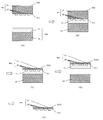
- FIG. 1 (A) to 1 (E) are schematic cross-sectional views (FIGS. 1 (A) and (B)) for explaining temporary bonding between a carrier substrate and a device wafer, respectively, and a device temporarily bonded to the carrier substrate.
- the wafer is thinned (FIG. 1C), the carrier substrate and the device wafer are peeled off (FIG. 1D), and the temporary adhesive film is removed from the device wafer (FIG. 1E).
- FIG. 1C schematic cross-sectional views
- an adhesive carrier base material 100 in which a temporary adhesive film 11 is provided on a carrier base material 12 is prepared.
- the temporary adhesive film 11 can be formed using the temporary bonding composition of the present invention. It is preferable that the temporary adhesive film 11 is an embodiment that does not substantially contain a solvent.
- the device wafer 60 is formed by providing a plurality of device chips 62 on a surface 61 a of a silicon substrate 61.
- the thickness of the silicon substrate 61 is preferably 200 to 1200 ⁇ m, for example.
- the device chip 62 is preferably a metal structure, for example, and the height is preferably 10 to 100 ⁇ m.
- a step of cleaning the back surface of the carrier substrate and the device wafer with a solvent may be provided. Specifically, by removing the temporary adhesive film residue adhering to the substrate or wafer end or back using a solvent that dissolves the temporary adhesive film, the contamination of the apparatus can be prevented, and the thinned device Wafer TTV (Total Thickness Variation) can be reduced.
- the solvent used in the step of washing the carrier substrate and the back surface of the device wafer with a solvent the solvent contained in the aforementioned temporary bonding composition can be used.
- the temporary adhesive film 11 preferably completely covers the device chip 62.
- the height of the device chip is X ⁇ m and the thickness of the temporary adhesive film is Y ⁇ m, the relationship of “X + 100 ⁇ Y> X” is satisfied. Is preferred.
- the provisional adhesive film 11 completely covering the device chip 62 is effective when it is desired to further reduce the TTV of the thinned device wafer (that is, when the flatness of the thinned device wafer is to be further improved). .
- the plurality of device chips 62 are protected by the temporary adhesive film 11, so that it is possible to almost eliminate the uneven shape on the contact surface with the carrier substrate 12. Therefore, even if the thickness is reduced in such a supported state, the possibility that the shape derived from the plurality of device chips 62 is transferred to the back surface 61b1 of the reduced thickness device wafer is reduced.
- the TTV of the integrated device wafer can be further reduced.
- the back surface 61b of the silicon substrate 61 is subjected to mechanical or chemical treatment (though not particularly limited, for example, thinning treatment such as grinding or chemical mechanical polishing (CMP)). , Chemical vapor deposition (CVD), physical vapor deposition (PVD) and other high-temperature and vacuum treatments, treatments using chemicals such as organic solvents, acidic treatment solutions and basic treatment solutions, plating treatments, actinic rays Irradiation, heat treatment, cooling treatment, etc.).
- the thickness of the silicon substrate 61 is reduced (for example, the thickness is reduced to the above-described thickness) to obtain a reduced device wafer 60a.
- the device wafer After the device wafer is thinned, it may be provided with a step of washing the temporary adhesive film protruding outside the area of the substrate surface of the device wafer with a solvent at a stage before performing the treatment under high temperature and vacuum. . Specifically, after thinning the device wafer, the protruding temporary adhesive film is removed using a solvent that dissolves the temporary adhesive film, so that the treatment at high temperature and under vacuum is directly applied to the temporary adhesive film. Can prevent deformation and alteration of the temporary adhesive film. As a solvent used in the step of washing the temporary adhesive film protruding outside the area of the substrate surface of the carrier substrate or the area of the substrate surface of the device wafer with a solvent, the solvent contained in the temporary bonding composition is used. Can be used.
- the area of the temporary adhesive film is preferably smaller than the area of the carrier surface of the carrier substrate.
- the diameter of the substrate surface of the carrier substrate is C ⁇ m
- the diameter of the substrate surface of the device wafer is D ⁇ m
- the diameter of the film surface of the temporary adhesive film is T ⁇ m, (C ⁇ 200) ⁇ T More preferably, ⁇ D is satisfied.
- the diameter of the substrate surface of the carrier substrate is C ⁇ m
- the diameter of the substrate surface of the device wafer is D ⁇ m
- the diameter of the film surface of the temporary adhesive film on the side in contact with the carrier substrate is TC ⁇ m
- the temporary adhesive film When the diameter of the film surface in contact with the device wafer is T D ⁇ m, it is preferable that (C-200) ⁇ T C > T D ⁇ D.
- the area of the film surface of the temporary adhesive film means an area when viewed from a direction perpendicular to the carrier substrate, and the unevenness of the film surface is not considered.
- the substrate surface of the device wafer is, for example, a surface corresponding to the surface 61a in FIG. 1 and the surface on which the device chip is provided.
- the diameter of the substrate surface of the carrier substrate and the diameter of the substrate surface of the device wafer refer to the diameter of the surface in contact with the temporary adhesive film.
- regulated as "diameter" about a carrier base material etc. it is not essential for a carrier base material etc. to be circular (perfect circle) in mathematical meaning, and if it is substantially circular, Good.
- the diameter when converted to a perfect circle of the same area is taken as the diameter.
- a through hole (not shown) penetrating the silicon substrate is formed from the back surface 61b1 of the thinned device wafer 60a after the thinning process, and the silicon through electrode is formed in the through hole. You may perform the process which forms (not shown).
- heating is performed when performing a mechanical or chemical treatment.
- the maximum temperature achieved in the heat treatment is preferably 80 to 400 ° C, more preferably 130 ° C to 400 ° C, and still more preferably 180 ° C to 350 ° C.
- the highest temperature reached in the heat treatment is preferably lower than the decomposition temperature of the temporary adhesive film.
- the heat treatment is preferably 30 seconds to 30 minutes at the highest temperature, and more preferably 1 minute to 10 minutes at the highest temperature.
- the temporary bonding film after the heat treatment can be used satisfactorily as long as there is no swelling or void generation. The generation of voids can be detected by observing with an ultrasonic microscope.
- the carrier substrate 12 is peeled from the thinned device wafer 60a.
- the temperature at the time of peeling is preferably 40 ° C. or lower, and can also be 30 ° C. or lower.
- the lower limit of the temperature at the time of peeling is, for example, 0 ° C. or higher, and preferably 10 ° C. or higher.
- Use of the temporary bonding composition of the present invention is highly valuable in that it can be peeled off at room temperature of about 15 to 35 ° C.
- the peeling method is not particularly limited, but it is preferable that the thinned device wafer 60a is fixed and then pulled up from the end of the carrier base material laminate in the vertical direction with respect to the thinned device wafer 60a and peeled off.
- the peeling interface is preferably peeled off at the interface between the carrier substrate 12 and the temporary adhesive film 11.
- the pulling speed during peeling is preferably 30 to 100 mm / min, and more preferably 40 to 80 mm / min.
- the adhesion strength A at the interface between the carrier base material 12 and the temporary adhesive film 11 and the adhesion strength B between the device wafer surface 61a and the temporary adhesive film 11 preferably satisfy the following expressions.
- the force at the time of raising the edge part in the case of peeling is 0.33 N / mm or less, and can also be 0.2 N / mm or less.
- the lower limit is preferably 0.07 N / mm or more. The force at this time can be measured using a force gauge.
- the thinned device wafer can be obtained by removing the temporary adhesive film 11 from the thinned device wafer 60a.
- the removal method of the temporary adhesive film 11 is, for example, a method of peeling and removing the temporary adhesive film as it is, a method of removing the temporary adhesive film by using a peeling liquid (peeling after the temporary adhesive film is swollen with the peeling liquid) Removal method, method of destroying and removing the temporary adhesive film by spraying the peeling liquid, method of dissolving and removing the temporary adhesive film in the peeling liquid, etc.), decomposition of the temporary adhesive film by irradiation with actinic rays, radiation or heat And a method of removing by vaporization.
- the method of peeling and removing the temporary adhesive film as it is refers to peeling in the state of the temporary adhesive film as it is (film form) without performing chemical treatment such as using a stripping solution.
- the adhesion strength B between the device wafer surface 61a and the temporary adhesive film 11 preferably satisfies the following formula (B1).
- B ⁇ 4N / cm ⁇ ⁇ ⁇ ⁇ Formula (B1) When the temporary protective film is removed using a stripping solution, the following stripping solution can be preferably used.
- peeling liquid As the stripping solution, water and a solvent (organic solvent) can be used. Moreover, as a peeling liquid, the organic solvent which melt
- the organic solvent include aliphatic hydrocarbons (hexane, heptane, isoper E, H, G (manufactured by Esso Chemical Co., Ltd.), limonene, p-menthane, nonane, decane, dodecane, decalin, etc.), aromatic Hydrocarbons (toluene, xylene, anisole, mesitylene, pseudocumene, ethylbenzene, propylbenzene, cumene, n-butylbenzene, sec-butylbenzene, isobutylbenzene, tert-butylbenzene, amylbenzene, isoamylbenzene, (2,2- Dimethylpropyl) benzene, 1-
- Polar solvents include alcohols (methanol, ethanol, propanol, isopropanol, 1-butanol, 1-pentanol, 1-hexanol, 1-heptanol, 1-octanol, 2-octanol, 2-ethyl-1-hexanol, 1 -Nonanol, 1-decanol, benzyl alcohol, ethylene glycol monomethyl ether, 2-ethoxyethanol, diethylene glycol monoethyl ether, diethylene glycol monohexyl ether, triethylene glycol monomethyl ether, propylene glycol monoethyl ether, propylene glycol monomethyl ether, polyethylene glycol monomethyl Ether, polypropylene glycol, tetraethylene glycol, ethylene glycol monobutyl ether Ter, ethylene glycol monobenzyl ether, ethylene glycol monophenyl ether, propylene glycol monophenyl ether, methylphenyl carbinol,
- the stripping solution may contain an alkali, an acid, and a surfactant.
- the blending amount is preferably 0.1 to 5.0% by mass of the stripping solution.
- a form in which two or more organic solvents and water, two or more alkalis, an acid, and a surfactant are mixed is also preferable.
- alkali examples include tribasic sodium phosphate, tribasic potassium phosphate, tribasic ammonium phosphate, dibasic sodium phosphate, dibasic potassium phosphate, dibasic ammonium phosphate, sodium carbonate, potassium carbonate, and ammonium carbonate.
- Inorganic alkali agents such as sodium bicarbonate, potassium bicarbonate, ammonium bicarbonate, sodium borate, potassium borate, ammonium borate, sodium hydroxide, ammonium hydroxide, potassium hydroxide and lithium hydroxide, monomethylamine, Dimethylamine, trimethylamine, monoethylamine, diethylamine, triethylamine, monoisopropylamine, diisopropylamine, triisopropylamine, n-butylamine, monoethanolamine, diethanolamine, triethanol Min, monoisopropanolamine, diisopropanolamine, ethyleneimine, ethylenediamine, pyridine, may be used an organic alkali agent such as tetramethylammonium hydroxide.
- These alkaline agents can be used alone or in combination of two or more.
- Examples of the acid include inorganic acids such as hydrogen halide, sulfuric acid, nitric acid, phosphoric acid and boric acid, alkylsulfonic acid, benzenesulfonic acid, alkylbenzenesulfonic acid, p-toluenesulfonic acid, trifluoromethanesulfonic acid, acetic acid and citric acid.
- Organic acids such as formic acid, gluconic acid, lactic acid, oxalic acid and tartaric acid can be used.
- the surfactant an anionic, cationic, nonionic or zwitterionic surfactant can be used.
- the content of the surfactant is preferably 1 to 20% by mass and more preferably 1 to 10% by mass with respect to the total amount of the alkaline aqueous solution.
- anionic surfactant examples include, but are not limited to, fatty acid salts, abietic acid salts, hydroxyalkane sulfonic acid salts, alkane sulfonic acid salts, dialkyl sulfosuccinic acid salts, linear alkyl benzene sulfonic acid salts, branched alkyl benzene sulfonic acid salts, Alkylnaphthalene sulfonates, alkyl diphenyl ether (di) sulfonates, alkylphenoxy polyoxyethylene alkyl sulfonates, polyoxyethylene alkyl sulfophenyl ether salts, N-alkyl-N-oleyl taurine sodium, N-alkyl sulfosuccinic acid Monoamide disodium salts, petroleum sulfonates, sulfated castor oil, sulfated beef oil, sulfate esters of fatty acid alkyl
- the cationic surfactant is not particularly limited, and conventionally known cationic surfactants can be used. Examples thereof include alkylamine salts, quaternary ammonium salts, alkyl imidazolinium salts, polyoxyethylene alkylamine salts, and polyethylene polyamine derivatives.
- the nonionic surfactant is not particularly limited, but is a polyethylene glycol type higher alcohol ethylene oxide adduct, alkylphenol ethylene oxide adduct, alkyl naphthol ethylene oxide adduct, phenol ethylene oxide adduct, naphthol ethylene oxide adduct, fatty acid.
- Ethylene oxide adduct polyhydric alcohol fatty acid ester ethylene oxide adduct, higher alkylamine ethylene oxide adduct, fatty acid amide ethylene oxide adduct, fat and oil ethylene oxide adduct, polypropylene glycol ethylene oxide adduct, dimethylsiloxane-ethylene oxide block Copolymer, dimethylsiloxane- (propylene oxide-ethylene oxide) block copolymer , Fatty acid esters of polyhydric alcohol type glycerol, fatty acid esters of pentaerythritol, fatty acid esters of sorbitol and sorbitan, fatty acid esters of sucrose, alkyl ethers of polyhydric alcohols, fatty acid amides of alkanolamines.
- those having an aromatic ring and an ethylene oxide chain are preferable, and an alkyl-substituted or unsubstituted phenol ethylene oxide adduct or an alkyl-substituted or unsubstituted naphthol ethylene oxide adduct is more preferable.
- Zwitterionic surfactants include, but are not limited to, amine oxides such as alkyldimethylamine oxide, betaines such as alkylbetaines, and amino acids such as sodium alkylamino fatty acids.
- alkyldimethylamine oxide which may have a substituent alkylcarboxybetaine which may have a substituent
- alkylsulfobetaine which may have a substituent are preferably used.
- a compound represented by the formula (2) in paragraph No. 0256 of JP-A-2008-203359, a formula (I), a formula (II), a formula (I) in paragraph No. 0028 of JP-A-2008-276166, A compound represented by VI) and compounds represented by paragraph numbers 0022 to 0029 of JP-A-2009-47927 can be used.
- additives such as an antifoaming agent and a water softening agent can be contained as required.
- the carrier substrate 12 is peeled by pulling up from the end of the thinned device wafer 60a in a direction perpendicular to the device wafer without any treatment.
- the temporary adhesive film 11 As a method for removing the temporary adhesive film 11 above, it is preferable to remove the temporary adhesive film 11 in the form of a film.
- the carrier is satisfied by satisfying both the above-described formulas (A1) and (B1).
- the base material 12 and the temporary adhesive film 11 can be removed from the device wafer in the manner described above. After peeling the carrier substrate 12 from the thinned device wafer 60a, various known processes are performed on the thinned device wafer 60a as necessary to manufacture a semiconductor device having the thinned device wafer 60a.
- the carrier base material can be regenerated by removing the temporary adhesive film.
- a method of removing the temporary adhesive film in a film state, a method of physically removing by brush, ultrasonic waves, ice particles, aerosol spraying, and a method of dissolving and removing by dissolving in an aqueous solution or an organic solvent, A chemical removal method such as a method of decomposing or vaporizing by irradiation with actinic rays, radiation, or heat can be mentioned, and conventionally known removal methods can be used depending on the carrier substrate. For example, when a silicon substrate is used as a carrier base material, a conventionally known silicon wafer cleaning method can be used.
- strong acid for example, as an aqueous solution or an organic solvent that can be used for chemical removal, strong acid, strong base, Examples include strong oxidizers, or mixtures thereof. Specific examples include acids such as sulfuric acid, hydrochloric acid, hydrofluoric acid, nitric acid, and organic acids, bases such as tetramethylammonium, ammonia, and organic bases, and hydrogen peroxide. Oxidizing agent or a mixture of ammonia and hydrogen peroxide, a mixture of hydrochloric acid and hydrogen peroxide, a mixture of sulfuric acid and hydrogen peroxide, a mixture of hydrofluoric acid and hydrogen peroxide, a mixture of hydrofluoric acid and ammonium fluoride, etc. Is mentioned.
- the method for removing the temporary adhesive film is preferably a method using a carrier substrate cleaning solution from the viewpoint of adhesiveness.
- the carrier substrate cleaning liquid preferably contains an acid (strong acid) having a pKa of less than 0 and hydrogen peroxide.
- the acid having a pKa of less than 0 is selected from inorganic acids such as hydrogen iodide, perchloric acid, hydrogen bromide, hydrogen chloride, nitric acid and sulfuric acid, or organic acids such as alkylsulfonic acid and arylsulfonic acid. From the viewpoint of detergency of the temporary adhesive film on the carrier substrate, an inorganic acid is preferable, and sulfuric acid is most preferable.
- 30% by mass hydrogen peroxide water can be preferably used, and the mixing ratio of the strong acid and 30% by mass hydrogen peroxide water is preferably 0.1: 1 to 100: 1 by mass ratio. : 1 to 10: 1 is more preferable, and 3: 1 to 5: 1 is most preferable.
- FIG. 2 (A) to 2 (E) are schematic cross-sectional views (FIGS. 2 (A) and 2 (B)) for explaining the temporary bonding between the carrier base material and the device wafer, respectively,
- the wafer is thinned (FIG. 2C)
- the carrier substrate and the device wafer are peeled off (FIG. 2D)
- the temporary adhesive film is removed from the device wafer (FIG. 2E).
- This embodiment is different from the first embodiment in that a temporary adhesive film is formed on the surface 61a of the device wafer as shown in FIG.
- the temporary adhesive film 11a is provided on the surface 61a of the device wafer 60
- the temporary adhesion composition is applied (preferably applied) to the surface 61a of the device wafer 60, and then dried (baked). Can be formed. Drying can be performed, for example, at 60 to 150 ° C. for 10 seconds to 2 minutes.
- FIG. 2B the carrier base 12 and the device wafer 60 are pressure-bonded, and the carrier base 12 and the device wafer 60 are temporarily bonded.
- FIG. 2B the carrier base 12 and the device wafer 60 are pressure-bonded, and the carrier base 12 and the device wafer 60 are temporarily bonded.
- the back surface 61b of the silicon substrate 61 is subjected to mechanical or chemical treatment, and the thickness of the silicon substrate 61 is reduced as shown in FIG. Thinning to obtain a thinned device wafer 60a.
- the carrier substrate 12 is peeled from the thinned device wafer 60a.
- the temporary adhesive film 11a is removed from the thinned device wafer 60a.
- FIG. 3 is a schematic cross-sectional view for explaining the release of the temporarily bonded state between the conventional adhesive carrier substrate and the device wafer.
- an adhesive carrier base material is provided with a temporary adhesive film 11b formed of a conventional temporary adhesive composition on a carrier base material 12 as an adhesive carrier base material.
- the adhesive carrier base material 100a and the device wafer are temporarily bonded in the same manner as described with reference to FIG. 1, and the silicon substrate 61 is thinned on the device wafer. Then, the thinned device wafer 60a is peeled from the adhesive carrier substrate 100a in the same manner as described above.
- the conventional temporary bonding composition it is difficult to easily release the temporary support to the device wafer without temporarily supporting the device wafer with high adhesive force and damaging the device wafer.
- a highly temporary adhesive composition is used among the conventional temporary bonding compositions in order to ensure sufficient temporary bonding between the device wafer and the carrier substrate, temporary bonding between the device wafer and the carrier substrate is prevented. It tends to be too strong. Therefore, in order to release this excessively strong temporary adhesion, for example, as shown in FIG. 3, a tape (for example, dicing tape) 70 is attached to the back surface of the thinned device wafer 60a, and the adhesive carrier base material 100a is thinned.
- the device chip 62 on which the structure 63 is provided is likely to be damaged due to the structure 63 being peeled off.
- a low-adhesive composition among conventional temporary bonding compositions is used, temporary support to the device wafer can be easily released, but in the first place temporary bonding between the device wafer and the carrier substrate is too weak.
- the device wafer tends to have a problem that it cannot be reliably supported by the carrier substrate.
- the laminate of the present invention exhibits sufficient adhesion and can easily release the temporary adhesion between the device wafer 60 and the carrier substrate 12. That is, according to the laminated body of the present invention, the device wafer 60 can be temporarily bonded with high adhesive force, and the temporary bonding to the thinned device wafer 60a can be easily released without damaging the thinned device wafer 60a.
- the method for manufacturing a semiconductor device of the present invention is not limited to the above-described embodiment, and appropriate modifications and improvements can be made.
- the silicon substrate is used as the device wafer.
- the present invention is not limited to this, and any device that can be subjected to mechanical or chemical treatment in the method of manufacturing a semiconductor device is not limited thereto. It may be a processing member.
- the device wafer (silicon substrate) is mechanically or chemically treated as a device wafer thinning process and a through silicon via formation process, but is not limited thereto. Any processing required in the method of manufacturing a semiconductor device is included.
- the shape, dimension, number, arrangement location, and the like of the device chip in the device wafer exemplified in the above-described embodiment are arbitrary and are not limited. Further, as another embodiment, the following configuration may be adopted.
- a temporary bonding composition is applied to a glass, silicon, or metal carrier to form a temporary bonding film, and a diced chip is bonded thereon.
- the adhesion temperature at this time is preferably in the range of 10 ° C to 250 ° C.
- the bonded chip is sealed with a molding resin, and the molding resin in which the chip is embedded is peeled off from the adhesive carrier substrate in the same manner as described above, and the temporary adhesive film is removed.
- composition for temporary adhesion As shown below, each component of the temporary bonding composition was mixed to obtain a uniform solution, and then filtered using a polytetrafluoroethylene filter having a pore size of 5 ⁇ m to prepare a temporary bonding composition. .
- composition of Temporary Adhesion Composition >> -Resins listed in Table 1: Amounts listed in Table 1-Additives listed in Table 1: Amounts listed in Table 1-Solvents listed in Table 1: Amounts listed in Table 1 ⁇ All Temporary Adhesions Ingredients blended in the composition for use >>> ⁇ Irganox 1010 (manufactured by BASF Japan Ltd.): 1 part by mass ⁇ Sumilizer TP-D (manufactured by Sumitomo Chemical Co., Ltd.): 1 part by mass
- E indicates the tensile elastic modulus of the resin at 25 ° C. according to JIS K 7161: 1994.
- H-NMR JEOL-JSX400, manufactured by JEOL Ltd.
- the integral intensity of signals attributed to styrene and other copolymer components in the resin is measured, and the specific gravity of each copolymer component is multiplied. It was calculated by doing.
- COP refers to a cycloolefin polymer
- TPI refers to a thermoplastic polyimide resin
- the “280 ° C. 30 minute mass reduction rate” shown in the above table is from 20 ° C. to 280 ° C. using a thermogravimetric apparatus (TGA-50, manufactured by Shimadzu Corporation) under a nitrogen stream of 60 mL / min. The temperature was raised at a rate of temperature increase of 20 ° C./min, held at a temperature of 280 ° C. for 30 minutes, and calculated based on the following formula.
- Mass reduction rate (mass%) ⁇ (Mass at 20 ° C. ⁇ mass after holding at 280 ° C. for 30 minutes) / mass at 20 ° C. ⁇ ⁇ 100
- the refractive index was measured using a precision refractometer (KPR-3000, manufactured by Shimadzu Corporation) at a temperature of 25 ° C. and a wavelength of 589 nm.
- a silicon wafer having a diameter of 12 inches was used as the first substrate, and the film was formed on the surface by applying the temporary bonding composition using a wafer bonding apparatus (Synapse V, manufactured by Tokyo Electron Ltd.).
- a temporary adhesive film was formed on the surface of the first substrate by heating at 130 ° C. for 3 minutes using a hot plate and further heating at 190 ° C. for 3 minutes. At this time, the thickness of the temporary adhesive film was 30 ⁇ m.
- a silicon wafer having a diameter of 12 inches was used as the second base material, and a film was formed on the surface by applying the temporary bonding composition using a wafer bonding apparatus (manufactured by Tokyo Electron Ltd., Synapse V).
- a temporary adhesive film was formed on the surface of the second substrate by heating at 130 ° C. for 3 minutes using a hot plate and further heating at 190 ° C. for 3 minutes. At this time, the thickness of the temporary adhesive film was 30 ⁇ m.
- ⁇ Bonding Process (Example 19) >> The first base material on which the temporary adhesive film is formed and the second base material are subjected to a wafer bonding apparatus (manufactured by Evi Group Japan Co., Ltd., 520IS) at an atmospheric pressure of 10 Pa, a temperature of 300 ° C., and a pressure of 0.5 MPa. Thermocompression bonding was performed for 3 minutes to obtain a laminate.
- a wafer bonding apparatus manufactured by Evi Group Japan Co., Ltd., 520IS
- ⁇ Back grinding process Polishing the laminated body to the thickness of 40 ⁇ m by using a back grinder (manufactured by DISCO Corporation, DFG8540) on the back surface of the substrate 2 side (the side where the temporary adhesive film is not provided), and reducing the thickness of the laminated body Obtained.
- a back grinder manufactured by DISCO Corporation, DFG8540
- the laminate subjected to the CVD process was observed with the naked eye, and the number of blisters was evaluated based on the following criteria.
- Warpage The laminated body subjected to the CVD process was measured for warpage (curvature radius) using a thin film stress measuring device (FLX-2320-S, manufactured by Toago Technology Co., Ltd.), and evaluated according to the following criteria. . Note that the evaluation was performed with an absolute value regardless of the direction of warping.
- D Warpage value is greater than 200 ⁇ m
- a silicon wafer having a diameter of 4 inches was used as the substrate (1 inch is 2.54 cm), and the composition for temporary bonding described in Table 1 was applied to the surface of the wafer by a spin coater (Mikasa Co., Ltd., MS-B200). ) To form a film. A temporary adhesive film was formed on the surface of the first substrate by heating at 130 ° C. for 3 minutes using a hot plate and further heating at 190 ° C. for 3 minutes. At this time, the thickness of the temporary adhesive film was 15 ⁇ m. The end of the temporary adhesive film is cut in a width of 90 mm in the temporary adhesive film of the laminate and at a speed of 300 mm / min at 25 ° C.
- the substrate when the temporary bonding composition of the present invention is used, the substrate can be appropriately peeled from the laminate obtained by temporarily fixing the substrates, and the surface of the substrate after processing It was possible to provide a laminate having an excellent surface shape (Examples 1 to 19). Furthermore, when the tensile modulus was 1 MPa or more and 100 MPa or less, particularly when the tensile modulus was 1 MPa or more and 60 MPa or less, laminates with significantly small warpage were obtained (Examples 1 to 17, especially Examples 1 to 13 and Examples). Examples 15-17).
- Example 20 The evaluation was the same as in Example 1, except that the solvent was a mixed solvent of 80 parts by mass of mesitylene and 20 parts by mass of tert-butylbenzene (manufactured by Toyo Gosei Co., Ltd.). .
- Example 21 The evaluation was the same as in Example 1, except that the solvent was a mixed solvent of 80 parts by mass of mesitylene and 20 parts by mass of pseudocumene (manufactured by Toyo Gosei Co., Ltd.).
- Example 22 When the solvent was used as a mixed solvent of 80 parts by mass of mesitylene and 20 parts by mass of cyclohexanone (manufactured by Sankyo Chemical Co., Ltd.) and the solid content concentration was changed to 20%, the evaluation was carried out in the same manner as in Example 1. It was the same as 1.
- Example 23 Evaluation was the same as Example 19 except that the solvent was a mixed solvent of 80 parts by mass of mesitylene and 20 parts by mass of cyclopentanone (manufactured by Nippon Zeon Co., Ltd.).
- Example 24 When the CVD process was performed in the same manner as in Example 1 except that the conditions were changed to 350 ° C. and 20 minutes, the evaluation was the same as in Example 1.
- Temporary adhesive film 12 Carrier substrate 60: Device wafer 60a: Thinned device wafer 61: Silicon substrate 61a: Front surface 61b, 61b1: Back surface 62: Device chip 63: Structure 70: Tape 100, 100a: Adhesion Carrier substrate
Landscapes
- Chemical & Material Sciences (AREA)
- Organic Chemistry (AREA)
- Chemical Kinetics & Catalysis (AREA)
- Health & Medical Sciences (AREA)
- Medicinal Chemistry (AREA)
- Polymers & Plastics (AREA)
- Laminated Bodies (AREA)
- Adhesives Or Adhesive Processes (AREA)
Abstract
Description
電子機器のさらなる小型化および高性能化のニーズに伴い、電子機器に搭載されるICチップについてもさらなる小型化および高集積化が求められているが、デバイスウェハの面内方向における集積回路の高集積化は限界に近づいている。
しかしながら、厚さ200μm以下のデバイスウェハは非常に薄く、これを基材とする半導体デバイス製造用部材も非常に薄いため、このような部材に対してさらなる処理を施したり、あるいは、このような部材を単に移動したりする場合等において、部材を安定的に、かつ、損傷を与えることなく支持することは困難である。
具体的には、特許文献1には、基板と、上記基板を支持する支持体とを一時的に貼り付けるための接着剤組成物であって、熱可塑性樹脂と、離型剤とを含んでいる接着剤組成物が開示されている。また、特許文献2にも、基材と、半導体基板と、熱安定性ポリマー層からなり、熱安定性ポリマー層が、表面エネルギー調整剤を、熱安定性ポリマーに対し、2.5%以上含むウェハ積層体が記載されている。
本発明はかかる課題を解決することを目的としたものであって、基材同士を仮固定した後、基材を適切に剥離でき、かつ、加工後の基材の表面面状が良好な積層体を提供可能な仮接着用組成物、および、積層体を提供することを目的とする。
<1>樹脂、および、下記式(A)で表される比率が80%以上であるポリエーテル変性シリコーンAを含む仮接着用組成物であって、
上記ポリエーテル変性シリコーンAの含有量が、上記仮接着用組成物の固形分の0.001~1.0質量%である、仮接着用組成物;
式(A) {(MO+EO)/AO}×100
上記式(A)中、MOは、ポリエーテル変性シリコーン中のポリエーテル構造に含まれるメチレンオキシドのモル%であり、EOは、ポリエーテル変性シリコーン中のポリエーテル構造に含まれるエチレンオキシドのモル%であり、AOは、ポリエーテル変性シリコーン中のポリエーテル構造に含まれるアルキレンオキシドのモル%をいう。
<2>上記樹脂が、ポリスチレン系エラストマーである、<1>に記載の仮接着用組成物。
<3>上記樹脂が、ポリスチレン-ポリ(エチレン-プロピレン)ジブロック共重合体、ポリスチレン-ポリ(エチレン-プロピレン)-ポリスチレントリブロック共重合体、ポリスチレン-ポリ(エチレン-ブチレン)-ポリスチレントリブロック共重合体、およびポリスチレン-ポリ(エチレン/エチレン-プロピレン)-ポリスチレントリブロック共重合体の少なくとも1種から選ばれるポリスチレン系エラストマーである、<1>に記載の仮接着用組成物。
<4>上記ポリスチレン系エラストマーにおける、スチレン由来の繰り返し単位の割合が55質量%以下である、<2>または<3>に記載の仮接着用組成物。
<5>上記樹脂の、25℃における、JIS K 7161:1994に準拠した、引張弾性率Eが1~60MPaである、<1>~<4>のいずれかに記載の仮接着用組成物。
<6>上記ポリエーテル変性シリコーンAの、式(A)で表される比率が90%以上である、<1>~<5>のいずれかに記載の仮接着用組成物。
<7>上記ポリエーテル変性シリコーンAの、窒素気流60mL/分のもと、20℃から280℃まで20℃/分の昇温速度で昇温し、280℃の温度で30分間保持したときの質量減少率が50質量%以下である、<1>~<6>のいずれかに記載の仮接着用組成物。
<8>上記ポリエーテル変性シリコーンAが、下記式(101)~式(104)のいずれかで表される、<1>~<7>のいずれかに記載の仮接着用組成物;
式(101)

式(102)
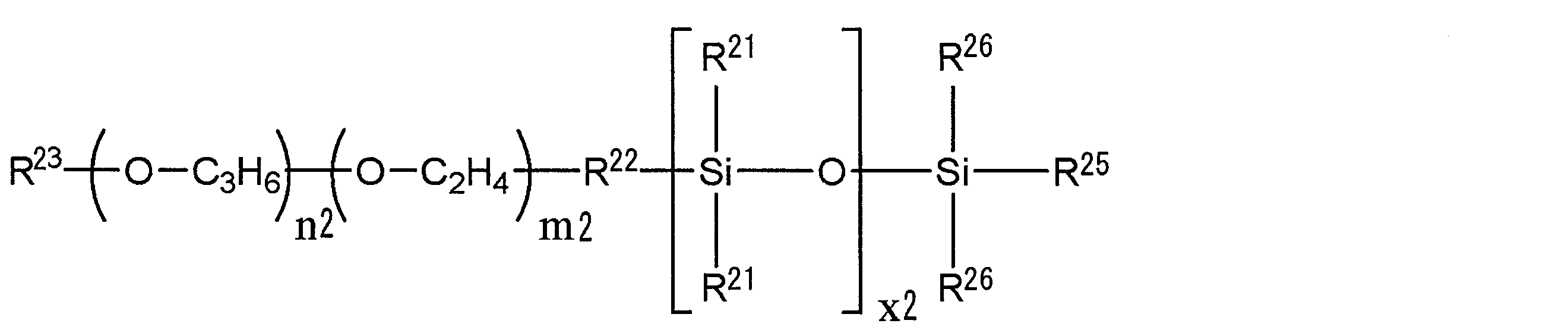
式(103)

式(104)
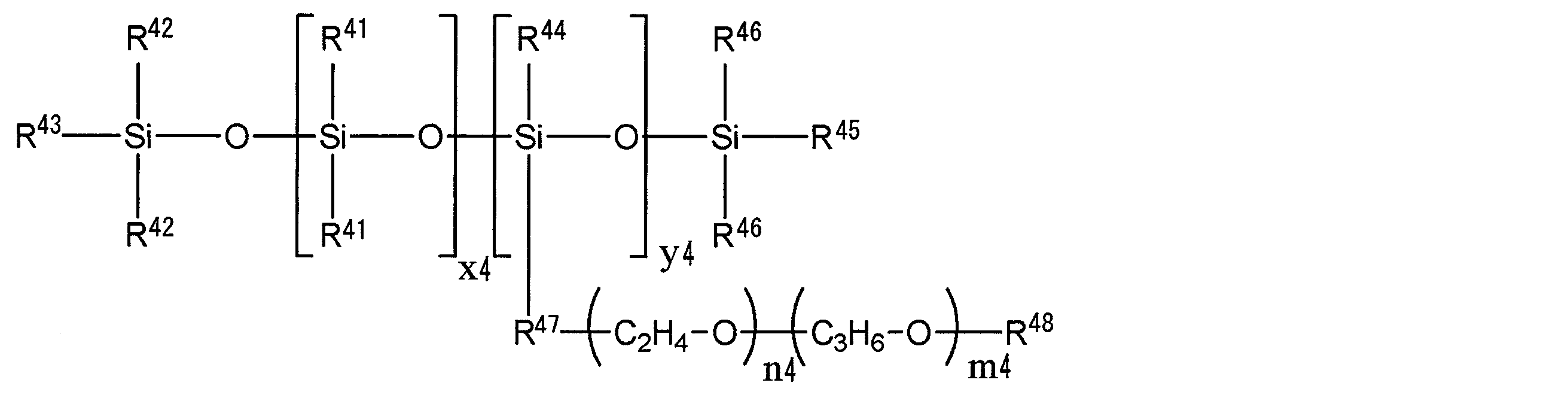
<9>上記ポリエーテル変性シリコーンAの屈折率が1.440以下である、<1>~<8>のいずれかに記載の仮接着用組成物。
<10>仮接着用組成物の剥離力が1~20N/mである、<1>~<9>のいずれかに記載の仮接着用組成物:但し、剥離力とは、仮接着用組成物を用いて、シリコンウェハの表面に、厚さ15μmの仮接着膜を成形し、25℃、速度300mm/分の速度で、シリコンウェハの仮接着膜が形成された面に対し垂直な方向に、仮接着膜の端部を引き上げることによって、剥離可能で、かつ、引き上げる際にかかる力を、フォースゲージを用いて測定したときの力をいう。
<11>第1の基材と、仮接着膜と、第2の基材を、上記順に互いに隣接して有する積層体であって、上記仮接着膜は、<1>~<10>のいずれかに記載の仮接着用組成物から形成される、積層体。
本明細書における基(原子団)の表記において、置換および無置換を記していない表記は、置換基を有さない基と共に置換基を有する基をも包含する。例えば、「アルキル基」とは、置換基を有さないアルキル基(無置換アルキル基)のみならず、置換基を有するアルキル基(置換アルキル基)をも包含する。
本明細書中における「活性光線」または「放射線」は、例えば、可視光線、紫外線、遠紫外線、電子線、X線等を含む。
本明細書において「露光」とは、特に断らない限り、光を用いた露光のみならず、電子線、イオンビーム等の粒子線を用いた描画も含む。また、露光に用いられる光としては、一般的に、水銀灯の輝線スペクトル、エキシマレーザーに代表される遠紫外線、極紫外線(EUV光)、X線、電子線等の活性光線または放射線が挙げられる。
本明細書において、全固形分とは、組成物の全成分から溶剤を除いた成分の総質量をいう。
本明細書において、「(メタ)アクリレート」は、アクリレートおよびメタクリレートを表し、「(メタ)アクリル」は、アクリルおよびメタクリルを表し、「(メタ)アクリロイル」は、「アクリロイル」および「メタクリロイル」を表す。
本明細書において、重量平均分子量(Mw)および数平均分子量(Mn)は、ゲルパーミエーションクロマトグラフィー(GPC)により測定したポリスチレン換算値として定義される。本明細書において、重量平均分子量(Mw)および数平均分子量(Mn)は、例えば、HLC-8220(東ソー(株)製)を用い、カラムとしてTSKgel Super AWM―H(東ソー(株)製、内径(ID)6.0mm×15.0cm)を用い、溶離液として10mmol/LのリチウムブロミドNMP(N-メチルピロリドン)溶液を用いることによって求めることができる。
なお、以下に説明する実施の形態において、既に参照した図面において説明した部材等については、図中に同一符号あるいは相当符号を付すことにより説明を簡略化あるいは省略化する。
式(A) {(MO+EO)/AO}×100
上記式(A)中、MOは、ポリエーテル変性シリコーン中のポリエーテル構造に含まれるメチレンオキシドのモル%であり、EOは、ポリエーテル変性シリコーン中のポリエーテル構造に含まれるエチレンオキシドのモル%であり、AOは、ポリエーテル変性シリコーン中のポリエーテル構造に含まれるアルキレンオキシドのモル%である。
このような構成とすることにより、基材同士を適切に仮固定して積層体とすることができ、さらに、加工後に、基材を適切に剥離できる。併せて、加工後の基材の表面の面状が優れた積層体を提供可能な、仮接着用組成物が得られる。
このメカニズムは、以下の通りであると推定される。すなわち、式(A)で表される比率が80%以上であるポリエーテル変性シリコーンAは、仮接着膜中の界面に選択的に偏在化するため、上記範囲のような少ない添加量であっても基材を適切に仮固定し、かつ、適切に剥離することを可能にする。さらには、加熱を伴う加工を行っても分解によるアウトガスの発生が少ないために、加工後の基材の表面面状が良好となる。
さらに、上記ポリエーテル変性シリコーンAを用いることにより、引張弾性率の低い樹脂、例えば、スチレン由来の繰り返し単位の割合が55質量%以下のスチレン系エラストマーを樹脂成分として用いることができ、反りを効果的に抑制することが可能になる。
本発明の仮接着用組成物は、樹脂を少なくとも1種含む。本発明において、樹脂は、上記仮接着膜の各種特性を達成できる限り、その種類等は特に定めるものでは無い。
樹脂は、ブロック共重合体、ランダム共重合体、グラフト共重合体が挙げられ、ブロック共重合体が好ましい。ブロック共重合体であれば、加熱プロセス時の仮接着用組成物の流動を抑えることができるため、加熱プロセス時においても接着を維持でき、また加熱プロセス後でも剥離性が変化しないという効果が期待できる。
樹脂の種類としては、特に限定はなく、ポリスチレン系共重合体、ポリエステル系共重合体、ポリオレフィン系共重合体、ポリウレタン系共重合体、ポリアミド系共重合体、ポリアクリル系共重合体、シリコーン系共重合体、ポリイミド系共重合体、シクロオレフィン系重合体などが使用できる。
本発明では、上記樹脂が、スチレン-ブタジエン-スチレンブロック共重合体、スチレン-イソプレン-スチレンブロック共重合体、ポリスチレン-ポリ(エチレン-プロピレン)ジブロック共重合体、ポリスチレン-ポリ(エチレン-プロピレン)-ポリスチレントリブロック共重合体、ポリスチレン-ポリ(エチレン-ブチレン)-ポリスチレントリブロック共重合体、ポリスチレン-ポリ(エチレン/エチレン-プロピレン)-ポリスチレントリブロック共重合体、シクロオレフィン系重合体、および、熱可塑性ポリイミド樹脂の少なくとも1種から選ばれる熱可塑性樹脂であることが好ましく、ポリスチレン-ポリ(エチレン-プロピレン)ジブロック共重合体、ポリスチレン-ポリ(エチレン-プロピレン)-ポリスチレントリブロック共重合体、ポリスチレン-ポリ(エチレン-ブチレン)-ポリスチレントリブロック共重合体、およびポリスチレン-ポリ(エチレン/エチレン-プロピレン)-ポリスチレントリブロック共重合体の少なくとも1種から選ばれるポリスチレン系エラストマーであることがより好ましい。
なかでも、樹脂は、スチレンと他のモノマーとのブロック共重合体であることが好ましく、片末端または両末端がスチレンブロックであるスチレンブロック共重合体が特に好ましい。
また、樹脂は、ブロック共重合体の水添物であることが好ましい。樹脂が水添物であると、熱安定性や保存安定性が向上する。さらには、剥離性および剥離後の仮接着膜の洗浄除去性が向上する。なお、水添物とは、ブロック共重合体が水添された構造の重合体を意味する。
なお、本明細書において、エラストマーとは、弾性変形を示す高分子化合物を表す。すなわち外力を加えたときに、その外力に応じて瞬時に変形し、かつ外力を除いたときには、短時間に元の形状を回復する性質を有する高分子化合物と定義する。
また、本明細書において、「接着性」とは「単に高圧で接着すれば高い接着力を与える」性能のみならず、「低圧での接着(例えば、0.4MPaでの低圧接着)に対しても十分に高い接着力を与える」性能をも含む、と定義する。
本発明において、エラストマーの重量平均分子量は、2,000~200,000が好ましく、10,000~200,000がより好ましく、50,000~100,000がさらに好ましい。重量平均分子量がこの範囲にあるエラストマーは、溶剤への溶解性が優れるため、キャリア基材をデバイスウェハから剥離した後、溶剤を用いて、デバイスウェハやキャリア基材に残存するエラストマー由来の残渣を除去する際、残渣が容易に溶剤に溶解して除去される。このため、デバイスウェハやキャリア基材などに残渣が残らないなどの利点がある。
本発明におけるエラストマーは、元の大きさを100%としたときに、室温(20℃)において小さな外力で200%まで変形させることができ、かつ外力を除いたときに、短時間で130%以下に戻る性質を有することが好ましい。
ポリスチレン系エラストマーとしては、特に制限はなく、目的に応じて適宜選択することができる。例えば、スチレン-ブタジエン-スチレンブロック共重合体(SBS)、スチレン-イソプレン-スチレンブロック共重合体(SIS)、ポリスチレン-ポリ(エチレン-プロピレン)ジブロック共重合体(SEP)、ポリスチレン-ポリ(エチレン-プロピレン)-ポリスチレントリブロック共重合体(SEPS)、ポリスチレン-ポリ(エチレン-ブチレン)-ポリスチレントリブロック共重合体(SEBS)、ポリスチレン-ポリ(エチレン/エチレン-プロピレン)-ポリスチレントリブロック共重合体(SEEPS)の少なくとも1種から選ばれるポリスチレン系エラストマーであることが好ましい。
スチレン由来の繰り返し単位の割合の計算方法は、後述する実施例に記載の方法に従う。
すなわち、エラストマーAは、比較的柔らかい材料であるため、弾性を有する仮接着膜を形成しやすい。このため、本発明の仮接着用組成物を用いて基材と支持体との積層体を製造し、基材を研磨して薄膜化する際に、研磨時の圧力が局所的に加わっても、仮接着膜が弾性変形して元の形状に戻り易くできる。その結果、優れた平坦研磨性が得られる。また、研磨後の積層体を、加熱処理し、その後冷却しても、仮接着膜によって、冷却時に発生する内部応力を緩和でき、反りの発生を効果的に抑制できる。
また、上記エラストマーBは、比較的硬い材料であるため、エラストマーBを含むことで、剥離性に優れた仮接着膜を製造できる。
また、ポリスチレン系エラストマーは水添物であると、熱に対する安定性が向上し、分解や重合等の変質が起こりにくい。さらに、溶剤への溶解性およびレジスト溶剤への耐性の観点からもより好ましい。
ポリスチレン系エラストマーの不飽和二重結合量としては、剥離性の観点から、ポリスチレン系エラストマー1gあたり、15mmol未満であることが好ましく、5mmol未満であることがより好ましく、0.5mmol未満であることが最も好ましい。なお、ここでいう不飽和二重結合量は、スチレン由来のベンゼン環内の不飽和二重結合量を含まない。不飽和二重結合量は、NMR(核磁気共鳴)測定により算出することができる。
ポリエステル系エラストマーとしては、特に制限はなく、目的に応じて適宜選択することができる。例えば、ジカルボン酸またはその誘導体と、ジオール化合物またはその誘導体とを重縮合して得られるものが挙げられる。
ジカルボン酸としては、例えば、テレフタル酸、イソフタル酸、ナフタレンジカルボン酸等の芳香族ジカルボン酸(これらの芳香環の水素原子がメチル基、エチル基、フェニル基等で置換された芳香族ジカルボン酸を含む);アジピン酸、セバシン酸、ドデカンジカルボン酸等の炭素数2~20の脂肪族ジカルボン酸;およびシクロヘキサンジカルボン酸などの脂環式ジカルボン酸などが挙げられる。これらは、1種単独で使用してもよく、2種以上併用してもよい。
ジオール化合物としては、例えば、エチレングリコール、1,3-プロパンジオール、1,4-ブタンジオール、1,6-ヘキサンジオール、1,10-デカンジオール、1,4-シクロヘキサンジオールなどの脂肪族ジオール、脂環式ジオール、下記式で表される2価のフェノール化合物などが挙げられる。

また、ポリエステル系エラストマーとして、芳香族ポリエステル(例えば、ポリブチレンテレフタレート)部分からなるハードセグメント成分と、脂肪族ポリエステル(例えば、ポリテトラメチレングリコール)部分からなるソフトセグメント成分とを含む、マルチブロック共重合体を用いることもできる。マルチブロック共重合体としては、ハードセグメントとソフトセグメントとの種類、比率、および分子量の違いによりさまざまなグレードのものが挙げられる。具体例としては、ハイトレル(東レ・デュポン(株)製)、ペルプレン(東洋紡(株)製)、プリマロイ(三菱化学(株)製)、ヌーベラン(帝人(株)製)、エスペル1612、1620(以上、日立化成工業(株)製)などが挙げられる。
ポリオレフィン系エラストマーとしては、特に制限はなく、目的に応じて適宜選択することができる。例えば、エチレン、プロピレン、1-ブテン、1-ヘキセン、4-メチル-1-ペンテン等の炭素数2~20のα-オレフィンの共重合体などが挙げられる。例えば、エチレン-プロピレン共重合体(EPR)、エチレン-プロピレン-ジエン共重合体(EPDM)等が挙げられる。また、ジシクロペンタジエン、1,4-ヘキサジエン、シクロオクタジエン、メチレンノルボルネン、エチリデンノルボルネン、ブタジエン、イソプレンなどの炭素数4~20の非共役ジエンとα-オレフィンとの共重合体などが挙げられる。また、ブタジエン-アクリロニトリル共重合体にメタクリル酸を共重合したカルボキシ変性ニトリルゴムが挙げられる。具体的には、エチレン/α-オレフィン共重合体ゴム、エチレン/α-オレフィン/非共役ジエン共重合体ゴム、プロピレン/α-オレフィン共重合体ゴム、ブテン/α-オレフィン共重合体ゴムなどが挙げられる。
市販品として、ミラストマー(三井化学(株)製)、サーモラン(三菱化学(株)製)EXACT(エクソンモービル製)、ENGAGE(ダウ・ケミカル日本(株)製)、エスポレックス(住友化学(株)製)、Sarlink(東洋紡(株)製)、ニューコン(日本ポリプロ(株)製)、EXCELINK(JSR(株)製)などが挙げられる。
ポリウレタン系エラストマーとしては、特に制限はなく、目的に応じて適宜選択することができる。例えば、低分子のグリコールおよびジイソシアネートからなるハードセグメントと、高分子(長鎖)ジオールおよびジイソシアネートからなるソフトセグメントとの構造単位を含むエラストマーなどが挙げられる。
高分子(長鎖)ジオールとしては、ポリプロピレングリコール、ポリテトラメチレンオキサイド、ポリ(1,4-ブチレンアジペート)、ポリ(エチレン/1,4-ブチレンアジペート)、ポリカプロラクトン、ポリ(1,6-ヘキシレンカーボネート)、ポリ(1,6-ヘキシレン/ネオペンチレンアジペート)などが挙げられる。高分子(長鎖)ジオールの数平均分子量は、500~10,000が好ましい。
低分子のグリコールとしては、エチレングリコール、プロピレングリコール、1,4-ブタンジオール、ビスフェノールA等の短鎖ジオールを用いることができる。短鎖ジオールの数平均分子量は、48~500が好ましい。
ポリウレタン系エラストマーの市販品としては、PANDEX T-2185、T-2983N(以上、DIC(株)製)、ミラクトラン(日本ミラクトラン(株)製)、エラストラン(BASFジャパン(株)製)、レザミン(大日精化工業(株)製)、ペレセン(ダウ・ケミカル日本(株)製)、アイアンラバー(NOK(株)製)、モビロン(日清紡ケミカル(株)製)などが挙げられる。
ポリアミド系エラストマーとしては、特に制限はなく、目的に応じて適宜選択することができる。例えば、ポリアミド-6、11、12などのポリアミドからなるハードセグメントと、ポリオキシエチレン、ポリオキシプロピレン、ポリテトラメチレングリコールなどのポリエーテルおよびポリエステルのうちの少なくとも一種からなるソフトセグメントとを含むエラストマーなどが挙げられる。このエラストマーは、ポリエーテルブロックアミド型、ポリエーテルエステルブロックアミド型の2種に大別される。
市販品として、UBEポリアミドエラストマーの、UBESTA XPA(宇部興産(株)製)、ダイアミド(ダイセルエボニック(株)製)、PEBAX(ARKEMA社製)、グリロンELX(エムスケミージャパン(株)製)、ノパミッド(三菱化学(株)製)、グリラックス(東洋紡製)、ポリエーテルエステルアミドPA-200、PA-201、TPAE-12、TPAE-32、ポリエステルアミドTPAE-617、TPAE-617C(以上、(株)T&K TOKA製)などが挙げられる。
ポリアクリル系エラストマーとしては、特に制限はなく、目的に応じて適宜選択することができる。例えば、エチルアクリレート、ブチルアクリレート、メトキシエチルアクリレート、エトキシエチルアクリレートなどのアクリル酸エステルをモノマー材料の主成分としたものや、アクリル酸エステルと、グリシジルメタクリレート、アリルグリシジルエーテルなどとを共重合した共重合体が挙げられる。さらに、アクリル酸エステルと、アクリロニトリルやエチレンなどの架橋点モノマーとを共重合してなるものなどが挙げられる。具体的には、アクリロニトリル-ブチルアクリレート共重合体、アクリロニトリル-ブチルアクリレート-エチルアクリレート共重合体、アクリロニトリル-ブチルアクリレート-グリシジルメタクリレート共重合体などが挙げられる。
シリコーン系エラストマーとしては、特に制限はなく、目的に応じて適宜選択することができる。例えば、オルガノポリシロキサンを主成分とした、ポリジメチルシロキサン系、ポリメチルフェニルシロキサン系、ポリジフェニルシロキサン系などが挙げられる。市販品の具体例としては、KEシリーズ(信越化学工業(株)製)、SEシリーズ、CYシリーズ、SHシリーズ(以上、東レダウコーニング(株)製)などが挙げられる。
本発明では、エラストマーとして、ゴム変性したエポキシ樹脂(エポキシ系エラストマー)を用いることができる。エポキシ系エラストマーは、例えば、ビスフェノールF型エポキシ樹脂、ビスフェノールA型エポキシ樹脂、サリチルアルデヒド型エポキシ樹脂、フェノールノボラック型エポキシ樹脂もしくはクレゾールノボラック型エポキシ樹脂の一部または全部のエポキシ基を、両末端カルボン酸変性型ブタジエン-アクリロニトリルゴム、末端アミノ変性シリコーンゴム等で変性することによって得られる。
本発明では、樹脂として、上述した樹脂以外の他の高分子化合物(他の高分子化合物ともいう)を用いることができる。他の高分子化合物は、1種または2種以上を併用することができる。
他の高分子化合物の具体例としては、例えば、炭化水素樹脂、ノボラック樹脂、フェノール樹脂、エポキシ樹脂、メラミン樹脂、ユリア樹脂、不飽和ポリエステル樹脂、アルキド樹脂、ポリアミド樹脂、熱可塑性ポリイミド樹脂、ポリアミドイミド樹脂、ポリベンズイミダゾール樹脂、ポリベンゾオキサゾール樹脂、ポリ塩化ビニル樹脂、ポリ酢酸ビニル樹脂、ポリアセタール樹脂、ポリカーボネート樹脂、ポリフェニレンエーテル樹脂、ポリブチレンテレフタレート樹脂、ポリエチレンテレフタレート樹脂、ポリフェニレンスルフィド樹脂、ポリスルホン樹脂、ポリエーテルスルホン樹脂、ポリアリレート樹脂、ポリエーテルエーテルケトン樹脂などが挙げられる。なかでも、炭化水素樹脂、熱可塑性ポリイミド樹脂、ポリカーボネート樹脂が好ましく、炭化水素樹脂がより好ましい。
また、本発明では、樹脂として、後述するフッ素原子を含むものを用いることができるが、フッ素原子を含む樹脂(以下、フッ素系樹脂ともいう)は、実質的に含まないことが好ましい。フッ素系樹脂を実質的に含まないとは、フッ素系樹脂の含有量が、樹脂の全質量に対し、例えば、0.1質量%以下が好ましく、0.05質量%以下がより好ましく、含有しないことがさらに好ましい。
本発明において、炭化水素樹脂として任意のものを使用できる。
炭化水素樹脂は、基本的には炭素原子と水素原子のみからなる樹脂を意味するが、基本となる骨格が炭化水素樹脂であれば、側鎖としてその他の原子を含んでいても良い。すなわち、炭素原子と水素原子のみからなる炭化水素樹脂に、アクリル樹脂、ポリビニルアルコール樹脂、ポリビニルアセタール樹脂、ポリビニルピロリドン樹脂のように、主鎖に炭化水素基以外の官能基が直接結合する場合も本発明における炭化水素樹脂に包含されるものであり、この場合、主鎖に炭化水素基が直接結合されてなる繰り返し単位の含有量が、樹脂の全繰り返し単位に対して30モル%以上であることが好ましい。
上記条件に合致する炭化水素樹脂としては例えば、テルペン樹脂、テルペンフェノール樹脂、変性テルペン樹脂、水添テルペン樹脂、水添テルペンフェノール樹脂、ロジン、ロジンエステル、水添ロジン、水添ロジンエステル、重合ロジン、重合ロジンエステル、変性ロジン、ロジン変性フェノール樹脂、アルキルフェノール樹脂、脂肪族石油樹脂、芳香族石油樹脂、水添石油樹脂、変性石油樹脂、脂環族石油樹脂、クマロン石油樹脂、インデン石油樹脂、ポリスチレン-ポリオレフィン共重合体、オレフィンポリマー(例えば、メチルペンテン共重合体)、およびシクロオレフィンポリマー(例えば、ノルボルネン共重合体、ジシクロペンタジエン共重合体、テトラシクロドデセン共重合体)などが挙げられる。
炭化水素樹脂は、中でも、テルペン樹脂、ロジン、石油樹脂、水素化ロジン、重合ロジン、オレフィンポリマー、または、シクロオレフィンポリマーであることが好ましく、テルペン樹脂、ロジン、オレフィンポリマー、または、シクロオレフィンポリマーであることがより好ましく、シクロオレフィンポリマーであることがさらに好ましい。
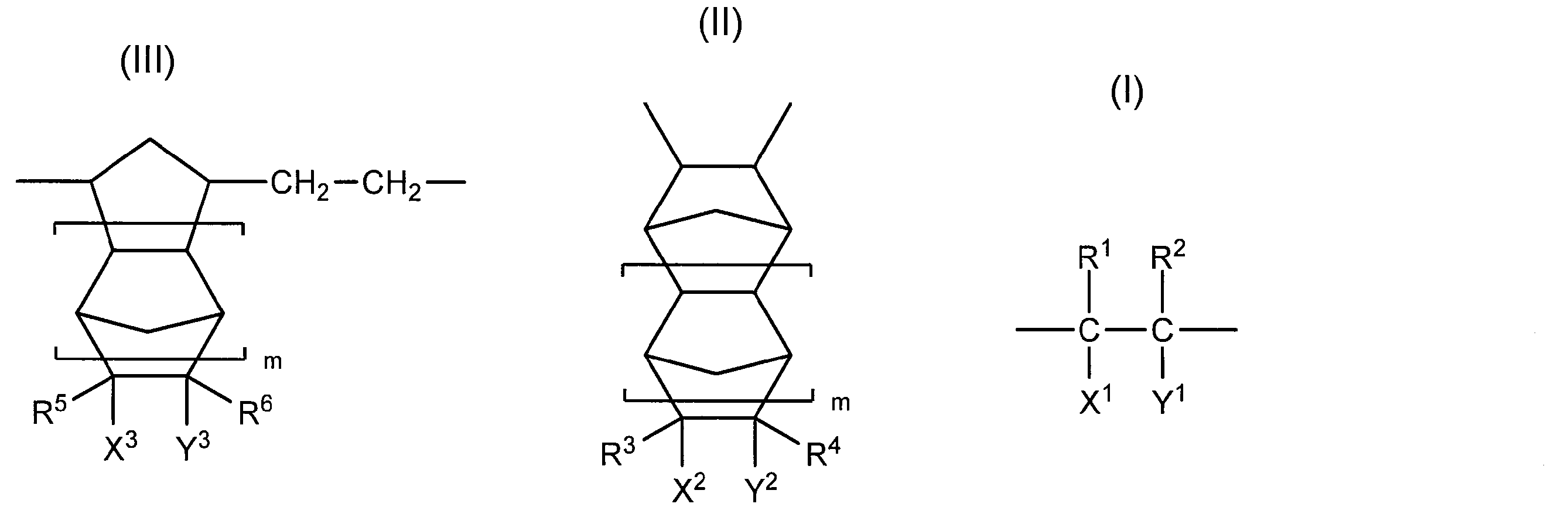
式(III)中、R5およびR6は、水素原子またはメチル基であることが好ましく、X3およびY3は水素原子であることが好ましく、その他の基は適宜選択される。このノルボルネン系重合体は、JSR(株)からアートン(Arton)GあるいはアートンFという商品名で発売されており、また日本ゼオン(株)からゼオノア(Zeonor)ZF14、ZF16、ゼオネックス(ZEONEX)250、同280、同480Rという商品名で市販されており、これらを使用することができる。
熱可塑性ポリイミド樹脂としては、テトラカルボン酸二無水物とジアミンとを公知の方法で縮合反応させて得られるものを用いることができる。
公知の方法としては、例えば、有機溶剤中で、テトラカルボン酸二無水物とジアミンとを略等モル混合し、反応温度80℃以下で反応させてポリアミック酸を合成し、得られたポリアミック酸を脱水閉環(イミド化)させる方法などが挙げられる。ここで、略等モルとは、テトラカルボン酸二無水物とジアミンのモル量比が1:1近傍であることを言う。なお、必要に応じて、テトラカルボン酸二無水物とジアミンとの組成比が、テトラカルボン酸二無水物の合計1.0モルに対して、ジアミンの合計が0.5~2.0モルとなるように調整してもよい。テトラカルボン酸二無水物とジアミンとの組成比を上記の範囲内で調整することによって、熱可塑性ポリイミド樹脂の重量平均分子量を調整することができる。
これらのジアミンの中でも、3-(4-アミノフェニル)-1,1,3-トリメチル-5-アミノインダン、1,3-ビス(3-アミノプロピル)テトラメチルジシロキサン、ポリオキシプロピレンジアミン、2,2-ビス(4-アミノフェノキシフェニル)プロパン、4,9-ジオキサドデカン-1,12-ジアミン、1,6-ジアミノヘキサン、および、4,9,14-トリオキサへプタデカン-1,17-ジアミンからなる群から選択される1種以上が好ましく、3-(4-アミノフェニル)-1,1,3-トリメチル-5-アミノインダンがより好ましい。
テトラカルボン酸二無水物とジアミンとの反応温度は、好ましくは100℃未満、さらに好ましくは90℃未満である。また、ポリアミック酸のイミド化は、代表的には不活性雰囲気(例えば、真空または窒素雰囲気)下で加熱処理することにより行われる。加熱処理温度は、好ましくは150℃以上であり、より好ましくは180~450℃である。
このような溶解度を有する熱可塑性ポリイミド樹脂としては、例えば、3,4,3’,4’-ベンゾフェノンテトラカルボン酸二無水物と、3-(4-アミノフェニル)-1,1,3-トリメチル-5-アミノインダンとを反応させて得られる熱可塑性ポリイミド樹脂などが挙げられる。この熱可塑性ポリイミド樹脂は、耐熱性が特に優れる。
本発明において、ポリカーボネート樹脂は、下記式(1)で表される繰り返し単位を有することが好ましい。

これらの芳香族基は、置換基を有していてもよいが、置換基を有していない方が好ましい。
芳香族基が有していてもよい置換基の例としては、ハロゲン原子、アルキル基、アルコキシ基、アリール基などが挙げられる。
ハロゲン原子としては、フッ素原子、塩素原子、臭素原子、ヨウ素原子等が挙げられる。
アルキル基としては、炭素数1~30のアルキル基が挙げられる。アルキル基の炭素数は、1~20が好ましく、1~10がより好ましい。アルキル基は、直鎖、分岐のいずれであってもよい。また、アルキル基の水素原子の一部または全部は、ハロゲン原子で置換されていてもよい。ハロゲン原子としては、フッ素原子、塩素原子、臭素原子、ヨウ素原子等が挙げられ、フッ素原子が好ましい。
アルコキシ基としては、炭素数1~30のアルコキシ基が好ましい。アルコキシ基の炭素数は、1~20がより好ましく、1~10がさらに好ましい。アルコキシ基は、直鎖、分岐、環状のいずれでもよい。
アリール基としては、炭素数6~30のアリール基が好ましく、炭素数6~20のアリール基がより好ましい。
本発明の仮接着用組成物に用いる樹脂は、25℃における、JIS(日本工業規格)K 7161:1994に準拠した引張弾性率Eが、1MPa以上4000MPa以下であることが好ましく、1MPa以上100MPa以下であることがより好ましく、1MPa以上60MPa以下であることがさらに好ましく、1MPa以上35MPa以下であることが一層好ましく、1MPa以上20MPa以下であることがより一層好ましく、1MPa以上15MPa以下であることがさらに一層好ましく、3MPa以上10MPa以下であることが特に好ましい。このような範囲にすることにより、反りをより効果的に抑制することが可能になる。
上記樹脂の引張弾性率Eは、後述する実施例に記載の方法で測定される。
本発明の仮接着用組成物は、樹脂を、仮接着用組成物の全固形分中に50.00~99.99質量%の割合で含むことが好ましく、70.00~99.99質量%がより好ましく、88.00~99.99質量%が特に好ましい。樹脂の含有量が上記範囲であれば、接着性および剥離性に優れる。
樹脂としてエラストマーを用いる場合、エラストマーは、仮接着用組成物の全固形分中に50.00~99.99質量%の割合で含まれることが好ましく、70.00~99.99質量%がより好ましく、88.00~99.99質量%が特に好ましい。エラストマーの含有量が上記範囲であれば、接着性および剥離性に優れる。エラストマーを2種以上使用した場合は、合計が上記範囲であることが好ましい。
また、樹脂としてエラストマーを用いる場合、樹脂全質量におけるエラストマーの含有量は、50~100質量%が好ましく、70~100質量%がより好ましく、80~100質量%がさらに好ましく、90~100質量%が一層好ましい。また、樹脂は、実質的にエラストマーのみであってもよい。なお、樹脂が、実質的にエラストマーのみであるとは、樹脂全質量におけるエラストマーの含有量が、99質量%以上が好ましく、99.9質量%以上がより好ましく、エラストマーのみからなることが一層好ましい。
本発明の仮接着用組成物に用いるポリエーテル変性シリコーンAは、下記式(A)で表される比率が80%以上である。
式(A) {(MO+EO)/AO}×100
上記式(A)中、MOは、ポリエーテル変性シリコーン中のポリエーテル構造に含まれるメチレンオキシドのモル%であり、EOは、ポリエーテル変性シリコーン中のポリエーテル構造に含まれるエチレンオキシドのモル%であり、AOは、ポリエーテル変性シリコーン中のポリエーテル構造に含まれるアルキレンオキシドのモル%である。
上記式(A)で表される比率は、90%以上であることが好ましく、95%以上であることがより好ましく、98%以上であることがさらに好ましく、99%以上であることが一層好ましく、100%であることがより一層好ましい。
本発明における質量減少率は、実施例に記載の方法によって測定される。
式(101)

式(102)
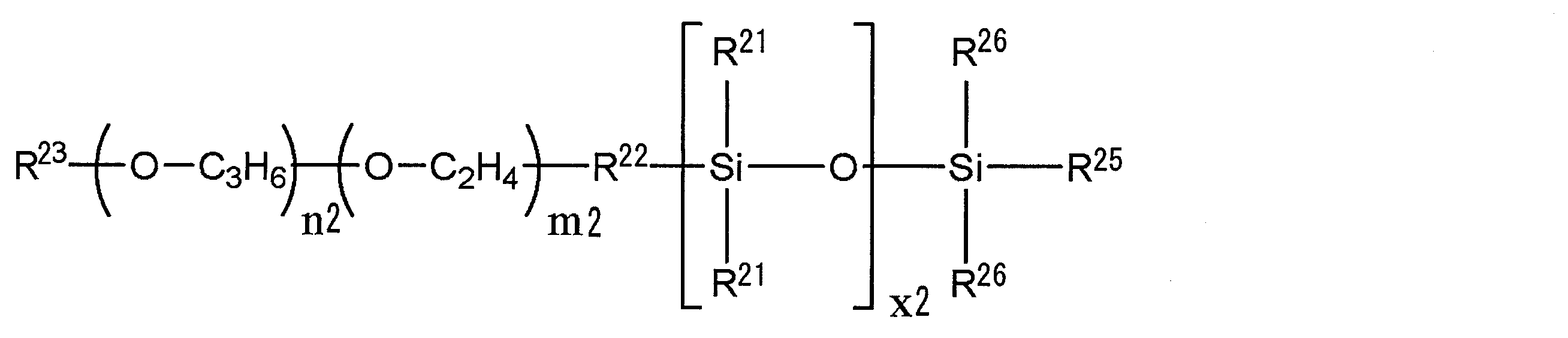
式(103)

式(104)
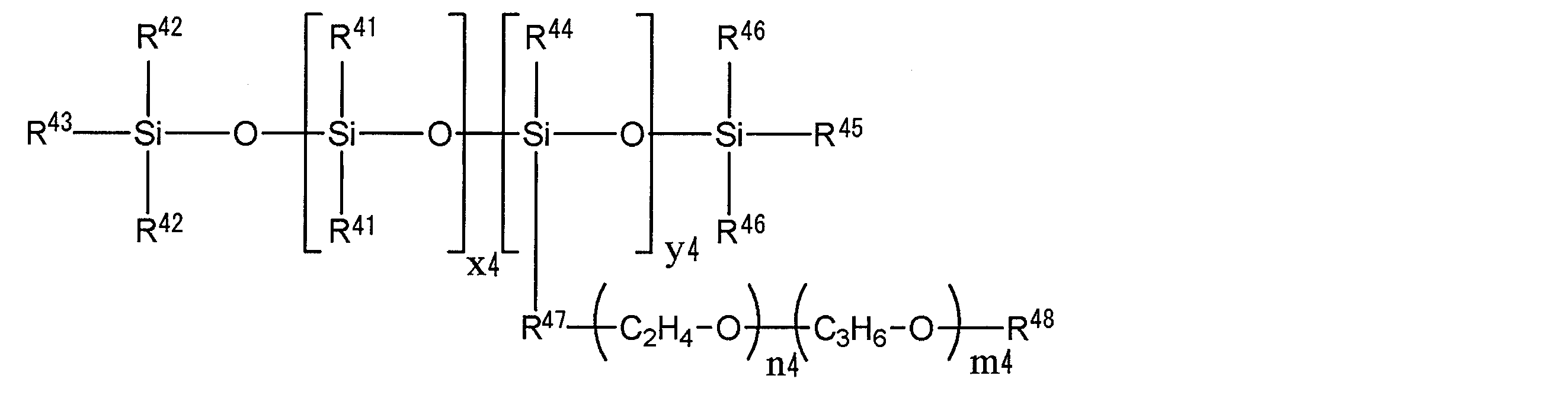
上記式(101)中、R12およびR14は、それぞれ独立に、2価の連結基であり、カルボニル基、酸素原子、炭素数1~6のアルキレン基、炭素数6~16のシクロアルキレン基、炭素数2~8のアルケニレン基、炭素数2~5のアルキニレン基、および炭素数6~10のアリーレン基が好ましく、酸素原子がより好ましい。
式(101)中、R13およびR15は、水素原子または炭素数1~5のアルキル基であり、水素原子または炭素数1~4のアルキル基が好ましく、水素原子または炭素数1~3のアルキル基がより好ましい。
上記式(102)中、R22は、2価の連結基であり、式(101)におけるR12およびR14と同義であり、好ましい範囲も同様である。
上記式(102)中、R23は、水素原子または炭素数1~5のアルキル基であり、式(101)におけるR13およびR15と同義であり、好ましい範囲も同様である。
上記式(103)中、R32およびR34は、それぞれ独立に、2価の連結基であり、式(101)におけるR12およびR14と同義であり、好ましい範囲も同様である。
上記式(103)中、R33およびR35は、水素原子または炭素数1~5のアルキル基であり、式(101)におけるR13およびR15と同義であり、好ましい範囲も同様である。
上記式(104)中、R47は、2価の連結基であり、式(101)におけるR12およびR14と同義であり、好ましい範囲も同様である。
上記式(104)中、R48は、水素原子または炭素数1~5のアルキル基であり、式(101)におけるR13およびR15と同義であり、好ましい範囲も同様である。
ポリオキシアルキレン基の含有率は、「{(ポリエーテル変性シリコーンA1分子中のポリオキシアルキレン基の式量)/ポリエーテル変性シリコーンA1分子の分子量}×100」で定義される。
本発明の仮接着用組成物は、ポリエーテル変性シリコーンAを1種のみ含んでいてもよく、2種以上含んでいてもよい。2種以上含む場合、合計量が上記範囲となることが好ましい。
本発明の仮接着用組成物は、上記ポリエーテル変性シリコーンA以外の離型剤を含んでいてもよい。他の離型剤としては、フッ素系液体状化合物や上記以外のシリコーン化合物が例示される。
他の離型剤を含有する場合、その含有量は、仮接着用組成物の固形分の0.001~0.005質量%の範囲が好ましい。他の離型剤は、1種のみ含んでいてもよいし、2種以上含んでいてもよい。2種以上含む場合、合計量が上記範囲となることが好ましい。
また、本発明では、他の離型剤を実質的に含まない構成とすることができる。他の離型剤を実質的に含まないとは、他の離型剤の含有量が、上記ポリエーテル変性シリコーンAの含有量の1質量%以下であることをいう。
本発明の仮接着用組成物は、必要に応じて可塑剤を含んでいてもよい。可塑剤を配合することにより、上記諸性能を満たす仮接着膜を形成することができる。
可塑剤としては、フタル酸エステル、脂肪酸エステル、芳香族多価カルボン酸エステル、ポリエステルなどが使用できる。
脂肪酸エステルとしては例えば、ブチルステアレート、ユニスターM-9676、ユニスターM-2222SL、ユニスターH-476、ユニスターH-476D、パナセート800B、パナセート875、パナセート810(以上、日油(株)製)、DBA、DIBA、DBS、DOA、DINA、DIDA、DOS、BXA、DOZ、DESU(以上、大八化学工業(株)製)などが挙げられる。
芳香族多価カルボン酸エステルとしては、TOTM、モノサイザーW-705(以上、大八化学工業(株)製)、UL-80、UL-100(以上、(株)ADEKA製)などが挙げられる。
ポリエステルとしては、ポリサイザーTD-1720、ポリサイザーS-2002、ポリサイザーS-2010(以上、DIC(株)製)、BAA-15(大八化学工業(株)製)などが挙げられる。
上記可塑剤の中では、DIDP、DIDA、TOTM、ユニスターM-2222SL、ポリサイザーTD-1720が好ましく、DIDA、TOTMがより好ましく、TOTMが特に好ましい。
可塑剤は1種のみを用いてもよいし、2種以上を組み合わせてもよい。
本発明の仮接着用組成物は、酸化防止剤を含有してもよい。酸化防止剤としては、フェノール系酸化防止剤、硫黄系酸化防止剤、リン系酸化防止剤、キノン系酸化防止剤、アミン系酸化防止剤などが使用できる。
フェノール系酸化防止剤としては、例えば、p-メトキシフェノール、2,6-ジ-tert-ブチル-4-メチルフェノール、Irganox1010、Irganox1330、Irganox3114、Irganox1035(以上、BASFジャパン(株)製)、Sumilizer MDP-S、Sumilizer GA-80(以上、住友化学(株)製)などが挙げられる。
硫黄系酸化防止剤としては、例えば、3,3’-チオジプロピオネートジステアリル、Sumilizer TPM、Sumilizer TPS、Sumilizer TP-D(以上、住友化学(株)製)などが挙げられる。
リン系酸化防止剤としては、例えば、トリス(2,4-ジ-tert-ブチルフェニル)ホスファイト、ビス(2,4-ジ-tert-ブチルフェニル)ペンタエリスリトールジホスフィト、ポリ(ジプロピレングリコール)フェニルホスフィト、ジフェニルイソデシルホスフィト、2-エチルヘキシルジフェニルホスフィト、トリフェニルホスフィト、Irgafos168、Irgafos38(以上、BASFジャパン(株)製)などが挙げられる。
キノン系酸化防止剤としては、例えば、p-ベンゾキノン、2-tert-ブチル-1,4-ベンゾキノンなどが挙げられる。
アミン系酸化防止剤としては、例えば、ジメチルアニリンやフェノチアジンなどが挙げられる。
酸化防止剤は、Irganox1010、Irganox1330、3,3’-チオジプロピオネートジステアリル、Sumilizer TP-Dが好ましく、Irganox1010、Irganox1330がより好ましく、Irganox1010が特に好ましい。
また、上記酸化防止剤のうち、フェノール系酸化防止剤と、硫黄系酸化防止剤またはリン系酸化防止剤とを併用することが好ましく、フェノール系酸化防止剤と硫黄系酸化防止剤とを併用することが最も好ましい。特に、樹脂として、ポリスチレン系エラストマーを使用した場合において、フェノール系酸化防止剤と硫黄系酸化防止剤とを併用することが好ましい。このような組み合わせにすることにより、酸化反応による樹脂の劣化を、効率よく抑制できる効果が期待できる。フェノール系酸化防止剤と硫黄系酸化防止剤とを併用する場合、フェノール系酸化防止剤と硫黄系酸化防止剤との質量比は、フェノール系酸化防止剤:硫黄系酸化防止剤=95:5~5:95が好ましく、25:75~75:25がより好ましい。
酸化防止剤の組み合わせとしては、Irganox1010とSumilizer TP-D、Irganox1330とSumilizer TP-D、および、Sumilizer GA-80とSumilizer TP-Dが好ましく、Irganox1010とSumilizer TP-D、Irganox1330とSumilizer TP-Dがより好ましく、Irganox1010とSumilizer TP-Dが特に好ましい。
酸化防止剤は1種のみでもよいし、2種以上であってもよい。酸化防止剤が2種以上の場合は、その合計が上記範囲であることが好ましい。
本発明の仮接着用組成物は、溶剤を含有することが好ましい。溶剤は、公知のものを制限なく使用でき、有機溶剤が好ましい。
有機溶剤としては、酢酸エチル、酢酸-n-ブチル、酢酸イソブチル、ギ酸アミル、酢酸イソアミル、プロピオン酸ブチル、酪酸イソプロピル、酪酸エチル、酪酸ブチル、乳酸メチル、乳酸エチル、アルコキシ酢酸アルキル(例えば、アルコキシ酢酸メチル、アルコキシ酢酸エチル、アルコキシ酢酸ブチル(例えば、メトキシ酢酸メチル、メトキシ酢酸エチル、メトキシ酢酸ブチル、エトキシ酢酸メチル、エトキシ酢酸エチル等))、3-アルコキシプロピオン酸アルキルエステル類(例えば、3-アルコキシプロピオン酸メチル、3-アルコキシプロピオン酸エチル等(例えば、3-メトキシプロピオン酸メチル、3-メトキシプロピオン酸エチル、3-エトキシプロピオン酸メチル、3-エトキシプロピオン酸エチル等))、2-アルコキシプロピオン酸アルキルエステル類(例えば、2-アルコキシプロピオン酸メチル、2-アルコキシプロピオン酸エチル、2-アルコキシプロピオン酸プロピル等(例えば、2-メトキシプロピオン酸メチル、2-メトキシプロピオン酸エチル、2-メトキシプロピオン酸プロピル、2-エトキシプロピオン酸メチル、2-エトキシプロピオン酸エチル))、2-アルコキシ-2-メチルプロピオン酸メチルおよび2-アルコキシ-2-メチルプロピオン酸エチル(例えば、2-メトキシ-2-メチルプロピオン酸メチル、2-エトキシ-2-メチルプロピオン酸エチル等)、ピルビン酸メチル、ピルビン酸エチル、ピルビン酸プロピル、アセト酢酸メチル、アセト酢酸エチル、2-オキソブタン酸メチル、2-オキソブタン酸エチル、1-メトキシ-2-プロピルアセテート、エチルカルビトールアセテート、ブチルカルビトールアセテート等のエステル類;
ジエチレングリコールジメチルエーテル、テトラヒドロフラン、エチレングリコールモノメチルエーテル、エチレングリコールモノエチルエーテル、メチルセロソルブアセテート、エチルセロソルブアセテート、ジエチレングリコールモノメチルエーテル、ジエチレングリコールモノエチルエーテル、ジエチレングリコールモノブチルエーテル、プロピレングリコールモノメチルエーテル、プロピレングリコールモノメチルエーテルアセテート、プロピレングリコールモノエチルエーテルアセテート、プロピレングリコールモノプロピルエーテルアセテート、プロピレングリコールメチルエーテル、プロピレングリコールメチルエーテルアセテート等のエーテル類;
メチルエチルケトン、シクロヘキサノン、シクロペンタノン、2-ヘプタノン、3-ヘプタノン、N-メチル-2-ピロリドン、γ-ブチロラクトン等のケトン類;
N-メチル-2-ピロリドン、N-エチル-2-ピロリドン等のピロリドン類;
トルエン、キシレン、アニソール、メシチレン、プソイドクメン、エチルベンゼン、プロピルベンゼン、クメン、n-ブチルベンゼン、sec-ブチルベンゼン、イソブチルベンゼン、tert-ブチルベンゼン、アミルベンゼン、イソアミルベンゼン、(2,2-ジメチルプロピル)ベンゼン、1-フェニルへキサン、1-フェニルヘプタン、1-フェニルオクタン、1-フェニルノナン、1-フェニルデカン、シクロプロピルベンゼン、シクロヘキシルベンゼン、2-エチルトルエン、1,2-ジエチルベンゼン、o-シメン、インダン、1,2,3,4-テトラヒドロナフタレン、3-エチルトルエン、m-シメン、1,3-ジイソプロピルベンゼン、4-エチルトルエン、1,4-ジエチルベンゼン、p-シメン、1,4-ジイソプロピルベンゼン、4-tert-ブチルトルエン、1,4-ジ-tert-ブチルベンゼン、1,3-ジエチルベンゼン、1,2,3-トリメチルベンゼン、1,2,4-トリメチルベンゼン、4-tert-ブチル-o-キシレン、1,2,4-トリエチルベンゼン、1,3,5-トリエチルベンゼン、1,3,5-トリイソプロピルベンゼン、5-tert-ブチル-m-キシレン、3,5-ジ-tert-ブチルトルエン、1,2,3,5-テトラメチルベンゼン、1,2,4,5-テトラメチルベンゼン、ペンタメチルベンゼン、デカヒドロナフタレン等の芳香族炭化水素類;
エチルシクロヘキサン、リモネン、p-メンタン、ノナン、デカン、ドデカン、デカリン等の脂肪族炭化水素類などが好適に挙げられる。
溶剤は1種のみでもよいし、2種以上であってもよい。溶剤が2種以上の場合は、その合計が上記範囲であることが好ましい。
本発明の仮接着用組成物は、界面活性剤を含有することが好ましい。
界面活性剤としては、アニオン系、カチオン系、ノニオン系、または、両性のいずれでも使用することができるが、好ましい界面活性剤はノニオン系界面活性剤である。
ノニオン系界面活性剤の好ましい例としては、ポリオキシエチレン高級アルキルエーテル類、ポリオキシエチレン高級アルキルフェニルエーテル類、ポリオキシエチレングリコールの高級脂肪酸ジエステル類を挙げることができる。
本発明の仮接着用組成物は、本発明の効果を損なわない範囲で、必要に応じて、各種添加物、例えば、硬化剤、硬化触媒、充填剤、密着促進剤、紫外線吸収剤、凝集防止剤等を配合することができる。これらの添加剤を配合する場合、その合計配合量は仮接着用組成物の全固形分の3質量%以下が好ましい。
仮接着用組成物から金属等の不純物を除去する方法としては、例えば、フィルタを用いた濾過を挙げることができる。フィルタ孔径としては、10nm以下が好ましく、5nm以下がより好ましく、3nm以下がさらに好ましい。フィルタの材質としては、ポリテトラフロロエチレン、ポリエチレン、ナイロンが好ましい。フィルタは、有機溶剤であらかじめ洗浄したものを用いてもよい。フィルタ濾過工程では、複数種類のフィルタを直列または並列に接続して用いてもよい。複数種類のフィルタを使用する場合は、孔径および/または材質が異なるフィルタを組み合わせて使用しても良い。また、各種材料を複数回濾過してもよく、複数回濾過する工程が循環濾過工程であっても良い。
また、仮接着用組成物に含まれる金属等の不純物を低減する方法としては、仮接着用組成物を構成する原料として金属含有量が少ない原料を選択する、仮接着用組成物を構成する原料に対してフィルタ濾過を行う、装置内をテフロン(登録商標)でライニングする等によりコンタミネーションを可能な限り抑制した条件下で蒸留を行う等の方法を挙げることができる。仮接着用組成物を構成する原料に対して行うフィルタ濾過における好ましい条件は、上記した条件と同様である。
フィルタ濾過の他、吸着材による不純物の除去を行っても良く、フィルタ濾過と吸着材による不純物の除去とを組み合わせて実施しても良い。吸着材としては、公知の吸着材を用いることができ、例えば、シリカゲル、ゼオライトなどの無機系吸着材、活性炭などの有機系吸着材を使用することができる。
仮接着膜は、第1の基材および第2の基材の少なくとも一方の表面に、本発明の仮接着用組成物を用いて形成することができる。第1の基材および第2の基材の一方のみに仮接着膜を形成して他方の基材と貼り合わせても良いし、両方の基材に仮接着膜を設けて両者を貼り合わせてもよい。
仮接着膜の形成には、仮接着用組成物を、従来公知のスピンコート法、スプレー法、スリットコート法、ローラーコート法、フローコート法、ドクターコート法、浸漬法などを用いることができる。
次いで、通常、仮接着用組成物は溶剤を含むため、加熱を行って溶剤を揮発させる。この加熱温度としては、溶剤の沸点よりも高い温度であることが好ましく、110℃以上であることがより好ましく、130℃~200℃がさらに好ましく、160℃~190℃が特に好ましい。
本発明の仮接着用組成物は、上述の各成分を混合して調製することができる。各成分の混合は、通常、0℃~100℃の範囲で行われる。また、各成分を混合した後、例えば、フィルタでろ過することが好ましい。ろ過は、多段階で行ってもよいし、多数回繰り返してもよい。また、ろ過した液を再ろ過することもできる。
フィルタとしては、従来からろ過用途等に用いられているものであれば特に限定されることなく用いることができる。例えば、PTFE(ポリテトラフルオロエチレン)等のフッ素樹脂、ナイロン-6、ナイロン-6,6等のポリアミド系樹脂、ポリエチレン、ポリプロピレン(PP)等のポリオレフィン樹脂(高密度、超高分子量のポリオレフィン樹脂を含む)等の素材を用いたフィルタが挙げられる。これら素材の中でもポリプロピレン(高密度ポリプロピレンを含む)およびナイロンが好ましい。
フィルタの孔径は、例えば、0.003~5.0μm程度が適している。この範囲とすることにより、ろ過詰まりを抑えつつ、組成物に含まれる不純物や凝集物など、微細な異物を確実に除去することが可能となる。
フィルタを使用する際、異なるフィルタを組み合わせても良い。その際、第1のフィルタでのフィルタリングは、1回のみでもよいし、2回以上行ってもよい。異なるフィルタを組み合わせて2回以上フィルタリングを行う場合は1回目のフィルタリングの孔径より2回目以降の孔径が同じ、もしくは小さい方が好ましい。また、上述した範囲内で異なる孔径の第1のフィルタを組み合わせてもよい。ここでの孔径は、フィルタメーカーの公称値を参照することができる。市販のフィルタとしては、例えば、日本ポール(株)、アドバンテック東洋(株)、日本インテグリス(株)または(株)キッツマイクロフィルタ等が提供する各種フィルタの中から選択することができる。
本発明の仮接着用組成物は、剥離力が1~20N/mであることが好ましく、1~25N/mであることがより好ましい。上記剥離力の下限は、3.0N/m以上であることがより好ましい。上記剥離力の上限は、20N/m以下であることがより好ましく、15N/m以下であることがさらに好ましく、10N/m以下であることが一層好ましく、9N/m以下であることがより一層好ましい。このような範囲とすることにより、加工後の基材に損傷を与えることなく剥離が可能になるという効果がより効果的に発揮される。
ここで、剥離力とは、仮接着用組成物を用いて、シリコンウェハの表面に、厚さ15μmの仮接着膜を成形し、25℃、速度300mm/分の速度で、シリコンウェハの仮接着膜が形成された面に対し垂直な方向に、仮接着膜の端部を引き上げることによって剥離可能で、かつ、引き上げる際にかかる力を、フォースゲージを用いて測定したときの力をいう。具体的には、後述する実施例に記載の方法に従う。
本発明は、また、第1の基材と、仮接着膜と、第2の基材を、上記順に互いに隣接して有する積層体を開示する。上記仮接着膜は、上述の本発明の仮接着用組成物から形成される。本発明の積層体は、上記仮接着用組成物を用いて、第1の基材と、第2の基材とを、一時的に接着して用いる。
<第一の実施形態>
以下、積層体を製造する工程を経た半導体装置の製造方法の一実施形態について、図1をあわせて参照しながら説明する。なお、本発明は、以下の実施形態に限定されるものではない。
図1(A)~(E)は、それぞれ、キャリア基材とデバイスウェハとの仮接着を説明する概略断面図(図1(A)、(B))、キャリア基材に仮接着されたデバイスウェハが薄型化された状態(図1(C))、キャリア基材とデバイスウェハを剥離した状態(図1(D))、デバイスウェハから仮接着膜を除去後の状態(図1(E))を示す概略断面図である。
仮接着膜11は、本発明の仮接着用組成物を用いて形成することができる。仮接着膜11は、実質的に溶剤を含まない態様であることが好ましい。
デバイスウェハ60は、シリコン基板61の表面61aに複数のデバイスチップ62が設けられてなる。
シリコン基板61の厚さは、例えば、200~1200μmが好ましい。デバイスチップ62は例えば金属構造体であることが好ましく、高さは10~100μmが好ましい。
仮接着膜を形成させる過程で、キャリア基材およびデバイスウェハの裏面を溶剤で洗浄する工程を設けてもよい。具体的には、基材やウェハの端面または裏面に付着した仮接着膜の残渣を、仮接着膜が溶解する溶剤を用いて除去することで、装置の汚染を防ぐことができ、薄型化デバイスウェハのTTV(Total Thickness Variation)を低下させることができる。
キャリア基材およびデバイスウェハの裏面を溶剤で洗浄する工程に用いる溶剤としては、前述の仮接着用組成物に含まれる溶剤を使用することができる。
仮接着膜11は、デバイスチップ62を完全に覆っていることが好ましく、デバイスチップの高さがXμm、仮接着膜の厚さがYμmの場合、「X+100≧Y>X」の関係を満たすことが好ましい。
仮接着膜11がデバイスチップ62を完全に被覆していることは、薄型化デバイスウェハのTTVをより低下したい場合(すなわち、薄型化デバイスウェハの平坦性をより向上させたい場合)に有効である。
すなわち、デバイスウェハを薄型化する際において、複数のデバイスチップ62を仮接着膜11によって保護することにより、キャリア基材12との接触面において、凹凸形状をほとんど無くすことが可能である。よって、このように支持した状態で薄型化しても、複数のデバイスチップ62に由来する形状が、薄型化デバイスウェハの裏面61b1に転写されるおそれは低減され、その結果、最終的に得られる薄型化デバイスウェハのTTVをより低下することができる。
すなわち、本発明では、仮接着膜の膜面の面積は、キャリア基材の基材面の面積よりも小さいことが好ましい。また、本発明では、キャリア基材の基材面の直径をCμm、デバイスウェハの基材面の直径をDμm、仮接着膜の膜面の直径をTμmとしたとき、(C‐200)≧T≧Dを満たすことがより好ましい。さらに、キャリア基材の基材面の直径をCμm、デバイスウェハの基材面の直径をDμm、仮接着膜のキャリア基材と接している側の膜面の直径をTCμm、仮接着膜のデバイスウェハと接している側の膜面の直径をTDμmとしたとき、(C‐200)≧TC>TD≧Dを満たすことが好ましい。このような構成とすることにより、高温および真空下での処理が仮接着膜に直接施されることによる仮接着膜の変形、変質をより抑制することができる。
尚、仮接着膜の膜面の面積とは、キャリア基材に対し垂直な方向から見たときの面積をいい、膜面の凹凸は考えないものとする。デバイスウェハの基材面についても同様である。すなわち、ここでいう、デバイスウェハの基材面とは、例えば、図1の61a面に対応する面であり、デバイスチップが設けられている側の面である。仮接着膜の膜面等の直径についても、同様に考える。
また、仮接着膜の膜面の直径Tとは、仮接着膜のキャリア基材と接している側の膜面の直径をTCμm、仮接着膜のデバイスウェハと接している側の膜面の直径をTDμmとしたとき、T=(TC+TD)/2とする。キャリア基材の基材面の直径およびデバイスウェハの基材面の直径は、仮接着膜と接している側の表面の直径をいう。
尚、キャリア基材等について、「直径」と規定しているが、キャリア基材等が、数学的な意味で円形(正円)であることを必須とするものではなく、概ね円形であればよい。正円でない場合、同じ面積の正円に換算した時の直径をもって、上記直径とする。
また、機械的または化学的な処理として、薄膜化処理の後に、薄型化デバイスウェハ60aの裏面61b1からシリコン基板を貫通する貫通孔(図示せず)を形成し、この貫通孔内にシリコン貫通電極(図示せず)を形成する処理を行ってもよい。
また、図(B)の段階でキャリア基材12とデバイスウェハ60とを仮接着した後、剥離するまでの間に加熱処理を行っても良い。加熱処理の一例として、機械的または化学的な処理を行う際に、加熱を行うことが挙げられる。
加熱処理における最高到達温度は80~400℃が好ましく、130℃~400℃がより好ましく、180℃~350℃がさらに好ましい。加熱処理における最高到達温度は仮接着膜の分解温度よりも低い温度とすることが好ましい。加熱処理は、最高到達温度での30秒~30分間の加熱であることが好ましく、最高到達温度での1分~10分の加熱であることがより好ましい。
但し、仮接着用組成物が含む成分の分解温度にかかわらず、加熱処理後の仮接着膜に膨れやボイドの発生が無ければ良好に使用できる。ボイドの発生は超音波顕微鏡で観察することで検出可能である。
剥離の方法は特に限定されるものではないが、薄型化デバイスウェハ60aを固定し、キャリア基材積層体の端部から薄型化デバイスウェハ60aに対して垂直方向に引き上げて剥離することが好ましい。このとき、剥離界面は、キャリア基材12と仮接着膜11の界面で剥離されることが好ましい。剥離の際の引き上げ速度は、30~100mm/分の速さであることが好ましく、40~80mm/分の速さであることがより好ましい。この場合、キャリア基材12と仮接着膜11の界面の密着強度A、デバイスウェハ表面61aと仮接着膜11の密着強度Bは、以下の式を満たすことが好ましい。
A<B ・・・・式(A1)
また、剥離の際の端部を引き上げる際の力は、0.33N/mm以下であることが好ましく、0.2N/mm以下とすることもできる。下限値としては、好ましくは0.07N/mm以上である。この際の力は、フォースゲージを用いて測定することができる。
仮接着膜11の除去方法は、例えば、仮接着膜をそのままの状態で剥離除去する方法、仮接着膜を、剥離液を用いて除去する方法(仮接着膜を剥離液で膨潤させた後に剥離除去する方法、仮接着膜に剥離液を噴射して破壊除去する方法、仮接着膜を剥離液に溶解させて溶解除去する方法等)、仮接着膜を活性光線、放射線または熱の照射により分解、気化して除去する方法などが挙げられる。剥離液の使用量削減の観点からは、そのまま(フィルム状)の状態で剥離除去することが好ましい。また、デバイスウェハ表面のダメージ低減の観点からは、溶解除去が好ましい。仮接着膜をそのままの状態で剥離除去する方法とは、剥離液を用いる等の化学的処理を行うことなく、仮接着膜そのまま(フィルム状)の状態で剥離することをいう。仮接着膜をそのままの状態で剥離する場合、機械剥離が好ましい。仮接着膜をそのまま(フィルム状)の状態で剥離除去するためには、デバイスウェハ表面61aと仮接着膜11の密着強度Bが以下の式(B1)を満たすことが好ましい。
B≦4N/cm ・・・・式(B1)
仮保護膜を、剥離液を用いて除去する場合、以下の剥離液を好ましく用いることができる。
剥離液としては、水および、溶剤(有機溶剤)を使用することができる。
また、剥離液としては、仮接着膜11を溶解する有機溶剤が好ましい。有機溶剤としては、例えば、脂肪族炭化水素類(ヘキサン、ヘプタン、アイソパーE、H、G(エッソ化学(株)製)、リモネン、p-メンタン、ノナン、デカン、ドデカン、デカリン等)、芳香族炭化水素類(トルエン、キシレン、アニソール、メシチレン、プソイドクメン、エチルベンゼン、プロピルベンゼン、クメン、n-ブチルベンゼン、sec-ブチルベンゼン、イソブチルベンゼン、tert-ブチルベンゼン、アミルベンゼン、イソアミルベンゼン、(2,2-ジメチルプロピル)ベンゼン、1-フェニルへキサン、1-フェニルヘプタン、1-フェニルオクタン、1-フェニルノナン、1-フェニルデカン、シクロプロピルベンゼン、シクロヘキシルベンゼン、2-エチルトルエン、1,2-ジエチルベンゼン、o-シメン、インダン、1,2,3,4-テトラヒドロナフタレン、3-エチルトルエン、m-シメン、1,3-ジイソプロピルベンゼン、4-エチルトルエン、1,4-ジエチルベンゼン、p-シメン、1,4-ジイソプロピルベンゼン、4-tert-ブチルトルエン、1,4-ジ-tert-ブチルベンゼン、1,3-ジエチルベンゼン、1,2,3-トリメチルベンゼン、1,2,4-トリメチルベンゼン、4-tert-ブチル-o-キシレン、1,2,4-トリエチルベンゼン、1,3,5-トリエチルベンゼン、1,3,5-トリイソプロピルベンゼン、5-tert-ブチル-m-キシレン、3,5-ジ-tert-ブチルトルエン、1,2,3,5-テトラメチルベンゼン、1,2,4,5-テトラメチルベンゼン、ペンタメチルベンゼン等)、ハロゲン化炭化水素(メチレンジクロライド、エチレンジクロライド、トリクレン、モノクロルベンゼン等)、極性溶剤が挙げられる。極性溶剤としては、アルコール類(メタノール、エタノール、プロパノール、イソプロパノール、1-ブタノール、1-ペンタノール、1-ヘキサノール、1-ヘプタノール、1-オクタノール、2-オクタノール、2-エチル-1-ヘキサノール、1-ノナノール、1-デカノール、ベンジルアルコール、エチレングリコールモノメチルエーテル、2-エトキシエタノール、ジエチレングリコールモノエチルエーテル、ジエチレングリコールモノヘキシルエーテル、トリエチレングリコールモノメチルエーテル、プロピレングリコールモノエチルエーテル、プロピレングリコールモノメチルエーテル、ポリエチレングリコールモノメチルエーテル、ポリプロピレングリコール、テトラエチレングリコール、エチレングリコールモノブチルエーテル、エチレングリコールモノベンジルエーテル、エチレングリコールモノフェニルエーテル、プロピレングリコールモノフェニルエーテル、メチルフェニルカルビノール、n-アミルアルコール、メチルアミルアルコール等)、ケトン類(アセトン、メチルエチルケトン、エチルブチルケトン、メチルイソブチルケトン、シクロヘキサノン、シクロペンタノン等)、エステル類(酢酸エチル、酢酸プロピル、酢酸ブチル、酢酸アミル、酢酸ベンジル、乳酸メチル、乳酸ブチル、エチレングリコールモノブチルエーテルアセテート、プロピレングリコールモノメチルエーテルアセテート、ジエチレングリコールアセテート、ジエチルフタレート、レブリン酸ブチル等)、その他(トリエチルフォスフェート、トリクレジルフォスフェート、N-フェニルエタノールアミン、N-フェニルジエタノールアミン、N-メチルジエタノールアミン、N-エチルジエタノールアミン、4-(2-ヒドロキシエチル)モルホリン、N,N-ジメチルアセトアミド、N-メチルピロリドン、N-エチル-2-ピロリドン等)が挙げられる。
さらに剥離性の観点から、2種以上の有機溶剤および水、2種以上のアルカリ、酸および界面活性剤を混合する形態も好ましい。
界面活性剤の含有量を上記した範囲内とすることにより、仮接着膜11と薄型化デバイスウェハ60aとの剥離性をより向上できる傾向となる。
キャリア基材12と仮接着膜11の界面の密着強度をA、デバイスウェハ表面61aと仮接着膜11の密着強度Bとすると、上述した式(A1)および(B1)をともに満たすことにより、キャリア基材12、仮接着膜11を、上述した態様で、デバイスウェハから除去することができる。
キャリア基材12を薄型化デバイスウェハ60aから剥離した後、必要に応じて、薄型化デバイスウェハ60aに対して、種々の公知の処理を施し、薄型化デバイスウェハ60aを有する半導体装置を製造する。
例えば、キャリア基材としてシリコン基板を使用した場合、従来既知のシリコンウェハの洗浄方法を使用することができ、例えば化学的に除去する場合に使用できる水溶液または有機溶剤としては、強酸、強塩基、強酸化剤、またはそれらの混合物が挙げられ、具体的には、硫酸、塩酸、フッ酸、硝酸、有機酸などの酸類、テトラメチルアンモニウム、アンモニア、有機塩基などの塩基類、過酸化水素などの酸化剤、またはアンモニアと過酸化水素の混合物、塩酸と過酸化水素水の混合物、硫酸と過酸化水素水の混合物、フッ酸と過酸化水素水の混合物、フッ酸とフッ化アンモニウムとの混合物などが挙げられる。
積層体を製造する工程を経た半導体の製造方法の第二の実施形態について、図2をあわせて参照しながら説明する。上述した第一の実施形態と同一箇所は、同一符号を付してその説明を省略する。
図2(A)~(E)は、それぞれ、キャリア基材とデバイスウェハとの仮接着を説明する概略断面図(図2(A)、(B))、キャリア基材に仮接着されたデバイスウェハが薄型化された状態(図2(C))、キャリア基材とデバイスウェハを剥離した状態(図2(D))、デバイスウェハから仮接着膜を除去後の状態(図2(E))を示す概略断面図である。
この実施形態では、図2(A)に示すように、デバイスウェハの表面61a上に仮接着膜を形成する点が上記第一の実施形態と相違する。
デバイスウェハ60の表面61a上に、仮接着膜11aを設ける場合は、デバイスウェハ60の表面61aの表面に仮接着用組成物を適用(好ましくは塗布)し、次いで、乾燥(ベーク)することにより形成することができる。乾燥は、例えば、60~150℃で、10秒~2分行うことができる。
次いで、図2(B)に示す通り、キャリア基材12とデバイスウェハ60とを圧着させ、キャリア基材12とデバイスウェハ60とを仮接着させる。次いで、図2(C)に示すように、シリコン基板61の裏面61bに対して、機械的または化学的な処理を施して、図2(C)に示すように、シリコン基板61の厚さを薄くし、薄型化デバイスウェハ60aを得る。次いで、図2(D)に示すように、キャリア基材12を、薄型化デバイスウェハ60aから剥離させる。そして、図2(E)に示すように、薄型化デバイスウェハ60aから仮接着膜11aを除去する。
次いで、従来の実施形態について説明する。
図3は、従来の接着性キャリア基材とデバイスウェハとの仮接着状態の解除を説明する概略断面図である。
従来の実施形態においては、図3に示すように、接着性キャリア基材として、キャリア基材12の上に、従来の仮接着用組成物により形成された仮接着膜11bが設けられてなる接着性キャリア基材100aを使用し、それ以外は、図1を参照して説明した手順と同様に、接着性キャリア基材100aとデバイスウェハとを仮接着し、デバイスウェハにおけるシリコン基板61の薄膜化処理を行い、次いで、上記した手順と同様に、接着性キャリア基材100aから薄型化デバイスウェハ60aを剥離する。
一方、従来の仮接着用組成物のうち、接着性が低いものを採用すると、デバイスウェハに対する仮支持を容易に解除することはできるが、そもそもデバイスウェハとキャリア基材との仮接着が弱すぎ、デバイスウェハをキャリア基材で確実に支持できないという不具合が生じやすい。
また、上述した実施形態においては、デバイスウェハとして、シリコン基板を挙げたが、これに限定されるものではなく、半導体装置の製造方法において、機械的または化学的な処理に供され得るいずれの被処理部材であっても良い。
また、上述した実施形態においては、デバイスウェハ(シリコン基板)に対する機械的または化学的な処理として、デバイスウェハの薄膜化処理、および、シリコン貫通電極の形成処理を挙げたが、これらに限定されるものではなく、半導体装置の製造方法において必要ないずれの処理も挙げられる。
その他、上述した実施形態において例示した、デバイスウェハにおけるデバイスチップの形状、寸法、数、配置箇所等は任意であり、限定されない。
また、他の実施形態として、以下の構成とすることも可能である。
ガラス製、シリコン製または金属製のキャリアに仮接着用組成物を適用して仮接着膜を形成し、その上に、ダイシング済みのチップを接着する。この際の接着温度は、好ましくは10℃~250℃の範囲である。さらに、接着したチップを、モールディング樹脂により封止し、上記した手順と同様に、接着性キャリア基材からチップの埋め込まれたモールディング樹脂を剥離し、仮接着膜を除去する。
下記に示す通り、仮接着用組成物の各成分を混合して均一な溶液とした後、5μmの孔径を有するポリテトラフルオロエチレン製フィルタを用いてろ過して、仮接着用組成物を調製した。
・表1に記載の樹脂:表1に記載の量
・表1に記載の添加剤:表1に記載の量
・表1に記載の溶剤:表1に記載の量
<<<全ての仮接着用組成物に配合した成分>>>
・Irganox 1010(BASFジャパン(株)製):1質量部
・Sumilizer TP-D(住友化学(株)製):1質量部


上記表に記載の「280℃30分質量減少率」は、熱重量測定装置(TGA-50、(株)島津製作所製)を用い、窒素気流60mL/分のもと、20℃から280℃まで20℃/分の昇温速度で昇温し、280℃の温度で30分間保持し、以下の式に基づいて算出した。
質量減少率(質量%)=
{(20℃での質量-280℃30分保持後の質量)/20℃での質量}×100
屈折率は、精密屈折計(KPR-3000、(株)島津製作所製)を用い、25℃の温度で、波長589nmの屈折率を測定した。
式(A)で表される比率は、NMR(核磁気共鳴)を用いて、メチレンオキシド、エチレンオキシド、プロピレンオキシドに固有の水素原子のピークを測定し、各々の面積比率より算出した。

<<積層体の形成(実施例1~16、18~19、比較例1~8)>>
第1の基材として直径12インチのシリコンウェハ(1インチは、2.54cmである)を用い、その表面に、表1に記載の仮接着用組成物をウェハボンディング装置(東京エレクトロン(株)製、Synapse V)により適用して成膜した。ホットプレートを用いて、130℃で3分間加熱し、さらに、190℃で3分間加熱することで、第1の基材の表面に仮接着膜を形成した。この時の仮接着膜の厚さは60μmであった。
第1の基材として直径12インチのシリコンウェハを用い、その表面に、上記仮接着用組成物をウェハボンディング装置(東京エレクトロン(株)製、Synapse V)により適用して成膜した。ホットプレートを用いて、130℃で3分間加熱し、さらに、190℃の温度で3分間加熱することで、第1の基材の表面に仮接着膜を形成した。この時の仮接着膜の厚さは30μmであった。
第2の基材として、直径12インチのシリコンウェハを用い、その表面に、上記仮接着用組成物をウェハボンディング装置(東京エレクトロン(株)製、Synapse V)により適用して成膜した。ホットプレートを用いて、130℃で3分間加熱し、さらに、190℃で3分間加熱することで、第2の基材の表面に仮接着膜を形成した。この時の仮接着膜の厚さは30μmであった。
仮接着膜を形成した第1の基材と第2の基材、あるいは、仮接着膜を形成した第1の基材と仮接着膜を形成した第2の基材とを、ウェハボンディング装置(東京エレクトロン(株)製、Synapse V)により気圧10Pa下、温度200℃、0.5MPaの圧力下で5分間熱圧着し、積層体を得た。
仮接着膜を形成した第1の基材と、第2の基材とを、ウェハボンディング装置(イーヴィグループジャパン(株)製、520IS)により気圧10Pa下、温度300℃、0.5MPaの圧力で3分間熱圧着し、積層体を得た。
上記積層体の、基材2側の裏面(仮接着膜を設けていない側)を、バックグラインダー((株)ディスコ製、DFG8540)を用いて40μmの厚さまで研磨し、薄型化した積層体を得た。
得られた積層体の、薄型化された基材2の裏面(仮接着膜を設けていない側)に、200℃、20分間の条件において、TEOS(オルトケイ酸テトラエチル)とO2ガスを用いてCVD処理によるSiO2膜の成膜を行なった。得られたSiO2膜の厚さは2μmであった。
上記CVD加工を施した積層体を肉眼で観察し、膨れの個数を以下の基準に基づいて評価した。
A: 基材2に膨れが観察されなかった。
B: 基材2に、膨れが観察され、膨れの最も長い部分の長さが5mm未満の膨れが5個未満であった。
C: 基材2に、膨れが観察され、膨れの最も長い部分の長さが5mm以上の膨れ、もしくは、膨れの最も長い部分の長さが5mm未満の膨れが、5個以上観察された。
上記CVD加工を施した積層体を、薄膜応力測定装置(FLX-2320-S、東朋テクノロジー(株)製)を用いて反り(曲率半径)の計測を行い、以下の基準で評価を行った。なお、反りの方向に関わらず、絶対値をもって評価を行った。
A: 反りの値が50μm以下
B: 反りの値が50μmより大きく、100μm以下
C: 反りの値が100μmより大きく、200μm以下
D: 反りの値が200μmより大きい
基材として直径4インチのシリコンウェハ(1インチは、2.54cmである)を用い、その表面に、表1に記載の仮接着用組成物をスピンコーター(ミカサ(株)製、MS-B200)により適用して成膜した。ホットプレートを用いて、130℃で3分間加熱し、さらに、190℃で3分間加熱することで、第1の基材の表面に仮接着膜を形成した。この時の仮接着膜の厚さは15μmであった。
上記積層体の仮接着膜に90mmの幅に切れ目を入れ、25℃で、速度300mm/分で、シリコンウェハの仮接着膜が形成された面に対し垂直な方向に、仮接着膜の端部を引き上げることによって、剥離の可非を確認し、かつ、引き上げる際にかかる力を、フォースゲージ((株)イマダ製、DS2-20N)を用いて測定した。単位は、N/mで示した。
上記CVD加工を施した積層体の、CVD加工を施した面を下側にし、下側のシリコンウェハを、ダイシングテープマウンターを用いてダイシングテープ中央にダイシングフレームと共に固定した。その後、ウェハデボンダー装置(東京エレクトロン(株)製、Synapse Z)を用いて、25℃で、上側の基材を下側の基材に対して垂直方向に、3mm/分の速さで引き上げて、上側または下側の基材が割れたりせずに、剥離できるかどうかを確認し、以下の基準で評価を行った。
A: 剥離が可能であった
B: 接着力が弱くウェハの周辺が一部浮いていたが剥離が可能、もしくは、引き上げ速度が3mm/分ではウェハが割れたが引き上げ速度2mm/分では剥離可能であった。
C: 引き上げ速度2mm/分にしても剥離ができなかった。

上記剥離評価後の仮接着膜(仮接着剤)が残存した基材を、ウェハデボンダー装置(東京エレクトロン社製、Synapse Z)により200rpmで回転させながら、メシチレンを180秒間噴霧することで、仮接着膜(仮接着剤)を除去した。
尚、上記剥離評価が「C」のものについては、そもそも、剥離後の洗浄ができる状態ではなかったため、洗浄を行わなかった。
上記剥離評価後の仮接着膜が残存した基材を、ウェハデボンダー装置(東京エレクトロン社製、Synapse Z)により200rpmで回転させながら、シクロペンタノンを180秒間噴霧することで、仮接着膜を除去した。
溶剤をメシチレン80質量部とtert-ブチルベンゼン(東洋合成工業(株)製)20質量部の混合溶剤とした以外は実施例1と同様に実施したところ、評価は実施例1と同様であった。
溶剤をメシチレン80質量部とプソイドクメン(東洋合成工業(株)製)20質量部の混合溶剤とした以外は実施例1と同様に実施したところ、評価は実施例1と同様であった。
溶剤をメシチレン80質量部とシクロヘキサノン(三協化学(株)製)20質量部の混合溶剤とし、固形分濃度を20%に変更した以外は実施例1と同様に実施したところ、評価は実施例1と同様であった。
溶剤をメシチレン80質量部とシクロペンタノン(日本ゼオン(株)製)20質量部の混合溶剤とした以外は実施例19と同様に実施したところ、評価は実施例19と同様であった。
CVD加工を、350℃、20分間の条件に変更した以外は実施例1と同様に実施したところ、評価は実施例1と同様であった。
12:キャリア基材
60:デバイスウェハ
60a:薄型化デバイスウェハ
61:シリコン基板
61a:表面
61b、61b1:裏面
62:デバイスチップ
63:構造体
70:テープ
100、100a:接着性キャリア基材
Claims (11)
- 樹脂、および、下記式(A)で表される比率が80%以上であるポリエーテル変性シリコーンAを含む仮接着用組成物であって、
前記ポリエーテル変性シリコーンAの含有量が、前記仮接着用組成物の固形分の0.001~1.0質量%である、仮接着用組成物;
式(A) {(MO+EO)/AO}×100
上記式(A)中、MOは、ポリエーテル変性シリコーン中のポリエーテル構造に含まれるメチレンオキシドのモル%であり、EOは、ポリエーテル変性シリコーン中のポリエーテル構造に含まれるエチレンオキシドのモル%であり、AOは、ポリエーテル変性シリコーン中のポリエーテル構造に含まれるアルキレンオキシドのモル%をいう。 - 前記樹脂がポリスチレン系エラストマーである、請求項1に記載の仮接着用組成物。
- 前記樹脂が、ポリスチレン-ポリ(エチレン-プロピレン)ジブロック共重合体、ポリスチレン-ポリ(エチレン-プロピレン)-ポリスチレントリブロック共重合体、ポリスチレン-ポリ(エチレン-ブチレン)-ポリスチレントリブロック共重合体、およびポリスチレン-ポリ(エチレン/エチレン-プロピレン)-ポリスチレントリブロック共重合体の少なくとも1種から選ばれるポリスチレン系エラストマーである、請求項1に記載の仮接着用組成物。
- 前記ポリスチレン系エラストマーにおける、スチレン由来の繰り返し単位の割合が55質量%以下である、請求項2または3に記載の仮接着用組成物。
- 前記樹脂の、25℃における、JIS K 7161:1994に準拠した、引張弾性率Eが1~60MPaである、請求項1~4のいずれか1項に記載の仮接着用組成物。
- 前記ポリエーテル変性シリコーンAの、式(A)で表される比率が、90%以上である、請求項1~5のいずれか1項に記載の仮接着用組成物。
- 前記ポリエーテル変性シリコーンAの、窒素気流60mL/分のもと、20℃から280℃まで20℃/分の昇温速度で昇温し、280℃の温度で30分間保持したときの質量減少率が50質量%以下である、請求項1~6のいずれか1項に記載の仮接着用組成物。
- 前記ポリエーテル変性シリコーンAが、下記式(101)~式(104)のいずれかで表される、請求項1~7のいずれか1項に記載の仮接着用組成物;
式(101)

式(102)
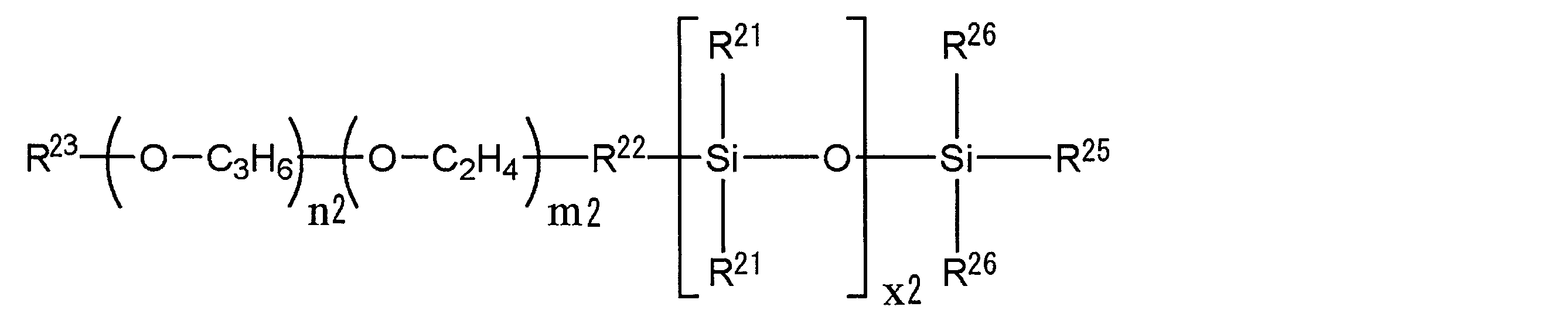
式(103)
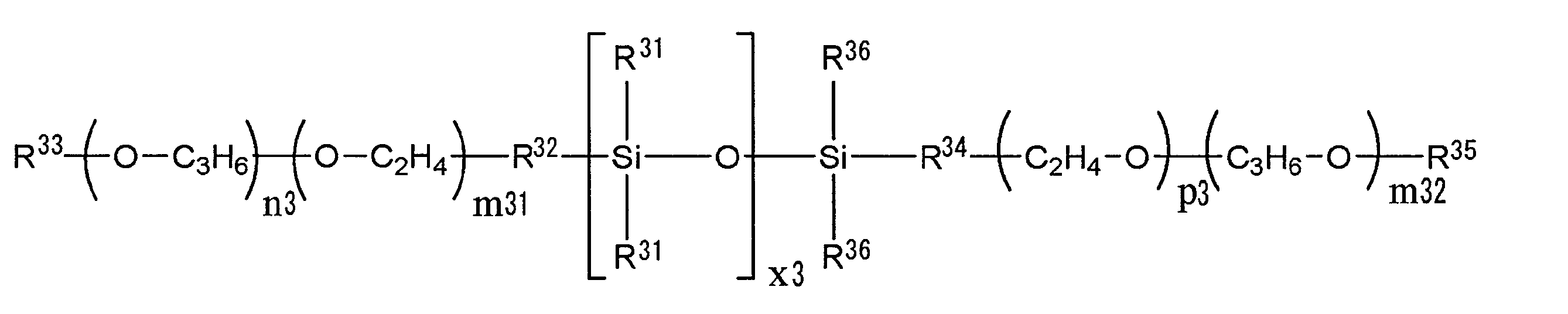
式(104)
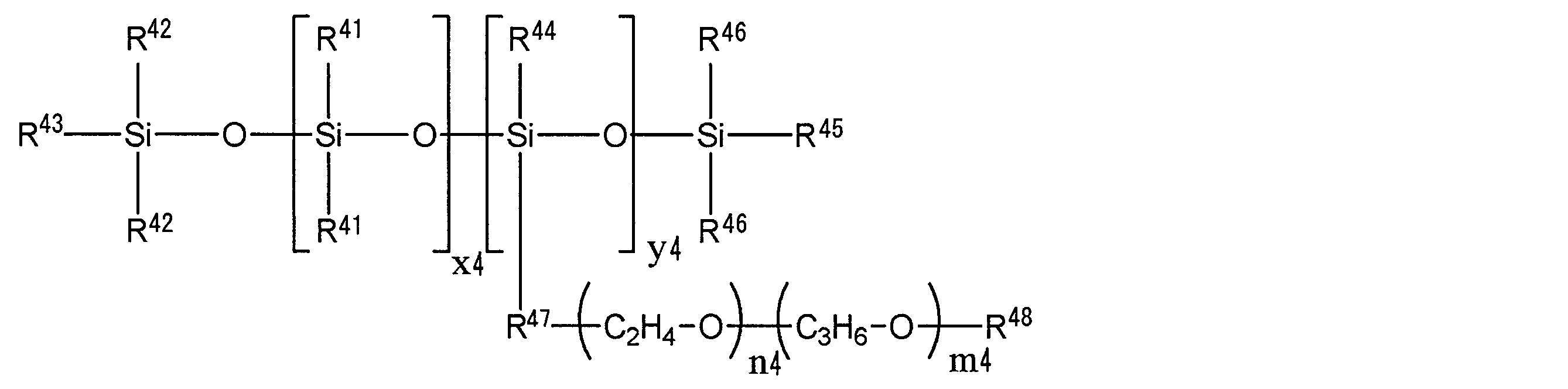
- 前記ポリエーテル変性シリコーンAの屈折率が1.440以下である、請求項1~8のいずれか1項に記載の仮接着用組成物。
- 仮接着用組成物の剥離力が1~20N/mである、請求項1~9のいずれか1項に記載の仮接着用組成物:但し、剥離力とは、仮接着用組成物を用いて、シリコンウェハの表面に、厚さ15μmの仮接着膜を成形し、25℃、速度300mm/分の速度で、シリコンウェハの仮接着膜が形成された面に対し垂直な方向に、仮接着膜の端部を引き上げることによって、剥離可能で、かつ、引き上げる際にかかる力を、フォースゲージを用いて測定したときの力をいう。
- 第1の基材と、仮接着膜と、第2の基材を、前記順に互いに隣接して有する積層体であって、前記仮接着膜は、請求項1~10のいずれか1項に記載の仮接着用組成物から形成される、積層体。
Priority Applications (2)
| Application Number | Priority Date | Filing Date | Title |
|---|---|---|---|
| JP2018503081A JP6646726B2 (ja) | 2016-02-29 | 2017-02-23 | 仮接着用組成物および積層体 |
| KR1020187024332A KR20180102184A (ko) | 2016-02-29 | 2017-02-23 | 가접착용 조성물 및 적층체 |
Applications Claiming Priority (4)
| Application Number | Priority Date | Filing Date | Title |
|---|---|---|---|
| JP2016038244 | 2016-02-29 | ||
| JP2016-038244 | 2016-02-29 | ||
| JP2016121445 | 2016-06-20 | ||
| JP2016-121445 | 2016-06-20 |
Publications (1)
| Publication Number | Publication Date |
|---|---|
| WO2017150320A1 true WO2017150320A1 (ja) | 2017-09-08 |
Family
ID=59742807
Family Applications (1)
| Application Number | Title | Priority Date | Filing Date |
|---|---|---|---|
| PCT/JP2017/006723 Ceased WO2017150320A1 (ja) | 2016-02-29 | 2017-02-23 | 仮接着用組成物および積層体 |
Country Status (4)
| Country | Link |
|---|---|
| JP (1) | JP6646726B2 (ja) |
| KR (1) | KR20180102184A (ja) |
| TW (1) | TW201800539A (ja) |
| WO (1) | WO2017150320A1 (ja) |
Cited By (7)
| Publication number | Priority date | Publication date | Assignee | Title |
|---|---|---|---|---|
| JP2019121733A (ja) * | 2018-01-10 | 2019-07-22 | 東京応化工業株式会社 | 積層体の製造方法、積層体、及び電子装置の製造方法 |
| WO2019160073A1 (ja) * | 2018-02-19 | 2019-08-22 | 富士フイルム株式会社 | 積層体、組成物、積層体の製造方法、部材の製造方法 |
| JP2019212726A (ja) * | 2018-06-04 | 2019-12-12 | 信越化学工業株式会社 | 薄型基板の製造方法 |
| WO2020032403A1 (ko) * | 2018-08-10 | 2020-02-13 | 포항공과대학교 산학협력단 | 전도성 복합 용액을 이용한 전도성 복합체 및 그의 제조방법 |
| JPWO2020080328A1 (ja) * | 2018-10-18 | 2021-10-07 | 富士フイルム株式会社 | 仮接着用組成物、キットおよび積層体 |
| CN114365274A (zh) * | 2019-10-31 | 2022-04-15 | 昭和电工材料株式会社 | 暂时固定用树脂组合物、基板搬送用支承带及电子设备装置的制造方法 |
| CN116285709A (zh) * | 2023-02-17 | 2023-06-23 | 黑龙江省科学院石油化学研究院 | 一种低应力键合胶材料及制备方法 |
Families Citing this family (1)
| Publication number | Priority date | Publication date | Assignee | Title |
|---|---|---|---|---|
| JP7414005B2 (ja) * | 2018-11-29 | 2024-01-16 | 株式会社レゾナック | 半導体装置の製造方法及び仮固定材用積層フィルム |
Citations (5)
| Publication number | Priority date | Publication date | Assignee | Title |
|---|---|---|---|---|
| JP2009091406A (ja) * | 2007-10-04 | 2009-04-30 | Nippon Carbide Ind Co Inc | 感圧接着剤組成物及び表面保護フィルム |
| JP2013185007A (ja) * | 2012-03-06 | 2013-09-19 | Fujimori Kogyo Co Ltd | 粘着剤組成物及び表面保護フィルム |
| JP2013231157A (ja) * | 2011-10-19 | 2013-11-14 | Nitto Denko Corp | 再剥離用水分散型アクリル系粘着剤組成物、及び、粘着シート |
| JP2015214675A (ja) * | 2014-04-22 | 2015-12-03 | 東京応化工業株式会社 | 接着剤組成物、積層体及び剥離方法 |
| JP2016216571A (ja) * | 2015-05-18 | 2016-12-22 | 日立化成株式会社 | 研削された基材の製造方法、並びにこれに用いられるフィルム状粘着剤及び積層体 |
Family Cites Families (1)
| Publication number | Priority date | Publication date | Assignee | Title |
|---|---|---|---|---|
| US8696864B2 (en) | 2012-01-26 | 2014-04-15 | Promerus, Llc | Room temperature debonding composition, method and stack |
-
2017
- 2017-02-22 TW TW106105891A patent/TW201800539A/zh unknown
- 2017-02-23 JP JP2018503081A patent/JP6646726B2/ja active Active
- 2017-02-23 KR KR1020187024332A patent/KR20180102184A/ko not_active Abandoned
- 2017-02-23 WO PCT/JP2017/006723 patent/WO2017150320A1/ja not_active Ceased
Patent Citations (5)
| Publication number | Priority date | Publication date | Assignee | Title |
|---|---|---|---|---|
| JP2009091406A (ja) * | 2007-10-04 | 2009-04-30 | Nippon Carbide Ind Co Inc | 感圧接着剤組成物及び表面保護フィルム |
| JP2013231157A (ja) * | 2011-10-19 | 2013-11-14 | Nitto Denko Corp | 再剥離用水分散型アクリル系粘着剤組成物、及び、粘着シート |
| JP2013185007A (ja) * | 2012-03-06 | 2013-09-19 | Fujimori Kogyo Co Ltd | 粘着剤組成物及び表面保護フィルム |
| JP2015214675A (ja) * | 2014-04-22 | 2015-12-03 | 東京応化工業株式会社 | 接着剤組成物、積層体及び剥離方法 |
| JP2016216571A (ja) * | 2015-05-18 | 2016-12-22 | 日立化成株式会社 | 研削された基材の製造方法、並びにこれに用いられるフィルム状粘着剤及び積層体 |
Cited By (9)
| Publication number | Priority date | Publication date | Assignee | Title |
|---|---|---|---|---|
| JP2019121733A (ja) * | 2018-01-10 | 2019-07-22 | 東京応化工業株式会社 | 積層体の製造方法、積層体、及び電子装置の製造方法 |
| WO2019160073A1 (ja) * | 2018-02-19 | 2019-08-22 | 富士フイルム株式会社 | 積層体、組成物、積層体の製造方法、部材の製造方法 |
| JP2019212726A (ja) * | 2018-06-04 | 2019-12-12 | 信越化学工業株式会社 | 薄型基板の製造方法 |
| JP6998838B2 (ja) | 2018-06-04 | 2022-01-18 | 信越化学工業株式会社 | 薄型基板の製造方法 |
| WO2020032403A1 (ko) * | 2018-08-10 | 2020-02-13 | 포항공과대학교 산학협력단 | 전도성 복합 용액을 이용한 전도성 복합체 및 그의 제조방법 |
| JPWO2020080328A1 (ja) * | 2018-10-18 | 2021-10-07 | 富士フイルム株式会社 | 仮接着用組成物、キットおよび積層体 |
| JP7074879B2 (ja) | 2018-10-18 | 2022-05-24 | 富士フイルム株式会社 | 仮接着用組成物、キットおよび積層体 |
| CN114365274A (zh) * | 2019-10-31 | 2022-04-15 | 昭和电工材料株式会社 | 暂时固定用树脂组合物、基板搬送用支承带及电子设备装置的制造方法 |
| CN116285709A (zh) * | 2023-02-17 | 2023-06-23 | 黑龙江省科学院石油化学研究院 | 一种低应力键合胶材料及制备方法 |
Also Published As
| Publication number | Publication date |
|---|---|
| KR20180102184A (ko) | 2018-09-14 |
| JPWO2017150320A1 (ja) | 2019-01-10 |
| TW201800539A (zh) | 2018-01-01 |
| JP6646726B2 (ja) | 2020-02-14 |
Similar Documents
| Publication | Publication Date | Title |
|---|---|---|
| JP6450452B2 (ja) | 積層体、仮接着用組成物および仮接着膜 | |
| JP6646726B2 (ja) | 仮接着用組成物および積層体 | |
| JP6450451B2 (ja) | キットおよび積層体 | |
| JP6724140B2 (ja) | キット、洗浄剤組成物および半導体素子の製造方法 | |
| JP6473462B2 (ja) | 仮接着膜の製造方法、仮接着膜、積層体、デバイスウエハ付き積層体、仮接着用組成物 | |
| JP6450456B2 (ja) | 積層体 | |
| JP6615722B2 (ja) | 積層体の製造方法、仮接着用組成物、仮接着膜 | |
| JP6606033B2 (ja) | 積層体および積層体の製造方法 | |
| TW202113060A (zh) | 清洗用組成物、淋洗液、清洗套組、清洗體的製造方法及半導體元件的製造方法 | |
| JP6623132B2 (ja) | 仮接着用組成物、硬化膜および半導体素子の製造方法 |
Legal Events
| Date | Code | Title | Description |
|---|---|---|---|
| WWE | Wipo information: entry into national phase |
Ref document number: 2018503081 Country of ref document: JP |
|
| ENP | Entry into the national phase |
Ref document number: 20187024332 Country of ref document: KR Kind code of ref document: A |
|
| WWE | Wipo information: entry into national phase |
Ref document number: 1020187024332 Country of ref document: KR |
|
| NENP | Non-entry into the national phase |
Ref country code: DE |
|
| 121 | Ep: the epo has been informed by wipo that ep was designated in this application |
Ref document number: 17759786 Country of ref document: EP Kind code of ref document: A1 |
|
| 122 | Ep: pct application non-entry in european phase |
Ref document number: 17759786 Country of ref document: EP Kind code of ref document: A1 |