WO2017146144A1 - 着色ポリエチレン繊維およびその製造方法 - Google Patents
着色ポリエチレン繊維およびその製造方法 Download PDFInfo
- Publication number
- WO2017146144A1 WO2017146144A1 PCT/JP2017/006822 JP2017006822W WO2017146144A1 WO 2017146144 A1 WO2017146144 A1 WO 2017146144A1 JP 2017006822 W JP2017006822 W JP 2017006822W WO 2017146144 A1 WO2017146144 A1 WO 2017146144A1
- Authority
- WO
- WIPO (PCT)
- Prior art keywords
- polyethylene
- colored
- less
- polyethylene fiber
- coloring
- Prior art date
- Legal status (The legal status is an assumption and is not a legal conclusion. Google has not performed a legal analysis and makes no representation as to the accuracy of the status listed.)
- Ceased
Links
Classifications
-
- D—TEXTILES; PAPER
- D01—NATURAL OR MAN-MADE THREADS OR FIBRES; SPINNING
- D01F—CHEMICAL FEATURES IN THE MANUFACTURE OF ARTIFICIAL FILAMENTS, THREADS, FIBRES, BRISTLES OR RIBBONS; APPARATUS SPECIALLY ADAPTED FOR THE MANUFACTURE OF CARBON FILAMENTS
- D01F6/00—Monocomponent artificial filaments or the like of synthetic polymers; Manufacture thereof
- D01F6/02—Monocomponent artificial filaments or the like of synthetic polymers; Manufacture thereof from homopolymers obtained by reactions only involving carbon-to-carbon unsaturated bonds
- D01F6/04—Monocomponent artificial filaments or the like of synthetic polymers; Manufacture thereof from homopolymers obtained by reactions only involving carbon-to-carbon unsaturated bonds from polyolefins
-
- D—TEXTILES; PAPER
- D03—WEAVING
- D03D—WOVEN FABRICS; METHODS OF WEAVING; LOOMS
- D03D15/00—Woven fabrics characterised by the material, structure or properties of the fibres, filaments, yarns, threads or other warp or weft elements used
- D03D15/20—Woven fabrics characterised by the material, structure or properties of the fibres, filaments, yarns, threads or other warp or weft elements used characterised by the material of the fibres or filaments constituting the yarns or threads
- D03D15/283—Woven fabrics characterised by the material, structure or properties of the fibres, filaments, yarns, threads or other warp or weft elements used characterised by the material of the fibres or filaments constituting the yarns or threads synthetic polymer-based, e.g. polyamide or polyester fibres
-
- D—TEXTILES; PAPER
- D03—WEAVING
- D03D—WOVEN FABRICS; METHODS OF WEAVING; LOOMS
- D03D15/00—Woven fabrics characterised by the material, structure or properties of the fibres, filaments, yarns, threads or other warp or weft elements used
-
- D—TEXTILES; PAPER
- D02—YARNS; MECHANICAL FINISHING OF YARNS OR ROPES; WARPING OR BEAMING
- D02J—FINISHING OR DRESSING OF FILAMENTS, YARNS, THREADS, CORDS, ROPES OR THE LIKE
- D02J1/00—Modifying the structure or properties resulting from a particular structure; Modifying, retaining, or restoring the physical form or cross-sectional shape, e.g. by use of dies or squeeze rollers
- D02J1/22—Stretching or tensioning, shrinking or relaxing, e.g. by use of overfeed and underfeed apparatus, or preventing stretch
-
- D—TEXTILES; PAPER
- D03—WEAVING
- D03D—WOVEN FABRICS; METHODS OF WEAVING; LOOMS
- D03D15/00—Woven fabrics characterised by the material, structure or properties of the fibres, filaments, yarns, threads or other warp or weft elements used
- D03D15/50—Woven fabrics characterised by the material, structure or properties of the fibres, filaments, yarns, threads or other warp or weft elements used characterised by the properties of the yarns or threads
- D03D15/573—Tensile strength
Definitions
- the present invention relates to a colored polyethylene fiber.
- Patent Document 1 discloses a method of adding a dye from the raw material preparation stage to obtain an original yarn
- Patent Document 2 discloses that an intermediate drawn yarn is heated under heating. A method of applying a dye is disclosed.
- an object of the present invention is to solve the above-mentioned conventional problems. That is, an object of the present invention is to provide a polyethylene fiber that is darkly colored and hardly discolors or discolors, a colored polyethylene fiber that achieves both uniform dyeing with little unevenness and high strength, and a method for producing the same.
- the inventors of the present invention applied a coloring material to a polyethylene fibrous material under a specific condition and performed a heat treatment process, thereby obtaining a dark color and a fastness to dyeing.
- the present invention was completed by finding that colored polyethylene fibers excellent in the above can be obtained. That is, the colored polyethylene fiber according to the present invention is CIE-L * a * b * is in the L * value is 80 or below color system, and, fastness to rubbing, characterized in that for any of the dry and wet states is also tertiary or higher.
- the colored polyethylene fiber according to the present invention preferably has a coefficient of variation (CV) defined by the following formula 1 of 10% or less of the tensile strength measured at any 10 locations in the longitudinal direction.
- Coefficient of variation of tensile strength (%) (standard deviation of tensile strength / average value of tensile strength) ⁇ 100 (Formula 1)
- the colored polyethylene fiber according to the present invention preferably has an acid value of 0.1 mgKOH / g or more and 50 mgKOH / g or less.
- the colored polyethylene fiber according to the present invention preferably contains 0.4% or more and 5.0% or less of a surfactant having an HLB value (Hydrophile-Lipophile Balance) of 7.0 or more and 14.0 or less.
- HLB value Hydrophile Balance
- the present invention also includes colored polyethylene fibers having a solvent resistance of 75% or more determined by the following measurement method.
- Measurement method of solvent resistance The colored polyethylene fiber is immersed in acetone so as to be 0.1 g / mL, and is allowed to stand at room temperature for 24 hours. Acetone used for immersing colored polyethylene fiber and acetone after immersing the colored polyethylene fiber and allowed to stand at 20 ⁇ 5 ° C. for 24 hours using a UV-visible spectrophotometer, transmittance in the wavelength range of 350 nm to 780 nm The integral value of the transmittance in the above wavelength region is determined from the obtained transmittance curve, and the solvent resistance is calculated from the following equation 2.
- Solvent resistance (%) (T 1 / T 0 ) ⁇ 100 (Formula 2)
- T 0 represents the integral value of the transmittance of acetone at wavelengths of 350 nm to 780 nm
- T 1 represents the integral value of the transmittance of acetone after immersion in the colored polyethylene fiber at wavelengths of 350 nm to 780 nm.
- the colored polyethylene fiber according to the present invention preferably has a non-uniformity in fineness in the longitudinal direction of 10% or less.
- the tensile strength is preferably 18 cN / dtex or more.
- the colored polyethylene fiber according to the present invention preferably contains a coloring material which is an oil-soluble dye.
- the fineness of the single yarn of the colored polyethylene fiber according to the present invention is preferably 1 dtex or more and 80 dtex or less.
- the present invention also includes a braid comprising at least one colored polyethylene fiber, a fishing line containing the colored polyethylene fiber, a glove, a rope, a net, a woven fabric, or a knitted fabric.
- the strength of the fiber unwound from the braid is preferably 15 cN / dtex or more.
- the method for producing a colored polyethylene fiber according to the present invention is as follows. Polyethylene composed of ethylene having an intrinsic viscosity [ ⁇ ] of 5.0 dL / g or more and 25 dL / g or less and a repeating unit of 90 mol% or more was dissolved in an organic solvent so as to have a concentration of 0.5 to 40% by mass. A step of spinning a polyethylene solution to obtain a polyethylene fiber, A step of contacting a polyethylene fibrous material containing an organic solvent of less than 20% by mass with a coloring liquid containing a coloring material and an organic solvent and having a temperature of 0 ° C.
- a step of stretching a polyethylene fiber It is characterized by including.
- the method for producing a colored polyethylene fiber according to the present invention includes: Polyethylene composed of ethylene having an intrinsic viscosity [ ⁇ ] of 5.0 dL / g or more and 25 dL / g or less and a repeating unit of 90 mol% or more was dissolved in an organic solvent so as to have a concentration of 0.5 to 40% by mass.
- a step of spinning a polyethylene solution to obtain a polyethylene fiber A step of bringing the polyethylene fibrous material into contact with a coloring liquid containing a coloring material and a polyolefin having a hydrophilic group at one end and having a temperature of 0 ° C. or more and less than 60 ° C .; Heating the polyethylene fibrous material to which the colored liquid is applied at 110 ° C. or more for 10 seconds or more, and stretching the polyethylene fibrous material, It is characterized by including.
- the method for producing a colored polyethylene fiber according to the present invention includes: Polyethylene composed of ethylene having an intrinsic viscosity [ ⁇ ] of 5.0 dL / g or more and 25 dL / g or less and a repeating unit of 90 mol% or more was dissolved in an organic solvent so as to have a concentration of 0.5 to 40% by mass.
- a step of spinning a polyethylene solution to obtain a polyethylene fiber A step of bringing the polyethylene fibrous material into contact with a coloring liquid containing a coloring material and a surfactant having an HLB value (Hydrophile-Lipophile Balance) of 7.0 or more and 14.0 or less and having a temperature of 0 ° C. or more and less than 60 ° C. , Heating the polyethylene fibrous material to which the colored liquid is applied at 110 ° C. or more for 10 seconds or more, and stretching the polyethylene fibrous material, It is characterized by including.
- the temperature of the polyethylene fibrous material brought into contact with the colored liquid is 50 ° C. or less.
- the heating is preferably performed while applying a tension of 0.8 to 6.5 cN / dtex to the polyethylene fibrous material to which the coloring liquid has been applied.
- the colored polyethylene fiber colored with the dark color and excellent in the dyeing fastness with respect to friction and / or solvent resistance can be provided.
- this polyethylene fiber has high strength and there is little unevenness in strength and fineness, it is suitably used as a material for braids, fishing lines, gloves, ropes, nets, woven fabrics, knitted fabrics and the like.
- the polyethylene fiber can be produced with reduced environmental load if water is used as a solvent for the coloring material.
- the colored polyethylene fiber of this embodiment is (I) CIE-L * a * b * L * value according to the color system is 80 or less, and the dyeing fastness to friction is 3 or more in both dry and wet conditions, or (II)
- the solvent resistance required by the following measurement method is 75% or more.
- the colored polyethylene fiber is immersed in acetone so as to be 0.1 g / mL, and is allowed to stand at room temperature for 24 hours. Acetone used for immersing colored polyethylene fiber and acetone after immersing the colored polyethylene fiber and allowed to stand at 20 ⁇ 5 ° C.
- the colored polyethylene fiber of the present embodiment is darkly colored, and L * obtained when the colored polyethylene fiber or a processed product obtained from the colored polyethylene fiber is measured by the CIE-L * a * b * color difference measurement method .
- the value is 80 or less.
- the lower limit of the L * value is not particularly limited.
- the colored polyethylene fiber of this embodiment has excellent dyeing fastness to friction. More specifically, the fastness to dyeing with respect to friction is 3 or more in both dry and wet conditions.
- the dyeing fastness to friction indicates that the higher the grade, the more difficult the color fading and color transfer. Accordingly, the dyeing fastness to friction is preferably 4th or higher, more preferably 5th.
- the dyeing fastness to friction is determined by conducting a friction fastness test according to JIS L 0849 (2004) using a Gakushin type friction tester on a sample prepared according to JIS L 0801 (2000). Evaluation is performed using a scale (JIS L 0805 (2005)). Details of the test and evaluation method will be described in Examples.
- the colored polyethylene fiber of the present embodiment includes a colored polyethylene fiber having a solvent resistance of 75% or more required by the measurement method described in (II) above.
- the solvent resistance is preferably 80% or more, more preferably 85% or more.
- the solvent resistance indicates the amount of the coloring material extracted from the colored polyethylene fiber, and the larger the value, the smaller the amount of the coloring material extracted from the colored polyethylene fiber. Therefore, the larger the solvent resistance value, the better, and the solvent resistance is more preferably 98% or more.
- the colored polyethylene fiber preferably satisfies the above (I) and (II) at the same time.
- a polyethylene fiber has a high resistance to friction and an organic solvent in addition to being colored in a dark color, and can be said to be a fiber that is not easily discolored or transferred.
- the tensile strength of the colored polyethylene fiber of this embodiment is preferably 18 cN / dtex or more.
- the tensile strength is more preferably 20 cN / dtex or more, and further preferably 25 cN / dtex or more.
- the upper limit of the tensile strength is not particularly limited, but it is technically and industrially difficult to obtain a polyethylene fiber having a tensile strength exceeding 60 cN / dtex.
- the colored polyethylene fiber has a tensile strength coefficient of variation (CV) (%) of 10% or less obtained from the following formula 1 with respect to the tensile strength measured at any 10 locations in the longitudinal direction (length direction) of the fiber.
- CV tensile strength coefficient of variation
- Coefficient of variation of tensile strength (%) (standard deviation of tensile strength / average value of tensile strength) ⁇ 100 (Formula 1)
- the coefficient of variation (%) in tensile strength is more preferably 9% or less, further preferably 8% or less, and still more preferably 5% or less.
- a polyethylene fiber having a coefficient of variation (%) in tensile strength within the above range is preferable because it has a small variation in strength in the length direction.
- the elongation (elongation) at the maximum strength of the colored polyethylene fiber is preferably 3.0% or more. More preferably, it is 3.5% or more, More preferably, it is 3.7% or more.
- the upper limit of the elongation is not particularly limited, but is preferably 6.0% or less.
- the initial elastic modulus of the colored polyethylene fiber is preferably 500 cN / dtex or more and 2000 cN / dtex or less.
- the initial elastic modulus is more preferably 600 cN / dtex or more, further preferably 700 cN / dtex or more, more preferably 1600 cN / dtex or less, and still more preferably 1400 cN / dtex or less. If the initial elastic modulus is too high, it is difficult to align polyethylene fibers during molding into a rope or braid, and there is a risk that single yarn breakage is likely to occur, but if the initial elastic modulus is within the above range, It is preferable because such a problem hardly occurs.
- the fineness of the single yarn constituting the colored polyethylene fiber is preferably 1 dtex or more and 80 dtex or less. If the single yarn fineness exceeds 80 dtex, the polyethylene fiber becomes hard, and at the same time, it may be difficult to increase the strength. Preferably it is 70 dtex or less, More preferably, it is 60 dtex or less. If the fiber is less than 1 dtex, fluff or the like may easily occur during stretching in the production process or when the polyethylene fiber is actually used. Preferably it is 2 dtex or more, More preferably, it is 5 dtex or more.
- the non-uniformity of the fineness of the colored polyethylene fiber is preferably 10% or less.
- the fineness unevenness exceeds 10%, not only unevenness in strength is likely to occur, but also uneven coloring due to the variation in fineness is likely to occur, and there is a risk of variations in the apparent color, but the unevenness in fineness is 10%. The following cases are preferred because such problems are unlikely to occur.
- the unevenness of fineness is more preferably 6% or less, and further preferably 5% or less.
- Colored polyethylene fiber contains a colored material.
- an organic coloring material is preferable, and a dye soluble in an organic solvent is particularly preferably used.
- coloring materials include oil-soluble dyes, disperse dyes, acid dyes, and cationic dyes.
- oil-soluble dyes and disperse dyes are preferable because they have good compatibility with polyethylene and can easily realize dark-colored polyethylene fibers.
- Preferred oil-soluble dyes include, for example, C.I. I. Solvent Yellow 2 (hereinafter abbreviated as “CI Solvent Yellow”), 6, 14, 15, 16, 19, 21, 33, 56, 61, 80, C.I. I.
- Solvent Orange 1 (hereinafter abbreviated as “CI Solvent Orange”), 2, 5, 6, 14, 37, 40, 44, 45, C.I. I. Solvent Red 1 (hereinafter abbreviated as “CI Solvent Red”), 3, 8, 23, 24, 25, 27, 30, 49, 81, 82, 83, 84, 100, 109, 121, C.I. I. Solvent Violet 8 (hereinafter abbreviated as “CI. Solvent Violet”), 13, 14, 21, 27, C.I. I. Solvent Blue 2 (hereinafter abbreviated as “CI Solvent Blue”) 11, 12, 25, 58, 36, 55, 73, C.I. I. Solvent Green 3 etc. are mentioned.
- disperse dyes include C.I. I.
- Disperse Red 4 (hereinafter, “CI Disperse Red” is omitted), 5, 11, 17, 60, 74, 75, 86, 91, 92, 152, 153, 167, 179, 200, 221, 302, C .
- Disperse dyes classified as Disperse Black C.I. I. Disperse Orange 3 (hereinafter abbreviated as “CI Disperse Orange”), 13, 25, 31, 37, 45, 61, 76, C.I. I. Disperse dyes classified as Disperse Gray, C.I. I.
- Disperse Yellow 3 (hereinafter abbreviated as “CI Disperse Yellow”), 5, 42, 49, 79, 82, 104, 134, 149, 198, 211, 241, C.I. I. Disperse dyes classified as Disperse Green, C.I. I. Disperse Violet 1 (hereinafter abbreviated as “CI Disperse Violet”), 3, 28, 43, C.I. I. Disperse dyes classified as Disperse Brown, C.I. I. Disperse Blue 1 (hereinafter, “CI Disperse Blue” is omitted), 3, 56, 60, 72, 77, 106, 148, 165, 183, 257, 360, and the like. These coloring materials may be used alone or in combination with a plurality of coloring materials having different colors.
- the amount of the coloring material contained in the colored polyethylene fiber is preferably 0.2% by mass or more and 5% by mass or less. More preferably, it is 0.5 mass% or more, 1.0 mass% or more is still more preferable, More preferably, it is 2 mass% or more. As an upper limit, More preferably, it is 4 mass% or less, More preferably, it is 3 mass% or less. If the content of the coloring material is within the above range, it is preferable because dark coloring can be realized and there is little possibility of affecting the mechanical properties of the fiber.
- the amount of the coloring material contained in the colored polyethylene fiber can be determined by the method described in the examples at the later stage.
- colored polyethylene fibers are produced by a solution forming method.
- the solution forming method may be a conventionally known method, and is not particularly limited.
- polyethylene is dissolved in a volatile organic solvent such as decalin or tetralin or a non-volatile organic solvent such as paraffin. It is preferable to employ a solution spinning method in which the fiber is shaped into a fiber.
- polyethylene having an intrinsic viscosity [ ⁇ ] of 5.0 dL / g or more and 25 dL / g or less and a repeating unit composed of ethylene of 90 mol% or more is used as the raw material polyethylene.
- the intrinsic viscosity is more preferably 7.0 to 22 dL / g, still more preferably 8 to 20 dL / g. If the intrinsic viscosity is too small, the dimensional stability is inferior, the fluctuation of mechanical properties over time tends to be large, and it is difficult to realize a strength of 10 cN / dtex or more.
- Raw material polyethylene has ethylene of 90 mol% or more of repeating units.
- the ethylene repeating unit is preferably 92 mol% or more, more preferably 94 mol% or more, and most preferably an ethylene homopolymer.
- the raw material polyethylene may contain components other than ethylene as long as the physical properties of the polyethylene fiber are not adversely affected.
- a raw material polyethylene is a copolymer of ethylene and other monomers such as ⁇ -olefin, acrylic acid and derivatives thereof, methacrylic acid and derivatives thereof, vinylsilane and derivatives thereof, and ethylene. Can be used as
- the raw material polyethylene is a polyethylene having a different weight average molecular weight including, for example, a blend of high density polyethylene and ultra high molecular weight polyethylene, and a blend of low density polyethylene and ultra high molecular weight polyethylene.
- the raw material polyethylene may be a blend of two or more types of ultrahigh molecular weight polyethylenes having different weight average molecular weights, or may be a blend of two or more types of polyethylenes having different molecular weight distributions.
- the number of branches present in polyethylene is preferably 3 or less per 1000 main chain carbon atoms. More preferably, it is 2 or less, and more preferably 1.5 or less.
- additives such as an antioxidant and a light resistance agent may be added to the raw material polyethylene.
- an antioxidant in addition to mechanical properties such as the strength of colored polyethylene fibers, a change in hue can also be suppressed. This is because the deterioration mechanism of the coloring material by ultraviolet rays is considered to be basically the same as the deterioration mechanism of the polyethylene fiber. Therefore, when the polyethylene fiber contains an antioxidant, the deterioration of the coloring material is suppressed as well as the decrease in the strength due to the deterioration of the polyethylene fiber. As a result, the hue of the colored polyethylene fiber is suppressed. It is thought that the change of the is also suppressed.
- the amount of the additive used is preferably 0.01 to 10 parts by mass with respect to 100 parts by mass of the raw polyethylene.
- the above raw material polyethylene is dissolved in an organic solvent to prepare a polyethylene solution.
- concentration of polyethylene is 0.5 mass% or more and 40 mass% or less, Preferably it is 2.0 mass% or more and 30 mass% or less, More preferably, it is 4.0 mass% or more and 20 mass% or less. If the polyethylene concentration is too low, production efficiency tends to decrease. On the other hand, if the polyethylene concentration is too high, the molecular weight of the raw polyethylene is very high, and it tends to be difficult to discharge from a nozzle described later in the solution spinning method.
- the organic solvent for dissolving the raw polyethylene is preferably a solvent capable of dissolving the raw polyethylene, preferably an organic solvent having a boiling point higher than the melting point of the raw polyethylene, and an organic solvent having a boiling point higher by 20 ° C. than the melting point of the raw polyethylene. More preferred.
- Such solvents include n-nonane, n-decane, n-undecane, n-dodecane, n-tetradecane, n-octadecane, liquid hydrocarbons such as liquid paraffin and kerosene, xylene, naphthalene (naphthalene), Aromatic hydrocarbon solvents such as tetralin (tetrahydronaphthalene), decalin, butylbenzene, p-cymene, cyclohexylbenzene, diethylbenzene, pentylbenzene, dodecylbenzene, bicyclohexyl, methylnaphthalene, ethylnaphthalene or hydrogenated derivatives thereof; Halogenated hydrocarbon solvents such as 1,2,2-tetrachloroethane, pentachloroethane, hexachloroethane, 1,2,3-trichloropropane
- the polyethylene solution is heated at a temperature 10 ° C. higher than the melting point of the raw polyethylene (melting point of the raw polyethylene + 10 ° C. or higher), and then passed through a spinning nozzle (spinneret) to form a polyethylene fibrous material (undrawn yarn). Is preferred (spinning step).
- the heating temperature is more preferably the melting point of the starting polyethylene + 20 ° C. or more, and more preferably the melting point of the starting polyethylene + 30 ° C. or more.
- the temperature of the spinneret is preferably set to the melting point of the raw polyethylene + 5 ° C. or higher and the boiling point of the organic solvent used in the polyethylene solution. More preferably, it is melting
- the temperature of the spinneret is too low, it may be difficult to take up the polyethylene fibrous material at a desired speed due to a decrease in the viscosity of the raw material polyethylene.
- the temperature of the spinneret exceeds the boiling point of the organic solvent, the organic solvent will boil immediately after the polyethylene solution is discharged from the spinneret, and yarn breakage may occur frequently directly under the spinneret.
- the spinning nozzle preferably has an orifice having a diameter of 0.2 mm to 3.5 mm.
- the diameter of the orifice is more preferably 0.5 mm to 2.5 mm, still more preferably 0.8 mm to 2.0 mm.
- the discharge molding from the spinning nozzle is cooled, solidified, and taken to obtain a polyethylene fibrous material.
- the cooling method is not particularly limited, and the discharge molded product from the spinneret may be naturally cooled by being exposed to the ambient temperature, or a cooling device may be used.
- the cooling method using a cooling device may be a dry quench method using a gas such as air or nitrogen, or a liquid miscible with the organic solvent used in the polyethylene solution, or water or other organic solvent used in the polyethylene solution.
- a cooling method using a difficult liquid may be used.
- the discharge molded product is preferably deformed at a magnification of 1.1 times or more and 100 times or less before being cooled and solidified to become a polyethylene fibrous material.
- the deformation magnification is more preferably 2.0 times or more and 80 times or less, and further preferably 5.0 times or more and 50 times or less.
- the time required for deformation is preferably within 3 minutes. More preferably, it is within 2 minutes, and further preferably within 1 minute. If the time required for deformation exceeds 3 minutes, the polyethylene molecular chain constituting the polyethylene fibrous material is relaxed, and it may be difficult to obtain a polyethylene fiber having a high strength and a high elastic modulus.
- a part of the solvent contained in the polyethylene fibrous material may be removed.
- the obtained polyethylene fibrous material (unstretched yarn) is heated and stretched several times (stretching step).
- the stretching step may be single-stage stretching or multi-stage stretching of two or more stages. From the viewpoint of increasing the strength of the polyethylene fiber, it is preferable to perform two or more stages of multi-stage stretching.
- the “polyethylene fibrous material” means a polyethylene fibrous material that has been drawn to a preset draw ratio after the spinning step.
- the method for heating the polyethylene fibrous material in the stretching step is not particularly limited, and it may be heated using a medium such as an inert gas such as air or nitrogen, water vapor or liquid, and a heating roller or contact heater. Etc. may be used.
- the stretching temperature is preferably 110 ° C. or higher, more preferably 120 ° C. or higher, and further preferably 130 ° C. or higher.
- the upper limit of the drawing temperature may be in a range where the fiber does not melt.
- the draw ratio of the polyethylene fiber is preferably 8 times or more, more preferably 10 times or more, and still more preferably 12 times or more as the total draw ratio with the roller.
- the upper limit of a draw ratio is not specifically limited, What is necessary is just to determine so that the polyethylene fiber of desired intensity
- the organic solvent contained in the fibrous material can be removed simultaneously with the stretching of the polyethylene fibrous material (desolvation).
- the organic solvent constituting the polyethylene solution is nonvolatile
- the nonvolatile organic solvent may be removed from the polyethylene fibrous material by extraction.
- organic solvents such as chloroform, benzene, trichlorotrifluoroethane (TCTFE), hexane, heptane, nonane, decane, ethanol, and higher alcohol can be used.
- TFTFE trichlorotrifluoroethane
- the solvent removal step for removing the organic solvent from the polyethylene fibrous material may be performed as a separate step from the stretching step, or may be performed simultaneously with the stretching step.
- the manufacturing method of the present embodiment includes a step of bringing a polyethylene fibrous material into contact with a coloring liquid in addition to the spinning step and the drawing step described above (coloring liquid contact step).
- a colored liquid containing a coloring material and an organic solvent and having a temperature of 0 ° C. or higher and lower than 60 ° C. is brought into contact with a polyethylene fibrous material containing an organic solvent of less than 20% by mass.
- a coloring material can be provided to a polyethylene fibrous material.
- the color liquid contact step is not limited as long as it is performed on a polyethylene fibrous material having an organic solvent amount of less than 20% by mass. However, after completion of the crystallization of polyethylene, it may be difficult to move the coloring material to the inside of the fibrous material. Therefore, it is performed before the final stretching for stretching the polyethylene fibrous material to a preset stretching ratio. Is preferred. Accordingly, the coloring liquid contact step is preferably performed after the spinning step and before the stretching step, and when performing two or more stages of stretching, during the stretching process, for example, in the case of two-stage stretching, the first stage and the second stage It may be performed during the stretching step.
- the amount of the organic solvent (residual solvent amount) contained in the polyethylene fibrous material is preferably 18% by mass or less, more preferably 15% by mass or less, and preferably 1% by mass or more, more preferably 2%. It is at least 3% by mass, more preferably at least 3% by mass.
- the coloring material can be easily moved to the inside of the polyethylene fibrous material, and therefore, it is considered that the coloring material can be present up to the core of each fibrous material. Therefore, from the viewpoint of realizing a dark color and uniform coloring, it is preferable to perform the colored liquid contact step in a state where the polyethylene fibrous material contains a residual solvent to some extent.
- the organic solvent contained in the coloring liquid As the organic solvent contained in the coloring liquid, the organic solvent exemplified in the preparation of the polyethylene solution and the organic solvent for extraction exemplified in the desolvation step can be used.
- the organic solvent used for the preparation of the polyethylene solution it is not necessary to change the conditions of the desolvation step according to the type of solvent, and the solvent recovered after the desolvation step is separated for each individual solvent. Since it is not necessary to do, it is preferable.
- the coloring material those described above are preferably used. More preferred are oil-soluble dyes or disperse dyes.
- the concentration of the coloring material in the coloring liquid may be adjusted so that the coloring material is contained in the colored polyethylene fiber in an amount of 0.2 to 5% by mass. Generally, the concentration of the coloring material in the coloring liquid is 1
- the mass is preferably from 28% by mass to 28% by mass. More preferably, it is 1.5 mass% or more and 25 mass% or less, More preferably, it is 2 mass% or more and 23 mass% or less. If the concentration of the coloring material is too low, it may be difficult to achieve dark coloration.If the concentration of the coloring material is too high, excessive coloring material will remain on the fiber surface, and the fastness of dyeing of the polyethylene fiber will be reduced. Since it may reduce, it is not preferable.
- the temperature of the coloring liquid is 0 ° C or higher and lower than 60 ° C. More preferably, it is 5 ° C. or higher, more preferably 8 ° C. or higher, still more preferably 10 ° C. or higher, preferably 50 ° C. or lower, and more preferably 40 ° C. or lower. Moreover, it is preferable that the temperature of the polyethylene fibrous material contacted with a coloring liquid is 50 degrees C or less, More preferably, it is 45 degrees C or less, More preferably, it is 40 degrees C or less. Although there is no restriction
- the temperature of the polyethylene fibrous material can be measured by, for example, a non-contact type thermometer such as an infrared thermometer.
- the organic solvent quickly evaporates, and only the coloring material remains on the surface of the polyethylene fibrous material, which tends to make it difficult to move the coloring material to the inside of the polyethylene fibrous material.
- the peripheral member is contaminated in the subsequent process, or the coloring material is dropped from the product using the obtained polyethylene fiber to cause contamination.
- a process for washing the dye adhering to the surface is required, which may reduce the working efficiency.
- the coloring liquid temperature is too high, the temperature of the polyethylene fibrous material that comes into contact with it rises, and the influence of the tension applied to the polyethylene fibrous material in the heat treatment process and the stretching process performed after the coloring liquid contact process is affected. As a result, fineness unevenness and strength unevenness (thread unevenness) may occur.
- the stretching step is performed following the coloring liquid contact step, if the temperature of the polyethylene fibrous material is too high, the stretching point is not fixed, and stretching unevenness may occur.
- the method for contacting the polyethylene fibrous material and the coloring liquid is not particularly limited as long as it can add a coloring material to the polyethylene fibrous material, and various methods can be used.
- Specific contact methods include a method in which a polyethylene fibrous material and a colored liquid are brought into contact by guide oiling, a method in which the polyethylene fibrous material is brought into contact with the surface of a rotating roller to which the colored liquid is adhered, and a polyethylene fibrous material that is running. Examples thereof include a method of spraying a colored liquid on a product, a method of allowing a polyethylene fibrous material to pass through a colored liquid bath, and the like.
- the polyethylene solution contains a non-volatile organic solvent (for example, paraffin)
- a coloring liquid in which a coloring material is dissolved in an extraction solvent used in the desolvation step is used as an extraction bath, and the polyethylene fiber is contained in the extraction bath.
- the polyethylene fiber and the colored liquid may be brought into contact with each other by passing the product.
- the amount of the colored liquid applied to the polyethylene fibrous material is preferably in the range of 0.1 to 15% by mass with respect to the polyethylene fibrous material. More preferably, it is 0.5 mass% or more, More preferably, it is 1 mass% or more, More preferably, it is 12 mass% or less, More preferably, it is 8 mass% or less. If the amount of the colored liquid applied is too small, it may be difficult to color the dark color. On the other hand, if the amount of the colored liquid applied is too large, excessive coloring material may remain on the fiber surface and the color fastness may deteriorate. In addition, the coloring material may fall off from the fibrous material during the process and contaminate the peripheral members.
- the amount of the organic solvent contained in the polyethylene fibrous material may increase.
- the amount of the organic solvent contained in the polyethylene fibrous material after contact with the coloring liquid (the amount of the organic solvent contained in the polyethylene fibrous material provided for the coloring liquid contacting step and the amount of the organic solvent increased in the coloring liquid contacting step) Is less than 25% by mass, preferably 20% by mass or less, and more preferably 18% by mass or less.
- the lower limit of the amount of the organic solvent is preferably 0.1% by mass or more, more preferably 0.5% by mass or more, and further preferably 1.0% by mass or more.
- the colored liquid contact step is preferably carried out while applying a tension of 0.05 cN / dtex or more and 3 cN / dtex or less to the polyethylene fibrous material. More preferably, it is 0.1 cN / dtex or more and 1 cN / dtex or less, More preferably, it is 0.2 cN / dtex or more and 0.8 cN / dtex or less.
- the tension applied to the polyethylene fibrous material is too small, it is difficult to stably run the polyethylene fibrous material, which may cause shake and cause coloring material to be applied.
- the tension is too large, the polyethylene fibrous material is converged and the coloring liquid may not easily penetrate into the individual fibrous materials. In this case, not only the dyeing uniformity of the single yarn is impaired, but most of the coloring material remains on the surface of the polyethylene fibrous material, and as a result, the fastness to dyeing may be lowered.
- a heat treatment step is performed in which the polyethylene fibrous material to which the coloring liquid is applied is heated at 110 ° C. or higher for 10 seconds or longer (heat treatment step).
- heat treatment step facilitates penetration of the colored liquid into the polyethylene fibrous material and facilitates the movement of the colored material to the core of the polyethylene fibrous material.
- a colored polyethylene fiber having a dark color and further enhanced dyeing fastness can be obtained.
- the stretching step is carried out in the state where the coloring material is present in the inside (core portion) of the polyethylene fibrous material. By the crystallization of polyethylene by stretching, the coloring material is put inside the polyethylene fiber ( This is thought to be because it can be confined in the core).
- the heat treatment step may be performed at any timing after the coloring liquid contact step. Further, the heat treatment step may be performed alone or at the same time as the stretching step.
- the heat treatment step is performed simultaneously with the stretching step, the movement of the coloring material into the polyethylene fibrous material by the penetration of the coloring liquid and the crystallization of polyethylene by the stretching can be simultaneously performed.
- the heat treatment step and the stretching step are performed separately, the color fastness can be further enhanced because the stretching step can be performed after the coloring material has moved into the polyethylene fibrous material by the heat treatment step. .
- the heat treatment step is performed simultaneously with the stretching step.
- the heating temperature is preferably 120 ° C or higher, more preferably 130 ° C or higher. It is recommended that the upper limit of the heating temperature be a temperature at which yarn breakage does not occur due to fusing, that is, the melting point of the polyethylene filament or less.
- the heating method is not particularly limited, and known methods such as hot air, a hot roller, a radiant panel, a steam jet, and a hot pin can be employed. From the viewpoint of minimizing contamination by the coloring material, it is preferable to employ a non-contact type heating method using hot air, a radiant panel, a steam jet, or the like.
- the heating time is preferably 10 seconds or longer, more preferably 12 seconds or longer, and even more preferably 15 seconds or longer.
- the upper limit of heating time is not specifically limited, For example, it is preferable that it is 150 seconds or less, More preferably, it is 120 seconds or less, More preferably, it is 100 seconds or less.
- the heat treatment step is preferably performed while applying tension to the polyethylene fibrous material.
- the tension applied to the polyethylene fibrous material is preferably 0.8 cN / dtex to 6.5 cN / dtex. More preferably, it is 1 cN / dtex or more, More preferably, it is 2 cN / dtex or more, More preferably, it is 6 cN / dtex or less, More preferably, it is 5 cN / dtex or less.
- the stretching step performed after the heat treatment step or simultaneously with the heat treatment step it is preferable to stretch the polyethylene fibrous material at a magnification of at least 2 times. More preferably, it is 2.5 times or more.
- the draw ratio is preferably 30 times or less.
- drawing is performed at a high draw ratio in order to increase the strength of the fiber.
- the draw ratio in the drawing step performed after the heat treatment step or simultaneously with the heat treatment step is within the above range.
- the colored polyethylene fiber of this embodiment is L * value according to CIE-L * a * b * color system is 80 or less, dyeing fastness to friction is 3 or more in both dry and wet conditions, and acid value is 0. It is characterized by being 1 mgKOH / g or more and 50 mgKOH / g or less.
- the colored polyethylene fiber of the present embodiment is darkly colored, and L * obtained when the colored polyethylene fiber or a processed product obtained from the colored polyethylene fiber is measured by the CIE-L * a * b * color difference measurement method .
- the value is 80 or less.
- the lower limit of the L * value is not particularly limited.
- the colored polyethylene fiber of this embodiment has excellent dyeing fastness to friction. More specifically, the fastness to dyeing with respect to friction is 3 or more in both dry and wet conditions.
- the dyeing fastness to friction indicates that the higher the grade, the more difficult the color fading and color transfer. Accordingly, the dyeing fastness to friction is preferably 4th or higher, more preferably 5th.
- the dyeing fastness to friction is determined by conducting a friction fastness test according to JIS L 0849 (2004) using a Gakushin type friction tester on a sample prepared according to JIS L 0801 (2000). Evaluation is performed using a scale (JIS L 0805 (2005)). Details of the test and evaluation method will be described in Examples.
- the tensile strength of the colored polyethylene fiber of this embodiment is preferably 18 cN / dtex or more.
- the tensile strength is more preferably 20 cN / dtex or more, and further preferably 25 cN / dtex or more.
- the upper limit of the tensile strength is not particularly limited, but it is technically and industrially difficult to obtain a polyethylene fiber having a tensile strength exceeding 60 cN / dtex.
- the colored polyethylene fiber has a tensile strength coefficient of variation (CV) (%) of 10% or less obtained from the following formula 1 with respect to the tensile strength measured at any 10 locations in the longitudinal direction (length direction) of the fiber.
- CV tensile strength coefficient of variation
- Coefficient of variation of tensile strength (%) standard deviation of tensile strength / average value of tensile strength ⁇ 100 (Equation 1)
- the coefficient of variation (%) in tensile strength is more preferably 9% or less, further preferably 8% or less, and still more preferably 5% or less.
- Polyethylene fibers having a coefficient of variation (%) in tensile strength within the above range are preferred because the variation in strength in the length direction is small.
- the elongation (elongation) at the maximum strength of the colored polyethylene fiber is preferably 3.0% or more. More preferably, it is 3.5% or more, More preferably, it is 3.7% or more.
- the upper limit of the elongation is not particularly limited, but is preferably 6.0% or less.
- the initial elastic modulus of the colored polyethylene fiber is preferably 500 cN / dtex or more and 2000 cN / dtex or less.
- the initial elastic modulus is more preferably 600 cN / dtex or more, and still more preferably 700 cN / dtex or more. Moreover, it is more preferable that it is 1600 cN / dtex or less, More preferably, it is 1400 cN / dtex or less. If the initial elastic modulus is too high, it is difficult to align polyethylene fibers during molding into a rope or braid, and there is a risk that single yarn breakage is likely to occur, but if the initial elastic modulus is within the above range, It is preferable because such a problem hardly occurs.
- the fineness of the single yarn constituting the colored polyethylene fiber is preferably 1 dtex or more and 80 dtex or less. If the single yarn fineness exceeds 80 dtex, the polyethylene fiber becomes hard, and at the same time, it may be difficult to increase the strength. Preferably it is 70 dtex or less, More preferably, it is 60 dtex or less. Moreover, when the fiber is less than 1 dtex, fluff or the like may easily occur during stretching in the production process or when the polyethylene fiber is actually used. Preferably it is 2 dtex or more, More preferably, it is 5 dtex or more.
- the non-uniformity of the fineness of the colored polyethylene fiber is preferably 10% or less.
- the fineness unevenness exceeds 10%, not only strength unevenness is likely to occur, but also coloring unevenness is likely to occur due to the variation in fineness, which may cause variations in the apparent color.
- the fineness unevenness is 10% or less, such a problem hardly occurs, which is preferable.
- the unevenness of fineness is more preferably 6% or less, and further preferably 5% or less.
- Colored polyethylene fiber contains colored material.
- an organic coloring material is preferable, and in particular, a coloring material having affinity with a polyolefin having a hydrophilic group at one end is preferably used. This is because an emulsion can be formed by adding a polyolefin containing a hydrophilic group at one end to a solvent of an organic coloring material, and water can be used as a solvent. This will be further described later. By using water as the solvent, it is possible to suppress the environmental load during production and the environmental load of the product.
- Such coloring materials include oil-soluble dyes, disperse dyes, acid dyes, and cationic dyes.
- oil-soluble dyes and disperse dyes are preferable because they have good compatibility with polyolefins having a hydrophilic group at one end and can easily realize dark colored polyethylene fibers.
- Preferred oil-soluble dyes include, for example, C.I. I. Solvent Yellow 2 (hereinafter abbreviated as “CI Solvent Yellow”), 6, 14, 15, 16, 19, 21, 33, 56, 61, 80, C.I. I. Solvent Orange 1 (hereinafter abbreviated as “CI Solvent Orange”), 2, 5, 6, 14, 37, 40, 44, 45, C.I. I.
- Solvent Red 1 (hereinafter abbreviated as “CI Solvent Red”), 3, 8, 23, 24, 25, 27, 30, 49, 81, 82, 83, 84, 100, 109, 121, C.I. I. Solvent Violet 8 (hereinafter abbreviated as “CI. Solvent Violet”), 13, 14, 21, 27, C.I. I. Solvent Blue 2 (hereinafter abbreviated as “CI Solvent Blue”) 11, 12, 25, 58, 36, 55, 73, C.I. I. Solvent Green 3 etc. are mentioned.
- disperse dyes include C.I. I.
- Disperse Red 4 (hereinafter, “CI Disperse Red” is omitted), 5, 11, 17, 60, 74, 75, 86, 91, 92, 152, 153, 167, 179, 200, 221, 302, C .
- Disperse dyes classified as Disperse Black C.I. I. Disperse Orange 3 (hereinafter abbreviated as “CI Disperse Orange”), 13, 25, 31, 37, 45, 61, 76, C.I. I. Disperse dyes classified as Disperse Gray, C.I. I.
- Disperse Yellow 3 (hereinafter abbreviated as “CI Disperse Yellow”), 5, 42, 49, 79, 82, 104, 134, 149, 198, 211, 241, C.I. I. Disperse dyes classified as Disperse Green, C.I. I. Disperse Violet 1 (hereinafter abbreviated as “CI Disperse Violet”), 3, 28, 43, C.I. I. Disperse dyes classified as Disperse Brown, C.I. I. Disperse Blue 1 (hereinafter, “CI Disperse Blue” is omitted), 3, 56, 60, 72, 77, 106, 148, 165, 183, 257, 360, and the like. These coloring materials may be used alone or in combination with a plurality of coloring materials having different colors.
- the amount of the coloring material contained in the colored polyethylene fiber is preferably 0.2% by mass or more and 5% by mass or less. More preferably, it is 0.5 mass% or more, 1.0 mass% or more is still more preferable, More preferably, it is 2 mass% or more. As an upper limit, More preferably, it is 4 mass% or less, More preferably, it is 3 mass% or less. If the content of the coloring material is within the above range, it is preferable because dark coloring can be realized and there is little possibility of affecting the mechanical properties of the fiber.
- the amount of the coloring material contained in the colored polyethylene fiber can be determined by the method described in the examples at the later stage.
- the acid value of the colored polyethylene fiber is preferably 0.1 mgKOH / g or more and 50 mgKOH / g or less, the acid value is more preferably 0.5 mgKOH / g or more and 30 mgKOH / g or less, and the acid value is 1.0 mgKOH / g or more and 10 mgKOH / g.
- the acid value of the colored polyethylene fiber is affected by the polyolefin containing a hydrophilic group at one end added to the solvent of the organic coloring material described above, and the acid value of the colored polyethylene fiber is 0, as will be described in detail later.
- the amount is less than 1 mgKOH / g, a highly fast polyethylene fiber cannot be obtained, which is not preferable.
- the acid value exceeds 50 mgKOH / g the fastness is deteriorated.
- the colored liquid used for coloring is different from the colored liquid of the first embodiment, but colored polyethylene fibers are basically produced by the same production method as in the first embodiment. Therefore, the description of the same contents in the steps described in Embodiment 1 is omitted.
- the manufacturing method of the present embodiment includes a step of bringing a polyethylene fibrous material into contact with a coloring liquid in addition to the spinning step and the drawing step described above (coloring liquid contact step).
- a colored liquid having a temperature of 0 ° C. or higher and lower than 60 ° C. containing a colored material and a polyolefin containing a hydrophilic group at one end is brought into contact with the polyethylene fibrous material.
- a coloring material can be provided to a polyethylene fibrous material.
- the coloring liquid contains a coloring material and a polyolefin having a hydrophilic group at one end, and is preferably dispersed or emulsified in water.
- the polyolefin containing a hydrophilic group at one end it is preferable to add a low amount of polyethylene having an acid value of 1 mgKOH / g or more and 150 mgKOH / g or less to the coloring liquid.
- the molecular weight of polyethylene (hereinafter, added polyethylene) added to the coloring liquid is preferably 500 or more and 20000 or less.
- the molecular weight is less than 500, the melting point is low, and the added polyethylene may ooze out from the product when the product using the colored polyethylene fiber is used.
- the molecular weight of the added polyethylene exceeds 20000, the added polyethylene does not penetrate into the fiber, which is not preferable.
- the acid value of the added polyethylene is from 1 mgKOH / g to 150 mgKOH / g, the acid value is preferably from 3 mgKOH / g to 120 mgKOH / g, and the acid value is more preferably from 5 mgKOH / g to 100 mgKOH / g.
- the acid value is less than 1 mgKOH / g, the affinity with the coloring material is lowered, and a high-fastness polyethylene fiber cannot be obtained.
- the acid value exceeds 150 mgKOH / g, the affinity between the polyethylene fiber and the added polyethylene decreases, so that the polyethylene fiber adheres to the polyethylene fiber during the later-described spinning process and further penetrates into the fiber. Slow penetration. As a result, the coloring material remains on the fiber surface, which is not preferable because the fastness of the fiber is deteriorated.
- the melting point of the added polyethylene is preferably 80 ° C. or higher. A melting point of less than 80 ° C. is not preferable because the added polyethylene exudes from the product when the product is used.
- the solvent at this time is preferably water. As described above, by using water as the solvent, it is possible to produce an environment-friendly and eco-friendly fiber by suppressing the environmental load during production and the environmental load of the product.
- the color liquid contact step is not limited as long as it is performed on the polyethylene fibrous material. However, after completion of the crystallization of polyethylene, it may be difficult to move the coloring material to the inside of the fibrous material. Therefore, it is performed before the final stretching for stretching the polyethylene fibrous material to a preset stretching ratio. Is preferred. Accordingly, the coloring liquid contact step is preferably performed after the spinning step and before the stretching step, and when performing two or more stages of stretching, during the stretching process, for example, in the case of two-stage stretching, the first stage and the second stage It may be performed during the stretching step.
- the coloring material those described above are preferably used. More preferred are oil-soluble dyes or disperse dyes.
- the concentration of the coloring material in the coloring liquid may be adjusted so that the coloring material is contained in the colored polyethylene fiber in an amount of 0.2 to 5% by mass. Generally, the concentration of the coloring material in the coloring liquid is 1
- the mass is preferably from 28% by mass to 28% by mass. More preferably, it is 1.5 mass% or more and 25 mass% or less, More preferably, it is 2 mass% or more and 23 mass% or less. If the concentration of the coloring material is too low, it may be difficult to achieve dark coloration.If the concentration of the coloring material is too high, excessive coloring material will remain on the fiber surface, and the fastness of dyeing of the polyethylene fiber will be reduced. Since it may reduce, it is not preferable.
- the temperature of the coloring liquid is 0 ° C or higher and lower than 60 ° C. More preferably, it is 5 ° C. or higher, more preferably 8 ° C. or higher, still more preferably 10 ° C. or higher, preferably 50 ° C. or lower, and more preferably 40 ° C. or lower. Moreover, it is preferable that the temperature of the polyethylene fibrous material contacted with a coloring liquid is 50 degrees C or less, More preferably, it is 45 degrees C or less, More preferably, it is 40 degrees C or less. Although there is no restriction
- the temperature of the polyethylene fibrous material can be measured by, for example, a non-contact type thermometer such as an infrared thermometer.
- the temperature of the coloring liquid is too high, when the coloring material is dispersed in water, the water quickly evaporates and only the coloring material remains on the surface of the polyethylene fibrous material. It tends to be difficult to move. In this case, there is a possibility that the peripheral member is contaminated in the subsequent process, or the coloring material is dropped from the product using the obtained polyethylene fiber to cause contamination. Furthermore, in order to solve such a problem, a process for cleaning the coloring material adhering to the surface is required, and there is a possibility that the working efficiency is lowered.
- the coloring liquid temperature is too high, the temperature of the polyethylene fibrous material that comes into contact with it rises, and the influence of the tension applied to the polyethylene fibrous material in the heat treatment process and the stretching process performed after the coloring liquid contact process is affected. As a result, fineness unevenness and strength unevenness (thread unevenness) may occur.
- the stretching step is performed following the coloring liquid contact step, if the temperature of the polyethylene fibrous material is too high, the stretching point is not fixed, and stretching unevenness may occur.
- the method for contacting the polyethylene fibrous material and the coloring liquid is not particularly limited as long as it can add a coloring material to the polyethylene fibrous material, and various methods can be used.
- Specific contact methods include a method in which a polyethylene fibrous material and a colored liquid are brought into contact by guide oiling, a method in which the polyethylene fibrous material is brought into contact with the surface of a rotating roller to which the colored liquid is adhered, and a polyethylene fibrous material that is running. Examples thereof include a method of spraying a colored liquid on a product, a method of allowing a polyethylene fibrous material to pass through a colored liquid bath, and the like.
- the polyethylene solution contains a non-volatile organic solvent (for example, paraffin)
- a coloring liquid in which a coloring material is dissolved in an extraction solvent used in the desolvation step is used as an extraction bath, and the polyethylene fiber is contained in the extraction bath.
- the polyethylene fiber and the colored liquid may be brought into contact with each other by passing the product.
- the amount of the colored liquid applied to the polyethylene fibrous material is preferably in the range of 0.1 to 15% by mass with respect to the polyethylene fibrous material. More preferably, it is 0.5 mass% or more, More preferably, it is 1 mass% or more, More preferably, it is 12 mass% or less, More preferably, it is 8 mass% or less. If the amount of the colored liquid applied is too small, it may be difficult to color the dark color. On the other hand, if the amount of the colored liquid applied is too large, excessive coloring material may remain on the fiber surface and the color fastness may deteriorate. In addition, the coloring material may fall off from the fibrous material during the process and contaminate the peripheral members.
- a heat treatment step is performed in which the polyethylene fibrous material to which the coloring liquid is applied is heated at 110 ° C. or higher for 10 seconds or longer (heat treatment step).
- heat treatment step facilitates penetration of the colored liquid into the polyethylene fibrous material and facilitates the movement of the colored material to the core of the polyethylene fibrous material.
- a colored polyethylene fiber having a dark color and further enhanced dyeing fastness can be obtained.
- the stretching step is carried out in the state where the coloring material is present in the inside (core portion) of the polyethylene fibrous material. By the crystallization of polyethylene by stretching, the coloring material is put inside the polyethylene fiber ( This is thought to be because it can be confined in the core).
- the heat treatment step may be performed at any timing after the coloring liquid contact step. Further, the heat treatment step may be performed alone or at the same time as the stretching step.
- the heat treatment step is performed simultaneously with the stretching step, the movement of the coloring material into the polyethylene fibrous material by the penetration of the coloring liquid and the crystallization of polyethylene by the stretching can be simultaneously performed.
- the heat treatment step and the stretching step are performed separately, the color fastness can be further enhanced because the stretching step can be performed after the coloring material has moved into the polyethylene fibrous material by the heat treatment step. .
- the heat treatment step is performed simultaneously with the stretching step.
- the heating temperature is preferably 120 ° C or higher, more preferably 130 ° C or higher. It is recommended that the upper limit of the heating temperature be a temperature at which yarn breakage does not occur due to fusing, that is, the melting point of the polyethylene filament or less.
- the heating method is not particularly limited, and known methods such as hot air, a hot roller, a radiant panel, a steam jet, and a hot pin can be employed. From the viewpoint of minimizing contamination by the coloring material, it is preferable to employ a non-contact type heating method using hot air, a radiant panel, a steam jet, or the like.
- the heating time is preferably 10 seconds or longer, more preferably 12 seconds or longer, and even more preferably 15 seconds or longer.
- the upper limit of heating time is not specifically limited, For example, it is preferable that it is 150 seconds or less, More preferably, it is 120 seconds or less, More preferably, it is 100 seconds or less.
- a tension to the polyethylene fibrous material in the heat treatment step because a polyethylene molecular chain is stretched to cause capillary action and further promote the penetration of the colored liquid into the fibrous material.
- the tension in the heat treatment process is too small, there is a possibility that the capillary phenomenon is difficult to occur.
- the tension is too high, fluff or the like is generated, and it may be difficult to obtain polyethylene fibers with little fineness and strength unevenness.
- the stretching step performed after the heat treatment step or simultaneously with the heat treatment step it is preferable to stretch the polyethylene fibrous material at a magnification of at least 2 times. More preferably, it is 2.5 times or more.
- the draw ratio is preferably 30 times or less.
- drawing is performed at a high draw ratio in order to increase the strength of the fiber.
- the draw ratio in the drawing step performed after the heat treatment step or simultaneously with the heat treatment step is within the above range.
- the colored polyethylene fiber of the present embodiment desirably has a residual solvent concentration of 1000 ppm or less after heat treatment / stretching treatment. If the residual solvent concentration exceeds 1000 ppm, the influence on the environment and ecosystem at the time of production and use of the product becomes large, which is not preferable.
- the colored polyethylene fiber of this embodiment is The CIE-L * a * b * color system L * value is 80 or less, the dyeing fastness to friction is 3 or more in both dry and wet conditions, and the HLB value (Hydrophile- (Lipophile Balance) contains a surfactant of 7.0 to 14.0 in an amount of 0.4 to 5.0%.
- HLB value Hydrophile Balance
- the colored polyethylene fiber of the present embodiment is darkly colored, and L * obtained when the colored polyethylene fiber or a processed product obtained from the colored polyethylene fiber is measured by the CIE-L * a * b * color difference measurement method .
- the value is 80 or less.
- the lower limit of the L * value is not particularly limited.
- the colored polyethylene fiber of this embodiment has excellent dyeing fastness to friction. More specifically, the fastness to dyeing with respect to friction is 3 or more in both dry and wet conditions.
- the dyeing fastness to friction indicates that the higher the grade, the more difficult the color fading and color transfer. Accordingly, the dyeing fastness to friction is preferably 4th or higher, more preferably 5th.
- the dyeing fastness to friction is determined by conducting a friction fastness test according to JIS L 0849 (2004) using a Gakushin type friction tester on a sample prepared according to JIS L 0801 (2000). Evaluation was performed using a scale (JIS L 0805 (2005)). Details of the test and evaluation method will be described in Examples.
- the tensile strength of the colored polyethylene fiber of this embodiment is preferably 18 cN / dtex or more.
- the tensile strength is more preferably 20 cN / dtex or more, and further preferably 25 cN / dtex or more.
- the upper limit of the tensile strength is not particularly limited, but it is technically and industrially difficult to obtain a polyethylene fiber having a tensile strength exceeding 60 cN / dtex.
- the colored polyethylene fiber has a tensile strength coefficient of variation (CV) (%) of 10% or less obtained from the following formula 1 with respect to the tensile strength measured at any 10 locations in the longitudinal direction (length direction) of the fiber.
- CV tensile strength coefficient of variation
- Coefficient of variation of tensile strength (%) standard deviation of tensile strength / average value of tensile strength ⁇ 100 (Equation 1)
- the coefficient of variation (%) in tensile strength is more preferably 9% or less, further preferably 8% or less, and still more preferably 5% or less.
- Polyethylene fibers having a coefficient of variation (%) in tensile strength within the above range are preferred because the variation in strength in the length direction is small.
- the elongation (elongation) at the maximum strength of the colored polyethylene fiber is preferably 3.0% or more. More preferably, it is 3.5% or more, More preferably, it is 3.7% or more.
- the upper limit of the elongation is not particularly limited, but is preferably 6.0% or less.
- the initial elastic modulus of the colored polyethylene fiber is preferably 500 cN / dtex or more and 2000 cN / dtex or less.
- the initial elastic modulus is more preferably 600 cN / dtex or more, and still more preferably 700 cN / dtex or more. Moreover, it is more preferable that it is 1600 cN / dtex or less, More preferably, it is 1400 cN / dtex or less. If the initial elastic modulus is too high, it is difficult to align polyethylene fibers during molding into a rope or braid, and there is a risk that single yarn breakage is likely to occur, but if the initial elastic modulus is within the above range, It is preferable because such a problem hardly occurs.
- the fineness of the single yarn constituting the colored polyethylene fiber is preferably 1 dtex or more and 80 dtex or less. If the single yarn fineness exceeds 80 dtex, the polyethylene fiber becomes hard, and at the same time, it may be difficult to increase the strength. Preferably it is 70 dtex or less, More preferably, it is 60 dtex or less. Moreover, when the fiber is less than 1 dtex, fluff or the like may easily occur during stretching in the production process or when the polyethylene fiber is actually used. Preferably it is 2 dtex or more, More preferably, it is 5 dtex or more.
- the non-uniformity of the fineness of the colored polyethylene fiber is preferably 10% or less.
- the fineness unevenness exceeds 10%, not only strength unevenness is likely to occur, but also coloring unevenness is likely to occur due to the variation in fineness, which may cause variations in the apparent color.
- the fineness unevenness is 10% or less, such a problem hardly occurs, which is preferable.
- the unevenness of fineness is more preferably 6% or less, and further preferably 5% or less.
- Colored polyethylene fiber contains colored material.
- an organic coloring material is preferable, and in particular, a dye having an affinity for a surfactant is preferably used. This is because an emulsion is formed with the surfactant and the coloring material by adding the surfactant to the solvent of the organic coloring material, so that water can be used as the solvent. This will be further described later. By using water as the solvent, it is possible to suppress the environmental load during production and the environmental load of the product.
- Such coloring materials include oil-soluble dyes, disperse dyes, acid dyes, and cationic dyes.
- oil-soluble dyes and disperse dyes are preferable because they have good compatibility with surfactants and can easily realize dark-colored polyethylene fibers.
- Preferred oil-soluble dyes include, for example, C.I. I. Solvent Yellow 2 (hereinafter abbreviated as “CI Solvent Yellow”), 6, 14, 15, 16, 19, 21, 33, 56, 61, 80, C.I. I. Solvent Orange 1 (hereinafter abbreviated as “CI Solvent Orange”), 2, 5, 6, 14, 37, 40, 44, 45, C.I. I.
- Solvent Red 1 (hereinafter abbreviated as “CI Solvent Red”), 3, 8, 23, 24, 25, 27, 30, 49, 81, 82, 83, 84, 100, 109, 121, C.I. I. Solvent Violet 8 (hereinafter abbreviated as “CI. Solvent Violet”), 13, 14, 21, 27, C.I. I. Solvent Blue 2 (hereinafter abbreviated as “CI Solvent Blue”) 11, 12, 25, 58, 36, 55, 73, C.I. I. Solvent Green 3 etc. are mentioned.
- disperse dyes include C.I. I.
- Disperse Red 4 (hereinafter, “CI Disperse Red” is omitted), 5, 11, 17, 60, 74, 75, 86, 91, 92, 152, 153, 167, 179, 200, 221, 302, C .
- Disperse dyes classified as Disperse Black C.I. I. Disperse Orange 3 (hereinafter abbreviated as “CI Disperse Orange”), 13, 25, 31, 37, 45, 61, 76, C.I. I. Disperse dyes classified as Disperse Gray, C.I. I.
- Disperse Yellow 3 (hereinafter abbreviated as “CI Disperse Yellow”), 5, 42, 49, 79, 82, 104, 134, 149, 198, 211, 241, C.I. I. Disperse dyes classified as Disperse Green, C.I. I. Disperse Violet 1 (hereinafter abbreviated as “CI Disperse Violet”), 3, 28, 43, C.I. I. Disperse dyes classified as Disperse Brown, C.I. I. Disperse Blue 1 (hereinafter, “CI Disperse Blue” is omitted), 3, 56, 60, 72, 77, 106, 148, 165, 183, 257, 360, and the like. These coloring materials may be used alone or in combination with a plurality of coloring materials having different colors.
- the amount of the coloring material contained in the colored polyethylene fiber is preferably 0.2% by mass or more and 5% by mass or less. More preferably, it is 0.5 mass% or more, 1.0 mass% or more is still more preferable, More preferably, it is 2 mass% or more. As an upper limit, More preferably, it is 4 mass% or less, More preferably, it is 3 mass% or less. If the content of the coloring material is within the above range, it is preferable because dark coloring can be realized and there is little possibility of affecting the mechanical properties of the fiber.
- the amount of the coloring material contained in the colored polyethylene fiber can be determined by the method described in the examples at the later stage.
- the amount of the surfactant contained in the colored polyethylene fiber is preferably 0.4% or more and 5.0% or less, more preferably 0.4% or more and 3% or less, and further preferably 0.4% or more and 1% or less.
- the content of the surfactant in the colored polyethylene fiber is particularly affected by the surfactant added to the solvent of the coloring material used at the time of coloring in the production process. When the content of the surfactant in the colored polyethylene fiber is less than 0.4%, even if it is difficult to disperse the coloring material in the aqueous solvent, the colored liquid is made into the polyethylene fiber during the spinning process to be described later. When adhering and further penetrating into the fiber, the penetration into the fiber becomes slow.
- the coloring material stays on the fiber surface, so that the fastness is deteriorated, which is not preferable.
- the content of the surfactant in the colored polyethylene fiber exceeds 5.0%, the coloring material contained in the coloring liquid is agglomerated, or even if it can be colored, the surfactant is excessively attached to the fiber surface. The stickiness may occur due to the influence of. Therefore, the surface smoothness, fastness, and quality at the time of handling of the fiber surface or processed product are impaired, which is not preferable.
- the HLB value (Hydrophile-Lipophile Balance) of the surfactant contained in the colored polyethylene fiber is preferably 7.0 or more and 14.0 or less.
- HLB value Hydrophile Balance
- the solubility of the surfactant in water is good, but the solubility of the colorant is poor, which is not preferable.
- the surfactant used in the colored polyethylene fiber of the present embodiment is a higher alcohol-based ethylene oxide adduct such as polyoxyalkylene alkyl ether, polyoxyethylene behenyl ether, polyoxyethylene stearyl ether which is a non-ionic surfactant. It is preferable.
- the colored liquid used for coloring is different from the colored liquid of the first embodiment, but colored polyethylene fibers are basically produced by the same production method as in the first embodiment. Therefore, the description of the same contents in the steps described in Embodiment 1 is omitted.
- the method for producing a colored polyethylene fiber of the present embodiment includes a step of bringing a polyethylene fibrous material into contact with a coloring liquid in addition to the spinning step and the drawing step described above (coloring liquid contact step).
- the polyethylene fiber containing an organic solvent of less than 20% by mass contains the coloring material, the surfactant in the range of the HLB value described above and water, and the temperature is 0 ° C. or more and less than 60 ° C.
- a coloring material can be provided to a polyethylene fibrous material.
- the coloring liquid contains a coloring material and a surfactant in the range of the HLB value described above, and is preferably dispersed or emulsified in water.
- the colored liquid used in the colored liquid contact step is dispersed in water or in an emulsion form using a coloring material, a surfactant and water, and added to the polyethylene fibrous material.
- the method of making it preferable is.
- the emulsion method a known method can be used as long as the state of the colored liquid can be changed from W / O to O / W.
- a coloring material and a surfactant are mixed and water is added dropwise little by little while constantly stirring with a stirrer such as a homogenizer or a high-speed stirrer, the liquid viscosity gradually increases, and when it becomes a paste, It leads to conversion, and the colored liquid emulsified is obtained by further dropping water.
- a stirrer such as a homogenizer or a high-speed stirrer
- An appropriate amount of a solvent may be added to advance the dissolution of the coloring material.
- various functional agent amounts may be added as long as they do not interfere with the spinning process and the coloring process.
- light-resistant agents ultraviolet absorbers, light stabilizers, etc.
- antibacterial agents antibacterial agents
- smoothing agents smoothing agents
- deodorants deodorants and the like
- the amount of the additive used is preferably 0.01 to 10 parts by mass with respect to 100 parts by mass of the coloring liquid.
- the HLB value is a value indicating a balance between hydrophilicity and hydrophobicity, and can be obtained by various calculation methods such as the Griffin method and the Davis method.
- an HLB value 20 ⁇ (molecular weight of hydrophilic group) / (total molecular weight of surfactant), and a surfactant suitable for water dispersion or emulsion when the HLB value is in the range of 8 to 18. It is well known that it can be said that.
- the total molecular weight of the surfactant is 625.
- the surfactant HLB is tetrathiocyanatocobalt (II) acid absorptiometric JIS 1993, hydrobromic acid decomposition method, bismuth iodide salt method, liquid chromatograph mass spectrometry, gas chromatograph mass spectrometry, liquid paraffin. You may obtain
- surfactants of higher alcohol ethylene oxide adducts used in the method for producing colored polyethylene fibers of the present embodiment include, for example, trade name “Nonion S-207” (manufactured by NOF Corporation, HLB value). 10.7) and the trade name “Naroacty CL-70” (manufactured by Sanyo Chemical Industries, Ltd., HLB value 11.5).
- the color liquid contact step is not limited as long as it is performed on the polyethylene fibrous material. However, after completion of the crystallization of polyethylene, it may be difficult to move the coloring material to the inside of the fibrous material. Is preferred. Accordingly, the coloring liquid contact step is preferably performed after the spinning step and before the stretching step, and when performing two or more stages of stretching, during the stretching process, for example, in the case of two-stage stretching, the first stage and the second stage It may be performed during the stretching step.
- the coloring material those described above are preferably used. More preferred are oil-soluble dyes or disperse dyes.
- the concentration of the coloring material in the coloring liquid may be adjusted so that the coloring material is contained in the colored polyethylene fiber in an amount of 0.2 to 5% by mass. Generally, the concentration of the coloring material in the coloring liquid is 1
- the mass is preferably from 28% by mass to 28% by mass. More preferably, it is 1.5 mass% or more and 25 mass% or less, More preferably, it is 2 mass% or more and 23 mass% or less. If the concentration of the coloring material is too low, it may be difficult to achieve dark coloration.If the concentration of the coloring material is too high, excessive coloring material will remain on the fiber surface, and the fastness of dyeing of the polyethylene fiber will be reduced. Since it may reduce, it is not preferable.
- the temperature of the coloring liquid is 0 ° C or higher and lower than 60 ° C. More preferably, it is 5 ° C. or higher, more preferably 8 ° C. or higher, still more preferably 10 ° C. or higher, preferably 50 ° C. or lower, and more preferably 40 ° C. or lower. Moreover, it is preferable that the temperature of the polyethylene fibrous material contacted with a coloring liquid is 50 degrees C or less, More preferably, it is 45 degrees C or less, More preferably, it is 40 degrees C or less. Although there is no restriction
- the temperature of the polyethylene fibrous material can be measured by, for example, a non-contact type thermometer such as an infrared thermometer.
- the temperature of the coloring liquid is too high, when the coloring material is dispersed in water, the water quickly evaporates and only the coloring material remains on the surface of the polyethylene fibrous material. It tends to be difficult to move. In this case, there is a possibility that the peripheral member is contaminated in the subsequent process, or the coloring material is dropped from the product using the obtained polyethylene fiber to cause contamination. Furthermore, in order to solve such a problem, a process for cleaning the coloring material adhering to the surface is required, and there is a possibility that the working efficiency is lowered.
- the coloring liquid temperature is too high, the temperature of the polyethylene fibrous material that comes into contact with it rises, and the influence of the tension applied to the polyethylene fibrous material in the heat treatment process and the stretching process performed after the coloring liquid contact process is affected. As a result, fineness unevenness and strength unevenness (thread unevenness) may occur.
- the stretching step is performed following the coloring liquid contact step, if the temperature of the polyethylene fibrous material is too high, the stretching point is not fixed, and stretching unevenness may occur.
- the method for contacting the polyethylene fibrous material and the coloring liquid is not particularly limited as long as it can add a coloring material to the polyethylene fibrous material, and various methods can be used.
- Specific contact methods include a method in which a polyethylene fibrous material and a colored liquid are brought into contact by guide oiling, a method in which the polyethylene fibrous material is brought into contact with the surface of a rotating roller to which the colored liquid is adhered, and a polyethylene fibrous material that is running. Examples thereof include a method of spraying a colored liquid on a product, a method of allowing a polyethylene fibrous material to pass through a colored liquid bath, and the like.
- the polyethylene solution contains a non-volatile organic solvent (for example, paraffin)
- a coloring liquid in which a coloring material is dissolved in an extraction solvent used in the desolvation step is used as an extraction bath, and the polyethylene fiber is contained in the extraction bath.
- the polyethylene fiber and the colored liquid may be brought into contact with each other by passing the product.
- the amount of the colored liquid applied to the polyethylene fibrous material is preferably in the range of 0.1 to 15% by mass with respect to the polyethylene fibrous material. More preferably, it is 0.5 mass% or more, More preferably, it is 1 mass% or more, More preferably, it is 12 mass% or less, More preferably, it is 8 mass% or less. If the amount of the colored liquid applied is too small, it may be difficult to color the dark color. On the other hand, if the amount of the colored liquid applied is too large, excessive coloring material may remain on the fiber surface and the color fastness may deteriorate. In addition, the coloring material may fall off from the fibrous material during the process and contaminate the peripheral members.
- a heat treatment step is performed in which the polyethylene fibrous material to which the coloring liquid is applied is heated at 110 ° C. or higher for 10 seconds or longer (heat treatment step).
- heat treatment step facilitates penetration of the colored liquid into the polyethylene fibrous material and facilitates the movement of the colored material to the core of the polyethylene fibrous material.
- a colored polyethylene fiber having a dark color and further enhanced dyeing fastness can be obtained.
- the stretching step is carried out in the state where the coloring material is present in the inside (core portion) of the polyethylene fibrous material. By the crystallization of polyethylene by stretching, the coloring material is put inside the polyethylene fiber ( This is thought to be because it can be confined in the core).
- the heat treatment step may be performed at any timing after the coloring liquid contact step. Further, the heat treatment step may be performed alone or at the same time as the stretching step.
- the heat treatment step is performed simultaneously with the stretching step, the movement of the coloring material into the polyethylene fibrous material by the penetration of the coloring liquid and the crystallization of polyethylene by the stretching can be simultaneously performed.
- the heat treatment step and the stretching step are performed separately, the color fastness can be further enhanced because the stretching step can be performed after the coloring material has moved into the polyethylene fibrous material by the heat treatment step. .
- the heat treatment step is performed simultaneously with the stretching step.
- the heating temperature is preferably 120 ° C or higher, more preferably 130 ° C or higher. It is recommended that the upper limit of the heating temperature be a temperature at which yarn breakage does not occur due to fusing, that is, the melting point of the polyethylene filament or less.
- the heating method is not particularly limited, and known methods such as hot air, a hot roller, a radiant panel, a steam jet, and a hot pin can be employed. From the viewpoint of minimizing contamination by the coloring material, it is preferable to employ a non-contact type heating method using hot air, a radiant panel, a steam jet, or the like.
- the heating time is preferably 10 seconds or longer, more preferably 12 seconds or longer, and even more preferably 15 seconds or longer.
- the upper limit of heating time is not specifically limited, For example, it is preferable that it is 150 seconds or less, More preferably, it is 120 seconds or less, More preferably, it is 100 seconds or less.
- a tension to the polyethylene fibrous material in the heat treatment step because a polyethylene molecular chain is stretched to cause capillary action and further promote the penetration of the colored liquid into the fibrous material.
- the tension in the heat treatment process is too small, there is a possibility that the capillary phenomenon is difficult to occur.
- the tension is too high, fluff or the like is generated, and it may be difficult to obtain polyethylene fibers with little fineness and strength unevenness.
- the stretching step performed after the heat treatment step or simultaneously with the heat treatment step it is preferable to stretch the polyethylene fibrous material at a magnification of at least 2 times. More preferably, it is 2.5 times or more.
- the draw ratio is preferably 30 times or less.
- drawing is performed at a high draw ratio in order to increase the strength of the fiber.
- the draw ratio in the drawing step performed after the heat treatment step or simultaneously with the heat treatment step is within the above range.
- the colored polyethylene fiber of the present embodiment desirably has a residual solvent concentration of 1000 ppm or less after heat treatment / stretching treatment. If the residual solvent concentration exceeds 1000 ppm, the influence on the environment and people at the time of production and use of the product becomes unfavorable.
- the colored polyethylene fibers described in the first to third embodiments are darkly colored and have excellent dyeing fastness to friction and / or solvent resistance, braided strings, fishing lines, gloves, ropes, It is suitably used as a material for nets, woven fabrics, knitted fabrics and the like. All the yarns used for these applications may be the above-described colored polyethylene fibers, or the above-mentioned colored polyethylene fibers may be used in part. For example, in the case of a braid, it is desirable to include at least one colored polyethylene fiber.
- the braid preferably has a fiber (multifilament) strength of 15 cN / dtex or more unraveled from the braid. More preferably, it is 18 cN / dtex or more, More preferably, it is 20 cN / dtex or more.
- the upper limit of the fineness is the same as that of the above-mentioned colored polyethylene fiber.
- Color measurement (CIE-L * a * b * color system) Measurement is performed according to JIS Z 8781-4 2013 as measurement conditions. Using SPECTROTOPOMETER CM-3700d (manufactured by Konica Minolta Co., Ltd.), D65 using a Datacolor Spectraflash Model SF-300 colorimeter (Datacolor International, Lawrenceville, NJ) / 10 degree light source is used. The sample for measurement is prepared by winding colored polyethylene fibers around a stainless steel (SUS304) plate so that no gap is generated as much as possible.
- SUS304 stainless steel
- Measurements use the reference color coordinates of the mCIELAB L * a * b * color space “Commission Internationale de L'Eclairage” (Paris, France) (International Society for Illumination / Lighting) (“CIE”) ) Use the international standard color measurement method published by). “L * ” indicates lightness coordinates, “a * ” indicates red / green coordinates (+ a * indicates red, ⁇ a * indicates green), and “b * ” indicates yellow / blue coordinates ( + B * indicates yellow and -b * indicates blue).
- a sample of a rectangular paperboard of the same size as the sample board may be measured by measuring a sample tightly and tightly wound parallel to the direction of the long side of the paperboard, You may measure as a state of a fabric. When the sample is a fabric, it may be used as it is.
- Fineness of yarn and unevenness of fineness of yarn Each polyethylene fiber is cut into 50 cm at three different positions in the longitudinal direction, its weight is measured, and the fineness of the yarn is obtained using the average value. The single yarn fineness can be calculated from the fineness of the yarn.
- the fineness unevenness in the longitudinal direction was measured by the following method. Ten colored polyethylene fibers are continuously cut every 10 cm, their weights are measured, and the fineness unevenness (coefficient of variation of the total fineness) is determined using the following Equation 3.
- Fineness unevenness (%) (standard deviation of fineness / average value of fineness) ⁇ 100 (Formula 3)
- Tensile strength / elongation / elastic modulus Measured in accordance with JIS L1013 8.5.1. Tensile strength and elastic modulus were measured using a “Tensilon Universal Material Testing Machine” manufactured by Orientec Co., Ltd., with a sample length of 200 mm (length between chucks), an elongation rate of 100% / min, an ambient temperature of 20 ° C., and a relative humidity of 65%. Measure the strain-stress curve under the conditions, from the stress and elongation at the breaking point to the strength (cN / dtex), elongation (%), tangent that gives the maximum gradient near the origin of the curve (cN / dtex) Is calculated. The initial load applied to the polyethylene fiber during the measurement was 1/10 (cN / dtex) of the fineness. In addition, each value uses the average value of 10 times of measured values.
- Intrinsic viscosity The specific viscosity of various dilute solutions is measured with a Ubbelohde capillary viscometer tube at 135 ° C decalin, and extrapolation of the straight line obtained by the least square approximation of the plot to the viscosity concentration to the origin The intrinsic viscosity is determined from the point. The intrinsic viscosity is measured not only for the raw polyethylene but also for the manufactured polyethylene fiber.
- Residual volatile solvent concentration (measured only in Examples 2-1 to 2-4, Comparative Examples 2-1 to 2-6, and Reference Example 2-1)
- the residual solvent concentration is measured using “Gas Chromatography” manufactured by Shimadzu Corporation. First, as a sample, 10 mg of polyethylene fiber is set in a glass insert of a gas chromatography inlet, and then the inlet is heated to the boiling point of the solvent or higher, and the solvent generated by heating is introduced into the column by nitrogen purge. The column temperature is then set to 40 ° C. and the solvent is trapped for 5 minutes. And measurement was started after raising column temperature to 80 degreeC. The residual solvent concentration is determined from the obtained peak.
- Fiber acid value (measured only in Examples 2-1 to 2-4, Comparative Examples 2-1 to 2-6, and Reference Example 2-1) Dissolve 1 to 2 g of polyethylene fiber sample in 20 ml of hot xylene heated to 130 ° C., add phenolphthalein, and titrate with a 0.1 mol / L potassium methyl alcohol titration solution to determine the acid value.
- Amount of surfactant in fiber (measured only in Examples 3-1 to 3-7 and Comparative Examples 3-1 to 3-4)
- the colored polyethylene fiber is extracted, separated and purified, and the amount of surfactant remaining on the fiber is measured by a known method such as NMR, LC / MS or other structural analysis.
- Example 1-1 Ultra high molecular weight polyethylene having an intrinsic viscosity of 18.5 dL / g and 98% of repeating units of ethylene was used as a raw material polyethylene, and this was dispersed in decahydronaphthalene to prepare a dispersion having a polyethylene concentration of 8% by mass.
- This dispersion was heated at 190 ° C. with an extruder to obtain a solution, and then discharged from a spinneret having an orifice diameter of ⁇ 1.0 mm and 30H at a nozzle surface temperature of 180 ° C. and a single hole discharge rate of 2.0 g / min. Before the discharged yarn solidified, it was deformed by a factor of 8 and cooled with a 30 ° C. water-cooled bath to obtain a polyethylene fibrous material (undrawn yarn). The amount of residual solvent in the undrawn yarn was 12% by mass.
- C.I. I. A colored liquid (30 ° C.) in which Solvent Blue 58 was dissolved was adhered by a guide oiling method so that the adhesion amount was 6% by mass with respect to the mass of the polyethylene fibrous material.
- the temperature of the polyethylene fibrous material at the time of contacting the coloring liquid was 30 ° C.
- the tension was 1.2 cN / dtex
- the amount of the organic solvent contained in the polyethylene fibrous material after contacting the coloring liquid was 16.8% by mass.
- the polyethylene fibrous material was heat-treated with hot air of nitrogen at 120 ° C.
- Example 1 shows the production conditions employed in Example 1-1, and Table 2 shows the physical properties of the obtained colored polyethylene fibers.
- the L * value was 41.25
- the a * value was 1.62
- the b * value was ⁇ 42.05.
- the sample was allowed to stand at room temperature (20 ° C.) for 24 hours at a bath ratio of 1:20 (polyethylene fiber: acetone, mass ratio) in acetone, and color measurement was performed in the same manner.
- the hue of the polyethylene fiber after the acetone treatment the L * value was 42.10
- the a * value was 1.73
- the b * value was ⁇ 41.06. Even when visually compared with the polyethylene fiber before the acetone treatment, no change in hue was observed.
- Example 1-1 a method for examining the structure and content of the coloring material contained in the fiber will be described. If different coloring materials are used, the structure of the coloring material contained in the fiber can be similarly identified and the content can be obtained by using an appropriate solvent or apparatus suitable for the coloring material. be able to.
- Example 1-1 3 g of the colored polyethylene fiber obtained in Example 1-1 was subjected to Soxhlet extraction for 4 hours using 120 mL of acetone as a solvent. 15 mg of the residue obtained by drying the extract was dissolved in 0.6 mL of deuterated chloroform, and 1 H-NMR spectrum was measured using an AVANCE 500 manufactured by BRUKER BIASPIN. Further, 1 mg of the above residue was dissolved in 20 mL of a methanol / chloroform mixed solvent (2/1 volume ratio), and accurate mass measurement was performed by an electrospray ionization method using a MICROTOF manufactured by BRUKER DALTONICS.
- Example 1-1 From the obtained 1 H-NMR spectrum and the results of accurate mass measurement, the polyethylene fiber of Example 1-1 was found to have C.I. I. It was confirmed that Solvent Blue 58 was contained without causing decomposition or the like.
- the content of the coloring material in the colored polyethylene fiber of Example 1-1 can be determined as follows.
- the residue obtained by the Soxhlet extraction is dissolved in acetone to prepare a sample solution having a concentration of 10 mg / L, and an ultraviolet-visible absorption spectrum is obtained using an ultraviolet-visible spectrophotometer (for example, SolidSpec-3700 manufactured by Shimadzu Corporation). Measure.
- an ultraviolet-visible spectrophotometer for example, SolidSpec-3700 manufactured by Shimadzu Corporation.
- concentrations of C.I. I A solution of Solvent Blue 58 in acetone was prepared, and the UV-visible absorption spectrum was measured in the same manner.
- the quantity of the coloring material contained in polyethylene fiber can be calculated
- a coloring material other than Solvent Blue 58 an appropriate solvent or apparatus corresponding to the coloring material may be used.
- Example 1-2 Polyethylene fibers were produced by spinning and stretching under the same conditions as in Example 1-1, except that 1.7% by mass of an antioxidant was added to the raw material polyethylene used in Example 1-1.
- the intrinsic viscosity of the colored polyethylene fiber obtained in Example 1-2 was 16 dL / g. Production conditions are shown in Table 1, and physical properties of the obtained colored polyethylene fiber are shown in Table 2.
- Example 1-3 The same conditions as in Example 1-1 except that the temperature of the coloring liquid was changed to 45 ° C., the stretching temperature in the second stretching step was 148 ° C., and the conditions shown in Table 1 were adopted. Spinning and drawing were carried out to produce polyethylene fibers.
- the intrinsic viscosity of the colored polyethylene fiber obtained in Example 1-3 was 16 dL / g. Production conditions are shown in Table 1, and physical properties of the obtained colored polyethylene fiber are shown in Table 2. Since the temperature of the colored liquid was higher than that of Example 1-1, tension relaxation occurred in the heat treatment step and the first drawing step, but the physical properties were not greatly reduced.
- Example 1-4 In the first stage stretching step performed after contact with the coloring liquid, the furnace length of the stretching furnace is lengthened while the stretching speed is kept constant, the heat treatment and stretching temperature (first stage) is set to 130 ° C.
- Polyethylene fibers were produced by spinning and drawing under the same conditions as in Example 1-1 except that the conditions shown were adopted.
- the intrinsic viscosity of the colored polyethylene fiber obtained in Example 1-4 was 16 dL / g.
- Table 1 shows the production conditions
- Table 2 shows the physical properties of the obtained polyethylene fibers.
- Example 1-1 Since the length of the drawing furnace was made longer than in the other examples, the heat treatment time and the deformation time became longer, and the tension relaxation occurred during the heat treatment and the first-stage drawing, but the physical properties of the polyethylene fiber were as in Example 1-1. There was no big difference compared to.
- the polyethylene fiber of Example 1-4 was colored darker than the polyethylene fiber of the other examples (L * value 39.32), the extraction amount of the coloring material to acetone And the solvent resistance (95%) was excellent. This is presumably because the heat treatment temperature after contact with the coloring liquid was higher and the heat treatment time was longer than in the other examples, so that the movement of the coloring material into the polyethylene fiber was promoted.
- Example 1-5 In Example 1-1, the polyethylene fibrous material (undrawn yarn) obtained in the spinning step and the colored liquid were heat-treated for 11 seconds with hot air of nitrogen at 120 ° C., and the draw ratio was 3 times at the same temperature.
- the polyethylene fibrous material (residual solvent amount: 9% by mass) after one-stage stretching is mixed with a colored liquid (20 mass% CI Solvent Blue 58 in decahydronaphthalene solution at 30 ° C.) by the guide oiling method. It was made to adhere so that it might become the adhesion amount of 6 mass% with respect to the mass of a thing.
- the temperature of the polyethylene fibrous material at the time of contact with the coloring liquid was 30 ° C., and the tension was 0.5 cN / dtex. Subsequently, the polyethylene fibrous material after contact with the colored liquid was heat treated at 150 ° C. for 18 seconds (tensile 4.5 cN / dtex), and then stretched 5 times at the same temperature and wound up.
- the intrinsic viscosity of the colored polyethylene fiber obtained in Example 1-5 was 16 dL / g. Table 1 shows the production conditions, and Table 2 shows the physical properties of the obtained polyethylene fibers. Even if the colored liquid contact step is performed after the first drawing step, the physical properties thereof are not much different from those of Example 1-1, and a colored polyethylene fiber having excellent color fastness and solvent resistance is obtained. It was.
- Example 1-1 Spinning and drawing were attempted under the same conditions as in Example 1-1 except that the temperature of the colored liquid brought into contact with the polyethylene fibrous material (undrawn yarn) obtained in the spinning process was changed to 140 ° C. Since the temperature of the coloring liquid was too high, the undrawn yarn was softened at the time of contact with the coloring liquid, and thread breakage occurred in the drawing process, and polyethylene fibers were not obtained.
- the obtained colored polyethylene fiber had large fineness unevenness and strength unevenness as compared with Examples.
- Comparative Example 1-2 since the temperature of the coloring liquid was too high, the undrawn yarn was softened when it contacted the coloring liquid, and the tension could not be kept high in the coloring liquid contact process. This is probably because the first stretching step was performed in this state, so the stretching point was not fixed and uniform stretching was difficult.
- the polyethylene fiber was colored in dark color, the dyeing fastness with respect to friction and the solvent resistance were inferior compared with the Example.
- Example 1-3 The tension applied to the polyethylene fibrous material in contact with the coloring liquid is 0.9 cN / dtex, the subsequent heat treatment is performed at 90 ° C. for 5 seconds at a tension of 4.2 cN / dtex, and the first stage draw ratio is doubled.
- a colored polyethylene fiber was obtained by spinning and drawing under the same conditions as in Example 1-1, except that the drawing temperature in the second drawing step was 141 ° C. and the draw ratio was 2.5 times.
- the intrinsic viscosity of the colored polyethylene fiber obtained in Comparative Example 1-3 was 16 dL / g. Production conditions are shown in Table 1, and physical properties of the obtained colored polyethylene fiber are shown in Table 2.
- the obtained colored polyethylene fiber was inferior in dyeing fastness to friction as compared with the colored polyethylene fiber of the example. This is presumably because it was difficult to promote the penetration of the coloring material into the fibrous material because the temperature of the heat treatment after the color liquid contact step was low and the time was short. This is also clear from the fact that the solvent resistance is 64%.
- the colored polyethylene fiber of Comparative Example 1-3 had lower strength and elastic modulus than those of the Examples, and unevenness was found in strength and fineness. This is because the drawing temperature at the first stage was low, and the draw ratio could not be increased even at the first and second stages, and in addition, a large amount of coloring material and solvent remained on the surface of the fibrous material. This is probably because the points were not fixed and the stretching could not be performed uniformly.
- Example 1-4 Except for using a coloring liquid (solvent: decahydronaphthalene) having a concentration of coloring material (CI Solvent Blue 58) of 30% by mass and setting the amount of coloring liquid applied to the polyethylene fibrous material to 20% by mass, Spinning and drawing were performed under the same conditions as in Example 1-1 to obtain polyethylene fibers.
- the organic solvent (the total amount of the organic solvent after the spinning step and the organic solvent derived from the colored liquid) contained in the polyethylene fibrous material after the colored liquid contact step was 26% by mass.
- the intrinsic viscosity of the colored polyethylene fiber obtained in Comparative Example 1-4 was 16 dL / g. Table 1 shows the production conditions, and Table 2 shows the physical properties of the obtained polyethylene fibers.
- the obtained polyethylene fibers were dark in color, but were inferior in dyeing fastness and solvent resistance as compared to the Examples, and had large unevenness in strength and fineness. This is thought to be because the excessive coloring material was passed through the drawing process while existing on the fiber surface. Moreover, since there was much residual solvent amount contained in the polyethylene fibrous material after a coloring liquid contact process, it is thought that extending
- the intrinsic viscosity of the colored polyethylene fiber of Reference Example 1-1 was 16 dL / g, and the intrinsic viscosity of the colored polyethylene fiber of Comparative Example 1-5 was 16 dL / g.
- the colored material contained in the colored polyethylene fiber of Reference Example 1-1 was 1.2% by mass, and the colored material contained in the colored polyethylene fiber of Comparative Example 5 was 0.12% by mass.
- Tables 1 and 2 show the manufacturing conditions and physical properties, respectively.
- the polyethylene fiber obtained in Reference Example 1-1 had low strength, elongation, and elastic modulus, and the strength and fineness variation in the fiber (yarn) was larger than that of the polyethylene fiber of the example. .
- the coloring material since the coloring material is added to the raw polyethylene dispersion at the spinning stage, the coloring material may exist in the deep part of the crystal structure of the polyethylene, but this acts as a foreign substance, making it difficult to increase the draw ratio. It is thought that.
- Comparative Example 1-5 since the content ratio of the coloring material was reduced, the effect of the foreign matter was reduced, and a polyethylene fiber having the same strength, elongation, and elastic modulus as in the Example was obtained. Since the addition amount was small, the L * value was higher than 80 and the color was light.
- Reference Example 1-2 A polyethylene fiber was produced in the same manner as in Example 1-1 except that the undrawn yarn was not contacted with the coloring liquid.
- the intrinsic viscosity of the colored polyethylene fiber of Reference Example 1-2 was 16 dL / g. Tables 1 and 2 show the manufacturing conditions and physical properties, respectively.
- the organic solvent amount 1 indicates the amount of the organic solvent contained in the polyethylene fibrous material subjected to the colored liquid contact step
- the organic solvent amount 2 is included in the polyethylene fibrous material after the colored liquid contact step.
- the amount of the organic solvent (the total of the organic solvent 1 and the organic solvent derived from the coloring liquid) is indicated
- the yarn temperature indicates the temperature of the yarn supplied to the coloring liquid contact step.
- Example 2-1 Ultra high molecular weight polyethylene having an intrinsic viscosity of 17.0 dL / g and 98% of repeating units of ethylene was used as a raw material polyethylene, and this was dispersed in decahydronaphthalene to prepare a dispersion having a polyethylene concentration of 9% by mass. This dispersion was heated at 200 ° C. with an extruder to form a solution, and then discharged from a spinneret having an orifice diameter of ⁇ 1.0 mm and 30H at a nozzle surface temperature of 180 ° C. and a single hole discharge rate of 2.0 g / min. Before the discharged yarn solidified, it was deformed by a factor of 8 and cooled with a 30 ° C. water-cooled bath to obtain a polyethylene fibrous material (undrawn yarn).
- a colored liquid (30 ° C.) in which Solvent Blue 35 (10% by mass), an acid value of 20 mg KOH, and a modified polyethylene (added polyethylene) having a molecular weight of 3000 (10% by mass) are formed into an emulsion in water is obtained by the guide oiling method. It was made to contact with a shape thing, and it was made to adhere so that it might become a 1 mass% adhesion amount with respect to the mass of this polyethylene fibrous material. The temperature of the polyethylene fibrous material (temperature of the yarn) when contacting the coloring liquid was 30 ° C.
- Example 3 shows the production conditions employed in Example 2-1 and the physical properties of the obtained colored polyethylene fiber.
- Example 2-2 The same procedure as in Example 2-1 was used except that the added polyethylene to be added to the coloring liquid was a polymer having a molecular weight of 4000 and an acid value of 30 mgKOH, and the first stage stretching time was 25 seconds. Colored polyethylene fibers were produced. Table 3 shows the production conditions employed in Example 2-2 and the physical properties of the obtained colored polyethylene fiber.
- Example 2-3 The added polyethylene to be added to the coloring liquid was one having a molecular weight of 3000 and an acid value of 60 mgKOH, and the first stage stretching time was 25 seconds and the first stage stretching ratio was 3.5 times. Except for the above, a colored polyethylene fiber was produced in the same manner as in Example 2-1. Table 3 shows the production conditions employed in Example 2-3 and the physical properties of the obtained colored polyethylene fibers.
- Example 2-4 The added polyethylene to be added to the coloring liquid has a molecular weight of 5000 and an acid value of 40 mgKOH, and the added amount is 20% by mass.
- the first stage stretching time is 25 seconds, and the first stage stretching ratio is A colored polyethylene fiber was produced in the same manner as in Example 2-1, except that the ratio was 3.5 times.
- Table 3 shows the production conditions employed in Example 2-4 and the physical properties of the obtained colored polyethylene fibers.
- the polyethylene fibrous material was heat-treated with hot air of nitrogen at 120 ° C. for 11 seconds, and then stretched 3 times at the same temperature (first stage). Thereafter, the polyethylene fiber material after the first stage stretching in a 150 ° C. oven was stretched 5 times (second stage) and wound up.
- Table 2 shows the production conditions employed in Comparative Example 2-1 and the physical properties of the obtained colored polyethylene fiber.
- Comparative Example 2-3 In the same raw material polyethylene dispersion as in Comparative Example 2-1, C.I. I. Comparative Example 2-1 except that Solvent Blue 35 was added so as to have a concentration of 0.05% by mass, and that the undrawn yarn and the coloring liquid were not contacted (dyed). In the same manner, colored polyethylene fibers were produced. Table 4 shows the production conditions employed in Comparative Example 2-3 and the physical properties of the obtained colored polyethylene fibers.
- Comparative Example 2-4 20% by weight of C.I. I. After using a colored solution in which Solvent Blue 58 was dissolved, and after heat treatment with hot air of nitrogen at 90 ° C. for 5 seconds, the film was stretched twice at the same temperature (first stage), and then the oven at 90 ° C. Among them, a colored polyethylene fiber was produced in the same manner as in Comparative Example 2-1, except that the polyethylene fiber material after one-stage stretching was stretched 4 times (second stage). Table 4 shows the production conditions employed in Comparative Example 2-4 and the physical properties of the obtained colored polyethylene fiber.
- Comparative Example 2-5 20% by weight of C.I. I. Using a colored liquid in which Solvent Blue 58 was dissolved, the liquid was adhered so as to have an amount of 12% by mass based on the mass of the polyethylene fibrous material, and the second-stage stretching was performed in an oven at 135 ° C. A colored polyethylene fiber was produced in the same manner as in Comparative Example 2-1. Table 4 shows the production conditions employed in Comparative Example 2-5 and the physical properties of the obtained colored polyethylene fiber.
- Comparative Example 2-6 As a coloring material, C.I. I. Solvent Blue 35 (10% by mass) was used, purified water was used as a solvent, and a colored liquid was produced without using added polyethylene. This colored liquid was not a uniform solution, and the colored material was dispersed in water. A polyethylene fiber was produced in the same manner as in Example 2-4 except that this coloring liquid was used. However, the colored material only adhered to the fiber surface, and the polyethylene fiber could not be colored. Table 4 shows the production conditions employed in Comparative Example 2-6 and the physical properties of the obtained polyethylene fibers.
- Examples 2-1 to 2-4 in which water is used as the solvent of the coloring liquid and the fiber acid value falls within the range of 0.1 mgKOH / g to 50 mgKOH / g, are coloring materials.
- an organic solvent decahydronaphthalene in the comparative example
- the residual volatile solvent concentration is overwhelmingly low, and the environmental load is reduced. It is difficult to give.
- the fibers of Examples 2-1 to 2-4 have an L * value of 80 or less according to the CIE-L * a * b * color system, and the dyeing fastness to friction is either dry or wet.
- the fiber is grade 3 or higher and has an acid value of 0.1 mgKOH / g or more and 50 mgKOH / g or less, so it is darkly colored and has excellent dyeing fastness and / or solvent resistance. It can be seen that it is.
- Example 3-1 First, in Example 3-1, a colored liquid was prepared as follows.
- the resulting emulsified colored liquid was adjusted to 3% by weight of coloring material, 1.2% by weight of surfactant, and 95.8% by weight of purified water.
- the colored liquid is observed as follows. A small amount of the emulsified color solution or the water-dispersed color solution is dropped on a commercially available paper and the like, and the bleeding of the dye solution is observed. If the colored liquid spreads evenly on dust paper, etc., it is judged as good. If the coloring material is agglomerated and separated from water with dust paper, etc., it is not sufficiently marshalled, and it is an unstable coloring liquid. .
- Example 3-1 Ultra high molecular weight polyethylene having an intrinsic viscosity of 17.0 dL / g and 98% of repeating units of ethylene was used as a raw material polyethylene, and this was dispersed in decahydronaphthalene to prepare a dispersion having a polyethylene concentration of 9% by mass.
- This dispersion was heated at 200 ° C. with an extruder to form a solution, and then discharged from a spinneret having an orifice diameter of ⁇ 1.0 mm and 30H at a nozzle surface temperature of 180 ° C. and a single hole discharge rate of 2.0 g / min. Before the discharged yarn solidified, it was deformed by a factor of 8 and cooled with a 30 ° C. water-cooled bath to obtain a polyethylene fibrous material (undrawn yarn).
- the prepared colored liquid (30 ° C.) is subjected to a guide oiling method with respect to the mass of the polyethylene fibrous material, the coloring material is 1% by mass, and the main component contained in the colored liquid is polyoxyalkylene alkyl ether. It was made to adhere so that the total amount of surfactant containing the agent (the total of the surfactant contained in the coloring liquid and the surfactant contained in the oil replenisher) would be 0.93% by mass.
- the temperature of the polyethylene fibrous material when contacting the coloring liquid was 30 ° C., and the tension was 1.2 cN.
- Example 3-2 A colored polyethylene is prepared in the same manner as in Example 3-1, except that a commercially available surfactant having an HLB value of 7.0, which is composed of polyoxyethylene behenyl ether, is used as the main component of the surfactant contained in the coloring liquid. A fiber was produced. When a small amount of the coloring liquid of Example 3-2 was dropped onto the dust paper, the dyeing liquid spread evenly without any aggregates of the coloring material, and the state of the coloring liquid was good. The color of the colored polyethylene fiber of Example 3-2 was good, the fastness to dry friction was quaternary 4, the fastness to wet friction was quaternary, and the amount of surfactant remaining in the fiber was 0.91% by mass. Table 5 shows the production conditions employed in Example 3-2 and the physical properties of the obtained colored polyethylene fibers.
- Example 3-3 A colored polyethylene was prepared in the same manner as in Example 3-1, except that a commercially available surfactant composed of polyoxyethylene behenyl ether having a HLB value of 14.0 was used as the main component of the surfactant contained in the coloring liquid. A fiber was produced. When a small amount of the coloring liquid of Example 3-3 was dropped onto the dust paper, the dyeing liquid spread evenly without any aggregates of the coloring material, and the state of the coloring liquid was good. The colored polyethylene fiber of Example 3-3 had good color development, dry friction fastness level 4 and wet friction fastness level 4 and the amount of surfactant remaining on the fiber was 0.79% by mass. Table 5 shows the production conditions employed in Example 3-3 and the physical properties of the obtained colored polyethylene fibers.
- Example 3-4 A colored polyethylene was prepared in the same manner as in Example 3-1, except that a surfactant having a HLB value of 10.7 of a commercially available product made of polyoxyethylene stearyl ether was used as the main component of the surfactant contained in the coloring liquid. A fiber was produced. When a small amount of the coloring liquid of Example 3-4 was dropped on the dust paper, the dyeing liquid spread evenly without agglomeration of the coloring material, and the state of the coloring liquid was good. The colored polyethylene fiber of Example 3-4 had good color development, dry friction fastness level 4 and wet friction fastness level 4 and the amount of surfactant remaining on the fiber was 0.87% by mass. Table 5 shows the production conditions employed in Example 3-4 and the physical properties of the obtained colored polyethylene fiber.
- Example 3-5 A colored liquid was prepared in the same manner as in Example 3-1, except that the resulting emulsified colored liquid was adjusted to 3% by weight of coloring material, 0.6% by weight of surfactant, and 96.4% by weight of purified water. Was made. Using this colored liquid, colored polyethylene was used in the same manner as in Example 3-1, except that the total surfactant amount was 0.67% by mass with respect to the mass of the polyethylene fibrous material. A fiber was produced. When a small amount of the coloring liquid of Example 3-5 was dropped on the dust paper, the dyeing liquid spread evenly without agglomeration of the coloring material, and the state of the coloring liquid was good.
- the colored polyethylene fiber of Example 3-5 had good color development, dry friction fastness 4th grade, wet friction fastness 3-4th grade, and the amount of surfactant remaining on the fiber was 0.58% by mass.
- Table 5 shows the production conditions employed in Example 3-5 and the physical properties of the obtained colored polyethylene fiber.
- Example 3-6 A colored liquid was prepared in the same manner as in Example 3-1, except that the resulting emulsified colored liquid was adjusted to 3% by weight of coloring material, 0.24% by weight of surfactant, and 96.76% by weight of purified water. Was made. Using this coloring liquid, colored polyethylene was used in the same manner as in Example 3-1, except that the total amount of surfactant was 0.51% by mass with respect to the mass of the polyethylene fibrous material. A fiber was produced. The colored polyethylene fiber of Example 3-6 was good in color, fastness to dry friction was quaternary 4, fastness to wet friction was 3 to 4, and the amount of surfactant remaining in the fiber was 0.49% by mass. Table 5 shows the production conditions employed in Examples 3-6 and the physical properties of the obtained colored polyethylene fibers.
- Example 3--7 A colored liquid was prepared in the same manner as in Example 3-1, except that the resulting emulsified colored liquid was adjusted to 3% by weight of coloring material, 10% by weight of surfactant, and 87% by weight of purified water. Using this coloring liquid, the same as in the spinning of Example 3-1, except that the total surfactant amount was 4.6% by mass with respect to the mass of the polyethylene fibrous material. Colored polyethylene fibers were produced. The colored polyethylene fiber of Example 3-7 was good in color and slightly sticky to the touch, but dry friction fastness level 3 and wet friction fastness level 3 and the amount of surfactant remaining on the fiber was 4.1. It was mass%. Table 5 shows the production conditions employed in Examples 3-7 and the physical properties of the obtained colored polyethylene fibers.
- Example 3-1 A colored polyethylene is prepared in the same manner as in Example 3-1, except that a surfactant having a HLB value of 6.0, which is a commercially available product composed of polyoxyethylene stearyl ether, is used as the main component of the surfactant contained in the coloring liquid.
- a surfactant having a HLB value of 6.0 which is a commercially available product composed of polyoxyethylene stearyl ether, is used as the main component of the surfactant contained in the coloring liquid.
- a fiber was produced.
- the coloring liquid of Comparative Example 3-1 was dripped onto the dust paper, the coloring material aggregated and separated from water. Although the coloring liquid was examined while stirring the coloring liquid, the colored polyethylene fiber obtained in Comparative Example 3-1 had a light color, dry friction fastness level 3 and wet friction fastness level 2 and the amount of surfactant remaining on the fiber. was 0.46 mass%.
- Comparative Example 3-2 A colored polyethylene was prepared in the same manner as in Example 3-1, except that a commercially available surfactant comprising a polyoxyethylene alkyl ether having a HLB value of 14.7 was used as the main component of the surfactant contained in the coloring liquid. A fiber was produced. Although the coloring liquid of Comparative Example 3-2 was apparently stable, when a small amount was dropped on the dust paper, the coloring material aggregated and separated from water. Although the coloring liquid was studied while stirring the colored liquid, the colored polyethylene fiber obtained in Comparative Example 3-2 was light in color, dry friction fastness level 2 and wet friction fastness level 1-2, and surface activity remaining on the fiber. The amount of the agent was 0.93 mass%.
- Table 6 shows the production conditions employed in Comparative Example 3-2 and the properties of the obtained colored polyethylene fiber.
- Comparative Example 3-3 A commercial product consisting mainly of polyoxyethylene alkyl ether was followed in the same manner as in Example 3-1, except that 0.05% by mass of a surfactant having an HLB value of 11.7 was studied. However, since the coloring liquid prepared was not mixed with the coloring material and water and could not be emulsified, the coloring was abandoned. Table 6 shows the production conditions employed in Comparative Example 3-3 and the properties of the obtained colored polyethylene fiber.
- Comparative Example 3-4 Using 12.5% by mass of a surfactant having a HLB 11.7 value of a commercially available product composed of polyoxyethylene alkyl ether as the main component of the surfactant contained in the coloring liquid, the total surfactant amount is 5.7% by mass.
- a colored polyethylene fiber was produced in the same manner as in Example 3-1, except that the colored liquid was adhered so as to give an adhesion amount of%. When a small amount of the coloring liquid of Comparative Example 3-4 was dropped on the dust paper, there was no aggregate of coloring material, and the state of the coloring liquid obtained in Comparative Example 3-4 was good.
- the colored polyethylene fiber of Comparative Example 3-4 had a dry friction fastness 2-3 grade, a wet friction fastness secondary grade, and the amount of surfactant remaining on the fiber was 5.2% by mass. However, some stickiness was generated in the fiber and the fastness to wet friction was poor. Table 6 shows the production conditions employed in Comparative Example 3-4 and the physical properties of the obtained colored polyethylene fiber.
- the fibers of Examples 3-1 to 3-7 have a L of CIE-L * a * b * color system compared to the fibers of Comparative Examples 3-1 to 3-4.
- the colored polyethylene fiber which is colored deeply and is excellent in dyeing fastness and / or solvent resistance can be provided.
- This colored polyethylene fiber has little unevenness in strength and fineness. Therefore, it is suitably used as a material for braids, fishing lines, gloves, ropes, nets, woven fabrics, knitted fabrics and the like.
Landscapes
- Engineering & Computer Science (AREA)
- Textile Engineering (AREA)
- Chemical & Material Sciences (AREA)
- Chemical Kinetics & Catalysis (AREA)
- General Chemical & Material Sciences (AREA)
- Artificial Filaments (AREA)
- Coloring (AREA)
Abstract
本発明の着色ポリエチレン繊維は、CIE-L*a*b*表色系によるL*値80以下、且つ摩擦に対する染色堅牢度が乾燥状態及び湿潤状態で3級以上、又は所定の測定法による耐溶剤性が75%以上である。よって、本発明の着色ポリエチレン繊維は、濃色に着色され、色落ちや色移りし難く、さらには、ムラの少ない均一な染色と高い強度を両立している。
Description
本発明は、着色ポリエチレン繊維に関する。
従来、着色繊維の製造方法としては様々な技術が開示されている。しかしながら、高強力ポリエチレンは、化学構造的に単純であることや、結晶化度が非常に高いことから、市場の要求を満たすほどの色合いや染色堅牢度を有するポリエチレン繊維を得ることは困難であるとの問題があった。斯かる問題を解決することを目的として、例えば特許文献1には染料を原料調合段階から添加し、原着糸として得る方法が開示され、また特許文献2には、中間延伸糸に加熱下で染料を付与する方法が開示されている。
しかしながら、原着糸の場合、原料調合段階で添加できる染料の濃度には限界があるため濃色の着色が困難という問題がある。また中間延伸糸に加熱下で染料を付与する場合には、中間延伸糸への熱履歴がその後の延伸に影響し繊維の太細ムラが生じ、繊維長手方向における強度の均一化や、ムラの少ない染色が実現し難いといった問題がある。
そこで、本発明の目的は、上記の従来の問題点を解決することにある。すなわち、濃色に着色され、色落ちや色移りし難いポリエチレン繊維、さらには、ムラの少ない均一な染色と高い強度を両立した着色ポリエチレン繊維及びその製造方法を提供することにある。
本発明者らは、前記課題を解決するために鋭意研究を重ねた結果、特定の条件下で着色材料をポリエチレン繊維状物に付与し、熱処理工程を行うことで、濃色で、染色堅牢度に優れる着色ポリエチレン繊維が得られることを見出し、本発明を完成した。
すなわち、本発明に係る着色ポリエチレン繊維は、
CIE-L*a*b*表色系によるL*値が80以下であり、且つ、摩擦に対する染色堅牢度が、乾燥状態及び湿潤状態のいずれについても3級以上であることを特徴とする。
すなわち、本発明に係る着色ポリエチレン繊維は、
CIE-L*a*b*表色系によるL*値が80以下であり、且つ、摩擦に対する染色堅牢度が、乾燥状態及び湿潤状態のいずれについても3級以上であることを特徴とする。
また、本発明に係る着色ポリエチレン繊維は、長手方向の任意の10箇所で測定した引張強度の下記式1で定義される変動係数(CV)が10%以下であるのが好ましい。
引張強度の変動係数(%)=(引張強度の標準偏差/引張強度の平均値)×100 (式1)
引張強度の変動係数(%)=(引張強度の標準偏差/引張強度の平均値)×100 (式1)
また、本発明に係る着色ポリエチレン繊維は、酸価が0.1mgKOH/g以上50mgKOH/g以下であるのが好ましい。
または、本発明に係る着色ポリエチレン繊維は、HLB値(Hydrophile-Lipophile Balance)が7.0以上14.0以下の界面活性剤を0.4%以上5.0%以下含有するのが好ましい。
本発明には、下記測定方法により求められる耐溶剤性が75%以上である着色ポリエチレン繊維も含まれる。
[耐溶剤性の測定方法]
アセトンに対して、0.1g/mLとなるように着色ポリエチレン繊維を浸漬し、室温下で24時間静置する。着色ポリエチレン繊維の浸漬に使用したアセトンと、着色ポリエチレン繊維を浸漬し20±5℃で24時間静置した後のアセトンについて、紫外可視分光光度計を使用して波長350nm~780nmの範囲の透過率を測定し、得られた透過率曲線から上記波長領域における透過率の積分値を求め、下記式2より耐溶剤性を算出する。
耐溶剤性(%)=(T1/T0)×100 (式2)
式2中、T0は波長350nm~780nmにおけるアセトンの透過率の積分値を示し、T1は波長350nm~780nmにおける着色ポリエチレン繊維浸漬後のアセトンの透過率の積分値を示す。
[耐溶剤性の測定方法]
アセトンに対して、0.1g/mLとなるように着色ポリエチレン繊維を浸漬し、室温下で24時間静置する。着色ポリエチレン繊維の浸漬に使用したアセトンと、着色ポリエチレン繊維を浸漬し20±5℃で24時間静置した後のアセトンについて、紫外可視分光光度計を使用して波長350nm~780nmの範囲の透過率を測定し、得られた透過率曲線から上記波長領域における透過率の積分値を求め、下記式2より耐溶剤性を算出する。
耐溶剤性(%)=(T1/T0)×100 (式2)
式2中、T0は波長350nm~780nmにおけるアセトンの透過率の積分値を示し、T1は波長350nm~780nmにおける着色ポリエチレン繊維浸漬後のアセトンの透過率の積分値を示す。
また、本発明に係る着色ポリエチレン繊維は、長手方向の繊度ムラが10%以下であるのが好ましい。また、引張強度が18cN/dtex以上であることが好ましい。さらに、本発明に係る着色ポリエチレン繊維は、着油溶性染料である着色材料を含んでいるのが好ましい。また、本発明に係る着色ポリエチレン繊維の単糸の繊度は1dtex以上、80dtex以下であるのが好ましい。
また本発明は、上記着色ポリエチレン繊維を少なくとも1本含む組紐、上記着色ポリエチレン繊維を含む釣糸、手袋、ロープ、ネット、織物又は編物を含む。上記組紐から解いた繊維の強度は15cN/dtex以上であるのが好ましい。
本発明に係る着色ポリエチレン繊維の製造方法は、
極限粘度[η]が5.0dL/g以上25dL/g以下であり、その繰り返し単位が90モル%以上エチレンからなるポリエチレンを濃度0.5~40質量%となるように有機溶媒に溶解させたポリエチレン溶液を紡糸してポリエチレン繊維状物を得る工程、
20質量%未満の有機溶媒を含むポリエチレン繊維状物を、着色材料と有機溶媒とを含む、温度が0℃以上、60℃未満の着色液と接触させる工程、
着色液が付与され繊維重量に対し25%未満の有機溶媒を含むポリエチレン繊維状物を110℃以上で10秒以上加熱する工程、及び、
ポリエチレン繊維状物を延伸する工程、
を含むことを特徴とする。
極限粘度[η]が5.0dL/g以上25dL/g以下であり、その繰り返し単位が90モル%以上エチレンからなるポリエチレンを濃度0.5~40質量%となるように有機溶媒に溶解させたポリエチレン溶液を紡糸してポリエチレン繊維状物を得る工程、
20質量%未満の有機溶媒を含むポリエチレン繊維状物を、着色材料と有機溶媒とを含む、温度が0℃以上、60℃未満の着色液と接触させる工程、
着色液が付与され繊維重量に対し25%未満の有機溶媒を含むポリエチレン繊維状物を110℃以上で10秒以上加熱する工程、及び、
ポリエチレン繊維状物を延伸する工程、
を含むことを特徴とする。
また、本発明に係る着色ポリエチレン繊維の製造方法は、
極限粘度[η]が5.0dL/g以上25dL/g以下であり、その繰り返し単位が90モル%以上エチレンからなるポリエチレンを濃度0.5~40質量%となるように有機溶媒に溶解させたポリエチレン溶液を紡糸してポリエチレン繊維状物を得る工程、
前記ポリエチレン繊維状物を、着色材料と片末端に親水基を備えたポリオレフィンとを含み、温度が0℃以上60℃未満の着色液と接触させる工程、
前記着色液が付与されたポリエチレン繊維状物を110℃以上で10秒以上加熱する工程、及び
前記ポリエチレン繊維状物を延伸する工程、
を含むことを特徴とする。
極限粘度[η]が5.0dL/g以上25dL/g以下であり、その繰り返し単位が90モル%以上エチレンからなるポリエチレンを濃度0.5~40質量%となるように有機溶媒に溶解させたポリエチレン溶液を紡糸してポリエチレン繊維状物を得る工程、
前記ポリエチレン繊維状物を、着色材料と片末端に親水基を備えたポリオレフィンとを含み、温度が0℃以上60℃未満の着色液と接触させる工程、
前記着色液が付与されたポリエチレン繊維状物を110℃以上で10秒以上加熱する工程、及び
前記ポリエチレン繊維状物を延伸する工程、
を含むことを特徴とする。
また、本発明に係る着色ポリエチレン繊維の製造方法は、
極限粘度[η]が5.0dL/g以上25dL/g以下であり、その繰り返し単位が90モル%以上エチレンからなるポリエチレンを濃度0.5~40質量%となるように有機溶媒に溶解させたポリエチレン溶液を紡糸してポリエチレン繊維状物を得る工程、
前記ポリエチレン繊維状物を、着色材料とHLB値(Hydrophile-Lipophile Balance)が7.0以上14.0以下の界面活性剤とを含み、温度が0℃以上60℃未満の着色液と接触させる工程、
前記着色液が付与されたポリエチレン繊維状物を110℃以上で10秒以上加熱する工程、及び
前記ポリエチレン繊維状物を延伸する工程、
を含むことを特徴とする。
極限粘度[η]が5.0dL/g以上25dL/g以下であり、その繰り返し単位が90モル%以上エチレンからなるポリエチレンを濃度0.5~40質量%となるように有機溶媒に溶解させたポリエチレン溶液を紡糸してポリエチレン繊維状物を得る工程、
前記ポリエチレン繊維状物を、着色材料とHLB値(Hydrophile-Lipophile Balance)が7.0以上14.0以下の界面活性剤とを含み、温度が0℃以上60℃未満の着色液と接触させる工程、
前記着色液が付与されたポリエチレン繊維状物を110℃以上で10秒以上加熱する工程、及び
前記ポリエチレン繊維状物を延伸する工程、
を含むことを特徴とする。
本発明に係る着色ポリエチレン繊維の製造方法では、前記着色液と接触させる前記ポリエチレン繊維状物の温度が50℃以下であるのが好ましい。また、前記着色液が付与されたポリエチレン繊維状物に0.8~6.5cN/dtexの張力をかけながら上記加熱を行うのが好ましい。また、前記着色液が付与されたポリエチレン繊維状物を2倍以上の延伸倍率で延伸する工程を含むのが好ましい。
本発明によれば、濃色に着色され、摩擦に対する染色堅牢度及び/又は耐溶剤性に優れた着色ポリエチレン繊維を提供できる。また、このポリエチレン繊維は、高い強度を有す
るものであり、強度、繊度のムラが少ないため、組紐、釣糸、手袋、ロープ、ネット、織物及び編物等の材料として好適に用いられる。また、このポリエチレン繊維は、着色材料の溶媒に水を用いれば、環境負荷を低減して製造できる。
るものであり、強度、繊度のムラが少ないため、組紐、釣糸、手袋、ロープ、ネット、織物及び編物等の材料として好適に用いられる。また、このポリエチレン繊維は、着色材料の溶媒に水を用いれば、環境負荷を低減して製造できる。
以下、本発明を詳細に説明する。
〔実施の形態1〕
本実施形態の着色ポリエチレン繊維は、
(I)CIE-L*a*b*表色系によるL*値が80以下であり、且つ、摩擦に対する染色堅牢度が、乾燥状態及び湿潤状態のいずれについても3級以上であるか、又は
(II)下記測定方法により求められる耐溶剤性が75%以上、であるところを特徴とする。
[耐溶剤性の測定方法]
アセトンに対して、0.1g/mLとなるように着色ポリエチレン繊維を浸漬し、室温下で24時間静置する。着色ポリエチレン繊維の浸漬に使用したアセトンと、着色ポリエチレン繊維を浸漬し20±5℃で24時間静置した後のアセトンについて、紫外可視分光光度計を使用して波長350nm~780nmの範囲の透過率を測定し、得られた透過率曲線から上記波長領域における透過率の積分値を求め、下記式2より耐溶剤性を算出する。
耐溶剤性(%)=(T1/T0)×100 (式2)
式2中、T0は上記波長領域におけるアセトン(ブランク、着色ポリエチレン繊維未浸漬)の透過率の積分値を示し、T1は上記波長領域における着色ポリエチレン繊維浸漬後のアセトンの透過率の積分値を示す。
〔実施の形態1〕
本実施形態の着色ポリエチレン繊維は、
(I)CIE-L*a*b*表色系によるL*値が80以下であり、且つ、摩擦に対する染色堅牢度が、乾燥状態及び湿潤状態のいずれについても3級以上であるか、又は
(II)下記測定方法により求められる耐溶剤性が75%以上、であるところを特徴とする。
[耐溶剤性の測定方法]
アセトンに対して、0.1g/mLとなるように着色ポリエチレン繊維を浸漬し、室温下で24時間静置する。着色ポリエチレン繊維の浸漬に使用したアセトンと、着色ポリエチレン繊維を浸漬し20±5℃で24時間静置した後のアセトンについて、紫外可視分光光度計を使用して波長350nm~780nmの範囲の透過率を測定し、得られた透過率曲線から上記波長領域における透過率の積分値を求め、下記式2より耐溶剤性を算出する。
耐溶剤性(%)=(T1/T0)×100 (式2)
式2中、T0は上記波長領域におけるアセトン(ブランク、着色ポリエチレン繊維未浸漬)の透過率の積分値を示し、T1は上記波長領域における着色ポリエチレン繊維浸漬後のアセトンの透過率の積分値を示す。
本実施形態の着色ポリエチレン繊維は、濃色に着色されており、着色ポリエチレン繊維あるいは着色ポリエチレン繊維から得られる加工物をCIE-L*a*b*色差測定法で測定した際に得られるL*値が80以下である。L*値が小さいほどポリエチレン繊維が濃色に着色されていることを意味する。したがって、L*値は、75以下であるのが好ましく、より好ましくは70以下であり、さらに好ましくは65以下である。なおL*値の下限は特に限定されない。
本実施形態の着色ポリエチレン繊維は、摩擦に対する染色堅牢性に優れるものである。より具体的には、摩擦に対する染色堅牢度が乾燥時及び湿潤時のいずれにおいても3級以上である。摩擦に対する染色堅牢度はその等級が高いほど、色落ち及び色移りし難い繊維であることを示す。したがって、摩擦に対する染色堅牢度は4級以上であるのが好ましく、より好ましくは5級である。摩擦に対する染色堅牢度は、JIS L 0801(2000)に準じて調製した試料について、学振形摩擦試験機を使用してJIS L 0849(2004)に準じた摩擦堅牢度試験を行い、汚染用グレースケール(JIS L 0805(2005))を使用して評価を行う。試験及び評価方法の詳細は実施例において説明する。
また本実施形態の着色ポリエチレン繊維には、上記(II)に記載した測定方法により求められる耐溶剤性が75%以上である着色ポリエチレン繊維も含まれる。耐溶剤性は80%以上であるのが好ましく、より好ましくは85%以上である。耐溶剤性は、着色ポリエチレン繊維から抽出される着色材料の量を指標するものであり、その値が大きいほど着色ポリエチレン繊維から抽出される着色材料の量が少ないことを意味する。したがって、耐溶剤性の値は大きいほど好ましく、耐溶剤性は98%以上であるのがより一層好ましい。
着色ポリエチレン繊維は、上記(I)と(II)を同時に満たすものであるのが好ましい。斯かるポリエチレン繊維は、濃色に着色されていることに加えて、摩擦や、有機溶媒に対して優れた耐性を有するものであり、色落ちや色移りし難い繊維といえる。
本実施形態の着色ポリエチレン繊維の引張強度は、18cN/dtex以上であることが好ましい。引張強度は、20cN/dtex以上であるのがより好ましく、さらに好ましくは25cN/dtex以上である。引張強度の上限は特に限定されないが、引張強度が60cN/dtexを超えるポリエチレン繊維を得ることは、技術的、工業生産的に困難である。
また、着色ポリエチレン繊維は、繊維の長手方向(長さ方向)の任意の10ヶ所で測定した引張強度について、下記式1より求められる引張強度の変動係数(CV)(%)が10%以下であることが好ましい。
引張強度の変動係数(%)=(引張強度の標準偏差/引張強度の平均値)×100 (式1)
引張強度の変動係数(%)は9%以下であるのがより好ましく、さらに好ましくは8%以下であり、より一層好ましくは5%以下である。引張強度の変動係数(%)が上記範囲
内であるポリエチレン繊維は、長さ方向における強度のバラツキが小さいものであるので好ましい。
引張強度の変動係数(%)=(引張強度の標準偏差/引張強度の平均値)×100 (式1)
引張強度の変動係数(%)は9%以下であるのがより好ましく、さらに好ましくは8%以下であり、より一層好ましくは5%以下である。引張強度の変動係数(%)が上記範囲
内であるポリエチレン繊維は、長さ方向における強度のバラツキが小さいものであるので好ましい。
着色ポリエチレン繊維の最大強度時の伸び(伸度)は、3.0%以上であることが好ましい。より好ましくは3.5%以上であり、さらに好ましくは3.7%以上である。伸度の上限は特に限定されないが、好ましくは6.0%以下である。
着色ポリエチレン繊維の初期弾性率は、500cN/dtex以上、2000cN/dtex以下であることが好ましい。初期弾性率は600cN/dtex以上であるのがより好ましく、さらに好ましくは700cN/dtex以上であり、1600cN/dtex以下であるのがより好ましく、さらに好ましくは1400cN/dtex以下である。初期弾性率が高すぎると、ロープや組紐への成型加工時にポリエチレン繊維の引き揃えが困難になり、また単糸切れも発生し易くなる虞があるが、初期弾性率が上記範囲内であれば斯かる問題が生じ難いので好ましい。
着色ポリエチレン繊維を構成する単糸の繊度は、1dtex以上、80dtex以下であるのが好ましい。単糸繊度が80dtexを超えると、ポリエチレン繊維が硬くなるのと同時に、強度を高め難くなる虞がある。好ましくは70dtex以下、より好ましくは60dtex以下である。1dtex未満の繊維はその製造工程における延伸時や、ポリエチレン繊維の実使用時に毛羽等が発生し易くなる虞がある。好ましくは2dtex以上、より好ましくは5dtex以上である。
また、着色ポリエチレン繊維の繊度ムラ(総繊度の変動係数)は、10%以下であることが好ましい。繊度ムラが10%を超えると、強度ムラが生じ易くなるだけでなく、繊度のばらつきに起因して着色ムラも生じ易くなり、見た目の色合いにバラつきが生じる虞があるが、繊度ムラが10%以下の場合は斯かる問題が生じ難いので好ましい。繊度ムラは6%以下であるのがより好ましく、さらに好ましくは5%以下である。
着色ポリエチレン繊維は、着色材料を含む。着色材料としては、有機物の着色材料が好ましく、特に有機溶媒に可溶な染料が好ましく用いられる。そのような着色材料としては、油溶性染料、分散染料、酸性染料、及びカチオン染料などが挙げられる。これらの中でも油溶性染料及び分散染料はポリエチレンとの相溶性がよく、濃色に着色ポリエチレン繊維を実現し易いので好ましい。好ましい油溶性染料としては、例えば、C.I. Solvent Yellow 2(以下「C.I. Solvent Yellow」を省略),6,14,15,16,19,21,33,56,61,80,C.I. Solvent Orange 1(以下「C.I. Solvent Orange」を省略),2,5,6,14,37,40,44,45,C.I. Solvent Red 1(以下「C.I. Solvent Red」を省略),3,8,23,24,25,27,30,49,81,82,83,84,100,109,121,C.I. Solvent Violet 8(以下「C.I. Solvent Violet」を省略),13,14,21,27,C.I. Solvent Blue 2(以下「C.I. Solvent Blue」を省略)11,12,25,58,36,55,73,C.I. Solvent Green 3等が挙げられる。分散染料としては、C.I. Disperse Red 4(以下「C.I. Disperse Red」を省略),5,11,17,60,74,75,86,91,92,152,153,167,179,200,221,302,C.I. Disperse Blackに分類される分散染料,C.I. Disperse Orange 3(以下「C.I. Disperse Orange」を省略),13,25,31,37,45,61,76,C.I. Disperse Greyに分類される分散染料,C.I. Disperse Yellow 3(以下「C.I. Disperse Yellow」を省略),5,42,49,79,82,104,134,149,198,211,241,C.I. Disperse Greenに分類される分散染料,C.I. Disperse Violet 1(以下「C.I. Disperse Violet」を省略),3,28,43,C.I. Disperse Brownに分類される分散染料,C.I. Disperse Blue 1(以下「C.I. Disperse Blue」を省略),3,56,60,72,77,106,148,165,183,257,360等が挙げられる。これらの着色材料は、単独で用いてもよいし、色味の異なる複数の着色材料を組み合わせて用いてもよい。
着色ポリエチレン繊維に含まれる着色材料の量は、0.2質量%以上、5質量%以下であるのが好ましい。より好ましくは0.5質量%以上であり、1.0質量%以上がさらに好ましく、より一層好ましくは2質量%以上である。上限としては、より好ましくは4質量%以下であり、さらに好ましくは3質量%以下である。着色材料の含有量が上記範囲内であれば、濃色な着色を実現でき、また、繊維の力学特性に影響を及ぼす虞も少ないので好ましい。着色ポリエチレン繊維に含まれる着色材料の量は、後段の実施例に記載の方法により求めることができる。
次に、本実施形態に係る製造方法について説明する。
本実施形態では溶液形成法により着色ポリエチレン繊維を製造する。溶液形成法としては従来公知の方法を採用すればよく、特に制限はないが、例えば、デカリンやテトラリンなどの揮発性の有機溶媒やパラフィン等の非揮発性の有機溶媒にポリエチレンを溶解させてポリエチレンを繊維状に成形する溶液紡糸法を採用するのが好ましい。
本実施形態では溶液形成法により着色ポリエチレン繊維を製造する。溶液形成法としては従来公知の方法を採用すればよく、特に制限はないが、例えば、デカリンやテトラリンなどの揮発性の有機溶媒やパラフィン等の非揮発性の有機溶媒にポリエチレンを溶解させてポリエチレンを繊維状に成形する溶液紡糸法を採用するのが好ましい。
原料ポリエチレンとしては、極限粘度[η]が5.0dL/g以上25dL/g以下であり、繰り返し単位が90モル%以上エチレンからなるポリエチレンを使用する。極限粘度は7.0~22dL/gであるのがより好ましく、さらに好ましくは8~20dL/gである。極限粘度が小さすぎると、寸法安定性が劣り、経時での力学物性の変動が大きくなる傾向があり、また10cN/dtex以上の強度を実現し難くなる虞がある。一方、極限粘度が大きすぎる場合には、高強度、高弾性率は実現し易くなるが、ポリエチレン繊維を組紐等の製品に加工する後工程において単糸切れが多発する虞がある。極限粘度が上記範囲内にあるポリエチレンを原料とすることで、ポリエチレンの分子末端基が適正範囲となり、繊維や繊維製品中の構造欠陥数を減少させることができる。その結果、ポリエチレン繊維の強度や弾性率等の力学物性、寸法安定性、および耐磨耗性能を向上させることができ、さらに経時での力学物性の変動も抑制できる。
原料ポリエチレンは、繰り返し単位の90モル%以上がエチレンである。エチレンの繰り返し単位は92モル%以上であるのが好ましく、94モル%以上であるのがより好まく、最も好ましいのはエチレンの単独重合体である。なお、ポリエチレン繊維の物性に好ましくない影響を与えない範囲であれば、原料ポリエチレンはエチレン以外の成分を含んでいてもよい。例えば、エチレンと少量の他のモノマー、具体的には、α-オレフィン、アクリル酸及びその誘導体、メタクリル酸及びその誘導体、ビニルシラン及びその誘導体等の他のモノマーとエチレンとの共重合体を原料ポリエチレンとして使用することができる。
また、極限粘度が上述の範囲内にあるものであれば、原料ポリエチレンは、例えば高密度ポリエチレンと超高分子量ポリエチレンのブレンド、低密度ポリエチレンと超高分子量ポリエチレンのブレンドを含む重量平均分子量が異なるポリエチレンのブレンドであってもよい。さらに、原料ポリエチレンは、重量平均分子量が異なる2種類以上の超高分子量ポリエチレンのブレンドでもよく、分子量分布が異なる2種類以上のポリエチレンのブレンドであってもよい。
しかしながら、エチレン以外の成分の含有量が増えすぎると、却って延伸の阻害要因になる場合がある。そのため、高強度繊維を得るという観点から、ポリエチレン中に存在する分岐数は、主鎖炭素原子1000個あたり3個以下であることが好ましい。より好ましくは2個以下、さらに好ましくは1.5個以下である。
ポリエチレン繊維の物性低下を抑制するため、原料ポリエチレンに酸化防止剤、耐光剤等の添加剤を添加してもよい。添加剤として酸化防止剤を使用する場合には着色ポリエチレン繊維の強度といった機械的物性に加えて、色相の変化も抑制できる。着色材料の紫外線による劣化メカニズムは、基本的にポリエチレン繊維の劣化のメカニズムと同様であると考えられるからである。したがって、ポリエチレン繊維に酸化防止剤が含まれている場合には、ポリエチレン繊維の劣化による強度の低下が抑制されるのと同様に、着色材料の劣化も抑制され、その結果、着色ポリエチレン繊維の色相の変化も抑制されるものと考えられる。添加剤の使用量は、原料ポリエチレン100質量部に対して0.01質量部~10質量部とするのが好ましい。
上述の原料ポリエチレンを有機溶媒に溶解させてポリエチレン溶液を調製する。ポリエチレンの濃度は、0.5質量%以上、40質量%以下であり、好ましくは2.0質量%以上、30質量%以下、さらに好ましくは4.0質量%以上、20質量%以下である。ポリエチレン濃度が低すぎると、生産効率が低下する傾向がある。一方、ポリエチレンの濃度が高すぎると、原料ポリエチレンの分子量が非常に大きいことに起因して、溶液紡糸法では後述するノズルから吐出させ難くなる傾向がある。
原料ポリエチレンを溶解させる有機溶媒としては、原料ポリエチレンを溶解できる溶媒であって、原料ポリエチレンの融点以上の沸点を有する有機溶媒が好ましく、原料ポリエチレンの融点よりも20℃以上高い沸点を有する有機溶媒がより好ましい。斯かる溶媒としてはn-ノナン、n-デカン、n-ウンデカン、n-ドデカン、n-テトラデカン、n-オクタデカン、あるいは流動パラフィン、灯油等の脂肪族炭化水素系溶媒、キシレン、ナフタリン(ナフタレン)、テトラリン(テトラヒドロナフタレン)、デカリン、ブチルベンゼン、p-シメン、シクロヘキシルベンゼン、ジエチルベンゼン、ペンチルベンゼン、ドデシルベンゼン、ビシクロヘキシル、メチルナフタリン、エチルナフタリン等の芳香族炭化水素系溶媒あるいはその水素化誘導体、1,1,2,2-テトラクロロエタン、ペンタクロロエタン、ヘキサクロロエタン、1,2,3-トリクロロプロパン、ジクロロベンゼン、1,2,4-トリクロロベンゼン、ブロモベンゼン等のハロゲン化炭化水素溶媒、パラフィン系プロセスオイル、ナフテン系プロセスオイル、芳香族系プロセスオイル等の鉱油が挙げられる。これらの有機溶媒の中でも揮発性の有機溶媒は、後述する延伸工程において延伸と同時に、ポリエチレン繊維状物から有機溶媒を除去できるので好ましい。
ポリエチレン溶液は、原料ポリエチレンの融点よりも10℃以上高い温度(原料ポリエチレンの融点+10℃以上)で加熱した後、紡糸ノズル(紡糸口金)を通過させてポリエチレン繊維状物(未延伸糸)とするのが好ましい(紡糸工程)。加熱温度は原料ポリエチレンの融点+20℃以上であるのがより好ましく、更に好ましくは原料ポリエチレンの融点+30℃以上である。上記温度範囲内で加熱することで、有機溶媒中に分散している原料ポリエチレンを溶解させ均一な溶液とすることができる。
紡糸口金の温度は、原料ポリエチレンの融点+5℃以上、ポリエチレン溶液に使用した有機溶媒の沸点以下にすることが好ましい。より好ましくは原料ポリエチレンの融点+10℃以上である。紡糸口金の温度が低すぎると、原料ポリエチレンの粘度が低下することにより所望する速度でのポリエチレン繊維状物の引き取りが困難になる場合がある。一方、紡糸口金の温度が有機溶媒の沸点を超えると、ポリエチレン溶液が紡糸口金から吐出された直後に有機溶媒が沸騰してしまい、紡糸口金直下で糸切れが頻繁に発生する虞がある。
紡糸ノズルとしては、直径が0.2mm~3.5mmのオリフィス(孔)を有するものが好ましい。オリフィスの直径は0.5mm~2.5mmであるのがより好ましく、さらに好ましくは0.8mm~2.0mmである。
紡糸ノズルからの吐出成形物を冷却、固化し、引き取ってポリエチレン繊維状物を得る。冷却方法は特に限定されず、紡糸口金からの吐出成形物を雰囲気温度にさらすことで自然に冷却してもよく、あるいは冷却装置を使用してもよい。冷却装置による冷却方法としては、空気や窒素等のガスによる乾式クエンチ法でもよいし、ポリエチレン溶液に使用した有機溶媒と混和可能な液体、もしくは水等、ポリエチレン溶液に使用した有機溶媒とは混和し難い液体を用いた冷却方法であってもよい。
吐出成形物は、冷却され、固化してポリエチレン繊維状物となるまでに、1.1倍以上、100倍以下の倍率で変形させることが好ましい。変形倍率は2.0倍以上、80倍以下とするのがより好ましく、更に好ましくは5.0倍以上、50倍以下である。変形に要する時間は3分以内とすることが好ましい。より好ましくは2分以内、更に好ましくは1分以内である。変形に要する時間が3分を超えると、ポリエチレン繊維状物を構成するポリエチレン分子鎖の緩和が発生し、高強度・高弾性率のポリエチレン繊維が得られ難くなる虞がある。ポリエチレン溶液を紡糸し、ポリエチレン繊維状物を得る工程では、ポリエチレン繊維状物に含まれる溶媒の一部を除去してもよい。
次いで、得られたポリエチレン繊維状物(未延伸糸)を加熱し、数倍に延伸する(延伸工程)。延伸工程は、1段延伸であってもよく、2段以上の多段延伸であってもよい。ポリエチレン繊維の強力を高める観点からは2段以上の多段延伸を行うのが好ましい。なお、本明細書において「ポリエチレン繊維状物」とは、紡糸工程後、予め設定した延伸倍率にまで延伸される前のポリエチレン繊維状物を意味する。
延伸工程においてポリエチレン繊維状物を加熱する方法は特に限定されず、空気、窒素等の不活性ガス、水蒸気、液体等の媒体を使用して加熱してもよく、また、加熱ローラー、接触式ヒーター等を使用してもよい。延伸温度は110℃以上が好ましく、より好ましくは120℃以上であり、さらに好ましくは130℃以上である。延伸温度の上限は、繊維が溶断しない範囲であればよい。
ポリエチレン繊維の延伸倍率はローラーでの総延伸倍率として、8倍以上とするのが好ましく、より好ましくは10倍以上、さらに好ましくは12倍以上である。延伸倍率の上限は特に限定されず、所望の強度、伸度、弾性率のポリエチレン繊維が得られるように決定すればよい。
ポリエチレン溶液が揮発性の有機溶媒を含む場合、ポリエチレン繊維状物の延伸と同時に、当該繊維状物に含まれる有機溶媒も除去することができる(脱溶媒)。一方、ポリエチレン溶液を構成する有機溶媒が不揮発性である場合は、抽出によりポリエチレン繊維状物から不揮発性の有機溶媒を除去すればよい。抽出には、例えば、クロロホルム、ベンゼン、トリクロロトリフルオロエタン(TCTFE)、ヘキサン、ヘプタン、ノナン、デカン、エタノール、高級アルコール等の有機溶媒を使用できる。
ポリエチレン繊維状物から有機溶媒を除去する脱溶媒工程は、延伸工程とは別個の工程として実施してもよいし、延伸工程と同時に行ってもよい。
ポリエチレン繊維状物から有機溶媒を除去する脱溶媒工程は、延伸工程とは別個の工程として実施してもよいし、延伸工程と同時に行ってもよい。
本実施形態の製造方法は、上述の紡糸工程、延伸工程に加えて、ポリエチレンの繊維状物を着色液と接触させる工程を含む(着色液接触工程)。着色液接触工程では、20質量%未満の有機溶媒を含むポリエチレン繊維状物に、着色材料と有機溶媒とを含む、温度が0℃以上60℃未満の着色液を接触させる。これにより、ポリエチレン繊維状物に着色材料を付与することができる。
着色液接触工程は、有機溶媒量が20質量%未満であるポリエチレン繊維状物に対して行う限りその実施時期は限定されない。但し、ポリエチレンの結晶化が完了した後では、着色材料を繊維状物内部にまで移動させ難い場合があるので、予め設定した延伸倍率までポリエチレン繊維状物を延伸する最終延伸の前に行う実施するのが好ましい。したがって、着色液接触工程は、紡糸工程後延伸工程前に行うのが好ましく、2段以上の多段延伸を行う場合は延伸工程の間、例えば2段延伸であれば、1段目と2段目の延伸工程の間に行ってもよい。
ポリエチレン繊維状物に含まれる有機溶媒量(残留溶媒量)は18質量%以下であるのが好ましく、より好ましくは15質量%以下であり、1質量%以上であるのが好ましく、より好ましくは2質量%以上であり、さらに好ましくは3質量%以上である。溶媒が完全に除去される前であれば、ポリエチレン繊維状物の内部にまで着色材料を移動させ易いため、個々の繊維状物の芯部にまで着色材料を存在させられるものと考えられる。したがって、濃色で、均一な着色を実現する観点からはポリエチレン繊維状物がある程度残留溶媒を含む状態で着色液接触工程を行うのが好ましい。しかしながら、残留溶媒量は多すぎても、少なすぎても着色材料の繊維状物内部への移動が阻害される傾向がある。なお、残留溶媒量が多すぎる場合は、着色液接触工程前に上述の脱溶媒を行って、残留溶媒量を上記範囲内にしておくことが推奨される。
着色液に含まれる有機溶媒としては、ポリエチレン溶液の調製で例示した有機溶媒や、脱溶媒工程で例示した抽出用の有機溶媒を使用することができる。ポリエチレン溶液の調製に使用した有機溶媒を使用する場合には、溶媒の種類に応じて脱溶媒工程の条件を変更する必要がなく、また脱溶媒工程後に回収された溶媒を個々の溶媒ごとに分離する必要もないので好ましい。
着色材料としては、上述したものが好ましく用いられる。より好ましくは油溶性染料又は分散染料である。着色液中の着色材料の濃度は、着色ポリエチレン繊維中に着色材料が0.2~5質量%含まれるように調整すればよいが、一般的には、着色液中の着色材料の濃度は1質量%~28質量%とするのが好ましい。より好ましくは1.5質量%以上、25質量%以下、さらに好ましくは2質量%以上、23質量%以下である。着色材料の濃度が低すぎると濃色な着色を実現し難くなる虞があり、着色材料濃度が高すぎる場合は、過剰な着色材料が繊維表面に残留してしまい、ポリエチレン繊維の染色堅牢度を低下させることがあるため好ましくない。
着色液の温度は0℃以上60℃未満で用いる。より好ましくは5℃以上、さらに好ましくは8℃以上、より一層好ましくは10℃以上であり、好ましくは50℃以下であり、さらに好ましくは40℃以下である。また、着色液と接触させるポリエチレン繊維状物の温度は、50℃以下であるのが好ましく、より好ましくは45℃以下であり、さらに好ましくは40℃以下である。ポリエチレン繊維状物の温度の下限に制限はないが、一般的に室温以上であるのが好ましい。ポリエチレン繊維状物の温度は、例えば赤外線温度計の非接触タイプの温度計により測定することができる。
着色液の温度が高すぎると、有機溶媒が速やかに蒸発して着色材料だけがポリエチレン繊維状物表面に残り、ポリエチレン繊維状物の内部にまで着色材料を移動させ難くなる傾向がある。この場合、続く工程において周辺部材を汚染したり、また得られたポリエチレン繊維が用いられた製品から着色材料が脱落して汚染を生じる虞がある。さらに斯かる問題を解消するためには表面に付着した染料を洗浄する工程が必要となり、作業効率を低下させる虞がある。また着色液温度が高すぎる場合には、これと接触するポリエチレン繊維状物の温度が上昇し、着色液接触工程後に行われる熱処理工程や延伸工程でポリエチレン繊維状物に負荷される張力の影響が大きくなり、その結果、繊度ムラや強度ムラ(糸ムラ)が生じる虞もある。特に、着色液接触工程に続けて延伸工程を行う場合、ポリエチレン繊維状物の温度が高すぎると延伸点が固定されず、延伸ムラが生じる虞がある。
なお、ポリエチレン繊維状物の温度が十分低くても、着色液の温度が高い場合には、着色液との接触時にポリエチレン繊維状物内に形成された結晶構造が崩れて、結果的に着色ムラが生じる虞がある。着色液の温度、及びポリエチレン繊維状物の温度が上記範囲内であれば、上述の問題は生じ難いので好ましい。
ポリエチレン繊維状物と着色液との接触方法は、ポリエチレン繊維状物に着色材料を付与できるものであれば特に限定されず、様々な手法を用いることができる。具体的な接触方法としては、ガイドオイリングによりポリエチレン繊維状物と着色液とを接触させる方法、着色液を付着させた回転ローラーの表面にポリエチレン繊維状物を接触させる方法、走行中のポリエチレン繊維状物に着色液を噴霧する方法、着色液のバス中にポリエチレン繊維状物を通過させて接触させる方法等が挙げられる。また、ポリエチレン溶液が不揮発性の有機溶媒(例えばパラフィン等)を含む場合には、脱溶媒工程で使用する抽出溶媒に着色材料を溶解させた着色液を抽出浴とし、この抽出浴中にポリエチレン繊維状物を通過させて、ポリエチレン繊維状物と着色液とを接触させてもよい。
ポリエチレン繊維状物への着色液の付与量は、ポリエチレン繊維状物に対して0.1~15質量%の範囲とするのが好ましい。より好ましくは0.5質量%以上、さらに好ましくは1質量%以上であり、より好ましくは12質量%以下、さらに好ましくは8質量%以下である。着色液の付与量が少なすぎると濃色に着色し難くなる虞があり、一方着色液の付与量が多すぎると、過剰な着色材料が繊維表面に残留して染色堅牢度が悪化する虞があり、また工程通過中に着色材料が繊維状物から脱落し、周辺部材を汚染する虞がある。
着色液接触工程では、ポリエチレン繊維状物に含まれる有機溶媒の量が増加する場合がある。しかしながら、ポリエチレン繊維状物に過剰な有機溶媒が存在すると、結晶構造に緩みが生じ易くなったり、延伸ロール上で繊維状物が滑り易くなったりし、その結果、均一な延伸が困難になり、繊度、強度のムラが生じ易くなる虞がある。したがって、着色液と接触後のポリエチレン繊維状物に含まれる有機溶媒の量(着色液接触工程に供されるポリエチレン繊維状物に含まれる有機溶媒と、着色液接触工程で増加した有機溶媒の量の合計)は25質量%未満であり、好ましくは20質量%以下、より好ましくは18質量%以下である。有機溶媒量の下限は、好ましくは0.1質量%以上であり、より好ましくは0.5質量%以上であり、さらに好ましくは1.0質量%以上である。
着色液接触工程は、ポリエチレン繊維状物に0.05cN/dtex以上、3cN/dtex以下の張力をかけながら実施するのが好ましい。より好ましくは0.1cN/dtex以上、1cN/dtex以下であり、さらに好ましくは、0.2cN/dtex以上、0.8cN/dtex以下である。ポリエチレン繊維状物に負荷される張力が小さすぎる場合には、ポリエチレン繊維状物を安定走行させ難く、振れが生じ、着色材料の付与斑が生じる虞がある。一方、張力が大きすぎると、ポリエチレン繊維状物が収束した状態になり着色液が個々の繊維状物内部にまで浸透し難くなる虞がある。この場合、単糸の染色均一性が損なわれるだけでなく、着色材料の多くがポリエチレン繊維状物表面に残り、結果として、染色堅牢度が低下する虞がある。
本実施形態では、着色液が付与されたポリエチレン繊維状物を110℃以上で10秒以上加熱する熱処理工程を実施する(熱処理工程)。これにより着色液のポリエチレン繊維状物内部への浸透が促進され、ポリエチレン繊維状物の芯部にまで着色材料を移動させ易くなる。その結果、濃色で、染色堅牢度が一層高められた着色ポリエチレン繊維が得られる。熱処理工程を行うことにより、ポリエチレン繊維状物の内部(芯部)に着色材料を存在させた状態で延伸工程を実施することとなり、延伸によるポリエチレンの結晶化により、着色材料をポリエチレン繊維の内部(芯部)に閉じ込めることができるためと考えられる。
熱処理工程は、着色液接触工程の後であればどのタイミングで行ってもよい。また、熱処理工程は単独で行ってもよく、延伸工程と同時に行ってもよい。熱処理工程を延伸工程と同時に行う場合には、着色液の浸透によるポリエチレン繊維状物内部への着色材料の移動と、延伸によるポリエチレンの結晶化を同時に進行させることができる。また、熱処理工程と延伸工程とを別個に行う場合には、熱処理工程により着色材料がポリエチレン繊維状物内部に移動した後に、延伸工程を行うことができるため、染色堅牢度を一層高めることができる。好ましくは、熱処理工程を延伸工程と同時に行う。
加熱温度は、好ましくは120℃以上、より好ましくは130℃以上である。加熱温度の上限は溶断により糸切れが生じない温度、すなわちポリエチレンフィラメントの融点以下とすることが推奨される。
加熱方法には特に制限がなく、例えば熱風、ホットローラー、輻射パネル、スチームジェット、ホットピンなどの公知の手法を採用することができる。なお、着色材料による汚染を最小限に抑える観点からは、熱風、輻射パネル、及びスチームジェット等を使用する非接触タイプの加熱方法を採用するのが好ましい。
加熱時間は、好ましくは10秒以上、より好ましくは12秒以上、さらに好ましくは15秒以上である。加熱時間の上限は特に限定されないが、例えば150秒以下であるのが好ましく、より好ましくは120秒以下、さらに好ましくは100秒以下である。熱処理工程を単独で実施する場合には、上述の範囲内で熱処理工程と延伸工程とを実施するのが好ましい。
熱処理工程は、ポリエチレン繊維状物に張力をかけながら行うことが好ましい。ポリエチレン繊維状物に負荷する張力は0.8cN/dtex~6.5cN/dtexとするのが好ましい。より好ましくは1cN/dtex以上であり、さらに好ましくは2cN/dtex以上であり、より好ましくは6cN/dtex以下であり、さらに好ましくは5cN/dtex以下である。
熱処理工程で上述の範囲の張力を負荷することでポリエチレンの分子鎖が引き伸ばされることにより毛細管現象が生じ、着色液の繊維状物内部への浸透が一層促進されるので好ましい。熱処理工程での張力が小さすぎる場合には、毛細管現象が生じにくくなる虞がある。一方張力が高すぎると毛羽等が生じ、繊度、強度ムラの少ないポリエチレン繊維を得ることが困難になる虞がある。
熱処理工程の後、又は熱処理工程と同時に行う延伸工程では、少なくとも2倍の倍率でポリエチレン繊維状物を延伸するのが好ましい。より好ましくは2.5倍以上である。上限としては強度を高める目的では可能な限り延伸倍率を高めることが好ましいが、高くしすぎると糸切れや毛羽の発生が見られる虞がある。したがって延伸倍率は30倍以下とすることが好ましい。
通常、高強力ポリエチレンの製造では、繊維の強度を高めるため高い延伸倍率で延伸を行う。しかしながら、延伸工程前に比較的温度の高い着色液と接触させる場合には、延伸工程に供される段階でポリエチレン繊維状物が軟化するので、この状態で高倍率の延伸を行うと、延伸点が固定されず繊度や強度にムラを生じる虞がある。したがって、熱処理工程の後、又は熱処理工程と同時に行う延伸工程での延伸倍率は上述の範囲内とすることが好ましい。
〔実施の形態2〕
本実施形態の着色ポリエチレン繊維は、
CIE-L*a*b*表色系によるL*値が80以下であり、摩擦に対する染色堅牢度が、乾燥状態及び湿潤状態のいずれについても3級以上であり、かつ、酸価が0.1mgKOH/g以上50mgKOH/g以下である、ところを特徴とする。
本実施形態の着色ポリエチレン繊維は、
CIE-L*a*b*表色系によるL*値が80以下であり、摩擦に対する染色堅牢度が、乾燥状態及び湿潤状態のいずれについても3級以上であり、かつ、酸価が0.1mgKOH/g以上50mgKOH/g以下である、ところを特徴とする。
本実施形態の着色ポリエチレン繊維は、濃色に着色されており、着色ポリエチレン繊維あるいは着色ポリエチレン繊維から得られる加工物をCIE-L*a*b*色差測定法で測定した際に得られるL*値が80以下である。L*値が小さいほどポリエチレン繊維が濃色に着色されていることを意味する。したがって、L*値は80以下である必要があり、75以下であるのが好ましく、より好ましくは70以下であり、さらに好ましくは65以下である。なおL*値の下限は特に限定されない。
本実施形態の着色ポリエチレン繊維は、摩擦に対する染色堅牢性に優れるものである。より具体的には、摩擦に対する染色堅牢度が乾燥時及び湿潤時のいずれにおいても3級以上である。摩擦に対する染色堅牢度はその等級が高いほど、色落ち及び色移りし難い繊維であることを示す。したがって、摩擦に対する染色堅牢度は4級以上であるのが好ましく、より好ましくは5級である。摩擦に対する染色堅牢度は、JIS L 0801(2000)に準じて調製した試料について、学振形摩擦試験機を使用してJIS L 0849(2004)に準じた摩擦堅牢度試験を行い、汚染用グレースケール(JIS L 0805(2005))を使用して評価を行う。試験及び評価方法の詳細は実施例において説明する。
本実施形態の着色ポリエチレン繊維の引張強度は、18cN/dtex以上であることが好ましい。引張強度は20cN/dtex以上であるのがより好ましく、さらに好ましくは25cN/dtex以上である。引張強度の上限は特に限定されないが、引張強度が60cN/dtexを超えるポリエチレン繊維を得ることは、技術的、工業生産的に困難である。
また、着色ポリエチレン繊維は、繊維の長手方向(長さ方向)の任意の10ヶ所で測定した引張強度について、下記式1より求められる引張強度の変動係数(CV)(%)が10%以下であることが好ましい。
引張強度の変動係数(%)=引張強度の標準偏差/引張強度の平均値×100 (式1)
引張強度の変動係数(%)は9%以下であるのがより好ましく、さらに好ましくは8%以下であり、より一層好ましくは5%以下である。引張強度の変動係数(%)が上記範囲内であるポリエチレン繊維は、長さ方向における強度のバラツキが小さいので好ましい。
引張強度の変動係数(%)=引張強度の標準偏差/引張強度の平均値×100 (式1)
引張強度の変動係数(%)は9%以下であるのがより好ましく、さらに好ましくは8%以下であり、より一層好ましくは5%以下である。引張強度の変動係数(%)が上記範囲内であるポリエチレン繊維は、長さ方向における強度のバラツキが小さいので好ましい。
着色ポリエチレン繊維の最大強度時の伸び(伸度)は、3.0%以上であることが好ましい。より好ましくは3.5%以上であり、さらに好ましくは3.7%以上である。伸度の上限は特に限定されないが、好ましくは6.0%以下である。
着色ポリエチレン繊維の初期弾性率は、500cN/dtex以上、2000cN/dtex以下であることが好ましい。初期弾性率は600cN/dtex以上であるのがより好ましく、さらに好ましくは700cN/dtex以上である。また、1600cN/dtex以下であるのがより好ましく、さらに好ましくは1400cN/dtex以下である。初期弾性率が高すぎると、ロープや組紐への成型加工時にポリエチレン繊維の引き揃えが困難になり、また単糸切れも発生し易くなる虞があるが、初期弾性率が上記範囲内であれば斯かる問題が生じ難いので好ましい。
着色ポリエチレン繊維を構成する単糸の繊度は、1dtex以上、80dtex以下であるのが好ましい。単糸繊度が80dtexを超えると、ポリエチレン繊維が硬くなるのと同時に、強度を高め難くなる虞がある。好ましくは70dtex以下、より好ましくは60dtex以下である。また、1dtex未満の繊維はその製造工程における延伸時や、ポリエチレン繊維の実使用時に毛羽等が発生し易くなる虞がある。好ましくは2dtex以上、より好ましくは5dtex以上である。
また、着色ポリエチレン繊維の繊度ムラ(総繊度の変動係数)は、10%以下であることが好ましい。繊度ムラが10%を超えると、強度ムラが生じ易くなるだけでなく、繊度のばらつきに起因して着色ムラも生じ易くなり、見た目の色合いにバラつきが生じる虞がある。繊度ムラが10%以下の場合はそのような問題が生じ難いので好ましい。繊度ムラは6%以下であるのがより好ましく、さらに好ましくは5%以下である。
着色ポリエチレン繊維は着色材料を含む。着色材料としては、有機物の着色材料が好ましく、特に、片末端に親水基を含むポリオレフィンとの親和性のある着色材料が好ましく用いられる。有機物の着色材料の溶媒に片末端に親水基を含むポリオレフィンを添加することでエマルジョンを形成し、溶媒として水を用いることができるからである。これについては、後段でさらに説明する。溶媒に水を用いることで、製造時の環境負荷、また、製品の環境負荷を抑えることができる。
そのような着色材料としては、油溶性染料、分散染料、酸性染料、及びカチオン染料などが挙げられる。これらの中でも油溶性染料及び分散染料は、片末端に親水基を含むポリオレフィンとの相溶性がよく、濃色な着色ポリエチレン繊維を実現し易いので好ましい。好ましい油溶性染料としては、例えば、C.I. Solvent Yellow 2(以下「C.I. Solvent Yellow」を省略),6,14,15,16,19,21,33,56,61,80,C.I. Solvent Orange 1(以下「C.I. Solvent Orange」を省略),2,5,6,14,37,40,44,45,C.I. Solvent Red 1(以下「C.I. Solvent Red」を省略),3,8,23,24,25,27,30,49,81,82,83,84,100,109,121,C.I. Solvent Violet 8(以下「C.I. Solvent Violet」を省略),13,14,21,27,C.I. Solvent Blue 2(以下「C.I. Solvent Blue」を省略)11,12,25,58,36,55,73,C.I. Solvent Green 3等が挙げられる。分散染料としては、C.I. Disperse Red 4(以下「C.I. Disperse Red」を省略),5,11,17,60,74,75,86,91,92,152,153,167,179,200,221,302,C.I. Disperse Blackに分類される分散染料,C.I. Disperse Orange 3(以下「C.I. Disperse Orange」を省略),13,25,31,37,45,61,76,C.I. Disperse Greyに分類される分散染料,C.I. Disperse Yellow 3(以下「C.I. Disperse Yellow」を省略),5,42,49,79,82,104,134,149,198,211,241,C.I. Disperse Greenに分類される分散染料,C.I. Disperse Violet 1(以下「C.I. Disperse Violet」を省略),3,28,43,C.I. Disperse Brownに分類される分散染料,C.I. Disperse Blue 1(以下「C.I. Disperse Blue」を省略),3,56,60,72,77,106,148,165,183,257,360等が挙げられる。これらの着色材料は、単独で用いてもよいし、色味の異なる複数の着色材料を組み合わせて用いてもよい。
着色ポリエチレン繊維に含まれる着色材料の量は0.2質量%以上、5質量%以下であるのが好ましい。より好ましくは0.5質量%以上であり、1.0質量%以上がさらに好ましく、より一層好ましくは2質量%以上である。上限としては、より好ましくは4質量%以下であり、さらに好ましくは3質量%以下である。着色材料の含有量が上記範囲内であれば、濃色な着色を実現でき、また、繊維の力学特性に影響を及ぼす虞も少ないので好ましい。着色ポリエチレン繊維に含まれる着色材料の量は、後段の実施例に記載の方法により求めることができる。
着色ポリエチレン繊維の酸価は、0.1mgKOH/g以上50mgKOH/g以下が好ましく、酸価が0.5mgKOH/g以上30mgKOH/g以下がより好ましく、酸価が1.0mgKOH/g以上10mgKOH/g以下が更に好ましい。本実施形態では、着色ポリエチレン繊維の酸価は、上記した有機物の着色材料の溶媒に添加する片末端に親水基を含むポリオレフィンに影響され、詳細は後述するが、着色ポリエチレン繊維の酸価が0.1mgKOH/g未満の場合、堅牢性の高いポリエチレン繊維が得られないため好ましくない。他方、酸価が50mgKOH/gを超えても、堅牢性が悪くなり好ましくない。
次に、本実施形態に係る製造方法について説明する。本実施形態では、着色に用いる着色液が実施の形態1の着色液と異なるが、基本的に実施の形態1と同様の製造方法にて着色ポリエチレン繊維を製造する。そのため、実施の形態1で説明した工程で同じ内容であるものは説明を省略する。
本実施形態の製造方法は、上述の紡糸工程、延伸工程に加えて、ポリエチレンの繊維状物を着色液と接触させる工程を含む(着色液接触工程)。着色液接触工程では、ポリエチレン繊維状物に、着色材料と片末端に親水基を含むポリオレフィンとを含む、温度が0℃以上60℃未満の着色液を接触させる。これにより、ポリエチレン繊維状物に着色材料を付与することができる。着色液は、着色材料と、片末端に親水基を含むポリオレフィンを含み、好ましくは水中に分散、またはエマルジョン化した状態である。
片末端に親水基を含むポリオレフィンとして、低分量の、酸価が1mgKOH/g以上150mgKOH/g以下のポリエチレンを着色液に添加するのが好ましい。
片末端に親水基を含むポリオレフィンとして、低分量の、酸価が1mgKOH/g以上150mgKOH/g以下のポリエチレンを着色液に添加するのが好ましい。
着色液に添加するポリエチレン(以下、添加ポリエチレン)の分子量は、500以上20000以下であることが好ましい。分子量が500未満の場合融点が低くなり、着色ポリエチレン繊維を用いた製品の使用時に添加ポリエチレンが製品から染み出してくる可能性があるため好ましくない。他方、添加ポリエチレンの分子量が20000を超えると、添加ポリエチレンが繊維内部に浸透しないため好ましくない。
また、添加ポリエチレンの酸価は、1mgKOH/g以上150mgKOH/g以下であり、酸価が3mgKOH/g以上120mgKOH/g以下がより好ましく、酸価が5mgKOH/g以上100mgKOH/g以下が更に好ましい。酸価が1mgKOH/g未満の場合、上記着色材料との親和性が低くなり、堅牢性の高いポリエチレン繊維が得られないため好ましくない。他方、酸価が150mgKOH/gを超えると、ポリエチレン繊維と添加ポリエチレンとの親和性が低くなるため、後述する製糸工程途中でポリエチレン繊維に付着させ、さらに繊維内部に浸透させる際に、繊維内部への浸透が遅くなる。結果として繊維表面に着色材料が留まってしまうため、繊維の堅牢性が悪くなり好ましくない。
このように、分子量が低く、酸価が1mgKOH/g以上150mgKOH/g以下の官能基末端を有するポリエチレンを着色液に添加することで、酸価が0.1mgKOH/g以上50mgKOH/g以下の着色ポリエチレン繊維を得ることができる。
また、添加ポリエチレンの融点は80℃以上であることが好ましい。融点が80℃未満の場合、製品使用時に添加ポリエチレンが製品から染み出してくるため好ましくない。着色液に添加する添加ポリエチレンを、着色液中の着色材料と合わせてエマルジョン形状にして添加させる方法がある。このときの溶媒は水であることが好ましい。上記したように、溶媒に水を用いることで、製造時の環境負荷、また、製品の環境負荷を抑え、環境や生態系に配慮した繊維を製造できる。
着色液接触工程は、ポリエチレン繊維状物に対して行う限りその実施時期は限定されない。但し、ポリエチレンの結晶化が完了した後では、着色材料を繊維状物内部にまで移動させ難い場合があるので、予め設定した延伸倍率までポリエチレン繊維状物を延伸する最終延伸の前に行う実施するのが好ましい。したがって、着色液接触工程は、紡糸工程後延伸工程前に行うのが好ましく、2段以上の多段延伸を行う場合は延伸工程の間、例えば2段延伸であれば、1段目と2段目の延伸工程の間に行ってもよい。
着色材料としては、上述したものが好ましく用いられる。より好ましくは油溶性染料又は分散染料である。着色液中の着色材料の濃度は、着色ポリエチレン繊維中に着色材料が0.2~5質量%含まれるように調整すればよいが、一般的には、着色液中の着色材料の濃度は1質量%~28質量%とするのが好ましい。より好ましくは1.5質量%以上、25質量%以下、さらに好ましくは2質量%以上、23質量%以下である。着色材料の濃度が低すぎると濃色な着色を実現し難くなる虞があり、着色材料濃度が高すぎる場合は、過剰な着色材料が繊維表面に残留してしまい、ポリエチレン繊維の染色堅牢度を低下させることがあるため好ましくない。
着色液の温度は0℃以上、60℃未満で用いる。より好ましくは5℃以上、さらに好ましくは8℃以上、より一層好ましくは10℃以上であり、好ましくは50℃以下であり、さらに好ましくは40℃以下である。また、着色液と接触させるポリエチレン繊維状物の温度は、50℃以下であるのが好ましく、より好ましくは45℃以下であり、さらに好ましくは40℃以下である。ポリエチレン繊維状物の温度の下限に制限はないが、一般的に室温以上であるのが好ましい。ポリエチレン繊維状物の温度は、例えば赤外線温度計の非接触タイプの温度計により測定することができる。
着色液の温度が高すぎると、着色材料を水中に分散させている場合、水が速やかに蒸発して着色材料だけがポリエチレン繊維状物表面に残り、ポリエチレン繊維状物の内部にまで着色材料を移動させ難くなる傾向がある。この場合、続く工程において周辺部材を汚染したり、また得られたポリエチレン繊維が用いられた製品から着色材料が脱落して汚染を生じたりする虞がある。さらに斯かる問題を解消するためには表面に付着した着色材料を洗浄する工程が必要となり、作業効率を低下させる虞がある。また着色液温度が高すぎる場合には、これと接触するポリエチレン繊維状物の温度が上昇し、着色液接触工程後に行われる熱処理工程や延伸工程でポリエチレン繊維状物に負荷される張力の影響が大きくなり、その結果、繊度ムラや強度ムラ(糸ムラ)が生じる虞もある。特に、着色液接触工程に続けて延伸工程を行う場合、ポリエチレン繊維状物の温度が高すぎると延伸点が固定されず、延伸ムラが生じる虞がある。
なお、ポリエチレン繊維状物の温度が十分低くても、着色液の温度が高い場合には、着色液との接触時にポリエチレン繊維状物内に形成された結晶構造が崩れて、結果的に着色ムラが生じる虞がある。着色液の温度、及びポリエチレン繊維状物の温度が上記範囲内であれば、上述の問題は生じ難いので好ましい。
ポリエチレン繊維状物と着色液との接触方法は、ポリエチレン繊維状物に着色材料を付与できるものであれば特に限定されず、様々な手法を用いることができる。具体的な接触方法としては、ガイドオイリングによりポリエチレン繊維状物と着色液とを接触させる方法、着色液を付着させた回転ローラーの表面にポリエチレン繊維状物を接触させる方法、走行中のポリエチレン繊維状物に着色液を噴霧する方法、着色液のバス中にポリエチレン繊維状物を通過させて接触させる方法等が挙げられる。また、ポリエチレン溶液が不揮発性の有機溶媒(例えばパラフィン等)を含む場合には、脱溶媒工程で使用する抽出溶媒に着色材料を溶解させた着色液を抽出浴とし、この抽出浴中にポリエチレン繊維状物を通過させて、ポリエチレン繊維状物と着色液とを接触させてもよい。
ポリエチレン繊維状物への着色液の付与量は、ポリエチレン繊維状物に対して0.1~15質量%の範囲とするのが好ましい。より好ましくは0.5質量%以上、さらに好ましくは1質量%以上であり、より好ましくは12質量%以下、さらに好ましくは8質量%以下である。着色液の付与量が少なすぎると濃色に着色し難くなる虞があり、一方着色液の付与量が多すぎると、過剰な着色材料が繊維表面に残留して染色堅牢度が悪化する虞があり、また工程通過中に着色材料が繊維状物から脱落し、周辺部材を汚染する虞がある。
本実施形態では、着色液が付与されたポリエチレン繊維状物を110℃以上で10秒以上加熱する熱処理工程を実施する(熱処理工程)。これにより着色液のポリエチレン繊維状物内部への浸透が促進され、ポリエチレン繊維状物の芯部にまで着色材料を移動させ易くなる。その結果、濃色で、染色堅牢度が一層高められた着色ポリエチレン繊維が得られる。熱処理工程を行うことにより、ポリエチレン繊維状物の内部(芯部)に着色材料を存在させた状態で延伸工程を実施することとなり、延伸によるポリエチレンの結晶化により、着色材料をポリエチレン繊維の内部(芯部)に閉じ込めることができるためと考えられる。
熱処理工程は、着色液接触工程の後であればどのタイミングで行ってもよい。また、熱処理工程は単独で行ってもよく、延伸工程と同時に行ってもよい。熱処理工程を延伸工程と同時に行う場合には、着色液の浸透によるポリエチレン繊維状物内部への着色材料の移動と、延伸によるポリエチレンの結晶化を同時に進行させることができる。また、熱処理工程と延伸工程とを別個に行う場合には、熱処理工程により着色材料がポリエチレン繊維状物内部に移動した後に、延伸工程を行うことができるため、染色堅牢度を一層高めることができる。好ましくは、熱処理工程を延伸工程と同時に行う。
加熱温度は、好ましくは120℃以上、より好ましくは130℃以上である。加熱温度の上限は溶断により糸切れが生じない温度、すなわちポリエチレンフィラメントの融点以下とすることが推奨される。
加熱方法には特に制限がなく、例えば熱風、ホットローラー、輻射パネル、スチームジェット、ホットピンなどの公知の手法を採用することができる。なお、着色材料による汚染を最小限に抑える観点からは、熱風、輻射パネル、及びスチームジェット等を使用する非接触タイプの加熱方法を採用するのが好ましい。
加熱時間は、好ましくは10秒以上、より好ましくは12秒以上、さらに好ましくは15秒以上である。加熱時間の上限は特に限定されないが、例えば150秒以下であるのが好ましく、より好ましくは120秒以下、さらに好ましくは100秒以下である。熱処理工程を単独で実施する場合には、上述の範囲内で熱処理工程と延伸工程とを実施するのが好ましい。
熱処理工程でポリエチレン繊維状物に張力を負荷すると、ポリエチレンの分子鎖が引き伸ばされることにより毛細管現象が生じ、着色液の繊維状物内部への浸透が一層促進されるので好ましい。熱処理工程での張力が小さすぎる場合には、毛細管現象が生じにくくなる虞がある。一方張力が高すぎると毛羽等が生じ、繊度、強度ムラの少ないポリエチレン繊維を得ることが困難になる虞がある。
熱処理工程の後、又は熱処理工程と同時に行う延伸工程では、少なくとも2倍の倍率でポリエチレン繊維状物を延伸するのが好ましい。より好ましくは2.5倍以上である。上限としては強度を高める目的では可能な限り延伸倍率を高めることが好ましいが、高くしすぎると糸切れや毛羽の発生が見られる虞がある。したがって延伸倍率は30倍以下とすることが好ましい。
通常、高強力ポリエチレンの製造では、繊維の強度を高めるため高い延伸倍率で延伸を行う。しかしながら、延伸工程前に比較的温度の高い着色液と接触させる場合には、延伸工程に供される段階でポリエチレン繊維状物が軟化するので、この状態で高倍率の延伸を行うと、延伸点が固定されず繊度や強度にムラを生じる虞がある。したがって、熱処理工程の後、又は熱処理工程と同時に行う延伸工程での延伸倍率は上述の範囲内とすることが好ましい。
本実施形態の着色ポリエチレン繊維は、熱処理・延伸処理後の残留溶剤濃度は1000ppm以下であることが望ましい。残留溶剤濃度が1000ppmを超えると、製造時、製品使用時の環境および生態系への影響が大きくなるため好ましくない。
〔実施の形態3〕
本実施形態の着色ポリエチレン繊維は、
CIE-L*a*b*表色系によるL*値が80以下であり、摩擦に対する染色堅牢度が、乾燥状態及び湿潤状態のいずれについても3級以上であり、かつ、HLB値(Hydrophile-Lipophile Balance)が7.0以上14.0以下の界面活性剤を0.4%以上5.0%以下含有する、ところを特徴とする。
本実施形態の着色ポリエチレン繊維は、
CIE-L*a*b*表色系によるL*値が80以下であり、摩擦に対する染色堅牢度が、乾燥状態及び湿潤状態のいずれについても3級以上であり、かつ、HLB値(Hydrophile-Lipophile Balance)が7.0以上14.0以下の界面活性剤を0.4%以上5.0%以下含有する、ところを特徴とする。
本実施形態の着色ポリエチレン繊維は、濃色に着色されており、着色ポリエチレン繊維あるいは着色ポリエチレン繊維から得られる加工物をCIE-L*a*b*色差測定法で測定した際に得られるL*値が80以下である。L*値が小さいほどポリエチレン繊維が濃色に着色されていることを意味する。したがって、L*値は80以下である必要があり、75以下であるのが好ましく、より好ましくは70以下であり、さらに好ましくは65以下である。なおL*値の下限は特に限定されない。
本実施形態の着色ポリエチレン繊維は、摩擦に対する染色堅牢性に優れるものである。より具体的には、摩擦に対する染色堅牢度が乾燥時及び湿潤時のいずれにおいても3級以上である。摩擦に対する染色堅牢度はその等級が高いほど、色落ち及び色移りし難い繊維であることを示す。したがって、摩擦に対する染色堅牢度は4級以上であるのが好ましく、より好ましくは5級である。摩擦に対する染色堅牢度は、JIS L 0801(2000)に準じて調製した試料について、学振形摩擦試験機を使用してJIS L 0849(2004)に準じた摩擦堅牢度試験を行い、汚染用グレースケール(JIS L 0805(2005))を使用して評価を行った。試験及び評価方法の詳細は実施例において説明する。
本実施形態の着色ポリエチレン繊維の引張強度は、18cN/dtex以上であることが好ましい。引張強度は20cN/dtex以上であるのがより好ましく、さらに好ましくは25cN/dtex以上である。引張強度の上限は特に限定されないが、引張強度が60cN/dtexを超えるポリエチレン繊維を得ることは、技術的、工業生産的に困難である。
また、着色ポリエチレン繊維は、繊維の長手方向(長さ方向)の任意の10ヶ所で測定した引張強度について、下記式1より求められる引張強度の変動係数(CV)(%)が10%以下であることが好ましい。
引張強度の変動係数(%)=引張強度の標準偏差/引張強度の平均値×100 (式1)
引張強度の変動係数(%)は9%以下であるのがより好ましく、さらに好ましくは8%以下であり、より一層好ましくは5%以下である。引張強度の変動係数(%)が上記範囲内であるポリエチレン繊維は、長さ方向における強度のバラツキが小さいので好ましい。
引張強度の変動係数(%)=引張強度の標準偏差/引張強度の平均値×100 (式1)
引張強度の変動係数(%)は9%以下であるのがより好ましく、さらに好ましくは8%以下であり、より一層好ましくは5%以下である。引張強度の変動係数(%)が上記範囲内であるポリエチレン繊維は、長さ方向における強度のバラツキが小さいので好ましい。
着色ポリエチレン繊維の最大強度時の伸び(伸度)は、3.0%以上であることが好ましい。より好ましくは3.5%以上であり、さらに好ましくは3.7%以上である。伸度の上限は特に限定されないが、好ましくは6.0%以下である。
着色ポリエチレン繊維の初期弾性率は、500cN/dtex以上、2000cN/dtex以下であることが好ましい。初期弾性率は600cN/dtex以上であるのがより好ましく、さらに好ましくは700cN/dtex以上である。また、1600cN/dtex以下であるのがより好ましく、さらに好ましくは1400cN/dtex以下である。初期弾性率が高すぎると、ロープや組紐への成型加工時にポリエチレン繊維の引き揃えが困難になり、また単糸切れも発生し易くなる虞があるが、初期弾性率が上記範囲内であれば斯かる問題が生じ難いので好ましい。
着色ポリエチレン繊維を構成する単糸の繊度は、1dtex以上、80dtex以下であるのが好ましい。単糸繊度が80dtexを超えると、ポリエチレン繊維が硬くなるのと同時に、強度を高め難くなる虞がある。好ましくは70dtex以下、より好ましくは60dtex以下である。また、1dtex未満の繊維はその製造工程における延伸時や、ポリエチレン繊維の実使用時に毛羽等が発生し易くなる虞がある。好ましくは2dtex以上、より好ましくは5dtex以上である。
また、着色ポリエチレン繊維の繊度ムラ(総繊度の変動係数)は、10%以下であることが好ましい。繊度ムラが10%を超えると、強度ムラが生じ易くなるだけでなく、繊度のばらつきに起因して着色ムラも生じ易くなり、見た目の色合いにバラつきが生じる虞がある。繊度ムラが10%以下の場合はそのような問題が生じ難いので好ましい。繊度ムラは6%以下であるのがより好ましく、さらに好ましくは5%以下である。
着色ポリエチレン繊維は着色材料を含む。着色材料としては、有機物の着色材料が好ましく、特に、界面活性剤との親和性のある染料が好ましく用いられる。有機物の着色材料の溶媒に界面活性剤を添加することで界面活性剤と着色材料とでエマルジョンを形成するので、溶媒として水を用いることができるからである。これについては、後段でさらに説明する。溶媒に水を用いることで、製造時の環境負荷、また、製品の環境負荷を抑えることができる。
そのような着色材料としては、油溶性染料、分散染料、酸性染料、及びカチオン染料などが挙げられる。これらの中でも油溶性染料及び分散染料は、界面活性剤との相溶性がよく、濃色に着色ポリエチレン繊維を実現し易いので好ましい。好ましい油溶性染料としては、例えば、C.I. Solvent Yellow 2(以下「C.I. Solvent Yellow」を省略),6,14,15,16,19,21,33,56,61,80,C.I. Solvent Orange 1(以下「C.I. Solvent Orange」を省略),2,5,6,14,37,40,44,45,C.I. Solvent Red 1(以下「C.I. Solvent Red」を省略),3,8,23,24,25,27,30,49,81,82,83,84,100,109,121,C.I. Solvent Violet 8(以下「C.I. Solvent Violet」を省略),13,14,21,27,C.I. Solvent Blue 2(以下「C.I. Solvent Blue」を省略)11,12,25,58,36,55,73,C.I. Solvent Green 3等が挙げられる。分散染料としては、C.I. Disperse Red 4(以下「C.I. Disperse Red」を省略),5,11,17,60,74,75,86,91,92,152,153,167,179,200,221,302,C.I. Disperse Blackに分類される分散染料,C.I. Disperse Orange 3(以下「C.I. Disperse Orange」を省略),13,25,31,37,45,61,76,C.I. Disperse Greyに分類される分散染料,C.I. Disperse Yellow 3(以下「C.I. Disperse Yellow」を省略),5,42,49,79,82,104,134,149,198,211,241,C.I. Disperse Greenに分類される分散染料,C.I. Disperse Violet 1(以下「C.I. Disperse Violet」を省略),3,28,43,C.I. Disperse Brownに分類される分散染料,C.I. Disperse Blue 1(以下「C.I. Disperse Blue」を省略),3,56,60,72,77,106,148,165,183,257,360等が挙げられる。これらの着色材料は、単独で用いてもよいし、色味の異なる複数の着色材料を組み合わせて用いてもよい。
着色ポリエチレン繊維に含まれる着色材料の量は、0.2質量%以上、5質量%以下であるのが好ましい。より好ましくは0.5質量%以上であり、1.0質量%以上がさらに好ましく、より一層好ましくは2質量%以上である。上限としては、より好ましくは4質量%以下であり、さらに好ましくは3質量%以下である。着色材料の含有量が上記範囲内であれば、濃色な着色を実現でき、また、繊維の力学特性に影響を及ぼす虞も少ないので好ましい。着色ポリエチレン繊維に含まれる着色材料の量は、後段の実施例に記載の方法により求めることができる。
着色ポリエチレン繊維中に含まれる界面活性剤量は、0.4%以上5.0%以下が好ましく、0.4%以上3%以下がより好ましく、0.4%以上1%以下が更に好ましい。着色ポリエチレン繊維中の界面活性剤の含有量は、特に、製造工程における着色時に用いられる着色材料の溶媒に添加する界面活性剤に影響される。着色ポリエチレン繊維中の界面活性剤の含有量が0.4%よりも少ない場合、水溶媒への着色材料の分散が難しく仮に分散が出来たとしても後述する製糸工程途中で着色液をポリエチレン繊維に付着させ、さらに繊維内部に浸透させる際に、繊維内部への浸透が遅くなる。結果として繊維表面に該着色材料が留まってしまうため堅牢性が悪くなり好ましくない。一方、着色ポリエチレン繊維中の界面活性剤の含有量が5.0%を超えると、着色液に含まれる着色材料の凝集が生じたり、仮に着色できたとしても繊維表面に過剰についた界面活性剤の影響によりべたつきが発生したりする。よって、繊維表面や加工製品にした場合の表面平滑性、堅牢度及び取扱い時の品位が損なわれるため、好ましくない。
また、着色ポリエチレン繊維に含有された界面活性剤のHLB値(Hydrophile-Lipophile Balance)は、7.0以上14.0以下であることが好ましい。HLB値が7未満の場合、該ポリエチレン繊維へ着色液を付与するときに界面活性剤が水分散液を作成することが困難なため、好ましくない。またHLB値が14を超えると界面活性剤の水への溶解性はよいが着色剤の溶解性が悪くなるため、好ましくない。
本実施形態の着色ポリエチレン繊維に用いられる界面活性剤は、非イオ性界面活性剤のポリオキシアルキレンアルキルエーテル、ポリオキシエチレンベヘニルエーテル、ポリオキシエチレンステアリルエーテルなど高級アルコール系のエチレンオキサイド付加物であることが好ましい。
次に、本実施形態に係る製造方法について説明する。本実施形態では、着色に用いる着色液が実施の形態1の着色液と異なるが、基本的に実施の形態1と同様の製造方法にて着色ポリエチレン繊維を製造する。そのため、実施の形態1で説明した工程で同じ内容であるものは説明を省略する。
本実施形態の着色ポリエチレン繊維の製造方法は、上述の紡糸工程、延伸工程に加えて、ポリエチレンの繊維状物を着色液と接触させる工程を含む(着色液接触工程)。着色液接触工程では、20質量%未満の有機溶媒を含むポリエチレン繊維状物に、着色材料と上述したHLB値の範囲にある界面活性剤と水とを含む、温度が0℃以上、60℃未満の着色液を接触させる。これにより、ポリエチレン繊維状物に着色材料を付与することができる。着色液は、着色材料と上述したHLB値の範囲にある界面活性剤を含み、好ましくは水中に分散、またはエマルジョン化した状態である。
本実施形態の着色ポリエチレン繊維の製造方法において、着色液接触工程で用いられる着色液は、着色材料と界面活性剤と水とを用いて、水分散またはエマルジョン形状にして、ポリエチレン繊維状物に添加させる方法が好ましい。エマルジョンの方法は、着色液の状態がW/OからO/Wへ相転換できれば公知の方法を用いることができる。例えば、着色材料と界面活性剤とを混合し、ホモジナイザーや高速撹拌機などの撹拌機で常時撹拌しながら水を少量ずつ滴下することで徐々に液粘度が増し、やがてペースト状になる時点で相転換に至り、更に水を滴下することでエマルジョン化した着色液が得られる。着色材料の溶解を進めるには溶剤を適量添加しても構わない。
エマルジョン作製時、紡糸工程及び着色工程に支障がない範囲であれば、種々の機能剤量を添加してもよい。例えば、耐光剤(紫外線吸収剤・光安定剤など)、抗菌剤、平滑剤、消臭剤などが挙げられる。添加剤の使用量は、着色液100質量部に対して0.01質量部~10質量部とするのが好ましい。
なお、HLB値は親水性と疎水性とのバランスを示す値であり、グリフィン法やデイビス法などの種々の計算方法により求め得られる。例えばグリフィン法では、HLB値=20×(親水基の分子量)/(界面活性剤の全分子量)で求められ、HLB値の範囲が8~18であると水分散またはエマルジョンに好適な界面活性剤だと見当がつけられることはよく知られている。例えば、ポリオキシアルキレンアルキルエーテルの炭素数が12、エチレンオキサイドの付加モル数が10の場合(水素の原子量1、炭素の原子量12、酸素の原子量16とした場合)、界面活性剤の全分子量625、親水基の分子量は396、HLB値=20×(440/625)=14.08となる。
界面活性剤のHLB値は、界面活性剤緒含む着色液を付与した後の繊維中においても変化しない。
界面活性剤のHLB値は、界面活性剤緒含む着色液を付与した後の繊維中においても変化しない。
また界面活性剤のHLBは、テトラチオシアナトコバルト(II)酸吸光光度法JIS1993、臭化水素酸分解法、ヨウ化ビスマス塩法、液体クロマトグラフ質量分析法やガスクロトグラフ質量分析法、流動パラフィンO/W試験、流動パラフィンW/O試験(エマルションの基礎と安定化および評価技術 技術情報協会)などの公知の分析方法の情報を基に、おおよその値として求めてもかまわない。
本実施形態の着色ポリエチレン繊維の製造方法に使用する高級アルコール系のエチレンオキサイド付加物の界面活性剤の具体例としては、例えば、商品名「ノニオンS-207」(日油株式会社製、HLB値10.7)や、商品名「ナロアクティーCL-70」(三洋化成工業株式会社製、HLB値11.5)などが挙げられる。
着色液接触工程は、ポリエチレン繊維状物に対して行う限りその実施時期は限定されない。但し、ポリエチレンの結晶化が完了した後では、着色材料を繊維状物内部にまで移動させ難い場合があるので、予め設定した延伸倍率までポリエチレン繊維状物を延伸する最終延伸の前に行う実施するのが好ましい。したがって、着色液接触工程は、紡糸工程後延伸工程前に行うのが好ましく、2段以上の多段延伸を行う場合は延伸工程の間、例えば2段延伸であれば、1段目と2段目の延伸工程の間に行ってもよい。
着色材料としては、上述したものが好ましく用いられる。より好ましくは油溶性染料又は分散染料である。着色液中の着色材料の濃度は、着色ポリエチレン繊維中に着色材料が0.2~5質量%含まれるように調整すればよいが、一般的には、着色液中の着色材料の濃度は1質量%~28質量%とするのが好ましい。より好ましくは1.5質量%以上、25質量%以下、さらに好ましくは2質量%以上、23質量%以下である。着色材料の濃度が低すぎると濃色な着色を実現し難くなる虞があり、着色材料濃度が高すぎる場合は、過剰な着色材料が繊維表面に残留してしまい、ポリエチレン繊維の染色堅牢度を低下させることがあるため好ましくない。
着色液の温度は0℃以上、60℃未満で用いる。より好ましくは5℃以上、さらに好ましくは8℃以上、より一層好ましくは10℃以上であり、好ましくは50℃以下であり、さらに好ましくは40℃以下である。また、着色液と接触させるポリエチレン繊維状物の温度は、50℃以下であるのが好ましく、より好ましくは45℃以下であり、さらに好ましくは40℃以下である。ポリエチレン繊維状物の温度の下限に制限はないが、一般的に室温以上であるのが好ましい。ポリエチレン繊維状物の温度は、例えば赤外線温度計の非接触タイプの温度計により測定することができる。
着色液の温度が高すぎると、着色材料を水中に分散させている場合、水が速やかに蒸発して着色材料だけがポリエチレン繊維状物表面に残り、ポリエチレン繊維状物の内部にまで着色材料を移動させ難くなる傾向がある。この場合、続く工程において周辺部材を汚染したり、また得られたポリエチレン繊維が用いられた製品から着色材料が脱落して汚染を生じたりする虞がある。さらに斯かる問題を解消するためには表面に付着した着色材料を洗浄する工程が必要となり、作業効率を低下させる虞がある。また着色液温度が高すぎる場合には、これと接触するポリエチレン繊維状物の温度が上昇し、着色液接触工程後に行われる熱処理工程や延伸工程でポリエチレン繊維状物に負荷される張力の影響が大きくなり、その結果、繊度ムラや強度ムラ(糸ムラ)が生じる虞もある。特に、着色液接触工程に続けて延伸工程を行う場合、ポリエチレン繊維状物の温度が高すぎると延伸点が固定されず、延伸ムラが生じる虞がある。
なお、ポリエチレン繊維状物の温度が十分低くても、着色液の温度が高い場合には、着色液との接触時にポリエチレン繊維状物内に形成された結晶構造が崩れて、結果的に着色ムラが生じる虞がある。着色液の温度、及びポリエチレン繊維状物の温度が上記範囲内であれば、上述の問題は生じ難いので好ましい。
ポリエチレン繊維状物と着色液との接触方法は、ポリエチレン繊維状物に着色材料を付与できるものであれば特に限定されず、様々な手法を用いることができる。具体的な接触方法としては、ガイドオイリングによりポリエチレン繊維状物と着色液とを接触させる方法、着色液を付着させた回転ローラーの表面にポリエチレン繊維状物を接触させる方法、走行中のポリエチレン繊維状物に着色液を噴霧する方法、着色液のバス中にポリエチレン繊維状物を通過させて接触させる方法等が挙げられる。また、ポリエチレン溶液が不揮発性の有機溶媒(例えばパラフィン等)を含む場合には、脱溶媒工程で使用する抽出溶媒に着色材料を溶解させた着色液を抽出浴とし、この抽出浴中にポリエチレン繊維状物を通過させて、ポリエチレン繊維状物と着色液とを接触させてもよい。
ポリエチレン繊維状物への着色液の付与量は、ポリエチレン繊維状物に対して0.1~15質量%の範囲とするのが好ましい。より好ましくは0.5質量%以上、さらに好ましくは1質量%以上であり、より好ましくは12質量%以下、さらに好ましくは8質量%以下である。着色液の付与量が少なすぎると濃色に着色し難くなる虞があり、一方着色液の付与量が多すぎると、過剰な着色材料が繊維表面に残留して染色堅牢度が悪化する虞があり、また工程通過中に着色材料が繊維状物から脱落し、周辺部材を汚染する虞がある。
本実施形態では、着色液が付与されたポリエチレン繊維状物を110℃以上で10秒以上加熱する熱処理工程を実施する(熱処理工程)。これにより着色液のポリエチレン繊維状物内部への浸透が促進され、ポリエチレン繊維状物の芯部にまで着色材料を移動させ易くなる。その結果、濃色で、染色堅牢度が一層高められた着色ポリエチレン繊維が得られる。熱処理工程を行うことにより、ポリエチレン繊維状物の内部(芯部)に着色材料を存在させた状態で延伸工程を実施することとなり、延伸によるポリエチレンの結晶化により、着色材料をポリエチレン繊維の内部(芯部)に閉じ込めることができるためと考えられる。
熱処理工程は、着色液接触工程の後であればどのタイミングで行ってもよい。また、熱処理工程は単独で行ってもよく、延伸工程と同時に行ってもよい。熱処理工程を延伸工程と同時に行う場合には、着色液の浸透によるポリエチレン繊維状物内部への着色材料の移動と、延伸によるポリエチレンの結晶化を同時に進行させることができる。また、熱処理工程と延伸工程とを別個に行う場合には、熱処理工程により着色材料がポリエチレン繊維状物内部に移動した後に、延伸工程を行うことができるため、染色堅牢度を一層高めることができる。好ましくは、熱処理工程を延伸工程と同時に行う。
加熱温度は、好ましくは120℃以上、より好ましくは130℃以上である。加熱温度の上限は溶断により糸切れが生じない温度、すなわちポリエチレンフィラメントの融点以下とすることが推奨される。
加熱方法には特に制限がなく、例えば熱風、ホットローラー、輻射パネル、スチームジェット、ホットピンなどの公知の手法を採用することができる。なお、着色材料による汚染を最小限に抑える観点からは、熱風、輻射パネル、及びスチームジェット等を使用する非接触タイプの加熱方法を採用するのが好ましい。
加熱時間は、好ましくは10秒以上、より好ましくは12秒以上、さらに好ましくは15秒以上である。加熱時間の上限は特に限定されないが、例えば150秒以下であるのが好ましく、より好ましくは120秒以下、さらに好ましくは100秒以下である。熱処理工程を単独で実施する場合には、上述の範囲内で熱処理工程と延伸工程とを実施するのが好ましい。
熱処理工程でポリエチレン繊維状物に張力を負荷すると、ポリエチレンの分子鎖が引き伸ばされることにより毛細管現象が生じ、着色液の繊維状物内部への浸透が一層促進されるので好ましい。熱処理工程での張力が小さすぎる場合には、毛細管現象が生じにくくなる虞がある。一方張力が高すぎると毛羽等が生じ、繊度、強度ムラの少ないポリエチレン繊維を得ることが困難になる虞がある。
熱処理工程の後、又は熱処理工程と同時に行う延伸工程では、少なくとも2倍の倍率でポリエチレン繊維状物を延伸するのが好ましい。より好ましくは2.5倍以上である。上限としては強度を高める目的では可能な限り延伸倍率を高めることが好ましいが、高くしすぎると糸切れや毛羽の発生が見られる虞がある。したがって延伸倍率は30倍以下とすることが好ましい。
通常、高強力ポリエチレンの製造では、繊維の強度を高めるため高い延伸倍率で延伸を行う。しかしながら、延伸工程前に比較的温度の高い着色液と接触させる場合には、延伸工程に供される段階でポリエチレン繊維状物が軟化するので、この状態で高倍率の延伸を行うと、延伸点が固定されず繊度や強度にムラを生じる虞がある。したがって、熱処理工程の後、又は熱処理工程と同時に行う延伸工程での延伸倍率は上述の範囲内とすることが好ましい。
本実施形態の着色ポリエチレン繊維は、熱処理・延伸処理後の残留溶剤濃度は1000ppm以下であることが望ましい。残留溶剤濃度が1000ppmを超えると、製造時、製品使用時の環境および人への影響が大きくなるため好ましくない。
以上実施の形態1~3で説明した着色ポリエチレン繊維は、濃色に着色されており、また摩擦に対する染色堅牢度及び/又は耐溶剤性に優れるものであるので、組紐、釣糸、手袋、ロープ、ネット、織物及び編物等の材料として好適に用いられる。これらの用途に用いられる全ての糸を上述の着色ポリエチレン繊維としてもよく、また一部に上述の着色ポリエチレン繊維を用いてもよい。例えば、組紐の場合は、着色ポリエチレン繊維を少なくとも1本含んでいることが望ましい。
組紐は、当該組紐から解いた繊維(マルチフィラメント)の強度が15cN/dtex以上であるのが好ましい。より好ましくは18cN/dtex以上であり、さらに好ましくは20cN/dtex以上である。繊度の上限は上述の着色ポリエチレン繊維と同様である。
以下、実施例を挙げて本発明をより具体的に説明するが、本発明はもとより下記実施例によって制限を受けるものではなく、前・後記の趣旨に適合し得る範囲で適当に変更を加えて実施することも勿論可能であり、それらはいずれも本発明の技術的範囲に包含される。なお、以下においては、特に断りのない限り、「部」は「質量部」を、「%」は「質量%」を意味する。
まず、後段の実施例等で得られた着色ポリエチレン繊維(糸)の評価方法について説明する。
(1)色の測定(CIE-L*a*b*表色系)
測定条件として、JIS Z 8781-4 2013に準拠して測定を行う。SPECTROPHOTOMETER CM-3700d(コニカミノルタ株式会社製)を用い、データカラー・スペクトラフラッシュ(Datacolor Spectraflash)モデルSF-300比色計(ニュージャージー州、ローレンスビルのデータカラー・インターナショナル(Datacolor International))を用いてD65/10度光源を使用して行う。
測定用試料は、着色ポリエチレン繊維をステンレス製(SUS304)の板に出来るだけ隙間が生じ無いように巻きつけて作製する。
測定条件として、JIS Z 8781-4 2013に準拠して測定を行う。SPECTROPHOTOMETER CM-3700d(コニカミノルタ株式会社製)を用い、データカラー・スペクトラフラッシュ(Datacolor Spectraflash)モデルSF-300比色計(ニュージャージー州、ローレンスビルのデータカラー・インターナショナル(Datacolor International))を用いてD65/10度光源を使用して行う。
測定用試料は、着色ポリエチレン繊維をステンレス製(SUS304)の板に出来るだけ隙間が生じ無いように巻きつけて作製する。
測定はmCIELABのL*a*b*色空間の基準色座標を使用する“Commission Internationale de L’Eclairage”(パリ、フランス)(照明に関する国際協会(International Society for Illumination/Lighting))(“CIE”)により公表された国際基準色測定方法を使用する。「L*」は明度座標を示し、「a*」は赤色/緑色座標を示し(+a*は赤色を示し、-a*は緑色を示し)、「b*」は黄色/青色座標を示す(+b*は黄色を示し、-b*は青色を示す)。
(2)摩擦に対する染色堅牢度
JIS L 0801(2000)に準じて試料を準備する。乾燥状態及び湿潤状態の試料について、摩擦試験機II形(学振形)を使用して、JIS L 0849(2013)に準じて摩擦に対する染色堅牢度の試験を行う。結果を、汚染用グレースケール(JIS L 0805(2005))を使用して視覚法により染色堅牢度の判定を行う。
なお、試料として着色ポリエチレン繊維の少なくとも1本を学振形摩擦試験機のサンプル台に固定して測定を行う。繊維の長さが十分ある場合は、繊維を複数本並べてサンプル台に固定して測定を行ってもよい。または、サンプル台と同程度の大きさの長方形の板紙に、板紙の長辺の方向に平行して密に硬く巻きつけた試料を作製しこれを測定してもよいし、また筒編み等により布帛の状態として測定してもよい。試料が布帛の場合はそのまま用いてよい。
JIS L 0801(2000)に準じて試料を準備する。乾燥状態及び湿潤状態の試料について、摩擦試験機II形(学振形)を使用して、JIS L 0849(2013)に準じて摩擦に対する染色堅牢度の試験を行う。結果を、汚染用グレースケール(JIS L 0805(2005))を使用して視覚法により染色堅牢度の判定を行う。
なお、試料として着色ポリエチレン繊維の少なくとも1本を学振形摩擦試験機のサンプル台に固定して測定を行う。繊維の長さが十分ある場合は、繊維を複数本並べてサンプル台に固定して測定を行ってもよい。または、サンプル台と同程度の大きさの長方形の板紙に、板紙の長辺の方向に平行して密に硬く巻きつけた試料を作製しこれを測定してもよいし、また筒編み等により布帛の状態として測定してもよい。試料が布帛の場合はそのまま用いてよい。
(3)耐溶剤性(実施例1-1~1-5、比較例1-1~1-5、参考例1-1,1-2でのみ測定)
透明なガラス製の容器内で、アセトンに対して、0.1g/mLとなるように着色ポリエチレン繊維を浸漬し、室温(20℃)下で24時間静置する。着色ポリエチレン繊維の浸漬に使用したアセトン(ブランクとしてのアセトン)と、着色ポリエチレン繊維を浸漬し24時間静置した後のアセトンについて、紫外可視分光光度計(日立製作所社製、U-3210形)を用いて波長350~780nmの範囲の透過率を測定し、得られた透過率曲線から上記波長領域における透過率の積分値T0(ブランク、着色ポリエチレン繊維の浸漬に使用したアセトン)、T1(着色ポリエチレン繊維浸漬後のアセトン)を求め、下記式2より耐溶剤性を算出する。
耐溶剤性(%)=(T1/T0)×100 (式2)
透明なガラス製の容器内で、アセトンに対して、0.1g/mLとなるように着色ポリエチレン繊維を浸漬し、室温(20℃)下で24時間静置する。着色ポリエチレン繊維の浸漬に使用したアセトン(ブランクとしてのアセトン)と、着色ポリエチレン繊維を浸漬し24時間静置した後のアセトンについて、紫外可視分光光度計(日立製作所社製、U-3210形)を用いて波長350~780nmの範囲の透過率を測定し、得られた透過率曲線から上記波長領域における透過率の積分値T0(ブランク、着色ポリエチレン繊維の浸漬に使用したアセトン)、T1(着色ポリエチレン繊維浸漬後のアセトン)を求め、下記式2より耐溶剤性を算出する。
耐溶剤性(%)=(T1/T0)×100 (式2)
(4)糸の繊度、糸の繊度ムラ
ポリエチレン繊維を長手方向の位置の異なる3箇所で各々50cmにカットし、その重量を測定し、その平均値を用いて糸の繊度を求める。単糸繊度は、糸の繊度から算出することができる。
長手方向の繊度ムラは以下の方法で測定した。着色ポリエチレン繊維を10cm毎に連続で10本カットし、その重量を各々測定し以下の式3を用いて繊度ムラ(総繊度の変動係数)を求める。
繊度ムラ(%) =(繊度の標準偏差/繊度の平均値)×100 (式3)
ポリエチレン繊維を長手方向の位置の異なる3箇所で各々50cmにカットし、その重量を測定し、その平均値を用いて糸の繊度を求める。単糸繊度は、糸の繊度から算出することができる。
長手方向の繊度ムラは以下の方法で測定した。着色ポリエチレン繊維を10cm毎に連続で10本カットし、その重量を各々測定し以下の式3を用いて繊度ムラ(総繊度の変動係数)を求める。
繊度ムラ(%) =(繊度の標準偏差/繊度の平均値)×100 (式3)
(5)引張強度・伸度・弾性率
JIS L1013 8.5.1に準拠して測定する。引張強度、弾性率は、株式会社オリエンテック製の「テンシロン万能材料試験機」を用い、試料長200mm(チャック間長さ)、伸長速度100%/分、雰囲気温度20℃、相対湿度65%の条件下で歪-応力曲線を測定し、破断点での応力と伸びから強度(cN/dtex)、伸度(%)、曲線の原点付近の最大勾配を与える接線から弾性率(cN/dtex)を計算して求める。測定時にポリエチレン繊維に印加する初荷重を繊度の1/10(cN/dtex)とした。なお、各値は10回の測定値の平均値を使用する。
JIS L1013 8.5.1に準拠して測定する。引張強度、弾性率は、株式会社オリエンテック製の「テンシロン万能材料試験機」を用い、試料長200mm(チャック間長さ)、伸長速度100%/分、雰囲気温度20℃、相対湿度65%の条件下で歪-応力曲線を測定し、破断点での応力と伸びから強度(cN/dtex)、伸度(%)、曲線の原点付近の最大勾配を与える接線から弾性率(cN/dtex)を計算して求める。測定時にポリエチレン繊維に印加する初荷重を繊度の1/10(cN/dtex)とした。なお、各値は10回の測定値の平均値を使用する。
(6)繊維の長手方向の引張強度のムラ(変動係数)
着色ポリエチレン繊維の長手方向に対し、任意の10箇所で上述の強度試験を行い、下記(式1)により引張強度の変動係数(CV)(%)を求める。なお、試料採取箇所は同一の繊維(糸)から採取する限り特に限定は無く、繊維長手方向で連続して採取してもよいし、1の試料を採取した後、間隔をおいて次の試料を採取してもよい。
引張強度の変動係数(%)=(引張強度の標準偏差/引張強度の平均値)×100 (式1)
着色ポリエチレン繊維の長手方向に対し、任意の10箇所で上述の強度試験を行い、下記(式1)により引張強度の変動係数(CV)(%)を求める。なお、試料採取箇所は同一の繊維(糸)から採取する限り特に限定は無く、繊維長手方向で連続して採取してもよいし、1の試料を採取した後、間隔をおいて次の試料を採取してもよい。
引張強度の変動係数(%)=(引張強度の標準偏差/引張強度の平均値)×100 (式1)
(7)極限粘度
135℃のデカリンにてウベローデ型毛細粘度管により、種々の希薄溶液の比粘度を測定し、その粘度の濃度に対するプロットの最小2乗近似で得られる直線の原点への外挿点より極限粘度を決定する。なお、極限粘度は、原料ポリエチレンだけでなく、同様に、製造したポリエチレン繊維についても測定する。
135℃のデカリンにてウベローデ型毛細粘度管により、種々の希薄溶液の比粘度を測定し、その粘度の濃度に対するプロットの最小2乗近似で得られる直線の原点への外挿点より極限粘度を決定する。なお、極限粘度は、原料ポリエチレンだけでなく、同様に、製造したポリエチレン繊維についても測定する。
(8)有機溶媒量(実施例1-1~1-5、比較例1-1~1-5、参考例1-1,1-2でのみ測定)
紡糸工程及び着色液接触工程から、ポリエチレン繊維状物(マルチフィラメント)を抜き出して重量を測定(乾燥前の重量)した後、この抜き出したポリエチレン繊維状物を、有機溶媒が揮発する温度で24時間真空乾燥させ、再び重量(乾燥後の重量)を測定する。得られた重量と下記式より、ポリエチレン繊維状物に含まれる有機溶媒量(残留溶媒量)を求める。
残存溶媒量(%)=(乾燥前の重量-乾燥後の重量)/乾燥前重量×100
紡糸工程及び着色液接触工程から、ポリエチレン繊維状物(マルチフィラメント)を抜き出して重量を測定(乾燥前の重量)した後、この抜き出したポリエチレン繊維状物を、有機溶媒が揮発する温度で24時間真空乾燥させ、再び重量(乾燥後の重量)を測定する。得られた重量と下記式より、ポリエチレン繊維状物に含まれる有機溶媒量(残留溶媒量)を求める。
残存溶媒量(%)=(乾燥前の重量-乾燥後の重量)/乾燥前重量×100
(9)残留揮発性溶剤濃度(実施例2-1~2-4、比較例2-1~2-6、参考例2-1でのみ測定)
残留溶媒濃度は、島津製作所製「ガスクロマトグラフィー」を用いて測定する。まず、試料として、ポリエチレン繊維10mgをガスクロマトグラフィー注入口のガラスインサートにセットし、続いて注入口を溶媒の沸点以上に加熱し、加熱により発生した溶剤を窒素パージでカラムに導入する。次に、カラム温度を40℃に設定し、溶媒を5分間トラップさせる。そして、カラム温度を80℃まで昇温させた後に測定を開始した。得られたピークより残留溶剤濃度を求める。
残留溶媒濃度は、島津製作所製「ガスクロマトグラフィー」を用いて測定する。まず、試料として、ポリエチレン繊維10mgをガスクロマトグラフィー注入口のガラスインサートにセットし、続いて注入口を溶媒の沸点以上に加熱し、加熱により発生した溶剤を窒素パージでカラムに導入する。次に、カラム温度を40℃に設定し、溶媒を5分間トラップさせる。そして、カラム温度を80℃まで昇温させた後に測定を開始した。得られたピークより残留溶剤濃度を求める。
(10)繊維の酸価(実施例2-1~2-4、比較例2-1~2-6、参考例2-1でのみ測定)
ポリエチレン繊維のサンプル1~2gを130℃に加熱した熱キシレン20mlに溶解後、フェノールフタレインを加え、0.1mol/Lカリウム・メチルアルコール滴定用溶液で滴定を行って、酸価を求める。
ポリエチレン繊維のサンプル1~2gを130℃に加熱した熱キシレン20mlに溶解後、フェノールフタレインを加え、0.1mol/Lカリウム・メチルアルコール滴定用溶液で滴定を行って、酸価を求める。
(11)繊維中の界面活性剤量(実施例3-1~3-7、比較例3-1~3-4でのみ測定)
着色ポリエチレン繊維を抽出分離精製してNMR、LC/MS等構造解析等の公知の方法で繊維に残留する界面活性剤量を測定する。
着色ポリエチレン繊維を抽出分離精製してNMR、LC/MS等構造解析等の公知の方法で繊維に残留する界面活性剤量を測定する。
(実施例1-1)
極限粘度が18.5dL/gで、繰り返し単位の98%がエチレンである超高分子量ポリエチレンを原料ポリエチレンとし、これをデカヒドロナフタレンに分散させてポリエチレン濃度8質量%の分散液を調製した。この分散液を押出し機にて190℃で加熱して溶液とした後、オリフィス径φ1.0mm、30Hからなる紡糸口金からノズル面温度180℃、単孔吐出量2.0g/minで吐出した。吐出された糸条が固化するまでに8倍で変形し30℃の水冷バスで冷却しポリエチレン繊維状物(未延伸糸)を得た。この未延伸糸中の残存溶媒量は12質量%であった。
極限粘度が18.5dL/gで、繰り返し単位の98%がエチレンである超高分子量ポリエチレンを原料ポリエチレンとし、これをデカヒドロナフタレンに分散させてポリエチレン濃度8質量%の分散液を調製した。この分散液を押出し機にて190℃で加熱して溶液とした後、オリフィス径φ1.0mm、30Hからなる紡糸口金からノズル面温度180℃、単孔吐出量2.0g/minで吐出した。吐出された糸条が固化するまでに8倍で変形し30℃の水冷バスで冷却しポリエチレン繊維状物(未延伸糸)を得た。この未延伸糸中の残存溶媒量は12質量%であった。
次いで、デカヒドロナフタレンに20質量%のC.I. Solvent Blue 58を溶解させた着色液(30℃)をガイドオイリング法により上記ポリエチレン繊維状物の質量に対し6質量%の付着量となるように付着させた。着色液接触時のポリエチレン繊維状物の温度は30℃、張力は1.2cN/dtexであり、着色液接触後のポリエチレン繊維状物に含まれる有機溶媒量は16.8質量%であった。
続いて該ポリエチレン繊維状物に3.7cN/dtexの張力をかけながら、120℃の窒素の熱風で11秒間熱処理した後、同温度で3倍の延伸を行った(1段目)。その後、150℃のオーブン中で、1段延伸後のポリエチレン繊維状物を5倍延伸して(2段目)、巻き取った。このとき得られた着色ポリエチレン繊維の極限粘度は16dL/gであった。実施例1-1で採用した製造条件を表1に、得られた着色ポリエチレン繊維の物性を表2に示す。
続いて該ポリエチレン繊維状物に3.7cN/dtexの張力をかけながら、120℃の窒素の熱風で11秒間熱処理した後、同温度で3倍の延伸を行った(1段目)。その後、150℃のオーブン中で、1段延伸後のポリエチレン繊維状物を5倍延伸して(2段目)、巻き取った。このとき得られた着色ポリエチレン繊維の極限粘度は16dL/gであった。実施例1-1で採用した製造条件を表1に、得られた着色ポリエチレン繊維の物性を表2に示す。
得られた着色ポリエチレン繊維を側色したところ、L*値41.25、a*値1.62、b*値-42.05であった。続いてアセトンに浴比1:20(ポリエチレン繊維:アセトン、質量比)で、室温(20℃)下、24時間静置した後に取り出して同様に測色を行った。アセトン処理後のポリエチレン繊維の色相は、L*値が42.10、a*値が1.73、b*値が-41.06であった。アセトン処理前のポリエチレン繊維と目視で比較しても、色相の変化は認められなかった。
実施例1-1を例として、繊維に含まれている着色材料の構造及び含有量を調べる方法を説明する。なお、異なる着色材料が用いられている場合は、着色材料に応じた適切な溶媒や装置を使用すれば、同様に、繊維に含まれている着色材料の構造を同定し、その含有量を求めることができる。
実施例1-1で得られた着色ポリエチレン繊維3gを、120mLのアセトンを溶媒として、4時間ソックスレー抽出を行った。抽出液を乾固して得られた残渣15mgを0.6mLの重クロロホルムに溶解し、BRUKER BIOSPIN製AVANCE500を用いて1H-NMRスペクトルの測定を行った。
また、上記残渣1mgを20mLのメタノール/クロロホルム混合溶媒(2/1体積比)に溶解し、BRUKER DALTONICS製micrOTOFを用いてエレクトロスプレーイオン化法により精密質量測定を行った。
また、上記残渣1mgを20mLのメタノール/クロロホルム混合溶媒(2/1体積比)に溶解し、BRUKER DALTONICS製micrOTOFを用いてエレクトロスプレーイオン化法により精密質量測定を行った。
得られた1H-NMRスペクトルおよび精密質量測定の結果から、実施例1-1のポリエチレン繊維には、C.I. Solvent Blue 58が分解等を起こすことなく含有されていることを確認した。
また、実施例1-1の着色ポリエチレン繊維中の着色材料の含有量は、次のようにして求めることができる。上記ソックスレー抽出で得られた残渣をアセトンに溶解して濃度10mg/Lの試料溶液を調製し、紫外可視分光光度計(例えば、株式会社島津製作所製SolidSpec-3700等)を用いて紫外可視吸収スペクトルを測定する。これとは別に、少なくとも3種の異なる濃度のC.I. Solvent Blue 58のアセトン溶液を調製し、同様に紫外可視吸収スペクトルを測定して、波長350nm~700nmにおける最大吸収波長(C.I. Solvent Blue 58の場合は440nm)における吸光度と、溶液濃度の関係を示す検量線を作成する。そして、この検量線と試料(残渣の10mg/Lアセトン溶液)の測定結果からポリエチレン繊維に含有されてい
る着色材料の量を求めることが出来る。なお、C.I. Solvent Blue 58以外の着色材料が用いられている場合は、着色材料に応じた適切な溶媒や装置を使用すればよい。
る着色材料の量を求めることが出来る。なお、C.I. Solvent Blue 58以外の着色材料が用いられている場合は、着色材料に応じた適切な溶媒や装置を使用すればよい。
(実施例1-2)
実施例1-1で用いた原料ポリエチレンに酸化防止剤を1.7質量%添加したこと以外は、実施例1-1と同様の条件で、紡糸、延伸を行ってポリエチレン繊維を製造した。実施例1-2で得られた着色ポリエチレン繊維の極限粘度は16dL/gであった。製造条件を表1、得られた着色ポリエチレン繊維の物性を表2に示す。
実施例1-1で用いた原料ポリエチレンに酸化防止剤を1.7質量%添加したこと以外は、実施例1-1と同様の条件で、紡糸、延伸を行ってポリエチレン繊維を製造した。実施例1-2で得られた着色ポリエチレン繊維の極限粘度は16dL/gであった。製造条件を表1、得られた着色ポリエチレン繊維の物性を表2に示す。
(実施例1-3)
着色液の温度を45℃に変更したことと、2段目の延伸工程における延伸温度を148℃とし、さらに表1に示す条件を採用したこと以外は、実施例1-1と同様の条件で、紡糸、延伸を行ってポリエチレン繊維を製造した。実施例1-3で得られた着色ポリエチレン繊維の極限粘度は16dL/gであった。製造条件を表1、得られた着色ポリエチレン繊維の物性を表2に示す。
実施例1-1に比べて着色液の温度が高かったため、熱処理工程及び1段目の延伸工程で張力緩和が生じたが、物性が大きく低下することはなかった。
着色液の温度を45℃に変更したことと、2段目の延伸工程における延伸温度を148℃とし、さらに表1に示す条件を採用したこと以外は、実施例1-1と同様の条件で、紡糸、延伸を行ってポリエチレン繊維を製造した。実施例1-3で得られた着色ポリエチレン繊維の極限粘度は16dL/gであった。製造条件を表1、得られた着色ポリエチレン繊維の物性を表2に示す。
実施例1-1に比べて着色液の温度が高かったため、熱処理工程及び1段目の延伸工程で張力緩和が生じたが、物性が大きく低下することはなかった。
(実施例1-4)
着色液との接触後に行われる1段目の延伸工程において、延伸速度は一定にしたまま延伸炉の炉長を長くし、熱処理及び延伸温度(1段目)を130℃とし、さらに表1に示す条件を採用したこと以外は実施例1-1と同様の条件で、紡糸、延伸を行ってポリエチレン繊維を製造した。実施例1-4で得られた着色ポリエチレン繊維の極限粘度は16dL/gであった。製造条件を表1、得られたポリエチレン繊維の物性を表2に示す。
着色液との接触後に行われる1段目の延伸工程において、延伸速度は一定にしたまま延伸炉の炉長を長くし、熱処理及び延伸温度(1段目)を130℃とし、さらに表1に示す条件を採用したこと以外は実施例1-1と同様の条件で、紡糸、延伸を行ってポリエチレン繊維を製造した。実施例1-4で得られた着色ポリエチレン繊維の極限粘度は16dL/gであった。製造条件を表1、得られたポリエチレン繊維の物性を表2に示す。
他の例に比べて延伸炉の炉長を長くしたため、熱処理時間及び変形時間が長くなり、熱処理時及び1段目の延伸時に張力緩和が生じたが、ポリエチレン繊維の物性は実施例1-1と比較しても大きな差はなかった。なお実施例1-4のポリエチレン繊維は、他の実施例のポリエチレン繊維に比べて、濃色に着色されていたにも拘らず(L*値39.32)、アセトンへの着色材料の抽出量が少なく、耐溶剤性(95%)に優れるものであった。これは、他の例と比較して着色液接触後の熱処理温度が高く、また熱処理時間も長かったことから、ポリエチレン繊維内部への着色材料の移動が促進されたためと推察される。
(実施例1-5)
実施例1-1において、紡糸工程で得られたポリエチレン繊維状物(未延伸糸)と着色液とを接触させることなく120℃の窒素の熱風で11秒間熱処理し、同温度で延伸倍率3倍の延伸を行った(1段目)。1段延伸後のポリエチレン繊維状物(残留溶媒量9質量%)に、着色液(20質量%C.I. Solvent Blue 58のデカヒドロナフタレン溶液、30℃)をガイドオイリング法により上記ポリエチレン繊維状物の質量に対し6質量%の付着量となるように付着させた。着色液との接触時のポリエチレン繊維状物の温度は30℃、張力は0.5cN/dtexであった。
続いて着色液接触後のポリエチレン繊維状物を150℃で18秒間熱処理した後(張力4.5cN/dtex)、同温度で5倍の延伸を行って巻き取った。実施例1-5で得られた着色ポリエチレン繊維の極限粘度は16dL/gであった。製造条件を表1、得られたポリエチレン繊維の物性を表2に示す。
着色液接触工程を1段目の延伸工程後に行っても、その物性は実施例1-1と大差なく、濃色に着色され、優れた染色堅牢度及び耐溶剤性を有する着色ポリエチレン繊維が得られた。
実施例1-1において、紡糸工程で得られたポリエチレン繊維状物(未延伸糸)と着色液とを接触させることなく120℃の窒素の熱風で11秒間熱処理し、同温度で延伸倍率3倍の延伸を行った(1段目)。1段延伸後のポリエチレン繊維状物(残留溶媒量9質量%)に、着色液(20質量%C.I. Solvent Blue 58のデカヒドロナフタレン溶液、30℃)をガイドオイリング法により上記ポリエチレン繊維状物の質量に対し6質量%の付着量となるように付着させた。着色液との接触時のポリエチレン繊維状物の温度は30℃、張力は0.5cN/dtexであった。
続いて着色液接触後のポリエチレン繊維状物を150℃で18秒間熱処理した後(張力4.5cN/dtex)、同温度で5倍の延伸を行って巻き取った。実施例1-5で得られた着色ポリエチレン繊維の極限粘度は16dL/gであった。製造条件を表1、得られたポリエチレン繊維の物性を表2に示す。
着色液接触工程を1段目の延伸工程後に行っても、その物性は実施例1-1と大差なく、濃色に着色され、優れた染色堅牢度及び耐溶剤性を有する着色ポリエチレン繊維が得られた。
(比較例1-1)
紡糸工程で得られたポリエチレン繊維状物(未延伸糸)と接触させる着色液の温度を140℃に変更したこと以外は、実施例1-1と同様の条件で紡糸延伸を行おうとしたが、着色液の温度が高すぎたため、未延伸糸が着色液と接触した時点で軟化してしまい、延伸工程で糸切れが発生しポリエチレン繊維は得られなかった。
紡糸工程で得られたポリエチレン繊維状物(未延伸糸)と接触させる着色液の温度を140℃に変更したこと以外は、実施例1-1と同様の条件で紡糸延伸を行おうとしたが、着色液の温度が高すぎたため、未延伸糸が着色液と接触した時点で軟化してしまい、延伸工程で糸切れが発生しポリエチレン繊維は得られなかった。
(比較例1-2)
紡糸工程で得られたポリエチレン繊維状物(未延伸糸)と接触させる着色液の温度を110℃、張力を0.02cN/dtexに変更し、熱処理工程及び1段目の延伸工程の温度を110℃、延伸倍率を5倍、2段目の延伸工程における延伸温度を145℃、延伸倍率を4倍に変更したこと以外は、実施例1-1と同様の条件で、紡糸延伸を行ってポリエチレン繊維を得た。比較例1-2で得られた着色ポリエチレン繊維の極限粘度は16dL/gであった。製造条件を表1、得られた着色ポリエチレン繊維の物性を表2に示す。
紡糸工程で得られたポリエチレン繊維状物(未延伸糸)と接触させる着色液の温度を110℃、張力を0.02cN/dtexに変更し、熱処理工程及び1段目の延伸工程の温度を110℃、延伸倍率を5倍、2段目の延伸工程における延伸温度を145℃、延伸倍率を4倍に変更したこと以外は、実施例1-1と同様の条件で、紡糸延伸を行ってポリエチレン繊維を得た。比較例1-2で得られた着色ポリエチレン繊維の極限粘度は16dL/gであった。製造条件を表1、得られた着色ポリエチレン繊維の物性を表2に示す。
得られた着色ポリエチレン繊維は、実施例に比べると繊度ムラ及び強度ムラが大きいものであった。比較例1-2では、着色液の温度が高すぎたために、未延伸糸が着色液と接触した時点で軟化してしまい、着色液接触工程で張力を高く維持することができず、また、この状態で1段目の延伸工程を行ったので延伸点が固定されず、均一な延伸が困難であったためと考えられる。
また、ポリエチレン繊維は濃色に着色されていたが、摩擦に対する染色堅牢度も、耐溶剤性も実施例に比べて劣っていた。これは、着色液の温度が高かったため、未延伸糸に付着した着色液から溶媒であるデカリンが速やかに揮発し、繊維表面における染料の濃度が高くなりすぎて、未延伸糸内部への着色材料の移動が生じ難かったためと推定される。
また、ポリエチレン繊維は濃色に着色されていたが、摩擦に対する染色堅牢度も、耐溶剤性も実施例に比べて劣っていた。これは、着色液の温度が高かったため、未延伸糸に付着した着色液から溶媒であるデカリンが速やかに揮発し、繊維表面における染料の濃度が高くなりすぎて、未延伸糸内部への着色材料の移動が生じ難かったためと推定される。
(比較例1-3)
着色液と接触させる際にポリエチレン繊維状物にかける張力を0.9cN/dtex、続く熱処理を90℃、5秒間、張力4.2cN/dtexで行い、1段目の延伸倍率を2倍とし、2段目の延伸工程の延伸温度を141℃、延伸倍率を2.5倍としたこと以外は、実施例1-1と同様の条件で、紡糸延伸を行って着色ポリエチレン繊維を得た。比較例1-3で得られた着色ポリエチレン繊維の極限粘度は16dL/gであった。製造条件を表1、得られた着色ポリエチレン繊維の物性を表2に示す。
着色液と接触させる際にポリエチレン繊維状物にかける張力を0.9cN/dtex、続く熱処理を90℃、5秒間、張力4.2cN/dtexで行い、1段目の延伸倍率を2倍とし、2段目の延伸工程の延伸温度を141℃、延伸倍率を2.5倍としたこと以外は、実施例1-1と同様の条件で、紡糸延伸を行って着色ポリエチレン繊維を得た。比較例1-3で得られた着色ポリエチレン繊維の極限粘度は16dL/gであった。製造条件を表1、得られた着色ポリエチレン繊維の物性を表2に示す。
得られた着色ポリエチレン繊維は、実施例の着色ポリエチレン繊維に比べて摩擦に対する染色堅牢度に劣るものであった。これは、着色液接触工程後の熱処理の温度が低く、また時間も短かったことから、繊維状物内部への着色材料の浸透を促進させ難かったためと考えられる。これは耐溶剤性が64%であることからも明らかである。
また、比較例1-3の着色ポリエチレン繊維は実施例に比べて強度、弾性率が低く、強度及び繊度にもムラが生じていた。これは、1段目の延伸温度が低かったため、1段目さらには2段目でも延伸倍率を高められなかったことに加えて、繊維状物表面に着色材料と溶剤が多く残った影響で延伸点が固定されず、延伸を均質に行えなかったためと考えられる。
また、比較例1-3の着色ポリエチレン繊維は実施例に比べて強度、弾性率が低く、強度及び繊度にもムラが生じていた。これは、1段目の延伸温度が低かったため、1段目さらには2段目でも延伸倍率を高められなかったことに加えて、繊維状物表面に着色材料と溶剤が多く残った影響で延伸点が固定されず、延伸を均質に行えなかったためと考えられる。
(比較例1-4)
着色材料(C.I. Solvent Blue 58)の濃度が30質量%の着色液(溶媒:デカヒドロナフタレン)を用い、ポリエチレン繊維状物に対する着色液の付与量を20質量%としたこと以外は、実施例1-1と同様の条件で、紡糸延伸を行ってポリエチレン繊維を得た。なお、着色液接触工程後のポリエチレン繊維状物に含まれる有機溶媒(紡糸工程後の有機溶媒と着色液由来の有機溶媒の合計量)は26質量%であった。比較例1-4で得られた着色ポリエチレン繊維の極限粘度は16dL/gであった。製造条件を表1、得られたポリエチレン繊維の物性を表2に示す。
得られたポリエチレン繊維は濃色であったが、実施例に比べて染色堅牢度も、耐溶剤性も劣り、強度ムラ及び繊度ムラも大きいものであった。これは過剰な着色材料が繊維表面に存在したまま延伸工程を通過させたためと考えられる。また、着色液接触工程後のポリエチレン繊維状物に含まれる残留溶媒量が多かったことから、延伸が不均一になったものと考えられる。
着色材料(C.I. Solvent Blue 58)の濃度が30質量%の着色液(溶媒:デカヒドロナフタレン)を用い、ポリエチレン繊維状物に対する着色液の付与量を20質量%としたこと以外は、実施例1-1と同様の条件で、紡糸延伸を行ってポリエチレン繊維を得た。なお、着色液接触工程後のポリエチレン繊維状物に含まれる有機溶媒(紡糸工程後の有機溶媒と着色液由来の有機溶媒の合計量)は26質量%であった。比較例1-4で得られた着色ポリエチレン繊維の極限粘度は16dL/gであった。製造条件を表1、得られたポリエチレン繊維の物性を表2に示す。
得られたポリエチレン繊維は濃色であったが、実施例に比べて染色堅牢度も、耐溶剤性も劣り、強度ムラ及び繊度ムラも大きいものであった。これは過剰な着色材料が繊維表面に存在したまま延伸工程を通過させたためと考えられる。また、着色液接触工程後のポリエチレン繊維状物に含まれる残留溶媒量が多かったことから、延伸が不均一になったものと考えられる。
(参考例1-1、比較例1-5)
原料ポリエチレン分散液(ポリエチレン濃度8質量%)に、C.I. Solvent Blue 58を溶媒に対して、濃度が0.1質量%(参考例1-1)、0.01質量%(比較例1-5)となるように添加したこと、着色液接触工程を行わなかったこと以外は実施例1-1と同様にして紡糸延伸を行って着色ポリエチレン繊維を得た。但し、参考例1-1の2段目の延伸工程では、延伸倍率を5倍にすると糸切れが多発したため、延伸倍率4倍とした。参考例1-1の着色ポリエチレン繊維の極限粘度は16dL/gであり、比較例1-5の着色ポリエチレン繊維の極限粘度は16dL/gであった。なお、参考例1-1の着色ポリエチレン繊維に含まれる着色材料は1.2質量%であり、比較例5の着色ポリエチレン繊維に含まれる着色材料は0.12質量%であった。表1、2に製造条件と物性をそれぞれ示す。
原料ポリエチレン分散液(ポリエチレン濃度8質量%)に、C.I. Solvent Blue 58を溶媒に対して、濃度が0.1質量%(参考例1-1)、0.01質量%(比較例1-5)となるように添加したこと、着色液接触工程を行わなかったこと以外は実施例1-1と同様にして紡糸延伸を行って着色ポリエチレン繊維を得た。但し、参考例1-1の2段目の延伸工程では、延伸倍率を5倍にすると糸切れが多発したため、延伸倍率4倍とした。参考例1-1の着色ポリエチレン繊維の極限粘度は16dL/gであり、比較例1-5の着色ポリエチレン繊維の極限粘度は16dL/gであった。なお、参考例1-1の着色ポリエチレン繊維に含まれる着色材料は1.2質量%であり、比較例5の着色ポリエチレン繊維に含まれる着色材料は0.12質量%であった。表1、2に製造条件と物性をそれぞれ示す。
参考例1-1で得られたポリエチレン繊維は、強度、伸度、弾性率が低く、また繊維(糸)内での強度及び繊度のバラつきも実施例のポリエチレン繊維に比べて大きいものであった。参考例1-1では紡糸段階で原料ポリエチレン分散液に着色材料を添加しているため、着色材料はポリエチレンの結晶構造内の深部に存在し得るものの、これが異物として働き、延伸倍率を高め難くなったものと考えられる。一方、比較例1-5では、着色材料の含有比率を低減したため異物による効果が低減され、実施例と同程度の強度、伸度及び弾性率を有するポリエチレン繊維が得られたが、着色材料の添加量が少なかったため、L*値が80よりも高く、淡色であった。
(参考例1-2)
未延伸糸と着色液との接触を行わなかったこと以外は実施例1-1と同様にしてポリエチレン繊維を製造した。参考例1-2の着色ポリエチレン繊維の極限粘度は16dL/gであった。表1、2に製造条件と物性をそれぞれ示す。
未延伸糸と着色液との接触を行わなかったこと以外は実施例1-1と同様にしてポリエチレン繊維を製造した。参考例1-2の着色ポリエチレン繊維の極限粘度は16dL/gであった。表1、2に製造条件と物性をそれぞれ示す。

表1中、有機溶媒量1は、着色液接触工程に供したポリエチレン繊維状物に含まれる有機溶媒の量を示し、有機溶媒量2は、着色液接触工程後のポリエチレン繊維状物に含まれる有機溶媒の量(有機溶媒1と着色液由来の有機溶媒の合計)を示し、糸温度は着色液接触工程に供給する糸の温度を示す。
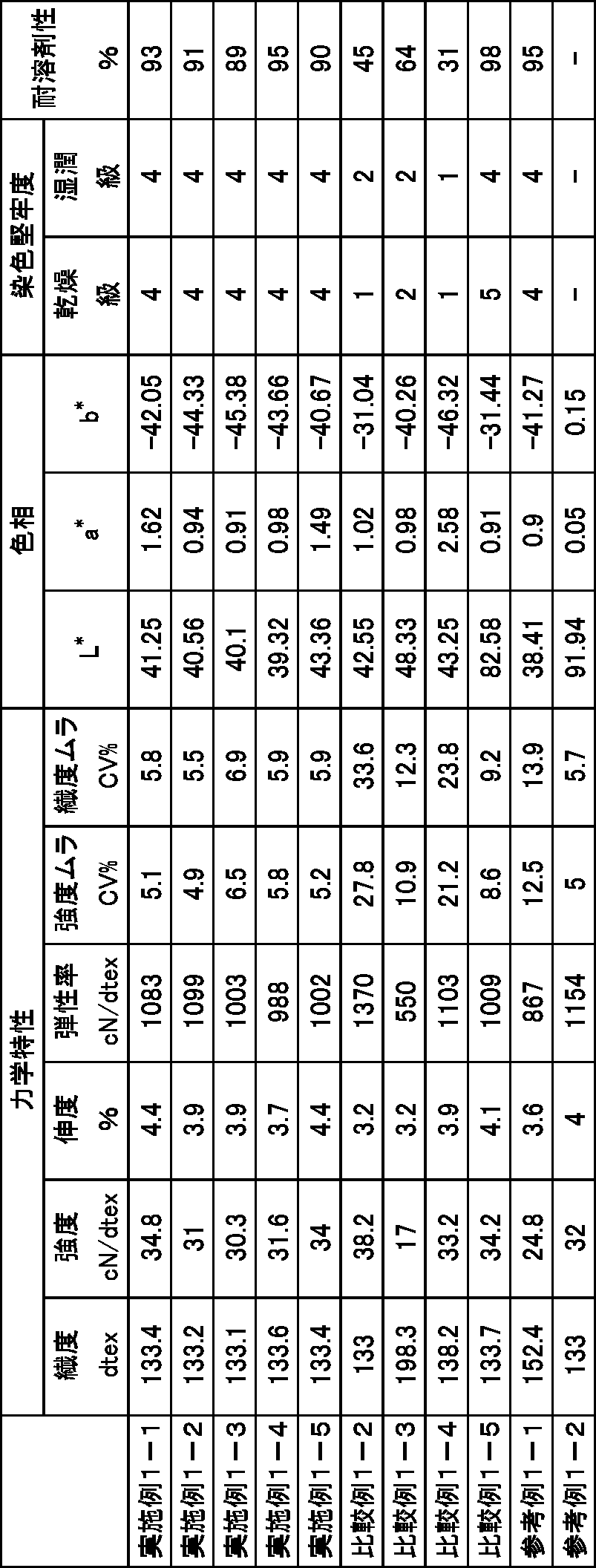
(実施例2-1)
極限粘度が17.0dL/gで、繰り返し単位の98%がエチレンである超高分子量ポリエチレンを原料ポリエチレンとし、これをデカヒドロナフタレンに分散させてポリエチレン濃度9質量%の分散液を調製した。この分散液を押出し機にて200℃で加熱して溶液とした後、オリフィス径φ1.0mm、30Hからなる紡糸口金からノズル面温度180℃、単孔吐出量2.0g/minで吐出した。吐出された糸条が固化するまでに8倍で変形し30℃の水冷バスで冷却しポリエチレン繊維状物(未延伸糸)を得た。
極限粘度が17.0dL/gで、繰り返し単位の98%がエチレンである超高分子量ポリエチレンを原料ポリエチレンとし、これをデカヒドロナフタレンに分散させてポリエチレン濃度9質量%の分散液を調製した。この分散液を押出し機にて200℃で加熱して溶液とした後、オリフィス径φ1.0mm、30Hからなる紡糸口金からノズル面温度180℃、単孔吐出量2.0g/minで吐出した。吐出された糸条が固化するまでに8倍で変形し30℃の水冷バスで冷却しポリエチレン繊維状物(未延伸糸)を得た。
次いで、溶媒として精製水を用い、C.I. Solvent Blue35(10質量%)と、酸価20mgKOH、分子量3000の変性ポリエチレン(添加ポリエチレン)(10質量%)とを水中でエマルジョン形状にした着色液(30℃)を、ガイドオイリング法により上記ポリエチレン繊維状物に接触させ、該ポリエチレン繊維状物の質量に対し1質量%の付着量となるように付着させた。着色液接触時のポリエチレン繊維状物の温度(糸の温度)は30℃であった。
続いて、着色液を付着させたポリエチレン繊維状物を、100℃の窒素の熱風で15秒間熱処理した後、同温度で4倍の延伸を行った(1段目)。その後、150℃のオーブン中で1段延伸後のポリエチレン繊維状物を4倍延伸して(2段目)、巻き取った。実施例2-1で採用した製造条件と、得られた着色ポリエチレン繊維の物性とを表3に示す。
(実施例2-2)
着色液に添加する添加ポリエチレンに、分子量が4000、酸価が30mgKOHであるものを用いたこと、および1段目の延伸時間を25秒にしたこと以外は、実施例2-1と同様にして着色ポリエチレン繊維を製造した。実施例2-2で採用した製造条件と、得られた着色ポリエチレン繊維の物性とを表3に示す。
着色液に添加する添加ポリエチレンに、分子量が4000、酸価が30mgKOHであるものを用いたこと、および1段目の延伸時間を25秒にしたこと以外は、実施例2-1と同様にして着色ポリエチレン繊維を製造した。実施例2-2で採用した製造条件と、得られた着色ポリエチレン繊維の物性とを表3に示す。
(実施例2-3)
着色液に添加する添加ポリエチレンに、分子量が3000、酸価が60mgKOHであるものを用いたこと、および、1段目の延伸時間を25秒、1段目の延伸倍率を3.5倍にしたこと以外は、実施例2-1と同様にして着色ポリエチレン繊維を製造した。実施例2-3で採用した製造条件と、得られた着色ポリエチレン繊維の物性とを表3に示す。
着色液に添加する添加ポリエチレンに、分子量が3000、酸価が60mgKOHであるものを用いたこと、および、1段目の延伸時間を25秒、1段目の延伸倍率を3.5倍にしたこと以外は、実施例2-1と同様にして着色ポリエチレン繊維を製造した。実施例2-3で採用した製造条件と、得られた着色ポリエチレン繊維の物性とを表3に示す。
(実施例2-4)
着色液に添加する添加ポリエチレンに、分子量が5000、酸価が40mgKOHのものを、添加量を20質量%にして用いたこと、1段目の延伸時間を25秒、1段目の延伸倍率を3.5倍にしたこと以外は、実施例2-1と同様にして着色ポリエチレン繊維を製造した。実施例2-4で採用した製造条件と、得られた着色ポリエチレン繊維の物性とを表3に示す。
着色液に添加する添加ポリエチレンに、分子量が5000、酸価が40mgKOHのものを、添加量を20質量%にして用いたこと、1段目の延伸時間を25秒、1段目の延伸倍率を3.5倍にしたこと以外は、実施例2-1と同様にして着色ポリエチレン繊維を製造した。実施例2-4で採用した製造条件と、得られた着色ポリエチレン繊維の物性とを表3に示す。
(比較例2-1)
極限粘度が18.5dL/gで、繰り返し単位の96%がエチレンである超高分子量ポリエチレンを原料ポリエチレンとし、これをデカヒドロナフタレンに分散させてポリエチレン濃度8質量%の分散液を調製した。この分散液を押出し機にて190℃で加熱して溶液とした後、オリフィス径φ0.8mm、30Hからなる紡糸口金からノズル面温度180℃、単孔吐出量2g/minで吐出した。吐出された糸条が固化するまでに16倍で変形し30℃の水冷バスで冷却しポリエチレン繊維状物(未延伸糸)を得た。
極限粘度が18.5dL/gで、繰り返し単位の96%がエチレンである超高分子量ポリエチレンを原料ポリエチレンとし、これをデカヒドロナフタレンに分散させてポリエチレン濃度8質量%の分散液を調製した。この分散液を押出し機にて190℃で加熱して溶液とした後、オリフィス径φ0.8mm、30Hからなる紡糸口金からノズル面温度180℃、単孔吐出量2g/minで吐出した。吐出された糸条が固化するまでに16倍で変形し30℃の水冷バスで冷却しポリエチレン繊維状物(未延伸糸)を得た。
次いで、デカヒドロナフタレンに10質量%のC.I. Solvent Blue 58を溶解させた着色液(30℃)をガイドオイリング法により上記ポリエチレン繊維状物に接触させて、該ポリエチレン繊維状物の質量に対し1質量%の付着量となるように付着させた。着色液接触時のポリエチレン繊維状物の温度(糸の温度)は30℃であった。
続いて該ポリエチレン繊維状物を120℃の窒素の熱風で11秒間熱処理した後、同温度で3倍の延伸を行った(1段目)。その後、150℃のオーブン中で1段延伸後のポリエチレン繊維状物を5倍延伸して(2段目)、巻き取った。比較例2-1で採用した製造条件と、得られた着色ポリエチレン繊維の物性とを表2に示す。
(比較例2-2)
デカヒドロナフタレンに15質量%のC.I. Solvent Blue 35を溶解させた着色液(110℃)をガイドオイリング法により上記ポリエチレン繊維状物に接触させたこと、かつ、2段目の延伸を135℃のオーブン中で実施したこと以外は、比較例2-1と同様にして着色ポリエチレン繊維を製造した。比較例2-2で採用した製造条件と、得られた着色ポリエチレン繊維の物性とを表4に示す。
デカヒドロナフタレンに15質量%のC.I. Solvent Blue 35を溶解させた着色液(110℃)をガイドオイリング法により上記ポリエチレン繊維状物に接触させたこと、かつ、2段目の延伸を135℃のオーブン中で実施したこと以外は、比較例2-1と同様にして着色ポリエチレン繊維を製造した。比較例2-2で採用した製造条件と、得られた着色ポリエチレン繊維の物性とを表4に示す。
(比較例2-3)
比較例2-1と同じ原料ポリエチレン分散液中に、C.I. Solvent Blue 35を濃度が0.05質量%となるように添加したこと、かつ、未延伸糸と着色液との接触を行わなかった(染色を行わなかった)こと以外は、比較例2-1と同様にして着色ポリエチレン繊維を製造した。比較例2-3で採用した製造条件と、得られた着色ポリエチレン繊維の物性とを表4に示す。
比較例2-1と同じ原料ポリエチレン分散液中に、C.I. Solvent Blue 35を濃度が0.05質量%となるように添加したこと、かつ、未延伸糸と着色液との接触を行わなかった(染色を行わなかった)こと以外は、比較例2-1と同様にして着色ポリエチレン繊維を製造した。比較例2-3で採用した製造条件と、得られた着色ポリエチレン繊維の物性とを表4に示す。
(比較例2-4)
デカヒドロナフタレンに20質量%のC.I. Solvent Blue 58を溶解させた着色液を用いたこと、かつ、90℃の窒素の熱風で5秒間熱処理した後、同温度で2倍の延伸を行った(1段目)後、90℃のオーブン中で1段延伸後のポリエチレン繊維状物を4倍延伸した(2段目)こと以外は、比較例2-1と同様にして着色ポリエチレン繊維を製造した。比較例2-4で採用した製造条件と、得られた着色ポリエチレン繊維の物性とを表4に示す。
デカヒドロナフタレンに20質量%のC.I. Solvent Blue 58を溶解させた着色液を用いたこと、かつ、90℃の窒素の熱風で5秒間熱処理した後、同温度で2倍の延伸を行った(1段目)後、90℃のオーブン中で1段延伸後のポリエチレン繊維状物を4倍延伸した(2段目)こと以外は、比較例2-1と同様にして着色ポリエチレン繊維を製造した。比較例2-4で採用した製造条件と、得られた着色ポリエチレン繊維の物性とを表4に示す。
(比較例2-5)
デカヒドロナフタレンに20質量%のC.I. Solvent Blue 58を溶解させた着色液を用いて、ポリエチレン繊維状物の質量に対し12質量%の付着量となるように付着させ、かつ、2段目の延伸を135℃のオーブン中で実施したこと以外は、比較例2-1と同様にして着色ポリエチレン繊維を製造した。比較例2-5で採用した製造条件と、得られた着色ポリエチレン繊維の物性とを表4に示す。
デカヒドロナフタレンに20質量%のC.I. Solvent Blue 58を溶解させた着色液を用いて、ポリエチレン繊維状物の質量に対し12質量%の付着量となるように付着させ、かつ、2段目の延伸を135℃のオーブン中で実施したこと以外は、比較例2-1と同様にして着色ポリエチレン繊維を製造した。比較例2-5で採用した製造条件と、得られた着色ポリエチレン繊維の物性とを表4に示す。
(比較例2-6)
着色材料としてC.I. Solvent Blue35(10質量%)を用い、溶媒として精製水を用い、添加ポリエチレンを用いることなく、着色液を作製した。この着色液は、均一溶液とならず、着色材料が水中に分散した状態となった。この着色液を用いた以外は実施例2-4と同様にしてポリエチレン繊維を製造した。しかしながら、着色材料は繊維表面に付着したのみで、該ポリエチレン繊維を着色することができなかった。比較例2-6で採用した製造条件と得られたポリエチレン繊維の物性とを表4に示す。
着色材料としてC.I. Solvent Blue35(10質量%)を用い、溶媒として精製水を用い、添加ポリエチレンを用いることなく、着色液を作製した。この着色液は、均一溶液とならず、着色材料が水中に分散した状態となった。この着色液を用いた以外は実施例2-4と同様にしてポリエチレン繊維を製造した。しかしながら、着色材料は繊維表面に付着したのみで、該ポリエチレン繊維を着色することができなかった。比較例2-6で採用した製造条件と得られたポリエチレン繊維の物性とを表4に示す。
(参考例2-1)
未延伸糸と着色液との接触を行わなかった(染色を行わなかった)こと、かつ、1段目の延伸では、3.5倍の延伸を行ったこと以外は、比較例2-1と同様にしてポリエチレン繊維を製造した。参考例2-1で採用した製造条件と、得られたポリエチレン繊維の物性とを表4に示す。
未延伸糸と着色液との接触を行わなかった(染色を行わなかった)こと、かつ、1段目の延伸では、3.5倍の延伸を行ったこと以外は、比較例2-1と同様にしてポリエチレン繊維を製造した。参考例2-1で採用した製造条件と、得られたポリエチレン繊維の物性とを表4に示す。
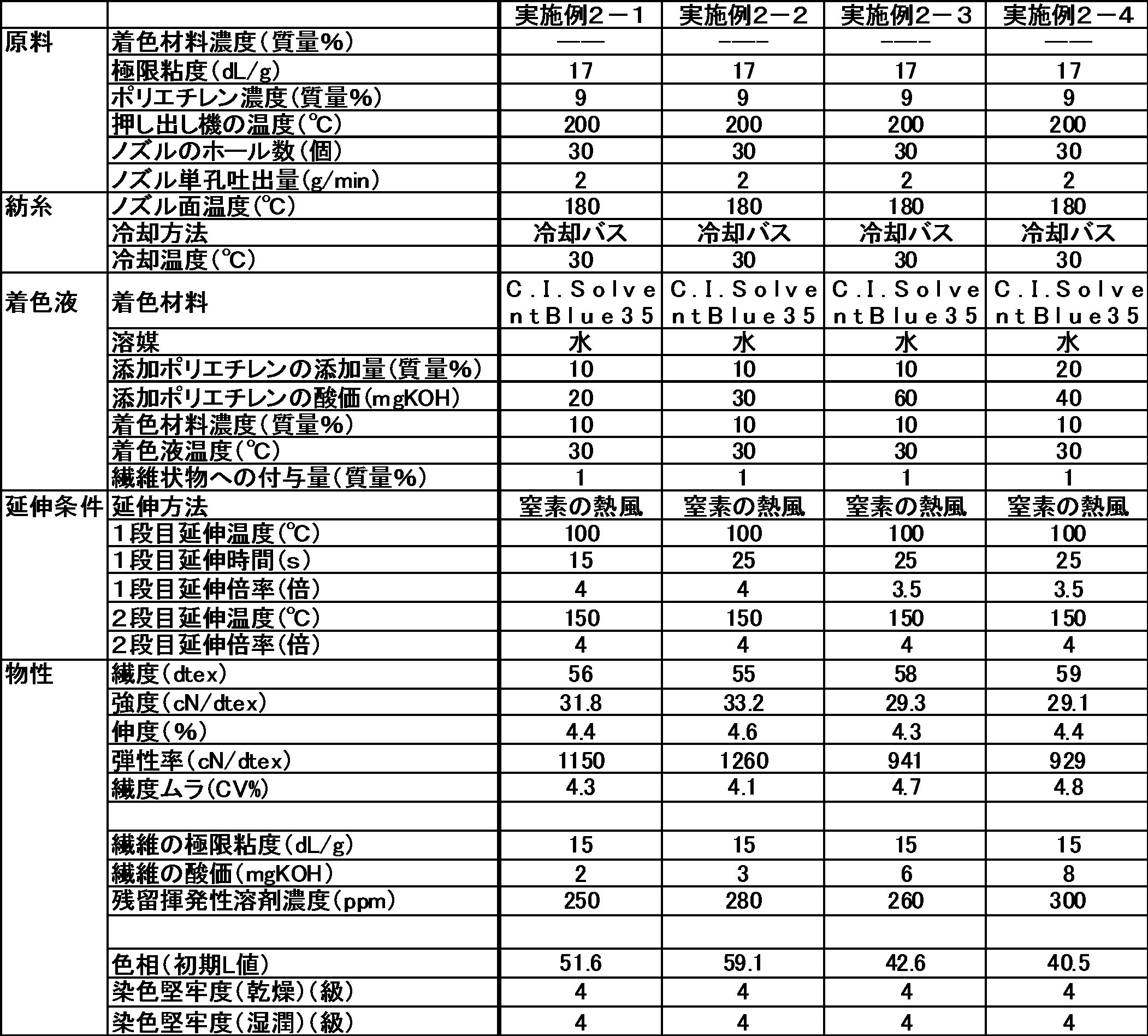
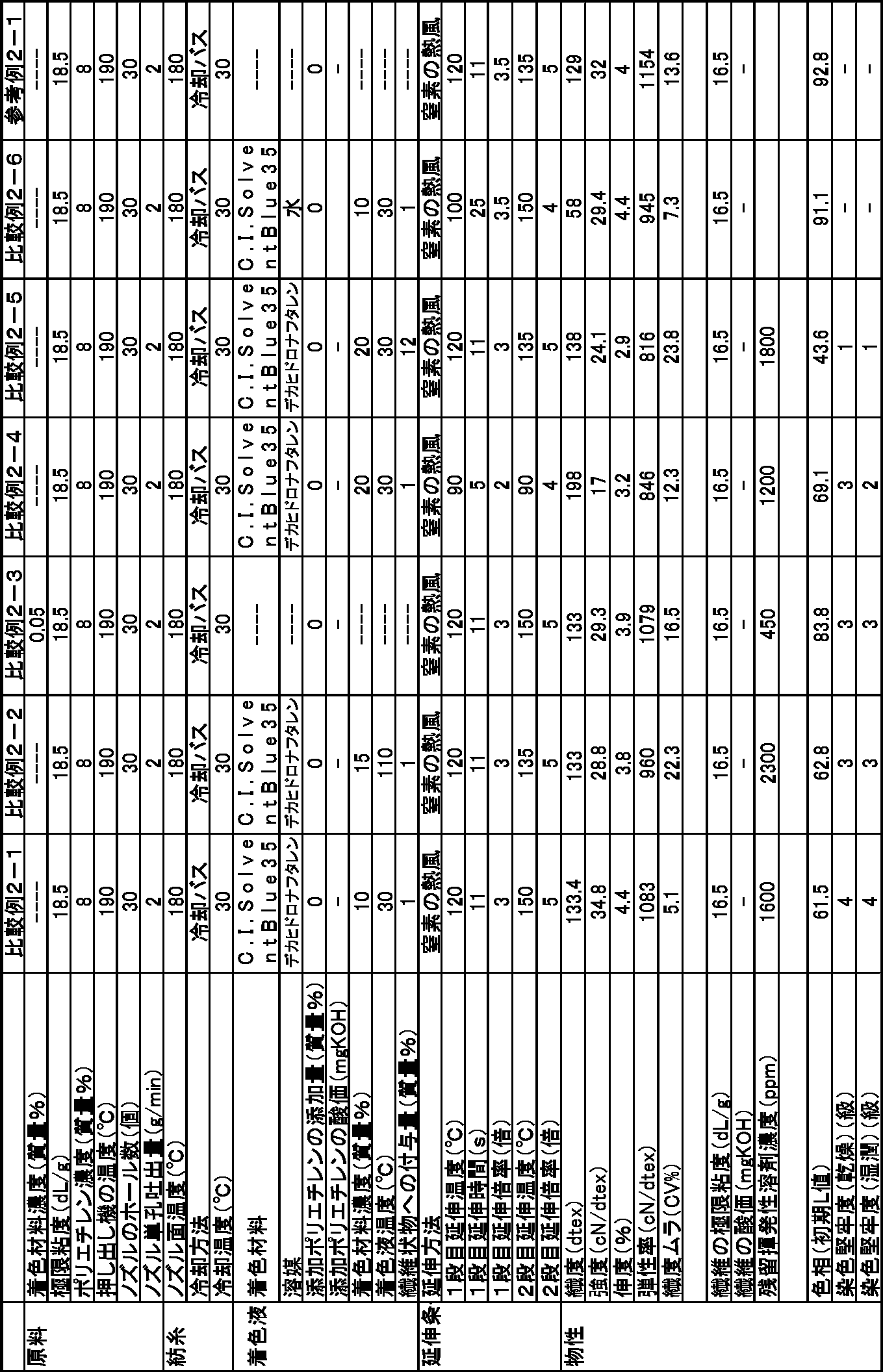
表3及び4から分かるように、着色液の溶媒に水を用い、繊維の酸価が0.1mgKOH/g以上50mgKOH/g以下の範囲に入る実施例2-1~2-4は、着色材料の溶媒に有機溶媒(比較例ではデカヒドロナフタレン)を用い、繊維の酸価が0の比較例2-1~2-5に比べて、残留揮発性溶剤濃度が圧倒的に低く、環境負荷を与え難いことがわかる。また、実施例2-1~2-4の繊維は、CIE-L*a*b*表色系によるL*値が80以下であり、摩擦に対する染色堅牢度が、乾燥状態及び湿潤状態のいずれについても3級以上であり、かつ、酸価が0.1mgKOH/g以上50mgKOH/g以下であるため、濃色に着色されており、且つ、染色堅牢度及び/又は耐溶剤性に優れた繊維であることがわかる。
(実施例3-1)
まず、実施例3-1では、着色液を次のように作製した。着色材料であるC.I. Solvent Blue 58と、主成分がポリオキシアルキレンアルキルエーテルから成るHLB値が11.7である市販品の界面活性剤とを撹拌させながら、精製水を徐々に滴下しエマルジョン化した着色液を得た。なお、出来上がるエマルジョン化した着色液が、着色材料3質量%、界面活性剤1.2質量%、精製水95.8質量%となるように調整した。
まず、実施例3-1では、着色液を次のように作製した。着色材料であるC.I. Solvent Blue 58と、主成分がポリオキシアルキレンアルキルエーテルから成るHLB値が11.7である市販品の界面活性剤とを撹拌させながら、精製水を徐々に滴下しエマルジョン化した着色液を得た。なお、出来上がるエマルジョン化した着色液が、着色材料3質量%、界面活性剤1.2質量%、精製水95.8質量%となるように調整した。
上記のように作製した着色液の状態を観察したところ、良好であった。ここで、着色液の観察は次のようにして行う。エマルジョン化した着色液または水分散した着色液を市販のちり紙などへ少量滴下し、染液の滲み具合を観察する。ちり紙などへ着色液が均等に広がれば良好と判断する。ちり紙等で着色材料が凝集し水と分離した滲みができた場合は、マルジョン化が十分にできておらず、不安定な着色液であり、着色しても発色が淡くなるため使用は好ましくない。
次に、実施例3-1での紡糸について説明する。
極限粘度が17.0dL/gで、繰り返し単位の98%がエチレンである超高分子量ポリエチレンを原料ポリエチレンとし、これをデカヒドロナフタレンに分散させてポリエチレン濃度9質量%の分散液を調製した。この分散液を押出し機にて200℃で加熱して溶液とした後、オリフィス径φ1.0mm、30Hからなる紡糸口金からノズル面温度180℃、単孔吐出量2.0g/minで吐出した。吐出された糸条が固化するまでに8倍で変形し30℃の水冷バスで冷却しポリエチレン繊維状物(未延伸糸)を得た。
極限粘度が17.0dL/gで、繰り返し単位の98%がエチレンである超高分子量ポリエチレンを原料ポリエチレンとし、これをデカヒドロナフタレンに分散させてポリエチレン濃度9質量%の分散液を調製した。この分散液を押出し機にて200℃で加熱して溶液とした後、オリフィス径φ1.0mm、30Hからなる紡糸口金からノズル面温度180℃、単孔吐出量2.0g/minで吐出した。吐出された糸条が固化するまでに8倍で変形し30℃の水冷バスで冷却しポリエチレン繊維状物(未延伸糸)を得た。
次いで、上記作製した着色液(30℃)をガイドオイリング法により上記ポリエチレン繊維状物の質量に対し、着色材料が1質量%、着色液に含まれる主成分がポリオキシアルキレンアルキルエーテルである界面活性剤を含む総界面活性剤量(着色液に含まれる界面活性剤と追油剤に含まれる界面活性剤との合計)が0.93質量%の付着量となるように付着させた。着色液接触時のポリエチレン繊維状物の温度は30℃、張力は1.2cNであった。
続いて、着色液を付着させたポリエチレン繊維状物に3.7cN/dtexの張力をかけながら、110℃の窒素の熱風で25秒間熱処理した後、同温度で4倍の延伸を行った(1段目)。その後、150℃のオーブン中で、1段延伸後のポリエチレン繊維状物を4倍延伸して(2段目)、巻き取った。
着色液付着後(着色後)の着色ポリエチレン繊維の発色は良好、乾摩擦堅牢度4級、湿摩擦堅牢度4級、繊維に残留する界面活性剤量は0.89質量%であった。実施例3-1で採用した製造条件及び得られた着色ポリエチレン繊維の物性を表5に示す。
(実施例3-2)
着色液に含まれる界面活性剤の主成分をポリオキシエチレンベヘニルエーテルから成るHLB値が7.0である市販品の界面活性剤を用いた以外は実施例3-1と同様にして、着色ポリエチレン繊維を製造した。
実施例3-2の着色液をちり紙へ少量滴下すると、着色材料の凝集物も無く均等に染液が滲み、着色液の状態は良好であった。実施例3-2の着色ポリエチレン繊維の発色は良好、乾摩擦堅牢度4級、湿摩擦堅牢度4級、繊維に残留する界面活性剤量は0.91質量%であった。実施例3-2で採用した製造条件及び得られた着色ポリエチレン繊維の物性を表5に示す。
着色液に含まれる界面活性剤の主成分をポリオキシエチレンベヘニルエーテルから成るHLB値が7.0である市販品の界面活性剤を用いた以外は実施例3-1と同様にして、着色ポリエチレン繊維を製造した。
実施例3-2の着色液をちり紙へ少量滴下すると、着色材料の凝集物も無く均等に染液が滲み、着色液の状態は良好であった。実施例3-2の着色ポリエチレン繊維の発色は良好、乾摩擦堅牢度4級、湿摩擦堅牢度4級、繊維に残留する界面活性剤量は0.91質量%であった。実施例3-2で採用した製造条件及び得られた着色ポリエチレン繊維の物性を表5に示す。
(実施例3-3)
着色液に含まれる界面活性剤の主成分をポリオキシエチレンベヘニルエーテルから成る市販品のHLB値が14.0である界面活性剤を用いた以外は実施例3-1と同様にして、着色ポリエチレン繊維を製造した。
実施例3-3の着色液をちり紙へ少量滴下すると、着色材料の凝集物も無く均等に染液が滲み、着色液の状態は良好であった。実施例3-3の着色ポリエチレン繊維の発色は良好、乾摩擦堅牢度4級、湿摩擦堅牢度4級、繊維に残留する界面活性剤量は0.79質量%であった。実施例3-3で採用した製造条件及び得られた着色ポリエチレン繊維の物性を表5に示す。
着色液に含まれる界面活性剤の主成分をポリオキシエチレンベヘニルエーテルから成る市販品のHLB値が14.0である界面活性剤を用いた以外は実施例3-1と同様にして、着色ポリエチレン繊維を製造した。
実施例3-3の着色液をちり紙へ少量滴下すると、着色材料の凝集物も無く均等に染液が滲み、着色液の状態は良好であった。実施例3-3の着色ポリエチレン繊維の発色は良好、乾摩擦堅牢度4級、湿摩擦堅牢度4級、繊維に残留する界面活性剤量は0.79質量%であった。実施例3-3で採用した製造条件及び得られた着色ポリエチレン繊維の物性を表5に示す。
(実施例3-4)
着色液に含まれる界面活性剤の主成分をポリオキシエチレンステアリルエーテルから成る市販品のHLB値が10.7である界面活性剤を用いた以外は実施例3-1と同様にして、着色ポリエチレン繊維を製造した。
実施例3-4の着色液をちり紙へ少量滴下すると、着色材料の凝集物も無く均等に染液が滲み、着色液の状態は良好であった。実施例3-4の着色ポリエチレン繊維の発色は良好、乾摩擦堅牢度4級、湿摩擦堅牢度4級、繊維に残留する界面活性剤量は0.87質量%であった。実施例3-4で採用した製造条件及び得られた着色ポリエチレン繊維の物性を表5に示す。
着色液に含まれる界面活性剤の主成分をポリオキシエチレンステアリルエーテルから成る市販品のHLB値が10.7である界面活性剤を用いた以外は実施例3-1と同様にして、着色ポリエチレン繊維を製造した。
実施例3-4の着色液をちり紙へ少量滴下すると、着色材料の凝集物も無く均等に染液が滲み、着色液の状態は良好であった。実施例3-4の着色ポリエチレン繊維の発色は良好、乾摩擦堅牢度4級、湿摩擦堅牢度4級、繊維に残留する界面活性剤量は0.87質量%であった。実施例3-4で採用した製造条件及び得られた着色ポリエチレン繊維の物性を表5に示す。
(実施例3-5)
出来上がるエマルジョン化した着色液が、着色材料3質量%、界面活性剤0.6質量%、精製水96.4質量%となるように調整した以外は実施例3-1と同様にして、着色液を作製した。この着色液を用いて、総界面活性剤量がポリエチレン繊維状物の質量に対し0.67質量%の付着量となるように付着させた以外は実施例3-1と同様にして、着色ポリエチレン繊維を製造した。
実施例3-5の着色液をちり紙へ少量滴下すると、着色材料の凝集物も無く均等に染液が滲み、着色液の状態は良好であった。実施例3-5の着色ポリエチレン繊維の発色は良好、乾摩擦堅牢度4級、湿摩擦堅牢度3-4級、繊維に残留する界面活性剤量は0.58質量%であった。実施例3-5で採用した製造条件及び得られた着色ポリエチレン繊維の物性を表5に示す。
出来上がるエマルジョン化した着色液が、着色材料3質量%、界面活性剤0.6質量%、精製水96.4質量%となるように調整した以外は実施例3-1と同様にして、着色液を作製した。この着色液を用いて、総界面活性剤量がポリエチレン繊維状物の質量に対し0.67質量%の付着量となるように付着させた以外は実施例3-1と同様にして、着色ポリエチレン繊維を製造した。
実施例3-5の着色液をちり紙へ少量滴下すると、着色材料の凝集物も無く均等に染液が滲み、着色液の状態は良好であった。実施例3-5の着色ポリエチレン繊維の発色は良好、乾摩擦堅牢度4級、湿摩擦堅牢度3-4級、繊維に残留する界面活性剤量は0.58質量%であった。実施例3-5で採用した製造条件及び得られた着色ポリエチレン繊維の物性を表5に示す。
(実施例3-6)
出来上がるエマルジョン化した着色液が、着色材料3質量%、界面活性剤0.24質量%、精製水96.76質量%となるように調整した以外は実施例3-1と同様にして、着色液を作製した。この着色液を用いて、総界面活性剤量がポリエチレン繊維状物の質量に対し0.51質量%の付着量となるように付着させた以外は実施例3-1と同様にして、着色ポリエチレン繊維を製造した。
実施例3-6の着色ポリエチレン繊維の発色は良好、乾摩擦堅牢度4級、湿摩擦堅牢度3-4級、繊維に残留する界面活性剤量は0.49質量%であった。実施例3-6で採用した製造条件及び得られた着色ポリエチレン繊維の物性を表5に示す。
出来上がるエマルジョン化した着色液が、着色材料3質量%、界面活性剤0.24質量%、精製水96.76質量%となるように調整した以外は実施例3-1と同様にして、着色液を作製した。この着色液を用いて、総界面活性剤量がポリエチレン繊維状物の質量に対し0.51質量%の付着量となるように付着させた以外は実施例3-1と同様にして、着色ポリエチレン繊維を製造した。
実施例3-6の着色ポリエチレン繊維の発色は良好、乾摩擦堅牢度4級、湿摩擦堅牢度3-4級、繊維に残留する界面活性剤量は0.49質量%であった。実施例3-6で採用した製造条件及び得られた着色ポリエチレン繊維の物性を表5に示す。
(実施例3-7)
出来上がるエマルジョン化した着色液が、着色材料3質量%、界面活性剤10質量%、精製水87質量%となるように調整した以外は実施例3-1と同様にして、着色液を作製した。この着色液を用いて、総界面活性剤量がポリエチレン繊維状物の質量に対し4.6質量%の付着量となるように付着させた以外は実施例3-1の紡糸と同様にして、着色ポリエチレン繊維を製造した。
実施例3-7の着色ポリエチレン繊維の発色は良好、手触りはややベタツキ感が生じたが、乾摩擦堅牢度3級、湿摩擦堅牢度3級、繊維に残留する界面活性剤量は4.1質量%であった。実施例3-7で採用した製造条件及び得られた着色ポリエチレン繊維の物性を表5に示す。
出来上がるエマルジョン化した着色液が、着色材料3質量%、界面活性剤10質量%、精製水87質量%となるように調整した以外は実施例3-1と同様にして、着色液を作製した。この着色液を用いて、総界面活性剤量がポリエチレン繊維状物の質量に対し4.6質量%の付着量となるように付着させた以外は実施例3-1の紡糸と同様にして、着色ポリエチレン繊維を製造した。
実施例3-7の着色ポリエチレン繊維の発色は良好、手触りはややベタツキ感が生じたが、乾摩擦堅牢度3級、湿摩擦堅牢度3級、繊維に残留する界面活性剤量は4.1質量%であった。実施例3-7で採用した製造条件及び得られた着色ポリエチレン繊維の物性を表5に示す。
(比較例3-1)
着色液に含まれる界面活性剤の主成分をポリオキシエチレンステアリルエーテルから成る市販品のHLB値が6.0である界面活性剤を用いた以外は実施例3-1と同様にして、着色ポリエチレン繊維を製造した。
比較例3-1の着色液をちり紙へ該染液を滴下すると着色材料が凝集し水と分離した。着色液を撹拌しながら着色を検討したものの、比較例3-1で得られた着色ポリエチレン繊維は、淡色、乾摩擦堅牢度3級、湿摩擦堅牢度2級、繊維に残留する界面活性剤量は0.46質量%であった。着色液に凝集が生じたのは界面活性剤のHLB値が低く十分にエマルジョン化ができておらず、着色が進まず堅牢度も劣ったとみられる。比較例3-1で採用した製造条件及び得られた着色ポリエチレン繊維の物性を表6に示す。
着色液に含まれる界面活性剤の主成分をポリオキシエチレンステアリルエーテルから成る市販品のHLB値が6.0である界面活性剤を用いた以外は実施例3-1と同様にして、着色ポリエチレン繊維を製造した。
比較例3-1の着色液をちり紙へ該染液を滴下すると着色材料が凝集し水と分離した。着色液を撹拌しながら着色を検討したものの、比較例3-1で得られた着色ポリエチレン繊維は、淡色、乾摩擦堅牢度3級、湿摩擦堅牢度2級、繊維に残留する界面活性剤量は0.46質量%であった。着色液に凝集が生じたのは界面活性剤のHLB値が低く十分にエマルジョン化ができておらず、着色が進まず堅牢度も劣ったとみられる。比較例3-1で採用した製造条件及び得られた着色ポリエチレン繊維の物性を表6に示す。
(比較例3-2)
着色液に含まれる界面活性剤の主成分をポリオキシエチレンアルキルエーテルから成る市販品のHLB値が14.7である界面活性剤を用いた以外は実施例3-1と同様にして、着色ポリエチレン繊維を製造した。
比較例3-2の着色液は見かけ安定していたものの、ちり紙へ少量滴下すると着色材料が凝集し水と分離した。着色液を撹拌しながら着色を検討したものの、比較例3-2で得られた着色ポリエチレン繊維は、淡色、乾摩擦堅牢度2級、湿摩擦堅牢度1-2級、繊維に残留する界面活性剤量0.93質量%であった。界面活性剤の親水性が高いと疎水性の着色材料と馴染み難くエマルジョン化が十分でなく着色に影響したとみられる。比較例3-2で採用した製造条件及び得られた着色ポリエチレン繊維の物性を表6に示す。
着色液に含まれる界面活性剤の主成分をポリオキシエチレンアルキルエーテルから成る市販品のHLB値が14.7である界面活性剤を用いた以外は実施例3-1と同様にして、着色ポリエチレン繊維を製造した。
比較例3-2の着色液は見かけ安定していたものの、ちり紙へ少量滴下すると着色材料が凝集し水と分離した。着色液を撹拌しながら着色を検討したものの、比較例3-2で得られた着色ポリエチレン繊維は、淡色、乾摩擦堅牢度2級、湿摩擦堅牢度1-2級、繊維に残留する界面活性剤量0.93質量%であった。界面活性剤の親水性が高いと疎水性の着色材料と馴染み難くエマルジョン化が十分でなく着色に影響したとみられる。比較例3-2で採用した製造条件及び得られた着色ポリエチレン繊維の物性を表6に示す。
(比較例3-3)
主成分がポリオキシエチレンアルキルエーテルから成る市販品のHLB値が11.7である界面活性剤を0.05質量%用いてエマルジョン化を検討した以外は、実施例3-1に順じた。しかしながら作製した着色液は着色材料と水とが混ざらずエマルジョン化ができなかったため、着色を断念した。比較例3-3で採用した製造条件及び得られた着色ポリエチレン繊維の物性を表6に示す。
主成分がポリオキシエチレンアルキルエーテルから成る市販品のHLB値が11.7である界面活性剤を0.05質量%用いてエマルジョン化を検討した以外は、実施例3-1に順じた。しかしながら作製した着色液は着色材料と水とが混ざらずエマルジョン化ができなかったため、着色を断念した。比較例3-3で採用した製造条件及び得られた着色ポリエチレン繊維の物性を表6に示す。
(比較例3-4)
着色液に含まれる界面活性剤の主成分をポリオキシエチレンアルキルエーテルから成る市販品のHLB11.7値である界面活性剤を12.5質量%用いて、総界面活性剤量が5.7質量%の付着量となるように着色液を付着させた以外は実施例3-1と同様にして、着色ポリエチレン繊維を製造した。
比較例3-4の着色液をちり紙へ少量滴下すると、着色材料の凝集物も無く、比較例3-4で得られた着色液の状態は良好であった。比較例3-4の着色ポリエチレン繊維は、乾摩擦堅牢度2-3級、湿摩擦堅牢度2級、繊維へ残留する界面活性剤量は5.2質量%であった。しかしながら、繊維に若干のベタツキ感が生じ、湿摩擦堅牢度が劣っていた。比較例3-4で採用した製造条件及び得られた着色ポリエチレン繊維の物性を表6に示す。
着色液に含まれる界面活性剤の主成分をポリオキシエチレンアルキルエーテルから成る市販品のHLB11.7値である界面活性剤を12.5質量%用いて、総界面活性剤量が5.7質量%の付着量となるように着色液を付着させた以外は実施例3-1と同様にして、着色ポリエチレン繊維を製造した。
比較例3-4の着色液をちり紙へ少量滴下すると、着色材料の凝集物も無く、比較例3-4で得られた着色液の状態は良好であった。比較例3-4の着色ポリエチレン繊維は、乾摩擦堅牢度2-3級、湿摩擦堅牢度2級、繊維へ残留する界面活性剤量は5.2質量%であった。しかしながら、繊維に若干のベタツキ感が生じ、湿摩擦堅牢度が劣っていた。比較例3-4で採用した製造条件及び得られた着色ポリエチレン繊維の物性を表6に示す。
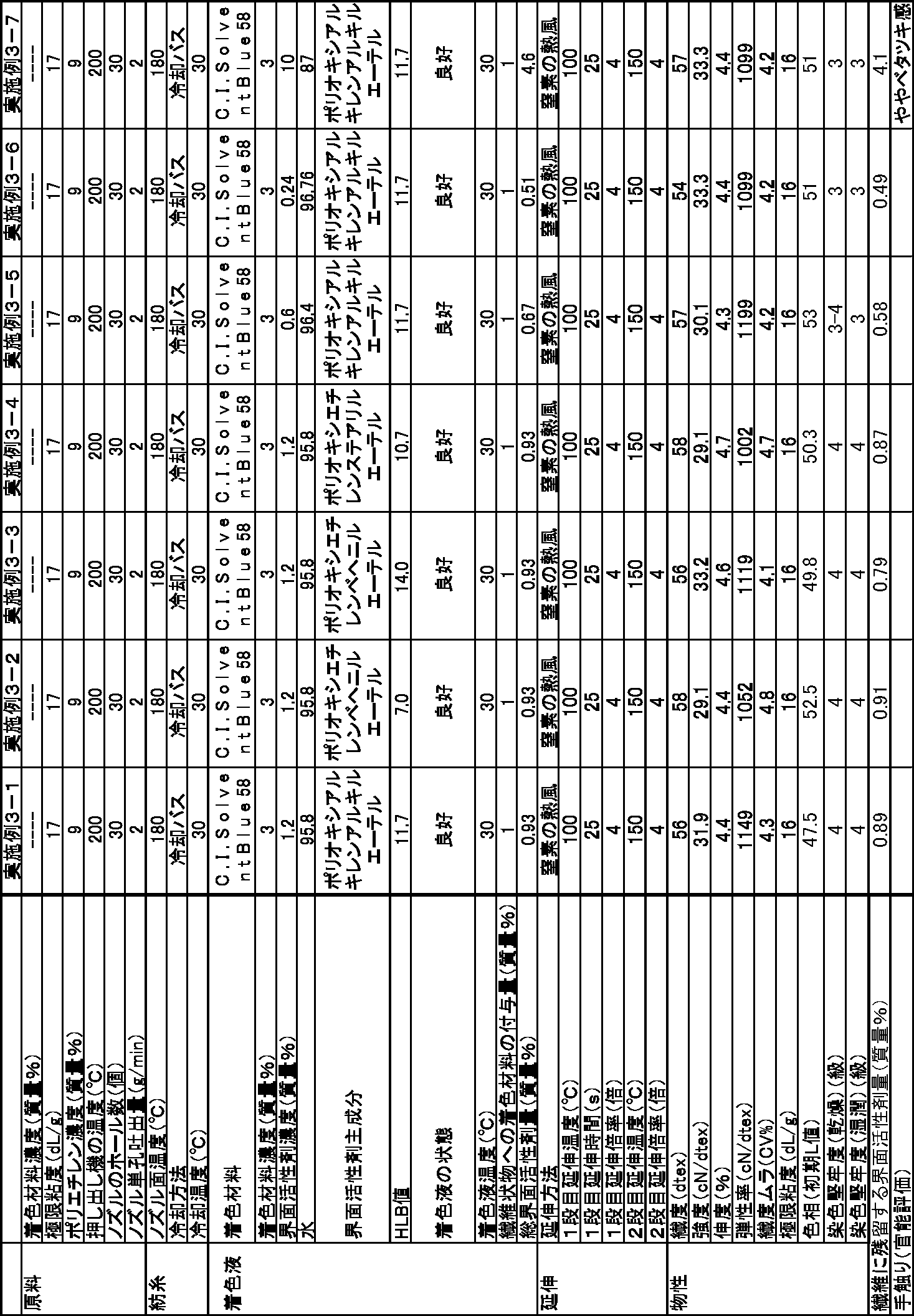
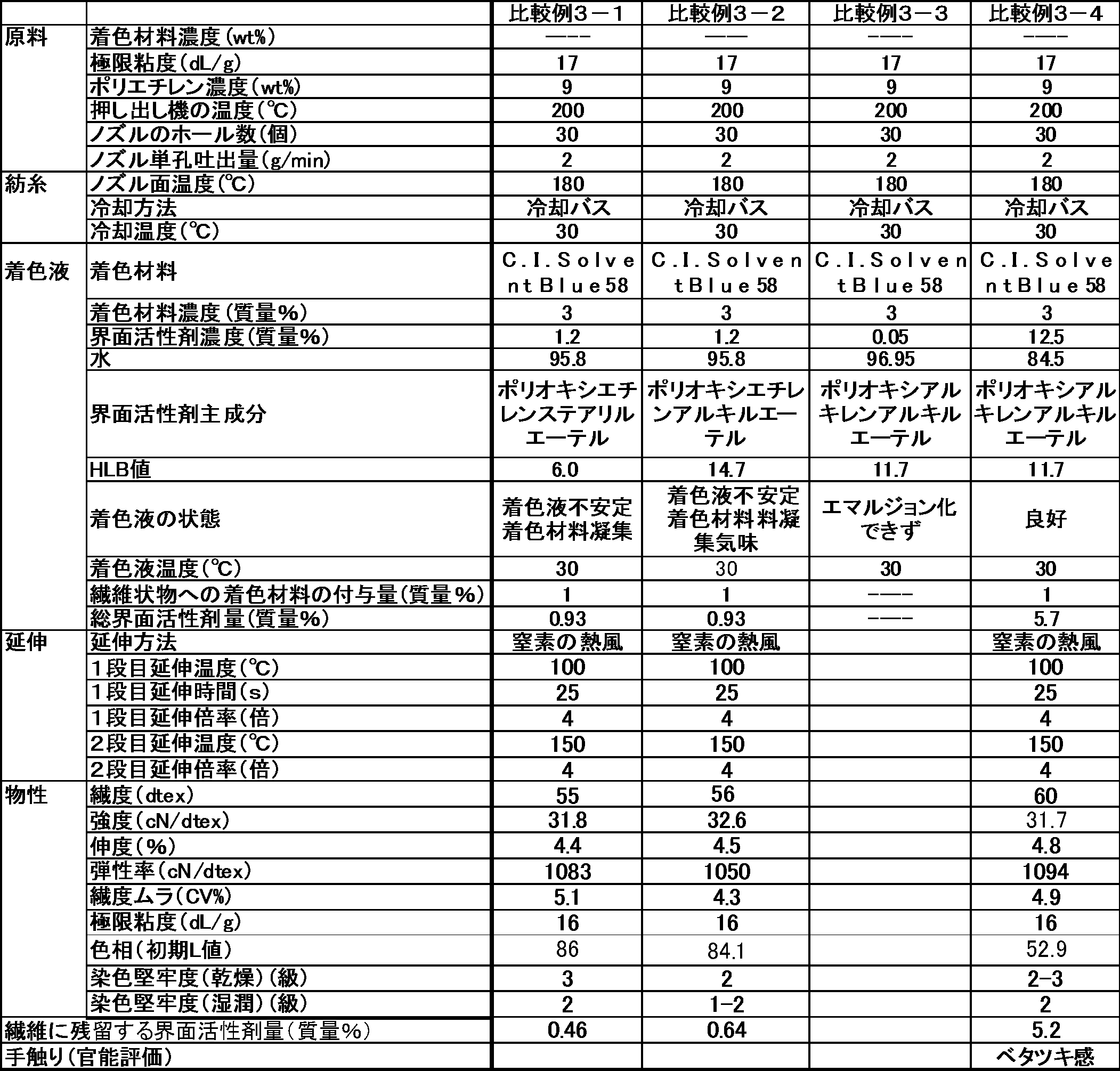
表5及び6から分かるように、実施例3-1~3-7の繊維は、比較例3-1~3-4の繊維に比べて、CIE-L*a*b*表色系によるL*値が80以下であり、摩擦に対する染色堅牢度が、乾燥状態及び湿潤状態のいずれについても3級以上であり、かつ、HLB値が7.0以上14.0以下の界面活性剤を0.4%以上5.0%以下含有しているため、濃色に着色されており、且つ、染色堅牢度及び/又は耐溶剤性に優れた繊維であることがわかる。
以上で説明した各実施の形態および各実施例は、すべての点で例示であって、制限的なものではない。本発明の技術的範囲は、請求の範囲によって画定され、また請求の範囲の記載と均等の意味および範囲内でのすべての変更を含むものである。
本発明によれば、濃色に着色されており、且つ、染色堅牢度及び/又は耐溶剤性に優れる着色ポリエチレン繊維を提供できる。この着色ポリエチレン繊維は、強度、繊度のムラが少ない。よって、組紐、釣糸、手袋、ロープ、ネット、織物及び編物等の材料として好適に用いられる。
Claims (22)
- CIE-L*a*b*表色系によるL*値が80以下であり、かつ、摩擦に対する染色堅牢度が、乾燥状態及び湿潤状態のいずれについても3級以上である、ことを特徴とする着色ポリエチレン繊維。
- 長手方向の任意の10箇所で測定した引張強度について下記式1で定義される変動係数が10%以下である請求項1に記載の着色ポリエチレン繊維。
引張強度の変動係数(%)=(引張強度の標準偏差/引張強度の平均値)×100 (式1) - 酸価が0.1mgKOH/g以上50mgKOH/g以下であることを特徴とする請求項1または2に記載の着色ポリエチレン繊維。
- HLB値(Hydrophile-Lipophile Balance)が7.0以上14.0以下の界面活性剤を0.4%以上5.0%以下含有することを特徴とする請求項1または2に記載の着色ポリエチレン繊維。
- 下記測定方法により求められる耐溶剤性が75%以上であることを特徴とする着色ポリエチレン繊維。
[耐溶剤性の測定方法]
アセトンに対して、0.1g/mLとなるように着色ポリエチレン繊維を浸漬し、室温下で24時間静置する。着色ポリエチレン繊維の浸漬に使用したアセトンと、着色ポリエチレン繊維を浸漬し20±5℃で24時間静置した後のアセトンについて、紫外可視分光光度計を使用して波長350nm~780nmの範囲の透過率を測定し、得られた透過率曲線から上記波長領域における透過率の積分値を求め、下記式2より耐溶剤性を算出する。
耐溶剤性(%)=(T1/T0)×100 (式2)
[式2中、T0は波長350nm~780nmにおけるアセトンの透過率の積分値を示し、T1は波長350nm~780nmにおける着色ポリエチレン繊維浸漬後のアセトンの透過率の積分値を示す。] - 長手方向の繊度ムラが10%以下である請求項1~5のいずれか1項に記載の着色ポリエチレン繊維。
- 引張強度が18cN/dtex以上である請求項1~6のいずれか1項に記載の着色ポリエチレン繊維。
- 油溶性染料である着色材料を含むことを特徴とする請求項1~7のいずれか1項に記載の着色ポリエチレン繊維。
- 含有する単糸の繊度が1dtex以上80dtex以下である請求項1~8のいずれか1項に記載の着色ポリエチレン繊維。
- 請求項1~9のいずれか1項に記載の着色ポリエチレン繊維を少なくとも1本含むことを特徴とする組紐。
- 組紐から解いた繊維の強度が15cN/dtex以上である請求項10に記載の組紐。
- 請求項1~9のいずれか1項に記載の着色ポリエチレン繊維を含む釣糸。
- 請求項1~9のいずれか1項に記載の着色ポリエチレン繊維を含む手袋。
- 請求項1~9のいずれか1項に記載の着色ポリエチレン繊維を含むロープ。
- 請求項1~9のいずれか1項に記載の着色ポリエチレン繊維を含むネット。
- 請求項1~9のいずれか1項に記載の着色ポリエチレン繊維を含む織物又は編物。
- 極限粘度[η]が5.0dL/g以上25dL/g以下であり、その繰り返し単位が90モル%以上エチレンからなるポリエチレンを濃度0.5~40質量%となるように有機溶媒に溶解させたポリエチレン溶液を紡糸してポリエチレン繊維状物を得る工程、
20質量%未満の有機溶媒を含むポリエチレン繊維状物を、着色材料と有機溶媒とを含む、温度が0℃以上、60℃未満の着色液と接触させる工程、
着色液が付与され繊維重量に対し25%未満の有機溶媒を含むポリエチレン繊維状物を110℃以上で10秒以上加熱する工程、及び、
ポリエチレン繊維状物を延伸する工程、
を含むことを特徴とする着色ポリエチレン繊維の製造方法。 - 極限粘度[η]が5.0dL/g以上25dL/g以下であり、その繰り返し単位が90モル%以上エチレンからなるポリエチレンを濃度0.5~40質量%となるように有機溶媒に溶解させたポリエチレン溶液を紡糸してポリエチレン繊維状物を得る工程と、
前記ポリエチレン繊維状物を、着色材料と片末端に親水基を備えたポリオレフィンとを含み、温度が0℃以上60℃未満の着色液と接触させる工程と、
前記着色液が付与されたポリエチレン繊維状物を110℃以上で10秒以上加熱する工程、及び、
前記ポリエチレン繊維状物を延伸する工程、
を含むことを特徴とする着色ポリエチレン繊維の製造方法。 - 極限粘度[η]が5.0dL/g以上25dL/g以下であり、その繰り返し単位が90モル%以上エチレンからなるポリエチレンを濃度0.5~40質量%となるように有機溶媒に溶解させたポリエチレン溶液を紡糸してポリエチレン繊維状物を得る工程、
前記ポリエチレン繊維状物を、着色材料とHLB値(Hydrophile-Lipophile Balance)が7.0以上14.0以下の界面活性剤とを含み、温度が0℃以上60℃未満の着色液と接触させる工程、
前記着色液が付与されたポリエチレン繊維状物を110℃以上で10秒以上加熱する工程、及び、
前記ポリエチレン繊維状物を延伸する工程、
を含むことを特徴とする着色ポリエチレン繊維の製造方法。 - 前記着色液と接触させる前記ポリエチレン繊維状物の温度が50℃以下である請求項17~19のいずれか1項に記載の着色ポリエチレン繊維の製造方法。
- 前記着色液が付与されたポリエチレン繊維状物に0.8~6.5cN/dtexの張力をかけながら上記加熱を行う請求項17~20のいずれか1項に記載の着色ポリエチレン繊維の製造方法。
- 前記着色液が付与されたポリエチレン繊維状物を2倍以上の延伸倍率で延伸する工程を含む請求項17~21のいずれかに記載の着色ポリエチレン繊維の製造方法。
Priority Applications (1)
| Application Number | Priority Date | Filing Date | Title |
|---|---|---|---|
| CN201780007375.2A CN108495959B (zh) | 2016-02-24 | 2017-02-23 | 着色聚乙烯纤维和其制造方法 |
Applications Claiming Priority (8)
| Application Number | Priority Date | Filing Date | Title |
|---|---|---|---|
| JP2016-033656 | 2016-02-24 | ||
| JP2016033656A JP6079917B1 (ja) | 2016-02-24 | 2016-02-24 | 着色ポリエチレン繊維および製造方法 |
| JP2016124588 | 2016-06-23 | ||
| JP2016-124588 | 2016-06-23 | ||
| JP2017-029138 | 2017-02-20 | ||
| JP2017029138 | 2017-02-20 | ||
| JP2017-029948 | 2017-02-21 | ||
| JP2017029948A JP6992257B2 (ja) | 2016-06-23 | 2017-02-21 | 着色ポリエチレン繊維およびその製造方法 |
Publications (1)
| Publication Number | Publication Date |
|---|---|
| WO2017146144A1 true WO2017146144A1 (ja) | 2017-08-31 |
Family
ID=59685185
Family Applications (1)
| Application Number | Title | Priority Date | Filing Date |
|---|---|---|---|
| PCT/JP2017/006822 Ceased WO2017146144A1 (ja) | 2016-02-24 | 2017-02-23 | 着色ポリエチレン繊維およびその製造方法 |
Country Status (1)
| Country | Link |
|---|---|
| WO (1) | WO2017146144A1 (ja) |
Cited By (1)
| Publication number | Priority date | Publication date | Assignee | Title |
|---|---|---|---|---|
| JP2025031446A (ja) * | 2023-08-25 | 2025-03-07 | 青島万青生活家居用品有限公司 | 毛羽立ち・ピリング防止性を有するpe100%紡績糸及びその製造方法 |
Citations (7)
| Publication number | Priority date | Publication date | Assignee | Title |
|---|---|---|---|---|
| JPH04289214A (ja) * | 1991-03-15 | 1992-10-14 | Toyobo Co Ltd | 着色された高強力ポリエチレン繊維の製造方法 |
| JPH04289213A (ja) * | 1991-03-14 | 1992-10-14 | Toyobo Co Ltd | 着色された高強力ポリエチレン繊維の製造方法 |
| JPH04289212A (ja) * | 1991-03-14 | 1992-10-14 | Toyobo Co Ltd | 着色された高強力ポリエチレン繊維 |
| JPH07268784A (ja) * | 1994-03-28 | 1995-10-17 | Goosen:Kk | 着色された高強力ポリエチレン繊維及びその染色方法 |
| WO2011049026A1 (ja) * | 2009-10-23 | 2011-04-28 | 東洋紡績株式会社 | 高機能ポリエチレン繊維、織編物及び耐切創性手袋 |
| JP2011513597A (ja) * | 2008-02-26 | 2011-04-28 | シャンドン アイシーディー ハイ パフォーマンス ファイバース カンパニー リミテッド | 1種の色彩を有する高強度ポリエチレン繊維および製法と応用 |
| WO2012117596A1 (ja) * | 2011-03-03 | 2012-09-07 | 東洋紡績株式会社 | 高機能ポリエチレン繊維、及び染色高機能ポリエチレン繊維 |
-
2017
- 2017-02-23 WO PCT/JP2017/006822 patent/WO2017146144A1/ja not_active Ceased
Patent Citations (7)
| Publication number | Priority date | Publication date | Assignee | Title |
|---|---|---|---|---|
| JPH04289213A (ja) * | 1991-03-14 | 1992-10-14 | Toyobo Co Ltd | 着色された高強力ポリエチレン繊維の製造方法 |
| JPH04289212A (ja) * | 1991-03-14 | 1992-10-14 | Toyobo Co Ltd | 着色された高強力ポリエチレン繊維 |
| JPH04289214A (ja) * | 1991-03-15 | 1992-10-14 | Toyobo Co Ltd | 着色された高強力ポリエチレン繊維の製造方法 |
| JPH07268784A (ja) * | 1994-03-28 | 1995-10-17 | Goosen:Kk | 着色された高強力ポリエチレン繊維及びその染色方法 |
| JP2011513597A (ja) * | 2008-02-26 | 2011-04-28 | シャンドン アイシーディー ハイ パフォーマンス ファイバース カンパニー リミテッド | 1種の色彩を有する高強度ポリエチレン繊維および製法と応用 |
| WO2011049026A1 (ja) * | 2009-10-23 | 2011-04-28 | 東洋紡績株式会社 | 高機能ポリエチレン繊維、織編物及び耐切創性手袋 |
| WO2012117596A1 (ja) * | 2011-03-03 | 2012-09-07 | 東洋紡績株式会社 | 高機能ポリエチレン繊維、及び染色高機能ポリエチレン繊維 |
Cited By (2)
| Publication number | Priority date | Publication date | Assignee | Title |
|---|---|---|---|---|
| JP2025031446A (ja) * | 2023-08-25 | 2025-03-07 | 青島万青生活家居用品有限公司 | 毛羽立ち・ピリング防止性を有するpe100%紡績糸及びその製造方法 |
| JP7710503B2 (ja) | 2023-08-25 | 2025-07-18 | 青島万青生活家居用品有限公司 | 毛羽立ち・ピリング防止性を有するpe100%紡績糸及びその製造方法 |
Similar Documents
| Publication | Publication Date | Title |
|---|---|---|
| EP2682504B1 (en) | Highly functional polyethylene fiber, and dyed highly functional polyethylene fiber | |
| US9546446B2 (en) | Highly functional polyethylene fibers, woven or knit fabric, and cut-resistant glove | |
| CN100410431C (zh) | 制造和转化聚烯烃纤维的方法 | |
| US10087560B2 (en) | Braid | |
| CN106471167B (zh) | 高功能复丝 | |
| EP3124656B1 (en) | Multifilament and braid | |
| CN104136667A (zh) | 增强uhmwpe制品的着色的方法、经着色的制品和包含该制品的产品 | |
| JP6079917B1 (ja) | 着色ポリエチレン繊維および製造方法 | |
| WO2017146144A1 (ja) | 着色ポリエチレン繊維およびその製造方法 | |
| JP2019039097A (ja) | 淡色原着メタ型全芳香族ポリアミド繊維及びその製造方法 | |
| JP6992257B2 (ja) | 着色ポリエチレン繊維およびその製造方法 | |
| TWI715733B (zh) | 著色聚乙烯纖維、編繩、釣魚線、手套、繩索、網、針織物或編織物及著色聚乙烯纖維之製造方法 | |
| JP7017039B2 (ja) | 着色ポリエチレン繊維およびその製造方法 | |
| US20190194844A1 (en) | Multifilament and braid using same | |
| JPH04289212A (ja) | 着色された高強力ポリエチレン繊維 | |
| JPH073672A (ja) | 合成繊維の染色方法 | |
| EP3133191A1 (en) | Multifilament and braid | |
| JPH04289214A (ja) | 着色された高強力ポリエチレン繊維の製造方法 | |
| JP7405279B2 (ja) | ポリエチレン繊維およびその製造方法 | |
| JP6088109B1 (ja) | 染色ロープ及びその製造方法 | |
| JPH04289213A (ja) | 着色された高強力ポリエチレン繊維の製造方法 | |
| WO2024059060A1 (en) | Dyeing method for coloration of ultra-high molecular weight polyethylene fiber | |
| JP2005307389A (ja) | 着色ポリベンザゾール繊維 |
Legal Events
| Date | Code | Title | Description |
|---|---|---|---|
| NENP | Non-entry into the national phase |
Ref country code: DE |
|
| 121 | Ep: the epo has been informed by wipo that ep was designated in this application |
Ref document number: 17756582 Country of ref document: EP Kind code of ref document: A1 |
|
| 122 | Ep: pct application non-entry in european phase |
Ref document number: 17756582 Country of ref document: EP Kind code of ref document: A1 |