WO2017138635A1 - 化粧シート及びその製造方法 - Google Patents
化粧シート及びその製造方法 Download PDFInfo
- Publication number
- WO2017138635A1 WO2017138635A1 PCT/JP2017/004928 JP2017004928W WO2017138635A1 WO 2017138635 A1 WO2017138635 A1 WO 2017138635A1 JP 2017004928 W JP2017004928 W JP 2017004928W WO 2017138635 A1 WO2017138635 A1 WO 2017138635A1
- Authority
- WO
- WIPO (PCT)
- Prior art keywords
- layer
- fabric layer
- resin
- decorative sheet
- mass
- Prior art date
- Legal status (The legal status is an assumption and is not a legal conclusion. Google has not performed a legal analysis and makes no representation as to the accuracy of the status listed.)
- Ceased
Links
Images

Classifications
-
- B—PERFORMING OPERATIONS; TRANSPORTING
- B32—LAYERED PRODUCTS
- B32B—LAYERED PRODUCTS, i.e. PRODUCTS BUILT-UP OF STRATA OF FLAT OR NON-FLAT, e.g. CELLULAR OR HONEYCOMB, FORM
- B32B27/00—Layered products comprising a layer of synthetic resin
-
- B—PERFORMING OPERATIONS; TRANSPORTING
- B32—LAYERED PRODUCTS
- B32B—LAYERED PRODUCTS, i.e. PRODUCTS BUILT-UP OF STRATA OF FLAT OR NON-FLAT, e.g. CELLULAR OR HONEYCOMB, FORM
- B32B27/00—Layered products comprising a layer of synthetic resin
- B32B27/18—Layered products comprising a layer of synthetic resin characterised by the use of special additives
-
- B—PERFORMING OPERATIONS; TRANSPORTING
- B32—LAYERED PRODUCTS
- B32B—LAYERED PRODUCTS, i.e. PRODUCTS BUILT-UP OF STRATA OF FLAT OR NON-FLAT, e.g. CELLULAR OR HONEYCOMB, FORM
- B32B27/00—Layered products comprising a layer of synthetic resin
- B32B27/32—Layered products comprising a layer of synthetic resin comprising polyolefins
Definitions
- the present invention relates to a decorative sheet used for a building interior material, a building exterior member such as a front door, a surface of a joinery, a surface material of home appliances, and a manufacturing method thereof.
- Patent Document 1 discloses that a topcoat layer made of a resin containing a triazine-based organic ultraviolet absorber is provided on the surface of a polyolefin sheet.
- the aggregated ultraviolet absorber bleeds on the surface of the resin composition.
- the resin sheet is adhered to another resin sheet due to powder spraying or stickiness, it has a problem of poor adhesion.
- the present invention has excellent adhesion between the original fabric layer and other resin layers by suppressing the aggregation of the ultraviolet absorber even when an ultraviolet absorber is contained in the original fabric layer, and further has excellent weather resistance. It aims at providing the decorative sheet which has property.
- the decorative sheet of one embodiment of the present invention is a decorative sheet including a raw fabric layer made of a resin composition containing an olefin resin as a main component, and the raw fabric layer absorbs ultraviolet rays.
- the ultraviolet absorber is added to the resin composition constituting the raw fabric layer in the state of the ultraviolet absorber vesicle included in the outer film.
- the method for producing a decorative sheet according to one aspect of the present invention is a method for producing a decorative sheet comprising a raw fabric layer made of a resin composition containing an olefin resin as a main component, wherein the ultraviolet absorber is used as an outer membrane.
- the included ultraviolet absorber vesicle is added to the resin composition.
- the ultraviolet absorber may be added to the resin composition of the original fabric layer in a state where the ultraviolet absorber is included in the outer membrane of the vesicle, so that the original fabric layer may contain the ultraviolet absorber. It is possible to provide a decorative sheet having excellent weather resistance. Moreover, since generation
- the decorative sheet of the present embodiment based on the present invention is a decorative sheet provided with a raw fabric layer made of a resin composition containing an olefin resin as a main component, and the raw fabric layer contains an ultraviolet absorber.
- the ultraviolet absorber is added to the resin composition constituting the raw fabric layer in the state of the ultraviolet absorber vesicle included in the outer membrane (vesicle).
- one of the features (invention specific matter) of the present invention is that "by adding an ultraviolet absorber to the resin composition constituting the raw fabric layer in the state of an ultraviolet absorber vesicle included in the outer membrane, In a decorative sheet as a product, an ultraviolet absorber is contained in the original fabric layer. And, by adding to the resin composition in the state of the ultraviolet absorber vesicle, there is an effect of dramatically improving the dispersibility of the ultraviolet absorber in the resin material, that is, in the raw fabric layer. It can be said that it is impractical to directly specify the structure and characteristics of the object in the state of the completed decorative sheet, depending on the situation. The reason is as follows.
- the ultraviolet absorber added in the state of vesicle is in a dispersed state having high dispersibility, and the ultraviolet absorber is highly dispersed in the original fabric layer even in the state of the produced decorative sheet.
- the compression treatment or curing treatment to the laminate is usually performed.
- the outer membrane of the UV absorber vesicle is crushed or chemically reacted, and the UV absorber is not included in the outer membrane (skin).
- the state in which the outer membrane is crushed or chemically reacted varies depending on the process of the decorative sheet.
- the ultraviolet absorbent vesicle has a structure in which the ultraviolet absorbent is encapsulated in a vesicular capsule having a membrane structure closed in a spherical shell shape.
- This ultraviolet absorbent vesicle has extremely high dispersibility without causing the particles to aggregate due to the action of repelling each other's outer membranes. This action makes it possible to uniformly disperse the ultraviolet absorber in the resin composition constituting the raw fabric layer.
- Examples of the method for obtaining the ultraviolet absorber vesicle include the Bangham method, the extrusion method, the hydration method, the reverse phase evaporation method, the freeze-thaw method, the supercritical reverse phase evaporation method, and the like. Briefly explaining such a vesicle treatment method, in the Bangham method, chloroform or a chloroform / methanol mixed solvent is placed in a container such as a flask, and phospholipid is further dissolved therein.
- the extrusion method is a method of preparing a vesicle by preparing a thin phospholipid solution and passing it through a filter instead of the mixer used as an external perturbation in the Bangham method.
- the hydration method is almost the same preparation method as the Bangham method, but is a method of obtaining vesicles by gently stirring and dispersing without using a mixer.
- phospholipids are dissolved in diethyl ether or chloroform, a solution containing additives is added to make a W / O emulsion, the organic solvent is removed from the emulsion under reduced pressure, and then water is added.
- the freeze-thaw method is a method using cooling / heating as external perturbation, and is a method of obtaining vesicles by repeating this cooling / heating.
- a supercritical reverse phase evaporation method may be mentioned as a method for obtaining an ultraviolet absorbent vesicle having an outer film composed of a single layer film.
- the supercritical reverse phase evaporation method is disclosed in JP-T-2002 / 032564, JP-A-2003-119120, JP-A-2005-298407, and JP-A-2008-063274 (provided by the present inventors). (Hereinafter referred to as “supercritical reverse phase evaporation method publications”), and can be carried out using the method and apparatus described in the supercritical reverse phase evaporation method publications.
- supercritical reverse phase evaporation is a method in which a substance that forms the outer membrane of a vesicle is uniformly dissolved in carbon dioxide under supercritical conditions or temperature conditions or pressure conditions above the critical point.
- an aqueous phase containing an ultraviolet absorber as a water-soluble or hydrophilic encapsulating substance is added to form a capsule-like vesicle including the ultraviolet absorber as an encapsulating substance in a single layer.
- an ultraviolet absorbent vesicle in which the outer membrane is composed of a substance containing a biological lipid such as phospholipid is referred to as an ultraviolet absorbent liposome.
- the supercritical carbon dioxide means carbon dioxide in a supercritical state at a critical temperature (30.98 ° C.) and a critical pressure (7.3773 ⁇ 0.0030 MPa) or more, and a temperature condition above the critical point.
- Carbon dioxide under lower or pressure conditions means carbon dioxide having only critical temperature or critical pressure exceeding the critical condition.
- Phospholipids include phosphatidylcholine, phosphatidylethanolamine, phosphatidylserine, phosphatidic acid, phosphatidylglycerol, phosphatidylinositol, cardiopine, yolk lecithin, hydrogenated yolk lecithin, soybean lecithin, glycerophospholipid such as hydrogenated soybean lecithin, sphingomyelin, Examples include sphingophospholipids such as ceramide phosphorylethanolamine and ceramide phosphorylglycerol. Other substances that form the outer membrane of vesicles include nonionic surfactants and dispersants such as a mixture of this with cholesterols or triacylglycerols.
- nonionic surfactants include polyglycerol ether, dialkyl glycerol, polyoxyethylene hydrogenated castor oil, polyoxyethylene alkyl ether, polyoxyethylene sorbitan fatty acid ester, sorbitan fatty acid ester, polyoxyethylene polyoxypropylene copolymer, polybutadiene.
- polyoxyethylene copolymer polybutadiene-poly-2-vinylpyridine, polystyrene-polyacrylic acid copolymer, polyethylene oxide-polyethylethylene copolymer, polyoxyethylene-polycaprolactam copolymer, etc. More than seeds can be used.
- cholesterol As cholesterols, cholesterol, ⁇ -cholestanol, ⁇ -cholestanol, cholestane, desmosterol (5,24-cholestadien-3 ⁇ -ol), sodium cholate or cholecalciferol can be used.
- the ultraviolet absorbent vesicle is preferably an ultraviolet absorbent liposome having an outer membrane made of phospholipid, and the outer membrane is made of phospholipid, so that The compatibility between the resin material as the component and the vesicle can be improved.
- the ultraviolet absorber an inorganic ultraviolet absorber or an organic ultraviolet absorber can be used.
- inorganic ultraviolet absorbers have little deterioration over time and can obtain stable ultraviolet absorption performance over a long period of time.
- the organic ultraviolet absorber is excellent in transparency and can improve the weather resistance without impairing the design of the original fabric layer.
- inorganic ultraviolet absorbers examples include zinc oxide, titanium oxide, and ceria oxide.
- zinc oxide is suitable because it is excellent in transparency and can improve the weather resistance without impairing the design of the original fabric layer.
- Such an inorganic ultraviolet absorber is contained in the resin composition constituting the raw fabric layer in a range of 0.1 parts by mass or more and 10 parts by mass or less with respect to 100 parts by mass of the resin material as the main component.
- it is. More preferably, it is the range of 0.5 mass part or more and 2 mass parts or less with respect to 100 mass parts of resin materials.
- ultraviolet absorption performance will not fully be acquired, but when there is more content than 10 mass parts, possibility that a bleedout will arise will become high.
- the organic ultraviolet absorber at least one selected from benzotriazole, triazine, benzophenone, benzoate, and cyanoacrylate can be used.
- benzotriazole and triazine ultraviolet absorbers can be used.
- the agent is suitable because it is excellent in transparency and can improve the weather resistance without impairing the design of the original fabric layer, and is suitable from at least one of the benzotriazole-based or triazine-based organic ultraviolet absorbers. It is preferable to select and use.
- Such an organic ultraviolet absorber is contained in the resin composition constituting the raw fabric layer in a range of 0.1 parts by mass or more and 10 parts by mass or less with respect to 100 parts by mass of the resin material as the main component. Preferably it is.
- the decorative sheet 1 of the present embodiment has an ink layer 5, an adhesive layer 4, a transparent resin layer 3, and a topcoat layer 2 formed in this order on the raw fabric layer 6. Is illustrated. And in FIG. 1, the state of the decorative board with which the decorative sheet 1 was affixed on the base material B is illustrated. And the ultraviolet absorber was contained in the original fabric layer 6 by adding the above ultraviolet absorber vesicles to the original fabric layer 6.
- Such a decorative sheet 1 is prepared by, for example, preparing an original fabric layer 6 by adding an ultraviolet absorbent vesicle containing an ultraviolet absorber in a vesicle to a resin composition constituting the original fabric layer 6.
- the top surface of the decorative sheet 1 is provided with a topcoat layer 2 that plays a role of protecting the surface and adjusting gloss.
- the main resin material is polyurethane, acrylic silicon, fluorine, epoxy. Resin materials such as those based on vinyl, vinyl, polyester, melamine, aminoalkyd, and urea can be appropriately selected and used.
- the form of the resin material is not particularly limited, such as aqueous, emulsion, solvent type.
- the curing method can be appropriately selected from a one-component type, a two-component type, an ultraviolet curing method, and the like.
- the top coat layer 2 is configured to be embedded in the concave portion of the embossed pattern 3a of the transparent resin layer 3, and the layer thickness is reduced by forming the embossed pattern 3a. It can be set as the decorative sheet 1 which filled the recessed part and was excellent in the designability. 1 illustrates the case where the top coat layer 2 is formed so as to cover the entire surface of the transparent resin layer 3, the top coat layer 2 is embedded only in the recesses of the embossed pattern 3a. It may be formed. When such a topcoat layer 2 is formed, it may be formed by wiping or the like by applying a topcoat resin material composition to the recesses of the embossed pattern 3a and scraping off unnecessary coating liquid with a squeegee or the like. it can.
- urethane-based materials using isocyanate are suitable from the viewpoints of workability, cost, cohesion of the resin itself, and the like.
- isocyanate tolylene diisocyanate (TDI), xylylene diisocyanate (XDI), hexamethylene diisocyanate (HMDI), diphenylmethane diisocyanate (MDI), lysine diisocyanate (LDI), isophorone diisocyanate (IPDI), methylhexane diisocyanate (HTDI),
- HXDI methylcyclohexanone diisocyanate
- TMDI trimethylhexamethylene diisocyanate
- HMDI hexamethylene diisocyanate having a linear molecular structure is preferred.
- a resin curable with active energy rays such as ultraviolet rays and electron beams.
- active energy rays such as ultraviolet rays and electron beams.
- These resins can be used in combination with each other.
- a hybrid type of a thermosetting resin and a photocurable resin surface hardness is improved, curing shrinkage is suppressed, and a transparent resin layer is used. It is possible to improve the adhesion.
- a transparent resin layer 3 is provided on the lower surface of the top coat layer 2.
- the resin material used as the main component of the transparent resin layer 3 is preferably made of an olefin resin, and in addition to polypropylene, polyethylene, polybutene and the like, ⁇ -olefin (for example, propylene, 1-butene, 1-pentene, 1 -Hexene, 1-heptene, 1-octene, 1-nonene, 1-decene, 1-undecene, 1-dodecene, tridecene, 1-tetradecene, 1-pentadecene, 1-hexadecene, 1-heptadecene, 1-octadecene, 1 -Nonadecene, 1-eicosene, 3-methyl-1-butene, 3-methyl-1-pentene, 3-ethyl-1-pentene, 4-methyl-1-pentene, 4-methyl-1-hexene
- the resin composition constituting the transparent resin layer 3 includes a heat stabilizer, a light stabilizer, an antiblocking agent, a catalyst scavenger, a colorant, a light scattering agent, an ultraviolet absorber, and a gloss adjustment as necessary.
- Various functional additives such as an agent may be contained. These various functional additives are preferably selected from known ones and used.
- an embossed pattern 3a is formed on the surface of the transparent resin layer 3 in order to improve the design.
- the embossed pattern 3a is formed by a method of forming the embossed pattern 3a by applying heat and pressure using an embossed plate having a concavo-convex pattern before forming the topcoat layer 2, or when forming a film using an extruder.
- the embossed pattern 3a can be formed simultaneously with the cooling of the sheet using a cooling roll having an uneven pattern. Further, it is possible to further improve the design by embedding ink or the like in the recesses of the embossed pattern 3a.
- the adhesive resin layer 3 b When nonpolar polypropylene is used for the transparent resin layer 3, it is preferable to provide the adhesive resin layer 3 b when the adhesion between the transparent resin layer 3 and the resin layer disposed on the lower surface is low.
- the adhesive resin layer 3b is preferably an acid-modified resin such as polypropylene, polyethylene, or acrylic resin, and the layer thickness is desirably 2 to 20 ⁇ m from the viewpoint of adhesion and heat resistance.
- the adhesive resin layer 3b is preferably formed by coextrusion laminating with the transparent resin layer 3 from the viewpoint of improving the adhesive strength.
- a nano-sized nucleating agent is added to the transparent resin layer 3.
- the nano-sized nucleating agent is preferably added in the form of a nucleating agent vesicle encapsulated in a vesicle having a single-layer outer membrane.
- the dispersibility of the nucleating agent can be improved, and aggregation of the nucleating agent can be suppressed and uniformly dispersed.
- the crystallinity of the resin is improved, thereby suppressing light scattering due to the addition of the nucleating agent and extremely high transparency.
- the transparent resin sheet which has can be obtained.
- the addition of the nano-sized nucleating agent can further improve the scratch resistance and post-processability of the surface of the transparent resin sheet.
- the nucleating agent vesicle can be prepared by the Bangham method, the extrusion method, the hydration method, the surfactant dialysis method, the reverse phase evaporation method, the freeze-thaw method, the supercritical reverse phase evaporation method and the like. Among them, the supercritical reverse phase evaporation method is particularly preferable.
- Supercritical reversed-phase evaporation method is a method of producing nano-sized vesicles (capsules) encapsulating target substances using carbon dioxide under supercritical conditions, temperature conditions above the critical point or pressure conditions above the critical point. It is.
- Carbon dioxide in the supercritical state means carbon dioxide in a supercritical state at a critical temperature (30.98 ° C.) and a critical pressure (7.3773 ⁇ 0.0030 MPa) or higher, under temperature conditions above the critical point or Carbon dioxide under pressure conditions above the critical point means carbon dioxide under conditions where only the critical temperature or only the critical pressure exceeds the critical condition.
- an emulsion of supercritical carbon dioxide and an aqueous phase is produced by injecting an aqueous phase into a mixed fluid of supercritical carbon dioxide, phospholipid, and a nucleating agent as an inclusion substance, and stirring. Thereafter, when the pressure is reduced, carbon dioxide expands and evaporates to cause phase inversion, and nanovesicles in which the surface of the nucleating agent nanoparticles are covered with a monolayer film are generated. According to this supercritical reverse phase evaporation method, since a vesicle of a single layer film can be generated, a very small size vesicle can be obtained.
- the average particle diameter of the nucleating agent vesicle encapsulating the nano-sized nucleating agent is preferably 1 ⁇ 2 or less of the visible light wavelength (400 to 750 nm), more specifically 200 to 375 nm or less.
- the nucleating agent vesicle is present in the resin composition in a state where the outer membrane of the vesicle is broken and the nano-sized nucleating agent is exposed.
- the nucleating agent is not particularly limited as long as it is a substance that becomes a starting point of crystallization when the resin is crystallized.
- the nucleating agent include phosphoric acid ester metal salts, benzoic acid metal salts, pimelic acid metal salts, rosin metal salts, benzylidene sorbitol, quinacridone, cyanine blue and talc.
- phosphoric acid ester metal salts phosphoric acid ester metal salts
- benzoic acid metal salts pimelic acid metal salts
- rosin metal salts benzylidene sorbitol
- quinacridone quinacridone
- cyanine blue and talc cyanine blue and talc.
- the material itself can be made transparent by nano-treatment
- colored quinacridone, cyanine blue, talc and the like can also be used.
- a molten benzylidene sorbitol may be appropriately mixed and used with a non-melting nucleating agent. As described above, by adding the nucleating agent vesicle, the transparency, that is, the design of the decorative sheet can be further improved while improving the post-processability.
- an adhesive layer 4 for further improving the adhesion between the ink layer 5 on the lower surface side and the transparent resin layer 3 is provided.
- the material of the adhesive layer 4 is not particularly limited, but can be appropriately selected from acrylic, polyester, polyurethane, epoxy, and the like.
- the coating method can be appropriately selected according to the viscosity of the adhesive and the like, but generally, a gravure coat is used and applied to the raw fabric layer 6 side on which the ink layer 5 has been applied. Thereafter, it is laminated with the transparent resin layer 3 or the adhesive resin layer 3b.
- the adhesive layer 4 can be omitted when the adhesive strength between the transparent resin layer 3 and the ink layer 5 is sufficiently obtained.
- the ink layer 5 is provided on the lower surface side of the adhesive layer 4.
- the ink layer 5 includes a pattern pattern layer 5a having a pattern or a pattern, and a solid ink layer 5b which is located on the lower surface of the pattern pattern layer 5a and has a concealing property.
- the pattern layer 5a is formed of ink containing at least a light stabilizer, so that a colorful pattern or pattern can be maintained over a long period of time.
- the ink can be selected from nitrified cotton as a binder, cellulose, vinyl chloride-vinyl acetate copolymer, polyvinyl butyral, polyurethane, acrylic, polyester or the like, or can be appropriately selected and used.
- the binder is not particularly limited such as aqueous, solvent-based, or emulsion-based, and the curing method may be a one-component type or a two-component type using a curing agent.
- a general method is a method in which urethane-based ink is used and is cured by isocyanate.
- coloring agents such as pigments and dyes, extender pigments, solvents, various additives, and the like that are included in ordinary inks are included.
- highly versatile pigments include pearls such as condensed azo, insoluble azo, quinacridone, isoindoline, anthraquinone, imidazolone, cobalt, phthalocyanine, carbon, titanium oxide, iron oxide, and mica.
- the same material as the ink used for the pattern layer 5a can be used.
- the ink is a transparent material, an opaque pigment, titanium oxide, iron oxide, or the like is used. be able to.
- flaky aluminum is used.
- a comma coater knife coater, lip coater, metal vapor deposition or sputtering method.
- the surface to be laminated is subjected to corona treatment, ozone treatment, plasma treatment, electron beam in consideration of its adhesiveness before applying the resin material or ink. Adhesion between layers can be improved by performing a lamination process after activating the surface by performing surface treatment such as treatment, ultraviolet treatment, or dichromic acid treatment.
- an original fabric layer 6 made of a resin composition containing an olefin resin as a main component is provided on the lower surface side of the ink layer 5.
- the olefin resin used in the resin composition constituting the raw fabric layer 6 include the following (a) to (c).
- (b) an ethylene / propylene / butene copolymer Japanese Patent Laid-Open Nos. 9-1111055 and 5) No. 077371, JP-A-7-316358)
- C A mixture of isotactic polypropylene as a hard segment and atactic polypropylene as a soft segment
- (a) as the high-density polyethylene as the hard segment, a resin composition having a specific gravity of 0.94 to 0.96 and a high crystallinity obtained by the low-pressure method and having a small number of branched structures in the molecule can be mentioned. It is done. Moreover, it is preferable to use isotactic polypropylene as the polypropylene as the hard segment.
- (A) diene rubber, hydrogenated diene rubber, olefin elastomer, and the like can be used as the elastomer as the soft segment.
- diene rubber examples include isoprene rubber, butadiene rubber, butyl rubber, propylene / butadiene rubber, acrylonitrile / butadiene rubber, acrylonitrile / isoprene rubber, and styrene butadiene rubber.
- a hydrogenated diene rubber is one obtained by adding a hydrogen atom to at least a part of a double bond of a diene rubber molecule, and suppresses crystallization of a polyolefin resin to improve flexibility.
- the olefin elastomer is an elastic copolymer to which at least one polyene that can be copolymerized with two or three or more olefins is added.
- olefin ethylene, propylene, ⁇ -olefin, or the like is used.
- polyene include 1,4 hexadiene, cyclic diene, norbornene and the like.
- olefin elastomer it is preferable to use an elastic copolymer containing an olefin as a main component, such as ethylene-propylene copolymer rubber, ethylene-propylene-nonconjugated diene rubber, and ethylene-butadiene copolymer rubber.
- ethylene-propylene copolymer rubber ethylene-propylene-nonconjugated diene rubber
- ethylene-butadiene copolymer rubber ethylene-butadiene copolymer rubber.
- the amount of these elastomers added is preferably in the range of 10 to 60% by mass, more preferably 30% by mass.
- the added amount of the elastomer is less than 10% by mass, the change in the constant excess elongation becomes steep, and the elongation at break, impact resistance, and easy adhesion are reduced.
- the amount of the elastomer added is more than 60% by mass, transparency, weather resistance and creep resistance are lowered.
- the inorganic filler a powder having an average particle size of about 0.1 to 10 ⁇ m, such as calcium carbonate, barium sulfate, clay, talc, and the like can be used.
- the added amount of such an inorganic filler is preferably in the range of 1 to 60% by mass, more preferably in the range of 5 to 30% by mass. This is because when the addition amount of the inorganic filler is less than 1% by mass, the creep deformation resistance and easy adhesion are insufficient, and when the addition amount is more than 60% by mass, the elongation at break and impact resistance are high. Decreases.
- (B) includes a thermoplastic elastomer made of a copolymer resin of ethylene, propylene and butene as a polyolefin resin.
- a copolymer resin of ethylene, propylene and butene as a polyolefin resin.
- the copolymer is preferably a random copolymer that partially contains an amorphous part.
- Specific examples of the ethylene / propylene / butene copolymer resin include the following (a) to (c).
- the ethylene / propylene / butene copolymer resins listed in the following (a) to (c) may be used in combination with other polyolefin resins as required, in addition to being used alone.
- (A) As a first specific example, there is a random copolymer resin made of a terpolymer of ethylene, propylene and butene described in JP-A-9-1111055.
- the mass ratio of the propylene component is preferably 90% by mass or more, and the melt flow rate (MFR) is preferably 1 to 50 g / 10 min (230 ° C., 2.16 kg).
- MFR melt flow rate
- 0.01 to 50 parts by mass of a transparent nucleating agent mainly composed of a phosphoric acid aryl ester compound and 12 to 12 carbon atoms with respect to 100 parts by mass of the random copolymer resin. It is preferable that 0.003 to 0.3 parts by mass of 22 fatty acid amides are melt-kneaded.
- (B) As a second specific example, there is a terpolymer resin of ethylene, propylene and butene described in JP-A-5-077371. In this ternary copolymer resin, crystalline polypropylene is added at a ratio of 80 to 0% by mass with respect to 20 to 100% by mass of the amorphous polymer having a mass ratio of the propylene component of 50% by mass or more. It will be.
- (C) As a third specific example, there is a terpolymer resin of ethylene, propylene and 1-butene described in JP-A-7-316358.
- propylene and / or 1 butene content is 50% by mass or more to a low crystalline polymer 20 to 100% by mass, and crystalline polyolefin 80 to 100% such as isotactic polypropylene is used.
- the melt index as a hard segment is 0.1 to 4 g / 10 minutes boiling heptane insoluble isotactic polypropylene 90 to 10% by mass
- the number average molecular weight Mn as a soft segment is 25000 or more
- the molecular weight distribution An olefinic thermoplastic elastomer which is a soft polypropylene composed of a mixture of 10 to 90% by mass of atactic polypropylene soluble in boiling heptane having an MWD (Mw / Mn) of 7 or less.
- the mass ratio of the atactic polypropylene in the mixture of the isotactic polypropylene as the hard segment and the atactic polypropylene as the soft segment is 10 to 50% by mass. In particular, 20 to 40% by mass is more preferable. This is because when the mass ratio of the atactic polypropylene is less than 10% by mass, deformation due to necking occurs when embossing is performed or when forming a three-dimensional or concavo-convex article, and the resulting raw sheet This is because wrinkles and distortion occur in the skin. On the other hand, if the mass ratio is more than 50% by mass, sufficient rigidity cannot be obtained and the material sheet is often torn during molding.
- the ink layer 5 is deformed when the formed original sheet is passed through a printing machine and the ink layer 5 is distorted or the "registration" used for multicolor printing is not suitable due to the deformation of the original sheet. Or other defects will occur.
- the raw fabric layer 6 of the decorative sheet 1 of the present embodiment contains the olefin resin as a main component and contains an ultraviolet absorber, but it is important that the ultraviolet absorber is added in the form of an ultraviolet absorber vesicle. It is.
- the ultraviolet absorber vesicle contains an inorganic ultraviolet absorber, it is contained in the resin composition in an amount of 0.1 to 10 parts by mass with respect to 100 parts by mass of the main resin material.
- the resin composition contains 0.1 to 10 parts by mass with respect to 100 parts by mass of the main resin material. It is preferable.
- the ultraviolet absorber vesicle is contained in the resin composition in an amount of 0.1 to 10 parts by mass with respect to 100 parts by mass of the main resin material. It is substantially synonymous with the content in the range of 0.1 to 10 parts by mass with respect to 100 parts by mass of the main resin material.
- the resin composition which comprises the raw fabric layer 6 you may contain functional additives, such as a coloring agent, a heat stabilizer, a flame retardant, and a radical scavenger, as needed.
- a functional additive a well-known material can be appropriately selected and used.
- olefin resin as a main component, between the original fabric layer 6 and the base material which pastes the decorative sheet 1, It is preferable to provide a primer layer.
- corona treatment in order to improve the adhesion between the raw fabric layer 6 made of a resin composition containing an olefin resin as a main component and the base material, corona treatment, plasma treatment, Ozone treatment, electron beam treatment, ultraviolet treatment or dichromic acid treatment is preferably performed.
- the primer layer is made of an inorganic filler such as silica, alumina, magnesia, titanium oxide, or barium sulfate in order to avoid blocking and increase adhesion to the adhesive. It is preferable to contain.
- the original fabric layer 6 is 20 ⁇ m to 150 ⁇ m
- the ink layer 5 is 5 ⁇ m to 20 ⁇ m
- the adhesive layer 4 is 1 ⁇ m to 20 ⁇ m
- the transparent resin layer 3 in consideration of printing workability and cost.
- Is preferably 20 ⁇ m to 200 ⁇ m
- the top coat layer 2 is preferably 3 ⁇ m to 20 ⁇ m.
- the total thickness of the decorative sheet 1 is preferably in the range of 45 ⁇ m to 410 ⁇ m.
- the decorative sheet 1 of the present embodiment including the raw fabric layer 6 containing the ultraviolet absorbent vesicle includes the raw fabric layer 6 in which the ultraviolet absorbent is extremely uniformly dispersed in the resin composition.
- the ultraviolet absorber generates bloom (powder spray) or bleed (liquid spray) on the surface of the original fabric layer 6.
- unnecessary substances are not interposed between the ink layer 5 and the original fabric layer 6, so that the ink layer 5 and the original fabric layer 6 Excellent adhesion can be realized.
- the outermost layer of the decorative sheet 1 that contacts the original fabric layer 6 is clouded by blooming powder.
- an ultraviolet absorber is contained in the resin composition as compared with the raw fabric layer 6 produced in the same addition amount as in the past. A large amount remains and is contained, and it is possible to provide a decorative sheet 1 that exhibits high ultraviolet absorption performance and is extremely excellent in weather resistance. And if the weather resistance of the original fabric layer 6 is improved, the discoloration and cracking of the original fabric layer 6 due to oxidative degradation is suppressed, and the surface of the ink layer 5 is whitened due to the separation between the ink layer 5 and the original fabric layer 6. Since the effect of suppression can be acquired, the external appearance change of the decorative sheet 1 can be prevented.
- the decorative sheet of this embodiment is a decorative sheet comprising a raw fabric layer made of a resin composition containing an olefin resin as a main component, and the raw fabric layer contains an ultraviolet absorber, and the ultraviolet absorber.
- the ratio of the change of the water droplet contact angle before and after the curing is 30% or less with respect to the water droplet contact angle before curing (one day at a temperature of 60 ° C. and a humidity of 20%).
- the ultraviolet absorber may be contained in the range of 0.1 to 10 parts by mass with respect to 100 parts by mass of the resin material in the resin composition.
- the UV absorber is dispersed with high dispersibility, and the water repellency of the surface of the original fabric sheet 6 is reduced without causing bleed out due to the aggregated additive. It is possible to consider it higher.
- the water droplet contact angle before and after the curing of the original fabric sheet 6 is substantially the same value, but has a measurement error, so it is defined as 30% or less.
- an ultraviolet absorber as an ultraviolet absorber vesicle
- the decorative sheet 1 having higher weather resistance can be realized.
- an ultraviolet absorber as an ultraviolet absorber vesicle it is possible to obtain the effect that the flexibility, impact strength and flatness required for the decorative sheet can be maintained.
- an inorganic ultraviolet absorbent vesicle encapsulating an inorganic ultraviolet absorbent is used as the ultraviolet absorbent vesicle, it is possible to provide a decorative sheet 1 that realizes a stable ultraviolet absorbing performance over a long period of time.
- the original fabric layer 6 can be colored in a desired manner, so that it is possible to provide a decorative sheet 1 having excellent design.
- a nano-nucleating agent is added to the transparent resin layer 3. By subjecting the nucleating agent to nano-treatment, the dispersibility of the nucleating agent in the transparent resin layer 3 can be remarkably improved. This makes it possible to improve the transparency while improving the scratch resistance of the surface of the transparent resin sheet, and to improve the post-processability.
- the preparation is carried out in a high-pressure stainless steel container kept at 60 ° C., 100 parts by mass of methanol, 82 parts by mass of zinc oxide or benzotriazole-based ultraviolet absorber (manufactured by BASF) as an ultraviolet absorber, phosphorus Filled with 5 parts by mass of phosphatidylcholine as lipid and sealed, injected carbon dioxide into a supercritical state so that the pressure in the container was 20 MPa, and injected 100 parts by mass of ion-exchanged water with vigorous stirring and mixing. After stirring and mixing for 15 minutes while maintaining temperature and pressure, zinc oxide liposomes or benzotriazole-based UV absorber liposomes having a monolayer outer membrane made of phospholipid by discharging carbon dioxide and returning to atmospheric pressure Obtained.
- a two-component urethane ink (V180; manufactured by Toyo Ink Manufacturing Co., Ltd.) is applied to one surface of the original sheet 6 as the original fabric layer 6 to provide a hindered amine-based light stability against the binder resin content of the ink.
- a pattern printing layer 5a is provided by printing with a gravure printing method using an ink to which 0.5% by mass of an agent (Kimasorb 944; manufactured by BASF) is added, and the other surface of the raw fabric layer 6 is provided. Primer coating was applied.
- the transparent resin layer 3 is placed on the upper surface of the pattern layer 5a formed on the original fabric layer 6 through an adhesive for dry lamination (Takelac A540; manufactured by Mitsui Chemicals, Inc .; coating amount 2 g / m 2 ). And bonded together by a dry laminating method.
- embossed pattern 3a is applied to the surface of transparent resin layer 3 of the bonded sheet, a two-component urethane topcoat (W184; manufactured by DIC Graphics) is applied at a coating thickness of 3 g / m 2 to perform wiping.
- the top coat layer 2 was formed in the recesses of the embossed pattern 3a.
- a decorative sheet 1 having a total thickness of 155 ⁇ m and the same layer structure as that of FIG. 1 was obtained. And the structure of this decorative sheet was made into the basic structure of each Example and comparative example demonstrated below.
- Example 1 the zinc oxide liposome prepared by the above-described method is contained in the resin composition at a ratio of 0.2 part by mass with respect to 100 parts by mass of the resin material as the main component of the resin composition.
- a sheet 6 was produced, and a decorative sheet 1 was produced using the original fabric sheet 6 as an original fabric layer 6.
- a random polypropylene resin as a main component resin material
- 0.05 part by mass of a hindered phenol-based antioxidant Irganox 1010; manufactured by BASF
- hindered amine-based light stabilization A resin prepared by adding 0.2 parts by mass of an agent (Kimasorb 944; manufactured by BASF) and 0.2 parts by mass of zinc oxide liposomes as a raw sheet 6 having a thickness of 60 ⁇ m using a melt extruder What was done was used.
- Example 2 the benzotriazole-based ultraviolet absorbent liposome prepared by the above-described method is contained in the resin composition at a ratio of 0.2 part by mass with respect to 100 parts by mass of the resin material as the main component of the resin composition.
- An original sheet 6 was prepared, and a decorative sheet 1 was prepared using the original sheet 6 as an original layer 6.
- the content of other functional additives and the film forming method are the same as in Example 1.
- Comparative Example 1 zinc oxide as an inorganic ultraviolet absorber that has not been vesicled is contained in the resin composition in a proportion of 0.2 part by mass with respect to 100 parts by mass of the resin material as the main component of the resin composition.
- An original sheet 6 was prepared, and a decorative sheet 1 was prepared using the original sheet 6 as an original layer 6.
- the content of other functional additives and the film forming method are the same as in Example 1.
- Comparative Example 2 Nano zinc oxide as an inorganic ultraviolet absorber that has been nano-processed by a solid phase method is added to the resin composition in an amount of 0.000 to 100 parts by mass of the resin material as the main component of the resin composition.
- Nano-zinc oxide is obtained by subjecting 100 g of isopropyl alcohol and 50 g of zinc oxide to nano-treatment for 60 minutes in a bead mill using 30 ⁇ m stabilized zirconia beads, resulting in zinc oxide nanoparticles having an average particle size of about 1 to 150 nm. Got as.
- the content of other functional additives and the film forming method are the same as in Example 1.
- a benzotriazole ultraviolet absorber manufactured by BASF
- an organic ultraviolet absorber is 0.2 mass relative to 100 mass parts of the resin material as the main component of the resin composition in the resin composition.
- the raw fabric sheet 6 contained at a ratio of parts was prepared, and the decorative sheet 1 was prepared using the original fabric sheet 6 as the original fabric layer 6.
- the content of other functional additives and the film forming method are the same as in Example 1.
- each decorative sheet 1 of Examples 1 and 2 and Comparative Examples 1 to 3 was transparent using a tensile property tester (AGS-X; Shimadzu Corporation).
- a 90 ° peel test JIS0237 was performed between the resin layer 3 and the original fabric layer 6. The test conditions were a tensile rate of 50 mm / s and the peel strength was evaluated. The obtained results are shown in Table 1.
- the decorative sheets 1 in Examples 1 and 2 in the visual observation from the surface side of the top coat layer 2 after the super accelerated weather resistance test, the color change and cracks of the raw fabric layer 6 were recognized. I could't. Whitening of the ink layer 5 due to peeling between the original fabric layer 6 and the ink layer 5 was not observed.
- the decorative sheets 1 in Comparative Examples 1 to 3 have cracks in the raw fabric layer 6 and whitening of the ink layer 5 in visual observation from the surface side of the topcoat layer 2 after the super accelerated weathering test. Admitted.
- the ultraviolet absorbent is aggregated when the ultraviolet absorbent is added in a vesicle state to the original fabric sheet 6 used as the original fabric layer 6.
- the bloom (powder spraying) generated by the aggregation of the ultraviolet absorber is suppressed, so that the content of the ultraviolet absorber in the resin composition does not decrease and a large amount in the resin composition.
- the original fabric layer 6 did not undergo oxidative deterioration by maintaining an excellent ultraviolet absorption performance by the ultraviolet absorber present in the film, and maintained good design properties.
- no bloom (powder spraying) occurring on the surface of the original fabric layer 6 it was considered that excellent adhesion between the original fabric layer 6 and the ink layer 5 was realized, and whitening of the ink layer 5 was prevented.
- the decorative sheets 1 in Examples 1 and 2 showed higher values in the peel strength test than the decorative sheets 1 in Comparative Examples 1 to 3, and the transparent resin layer 3 It was revealed that the adhesion between the film and the original fabric layer 6 was excellent.
- the original fabric sheet 6 used as the original fabric layer 6 in Examples 1 and 2 is made of a resin composition to which an ultraviolet absorber is added in the state of a vesicle, and on the transparent resin layer 3 side of the original fabric sheet 6 This is considered to be because the surface of the transparent resin layer 3 and the surface 6a of the original fabric sheet 6 are in close contact with each other because the ultraviolet absorber that bleeds out from the surface 6a is extremely small.
- the ratio of the change in the water droplet contact angle before and after curing with respect to the water droplet contact angle before curing is as small as 16.1% in Example 1 and 12.6% in Example 2.
- the ratio of the change of the water droplet contact angle before and after curing with respect to the water droplet contact angle before curing is suppressed to 30% or less, but a comparative example outside the present invention.
- the rate of change of the water droplet contact angle before and after curing was 70% or more.
- the ultraviolet absorber is uniformly dispersed in the resin composition, and the aggregated addition It was found that the water repellency of the surface of the original sheet 6 was maintained high without causing bleed out due to the agent.
- the decorative sheet 1 in Examples 1 and 2 is provided with the original fabric layer 6 containing an ultraviolet absorber vesicle and causing less bleed out, so that the transparent resin of the decorative sheet 1 in the original fabric layer 6 is obtained.
- the transparent resin of the decorative sheet 1 in the original fabric layer 6 is obtained.
- On the surface 6a on the layer 3 side excellent adhesion to the transparent resin layer 3 or the ink layer 5 is realized, and on the surface 6b on the base material B side of the decorative sheet 1 in the raw fabric layer 6, it is in a rolled state.
- the outermost layer of the decorative sheet 1 in contact with the original fabric layer 6 is clouded and the design properties are not impaired, and the problem of stickiness due to the bleed liquid does not occur. Excellent adhesion can be achieved.
- the decorative sheets 1 of Examples 1 and 2 having such an original fabric layer 6 are decorative sheets having excellent weather resistance as compared with the decorative sheets of Comparative Examples 1 to 3 as conventional decorative sheets. It became clear that there was.
Landscapes
- Laminated Bodies (AREA)
Abstract
本発明は、原反層に紫外線吸収剤を含有させても該紫外線吸収剤の凝集を抑制することで、原反層と他の樹脂層との優れた密着性を有し、耐候性に優れた化粧シートを提供することを目的とする。化粧シート(1)は、オレフィン系樹脂を主成分とする樹脂組成物からなる原反層(6)を備える。原反層(6)は、紫外線吸収剤を含有している。その紫外線吸収剤は、ベシクルに包含された紫外線吸収剤ベシクルの状態で前記原反層(6)を構成する樹脂組成物に添加された。
Description
本発明は、建築内装材、玄関ドアなどの建築外装部材、建具の表面、家電品の表面材等に用いられる化粧シート及びその製造方法に関する。
近年、塩化ビニル製化粧シートに替わる化粧シートとして、オレフィン系樹脂を使用した化粧シートが多く提案されている。しかし、化粧シートとして用いられるオレフィン系樹脂からなる軟質ポリオレフィンシートの耐傷性を向上させるために、高結晶性かつアイソタクチシティの高い樹脂を用いると、化粧シートが耐候性に劣るという問題点を有していた。
これに対し、特許文献1においては、ポリオレフィンシートの表面に、トリアジン系の有機系紫外線吸収剤を含む樹脂からなるトップコート層を設けることが開示されている。
これに対し、特許文献1においては、ポリオレフィンシートの表面に、トリアジン系の有機系紫外線吸収剤を含む樹脂からなるトップコート層を設けることが開示されている。
しかしながら、化粧シートの最表層に位置するトップコート層についてのみ耐候性の向上を図っても、例えば、トップコート層に存在するクラック部においては十分な耐候性が得られず、下層に位置するインキ層や原反層などが劣化して白化が生じるおそれがあるという問題を有している。
この他にも、トップコート層を具備しない化粧シートであって、最表層となる透明樹脂層の表面にエンボス模様を形成している化粧シートの場合、いかに透明樹脂層の耐候性を向上させても、層厚が薄くなるエンボス模様の凹部において耐候性が十分に得られないおそれがある。このため、下層に設けられたインキ層や原反層における当該凹部に位置する部分から劣化が進行して白化や破断が生じるおそれがあるという問題点を有していた。
この他にも、トップコート層を具備しない化粧シートであって、最表層となる透明樹脂層の表面にエンボス模様を形成している化粧シートの場合、いかに透明樹脂層の耐候性を向上させても、層厚が薄くなるエンボス模様の凹部において耐候性が十分に得られないおそれがある。このため、下層に設けられたインキ層や原反層における当該凹部に位置する部分から劣化が進行して白化や破断が生じるおそれがあるという問題点を有していた。
また、透明樹脂層や原反層などに用いる樹脂シートとして、樹脂組成物中に紫外線吸収剤を多量に含有させた樹脂シートを用いると、凝集した紫外線吸収剤が当該樹脂組成物の表面においてブリードアウトし、粉噴きやベタつきが生じて、当該樹脂シートを他の樹脂シートと接着する際に密着性に劣るという課題を有していた。
本発明は、原反層に紫外線吸収剤を含有させても該紫外線吸収剤の凝集を抑制することで、原反層と他の樹脂層との優れた密着性を有し、さらに優れた耐候性を有する化粧シートを提供することを目的とする。
本発明は、原反層に紫外線吸収剤を含有させても該紫外線吸収剤の凝集を抑制することで、原反層と他の樹脂層との優れた密着性を有し、さらに優れた耐候性を有する化粧シートを提供することを目的とする。
本発明者等は、鋭意検討の結果、紫外線吸収剤をベシクル(外膜)に内包した状態で樹脂材料中に添加することにより、樹脂材料中への紫外線吸収剤の分散性を飛躍的に向上させることに成功し、これによって、原反層でのブリードアウトの発生を抑制できることを見出し、以下に記載する発明を完成させた。
そして、課題を達成するべく、本発明の一態様の化粧シートは、オレフィン系樹脂を主成分とする樹脂組成物からなる原反層を備える化粧シートであって、前記原反層は、紫外線吸収剤を含有しており、前記紫外線吸収剤が、外膜で包含された紫外線吸収剤ベシクルの状態で前記原反層を構成する樹脂組成物に添加されたことを特徴とする。
そして、課題を達成するべく、本発明の一態様の化粧シートは、オレフィン系樹脂を主成分とする樹脂組成物からなる原反層を備える化粧シートであって、前記原反層は、紫外線吸収剤を含有しており、前記紫外線吸収剤が、外膜で包含された紫外線吸収剤ベシクルの状態で前記原反層を構成する樹脂組成物に添加されたことを特徴とする。
又、本発明の一態様である化粧シートの製造方法は、オレフィン系樹脂を主成分とする樹脂組成物からなる原反層を備える化粧シートの製造方法であって、紫外線吸収剤を外膜で包含した紫外線吸収剤ベシクルを、前記樹脂組成物に添加することを特徴とする。
本発明の一態様によれば、前記紫外線吸収剤がベシクルの外膜で包含された状態で原反層の樹脂組成物に添加されることで、原反層に紫外線吸収剤を含有させても、優れた耐候性を有する化粧シートを提供することを可能とする。
また、原反層の表面においてブリードアウトの発生が抑制できるため、原反層における他の樹脂層と隣接する表面においては、優れた密着性を実現することができる。そして、基材と隣接する表面においては、ブリードアウトに起因する粉噴きやベタつきが生じることを抑えることが出来る。この結果、例えば、化粧シートをロール状で保管する場合に、原反層に接触する当該化粧シートの最表層が粉噴きによって意匠性が損なわれたり、ベタついて使用感が損なわれたりすることを防止することができる。
また、原反層の表面においてブリードアウトの発生が抑制できるため、原反層における他の樹脂層と隣接する表面においては、優れた密着性を実現することができる。そして、基材と隣接する表面においては、ブリードアウトに起因する粉噴きやベタつきが生じることを抑えることが出来る。この結果、例えば、化粧シートをロール状で保管する場合に、原反層に接触する当該化粧シートの最表層が粉噴きによって意匠性が損なわれたり、ベタついて使用感が損なわれたりすることを防止することができる。
本発明に基づく本実施形態の化粧シートは、オレフィン系樹脂を主成分とする樹脂組成物からなる原反層を備える化粧シートであって、当該原反層は紫外線吸収剤を含有している。特に、当該紫外線吸収剤が、外膜(ベシクル)で包含された紫外線吸収剤ベシクルの状態で原反層を構成する樹脂組成物に添加された点に一つの特徴がある。
すなわち、本発明の特徴(発明特定事項)の一つは、「紫外線吸収剤を、外膜で包含された紫外線吸収剤ベシクルの状態で原反層を構成する樹脂組成物に添加することで、物としての化粧シートにおいて、原反層に紫外線吸収剤が含有している」事にある。そして、紫外線吸収剤ベシクルの状態で樹脂組成物に添加することで、樹脂材料中、すなわち原反層中への紫外線吸収剤の分散性を飛躍的に向上するという効果が奏するが、その特徴を、完成された化粧シートの状態における物の構造や特性にて直接特定することは、状況により困難な場合も想定され、非実際的であるといえる。その理由は次の通りである。ベシクルの状態で添加された紫外線吸収剤は、高い分散性を有して分散された状態になっていて、作製した化粧シートの状態においても、紫外線吸収剤は原反層に高分散されている。しかしながら、原反層を構成する樹脂組成物に紫外線吸収剤ベシクルの状態で添加して原反層を作製した後の、化粧シートの作製工程においては、通常、積層体への圧縮処理や硬化処理などの種々の処理が施されるが、このような処理によって、紫外線吸収剤ベシクルの外膜が破砕や化学反応して、紫外線吸収剤が外膜で包含(包皮)されていない可能性も高く、また、その外膜が破砕や化学反応している状態が化粧シートの処理工程によってばらつくためである。そして、この紫外線吸収剤が外膜で包含されていないなどの状況は、物性自体を数値範囲で特定することが困難であり、また破砕された外膜の構成材料が、ベシクルの外膜なのか紫外線吸収剤とは別に添加された材料なのか判定が困難な場合も想定される。このように、本発明は、従来に比して紫外線吸収剤が高分散で配合されている点で相違があるものの、紫外線吸収剤ベシクルの状態で添加されたためなのかどうかが、化粧シートの状態において、その構造や特性を測定に基づき解析した数値範囲で特定することが非実際的である場合も想定される。
ここで、紫外線吸収剤ベシクルは、球殻状に閉じた膜構造を有する小胞状のカプセル内に紫外線吸収剤が内包された構造を有しているものである。この紫外線吸収剤ベシクルは、互いの外膜同士が反発し合う作用によって粒子が凝集することがなく、極めて高い分散性を有している。この作用によって、原反層を構成する樹脂組成物中に対して紫外線吸収剤を均一に分散させることを可能とするものである。
紫外線吸収剤ベシクルを得る手法(ベシクル化処理方法)としては、例えば、Bangham法、エクストルージョン法、水和法、逆相蒸発法、凍結融解法、超臨界逆相蒸発法などが挙げられる。このようなベシクル化処理方法について簡単に説明すると、Bangham法は、フラスコなどの容器にクロロホルムまたはクロロホルム/メタノール混合溶媒を入れ、さらにリン脂質を入れて溶解する。その後、エバポレータを用いて溶媒を除去して脂質からなる薄膜を形成し、添加剤の分散液を加えた後、ボルテックスミキサーで水和・分散させることよりベシクルを得る方法である。エクストルージョン法は、薄膜のリン脂質溶液を調液し、Bangham法において外部摂動として用いたミキサーに代わってフィルターを通過させることによりベシクルを得る方法である。水和法は、Bangham法とほぼ同じ調製方法であるが、ミキサーを用いずに、穏やかに攪拌して分散させてベシクルを得る方法である。逆相蒸発法は、リン脂質をジエチルエーテルやクロロホルムに溶解し、添加剤を含んだ溶液を加えてW/Oエマルジョンを作り、当該エマルジョンから減圧下において有機溶媒を除去した後、水を添加することによりベシクルを得る方法である。凍結融解法は、外部摂動として冷却・加熱を用いる方法であり、この冷却・加熱を繰り返すことによってベシクルを得る方法である。
特に、単層膜からなる外膜を具備する紫外線吸収剤ベシクルを得る方法として、超臨界逆相蒸発法が挙げられる。超臨界逆相蒸発法とは、本発明者等が提案している特表2002/032564号公報、特開2003-119120号公報、特開2005-298407号公報および特開2008-063274号公報(以下、「超臨界逆相蒸発法公報類」と称する)に開示されているものであり、当該超臨界逆相蒸発法公報類に記載の方法および装置を用いて行うことができる。具体的には、超臨界逆相蒸発法とは、超臨界状態または臨界点以上の温度条件下もしくは圧力条件下の二酸化炭素にベシクルの外膜を形成する物質を均一に溶解させた混合物中に、水溶性または親水性の封入物質としての紫外線吸収剤を含む水相を加えて、一層の膜で封入物質としての紫外線吸収剤を包含したカプセル状のベシクルを形成する方法である。特に、前記外膜がリン脂質のような生体脂質を含む物質から構成される紫外線吸収剤ベシクルを紫外線吸収剤リポソームと称する。なお、超臨界状態の二酸化炭素とは、臨界温度(30.98℃)および臨界圧力(7.3773±0.0030MPa)以上の超臨界状態にある二酸化炭素を意味し、臨界点以上の温度条件下もしくは圧力条件下の二酸化炭素とは、臨界温度だけ、あるいは臨界圧力だけが臨界条件を超えた二酸化炭素を意味するものである。この方法により、紫外線吸収剤を内包する直径50~800nmの単層ラメラベシクルを得ることができる。
リン脂質としては、ホスファチジルコリン、ホスファチジルエタノールアミン、ホスファチジルセリン、ホスファチジン酸、ホスファチジルグリセロール、ホスファチジルイノシトール、カルジオピン、黄卵レシチン、水添黄卵レシチン、大豆レシチン、水添大豆レシチン等のグリセロリン脂質、スフィンゴミエリン、セラミドホスホリルエタノールアミン、セラミドホスホリルグリセロール等のスフィンゴリン脂質が挙げられる。
ベシクルの外膜となるその他の物質としては、ノニオン系界面活性剤や、これとコレステロール類もしくはトリアシルグリセロールの混合物などの分散剤が挙げられる。このうちノニオン系界面活性剤としては、ポリグリセリンエーテル、ジアルキルグリセリン、ポリオキシエチレン硬化ヒマシ油、ポリオキシエチレンアルキルエーテル、ポリオキシエチレンソルビタン脂肪酸エステル、ソルビタン脂肪酸エステル、ポリオキシエチレンポリオキシプロピレンコポリマー、ポリブタジエン-ポリオキシエチレン共重合体、ポリブタジエン-ポリ2-ビニルピリジン、ポリスチレン-ポリアクリル酸共重合体、ポリエチレンオキシド-ポリエチルエチレン共重合体、ポリオキシエチレン-ポリカプロラクタム共重合体等の1種または2種以上を使用することができる。コレステロール類としては、コレステロール、α-コレスタノール、β-コレスタノール、コレスタン、デスモステロール(5,24-コレスタジエン-3β-オール)、コール酸ナトリウムまたはコレカルシフェロール等を使用することができる。
ベシクルの外膜となるその他の物質としては、ノニオン系界面活性剤や、これとコレステロール類もしくはトリアシルグリセロールの混合物などの分散剤が挙げられる。このうちノニオン系界面活性剤としては、ポリグリセリンエーテル、ジアルキルグリセリン、ポリオキシエチレン硬化ヒマシ油、ポリオキシエチレンアルキルエーテル、ポリオキシエチレンソルビタン脂肪酸エステル、ソルビタン脂肪酸エステル、ポリオキシエチレンポリオキシプロピレンコポリマー、ポリブタジエン-ポリオキシエチレン共重合体、ポリブタジエン-ポリ2-ビニルピリジン、ポリスチレン-ポリアクリル酸共重合体、ポリエチレンオキシド-ポリエチルエチレン共重合体、ポリオキシエチレン-ポリカプロラクタム共重合体等の1種または2種以上を使用することができる。コレステロール類としては、コレステロール、α-コレスタノール、β-コレスタノール、コレスタン、デスモステロール(5,24-コレスタジエン-3β-オール)、コール酸ナトリウムまたはコレカルシフェロール等を使用することができる。
また、リポソームの外膜は、リン脂質と分散剤との混合物から形成するようにしてもよい。本実施形態の化粧シートにおいては、紫外線吸収剤ベシクルを、リン脂質からなる外膜を具備した紫外線吸収剤リポソームとすることが好ましく、外膜をリン脂質から構成することによって、原反層の主成分である樹脂材料とベシクルとの相溶性を良好なものとすることができる。
紫外線吸収剤としては、無機系紫外線吸収剤または有機系紫外線吸収剤を用いることができる。特に、無機系紫外線吸収剤は、経年劣化が小さく、長期間に亘って安定した紫外線吸収性能を得ることができる。また、有機系紫外線吸収剤は、透明性に優れており、原反層の意匠性を損なうことなく耐候性を向上させることができる。
紫外線吸収剤としては、無機系紫外線吸収剤または有機系紫外線吸収剤を用いることができる。特に、無機系紫外線吸収剤は、経年劣化が小さく、長期間に亘って安定した紫外線吸収性能を得ることができる。また、有機系紫外線吸収剤は、透明性に優れており、原反層の意匠性を損なうことなく耐候性を向上させることができる。
無機系紫外線吸収剤としては、酸化亜鉛、酸化チタン、酸化セリアなどが挙げられる。
特に、酸化亜鉛は、透明性に優れており、原反層の意匠性を損なうことなく耐候性を向上させることができるため好適である。なお、無機系紫外線吸収剤の粒径は1nm~200nmの範囲内のものを用いることが好ましい。このような、無機系紫外線吸収剤は、原反層を構成する樹脂組成物中に主成分である樹脂材料100質量部に対して0.1質量部以上10質量部以下の範囲で含有されていることが好ましい。より好ましくは、樹脂材料100質量部に対して0.5質量部以上2質量部以下の範囲である。なお、無機系紫外線吸収剤の含有量が0.1質量部よりも少ないと紫外線吸収性能が十分に得られず、含有量が10質量部よりも多いとブリードアウトが生じる可能性が高くなる。
特に、酸化亜鉛は、透明性に優れており、原反層の意匠性を損なうことなく耐候性を向上させることができるため好適である。なお、無機系紫外線吸収剤の粒径は1nm~200nmの範囲内のものを用いることが好ましい。このような、無機系紫外線吸収剤は、原反層を構成する樹脂組成物中に主成分である樹脂材料100質量部に対して0.1質量部以上10質量部以下の範囲で含有されていることが好ましい。より好ましくは、樹脂材料100質量部に対して0.5質量部以上2質量部以下の範囲である。なお、無機系紫外線吸収剤の含有量が0.1質量部よりも少ないと紫外線吸収性能が十分に得られず、含有量が10質量部よりも多いとブリードアウトが生じる可能性が高くなる。
有機系紫外線吸収剤としては、ベンゾトリアゾール系、トリアジン系、ベンゾフェノン系、ベンゾエート系、シアノアクリレート系のうち少なくとも1種類から選択して用いることができるが、特に、ベンゾトリアゾール系およびトリアジン系の紫外線吸収剤は、透明性に優れており、原反層の意匠性を損なうことなく耐候性を向上させることができるため好適であり、当該ベンゾトリアゾール系またはトリアジン系の有機系紫外線吸収剤の少なくとも一方から選択して用いることが好ましい。このような、有機系紫外線吸収剤は、原反層を構成する樹脂組成物中に主成分である樹脂材料100質量部に対して0.1質量部以上10質量部以下の範囲で含有されていることが好ましい。より好ましくは、樹脂材料100質量部に対して0.5質量部以上2質量部以下の範囲である。なお、有機系紫外線吸収剤の含有量が0.1質量部よりも少ないと紫外線吸収性能が十分に得られず、含有量が10質量部よりも多いとブリードアウトが生じる可能性が高くなる。
以下に、本発明の化粧シートの具体的な実施形態について、図1を参照して説明する。
本実施形態の化粧シート1は、図1に示すように、原反層6の上に、インキ層5,接着剤層4,透明樹脂層3,及びトップコート層2がこの順に形成された場合を例示している。そして、図1では、化粧シート1が基材Bに貼り付けられた化粧板の状態を例示している。そして、原反層6には、上述のような紫外線吸収剤ベシクルを添加することで、原反層6に紫外線吸収剤を含有した。
このような化粧シート1は、例えば、紫外線吸収剤をベシクルで包含した紫外線吸収剤ベシクルを、原反層6を構成する樹脂組成物に添加して原反層6を作製し、作製された原反層6の一方の面にインキ層5を設けることで、原反層6としての原反樹脂シートを作製し、その原反樹脂シートに接着剤層4が形成されたものと、透明樹脂層3に接着性樹脂層3bを共押ししたものとをドライラミネートまたは押出ラミネートなどで貼り合わせることによって得られる。
本実施形態の化粧シート1は、図1に示すように、原反層6の上に、インキ層5,接着剤層4,透明樹脂層3,及びトップコート層2がこの順に形成された場合を例示している。そして、図1では、化粧シート1が基材Bに貼り付けられた化粧板の状態を例示している。そして、原反層6には、上述のような紫外線吸収剤ベシクルを添加することで、原反層6に紫外線吸収剤を含有した。
このような化粧シート1は、例えば、紫外線吸収剤をベシクルで包含した紫外線吸収剤ベシクルを、原反層6を構成する樹脂組成物に添加して原反層6を作製し、作製された原反層6の一方の面にインキ層5を設けることで、原反層6としての原反樹脂シートを作製し、その原反樹脂シートに接着剤層4が形成されたものと、透明樹脂層3に接着性樹脂層3bを共押ししたものとをドライラミネートまたは押出ラミネートなどで貼り合わせることによって得られる。
各層の詳細を以下に説明する。
<トップコート層>
化粧シート1の最表面には、表面の保護や艶の調整としての役割を果たすトップコート層2が設けられており、主成分の樹脂材料としては、ポリウレタン系、アクリルシリコン系、フッ素系、エポキシ系、ビニル系、ポリエステル系、メラミン系、アミノアルキッド系、尿素系などの樹脂材料から適宜選択して用いることができる。樹脂材料の形態は、水性、エマルジョン、溶剤系など特に限定されるものではない。硬化法についても1液タイプ、2液タイプ、紫外線硬化法など適宜選択して行うことができる。
<トップコート層>
化粧シート1の最表面には、表面の保護や艶の調整としての役割を果たすトップコート層2が設けられており、主成分の樹脂材料としては、ポリウレタン系、アクリルシリコン系、フッ素系、エポキシ系、ビニル系、ポリエステル系、メラミン系、アミノアルキッド系、尿素系などの樹脂材料から適宜選択して用いることができる。樹脂材料の形態は、水性、エマルジョン、溶剤系など特に限定されるものではない。硬化法についても1液タイプ、2液タイプ、紫外線硬化法など適宜選択して行うことができる。
このような、トップコート層2は、図1に示すように、透明樹脂層3のエンボス模様3aの凹部に埋め込んで設ける構成としており、エンボス模様3aを形成することにより層厚が薄くなっている凹部を埋めて意匠性に優れた化粧シート1とすることができる。なお、図1では、透明樹脂層3の表面全体を覆うようにトップコート層2を形成する場合を例示しているが、トップコート層2を、エンボス模様3aの凹部だけに埋め込まれるようにして形成しても良い。
このようなトップコート層2を形成する際には、エンボス模様3aの凹部に対してトップコート用樹脂材料組成物を塗布し、不要な塗液をスキージなどで掻き取るワイピングなどによって形成することができる。
このようなトップコート層2を形成する際には、エンボス模様3aの凹部に対してトップコート用樹脂材料組成物を塗布し、不要な塗液をスキージなどで掻き取るワイピングなどによって形成することができる。
トップコート層2の主成分として用いる樹脂材料としては、イソシアネートを用いたウレタン系のものが作業性、価格、樹脂自体の凝集力などの観点から好適である。イソシアネートとしては、トリレンジイソシアネート(TDI)、キシリレンジイソシアネート(XDI)、ヘキサメチレンジイソシアネート(HMDI)、ジフェニルメタンジイソシアネート(MDI)、リジンジイソシアネート(LDI)、イソホロンジイソシアネート(IPDI)、メチルヘキサンジイソシアネート(HTDI)、メチルシクロヘキサノンジイソシアネート(HXDI)、トリメチルヘキサメチレンジイソシアネート(TMDI)などから適宜選定して用いることができるが、耐候性を考慮すると、直鎖状の分子構造を有するヘキサメチレンジイソシアネート(HMDI)が好ましい。この他にも、表面硬度の向上を図る場合には、紫外線や電子線などの活性エネルギー線で硬化する樹脂を用いることが好ましい。なお、これらの樹脂は相互に組み合わせて用いることが可能であり、例えば、熱硬化型樹脂と光硬化型樹脂とのハイブリッド型とすることにより、表面硬度の向上、硬化収縮の抑制および透明樹脂層との密着性の向上を図ることができる。
<透明樹脂層>
トップコート層2の下面には、透明樹脂層3が設けられている。当該透明樹脂層3の主成分として用いる樹脂材料はオレフィン系樹脂からなることが好適であり、ポリプロピレン、ポリエチレン、ポリブテンなどの他に、αオレフィン(例えば、プロピレン、1-ブテン、1-ペンテン、1-ヘキセン、1-ヘプテン、1-オクテン、1-ノネン、1-デセン、1-ウンデセン、1-ドデセン、トリデセン、1-テトラデセン、1-ペンタデセン、1-ヘキサデセン、1-ヘプタデセン、1-オクタデセン、1-ノナデセン、1-エイコセン、3-メチル-1-ブテン、3-メチル-1-ペンテン、3-エチル-1-ペンテン、4-メチル-1-ペンテン、4-メチル-1-ヘキセン、4,4-ジメチル-1-ペンテン、4-エチル-1-ヘキセン、3-エチル-1-ヘキセン、9-メチル-1-デセン、11-メチル-1-ドデセン、12-エチル-1-テトラデセンなど)を単独重合あるいは2種類以上共重合させたものや、エチレン・酢酸ビニル共重合体、エチレン・ビニルアルコール共重合体、エチレン・メチルメタクリレート共重合体、エチレン・エチルメタクリレート共重合体、エチレン・ブチルメタクリレート共重合体、エチレン・メチルアクリレート共重合体、エチレン・エチルアクリレート共重合体、エチレン・ブチルアクリレート共重合体などのように、エチレンまたはαオレフィンとそれ以外のモノマーとを共重合させたものが挙げられる。また、化粧シート1の表面強度の向上を図る場合には、高結晶性のポリプロピレンを用いることが好ましい。
トップコート層2の下面には、透明樹脂層3が設けられている。当該透明樹脂層3の主成分として用いる樹脂材料はオレフィン系樹脂からなることが好適であり、ポリプロピレン、ポリエチレン、ポリブテンなどの他に、αオレフィン(例えば、プロピレン、1-ブテン、1-ペンテン、1-ヘキセン、1-ヘプテン、1-オクテン、1-ノネン、1-デセン、1-ウンデセン、1-ドデセン、トリデセン、1-テトラデセン、1-ペンタデセン、1-ヘキサデセン、1-ヘプタデセン、1-オクタデセン、1-ノナデセン、1-エイコセン、3-メチル-1-ブテン、3-メチル-1-ペンテン、3-エチル-1-ペンテン、4-メチル-1-ペンテン、4-メチル-1-ヘキセン、4,4-ジメチル-1-ペンテン、4-エチル-1-ヘキセン、3-エチル-1-ヘキセン、9-メチル-1-デセン、11-メチル-1-ドデセン、12-エチル-1-テトラデセンなど)を単独重合あるいは2種類以上共重合させたものや、エチレン・酢酸ビニル共重合体、エチレン・ビニルアルコール共重合体、エチレン・メチルメタクリレート共重合体、エチレン・エチルメタクリレート共重合体、エチレン・ブチルメタクリレート共重合体、エチレン・メチルアクリレート共重合体、エチレン・エチルアクリレート共重合体、エチレン・ブチルアクリレート共重合体などのように、エチレンまたはαオレフィンとそれ以外のモノマーとを共重合させたものが挙げられる。また、化粧シート1の表面強度の向上を図る場合には、高結晶性のポリプロピレンを用いることが好ましい。
なお、透明樹脂層3を構成する樹脂組成物には、必要に応じて熱安定化剤、光安定化剤、ブロッキング防止剤、触媒捕捉剤、着色剤、光散乱剤、紫外線吸収剤および艶調整剤などの各種機能性添加剤を含有させてもよい。なお、これらの各種機能性添加剤は、周知のものから適宜選択して用いることが好ましい。
また、透明樹脂層3の表面には、意匠性を向上させるためにエンボス模様3aが形成されている。エンボス模様3aは、トップコート層2を形成する前に、凹凸模様を有するエンボス版を用いて熱および圧力を付与することによってエンボス模様3aを形成する方法や、押出機を用いて製膜する際に凹凸模様を有する冷却ロールを用いてシートの冷却と同時にエンボス模様3aを形成する方法などによって形成することができる。また、エンボス模様3aの凹部にインキなどを埋め込んでさらに意匠性を向上させることもできる。
また、透明樹脂層3の表面には、意匠性を向上させるためにエンボス模様3aが形成されている。エンボス模様3aは、トップコート層2を形成する前に、凹凸模様を有するエンボス版を用いて熱および圧力を付与することによってエンボス模様3aを形成する方法や、押出機を用いて製膜する際に凹凸模様を有する冷却ロールを用いてシートの冷却と同時にエンボス模様3aを形成する方法などによって形成することができる。また、エンボス模様3aの凹部にインキなどを埋め込んでさらに意匠性を向上させることもできる。
透明樹脂層3に対して非極性のポリプロピレンを用いた場合、当該透明樹脂層3と下面に配置される樹脂層との密着性が低い場合には、接着性樹脂層3bを設けることが好ましい。接着性樹脂層3bとしては、ポリプロピレン、ポリエチレン、アクリル系などの樹脂に酸変性を施したものが好ましく、接着性や耐熱性の観点から層厚は2~20μmが望ましい。また、当該接着性樹脂層3bは、接着強度向上の観点から、透明樹脂層3と共押出ラミネート法によって形成されることが好ましい。
[造核剤]
透明樹脂層3に、ナノサイズの造核剤が添加されていることが好ましい。特に、ナノサイズの造核剤が、単層膜の外膜を具備するベシクルに内包された、造核剤ベシクルの形で添加されていることが好ましい。造核剤をベシクル化することで、造核剤の分散性を向上でき、造核剤の凝集を抑制して均一に分散できる。
透明樹脂層3を構成する樹脂に対して造核剤ベシクルを添加することにより、樹脂の結晶化度を向上させることで、造核剤の添加による光の散乱を抑制して、極めて高い透明性を有する透明樹脂シートを得ることができる。このようにナノサイズの造核剤を添加することで、透明樹脂シートの表面の耐傷性や後加工性をさらに向上させることが出来る。
透明樹脂層3に、ナノサイズの造核剤が添加されていることが好ましい。特に、ナノサイズの造核剤が、単層膜の外膜を具備するベシクルに内包された、造核剤ベシクルの形で添加されていることが好ましい。造核剤をベシクル化することで、造核剤の分散性を向上でき、造核剤の凝集を抑制して均一に分散できる。
透明樹脂層3を構成する樹脂に対して造核剤ベシクルを添加することにより、樹脂の結晶化度を向上させることで、造核剤の添加による光の散乱を抑制して、極めて高い透明性を有する透明樹脂シートを得ることができる。このようにナノサイズの造核剤を添加することで、透明樹脂シートの表面の耐傷性や後加工性をさらに向上させることが出来る。
造核剤ベシクルは、Bangham法、エクストルージョン法、水和法、界面活性剤透析法、逆相蒸発法、凍結融解法、超臨界逆相蒸発法などによって調製することができる。その中でも特に超臨界逆相蒸発法がより好ましい。
超臨界逆相蒸発法とは、超臨界状態または臨界点以上の温度条件下もしくは臨界点以上の圧力条件下の二酸化炭素を用いて対象物質を内包したナノサイズのベシクル(カプセル)を作製する方法である。超臨界状態の二酸化炭素とは、臨界温度(30.98℃)および臨界圧力(7.3773±0.0030MPa)以上の超臨界状態にある二酸化炭素を意味し、臨界点以上の温度条件下もしくは臨界点以上の圧力条件下の二酸化炭素とは、臨界温度だけ、あるいは臨界圧力だけが臨界条件を超えた条件下の二酸化炭素を意味する。
超臨界逆相蒸発法とは、超臨界状態または臨界点以上の温度条件下もしくは臨界点以上の圧力条件下の二酸化炭素を用いて対象物質を内包したナノサイズのベシクル(カプセル)を作製する方法である。超臨界状態の二酸化炭素とは、臨界温度(30.98℃)および臨界圧力(7.3773±0.0030MPa)以上の超臨界状態にある二酸化炭素を意味し、臨界点以上の温度条件下もしくは臨界点以上の圧力条件下の二酸化炭素とは、臨界温度だけ、あるいは臨界圧力だけが臨界条件を超えた条件下の二酸化炭素を意味する。
具体的には、超臨界二酸化炭素とリン脂質と内包物質としての造核剤の混合流体中に水相を注入し、攪拌することによって超臨界二酸化炭素と水相のエマルジョンが生成する。その後、減圧すると二酸化炭素が膨張・蒸発して転相が生じ、リン脂質が造核剤ナノ粒子の表面を単層膜で覆ったナノベシクルが生成する。この超臨界逆相蒸発法によれば、単層膜のベシクルを生成することができるので、極めて小さいサイズのベシクルを得ることができる。
ナノサイズの造核剤を内包した造核剤ベシクルの平均粒径は、可視光波長(400~750nm)の1/2以下、より具体的には200nm~375nm以下とされていることが好ましい。なお、造核剤ベシクルは、樹脂組成物中においてはベシクルの外膜が破れてナノサイズの造核剤が露出している状態で存在している。造核剤の粒径を上記の範囲内のように極小サイズとすることにより、光の散乱を小さくして高い透明性を有する透明樹脂層3を実現することができる。
ナノサイズの造核剤を内包した造核剤ベシクルの平均粒径は、可視光波長(400~750nm)の1/2以下、より具体的には200nm~375nm以下とされていることが好ましい。なお、造核剤ベシクルは、樹脂組成物中においてはベシクルの外膜が破れてナノサイズの造核剤が露出している状態で存在している。造核剤の粒径を上記の範囲内のように極小サイズとすることにより、光の散乱を小さくして高い透明性を有する透明樹脂層3を実現することができる。
造核剤としては、樹脂が結晶化する際に結晶化の起点となる物質であれば特に限定するものではない。造核剤としては、例えば、リン酸エステル金属塩、安息香酸金属塩、ピメリン酸金属塩、ロジン金属塩、ベンジリデンソルビトール、キナクリドン、シアニンブルーおよびタルク等が挙げられる。特に、ナノ化処理の効果を最大限に得るべく、非溶融型で良好な透明性が期待できるリン酸エステル金属塩、安息香酸金属塩、ピメリン酸金属塩、ロジン金属塩を用いることが好ましいが、ナノ化処理によって材料自体の透明化が可能な場合には、有色のキナクリドン、シアニンブルー、タルクなども用いることができる。また、非溶融型の造核剤に対して、溶融型のベンジリデンソルビトールを適宜混合して用いるようにしてもよい。
以上のように、造核剤ベシクルを添加することで、後加工性を向上させつつ、透明性、すなわち化粧シートの意匠性をさらに向上させることができる。
以上のように、造核剤ベシクルを添加することで、後加工性を向上させつつ、透明性、すなわち化粧シートの意匠性をさらに向上させることができる。
<接着剤層>
透明樹脂層3の下面側には、図1に示すように、さらに下面側のインキ層5と透明樹脂層3との密着性を向上させるための接着剤層4が設けられている。接着剤層4の材質は特に限定されるものではないが、アクリル系、ポリエステル系、ポリウレタン系、エポキシ系などから適宜選択して用いることができる。塗工方法は接着剤の粘度などに応じて適宜選択することができるが、一般的には、グラビアコートが用いられ、インキ層5が施された原反層6側にグラビアコートによって塗布された後、透明樹脂層3あるいは接着性樹脂層3bとラミネートするようにされている。なお、接着剤層4は、透明樹脂層3とインキ層5との接着強度が十分に得られる場合には、省略することができる。
透明樹脂層3の下面側には、図1に示すように、さらに下面側のインキ層5と透明樹脂層3との密着性を向上させるための接着剤層4が設けられている。接着剤層4の材質は特に限定されるものではないが、アクリル系、ポリエステル系、ポリウレタン系、エポキシ系などから適宜選択して用いることができる。塗工方法は接着剤の粘度などに応じて適宜選択することができるが、一般的には、グラビアコートが用いられ、インキ層5が施された原反層6側にグラビアコートによって塗布された後、透明樹脂層3あるいは接着性樹脂層3bとラミネートするようにされている。なお、接着剤層4は、透明樹脂層3とインキ層5との接着強度が十分に得られる場合には、省略することができる。
<インキ層>
接着剤層4の下面側には、インキ層5が設けられている。インキ層5は、絵柄や模様を有する絵柄模様層5aと、当該絵柄模様層5aの下面に位置し、隠蔽性を有するベタインキ層5bとを備える。絵柄模様層5aは、少なくとも光安定化剤を含有するインキによって形成されることにより、長期間に亘って色鮮やかな絵柄や模様を維持することができる。
インキには、バインダーとしての硝化綿、セルロース、塩化ビニル-酢酸ビニル共重合体、ポリビニルブチラール、ポリウレタン、アクリル、ポリエステル系などの単独もしくは各変性物から適宜選択して用いることができる。当該バインダーは、水性、溶剤系、エマルジョン系など特に限定されるものではなく、硬化方法についても、1液タイプでも硬化剤を使用した2液タイプでもよい。さらに、紫外線や電子線などの活性エネルギー線照射によりインキを硬化させる方法を用いてもよい。特に、一般的な方法は、ウレタン系のインキを用いるもので、イソシアネートによって硬化させる方法である。これらのバインダー以外には、通常のインキに含まれている顔料、染料などの着色剤、体質顔料、溶剤、各種添加剤などが含まれている。汎用性の高い顔料としては、縮合アゾ、不溶性アゾ、キナクリドン、イソインドリン、アンスラキノン、イミダゾロン、コバルト、フタロシアニン、カーボン、酸化チタン、酸化鉄、雲母などのパール類が挙げられる。
接着剤層4の下面側には、インキ層5が設けられている。インキ層5は、絵柄や模様を有する絵柄模様層5aと、当該絵柄模様層5aの下面に位置し、隠蔽性を有するベタインキ層5bとを備える。絵柄模様層5aは、少なくとも光安定化剤を含有するインキによって形成されることにより、長期間に亘って色鮮やかな絵柄や模様を維持することができる。
インキには、バインダーとしての硝化綿、セルロース、塩化ビニル-酢酸ビニル共重合体、ポリビニルブチラール、ポリウレタン、アクリル、ポリエステル系などの単独もしくは各変性物から適宜選択して用いることができる。当該バインダーは、水性、溶剤系、エマルジョン系など特に限定されるものではなく、硬化方法についても、1液タイプでも硬化剤を使用した2液タイプでもよい。さらに、紫外線や電子線などの活性エネルギー線照射によりインキを硬化させる方法を用いてもよい。特に、一般的な方法は、ウレタン系のインキを用いるもので、イソシアネートによって硬化させる方法である。これらのバインダー以外には、通常のインキに含まれている顔料、染料などの着色剤、体質顔料、溶剤、各種添加剤などが含まれている。汎用性の高い顔料としては、縮合アゾ、不溶性アゾ、キナクリドン、イソインドリン、アンスラキノン、イミダゾロン、コバルト、フタロシアニン、カーボン、酸化チタン、酸化鉄、雲母などのパール類が挙げられる。
ベタインキ層5bにおいては、基本的には絵柄模様層5aに用いるインキと同じ材料を用いることができるが、当該インキが透明な材料の場合には、不透明な顔料、酸化チタン、酸化鉄などを用いることができる。この他にも、金、銀、銅、アルミなどの金属を添加することで隠蔽性をもたせることも可能である。一般的には、フレーク状のアルミが用いられる。
これらのインキ層5は、原反層6に対して直接、グラビア印刷、オフセット印刷、スクリーン印刷、フレキソ印刷、静電印刷、インクジェット印刷などにより形成することができる。また、金属によって隠蔽性を付与する場合には、コンマコーター、ナイフコーター、リップコーター、金属蒸着あるいはスパッタ法などを用いることが好ましい。
なお、樹脂材料やインキが積層される界面に対しては、その接着性を考慮して、当該樹脂材料やインキを施す前に、積層される表面にコロナ処理、オゾン処理、プラズマ処理、電子線処理、紫外線処理、重クロム酸処理などの表面処理を施すことにより表面を活性化した後に積層工程を経ると層同士の接着性を向上させることができる。
これらのインキ層5は、原反層6に対して直接、グラビア印刷、オフセット印刷、スクリーン印刷、フレキソ印刷、静電印刷、インクジェット印刷などにより形成することができる。また、金属によって隠蔽性を付与する場合には、コンマコーター、ナイフコーター、リップコーター、金属蒸着あるいはスパッタ法などを用いることが好ましい。
なお、樹脂材料やインキが積層される界面に対しては、その接着性を考慮して、当該樹脂材料やインキを施す前に、積層される表面にコロナ処理、オゾン処理、プラズマ処理、電子線処理、紫外線処理、重クロム酸処理などの表面処理を施すことにより表面を活性化した後に積層工程を経ると層同士の接着性を向上させることができる。
<原反層>
インキ層5の下面側には、オレフィン系樹脂を主成分とする樹脂組成物からなる原反層6が設けられている。原反層6を構成する樹脂組成物に用いるオレフィン系樹脂としては、下記の(イ)~(ハ)のものが挙げられる。
(イ)ハードセグメントとしての高密度ポリエチレンまたはポリプロピレンと、ソフトセグメントとしてのエラストマーまたは無機充填剤との混合物
(ロ)エチレン・プロピレン・ブテン共重合体(特開平9-111055号公報、特開平5-077371号公報、特開平7-316358号公報参照)
(ハ)ハードセグメントとしてのアイソタクチックポリプロピレンと、ソフトセグメントとしてのアタクチックポリプロピレンとの混合物
インキ層5の下面側には、オレフィン系樹脂を主成分とする樹脂組成物からなる原反層6が設けられている。原反層6を構成する樹脂組成物に用いるオレフィン系樹脂としては、下記の(イ)~(ハ)のものが挙げられる。
(イ)ハードセグメントとしての高密度ポリエチレンまたはポリプロピレンと、ソフトセグメントとしてのエラストマーまたは無機充填剤との混合物
(ロ)エチレン・プロピレン・ブテン共重合体(特開平9-111055号公報、特開平5-077371号公報、特開平7-316358号公報参照)
(ハ)ハードセグメントとしてのアイソタクチックポリプロピレンと、ソフトセグメントとしてのアタクチックポリプロピレンとの混合物
上記の(イ)~(ハ)についてより詳しく説明する。
(イ)においては、ハードセグメントとしての高密度ポリエチレンとして、比重0.94~0.96のポリエチレンであって低圧法によって得られた結晶化度が高く分子に枝分かれ構造の少ない樹脂組成物が挙げられる。また、ハードセグメントとしてのポリプロピレンとしては、アイソタクチックポリプロピレンを用いることが好ましい。
また、(イ)においては、ソフトセグメントとしてのエラストマーとして、ジエン系ゴム、水素添加ジエン系ゴム、オレフィンエラストマーなどを用いることができる。ジエン系ゴムとしては、イソプレンゴム、ブタジエンゴム、ブチルゴム、プロピレン・ブタジエンゴム、アクリロニトリル・ブタジエンゴム、アクリロニトリル・イソプレンゴム、スチレンブタジエンゴムなどが挙げられる。水素添加ジエン系ゴムとは、ジエン系ゴム分子の二重結合の少なくとも一部に水素原子を付加させてなるものであり、ポリオレフィン系樹脂の結晶化を抑えて柔軟性を向上させたものである。オレフィンエラストマーとしては、2種類または3種類以上のオレフィンと共重合し得るポリエンを少なくとも1種類加えた弾性共重合体であり、オレフィンとしてはエチレン、プロピレン、α-オレフィンなどが用いられている。ポリエンとしては、1,4ヘキサジエン、環状ジエン、ノルボルネンなどが挙げられる。特に、オレフィンエラストマーとしては、エチレン-プロピレン共重合体ゴム、エチレン-プロピレン-非共役ジエンゴム、エチレン-ブタジエン共重合体ゴムなどのオレフィンを主成分とする弾性共重合体を用いることが好ましい。なお、これらのエラストマーは、必要に応じて有機過酸化物、硫黄などの架橋剤を用いて過重架橋させてもよい。これらのエラストマーの添加量としては、10~60質量%の範囲内とされていることが好ましく、より好ましくは30質量%である。エラストマーの添加量が10質量%未満では、一定過重伸度の変化が急峻となり、破断時伸度、耐衝撃性、易接着性の低下が生じる。反対に、エラストマーの添加量が60質量%よりも多いと、透明性、耐候性および耐クリープ性が低下する。
(イ)においては、ハードセグメントとしての高密度ポリエチレンとして、比重0.94~0.96のポリエチレンであって低圧法によって得られた結晶化度が高く分子に枝分かれ構造の少ない樹脂組成物が挙げられる。また、ハードセグメントとしてのポリプロピレンとしては、アイソタクチックポリプロピレンを用いることが好ましい。
また、(イ)においては、ソフトセグメントとしてのエラストマーとして、ジエン系ゴム、水素添加ジエン系ゴム、オレフィンエラストマーなどを用いることができる。ジエン系ゴムとしては、イソプレンゴム、ブタジエンゴム、ブチルゴム、プロピレン・ブタジエンゴム、アクリロニトリル・ブタジエンゴム、アクリロニトリル・イソプレンゴム、スチレンブタジエンゴムなどが挙げられる。水素添加ジエン系ゴムとは、ジエン系ゴム分子の二重結合の少なくとも一部に水素原子を付加させてなるものであり、ポリオレフィン系樹脂の結晶化を抑えて柔軟性を向上させたものである。オレフィンエラストマーとしては、2種類または3種類以上のオレフィンと共重合し得るポリエンを少なくとも1種類加えた弾性共重合体であり、オレフィンとしてはエチレン、プロピレン、α-オレフィンなどが用いられている。ポリエンとしては、1,4ヘキサジエン、環状ジエン、ノルボルネンなどが挙げられる。特に、オレフィンエラストマーとしては、エチレン-プロピレン共重合体ゴム、エチレン-プロピレン-非共役ジエンゴム、エチレン-ブタジエン共重合体ゴムなどのオレフィンを主成分とする弾性共重合体を用いることが好ましい。なお、これらのエラストマーは、必要に応じて有機過酸化物、硫黄などの架橋剤を用いて過重架橋させてもよい。これらのエラストマーの添加量としては、10~60質量%の範囲内とされていることが好ましく、より好ましくは30質量%である。エラストマーの添加量が10質量%未満では、一定過重伸度の変化が急峻となり、破断時伸度、耐衝撃性、易接着性の低下が生じる。反対に、エラストマーの添加量が60質量%よりも多いと、透明性、耐候性および耐クリープ性が低下する。
さらに、(イ)においては、無機充填剤としては、炭酸カルシウム、硫酸バリウム、クレー、タルクなどの平均粒子径0.1~10μm程度の粉末を用いることができる。このような無機充填剤の添加量としては、1~60質量%の範囲内とされていることが好ましく、より好ましくは5~30質量%の範囲内とされていることである。これは、無機充填剤の添加量が、1質量%未満では、耐クリープ変形性および易接着性が不十分であり、添加量が60質量%よりも多いと、破断時伸度および耐衝撃性が低下する。
(ロ)においては、ポリオレフィン系樹脂としてのエチレン、プロピレンおよびブテンの共重合体樹脂からなる熱可塑性エラストマーが挙げられる。なお、ブテンとしては、1ブテン、2ブテン、イソブチレンの3種の構造異性体のいずれを用いてもよい。共重合体としては、ランダム共重合体であって、一部に非晶質部分を含むものが好ましい。エチレン・プロピレン・ブテン共重合体樹脂の具体例としては、下記の(a)~(c)が挙げられる。なお、下記の(a)~(c)に挙げるエチレン・プロピレン・ブテン共重合体樹脂は、単独で用いる以外にも、必要に応じてさらに他のポリオレフィン樹脂を混合して用いてもよい。
(a)第1の具体例としては、特開平9-111055号公報に記載のエチレン、プロピレンおよびブテンの3元共重合体によるランダム共重合体樹脂が挙げられる。このランダム共重合体樹脂においては、プロピレン成分の質量比率が90質量%以上とされ、メルトフローレート(MFR)が1~50g/10分(230℃,2.16kg)であることが好ましい。また、このようなランダム共重合体樹脂には、ランダム共重合体樹脂100質量部に対して、燐酸アリールエステル化合物を主成分とする透明造核剤0.01~50質量部および炭素数12~22の脂肪酸アミド0.003~0.3質量部が溶融混練されていることが好ましい。
(b)第2の具体例としては、特開平5-077371号公報に記載のエチレン、プロピレンおよびブテンの3元共重合体樹脂が挙げられる。この3元共重合体樹脂においては、プロピレン成分の質量比率が50質量%以上の非晶質重合体20~100質量%に対して、結晶質ポリプロピレンを80~0質量%の割合で添加してなるものである。
(c)第3の具体例としては、特開平7-316358号公報に記載のエチレン、プロピレンおよび1ブテンの3元共重合体樹脂が挙げられる。この3元共重合体樹脂においては、プロピレンおよび/または1ブテンの含有率が50質量%以上の低結晶質重合体20~100質量%に対して、アイソタクチックポリプロピレンなどの結晶性ポリオレフィン80~0質量%を混合した樹脂組成物であって、Nアシルアミノ酸アミン塩、Nアシルアミノ酸エステルなどの油ゲル化剤を0.5質量%の割合で添加したものである。
(c)第3の具体例としては、特開平7-316358号公報に記載のエチレン、プロピレンおよび1ブテンの3元共重合体樹脂が挙げられる。この3元共重合体樹脂においては、プロピレンおよび/または1ブテンの含有率が50質量%以上の低結晶質重合体20~100質量%に対して、アイソタクチックポリプロピレンなどの結晶性ポリオレフィン80~0質量%を混合した樹脂組成物であって、Nアシルアミノ酸アミン塩、Nアシルアミノ酸エステルなどの油ゲル化剤を0.5質量%の割合で添加したものである。
(ハ)においては、ハードセグメントとしてのメルトインデックス0.1~4g/10分の沸騰ヘプタン不溶性のアイソタクチックポリプロピレン90~10質量%と、ソフトセグメントとしての数平均分子量Mnが25000以上,分子量分布MWD(Mw/Mn)が7以下の沸騰ヘプタンに可溶なアタクチックポリプロピレン10~90質量%との混合物からなる軟質ポリプロピレンであるオレフィン系熱可塑性エラストマーが挙げられる。
また、(ハ)においては、前記オレフィン系熱可塑性エラストマーの中でも、ハードセグメントとしてのアイソタクチックポリプロピレンと、ソフトセグメントとしてのアタクチックポリプロピレンとの混合物におけるアタクチックポリプロピレンの質量比率が10~50質量%のものが好ましく、特に、20~40質量%のものがより好ましい。これは、アタクチックポリプロピレンの質量比率が10質量%未満であるとエンボス加工を施す際や3次元形状や凹凸形状の物品に形成加工を施す際にネッキングによる変形が生じて、得られる原反シートにシワやゆがみなどが生じるためである。反対に、質量比率が50質量%より多くなると十分な剛性が得られずに、原反シートの成形時に破れてしまうことが多い。仮に、シート状に成形できても、成形した原反シートを印刷機に通した時に変形してインキ層5が歪んだり、当該原反シートの変形によって多色印刷に用いる「見当」が合わなくなったりするなどの不良が発生してしまう。
また、(ハ)においては、前記オレフィン系熱可塑性エラストマーの中でも、ハードセグメントとしてのアイソタクチックポリプロピレンと、ソフトセグメントとしてのアタクチックポリプロピレンとの混合物におけるアタクチックポリプロピレンの質量比率が10~50質量%のものが好ましく、特に、20~40質量%のものがより好ましい。これは、アタクチックポリプロピレンの質量比率が10質量%未満であるとエンボス加工を施す際や3次元形状や凹凸形状の物品に形成加工を施す際にネッキングによる変形が生じて、得られる原反シートにシワやゆがみなどが生じるためである。反対に、質量比率が50質量%より多くなると十分な剛性が得られずに、原反シートの成形時に破れてしまうことが多い。仮に、シート状に成形できても、成形した原反シートを印刷機に通した時に変形してインキ層5が歪んだり、当該原反シートの変形によって多色印刷に用いる「見当」が合わなくなったりするなどの不良が発生してしまう。
そして、本実施形態の化粧シート1の原反層6には、前記オレフィン系樹脂を主成分とし紫外線吸収剤を含有するが、その紫外線吸収剤を紫外線吸収剤ベシクルの形で添加した点が重要である。紫外線吸収剤ベシクルは、無機系紫外線吸収剤を内包している場合には、当該樹脂組成物中に主成分の樹脂材料100質量部に対して0.1~10質量部の範囲で含有されていることが好ましく、有機系紫外線吸収剤を内包している場合には、当該樹脂組成物中に主成分の樹脂材料100質量部に対して0.1~10質量部の範囲で含有されていることが好ましい。なお、紫外線吸収剤ベシクルが、樹脂組成物中に主成分の樹脂材料100質量部に対して0.1~10質量部の範囲で含有しているということは、紫外線吸収剤が、樹脂組成物中に主成分の樹脂材料100質量部に対して0.1~10質量部の範囲で含有していることと、実質的に同義である。
また、原反層6を構成する樹脂組成物に対しては、必要に応じて、着色剤、熱安定化剤、難燃剤、ラジカル捕捉剤などの機能性添加剤を含有させてもよい。なお、機能性添加剤は、周知の材料を適宜選択して用いることができる。
なお、オレフィン系樹脂を主成分とすることにより当該原反層6の表面が不活性な状態とされている場合には、原反層6と化粧シート1を貼り付ける基材との間に、プライマー層を設けることが好ましい。この他にも、オレフィン系樹脂を主成分とする樹脂組成物からなる原反層6と前記基材との接着性を向上させるために、原反層6に対して、コロナ処理、プラズマ処理、オゾン処理、電子線処理、紫外線処理または重クロム酸処理などが施されていることが好ましい。
なお、オレフィン系樹脂を主成分とすることにより当該原反層6の表面が不活性な状態とされている場合には、原反層6と化粧シート1を貼り付ける基材との間に、プライマー層を設けることが好ましい。この他にも、オレフィン系樹脂を主成分とする樹脂組成物からなる原反層6と前記基材との接着性を向上させるために、原反層6に対して、コロナ処理、プラズマ処理、オゾン処理、電子線処理、紫外線処理または重クロム酸処理などが施されていることが好ましい。
なお、プライマー層としては、インキ層5と同じ材料を適用することができる。化粧シート1をウェブ状で巻き取ることを考慮すると、ブロッキングを避けるとともに、接着剤との密着性を高めるために、プライマー層は、シリカ、アルミナ、マグネシア、酸化チタンまたは硫酸バリウムなどの無機充填剤を含有させることが好ましい。
本実施形態の化粧シート1においては、原反層6は印刷作業性、コストなどを考慮して20μm~150μm、インキ層5は5μm~20μm、接着剤層4は1μm~20μm、透明樹脂層3は20μm~200μm、トップコート層2は3μm~20μmとすることが望ましく、化粧シート1の総厚は45μm~410μmの範囲内とすることが好適である。
本実施形態の化粧シート1においては、原反層6は印刷作業性、コストなどを考慮して20μm~150μm、インキ層5は5μm~20μm、接着剤層4は1μm~20μm、透明樹脂層3は20μm~200μm、トップコート層2は3μm~20μmとすることが望ましく、化粧シート1の総厚は45μm~410μmの範囲内とすることが好適である。
以上のように、紫外線吸収剤ベシクルを含有する原反層6を具備する本実施形態の化粧シート1は、樹脂組成物中に紫外線吸収剤が極めて均一に分散した原反層6を備えており、その結果、原反層6の表面に紫外線吸収剤がブルーム(粉噴き)もしくはブリード(液噴き)が生じるブリードアウトが発生することがない。
これにより、原反層6のインキ層5側の表面6aにおいては、インキ層5と原反層6との間に不要な物質が介在することがないので、インキ層5と原反層6との優れた密着性を実現することができる。また、原反層6の基材B側の表面6bにおいては、化粧シート1を巻いた状態で保管する際に、原反層6に接触する化粧シート1の最表層が、ブルームした粉によって白濁して意匠性が損なわれたり、ブリードした液によってベタついたりするなどの問題が生じることを抑制することができる。
これにより、原反層6のインキ層5側の表面6aにおいては、インキ層5と原反層6との間に不要な物質が介在することがないので、インキ層5と原反層6との優れた密着性を実現することができる。また、原反層6の基材B側の表面6bにおいては、化粧シート1を巻いた状態で保管する際に、原反層6に接触する化粧シート1の最表層が、ブルームした粉によって白濁して意匠性が損なわれたり、ブリードした液によってベタついたりするなどの問題が生じることを抑制することができる。
さらに、本実施形態の原反層6においては、ブリードアウトの発生が抑制された結果、従来と同じ添加量において作製された原反層6と比較して、樹脂組成物中に紫外線吸収剤が多量に残存し含有されていることとなり、高い紫外線吸収性能を発現して、極めて耐候性に優れた化粧シート1を提供することを可能とする。そして、原反層6の耐候性が向上すると、酸化劣化に起因する原反層6の変色・亀裂の抑制、インキ層5と原反層6との剥離に起因するインキ層5表面の白化の抑制、といった効果を得ることができるので、化粧シート1の外観変化を防止することができる。
ここで、原反層6においては、ブリードアウトの発生が抑制されているかは、後述の実施例のように、養生前後の水滴接触角の変化の割合から推定することが可能である。
そして、本実施形態の化粧シートは、オレフィン系樹脂を主成分とする樹脂組成物からなる原反層を備える化粧シートであって、原反層は紫外線吸収剤を含有しており、紫外線吸収剤は、樹脂組成物中の樹脂材料100質量部に対して0.1~10質量部の範囲で含有し、JISR3257に準拠した静滴法による接触角試験による、原反層の水滴接触角について、養生(温度60℃、湿度20%の条件下で1日)前の前記水滴接触角に対する、前記養生前後の前記水滴接触角の変化の割合が、30%以下であることが好ましい。
そして、本実施形態の化粧シートは、オレフィン系樹脂を主成分とする樹脂組成物からなる原反層を備える化粧シートであって、原反層は紫外線吸収剤を含有しており、紫外線吸収剤は、樹脂組成物中の樹脂材料100質量部に対して0.1~10質量部の範囲で含有し、JISR3257に準拠した静滴法による接触角試験による、原反層の水滴接触角について、養生(温度60℃、湿度20%の条件下で1日)前の前記水滴接触角に対する、前記養生前後の前記水滴接触角の変化の割合が、30%以下であることが好ましい。
養生前後の水滴接触角の変化の割合が、30%以下であれば、紫外線吸収剤を樹脂組成物中の樹脂材料100質量部に対して0.1~10質量部の範囲で含有させても、原反シート6の樹脂組成物中において紫外線吸収剤が高い分散性を有して分散しており、凝集した添加剤に起因するブリードアウトが生じずに原反シート6の表面の撥水性が高くなっていると見なすことが可能となる。
ここで、本実施形態の化粧シートにあっては、原反シート6の養生前後の水滴接触角は実質的に同じ値であるが、測定誤差を有するため、30%以下と規定した。
ここで、本実施形態の化粧シートにあっては、原反シート6の養生前後の水滴接触角は実質的に同じ値であるが、測定誤差を有するため、30%以下と規定した。
また、本実施形態のように、紫外線吸収剤を紫外線吸収剤ベシクルとして添加することで、原反層6に対して、紫外線吸収剤を多量に含有させたいという要望にも応えることが可能となり、より高い耐候性能を備えた化粧シート1を実現することができる。この他にも、紫外線吸収剤を紫外線吸収剤ベシクルとして添加することで、化粧シートに必要な可撓性、衝撃強度および平面平滑性を維持することができるという効果を得ることができる。
また、紫外線吸収剤ベシクルとして、無機系紫外線吸収剤を内包した無機系紫外線吸収剤ベシクルを用いると、長期間に亘って安定した紫外線吸収性能を実現した化粧シート1を提供することが可能となり、有機系紫外線吸収剤を内包した有機系紫外線吸収剤ベシクルを用いると、原反層6に所望の着色を行うことができるため意匠性に優れた化粧シート1を提供することが可能となる。
また、透明樹脂層3に、ナノ化処理された造核剤が添加されていることが好ましい。
造核剤にナノ化処理を施すことによって、透明樹脂層3に対する造核剤の分散性を著しく向上させることができる。これによって、透明樹脂シートの表面の耐傷性を向上させつつ透明性を向上させることが可能となると共に、後加工性も良好となる。
また、透明樹脂層3に、ナノ化処理された造核剤が添加されていることが好ましい。
造核剤にナノ化処理を施すことによって、透明樹脂層3に対する造核剤の分散性を著しく向上させることができる。これによって、透明樹脂シートの表面の耐傷性を向上させつつ透明性を向上させることが可能となると共に、後加工性も良好となる。
以下に、本発明に基づく化粧シート1の具体的な実施例について説明する。
<紫外線吸収剤ベシクルの調製について>
まず、以下の実施例において用いる紫外線吸収剤ベシクルの調製方法について説明する。
紫外線吸収剤ベシクルの調製は超臨界逆相蒸発法によって行われる。具体的には、その調製は、60℃に保たれた高圧ステンレス容器にメタノール100質量部と、紫外線吸収剤としての酸化亜鉛またはベンゾトリアゾール系紫外線吸収剤(BASF社製)82質量部と、リン脂質としてのホスファチジルコリン5質量部とを入れて密閉し、容器内の圧力が20MPaになるように二酸化炭素を注入して超臨界状態とし、激しく攪拌混合しながらイオン交換水を100質量部注入して温度と圧力とを保ちながら15分間攪拌混合後、二酸化炭素を排出して大気圧に戻すことでリン脂質からなる単層膜の外膜を具備する酸化亜鉛リポソームまたはベンゾトリアゾール系紫外線吸収剤リポソームを得た。
<紫外線吸収剤ベシクルの調製について>
まず、以下の実施例において用いる紫外線吸収剤ベシクルの調製方法について説明する。
紫外線吸収剤ベシクルの調製は超臨界逆相蒸発法によって行われる。具体的には、その調製は、60℃に保たれた高圧ステンレス容器にメタノール100質量部と、紫外線吸収剤としての酸化亜鉛またはベンゾトリアゾール系紫外線吸収剤(BASF社製)82質量部と、リン脂質としてのホスファチジルコリン5質量部とを入れて密閉し、容器内の圧力が20MPaになるように二酸化炭素を注入して超臨界状態とし、激しく攪拌混合しながらイオン交換水を100質量部注入して温度と圧力とを保ちながら15分間攪拌混合後、二酸化炭素を排出して大気圧に戻すことでリン脂質からなる単層膜の外膜を具備する酸化亜鉛リポソームまたはベンゾトリアゾール系紫外線吸収剤リポソームを得た。
<実施例および比較例における化粧シート1の作製方法について>
下記の実施例および比較例における化粧シート1の作製方法について説明する。
まず、主成分としてのホモポリプロピレン樹脂100質量部に対して、ヒンダードフェノール系酸化防止剤(イルガノックス1010;BASF社製)を0.05質量部、酸化亜鉛を0.2質量部、ヒンダードアミン系光安定化剤(キマソーブ944;BASF社製)を0.2質量部添加した樹脂を、押出機を用いて溶融押出しして、厚さ80μmの透明な高結晶性ポリプロピレンシートとしてのシート状の透明樹脂層3を製膜した。更に、得られた透明樹脂層3の両面にコロナ処理を施し、シート表面の濡れ張力を40dyn/cm以上とした。
下記の実施例および比較例における化粧シート1の作製方法について説明する。
まず、主成分としてのホモポリプロピレン樹脂100質量部に対して、ヒンダードフェノール系酸化防止剤(イルガノックス1010;BASF社製)を0.05質量部、酸化亜鉛を0.2質量部、ヒンダードアミン系光安定化剤(キマソーブ944;BASF社製)を0.2質量部添加した樹脂を、押出機を用いて溶融押出しして、厚さ80μmの透明な高結晶性ポリプロピレンシートとしてのシート状の透明樹脂層3を製膜した。更に、得られた透明樹脂層3の両面にコロナ処理を施し、シート表面の濡れ張力を40dyn/cm以上とした。
次に、原反層6としての原反シート6の一方の表面に、2液型ウレタンインキ(V180;東洋インキ製造(株)製)に、そのインキのバインダー樹脂分に対してヒンダードアミン系光安定化剤(キマソーブ944;BASF社製)を0.5質量%添加したインキを用いてグラビア印刷方式にて絵柄印刷を施して絵柄模様層5aを設け、また、原反層6の他方の表面にプライマーコートを施した。しかる後、前記原反層6に形成された絵柄模様層5aの上面に、透明樹脂層3をドライラミネート用接着剤(タケラックA540;三井化学(株)製;塗布量2g/m2)を介してドライラミネート法にて貼り合わせた。この貼り合わせたシートの透明樹脂層3の表面にエンボス模様3aを施した後、2液型ウレタントップコート(W184;DICグラフィックス社製)を塗布厚3g/m2にて塗布しワイピングを行ってエンボス模様3aの凹部にトップコート層2を形成した。これによって、総厚155μmの図1と同じ層構成の化粧シート1を得た。そして、この化粧シートの構成を、以下に説明する各実施例及び比較例の基本構成とした。
以下、各実施例及び比較例について説明する。
<実施例1>
実施例1においては、上述の方法により調製した酸化亜鉛リポソームを樹脂組成物中に当該樹脂組成物の主成分の樹脂材料100質量部に対して0.2質量部の割合で含有させて原反シート6を作製し、当該原反シート6を原反層6として化粧シート1を作製した。
具体的には、主成分の樹脂材料としてのランダムポリプロピレン樹脂100質量部に対して、ヒンダードフェノール系酸化防止剤(イルガノックス1010;BASF社製)を0.05質量部、ヒンダードアミン系光安定化剤(キマソーブ944;BASF社製)を0.2質量部、酸化亜鉛リポソームを0.2質量部の割合で添加した樹脂を、溶融押出機を用いて厚さ60μmの原反シート6として製膜したものを用いた。
<実施例1>
実施例1においては、上述の方法により調製した酸化亜鉛リポソームを樹脂組成物中に当該樹脂組成物の主成分の樹脂材料100質量部に対して0.2質量部の割合で含有させて原反シート6を作製し、当該原反シート6を原反層6として化粧シート1を作製した。
具体的には、主成分の樹脂材料としてのランダムポリプロピレン樹脂100質量部に対して、ヒンダードフェノール系酸化防止剤(イルガノックス1010;BASF社製)を0.05質量部、ヒンダードアミン系光安定化剤(キマソーブ944;BASF社製)を0.2質量部、酸化亜鉛リポソームを0.2質量部の割合で添加した樹脂を、溶融押出機を用いて厚さ60μmの原反シート6として製膜したものを用いた。
<実施例2>
実施例2においては、上述の方法により調製したベンゾトリアゾール系紫外線吸収剤リポソームを樹脂組成物中に当該樹脂組成物の主成分の樹脂材料100質量部に対して0.2質量部の割合で含有する原反シート6を作製し、当該原反シート6を原反層6として化粧シート1を作製した。その他の機能性添加剤の含有量や製膜方法などは実施例1と同様である。
実施例2においては、上述の方法により調製したベンゾトリアゾール系紫外線吸収剤リポソームを樹脂組成物中に当該樹脂組成物の主成分の樹脂材料100質量部に対して0.2質量部の割合で含有する原反シート6を作製し、当該原反シート6を原反層6として化粧シート1を作製した。その他の機能性添加剤の含有量や製膜方法などは実施例1と同様である。
<比較例1>
比較例1においては、ベシクル化していない無機系紫外線吸収剤としての酸化亜鉛を樹脂組成物中に当該樹脂組成物の主成分の樹脂材料100質量部に対して0.2質量部の割合で含有する原反シート6を作製し、当該原反シート6を原反層6として化粧シート1を作製した。その他の機能性添加剤の含有量や製膜方法などは実施例1と同様である。
比較例1においては、ベシクル化していない無機系紫外線吸収剤としての酸化亜鉛を樹脂組成物中に当該樹脂組成物の主成分の樹脂材料100質量部に対して0.2質量部の割合で含有する原反シート6を作製し、当該原反シート6を原反層6として化粧シート1を作製した。その他の機能性添加剤の含有量や製膜方法などは実施例1と同様である。
<比較例2>
比較例2においては、固相法によりナノ化処理を施した無機系紫外線吸収剤としてのナノ酸化亜鉛を樹脂組成物中に当該樹脂組成物の主成分の樹脂材料100質量部に対して0.2質量部の割合で含有する原反シート6を作製し、当該原反シート6を原反層6として化粧シート1を作製した。ナノ酸化亜鉛は、イソプロピルアルコール100gと、酸化亜鉛50gとを、30μmの安定化ジルコニアビーズを用いてビーズミルにて60分間ナノ化処理を行うことで、平均粒子径1~150nm程度の酸化亜鉛ナノ微粒子として得た。その他の機能性添加剤の含有量や製膜方法などは実施例1と同様である。
比較例2においては、固相法によりナノ化処理を施した無機系紫外線吸収剤としてのナノ酸化亜鉛を樹脂組成物中に当該樹脂組成物の主成分の樹脂材料100質量部に対して0.2質量部の割合で含有する原反シート6を作製し、当該原反シート6を原反層6として化粧シート1を作製した。ナノ酸化亜鉛は、イソプロピルアルコール100gと、酸化亜鉛50gとを、30μmの安定化ジルコニアビーズを用いてビーズミルにて60分間ナノ化処理を行うことで、平均粒子径1~150nm程度の酸化亜鉛ナノ微粒子として得た。その他の機能性添加剤の含有量や製膜方法などは実施例1と同様である。
<比較例3>
比較例3においては、有機系紫外線吸収剤としてのベンゾトリアゾール系紫外線吸収剤(BASF社製)を樹脂組成物中に当該樹脂組成物の主成分の樹脂材料100質量部に対して0.2質量部の割合で含有する原反シート6を作製し、当該原反シート6を原反層6として化粧シート1を作製した。その他の機能性添加剤の含有量や製膜方法などは実施例1と同様である。
比較例3においては、有機系紫外線吸収剤としてのベンゾトリアゾール系紫外線吸収剤(BASF社製)を樹脂組成物中に当該樹脂組成物の主成分の樹脂材料100質量部に対して0.2質量部の割合で含有する原反シート6を作製し、当該原反シート6を原反層6として化粧シート1を作製した。その他の機能性添加剤の含有量や製膜方法などは実施例1と同様である。
<超促進耐候性試験>
上記の実施例1,2および比較例1~3の各化粧シート1に対して、耐候性試験機(アイ スーパーUVテスター:岩崎電気(株)製)を用いて、JISK 7350-2に準じた超促進耐候性試験を行った。なお、試験条件は耐候経時200時間として行った。そして、耐候性試験後のトップコート層2の表面側から目視により原反層6の外観変化の評価を行った。なお、外観変化の記号の内容は下記の通りである。得られた評価結果を表1に示す。
上記の実施例1,2および比較例1~3の各化粧シート1に対して、耐候性試験機(アイ スーパーUVテスター:岩崎電気(株)製)を用いて、JISK 7350-2に準じた超促進耐候性試験を行った。なお、試験条件は耐候経時200時間として行った。そして、耐候性試験後のトップコート層2の表面側から目視により原反層6の外観変化の評価を行った。なお、外観変化の記号の内容は下記の通りである。得られた評価結果を表1に示す。
<外観変化の記号>
○:全く変化なし
△:原反層6の若干の色味変化、白化あり
×:原反層6の激しい色味変化、白化および一部が亀裂・破断
○:全く変化なし
△:原反層6の若干の色味変化、白化あり
×:原反層6の激しい色味変化、白化および一部が亀裂・破断
<剥離強度試験>
また、超促進耐候性試験を行った後に、実施例1,2および比較例1~3の各化粧シート1について、引張り特性試験機(AGS-X;(株)島津製作所)を用いて、透明樹脂層3と原反層6との間における90°剥離試験(JIS0237)を行った。なお、試験条件は、引張り速度50mm/sとして行い、剥離強度を評価した。得られた結果を表1に示す。
また、超促進耐候性試験を行った後に、実施例1,2および比較例1~3の各化粧シート1について、引張り特性試験機(AGS-X;(株)島津製作所)を用いて、透明樹脂層3と原反層6との間における90°剥離試験(JIS0237)を行った。なお、試験条件は、引張り速度50mm/sとして行い、剥離強度を評価した。得られた結果を表1に示す。
<水滴接触角測定試験>
実施例1,2および比較例1~3の各原反シート6について、接触角計(CA-X;(株)協和界面科学製)を用いて、静滴法による接触角測定試験(JISR3257)を行った。なお、測定条件は、原反シート6を温度60℃、湿度20%の条件下にて1日養生した前後にて測定を行った。得られた測定結果を表1に示す。
実施例1,2および比較例1~3の各原反シート6について、接触角計(CA-X;(株)協和界面科学製)を用いて、静滴法による接触角測定試験(JISR3257)を行った。なお、測定条件は、原反シート6を温度60℃、湿度20%の条件下にて1日養生した前後にて測定を行った。得られた測定結果を表1に示す。

更に、実施例1,2および比較例1~3の各原反シート6において、上記の超促進耐候性試験を行う前と、耐候試験後においても、上記と同条件による静滴法による接触角測定試験(JISR3257)を行った。なお、超促進耐候性試験の試験条件は上記の通りであり、耐候経時を200時間として行ったものである。得られた測定結果を、表2に示す。
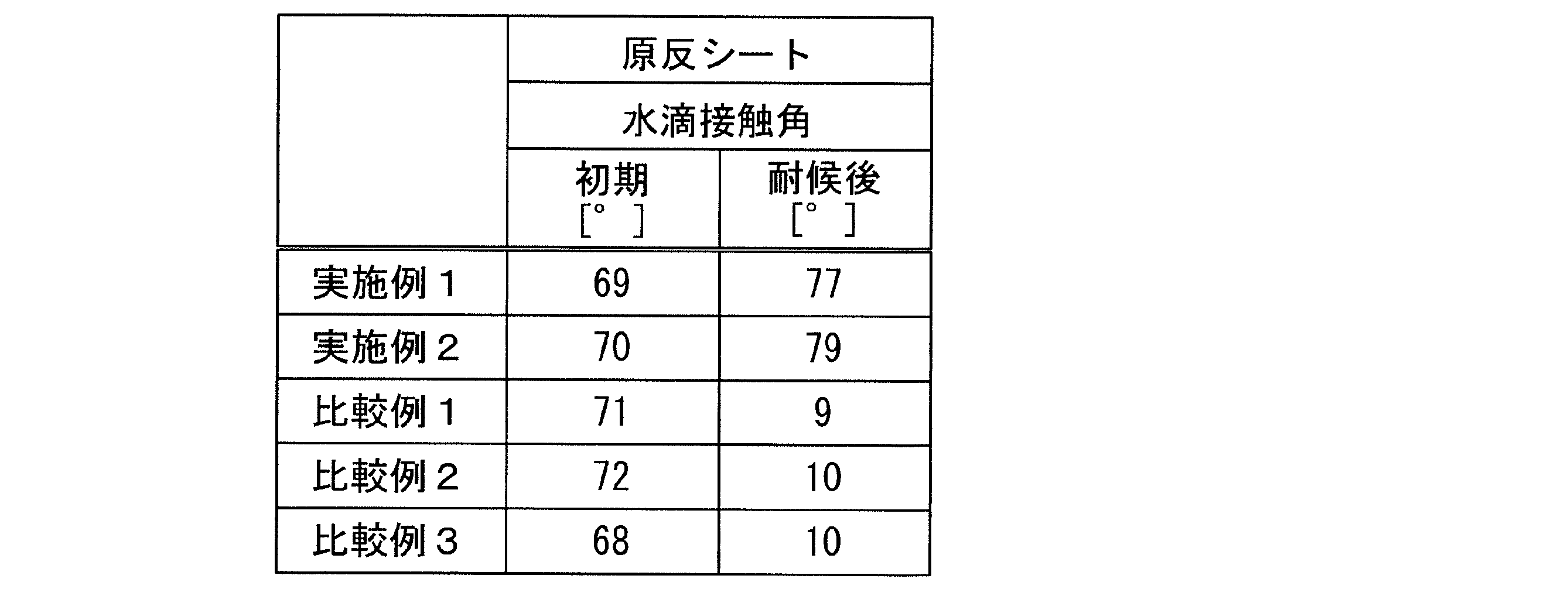
実施例1,2における化粧シート1は、表1に示すように、超促進耐候性試験後のトップコート層2の表面側からの目視観察において、原反層6の色味変化や亀裂は認められなかった。原反層6とインキ層5との剥離に起因するインキ層5の白化も認められなかった。これに対して、比較例1~3における化粧シート1は、超促進耐候性試験後のトップコート層2の表面側からの目視観察においては、原反層6の亀裂やインキ層5の白化が認められた。これは、実施例1,2における化粧シート1は、原反層6として用いた原反シート6に対して紫外線吸収剤がベシクルの状態で添加されていることにより、紫外線吸収剤が凝集することなく均一に分散しており、紫外線吸収剤の凝集によって発生するブルーム(粉噴き)が抑制されて樹脂組成物中の紫外線吸収剤の含有量が減少することがなく、当該樹脂組成物中に多量に存在する紫外線吸収剤によって優れた紫外線吸収性能を実現することで原反層6が酸化劣化せず、良好な意匠性を保持していたと考えられる。そして、原反層6の表面にブルーム(粉噴き)が生じなかった結果、原反層6とインキ層5との優れた密着性を実現し、インキ層5の白化が防止されたと考えられる。
また、実施例1,2における化粧シート1は、表1に示すように、剥離強度試験において、比較例1~3における各化粧シート1と比較して高い値を示しており、透明樹脂層3と原反層6との間の密着性に優れていることが明らかとなった。これは、実施例1,2において原反層6として用いた原反シート6が、紫外線吸収剤をベシクルの状態で添加した樹脂組成物からなり、当該原反シート6の透明樹脂層3側の表面6aからブリードアウトする紫外線吸収剤が極めて少ないので、透明樹脂層3の表面と原反シート6の表面6aとがしっかりと密着しているためであると考えられる。
実施例1,2における原反シート6の水滴接触角測定結果は、表1に示すように、養生前後において殆ど水滴接触角の変化は認められなかった。これに対して、比較例1~3における原反シート6の水滴接触角測定結果は、養生前は実施例1,2の原反シート6と殆ど同等の水滴接触角であったが、養生後は極めて小さい水滴接触角となった。これは、実施例1,2における原反シート6は、樹脂組成物中に対して紫外線吸収剤がベシクルの状態で添加されていることによって、樹脂組成物中において紫外線吸収剤が均一に分散しており、凝集した添加剤に起因するブリードアウトが生じずに原反シート6の表面の撥水性が高く、比較例1~3における原反シート6は、樹脂組成物中において紫外線吸収剤が凝集し、養生後において、この凝集した紫外線吸収剤としての粉末が当該原反シート6の表面にブルーム(粉化)したために表面の撥水性が低下して水滴の接触角が小さくなったと考えられる。
ここで、養生前の水滴接触角に対する養生前後の水滴接触角の変化の割合は、実施例1で16.1%、実施例2で12.6%と小さな割合になっている。一方、比較例1で81.1%、比較例2で70.8%、比較例3で83.5%と50%以上の大きな割合となっている。このように、本発明に基づく実施例1,2では、養生前の水滴接触角に対する養生前後の水滴接触角の変化の割合は、30%以下に抑えられているが、本発明外の比較例1~3では、養生前後の水滴接触角の変化の割合は70%以上であった。
更に、表2に示すように、実施例1,2における原反シート6にあっては、200時間の超促進耐候性試験を行った後であっても、超促進耐候試験前と水滴接触角の変化は認められなかった。これに対して、比較例1~3における原反シート6の水滴接触角測定結果は、超促進耐候試験前は実施例1,2の原反シート6と殆ど同等の水滴接触角であったが、超促進耐候試験後は極めて小さい水滴接触角となった。このように、本発明に基づく実施例1,2における原反シート6にあっては、耐候試験後であっても、樹脂組成物中において紫外線吸収剤が均一に分散しており、凝集した添加剤に起因するブリードアウトが生じずに原反シート6の表面の撥水性が高く維持されることが分かった。
以上の結果から、実施例1,2における化粧シート1は、紫外線吸収剤ベシクルを含有しブリードアウトの発生が少ない原反層6を具備することにより、原反層6における化粧シート1の透明樹脂層3側の表面6aにおいては、透明樹脂層3またはインキ層5との優れた密着性を実現し、原反層6における化粧シート1の基材B側の表面6bにおいては、巻いた状態での保管時には、原反層6に接触する化粧シート1の最表層が白濁して意匠性が損なわれたり、ブリードした液によってベタつくなどの問題が生じることがなく、使用時には、基材Bとの優れた密着性を実現することができる。そして、このような原反層6を具備する実施例1,2の化粧シート1は、従来の化粧シートとしての比較例1~3の化粧シートと比較して、耐候性に優れた化粧シートであることが明らかとなった。
以上、本願が優先権を主張する、日本国特許出願2016-024549号(2016年02月12日出願)の全内容は、参照により本開示の一部をなす。
また、本実施の形態は、本発明の技術的思想を具体化するための構成を例示するものであって、本発明の技術的思想は、構成部品の材質、形状、構造、配置等を特定するものでない。本発明の技術的思想は、特許請求の範囲に記載された請求項が規定する技術的範囲内において、種々の変更を加えることができる。
また、本実施の形態は、本発明の技術的思想を具体化するための構成を例示するものであって、本発明の技術的思想は、構成部品の材質、形状、構造、配置等を特定するものでない。本発明の技術的思想は、特許請求の範囲に記載された請求項が規定する技術的範囲内において、種々の変更を加えることができる。
1 化粧シート
2 トップコート層
3 透明樹脂層
3a エンボス模様
3b 接着性樹脂層
4 接着剤層
5 インキ層
5a 絵柄模様層
5b ベタインキ層
6 原反層
2 トップコート層
3 透明樹脂層
3a エンボス模様
3b 接着性樹脂層
4 接着剤層
5 インキ層
5a 絵柄模様層
5b ベタインキ層
6 原反層
Claims (6)
- オレフィン系樹脂を主成分とする樹脂組成物からなる原反層を備える化粧シートであって、
前記原反層は、紫外線吸収剤を含有しており、
前記紫外線吸収剤が、外膜で包含された紫外線吸収剤ベシクルの状態で前記原反層を構成する樹脂組成物に添加されたことを特徴とする化粧シート。 - 前記外膜が、単層膜であることを特徴とする請求項1に記載した化粧シート。
- 前記紫外線吸収剤ベシクルが、リン脂質からなる前記外膜を備える紫外線吸収剤リポソームであることを特徴とする請求項1または請求項2に記載した化粧シート。
- 前記原反層の一方の面側に、絵柄模様層及び透明樹脂層がこの順に形成され、
前記透明樹脂層に、ナノサイズの造核剤が添加されていることを特徴とする請求項1~請求項3のいずれか1項に記載した化粧シート。 - オレフィン系樹脂を主成分とする樹脂組成物からなる原反層を備える化粧シートであって、
前記原反層は、紫外線吸収剤を含有しており、
前記紫外線吸収剤は、前記樹脂組成物中の樹脂材料100質量部に対して0.1~10質量部の範囲で含有し、
JISR3257に準拠した静滴法による接触角試験による、前記原反層の水滴接触角について、養生(温度60℃、湿度20%の条件下で1日)前の前記水滴接触角に対する、前記養生前後の前記水滴接触角の変化の割合が、30%以下であることを特徴とする化粧シート。 - オレフィン系樹脂を主成分とする樹脂組成物からなる原反層を備える化粧シートの製造方法であって、
紫外線吸収剤を外膜で包含した紫外線吸収剤ベシクルを、前記樹脂組成物に添加することを特徴とする化粧シートの製造方法。
Applications Claiming Priority (2)
| Application Number | Priority Date | Filing Date | Title |
|---|---|---|---|
| JP2016024549 | 2016-02-12 | ||
| JP2016-024549 | 2016-02-12 |
Publications (1)
| Publication Number | Publication Date |
|---|---|
| WO2017138635A1 true WO2017138635A1 (ja) | 2017-08-17 |
Family
ID=59563837
Family Applications (1)
| Application Number | Title | Priority Date | Filing Date |
|---|---|---|---|
| PCT/JP2017/004928 Ceased WO2017138635A1 (ja) | 2016-02-12 | 2017-02-10 | 化粧シート及びその製造方法 |
Country Status (3)
| Country | Link |
|---|---|
| JP (1) | JP6941316B2 (ja) |
| TW (1) | TW201733809A (ja) |
| WO (1) | WO2017138635A1 (ja) |
Families Citing this family (1)
| Publication number | Priority date | Publication date | Assignee | Title |
|---|---|---|---|---|
| JP2020062775A (ja) * | 2018-10-16 | 2020-04-23 | 凸版印刷株式会社 | エンボス化粧シート |
Citations (6)
| Publication number | Priority date | Publication date | Assignee | Title |
|---|---|---|---|---|
| JP2007100045A (ja) * | 2005-10-07 | 2007-04-19 | Masamitsu Nagahama | ポリオレフィン樹脂製品、ポリオレフィン樹脂製品の製造方法、粒状物の使用 |
| JP2008062416A (ja) * | 2006-09-05 | 2008-03-21 | Toppan Printing Co Ltd | 化粧シート |
| JP2008080601A (ja) * | 2006-09-27 | 2008-04-10 | Dainippon Printing Co Ltd | 化粧シート及びその製造方法 |
| JP2013008825A (ja) * | 2011-06-24 | 2013-01-10 | Mitsubishi Rayon Co Ltd | ナノ凹凸構造用樹脂組成物、およびそれを用いた自動車メータカバー用透明部材とカーナビゲーション用透明部材 |
| JP2014037124A (ja) * | 2012-08-20 | 2014-02-27 | C I Kasei Co Ltd | 成形品の製造方法 |
| JP2016117280A (ja) * | 2014-12-19 | 2016-06-30 | 凸版印刷株式会社 | 化粧シート |
Family Cites Families (4)
| Publication number | Priority date | Publication date | Assignee | Title |
|---|---|---|---|---|
| JPH1067081A (ja) * | 1996-04-08 | 1998-03-10 | Tokuyama Corp | 化粧シート |
| JPH11207876A (ja) * | 1998-01-29 | 1999-08-03 | Dainippon Printing Co Ltd | 化粧シート |
| JPH11235804A (ja) * | 1998-02-23 | 1999-08-31 | Dainippon Printing Co Ltd | 化粧シート |
| JP2011089101A (ja) * | 2009-09-26 | 2011-05-06 | Ko Tamihiro | 吸湿性樹脂ペレット |
-
2017
- 2017-02-10 WO PCT/JP2017/004928 patent/WO2017138635A1/ja not_active Ceased
- 2017-02-10 JP JP2017023127A patent/JP6941316B2/ja active Active
- 2017-02-10 TW TW106104449A patent/TW201733809A/zh unknown
Patent Citations (6)
| Publication number | Priority date | Publication date | Assignee | Title |
|---|---|---|---|---|
| JP2007100045A (ja) * | 2005-10-07 | 2007-04-19 | Masamitsu Nagahama | ポリオレフィン樹脂製品、ポリオレフィン樹脂製品の製造方法、粒状物の使用 |
| JP2008062416A (ja) * | 2006-09-05 | 2008-03-21 | Toppan Printing Co Ltd | 化粧シート |
| JP2008080601A (ja) * | 2006-09-27 | 2008-04-10 | Dainippon Printing Co Ltd | 化粧シート及びその製造方法 |
| JP2013008825A (ja) * | 2011-06-24 | 2013-01-10 | Mitsubishi Rayon Co Ltd | ナノ凹凸構造用樹脂組成物、およびそれを用いた自動車メータカバー用透明部材とカーナビゲーション用透明部材 |
| JP2014037124A (ja) * | 2012-08-20 | 2014-02-27 | C I Kasei Co Ltd | 成形品の製造方法 |
| JP2016117280A (ja) * | 2014-12-19 | 2016-06-30 | 凸版印刷株式会社 | 化粧シート |
Also Published As
| Publication number | Publication date |
|---|---|
| JP6941316B2 (ja) | 2021-09-29 |
| TW201733809A (zh) | 2017-10-01 |
| JP2017144729A (ja) | 2017-08-24 |
Similar Documents
| Publication | Publication Date | Title |
|---|---|---|
| JP6709611B2 (ja) | 化粧シートおよび化粧シートの製造方法 | |
| EP3219488B1 (en) | Decorated sheet | |
| US11148403B2 (en) | Decorative sheet | |
| JP7006191B2 (ja) | 化粧シート及び化粧シートの製造方法 | |
| JP2016137585A (ja) | 化粧シート | |
| JP6622487B2 (ja) | 化粧シートおよび化粧シートの製造方法 | |
| JP7322381B2 (ja) | 化粧シート及びその製造方法 | |
| JP6916428B2 (ja) | 化粧シートおよび化粧シートの製造方法 | |
| JP6941316B2 (ja) | 化粧シート及びその製造方法 | |
| US11446906B2 (en) | Decorative sheets | |
| JP7067589B2 (ja) | 化粧シート | |
| JP6915223B2 (ja) | 化粧シートおよび化粧シートの製造方法 | |
| JP2017165101A (ja) | 化粧シートおよび化粧シートの製造方法 | |
| JP6913861B2 (ja) | 化粧シート | |
| JP2017047653A (ja) | 化粧シート | |
| JP6905706B2 (ja) | 化粧シートおよび化粧シートの製造方法 | |
| JP2024174613A (ja) | 化粧シート及び化粧材 | |
| JP2018144438A (ja) | 化粧シートおよび化粧シートの製造方法 | |
| JP2017124501A (ja) | 化粧シート |
Legal Events
| Date | Code | Title | Description |
|---|---|---|---|
| 121 | Ep: the epo has been informed by wipo that ep was designated in this application |
Ref document number: 17750356 Country of ref document: EP Kind code of ref document: A1 |
|
| NENP | Non-entry into the national phase |
Ref country code: DE |
|
| 122 | Ep: pct application non-entry in european phase |
Ref document number: 17750356 Country of ref document: EP Kind code of ref document: A1 |