WO2017135316A1 - 変異リゾプス属菌 - Google Patents
変異リゾプス属菌 Download PDFInfo
- Publication number
- WO2017135316A1 WO2017135316A1 PCT/JP2017/003647 JP2017003647W WO2017135316A1 WO 2017135316 A1 WO2017135316 A1 WO 2017135316A1 JP 2017003647 W JP2017003647 W JP 2017003647W WO 2017135316 A1 WO2017135316 A1 WO 2017135316A1
- Authority
- WO
- WIPO (PCT)
- Prior art keywords
- seq
- amino acid
- acid sequence
- polypeptide
- polynucleotide
- Prior art date
- Legal status (The legal status is an assumption and is not a legal conclusion. Google has not performed a legal analysis and makes no representation as to the accuracy of the status listed.)
- Ceased
Links
Classifications
-
- C—CHEMISTRY; METALLURGY
- C12—BIOCHEMISTRY; BEER; SPIRITS; WINE; VINEGAR; MICROBIOLOGY; ENZYMOLOGY; MUTATION OR GENETIC ENGINEERING
- C12N—MICROORGANISMS OR ENZYMES; COMPOSITIONS THEREOF; PROPAGATING, PRESERVING, OR MAINTAINING MICROORGANISMS; MUTATION OR GENETIC ENGINEERING; CULTURE MEDIA
- C12N9/00—Enzymes; Proenzymes; Compositions thereof; Processes for preparing, activating, inhibiting, separating or purifying enzymes
- C12N9/88—Lyases (4.)
-
- C—CHEMISTRY; METALLURGY
- C12—BIOCHEMISTRY; BEER; SPIRITS; WINE; VINEGAR; MICROBIOLOGY; ENZYMOLOGY; MUTATION OR GENETIC ENGINEERING
- C12N—MICROORGANISMS OR ENZYMES; COMPOSITIONS THEREOF; PROPAGATING, PRESERVING, OR MAINTAINING MICROORGANISMS; MUTATION OR GENETIC ENGINEERING; CULTURE MEDIA
- C12N1/00—Microorganisms; Compositions thereof; Processes of propagating, maintaining or preserving microorganisms or compositions thereof; Processes of preparing or isolating a composition containing a microorganism; Culture media therefor
- C12N1/14—Fungi; Culture media therefor
- C12N1/145—Fungi isolates
-
- C—CHEMISTRY; METALLURGY
- C12—BIOCHEMISTRY; BEER; SPIRITS; WINE; VINEGAR; MICROBIOLOGY; ENZYMOLOGY; MUTATION OR GENETIC ENGINEERING
- C12N—MICROORGANISMS OR ENZYMES; COMPOSITIONS THEREOF; PROPAGATING, PRESERVING, OR MAINTAINING MICROORGANISMS; MUTATION OR GENETIC ENGINEERING; CULTURE MEDIA
- C12N15/00—Mutation or genetic engineering; DNA or RNA concerning genetic engineering, vectors, e.g. plasmids, or their isolation, preparation or purification; Use of hosts therefor
- C12N15/09—Recombinant DNA-technology
-
- C—CHEMISTRY; METALLURGY
- C12—BIOCHEMISTRY; BEER; SPIRITS; WINE; VINEGAR; MICROBIOLOGY; ENZYMOLOGY; MUTATION OR GENETIC ENGINEERING
- C12P—FERMENTATION OR ENZYME-USING PROCESSES TO SYNTHESISE A DESIRED CHEMICAL COMPOUND OR COMPOSITION OR TO SEPARATE OPTICAL ISOMERS FROM A RACEMIC MIXTURE
- C12P7/00—Preparation of oxygen-containing organic compounds
- C12P7/40—Preparation of oxygen-containing organic compounds containing a carboxyl group including Peroxycarboxylic acids
-
- C—CHEMISTRY; METALLURGY
- C12—BIOCHEMISTRY; BEER; SPIRITS; WINE; VINEGAR; MICROBIOLOGY; ENZYMOLOGY; MUTATION OR GENETIC ENGINEERING
- C12P—FERMENTATION OR ENZYME-USING PROCESSES TO SYNTHESISE A DESIRED CHEMICAL COMPOUND OR COMPOSITION OR TO SEPARATE OPTICAL ISOMERS FROM A RACEMIC MIXTURE
- C12P7/00—Preparation of oxygen-containing organic compounds
- C12P7/40—Preparation of oxygen-containing organic compounds containing a carboxyl group including Peroxycarboxylic acids
- C12P7/44—Polycarboxylic acids
- C12P7/46—Dicarboxylic acids having four or less carbon atoms, e.g. fumaric acid, maleic acid
-
- C—CHEMISTRY; METALLURGY
- C12—BIOCHEMISTRY; BEER; SPIRITS; WINE; VINEGAR; MICROBIOLOGY; ENZYMOLOGY; MUTATION OR GENETIC ENGINEERING
- C12P—FERMENTATION OR ENZYME-USING PROCESSES TO SYNTHESISE A DESIRED CHEMICAL COMPOUND OR COMPOSITION OR TO SEPARATE OPTICAL ISOMERS FROM A RACEMIC MIXTURE
- C12P7/00—Preparation of oxygen-containing organic compounds
- C12P7/40—Preparation of oxygen-containing organic compounds containing a carboxyl group including Peroxycarboxylic acids
- C12P7/44—Polycarboxylic acids
- C12P7/50—Polycarboxylic acids having keto groups, e.g. 2-ketoglutaric acid
-
- C—CHEMISTRY; METALLURGY
- C12—BIOCHEMISTRY; BEER; SPIRITS; WINE; VINEGAR; MICROBIOLOGY; ENZYMOLOGY; MUTATION OR GENETIC ENGINEERING
- C12P—FERMENTATION OR ENZYME-USING PROCESSES TO SYNTHESISE A DESIRED CHEMICAL COMPOUND OR COMPOSITION OR TO SEPARATE OPTICAL ISOMERS FROM A RACEMIC MIXTURE
- C12P7/00—Preparation of oxygen-containing organic compounds
- C12P7/40—Preparation of oxygen-containing organic compounds containing a carboxyl group including Peroxycarboxylic acids
- C12P7/56—Lactic acid
-
- C—CHEMISTRY; METALLURGY
- C12—BIOCHEMISTRY; BEER; SPIRITS; WINE; VINEGAR; MICROBIOLOGY; ENZYMOLOGY; MUTATION OR GENETIC ENGINEERING
- C12Y—ENZYMES
- C12Y401/00—Carbon-carbon lyases (4.1)
- C12Y401/01—Carboxy-lyases (4.1.1)
- C12Y401/01001—Pyruvate decarboxylase (4.1.1.1)
-
- C—CHEMISTRY; METALLURGY
- C12—BIOCHEMISTRY; BEER; SPIRITS; WINE; VINEGAR; MICROBIOLOGY; ENZYMOLOGY; MUTATION OR GENETIC ENGINEERING
- C12R—INDEXING SCHEME ASSOCIATED WITH SUBCLASSES C12C - C12Q, RELATING TO MICROORGANISMS
- C12R2001/00—Microorganisms ; Processes using microorganisms
- C12R2001/645—Fungi ; Processes using fungi
- C12R2001/845—Rhizopus
Definitions
- the present invention relates to a mutant genus Rhizopus and a method for producing an organic acid using the same.
- Organic acids such as lactic acid, malic acid, succinic acid, and fumaric acid are industrially valuable substances that are used in food production and as raw materials for synthetic resins and biodegradable polymers.
- Patent Documents 1 to 3 disclose lactic acid production methods using microorganisms into which a promoter of Rhizopus, which is a filamentous fungus, has been introduced.
- Non-Patent Document 1 reports a mutant Rhizopus genus that produces a large amount of fumaric acid and a small amount of byproduct ethanol production.
- Patent Documents 4 and 5 in the production of fumaric acid in eukaryotes and prokaryotes under specific conditions, disruption of the pyruvate decarboxylase gene or suppression of pyruvate decarboxylase activity improves fumaric acid productivity. It reports that it contributes.
- the genetic background of Rhizopus spp. Has not yet been fully studied, it is not easy to develop Rhizopus spp. Suitable for production of useful substances by genetic recombination technology.
- Patent Document 1 US Pat. No. 6,268,189 (Patent Document 2) International Publication No. 2001/73083 (Patent Document 3) International Publication No. 2001/72967 (Patent Document 4) International Publication No. 2009/155382 (Patent Document 3) Reference 5) Japanese Patent Application Laid-Open No. 2005-211042 (Non-Patent Document 1) Korean J Chem Eng, 2010, 27 (1): 183-186
- the present invention provides a mutant Rhizopus sp. That has reduced activity of pyruvate decarboxylase.
- the present invention also provides a method for producing a mutant Rhizopus, which comprises reducing the activity of pyruvate decarboxylase in Rhizopus.
- the present invention also provides a method for improving the organic acid productivity of Rhizopus sp., which comprises reducing the activity of pyruvate decarboxylase in Rhizopus sp.
- the present invention also provides a method for producing an organic acid, comprising culturing the mutant genus Rhizopus.
- nucleotide sequence and amino acid sequence identities are calculated by the Lipman-Pearson method (Science, 1985, 227: 1435-1441). Specifically, it is calculated by performing an analysis with unit size to compare (ktup) of 2 using a homology analysis (Search homology) program of genetic information processing software Genetyx-Win.
- “at least 80% identity” with respect to an amino acid sequence or nucleotide sequence means 80% or more, preferably 85% or more, more preferably 90% or more, still more preferably 95% or more, and even more preferably. 97% or more, preferably 98% or more, and more preferably 99% or more identity.
- “at least 85% identity” with respect to an amino acid sequence or a nucleotide sequence is 85% or more, preferably 90% or more, more preferably 95% or more, still more preferably 97% or more, still more preferably An identity of 98% or more, more preferably 99% or more.
- “at least 95% identity” with respect to an amino acid sequence or nucleotide sequence means 95% or more, preferably 97% or more, more preferably 98% or more, and even more preferably 99% or more.
- amino acid sequence in which one or more amino acids are deleted, inserted, substituted or added is 1 or more and 30 or less, preferably 1 or more and 20 or less, more preferably 1 An amino acid sequence in which 10 or less, more preferably 1 or more and 5 or less, and still more preferably 1 or more and 3 or less amino acids are deleted, inserted, substituted or added.
- nucleotide sequence in which one or more nucleotides are deleted, inserted, substituted or added is 1 or more and 90 or less, preferably 1 or more and 60 or less, more preferably 1 Examples include nucleotide sequences in which one or more and 30 or less, more preferably 1 or more and 15 or less, more preferably 1 or more and 10 or less nucleotides are deleted, inserted, substituted or added.
- “addition” of amino acids or nucleotides includes addition of one or more amino acids or nucleotides to one and both ends of the sequence.
- operable linkage between a control region and a gene means that the gene and the control region are linked so that the gene can be expressed under the control of the control region.
- operable linkage between a gene and a regulatory region is well known to those skilled in the art.
- upstream and downstream relating to a gene refer to upstream and downstream in the transcription direction of the gene.
- the “corresponding position” or “corresponding region” on the amino acid sequence or nucleotide sequence represents the maximum homology between the target sequence and the reference sequence (for example, the amino acid sequence shown by SEQ ID NO: 11). It can be determined by aligning as given. Alignment of amino acid sequences or nucleotide sequences can be performed using known algorithms and the procedures are known to those skilled in the art. For example, alignment can be performed manually based on the above-described Lipman-Pearson method or the like, but the Clustal W multiple alignment program (Thompson, JD et al, 1994, Nucleic Acids Res. 22: 4673-4680). ) With default settings.
- Clustal W2 or Clustal omega which is a revised version of Clustal W.
- Clustal W, Clustal W2, and Clustal omega are, for example, European Bioinformatics Institute (EBI [www.ebi.ac.uk/index.html]) and Japanese DNA data operated by the National Institute of Genetics. It can be used on the website of the bank (DDBJ [www.ddbj.nig.ac.jp/searches-j.html]).
- the position or region of the target sequence aligned corresponding to an arbitrary region of the reference sequence by the above alignment is regarded as a “corresponding position” or “corresponding region” for the arbitrary region.
- the “pdc gene” is a gene encoding pyruvate decarboxylase, and is a polynucleotide comprising the nucleotide sequence represented by SEQ ID NO: 1; at least 80% identity with the nucleotide sequence represented by SEQ ID NO: 1 And a polynucleotide encoding a polypeptide having pyruvate decarboxylase activity; and one or more nucleotides deleted, inserted, substituted or substituted with respect to the nucleotide sequence represented by SEQ ID NO: 1
- polynucleotide having the nucleotide sequence represented by SEQ ID NO: 1 examples include a gene encoding pyruvate decarboxylase 1 (PDC1) (SEQ ID NO: 2) derived from Rhizopus delmar.
- PDC1 pyruvate decarboxylase 1
- the “pdc gene” in the present specification is also a polynucleotide encoding a polypeptide consisting of the amino acid sequence represented by SEQ ID NO: 2; an amino acid sequence having at least 80% identity with the amino acid sequence represented by SEQ ID NO: 2 And a polynucleotide encoding a polypeptide having pyruvate decarboxylase activity; and one or more amino acid residues are deleted, inserted, substituted or added to the amino acid sequence shown in SEQ ID NO: 2
- “reduction of pyruvate decarboxylase activity” in the mutant microorganism means that the pyruvate decarboxylase activity in the mutant microorganism is 50% or less, preferably 20% or less of the activity of the strain (parent strain) before mutation, More preferably, it means a reduction to 15% or less.
- the pyruvate decarboxylase activity of microorganisms can be measured according to the method described in the examples below.
- the present invention relates to the provision of a mutant Rhizopus sp. Having high organic acid productivity and a method for producing an organic acid using the same.
- the present inventors examined improvement of organic acid productivity of Rhizopus sp. As a result, the present inventors found that organic acid productivity was remarkably improved in Rhizopus spp. In which the activity of pyruvate decarboxylase was reduced, and completed the present invention.
- the present invention provides a mutant Rhizopus genus having high organic acid productivity. According to the genus Rhizopus of the present invention, efficient microbiological production of an organic acid is realized.
- the mutant Rhizopus spp. Of the present invention is a mutant Rhizopus spp. With reduced pyruvate decarboxylase activity.
- filamentous fungi belonging to the genus Rhizopus for example, Rhizopus oryzae, Rhizopus arrizus, Rhizopus chinissis, Rhizopus nigricans, Rhizopus, Rhizopus.
- Rhizopus oryzae and Rhizopus delemar are preferable, and Rhizopus delemar is more preferable.
- Reduction of pyruvate decarboxylase activity in Rhizopus sp. Can be achieved by reducing the expression level of pyruvate decarboxylase in Rhizopus sp. Cells. For example, by deleting or inactivating the pdc gene of the genus Rhizopus, inactivating mRNA transcribed from the pdc gene, or inhibiting translation of the pdc gene from mRNA to protein, pyruvin The activity of acid decarboxylase can be reduced.
- the “pdc gene” to be deleted or inactivated according to the present invention is as defined above.
- pyruvate decarboxylase shown in SEQ ID NO: 83 (sometimes referred to herein as a pdc3 gene) are deleted or inactivated.
- the “pyrubin” defined herein is used.
- the reduction in acid decarboxylase activity cannot be achieved, and the organic acid productivity improving effect according to the present invention cannot be sufficiently obtained.
- the activity of pyruvate decarboxylase can also be reduced by reducing the activity of pyruvate decarboxylase expressed in Rhizopus sp.
- the above modification can be artificially performed using molecular biological or genetic engineering techniques.
- siRNA inhibition using siRNA As a method for inactivating mRNA of pdc gene in cells, target-specific mRNA inhibition using siRNA can be mentioned.
- the basic procedure of siRNA is well known to those skilled in the art (see, for example, JP-T-2007-512808), and reagents or kits for siRNA are commercially available.
- a person skilled in the art can prepare a desired target-specific siRNA and inhibit the target mRNA based on known literature and manuals of commercially available products.
- Examples of the method for reducing the activity of pyruvate decarboxylase include a method using a PDC inhibitor.
- Examples of the PDC inhibitor include omeprazole (see Biochem. Pharmacol, 44: 177-179, etc.).
- Methods for deleting or inactivating the pdc gene in cells include removing part or all of the nucleotide sequence of the pdc gene from the genome or replacing it with other nucleotide sequences, and other methods in the pdc gene sequence. And a method of mutating the transcription or translation initiation region of the pdc gene. Preferably, part or all of the nucleotide sequence of the pdc gene is deleted. More specific examples include a method for specifically deleting or inactivating the pdc gene on the cell genome, and a random deletion or inactivating mutation in the gene in the cell, and then the pdc gene. And a method for selecting a cell having a desired mutation by performing an expression level or activity evaluation of a pyruvate decarboxylase encoded by the gene, or performing a gene analysis.
- a DNA fragment obtained by randomly cloning the inactivated gene is introduced into the cell, and homologous recombination is performed between the gene on the genome of the cell. And a method of inducing mutations by irradiating cells with ultraviolet rays, ⁇ rays and the like.
- Site-directed mutagenesis system Mutan-SuperExpress Km kit (Takara Bio), Transformer TM Site-Directed Mutagenesis kit (CloneOD-Co), a method for producing an inactivated gene includes site-directed mutagenesis.
- Commercially available kits such as Plus-Mutageness Kit (Toyobo Co., Ltd.) can be used.
- a cell in which the pdc gene is deleted or inactivated can be selected.
- cells in which the pdc gene is deleted or inactivated can be selected using the expression level or activity of pyruvate decarboxylase in the cells as an index.
- Examples of a method for specifically deleting or inactivating a gene in the genome include, but are not limited to, genome editing using an artificial DNA cleaving enzyme (artificial DNA nucleases or Programmable nuclease). It is done.
- an artificial DNA cleaving enzyme artificial DNA nucleases or Programmable nuclease
- the deletion or inactivation of the Rhizopus pdc gene according to the present invention is performed by genome editing of the pdc locus.
- the “pdc locus” refers to a region on the genome including the DNA sequence of the pdc gene, its 5′-side 1000 bp region and its 3′-side 1000 bp region.
- Genome editing specifically cleaves the DNA duplex at the target locus on the genome, induces deletion, insertion, or substitution of nucleotides in the process of repairing the cleaved DNA, or inserts a foreign polynucleotide. This is a technique for site-specific modification of the genome.
- Such technologies include TALEN (transcribable activator-like effector nuclease), ZFN (zinc-finger nuclase, etc.), CRISPR (Clustered RegularlyInterpacedShortlandPalmedHardenReductiveCreatingHard-CentricallyReducedHealth) Nature Reviews Genetics, 2014, 15: 321-334, Nucleic Acids Research, 2011, 39: e82, Nucleic Acids Research, 2006, 34: e149, Nature communications, 2013,4: 1762). Kits for genome editing based on these technologies are commercially available, and can be purchased from Life technologies, Cellectis, Transposagen Biopharmaceuticals, and the like.
- TALEN will be described in detail for the purpose of illustration of genome editing technology only.
- TALEN is a protein having a transcriptional activator-like (TAL) effector derived from the DNA binding domain of the genus Xanthomonas, which is a phytopathogenic bacterium, and a DNA cleavage domain consisting of DNA nuclease Fok1.
- the TALEN TAL effector has a structure in which about 17 repeating sequences (repeats) consisting of about 34 amino acids are linked, and each repeat recognizes one nucleotide.
- the type of base specifically recognized by each repeat depends on the type of two consecutive amino acid residues (referred to as repeat-variable diresidues; RVD) at a specific position in each repeat.
- RVD repeat-variable diresidues
- TALEN that specifically recognizes the target genomic DNA sequence.
- genome editing by TALEN a set of TALENs that specifically recognize upstream and downstream sequences in the vicinity of the genomic DNA region to be cleaved are designed and expressed in cells.
- a gene encoding a target-specific TALEN is constructed, introduced into a cell, and the TALEN is expressed in the cell.
- Fok1 contained therein forms a dimer on the cleavage target genomic DNA region and cleaves the DNA duplex.
- TALEN for deletion or inactivation of Rhizopus sp.
- Pdc gene examples include TALEN pairs consisting of the following polypeptides (L) and (R).
- the TAL effector contained in the polypeptide (L) includes a polypeptide in which 17 repeat sequences (repeats) are linked, and includes 5′-TGCCTGCTATTAAAATCG-3 ′. The sequence shown by (SEQ ID NO: 9) is recognized.
- the TAL effector contained in the polypeptide (R) includes a polypeptide in which 17 repeat sequences (repeats) are linked, and 5′-TTGATTTCCTTAAGACGG-3 ′. The sequence represented by (SEQ ID NO: 10) is recognized.
- the 1st to 16th repeats from the upstream each consist of an amino acid sequence having at least 85% identity with the amino acid sequence represented by SEQ ID NO: 11 Or consisting of an amino acid sequence in which 5 or less amino acid residues are deleted, inserted, substituted or added to the amino acid sequence shown in SEQ ID NO: 11.
- the 1st to 16th repeats from the upstream are deleted or inserted in the amino acid sequence represented by SEQ ID NO: 11 by deleting or inserting 3 or less amino acid residues in portions other than RVD described later Consists of a substituted or added amino acid sequence.
- the 17th repeat located in the most downstream among the repeats in the TAL effector (L) consists of an amino acid sequence having at least 95% identity with the amino acid sequence shown in SEQ ID NO: 27.
- the 1st to 16th repeats from the upstream each consist of an amino acid sequence having at least 85% identity with the amino acid sequence shown in SEQ ID NO: 28 Or an amino acid sequence in which 5 or less amino acid residues are deleted, inserted, substituted or added to the amino acid sequence shown in SEQ ID NO: 28.
- the 1st to 16th repeats from the upstream are deleted or inserted in the amino acid sequence represented by SEQ ID NO: 28 by deleting or inserting 3 or less amino acid residues in portions other than RVD described later Consists of a substituted or added amino acid sequence.
- the 17th repeat located at the most downstream of the repeats in the TAL effector (R) consists of an amino acid sequence having at least 95% identity with the amino acid sequence shown in SEQ ID NO: 44.
- the 17 repeats in the TAL effector (L) each have two amino acid residues (repeat) that are base recognition sites at positions corresponding to amino acids 12 to 13 of the amino acid sequence represented by SEQ ID NO: 11. -Variable diresidues (RVD), and the RVD of each repeat recognizes the 2nd to 18th bases of the sequence shown in SEQ ID NO: 9.
- each of the 17 repeats in the TAL effector (R) has an RVD at a position corresponding to amino acids 12 to 13 of the amino acid sequence represented by SEQ ID NO: 28, and the RVD of each repeat has the sequence Recognizes the 2nd to 18th bases of the sequence represented by number 10.
- the type of amino acid residue of RVD depends on the type of target base as shown below.
- Target base RVD A NI C HD G / A NN T NG
- the TAL effector (L) can recognize the sequence represented by SEQ ID NO: 9, 2 or less, preferably 1 of the 17 repeats have RVD corresponding to SEQ ID NO: 9. Not necessary. In other words, 15 or more, preferably 16 or more of the 17 repeats may have RVD corresponding to SEQ ID NO: 9. As long as the TAL effector (R) can recognize the sequence represented by SEQ ID NO: 10, 2 or less, preferably 1 of the 17 repeats do not have an RVD corresponding to SEQ ID NO: 10. Also good. In other words, 15 or more, preferably 16 or more of the 17 repeats may have RVD corresponding to SEQ ID NO: 10.
- each of the 17 repeats of the TAL effector (L) consists of the following amino acid sequences (1) to (17) in order from the upstream: (1) the amino acid sequence represented by SEQ ID NO: 11, or an amino acid sequence having at least 95% identity with this; (2) the amino acid sequence shown in SEQ ID NO: 12, or an amino acid sequence having at least 95% identity with this; (3) the amino acid sequence represented by SEQ ID NO: 13, or an amino acid sequence having at least 95% identity with this; (4) the amino acid sequence shown in SEQ ID NO: 14, or an amino acid sequence having at least 95% identity with this; (5) the amino acid sequence shown in SEQ ID NO: 15, or an amino acid sequence having at least 95% identity with this; (6) the amino acid sequence represented by SEQ ID NO: 16, or an amino acid sequence having at least 95% identity with this; (7) the amino acid sequence represented by SEQ ID NO: 17, or an amino acid sequence having at least 95% identity thereto; (8) the amino acid sequence shown in SEQ ID NO: 18, or an amino acid sequence having
- the amino acid sequences (1) to (17) each have an RVD consisting of the following amino acid residue pairs: (1) amino acid residue NN (guanine recognition site) at a position corresponding to amino acids 12 to 13 of SEQ ID NO: 11; (2) amino acid residue HD (cytosine recognition site) at a position corresponding to amino acids 12 to 13 of SEQ ID NO: 12; (3) amino acid residue HD (cytosine recognition site) at a position corresponding to amino acids 12 to 13 of SEQ ID NO: 13; (4) amino acid residue NG (thymine recognition site) at a position corresponding to amino acids 12 to 13 of SEQ ID NO: 14; (5) amino acid residue NN (guanine recognition site) at a position corresponding to amino acids 12 to 13 of SEQ ID NO: 15; (6) amino acid residue HD (cytosine recognition site) at a position corresponding to amino acids 12 to 13 of SEQ ID NO: 16; (7) amino acid residue NG (thymine recognition site) at a position corresponding to amino acids 12 to 13 of SEQ
- the TAL effector (L) can recognize the sequence represented by 5′-TGCCCTGCTTTAAAAACG-3 ′ (SEQ ID NO: 9), 15 or more of the repeats (1) to (17), preferably 16 What is necessary is just to have the said RVD at least.
- each of the 17 repeats of the TAL effector (R) consists of the following amino acid sequences (1 ′) to (17 ′) in order from upstream: (1 ′) the amino acid sequence represented by SEQ ID NO: 28, or an amino acid sequence having at least 95% identity thereto; (2 ′) the amino acid sequence shown in SEQ ID NO: 29, or an amino acid sequence having at least 95% identity with this; (3 ′) the amino acid sequence shown in SEQ ID NO: 30, or an amino acid sequence having at least 95% identity with this; (4 ′) the amino acid sequence shown in SEQ ID NO: 31, or an amino acid sequence having at least 95% identity with this; (5 ′) the amino acid sequence shown in SEQ ID NO: 32, or an amino acid sequence having at least 95% identity with this; (6 ′) the amino acid sequence represented by SEQ ID NO: 33, or an amino acid sequence having at least 95% identity thereto; (7 ′) the amino acid sequence represented by SEQ ID NO: 34, or an amino acid sequence having at least 95% identity
- the amino acid sequences (1 ′) to (17 ′) each have an RVD consisting of the following amino acid residue pairs: (1 ′) amino acid residue NG (thymine recognition site) at a position corresponding to amino acids 12 to 13 of SEQ ID NO: 28; (2 ′) amino acid residue NN (guanine recognition site) at a position corresponding to amino acids 12 to 13 of SEQ ID NO: 29; (3 ′) amino acid residue NI (adenine recognition site) at a position corresponding to amino acids 12 to 13 of SEQ ID NO: 30; (4 ′) amino acid residue NG (thymine recognition site) at a position corresponding to amino acids 12 to 13 of SEQ ID NO: 31; (5 ′) amino acid residue NG (thymine recognition site) at a position corresponding to amino acids 12 to 13 of SEQ ID NO: 32; (6 ′) amino acid residue NG (thymine recognition site) at a position corresponding to amino acids 12 to 13 of SEQ ID NO: 33; (7 ′) amino acid residue pairs
- the TAL effector can recognize the sequence represented by 5′-TTGATTTCCTTAAGACGG-3 ′ (SEQ ID NO: 10), preferably 15 or more of the repeats (1 ′) to (17 ′) above, 16 or more may have the RVD.
- the Fok1-like DNA nuclease contained in the polypeptides (L) and (R) refers to a nuclease that dimerizes and functions as a DNA endonuclease.
- the Fok1-like DNA nuclease is encoded by a polynucleotide consisting of a sequence represented by nucleotides 2416 to 3006 of SEQ ID NO: 3, or a sequence consisting of at least 95% of the same and dimerized to form a DNA endonuclease. It is a nuclease that functions as a nuclease.
- polypeptides (L) and (R) include the following: Polypeptide (L): A polypeptide comprising the amino acid sequence represented by SEQ ID NO: 4; or the TAL comprising the amino acid sequence having at least 95% identity with the amino acid sequence represented by SEQ ID NO: 4 and targeting the sequence represented by SEQ ID NO: 9 A polypeptide having an effector (L) and a DNA cleavage domain comprising the Fok1-like DNA nuclease, Polypeptide (R): A polypeptide comprising the amino acid sequence represented by SEQ ID NO: 6, or the TAL comprising the amino acid sequence having at least 95% identity with the amino acid sequence represented by SEQ ID NO: 6 and targeting the sequence represented by SEQ ID NO: 10 A polypeptide having an effector (R) and a DNA cleavage domain comprising the Fok1-like DNA nuclease.
- polypeptides (L) and (R) include polypeptides encoded by the following polynucleotides (l) and (r), respectively: Polynucleotide (l): A polynucleotide comprising the nucleotide sequence represented by SEQ ID NO: 3; or the TAL comprising a nucleotide sequence having at least 95% identity to the nucleotide sequence represented by SEQ ID NO: 3 and targeting the sequence represented by SEQ ID NO: 9 A polynucleotide encoding a polypeptide having an effector (L) and a DNA cleavage domain comprising the Fok1-like DNA nuclease, Polynucleotide (r): A polynucleotide comprising the nucleotide sequence represented by SEQ ID NO: 5; or the TAL comprising a nucleotide sequence having at least 95% identity to the nucleotide sequence represented by SEQ ID NO: 5 and targeting the sequence represented by SEQ
- the polypeptide (L) is a polypeptide consisting of the amino acid sequence shown by SEQ ID NO: 4 or a polypeptide encoded by a polynucleotide consisting of the nucleotide sequence shown by SEQ ID NO: 3.
- the polypeptide (R) is a polypeptide consisting of the amino acid sequence shown by SEQ ID NO: 6 or a polypeptide encoded by a polynucleotide consisting of the nucleotide sequence shown by SEQ ID NO: 5.
- TALEN consisting of the polypeptides (L) and (R) specifically binds to the sense strand and the antisense strand of DNA (SEQ ID NO: 81) containing the pdc locus on the Rhizopus genome, respectively.
- SEQ ID NO: 81 DNA sequence containing the pdc locus on the Rhizopus genome, respectively.
- the DNA at the locus is cleaved, and the pdc gene is deleted or inactivated.
- the above-mentioned polypeptides (L) and (R) or a polynucleotide encoding them is introduced into the Rhizopus sp. Parent strain, so that the pdc gene of the Rhizopus sp. Activated to produce the mutant Rhizopus spp.
- the polynucleotide encoding the polypeptides (L) and (R) include the above-described polynucleotides (l) and (r), respectively.
- an exogenous exonuclease together with an artificial DNA cleaving enzyme such as TALEN in the cell
- an artificial DNA cleaving enzyme such as TALEN
- the destruction of the target DNA of the artificial DNA cleaving enzyme is promoted (Scientific Reports, 2013, 3: 1253, DOI: 10.1038 / srep01253). Nat Methods, 2012, 9: 973-975). Therefore, in a preferred embodiment of the present invention, in addition to the TALEN peptide or a polynucleotide encoding the same, an exonuclease or a polynucleotide encoding the same is further introduced into the Rhizopus sp. Parent strain.
- the exonuclease is not particularly limited as long as it is an exonuclease derived from a filamentous fungus, but preferably includes an exonuclease derived from Rhizopus spp., More preferably one belonging to exonuclease 1 or exonuclease 2, and more preferably Rhizopus. exonuclease derived from oryzae or Rhizopus delmar.
- exonuclease examples include Rhizopus oryzae-derived exonuclease (SEQ ID NO: 8) encoded by a polynucleotide comprising the nucleotide sequence represented by SEQ ID NO: 7 or SEQ ID NO: 82.
- a polypeptide comprising the amino acid sequence represented by SEQ ID NO: 8; an amino acid sequence having at least 95% identity with the amino acid sequence represented by SEQ ID NO: 8
- Polypeptide comprising the polynucleotide-encoded exonuclease activity consisting of the nucleotide sequence having 95%
- TALEN or exonuclease peptide or a polynucleotide encoding it may be introduced into the cell.
- an expression vector containing a polynucleotide encoding each TALEN or exonuclease is introduced into the cell, and the TALEN or exonuclease is expressed in the cell.
- Each TALEN and exonuclease polynucleotide may be contained in the same vector, but may be contained in separate vectors.
- the expression vector is not particularly limited as long as it is stably retained in the cell into which it is introduced and can be propagated.
- Examples of expression vectors suitable for Rhizopus sp include pUC18 / 19, pUC118 / 119, pBR322, pMW218 / 219, pPTR1 / 2 (TaKaRa), pRI909 / 910 (TaKaRa), pDJB2 (DJ Ballance et al.
- the polynucleotide encoding TALEN or exonuclease is preferably operably linked to a promoter working in Rhizopus sp.
- promoters working in Rhizopus sp include an ldhA promoter (US Pat. No. 6,268,189), a pgk1 promoter (International Publication No. 2001/73083), a pgk2 promoter (International Publication No. 2001/72967), a pdcA promoter and an amyA promoter. (Archives of Microbiology, 2006, 186: 41-50), tef and 18S rRNA promoters (US Patent Application Publication No. 2010/112651), and adh1 promoter (Japanese Patent Application No. 2015-155759), but are not limited thereto.
- the polynucleotide encoding TALEN or exonuclease or an expression vector containing the same can be obtained by a general transformation method, for example, electroporation method, transformation method, transfection method, conjugation method, protoplast method, particle gun method, agro It can be introduced into cells using a bacterial method or the like.
- Cells in which the target gene has been deleted or inactivated by the introduction of TALEN can be selected based on the confirmation of the genomic sequence of the cells or the expression level or activity of pyruvate decarboxylase, as in the case of random mutation. .
- the mutant genus Rhizopus of the present invention with reduced pyruvate decarboxylase activity can be produced.
- the mutant Rhizopus spp. Of the present invention has improved organic acid productivity as compared to the strain (parent strain) before the mutation. Therefore, when the mutant Rhizopus bacterium of the present invention is cultured, an organic acid can be produced efficiently. Therefore, the present invention provides a method for producing an organic acid, comprising culturing the mutant Rhizopus spp. Of the present invention.
- the organic acid is preferably lactic acid, fumaric acid, succinic acid, malic acid and ⁇ -ketoglutaric acid, more preferably fumaric acid, succinic acid and malic acid.
- the production of the organic acid using the mutant genus Rhizopus of the present invention is carried out by aerobically cultivating the mutant genus Rhizopus of the present invention according to a general method of culturing Rhizopus, and then recovering the organic acid from the culture This can be done.
- an organic acid can be produced by aerobically culturing the mutant Rhizopus spp.
- the culture period may be a period in which the target organic acid is sufficiently produced.
- the target organic acid is lactic acid
- lactic acid is produced by culturing at the above-mentioned temperature for 1 to 168 hours, preferably 2 to 72 hours, more preferably 4 to 24 hours.
- fumaric acid is produced by culturing at the above-mentioned temperature for 1 to 168 hours, preferably 2 to 72 hours, more preferably 4 to 36 hours.
- succinic acid, malic acid, and ⁇ -ketoglutaric acid is succinic acid, malic acid, and ⁇ -ketoglutaric acid.
- the medium for culturing the mutant Rhizopus sp. Of the present invention is not particularly limited as long as Rhizopus sp. Grows healthy and can produce the target organic acid.
- the medium include monosaccharides such as glucose and xylose; oligosaccharides such as sucrose, lactose and maltose; solid medium or liquid medium using a polysaccharide such as starch as a substrate, or commercially available PDB medium (potato dextrose medium; Becton Dickinson & Company, etc.), PDA medium (Becton Dickinson & Company, etc.), LB medium (Luria-Bertani medium; trade name “Daigo”, etc.), NB medium (Nutient Broth; Becton) -Dickinson & Company, etc.), SB medium (Sabouraud medium; manufactured by OXOID, etc.) and the like can be used.
- the medium contains biological components such as glycerin and citric acid; nitrogen sources such as ammonium salts, nitrates, nitrites, urea, amino acids, natural nitrogen sources such as soybean peptides; sodium, potassium, magnesium, zinc, iron, Various salts such as phosphoric acid can be added as appropriate.
- biological components such as glycerin and citric acid; nitrogen sources such as ammonium salts, nitrates, nitrites, urea, amino acids, natural nitrogen sources such as soybean peptides; sodium, potassium, magnesium, zinc, iron,
- Various salts such as phosphoric acid can be added as appropriate.
- an organic acid can be obtained by collecting the culture supernatant from the medium. If necessary, the organic acid in the culture solution is organically treated by a gradient method, membrane separation, centrifugation, electrodialysis, use of an ion exchange resin, distillation, salting out, crystallization, or a combination thereof. After recovery as an acid salt, the organic acid may be isolated or purified from the recovered organic acid salt.
- a spore suspension of the mutated Rhizopus spp. Of the present invention is prepared (step A), which is cultured in a culture solution to germinate spores to prepare a mycelium (step B1), and preferably further the mycelium.
- An organic acid can be efficiently produced by growing the body (step B2) and then culturing the prepared mycelium to produce an organic acid (step C).
- the spores of the genus Rhizopus of the present invention can be obtained, for example, by using an inorganic agar medium (composition example: 2% glucose, 0.1% ammonium sulfate, 0.06% potassium dihydrogen phosphate, 0.025% magnesium sulfate / 7 hydrate).
- an inorganic agar medium composition example: 2% glucose, 0.1% ammonium sulfate, 0.06% potassium dihydrogen phosphate, 0.025% magnesium sulfate / 7 hydrate.
- a spore suspension can be prepared by forming a spore by stationary culture at -30 ° C for 7 to 10 days and suspending it in physiological saline or the like.
- the mycelium may or may not be contained in the spore suspension.
- Step B1 Preparation of mycelium>
- the spore suspension obtained in step A is inoculated into a culture solution and cultured, and the spores are germinated to obtain mycelium.
- the number of spores of the filamentous fungus inoculated into the culture solution is 1 ⁇ 10 2 to 1 ⁇ 10 8 spore / mL-culture solution, preferably 1 ⁇ 10 2 to 5 ⁇ 10 4 spore / mL-culture solution, More preferred is 5 ⁇ 10 2 to 1 ⁇ 10 4 spores / mL-culture solution, and further preferred is 1 ⁇ 10 3 to 1 ⁇ 10 4 spores / mL-culture solution.
- the culture solution may include monosaccharides such as glucose and xylose, oligosaccharides such as sucrose, lactose, and maltose, or polysaccharides such as starch as a carbon source; glycerin, citric acid Biological components such as ammonium sources, ammonium salts, nitrates, nitrites, urea, etc., amino acids, natural nitrogen sources such as soybean peptides, etc .; other inorganic substances such as sodium, potassium, magnesium, zinc, iron, phosphoric acid, etc.
- the preferred concentration of monosaccharide, oligosaccharide, polysaccharide and glycerin is 0.1-30% (w / v)
- the preferred concentration of citric acid is 0.01-10% (w / v)
- the preferred concentration of nitrogen source is 0 .01 to 1% (w / v)
- the preferred concentration of the inorganic substance is 0.0001 to 0.5% (w / v).
- the mutant Rhizopus spp. Of the present invention is cultured using the culture solution.
- the culture may be performed according to a normal procedure.
- a filamentous fungal spore is inoculated into a culture vessel containing a culture solution, and preferably 24 to 24.degree. C. under a culture temperature control of 25 to 42.5.degree. C. while stirring at 80 to 250 rpm, more preferably 100 to 170 rpm. Incubate for ⁇ 120 hours, more preferably 48-72 hours.
- the amount of the culture solution used for the culture may be appropriately adjusted according to the culture vessel.
- it may be about 50 to 100 mL for a 200 mL baffled flask and about 100 to 300 mL for a 500 mL baffled flask. That's fine.
- filamentous fungal spores germinate and grow into mycelium.
- Step B2 Growth of mycelium> From the viewpoint of improving organic acid production ability, it is preferable to perform a step (step B2) of further culturing and growing the mycelium obtained in step B1.
- the growth culture medium used in step B2 is not particularly limited, and may be any inorganic culture liquid containing glucose that is normally used.
- 7.5-30% glucose, 0.05-2% ammonium sulfate, 0 0.03 to 0.6% potassium dihydrogen phosphate, 0.01 to 0.1% magnesium sulfate heptahydrate, 0.005 to 0.1% zinc sulfate heptahydrate, and 3.75 to Examples thereof include a culture solution containing 20% calcium carbonate (both concentrations are% (w / v)), preferably 10% glucose, 0.1% ammonium sulfate, 0.06% potassium dihydrogen phosphate, 0 A culture solution containing 0.025% magnesium sulfate.7 hydrate, 0.009% zinc sulfate.7 hydrate, and 5.0% calcium carbonate (the concentration is% (w / v)). .
- the amount of the culture solution may be appropriately adjusted according to the culture vessel.
- the culture vessel in the case of a 500 mL Erlenmeyer flask, it may be 50 to 300 mL, preferably 100 to 200 mL.
- the bacterial cells cultured in Step B1 are inoculated into this culture solution so that the wet weight becomes 1 to 20 g-bacteria / 100 mL-medium, preferably 3 to 10 g-bacteria / 100 mL-medium, and 100 to 300 rpm, Culturing is preferably performed at 170 to 230 rpm and under a culture temperature control of 25 to 42.5 ° C. for 12 to 120 hours, preferably 16 to 72 hours.
- the mycelium of the filamentous fungus obtained in the above procedure (B1 or B2) can be cultured to cause the fungus to produce an organic acid, and then the produced organic acid can be recovered.
- the culture solution for organic acid production used in the step (C) includes a carbon source such as glucose, a nitrogen source such as ammonium salt, various metal salts, and the like, and may be any culture solution that can produce an organic acid.
- Examples of the culture solution used in the step (C) include 7.5 to 30% glucose, 0.05 to 2% ammonium sulfate, 0.03 to 0.6% potassium dihydrogen phosphate, 0.01 to 0.1% magnesium sulfate 7-hydrate, 0.005 to 0.1% zinc sulfate 7-hydrate, and 3.75 to 20% calcium carbonate (all concentrations are% (w / v)) And the like, and preferably 10 to 12.5% glucose, 0.1% ammonium sulfate, 0.06% potassium dihydrogen phosphate, 0.025% magnesium sulfate heptahydrate, Examples include a culture solution containing 009% zinc sulfate heptahydrate and 5.0% calcium carbonate (both concentrations are% (w / v)).
- the amount of the culture solution used in step (C) may be appropriately adjusted according to the culture vessel. For example, in the case of a 200 mL Erlenmeyer flask, about 20 to 80 mL, and in the case of a 500 mL Erlenmeyer flask, about 50 to 200 mL. If it is.
- the cells obtained in the step B1 or B2 are added in a weight of 5 g to 90 g-cells / 100 mL-culture solution, preferably 5 g-50 g-cells / 100 mL-culture solution.
- the mutant Rhizopus spp. Described in [1], wherein the pdc gene is deleted or inactivated.
- the pdc gene is: A polynucleotide comprising the nucleotide sequence represented by SEQ ID NO: 1; A polynucleotide comprising a nucleotide sequence having at least 80% identity to the nucleotide sequence represented by SEQ ID NO: 1 and encoding a polypeptide having pyruvate decarboxylase activity; A polynucleotide comprising a nucleotide sequence in which one or more nucleotides are deleted, inserted, substituted or added to the nucleotide sequence represented by SEQ ID NO: 1 and encoding a polypeptide having pyruvate decarboxylase activity; A polynucleotide encoding a polypeptide consisting of the amino acid sequence represented by SEQ ID NO: 2; A polynucleotide encoding a polypeptide comprising an amino acid sequence having at least 80% identity to the amino acid sequence set forth in SEQ ID NO: 2 and having
- a polynucleotide comprising the nucleotide sequence represented by SEQ ID NO: 3 or a nucleotide sequence having at least 95% identity thereto, and the nucleotide sequence represented by SEQ ID NO: 5, or at least 95% thereof
- the mutant Rhizopus genus according to [2] or [3], wherein a polynucleotide comprising a nucleotide sequence having identity is introduced.
- the mutated Rhizopus spp. According to [4], into which an exonuclease or a polynucleotide encoding the same is further introduced.
- the exonuclease is Preferably, it is an exonuclease derived from the genus Rhizopus, More preferably, it is an exonuclease derived from Rhizopus oryzae or Rhizopus delmar. [5] The mutant Rhizopus sp.
- the polynucleotide encoding the exonuclease comprises A polynucleotide consisting of the nucleotide sequence represented by SEQ ID NO: 7; A polynucleotide comprising a nucleotide sequence having at least 95% identity to the nucleotide sequence shown in SEQ ID NO: 7 and encoding a polypeptide having exonuclease activity; A polynucleotide consisting of the nucleotide sequence represented by SEQ ID NO: 82; A polynucleotide comprising a nucleotide sequence having at least 95% identity to the nucleotide sequence shown in SEQ ID NO: 82 and encoding a polypeptide having exonuclease activity; A polynucleotide encoding a polypeptide comprising the amino acid sequence represented by SEQ ID NO: 8; or a polypeptide comprising an amino acid sequence having at least 95% identity with the amino acid sequence
- the activity of pyruvate decarboxylase is preferably reduced to 50% or less, more preferably 20% or less, and even more preferably 15% or less, compared to that before mutation, [1] to [7]
- the mutant genus Rhizopus according to any one of the above.
- Rhizopus sp. Rhizopus oryzae or Rhizopus delmar is preferred, More preferably Rhizopus delmar, [1] The mutant Rhizopus genus according to any one of [1] to [8].
- a method for producing a mutant Rhizopus which comprises reducing the activity of pyruvate decarboxylase in Rhizopus.
- a method for improving the organic acid productivity of Rhizopus comprising reducing the activity of pyruvate decarboxylase in Rhizopus.
- the pdc gene is: A polynucleotide comprising the nucleotide sequence represented by SEQ ID NO: 1; A polynucleotide comprising a nucleotide sequence having at least 80% identity to the nucleotide sequence represented by SEQ ID NO: 1 and encoding a polypeptide having pyruvate decarboxylase activity; A polynucleotide comprising a nucleotide sequence in which one or more nucleotides are deleted, inserted, substituted or added to the nucleotide sequence represented by SEQ ID NO: 1 and encoding a polypeptide having pyruvate decarboxylase activity; A polynucleotide encoding a polypeptide consisting of the amino acid sequence represented by SEQ ID NO: 2; A polynucleotide encoding a polypeptide comprising an amino acid sequence having at least 80% identity to the amino acid sequence set forth in SEQ ID NO: 2 and having
- the genome editing Preferably, the TALEN peptide or a polynucleotide encoding the same is introduced into the Rhizopus sp. More preferably, a polynucleotide encoding a TALEN peptide is introduced into the Rhizopus sp. [16] The method described in the above.
- the TALEN peptide preferably comprises the following polypeptides (L) and (R): Polypeptide (L): Has a TAL effector with 17 repeats linked;
- the 1st to 16th repeats from the upstream are each an amino acid sequence having at least 85% identity with the amino acid sequence represented by SEQ ID NO: 11, or the amino acid sequence represented by SEQ ID NO: 11
- the 17th repeat from the upstream of the 17 repeats consists of an amino acid sequence having at least 95% identity with the amino acid sequence represented by SEQ ID NO: 27;
- the TAL effector recognizes the sequence represented by SEQ ID NO: 9.
- the 17 repeats in the TAL effector of the polypeptide (L) are each a repeat-variable diresidues (RVD) at a position corresponding to amino acids 12 to 13 of the amino acid sequence represented by SEQ ID NO: 11.
- the RVD of each repeat recognizes the 2nd to 18th bases of the sequence represented by SEQ ID NO: 9.
- the 17 repeats in the TAL effector of the polypeptide (R) are each a repeat-variable diresidues (RVD) at a position corresponding to amino acids 12 to 13 of the amino acid sequence represented by SEQ ID NO: 28.
- RVD repeat-variable diresidues
- polypeptide (L) is preferably the following polypeptide: A polypeptide comprising the amino acid sequence represented by SEQ ID NO: 4; It has an amino acid sequence having at least 95% identity with the amino acid sequence shown in SEQ ID NO: 4 and has a TAL effector targeting the sequence shown in SEQ ID NO: 9 and a DNA cleavage domain consisting of a Fok1-like DNA nuclease A polypeptide; A polypeptide encoded by a polynucleotide comprising the nucleotide sequence represented by SEQ ID NO: 3; or a polynucleotide encoded by a polynucleotide comprising a nucleotide sequence having at least 95% identity to the nucleotide sequence represented by SEQ ID NO: 3, and SEQ ID NO: A polypeptide having a TAL effector targeting the sequence represented by 9 and a DNA cleavage domain comprising a Fok1
- polypeptide (R) is preferably the following polypeptide: A polypeptide comprising the amino acid sequence represented by SEQ ID NO: 6; It has an amino acid sequence having at least 95% identity with the amino acid sequence shown in SEQ ID NO: 6 and has a TAL effector targeting the sequence shown in SEQ ID NO: 10 and a DNA cleavage domain consisting of a Fok1-like DNA nuclease A polypeptide; A polypeptide encoded by a polynucleotide comprising the nucleotide sequence represented by SEQ ID NO: 5; or a polynucleotide encoded by a polynucleotide comprising a nucleotide sequence having at least 95% identity to the nucleotide sequence represented by SEQ ID NO: 5, and SEQ ID NO: A polypeptide having a TAL effector targeting the sequence represented by 10 and a DNA cleavage domain comprising a Fok1
- polynucleotide encoding TALEN is preferably the following i) and ii): i) A nucleotide sequence represented by SEQ ID NO: 3, or a polynucleotide comprising a nucleotide sequence having at least 95% identity thereto, or an amino acid sequence represented by SEQ ID NO: 4, or at least 95% identity thereto A polynucleotide encoding a polypeptide comprising an amino acid sequence, and ii) a nucleotide sequence represented by SEQ ID NO: 5 or a polynucleotide comprising a nucleotide sequence having at least 95% identity thereto, or an amino acid sequence represented by SEQ ID NO: 6, or at least 95% identity thereto Polynucleotide encoding polypeptide comprising amino acid sequence
- the exonuclease is Preferably, it is an exonuclease derived from the genus Rhizopus, More preferably, it is an exonuclease derived from Rhizopus oryzae or Rhizopus delmar. [28] The method described.
- the polynucleotide encoding the exonuclease is: A polynucleotide consisting of the nucleotide sequence represented by SEQ ID NO: 7; A polynucleotide comprising a nucleotide sequence having at least 95% identity to the nucleotide sequence shown in SEQ ID NO: 7 and encoding a polypeptide having exonuclease activity; A polynucleotide consisting of the nucleotide sequence represented by SEQ ID NO: 82; A polynucleotide comprising a nucleotide sequence having at least 95% identity to the nucleotide sequence shown in SEQ ID NO: 82 and encoding a polypeptide having exonuclease activity; A polynucleotide encoding a polypeptide comprising the amino acid sequence represented by SEQ ID NO: 8; or a polypeptide comprising an amino acid sequence having at least 95% identity with the amino acid
- Rhizopus sp. Rhizopus oryzae or Rhizopus delmar is preferred, More preferably Rhizopus delmar, [11] The method according to any one of [30].
- the reduction of pyruvate decarboxylase activity in the genus Rhizopus is preferably 50% or less, more preferably 20% or less, and even more preferably 15% or less. [11] to [31] The method of any one of these.
- a method for producing an organic acid comprising culturing the mutant Rhizopus bacterium according to any one of [1] to [10].
- the organic acid is Preferably fumaric acid, lactic acid, succinic acid, malic acid or ⁇ -ketoglutaric acid, More preferably fumaric acid, succinic acid or malic acid, [33] or [34] The method for producing an organic acid according to [34].
- the organic acid is Preferably fumaric acid, lactic acid, succinic acid, malic acid or ⁇ -ketoglutaric acid, More preferably fumaric acid, succinic acid or malic acid, [36] The use according to [36].
- PCR primers used in this example are shown in Table 1 and Table 2.
- Example 1 Production of pdc gene-deficient mutant Rhizopus genus (1) Production of tryptophan auxotrophic strain Rhizopus delmar JCM (Japan Collection of Microorganisms / RIKEN) 5557 strain (hereinafter referred to as 5557 strain) auxotrophic strain was used as the parent strain for the pdc gene (SEQ ID NO: 1) deletion. The tryptophan auxotrophic strain was selected and obtained from among the mutant-introduced strains obtained by ion beam irradiation of 5557 strains. Ion beam irradiation was performed at the ion irradiation facility (TIARA) of the Japan Atomic Energy Agency / Takasaki Quantum Application Laboratory.
- TIARA ion irradiation facility
- Rhizopus delmar 02T6 strain having a 1 base deletion mutation in the trpC gene region and showing tryptophan auxotrophy was obtained. This strain was used as the parent strain of the mutant Rhizopus in the following examples.
- the promoter fragment and terminator fragment of adh1 were used as primers oJK202 (SEQ ID NO: 49) and oJK204 (SEQ ID NO: 50), and oJK205 (SEQ ID NO: 51) and oJK216 (SEQ ID NO: 52), respectively.
- a plasmid vector was prepared by removing the trpC gene region from pUC18-trpC-Pad-Tadh. That is, the DNA fragment was amplified by PCR using the primers trpC-lost-F (SEQ ID NO: 55) and trpC-lost-R (SEQ ID NO: 56) using the pUC18-trpC-Pad-Tadh constructed above as a template. . This fragment was ligated using In-Fusion HD Cloning Kit (Clontech) to prepare plasmid pUC18-Padh-Tadh.
- LeftTALEN-pdc encodes TALEN targeting the sequence of 5′-TGCCTGCTATTTAAAATCG-3 ′ (SEQ ID NO: 9) in the sense strand of the pdc gene
- RightTALEN-pdc is 5′-TTGATTTCCTTAAGACGG- in the antisense strand It encodes a TALEN that targets the 3 '(SEQ ID NO: 10) sequence.
- the polynucleotide encoding the above LEFTTALEN-pdc was prepared by the method described in (2) above.
- a vector that expresses TALEN under the control of an adh1 promoter and an adh1 terminator was prepared by inserting into the expression vector pUC18-trpC-Pad-Tadh for delmar. That is, the vector fragment was amplified by PCR using pUC18-trpC-Padh-Tadh as a template and primers adhpro-R (SEQ ID NO: 57) and adhter-F (SEQ ID NO: 58).
- the LeftTALEN-pdc fragment was amplified by PCR using the primers TALPRON-pdc as a template and primers adhpro-TALEN-F (SEQ ID NO: 59) and TALEN-adhter-R (SEQ ID NO: 60). In the two fragments, there is an overlapping region of 15 bases. These two fragments were ligated using In-Fusion HD cloning kit (Clontech) to obtain a plasmid padh-LeftTALEN-pdc containing LeftTALEN-pdc.
- the polynucleotide encoding the above RightTALEN-pdc was prepared by the method described in (2) above.
- the vector was inserted into an expression vector pUC18-Pad-Tadh for delmar, and a vector expressing TALEN (but not including the trpC sequence) under the control of the adh1 promoter and adh1 terminator was prepared. That is, the vector fragment was amplified by PCR using pUC18-Pad-Tadh as a template and primers adhpro-R (SEQ ID NO: 57) and adhter-F (SEQ ID NO: 58).
- RightTALEN-pdc fragment was amplified by PCR using RightTALEN-pdc as a template and primers adhpro-TALEN-F (SEQ ID NO: 59) and TALEN-adhter-R (SEQ ID NO: 60), and ligated with the vector fragment.
- adhpro-TALEN-F SEQ ID NO: 59
- TALEN-adhter-R SEQ ID NO: 60
- plasmid ptrpC-knock-in for knock-in the trpC gene region was prepared by removing the pdc gene ORF from the pdc gene locus. That is, the pUC18 vector fragment amplified with primers pUC18-Pae1-F3 (SEQ ID NO: 69) and pUC18-Hind3-R3 (SEQ ID NO: 70) using pUC18 as a template, and the primer PDC1-upstr-F using the genome of JCM5557 strain as a template.
- the purified product was further treated with Lambda Exonuclease (NEW ENGLAND BioLabs) and then purified in the same manner as above to obtain single-stranded DNA. Lambda exonuclease treatment was performed at 37 ° C. overnight.
- the gene was introduced into the spores of the 02T6 strain obtained in (1) above using GDS-80 (Neppagene) using the above DNA-gold particle solution.
- the spore after gene transfer is an inorganic agar medium (20 g / L glucose, 1 g / L ammonium sulfate, 0.6 g / L potassium dihydrogen phosphate, 0.25 g / L magnesium sulfate heptahydrate, 0.09 g / L (Zinc sulfate heptahydrate, 15 g / L agar), and statically cultured at 30 ° C. for about one week.
- Colony PCR was performed using the genomic template solution, primers pdc1-up2 (SEQ ID NO: 79) and trpC (d) -1 (SEQ ID NO: 80), and KOD FX Neo (TOYOBO).
- pdc1-up2 SEQ ID NO: 79
- trpC trpC
- d trpC
- TOYOBO KOD FX Neo
- Example 2 Evaluation of pyruvate decarboxylase activity in mutant Rhizopus genus 02T6 strain and 02T6 ⁇ pdc strain obtained in Example 1 were cultured, and pyruvate decarboxylase (PDC) activity was measured.
- PDC pyruvate decarboxylase
- Inorganic culture solution 100mL (composition: 10% glucose, 0.1% ammonium sulfate, 0.06% potassium dihydrogen phosphate, 0.025% magnesium sulfate heptahydrate) 0.009% zinc sulfate heptahydrate, 5.0% calcium carbonate, 0.002% tryptophan, both in concentration (% (w / v)) are inoculated with 6.0 to 8.0 g, 27 Stirring culture was performed at 220 rpm at 40 ° C. for about 40 hours.
- the culture is filtered using a sterilized stainless steel screen filter holder (MILLIPORE), the cells are collected on the filter, and the cells are collected on the filter holder with about 50 mL of physiological saline. Washed twice. The physiological saline used for washing was removed by suction filtration.
- MILLIPORE sterilized stainless steel screen filter holder
- the frozen 3 mL disruption tube was subjected to a multi-bead shocker (manufactured by Yasui Kikai Co., Ltd.), and the cells were disrupted at 1700 rpm for 10 seconds. Then, after suspending in 50 mM Tri-HCl (pH 7.5) solution added with cComplete ULTRA Tables, Mini, EDTA-free, and EASY pack (Roche), it was centrifuged at 14500 rpm for 5 minutes, and the supernatant was disrupted. Liquid. The protein concentration of the cell disruption solution was measured using Quick Start Bradford Protein Assay (BIO-RAD).
- the PDC activity of the cell disruption solution is determined by reacting the reaction product of pyruvic acid and the cell disruption solution with alcohol dehydrogenase (hereinafter referred to as ADH) and measuring the amount of NAD + produced based on the change in absorbance. did. That is, 10 L of an appropriately diluted microbial cell disruption solution was added to 180 ⁇ L of a reaction solution [50 mM Tris-HCl (pH 7.5), 175 ⁇ M NADH, 2 mM MgCl 2 , 1 mM thiamine diphosphate, 1 U ADH (Sigma)] The mixture was allowed to stand at 35 ° C. for 5 minutes.
- ADH alcohol dehydrogenase
- Example 3 Evaluation of organic acid productivity in mutant Rhizopus genus 02T6 strain and 02T6 ⁇ pdc strain were cultured in the same procedure as in Example 2 (1). However, the culture period was 2 days. The culture supernatant was sampled at 0, 4, 8, 10, 24, and 32 hours after the start of the culture, and glucose, fumaric acid, malic acid, succinic acid in the supernatant were sampled according to the procedure described in Reference Example 1 described later. The acid and ethanol were quantified, and then the selectivity of each substance was determined.
- Table 4 shows the selectivity of each substance after 24 hours of culture in which complete consumption of glucose was confirmed.
- the 02T6 ⁇ pdc strain had a reduced ethanol selectivity of 95.5% and an increased selectivity of fumaric acid, malic acid and succinic acid to 117%, 112% and 108%, respectively, compared to the parental strain 02T6. As a result, it became clear that the productivity of organic acids was improved.
- citC promoter region fragment was amplified by PCR using the primers trpCter-cicCpro-F (SEQ ID NO: 89) and chipCpro-adhter-R (SEQ ID NO: 90) as templates.
- the above two fragments were ligated using In-Fusion HD Cloning Kit (Clontech) to produce plasmid pUC18-trpC-PcipC-Tadh.
- a plasmid vector was prepared by removing the trpC gene region from the pUC18-trpC-PcipC-Tadh constructed above. That is, a DNA fragment was amplified by PCR using the primers trpC-lost-F2 (SEQ ID NO: 91) and trpC-lost-R2 (SEQ ID NO: 92) using the pUC18-trpC-PcipC-Tadh as a template. This fragment was ligated using In-Fusion HD Cloning Kit (Clontech) to prepare plasmid pUC18-PcipC-Tadh.
- Kits that target the pdc3 gene include LeftTALEN-pdc3 (SEQ ID NO: 84) and RightTALEN-pdc3 (SEQ ID NO: 85), each of which is 5′-CCGGAATCGACAGAGTTT- in the sense strand of the pdc3 gene. It encodes a TALEN that targets the 3 '(SEQ ID NO: 86) and 5'-CGTAACTTACCATATTGTA-3' (SEQ ID NO: 87) sequences in the antisense strand.
- a polynucleotide encoding LeftTALEN for the pdc3 gene was prepared in the above-mentioned (1).
- a vector that expresses TALEN under the control of the cipC promoter and adh1 terminator was prepared by inserting into the expression vector pUC18-PcipC-Tadh for delmar. That is, the vector fragment was amplified by PCR using pUC18-PcipC-Tadh as a template and primers cpCpro-R (SEQ ID NO: 93) and adhter-F (SEQ ID NO: 58).
- the LeftTALEN-pdc3 fragment was amplified by PCR using the primers cpCpro-LifeTALEN-F (SEQ ID NO: 94) and LifeTALEN-adter-R (SEQ ID NO: 95) using the template. In the two fragments, there is an overlapping region of 15 bases. These two fragments were ligated with an In-Fusion HD cloning kit (Clontech) to obtain a plasmid pcipC-LeftTALEN-pdc3 containing LeftTALEN-pdc3.
- the polynucleotide encoding RightTALEN for the pdc3 gene was prepared in the above-mentioned (1).
- a vector that expresses TALEN under the control of the cipC promoter and adh1 terminator was prepared by inserting into the expression vector pUC18-PcipC-Tadh for delmar. That is, the vector fragment was amplified by PCR using pUC18-PcipC-Tadh as a template and primers cpCpro-R (SEQ ID NO: 93) and adhter-F (SEQ ID NO: 58).
- RightTALEN-pdc3 was amplified by PCR using RightTALEN-pdc3 as a template and primers cipCpro-LifeTALEN-F (SEQ ID NO: 94) and LifeTALEN-adhter-R (SEQ ID NO: 95). In the two fragments, there is an overlapping region of 15 bases. These two fragments were ligated with In-Fusion HD cloning kit (Clontech) to obtain a plasmid pcipC-RightTALEN-pdc3 containing RightTALEN-pdc3.
- the pdc3 gene terminator fragment amplified with -R (SEQ ID NO: 101) was ligated using In-Fusion HD Cloning Kit (Clontech) to prepare plasmid pknock-in (pdc3).
- the trpC gene region fragments amplified with the primers trpCpro-R (SEQ ID NO: 73) and trpCter-F (SEQ ID NO: 74) were ligated using In-Fusion HD Cloning Kit (Clontech) and the plasmid ptrpC-knock-in ( pdc3) was prepared.
- a DNA-gold particle solution containing single-stranded DNA is prepared, and this is used for gene transfer to the spore of 02T6 strain.
- the obtained spores were cultured.
- the single-stranded DNA the single-stranded DNA prepared in (5) above was used.
- the TALEN expression vector pcipC-LeftTALEN-pdc3 and pcipC-RightTALEN-pdc3 prepared in (2) above were used.
- pcipC-exo1 prepared in (4) above was used as the exonuclease expression vector.
- the concentration ratio of pcipC-LeftTALEN-pdc3, pcipC-RightTALEN-pdc3, pcipC-exo1, and single-stranded DNA in the DNA solution was approximately 1: 1: 1: 2.
- Reference Example 1 Determination of glucose, fumaric acid, malic acid, succinic acid and ethanol in the culture ⁇ Analysis conditions> Glucose, glucose, fumaric acid, malic acid, succinic acid, and ethanol in the culture supernatant were quantified using an HPLC apparatus LaChrom Elite (manufactured by Hitachi High-Technologies).
- a guard column ICSep ION-300 Guard Column Cartridge (4.0 mm ID ⁇ 20 mm, manufactured by Transgenomic) was connected to a polymer column for organic acid analysis ICSep ICE-ION-300 (7.8 mm I.D.).
- RI detector refractive index detector
- UV detector detection wavelength 210 nm
- a culture supernatant sample to be subjected to HPLC analysis is diluted three-fold with a 0.86 M sodium sulfate solution in advance and then appropriately diluted with 37 mM sulfuric acid, and then AcroPrep 96-well Filter Plates (0.2 ⁇ m GHP membrane, manufactured by Pall). Was used to remove insolubles.
- the selectivity of a substance is the actual value obtained from the culture relative to the maximum equivalent of the substance that can be theoretically obtained from the culture (calculated from the glucose consumption of the culture). Refers to the ratio of equivalents of substances. That is, the selectivity is obtained by the following formula.
Landscapes
- Chemical & Material Sciences (AREA)
- Organic Chemistry (AREA)
- Life Sciences & Earth Sciences (AREA)
- Engineering & Computer Science (AREA)
- Zoology (AREA)
- Wood Science & Technology (AREA)
- Health & Medical Sciences (AREA)
- Genetics & Genomics (AREA)
- Bioinformatics & Cheminformatics (AREA)
- General Engineering & Computer Science (AREA)
- Biochemistry (AREA)
- General Health & Medical Sciences (AREA)
- Biotechnology (AREA)
- Microbiology (AREA)
- General Chemical & Material Sciences (AREA)
- Chemical Kinetics & Catalysis (AREA)
- Biomedical Technology (AREA)
- Molecular Biology (AREA)
- Medicinal Chemistry (AREA)
- Biophysics (AREA)
- Plant Pathology (AREA)
- Physics & Mathematics (AREA)
- Botany (AREA)
- Mycology (AREA)
- Tropical Medicine & Parasitology (AREA)
- Virology (AREA)
- Micro-Organisms Or Cultivation Processes Thereof (AREA)
- Preparation Of Compounds By Using Micro-Organisms (AREA)
Abstract
有機酸生産性の高いリゾプス属菌の提供。ピルビン酸デカルボキシラーゼの活性が低減されている変異リゾプス属菌。
Description
本発明は、変異リゾプス属菌、及びそれを用いた有機酸の製造方法に関する。
乳酸、リンゴ酸、コハク酸、フマル酸などの有機酸は、食品製造に使用されたり、合成樹脂や生分解性ポリマーの原料として用いられるなど、工業的な価値が高い物質である。
近年、微生物や酵素を用いた生物学的な有用物質生産が行われている。しかしながら、微生物による物質の工業生産においては、生産性の向上が重要な課題の一つである。生産性向上のため、従来、突然変異等の遺伝学的手法による生産菌の育種が行われてきた。特に最近では、微生物遺伝学及びバイオテクノロジーの発展により、遺伝子組換え技術等を用いたより効率的な微生物学的な物質生産方法の開発が注目されている。
例えば、特許文献1~3には、糸状菌であるリゾプス属(Rhizopus)のプロモーターを導入した微生物を用いた乳酸生産法が開示されている。また、非特許文献1には、フマル酸生産量が多く、副産物であるエタノール産生の少ない変異リゾプス属菌が報告されている。また特許文献4及び5は、特定の条件における真核生物や原核生物でのフマル酸生産において、ピルビン酸デカルボキシラーゼ遺伝子の破壊またはピルビン酸デカルボキシラーゼの活性の抑制が、フマル酸生産性の向上に寄与することを報告している。しかし、リゾプス属菌の遺伝学的背景は未だ十分に研究されていないことから、現状では、有用物質生産に適したリゾプス属菌を遺伝子組換え技術によって開発することは容易ではない。
(特許文献1)米国特許第6268189号明細書
(特許文献2)国際公開第2001/73083号
(特許文献3)国際公開第2001/72967号
(特許文献4)国際公開第2009/155382号
(特許文献5)特開2005-211042号
(非特許文献1)Korean J Chem Eng, 2010, 27(1):183-186
(特許文献2)国際公開第2001/73083号
(特許文献3)国際公開第2001/72967号
(特許文献4)国際公開第2009/155382号
(特許文献5)特開2005-211042号
(非特許文献1)Korean J Chem Eng, 2010, 27(1):183-186
本発明は、ピルビン酸デカルボキシラーゼの活性が低減されている変異リゾプス属菌を提供する。
また本発明は、リゾプス属菌においてピルビン酸デカルボキシラーゼの活性を低減することを含む、変異リゾプス属菌の製造方法を提供する。
また本発明は、リゾプス属菌においてピルビン酸デカルボキシラーゼの活性を低減することを含む、リゾプス属菌の有機酸生産性の向上方法を提供する。
また本発明は、上記変異リゾプス属菌を培養することを含む、有機酸の製造方法を提供する。
本明細書中で引用された全ての特許文献、非特許文献、およびその他の刊行物は、その全体が本明細書中において参考として援用される。
本明細書において、ヌクレオチド配列及びアミノ酸配列の同一性は、Lipman-Pearson法(Science,1985,227:1435-1441)によって計算される。具体的には、遺伝情報処理ソフトウェアGenetyx-Winのホモロジー解析(Search homology)プログラムを用いて、Unit size to compare(ktup)を2として解析を行うことにより算出される。
本明細書において、アミノ酸配列又はヌクレオチド配列に関する「少なくとも80%の同一性」とは、80%以上、好ましくは85%以上、より好ましくは90%以上、さらに好ましくは95%以上、さらにより好ましくは97%以上、なお好ましくは98%以上、さらになお好ましくは99%以上の同一性をいう。また本明細書において、アミノ酸配列又はヌクレオチド配列に関する「少なくとも85%の同一性」とは、85%以上、好ましくは90%以上、より好ましくは95%以上、さらに好ましくは97%以上、なお好ましくは98%以上、さらになお好ましくは99%以上の同一性をいう。また本明細書において、アミノ酸配列又はヌクレオチド配列に関する「少なくとも95%の同一性」とは、95%以上、好ましくは97%以上、より好ましくは98%以上、さらに好ましくは99%以上の同一性をいう。
本明細書において、「1又は複数個のアミノ酸が欠失、挿入、置換若しくは付加されたアミノ酸配列」としては、1個以上30個以下、好ましくは1個以上20個以下、より好ましくは1個以上10個以下、さらに好ましくは1個以上5個以下、なお好ましくは1個以上3個以下のアミノ酸が欠失、挿入、置換若しくは付加されたアミノ酸配列が挙げられる。また本明細書において、「1又は複数個のヌクレオチドが欠失、挿入、置換若しくは付加されたヌクレオチド配列」としては、1個以上90個以下、好ましくは1個以上60個以下、より好ましくは1個以上30個以下、さらに好ましくは1個以上15個以下、なお好ましくは1個以上10個以下のヌクレオチドが欠失、挿入、置換若しくは付加されたヌクレオチド配列が挙げられる。また本明細書において、アミノ酸又はヌクレオチドの「付加」には、配列の一末端及び両末端への1又は複数個のアミノ酸又はヌクレオチドの付加が含まれる。
また本明細書において、制御領域と遺伝子との「作動可能な連結」とは、遺伝子と制御領域とが、該遺伝子が該制御領域の制御の下で発現し得るように連結されていることをいう。遺伝子と制御領域との「作動可能な連結」の手順は当業者に周知である。
本明細書において、別途限定がない限り、遺伝子に関する「上流」及び「下流」とは、該遺伝子の転写方向の上流及び下流をいう。
本明細書において、アミノ酸配列又はヌクレオチド配列上の「相当する位置」又は「相当する領域」は、目的配列と参照配列(例えば、配列番号11で示されるアミノ酸配列)とを、最大の相同性を与えるように整列(アラインメント)させることにより決定することができる。アミノ酸配列又はヌクレオチド配列のアラインメントは、公知のアルゴリズムを用いて実行することができ、その手順は当業者に公知である。例えば、アラインメントは、上述のLipman-Pearson法等に基づいて手作業で行うこともできるが、Clustal Wマルチプルアラインメントプログラム(Thompson,J.D.et al,1994,Nucleic Acids Res.22:4673-4680)をデフォルト設定で用いることにより行うことができる。あるいは、Clustal Wの改訂版であるClustal W2やClustal omegaを使用することもできる。Clustal W、Clustal W2及びClustal omegaは、例えば、欧州バイオインフォマティクス研究所(European Bioinformatics Institute:EBI[www.ebi.ac.uk/index.html])や、国立遺伝学研究所が運営する日本DNAデータバンク(DDBJ[www.ddbj.nig.ac.jp/searches-j.html])のウェブサイト上で利用することができる。上述のアラインメントにより参照配列の任意の領域に対応してアラインされた目的配列の位置又は領域は、当該任意の領域に「相当する位置」又は「相当する領域」とみなされる。
本明細書において、「pdc遺伝子」は、ピルビン酸デカルボキシラーゼをコードする遺伝子であり、配列番号1で示されるヌクレオチド配列からなるポリヌクレオチド;配列番号1で示されるヌクレオチド配列と少なくとも80%の同一性を有するヌクレオチド配列からなり、且つピルビン酸デカルボキシラーゼ活性を有するポリペプチドをコードするポリヌクレオチド;及び、配列番号1で示されるヌクレオチド配列に対して1又は複数個のヌクレオチドが欠失、挿入、置換若しくは付加されたヌクレオチド配列からなり、且つピルビン酸デカルボキシラーゼ活性を有するポリペプチドをコードするポリヌクレオチド、からなる群より選択される遺伝子をいう。配列番号1で示されるヌクレオチド配列からなるポリヌクレオチドとしては、Rhizopus delemar由来のピルビン酸デカルボキシラーゼ1(PDC1)(配列番号2)をコードする遺伝子が挙げられる。
したがって、本明細書における「pdc遺伝子」はまた、配列番号2で示されるアミノ酸配列からなるポリペプチドをコードするポリヌクレオチド;配列番号2で示されるアミノ酸配列と少なくとも80%の同一性を有するアミノ酸配列からなり且つピルビン酸デカルボキシラーゼ活性を有するポリペプチドをコードするポリヌクレオチド;及び、配列番号2で示されるアミノ酸配列に対して1又は複数個のアミノ酸残基が欠失、挿入、置換若しくは付加されたアミノ酸配列からなり且つピルビン酸デカルボキシラーゼ活性を有するポリペプチドをコードするポリヌクレオチド、からなる群より選択される遺伝子をいう。
本明細書において、変異微生物における「ピルビン酸デカルボキシラーゼ活性の低減」とは、変異微生物におけるピルビン酸デカルボキシラーゼ活性が、変異前の株(親株)の活性の50%以下、好ましくは20%以下、より好ましくは15%以下に低減していることをいう。微生物のピルビン酸デカルボキシラーゼ活性は、後述の実施例に記載された方法に従って測定することができる。
本発明は、有機酸生産性の高い変異リゾプス属菌、及びそれを用いた有機酸の製造方法の提供に関する。
本発明者らは、リゾプス属菌の有機酸生産性の向上について検討した。その結果、本発明者らは、ピルビン酸デカルボキシラーゼの活性が低減したリゾプス属菌において、有機酸生産性が顕著に向上することを見出し、本発明を完成した。
本発明は、有機酸生産性が高い変異リゾプス属菌を提供する。本発明の変異リゾプス属菌によれば、効率のよい有機酸の微生物学的生産が実現する。
本発明の変異リゾプス属菌は、ピルビン酸デカルボキシラーゼ活性が低減した変異リゾプス属菌である。
本発明の変異リゾプス属菌の親株としては、リゾプス属に属する糸状菌、例えば、Rhizopus oryzae、Rhizopus arrhizus、Rhizopus chinensis、Rhizopus nigricans、Rhizopus tonkinensis、Rhizopus tritici、Rhizopus delemarなどが挙げられる。このうち、Rhizopus oryzae及びRhizopus delemarが好ましく、Rhizopus delemarがより好ましい。当該親株を、ピルビン酸デカルボキシラーゼ活性が低減するように改変することにより、本発明の変異リゾプス属菌を作製することができる。
リゾプス属菌におけるピルビン酸デカルボキシラーゼ活性の低減は、該リゾプス属菌の細胞におけるピルビン酸デカルボキシラーゼの発現量を低下させることによって実現することができる。例えば、該リゾプス属菌のpdc遺伝子を欠失又は不活性化させること、pdc遺伝子から転写されたmRNAを不活性化すること、又はpdc遺伝子のmRNAからタンパク質への翻訳を阻害することによって、ピルビン酸デカルボキシラーゼの活性を低減させることができる。なお、本発明により欠失又は不活性化されるべき「pdc遺伝子」は、上記で定義したとおりである。他の遺伝子、例えば配列番号83で示されるピルビン酸デカルボキシラーゼをコードする遺伝子(本明細書においてpdc3遺伝子、という場合もある)を欠失又は不活性化しても、本明細書で定義する「ピルビン酸デカルボキシラーゼ活性の低減」を達成できず、本発明による有機酸生産性向上効果を充分に得ることはできない。あるいは、リゾプス属菌中で発現したピルビン酸デカルボキシラーゼの活性を低下させることによっても、ピルビン酸デカルボキシラーゼの活性を低減させることができる。上記の改変は、分子生物学的又は遺伝子工学的手法を用いて、人工的に行うことができる。
細胞中のpdc遺伝子のmRNAを不活性化させる方法としては、siRNAを用いた標的特異的なmRNA阻害が挙げられる。siRNAの基本的な手順は当業者によく知られており(例えば、特表2007-512808号公報参照)、またsiRNAのための試薬又はキットが市販されている。当業者は、公知の文献や市販の製品のマニュアルに基づいて、所望の標的特異的なsiRNAを調製し、標的mRNAを阻害することができる。
ピルビン酸デカルボキシラーゼの活性を低下させる方法としては、PDC阻害剤を用いる方法が挙げられる。PDC阻害剤としては、オメプラゾールなどが挙げられる(Biochem.Pharmacol,44:177-179等を参照)。
細胞中のpdc遺伝子を欠失又は不活性化させる方法としては、pdc遺伝子のヌクレオチド配列の一部若しくは全部をゲノム中から除去するか又は他のヌクレオチド配列と置き換える方法、pdc遺伝子の配列中に他のポリヌクレオチド断片を挿入する方法、pdc遺伝子の転写又は翻訳開始領域に変異を与える方法、などが挙げられる。好適には、pdc遺伝子のヌクレオチド配列の一部若しくは全部を欠失させる。より具体的な例としては、細胞のゲノム上のpdc遺伝子を特異的に欠失又は不活性化させる方法、及び細胞中の遺伝子にランダムな欠失又は不活性化変異を与えた後、pdc遺伝子にコードされるピルビン酸デカルボキシラーゼの発現量や活性評価、又は遺伝子解析を行って、所望の変異を有する細胞を選択する方法が挙げられる。
細胞中の遺伝子をランダムに欠失又は不活性化させる方法としては、不活性化した遺伝子をランダムにクローニングしたDNA断片を細胞に導入し、該細胞のゲノム上の遺伝子との間に相同組換えを起こさせる方法、細胞に紫外線、γ線等を照射して突然変異を誘発する方法などが挙げられる。不活性化した遺伝子を作製する方法としては、部位特異的変異導入があり、Site-Directed Mutagenesis System Mutan-SuperExpress Kmキット(タカラバイオ社)、TransformerTM Site-Directed Mutagenesisキット(Clonetech社)、KOD-Plus-Mutagenesis Kit(東洋紡社)等の市販のキットを利用することができる。上記の方法で得られたランダムな変異を有する細胞のゲノム配列を確認することにより、pdc遺伝子が欠失又は不活性化された細胞を選択することができる。あるいは、細胞のピルビン酸デカルボキシラーゼの発現量又は活性を指標に、pdc遺伝子が欠失又は不活性化された細胞を選択することができる。
ゲノム中の遺伝子を特異的に欠失又は不活性化させる方法の例としては、これに限定されるものではないが、人工DNA切断酵素(artificial DNA nucleases又はProgrammable nuclease)を用いたゲノム編集が挙げられる。
好ましい実施形態において、本発明によるリゾプス属菌pdc遺伝子の欠失又は不活性化は、pdc遺伝子座のゲノム編集によって行われる。本明細書において、「pdc遺伝子座」とは、pdc遺伝子のDNA配列と、その5’側1000bp領域及びその3’側1000bp領域とを含むゲノム上の領域をいう。
ゲノム編集は、ゲノム上の標的遺伝子座のDNA2重鎖を特異的に切断し、切断したDNAの修復の過程でヌクレオチドの欠失や挿入、置換を誘導したり、外来ポリヌクレオチドを挿入するなどして、ゲノムを部位特異的に改変する技術である。このような技術は、TALEN(transcription activator-like effector nuclease)、ZFN(zinc-finger nuclease)、CRISPR(Clustered Regularly Interspaced Short Palindromic Repeat)-Cas9システム、Homing endonuclease、compact designer TALENなどとして知られている(Nature Reviews Genetics,2014,15:321-334、Nucleic Acids Research,2011,39:e82、Nucleic Acids Research,2006,34:e149、Nature communications,2013,4:1762)。これらの技術に基づくゲノム編集のためのキットは市販されており、例えばLife technologies社、Cellectis社、Transposagen Biopharmaceuticals社などから購入することができる。
ゲノム編集技術の例示のみを目的として、TALENについて詳述する。TALENは、植物病原性細菌であるキサントモナス属のDNA結合ドメインに由来する転写アクチベーター様(TAL)エフェクターと、DNAヌクレアーゼFok1からなるDNA切断ドメインとを有するタンパク質である。TALENのTALエフェクターは、約34アミノ酸からなる繰り返し配列(リピート)を約17個連結した構造を取り、各リピートが1ヌクレオチドを認識する。各リピートが特異的に認識する塩基の種類は、各リピート中の特定位置にある連続する2個のアミノ酸残基(repeat-variable diresidues;RVDと称される)の種類に依存する。4種の塩基ATGCに対応するRVDのアミノ酸残基ペアの種類は公知である。したがって当業者は、標的ゲノムDNA配列を特異的に認識するTALENを構築することができる。TALENによるゲノム編集では、切断したいゲノムDNA領域の近傍の上流及び下流の配列をそれぞれ特異的に認識する1組のTALENを設計し、細胞内で発現させる。一般的には、標的特異的なTALENをコードする遺伝子を構築し、細胞に導入して、細胞内で該TALENを発現させる。発現した各TALENが対応するゲノムDNAに結合すると、それぞれに含まれるFok1が切断標的ゲノムDNA領域上で2量体を形成し、DNA2重鎖を切断する。
リゾプス属菌pdc遺伝子の欠失又は不活性化のためのTALENの例としては、下記ポリペプチド(L)及び(R)からなるTALENのペアが挙げられる。
ポリペプチド(L):pdc遺伝子のセンス鎖中の5’-TGCCTGCTATTAAAATCG-3’(配列番号9)で示される配列を標的とするTALエフェクターと、Fok1様DNAヌクレアーゼからなるDNA切断ドメインとを有するTALENポリペプチド。好ましくは、該ポリペプチド(L)に含まれるTALエフェクター(以下、TALエフェクター(L)とも称する)は、17個の繰り返し配列(リピート)が連結したポリペプチドを含み、5’-TGCCTGCTATTAAAATCG-3’(配列番号9)で示される配列を認識する。
ポリペプチド(R):pdc遺伝子のアンチセンス鎖中の5’-TTGATTTCCTTAAGACGG-3’(配列番号10)で示される配列を標的とするTALエフェクターと、Fok1様DNAヌクレアーゼからなるDNA切断ドメインとを有するTALENポリペプチド。好ましくは、該ポリペプチド(R)に含まれるTALエフェクター(以下、TALエフェクター(R)とも称する)は、17個の繰り返し配列(リピート)が連結したポリペプチドを含み、5’-TTGATTTCCTTAAGACGG-3’(配列番号10)で示される配列を認識する。
上記TALエフェクター(L)中の17個のリピートのうちの上流から1~16個目までのリピートは、各々、配列番号11で示されるアミノ酸配列と少なくとも85%の同一性を有するアミノ酸配列からなるか、又は配列番号11で示されるアミノ酸配列に対して5個以下のアミノ酸残基が欠失、挿入、置換若しくは付加されたアミノ酸配列からなる。好ましくは、該上流から1~16個目までのリピートは、各々、配列番号11で示されるアミノ酸配列に対して、後述するRVD以外の部分で、3個以下のアミノ酸残基が欠失、挿入、置換若しくは付加されたアミノ酸配列からなる。TALエフェクター(L)中のリピートのうち最下流に位置する17個目のリピートは、配列番号27で示されるアミノ酸配列と少なくとも95%の同一性を有するアミノ酸配列からなる。
上記TALエフェクター(R)中の17個のリピートのうちの上流から1~16個目までのリピートは、各々、配列番号28で示されるアミノ酸配列と少なくとも85%の同一性を有するアミノ酸配列からなるか、又は配列番号28で示されるアミノ酸配列に対して5個以下のアミノ酸残基が欠失、挿入、置換若しくは付加されたアミノ酸配列からなる。好ましくは、該上流から1~16個目までのリピートは、各々、配列番号28で示されるアミノ酸配列に対して、後述するRVD以外の部分で、3個以下のアミノ酸残基が欠失、挿入、置換若しくは付加されたアミノ酸配列からなる。TALエフェクター(R)中のリピートのうち最下流に位置する17個目のリピートは、配列番号44で示されるアミノ酸配列と少なくとも95%の同一性を有するアミノ酸配列からなる。
好ましくは、TALエフェクター(L)中の17個のリピートは、それぞれ、配列番号11で示されるアミノ酸配列の12~13番アミノ酸に相当する位置に、塩基認識部位である2つのアミノ酸残基(repeat-variable diresidues;RVD)を有し、各リピートのRVDは、配列番号9で示される配列の2~18番塩基を認識する。また好ましくは、TALエフェクター(R)中の17個のリピートは、それぞれ、配列番号28で示されるアミノ酸配列の12~13番アミノ酸に相当する位置にRVDを有し、各リピートのRVDは、配列番号10で示される配列の2~18番塩基を認識する。RVDのアミノ酸残基の種類は、下記に示すとおり、標的とする塩基の種類に依存する。
標的塩基 RVD
A NI
C HD
G/A NN
T NG
標的塩基 RVD
A NI
C HD
G/A NN
T NG
ただし、上記TALエフェクター(L)が配列番号9で示される配列を認識できる限り、上記17個のリピートのうちの2個以下、好ましくは1個は、配列番号9に対応するRVDを有していなくともよい。言い換えれば、上記17個のリピートのうち15個以上、好ましくは16個以上が配列番号9に対応するRVDを有していればよい。また上記TALエフェクター(R)が配列番号10で示される配列を認識できる限り、上記17個のリピートのうちの2個以下、好ましくは1個は、配列番号10に対応するRVDを有していなくともよい。言い換えれば、上記17個のリピートのうち15個以上、好ましくは16個以上が配列番号10に対応するRVDを有していればよい。
さらに好ましい実施形態において、TALエフェクター(L)の17個のリピートの各々は、上流から順に、以下の(1)~(17)のアミノ酸配列からなる:
(1)配列番号11で示されるアミノ酸配列、又はこれと少なくとも95%の同一性を有するアミノ酸配列;
(2)配列番号12で示されるアミノ酸配列、又はこれと少なくとも95%の同一性を有するアミノ酸配列;
(3)配列番号13で示されるアミノ酸配列、又はこれと少なくとも95%の同一性を有するアミノ酸配列;
(4)配列番号14で示されるアミノ酸配列、又はこれと少なくとも95%の同一性を有するアミノ酸配列;
(5)配列番号15で示されるアミノ酸配列、又はこれと少なくとも95%の同一性を有するアミノ酸配列;
(6)配列番号16で示されるアミノ酸配列、又はこれと少なくとも95%の同一性を有するアミノ酸配列;
(7)配列番号17で示されるアミノ酸配列、又はこれと少なくとも95%の同一性を有するアミノ酸配列;
(8)配列番号18で示されるアミノ酸配列、又はこれと少なくとも95%の同一性を有するアミノ酸配列;
(9)配列番号19で示されるアミノ酸配列、又はこれと少なくとも95%の同一性を有するアミノ酸配列;
(10)配列番号20で示されるアミノ酸配列、又はこれと少なくとも95%の同一性を有するアミノ酸配列;
(11)配列番号21で示されるアミノ酸配列、又はこれと少なくとも95%の同一性を有するアミノ酸配列;
(12)配列番号22で示されるアミノ酸配列、又はこれと少なくとも95%の同一性を有するアミノ酸配列;
(13)配列番号23で示されるアミノ酸配列、又はこれと少なくとも95%の同一性を有するアミノ酸配列;
(14)配列番号24で示されるアミノ酸配列、又はこれと少なくとも95%の同一性を有するアミノ酸配列;
(15)配列番号25で示されるアミノ酸配列、又はこれと少なくとも95%の同一性を有するアミノ酸配列;
(16)配列番号26で示されるアミノ酸配列、又はこれと少なくとも95%の同一性を有するアミノ酸配列;
(17)配列番号27で示されるアミノ酸配列、又はこれと少なくとも95%の同一性を有するアミノ酸配列。
(1)配列番号11で示されるアミノ酸配列、又はこれと少なくとも95%の同一性を有するアミノ酸配列;
(2)配列番号12で示されるアミノ酸配列、又はこれと少なくとも95%の同一性を有するアミノ酸配列;
(3)配列番号13で示されるアミノ酸配列、又はこれと少なくとも95%の同一性を有するアミノ酸配列;
(4)配列番号14で示されるアミノ酸配列、又はこれと少なくとも95%の同一性を有するアミノ酸配列;
(5)配列番号15で示されるアミノ酸配列、又はこれと少なくとも95%の同一性を有するアミノ酸配列;
(6)配列番号16で示されるアミノ酸配列、又はこれと少なくとも95%の同一性を有するアミノ酸配列;
(7)配列番号17で示されるアミノ酸配列、又はこれと少なくとも95%の同一性を有するアミノ酸配列;
(8)配列番号18で示されるアミノ酸配列、又はこれと少なくとも95%の同一性を有するアミノ酸配列;
(9)配列番号19で示されるアミノ酸配列、又はこれと少なくとも95%の同一性を有するアミノ酸配列;
(10)配列番号20で示されるアミノ酸配列、又はこれと少なくとも95%の同一性を有するアミノ酸配列;
(11)配列番号21で示されるアミノ酸配列、又はこれと少なくとも95%の同一性を有するアミノ酸配列;
(12)配列番号22で示されるアミノ酸配列、又はこれと少なくとも95%の同一性を有するアミノ酸配列;
(13)配列番号23で示されるアミノ酸配列、又はこれと少なくとも95%の同一性を有するアミノ酸配列;
(14)配列番号24で示されるアミノ酸配列、又はこれと少なくとも95%の同一性を有するアミノ酸配列;
(15)配列番号25で示されるアミノ酸配列、又はこれと少なくとも95%の同一性を有するアミノ酸配列;
(16)配列番号26で示されるアミノ酸配列、又はこれと少なくとも95%の同一性を有するアミノ酸配列;
(17)配列番号27で示されるアミノ酸配列、又はこれと少なくとも95%の同一性を有するアミノ酸配列。
なお好ましくは、上記(1)~(17)のアミノ酸配列は、各々、以下のアミノ酸残基ペアからなるRVDを有する:
(1)配列番号11の12~13番アミノ酸に相当する位置におけるアミノ酸残基NN(グアニン認識部位);
(2)配列番号12の12~13番アミノ酸に相当する位置におけるアミノ酸残基HD(シトシン認識部位);
(3)配列番号13の12~13番アミノ酸に相当する位置におけるアミノ酸残基HD(シトシン認識部位);
(4)配列番号14の12~13番アミノ酸に相当する位置におけるアミノ酸残基NG(チミン認識部位);
(5)配列番号15の12~13番アミノ酸に相当する位置におけるアミノ酸残基NN(グアニン認識部位);
(6)配列番号16の12~13番アミノ酸に相当する位置におけるアミノ酸残基HD(シトシン認識部位);
(7)配列番号17の12~13番アミノ酸に相当する位置におけるアミノ酸残基NG(チミン認識部位);
(8)配列番号18の12~13番アミノ酸に相当する位置におけるアミノ酸残基NI(アデニン認識部位);
(9)配列番号19の12~13番アミノ酸に相当する位置におけるアミノ酸残基NG(チミン認識部位);
(10)配列番号20の12~13番アミノ酸に相当する位置におけるアミノ酸残基NG(チミン認識部位);
(11)配列番号21の12~13番アミノ酸に相当する位置におけるアミノ酸残基NI(アデニン認識部位);
(12)配列番号22の12~13番アミノ酸に相当する位置におけるアミノ酸残基NI(アデニン認識部位);
(13)配列番号23の12~13番アミノ酸に相当する位置におけるアミノ酸残基NI(アデニン認識部位);
(14)配列番号24の12~13番アミノ酸に相当する位置におけるアミノ酸残基NI(アデニン認識部位);
(15)配列番号25の12~13番アミノ酸に相当する位置におけるアミノ酸残基NG(チミン認識部位);
(16)配列番号26の12~13番アミノ酸に相当する位置におけるアミノ酸残基HD(シトシン認識部位);
(17)配列番号27の12~13番アミノ酸に相当する位置におけるアミノ酸残基NN(グアニン認識部位)。
ただし、上記TALエフェクター(L)が5’-TGCCTGCTATTAAAATCG-3’(配列番号9)で示される配列を認識できる限り、上記(1)~(17)のリピートのうちの15個以上、好ましくは16個以上が上記RVDを有していればよい。
(1)配列番号11の12~13番アミノ酸に相当する位置におけるアミノ酸残基NN(グアニン認識部位);
(2)配列番号12の12~13番アミノ酸に相当する位置におけるアミノ酸残基HD(シトシン認識部位);
(3)配列番号13の12~13番アミノ酸に相当する位置におけるアミノ酸残基HD(シトシン認識部位);
(4)配列番号14の12~13番アミノ酸に相当する位置におけるアミノ酸残基NG(チミン認識部位);
(5)配列番号15の12~13番アミノ酸に相当する位置におけるアミノ酸残基NN(グアニン認識部位);
(6)配列番号16の12~13番アミノ酸に相当する位置におけるアミノ酸残基HD(シトシン認識部位);
(7)配列番号17の12~13番アミノ酸に相当する位置におけるアミノ酸残基NG(チミン認識部位);
(8)配列番号18の12~13番アミノ酸に相当する位置におけるアミノ酸残基NI(アデニン認識部位);
(9)配列番号19の12~13番アミノ酸に相当する位置におけるアミノ酸残基NG(チミン認識部位);
(10)配列番号20の12~13番アミノ酸に相当する位置におけるアミノ酸残基NG(チミン認識部位);
(11)配列番号21の12~13番アミノ酸に相当する位置におけるアミノ酸残基NI(アデニン認識部位);
(12)配列番号22の12~13番アミノ酸に相当する位置におけるアミノ酸残基NI(アデニン認識部位);
(13)配列番号23の12~13番アミノ酸に相当する位置におけるアミノ酸残基NI(アデニン認識部位);
(14)配列番号24の12~13番アミノ酸に相当する位置におけるアミノ酸残基NI(アデニン認識部位);
(15)配列番号25の12~13番アミノ酸に相当する位置におけるアミノ酸残基NG(チミン認識部位);
(16)配列番号26の12~13番アミノ酸に相当する位置におけるアミノ酸残基HD(シトシン認識部位);
(17)配列番号27の12~13番アミノ酸に相当する位置におけるアミノ酸残基NN(グアニン認識部位)。
ただし、上記TALエフェクター(L)が5’-TGCCTGCTATTAAAATCG-3’(配列番号9)で示される配列を認識できる限り、上記(1)~(17)のリピートのうちの15個以上、好ましくは16個以上が上記RVDを有していればよい。
別のさらに好ましい実施形態において、TALエフェクター(R)の17個のリピートの各々は、上流から順に、以下(1')~(17')のアミノ酸配列からなる:
(1')配列番号28で示されるアミノ酸配列、又はこれと少なくとも95%の同一性を有するアミノ酸配列;
(2')配列番号29で示されるアミノ酸配列、又はこれと少なくとも95%の同一性を有するアミノ酸配列;
(3')配列番号30で示されるアミノ酸配列、又はこれと少なくとも95%の同一性を有するアミノ酸配列;
(4')配列番号31で示されるアミノ酸配列、又はこれと少なくとも95%の同一性を有するアミノ酸配列;
(5')配列番号32で示されるアミノ酸配列、又はこれと少なくとも95%の同一性を有するアミノ酸配列;
(6')配列番号33で示されるアミノ酸配列、又はこれと少なくとも95%の同一性を有するアミノ酸配列;
(7')配列番号34で示されるアミノ酸配列、又はこれと少なくとも95%の同一性を有するアミノ酸配列;
(8')配列番号35で示されるアミノ酸配列、又はこれと少なくとも95%の同一性を有するアミノ酸配列;
(9')配列番号36で示されるアミノ酸配列、又はこれと少なくとも95%の同一性を有するアミノ酸配列;
(10')配列番号37で示されるアミノ酸配列、又はこれと少なくとも95%の同一性を有するアミノ酸配列;
(11')配列番号38で示されるアミノ酸配列、又はこれと少なくとも95%の同一性を有するアミノ酸配列;
(12')配列番号39で示されるアミノ酸配列、又はこれと少なくとも95%の同一性を有するアミノ酸配列;
(13')配列番号40で示されるアミノ酸配列、又はこれと少なくとも95%の同一性を有するアミノ酸配列;
(14')配列番号41で示されるアミノ酸配列、又はこれと少なくとも95%の同一性を有するアミノ酸配列;
(15')配列番号42で示されるアミノ酸配列、又はこれと少なくとも95%の同一性を有するアミノ酸配列;
(16')配列番号43で示されるアミノ酸配列、又はこれと少なくとも95%の同一性を有するアミノ酸配列;
(17')配列番号44で示されるアミノ酸配列、又はこれと少なくとも95%の同一性を有するアミノ酸配列。
(1')配列番号28で示されるアミノ酸配列、又はこれと少なくとも95%の同一性を有するアミノ酸配列;
(2')配列番号29で示されるアミノ酸配列、又はこれと少なくとも95%の同一性を有するアミノ酸配列;
(3')配列番号30で示されるアミノ酸配列、又はこれと少なくとも95%の同一性を有するアミノ酸配列;
(4')配列番号31で示されるアミノ酸配列、又はこれと少なくとも95%の同一性を有するアミノ酸配列;
(5')配列番号32で示されるアミノ酸配列、又はこれと少なくとも95%の同一性を有するアミノ酸配列;
(6')配列番号33で示されるアミノ酸配列、又はこれと少なくとも95%の同一性を有するアミノ酸配列;
(7')配列番号34で示されるアミノ酸配列、又はこれと少なくとも95%の同一性を有するアミノ酸配列;
(8')配列番号35で示されるアミノ酸配列、又はこれと少なくとも95%の同一性を有するアミノ酸配列;
(9')配列番号36で示されるアミノ酸配列、又はこれと少なくとも95%の同一性を有するアミノ酸配列;
(10')配列番号37で示されるアミノ酸配列、又はこれと少なくとも95%の同一性を有するアミノ酸配列;
(11')配列番号38で示されるアミノ酸配列、又はこれと少なくとも95%の同一性を有するアミノ酸配列;
(12')配列番号39で示されるアミノ酸配列、又はこれと少なくとも95%の同一性を有するアミノ酸配列;
(13')配列番号40で示されるアミノ酸配列、又はこれと少なくとも95%の同一性を有するアミノ酸配列;
(14')配列番号41で示されるアミノ酸配列、又はこれと少なくとも95%の同一性を有するアミノ酸配列;
(15')配列番号42で示されるアミノ酸配列、又はこれと少なくとも95%の同一性を有するアミノ酸配列;
(16')配列番号43で示されるアミノ酸配列、又はこれと少なくとも95%の同一性を有するアミノ酸配列;
(17')配列番号44で示されるアミノ酸配列、又はこれと少なくとも95%の同一性を有するアミノ酸配列。
なお好ましくは、上記(1')~(17')のアミノ酸配列は、各々、以下のアミノ酸残基ペアからなるRVDを有する:
(1')配列番号28の12~13番アミノ酸に相当する位置におけるアミノ酸残基NG(チミン認識部位);
(2')配列番号29の12~13番アミノ酸に相当する位置におけるアミノ酸残基NN(グアニン認識部位);
(3')配列番号30の12~13番アミノ酸に相当する位置におけるアミノ酸残基NI(アデニン認識部位);
(4')配列番号31の12~13番アミノ酸に相当する位置におけるアミノ酸残基NG(チミン認識部位);
(5')配列番号32の12~13番アミノ酸に相当する位置におけるアミノ酸残基NG(チミン認識部位);
(6')配列番号33の12~13番アミノ酸に相当する位置におけるアミノ酸残基NG(チミン認識部位);
(7')配列番号34の12~13番アミノ酸に相当する位置におけるアミノ酸残基HD(シトシン認識部位);
(8')配列番号35の12~13番アミノ酸に相当する位置におけるアミノ酸残基HD(シトシン認識部位);
(9')配列番号36の12~13番アミノ酸に相当する位置におけるアミノ酸残基NG(チミン認識部位);
(10')配列番号37の12~13番アミノ酸に相当する位置におけるアミノ酸残基NG(チミン認識部位);
(11')配列番号38の12~13番アミノ酸に相当する位置におけるアミノ酸残基NI(アデニン認識部位);
(12')配列番号39の12~13番アミノ酸に相当する位置におけるアミノ酸残基NI(アデニン認識部位);
(13')配列番号40の12~13番アミノ酸に相当する位置におけるアミノ酸残基NN(グアニン認識部位);
(14')配列番号41の12~13番アミノ酸に相当する位置におけるアミノ酸残基NI(アデニン認識部位);
(15')配列番号42の12~13番アミノ酸に相当する位置におけるアミノ酸残基HD(シトシン認識部位);
(16')配列番号43の12~13番アミノ酸に相当する位置におけるアミノ酸残基NN(グアニン認識部位);
(17')配列番号44の12~13番アミノ酸に相当する位置におけるアミノ酸残基NN(グアニン認識部位)。
ただし、上記TALエフェクター(R)が5’-TTGATTTCCTTAAGACGG-3’(配列番号10)で示される配列を認識できる限り、上記(1')~(17')のリピートのうちの15個以上、好ましくは16個以上が上記RVDを有していればよい。
(1')配列番号28の12~13番アミノ酸に相当する位置におけるアミノ酸残基NG(チミン認識部位);
(2')配列番号29の12~13番アミノ酸に相当する位置におけるアミノ酸残基NN(グアニン認識部位);
(3')配列番号30の12~13番アミノ酸に相当する位置におけるアミノ酸残基NI(アデニン認識部位);
(4')配列番号31の12~13番アミノ酸に相当する位置におけるアミノ酸残基NG(チミン認識部位);
(5')配列番号32の12~13番アミノ酸に相当する位置におけるアミノ酸残基NG(チミン認識部位);
(6')配列番号33の12~13番アミノ酸に相当する位置におけるアミノ酸残基NG(チミン認識部位);
(7')配列番号34の12~13番アミノ酸に相当する位置におけるアミノ酸残基HD(シトシン認識部位);
(8')配列番号35の12~13番アミノ酸に相当する位置におけるアミノ酸残基HD(シトシン認識部位);
(9')配列番号36の12~13番アミノ酸に相当する位置におけるアミノ酸残基NG(チミン認識部位);
(10')配列番号37の12~13番アミノ酸に相当する位置におけるアミノ酸残基NG(チミン認識部位);
(11')配列番号38の12~13番アミノ酸に相当する位置におけるアミノ酸残基NI(アデニン認識部位);
(12')配列番号39の12~13番アミノ酸に相当する位置におけるアミノ酸残基NI(アデニン認識部位);
(13')配列番号40の12~13番アミノ酸に相当する位置におけるアミノ酸残基NN(グアニン認識部位);
(14')配列番号41の12~13番アミノ酸に相当する位置におけるアミノ酸残基NI(アデニン認識部位);
(15')配列番号42の12~13番アミノ酸に相当する位置におけるアミノ酸残基HD(シトシン認識部位);
(16')配列番号43の12~13番アミノ酸に相当する位置におけるアミノ酸残基NN(グアニン認識部位);
(17')配列番号44の12~13番アミノ酸に相当する位置におけるアミノ酸残基NN(グアニン認識部位)。
ただし、上記TALエフェクター(R)が5’-TTGATTTCCTTAAGACGG-3’(配列番号10)で示される配列を認識できる限り、上記(1')~(17')のリピートのうちの15個以上、好ましくは16個以上が上記RVDを有していればよい。
上記ポリペプチド(L)及び(R)に含まれるFok1様DNAヌクレアーゼとは、2量体化してDNAエンドヌクレアーゼとして機能するヌクレアーゼをいう。好ましくは、該Fok1様DNAヌクレアーゼとは、配列番号3の2416~3006番ヌクレオチドで示される配列、又はこれと少なくとも95%同一な配列からなるポリヌクレオチドにコードされ、且つ2量体化してDNAエンドヌクレアーゼとして機能するヌクレアーゼである。
上記ポリペプチド(L)及び(R)の好ましい例としては、下記が挙げられる:
ポリペプチド(L):
配列番号4で示されるアミノ酸配列からなるポリペプチド;又は
配列番号4で示されるアミノ酸配列と少なくとも95%の同一性を有するアミノ酸配列からなり、且つ配列番号9で示される配列を標的とする上記TALエフェクター(L)と、上記Fok1様DNAヌクレアーゼからなるDNA切断ドメインとを有するポリペプチド、
ポリペプチド(R):
配列番号6で示されるアミノ酸配列からなるポリペプチド;又は
配列番号6で示されるアミノ酸配列と少なくとも95%の同一性を有するアミノ酸配列からなり、且つ配列番号10で示される配列を標的とする上記TALエフェクター(R)と、上記Fok1様DNAヌクレアーゼからなるDNA切断ドメインとを有するポリペプチド。
ポリペプチド(L):
配列番号4で示されるアミノ酸配列からなるポリペプチド;又は
配列番号4で示されるアミノ酸配列と少なくとも95%の同一性を有するアミノ酸配列からなり、且つ配列番号9で示される配列を標的とする上記TALエフェクター(L)と、上記Fok1様DNAヌクレアーゼからなるDNA切断ドメインとを有するポリペプチド、
ポリペプチド(R):
配列番号6で示されるアミノ酸配列からなるポリペプチド;又は
配列番号6で示されるアミノ酸配列と少なくとも95%の同一性を有するアミノ酸配列からなり、且つ配列番号10で示される配列を標的とする上記TALエフェクター(R)と、上記Fok1様DNAヌクレアーゼからなるDNA切断ドメインとを有するポリペプチド。
上記ポリペプチド(L)及び(R)の別の好ましい例としては、それぞれ、下記ポリヌクレオチド(l)及び(r)にコードされるポリペプチドが挙げられる:
ポリヌクレオチド(l):
配列番号3で示されるヌクレオチド配列からなるポリヌクレオチド;又は
配列番号3で示されるヌクレオチド配列と少なくとも95%の同一性を有するヌクレオチド配列からなり、且つ配列番号9で示される配列を標的とする上記TALエフェクター(L)と、上記Fok1様DNAヌクレアーゼからなるDNA切断ドメインとを有するポリペプチドをコードするポリヌクレオチド、
ポリヌクレオチド(r):
配列番号5で示されるヌクレオチド配列からなるポリヌクレオチド;又は
配列番号5で示されるヌクレオチド配列と少なくとも95%の同一性を有するヌクレオチド配列からなり、且つ配列番号10で示される配列を標的とする上記TALエフェクター(R)と、上記Fok1様DNAヌクレアーゼからなるDNA切断ドメインとを有するポリペプチドをコードするポリヌクレオチド。
ポリヌクレオチド(l):
配列番号3で示されるヌクレオチド配列からなるポリヌクレオチド;又は
配列番号3で示されるヌクレオチド配列と少なくとも95%の同一性を有するヌクレオチド配列からなり、且つ配列番号9で示される配列を標的とする上記TALエフェクター(L)と、上記Fok1様DNAヌクレアーゼからなるDNA切断ドメインとを有するポリペプチドをコードするポリヌクレオチド、
ポリヌクレオチド(r):
配列番号5で示されるヌクレオチド配列からなるポリヌクレオチド;又は
配列番号5で示されるヌクレオチド配列と少なくとも95%の同一性を有するヌクレオチド配列からなり、且つ配列番号10で示される配列を標的とする上記TALエフェクター(R)と、上記Fok1様DNAヌクレアーゼからなるDNA切断ドメインとを有するポリペプチドをコードするポリヌクレオチド。
好ましい実施形態において、上記ポリペプチド(L)は、配列番号4で示されるアミノ酸配列からなるポリペプチド、又は配列番号3で示されるヌクレオチド配列からなるポリヌクレオチドにコードされるポリペプチドである。また好ましい実施形態において、上記ポリペプチド(R)は、配列番号6で示されるアミノ酸配列からなるポリペプチド、又は配列番号5で示されるヌクレオチド配列からなるポリヌクレオチドにコードされるポリペプチドである。
上記ポリペプチド(L)及び(R)からなるTALENは、リゾプス属菌ゲノム上のpdc遺伝子座を含むDNA(配列番号81)のセンス鎖とアンチセンス鎖とにそれぞれ特異的に結合して、pdc遺伝子座のDNAを切断し、pdc遺伝子を欠失又は不活性化する。
したがって、好ましい実施形態においては、リゾプス属菌親株に、上記ポリペプチド(L)及び(R)、又はそれらをコードするポリヌクレオチドを導入することによって、該リゾプス属菌のpdc遺伝子を欠失又は不活性化して、本発明の変異リゾプス属菌を作製する。該ポリペプチド(L)及び(R)をコードするポリヌクレオチドの好ましい例としては、それぞれ、上述したポリヌクレオチド(l)及び(r)が挙げられる。
細胞内でTALENなどの人工DNA切断酵素とともに外来エキソヌクレアーゼを発現させることにより、人工DNA切断酵素の標的DNAの破壊が促進される(Scientific Reports,2013,3:1253,DOI:10.1038/srep01253、Nat Methods,2012,9:973-975)。したがって、本発明の好ましい実施形態においては、リゾプス属菌親株に、上記TALENペプチド、又はそれをコードするポリヌクレオチドに加えて、さらにエキソヌクレアーゼ、又はそれをコードするポリヌクレオチドを導入する。エキソヌクレアーゼとしては、糸状菌に由来するエキソヌクレアーゼであれば特に限定されないが、好ましくはリゾプス属菌由来エキソヌクレアーゼ、より好ましくはエキソヌクレアーゼ1又はエキソヌクレアーゼ2に属するものが挙げられ、さらに好ましくはRhizopus oryzae又はRhizopus delemar由来のエキソヌクレアーゼが挙げられる。
さらに好ましいエキソヌクレアーゼの例としては、配列番号7又は配列番号82で示されるヌクレオチド配列からなるポリヌクレオチドにコードされるRhizopus oryzae由来エキソヌクレアーゼ(配列番号8)が挙げられる。したがって、本発明で使用されるエキソヌクレアーゼのさらに好ましい例としては、配列番号8で示されるアミノ酸配列からなるポリペプチド;配列番号8で示されるアミノ酸配列と少なくとも95%の同一性を有するアミノ酸配列からなり、且つエキソヌクレアーゼ活性を有するポリペプチド;配列番号7で示されるヌクレオチド配列からなるポリヌクレオチドにコードされるポリペプチド;配列番号7で示されるヌクレオチド配列と少なくとも95%の同一性を有するヌクレオチド配列からなるポリヌクレオチドにコードされたエキソヌクレアーゼ活性を有するポリペプチド;配列番号82で示されるヌクレオチド配列からなるポリヌクレオチドにコードされるポリペプチド;及び、配列番号82で示されるヌクレオチド配列と少なくとも95%の同一性を有するヌクレオチド配列からなるポリヌクレオチドにコードされたエキソヌクレアーゼ活性を有するポリペプチド、が挙げられる。
細胞内でのTALEN又はエキソヌクレアーゼの発現には、TALEN又はエキソヌクレアーゼのペプチド、又はそれをコードするポリヌクレオチドを細胞内に導入すればよい。好ましくは、各TALEN又はエキソヌクレアーゼをコードするポリヌクレオチドを含む発現ベクターを細胞内に導入し、該細胞内でTALEN又はエキソヌクレアーゼを発現させる。各TALEN及びエキソヌクレアーゼのポリヌクレオチドは、同じベクターに含まれていてもよいが、別々のベクターに含まれていてもよい。発現ベクターは、それを導入する細胞内で安定に保持され増殖が可能なものであれば特に限定されない。リゾプス属菌に適した発現ベクターとしては、例えばpUC18/19、pUC118/119、pBR322、pMW218/219、pPTR1/2(TaKaRa)、pRI909/910(TaKaRa)、pDJB2(D.J.Ballance et al.,Gene,36,321-331,1985)、pAB4-1(van Hartingsveldt W et al.,Mol Gen Genet,206,71-75,1987)、pLeu4(M.I.G.Roncero et al.,Gene,84,335-343,1989)、pPyr225(C.D.Skory et al.,Mol Genet Genomics,268,397-406,2002)、pFG1(Gruber,F.et al.,Curr Genet,18,447-451,1990)等が挙げられる。
細胞内でのTALENの効率的な発現のために、上記TALEN又はエキソヌクレアーゼをコードするポリヌクレオチドは、リゾプス属菌で働くプロモーターと作動可能に連結されていることが好ましい。リゾプス属菌で働くプロモーターの例としては、ldhAプロモーター(米国特許第6268189号)、pgk1プロモーター(国際公開第2001/73083号)、pgk2プロモーター(国際公開第2001/72967号)、pdcAプロモーター及びamyAプロモーター(Archives of Microbiology,2006,186:41-50)、tef及び18SrRNAプロモーター(米国特許出願公開第2010/112651号)、ならびにadh1プロモーター(特願2015-155759)が挙げられるが、これらに限定されない。
上記TALEN又はエキソヌクレアーゼをコードするポリヌクレオチド又はそれを含む発現ベクターは、一般的な形質転換法、例えばエレクトロポレーション法、トランスフォーメーション法、トランスフェクション法、接合法、プロトプラスト法、パーティクルガン法、アグロバクテリウム法などを用いて細胞に導入することができる。
TALENの導入により標的遺伝子が欠失又は不活性化した細胞は、ランダム変異の場合と同様に、細胞のゲノム配列の確認、又はピルビン酸デカルボキシラーゼの発現量若しくは活性に基づいて選択することができる。
以上の手順により、ピルビン酸デカルボキシラーゼ活性が低減された本発明の変異リゾプス属菌を作製することができる。本発明の変異リゾプス属菌は、その変異前の株(親株)と比べて有機酸の生産性が向上している。したがって、本発明の変異リゾプス属菌を培養すれば、有機酸を効率よく生産することができる。したがって、本発明は、本発明の変異リゾプス属菌を培養することを含む、有機酸の製造方法を提供する。有機酸としては、好ましくは乳酸、フマル酸、コハク酸、リンゴ酸及びα-ケトグルタル酸が挙げられ、より好ましくはフマル酸、コハク酸及びリンゴ酸が挙げられる。
本発明の変異リゾプス属菌を用いた有機酸の製造は、本発明の変異リゾプス属菌を、一般的なリゾプス属菌の培養方法に従って好気的に培養し、次いで培養物から有機酸を回収することにより行うことができる。例えば、本発明の変異リゾプス属菌を、適切な培地で10℃~50℃、好ましくは25℃~35℃にて、数日間好気的に培養することで、有機酸を生産することができる。培養日数は目的の有機酸が充分に産生される期間であればよい。例えば、目的の有機酸が乳酸であれば、前述の温度にて、1~168時間、好ましくは2~72時間、より好ましくは4~24時間培養することにより、乳酸が生産される。あるいは目的の有機酸がフマル酸であれば、前述の温度にて、1~168時間、好ましくは2~72時間、より好ましくは4~36時間培養することにより、フマル酸が生産される。コハク酸、リンゴ酸、及びα-ケトグルタル酸の場合も同様である。
本発明の変異リゾプス属菌を培養するための培地は、リゾプス属菌が健全に生育し、且つ目的の有機酸を生産することが可能な培地である限り特に限定されない。例えば、培地としては、グルコース、キシロースなどの単糖;シュークロース、ラクトース、マルトースなどのオリゴ糖;デンプン等の多糖などを基質とした固体培地若しくは液体培地、又は市販のPDB培地(ポテトデキストロース培地;ベクトン・ディッキンソン アンド カンパニー製等)、PDA培地(ベクトン・ディッキンソン アンド カンパニー製等)、LB培地(Luria-Bertani培地;日本製薬社製(商標名「ダイゴ」)等)、NB培地(Nutrient Broth;ベクトン・ディッキンソン アンド カンパニー製等)、SB培地(Sabouraud培地;OXOID社製等)などを使用することができる。さらに培地には、グリセリン、クエン酸などの生体成分;アンモニウム塩、硝酸塩、亜硝酸塩、尿素等、アミノ酸等、大豆ペプチドなどの天然窒素源等の窒素源;ナトリウム、カリウム、マグネシウム、亜鉛、鉄、リン酸等の各種塩類、などを適宜添加することができる。
培養後、培地から培養上清を回収することにより、有機酸を得ることができる。必要に応じて、傾斜法、膜分離、遠心分離、電気透析法、イオン交換樹脂の利用、蒸留、塩析、晶析等の方法、又はこれらの組み合わせにより、当該培養液中の有機酸を有機酸塩として回収した後、回収された有機酸塩から有機酸を単離又は精製してもよい。
一実施形態において、より効率的に有機酸を生産するには、以下に示すような工程で生産を行ってもよい。すなわち、本発明の変異リゾプス属菌の胞子懸濁液を調製し(工程A)、それを培養液で培養して胞子を発芽させ菌糸体を調製し(工程B1)、好適にはさらに当該菌糸体を増殖させ(工程B2)、次いで調製した菌糸体を培養して有機酸を生産させること(工程C)により、効率よく有機酸を製造することができる。
<工程A:胞子懸濁液の調製>
本発明の変異リゾプス属菌の胞子を、例えば、無機寒天培地(組成例:2%グルコース、0.1%硫酸アンモニウム、0.06%リン酸2水素カリウム、0.025%硫酸マグネシウム・7水和物、0.009%硫酸亜鉛・7水和物、1.5%寒天、いずれも濃度は%(w/v))、PDA培地、等の培地に接種し、10~40℃、好ましくは27~30℃にて、7~10日間静置培養を行なうことにより胞子を形成させ、生理食塩水などに懸濁することで、胞子懸濁液を調製することができる。胞子懸濁液には菌糸体が含まれてもよいし、含まれなくてもよい。
本発明の変異リゾプス属菌の胞子を、例えば、無機寒天培地(組成例:2%グルコース、0.1%硫酸アンモニウム、0.06%リン酸2水素カリウム、0.025%硫酸マグネシウム・7水和物、0.009%硫酸亜鉛・7水和物、1.5%寒天、いずれも濃度は%(w/v))、PDA培地、等の培地に接種し、10~40℃、好ましくは27~30℃にて、7~10日間静置培養を行なうことにより胞子を形成させ、生理食塩水などに懸濁することで、胞子懸濁液を調製することができる。胞子懸濁液には菌糸体が含まれてもよいし、含まれなくてもよい。
<工程B1:菌糸体の調製>
工程Aで得られた胞子懸濁液を、培養液に接種して培養し、胞子を発芽させて菌糸体を得る。培養液に接種する糸状菌の胞子数は、1×10²~1×10⁸個-胞子/mL-培養液、好ましくは1×102~5×104個-胞子/mL-培養液、より好ましくは5×102~1×104個-胞子/mL-培養液、さらに好ましくは1×103~1×104個-胞子/mL-培養液である。
工程Aで得られた胞子懸濁液を、培養液に接種して培養し、胞子を発芽させて菌糸体を得る。培養液に接種する糸状菌の胞子数は、1×10²~1×10⁸個-胞子/mL-培養液、好ましくは1×102~5×104個-胞子/mL-培養液、より好ましくは5×102~1×104個-胞子/mL-培養液、さらに好ましくは1×103~1×104個-胞子/mL-培養液である。
本工程で使用する胞子発芽用の培養液には、市販の培地、例えば、PDB培地、LB培地、NB培地、SB培地などが利用できる。また、当該培養液には、発芽率と菌体生育の観点から、炭素源としてグルコース、キシロースなどの単糖、シュークロース、ラクトース、マルトースなどのオリゴ糖、又はデンプン等の多糖;グリセリン、クエン酸などの生体成分;窒素源としてアンモニウム塩、硝酸塩、亜硝酸塩、尿素等、アミノ酸等、大豆ペプチドなどの天然窒素源等;その他無機物としてナトリウム、カリウム、マグネシウム、亜鉛、鉄、リン酸等の各種塩類を適宜添加することができる。単糖、オリゴ糖、多糖及びグリセリンの好ましい濃度は0.1~30%(w/v)、クエン酸の好ましい濃度は0.01~10%(w/v)、窒素源の好ましい濃度は0.01~1%(w/v)、無機物の好ましい濃度は0.0001~0.5%(w/v)である。
工程B1においては、上記培養液を用いて、本発明の変異リゾプス属菌を培養する。培養は、通常の手順にて行なえばよい。例えば、培養液を含む培養容器に、糸状菌胞子を接種し、好ましくは80~250rpm、より好ましくは100~170rpmで攪拌しながら、25~42.5℃の培養温度制御下で、好ましくは24~120時間、より好ましくは48~72時間培養する。培養に供する培養液の量は、培養容器にあわせて適宜調整すればよいが、例えば、200mL容バッフル付フラスコの場合は50~100mL程度、500mL容バッフル付フラスコの場合は100~300mL程度であればよい。この培養により、糸状菌胞子は発芽し、菌糸体へと成長する。
<工程B2:菌糸体の増殖>
有機酸生産能向上の観点から、工程B1で得られた菌糸体をさらに培養して増殖させる工程(工程B2)を行うことが好ましい。工程B2で使用する増殖用の培養液は特に限定されないが、通常使用されるグルコースを含む無機培養液であればよく、例えば、7.5~30%グルコース、0.05~2%硫酸アンモニウム、0.03~0.6%リン酸2水素カリウム、0.01~0.1%硫酸マグネシウム・7水和物、0.005~0.1%硫酸亜鉛・7水和物、及び3.75~20%炭酸カルシウム(いずれも濃度は%(w/v))を含有する培養液等が挙げられ、好ましくは、10%グルコース、0.1%硫酸アンモニウム、0.06%リン酸2水素カリウム、0.025%硫酸マグネシウム・7水和物、0.009%硫酸亜鉛・7水和物、及び5.0%炭酸カルシウム(いずれも濃度は%(w/v))を含有する培養液が挙げられる。当該培養液の量は、培養容器にあわせて適宜調整すればよいが、例えば、500mL容三角フラスコの場合は50~300mL、好ましくは100~200mLであればよい。この培養液に、工程B1で培養した菌体を、湿重量として1~20g-菌体/100mL-培地、好ましくは3~10g-菌体/100mL-培地となるよう接種し、100~300rpm、好ましくは170~230rpmで攪拌しながら、25~42.5℃の培養温度制御下で、12~120時間、好ましくは16~72時間培養する。
有機酸生産能向上の観点から、工程B1で得られた菌糸体をさらに培養して増殖させる工程(工程B2)を行うことが好ましい。工程B2で使用する増殖用の培養液は特に限定されないが、通常使用されるグルコースを含む無機培養液であればよく、例えば、7.5~30%グルコース、0.05~2%硫酸アンモニウム、0.03~0.6%リン酸2水素カリウム、0.01~0.1%硫酸マグネシウム・7水和物、0.005~0.1%硫酸亜鉛・7水和物、及び3.75~20%炭酸カルシウム(いずれも濃度は%(w/v))を含有する培養液等が挙げられ、好ましくは、10%グルコース、0.1%硫酸アンモニウム、0.06%リン酸2水素カリウム、0.025%硫酸マグネシウム・7水和物、0.009%硫酸亜鉛・7水和物、及び5.0%炭酸カルシウム(いずれも濃度は%(w/v))を含有する培養液が挙げられる。当該培養液の量は、培養容器にあわせて適宜調整すればよいが、例えば、500mL容三角フラスコの場合は50~300mL、好ましくは100~200mLであればよい。この培養液に、工程B1で培養した菌体を、湿重量として1~20g-菌体/100mL-培地、好ましくは3~10g-菌体/100mL-培地となるよう接種し、100~300rpm、好ましくは170~230rpmで攪拌しながら、25~42.5℃の培養温度制御下で、12~120時間、好ましくは16~72時間培養する。
<工程C:有機酸生産>
上記の手順(B1又はB2)で得られた糸状菌の菌糸体を培養して当該菌に有機酸を生産させ、その後生産された有機酸を回収することができる。工程(C)で使用される有機酸生産用培養液は、グルコース等の炭素源、アンモニウム塩等の窒素源及び各種金属塩等を含み、有機酸を生産できる培養液であればよい。当該工程(C)に使用される培養液としては、例えば、7.5~30%グルコース、0.05~2%硫酸アンモニウム、0.03~0.6%リン酸2水素カリウム、0.01~0.1%硫酸マグネシウム・7水和物、0.005~0.1%硫酸亜鉛・7水和物、及び3.75~20%炭酸カルシウム(いずれも濃度は%(w/v))を含有する培養液等が挙げられ、好ましくは、10~12.5%グルコース、0.1%硫酸アンモニウム、0.06%リン酸2水素カリウム、0.025%硫酸マグネシウム・7水和物、0.009%硫酸亜鉛・7水和物、及び5.0%炭酸カルシウム(いずれも濃度は%(w/v))を含有する培養液が挙げられる。
上記の手順(B1又はB2)で得られた糸状菌の菌糸体を培養して当該菌に有機酸を生産させ、その後生産された有機酸を回収することができる。工程(C)で使用される有機酸生産用培養液は、グルコース等の炭素源、アンモニウム塩等の窒素源及び各種金属塩等を含み、有機酸を生産できる培養液であればよい。当該工程(C)に使用される培養液としては、例えば、7.5~30%グルコース、0.05~2%硫酸アンモニウム、0.03~0.6%リン酸2水素カリウム、0.01~0.1%硫酸マグネシウム・7水和物、0.005~0.1%硫酸亜鉛・7水和物、及び3.75~20%炭酸カルシウム(いずれも濃度は%(w/v))を含有する培養液等が挙げられ、好ましくは、10~12.5%グルコース、0.1%硫酸アンモニウム、0.06%リン酸2水素カリウム、0.025%硫酸マグネシウム・7水和物、0.009%硫酸亜鉛・7水和物、及び5.0%炭酸カルシウム(いずれも濃度は%(w/v))を含有する培養液が挙げられる。
工程(C)で使用する培養液の量は、培養容器にあわせて適宜調整すればよいが、例えば、200mL容三角フラスコの場合は20~80mL程度、500mL容三角フラスコの場合は50~200mL程度であればよい。この培養液に、工程B1又はB2で得られた菌体を、湿重量として5g~90g-菌体/100mL-培養液、好ましくは5g~50g-菌体/100mL-培養液の量となるように接種し、100~300rpm、好ましくは170~230rpmで攪拌しながら、25~45℃の培養温度制御下で、2時間~72時間、好ましくは4時間~36時間好気的に培養する。
本発明の例示的実施形態として、以下の物質、製造方法、用途、あるいは方法をさらに本明細書に開示する。但し、本発明はこれらの実施形態に限定されない。
〔1〕ピルビン酸デカルボキシラーゼの活性が低減されている変異リゾプス属菌。
〔2〕好ましくは、pdc遺伝子が欠失又は不活性化されている、〔1〕記載の変異リゾプス属菌。
〔3〕好ましくは、前記pdc遺伝子が、以下:
配列番号1で示されるヌクレオチド配列からなるポリヌクレオチド;
配列番号1で示されるヌクレオチド配列と少なくとも80%の同一性を有するヌクレオチド配列からなり、且つピルビン酸デカルボキシラーゼ活性を有するポリペプチドをコードするポリヌクレオチド;
配列番号1で示されるヌクレオチド配列に対して1又は複数個のヌクレオチドが欠失、挿入、置換若しくは付加されたヌクレオチド配列からなり、且つピルビン酸デカルボキシラーゼ活性を有するポリペプチドをコードするポリヌクレオチド;
配列番号2で示されるアミノ酸配列からなるポリペプチドをコードするポリヌクレオチド;
配列番号2で示されるアミノ酸配列と少なくとも80%の同一性を有するアミノ酸配列からなり且つピルビン酸デカルボキシラーゼ活性を有するポリペプチドをコードするポリヌクレオチド;及び、
配列番号2で示されるアミノ酸配列に対して1又は複数個のアミノ酸残基が欠失、挿入、置換若しくは付加されたアミノ酸配列からなり且つピルビン酸デカルボキシラーゼ活性を有するポリペプチドをコードするポリヌクレオチド、
からなる群より選択される少なくとも1つである、〔2〕記載の変異リゾプス属菌。
配列番号1で示されるヌクレオチド配列からなるポリヌクレオチド;
配列番号1で示されるヌクレオチド配列と少なくとも80%の同一性を有するヌクレオチド配列からなり、且つピルビン酸デカルボキシラーゼ活性を有するポリペプチドをコードするポリヌクレオチド;
配列番号1で示されるヌクレオチド配列に対して1又は複数個のヌクレオチドが欠失、挿入、置換若しくは付加されたヌクレオチド配列からなり、且つピルビン酸デカルボキシラーゼ活性を有するポリペプチドをコードするポリヌクレオチド;
配列番号2で示されるアミノ酸配列からなるポリペプチドをコードするポリヌクレオチド;
配列番号2で示されるアミノ酸配列と少なくとも80%の同一性を有するアミノ酸配列からなり且つピルビン酸デカルボキシラーゼ活性を有するポリペプチドをコードするポリヌクレオチド;及び、
配列番号2で示されるアミノ酸配列に対して1又は複数個のアミノ酸残基が欠失、挿入、置換若しくは付加されたアミノ酸配列からなり且つピルビン酸デカルボキシラーゼ活性を有するポリペプチドをコードするポリヌクレオチド、
からなる群より選択される少なくとも1つである、〔2〕記載の変異リゾプス属菌。
〔4〕好ましくは、配列番号3で示されるヌクレオチド配列、又はこれと少なくとも95%の同一性を有するヌクレオチド配列からなるポリヌクレオチド、及び配列番号5で示されるヌクレオチド配列、又はこれと少なくとも95%の同一性を有するヌクレオチド配列からなるポリヌクレオチドが導入されている、〔2〕又は〔3〕記載の変異リゾプス属菌。
〔5〕好ましくは、エキソヌクレアーゼ、又はそれをコードするポリヌクレオチドがさらに導入されている、〔4〕記載の変異リゾプス属菌。
〔6〕前記エキソヌクレアーゼが、
好ましくは、Rhizopus属菌由来エキソヌクレアーゼであり、
より好ましくは、Rhizopus oryzae又はRhizopus delemar由来のエキソヌクレアーゼである、
〔5〕記載の変異リゾプス属菌。
好ましくは、Rhizopus属菌由来エキソヌクレアーゼであり、
より好ましくは、Rhizopus oryzae又はRhizopus delemar由来のエキソヌクレアーゼである、
〔5〕記載の変異リゾプス属菌。
〔7〕好ましくは、前記エキソヌクレアーゼをコードするポリヌクレオチドが、
配列番号7で示されるヌクレオチド配列からなるポリヌクレオチド;
配列番号7で示されるヌクレオチド配列と少なくとも95%の同一性を有するヌクレオチド配列からなり、且つエキソヌクレアーゼ活性を有するポリペプチドをコードするポリヌクレオチド;
配列番号82で示されるヌクレオチド配列からなるポリヌクレオチド;
配列番号82で示されるヌクレオチド配列と少なくとも95%の同一性を有するヌクレオチド配列からなり、且つエキソヌクレアーゼ活性を有するポリペプチドをコードするポリヌクレオチド;
配列番号8で示されるアミノ酸配列からなるポリペプチドをコードするポリヌクレオチド;又は
配列番号8で示されるアミノ酸配列と少なくとも95%の同一性を有するアミノ酸配列からなり且つエキソヌクレアーゼ活性を有するポリペプチドをコードするポリヌクレオチド、
である、〔5〕記載の変異リゾプス属菌。
配列番号7で示されるヌクレオチド配列からなるポリヌクレオチド;
配列番号7で示されるヌクレオチド配列と少なくとも95%の同一性を有するヌクレオチド配列からなり、且つエキソヌクレアーゼ活性を有するポリペプチドをコードするポリヌクレオチド;
配列番号82で示されるヌクレオチド配列からなるポリヌクレオチド;
配列番号82で示されるヌクレオチド配列と少なくとも95%の同一性を有するヌクレオチド配列からなり、且つエキソヌクレアーゼ活性を有するポリペプチドをコードするポリヌクレオチド;
配列番号8で示されるアミノ酸配列からなるポリペプチドをコードするポリヌクレオチド;又は
配列番号8で示されるアミノ酸配列と少なくとも95%の同一性を有するアミノ酸配列からなり且つエキソヌクレアーゼ活性を有するポリペプチドをコードするポリヌクレオチド、
である、〔5〕記載の変異リゾプス属菌。
〔8〕ピルビン酸デカルボキシラーゼの活性が、変異前と比べて、好ましくは50%以下、より好ましくは20%以下、さらに好ましくは15%以下に低減されている、〔1〕~〔7〕のいずれか1項記載の変異リゾプス属菌。
〔9〕前記リゾプス属菌が、
好ましくはRhizopus oryzae又はRhizopus delemarであり、
より好ましくはRhizopus delemarである、
〔1〕~〔8〕のいずれか1項記載の変異リゾプス属菌。
好ましくはRhizopus oryzae又はRhizopus delemarであり、
より好ましくはRhizopus delemarである、
〔1〕~〔8〕のいずれか1項記載の変異リゾプス属菌。
〔10〕有機酸生産性が向上している、〔1〕~〔9〕のいずれか1項記載の変異リゾプス属菌。
〔11〕リゾプス属菌においてピルビン酸デカルボキシラーゼの活性を低減することを含む、変異リゾプス属菌の製造方法。
〔12〕リゾプス属菌においてピルビン酸デカルボキシラーゼの活性を低減することを含む、リゾプス属菌の有機酸生産性の向上方法。
〔13〕好ましくは、リゾプス属菌におけるpdc遺伝子を欠失又は不活性化することを含む、〔11〕又は〔12〕記載の方法。
〔14〕好ましくは、前記pdc遺伝子が、以下:
配列番号1で示されるヌクレオチド配列からなるポリヌクレオチド;
配列番号1で示されるヌクレオチド配列と少なくとも80%の同一性を有するヌクレオチド配列からなり、且つピルビン酸デカルボキシラーゼ活性を有するポリペプチドをコードするポリヌクレオチド;
配列番号1で示されるヌクレオチド配列に対して1又は複数個のヌクレオチドが欠失、挿入、置換若しくは付加されたヌクレオチド配列からなり、且つピルビン酸デカルボキシラーゼ活性を有するポリペプチドをコードするポリヌクレオチド;
配列番号2で示されるアミノ酸配列からなるポリペプチドをコードするポリヌクレオチド;
配列番号2で示されるアミノ酸配列と少なくとも80%の同一性を有するアミノ酸配列からなり且つピルビン酸デカルボキシラーゼ活性を有するポリペプチドをコードするポリヌクレオチド;及び、
配列番号2で示されるアミノ酸配列に対して1又は複数個のアミノ酸残基が欠失、挿入、置換若しくは付加されたアミノ酸配列からなり且つピルビン酸デカルボキシラーゼ活性を有するポリペプチドをコードするポリヌクレオチド、
からなる群より選択される少なくとも1つである、〔13〕記載の方法。
配列番号1で示されるヌクレオチド配列からなるポリヌクレオチド;
配列番号1で示されるヌクレオチド配列と少なくとも80%の同一性を有するヌクレオチド配列からなり、且つピルビン酸デカルボキシラーゼ活性を有するポリペプチドをコードするポリヌクレオチド;
配列番号1で示されるヌクレオチド配列に対して1又は複数個のヌクレオチドが欠失、挿入、置換若しくは付加されたヌクレオチド配列からなり、且つピルビン酸デカルボキシラーゼ活性を有するポリペプチドをコードするポリヌクレオチド;
配列番号2で示されるアミノ酸配列からなるポリペプチドをコードするポリヌクレオチド;
配列番号2で示されるアミノ酸配列と少なくとも80%の同一性を有するアミノ酸配列からなり且つピルビン酸デカルボキシラーゼ活性を有するポリペプチドをコードするポリヌクレオチド;及び、
配列番号2で示されるアミノ酸配列に対して1又は複数個のアミノ酸残基が欠失、挿入、置換若しくは付加されたアミノ酸配列からなり且つピルビン酸デカルボキシラーゼ活性を有するポリペプチドをコードするポリヌクレオチド、
からなる群より選択される少なくとも1つである、〔13〕記載の方法。
〔15〕好ましくは、前記pdc遺伝子の欠失又は不活性化が、人工DNA切断酵素を用いたpdc遺伝子座のゲノム編集によって行われる、〔13〕又は〔14〕記載の方法。
〔16〕前記ゲノム編集が、好ましくはTALEN、Crispr-cas9システム、又はZFNによって行われ、より好ましくはTALENによって行われる、〔15〕記載の方法。
〔17〕前記ゲノム編集が、
好ましくは、前記リゾプス属菌にTALENペプチド、又はそれをコードするポリヌクレオチドを導入することであり、
より好ましくは、前記リゾプス属菌にTALENペプチドをコードするポリヌクレオチドを導入することである、
〔16〕記載の方法。
好ましくは、前記リゾプス属菌にTALENペプチド、又はそれをコードするポリヌクレオチドを導入することであり、
より好ましくは、前記リゾプス属菌にTALENペプチドをコードするポリヌクレオチドを導入することである、
〔16〕記載の方法。
〔18〕好ましくは、前記TALENペプチドが下記ポリペプチド(L)及び(R)からなる、〔17〕記載の方法:
ポリペプチド(L):
17個のリピートが連結したTALエフェクターを有し;
該17個のリピートうちの上流から1~16個目までのリピートは、各々、配列番号11で示されるアミノ酸配列と少なくとも85%の同一性を有するアミノ酸配列、又は配列番号11で示されるアミノ酸配列に対して5個以下のアミノ酸残基が欠失、挿入、置換若しくは付加されたアミノ酸配列からなり;
該17個のリピートうちの上流から17個目のリピートは、配列番号27で示されるアミノ酸配列と少なくとも95%の同一性を有するアミノ酸配列からなり;
該TALエフェクターは、配列番号9で示される配列を認識する、
ポリペプチド(R):
17個のリピートが連結したTALエフェクターを有し;
該17個のリピートうちの上流から1~16個目までのリピートは、各々、配列番号28で示されるアミノ酸配列と少なくとも85%の同一性を有するアミノ酸配列、又は配列番号28で示されるアミノ酸配列に対して5個以下のアミノ酸残基が欠失、挿入、置換若しくは付加されたアミノ酸配列からなり;
該17個のリピートうちの上流から17個目のリピートは、配列番号44で示されるアミノ酸配列と少なくとも95%の同一性を有するアミノ酸配列からなり;
該TALエフェクターは、配列番号10で示される配列を認識する。
ポリペプチド(L):
17個のリピートが連結したTALエフェクターを有し;
該17個のリピートうちの上流から1~16個目までのリピートは、各々、配列番号11で示されるアミノ酸配列と少なくとも85%の同一性を有するアミノ酸配列、又は配列番号11で示されるアミノ酸配列に対して5個以下のアミノ酸残基が欠失、挿入、置換若しくは付加されたアミノ酸配列からなり;
該17個のリピートうちの上流から17個目のリピートは、配列番号27で示されるアミノ酸配列と少なくとも95%の同一性を有するアミノ酸配列からなり;
該TALエフェクターは、配列番号9で示される配列を認識する、
ポリペプチド(R):
17個のリピートが連結したTALエフェクターを有し;
該17個のリピートうちの上流から1~16個目までのリピートは、各々、配列番号28で示されるアミノ酸配列と少なくとも85%の同一性を有するアミノ酸配列、又は配列番号28で示されるアミノ酸配列に対して5個以下のアミノ酸残基が欠失、挿入、置換若しくは付加されたアミノ酸配列からなり;
該17個のリピートうちの上流から17個目のリピートは、配列番号44で示されるアミノ酸配列と少なくとも95%の同一性を有するアミノ酸配列からなり;
該TALエフェクターは、配列番号10で示される配列を認識する。
〔19〕好ましくは、前記ポリペプチド(L)のTALエフェクター中の17個のリピートは、それぞれ、配列番号11で示されるアミノ酸配列の12~13番アミノ酸に相当する位置にrepeat-variable diresidues(RVD)を有し、各リピートのRVDは、配列番号9で示される配列の2~18番塩基を認識する、〔18〕記載の方法。
〔20〕好ましくは、前記ポリペプチド(R)のTALエフェクター中の17個のリピートは、それぞれ、配列番号28で示されるアミノ酸配列の12~13番アミノ酸に相当する位置にrepeat-variable diresidues(RVD)を有し、各リピートのRVDは、配列番号10で示される配列の2~18番塩基を認識する、〔18〕記載の方法。
〔21〕好ましくは、前記ポリペプチド(L)のTALエフェクター中の17個のリピートは、上流から順に、以下の(1)~(17)のアミノ酸配列からなる、〔18〕記載の方法。
(1)配列番号11で示されるアミノ酸配列、又はこれと少なくとも95%の同一性を有するアミノ酸配列
(2)配列番号12で示されるアミノ酸配列、又はこれと少なくとも95%の同一性を有するアミノ酸配列
(3)配列番号13で示されるアミノ酸配列、又はこれと少なくとも95%の同一性を有するアミノ酸配列
(4)配列番号14で示されるアミノ酸配列、又はこれと少なくとも95%の同一性を有するアミノ酸配列
(5)配列番号15で示されるアミノ酸配列、又はこれと少なくとも95%の同一性を有するアミノ酸配列
(6)配列番号16で示されるアミノ酸配列、又はこれと少なくとも95%の同一性を有するアミノ酸配列
(7)配列番号17で示されるアミノ酸配列、又はこれと少なくとも95%の同一性を有するアミノ酸配列
(8)配列番号18で示されるアミノ酸配列、又はこれと少なくとも95%の同一性を有するアミノ酸配列
(9)配列番号19で示されるアミノ酸配列、又はこれと少なくとも95%の同一性を有するアミノ酸配列
(10)配列番号20で示されるアミノ酸配列、又はこれと少なくとも95%の同一性を有するアミノ酸配列
(11)配列番号21で示されるアミノ酸配列、又はこれと少なくとも95%の同一性を有するアミノ酸配列
(12)配列番号22で示されるアミノ酸配列、又はこれと少なくとも95%の同一性を有するアミノ酸配列
(13)配列番号23で示されるアミノ酸配列、又はこれと少なくとも95%の同一性を有するアミノ酸配列
(14)配列番号24で示されるアミノ酸配列、又はこれと少なくとも95%の同一性を有するアミノ酸配列
(15)配列番号25で示されるアミノ酸配列、又はこれと少なくとも95%の同一性を有するアミノ酸配列
(16)配列番号26で示されるアミノ酸配列、又はこれと少なくとも95%の同一性を有するアミノ酸配列
(17)配列番号27で示されるアミノ酸配列、又はこれと少なくとも95%の同一性を有するアミノ酸配列
(1)配列番号11で示されるアミノ酸配列、又はこれと少なくとも95%の同一性を有するアミノ酸配列
(2)配列番号12で示されるアミノ酸配列、又はこれと少なくとも95%の同一性を有するアミノ酸配列
(3)配列番号13で示されるアミノ酸配列、又はこれと少なくとも95%の同一性を有するアミノ酸配列
(4)配列番号14で示されるアミノ酸配列、又はこれと少なくとも95%の同一性を有するアミノ酸配列
(5)配列番号15で示されるアミノ酸配列、又はこれと少なくとも95%の同一性を有するアミノ酸配列
(6)配列番号16で示されるアミノ酸配列、又はこれと少なくとも95%の同一性を有するアミノ酸配列
(7)配列番号17で示されるアミノ酸配列、又はこれと少なくとも95%の同一性を有するアミノ酸配列
(8)配列番号18で示されるアミノ酸配列、又はこれと少なくとも95%の同一性を有するアミノ酸配列
(9)配列番号19で示されるアミノ酸配列、又はこれと少なくとも95%の同一性を有するアミノ酸配列
(10)配列番号20で示されるアミノ酸配列、又はこれと少なくとも95%の同一性を有するアミノ酸配列
(11)配列番号21で示されるアミノ酸配列、又はこれと少なくとも95%の同一性を有するアミノ酸配列
(12)配列番号22で示されるアミノ酸配列、又はこれと少なくとも95%の同一性を有するアミノ酸配列
(13)配列番号23で示されるアミノ酸配列、又はこれと少なくとも95%の同一性を有するアミノ酸配列
(14)配列番号24で示されるアミノ酸配列、又はこれと少なくとも95%の同一性を有するアミノ酸配列
(15)配列番号25で示されるアミノ酸配列、又はこれと少なくとも95%の同一性を有するアミノ酸配列
(16)配列番号26で示されるアミノ酸配列、又はこれと少なくとも95%の同一性を有するアミノ酸配列
(17)配列番号27で示されるアミノ酸配列、又はこれと少なくとも95%の同一性を有するアミノ酸配列
〔22〕前記(1)~(17)の配列のうちの好ましくは15個以上、より好ましくは16個以上が、以下のアミノ酸残基を有する、〔21〕記載の方法。
(1)について:配列番号11の12-13番アミノ酸に相当する位置におけるアミノ酸残基NN
(2)について:配列番号12の12-13番アミノ酸に相当する位置におけるアミノ酸残基HD
(3)について:配列番号13の12-13番アミノ酸に相当する位置におけるアミノ酸残基HD
(4)について:配列番号14の12-13番アミノ酸に相当する位置におけるアミノ酸残基NG
(5)について:配列番号15の12-13番アミノ酸に相当する位置におけるアミノ酸残基NN
(6)について:配列番号16の12-13番アミノ酸に相当する位置におけるアミノ酸残基HD
(7)について:配列番号17の12-13番アミノ酸に相当する位置におけるアミノ酸残基NG
(8)について:配列番号18の12-13番アミノ酸に相当する位置におけるアミノ酸残基NI
(9)について:配列番号19の12-13番アミノ酸に相当する位置におけるアミノ酸残基NG
(10)について:配列番号20の12-13番アミノ酸に相当する位置におけるアミノ酸残基NG
(11)について:配列番号21の12-13番アミノ酸に相当する位置におけるアミノ酸残基NI
(12)について:配列番号22の12-13番アミノ酸に相当する位置におけるアミノ酸残基NI
(13)について:配列番号23の12-13番アミノ酸に相当する位置におけるアミノ酸残基NI
(14)について:配列番号24の12-13番アミノ酸に相当する位置におけるアミノ酸残基NI
(15)について:配列番号25の12-13番アミノ酸に相当する位置におけるアミノ酸残基NG
(16)について:配列番号26の12-13番アミノ酸に相当する位置におけるアミノ酸残基HD
(17)について:配列番号27の12-13番アミノ酸に相当する位置におけるアミノ酸残基NN
(1)について:配列番号11の12-13番アミノ酸に相当する位置におけるアミノ酸残基NN
(2)について:配列番号12の12-13番アミノ酸に相当する位置におけるアミノ酸残基HD
(3)について:配列番号13の12-13番アミノ酸に相当する位置におけるアミノ酸残基HD
(4)について:配列番号14の12-13番アミノ酸に相当する位置におけるアミノ酸残基NG
(5)について:配列番号15の12-13番アミノ酸に相当する位置におけるアミノ酸残基NN
(6)について:配列番号16の12-13番アミノ酸に相当する位置におけるアミノ酸残基HD
(7)について:配列番号17の12-13番アミノ酸に相当する位置におけるアミノ酸残基NG
(8)について:配列番号18の12-13番アミノ酸に相当する位置におけるアミノ酸残基NI
(9)について:配列番号19の12-13番アミノ酸に相当する位置におけるアミノ酸残基NG
(10)について:配列番号20の12-13番アミノ酸に相当する位置におけるアミノ酸残基NG
(11)について:配列番号21の12-13番アミノ酸に相当する位置におけるアミノ酸残基NI
(12)について:配列番号22の12-13番アミノ酸に相当する位置におけるアミノ酸残基NI
(13)について:配列番号23の12-13番アミノ酸に相当する位置におけるアミノ酸残基NI
(14)について:配列番号24の12-13番アミノ酸に相当する位置におけるアミノ酸残基NI
(15)について:配列番号25の12-13番アミノ酸に相当する位置におけるアミノ酸残基NG
(16)について:配列番号26の12-13番アミノ酸に相当する位置におけるアミノ酸残基HD
(17)について:配列番号27の12-13番アミノ酸に相当する位置におけるアミノ酸残基NN
〔23〕好ましくは、前記ポリペプチド(R)のTALエフェクター中の17個のリピートは、上流から順に、以下の(1')~(17')のアミノ酸配列からなる、〔18〕記載の方法。
(1')配列番号28で示されるアミノ酸配列、又はこれと少なくとも95%の同一性を有するアミノ酸配列
(2')配列番号29で示されるアミノ酸配列、又はこれと少なくとも95%の同一性を有するアミノ酸配列
(3')配列番号30で示されるアミノ酸配列、又はこれと少なくとも95%の同一性を有するアミノ酸配列
(4')配列番号31で示されるアミノ酸配列、又はこれと少なくとも95%の同一性を有するアミノ酸配列
(5')配列番号32で示されるアミノ酸配列、又はこれと少なくとも95%の同一性を有するアミノ酸配列
(6')配列番号33で示されるアミノ酸配列、又はこれと少なくとも95%の同一性を有するアミノ酸配列
(7')配列番号34で示されるアミノ酸配列、又はこれと少なくとも95%の同一性を有するアミノ酸配列
(8')配列番号35で示されるアミノ酸配列、又はこれと少なくとも95%の同一性を有するアミノ酸配列
(9')配列番号36で示されるアミノ酸配列、又はこれと少なくとも95%の同一性を有するアミノ酸配列
(10')配列番号37で示されるアミノ酸配列、又はこれと少なくとも95%の同一性を有するアミノ酸配列
(11')配列番号38で示されるアミノ酸配列、又はこれと少なくとも95%の同一性を有するアミノ酸配列
(12')配列番号39で示されるアミノ酸配列、又はこれと少なくとも95%の同一性を有するアミノ酸配列
(13')配列番号40で示されるアミノ酸配列、又はこれと少なくとも95%の同一性を有するアミノ酸配列
(14')配列番号41で示されるアミノ酸配列、又はこれと少なくとも95%の同一性を有するアミノ酸配列
(15')配列番号42で示されるアミノ酸配列、又はこれと少なくとも95%の同一性を有するアミノ酸配列
(16')配列番号43で示されるアミノ酸配列、又はこれと少なくとも95%の同一性を有するアミノ酸配列
(17')配列番号44で示されるアミノ酸配列、又はこれと少なくとも95%の同一性を有するアミノ酸配列
(1')配列番号28で示されるアミノ酸配列、又はこれと少なくとも95%の同一性を有するアミノ酸配列
(2')配列番号29で示されるアミノ酸配列、又はこれと少なくとも95%の同一性を有するアミノ酸配列
(3')配列番号30で示されるアミノ酸配列、又はこれと少なくとも95%の同一性を有するアミノ酸配列
(4')配列番号31で示されるアミノ酸配列、又はこれと少なくとも95%の同一性を有するアミノ酸配列
(5')配列番号32で示されるアミノ酸配列、又はこれと少なくとも95%の同一性を有するアミノ酸配列
(6')配列番号33で示されるアミノ酸配列、又はこれと少なくとも95%の同一性を有するアミノ酸配列
(7')配列番号34で示されるアミノ酸配列、又はこれと少なくとも95%の同一性を有するアミノ酸配列
(8')配列番号35で示されるアミノ酸配列、又はこれと少なくとも95%の同一性を有するアミノ酸配列
(9')配列番号36で示されるアミノ酸配列、又はこれと少なくとも95%の同一性を有するアミノ酸配列
(10')配列番号37で示されるアミノ酸配列、又はこれと少なくとも95%の同一性を有するアミノ酸配列
(11')配列番号38で示されるアミノ酸配列、又はこれと少なくとも95%の同一性を有するアミノ酸配列
(12')配列番号39で示されるアミノ酸配列、又はこれと少なくとも95%の同一性を有するアミノ酸配列
(13')配列番号40で示されるアミノ酸配列、又はこれと少なくとも95%の同一性を有するアミノ酸配列
(14')配列番号41で示されるアミノ酸配列、又はこれと少なくとも95%の同一性を有するアミノ酸配列
(15')配列番号42で示されるアミノ酸配列、又はこれと少なくとも95%の同一性を有するアミノ酸配列
(16')配列番号43で示されるアミノ酸配列、又はこれと少なくとも95%の同一性を有するアミノ酸配列
(17')配列番号44で示されるアミノ酸配列、又はこれと少なくとも95%の同一性を有するアミノ酸配列
〔24〕前記(1')~(17')の配列のうちの好ましくは15個以上、より好ましくは16個以上が、以下のアミノ酸残基を有する、〔23〕記載の方法。
(1')について:配列番号28の12-13番アミノ酸に相当する位置におけるアミノ酸残基NG
(2')について:配列番号29の12-13番アミノ酸に相当する位置におけるアミノ酸残基NN
(3')について:配列番号30の12-13番アミノ酸に相当する位置におけるアミノ酸残基NI
(4')について:配列番号31の12-13番アミノ酸に相当する位置におけるアミノ酸残基NG
(5')について:配列番号32の12-13番アミノ酸に相当する位置におけるアミノ酸残基NG
(6')について:配列番号33の12-13番アミノ酸に相当する位置におけるアミノ酸残基NG
(7')について:配列番号34の12-13番アミノ酸に相当する位置におけるアミノ酸残基HD
(8')について:配列番号35の12-13番アミノ酸に相当する位置におけるアミノ酸残基HD
(9')について:配列番号36の12-13番アミノ酸に相当する位置におけるアミノ酸残基NG
(10')について:配列番号37の12-13番アミノ酸に相当する位置におけるアミノ酸残基NG
(11')について:配列番号38の12-13番アミノ酸に相当する位置におけるアミノ酸残基NI
(12')について:配列番号39の12-13番アミノ酸に相当する位置におけるアミノ酸残基NI
(13')について:配列番号40の12-13番アミノ酸に相当する位置におけるアミノ酸残基NN
(14')について:配列番号41の12-13番アミノ酸に相当する位置におけるアミノ酸残基NI
(15')について:配列番号42の12-13番アミノ酸に相当する位置におけるアミノ酸残基HD
(16')について:配列番号43の12-13番アミノ酸に相当する位置におけるアミノ酸残基NN
(17')について:配列番号44の12-13番アミノ酸に相当する位置におけるアミノ酸残基NN
(1')について:配列番号28の12-13番アミノ酸に相当する位置におけるアミノ酸残基NG
(2')について:配列番号29の12-13番アミノ酸に相当する位置におけるアミノ酸残基NN
(3')について:配列番号30の12-13番アミノ酸に相当する位置におけるアミノ酸残基NI
(4')について:配列番号31の12-13番アミノ酸に相当する位置におけるアミノ酸残基NG
(5')について:配列番号32の12-13番アミノ酸に相当する位置におけるアミノ酸残基NG
(6')について:配列番号33の12-13番アミノ酸に相当する位置におけるアミノ酸残基NG
(7')について:配列番号34の12-13番アミノ酸に相当する位置におけるアミノ酸残基HD
(8')について:配列番号35の12-13番アミノ酸に相当する位置におけるアミノ酸残基HD
(9')について:配列番号36の12-13番アミノ酸に相当する位置におけるアミノ酸残基NG
(10')について:配列番号37の12-13番アミノ酸に相当する位置におけるアミノ酸残基NG
(11')について:配列番号38の12-13番アミノ酸に相当する位置におけるアミノ酸残基NI
(12')について:配列番号39の12-13番アミノ酸に相当する位置におけるアミノ酸残基NI
(13')について:配列番号40の12-13番アミノ酸に相当する位置におけるアミノ酸残基NN
(14')について:配列番号41の12-13番アミノ酸に相当する位置におけるアミノ酸残基NI
(15')について:配列番号42の12-13番アミノ酸に相当する位置におけるアミノ酸残基HD
(16')について:配列番号43の12-13番アミノ酸に相当する位置におけるアミノ酸残基NN
(17')について:配列番号44の12-13番アミノ酸に相当する位置におけるアミノ酸残基NN
〔25〕好ましくは、前記ポリペプチド(L)が以下のポリペプチドである、〔18〕~〔24〕のいずれか1項記載の方法:
配列番号4で示されるアミノ酸配列からなるポリペプチド;
配列番号4で示されるアミノ酸配列と少なくとも95%の同一性を有するアミノ酸配列からなり、且つ配列番号9で示される配列を標的とするTALエフェクターと、Fok1様DNAヌクレアーゼからなるDNA切断ドメインとを有するポリペプチド;
配列番号3で示されるヌクレオチド配列からなるポリヌクレオチドにコードされるポリペプチド;又は
配列番号3で示されるヌクレオチド配列と少なくとも95%の同一性を有するヌクレオチド配列からなるポリヌクレオチドにコードされ、且つ配列番号9で示される配列を標的とするTALエフェクターと、Fok1様DNAヌクレアーゼからなるDNA切断ドメインとを有するポリペプチド。
配列番号4で示されるアミノ酸配列からなるポリペプチド;
配列番号4で示されるアミノ酸配列と少なくとも95%の同一性を有するアミノ酸配列からなり、且つ配列番号9で示される配列を標的とするTALエフェクターと、Fok1様DNAヌクレアーゼからなるDNA切断ドメインとを有するポリペプチド;
配列番号3で示されるヌクレオチド配列からなるポリヌクレオチドにコードされるポリペプチド;又は
配列番号3で示されるヌクレオチド配列と少なくとも95%の同一性を有するヌクレオチド配列からなるポリヌクレオチドにコードされ、且つ配列番号9で示される配列を標的とするTALエフェクターと、Fok1様DNAヌクレアーゼからなるDNA切断ドメインとを有するポリペプチド。
〔26〕好ましくは、前記ポリペプチド(R)が以下のポリペプチドである、〔18〕~〔25〕のいずれか1項記載の方法:
配列番号6で示されるアミノ酸配列からなるポリペプチド;
配列番号6で示されるアミノ酸配列と少なくとも95%の同一性を有するアミノ酸配列からなり、且つ配列番号10で示される配列を標的とするTALエフェクターと、Fok1様DNAヌクレアーゼからなるDNA切断ドメインとを有するポリペプチド;
配列番号5で示されるヌクレオチド配列からなるポリヌクレオチドにコードされるポリペプチド;又は
配列番号5で示されるヌクレオチド配列と少なくとも95%の同一性を有するヌクレオチド配列からなるポリヌクレオチドにコードされ、且つ配列番号10で示される配列を標的とするTALエフェクターと、Fok1様DNAヌクレアーゼからなるDNA切断ドメインとを有するポリペプチド。
配列番号6で示されるアミノ酸配列からなるポリペプチド;
配列番号6で示されるアミノ酸配列と少なくとも95%の同一性を有するアミノ酸配列からなり、且つ配列番号10で示される配列を標的とするTALエフェクターと、Fok1様DNAヌクレアーゼからなるDNA切断ドメインとを有するポリペプチド;
配列番号5で示されるヌクレオチド配列からなるポリヌクレオチドにコードされるポリペプチド;又は
配列番号5で示されるヌクレオチド配列と少なくとも95%の同一性を有するヌクレオチド配列からなるポリヌクレオチドにコードされ、且つ配列番号10で示される配列を標的とするTALエフェクターと、Fok1様DNAヌクレアーゼからなるDNA切断ドメインとを有するポリペプチド。
〔27〕好ましくは、前記TALENをコードするポリヌクレオチドが以下のi)及びii)である、〔17〕記載の方法。
i) 配列番号3で示されるヌクレオチド配列、若しくはこれと少なくとも95%の同一性を有するヌクレオチド配列からなるポリヌクレオチド、又は
配列番号4で示されるアミノ酸配列、若しくはこれと少なくとも95%の同一性を有するアミノ酸配列からなるポリペプチドをコードするポリヌクレオチド
及び
ii)配列番号5で示されるヌクレオチド配列、若しくはこれと少なくとも95%の同一性を有するヌクレオチド配列からなるポリヌクレオチド、又は
配列番号6で示されるアミノ酸配列、若しくはこれと少なくとも95%の同一性を有するアミノ酸配列からなるポリペプチドをコードするポリヌクレオチド
i) 配列番号3で示されるヌクレオチド配列、若しくはこれと少なくとも95%の同一性を有するヌクレオチド配列からなるポリヌクレオチド、又は
配列番号4で示されるアミノ酸配列、若しくはこれと少なくとも95%の同一性を有するアミノ酸配列からなるポリペプチドをコードするポリヌクレオチド
及び
ii)配列番号5で示されるヌクレオチド配列、若しくはこれと少なくとも95%の同一性を有するヌクレオチド配列からなるポリヌクレオチド、又は
配列番号6で示されるアミノ酸配列、若しくはこれと少なくとも95%の同一性を有するアミノ酸配列からなるポリペプチドをコードするポリヌクレオチド
〔28〕好ましくは、前記リゾプス属菌にエキソヌクレアーゼ、又はそれをコードするポリヌクレオチドを導入することをさらに含む、〔17〕~〔27〕のいずれか1項記載の方法。
〔29〕前記エキソヌクレアーゼが、
好ましくは、Rhizopus属菌由来エキソヌクレアーゼであり、
より好ましくは、Rhizopus oryzae又はRhizopus delemar由来のエキソヌクレアーゼである、
〔28〕記載の方法。
好ましくは、Rhizopus属菌由来エキソヌクレアーゼであり、
より好ましくは、Rhizopus oryzae又はRhizopus delemar由来のエキソヌクレアーゼである、
〔28〕記載の方法。
〔30〕好ましくは、前記エキソヌクレアーゼをコードするポリヌクレオチドが、
配列番号7で示されるヌクレオチド配列からなるポリヌクレオチド;
配列番号7で示されるヌクレオチド配列と少なくとも95%の同一性を有するヌクレオチド配列からなり、且つエキソヌクレアーゼ活性を有するポリペプチドをコードするポリヌクレオチド;
配列番号82で示されるヌクレオチド配列からなるポリヌクレオチド;
配列番号82で示されるヌクレオチド配列と少なくとも95%の同一性を有するヌクレオチド配列からなり、且つエキソヌクレアーゼ活性を有するポリペプチドをコードするポリヌクレオチド;
配列番号8で示されるアミノ酸配列からなるポリペプチドをコードするポリヌクレオチド;又は
配列番号8で示されるアミノ酸配列と少なくとも95%の同一性を有するアミノ酸配列からなり且つエキソヌクレアーゼ活性を有するポリペプチドをコードするポリヌクレオチド、
である、〔28〕記載の方法。
配列番号7で示されるヌクレオチド配列からなるポリヌクレオチド;
配列番号7で示されるヌクレオチド配列と少なくとも95%の同一性を有するヌクレオチド配列からなり、且つエキソヌクレアーゼ活性を有するポリペプチドをコードするポリヌクレオチド;
配列番号82で示されるヌクレオチド配列からなるポリヌクレオチド;
配列番号82で示されるヌクレオチド配列と少なくとも95%の同一性を有するヌクレオチド配列からなり、且つエキソヌクレアーゼ活性を有するポリペプチドをコードするポリヌクレオチド;
配列番号8で示されるアミノ酸配列からなるポリペプチドをコードするポリヌクレオチド;又は
配列番号8で示されるアミノ酸配列と少なくとも95%の同一性を有するアミノ酸配列からなり且つエキソヌクレアーゼ活性を有するポリペプチドをコードするポリヌクレオチド、
である、〔28〕記載の方法。
〔31〕前記リゾプス属菌が、
好ましくはRhizopus oryzae又はRhizopus delemarであり、
より好ましくはRhizopus delemarである、
〔11〕~〔30〕のいずれか1項記載の方法。
好ましくはRhizopus oryzae又はRhizopus delemarであり、
より好ましくはRhizopus delemarである、
〔11〕~〔30〕のいずれか1項記載の方法。
〔32〕前記リゾプス属菌におけるピルビン酸デカルボキシラーゼの活性の低減が、好ましくは50%以下、より好ましくは20%以下、さらに好ましくは15%以下への低減である、〔11〕~〔31〕のいずれか1項記載の方法。
〔33〕〔1〕~〔10〕のいずれか1項記載の変異リゾプス属菌を培養することを含む、有機酸の製造方法。
〔34〕好ましくは、培養後の培養物から有機酸を回収することをさらに含む、〔33〕記載の有機酸の製造方法。
〔35〕前記有機酸が、
好ましくはフマル酸、乳酸、コハク酸、リンゴ酸又はα-ケトグルタル酸であり、
より好ましくはフマル酸、コハク酸又はリンゴ酸である、
〔33〕又は〔34〕記載の有機酸の製造方法。
好ましくはフマル酸、乳酸、コハク酸、リンゴ酸又はα-ケトグルタル酸であり、
より好ましくはフマル酸、コハク酸又はリンゴ酸である、
〔33〕又は〔34〕記載の有機酸の製造方法。
〔36〕有機酸の製造のための、〔1〕~〔10〕のいずれか1項記載の変異リゾプス属菌の使用。
〔37〕前記有機酸が、
好ましくはフマル酸、乳酸、コハク酸、リンゴ酸又はα-ケトグルタル酸であり、
より好ましくはフマル酸、コハク酸又はリンゴ酸である、
〔36〕記載の使用。
好ましくはフマル酸、乳酸、コハク酸、リンゴ酸又はα-ケトグルタル酸であり、
より好ましくはフマル酸、コハク酸又はリンゴ酸である、
〔36〕記載の使用。
以下、実施例に基づき本発明をさらに詳細に説明するが、本発明はこれに限定されるものではない。
本実施例で用いたPCRプライマーを表1及び表2に示す。

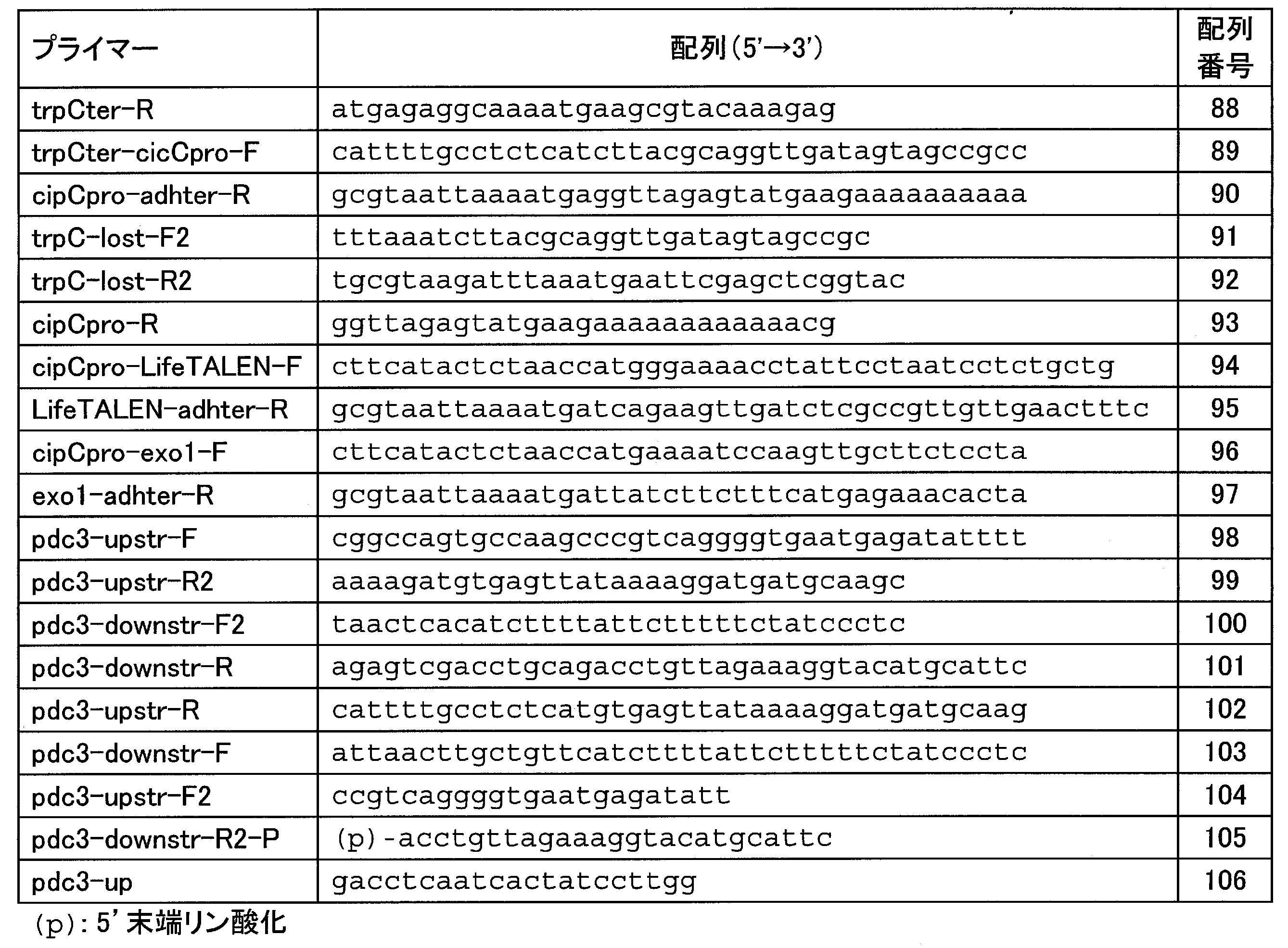
実施例1 pdc遺伝子欠損変異リゾプス属菌の作製
(1)トリプトファン栄養要求性株の作製
Rhizopus delemar JCM(Japan Collection of Microorganisms/理研)5557株(以降、5557株と表記)由来のトリプトファン栄養要求性株を、pdc遺伝子(配列番号1)欠失のための親株として用いた。トリプトファン栄養要求性株は、5557株へのイオンビーム照射による変異導入株の中から選抜し取得した。イオンビーム照射は、独立行政法人日本原子力研究開発機構・高崎量子応用研究所のイオン照射施設(TIARA)において行った。照射は、AVFサイクロトロンを用いて12C5+を加速し、220MeVのエネルギーで100~1250Gray照射した。照射した菌体より胞子を回収し、その中から、trpC遺伝子領域に1塩基欠損変異を有し、トリプトファン栄養要求性を示すRhizopus delemar 02T6株を取得した。この株を、以降の実施例で変異リゾプス属菌の親株として用いた。
(1)トリプトファン栄養要求性株の作製
Rhizopus delemar JCM(Japan Collection of Microorganisms/理研)5557株(以降、5557株と表記)由来のトリプトファン栄養要求性株を、pdc遺伝子(配列番号1)欠失のための親株として用いた。トリプトファン栄養要求性株は、5557株へのイオンビーム照射による変異導入株の中から選抜し取得した。イオンビーム照射は、独立行政法人日本原子力研究開発機構・高崎量子応用研究所のイオン照射施設(TIARA)において行った。照射は、AVFサイクロトロンを用いて12C5+を加速し、220MeVのエネルギーで100~1250Gray照射した。照射した菌体より胞子を回収し、その中から、trpC遺伝子領域に1塩基欠損変異を有し、トリプトファン栄養要求性を示すRhizopus delemar 02T6株を取得した。この株を、以降の実施例で変異リゾプス属菌の親株として用いた。
(2)プラスミドベクター作製
5557株のゲノムDNAを鋳型に、プライマーoJK162(配列番号45)及びoJK163(配列番号46)を用いたPCRにてtrpC遺伝子のDNA断片を合成した。次に、プラスミドpUC18を鋳型に、プライマーoJK164(配列番号47)及びoJK165(配列番号48)を用いたPCRにてDNA断片を増幅した。以上の2断片をIn-Fusion HD Cloning Kit(Clontech)を用いて連結しプラスミドpUC18-trpCを作製した。
5557株のゲノムDNAを鋳型に、プライマーoJK162(配列番号45)及びoJK163(配列番号46)を用いたPCRにてtrpC遺伝子のDNA断片を合成した。次に、プラスミドpUC18を鋳型に、プライマーoJK164(配列番号47)及びoJK165(配列番号48)を用いたPCRにてDNA断片を増幅した。以上の2断片をIn-Fusion HD Cloning Kit(Clontech)を用いて連結しプラスミドpUC18-trpCを作製した。
次いで、5557株のゲノムDNAを鋳型に、adh1のプロモーター断片とターミネーター断片を、それぞれプライマーoJK202(配列番号49)及びoJK204(配列番号50)、ならびにoJK205(配列番号51)及びoJK216(配列番号52)を用いたPCRにて増幅した。次に、上記で構築したプラスミドpUC18-trpCを鋳型に、プライマーoJK210(配列番号53)及びoJK211(配列番号54)を用いたPCRにてDNA断片を増幅した。以上の3断片をIn-Fusion HD Cloning Kit(Clontech)を用いて連結してプラスミドpUC18-trpC-Padh-Tadhを作製した。得られたプラスミドには、trpC遺伝子領域の下流にadh1プロモーター及びターミネーターが順に配置されている。
さらに、pUC18-trpC-Padh-Tadhから、trpC遺伝子領域を除いたプラスミドベクターを作製した。すなわち、上記で構築したpUC18-trpC-Padh-Tadhを鋳型に、プライマーtrpC-lost-F(配列番号55)及びtrpC-lost-R(配列番号56)を用いたPCRにてDNA断片を増幅した。本断片をIn-Fusion HD Cloning Kit(Clontech)を用いて連結し、プラスミドpUC18-Padh-Tadhを作製した。
(3)pdc遺伝子破壊用TALENの作製
Transposagen Biopharmaceuticals社に依頼し、Custom XTN TALEN(Transposagen Biopharmaceuticals社が提供するTALENの商品名)を作製した。これは、ピルビン酸デカルボキシラーゼ1(PDC1)をコードする遺伝子(pdc遺伝子;配列番号1)を標的とするTALENのためのキットであり、2つのポリヌクレオチドLeftTALEN-pdc(配列番号3)及びRightTALEN-pdc(配列番号5)を含み、pdc遺伝子を含む領域(配列番号81)に結合する。LeftTALEN-pdcは、pdc遺伝子のセンス鎖中の5’-TGCCTGCTATTAAAATCG-3’(配列番号9)の配列を標的とするTALENをコードし、RightTALEN-pdcは、アンチセンス鎖中の5’-TTGATTTCCTTAAGACGG-3’(配列番号10)の配列を標的とするTALENをコードする。
Transposagen Biopharmaceuticals社に依頼し、Custom XTN TALEN(Transposagen Biopharmaceuticals社が提供するTALENの商品名)を作製した。これは、ピルビン酸デカルボキシラーゼ1(PDC1)をコードする遺伝子(pdc遺伝子;配列番号1)を標的とするTALENのためのキットであり、2つのポリヌクレオチドLeftTALEN-pdc(配列番号3)及びRightTALEN-pdc(配列番号5)を含み、pdc遺伝子を含む領域(配列番号81)に結合する。LeftTALEN-pdcは、pdc遺伝子のセンス鎖中の5’-TGCCTGCTATTAAAATCG-3’(配列番号9)の配列を標的とするTALENをコードし、RightTALEN-pdcは、アンチセンス鎖中の5’-TTGATTTCCTTAAGACGG-3’(配列番号10)の配列を標的とするTALENをコードする。
上記LeftTALEN-pdcをコードするポリヌクレオチドを、上記(2)で作製したR.delemar用発現ベクターpUC18-trpC-Padh-Tadhに挿入し、adh1プロモーターとadh1ターミネーターの制御下でTALENを発現するベクターを作製した。すなわち、pUC18-trpC-Padh-Tadhを鋳型に、プライマーadhpro-R(配列番号57)及びadhter-F(配列番号58)を用いたPCRにてベクター断片を増幅した。続いてLeftTALEN-pdcを鋳型に、プライマーadhpro-TALEN-F(配列番号59)及びTALEN-adhter-R(配列番号60)を用いたPCRにてLeftTALEN-pdc断片を増幅した。上記2断片には、15塩基ずつオーバーラップする領域が存在する。これら2断片をIn-Fusion HD cloning kit(clontech社)にて連結し、LeftTALEN-pdcを含むプラスミドpadh-LeftTALEN-pdcを得た。
上記RightTALEN-pdcをコードするポリヌクレオチドを、上記(2)で作製したR.delemar用発現ベクターpUC18-Padh-Tadhに挿入し、adh1プロモーターとadh1ターミネーターの制御下でTALENを発現する(但しtrpC配列を含まない)ベクターを作製した。すなわち、pUC18-Padh-Tadhを鋳型に、プライマーadhpro-R(配列番号57)及びadhter-F(配列番号58)を用いたPCRにてベクター断片を増幅した。続いてRightTALEN-pdcを鋳型に、プライマーadhpro-TALEN-F(配列番号59)及びTALEN-adhter-R(配列番号60)を用いたPCRにてRightTALEN-pdc断片を増幅し、ベクター断片と連結して、RightTALEN-pdcを含むプラスミドpadh-RightTALEN-pdcを得た。
(4)エキソヌクレアーゼ発現ベクターの作製
プラスミドpUC18(タカラバイオ)を鋳型に、プライマーpPTR1-sal1-F(配列番号61)及びpPTR1-sal1-R(配列番号62)を用いたPCRにてpUC18ベクター断片を増幅した。また、Rhizopus oryzae NRBC5384株(以下、5384株と表記)の精製ゲノム溶液を鋳型に、プライマーsal1-ldhpro-F3(配列番号63)及びldhpro-R(配列番号64)を用いてldhプロモーター断片を、プライマーldhpro-exo1-F2(配列番号65)及びexo1-pdcter-R2(配列番号66)を用いてエキソヌクレアーゼ遺伝子断片(配列番号82)を、及びプライマーpdcTer-F(配列番号67)及びpdcTer-sal1-R(配列番号68)を用いてpdcターミネーター断片を、それぞれ増幅した。増幅した上記4断片を、In-Fusion HD cloning kit(clontech社)にて連結し、プラスミドpldh-exo1を作製した。
プラスミドpUC18(タカラバイオ)を鋳型に、プライマーpPTR1-sal1-F(配列番号61)及びpPTR1-sal1-R(配列番号62)を用いたPCRにてpUC18ベクター断片を増幅した。また、Rhizopus oryzae NRBC5384株(以下、5384株と表記)の精製ゲノム溶液を鋳型に、プライマーsal1-ldhpro-F3(配列番号63)及びldhpro-R(配列番号64)を用いてldhプロモーター断片を、プライマーldhpro-exo1-F2(配列番号65)及びexo1-pdcter-R2(配列番号66)を用いてエキソヌクレアーゼ遺伝子断片(配列番号82)を、及びプライマーpdcTer-F(配列番号67)及びpdcTer-sal1-R(配列番号68)を用いてpdcターミネーター断片を、それぞれ増幅した。増幅した上記4断片を、In-Fusion HD cloning kit(clontech社)にて連結し、プラスミドpldh-exo1を作製した。
(5)trpC knock-in用プラスミドの作製
pdc遺伝子ローカスにてpdc遺伝子ORFを除き、trpC遺伝子領域をknock-inするためのプラスミドptrpC-knock-inを作製した。すなわち、pUC18を鋳型にプライマーpUC18-Pae1-F3(配列番号69)及びpUC18-Hind3-R3(配列番号70)にて増幅したpUC18ベクター断片と、JCM5557株のゲノムを鋳型にプライマーPDC1-upstr-F(配列番号71)及びPDC1-upstr-R(配列番号72)にて増幅したpdc遺伝子のプロモーター部位断片と、JCM5557株のゲノムを鋳型にプライマーtrpCpro-R(配列番号73)及びtrpCter-F(配列番号74)にて増幅したtrpC遺伝子領域断片と、JCM5557株のゲノムを鋳型にプライマーPDC1-downstr-F(配列番号75)及びPDC1-downstr-R(配列番号76)にて増幅したpdc遺伝子のターミネーター部位断片を、In-Fusion HD Cloning Kit(Clontech)を用いて連結し、プラスミドptrpC-knock-inを構築した。
pdc遺伝子ローカスにてpdc遺伝子ORFを除き、trpC遺伝子領域をknock-inするためのプラスミドptrpC-knock-inを作製した。すなわち、pUC18を鋳型にプライマーpUC18-Pae1-F3(配列番号69)及びpUC18-Hind3-R3(配列番号70)にて増幅したpUC18ベクター断片と、JCM5557株のゲノムを鋳型にプライマーPDC1-upstr-F(配列番号71)及びPDC1-upstr-R(配列番号72)にて増幅したpdc遺伝子のプロモーター部位断片と、JCM5557株のゲノムを鋳型にプライマーtrpCpro-R(配列番号73)及びtrpCter-F(配列番号74)にて増幅したtrpC遺伝子領域断片と、JCM5557株のゲノムを鋳型にプライマーPDC1-downstr-F(配列番号75)及びPDC1-downstr-R(配列番号76)にて増幅したpdc遺伝子のターミネーター部位断片を、In-Fusion HD Cloning Kit(Clontech)を用いて連結し、プラスミドptrpC-knock-inを構築した。
(6)一本鎖DNAの調製
プラスミドptrpC-knock-inを鋳型にプライマーPDC1-upstr-F2(配列番号77)及びPDC1-downstr-R-P(配列番号78、プライマーの5’末端がリン酸化されている)を用いてDNA断片をPCR増幅し、鋳型をDpn1(TOYOBO)処理にて分解した後、生成物をフェノール/クロロホルム/イソアミルアルコール処理、及びエタノール沈殿処理にて精製した。精製物を、さらにLambda Exonuclease(NEW ENGLAND BioLabs)を用いて処理した後、上記と同様に精製し、一本鎖DNAを得た。Lambda Exonuclease処理は、37℃、オーバーナイトで行った。
プラスミドptrpC-knock-inを鋳型にプライマーPDC1-upstr-F2(配列番号77)及びPDC1-downstr-R-P(配列番号78、プライマーの5’末端がリン酸化されている)を用いてDNA断片をPCR増幅し、鋳型をDpn1(TOYOBO)処理にて分解した後、生成物をフェノール/クロロホルム/イソアミルアルコール処理、及びエタノール沈殿処理にて精製した。精製物を、さらにLambda Exonuclease(NEW ENGLAND BioLabs)を用いて処理した後、上記と同様に精製し、一本鎖DNAを得た。Lambda Exonuclease処理は、37℃、オーバーナイトで行った。
(7)パーティクルガンによる遺伝子導入
上記(3)で作製したプラスミドpadh-LeftTALEN-pdc及びpadh-RightTALEN-pdcは制限酵素ScaIで、及び上記(4)で作製したプラスミドpldh-exo1は制限酵素Pst1で処理した。padh-LeftTALEN-pdc、padh-RightTALEN-pdc、pldh-exo1及び上記(6)で作製した一本鎖DNAの濃度比が、2:4:2:1になるよう混合してDNA溶液(約1~3μg/μL)を調製した。該DNA溶液10μLを金粒子溶液(60mg/mL、INBIO GOLD社、粒子径1μm)100μLに加え混合した。さらに0.1Mスペルミジンを40μL加え、ボルテックスでよく攪拌した。2.5MのCaCl2を100μL加え、ボルテックスで1分間攪拌した後、6000rpmで30秒間遠心し、上清を除いた。得られた沈殿に70%EtOHを200μL加え、30秒間ボルテックスで攪拌した後、6000rpmで30秒間遠心し、上清を除いた。得られた沈殿を100μLの100%EtOHで再懸濁した。
上記(3)で作製したプラスミドpadh-LeftTALEN-pdc及びpadh-RightTALEN-pdcは制限酵素ScaIで、及び上記(4)で作製したプラスミドpldh-exo1は制限酵素Pst1で処理した。padh-LeftTALEN-pdc、padh-RightTALEN-pdc、pldh-exo1及び上記(6)で作製した一本鎖DNAの濃度比が、2:4:2:1になるよう混合してDNA溶液(約1~3μg/μL)を調製した。該DNA溶液10μLを金粒子溶液(60mg/mL、INBIO GOLD社、粒子径1μm)100μLに加え混合した。さらに0.1Mスペルミジンを40μL加え、ボルテックスでよく攪拌した。2.5MのCaCl2を100μL加え、ボルテックスで1分間攪拌した後、6000rpmで30秒間遠心し、上清を除いた。得られた沈殿に70%EtOHを200μL加え、30秒間ボルテックスで攪拌した後、6000rpmで30秒間遠心し、上清を除いた。得られた沈殿を100μLの100%EtOHで再懸濁した。
上記(1)で取得した02T6株の胞子に対し、上記のDNA-金粒子溶液を用い、GDS-80(ネッパジーン)にて遺伝子導入を行った。遺伝子導入後の胞子は、無機寒天培地(20g/Lグルコース、1g/L硫酸アンモニウム、0.6g/Lリン酸2水素カリウム、0.25g/L硫酸マグネシウム・7水和物、0.09g/L硫酸亜鉛・7水和物、15g/L寒天)上で、30℃にて1週間ほど静置培養した。
(8)pdc遺伝子欠損株の選択
上記(7)で培養した菌体から胞子を回収し、pH3に調製した無機寒天培地(20g/Lグルコース、1g/L硫酸アンモニウム、0.6g/Lリン酸2水素カリウム、0.25g/L硫酸マグネシウム・7水和物、0.09g/L硫酸亜鉛・7水和物、15g/L寒天)を用いて菌株を単離した。生育した菌株の菌糸を爪楊枝にて一部かき取り、10mM Tris-HCl(pH8.5)に懸濁し、95℃で10分間インキュベートした。その後、10mM Tris-HCl(pH8.5)で適宜希釈し、コロニーPCR用のゲノムテンプレート溶液とした。コロニーPCRは、上記ゲノムテンプレート溶液、プライマーpdc1-up2(配列番号79)とtrpC(d)-1(配列番号80)、及びKOD FX Neo(TOYOBO)を用いて行った。上記プライマーでコロニーPCRを行った場合、pdc遺伝子ローカスにtrpC遺伝子断片のknock-inが起こっていれば、適切な長さのDNA断片が増幅する。コロニーPCRによりDNA増幅断片が得られた菌株を、pdc遺伝子欠失株02T6Δpdc株として取得した。
上記(7)で培養した菌体から胞子を回収し、pH3に調製した無機寒天培地(20g/Lグルコース、1g/L硫酸アンモニウム、0.6g/Lリン酸2水素カリウム、0.25g/L硫酸マグネシウム・7水和物、0.09g/L硫酸亜鉛・7水和物、15g/L寒天)を用いて菌株を単離した。生育した菌株の菌糸を爪楊枝にて一部かき取り、10mM Tris-HCl(pH8.5)に懸濁し、95℃で10分間インキュベートした。その後、10mM Tris-HCl(pH8.5)で適宜希釈し、コロニーPCR用のゲノムテンプレート溶液とした。コロニーPCRは、上記ゲノムテンプレート溶液、プライマーpdc1-up2(配列番号79)とtrpC(d)-1(配列番号80)、及びKOD FX Neo(TOYOBO)を用いて行った。上記プライマーでコロニーPCRを行った場合、pdc遺伝子ローカスにtrpC遺伝子断片のknock-inが起こっていれば、適切な長さのDNA断片が増幅する。コロニーPCRによりDNA増幅断片が得られた菌株を、pdc遺伝子欠失株02T6Δpdc株として取得した。
実施例2 変異リゾプス属菌におけるピルビン酸デカルボキシラーゼ活性の評価
実施例1で取得した02T6株及び02T6Δpdc株を培養し、ピルビン酸デカルボキシラーゼ(PDC)活性を測定した。
実施例1で取得した02T6株及び02T6Δpdc株を培養し、ピルビン酸デカルボキシラーゼ(PDC)活性を測定した。
(1)菌体の培養
500mL容バッフル付三角フラスコ(旭硝子製)に、200mLのシード培地(組成:SD/-Trp Broth(Clontech、添付のプロトコールに従い調製)、0.002%トリプトファン、0.5%ソルビタンモノラウレート(レオドール(登録商標)SP-L10、花王製)、いずれも濃度は%(w/v))を供し、02T6株又は02T6Δpdc株の胞子懸濁液を1×103個-胞子/mL-培地となるように接種し、27℃にて約72時間、170rpmで撹拌培養した。次いで、上記の培養物を、滅菌処理した網目250μmの金網を用いて濾過し、菌体をフィルター上に回収した。回収した菌体を500mL容三角フラスコに供した無機培養液100mL(組成:10%グルコース、0.1%硫酸アンモニウム、0.06%リン酸2水素カリウム、0.025%硫酸マグネシウム・7水和物、0.009%硫酸亜鉛・7水和物、5.0%炭酸カルシウム、0.002%トリプトファン、いずれも濃度は%(w/v))に6.0~8.0gを接種し、27℃で約40時間、220rpmにて撹拌培養した。上記培養物を、滅菌処理したステンレススクリーンフィルターホルダー(MILLIPORE製)を用いて培養物を濾過し、フィルター上に菌体を回収し、このフィルターホルダー上で約50mLの生理食塩水にて菌体を2回洗浄した。洗浄に用いた生理食塩水は吸引ろ過して除去した。得られた菌体6gを、200mL容三角フラスコに供した無機培養液40mL(組成:10%グルコース、0.1%硫酸アンモニウム、0.06%リン酸2水素カリウム、0.025%硫酸マグネシウム・7水和物、0.009%硫酸亜鉛・7水和物、5.0%炭酸カルシウム、0.002%トリプトファン、いずれも濃度は%(w/v))に接種し35℃、170rpmにて8時間、振盪培養を行った。
500mL容バッフル付三角フラスコ(旭硝子製)に、200mLのシード培地(組成:SD/-Trp Broth(Clontech、添付のプロトコールに従い調製)、0.002%トリプトファン、0.5%ソルビタンモノラウレート(レオドール(登録商標)SP-L10、花王製)、いずれも濃度は%(w/v))を供し、02T6株又は02T6Δpdc株の胞子懸濁液を1×103個-胞子/mL-培地となるように接種し、27℃にて約72時間、170rpmで撹拌培養した。次いで、上記の培養物を、滅菌処理した網目250μmの金網を用いて濾過し、菌体をフィルター上に回収した。回収した菌体を500mL容三角フラスコに供した無機培養液100mL(組成:10%グルコース、0.1%硫酸アンモニウム、0.06%リン酸2水素カリウム、0.025%硫酸マグネシウム・7水和物、0.009%硫酸亜鉛・7水和物、5.0%炭酸カルシウム、0.002%トリプトファン、いずれも濃度は%(w/v))に6.0~8.0gを接種し、27℃で約40時間、220rpmにて撹拌培養した。上記培養物を、滅菌処理したステンレススクリーンフィルターホルダー(MILLIPORE製)を用いて培養物を濾過し、フィルター上に菌体を回収し、このフィルターホルダー上で約50mLの生理食塩水にて菌体を2回洗浄した。洗浄に用いた生理食塩水は吸引ろ過して除去した。得られた菌体6gを、200mL容三角フラスコに供した無機培養液40mL(組成:10%グルコース、0.1%硫酸アンモニウム、0.06%リン酸2水素カリウム、0.025%硫酸マグネシウム・7水和物、0.009%硫酸亜鉛・7水和物、5.0%炭酸カルシウム、0.002%トリプトファン、いずれも濃度は%(w/v))に接種し35℃、170rpmにて8時間、振盪培養を行った。
(2)ピルビン酸デカルボキシラーゼ(PDC)活性の評価
上記(1)で得られた培養物から、滅菌処理したステンレススクリーンフィルターホルダー(MILLIPORE製)を用いて菌体を濾過し、フィルター上に菌体を回収した。さらに、このフィルターホルダー上で約50mLの生理食塩水にて菌体を2回洗浄した。洗浄に用いた生理食塩水は吸引ろ過して除去した。菌体0.3gを3mL破砕チューブ(安井器械社製)に回収し、3mL用メタルコーン(安井器械社製)を入れ、蓋を閉めた後、液体窒素で凍結した。凍結した3mL破砕チューブをマルチビーズショッカー(安井器械社製)に供し、1700rpmで10秒間菌体を破砕した。その後、cOmplete ULTRA Tablets,Mini,EDTA-free,EASY pack(ロシュ社)を添加した50mM Tri-HCl(pH7.5)溶液にて懸濁後、14500rpmで5分間遠心し、上清を菌体破砕液とした。菌体破砕液のタンパク質濃度は、Quick Start Bradford Protein Assay(BIO-RAD社)を用いて測定した。
上記(1)で得られた培養物から、滅菌処理したステンレススクリーンフィルターホルダー(MILLIPORE製)を用いて菌体を濾過し、フィルター上に菌体を回収した。さらに、このフィルターホルダー上で約50mLの生理食塩水にて菌体を2回洗浄した。洗浄に用いた生理食塩水は吸引ろ過して除去した。菌体0.3gを3mL破砕チューブ(安井器械社製)に回収し、3mL用メタルコーン(安井器械社製)を入れ、蓋を閉めた後、液体窒素で凍結した。凍結した3mL破砕チューブをマルチビーズショッカー(安井器械社製)に供し、1700rpmで10秒間菌体を破砕した。その後、cOmplete ULTRA Tablets,Mini,EDTA-free,EASY pack(ロシュ社)を添加した50mM Tri-HCl(pH7.5)溶液にて懸濁後、14500rpmで5分間遠心し、上清を菌体破砕液とした。菌体破砕液のタンパク質濃度は、Quick Start Bradford Protein Assay(BIO-RAD社)を用いて測定した。
菌体破砕液のPDC活性は、ピルビン酸と菌体破砕液との反応生成物にアルコールデヒドロゲナーゼ(以下、ADH)を反応させ、生成するNAD+の量を吸光度変化に基づいて測定することで定量した。すなわち、180μLの反応液[50mM Tris-HCl(pH7.5)、175μM NADH、2mM MgCl2、1mM チアミン2リン酸、1U ADH(Sigma)]に、適宜希釈した菌体破砕液を10L添加し、35℃で5分静置した。その後、上記反応液に200mMのピルビン酸ナトリウム溶液を10μL添加し、35℃で反応を開始した。吸光度変化は、infinite M200 PRO(TECAN)で測定した。1Uは、35℃で1分間に1μmolのNAD+を生成する酵素量と定義した。
結果を表3に示す。親株である02T6株と比較して、02T6Δpdc株では、PDC活性が約13%に減少していた。

実施例3 変異リゾプス属菌における有機酸生産性評価
実施例2(1)と同様の手順で02T6株及び02T6Δpdc株を培養した。但し、培養期間は2日間とした。培養開始0、4、8、10、24及び32時間後に、培養液上清のサンプリングを行い、後述の参考例1に記載の手順にて該上清中のグルコース、フマル酸、リンゴ酸、コハク酸及びエタノールを定量し、次いで各物質の選択率を求めた。
実施例2(1)と同様の手順で02T6株及び02T6Δpdc株を培養した。但し、培養期間は2日間とした。培養開始0、4、8、10、24及び32時間後に、培養液上清のサンプリングを行い、後述の参考例1に記載の手順にて該上清中のグルコース、フマル酸、リンゴ酸、コハク酸及びエタノールを定量し、次いで各物質の選択率を求めた。
グルコースの完全消費が確認された培養24時間後時点での各物質の選択率を表4に示す。02T6Δpdc株は、親株である02T6株と比較して、エタノール選択率が95.5%に減少し、フマル酸、リンゴ酸及びコハク酸の選択率がそれぞれ117%、112%及び108%に向上したことにより、有機酸の生産性が向上したことが明らかになった。
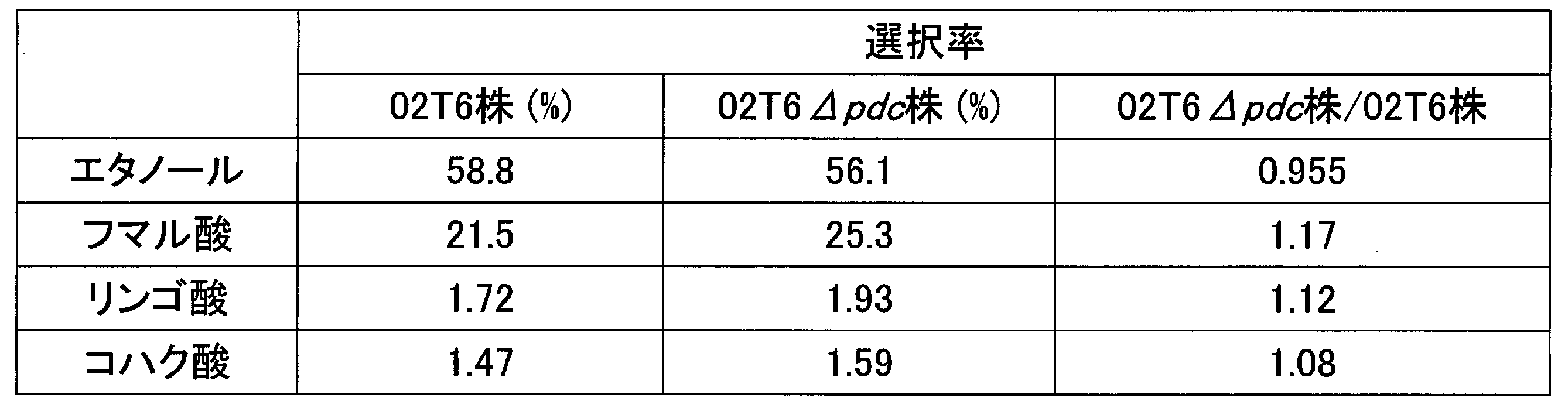
比較例1 pdc3遺伝子破壊株のピルビン酸デカルボキシラーゼ活性の評価
(1)プラスミドベクターの作製
実施例1(2)で構築したpUC18-trpC-Padh-Tadhのadh1プロモーターをcipCプロモーターに変更したプラスミドベクターを作製した。すなわち、該pUC18-trpC-Padh-Tadhを鋳型にプライマーadhter-F(配列番号58)及びtrpCter-R(配列番号88)を用いたPCRにてベクター断片を増幅し、また5557株のゲノムDNAを鋳型にプライマーtrpCter-cicCpro-F(配列番号89)及びcipCpro-adhter-R(配列番号90)を用いたPCRにてcipCプロモーター領域断片を増幅した。以上の2断片を、In-Fusion HD Cloning Kit(Clontech)を用いて連結してプラスミドpUC18-trpC-PcipC-Tadhを作製した。
(1)プラスミドベクターの作製
実施例1(2)で構築したpUC18-trpC-Padh-Tadhのadh1プロモーターをcipCプロモーターに変更したプラスミドベクターを作製した。すなわち、該pUC18-trpC-Padh-Tadhを鋳型にプライマーadhter-F(配列番号58)及びtrpCter-R(配列番号88)を用いたPCRにてベクター断片を増幅し、また5557株のゲノムDNAを鋳型にプライマーtrpCter-cicCpro-F(配列番号89)及びcipCpro-adhter-R(配列番号90)を用いたPCRにてcipCプロモーター領域断片を増幅した。以上の2断片を、In-Fusion HD Cloning Kit(Clontech)を用いて連結してプラスミドpUC18-trpC-PcipC-Tadhを作製した。
続いて、上記で構築したpUC18-trpC-PcipC-TadhからtrpC遺伝子領域を除いたプラスミドベクターを作製した。すなわち、該pUC18-trpC-PcipC-Tadhを鋳型に、プライマーtrpC-lost-F2(配列番号91)及びtrpC-lost-R2(配列番号92)を用いたPCRにてDNA断片を増幅した。本断片をIn-Fusion HD Cloning Kit(Clontech)を用いて連結し、プラスミドpUC18-PcipC-Tadhを作製した。
(2)pdc3遺伝子破壊用TALENの作製
pdc3遺伝子座を標的として、TALENを作製した。TALENの作製は、Life technologies社に依頼し、GeneArt PerfectMatch TALs(Life Technologies社が提供するTALENの商品名)を得た。このキットは、標的遺伝子に対するLeft-TALEN及びRight-TALENの2つのポリヌクレオチドを含む。pdc3遺伝子(配列番号83)を標的とするキットは、LeftTALEN-pdc3(配列番号84)及びRightTALEN-pdc3(配列番号85)を含み、これらはそれぞれ、pdc3遺伝子のセンス鎖中の5’-CCGGAATCGACACGATTTT-3’(配列番号86)及びアンチセンス鎖中の5’-CGTAACTTACCATATTGTA-3’(配列番号87)の配列を標的とするTALENをコードする。
pdc3遺伝子座を標的として、TALENを作製した。TALENの作製は、Life technologies社に依頼し、GeneArt PerfectMatch TALs(Life Technologies社が提供するTALENの商品名)を得た。このキットは、標的遺伝子に対するLeft-TALEN及びRight-TALENの2つのポリヌクレオチドを含む。pdc3遺伝子(配列番号83)を標的とするキットは、LeftTALEN-pdc3(配列番号84)及びRightTALEN-pdc3(配列番号85)を含み、これらはそれぞれ、pdc3遺伝子のセンス鎖中の5’-CCGGAATCGACACGATTTT-3’(配列番号86)及びアンチセンス鎖中の5’-CGTAACTTACCATATTGTA-3’(配列番号87)の配列を標的とするTALENをコードする。
pdc3遺伝子用のLeftTALENをコードするポリヌクレオチドを、上記(1)で作製したR.delemar用発現ベクターpUC18-PcipC-Tadhに挿入し、cipCプロモーターとadh1ターミネーターの制御下でTALENを発現するベクターを作製した。すなわち、pUC18-PcipC-Tadhを鋳型に、プライマーcipCpro-R(配列番号93)及びadhter-F(配列番号58)を用いたPCRにてベクター断片を増幅した。続いてLeftTALEN-pdc3を鋳型に、プライマーcipCpro-LifeTALEN-F(配列番号94)及びLifeTALEN-adhter-R(配列番号95)を用いたPCRにてLeftTALEN-pdc3の断片を増幅した。上記2断片には、15塩基ずつオーバーラップする領域が存在する。これら2断片をIn-Fusion HD cloning kit(clontech社)にて連結し、LeftTALEN-pdc3を含むプラスミドpcipC-LeftTALEN-pdc3を得た。
同様に、pdc3遺伝子用のRightTALENをコードするポリヌクレオチドを、上記(1)で作製したR.delemar用発現ベクターpUC18-PcipC-Tadhに挿入し、cipCプロモーターとadh1ターミネーターの制御下でTALENを発現するベクターを作製した。すなわち、pUC18-PcipC-Tadhを鋳型に、プライマーcipCpro-R(配列番号93)及びadhter-F(配列番号58)を用いたPCRにてベクター断片を増幅した。続いてRightTALEN-pdc3を鋳型に、プライマーcipCpro-LifeTALEN-F(配列番号94)及びLifeTALEN-adhter-R(配列番号95)を用いたPCRにてRightTALEN-pdc3の断片を増幅した。上記2断片には、15塩基ずつオーバーラップする領域が存在する。これら2断片をIn-Fusion HD cloning kit(clontech社)にて連結し、RightTALEN-pdc3を含むプラスミドpcipC-RightTALEN-pdc3を得た。
(3)エキソヌクレアーゼ発現ベクターの作製
実施例1(4)で作製したプラスミドpldh-exo1を鋳型に、プライマーcipCpro-exo1-F(配列番号96)及びexo1-adhter-R(配列番号97)を用いたPCRにてエキソヌクレアーゼ遺伝子断片を、上記(1)で作製したプラスミドpUC18-PcipC-Tadhを鋳型に、プライマーcipCpro-R(配列番号93)及びadhter-F(配列番号58)を用いたPCRにてベクター断片を、それぞれ増幅した。上記2断片には、15塩基ずつオーバーラップする領域が存在する。これら2断片をIn-Fusion HD cloning kit(clontech社)にて連結し、プラスミドpcipC-exo1を得た。
実施例1(4)で作製したプラスミドpldh-exo1を鋳型に、プライマーcipCpro-exo1-F(配列番号96)及びexo1-adhter-R(配列番号97)を用いたPCRにてエキソヌクレアーゼ遺伝子断片を、上記(1)で作製したプラスミドpUC18-PcipC-Tadhを鋳型に、プライマーcipCpro-R(配列番号93)及びadhter-F(配列番号58)を用いたPCRにてベクター断片を、それぞれ増幅した。上記2断片には、15塩基ずつオーバーラップする領域が存在する。これら2断片をIn-Fusion HD cloning kit(clontech社)にて連結し、プラスミドpcipC-exo1を得た。
(4)pdc3遺伝子座を標的とするtrpC knock-in用プラスミドの作製
pdc3遺伝子ローカスにてpdc3遺伝子ORFを除き、trpC遺伝子領域をknock-inするための、プラスミドptrpC-knock-in(pdc3)を作製した。すなわち、pUC18を鋳型にプライマーpUC18-Pae1-F3(配列番号69)及びpUC18-Hind3-R3(配列番号70)にて増幅したpUC18ベクター断片と、5557株のゲノムDNAを鋳型にプライマーpdc3-upstr-F(配列番号98)及びpdc3-upstr-R2(配列番号99)にて増幅したpdc3遺伝子プロモーター断片と、5557株のゲノムDNAを鋳型にプライマーpdc3-downstr-F2(配列番号100)及びpdc3-downstr-R(配列番号101)にて増幅したpdc3遺伝子ターミネーター断片を、In-Fusion HD Cloning Kit(Clontech)を用いて連結し、プラスミドpknock-in(pdc3)を作製した。
pdc3遺伝子ローカスにてpdc3遺伝子ORFを除き、trpC遺伝子領域をknock-inするための、プラスミドptrpC-knock-in(pdc3)を作製した。すなわち、pUC18を鋳型にプライマーpUC18-Pae1-F3(配列番号69)及びpUC18-Hind3-R3(配列番号70)にて増幅したpUC18ベクター断片と、5557株のゲノムDNAを鋳型にプライマーpdc3-upstr-F(配列番号98)及びpdc3-upstr-R2(配列番号99)にて増幅したpdc3遺伝子プロモーター断片と、5557株のゲノムDNAを鋳型にプライマーpdc3-downstr-F2(配列番号100)及びpdc3-downstr-R(配列番号101)にて増幅したpdc3遺伝子ターミネーター断片を、In-Fusion HD Cloning Kit(Clontech)を用いて連結し、プラスミドpknock-in(pdc3)を作製した。
続いて、pknock-in(pdc3)を鋳型にプライマーpdc3-upstr-R(配列番号102)及びpdc3-downstr-F(配列番号103)にて増幅したDNA断片と、5557株のゲノムDNAを鋳型にプライマーtrpCpro-R(配列番号73)及びtrpCter-F(配列番号74)にて増幅したtrpC遺伝子領域断片を、In-Fusion HD Cloning Kit(Clontech)を用いて連結し、プラスミドptrpC-knock-in(pdc3)を作製した。
(5)一本鎖DNAの調製
PCRの鋳型としてptrpC-knock-in(pdc3)を、プライマーとしてpdc3-upstr-F2(配列番号104)及びpdc3-downstr-R2-P(配列番号105、5’側はリン酸化されている)を用いた以外は、上記実施例1(6)と同様の手順で一本鎖DNAを得た。
PCRの鋳型としてptrpC-knock-in(pdc3)を、プライマーとしてpdc3-upstr-F2(配列番号104)及びpdc3-downstr-R2-P(配列番号105、5’側はリン酸化されている)を用いた以外は、上記実施例1(6)と同様の手順で一本鎖DNAを得た。
(6)パーティクルガンによる遺伝子導入
上記実施例1(7)と同様の手順で、一本鎖DNAを含むDNA-金粒子溶液を調製し、これを用いて02T6株の胞子に対して遺伝子導入し、得られた胞子を培養した。一本鎖DNAには、上記(5)で作製した一本鎖DNAを用いた。TALEN発現ベクターには、上記(2)で作製したpcipC-LeftTALEN-pdc3及びpcipC-RightTALEN-pdc3を用いた。エキソヌクレアーゼ発現ベクターには上記(4)で作製したpcipC-exo1を用いた。DNA溶液におけるpcipC-LeftTALEN-pdc3、pcipC-RightTALEN-pdc3、pcipC-exo1、及び一本鎖DNAの濃度比は、およそ1:1:1:2とした。
上記実施例1(7)と同様の手順で、一本鎖DNAを含むDNA-金粒子溶液を調製し、これを用いて02T6株の胞子に対して遺伝子導入し、得られた胞子を培養した。一本鎖DNAには、上記(5)で作製した一本鎖DNAを用いた。TALEN発現ベクターには、上記(2)で作製したpcipC-LeftTALEN-pdc3及びpcipC-RightTALEN-pdc3を用いた。エキソヌクレアーゼ発現ベクターには上記(4)で作製したpcipC-exo1を用いた。DNA溶液におけるpcipC-LeftTALEN-pdc3、pcipC-RightTALEN-pdc3、pcipC-exo1、及び一本鎖DNAの濃度比は、およそ1:1:1:2とした。
(7)pdc3遺伝子欠損株の選択
上記(6)で培養した菌体から胞子を回収し、上記実施例1(8)と同様の手順で、菌株の単離及びゲノムテンプレート溶液の調製を行った。次いでこれを鋳型としたコロニーPCRによりpdc3遺伝子ローカスにtrpC遺伝子領域断片がknock-inされたpdc3遺伝子欠損株を選択した。コロニーPCRは、上記ゲノムテンプレート溶液、プライマーpdc3-up(配列番号106)とtrpC(d)-1(配列番号80)、及びKOD FX Neo(TOYOBO)を用いて行った。上記プライマーでコロニーPCRを行った場合、pdc3遺伝子座にtrpC遺伝子領域断片のknock-inが起こっていれば、適切な長さのDNA断片が増幅する。コロニーPCRによりDNA増幅断片が得られた菌株を、pdc3遺伝子欠損株02T6Δpdc3株として取得した。
上記(6)で培養した菌体から胞子を回収し、上記実施例1(8)と同様の手順で、菌株の単離及びゲノムテンプレート溶液の調製を行った。次いでこれを鋳型としたコロニーPCRによりpdc3遺伝子ローカスにtrpC遺伝子領域断片がknock-inされたpdc3遺伝子欠損株を選択した。コロニーPCRは、上記ゲノムテンプレート溶液、プライマーpdc3-up(配列番号106)とtrpC(d)-1(配列番号80)、及びKOD FX Neo(TOYOBO)を用いて行った。上記プライマーでコロニーPCRを行った場合、pdc3遺伝子座にtrpC遺伝子領域断片のknock-inが起こっていれば、適切な長さのDNA断片が増幅する。コロニーPCRによりDNA増幅断片が得られた菌株を、pdc3遺伝子欠損株02T6Δpdc3株として取得した。
(8)ピルビン酸デカルボキシラーゼ活性の評価
上記実施例2(1)と同様の方法で02T6株、02T6Δpdc株及び02T6Δpdc3株菌体を培養し、実施例2(2)と同様の方法でピルビン酸デカルボキシラーゼ活性の評価を行った。
上記実施例2(1)と同様の方法で02T6株、02T6Δpdc株及び02T6Δpdc3株菌体を培養し、実施例2(2)と同様の方法でピルビン酸デカルボキシラーゼ活性の評価を行った。
結果を表5に示す。親株である02T6株と比較して、PDC活性は、02T6Δpdc株では約20%に減少していたが、02T6Δpdc3株では約89%残存していた。PDCの活性低下は、有機酸生産の副産物であるエタノールの生成の抑制に寄与することから、02T6Δpdc3株の有機酸生産性が02T6Δpdc株に劣ること、ピルビン酸デカルボキシラーゼをコードする遺伝子の中でも、pdc遺伝子の欠損が有機酸生産性向上に有効であることが示された。

参考例1 培養物中のグルコース、フマル酸、リンゴ酸、コハク酸及びエタノールの定量
<分析条件>
培養上清中のグルコース、フマル酸、リンゴ酸、コハク酸及びエタノールの定量は、HPLC装置LaChrom Elite(日立ハイテクノロジーズ製)を用いて行なった。分析カラムには、ガードカラムICSep ION-300 Guard Column Cartride(4.0mm I.D.×20mm、Transgenomic社製)を接続した有機酸分析用ポリマーカラムICSep ICE-ION-300(7.8mm I.D.×300mm、Transgenomic社製)を用い、溶離液0.01N硫酸、流速0.5mL/min、カラム温度50℃の条件にて溶出した。グルコース及びエタノールの検出には示唆屈折率検出器(RI検出器)を、フマル酸、リンゴ酸及びコハク酸の検出にはUV検出器(検出波長210nm)を用いた。HPLC分析に供する培養上清試料は、予め0.86M硫酸ナトリウム溶液で3倍希釈し、その後37mM硫酸にて適宜希釈した後、AcroPrep 96-well Filter Plates(0.2μm GHP膜、ポール社製)を用いて不溶物を除去した。
<分析条件>
培養上清中のグルコース、フマル酸、リンゴ酸、コハク酸及びエタノールの定量は、HPLC装置LaChrom Elite(日立ハイテクノロジーズ製)を用いて行なった。分析カラムには、ガードカラムICSep ION-300 Guard Column Cartride(4.0mm I.D.×20mm、Transgenomic社製)を接続した有機酸分析用ポリマーカラムICSep ICE-ION-300(7.8mm I.D.×300mm、Transgenomic社製)を用い、溶離液0.01N硫酸、流速0.5mL/min、カラム温度50℃の条件にて溶出した。グルコース及びエタノールの検出には示唆屈折率検出器(RI検出器)を、フマル酸、リンゴ酸及びコハク酸の検出にはUV検出器(検出波長210nm)を用いた。HPLC分析に供する培養上清試料は、予め0.86M硫酸ナトリウム溶液で3倍希釈し、その後37mM硫酸にて適宜希釈した後、AcroPrep 96-well Filter Plates(0.2μm GHP膜、ポール社製)を用いて不溶物を除去した。
<選択率の算出>
物質の選択率とは、培養物のグルコース消費量から計算される該培養物から理論上得ることが可能な該物質の最大当量(理論最大量)に対する、該培養物から実際に得られた該物質の当量の比率をいう。すなわち、選択率は以下の式で求められる。
選択率 = 生成物当量/理論最大量
(ここで、理論最大量=グルコース消費当量 ×〔補正係数〕)
測定対象物質の理論最大量及び補正係数は以下のとおりである:
〔理論最大量〕 〔補正係数〕
エタノール:グルコース1molから最大2mol 1/2
フマル酸 :グルコース2molから最大3mol 2/3
リンゴ酸 :グルコース2molから最大3mol 2/3
コハク酸 :グルコース2molから最大3mol 2/3
物質の選択率とは、培養物のグルコース消費量から計算される該培養物から理論上得ることが可能な該物質の最大当量(理論最大量)に対する、該培養物から実際に得られた該物質の当量の比率をいう。すなわち、選択率は以下の式で求められる。
選択率 = 生成物当量/理論最大量
(ここで、理論最大量=グルコース消費当量 ×〔補正係数〕)
測定対象物質の理論最大量及び補正係数は以下のとおりである:
〔理論最大量〕 〔補正係数〕
エタノール:グルコース1molから最大2mol 1/2
フマル酸 :グルコース2molから最大3mol 2/3
リンゴ酸 :グルコース2molから最大3mol 2/3
コハク酸 :グルコース2molから最大3mol 2/3
Claims (19)
- 変異リゾプス属菌であって、pdc遺伝子が欠失又は不活性化されており、
該pdc遺伝子が、以下:
配列番号1で示されるヌクレオチド配列からなるポリヌクレオチド;
配列番号1で示されるヌクレオチドと少なくとも80%の同一性を有するヌクレオチド配列からなり、且つピルビン酸デカルボキシラーゼ活性を有するポリペプチドをコードするポリヌクレオチド;
配列番号1で示されるヌクレオチド配列に対して1又は複数個のヌクレオチドが欠失、挿入、置換若しくは付加されたヌクレオチド配列からなり、且つピルビン酸デカルボキシラーゼ活性を有するポリペプチドをコードするポリヌクレオチド;
配列番号2で示されるアミノ酸配列からなるポリペプチドをコードするポリヌクレオチド;
配列番号2で示されるアミノ酸配列と少なくとも80%の同一性を有するアミノ酸配列からなり且つピルビン酸デカルボキシラーゼ活性を有するポリペプチドをコードするポリヌクレオチド;及び、
配列番号2で示されるアミノ酸配列に対して1又は複数個のアミノ酸残基が欠失、挿入、置換若しくは付加されたアミノ酸配列からなり且つピルビン酸デカルボキシラーゼ活性を有するポリペプチドをコードするポリヌクレオチド、
からなる群より選択される少なくとも1つである、
変異リゾプス属菌。 - ピルビン酸デカルボキシラーゼの活性が、変異前と比べて50%以下に低減されている、請求項1記載の変異リゾプス属菌。
- 前記リゾプス属菌が、Rhizopus oryzae又はRhizopus delemarである、請求項1又は2記載の変異リゾプス属菌。
- 有機酸生産性が向上している、請求項1~3のいずれか1項記載の変異リゾプス属菌。
- 前記有機酸が、フマル酸、乳酸、コハク酸、リンゴ酸又はα-ケトグルタル酸である、請求項4記載の変異リゾプス属菌。
- 変異リゾプス属菌の製造方法であって、
リゾプス属菌におけるpdc遺伝子を欠失又は不活性化することを含み、
該pdc遺伝子が、以下:
配列番号1で示されるヌクレオチド配列からなるポリヌクレオチド;
配列番号1で示されるヌクレオチドと少なくとも80%の同一性を有するヌクレオチド配列からなり、且つピルビン酸デカルボキシラーゼ活性を有するポリペプチドをコードするポリヌクレオチド;
配列番号1で示されるヌクレオチド配列に対して1又は複数個のヌクレオチドが欠失、挿入、置換若しくは付加されたヌクレオチド配列からなり、且つピルビン酸デカルボキシラーゼ活性を有するポリペプチドをコードするポリヌクレオチド;
配列番号2で示されるアミノ酸配列からなるポリペプチドをコードするポリヌクレオチド;
配列番号2で示されるアミノ酸配列と少なくとも80%の同一性を有するアミノ酸配列からなり且つピルビン酸デカルボキシラーゼ活性を有するポリペプチドをコードするポリヌクレオチド;及び、
配列番号2で示されるアミノ酸配列に対して1又は複数個のアミノ酸残基が欠失、挿入、置換若しくは付加されたアミノ酸配列からなり且つピルビン酸デカルボキシラーゼ活性を有するポリペプチドをコードするポリヌクレオチド、
からなる群より選択される少なくとも1つである、
方法。 - リゾプス属菌の有機酸生産性の向上方法であって、
リゾプス属菌におけるpdc遺伝子を欠失又は不活性化することを含み、
該pdc遺伝子が、以下:
配列番号1で示されるヌクレオチド配列からなるポリヌクレオチド;
配列番号1で示されるヌクレオチドと少なくとも80%の同一性を有するヌクレオチド配列からなり、且つピルビン酸デカルボキシラーゼ活性を有するポリペプチドをコードするポリヌクレオチド;
配列番号1で示されるヌクレオチド配列に対して1又は複数個のヌクレオチドが欠失、挿入、置換若しくは付加されたヌクレオチド配列からなり、且つピルビン酸デカルボキシラーゼ活性を有するポリペプチドをコードするポリヌクレオチド;
配列番号2で示されるアミノ酸配列からなるポリペプチドをコードするポリヌクレオチド;
配列番号2で示されるアミノ酸配列と少なくとも80%の同一性を有するアミノ酸配列からなり且つピルビン酸デカルボキシラーゼ活性を有するポリペプチドをコードするポリヌクレオチド;及び、
配列番号2で示されるアミノ酸配列に対して1又は複数個のアミノ酸残基が欠失、挿入、置換若しくは付加されたアミノ酸配列からなり且つピルビン酸デカルボキシラーゼ活性を有するポリペプチドをコードするポリヌクレオチド、
からなる群より選択される少なくとも1つである、
方法。 - 前記pdc遺伝子の欠失又は不活性化が、人工DNA切断酵素を用いたpdc遺伝子座のゲノム編集によって行われる、請求項4又は5記載の方法。
- 前記ゲノム編集が、TALEN、Crispr-cas9システム、又はZFNによって行われる、請求項8記載の方法。
- 前記ゲノム編集が、前記リゾプス属菌にTALENペプチド、又はそれをコードするポリヌクレオチドを導入することである、請求項8記載の方法。
- 前記TALENペプチドが下記ポリペプチド(L)及び(R)からなる、請求項10記載の方法:
ポリペプチド(L)
17個のリピートが連結したTALエフェクターを有し、
該17個のリピートうちの上流から1~16個目までのリピートは、各々、配列番号11で示されるアミノ酸配列と少なくとも85%の同一性を有するアミノ酸配列からなり、
該17個のリピートうちの上流から17個目のリピートは、配列番号27で示されるアミノ酸配列と少なくとも95%の同一性を有するアミノ酸配列からなり、
該TALエフェクターは、配列番号9で示される配列を認識する、
ポリペプチド(R)
17個のリピートが連結したTALエフェクターを有し、
該17個のリピートうちの上流から1~16個目までのリピートは、各々、配列番号28で示されるアミノ酸配列と少なくとも85%の同一性を有するアミノ酸配列からなり、
該17個のリピートうちの上流から17個目のリピートは、配列番号44で示されるアミノ酸配列と少なくとも95%の同一性を有するアミノ酸配列からなり、
該TALエフェクターは、配列番号10で示される配列を認識する。 - 前記TALENペプチドが下記ポリペプチド(L)及び(R)からなる、請求項10記載の方法:
ポリペプチド(L)
配列番号4で示されるアミノ酸配列からなるポリペプチド;
配列番号4で示されるアミノ酸配列と少なくとも95%の同一性を有するアミノ酸配列からなり、且つ配列番号9で示される配列を標的とするTALエフェクターとFok1様DNAヌクレアーゼからなるDNA切断ドメインとを有するポリペプチド;
配列番号3で示されるヌクレオチド配列からなるポリヌクレオチドにコードされるポリペプチド;又は
配列番号3で示されるヌクレオチド配列と少なくとも95%の同一性を有するヌクレオチド配列からなるポリヌクレオチドにコードされ、且つ配列番号9で示される配列を標的とするTALエフェクターとFok1様DNAヌクレアーゼからなるDNA切断ドメインとを有するポリペプチド、
ポリペプチド(R)
配列番号6で示されるアミノ酸配列からなるポリペプチド;
配列番号6で示されるアミノ酸配列と少なくとも95%の同一性を有するアミノ酸配列からなり、且つ配列番号10で示される配列を標的とするTALエフェクターとFok1様DNAヌクレアーゼからなるDNA切断ドメインとを有するポリペプチド;
配列番号5で示されるヌクレオチド配列からなるポリヌクレオチドにコードされるポリペプチド;又は
配列番号5で示されるヌクレオチド配列と少なくとも95%の同一性を有するヌクレオチド配列からなるポリヌクレオチドにコードされ、且つ配列番号10で示される配列を標的とするTALエフェクターとFok1様DNAヌクレアーゼからなるDNA切断ドメインとを有するポリペプチド。 - 前記リゾプス属菌にエキソヌクレアーゼ、又はそれをコードするポリヌクレオチドを導入することをさらに含む、請求項10~12のいずれか1項記載の方法。
- 前記エキソヌクレアーゼをコードするポリヌクレオチドが、
配列番号7で示されるヌクレオチド配列からなるポリヌクレオチド;
配列番号7で示されるヌクレオチド配列と少なくとも95%の同一性を有するヌクレオチド配列からなり、且つエキソヌクレアーゼ活性を有するポリペプチドをコードするポリヌクレオチド;
配列番号82で示されるヌクレオチド配列からなるポリヌクレオチド;
配列番号82で示されるヌクレオチド配列と少なくとも95%の同一性を有するヌクレオチド配列からなり、且つエキソヌクレアーゼ活性を有するポリペプチドをコードするポリヌクレオチド;
配列番号8で示されるアミノ酸配列からなるポリペプチドをコードするポリヌクレオチド;又は
配列番号8で示されるアミノ酸配列と少なくとも95%の同一性を有するアミノ酸配列からなり且つエキソヌクレアーゼ活性を有するポリペプチドをコードするポリヌクレオチド、
である、請求項13記載の方法。 - 前記リゾプス属菌が、Rhizopus oryzae又はRhizopus delemarである、請求項6~14のいずれか1項記載の方法。
- 請求項1~5のいずれか1項記載の変異リゾプス属菌を培養することを含む、有機酸の製造方法。
- 培養後の培養物から有機酸を回収することをさらに含む、請求項16記載の有機酸の製造方法。
- 前記有機酸が、フマル酸、乳酸、コハク酸、リンゴ酸又はα-ケトグルタル酸である、請求項16又は17記載の有機酸の製造方法。
- 前記培養が好気培養である、請求項16~18のいずれか1項記載の有機酸の製造方法。
Priority Applications (3)
| Application Number | Priority Date | Filing Date | Title |
|---|---|---|---|
| US16/074,162 US10947522B2 (en) | 2016-02-04 | 2017-02-01 | Mutant of genus Rhizopus |
| CN201780009766.8A CN108603189A (zh) | 2016-02-04 | 2017-02-01 | 突变根霉属菌 |
| JP2017565596A JP7025932B2 (ja) | 2016-02-04 | 2017-02-01 | 変異リゾプス属菌 |
Applications Claiming Priority (2)
| Application Number | Priority Date | Filing Date | Title |
|---|---|---|---|
| JP2016-019676 | 2016-02-04 | ||
| JP2016019676 | 2016-02-04 |
Publications (1)
| Publication Number | Publication Date |
|---|---|
| WO2017135316A1 true WO2017135316A1 (ja) | 2017-08-10 |
Family
ID=59500741
Family Applications (1)
| Application Number | Title | Priority Date | Filing Date |
|---|---|---|---|
| PCT/JP2017/003647 Ceased WO2017135316A1 (ja) | 2016-02-04 | 2017-02-01 | 変異リゾプス属菌 |
Country Status (4)
| Country | Link |
|---|---|
| US (1) | US10947522B2 (ja) |
| JP (1) | JP7025932B2 (ja) |
| CN (1) | CN108603189A (ja) |
| WO (1) | WO2017135316A1 (ja) |
Citations (7)
| Publication number | Priority date | Publication date | Assignee | Title |
|---|---|---|---|---|
| JPH09173090A (ja) * | 1995-12-27 | 1997-07-08 | Mercian Corp | L(+)−乳酸の製造法及びその製造装置 |
| JP2002238590A (ja) * | 2001-02-14 | 2002-08-27 | Tsukishima Kikai Co Ltd | 乳酸の製造方法 |
| US20090042264A1 (en) * | 2005-01-14 | 2009-02-12 | Archer-Daniels-Midland Company | Compositions and methods for manipulating carbon flux in cells |
| WO2009155382A1 (en) * | 2008-06-17 | 2009-12-23 | Genomatica, Inc. | Microorganisms and methods for the biosynthesis of fumarate, malate, and acrylate |
| WO2013157398A1 (ja) * | 2012-04-19 | 2013-10-24 | 花王株式会社 | 乳酸の製造方法 |
| WO2015017866A1 (en) * | 2013-08-02 | 2015-02-05 | Enevolv, Inc. | Processes and host cells for genome, pathway, and biomolecular engineering |
| WO2015138855A1 (en) * | 2014-03-14 | 2015-09-17 | The Regents Of The University Of California | Vectors and methods for fungal genome engineering by crispr-cas9 |
Family Cites Families (7)
| Publication number | Priority date | Publication date | Assignee | Title |
|---|---|---|---|---|
| US6268189B1 (en) | 2000-03-24 | 2001-07-31 | The United States Of America As Represented By The Secretary Of Agriculture | Fungal lactate dehydrogenase gene and constructs for the expression thereof |
| US6465635B2 (en) | 2000-03-27 | 2002-10-15 | Battelle Memorial Institute | Promoter sequence of 3-phosphoglycerate kinase gene 1 of lactic acid-producing fungus rhizopus oryzae and a method of expressing a gene of interest in fungal species |
| US6528636B1 (en) | 2000-03-27 | 2003-03-04 | Battelle Memorial Institute | Promoter sequence of 3-phosphoglycerate kinase gene 2 of lactic acid-producing fungus rhizopus oryzae and a method of expressing a gene of interest in fungal species |
| JP2005211042A (ja) | 2004-02-02 | 2005-08-11 | Nippon Shokubai Co Ltd | フマル酸の製造方法 |
| EP3156062A1 (en) * | 2010-05-17 | 2017-04-19 | Sangamo BioSciences, Inc. | Novel dna-binding proteins and uses thereof |
| CN103789360B (zh) * | 2014-01-24 | 2016-02-10 | 合肥工业大学 | 一种利用玉米芯纤维素发酵制备富马酸发酵液的方法 |
| JP2017121184A (ja) | 2016-01-04 | 2017-07-13 | 花王株式会社 | 変異リゾプス属菌 |
-
2017
- 2017-02-01 CN CN201780009766.8A patent/CN108603189A/zh active Pending
- 2017-02-01 US US16/074,162 patent/US10947522B2/en active Active
- 2017-02-01 JP JP2017565596A patent/JP7025932B2/ja active Active
- 2017-02-01 WO PCT/JP2017/003647 patent/WO2017135316A1/ja not_active Ceased
Patent Citations (7)
| Publication number | Priority date | Publication date | Assignee | Title |
|---|---|---|---|---|
| JPH09173090A (ja) * | 1995-12-27 | 1997-07-08 | Mercian Corp | L(+)−乳酸の製造法及びその製造装置 |
| JP2002238590A (ja) * | 2001-02-14 | 2002-08-27 | Tsukishima Kikai Co Ltd | 乳酸の製造方法 |
| US20090042264A1 (en) * | 2005-01-14 | 2009-02-12 | Archer-Daniels-Midland Company | Compositions and methods for manipulating carbon flux in cells |
| WO2009155382A1 (en) * | 2008-06-17 | 2009-12-23 | Genomatica, Inc. | Microorganisms and methods for the biosynthesis of fumarate, malate, and acrylate |
| WO2013157398A1 (ja) * | 2012-04-19 | 2013-10-24 | 花王株式会社 | 乳酸の製造方法 |
| WO2015017866A1 (en) * | 2013-08-02 | 2015-02-05 | Enevolv, Inc. | Processes and host cells for genome, pathway, and biomolecular engineering |
| WO2015138855A1 (en) * | 2014-03-14 | 2015-09-17 | The Regents Of The University Of California | Vectors and methods for fungal genome engineering by crispr-cas9 |
Non-Patent Citations (4)
| Title |
|---|
| DATABASE GenBank 14 July 2003 (2003-07-14), "pyruvate decarboxylase PdcA [Rhizopus oryzae", XP055405650, Database accession no. AAM73539 * |
| DATABASE GenBank 23 March 2015 (2015-03-23), "pyruvate decarboxylase isozyme [Rhizopus delemar RA 99-880", XP055405648, Database accession no. EIE77072 * |
| GHEINANI, A. H. ET AL.: "RNA silencing of lactate dehydrogenase gene in Rhizopus oryzae", JOURNAL OF RNAI AND GENE SILENCING, vol. 7, 2011, pages 443 - 448, XP055405656, ISSN: 1747-0854 * |
| TSUBOI, Y. ET AL.: "Development of gene disruption technique in Rhizopus oryzae by programmable nucleases, TALEN", PROCEEDINGS OF THE 2016 ANNUAL MEETING OF JAPAN SOCIETY FOR BIOSCIENCE, BIOTECHNOLOGY, AND AGROCHEMISTRY, 5 March 2016 (2016-03-05), ISSN: 2186-7976 * |
Also Published As
| Publication number | Publication date |
|---|---|
| JP7025932B2 (ja) | 2022-02-25 |
| CN108603189A (zh) | 2018-09-28 |
| US20190352630A1 (en) | 2019-11-21 |
| JPWO2017135316A1 (ja) | 2018-11-29 |
| US10947522B2 (en) | 2021-03-16 |
Similar Documents
| Publication | Publication Date | Title |
|---|---|---|
| JP6873244B2 (ja) | 新規な5’−イノシン酸デヒドロゲナーゼ及びこれを用いた5’−イノシン酸の製造方法 | |
| JP6994730B2 (ja) | ゲノム編集タンパク質の直接導入による糸状菌ゲノム編集方法 | |
| CN104903438A (zh) | 用于化合物生产的蓝藻 | |
| JP6990111B2 (ja) | 変異糸状菌の製造方法 | |
| JP2017121184A (ja) | 変異リゾプス属菌 | |
| JP6637712B2 (ja) | C4ジカルボン酸の製造方法 | |
| JP7025932B2 (ja) | 変異リゾプス属菌 | |
| JP6859086B2 (ja) | 糸状菌変異株及びそれを用いたc4ジカルボン酸の製造方法 | |
| JP6944748B2 (ja) | C4ジカルボン酸の製造方法 | |
| JP6970101B2 (ja) | 変異糸状菌、及びそれを用いたc4ジカルボン酸の製造方法 | |
| JP6671923B2 (ja) | C4ジカルボン酸の製造方法 | |
| JP6671922B2 (ja) | C4ジカルボン酸の製造方法 | |
| JP6276479B2 (ja) | 新規プロモーター | |
| JP2022023042A (ja) | ゲノム編集タンパク質の直接導入による糸状菌ゲノム編集方法 |
Legal Events
| Date | Code | Title | Description |
|---|---|---|---|
| 121 | Ep: the epo has been informed by wipo that ep was designated in this application |
Ref document number: 17747471 Country of ref document: EP Kind code of ref document: A1 |
|
| ENP | Entry into the national phase |
Ref document number: 2017565596 Country of ref document: JP Kind code of ref document: A |
|
| NENP | Non-entry into the national phase |
Ref country code: DE |
|
| 122 | Ep: pct application non-entry in european phase |
Ref document number: 17747471 Country of ref document: EP Kind code of ref document: A1 |