WO2017130347A1 - 火皿を有する喫煙具用のたばこ材料 - Google Patents
火皿を有する喫煙具用のたばこ材料 Download PDFInfo
- Publication number
- WO2017130347A1 WO2017130347A1 PCT/JP2016/052472 JP2016052472W WO2017130347A1 WO 2017130347 A1 WO2017130347 A1 WO 2017130347A1 JP 2016052472 W JP2016052472 W JP 2016052472W WO 2017130347 A1 WO2017130347 A1 WO 2017130347A1
- Authority
- WO
- WIPO (PCT)
- Prior art keywords
- tobacco material
- tobacco
- less
- smoking
- fine particles
- Prior art date
- Legal status (The legal status is an assumption and is not a legal conclusion. Google has not performed a legal analysis and makes no representation as to the accuracy of the status listed.)
- Ceased
Links
Images
Classifications
-
- A—HUMAN NECESSITIES
- A24—TOBACCO; CIGARS; CIGARETTES; SIMULATED SMOKING DEVICES; SMOKERS' REQUISITES
- A24B—MANUFACTURE OR PREPARATION OF TOBACCO FOR SMOKING OR CHEWING; TOBACCO; SNUFF
- A24B13/00—Tobacco for pipes, for cigars, e.g. cigar inserts, or for cigarettes; Chewing tobacco; Snuff
- A24B13/02—Flakes or shreds of tobacco
Definitions
- the present invention relates to a tobacco material for a smoking tool having a fire pan like a pipe.
- Smoking in pipes generally requires two ignitions.
- the first ignition is positioned as a preparation for sustaining the combustion, and the second ignition enjoys smoking.
- so-called “know-how” for sustaining combustion is required, and the operation of “sucking / sucking” is repeated at a constant pace. Therefore, since it is difficult to maintain combustion during smoking, pipes are currently difficult to handle for beginners.
- This invention aims at providing the tobacco material which can continue combustion from the start of smoking to the end regarding the tobacco material used for the smoking tool which has a fire tray like a pipe.
- the present inventors have developed a tobacco material that can sustain combustion from the start to the end of smoking by combining tobacco engraving and fine particles that satisfy a specific condition. As a result, the present invention has been completed. That is, the present invention is as follows.
- a cigarette material for a smoking tool having a pan having a long side of 0.03 mm to 30 mm, a short side of 0.03 mm to 2 mm, an apparent density of 0.8 g / cm 3 or more, and an ash content of 15
- a tobacco material comprising 1.8 to 15 parts by mass of the fine particles with respect to 100 parts by mass of the tobacco.
- the present invention it is possible to provide a tobacco material capable of sustaining combustion from the start to the end of smoking with respect to the tobacco material used for a smoking tool having a fire tray such as a pipe.
- the tobacco material which is one embodiment of the present invention is a tobacco material for a smoking tool having a fire pan.
- a cigarette with a long side of 0.03 mm to 30 mm, a short side of 0.03 mm to 2 mm, an apparent density of 0.8 g / cm 3 or more, and an ash content of 15% or less (hereinafter referred to as “tobacco cut”)
- Fine particles (hereinafter referred to as tobacco) having an average particle size of 0.01 mm or more and 1.2 mm or less, an apparent density of 0.5 g / cm 3 or less, and an ash content of 16% or more.
- fine grain is characterized by containing 1.8 to 15 parts by mass of fine grains per 100 parts by mass of tobacco.
- tobacco engraving In order to successfully form this layer on the upper surface, “tobacco engraving” and “fine particles” The balance of density and content is important, and by combining “tobacco engraving” and “fine granules” that satisfy the above-mentioned conditions, it becomes a tobacco material with excellent combustion sustainability.
- “smoking tool with a pan”, “cigarette”, “fine grain” and the like will be described in detail.
- the tobacco material of the present invention is a tobacco material for smoking utensils having a pan, but the specific type of smoking utensils having a pan is not particularly limited and can be appropriately selected according to the purpose.
- Smoking utensils having a pan are common in that heat loss from the top of the pan is large, and the tobacco material of the present invention can be suitably used.
- Examples of the smoking tool having a fire pan include a pipe, a smoke pipe (xel), and a pick.
- Tobacco engraving has a long side of 0.03 mm to 30 mm, a short side of 0.03 mm to 2 mm, an apparent density of 0.8 g / cm 3 or more, and an ash content of 15% or less.
- the specific numerical values of the physical properties are not particularly limited and can be appropriately selected depending on the purpose. Hereinafter, a specific example will be described.
- the types of tobacco engraved include yellow, Burley, native, and regenerated tobacco, and the parts used are leaves (relaxed), stems, veins (medium bone), roots, flowers, etc. Is mentioned.
- the long side of the tobacco cut is preferably 0.03 mm or more, more preferably 0.05 mm or more, preferably 30 mm or less, more preferably 20 mm or less.
- the short side of the tobacco cut is preferably 0.03 mm or more, more preferably 0.05 mm or more, preferably 2 mm or less, more preferably 1.5 mm or less.
- the apparent density of the tobacco is preferably 0.8 g / cm 3 or more, more preferably 1.0 g / cm 3 or more, and usually 1.5 g / cm 3 or less.
- the apparent density of tobacco can be calculated by analyzing the obtained results using a mercury porosimeter.
- the ash content of tobacco is preferably 15% or less, more preferably 10% or less.
- the tobacco ash content ratio can be calculated by, for example, a method described later. When it is within the above range, a tobacco material having excellent combustion sustainability can be easily obtained.
- Cigarettes that do not satisfy the above range that is, those that have a low apparent density and a high ash content, are not suitable for use because they have a low smoke volume, a light taste, and a lot of taste.
- the apparent density is low, the volume to be added increases with respect to the added amount, and air (oxygen supply) supply from the upper part of the pipe is disadvantageous, reducing the sustainability of combustion and increasing the airflow resistance. Arise.
- the fine particles are made of tobacco materials, have an average particle size of 0.01 mm to 1.2 mm, an apparent density of 0.5 g / cm 3 or less, and an ash content of 16% or more.
- the specific numerical values of the physical properties are not particularly limited and can be appropriately selected depending on the purpose. Hereinafter, a specific example will be described.
- the types of fine-grained tobacco materials as in the case of tobacco, yellow, burley, native, regenerated tobacco, etc. can be mentioned, and the parts used are leaves (relaxed), stems, veins ( Medium bone), roots, flowers and the like.
- the average particle size of the fine particles is preferably 0.6 mm or less, more preferably 0.5 mm or less, and usually 0.01 mm or more.
- Fine particles of less than 0.01 mm are not suitable because they affect handling problems (such as fine particles flying) and ease of sucking (venting resistance).
- the average particle diameter can be calculated as an average value of equivalent sphere diameters (volume basis) obtained from the projected sectional area of the particles using an image type particle size distribution measuring apparatus. Further, fine particles having an average particle size of 1.2 mm or less can be obtained by using a commercially available pulverizer or sieve.
- the apparent density of the fine particles is preferably 0.35 g / cm 3 or less, and usually 0.2 g / cm 3 or more.
- the apparent density of the fine particles can be calculated by analyzing the obtained results using a mercury porosimeter in the same manner as the tobacco engraving.
- the fine ash content is preferably 19% or more, and usually 30% or less.
- the fine ash content ratio can be calculated by, for example, a method described later.
- the tobacco material of the present invention is characterized in that it contains 1.8 to 15 parts by mass of fine particles per 100 parts by mass of tobacco, but the specific content of fine particles is not particularly limited, It can be appropriately selected depending on Hereinafter, a specific example will be described.
- the content of the fine particles is preferably 3.0 parts by mass or more and preferably 10 parts by mass or less with respect to 100 parts by mass of the tobacco.
- the content of fine particles is 15 parts by mass or more, fine particles are likely to be exposed on the upper surface of the tobacco material filled in the pan, and problems such as fluttering during smoking are likely to occur. If it is in the said range, while being able to suppress the rise of a fine grain, it becomes easy to obtain the tobacco material excellent in combustion sustainability.
- the tobacco material of the present invention is not particularly limited as long as it includes the above-described tobacco engraving and fine particles, but preferably contains an inorganic filler.
- an inorganic filler By including the inorganic filler, a tobacco material particularly excellent in combustibility and combustion sustainability can be obtained.
- inorganic fillers alkali metal elements (Li, Na, K), alkaline earth metal elements (Mg, Ca), Group 13 elements (Al, Sn), iron group elements (Fe, Co, Ni), noble metal elements And carbonates, carbides, oxides, hydrogen compounds, oxoacids, hydroxides, acetates and the like. Specific examples include calcium carbonate, magnesium carbonate, sodium carbonate, titanium oxide, calcium oxide, magnesium oxide, iron oxide, and silica.
- the average particle size of the inorganic filler is usually 1.0 mm or less, preferably 0.6 mm or less, more preferably 0.1 mm or less, usually 0.0001 mm or more, preferably 0.001 mm or more, more preferably 0.01 mm. That's it.
- the apparent density of the inorganic filler is usually 5 g / cm 3 or less, preferably 3 g / cm 3 or less, more preferably 2.5 g / cm 3 or less, usually 0.1 g / cm 3 or more, preferably 0.5 g / cm 3 or less. cm 3 or more, more preferably 1 g / cm 3 or more.
- the ash content of the inorganic filler is usually 90% or less, preferably 95% or less, more preferably 99.9% or less, and usually 50% or more, preferably 60% or more, more preferably 70% or more.
- the content of the inorganic filler is usually 0.7 parts by mass or more, preferably 0.9 parts by mass or more, more preferably 1.8 parts by mass or more, and usually 30 parts by mass or less with respect to 100 parts by mass of the tobacco. , Preferably 15 parts by mass or less, more preferably 10 parts by mass or less.
- Comparative Examples 1 to 8 > 2.75g of cigarette with a long side of 0.03mm to 30mm and a short side of 0.03mm to 2mm, an apparent density of 1.0g / cm 3 and an ash content of 10%
- the middle bone used in the present example refers to the middle bone that has been subjected to the processing shown in, for example, WO2015 / 098743A
- the roasted middle bone refers to the middle bone that has been subjected to the processing, for example, described in WO2014 / 118898A.
- Burley species, yellow species, and oriental species can be identified by the method described in, for example, the method for determining tobacco raw material classification WO2013 / 132622A. Fine particles were pulverized using a household mill, then vibrated for 2 minutes with a sieve (AS200, manufactured by Retsch, condition: amplitide-1.5 mm / "g"), and passed through a sieve diameter of 0.5 mm. We used what we did. Examples 8 and 9 were prepared by changing the sieve diameter and having a large average particle diameter (the sieve diameters were 0.5 to 0.7 mm and 0.7 mm or more). The apparent density was calculated by observing and analyzing hysteresis using a mercury porosimeter (Pore-master, manufactured by Mulvern).
- the average particle diameter was measured by using Camsizer (manufactured by Retsch), and the average value of the equivalent sphere diameters (volume basis) obtained from the projected sectional area of the particles was used as the average particle diameter.
- the amount of ash was measured by the weight difference using a crucible. Specifically, the sample was heated to 350 ° C. in 30 minutes, then heated for 45 minutes, then heated to 500 ° C. over 30 minutes, and heated for 120 minutes. Then, it stood to cool in a desiccator for 1 hour, the weight difference of the crucible was measured, and the value was computed.
- a commercially available corn pipe (Missouri Mesham Co., Ltd .: corn pipe straight type) was filled with this tobacco material, and combustibility was confirmed using a smoking machine (Borgwaldt, RM-26).
- the evaluation method of combustibility was performed by the following procedures (1) to (7).
- (3) Continue to absorb smoke at intervals of 8 seconds and observe visually until no smoke rises from the top of the cone pipe.
- the smoke absorption that eliminates the rising smoke is defined as the final smoke absorption of the first ignition.
- reignition is performed under the same conditions, and visual observation is performed until the rising smoke and the smoke in the flue pipe disappear.
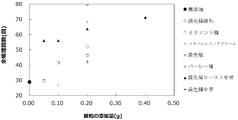
- FIG. 1 is a graph showing the relationship between the amount of fine particles added and the total number of smoke absorptions. It can be confirmed from FIG.
- the fine particles having a high effect generally had an ash content of 16% or more and an apparent density of 0.5 g / cm 3 or less.
- a specific example is a granule consisting of Burley seeds and midbones. High ash fraction fines are advantageous for ash formation, and the apparent density is expected to be advantageous for maintaining the apparent volume of ash after combustion of the powder. In other words, the lower the apparent density, the more advantageous the added volume in the same amount, and the larger the apparent volume of ash formed after combustion is expected to form a stronger lid-like ash layer. Burley species and midbones are thought to be highly effective because they have many internal voids and are advantageous for the formation of ash.
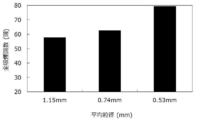
- Fig. 2 shows a graph showing the relationship between the average particle size of fine particles and the total number of smoke absorption. It can be confirmed that the smaller the average particle size, the higher the effect. By adding finer particles, it is expected that the effect of improving the dispersibility over the whole time, filling the gaps between the times, or the effect of burning quickly when receiving heat with a small heat capacity is expected.
- the tobacco material of the present invention can be used for pipes, smoke pipes (xels), picks and the like.
Landscapes
- Manufacture Of Tobacco Products (AREA)
Abstract
パイプのような火皿を有する喫煙具に使用するたばこ材料に関して、喫煙開始から終了まで燃焼を持続させることができるたばこ材料を提供することを目的とする。長辺が0.03mm~30mm、短辺が0.03mm~2mm、見掛け密度が0.8g/cm3以上、かつ灰分割合が15%以下であるたばこ刻、及び平均粒径が0.01mm以上1.2mm以下、見掛け密度が0.5g/cm3以下、かつ灰分割合が16%以上である、たばこ材料からなる細粒を含み、たばこ刻100質量部に対して、細粒を1.8質量部~15質量部含むたばこ材料が、喫煙開始から終了まで燃焼を持続させることができるたばこ材料となる。
Description
本発明は、パイプのような火皿を有する喫煙具用のたばこ材料に関する。
パイプでの喫煙は、一般的に2回の着火が必要とされている。1回目の着火は燃焼を持続させるための準備として位置づけられており、2回目の着火によって喫煙を楽しむこととなる。また、1回目の着火後にタンパーと呼ばれる喫煙補助具で盛り上がったたばこを押さえて、表面全体を炭化刻で覆うことが燃焼維持に必要とされている。さらに2回目の着火後には、燃焼持続のための言わば「ノウハウ」が必要とされており、「吸う/吐く」の動作を一定のペースで繰り返すことなども行われている。そのため、喫煙時の燃焼維持が困難であることから、パイプは初心者には取り扱いが難しい商材となっているのが現状である。
パイプでの燃焼を持続する方法として、ボウルトップに被せる蓋のようなパイプ用部品を使用することが提案されている(例えば、特許文献1参照。)。このパイプ用部品によって、火が消え難くなったり、指がやけどし難くなったりすることが報告されているが、このパイプ用部品は着火する際の邪魔になるものと考えられる。
一方、燃焼維持目的ではないものの、たばこ材料にアルコール等の分散媒体を配合すること(例えば、特許文献2参照。)や細かく粉砕したコーヒー豆の微粒子を混入・添加すること(例えば、特許文献3参照。)等も提案されている。これらの技術は、味の付与を目的としたものであり、燃焼持続性向上の効果を期待できるものではない。
一方、燃焼維持目的ではないものの、たばこ材料にアルコール等の分散媒体を配合すること(例えば、特許文献2参照。)や細かく粉砕したコーヒー豆の微粒子を混入・添加すること(例えば、特許文献3参照。)等も提案されている。これらの技術は、味の付与を目的としたものであり、燃焼持続性向上の効果を期待できるものではない。
本発明は、パイプのような火皿を有する喫煙具に使用するたばこ材料に関して、喫煙開始から終了まで燃焼を持続させることができるたばこ材料を提供することを目的とする。
本発明者らは、前述の課題を解決すべく鋭意検討を重ねた結果、特定の条件を満たすたばこ刻と細粒を組み合わせることにより、喫煙開始から終了まで燃焼を持続させることができるたばこ材料となることを見出し、本発明を完成させた。
即ち、本発明は以下の通りである。
即ち、本発明は以下の通りである。
<1> 火皿を有する喫煙具用のたばこ材料であって、長辺が0.03mm~30mm、短辺が0.03mm~2mm、見掛け密度が0.8g/cm3以上、かつ灰分割合が15%以下であるたばこ刻、及び平均粒径が0.01mm以上1.2mm以下、見掛け密度が0.5g/cm3以下、かつ灰分割合が16%以上である、たばこ材料からなる細粒を含み、前記たばこ刻100質量部に対して、前記細粒を1.8質量部~15質量部含むことを特徴とする、たばこ材料。
<2> 前記細粒が、バーレー種の葉又は中骨からなるものである、<1>に記載のたばこ材料。
<3> 無機填料を含む、<1>又は<2>に記載のたばこ材料。
<2> 前記細粒が、バーレー種の葉又は中骨からなるものである、<1>に記載のたばこ材料。
<3> 無機填料を含む、<1>又は<2>に記載のたばこ材料。
本発明によれば、パイプのような火皿を有する喫煙具に使用するたばこ材料に関して、喫煙開始から終了まで燃焼を持続させることができるたばこ材料を提供することができる。
本発明の詳細を説明するに当たり、具体例を挙げて説明するが、本発明の趣旨を逸脱しない限り以下の内容に限定されるものではなく、適宜変更して実施することができる。
<たばこ材料>
本発明の一態様であるたばこ材料(以下、「本発明のたばこ材料」と略す場合がある。)は、火皿を有する喫煙具用のたばこ材料である。そして、長辺が0.03mm~30mm、短辺が0.03mm~2mm、見掛け密度が0.8g/cm3以上、かつ灰分割合が15%以下であるたばこ刻(以下、「たばこ刻」と略す場合がある。)、及び平均粒径が0.01mm以上1.2mm以下、見掛け密度が0.5g/cm3以下、かつ灰分割合が16%以上である、たばこ材料からなる細粒(以下、「細粒」と略す場合がある。)を含み、たばこ刻100質量部に対して、細粒を1.8質量部~15質量部含むことを特徴とする。
本発明者らは、パイプ等の喫煙において燃焼が持続しない原因を追究した結果、燃焼している刻層の上面表層と側面からの熱損失が大きいことが原因であり、熱損失によって着火刻の燃焼温度が低下して燃焼が停止してしまうことを明らかとしている。そして、熱損失を抑える保温層が上表面に自動的に形成するようなたばこ材料とすることで、喫煙補助具を用いずに、喫煙開始から終了まで燃焼を持続させることができることを見出したのである。なお、この保温層は、前述した「細粒」が燃焼して灰になることによって形成することになるが、この層を上表面にうまく形成するためには、「たばこ刻」と「細粒」の密度や含有量のバランスが重要であり、前述した条件を満たす「たばこ刻」と「細粒」を組み合わせることによって、燃焼持続性に優れたたばこ材料となるのである。
以下、「火皿を有する喫煙具」、「たばこ刻」、「細粒」等について詳細に説明する。
本発明の一態様であるたばこ材料(以下、「本発明のたばこ材料」と略す場合がある。)は、火皿を有する喫煙具用のたばこ材料である。そして、長辺が0.03mm~30mm、短辺が0.03mm~2mm、見掛け密度が0.8g/cm3以上、かつ灰分割合が15%以下であるたばこ刻(以下、「たばこ刻」と略す場合がある。)、及び平均粒径が0.01mm以上1.2mm以下、見掛け密度が0.5g/cm3以下、かつ灰分割合が16%以上である、たばこ材料からなる細粒(以下、「細粒」と略す場合がある。)を含み、たばこ刻100質量部に対して、細粒を1.8質量部~15質量部含むことを特徴とする。
本発明者らは、パイプ等の喫煙において燃焼が持続しない原因を追究した結果、燃焼している刻層の上面表層と側面からの熱損失が大きいことが原因であり、熱損失によって着火刻の燃焼温度が低下して燃焼が停止してしまうことを明らかとしている。そして、熱損失を抑える保温層が上表面に自動的に形成するようなたばこ材料とすることで、喫煙補助具を用いずに、喫煙開始から終了まで燃焼を持続させることができることを見出したのである。なお、この保温層は、前述した「細粒」が燃焼して灰になることによって形成することになるが、この層を上表面にうまく形成するためには、「たばこ刻」と「細粒」の密度や含有量のバランスが重要であり、前述した条件を満たす「たばこ刻」と「細粒」を組み合わせることによって、燃焼持続性に優れたたばこ材料となるのである。
以下、「火皿を有する喫煙具」、「たばこ刻」、「細粒」等について詳細に説明する。
本発明のたばこ材料は、火皿を有する喫煙具用のたばこ材料であるが、火皿を有する喫煙具の具体的種類は特に限定されず、目的に応じて適宜選択することができる。火皿を有する喫煙具は、火皿上部からの熱損失が大きい点で共通しており、本発明のたばこ材料を好適に利用することができる。
火皿を有する喫煙具としては、パイプ、煙管(キセル)、ピックス等が挙げられる。
火皿を有する喫煙具としては、パイプ、煙管(キセル)、ピックス等が挙げられる。
たばこ刻は、長辺が0.03mm~30mm、短辺が0.03mm~2mm、見掛け密度が0.8g/cm3以上、かつ灰分割合が15%以下であるが、たばこ刻の具体的種類や物性の具体的数値は特に限定されず、目的に応じて適宜選択することができる。以下、具体例を挙げて説明する。
たばこ刻の種類としては、黄色種、バーレー種、在来種、再生たばこ等が挙げられ、また使用する部位としては、葉(緩和刻)、茎、葉脈(中骨刻)、根、花等が挙げられる。
たばこ刻の長辺は、好ましくは0.03mm以上、より好ましくは0.05mm以上であり、好ましくは30mm以下、より好ましくは20mm以下である。
たばこ刻の短辺は、好ましくは0.03mm以上、より好ましくは0.05mm以上であり、好ましくは2mm以下、より好ましくは1.5mm以下である。
たばこ刻の見掛け密度は、好ましくは0.8g/cm3以上、より好ましくは1.0g/cm3以上であり、通常1.5g/cm3以下である。なお、たばこ刻の見掛け密度は、水銀ポロシメーターを用い、得られた結果を解析することによって算出することができる。
たばこ刻の灰分割合は、好ましくは15%以下、より好ましくは10%以下である。なお、たばこ刻の灰分割合は、例えば後述する方法で算出することができる。
上記範囲内であると、燃焼持続性が優れたたばこ材料が得られ易くなる。上記範囲を満たさないたばこ刻、つまりは見掛け密度が低く、灰分割合の多いたばこ刻は、煙量感が少なく、喫味は薄く雑味が多いため使用に適さない。また見掛け密度の低い刻は、添加量に対して添加する体積が増え、パイプ上部からの空気(酸素供給)供給が不利となり燃焼持続性を低減させることや、通気抵抗が高くなるなどの問題が生じる。
たばこ刻の種類としては、黄色種、バーレー種、在来種、再生たばこ等が挙げられ、また使用する部位としては、葉(緩和刻)、茎、葉脈(中骨刻)、根、花等が挙げられる。
たばこ刻の長辺は、好ましくは0.03mm以上、より好ましくは0.05mm以上であり、好ましくは30mm以下、より好ましくは20mm以下である。
たばこ刻の短辺は、好ましくは0.03mm以上、より好ましくは0.05mm以上であり、好ましくは2mm以下、より好ましくは1.5mm以下である。
たばこ刻の見掛け密度は、好ましくは0.8g/cm3以上、より好ましくは1.0g/cm3以上であり、通常1.5g/cm3以下である。なお、たばこ刻の見掛け密度は、水銀ポロシメーターを用い、得られた結果を解析することによって算出することができる。
たばこ刻の灰分割合は、好ましくは15%以下、より好ましくは10%以下である。なお、たばこ刻の灰分割合は、例えば後述する方法で算出することができる。
上記範囲内であると、燃焼持続性が優れたたばこ材料が得られ易くなる。上記範囲を満たさないたばこ刻、つまりは見掛け密度が低く、灰分割合の多いたばこ刻は、煙量感が少なく、喫味は薄く雑味が多いため使用に適さない。また見掛け密度の低い刻は、添加量に対して添加する体積が増え、パイプ上部からの空気(酸素供給)供給が不利となり燃焼持続性を低減させることや、通気抵抗が高くなるなどの問題が生じる。
細粒は、たばこ材料からなり、平均粒径が0.01mm以上1.2mm以下、見掛け密度が0.5g/cm3以下、かつ灰分割合が16%以上であるが、たばこ材料の具体的種類や物性の具体的数値は特に限定されず、目的に応じて適宜選択することができる。以下、具体例を挙げて説明する。
細粒のたばこ材料の種類としては、たばこ刻と同様に、黄色種、バーレー種、在来種、再生たばこ等が挙げられ、また使用する部位としては、葉(緩和刻)、茎、葉脈(中骨刻)、根、花等が挙げられる。
細粒の平均粒径は、好ましくは0.6mm以下、より好ましくは0.5mm以下であり、通常0.01mm以上である。0.01mm未満の細粒は、ハンドリング上の問題(細粒が舞うなど)や吸いやすさ(通気抵抗)へ影響を与えるため適さない。なお、平均粒径は、画像式粒度分布測定装置を用い、粒子の投影断面積から求めた球相当径(体積基準)の平均値として算出することができる。また、平均粒径が1.2mm以下の細粒は、市販の粉砕機やふるいを利用することによって得ることができる。
細粒の見掛け密度は、好ましくは0.35g/cm3以下であり、通常0.2g/cm3以上である。なお、細粒の見掛け密度は、たばこ刻と同様に水銀ポロシメーターを用い、得られた結果を解析することによって算出することができる。
細粒の灰分割合は、好ましくは19%以上であり、通常30%以下である。なお、細粒の灰分割合は、例えば後述する方法で算出することができる。
細粒のたばこ材料の種類としては、たばこ刻と同様に、黄色種、バーレー種、在来種、再生たばこ等が挙げられ、また使用する部位としては、葉(緩和刻)、茎、葉脈(中骨刻)、根、花等が挙げられる。
細粒の平均粒径は、好ましくは0.6mm以下、より好ましくは0.5mm以下であり、通常0.01mm以上である。0.01mm未満の細粒は、ハンドリング上の問題(細粒が舞うなど)や吸いやすさ(通気抵抗)へ影響を与えるため適さない。なお、平均粒径は、画像式粒度分布測定装置を用い、粒子の投影断面積から求めた球相当径(体積基準)の平均値として算出することができる。また、平均粒径が1.2mm以下の細粒は、市販の粉砕機やふるいを利用することによって得ることができる。
細粒の見掛け密度は、好ましくは0.35g/cm3以下であり、通常0.2g/cm3以上である。なお、細粒の見掛け密度は、たばこ刻と同様に水銀ポロシメーターを用い、得られた結果を解析することによって算出することができる。
細粒の灰分割合は、好ましくは19%以上であり、通常30%以下である。なお、細粒の灰分割合は、例えば後述する方法で算出することができる。
本発明のたばこ材料は、たばこ刻100質量部に対して、細粒を1.8質量部~15質量部含むことを特徴とするが、細粒の具体的含有量は特に限定されず、目的に応じて適宜選択することができる。以下、具体例を挙げて説明する。
細粒の含有量は、たばこ刻100質量部に対して、好ましくは3.0質量部以上であり、好ましくは10質量部以下である。細粒の含有量が15質量部以上になると、火皿に充填したたばこ材料の上部表面に細粒が露出しやすくなり、喫煙時に舞う等の問題が生じやすくなる。上記範囲内であれば、細粒の舞い上がりを抑制できるとともに、燃焼持続性が優れたたばこ材料が得られ易くなる。
細粒の含有量は、たばこ刻100質量部に対して、好ましくは3.0質量部以上であり、好ましくは10質量部以下である。細粒の含有量が15質量部以上になると、火皿に充填したたばこ材料の上部表面に細粒が露出しやすくなり、喫煙時に舞う等の問題が生じやすくなる。上記範囲内であれば、細粒の舞い上がりを抑制できるとともに、燃焼持続性が優れたたばこ材料が得られ易くなる。
本発明のたばこ材料は、前述のたばこ刻と細粒を含むものであれば、その他については特に限定されないが、無機填料を含むことが好ましい。無機填料を含むことにより、燃焼性及び燃焼持続性に特に優れたたばこ材料が得られることになる。
無機填料としては、アルカリ金属元素(Li、Na、K)、アルカリ土類金属元素(Mg、Ca)、第13族元素(Al、Sn)、鉄族元素(Fe、Co、Ni)、貴金属元素等の炭酸塩、炭化物、酸化物、水素化合物、オキソ酸、水酸化物、酢酸塩等が挙げられる。具体的なものとしては、炭酸カルシウム、炭酸マグネシウム、炭酸ナトリウム、酸化チタン、酸化カルシウム、酸化マグネシウム、酸化鉄、シリカなどが挙げられる。
無機填料の平均粒径は、通常1.0mm以下、好ましくは0.6mm以下、より好ましくは0.1mm以下であり、通常0.0001mm以上、好ましくは0.001mm以上、より好ましくは0.01mm以上である。
無機填料の見掛け密度は、通常5g/cm3以下、好ましくは3g/cm3以下、より好ましくは2.5g/cm3以下であり、通常0.1g/cm3以上、好ましくは0.5g/cm3以上、より好ましくは1g/cm3以上である。
無機填料の灰分割合は、通常90%以下、好ましくは95%以下、より好ましくは99.9%以下であり、通常50%以上、好ましくは60%以上、より好ましくは70%以上である。
無機填料としては、アルカリ金属元素(Li、Na、K)、アルカリ土類金属元素(Mg、Ca)、第13族元素(Al、Sn)、鉄族元素(Fe、Co、Ni)、貴金属元素等の炭酸塩、炭化物、酸化物、水素化合物、オキソ酸、水酸化物、酢酸塩等が挙げられる。具体的なものとしては、炭酸カルシウム、炭酸マグネシウム、炭酸ナトリウム、酸化チタン、酸化カルシウム、酸化マグネシウム、酸化鉄、シリカなどが挙げられる。
無機填料の平均粒径は、通常1.0mm以下、好ましくは0.6mm以下、より好ましくは0.1mm以下であり、通常0.0001mm以上、好ましくは0.001mm以上、より好ましくは0.01mm以上である。
無機填料の見掛け密度は、通常5g/cm3以下、好ましくは3g/cm3以下、より好ましくは2.5g/cm3以下であり、通常0.1g/cm3以上、好ましくは0.5g/cm3以上、より好ましくは1g/cm3以上である。
無機填料の灰分割合は、通常90%以下、好ましくは95%以下、より好ましくは99.9%以下であり、通常50%以上、好ましくは60%以上、より好ましくは70%以上である。
無機填料の含有量は、たばこ刻100質量部に対して、通常0.7質量部以上、好ましくは0.9質量部以上、より好ましくは1.8質量部以上であり、通常30質量部以下、好ましくは15質量部以下、より好ましくは10質量部以下である。
以下に実施例を挙げて本発明をさらに具体的に説明するが、本発明の趣旨を逸脱しない限り適宜変更することができる。
<実施例1~9、比較例1~8>
長辺が0.03mm~30mm、短辺が0.03mm~2mmからなる大きさの刻から構成され、見掛け密度が1.0g/cm3、かつ灰分割合が10%であるたばこ刻2.75gと、表1に示す細粒をそれぞれ準備し、細粒が全体に分散するようにこれらを手で混ぜ合わせてたばこ材料を作製した。本実施例において使用した中骨とは、例えばWO2015/098743Aに示される処理を施された中骨を指し、ロースト中骨は、例えばWO2014/118988Aに示される処理を施された中骨を指す。バーレー種、黄色種およびオリエント種は、例えばたばこ原料区分の判別方法 WO2013/132622Aに記載の方法にて、判別することができる。
なお、細粒は、家庭用ミルを用いて粉砕後、ふるい(AS200,Retsch社製,条件:amplitude-1.5mm/“g”)にて2分間振動させ、ふるい目径0.5mmを通過したものを使用した。実施例8及び9は、ふるい目径を変更し、平均粒径が大きいものを作製した(ふるい目径は0.5~0.7mm及び0.7mm以上。)。
また、見掛け密度は、水銀ポロシメーター(Pore-master,Mulvern社製)を用いてヒステリシスを観測し、解析して値を算出した。
平均粒径の測定は、Camsizer(Retsch社製)を用い、粒子の投影断面積から求めた球相当径(体積基準)の平均値を平均粒径とした。
灰分量の測定は、るつぼを用いた重量差により算出した。具体的には、サンプルを350℃まで30分で昇温させた後、45分間加熱し、その後30分かけて500℃まで昇温させ、120分間加熱した。その後、デシケーター内で1時間放冷し、るつぼの重量差を測定して値を算出した。
長辺が0.03mm~30mm、短辺が0.03mm~2mmからなる大きさの刻から構成され、見掛け密度が1.0g/cm3、かつ灰分割合が10%であるたばこ刻2.75gと、表1に示す細粒をそれぞれ準備し、細粒が全体に分散するようにこれらを手で混ぜ合わせてたばこ材料を作製した。本実施例において使用した中骨とは、例えばWO2015/098743Aに示される処理を施された中骨を指し、ロースト中骨は、例えばWO2014/118988Aに示される処理を施された中骨を指す。バーレー種、黄色種およびオリエント種は、例えばたばこ原料区分の判別方法 WO2013/132622Aに記載の方法にて、判別することができる。
なお、細粒は、家庭用ミルを用いて粉砕後、ふるい(AS200,Retsch社製,条件:amplitude-1.5mm/“g”)にて2分間振動させ、ふるい目径0.5mmを通過したものを使用した。実施例8及び9は、ふるい目径を変更し、平均粒径が大きいものを作製した(ふるい目径は0.5~0.7mm及び0.7mm以上。)。
また、見掛け密度は、水銀ポロシメーター(Pore-master,Mulvern社製)を用いてヒステリシスを観測し、解析して値を算出した。
平均粒径の測定は、Camsizer(Retsch社製)を用い、粒子の投影断面積から求めた球相当径(体積基準)の平均値を平均粒径とした。
灰分量の測定は、るつぼを用いた重量差により算出した。具体的には、サンプルを350℃まで30分で昇温させた後、45分間加熱し、その後30分かけて500℃まで昇温させ、120分間加熱した。その後、デシケーター内で1時間放冷し、るつぼの重量差を測定して値を算出した。
市販されているコーンパイプ(ミズーリメシャム社:コーンパイプ ストレートタイプ)に、このたばこ材料を充填し、喫煙機(Borgwaldt,RM-26)を用いて燃焼性の確認を実施した。

<燃焼持続性の評価>
燃焼性の評価方法は、以下の(1)~(7)の手順により行った。
(1)実験用ライター(Borgwaldt,Electronic Lighter R29)を用いて、十分加熱された状態で10秒間コーンパイプの上面を加熱する。
(2)加熱を10秒間実施した後、55ml/2sの条件で機械喫煙を行う。
(3)8秒間隔で吸煙を継続させ、コーンパイプ上部から立ち上る煙がなくなるまでを目視観察する。
(4)立ち上る煙がなくなる吸煙を第1着火の最終吸煙と定義する。
(5)その後、同様の条件で再着火を行い、立ち上る煙および煙道管内の煙がなくなるまで目視観察する。
(6)立ち上る煙および煙道管内の煙がなくなる吸煙を第2着火の最終吸煙と定義する。
(7)(1)~(6)を3回以上繰り返し、持続吸煙回数の平均値を解析する。
第1着火の持続吸煙回数及び第2着火の持続吸煙回数の合計吸煙回数を燃焼持続性の指標とし、合計吸煙回数が50回を超えた場合、燃焼持続性が向上したものとした。50回以上の合計吸煙回数は、人が喫煙した場合においても明らかに向上したことが体感できるものと言える。図1に細粒の添加量と全吸煙回数の関係を表したグラフを示す。
図1から細粒の灰分割合が高く、また見掛け密度が低いほど、燃焼持続性が高いことが確認できる。本実施例において、効果が高い細粒は概ね灰分割合が16%以上であり、見掛け密度が0.5g/cm3以下であった。具体的な実施例は、バーレー種および中骨からなる細粒である。高灰分割合の細粒が、灰の形成には有利であり、また見掛け密度は粉体の燃焼後の灰の見掛け体積維持に有利と予想される。つまり見掛け密度が低いほど同量における添加体積は有利となり、燃焼後に形成される灰の見掛け体積が多くなることで、より蓋状の強化な灰の層を形成すると予想される。バーレー種および中骨は、内部の空隙が多く、灰の形成には有利であったため、効果が高いと考えられる。
燃焼性の評価方法は、以下の(1)~(7)の手順により行った。
(1)実験用ライター(Borgwaldt,Electronic Lighter R29)を用いて、十分加熱された状態で10秒間コーンパイプの上面を加熱する。
(2)加熱を10秒間実施した後、55ml/2sの条件で機械喫煙を行う。
(3)8秒間隔で吸煙を継続させ、コーンパイプ上部から立ち上る煙がなくなるまでを目視観察する。
(4)立ち上る煙がなくなる吸煙を第1着火の最終吸煙と定義する。
(5)その後、同様の条件で再着火を行い、立ち上る煙および煙道管内の煙がなくなるまで目視観察する。
(6)立ち上る煙および煙道管内の煙がなくなる吸煙を第2着火の最終吸煙と定義する。
(7)(1)~(6)を3回以上繰り返し、持続吸煙回数の平均値を解析する。
第1着火の持続吸煙回数及び第2着火の持続吸煙回数の合計吸煙回数を燃焼持続性の指標とし、合計吸煙回数が50回を超えた場合、燃焼持続性が向上したものとした。50回以上の合計吸煙回数は、人が喫煙した場合においても明らかに向上したことが体感できるものと言える。図1に細粒の添加量と全吸煙回数の関係を表したグラフを示す。
図1から細粒の灰分割合が高く、また見掛け密度が低いほど、燃焼持続性が高いことが確認できる。本実施例において、効果が高い細粒は概ね灰分割合が16%以上であり、見掛け密度が0.5g/cm3以下であった。具体的な実施例は、バーレー種および中骨からなる細粒である。高灰分割合の細粒が、灰の形成には有利であり、また見掛け密度は粉体の燃焼後の灰の見掛け体積維持に有利と予想される。つまり見掛け密度が低いほど同量における添加体積は有利となり、燃焼後に形成される灰の見掛け体積が多くなることで、より蓋状の強化な灰の層を形成すると予想される。バーレー種および中骨は、内部の空隙が多く、灰の形成には有利であったため、効果が高いと考えられる。
図2に細粒の平均粒径と全吸煙回数の関係を表したグラフを示す。平均粒径が小さいほど効果が高い結果が得られていることが確認できる。より細粒を添加することで、刻全体への分散性の向上や刻間の隙間を埋める効果または熱容量が小さく熱を受けた際にすばやく燃焼する効果がより発現したためと予想される。
本発明のたばこ材料は、パイプ、煙管(キセル)、ピックス等に使用することができる。
Claims (3)
- 火皿を有する喫煙具用のたばこ材料であって、
長辺が0.03mm~30mm、短辺が0.03mm~2mm、見掛け密度が0.8g/cm3以上、かつ灰分割合が15%以下であるたばこ刻、及び
平均粒径が0.01mm以上1.2mm以下、見掛け密度が0.5g/cm3以下、かつ灰分割合が16%以上である、たばこ材料からなる細粒を含み、
前記たばこ刻100質量部に対して、前記細粒を1.8質量部~15質量部含むことを特徴とする、たばこ材料。 - 前記細粒が、バーレー種の葉又は中骨からなるものである、請求項1に記載のたばこ材料。
- 無機填料を含む、請求項1又は2に記載のたばこ材料。
Priority Applications (1)
| Application Number | Priority Date | Filing Date | Title |
|---|---|---|---|
| PCT/JP2016/052472 WO2017130347A1 (ja) | 2016-01-28 | 2016-01-28 | 火皿を有する喫煙具用のたばこ材料 |
Applications Claiming Priority (1)
| Application Number | Priority Date | Filing Date | Title |
|---|---|---|---|
| PCT/JP2016/052472 WO2017130347A1 (ja) | 2016-01-28 | 2016-01-28 | 火皿を有する喫煙具用のたばこ材料 |
Publications (1)
| Publication Number | Publication Date |
|---|---|
| WO2017130347A1 true WO2017130347A1 (ja) | 2017-08-03 |
Family
ID=59397662
Family Applications (1)
| Application Number | Title | Priority Date | Filing Date |
|---|---|---|---|
| PCT/JP2016/052472 Ceased WO2017130347A1 (ja) | 2016-01-28 | 2016-01-28 | 火皿を有する喫煙具用のたばこ材料 |
Country Status (1)
| Country | Link |
|---|---|
| WO (1) | WO2017130347A1 (ja) |
Cited By (2)
| Publication number | Priority date | Publication date | Assignee | Title |
|---|---|---|---|---|
| CN108477662A (zh) * | 2018-04-11 | 2018-09-04 | 湖北中烟工业有限责任公司 | 一种白肋烟特色再造烟叶的制造工艺 |
| US11276589B2 (en) | 2016-09-29 | 2022-03-15 | Ev Group E. Thallner Gmbh | Device and method for bonding of two substrates |
Citations (4)
| Publication number | Priority date | Publication date | Assignee | Title |
|---|---|---|---|---|
| JPS51115161A (en) * | 1975-04-03 | 1976-10-09 | Nippon Tokushiyu Gijiyutsu Ken | Cooled smoke tasteeadjustable cigarette holder and smoking pipe |
| JP2007209302A (ja) * | 2006-02-13 | 2007-08-23 | Japan Tobacco Inc | 難燃性タバコ刻の製造方法 |
| JP2013544523A (ja) * | 2010-12-01 | 2013-12-19 | アール・ジエイ・レイノルズ・タバコ・カンパニー | 無煙タバコ香錠および無煙タバコ製品を形成する方法 |
| WO2014185103A1 (ja) * | 2013-05-13 | 2014-11-20 | 日本たばこ産業株式会社 | たばこ材料、該たばこ材料が添加されたたばこ製品及びたばこ材料の製造方法 |
-
2016
- 2016-01-28 WO PCT/JP2016/052472 patent/WO2017130347A1/ja not_active Ceased
Patent Citations (4)
| Publication number | Priority date | Publication date | Assignee | Title |
|---|---|---|---|---|
| JPS51115161A (en) * | 1975-04-03 | 1976-10-09 | Nippon Tokushiyu Gijiyutsu Ken | Cooled smoke tasteeadjustable cigarette holder and smoking pipe |
| JP2007209302A (ja) * | 2006-02-13 | 2007-08-23 | Japan Tobacco Inc | 難燃性タバコ刻の製造方法 |
| JP2013544523A (ja) * | 2010-12-01 | 2013-12-19 | アール・ジエイ・レイノルズ・タバコ・カンパニー | 無煙タバコ香錠および無煙タバコ製品を形成する方法 |
| WO2014185103A1 (ja) * | 2013-05-13 | 2014-11-20 | 日本たばこ産業株式会社 | たばこ材料、該たばこ材料が添加されたたばこ製品及びたばこ材料の製造方法 |
Cited By (4)
| Publication number | Priority date | Publication date | Assignee | Title |
|---|---|---|---|---|
| US11276589B2 (en) | 2016-09-29 | 2022-03-15 | Ev Group E. Thallner Gmbh | Device and method for bonding of two substrates |
| US11562912B2 (en) | 2016-09-29 | 2023-01-24 | Ev Group E. Thallner Gmbh | Device and method for bonding of two substrates |
| CN108477662A (zh) * | 2018-04-11 | 2018-09-04 | 湖北中烟工业有限责任公司 | 一种白肋烟特色再造烟叶的制造工艺 |
| CN108477662B (zh) * | 2018-04-11 | 2020-07-24 | 湖北中烟工业有限责任公司 | 一种白肋烟特色再造烟叶的制造工艺 |
Similar Documents
| Publication | Publication Date | Title |
|---|---|---|
| JP4759523B2 (ja) | 非燃焼型喫煙物品用炭素質熱源組成物 | |
| JP6838767B2 (ja) | 揮発性材料及びカプセル | |
| KR102388942B1 (ko) | 비연소형 가열 흡연 물품용의 담배 충전물 | |
| MXPA04002927A (es) | Productor de material de plantas de tabaco y menta. | |
| EP1501382A1 (en) | Improvements relating to smoking articles and smokable filler materials therefor | |
| CN108835714A (zh) | 两用型卷烟及其烟草填充物 | |
| JP2023500735A (ja) | 電子タバコのタバコスティック用発煙基質及びその製造方法 | |
| EP1014811A1 (en) | Smokable filler material for smoking articles | |
| JP6685398B2 (ja) | 非燃焼型加熱喫煙物品用のたばこ充填物 | |
| JP4504921B2 (ja) | 改良された低延焼性のシガレット | |
| WO2017130347A1 (ja) | 火皿を有する喫煙具用のたばこ材料 | |
| JP7688622B2 (ja) | 中鎖トリグリセリドを含むエアロゾル生成たばこ含有組成物 | |
| JP2014500035A (ja) | 裁断圧延茎を含むタバコ・カット・フィラー | |
| KR101345117B1 (ko) | 바이오-그린 필터 | |
| WO2001048316A1 (en) | Wrapping paper for cigarette and cigarette | |
| WO2001048318A1 (en) | Wrapping paper for cigarette reduced in scattering property of ash therefrom | |
| JPWO2002054892A1 (ja) | シガレット | |
| CA1060195A (en) | Expanded cereal compositions for smoking | |
| KR102715379B1 (ko) | 흡연 물품을 위한 포장지 | |
| JPWO2003077688A1 (ja) | 副流煙量が低減されたシガレット | |
| CN102894481A (zh) | 一种带阻燃功能的多层盘纸过滤嘴卷烟 | |
| JP6999554B2 (ja) | タバコ材料の高圧低温殺菌 | |
| JPH07502402A (ja) | 複数回喫煙可能なシガレットシステム | |
| US3964495A (en) | Smoking compositions | |
| Lu et al. | Effects of threshing tobacco slice size on the quality of fine cigarette. |
Legal Events
| Date | Code | Title | Description |
|---|---|---|---|
| 121 | Ep: the epo has been informed by wipo that ep was designated in this application |
Ref document number: 16887934 Country of ref document: EP Kind code of ref document: A1 |
|
| NENP | Non-entry into the national phase |
Ref country code: DE |
|
| 122 | Ep: pct application non-entry in european phase |
Ref document number: 16887934 Country of ref document: EP Kind code of ref document: A1 |
|
| NENP | Non-entry into the national phase |
Ref country code: JP |