WO2017126527A1 - 近赤外線吸収組成物、近赤外線カットフィルタの製造方法、近赤外線カットフィルタ、固体撮像素子、カメラモジュールおよび赤外線センサ - Google Patents
近赤外線吸収組成物、近赤外線カットフィルタの製造方法、近赤外線カットフィルタ、固体撮像素子、カメラモジュールおよび赤外線センサ Download PDFInfo
- Publication number
- WO2017126527A1 WO2017126527A1 PCT/JP2017/001480 JP2017001480W WO2017126527A1 WO 2017126527 A1 WO2017126527 A1 WO 2017126527A1 JP 2017001480 W JP2017001480 W JP 2017001480W WO 2017126527 A1 WO2017126527 A1 WO 2017126527A1
- Authority
- WO
- WIPO (PCT)
- Prior art keywords
- group
- compound
- infrared
- copper
- cut filter
- Prior art date
- Legal status (The legal status is an assumption and is not a legal conclusion. Google has not performed a legal analysis and makes no representation as to the accuracy of the status listed.)
- Ceased
Links
- 0 CCC(C)(*=I)C(OIIN*)=O Chemical compound CCC(C)(*=I)C(OIIN*)=O 0.000 description 5
- FODFRQFRJYJPSO-UHFFFAOYSA-N CC(C[n]1nc(C)cc1C)N Chemical compound CC(C[n]1nc(C)cc1C)N FODFRQFRJYJPSO-UHFFFAOYSA-N 0.000 description 1
- WMKLWUCIBSCFNP-UHFFFAOYSA-N CCCCC(CC)C(N(Cc1ccccn1)Cc1ccccn1)=O Chemical compound CCCCC(CC)C(N(Cc1ccccn1)Cc1ccccn1)=O WMKLWUCIBSCFNP-UHFFFAOYSA-N 0.000 description 1
- MGYGVVVDLZIDTB-UHFFFAOYSA-N CN(C)Cc1nc(CN(C)C)ccc1 Chemical compound CN(C)Cc1nc(CN(C)C)ccc1 MGYGVVVDLZIDTB-UHFFFAOYSA-N 0.000 description 1
- LGQXVRIHIPWAFZ-UHFFFAOYSA-N Cc1cc(C)n[n]1C[n]1nc(C)cc1C Chemical compound Cc1cc(C)n[n]1C[n]1nc(C)cc1C LGQXVRIHIPWAFZ-UHFFFAOYSA-N 0.000 description 1
- PZROUOOSVHHWDV-UHFFFAOYSA-N Cc1cc(C)n[n]1Cc1cccc(C[n]2nc(C)cc2C)n1 Chemical compound Cc1cc(C)n[n]1Cc1cccc(C[n]2nc(C)cc2C)n1 PZROUOOSVHHWDV-UHFFFAOYSA-N 0.000 description 1
- XHEIQSYXZCYRCG-UHFFFAOYSA-N Cc1cccc(Oc2nc(C)ccc2)n1 Chemical compound Cc1cccc(Oc2nc(C)ccc2)n1 XHEIQSYXZCYRCG-UHFFFAOYSA-N 0.000 description 1
- ROFVEXUMMXZLPA-UHFFFAOYSA-N c1ccnc(-c2ccccn2)c1 Chemical compound c1ccnc(-c2ccccn2)c1 ROFVEXUMMXZLPA-UHFFFAOYSA-N 0.000 description 1
Images
Classifications
-
- C—CHEMISTRY; METALLURGY
- C09—DYES; PAINTS; POLISHES; NATURAL RESINS; ADHESIVES; COMPOSITIONS NOT OTHERWISE PROVIDED FOR; APPLICATIONS OF MATERIALS NOT OTHERWISE PROVIDED FOR
- C09K—MATERIALS FOR MISCELLANEOUS APPLICATIONS, NOT PROVIDED FOR ELSEWHERE
- C09K3/00—Materials not provided for elsewhere
-
- G—PHYSICS
- G02—OPTICS
- G02B—OPTICAL ELEMENTS, SYSTEMS OR APPARATUS
- G02B5/00—Optical elements other than lenses
- G02B5/20—Filters
- G02B5/22—Absorbing filters
-
- H—ELECTRICITY
- H10—SEMICONDUCTOR DEVICES; ELECTRIC SOLID-STATE DEVICES NOT OTHERWISE PROVIDED FOR
- H10F—INORGANIC SEMICONDUCTOR DEVICES SENSITIVE TO INFRARED RADIATION, LIGHT, ELECTROMAGNETIC RADIATION OF SHORTER WAVELENGTH OR CORPUSCULAR RADIATION
- H10F99/00—Subject matter not provided for in other groups of this subclass
Definitions
- the present invention relates to a near-infrared absorbing composition, a method for producing a near-infrared cut filter, a near-infrared cut filter, a solid-state imaging device, a camera module, and an infrared sensor.
- Video cameras, digital still cameras, mobile phones with camera functions, etc. use charge coupled devices (CCD), complementary metal oxide semiconductors (CMOS), etc., which are solid-state imaging devices for color images. Since these solid-state imaging devices use silicon photodiodes having sensitivity to near infrared rays in their light receiving portions, it is necessary to perform visibility correction and often use near-infrared cut filters.
- CCD charge coupled devices
- CMOS complementary metal oxide semiconductors
- a near-infrared cut filter may be manufactured using the composition (near-infrared absorption composition) containing an infrared absorber. It is known that a near-infrared absorbing composition contains a curable compound in addition to an infrared absorber.
- a near-infrared absorbing composition contains a curable compound in addition to an infrared absorber.
- Patent Documents 1 and 2 describe the use of an alkoxysilane compound as a curable compound.
- copper compounds are known as infrared absorbers (see Patent Document 3).
- a near-infrared absorbing composition containing a curable compound that can be cured by a sol-gel method such as an alkoxysilane compound is likely to have low storage stability. Furthermore, it turned out that a haze is easy to produce in the cured film obtained. Moreover, also in the near-infrared absorptive composition described in patent document 1, 2, the storage stability was bad and it was easy to produce haze in the cured film obtained.
- patent document 3 describes using a copper compound as an infrared absorber, it relates to storage stability and haze when a curable compound that can be cured by a sol-gel method such as an alkoxysilane compound is contained. There is no examination or suggestion.
- an object of the present invention is to provide a near-infrared absorbing composition capable of producing a cured film having excellent storage stability and suppressed haze. Moreover, it is providing the manufacturing method of a near-infrared cut filter, a near-infrared cut filter, a solid-state image sensor, a camera module, and an infrared sensor.
- a near-infrared absorbing composition comprising a copper compound, a compound having a partial structure represented by MX, water, and an organic solvent,
- the near-infrared absorbing composition has a water content of 0.01 to 20% by mass;
- M is an atom selected from Si, Ti, Zr and Al
- X is a hydroxy group, alkoxy group, acyloxy group, phosphoryloxy group, sulfonyloxy group, amino group, oxime group
- O C ( R a ) (R b ) is one selected from R a and R b each independently represents a monovalent organic group, and X is O ⁇ C (R a ) (R b ).
- X is bonded to M by an unshared electron pair of the oxygen atom of the carbonyl group.
- the near-infrared absorbing composition according to ⁇ 1>, wherein the compound having a partial structure represented by MX is M is Si.
- the near-infrared absorbing composition according to ⁇ 1> or ⁇ 2>, wherein the compound having a partial structure represented by MX is X is an alkoxy group.
- ⁇ 5> The near-infrared absorbing composition according to any one of ⁇ 1> to ⁇ 4>, wherein the compound having a partial structure represented by MX has a weight average molecular weight of 3000 to 100,000.
- ⁇ 6> The near-infrared absorbing composition according to any one of ⁇ 1> to ⁇ 5>, further comprising a diketone compound.
- diketone compound is a compound represented by the following formula (1); Formula (1)
- R 1 to R 3 each independently represents a hydrogen atom or a substituent.
- ⁇ 8> A method for producing a near-infrared cut filter, comprising a step of forming a near-infrared absorbing composition layer using the near-infrared absorbing composition according to any one of ⁇ 1> to ⁇ 7>.
- ⁇ 9> A near-infrared cut filter using the near-infrared absorbing composition according to any one of ⁇ 1> to ⁇ 7>.
- the near-infrared cut filter according to ⁇ 9> further comprising at least one selected from a dielectric multilayer film and an ultraviolet absorption film.
- a solid-state imaging device having the near-infrared cut filter according to ⁇ 9> or ⁇ 10>.
- ⁇ 12> A camera module having the near-infrared cut filter according to ⁇ 9> or ⁇ 10>.
- ⁇ 13> An infrared sensor having the near-infrared cut filter according to ⁇ 9> or ⁇ 10>.
- a near-infrared absorbing composition capable of producing a cured film having excellent storage stability and suppressed haze.
- a method for manufacturing a near-infrared cut filter, a near-infrared cut filter, a solid-state imaging device, a camera module, and an infrared sensor is a method for manufacturing a near-infrared cut filter, a near-infrared cut filter, a solid-state imaging device, a camera module, and an infrared sensor.
- the notation in which neither substitution nor substitution is described includes a group (atomic group) having a substituent together with a group (atomic group) having no substituent.
- Me in the chemical formula represents a methyl group
- Et represents an ethyl group
- Pr represents a propyl group
- Bu represents a butyl group
- Ph represents a phenyl group.
- near-infrared light refers to light (electromagnetic wave) having a wavelength region of 700 to 2500 nm.
- the total solid content refers to the total mass of components obtained by removing the solvent from all components of the composition.
- a weight average molecular weight and a number average molecular weight are defined as a polystyrene conversion value by a gel permeation chromatography (GPC) measurement.
- the near-infrared absorbing composition of the present invention includes a copper compound, a compound having a partial structure represented by MX, water, and an organic solvent, and the water content is 0.01 to 20% by mass. It is.
- M is an atom selected from Si, Ti, Zr and Al
- X is a hydroxy group, alkoxy group, acyloxy group, phosphoryloxy group, sulfonyloxy group, amino group, oxime group
- O C ( R a ) (R b ) is one selected from R a and R b each independently represents a monovalent organic group, and X is O ⁇ C (R a ) (R b ).
- X is bonded to M by an unshared electron pair of the oxygen atom of the carbonyl group.
- the compound having the partial structure represented by MX (hereinafter also referred to as compound MX) is a compound that cures by hydrolysis and polycondensation reaction. Moreover, since a copper compound is excellent in infrared shielding property and visible transparency, the cured film excellent in infrared shielding property and visible transparency can be manufactured by using a copper compound as an infrared absorber. On the other hand, according to the study by the present inventors, it has been found that the copper compound may function as a catalyst for promoting the curing reaction of the compound MX. For this reason, when a copper compound and the compound MX are used in combination, the storage stability may be lowered. Furthermore, it turned out that the haze of the obtained cured film tends to become large.
- the near-infrared absorbing composition containing the copper compound and the compound MX has excellent storage stability because the water content is 0.01 to 20% by mass.
- a cured film having a small haze can be obtained.
- the reason for this is presumed to be as follows. By setting the content of water in the near-infrared absorbing composition to 0.01 to 20% by mass, the compatibility between the copper compound and other components in the near-infrared absorbing composition is appropriately reduced, and the copper compound is reduced. It is presumed that the storage stability is improved because the compound MX tends to exist outside the reaction system and the catalytic action on the compound MX is reduced.
- the water content of the near-infrared absorbing composition is large, hydrolysis and polycondensation reaction of the compound MX may proceed during storage, and the storage stability may be lowered. It is presumed that the reaction of the compound MX at the time of storage could be suppressed by setting it to not more than%.
- the compatibility with the copper compound and other component in a near-infrared absorption composition will fall, and a copper compound will precipitate easily, and the cured film obtained The haze may increase, but by setting the water content to 20% by mass or less, it was possible to suppress the precipitation of the copper compound and produce a cured film having a small haze.
- the copper compound acts as a polymerization inhibitor for the radical polymerization reaction of the radical polymerizable compound.
- the radical polymerization reaction may not proceed sufficiently, and the durability of the resulting cured film (for example, resistance to resistance) In some cases, solvent resistance, heat resistance, etc.) were insufficient.
- the compound MX sufficiently proceeds with the curing reaction even in the presence of the copper compound, a cured film having excellent durability can also be produced. For this reason, according to this invention, the cured film excellent in durability can be manufactured.
- the near infrared ray absorbing composition of the present invention has a water content of 0.01 to 20% by mass, preferably 0.01 to 10% by mass, and more preferably 0.1 to 1% by mass.
- the amount of water is preferably 0.04 to 80 parts by mass, more preferably 0.04 to 40 parts by mass, and still more preferably 0.4 to 4 parts by mass with respect to 100 parts by mass of the copper compound. Further, 0.04 to 80 parts by mass of water is preferably contained with respect to 100 parts by mass of Compound MX, more preferably 0.04 to 40 parts by mass, and even more preferably 0.4 to 4 parts by mass.
- the amount of water is preferably 0.02 to 40 parts by mass, more preferably 0.02 to 20 parts by mass, and still more preferably 0.2 to 2 parts by mass with respect to 100 parts by mass of the organic solvent.
- the water content in the near-infrared absorbing composition is a value measured by the Karl Fischer method. Specifically, the moisture content of the measurement sample was measured using a Karl Fischer moisture meter (KF-06, manufactured by Mitsubishi Chemical Holdings Corporation), and the water content was measured as moisture content / mass of measurement sample ⁇ 100.
- the near-infrared absorbing composition of the present invention contains a compound having a partial structure represented by MX.
- M is an atom selected from Si, Ti, Zr and Al, and Si, Ti and Zr are preferable, and Si is more preferable.
- Groups and oxime groups are preferred, and alkoxy groups are more preferred.
- R a and R b each independently represents a monovalent organic group.
- the partial structure represented by MX is particularly preferably a combination in which M is Si and X is an alkoxy group. According to this combination, since it has moderate reactivity, the storage stability of the near-infrared absorbing composition is improved. Furthermore, it is easy to form a film having better heat resistance.
- the number of carbon atoms of the alkoxy group is preferably 1-20, more preferably 1-10, still more preferably 1-5, and particularly preferably 1-2.
- the alkoxy group may be linear, branched or cyclic, but is preferably linear or branched, more preferably linear.
- the alkoxy group may be unsubstituted or may have a substituent, but is preferably unsubstituted.
- substituents examples include a halogen atom (preferably a fluorine atom), a polymerizable group (for example, vinyl group, (meth) acryloyl group, styryl group, epoxy group, oxetane group, etc.), amino group, isocyanate group, isocyanurate group, Examples thereof include a ureido group, a mercapto group, a sulfide group, a sulfo group, a carboxyl group, and a hydroxyl group.
- halogen atom preferably a fluorine atom
- a polymerizable group for example, vinyl group, (meth) acryloyl group, styryl group, epoxy group, oxetane group, etc.
- amino group amino group
- isocyanate group examples thereof include a ureido group, a mercapto group, a sulfide group, a sulfo group, a
- acyloxy group examples include a substituted or unsubstituted alkylcarbonyloxy group having 2 to 30 carbon atoms and a substituted or unsubstituted arylcarbonyloxy group having 6 to 30 carbon atoms.
- substituent examples include those described above.
- the oxime group preferably has 1 to 20 carbon atoms, more preferably 1 to 10 carbon atoms, and still more preferably 1 to 5 carbon atoms.
- an ethylmethylketoxime group and the like can be mentioned.
- amino group examples include an amino group, a substituted or unsubstituted alkylamino group having 1 to 30 carbon atoms, a substituted or unsubstituted arylamino group having 6 to 30 carbon atoms, and a heterocyclic amino group having 0 to 30 carbon atoms.
- Specific examples include amino group, methylamino group, dimethylamino group, anilino group, N-methyl-anilino group, diphenylamino group, N-1,3,5-triazin-2-ylamino group and the like.
- substituent examples include those described above.
- Examples of the monovalent organic group represented by R a and R b include an alkyl group, an aryl group, a group represented by —R 101 —COR 102 , and the like.
- the alkyl group preferably has 1 to 20 carbon atoms, and more preferably 1 to 10 carbon atoms.
- the alkyl group may be linear, branched or cyclic.
- the alkyl group may be unsubstituted or may have the above-described substituent.
- the aryl group preferably has 6 to 20 carbon atoms, more preferably 6 to 12 carbon atoms.
- the aryl group may be unsubstituted or may have the above-described substituent.
- R 101 represents an alkylene group
- R 102 represents an alkyl group or an aryl group.
- the alkylene group represented by R 101 preferably has 1 to 20 carbon atoms, and more preferably 1 to 10 carbon atoms.
- the alkylene group may be linear, branched or cyclic.
- the alkylene group may be unsubstituted or may have the above-described substituent. Examples of the alkyl group and aryl group represented by R 102 include those described for R a and R b , and the preferred ranges are also the same.
- the compound having a partial structure represented by MX may be in the form of a low molecular compound or a polymer, but a polymer is preferred from the viewpoint of storage stability of the near-infrared absorbing composition.
- the molecular weight of the low molecular weight compound is preferably 100 to 1,000.
- the upper limit is preferably 800 or less, and more preferably 700 or less.
- the molecular weight is a theoretical value obtained from the structural formula.
- the polymer type compound preferably has a weight average molecular weight of 500 to 300,000.
- the lower limit is preferably 1000 or more, and more preferably 2000 or more.
- the upper limit is preferably 250,000 or less, and more preferably 200,000 or less.
- Examples of the low molecular compound include compounds represented by the following (MX1).
- m represents the number of bonds between X 1 of the M.
- M is an atom selected from Si, Ti, Zr and Al, and Si, Ti and Zr are preferable, and Si is more preferable.
- At least one of the m X 1 groups is an alkoxy group, and it is even more preferable that all of X 1 groups are alkoxy groups.
- a substituent other than a hydroxy group, an alkoxy group, an acyloxy group, a phosphoryloxy group, a sulfonyloxy group, an amino group, and an oxime group a hydrocarbon group is preferable.
- Examples of the hydrocarbon group include an alkyl group, an alkenyl group, and an aryl group.
- the alkyl group may be linear, branched or cyclic.
- the linear alkyl group preferably has 1 to 20 carbon atoms, more preferably 1 to 12 carbon atoms, and still more preferably 1 to 8 carbon atoms.
- the branched alkyl group preferably has 3 to 20 carbon atoms, more preferably 3 to 12 carbon atoms, and still more preferably 3 to 8 carbon atoms.
- the cyclic alkyl group may be monocyclic or polycyclic.
- the carbon number of the cyclic alkyl group is preferably 3 to 20, more preferably 4 to 10, and still more preferably 6 to 10.
- the alkenyl group preferably has 2 to 10 carbon atoms, more preferably 2 to 8 carbon atoms, and still more preferably 2 to 4 carbon atoms.
- the aryl group preferably has 6 to 18 carbon atoms, more preferably 6 to 14 carbon atoms, and still more preferably 6 to 10 carbon atoms.
- the hydrocarbon group may have a substituent.
- substituents examples include an alkyl group, a halogen atom (preferably a fluorine atom), a polymerizable group (for example, a vinyl group, a (meth) acryloyl group, a styryl group, Epoxy group, oxetane group, etc.), amino group, isocyanate group, isocyanurate group, ureido group, mercapto group, sulfide group, sulfo group, carboxyl group, hydroxyl group, alkoxy group and the like.
- a halogen atom preferably a fluorine atom
- a polymerizable group for example, a vinyl group, a (meth) acryloyl group, a styryl group, Epoxy group, oxetane group, etc.
- amino group isocyanate group, isocyanurate group, ureido group, mercapto group, sulfide group, s
- the number of carbon atoms of the alkoxy group in the alkoxysilyl group is preferably 1 to 5, more preferably 1 to 3, and particularly preferably 1 or 2.
- the number of alkoxysilyl groups is preferably 2 or more, more preferably 2 to 3 in one molecule.
- the compounds having an alkoxysilyl group include tetraalkoxysilane compounds, trialkoxysilane compounds (compounds having trialkoxysilyl groups), dialkoxysilane compounds (compounds having dialkoxysilyl groups), monoalkoxysilane compounds (monoalkoxy). Compound having a silyl group). Trialkoxysilane compounds and dialkoxysilane compounds are preferred.
- a tetraalkoxysilane compound one type selected from a tetraalkoxysilane compound and a trialkoxysilane compound, a dialkoxysilane compound and a monoalkoxysilane compound (preferably a trialkoxysilane compound, more preferably an aryl group). It is preferable to use in combination with (preferably a trialkoxysilane compound having a phenyl group). According to this aspect, the flexibility of the film is improved, and cracks are less likely to occur.
- Examples of the compound in which M represents Si include tetraethoxysilane, tetramethoxysilane, methyltrimethoxysilane, ethyltrimethoxysilane, n-propyltrimethoxysilane, isopropyltrimethoxysilane, butyltrimethoxysilane, and isobutyltrimethoxysilane.
- the compounds in which M is represented by Ti include tetraisopropyl titanate, tetranormal butyl titanate, butyl titanate dimer, tetraoctyl titanate, titanium diisopropoxybis (acetylacetonate), titanium tetraacetylacetonate, titanium diisopropoxybis (Ethyl acetoacetate), titanium phosphate compound, titanium di-2-ethylhexoxybis (2-ethyl-3-hydroxyhexoxide), titanium lactate ammonium salt, titanium lactate, titanium diisopropoxybis (triethanolamine) Nate), tertiary amyl titanate, tetratertiary butyl titanate, tetrastearyl titanate, titanium-1,3-propanedioxybis (ethylacetoacetate), dodecylbe Zensuruhon acid titanium compound, titanium isostearate, titanium diethanol aminate, and titanium-aminoethylamino
- Examples of commercially available products include the ORGATIX series (for example, TA-10, TA-21, TA-23, TA-30, TC-100, TC-401, TC-710, TC-1040, TC-, manufactured by Matsumoto Fine Chemical Co., Ltd.
- Examples of the compound in which M is represented by Zr include zirconium tetranormal propoxide, zirconium tetranormal butoxide, zirconium tetraacetylacetonate, zirconium tributoxymonoacetylacetonate, zirconium dibutoxybis (ethylacetoacetate) and the like.
- Commercially available products include the ORGATIX series (for example, ZA-45, ZA-65, ZC-150, ZC-540, ZC-700, ZC-580, ZC-200, ZC-320, ZC-) manufactured by Matsumoto Fine Chemical Co., Ltd. 126, ZC-300, etc.).
- Examples of the compound in which M is represented by Al include alkyl acetoacetate aluminum diisopropylate.
- Commercially available products include Prenact AL-M manufactured by Ajinomoto Fine Techno Co., Ltd.
- examples of the polymer type compound include (meth) acrylic resin, styrene resin, and polysiloxane.
- examples of (meth) acrylic resins include (meth) acrylic acid resins and (meth) acrylamide resins.
- the polymer type compound is a (meth) acrylic resin (preferably a (meth) acrylic acid resin, (meth) acrylamide resin), for reasons of storage stability, improved film properties, and ease of adjusting the coating solution viscosity, and At least one selected from styrene resins is preferred.
- polymer type compound examples include, for example, a repeating unit represented by the following (MX2-1), a repeating unit represented by the following (MX2-2), and a repeating unit represented by the following (MX2-3) And a polymer having one selected from:
- M represents an atom selected from Si, Ti, Zr and Al
- X 2 represents a substituent or a ligand
- at least one of n X 2 is a hydroxy group, an alkoxy group
- R 1 represents a hydrogen atom or an alkyl group
- L 1 represents a single bond or a divalent linking group
- n represents the number of bonds of M to X 2 .
- R 1 represents a hydrogen atom or an alkyl group.
- the alkyl group preferably has 1 to 5 carbon atoms, more preferably 1 to 3 carbon atoms, and particularly preferably 1 carbon atom.
- the alkyl group is preferably linear or branched, and more preferably linear. In the alkyl group, part or all of the hydrogen atoms may be substituted with a halogen atom (preferably a fluorine atom).
- L 1 represents a single bond or a divalent linking group.
- Examples of the divalent linking group include an alkylene group, an arylene group, —O—, —S—, —CO—, —COO—, —OCO—, —SO 2 —, —NR 10 —
- R 10 represents a hydrogen atom Or a group consisting of a combination thereof, and a group consisting of at least one of an alkylene group, an arylene group and an alkylene group and —O— is preferable.
- the alkylene group preferably has 1 to 30 carbon atoms, more preferably 1 to 15 carbon atoms, and still more preferably 1 to 10 carbon atoms.
- the alkylene group may have a substituent, but is preferably unsubstituted.
- the alkylene group may be linear, branched or cyclic. Further, the cyclic alkylene group may be monocyclic or polycyclic.
- the carbon number of the arylene group is preferably 6 to 18, more preferably 6 to 14, still more preferably 6 to 10, and particularly preferably a phenylene group.
- the polymer type compound may contain other repeating units in addition to the repeating units represented by the formulas (MX2-1), (MX2-2), and (MX2-3).
- Other components constituting the repeating unit are disclosed in paragraph Nos. 0068 to 0075 of JP 2010-106268 A (corresponding to [0112] to [0118] of the corresponding US Patent Application Publication No. 2011/0124824).
- the description of the copolymerization component can be taken into account, the contents of which are incorporated herein.
- Preferable other repeating units include repeating units represented by the following formulas (MX3-1) to (MX3-6).
- R 5 represents a hydrogen atom or an alkyl group
- L 4 to L 7 each independently represents a single bond or a divalent linking group
- R 10 to R 13 each independently represents an alkyl group or an aryl group.
- R 5 has the same meaning as R 1 in formulas (MX2-1) to (MX2-3), and the preferred range is also the same.
- L 4 ⁇ L 7 has the same meaning as L 1 in formula (MX2-1) ⁇ (MX2-3), and preferred ranges are also the same.
- the alkyl group represented by R 10 may be linear, branched or cyclic, and is preferably cyclic.
- the alkyl group preferably has 1 to 30 carbon atoms, more preferably 1 to 20 carbon atoms, and still more preferably 1 to 10 carbon atoms.
- the alkyl group may have a substituent, and examples of the substituent include those described above.
- the aryl group represented by R 10 may be monocyclic or polycyclic, but is preferably monocyclic.
- the aryl group preferably has 6 to 18 carbon atoms, more preferably 6 to 12 carbon atoms, and still more preferably 6 carbon atoms.
- R 10 is preferably a cyclic alkyl group or an aryl group.
- the alkyl group represented by R 11 and R 12 may be linear, branched or cyclic, and is preferably linear or branched.
- the alkyl group may have a substituent, and examples of the substituent include those described above.
- the alkyl group preferably has 1 to 12 carbon atoms, more preferably 1 to 6 carbon atoms, and still more preferably 1 to 4 carbon atoms.
- the aryl group represented by R 11 and R 12 may be monocyclic or polycyclic, but is preferably monocyclic.
- the aryl group preferably has 6 to 18 carbon atoms, more preferably 6 to 12 carbon atoms, and still more preferably 6 carbon atoms.
- R 11 and R 12 are preferably linear or branched alkyl groups.
- the alkyl group represented by R 13 may be linear, branched or cyclic, and is preferably linear or branched.
- the alkyl group may have a substituent, and examples of the substituent include those described above.
- the alkyl group preferably has 1 to 12 carbon atoms, more preferably 1 to 6 carbon atoms, and still more preferably 1 to 4 carbon atoms.
- the aryl group represented by R 13 may be monocyclic or polycyclic, but is preferably monocyclic.
- the aryl group preferably has 6 to 18 carbon atoms, more preferably 6 to 12 carbon atoms, and still more preferably 6 carbon atoms.
- R 13 is preferably a linear or branched alkyl group or an aryl group.
- the polymer type compound includes other repeating units (preferably repeating units represented by the formulas (MX3-1) to (MX3-6)), the compounds represented by the formulas (MX2-1) to (MX2-3)
- the molar ratio of the total number of repeating units represented to the total number of other repeating units is preferably 95: 5 to 20:80, and more preferably 90:10 to 40:60.
- Examples of the polymer type compound in which M is Si include the following structures.
- the numerical value described in the repeating unit is a molar ratio.
- polysiloxane can also be used as a polymer type compound having a partial structure represented by MX.
- polysiloxane examples include KC-89S, KR-500, X-40-9225, X-40-9246, and X-40-9250 (all methyl silicone alkoxy oligomers having a methoxy group) manufactured by Shin-Etsu Silicone Co., Ltd., KR -9218, KR-213, KR-510, X-40-9227, X-40-9247 (all methylphenyl silicone alkoxy oligomers having a methoxy group), X-41-1053, X-41-1059A, X -41-1056, X-41-18805, X-41-1818, X-41-1810, KR-513, X-40-2672B, X-40-9272B, X-40-2651, X-40-2308 X-40-9238 (silicone alkoxy oligomer
- the near-infrared absorbing composition of the present invention preferably contains 15% by mass or more, and 20% by mass or more of the compound having a partial structure represented by MX with respect to the total solid content of the near-infrared absorbing composition. It is more preferable to contain, and it is further more preferable to contain 25 mass% or more.
- the upper limit is not particularly limited, but is preferably 99% by mass or less, more preferably 90% by mass or less, still more preferably 80% by mass or less, and still more preferably 70% by mass or less.
- the compound having a partial structure represented by MX can be an embodiment substantially composed of one kind selected from the above-described low molecular weight compounds and polymer type compounds.
- substantially composed of one kind selected from a low molecular compound and a polymer type compound means, for example, the inclusion of a low molecular compound and a polymer type compound other than the target type compound
- the amount is preferably 1% by mass or less, more preferably 0.5% by mass or less, and still more preferably not contained in the total amount of the compound having a partial structure represented by MX.
- the target type compound is a polymer type compound
- the low molecular weight compound corresponds to other than the target type compound.
- the compound having a partial structure represented by MX can be used in combination of one or more selected from low molecular compounds and one or more selected from polymer-type compounds.
- the mass ratio of the sum of the low molecular weight compounds to the sum of the polymer type compounds is preferably 1: 9 to 5: 5, more preferably 1: 9 to 4: 6, and particularly preferably 1: 9 to 3: 7. .
- the near-infrared absorbing composition of the present invention contains a copper compound.
- the copper compound is preferably an infrared absorber.
- the copper compound as an infrared absorber has absorption in the wavelength region of the infrared region (preferably, a wavelength range of 700 to 1200 mn) and emits light having a wavelength in the visible region (preferably, a wavelength range of 400 to 650 mn). Permeating compounds are preferred.
- the copper compound used as the infrared absorber is preferably a copper complex.
- a copper complex the complex of copper and the compound (ligand) which has a coordination site
- part with respect to copper the coordination site
- the copper complex may have two or more ligands. When having two or more ligands, the respective ligands may be the same or different.
- the copper complex is exemplified by 4-coordinate, 5-coordinate and hexacoordinate, and 4-coordinate and 5-coordinate are preferable, and 5-coordinate is more preferable.
- Such a copper complex is stable in shape and excellent in complex stability.
- the copper complex is also preferably a copper complex other than the phthalocyanine copper complex.
- the phthalocyanine copper complex is a copper complex having a compound having a phthalocyanine skeleton as a ligand.
- a compound having a phthalocyanine skeleton has a planar structure in which a ⁇ -electron conjugated system spreads throughout the molecule.
- the phthalocyanine copper complex absorbs light at the ⁇ - ⁇ * transition.
- the ligand compound In order to absorb light in the infrared region through the ⁇ - ⁇ * transition, the ligand compound must have a long conjugated structure. However, when the conjugated structure of the ligand is lengthened, the visible light transmittance tends to decrease.
- the phthalocyanine copper complex may have insufficient visible light transmittance.
- the copper complex is preferably a copper complex having a compound having no maximum absorption wavelength in the wavelength region of 400 to 600 nm as a ligand.
- a copper complex having a compound having a maximum absorption wavelength in the wavelength region of 400 to 600 nm as a ligand has absorption in the visible region (for example, the wavelength region of 400 to 600 nm), and thus the visible light transmittance is insufficient.
- the compound having a maximum absorption wavelength in the wavelength region of 400 to 600 nm include a compound having a long conjugated structure and large absorption of light of a ⁇ - ⁇ * transition. Specific examples include compounds having a phthalocyanine skeleton.
- the copper complex can be obtained, for example, by mixing or reacting a copper component (copper or a compound containing copper) with a compound (ligand) having a coordination site for copper.
- a copper component copper or a compound containing copper
- a compound (ligand) having a coordination site for copper may be a low molecular compound or a polymer. Both can be used together.
- the copper component is preferably a compound containing divalent copper.
- a copper component may use only 1 type and may use 2 or more types.
- copper oxide or copper salt can be used.
- the copper salt include copper carboxylate (eg, copper acetate, copper ethyl acetoacetate, copper formate, copper benzoate, copper stearate, copper naphthenate, copper citrate, copper 2-ethylhexanoate), copper sulfonate (For example, copper methanesulfonate), copper phosphate, phosphate copper, phosphonate copper, phosphonate copper, phosphinate, amide copper, sulfonamido copper, imide copper, acylsulfonimide copper, bissulfonimide Copper, methido copper, alkoxy copper, phenoxy copper, copper hydroxide, copper carbonate, copper sulfate, copper nitrate, copper perchlorate, copper fluoride, copper chloride
- the copper complex is preferably a compound having a maximum absorption wavelength in a wavelength region of 700 to 1200 nm.
- the maximum absorption wavelength of the copper complex is more preferably in the wavelength region of 720 to 1200 nm, and still more preferably in the wavelength region of 800 to 1100 nm.
- the maximum absorption wavelength can be measured using, for example, Cary 5000 UV-Vis-NIR (manufactured by Agilent Technologies, Inc.).
- the molar extinction coefficient at the maximum absorption wavelength in the above-described wavelength region of the copper complex is preferably 100 (L / mol ⁇ cm) or more, more preferably 120 (L / mol ⁇ cm) or more, and 150 (L / mol ⁇ cm).
- an upper limit does not have limitation in particular, For example, it can be set as 30,000 (L / mol * cm) or less. If the molar absorption coefficient of the copper complex is 100 (L / mol ⁇ cm) or more, a cured film having excellent infrared shielding properties can be formed even if it is a thin film.
- the gram extinction coefficient at 800 nm of the copper complex is preferably 0.11 (L / g ⁇ cm) or more, more preferably 0.15 (L / g ⁇ cm) or more, and 0.24 (L / g ⁇ cm). The above is more preferable.
- the molar extinction coefficient and gram extinction coefficient of the copper complex were determined by measuring the absorption spectrum of the solution in which the copper complex was dissolved by preparing a solution having a concentration of 1 g / L by dissolving the copper complex in a solvent. Can be obtained.
- UV-1800 wavelength region 200 to 1100 nm
- Cary 5000 wavelength region 200 to 1300 nm
- the measurement solvent include water, N, N-dimethylformamide, propylene glycol monomethyl ether, 1,2,4-trichlorobenzene, and acetone.
- a solvent capable of dissolving the copper complex to be measured is selected and used from the measurement solvents described above.
- dissolved means a state in which the solubility of the copper complex in a solvent at 25 ° C. exceeds 0.01 g / 100 g Solvent.
- the molar extinction coefficient and gram extinction coefficient of the copper complex are preferably values measured using any one of the above-described measurement solvents, and more preferably values of propylene glycol monomethyl ether. .
- a commercial item can also be used for a copper compound.
- Commercially available copper compounds include eXcolor IR-17 (manufactured by Nippon Shokubai Co., Ltd.).
- the content of the copper compound is preferably 10% by mass or more, more preferably 20% by mass or more, and further preferably 30% by mass or more based on the elemental element of copper with respect to the total solid content of the near-infrared absorbing composition. . Although there is no upper limit in particular, 70 mass% or less is preferable and 60 mass% or less is more preferable.
- the content of the copper compound is preferably 1 to 80% by mass with respect to the total solid content of the near-infrared absorbing composition.
- the upper limit is more preferably 70% by mass or less, and still more preferably 60% by mass or less.
- the lower limit is more preferably 5% by mass or more, and further preferably 10% by mass or more.
- a copper complex represented by the following formula (Cu-1) can be used as the copper compound.
- This copper complex is a copper compound in which a ligand L is coordinated to copper as a central metal, and copper is usually divalent copper.
- Such a copper complex can be obtained, for example, by mixing or reacting a compound serving as the ligand L or a salt thereof with respect to the copper component.
- Cu (L) n1 ⁇ (X) n2 formula (Cu-1) In the above formula, L represents a ligand coordinated to copper, and X represents a counter ion. n1 represents an integer of 1 to 4. n2 represents an integer of 0 to 4.
- X represents a counter ion.
- the copper compound may become a cation complex or an anion complex in addition to a neutral complex having no charge.
- counter ions are present as necessary to neutralize the charge of the copper compound.
- an inorganic anion or an organic anion may be used. Specific examples include hydroxide ions, halogen anions (eg, fluoride ions, chloride ions, bromide ions, iodide ions, etc.), substituted or unsubstituted alkyl carboxylate ions (acetate ions, trifluoroacetate ions).
- substituted or unsubstituted aryl carboxylate ions (benzoate ions, etc.), substituted or unsubstituted alkyl sulfonate ions (methane sulfonate ions, trifluoromethane sulfonate ions, etc.), substituted or unsubstituted aryl sulfonic acids Ions (eg, p-toluenesulfonic acid ion, p-chlorobenzenesulfonic acid ion, etc.), aryl disulfonic acid ions (eg, 1,3-benzenedisulfonic acid ion, 1,5-naphthalenedisulfonic acid ion, 2,6-naphthalenedisulfonic acid ion) Ions), alkyl sulfur Ion (e.g., methyl sulfate ion, etc.), sulfate ion, thiocyanate ion, nit
- the counter ion is a positive counter ion
- inorganic or organic ammonium ion for example, tetraalkylammonium ion such as tetrabutylammonium ion, triethylbenzylammonium ion, pyridinium ion, etc.
- phosphonium ion for example, tetrabutylphosphonium
- Tetraalkylphosphonium ions such as ions, alkyltriphenylphosphonium ions, triethylphenylphosphonium ions, etc.
- alkali metal ions or protons for example, inorganic or organic ammonium ion (for example, tetraalkylammonium ion such as tetrabutylammonium ion, triethylbenzylammonium ion, pyridinium ion, etc.), phosphonium ion (for example, tetrabuty
- the counter ion may be a metal complex ion, and in particular, the counter ion may be a copper complex, that is, a salt of a cationic copper complex and an anionic copper complex.
- the counter anion is preferably a low nucleophilic anion.
- a low nucleophilic anion is an anion formed by dissociating a proton from an acid having a low pKa, generally called a super acid.
- superacid Although the definition of superacid differs depending on the literature, it is a generic term for acids having a lower pKa than methanesulfonic acid. Org. Chem. The structure described in 2011, 76, 391-395 Equilibrium Acids of Super Acids is known.
- the pKa of the low nucleophilic anion is, for example, preferably ⁇ 11 or less, and more preferably ⁇ 11 to ⁇ 18.
- pKa is, for example, J.P. Org. Chem. It can be measured by the method described in 2011, 76, 391-395.
- the pKa value in the present specification is pKa in 1,2-dichloroethane unless otherwise specified.
- Low nucleophilic anions include tetrafluoroborate ion, tetraarylborate ion (including aryl substituted with halogen atom or fluoroalkyl group), hexafluorophosphate ion, imide ion (amide substituted with acyl group or sulfonyl group) ), Methide ions (including methides substituted with acyl groups or sulfonyl groups), tetraarylborate ions (including aryl substituted with halogen atoms or fluoroalkyl groups), imide ions (substituted with sulfonyl groups) And methides (including methides substituted with sulfonyl groups) are particularly preferred.
- the ligand L is a compound having a coordination site with respect to copper, and is selected from a coordination site that coordinates with copper by an anion, and a coordination atom that coordinates with copper by an unshared electron pair.
- the compound which has the above is mentioned.
- the coordination site coordinated by an anion may be dissociated or non-dissociated.
- the ligand L is preferably a compound (multidentate ligand) having two or more coordination sites for copper.
- it is preferable that the ligand L is not continuously bonded with a plurality of ⁇ -conjugated systems such as aromatic groups in order to improve visible transmittance.
- Ligand L can also use together the compound (monodentate ligand) which has one coordination site
- the monodentate ligand include a monodentate ligand coordinated by an anion or an unshared electron pair.
- ligands coordinated with anions include halide anions, hydroxide anions, alkoxide anions, phenoxide anions, amide anions (including amides substituted with acyl groups and sulfonyl groups), and imide anions (acyl groups and sulfonyl groups).
- Substituted imides anilide anions (including acylides and sulfonyl substituted anilides), thiolate anions, bicarbonate anions, carboxylate anions, thiocarboxylate anions, dithiocarboxylate anions, hydrogen sulfate anions, sulfones Acid anion, phosphate dihydrogen anion, phosphate diester anion, phosphonate monoester anion, hydrogen phosphonate anion, phosphinate anion, nitrogen-containing heterocyclic anion, nitrate anion, hypochlorite anion, cyanide anion Cyanate anion, isocyanate anion, thiocyanate anion, isothiocyanate anions, such as azide anions.
- Monodentate ligands coordinated by lone pairs include water, alcohol, phenol, ether, amine, aniline, amide, imide, imine, nitrile, isonitrile, thiol, thioether, carbonyl compound, thiocarbonyl compound, sulfoxide, Examples include heterocycles, carbonic acid, carboxylic acid, sulfuric acid, sulfonic acid, phosphoric acid, phosphonic acid, phosphinic acid, nitric acid, and esters thereof.
- the anion possessed by the ligand L may be any one that can coordinate to a copper atom in the copper component, and is preferably an oxygen anion, a nitrogen anion, or a sulfur anion.
- the coordination site coordinated by an anion is preferably at least one selected from the following monovalent functional group (AN-1) or divalent functional group (AN-2).
- AN-1 monovalent functional group
- AN-2 divalent functional group
- the wavy line in the following structural formula is the bonding position with the atomic group constituting the ligand.
- X represents N or CR, and each R independently represents a hydrogen atom, an alkyl group, an alkenyl group, an alkynyl group, an aryl group or a heteroaryl group.
- the alkyl group represented by R may be linear, branched or cyclic, but is preferably linear.
- the alkyl group preferably has 1 to 10 carbon atoms, more preferably 1 to 6 carbon atoms, and still more preferably 1 to 4 carbon atoms. Examples of the alkyl group include a methyl group.
- the alkyl group may have a substituent, and examples of the substituent include a halogen atom, a carboxyl group, and a heterocyclic group.
- the heterocyclic group as a substituent may be monocyclic or polycyclic, and may be aromatic or non-aromatic.
- the number of heteroatoms constituting the heterocycle is preferably 1 to 3, and more preferably 1 or 2.
- the hetero atom constituting the hetero ring is preferably a nitrogen atom.
- the alkyl group may further have a substituent.
- the alkenyl group represented by R may be linear, branched or cyclic, but is preferably linear.
- the alkenyl group preferably has 2 to 10 carbon atoms, and more preferably 2 to 6 carbon atoms.
- the alkenyl group may be unsubstituted or may have a substituent. Examples of the substituent include those described above.
- the alkynyl group represented by R may be linear, branched or cyclic, but is preferably linear.
- the alkynyl group preferably has 2 to 10 carbon atoms, and more preferably 2 to 6 carbon atoms.
- the alkynyl group may be unsubstituted or may have a substituent. Examples of the substituent include those described above.
- the aryl group represented by R may be monocyclic or polycyclic, but is preferably monocyclic.
- the aryl group preferably has 6 to 18 carbon atoms, more preferably 6 to 12 carbon atoms, and still more preferably 6 carbon atoms.
- the aryl group may be unsubstituted or may have a substituent. Examples of the substituent include those described above.
- the heteroaryl group represented by R may be monocyclic or polycyclic.
- the number of heteroatoms constituting the heteroaryl group is preferably 1 to 3.
- the hetero atom constituting the heteroaryl group is preferably a nitrogen atom, a sulfur atom or an oxygen atom.
- the number of carbon atoms constituting the heteroaryl group is preferably 1-18, and more preferably 1-12.
- the heteroaryl group may be unsubstituted or may have a substituent. Examples of the substituent include those described above.
- Examples of coordination sites coordinated by anions also include monoanionic coordination sites.
- part represents the site
- an acid group having an acid dissociation constant (pKa) of 12 or less can be mentioned.
- Specific examples include acid groups containing phosphorous atoms (phosphoric acid diester groups, phosphonic acid monoester groups, phosphinic acid groups, etc.), sulfo groups, carboxyl groups, imido acid groups, and the like. preferable.
- the coordination atom coordinated by the lone pair is preferably an oxygen atom, a nitrogen atom, a sulfur atom or a phosphorus atom, more preferably an oxygen atom, a nitrogen atom or a sulfur atom, still more preferably an oxygen atom or a nitrogen atom, and a nitrogen atom. Is particularly preferred.
- the coordinating atom coordinated by the lone pair is a nitrogen atom
- the atom adjacent to the nitrogen atom is preferably a carbon atom or a nitrogen atom, and more preferably a carbon atom.
- the coordination atom coordinated by the lone pair of electrons is contained in the ring, or the following monovalent functional group (UE-1), divalent functional group (UE-2), trivalent It is preferably contained in at least one partial structure selected from the functional group group (UE-3).
- the wavy line in the following structural formula is the bonding position with the atomic group constituting the ligand.
- R 1 represents a hydrogen atom, an alkyl group, an alkenyl group, an alkynyl group, an aryl group or a heteroaryl group
- R 2 represents a hydrogen atom, an alkyl group Alkenyl group, alkynyl group, aryl group, heteroaryl group, alkoxy group, aryloxy group, heteroaryloxy group, alkylthio group, arylthio group, heteroarylthio group, amino group or acyl group.
- R 1 is preferably a hydrogen atom, an alkyl group, an alkenyl group, or an alkynyl group, more preferably a hydrogen atom or an alkyl group, and particularly preferably an alkyl group.
- the alkyl group preferably has 1 to 3 carbon atoms.
- the coordinating atom coordinated by the lone pair may be contained in the ring.
- the ring that includes a coordination atom that coordinates with an unshared electron pair may be monocyclic or polycyclic, It may be aromatic or non-aromatic.
- the ring containing a coordination atom coordinated by a lone pair is preferably a 5- to 12-membered ring, and more preferably a 5- to 7-membered ring.
- the ring containing a coordinating atom coordinated by a lone pair may have a substituent, such as a linear, branched or cyclic alkyl group having 1 to 10 carbon atoms, carbon number Examples include 6-12 aryl groups, halogen atoms, silicon atoms, alkoxy groups having 1 to 12 carbon atoms, acyl groups having 2 to 12 carbon atoms, alkylthio groups having 1 to 12 carbon atoms, and carboxyl groups.
- the ring containing the coordination atom coordinated by the lone pair has a substituent
- the ring may further have a substituent, and examples of the further substituent include a coordinate coordinated by the lone pair.
- a group comprising a ring containing a positional atom a group comprising at least one partial structure selected from the functional group groups (UE-1) to (UE-3) described above, an alkyl group having 1 to 12 carbon atoms, and a carbon number Examples thereof include 2 to 12 acyl groups and hydroxy groups.
- R 1 is a hydrogen atom, an alkyl group, an alkenyl group, Represents an alkynyl group, an aryl group or a heteroaryl group
- R 2 represents a hydrogen atom, an alkyl group, an alkenyl group, an alkynyl group, an aryl group, a heteroaryl group, an alkoxy group, an aryloxy group, a heteroaryloxy group, an alkylthio group, An arylthio group, a heteroarylthio group, an amino group or an acyl group is represented.
- the alkyl group, alkenyl group, alkynyl group, aryl group, and heteroaryl group are synonymous with the alkyl group, alkenyl group, alkynyl group, aryl group, and heteroaryl group described in the coordination site coordinated with the above anion.
- the preferable range is also the same.
- the alkoxy group preferably has 1 to 12 carbon atoms, and more preferably 3 to 9 carbon atoms.
- the aryloxy group preferably has 6 to 18 carbon atoms, more preferably 6 to 12 carbon atoms.
- the heteroaryloxy group may be monocyclic or polycyclic.
- the heteroaryl group which comprises heteroaryloxy group is synonymous with the heteroaryl group demonstrated by the coordination site
- the alkylthio group preferably has 1 to 12 carbon atoms, and more preferably 1 to 9 carbon atoms.
- the arylthio group preferably has 6 to 18 carbon atoms, more preferably 6 to 12 carbon atoms.
- the heteroarylthio group may be monocyclic or polycyclic.
- the heteroaryl group which comprises a heteroarylthio group is synonymous with the heteroaryl group demonstrated by the coordination site
- the acyl group preferably has 2 to 12 carbon atoms, and more preferably 2 to 9 carbon atoms.
- the ligand When the ligand has a coordination site coordinated by an anion and a coordination atom coordinated by an unshared electron pair in one molecule, it is coordinated by a coordination site coordinated by an anion and an unshared electron pair.
- the number of atoms linking the coordinated coordination atoms is preferably 1 to 6, more preferably 1 to 3.
- the kind of atom that connects the coordination site coordinated by the anion and the coordination atom coordinated by the lone pair may be one or more. A carbon atom or a nitrogen atom is preferable.
- the ligand When the ligand has two or more coordination atoms coordinated by a lone pair in one molecule, it may have three or more coordination atoms coordinated by a lone pair. It is preferable to have ⁇ 5, and more preferably four.
- the number of atoms connecting the coordinating atoms coordinated by the lone pair is preferably 1 to 6, more preferably 1 to 3, further preferably 2 to 3, and particularly preferably 3. By setting it as such a structure, since the structure of a copper complex becomes easier to distort, color value can be improved more. 1 type (s) or 2 or more types may be sufficient as the atom which connects the coordination atoms coordinated by a lone pair.
- the atom connecting the coordinating atoms coordinated by the lone pair is preferably a carbon atom.
- the ligand is preferably a compound having at least two coordination sites (also referred to as a multidentate ligand).
- the ligand preferably has at least three coordination sites, more preferably 3 to 5, and particularly preferably 4 to 5.
- the multidentate ligand acts as a chelate ligand for the copper component. That is, at least two coordination sites of the polydentate ligand are chelate-coordinated with copper, so that the structure of the copper complex is distorted, high transparency in the visible light region is obtained, and infrared absorption ability is improved. It can be improved and the color value is also improved. Accordingly, even if the near-infrared cut filter is used for a long period of time, its characteristics are not impaired, and the camera module can be stably manufactured.
- a multidentate ligand is a compound comprising one or more coordination sites coordinated by an anion and one or more coordination atoms coordinated by an unshared electron pair, or coordinated by an unshared electron pair. Examples thereof include compounds having two or more atoms, compounds containing two coordination sites coordinated by anions, and the like. These compounds can be used independently or in combination of two or more. Moreover, the compound used as a ligand can also use the compound which has only one coordination site
- the multidentate ligand is preferably a compound represented by the following formulas (IV-1) to (IV-14).
- the ligand is a compound having four coordination sites
- the compound represented by (IV-12) is more preferable because it coordinates more strongly with the metal center and easily forms a stable pentacoordination complex having high heat resistance.
- the ligand is a compound having five coordination sites
- the following formulas (IV-4), (IV-8) to (IV-11), (IV-13), (IV- (14) is preferred, and (IV-9), (IV-10), (IV), and (IV-9), (IV-10),
- the compounds represented by IV-13) and (IV-14) are more preferred, and the compound represented by (IV-13) is particularly preferred.
- X 1 to X 59 each independently represent a coordination site
- L 1 to L 25 each independently represent a single bond or a divalent group
- L 26 to L 32 each independently represent a trivalent linking group
- L 33 and L 34 each independently represent a tetravalent linking group.
- X 1 to X 42 each independently represents a group comprising a ring containing a coordinating atom coordinated by a lone pair, the functional group group (AN-1), or the functional group group (UE-1 It is preferable to represent at least one selected from X 43 to X 56 are each independently a group comprising a ring containing a coordinating atom coordinated by a lone pair, the functional group group (AN-2), or the functional group group (UE-2) It is preferable to represent at least one selected from X 57 to X 59 each independently preferably represent at least one selected from the functional group group (UE-3) described above.
- L 1 to L 25 each independently represents a single bond or a divalent linking group.
- an alkylene group having 1 to 12 carbon atoms, an arylene group having 6 to 12 carbon atoms, —SO—, —O—, —SO 2 —, or a combination thereof is preferable.
- a group consisting of an alkylene group having a number of 1 to 3, a phenylene group, —SO 2 —, or a combination thereof is more preferable.
- L 26 to L 32 each independently represents a trivalent linking group. Examples of the trivalent linking group include groups obtained by removing one hydrogen atom from the above-described divalent linking group.
- L 33 and L 34 each independently represents a tetravalent linking group.
- Examples of the tetravalent linking group include groups obtained by removing two hydrogen atoms from the above-described divalent linking group.
- functional groups (AN-1) and (AN-2) in R, and, R 1 in the functional groups (UE-1) ⁇ (UE -3) is, R to each other, R 1 together, Alternatively, a ring may be formed by linking between R and R 1 .
- Specific examples of the compound forming the ligand include the following compounds, compounds shown as preferred specific examples of the polydentate ligand described below, and salts of these compounds.
- Examples of the atoms constituting the salt include metal atoms and tetrabutylammonium.
- the metal atom an alkali metal atom or an alkaline earth metal atom is more preferable.
- Examples of the alkali metal atom include sodium and potassium.
- Examples of alkaline earth metal atoms include calcium and magnesium.
- paragraph numbers 0022 to 0042 of JP 2014-41318 A, paragraph numbers 0021 to 0039 of JP 2015-43063 A, and paragraph numbers 0025 and 0026 of JP 2015-158862 A can be referred to. Is incorporated herein by reference.
- the following aspects (1) to (5) are preferred examples of the copper complex, (2) to (5) are more preferred, (3) to (5) are more preferred, (4) or (5) is more preferable.
- (1) Copper complex having one or two compounds having two coordination sites as ligands (2) Copper complex having a compound having three coordination sites as ligands (3) Three coordinations Copper complex having a compound having a coordination site and a compound having two coordination sites as a ligand (4) Copper complex having a compound having four coordination sites as a ligand (5) Five coordination sites Copper complex having a compound containing
- multidentate ligand examples include compounds having two or more coordination sites among the compounds described in the specific examples of the ligand described above, and compounds shown below.
- a phosphate ester copper complex can also be used as a copper compound.
- the phosphate ester copper complex has copper as a central metal and a phosphate ester compound as a ligand.
- the phosphate compound forming the ligand of the phosphate copper complex is preferably a compound represented by the following formula (L-100) or a salt thereof.
- R 1 represents an alkyl group having 1 to 18 carbon atoms, an aryl group having 6 to 18 carbon atoms, an aralkyl group having 7 to 18 carbon atoms, or an alkenyl group having 2 to 18 carbon atoms, or —OR 1 Represents a polyoxyalkyl group having 4 to 100 carbon atoms, a (meth) acryloyloxyalkyl group having 4 to 100 carbon atoms, or a (meth) acryloyl polyoxyalkyl group having 4 to 100 carbon atoms, and n is 1 or 2 is represented. When n is 1, R 2 may be the same or different.
- phosphate ester compound examples include the ligands described above.
- description of paragraph numbers 0022 to 0042 of JP 2014-41318 A can be referred to, and the contents thereof are incorporated in the present specification.
- a sulfonic acid copper complex can also be used as the copper compound.
- the sulfonic acid copper complex has copper as a central metal and a sulfonic acid compound as a ligand.
- the sulfonic acid compound forming the ligand of the sulfonic acid copper complex is preferably a compound represented by the following formula (L-200) or a salt thereof. R 2 —SO 2 —OH Formula (L-200)
- R 2 represents a monovalent organic group.
- the monovalent organic group include an alkyl group, an aryl group, and a heteroaryl group.
- the alkyl group, aryl group, and heteroaryl group may be unsubstituted or may have a substituent.
- the substituent include a polymerizable group (preferably a group having an ethylenically unsaturated bond such as a vinyl group, a (meth) acryloyloxy group), a (meth) acryloyl group), a halogen atom (a fluorine atom, a chlorine atom, a bromine).
- Atoms, iodine atoms alkyl groups, carboxylic acid ester groups (eg —CO 2 CH 3 ), halogenated alkyl groups, alkoxy groups, methacryloyloxy groups, acryloyloxy groups, ether groups, alkylsulfonyl groups, arylsulfonyl groups, sulfides Group, amide group, acyl group, hydroxy group, carboxyl group, sulfonic acid group, acid group containing phosphorus atom, amino group, carbamoyl group, carbamoyloxy group and the like.
- sulfonic acid compound examples include the ligands described above.
- the descriptions in paragraph numbers 0021 to 0039 of JP-A-2015-43063 can be referred to, and the contents thereof are incorporated in this specification.
- ⁇ Polymer type copper compound >>>
- a copper-containing polymer having a copper complex site in the polymer side chain can be used as the copper compound.
- Examples of the copper complex site include those having copper and a site coordinated to copper (coordination site).
- part coordinated with respect to copper the site
- part has a site
- the details of the coordination site include those described in the low molecular type copper compound described above, and the preferred range is also the same.
- Examples of the copper-containing polymer include a polymer obtained by reacting a coordination site-containing polymer (also referred to as polymer (B1)) with a copper component, and a polymer having a reactive site in the polymer side chain (hereinafter referred to as polymer (B2)). And a polymer obtained by reacting a reactive site of the polymer (B2) with a copper complex having a functional group capable of reacting.
- the weight average molecular weight of the copper-containing polymer is preferably 2000 or more, more preferably 2000 to 2 million, and still more preferably 6000 to 200,000.
- the weight average molecular weight of the copper-containing polymer is preferably 2000 or more, more preferably 2000 to 2 million, and still more preferably 6000 to 200,000.
- the near-infrared absorption composition of this invention may further contain other infrared absorbers other than a copper compound.
- examples of other infrared absorbers include pyrrolopyrrole compounds, squarylium compounds, cyanine compounds, phthalocyanine compounds, naphthalocyanine compounds, diiminium compounds, thiol complex compounds, transition metal oxide compounds, quaterylene compounds, croconium compounds, etc. Is mentioned.
- the content of other infrared absorbers is preferably 1 to 80% by mass with respect to the total solid content of the near-infrared absorbing composition.
- the upper limit is more preferably 70% by mass or less, and still more preferably 60% by mass or less.
- the lower limit is more preferably 5% by mass or more, and further preferably 10% by mass or more.
- the near infrared ray absorbing composition of the present invention may contain inorganic fine particles. Only one type of inorganic fine particles may be used, or two or more types may be used.
- the inorganic fine particles are particles that mainly play a role of shielding (absorbing) infrared rays.
- the inorganic fine particles are preferably metal oxide fine particles or metal fine particles from the viewpoint of better infrared shielding properties. Examples of the metal oxide fine particles include indium tin oxide (ITO) particles, antimony tin oxide (ATO) particles, zinc oxide (ZnO) particles, Al-doped zinc oxide (Al-doped ZnO) particles, and fluorine-doped tin dioxide (F-doped).
- the metal fine particles include silver (Ag) particles, gold (Au) particles, copper (Cu) particles, and nickel (Ni) particles.
- the transmittance at the exposure wavelength (365 to 405 nm) is high, and indium tin oxide (ITO) particles or antimony tin oxide (ATO) particles are preferable.
- the shape of the inorganic fine particles is not particularly limited, and may be a sheet shape, a wire shape, or a tube shape regardless of spherical or non-spherical.
- a tungsten oxide compound can be used as the inorganic fine particles.
- a tungsten oxide compound represented by the following formula (composition formula) (I) is preferable.
- M x W y O z (I) M represents a metal, W represents tungsten, and O represents oxygen.
- alkali metal alkaline earth metal, Mg, Zr, Cr, Mn, Fe, Ru, Co, Rh, Ir, Ni, Pd, Pt, Cu, Ag, Au, Zn, Cd, Al , Ga, In, Tl, Sn, Pb, Ti, Nb, V, Mo, Ta, Re, Be, Hf, Os, Bi, alkali metals are preferable, Rb or Cs is more preferable, and Cs is particularly preferable. .
- the metal of M may be one type or two or more types.
- tungsten oxide compound represented by the above formula (I) include Cs 0.33 WO 3 , Rb 0.33 WO 3 , K 0.33 WO 3 , Ba 0.33 WO 3 and the like. Cs 0.33 WO 3 or Rb 0.33 WO 3 is preferable, and Cs 0.33 WO 3 is more preferable.
- the tungsten oxide compound is available as a dispersion of tungsten fine particles such as YMF-02 manufactured by Sumitomo Metal Mining Co., Ltd., for example.
- the average particle size of the inorganic fine particles is preferably 800 nm or less, more preferably 400 nm or less, and further preferably 200 nm or less. When the average particle diameter of the inorganic fine particles is within such a range, the translucency in the visible light region can be further ensured. From the viewpoint of avoiding light scattering, the average particle size is preferably as small as possible, but for reasons such as ease of handling during production, the average particle size of the inorganic fine particles is usually 1 nm or more.
- the content of the inorganic fine particles is preferably 0.01 to 30% by mass with respect to the total solid content of the near-infrared absorbing composition.
- the lower limit is more preferably 0.1% by mass or more, and further preferably 1% by mass or more.
- the upper limit is more preferably 20% by mass or less, and further preferably 10% by mass or less.
- the near-infrared absorbing composition of the present invention contains an organic solvent.
- the solvent is not particularly limited and may be appropriately selected depending on the purpose as long as each component can be uniformly dissolved or dispersed.
- alcohols, ketones, esters, aromatic hydrocarbons, halogenated hydrocarbons, dimethylformamide, dimethylacetamide, dimethylsulfoxide, sulfolane and the like are preferable. These may be used alone or in combination of two or more.
- Specific examples of the alcohols, aromatic hydrocarbons, and halogenated hydrocarbons include those described in paragraph No. 0136 of JP 2012-194534 A, the contents of which are incorporated herein.
- esters, ketones and ethers include those described in JP 2012-208494 A, paragraph 0497 (corresponding to US Patent Application Publication No. 2012/0235099, [0609]). It is done. Furthermore, acetic acid-n-amyl, ethyl propionate, dimethyl phthalate, ethyl benzoate, methyl sulfate, acetone, methyl isobutyl ketone, diethyl ether, ethylene glycol monobutyl ether acetate and the like can be mentioned.
- the organic solvent is at least one selected from 1-methoxy-2-propanol, cyclopentanone, cyclohexanone, propylene glycol monomethyl ether acetate, N-methyl-2-pyrrolidone, butyl acetate, ethyl lactate and propylene glycol monomethyl ether It is preferable to use the above.
- an organic solvent having a low metal content it is preferable to use an organic solvent having a low metal content, and the metal content of the organic solvent is preferably, for example, 10 ppb or less. If necessary, a ppt level solvent may be used, and such a high-purity solvent is provided by Toyo Gosei Co., Ltd., for example.
- Examples of methods for removing impurities such as metals from organic solvents include distillation (molecular distillation, thin film distillation, etc.) and filtration using a filter.
- the filter pore diameter in filtration using a filter is preferably 10 nm or less, more preferably 5 nm or less, and even more preferably 3 nm or less.
- the filter material is preferably a polytetrafluoroethylene, polyethylene, or nylon filter.
- the organic solvent may contain isomers (compounds having the same number of atoms and different structures). Moreover, only 1 type may be included and the isomer may be included multiple types.
- the content of the organic solvent is preferably such that the total solid content of the near-infrared absorbing composition of the present invention is 5 to 60% by mass.
- the lower limit is more preferably 10% by mass or more.
- the upper limit is more preferably 40% by mass or less. Only one type of organic solvent may be used, or two or more types may be used. In the case of two or more types, the total amount is preferably within the above range.
- the near infrared ray absorbing composition of the present invention preferably further contains a diketone compound.
- the storage stability of the near-infrared absorbing composition is further improved.
- R 1 to R 3 each independently represents a hydrogen atom or a substituent.
- Examples of the substituent represented by R 1 to R 3 include an alkyl group, an aryl group, and a heteroaryl group.
- the alkyl group preferably has 1 to 20 carbon atoms, more preferably 1 to 15 carbon atoms, and still more preferably 1 to 8 carbon atoms.
- the alkyl group may be linear, branched or cyclic, and is preferably linear or branched.
- the aryl group preferably has 6 to 30 carbon atoms, more preferably 6 to 20 carbon atoms, and still more preferably 6 to 12 carbon atoms.
- the heteroaryl group is preferably a single ring or a condensed ring, more preferably a single ring or a condensed ring having 2 to 8 condensations, and further preferably a single ring or a condensed ring having 2 to 4 condensations.
- the number of heteroatoms constituting the ring of the heteroaryl group is preferably 1 to 3.
- the hetero atom constituting the ring of the heteroaryl group is preferably a nitrogen atom, an oxygen atom or a sulfur atom.
- the heteroaryl group is preferably a 5-membered ring or a 6-membered ring.
- the number of carbon atoms constituting the ring of the heteroaryl group is preferably 3 to 30, more preferably 3 to 18, and more preferably 3 to 12.
- the alkyl group, aryl group, and heteroaryl group may have a substituent or may be unsubstituted.
- substituents include an alkyl group, an aryl group, a heteroaryl group, and a halogen atom.
- the near infrared ray absorbing composition of the present invention can contain a resin.
- resin There is no limitation in particular as resin.
- resin for example, (meth) acrylic resin, styrene resin, epoxy resin, ene thiol resin, polycarbonate resin, polyether resin, polyarylate resin, polysulfone resin, polyethersulfone resin, polyparaphenylene resin, polyarylene ether phosphine oxide resin
- Polyimide resin polyamide resin, polyamideimide resin, polyolefin resin, cyclic olefin resin, polyester resin, maleimide resin, acrylonitrile resin, polyvinyl acetal resin, poly-N-vinylacetamide resin, polyvinylpyrrolidone resin, fluorene polycarbonate resin, fluorene polyester resin Polyethylene naphthalate resin, fluorinated aromatic polymer resin, allyl ester resin, silsesquioxane resin, etc.
- One kind selected from these resins may be used alone, or two or more kinds may be mixed and used.
- description in paragraph numbers 0056 to 0060 of JP-A No. 2014-218597 and description of paragraph numbers 0074 to 0156 in JP-A No. 2013-218312 can be referred to, the contents of which are incorporated herein.
- the weight average molecular weight (Mw) of the resin is preferably 2,000 to 2,000,000.
- the upper limit is more preferably 1,000,000 or less, and further preferably 500,000 or less.
- the lower limit is more preferably 3,000 or more, and even more preferably 5,000 or more.
- the weight average molecular weight (Mw) is preferably 100 or more, more preferably 200 to 2,000,000.
- the upper limit is more preferably 1,000,000 or less, and further preferably 500,000 or less.
- (Meth) acrylic resin includes a polymer containing a structural unit derived from (meth) acrylic acid and / or its ester. Specific examples include polymers obtained by polymerizing at least one selected from (meth) acrylic acid, (meth) acrylic acid esters, (meth) acrylamide and (meth) acrylonitrile.
- Polyester resins include polyols (for example, ethylene glycol, propylene glycol, glycerin, trimethylolpropane), polybasic acids (for example, aromatic dicarboxylic acids such as terephthalic acid, isophthalic acid, naphthalenedicarboxylic acid, and aromatic ring Aliphatic dicarboxylic acids having 2 to 20 carbon atoms, such as aromatic dicarboxylic acids, adipic acid, sebacic acid, dodecanedicarboxylic acid, etc.
- polyols for example, ethylene glycol, propylene glycol, glycerin, trimethylolpropane
- polybasic acids for example, aromatic dicarboxylic acids such as terephthalic acid, isophthalic acid, naphthalenedicarboxylic acid, and aromatic ring Aliphatic dicarboxylic acids having 2 to 20 carbon atoms, such as aromatic dicarboxylic acids, adipic acid, sebacic acid,
- epoxy resin examples include bisphenol A type epoxy resin, bisphenol F type epoxy resin, phenol novolac type epoxy resin, cresol novolac type epoxy resin, aliphatic epoxy resin and the like.
- the content of the resin is preferably 1 to 70% by mass with respect to the total solid content of the near-infrared absorbing composition.
- the lower limit is more preferably 5% by mass or more, and further preferably 10% by mass or more.
- the upper limit can be, for example, 65% by mass or less, or 60% by mass or less. Only one type of resin may be used, or two or more types of resins may be used. In the case of two or more types, the total amount is preferably within the above range.
- the near-infrared absorbing composition of the present invention may contain a compound having a crosslinkable group (hereinafter also referred to as a crosslinkable compound) as a component other than the above-described compound MX.
- a crosslinkable compound include a compound having a group having an ethylenically unsaturated bond, a compound having a cyclic ether group, and a compound having a methylol group.
- Examples of the group having an ethylenically unsaturated bond include a vinyl group, a styryl group, a (meth) allyl group, a (meth) acryloyl group, and a (meth) allyl group and a (meth) acryloyl group are preferable.
- Examples of the cyclic ether group include an epoxy group and an oxetanyl group, and an epoxy group is preferable.
- the crosslinkable compound may be a monomer or a polymer. Monomers are preferred.
- the molecular weight of the monomer type crosslinkable compound is preferably less than 2000, more preferably 100 or more and less than 2000, and further preferably 200 or more and less than 2000.
- the upper limit is preferably 1500 or less, for example.
- the weight average molecular weight (Mw) of the polymer type crosslinkable compound is preferably 2,000 to 2,000,000.
- the upper limit is more preferably 1,000,000 or less, and further preferably 500,000 or less.
- the lower limit is more preferably 3,000 or more, and even more preferably 5,000 or more.
- the weight average molecular weight (Mw) is preferably 100 or more, more preferably 200 to 2,000,000.
- the upper limit is more preferably 1,000,000 or less, and further preferably 500,000 or less.
- the compound having a group having an ethylenically unsaturated bond is preferably a 3 to 15 functional (meth) acrylate compound, more preferably a 3 to 6 functional (meth) acrylate compound.
- the description in paragraph numbers 0033 to 0034 of JP2013-253224A can be referred to, and the contents thereof are incorporated herein.
- ethyleneoxy-modified pentaerythritol tetraacrylate (commercially available NK ester ATM-35E; manufactured by Shin-Nakamura Chemical Co., Ltd.), dipentaerythritol triacrylate (commercially available KAYARAD D-330; Nippon Kayaku) Manufactured by Yakuhin Co., Ltd.), dipentaerythritol tetraacrylate (commercially available product is KAYARAD D-320; manufactured by Nippon Kayaku Co., Ltd.), dipentaerythritol penta (meth) acrylate (commercially available product is KAYARAD D-310; Japan Kayarad DPHA; Nippon Kayaku Co., Ltd., A-DPH-12E; Shin-Nakamura Chemical Co., Ltd.), and (Metal) )
- the acryloyl group is ethylene A structure having a structure linked through a recall and propylene glycol residue is preferred.
- Pentaerythritol tetraacrylate (manufactured by Shin-Nakamura Chemical Co., Ltd., A-TMMT) and 1,6-hexanediol diacrylate (manufactured by Nippon Kayaku Co., Ltd., KAYARAD HDDA) are also preferable. These oligomer types can also be used. Examples thereof include RP-1040 (manufactured by Nippon Kayaku Co., Ltd.).
- the compound containing a group having an ethylenically unsaturated bond may further have an acid group such as a carboxyl group, a sulfonic acid group, or a phosphoric acid group.
- an acid group such as a carboxyl group, a sulfonic acid group, or a phosphoric acid group.
- the compound having an acid group include an ester of an aliphatic polyhydroxy compound and an unsaturated carboxylic acid.
- a non-aromatic carboxylic acid anhydride is reacted with an unreacted hydroxyl group of the aliphatic polyhydroxy compound to form an acid.
- a polyfunctional monomer having a group is preferable, and an aliphatic polyhydroxy compound is particularly preferably pentaerythritol and / or dipentaerythritol.
- Examples of commercially available products include Aronix series M-305, M-510, and M-520, which are polybasic acid-modified acrylic oligomers manufactured by Toagosei Co., Ltd.
- the acid value of the compound having an acid group is preferably 0.1 to 40 mgKOH / g.
- the lower limit is more preferably 5 mgKOH / g or more.
- the upper limit is more preferably 30 mgKOH / g or less.
- the compound containing a group having an ethylenically unsaturated bond is also a preferred embodiment having a caprolactone structure.
- the description of paragraph numbers 0042 to 0045 of JP2013-253224A can be referred to, and the contents thereof are incorporated herein.
- Examples of commercially available products include SR-494, which is a tetrafunctional acrylate having four ethyleneoxy chains manufactured by Sartomer, and DPCA-60, which is a hexafunctional acrylate having six pentyleneoxy chains, manufactured by Nippon Kayaku Co., Ltd.
- TPA-330 which is a trifunctional acrylate having three isobutyleneoxy chains.
- a polymer having a group having an ethylenically unsaturated bond in the side chain can also be used as a compound having a group having an ethylenically unsaturated bond.
- the content of the structural unit having a group having an ethylenically unsaturated bond in the side chain is preferably 5 to 100% by mass of the total structural units constituting the polymer.
- the lower limit is more preferably 10% by mass or more, and further preferably 15% by mass or more.
- the upper limit is more preferably 90% by mass or less, further preferably 80% by mass or less, and particularly preferably 70% by mass or less.
- the polymer may contain other structural units in addition to the structural unit having a group having an ethylenically unsaturated bond in the side chain.
- the other structural unit may contain a functional group such as an acid group. It does not have to contain a functional group.
- the acid group include a carboxyl group, a sulfonic acid group, and a phosphoric acid group. Only one type of acid group may be included, or two or more types of acid groups may be included.
- the proportion of the structural unit having an acid group is preferably 0 to 50% by mass of the total structural units constituting the polymer.
- the lower limit is more preferably 1% by mass or more, and further preferably 3% by mass or more.
- the upper limit is more preferably 35% by mass or less, and further preferably 30% by mass or less.
- polymer examples include (meth) allyl (meth) acrylate / (meth) acrylic acid copolymer.
- Commercially available products of the above-mentioned polymers include Dianal NR series (manufactured by Mitsubishi Rayon Co., Ltd.), Photomer 6173 (COOH-containing polyurethane acrylic. Chemical Industry Co., Ltd.), Cyclomer P series (for example, ACA230AA), Plaxel CF200 series (all manufactured by Daicel Corporation), Ebecryl 3800 (manufactured by Daicel UCB Corporation), Acrycure RD-F8 (Nippon Shokubai Co., Ltd.) Manufactured).
- a compound having a cyclic ether group can also be used as the crosslinkable compound.
- the cyclic ether group include an epoxy group and an oxetanyl group, and an epoxy group is preferable.
- the compound having a cyclic ether group include a polymer having a cyclic ether group in the side chain, and a monomer or oligomer having two or more cyclic ether groups in the molecule.
- bisphenol A type epoxy resin, bisphenol F type epoxy resin, phenol novolac type epoxy resin, cresol novolac type epoxy resin, aliphatic epoxy resin, and the like can be given.
- a monofunctional or polyfunctional glycidyl ether compound is also mentioned, and a polyfunctional aliphatic glycidyl ether compound is preferable.
- a compound having a cyclic ether group a compound having a glycidyl group such as glycidyl (meth) acrylate or allyl glycidyl ether, or a compound having an alicyclic epoxy group can also be used.
- the description in paragraph No. 0045 of JP2009-265518A can be referred to, and the contents thereof are incorporated in the present specification.
- a commercial item can also be used for the compound which has a cyclic ether group.
- a commercial product of a compound having a cyclic ether group for example, description in paragraph No. 0191 of JP2012-155288A can be referred to, and the contents thereof are incorporated in the present specification.
- As bisphenol A type epoxy resins JER827, JER828, JER834, JER1001, JER1002, JER1003, JER1055, JER1007, JER1009, JER1010 (above, manufactured by Mitsubishi Chemical Corporation), EPICLON860, EPICLON1051, EPICLON1051, EPICLON105, EPICLON1055 Etc.).
- Examples of the bisphenol F type epoxy resin include JER806, JER807, JER4004, JER4005, JER4007, JER4010 (above, manufactured by Mitsubishi Chemical Corporation), EPICLON830, EPICLON835 (above, made by DIC Corporation), LCE-21, RE-602S. (Nippon Kayaku Co., Ltd.) and the like.
- Phenol novolac type epoxy resins include JER152, JER154, JER157S70, JER157S65 (manufactured by Mitsubishi Chemical Corporation), EPICLON N-740, EPICLON N-740, EPICLON N-770, EPICLON N-775 (above, DIC ( Etc.).
- Cresol novolac type epoxy resins include EPICLON N-660, EPICLON N-665, EPICLON N-670, EPICLON N-673, EPICLON N-680, EPICLON N-690, EPICLON N-695 (above, manufactured by DIC Corporation) ), EOCN-1020 (manufactured by Nippon Kayaku Co., Ltd.), and the like.
- ADEKA RESIN EP-4080S, EP-4085S, EP-4088S manufactured by ADEKA
- Celoxide 2021P Celoxide 2081, Celoxide 2083, Celoxide 2085, EHPE3150, EPOLEAD PB 3600, PB 4700 (above, manufactured by Daicel Corporation), Denacol EX-212L, EX-214L, EX-216L, EX-321L, EX-850L (above, manufactured by Nagase ChemteX Corporation), and the like.
- ADEKA RESIN EP-4000S, EP-4003S, EP-4010S, EP-4010S, EP-4011S (above, manufactured by ADEKA Corporation), NC-2000, NC-3000, NC-7300, XD-1000, EPPN-501, EPPN-502 (manufactured by ADEKA Corporation), JER1031S (manufactured by Mitsubishi Chemical Corporation), lipoxy SPCF-9X (manufactured by Showa Denko KK) and the like.
- the content of the crosslinkable compound is preferably 1 to 30% by mass, more preferably 1 to 25% by mass, and still more preferably 1 to 20% by mass with respect to the total solid content of the near-infrared absorbing composition. Only one type of crosslinkable compound may be used, or two or more types may be used. In the case of two or more types, the total amount is preferably within the above range.
- the near-infrared absorbing composition of the present invention can also contain substantially no crosslinkable compound. “Substantially free of crosslinkable compound” means, for example, preferably 0.5% by mass or less, more preferably 0.1% by mass or less, and not to the total solid content of the near-infrared absorbing composition. More preferably.
- the near-infrared absorbing composition of the present invention may further contain a radical generator.
- a radical generator By containing the radical generator, the heat resistance of the obtained film is improved, and coloring can be suppressed even when the film is heated.
- the radical generator a compound having an aromatic group is preferable.
- acylphosphine compounds for example, acylphosphine compounds, acetophenone compounds, ⁇ -aminoketone compounds, benzophenone compounds, benzoin ether compounds, ketal compounds, thioxanthone compounds, oxime compounds, hexaarylbiimidazole compounds, trihalomethyl compounds, azo compounds, organic peroxides, diazonium compounds Onium salt compounds such as iodonium compounds, sulfonium compounds, azinium compounds, metallocene compounds, organic boron salt compounds, disulfone compounds, thiol compounds, and the like.
- the radical generator the description in paragraphs 0217 to 0228 of JP2013-253224A can be referred to, and the contents thereof are incorporated in the present specification.
- an oxime compound an acetophenone compound or an acylphosphine compound is preferable.
- oxime compounds include IRGACURE-OXE01, IRGACURE-OXE02 (manufactured by BASF), TR-PBG-304 (manufactured by Changzhou Strong Electronic New Materials Co., Ltd.), Adeka Arcles NCI-831, Adeka Arcles NCI -930 (above, manufactured by ADEKA Corporation) can be used.
- an oxime compound having a fluorine atom can also be used as the oxime compound.
- Specific examples of the oxime compound having a fluorine atom include compounds described in JP 2010-262028 A, compounds 24 and 36 to 40 described in JP-A-2014-500852, and JP-A 2013-164471.
- Compound (C-3) Compound (C-3).
- an oxime compound having a nitro group can be used as the oxime compound.
- the oxime compound having a nitro group is also preferably a dimer.
- Specific examples of the oxime compound having a nitro group include paragraph numbers 0031 to 0047 of JP 2013-114249 A, paragraph numbers 0008 to 0012 and 0070 to 0079 of JP 2014-137466 A, paragraphs of Japanese Patent No. 4223071. No. 0007 to 0025, Adeka Arcles NCI-831 (manufactured by ADEKA Corporation) can be mentioned.
- acetophenone compounds examples include IRGACURE-907, IRGACURE-369, IRGACURE-379 (trade names: all manufactured by BASF).
- acylphosphine compounds examples include IRGACURE-819, DAROCUR-TPO (trade names: all manufactured by BASF) and the like can be used.
- the content of the radical generator is preferably 0.01 to 30% by mass with respect to the total solid content of the near-infrared absorbing composition.
- the lower limit is more preferably 0.1% by mass or more.
- the upper limit is more preferably 20% by mass or less, and further preferably 15% by mass or less. Only one type of radical generator may be used, or two or more types may be used. In the case of two or more types, the total amount is preferably within the above range.
- the near-infrared absorbing composition of the present invention may contain a catalyst.
- the catalyst include an organometallic catalyst, an acid catalyst, an amine catalyst, and the like, and an organometallic catalyst is preferable.
- the acid catalyst include hydrochloric acid, nitric acid, trichloroacetic acid, trifluoroacetic acid, sulfuric acid, phosphoric acid, methanesulfonic acid, paratoluenesulfonic acid, and oxalic acid.
- the organometallic catalyst includes an oxide, sulfide, halide, carbonic acid containing at least one metal selected from the group consisting of Na, K, Ca, Mg, Ti, Zr, Al, Zn, Sn, and Bi. At least one selected from the group consisting of a salt, carboxylate, sulfonate, phosphate, nitrate, sulfate, alkoxide, hydroxide, and optionally substituted acetylacetonate complex Preferably there is.
- the metal is at least one selected from the group consisting of halides, carboxylates, nitrates, sulfates, hydroxides, and optionally substituted acetylacetonate complexes.
- an acetylacetonate complex is more preferable.
- an acetylacetonate complex of Al is preferable.
- Specific examples of the organometallic catalyst include, for example, tris (2,4-pentanedionato) aluminum (III).
- the content of the catalyst is preferably 0.01 to 5% by mass with respect to the total solid content of the near-infrared absorbing composition.
- the upper limit is more preferably 3% by mass or less, and further preferably 1% by mass or less.
- the lower limit is more preferably 0.05% by mass or more.
- the near-infrared absorbing composition of the present invention may contain a surfactant. Only one type of surfactant may be used, or two or more types may be combined.
- the content of the surfactant is preferably 0.0001 to 5% by mass with respect to the total solid content of the near-infrared absorbing composition.
- the lower limit is more preferably 0.005% by mass or more, and still more preferably 0.01% by mass or more.
- the upper limit is more preferably 2% by mass or less, and further preferably 1% by mass or less.
- the surfactant various surfactants such as a fluorine-based surfactant, a nonionic surfactant, a cationic surfactant, an anionic surfactant, and a silicone-based surfactant can be used.
- the near-infrared absorbing composition preferably contains at least one of a fluorine-based surfactant and a silicone-based surfactant.
- the interfacial tension between the coated surface and the coating liquid is reduced, and the wettability to the coated surface is improved. For this reason, the liquid characteristic (especially fluidity
- the fluorine content of the fluorosurfactant is preferably 3 to 40% by mass.
- the lower limit is preferably 5% by mass or more, and more preferably 7% by mass or more.
- the upper limit is preferably 30% by mass or less, and more preferably 25% by mass or less.
- Specific examples of the fluorosurfactant include surfactants described in JP 2014-41318 A, paragraphs 0060 to 0064 (paragraph numbers 0060 to 0064 of the corresponding international publication WO 2014/17669), and the like.
- Examples include surfactants described in paragraphs 0117 to 0132 of JP2011-132503A, the contents of which are incorporated herein.
- Commercially available fluorosurfactants include, for example, Megafac F-171, F-172, F-173, F-176, F-177, F-141, F-142, and the like.
- F-143, F-144, R30, F-437, F-475, F-479, F-482, F-554, F-780 (above, manufactured by DIC Corporation) FLORARD FC430, FC431, FC171 (manufactured by Sumitomo 3M Ltd.), Surflon S-382, SC-101, SC-103, SC-104, SC-105, SC1068, SC -381, SC-383, S393, KH-40 (manufactured by Asahi Glass Co., Ltd.), PolyFox PF-7002 (Omnova).
- fluorine-based surfactant compounds described in paragraph numbers 0015 to 0158 of JP-A No. 2015-117327 can also be used.
- a block polymer can also be used as the fluorosurfactant, and specific examples thereof include compounds described in JP-A-2011-89090.
- a fluorine-containing polymer compound containing a repeating unit derived from an acrylate compound can also be preferably used, and the following compounds are also exemplified as the fluorine-based surfactant used in the present invention.
- the weight average molecular weight of the above compound is preferably 3,000 to 50,000, for example, 14,000.
- the fluoropolymer which has an ethylenically unsaturated group in a side chain can also be used as a fluorine-type surfactant.
- Specific examples include compounds described in JP-A 2010-164965, paragraph numbers 0050 to 0090 and 0289 to 0295, such as MegaFac RS-101, RS-102 and RS-718K manufactured by DIC. .
- nonionic surfactants include nonionic surfactants described in paragraph No. 0553 of JP2012-208494A (corresponding to [0679] of US 2012/0235099). The contents of which are incorporated herein by reference.
- Specific examples of the cationic surfactant include the cationic surfactant described in paragraph No. 0554 of JP2012-208494A (corresponding to [0680] of the corresponding US Patent Application Publication No. 2012/0235099). The contents of which are incorporated herein by reference.
- Specific examples of the anionic surfactant include W004, W005, W017 (manufactured by Yusho Co., Ltd.) and the like.
- silicone surfactant include silicone surfactants described in paragraph No. 0556 of JP 2012-208494 A (corresponding US Patent Application Publication No. 2012/0235099, [0682]). The contents of which are incorporated herein by reference.
- the near-infrared absorbing composition of the present invention may contain an ultraviolet absorber.
- a well-known compound can be used for a ultraviolet absorber.
- UV503 (Daito Chemical Co., Ltd.) etc. are mentioned, for example.
- the content of the ultraviolet absorber is preferably 0.01 to 10% by mass and more preferably 0.01 to 5% by mass with respect to the total solid content of the near-infrared absorbing composition.
- Examples of other components that can be used in combination with the near-infrared absorbing composition of the present invention include a dispersant, a sensitizer, a curing accelerator, a filler, a thermosetting accelerator, a thermal polymerization inhibitor, and a plasticizer. Furthermore, adhesion promoters to the substrate surface and other auxiliaries (for example, conductive particles, fillers, antifoaming agents, flame retardants, leveling agents, peeling accelerators, antioxidants, fragrances, surface tension modifiers, A chain transfer agent or the like) may be used in combination. By appropriately containing these components, properties such as stability and film physical properties of the target near-infrared cut filter can be adjusted. These components are described, for example, in paragraph No.
- JP2012-003225A 0183 and later of JP2012-003225A (corresponding to [0237] and later of US Patent Application Publication No. 2013/0034812), JP2008-250074A, and the like.
- the description of paragraph numbers 0101 to 0104, 0107 to 0109, and the like can be referred to, and the contents thereof are incorporated in the present specification.
- the antioxidant include a phenol compound, a phosphite compound, and a thioether compound.
- a phenol compound having a molecular weight of 500 or more, a phosphite compound having a molecular weight of 500 or more, or a thioether compound having a molecular weight of 500 or more is more preferable.
- phenol compound any phenol compound known as a phenol-based antioxidant can be used.
- Preferable phenolic compounds include hindered phenolic compounds.
- a compound having a substituent at a site (ortho position) adjacent to the phenolic hydroxyl group is preferable.
- a substituted or unsubstituted alkyl group having 1 to 22 carbon atoms is preferable, and a methyl group, ethyl group, propyl group, isopropyl group, butyl group, isobutyl group, t-butyl group, pentyl group, isopentyl group T-pentyl group, hexyl group, octyl group, isooctyl group and 2-ethylhexyl group are more preferable.
- a compound (antioxidant) having a phenol group and a phosphite group in the same molecule is also preferred.
- phosphorus antioxidant can also be used suitably as antioxidant.
- phosphorus-based antioxidant tris [2-[[2,4,8,10-tetrakis (1,1-dimethylethyl) dibenzo [d, f] [1,3,2] dioxaphosphine-6 -Yl] oxy] ethyl] amine, tris [2-[(4,6,9,11-tetra-tert-butyldibenzo [d, f] [1,3,2] dioxaphosphin-2-yl And at least one compound selected from the group consisting of) oxy] ethyl] amine and ethyl bis (2,4-di-tert-butyl-6-methylphenyl) phosphite.
- the content of the antioxidant is preferably 0.01 to 20% by mass, and more preferably 0.3 to 15% by mass, based on the total solid content of the composition. Only one type of antioxidant may be used, or two or more types may be used. In the case of two or more types, the total amount is preferably within the above range.
- the near-infrared absorbing composition of the present invention can be prepared by mixing the above components.
- the components constituting the composition may be combined at once, or may be combined sequentially after each component is dissolved and / or dispersed in a solvent.
- fluororesins such as polytetrafluoroethylene (PTFE), polyamide resins such as nylon (eg nylon-6, nylon-6,6), polyolefin resins such as polyethylene and polypropylene (PP) (high density, ultra high molecular weight)
- a filter using a material such as polypropylene a material such as polypropylene.
- filters made of polypropylene (including high density and ultra high molecular weight polypropylene) and nylon are preferable.
- the filter has a pore size of about 0.01 to 7.0 ⁇ m, preferably about 0.01 to 3.0 ⁇ m, more preferably about 0.05 to 0.5 ⁇ m. By setting it as this range, it becomes possible to remove a fine foreign material reliably.
- a fiber-shaped filter medium examples include polypropylene fiber, nylon fiber, glass fiber, and the like. , TPR005, etc.) and SHPX type series (SHPX003 etc.) filter cartridges can be used.
- filters When using filters, different filters may be combined. At that time, the filtration with the first filter may be performed only once or may be performed twice or more. Moreover, you may combine the filter of a different hole diameter within the range mentioned above as a 1st filter.
- the pore diameter here can refer to the nominal value of the filter manufacturer. As a commercially available filter, for example, it can be selected from various filters provided by Nippon Pole Co., Ltd., Advantech Toyo Co., Ltd., Japan Entegris Co., Ltd. (formerly Japan Microlith Co., Ltd.) or KITZ Micro Filter Co., Ltd. .
- As the second filter a filter formed of the same material as the first filter described above can be used.
- the pore diameter of the second filter is preferably 0.2 to 10.0 ⁇ m, more preferably 0.2 to 7.0 ⁇ m, and further preferably 0.3 to 6.0 ⁇ m. By setting it as this range, a foreign material can be removed with the component particles contained in the composition remaining.
- the near-infrared absorbing composition of the present invention can be made liquid, for example, a near-infrared cut filter can be easily produced by applying the near-infrared absorbing composition of the present invention to a substrate and drying it.
- the near-infrared absorbing composition of the present invention can be a one-component composition. That is, a film can be produced by applying the near-infrared absorbing composition of the present invention as it is to a support or the like.
- the viscosity of the near-infrared absorbing composition of the present invention is preferably 1 to 3000 mPa ⁇ s when a near-infrared cut filter is formed by coating.
- the lower limit is more preferably 10 mPa ⁇ s or more, and even more preferably 100 mPa ⁇ s or more.
- the upper limit is more preferably 2000 mPa ⁇ s or less, and even more preferably 1500 mPa ⁇ s or less.
- the total solid content of the near-infrared absorbing composition of the present invention varies depending on the coating method, but is preferably 1 to 70% by mass, for example.
- the lower limit is more preferably 10% by mass or more.
- the upper limit is more preferably 60% by mass or less.
- the use of the near-infrared absorption composition of this invention is not specifically limited, It can use preferably for formation of a near-infrared cut filter etc.
- a near-infrared cut filter for example, for a near-infrared cut filter for a wafer level lens
- a near-infrared cut filter on the back side (the side opposite to the light-receiving side) of the solid-state image sensor can be used.
- it can be preferably used as a near-infrared cut filter on the light receiving side of the solid-state imaging device.
- a near-infrared cut filter that has high heat resistance and can achieve high infrared shielding properties while maintaining high transmittance in the visible region can be obtained. Furthermore, the film thickness of the near-infrared cut filter can be reduced, which can contribute to a reduction in the height of camera modules, image display devices, infrared sensors, and the like.
- the near-infrared cut filter of this invention uses the near-infrared absorption composition of this invention mentioned above.
- the near-infrared cut filter of the present invention preferably has a light transmittance satisfying at least one of the following conditions (1) to (9), and satisfies all the following conditions (1) to (8): It is more preferable that all the conditions (1) to (9) are satisfied.
- the light transmittance at a wavelength of 400 nm is preferably 80% or more, more preferably 90% or more, still more preferably 92% or more, and particularly preferably 95% or more.
- the light transmittance at a wavelength of 450 nm is preferably 80% or more, more preferably 90% or more, still more preferably 92% or more, and particularly preferably 95% or more.
- the light transmittance at a wavelength of 500 nm is preferably 80% or more, more preferably 90% or more, still more preferably 92% or more, and particularly preferably 95% or more.
- the light transmittance at a wavelength of 550 nm is preferably 80% or more, more preferably 90% or more, still more preferably 92% or more, and particularly preferably 95% or more.
- the light transmittance at a wavelength of 700 nm is preferably 20% or less, more preferably 15% or less, further preferably 10% or less, and particularly preferably 5% or less.
- the light transmittance at a wavelength of 750 nm is preferably 20% or less, more preferably 15% or less, further preferably 10% or less, and particularly preferably 5% or less.
- the light transmittance at a wavelength of 800 nm is preferably 20% or less, more preferably 15% or less, further preferably 10% or less, and particularly preferably 5% or less.
- the light transmittance at a wavelength of 850 nm is preferably 20% or less, more preferably 15% or less, still more preferably 10% or less, and particularly preferably 5% or less.
- the light transmittance at a wavelength of 900 nm is preferably 20% or less, more preferably 15% or less, further preferably 10% or less, and particularly preferably 5% or less.
- the near-infrared cut filter preferably has a light transmittance of 85% or more in the entire range of wavelengths from 400 to 550 nm, more preferably 90% or more, and still more preferably 95% or more. The higher the transmittance in the visible region, the better.
- the transmittance is preferably high at a wavelength of 400 to 550 nm. Further, the light transmittance at at least one point in the wavelength range of 700 to 800 nm is preferably 20% or less, and the light transmittance in the entire range of wavelength 700 to 800 nm is more preferably 20% or less. .
- the film thickness of the near infrared cut filter can be appropriately selected according to the purpose.
- the lower limit of the film thickness is preferably 0.1 ⁇ m or more, more preferably 0.2 ⁇ m or more, and further preferably 0.5 ⁇ m or more.
- the near-infrared cut filter of the present invention may further have a dielectric multilayer film or an ultraviolet absorption layer in addition to the film obtained by using the near-infrared absorbing composition of the present invention. Since the infrared cut filter of the present invention further includes a dielectric multilayer film, an infrared cut filter having a wide viewing angle and excellent infrared shielding properties can be easily obtained. Moreover, it can be set as the infrared cut filter excellent in ultraviolet-shielding property because the infrared cut filter of this invention has an ultraviolet absorption layer further.
- the ultraviolet absorbing layer for example, the absorbing layer described in paragraph Nos. 0040 to 0070 and 0119 to 0145 of International Publication No. WO2015 / 099060 can be referred to, and the contents thereof are incorporated in the present specification.
- the material for the dielectric multilayer film for example, ceramic can be used.
- ceramic In order to form an infrared cut filter utilizing the effect of light interference, it is preferable to use two or more ceramics having different refractive indexes.
- the dielectric multilayer film a multilayer film having a configuration in which high refractive index material layers and low refractive index material layers are alternately laminated can be suitably used.
- a material having a refractive index of 1.7 or more can be used, and a material having a refractive index range of 1.7 to 2.5 is usually selected.
- the material include titanium oxide, zirconium oxide, tantalum pentoxide, niobium pentoxide, lanthanum oxide, yttrium oxide, zinc oxide, zinc sulfide, or indium oxide, and titanium oxide, tin oxide, and / or cerium oxide. The thing which contained a small amount etc. is mentioned.
- a material having a refractive index of 1.6 or less can be used, and a material having a refractive index range of 1.2 to 1.6 is usually selected.
- this material include silica, alumina, lanthanum fluoride, magnesium fluoride, and sodium aluminum hexafluoride.
- a method for forming the dielectric multilayer film is not particularly limited.
- the high refractive index material layer and the low refractive index material layer are alternately formed by a CVD (chemical vapor deposition) method, a sputtering method, a vacuum deposition method, or the like.
- a method of forming a dielectric multilayer film by alternately laminating a high refractive index material layer and a low refractive index material layer by a CVD method, a sputtering method, a vacuum deposition method, or the like can be given.
- each of the high refractive index material layer and the low refractive index material layer is preferably 0.1 ⁇ to 0.5 ⁇ of the infrared wavelength ⁇ (nm) to be blocked. By setting the thickness within the above range, it is easy to control blocking and transmission of a specific wavelength.
- the number of laminated layers in the dielectric multilayer film is preferably 2 to 100 layers, more preferably 2 to 60 layers, and further preferably 2 to 40 layers. If the substrate is warped when the dielectric multilayer film is deposited, the dielectric multilayer film is vapor-deposited on both sides of the substrate in order to solve this problem. It is possible to take a method such as irradiating the radiation. In addition, when irradiating a radiation, you may irradiate while performing the vapor deposition of a dielectric multilayer, and you may irradiate separately after vapor deposition.
- the near-infrared cut filter of the present invention can be used for various devices such as a solid-state imaging device such as a CCD (Charge Coupled Device) and a CMOS (Complementary Metal Oxide Semiconductor), an infrared sensor, and an image display device.
- the near-infrared cut filter of the present invention includes a lens having a function of absorbing / cutting near-infrared rays (a camera lens such as a digital camera, a mobile phone or a vehicle-mounted camera, an optical lens such as an f- ⁇ lens, a pickup lens) and the like.
- the near-infrared cut filter of the present invention can be produced using the near-infrared absorbing composition of the present invention.
- the manufacturing method of the near-infrared cut filter of this invention includes the process of forming a near-infrared absorption composition layer using the near-infrared absorption composition of this invention. Furthermore, it is preferable to include a step of curing the near-infrared absorbing composition layer. In the manufacturing method of the near-infrared cut filter of this invention, you may perform the process of forming a pattern further.
- a material in which a film made of the near-infrared absorbing composition of the present invention is formed on a support may be used as a near-infrared cut filter, and the aforementioned film is peeled off from the support and peeled off from the support.
- the aforementioned film (single film) may be used as a near infrared cut filter.
- a known method can be used as a method for applying the near-infrared absorbing composition.
- a dropping method drop casting
- a slit coating method for example, a spray method; a roll coating method; a spin coating method (spin coating); a casting coating method; a slit and spin method; a pre-wet method (for example, JP 2009-145395 A).
- inkjet for example, on-demand method, piezo method, thermal method
- ejection printing such as nozzle jet, flexographic printing, screen printing, gravure printing, reverse offset printing, metal mask printing method, etc.
- JP-A-2006-169325 discloses a method of replacing the composition to be discharged with the near-infrared absorbing composition of the present invention.
- the dropping method (drop casting) it is preferable to form a dropping region of the near-infrared absorbing composition having a photoresist as a partition on the support so that a uniform film can be obtained with a predetermined film thickness.
- a desired film thickness can be obtained by adjusting the dropping amount and solid content concentration of the near-infrared absorbing composition and the area of the dropping region.
- the support may be a transparent substrate such as glass.
- a solid-state image sensor may be sufficient.
- substrate provided in the light-receiving side of the solid-state image sensor may be sufficient. Further, it may be a layer such as a flattening layer provided on the light receiving side of the solid-state imaging device.
- the curing method of the near-infrared absorbing composition layer is not particularly limited and can be appropriately selected depending on the purpose.
- the method of heating and hardening a near-infrared absorption composition layer is mentioned.
- the heating temperature is preferably 120 ° C. to 250 ° C., more preferably 120 ° C. to 220 ° C.
- the heating temperature is 120 ° C. or higher, the film strength is improved by heat treatment, and when the heating temperature is 250 ° C.
- the heating time in the heating is preferably 3 minutes to 180 minutes, more preferably 5 minutes to 120 minutes.
- a heating apparatus There is no restriction
- IR infrared
- photocuring may be used as an auxiliary.
- the method for producing a near-infrared cut filter of the present invention may further include a step of drying the near-infrared absorbing composition layer. Drying conditions vary depending on each component, the type of organic solvent, the use ratio, and the like. For example, the temperature is preferably 60 to 150 ° C. and preferably 30 seconds to 15 minutes.
- the manufacturing method of the near infrared cut filter of the present invention may further include a step of forming a pattern.
- the pattern forming method include a pattern forming method using a photolithography method and a pattern forming method using a dry etching method.
- the solid-state imaging device of the present invention includes the near-infrared cut filter of the present invention.
- the camera module of the present invention includes the near-infrared cut filter of the present invention.
- FIG. 1 is a schematic cross-sectional view showing the configuration of a camera module having a near-infrared cut filter according to an embodiment of the present invention.
- a camera module 10 illustrated in FIG. 1 includes a solid-state image sensor 11, a planarization layer 12 provided on the main surface side (light-receiving side) of the solid-state image sensor, a near-infrared cut filter 13, and a near-infrared cut filter. And a lens holder 15 having an imaging lens 14 in the internal space.
- incident light h ⁇ from the outside passes through the imaging lens 14, the near-infrared cut filter 13, and the planarization layer 12 in order, and then reaches the imaging device portion of the solid-state imaging device 11.
- the solid-state imaging device 11 includes, for example, a photodiode, an interlayer insulating film (not shown), a base layer (not shown), a color filter 17, an overcoat (not shown), and a microlens 18 on the main surface of the substrate 16. Are provided in this order.
- the color filter 17 (red color filter, green color filter, blue color filter) and the microlens 18 are respectively disposed so as to correspond to the solid-state imaging device 11.
- the surface of the microlens 18, between the base layer and the color filter 17, or between the color filter 17 and the overcoat may be sufficient.
- the near-infrared cut filter 13 may be provided at a position within 2 mm (more preferably within 1 mm) from the surface of the microlens. If provided at this position, the step of forming the near infrared cut filter can be simplified, and unnecessary near infrared rays to the microlens can be sufficiently cut, so that the infrared shielding property can be further improved.
- the near-infrared cut filter of this invention is excellent in heat resistance, it can use for a solder reflow process.
- the camera module By manufacturing the camera module through the solder reflow process, it is possible to automatically mount electronic component mounting boards, etc. that need to be soldered, making the productivity significantly higher than when not using the solder reflow process. Can be improved. Furthermore, since it can be performed automatically, the cost can be reduced.
- the near-infrared cut filter is exposed to a temperature of about 250 to 270 ° C. Therefore, the near-infrared cut filter is also referred to as heat resistance that can withstand the solder reflow process (hereinafter also referred to as “solder reflow resistance”). ).
- the camera module of the present invention can further have an ultraviolet absorbing layer.
- the ultraviolet shielding property can be enhanced.
- the description of paragraphs 0040 to 0070 and 0119 to 0145 in International Publication No. WO2015 / 099060 can be referred to for the ultraviolet absorbing layer, and the contents thereof are incorporated herein.
- it can further have an ultraviolet / infrared light reflecting film described later.
- the ultraviolet absorbing layer and the ultraviolet / infrared light reflecting film may be used in combination, or only one of them.
- 2 to 4 are schematic cross-sectional views showing an example of the vicinity of the near-infrared cut filter in the camera module.
- the camera module includes a solid-state imaging device 11, a planarization layer 12, an ultraviolet / infrared light reflection film 19, a transparent base material 20, and a near infrared absorption layer (near infrared cut filter) 21. And an antireflection layer 22 in this order.
- the ultraviolet / infrared light reflection film 19 has the effect of imparting or enhancing the function of a near-infrared cut filter. For example, paragraphs 0033 to 0039 of JP2013-68688A, paragraphs of international publication WO2015 / 099060. Numbers 0110-0114 can be referred to, the contents of which are incorporated herein.
- the transparent substrate 20 transmits light having a wavelength in the visible region.
- the near-infrared absorbing layer 21 can be formed by applying the near-infrared absorbing composition of the present invention described above.
- the antireflection layer 22 has a function of improving the transmittance by preventing reflection of light incident on the near-infrared cut filter and efficiently using incident light.
- Japanese Patent Application Laid-Open No. 2013-68688 Paragraph No. 0040 which is incorporated herein by reference.
- the camera module includes a solid-state imaging device 11, a near infrared absorption layer (near infrared cut filter) 21, an antireflection layer 22, a planarization layer 12, an antireflection layer 22, and a transparent substrate.
- the material 20 and the ultraviolet / infrared light reflection film 19 may be provided in this order.
- the camera module includes a solid-state imaging device 11, a near infrared absorption layer (near infrared cut filter) 21, an ultraviolet / infrared light reflection film 19, a planarization layer 12, and an antireflection layer 22. And you may have the transparent base material 20 and the reflection preventing layer 22 in this order.
- the near-infrared cut filter of the present invention can also be used for image display devices such as liquid crystal display devices and organic electroluminescence (organic EL) display devices.
- image display devices such as liquid crystal display devices and organic electroluminescence (organic EL) display devices.
- organic EL organic electroluminescence
- each colored pixel for example, red, green, blue
- the infrared light contained in the backlight of the display device for example, white light emitting diode (white LED)
- white LED white light emitting diode
- It can be used for the purpose of forming an infrared pixel in addition to each colored display pixel.
- the display device For the definition of the display device and details of each display device, refer to, for example, “Electronic Display Device (Akio Sasaki, Kogyo Kenkyukai, 1990)”, “Display Device (Junaki Ibuki, Sangyo Tosho) , Issued in 1989).
- the liquid crystal display device is described in, for example, “Next-generation liquid crystal display technology (edited by Tatsuo Uchida, Industrial Research Co., Ltd., published in 1994)”.
- the liquid crystal display device to which the present invention can be applied is not particularly limited, and can be applied to, for example, various types of liquid crystal display devices described in the “next generation liquid crystal display technology”.
- the image display device may have a white organic EL element.
- the white organic EL element preferably has a tandem structure.
- JP 2003-45676 A supervised by Akiyoshi Mikami, “Frontier of Organic EL Technology Development-High Brightness, High Precision, Long Life, Know-how Collection”, Technical Information Association, 326-328 pages, 2008, etc.
- the spectrum of white light emitted from the organic EL element preferably has a strong maximum emission peak in the blue region (430 to 485 nm), the green region (530 to 580 nm) and the yellow region (580 to 620 nm). In addition to these emission peaks, those having a maximum emission peak in the red region (650 to 700 nm) are more preferable.
- the infrared sensor of the present invention includes the near infrared cut filter of the present invention.
- the configuration of the infrared sensor of the present invention is a configuration provided with the near-infrared cut filter of the present invention, and is not particularly limited as long as it functions as an infrared sensor. Examples thereof include the following configurations.
- the substrate has a transfer electrode made of a plurality of photodiodes and polysilicon constituting a light receiving area of a solid-state imaging device (CCD sensor, CMOS sensor, organic CMOS sensor, etc.).
- a light-shielding film made of tungsten or the like that is open only in the light-receiving part, and a device protective film made of silicon nitride or the like formed on the light-shielding film so as to cover the entire surface of the light-shielding film and the photodiode light-receiving part.
- the structure which has a condensing means for example, a microlens etc.
- composition 1 Composition 1
- Compositions of Examples 1 to 5 45 parts by mass of the copper complex 1 shown below, 49.95 parts by mass of the resin 1 shown below, and 5 parts by mass of IRGACURE-OXE02 (manufactured by BASF)
- 0.05 part by mass of tris (2,4-pentanedionato) aluminum (III) manufactured by Tokyo Chemical Industry Co., Ltd.
- 100 parts by mass of cyclohexanone and water were mixed and stirred
- the compositions of Examples 1 to 5 comprising Composition 1 were prepared by filtration through a 0.45 ⁇ m nylon filter (Nihon Pole Co., Ltd.).
- composition 2 Composition of Example 6
- composition 1 1.0 mass part of acetylacetone was further added to adjust the content of water, and the composition of Example 6 consisting of composition 2 (water content) 1% by mass) was adjusted.
- composition 3 Composition of Example 7 28.9 parts by mass of tetraethoxysilane, 28.9 parts by mass of phenyltriethoxysilane, and 30.6 parts by mass of 10% by mass hydrochloric acid were mixed at room temperature for 4 hours to obtain a sol. .
- composition 4 Composition 4 (water) in the same formulation as composition 1 except that the same amount of copper complex 2 was used instead of copper complex 1. A content of 1% by mass) was prepared. Copper complex 2: the following structure
- composition 5 Composition of Example 9
- composition of Example 9 comprising 5 in the same formulation as composition 1 except that the same amount of copper complex 3 was used instead of copper complex 1. 1% by weight
- Copper complex 3 the following structure
- composition 6 Composition of Example 10
- composition 6 Composition of Example 10 comprising composition 6 in the same formulation as composition 1 except that the same amount of copper complex 4 was used instead of copper complex 1 (containing water) 1% by weight) was prepared.
- Copper complex 4 A copper complex having the following compound as a ligand.
- composition 7 Compositions of Example 11, Comparative Example 1, and Comparative Example 2 Implementation comprising composition 7 in the same formulation as composition 1 except that the same amount of copper complex 5 was used instead of copper complex 1.
- the composition of Example 11 (water content 1% by mass) was prepared.
- the amount of water in composition 7 was adjusted to prepare the composition of Comparative Example 1 (water content 0.005 mass%) and the composition of Comparative Example 2 (water content 23 mass%), respectively. did.
- Copper complex 5 A copper complex having the following compound as a ligand.
- composition 8 Composition of Example 12 1 part by weight of copper phthalocyanine EX color IR-17 (manufactured by Nippon Shokubai Co., Ltd.), 93.95 parts by weight of resin 1 and IRGACURE-OXE02 (manufactured by BASF) 5 parts by mass, 0.05 parts by mass of tris (2,4-pentanedionato) aluminum (III) (manufactured by Tokyo Chemical Industry Co., Ltd.), 100 parts by mass of cyclohexanone and contents shown in Table 1 for water After mixing and stirring, a composition of Example 12 consisting of composition 8 was prepared by filtration through a nylon filter (manufactured by Nippon Pole Co., Ltd.) having a pore size of 0.45 ⁇ m.
- composition 9 Composition of Example 13 Composition of Example 13 comprising composition 9 in the same formulation as composition 3 except that the same amount of anhydrous copper sulfate (II) was used instead of copper complex 1. A water content of 1% by mass) was prepared.
- composition 10 Composition of Example 14
- Composition of Example 14 comprising composition 10 in the same formulation as composition 3 except that the same amount of copper complex 6 was used instead of copper complex 1 (containing water) 1% by weight) was prepared.
- Copper complex 6 A copper complex having the following compound as a ligand.
- composition 11 Composition of Example 15 Composition of Example 15 consisting of composition 11 in the same formulation as composition 3 except that the same amount of copper complex 7 was used instead of copper complex 1 (containing water) 1% by weight) was prepared.
- Copper complex 7 A copper complex having the following compound as a ligand.
- Composition 12 Composition of Example 16 6.55 parts by mass of copper complex 1, 19.65 parts by mass of complex 8 below, 61.9 parts by mass of resin 2 shown below, IRGACURE-OXE02 (BASF 5 parts by mass, Tris (2,4-pentanedionato) aluminum (III) (Tokyo Chemical Industry Co., Ltd.) 0.025 parts by mass, KBM-3066 (Shin-Etsu Chemical Co., Ltd.) 6.875 parts by mass, 24.344 parts by mass of cyclopentanone, 75.656 parts by mass of butyl acetate and water were mixed so as to have the water content shown in Table 1, and stirred.
- IRGACURE-OXE02 BASF 5 parts by mass, Tris (2,4-pentanedionato) aluminum (III) (Tokyo Chemical Industry Co., Ltd.) 0.025 parts by mass
- KBM-3066 Shin-Etsu Chemical Co., Ltd.
- 6.875 parts by mass 24.344 parts by mass of cyclopen
- Example 16 The composition of Example 16 consisting of composition 12 (water content 1 mass%) was prepared by filtration through a nylon filter (manufactured by Nippon Pole Co., Ltd.) having a pore diameter of 0.45 ⁇ m.
- Copper complex 8 the following structure
- Example 2 Manufacturing method of near-infrared cut filter using composition of Example 12
- the composition of Example 12 was applied on a glass wafer using a spin coater so that the film thickness after drying was 1 ⁇ m, and the hot filter at 160 ° C.
- a near-infrared cut filter was manufactured by performing heat treatment for 1.5 hours using a plate.
- the haze of the near-infrared cut filter was measured using a haze meter NDH-5000 manufactured by Nippon Denshoku Industries Co., Ltd. When the haze exceeds 1%, it is a level at which cloudiness can be visually observed, and a haze of 1% or less is practical. Less than 0.1% was designated as A, 0.1% or more and less than 1% as B, and 1% or more as C.
- Example 6 which further contains a ketone compound was particularly excellent in liquid stability.
- the liquid stability was poor in the comparative example, and the haze of the film was large.
- compositions of Examples 1 to 16 are applied on the ultraviolet absorbing layer and a near infrared cut filter is produced by the same method as described above, the same effect can be obtained.
- compositions of Examples 1 to 16 are applied on a substrate on which a dielectric multilayer film is formed and a near-infrared cut filter is manufactured by the same method as described above, the same effect can be obtained.
- a dielectric is formed by alternately laminating silica (SiO 2 : film thickness 120 to 190 nm) layers and titania (TiO 2 : film thickness 70 to 120 nm) layers on one surface of the substrate at a deposition temperature of 150 ° C. (number of layers 40). A multilayer film was obtained.
Landscapes
- Chemical & Material Sciences (AREA)
- Physics & Mathematics (AREA)
- Engineering & Computer Science (AREA)
- Materials Engineering (AREA)
- Organic Chemistry (AREA)
- General Physics & Mathematics (AREA)
- Optics & Photonics (AREA)
- Optical Filters (AREA)
- Solid State Image Pick-Up Elements (AREA)
- Studio Devices (AREA)
Abstract
保存安定性に優れ、ヘイズが抑制された硬化膜を製造できる近赤外線吸収組成物を提供する。また、近赤外線カットフィルタの製造方法、近赤外線カットフィルタ、固体撮像素子、カメラモジュールおよび赤外線センサを提供する。銅化合物と、M-Xで表される部分構造を有する化合物と、水と、有機溶剤とを含む近赤外線吸収組成物であり、近赤外線吸収組成物は、水の含有量が、0.01~20質量%である。Mは、Siなどであり、Xは、アルコキシ基などである。
Description
本発明は、近赤外線吸収組成物、近赤外線カットフィルタの製造方法、近赤外線カットフィルタ、固体撮像素子、カメラモジュールおよび赤外線センサに関する。
ビデオカメラ、デジタルスチルカメラ、カメラ機能付き携帯電話などにはカラー画像の固体撮像素子である、電荷結合素子(CCD)や、相補型金属酸化膜半導体(CMOS)などが用いられている。これら固体撮像素子は、その受光部において近赤外線に感度を有するシリコンフォトダイオードを使用しているために、視感度補正を行うことが必要であり、近赤外線カットフィルタを用いることが多い。
近赤外線カットフィルタは、赤外線吸収剤を含む組成物(近赤外線吸収組成物)を用いて製造することがある。近赤外線吸収組成物には、赤外線吸収剤の他に、硬化性化合物を配合することが知られている。例えば、特許文献1、2には、硬化性化合物としてアルコキシシラン化合物を使用することが記載されている。
一方、赤外線吸収剤としては、銅化合物などが知られている(特許文献3参照)。
一方、赤外線吸収剤としては、銅化合物などが知られている(特許文献3参照)。
しかしながら、本発明者らの検討によれば、アルコキシシラン化合物などのゾルゲル法で硬化しうる硬化性化合物を含む近赤外線吸収性組成物は、保存安定性が低下しやすいことが分かった。さらには、得られる硬化膜にヘイズが生じやすいことが分かった。また、特許文献1、2に記載された近赤外線吸収性組成物においても、保存安定性が悪く、得られる硬化膜にヘイズが生じやすかった。
一方、特許文献3は、赤外線吸収剤として銅化合物を使用することが記載されているものの、アルコキシシラン化合物などのゾルゲル法で硬化しうる硬化性化合物を含有させた場合における保存安定性およびヘイズに関する検討や示唆はない。
よって、本発明の目的は、保存安定性に優れ、ヘイズの抑制された硬化膜を製造できる近赤外線吸収組成物を提供することにある。また、近赤外線カットフィルタの製造方法、近赤外線カットフィルタ、固体撮像素子、カメラモジュールおよび赤外線センサを提供することにある。
本発明者らが鋭意検討を行った結果、後述する構成の近赤外線吸収組成物を用いることで、本発明の目的を達成できることを見出し、本発明を完成するに至った。本発明は、以下を提供する。
<1> 銅化合物と、M-Xで表される部分構造を有する化合物と、水と、有機溶剤とを含む近赤外線吸収組成物であり、
近赤外線吸収組成物は、水の含有量が、0.01~20質量%である、近赤外線吸収組成物;
ただし、Mは、Si、Ti、ZrおよびAlから選択される原子であり、Xは、ヒドロキシ基、アルコキシ基、アシルオキシ基、ホスホリルオキシ基、スルホニルオキシ基、アミノ基、オキシム基およびO=C(Ra)(Rb)から選択される1種であり、RaおよびRbは、それぞれ独立して、1価の有機基を表し、Xが、O=C(Ra)(Rb)である場合、Xは、カルボニル基の酸素原子の非共有電子対でMと結合する。
<2> M-Xで表される部分構造を有する化合物は、MがSiである、<1>に記載の近赤外線吸収組成物。
<3> M-Xで表される部分構造を有する化合物は、Xがアルコキシ基である、<1>または<2>に記載の近赤外線吸収組成物。
<4> M-Xで表される部分構造を有する化合物は、(メタ)アクリル樹脂およびスチレン樹脂から選ばれる少なくとも1種である、<1>~<3>のいずれかに記載の近赤外線吸収組成物。
<5> M-Xで表される部分構造を有する化合物は、重量平均分子量が3000~100,000である、<1>~<4>のいずれかに記載の近赤外線吸収組成物。
<6> さらに、ジケトン化合物を含む、<1>~<5>のいずれかに記載の近赤外線吸収組成物。
<7> ジケトン化合物が、下記式(1)で表される化合物である、<6>に記載の近赤外線吸収組成物;
式(1)

式中、R1~R3は、それぞれ独立して、水素原子または置換基を表す。
<8> <1>~<7>のいずれかに記載の近赤外線吸収組成物を用いて、近赤外線吸収組成物層を形成する工程を含む、近赤外線カットフィルタの製造方法。
<9> <1>~<7>のいずれかに記載の近赤外線吸収組成物を用いた、近赤外線カットフィルタ。
<10> さらに、誘電体多層膜および紫外線吸収膜から選ばれる少なくとも1種を有する、<9>に記載の近赤外線カットフィルタ。
<11> <9>または<10>に記載の近赤外線カットフィルタを有する固体撮像素子。
<12> <9>または<10>に記載の近赤外線カットフィルタを有するカメラモジュール。
<13> <9>または<10>に記載の近赤外線カットフィルタを有する赤外線センサ。
<1> 銅化合物と、M-Xで表される部分構造を有する化合物と、水と、有機溶剤とを含む近赤外線吸収組成物であり、
近赤外線吸収組成物は、水の含有量が、0.01~20質量%である、近赤外線吸収組成物;
ただし、Mは、Si、Ti、ZrおよびAlから選択される原子であり、Xは、ヒドロキシ基、アルコキシ基、アシルオキシ基、ホスホリルオキシ基、スルホニルオキシ基、アミノ基、オキシム基およびO=C(Ra)(Rb)から選択される1種であり、RaおよびRbは、それぞれ独立して、1価の有機基を表し、Xが、O=C(Ra)(Rb)である場合、Xは、カルボニル基の酸素原子の非共有電子対でMと結合する。
<2> M-Xで表される部分構造を有する化合物は、MがSiである、<1>に記載の近赤外線吸収組成物。
<3> M-Xで表される部分構造を有する化合物は、Xがアルコキシ基である、<1>または<2>に記載の近赤外線吸収組成物。
<4> M-Xで表される部分構造を有する化合物は、(メタ)アクリル樹脂およびスチレン樹脂から選ばれる少なくとも1種である、<1>~<3>のいずれかに記載の近赤外線吸収組成物。
<5> M-Xで表される部分構造を有する化合物は、重量平均分子量が3000~100,000である、<1>~<4>のいずれかに記載の近赤外線吸収組成物。
<6> さらに、ジケトン化合物を含む、<1>~<5>のいずれかに記載の近赤外線吸収組成物。
<7> ジケトン化合物が、下記式(1)で表される化合物である、<6>に記載の近赤外線吸収組成物;
式(1)
<8> <1>~<7>のいずれかに記載の近赤外線吸収組成物を用いて、近赤外線吸収組成物層を形成する工程を含む、近赤外線カットフィルタの製造方法。
<9> <1>~<7>のいずれかに記載の近赤外線吸収組成物を用いた、近赤外線カットフィルタ。
<10> さらに、誘電体多層膜および紫外線吸収膜から選ばれる少なくとも1種を有する、<9>に記載の近赤外線カットフィルタ。
<11> <9>または<10>に記載の近赤外線カットフィルタを有する固体撮像素子。
<12> <9>または<10>に記載の近赤外線カットフィルタを有するカメラモジュール。
<13> <9>または<10>に記載の近赤外線カットフィルタを有する赤外線センサ。
本発明によれば、保存安定性に優れ、ヘイズの抑制された硬化膜を製造できる近赤外線吸収組成物を提供することが可能になった。また、近赤外線カットフィルタの製造方法、近赤外線カットフィルタ、固体撮像素子、カメラモジュールおよび赤外線センサを提供することが可能となった。
以下において、本発明の内容について詳細に説明する。尚、本明細書において「~」とはその前後に記載される数値を下限値および上限値として含む意味で使用される。
本明細書において、「(メタ)アクリレート」は、アクリレートおよびメタクリレートを表し、「(メタ)アリル」は、アリルおよびメタリルを表し、「(メタ)アクリル」は、アクリルおよびメタクリルを表し、「(メタ)アクリロイル」は、アクリロイルおよびメタクリロイルを表す。
本明細書における基(原子団)の表記において、置換および無置換を記していない表記は、置換基を有さない基(原子団)と共に置換基を有する基(原子団)をも包含する。
本明細書において、化学式中のMeはメチル基を、Etはエチル基を、Prはプロピル基を、Buはブチル基を、Phはフェニル基をそれぞれ示す。
本明細書において、近赤外線とは、波長領域が700~2500nmの光(電磁波)をいう。
本明細書において、全固形分とは、組成物の全成分から溶剤を除いた成分の総質量をいう。
本明細書において、重量平均分子量および数平均分子量は、ゲルパーミエーションクロマトグラフィ(GPC)測定によるポリスチレン換算値として定義される。
本明細書において、「(メタ)アクリレート」は、アクリレートおよびメタクリレートを表し、「(メタ)アリル」は、アリルおよびメタリルを表し、「(メタ)アクリル」は、アクリルおよびメタクリルを表し、「(メタ)アクリロイル」は、アクリロイルおよびメタクリロイルを表す。
本明細書における基(原子団)の表記において、置換および無置換を記していない表記は、置換基を有さない基(原子団)と共に置換基を有する基(原子団)をも包含する。
本明細書において、化学式中のMeはメチル基を、Etはエチル基を、Prはプロピル基を、Buはブチル基を、Phはフェニル基をそれぞれ示す。
本明細書において、近赤外線とは、波長領域が700~2500nmの光(電磁波)をいう。
本明細書において、全固形分とは、組成物の全成分から溶剤を除いた成分の総質量をいう。
本明細書において、重量平均分子量および数平均分子量は、ゲルパーミエーションクロマトグラフィ(GPC)測定によるポリスチレン換算値として定義される。
<近赤外線吸収組成物>
本発明の近赤外線吸収組成物は、銅化合物と、M-Xで表される部分構造を有する化合物と、水と、有機溶剤とを含み、水の含有量が、0.01~20質量%である。ただし、Mは、Si、Ti、ZrおよびAlから選択される原子であり、Xは、ヒドロキシ基、アルコキシ基、アシルオキシ基、ホスホリルオキシ基、スルホニルオキシ基、アミノ基、オキシム基およびO=C(Ra)(Rb)から選択される1種であり、RaおよびRbは、それぞれ独立して、1価の有機基を表し、Xが、O=C(Ra)(Rb)である場合、Xは、カルボニル基の酸素原子の非共有電子対でMと結合する。
本発明の近赤外線吸収組成物は、銅化合物と、M-Xで表される部分構造を有する化合物と、水と、有機溶剤とを含み、水の含有量が、0.01~20質量%である。ただし、Mは、Si、Ti、ZrおよびAlから選択される原子であり、Xは、ヒドロキシ基、アルコキシ基、アシルオキシ基、ホスホリルオキシ基、スルホニルオキシ基、アミノ基、オキシム基およびO=C(Ra)(Rb)から選択される1種であり、RaおよびRbは、それぞれ独立して、1価の有機基を表し、Xが、O=C(Ra)(Rb)である場合、Xは、カルボニル基の酸素原子の非共有電子対でMと結合する。
上述したM-Xで表される部分構造を有する化合物(以下、化合物MXともいう)は、加水分解および重縮合反応で硬化する化合物である。また、銅化合物は、赤外線遮蔽性および可視透明性に優れるので、銅化合物を赤外線吸収剤として用いることで、赤外線遮蔽性および可視透明性に優れた硬化膜を製造することができる。
一方、本発明者らの検討によれば、銅化合物は、化合物MXの硬化反応を促進する触媒として機能する場合があることが分かった。このため、銅化合物と、化合物MXとを併用すると、保存安定性が低下することがあった。さらには、得られる硬化膜のヘイズが大きくなりやすいことが分かった。
しかしながら、本発明によれば、銅化合物と、化合物MXとを含む近赤外線吸収組成物において、水の含有量を、0.01~20質量%としたことで、優れた保存安定性を有し、ヘイズの小さい硬化膜を得ることが可能となった。この理由としては、次によるものと推測する。近赤外線吸収組成物の水の含有量を、0.01~20質量%としたことで、近赤外線吸収組成物中における銅化合物と他の成分との相溶性が適度に低下して銅化合物が化合物MXの反応系外に存在しやすくなり、化合物MXに対する触媒作用が低下したため、保存安定性が向上したと推測する。また、近赤外線吸収組成物の水の含有量が多いと、保管時に化合物MXの加水分解および重縮合反応が進行して、保存安定性が低下することがあるが、水の含有量を20質量%以下としたことで、保管時における化合物MXの反応を抑制できたと推測する。また、近赤外線吸収組成物の水の含有量が多すぎると、近赤外線吸収組成物中における銅化合物と他の成分との相溶性が低下して銅化合物が析出しやすくなり、得られる硬化膜のヘイズが増加することがあるが、水の含有量を20質量%以下としたことで、銅化合物の析出を抑制して、ヘイズの小さい硬化膜を製造することができた。
一方、本発明者らの検討によれば、銅化合物は、化合物MXの硬化反応を促進する触媒として機能する場合があることが分かった。このため、銅化合物と、化合物MXとを併用すると、保存安定性が低下することがあった。さらには、得られる硬化膜のヘイズが大きくなりやすいことが分かった。
しかしながら、本発明によれば、銅化合物と、化合物MXとを含む近赤外線吸収組成物において、水の含有量を、0.01~20質量%としたことで、優れた保存安定性を有し、ヘイズの小さい硬化膜を得ることが可能となった。この理由としては、次によるものと推測する。近赤外線吸収組成物の水の含有量を、0.01~20質量%としたことで、近赤外線吸収組成物中における銅化合物と他の成分との相溶性が適度に低下して銅化合物が化合物MXの反応系外に存在しやすくなり、化合物MXに対する触媒作用が低下したため、保存安定性が向上したと推測する。また、近赤外線吸収組成物の水の含有量が多いと、保管時に化合物MXの加水分解および重縮合反応が進行して、保存安定性が低下することがあるが、水の含有量を20質量%以下としたことで、保管時における化合物MXの反応を抑制できたと推測する。また、近赤外線吸収組成物の水の含有量が多すぎると、近赤外線吸収組成物中における銅化合物と他の成分との相溶性が低下して銅化合物が析出しやすくなり、得られる硬化膜のヘイズが増加することがあるが、水の含有量を20質量%以下としたことで、銅化合物の析出を抑制して、ヘイズの小さい硬化膜を製造することができた。
また、本発明者らの検討によれば、銅化合物は、ラジカル重合性化合物のラジカル重合反応の重合禁止剤として作用することが分かった。このため、銅化合物を含む近赤外線吸収組成物において、ラジカル重合性化合物を硬化性化合物として使用した場合、ラジカル重合反応が十分に進行しないことがあり、得られる硬化膜の耐久性(例えば、耐溶剤性、耐熱性など)が不十分な場合があった。一方、化合物MXは、銅化合物の存在下でも硬化反応が十分に進行するので、耐久性に優れた硬化膜を製造することもできる。このため、本発明によれば、耐久性に優れた硬化膜を製造することができる。
本発明の近赤外線吸収組成物は、水の含有量が0.01~20質量%であり、0.01~10質量%が好ましく、0.1~1質量%がより好ましい。
また、銅化合物の100質量部に対して、水を0.04~80質量部含有することが好ましく、0.04~40質量部がより好ましく、0.4~4質量部がさらに好ましい。
また、化合物MXの100質量部に対して、水を0.04~80質量部含有することが好ましく、0.04~40質量部がより好ましく、0.4~4質量部がさらに好ましい。
また、有機溶剤の100質量部に対して、水を0.02~40質量部含有することが好ましく、0.02~20質量部がより好ましく、0.2~2質量部がさらに好ましい。
なお、本発明において、近赤外線吸収組成物における水の含有量は、カールフィッシャー法により測定した値である。具体的には、カールフィッシャー水分計(三菱ケミカルホールディングス社製 KF-06)を用いて測定試料の水分量を測定し、水分量/測定試料の質量×100として、水の含有量を測定した。
また、銅化合物の100質量部に対して、水を0.04~80質量部含有することが好ましく、0.04~40質量部がより好ましく、0.4~4質量部がさらに好ましい。
また、化合物MXの100質量部に対して、水を0.04~80質量部含有することが好ましく、0.04~40質量部がより好ましく、0.4~4質量部がさらに好ましい。
また、有機溶剤の100質量部に対して、水を0.02~40質量部含有することが好ましく、0.02~20質量部がより好ましく、0.2~2質量部がさらに好ましい。
なお、本発明において、近赤外線吸収組成物における水の含有量は、カールフィッシャー法により測定した値である。具体的には、カールフィッシャー水分計(三菱ケミカルホールディングス社製 KF-06)を用いて測定試料の水分量を測定し、水分量/測定試料の質量×100として、水の含有量を測定した。
以下、本発明の近赤外線吸収組成物の各成分について説明する。
<<M-Xで表される部分構造を有する化合物(化合物MX)>>
本発明の近赤外線吸収組成物は、M-Xで表される部分構造を有する化合物を含有する。
Mは、Si、Ti、ZrおよびAlから選択される原子であり、Si、Ti、Zrが好ましく、Siがより好ましい。
Xは、ヒドロキシ基、アルコキシ基、アシルオキシ基、ホスホリルオキシ基、スルホニルオキシ基、アミノ基、オキシム基およびO=C(Ra)(Rb)から選択される1種であり、アルコキシ基、アシルオキシ基およびオキシム基が好ましく、アルコキシ基がより好ましい。なお、Xが、O=C(Ra)(Rb)である場合、Xは、カルボニル基(-CO-)の酸素原子の非共有電子対でMと結合する。RaおよびRbは、それぞれ独立して1価の有機基を表す。
M-Xで表される部分構造は、特に、MがSiで、Xがアルコキシ基である組み合わせが好ましい。この組み合わせによれば、適度な反応性を有しているので、近赤外線吸収組成物の保存安定性が良好になる。さらにはより耐熱性に優れた膜を形成しやすい。
本発明の近赤外線吸収組成物は、M-Xで表される部分構造を有する化合物を含有する。
Mは、Si、Ti、ZrおよびAlから選択される原子であり、Si、Ti、Zrが好ましく、Siがより好ましい。
Xは、ヒドロキシ基、アルコキシ基、アシルオキシ基、ホスホリルオキシ基、スルホニルオキシ基、アミノ基、オキシム基およびO=C(Ra)(Rb)から選択される1種であり、アルコキシ基、アシルオキシ基およびオキシム基が好ましく、アルコキシ基がより好ましい。なお、Xが、O=C(Ra)(Rb)である場合、Xは、カルボニル基(-CO-)の酸素原子の非共有電子対でMと結合する。RaおよびRbは、それぞれ独立して1価の有機基を表す。
M-Xで表される部分構造は、特に、MがSiで、Xがアルコキシ基である組み合わせが好ましい。この組み合わせによれば、適度な反応性を有しているので、近赤外線吸収組成物の保存安定性が良好になる。さらにはより耐熱性に優れた膜を形成しやすい。
アルコキシ基の炭素数は、1~20が好ましく、1~10がより好ましく、1~5がさらに好ましく、1~2が特に好ましい。アルコキシ基は直鎖、分岐、環状のいずれでもよいが、直鎖または分岐が好ましく、直鎖がより好ましい。アルコキシ基は、無置換であってもよく、置換基を有してもよいが、無置換が好ましい。置換基としては、ハロゲン原子(好ましくはフッ素原子)、重合性基(例えば、ビニル基、(メタ)アクリロイル基、スチリル基、エポキシ基、オキセタン基など)、アミノ基、イソシアネート基、イソシアヌレート基、ウレイド基、メルカプト基、スルフィド基、スルホ基、カルボキシル基、ヒドロキシル基等が挙げられる。
アシルオキシ基としては、例えば、炭素数2~30の置換もしくは無置換のアルキルカルボニルオキシ基、炭素数6~30の置換もしくは無置換のアリールカルボニルオキシ基等が挙げられる。置換基としては上述したものが挙げられる。
オキシム基の炭素数は、1~20が好ましく、1~10がより好ましく、1~5がさらに好ましい。例えば、エチルメチルケトオキシム基などが挙げられる。
アミノ基としては、アミノ基、炭素数1~30の置換もしくは無置換のアルキルアミノ基、炭素数6~30の置換もしくは無置換のアリールアミノ基、炭素数0~30のヘテロ環アミノ基等が挙げられる。具体例としては、アミノ基、メチルアミノ基、ジメチルアミノ基、アニリノ基、N-メチル-アニリノ基、ジフェニルアミノ基、N-1,3,5-トリアジン-2-イルアミノ基等が挙げられる。置換基としては上述したものが挙げられる。
RaおよびRbが表す1価の有機基としては、アルキル基、アリール基、-R101-COR102で表される基等が挙げられる。
アルキル基の炭素数は、1~20が好ましく、1~10がより好ましい。アルキル基は、直鎖、分岐、環状のいずれでもよい。アルキル基は、無置換であってもよく、上述した置換基を有していてもよい。
アリール基の炭素数は、6~20が好ましく、6~12がより好ましい。アリール基は、無置換であってもよく、上述した置換基を有していてもよい。
-R101-COR102で表される基において、R101は、アルキレン基を表し、R102はアルキル基またはアリール基を表す。
R101が表すアルキレン基の炭素数は、1~20が好ましく、1~10がより好ましい。アルキレン基は、直鎖、分岐、環状のいずれでもよい。アルキレン基は、無置換であってもよく、上述した置換基を有していてもよい。
R102が表すアルキル基およびアリール基は、Ra、Rbで説明したものが挙げられ、好ましい範囲も同様である。
アシルオキシ基としては、例えば、炭素数2~30の置換もしくは無置換のアルキルカルボニルオキシ基、炭素数6~30の置換もしくは無置換のアリールカルボニルオキシ基等が挙げられる。置換基としては上述したものが挙げられる。
オキシム基の炭素数は、1~20が好ましく、1~10がより好ましく、1~5がさらに好ましい。例えば、エチルメチルケトオキシム基などが挙げられる。
アミノ基としては、アミノ基、炭素数1~30の置換もしくは無置換のアルキルアミノ基、炭素数6~30の置換もしくは無置換のアリールアミノ基、炭素数0~30のヘテロ環アミノ基等が挙げられる。具体例としては、アミノ基、メチルアミノ基、ジメチルアミノ基、アニリノ基、N-メチル-アニリノ基、ジフェニルアミノ基、N-1,3,5-トリアジン-2-イルアミノ基等が挙げられる。置換基としては上述したものが挙げられる。
RaおよびRbが表す1価の有機基としては、アルキル基、アリール基、-R101-COR102で表される基等が挙げられる。
アルキル基の炭素数は、1~20が好ましく、1~10がより好ましい。アルキル基は、直鎖、分岐、環状のいずれでもよい。アルキル基は、無置換であってもよく、上述した置換基を有していてもよい。
アリール基の炭素数は、6~20が好ましく、6~12がより好ましい。アリール基は、無置換であってもよく、上述した置換基を有していてもよい。
-R101-COR102で表される基において、R101は、アルキレン基を表し、R102はアルキル基またはアリール基を表す。
R101が表すアルキレン基の炭素数は、1~20が好ましく、1~10がより好ましい。アルキレン基は、直鎖、分岐、環状のいずれでもよい。アルキレン基は、無置換であってもよく、上述した置換基を有していてもよい。
R102が表すアルキル基およびアリール基は、Ra、Rbで説明したものが挙げられ、好ましい範囲も同様である。
M-Xで表される部分構造を有する化合物は、低分子化合物、ポリマーのいずれの形態であってもよいが、近赤外線吸収組成物の保存安定性の観点からポリマーが好ましい。
M-Xで表される部分構造を有する化合物のうち、低分子化合物の分子量は、100~1000であることが好ましい。上限は、800以下が好ましく、700以下がより好ましい。なお、分子量は、構造式から求めた理論値である。
M-Xで表される部分構造を有する化合物のうち、ポリマータイプの化合物の重量平均分子量は、500~300,000であることが好ましい。下限は、1000以上が好ましく、2000以上がより好ましい。上限は、250,000以下が好ましく、200,000以下がより好ましい。
M-Xで表される部分構造を有する化合物のうち、低分子化合物の分子量は、100~1000であることが好ましい。上限は、800以下が好ましく、700以下がより好ましい。なお、分子量は、構造式から求めた理論値である。
M-Xで表される部分構造を有する化合物のうち、ポリマータイプの化合物の重量平均分子量は、500~300,000であることが好ましい。下限は、1000以上が好ましく、2000以上がより好ましい。上限は、250,000以下が好ましく、200,000以下がより好ましい。
<<<低分子化合物>>>
M-Xで表される部分構造を有する化合物のうち、低分子化合物としては、例えば、下記(MX1)で表される化合物が挙げられる。
M-(X1)m ・・・(MX1)
Mは、Si、Ti、ZrおよびAlから選択される原子を表し、X1は置換基または配位子を表し、m個のX1のうち、少なくとも1つは、ヒドロキシ基、アルコキシ基、アシルオキシ基、ホスホリルオキシ基、スルホニルオキシ基、アミノ基、オキシム基およびO=C(Ra)(Rb)から選択される1種であり、X1同士は、それぞれ結合して環を形成していてもよく、mは、MのX1との結合手の数を表す。
M-Xで表される部分構造を有する化合物のうち、低分子化合物としては、例えば、下記(MX1)で表される化合物が挙げられる。
M-(X1)m ・・・(MX1)
Mは、Si、Ti、ZrおよびAlから選択される原子を表し、X1は置換基または配位子を表し、m個のX1のうち、少なくとも1つは、ヒドロキシ基、アルコキシ基、アシルオキシ基、ホスホリルオキシ基、スルホニルオキシ基、アミノ基、オキシム基およびO=C(Ra)(Rb)から選択される1種であり、X1同士は、それぞれ結合して環を形成していてもよく、mは、MのX1との結合手の数を表す。
Mは、Si、Ti、ZrおよびAlから選択される原子であり、Si、Ti、Zrが好ましく、Siがより好ましい。
X1は置換基または配位子を表し、m個のX1のうち、少なくとも1つは、ヒドロキシ基、アルコキシ基、アシルオキシ基、ホスホリルオキシ基、スルホニルオキシ基、アミノ基、オキシム基およびO=C(Ra)(Rb)から選択される1種であり、m個のX1のうち、少なくとも1つは、アルコキシ基、アシルオキシ基およびオキシム基から選択される1種であることが好ましく、m個のX1のうち、少なくとも1つがアルコキシ基であることがより好ましく、X1の全てが、アルコキシ基であることがさらに好ましい。
置換基および配位子のうち、ヒドロキシ基、アルコキシ基、アシルオキシ基、ホスホリルオキシ基、スルホニルオキシ基、アミノ基、オキシム基およびO=C(Ra)(Rb)は、上述したものと同義であり、好ましい範囲も同様である。
ヒドロキシ基、アルコキシ基、アシルオキシ基、ホスホリルオキシ基、スルホニルオキシ基、アミノ基、オキシム基以外の置換基としては、炭化水素基が好ましい。炭化水素基としては、アルキル基、アルケニル基、アリール基などが挙げられる。
アルキル基は、直鎖状、分岐状または環状のいずれであってもよい。直鎖状のアルキル基の炭素数は、1~20が好ましく、1~12がより好ましく、1~8がさらに好ましい。分岐状のアルキル基の炭素数は、3~20が好ましく、3~12がより好ましく、3~8がさらに好ましい。環状のアルキル基は、単環、多環のいずれであってもよい。環状のアルキル基の炭素数は、3~20が好ましく、4~10がより好ましく、6~10がさらに好ましい。
アルケニル基の炭素数は、2~10が好ましく、2~8がより好ましく、2~4がさらに好ましい。
アリール基の炭素数は、6~18が好ましく、6~14がより好ましく、6~10がさらに好ましい。
炭化水素基は、置換基を有していてもよく、置換基としては、アルキル基、ハロゲン原子(好ましくはフッ素原子)、重合性基(例えば、ビニル基、(メタ)アクリロイル基、スチリル基、エポキシ基、オキセタン基など)、アミノ基、イソシアネート基、イソシアヌレート基、ウレイド基、メルカプト基、スルフィド基、スルホ基、カルボキシル基、ヒドロキシル基、アルコキシ基等が挙げられる。
X1は置換基または配位子を表し、m個のX1のうち、少なくとも1つは、ヒドロキシ基、アルコキシ基、アシルオキシ基、ホスホリルオキシ基、スルホニルオキシ基、アミノ基、オキシム基およびO=C(Ra)(Rb)から選択される1種であり、m個のX1のうち、少なくとも1つは、アルコキシ基、アシルオキシ基およびオキシム基から選択される1種であることが好ましく、m個のX1のうち、少なくとも1つがアルコキシ基であることがより好ましく、X1の全てが、アルコキシ基であることがさらに好ましい。
置換基および配位子のうち、ヒドロキシ基、アルコキシ基、アシルオキシ基、ホスホリルオキシ基、スルホニルオキシ基、アミノ基、オキシム基およびO=C(Ra)(Rb)は、上述したものと同義であり、好ましい範囲も同様である。
ヒドロキシ基、アルコキシ基、アシルオキシ基、ホスホリルオキシ基、スルホニルオキシ基、アミノ基、オキシム基以外の置換基としては、炭化水素基が好ましい。炭化水素基としては、アルキル基、アルケニル基、アリール基などが挙げられる。
アルキル基は、直鎖状、分岐状または環状のいずれであってもよい。直鎖状のアルキル基の炭素数は、1~20が好ましく、1~12がより好ましく、1~8がさらに好ましい。分岐状のアルキル基の炭素数は、3~20が好ましく、3~12がより好ましく、3~8がさらに好ましい。環状のアルキル基は、単環、多環のいずれであってもよい。環状のアルキル基の炭素数は、3~20が好ましく、4~10がより好ましく、6~10がさらに好ましい。
アルケニル基の炭素数は、2~10が好ましく、2~8がより好ましく、2~4がさらに好ましい。
アリール基の炭素数は、6~18が好ましく、6~14がより好ましく、6~10がさらに好ましい。
炭化水素基は、置換基を有していてもよく、置換基としては、アルキル基、ハロゲン原子(好ましくはフッ素原子)、重合性基(例えば、ビニル基、(メタ)アクリロイル基、スチリル基、エポキシ基、オキセタン基など)、アミノ基、イソシアネート基、イソシアヌレート基、ウレイド基、メルカプト基、スルフィド基、スルホ基、カルボキシル基、ヒドロキシル基、アルコキシ基等が挙げられる。
(MX1)で表される化合物は、アルコキシシリル基を有する化合物(M=Si、X1の少なくとも一つがアルコキシ基である化合物)が好ましい。アルコキシシリル基におけるアルコキシ基の炭素数は、1~5が好ましく、1~3がより好ましく、1または2が特に好ましい。アルコキシシリル基は、一分子中に2個以上有することが好ましく、2~3個有することがより好ましい。また、アルコキシシリル基を有する化合物は、テトラアルコキシシラン化合物、トリアルコキシシラン化合物(トリアルコキシシリル基を有する化合物)、ジアルコキシシラン化合物(ジアルコキシシリル基を有する化合物)、モノアルコキシシラン化合物(モノアルコキシシリル基を有する化合物)が挙げられる。トリアルコキシシラン化合物、ジアルコキシシラン化合物が好ましい。また、テトラアルコキシシラン化合物を用いる場合は、テトラアルコキシシラン化合物と、トリアルコキシシラン化合物、ジアルコキシシラン化合物およびモノアルコキシシラン化合物から選ばれる1種(好ましくは、トリアルコキシシラン化合物。より好ましくはアリール基(好ましくはフェニル基)を有するトリアルコキシシラン化合物)とを併用することが好ましい。この態様によれば、膜の柔軟性が向上し、クラックなどが生じにくくなる。また、テトラアルコキシシラン化合物とトリアルコキシシラン化合物とを併用する場合、質量比は、テトラアルコキシシラン化合物:トリアルコキシシラン化合物=50:50~80:20が好ましい。
MがSiで表される化合物としては、テトラエトキシシラン、テトラメトキシシラン、メチルトリメトキシシラン、エチルトリメトキシシラン、n-プロピルトリメトキシシラン、イソプロピルトリメトキシシラン、ブチルトリメトキシシラン、イソブチルトリメトキシシラン、ジメチルジメトキシシラン、フェニルトリメトキシシラン、メチルトリエトキシシラン、ジメチルジエトキシシラン、フェニルトリエトキシシラン、フェニルトリイソプロポキシシラン、フェニルトリノルマルプロポキシシラン、エチルトリエトキシシラン、n-プロピルトリエトキシシラン、イソプロピルトリエトキシシラン、ヘキシルトリメトキシシラン、ヘキシルトリエトキシシラン、オクチルトリエトキシシラン、デシルトリメトキシシラン、1,6-ビス(トリメトキシシリル)ヘキサン、トリフルオロプロピルトリメトキシシラン、ヘキサメチルジシラザン、ビニルトリメトキシシラン、ビニルトリエトキシシラン、2-(3,4-エポキシシクロヘキシル)エチルトリメトキシシラン、3-グリシドキシプロピルメチルジメトキシシラン、3-グリシドキシプロピルトリメトキシシラン、3-グリシドキシプロピルメチルジエトキシシラン、3-グリシドキシプロピルトリエトキシシラン、p-スチリルトリメトキシシラン、3-メタクリロキシプロピルメチルジエトキシシラン、3-メタクリロキシプロピルトリエトキシシラン、3-アクリロキシプロピルトリメトキシシラン、N-2-(アミノエチル)-3-アミノプロピルメチルジメトキシシラン、N-2-(アミノエチル)-3-アミノプロピルトリメトキシシラン、3-アミノプロピルトリメトキシシラン、3-アミノプロピルトリエトキシシラン、3-トリエトキシシリル-N-(1,3-ジメチル-ブチリデン)プロピルアミン、N-フェニル-3-アミノプロピルトリメトキシシラン、N-(ビニルベンジル)-2-アミノエチル-3-アミノプロピルトリメトキシシランの塩酸塩、トリス-(3-トリメトキシシリルプロピル)イソシアヌレート、3-ウレイドプロピルトリエトキシシラン、3-メルカプトプロピルメチルジメトキシシラン、3-メルカプトプロピルトリメトキシシラン、ビス(トリエトキシシリルプロピル)テトラスルフィド、3-イソシアネートプロピルトリエトキシシランなどが挙げられる。また、下記化合物を用いることもできる。
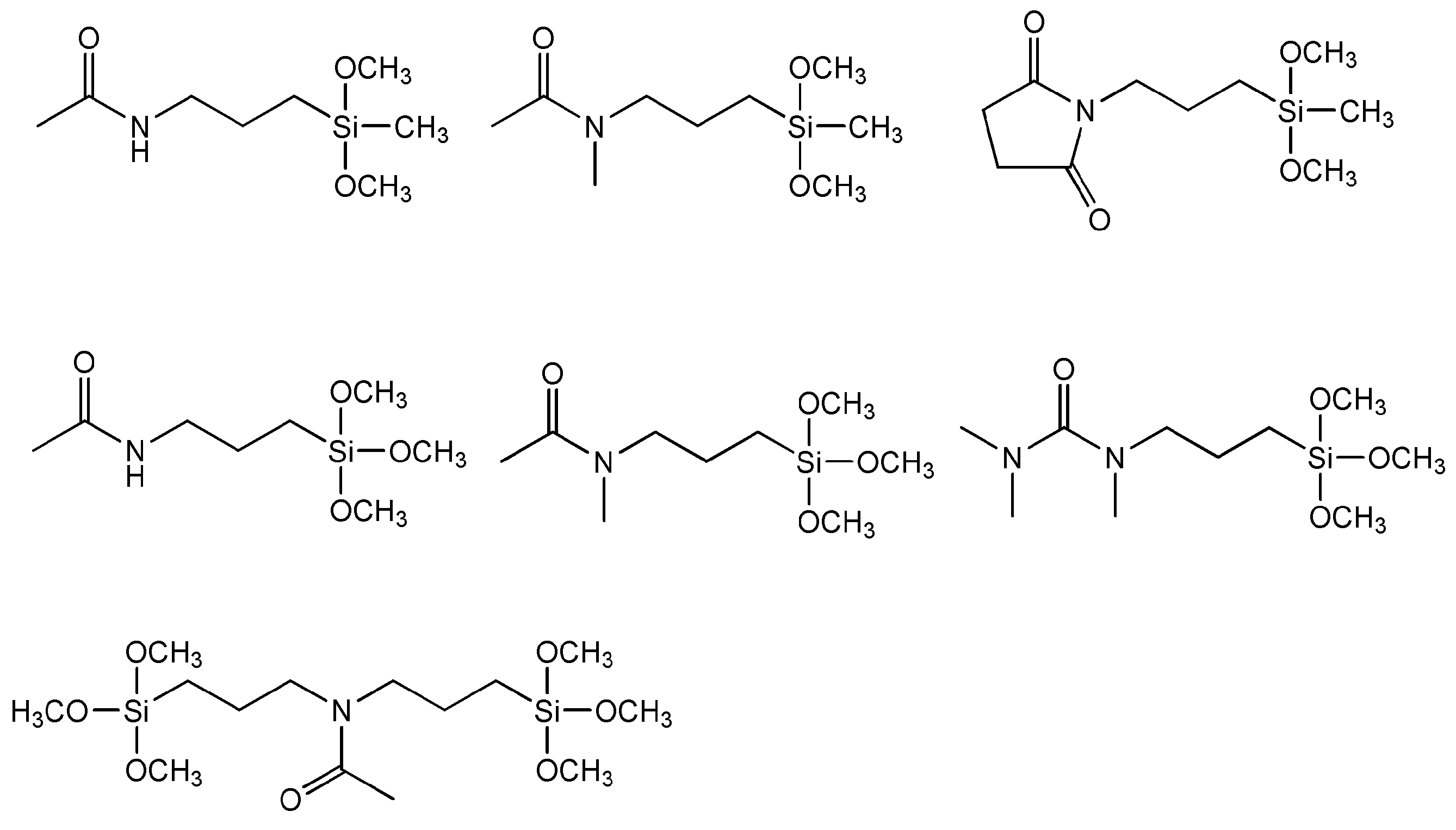
市販品としては、信越シリコーン社製の、KBM-13、KBM-22、KBM-103、KBE-13、KBE-22、KBE-103、KBM-3033、KBE-3033、KBM-3063、KBM-3066、KBM-3086、KBE-3063、KBE-3083、KBM-3103、KBM-7103、SZ-31、KPN-3504、KBM-1003、KBE-1003、KBM-303、KBM-402、KBM-403、KBE-402、KBE-403、KBM-1403、KBM-502、KBM-503、KBE-502、KBE-503、KBM-5103、KBM-602、KBM-603、KBM-903、KBE-903、KBE-9103、KBM-573、KBM-575、KBM-9659、KBE-585、KBM-802、KBM-803、KBE-846、KBE-9007、X-40-1053、X-41-1059A、X-41-1056、X-41-1805、X-41-1818、X-41-1810、X-40-2651、X-40-2655A、KR-513、KC-89S、KR-500、X-40-9225、X-40-9246、X-40-9250、KR-401N、X-40-9227、X-40-9247、KR-510、KR-9218、KR-213、X-40-2308、X-40-9238などが挙げられる。
MがTiで表される化合物としては、テトライソプロピルチタネート、テトラノルマルブチルチタネート、ブチルチタネートダイマー、テトラオクチルチタネート、チタンジイソプロポキシビス(アセチルアセトネート)、チタンテトラアセチルアセトネート、チタンジイソプロポキシビス(エチルアセトアセテート)、リン酸チタン化合物、チタニウムジ-2-エチルヘキソキシビス(2-エチル-3-ヒドロキシヘキソキシド)、チタンラクテートアンモニウム塩、チタンラクテート、チタンジイソプロポキシビス(トリエタノールアミネート)、ターシャリーアミルチタネート、テトラターシャリーブチルチタネート、テトラステアリルチタネート、チタン-1,3-プロパンジオキシビス(エチルアセトアセテート)、ドデシルベンゼンスルホン酸チタン化合物、チタンイソステアレート、チタンジエタノールアミネート、チタンアミノエチルアミノエタノレートなどが挙げられる。市販品としては、マツモトファインケミカル社製のオルガチックスシリーズ(例えば、TA-10、TA-21、TA-23、TA-30、TC-100、TC-401、TC-710、TC-1040、TC-201、TC-750、TC-300、TC-310、TC-315、TC-400、TA-60、TA-80、TA-90、TC-120、TC-220、TC-730、TC-810、TC-800、TC-500、TC-510など)、味の素ファインテクノ社製のプレンアクトシリーズ(例えば、TTS、46B、55、41B、38S、138S、238S、338X、44、9SA、ETなど)が挙げられる。
MがZrで表される化合物としては、ジルコニウムテトラノルマルプロポキシド、ジルコニウムテトラノルマルブトキシド、ジルコニウムテトラアセチルアセトネート、ジルコニウムトリブトキシモノアセチルアセトネート、ジルコニウムジブトキシビス(エチルアセトアセテート)などが挙げられる。市販品としては、マツモトファインケミカル社製のオルガチックスシリーズ(例えば、ZA-45、ZA-65、ZC-150、ZC-540、ZC-700、ZC-580、ZC-200、ZC-320、ZC-126、ZC-300など)が挙げられる。
MがAlで表される化合物としては、アルキルアセトアセテートアルミニウムジイソプロピレートなどが挙げられる。市販品としては、味の素ファインテクノ社製のプレンアクトAL-Mなどが挙げられる。
<<<ポリマータイプの化合物>>>
M-Xで表される部分構造を有する化合物のうち、ポリマータイプの化合物としては、例えば、(メタ)アクリル樹脂、スチレン樹脂、ポリシロキサンなどが挙げられる。(メタ)アクリル樹脂としては、(メタ)アクリル酸樹脂、(メタ)アクリルアミド樹脂などが挙げられる。ポリマータイプの化合物は、保存安定性、皮膜性の向上、塗布液粘度調整の容易性という理由から(メタ)アクリル樹脂(好ましくは、(メタ)アクリル酸樹脂、(メタ)アクリルアミド樹脂)、および、スチレン樹脂から選ばれる少なくとも1種が好ましい。
ポリマータイプの化合物の具体例としては、例えば、下記(MX2-1)で表される繰り返し単位、下記(MX2-2)で表される繰り返し単位および下記(MX2-3)で表される繰り返し単位から選ばれる1種を有するポリマーなどが挙げられる。
M-Xで表される部分構造を有する化合物のうち、ポリマータイプの化合物としては、例えば、(メタ)アクリル樹脂、スチレン樹脂、ポリシロキサンなどが挙げられる。(メタ)アクリル樹脂としては、(メタ)アクリル酸樹脂、(メタ)アクリルアミド樹脂などが挙げられる。ポリマータイプの化合物は、保存安定性、皮膜性の向上、塗布液粘度調整の容易性という理由から(メタ)アクリル樹脂(好ましくは、(メタ)アクリル酸樹脂、(メタ)アクリルアミド樹脂)、および、スチレン樹脂から選ばれる少なくとも1種が好ましい。
ポリマータイプの化合物の具体例としては、例えば、下記(MX2-1)で表される繰り返し単位、下記(MX2-2)で表される繰り返し単位および下記(MX2-3)で表される繰り返し単位から選ばれる1種を有するポリマーなどが挙げられる。
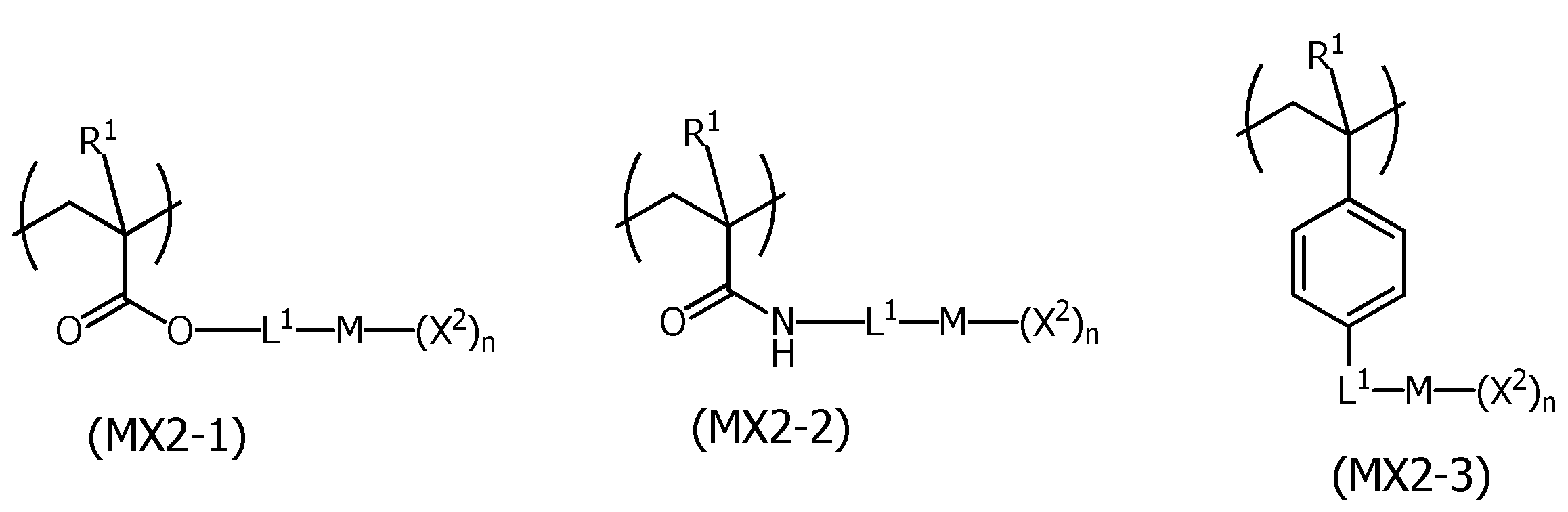
Mは、Si、Ti、ZrおよびAlから選択される原子を表し、X2は、置換基または配位子を表し、n個のX2のうち、少なくとも1つは、ヒドロキシ基、アルコキシ基、アシルオキシ基、ホスホリルオキシ基、スルホニルオキシ基、アミノ基、オキシム基およびO=C(Ra)(Rb)から選択される1種であり、X2同士は、それぞれ結合して環を形成していてもよく、R1は、水素原子またはアルキル基を表し、L1は、単結合または2価の連結基を表し、nは、MのX2との結合手の数を表す。
MおよびX2は、それぞれ(MX1)のMおよびX1と同義であり、好ましい範囲も同様である。
R1は、水素原子またはアルキル基を表す。アルキル基の炭素数は、1~5が好ましく、1~3がより好ましく、1が特に好ましい。アルキル基は、直鎖、分岐のいずれも好ましく、直鎖がより好ましい。アルキル基は、水素原子の一部または全部がハロゲン原子(好ましくはフッ素原子)で置換されていてもよい。
L1は、単結合または2価の連結基を表す。2価の連結基としては、アルキレン基、アリーレン基、-O-、-S-、-CO-、-COO-、-OCO-、-SO2-、-NR10-(R10は、水素原子またはアルキル基を表し、水素原子が好ましい)、または、これらの組み合わせからなる基が挙げられ、アルキレン基、アリーレン基およびアルキレン基の少なくとも1つと-O-との組み合わせからなる基が好ましい。
アルキレン基の炭素数は、1~30が好ましく、1~15がより好ましく、1~10がさらに好ましい。アルキレン基は、置換基を有していてもよいが、無置換が好ましい。アルキレン基は、直鎖、分岐、環状のいずれであってもよい。また、環状のアルキレン基は、単環、多環のいずれであってもよい。
アリーレン基の炭素数は、6~18が好ましく、6~14がより好ましく、6~10がさらに好ましく、フェニレン基が特に好ましい。
R1は、水素原子またはアルキル基を表す。アルキル基の炭素数は、1~5が好ましく、1~3がより好ましく、1が特に好ましい。アルキル基は、直鎖、分岐のいずれも好ましく、直鎖がより好ましい。アルキル基は、水素原子の一部または全部がハロゲン原子(好ましくはフッ素原子)で置換されていてもよい。
L1は、単結合または2価の連結基を表す。2価の連結基としては、アルキレン基、アリーレン基、-O-、-S-、-CO-、-COO-、-OCO-、-SO2-、-NR10-(R10は、水素原子またはアルキル基を表し、水素原子が好ましい)、または、これらの組み合わせからなる基が挙げられ、アルキレン基、アリーレン基およびアルキレン基の少なくとも1つと-O-との組み合わせからなる基が好ましい。
アルキレン基の炭素数は、1~30が好ましく、1~15がより好ましく、1~10がさらに好ましい。アルキレン基は、置換基を有していてもよいが、無置換が好ましい。アルキレン基は、直鎖、分岐、環状のいずれであってもよい。また、環状のアルキレン基は、単環、多環のいずれであってもよい。
アリーレン基の炭素数は、6~18が好ましく、6~14がより好ましく、6~10がさらに好ましく、フェニレン基が特に好ましい。
上記ポリマータイプの化合物は、式(MX2-1)、(MX2-2)、(MX2-3)で表される繰り返し単位の他に、他の繰り返し単位を含有していてもよい。
他の繰り返し単位を構成する成分としては、特開2010-106268号公報の段落番号0068~0075(対応する米国特許出願公開第2011/0124824号明細書の[0112]~[0118])に開示の共重合成分の記載を参酌でき、これらの内容は本明細書に組み込まれる。
好ましい他の繰り返し単位としては、下記式(MX3-1)~(MX3-6)で表される繰り返し単位が挙げられる。
他の繰り返し単位を構成する成分としては、特開2010-106268号公報の段落番号0068~0075(対応する米国特許出願公開第2011/0124824号明細書の[0112]~[0118])に開示の共重合成分の記載を参酌でき、これらの内容は本明細書に組み込まれる。
好ましい他の繰り返し単位としては、下記式(MX3-1)~(MX3-6)で表される繰り返し単位が挙げられる。
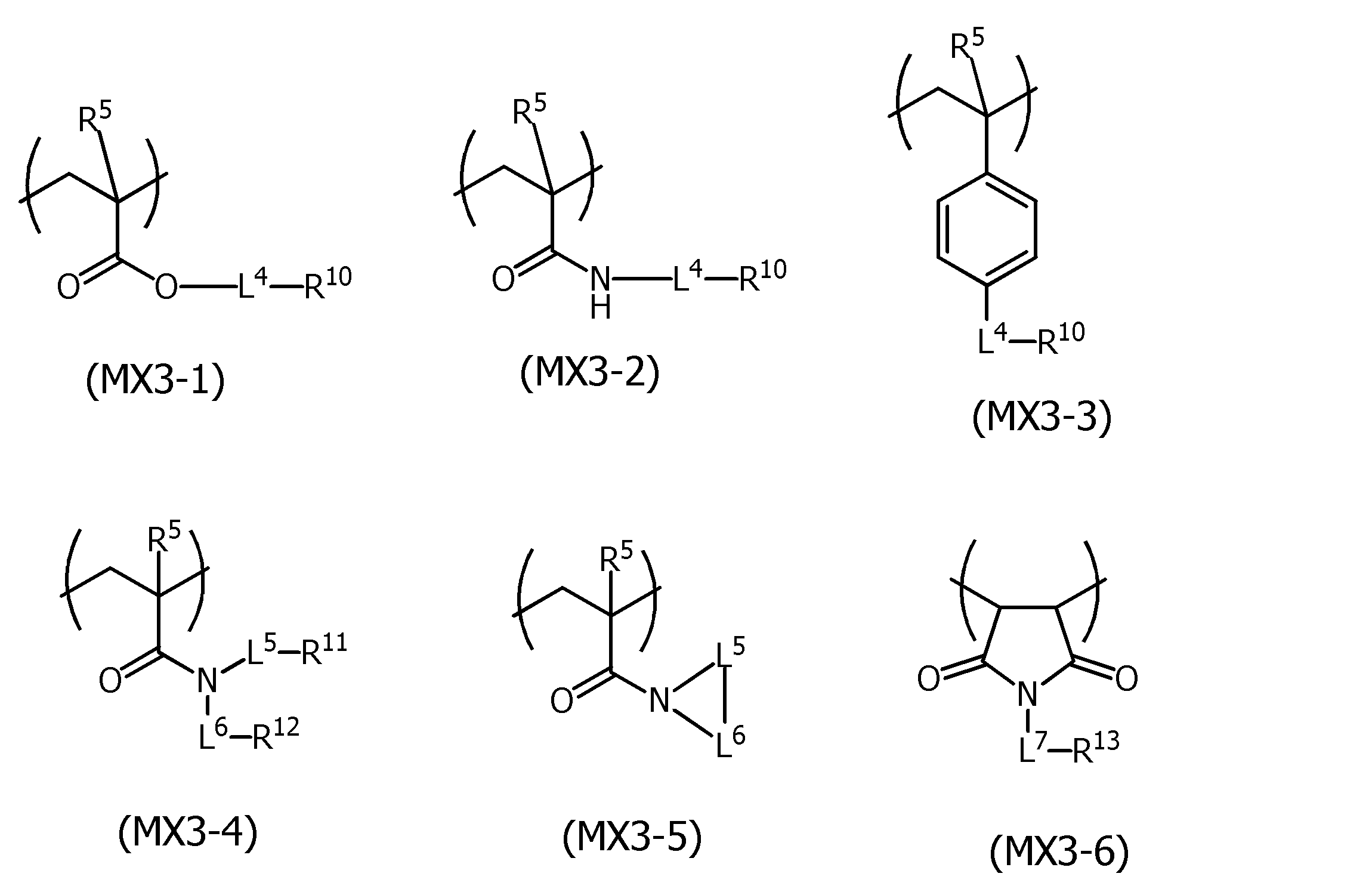
R5は、式(MX2-1)~(MX2-3)のR1と同義であり、好ましい範囲も同様である。
L4~L7は、式(MX2-1)~(MX2-3)のL1と同義であり、好ましい範囲も同様である。
L4~L7は、式(MX2-1)~(MX2-3)のL1と同義であり、好ましい範囲も同様である。
R10で表されるアルキル基は、直鎖状、分岐状または環状のいずれでもよく、環状が好ましい。アルキル基の炭素数は、1~30が好ましく、1~20がより好ましく、1~10がさらに好ましい。アルキル基は置換基を有していてもよく、置換基としては、上述したものが挙げられる。
R10で表されるアリール基は、単環であってもよく、多環であってもよいが、単環が好ましい。アリール基の炭素数は、6~18が好ましく、6~12がより好ましく、6がさらに好ましい。
R10は、環状のアルキル基またはアリール基が好ましい。
R10で表されるアリール基は、単環であってもよく、多環であってもよいが、単環が好ましい。アリール基の炭素数は、6~18が好ましく、6~12がより好ましく、6がさらに好ましい。
R10は、環状のアルキル基またはアリール基が好ましい。
R11、R12で表されるアルキル基は、直鎖状、分岐状または環状のいずれでも良く、直鎖状または分岐状が好ましい。アルキル基は置換基を有していても良く、置換基としては上述したものが挙げられる。アルキル基の炭素数は、1~12が好ましく、1~6がより好ましく、1~4がさらに好ましい。
R11、R12で表されるアリール基は、単環であってもよく、多環であっても良いが、単環が好ましい。アリール基の炭素数は、6~18が好ましく、6~12がより好ましく、6がさらに好ましい。
R11、R12は、直鎖状または分岐状のアルキル基が好ましい。
R11、R12で表されるアリール基は、単環であってもよく、多環であっても良いが、単環が好ましい。アリール基の炭素数は、6~18が好ましく、6~12がより好ましく、6がさらに好ましい。
R11、R12は、直鎖状または分岐状のアルキル基が好ましい。
R13で表されるアルキル基は、直鎖状、分岐状または環状のいずれでも良く、直鎖状または分岐状が好ましい。アルキル基は置換基を有していても良く、置換基としては上述したものが挙げられる。アルキル基の炭素数は1~12が好ましく、1~6がより好ましく、1~4がさらに好ましい。
R13で表されるアリール基は、単環であってもよく、多環であっても良いが、単環が好ましい。アリール基の炭素数は、6~18が好ましく、6~12がより好ましく、6がさらに好ましい。
R13は、直鎖状または分岐状のアルキル基、または、アリール基が好ましい。
R13で表されるアリール基は、単環であってもよく、多環であっても良いが、単環が好ましい。アリール基の炭素数は、6~18が好ましく、6~12がより好ましく、6がさらに好ましい。
R13は、直鎖状または分岐状のアルキル基、または、アリール基が好ましい。
上記ポリマータイプの化合物が、他の繰り返し単位(好ましくは式(MX3-1)~(MX3-6)で表される繰り返し単位)を含む場合、式(MX2-1)~(MX2-3)で表される繰り返し単位の合計と、他の繰り返し単位の合計とのモル比は、95:5~20:80であることが好ましく、90:10~40:60であることがより好ましい。式(MX2-1)~(MX2-3)で表される繰り返し単位の含有率を上記の範囲内で高めることで、耐湿性および耐溶剤性がより向上する傾向にある。また、式(MX2-1)~(MX2-3)で表される繰り返し単位の含有率を上記の範囲内で低くすることで、耐熱性がより向上する傾向にある。
MがSiであるポリマータイプの化合物としては、例えば、下記構造が挙げられる。なお、繰り返し単位に記載の数値は、モル比である。

本発明では、M-Xで表される部分構造を有するポリマータイプの化合物として、ポリシロキサンを用いることもできる。ポリシロキサンとしては、信越シリコーン社製のKC-89S、KR-500、X-40-9225、X-40-9246、X-40-9250(いずれもメトキシ基を有するメチル系シリコーンアルコキシオリゴマー)、KR-9218、KR-213、KR-510、X-40-9227、X-40-9247(いずれもメトキシ基を有するメチルフェニル系シリコーンアルコキシオリゴマー)、X-41-1053、X-41-1059A、X-41-1056、X-41-1805、X-41-1818、X-41-1810、KR-513、X-40-2672B、X-40-9272B、X-40-2651、X-40-2308、X-40-9238(シリコーンアルコキシオリゴマー)などが挙げられる。
本発明の近赤外線吸収組成物は、M-Xで表される部分構造を有する化合物を、近赤外線吸収組成物の全固形分に対し、15質量%以上含有することが好ましく、20質量%以上含有することがより好ましく、25質量%以上含有することがさらに好ましい。上限は、特に限定はないが、99質量%以下が好ましく、90質量%以下がより好ましく、80質量%以下がさらに好ましく、70質量%以下が一層好ましい。M-Xで表される部分構造を有する化合物の含有量が上記の範囲内であれば、耐熱性に優れた膜を形成しやすい。
また、M-Xで表される部分構造を有する化合物と、銅化合物との質量比は、M-Xで表される部分構造を有する化合物:銅化合物=15:85~90:10が好ましく、20:80~80:20がより好ましく、25:75~70:30がさらに好ましい。両者の比が上記の範囲内であれば、高い近赤外線遮蔽性を維持しつつ、耐熱性に優れた膜を形成しやすい。
また、M-Xで表される部分構造を有する化合物と、銅化合物との質量比は、M-Xで表される部分構造を有する化合物:銅化合物=15:85~90:10が好ましく、20:80~80:20がより好ましく、25:75~70:30がさらに好ましい。両者の比が上記の範囲内であれば、高い近赤外線遮蔽性を維持しつつ、耐熱性に優れた膜を形成しやすい。
本発明において、M-Xで表される部分構造を有する化合物は、上述した低分子化合物およびポリマータイプの化合物から選ばれる1種で実質的に構成されている態様とすることもできる。なお、「低分子化合物およびポリマータイプの化合物から選ばれる1種で実質的に構成されている」とは、例えば、低分子化合物およびポリマータイプの化合物のうち、目的とするタイプの化合物以外の含有量が、M-Xで表される部分構造を有する化合物の全量中に1質量%以下であることが好ましく、0.5質量%以下であることがより好ましく、含有しないことがさらに好ましい。例えば、目的とするタイプの化合物がポリマータイプの化合物の場合は、低分子化合物が目的とするタイプの化合物以外に該当する。
また、本発明において、M-Xで表される部分構造を有する化合物は、低分子化合物から選ばれる1種以上と、ポリマータイプの化合物から選ばれる1種以上とを組み合わせて用いることもできる。低分子化合物の合計と、ポリマータイプの化合物の合計との質量比は、1:9~5:5が好ましく、1:9~4:6がより好ましく、1:9~3:7が特に好ましい。
また、本発明において、M-Xで表される部分構造を有する化合物は、低分子化合物から選ばれる1種以上と、ポリマータイプの化合物から選ばれる1種以上とを組み合わせて用いることもできる。低分子化合物の合計と、ポリマータイプの化合物の合計との質量比は、1:9~5:5が好ましく、1:9~4:6がより好ましく、1:9~3:7が特に好ましい。
<<銅化合物>>
本発明の近赤外線吸収組成物は、銅化合物を含有する。銅化合物は、赤外線吸収剤であることが好ましい。赤外線吸収剤としての銅化合物は、赤外領域の波長領域(好ましくは、波長700~1200mnの範囲)に吸収を有し、可視領域(好ましくは、波長400~650mnの範囲)の波長の光を透過する化合物が好ましい。
本発明の近赤外線吸収組成物は、銅化合物を含有する。銅化合物は、赤外線吸収剤であることが好ましい。赤外線吸収剤としての銅化合物は、赤外領域の波長領域(好ましくは、波長700~1200mnの範囲)に吸収を有し、可視領域(好ましくは、波長400~650mnの範囲)の波長の光を透過する化合物が好ましい。
本発明において、赤外線吸収剤として用いる銅化合物は、銅錯体が好ましい。銅錯体としては、銅と、銅に対する配位部位を有する化合物(配位子)との錯体が好ましい。銅に対する配位部位としては、アニオンで配位する配位部位、非共有電子対で配位する配位原子が挙げられる。銅錯体は、配位子を2つ以上有していてもよい。配位子を2つ以上有する場合は、それぞれの配位子は同一であってもよく、異なっていてもよい。銅錯体は、4配位、5配位および6配位が例示され、4配位および5配位が好ましく、5配位がより好ましい。また、銅錯体は、銅と配位子によって、5員環および/または6員環が形成されていることが好ましい。このような銅錯体は、形状が安定であり、錯体安定性に優れる。
本発明において、銅錯体は、フタロシアニン銅錯体以外の銅錯体であることも好ましい。ここで、フタロシアニン銅錯体とは、フタロシアニン骨格を有する化合物を配位子とする銅錯体である。フタロシアニン骨格を有する化合物は、分子全体にπ電子共役系が広がり、平面構造を取る。フタロシアニン銅錯体は、π-π*遷移で光を吸収する。π-π*遷移で赤外領域の光を吸収するには、配位子をなす化合物が長い共役構造をとる必要がある。しかしながら、配位子の共役構造を長くすると、可視光透過性が低下する傾向にある。このため、フタロシアニン銅錯体は、可視光透過性が不十分な場合がある。
また、銅錯体は、400~600nmの波長領域に極大吸収波長を有さない化合物を配位子とする銅錯体であることも好ましい。400~600nmの波長領域に極大吸収波長を有する化合物を配位子とする銅錯体は、可視領域(例えば、400~600nmの波長領域)に吸収を有するため、可視光透過性が不十分な場合がある。400~600nmの波長領域に極大吸収波長を有する化合物としては、長い共役構造を有し、π-π*遷移の光の吸収の大きい化合物が挙げられる。具体的には、フタロシアニン骨格を有する化合物が挙げられる。
また、銅錯体は、400~600nmの波長領域に極大吸収波長を有さない化合物を配位子とする銅錯体であることも好ましい。400~600nmの波長領域に極大吸収波長を有する化合物を配位子とする銅錯体は、可視領域(例えば、400~600nmの波長領域)に吸収を有するため、可視光透過性が不十分な場合がある。400~600nmの波長領域に極大吸収波長を有する化合物としては、長い共役構造を有し、π-π*遷移の光の吸収の大きい化合物が挙げられる。具体的には、フタロシアニン骨格を有する化合物が挙げられる。
銅錯体は、例えば銅成分(銅または銅を含む化合物)に対して、銅に対する配位部位を有する化合物(配位子)を混合や反応等させて得ることができる。銅に対する配位部位を有する化合物(配位子)は、低分子化合物であってもよく、ポリマーであってもよい。両者を併用することもできる。
銅成分は、2価の銅を含む化合物が好ましい。銅成分は、1種のみを用いてもよいし、2種以上を用いてもよい。銅成分としては、例えば、酸化銅や銅塩を用いることができる。銅塩は、例えば、カルボン酸銅(例えば、酢酸銅、エチルアセト酢酸銅、ギ酸銅、安息香酸銅、ステアリン酸銅、ナフテン酸銅、クエン酸銅、2-エチルヘキサン酸銅など)、スルホン酸銅(例えば、メタンスルホン酸銅など)、リン酸銅、リン酸エステル銅、ホスホン酸銅、ホスホン酸エステル銅、ホスフィン酸銅、アミド銅、スルホンアミド銅、イミド銅、アシルスルホンイミド銅、ビススルホンイミド銅、メチド銅、アルコキシ銅、フェノキシ銅、水酸化銅、炭酸銅、硫酸銅、硝酸銅、過塩素酸銅、フッ化銅、塩化銅、臭化銅が好ましく、カルボン酸銅、スルホン酸銅、スルホンアミド銅、イミド銅、アシルスルホンイミド銅、ビススルホンイミド銅、アルコキシ銅、フェノキシ銅、水酸化銅、炭酸銅、フッ化銅、塩化銅、硫酸銅、硝酸銅がより好ましく、カルボン酸銅、アシルスルホンイミド銅、フェノキシ銅、塩化銅、硫酸銅、硝酸銅がさらに好ましく、カルボン酸銅、アシルスルホンイミド銅、塩化銅、硫酸銅が特に好ましい。
本発明において、銅錯体は、700~1200nmの波長領域に極大吸収波長を有する化合物が好ましい。銅錯体の極大吸収波長は、720~1200nmの波長領域に有することがより好ましく、800~1100nmの波長領域に有することがさらに好ましい。極大吸収波長は、例えば、Cary 5000 UV-Vis-NIR(分光光度計 アジレント・テクノロジー株式会社製)を用いて測定することができる。
銅錯体の上述した波長領域における極大吸収波長でのモル吸光係数は、100(L/mol・cm)以上が好ましく、120(L/mol・cm)以上がより好ましく、150(L/mol・cm)以上が更に好ましく、200(L/mol・cm)以上がよりさらに好ましく、300(L/mol・cm)以上が一層好ましく、400(L/mol・cm)以上が特に好ましい。上限は、特に限定はないが、例えば、30,000(L/mol・cm)以下とすることができる。銅錯体の上記モル吸光係数が、100(L/mol・cm)以上であれば、薄膜であっても、赤外線遮蔽性に優れた硬化膜を形成することができる。
銅錯体の800nmでのグラム吸光係数は、0.11(L/g・cm)以上が好ましく、0.15(L/g・cm)以上がより好ましく、0.24(L/g・cm)以上がさらに好ましい。
なお、本発明において、銅錯体のモル吸光係数およびグラム吸光係数は、銅錯体を溶媒に溶解させて1g/Lの濃度の溶液を調製し、銅錯体を溶解させた溶液の吸収スペクトルを測定して求めることができる。測定装置としては、島津製作所製UV-1800(波長領域200~1100nm)、Agilent製Cary 5000(波長領域200~1300nm)などを用いることができる。測定溶媒としては、水、N,N-ジメチルホルムアミド、プロピレングリコールモノメチルエーテル、1,2,4-トリクロロベンゼン、アセトンが挙げられる。本発明では、上述した測定溶媒のうち、測定対象の銅錯体を溶解できるものを選択して用いる。なかでも、プロピレングリコールモノメチルエーテルで溶解する銅錯体の場合は、測定溶媒としては、プロピレングリコールモノメチルエーテルを用いることが好ましい。なお、溶解するとは、25℃の溶媒に対する、銅錯体の溶解度が0.01g/100gSolventを超える状態を意味する。
本発明において、銅錯体のモル吸光係数およびグラム吸光係数は、上述した測定溶媒のいずれか1つを用いて測定した値であることが好ましく、プロピレングリコールモノメチルエーテルでの値であることがより好ましい。
銅錯体の上述した波長領域における極大吸収波長でのモル吸光係数は、100(L/mol・cm)以上が好ましく、120(L/mol・cm)以上がより好ましく、150(L/mol・cm)以上が更に好ましく、200(L/mol・cm)以上がよりさらに好ましく、300(L/mol・cm)以上が一層好ましく、400(L/mol・cm)以上が特に好ましい。上限は、特に限定はないが、例えば、30,000(L/mol・cm)以下とすることができる。銅錯体の上記モル吸光係数が、100(L/mol・cm)以上であれば、薄膜であっても、赤外線遮蔽性に優れた硬化膜を形成することができる。
銅錯体の800nmでのグラム吸光係数は、0.11(L/g・cm)以上が好ましく、0.15(L/g・cm)以上がより好ましく、0.24(L/g・cm)以上がさらに好ましい。
なお、本発明において、銅錯体のモル吸光係数およびグラム吸光係数は、銅錯体を溶媒に溶解させて1g/Lの濃度の溶液を調製し、銅錯体を溶解させた溶液の吸収スペクトルを測定して求めることができる。測定装置としては、島津製作所製UV-1800(波長領域200~1100nm)、Agilent製Cary 5000(波長領域200~1300nm)などを用いることができる。測定溶媒としては、水、N,N-ジメチルホルムアミド、プロピレングリコールモノメチルエーテル、1,2,4-トリクロロベンゼン、アセトンが挙げられる。本発明では、上述した測定溶媒のうち、測定対象の銅錯体を溶解できるものを選択して用いる。なかでも、プロピレングリコールモノメチルエーテルで溶解する銅錯体の場合は、測定溶媒としては、プロピレングリコールモノメチルエーテルを用いることが好ましい。なお、溶解するとは、25℃の溶媒に対する、銅錯体の溶解度が0.01g/100gSolventを超える状態を意味する。
本発明において、銅錯体のモル吸光係数およびグラム吸光係数は、上述した測定溶媒のいずれか1つを用いて測定した値であることが好ましく、プロピレングリコールモノメチルエーテルでの値であることがより好ましい。
銅化合物は、市販品を用いることもできる。市販品の銅化合物としては、イーエクスカラーIR-17(日本触媒(株)製)などが挙げられる。
銅化合物の含有量は、近赤外線吸収組成物の全固形分に対して、銅の元素基準で10質量%以上であることが好ましく、20質量%以上がより好ましく、30質量%以上がさらに好ましい。上限は特にないが、70質量%以下が好ましく、60質量%以下がより好ましい。
また、銅化合物の含有量は、近赤外線吸収組成物の全固形分に対して、1~80質量%が好ましい。上限は、70質量%以下がより好ましく、60質量%以下がさらに好ましい。下限は、5質量%以上がより好ましく、10質量%以上がさらに好ましい。
また、銅化合物の含有量は、近赤外線吸収組成物の全固形分に対して、1~80質量%が好ましい。上限は、70質量%以下がより好ましく、60質量%以下がさらに好ましい。下限は、5質量%以上がより好ましく、10質量%以上がさらに好ましい。
<<<低分子タイプの銅化合物>>>
銅化合物としては、例えば、下記式(Cu-1)で表される銅錯体を用いることができる。この銅錯体は、中心金属の銅に配位子Lが配位した銅化合物であり、銅は、通常2価の銅である。このような銅錯体は、例えば銅成分に対して、配位子Lとなる化合物またはその塩を混合や反応等させて得ることができる。
Cu(L)n1・(X)n2 式(Cu-1)
上記式中、Lは、銅に配位する配位子を表し、Xは、対イオンを表す。n1は、1~4の整数を表す。n2は、0~4の整数を表す。
銅化合物としては、例えば、下記式(Cu-1)で表される銅錯体を用いることができる。この銅錯体は、中心金属の銅に配位子Lが配位した銅化合物であり、銅は、通常2価の銅である。このような銅錯体は、例えば銅成分に対して、配位子Lとなる化合物またはその塩を混合や反応等させて得ることができる。
Cu(L)n1・(X)n2 式(Cu-1)
上記式中、Lは、銅に配位する配位子を表し、Xは、対イオンを表す。n1は、1~4の整数を表す。n2は、0~4の整数を表す。
Xは、対イオンを表す。銅化合物は、電荷を持たない中性錯体のほか、カチオン錯体、アニオン錯体になることもある。この場合、銅化合物の電荷を中和するよう、必要に応じて対イオンが存在する。
対イオンが負の対イオンの場合、例えば、無機陰イオンでも有機陰イオンでもよい。具体例としては、水酸化物イオン、ハロゲン陰イオン(例えば、フッ化物イオン、塩化物イオン、臭化物イオン、ヨウ化物イオン等)、置換または無置換のアルキルカルボン酸イオン(酢酸イオン、トリフルオロ酢酸イオン等)、置換または無置換のアリールカルボン酸イオン(安息香酸イオン等)、置換もしくは無置換のアルキルスルホン酸イオン(メタンスルホン酸イオン、トリフルオロメタンスルホン酸イオン等)、置換もしくは無置換のアリールスルホン酸イオン(例えば、パラトルエンスルホン酸イオン、パラクロロベンゼンスルホン酸イオン等)、アリールジスルホン酸イオン(例えば、1,3-ベンゼンジスルホン酸イオン、1,5-ナフタレンジスルホン酸イオン、2,6-ナフタレンジスルホン酸イオン等)、アルキル硫酸イオン(例えばメチル硫酸イオン等)、硫酸イオン、チオシアン酸イオン、硝酸イオン、過塩素酸イオン、テトラフルオロホウ酸イオン、テトラアリールホウ酸イオン、テトラキス(ペンタフルオロフェニル)ホウ酸イオン(B-(C6F5)4)、ヘキサフルオロホスフェートイオン、ピクリン酸イオン、アミドイオン(アシル基やスルホニル基で置換されたアミドを含む)、メチドイオン(アシル基やスルホニル基で置換されたメチドを含む)が挙げられ、ハロゲン陰イオン、置換もしくは無置換のアルキルカルボン酸イオン、硫酸イオン、硝酸イオン、テトラフルオロホウ酸イオン、テトラアリールホウ酸イオン、ヘキサフルオロホスフェートイオン、アミドイオン(アシル基やスルホニル基で置換されたアミドを含む)、メチドイオン(アシル基やスルホニル基で置換されたメチドを含む)が好ましい。
対イオンが正の対イオンの場合、例えば、無機もしくは有機のアンモニウムイオン(例えば、テトラブチルアンモニウムイオンなどのテトラアルキルアンモニウムイオン、トリエチルベンジルアンモニウムイオン、ピリジニウムイオン等)、ホスホニウムイオン(例えば、テトラブチルホスホニウムイオンなどのテトラアルキルホスホニウムイオン、アルキルトリフェニルホスホニウムイオン、トリエチルフェニルホスホニウムイオン等)、アルカリ金属イオンまたはプロトンが挙げられる。
また、対イオンは金属錯体イオンであってもよく、特に対イオンが銅錯体、すなわち、カチオン性銅錯体とアニオン性銅錯体の塩であっても良い。
対アニオンは、低求核アニオンが好ましい。低求核アニオンとは、一般的に超酸(super acid)と呼ばれるpKaの低い酸がプロトンを解離してなるアニオンである。超酸の定義は、文献によっても異なるが、メタンスルホン酸よりpKaが低い酸の総称であり、J.Org.Chem.2011,76,391-395 Equilibrium Acidities of Super acidsに記載される構造が知られている。低求核アニオンのpKaは、例えば、-11以下が好ましく、-11~-18がより好ましい。pKaは、例えば、J.Org.Chem.2011,76,391-395に記載の方法により測定することができる。本明細書におけるpKa値は、特に断りがない場合、1,2-ジクロロエタン中でのpKaである。
低求核アニオンは、テトラフルオロホウ酸イオン、テトラアリールホウ酸イオン(ハロゲン原子やフルオロアルキル基で置換されたアリールを含む)、ヘキサフルオロホスフェートイオン、イミドイオン(アシル基やスルホニル基で置換されたアミドを含む)、メチドイオン(アシル基やスルホニル基で置換されたメチドを含む)が好ましく、テトラアリールホウ酸イオン(ハロゲン原子やフルオロアルキル基で置換されたアリールを含む)、イミドイオン(スルホニル基で置換されたアミドを含む)、メチドイオン(スルホニル基で置換されたメチドを含む)が特に好ましい。
対イオンが負の対イオンの場合、例えば、無機陰イオンでも有機陰イオンでもよい。具体例としては、水酸化物イオン、ハロゲン陰イオン(例えば、フッ化物イオン、塩化物イオン、臭化物イオン、ヨウ化物イオン等)、置換または無置換のアルキルカルボン酸イオン(酢酸イオン、トリフルオロ酢酸イオン等)、置換または無置換のアリールカルボン酸イオン(安息香酸イオン等)、置換もしくは無置換のアルキルスルホン酸イオン(メタンスルホン酸イオン、トリフルオロメタンスルホン酸イオン等)、置換もしくは無置換のアリールスルホン酸イオン(例えば、パラトルエンスルホン酸イオン、パラクロロベンゼンスルホン酸イオン等)、アリールジスルホン酸イオン(例えば、1,3-ベンゼンジスルホン酸イオン、1,5-ナフタレンジスルホン酸イオン、2,6-ナフタレンジスルホン酸イオン等)、アルキル硫酸イオン(例えばメチル硫酸イオン等)、硫酸イオン、チオシアン酸イオン、硝酸イオン、過塩素酸イオン、テトラフルオロホウ酸イオン、テトラアリールホウ酸イオン、テトラキス(ペンタフルオロフェニル)ホウ酸イオン(B-(C6F5)4)、ヘキサフルオロホスフェートイオン、ピクリン酸イオン、アミドイオン(アシル基やスルホニル基で置換されたアミドを含む)、メチドイオン(アシル基やスルホニル基で置換されたメチドを含む)が挙げられ、ハロゲン陰イオン、置換もしくは無置換のアルキルカルボン酸イオン、硫酸イオン、硝酸イオン、テトラフルオロホウ酸イオン、テトラアリールホウ酸イオン、ヘキサフルオロホスフェートイオン、アミドイオン(アシル基やスルホニル基で置換されたアミドを含む)、メチドイオン(アシル基やスルホニル基で置換されたメチドを含む)が好ましい。
対イオンが正の対イオンの場合、例えば、無機もしくは有機のアンモニウムイオン(例えば、テトラブチルアンモニウムイオンなどのテトラアルキルアンモニウムイオン、トリエチルベンジルアンモニウムイオン、ピリジニウムイオン等)、ホスホニウムイオン(例えば、テトラブチルホスホニウムイオンなどのテトラアルキルホスホニウムイオン、アルキルトリフェニルホスホニウムイオン、トリエチルフェニルホスホニウムイオン等)、アルカリ金属イオンまたはプロトンが挙げられる。
また、対イオンは金属錯体イオンであってもよく、特に対イオンが銅錯体、すなわち、カチオン性銅錯体とアニオン性銅錯体の塩であっても良い。
対アニオンは、低求核アニオンが好ましい。低求核アニオンとは、一般的に超酸(super acid)と呼ばれるpKaの低い酸がプロトンを解離してなるアニオンである。超酸の定義は、文献によっても異なるが、メタンスルホン酸よりpKaが低い酸の総称であり、J.Org.Chem.2011,76,391-395 Equilibrium Acidities of Super acidsに記載される構造が知られている。低求核アニオンのpKaは、例えば、-11以下が好ましく、-11~-18がより好ましい。pKaは、例えば、J.Org.Chem.2011,76,391-395に記載の方法により測定することができる。本明細書におけるpKa値は、特に断りがない場合、1,2-ジクロロエタン中でのpKaである。
低求核アニオンは、テトラフルオロホウ酸イオン、テトラアリールホウ酸イオン(ハロゲン原子やフルオロアルキル基で置換されたアリールを含む)、ヘキサフルオロホスフェートイオン、イミドイオン(アシル基やスルホニル基で置換されたアミドを含む)、メチドイオン(アシル基やスルホニル基で置換されたメチドを含む)が好ましく、テトラアリールホウ酸イオン(ハロゲン原子やフルオロアルキル基で置換されたアリールを含む)、イミドイオン(スルホニル基で置換されたアミドを含む)、メチドイオン(スルホニル基で置換されたメチドを含む)が特に好ましい。
配位子Lは、銅に対する配位部位を有する化合物であり、銅に対しアニオンで配位する配位部位、および、銅に対し非共有電子対で配位する配位原子から選ばれる1種以上を有する化合物が挙げられる。アニオンで配位する配位部位は、解離していてもよく、非解離でも良い。配位子Lは、銅に対する配位部位を2個以上有する化合物(多座配位子)が好ましい。また、配位子Lは、可視透過性を向上させるために、芳香族などのπ共役系が連続して複数結合していないことが好ましい。配位子Lは、銅に対する配位部位を1個有する化合物(単座配位子)と、銅に対する配位部位を2個以上有する化合物(多座配位子)とを併用することもできる。単座配位子としては、アニオンまたは非共有電子対で配位する単座配位子が挙げられる。アニオンで配位する配位子としては、ハライドアニオン、ヒドロキシドアニオン、アルコキシドアニオン、フェノキシドアニオン、アミドアニオン(アシル基やスルホニル基で置換されたアミドを含む)、イミドアニオン(アシル基やスルホニル基で置換されたイミドを含む)、アニリドアニオン(アシル基やスルホニル基で置換されたアニリドを含む)、チオラートアニオン、炭酸水素アニオン、カルボン酸アニオン、チオカルボン酸アニオン、ジチオカルボン酸アニオン、硫酸水素アニオン、スルホン酸アニオン、リン酸二水素アニオン、リン酸ジエステルアニオン、ホスホン酸モノエステルアニオン、ホスホン酸水素アニオン、ホスフィン酸アニオン、含窒素へテロ環アニオン、硝酸アニオン、次亜塩素酸アニオン、シアニドアニオン、シアナートアニオン、イソシアナートアニオン、チオシアナートアニオン、イソチオシアナートアニオン、アジドアニオンなどが挙げられる。非共有電子対で配位する単座配位子としては、水、アルコール、フェノール、エーテル、アミン、アニリン、アミド、イミド、イミン、ニトリル、イソニトリル、チオール、チオエーテル、カルボニル化合物、チオカルボニル化合物、スルホキシド、へテロ環、あるいは、炭酸、カルボン酸、硫酸、スルホン酸、リン酸、ホスホン酸、ホスフィン酸、硝酸、または、そのエステルが挙げられる。
上記配位子Lが有するアニオンは、銅成分中の銅原子に配位可能なものであればよく、酸素アニオン、窒素アニオンまたは硫黄アニオンが好ましい。アニオンで配位する配位部位は、以下の1価の官能基群(AN-1)、または、2価の官能基群(AN-2)から選択される少なくとも1種であることが好ましい。なお、以下の構造式における波線は、配位子を構成する原子団との結合位置である。
官能基群(AN-1)
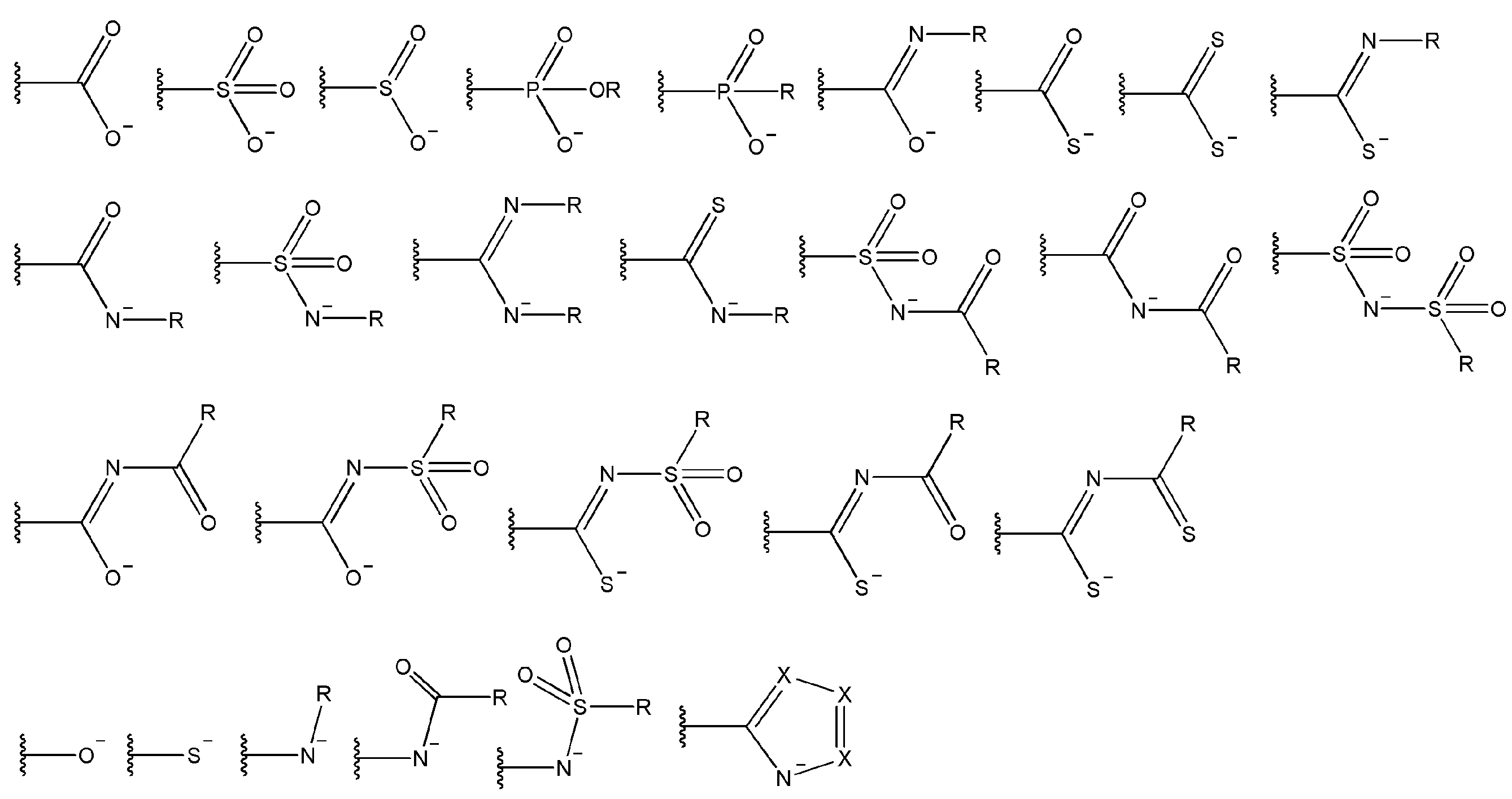
官能基群(AN-2)

上記式中、Xは、NまたはCRを表し、Rは、それぞれ独立して、水素原子、アルキル基、アルケニル基、アルキニル基、アリール基またはヘテロアリール基を表す。
Rが表すアルキル基は、直鎖状、分岐状または環状であってもよいが、直鎖状が好ましい。アルキル基の炭素数は、1~10が好ましく、1~6がより好ましく、1~4がさらに好ましい。アルキル基の例としては、メチル基が挙げられる。アルキル基は置換基を有していてもよく、置換基としてはハロゲン原子、カルボキシル基、ヘテロ環基が挙げられる。置換基としてのヘテロ環基は、単環であっても多環であってもよく、また、芳香族であっても非芳香族であってもよい。ヘテロ環を構成するヘテロ原子の数は1~3が好ましく、1または2がより好ましい。ヘテロ環を構成するヘテロ原子は、窒素原子が好ましい。アルキル基が置換基を有している場合、さらに置換基を有していてもよい。
Rが表すアルケニル基は、直鎖状、分岐状または環状であってもよいが、直鎖状が好ましい。アルケニル基の炭素数は、2~10が好ましく、2~6がより好ましい。アルケニル基は、無置換であってもよく、置換基を有していてもよい。置換基としては、上述したものが挙げられる。
Rが表すアルキニル基は、直鎖状、分岐状または環状であってもよいが、直鎖状が好ましい。アルキニル基の炭素数は、2~10が好ましく、2~6がより好ましい。アルキニル基は、無置換であってもよく、置換基を有していてもよい。置換基としては、上述したものが挙げられる。
Rが表すアリール基は、単環であっても多環であってもよいが、単環が好ましい。アリール基の炭素数は6~18が好ましく、6~12がより好ましく、6がさらに好ましい。アリール基は、無置換であってもよく、置換基を有していてもよい。置換基としては、上述したものが挙げられる。
Rが表すヘテロアリール基は、単環であっても多環であってもよい。ヘテロアリール基を構成するヘテロ原子の数は1~3が好ましい。ヘテロアリール基を構成するヘテロ原子は、窒素原子、硫黄原子、酸素原子が好ましい。ヘテロアリール基を構成する炭素数は1~18が好ましく、1~12がより好ましい。ヘテロアリール基は、無置換であってもよく、置換基を有していてもよい。置換基としては、上述したものが挙げられる。
Rが表すアルキル基は、直鎖状、分岐状または環状であってもよいが、直鎖状が好ましい。アルキル基の炭素数は、1~10が好ましく、1~6がより好ましく、1~4がさらに好ましい。アルキル基の例としては、メチル基が挙げられる。アルキル基は置換基を有していてもよく、置換基としてはハロゲン原子、カルボキシル基、ヘテロ環基が挙げられる。置換基としてのヘテロ環基は、単環であっても多環であってもよく、また、芳香族であっても非芳香族であってもよい。ヘテロ環を構成するヘテロ原子の数は1~3が好ましく、1または2がより好ましい。ヘテロ環を構成するヘテロ原子は、窒素原子が好ましい。アルキル基が置換基を有している場合、さらに置換基を有していてもよい。
Rが表すアルケニル基は、直鎖状、分岐状または環状であってもよいが、直鎖状が好ましい。アルケニル基の炭素数は、2~10が好ましく、2~6がより好ましい。アルケニル基は、無置換であってもよく、置換基を有していてもよい。置換基としては、上述したものが挙げられる。
Rが表すアルキニル基は、直鎖状、分岐状または環状であってもよいが、直鎖状が好ましい。アルキニル基の炭素数は、2~10が好ましく、2~6がより好ましい。アルキニル基は、無置換であってもよく、置換基を有していてもよい。置換基としては、上述したものが挙げられる。
Rが表すアリール基は、単環であっても多環であってもよいが、単環が好ましい。アリール基の炭素数は6~18が好ましく、6~12がより好ましく、6がさらに好ましい。アリール基は、無置換であってもよく、置換基を有していてもよい。置換基としては、上述したものが挙げられる。
Rが表すヘテロアリール基は、単環であっても多環であってもよい。ヘテロアリール基を構成するヘテロ原子の数は1~3が好ましい。ヘテロアリール基を構成するヘテロ原子は、窒素原子、硫黄原子、酸素原子が好ましい。ヘテロアリール基を構成する炭素数は1~18が好ましく、1~12がより好ましい。ヘテロアリール基は、無置換であってもよく、置換基を有していてもよい。置換基としては、上述したものが挙げられる。
アニオンで配位する配位部位の例として、モノアニオン性配位部位も挙げられる。モノアニオン性配位部位は、1つの負電荷を有する官能基を介して銅原子と配位する部位を表す。例えば、酸解離定数(pKa)が12以下の酸基が挙げられる。具体的には、リン原子を含有する酸基(リン酸ジエステル基、ホスホン酸モノエステル基、ホスフィン酸基等)、スルホ基、カルボキシル基、イミド酸基等が挙げられ、スルホ基、カルボキシル基が好ましい。
非共有電子対で配位する配位原子は、酸素原子、窒素原子、硫黄原子またはリン原子が好ましく、酸素原子、窒素原子または硫黄原子がより好ましく、酸素原子、窒素原子がさらに好ましく、窒素原子が特に好ましい。非共有電子対で配位する配位原子が窒素原子である場合、窒素原子に隣接する原子が炭素原子、または、窒素原子であることが好ましく、炭素原子がより好ましい。
非共有電子対で配位する配位原子は、環に含まれるか、または、以下の1価の官能基群(UE-1)、2価の官能基群(UE-2)、3価の官能基群(UE-3)から選択される少なくとも1種の部分構造に含まれることが好ましい。なお、以下の構造式における波線は、配位子を構成する原子団との結合位置である。
官能基群(UE-1)

官能基群(UE-1)
官能基群(UE-2)
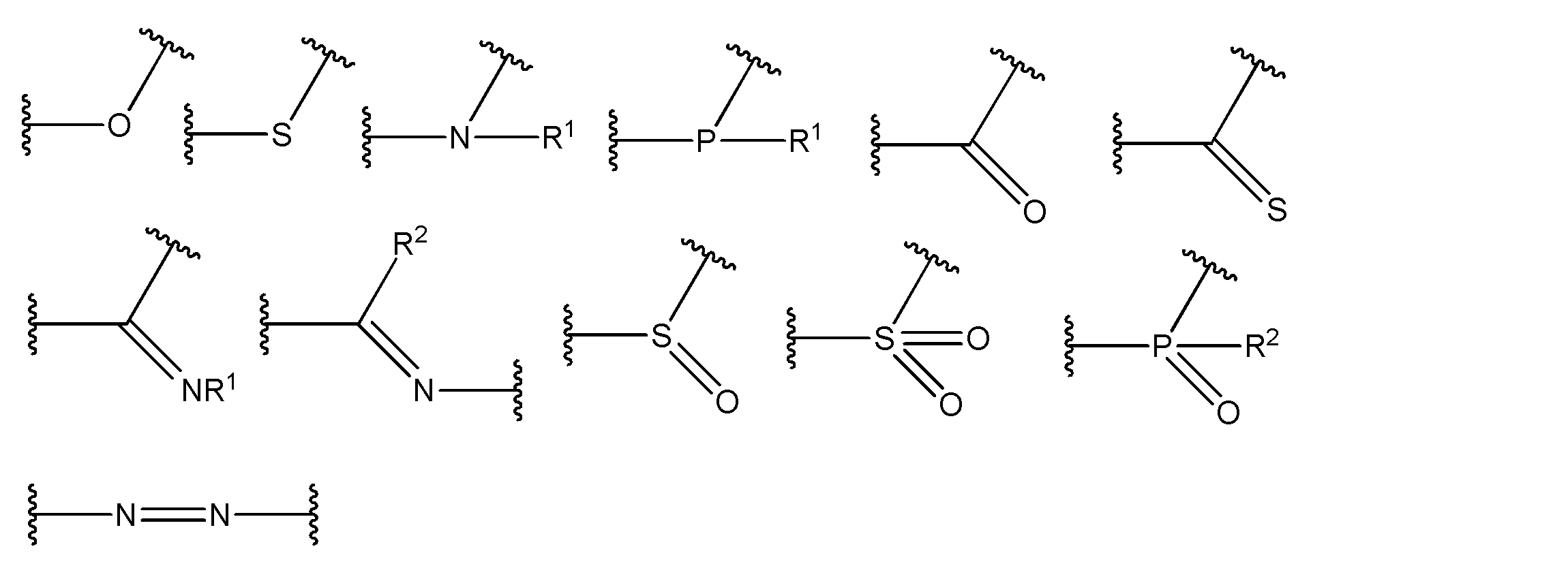
官能基群(UE-3)

官能基群(UE-1)~(UE-3)中、R1は、水素原子、アルキル基、アルケニル基、アルキニル基、アリール基またはヘテロアリール基を表し、R2は、水素原子、アルキル基、アルケニル基、アルキニル基、アリール基、ヘテロアリール基、アルコキシ基、アリールオキシ基、ヘテロアリールオキシ基、アルキルチオ基、アリールチオ基、ヘテロアリールチオ基、アミノ基またはアシル基を表す。R1は、水素原子、アルキル基、アルケニル基、アルキニル基が好ましく、水素原子、アルキル基がより好ましく、アルキル基が特に好ましい。アルキル基の炭素数は1~3であることが好ましい。N原子上の置換基、すなわちR1をアルキル基とすることで、可視透過性がより向上する。理由は不明だが、配位子軌道のエネルギーレベルが変わることで、配位子-銅間の電荷移動遷移が長波長シフトするためと推定する。
非共有電子対で配位する配位原子は、環に含まれていてもよい。非共有電子対で配位する配位原子が環に含まれる場合、非共有電子対で配位する配位原子を含む環は、単環であっても多環であってもよく、また、芳香族であっても非芳香族であってもよい。非共有電子対で配位する配位原子を含む環は、5~12員環が好ましく、5~7員環がより好ましい。
非共有電子対で配位する配位原子を含む環は、置換基を有していてもよく、置換基としては炭素数1~10の直鎖状、分岐状または環状のアルキル基、炭素数6~12のアリール基、ハロゲン原子、ケイ素原子、炭素数1~12のアルコキシ基、炭素数2~12のアシル基、炭素数1~12のアルキルチオ基、カルボキシル基等が挙げられる。
非共有電子対で配位する配位原子を含む環が置換基を有している場合、さらに置換基を有していてもよく、さらなる置換基としては、非共有電子対で配位する配位原子を含む環からなる基、上述した官能基群(UE-1)~(UE-3)から選択される少なくとも1種の部分構造を含む基、炭素数1~12のアルキル基、炭素数2~12のアシル基、ヒドロキシ基が挙げられる。
非共有電子対で配位する配位原子を含む環は、置換基を有していてもよく、置換基としては炭素数1~10の直鎖状、分岐状または環状のアルキル基、炭素数6~12のアリール基、ハロゲン原子、ケイ素原子、炭素数1~12のアルコキシ基、炭素数2~12のアシル基、炭素数1~12のアルキルチオ基、カルボキシル基等が挙げられる。
非共有電子対で配位する配位原子を含む環が置換基を有している場合、さらに置換基を有していてもよく、さらなる置換基としては、非共有電子対で配位する配位原子を含む環からなる基、上述した官能基群(UE-1)~(UE-3)から選択される少なくとも1種の部分構造を含む基、炭素数1~12のアルキル基、炭素数2~12のアシル基、ヒドロキシ基が挙げられる。
非共有電子対で配位する配位原子が官能基群(UE-1)~(UE-3)で表される部分構造に含まれる場合、R1は、水素原子、アルキル基、アルケニル基、アルキニル基、アリール基またはヘテロアリール基を表し、R2は、水素原子、アルキル基、アルケニル基、アルキニル基、アリール基、ヘテロアリール基、アルコキシ基、アリールオキシ基、ヘテロアリールオキシ基、アルキルチオ基、アリールチオ基、ヘテロアリールチオ基、アミノ基またはアシル基を表す。
アルキル基、アルケニル基、アルキニル基、アリール基、およびヘテロアリール基は、上記アニオンで配位する配位部位で説明したアルキル基、アルケニル基、アルキニル基、アリール基、およびヘテロアリール基と同義であり、好ましい範囲も同様である。
アルコキシ基の炭素数は、1~12が好ましく、3~9がより好ましい。
アリールオキシ基の炭素数は、6~18が好ましく、6~12がより好ましい。
ヘテロアリールオキシ基は、単環であっても多環であってもよい。ヘテロアリールオキシ基を構成するヘテロアリール基は、上記アニオンで配位する配位部位で説明したヘテロアリール基と同義であり、好ましい範囲も同様である。
アルキルチオ基の炭素数は、1~12が好ましく、1~9がより好ましい。
アリールチオ基の炭素数は、6~18が好ましく、6~12がより好ましい。
ヘテロアリールチオ基は、単環であっても多環であってもよい。ヘテロアリールチオ基を構成するヘテロアリール基は、上記アニオンで配位する配位部位で説明したヘテロアリール基と同義であり、好ましい範囲も同様である。
アシル基の炭素数は、2~12が好ましく、2~9がより好ましい。
アルキル基、アルケニル基、アルキニル基、アリール基、およびヘテロアリール基は、上記アニオンで配位する配位部位で説明したアルキル基、アルケニル基、アルキニル基、アリール基、およびヘテロアリール基と同義であり、好ましい範囲も同様である。
アルコキシ基の炭素数は、1~12が好ましく、3~9がより好ましい。
アリールオキシ基の炭素数は、6~18が好ましく、6~12がより好ましい。
ヘテロアリールオキシ基は、単環であっても多環であってもよい。ヘテロアリールオキシ基を構成するヘテロアリール基は、上記アニオンで配位する配位部位で説明したヘテロアリール基と同義であり、好ましい範囲も同様である。
アルキルチオ基の炭素数は、1~12が好ましく、1~9がより好ましい。
アリールチオ基の炭素数は、6~18が好ましく、6~12がより好ましい。
ヘテロアリールチオ基は、単環であっても多環であってもよい。ヘテロアリールチオ基を構成するヘテロアリール基は、上記アニオンで配位する配位部位で説明したヘテロアリール基と同義であり、好ましい範囲も同様である。
アシル基の炭素数は、2~12が好ましく、2~9がより好ましい。
配位子が、1分子内に、アニオンで配位する配位部位と非共有電子対で配位する配位原子とを有する場合、アニオンで配位する配位部位と非共有電子対で配位する配位原子とを連結する原子数は、1~6であることが好ましく、1~3であることがより好ましい。このような構成とすることにより、銅錯体の構造がより歪みやすくなるため、色価をより向上させることができ、可視光透過性を高めつつ、モル吸光係数を大きくし易い。アニオンで配位する配位部位と非共有電子対で配位する配位原子とを連結する原子の種類は、1種または2種以上であってもよい。炭素原子、または、窒素原子が好ましい。
配位子が、1分子内に、非共有電子対で配位する配位原子を2以上有する場合、非共有電子対で配位する配位原子は3つ以上有していてもよく、2~5つ有していることが好ましく、4つ有していることがより好ましい。非共有電子対で配位する配位原子同士を連結する原子数は、1~6であることが好ましく、1~3であることがより好ましく、2~3がさらに好ましく、3が特に好ましい。このような構成とすることにより、銅錯体の構造がより歪みやすくなるため、色価をより向上させることができる。非共有電子対で配位する配位原子同士を連結する原子は、1種または2種以上であってもよい。非共有電子対で配位する配位原子同士を連結する原子は、炭素原子が好ましい。
配位子は、少なくとも2つの配位部位を有する化合物(多座配位子ともいう)が好ましい。配位子は、配位部位を少なくとも3つ有することがより好ましく、3~5個有することがさらに好ましく、4~5個有することが特に好ましい。多座配位子は、銅成分に対し、キレート配位子として働く。すなわち、多座配位子が有する少なくとも2つの配位部位が、銅とキレート配位することにより、銅錯体の構造が歪んで、可視光領域の高い透過性が得られ、赤外線の吸光能力を向上でき、色価も向上すると考えられる。これにより、近赤外線カットフィルタを長期間使用しても、その特性が損なわれず、またカメラモジュールを安定的に製造することも可能となる。
多座配位子は、アニオンで配位する配位部位を1つ以上と非共有電子対で配位する配位原子を1つ以上とを含む化合物、非共有電子対で配位する配位原子を2つ以上有する化合物、アニオンで配位する配位部位を2つ含む化合物等が挙げられる。これらの化合物は、それぞれ独立して、1種または2種以上を組み合わせて用いることができる。また、配位子となる化合物は、配位部位を1つのみ有する化合物を用いることもできる。
多座配位子は、下記式(IV-1)~(IV-14)で表される化合物であることが好ましい。例えば、配位子が4つの配位部位を有する化合物である場合は、下記式(IV-3)、(IV-6)、(IV-7)、(IV-12)で表される化合物が好ましく、金属中心により強固に配位し、耐熱性の高い安定な5配位錯体を形成しやすいという理由から、(IV-12)で表される化合物がより好ましい。また、例えば、配位子が5つの配位部位を有する化合物である場合は、下記式(IV-4)、(IV-8)~(IV-11)、(IV-13)、(IV-14)で表される化合物が好ましく、金属中心により強固に配位し、耐熱性の高い安定な5配位錯体を形成しやすいという理由から、(IV-9)、(IV-10)、(IV-13)、(IV-14)で表される化合物がより好ましく、(IV-13)で表される化合物が特に好ましい。
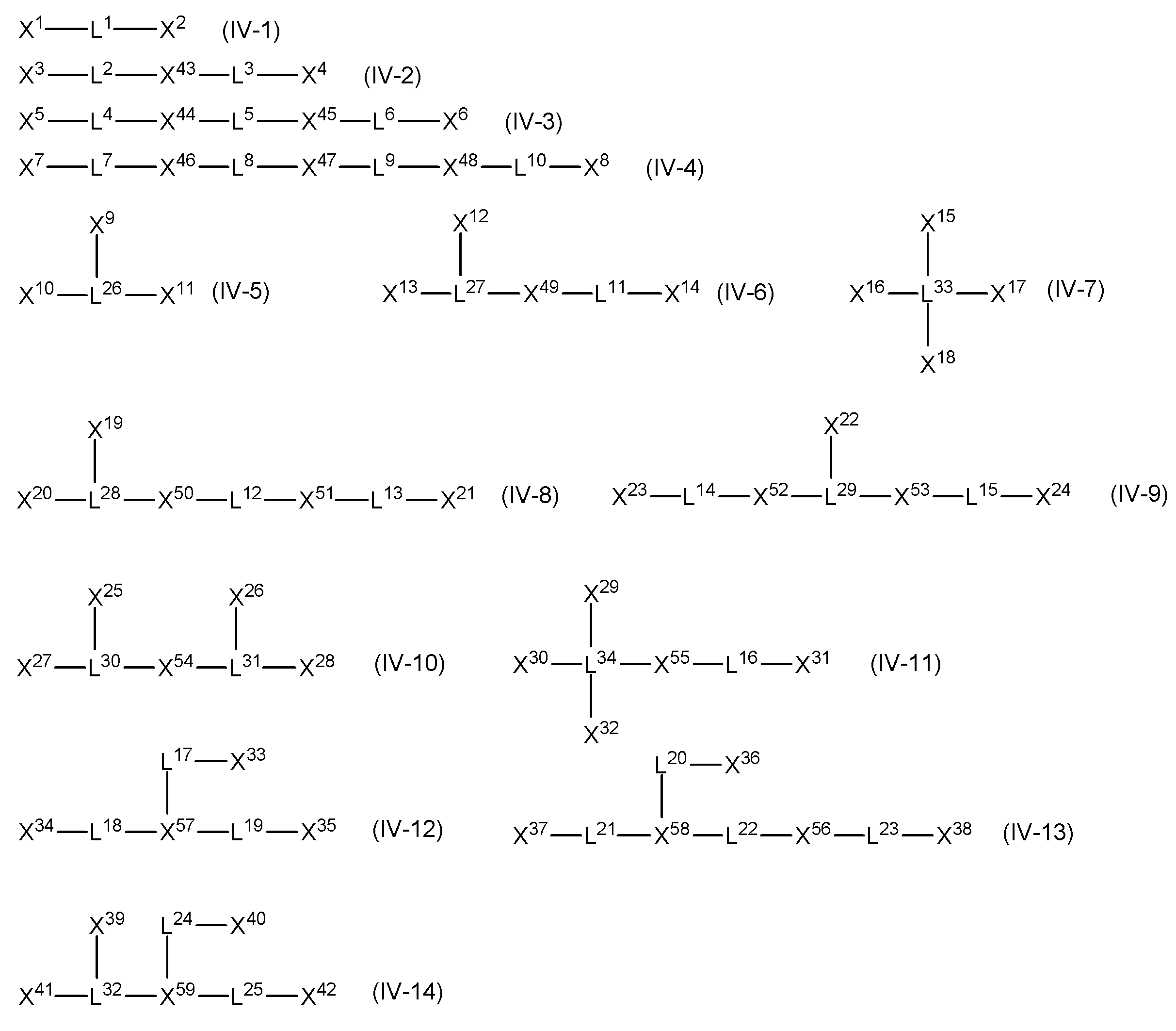
式(IV-1)~(IV-14)中、X1~X59は、それぞれ独立して、配位部位を表し、L1~L25は、それぞれ独立して、単結合または2価の連結基を表し、L26~L32は、それぞれ独立して、3価の連結基を表し、L33およびL34は、それぞれ独立して、4価の連結基を表す。
X1~X42は、それぞれ独立して、非共有電子対で配位する配位原子を含む環からなる基、上述した官能基群(AN-1)、または、官能基群(UE-1)から選択される少なくとも1種を表すことが好ましい。
X43~X56は、それぞれ独立して、非共有電子対で配位する配位原子を含む環からなる基、上述した官能基群(AN-2)、または、官能基群(UE-2)から選択される少なくとも1種を表すことが好ましい。
X57~X59は、それぞれ独立して、上述した官能基群(UE-3)から選択される少なくとも1種を表すことが好ましい。
L1~L25は、それぞれ独立して、単結合または2価の連結基を表す。2価の連結基としては、炭素数1~12のアルキレン基、炭素数6~12のアリーレン基、-SO-、-O-、-SO2-または、これらの組み合わせからなる基が好ましく、炭素数1~3のアルキレン基、フェニレン基、-SO2-またはこれらの組み合わせからなる基がより好ましい。
L26~L32は、それぞれ独立して、3価の連結基を表す。3価の連結基としては、上述した2価の連結基から水素原子を1つ除いた基が挙げられる。
L33およびL34はそれぞれ独立して4価の連結基を表す。4価の連結基としては、上述した2価の連結基から水素原子を2つ除いた基が挙げられる。
ここで、官能基群(AN-1)および(AN-2)中のR、および、官能基群(UE-1)~(UE-3)中のR1は、R同士、R1同士、あるいは、RとR1間で連結して環を形成しても良い。
X1~X42は、それぞれ独立して、非共有電子対で配位する配位原子を含む環からなる基、上述した官能基群(AN-1)、または、官能基群(UE-1)から選択される少なくとも1種を表すことが好ましい。
X43~X56は、それぞれ独立して、非共有電子対で配位する配位原子を含む環からなる基、上述した官能基群(AN-2)、または、官能基群(UE-2)から選択される少なくとも1種を表すことが好ましい。
X57~X59は、それぞれ独立して、上述した官能基群(UE-3)から選択される少なくとも1種を表すことが好ましい。
L1~L25は、それぞれ独立して、単結合または2価の連結基を表す。2価の連結基としては、炭素数1~12のアルキレン基、炭素数6~12のアリーレン基、-SO-、-O-、-SO2-または、これらの組み合わせからなる基が好ましく、炭素数1~3のアルキレン基、フェニレン基、-SO2-またはこれらの組み合わせからなる基がより好ましい。
L26~L32は、それぞれ独立して、3価の連結基を表す。3価の連結基としては、上述した2価の連結基から水素原子を1つ除いた基が挙げられる。
L33およびL34はそれぞれ独立して4価の連結基を表す。4価の連結基としては、上述した2価の連結基から水素原子を2つ除いた基が挙げられる。
ここで、官能基群(AN-1)および(AN-2)中のR、および、官能基群(UE-1)~(UE-3)中のR1は、R同士、R1同士、あるいは、RとR1間で連結して環を形成しても良い。
配位子をなす化合物の具体例としては、以下に示す化合物、後述する多座配位子の好ましい具体例として示す化合物、および、これらの化合物の塩が挙げられる。塩を構成する原子としては、金属原子、テトラブチルアンモニウムなどが挙げられる。金属原子としては、アルカリ金属原子またはアルカリ土類金属原子がより好ましい。アルカリ金属原子としては、ナトリウム、カリウム等が挙げられる。アルカリ土類金属原子としては、カルシウム、マグネシウム等が挙げられる。また、特開2014-41318号公報の段落番号0022~0042、特開2015-43063号公報の段落番号0021~0039、特開2015-158662号公報の段落番号0025、0026の記載を参酌でき、これらの内容は本明細書に組み込まれる。


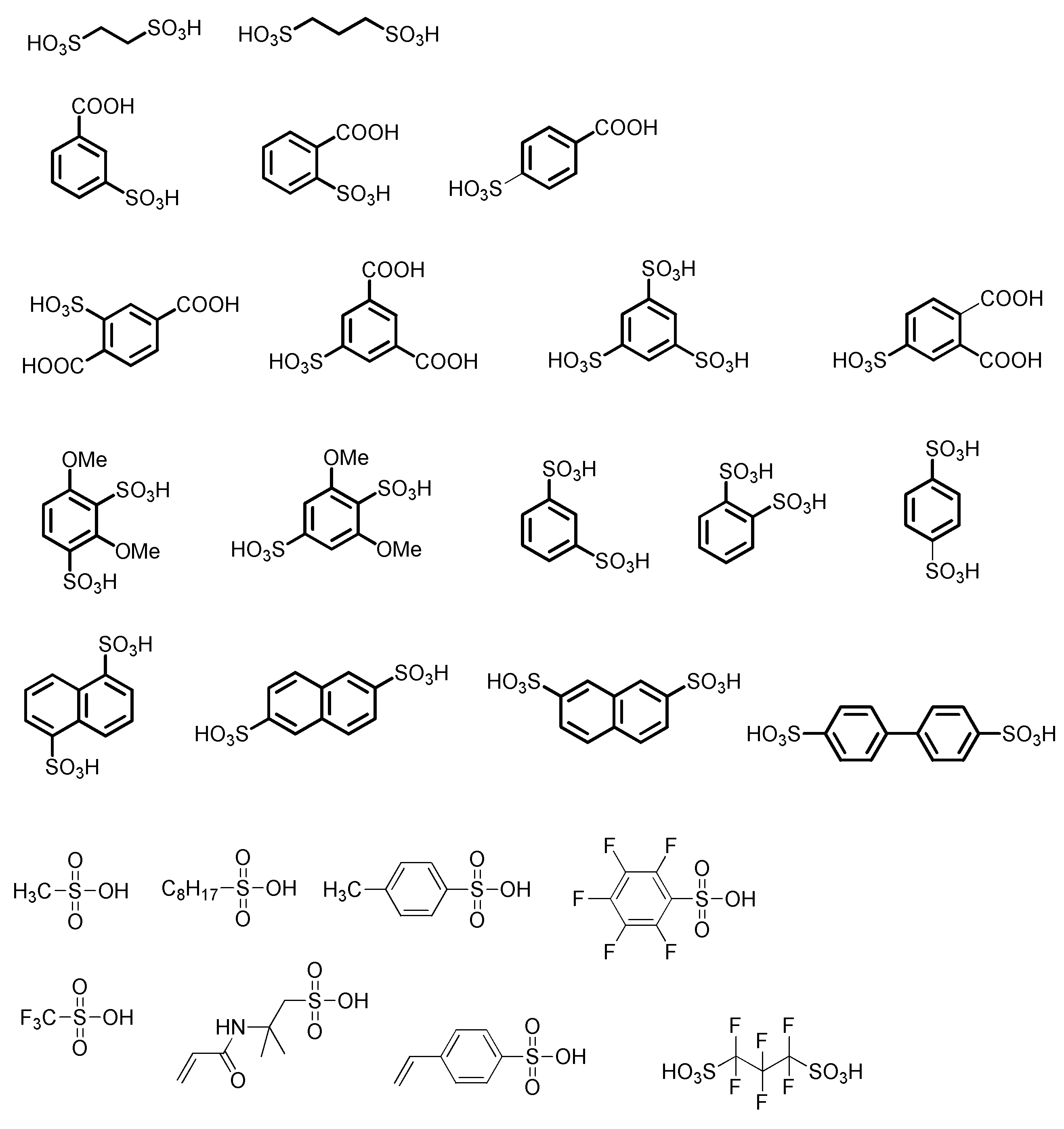
銅錯体は、例えば、以下の(1)~(5)の態様が好ましい一例として挙げられ、(2)~(5)がより好ましく、(3)~(5)がさらに好ましく、(4)または(5)が一層好ましい。
(1)2つの配位部位を有する化合物の1つまたは2つを配位子として有する銅錯体
(2)3つの配位部位を有する化合物を配位子として有する銅錯体
(3)3つの配位部位を有する化合物と2つの配位部位を有する化合物とを配位子として有する銅錯体
(4)4つの配位部位を有する化合物を配位子として有する銅錯体
(5)5つの配位部位を有する化合物を配位子として有する銅錯体
(1)2つの配位部位を有する化合物の1つまたは2つを配位子として有する銅錯体
(2)3つの配位部位を有する化合物を配位子として有する銅錯体
(3)3つの配位部位を有する化合物と2つの配位部位を有する化合物とを配位子として有する銅錯体
(4)4つの配位部位を有する化合物を配位子として有する銅錯体
(5)5つの配位部位を有する化合物を配位子として有する銅錯体
多座配位子としては、上述した配位子の具体例で説明した化合物のうち、配位部位を2以上有する化合物や、以下に示す化合物が挙げられる。


(リン酸エステル銅錯体)
本発明において、銅化合物として、リン酸エステル銅錯体を用いることもできる。リン酸エステル銅錯体は、銅を中心金属としリン酸エステル化合物を配位子とするものである。リン酸エステル銅錯体の配位子をなすリン酸エステル化合物は、下記式(L-100)で表される化合物またはその塩が好ましい。
(HO)n-P(=O)-(OR1)3-n 式(L-100)
式中、R1は、炭素数1~18のアルキル基、炭素数6~18のアリール基、炭素数7~18のアラルキル基、または炭素数2~18のアルケニル基を表すか、-OR1が、炭素数4~100のポリオキシアルキル基、炭素数4~100の(メタ)アクリロイルオキシアルキル基、または、炭素数4~100の(メタ)アクリロイルポリオキシアルキル基を表し、nは1または2を表す。nが1のとき、R2はそれぞれ同一でもよいし、異なっていてもよい。
本発明において、銅化合物として、リン酸エステル銅錯体を用いることもできる。リン酸エステル銅錯体は、銅を中心金属としリン酸エステル化合物を配位子とするものである。リン酸エステル銅錯体の配位子をなすリン酸エステル化合物は、下記式(L-100)で表される化合物またはその塩が好ましい。
(HO)n-P(=O)-(OR1)3-n 式(L-100)
式中、R1は、炭素数1~18のアルキル基、炭素数6~18のアリール基、炭素数7~18のアラルキル基、または炭素数2~18のアルケニル基を表すか、-OR1が、炭素数4~100のポリオキシアルキル基、炭素数4~100の(メタ)アクリロイルオキシアルキル基、または、炭素数4~100の(メタ)アクリロイルポリオキシアルキル基を表し、nは1または2を表す。nが1のとき、R2はそれぞれ同一でもよいし、異なっていてもよい。
リン酸エステル化合物の具体例としては、上述した配位子が挙げられる。また、特開2014-41318号公報の段落番号0022~0042の記載を参酌でき、これらの内容は本明細書に組み込まれる。
(スルホン酸銅錯体)
本発明において、銅化合物として、スルホン酸銅錯体を用いることもできる。スルホン酸銅錯体は、銅を中心金属としスルホン酸化合物を配位子とするものである。スルホン酸銅錯体の配位子をなすスルホン酸化合物は、下記式(L-200)で表される化合物またはその塩が好ましい。
R2-SO2-OH 式(L-200)
本発明において、銅化合物として、スルホン酸銅錯体を用いることもできる。スルホン酸銅錯体は、銅を中心金属としスルホン酸化合物を配位子とするものである。スルホン酸銅錯体の配位子をなすスルホン酸化合物は、下記式(L-200)で表される化合物またはその塩が好ましい。
R2-SO2-OH 式(L-200)
式中、R2は、1価の有機基を表す。1価の有機基としては、アルキル基、アリール基、ヘテロアリール基などを挙げることができる。
アルキル基、アリール基、ヘテロアリール基は、無置換であってもよく、置換基を有していてもよい。置換基としては、重合性基(好ましくは、ビニル基、(メタ)アクリロイルオキシ基)、(メタ)アクリロイル基などのエチレン性不飽和結合を有する基)、ハロゲン原子(フッ素原子、塩素原子、臭素原子、ヨウ素原子)、アルキル基、カルボン酸エステル基(例えば-CO2CH3)、ハロゲン化アルキル基、アルコキシ基、メタクリロイルオキシ基、アクリロイルオキシ基、エーテル基、アルキルスルホニル基、アリールスルホニル基、スルフィド基、アミド基、アシル基、ヒドロキシ基、カルボキシル基、スルホン酸基、リン原子を含有する酸基、アミノ基、カルバモイル基、カルバモイルオキシ基等が挙げられる。
アルキル基、アリール基、ヘテロアリール基は、無置換であってもよく、置換基を有していてもよい。置換基としては、重合性基(好ましくは、ビニル基、(メタ)アクリロイルオキシ基)、(メタ)アクリロイル基などのエチレン性不飽和結合を有する基)、ハロゲン原子(フッ素原子、塩素原子、臭素原子、ヨウ素原子)、アルキル基、カルボン酸エステル基(例えば-CO2CH3)、ハロゲン化アルキル基、アルコキシ基、メタクリロイルオキシ基、アクリロイルオキシ基、エーテル基、アルキルスルホニル基、アリールスルホニル基、スルフィド基、アミド基、アシル基、ヒドロキシ基、カルボキシル基、スルホン酸基、リン原子を含有する酸基、アミノ基、カルバモイル基、カルバモイルオキシ基等が挙げられる。
スルホン酸化合物の具体例としては、上述した配位子が挙げられる。また、特開2015-43063号公報の段落番号0021~0039の記載を参酌でき、これらの内容は本明細書に組み込まれる。
<<<ポリマータイプの銅化合物>>>
本発明において、銅化合物として、ポリマー側鎖に銅錯体部位を有する銅含有ポリマーを用いることができる。
本発明において、銅化合物として、ポリマー側鎖に銅錯体部位を有する銅含有ポリマーを用いることができる。
銅錯体部位としては、銅と、銅に対して配位する部位(配位部位)とを有するものが挙げられる。銅に対して配位する部位としては、アニオンまたは非共有電子対で配位する部位が挙げられる。また、銅錯体部位は、銅に対して4座配位または5座配位する部位を有することが好ましい。配位部位の詳細については、上述した低分子タイプの銅化合物で説明したものが挙げられ、好ましい範囲も同様である。
銅含有ポリマーとしては、配位部位を含むポリマー(ポリマー(B1)ともいう)と、銅成分との反応で得られるポリマーや、ポリマー側鎖に反応性部位を有するポリマー(以下ポリマー(B2)ともいう)と、ポリマー(B2)が有する反応性部位と反応可能な官能基を有する銅錯体とを反応させて得られるポリマーが挙げられる。銅含有ポリマーの重量平均分子量は、2000以上が好ましく、2000~200万がより好ましく、6000~200,000がさらに好ましい。
銅含有ポリマーの重量平均分子量は、2000以上が好ましく、2000~200万がより好ましく、6000~200,000がさらに好ましい。
<<他の赤外線吸収剤>>>
本発明の近赤外線吸収組成物は、銅化合物以外の他の赤外線吸収剤をさらに含有してもよい。他の赤外線吸収剤としては、例えば、ピロロピロール化合物、スクアリリウム化合物、シアニン化合物、フタロシアニン化合物、ナフタロシアニン化合物、ジイミニウム化合物、チオール錯体系化合物、遷移金属酸化物系化合物、クアテリレン系化合物、クロコニウム系化合物等が挙げられる。
本発明の近赤外線吸収組成物は、銅化合物以外の他の赤外線吸収剤をさらに含有してもよい。他の赤外線吸収剤としては、例えば、ピロロピロール化合物、スクアリリウム化合物、シアニン化合物、フタロシアニン化合物、ナフタロシアニン化合物、ジイミニウム化合物、チオール錯体系化合物、遷移金属酸化物系化合物、クアテリレン系化合物、クロコニウム系化合物等が挙げられる。
他の赤外線吸収剤の含有量は、近赤外線吸収組成物の全固形分に対して、1~80質量%が好ましい。上限は、70質量%以下がより好ましく、60質量%以下がさらに好ましい。下限は、5質量%以上がより好ましく、10質量%以上がさらに好ましい。
<<無機微粒子>>
本発明の近赤外線吸収組成物は、無機微粒子を含んでいてもよい。無機微粒子は、1種のみを用いてもよいし、2種以上を用いてもよい。
無機微粒子は、主に、赤外線を遮光(吸収)する役割を果たす粒子である。無機微粒子は、赤外線遮蔽性がより優れる点で、金属酸化物微粒子または金属微粒子が好ましい。
金属酸化物微粒子としては、例えば、酸化インジウムスズ(ITO)粒子、酸化アンチモンスズ(ATO)粒子、酸化亜鉛(ZnO)粒子、Alドープ酸化亜鉛(AlドープZnO)粒子、フッ素ドープ二酸化スズ(FドープSnO2)粒子、ニオブドープ二酸化チタン(NbドープTiO2)粒子などが挙げられる。
金属微粒子としては、例えば、銀(Ag)粒子、金(Au)粒子、銅(Cu)粒子、ニッケル(Ni)粒子などが挙げられる。なお、赤外線遮蔽性とフォトリソ性とを両立するためには、露光波長(365~405nm)の透過率が高い方が望ましく、酸化インジウムスズ(ITO)粒子または酸化アンチモンスズ(ATO)粒子が好ましい。
無機微粒子の形状は特に制限されず、球状、非球状を問わず、シート状、ワイヤー状、チューブ状であってもよい。
本発明の近赤外線吸収組成物は、無機微粒子を含んでいてもよい。無機微粒子は、1種のみを用いてもよいし、2種以上を用いてもよい。
無機微粒子は、主に、赤外線を遮光(吸収)する役割を果たす粒子である。無機微粒子は、赤外線遮蔽性がより優れる点で、金属酸化物微粒子または金属微粒子が好ましい。
金属酸化物微粒子としては、例えば、酸化インジウムスズ(ITO)粒子、酸化アンチモンスズ(ATO)粒子、酸化亜鉛(ZnO)粒子、Alドープ酸化亜鉛(AlドープZnO)粒子、フッ素ドープ二酸化スズ(FドープSnO2)粒子、ニオブドープ二酸化チタン(NbドープTiO2)粒子などが挙げられる。
金属微粒子としては、例えば、銀(Ag)粒子、金(Au)粒子、銅(Cu)粒子、ニッケル(Ni)粒子などが挙げられる。なお、赤外線遮蔽性とフォトリソ性とを両立するためには、露光波長(365~405nm)の透過率が高い方が望ましく、酸化インジウムスズ(ITO)粒子または酸化アンチモンスズ(ATO)粒子が好ましい。
無機微粒子の形状は特に制限されず、球状、非球状を問わず、シート状、ワイヤー状、チューブ状であってもよい。
また、無機微粒子として、酸化タングステン系化合物が使用できる、具体的には、下記式(組成式)(I)で表される酸化タングステン系化合物であることが好ましい。
MxWyOz・・・(I)
Mは金属、Wはタングステン、Oは酸素を表す。
0.001≦x/y≦1.1
2.2≦z/y≦3.0
Mが表す金属としては、アルカリ金属、アルカリ土類金属、Mg、Zr、Cr、Mn、Fe、Ru、Co、Rh、Ir、Ni、Pd、Pt、Cu、Ag、Au、Zn、Cd、Al、Ga、In、Tl、Sn、Pb、Ti、Nb、V、Mo、Ta、Re、Be、Hf、Os、Biが挙げられ、アルカリ金属が好ましく、RbまたはCsがより好ましく、Csが特に好ましい。Mの金属は1種でも2種以上でも良い。
x/yが0.001以上であることにより、赤外線を十分に遮蔽することができ、1.1以下であることにより、酸化タングステン系化合物中に不純物相が生成されることをより確実に回避することができる。
z/yが2.2以上であることにより、材料としての化学的安定性をより向上させることができ、3.0以下であることにより赤外線を十分に遮蔽することができる。
上記式(I)で表される酸化タングステン系化合物の具体例としては、Cs0.33WO3、Rb0.33WO3、K0.33WO3、Ba0.33WO3などを挙げることができ、Cs0.33WO3またはRb0.33WO3であることが好ましく、Cs0.33WO3であることがより好ましい。
酸化タングステン系化合物は、例えば、住友金属鉱山株式会社製のYMF-02などのタングステン微粒子の分散物として入手可能である。
MxWyOz・・・(I)
Mは金属、Wはタングステン、Oは酸素を表す。
0.001≦x/y≦1.1
2.2≦z/y≦3.0
Mが表す金属としては、アルカリ金属、アルカリ土類金属、Mg、Zr、Cr、Mn、Fe、Ru、Co、Rh、Ir、Ni、Pd、Pt、Cu、Ag、Au、Zn、Cd、Al、Ga、In、Tl、Sn、Pb、Ti、Nb、V、Mo、Ta、Re、Be、Hf、Os、Biが挙げられ、アルカリ金属が好ましく、RbまたはCsがより好ましく、Csが特に好ましい。Mの金属は1種でも2種以上でも良い。
x/yが0.001以上であることにより、赤外線を十分に遮蔽することができ、1.1以下であることにより、酸化タングステン系化合物中に不純物相が生成されることをより確実に回避することができる。
z/yが2.2以上であることにより、材料としての化学的安定性をより向上させることができ、3.0以下であることにより赤外線を十分に遮蔽することができる。
上記式(I)で表される酸化タングステン系化合物の具体例としては、Cs0.33WO3、Rb0.33WO3、K0.33WO3、Ba0.33WO3などを挙げることができ、Cs0.33WO3またはRb0.33WO3であることが好ましく、Cs0.33WO3であることがより好ましい。
酸化タングステン系化合物は、例えば、住友金属鉱山株式会社製のYMF-02などのタングステン微粒子の分散物として入手可能である。
無機微粒子の平均粒子径は、800nm以下が好ましく、400nm以下がより好ましく、200nm以下がさらに好ましい。無機微粒子の平均粒子径がこのような範囲であることによって、可視光領域における透光性をより確実にすることができる。光散乱を回避する観点からは、平均粒子径は小さいほど好ましいが、製造時における取り扱いの容易性などの理由から、無機微粒子の平均粒子径は、通常、1nm以上である。
無機微粒子の含有量は、近赤外線吸収組成物の全固形分に対して、0.01~30質量%が好ましい。下限は、0.1質量%以上がより好ましく、1質量%以上がさらに好ましい。上限は、20質量%以下がより好ましく、10質量%以下がさらに好ましい。
無機微粒子の含有量は、近赤外線吸収組成物の全固形分に対して、0.01~30質量%が好ましい。下限は、0.1質量%以上がより好ましく、1質量%以上がさらに好ましい。上限は、20質量%以下がより好ましく、10質量%以下がさらに好ましい。
<<有機溶剤>>
本発明の近赤外線吸収組成物は、有機溶剤を含有する。溶剤は、特に制限はなく、各成分を均一に溶解または分散しうるものであれば、目的に応じて適宜選択することができる。例えば、アルコール類、ケトン類、エステル類、芳香族炭化水素類、ハロゲン化炭化水素類、およびジメチルホルムアミド、ジメチルアセトアミド、ジメチルスルホオキサイド、スルホラン等が好適に挙げられる。これらは、1種単独で使用してもよく、2種以上を併用してもよい。アルコール類、芳香族炭化水素類、ハロゲン化炭化水素類の具体例としては、特開2012-194534号公報の段落番号0136等に記載のものが挙げられ、この内容は本明細書に組み込まれる。エステル類、ケトン類、エーテル類の具体例としては、特開2012-208494号公報の段落番号0497(対応する米国特許出願公開第2012/0235099号明細書の[0609])に記載のものが挙げられる。さらに、酢酸-n-アミル、プロピオン酸エチル、フタル酸ジメチル、安息香酸エチル、硫酸メチル、アセトン、メチルイソブチルケトン、ジエチルエーテル、エチレングリコールモノブチルエーテルアセテートなどが挙げられる。
有機溶剤としては、1-メトキシ-2-プロパノール、シクロペンタノン、シクロヘキサノン、プロピレングリコールモノメチルエーテルアセテート、N-メチル-2-ピロリドン、酢酸ブチル、乳酸エチルおよびプロピレングリコールモノメチルエーテルから選択される少なくとも1種以上を用いることが好ましい。
本発明の近赤外線吸収組成物は、有機溶剤を含有する。溶剤は、特に制限はなく、各成分を均一に溶解または分散しうるものであれば、目的に応じて適宜選択することができる。例えば、アルコール類、ケトン類、エステル類、芳香族炭化水素類、ハロゲン化炭化水素類、およびジメチルホルムアミド、ジメチルアセトアミド、ジメチルスルホオキサイド、スルホラン等が好適に挙げられる。これらは、1種単独で使用してもよく、2種以上を併用してもよい。アルコール類、芳香族炭化水素類、ハロゲン化炭化水素類の具体例としては、特開2012-194534号公報の段落番号0136等に記載のものが挙げられ、この内容は本明細書に組み込まれる。エステル類、ケトン類、エーテル類の具体例としては、特開2012-208494号公報の段落番号0497(対応する米国特許出願公開第2012/0235099号明細書の[0609])に記載のものが挙げられる。さらに、酢酸-n-アミル、プロピオン酸エチル、フタル酸ジメチル、安息香酸エチル、硫酸メチル、アセトン、メチルイソブチルケトン、ジエチルエーテル、エチレングリコールモノブチルエーテルアセテートなどが挙げられる。
有機溶剤としては、1-メトキシ-2-プロパノール、シクロペンタノン、シクロヘキサノン、プロピレングリコールモノメチルエーテルアセテート、N-メチル-2-ピロリドン、酢酸ブチル、乳酸エチルおよびプロピレングリコールモノメチルエーテルから選択される少なくとも1種以上を用いることが好ましい。
本発明においては、金属含有量の少ない有機溶剤を用いることが好ましく、有機溶剤の金属含有量は、例えば10ppb以下であることが好ましい。必要に応じてpptレベルの溶剤を用いてもよく、そのような高純度溶剤は例えば東洋合成社が提供している。
有機溶剤から金属等の不純物を除去する方法としては、例えば、蒸留(分子蒸留や薄膜蒸留等)やフィルタを用いたろ過を挙げることができる。フィルタを用いたろ過におけるフィルタ孔径としては、ポアサイズ10nm以下が好ましく、5nm以下がより好ましく、3nm以下がさらに好ましい。フィルタの材質としては、ポリテトラフルオロエチレン製、ポリエチレン製、ナイロン製のフィルタが好ましい。
有機溶剤は、異性体(同じ原子数で異なる構造の化合物)が含まれていてもよい。また、異性体は、1種のみが含まれていてもよいし、複数種含まれていてもよい。
有機溶剤の含有量は、本発明の近赤外線吸収組成物の全固形分が5~60質量%となる量が好ましい。下限は、10質量%以上がより好ましい。上限は、40質量%以下がより好ましい。
有機溶剤は1種類のみでも、2種類以上でもよく、2種類以上の場合は、合計量が上記範囲となることが好ましい。
有機溶剤は1種類のみでも、2種類以上でもよく、2種類以上の場合は、合計量が上記範囲となることが好ましい。
<<ジケトン化合物>>
本発明の近赤外線吸収組成物は、さらにジケトン化合物を含有することが好ましい。ジケトン化合物を含有することで、近赤外線吸収組成物の保存安定性がさらに向上する。
本発明の近赤外線吸収組成物は、さらにジケトン化合物を含有することが好ましい。ジケトン化合物を含有することで、近赤外線吸収組成物の保存安定性がさらに向上する。
ジケトン化合物としては、下記式(1)で表される化合物が好ましい。
式(1)

式中、R1~R3は、それぞれ独立して、水素原子または置換基を表す。
式(1)
R1~R3が表す置換基としては、アルキル基、アリール基、ヘテロアリール基などが挙げられる。
アルキル基の炭素数は、1~20が好ましく、1~15がより好ましく、1~8がさらに好ましい。アルキル基は、直鎖、分岐、環状のいずれでもよく、直鎖または分岐が好ましい。
アリール基の炭素数は、6~30が好ましく、6~20がより好ましく、6~12がさらに好ましい。
ヘテロアリール基は、単環または縮合環が好ましく、単環または縮合数が2~8の縮合環がより好ましく、単環または縮合数が2~4の縮合環がさらに好ましい。ヘテロアリール基の環を構成するヘテロ原子の数は1~3が好ましい。ヘテロアリール基の環を構成するヘテロ原子は、窒素原子、酸素原子または硫黄原子が好ましい。ヘテロアリール基は、5員環または6員環が好ましい。ヘテロアリール基の環を構成する炭素原子の数は3~30が好ましく、3~18がより好ましく、3~12がより好ましい。
アルキル基、アリール基およびヘテロアリール基は、置換基を有していてもよく、無置換であってもよい。置換基としては、例えば、アルキル基、アリール基、ヘテロアリール基、ハロゲン原子などが挙げられる。
アルキル基の炭素数は、1~20が好ましく、1~15がより好ましく、1~8がさらに好ましい。アルキル基は、直鎖、分岐、環状のいずれでもよく、直鎖または分岐が好ましい。
アリール基の炭素数は、6~30が好ましく、6~20がより好ましく、6~12がさらに好ましい。
ヘテロアリール基は、単環または縮合環が好ましく、単環または縮合数が2~8の縮合環がより好ましく、単環または縮合数が2~4の縮合環がさらに好ましい。ヘテロアリール基の環を構成するヘテロ原子の数は1~3が好ましい。ヘテロアリール基の環を構成するヘテロ原子は、窒素原子、酸素原子または硫黄原子が好ましい。ヘテロアリール基は、5員環または6員環が好ましい。ヘテロアリール基の環を構成する炭素原子の数は3~30が好ましく、3~18がより好ましく、3~12がより好ましい。
アルキル基、アリール基およびヘテロアリール基は、置換基を有していてもよく、無置換であってもよい。置換基としては、例えば、アルキル基、アリール基、ヘテロアリール基、ハロゲン原子などが挙げられる。
<<樹脂>>
本発明の近赤外線吸収組成物は、樹脂を含有することができる。樹脂としては、特に限定はない。例えば、(メタ)アクリル樹脂、スチレン樹脂、エポキシ樹脂、エン・チオール樹脂、ポリカーボネート樹脂、ポリエーテル樹脂、ポリアリレート樹脂、ポリスルホン樹脂、ポリエーテルスルホン樹脂、ポリパラフェニレン樹脂、ポリアリーレンエーテルフォスフィンオキシド樹脂、ポリイミド樹脂、ポリアミド樹脂、ポリアミドイミド樹脂、ポリオレフィン樹脂、環状オレフィン樹脂、ポリエステル樹脂、マレイミド樹脂、アクリロニトリル樹脂、ポリビニルアセタール樹脂、ポリ-N-ビニルアセトアミド樹脂、ポリビニルピロリドン樹脂、フルオレンポリカーボネート樹脂、フルオレンポリエステル樹脂、ポリエチレンナフタレート樹脂、フッ素化芳香族ポリマー樹脂、アリルエステル樹脂およびシルセスキオキサン樹脂などが挙げられる。これらの樹脂から選択される1種を単独で使用してもよく、2種以上を混合して使用してもよい。上記樹脂については、特開2014-218597号公報の段落番号0056~0060の記載、特開2013-218312号公報の段落番号0074~0156の記載を参酌でき、この内容は本明細書に組み込まれる。
本発明の近赤外線吸収組成物は、樹脂を含有することができる。樹脂としては、特に限定はない。例えば、(メタ)アクリル樹脂、スチレン樹脂、エポキシ樹脂、エン・チオール樹脂、ポリカーボネート樹脂、ポリエーテル樹脂、ポリアリレート樹脂、ポリスルホン樹脂、ポリエーテルスルホン樹脂、ポリパラフェニレン樹脂、ポリアリーレンエーテルフォスフィンオキシド樹脂、ポリイミド樹脂、ポリアミド樹脂、ポリアミドイミド樹脂、ポリオレフィン樹脂、環状オレフィン樹脂、ポリエステル樹脂、マレイミド樹脂、アクリロニトリル樹脂、ポリビニルアセタール樹脂、ポリ-N-ビニルアセトアミド樹脂、ポリビニルピロリドン樹脂、フルオレンポリカーボネート樹脂、フルオレンポリエステル樹脂、ポリエチレンナフタレート樹脂、フッ素化芳香族ポリマー樹脂、アリルエステル樹脂およびシルセスキオキサン樹脂などが挙げられる。これらの樹脂から選択される1種を単独で使用してもよく、2種以上を混合して使用してもよい。上記樹脂については、特開2014-218597号公報の段落番号0056~0060の記載、特開2013-218312号公報の段落番号0074~0156の記載を参酌でき、この内容は本明細書に組み込まれる。
樹脂の重量平均分子量(Mw)は、2,000~2,000,000が好ましい。上限は、1,000,000以下がより好ましく、500,000以下がさらに好ましい。下限は、3,000以上がより好ましく、5,000以上がさらに好ましい。また、エポキシ樹脂の場合、重量平均分子量(Mw)は、100以上が好ましく、200~2,000,000がより好ましい。上限は、1,000,000以下がより好ましく、500,000以下がさらに好ましい。
(メタ)アクリル樹脂としては、(メタ)アクリル酸および/またはそのエステルに由来する構成単位を含むポリマーが挙げられる。具体的には、(メタ)アクリル酸、(メタ)アクリル酸エステル類、(メタ)アクリルアミドおよび(メタ)アクリロニトリルから選ばれる少なくとも1種を重合して得られるポリマーが挙げられる。
ポリエステル樹脂としては、ポリオール(例えば、エチレングリコール、プロピレングリコール、グリセリン、トリメチロールプロパン)と、多塩基酸(例えば、テレフタル酸、イソフタル酸、ナフタレンジカルボン酸等の芳香族ジカルボン酸およびこれらの芳香環の水素原子がメチル基、エチル基、フェニル基等で置換された芳香族ジカルボン酸、アジピン酸、セバシン酸、ドデカンジカルボン酸等の炭素数2~20の脂肪族ジカルボン酸、およびシクロヘキサンジカルボン酸などの脂環式ジカルボン酸など)との反応により得られるポリマーや、カプロラクトンモノマー等の環状エステル化合物の開環重合により得られるポリマー(例えばポリカプロラクトン)が挙げられる。
エポキシ樹脂としては、ビスフェノールA型エポキシ樹脂、ビスフェノールF型エポキシ樹脂、フェノールノボラック型エポキシ樹脂、クレゾールノボラック型エポキシ樹脂、脂肪族エポキシ樹脂等を挙げることができる。
樹脂の含有量は、近赤外線吸収組成物の全固形分に対して、1~70質量%が好ましい。下限は、5質量%以上がより好ましく、10質量%以上がさらに好ましい。上限は、例えば、65質量%以下とすることもでき、60質量%以下とすることもできる。樹脂は、1種類のみでもよく、2種類以上でもよい。2種類以上の場合は、合計量が上記範囲となることが好ましい。
<<架橋性基を有する化合物(架橋性化合物)>>
本発明の近赤外線吸収組成物は、上述した化合物MX以外の成分として、架橋性基を有する化合物(以下、架橋性化合物ともいう)を含有してもよい。架橋性化合物は、例えば、エチレン性不飽和結合を有する基を有する化合物、環状エーテル基を有する化合物、メチロール基を有する化合物等が挙げられる。エチレン性不飽和結合を有する基としては、ビニル基、スチリル基、(メタ)アリル基、(メタ)アクリロイル基などが挙げられ、(メタ)アリル基、(メタ)アクリロイル基が好ましい。環状エーテル基としては、エポキシ基やオキセタニル基が挙げられ、エポキシ基が好ましい。
本発明の近赤外線吸収組成物は、上述した化合物MX以外の成分として、架橋性基を有する化合物(以下、架橋性化合物ともいう)を含有してもよい。架橋性化合物は、例えば、エチレン性不飽和結合を有する基を有する化合物、環状エーテル基を有する化合物、メチロール基を有する化合物等が挙げられる。エチレン性不飽和結合を有する基としては、ビニル基、スチリル基、(メタ)アリル基、(メタ)アクリロイル基などが挙げられ、(メタ)アリル基、(メタ)アクリロイル基が好ましい。環状エーテル基としては、エポキシ基やオキセタニル基が挙げられ、エポキシ基が好ましい。
架橋性化合物は、モノマーであってもよく、ポリマーであってもよい。モノマーが好ましい。モノマータイプの架橋性化合物の分子量は、2000未満が好ましく、100以上2000未満がより好ましく、200以上2000未満がさらに好ましい。上限は、例えば1500以下が好ましい。ポリマータイプの架橋性化合物の重量平均分子量(Mw)は、2,000~2,000,000が好ましい。上限は、1,000,000以下がより好ましく、500,000以下がさらに好ましい。下限は、3,000以上がより好ましく、5,000以上がさらに好ましい。また、環状エーテル基を有する化合物の場合、重量平均分子量(Mw)は、100以上が好ましく、200~2,000,000がより好ましい。上限は、1,000,000以下がより好ましく、500,000以下がさらに好ましい。
(エチレン性不飽和結合を有する基を有する化合物)
エチレン性不飽和結合を有する基を有する化合物は、3~15官能の(メタ)アクリレート化合物であることが好ましく、3~6官能の(メタ)アクリレート化合物であることがより好ましい。エチレン性不飽和結合を有する基を含む化合物の例としては、特開2013-253224号公報の段落番号0033~0034の記載を参酌することができ、この内容は本明細書に組み込まれる。具体例としては、エチレンオキシ変性ペンタエリスリトールテトラアクリレート(市販品としては、NKエステルATM-35E;新中村化学工業社製)、ジペンタエリスリトールトリアクリレート(市販品としては、KAYARAD D-330;日本化薬株式会社製)、ジペンタエリスリトールテトラアクリレート(市販品としては、KAYARAD D-320;日本化薬株式会社製)、ジペンタエリスリトールペンタ(メタ)アクリレート(市販品としては、KAYARAD D-310;日本化薬株式会社製)、ジペンタエリスリトールヘキサ(メタ)アクリレート(市販品としては、KAYARAD DPHA;日本化薬株式会社製、A-DPH-12E;新中村化学工業社製)、およびこれらの(メタ)アクリロイル基がエチレングリコール、プロピレングリコール残基を介して結合している構造のものが好ましい。またこれらのオリゴマータイプも使用できる。また、特開2013-253224号公報の段落番号0034~0038に記載の重合性化合物の記載を参酌することができ、この内容は本明細書に組み込まれる。また、特開2012-208494号公報の段落番号0477(対応する米国特許出願公開第2012/0235099号明細書の[0585])に記載の重合性モノマー等が挙げられ、これらの内容は本明細書に組み込まれる。また、ジグリセリンEO(エチレンオキシド)変性(メタ)アクリレート(市販品としては、M-460;東亞合成製)が好ましい。ペンタエリスリトールテトラアクリレート(新中村化学工業社製、A-TMMT)、1,6-ヘキサンジオールジアクリレート(日本化薬社製、KAYARAD HDDA)も好ましい。これらのオリゴマータイプも使用できる。例えば、RP-1040(日本化薬株式会社製)などが挙げられる。
エチレン性不飽和結合を有する基を有する化合物は、3~15官能の(メタ)アクリレート化合物であることが好ましく、3~6官能の(メタ)アクリレート化合物であることがより好ましい。エチレン性不飽和結合を有する基を含む化合物の例としては、特開2013-253224号公報の段落番号0033~0034の記載を参酌することができ、この内容は本明細書に組み込まれる。具体例としては、エチレンオキシ変性ペンタエリスリトールテトラアクリレート(市販品としては、NKエステルATM-35E;新中村化学工業社製)、ジペンタエリスリトールトリアクリレート(市販品としては、KAYARAD D-330;日本化薬株式会社製)、ジペンタエリスリトールテトラアクリレート(市販品としては、KAYARAD D-320;日本化薬株式会社製)、ジペンタエリスリトールペンタ(メタ)アクリレート(市販品としては、KAYARAD D-310;日本化薬株式会社製)、ジペンタエリスリトールヘキサ(メタ)アクリレート(市販品としては、KAYARAD DPHA;日本化薬株式会社製、A-DPH-12E;新中村化学工業社製)、およびこれらの(メタ)アクリロイル基がエチレングリコール、プロピレングリコール残基を介して結合している構造のものが好ましい。またこれらのオリゴマータイプも使用できる。また、特開2013-253224号公報の段落番号0034~0038に記載の重合性化合物の記載を参酌することができ、この内容は本明細書に組み込まれる。また、特開2012-208494号公報の段落番号0477(対応する米国特許出願公開第2012/0235099号明細書の[0585])に記載の重合性モノマー等が挙げられ、これらの内容は本明細書に組み込まれる。また、ジグリセリンEO(エチレンオキシド)変性(メタ)アクリレート(市販品としては、M-460;東亞合成製)が好ましい。ペンタエリスリトールテトラアクリレート(新中村化学工業社製、A-TMMT)、1,6-ヘキサンジオールジアクリレート(日本化薬社製、KAYARAD HDDA)も好ましい。これらのオリゴマータイプも使用できる。例えば、RP-1040(日本化薬株式会社製)などが挙げられる。
エチレン性不飽和結合を有する基を含む化合物としては、さらに、カルボキシル基、スルホン酸基、リン酸基等の酸基を有していてもよい。酸基を有する化合物としては、脂肪族ポリヒドロキシ化合物と不飽和カルボン酸とのエステルが挙げられ、脂肪族ポリヒドロキシ化合物の未反応のヒドロキシル基に、非芳香族カルボン酸無水物を反応させて酸基を持たせた多官能モノマーが好ましく、特に好ましくは、脂肪族ポリヒドロキシ化合物がペンタエリスリトールおよび/またはジペンタエリスリトールであるものである。市販品としては、例えば、東亞合成株式会社製の多塩基酸変性アクリルオリゴマーである、アロニックスシリーズのM-305、M-510、M-520などが挙げられる。酸基を有する化合物の酸価は、0.1~40mgKOH/gが好ましい。下限は、5mgKOH/g以上がより好ましい。上限は、30mgKOH/g以下がより好ましい。
エチレン性不飽和結合を有する基を含む化合物は、カプロラクトン構造を有する化合物も好ましい態様である。カプロラクトン構造を有する化合物としては、特開2013-253224号公報の段落番号0042~0045の記載を参酌することができ、この内容は本明細書に組み込まれる。市販品としては、例えばサートマー社製のエチレンオキシ鎖を4個有する4官能アクリレートであるSR-494、日本化薬株式会社製のペンチレンオキシ鎖を6個有する6官能アクリレートであるDPCA-60、イソブチレンオキシ鎖を3個有する3官能アクリレートであるTPA-330などが挙げられる。
本発明において、エチレン性不飽和結合を有する基を有する化合物として、エチレン性不飽和結合を有する基を側鎖に有するポリマーを用いることもできる。側鎖にエチレン性不飽和結合を有する基を有する構成単位の含有量は、上記ポリマーを構成する全構成単位の5~100質量%であることが好ましい。下限は、10質量%以上がより好ましく、15質量%以上がさらに好ましい。上限は、90質量%以下がより好ましく、80質量%以下がさらに好ましく、70質量%以下が特に好ましい。
上記ポリマーは、側鎖にエチレン性不飽和結合を有する基を有する構成単位の他に、他の構成単位を含んでいてもよい。他の構成単位は、酸基等の官能基を含んでいてもよい。官能基を含んでいなくてもよい。酸基としては、カルボキシル基、スルホン酸基、リン酸基が例示される。酸基は1種類のみ含まれていても良いし、2種類以上含まれていても良い。酸基を有する構成単位の割合は、上記ポリマーを構成する全構成単位の0~50質量%であることが好ましい。下限は、1質量%以上がより好ましく、3質量%以上がさらに好ましい。上限は、35質量%以下がより好ましく、30質量%以下がさらに好ましい。
上記ポリマーの具体例としては、例えば、(メタ)アリル(メタ)アクリレート/(メタ)アクリル酸共重合体などが挙げられる。上記ポリマーの市販品としては、ダイヤナールNRシリーズ(三菱レイヨン株式会社製)、Photomer6173(COOH含有polyurethane acrylic oligomer.Diamond Shamrock Co.,Ltd製)、ビスコートR-264、KSレジスト106(いずれも大阪有機化学工業株式会社製)、サイクロマーPシリーズ(例えば、ACA230AA)、プラクセルCF200シリーズ(いずれも(株)ダイセル製)、Ebecryl3800(ダイセル・ユーシービー株式会社製)、アクリキュアーRD-F8(日本触媒社製)などが挙げられる。
(環状エーテル基を有する化合物)
本発明では、架橋性化合物として、環状エーテル基を有する化合物を用いることもできる。環状エーテル基としては、エポキシ基、オキセタニル基が挙げられ、エポキシ基が好ましい。
環状エーテル基を有する化合物としては、側鎖に環状エーテル基を有するポリマー、分子内に2個以上の環状エーテル基を有するモノマーまたはオリゴマーなどが挙げられる。例えば、ビスフェノールA型エポキシ樹脂、ビスフェノールF型エポキシ樹脂、フェノールノボラック型エポキシ樹脂、クレゾールノボラック型エポキシ樹脂、脂肪族エポキシ樹脂等を挙げることができる。また単官能または多官能グリシジルエーテル化合物も挙げられ、多官能脂肪族グリシジルエーテル化合物が好ましい。環状エーテル基を有する化合物は、グリシジル(メタ)アクリレートやアリルグリシジルエーテル等のグリシジル基を有する化合物や、脂環式エポキシ基を有する化合物を用いることもできる。このような化合物としては、例えば特開2009-265518号公報の段落番号0045等の記載を参酌でき、これらの内容は本明細書に組み込まれる。
本発明では、架橋性化合物として、環状エーテル基を有する化合物を用いることもできる。環状エーテル基としては、エポキシ基、オキセタニル基が挙げられ、エポキシ基が好ましい。
環状エーテル基を有する化合物としては、側鎖に環状エーテル基を有するポリマー、分子内に2個以上の環状エーテル基を有するモノマーまたはオリゴマーなどが挙げられる。例えば、ビスフェノールA型エポキシ樹脂、ビスフェノールF型エポキシ樹脂、フェノールノボラック型エポキシ樹脂、クレゾールノボラック型エポキシ樹脂、脂肪族エポキシ樹脂等を挙げることができる。また単官能または多官能グリシジルエーテル化合物も挙げられ、多官能脂肪族グリシジルエーテル化合物が好ましい。環状エーテル基を有する化合物は、グリシジル(メタ)アクリレートやアリルグリシジルエーテル等のグリシジル基を有する化合物や、脂環式エポキシ基を有する化合物を用いることもできる。このような化合物としては、例えば特開2009-265518号公報の段落番号0045等の記載を参酌でき、これらの内容は本明細書に組み込まれる。
環状エーテル基を有する化合物は、市販品を用いることもできる。環状エーテル基を有する化合物の市販品としては、例えば、特開2012-155288号公報の段落番号0191等の記載を参酌でき、これらの内容は本明細書に組み込まれる。
ビスフェノールA型エポキシ樹脂としては、JER827、JER828、JER834、JER1001、JER1002、JER1003、JER1055、JER1007、JER1009、JER1010(以上、三菱化学(株)製)、EPICLON860、EPICLON1050、EPICLON1051、EPICLON1055(以上、DIC(株)製)等が挙げられる。
ビスフェノールF型エポキシ樹脂としては、JER806、JER807、JER4004、JER4005、JER4007、JER4010(以上、三菱化学(株)製)、EPICLON830、EPICLON835(以上、DIC(株)製)、LCE-21、RE-602S(以上、日本化薬(株)製)等が挙げられる。
フェノールノボラック型エポキシ樹脂としては、JER152、JER154、JER157S70、JER157S65(以上、三菱化学(株)製)、EPICLON N-740、EPICLON N-740、EPICLON N-770、EPICLON N-775(以上、DIC(株)製)等が挙げられる。
クレゾールノボラック型エポキシ樹脂としては、EPICLON N-660、EPICLON N-665、EPICLON N-670、EPICLON N-673、EPICLON N-680、EPICLON N-690、EPICLON N-695(以上、DIC(株)製)、EOCN-1020(日本化薬(株)製)等が挙げられる。
脂肪族エポキシ樹脂としては、ADEKA RESIN EP-4080S、同EP-4085S、同EP-4088S(以上、(株)ADEKA製)、セロキサイド2021P、セロキサイド2081、セロキサイド2083、セロキサイド2085、EHPE3150、EPOLEAD PB 3600、同PB 4700(以上、(株)ダイセル製)、デナコール EX-212L、EX-214L、EX-216L、EX-321L、EX-850L(以上、ナガセケムテックス(株)製)等が挙げられる。
その他にも、ADEKA RESIN EP-4000S、同EP-4003S、同EP-4010S、同EP-4011S(以上、(株)ADEKA製)、NC-2000、NC-3000、NC-7300、XD-1000、EPPN-501、EPPN-502(以上、(株)ADEKA製)、JER1031S(三菱化学(株)製)、リポキシ SPCF-9X(昭和電工(株)製)等が挙げられる。
ビスフェノールA型エポキシ樹脂としては、JER827、JER828、JER834、JER1001、JER1002、JER1003、JER1055、JER1007、JER1009、JER1010(以上、三菱化学(株)製)、EPICLON860、EPICLON1050、EPICLON1051、EPICLON1055(以上、DIC(株)製)等が挙げられる。
ビスフェノールF型エポキシ樹脂としては、JER806、JER807、JER4004、JER4005、JER4007、JER4010(以上、三菱化学(株)製)、EPICLON830、EPICLON835(以上、DIC(株)製)、LCE-21、RE-602S(以上、日本化薬(株)製)等が挙げられる。
フェノールノボラック型エポキシ樹脂としては、JER152、JER154、JER157S70、JER157S65(以上、三菱化学(株)製)、EPICLON N-740、EPICLON N-740、EPICLON N-770、EPICLON N-775(以上、DIC(株)製)等が挙げられる。
クレゾールノボラック型エポキシ樹脂としては、EPICLON N-660、EPICLON N-665、EPICLON N-670、EPICLON N-673、EPICLON N-680、EPICLON N-690、EPICLON N-695(以上、DIC(株)製)、EOCN-1020(日本化薬(株)製)等が挙げられる。
脂肪族エポキシ樹脂としては、ADEKA RESIN EP-4080S、同EP-4085S、同EP-4088S(以上、(株)ADEKA製)、セロキサイド2021P、セロキサイド2081、セロキサイド2083、セロキサイド2085、EHPE3150、EPOLEAD PB 3600、同PB 4700(以上、(株)ダイセル製)、デナコール EX-212L、EX-214L、EX-216L、EX-321L、EX-850L(以上、ナガセケムテックス(株)製)等が挙げられる。
その他にも、ADEKA RESIN EP-4000S、同EP-4003S、同EP-4010S、同EP-4011S(以上、(株)ADEKA製)、NC-2000、NC-3000、NC-7300、XD-1000、EPPN-501、EPPN-502(以上、(株)ADEKA製)、JER1031S(三菱化学(株)製)、リポキシ SPCF-9X(昭和電工(株)製)等が挙げられる。
架橋性化合物の含有量は、近赤外線吸収組成物の全固形分に対して、1~30質量%が好ましく、1~25質量%がより好ましく、1~20質量%がさらに好ましい。架橋性化合物は、1種類のみでもよく、2種類以上でもよい。2種類以上の場合は、合計量が上記範囲となることが好ましい。本発明の近赤外線吸収組成物は、架橋性化合物を実質的に含有しないこともできる。「架橋性化合物を実質的に含有しない」とは、例えば、近赤外線吸収組成物の全固形分に対して、0.5質量%以下が好ましく、0.1質量%以下がより好ましく、含有しないことがさらに好ましい。
<<ラジカル発生剤>>
本発明の近赤外線吸収組成物は、さらにラジカル発生剤を含んでもよい。ラジカル発生剤を含むことで、得られる膜の耐熱性が向上し、膜を加熱しても着色を抑制できる。ラジカル発生剤としては、芳香族基を有する化合物が好ましい。例えば、アシルホスフィン化合物、アセトフェノン化合物、α-アミノケトン化合物、ベンゾフェノン化合物、ベンゾインエーテル化合物、ケタール化合物、チオキサントン化合物、オキシム化合物、ヘキサアリールビイミダゾール化合物、トリハロメチル化合物、アゾ化合物、有機過酸化物、ジアゾニウム化合物、ヨードニウム化合物、スルホニウム化合物、アジニウム化合物、メタロセン化合物等のオニウム塩化合物、有機硼素塩化合物、ジスルホン化合物、チオール化合物などが挙げられる。
ラジカル発生剤は、特開2013-253224号公報の段落番号0217~0228の記載を参酌することができ、この内容は本明細書に組み込まれる。
本発明の近赤外線吸収組成物は、さらにラジカル発生剤を含んでもよい。ラジカル発生剤を含むことで、得られる膜の耐熱性が向上し、膜を加熱しても着色を抑制できる。ラジカル発生剤としては、芳香族基を有する化合物が好ましい。例えば、アシルホスフィン化合物、アセトフェノン化合物、α-アミノケトン化合物、ベンゾフェノン化合物、ベンゾインエーテル化合物、ケタール化合物、チオキサントン化合物、オキシム化合物、ヘキサアリールビイミダゾール化合物、トリハロメチル化合物、アゾ化合物、有機過酸化物、ジアゾニウム化合物、ヨードニウム化合物、スルホニウム化合物、アジニウム化合物、メタロセン化合物等のオニウム塩化合物、有機硼素塩化合物、ジスルホン化合物、チオール化合物などが挙げられる。
ラジカル発生剤は、特開2013-253224号公報の段落番号0217~0228の記載を参酌することができ、この内容は本明細書に組み込まれる。
ラジカル発生剤としては、オキシム化合物、アセトフェノン化合物またはアシルホスフィン化合物が好ましい。
オキシム化合物の市販品としては、IRGACURE-OXE01、IRGACURE-OXE02(以上、BASF社製)、TR-PBG-304(常州強力電子新材料有限公司製)、アデカアークルズNCI-831、アデカアークルズNCI-930(以上、(株)ADEKA製)等を用いることができる。
本発明は、オキシム化合物として、フッ素原子を有するオキシム化合物を用いることもできる。フッ素原子を有するオキシム化合物の具体例としては、特開2010-262028号公報に記載の化合物、特表2014-500852号公報に記載の化合物24、36~40、特開2013-164471号公報に記載の化合物(C-3)などが挙げられる。この内容は本明細書に組み込まれる。
本発明は、オキシム化合物として、ニトロ基を有するオキシム化合物を用いることができる。ニトロ基を有するオキシム化合物は、二量体とすることも好ましい。ニトロ基を有するオキシム化合物の具体例としては、特開2013-114249号公報の段落番号0031~0047、特開2014-137466号公報の段落番号0008~0012、0070~0079、特許4223071号公報の段落番号0007~0025に記載されている化合物、アデカアークルズNCI-831((株)ADEKA製)が挙げられる。
本発明は、オキシム化合物として、フッ素原子を有するオキシム化合物を用いることもできる。フッ素原子を有するオキシム化合物の具体例としては、特開2010-262028号公報に記載の化合物、特表2014-500852号公報に記載の化合物24、36~40、特開2013-164471号公報に記載の化合物(C-3)などが挙げられる。この内容は本明細書に組み込まれる。
本発明は、オキシム化合物として、ニトロ基を有するオキシム化合物を用いることができる。ニトロ基を有するオキシム化合物は、二量体とすることも好ましい。ニトロ基を有するオキシム化合物の具体例としては、特開2013-114249号公報の段落番号0031~0047、特開2014-137466号公報の段落番号0008~0012、0070~0079、特許4223071号公報の段落番号0007~0025に記載されている化合物、アデカアークルズNCI-831((株)ADEKA製)が挙げられる。
アセトフェノン化合物の市販品としては、IRGACURE-907、IRGACURE-369、IRGACURE-379(商品名:いずれもBASF社製)等を用いることができる。アシルホスフィン化合物の市販品としては、IRGACURE-819、DAROCUR-TPO(商品名:いずれもBASF社製)等を用いることができる。
ラジカル発生剤の含有量は、近赤外線吸収組成物の全固形分に対して、0.01~30質量%が好ましい。下限は、0.1質量%以上がより好ましい。上限は、20質量%以下がより好ましく、15質量%以下がさらに好ましい。ラジカル発生剤は1種類のみでも、2種類以上でもよく、2種類以上の場合は、合計量が上記範囲となることが好ましい。
<<触媒>>
本発明の近赤外線吸収組成物は、触媒を含んでもよい。触媒としては、有機金属系触媒、酸系触媒、アミン系触媒などが挙げられ、有機金属系触媒が好ましい。
酸系触媒としては、塩酸、硝酸、トリクロロ酢酸、トリフルオロ酢酸、硫酸、リン酸、メタンスルホン酸、パラトルエンスルホン酸、シュウ酸などが挙げられる。
有機金属系触媒は、Na、K、Ca、Mg、Ti、Zr、Al、Zn、Sn、およびBiからなる群より選択される少なくとも1つの金属を含む、酸化物、硫化物、ハロゲン化物、炭酸塩、カルボン酸塩、スルホン酸塩、リン酸塩、硝酸塩、硫酸塩、アルコキシド、水酸化物、および置換基を有していてもよいアセチルアセトナート錯体からなる群より選択される少なくとも1種であることが好ましい。なかでも、上記金属の、ハロゲン化物、カルボン酸塩、硝酸塩、硫酸塩、水酸化物、および置換基を有していてもよいアセチルアセトナート錯体からなる群より選択される少なくとも1種であることがより好ましく、アセチルアセトナート錯体がさらに好ましい。特に、Alのアセチルアセトナート錯体が好ましい。有機金属系触媒の具体例としては、例えば、トリス(2,4-ペンタンジオナト)アルミニウム(III)などが挙げられる。
本発明の近赤外線吸収組成物は、触媒を含んでもよい。触媒としては、有機金属系触媒、酸系触媒、アミン系触媒などが挙げられ、有機金属系触媒が好ましい。
酸系触媒としては、塩酸、硝酸、トリクロロ酢酸、トリフルオロ酢酸、硫酸、リン酸、メタンスルホン酸、パラトルエンスルホン酸、シュウ酸などが挙げられる。
有機金属系触媒は、Na、K、Ca、Mg、Ti、Zr、Al、Zn、Sn、およびBiからなる群より選択される少なくとも1つの金属を含む、酸化物、硫化物、ハロゲン化物、炭酸塩、カルボン酸塩、スルホン酸塩、リン酸塩、硝酸塩、硫酸塩、アルコキシド、水酸化物、および置換基を有していてもよいアセチルアセトナート錯体からなる群より選択される少なくとも1種であることが好ましい。なかでも、上記金属の、ハロゲン化物、カルボン酸塩、硝酸塩、硫酸塩、水酸化物、および置換基を有していてもよいアセチルアセトナート錯体からなる群より選択される少なくとも1種であることがより好ましく、アセチルアセトナート錯体がさらに好ましい。特に、Alのアセチルアセトナート錯体が好ましい。有機金属系触媒の具体例としては、例えば、トリス(2,4-ペンタンジオナト)アルミニウム(III)などが挙げられる。
本発明の近赤外線吸収組成物が、触媒を含有する場合、触媒の含有量は、近赤外線吸収組成物の全固形分に対して0.01~5質量%が好ましい。上限は、3質量%以下がより好ましく、1質量%以下がさらに好ましい。下限は、0.05質量%以上がより好ましい。
<<界面活性剤>>
本発明の近赤外線吸収組成物は、界面活性剤を含んでもよい。界面活性剤は、1種のみを用いてもよいし、2種類以上を組み合わせてもよい。界面活性剤の含有量は、近赤外線吸収組成物の全固形分に対して、0.0001~5質量%が好ましい。下限は、0.005質量%以上がより好ましく、0.01質量%以上がさらに好ましい。上限は、2質量%以下がより好ましく、1質量%以下がさらに好ましい。
本発明の近赤外線吸収組成物は、界面活性剤を含んでもよい。界面活性剤は、1種のみを用いてもよいし、2種類以上を組み合わせてもよい。界面活性剤の含有量は、近赤外線吸収組成物の全固形分に対して、0.0001~5質量%が好ましい。下限は、0.005質量%以上がより好ましく、0.01質量%以上がさらに好ましい。上限は、2質量%以下がより好ましく、1質量%以下がさらに好ましい。
界面活性剤としては、フッ素系界面活性剤、ノニオン系界面活性剤、カチオン系界面活性剤、アニオン系界面活性剤、シリコーン系界面活性剤などの各種界面活性剤を使用できる。近赤外線吸収組成物は、フッ素系界面活性剤およびシリコーン系界面活性剤の少なくとも一方を含有することが好ましい。被塗布面と塗布液との界面張力が低下して、被塗布面への濡れ性が改善される。このため、組成物の液特性(特に、流動性)が向上し、塗布厚の均一性や省液性がより改善する。その結果、少量の液量で数μm程度の薄膜を形成した場合であっても、厚みムラの小さい均一厚の膜形成を行える。
フッ素系界面活性剤のフッ素含有率は、3~40質量%が好ましい。下限は、5質量%以上が好ましく、7質量%以上がさらに好ましい。上限は、30質量%以下が好ましく、25質量%以下がさらに好ましい。フッ素含有率が上述した範囲内である場合は、塗布膜の厚さの均一性や省液性の点で効果的であり、溶解性も良好である。
フッ素系界面活性剤として具体的には、特開2014-41318号公報の段落番号0060~0064(対応する国際公開WO2014/17669号公報の段落番号0060~0064)等に記載の界面活性剤、特開2011-132503号公報の段落番号0117~0132に記載の界面活性剤が挙げられ、これらの内容は本明細書に組み込まれる。フッ素系界面活性剤の市販品としては、例えば、メガファックF-171、同F-172、同F-173、同F-176、同F-177、同F-141、同F-142、同F-143、同F-144、同R30、同F-437、同F-475、同F-479、同F-482、同F-554、同F-780(以上、DIC(株)製)、フロラードFC430、同FC431、同FC171(以上、住友スリーエム(株)製)、サーフロンS-382、同SC-101、同SC-103、同SC-104、同SC-105、同SC1068、同SC-381、同SC-383、同S393、同KH-40(以上、旭硝子(株)製)、PolyFox PF-7002(オムノバ社)等が挙げられる。フッ素系界面活性剤として、特開2015-117327号公報の段落番号0015~0158に記載の化合物を用いることもできる。フッ素系界面活性剤としてブロックポリマーを用いることもでき、具体例としては、例えば特開2011-89090号公報に記載された化合物が挙げられる。
フッ素系界面活性剤として、フッ素原子を有する(メタ)アクリレート化合物に由来する繰り返し単位と、アルキレンオキシ基(好ましくはエチレンオキシ基、プロピレンオキシ基)を2以上(好ましくは5以上)有する(メタ)アクリレート化合物に由来する繰り返し単位とを含む、含フッ素高分子化合物も好ましく用いることができ、下記化合物も本発明で用いられるフッ素系界面活性剤として例示される。
上記の化合物の重量平均分子量は、好ましくは3,000~50,000であり、例えば、14,000である。
また、エチレン性不飽和基を側鎖に有する含フッ素重合体をフッ素系界面活性剤として用いることもできる。具体例としては、特開2010-164965号公報の段落番号0050~0090および0289~0295に記載された化合物、例えばDIC社製のメガファックRS-101、RS-102、RS-718K等が挙げられる。
フッ素系界面活性剤として具体的には、特開2014-41318号公報の段落番号0060~0064(対応する国際公開WO2014/17669号公報の段落番号0060~0064)等に記載の界面活性剤、特開2011-132503号公報の段落番号0117~0132に記載の界面活性剤が挙げられ、これらの内容は本明細書に組み込まれる。フッ素系界面活性剤の市販品としては、例えば、メガファックF-171、同F-172、同F-173、同F-176、同F-177、同F-141、同F-142、同F-143、同F-144、同R30、同F-437、同F-475、同F-479、同F-482、同F-554、同F-780(以上、DIC(株)製)、フロラードFC430、同FC431、同FC171(以上、住友スリーエム(株)製)、サーフロンS-382、同SC-101、同SC-103、同SC-104、同SC-105、同SC1068、同SC-381、同SC-383、同S393、同KH-40(以上、旭硝子(株)製)、PolyFox PF-7002(オムノバ社)等が挙げられる。フッ素系界面活性剤として、特開2015-117327号公報の段落番号0015~0158に記載の化合物を用いることもできる。フッ素系界面活性剤としてブロックポリマーを用いることもでき、具体例としては、例えば特開2011-89090号公報に記載された化合物が挙げられる。
フッ素系界面活性剤として、フッ素原子を有する(メタ)アクリレート化合物に由来する繰り返し単位と、アルキレンオキシ基(好ましくはエチレンオキシ基、プロピレンオキシ基)を2以上(好ましくは5以上)有する(メタ)アクリレート化合物に由来する繰り返し単位とを含む、含フッ素高分子化合物も好ましく用いることができ、下記化合物も本発明で用いられるフッ素系界面活性剤として例示される。
また、エチレン性不飽和基を側鎖に有する含フッ素重合体をフッ素系界面活性剤として用いることもできる。具体例としては、特開2010-164965号公報の段落番号0050~0090および0289~0295に記載された化合物、例えばDIC社製のメガファックRS-101、RS-102、RS-718K等が挙げられる。
ノニオン系界面活性剤として具体的には、特開2012-208494号公報の段落番号0553(対応する米国特許出願公開第2012/0235099号明細書の[0679])等に記載のノニオン系界面活性剤が挙げられ、これらの内容は本明細書に組み込まれる。
カチオン系界面活性剤として具体的には、特開2012-208494号公報の段落番号0554(対応する米国特許出願公開第2012/0235099号明細書の[0680])に記載のカチオン系界面活性剤が挙げられ、これらの内容は本明細書に組み込まれる。
アニオン系界面活性剤として具体的には、W004、W005、W017(裕商(株)製)等が挙げられる。
シリコーン系界面活性剤としては、例えば、特開2012-208494号公報の段落番号0556(対応する米国特許出願公開第2012/0235099号明細書の[0682])等に記載のシリコーン系界面活性剤が挙げられ、これらの内容は本明細書に組み込まれる。
カチオン系界面活性剤として具体的には、特開2012-208494号公報の段落番号0554(対応する米国特許出願公開第2012/0235099号明細書の[0680])に記載のカチオン系界面活性剤が挙げられ、これらの内容は本明細書に組み込まれる。
アニオン系界面活性剤として具体的には、W004、W005、W017(裕商(株)製)等が挙げられる。
シリコーン系界面活性剤としては、例えば、特開2012-208494号公報の段落番号0556(対応する米国特許出願公開第2012/0235099号明細書の[0682])等に記載のシリコーン系界面活性剤が挙げられ、これらの内容は本明細書に組み込まれる。
<<紫外線吸収剤>>
本発明の近赤外線吸収組成物は、紫外線吸収剤を含有してもよい。紫外線吸収剤は、公知の化合物を用いることができる。市販品としては、例えば、UV503(大東化学株式会社)などが挙げられる。紫外線吸収剤の含有量は、近赤外線吸収組成物の全固形分に対して、0.01~10質量%であることが好ましく、0.01~5質量%であることがより好ましい。
本発明の近赤外線吸収組成物は、紫外線吸収剤を含有してもよい。紫外線吸収剤は、公知の化合物を用いることができる。市販品としては、例えば、UV503(大東化学株式会社)などが挙げられる。紫外線吸収剤の含有量は、近赤外線吸収組成物の全固形分に対して、0.01~10質量%であることが好ましく、0.01~5質量%であることがより好ましい。
<<その他の成分>>
本発明の近赤外線吸収組成物で併用可能なその他の成分としては、例えば、分散剤、増感剤、硬化促進剤、フィラー、熱硬化促進剤、熱重合禁止剤、可塑剤などが挙げられ、さらに基材表面への密着促進剤およびその他の助剤類(例えば、導電性粒子、充填剤、消泡剤、難燃剤、レベリング剤、剥離促進剤、酸化防止剤、香料、表面張力調整剤、連鎖移動剤など)を併用してもよい。これらの成分を適宜含有させることにより、目的とする近赤外線カットフィルタの安定性、膜物性などの性質を調整することができる。これらの成分は、例えば、特開2012-003225号公報の段落番号0183以降(対応する米国特許出願公開第2013/0034812号明細書の[0237]以降)の記載、特開2008-250074号公報の段落番号0101~0104、0107~0109等の記載を参酌でき、これらの内容は本明細書に組み込まれる。
酸化防止剤としては、フェノール化合物、亜リン酸エステル化合物、チオエーテル化合物などが挙げられる。中でも、分子量500以上のフェノール化合物、分子量500以上の亜リン酸エステル化合物または分子量500以上のチオエーテル化合物がより好ましい。これらは2種以上を混合して使用してもよい。フェノール化合物としては、フェノール系酸化防止剤として知られる任意のフェノール化合物を使用することができる。好ましいフェノール化合物としては、ヒンダードフェノール化合物が挙げられる。特に、フェノール性水酸基に隣接する部位(オルト位)に置換基を有する化合物が好ましい。前述の置換基としては炭素数1~22の置換または無置換のアルキル基が好ましく、メチル基、エチル基、プロピル基、イソプロピル基、ブチル基、イソブチル基、t-ブチル基、ペンチル基、イソペンチル基、t-ペンチル基、ヘキシル基、オクチル基、イソオクチル基、2-エチルへキシル基がより好ましい。また、同一分子内にフェノール基と亜リン酸エステル基を有する化合物(酸化防止剤)も好ましい。また、酸化防止剤として、リン系酸化防止剤も好適に使用することができる。リン系酸化防止剤としてはトリス[2-[[2,4,8,10-テトラキス(1,1-ジメチルエチル)ジベンゾ[d,f][1,3,2]ジオキサホスフェピン-6-イル]オキシ]エチル]アミン、トリス[2-[(4,6,9,11-テトラ-tert-ブチルジベンゾ[d,f][1,3,2]ジオキサホスフェピン-2-イル)オキシ]エチル]アミン、および亜リン酸エチルビス(2,4-ジ-tert-ブチル-6-メチルフェニル)からなる群から選ばれる少なくとも1種の化合物が挙げられる。これらは、市販品として容易に入手可能であり、アデカスタブAO-20、アデカスタブAO-30、アデカスタブAO-40、アデカスタブAO-50、アデカスタブAO-50F、アデカスタブAO-60、アデカスタブAO-60G、アデカスタブAO-80、アデカスタブAO-330(以上、(株)ADEKA製)などが挙げられる。酸化防止剤の含有量は、組成物の全固形分に対して、0.01~20質量%であることが好ましく、0.3~15質量%であることがより好ましい。酸化防止剤は、1種類のみでもよく、2種類以上でもよい。2種類以上の場合は、合計量が上記範囲となることが好ましい。
本発明の近赤外線吸収組成物で併用可能なその他の成分としては、例えば、分散剤、増感剤、硬化促進剤、フィラー、熱硬化促進剤、熱重合禁止剤、可塑剤などが挙げられ、さらに基材表面への密着促進剤およびその他の助剤類(例えば、導電性粒子、充填剤、消泡剤、難燃剤、レベリング剤、剥離促進剤、酸化防止剤、香料、表面張力調整剤、連鎖移動剤など)を併用してもよい。これらの成分を適宜含有させることにより、目的とする近赤外線カットフィルタの安定性、膜物性などの性質を調整することができる。これらの成分は、例えば、特開2012-003225号公報の段落番号0183以降(対応する米国特許出願公開第2013/0034812号明細書の[0237]以降)の記載、特開2008-250074号公報の段落番号0101~0104、0107~0109等の記載を参酌でき、これらの内容は本明細書に組み込まれる。
酸化防止剤としては、フェノール化合物、亜リン酸エステル化合物、チオエーテル化合物などが挙げられる。中でも、分子量500以上のフェノール化合物、分子量500以上の亜リン酸エステル化合物または分子量500以上のチオエーテル化合物がより好ましい。これらは2種以上を混合して使用してもよい。フェノール化合物としては、フェノール系酸化防止剤として知られる任意のフェノール化合物を使用することができる。好ましいフェノール化合物としては、ヒンダードフェノール化合物が挙げられる。特に、フェノール性水酸基に隣接する部位(オルト位)に置換基を有する化合物が好ましい。前述の置換基としては炭素数1~22の置換または無置換のアルキル基が好ましく、メチル基、エチル基、プロピル基、イソプロピル基、ブチル基、イソブチル基、t-ブチル基、ペンチル基、イソペンチル基、t-ペンチル基、ヘキシル基、オクチル基、イソオクチル基、2-エチルへキシル基がより好ましい。また、同一分子内にフェノール基と亜リン酸エステル基を有する化合物(酸化防止剤)も好ましい。また、酸化防止剤として、リン系酸化防止剤も好適に使用することができる。リン系酸化防止剤としてはトリス[2-[[2,4,8,10-テトラキス(1,1-ジメチルエチル)ジベンゾ[d,f][1,3,2]ジオキサホスフェピン-6-イル]オキシ]エチル]アミン、トリス[2-[(4,6,9,11-テトラ-tert-ブチルジベンゾ[d,f][1,3,2]ジオキサホスフェピン-2-イル)オキシ]エチル]アミン、および亜リン酸エチルビス(2,4-ジ-tert-ブチル-6-メチルフェニル)からなる群から選ばれる少なくとも1種の化合物が挙げられる。これらは、市販品として容易に入手可能であり、アデカスタブAO-20、アデカスタブAO-30、アデカスタブAO-40、アデカスタブAO-50、アデカスタブAO-50F、アデカスタブAO-60、アデカスタブAO-60G、アデカスタブAO-80、アデカスタブAO-330(以上、(株)ADEKA製)などが挙げられる。酸化防止剤の含有量は、組成物の全固形分に対して、0.01~20質量%であることが好ましく、0.3~15質量%であることがより好ましい。酸化防止剤は、1種類のみでもよく、2種類以上でもよい。2種類以上の場合は、合計量が上記範囲となることが好ましい。
<近赤外線吸収組成物の調製、用途>
本発明の近赤外線吸収組成物は、上記各成分を混合して調製することができる。
組成物の調製に際しては、組成物を構成する各成分を一括配合してもよいし、各成分を溶剤に溶解および/または分散した後に逐次配合してもよい。また、配合する際の投入順序や作業条件は特に制約を受けない。
本発明においては、異物の除去や欠陥の低減などの目的で、フィルタでろ過することが好ましい。フィルタとしては、従来からろ過用途等に用いられているものであれば特に限定されることなく用いることができる。例えば、ポリテトラフルオロエチレン(PTFE)等のフッ素樹脂、ナイロン(例えばナイロン-6、ナイロン-6,6)等のポリアミド系樹脂、ポリエチレン、ポリプロピレン(PP)等のポリオレフィン樹脂(高密度、超高分子量のポリプロピレンを含む)等の素材を用いたフィルタが挙げられる。これら素材の中でもポリプロピレン(高密度、超高分子量のポリプロピレンを含む)製およびナイロン製のフィルタが好ましい。
フィルタの孔径は、0.01~7.0μm程度が適しており、好ましくは0.01~3.0μm程度、より好ましくは0.05~0.5μm程度である。この範囲とすることにより、微細な異物を確実に除去することが可能となる。また、ファイバ状のろ材を用いることも好ましく、ろ材としては例えばポリプロピレンファイバ、ナイロンファイバ、グラスファイバ等が挙げられ、具体的にはロキテクノ社製のSBPタイプシリーズ(SBP008など)、TPRタイプシリーズ(TPR002、TPR005など)、SHPXタイプシリーズ(SHPX003など)のフィルタカートリッジを用いることができる。
本発明の近赤外線吸収組成物は、上記各成分を混合して調製することができる。
組成物の調製に際しては、組成物を構成する各成分を一括配合してもよいし、各成分を溶剤に溶解および/または分散した後に逐次配合してもよい。また、配合する際の投入順序や作業条件は特に制約を受けない。
本発明においては、異物の除去や欠陥の低減などの目的で、フィルタでろ過することが好ましい。フィルタとしては、従来からろ過用途等に用いられているものであれば特に限定されることなく用いることができる。例えば、ポリテトラフルオロエチレン(PTFE)等のフッ素樹脂、ナイロン(例えばナイロン-6、ナイロン-6,6)等のポリアミド系樹脂、ポリエチレン、ポリプロピレン(PP)等のポリオレフィン樹脂(高密度、超高分子量のポリプロピレンを含む)等の素材を用いたフィルタが挙げられる。これら素材の中でもポリプロピレン(高密度、超高分子量のポリプロピレンを含む)製およびナイロン製のフィルタが好ましい。
フィルタの孔径は、0.01~7.0μm程度が適しており、好ましくは0.01~3.0μm程度、より好ましくは0.05~0.5μm程度である。この範囲とすることにより、微細な異物を確実に除去することが可能となる。また、ファイバ状のろ材を用いることも好ましく、ろ材としては例えばポリプロピレンファイバ、ナイロンファイバ、グラスファイバ等が挙げられ、具体的にはロキテクノ社製のSBPタイプシリーズ(SBP008など)、TPRタイプシリーズ(TPR002、TPR005など)、SHPXタイプシリーズ(SHPX003など)のフィルタカートリッジを用いることができる。
フィルタを使用する際、異なるフィルタを組み合わせてもよい。その際、第1のフィルタでのろ過は、1回のみでもよいし、2回以上行ってもよい。
また、第1のフィルタとして、上述した範囲内で異なる孔径のフィルタを組み合わせてもよい。ここでの孔径は、フィルタメーカーの公称値を参照することができる。市販のフィルタとしては、例えば、日本ポール株式会社、アドバンテック東洋株式会社、日本インテグリス株式会社(旧日本マイクロリス株式会社)または株式会社キッツマイクロフィルタ等が提供する各種フィルタの中から選択することができる。
第2のフィルタは、上述した第1のフィルタと同様の材料等で形成されたものを使用することができる。第2のフィルタの孔径は、0.2~10.0μmが好ましく、0.2~7.0μmがより好ましく、0.3~6.0μmがさらに好ましい。この範囲とすることにより、組成物に含有されている成分粒子を残存させたまま、異物を除去することができる。
また、第1のフィルタとして、上述した範囲内で異なる孔径のフィルタを組み合わせてもよい。ここでの孔径は、フィルタメーカーの公称値を参照することができる。市販のフィルタとしては、例えば、日本ポール株式会社、アドバンテック東洋株式会社、日本インテグリス株式会社(旧日本マイクロリス株式会社)または株式会社キッツマイクロフィルタ等が提供する各種フィルタの中から選択することができる。
第2のフィルタは、上述した第1のフィルタと同様の材料等で形成されたものを使用することができる。第2のフィルタの孔径は、0.2~10.0μmが好ましく、0.2~7.0μmがより好ましく、0.3~6.0μmがさらに好ましい。この範囲とすることにより、組成物に含有されている成分粒子を残存させたまま、異物を除去することができる。
本発明の近赤外線吸収組成物は、液状とすることができるため、例えば、本発明の近赤外線吸収組成物を基材などに適用し、乾燥させることにより近赤外線カットフィルタを容易に製造できる。また、本発明の近赤外線吸収組成物は、一液型の組成物とすることができる。すなわち、本発明の近赤外線吸収組成物を、そのまま支持体などに適用して膜を製造することができる。
本発明の近赤外線吸収組成物の粘度は、塗布により近赤外線カットフィルタを形成する場合は、1~3000mPa・sであることが好ましい。下限は、10mPa・s以上がより好ましく、100mPa・s以上がさらに好ましい。上限は、2000mPa・s以下がより好ましく、1500mPa・s以下がさらに好ましい。
本発明の近赤外線吸収組成物の全固形分は、塗布方法により変更されるが、例えば、1~70質量%であることが好ましい。下限は10質量%以上がより好ましい。上限は60質量%以下がより好ましい。
本発明の近赤外線吸収組成物の粘度は、塗布により近赤外線カットフィルタを形成する場合は、1~3000mPa・sであることが好ましい。下限は、10mPa・s以上がより好ましく、100mPa・s以上がさらに好ましい。上限は、2000mPa・s以下がより好ましく、1500mPa・s以下がさらに好ましい。
本発明の近赤外線吸収組成物の全固形分は、塗布方法により変更されるが、例えば、1~70質量%であることが好ましい。下限は10質量%以上がより好ましい。上限は60質量%以下がより好ましい。
本発明の近赤外線吸収組成物の用途は、特に限定されないが、近赤外線カットフィルタ等の形成に好ましく用いることができる。例えば、固体撮像素子の受光側における近赤外線カットフィルタ(例えば、ウエハーレベルレンズに対する近赤外線カットフィルタ用など)、固体撮像素子の裏面側(受光側とは反対側)における近赤外線カットフィルタなどに好ましく用いることができる。特に、固体撮像素子の受光側における近赤外線カットフィルタとして好ましく用いることができる。
また、本発明の近赤外線吸収組成物によれば、耐熱性が高く、可視領域では高い透過率を維持しつつ、高い赤外線遮蔽性を実現できる近赤外線カットフィルタが得られる。さらには、近赤外線カットフィルタの膜厚を薄くでき、カメラモジュール、画像表示装置、赤外線センサなどの低背化に寄与できる。
また、本発明の近赤外線吸収組成物によれば、耐熱性が高く、可視領域では高い透過率を維持しつつ、高い赤外線遮蔽性を実現できる近赤外線カットフィルタが得られる。さらには、近赤外線カットフィルタの膜厚を薄くでき、カメラモジュール、画像表示装置、赤外線センサなどの低背化に寄与できる。
<近赤外線カットフィルタ>
次に、本発明の近赤外線カットフィルタについて説明する。
本発明の近赤外線カットフィルタは、上述した本発明の近赤外線吸収組成物を用いてなるものである。
本発明の近赤外線カットフィルタは、光透過率が以下の(1)~(9)のうちの少なくとも1つの条件を満たすことが好ましく、以下の(1)~(8)のすべての条件を満たすことがより好ましく、(1)~(9)のすべての条件を満たすことがさらに好ましい。
(1)波長400nmでの光透過率は80%以上が好ましく、90%以上がより好ましく、92%以上がさらに好ましく、95%以上が特に好ましい。
(2)波長450nmでの光透過率は80%以上が好ましく、90%以上がより好ましく、92%以上がさらに好ましく、95%以上が特に好ましい。
(3)波長500nmでの光透過率は80%以上が好ましく、90%以上がより好ましく、92%以上がさらに好ましく、95%以上が特に好ましい。
(4)波長550nmでの光透過率は80%以上が好ましく、90%以上がより好ましく、92%以上がさらに好ましく、95%以上が特に好ましい。
(5)波長700nmでの光透過率は20%以下が好ましく、15%以下がより好ましく、10%以下がさらに好ましく、5%以下が特に好ましい。
(6)波長750nmでの光透過率は20%以下が好ましく、15%以下がより好ましく、10%以下がさらに好ましく、5%以下が特に好ましい。
(7)波長800nmでの光透過率は20%以下が好ましく、15%以下がより好ましく、10%以下がさらに好ましく、5%以下が特に好ましい。
(8)波長850nmでの光透過率は20%以下が好ましく、15%以下がより好ましく、10%以下がさらに好ましく、5%以下が特に好ましい。
(9)波長900nmでの光透過率は20%以下が好ましく、15%以下がより好ましく、10%以下がさらに好ましく、5%以下が特に好ましい。
次に、本発明の近赤外線カットフィルタについて説明する。
本発明の近赤外線カットフィルタは、上述した本発明の近赤外線吸収組成物を用いてなるものである。
本発明の近赤外線カットフィルタは、光透過率が以下の(1)~(9)のうちの少なくとも1つの条件を満たすことが好ましく、以下の(1)~(8)のすべての条件を満たすことがより好ましく、(1)~(9)のすべての条件を満たすことがさらに好ましい。
(1)波長400nmでの光透過率は80%以上が好ましく、90%以上がより好ましく、92%以上がさらに好ましく、95%以上が特に好ましい。
(2)波長450nmでの光透過率は80%以上が好ましく、90%以上がより好ましく、92%以上がさらに好ましく、95%以上が特に好ましい。
(3)波長500nmでの光透過率は80%以上が好ましく、90%以上がより好ましく、92%以上がさらに好ましく、95%以上が特に好ましい。
(4)波長550nmでの光透過率は80%以上が好ましく、90%以上がより好ましく、92%以上がさらに好ましく、95%以上が特に好ましい。
(5)波長700nmでの光透過率は20%以下が好ましく、15%以下がより好ましく、10%以下がさらに好ましく、5%以下が特に好ましい。
(6)波長750nmでの光透過率は20%以下が好ましく、15%以下がより好ましく、10%以下がさらに好ましく、5%以下が特に好ましい。
(7)波長800nmでの光透過率は20%以下が好ましく、15%以下がより好ましく、10%以下がさらに好ましく、5%以下が特に好ましい。
(8)波長850nmでの光透過率は20%以下が好ましく、15%以下がより好ましく、10%以下がさらに好ましく、5%以下が特に好ましい。
(9)波長900nmでの光透過率は20%以下が好ましく、15%以下がより好ましく、10%以下がさらに好ましく、5%以下が特に好ましい。
近赤外線カットフィルタは、波長400~550nmの全ての範囲での光透過率が85%以上であることが好ましく、90%以上であることがより好ましく、95%以上であることがさらに好ましい。可視領域での透過率は高いほど好ましく、波長400~550nmで高透過率となることが好ましい。また、波長700~800nmの範囲の少なくとも1点での光透過率が20%以下であることが好ましく、波長700~800nmの全ての範囲での光透過率が20%以下であることがさらに好ましい。
近赤外線カットフィルタの膜厚は、目的に応じて適宜選択することができる。例えば、500μm以下が好ましく、300μm以下がより好ましく、250μm以下がさらに好ましく、200μm以下が特に好ましい。膜厚の下限は、例えば、0.1μm以上が好ましく、0.2μm以上がより好ましく、0.5μm以上がさらに好ましい。
近赤外線カットフィルタの膜厚は、目的に応じて適宜選択することができる。例えば、500μm以下が好ましく、300μm以下がより好ましく、250μm以下がさらに好ましく、200μm以下が特に好ましい。膜厚の下限は、例えば、0.1μm以上が好ましく、0.2μm以上がより好ましく、0.5μm以上がさらに好ましい。
本発明の近赤外線カットフィルタは、本発明の近赤外線吸収組成物を用いて得られた膜の他に、さらに、誘電体多層膜や、紫外線吸収層を有していてもよい。本発明の赤外線カットフィルタが、さらに誘電体多層膜を有することで、視野角が広く、赤外線遮蔽性に優れた赤外線カットフィルタが得られ易い。また、本発明の赤外線カットフィルタが、さらに、紫外線吸収層を有することで、紫外線遮蔽性に優れた赤外線カットフィルタとすることができる。紫外線吸収層としては、例えば、国際公開WO2015/099060号公報の段落番号0040~0070、0119~0145に記載の吸収層を参酌でき、この内容は本明細書に組み込まれる。
誘電体多層膜の材料としては、例えばセラミックを用いることができる。光の干渉の効果を利用した赤外線カットフィルタを形成するためには、屈折率の異なるセラミックを2種以上用いることが好ましい。誘電体多層膜としては具体的には、高屈折率材料層と低屈折率材料層とを交互に積層した構成の多層膜を好適に用いることができる。
高屈折率材料層を構成する材料としては、屈折率が1.7以上の材料を用いることができ、屈折率の範囲が通常は1.7~2.5の材料が選択される。この材料としては、例えば、酸化チタン、酸化ジルコニウム、五酸化タンタル、五酸化ニオブ、酸化ランタン、酸化イットリウム、酸化亜鉛、硫化亜鉛または酸化インジウムを主成分とし、酸化チタン、酸化錫および/または酸化セリウムなどを少量含有させたものが挙げられる。
低屈折率材料層を構成する材料としては、屈折率が1.6以下の材料を用いることができ、屈折率の範囲が通常は1.2~1.6の材料が選択される。この材料としては、例えば、シリカ、アルミナ、フッ化ランタン、フッ化マグネシウムおよび六フッ化アルミニウムナトリウムが挙げられる。
誘電体多層膜を形成する方法としては、特に制限はないが、例えば、CVD(chemical vapor deposition)法、スパッタ法、真空蒸着法などにより、高屈折率材料層と低屈折率材料層とを交互に積層した誘電体多層膜を形成し、これを、銅を含有する透明層および/または赤外線吸収層と接着剤で張り合わせる方法、銅を含有する透明層および/または赤外線吸収層の表面に、CVD法、スパッタ法、真空蒸着法などにより、高屈折率材料層と低屈折率材料層とを交互に積層して誘電体多層膜を形成する方法を挙げることができる。
高屈折率材料層および低屈折率材料層の各層の厚さは、遮断しようとする赤外線波長λ(nm)の0.1λ~0.5λの厚さであることが好ましい。厚さが上記範囲とすることにより、特定波長の遮断や透過をコントロールしやすい。
また、誘電体多層膜における積層数は、2~100層が好ましく、2~60層がより好ましく、2~40層がさらに好ましい。誘電体多層膜を蒸着した際に基板に反りが生じてしまう場合には、これを解消するために、基板両面へ誘電体多層膜を蒸着する、基板の誘電多層膜を蒸着した面に紫外線等の放射線を照射する等の方法をとる事ができる。なお、放射線を照射する場合、誘電体多層膜の蒸着を行いながら照射してもよいし、蒸着後別途照射してもよい。
誘電体多層膜としては、特開2014-41318号公報の段落番号0255~0259、特開2011-100084号公報の段落番号0097~0108の記載を参酌でき、この内容は本明細書に組み込まれる。
本発明の近赤外線カットフィルタは、CCD(電荷結合素子)やCMOS(相補型金属酸化膜半導体)などの固体撮像素子や、赤外線センサ、画像表示装置などの各種装置に用いることができる。また、本発明の近赤外線カットフィルタは、近赤外線を吸収・カットする機能を有するレンズ(デジタルカメラや携帯電話や車載カメラ等のカメラ用レンズ、f-θレンズ、ピックアップレンズ等の光学レンズ)および半導体受光素子用の光学フィルタ、省エネルギー用に熱線を遮断する近赤外線吸収フィルムや近赤外線吸収板、太陽光の選択的な利用を目的とする農業用コーティング剤、近赤外線の吸収熱を利用する記録媒体、電子機器用や写真用近赤外線フィルタ、保護めがね、サングラス、熱線遮断フィルタ、光学文字読み取り記録、機密文書複写防止用、電子写真感光体、レーザー溶着などに用いられる。またCCDカメラ用ノイズカットフィルタ、CMOSイメージセンサ用フィルタとしても有用である。
<近赤外線カットフィルタの製造方法>
本発明の近赤外線カットフィルタは、本発明の近赤外線吸収組成物を用いて製造できる。
また、本発明の近赤外線カットフィルタの製造方法は、本発明の近赤外線吸収組成物を用いて、近赤外線吸収組成物層を形成する工程を含む。さらに、近赤外線吸収組成物層を硬化する工程を含むことが好ましい。本発明の近赤外線カットフィルタの製造方法では、さらにパターンを形成する工程を行ってもよい。
また、支持体上に、本発明の近赤外線吸収組成物からなる膜を形成した材料を、近赤外線カットフィルタとして用いてもよく、支持体から前述の膜を剥離して、支持体から剥離した前述の膜(単独膜)を近赤外線カットフィルタとして用いてもよい。
本発明の近赤外線カットフィルタは、本発明の近赤外線吸収組成物を用いて製造できる。
また、本発明の近赤外線カットフィルタの製造方法は、本発明の近赤外線吸収組成物を用いて、近赤外線吸収組成物層を形成する工程を含む。さらに、近赤外線吸収組成物層を硬化する工程を含むことが好ましい。本発明の近赤外線カットフィルタの製造方法では、さらにパターンを形成する工程を行ってもよい。
また、支持体上に、本発明の近赤外線吸収組成物からなる膜を形成した材料を、近赤外線カットフィルタとして用いてもよく、支持体から前述の膜を剥離して、支持体から剥離した前述の膜(単独膜)を近赤外線カットフィルタとして用いてもよい。
近赤外線吸収組成物層を形成する工程において、近赤外線吸収組成物の適用方法としては、公知の方法を用いることができる。例えば、滴下法(ドロップキャスト);スリットコート法;スプレー法;ロールコート法;回転塗布法(スピンコーティング);流延塗布法;スリットアンドスピン法;プリウェット法(たとえば、特開2009-145395号公報に記載されている方法);インクジェット(例えばオンデマンド方式、ピエゾ方式、サーマル方式)、ノズルジェット等の吐出系印刷、フレキソ印刷、スクリーン印刷、グラビア印刷、反転オフセット印刷、メタルマスク印刷法などの各種印刷法;金型等を用いた転写法;ナノインプリント法などが挙げられる。インクジェットによる適用方法としては、近赤外線吸収組成物を吐出可能であれば特に限定されず、例えば「広がる・使えるインクジェット-特許に見る無限の可能性-、2005年2月発行、住べテクノリサーチ」に示された特許公報に記載の方法(特に115~133ページ)や、特開2003-262716号公報、特開2003-185831号公報、特開2003-261827号公報、特開2012-126830号公報、特開2006-169325号公報などにおいて、吐出する組成物を本発明の近赤外線吸収組成物に置き換える方法が挙げられる。
滴下法(ドロップキャスト)の場合、所定の膜厚で、均一な膜が得られるように、支持体上にフォトレジストを隔壁とする近赤外線吸収組成物の滴下領域を形成することが好ましい。近赤外線吸収組成物の滴下量および固形分濃度、滴下領域の面積を調整することで、所望の膜厚が得られる。乾燥後の膜の厚さとしては、特に制限はなく、目的に応じて適宜選択することができる。
支持体は、ガラスなどの透明基板であってもよい。また、固体撮像素子であってもよい。また、固体撮像素子の受光側に設けられた別の基板であってもよい。また、固体撮像素子の受光側に設けられた平坦化層等の層であっても良い。
近赤外線吸収組成物層を硬化する工程において、近赤外線吸収組成物層の硬化方法としては、特に制限はなく、目的に応じて適宜選択することができる。例えば、近赤外線吸収組成物層を加熱して硬化する方法が挙げられる。加熱により、上述したM-Xで表される部分構造を有する化合物(化合物MX)の、加水分解および重縮合反応(ゾルゲル反応)が進行して、膜の耐溶剤性や耐熱性が向上する。加熱温度は、120℃~250℃が好ましく、120℃~220℃がより好ましい。加熱温度が120℃以上であれば、加熱処理によって膜強度が向上し、250℃以下であれば、膜成分の分解を抑制できる。加熱における加熱時間は、3分~180分が好ましく、5分~120分がより好ましい。加熱装置としては、特に制限はなく、公知の装置の中から、目的に応じて適宜選択することができ、例えば、ドライオーブン、ホットプレート、赤外線(IR)ヒーターなどが挙げられる。また、加熱処理に加えて、光硬化を補助的に使用してもよい。
本発明の近赤外線カットフィルタの製造方法は、さらに、近赤外線吸収組成物層を乾燥する工程を有していてもよい。乾燥条件としては、各成分、有機溶剤の種類、使用割合等によっても異なる。例えば、60~150℃の温度で、30秒間~15分間が好ましい。
本発明の近赤外線カットフィルタの製造方法は、さらに、パターンを形成する工程を有していてもよい。パターンの形成方法としては、フォトリソグラフィ法を用いたパターン形成方法や、ドライエッチング法を用いたパターン形成方法が挙げられる。
<固体撮像素子、カメラモジュール>
本発明の固体撮像素子は、本発明の近赤外線カットフィルタを含む。また、本発明のカメラモジュールは、本発明の近赤外線カットフィルタを含む。
本発明の固体撮像素子は、本発明の近赤外線カットフィルタを含む。また、本発明のカメラモジュールは、本発明の近赤外線カットフィルタを含む。
図1は、本発明の実施形態に係る近赤外線カットフィルタを有するカメラモジュールの構成を示す概略断面図である。
図1に示すカメラモジュール10は、固体撮像素子11と、固体撮像素子の主面側(受光側)に設けられた平坦化層12と、近赤外線カットフィルタ13と、近赤外線カットフィルタの上方に配置され内部空間に撮像レンズ14を有するレンズホルダー15とを備える。カメラモジュール10は、外部からの入射光hνが、撮像レンズ14、近赤外線カットフィルタ13、平坦化層12を順次透過した後、固体撮像素子11の撮像素子部に到達するようになっている。
図1に示すカメラモジュール10は、固体撮像素子11と、固体撮像素子の主面側(受光側)に設けられた平坦化層12と、近赤外線カットフィルタ13と、近赤外線カットフィルタの上方に配置され内部空間に撮像レンズ14を有するレンズホルダー15とを備える。カメラモジュール10は、外部からの入射光hνが、撮像レンズ14、近赤外線カットフィルタ13、平坦化層12を順次透過した後、固体撮像素子11の撮像素子部に到達するようになっている。
固体撮像素子11は、例えば、基板16の主面に、フォトダイオード、層間絶縁膜(図示せず)、ベース層(図示せず)、カラーフィルタ17、オーバーコート(図示せず)、マイクロレンズ18をこの順に備えている。カラーフィルタ17(赤色のカラーフィルタ、緑色のカラーフィルタ、青色のカラーフィルタ)やマイクロレンズ18は、固体撮像素子11に対応するように、それぞれ配置されている。なお、平坦化層12の表面に近赤外線カットフィルタ13が設けられる代わりに、マイクロレンズ18の表面、ベース層とカラーフィルタ17との間、または、カラーフィルタ17とオーバーコートとの間に、近赤外線カットフィルタ13が設けられる形態であってもよい。例えば、近赤外線カットフィルタ13は、マイクロレンズ表面から2mm以内(より好ましくは1mm以内)の位置に設けられていてもよい。この位置に設けると、近赤外線カットフィルタを形成する工程が簡略化でき、マイクロレンズへの不要な近赤外線を十分にカットすることができるので、赤外線遮蔽性をより高めることができる。
本発明の近赤外線カットフィルタは、耐熱性に優れるため、半田リフロー工程に供することができる。半田リフロー工程によりカメラモジュールを製造することによって、半田付けを行うことが必要な電子部品実装基板等の自動実装化が可能となり、半田リフロー工程を用いない場合と比較して、生産性を格段に向上することができる。さらに、自動で行うことができるため、低コスト化を図ることもできる。半田リフロー工程に供される場合、250~270℃程度の温度にさらされることとなるため、近赤外線カットフィルタは、半田リフロー工程に耐え得る耐熱性(以下、「耐半田リフロー性」ともいう。)を有することが好ましい。
本発明のカメラモジュールは、さらに、紫外線吸収層を有することもできる。この態様によれば、紫外線遮蔽性を高めることができる。紫外線吸収層は、例えば、国際公開WO2015/099060号公報の段落番号0040~0070、0119~0145の記載を参酌でき、この内容は本明細書に組み込まれる。また、後述する紫外・赤外光反射膜をさらに有することもできる。紫外線吸収層と紫外・赤外光反射膜は、両者を併用してもよく、いずれか一方のみであってもよい。
本発明のカメラモジュールは、さらに、紫外線吸収層を有することもできる。この態様によれば、紫外線遮蔽性を高めることができる。紫外線吸収層は、例えば、国際公開WO2015/099060号公報の段落番号0040~0070、0119~0145の記載を参酌でき、この内容は本明細書に組み込まれる。また、後述する紫外・赤外光反射膜をさらに有することもできる。紫外線吸収層と紫外・赤外光反射膜は、両者を併用してもよく、いずれか一方のみであってもよい。
図2~4は、カメラモジュールにおける近赤外線カットフィルタ周辺部分の一例を示す概略断面図である。
図2に示すように、カメラモジュールは、固体撮像素子11と、平坦化層12と、紫外・赤外光反射膜19と、透明基材20と、近赤外線吸収層(近赤外線カットフィルタ)21と、反射防止層22とをこの順に有していてもよい。紫外・赤外光反射膜19は、近赤外線カットフィルタの機能を付与または高める効果を有し、例えば、特開2013-68688号公報の段落番号0033~0039、国際公開WO2015/099060号公報の段落番号0110~0114を参酌することができ、この内容は本明細書に組み込まれる。透明基材20は、可視領域の波長の光を透過するものであり、例えば、特開2013-68688号公報の段落番号0026~0032を参酌することができ、この内容は本明細書に組み込まれる。近赤外線吸収層21は、上述した本発明の近赤外線吸収組成物を塗布することにより形成することができる。反射防止層22は、近赤外線カットフィルタに入射する光の反射を防止することにより透過率を向上させ、効率よく入射光を利用する機能を有するものであり、例えば、特開2013-68688号公報の段落番号0040を参酌することができ、この内容は本明細書に組み込まれる。
図3に示すように、カメラモジュールは、固体撮像素子11と、近赤外線吸収層(近赤外線カットフィルタ)21と、反射防止層22と、平坦化層12と、反射防止層22と、透明基材20と、紫外・赤外光反射膜19とをこの順に有していてもよい。
図4に示すように、カメラモジュールは、固体撮像素子11と、近赤外線吸収層(近赤外線カットフィルタ)21と、紫外・赤外光反射膜19と、平坦化層12と、反射防止層22と、透明基材20と、反射防止層22とをこの順に有していてもよい。
<画像表示装置>
本発明の近赤外線カットフィルタは、液晶表示装置や有機エレクトロルミネッセンス(有機EL)表示装置などの画像表示装置に用いることもできる。例えば、各着色画素(例えば赤色、緑色、青色)とともに用いることにより、表示装置のバックライト(例えば白色発光ダイオード(白色LED))に含まれる赤外光を遮断し、周辺機器の誤作動を防止する目的や、各着色表示画素に加えて赤外の画素を形成する目的で用いることが可能である。
本発明の近赤外線カットフィルタは、液晶表示装置や有機エレクトロルミネッセンス(有機EL)表示装置などの画像表示装置に用いることもできる。例えば、各着色画素(例えば赤色、緑色、青色)とともに用いることにより、表示装置のバックライト(例えば白色発光ダイオード(白色LED))に含まれる赤外光を遮断し、周辺機器の誤作動を防止する目的や、各着色表示画素に加えて赤外の画素を形成する目的で用いることが可能である。
表示装置の定義や各表示装置の詳細については、例えば「電子ディスプレイデバイス(佐々木昭夫著、(株)工業調査会、1990年発行)」、「ディスプレイデバイス(伊吹順章著、産業図書(株)、平成元年発行)」などに記載されている。また、液晶表示装置については、例えば「次世代液晶ディスプレイ技術(内田龍男編集、(株)工業調査会、1994年発行)」に記載されている。本発明が適用できる液晶表示装置に特に制限はなく、例えば、上記の「次世代液晶ディスプレイ技術」に記載されている色々な方式の液晶表示装置に適用できる。
画像表示装置は、白色有機EL素子を有するものであってもよい。白色有機EL素子としては、タンデム構造であることが好ましい。有機EL素子のタンデム構造については、特開2003-45676号公報、三上明義監修、「有機EL技術開発の最前線-高輝度・高精度・長寿命化・ノウハウ集-」、技術情報協会、326~328ページ、2008年などに記載されている。有機EL素子が発光する白色光のスペクトルは、青色領域(430~485nm)、緑色領域(530~580nm)および黄色領域(580~620nm)に強い極大発光ピークを有するものが好ましい。これらの発光ピークに加えさらに赤色領域(650~700nm)に極大発光ピークを有するものがより好ましい。
<赤外線センサ>
本発明の赤外線センサは、本発明の近赤外線カットフィルタを含む。本発明の赤外線センサの構成としては、本発明の近赤外線カットフィルタを備えた構成であり、赤外線センサとして機能する構成であれば特に限定はないが、例えば、以下のような構成が挙げられる。
本発明の赤外線センサは、本発明の近赤外線カットフィルタを含む。本発明の赤外線センサの構成としては、本発明の近赤外線カットフィルタを備えた構成であり、赤外線センサとして機能する構成であれば特に限定はないが、例えば、以下のような構成が挙げられる。
基板上に、固体撮像素子(CCDセンサ、CMOSセンサ、有機CMOSセンサ等)の受光エリアを構成する複数のフォトダイオードおよびポリシリコン等からなる転送電極を有し、フォトダイオードおよび転送電極上にフォトダイオードの受光部のみ開口したタングステン等からなる遮光膜を有し、遮光膜上に遮光膜全面およびフォトダイオード受光部を覆うように形成された窒化シリコン等からなるデバイス保護膜を有し、デバイス保護膜上に、本発明の硬化膜を有する構成である。さらに、デバイス保護膜上であって本発明の近赤外線カットフィルタの下(基板に近い側)に集光手段(例えば、マイクロレンズ等。以下同じ)を有する構成や、本発明の近赤外線カットフィルタ上に集光手段を有する構成等であってもよい。
以下に実施例を挙げて本発明をさらに具体的に説明する。以下の実施例に示す材料、使用量、割合、処理内容、処理手順等は、本発明の趣旨を逸脱しない限り、適宜、変更することができる。従って、本発明の範囲は以下に示す具体例に限定されるものではない。なお、特に断りのない限り、「部」、「%」は、質量基準である。
<重量平均分子量(Mw)>
重量平均分子量(Mw)は、以下の方法で、ゲルパーミエーションクロマトグラフィ(GPC)にて測定した。
カラムの種類:TSKgel Super AWM―H(東ソー(株)製、6.0mm(内径)×15.0cm)
展開溶媒:10mmol/L リチウムブロミドNMP(N-メチルピロリジノン)溶液
カラム温度:40℃
流量(サンプル注入量):10μL
装置名:HLC-8220(東ソー(株)製)
検量線ベース樹脂:ポリスチレン
重量平均分子量(Mw)は、以下の方法で、ゲルパーミエーションクロマトグラフィ(GPC)にて測定した。
カラムの種類:TSKgel Super AWM―H(東ソー(株)製、6.0mm(内径)×15.0cm)
展開溶媒:10mmol/L リチウムブロミドNMP(N-メチルピロリジノン)溶液
カラム温度:40℃
流量(サンプル注入量):10μL
装置名:HLC-8220(東ソー(株)製)
検量線ベース樹脂:ポリスチレン
<水の含有量(含水率)の測定方法>
カールフィッシャー水分計(三菱ケミカルホールディングス社製、KF-06)を用いて測定試料(近赤外線吸収組成物)の水分量を測定し、(水分量/測定試料の質量)×100として、水の含有量(質量%)を測定した。
カールフィッシャー水分計(三菱ケミカルホールディングス社製、KF-06)を用いて測定試料(近赤外線吸収組成物)の水分量を測定し、(水分量/測定試料の質量)×100として、水の含有量(質量%)を測定した。
<組成物の調製方法>
(組成1)実施例1~5の組成物
以下に示す銅錯体1を45質量部と、以下に示す樹脂1を49.95質量部と、IRGACURE-OXE02(BASF社製)を5質量部と、トリス(2,4-ペンタンジオナト)アルミニウム(III)(東京化成工業(株)製)を0.05質量部と、シクロヘキサノンを100質量部と、水とを混合し、撹拌した後、孔径0.45μmのナイロン製フィルタ(日本ポール(株)製)でろ過して組成1からなる実施例1~5の組成物を調製した。なお、組成1における水の配合量は、各組成物中における水の含有量が表1に量となるように調整した。
銅錯体1:下記構造
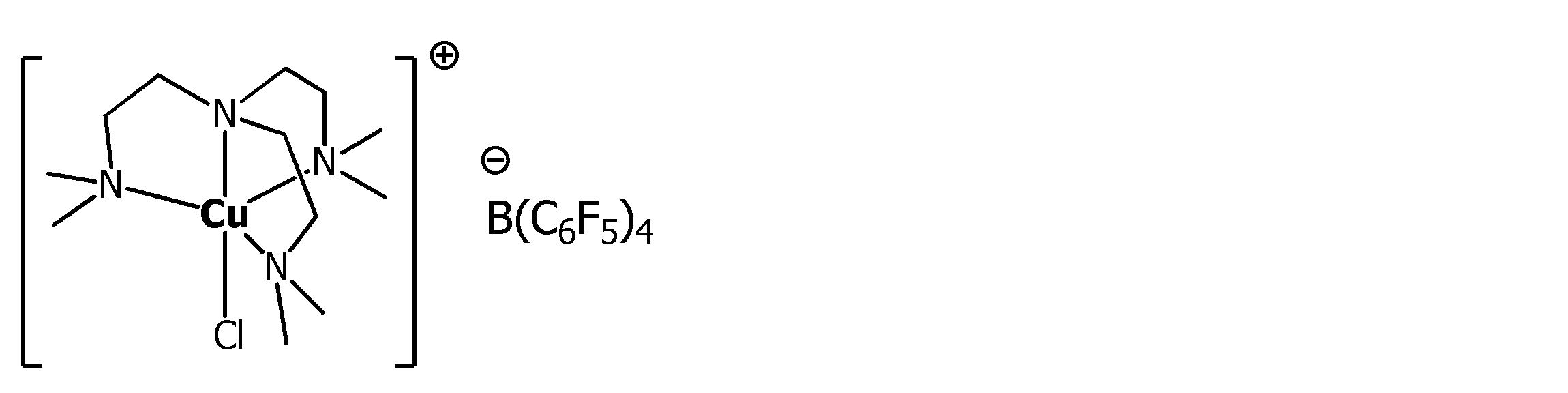
樹脂1:下記構造(Mw=1.5万、主鎖に付記した数値は、各構成単位のモル比である)
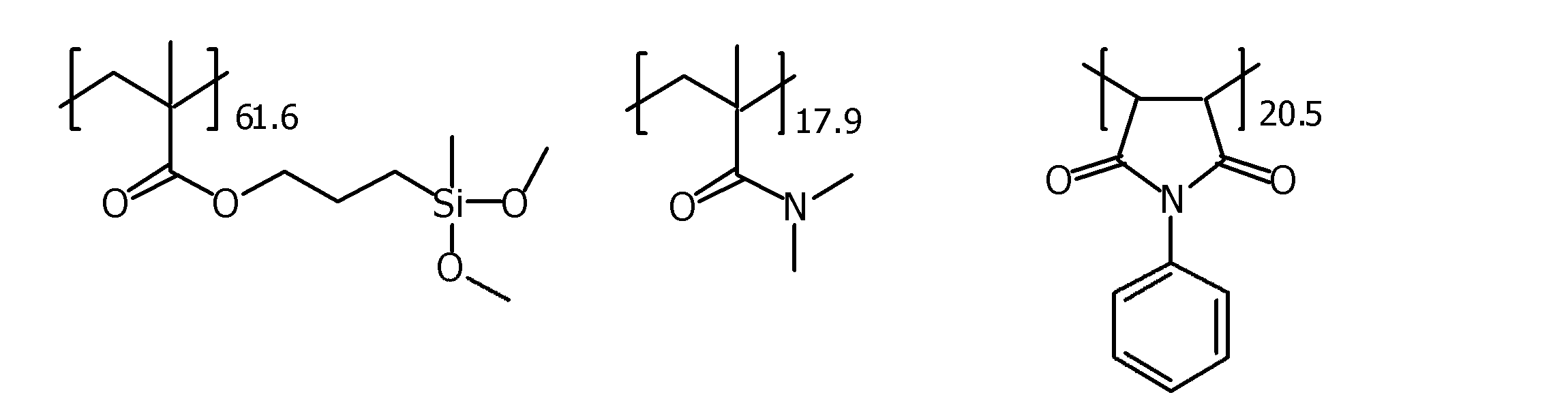
(組成1)実施例1~5の組成物
以下に示す銅錯体1を45質量部と、以下に示す樹脂1を49.95質量部と、IRGACURE-OXE02(BASF社製)を5質量部と、トリス(2,4-ペンタンジオナト)アルミニウム(III)(東京化成工業(株)製)を0.05質量部と、シクロヘキサノンを100質量部と、水とを混合し、撹拌した後、孔径0.45μmのナイロン製フィルタ(日本ポール(株)製)でろ過して組成1からなる実施例1~5の組成物を調製した。なお、組成1における水の配合量は、各組成物中における水の含有量が表1に量となるように調整した。
銅錯体1:下記構造
(組成2)実施例6の組成物
組成1において、さらに、アセチルアセトン1.0質量部を添加し、水の含有量を調整して、組成2からなる実施例6の組成物(水の含有量1質量%)を調整した。
組成1において、さらに、アセチルアセトン1.0質量部を添加し、水の含有量を調整して、組成2からなる実施例6の組成物(水の含有量1質量%)を調整した。
(組成3)実施例7の組成物
テトラエトキシシラン28.9質量部、フェニルトリエトキシシラン28.9質量部、10質量%塩酸30.6質量部を室温にて4時間混合しゾルを得た。シクロペンタノン85.5質量部に、銅錯体1の26.0質量部を室温にて20分溶解させた溶液を、前述のゾルに添加し、孔径0.45μmのナイロン製フィルタ(日本ポール(株)製)でろ過して組成3からなる実施例7の組成物(水の含有量1質量%)を調製した。
テトラエトキシシラン28.9質量部、フェニルトリエトキシシラン28.9質量部、10質量%塩酸30.6質量部を室温にて4時間混合しゾルを得た。シクロペンタノン85.5質量部に、銅錯体1の26.0質量部を室温にて20分溶解させた溶液を、前述のゾルに添加し、孔径0.45μmのナイロン製フィルタ(日本ポール(株)製)でろ過して組成3からなる実施例7の組成物(水の含有量1質量%)を調製した。
(組成4)実施例8の組成物
銅錯体1のかわりに、同量の銅錯体2を用いた以外は組成1と同様の処方にて、組成4からなる実施例8の組成物(水の含有量1質量%)を調製した。
銅錯体2:下記構造

銅錯体1のかわりに、同量の銅錯体2を用いた以外は組成1と同様の処方にて、組成4からなる実施例8の組成物(水の含有量1質量%)を調製した。
銅錯体2:下記構造
(組成5)実施例9の組成物
銅錯体1のかわりに、同量の銅錯体3を用いた以外は組成1と同様の処方にて組成5からなる実施例9の組成物(水の含有量1質量%)を調製した。
銅錯体3:下記構造
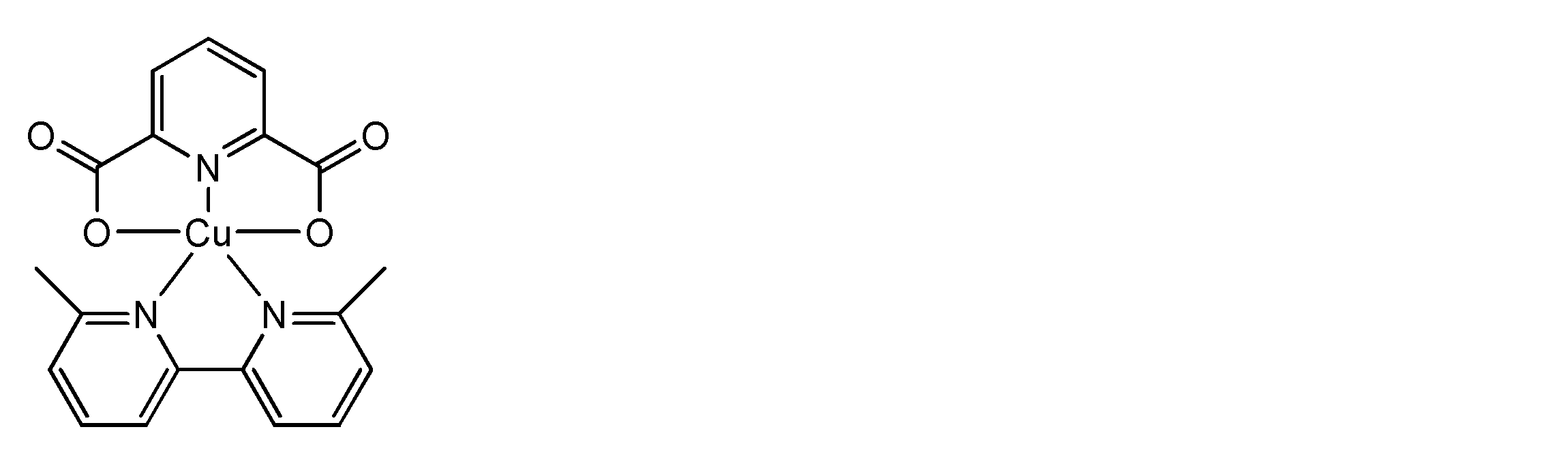
銅錯体1のかわりに、同量の銅錯体3を用いた以外は組成1と同様の処方にて組成5からなる実施例9の組成物(水の含有量1質量%)を調製した。
銅錯体3:下記構造
(組成6)実施例10の組成物
銅錯体1のかわりに、同量の銅錯体4を用いた以外は組成1と同様の処方にて組成6からなる実施例10の組成物(水の含有量1質量%)を調製した。
銅錯体4:下記化合物を配位子として有する銅錯体。

銅錯体1のかわりに、同量の銅錯体4を用いた以外は組成1と同様の処方にて組成6からなる実施例10の組成物(水の含有量1質量%)を調製した。
銅錯体4:下記化合物を配位子として有する銅錯体。
(組成7)実施例11、比較例1、比較例2の組成物
銅錯体1のかわりに、同量の銅錯体5を用いた以外は組成1と同様の処方にて組成物7からなる実施例11の組成物(水の含有量1質量%)を調製した。また、組成7における水の配合量を調整して、比較例1の組成物(水の含有量0.005質量%)、比較例2の組成物(水の含有量23質量%)をそれぞれ調製した。
銅錯体5:下記化合物を配位子として有する銅錯体。

銅錯体1のかわりに、同量の銅錯体5を用いた以外は組成1と同様の処方にて組成物7からなる実施例11の組成物(水の含有量1質量%)を調製した。また、組成7における水の配合量を調整して、比較例1の組成物(水の含有量0.005質量%)、比較例2の組成物(水の含有量23質量%)をそれぞれ調製した。
銅錯体5:下記化合物を配位子として有する銅錯体。
(組成8)実施例12の組成物
銅フタロシアニンイーエクスカラーIR-17(日本触媒(株)製)1質量部と、樹脂1を93.95質量部と、IRGACURE-OXE02(BASF社製)を5質量部と、トリス(2,4-ペンタンジオナト)アルミニウム(III)(東京化成工業(株)製)を0.05質量部と、シクロヘキサノンを100質量部および水を表1に示す含有量になる様に混合し、撹拌した後、孔径0.45μmのナイロン製フィルタ(日本ポール(株)製)でろ過して組成8からなる実施例12の組成物を調製した。
銅フタロシアニンイーエクスカラーIR-17(日本触媒(株)製)1質量部と、樹脂1を93.95質量部と、IRGACURE-OXE02(BASF社製)を5質量部と、トリス(2,4-ペンタンジオナト)アルミニウム(III)(東京化成工業(株)製)を0.05質量部と、シクロヘキサノンを100質量部および水を表1に示す含有量になる様に混合し、撹拌した後、孔径0.45μmのナイロン製フィルタ(日本ポール(株)製)でろ過して組成8からなる実施例12の組成物を調製した。
(組成9)実施例13の組成物
銅錯体1のかわりに、同量の無水硫酸銅(II)を用いた以外は組成3と同様の処方にて組成9からなる実施例13の組成物(水の含有量1質量%)を調製した。
銅錯体1のかわりに、同量の無水硫酸銅(II)を用いた以外は組成3と同様の処方にて組成9からなる実施例13の組成物(水の含有量1質量%)を調製した。
(組成10)実施例14の組成物
銅錯体1のかわりに、同量の銅錯体6を用いた以外は組成3と同様の処方にて組成10からなる実施例14の組成物(水の含有量1質量%)を調製した。
銅錯体6:下記化合物を配位子として有する銅錯体。

銅錯体1のかわりに、同量の銅錯体6を用いた以外は組成3と同様の処方にて組成10からなる実施例14の組成物(水の含有量1質量%)を調製した。
銅錯体6:下記化合物を配位子として有する銅錯体。
(組成11)実施例15の組成物
銅錯体1のかわりに、同量の銅錯体7を用いた以外は組成3と同様の処方にて組成11からなる実施例15の組成物(水の含有量1質量%)を調製した。
銅錯体7:下記化合物を配位子として有する銅錯体。

(組成12)実施例16の組成物
銅錯体1を6.55質量部と、下記錯体8を19.65質量部と、以下に示す樹脂2を61.9質量部と、IRGACURE-OXE02(BASF社製)を5質量部と、トリス(2,4-ペンタンジオナト)アルミニウム(III)(東京化成工業(株)製)を0.025質量部と、KBM-3066(信越化学工業(株)製)を6.875質量部と、シクロペンタノン24.344質量部と、酢酸ブチル75.656質量部および水を表1に示すになる水の含有量となるように混合し、撹拌した後、孔径0.45μmのナイロン製フィルタ(日本ポール(株)製)でろ過して組成12からなる実施例16の組成物(水の含有量1質量%)を調製した。
銅錯体8:下記構造
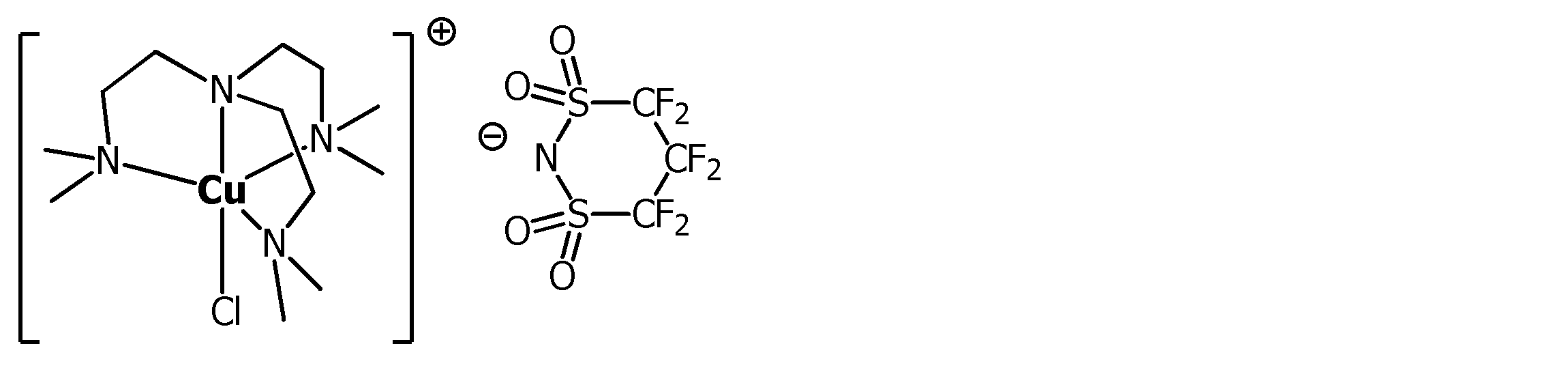
樹脂2:下記構造(Mw=1.5万、主鎖に付記した数値は、各構成単位のモル比である)

銅錯体1のかわりに、同量の銅錯体7を用いた以外は組成3と同様の処方にて組成11からなる実施例15の組成物(水の含有量1質量%)を調製した。
銅錯体7:下記化合物を配位子として有する銅錯体。
銅錯体1を6.55質量部と、下記錯体8を19.65質量部と、以下に示す樹脂2を61.9質量部と、IRGACURE-OXE02(BASF社製)を5質量部と、トリス(2,4-ペンタンジオナト)アルミニウム(III)(東京化成工業(株)製)を0.025質量部と、KBM-3066(信越化学工業(株)製)を6.875質量部と、シクロペンタノン24.344質量部と、酢酸ブチル75.656質量部および水を表1に示すになる水の含有量となるように混合し、撹拌した後、孔径0.45μmのナイロン製フィルタ(日本ポール(株)製)でろ過して組成12からなる実施例16の組成物(水の含有量1質量%)を調製した。
銅錯体8:下記構造
<液安定性の評価>
水の含有量を下記表に記載の量に調整した各組成物を、45℃で3日加熱し、加熱前と加熱後の粘度の比率で液安定性を評価した。粘度変動が1%未満の場合をAA、粘度変動が1%以上5%未満の場合をA、粘度変動が5%以上10%未満の場合をB、粘度変動が10%以上の場合をCとした。
水の含有量を下記表に記載の量に調整した各組成物を、45℃で3日加熱し、加熱前と加熱後の粘度の比率で液安定性を評価した。粘度変動が1%未満の場合をAA、粘度変動が1%以上5%未満の場合をA、粘度変動が5%以上10%未満の場合をB、粘度変動が10%以上の場合をCとした。
<近赤外線カットフィルタの製造>
(製造例1)
実施例1~11、13~16の組成物、比較例1~2の組成物を使用した近赤外線カットフィルタの製造方法
ガラスウェハ上に乾燥後の膜厚が200μmになるようにスピンコーターを用いて各組成物を塗布し、160℃のホットプレートを用いて1.5時間加熱処理を行って、近赤外線カットフィルタを製造した。
(製造例1)
実施例1~11、13~16の組成物、比較例1~2の組成物を使用した近赤外線カットフィルタの製造方法
ガラスウェハ上に乾燥後の膜厚が200μmになるようにスピンコーターを用いて各組成物を塗布し、160℃のホットプレートを用いて1.5時間加熱処理を行って、近赤外線カットフィルタを製造した。
(製造例2)
実施例12の組成物を使用した近赤外線カットフィルタの製造方法
ガラスウェハ上に乾燥後の膜厚が1μmになるようにスピンコーターを用いて実施例12の組成物を塗布し、160℃のホットプレートを用いて1.5時間加熱処理を行って、近赤外線カットフィルタを製造した。
実施例12の組成物を使用した近赤外線カットフィルタの製造方法
ガラスウェハ上に乾燥後の膜厚が1μmになるようにスピンコーターを用いて実施例12の組成物を塗布し、160℃のホットプレートを用いて1.5時間加熱処理を行って、近赤外線カットフィルタを製造した。
<ヘイズの評価>
日本電色工業社製ヘーズメーターNDH-5000を用いて、近赤外線カットフィルタのヘイズを測定した。ヘイズが1%を超えると、目視で曇りがわかるレベルであり、ヘイズは1%以下が実用的である。0.1%未満をA、0.1%以上1%未満をB、1%以上をCとした。
日本電色工業社製ヘーズメーターNDH-5000を用いて、近赤外線カットフィルタのヘイズを測定した。ヘイズが1%を超えると、目視で曇りがわかるレベルであり、ヘイズは1%以下が実用的である。0.1%未満をA、0.1%以上1%未満をB、1%以上をCとした。
上記表1に示す通り、実施例では液安定性が良好で、かつ、ヘイズの小さい膜を製造することができた。また、ケトン化合物をさらに含む実施例6は、液安定性が特に優れていた。これに対し、比較例では液安定性が悪く、さらには膜のヘイズが大きかった。
紫外線吸収層上に、実施例1~16の組成物を塗布し、上記と同様の方法で近赤外線カットフィルタを製造した場合であっても、同様の効果が得られる。
実施例1~16の組成物を、支持体から剥離して単独膜として用いた場合であっても、同様の効果が得られる。
誘電体多層膜を形成した基板の上に、実施例1~16の組成物を塗布し、上記と同様の方法で近赤外線カットフィルタを製造した場合であっても、同様の効果が得られる。
(誘電体多層膜の製造)
基板の一面に、蒸着温度150℃で、シリカ(SiO2:膜厚120~190nm)層とチタニア(TiO2:膜厚70~120nm)層とを交互に積層(積層数40)して誘電体多層膜を得た。
基板の一面に、蒸着温度150℃で、シリカ(SiO2:膜厚120~190nm)層とチタニア(TiO2:膜厚70~120nm)層とを交互に積層(積層数40)して誘電体多層膜を得た。
10 カメラモジュール、11 固体撮像素子、12 平坦化層、13 近赤外線カットフィルタ、14 撮像レンズ、15 レンズホルダー、16 シリコン基板、17 カラーフィルタ、18 マイクロレンズ、19 紫外・赤外光反射膜、20 透明基材、21 近赤外線吸収層、22 反射防止層
Claims (13)
- 銅化合物と、M-Xで表される部分構造を有する化合物と、水と、有機溶剤とを含む近赤外線吸収組成物であり、
前記近赤外線吸収組成物は、水の含有量が、0.01~20質量%である、近赤外線吸収組成物;
ただし、Mは、Si、Ti、ZrおよびAlから選択される原子であり、Xは、ヒドロキシ基、アルコキシ基、アシルオキシ基、ホスホリルオキシ基、スルホニルオキシ基、アミノ基、オキシム基およびO=C(Ra)(Rb)から選択される1種であり、RaおよびRbは、それぞれ独立して、1価の有機基を表し、Xが、O=C(Ra)(Rb)である場合、Xは、カルボニル基の酸素原子の非共有電子対でMと結合する。 - 前記M-Xで表される部分構造を有する化合物は、MがSiである、請求項1に記載の近赤外線吸収組成物。
- 前記M-Xで表される部分構造を有する化合物は、Xがアルコキシ基である、請求項1または2に記載の近赤外線吸収組成物。
- 前記M-Xで表される部分構造を有する化合物は、(メタ)アクリル樹脂およびスチレン樹脂から選ばれる少なくとも1種である、請求項1~3のいずれか1項に記載の近赤外線吸収組成物。
- 前記M-Xで表される部分構造を有する化合物は、重量平均分子量が3000~100000である、請求項1~4のいずれか1項に記載の近赤外線吸収組成物。
- さらに、ジケトン化合物を含む、請求項1~5のいずれか1項に記載の近赤外線吸収組成物。
- 前記ジケトン化合物が、下記式(1)で表される化合物である、請求項6に記載の近赤外線吸収組成物;
式(1)

- 請求項1~7のいずれか1項に記載の近赤外線吸収組成物を用いて、近赤外線吸収組成物層を形成する工程を含む、近赤外線カットフィルタの製造方法。
- 請求項1~7のいずれか1項に記載の近赤外線吸収組成物を用いた、近赤外線カットフィルタ。
- さらに、誘電体多層膜および紫外線吸収膜から選ばれる少なくとも1種を有する、請求項9に記載の近赤外線カットフィルタ。
- 請求項9または10に記載の近赤外線カットフィルタを有する固体撮像素子。
- 請求項9または10に記載の近赤外線カットフィルタを有するカメラモジュール。
- 請求項9または10に記載の近赤外線カットフィルタを有する赤外線センサ。
Priority Applications (1)
| Application Number | Priority Date | Filing Date | Title |
|---|---|---|---|
| JP2017562833A JPWO2017126527A1 (ja) | 2016-01-20 | 2017-01-18 | 近赤外線吸収組成物、近赤外線カットフィルタの製造方法、近赤外線カットフィルタ、固体撮像素子、カメラモジュールおよび赤外線センサ |
Applications Claiming Priority (2)
| Application Number | Priority Date | Filing Date | Title |
|---|---|---|---|
| JP2016008715 | 2016-01-20 | ||
| JP2016-008715 | 2016-01-20 |
Publications (1)
| Publication Number | Publication Date |
|---|---|
| WO2017126527A1 true WO2017126527A1 (ja) | 2017-07-27 |
Family
ID=59361759
Family Applications (1)
| Application Number | Title | Priority Date | Filing Date |
|---|---|---|---|
| PCT/JP2017/001480 Ceased WO2017126527A1 (ja) | 2016-01-20 | 2017-01-18 | 近赤外線吸収組成物、近赤外線カットフィルタの製造方法、近赤外線カットフィルタ、固体撮像素子、カメラモジュールおよび赤外線センサ |
Country Status (3)
| Country | Link |
|---|---|
| JP (1) | JPWO2017126527A1 (ja) |
| TW (1) | TW201728732A (ja) |
| WO (1) | WO2017126527A1 (ja) |
Cited By (5)
| Publication number | Priority date | Publication date | Assignee | Title |
|---|---|---|---|---|
| JP2019032503A (ja) * | 2017-08-07 | 2019-02-28 | 杭州美迪凱光電科技有限公司 | 吸収材を設けたコーティングタイプ狭帯域フィルタ |
| JP2019159343A (ja) * | 2017-11-07 | 2019-09-19 | 日本板硝子株式会社 | 光吸収性組成物及び光学フィルタ |
| WO2019221061A1 (ja) * | 2018-05-18 | 2019-11-21 | コニカミノルタ株式会社 | 近赤外線吸収性組成物、近赤外線吸収性膜及び固体撮像素子用イメージセンサー |
| CN119148277A (zh) * | 2023-06-16 | 2024-12-17 | 白金科技股份有限公司 | 复合感光结构及其制法 |
| WO2025126713A1 (ja) * | 2023-12-12 | 2025-06-19 | コニカミノルタ株式会社 | 近赤外線吸収性組成物、近赤外線吸収性硬化膜、及び光学部材 |
Citations (3)
| Publication number | Priority date | Publication date | Assignee | Title |
|---|---|---|---|---|
| JP2015028621A (ja) * | 2013-07-03 | 2015-02-12 | 富士フイルム株式会社 | 赤外線遮光組成物、赤外線遮光層、赤外線カットフィルタ、カメラモジュール |
| WO2016002702A1 (ja) * | 2014-06-30 | 2016-01-07 | 富士フイルム株式会社 | 近赤外線吸収性組成物、近赤外線カットフィルタ、近赤外線カットフィルタの製造方法、固体撮像素子、カメラモジュール |
| WO2016068037A1 (ja) * | 2014-10-28 | 2016-05-06 | 富士フイルム株式会社 | 近赤外線吸収性組成物、近赤外線カットフィルタ、固体撮像素子、カメラモジュール |
Family Cites Families (6)
| Publication number | Priority date | Publication date | Assignee | Title |
|---|---|---|---|---|
| JPS59151108A (ja) * | 1983-02-17 | 1984-08-29 | Teijin Ltd | 光選択透過機能性シ−ト |
| EP2426684A1 (en) * | 2010-09-02 | 2012-03-07 | Mitsubishi Materials Corporation | Dielectric-thin-film forming composition, method of forming dielectric thin film, and dielectric thin film formed by the method |
| JP5594027B2 (ja) * | 2010-09-30 | 2014-09-24 | 三菱マテリアル株式会社 | 誘電体薄膜形成用組成物及び誘電体薄膜の形成方法 |
| JP2014203044A (ja) * | 2013-04-09 | 2014-10-27 | 日本板硝子株式会社 | 赤外線カットフィルタおよび撮像装置 |
| JP2015134893A (ja) * | 2014-01-20 | 2015-07-27 | 株式会社クレハ | 近赤外線吸収剤分散液の製造方法、近赤外線吸収剤分散液およびその用途 |
| CN106170521A (zh) * | 2014-02-28 | 2016-11-30 | 旭硝子株式会社 | 液状组合物、玻璃物品和被膜的形成方法 |
-
2017
- 2017-01-13 TW TW106101077A patent/TW201728732A/zh unknown
- 2017-01-18 WO PCT/JP2017/001480 patent/WO2017126527A1/ja not_active Ceased
- 2017-01-18 JP JP2017562833A patent/JPWO2017126527A1/ja active Pending
Patent Citations (3)
| Publication number | Priority date | Publication date | Assignee | Title |
|---|---|---|---|---|
| JP2015028621A (ja) * | 2013-07-03 | 2015-02-12 | 富士フイルム株式会社 | 赤外線遮光組成物、赤外線遮光層、赤外線カットフィルタ、カメラモジュール |
| WO2016002702A1 (ja) * | 2014-06-30 | 2016-01-07 | 富士フイルム株式会社 | 近赤外線吸収性組成物、近赤外線カットフィルタ、近赤外線カットフィルタの製造方法、固体撮像素子、カメラモジュール |
| WO2016068037A1 (ja) * | 2014-10-28 | 2016-05-06 | 富士フイルム株式会社 | 近赤外線吸収性組成物、近赤外線カットフィルタ、固体撮像素子、カメラモジュール |
Cited By (13)
| Publication number | Priority date | Publication date | Assignee | Title |
|---|---|---|---|---|
| JP2019032503A (ja) * | 2017-08-07 | 2019-02-28 | 杭州美迪凱光電科技有限公司 | 吸収材を設けたコーティングタイプ狭帯域フィルタ |
| JP2019159343A (ja) * | 2017-11-07 | 2019-09-19 | 日本板硝子株式会社 | 光吸収性組成物及び光学フィルタ |
| KR102511445B1 (ko) * | 2018-05-18 | 2023-03-16 | 코니카 미놀타 가부시키가이샤 | 근적외선 흡수성 조성물, 근적외선 흡수성 막 및 고체 촬상 소자용 이미지 센서 |
| KR20200132962A (ko) * | 2018-05-18 | 2020-11-25 | 코니카 미놀타 가부시키가이샤 | 근적외선 흡수성 조성물, 근적외선 흡수성 막 및 고체 촬상 소자용 이미지 센서 |
| CN112189153A (zh) * | 2018-05-18 | 2021-01-05 | 柯尼卡美能达株式会社 | 近红外线吸收性组合物、近红外线吸收性膜及固体摄像元件用图像传感器 |
| JPWO2019221061A1 (ja) * | 2018-05-18 | 2021-07-08 | コニカミノルタ株式会社 | 近赤外線吸収性組成物、近赤外線吸収性膜及び固体撮像素子用イメージセンサー |
| WO2019221061A1 (ja) * | 2018-05-18 | 2019-11-21 | コニカミノルタ株式会社 | 近赤外線吸収性組成物、近赤外線吸収性膜及び固体撮像素子用イメージセンサー |
| US11753547B2 (en) | 2018-05-18 | 2023-09-12 | Konica Minolta, Inc. | Near-infrared absorbing composition, near-infrared absorbing film, and image sensor for solid-state imaging element |
| CN112189153B (zh) * | 2018-05-18 | 2023-11-21 | 柯尼卡美能达株式会社 | 近红外线吸收性组合物、近红外线吸收性膜及固体摄像元件用图像传感器 |
| JP2024020208A (ja) * | 2018-05-18 | 2024-02-14 | コニカミノルタ株式会社 | 近赤外線吸収性組成物、近赤外線吸収性膜及び固体撮像素子用イメージセンサー |
| JP7655361B2 (ja) | 2018-05-18 | 2025-04-02 | コニカミノルタ株式会社 | 近赤外線吸収性組成物、近赤外線吸収性膜及び固体撮像素子用イメージセンサー |
| CN119148277A (zh) * | 2023-06-16 | 2024-12-17 | 白金科技股份有限公司 | 复合感光结构及其制法 |
| WO2025126713A1 (ja) * | 2023-12-12 | 2025-06-19 | コニカミノルタ株式会社 | 近赤外線吸収性組成物、近赤外線吸収性硬化膜、及び光学部材 |
Also Published As
| Publication number | Publication date |
|---|---|
| JPWO2017126527A1 (ja) | 2018-11-08 |
| TW201728732A (zh) | 2017-08-16 |
Similar Documents
| Publication | Publication Date | Title |
|---|---|---|
| JP6806706B2 (ja) | 近赤外線吸収組成物、近赤外線カットフィルタ、近赤外線カットフィルタの製造方法、固体撮像素子、カメラモジュールおよび画像表示装置 | |
| JP6602396B2 (ja) | 近赤外線吸収組成物、近赤外線カットフィルタの製造方法、近赤外線カットフィルタ、固体撮像素子、カメラモジュール、赤外線センサおよび赤外線吸収剤 | |
| JP6595610B2 (ja) | 近赤外線カットフィルタ、近赤外線カットフィルタの製造方法、および固体撮像素子 | |
| JP6329638B2 (ja) | 近赤外線吸収性組成物、近赤外線カットフィルタ、固体撮像素子、カメラモジュール | |
| JP6611278B2 (ja) | 近赤外線吸収組成物、近赤外線カットフィルタ、近赤外線カットフィルタの製造方法、固体撮像素子、カメラモジュールおよび画像表示装置 | |
| JP6650040B2 (ja) | 近赤外線カットフィルタ、固体撮像素子、カメラモジュールおよび画像表示装置 | |
| CN106461831A (zh) | 近红外线吸收性组合物、近红外线截止滤波器、近红外线截止滤波器的制造方法、固体摄像元件、照相机模块 | |
| JP6709029B2 (ja) | 組成物、組成物の製造方法、膜、近赤外線カットフィルタ、固体撮像素子、カメラモジュールおよび画像表示装置 | |
| WO2017126527A1 (ja) | 近赤外線吸収組成物、近赤外線カットフィルタの製造方法、近赤外線カットフィルタ、固体撮像素子、カメラモジュールおよび赤外線センサ | |
| JP6251530B2 (ja) | 撮像素子用硬化性樹脂組成物及びその用途 | |
| JP6563014B2 (ja) | 近赤外線吸収性組成物、近赤外線カットフィルタ、近赤外線カットフィルタの製造方法、装置、銅含有ポリマーの製造方法および銅含有ポリマー | |
| JP6793808B2 (ja) | 近赤外線カットフィルタ、固体撮像素子、カメラモジュールおよび画像表示装置 | |
| JP6717955B2 (ja) | 近赤外線カットフィルタ、固体撮像素子、カメラモジュールおよび画像表示装置 | |
| JP6602387B2 (ja) | 近赤外線吸収組成物、膜、近赤外線カットフィルタおよび固体撮像素子 | |
| JP2017067871A (ja) | 樹脂成形体 |
Legal Events
| Date | Code | Title | Description |
|---|---|---|---|
| 121 | Ep: the epo has been informed by wipo that ep was designated in this application |
Ref document number: 17741404 Country of ref document: EP Kind code of ref document: A1 |
|
| ENP | Entry into the national phase |
Ref document number: 2017562833 Country of ref document: JP Kind code of ref document: A |
|
| NENP | Non-entry into the national phase |
Ref country code: DE |
|
| 122 | Ep: pct application non-entry in european phase |
Ref document number: 17741404 Country of ref document: EP Kind code of ref document: A1 |