WO2017115755A1 - 光硬化性組成物及び電子部品の製造方法 - Google Patents
光硬化性組成物及び電子部品の製造方法 Download PDFInfo
- Publication number
- WO2017115755A1 WO2017115755A1 PCT/JP2016/088746 JP2016088746W WO2017115755A1 WO 2017115755 A1 WO2017115755 A1 WO 2017115755A1 JP 2016088746 W JP2016088746 W JP 2016088746W WO 2017115755 A1 WO2017115755 A1 WO 2017115755A1
- Authority
- WO
- WIPO (PCT)
- Prior art keywords
- photocurable composition
- weight
- compound
- meth
- less
- Prior art date
- Legal status (The legal status is an assumption and is not a legal conclusion. Google has not performed a legal analysis and makes no representation as to the accuracy of the status listed.)
- Ceased
Links
Images
Classifications
-
- C—CHEMISTRY; METALLURGY
- C08—ORGANIC MACROMOLECULAR COMPOUNDS; THEIR PREPARATION OR CHEMICAL WORKING-UP; COMPOSITIONS BASED THEREON
- C08F—MACROMOLECULAR COMPOUNDS OBTAINED BY REACTIONS ONLY INVOLVING CARBON-TO-CARBON UNSATURATED BONDS
- C08F2/00—Processes of polymerisation
- C08F2/46—Polymerisation initiated by wave energy or particle radiation
- C08F2/48—Polymerisation initiated by wave energy or particle radiation by ultraviolet or visible light
- C08F2/50—Polymerisation initiated by wave energy or particle radiation by ultraviolet or visible light with sensitising agents
-
- C—CHEMISTRY; METALLURGY
- C08—ORGANIC MACROMOLECULAR COMPOUNDS; THEIR PREPARATION OR CHEMICAL WORKING-UP; COMPOSITIONS BASED THEREON
- C08F—MACROMOLECULAR COMPOUNDS OBTAINED BY REACTIONS ONLY INVOLVING CARBON-TO-CARBON UNSATURATED BONDS
- C08F2/00—Processes of polymerisation
- C08F2/44—Polymerisation in the presence of compounding ingredients, e.g. plasticisers, dyestuffs, fillers
-
- C—CHEMISTRY; METALLURGY
- C08—ORGANIC MACROMOLECULAR COMPOUNDS; THEIR PREPARATION OR CHEMICAL WORKING-UP; COMPOSITIONS BASED THEREON
- C08F—MACROMOLECULAR COMPOUNDS OBTAINED BY REACTIONS ONLY INVOLVING CARBON-TO-CARBON UNSATURATED BONDS
- C08F220/00—Copolymers of compounds having one or more unsaturated aliphatic radicals, each having only one carbon-to-carbon double bond, and only one being terminated by only one carboxyl radical or a salt, anhydride ester, amide, imide or nitrile thereof
- C08F220/02—Monocarboxylic acids having less than ten carbon atoms; Derivatives thereof
- C08F220/52—Amides or imides
- C08F220/54—Amides, e.g. N,N-dimethylacrylamide or N-isopropylacrylamide
- C08F220/56—Acrylamide; Methacrylamide
-
- C—CHEMISTRY; METALLURGY
- C08—ORGANIC MACROMOLECULAR COMPOUNDS; THEIR PREPARATION OR CHEMICAL WORKING-UP; COMPOSITIONS BASED THEREON
- C08F—MACROMOLECULAR COMPOUNDS OBTAINED BY REACTIONS ONLY INVOLVING CARBON-TO-CARBON UNSATURATED BONDS
- C08F290/00—Macromolecular compounds obtained by polymerising monomers on to polymers modified by introduction of aliphatic unsaturated end or side groups
- C08F290/02—Macromolecular compounds obtained by polymerising monomers on to polymers modified by introduction of aliphatic unsaturated end or side groups on to polymers modified by introduction of unsaturated end groups
- C08F290/06—Polymers provided for in subclass C08G
-
- C—CHEMISTRY; METALLURGY
- C09—DYES; PAINTS; POLISHES; NATURAL RESINS; ADHESIVES; COMPOSITIONS NOT OTHERWISE PROVIDED FOR; APPLICATIONS OF MATERIALS NOT OTHERWISE PROVIDED FOR
- C09D—COATING COMPOSITIONS, e.g. PAINTS, VARNISHES OR LACQUERS; FILLING PASTES; CHEMICAL PAINT OR INK REMOVERS; INKS; CORRECTING FLUIDS; WOODSTAINS; PASTES OR SOLIDS FOR COLOURING OR PRINTING; USE OF MATERIALS THEREFOR
- C09D7/00—Features of coating compositions, not provided for in group C09D5/00; Processes for incorporating ingredients in coating compositions
- C09D7/40—Additives
-
- H—ELECTRICITY
- H05—ELECTRIC TECHNIQUES NOT OTHERWISE PROVIDED FOR
- H05K—PRINTED CIRCUITS; CASINGS OR CONSTRUCTIONAL DETAILS OF ELECTRIC APPARATUS; MANUFACTURE OF ASSEMBLAGES OF ELECTRICAL COMPONENTS
- H05K3/00—Apparatus or processes for manufacturing printed circuits
- H05K3/22—Secondary treatment of printed circuits
- H05K3/28—Applying non-metallic protective coatings
Definitions
- the present invention relates to a photocurable composition that is used by being cured by light irradiation. Moreover, this invention relates to the manufacturing method of the electronic component using the said photocurable composition.
- Solder resist films are widely used as protective films for protecting printed wiring boards from high-temperature solder.
- a light emitting diode (hereinafter abbreviated as LED) chip is mounted on the upper surface of the printed wiring board.
- a white solder resist film may be formed on the upper surface of the printed wiring board in order to use light that has reached the upper surface side of the printed wiring board among the light emitted from the LEDs.
- the white solder resist film contains a white pigment.
- the white solder resist film reaches not only the light directly irradiated from the surface of the LED chip to the opposite side of the printed wiring board but also the upper surface side of the printed wiring board.
- the reflected light reflected by can also be used. Therefore, the utilization efficiency of the light generated from the LED can be increased.
- a cured film containing a white pigment is used in various light reflection applications.
- Patent Document 1 discloses a compound having no carboxyl group, two or more unsaturated groups, and a molecular weight of 500 to 5,000 ( A), a photopolymerization initiator (B), a reactive diluent (C) having two or more unsaturated groups, and a compound (D) having at least one amino group or imino group.
- a composition is disclosed.
- an active energy ray-curable resin (A) having at least two ethylenically unsaturated bonds in one molecule, a photopolymerization initiator (B), a diluent (C), A photocurable composition containing titanium oxide (D) and an epoxy thermosetting compound (E) is disclosed.
- the said photocurable composition contains bifunctional epoxy (meth) acrylate (A1) as said (A) component.
- the pencil hardness of the cured product film may be lowered. Conventionally, it has been difficult to achieve both high light reflectivity and high pencil hardness.
- an oligomer having no carboxyl group and having two or more ethylenically unsaturated bonds, a nitrogen-containing compound, a white pigment, and a photopolymerization initiator A photocurable composition is provided in which the viscosity of the photocurable composition at 10 rpm is 1 Pa ⁇ s or more and 30 Pa ⁇ s or less.
- the content of the epoxy compound is 100% by weight of the component excluding the solvent of the photocurable composition. 5% by weight or less.
- the photocurable composition when the photocurable composition contains a thermosetting compound and a thermosetting compound that is cured by the action of the thermosetting agent, the photocurable composition is used.
- the content of the thermosetting compound is 5% by weight or less.
- the nitrogen-containing compound contains an amide group-containing monomer having one or more ethylenically unsaturated bonds or a morpholine group having one or more ethylenically unsaturated bonds.
- Monomer Monomer.
- the nitrogen-containing compound is dimethyl (meth) acrylamide, (meth) acryloylmorpholine, isopropyl (meth) acrylamide, diethyl (meth) acrylamide, dimethylaminopropyl ( It is meth) acrylamide, dimethylaminopropyl (meth) acrylamide methyl chloride quaternary salt, or hydroxyethyl (meth) acrylamide.
- content of the said nitrogen containing compound is 1 to 40 weight% in 100 weight% of components except the solvent of a photocurable composition.
- the nitrogen-containing compound is a tetrazole compound, an imidazole compound, a triazole compound, an isocyanate compound, or a melamine compound.
- the content of the nitrogen-containing compound is 0.1% by weight or more and 5% by weight or less in 100% by weight of the component excluding the solvent of the photocurable composition. It is.
- the nitrogen-containing compound is a morpholine group-containing compound or an isocyanate compound.
- the photocurable composition is used by being cured by light irradiation and is used for forming a cured product film without performing development.
- the photocurable composition according to the present invention is preferably used by being partially applied to a plurality of locations on the surface of the application target member.
- the photocurable composition according to the present invention is preferably not used after being thermoset by the action of a thermosetting agent.
- a step of applying the above-described photocurable composition on the surface of the electronic component main body to form a composition layer, and irradiating the composition layer with light to cure is provided.
- a method of manufacturing an electronic component that includes a step of forming a physical film, and does not develop the composition layer in order to form the cured film.
- the photocurable composition is applied partially and at a plurality of locations on the surface of the electronic component body.
- the composition layer in order to form the cured product film, is not thermally cured by the action of a thermosetting agent.
- the photocurable composition according to the present invention includes an oligomer having no carboxyl group and having two or more ethylenically unsaturated bonds, a nitrogen-containing compound, a white pigment, and a photopolymerization initiator, 25 Since the viscosity of the photocurable composition at 1 ° C. and 10 rpm is 1 Pa ⁇ s or more and 30 Pa ⁇ s or less, a cured product film having high pencil hardness can be obtained, and a white pigment is used, A cured product film having high light reflectance can be obtained.
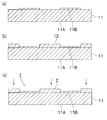
- FIGS. 1A to 1C are cross-sectional views for explaining an example of a method for producing an electronic component using the photocurable composition according to one embodiment of the present invention.
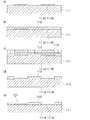
- FIGS. 2A to 2E are cross-sectional views for explaining an example of a method for producing an electronic component using a conventional development resist composition.
- the photocurable composition according to the present invention is preferably used by being cured by irradiation with light, and is used for forming a cured product film without performing development.
- the photocurable composition according to the present invention is preferably a non-developing resist photocurable composition.
- the photocurable composition according to the present invention is used and development is not performed to form a resist film, the photocurable composition is a developing resist composition that is developed to form a resist film. Is different.
- a composition capable of obtaining a good resist film without being developed is employed.
- the photocurable composition according to the present invention comprises (A) an oligomer having no carboxyl group and having two or more ethylenically unsaturated bonds, (C) a nitrogen-containing compound, (D) a white pigment, (E) a photopolymerization initiator.
- a cured product film (resist film or the like) having high pencil hardness can be formed.
- the photocurable composition according to the present invention contains (D) a white pigment, a white cured product film (resist film or the like) can be formed, and a cured product film having a high light reflectance is obtained. be able to.
- the cured product film is white, the light reflectance of the cured product film can be increased.
- the adhesion of the cured product film to the application target member is also improved.
- a good cured product film (resist film or the like) can be formed without performing many steps such as an exposure step and a development step in photolithography.
- the exposure process and the development process are not performed, the amount of waste can be reduced and the environmental load can be reduced. Furthermore, the manufacturing cost of electronic components can be reduced.
- the photocurable composition may not contain (F) a thermosetting compound or a thermosetting agent in order to be cured by light irradiation. It is preferable that the photocurable composition is not used after being thermoset by the action of a thermosetting agent.
- the composition layer (resist layer or the like) disposed on the surface of the application target member may not be thermally cured.
- the composition layer may be heated at a low temperature.
- the composition layer is preferably not heated to 280 ° C or higher, more preferably not heated to 180 ° C or higher, and still more preferably not heated to 60 ° C or higher.
- the lower the temperature at which the composition layer is heated the more the thermal degradation of the application target member such as the electronic component body can be suppressed.
- the viscosity of the photocurable composition at 25 ° C. and 10 rpm is 1 Pa ⁇ s or more and 30 Pa ⁇ s or less.
- the viscosity of the photocurable composition at 25 ° C. and 10 rpm is preferably 5 Pa ⁇ s or more, more preferably more than 5 Pa ⁇ s, still more preferably. Is 7 Pa ⁇ s or more, preferably 25 Pa ⁇ s or less.
- the above viscosity is measured using an E-type viscometer under the conditions of 25 ° C. and 10 rpm.
- E-type viscometer examples include “VISCOMETER TV-22” manufactured by Toki Sangyo Co., Ltd.
- ((A) Oligomer having no carboxyl group and having two or more ethylenically unsaturated bonds The oligomer (A) contained in the photocurable composition does not have a carboxyl group and has two or more ethylenically unsaturated bonds.
- (A) The use of the oligomer effectively increases the adhesion of the cured film to the application target member. In particular, when the content of (D) the white pigment is large, if (A) the oligomer is not used, the adhesion of the cured product film to the coating target member tends to be lowered.
- the oligomer is preferably a photocurable compound.
- Examples of the group containing an ethylenically unsaturated bond in the oligomer include a vinyl group, an allyl group, and a (meth) acryloyl group.
- a (meth) acryloyl group is preferable from the viewpoint of effectively allowing the reaction to proceed and further suppressing peeling and discoloration.
- the oligomer preferably has a (meth) acryloyl group.
- the (A) oligomer is preferably (A1) epoxy (meth) acrylate.
- the (A1) epoxy (meth) acrylate preferably contains a bifunctional epoxy (meth) acrylate and a trifunctional or higher functional epoxy (meth) acrylate.
- the bifunctional epoxy (meth) acrylate preferably has two (meth) acryloyl groups.
- the tri- or higher functional epoxy (meth) acrylate preferably has three or more (meth) acryloyl groups.
- (A1) Epoxy (meth) acrylate is obtained by reacting (meth) acrylic acid with an epoxy compound.
- (A1) Epoxy (meth) acrylate can be obtained by converting an epoxy group into a (meth) acryloyl group. Since the said photocurable composition is hardened
- epoxy (meth) acrylate bisphenol type epoxy (meth) acrylate (for example, bisphenol A type epoxy (meth) acrylate, bisphenol F type epoxy (meth) acrylate, bisphenol S type epoxy (meth) acrylate), cresol Novolak type epoxy (meth) acrylate, amine modified bisphenol type epoxy (meth) acrylate, caprolactone modified bisphenol type epoxy (meth) acrylate, carboxylic anhydride modified epoxy (meth) acrylate, phenol novolac type epoxy (meth) acrylate, etc. Can be mentioned.
- bisphenol type epoxy (meth) acrylate for example, bisphenol A type epoxy (meth) acrylate, bisphenol F type epoxy (meth) acrylate, bisphenol S type epoxy (meth) acrylate), cresol Novolak type epoxy (meth) acrylate, amine modified bisphenol type epoxy (meth) acrylate, caprolactone modified bisphenol type epoxy (meth) acrylate, carboxylic anhydride
- bifunctional epoxy (meth) acrylates include KAYARAD R-381 (manufactured by Nippon Kayaku Co., Ltd., bisphenol A type epoxy acrylate), EBECRYL 3700, EBECRYL 3701, and EBECRYL 3708 (manufactured by Daicel Ornex Corporation, modified bisphenol A type epoxy acrylate ) And the like.
- EBECRYL3603 the Daicel Ornex company make, novolak epoxy acrylate
- a trifunctional or higher functional epoxy (meth) acrylate may be obtained by modifying a hydroxyl group of a bifunctional epoxy (meth) acrylate and introducing a (meth) acryloyl group.
- (Meth) acryloyl group means an acryloyl group and a methacryloyl group.
- (Meth) acryl refers to acrylic and methacrylic.
- (Meth) acrylate refers to acrylate and methacrylate.
- Oligomer is a multimer in which two or more monomers are combined, unlike a monomer.
- the weight average molecular weight of the oligomer is preferably more than 500, more preferably more than 600, still more preferably more than 800, particularly preferably 1000 or more, and most preferably 2000 or more.
- the weight average molecular weight of the oligomer is preferably 10,000 or less.
- the weight average molecular weight in an oligomer is a weight average molecular weight in terms of polystyrene measured by gel permeation chromatography (GPC), and can be measured by the following measuring apparatus and measurement conditions. When measured under these measurement conditions, the weight average molecular weight of EBECRYL 3700 used in Examples described later is 1300.
- Measuring device “Waters GPC System (Waters 2690 + Waters 2414 (RI))” manufactured by Nihon Waters Measurement condition columns: Shodex GPC LF-G ⁇ 1, Shodex GPC LF-804 ⁇ 2
- Mobile phase THF 1.0 mL / min
- Sample concentration 5 mg / mL
- Detector Differential refractive index detector (RID)
- Reference material polystyrene (Made by TOSOH, molecular weight: 620 to 590000)
- the oligomer (A) is preferably not a compound having an alicyclic skeleton, and preferably not an epoxy (meth) acrylate having an alicyclic skeleton.
- the (A) oligomer preferably includes a compound having an aromatic skeleton, and preferably includes an epoxy (meth) acrylate having an aromatic skeleton.
- the oligomer (A) is preferably urethane (meth) acrylate, polyester (meth) acrylate or epoxy (meth) acrylate having an aromatic skeleton, and urethane (meth).
- An acrylate or an epoxy (meth) acrylate having an aromatic skeleton is more preferable.
- Epoxy (meth) acrylate is not particularly limited, but bisphenol A type epoxy compound, bisphenol F type epoxy compound, bisphenol S type epoxy compound, phenol novolac type epoxy compound, cresol novolac type epoxy compound, or aliphatic epoxy compound It can be obtained by reacting an epoxy compound such as (meth) acrylic acid.
- the epoxy (meth) acrylate may be an epoxy (meth) acrylate obtained by modifying a hydroxyl group of an epoxy (meth) acrylate having a hydroxyl group. In this case, the degree of crosslinking can be increased and the pencil hardness can be effectively increased.
- the compound that can be used for modification include a silane coupling agent and a monomer having an isocyanate group.
- the silane coupling agent include compounds having a functional group such as vinyl group, (meth) acryloyl group, styryl group, mercapto group, epoxy group, amino group, sulfide group, ureido group, and isocyanate group.
- a compound having a vinyl group, a (meth) acryloyl group, a styryl group, or a mercapto group is preferred because of photoreactivity.
- the monomer having an isocyanate group include a compound having a vinyl group, a (meth) acryloyl group, a styryl group, or a mercapto group.
- the acid value of the oligomer is preferably 20 mgKOH / g or less.
- the said acid value is not more than the above upper limit, the influence of acidic groups is suppressed, and the heat resistance of the cured product film can be improved.
- the said photocurable composition contains multiple types of (A) the oligomer which has two or more ethylenically unsaturated bonds
- the said acid value is (A) the oligomer which has two or more ethylenically unsaturated bonds. It means the acid value of the mixture.
- the content of (A) oligomer and (A1) epoxy (meth) acrylate is preferably 5% by weight or more, more preferably 10% by weight or more, Preferably it is 40 weight% or less, More preferably, it is 30 weight% or less.
- the content of (A) oligomer and (A1) epoxy (meth) acrylate is not less than the above lower limit, the adhesion of the cured product film is effectively increased.
- bifunctional epoxy (meth) acrylate that is an oligomer and trifunctional that is an oligomer in 100% by weight of the component excluding the solvent of the photocurable composition bifunctional epoxy (meth) acrylate that is an oligomer and trifunctional that is an oligomer in 100% by weight of the component excluding the solvent of the photocurable composition.
- the total content of the above epoxy (meth) acrylates is preferably 5% by weight or more, more preferably 10% by weight or more, preferably 40% by weight or less, more preferably 30% by weight or less.
- 100% by weight of the component excluding the solvent of the photocurable composition means 100% by weight of the component of the photocurable composition excluding the solvent.
- a thing does not contain a solvent it means 100 weight% of photocurable compositions.
- the photocurable composition has (B) an ethylenically unsaturated bond. It is preferable that the monomer which has 1 or more is included.
- the monomer is, for example, a reactive diluent.
- the molecular weight of the monomer is preferably less than 2000, more preferably 800 or less, still more preferably 600 or less, and particularly preferably 500 or less.
- the molecular weight of the monomer can be calculated from the structural formula.
- Examples of the group containing an ethylenically unsaturated bond in the monomer include a vinyl group, an allyl group, and a (meth) acryloyl group.
- a (meth) acryloyl group is preferable from the viewpoint of effectively allowing the reaction to proceed and further suppressing peeling and discoloration.
- the monomer preferably has a (meth) acryloyl group.
- the monomer is not particularly limited, and examples thereof include (meth) acrylic acid adducts of polyhydric alcohols and (meth) acrylic acid adducts of polyhydric alcohol alkylene oxides.
- examples of the polyhydric alcohol include diethylene glycol, triethylene glycol, polyethylene glycol, dipropylene glycol, tripropylene glycol, polypropylene glycol, trimethylol propane, cyclohexane dimethanol, tricyclodecane dimethanol, an alkylene oxide adduct of bisphenol A, and Examples include pentaerythritol.
- the monomer may be (B1) a compound having one ethylenically unsaturated bond.
- the (B) monomer preferably includes (B1) a compound having one ethylenically unsaturated bond, and a compound having one (meth) acryloyl group. It is preferable to include.
- the monomer may contain a compound having two ethylenically unsaturated bonds, or (B2) may contain a compound having two or more ethylenically unsaturated bonds.
- the (B) monomer preferably includes (B2) a compound having two or more ethylenically unsaturated bonds, and has two or more (meth) acryloyl groups. It is preferable to include a compound.
- the (B) monomer preferably contains an alicyclic compound, or contains an aromatic ring or a hydroxyl group.
- a monofunctional component is preferable, but a polyfunctional plural component such as a bifunctional or trifunctional component may be included.
- the content of the compound (B) and the compound (B2) having two or more ethylenically unsaturated bonds is preferably 5% by weight or more, more preferably 10%. % By weight or more, preferably 50% by weight or less, more preferably 40% by weight or less.
- the content of the (B) monomer and the compound (B2) having two or more ethylenically unsaturated bonds is not less than the above lower limit and not more than the above upper limit, the adhesion of the cured film is effectively increased.
- (C) Nitrogen-containing compound) By using a nitrogen-containing compound, a cured product film having high pencil hardness can be obtained, and scratches on the cured product film can be suppressed.
- the nitrogen-containing compound is not (E) a photopolymerization initiator.
- ethylene such as dimethyl (meth) acrylamide, isopropyl (meth) acrylamide, diethyl (meth) acrylamide, dimethylaminopropyl (meth) acrylamide, dimethylaminopropyl (meth) acrylamide methyl chloride quaternary salt, etc.
- Amide group-containing monomer having at least one ionic unsaturated bond Morpholine group-containing monomer having at least one ethylenically unsaturated bond such as (meth) acryloylmorpholine; Hydroxyethyl (meth) acrylamide, tetrazole compound, imidazole compound, triazole A compound, an isocyanate compound, a melamine compound, etc. are mentioned.
- the (C) nitrogen-containing compound is dimethyl (meth) acrylamide, (meth) acryloylmorpholine, isopropyl (meth) acrylamide, diethyl (meth) acrylamide, dimethylaminopropyl ( A meth) acrylamide, dimethylaminopropyl (meth) acrylamide methyl chloride quaternary salt, hydroxyethyl (meth) acrylamide, tetrazole compound, imidazole compound, triazole compound, isocyanate compound or melamine compound is preferred.
- (C) nitrogen-containing compounds are methyl (meth) acrylamide, (meth) acryloylmorpholine, isopropyl (meth) acrylamide, diethyl (meth) acrylamide, dimethylaminopropyl ( It is preferably meth) acrylamide, dimethylaminopropyl (meth) acrylamide methyl chloride quaternary salt, or hydroxyethyl (meth) acrylamide (also referred to as component (C1)).
- the (C) nitrogen-containing compound is a tetrazole compound, an imidazole compound, a triazole compound, an isocyanate compound, or a melamine compound (these are also referred to as the (C2) component). Is also preferable.
- the component (C2) preferably has no ethylenic double bond.
- tetrazole compounds include 1H-tetrazole, 5-amino-1H-tetrazole, 5-methyl-1H-tetrazole, 5-phenyl-1H-tetrazole, 1-methyl-5-ethyl-1H-tetrazole, 1-methyl- 5-mercapto-1H-tetrazole, 1-phenyl-5-mercapto-1H-tetrazole, 1- (2-dimethylaminoethyl) -5-mercapto-1H-tetrazole, 2-methoxy-5- (5-trifluoromethyl) -1H-tetrazol-1-yl) -benzaldehyde, 5,5'-bi-1H-tetrazole diammonium salt, 4,5-di (5-tetrazolyl)-[1,2,3] triazole, 5,5 '-Azobis-1H-tetrazole, 1-methyl-5-benzoyl-1H-tetrazole, 1-methyl-5-benz
- imidazole compound examples include imidazole-4-carboxaldehyde, 2-phenylimidazole-4-carboxaldehyde, imidazole-2-carboxaldehyde, imidazole-4-carbonitrile, 2-phenylimidazole-4-carbonitrile, 4-hydroxy Methylimidazole hydrochloride, 2-hydroxymethylimidazole hydrochloride, 4-imidazolecarboxylic acid, 4-imidazoledithiocarboxylic acid, 4-imidazolethiocarboxamide, 2-bromoimidazole, and 2-mercaptoimidazole (all of which are Shikoku Kasei Kogyo Co., Ltd.) Manufactured) and the like.
- the said imidazole compound only 1 type may be used and 2 or more types may be used together.
- triazole compound examples include 1,2,3-benzotriazole, 1- [N, N-bis (2-ethylhexyl) aminomethyl] benzotriazole, carboxybenzotriazole, 1- [N, N-bis (2-ethylhexyl). ) Aminomethyl] methylbenzotriazole, 2,2 ′-[[(methyl-1H-benzotriazol-1-yl) methyl] imino] bisethanol, and 1,2,3-benzotriazole sodium salt solution (all Johoku Chemical Industry Co., Ltd.). As for the said triazole compound, only 1 type may be used and 2 or more types may be used together.
- isocyanate compound examples include aromatic isocyanates such as tolylene diisocyanate, xylylene diisocyanate, methylene diphenyl diisocyanate, phenylene diisocyanate, and naphthalene diisocyanate; aromatic rings such as ⁇ , ⁇ , ⁇ ′, ⁇ ′-tetramethylxylylene diisocyanate.
- Aliphatic isocyanates such as methylene diisocyanate, propylene diisocyanate, lysine diisocyanate, trimethylhexamethylene diisocyanate, hexamethylene diisocyanate, etc .; cyclohexane diisocyanate, methylcyclohexane diisocyanate, isophorone diisocyanate, methylene bis (4-cyclohexyl isocyanate), isopropylidene dicyclohexyl Alicyclic isocyanates such as the isocyanate.
- polymers and derivatives such as burettes, isocyanurates, uretdiones, and carbodiimide-modified products of these isocyanate compounds are also exemplified as the isocyanate compounds.
- the isocyanate compound only 1 type may be used and 2 or more types may be used together. From the viewpoint of avoiding yellowing of the cured film caused by ultraviolet rays, an aliphatic isocyanate compound or an alicyclic isocyanate compound is more preferable than an aromatic isocyanate compound.
- examples of the blocking agent include bisulfites; phenol compounds such as phenol, cresol, and ethylphenol; propylene glycol monomethyl ether, ethylene glycol, benzyl alcohol, methanol, ethanol, and the like.
- Alcohol compounds such as dimethyl malonate, diethyl malonate, methyl acetoacetate, ethyl acetoacetate, and acetylacetone; mercaptan compounds such as butyl mercaptan and dodecyl mercaptan; lactam compounds such as ⁇ -caprolactam and ⁇ -valerolactam; Amine compounds such as aniline, aniline, and ethyleneimine; acetic acid amide compounds of acetanilide and acetic acid amides; Examples include oxime compounds such as cetoald oxime, acetone oxime, methyl ethyl ketone oxime, and cyclohexanone oxime. As for the said blocking agent, only 1 type may be used and 2 or more types may be used together.
- active methylene compounds such as dimethyl malonate, diethyl malonate, methyl acetoacetate, ethyl acetoacetate, and acet
- isocyanate compounds include 2-acryloyloxyethyl isocyanate (Karenz AOI), 2-methacryloyloxyethyl isocyanate (Karenz MOI), methacryloyloxyethoxyethyl isocyanate (Karenz MOI-EG), and Karenz MOI manufactured by Showa Denko K.K. Isocyanate block (Karenz MOI-BM), isocyanate block of Karenz MOI (Karenz MOI-BP), 1,1- (bisacryloyloxymethyl) ethyl isocyanate) (Karenz BEI), and the like.
- Karenz AOI 2-acryloyloxyethyl isocyanate
- Karenz MOI 2-methacryloyloxyethyl isocyanate
- Karenz MOI-EG methacryloyloxyethoxyethyl isocyanate
- Karenz MOI manufactured by Showa Denko K.K. Isocyanate block
- the melamine compound examples include alkylolated melamine derivatives, partially etherified compounds obtained by reacting alkylolated melamine derivatives with alcohol, and fully etherified compounds obtained by reacting alkylolated melamine derivatives with alcohol.
- the said melamine compound only 1 type may be used and 2 or more types may be used together.
- the alcohol used for the etherification include methyl alcohol, ethyl alcohol, isopropyl alcohol, n-butanol, and isobutanol.
- the melamine compound may be a monomer, a dimer or higher multimer, or a mixture of a monomer and a multimer.
- the melamine compound may be a compound obtained by co-condensing urea or the like with a part of melamine.
- a catalyst may be used to increase the reactivity of the melamine compound.
- the (C) nitrogen-containing compound is preferably a morpholine group-containing compound or an isocyanate compound, and contains a morpholine group.
- a compound may be sufficient and an isocyanate compound may be sufficient.
- the morpholine group-containing compound is preferably a morpholine group-containing monomer, and is ethylenically unsaturated. It is preferable to have one or more bonds, and the isocyanate compound is preferably an aliphatic isocyanate compound or an alicyclic isocyanate compound.
- the content of the (C) nitrogen-containing compound is preferably 0.1% by weight or more, more preferably 0.5% by weight or more, and preferably 45%. % By weight or less, more preferably 33% by weight or less.
- curing material film becomes it still higher that content of a nitrogen-containing compound is more than the said minimum and below the said upper limit.
- the content of the component (C1) is preferably 1% by weight or more, more preferably, in 100% by weight of the component excluding the solvent of the photocurable composition. It is 5% by weight or more, preferably 40% by weight or less, more preferably 33% by weight or less, and still more preferably 30% by weight or less.
- the content of the component (C1) is not less than the above lower limit and not more than the above upper limit, the pencil hardness of the cured product film is further increased.
- the content of the component (C2) is preferably 0.1% by weight or more in 100% by weight of the component excluding the solvent of the photocurable composition. Preferably it is 0.5 weight% or more, Preferably it is 5 weight% or less, More preferably, it is 3 weight% or less.
- the content of the component (C2) is not less than the above lower limit and not more than the above upper limit, the pencil hardness of the cured product film is further increased.
- the nitrogen-containing compound is a morpholine group-containing compound
- the morpholine group-containing compound in 100% by weight of the component excluding the solvent of the photocurable composition
- the content of is preferably 1% by weight or more, more preferably 5% by weight or more, preferably 40% by weight or less, more preferably 33% by weight or less, and further preferably 30% by weight or less.
- the content of the isocyanate compound in 100% by weight of the component excluding the solvent of the photocurable composition is Preferably it is 0.1 weight% or more, More preferably, it is 0.5 weight% or more, Preferably it is 5 weight% or less, More preferably, it is 3 weight% or less.
- ((D) White pigment When the said photocurable composition contains (D) white pigment, the hardened
- a white pigment By using a white pigment, a cured film having a high light reflectance can be obtained as compared with the case of using only a filler other than (D) the white pigment.
- a white pigment As for a white pigment, only 1 type may be used and 2 or more types may be used together.
- white pigments examples include alumina, titanium oxide, zinc oxide, zirconium oxide, antimony oxide, and magnesium oxide.
- the (D) white pigment is preferably titanium oxide, zinc oxide or zirconium oxide.
- this preferred white pigment one or more white pigments can be used among titanium oxide, zinc oxide and zirconium oxide.
- the white pigment is preferably titanium oxide or zinc oxide, preferably titanium oxide, and preferably zinc oxide.
- the white pigment may be zirconium oxide.
- the titanium oxide is preferably rutile type titanium oxide.
- rutile type titanium oxide By using rutile type titanium oxide, the heat resistance of the cured product film is further increased, and discoloration of the cured product film is further suppressed.
- the titanium oxide is preferably rutile type titanium oxide surface-treated with aluminum oxide (rutile type titanium oxide which is a surface treated product of aluminum oxide).
- rutile type titanium oxide which is a surface treated product of aluminum oxide.
- the use of rutile titanium oxide surface-treated with the aluminum oxide further increases the heat resistance of the cured film.
- Examples of the rutile-type titanium oxide surface-treated with the aluminum oxide include “CR-90-2” manufactured by Ishihara Sangyo Co., Ltd., which is rutile chlorine-based titanium oxide, and “CR-90-2” manufactured by Ishihara Sangyo Co., Ltd., which is rutile chlorine-based titanium oxide.
- CR-90-2 manufactured by Ishihara Sangyo Co., Ltd.
- CR-90-2 manufactured by Ishihara Sangyo Co., Ltd., which is rutile chlorine-based titanium oxide.
- the zinc oxide is preferably surface-treated zinc oxide.
- the zinc oxide is preferably surface-treated with a material containing silicon, aluminum or zirconia, and a material containing silicon. More preferably, the surface treatment is performed.
- the zinc oxide is preferably a surface-treated product made of the above material.
- the material containing silicon is preferably a silicone compound.
- the zirconium oxide is preferably surface-treated zirconium oxide. From the viewpoint of further increasing the light reflectance of the cured film, the zirconium oxide is preferably surface-treated with a material containing silicon, aluminum or zirconia, and is surface-treated with a material containing silicon. Is more preferable.
- the material containing silicon is preferably a silicone compound.
- the surface treatment method is not particularly limited. As a surface treatment method, a dry method, a wet method, an integral blend method, and other known and commonly used surface treatment methods can be used.
- the average particle diameter of the white pigment is preferably 1 nm or more, and preferably 40 ⁇ m or less.
- the average particle size is not less than the above lower limit and not more than the above upper limit, the light reflectance of the cured product film can be further increased.
- the content of the (D) white pigment is preferably 30% by weight or more, more preferably 40% by weight or more, and preferably 70% by weight or less. More preferably, it is 60% by weight or less.
- the content of the white pigment may be 50% by weight or more.
- the adhesion of the cured product film can be enhanced.
- the content of the white pigment (D) is 50% by weight or more in 100% by weight of the component excluding the solvent of the photocurable composition, the adhesion of the cured film is sufficiently high.
- photocurable composition contains the photoinitiator (E), a photocurable composition can be hardened by irradiation of light.
- a photoinitiator As for a photoinitiator, only 1 type may be used and 2 or more types may be used together.
- (E) As a photopolymerization initiator, acylphosphine oxide, halomethylated triazine, halomethylated oxadiazole, imidazole, benzoin, benzoin alkyl ether, anthraquinone, benzanthrone, benzophenone, acetophenone, thioxanthone, benzoate, acridine, Examples include phenazine, titanocene, ⁇ -aminoalkylphenone, oxime, and derivatives thereof.
- benzophenone photopolymerization initiator examples include methyl o-benzoylbenzoate and Michler's ketone. EAB (made by Hodogaya Chemical Co., Ltd.) etc. are mentioned as a commercial item of a benzophenone series photoinitiator.
- acylphosphine oxide photopolymerization initiators examples include Lucirin TPO (manufactured by BASF) and Irgacure 819 (manufactured by Ciba Specialty Chemicals).
- Examples of commercially available thioxanthone photopolymerization initiators include isopropyl thioxanthone and diethyl thioxanthone.
- alkylphenone photopolymerization initiators examples include Darocur 1173, Darocur 2959, Irgacure 184, Irgacure 907, Irgacure 369, Irgacure 379, Irgacure 651 (manufactured by BASF), Esacure 1001M (manufactured by Lamberti), and the like. It is done.
- the (E) photopolymerization initiator preferably contains an acyl phosphine oxide photopolymerization initiator, and an acetophenone photopolymerization initiator and an acyl phosphine oxide. It is more preferable to include both of the photopolymerization initiator and more preferable to include both of the acylphosphine oxide photopolymerization initiator and the bisacylphosphine oxide photopolymerization initiator.
- the content of the (E) photopolymerization initiator is preferably 1 part by weight or more, more preferably 3 parts by weight or more, preferably 20 parts by weight, based on 100 parts by weight of the total of (A) oligomer and (B) monomer. It is 15 parts by weight or less, more preferably 15 parts by weight or less.
- a photocurable composition can be photocured favorably.
- the total of 100 parts by weight of the (A) oligomer and the (B) monomer means (A) 100 parts by weight of the oligomer when the photocurable composition does not contain the (B) monomer, and the photocurable composition.
- (B) contains a monomer (B) it means a total of 100 parts by weight of (A) oligomer and (B) monomer.
- thermosetting compound The photocurable composition does not contain (F) a thermosetting compound, or (F) the thermosetting compound is 5 wt% or less in 100 wt% of the component excluding the solvent of the photocurable composition. It is preferable to include. That is, in the case where the photocurable compound contains a thermosetting compound and (F) a thermosetting compound that is cured by the action of the thermosetting agent, in 100% by weight of the component excluding the solvent of the photocurable composition, ( F) The content of the thermosetting compound is preferably 5% by weight or less. In the present invention, when the (F) thermosetting compound is used, it is preferable to reduce the amount of the (F) thermosetting compound used.
- thermosetting compound In 100% by weight of the component excluding the solvent of the photocurable composition, in the composition of (F) the thermosetting compound content of 5% by weight or less, and in 100% by weight of the component of the photocurable composition excluding the solvent (F)
- the basic physical properties of the cured product are generally different from those of the composition in which the content of the thermosetting compound is, for example, 10% by weight or more.
- thermosetting compound As for a thermosetting compound, only 1 type may be used and 2 or more types may be used together.
- thermosetting compound examples include (F1) an epoxy compound.
- the photocurable composition preferably contains no (F1) epoxy compound or contains (F1) an epoxy compound in an amount of 5% by weight or less in 100% by weight of the component excluding the solvent of the photocurable composition. . That is, when the photocurable compound contains (F1) an epoxy compound, the content of the (F1) epoxy compound may be 5% by weight or less in 100% by weight of the component excluding the solvent of the photocurable composition. preferable.
- (F1) The epoxy compound can be cured by the action of a thermosetting agent. In the present invention, when the (F1) epoxy compound is used, it is preferable to reduce the amount of the (F1) epoxy compound used.
- the content of the (F) thermosetting compound is preferably as small as possible in 100% by weight of the component excluding the solvent of the photocurable composition.
- the content of the (F) thermosetting compound is preferably 3% by weight or less, more preferably 1% by weight or less, still more preferably 0.5% by weight or less. Particularly preferred is 0% by weight (unused).
- the content of the (F1) epoxy compound is preferably as small as possible in 100% by weight of the component excluding the solvent of the photocurable composition.
- the content of the (F1) epoxy compound is preferably 3% by weight or less, more preferably 1% by weight or less, still more preferably 0.5% by weight or less, particularly Preferably it is 0% by weight (unused).
- (G) Thiol group-containing compound having one or more thiol groups) (G) By using a thiol group-containing compound having at least one thiol group, a cured product film that is difficult to foam and peel even when exposed to high temperatures can be obtained, and has a high heat resistance. Can be obtained. (G) It is preferable that a thiol group containing compound does not have a nitrogen atom. (G) As for a thiol group containing compound, only 1 type may be used and 2 or more types may be used together.
- Examples of the thiol group-containing compound include methyl mercaptoacetate, methyl 3-mercaptopropionate, 4-methoxybutyl 3-mercaptopropionate, 2-ethylhexyl 3-mercaptopropionate, n-octyl 3-mercaptopropionate, 3 -Stearyl mercaptopropionate, 1,4-bis (3-mercaptopropionyloxy) butane, 1,4-bis (3-mercaptobutyryloxy) butane, trimethylolethane tris (3-mercaptopropionate), trimethylol Ethanetris (3-mercaptobutyrate), trimethylolpropane tris (3-mercaptopropionate), trimethylolpropane tris (3-mercaptobutyrate), pentaerythritol tetrakis (3-mercaptopropionate) ), Pentaerythritol tetrakis (3-mercaptopropionate), Penta
- Mercaptoalcohol compounds aromatic ring mercaptan compounds such as thiophenol, benzylthiol, m-toluenethiol, p-toluenethiol, 2-naphthalenethiol; ( ⁇ -mercaptopropyl) tri Examples include silane-containing thiol compounds such as methoxysilane and ( ⁇ -mercaptopropyl) triethoxysilane.
- the thiol group-containing compound is preferably a mercaptocarboxylic acid ester compound, more preferably a secondary thiol compound.
- a mercaptocarboxylic acid ester compound is used, the mercaptocarboxylic acid ester compound is taken into the crosslinked structure at the time of photocuring, so that volatile components after curing can be suppressed and foaming can be further suppressed.
- a secondary thiol compound is used, the odor peculiar to a thiol group containing compound can be suppressed.
- thiol group-containing compound examples include trimethylolpropane tris (3-mercaptopropionate) (TMMP), pentaerythritol tetrakis (3-mercaptopropionate) (PEMP) manufactured by SC Organic Chemical Co., Ltd.
- TMMP trimethylolpropane tris
- PEMP pentaerythritol tetrakis
- Primary polyfunctional thiol such as tetraethylene glycol bis (3-mercaptopropionate) (EGMP-4), dipentaerythritol hexakis (3-mercaptopropionate) (DPMP); pentaerythritol tetrakis manufactured by Showa Denko KK Secondary polyfunctional thiols such as (3-mercaptobutyrate) (Karenz MT PE1), 1,4-bis (3-mercaptobutyryloxy) butane (Karenz MT BD1); ⁇ -mercaptopropion manufactured by SC Organic Chemical Co., Ltd.
- EGMP-4 tetraethylene glycol bis (3-mercaptopropionate)
- DPMP dipentaerythritol hexakis (3-mercaptopropionate)
- DPMP pentaerythritol tetrakis manufactured by Showa Denko KK
- Secondary polyfunctional thiols such as (3-mercaptobutyrate)
- BMPA methyl-3-mercap Propionate
- EHMP 2-ethylhexyl-3-mercaptopropionate
- NOMP n-octyl-3-mercaptopropionate
- MBMP methoxybutyl-3-mercaptopropionate
- STMP stearyl-3- And monofunctional thiols such as mercaptopropionate
- the content of the (G) thiol group-containing compound is preferably 0.1% by weight or more, more preferably 0.5% by weight or more, preferably It is 10 weight% or less, More preferably, it is 5 weight% or less.
- the content of the thiol group-containing compound is not less than the above lower limit and not more than the above upper limit, foaming, peeling and discoloration in the cured product film are further suppressed.
- content of (G) thiol group containing compound is below the said upper limit, gelatinization of a photocurable composition does not advance easily during storage.
- Curability becomes still higher that content of a thiol group containing compound is more than the above-mentioned minimum.
- the content of the (G) thiol group-containing compound is preferably 0.2 parts by weight or more, more preferably 1 part by weight or more, preferably 100 parts by weight in total of the (A) oligomer and the (B) monomer. Is 20 parts by weight or less, more preferably 10 parts by weight or less, still more preferably 6 parts by weight or less.
- the content of the thiol group-containing compound is not less than the above lower limit and not more than the above upper limit, foaming, peeling and discoloration in the cured product film are further suppressed.
- content of (G) thiol group containing compound is below the said upper limit, gelatinization of a photocurable composition does not advance easily during storage.
- Curability becomes still higher that content of a thiol group containing compound is more than the above-mentioned minimum.
- the photocurable composition preferably contains an antioxidant.
- antioxidants examples include phenol-based antioxidants, sulfur-based antioxidants, and phosphorus-based antioxidants.
- the phenolic antioxidant is an antioxidant having a phenol skeleton.
- the sulfur-based antioxidant is an antioxidant containing a sulfur atom.
- the phosphorus antioxidant is an antioxidant containing a phosphorus atom.
- the antioxidant is preferably a phenol-based antioxidant or a phosphorus-based antioxidant.
- phenolic antioxidant examples include 2,6-di-t-butyl-p-cresol (BHT), butylated hydroxyanisole (BHA), 2,6-di-t-butyl-4-ethylphenol, stearyl - ⁇ - (3,5-di-t-butyl-4-hydroxyphenyl) propionate, 2,2'-methylenebis- (4-methyl-6-butylphenol), 2,2'-methylenebis- (4-ethyl- 6-t-butylphenol), 4,4′-butylidene-bis- (3-methyl-6-t-butylphenol), 1,1,3-tris- (2-methyl-hydroxy-5-tert-butylphenyl) Butane, tetrakis [methylene-3- (3 ′, 5′-butyl-4-hydroxyphenyl) propionate] methane, 1,3,3-tris- (2-methyl-4- Droxy-5-tert-butylphenol) butane, 1,3,5-trimethyl-2,
- Examples of the phosphorus antioxidant include tridecyl phosphite, tris (tridecyl) phosphite, triphenyl phosphite, trinonylphenyl phosphite, bis (tridecyl) pentaerythritol diphosphite, bis (decyl) pentaerythritol diphos.
- the antioxidant is preferably a phenolic antioxidant, more preferably a hindered phenolic antioxidant, and pentaerythritol tetrakis [ 3- (3,5-di-tert-butyl-4-hydroxyphenyl) propionate] is particularly preferred.
- the content of the antioxidant is preferably 0.1 parts by weight or more, more preferably 1 part by weight or more, preferably 10 parts by weight or less, more preferably 6 parts by weight, relative to 100 parts by weight of the white pigment. Less than parts by weight.
- the content of the antioxidant is not less than the above lower limit and not more than the above upper limit, both high pencil hardness and high heat resistance can be achieved.
- the photocurable composition preferably contains an antifoaming agent.
- antifoaming agent examples include KS-66 and KS-69 (manufactured by Shin-Etsu Chemical Co., Ltd.).
- the content of the antifoaming agent is preferably 0.1% by weight or more, more preferably 0.5% by weight or more, preferably 5% by weight, in 100% by weight of the component excluding the solvent of the photocurable composition. Hereinafter, it is more preferably 3% by weight or less.
- the content of the antifoaming agent is not less than the above lower limit, the uniformity of the cured product film is increased, and the pencil hardness of the cured product film is further increased.
- the content of the antifoaming agent is not more than the above upper limit, the curability is further enhanced.
- the photocurable composition preferably contains a stabilizer.
- a stabilizer even if it uses the (G) thiol group containing compound, gelatinization and the viscosity change of the photocurable composition in storage are further suppressed.
- compounds described in JP-A Nos. 5-155987 and 2012-17448 can be used as the stabilizer.
- the photocurable composition includes a solvent, an inorganic filler other than a white pigment, an organic filler, a colorant, a polymerization inhibitor, a chain transfer agent, an ultraviolet absorber, a leveling agent, a surfactant, and a slip agent.
- a solvent an inorganic filler other than a white pigment
- an organic filler a colorant
- a polymerization inhibitor a chain transfer agent
- an ultraviolet absorber a leveling agent
- a surfactant e.g., a surfactant
- a slip agent e.g., a viscous, abrast copolymer, graft copolymer, graft copolymer, graft copolymer, graft copolymer, graft copolymer, graft copolymer, graft copolymer, graft copolymer, graft copolymer, graft copolymer, graft copolymer,
- the photocurable composition may contain a solvent.
- a solvent As for the said solvent, only 1 type may be used and 2 or more types may be used together.
- the above solvent is generally an organic solvent.
- the organic solvent include ketone compounds such as methyl ethyl ketone and cyclohexanone, aromatic hydrocarbon compounds such as toluene, xylene, and tetramethylbenzene, cellosolve, methyl cellosolve, butyl cellosolve, carbitol, methyl carbitol, butyl carbitol, and propylene glycol monomethyl.
- Glycol ether compounds such as ether, dipropylene glycol monomethyl ether, dipropylene glycol diethyl ether, tripropylene glycol monomethyl ether, ethyl acetate, butyl acetate, butyl lactate, cellosolve acetate, butyl cellosolve acetate, carbitol acetate, butyl carbitol acetate, propylene Glycol monomethyl ether acetate, diethylene glycol monoethyl ether Seteto, dipropylene glycol monomethyl ether acetate, ester compounds such as propylene carbonate, octane, aliphatic hydrocarbon compounds decane, petroleum ether, petroleum solvent and dibasic ester such as naphtha.
- the dibasic acid ester is a solvent called DBE.
- the photocurable composition preferably does not contain a solvent or contains a solvent at 50% by weight or less. It is better that the content of the solvent is small. In 100% by weight of the photocurable composition, the content of the solvent is preferably 5% by weight or less.
- the method for producing an electronic component according to the present invention includes a step of applying the photocurable composition on the surface of the electronic component main body to form a composition layer, and irradiating the composition layer with light. Forming a cured product film.
- the composition layer is preferably a resist layer
- the cured product film is preferably a resist film, and more preferably a solder resist film.
- the said photocurable composition can be used suitably in order to form a resist film, and can be used more suitably in order to form a soldering resist film.
- the photocurable composition is suitably used for forming a cured product film without development, the photocurable composition is partially and plurally provided on the surface of the electronic component body. It is preferable to apply.
- thermosetting agent it is preferable not to thermally cure the composition layer by the action of a thermosetting agent in order to form the cured product film.
- the composition layer is a resist layer
- the cured product film is a resist film.
- a non-developing resist photocurable composition is used.
- an application target member 11 is prepared.
- the application target member 11 is an electronic component main body.
- a substrate 11A is used as the application target member 11, and a plurality of electrodes 11B are arranged on the surface of the substrate 11A.
- a non-developing resist photocurable composition is applied onto the surface of the application target member 11 to form a resist layer 12 (composition layer).
- the non-developing resist photocurable composition is applied partially and at a plurality of locations on the surface of the application target member 11 to form a plurality of resist layers 12.
- a plurality of resist layers 12 are formed between a plurality of electrodes 11B on the surface of the substrate 11A.
- the resist layer 12 is a resist pattern, for example.
- the resist layer 12 is formed only at a position corresponding to a resist layer portion that is formed to remain after development, assuming that a conventional development resist composition is used.
- the resist layer 12 is not formed at a position corresponding to a resist layer portion to be removed by development using a conventional developing resist composition.
- Examples of the coating method of the photocurable composition include a coating method using a dispenser, a coating method using screen printing, and a coating method using an inkjet device. Screen printing is preferred because of its excellent manufacturing efficiency. It is preferable to pattern-print the non-developing resist photocurable composition.
- the resist layer 12 is irradiated with light.
- the resist layer 12 is irradiated with light from the side opposite to the application target member 11 side of the resist layer 12.
- the resist layer 12 is photocured, and a resist film 2 (cured product film) is formed.
- the electronic component 1 in which the resist film 2 is formed on the surface of the application target member 11 is obtained.
- the manufacturing method of an electronic component provided with the resist film demonstrated using FIG. 1 (a)-(c) is an example, and the manufacturing method of an electronic component can be changed suitably. It is preferable that development is not performed to form a resist film at the time of manufacturing an electronic component.
- a development resist composition has often been used.
- a negative development resist composition as shown in FIG. 2A, for example, a coating target member 111 having a substrate 111A and an electrode 111B arranged on the surface of the substrate 111A is prepared. To do.
- a resist layer 112 is formed on the entire surface of the application target member 111.
- FIG. 2C light is irradiated only to the resist layer 112 between the electrodes 111 ⁇ / b> B through a mask 113.
- FIG. 2D development is performed to partially remove the resist layer 112 located on the electrode 111B and not irradiated with light.
- the remaining resist layer 112 is thermally cured.
- the electronic component 101 in which the resist film 102 is formed on the surface of the application target member 111 (electronic component main body) is obtained.
- the formation efficiency of the resist film and the production efficiency of the electronic component are poor. Furthermore, it is necessary to perform development.
- the photocurable composition according to the present invention by using the photocurable composition according to the present invention, the formation efficiency of a cured product film (resist film or the like) and the production efficiency of an electronic component can be increased. Further, there is no need to perform development.
- a reflector having the cured product film as a light reflecting layer may be produced.
- Epoxy (meth) acrylate synthesis example 1 100 g of bisphenol A type epoxy resin (“YD-127” manufactured by Nippon Steel & Sumikin Chemical Co., Ltd.) and 28 g of acrylic acid are put into a reaction vessel, 0.06 g of hydroquinone monomethyl ether and 0.64 g of tetrabutylammonium bromide are added, and the temperature is 90 ° C. The reaction was carried out for 4 hours. Next, 300 ml of toluene, 200 ml of water and 1 g of sodium carbonate were added and stirred at room temperature for 1 hour. Thereafter, the aqueous phase was separated and removed.
- the resulting condensate had a weight average molecular weight of 900 and an acid value of 10 mgKOH / g.
- Epoxy (meth) acrylate synthesis example 2 100 g of bisphenol A type epoxy resin (“YD-134” manufactured by Nippon Steel & Sumikin Chemical Co., Ltd.) and 22 g of acrylic acid are put into a reaction vessel, 0.06 g of hydroquinone monomethyl ether and 0.64 g of tetrabutylammonium bromide are added, and 90 ° C. The reaction was carried out for 4 hours. Next, 300 ml of toluene, 200 ml of water and 2 g of sodium carbonate were added and stirred at room temperature for 1 hour. Thereafter, the aqueous phase was separated and removed.
- the obtained condensate had a weight average molecular weight of 1700 and an acid value of 1 mgKOH / g.
- Epoxy (meth) acrylate synthesis example 3 100 g of bisphenol A type epoxy resin (“YD-011” manufactured by Nippon Steel & Sumikin Chemical Co., Ltd.) and 18 g of acrylic acid are placed in a reaction vessel, 0.06 g of hydroquinone monomethyl ether and 0.64 g of tetrabutylammonium bromide are added, and 90 ° C. The reaction was carried out for 4 hours. Next, 300 ml of toluene, 200 ml of water and 2 g of sodium carbonate were added and stirred at room temperature for 1 hour. Thereafter, the aqueous phase was separated and removed.
- the resulting condensate had a weight average molecular weight of 3000 and an acid value of 1 mgKOH / g.
- Epoxy (meth) acrylate synthesis example 4 100 g of novolak type epoxy resin (“YDCN-704” manufactured by Nippon Steel & Sumikin Chemical Co., Ltd.) and 22 g of acrylic acid are put in a reaction vessel, 0.06 g of hydroquinone monomethyl ether and 0.64 g of tetrabutylammonium bromide are added, and the mixture is heated to 90 ° C. For 4 hours. Next, 300 ml of toluene, 200 ml of water and 2 g of sodium carbonate were added and stirred at room temperature for 1 hour. Thereafter, the aqueous phase was separated and removed.
- novolak type epoxy resin (“YDCN-704” manufactured by Nippon Steel & Sumikin Chemical Co., Ltd.) and 22 g of acrylic acid are put in a reaction vessel, 0.06 g of hydroquinone monomethyl ether and 0.64 g of tetrabutylammonium bromide are added, and the mixture is heated
- the obtained condensate had a weight average molecular weight of 1900 and an acid value of 1 mgKOH / g.
- Examples 1 to 14 and Comparative Examples 1 to 3 (1) Preparation of non-developable resist photocurable composition The blending components shown in Tables 1 and 2 below are blended in the blending amounts shown in Tables 1 and 2 below to obtain a non-developing resist photocurable composition Prepared.
- a substrate was prepared by laminating copper foil on FR-4 having a size of 100 mm x 100 mm x thickness 0.8 mm. This substrate was buffed with MD-4S-UFF (manufactured by 3M, count: 1000), and then a non-developing resist photocured with a mask pattern using a 255 mesh polyester bias plate by screen printing.
- the resist composition was printed to form a resist layer. After printing, using an ultraviolet irradiation device, the resist layer is irradiated with ultraviolet light having a wavelength of 365 nm by flowing it through a belt conveyor type exposure device at an ultraviolet illuminance of 500 mW / cm 2 so that the irradiation energy is 1500 mJ / cm 2 .
- a resist film as a measurement sample was obtained. The thickness of the obtained resist film was 20 ⁇ m.
- the reflectance Y of the obtained resist film of the electronic component was measured using a colorimeter (“CR-400” manufactured by Konica Minolta Co., Ltd.), and judged according to the following criteria.
Landscapes
- Chemical & Material Sciences (AREA)
- Organic Chemistry (AREA)
- Engineering & Computer Science (AREA)
- Health & Medical Sciences (AREA)
- Polymers & Plastics (AREA)
- Medicinal Chemistry (AREA)
- Chemical Kinetics & Catalysis (AREA)
- Wood Science & Technology (AREA)
- Microelectronics & Electronic Packaging (AREA)
- Manufacturing & Machinery (AREA)
- Life Sciences & Earth Sciences (AREA)
- Materials Engineering (AREA)
- Macromonomer-Based Addition Polymer (AREA)
- Non-Metallic Protective Coatings For Printed Circuits (AREA)
- Materials For Photolithography (AREA)
- Polymerisation Methods In General (AREA)
- Graft Or Block Polymers (AREA)
- Epoxy Resins (AREA)
- Paints Or Removers (AREA)
Abstract
Description
本発明に係る光硬化性組成物は、光の照射により硬化されて用いられ、かつ現像を行わずに硬化物膜を形成するために用いられることが好ましい。本発明に係る光硬化性組成物は、非現像型レジスト光硬化性組成物であることが好ましい。本発明に係る光硬化性組成物を用い、レジスト膜を形成するために現像が行われない場合には、光硬化性組成物は、レジスト膜を形成するために現像を行う現像型レジスト組成物とは異なる。本発明に係る光硬化性組成物では、現像を行わなくても、良好なレジスト膜を得ることができる組成が採用されている。
上記光硬化性組成物に含まれる(A)オリゴマーは、カルボキシル基を有さず、かつエチレン性不飽和結合を2個以上有する。(A)オリゴマーの使用により、塗布対象部材に対する硬化物膜の密着性が効果的に高くなる。特に(D)白色顔料の含有量が多い場合に、(A)オリゴマーを用いていないと、塗布対象部材に対する硬化物膜の密着性が低くなりやすい傾向がある。(A)オリゴマーを用いることで、(D)白色顔料の含有量が多くても、塗布対象部材に対する硬化物膜の密着性を高めることができる。また、(A)オリゴマーがカルボキシル基を有さないことにより、硬化物膜におけるカルボキシル基による悪影響を防ぐことができ、例えば硬化物膜の変色を抑えることができる。(A)オリゴマーは1種のみが用いられてもよく、2種以上が併用されてもよい。
測定条件カラム:Shodex GPC LF-G×1本、Shodex GPC LF-804×2本
移動相:THF 1.0mL/分
サンプル濃度:5mg/mL
検出器:示差屈折率検出器(RID)
標準物質:ポリスチレン(TOSOH社製、分子量:620~590000)
硬化物膜の密着性を効果的に高め、更に光硬化性組成物の粘度を最適な範囲に制御しやすくする観点からは、上記光硬化性組成物は、(B)エチレン性不飽和結合を1個以上有するモノマーを含むことが好ましい。(B)モノマーは、例えば、反応性希釈剤である。(A)オリゴマーとともに(B)モノマーを用いることにより、(D)白色顔料の含有量が多くても、硬化物膜の密着性を効果的に高めることができ、更に光硬化性組成物の粘度を最適な範囲に制御することが容易である。(B)モノマーの分子量は好ましくは2000未満であり、より好ましくは800以下、更に好ましくは600以下、特に好ましくは500以下である。(B)モノマーは、1種のみが用いられてもよく、2種以上が併用されてもよい。(B)モノマーの分子量は構造式から計算することができる。
(C)窒素含有化合物の使用により、鉛筆硬度が高い硬化物膜を得ることができることができ、硬化物膜の傷付きを抑えることができる。(C)窒素含有化合物は、(E)光重合開始剤ではない。(C)窒素含有化合物は、1種のみが用いられてもよく、2種以上が併用されてもよい。
上記光硬化性組成物が(D)白色顔料を含むことにより、光の反射率が高い硬化物膜を形成することができる。(D)白色顔料の使用によって、(D)白色顔料以外の充填材のみを用いた場合と比較して、光の反射率が高い硬化物膜が得られる。(D)白色顔料は、1種のみが用いられてもよく、2種以上が併用されてもよい。
上記光硬化性組成物は、(E)光重合開始剤を含むので、光の照射により光硬化性組成物を硬化させることができる。(E)光重合開始剤は、1種のみが用いられてもよく、2種以上が併用されてもよい。
上記光硬化性組成物は、(F)熱硬化性化合物を含まないか、又は、光硬化性組成物の溶剤を除く成分100重量%中で(F)熱硬化性化合物を5重量%以下で含むことが好ましい。すなわち、上記光硬化性化合物が熱硬化剤及び該熱硬化剤の作用により硬化される(F)熱硬化性化合物を含む場合に、光硬化性組成物の溶剤を除く成分100重量%中、(F)熱硬化性化合物の含有量は5重量%以下であることが好ましい。本発明では、(F)熱硬化性化合物を使用する場合には、(F)熱硬化性化合物の使用量を少なくすることが好ましい。光硬化性組成物の溶剤を除く成分100重量%中で(F)熱硬化性化合物の含有量が5重量%以下である組成物と、光硬化性組成物の溶剤を除く成分100重量%中で(F)熱硬化性化合物の含有量が例えば10重量%以上である組成物とでは、硬化物の基本物性が一般に異なる。(F)熱硬化性化合物は、1種のみが用いられてもよく、2種以上が併用されてもよい。
(G)チオール基を1個以上有するチオール基含有化合物の使用により、高温下に晒されても、発泡及び剥離が生じ難い硬化物膜を得ることができ、かつ、耐熱性が高い硬化物膜を得ることができることができる。(G)チオール基含有化合物は窒素原子を有さないことが好ましい。(G)チオール基含有化合物は、1種のみが用いられてもよく、2種以上が併用されてもよい。
高い鉛筆硬度と高い耐熱性とを両立する観点からは、上記光硬化性組成物は、酸化防止剤を含むことが好ましい。
本発明に係る電子部品の製造方法は、電子部品本体の表面上に、上記光硬化性組成物を塗布して、組成物層を形成する工程と、上記組成物層に光を照射して、硬化物膜を形成する工程とを備える。本発明に係る電子部品の製造方法では、上記硬化物膜を形成するために、上記組成物層を現像しないことが好ましい。上記組成物層がレジスト層であることが好ましく、上記硬化物膜がレジスト膜であることが好ましく、ソルダーレジスト膜であることがより好ましい。上記光硬化性組成物は、レジスト膜を形成するために好適に用いることができ、ソルダーレジスト膜を形成するためにより好適に用いることができる。
エポキシ(メタ)アクリレートの合成例1:
ビスフェノールA型エポキシ樹脂(新日鉄住金化学社製「YD-127」)100gとアクリル酸28gとを反応容器に入れ、ハイドロキノンモノメチルエーテル0.06gとテトラブチルアンモニウムブロマイド0.64gとを加えて、90℃にて4時間反応を行った。次に、トルエン300mlと水200mlと炭酸ナトリウム1gとを加えて、常温で1時間撹拌した。その後、水相を分相し、除去した。トルエン相に無水芒硝10gを加え、常温にて1時間撹拌した。その後、芒硝を濾過により除去し、トルエンを減圧除去して、目的物のエポキシアクリレート1を120gを得た。
ビスフェノールA型エポキシ樹脂(新日鉄住金化学社製「YD-134」)100gとアクリル酸22gとを反応容器に入れ、ハイドロキノンモノメチルエーテル0.06gとテトラブチルアンモニウムブロマイド0.64gとを加えて、90℃にて4時間反応を行った。次に、トルエン300mlと水200mlと炭酸ナトリウム2gとを加えて、常温で1時間撹拌した。その後、水相を分相し、除去した。トルエン相に無水芒硝10gを加え、常温にて1時間撹拌した。その後、芒硝を濾過により除去し、トルエンを減圧除去して、目的物のエポキシアクリレート2を120gを得た。
ビスフェノールA型エポキシ樹脂(新日鉄住金化学社製「YD-011」)100gとアクリル酸18gとを反応容器に入れ、ハイドロキノンモノメチルエーテル0.06gとテトラブチルアンモニウムブロマイド0.64gとを加えて、90℃にて4時間反応を行った。次に、トルエン300mlと水200mlと炭酸ナトリウム2gとを加えて、常温で1時間撹拌した。その後、水相を分相し、除去した。トルエン相に無水芒硝10gを加え、常温にて1時間撹拌した。その後、芒硝を濾過により除去し、トルエンを減圧除去して、目的物のエポキシアクリレート3を100gを得た。
ノボラック型エポキシ樹脂(新日鉄住金化学社製「YDCN-704」)100gとアクリル酸22gとを反応容器に入れ、ハイドロキノンモノメチルエーテル0.06gとテトラブチルアンモニウムブロマイド0.64gとを加えて、90℃にて4時間反応を行った。次に、トルエン300mlと水200mlと炭酸ナトリウム2gとを加えて、常温で1時間撹拌した。その後、水相を分相し、除去した。トルエン相に無水芒硝10gを加え、常温にて1時間撹拌した。その後、芒硝を濾過により除去し、トルエンを減圧除去して、目的物のエポキシアクリレート4を110gを得た。
(1)非現像型レジスト光硬化性組成物の調製
以下の表1,2に示す配合成分を以下の表1,2に示す配合量で配合して、非現像型レジスト光硬化性組成物を調製した。
100mm×100mm×厚さ0.8mmのFR-4に銅箔を積層した基板を用意した。この基板上に、MD-4S-UFF(3M社製、番手:1000)でバフ処理後、スクリーン印刷法により、255メッシュのポリエステルバイアス製の版を用いて、マスクパターンで非現像型レジスト光硬化性組成物を印刷して、レジスト層を形成した。印刷後、紫外線照射装置を用い、レジスト層に波長365nmの紫外線を、照射エネルギーが1500mJ/cm2となるように500mW/cm2の紫外線照度で、ベルトコンベアー式露光器に流すことにより照射し、測定サンプルとしてのレジスト膜を得た。得られたレジスト膜の厚みは20μmであった。
(1)粘度
得られた光硬化性組成物について、E型粘度計:東機産業社製「VISCOMETER TV-22」を用いて、25℃及び10rpmの条件で粘度を測定した。
A:1Pa・s以上、かつ30Pa・s以下
B:1Pa・s未満、又は30Pa・sを超える
得られた電子部品のレジスト膜について、JIS K5600-5-4に準拠して、鉛筆硬度を求めた。
実施例の電子部品のレジスト膜について、上記(2)硬度(鉛筆硬度)の試験において、4Hの鉛筆を用いた場合のきず跡の大きさを評価した。実施例1をSTDとして、他の実施例のきず跡の大きさを評価した。
A:実施例1(STD)よりもきず跡がかなり小さい
B:実施例1(STD)よりもきず跡がやや小さい
C:実施例1(STD)、又は実施例1(STD)と同等
D:実施例1(STD)よりもきず跡が大きい
-:評価せず
得られた電子部品のレジスト膜について、色彩色度計(コニカミノルタ社製「CR-400」)を用いて反射率Yを測定し、以下の基準で判定した。
○:80%以上
×:80%未満
得られた電子部品について、クロスカットテープ試験(JIS 5600)で確認し、密着性を確認した。1mm間隔で碁盤目に、硬化物に切り込みを20マス分カッターで作成し、次に切り込み部分を有する硬化物にセロハンテープ(JIS Z1522)を十分に貼りつけて、テープの一端を60度の角度で強く引き剥がして、剥離状態を確認した。剥離状態をJISに従い分類した。分類0,1,2の場合に、剥離した基盤目の数は0である。


2…レジスト膜(硬化物膜)
11…塗布対象部材(電子部品本体)
11A…基板
11B…電極
12…レジスト層(組成物層)
Claims (15)
- カルボキシル基を有さず、かつエチレン性不飽和結合を2個以上有するオリゴマーと、窒素含有化合物と、白色顔料と、光重合開始剤とを含み、
25℃及び10rpmでの光硬化性組成物の粘度が1Pa・s以上、30Pa・s以下である、光硬化性組成物。 - 光硬化性組成物がエポキシ化合物を含む場合に、光硬化性組成物の溶剤を除く成分100重量%中、エポキシ化合物の含有量が5重量%以下である、請求項1に記載の光硬化性組成物。
- 光硬化性組成物が熱硬化剤及び前記熱硬化剤の作用により硬化される熱硬化性化合物を含む場合に、光硬化性組成物の溶剤を除く成分100重量%中、前記熱硬化性化合物の含有量が5重量%以下である、請求項1に記載の光硬化性組成物。
- 前記窒素含有化合物が、エチレン性不飽和結合を1個以上有するアミド基含有モノマー又はエチレン性不飽和結合を1個以上有するモルホリン基含有モノマーである、請求項1~3のいずれか1項に記載の光硬化性組成物。
- 前記窒素含有化合物が、ジメチル(メタ)アクリルアミド、(メタ)アクリロイルモルホリン、イソプロピル(メタ)アクリルアミド、ジエチル(メタ)アクリルアミド、ジメチルアミノプロピル(メタ)アクリルアミド、ジメチルアミノプロピル(メタ)アクリルアミド塩化メチル4級塩、又はヒドロキシエチル(メタ)アクリルアミドである、請求項1~4のいずれか1項に記載の光硬化性組成物。
- 光硬化性組成物の溶剤を除く成分100重量%中、前記窒素含有化合物の含有量が1重量%以上、40重量%以下である、請求項4又は5に記載の光硬化性組成物。
- 前記窒素含有化合物が、テトラゾール化合物、イミダゾール化合物、トリアゾール化合物、イソシアネート化合物、又はメラミン化合物である、請求項1~3のいずれか1項に記載の光硬化性組成物。
- 光硬化性組成物の溶剤を除く成分100重量%中、前記窒素含有化合物の含有量が0.1重量%以上、5重量%以下である、請求項7に記載の光硬化性組成物。
- 前記窒素含有化合物が、モルホリン基含有化合物、又はイソシアネート化合物である、請求項1~8のいずれか1項に記載の光硬化性組成物。
- 光照射により硬化されて用いられ、かつ現像を行わずに硬化物膜を形成するために用いられる、請求項1~9のいずれか1項に記載の光硬化性組成物。
- 塗布対象部材の表面上に、部分的にかつ複数の箇所に塗布して用いられる、請求項1~10のいずれか1項に記載の光硬化性組成物。
- 熱硬化剤の作用により熱硬化させて用いられない、請求項1~11のいずれか1項に記載の光硬化性組成物。
- 電子部品本体の表面上に、請求項1~12のいずれか1項に記載の光硬化性組成物を塗布して、組成物層を形成する工程と、
前記組成物層に光を照射して、硬化物膜を形成する工程とを備え、
前記硬化物膜を形成するために、前記組成物層を現像しない、電子部品の製造方法。 - 前記電子部品本体の表面上に、部分的にかつ複数の箇所に、前記光硬化性組成物を塗布する、請求項13に記載の電子部品の製造方法。
- 前記硬化物膜を形成するために、熱硬化剤の作用により前記組成物層を熱硬化させない、請求項13又は14に記載の電子部品の製造方法。
Priority Applications (3)
| Application Number | Priority Date | Filing Date | Title |
|---|---|---|---|
| KR1020177035722A KR20180099456A (ko) | 2015-12-28 | 2016-12-26 | 광 경화성 조성물 및 전자 부품의 제조 방법 |
| CN201680038410.2A CN107709371A (zh) | 2015-12-28 | 2016-12-26 | 光固化性组合物以及电子部件的制造方法 |
| JP2017501722A JP6221010B1 (ja) | 2015-12-28 | 2016-12-26 | 光硬化性組成物及び電子部品の製造方法 |
Applications Claiming Priority (2)
| Application Number | Priority Date | Filing Date | Title |
|---|---|---|---|
| JP2015256978 | 2015-12-28 | ||
| JP2015-256978 | 2015-12-28 |
Publications (1)
| Publication Number | Publication Date |
|---|---|
| WO2017115755A1 true WO2017115755A1 (ja) | 2017-07-06 |
Family
ID=59225088
Family Applications (1)
| Application Number | Title | Priority Date | Filing Date |
|---|---|---|---|
| PCT/JP2016/088746 Ceased WO2017115755A1 (ja) | 2015-12-28 | 2016-12-26 | 光硬化性組成物及び電子部品の製造方法 |
Country Status (5)
| Country | Link |
|---|---|
| JP (2) | JP6221010B1 (ja) |
| KR (1) | KR20180099456A (ja) |
| CN (1) | CN107709371A (ja) |
| TW (1) | TW201736421A (ja) |
| WO (1) | WO2017115755A1 (ja) |
Families Citing this family (1)
| Publication number | Priority date | Publication date | Assignee | Title |
|---|---|---|---|---|
| WO2019235265A1 (ja) * | 2018-06-08 | 2019-12-12 | 東伸工業株式会社 | スクリーン印刷装置及びスクリーン印刷方法 |
Citations (9)
| Publication number | Priority date | Publication date | Assignee | Title |
|---|---|---|---|---|
| JPH11292910A (ja) * | 1998-02-27 | 1999-10-26 | Ciba Specialty Chem Holding Inc | 着色された光硬化性組成物 |
| JP2010144090A (ja) * | 2008-12-19 | 2010-07-01 | Idemitsu Technofine Co Ltd | 紫外線硬化型コート剤および成形品 |
| JP2012009364A (ja) * | 2010-06-28 | 2012-01-12 | Jujo Chemical Kk | 導光板用紫外線硬化型インキおよび導光板 |
| CN104017403A (zh) * | 2014-05-28 | 2014-09-03 | 江苏巨珩新材料科技有限公司 | 一种用于铝板表面的无溶剂uv涂料及其制备方法 |
| JP2015089928A (ja) * | 2013-11-06 | 2015-05-11 | セイコーエプソン株式会社 | 紫外線硬化型組成物および記録物 |
| JP5889491B1 (ja) * | 2014-07-04 | 2016-03-22 | 積水化学工業株式会社 | 光硬化性組成物及び電子部品の製造方法 |
| JP2016160372A (ja) * | 2015-03-03 | 2016-09-05 | 東洋インキScホールディングス株式会社 | 光学的立体造形用活性エネルギー線重合性樹脂組成物、及び立体造形物 |
| JP2016199671A (ja) * | 2015-04-09 | 2016-12-01 | 積水化学工業株式会社 | 光湿気硬化型樹脂組成物 |
| JP2017032903A (ja) * | 2015-08-05 | 2017-02-09 | 太陽インキ製造株式会社 | 硬化性樹脂組成物、ドライフィルム、硬化物およびプリント配線板 |
Family Cites Families (3)
| Publication number | Priority date | Publication date | Assignee | Title |
|---|---|---|---|---|
| WO2011065228A1 (ja) | 2009-11-30 | 2011-06-03 | 株式会社タムラ製作所 | 硬化性組成物、その硬化物及びその用途 |
| JP5325805B2 (ja) | 2010-01-29 | 2013-10-23 | 株式会社タムラ製作所 | 感光性樹脂組成物およびその硬化膜を用いたプリント配線板 |
| CN103901725B (zh) * | 2014-04-19 | 2017-07-28 | 长兴电子(苏州)有限公司 | 一种光固化树脂组合物 |
-
2016
- 2016-12-26 JP JP2017501722A patent/JP6221010B1/ja not_active Expired - Fee Related
- 2016-12-26 WO PCT/JP2016/088746 patent/WO2017115755A1/ja not_active Ceased
- 2016-12-26 KR KR1020177035722A patent/KR20180099456A/ko not_active Withdrawn
- 2016-12-26 CN CN201680038410.2A patent/CN107709371A/zh active Pending
- 2016-12-28 TW TW105143508A patent/TW201736421A/zh unknown
-
2017
- 2017-09-21 JP JP2017181454A patent/JP2018024884A/ja active Pending
Patent Citations (9)
| Publication number | Priority date | Publication date | Assignee | Title |
|---|---|---|---|---|
| JPH11292910A (ja) * | 1998-02-27 | 1999-10-26 | Ciba Specialty Chem Holding Inc | 着色された光硬化性組成物 |
| JP2010144090A (ja) * | 2008-12-19 | 2010-07-01 | Idemitsu Technofine Co Ltd | 紫外線硬化型コート剤および成形品 |
| JP2012009364A (ja) * | 2010-06-28 | 2012-01-12 | Jujo Chemical Kk | 導光板用紫外線硬化型インキおよび導光板 |
| JP2015089928A (ja) * | 2013-11-06 | 2015-05-11 | セイコーエプソン株式会社 | 紫外線硬化型組成物および記録物 |
| CN104017403A (zh) * | 2014-05-28 | 2014-09-03 | 江苏巨珩新材料科技有限公司 | 一种用于铝板表面的无溶剂uv涂料及其制备方法 |
| JP5889491B1 (ja) * | 2014-07-04 | 2016-03-22 | 積水化学工業株式会社 | 光硬化性組成物及び電子部品の製造方法 |
| JP2016160372A (ja) * | 2015-03-03 | 2016-09-05 | 東洋インキScホールディングス株式会社 | 光学的立体造形用活性エネルギー線重合性樹脂組成物、及び立体造形物 |
| JP2016199671A (ja) * | 2015-04-09 | 2016-12-01 | 積水化学工業株式会社 | 光湿気硬化型樹脂組成物 |
| JP2017032903A (ja) * | 2015-08-05 | 2017-02-09 | 太陽インキ製造株式会社 | 硬化性樹脂組成物、ドライフィルム、硬化物およびプリント配線板 |
Also Published As
| Publication number | Publication date |
|---|---|
| JPWO2017115755A1 (ja) | 2017-12-28 |
| JP6221010B1 (ja) | 2017-10-25 |
| TW201736421A (zh) | 2017-10-16 |
| JP2018024884A (ja) | 2018-02-15 |
| KR20180099456A (ko) | 2018-09-05 |
| CN107709371A (zh) | 2018-02-16 |
Similar Documents
| Publication | Publication Date | Title |
|---|---|---|
| JP6523986B2 (ja) | 光硬化性組成物及び電子部品の製造方法 | |
| CN105705525B (zh) | 印刷电路板用固化型组合物、使用其的固化涂膜和印刷电路板 | |
| WO2008053985A1 (en) | Photosensitive resin composition, cured product thereof, and method for producing photosensitive resin | |
| JP7766584B2 (ja) | 硬化性組成物、硬化物および電子部品 | |
| JP6106291B2 (ja) | 電子部品用光硬化性組成物及び電子部品の製造方法 | |
| JP6221010B1 (ja) | 光硬化性組成物及び電子部品の製造方法 | |
| CN116547326A (zh) | 固化性组合物、固化物和电子部件 | |
| CN116568502A (zh) | 具有暗部固化性的活性能量射线固化型组合物 | |
| JP5804336B2 (ja) | 感光性樹脂組成物及び感光性フィルム、永久レジスト | |
| JP2017119863A (ja) | 光硬化性組成物及び電子部品の製造方法 | |
| JP6427141B2 (ja) | レジスト光硬化性組成物、プリント配線板及び電子部品の製造方法 | |
| JP2021007948A (ja) | 硬化物膜の製造方法 | |
| JP2017119772A (ja) | 光硬化性組成物及び電子部品の製造方法 | |
| JP7092667B2 (ja) | 硬化性組成物、電子部品及び電子部品の製造方法 | |
| JP6646640B2 (ja) | 非現像型レジスト光硬化性組成物及び電子部品の製造方法 | |
| JP2017052846A (ja) | 光硬化性組成物及び電子部品の製造方法 | |
| JPWO2019098248A1 (ja) | レジスト硬化性組成物、プリント配線板及び電子部品の製造方法 | |
| JP2016152410A (ja) | 電子部品の製造方法 |
Legal Events
| Date | Code | Title | Description |
|---|---|---|---|
| ENP | Entry into the national phase |
Ref document number: 2017501722 Country of ref document: JP Kind code of ref document: A |
|
| 121 | Ep: the epo has been informed by wipo that ep was designated in this application |
Ref document number: 16881730 Country of ref document: EP Kind code of ref document: A1 |
|
| ENP | Entry into the national phase |
Ref document number: 20177035722 Country of ref document: KR Kind code of ref document: A |
|
| NENP | Non-entry into the national phase |
Ref country code: DE |
|
| 122 | Ep: pct application non-entry in european phase |
Ref document number: 16881730 Country of ref document: EP Kind code of ref document: A1 |