WO2017082283A1 - 水稲種籾、その製造方法、及び水稲種籾被覆用組成物 - Google Patents
水稲種籾、その製造方法、及び水稲種籾被覆用組成物 Download PDFInfo
- Publication number
- WO2017082283A1 WO2017082283A1 PCT/JP2016/083196 JP2016083196W WO2017082283A1 WO 2017082283 A1 WO2017082283 A1 WO 2017082283A1 JP 2016083196 W JP2016083196 W JP 2016083196W WO 2017082283 A1 WO2017082283 A1 WO 2017082283A1
- Authority
- WO
- WIPO (PCT)
- Prior art keywords
- resin
- rice seed
- paddy rice
- powder
- seed meal
- Prior art date
- Legal status (The legal status is an assumption and is not a legal conclusion. Google has not performed a legal analysis and makes no representation as to the accuracy of the status listed.)
- Ceased
Links
Images


Classifications
-
- A—HUMAN NECESSITIES
- A01—AGRICULTURE; FORESTRY; ANIMAL HUSBANDRY; HUNTING; TRAPPING; FISHING
- A01C—PLANTING; SOWING; FERTILISING
- A01C1/00—Apparatus, or methods of use thereof, for testing or treating seed, roots, or the like, prior to sowing or planting
- A01C1/06—Coating or dressing seed
Definitions
- the present invention relates to paddy rice seed meal (hereinafter referred to as “coated paddy rice seed meal”) to which powder suitable for direct sowing cultivation is attached. More specifically, brown rice oxide powder, zinc oxide powder, and / or tin oxide powder adheres without seeding until it germinates after sowing and is less susceptible to bird damage, its production method, and rice seed cake
- the present invention relates to a coating composition.
- Rice is one of the three largest crops in the world, and rice is an important crop with the largest cropping area in Japan.
- the current rice farming in Japan is generally rice planting, which is a method of transplanting seedlings grown in the seedling raising process to a field.
- 30% of the rice production cost is considered as seedling raising cost, and its reduction is strongly desired.
- the aging of paddy rice producers is progressing, and labor-saving paddy rice cultivation technology is also required.
- a direct sowing method for directly sowing paddy rice seed pods in a flooded field has attracted attention.
- Patent Document 1 In the direct sowing cultivation method, in recent years, a method (Patent Document 1) in which seed pods are covered with a mixed powder of iron powder and calcined gypsum so as not to float on the water of rice fields has been proposed, and hence the common name “iron coating”.
- a guidebook (Non-Patent Document 1) has been issued, and many paddy rice producers try to introduce it.
- the spread activity by the website (Non-Patent Document 2) is also thriving.
- work by iron coating is performed by charging a rolling granulator with the seed potato and the mixture of reduced iron powder and calcined gypsum, and spraying water.
- iron powder adhering to the surface of the seed vat is oxidized by oxygen in the air, and the rust generated and grows with heat plays a role as a binder, and iron powder and calcined gypsum gradually powder on the surface of the seed vat.
- iron coating it has been pointed out as a major problem from the beginning that seed pods deteriorate due to the heat generated by the occurrence of rust, resulting in a decrease in germination rate and a significant deterioration in rice production efficiency.
- the seed pods in the device are raised in seedling boxes or vinyl sheets on the floor. A post-process that spreads the film thinly and dissipates heat is necessary.
- Patent Document 2 coating with a mixture of iron oxide (III) (Fe 2 O 3 ), which is one of iron oxides, and a resin has been proposed (Patent Document 2), but it has a problem that the coating tends to collapse in water. ing. Moreover, since Fe 2 O 3 is used as a red pigment (Bengara), the seed pod coated with Fe 2 O 3 has a disadvantage that it is susceptible to bird damage because it differs from the color of the field.
- the problem of the present invention is that the degradation of paddy rice seeds due to heat generated during the coating process and the subsequent process is essentially eliminated, and the coating work efficiency is improved, It is another object of the present invention to provide a coated paddy rice seed pod that is less susceptible to bird damage, a method for producing the same, and a composition for coating paddy rice seed pod.
- the present inventors have found that the above problems can be solved by coating paddy rice seed meal with a resin containing powder of brown iron oxide, particularly iron oxide mineral (limonite) produced in nature. Furthermore, the present invention was completed by confirming that zinc oxide and tin oxide can be used in the same manner as limonite.
- brown iron oxide particularly iron oxide mineral (limonite) produced in nature.
- the present invention provides paddy rice seed meal having the following coating layers [1] to [10], a method for producing paddy rice seed meal having the coating layers [11] to [12], and [13] to [16]
- a composition for coating paddy rice seed meal is provided.
- the paddy rice seed meal according to item 1 or 2 wherein the brown iron oxide is limonite.
- the paddy rice seed meal according to any one of the preceding items 1 to 4 comprising 10 to 50% by mass of the powder (a) with respect to the rice seed meal having a resin coating layer.
- the paddy rice seed meal according to any one of 1 to 5 above which comprises 70 to 99% by mass of the powder (a) with respect to the resin coating layer.
- the paddy rice seed meal according to any one of 1 to 6 above wherein the average particle size of the powder (a) is in the range of 30 to 100 ⁇ m.
- the resin (b) is selected from the group consisting of a vinyl acetate polymer resin, an acrylate copolymer resin, an ethylene / vinyl acetate / acrylic acid copolymer resin, and an ethylene / vinyl acetate copolymer resin.
- a surface of the seed pod by spraying a composition containing the resin (b) onto a mixture of at least one powder (a) selected from brown iron oxide, zinc oxide, and tin oxide and the rice seed pod
- a method for producing paddy rice seed meal having a resin coating layer containing powder, wherein a coating layer containing powder and resin is formed on the substrate, followed by drying.
- a paddy rice seed meal and a paste-like composition containing the powder (a) and the resin (b) are mixed to form a coating layer containing the powder and resin on the seed rice surface, and then dried.
- a method for producing a rice seed bran having a resin coating layer containing powder.
- a composition for coating rice paddy rice seed comprising a composition containing the resin (b) and at least one powder (a) selected from brown iron oxide, zinc oxide, and tin oxide .
- the resin emulsion is a vinyl acetate polymer aqueous emulsion, an acrylic ester copolymer aqueous emulsion, an ethylene / vinyl acetate / acrylic acid copolymer aqueous emulsion, an ethylene / vinyl acetate copolymer aqueous emulsion, and a biodegradation.
- the paddy rice seed meal coating composition according to 14 above which is one or more resin emulsions selected from the group consisting of water-based aqueous resin emulsions.
- the paddy rice seed cake of the present invention having a resin coating layer containing a metal oxide powder selected from brown iron oxide, zinc oxide, and tin oxide is a conventional paddy rice seed cake coated with a mixed powder of iron powder and calcined gypsum. Deterioration to paddy rice seed bran due to heat generated during the coating process and the subsequent process, which was a problem in the above, is essentially eliminated, and a metal oxide-containing resin-coated paddy rice seed bran can be produced with high work efficiency.
- a resin composition containing brown iron oxide (limonite) in a specific particle size range disintegration in water is suppressed, and iron oxide (III) (Fe 2 O 3 ) depends on the main powder. There is an advantage that it is less susceptible to bird damage because it is closer to the field color than the covering.
- FIG. 4 is a photograph of the paste-like paddy rice seed coat coating composition produced in Preparation Example 2. 4 is a photograph of the coated paddy rice seed pod ( ⁇ ) produced in Example 2. FIG.
- a coating layer containing at least one powder selected from brown iron oxide, zinc oxide, and tin oxide (hereinafter sometimes abbreviated as metal oxide powder) and a resin Cover the surface of paddy rice seed.
- examples of the powder used for the coating layer include brown iron oxide, zinc oxide, and tin oxide. These may be used alone or in combination. For these combinations, the type of metal oxide to be used and the blending ratio may be appropriately set according to the required characteristics.
- examples of the zinc oxide include ZnO
- examples of the tin oxide include SnO (divalent) and SnO 2 (tetravalent).
- zinc oxide and tin oxide are generally white, and when used as a simple substance, a colorant (g) close to the field color, for example, brown, brown, or black, is included in the coating resin to prevent bird damage. It is preferable.
- brown iron oxide is preferable in that it is close to the color of the field without mixing colorants.
- the brown iron oxide is preferably contained in an amount of 80% by mass or more based on the powder (a), more preferably 90% by mass or more, and further preferably 99% by mass or more. It is preferable to contain 80% by mass or more of brown iron oxide with respect to the powder because the amount of the colorant can be reduced.
- brown iron oxide examples include ferrous oxide (FeO), triiron tetroxide (Fe 3 O 4 ), ⁇ -iron oxyhydroxide ( ⁇ -FeOOH), and ⁇ -iron oxyhydroxide ( ⁇ -FeOOH).
- the mineral containing brown iron oxide examples include wustite, magnetite (ferrite), goethite (goethite), spheroite (repidocrocite), and limonite (limonite).
- Limonite is a common name for iron oxide minerals and refers mainly to one or both aggregates of goethite and sphalerite. Limonite is particularly preferable from the viewpoint of stability and production cost.
- the limonite used in the present invention preferably has a goethite content of 10% by mass or more, more preferably 15% by mass or more, and still more preferably 20% by mass or more. When the content of goethite is 20% by mass or more, a brown color is exhibited.
- the inclusion of goethite can be analyzed, for example, by X-ray diffraction (XRD) under the conditions of an X-ray source CuK ⁇ , an output 45 kV-40 mA, and a scanning range (2 ⁇ ) of 10 to 90 deg.
- Limonite may be a natural product produced from an iron mine as it is, but may be used after aging, such as outdoor exposure after production, and after pulverization and classification.
- Fe 2 O 3 (iron (III) oxide), ⁇ -Fe 2 O 3 ( ⁇ -iron oxide (III)), ⁇ -Fe 2 is used as long as the brown color of the powder (a) is not impaired.
- the particle size of the powder (a) cannot be generally defined because of the bulk specific gravity, but the particle size is preferably in the range of 30 to 100 ⁇ m, more preferably 30 to 80 ⁇ m, and still more preferably 30 to 75 ⁇ m. If the particle size is 30 ⁇ m or more, the bulk specific gravity is large, so that the volume of the coating layer required is small and the work efficiency is improved. When the thickness is 100 ⁇ m or less, the coating layer is hardly disintegrated in water and peeled off from the surface.
- the average particle diameter referred to here is a volume cumulative particle diameter D50 measured by a laser diffraction / scattering particle size distribution measuring apparatus.
- the powder (a) in the coated rice seed bran of the present invention is preferably contained in an amount of 10 to 50 parts by weight, more preferably 20 to 45 parts by weight, based on 100 parts by weight of the paddy rice seed bran having the resin coating layer.
- the amount is preferably 25 to 40 parts by mass.
- the proportion of the powder (a) in the resin coating layer is preferably 70 to 99 parts by mass, more preferably 80 to 99 parts by mass, and still more preferably 90 to 99 parts by mass with respect to 100 parts by mass of the resin coating layer. 99 parts by mass. If it is 70 parts by mass or more, it is possible to effectively prevent the soot from floating, and if it is 99 parts by mass or less, the strength of the coating layer can be maintained.
- Resin (b) Although the kind of resin used for a coating layer in this invention is not specifically limited, From a viewpoint of coating strength, using as an emulsion is preferable. A water-based resin emulsion in which the dispersion medium is water is more preferable from the viewpoints of reducing deterioration of seed pods and environmental burden.
- the resin used in the aqueous emulsion include vinyl polymer, acrylic polymer, diene polymer, vinyl monomer, at least two copolymers of acrylic monomer and diene monomer, urethane polymer, biodegradable polymer, and the like. These can also be used as a mixture.
- Water-based resin emulsions include vinyl acetate polymer aqueous emulsion, acrylic ester copolymer aqueous emulsion, ethylene / vinyl acetate / acrylic acid copolymer aqueous emulsion, ethylene / vinyl acetate copolymer aqueous emulsion, and biodegradable Resin emulsions are preferred.
- an ethylene / vinyl acetate copolymer aqueous emulsion and a biodegradable resin emulsion can be more preferably used.
- the product containing the resin emulsion used in the present invention include the Polysol (registered trademark) series (vinyl acetate polymer aqueous emulsion, acrylate copolymer aqueous emulsion, ethylene / vinyl acetate copolymer provided by Showa Denko KK). Polymer aqueous emulsion and ethylene / vinyl acetate / acrylic acid copolymer aqueous emulsion).
- the biodegradable resin include Randy PL series (polylactic acid resin emulsion) manufactured by Miyoshi Yuka Co., Ltd.
- the solid content concentration of the emulsion of the resin (b) is preferably 10 to 85% by mass because it is easy to handle.
- the amount is preferably 25 to 70 parts by mass, and more preferably 40 to 60 parts by mass.
- the solid content concentration of the emulsion is preferably 1 to 10% by mass because it is easy to handle, more preferably 2 -7 parts by mass, more preferably 3-6 parts by mass.
- the proportion of the resin (b) in the resin coating layer is preferably 0.1 to 43 parts by mass, more preferably 0.5 to 25 parts by mass with respect to 100 parts by mass of the powder (c). More preferably, it is 1 to 10 parts by mass. If the amount is 0.1 parts by mass or more, the seed can be effectively coated with the seed, and if it is 43 parts by mass or less, the workability at the time of coating is good.
- fertilizer component (c) In this invention, you may add a fertilizer component (c) to a coating layer as needed.
- the fertilizer component (c) include KH 2 PO 4 (potassium dihydrogen phosphate), K 2 HPO 4 (dipotassium hydrogen phosphate), K 3 PO 4 (tripotassium phosphate), K 4 P 2 O 7.
- nucleotides include adenylate (adenosine-5′-phosphate), guanylate ( Guanosine-5'-phosphate), thymidyl acid (thymidine-5'-phosphate), uridylic acid (uridine-5'-phosphate), xanthylic acid (xanthosine-5'-phosphorus) ), And inosinic acid (inosine-5'-phosphate), and nucleosides such as these 2'-deoxy body, nucleotides,
- Nucleosides and nucleotides may be free forms or salts such as sodium salts and potassium salts.
- KPO 3 food additives
- n potassium metaphosphate
- MoO 3 moleukin oxide
- inosine inosine-5′-phosphate
- the fertilizer component (c) is preferably 0.01 to 10 parts by weight, more preferably 0.05 to 7.5 parts by weight, and still more preferably 0.1 to 5 parts by weight with respect to 100 parts by weight of the powder (a). Part. If it is 0.01 mass part or more, an effect will be acquired at the time of growth, and if it is 10 mass parts or less, it is favorable in terms of productivity or cost.
- Thickener (d) A general thickener (d) can be used in the coating layer as needed. By using a thickener, it is possible to coat the paddy rice seed meal in a uniform state without separating the paste.
- thickeners examples include cellulose compounds such as hydroxyethyl cellulose, hydroxypropyl cellulose, and glycols such as polyethylene glycol distearate, polyacrylic acid sodium salt, and guar gum, xanthan gum, and mixtures thereof.
- cellulose compounds such as hydroxyethyl cellulose, hydroxypropyl cellulose, and glycols such as polyethylene glycol distearate, polyacrylic acid sodium salt, and guar gum, xanthan gum, and mixtures thereof.
- hydroxypropylcellulose, guar gum, xanthan gum, and mixtures thereof known as food additives can be preferably used.
- the thickener is preferably used in an amount of 0 to 5 parts by weight, more preferably 0 to 3 parts by weight, and still more preferably 0 to 1 part by weight, based on 100 parts by weight of the powder (a). If a thickener is 5 mass parts or less, it has favorable handleability.
- a general dispersant (e) can be used in combination with the coating layer as necessary. By mixing the dispersant with the powder (a) and the resin (b) and then coating the paddy rice seed meal, wetting and dispersibility of the powder surface can be improved.
- the surfactant used as the dispersant various known surfactants can be selected and used according to the surface state of the powder particles to be used. Specifically, polycarboxylic acids such as Demol (registered trademark) EP, Homogenol (registered trademark) L-18, Poise (registered trademark) 520, and 530 (above, manufactured by Kao Corporation) as an anionic surfactant.
- Type surfactants and naphthalene sulfonic acid formalin condensate type surfactants such as Demol (registered trademark) N (manufactured by Kao Corporation), and nonionic surfactants include Surfynol (registered trademark) TG, Acetylene glycol type activator such as 104E (manufactured by Nissin Chemical Industry Co., Ltd.), Emulgen (registered trademark) 102KG, 103, 104P, 105, 106, 108, 109P, 120, Polyoxyethylene lauryl ether such as 123P, 130K, 147, 150 (above, manufactured by Kao Corporation), Emma Polyoxyethylene cetyl ethers such as Gen (registered trademark) 210P and 220 (above, manufactured by Kao Corporation), and polyoxyethylene cetyl ethers such as Emulgen (registered trademark) 306P, 320P, and 350 (above, manufactured by Kao Corporation) Polyethyleneethylene oleyl
- the amount of the dispersant (e) used is, for example, 0 when the powder (a) and the resin (b) are mixed in advance to form a paste and then coated on paddy rice seed meal with respect to 100 parts by mass of the powder (a). It is preferable to add 0.01 to 30 parts by mass, more preferably 0.1 to 15 parts by mass, and still more preferably 1 to 10 parts by mass. If a dispersing agent is 30 mass parts or less, the influence on the disintegration property of a coating layer is small.
- a general foam inhibitor (f) can be used in the coating layer as needed. By previously mixing the foam suppressant with the powder (a) and the resin (b) and then coating the paddy rice seed meal, the workability during coating can be improved.
- Antifoaming agents include Nopco (registered trademark) 8034, Nopco (registered trademark) 8034-L, SN deformer 477, SN deformer 5013, SN deformer 247, SN deformer 382 (above trade name, manufactured by San Nopco Co., Ltd.), Anti Home 08 (trade name), Emargen (registered trademark) 903 (above, manufactured by Kao Corporation), Awabreak G-109, SO-101, L-01, LJ-01, H-01 (above, Taiyo Kagaku) Commercially available products such as those manufactured by KK) can be used.
- the amount of the antifoaming agent used is preferably 0.01 to 3% by mass, more preferably 0.05 to 2 parts by mass, and still more preferably 0. 0 to 3% by mass with respect to 100 parts by mass of the powder (a). 1 to 1 part by mass. If the amount of the foam suppressor is 0.01 parts by mass or more, a good foam suppressing effect is obtained, and if it is 3 parts by mass or less, the influence on the disintegration property of the coating layer is small.
- Colorant (g) When zinc oxide powder and tin oxide powder are used as the metal oxide powder, it is preferable to use a colorant for bringing the color of the resin coating layer close to the color of the field.
- the colorant include TS brown / KR2.
- the colorant is preferably added in an amount of 0.05 to 1 part by weight, more preferably 0.05 to 0.7 parts by weight, still more preferably 0.1 to 0.6 parts by weight, based on 100 parts by weight of the powder. Part. If the colorant is 1 part by mass or less, it becomes close to the color of soil.
- the method for producing paddy rice seed meal having a resin coating layer containing metal oxide powder according to the present invention is not particularly limited as long as the powder (a) and the resin (b) can cover the surface of the rice seed seed meal.
- the powder (a) and the resin (b) can cover the surface of the rice seed seed meal.
- Method (1) A coating layer containing the powder (a) and the resin (b) on the surface of the seed pod by spraying the composition (i) containing the resin (b) onto the mixture of the powder (a) and the rice seed pod. Then, the resin dispersion medium is dried.
- Method (2) Coating of paddy rice seed meal with paste-like composition (II) containing the above powder (a) and resin (b) and containing the powder (a) and resin (b) on the surface of the seed meal After forming the layer, the resin dispersion medium is dried.
- the dispersion medium of the composition containing the resin (b) can contain an organic solvent miscible with water. It is preferable to use alcohols such as methanol, ethanol, normal propyl alcohol, and isopropyl alcohol in combination from the viewpoint of shortening the drying time of the coating of the final seed surface or sterilizing the composition. From the viewpoint, ethanol can be used more preferably.
- the organic solvent miscible with water is preferably used in an amount of 50 parts by mass or less, more preferably 20 parts by mass or less, and still more preferably 10 parts by mass or less with respect to the entire dispersion medium. By setting the organic solvent to 50 parts by mass or less, it is possible to obtain a composition excellent in workability and hygiene with a low environmental load.
- the composition (i) containing the resin (b) is sprayed on the mixture of the powder (a) and the rice seed seed meal and then dried.
- the spraying method and the drying method are not limited.
- a seed granule and powder (a) are loaded into an apparatus such as a rolling granulator, and a mixture thereof is prepared by rotating, and the composition (i) containing the resin (b) is sprayed on the mixture.
- a spraying method it can be carried out manually using a sprayer or the like, or a machine such as a mist spraying device can be used.
- the composition (i) used in the method (1) includes, in addition to the powder (a) and the resin (b), fertilizer components, thickeners (c) to (g) described above, if necessary. Dispersants, foam inhibitors, colorant materials and other additives may be included.
- the viscosity of the composition (i) in Method 1 is preferably 1 to 5 mPa ⁇ s, more preferably 1 to 3, and still more preferably 1 to 1.5. If the viscosity of the composition is 1 to 5 mPa ⁇ s, it is suitable for spraying.
- the powder (a) used in the method (2) As a filler, the powder (a), the resin (b) and other additives are used.
- the mixing method and the order of adding the materials are not limited as long as they can be uniformly dispersed.
- a paste is prepared by stirring and mixing all materials at once, or a mill base is prepared in advance by stirring and mixing materials other than the resin (b), and the resin (b) is added to the mill base and further added.
- a method of stirring and mixing can be used. There is no restriction
- a method of preparing a mill base in advance is preferable because the dispersibility of the resin (b) is improved and the production efficiency is improved.
- the composition (II) can be dried after being applied to the seed meal, and the application method and the drying method are not limited. For example, after loading seed pods into a rolling granulator, etc., adding composition (II) while rotating, applying composition (II) to the seed pods, and then drying on a stainless steel vat all day and night A coating layer can be formed.
- the viscosity of the composition (i) is preferably 5,000 to 30,000 mPa ⁇ s, more preferably 6,000 to 28,000, and further preferably 6,000 to 25,000.
- a composition having a viscosity of 5,000 to 30,000 mPa ⁇ s is suitable for handling as a paste.
- the drying in the methods 1 and 2 aims at raising the hardness of the resin coating layer which adheres to the seed soot by evaporating the dispersion medium of the resin (b) contained in the composition.
- the hardness of the coating layer is preferably 50 to 200N. If it is 50 N or more, it is difficult to receive bird damage, and if it is 200 N or less, the germination rate is good.
- the hardness of the coating layer is a value measured for each seed soot on which the coating layer is formed, and a hardness meter HH-411 manufactured by Mitutoyo Corporation can be used as the measuring instrument.
- the paddy rice seed pods used in the examples and comparative examples were used after the following pretreatment by the conventional agricultural technique.
- sowing seeds variety: Milky Queen, produced in Toyama Prefecture in 2014
- salt water adjusted to a specific gravity of 1.13 using a salt water seed meter (manufactured by Sato Keiki Seisakusho Co., Ltd.)
- salt water seed meter manufactured by Sato Keiki Seisakusho Co., Ltd.
- Synthesis Example 1 Synthesis of iron oxide A Iron nitrate (III) nonahydrate (manufactured by Kanto Chemical Co., Ltd.) 92.2 g (0) in a 3 L container made of tetrafluoroethylene / perfluoroalkyl vinyl ether copolymer (hereinafter referred to as PFA) .228 mol) and 4.2 g (0.031 mol) of potassium dihydrogen phosphate (manufactured by Kanto Chemical Co., Inc.) were weighed and dissolved in 600 ml of ion-exchanged water.
- PFA tetrafluoroethylene / perfluoroalkyl vinyl ether copolymer
- the obtained iron oxide is charged into an alumina pot together with 3 mm alumina balls of the same volume, treated for 3 hours on a ball mill apparatus at a rotation speed of 120 rpm, and then screened to be collected in a tray connected under a sieve using a 100 ⁇ m mesh.
- the iron oxide A powder was obtained.
- Preparation Example 1 Preparation of Iron Oxide Paste 20.
- a 30 ml polyethylene container was weighed with 20.03 g of a 2% aqueous solution of Celny (registered trademark) H (manufactured by Nippon Soda Co., Ltd.), which is hydroxypropylcellulose.
- An iron / vinyl acetate copolymer aqueous resin emulsion is added to a mill base prepared by adding 60.0 g of the iron oxide A powder synthesized in Synthesis Example 1 and stirring and mixing it using a rotation and revolution type stirring device.
- Paste A was obtained by adding 3.5 g of Lonefix eco # 700 (manufactured by Showa Denko KK, solid concentration 50%) and stirring and mixing using a rotation and revolution type stirring device.
- Preparation Example 2 Preparation of Limonite Paste B In a 150 mL polyethylene container, 20.12 g of a 2% aqueous solution of Celny (registered trademark) H (manufactured by Nippon Soda Co., Ltd.), which is hydroxypropylcellulose, was weighed. There, 1.03 g of Demol (registered trademark) EP (produced by Kao Corporation), 0.80 g of Emulgen (registered trademark) 108 (produced by Kao Corporation), Nopco (registered trademark) 8034-L (produced by San Nopco Corporation) After adding 32 g, the mixture was stirred and mixed using a rotation and revolution type stirring device.
- Celny (registered trademark) H manufactured by Nippon Soda Co., Ltd.
- LMB50 (manufactured by Nippon Limonite Co., Ltd .; pulverized and classified limonite produced from the mine for 3 years, pulverized and classified, the main component is goethite, average particle size 50 ⁇ m) 60.1 g is added, rotation and revolution type Lonefix eco # 700 (manufactured by Showa Denko KK, solid content concentration 50%) 3.50 g, which is an aqueous resin emulsion, is added to a mill base prepared by stirring and mixing using a stirrer, and a revolving and rotating stirrer is used.
- Limonite paste B was obtained by stirring and mixing. The appearance (photograph) of the obtained paste B is shown in FIG.
- Preparation Example 3 Preparation of limonite paste C 20.00 g of 2% aqueous solution of Celny (registered trademark) H (manufactured by Nippon Soda Co., Ltd.), which is hydroxypropylcellulose, was weighed into a 150 mL polyethylene container.
- Celny registered trademark
- H hydroxypropylcellulose
- LMB50 (manufactured by Nihon Limonite Co., Ltd.) 60.1 g was added to the mill base prepared by stirring and mixing using a rotation and revolution type stirrer, and water-based resin emulsion loan fix eco # 700 (manufactured by Showa Denko KK, solid content concentration) Limonite paste C was obtained by adding 3.54 g and stirring and mixing using a rotation and revolution type stirrer.
- Example 1 20 g of paddy rice seeds and 10 g of LMB50 (manufactured by Nippon Limonite Co., Ltd.) were loaded into a rolling granulator equipped with an 18 cm granulation pan. Rotating the granulation pan, spraying a 10-fold diluted Lonfix eco # 700 (Showa Denko Co., Ltd., solid content concentration 50%), which is a water-based resin emulsion, with ion-exchanged water, where the seed meal and LMB50 are familiar I was dressed.
- LMB50 manufactured by Nippon Limonite Co., Ltd.
- Example 2 A rolling granulator equipped with an 18 cm granulation pan was charged with 20 g of paddy rice seed meal. The granulation pan was rotated, and 1.5 g of paste B obtained in Preparation Example 2 was scraped from the container with a spatula to add the paste to the seed pod. The same operation was repeated, and finally 15 g of paste B was coated on the seed basket and then dried on a 20 cm ⁇ 20 cm stainless steel vat overnight to obtain a coated paddy rice seed basket ( ⁇ ). The appearance (photograph) of the obtained coated rice seed pod ( ⁇ ) is shown in FIG.
- Example 3 A coated paddy rice seed meal was obtained in the same manner as in Example 2, except that 15 g of paste C obtained in Preparation Example 3 was used instead of Paste B.
- Examples 5-7 Instead of the LMB50 powder, 10 g of zinc oxide (manufactured by Kanto Chemical Co., Inc.), tin oxide (II) (manufactured by Kanto Chemical Co., Ltd.) and tin oxide (IV) (manufactured by Kanto Chemical Co., Ltd.) Except for the use, the same operation as in Example 1 was performed to obtain a coated paddy rice seed pod. In this case, however, 0.05 g of the colorant TS Brown ⁇ KR2 (manufactured by Taisho Technos Co., Ltd.) was added during the coating operation. The 10-fold diluted emulsion aqueous solution of Lonefix eco # 700 used was 6.9 g (resin 0.345 g), 7.5 g (resin 0.375 g), and 7.4 g (0.37 g), respectively.
- Examples 8-10 In Examples 1 to 3, 0.15 g of inosine was added and the same operation was performed to obtain a coated paddy rice seed pod. Inosine was added simultaneously with the addition of LMB50 in Example 8, and simultaneously with the initial addition of pastes B and C in Examples 9-10.
- Examples 11-13 In Examples 1 to 3, 0.15 g of uric acid was added and the same operation was performed to obtain a coated paddy rice seed meal. The addition of uric acid was performed simultaneously with the addition of LMB50 in Example 11 and simultaneously with the initial addition of pastes B and C in Examples 12-13.
- Examples 14-16 In Examples 1 to 3, 0.075 g of uric acid and 0.075 g of inosine were added and the same operation was performed to obtain a coated paddy rice seed meal. The addition of uric acid and inosine was performed simultaneously with the addition of LMB50 in Example 14, and simultaneously with the initial addition of pastes B and C in Examples 15-16.
- Comparative Example 1 A rolling granulator equipped with an 18cm granulation pan, 20g of paddy rice seeds, and "Powder Beauty" (registered trademark, manufactured by JFE Steel Co., Ltd., Kinsei Matec Co., Ltd.) 2 g of a mixture of gypsum and a mass ratio of 10: 1) was added. The granulation pan was rotated, and ion-exchanged water was sprayed on the familiar place and dressed. Repeat the same operation, finally add 11 g of “Beautiful Beauty”, add 0.5 g of finished calcined gypsum, and then dress it with spraying ion-exchanged water, all day and night on a 20 cm ⁇ 20 cm stainless steel vat.
- “Powder Beauty” registered trademark, manufactured by JFE Steel Co., Ltd., Kinsei Matec Co., Ltd.
- Comparative Example 2 A coated paddy rice seed meal was obtained in the same manner as in Example 1 except that iron powder (manufactured by Kanto Chemical Co., Inc., particle size 60-80 ⁇ m) was used instead of LMB50 powder.
- iron powder manufactured by Kanto Chemical Co., Inc., particle size 60-80 ⁇ m
- Comparative Example 3 2 g of a mixture of 20 g of paddy rice seeds, 10 g of iron (III) oxide (manufactured by Kanto Chemical Co., Ltd.) and 1 g of calcined gypsum was added to a rolling granulator equipped with an 18 cm granulation pan. The granulation pan was rotated, and ion-exchanged water was sprayed on the familiar place and dressed. The same operation was repeated, and finally 11 g of a mixture of iron oxide and calcined gypsum was added, 0.5 g of finished calcined gypsum was added, and then powdered while spraying ion-exchanged water, and a stainless steel of 20 cm ⁇ 20 cm. It dried on the vat all day and night, and obtained the coated paddy rice seed potato ( ⁇ ).
- iron (III) oxide manufactured by Kanto Chemical Co., Ltd.
- Comparative Example 4 The same operation as in Example 2 was performed except that the paste A obtained in Preparation Example 1 was used in place of the paste B to obtain a coated paddy rice seed meal ( ⁇ ).
- the coated paddy rice seed pods produced using the seed pod coating agent of the present invention had a higher germination rate than the seed pods produced using the conventional iron coating material (Comparative Example 1). It was. This is considered to be due to the suppression of heat generation due to oxidation that occurs during the coating process. Further, since the germination rate of the coated paddy rice seed pods (Examples 1 to 3) of the present invention is almost the same as that of the uncoated seed pod (Reference Example), the coating treatment of the present invention does not adversely affect the germination rate itself. It is suggested.
- a seed soot coating agent (Examples 4 to 7) using a powder of zinc oxide or tin oxide (II, IV) as the powder (a), and a seed soot coating agent containing inosine and uric acid (Examples 8 to 8) are used.
- the coated paddy rice seed produced using 16 the germination rate after 10 days was almost 100%.
- the coated paddy rice seed pod ( ⁇ ) produced in Example 2 was not coated with seed pod (raw seed), iron powder powder-containing resin-coated paddy rice seed pod ( ⁇ ), or iron (III) -coated paddy rice seed pod ( ⁇ ). The result was the least bird damage.
- the metal oxide (iron oxide, zinc oxide, tin oxide) containing resin-coated paddy rice seed can be manufactured efficiently, and it is widely used in the agricultural field where crops are cultivated, particularly in rice cultivation. Is possible.
Landscapes
- Life Sciences & Earth Sciences (AREA)
- Soil Sciences (AREA)
- Environmental Sciences (AREA)
- Pretreatment Of Seeds And Plants (AREA)
Abstract
本発明は、金属酸化物(褐色の酸化鉄、酸化亜鉛、及び酸化スズ)から選択される少なくとも1種の粉体を含む水稲種籾;金属酸化物を含む粉体と水稲種籾との混合物に樹脂エマルジョンを噴霧して、種籾表面に金属酸化物粉体と樹脂エマルジョンを含む被覆層を形成した後乾燥する被覆水稲種籾の製造方;水稲種籾と金属酸化物粉体を含む樹脂を含むエマルジョンペーストとを混合処理して種籾表面に金属酸化物粉体と樹脂エマルジョンを含む被覆層を形成した後乾燥する被覆水稲種籾の製造方法;及び金属酸化物粉体と樹脂エマルジョンとを含有する水稲種籾被覆用組成物に関する。 本発明によれば、被覆工程時及び後工程時に発生する発熱による水稲種籾の劣化が本質的に排除され、被覆作業効率が向上し、かつ鳥害を受けにくい被覆水稲種籾、その製造方法及び水稲種籾被覆用組成物を提供することができる。
Description
本発明は直播栽培に好適な粉体が付着した水稲種籾(以下、「被覆水稲種籾」という。)に関する。さらに詳しく言えば、褐色の酸化鉄、酸化亜鉛、及び/または酸化スズの粉体が播種後発芽するまで脱落することなく付着し、鳥害を受けにくい被覆水稲種籾、その製造方法、及び水稲種籾被覆用組成物に関する。
米は世界三大穀物の1つであり、イネ(稲)は日本において最も作付面積が広い重要な作物である。現在の日本で行われている稲作は、育苗工程において生長させた苗を圃場に移植する方法である田植えが一般的である。ここで、米生産コストの3割が育苗コストとされており、その削減が強く望まれている。また、水稲生産者の高齢化も進んでおり、省力化した水稲栽培技術も求められている。
このように、稲作のコスト削減及び省力化を実現する観点から、水稲種籾を湛水状態にある圃場に直接播種する直播栽方法が注目されている。
直播栽培方法では、近年、田圃の水に浮かないよう種籾を鉄粉と焼石膏との混合粉で被覆して播種する方法(特許文献1)が提案されて以降、「鉄コーティング」の通称でガイドブック(非特許文献1)が発行され、導入を試みる水稲生産者も多い。また、ウェブサイトによる普及活動(非特許文献2)も盛んとなっている。
このように、稲作のコスト削減及び省力化を実現する観点から、水稲種籾を湛水状態にある圃場に直接播種する直播栽方法が注目されている。
直播栽培方法では、近年、田圃の水に浮かないよう種籾を鉄粉と焼石膏との混合粉で被覆して播種する方法(特許文献1)が提案されて以降、「鉄コーティング」の通称でガイドブック(非特許文献1)が発行され、導入を試みる水稲生産者も多い。また、ウェブサイトによる普及活動(非特許文献2)も盛んとなっている。
鉄コーティングによる種籾の被覆作業は、転動造粒装置類に種籾、及び還元鉄粉と焼石膏との混合物を装填し、水を噴霧することにより行われる。装置内では種籾表面に付着した鉄粉が空気中の酸素によって酸化され、発熱を伴って発生・成長する錆が結着材の役割を担って徐々に鉄粉と焼石膏が種籾表面に粉衣されていく現象が起こっている。
鉄コーティングでは錆発生に伴う発熱によって、種籾が劣化し、その結果発芽率が低下し、米生産効率を大きく悪化させることが当初から大きな課題として指摘されている。
鉄コーティングでは錆発生に伴う発熱によって、種籾が劣化し、その結果発芽率が低下し、米生産効率を大きく悪化させることが当初から大きな課題として指摘されている。
また、粉衣後も発熱に伴う種籾の劣化の原因となる被覆層内部の熱のこもりを抑制するために、粉衣作業後はすみやかに装置内の種籾を育苗箱、もしくは床上のビニールシート類の上に薄く広げて放熱させる後工程が必要である。
さらに、酸化不十分の鉄粉の酸化を促進させるために、粉衣作業後も数日に亘って急激な発熱に留意しながら、粉衣した種籾表面に水を噴霧する後工程も必須となっており、非常に作業効率が悪く、かつ負荷が大きい。
この方法では、被覆作業の終点(鉄粉の酸化)の判断は被覆種籾が赤褐色になった段階の目視により行われているが、実際にはその状態であっても被覆された鉄粉の酸化は完全に終点に達しておらず(磁石に被覆種籾自体が反応する。)、製造後の保管環境や播種後の圃場でも発熱を伴う酸化が再び始まり、さらに種籾の劣化を深刻化させる可能性も指摘されている。
この方法では、被覆作業の終点(鉄粉の酸化)の判断は被覆種籾が赤褐色になった段階の目視により行われているが、実際にはその状態であっても被覆された鉄粉の酸化は完全に終点に達しておらず(磁石に被覆種籾自体が反応する。)、製造後の保管環境や播種後の圃場でも発熱を伴う酸化が再び始まり、さらに種籾の劣化を深刻化させる可能性も指摘されている。
そこで、酸化鉄の1種である酸化鉄(III)(Fe2O3)と樹脂の混合物によるコーティングが提案されているが(特許文献2)、コーティングが水中で崩壊しやすいという問題を有している。また、Fe2O3は赤色顔料(ベンガラ)として用いられているように、これをコーティングした種籾は圃場の色と異なるために鳥害を受けやすいという欠点がある。
水稲鉄コーティング直播栽培ガイド ver.5,2014年 株式会社クボタ
鉄コの教室,株式会社クボタ(www.jnouki.kubota.co.jp/jnouki/html/agriculture_info/tetsuko/)
上記の従来の鉄コーティング技術が有する課題に鑑みて、本発明の課題は、被覆工程時及び後工程時に発生する発熱による水稲種籾の劣化が本質的に排除され、かつ被覆作業効率が向上し、かつ鳥害を受けにくい被覆水稲種籾、その製造方法及び水稲種籾被覆用組成物を提供することにある。
本願発明者は鋭意検討を行った結果、褐色の酸化鉄、特に天然に産出される鉄の酸化鉱物(褐鉄鉱)の粉体を含む樹脂で水稲種籾を被覆することにより上記課題が解決できることを見出し、さらに、酸化亜鉛及び酸化スズも褐鉄鉱と同様に利用できることを確認して本発明を完成した。
すなわち、本発明は 、以下の[1]~[10]の被覆層を有する水稲種籾、[11]~[12]の被覆層を有する水稲種籾の製造方法、及び[13]~[16]の水稲種籾被覆用組成物を提供する。
[1] 被覆層を有する水稲種籾であって、被覆層が褐色の酸化鉄、酸化亜鉛、及び酸化スズから選択される少なくとも1種の粉体(a)及び樹脂(b)を含む水稲種籾。
[2] 前記被覆層が褐色である前項1に記載の水稲種籾。
[3] 前記褐色の酸化鉄が褐鉄鉱である前項1または2に記載の水稲種籾。
[4] 前記褐色の酸化鉄が針鉄鉱を含む前項1~3のいずれかに記載の水稲種籾。
[5] 前記粉体(a)を、樹脂被覆層を有する水稲種籾に対して10~50質量%含む前項1~4のいずれかに記載の水稲種籾。
[6] 前記粉体(a)を、樹脂被覆層に対して70~99質量%含む前項1~5のいずれかに記載の水稲種籾。
[7] 前記粉体(a)の平均粒径が30~100μmの範囲である前項1~6のいずれかに記載の水稲種籾。
[8] さらに、樹脂被覆層に肥料成分(c)を含む前項1~7のいずれかに記載の水稲種籾。
[9] 前記樹脂(b)が、酢酸ビニル重合体樹脂、アクリル酸エステル共重合体樹脂、エチレン・酢酸ビニル・アクリル酸共重合体樹脂、及びエチレン・酢酸ビニル共重合体樹脂からなる群より選択される1以上の樹脂を含む前項1~8のいずれかに記載の水稲種籾。
[10] 前記樹脂(b)が、生分解性樹脂を含む前項1~9のいずれかに記載の水稲種籾。
[11] 褐色の酸化鉄、酸化亜鉛、及び酸化スズから選択される少なくとも1種の粉体(a)と水稲種籾との混合物に、樹脂(b)を含む組成物を噴霧して、種籾表面に粉体と樹脂を含む被覆層を形成した後、乾燥することを特徴とする、粉体を含む樹脂被覆層を有する水稲種籾の製造方法。
[12] 水稲種籾と、前記粉体(a)及び前記樹脂(b)を含むペースト状組成物とを混合処理して、種籾表面に前記粉体と樹脂を含む被覆層を形成した後、乾燥することを特徴とする、粉体を含む樹脂被覆層を有する水稲種籾の製造方法。
[13] 樹脂(b)を含む組成物と褐色の酸化鉄、酸化亜鉛、及び酸化スズから選択される少なくとも1種の粉体(a)を含有することを特徴とする水稲種籾被覆用組成物。
[14] 前記樹脂(b)を含む組成物が樹脂エマルジョンである前項13に記載の水稲種籾被覆用組成物。
[15] 前記樹脂エマルジョンが、酢酸ビニル重合体水性エマルジョン、アクリル酸エステル共重合体水性エマルジョン、エチレン・酢酸ビニル・アクリル酸共重合体水性エマルジョン、エチレン・酢酸ビニル共重合体水性エマルジョン、及び生分解性水性樹脂エマルジョンからなる群より選ばれる1以上の樹脂エマルジョンである前項14に記載の水稲種籾被覆用組成物。
[16] 前記褐色の酸化鉄が褐鉄鉱である前項13~15のいずれかに記載の水稲種籾被覆用組成物。
[1] 被覆層を有する水稲種籾であって、被覆層が褐色の酸化鉄、酸化亜鉛、及び酸化スズから選択される少なくとも1種の粉体(a)及び樹脂(b)を含む水稲種籾。
[2] 前記被覆層が褐色である前項1に記載の水稲種籾。
[3] 前記褐色の酸化鉄が褐鉄鉱である前項1または2に記載の水稲種籾。
[4] 前記褐色の酸化鉄が針鉄鉱を含む前項1~3のいずれかに記載の水稲種籾。
[5] 前記粉体(a)を、樹脂被覆層を有する水稲種籾に対して10~50質量%含む前項1~4のいずれかに記載の水稲種籾。
[6] 前記粉体(a)を、樹脂被覆層に対して70~99質量%含む前項1~5のいずれかに記載の水稲種籾。
[7] 前記粉体(a)の平均粒径が30~100μmの範囲である前項1~6のいずれかに記載の水稲種籾。
[8] さらに、樹脂被覆層に肥料成分(c)を含む前項1~7のいずれかに記載の水稲種籾。
[9] 前記樹脂(b)が、酢酸ビニル重合体樹脂、アクリル酸エステル共重合体樹脂、エチレン・酢酸ビニル・アクリル酸共重合体樹脂、及びエチレン・酢酸ビニル共重合体樹脂からなる群より選択される1以上の樹脂を含む前項1~8のいずれかに記載の水稲種籾。
[10] 前記樹脂(b)が、生分解性樹脂を含む前項1~9のいずれかに記載の水稲種籾。
[11] 褐色の酸化鉄、酸化亜鉛、及び酸化スズから選択される少なくとも1種の粉体(a)と水稲種籾との混合物に、樹脂(b)を含む組成物を噴霧して、種籾表面に粉体と樹脂を含む被覆層を形成した後、乾燥することを特徴とする、粉体を含む樹脂被覆層を有する水稲種籾の製造方法。
[12] 水稲種籾と、前記粉体(a)及び前記樹脂(b)を含むペースト状組成物とを混合処理して、種籾表面に前記粉体と樹脂を含む被覆層を形成した後、乾燥することを特徴とする、粉体を含む樹脂被覆層を有する水稲種籾の製造方法。
[13] 樹脂(b)を含む組成物と褐色の酸化鉄、酸化亜鉛、及び酸化スズから選択される少なくとも1種の粉体(a)を含有することを特徴とする水稲種籾被覆用組成物。
[14] 前記樹脂(b)を含む組成物が樹脂エマルジョンである前項13に記載の水稲種籾被覆用組成物。
[15] 前記樹脂エマルジョンが、酢酸ビニル重合体水性エマルジョン、アクリル酸エステル共重合体水性エマルジョン、エチレン・酢酸ビニル・アクリル酸共重合体水性エマルジョン、エチレン・酢酸ビニル共重合体水性エマルジョン、及び生分解性水性樹脂エマルジョンからなる群より選ばれる1以上の樹脂エマルジョンである前項14に記載の水稲種籾被覆用組成物。
[16] 前記褐色の酸化鉄が褐鉄鉱である前項13~15のいずれかに記載の水稲種籾被覆用組成物。
褐色の酸化鉄、酸化亜鉛、及び酸化スズから選択される金属酸化物粉体を含む樹脂被覆層を有する本発明の水稲種籾は、鉄粉と焼石膏との混合粉で被覆する従来の水稲種籾で課題となっていた被覆工程時、及び後工程時に発生する発熱による水稲種籾への劣化が本質的に排除され、金属酸化物含有樹脂被覆水稲種籾を作業効率良く製造することができる。また、特定粒径範囲の褐色の酸化鉄(褐鉄鉱)を含む樹脂組成物を用いることにより水中での崩壊が抑制され、さらに酸化鉄(III)(Fe2O3)が主成分の粉体による被覆に比べて圃場の色に近いため鳥害を受けにくいという利点がある。
本発明では、褐色の酸化鉄、酸化亜鉛、及び酸化スズの中から選択される少なくとも1種の粉体(以下、金属酸化物粉体と略記することがある。)と樹脂とを含む被覆層で水稲種籾表面を被覆する。
[粉体(a)]
本発明において、被覆層に用いられる粉体としては、褐色の酸化鉄、酸化亜鉛、酸化スズが挙げられる。これらは単体で使用しても、組み合わせて用いても良い。
これらの組み合わせは要求される特性に応じて、使用する金属酸化物の種類や、配合比率を適宜設定すればよい。酸化亜鉛はZnO、酸化スズはSnO(2価)、SnO2(4価)などが挙げられる。なお、酸化亜鉛及び酸化スズは一般的に白色であり、単体として用いる場合には鳥害を防ぐためにコーティング樹脂中に圃場の色、例えば茶色・褐色・黒色に近い着色剤(g)を含有させることが好ましい。これらの金属酸化物の中でも、着色剤を混合しなくても圃場の色に近いという点で褐色の酸化鉄が好ましい。褐色の酸化鉄は粉体(a)に対して80質量%以上含むことが好ましく、より好ましくは90質量%以上であり、さらに好ましくは99質量%以上である。褐色の酸化鉄を粉体に対して80質量%以上含むと、着色剤量が低減できるため好ましい。
本発明において、被覆層に用いられる粉体としては、褐色の酸化鉄、酸化亜鉛、酸化スズが挙げられる。これらは単体で使用しても、組み合わせて用いても良い。
これらの組み合わせは要求される特性に応じて、使用する金属酸化物の種類や、配合比率を適宜設定すればよい。酸化亜鉛はZnO、酸化スズはSnO(2価)、SnO2(4価)などが挙げられる。なお、酸化亜鉛及び酸化スズは一般的に白色であり、単体として用いる場合には鳥害を防ぐためにコーティング樹脂中に圃場の色、例えば茶色・褐色・黒色に近い着色剤(g)を含有させることが好ましい。これらの金属酸化物の中でも、着色剤を混合しなくても圃場の色に近いという点で褐色の酸化鉄が好ましい。褐色の酸化鉄は粉体(a)に対して80質量%以上含むことが好ましく、より好ましくは90質量%以上であり、さらに好ましくは99質量%以上である。褐色の酸化鉄を粉体に対して80質量%以上含むと、着色剤量が低減できるため好ましい。
褐色の酸化鉄としては、例えば、酸化第一鉄(FeO)、四酸化三鉄(Fe3O4)、α-オキシ水酸化鉄(α-FeOOH)、γ-オキシ水酸化鉄(γ-FeOOH)が挙げられ、褐色の酸化鉄を含む鉱物としては、例えば、ウスタイト、磁鉄鉱(フェライト)、針鉄鉱(ゲーサイト)、鱗鉄鉱(レピドクロサイト)、褐鉄鉱(リモナイト)が挙げられる。褐鉄鉱は鉄の酸化鉱物の通称名であり、主に針鉄鉱と鱗鉄鉱の一方または両者の集合体を指す。安定性及び生産コストの観点から、中でも褐鉄鉱が好ましい。
本発明で使用する褐鉄鉱は、針鉄鉱の含有割合が10質量%以上であることが好ましく、より好ましくは15質量%以上であり、さらに好ましくは20質量%以上である。針鉄鉱の含有割合が20質量%以上であると褐色を呈する。なお、針鉄鉱の含有については、例えばX線回折(XRD)においてX線源 CuKα、出力 45kV-40mA、走査域(2θ)10~90degの条件により分析可能である。
褐鉄鉱は鉄鉱山から産出される天然物をそのままの状態で使用しても良いが、産出後に屋外暴露等の熟成期間を経た後に粉砕、分級等の処理を施したものを用いてもよい。
褐鉄鉱は鉄鉱山から産出される天然物をそのままの状態で使用しても良いが、産出後に屋外暴露等の熟成期間を経た後に粉砕、分級等の処理を施したものを用いてもよい。
日本国内で操業中の露天の褐鉄鉱鉱山としては、柏原鉱山(長野県上水内郡信濃町)及び第一阿蘇鉱山(熊本県阿蘇郡阿蘇町)が知られており、それぞれ吉田号株式会社、及び株式会社日本リモナイトがそこで採掘した褐鉄鉱を数年間屋外暴露等の熟成期間を施した後に粉砕、分球等の処理を行ったものを製造・販売しているが、本発明ではそれをそのまま褐色の酸化鉄を含む粉体として用いることもできる。
本発明においては、粉体(a)の褐色を損なわない範囲で、Fe2O3(酸化鉄(III))、α-Fe2O3(α-酸化鉄(III))、β-Fe2O3(β-酸化鉄(III))、γ-Fe2O3(γ―酸化鉄(III))、ε-Fe2O3(ε-酸化鉄(III))、β-FeOOH(β-オキシ水酸化鉄)、δ-FeOOH(δ-オキシ水酸化鉄)、Fe(OH)2(水酸化鉄(II))、Fe(OH)3水酸化鉄(III)等の酸化鉄及びその他の粉体を含んでいてもよい。
粉体(a)の粒径は、かさ比重によるため一概には規定できないが、粒径が30~100μmの範囲が好ましく、より好ましくは30~80μmであり、さらに好ましくは30~75μmである。粒径が30μm以上であればかさ比重が大きいために必要な被覆層の体積が小さくてすみ作業効率が向上する。100μm以下であると水中で被覆層が崩壊し表面から剥がれ落ちることが少ない。ここで言う平均粒径は、レーザー回折散乱式粒度分布測定装置によって測定される体積累積粒径D50である。
本発明の被覆水稲種籾中の粉体(a)は、樹脂被覆層を有する水稲種籾100質量部に対して10~50質量部含むことが好ましく、より好ましくは20~45質量部であり、さらに好ましくは25~40質量部である。含有割合が10質量部以上であるとみかけの比重が増加して、播種後に流されにくくなり、また50質量部以下であると被覆層の維持が容易となる。
また、樹脂被覆層中の前記粉体(a)の割合は、樹脂被覆層100質量部に対して70~99質量部が好ましく、より好ましくは80~99質量部であり、さらに好ましくは90~99質量部である。70質量部以上であれば効果的に種籾の浮遊を防ぐことができ、99質量部以下であれば被覆層の強度を保つことができる。
また、樹脂被覆層中の前記粉体(a)の割合は、樹脂被覆層100質量部に対して70~99質量部が好ましく、より好ましくは80~99質量部であり、さらに好ましくは90~99質量部である。70質量部以上であれば効果的に種籾の浮遊を防ぐことができ、99質量部以下であれば被覆層の強度を保つことができる。
[樹脂(b)]
本発明において被覆層に用いる樹脂の種類は特に限定されないが、被覆強度の観点からエマルジョンとして用いることが好ましい。分散媒が水である水系の樹脂エマルジョンが種籾の劣化の低減及び環境面の負担の観点からさらに好ましい。水系のエマルジョンに用いられる樹脂としては、例えばビニルポリマー・アクリルポリマー・ジエン系ポリマー・ビニルモノマーとアクリルモノマーとジエンモノマーの少なくとも2つの共重合体・ウレタンポリマー・生分解性ポリマー等が挙げられる。これらは混合して用いることも可能である。
水系の樹脂エマルジョンとしては、酢酸ビニル重合体水性エマルジョン、アクリル酸エステル共重合体水性エマルジョン、エチレン・酢酸ビニル・アクリル酸共重合体水性エマルジョン、エチレン・酢酸ビニル共重合体水性エマルジョン、及び生分解性樹脂エマルジョンが好ましい。
本発明において被覆層に用いる樹脂の種類は特に限定されないが、被覆強度の観点からエマルジョンとして用いることが好ましい。分散媒が水である水系の樹脂エマルジョンが種籾の劣化の低減及び環境面の負担の観点からさらに好ましい。水系のエマルジョンに用いられる樹脂としては、例えばビニルポリマー・アクリルポリマー・ジエン系ポリマー・ビニルモノマーとアクリルモノマーとジエンモノマーの少なくとも2つの共重合体・ウレタンポリマー・生分解性ポリマー等が挙げられる。これらは混合して用いることも可能である。
水系の樹脂エマルジョンとしては、酢酸ビニル重合体水性エマルジョン、アクリル酸エステル共重合体水性エマルジョン、エチレン・酢酸ビニル・アクリル酸共重合体水性エマルジョン、エチレン・酢酸ビニル共重合体水性エマルジョン、及び生分解性樹脂エマルジョンが好ましい。
これらの中では、環境負荷の観点から、エチレン・酢酸ビニル共重合水性エマルジョン及び生分解性樹脂エマルジョンをさらに好ましく使用することができる。
本発明において用いる樹脂エマルジョンを含有する製品としては、例えば昭和電工株式会社から提供されるポリゾール(登録商標)シリーズ(酢酸ビニル重合体水性エマルジョン、アクリル酸エステル共重合体水性エマルジョン、エチレン・酢酸ビニル共重合体水性エマルジョン、及びエチレン・酢酸ビニル・アクリル酸共重合体水性エマルジョン)を挙げることができる。
生分解性樹脂としてはミヨシ油化株式会社が製造するランディPLシリーズ(ポリ乳酸樹脂エマルジョン)を挙げることができる。
本発明において用いる樹脂エマルジョンを含有する製品としては、例えば昭和電工株式会社から提供されるポリゾール(登録商標)シリーズ(酢酸ビニル重合体水性エマルジョン、アクリル酸エステル共重合体水性エマルジョン、エチレン・酢酸ビニル共重合体水性エマルジョン、及びエチレン・酢酸ビニル・アクリル酸共重合体水性エマルジョン)を挙げることができる。
生分解性樹脂としてはミヨシ油化株式会社が製造するランディPLシリーズ(ポリ乳酸樹脂エマルジョン)を挙げることができる。
樹脂(b)を粉体(a)と混合してから種籾に被覆する場合、樹脂(b)のエマルジョンの固形分濃度は、10~85質量%であると取り扱いが容易であるため好ましく、より好ましくは25~70質量部であり、さらに好ましくは40~60質量部である。一方、粉体(a)と水稲種籾との混合物に樹脂(b)を噴霧する場合のエマルジョンの固形分濃度は、1~10質量%であると取り扱いが容易であるため好ましく、より好ましくは2~7質量部であり、さらに好ましくは3~6質量部である。
また、樹脂被覆層中の前記樹脂(b)の割合は、粉体(c)100質量部に対して0.1~43質量部が好ましく、より好ましくは0.5~25質量部であり、さらに好ましくは1~10質量部である。0.1質量部以上であれば効果的に粉体を種籾に被覆させることができ、43質量部以下であれば被覆時の作業性が良好である。
[肥料成分(c)]
本発明では、被覆層に、必要に応じて肥料成分(c)を加えてもよい。肥料成分(c)としては、例えばKH2PO4(リン酸二水素カリウム)、K2HPO4(リン酸水素二カリウム)、K3PO4(リン酸三カリウム)、K4P2O7(ピロリン酸四カリウム)、K5P3O10(トリポリリン酸カリウム)、(KPO3)n(メタリン酸カリウム、n=10,000)のようなリン酸カリウム塩、及びMoO3(酸化モリブデン(VI))、アデノシン、グアノシン、チミジン、シチジン、ウリジン、キサントシン、及びイノシン、並びにこれらの2’-デオキシ体が挙げられ、ヌクレオチドとしては、アデニル酸(アデノシン-5’-リン酸)、グアニル酸(グアノシン-5’-リン酸)、チミジル酸(チミジン-5’-リン酸)、ウリジル酸(ウリジン-5’-リン酸)、キサンチル酸(キサントシン-5’-リン酸)、及びイノシン酸(イノシン-5’-リン酸)、並びにこれらの2’-デオキシ体のようなヌクレオシド、ヌクレオチド、尿酸やイノシンなどが挙げられる。ヌクレオシド及びヌクレオチドは、フリー体でも、ナトリウム塩、カリウム塩等の塩でもよい。中でも好ましくは食品添加物である(KPO3)n(メタリン酸カリウム、n=10,000)、MoO3(酸化モリブデン(VI))、イノシン、及びイノシン酸(イノシン-5’-リン酸)から選ばれる1種以上である。これらは単独でも複数でも用いることができる。
本発明では、被覆層に、必要に応じて肥料成分(c)を加えてもよい。肥料成分(c)としては、例えばKH2PO4(リン酸二水素カリウム)、K2HPO4(リン酸水素二カリウム)、K3PO4(リン酸三カリウム)、K4P2O7(ピロリン酸四カリウム)、K5P3O10(トリポリリン酸カリウム)、(KPO3)n(メタリン酸カリウム、n=10,000)のようなリン酸カリウム塩、及びMoO3(酸化モリブデン(VI))、アデノシン、グアノシン、チミジン、シチジン、ウリジン、キサントシン、及びイノシン、並びにこれらの2’-デオキシ体が挙げられ、ヌクレオチドとしては、アデニル酸(アデノシン-5’-リン酸)、グアニル酸(グアノシン-5’-リン酸)、チミジル酸(チミジン-5’-リン酸)、ウリジル酸(ウリジン-5’-リン酸)、キサンチル酸(キサントシン-5’-リン酸)、及びイノシン酸(イノシン-5’-リン酸)、並びにこれらの2’-デオキシ体のようなヌクレオシド、ヌクレオチド、尿酸やイノシンなどが挙げられる。ヌクレオシド及びヌクレオチドは、フリー体でも、ナトリウム塩、カリウム塩等の塩でもよい。中でも好ましくは食品添加物である(KPO3)n(メタリン酸カリウム、n=10,000)、MoO3(酸化モリブデン(VI))、イノシン、及びイノシン酸(イノシン-5’-リン酸)から選ばれる1種以上である。これらは単独でも複数でも用いることができる。
肥料成分(c)は粉体(a)100質量部に対し0.01~10質量部が好ましく、より好ましくは0.05~7.5質量部であり、さらに好ましくは0.1~5質量部である。0.01質量部以上であれば生長時に効果が得られ、10質量部以下であれば生産性やコストの面で良好である。
[増粘剤(d)]
被覆層には、必要に応じて一般的な増粘剤(d)を併用することができる。増粘剤を用いることによりペーストを分離させることなく均一な状態で水稲種籾に被覆させることができる。
被覆層には、必要に応じて一般的な増粘剤(d)を併用することができる。増粘剤を用いることによりペーストを分離させることなく均一な状態で水稲種籾に被覆させることができる。
増粘剤としては、ヒドロキシエチルセルロース、ヒドロキシプロピルセルロースのようなセルロース系化合物、及びポリエチレングリコールジステアレートのようなグリコール系、ポリアクリル酸ナトリウム塩、及びグアーガム、キサンタンガム、及びそれらの混合物を例示することができ、中でも食品添加物として知られているヒドロキシプロピルセルロース、グアーガム、キサンタンガム、及びそれらの混合物を好ましく使用することができる。
増粘剤は粉体(a)100質量部に対し0~5質量部使用することが好ましく、より好ましくは0~3質量部であり、さらに好ましくは0~1質量部である。増粘剤が5質量部以下であれば良好な取り扱い性を有する。
[分散剤(e)]
被覆層には、必要に応じて一般的な分散剤(e)を併用することができる。分散剤を粉体(a)及び樹脂(b)と混合してから水稲種籾に被覆することで、粉体表面の濡れや分散性を向上させることができる。分散剤として用いられる界面活性剤は、使用する粉体粒子の表面状態に合わせて公知の各種界面活性剤を選択し使用することができる。具体的には、アニオン系界面活性剤として、デモール(登録商標)EP、ホモゲノール(登録商標)L-18、ポイズ(登録商標)520、同530(以上、花王株式会社製)などのポリカルボン酸型界面活性剤や、デモール(登録商標)N(花王株式会社製)などのナフタレンスルフォン酸ホルマリン縮合物型界面活性剤などがあり、ノニオン系界面活性剤としては、サーフィノール(登録商標)TG、同104E(以上、日信化学工業株式会社製)などのアセチレングリコール型活性剤や、エマルゲン(登録商標)102KG、同103、同104P、同105、同106、同108、同109P、同120、同123P、同130K、同147、同150(以上、花王株式会社製)などのポリオキシエチレンラウリルエーテルや、エマルゲン(登録商標)210P、同220(以上、花王株式会社製)などのポリオキシエチレンセチルエーテルや、エマルゲン(登録商標)306P、同320P、同350(以上、花王株式会社製)などのポリオキシエチレンステアリルエーテルや、エマルゲン(登録商標)404、同408、同409V、同420、同430(以上、花王株式会社製)などのポリオキシエチレンオレイルエーテルや、ペグノール(登録商標)O-6A(東邦化学工業株式会社製)、チラバゾール(登録商標)L-01(太陽化学株式会社製)などの脂肪酸エステル、ノイゲン(登録商標)ET(第一工業製薬株式会社製)などのポリオキシエチレンアルキルエーテル型界面活性剤や、ノナール210、同212(以上商品名、東邦化学工業株式会社製)などのポリオキシエチレンアルキルフェニルエーテル型界面活性剤などが挙げられる。これらは単独で、あるいは複数混合して使用できる。
被覆層には、必要に応じて一般的な分散剤(e)を併用することができる。分散剤を粉体(a)及び樹脂(b)と混合してから水稲種籾に被覆することで、粉体表面の濡れや分散性を向上させることができる。分散剤として用いられる界面活性剤は、使用する粉体粒子の表面状態に合わせて公知の各種界面活性剤を選択し使用することができる。具体的には、アニオン系界面活性剤として、デモール(登録商標)EP、ホモゲノール(登録商標)L-18、ポイズ(登録商標)520、同530(以上、花王株式会社製)などのポリカルボン酸型界面活性剤や、デモール(登録商標)N(花王株式会社製)などのナフタレンスルフォン酸ホルマリン縮合物型界面活性剤などがあり、ノニオン系界面活性剤としては、サーフィノール(登録商標)TG、同104E(以上、日信化学工業株式会社製)などのアセチレングリコール型活性剤や、エマルゲン(登録商標)102KG、同103、同104P、同105、同106、同108、同109P、同120、同123P、同130K、同147、同150(以上、花王株式会社製)などのポリオキシエチレンラウリルエーテルや、エマルゲン(登録商標)210P、同220(以上、花王株式会社製)などのポリオキシエチレンセチルエーテルや、エマルゲン(登録商標)306P、同320P、同350(以上、花王株式会社製)などのポリオキシエチレンステアリルエーテルや、エマルゲン(登録商標)404、同408、同409V、同420、同430(以上、花王株式会社製)などのポリオキシエチレンオレイルエーテルや、ペグノール(登録商標)O-6A(東邦化学工業株式会社製)、チラバゾール(登録商標)L-01(太陽化学株式会社製)などの脂肪酸エステル、ノイゲン(登録商標)ET(第一工業製薬株式会社製)などのポリオキシエチレンアルキルエーテル型界面活性剤や、ノナール210、同212(以上商品名、東邦化学工業株式会社製)などのポリオキシエチレンアルキルフェニルエーテル型界面活性剤などが挙げられる。これらは単独で、あるいは複数混合して使用できる。
分散剤(e)の使用量は、例えば粉体(a)及び樹脂(b)を予め混合してペースト状にしてから水稲種籾に被覆する場合、粉体(a)100質量部に対して0.01~30質量部添加することが好ましく、より好ましくは0.1~15質量部であり、さらに好ましくは1~10質量部である。分散剤が30質量部以下であれば被覆層の崩壊性への影響が小さい。
[抑泡剤(f)]
被覆層には、必要に応じて一般的な抑泡剤(f)を併用することができる。抑泡剤を粉体(a)及び樹脂(b)と予め混合してから水稲種籾に被覆することで、被覆時の作業性を向上させることができる。
抑泡剤としては、ノプコ(登録商標)8034、ノプコ(登録商標)8034-L、SNデフォーマー477、SNデフォーマー5013、SNデフォーマー247、SNデフォーマー382(以上商品名、サンノプコ株式会社製)、アンチホーム08(商品名)、エマルゲン(登録商標)903(以上、花王株式会社製)、アワブレークG-109、同SO-101、同L-01、同LJ-01、同H-01(以上、太陽化学株式会社製)等の市販品を使用することができる。
被覆層には、必要に応じて一般的な抑泡剤(f)を併用することができる。抑泡剤を粉体(a)及び樹脂(b)と予め混合してから水稲種籾に被覆することで、被覆時の作業性を向上させることができる。
抑泡剤としては、ノプコ(登録商標)8034、ノプコ(登録商標)8034-L、SNデフォーマー477、SNデフォーマー5013、SNデフォーマー247、SNデフォーマー382(以上商品名、サンノプコ株式会社製)、アンチホーム08(商品名)、エマルゲン(登録商標)903(以上、花王株式会社製)、アワブレークG-109、同SO-101、同L-01、同LJ-01、同H-01(以上、太陽化学株式会社製)等の市販品を使用することができる。
抑泡剤の使用量は、粉体(a)100質量部に対して0.01~3質量%添加することが好ましく、より好ましくは0.05~2質量部であり、さらに好ましくは0.1~1質量部である。抑泡剤が0.01質量部以上であれば良好な抑泡効果を有し、3質量部以下であれば被覆層の崩壊性への影響が小さい。
[着色剤(g)]
金属酸化物粉体として酸化亜鉛粉体及び酸化スズ粉体を使用する場合には、樹脂被覆層の色を圃場の色に近づけるための着色剤を使用することが好ましい。着色剤としては、例えば、TSブラウン・KR2が挙げられる。
着色剤は粉体100質量部に対して0.05~1質量部添加することが好ましく、より好ましくは0.05~0.7質量部であり、さらに好ましくは0.1~0.6質量部である。着色剤が1質量部以下であれば土壌の色に近くなる。
金属酸化物粉体として酸化亜鉛粉体及び酸化スズ粉体を使用する場合には、樹脂被覆層の色を圃場の色に近づけるための着色剤を使用することが好ましい。着色剤としては、例えば、TSブラウン・KR2が挙げられる。
着色剤は粉体100質量部に対して0.05~1質量部添加することが好ましく、より好ましくは0.05~0.7質量部であり、さらに好ましくは0.1~0.6質量部である。着色剤が1質量部以下であれば土壌の色に近くなる。
[粉体含有樹脂被覆層の製造方法]
本発明による金属酸化物粉体を含む樹脂被覆層を有する水稲種籾の製造方法は、粉体(a)及び樹脂(b)が水稲種籾表面に被覆できれば特に限定されない。例えば、以下の方法(1)及び(2)がある。
本発明による金属酸化物粉体を含む樹脂被覆層を有する水稲種籾の製造方法は、粉体(a)及び樹脂(b)が水稲種籾表面に被覆できれば特に限定されない。例えば、以下の方法(1)及び(2)がある。
方法(1):粉体(a)と水稲種籾との混合物に、樹脂(b)を含む組成物(i)を噴霧して種籾表面に粉体(a)と樹脂(b)を含む被覆層を形成した後、樹脂の分散媒を乾燥する。
方法(2):水稲種籾と上記粉体(a)及び樹脂(b)を含むペースト状組成物(II)とを混合処理して種籾表面に粉体(a)と樹脂(b)を含む被覆層を形成した後、樹脂の分散媒を乾燥する。
方法(2):水稲種籾と上記粉体(a)及び樹脂(b)を含むペースト状組成物(II)とを混合処理して種籾表面に粉体(a)と樹脂(b)を含む被覆層を形成した後、樹脂の分散媒を乾燥する。
いずれの方法においても、樹脂(b)を含む組成物の分散媒には水と混和する有機溶媒を含むことができる。最終的に得られる種籾表面の被覆物の乾燥時間短縮、もしくは組成物の殺菌の観点から、メタノール、エタノール、ノルマルプロピルアルコール、イソプロピルアルコールのようなアルコール類を併用することが好ましく、中でも環境負荷の観点からエタノールをより好ましく使用することができる。水と混和する有機溶媒は分散媒全体に対し50質量部以下の量で使用することが好ましく、より好ましくは20質量部以下であり、さらに好ましくは10質量部以下である。有機溶媒を50質量部以下にすることで、低環境負荷で作業性、衛生面で優れた組成物を得ることが可能である。
方法(1)で樹脂被覆層を有する水稲種籾を製造する場合には、粉体(a)と水稲種籾との混合物に樹脂(b)を含む組成物(i)を噴霧して、その後乾燥することができればよく、噴霧方法及び乾燥方法については限定されない。
例えば、転動造粒装置等の装置に種籾と粉体(a)を装填し、回転させることでそれらの混合物を作製し、その混合物に樹脂(b)を含む組成物(i)を噴霧する方法がある。噴霧する方法としては、霧吹き等を使って手作業で行うことができ、またミスト散布装置等の機械を使用することもできる。
例えば、転動造粒装置等の装置に種籾と粉体(a)を装填し、回転させることでそれらの混合物を作製し、その混合物に樹脂(b)を含む組成物(i)を噴霧する方法がある。噴霧する方法としては、霧吹き等を使って手作業で行うことができ、またミスト散布装置等の機械を使用することもできる。
方法(1)で用いる組成物(i)には、粉体(a)と樹脂(b)の他に、必要に応じて前述の(c)~(g)の、肥料成分、増粘剤、分散剤、抑泡剤、着色剤の材料やその他の添加剤が含まれていてもよい。
方法1における組成物(i)の粘度は1~5mPa・sであることが好ましく、より好ましくは1~3であり、さらに好ましくは1~1.5である。組成物の粘度が1~5mPa・sであれば噴霧に適する。
方法1における組成物(i)の粘度は1~5mPa・sであることが好ましく、より好ましくは1~3であり、さらに好ましくは1~1.5である。組成物の粘度が1~5mPa・sであれば噴霧に適する。
方法(2)で用いる粉体(a)をフィラーとするペースト状の水稲種籾被覆用組成物(II)を調製する場合には、粉体(a)、樹脂(b)及びその他の添加剤が均一に分散できればよく、混合の方法及び材料の添加する順番は限定されない。
例えば、全ての材料をまとめて一度に撹拌混合させてペーストを作製する方法、または樹脂(b)以外の材料を撹拌混合させて予めミルベースを作製し、そのミルベースに樹脂(b)を加えてさらに撹拌混合させる方法を用いることができる。ミルベースを作製する際の材料の組み合わせには特に制限はなく、最終的なペーストに全ての材料が含有されていればよい。本発明においては、樹脂(b)の分散性が向上し、生産効率が良くなることから予めミルベースを作製する方法が好ましい。
ペースト状の組成物(II)を用いて樹脂被覆層を有する水稲種籾を製造する場合、種籾に組成物(II)を塗布後乾燥することができればよく、塗布方法及び乾燥方法については限定されない。
例えば、転動造粒装置等の装置に種籾を装填後、回転させながら組成物(II)を添加し、種籾に組成物(II)を塗布した後、ステンレスバット上で一昼夜乾燥することにより樹脂被覆層を形成することができる。
例えば、転動造粒装置等の装置に種籾を装填後、回転させながら組成物(II)を添加し、種籾に組成物(II)を塗布した後、ステンレスバット上で一昼夜乾燥することにより樹脂被覆層を形成することができる。
方法(2)の場合、組成物(i)の粘度は5,000~30,000mPa・sであることが好ましく、より好ましくは6,000~28,000であり、さらに好ましくは6,000~25,000である。組成物の粘度が5,000~30,000mPa・sであればペーストとしての取り扱いに適する。
なお、方法1及び2における乾燥は、組成物に含まれる樹脂(b)の分散媒等を蒸散させて種籾に固着する樹脂被覆層の硬度を上げることを目的とする。
被覆層の硬度は50~200Nが好ましい。50N以上であれば鳥害を受けにくく、200N以下であれば発芽率が良好である。被覆層の硬度は、被覆層を形成した種籾ごと測定した値であり、測定器は株式会社ミツトヨ製の硬度計HH-411等を使用することができる。
被覆層の硬度は50~200Nが好ましい。50N以上であれば鳥害を受けにくく、200N以下であれば発芽率が良好である。被覆層の硬度は、被覆層を形成した種籾ごと測定した値であり、測定器は株式会社ミツトヨ製の硬度計HH-411等を使用することができる。
以下、実施例、比較例及び参考例を挙げて本発明をさらに具体的に説明するが、本発明はこれらに限定されるものではない。
[水稲種籾の前処理]
実施例及び比較例で用いた水稲種籾は、慣行の農業手法によって以下の前処理を行った後に使用した。
株式会社のうけんより購入した種籾(品種:ミルキークイーン、平成26年富山県産)を塩水撰種計(株式会社佐藤計量器製作所製)を用いて比重1.13に調整した塩水で撰種後、15℃に調整した水中に浸漬し、5日間保持した。水から取り出した後、25℃に保たれた室内で24時間風乾させて前処理種籾とした。
実施例及び比較例で用いた水稲種籾は、慣行の農業手法によって以下の前処理を行った後に使用した。
株式会社のうけんより購入した種籾(品種:ミルキークイーン、平成26年富山県産)を塩水撰種計(株式会社佐藤計量器製作所製)を用いて比重1.13に調整した塩水で撰種後、15℃に調整した水中に浸漬し、5日間保持した。水から取り出した後、25℃に保たれた室内で24時間風乾させて前処理種籾とした。
合成例1:酸化鉄Aの合成
テトラフルオロエチレン・パーフルオロアルキルビニルエーテル共重合体(以下、PFA)製3L容器に硝酸鉄(III)九水和物(関東化学株式会社製)92.2g(0.228mol)とリン酸二水素カリウム(関東化学株式会社製)4.2g(0.031mol)を量り取り、イオン交換水600mlを加えて溶解させた。そこにケイ酸ナトリウム23%水溶液(関東化学株式会社製)17.2gを加え、室温中3時間撹拌を継続後、28%アンモニア水(関東化学株式会社製)55.9gを加え、さらに2時間撹拌を継続させた。そこに凝集沈殿剤としてGA1600L(三菱レイヨン株式会社製)0.1%水溶液134.5gを加え赤褐色の凝集体を形成させ、吸引ろ過によって酸化鉄前駆体を回収した。回収した前駆体を磁性皿に載せ、大気下のマッフル炉中350℃で3時間熱処理することによって酸化鉄23.3gを得た。得られた酸化鉄を同体積の3mmアルミナボールとともにアルミナ製ポットに仕込み、回転数120rpmでボールミル装置上で3時間処理後に、100μmメッシュを用い、篩下に接続した受け皿に捕集する篩分けを行い、酸化鉄Aの粉体を得た。
テトラフルオロエチレン・パーフルオロアルキルビニルエーテル共重合体(以下、PFA)製3L容器に硝酸鉄(III)九水和物(関東化学株式会社製)92.2g(0.228mol)とリン酸二水素カリウム(関東化学株式会社製)4.2g(0.031mol)を量り取り、イオン交換水600mlを加えて溶解させた。そこにケイ酸ナトリウム23%水溶液(関東化学株式会社製)17.2gを加え、室温中3時間撹拌を継続後、28%アンモニア水(関東化学株式会社製)55.9gを加え、さらに2時間撹拌を継続させた。そこに凝集沈殿剤としてGA1600L(三菱レイヨン株式会社製)0.1%水溶液134.5gを加え赤褐色の凝集体を形成させ、吸引ろ過によって酸化鉄前駆体を回収した。回収した前駆体を磁性皿に載せ、大気下のマッフル炉中350℃で3時間熱処理することによって酸化鉄23.3gを得た。得られた酸化鉄を同体積の3mmアルミナボールとともにアルミナ製ポットに仕込み、回転数120rpmでボールミル装置上で3時間処理後に、100μmメッシュを用い、篩下に接続した受け皿に捕集する篩分けを行い、酸化鉄Aの粉体を得た。
調製例1:酸化鉄ペーストAの調製
150mlのポリエチレン容器にヒドロキシプロピルセルロースであるセルニー(登録商標)H(日本曹達株式会社製)の2%水溶液20.03gを量り取った。そこにデモール(登録商標)EP(花王株式会社製)1.02g、エマルゲン(登録商標)108(花王株式会社製)0.81g、ノプコ(登録商標)8034-L(サンノプコ株式会社製)0.31gを加えた後、自転公転型撹拌装置を用いて撹拌混合させた。そこに合成例1で合成した酸化鉄Aの粉体60.0gを加え、自転公転型撹拌装置を用いて撹拌混合させて調製したミルベースに、エチレン・酢酸ビニル共重合体の水系樹脂エマルジョンであるローンフィックスeco#700(昭和電工株式会社製、固形分濃度50%)3.5gを加えて自転公転型撹拌装置を用いて撹拌混合させることでペーストAを得た。
150mlのポリエチレン容器にヒドロキシプロピルセルロースであるセルニー(登録商標)H(日本曹達株式会社製)の2%水溶液20.03gを量り取った。そこにデモール(登録商標)EP(花王株式会社製)1.02g、エマルゲン(登録商標)108(花王株式会社製)0.81g、ノプコ(登録商標)8034-L(サンノプコ株式会社製)0.31gを加えた後、自転公転型撹拌装置を用いて撹拌混合させた。そこに合成例1で合成した酸化鉄Aの粉体60.0gを加え、自転公転型撹拌装置を用いて撹拌混合させて調製したミルベースに、エチレン・酢酸ビニル共重合体の水系樹脂エマルジョンであるローンフィックスeco#700(昭和電工株式会社製、固形分濃度50%)3.5gを加えて自転公転型撹拌装置を用いて撹拌混合させることでペーストAを得た。
調製例2:褐鉄鉱(リモナイト)ペーストBの調製
150mLのポリエチレン容器にヒドロキシプロピルセルロースであるセルニー(登録商標)H(日本曹達株式会社製)2%水溶液20.12gを量り取った。そこにデモール(登録商標)EP(花王株式会社製)1.03g、エマルゲン(登録商標)108(花王株式会社製)0.80g、ノプコ(登録商標)8034-L(サンノプコ株式会社製)0.32gを加えた後、自転公転型撹拌装置を用いて撹拌混合させた。そこにLMB50(株式会社日本リモナイト製;鉱山から産出された褐鉄鉱を3年間熟成させたものを粉砕、分級したもの、主成分は針鉄鉱、平均粒径50μm)60.1gを加え、自転公転型撹拌装置を用いて撹拌混合させて調製したミルベースに水系樹脂エマルジョンであるローンフィックスeco#700(昭和電工株式会社製、固形分濃度50%)3.50gを加えて自転公転型撹拌装置を用いて撹拌混合することにより褐鉄鉱ペーストBを得た。得られたペーストBの外観(写真)を図1に示す。
150mLのポリエチレン容器にヒドロキシプロピルセルロースであるセルニー(登録商標)H(日本曹達株式会社製)2%水溶液20.12gを量り取った。そこにデモール(登録商標)EP(花王株式会社製)1.03g、エマルゲン(登録商標)108(花王株式会社製)0.80g、ノプコ(登録商標)8034-L(サンノプコ株式会社製)0.32gを加えた後、自転公転型撹拌装置を用いて撹拌混合させた。そこにLMB50(株式会社日本リモナイト製;鉱山から産出された褐鉄鉱を3年間熟成させたものを粉砕、分級したもの、主成分は針鉄鉱、平均粒径50μm)60.1gを加え、自転公転型撹拌装置を用いて撹拌混合させて調製したミルベースに水系樹脂エマルジョンであるローンフィックスeco#700(昭和電工株式会社製、固形分濃度50%)3.50gを加えて自転公転型撹拌装置を用いて撹拌混合することにより褐鉄鉱ペーストBを得た。得られたペーストBの外観(写真)を図1に示す。
調製例3:褐鉄鉱ペーストCの調製
150mLのポリエチレン容器にヒドロキシプロピルセルロースであるセルニー(登録商標)H(日本曹達株式会社製)2%水溶液20.00gを量り取った。そこにデモール(登録商標)EP(花王株式会社製)1.00g、エマルゲン(登録商標)108(花王株式会社製)0.81g、ノプコ(登録商標)8034-L(サンノプコ株式会社製)0.33g、メタリン酸カリウム(太洋化学工業株式会社製、(KPO3)n、n≒10,000)1.25gを加えた後、自転公転型撹拌装置を用いて撹拌混合させた。そこにLMB50(株式会社日本リモナイト製)60.1gを加え、自転公転型撹拌装置を用いて撹拌混合させて調製したミルベースに水系樹脂エマルジョンローンフィックスeco#700(昭和電工株式会社製、固形分濃度50%)3.54gを加えて自転公転型撹拌装置を用いて撹拌混合させることで褐鉄鉱ペーストCを得た。
150mLのポリエチレン容器にヒドロキシプロピルセルロースであるセルニー(登録商標)H(日本曹達株式会社製)2%水溶液20.00gを量り取った。そこにデモール(登録商標)EP(花王株式会社製)1.00g、エマルゲン(登録商標)108(花王株式会社製)0.81g、ノプコ(登録商標)8034-L(サンノプコ株式会社製)0.33g、メタリン酸カリウム(太洋化学工業株式会社製、(KPO3)n、n≒10,000)1.25gを加えた後、自転公転型撹拌装置を用いて撹拌混合させた。そこにLMB50(株式会社日本リモナイト製)60.1gを加え、自転公転型撹拌装置を用いて撹拌混合させて調製したミルベースに水系樹脂エマルジョンローンフィックスeco#700(昭和電工株式会社製、固形分濃度50%)3.54gを加えて自転公転型撹拌装置を用いて撹拌混合させることで褐鉄鉱ペーストCを得た。
実施例1:
18cmの造粒パンを備えた転動造粒装置に、水稲種籾20g及びLMB50(株式会社日本リモナイト製)10gを装填した。造粒パンを回転させ、種籾とLMB50が馴染んだところに水系樹脂エマルジョンであるローンフィックスeco#700(昭和電工株式会社製、固形分濃度50%)をイオン交換水で10倍希釈したものを噴霧させ粉衣させた。同様の操作を繰り返し、最終的に10倍希釈したエマルジョン7.9g(樹脂0.395g)でLMB50を10g粉衣させた後に20cm×20cmのステンレスバット上で一昼夜乾燥させ被覆水稲種籾を得た。
18cmの造粒パンを備えた転動造粒装置に、水稲種籾20g及びLMB50(株式会社日本リモナイト製)10gを装填した。造粒パンを回転させ、種籾とLMB50が馴染んだところに水系樹脂エマルジョンであるローンフィックスeco#700(昭和電工株式会社製、固形分濃度50%)をイオン交換水で10倍希釈したものを噴霧させ粉衣させた。同様の操作を繰り返し、最終的に10倍希釈したエマルジョン7.9g(樹脂0.395g)でLMB50を10g粉衣させた後に20cm×20cmのステンレスバット上で一昼夜乾燥させ被覆水稲種籾を得た。
実施例2:
18cmの造粒パンを備えた転動造粒装置に水稲種籾20gを装填した。造粒パンを回転させ、そこに調製例2で得たペーストB 1.5gを容器からヘラで掻きとって加えることにより、ペーストを種籾に被覆させた。同様の操作を繰り返し、最終的にペーストB 15gを種籾に被覆させた後に20cm×20cmのステンレスバット上で一昼夜乾燥させ、被覆水稲種籾(α)を得た。得られた被覆水稲種籾(α)の外観(写真)を図2に示す。
18cmの造粒パンを備えた転動造粒装置に水稲種籾20gを装填した。造粒パンを回転させ、そこに調製例2で得たペーストB 1.5gを容器からヘラで掻きとって加えることにより、ペーストを種籾に被覆させた。同様の操作を繰り返し、最終的にペーストB 15gを種籾に被覆させた後に20cm×20cmのステンレスバット上で一昼夜乾燥させ、被覆水稲種籾(α)を得た。得られた被覆水稲種籾(α)の外観(写真)を図2に示す。
実施例3:
ペーストBの代わりに調製例3で得たペーストC15gを用いた以外は実施例2と同様の操作を行い、被覆水稲種籾を得た。
ペーストBの代わりに調製例3で得たペーストC15gを用いた以外は実施例2と同様の操作を行い、被覆水稲種籾を得た。
実施例5~7:
LMB50の粉体の代わりにそれぞれ酸化亜鉛(関東化学株式会社製)、酸化スズ(II)(関東化学株式会社製)、及び酸化スズ(IV)(関東化学株式会社製)の粉体を10gを用いた以外は実施例1と同様の操作を行い、被覆水稲種籾を得た。ただし、この場合着色料TSブラウン・KR2(株式会社タイショーテクノス製)0.05gをそれぞれコート作業時に添加した。使用したローンフィックスeco#700の10倍希釈エマルジョン水溶液はそれぞれ6.9g(樹脂0.345g)、7.5g(樹脂0.375g)、7.4g(0.37g)であった。
LMB50の粉体の代わりにそれぞれ酸化亜鉛(関東化学株式会社製)、酸化スズ(II)(関東化学株式会社製)、及び酸化スズ(IV)(関東化学株式会社製)の粉体を10gを用いた以外は実施例1と同様の操作を行い、被覆水稲種籾を得た。ただし、この場合着色料TSブラウン・KR2(株式会社タイショーテクノス製)0.05gをそれぞれコート作業時に添加した。使用したローンフィックスeco#700の10倍希釈エマルジョン水溶液はそれぞれ6.9g(樹脂0.345g)、7.5g(樹脂0.375g)、7.4g(0.37g)であった。
実施例8~10:
実施例1~3において、イノシン0.15gを添加して同様の操作を行い、被覆水稲種籾を得た。イノシンの添加は、実施例8においてはLMB50の添加と同時に、実施例9~10においてはペーストB、Cの初回の添加と同時に行った。
実施例1~3において、イノシン0.15gを添加して同様の操作を行い、被覆水稲種籾を得た。イノシンの添加は、実施例8においてはLMB50の添加と同時に、実施例9~10においてはペーストB、Cの初回の添加と同時に行った。
実施例11~13:
実施例1~3において、尿酸0.15gを添加して同様の操作を行い、被覆水稲種籾を得た。尿酸の添加は、実施例11においてはLMB50の添加と同時に、実施例12~13においてはペーストB、Cの初回の添加と同時に行った。
実施例1~3において、尿酸0.15gを添加して同様の操作を行い、被覆水稲種籾を得た。尿酸の添加は、実施例11においてはLMB50の添加と同時に、実施例12~13においてはペーストB、Cの初回の添加と同時に行った。
実施例14~16:
実施例1~3において、尿酸0.075gとイノシン0.075gとを添加して同様の操作を行い、被覆水稲種籾を得た。尿酸及びイノシンの添加は、実施例14においてはLMB50の添加と同時に、実施例15~16においてはペーストB、Cの初回の添加と同時に行った。
実施例1~3において、尿酸0.075gとイノシン0.075gとを添加して同様の操作を行い、被覆水稲種籾を得た。尿酸及びイノシンの添加は、実施例14においてはLMB50の添加と同時に、実施例15~16においてはペーストB、Cの初回の添加と同時に行った。
比較例1:
18cmの造粒パンを備えた転動造粒装置に水稲種籾20g、及び「粉美人」(登録商標、JFEスチール株式会社製、キンセイマテック株式会社販売、鉄コーティング用の資材で、鉄粉と焼石膏とが質量比10:1の混合物)2gを添加した。造粒パンを回転させ、馴染んだところにイオン交換水を噴霧させ粉衣させた。同様の操作を繰り返し、最終的に「粉美人」11gを添加し、さらに仕上げの焼石膏を0.5g加えた後にイオン交換水を噴霧させながら粉衣させ、20cm×20cmのステンレスバット上で一昼夜乾燥させた。
乾燥後の被覆種子表面は白色を呈していたため、水を被覆種子全体に染み込ませるように噴霧させ、一昼夜乾燥させた。表面が赤褐色になるまでにさらに3日間に亘って同様の操作を繰り返し、被覆水稲種籾(β)を得た。
18cmの造粒パンを備えた転動造粒装置に水稲種籾20g、及び「粉美人」(登録商標、JFEスチール株式会社製、キンセイマテック株式会社販売、鉄コーティング用の資材で、鉄粉と焼石膏とが質量比10:1の混合物)2gを添加した。造粒パンを回転させ、馴染んだところにイオン交換水を噴霧させ粉衣させた。同様の操作を繰り返し、最終的に「粉美人」11gを添加し、さらに仕上げの焼石膏を0.5g加えた後にイオン交換水を噴霧させながら粉衣させ、20cm×20cmのステンレスバット上で一昼夜乾燥させた。
乾燥後の被覆種子表面は白色を呈していたため、水を被覆種子全体に染み込ませるように噴霧させ、一昼夜乾燥させた。表面が赤褐色になるまでにさらに3日間に亘って同様の操作を繰り返し、被覆水稲種籾(β)を得た。
比較例2:
LMB50粉体の代わりに鉄粉(関東化学株式会社製、粒径60~80μm)を用いた以外は実施例1と同様の操作を行い、被覆水稲種籾を得た。
LMB50粉体の代わりに鉄粉(関東化学株式会社製、粒径60~80μm)を用いた以外は実施例1と同様の操作を行い、被覆水稲種籾を得た。
比較例3:
18cmの造粒パンを備えた転動造粒装置に、水稲種籾20g、及び酸化鉄(III)10g(関東化学株式会社製)と焼石膏1gとの混合物のうち2gを添加した。造粒パンを回転させ、馴染んだところにイオン交換水を噴霧させ粉衣させた。同様の操作を繰り返し、最終的に酸化鉄と焼石膏との混合物11gを添加し、さらに仕上げの焼石膏を0.5g加えた後にイオン交換水を噴霧させながら粉衣させ、20cm×20cmのステンレスバット上で一昼夜乾燥させ、被覆水稲種籾(δ)を得た。
18cmの造粒パンを備えた転動造粒装置に、水稲種籾20g、及び酸化鉄(III)10g(関東化学株式会社製)と焼石膏1gとの混合物のうち2gを添加した。造粒パンを回転させ、馴染んだところにイオン交換水を噴霧させ粉衣させた。同様の操作を繰り返し、最終的に酸化鉄と焼石膏との混合物11gを添加し、さらに仕上げの焼石膏を0.5g加えた後にイオン交換水を噴霧させながら粉衣させ、20cm×20cmのステンレスバット上で一昼夜乾燥させ、被覆水稲種籾(δ)を得た。
比較例4:
ペーストBの代わりに調製例1で得たペーストAを用いた以外は実施例2と同様の操作を行い、被覆水稲種籾(γ)を得た。
ペーストBの代わりに調製例1で得たペーストAを用いた以外は実施例2と同様の操作を行い、被覆水稲種籾(γ)を得た。
参考例:
株式会社のうけんより購入した種籾(品種:ミルキークイーン、平成26年富山県産)を塩水撰種計(株式会社佐藤計量器製作所)を用いて比重1.13に調製した塩水で撰種後、15℃に調整した水中に浸漬し、5日間保持した。水から取り出した後、室温25℃に保たれた室内で24時間風乾させ、水稲種籾(w)を得た。
株式会社のうけんより購入した種籾(品種:ミルキークイーン、平成26年富山県産)を塩水撰種計(株式会社佐藤計量器製作所)を用いて比重1.13に調製した塩水で撰種後、15℃に調整した水中に浸漬し、5日間保持した。水から取り出した後、室温25℃に保たれた室内で24時間風乾させ、水稲種籾(w)を得た。
[発芽試験]
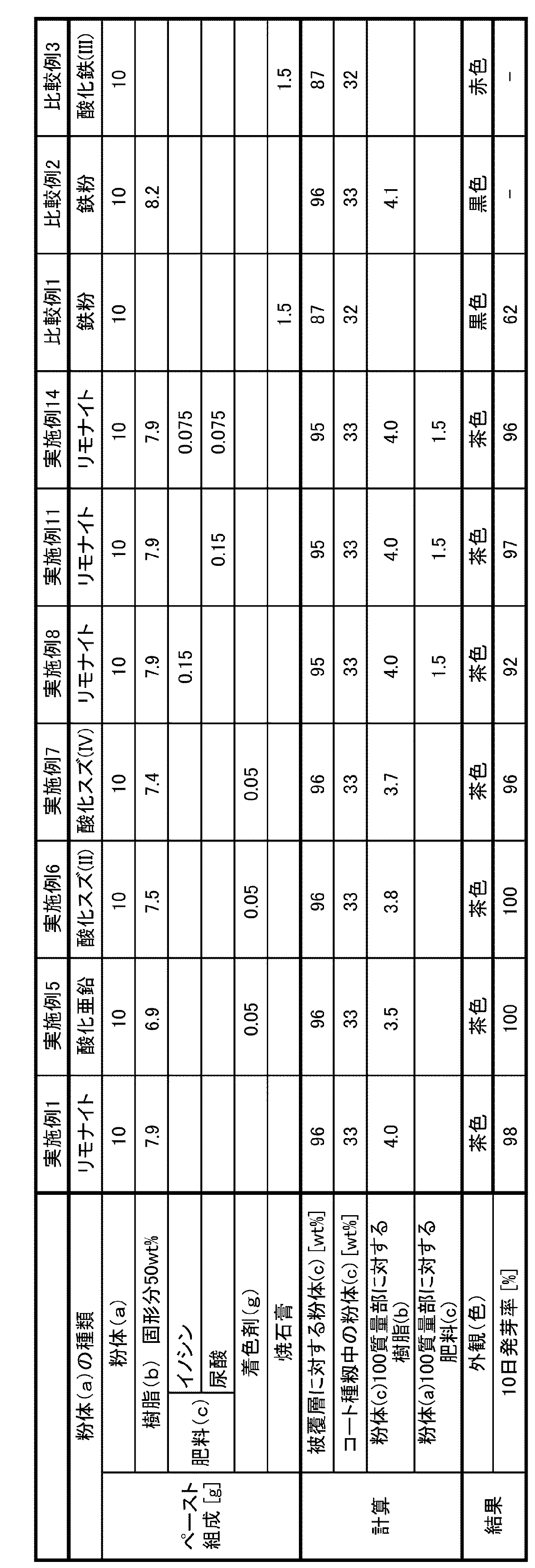
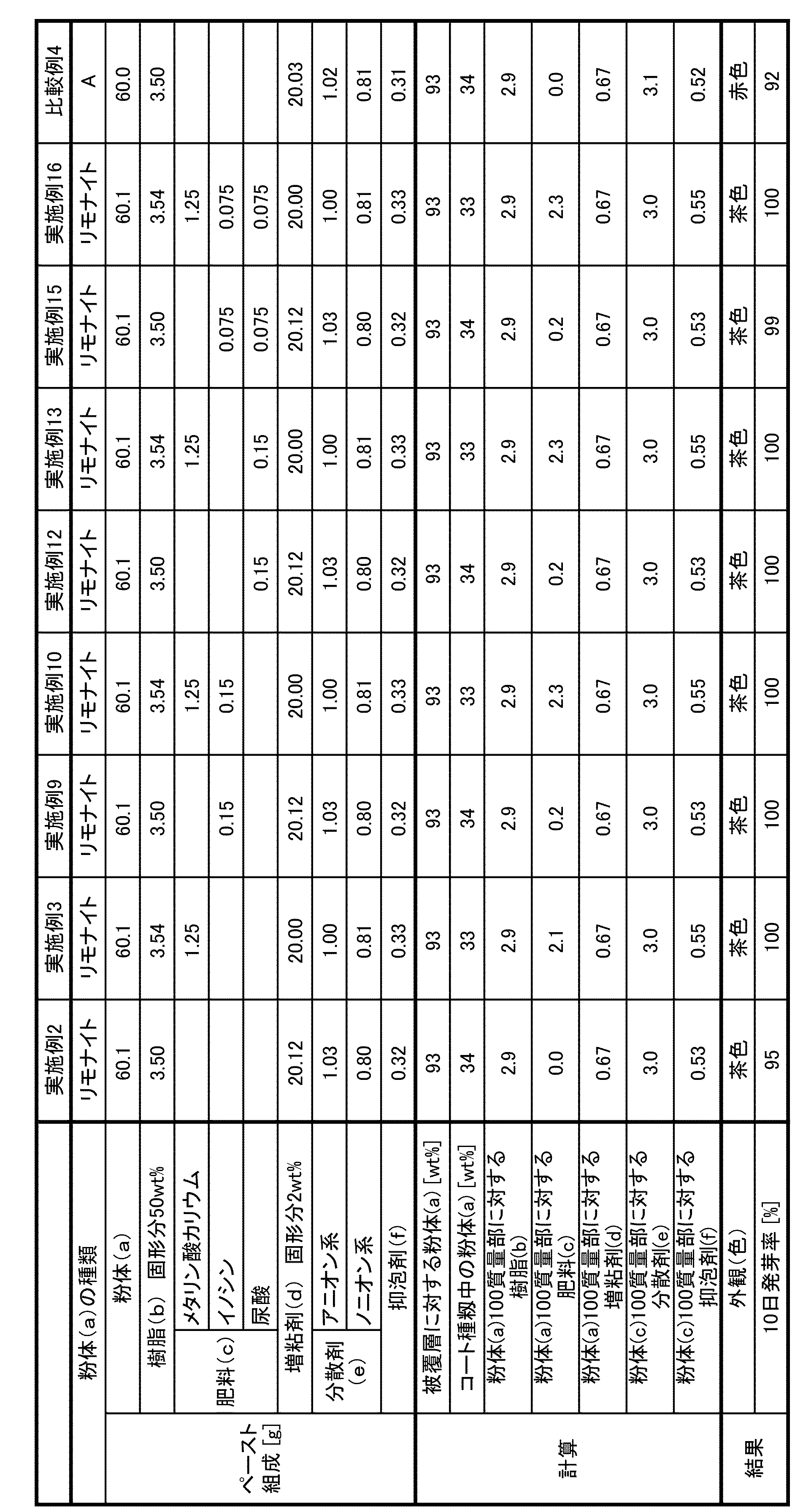
網目が2mmのステンレス製のメッシュを水面下8mmの位置に設置した。当該メッシュ上に実施例1~3及び比較例1~4にて製造した被覆水稲種籾をそれぞれ100粒配置し、室温20℃の恒温室中で水面高さを保ちながら10日間の栽培を行った。2日ごとに発芽した種籾の数を計測した。計測結果を表1に示す。
また、実施例4~16にて製造した被覆水稲種籾については10日後に発芽した種籾の数を計測した。結果を表2~3に示す。
網目が2mmのステンレス製のメッシュを水面下8mmの位置に設置した。当該メッシュ上に実施例1~3及び比較例1~4にて製造した被覆水稲種籾をそれぞれ100粒配置し、室温20℃の恒温室中で水面高さを保ちながら10日間の栽培を行った。2日ごとに発芽した種籾の数を計測した。計測結果を表1に示す。
また、実施例4~16にて製造した被覆水稲種籾については10日後に発芽した種籾の数を計測した。結果を表2~3に示す。

[コーティング材の崩壊試験]
実施例2で製造したリモナイト粉体含有樹脂被覆水稲種籾(α)、比較例1で製造した鉄粉粉体含有樹脂被覆水稲種籾(β)、及び比較例4で製造した酸化鉄A含有樹脂被覆水稲種籾(γ)について、発芽試験開始後3日目に被覆層を目視観察した。
その結果、リモナイト粉体含有樹脂被覆水稲種籾(α)では被覆層に外観上変化がなく、鉄粉含有樹脂被覆水稲種籾(β)では被覆層が溶出して種周りに鉄さびの広がりが確認され、酸化鉄A粉体含有樹脂被覆水稲種籾(γ)では被覆層の一部に剥がれ落ちが確認された。
実施例2で製造したリモナイト粉体含有樹脂被覆水稲種籾(α)、比較例1で製造した鉄粉粉体含有樹脂被覆水稲種籾(β)、及び比較例4で製造した酸化鉄A含有樹脂被覆水稲種籾(γ)について、発芽試験開始後3日目に被覆層を目視観察した。
その結果、リモナイト粉体含有樹脂被覆水稲種籾(α)では被覆層に外観上変化がなく、鉄粉含有樹脂被覆水稲種籾(β)では被覆層が溶出して種周りに鉄さびの広がりが確認され、酸化鉄A粉体含有樹脂被覆水稲種籾(γ)では被覆層の一部に剥がれ落ちが確認された。
[鳥害試験]
生種(品種:ミルキークイーン、平成26年富山県産、株式会社のうけんより購入した種籾)、実施例2で製造したリモナイト粉体含有樹脂被覆水稲種籾(α)、比較例1で製造した鉄粉粉体含有樹脂被覆水稲種籾(β)、及び比較例3で製造した酸化鉄(III)被覆水稲種籾(δ)を、それぞれ土を敷いたステンレスバット(幅150mm×奥150mm×高20mm)上に100粒散らばせた。ここで用意した4枚のステンレスバットを2016年10月12日から14日の10時から15時の間、屋外グラウンド(所在地:千葉県千葉市緑区、昭和電工株式会社内)に並べて放置した。放置後、鳥(雀)によって捕食された種子の粒数をカウントし、その割合(%)を最初に投入した粒数を基に算出し、鳥害度として評価した。同様の操作を3日間に亘って実施した。結果を表4に示す。

生種(品種:ミルキークイーン、平成26年富山県産、株式会社のうけんより購入した種籾)、実施例2で製造したリモナイト粉体含有樹脂被覆水稲種籾(α)、比較例1で製造した鉄粉粉体含有樹脂被覆水稲種籾(β)、及び比較例3で製造した酸化鉄(III)被覆水稲種籾(δ)を、それぞれ土を敷いたステンレスバット(幅150mm×奥150mm×高20mm)上に100粒散らばせた。ここで用意した4枚のステンレスバットを2016年10月12日から14日の10時から15時の間、屋外グラウンド(所在地:千葉県千葉市緑区、昭和電工株式会社内)に並べて放置した。放置後、鳥(雀)によって捕食された種子の粒数をカウントし、その割合(%)を最初に投入した粒数を基に算出し、鳥害度として評価した。同様の操作を3日間に亘って実施した。結果を表4に示す。
本発明の種籾被覆剤を用いて作製した被覆水稲種籾(実施例1~3)では、従来の鉄コーティングの材料を用いて行った種籾(比較例1)よりも発芽率が高いという結果が得られた。これはコーティング処理の際に起こる酸化に伴う発熱が抑制されたためであると考えられる。また、本発明の被覆水稲種籾(実施例1~3)はコーティングを行っていない種籾(参考例)と発芽率がほぼ同じことから、本発明のコーティング処理は発芽率そのものに悪い影響を与えないということが示唆される。
また、粉体(a)として酸化亜鉛、酸化スズ(II、IV)の粉体を使用した種籾被覆剤(実施例4~7)、及びイノシン、尿酸を添加した種籾被覆剤(実施例8~16)を用いて作製した被覆水稲種籾についても、10日後発芽率がほぼ100%となる結果が得られた。
実施例2にて作製した被覆水稲種籾(α)は、コーティングを行っていない種籾(生種)や鉄粉粉体含有樹脂被覆水稲種籾(β)、酸化鉄(III)被覆水稲種籾(δ)と比べて鳥害が最も少ない結果であった。
比較例2にて作製した被覆水稲種籾は、発芽試験の際に発芽前に水中で被覆層の剥がれが起きた。また、比較例3にて作製した被覆水稲種籾は、指で擦っただけで被覆層が剥がれた。
以上の結果から、金属酸化物粉体と樹脂とを組み合わせた本発明の被覆水稲種籾の優れた効果が明らかである。
また、粉体(a)として酸化亜鉛、酸化スズ(II、IV)の粉体を使用した種籾被覆剤(実施例4~7)、及びイノシン、尿酸を添加した種籾被覆剤(実施例8~16)を用いて作製した被覆水稲種籾についても、10日後発芽率がほぼ100%となる結果が得られた。
実施例2にて作製した被覆水稲種籾(α)は、コーティングを行っていない種籾(生種)や鉄粉粉体含有樹脂被覆水稲種籾(β)、酸化鉄(III)被覆水稲種籾(δ)と比べて鳥害が最も少ない結果であった。
比較例2にて作製した被覆水稲種籾は、発芽試験の際に発芽前に水中で被覆層の剥がれが起きた。また、比較例3にて作製した被覆水稲種籾は、指で擦っただけで被覆層が剥がれた。
以上の結果から、金属酸化物粉体と樹脂とを組み合わせた本発明の被覆水稲種籾の優れた効果が明らかである。
本発明によれば、金属酸化物(酸化鉄、酸化亜鉛、酸化スズ)含有樹脂被覆水稲種籾を被覆作業効率良く製造することができ、作物を栽培する農業分野、特に稲作での広範な利用が可能である。
Claims (16)
- 被覆層を有する水稲種籾であって、被覆層が褐色の酸化鉄、酸化亜鉛、及び酸化スズから選択される少なくとも1種の粉体(a)及び樹脂(b)を含む水稲種籾。
- 前記被覆層が褐色である請求項1に記載の水稲種籾。
- 前記褐色の酸化鉄が褐鉄鉱である請求項1または2に記載の水稲種籾。
- 前記褐色の酸化鉄が針鉄鉱を含む請求項1~3のいずれかに記載の水稲種籾。
- 前記粉体(a)を、樹脂被覆層を有する水稲種籾に対して10~50質量%含む請求項1~4のいずれかに記載の水稲種籾。
- 前記粉体(a)を、樹脂被覆層に対して70~99質量%含む請求項1~5のいずれかに記載の水稲種籾。
- 前記粉体(a)の平均粒径が30~100μmの範囲である請求項1~6のいずれかに記載の水稲種籾。
- さらに、樹脂被覆層に肥料成分(c)を含む請求項1~7のいずれかに記載の水稲種籾。
- 前記樹脂(b)が、酢酸ビニル重合体樹脂、アクリル酸エステル共重合体樹脂、エチレン・酢酸ビニル・アクリル酸共重合体樹脂、及びエチレン・酢酸ビニル共重合体樹脂からなる群より選択される1以上の樹脂を含む請求項1~8のいずれかに記載の水稲種籾。
- 前記樹脂(b)が、生分解性樹脂を含む請求項1~9のいずれかに記載の水稲種籾。
- 褐色の酸化鉄、酸化亜鉛、及び酸化スズから選択される少なくとも1種の粉体(a)と水稲種籾との混合物に、樹脂(b)を含む組成物を噴霧して、種籾表面に粉体と樹脂を含む被覆層を形成した後、乾燥することを特徴とする、粉体を含む樹脂被覆層を有する水稲種籾の製造方法。
- 水稲種籾と、前記粉体(a)及び前記樹脂(b)を含むペースト状組成物とを混合処理して、種籾表面に前記粉体と樹脂を含む被覆層を形成した後、乾燥することを特徴とする、粉体を含む樹脂被覆層を有する水稲種籾の製造方法。
- 樹脂(b)を含む組成物と褐色の酸化鉄、酸化亜鉛、及び酸化スズから選択される少なくとも1種の粉体(a)を含有することを特徴とする水稲種籾被覆用組成物。
- 前記樹脂(b)を含む組成物が樹脂エマルジョンである請求項13に記載の水稲種籾被覆用組成物。
- 前記樹脂エマルジョンが、酢酸ビニル重合体水性エマルジョン、アクリル酸エステル共重合体水性エマルジョン、エチレン・酢酸ビニル・アクリル酸共重合体水性エマルジョン、エチレン・酢酸ビニル共重合体水性エマルジョン、及び生分解性水性樹脂エマルジョンからなる群より選ばれる1以上の樹脂エマルジョンである請求項14に記載の水稲種籾被覆用組成物。
- 前記褐色の酸化鉄が褐鉄鉱である請求項13~15のいずれかに記載の水稲種籾被覆用組成物。
Priority Applications (2)
| Application Number | Priority Date | Filing Date | Title |
|---|---|---|---|
| JP2017550349A JPWO2017082283A1 (ja) | 2015-11-13 | 2016-11-09 | 水稲種籾、その製造方法、及び水稲種籾被覆用組成物 |
| CN201680021632.3A CN107529714A (zh) | 2015-11-13 | 2016-11-09 | 水稻种子、其制造方法及水稻种子被覆用组合物 |
Applications Claiming Priority (4)
| Application Number | Priority Date | Filing Date | Title |
|---|---|---|---|
| JP2015-223123 | 2015-11-13 | ||
| JP2015223123 | 2015-11-13 | ||
| JP2016167032 | 2016-08-29 | ||
| JP2016-167032 | 2016-08-29 |
Publications (1)
| Publication Number | Publication Date |
|---|---|
| WO2017082283A1 true WO2017082283A1 (ja) | 2017-05-18 |
Family
ID=58695370
Family Applications (1)
| Application Number | Title | Priority Date | Filing Date |
|---|---|---|---|
| PCT/JP2016/083196 Ceased WO2017082283A1 (ja) | 2015-11-13 | 2016-11-09 | 水稲種籾、その製造方法、及び水稲種籾被覆用組成物 |
Country Status (4)
| Country | Link |
|---|---|
| JP (1) | JPWO2017082283A1 (ja) |
| CN (1) | CN107529714A (ja) |
| TW (1) | TW201729680A (ja) |
| WO (1) | WO2017082283A1 (ja) |
Families Citing this family (5)
| Publication number | Priority date | Publication date | Assignee | Title |
|---|---|---|---|---|
| CN110248535B (zh) * | 2017-01-30 | 2021-07-23 | 杰富意钢铁株式会社 | 种子被覆剂、被覆种子和种子被覆方法 |
| CN115211263A (zh) * | 2021-04-16 | 2022-10-21 | 首立企业股份有限公司 | 稻种包覆材料、披覆有包覆材料的稻种及披覆方法 |
| TWI787788B (zh) * | 2021-04-20 | 2022-12-21 | 首立企業股份有限公司 | 稻種包覆材料、披覆有包覆材料的稻種及披覆方法 |
| TWI821996B (zh) * | 2022-04-15 | 2023-11-11 | 國立中興大學 | 氧化鋅用於提高農藥防治其抗藥性病原菌之功效的應用及方法 |
| TWI838313B (zh) * | 2023-09-12 | 2024-04-01 | 陳雅婷 | 應用於旱地播種的稻子包覆結構 |
Citations (4)
| Publication number | Priority date | Publication date | Assignee | Title |
|---|---|---|---|---|
| JPH01149704A (ja) * | 1987-12-07 | 1989-06-12 | Nogyo Kenkyu Center Shocho | 直播稲種子の出芽生育向上粉衣剤 |
| JPH08149907A (ja) * | 1994-11-29 | 1996-06-11 | Nippon Godo Hiryo Kk | 被覆植物種子 |
| JP2011155840A (ja) * | 2010-01-29 | 2011-08-18 | Sumika Agrotech Co Ltd | コート種子の保存方法 |
| JP2015077100A (ja) * | 2013-10-17 | 2015-04-23 | 住友化学株式会社 | イネ種子用コーティング資材及びコーティングイネ種子 |
Family Cites Families (1)
| Publication number | Priority date | Publication date | Assignee | Title |
|---|---|---|---|---|
| JP4441645B2 (ja) * | 2004-01-06 | 2010-03-31 | 独立行政法人農業・食品産業技術総合研究機構 | 鉄粉被覆稲種子の製造法 |
-
2016
- 2016-11-09 CN CN201680021632.3A patent/CN107529714A/zh active Pending
- 2016-11-09 JP JP2017550349A patent/JPWO2017082283A1/ja active Pending
- 2016-11-09 WO PCT/JP2016/083196 patent/WO2017082283A1/ja not_active Ceased
- 2016-11-11 TW TW105136943A patent/TW201729680A/zh unknown
Patent Citations (4)
| Publication number | Priority date | Publication date | Assignee | Title |
|---|---|---|---|---|
| JPH01149704A (ja) * | 1987-12-07 | 1989-06-12 | Nogyo Kenkyu Center Shocho | 直播稲種子の出芽生育向上粉衣剤 |
| JPH08149907A (ja) * | 1994-11-29 | 1996-06-11 | Nippon Godo Hiryo Kk | 被覆植物種子 |
| JP2011155840A (ja) * | 2010-01-29 | 2011-08-18 | Sumika Agrotech Co Ltd | コート種子の保存方法 |
| JP2015077100A (ja) * | 2013-10-17 | 2015-04-23 | 住友化学株式会社 | イネ種子用コーティング資材及びコーティングイネ種子 |
Also Published As
| Publication number | Publication date |
|---|---|
| CN107529714A (zh) | 2018-01-02 |
| TW201729680A (zh) | 2017-09-01 |
| JPWO2017082283A1 (ja) | 2017-12-21 |
Similar Documents
| Publication | Publication Date | Title |
|---|---|---|
| WO2017082283A1 (ja) | 水稲種籾、その製造方法、及び水稲種籾被覆用組成物 | |
| JP6024972B2 (ja) | 繁殖体被覆物、栽培方法、及び繁殖体被覆物の製造方法 | |
| CA2809229C (en) | Iron powder for coating seeds and seed | |
| US9107339B2 (en) | Seed-covering agent and seed covered with seed-covering agent | |
| WO2018123130A1 (ja) | 浸種処理が可能な被覆水稲種籾の製造方法 | |
| JP6553483B2 (ja) | 被覆稲種子及び被覆稲種子の製造方法 | |
| JP6372637B1 (ja) | 種子被覆剤、被覆種子及び種子被覆方法 | |
| JP2020124141A (ja) | 種子被覆剤、被覆種子及び種子被覆方法 | |
| TWI692507B (zh) | 種子被覆劑、被覆種子及種子被覆方法 | |
| JP2013046598A (ja) | 種子被覆用鉄粉、鉄粉被覆種子、種子被覆剤及び種子被覆剤被覆種子 | |
| JP6608655B2 (ja) | 製鋼スラグコーティング種子およびその製造方法 | |
| JP6598233B2 (ja) | 酸化鉄被覆種子の製造方法 | |
| JP6800945B2 (ja) | 水稲種籾被覆組成物および水稲種籾被覆組成物の製造方法 | |
| JP4957861B1 (ja) | 副資材含有種子被覆用鉄粉、副資材付着種子被覆用鉄粉、種子被覆用合金鋼粉及び、副資材含有種子被覆用鉄粉、副資材付着種子被覆用鉄粉または種子被覆用合金鋼粉で被覆された種子 | |
| JP7088219B2 (ja) | 種子被覆剤、被覆種子及び種子被覆方法 | |
| JP7088220B2 (ja) | 種子被覆剤、被覆種子及び種子被覆方法 | |
| JP7764878B2 (ja) | 種子被覆剤、被覆種子及び種子被覆方法 | |
| JP2013000058A (ja) | コーティング種子及びその製造方法 | |
| JP2019088262A (ja) | 水稲種籾の育苗方法 | |
| JP2019088261A (ja) | 水稲種籾の育苗方法 | |
| JP7459825B2 (ja) | 種子被覆方法 | |
| KR101512794B1 (ko) | 종자 피복제 및 종자 피복제 피복 종자 | |
| WO2022196216A1 (ja) | 種子被覆方法 | |
| JP2020010623A (ja) | 直播用コーティング種子および直播栽培方法 | |
| WO2012063967A1 (ja) | 種子被覆剤及び種子被覆剤被覆種子 |
Legal Events
| Date | Code | Title | Description |
|---|---|---|---|
| 121 | Ep: the epo has been informed by wipo that ep was designated in this application |
Ref document number: 16864244 Country of ref document: EP Kind code of ref document: A1 |
|
| ENP | Entry into the national phase |
Ref document number: 2017550349 Country of ref document: JP Kind code of ref document: A |
|
| NENP | Non-entry into the national phase |
Ref country code: DE |
|
| 122 | Ep: pct application non-entry in european phase |
Ref document number: 16864244 Country of ref document: EP Kind code of ref document: A1 |