WO2017065201A1 - ポリマー、ポリマー溶液、液晶配向層、光学異方体、及び液晶表示素子 - Google Patents
ポリマー、ポリマー溶液、液晶配向層、光学異方体、及び液晶表示素子 Download PDFInfo
- Publication number
- WO2017065201A1 WO2017065201A1 PCT/JP2016/080336 JP2016080336W WO2017065201A1 WO 2017065201 A1 WO2017065201 A1 WO 2017065201A1 JP 2016080336 W JP2016080336 W JP 2016080336W WO 2017065201 A1 WO2017065201 A1 WO 2017065201A1
- Authority
- WO
- WIPO (PCT)
- Prior art keywords
- group
- independently
- substituted
- alkyl group
- atom
- Prior art date
- Legal status (The legal status is an assumption and is not a legal conclusion. Google has not performed a legal analysis and makes no representation as to the accuracy of the status listed.)
- Ceased
Links
- XIAHSJTUQAWUAW-UHFFFAOYSA-N CC(C)(c1ccc(C)cc1)c1ccc(C)cc1 Chemical compound CC(C)(c1ccc(C)cc1)c1ccc(C)cc1 XIAHSJTUQAWUAW-UHFFFAOYSA-N 0.000 description 1
- RZTDESRVPFKCBH-UHFFFAOYSA-N Cc(cc1)ccc1-c1ccc(C)cc1 Chemical compound Cc(cc1)ccc1-c1ccc(C)cc1 RZTDESRVPFKCBH-UHFFFAOYSA-N 0.000 description 1
- YWYHGNUFMPSTTR-UHFFFAOYSA-N Cc(cc1)ccc1Oc1ccc(C)cc1 Chemical compound Cc(cc1)ccc1Oc1ccc(C)cc1 YWYHGNUFMPSTTR-UHFFFAOYSA-N 0.000 description 1
- HZAWPPRBCALFRN-UHFFFAOYSA-N Cc1ccc(Cc2ccc(C)cc2)cc1 Chemical compound Cc1ccc(Cc2ccc(C)cc2)cc1 HZAWPPRBCALFRN-UHFFFAOYSA-N 0.000 description 1
Images

Classifications
-
- C—CHEMISTRY; METALLURGY
- C09—DYES; PAINTS; POLISHES; NATURAL RESINS; ADHESIVES; COMPOSITIONS NOT OTHERWISE PROVIDED FOR; APPLICATIONS OF MATERIALS NOT OTHERWISE PROVIDED FOR
- C09K—MATERIALS FOR MISCELLANEOUS APPLICATIONS, NOT PROVIDED FOR ELSEWHERE
- C09K19/00—Liquid crystal materials
- C09K19/52—Liquid crystal materials characterised by components which are not liquid crystals, e.g. additives with special physical aspect: solvents, solid particles
- C09K19/54—Additives having no specific mesophase characterised by their chemical composition
- C09K19/56—Aligning agents
-
- C—CHEMISTRY; METALLURGY
- C08—ORGANIC MACROMOLECULAR COMPOUNDS; THEIR PREPARATION OR CHEMICAL WORKING-UP; COMPOSITIONS BASED THEREON
- C08G—MACROMOLECULAR COMPOUNDS OBTAINED OTHERWISE THAN BY REACTIONS ONLY INVOLVING UNSATURATED CARBON-TO-CARBON BONDS
- C08G73/00—Macromolecular compounds obtained by reactions forming a linkage containing nitrogen with or without oxygen or carbon in the main chain of the macromolecule, not provided for in groups C08G12/00 - C08G71/00
- C08G73/06—Polycondensates having nitrogen-containing heterocyclic rings in the main chain of the macromolecule
- C08G73/10—Polyimides; Polyester-imides; Polyamide-imides; Polyamide acids or similar polyimide precursors
- C08G73/1042—Copolyimides derived from at least two different tetracarboxylic compounds or two different diamino compounds
-
- C—CHEMISTRY; METALLURGY
- C08—ORGANIC MACROMOLECULAR COMPOUNDS; THEIR PREPARATION OR CHEMICAL WORKING-UP; COMPOSITIONS BASED THEREON
- C08G—MACROMOLECULAR COMPOUNDS OBTAINED OTHERWISE THAN BY REACTIONS ONLY INVOLVING UNSATURATED CARBON-TO-CARBON BONDS
- C08G73/00—Macromolecular compounds obtained by reactions forming a linkage containing nitrogen with or without oxygen or carbon in the main chain of the macromolecule, not provided for in groups C08G12/00 - C08G71/00
- C08G73/06—Polycondensates having nitrogen-containing heterocyclic rings in the main chain of the macromolecule
- C08G73/10—Polyimides; Polyester-imides; Polyamide-imides; Polyamide acids or similar polyimide precursors
- C08G73/1075—Partially aromatic polyimides
- C08G73/1078—Partially aromatic polyimides wholly aromatic in the diamino moiety
-
- C—CHEMISTRY; METALLURGY
- C09—DYES; PAINTS; POLISHES; NATURAL RESINS; ADHESIVES; COMPOSITIONS NOT OTHERWISE PROVIDED FOR; APPLICATIONS OF MATERIALS NOT OTHERWISE PROVIDED FOR
- C09D—COATING COMPOSITIONS, e.g. PAINTS, VARNISHES OR LACQUERS; FILLING PASTES; CHEMICAL PAINT OR INK REMOVERS; INKS; CORRECTING FLUIDS; WOODSTAINS; PASTES OR SOLIDS FOR COLOURING OR PRINTING; USE OF MATERIALS THEREFOR
- C09D179/00—Coating compositions based on macromolecular compounds obtained by reactions forming in the main chain of the macromolecule a linkage containing nitrogen, with or without oxygen, or carbon only, not provided for in groups C09D161/00 - C09D177/00
- C09D179/04—Polycondensates having nitrogen-containing heterocyclic rings in the main chain; Polyhydrazides; Polyamide acids or similar polyimide precursors
- C09D179/08—Polyimides; Polyester-imides; Polyamide-imides; Polyamide acids or similar polyimide precursors
-
- C—CHEMISTRY; METALLURGY
- C09—DYES; PAINTS; POLISHES; NATURAL RESINS; ADHESIVES; COMPOSITIONS NOT OTHERWISE PROVIDED FOR; APPLICATIONS OF MATERIALS NOT OTHERWISE PROVIDED FOR
- C09K—MATERIALS FOR MISCELLANEOUS APPLICATIONS, NOT PROVIDED FOR ELSEWHERE
- C09K19/00—Liquid crystal materials
- C09K19/04—Liquid crystal materials characterised by the chemical structure of the liquid crystal components, e.g. by a specific unit
- C09K19/36—Steroidal liquid crystal compounds
-
- C—CHEMISTRY; METALLURGY
- C09—DYES; PAINTS; POLISHES; NATURAL RESINS; ADHESIVES; COMPOSITIONS NOT OTHERWISE PROVIDED FOR; APPLICATIONS OF MATERIALS NOT OTHERWISE PROVIDED FOR
- C09K—MATERIALS FOR MISCELLANEOUS APPLICATIONS, NOT PROVIDED FOR ELSEWHERE
- C09K19/00—Liquid crystal materials
- C09K19/04—Liquid crystal materials characterised by the chemical structure of the liquid crystal components, e.g. by a specific unit
- C09K19/38—Polymers
- C09K19/3804—Polymers with mesogenic groups in the main chain
- C09K19/3809—Polyesters; Polyester derivatives, e.g. polyamides
-
- G—PHYSICS
- G02—OPTICS
- G02F—OPTICAL DEVICES OR ARRANGEMENTS FOR THE CONTROL OF LIGHT BY MODIFICATION OF THE OPTICAL PROPERTIES OF THE MEDIA OF THE ELEMENTS INVOLVED THEREIN; NON-LINEAR OPTICS; FREQUENCY-CHANGING OF LIGHT; OPTICAL LOGIC ELEMENTS; OPTICAL ANALOGUE/DIGITAL CONVERTERS
- G02F1/00—Devices or arrangements for the control of the intensity, colour, phase, polarisation or direction of light arriving from an independent light source, e.g. switching, gating or modulating; Non-linear optics
- G02F1/01—Devices or arrangements for the control of the intensity, colour, phase, polarisation or direction of light arriving from an independent light source, e.g. switching, gating or modulating; Non-linear optics for the control of the intensity, phase, polarisation or colour
- G02F1/13—Devices or arrangements for the control of the intensity, colour, phase, polarisation or direction of light arriving from an independent light source, e.g. switching, gating or modulating; Non-linear optics for the control of the intensity, phase, polarisation or colour based on liquid crystals, e.g. single liquid crystal display cells
- G02F1/133—Constructional arrangements; Operation of liquid crystal cells; Circuit arrangements
- G02F1/1333—Constructional arrangements; Manufacturing methods
- G02F1/1337—Surface-induced orientation of the liquid crystal molecules, e.g. by alignment layers
-
- G—PHYSICS
- G02—OPTICS
- G02F—OPTICAL DEVICES OR ARRANGEMENTS FOR THE CONTROL OF LIGHT BY MODIFICATION OF THE OPTICAL PROPERTIES OF THE MEDIA OF THE ELEMENTS INVOLVED THEREIN; NON-LINEAR OPTICS; FREQUENCY-CHANGING OF LIGHT; OPTICAL LOGIC ELEMENTS; OPTICAL ANALOGUE/DIGITAL CONVERTERS
- G02F1/00—Devices or arrangements for the control of the intensity, colour, phase, polarisation or direction of light arriving from an independent light source, e.g. switching, gating or modulating; Non-linear optics
- G02F1/01—Devices or arrangements for the control of the intensity, colour, phase, polarisation or direction of light arriving from an independent light source, e.g. switching, gating or modulating; Non-linear optics for the control of the intensity, phase, polarisation or colour
- G02F1/13—Devices or arrangements for the control of the intensity, colour, phase, polarisation or direction of light arriving from an independent light source, e.g. switching, gating or modulating; Non-linear optics for the control of the intensity, phase, polarisation or colour based on liquid crystals, e.g. single liquid crystal display cells
- G02F1/133—Constructional arrangements; Operation of liquid crystal cells; Circuit arrangements
- G02F1/1333—Constructional arrangements; Manufacturing methods
- G02F1/1337—Surface-induced orientation of the liquid crystal molecules, e.g. by alignment layers
- G02F1/13378—Surface-induced orientation of the liquid crystal molecules, e.g. by alignment layers by treatment of the surface, e.g. embossing, rubbing or light irradiation
- G02F1/133788—Surface-induced orientation of the liquid crystal molecules, e.g. by alignment layers by treatment of the surface, e.g. embossing, rubbing or light irradiation by light irradiation, e.g. linearly polarised light photo-polymerisation
-
- G—PHYSICS
- G02—OPTICS
- G02F—OPTICAL DEVICES OR ARRANGEMENTS FOR THE CONTROL OF LIGHT BY MODIFICATION OF THE OPTICAL PROPERTIES OF THE MEDIA OF THE ELEMENTS INVOLVED THEREIN; NON-LINEAR OPTICS; FREQUENCY-CHANGING OF LIGHT; OPTICAL LOGIC ELEMENTS; OPTICAL ANALOGUE/DIGITAL CONVERTERS
- G02F2201/00—Constructional arrangements not provided for in groups G02F1/00 - G02F7/00
- G02F2201/08—Constructional arrangements not provided for in groups G02F1/00 - G02F7/00 light absorbing layer
- G02F2201/086—UV absorbing
-
- G—PHYSICS
- G02—OPTICS
- G02F—OPTICAL DEVICES OR ARRANGEMENTS FOR THE CONTROL OF LIGHT BY MODIFICATION OF THE OPTICAL PROPERTIES OF THE MEDIA OF THE ELEMENTS INVOLVED THEREIN; NON-LINEAR OPTICS; FREQUENCY-CHANGING OF LIGHT; OPTICAL LOGIC ELEMENTS; OPTICAL ANALOGUE/DIGITAL CONVERTERS
- G02F2201/00—Constructional arrangements not provided for in groups G02F1/00 - G02F7/00
- G02F2201/12—Constructional arrangements not provided for in groups G02F1/00 - G02F7/00 electrode
- G02F2201/124—Constructional arrangements not provided for in groups G02F1/00 - G02F7/00 electrode interdigital
-
- G—PHYSICS
- G02—OPTICS
- G02F—OPTICAL DEVICES OR ARRANGEMENTS FOR THE CONTROL OF LIGHT BY MODIFICATION OF THE OPTICAL PROPERTIES OF THE MEDIA OF THE ELEMENTS INVOLVED THEREIN; NON-LINEAR OPTICS; FREQUENCY-CHANGING OF LIGHT; OPTICAL LOGIC ELEMENTS; OPTICAL ANALOGUE/DIGITAL CONVERTERS
- G02F2202/00—Materials and properties
- G02F2202/02—Materials and properties organic material
- G02F2202/022—Materials and properties organic material polymeric
Definitions
- the present invention relates to a polymer, a polymer solution, a liquid crystal alignment layer, an optical anisotropic body, and a liquid crystal display element.
- the liquid crystal alignment layer has excellent characteristics that there is no micro-scratch due to mechanical rubbing, there is no risk of dust generation due to rubbing and the accompanying destruction of TFT elements, and high-definition patterning is possible. For this reason, the application to various liquid crystal displays is energetically advanced. In particular, there is a great demand for a liquid crystal alignment layer for horizontal alignment (planar alignment) used for an IPS / FFS display.
- a method for producing a liquid crystal alignment layer without performing a rubbing treatment first, a solution containing a photo-alignment polymer is applied on a substrate to form a dried film, and then the film is irradiated with polarized light, A method of imparting alignment regulating force to the liquid crystal to the surface of the liquid crystal alignment layer is common (see, for example, Patent Document 1).
- AC image sticking means that the liquid crystal molecules do not completely return to the alignment direction defined by the liquid crystal alignment layer even if the voltage is applied to the liquid crystal molecules and then the voltage is not applied. It is a failure mode that causes it. When AC image sticking occurs, the contrast is seriously lowered. Therefore, a liquid crystal alignment layer that hardly causes AC image sticking is desired.
- it is also required to reduce the irradiation amount of polarized ultraviolet rays necessary for imparting alignment regulating force, and to reduce the tact time and production cost of liquid crystal panel production.
- Patent Document 1 discloses a polymer having cinnamic acid derivatives and azobenzene derivatives as side chains as photoalignable side chain units.
- a cinnamic acid derivative is dimerized by polarized ultraviolet rays to obtain an excellent alignment regulating force, and azobenzene enhances the sensitivity to polarized ultraviolet rays, thereby reducing the irradiation time.
- the present invention has been made in view of the above circumstances, and includes a polymer capable of forming a liquid crystal alignment layer having excellent alignment regulating power, high sensitivity to polarized ultraviolet rays, and excellent durability, and the polymer.
- a polymer solution, a liquid crystal alignment layer using the polymer, an optical anisotropic body including the liquid crystal alignment layer, and a liquid crystal display element are provided.
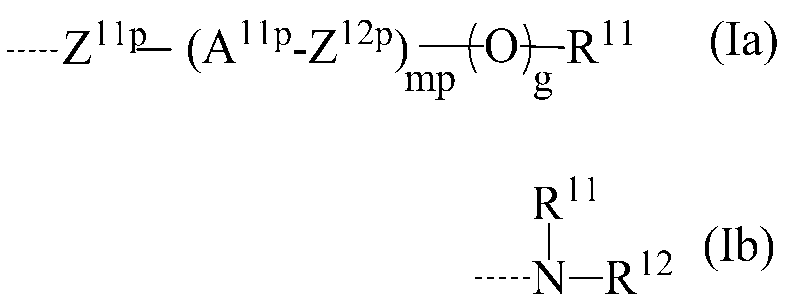
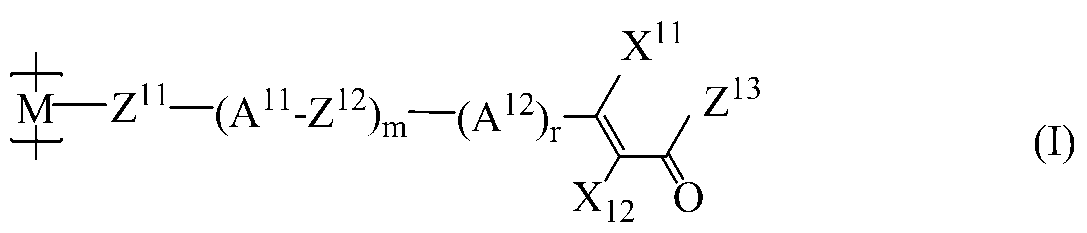
- the first aspect of the present invention is the general formula (I)
- Z 11 and Z 12 are each independently a single bond, — (CH 2 ) u — (wherein u represents 1 to 20), —OCH 2. —, —CH 2 O—, —COO—, —OCO—, —CH ⁇ CH—, —CF ⁇ CF—, —CF 2 O—, —OCF 2 —, —CF 2 CF 2 — or —C ⁇ C
- one or more of non-adjacent —CH 2 — groups independently represent —O—, —CO—, —CO—O—, —O—CO—, —Si ( CH 3 ) 2 —O—Si (CH 3 ) 2 —, —NR—, —NR—CO—, —CO—NR—, —NR—CO—O—, —O—CO—NR—, —NR— CO—NR—, —CH ⁇ CH—, —C ⁇ C— or —O—
- a 11 and A 12 are each independently two have not one methylene group or adjacent existing in xylene group (in this group the (a) trans-1,4-cyclohexylene
- the above methylene group may be replaced by —O—, —NH— or —S—)
- the group (a), the group (b) or the group (c) are each unsubstituted or one or more hydrogen atoms may be substituted with a fluorine atom, a chlorine atom, a cyano group, a methyl group or a methoxy group, m represents 0, 1 or 2, and when m represents 2, a plurality of A 11 and Z 12 may be the same or different; r represents 0, 1 or 2;
- a represents 2 a plurality of A 12 may be the same or different, and X 11 and X 12 are each independently a hydrogen atom, a fluorine atom, a chlorine atom,
- a broken line represents a bond to a carbon atom to which Z 13 is bonded
- R 11 and R 12 each independently represent a hydrogen atom or a linear or branched alkyl group having 1 to 30 carbon atoms.
- one -CH 2 in R 11 and R 12 - group or two or more non-adjacent -CH 2 - groups are -O -, - CO -, - CO-O -, - O-CO -, - CO- R 11 and R 12 may be substituted with one or more selected from NH—, —NH—CO—, —NCH 3 —, —CH ⁇ CH—, —CF ⁇ CF— and —C ⁇ C—.
- One or two or more —CH 2 — groups therein may be independently substituted with a cycloalkylene group having 3 to 8 ring members, and the hydrogen atom in R 11 and R 12 may have 1 to 20 carbon atoms. And may be substituted with an alkyl group, a cyano group or a halogen atom of Z 11p and Z 12p are each independently a single bond, — (CH 2 ) u — (wherein u represents 1 to 20), —OCH 2 —, —CH 2 O—, —COO—, —OCO—, —CH ⁇ CH—, —CF ⁇ CF—, —CF 2 O—, —OCF 2 —, —CF 2 CF 2 — or —C ⁇ C—, but in these substituents, non-adjacent —CH 2
- One or more of the groups are independently —O—, —CO—, —CO—O—, —O—CO—, —Si (CH 3 )
- a 11p is, (a) tiger 1,4-cyclohexylene group (one methylene group present in this group or two or more methylene groups not adjacent to each other may be replaced by —O—, —NH— or —S—).
- (B) 1,4-phenylene group (one or more of —CH ⁇ present in this group may be replaced by —N ⁇ ), and (c) 1,4-cyclohex Senylene group, 2,5-thiophenylene group, 2,5-furylene group, 1,4-bicyclo [2.2.2] octylene group, naphthalene-1,4-diyl group, naphthalene-2,6-diyl A group selected from the group consisting of a group, a decahydronaphthalene-2,6-diyl group and a 1,2,3,4-tetrahydronaphthalene-2,6-diyl group, and the groups (a) and (b ) Or group (c) is each unsubstituted or more than one hydrogen Child fluorine atom, a chlorine atom, a cyano group, may be substituted by a methyl group or a methoxy group, mp is 0, 1 or 2, if mp is 2, presence
- a 21 and A 22 are each independently trans-1,4-cyclohexylene group, trans-1,3-dioxane-2,5-diyl group, 1,4 -Naphthylene group, 2,6-naphthylene group, pyridine-2,5-diyl group, pyrimidine-2,5-diyl group, 2,5-thiophenylene group, 2,5-furylene group or 1,4-phenylene group Represents These are unsubstituted, or one or more hydrogen atoms are fluorine atoms, chlorine atoms, linear or branched alkyl groups having 1 to 20 carbon atoms (one or more —CH 2 — non-adjacent in the alkyl group).
- the groups are independently —O—, —COO—, —OCO—, —CH ⁇ CH—, —CF ⁇ CF—, —CF 2 O—, —OCF 2 —, —CF 2 CF 2 —, —C.
- R ′ independently represents a hydrogen atom or an alkyl group having 1 to 5 carbon atoms), and may be replaced with one or more hydrogen atoms of the alkyl group having 1 to 20 carbon atoms.
- Fluorine atom, a chlorine atom, a hydroxy group or a cyano group may be substituted.
- a broken line represents a bond to a carbon atom to which X 21 to X 25 are bonded, and A 23 and A 24 are a single bond, a trans-1,4-cyclohexylene group, a trans-1,3-dioxane- 2,5-diyl group, 1,4-naphthylene group, 2,6-naphthylene group, pyridine-2,5-diyl group, pyrimidine-2,5-diyl group, 2,5-thiophenylene group, 2,5 -Represents a furanylene group or a 1,4-phenylene group, which are unsubstituted, or one or more hydrogen atoms are a fluorine atom, a chlorine atom, a linear or branched alkyl group having 1 to 20 carbon atoms (the alkyl group)
- One or more non-adjacent —CH 2 — groups in it are independently —O—, —COO—
- R ′ is independently hydrogen Or one or more hydrogen atoms of the alkyl group having 1 to 20 carbon atoms may be a fluorine atom, a chlorine atom, a hydroxy group or a cyano group.
- Z 21 , Z 22 and Z 23 are each independently a single bond, a linear or branched alkylene group having 1 to 40 carbon atoms, or —OCH 2.
- One or more non-adjacent —CH 2 — groups in the alkylene group are independently —O—, —COO—, —OCO—, —CH ⁇ CH—, —CF ⁇ CF—, —CF 2 O—.
- One or more hydrogen atoms of the group may be substituted with fluorine, chlorine, hydroxy or cyano groups, n and q are each independently 0 or 1 S represents 1 or 2, and when s represents 2, a plurality of A 22 may be the same or different, and R 2 represents a hydrogen atom or a straight chain having 1 to 40 carbon atoms Or a branched alkyl group, and one or more of the non-adjacent —CH 2 — groups in the alkyl group are independently —O—, —COO—, —OCO—, —CH ⁇ CH—, — CF ⁇ CF—, —CF 2 O—, —OCF 2 —, —CF 2 CF 2 —, —C ⁇ C—, —CO—, —S—, —Si (CH 3 ) 2 —O—Si (CH 3 ) 2- , -NR'-, -NR'-CO-, -CO-NR'-, -NR'-CO-O
- -CH 2 alkyl group of the carbon number of 1 to 40 - one or more hydrogen atoms of which may be substituted with a halogen atom may be substituted by a hydroxy group or a cyano group, the carbon number of 1 to 40
- One or more —CH 2 — groups of the alkyl group may each independently be substituted with a cycloalkylene group having 3 to 8 ring members.
- R 2 is not a hydrogen atom.
- X 21 , X 22 , X 23 , X 24 , and X 25 are not hydrogen atoms at the same time.
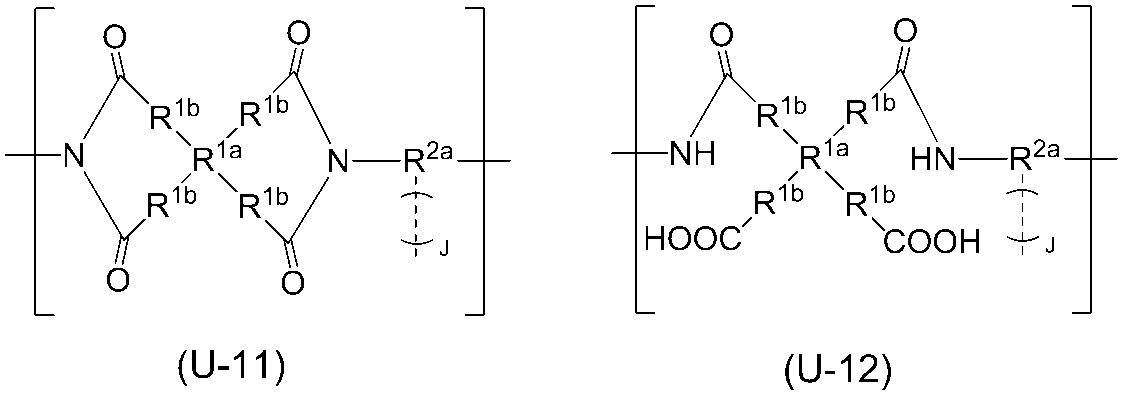
- the polymer main chain represented by M in the side chain units Ma and Mb has the general formulas (U-11) and (U-12)
- the second aspect of the present invention is a polymer solution characterized by comprising the polymer of the first aspect and an organic solvent as essential components.
- the third aspect of the present invention is a liquid crystal alignment layer comprising the polymer of the first aspect.
- the fourth aspect of the present invention is a liquid crystal display device comprising the liquid crystal alignment layer of the second aspect.
- a fifth aspect of the present invention is an optical anisotropic body including the liquid crystal alignment layer of the second aspect.
- a liquid crystal alignment layer having an excellent alignment regulating force and durability can be obtained. Since a film obtained by casting this polymer has high sensitivity to polarized ultraviolet rays, a liquid crystal alignment layer having a high alignment regulating force can be obtained with a small amount of light irradiation. As a result, by using the liquid crystal alignment layer according to the present invention, a liquid crystal display element excellent in display image quality can be produced in a short tact time.
- polymer The polymer of the first aspect of the present invention includes one or more side chain units Ma represented by the general formula (I) and one or more side chain units Mb represented by the general formula (II),
- the polymer main chain has a repeating unit represented by at least one of general formulas (U-11) and (U-12).
- the side chain unit Ma is a side chain unit represented by the general formula (I) and containing a cinnamic acid derivative.
- M represents a polymer main chain and has at least one repeating unit of general formula (U-11) and general formula (U-12).
- Z 11 and Z 12 are each independently a single bond, — (CH 2 ) u — (wherein u represents 1 to 20), —OCH 2 —, —CH 2 O—, —COO—, —OCO—, —CH ⁇ CH—, —CF ⁇ CF—, —CF 2 O—, —OCF 2 —, —CF 2 CF 2 — or —C ⁇ C—
- u represents 1 to 20
- one or more of the non-adjacent —CH 2 — groups are independently —O—, —CO—, —CO—O—, —O—CO—, —Si (CH 3 ) 2 —.
- a 11 and A 12 each independently represent (a) a trans-1,4-cyclohexylene group (one methylene group present in this group or two or more methylene groups not adjacent to each other represents- O—, —NH— or —S— may be substituted.), (B) 1,4-phenylene group (one or more —CH ⁇ present in this group is And (c) 1,4-cyclohexenylene group, 2,5-thiophenylene group, 2,5-furanylene group, 1,4-bicyclo [2.2.2] octylene group , Naphthalene-1,4-diyl group, naphthalene-2,6-diyl group, decahydronaphthalene-2,6-diyl group and 1,2,3,4-tetrahydronaphthalene-2,6-diyl group A group selected from the above groups (a) and (b Or each group (c) may be unsubstituted or one or more hydrogen atoms may be replaced
- R 11 and R 12 each independently represent a hydrogen atom or a linear or branched alkyl group having 1 to 30 carbon atoms.
- R 11 and R 12 are one —CH 2 — group or two or more non-adjacent —CH 2 — groups are —O—, —CO—, —CO—O—, —O—CO—, —CO—.
- R 11 and R 12 may be substituted with one or more selected from NH—, —NH—CO—, —NCH 3 —, —CH ⁇ CH—, —CF ⁇ CF— and —C ⁇ C—.
- One or two or more —CH 2 — groups therein may be independently substituted with a cycloalkyl group having 3 to 8 ring members, and the hydrogen atom in R 11 and R 12 may have 1 to 20 carbon atoms.
- alkyl group may be substituted with a cyano group or a halogen atom
- Z 11p and Z 1 2p each independently represents a single bond, — (CH 2 ) u — (wherein u represents 1 to 20), —OCH 2 —, —CH 2 O—, —COO—, —OCO—, —CH ⁇ CH—, —CF ⁇ CF—, —CF 2 O—, —OCF 2 —, —CF 2 CF 2 — or —C ⁇ C—, but in these substituents, non-adjacent —CH 2
- One or more of the groups are independently —O—, —CO—, —CO—O—, —O—CO—, —Si (CH 3
- (B) 1,4-phenylene group (one or more of —CH ⁇ present in this group may be replaced by —N ⁇ ), and (c) 1,4-cyclohex Senylene group, 2,5-thiophenylene group, 2,5-furylene group, 1,4-bicyclo [2.2.2] octylene group, naphthalene-1,4-diyl group, naphthalene-2,6-diyl A group selected from the group consisting of a group, a decahydronaphthalene-2,6-diyl group and a 1,2,3,4-tetrahydronaphthalene-2,6-diyl group, and the groups (a) and (b ) Or group (c) is each unsubstituted or more than one hydrogen Child fluorine atom, a chlorine atom, a cyano group, may be substituted by a methyl group or a methoxy group, mp is 0, 1 or 2, if mp is 2, presence
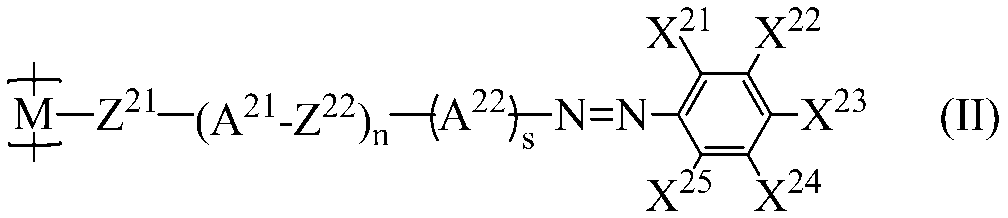
- the side chain unit Mb is a side chain unit represented by the general formula (II) and containing an azobenzene derivative.
- M represents a polymer main chain and has at least one repeating unit of general formula (U-11) and general formula (U-12).
- a 21 and A 22 are each independently a trans-1,4-cyclohexylene group, a trans-1,3-dioxane-2,5-diyl group, a 1,4-naphthylene group, 2 , 6-naphthylene group, pyridine-2,5-diyl group, pyrimidine-2,5-diyl group, 2,5-thiophenylene group, 2,5-furylene group or 1,4-phenylene group, These are unsubstituted, or one or more hydrogen atoms are fluorine atoms, chlorine atoms, linear or branched alkyl groups having 1 to 20 carbon atoms (one or more —CH 2 — non-adjacent in the alkyl group).
- the groups are independently —O—, —COO—, —OCO—, —CH ⁇ CH—, —CF ⁇ CF—, —CF 2 O—, —OCF 2 —, —CF 2 CF 2 —, —C.
- R ′ independently represents a hydrogen atom or an alkyl group having 1 to 5 carbon atoms), and may be replaced with one or more hydrogen atoms of the alkyl group having 1 to 20 carbon atoms.
- Fluorine atom, a chlorine atom, a hydroxy group or a cyano group may be substituted.
- a broken line represents a bond to a carbon atom to which X 21 to X 25 are bonded
- a 23 and A 24 are a single bond, a trans-1,4-cyclohexylene group, a trans-1,3-dioxane- 2,5-diyl group, 1,4-naphthylene group, 2,6-naphthylene group, pyridine-2,5-diyl group, pyrimidine-2,5-diyl group, 2,5-thiophenylene group, 2,5 -Represents a furanylene group or a 1,4-phenylene group, These are unsubstituted, or one or more hydrogen atoms are fluorine atoms, chlorine atoms, linear or branched alkyl groups having 1 to 20 carbon atoms (one or more non-adjacent —CH 2 — in the alkyl group).
- the atom may be substituted with a fluorine atom, a chlorine atom, a hydroxy group or a cyano group, n and q each independently represent 0 or 1, s represents 1 or 2, and a plurality of s represents 2
- the A 22 present may be the same or different
- R 2 represents a hydrogen atom or a linear or branched alkyl group having 1 to 40 carbon atoms, and one or more of non-adjacent —CH 2 — groups in the alkyl group are independently —O—, —COO—, —OCO—, —CH ⁇ CH—, —CF ⁇ CF—, —CF 2 O—, —OCF 2 —, —CF 2 CF 2 —, —C ⁇ C—, —CO—, —S —, —Si (CH 3 ) 2 —O—Si (CH 3 ) 2 —, —NR′—, —NR′—CO—, —CO—NR′—,
- one or more hydrogen atoms of which may be substituted with a halogen atom, hydro Shi group or a cyano group may be substituted with one or more -CH 2 in the alkyl group of the carbon number of 1 to 40 - groups substituted with independently cycloalkylene group ring members 3-8 May be.
- a 23 is a single bond, q is 0, represented by R 2 is not a hydrogen atom).
- the repeating unit represented by at least one of the general formulas (U-11) and (U-12) constitutes a polymer main chain.
- the repeating unit constituting the polymer main chain represented by M in the general formula (I) and the repeating unit constituting the polymer main chain represented by M in the general formula (II) may be the same as each other. And may be different.
- a broken line represents a bond to a group bonded to M representing the polymer main chain of each side chain unit
- R 1a is independently a tetravalent organic group containing a cyclic group
- R 1b is independently A single bond or an alkylene group having 1 to 4 carbon atoms
- R 2a independently represents a trivalent or tetravalent organic group
- J represents 1 or 2.
- each of the side chain units bonded to the plurality of R 2a includes one or more types of side chain units Ma and side chain units Mb.
- the tetravalent organic group represented by R 1a is preferably, for example, a tetravalent organic group obtained by removing four hydrogen atoms from a compound containing a cycloalkane or an aromatic ring.
- the cycloalkane is preferably a 4- to 10-membered ring, more preferably a 4- to 6-membered ring, and even more preferably a 4- or 5-membered ring.
- the aromatic ring is preferably benzene or naphthalene.
- R 1a examples include groups represented by the following formulas (R1a-a) to (R1a-d). Of these, from the viewpoint of further improving the durability of the photo-alignment layer of the present invention, the following formulas (R1a-a) to (R1a-c) are preferred, and the following formulas (R1a-a) or (R1a-b) are preferred. More preferred.
- R 1b represents a bond to R 1b
- R 1r to R 4r each independently represents a hydrogen atom or an alkyl group having 1 to 4 carbon atoms
- R 5r represents a hydrogen atom, a fluorine atom, or a carbon atom.
- Expression 1 represents an alkyl group of 1 to 4
- k represents an integer of 0 to 4
- a plurality of R 5r may be the same or different.
- the divalent linking group represented by R 1b is preferably a single bond, a methylene group or an ethylene group, and more preferably a single bond or a methylene group.
- a plurality of R 1b present in the general formulas (U-11) and (U-12) may be the same or different.
- the trivalent or tetravalent organic group represented by R 2a is preferably a trivalent or tetravalent organic group obtained by removing three or four hydrogen atoms from a compound containing an aromatic ring or cycloalkane.
- the aromatic ring is preferably benzene or naphthalene.
- the cycloalkane is preferably a 4- to 10-membered ring, more preferably a 4- to 6-membered ring.
- R 2a examples include groups represented by the following formulas (R2a-a) to (R2a-h). Of these, from the viewpoint of further improving the durability of the liquid crystal alignment layer of the present invention, the following formulas (R2a-e) to (R2a-g) are preferred, and the following formulas (R2a-f) or (R2a-g) are preferred. More preferred.
- each of the left end and the right end represents a bond to the nitrogen atom to which R 2a is bonded, and each broken line independently represents a bond to a group bonded to M representing the polymer main chain of each side chain unit.
- One or more hydrogen atoms bonded to the organic group represented by R 1a and R 2a may be substituted with a halogen atom.
- X 11 and X 12 are preferably hydrogen atoms.
- Z 11p is a single bond
- mp is 0, and g is 1.
- R 11 is one -CH 2 in the linear or branched alkyl group having 1 to 30 carbon atoms (the alkyl group - group or two or more non-adjacent
- the —CH 2 — group may be substituted with —O—, —CO—, —CO—O—, —O—CO—, —CO—NH—, —NH—CO—, —NCH 3 —
- One or more —CH 2 — groups in the alkyl group may each independently be substituted with a cycloalkylene group having 3 to 8 ring members, and the hydrogen atom in the alkyl group has 1 to 20 alkyl groups, cyano groups or halogen atoms may be substituted).
- R 12 represents a linear or branched alkyl group having 1 to 30 carbon atoms (one or two or more —CH 2 — groups in the alkyl group each independently has 3 ring members).
- the hydrogen atom in the alkyl group may be unsubstituted or substituted with an alkyl group having 1 to 20 carbon atoms, a cyano group or a halogen atom. ) Is preferable.
- R 11 represents the general formula (Ic)
- a broken line represents a bond to an atom to which R 11 is bonded
- W 11 represents a methylene group (the hydrogen atom of the methylene group may be unsubstituted or substituted with an alkyl group having 1 to 5 carbon atoms), —CO—O— or —CO—NH—.
- R 13 represents a hydrogen atom or an alkyl group having 1 to 5 carbon atoms
- R 14 represents a linear or branched alkyl group having 1 to 20 carbon atoms (one —CH 2 — group or two or more non-adjacent —CH 2 — groups in the alkyl group are —O—, — One or more of the alkyl groups substituted by CO—, —CO—O—, —O—CO—, —CO—NH—, —NH—CO—, or —NCH 3 —.
- Each of the CH 2 -groups may be independently substituted with a cycloalkylene group having 3 to 8 ring members, and the hydrogen atom of the alkyl group is unsubstituted or substituted with a fluorine atom, a chlorine atom or a cyano group It is also preferable to represent.
- R 11 is the general formula (Ic) because a better alignment regulating force and a high voltage holding ratio (VHR) can be secured. It is preferable that R 11 is a cyanoethyl group or a cyanopropyl group because better alignment regulating force and a high voltage holding ratio can be secured.
- R 11 is a linear or branched alkyl group having 1 to 30 carbon atoms (one —CH 2 — group or two or more non-adjacent —CH 2 — groups in the alkyl group are —CH ⁇ CH—, — Substituted with one or more selected from CF ⁇ CF— and —C ⁇ C—, and one or more —CH 2 — groups in the alkyl group are each independently a cyclohexane having 3 to 8 ring members.
- R 12 represents a linear or branched alkyl group having 1 to 30 carbon atoms (one or two or more —CH 2 — groups in the alkyl group are each independently a cycloalkylene group having 3 to 8 ring members). It may be substituted, and a hydrogen atom in the alkyl group may be unsubstituted or substituted with an alkyl group having 1 to 20 carbon atoms, a cyano group, or a halogen atom.
- R 11 represents the general formula (Id) or (If).
- a broken line represents a bond to an atom to which R 11 is bonded
- W 12 represents a single bond, —CH 2 —, —CO—O— or —CO—NH—
- R 17 represents a hydrogen atom or an alkyl group having 1 to 5 carbon atoms
- R 18 represents a hydrogen atom, a linear or branched alkyl group having 1 to 20 carbon atoms (one or two or more —CH 2 — groups in the alkyl group are each independently a cyclohexane having 3 to 8 ring members).
- R 15 represents an alkyl group having 1 to 20 carbon atoms (the hydrogen atom in the alkyl group may be substituted with a fluorine atom);
- R 16 represents an alkyl group having 1 to 20 carbon atoms (one —CH 2 — group or two or more non-adjacent —CH 2 — groups in the alkyl group are —CH ⁇ CH—, —CF ⁇ CF— and — Substituted with one or more selected from C ⁇ C—, wherein one or more —CH 2 — groups in the alkyl group are each independently substituted with a cycloalkyl group having 3 to 8 ring members. It is also preferable that a hydrogen atom in the alkyl group may be substituted with a fluorine atom or a chlorine atom.
- Z 11 and Z 12 in the general formula (I) are each independently a — (CH 2 ) u — group.
- the number of carbon atoms in the group is preferably 1 to 15, more preferably 3 to 10, and further preferably 5 to 8. It is preferred that one or more of the non-adjacent —CH 2 — groups of the group are independently substituted with —O—.
- a 11 and A 12 in the general formula (I) are each independently the group (b), ie, 1,4-phenylene group (present in this group).
- group (b) ie, 1,4-phenylene group (present in this group).
- one or more of —CH ⁇ may be replaced by —N ⁇ .
- a 11 is a trans-1,4-cyclohexylene group, a 2,6-naphthylene group, a pyridine-2,5-diyl group, a pyrimidine-2,5-diyl group, or a 1,4-phenylene group.
- One or more of the non-adjacent —CH 2 — groups in any of the above groups is independently —O—, —CO—, —CO—O—, —O—CO—, —CH ⁇ CH— or — Substitution with C ⁇ C— is also preferred.
- a 12 is preferably a pyridine-2,5-diyl group, a pyrimidine-2,5-diyl group, a 2,5-thiophenylene group or a 1,4-phenylene group, wherein one or more hydrogen atoms are fluorine atoms, chlorine atoms, More preferred is a 1,4-phenylene group which may be substituted with a methyl group or a methoxy group.
- a 12 is in the above-mentioned preferred group, it is possible to reduce the irradiation amount necessary to impart an alignment regulating force on the liquid crystal alignment layer comprising a polymer of the present invention (enhanced sensitivity to light).
- a 11 and A 12 may be 1,4-naphthylene group, 2,6-naphthylene group, 2,5-thiophenylene group, or 2,5-furylene group. preferable.
- r is preferably 1 or 2, and more preferably 1, in order to improve the solubility and orientation regulating force of the polymer of the present invention.
- m is preferably 0 or 1, and more preferably 0, because the sensitivity of the polymer of the present invention to polarized ultraviolet rays and the alignment regulating force are improved.
- a 12 is pyrimidine-2,5-diyl group, 2,5-thiophenylene Group, 2,6-naphthylene group and 2,5-furylene group are preferable, and X 11 and X 12 are preferably fluorine atom, chlorine atom or cyano group.
- W 11 in the general formula (Ic) is preferably —CO—O— or —CO—NH—
- R 12 in the general formula (Ib) Is an alkyl group having 1 to 6 carbon atoms, and one —CH 2 — group in the alkyl group is preferably substituted with —CH ⁇ CH— or —C ⁇ C—.
- Z 11 and Z 12 are each independently —NR—CO—, —CO—NR because the thermal stability of the alignment regulating force in the liquid crystal alignment layer comprising the polymer of the present invention is improved.
- —, —NR—CO—O—, —O—CO—NR—, —NR—CO—NR—, or —O—CO—O— is preferred, and
- a 11 is independently 1,4-naphthylene group 2,6-naphthylene group, pyridine-2,5-diyl group, pyrimidine-2,5-diyl group, 2,5-thiophenylene group, 2,5-furylene group or 1,4-phenylene group is preferable.
- Z 12 is —OCH 2 —, —CH 2 O—, —CF 2 O—, —OCF 2 —, —CF 2 CF 2 —, —NR— or — CO- is preferred, and A 11 is independently preferably a trans-1,4-cyclohexylene group, 1,4-naphthylene group, 2,6-naphthylene group or 2,5-furylene group.
- Z 11 and Z 12 are each independently a single bond, — (CH 2 ) u because the alignment regulating force (liquid crystal alignment) in the liquid crystal alignment layer comprising the polymer of the present invention is improved.
- the combination of —Z 11 — (A 11 —Z 12 ) m — is represented by, for example, the following chemical formulas (Sp-a-1) to (Sp-ah1-8) Those are preferred.
- the broken line on the left represents a bond to M
- the broken line on the right represents a bond to A 12 or a bond to a carbon atom to which X 11 is bonded.
- Z 21 is preferably a linear alkylene group.
- the alkylene group preferably has 2 to 10 carbon atoms, and more preferably 3 to 8 carbon atoms.
- one or more of non-adjacent —CH 2 — groups are independently substituted with —O—, —COO— or —OCO—. It is preferable.
- n is preferably 0 to 3, more preferably 0 to 2, and even more preferably 0 or 1.
- a 21 in the general formula (II) is trans-1,4-cyclohexylene group, 1,4-naphthylene group, 2,6-naphthylene group, 2,5-furylene group, pyrimidine-2,5-diyl group, A 1,4-phenylene group is preferred. Among these, 1,4-phenylene group is more preferable because the solubility of the polymer of the present invention is improved.
- Z 22 in the general formula (II) includes a single bond, —COO—, —OCO—, —OCH 2 —, —CH 2 O—, —CF 2 O—, —OCF 2 —, —CF 2 CF 2 —. , -NR-, -CO- or -C ⁇ C- are preferred.
- —OCH 2 —, —CH 2 O—, —CF 2 O—, —OCF 2 —, —CF 2 CF 2 —, —NR— or — CO- is more preferred.
- a single bond, —COO—, —OCO—, —CF 2 O—, —OCF 2 — is more preferable, and a single bond, —COO—, — More preferred is OCO-.
- the combination of —Z 21 — (A 21 —Z 22 ) n — is represented by, for example, the above chemical formula (Sp-a-1) to chemical formula (Sp-ah1-8) Those are preferred.
- the broken line on the left represents a bond to M
- the broken line on the right represents a bond to a carbon atom to which A 22 is bonded.
- s is preferably 1 or 2, and more preferably 1.
- a 22 in formula (II) is preferably a trans-1,4-cyclohexylene group, a pyrimidine-2,5-diyl group, or a 1,4-phenylene group, and a pyrimidine-2,5-diyl group or 1,4 A -phenylene group is more preferable, and a 1,4-phenylene group is more preferable.
- one or more hydrogen atoms bonded to the group of A 22 are substituted with a fluorine atom, a methyl group or a methoxy group.
- X 21 , X 22 , X 23 , X 24 and X 25 in the general formula (II) are not simultaneously hydrogen atoms.
- the X 22 and X 24 are preferably absent crosslinkable double bond.
- at least one of X 22 and X 24 is represented by a fluorine atom, a chlorine atom, a hydroxy group, a nitro group, a cyano group, or general formula (IIa). It is preferably a group.
- a 23 is preferably a single bond or a linear alkylene group, and more preferably a single bond.
- the alkylene group preferably has 1 to 20 carbon atoms, and more preferably 1 to 8 carbon atoms.
- q is preferably 0.
- Z 23 is preferably a single bond or a linear alkylene group.
- the alkylene group preferably has 1 to 20 carbon atoms, and more preferably 1 to 8 carbon atoms.
- One or more non-adjacent —CH 2 — groups in the alkylene group are independently —O—, —COO—, —OCO—, —CH ⁇ CH—, —CF ⁇ CF—, —CF 2 O—.
- —OCF 2 —, —CF 2 CF 2 —, —C ⁇ C— or —CO— is preferable.
- a 24 is preferably a trans-1,4-cyclohexylene group, a pyrimidine-2,5-diyl group, or a 1,4-phenylene group, and a pyrimidine-2,5-diyl group or 1,
- a 4-phenylene group is more preferable, and a 1,4-phenylene group is more preferable.
- R 2 in the general formula (IIa) is preferably a linear or branched alkyl group having 1 to 20 carbon atoms, more preferably a linear or branched alkyl group having 3 to 8 carbon atoms, and a C 3 to 8 carbon group.
- a branched alkyl group is more preferable, and an isopropyl group, a tertiary butyl group, or a normal butyl group is particularly preferable.
- the polymer of the present invention preferably contains one or more side chain units Mc represented by the following general formula (QX).
- QX general formula
- the pretilt angle of the liquid crystal alignment layer of the present invention can be easily controlled to be high.
- M represents a polymer main chain, and the polymer main chain has a repeating unit represented by at least one of the general formulas (U-11) and (U-12);
- the broken lines in U-11) and (U-12) are connected to S aa in the general formula (QX),
- S aa represents a single bond or an alkylene group having 1 to 20 carbon atoms
- V a represents a monovalent organic group
- One of the —CH 2 — groups or two or more non-adjacent ones of the alkylene group is independently —O—, —CO—, —CO—O—, —O—CO—, —Si (CH 3 ).
- R independently represents hydrogen or an alkyl group having 1 to 5 carbon atoms), one selected from —CH ⁇ CH—, —C ⁇ C—, and —O—CO—O—.
- One or more hydrogen atoms bonded to the group represented by the general formula (QX) are substituted with a fluorine atom, a chlorine atom, a cyano group, a hydroxyl group, a carboxyl group, an amide group, a fluorine, a sulfide group, or a nitro group. May be. )
- Va in the general formula (QX) is preferably a group represented by the following general formula (VII).
- Z 4 , Z 5 , Z 6 and Z 7 are each independently a single bond, — (CH 2 ) u — (wherein u represents 1 to 20), —OCH 2 —, —CH 2 O —, —COO—, —OCO—, —CH ⁇ CH—, —CF ⁇ CF—, —CF 2 O—, —OCF 2 —, —CF 2 CF 2 — or —C ⁇ C—
- One or more of the non-adjacent —CH 2 — groups in the substituents are independently —O—, —CO—, —CO—O—, —O—CO—, —Si (CH 3 ) 2 —O.
- a 3 , A 4 , A 5 and A 6 are each independently (a) a trans-1,4-cyclohexylene group (one methylene group present in this group or two or more not adjacent to each other) The methylene group of may be replaced by —O—, —NH— or —S—).
- a 1,4-phenylene group (one or more —CH ⁇ present in this group may be replaced by —N ⁇ ), and (c) 1,4-cyclohexenylene.
- a hydrogen atom in the alkyl group may be substituted with a fluorine atom, and one —CH 2 — group or two or more non-adjacent —CH 2 — groups may be represented by —O—, —CO—O—, It may be substituted with any one or more selected from —O—CO— and —CH ⁇ CH—.
- Z 4 , Z 5 , Z 6 and Z 7 are each independently a single bond, — (CH 2 ) u — (wherein u represents 1 to 12, and one or more of non-adjacent —CH 2 — groups Are independently —O—, —CO—, —CO—O—, —O—CO—, —NR—CO—, —CO—NR—, —NR—CO—NR—, —CH ⁇ CH—.
- R independently represents a hydrogen atom, a methyl group or an ethyl group.
- R independently represents a hydrogen atom, a methyl group or an ethyl group.
- —OCH 2 —, —CH 2 O— , —COO—, —OCO—, —CH ⁇ CH—, —CF 2 O—, —OCF 2 — or —C ⁇ C— are preferred.
- a 3 , A 4 , A 5 and A 6 are each independently trans-1,4-cyclohexylene group, 2,6-naphthylene group, pyridine-2,5-diyl group, pyrimidine-2,5-diyl group Alternatively, it is preferably a 1,4-phenylene group, and these are preferably unsubstituted or one or more hydrogen atoms are preferably substituted with a fluorine atom, a chlorine atom, a methyl group or a methoxy group.
- r1, s1, t1 and u1 is preferably r1 + s1 + t1 + u1 is an integer of 0 ⁇ 3
- R 12 is a hydrogen atom, a fluorine atom, a chlorine atom, a cyano group or an alkyl group having 1 to 18 carbon atoms (in the alkyl group One —CH 2 — group or two or more non-adjacent —CH 2 — groups may be substituted with —O—, —CO—O—, —O—CO— and / or —CH ⁇ CH—. ) Is preferable.
- Z 4 , Z 5 , Z 6 and Z 7 are each independently —OCH 2 —, —CH 2 O—, —CF 2 O—, —OCF 2 —. , —CF 2 CF 2 —, —NR— or —CO— is preferable.
- a 3 , A 4 , A 5 and A 6 are each independently a trans-1,4-cyclohexylene group, 1,4-naphthylene group, 2,6-naphthylene group or 2,5-furylene group. preferable.
- Z 4 , Z 5 , Z 6 and Z 7 are each independently a single bond, — (CH 2 ) u — (wherein u is 1 to represents 8, non-adjacent -CH 2 - 1 or 2 are independently groups, -O -, - CO-O -, - O-CO -, - Si (CH 3) 2 -O-Si (CH 3 ) 2 —, —CH ⁇ CH—, optionally substituted by —C ⁇ C—), —COO—, —OCO—, —CH ⁇ CH—, —CF ⁇ CF— or —C It is preferred that ⁇ C-.
- a 3 , A 4 , A 5 and A 6 are each independently a trans-1,4-cyclohexylene group, a trans-1,3-dioxane-2,5-diyl group, a pyridine-2,5-diyl group, Pyrimidine-2,5-diyl group, 2,5-thiophenylene group or 1,4-phenylene group is preferable.
- Z 4 , Z 5 , Z 6 and Z 7 are each independently —NR—CO—, —CO—NR—, —NR—CO. —O—, —O—CO—NR—, —NR—CO—NR—, or —O—CO—O— is preferable.
- a 3 , A 4 , A 5 and A 6 are each independently 1,4-naphthylene group, 2,6-naphthylene group, pyridine-2,5-diyl group, pyrimidine-2,5-diyl group, 2, A 5-thiophenylene group, a 2,5-furylene group or a 1,4-phenylene group is preferred.
- Z 4 , Z 5 , Z 6 and Z 7 are each independently a single bond, —OCH 2 —, —CH 2 O—, — COO—, —OCO— and —C ⁇ C— are preferred.
- a 3 , A 4 , A 5 and A 6 are each independently a trans-1,4-cyclohexylene group, a trans-1,3-dioxane-2,5-diyl group or a 1,4-phenylene group.
- R 12 is preferably an alkyl group having 1 to 10 carbon atoms, an alkoxy group, a fluorine atom, a trifluoromethyl group or a trifluoromethoxy group.
- the general formula (VII) includes many compounds, and specifically, compounds represented by the following formulas (VII-a-1) to (VII-q-10) are particularly preferable.
- the broken line represents a bond to S aa.
- the main chain of the polymer of the present invention has a repeating unit represented by at least one of general formulas (U-11) and (U-12).
- the polymer main chain is preferably polyimide or polyamic acid.
- the liquid crystal alignment layer using the polymer of the present invention is more durable than the liquid crystal alignment layer using a conventional polymer having polyacrylic acid or the like as the main chain. .
- the polymer main chain is preferably a polyamic acid from the viewpoint of enhancing the solubility of the polymer.
- the polymer main chain is preferably polyimide from the viewpoint of improving durability.
- the polymer of the present invention has a side chain unit Ma and a side chain unit Mb.
- the ratio of the mole fraction (Ma / Mb) represented by the side chain unit Ma / side chain unit Mb is preferably 60/40 to 99/1, more preferably 65/35 to 95/5. 70/30 to 90/10 are more preferable.
- the polymer of the present invention preferably further has a side chain unit Mc.
- the pretilt angle in the liquid crystal alignment layer of the present invention can be controlled to be high.
- the molar ratio of “side chain unit Ma + side chain unit Mb” / “side chain unit Mc” is preferably 70/30 to 95/5, and 75/25 to 90 / 10 is more preferable, and 80/20 to 85/15 is more preferable.
- a known method for synthesizing polyamic acid and polyimide can be applied.
- a polymer having a polyamic acid as a main chain is obtained by polymerizing tetracarboxylic dianhydride and diamine in an equimolar amount, and this is dehydrated and cyclized by heating or a catalyst to form a polyimide as a main chain. Is obtained.
- the polyamic acid as the polymer of the present invention is obtained. can get.
- the polyimide as a polymer of this invention is obtained by dehydrating and cyclizing this.
- a polyamic acid as a polymer according to the present invention having the side chain unit Mc can be obtained by using the diamine (diamine 3) having the side chain unit Mc described above as a diamine.
- the diamine 1 is preferably a compound in which M in the general formula (I) is substituted with a monovalent or divalent diamine.
- the diamine 2 is preferably a compound in which M in the general formula (II) is substituted with a monovalent or divalent diamine.
- the diamine 3 is preferably a compound in which M in the general formula (QX) is substituted with a monovalent or divalent diamine.
- the monovalent or divalent diamine for substituting M preferably has two —NH 2 groups and includes a cyclic group.
- the cyclic group is a cycloalkane or an aromatic ring
- the monovalent or divalent bond of the diamine is Z 11 in the general formula (I), Z 21 in the general formula (II), and the general formula (QX), respectively. It is preferably bonded to any one selected from S aa .
- the aromatic ring is preferably benzene
- the cycloalkane is preferably a 4- to 6-membered ring.
- diamine 1 to diamine 3 examples include diamines represented by the following formulas (R2A-A) to (R2A-G). Of these, from the viewpoint of further improving the durability of the liquid crystal alignment layer of the present invention, the following formulas (R2A-E) to (R2A-G) are preferred, and the following formulas (R2A-F) or (R2A-G) are preferred. More preferred.
- One or more hydrogen atoms bonded to the aromatic ring of the following formula may be substituted with a halogen atom.
- each broken line independently represents a bond to any one selected from Z 11 of the general formula (I), Z 21 of the general formula (II) and S aa of the general formula (QX).
- the tetracarboxylic dianhydride is preferably the following general formula (U-00).
- R 1a represents a tetravalent organic group containing a cyclic group
- R 1b independently represents a single bond or an alkylene group having 1 to 4 carbon atoms.
- R 1a and R 1b are the same as the description of R 1a and R 1b in the general formula (U-11) described above.
- the polymer solution of the present invention is a solution of the polyimide or polyamic acid and an organic solvent.
- the organic solvent that can be used here is not particularly limited.
- the polymer solution preferably has a solid content in the range of 1 to 10% by mass from the viewpoint of coatability.
- the polymer solution of the present invention is particularly preferably a polyamic acid solution from the viewpoint of solubility.
- ⁇ Formation of liquid crystal alignment layer By irradiating the film made of the polymer of the present invention with polarized ultraviolet rays, a liquid crystal alignment layer having an alignment regulating force can be obtained.
- a method for obtaining a liquid crystal alignment layer (photo-alignment film) made of the polymer can be obtained, for example, by applying a solution of the polymer to a substrate and drying it.
- the liquid crystal alignment layer of the present invention can be applied to a horizontal alignment or vertical alignment mode liquid crystal display element.
- the material for the substrate examples include glass, silicon, polyethylene terephthalate, polybutylene terephthalate, polyethersulfone, polycarbonate, and triacetyl cellulose.
- These substrates may be provided with an electrode layer such as an ITO film made of Cr, Al, In 2 O 3 —SnO 2 , or a NESA film made of SnO 2 .
- an electrode layer such as an ITO film made of Cr, Al, In 2 O 3 —SnO 2 , or a NESA film made of SnO 2 .
- a photo-etching method or a method using a mask when forming the electrode layers is used.
- a color filter layer or the like may be formed on the substrate.
- Examples of the method for applying the polymer-containing solution on the substrate include spin coating, die coating, gravure coating, flexographic printing, and inkjet printing.
- the solid content concentration of the solution during application is preferably 0.5 to 10% by weight. It is more preferable to select from this range in consideration of the method of applying the solution on the substrate, viscosity, volatility and the like.
- After applying the polymer solution on the substrate it is preferable to heat the coated surface to remove the solvent.
- the heating temperature is, for example, preferably 50 to 300 ° C., more preferably 80 to 200 ° C.
- the heating time in this suitable temperature range is, for example, preferably 2 to 200 minutes, and more preferably 2 to 100 minutes.
- Photo-isomerization reaction of side chain unit Mb and side chain unit by irradiation of linearly polarized light from the normal direction of the coating film surface and / or non-polarized or linearly polarized light irradiation from an oblique direction to the coating film formed on the substrate By causing a photocrosslinking reaction of Ma, a liquid crystal alignment layer having alignment control ability is obtained.
- linearly polarized light irradiation from an oblique direction is preferable.
- the irradiation from the oblique direction refers to a case where the angle formed between the light irradiation direction and the substrate surface is not less than 1 degree and not more than 89 degrees.
- the pretilt angle is preferably 70 to 89.8 °.
- the pretilt angle is 0 to 20 °.
- ultraviolet rays and visible rays containing light having a wavelength of 150 nm to 800 nm can be used, and ultraviolet rays of 270 nm to 450 nm are particularly preferable.
- the light source include a xenon lamp, a high-pressure mercury lamp, an ultra-high pressure mercury lamp, and a metal halide lamp.
- Linearly polarized light can be obtained by using a polarizing filter or a polarizing prism for the light from these light sources.
- the wavelength range of the ultraviolet light and visible light obtained from such a light source may be limited using an interference filter or a color filter.
- the thickness of the liquid crystal alignment layer to be formed is preferably about 10 to 250 nm, more preferably about 10 to 100 nm.
- a liquid crystal cell in which a liquid crystal composition is sandwiched between a pair of substrates and a liquid crystal display device using the same can be produced as follows.
- a liquid crystal cell can be manufactured by preparing two substrates on which the liquid crystal alignment layer in the present invention is formed and disposing a liquid crystal between the two substrates.
- the liquid crystal alignment layer may be formed on only one of the two substrates.
- the following method is mentioned, for example.
- a liquid crystal cell can be manufactured by injecting and filling the liquid crystal composition into the cell gap defined by the substrate surface and the sealing agent, and then sealing the injection hole.
- the liquid crystal cell can also be manufactured by a technique called an ODF (One Drop Fill) method.
- ODF One Drop Fill
- an ultraviolet light curable sealant is applied to a predetermined place on the substrate on which the liquid crystal alignment layer is formed, and the liquid crystal composition is further dropped on the liquid crystal alignment layer, and then the liquid crystal alignment layer The other substrate is bonded so that the two face each other.
- the liquid crystal cell can be manufactured by irradiating the entire surface of the substrate with ultraviolet light to cure the sealing agent.
- the liquid crystal used here is desirably heated to a temperature at which the liquid crystal takes an isotropic phase, and then slowly cooled to room temperature, thereby removing the flow alignment generated at the time of injection.
- the liquid crystal composition is not particularly limited, and for example, a known nematic liquid crystal composition can be used.
- a vertical alignment type liquid crystal cell those having negative dielectric anisotropy are preferable.
- a horizontal alignment type liquid crystal cell those having positive dielectric anisotropy are preferred.
- a liquid crystal display element can be obtained by bonding a known polarizing plate to the outer surface of the liquid crystal cell.
- the optical anisotropic body of the present invention has the liquid crystal alignment layer of the present invention and a film made of a polymer of a polymerizable liquid crystal composition formed on the liquid crystal alignment layer.
- This optical anisotropic body is useful for applications such as an optical anisotropic film used for optical compensation of a liquid crystal display element.
- optical properties such as light propagation speed, refractive index, and absorption differ depending on the traveling direction.
- a liquid crystal alignment layer is formed on a substrate, a polymerizable liquid crystal composition is applied thereon, and the liquid crystal molecules aligned by the liquid crystal alignment layer are included.
- a method of forming a polymer film may be mentioned.
- an optically anisotropic body is produced by applying a polymerizable liquid crystal composition on a liquid crystal alignment layer, bar coating, spin coating, roll coating, gravure coating, spray coating, die coating, cap coating, dipping method, etc.
- a known coating method can be applied.
- a known organic solvent may be added to the polymerizable liquid crystal composition. When an organic solvent is added, the polymerizable liquid crystal composition is applied on the liquid crystal alignment layer, and then the organic solvent is removed by a known drying method.
- Examples of the method of polymerizing the polymerizable liquid crystal composition include a method of irradiating the polymerizable liquid crystal composition with active energy rays, a thermal polymerization method, and the like.
- the polymerizable liquid crystal composition is preferably applied on the liquid crystal alignment layer and polymerized in a state where the polymerizable liquid crystal molecules are aligned.
- the polymerizable liquid crystal composition is polymerized by irradiation with active energy rays, for example, a method of irradiating ultraviolet rays at an irradiation intensity of 1 W / m 2 to 10 kW / m 2 can be mentioned.
- the temperature at which the polymerizable liquid crystal composition is polymerized by heat is preferably a temperature at which the polymerizable liquid crystal composition exhibits a liquid crystal phase or lower.
- the specific heating temperature is, for example, preferably 20 ° C. to 300 ° C., more preferably 30 ° C. to 200 ° C., and further preferably 30 ° C. to 120 ° C.
- a polymeric group is a (meth) acryloyloxy group
- the temperature is suitable, heterogeneous polymerization due to heat can be prevented.
- a polymerization method of the polymerizable liquid crystal composition either one or both of photopolymerization and thermal polymerization can be employed.
- the optical axis of the optical anisotropic body of the present invention can be adjusted by controlling the pretilt angle by the liquid crystal alignment layer.
- the pretilt angle is preferably from 0 degrees to 45 degrees.
- the pretilt angle is preferably 45 degrees to 90 degrees.
- a coating film of the polymer of the present invention is formed on a substrate.
- an anisotropic light is irradiated to impart alignment control ability to the coating film to form a liquid crystal alignment layer.
- a film of a polymerizable liquid crystal composition is formed on the liquid crystal alignment layer.
- the film of the polymerizable liquid crystal composition is polymerized to form an optical anisotropic body.
- an isomerization reaction or a crosslinking reaction may proceed simultaneously in the liquid crystal alignment layer.
- a coating film of the polymer of the present invention is formed on a substrate.
- a film of a polymerizable liquid crystal composition is formed on the coating film.
- an anisotropic light is irradiated to impart a liquid crystal alignment control force to the polymer coating film of the present invention to form a liquid crystal alignment layer.
- the film of the polymerizable liquid crystal composition is polymerized to form an optical anisotropic body.
- the third step and the fourth step may be performed simultaneously by light irradiation or the like. The number of processes can be reduced by simultaneous progress.
- a plurality of layers made of optical anisotropic bodies may be stacked.
- a method of forming a laminated body of optical anisotropic bodies a method of repeating a method of forming a single layer a plurality of times can be mentioned. For example, an optical anisotropic first layer is formed on the liquid crystal alignment layer, a liquid crystal alignment layer is newly formed on the first layer, and an optical anisotropic second layer is formed on the liquid crystal alignment layer. And a method of directly forming the second layer of the optical anisotropic body on the first layer of the optical anisotropic body formed on the liquid crystal alignment layer.
- Examples of the use of an optical anisotropic laminate having a plurality of optical anisotropic layers include simultaneous use of optical compensation of a liquid crystal layer and a polarizing plate of a liquid crystal display element, and optical compensation of a liquid crystal layer of a liquid crystal display element. And the use of simultaneously improving the brightness, the use of simultaneously improving the optical compensation of the polarizing plate of the liquid crystal display element and the brightness, and the like.
- the optical anisotropic body can be heat-aged.
- the polymerizable liquid crystal composition used for the production of the optical anisotropic body is not particularly limited, and a known liquid crystal composition containing a polymerizable liquid crystal exhibiting liquid crystallinity alone or in a composition with another liquid crystal compound can be applied. is there. *
- optical anisotropic body obtained by the above steps may be used alone as an optical anisotropic body by peeling the optical anisotropic layer from the substrate, or without being peeled from the substrate. It can also be used as a cuboid.
- an aging treatment was performed at 92 ° C. for 2 minutes. Thereafter, polarizing plates were attached to the top and bottom of the liquid crystal cell.
- the upper and lower polarizing plates were arranged orthogonally, and were set so that either the liquid crystal alignment direction when no voltage was applied or the transmission axes of the upper and lower polarizing plates were parallel.
- the transmittance of light when an AC voltage of 4 V (64 Hz rectangular wave) was applied to this liquid crystal cell at room temperature was defined as T1.
- an AC voltage of 10 V (60 Hz rectangular wave) was applied for 24 hours at a temperature of 60 ° C., then the temperature was lowered to room temperature, and an AC voltage of 4 V (60 Hz rectangular wave) was applied to the liquid crystal cell.
- the light transmittance was defined as T2.
- a value (T1 / T2) obtained by dividing T1 by T2 was defined as an evaluation parameter for AC image sticking. In an ideal state where there is no AC image sticking, the evaluation parameter is 1, and the evaluation parameter becomes larger than 1 when the ideal state is left.
- An IPS liquid crystal cell was produced using the electrodeless glass substrate with a liquid crystal alignment layer formed above and a glass substrate with a comb electrode.
- the structure of the IPS liquid crystal cell was as shown in the above (Measurement method of AC image sticking).
- the sealant used in the production of the IPS liquid crystal cell was cured by heating at 150 ° C. for 1 hour.
- the evaluation parameter was 1.07.
- the alignment direction of the liquid crystal was parallel to the vibration direction of the polarized UV.
- the result of measuring the VHR (driving voltage 1 V, 64 Hz, 60 ° C.) of the liquid crystal cell by a conventional method was 96%. Furthermore, when the application time of the AC voltage of 10 V in the above (AC burn-in measurement evaluation) was changed to 336 hours and measured in the same manner, the evaluation parameter was 1.07.
- VHR driving voltage 1 V, 64 Hz, 60 ° C.
- Example 1 Using the polyamic acid solution (E1), a liquid crystal alignment layer was formed on each glass substrate in the same manner as in Comparative Example 1. Subsequently, an IPS liquid crystal cell in which the liquid crystal composition A was injected was produced in the same manner as in Comparative Example 1, and AC image sticking (24-hour voltage application), VHR, and AC was conducted in the same evaluation method as in Comparative Example 1. Image sticking (voltage application for 336 hours) was evaluated. The results are shown in Table 2.
- Example 2 A liquid crystal alignment layer was formed on each glass substrate by using the polyamic acid solutions (E2) to (E15) in the same manner as in Example 1. Subsequently, an IPS liquid crystal cell in which the liquid crystal composition A was injected was produced in the same manner as in Example 1, and AC image sticking (24-hour voltage application), VHR, and AC was conducted in the same evaluation method as in Example 1. Image sticking (voltage application for 336 hours) was evaluated. The results are shown in Table 2.
- the AC image sticking was reduced in the liquid crystal cell provided with the liquid crystal alignment layer of the example according to the present invention. From this, it was found that the liquid crystal alignment layers of the examples according to the present invention exhibited an excellent alignment regulating force. Further, in the production of the liquid crystal alignment layer, it was found that the polymer of the examples according to the present invention has high sensitivity to polarized ultraviolet rays because the irradiation amount of polarized ultraviolet rays was small. Furthermore, since the liquid crystal alignment layer of the Example concerning this invention consists of a polymer which has a polyimide principal chain, it is clear that it is excellent in durability.
- the polymer of the present invention is widely applicable to the technical field of liquid crystal display elements.
Landscapes
- Chemical & Material Sciences (AREA)
- Organic Chemistry (AREA)
- Engineering & Computer Science (AREA)
- Materials Engineering (AREA)
- Crystallography & Structural Chemistry (AREA)
- Chemical Kinetics & Catalysis (AREA)
- Physics & Mathematics (AREA)
- Health & Medical Sciences (AREA)
- Medicinal Chemistry (AREA)
- Polymers & Plastics (AREA)
- Wood Science & Technology (AREA)
- Life Sciences & Earth Sciences (AREA)
- Nonlinear Science (AREA)
- Liquid Crystal (AREA)
- Spectroscopy & Molecular Physics (AREA)
- Mathematical Physics (AREA)
- General Physics & Mathematics (AREA)
- Optics & Photonics (AREA)
- Macromolecular Compounds Obtained By Forming Nitrogen-Containing Linkages In General (AREA)
- Addition Polymer Or Copolymer, Post-Treatments, Or Chemical Modifications (AREA)
Abstract
Description
その一方で、液晶配向層の製造において、配向規制力を付与するために必要な偏光紫外線の照射量を低減し、液晶パネル生産のタクトタイム及び製造コストを低減することも求められている。

(c) 1,4-シクロヘキセニレン基、2,5-チオフェニレン基、2,5-フラニレン基、1,4-ビシクロ[2.2.2]オクチレン基、ナフタレン-1,4-ジイル基、ナフタレン-2,6-ジイル基、デカヒドロナフタレン-2,6-ジイル基及び1,2,3,4-テトラヒドロナフタレン-2,6-ジイル基からなる群より選ばれる基を表し、上記の基(a)、基(b)又は基(c)はそれぞれ無置換であるか又は一個以上の水素原子がフッ素原子、塩素原子、シアノ基、メチル基又はメトキシ基によって置換されていても良く、mは、0、1又は2を表し、mが2を表す場合に複数存在するA11及びZ12は同一であっても異なっていてもよく、rは、0、1又は2を表し、rが2を表す場合に複数存在するA12は同一であっても異なっていてもよく、X11及びX12は、それぞれ独立して水素原子、フッ素原子、塩素原子、シアノ基又は炭素数1~20のアルキル基を表すが、前記アルキル基中の水素原子はフッ素原子に置換されていてもよく、1つの-CH2-基又は2以上の非隣接-CH2-基は-O-、-CO-O-、-O-CO-及び-CH=CH-から選ばれる1つ以上で置換されていても良く、Z13は、一般式(Ia)又は(Ib)
で表される側鎖ユニットMaの1種以上、
及び、
一般式(II)

これらは無置換であるか又は一個以上の水素原子がフッ素原子、塩素原子、炭素数1~20の直鎖若しくは分岐のアルキル基(当該アルキル基中の非隣接の1つ以上の-CH2-基は、独立して-O-、―COO-、-OCO-、-CH=CH-、-CF=CF-、-CF2O-、-OCF2-、-CF2CF2-、-C≡C-、-CO-、-S-、-Si(CH3)2-O-Si(CH3)2―、-NR’-、-NR’-CO-、-CO-NR’-、-NR’-CO-O-、-O-CO-NR’-、-NR’-CO-NR’-、-CH=CH-、-C≡C-又は-O-CO-O-(式中、R’は独立して水素原子又は炭素数1~5のアルキル基を表す。)で置き換わっていてもよく、前記炭素数1~20のアルキル基の1つ以上の水素原子はフッ素原子、塩素原子、ヒドロキシ基又はシアノ基で置換されていてもよい。)によって置換されていてもよく、X21、X22、X23、X24、X25は、それぞれ独立に水素原子、フッ素原子、塩素原子、ヒドロキシ基、ニトロ基、シアノ基、又は下記式(IIa)

前記アルキレン基において非隣接の-CH2-基の1つ以上は独立して、-O-、―COO-、-OCO-、-CH=CH-、-CF=CF-、-CF2O-、-OCF2-、-CF2CF2-、-C≡C-、-CO-、-S-、-Si(CH3)2-O-Si(CH3)2―、-NR’-、-NR’-CO-、-CO-NR’-、-NR’-CO-O-、-O-CO-NR’-、-NR’-CO-NR’-、-CH=CH-、-C≡C-又は-O-CO-O-(式中、R’は独立して水素原子又は炭素数1~5のアルキル基を表す。)で置き換わっていてもよく、前記アルキレン基の-CH2-基の1つ以上の水素原子はフッ素原子、塩素原子、ヒドロキシ基又はシアノ基で置換されていてもよく、nおよびqはそれぞれ独立に0又は1を表し、sは1又は2を表し、sが2を表す場合に複数存在するA22は同一であっても異なっていてもよく、R2は、水素原子又は炭素数1~40の直鎖若しくは分岐のアルキル基を表し、当該アルキル基中の、非隣接の-CH2-基の1つ以上は独立して、-O-、―COO-、-OCO-、-CH=CH-、-CF=CF-、-CF2O-、-OCF2-、-CF2CF2-、-C≡C-、-CO-、-S-、-Si(CH3)2-O-Si(CH3)2―、-NR’-、-NR’-CO-、-CO-NR’-、-NR’-CO-O-、-O-CO-NR’-、-NR’-CO-NR’-、-CH=CH-、-C≡C-又は-O-CO-O-(式中、R’は独立して水素原子又は炭素数1~5のアルキル基を表す。)で置き換わっていてもよく、前記炭素数1~40のアルキル基の-CH2-基の1つ以上の水素原子はハロゲン原子、ヒドロキシ基又はシアノ基で置換されていてもよく、前記炭素数1~40のアルキル基の1つ以上の-CH2-基はそれぞれ独立して環員数3~8のシクロアルキレン基で置換されていても良い。ただし、A23が単結合であり、qが0である場合、R2は水素原子ではない。ただし、X21、X22、X23、X24、X25は同時に水素原子ではない。)
で表される側鎖ユニットMbの1種以上を含み、
のうち少なくとも一方で表される繰り返し単位を有する、ポリマーである。
本発明の第二態様は、第一態様のポリマーと有機溶剤とを必須成分とすることを特徴とするポリマー溶液である。
本発明の第三態様は、第一態様のポリマーからなる液晶配向層である。
本発明の第四態様は、第二態様の液晶配向層を備えた液晶表示素子である。
本発明の第五態様は、第二態様の液晶配向層を備えた光学異方体である。
本発明の第一態様のポリマーは、一般式(I)で表される側鎖ユニットMaの1種以上、及び、一般式(II)で表される側鎖ユニットMbの1種以上を含み、ポリマー主鎖として、一般式(U-11)及び(U-12)のうち少なくとも一方で表される繰り返し単位を有する。
側鎖ユニットMaは、一般式(I)で表され、桂皮酸誘導体を含む側鎖ユニットである。
A11及びA12は、それぞれ独立して、(a) トランス-1,4-シクロへキシレン基(この基中に存在する1個のメチレン基又は隣接していない2個以上のメチレン基は-O-、-NH-又は-S-に置き換えられてもよい。)、(b) 1,4-フェニレン基(この基中に存在する1個又は2個以上の-CH=は-N=に置き換えられてもよい。)、及び(c) 1,4-シクロヘキセニレン基、2,5-チオフェニレン基、2,5-フラニレン基、1,4-ビシクロ[2.2.2]オクチレン基、ナフタレン-1,4-ジイル基、ナフタレン-2,6-ジイル基、デカヒドロナフタレン-2,6-ジイル基及び1,2,3,4-テトラヒドロナフタレン-2,6-ジイル基からなる群より選ばれる基を表し、上記の基(a)、基(b)又は基(c)はそれぞれ無置換であるか又は一個以上の水素原子がフッ素原子、塩素原子、シアノ基、メチル基又はメトキシ基によって置換されていても良く、mは、0、1又は2を表し、mが2を表す場合に複数存在するA11及びZ12は同一であっても異なっていてもよく、rは、0、1又は2を表し、rが2を表す場合に複数存在するA12は同一であっても異なっていてもよく、X11及びX12は、それぞれ独立して水素原子、フッ素原子、塩素原子、シアノ基又は炭素数1~20のアルキル基を表すが、前記アルキル基中の水素原子はフッ素原子に置換されていてもよく、1つの-CH2-基又は2以上の非隣接-CH2-基は-O-、-CO-O-、-O-CO-及び-CH=CH-から選ばれる1つ以上で置換されていても良く、Z13は、一般式(Ia)又は(Ib)

(式中、破線はZ13が結合する炭素原子への結合を表し、R11及びR12は、それぞれ独立して水素原子又は直鎖状若しくは分岐状の炭素数1~30のアルキル基を表し、R11及びR12中の1つの-CH2-基又は2以上の非隣接-CH2-基は-O-、-CO-、-CO-O-、-O-CO-、-CO-NH-、-NH-CO-、-NCH3-、-CH=CH-、-CF=CF-及び-C≡C-から選ばれる1つ以上で置換されていても良く、R11及びR12中の1つ又は2以上の-CH2-基はそれぞれ独立して環員数3~8のシクロアルキル基で置換されていても良く、R11及びR12中の水素原子は炭素数1~20のアルキル基、シアノ基若しくはハロゲン原子で置換されていても良く、Z11p及びZ12pは、それぞれ独立して単結合、-(CH2)u-(式中、uは1~20を表す。)、-OCH2-、-CH2O-、―COO-、-OCO-、-CH=CH-、-CF=CF-、-CF2O-、-OCF2-、-CF2CF2-又は-C≡C-を表すが、これらの置換基において非隣接の-CH2-基の一つ以上は独立して、-O-、-CO-、-CO-O-、-O-CO-、-Si(CH3)2-O-Si(CH3)2―、-NR-、-NR-CO-、-CO-NR-、-NR-CO-O-、-O-CO-NR-、-NR-CO-NR-、-CH=CH-、-C≡C-又は-O-CO-O-(式中、Rは独立して水素原子又は炭素数1~5のアルキル基を表す。)で置換することができ、A11pは、(a) トランス-1,4-シクロへキシレン基(この基中に存在する1個のメチレン基又は隣接していない2個以上のメチレン基は-O-、-NH-又は-S-に置き換えられてもよい)、(b) 1,4-フェニレン基(この基中に存在する1個又は2個以上の-CH=は-N=に置き換えられてもよい)、及び(c) 1,4-シクロヘキセニレン基、2,5-チオフェニレン基、2,5-フラニレン基、1,4-ビシクロ[2.2.2]オクチレン基、ナフタレン-1,4-ジイル基、ナフタレン-2,6-ジイル基、デカヒドロナフタレン-2,6-ジイル基及び1,2,3,4-テトラヒドロナフタレン-2,6-ジイル基からなる群より選ばれる基を表し、上記の基(a)、基(b)又は基(c)はそれぞれ無置換であるか又は一個以上の水素原子がフッ素原子、塩素原子、シアノ基、メチル基又はメトキシ基によって置換されていても良く、mpは、0、1又は2を表し、mpが2を表す場合に、複数存在するA11p及びZ12pは同一であっても異なっていてもよく、gは、0又は1を表す。)で表される。
側鎖ユニットMbは、一般式(II)で表され、アゾベンゼン誘導体を含む側鎖ユニットである。
これらは無置換であるか又は一個以上の水素原子がフッ素原子、塩素原子、炭素数1~20の直鎖若しくは分岐のアルキル基(当該アルキル基中の非隣接の1つ以上の-CH2-基は、独立して-O-、―COO-、-OCO-、-CH=CH-、-CF=CF-、-CF2O-、-OCF2-、-CF2CF2-、-C≡C-、-CO-、-S-、-Si(CH3)2-O-Si(CH3)2―、-NR’-、-NR’-CO-、-CO-NR’-、-NR’-CO-O-、-O-CO-NR’-、-NR’-CO-NR’-、-CH=CH-、-C≡C-又は-O-CO-O-(式中、R’は独立して水素原子又は炭素数1~5のアルキル基を表す。)で置き換わっていてもよく、前記炭素数1~20のアルキル基の1つ以上の水素原子はフッ素原子、塩素原子、ヒドロキシ基又はシアノ基で置換されていてもよい。)によって置換されていてもよく、X21、X22、X23、X24、X25は、それぞれ独立に水素原子、フッ素原子、塩素原子、ヒドロキシ基、ニトロ基、シアノ基、又は下記式(IIa)

これらは無置換であるか又は一個以上の水素原子がフッ素原子、塩素原子、炭素数1~20の直鎖もしくは分岐のアルキル基(当該アルキル基中の非隣接の1つ以上の-CH2-基は独立して-O-、―COO-、-OCO-、-CH=CH-、-CF=CF-、-CF2O-、-OCF2-、-CF2CF2-、-C≡C-、-CO-、-S-、-Si(CH3)2-O-Si(CH3)2―、-NR’-、-NR’-CO-、-CO-NR’-、-NR’-CO-O-、-O-CO-NR’-、-NR’-CO-NR’-、-CH=CH-、-C≡C-又は-O-CO-O-(式中、R’は独立して水素原子又は炭素数1~5のアルキル基を表す。)で置き換わっていてもよく、前記炭素数1~20のアルキル基の1つ以上の水素原子はフッ素原子、塩素原子、ヒドロキシ基又はシアノ基で置換されていてもよい。)によって置換されていてもよく、Z21、Z22及びZ23は、それぞれ独立に、単結合、炭素数1~40の直鎖若しくは分岐のアルキレン基、-OCH2-、-CH2O-、―COO-、-OCO-、-CH=CH-、-CF=CF-、-CF2O-、-OCF2-、-CF2CF2-、-N=N-又は-C≡C-を表し、前記アルキレン基において非隣接の-CH2-基の1つ以上は独立して、-O-、―COO-、-OCO-、-CH=CH-、-CF=CF-、-CF2O-、-OCF2-、-CF2CF2-、-C≡C-、-CO-、-S-、-Si(CH3)2-O-Si(CH3)2―、-NR’-、-NR’-CO-、-CO-NR’-、-NR’-CO-O-、-O-CO-NR’-、-NR’-CO-NR’-、-CH=CH-、-C≡C-又は-O-CO-O-(式中、R’は独立して水素原子又は炭素数1~5のアルキル基を表す。)で置き換わっていてもよく、前記アルキレン基の-CH2-基の1つ以上の水素原子はフッ素原子、塩素原子、ヒドロキシ基又はシアノ基で置換されていてもよく、nおよびqはそれぞれ独立に0又は1を表し、sは1又は2を表し、sが2を表す場合に複数存在するA22は同一であっても異なっていてもよく、
R2は、水素原子又は炭素数1~40の直鎖若しくは分岐のアルキル基を表し、当該アルキル基中の、非隣接の-CH2-基の1つ以上は独立して、-O-、―COO-、-OCO-、-CH=CH-、-CF=CF-、-CF2O-、-OCF2-、-CF2CF2-、-C≡C-、-CO-、-S-、-Si(CH3)2-O-Si(CH3)2―、-NR’-、-NR’-CO-、-CO-NR’-、-NR’-CO-O-、-O-CO-NR’-、-NR’-CO-NR’-、-CH=CH-、-C≡C-又は-O-CO-O-(式中、R’は独立して水素原子又は炭素数1~5のアルキル基を表す。)で置き換わっていてもよく、前記炭素数1~40のアルキル基の-CH2-基の1つ以上の水素原子はハロゲン原子、ヒドロキシ基又はシアノ基で置換されていてもよく、前記炭素数1~40のアルキル基の1つ以上の-CH2-基はそれぞれ独立して環員数3~8のシクロアルキレン基で置換されていても良い。
ただし、A23が単結合であり、qが0である場合、R2は水素原子ではない)で表される。
本発明のポリマーにおいて、一般式(U-11)及び(U-12)のうち少なくとも一方で表される繰り返し単位がポリマー主鎖を構成する。
一般式(I)のMで表されるポリマー主鎖を構成する繰り返し単位と、一般式(II)のMで表されるポリマー主鎖を構成する繰り返し単位とは、互いに同じであってもよいし、異なっていてもよい。


本発明のポリマーからなる液晶配向層における電圧保持率(VHR)が向上するため、一般式(I)において、X11及びX12は水素原子であることが好ましい。

W11は、メチレン基(前記メチレン基の水素原子は非置換であるか又は炭素数1~5のアルキル基で置換されていても良い。)、-CO-O-又は-CO-NH-を表し、
R13は、水素原子又は炭素数1~5のアルキル基を表し、
R14は、直鎖状若しくは分岐状の炭素数1~20のアルキル基(前記アルキル基中の1つの-CH2-基又は2以上の非隣接-CH2-基は、-O-、-CO-、-CO-O-、-O-CO-、-CO-NH-、-NH-CO-、又は-NCH3-で置換されており、前記アルキル基中の1つ又は2以上の-CH2-基はそれぞれ独立して環員数3~8のシクロアルキレン基で置換されていても良く、前記アルキル基の水素原子は非置換であるか又はフッ素原子、塩素原子若しくはシアノ基で置換されていても良い。)を表すことも好ましい。
R11が、シアノエチル基又はシアノプロピル基であると、より良好な配向規制力と高い電圧保持率を確保できるため、好ましい。
R11が直鎖状若しくは分岐状の炭素数1~30のアルキル基(前記アルキル基中の1つの-CH2-基又は2以上の非隣接-CH2-基は-CH=CH-、-CF=CF-及び-C≡C-から選ばれる1つ以上で置換されており、前記アルキル基中の1つ又は2以上の-CH2-基はそれぞれ独立して環員数3~8のシクロアルキレン基で置換されていても良く、前記アルキル基中の水素原子は炭素数1~20のアルキル基、シアノ基若しくはハロゲン原子で置換されていても良い。)を表し、
R12は直鎖状又は分岐状の炭素数1~30のアルキル基(前記アルキル基中の1つ又は2以上の-CH2-基はそれぞれ独立して環員数3~8のシクロアルキレン基で置換されていても良く、前記アルキル基中の水素原子は非置換であるか又は炭素数1~20のアルキル基、シアノ基若しくはハロゲン原子で置換されていても良い。)を表すことも好ましい。
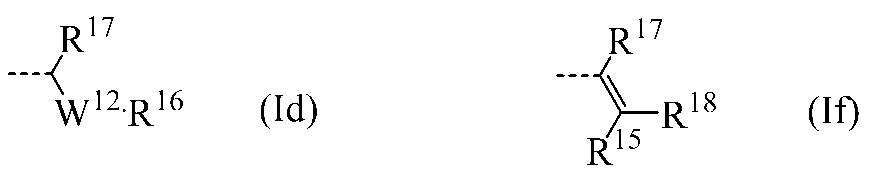
W12は、単結合、-CH2-、-CO-O-又は-CO-NH-を表し、
R17は、水素原子又は炭素数1~5のアルキル基を表し、
R18は水素原子、直鎖状若しくは分岐状の炭素数1~20のアルキル基(前記アルキル基中の1つ又は2以上の-CH2-基はそれぞれ独立して環員数3から8のシクロアルキル基で置換されていても良く、前記アルキル基中の水素原子は非置換であるか又はフッ素原子若しくは塩素原子で置換されていても良い。)を表し、
R15は、炭素数1~20のアルキル基(前記アルキル基中の水素原子はフッ素原子に置換されていても良い。)を表し、
R16は、炭素数1~20のアルキル基(前記アルキル基中の1つの-CH2-基又は2以上の非隣接-CH2-基は-CH=CH-、-CF=CF-及び-C≡C-から選ばれる1つ以上で置換されており、前記アルキル基中の1つ又は2以上の-CH2-基はそれぞれ独立して環員数3から8のシクロアルキル基で置換されていても良く、前記アルキル基中の水素原子はフッ素原子若しくは塩素原子で置換されていても良い。)を表すことも好ましい。
A12が上記好適な基であると、本発明のポリマーからなる液晶配向層に配向規制力を付与するために必要な光照射量を少なくする(光に対する感度を高める)ことができる。
本発明のポリマーの偏光紫外線に対する感度及び配向規制力が向上するため、一般式(I)において、mは、0または1が好ましく、0がより好ましい。
これらの化学式中、左の破線はMへの結合を表し、右の破線はA12への結合又はX11が結合する炭素原子への結合を表す。
必要に応じて選択可能であるが、これらの中でも、化学式(Sp-a-6)~(Sp-a-16)、化学式(Sp-b-3)~(Sp-b-10)、化学式(Sp-c-3)~(Sp-c-10)、化学式(Sp-d-3)~(Sp-d-12)、化学式(Sp-k-4)~(Sp-k-7)、化学式(Sp-l-13)~(Sp-l-17)、化学式(Sp-o-3)~(Sp-o-14)、化学式(Sp-p-2)~(Sp-p-13)、化学式(Sp-s-1)~(Sp-s-8)、化学式(Sp-t-1)~(Sp-t-8)、化学式(Sp-y-1)~(Sp-y-9)及び化学式(Sp-aa-1)~(Sp-aa-9)で表されるものがより好ましい。

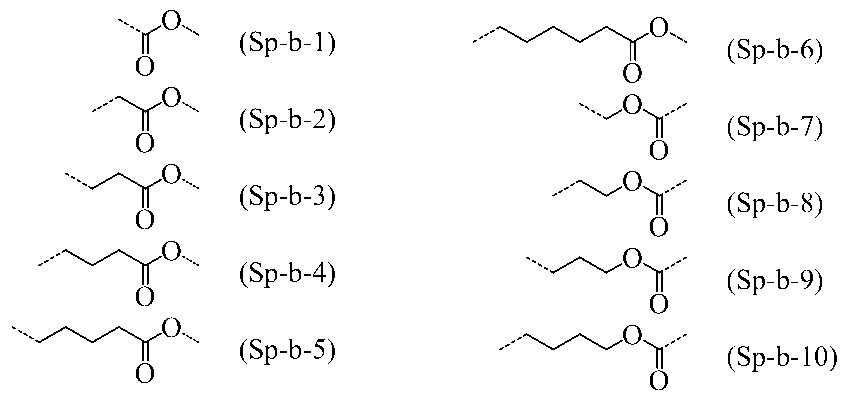
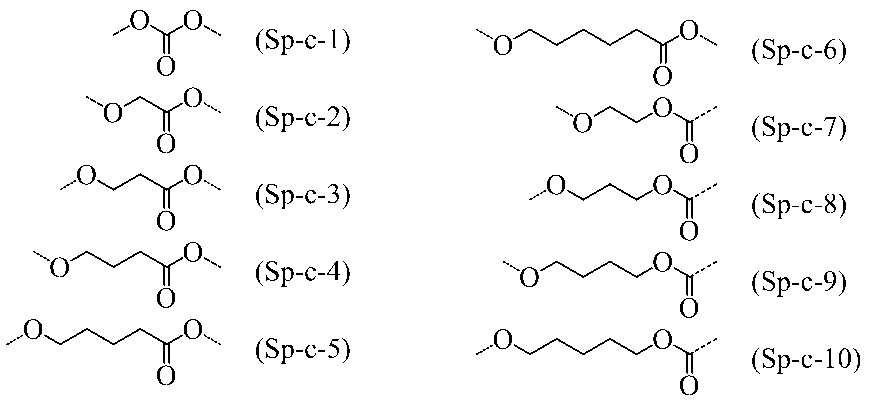

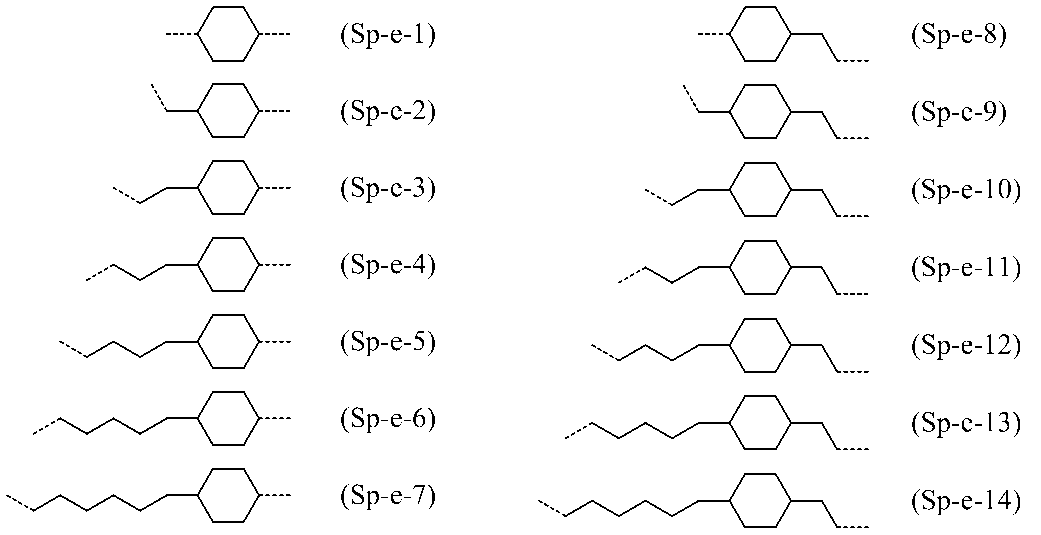

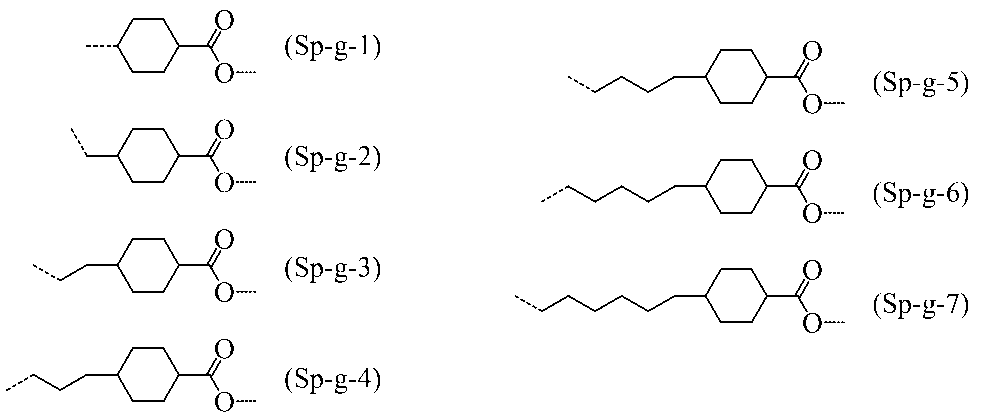
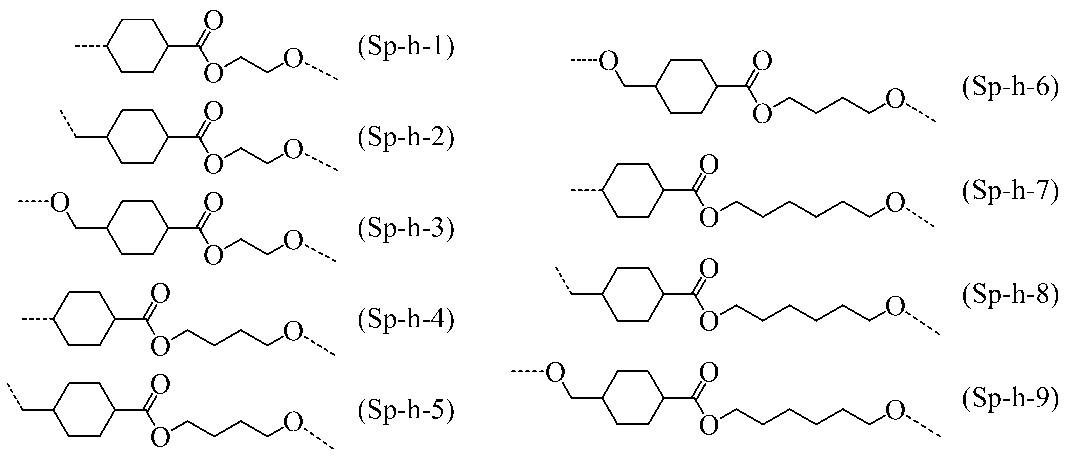


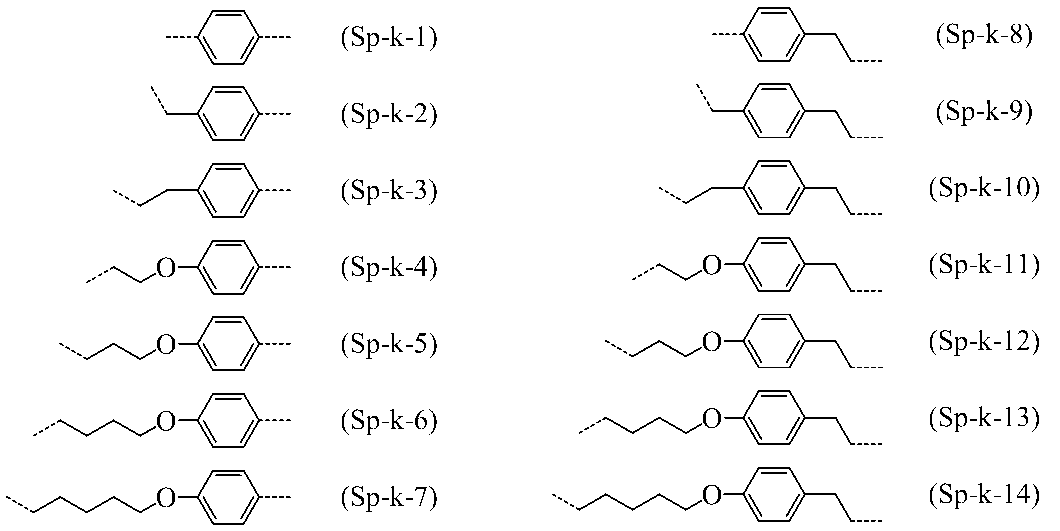


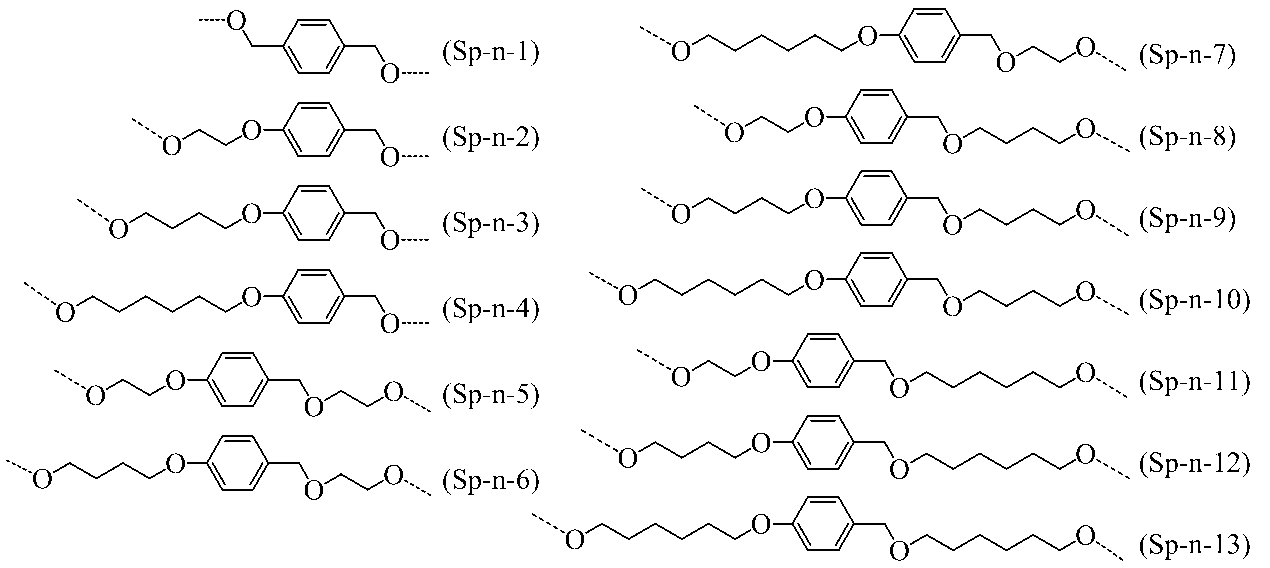
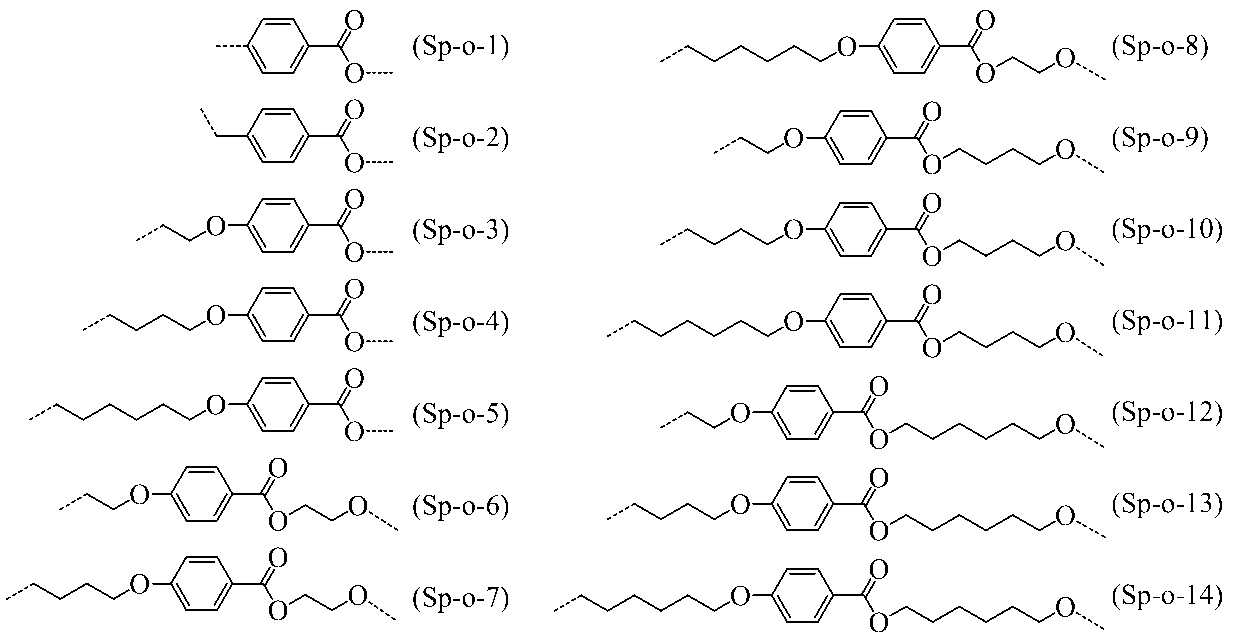
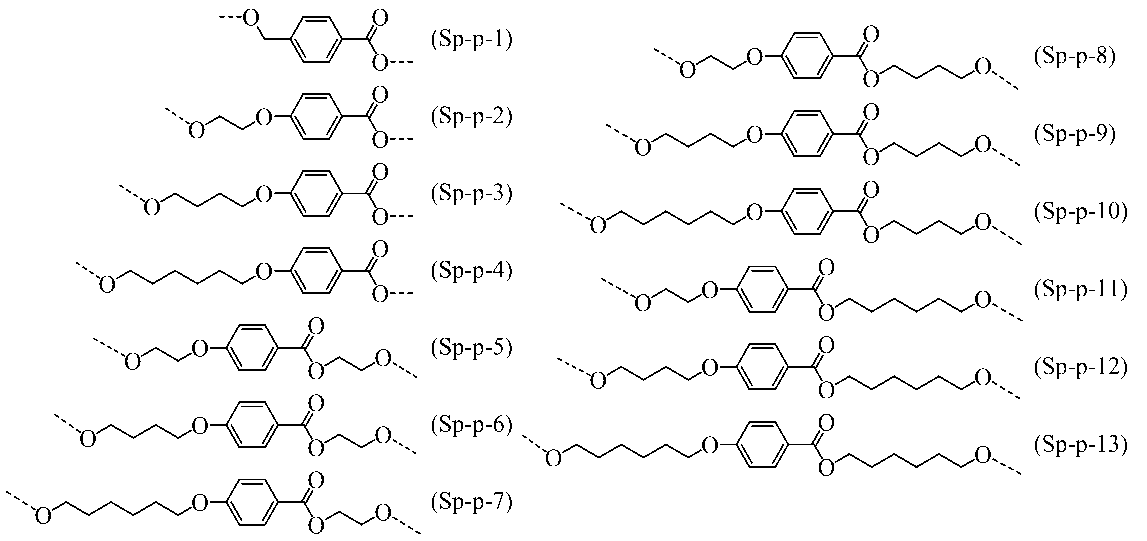

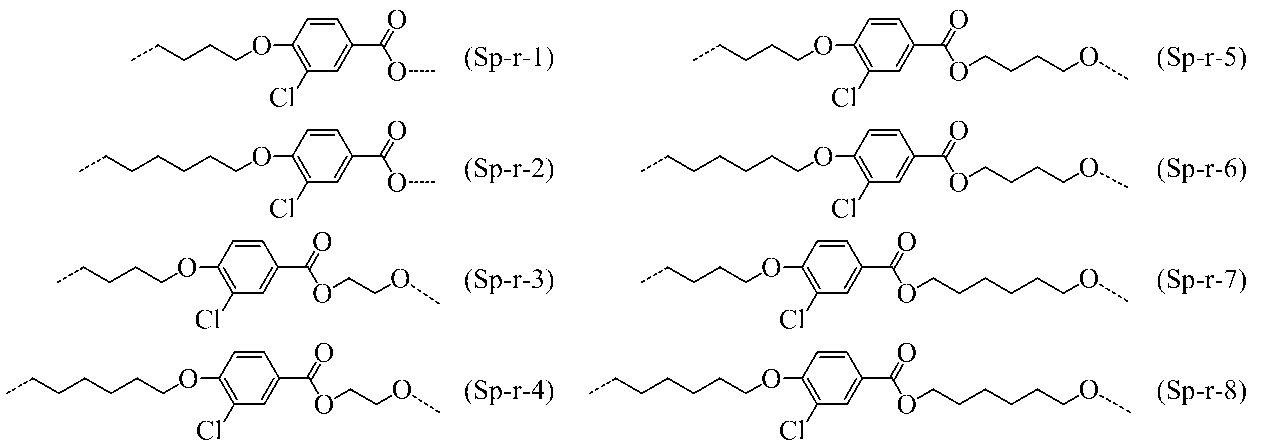


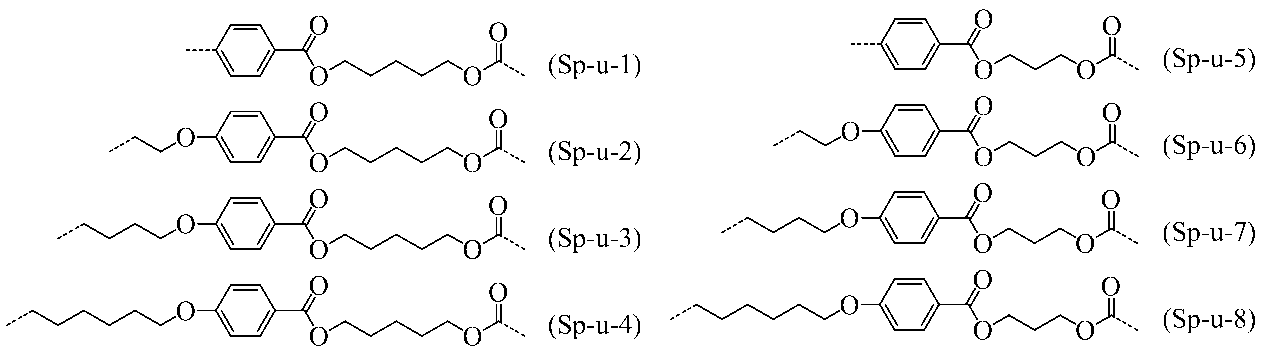
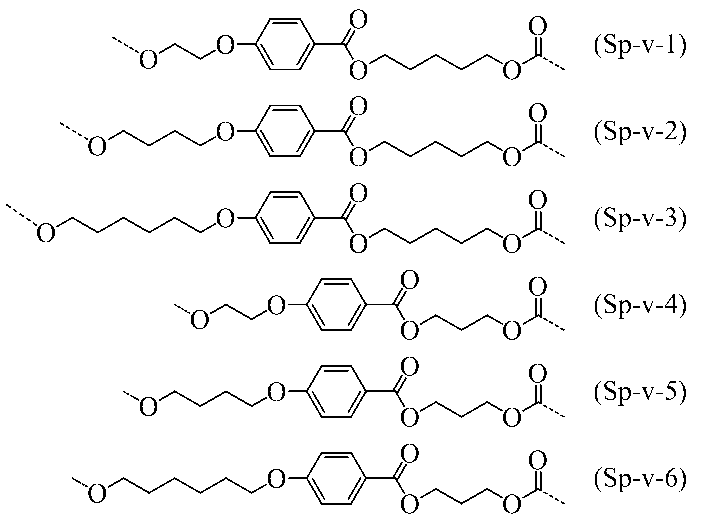

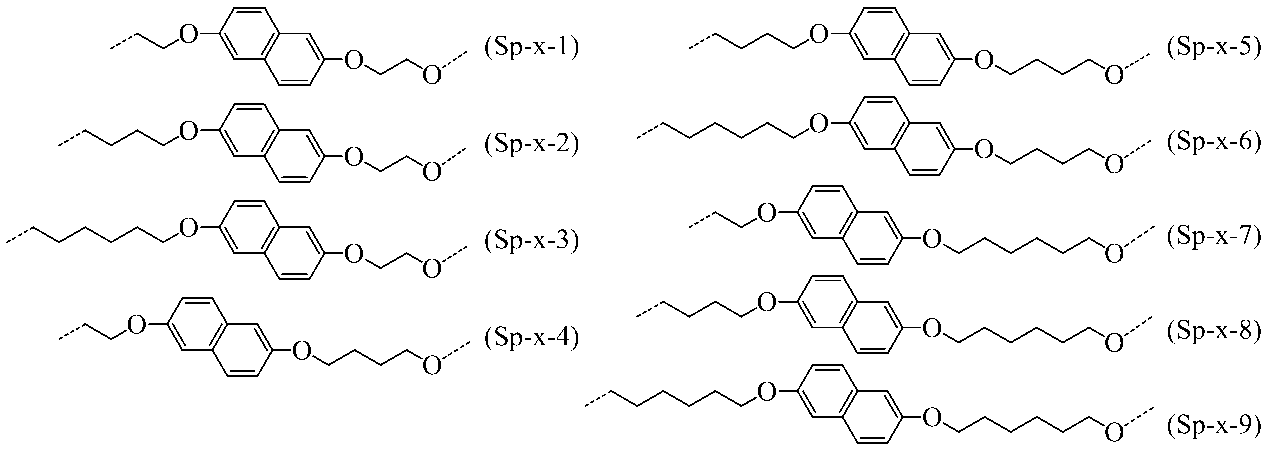


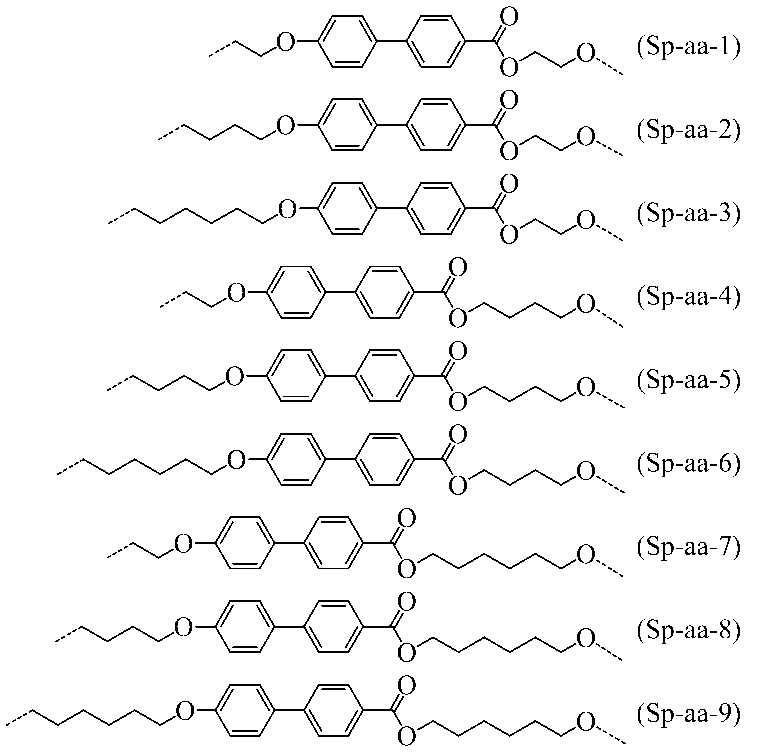
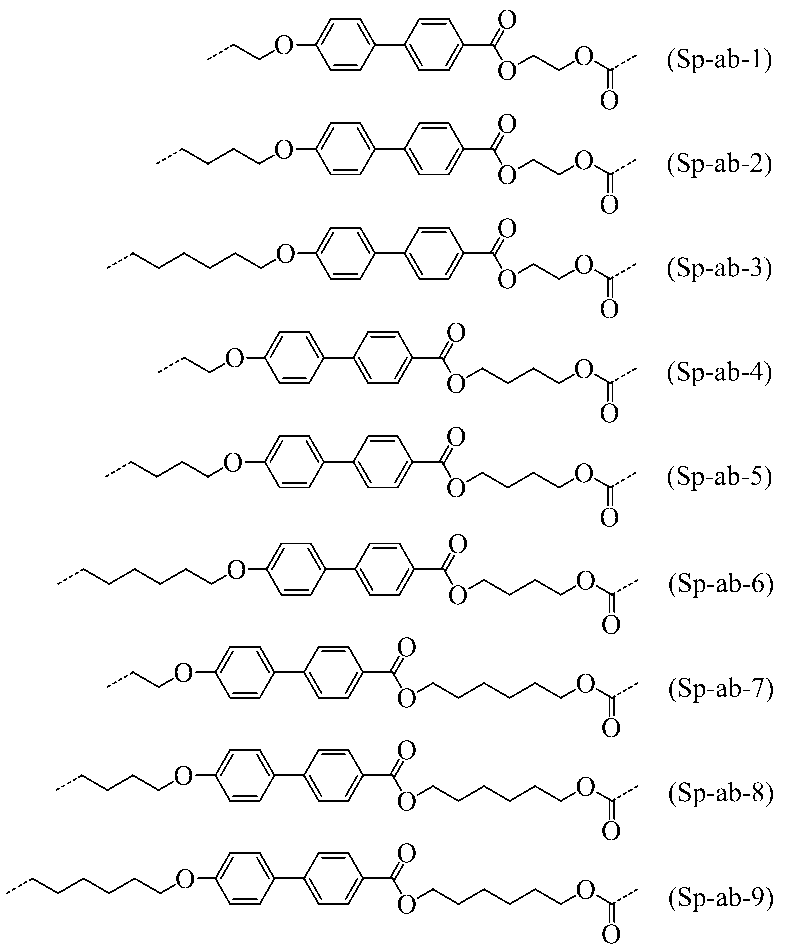

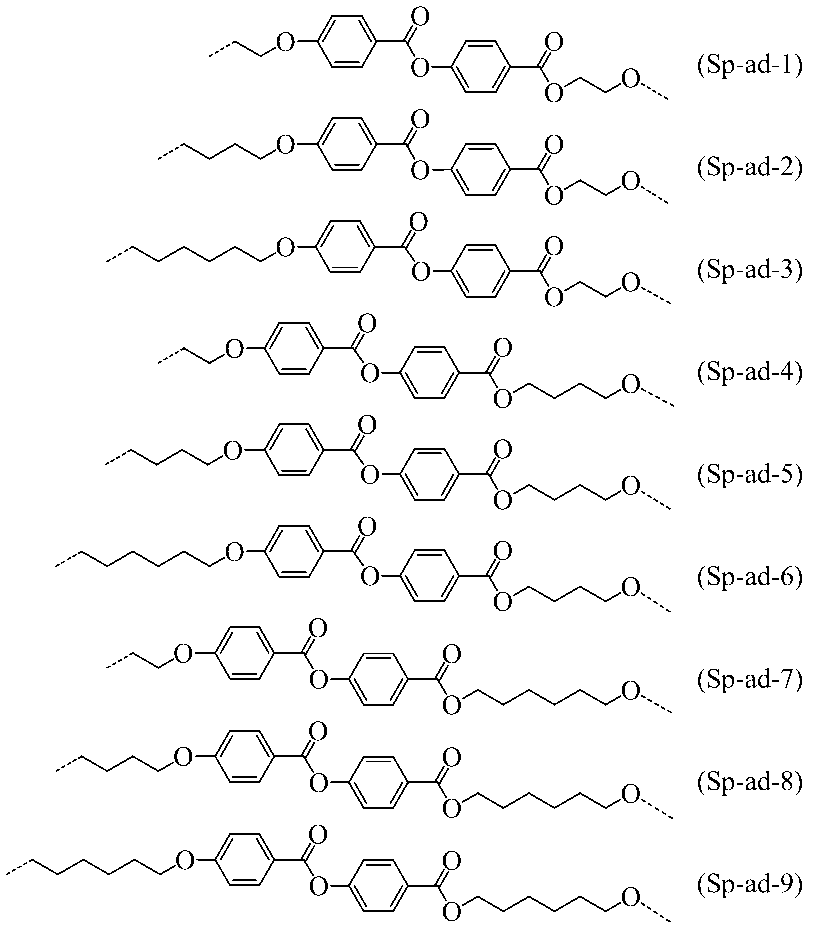
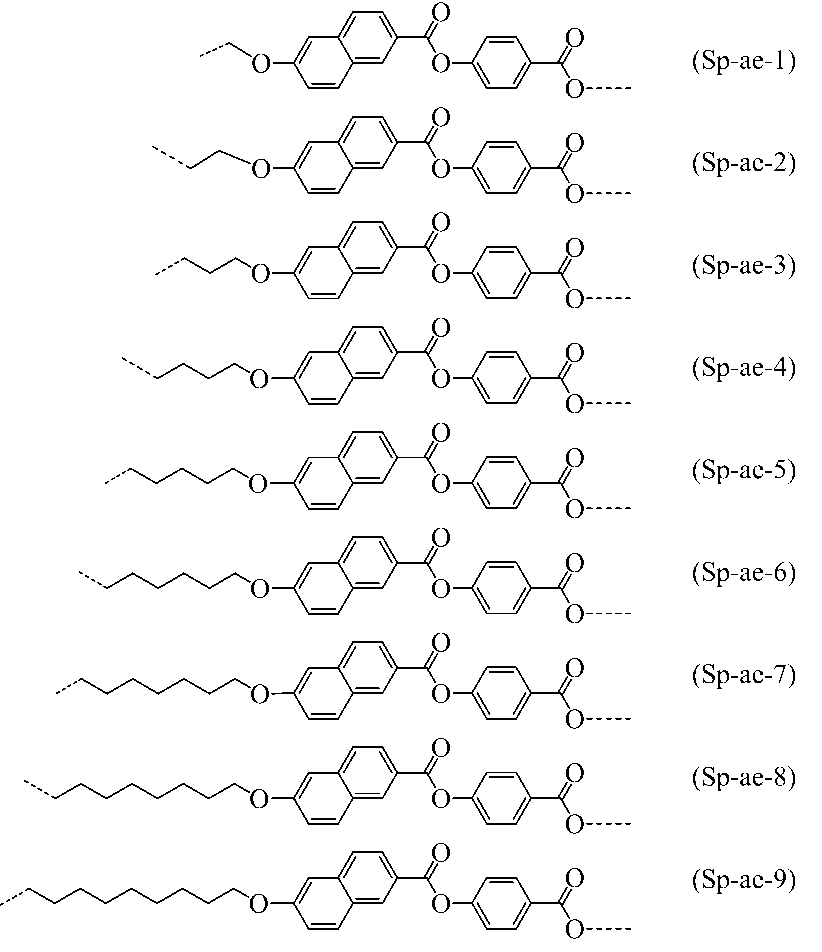
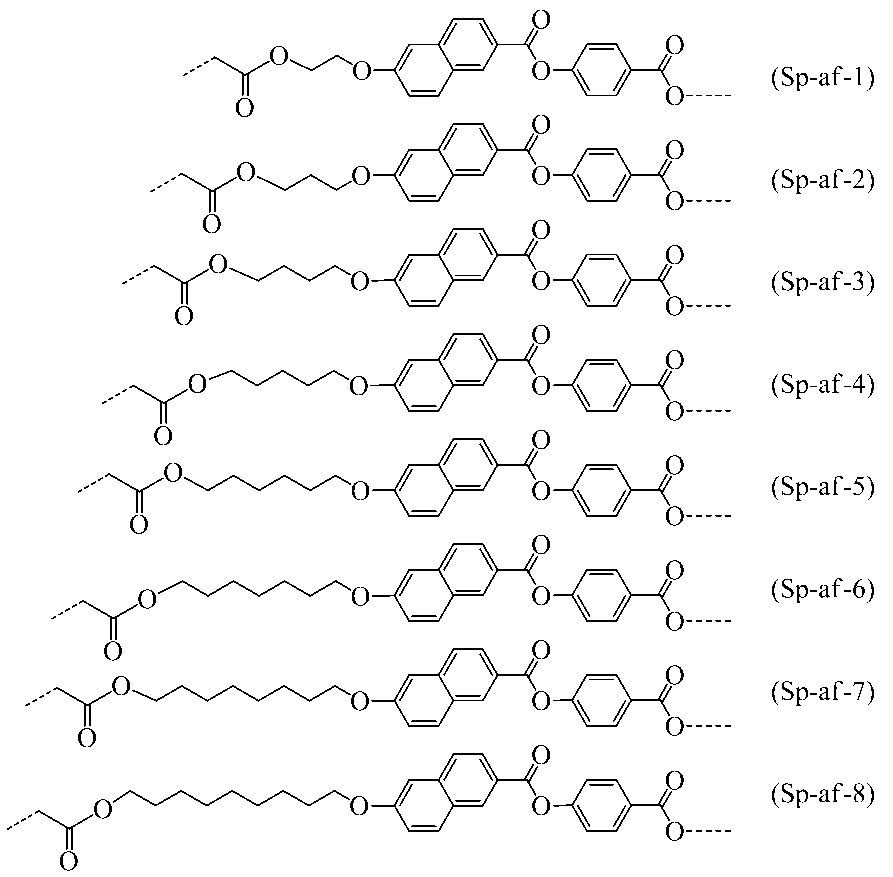
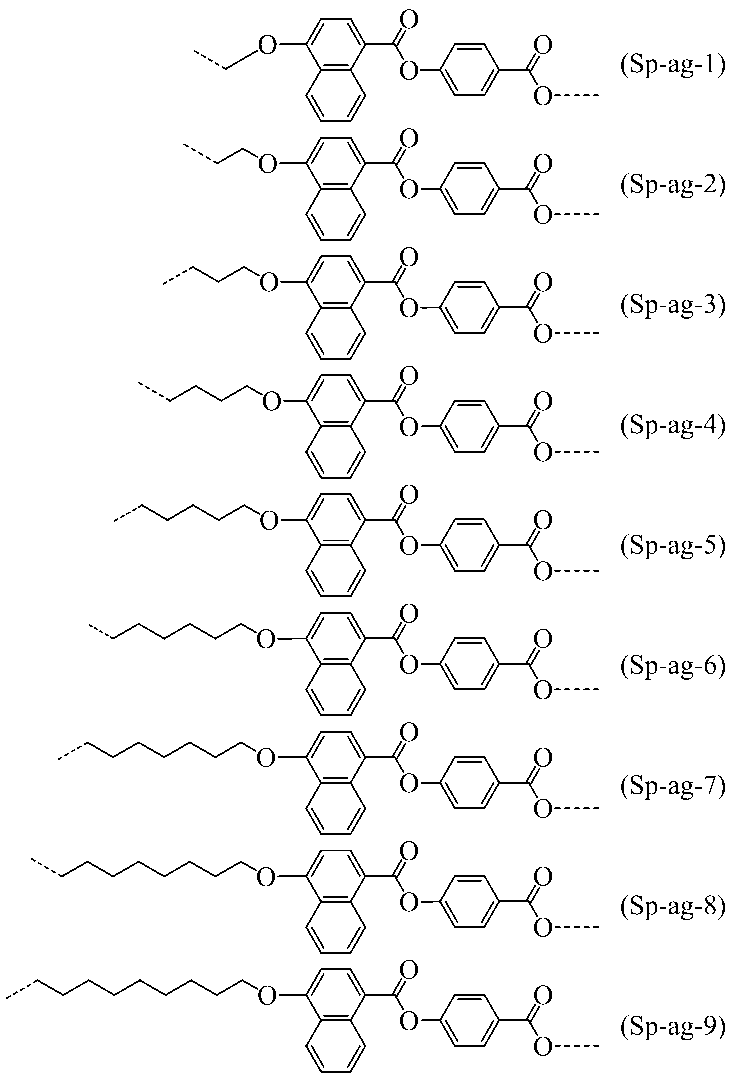
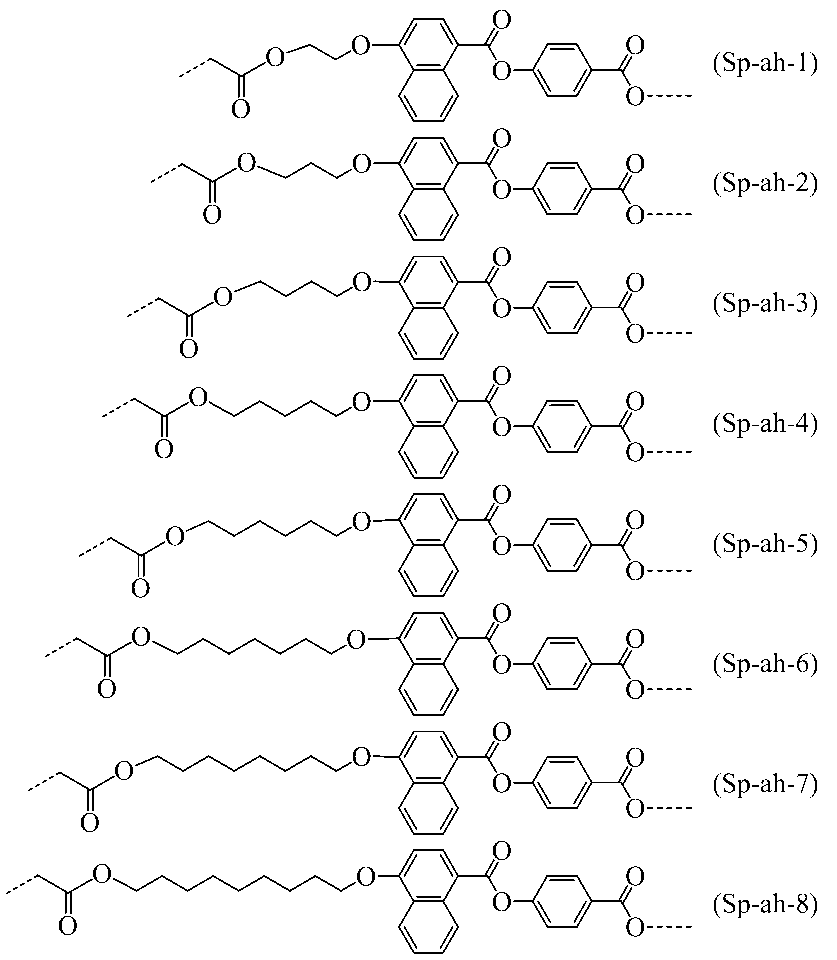
一般式(II)において、Z21は、直鎖のアルキレン基であることが好ましい。該アルキレン基の炭素数は、2~10が好ましく、3~8がより好ましい。
本発明のポリマーの溶解性が向上するため、前記アルキレン基において、非隣接の-CH2-基の1つ以上は独立して、-O-、-COO-又は-OCO-で置換されていることが好ましい。
これらの化学式中、左の破線はMへの結合を表し、右の破線はA22への結合する炭素原子への結合を表す。
必要に応じて選択可能であるが、これらの中でも、化学式(Sp-a-6)~(Sp-a-16)、化学式(Sp-b-3)~(Sp-b-10)、化学式(Sp-c-3)~(Sp-c-10)、化学式(Sp-d-3)~(Sp-d-12)、化学式(Sp-k-4)~(Sp-k-7)、化学式(Sp-l-13)~(Sp-l-17)、化学式(Sp-o-3)~(Sp-o-14)、化学式(Sp-p-2)~(Sp-p-13)、化学式(Sp-s-1)~(Sp-s-8)、化学式(Sp-t-1)~(Sp-t-8)、化学式(Sp-y-1)~(Sp-y-9)及び化学式(Sp-aa-1)~(Sp-aa-9)で表されるものがより好ましい。
本発明のポリマーの溶解性が向上するため、A22の上記基に結合する1つ以上の水素原子がフッ素原子、メチル基又はメトキシ基で置換されることは好ましい。
本発明の液晶配向層の配向規制力を向上させる観点から、X22及びX24のうち少なくとも一方がフッ素原子、塩素原子、ヒドロキシ基、ニトロ基、シアノ基又は一般式(IIa)で表される基であることが好ましい。
一般式(IIa)において、qは0であることが好ましい。
前記アルキレン基において非隣接の-CH2-基の1つ以上は独立して、-O-、―COO-、-OCO-、-CH=CH-、-CF=CF-、-CF2O-、-OCF2-、-CF2CF2-、-C≡C-又は-CO-で置換されていることが好ましい。
本発明のポリマーには、下記一般式(QX)で表される側鎖ユニットMcの1種以上が含まれることが好ましい。側鎖ユニットMcが含まれることにより、本発明の液晶配向層のプレチルト角を容易に高く制御することができる。
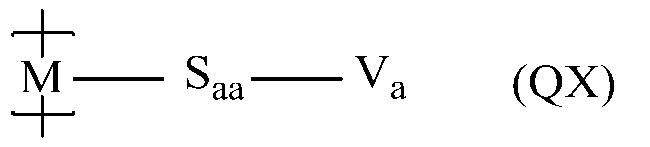
Saaは単結合又は炭素数1~20のアルキレン基を表し、Vaは1価の有機基を表し、
前記アルキレン基の-CH2-基の1つ又は非隣接の2つ以上は独立して、-O-、-CO-、-CO-O-、-O-CO-、-Si(CH3)2-O-Si(CH3)2-、-NR-、-NR-CO-、-CO-NR-、-NR-CO-O-、-O-CO-NR-、-NR-CO-NR-(式中、Rは独立して水素又は炭素数1~5のアルキル基を表す。)、-CH=CH-、-C≡C-、及び-O-CO-O-から選ばれる一つ以上の置換基で置換されていても良く、
前記一般式(QX)で表される基に結合する一個以上の水素原子が、フッ素原子、塩素原子、シアノ基、ヒドロキシル基、カルボキシル基、アミド基、フッ素、スルフィド基、ニトロ基に置換されていても良い。)

Z4、Z5、Z6及びZ7は、それぞれ独立して単結合、-(CH2)u-(式中、uは1~20を表す。)、-OCH2-、-CH2O-、―COO-、-OCO-、-CH=CH-、-CF=CF-、-CF2O-、-OCF2-、-CF2CF2-又は-C≡C-を表すが、これらの置換基において非隣接の-CH2-基の一つ以上は独立して、-O-、-CO-、-CO-O-、-O-CO-、-Si(CH3)2-O-Si(CH3)2―、-NR-、-NR-CO-、-CO-NR-、-NR-CO-O-、-O-CO-NR-、-NR-CO-NR-、-CH=CH-、-C≡C-又は-O-CO-O-(式中、Rは独立して水素原子又は炭素数1~5のアルキル基を表す。)で置換することができ、
A3、A4、A5及びA6は、それぞれ独立して
(a) トランス-1,4-シクロへキシレン基(この基中に存在する1個のメチレン基又は隣接していない2個以上のメチレン基は-O-、-NH-又は-S-に置き換えられてもよい。)、
(b) 1,4-フェニレン基(この基中に存在する1個又は2個以上の-CH=は-N=に置き換えられてもよい。)、及び
(c) 1,4-シクロヘキセニレン基、2,5-チオフェニレン基、2,5-フラニレン基、1,4-ビシクロ[2.2.2]オクチレン基、ナフタレン-1,4-ジイル基、ナフタレン-2,6-ジイル基、デカヒドロナフタレン-2,6-ジイル基及び1,2,3,4-テトラヒドロナフタレン-2,6-ジイル基
からなる群より選ばれる基を表し、上記の基(a)、基(b)又は基(c)はそれぞれ無置換であるか又は一個以上の水素原子がフッ素原子、塩素原子、シアノ基、メチル基又はメトキシ基によって置換されていても良く、
r1、s1、t1及びu1は、それぞれ独立して0又は1を表し、
R12は水素原子、フッ素原子、塩素原子、シアノ基又は炭素数1~20のアルキル基、或いは下記式(CHOL-a)~(CHOL-d)
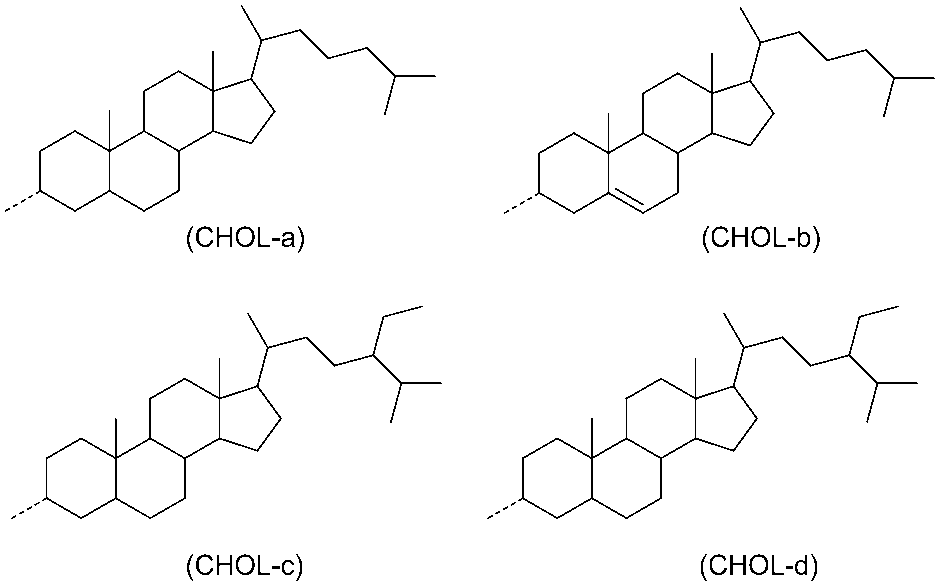
を表し、前記アルキル基中の水素原子はフッ素原子に置換されていてもよく、1つの-CH2-基若しくは2以上の非隣接-CH2-基は-O-、-CO-O-、-O-CO-及び-CH=CH-から選ばれる何れか1つ以上で置換されていても良い。)
A3、A4、A5及びA6はそれぞれ独立してトランス-1,4-シクロヘキシレン基、2,6-ナフチレン基、ピリジン-2,5-ジイル基、ピリミジン-2,5-ジイル基又は1,4-フェニレン基であることが好ましく、さらにこれらは無置換であるか又は一個以上の水素原子がフッ素原子、塩素原子、メチル基又はメトキシ基によって置換されていることが好ましい。
r1、s1、t1及びu1はr1+s1+t1+u1が0~3の整数であることが好ましく、R12は水素原子、フッ素原子、塩素原子、シアノ基又は炭素数1~18のアルキル基(前記アルキル基中の1つの-CH2-基又は2以上の非隣接-CH2-基は-O-、-CO-O-、-O-CO-及び/又は-CH=CH-で置換されていても良い。)であることが好ましい。
これらの中でも式(VII-a-1)~(VII-a-15)、式(VII-b-11)~(VII-b-15)、式(VII-c-1)~(VII-c-11)、式(VII-d-10)~(VII-d-15)、式(VII-f-1)~(VII-f-10)、式(VII-g-1)~(VII-g-10)、式(VII-h-1)~(VII-h-10)、式(VII-j-1)~(VII-j-9)、式(VII-l-1)~(VII-l-11)又は式(VII-m-1)~(VII-m-11)がさらに好ましい。
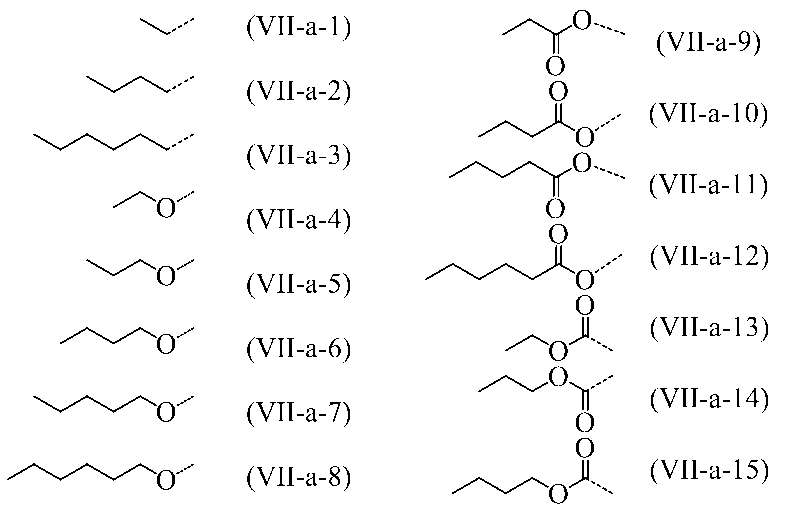
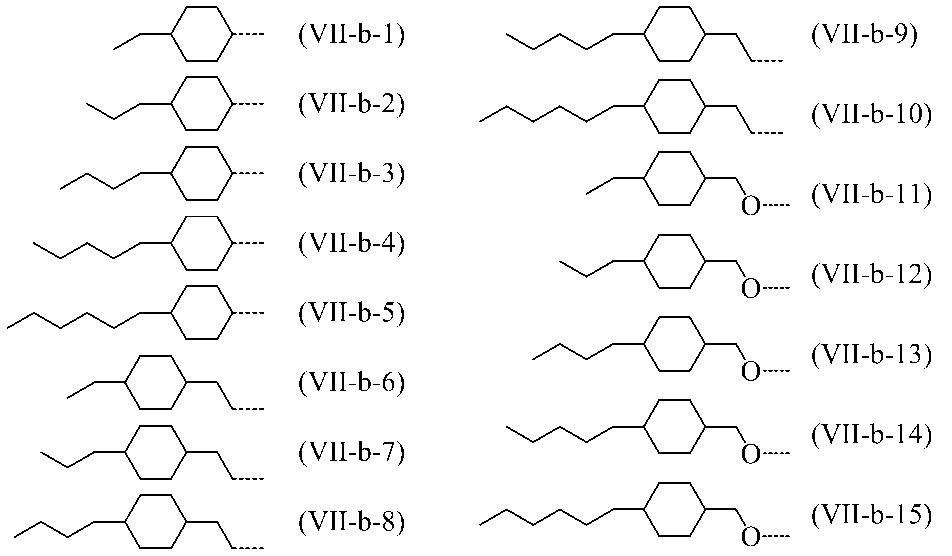
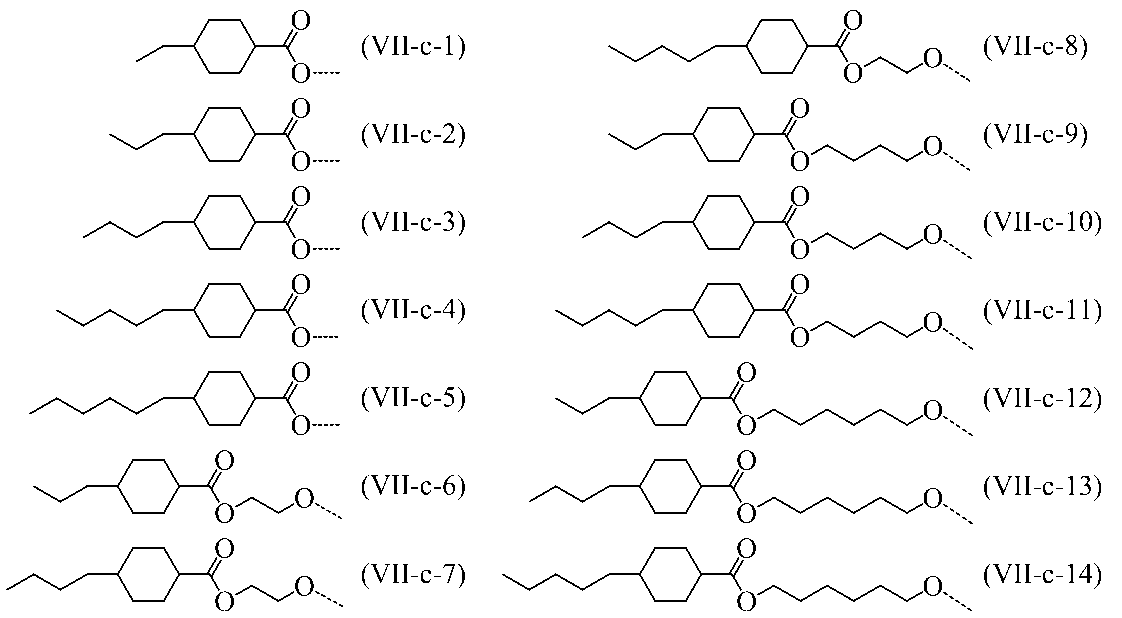

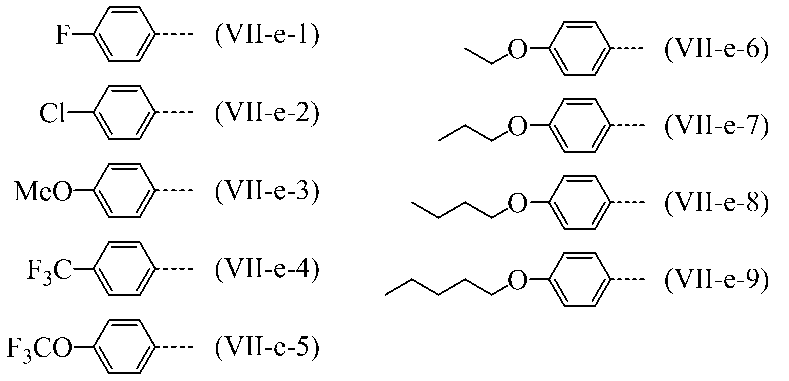


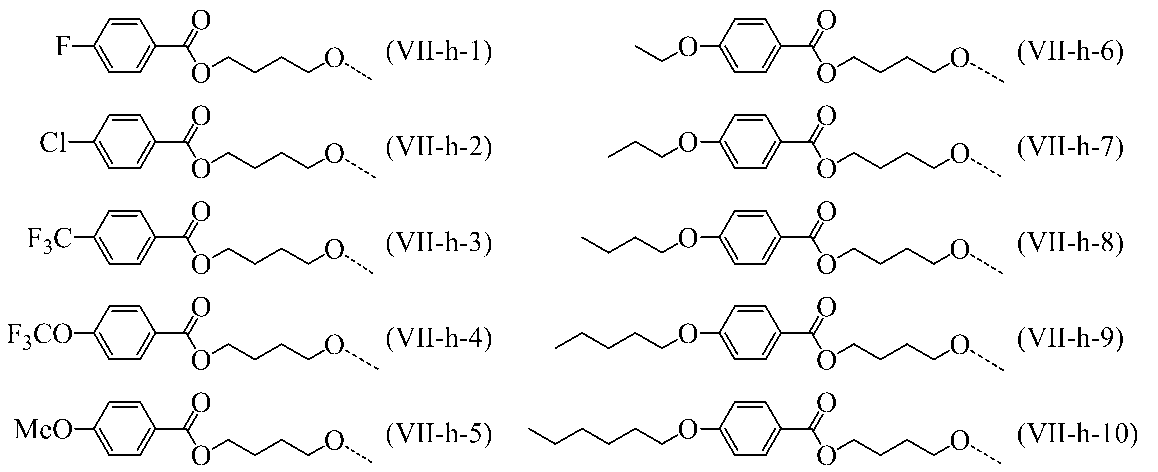


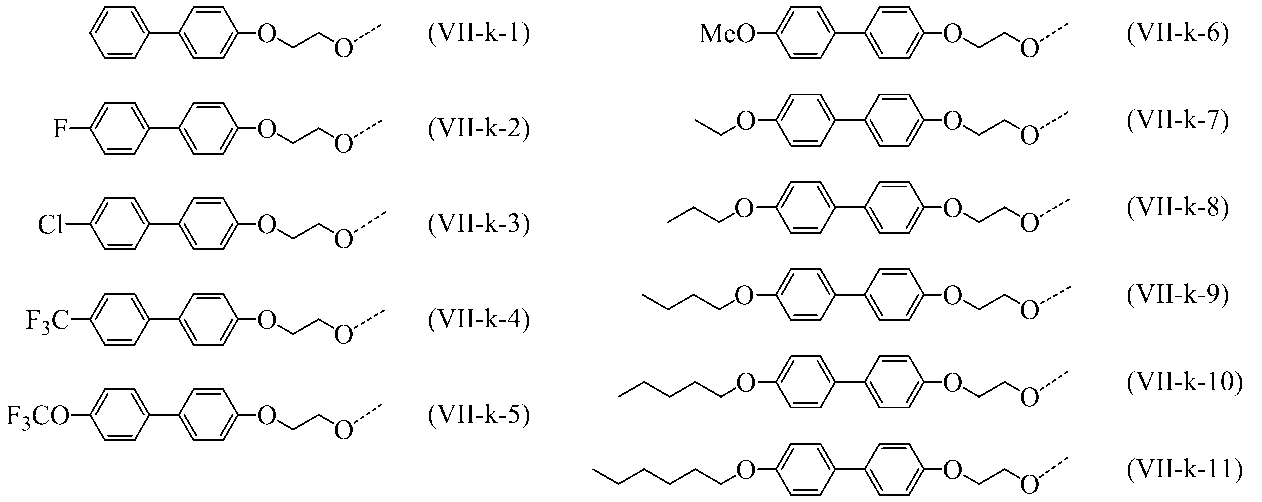


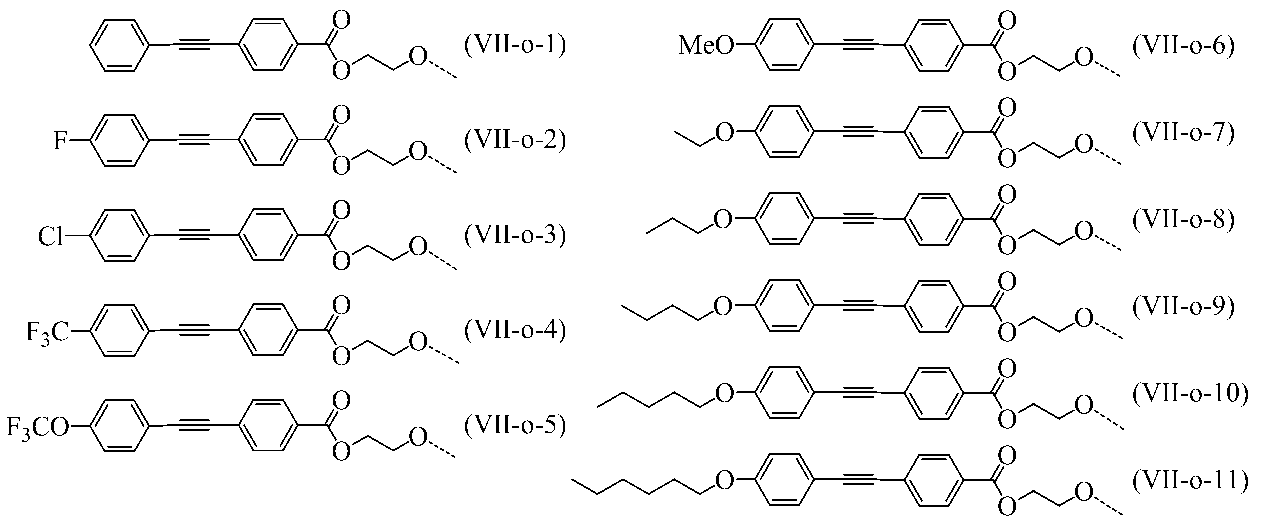
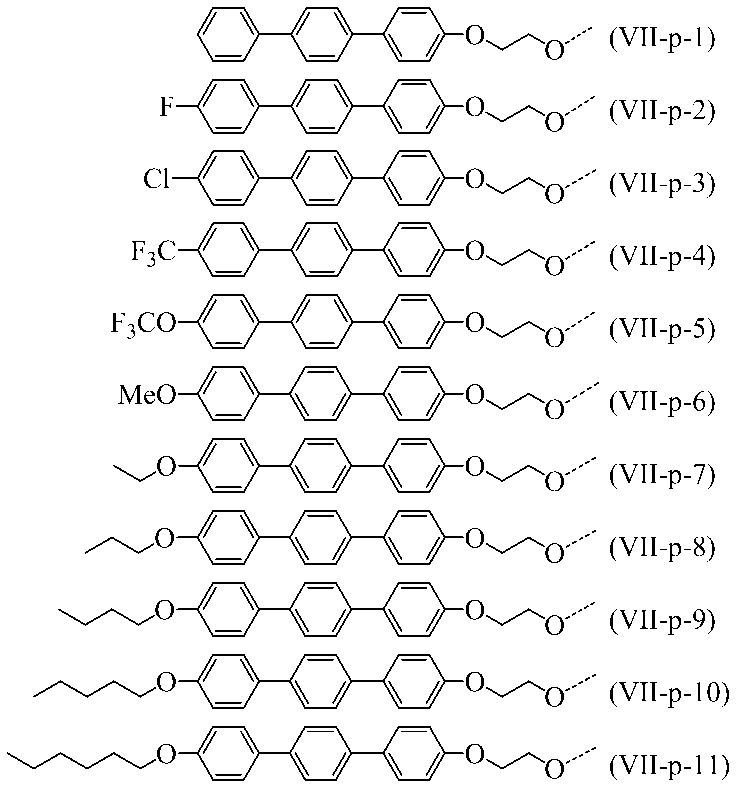
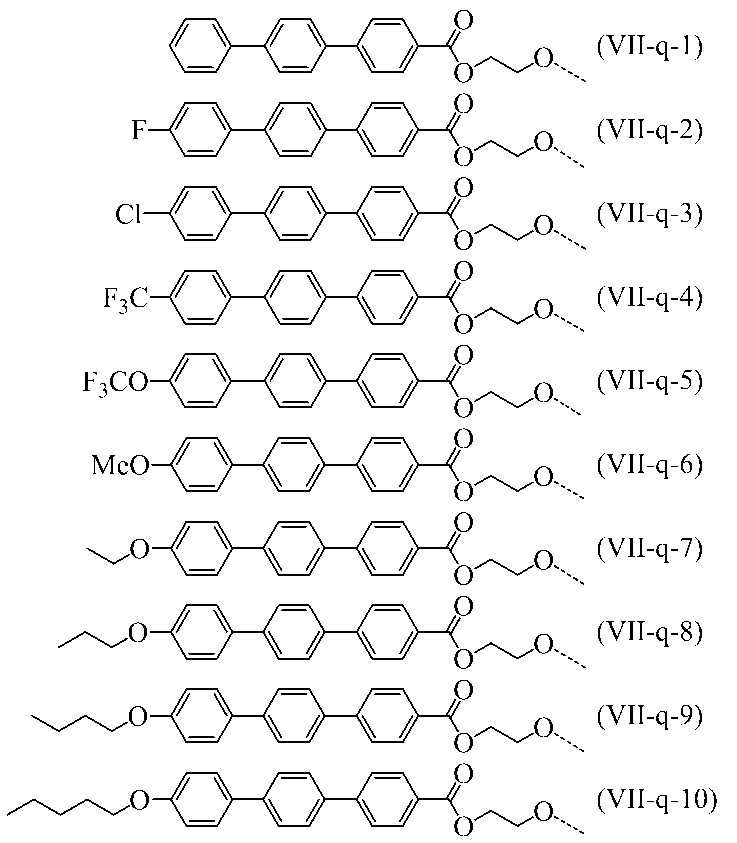
本発明のポリマーの主鎖は、一般式(U-11)及び(U-12)のうち少なくとも一方で表される繰り返し単位を有する。該ポリマー主鎖はポリイミド又はポリアミック酸であることが好ましい。これらがポリマー主鎖を構成していると、ポリアクリル酸等を主鎖とする従来のポリマーを用いた液晶配向層よりも、本発明のポリマーを用いた液晶配向層の方が耐久性に優れる。
一方、本発明のポリマーが液晶配向層を形成した固体状態においては、耐久性を向上させる観点から、ポリマー主鎖はポリイミドであることが好ましい。
プレチルト角を高く制御する場合には、「側鎖ユニットMa+側鎖ユニットMb」/「側鎖ユニットMc」のモル分率の比は、70/30~95/5が好ましく、75/25~90/10がより好ましく、80/20~85/15がさらに好ましい。
本発明のポリマーの合成方法として、公知のポリアミック酸及びポリイミドを合成する方法が適用できる。例えば、テトラカルボン酸二無水物と、ジアミンとを等モルで重合させることによりポリアミック酸を主鎖とするポリマーを得て、これを加熱又は触媒により脱水及び環化させることによりポリイミドを主鎖とするポリマーが得られる。
上記ポリアミック酸の合成において、ジアミンとして、前述した側鎖ユニットMa及び側鎖ユニットMbをそれぞれ有する2種のジアミン(ジアミン1、ジアミン2)を使用することにより、本発明のポリマーとしてのポリアミック酸が得られる。さらに、これを脱水及び環化させることにより、本発明のポリマーとしてのポリイミドが得られる。
前記ジアミン2としては、一般式(II)におけるMが1価又は2価のジアミンに置換された化合物が好ましい。
前記ジアミン3としては、一般式(QX)におけるMが1価又は2価のジアミンに置換された化合物が好ましい。
上記芳香環はベンゼンであることが好ましく、上記シクロアルカンは4~6員環であることが好ましい。
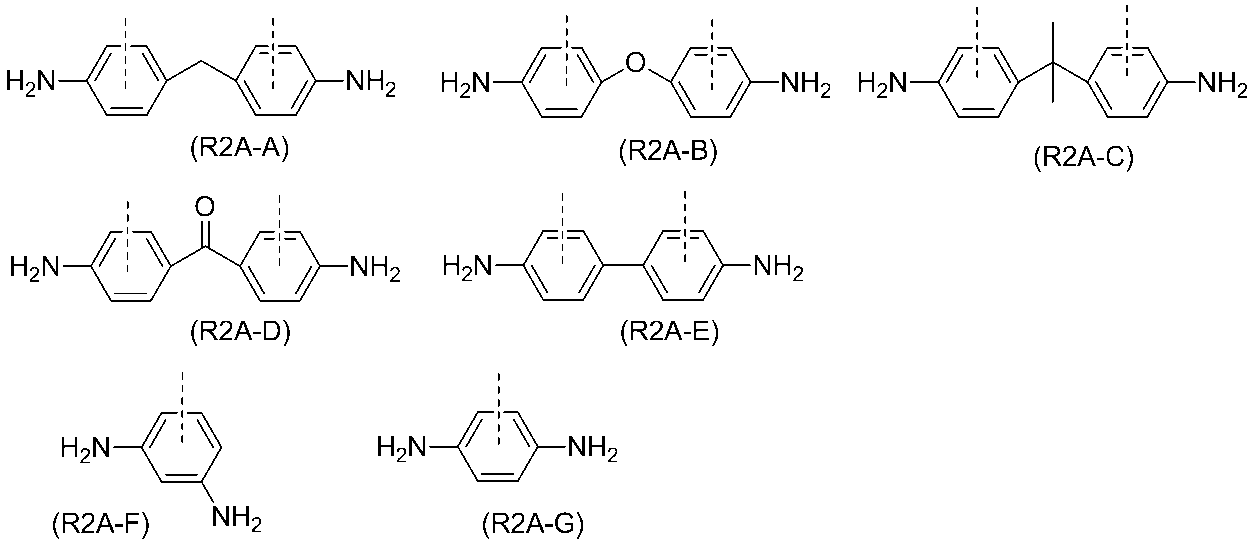

本発明のポリマーからなる膜に偏光紫外線を照射することにより、配向規制力を有する液晶配向層が得られる。
前記ポリマーからなる液晶配向層(光配向膜)を得る方法としては、例えば、前記ポリマーの溶液を基板に塗布して乾燥することにより得ることができる。
これらの基板には、Cr、Al、In2O3-SnO2からなるITO膜、またはSnO2からなるNESA膜などの電極層が設けられていても良い。これらの電極層のパターニングには、フォト・エッチング法や電極層を形成する際にマスクを用いる方法等が用いられる。さらに、前記基板には、カラーフィルタ層などが形成されていてもよい。
塗布する際の溶液の固形分濃度は、0.5~10重量%が好ましい。基板上に溶液を塗布する方法、粘性、揮発性等を考慮してこの範囲より選択することがさらに好ましい。
ポリマー溶液を基板上に塗布した後、前記塗布面を加熱して、溶媒を除去することが好ましい。加熱温度としては、例えば、50~300℃が好ましく、80~200℃がより好ましい。この好適な温度範囲における加熱時間としては、例えば、2~200分が好ましく、2~100分がより好ましい。
光源としては、例えば、キセノンランプ、高圧水銀ランプ、超高圧水銀ランプ、及びメタルハライドランプなどが挙げられる。これらの光源からの光に対して、偏光フィルターや偏光プリズムを用いることで直線偏光が得られる。又、このような光源から得た紫外光及び可視光は、干渉フィルターや色フィルターなどを用いて、照射する波長範囲を制限してもよい。
形成される液晶配向層の膜厚は、10~250nm程度が好ましく、10~100nm程度がより好ましい。
本発明の液晶配向層を用いて、例えば、以下のようにして、一対の基板間に液晶組成物を挟持する液晶セル及びこれを用いた液晶表示素子を製造することができる。
本発明における上記液晶配向層が形成された基板を2枚準備し、この2枚の基板間に液晶を配置することで液晶セルを製造することができる。又、2枚の基板のうち1枚のみに上記液晶配向層が形成されていてもよい。
液晶セルの製造方法としては、例えば、以下の方法が挙げられる。まず、それぞれの液晶配向層が対向するように2枚の基板を配置し、2枚の基板の間に一定の間隙(セルギャップ)を保った状態で周辺部を、シール剤を用いて貼り合わせ、基板表面およびシール剤により区画されたセルギャップ内に液晶組成物を注入充填した後、注入孔を封止することにより、液晶セルを製造することができる。
ここで用いた液晶が等方相をとる温度まで加熱した後、室温まで徐冷することにより、注入時に生じた流動配向を除去することが望ましい。
前記液晶セルの外側表面に公知の偏光板を貼り合わせることにより、液晶表示素子を得ることができる。
本発明の光学異方体は、本発明の液晶配向層と、該液晶配向層の上に形成された重合性液晶組成物の重合体からなる膜と、を有する。この光学異方体は、液晶表示素子の光学補償等に使用する光学異方性フィルム等の用途に有用である。光学異方体においては、その中を光が進むとき、進む方向によって光の伝搬速度、屈折率、吸収等の光学的性質が相違する。
本発明の光学異方体を製造する方法としては、例えば、基板上に液晶配向層を形成し、その上に重合性液晶組成物の塗布し、前記液晶配向層によって配向された液晶分子を含む重合体の膜を形成する方法が挙げられる。
重合性液晶組成物の重合方法として、光重合と熱重合の何れか一方又は両方を採用することができる。
上記で例示した製造工程においては、本発明のポリマーの塗膜に直接に光を照射するので、液晶分子の配向規制力が優れた液晶配向層を得ることができる。
光学異方体の層を複数有する光学異方体の積層体の用途としては、例えば、液晶表示素子の液晶層と偏光板の光学補償を同時に行う用途や、液晶表示素子の液晶層の光学補償と輝度向上を同時に行う用途や、液晶表示素子の偏光板の光学補償と輝度向上を同時に行う用途、等が挙げられる。
下記式 (DA-C1)で表される化合物(MW=578.66)を以下の手順で合成した。

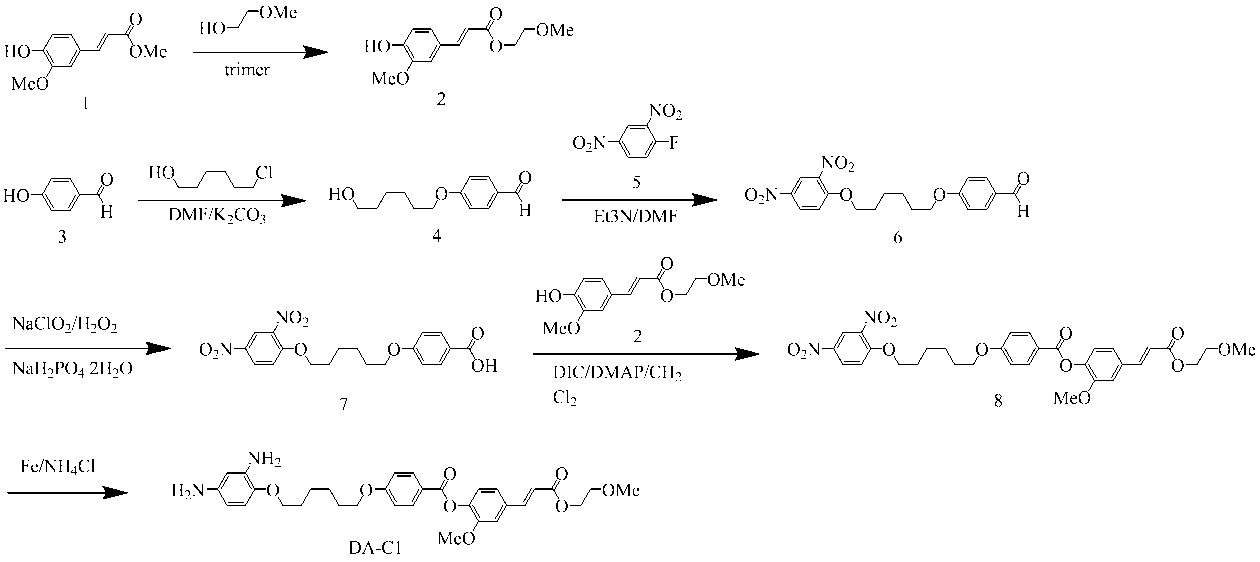
66.4gの化合物3、112.6gの炭酸カリウム、300mLのDMFを混合し、窒素雰囲気下、90℃で攪拌した。この反応溶液に、74gの6-クロロ-1-ヘキサノールを滴下し、13時間90℃で攪拌した。ここへ、200mLの酢酸エチル、100mLの飽和食塩水を加え、分液した。得られた有機層を濃縮した後、シリカゲルクロマトグラフィー(溶離液:ヘキサン・酢酸エチル混合溶媒)で精製し、91.6gの化合物4を得た。
37.2gの化合物5、44.4gの化合物4、40.4gのトリエチルアミン、300mLのDMFを混合し、窒素雰囲気下、15時間80℃で攪拌した。200mLの酢酸エチル、200mLの飽和食塩水を加え、有機層を抽出した。その有機層を200mLの飽和食塩水で2回洗浄し、濃縮することで、95gの化合物6を得た。
90gの化合物6、5.1gのりん酸二水素ナトリウム・2水和物を40gの水に溶解した溶液、24gのH2O2(30%)、1500mLのアセトニトリルを氷冷下で混合した。この反応液へ、26.5gの亜塩素酸ナトリウムを215gの水に溶解した溶液を滴下し、24時間室温で攪拌した。ここへ、150mLの10%HClを加えクエンチした後、ろ過をした。1500mLの水で洗浄することで、75gの化合物7を得た。
50.1gの化合物7、31gの化合物2、2.2gの4-ジメチルアミノピリジン、1000mLの塩化メチレンを混合し、窒素雰囲気下、0℃で攪拌した。ここへ、17.8gのN,N-ジイソプルピルカルボジイミドを30mLの塩化メチレンで溶解した溶液を滴下し、24時間室温で攪拌した。得られた溶液を濃縮後、シリカゲルクロマトグラフィー(溶離液:ヘキサン・塩化メチレン混合溶媒)、再結晶(メタノール)で精製することで、59gの化合物8を得た。
54gの化合物8、18.5gの20%塩化アンモニウム水溶液、1000mLのTHF、100mLのメタノールを混合し、0℃で攪拌した。ここへ、108gの粉末亜鉛を加え、0℃で2時間、40℃で2時間攪拌した。200mLの水を加えた後、反応液を濃縮し、200mLの塩化メチレンを加え、有機層を抽出した。更に得られた有機層を200mLの飽和食塩水で洗浄し、濃縮し、シリカゲルクロマトグラフィー(溶離液:ヘキサン・酢酸エチル混合溶媒)、再結晶(ヘキサン)で精製することで、28.4gの化合物DA-C1を得た。
下記式 (DA-C2)で表される化合物(MW=573.65)を以下の手順で合成した。


25gの化合物7、15gの化合物9、1gの4-ジメチルアミノピリジン、500mLの塩化メチレンを混合し、窒素雰囲気下、0℃で攪拌した。ここへ、9gのN,N-ジイソプルピルカルボジイミドを15mLの塩化メチレンで溶解した溶液を滴下し、24時間室温で攪拌した。得られた溶液を濃縮後、シリカゲルクロマトグラフィー(溶離液:ヘキサン・塩化メチレン混合溶媒)、再結晶(メタノール)で精製することで、30gの化合物10を得た。
27gの化合物8、9gの20%塩化アンモニウム水溶液、500mLのTHF、50mLのメタノールを混合し、0℃で攪拌した。ここへ、54gの粉末亜鉛を加え、0℃で2時間、40℃で2時間攪拌した。100mLの水を加えた後、反応液を濃縮し、100mLの塩化メチレンを加え、有機層を抽出した。更に得られた有機層を100mLの飽和食塩水で洗浄し、濃縮し、シリカゲルクロマトグラフィー(溶離液:ヘキサン・酢酸エチル混合溶媒)、再結晶(ヘキサン)で精製することで、14gの化合物DA-C2を得た。
下記式 (DA-A1)で表される化合物(MW=516.73)を以下の手順で合成した。
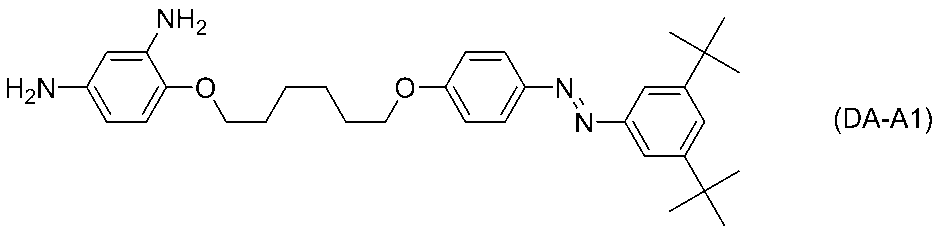

3gの化合物12、1.5gの6-クロロ-1-ヘキサノール、1.7gの炭酸カリウム、30mLのDMFを加え、90℃で16時間攪拌した。100mLの水、100mLの塩化メチレンを加え、有機層を抽出した。得られた溶液を濃縮し、シリカゲルクロマトグラフィー(溶離液:ヘキサン・塩化メチレン混合溶媒)で精製することで、4.5gの化合物13を得た。
7.5gの化合物5、8.9gの化合物13、2.8gのトリエチルアミン、60mLのDMFを混合し、80℃で32時間攪拌した。200mLの酢酸エチル、200mLの水を加え、有機層を抽出した。得られた有機層を100mLの飽和食塩水で、洗浄、濃縮し、シリカゲルクロマトグラフィー(溶離液:ヘキサン・酢酸エチル混合溶媒)で精製することで、7.9gの化合物14を得た。
7.9gの化合物14、3.1gの塩化アンモニウム、10mLのメタノール、100mLのTHF、40mLの水を混合し、0℃で攪拌した。ここへ、17.6gの粉末亜鉛を加え、40℃で3時間攪拌した。100mLの水を加えた後、有機層を濃縮した。この溶液に、100mLの酢酸エチルを加え、有機層を抽出した。得られた有機層を100mLの飽和食塩水で、洗浄、濃縮し、シリカゲルクロマトグラフィー(溶離液:ヘキサン・酢酸エチル混合溶媒)、再結晶(メタノール)で精製することで、2.3gのDA-A1を得た。
下記式 (DA-A2)で表される化合物(MW=460.62)を以下の手順で合成した。


3gの化合物17、1.4gの6-クロロ-1-ヘキサノール、1.7gの炭酸カリウム、30mLのDMFを加え、90℃で16時間攪拌した。100mLの水、100mLの塩化メチレンを加え、有機層を抽出した。得られた溶液を濃縮し、シリカゲルクロマトグラフィー(溶離液:ヘキサン・塩化メチレン混合溶媒)で精製することで、4.2gの化合物18を得た。
7.5gの化合物5、7.7gの化合物18、2.8gのトリエチルアミン、60mLのDMFを混合し、80℃で32時間攪拌した。200mLの酢酸エチル、200mLの水を加え、有機層を抽出した。得られた有機層を100mLの飽和食塩水で、洗浄、濃縮し、シリカゲルクロマトグラフィー(溶離液:ヘキサン・酢酸エチル混合溶媒)で精製することで、7.0gの化合物19を得た。
7.0gの化合物19、3.1gの塩化アンモニウム、10mLのメタノール、100mLのTHF、40mLの水を混合し、0℃で攪拌した。ここへ、17.6gの粉末亜鉛を加え、40℃で3時間攪拌した。100mLの水を加えた後、有機層を濃縮した。この溶液に、100mLの酢酸エチルを加え、有機層を抽出した。得られた有機層を100mLの飽和食塩水で、洗浄、濃縮し、シリカゲルクロマトグラフィー(溶離液:ヘキサン・酢酸エチル混合溶媒)、再結晶(メタノール)で精製することで、2.0gのDA-A2を得た。
下記式 (DA-A3)で表される化合物(MW=460.62)を以下の手順で合成した。

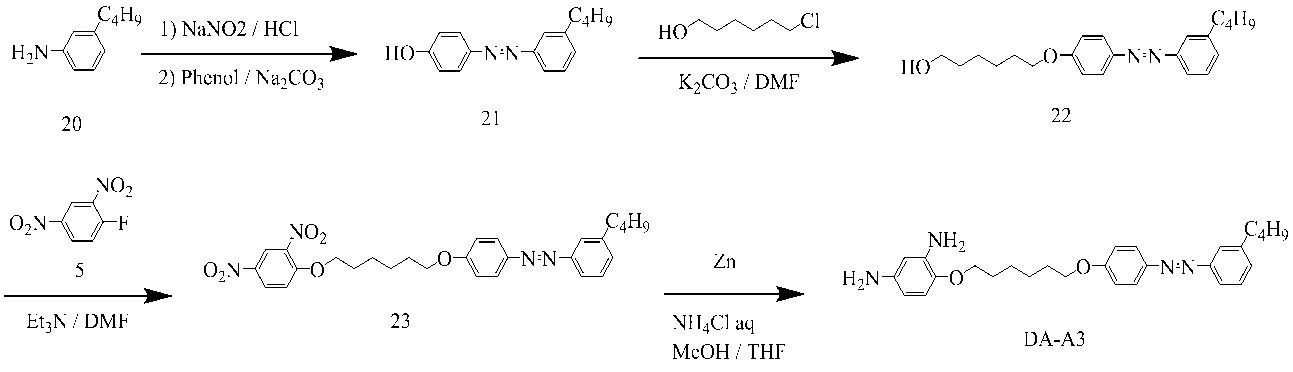
3gの化合物21、1.4gの6-クロロ-1-ヘキサノール、1.7gの炭酸カリウム、30mLのDMFを加え、90℃で16時間攪拌した。100mLの水、100mLの塩化メチレンを加え、有機層を抽出した。得られた溶液を濃縮し、シリカゲルクロマトグラフィー(溶離液:ヘキサン・塩化メチレン混合溶媒)で精製することで、4.2gの化合物22を得た。
7.5gの化合物5、7.7gの化合物22、2.8gのトリエチルアミン、60mLのDMFを混合し、80℃で32時間攪拌した。200mLの酢酸エチル、200mLの水を加え、有機層を抽出した。得られた有機層を100mLの飽和食塩水で、洗浄、濃縮し、シリカゲルクロマトグラフィー(溶離液:ヘキサン・酢酸エチル混合溶媒)で精製することで、7.1gの化合物23を得た。
7.0gの化合物23、3.1gの塩化アンモニウム、10mLのメタノール、100mLのTHF、40mLの水を混合し、0℃で攪拌した。ここへ、17.6gの粉末亜鉛を加え、40℃で3時間攪拌した。100mLの水を加えた後、有機層を濃縮した。この溶液に、100mLの酢酸エチルを加え、有機層を抽出した。得られた有機層を100mLの飽和食塩水で、洗浄、濃縮し、シリカゲルクロマトグラフィー(溶離液:ヘキサン・酢酸エチル混合溶媒)、再結晶(メタノール)で精製することで、2.1gのDA-A3を得た。
1,3-フェニレンジアミンを有する前記化合物(DA-C1)10.97g(0.020モル)と、N-メチルピロリジノン140gを室温で撹拌混合しながら、シクロブタンテトラカルボン酸二無水物(TC1)3.82g(0.020モル)を添加した。その後24時間撹拌した。その後、反応溶液を2リットルのメタノールに良く撹拌しながら滴下して再沈澱を行い、ポリアミック酸樹脂粉末8.4gを得た(収率59%)。
このポリアミック酸樹脂粉末を、N-メチルピロリジノン:ブトキシエタノール=1:1(質量比)の混合溶媒に固形分が5質量%となるように溶解させ、ポリアミック酸溶液(R1)を得た。
国際公開第2013/002260号(特許文献1)を参考にして、下記のポリマー(PA-R1)を合成した。重量平均分子量をGPCで測定したところ、約20万であった。

下記表に示した化合物を、同表に記載の割合で混合し、液晶組成物Aを調製した。
液晶組成物Aを分析した結果、ネマチック-等方性液体相転移温度(透明点)は、85.6℃であり、波長589nmにおける異常光屈折率neは1.596、波長589nmにおける常光屈折率nоは1.491であり、誘電率異方性は+7.0であり、K22は7.4pNであった。
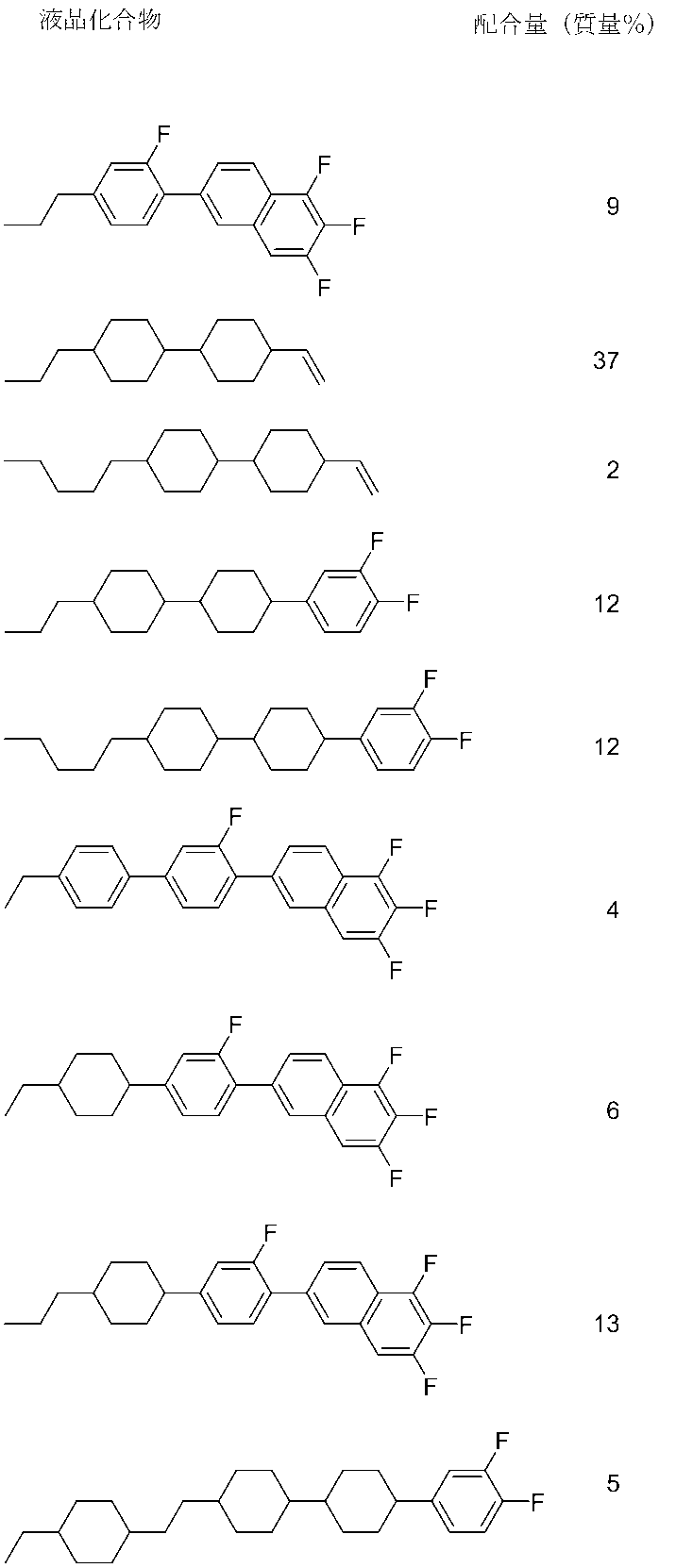
AC焼付きの評価は、ライン/スペース=10μm/10μmの櫛歯電極を備えた、セルギャップ4μmのIPS(In-Plane Switching)液晶セルを用いて行った。図1のような部分構造をもつ櫛歯電極において、電圧を印加しない時に、液晶分子が電極に対してθ=10°の角度をもつように配向方向(液晶配向層の配向規制力の向き)を設定した。
この液晶セルに液晶材料を注入した後、92℃で2分間エージング処理を行った。この後、液晶セルの上下に偏光板を貼り付けた。上下の偏光板は直交配置とし、電圧を印加しない時の液晶配向方向と、上下の偏光板の透過軸のどちらかが平行になるように設定した。
この液晶セルに室温で4Vの交流電圧(64Hzの矩形波)を印加した時の光の透過率をT1と定義した。次に、60℃の温度で10Vの交流電圧(60Hzの矩形波)を24時間印加した後、室温まで温度を下げて、液晶セルに4Vの交流電圧(60Hzの矩形波)を印加した時の光の透過率をT2と定義した。ここで、T1をT2で除した値(T1/T2)をAC焼付きの評価パラメータとして定義した。AC焼付きが無い理想的な状態では、評価パラメータが1となり、理想的な状態から離れると評価パラメータは1より大きくなる。
合成したポリアミック酸溶液(R1)を用いて、電極無しガラス基板及び櫛歯電極(ライン/スペース=10μm/10μm)付きガラス基板上にスピンコート後、80℃で3分加熱し、更に150℃で5分間加熱及び乾燥させることによって、各ガラス基板上に厚さ100nmのポリアミック酸の薄膜を形成した。この薄膜に波長313nm、強度20mW/cm2の偏光紫外線を300mJ/cm2照射して、各ガラス基板上に液晶配向層を形成した。この後、230℃で1時間加熱し、各液晶配向層を構成するポリマー主鎖のポリイミド化を行った。
上記で形成した液晶配向層付きの電極無しガラス基板及び櫛歯電極付きガラス基板を用いてIPS液晶セルを作製した。IPS液晶セルの構造は、上述の(AC焼付きの測定方法)に示したとおりとした。IPS液晶セル作製の際に用いたシール剤は150℃で1時間の加熱により硬化した。
この液晶セルに上記で調製した液晶組成物Aを用いて、上述の(AC焼付きの測定方法)に従って測定したところ、評価パラメータは1.07であった。また、液晶の配向方向は、偏光UVの振動方向に対して平行であった。
常法により、液晶セルのVHR(駆動電圧1V、64Hz、60℃)を測定した結果は、96%であった。
更に、上述の(AC焼付きの測定評価)における10Vの交流電圧の印加時間を336時間に変更して、同様に測定したところ、評価パラメータは1.07であった。
合成したポリマー(PA-R1)をN-メチルピロリジノン:2-ブトキシエタノール=50:50(質量比)の混合溶媒に固形分濃度5%で溶解させた。この溶液を用いて、比較例1と同様の方法で、各ガラス基板上に液晶配向層を形成した。
続いて、比較例1と同様の方法で、液晶組成物Aを注入したIPS液晶セルを作製し、上述の(AC焼付きの測定方法)に従って測定したところ、評価パラメータは1.22であった。また、液晶の配向方向は、偏光UVの振動方向に対して平行であった。
常法により、液晶セルのVHR(駆動電圧1V、64Hz、60℃)を測定した結果は、97%であった。
更に、上述の(AC焼付きの測定評価)における10Vの交流電圧の印加時間を336時間に変更して、同様に測定したところ、評価パラメータは1.24であった。
合成した化合物(DA-C1)9.88g(0.018モル)、合成した化合物(DA-A1)1.03g(0.002モル)N-メチルピロリジノン140gを室温で撹拌混合しながら、シクロブタンテトラカルボン酸二無水物(TC1)3.824g(0.020モル)を添加した。その後24時間撹拌した。その後、反応溶液を2リットルのメタノールに良く撹拌しながら滴下して再沈澱を行い、ポリアミック酸樹脂粉末8.8gを得た(収率62%)。
このポリアミック酸樹脂粉末を、N-メチルピロリジノン:ブトキシエタノール=1:1(質量比)の混合溶媒に固形分が5質量%となるように溶解させ、ポリアミック酸溶液(E1)を得た。
ポリアミック酸溶液(E1)を用いて、比較例1と同様の方法で、各ガラス基板上に液晶配向層を形成した。
続いて、比較例1と同様の方法で、液晶組成物Aを注入したIPS液晶セルを作製し、比較例1と同様の評価方法で、AC焼付き(24時間電圧印加)、VHR、及びAC焼付き(336時間電圧印加)を評価した。その結果を表2に示す。
合成例8と同様に、上記で合成した2つの化合物(ジアミン1、ジアミン2)を表2に示す質量比で配合し、カルボン酸(TC1又はTC2)を含む溶媒中で重合反応させ、ポリアミック酸溶液(E2)~(E15)を得た。
ここで、表2のカルボン酸(T1)は、シクロブタンテトラカルボン酸二無水物であり、カルボン酸(T2)は、2,3,5-トリカルボキシシクロペンチル酢酸二無水物である。何れのカルボン酸を使用する場合においても、ジアミン1及びジアミン2の合計のモル数と同じモル数(等モル量)となる様に、カルボン酸を配合した。
ポリアミック酸溶液(E2)~(E15)を用いて、実施例1と同様の方法で、各ガラス基板上に液晶配向層を形成した。
続いて、実施例1と同様の方法で、液晶組成物Aを注入したIPS液晶セルを作製し、実施例1と同様の評価方法で、AC焼付き(24時間電圧印加)、VHR、及びAC焼付き(336時間電圧印加)を評価した。その結果を表2に示す。

Claims (17)
- 一般式(I)

(c) 1,4-シクロヘキセニレン基、2,5-チオフェニレン基、2,5-フラニレン基、1,4-ビシクロ[2.2.2]オクチレン基、ナフタレン-1,4-ジイル基、ナフタレン-2,6-ジイル基、デカヒドロナフタレン-2,6-ジイル基及び1,2,3,4-テトラヒドロナフタレン-2,6-ジイル基からなる群より選ばれる基を表し、上記の基(a)、基(b)又は基(c)はそれぞれ無置換であるか又は一個以上の水素原子がフッ素原子、塩素原子、シアノ基、メチル基又はメトキシ基によって置換されていても良く、mは、0、1又は2を表し、mが2を表す場合に複数存在するA11及びZ12は同一であっても異なっていてもよく、rは、0、1又は2を表し、rが2を表す場合に複数存在するA12は同一であっても異なっていてもよく、X11及びX12は、それぞれ独立して水素原子、フッ素原子、塩素原子、シアノ基又は炭素数1~20のアルキル基を表すが、前記アルキル基中の水素原子はフッ素原子に置換されていてもよく、1つの-CH2-基又は2以上の非隣接-CH2-基は-O-、-CO-O-、-O-CO-及び-CH=CH-から選ばれる1つ以上で置換されていても良く、
Z13は、一般式(Ia)又は(Ib)
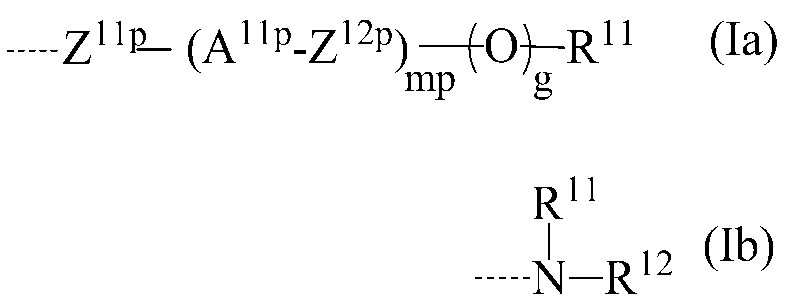
R11及びR12は、それぞれ独立して水素原子又は直鎖状若しくは分岐状の炭素数1~30のアルキル基を表し、R11及びR12中の1つの-CH2-基又は2以上の非隣接-CH2-基は-O-、-CO-、-CO-O-、-O-CO-、-CO-NH-、-NH-CO-、-NCH3-、-CH=CH-、-CF=CF-及び-C≡C-から選ばれる1つ以上で置換されていても良く、R11及びR12中の1つ又は2以上の-CH2-基はそれぞれ独立して環員数3~8のシクロアルキレン基で置換されていても良く、R11及びR12中の水素原子は炭素数1~20のアルキル基、シアノ基若しくはハロゲン原子で置換されていても良く、Z11p及びZ12pは、それぞれ独立して単結合、-(CH2)u-(式中、uは1~20を表す。)、-OCH2-、-CH2O-、―COO-、-OCO-、-CH=CH-、-CF=CF-、-CF2O-、-OCF2-、-CF2CF2-又は-C≡C-を表すが、これらの置換基において非隣接の-CH2-基の一つ以上は独立して、-O-、-CO-、-CO-O-、-O-CO-、-Si(CH3)2-O-Si(CH3)2―、-NR-、-NR-CO-、-CO-NR-、-NR-CO-O-、-O-CO-NR-、-NR-CO-NR-、-CH=CH-、-C≡C-又は-O-CO-O-(式中、Rは独立して水素原子又は炭素数1~5のアルキル基を表す。)で置換することができ、A11pは、(a) トランス-1,4-シクロへキシレン基(この基中に存在する1個のメチレン基又は隣接していない2個以上のメチレン基は-O-、-NH-又は-S-に置き換えられてもよい)、(b) 1,4-フェニレン基(この基中に存在する1個又は2個以上の-CH=は-N=に置き換えられてもよい)、及び(c) 1,4-シクロヘキセニレン基、2,5-チオフェニレン基、2,5-フラニレン基、1,4-ビシクロ[2.2.2]オクチレン基、ナフタレン-1,4-ジイル基、ナフタレン-2,6-ジイル基、デカヒドロナフタレン-2,6-ジイル基及び1,2,3,4-テトラヒドロナフタレン-2,6-ジイル基からなる群より選ばれる基を表し、上記の基(a)、基(b)又は基(c)はそれぞれ無置換であるか又は一個以上の水素原子がフッ素原子、塩素原子、シアノ基、メチル基又はメトキシ基によって置換されていても良く、mpは、0、1又は2を表し、mpが2を表す場合に、複数存在するA11p及びZ12pは同一であっても異なっていてもよく、gは、0又は1を表す。)で表される側鎖ユニットMaの1種以上、
及び、
一般式(II)


前記アルキレン基において非隣接の-CH2-基の1つ以上は独立して、-O-、―COO-、-OCO-、-CH=CH-、-CF=CF-、-CF2O-、-OCF2-、-CF2CF2-、-C≡C-、-CO-、-S-、-Si(CH3)2-O-Si(CH3)2―、-NR’-、-NR’-CO-、-CO-NR’-、-NR’-CO-O-、-O-CO-NR’-、-NR’-CO-NR’-、-CH=CH-、-C≡C-又は-O-CO-O-(式中、R’は独立して水素原子又は炭素数1~5のアルキル基を表す。)で置き換わっていてもよく、前記アルキレン基の-CH2-基の1つ以上の水素原子はフッ素原子、塩素原子、ヒドロキシ基又はシアノ基で置換されていてもよく、nおよびqはそれぞれ独立に0又は1を表し、sは1又は2を表し、sが2を表す場合に複数存在するA22は同一であっても異なっていてもよく、R2は、水素原子又は炭素数1~40の直鎖若しくは分岐のアルキル基を表し、当該アルキル基中の、非隣接の-CH2-基の1つ以上は独立して、-O-、―COO-、-OCO-、-CH=CH-、-CF=CF-、-CF2O-、-OCF2-、-CF2CF2-、-C≡C-、-CO-、-S-、-Si(CH3)2-O-Si(CH3)2―、-NR’-、-NR’-CO-、-CO-NR’-、-NR’-CO-O-、-O-CO-NR’-、-NR’-CO-NR’-、-CH=CH-、-C≡C-又は-O-CO-O-(式中、R’は独立して水素原子又は炭素数1~5のアルキル基を表す。)で置き換わっていてもよく、前記炭素数1~40のアルキル基の-CH2-基の1つ以上の水素原子はハロゲン原子、ヒドロキシ基又はシアノ基で置換されていてもよく、前記炭素数1~40のアルキル基の1つ以上の-CH2-基はそれぞれ独立して環員数3~8のシクロアルキレン基で置換されていても良い。ただし、A23が単結合であり、qが0である場合、R2は水素原子ではない。ただし、X21、X22、X23、X24、X25は同時に水素原子ではない。)で表される側鎖ユニットMbの1種以上を含み、
前記側鎖ユニットMa及びMbのMで表されるポリマー主鎖は、一般式(U-11)及び(U-12)
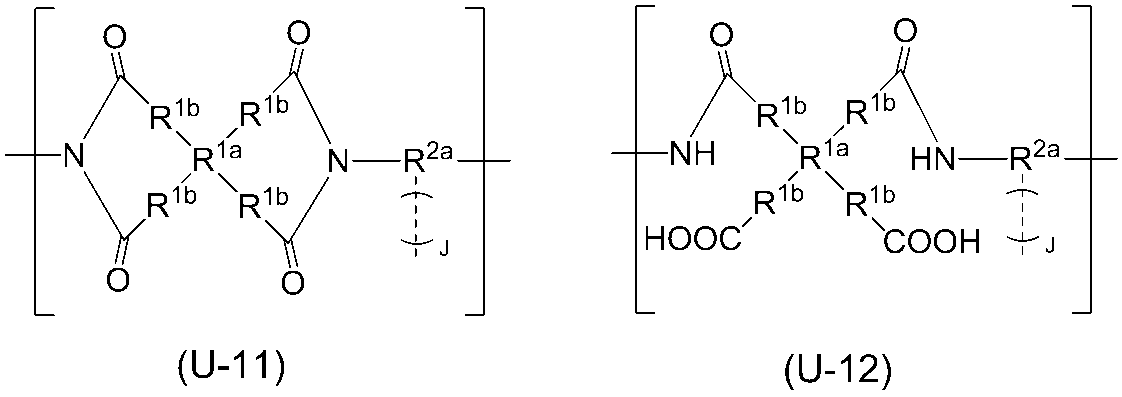
- 前記一般式(IIa)において、R2は直鎖状又は分岐状の炭素数1~30のアルキル基(前記アルキル基中の1つ又は2以上の-CH2-基はそれぞれ独立して環員数3~8のシクロアルキレン基で置換されていても良く、前記アルキル基中の水素原子は非置換であるか又は炭素数1~20のアルキル基、シアノ基若しくはハロゲン原子で置換されていても良い。)を表す、請求項1記載のポリマー。
- 前記一般式(Ia)において、Z11pが単結合であり、mpが0であり、gが1である、請求項1又は2に記載のポリマー。
- 前記一般式(Ia)又は(Ib)において、R11が一般式(Ic)

- 前記一般式(Ia)又は(Ib)において、R11が直鎖状若しくは分岐状の炭素数1~30のアルキル基(前記アルキル基中の1つの-CH2-基又は2以上の非隣接-CH2-基は-CH=CH-、-CF=CF-及び-C≡C-から選ばれる1つ以上で置換されており、前記アルキル基中の1つ又は2以上の-CH2-基はそれぞれ独立して環員数3~8のシクロアルキレン基で置換されていても良く、前記アルキル基中の水素原子は炭素数1~20のアルキル基、シアノ基若しくはハロゲン原子で置換されていても良い。)を表し、
R12は直鎖状又は分岐状の炭素数1~30のアルキル基(前記アルキル基中の1つ又は2以上の-CH2-基はそれぞれ独立して環員数3~8のシクロアルキレン基で置換されていても良く、前記アルキル基中の水素原子は非置換であるか又は炭素数1~20のアルキル基、シアノ基若しくはハロゲン原子で置換されていても良い。)を表す、請求項1~3の何れか一項に記載のポリマー。 - 前記一般式(Ia)又は(Ib)において、R11が一般式(Id)又は(If)
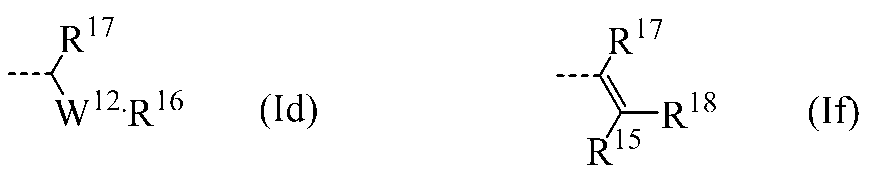
- 一般式(I)において、X11及びX12が水素原子を表す、請求項1~6の何れか一項に記載のポリマー。
- 一般式(I)において、rが1を表し、A12は2,6-ナフチレン基、ピリジン-2,5-ジイル基、ピリミジン-2,5-ジイル基、又は1,4-フェニレン基の何れかの基を表し、前記何れかの基における一個以上の水素原子がフッ素原子、塩素原子、メチル基又はメトキシ基によって置換されていてもよく、Z11は単結合、-(CH2)u-(式中、uは1~20を表す。)、-OCH2-、-CH2O-、―COO-、-OCO-、-CH=CH-又は-C≡C-の何れかの基を表し、前記何れかの基において非隣接の-CH2-基の1つ以上は独立して、-O-、-CO-、-CO-O-、-O-CO-、-CH=CH-又は-C≡C-に置換されていてもよく、請求項1記載のポリマー。
- 一般式(II)において、X22及びX24の少なくとも一方が、フッ素原子、塩素原子、ヒドロキシ基、ニトロ基、シアノ基、又は前記一般式(IIa)で表される基である、請求項1記載のポリマー。
- 側鎖ユニットMa/側鎖ユニットMbで表されるモル分率の比(Ma/Mb)が、99/1~60/40である、請求項1記載のポリマー。
- 下記一般式(QX)で表される側鎖ユニットMcの1種以上を有する、請求項1記載のポリマー。

Saaは単結合又は炭素数1~20のアルキレン基を表し、Vaは1価の有機基を表し、
前記アルキレン基の-CH2-基の1つ又は非隣接の2つ以上は独立して、-O-、-CO-、-CO-O-、-O-CO-、-Si(CH3)2-O-Si(CH3)2-、-NR-、-NR-CO-、-CO-NR-、-NR-CO-O-、-O-CO-NR-、-NR-CO-NR-(式中、Rは独立して水素又は炭素数1~5のアルキル基を表す。)、-CH=CH-、-C≡C-、及び-O-CO-O-から選ばれる一つ以上の置換基で置換されていても良く、
前記一般式(QX)で表される基に結合する一個以上の水素原子が、フッ素原子、塩素原子、シアノ基、ヒドロキシル基、カルボキシル基、アミド基、フッ素、スルフィド基、ニトロ基に置換されていても良い。) - 請求項1~11の何れか一つに記載のポリマーと有機溶剤とを必須成分とすることを特徴とするポリマー溶液。
- 固形分濃度が1~20質量%の範囲である請求項12記載のポリマー溶液。
- 請求項1~11の何れか一つに記載のポリマーからなる液晶配向層。
- 請求項12記載のポリマー溶液を基材に塗布、乾燥させ、偏光紫外線を照射し、必要により加熱してなる請求項14記載の液晶配向層。
- 請求項14に記載の液晶配向層を備えた液晶表示素子。
- 請求項14に記載の液晶配向層を備えた光学異方体。
Priority Applications (2)
| Application Number | Priority Date | Filing Date | Title |
|---|---|---|---|
| US15/768,747 US20180282625A1 (en) | 2015-10-16 | 2016-10-13 | Polymer, polymer solution, liquid crystal alignment layer, optically anisotropic body, and liquid crystal display element |
| JP2017545447A JP6361834B2 (ja) | 2015-10-16 | 2016-10-13 | ポリマー、ポリマー溶液、液晶配向層、光学異方体、及び液晶表示素子 |
Applications Claiming Priority (2)
| Application Number | Priority Date | Filing Date | Title |
|---|---|---|---|
| JP2015204829 | 2015-10-16 | ||
| JP2015-204829 | 2015-10-16 |
Publications (1)
| Publication Number | Publication Date |
|---|---|
| WO2017065201A1 true WO2017065201A1 (ja) | 2017-04-20 |
Family
ID=58517256
Family Applications (1)
| Application Number | Title | Priority Date | Filing Date |
|---|---|---|---|
| PCT/JP2016/080336 Ceased WO2017065201A1 (ja) | 2015-10-16 | 2016-10-13 | ポリマー、ポリマー溶液、液晶配向層、光学異方体、及び液晶表示素子 |
Country Status (4)
| Country | Link |
|---|---|
| US (1) | US20180282625A1 (ja) |
| JP (1) | JP6361834B2 (ja) |
| TW (1) | TW201728624A (ja) |
| WO (1) | WO2017065201A1 (ja) |
Citations (2)
| Publication number | Priority date | Publication date | Assignee | Title |
|---|---|---|---|---|
| WO1996037807A1 (fr) * | 1995-05-26 | 1996-11-28 | Hitachi Chemical Company, Ltd. | Film a alignement de cristaux liquides |
| JP2012032601A (ja) * | 2010-07-30 | 2012-02-16 | Sony Corp | 液晶表示装置及びその製造方法 |
Family Cites Families (3)
| Publication number | Priority date | Publication date | Assignee | Title |
|---|---|---|---|---|
| DE102009014944B4 (de) * | 2009-03-30 | 2011-06-16 | Phoenix Contact Gmbh & Co. Kg | Modulares Schaltgerät zum Schalten eines elektrischen Laststromkreises sowie Verfahren zum Betreiben eines solchen |
| CN103732638B (zh) * | 2011-06-30 | 2016-01-20 | Dic株式会社 | 共聚物及包含该共聚物的固化物的液晶取向层 |
| WO2013050121A1 (en) * | 2011-10-03 | 2013-04-11 | Rolic Ag | Photoaligning materials |
-
2016
- 2016-10-13 WO PCT/JP2016/080336 patent/WO2017065201A1/ja not_active Ceased
- 2016-10-13 JP JP2017545447A patent/JP6361834B2/ja not_active Expired - Fee Related
- 2016-10-13 US US15/768,747 patent/US20180282625A1/en not_active Abandoned
- 2016-10-14 TW TW105133209A patent/TW201728624A/zh unknown
Patent Citations (2)
| Publication number | Priority date | Publication date | Assignee | Title |
|---|---|---|---|---|
| WO1996037807A1 (fr) * | 1995-05-26 | 1996-11-28 | Hitachi Chemical Company, Ltd. | Film a alignement de cristaux liquides |
| JP2012032601A (ja) * | 2010-07-30 | 2012-02-16 | Sony Corp | 液晶表示装置及びその製造方法 |
Also Published As
| Publication number | Publication date |
|---|---|
| JPWO2017065201A1 (ja) | 2018-02-01 |
| US20180282625A1 (en) | 2018-10-04 |
| TW201728624A (zh) | 2017-08-16 |
| JP6361834B2 (ja) | 2018-07-25 |
Similar Documents
| Publication | Publication Date | Title |
|---|---|---|
| KR101802218B1 (ko) | 액정 배향막 | |
| JP6200424B2 (ja) | 光アライニング材料 | |
| TWI477864B (zh) | 液晶顯示元件 | |
| TWI810273B (zh) | 液晶配向劑、液晶配向膜、液晶元件、聚合體及化合物 | |
| KR20140074982A (ko) | 광정렬 재료 | |
| KR20190028287A (ko) | 광배향 방식의 액정 배향막을 형성하기 위한 액정 배향제, 액정 배향막, 이것을 이용한 액정 표시 소자, 폴리머, 및 디아민 | |
| JP7593392B2 (ja) | 液晶配向剤、液晶配向膜、液晶表示素子及びジアミン | |
| JP6523169B2 (ja) | 重合体、重合体組成物および横電界駆動型液晶表示素子用液晶配向膜 | |
| JP2021071717A (ja) | 液晶配向剤、液晶配向膜、およびこれを用いた液晶表示素子、ならびにジアミンおよびポリマー | |
| JP2022036952A (ja) | 液晶配向剤、液晶配向膜及び液晶表示素子 | |
| US9260663B2 (en) | Liquid crystal composition, liquid crystal display, and method for producing liquid crystal display | |
| JP6403030B2 (ja) | 光配向膜用ポリマー、ポリマー溶液、光配向膜、光学異方体、及び液晶表示素子 | |
| JP7295091B2 (ja) | 光配列ポリマー材料 | |
| JP6358400B2 (ja) | 光配向膜用ポリマー、ポリマー溶液、光配向膜、光学異方体、及び液晶表示素子 | |
| JP2015090427A (ja) | 液晶配向膜の製造方法およびそれを使用した液晶表示素子 | |
| JP2019008170A (ja) | 液晶配向膜用ポリマー、液晶配向膜、液晶表示素子、液晶ディスプレイ、光学異方体、光学異方性フィルム及び光デバイス | |
| JP7409388B2 (ja) | 液晶配向剤、液晶配向膜及び液晶素子 | |
| JP7601777B2 (ja) | 光配向性ポリマー材料及び組成物の調製方法 | |
| WO2017065079A1 (ja) | 光配向膜用ポリマー、ポリマー溶液、光配向膜、光学異方体、及び液晶表示素子 | |
| CN107924092B (zh) | 液晶取向膜制造用组合物、使用该组合物的液晶取向膜及其制造方法、以及具有液晶取向膜的液晶表示元件及其制造方法 | |
| JPWO2014196589A1 (ja) | 横電界駆動型液晶表示素子用液晶配向膜を有する基板の製造方法 | |
| JP6361834B2 (ja) | ポリマー、ポリマー溶液、液晶配向層、光学異方体、及び液晶表示素子 | |
| WO2021049255A1 (ja) | 液晶配向剤、液晶配向膜及び液晶素子 | |
| JP2023019900A (ja) | 光配向方式の液晶配向膜を形成するための光配向用液晶配向剤、液晶配向膜、およびこれを用いた液晶素子 |
Legal Events
| Date | Code | Title | Description |
|---|---|---|---|
| 121 | Ep: the epo has been informed by wipo that ep was designated in this application |
Ref document number: 16855454 Country of ref document: EP Kind code of ref document: A1 |
|
| ENP | Entry into the national phase |
Ref document number: 2017545447 Country of ref document: JP Kind code of ref document: A |
|
| WWE | Wipo information: entry into national phase |
Ref document number: 15768747 Country of ref document: US |
|
| NENP | Non-entry into the national phase |
Ref country code: DE |
|
| 122 | Ep: pct application non-entry in european phase |
Ref document number: 16855454 Country of ref document: EP Kind code of ref document: A1 |