WO2017056766A1 - ポリウレタン樹脂形成性組成物およびポリウレタン樹脂 - Google Patents
ポリウレタン樹脂形成性組成物およびポリウレタン樹脂 Download PDFInfo
- Publication number
- WO2017056766A1 WO2017056766A1 PCT/JP2016/074003 JP2016074003W WO2017056766A1 WO 2017056766 A1 WO2017056766 A1 WO 2017056766A1 JP 2016074003 W JP2016074003 W JP 2016074003W WO 2017056766 A1 WO2017056766 A1 WO 2017056766A1
- Authority
- WO
- WIPO (PCT)
- Prior art keywords
- polyurethane resin
- containing compound
- forming composition
- compound
- phosphorus
- Prior art date
- Legal status (The legal status is an assumption and is not a legal conclusion. Google has not performed a legal analysis and makes no representation as to the accuracy of the status listed.)
- Ceased
Links
Images

Classifications
-
- C—CHEMISTRY; METALLURGY
- C08—ORGANIC MACROMOLECULAR COMPOUNDS; THEIR PREPARATION OR CHEMICAL WORKING-UP; COMPOSITIONS BASED THEREON
- C08G—MACROMOLECULAR COMPOUNDS OBTAINED OTHERWISE THAN BY REACTIONS ONLY INVOLVING UNSATURATED CARBON-TO-CARBON BONDS
- C08G18/00—Polymeric products of isocyanates or isothiocyanates
- C08G18/06—Polymeric products of isocyanates or isothiocyanates with compounds having active hydrogen
- C08G18/28—Polymeric products of isocyanates or isothiocyanates with compounds having active hydrogen characterised by the compounds used containing active hydrogen
- C08G18/30—Low-molecular-weight compounds
- C08G18/36—Hydroxylated esters of higher fatty acids
-
- C—CHEMISTRY; METALLURGY
- C08—ORGANIC MACROMOLECULAR COMPOUNDS; THEIR PREPARATION OR CHEMICAL WORKING-UP; COMPOSITIONS BASED THEREON
- C08K—Use of inorganic or non-macromolecular organic substances as compounding ingredients
- C08K3/00—Use of inorganic substances as compounding ingredients
- C08K3/10—Metal compounds
-
- C—CHEMISTRY; METALLURGY
- C08—ORGANIC MACROMOLECULAR COMPOUNDS; THEIR PREPARATION OR CHEMICAL WORKING-UP; COMPOSITIONS BASED THEREON
- C08K—Use of inorganic or non-macromolecular organic substances as compounding ingredients
- C08K5/00—Use of organic ingredients
- C08K5/49—Phosphorus-containing compounds
- C08K5/51—Phosphorus bound to oxygen
- C08K5/52—Phosphorus bound to oxygen only
- C08K5/521—Esters of phosphoric acids, e.g. of H3PO4
- C08K5/523—Esters of phosphoric acids, e.g. of H3PO4 with hydroxyaryl compounds
Definitions
- the present invention relates to a polyurethane resin-forming composition and a polyurethane resin.
- Patent Document 1 a polyurethane resin composition containing a specific polyurethane resin, a non-halogen phosphorus flame retardant and a hydrolysis inhibitor, which has excellent flame retardancy and hydrolysis resistance and is less likely to cause environmental problems.
- a resin case may be used for the peripheral parts of the sealing material.
- the chemical stress crack does not occur on the case such as the electronic substrate and the case material, but the chemical stress crack is generated in the polyurethane resin composition disclosed so far.
- a chemical stress crack is a typical brittle fracture that occurs with a tensile stress that is less than the tensile strength of the resin case.
- the chemical adheres to and contacts the location where the tensile stress occurs (where the load is applied). In some cases, this is a phenomenon in which cracks (crazes, cracks) occur due to the synergistic action of chemicals and stress over time.
- the chemical stress cracking property of the polyurethane resin composition of Patent Document 1 was not always good.
- the present invention has been made in view of the above-mentioned problems, and provides a polyurethane resin-forming composition that is excellent in flame retardancy and workability and is less prone to chemical stress cracks in a resin case. Let it be an issue.
- the inventors of the present invention use a hydroxyl group-containing compound having a specific structure, an isocyanate group-containing compound, and a phosphorus-containing compound having a specific structure as the polyurethane resin-forming composition. As a result, it has been found that the above problems can be solved, and the present invention has been completed.
- the phosphorus-containing compound (C) is represented by the following general formula (1) Wherein R1 is a hydrocarbon group having an aromatic ring having 6 to 30 carbon atoms, R2 is the same or different aryl group having 6 to 15 carbon atoms, and n is 1 to 3.
- the polyurethane resin-forming composition according to (3) or (4), wherein a mass ratio of the phosphorus-containing compound (C) to the polycarbodiimide (D2) is (C) :( D2) 15 to 115: 1 .
- the polyurethane resin obtained by curing the polyurethane resin-forming composition of the present invention is excellent in flame retardancy and workability and hardly causes chemical stress cracks in the resin case.
- the polyurethane resin-forming composition of the present invention contains a hydroxyl group-containing compound (A), an isocyanate group-containing compound (B), and a phosphorus-containing compound (C).
- the hydroxyl group-containing compound used in the present invention contains castor oil-based polyol (A1).
- castor oil-based polyol (A1) By containing the castor oil-based polyol (A1), workability and heat-and-moisture resistance are excellent.
- castor oil-based polyol (A1) a castor oil, a castor oil fatty acid, and a polyol produced using hydrogenated castor oil or hydrogenated castor oil fatty acid hydrogenated to these can be used.
- examples of such polyols include, but are not limited to, castor oil, a transesterification product of castor oil and other natural fats and oils, a reaction product of castor oil and polyhydric alcohol, and an esterification reaction product of castor oil fatty acid and polyhydric alcohol.
- polyols obtained by addition polymerization of alkylene oxides can use 1 type, or 2 or more types.
- the viscosity of castor oil-based polyol (A1) at 25 ° C. is preferably 800 mPa ⁇ s or less, and more preferably 700 mPa ⁇ s or less.
- the average number of hydroxyl groups calculated from the charged amount is preferably 1.0 to 3.0, and more preferably 1.0 to 2.7. If it is these ranges, the mixing viscosity at the time of manufacture of a polyurethane resin-forming composition will become suitable, and workability
- the compounding amount of castor oil-based polyol (A1) is preferably 20 to 70% by mass, more preferably 40 to 60% by mass with respect to the polyurethane resin-forming composition.
- the blending amount of the castor oil-based polyol (A1) is less than the above range, the moist heat resistance tends to be lowered. Tend to.
- polyols other than castor oil-based polyol (A1) can be blended with the polyol component used in the present invention to such an extent that the effects of the present invention are not impaired.
- examples of such polyols include, but are not limited to, polyether polyols, polyester polyols, polybutadiene polyols, polycarbonate polyols, polyisoprene polyols, hydrides of polybutadiene polyols, and hydrides of polyisoprene polyols.
- polybutadiene polyol (A2) is preferable from the viewpoint of heat and moisture resistance. These can use 1 type, or 2 or more types.
- the castor oil-based polyol (A1) may be a hydroxyl group-terminated urethane prepolymer obtained by reacting with the isocyanate group-containing compound (B).
- the isocyanate group-containing compound (B) used in the present invention is not particularly limited as long as it is a compound having an isocyanate group in the molecule.
- an aliphatic polyisocyanate compound, an alicyclic polyisocyanate compound, an aromatic polyisocyanate compound, and Examples include aromatic aliphatic polyisocyanate compounds. These can use 1 type (s) or 2 or more types.
- the aliphatic polyisocyanate compound is not particularly limited.
- Examples thereof include diisocyanate, lysine diisocyanate, 2-methylpentane-1,5-diisocyanate, and 3-methylpentane-1,5-diisocyanate.
- the alicyclic polyisocyanate compound is not particularly limited.
- isophorone diisocyanate, hydrogenated xylylene diisocyanate, 4,4′-dicyclohexylmethane diisocyanate, 1,4-cyclohexane diisocyanate, methylcyclohexylene diisocyanate, 1,3- Bis (isocyanatomethyl) cyclohexane and the like can be mentioned.
- the aromatic polyisocyanate compound is not particularly limited.
- tolylene diisocyanate TDI
- 2,2′-diphenylmethane diisocyanate 2,4′-diphenylmethane diisocyanate
- 4,4′-diphenylmethane diisocyanate MDI
- 4 4,4'-dibenzyl diisocyanate 1,5-naphthylene diisocyanate
- xylylene diisocyanate 1,3-phenylene diisocyanate
- 1,4-phenylene diisocyanate 1,4-phenylene diisocyanate and the like.
- the aromatic aliphatic polyisocyanate compound is not particularly limited, and examples thereof include dialkyldiphenylmethane diisocyanate, tetraalkyldiphenylmethane diisocyanate, ⁇ , ⁇ , ⁇ , ⁇ -tetramethylxylylene diisocyanate.
- polyisocyanate compounds include modified products such as isocyanate group-terminated urethane prepolymer modified products, carbodiimide modified products, isocyanurate modified products, allophanate modified products, and burette modified products obtained by reacting an isocyanate group-containing compound and a hydroxyl group-containing compound. It can also be used. These can use 1 type, or 2 or more types.
- MDI dimethyl methacrylate
- TDI tert-butyl styrene
- HDI terephthalate
- modified products thereof are preferable from the viewpoints of reactivity, viscosity, and workability.
- the phosphorus-containing compound (C) used in the present invention is a compound in which the phosphorus-containing compound (C) is represented by the following general formula (1).
- R1 is a hydrocarbon group having an aromatic ring having 6 to 30 carbon atoms, and preferably 6 to 25 carbon atoms from the viewpoint of flame retardancy, workability, and chemical stress cracking suppression, Preferably, it has 6 to 15 carbon atoms, and an aromatic ring and / or a bisphenol structure is more preferable.
- R2 is the same or different aryl group having 6 to 15 carbon atoms, preferably 6 to 10 carbon atoms, more preferably from the viewpoint of flame retardancy, workability and chemical stress cracking suppression, more preferably More preferably 6 to 8 carbon atoms, and more preferably phenyl and / or xylenyl.
- n is 1 to 3, preferably 1 to 2 and more preferably 1 from the viewpoint of workability.
- the phosphorus-containing compound (C) as long as it contains at least the compound (C1), another phosphorus-containing compound (C2) may be used in combination. Since flame retardancy improves by using together (C1) and (C2), it is one of the preferable embodiments. Although it is not clear why the flame retardancy is improved, the presence of (C2) improves the compatibility between (C1) and other components in the polyurethane resin-forming composition. It is inferred.
- the other phosphorus-containing compound (C2) used in the present invention is not particularly limited as long as it is a phosphorus-containing compound excluding the compound (C1).
- a phosphorus-containing compound excluding the compound (C1) for example, trimethyl phosphate, triethyl phosphate, triphenyl phosphate, tricresyl phosphate, Examples include phosphate esters such as silenyl phosphate, cresyl diphenyl phosphate, cresyl di 2,6-xylenyl phosphate, tris (chloropropyl) phosphate, tris (tribromoneopentyl) phosphate.
- the content of (C1) in (C) is preferably 15% by mass or more, and more preferably 25% by mass or more. 35 mass% or more is more preferable. If it is these ranges, it is preferable from a flame-retardant property, a chemical stress crack, and a wet heat resistant viewpoint.
- the compounding amount of the phosphorus-containing compound (C) is preferably 10 to 60% by mass, and more preferably 10 to 30% by mass with respect to the polyurethane resin-forming composition. If the compounding quantity of a phosphorus-containing compound (C) is these ranges, it is preferable from a viewpoint of a flame retardance, workability
- an ionic compound scavenger (D) is also a preferable aspect to further contain an ionic compound scavenger (D). Furthermore, containing an ionic compound scavenger (D) is preferable from the viewpoint of heat and humidity resistance.
- the ionic compound scavenger (D) is preferably at least one selected from the group consisting of alkaline earth metal hydroxides, oxides, carbonates and polycarbodiimides from the viewpoint of heat and heat resistance. Examples of the polycarbodiimide include (co) polymers using at least one selected from polyvalent isocyanate compounds.
- the carbodiimide equivalent represents the number of grams of a polymer containing 1 equivalent of a carbodiimide group.
- the compounding amount of the ionic compound scavenger (D) is 0 with respect to the polyurethane resin-forming composition when at least one selected from the group consisting of alkaline earth metal hydroxides, oxides and carbonates (D1). 0.1 to 1.0% by mass is preferable, and 0.05 to 0.5% by mass is more preferable.
- the content is preferably 0.05 to 2% by mass and more preferably 0.1 to 1.0% by mass with respect to the polyurethane resin-forming composition. If the compounding quantity of an ionic compound scavenger (D) is these ranges, it is preferable from a heat-and-moisture resistant viewpoint.
- the method for obtaining a polyurethane resin using the polyurethane resin-forming composition of the present invention is not particularly limited, but one-shot and two-component reactions can be used, but two-component reactions are preferred.
- a polyurethane resin is obtained by mixing and curing a curing agent containing a hydroxyl group-containing compound and a main agent containing an isocyanate group-containing compound.
- the phosphorus-containing compound and the ionic compound scavenger can be suitably used regardless of whether they are contained in the main agent or the curing agent.
- the ionic compound scavenger is the curing agent, and the phosphorus-containing compound is the main agent. It is preferable to make it contain.
- the mixing is not particularly limited as long as it is a mixing device capable of uniform mixing.
- the molar ratio of isocyanate groups to hydroxyl groups is preferably 0.5 to 1.5, and preferably 0.6 to 1.3. More preferred. If the molar ratio of isocyanate groups to hydroxyl groups is outside this range, poor curing may occur. On the other hand, if it is smaller than this range, the heat and heat resistance of the resulting resin may be lowered.
- the polyurethane resin-forming composition of the present invention does not practically contain a plasticizer excluding a phosphorus-containing compound, and in particular, it may contain no plasticizer consisting of a phthalic acid ester or trimellitic acid ester. More preferred.
- substantially not contained means that the content of a plasticizer made of a plasticizer, a phthalate ester or a trimellitic acid ester in the polyurethane resin composition (X) is 0.01% by mass or less. This is because chemical stress cracks are likely to occur in the resin case due to bleed out over time.
- the polyurethane resin-forming composition of the present invention includes water, trichloromonomonofluoromethane, dichlorodifluoromethane, monochlorodifluoromethane, dichlorotetrafluoroethane, and trichlorotrifluoromethane from the viewpoints of flame retardancy, workability, and chemical stress cracking suppression.
- substantially not containing means that it is 0.3 mass% or less in the polyurethane resin-forming composition.
- silane coupling agent examples include alkoxysilanes, vinyl group-containing silane coupling agents, epoxy group-containing silane coupling agents, methacryl group-containing silane coupling agents, and acrylic group-containing silane coupling agents.
- the mixing viscosity of the polyurethane resin-forming composition of the present invention is preferably 3000 or less (mPa ⁇ s), more preferably 2500 or less (mPa ⁇ s).
- the mixed viscosity is measured by the method described in the examples.
- the heat and humidity resistance of the polyurethane resin obtained by curing the polyurethane resin-forming composition of the present invention preferably retains a hardness type A5 or more, and retains a hardness type A10 or more after 85 ° C. ⁇ 85% RH ⁇ 600 hours. More preferably. These ranges are good in terms of maintaining the resin shape.
- the flame retardancy of the polyurethane resin obtained by curing the polyurethane resin-forming composition of the present invention preferably has a flame retardancy of V-1 level and has a flame retardancy of V-0 level in the UL94 standard. More preferably, it has.
- the chemical stress cracking property of the polyurethane resin obtained by curing the polyurethane resin-forming composition of the present invention is preferably 0.5% or more at a critical strain after 25 ° C. ⁇ 60% RH ⁇ 48 hours. More preferably, it is 0.7% or more. Within these ranges, it is favorable in that cracks do not occur in the housing and case material of the substrate.
- polyurethane resin-forming composition of the present invention will be described in detail based on examples and comparative examples.
- “parts” and “%” represent “parts by mass” and “mass%”, respectively, unless otherwise specified.
- the flame retardancy was measured according to UL standard UL94 (flame retardance of plastic material) and evaluated as follows. ⁇ : In the UL94 standard, V-1 or V-0 ⁇ : In the UL94 standard, V-2
- ABS test piece (trade name: Koube Poly Sheet ABS, manufactured by Shin-Kobe Electric Machinery Co., Ltd.) is attached to a 1/4 oval jig shown in FIG. 1 having a major axis of 100 mm and a minor axis of 40 mm, and the resin sheet of the example is attached to the surface of the specimen. After being attached, the sample was left in an environment of 25 ° C. ⁇ 60% RH for 48 hours, the position X at which a crack was generated was measured, and the critical strain value was obtained using Equation 1. Based on the critical strain value, chemical stress cracking properties were ranked and evaluated as follows.
- ⁇ critical strain value a: ellipse major axis 100 mm b: Ellipse minor axis 40mm
- X Crack generation point Distance from the fixed end to the crack generation point with respect to the long axis of the test piece mm t: Test piece thickness 2.0 mm ⁇ Evaluation> ⁇ (Fully practical): Critical strain value ( ⁇ ) 0.7% or more ⁇ (Not practical): Critical strain value ( ⁇ ) less than 0.7%
- the polyurethane resin-forming composition of the present invention has a mixed viscosity within a usable range, is excellent in flame retardancy and workability, and has chemical stress cracks in the resin case. It turns out that it is hard to occur.
- the phosphorus-containing compound (C) does not contain the compound (C1) represented by the general formula (1) as in Comparative Example 1, chemical stress cracks are likely to occur. It can be seen that a system that does not contain a castor oil-based polyol (A1) as in Comparative Example 2 has a high mixing viscosity, poor workability, and poor flame retardancy.
- the polyurethane resin-forming composition of the present invention has a range in which the mixed viscosity can be used, is excellent in flame retardancy, moist heat resistance and workability, and is chemically applied to the resin case. It can be seen that stress cracks are less likely to occur. On the other hand, when the phosphorus-containing compound (C) does not contain the compound (C1) represented by the general formula (1) as in Comparative Example 3, chemical stress cracking is likely to occur. It can be seen that in the system not containing the ionic compound scavenger (D) as in Comparative Example 4, the heat and moisture resistance is inferior. It can be seen that a system that does not contain a castor oil-based polyol (A1) as in Comparative Example 5 has a high mixing viscosity, poor workability, and poor flame retardancy.
- the polyurethane resin obtained by curing the polyurethane resin-forming composition of the present invention can be suitably used for electric and electronic parts. Furthermore, in the aspect which has heat-and-moisture resistance, it can be used conveniently for the electrical and electronic component with a heat_generation
- the electric and electronic parts using the polyurethane resin of the present invention can be used in electric washing machines, toilet seats, water heaters, water purifiers, baths, dishwashers, solar panels, electric tools, automobiles, motorcycles and the like.
- the polyurethane resin obtained by curing is less likely to cause chemical stress cracks in the resin case, and is particularly suitable for the electric and electronic component field in which the resin case material is used. Can be used.
Landscapes
- Chemical & Material Sciences (AREA)
- Health & Medical Sciences (AREA)
- Chemical Kinetics & Catalysis (AREA)
- Medicinal Chemistry (AREA)
- Polymers & Plastics (AREA)
- Organic Chemistry (AREA)
- Polyurethanes Or Polyureas (AREA)
Abstract
難燃性、作業性に優れ、かつ樹脂ケースにケミカルストレスクラックが生じにくいポリウレタン樹脂形成性組成物を提供することである。 水酸基含有化合物(A)、イソシアネート基含有化合物(B)および含リン化合物(C)を含有するポリウレタン樹脂組成物(X)であって、前記水酸基含有化合物が、ひまし油系ポリオール(A1)を含有し、前記含リン化合物(C)が、下記一般式(1)で表される化合物(C1)を含有する、ポリウレタン樹脂形成性組成物に関する。
Description
本発明は、ポリウレタン樹脂形成性組成物およびポリウレタン樹脂に関する。
従来、電子回路基板や電子部品は、外部からの汚染を防ぐためにポリウレタン樹脂等を用いて封止することが行われている。本発明者らは、難燃性、耐加水分解性に優れ環境上問題となる虞も少ない、特定のポリウレタン樹脂、ノンハロゲンリン系難燃剤および加水分解防止剤を含むポリウレタン樹脂組成物について開示してきた(特許文献1)。
一方、封止材の周辺部品には樹脂ケースが使用される場合がある。この場合に、電子基板等の筐体(きょうたい)やケース材に対して、ケミカルストレスクラックが発生しないことが求められるが、これまでに開示されていたポリウレタン樹脂組成物ではケミカルストレスクラックの生じにくさが、十分でない場合があった。ケミカルストレスクラックとは、樹脂ケースの引張強度以下の引張応力で発生する、典型的な脆性破壊をいい、成形品において、引張応力発生箇所(荷重がかかっている箇所)に薬品が付着・接触した場合等に、時間経過を伴って薬品と応力との相乗作用にて割れ(クレーズ、クラック)が起る現象である。特許文献1のポリウレタン樹脂組成物のケミカルストレスクラック性は、必ずしも良好ではなかった。
そこで、本発明は、前記問題点に鑑みて為されたものであり、難燃性、作業性に優れ、かつ樹脂ケースにケミカルストレスクラックが生じにくいポリウレタン樹脂形成性組成物、を提供することを課題とする。
本発明の発明者らは、上記課題を解決すべく鋭意検討を重ねた結果、ポリウレタン樹脂形成性組成物として特定の構造の水酸基含有化合物、イソシアネート基含有化合物および特定の構造の含リン化合物を用いることにより、上記課題を解決できることを見いだし、本発明を完成させるに至った。
すなわち、本発明は下記に掲げるに発明に関する。
(1) 水酸基含有化合物(A)、イソシアネート基含有化合物(B)および含リン化合物(C)を含有するポリウレタン樹脂組成物(X)であって、前記水酸基含有化合物が、ひまし油系ポリオール(A1)を含有し、前記含リン化合物(C)が、下記一般式(1)

(式中、R1は炭素数6~30の芳香環を有する炭化水素基、R2は同一または異なる炭素数6~15のアリール基、nは1~3である。)で表される化合物(C1)を含有する、ポリウレタン樹脂形成性組成物、
(2) 前記水酸基含有化合物(A)と前記含リン化合物(C)の質量比が(A):(C)=0.5~5.0:1である(1)記載のポリウレタン樹脂形成性組成物、
(3) さらにイオン性化合物捕捉剤(D)を含有するポリウレタン樹脂組成物(X)を
含有する(1)記載のポリウレタン樹脂形成性組成物、
(4) 前記イオン性化合物捕捉剤(D)が、アルカリ土類金属水酸化物、酸化物、炭酸塩およびポリカルボジイミドからなる群より選ばれる1種以上である(3)記載のポリウレタン樹脂形成性組成物。
(5) 前記含リン化合物(C)とアルカリ土類金属水酸化物、酸化物及び炭酸塩からなる群より選ばれる1種以上(D1)の質量比が(C):(D1)=30~230:1である(3)または(4)記載のポリウレタン樹脂形成性組成物。
(6) 前記含リン化合物(C)とポリカルボジイミド(D2)の質量比が(C):(D2)=15~115:1である(3)または(4)記載のポリウレタン樹脂形成性組成物。
(7) 電気電子部品用であることを特徴とする(1)~(6)記載のポリウレタン樹脂形成性組成物、
(8) (1)~(7)記載のポリウレタン樹脂形成性組成物を硬化して得られるポリウレタン樹脂。
(1) 水酸基含有化合物(A)、イソシアネート基含有化合物(B)および含リン化合物(C)を含有するポリウレタン樹脂組成物(X)であって、前記水酸基含有化合物が、ひまし油系ポリオール(A1)を含有し、前記含リン化合物(C)が、下記一般式(1)
(2) 前記水酸基含有化合物(A)と前記含リン化合物(C)の質量比が(A):(C)=0.5~5.0:1である(1)記載のポリウレタン樹脂形成性組成物、
(3) さらにイオン性化合物捕捉剤(D)を含有するポリウレタン樹脂組成物(X)を
含有する(1)記載のポリウレタン樹脂形成性組成物、
(4) 前記イオン性化合物捕捉剤(D)が、アルカリ土類金属水酸化物、酸化物、炭酸塩およびポリカルボジイミドからなる群より選ばれる1種以上である(3)記載のポリウレタン樹脂形成性組成物。
(5) 前記含リン化合物(C)とアルカリ土類金属水酸化物、酸化物及び炭酸塩からなる群より選ばれる1種以上(D1)の質量比が(C):(D1)=30~230:1である(3)または(4)記載のポリウレタン樹脂形成性組成物。
(6) 前記含リン化合物(C)とポリカルボジイミド(D2)の質量比が(C):(D2)=15~115:1である(3)または(4)記載のポリウレタン樹脂形成性組成物。
(7) 電気電子部品用であることを特徴とする(1)~(6)記載のポリウレタン樹脂形成性組成物、
(8) (1)~(7)記載のポリウレタン樹脂形成性組成物を硬化して得られるポリウレタン樹脂。
本発明のポリウレタン樹脂形成性組成物を硬化して得られるポリウレタン樹脂は、難燃性、作業性に優れ、かつ樹脂ケースにケミカルストレスクラックが生じにくい。
本発明のポリウレタン樹脂形成性組成物は、水酸基含有化合物(A)、イソシアネート基含有化合物(B)および含リン化合物(C)を含有する。
本発明に用いる水酸基含有化合物は、ひまし油系ポリオール(A1)を含有する。ひまし油系ポリオール(A1)を含有することにより、作業性、耐湿熱性が優れる。
ひまし油系ポリオール(A1)としては、ひまし油、ひまし油脂肪酸、及びこれらに水素付加した水添ひまし油や水添ひまし油脂肪酸を用いて製造されたポリオールを使用することができる。このようなポリオールとしては、特に限定されないが、例えば、ひまし油、ひまし油とその他の天然油脂とのエステル交換物、ひまし油と多価アルコールとの反応物、ひまし油脂肪酸と多価アルコールとのエステル化反応物及びこれらにアルキレンオキサイドを付加重合したポリオールなどが挙げられる。これらは一種又は二種以上を使用することができる。
ひまし油系ポリオール(A1)の25℃における粘度は、800mPa・s以下であることが好ましく、700mPa・s以下であることがより好ましい。仕込み量から算出される平均水酸基数は、1.0~3.0であることが好ましく、1.0~2.7であることがより好ましい。これらの範囲であれば、ポリウレタン樹脂形成性組成物の製造時の混合粘度が好適なものとなり、作業性が良好なものとなる。
ひまし油系ポリオール(A1)の配合量は、ポリウレタン樹脂形成性組成物に対して20~70質量%であることが好ましく、40~60質量%であることがより好ましい。ひまし油系ポリオール(A1)の配合量が上記範囲より少ないと、耐湿熱性が低下する傾向があり、上記範囲より多いとポリウレタン樹脂形成性組成物の製造時の混合粘度が高くなり、作業性が低下する傾向がある。
なお、本発明に用いるポリオール成分には、本発明の効果を損なわない程度に、ひまし油系ポリオール(A1)以外のポリオールを配合することができる。このようなポリオールとしては、特に限定されないが、例えば、ポリエーテルポリオール、ポリエステルポリオール、ポリブタジエンポリオール、ポリカーボネートポリオール、ポリイソプレンポリオール、ポリブタジエンポリオールの水素化物およびポリイソプレンポリオールの水素化物などが挙げられる。これらの中でも、耐湿熱性の観点からポリブタジエンポリオール(A2)が好ましい。これらは一種又は二種以上を使用することができる。
ひまし油系ポリオール(A1)は、イソシアネート基含有化合物(B)と反応させて得られる水酸基末端ウレタンプレポリマーであってもよい。
本発明に用いるイソシアネート基含有化合物(B)は、分子中にイソシアネート基を有する化合物であれば特に限定されないが、例えば、脂肪族ポリイソシアネート化合物、脂環族ポリイソシアネート化合物、芳香族ポリイソシアネート化合物および芳香脂肪族ポリイソシアネート化合物が挙げられる。これらは1種又は2種以上を使用することができる。
脂肪族ポリイソシアネート化合物としては、特に限定されないが、例えば、テトラメチレンジイソシアネート、ドデカメチレンジイソシアネート、ヘキサメチレンジイソシアネート(HDI)、2,2,4-トリメチルヘキサメチレンジイソシアネート、2,4,4-トリメチルヘキサメチレンジイソシアネート、リジンジイソシアネート、2-メチルペンタン-1,5-ジイソシアネート、3-メチルペンタン-1,5-ジイソシアネートなどが挙げられる。
脂環族ポリイソシアネート化合物としては、特に限定されないが、例えば、イソホロンジイソシアネート、水添キシリレンジイソシアネート、4,4’-ジシクロヘキシルメタンジイソシアネート、1,4-シクロヘキサンジイソシアネート、メチルシクロヘキシレンジイソシアネート、1,3-ビス(イソシアネートメチル)シクロヘキサンなどが挙げられる。
芳香族ポリイソシアネート化合物としては、特に限定されないが、例えば、トリレンジイソシアネート(TDI)、2,2’-ジフェニルメタンジイソシアネート、2,4’-ジフェニルメタンジイソシアネート、4,4’-ジフェニルメタンジイソシアネート(MDI)、4,4’-ジベンジルジイソシアネート、1,5-ナフチレンジイソシアネート、キシリレンジイソシアネート、1,3-フェニレンジイソシアネート、1,4-フェニレンジイソシアネートなどが挙げられる。
芳香脂肪族ポリイソシアネート化合物としては、特に限定されないが、例えば、ジアルキルジフェニルメタンジイソシアネート、テトラアルキルジフェニルメタンジイソシアネート、α,α,α,α-テトラメチルキシリレンジイソシアネートなどが挙げられる。
ポリイソシアネート化合物としては、イソシアネート基含有化合物と水酸基含有化合物とを反応させてなるイソシアネート基末端ウレタンプレポリマー変性体、カルボジイミド変性体、イソシアヌレート変性体、アロファネート変性体、ビュレット変性体等の変性体を使用することもできる。これらは一種又は二種以上を使用することができる。
ポリイソシアネート化合物としては、反応性、粘度および作業性の観点から、MDI、TDI、HDI、およびこれらの前記変性体が好ましい。
本発明に用いる含リン化合物(C)は、前記含リン化合物(C)が、下記一般式(1)で表される化合物である。

一般式(1)中、R1は炭素数6~30の芳香環を有する炭化水素基であり、難燃性、作業性およびケミカルストレスクラック抑制の観点から好ましくは炭素数6~25であり、より好ましくは、炭素数6~15であり、芳香環および/またはビスフェノール構造がさらに好ましい。
一般式(1)中、R2は同一または異なる炭素数6~15のアリール基であり、難燃性、作業性およびケミカルストレスクラック抑制の観点から好ましくは炭素数6~10であり、より好ましくは、炭素数6~8であり、フェニルおよび/またはキシレニルがさらに好ましい。
一般式(1)中、nは1~3であり、作業性の観点から好ましくは1~2であり、より好ましくは、1である。
含リン化合物(C)としては、少なくとも化合物(C1)を含有するものであれば、他の含リン化合物(C2)を併用してもよい。(C1)と(C2)を併用することにより、難燃性が向上することから、好ましい態様の一つである。難燃性が向上する理由については明らかではないが、(C2)が存在することにより、(C1)とポリウレタン樹脂形成性組成物中の他の成分との相溶性が向上することが理由であることが推察される。
本発明に用いる他の含リン化合物(C2)は、化合物(C1)を除く含リン化合物であれば、特に限定されないが、例えば、トリメチルホスフェート、トリエチルホスフェート、トリフェニルホスフェート、トリクレジルホスフェート、トリキシレニルホスフェート、クレジルジフェニルホスフェート、クレジルジ2,6-キシレニルホスフェート、トリス(クロロプロピル)ホスフェート、トリス(トリブロモネオペンチル)ホスフェートなどのリン酸エステルが挙げられる。
含リン化合物(C)として、化合物(C1)と化合物(C2)を併用する場合の、(C)中の(C1)の含有量は、15質量%以上が好ましく、25質量%以上がより好ましく、35質量%以上がさらに好ましい。これらの範囲であれば、難燃性、ケミカルストレスクラック、耐湿熱性の観点から好ましい。
含リン化合物(C)の配合量は、ポリウレタン樹脂形成性組成物に対して10~60質量%であることが好ましく、10~30質量%であることがより好ましい。含リン化合物(C)の配合量がこれらの範囲であれば、難燃性、作業性およびケミカルストレスクラック抑制の観点から好ましい。
本発明においては、イオン性化合物捕捉剤(D)をさらに含有することも、好ましい態様である。さらにイオン性化合物捕捉剤(D)を含有することは、耐湿熱性の観点から、好ましい。イオン性化合物捕捉剤(D)としては、耐湿熱性の観点から、アルカリ土類金属水酸化物、酸化物、炭酸塩およびポリカルボジイミドからなる群より選ばれる1種以上であることが好ましい。ポリカルボジイミドとしては、多価イソシアネート化合物から選択される少なくとも一種を用いた(共)重合体が挙げられる。より好ましくは水酸化カルシウム、水酸化マグネシウム、酸化カルシウム、酸化マグネシウム、炭酸カルシウム、炭酸マグネシウム、カルボジイミド等量100~500であるポリカルボジイミドであり、さらに好ましくは水酸化カルシウム、カルボジイミド等量200~400である。これらは一種又は二種以上を使用することができる。ここでカルボジイミド等量とは1当量のカルボジイミド基を含有する重合体のグラム数を表す。
イオン性化合物捕捉剤(D)の配合量は、アルカリ土類金属水酸化物、酸化物及び炭酸塩からなる群より選ばれる1種以上(D1)では、ポリウレタン樹脂形成性組成物に対して0.1~1.0質量%であることが好ましく、0.05~0.5質量%であることがより好ましい。ポリカルボジイミド(D2)では、ポリウレタン樹脂形成性組成物に対して0.05~2質量%であることが好ましく、0.1~1.0質量%であることがより好ましい。イオン性化合物捕捉剤(D)の配合量がこれらの範囲であれば、耐湿熱性の観点から好ましい。
ポリウレタン樹脂形成性組成物中の前記水酸基含有化合物(A)と前記含リン化合物(C)の質量比は(A):(C)=0.5~5.0:1であることが好ましく、0.7~4.7:1であることがより好ましく、1.0~4.4:1であることがさらに好ましい。これらの範囲であれば、難燃性、ケミカルストレスクラック性、粘度および作業性が両立できる。なお、化合物(C)として、化合物(C1)を含有することなく、化合物(C2)のみを含有する場合は、本願の化合物(C)としての要件を満たさないことから、これらの範囲内に含まれることはない。
ポリウレタン樹脂形成性組成物中の前記含リン化合物(C)とアルカリ土類金属水酸化物、酸化物及び炭酸塩からなる群より選ばれる1種以上(D1)の質量比は(C):(D1)=30~230:1であることが好ましく、40~200:1であることがより好ましく、45~170:1であることがさらに好ましい。これらの範囲であれば、難燃性、耐湿熱性、粘度および作業性が両立できる。なお、化合物(C)として、化合物(C1)を含有することなく、化合物(C2)のみを含有する場合は、本願の化合物(C)としての要件を満たさないことから、これらの範囲内に含まれることはない。
ポリウレタン樹脂形成性組成物中の前記含リン化合物(C)とポリカルボジイミド(D2)の質量比は(C):(D2)=15~115:1であることが好ましく、20~100:1であることがより好ましく、25~85:1であることがさらに好ましい。これらの範囲であれば、難燃性、耐湿熱性、粘度および作業性が両立できる。なお、化合物(C)として、化合物(C1)を含有することなく、化合物(C2)のみを含有する場合は、本願の化合物(C)としての要件を満たさないことから、これらの範囲内に含まれることはない。
本発明のポリウレタン樹脂形成性組成物を用いて、ポリウレタン樹脂を得る方法としては、特に限定されないが、ワンショット、2液反応いずれも用いることができるが、2液反応が好ましい。2液反応の場合、水酸基含有化合物を含有する硬化剤と、イソシアネート基含有化合物を含有する主剤を混合、硬化することでポリウレタン樹脂を得る。含リン化合物およびイオン性化合物捕捉剤については、主剤および硬化剤いずれに含有させても好適に使用できるが、作業性等の観点から、イオン性化合物捕捉剤は硬化剤、含リン化合物は主剤中に含有させることが好ましい。混合に際しては、均一混合できる混合装置であれば特に限定されない。
本発明のポリウレタン樹脂形成性組成物は、イソシアネート基と水酸基とのモル比(NCO/OH)が、0.5~1.5であることが好ましく、0.6~1.3であることがより好ましい。イソシアネート基と水酸基のモル比がこの範囲外であれば、硬化不良が生じる場合がある。また、この範囲より小さいと得られる樹脂の耐湿熱性が低くなる場合もある。
本発明のポリウレタン樹脂形成性組成物には、含リン化合物を除く可塑剤を実施的に含有しないことが好ましく、特にフタル酸エステルまたはトリメリット酸エステルからなる可塑剤を実施的に含有しないことがより好ましい。ここで、実質的に含有しないとは、可塑剤またはフタル酸エステルまたはトリメリット酸エステルからなる可塑剤のポリウレタン樹脂組成物(X)中の含有量が0.01質量%以下のものをいう。経時的なブリードアウトにより、樹脂ケースにケミカルストレスクラックが生じ易くなるからである。
本発明のポリウレタン樹脂形成性組成物には、難燃性、作業性、ケミカルストレスクラック抑制の観点から、水、トリクロロモノモノフルオロメタン、ジクロロジフルオロメタン、モノクロロジフルオロメタン、ジクロロテトラフルオロエタン、トリクロロトリフルオロエタン、メチレンクロライド、トリクロロエタン、1,1-ジクロロ-1-フルオロエタン(HCFC-141b)、クロロジフルオロメタン(HCFC-22)、1,2,2,2-テトラフルオロエタン(HFC-134a)、1,1,1,3,3-ペンタフルオロプロパン(HFC-245fa)、1,1,1,3,3-ペンタフルオロブタン(HFC-365mfc)、ノルマルペンタン、シクロペンタンおよびヘキサン等の発泡剤を実質的に含有しないことが好ましい。ここで、実質的に含有しないとは、ポリウレタン樹脂形成性組成物中に0.3質量%以下であることをいう。
また、本発明のポリウレタン樹脂形成性組成物には、触媒、酸化防止剤、吸湿剤、防黴剤、シランカップリング剤など、必要に応じて各種の添加剤を添加することができる。シランカップリング剤としては、例えばアルコキシシラン類、ビニル基含有シランカップリング剤、エポキシ基含有シランカップリング剤、メタクリル基含有シランカップリング剤、アクリル基含有シランカップリング剤などが挙げられる。
本発明のポリウレタン樹脂形成性組成物の混合粘度は、3000以下(mPa・s)が好ましく、2500以下(mPa・s)がより好ましい。なお、混合粘度は実施例記載の方法で測定される。
本発明のポリウレタン樹脂形成性組成物を硬化して得られるポリウレタン樹脂の耐湿熱性は、85℃×85%RH×600時間後において、硬度typeA5以上を保持することが好ましく、硬度typeA10以上を保持することがさらに好ましい。これらの範囲であると樹脂形状保持の点で良好である。
本発明のポリウレタン樹脂形成性組成物を硬化して得られるポリウレタン樹脂の難燃性は、UL94規格において、V-1レベルの難燃性を有することが好ましく、V-0レベルの難燃性を有することがさらに好ましい。
本発明のポリウレタン樹脂形成性組成物を硬化して得られるポリウレタン樹脂のケミカルストレスクラック性は、25℃×60%RH×48時間後での臨界ひずみにおいて、0.5%以上であることが好ましく、0.7%以上であることがさらに好ましい。これらの範囲であると基板の筐体およびケース材にクラックが入らない点で良好である。
以下、実施例及び比較例に基づいて、本発明のポリウレタン樹脂形成性組成物について詳細に説明する。なお、本明細書中に於ける「部」、「%」は、特に明示した場合を除き、「質量部」、「質量%」をそれぞれ表している。
実施例及び比較例において使用する原料を以下に示す。
(ひまし油系ポリオール(A1))
A1-1:ひまし油
(商品名:ひまし油マルトクA、伊藤製油社製)
A1-2: ひまし油脂肪酸-多価アルコールエステル
(商品名:URIC Y-403、伊藤製油社製)
(ポリブタジエンポリオール(A2))
A2-1:平均水酸基価46.6mgKOH/gのポリブタジエンポリオール
(商品名:Poly bd R-45HT、出光興産社製)
(イソシアネート基含有化合物(B))
B1:ポリメリックMDI
(商品名:フォームライト500B、BASFイノアックポリウレタン社製)
B2:カルボジイミド変性MDI
(商品名:ルプラネートMM-103、BASFイノアックポリウレタン社製)
B3:TDI
(商品名:コロネートT-80、東ソー社製)
B4:イソシアヌレート変性HDI
(商品名:デュラネートTLA-100、旭化成ケミカルズ社製)
(含リン化合物(C))
C1-1:ビスフェノールAビス(ジフェニルホスフェート)
(商品名:アデカスタブFP600、ADEKA社製)
C1-2:1,3-フェニレンビス(2,6-ジメチルフェニル=ホスフェート)
(商品名:PX-200、大八化学工業社製)
C1-3:レゾルシノールビス(ジフェニルホスフェート)
(商品名:アデカスタブPFR、ADEKA社製)
C1-4:ビスフェノールAビス(ジフェニルホスフェート)
(商品名:CR-741、大八化学工業社製)
C2-1:クレジルジ2,6-キシレニルホスフェート
(商品名:PX-110、大八化学工業社製)
C2-2:トリキシレニルホスフェート
(商品名:TXP、大八化学工業社製)
(イオン性化合物捕捉剤(D))
D1-1:水酸化カルシウム
(商品名:水酸化カルシウム 特級、ナカライテスク社製)
D1-2:水酸化マグネシウム
(商品名:水酸化マグネシウム、和光純薬工業社製)
D1-3:酸化カルシウム
(商品名:酸化カルシウムEP、ナカライテスク社製)
D1-4:炭酸カルシウム
(商品名:炭酸カルシウム、和光純薬工業社製)
D2-1:カルボジイミド基含有ポリマー(カルボジイミド等量:385)
(商品名:カルボジライトV02L2、日清紡ケミカルズ社製)
D2-2:カルボジイミド基含有ポリマー(カルボジイミド等量:360)
(商品名:スタバクゾールP、ラインケミージャパン(株))
(ひまし油系ポリオール(A1))
A1-1:ひまし油
(商品名:ひまし油マルトクA、伊藤製油社製)
A1-2: ひまし油脂肪酸-多価アルコールエステル
(商品名:URIC Y-403、伊藤製油社製)
(ポリブタジエンポリオール(A2))
A2-1:平均水酸基価46.6mgKOH/gのポリブタジエンポリオール
(商品名:Poly bd R-45HT、出光興産社製)
(イソシアネート基含有化合物(B))
B1:ポリメリックMDI
(商品名:フォームライト500B、BASFイノアックポリウレタン社製)
B2:カルボジイミド変性MDI
(商品名:ルプラネートMM-103、BASFイノアックポリウレタン社製)
B3:TDI
(商品名:コロネートT-80、東ソー社製)
B4:イソシアヌレート変性HDI
(商品名:デュラネートTLA-100、旭化成ケミカルズ社製)
(含リン化合物(C))
C1-1:ビスフェノールAビス(ジフェニルホスフェート)
(商品名:アデカスタブFP600、ADEKA社製)
C1-2:1,3-フェニレンビス(2,6-ジメチルフェニル=ホスフェート)
(商品名:PX-200、大八化学工業社製)
C1-3:レゾルシノールビス(ジフェニルホスフェート)
(商品名:アデカスタブPFR、ADEKA社製)
C1-4:ビスフェノールAビス(ジフェニルホスフェート)
(商品名:CR-741、大八化学工業社製)
C2-1:クレジルジ2,6-キシレニルホスフェート
(商品名:PX-110、大八化学工業社製)
C2-2:トリキシレニルホスフェート
(商品名:TXP、大八化学工業社製)
(イオン性化合物捕捉剤(D))
D1-1:水酸化カルシウム
(商品名:水酸化カルシウム 特級、ナカライテスク社製)
D1-2:水酸化マグネシウム
(商品名:水酸化マグネシウム、和光純薬工業社製)
D1-3:酸化カルシウム
(商品名:酸化カルシウムEP、ナカライテスク社製)
D1-4:炭酸カルシウム
(商品名:炭酸カルシウム、和光純薬工業社製)
D2-1:カルボジイミド基含有ポリマー(カルボジイミド等量:385)
(商品名:カルボジライトV02L2、日清紡ケミカルズ社製)
D2-2:カルボジイミド基含有ポリマー(カルボジイミド等量:360)
(商品名:スタバクゾールP、ラインケミージャパン(株))
<実施例1~12、13~29及び比較例1~2、3~5>
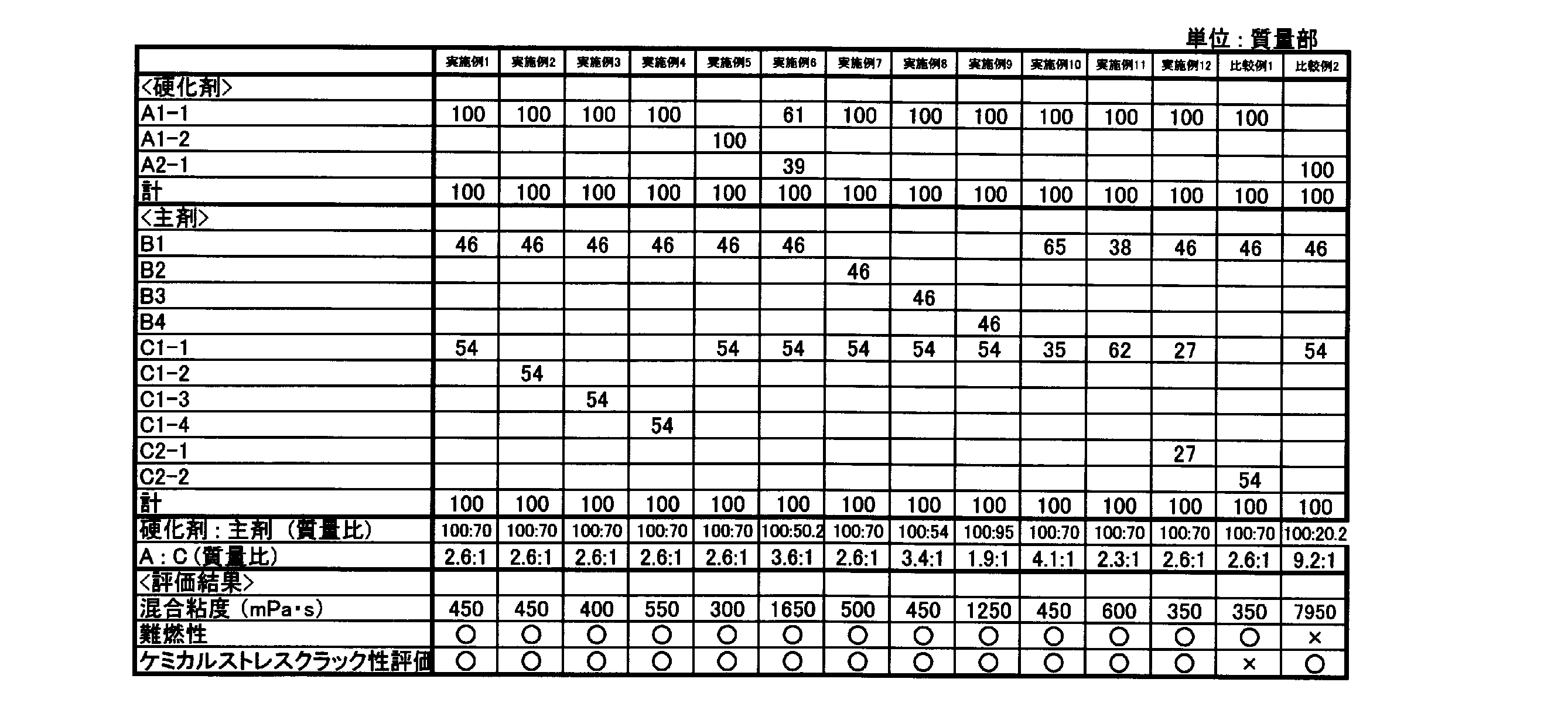
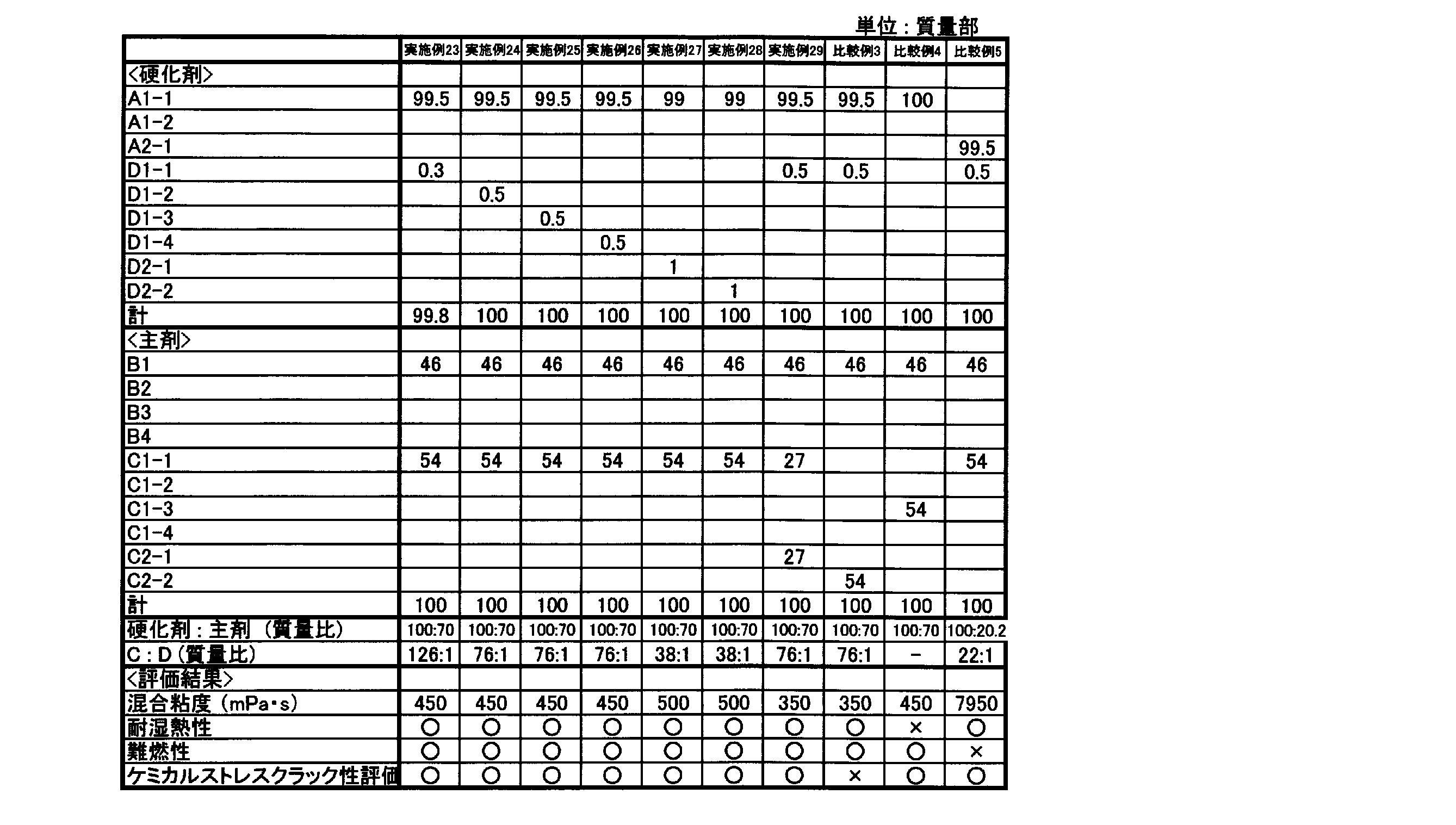
表1~表3に示す配合により、各実施例及び各比較例のポリウレタン樹脂形成性組成物の主剤および硬化剤を調製した。調製した硬化剤および主剤を、混合比100/70(重量比。NCO/OH=0.8)で合計量100gとなる量を25℃にて混合機(商品名:あわとり練太郎、シンキー社製)を用いて2000rpmで1分間混合することにより、各実施例のポリウレタン樹脂形成性組成物を得た。
表1~表3に示す配合により、各実施例及び各比較例のポリウレタン樹脂形成性組成物の主剤および硬化剤を調製した。調製した硬化剤および主剤を、混合比100/70(重量比。NCO/OH=0.8)で合計量100gとなる量を25℃にて混合機(商品名:あわとり練太郎、シンキー社製)を用いて2000rpmで1分間混合することにより、各実施例のポリウレタン樹脂形成性組成物を得た。

<評価方法>
(混合粘度)
得られたポリウレタン樹脂形成性組成物を25℃に調整し、混合開始から3分後の粘度をBM型粘度計により測定した。
(混合粘度)
得られたポリウレタン樹脂形成性組成物を25℃に調整し、混合開始から3分後の粘度をBM型粘度計により測定した。
(耐湿熱性)
1.試験片の作成
上記ポリウレタン形成性樹脂組成物を5cm×5cm、厚み1cmの金型に流し込み、80℃で16時間養生した後、これを脱型することにより、耐湿熱性評価用の試験片を作成した。
2.耐湿熱性の評価
試験片を85℃×85%RH×600時間処理後、硬度(タイプA)をJIS K6253で測定し、下記の通り評価した。
○:硬度typeA10以上
×:硬度typeA10未満
1.試験片の作成
上記ポリウレタン形成性樹脂組成物を5cm×5cm、厚み1cmの金型に流し込み、80℃で16時間養生した後、これを脱型することにより、耐湿熱性評価用の試験片を作成した。
2.耐湿熱性の評価
試験片を85℃×85%RH×600時間処理後、硬度(タイプA)をJIS K6253で測定し、下記の通り評価した。
○:硬度typeA10以上
×:硬度typeA10未満
(難燃性)
難燃性は、UL規格のUL94(プラスチック材料の難燃性)に従って測定し、下記の通り評価した。
○:UL94規格において、V-1またはV-0
×:UL94規格において、V-2
難燃性は、UL規格のUL94(プラスチック材料の難燃性)に従って測定し、下記の通り評価した。
○:UL94規格において、V-1またはV-0
×:UL94規格において、V-2
(ケミカルストレスクラック性評価)
ABS試験片(商品名:コウベポリシートABS、新神戸電機社製)を長軸100mm、短軸40mmの図1に示す1/4楕円治具に取り付け、実施例の樹脂シートを試験片表面に貼り付けしたあと、 25℃×60%RHの環境下に48時間放置し、亀裂が発生する位置Xを測定し、式1を用いて臨界ひずみ値を求めた。当該臨界ひずみ値に基づき、ケミカルストレスクラック性を下記のようにランク分けして評価した。

ε:臨界ひずみ値
a:楕円長軸 100mm
b:楕円短軸 40mm
X:亀裂発生点 試験片の長軸に対する固定端から亀裂発生点までの距離 mm
t:試験片厚み 2.0mm
<評価>
○(十分に実用可能):臨界ひずみ値(ε)0.7%以上
×(実用不可):臨界ひずみ値(ε)0.7%未満
ABS試験片(商品名:コウベポリシートABS、新神戸電機社製)を長軸100mm、短軸40mmの図1に示す1/4楕円治具に取り付け、実施例の樹脂シートを試験片表面に貼り付けしたあと、 25℃×60%RHの環境下に48時間放置し、亀裂が発生する位置Xを測定し、式1を用いて臨界ひずみ値を求めた。当該臨界ひずみ値に基づき、ケミカルストレスクラック性を下記のようにランク分けして評価した。
a:楕円長軸 100mm
b:楕円短軸 40mm
X:亀裂発生点 試験片の長軸に対する固定端から亀裂発生点までの距離 mm
t:試験片厚み 2.0mm
<評価>
○(十分に実用可能):臨界ひずみ値(ε)0.7%以上
×(実用不可):臨界ひずみ値(ε)0.7%未満
<評価結果>
実施例1~12から分かるように、本発明のポリウレタン樹脂形成性組成物は、混合粘度が使用可能な範囲であり、また、難燃性、作業性に優れ、かつ樹脂ケースにケミカルストレスクラックが生じにくいことが分かる。一方、比較例1のように含リン化合物(C)が、前記一般式(1)で表される化合物(C1)を含有しない場合、ケミカルストレスクラックが生じやすい。比較例2のようにヒマシ油系ポリオール(A1)を含有しない系では、混合粘度が高く作業性に劣り、難燃性にも劣ることが分かる。
実施例1~12から分かるように、本発明のポリウレタン樹脂形成性組成物は、混合粘度が使用可能な範囲であり、また、難燃性、作業性に優れ、かつ樹脂ケースにケミカルストレスクラックが生じにくいことが分かる。一方、比較例1のように含リン化合物(C)が、前記一般式(1)で表される化合物(C1)を含有しない場合、ケミカルストレスクラックが生じやすい。比較例2のようにヒマシ油系ポリオール(A1)を含有しない系では、混合粘度が高く作業性に劣り、難燃性にも劣ることが分かる。
実施例13~29から分かるように、本発明のポリウレタン樹脂形成性組成物は、混合粘度が使用可能な範囲であり、また、難燃性、耐湿熱性、作業性に優れ、かつ樹脂ケースにケミカルストレスクラックが生じにくいことが分かる。一方、比較例3のように含リン化合物(C)が、前記一般式(1)で表される化合物(C1)を含有しない場合、ケミカルストレスクラック性が生じやすい。比較例4のようにイオン性化合物捕捉剤(D)を含有しない系では、耐湿熱性が劣ることが分かる。比較例5のようにヒマシ油系ポリオール(A1)を含有しない系では、混合粘度が高く作業性に劣り、難燃性にも劣ることが分かる。
本発明のポリウレタン樹脂形成性組成物を硬化して得られるポリウレタン樹脂は、電気電子部品に好適に使用することができる。さらに耐湿熱性を有する態様においては、発熱を伴う電気電子部品に好適に使用することができる。このような電気電子部品としては、トランスコイル、チョークコイルおよびリアクトルコイルなどの変圧器や機器制御基板が挙げられる。本発明のポリウレタン樹脂を使用した電気電子部品は、電気洗濯機、便座、湯沸し器、浄水器、風呂、食器洗浄機、太陽光パネル、電動工具、自動車、バイクなどに使用できる。また、本発明のポリウレタン樹脂形成性組成物を用いれば、硬化して得られるポリウレタン樹脂は樹脂ケースにケミカルストレスクラックが生じにくいため、特に、樹脂ケース材が使用される電気電子部品分野に好適に使用できる。
Claims (8)
- 水酸基含有化合物(A)、イソシアネート基含有化合物(B)および含リン化合物(C)を含有するポリウレタン樹脂組成物(X)であって、
前記水酸基含有化合物が、ひまし油系ポリオール(A1)を含有し、
前記含リン化合物(C)が、下記一般式(1)

(式中、R1は炭素数6~30の芳香環を有する炭化水素基、R2は同一または異なる炭素数6~15のアリール基、nは1~3である。)で表される化合物(C1)を含有する、ポリウレタン樹脂形成性組成物。 - 前記水酸基含有化合物(A)と前記含リン化合物(C)の質量比が(A):(C)=0.5~5.0:1である請求項1記載のポリウレタン樹脂形成性組成物。
- さらにイオン性化合物捕捉剤(D)を含有するポリウレタン樹脂組成物(X)を含有する請求項1記載のポリウレタン樹脂形成性組成物。
- 前記イオン性化合物捕捉剤(D)が、アルカリ土類金属水酸化物、酸化物、炭酸塩およびポリカルボジイミドからなる群より選ばれる1種以上である請求項3記載のポリウレタン樹脂形成性組成物。
- 前記含リン化合物(C)とアルカリ土類金属水酸化物、酸化物及び炭酸塩からなる群より選ばれる1種以上(D1)の質量比が(C):(D1)=30~230:1である請求項3または4記載のポリウレタン樹脂形成性組成物。
- 前記含リン化合物(C)とポリカルボジイミド(D2)の質量比が(C):(D2)=15~115:1である請求項3または4記載のポリウレタン樹脂形成性組成物。
- 電気電子部品用であることを特徴とする請求項1~6記載のポリウレタン樹脂形成性組成物。
- 請求項1~7記載のポリウレタン樹脂形成性組成物を硬化して得られるポリウレタン樹脂。
Applications Claiming Priority (4)
| Application Number | Priority Date | Filing Date | Title |
|---|---|---|---|
| JP2015-192361 | 2015-09-30 | ||
| JP2015-192360 | 2015-09-30 | ||
| JP2015192360A JP6653949B2 (ja) | 2015-09-30 | 2015-09-30 | ポリウレタン樹脂形成性組成物およびポリウレタン樹脂 |
| JP2015192361A JP6621633B2 (ja) | 2015-09-30 | 2015-09-30 | ポリウレタン樹脂形成性組成物およびポリウレタン樹脂 |
Publications (1)
| Publication Number | Publication Date |
|---|---|
| WO2017056766A1 true WO2017056766A1 (ja) | 2017-04-06 |
Family
ID=58423161
Family Applications (1)
| Application Number | Title | Priority Date | Filing Date |
|---|---|---|---|
| PCT/JP2016/074003 Ceased WO2017056766A1 (ja) | 2015-09-30 | 2016-08-17 | ポリウレタン樹脂形成性組成物およびポリウレタン樹脂 |
Country Status (1)
| Country | Link |
|---|---|
| WO (1) | WO2017056766A1 (ja) |
Citations (7)
| Publication number | Priority date | Publication date | Assignee | Title |
|---|---|---|---|---|
| JPH02228315A (ja) * | 1989-03-01 | 1990-09-11 | Hitachi Chem Co Ltd | ウレタン樹脂組成物 |
| JPH07206962A (ja) * | 1994-01-21 | 1995-08-08 | Asahi Glass Co Ltd | 軟質ポリウレタンフォームの製造方法 |
| JP2003155321A (ja) * | 2001-09-10 | 2003-05-27 | Toyo Ink Mfg Co Ltd | ウレタン樹脂組成物 |
| JP2003221425A (ja) * | 2002-01-31 | 2003-08-05 | Sanyo Chem Ind Ltd | ポリウレタンフォームの製造方法 |
| JP2006307092A (ja) * | 2005-04-28 | 2006-11-09 | Nhk Spring Co Ltd | ポリウレタン発泡体からなる止水材 |
| JP2012201800A (ja) * | 2011-03-25 | 2012-10-22 | Dai Ichi Kogyo Seiyaku Co Ltd | ポリオール組成物及びポリウレタン樹脂 |
| WO2015104918A1 (ja) * | 2014-01-10 | 2015-07-16 | 第一工業製薬株式会社 | ポリウレタン樹脂組成物 |
-
2016
- 2016-08-17 WO PCT/JP2016/074003 patent/WO2017056766A1/ja not_active Ceased
Patent Citations (7)
| Publication number | Priority date | Publication date | Assignee | Title |
|---|---|---|---|---|
| JPH02228315A (ja) * | 1989-03-01 | 1990-09-11 | Hitachi Chem Co Ltd | ウレタン樹脂組成物 |
| JPH07206962A (ja) * | 1994-01-21 | 1995-08-08 | Asahi Glass Co Ltd | 軟質ポリウレタンフォームの製造方法 |
| JP2003155321A (ja) * | 2001-09-10 | 2003-05-27 | Toyo Ink Mfg Co Ltd | ウレタン樹脂組成物 |
| JP2003221425A (ja) * | 2002-01-31 | 2003-08-05 | Sanyo Chem Ind Ltd | ポリウレタンフォームの製造方法 |
| JP2006307092A (ja) * | 2005-04-28 | 2006-11-09 | Nhk Spring Co Ltd | ポリウレタン発泡体からなる止水材 |
| JP2012201800A (ja) * | 2011-03-25 | 2012-10-22 | Dai Ichi Kogyo Seiyaku Co Ltd | ポリオール組成物及びポリウレタン樹脂 |
| WO2015104918A1 (ja) * | 2014-01-10 | 2015-07-16 | 第一工業製薬株式会社 | ポリウレタン樹脂組成物 |
Similar Documents
| Publication | Publication Date | Title |
|---|---|---|
| JP5644116B2 (ja) | 高難燃性ポリウレタンフォーム | |
| JP5568187B1 (ja) | ポリウレタン樹脂組成物 | |
| JP5550161B1 (ja) | ポリウレタン樹脂組成物 | |
| JP5644189B2 (ja) | 高難燃性ポリウレタンフォーム | |
| JP2011512449A (ja) | ハロゲン非含有難燃性tpu | |
| JP6286085B1 (ja) | ポリウレタン樹脂組成物および封止物 | |
| JP6990999B2 (ja) | ポリウレタン樹脂組成物、封止物、ポリオール組成物およびイソシアネート組成物 | |
| JP5854534B2 (ja) | ポリウレタン樹脂組成物 | |
| JP2021178922A (ja) | ウレタン樹脂組成物及びその硬化物 | |
| JP2015089941A (ja) | ポリウレタン樹脂組成物 | |
| JP5854533B2 (ja) | ポリウレタン樹脂組成物 | |
| JP6653949B2 (ja) | ポリウレタン樹脂形成性組成物およびポリウレタン樹脂 | |
| JP5787425B2 (ja) | ポリウレタン樹脂 | |
| JP5282214B1 (ja) | 難燃性樹脂組成物 | |
| TW201134925A (en) | Migration-free, halogen-free, flame retardant thermoplastic polyurethane compositions | |
| WO2014038595A1 (ja) | 非ハロゲン系難燃性樹脂組成物および成形体 | |
| WO2016009716A1 (ja) | ポリウレタン樹脂組成物 | |
| JP2018172631A (ja) | ポリウレタン樹脂組成物および封止物 | |
| JP6621633B2 (ja) | ポリウレタン樹脂形成性組成物およびポリウレタン樹脂 | |
| WO2017056766A1 (ja) | ポリウレタン樹脂形成性組成物およびポリウレタン樹脂 | |
| JP7075735B2 (ja) | 樹脂組成物および樹脂製造用組成物 | |
| JP2011052104A (ja) | 高難燃性ポリウレタンフォーム | |
| JP6482208B2 (ja) | ポリウレタンフォーム | |
| CN1639247A (zh) | 用于聚氨酯泡沫的不含卤素的磷酸酯抗焦添加剂 |
Legal Events
| Date | Code | Title | Description |
|---|---|---|---|
| 121 | Ep: the epo has been informed by wipo that ep was designated in this application |
Ref document number: 16850942 Country of ref document: EP Kind code of ref document: A1 |
|
| NENP | Non-entry into the national phase |
Ref country code: DE |
|
| 122 | Ep: pct application non-entry in european phase |
Ref document number: 16850942 Country of ref document: EP Kind code of ref document: A1 |