WO2017038760A1 - 選択的な染色体タンパク質のアシル化を行うための人工触媒システム - Google Patents
選択的な染色体タンパク質のアシル化を行うための人工触媒システム Download PDFInfo
- Publication number
- WO2017038760A1 WO2017038760A1 PCT/JP2016/075183 JP2016075183W WO2017038760A1 WO 2017038760 A1 WO2017038760 A1 WO 2017038760A1 JP 2016075183 W JP2016075183 W JP 2016075183W WO 2017038760 A1 WO2017038760 A1 WO 2017038760A1
- Authority
- WO
- WIPO (PCT)
- Prior art keywords
- catalyst
- acylation
- target
- dsh
- binding
- Prior art date
- Legal status (The legal status is an assumption and is not a legal conclusion. Google has not performed a legal analysis and makes no representation as to the accuracy of the status listed.)
- Ceased
Links
Images





Classifications
-
- C—CHEMISTRY; METALLURGY
- C07—ORGANIC CHEMISTRY
- C07D—HETEROCYCLIC COMPOUNDS
- C07D401/00—Heterocyclic compounds containing two or more hetero rings, having nitrogen atoms as the only ring hetero atoms, at least one ring being a six-membered ring with only one nitrogen atom
- C07D401/14—Heterocyclic compounds containing two or more hetero rings, having nitrogen atoms as the only ring hetero atoms, at least one ring being a six-membered ring with only one nitrogen atom containing three or more hetero rings
-
- A—HUMAN NECESSITIES
- A61—MEDICAL OR VETERINARY SCIENCE; HYGIENE
- A61K—PREPARATIONS FOR MEDICAL, DENTAL OR TOILETRY PURPOSES
- A61K31/00—Medicinal preparations containing organic active ingredients
- A61K31/33—Heterocyclic compounds
- A61K31/395—Heterocyclic compounds having nitrogen as a ring hetero atom, e.g. guanethidine or rifamycins
- A61K31/435—Heterocyclic compounds having nitrogen as a ring hetero atom, e.g. guanethidine or rifamycins having six-membered rings with one nitrogen as the only ring hetero atom
- A61K31/44—Non condensed pyridines; Hydrogenated derivatives thereof
- A61K31/4427—Non condensed pyridines; Hydrogenated derivatives thereof containing further heterocyclic ring systems
- A61K31/4439—Non condensed pyridines; Hydrogenated derivatives thereof containing further heterocyclic ring systems containing a five-membered ring with nitrogen as a ring hetero atom, e.g. omeprazole
-
- A—HUMAN NECESSITIES
- A61—MEDICAL OR VETERINARY SCIENCE; HYGIENE
- A61K—PREPARATIONS FOR MEDICAL, DENTAL OR TOILETRY PURPOSES
- A61K45/00—Medicinal preparations containing active ingredients not provided for in groups A61K31/00 - A61K41/00
- A61K45/06—Mixtures of active ingredients without chemical characterisation, e.g. antiphlogistics and cardiaca
-
- A—HUMAN NECESSITIES
- A61—MEDICAL OR VETERINARY SCIENCE; HYGIENE
- A61P—SPECIFIC THERAPEUTIC ACTIVITY OF CHEMICAL COMPOUNDS OR MEDICINAL PREPARATIONS
- A61P35/00—Antineoplastic agents
-
- C—CHEMISTRY; METALLURGY
- C07—ORGANIC CHEMISTRY
- C07K—PEPTIDES
- C07K1/00—General methods for the preparation of peptides, i.e. processes for the organic chemical preparation of peptides or proteins of any length
- C07K1/13—Labelling of peptides
-
- A—HUMAN NECESSITIES
- A61—MEDICAL OR VETERINARY SCIENCE; HYGIENE
- A61K—PREPARATIONS FOR MEDICAL, DENTAL OR TOILETRY PURPOSES
- A61K2300/00—Mixtures or combinations of active ingredients, wherein at least one active ingredient is fully defined in groups A61K31/00 - A61K41/00
-
- A—HUMAN NECESSITIES
- A61—MEDICAL OR VETERINARY SCIENCE; HYGIENE
- A61K—PREPARATIONS FOR MEDICAL, DENTAL OR TOILETRY PURPOSES
- A61K31/00—Medicinal preparations containing organic active ingredients
- A61K31/16—Amides, e.g. hydroxamic acids
Definitions
- the present invention relates to an artificial catalyst system that can be replaced with an acylation function in a living body, and more particularly, to an artificial catalyst system for selectively acylating chromosomal proteins.
- Protein post-translational modification in vivo plays a major role in biological function control. As post-translational modifications, there are various reactions such as methylation and phosphorylation. A typical example is histone acetylation. Histones are the main proteins that make up chromosomes. In addition to folding DNA and storing it in the nucleus, histones contain lysine residues that are acetylated by histone acetylases or by histone deacetylases. By being deacetylated, it is actively involved in the dynamic control of chromosome structure and associated gene transcription (Non-patent Document 1).
- Non-patent Document 2 a drug for cutaneous T-cell lymphoma
- Non-Patent Documents 4 to 9 acylation modifications other than acetylation in histones have been found: malonylation, succinylation, glutarylation, butyrylation, 2-hydroxyisobutyrylation, biotinylation, and these modifications are It has been suggested that it is related to structure and function (Non-Patent Documents 4 to 9).
- the cell is an integrated field of chemical reaction, and life activity is supported by the activity of an enzyme that is a kind of catalyst. Therefore, if an artificial catalyst system that can replace the enzyme function in the living body can be developed, it is possible to effectively treat the diseases caused by the enzyme deficiency or inactivation as described above. Therefore, the present invention aims to realize a medical treatment based on a new concept of “catalytic medical treatment” by developing an artificial catalytic system that can replace an in vivo enzyme function and introducing the system into a cell. To do.
- an object of the present invention is to provide an artificial catalyst system that can replace the acylation function in a living body.
- an object of the present invention is to provide an artificial catalyst system capable of selectively acylating chromosomal proteins.
- the present inventors first examined the selectivity of acetylation for cytoplasmic proteins for various acetylating agents. As a result, EG5-PTA and N-methoxydiacetamide (NMD) non-selectively acetylate many proteins, while acetyl-CoA, an acetyl group donor used by living organisms, and TEG- Ac was found not to cause non-selective acetylation (FIG. 1B).
- the present inventors have intensively studied a catalyst capable of activating acetyl CoA, and finally envision a mechanism for activating acetyl CoA using a novel catalyst DMAP-SH (hereinafter sometimes abbreviated as “DSH”).
- DSH novel catalyst
- Fig. 2 the thiol group introduced into DSH causes a thiol-thioester exchange reaction with the thioester group of acetyl CoA, so that DSH takes the acetyl group into the catalyst molecule and activates the acetyl group through an intramolecular reaction.
- the present inventors further acetylated the target site with high selectivity by introducing a molecule having binding property to a specific region on the chromosome into DSH and binding DSH to the peripheral region of the target site. I thought it might be possible.
- pyrrole-imidazole polyamide (Dervan, PB, Bioorganic & Medicinal Chemistry 2001, 9, 221-25-2235), which is a DNA sequence-specific recognition binding molecule, and LANA (Barbera, AJ et al.,), A histone protein-binding molecule. Science 2006, 311, and 856-861) were synthesized (respectively called “LANA-DSH” and “PIP-DSH”), and the feasibility of the above concept was verified using them.
- PIP pyrrole-imidazole polyamide
- the present invention provides a novel acyl-CoA activation catalyst having a binding property to a target acylation region (hereinafter referred to as “target acylation region-binding catalyst”), and the catalyst and acyl-CoA or a derivative thereof. More specifically, the following provides a highly selective chromosomal protein acylation system using a combination.
- a drug for acylating a chromosomal protein comprising a combination of the compound according to (1) and acyl CoA or a derivative thereof.
- a highly selective chromosomal protein acylation system using a combination of a target acylation region binding catalyst and acyl CoA or a derivative thereof is provided.
- the fact that the function of an enzyme that performs its function in the living body through interactions with other proteins, etc., could be replaced with such an artificial catalyst system is itself extremely innovative and surprising. It is to be done.
- the acetylation site can be freely selected at the amino acid residue level simply by changing the target acylation region binding molecule introduced into the catalyst.
- various acylations including acetylation and malonylation can be performed at the target site simply by changing the type of acyl CoA or derivative thereof to be combined while using the same catalyst. Therefore, it can be said that the artificial catalyst system of the present invention is a system having both high versatility and excellent practicality.
- the mechanism of action is essentially different from conventional drugs targeting enzymes in the living body.
- A is a photograph showing the result of detecting protein selective acetylation
- B is a photograph showing the result of detecting lysine residue selective acetylation. It is a figure which shows the outline
- the present invention provides a target acylation region binding catalyst, specifically, a compound having the following structure.
- the target acylation region-binding catalyst of the present invention is one component of the artificial catalyst system of the present invention, and can perform protein acylation with high selectivity in combination with acyl CoA or a derivative thereof.
- acylation means introduction of an acyl group into a functional group having a replaceable hydrogen atom.
- examples of acylation in the present invention include, but are not limited to, acetylation, malonylation, glutarylation, butyrylation, 2-hydroxyisobutyrylation, and biotinylation.
- the “target acylation region” means a target acylation site and its peripheral region.
- the “peripheral region” means a region that is close enough to the target acylation site to such an extent that an acylation reaction occurs at the target acylation site when the catalyst of the present invention is bound. Whether or not the synthesized catalyst has binding property in the peripheral region of the target acylation site can be evaluated by, for example, whether or not the synthesized catalyst can acylate the target acylation site by the method described in this Example. Good.
- the catalyst of the present invention is present in the peripheral region of the target acylation site even if it binds to chromosomal DNA existing in the peripheral region of the target acylation site. May bind to a chromosomal protein that binds to, or both.
- the target acylation region-binding catalyst of the present invention can introduce any molecule having binding properties to the target acylation region, a plurality of target acylation regions are set according to the structure of the molecule. You can also
- the linker is not particularly limited as long as it does not inhibit the ability to bind to the target acylation region in the synthesized target acylation region-binding catalyst and the activation ability of acyl CoA or a derivative thereof.
- PIP-DSH is an embodiment of the catalyst of the present invention that binds to chromosomal DNA.
- PIP is a DNA sequence-specific recognition-binding molecule, and can impart arbitrary base sequence specificity by appropriately arranging pyrrole and imidazole in the molecular structure. Therefore, the molecular design of PIP based on the base sequence on the chromosomal DNA existing in the peripheral region of the target acylation site is introduced into the catalyst of the present invention, whereby the acylation at the target acylation site is efficiently performed. It can be carried out.
- the 36th lysine residue (H3K36) and 56th lysine residue (H3K56) of histone H3 and the 77th lysine residue (H4K77) of histone H4 are acylated.
- other lysine residues can be acylated by appropriately changing the arrangement of pyrrole and imidazole in PIP.
- LANA-DSH is an embodiment of the catalyst of the present invention that binds to chromosomal proteins.
- LANA is a histone protein-binding molecule, and its N-terminal region binds to the H2A-H2B dimer of chromatin ( Figure 7). Therefore, by introducing LANA into the catalyst of the present invention, the acylation site existing around the binding site, particularly the 120th lysine residue (H2BK120) of histone H2B can be acylated.
- the molecule having binding properties to the target acylation region may be, for example, peptide nucleic acid (PNA), aptamer, or CRISPR-Cas9 system guide RNA.
- PNA peptide nucleic acid
- aptamer aptamer
- CRISPR-Cas9 system guide RNA RNA sequences
- PNA peptide nucleic acid
- Aptamers are DNA or RNA strands that have a tertiary structure that binds to the target, and DNA aptamers that bind to histone tails have been reported (Hanyang Yu, et al., ChemBioChem 2011, 12, 2659-2666. ).
- the guide RNA of the CRISPR-Cas9 system binds to the target in a DNA sequence-specific manner by forming a complementary strand base pair with the target DNA (Hsu P.D. et al., Cell 2014, 157, 1262-1278).
- various sites in the chromosomal protein can be targeted for acylation.
- the introduced thiol group causes a thiol-thioester exchange reaction with the thioester group of acetyl CoA, thereby incorporating the acetyl group into the catalyst molecule, and through the intramolecular reaction, the acetyl group Is activated ( Figure 2).
- acetyl group Is activated ( Figure 2).
- FIG. 9 various acyl-CoAs other than acetyl-CoA can be activated (FIG. 9).
- chromosomal proteins can be acylated by a combination of a target acylation region binding catalyst and acyl CoA or a derivative thereof. Accordingly, the present invention provides an agent for acylating a chromosomal protein comprising a combination of the above target acylation region binding catalyst and acyl CoA or a derivative thereof. The present invention also provides a method for acylating a chromosomal protein using the combination.
- acyl CoA derivative refers to a compound in which a part of the acyl CoA structure is modified and activated by a target acylation region-binding catalyst to function as an acyl group donor.
- a derivative of acyl-CoA typically has the following structure:
- R ′′ and R ′ ′′ represent an arbitrary substituent.
- R ′′ is a substituent constituting an acyl group, and may be appropriately selected according to the target acylation type.
- R ′ ′′ is not particularly limited as long as it does not inhibit the compound from functioning as an acyl group donor by being activated by the target acylation region binding catalyst.
- acyl CoA derivative (acetyl CoA derivative) used in this example is shown below.
- Chrosomal proteins to be acylated are mainly histones (eg, histones H3 and H4).
- the target acylation region-binding catalyst of the present invention can be theoretically designed according to the target acylation site, and can have binding specificity at various sites on the chromosome. Therefore, it can also be used for the purpose of acylating chromosomal proteins other than histones.
- Acylation of lysine residues of chromosomal proteins can be evaluated, for example, by Western blotting using an anti-acylated lysine antibody (see “Western blotting” in “Materials and Methods”). .
- an antibody specific for the specific lysine residue that has been acylated may be used.
- the agent of the present invention can be used as a reagent for acylating chromosomal proteins and as a medicine for treating diseases caused by a decrease in chromosomal protein acylation.
- the “disease caused by reduced chromosomal protein acylation” is preferably cancer. Since endogenous histone acetylase is inactivated in certain types of B-cell lymphoma, it is feared that treatment with a histone deacetylase inhibitor cannot be expected to increase acetylation (Pasqualucci, L. et al., Nature 2011, 471, 189-195). According to the agent of the present invention, even when the endogenous histone acetylase is inactivated, its function can be supplemented, and a medicinal effect that cannot be achieved by a conventional histone deacetylase inhibitor is exhibited. be able to.
- the drug of the present invention may be used in combination with other anticancer agents and other cancer treatment methods (for example, radiation therapy, immunotherapy).
- Histone acetylation has been suggested to increase the degree of DNA exposure by relaxing the chromatin structure, increasing the sensitivity of chromosomal DNA to DNA damaging agents and radiation (Oleinick et al., Int. J. Radiat Biol. 1994, 66, 523-529, Gorisch SM, et al., J Cell Sci 2005, 118, 5825-5834, Camphausen K, et al. Int J Cancer 2005, 114, 380-366, Karagiannis TC & El -Osta A.
- the agents of the present invention may be combined with auxiliary moieties that enhance useful therapeutic properties.
- Typical useful properties include, for example, facilitating the delivery of the compound to the target area (e.g., tumor), sustaining the therapeutic concentration of the compound in the target area, and the pharmacokinetic and pharmacodynamic properties of the compound. Modifying or improving the therapeutic index or safety profile of the compound.
- the target acylation region binding catalyst and acyl CoA or a derivative thereof which are active ingredients
- the agent of the present invention includes a combination of a target acylation region-binding catalyst and acyl CoA or a derivative thereof.
- a single agent containing both a target acylation region-binding catalyst and acyl CoA or a derivative thereof as active ingredients This means that it may be in the form of a combination agent of a preparation containing a target acylation region binding catalyst as an active ingredient and a preparation containing acyl CoA or a derivative thereof as an active ingredient.
- Examples of the pharmacologically acceptable carrier used in the formulation include sterilized water, physiological saline, vegetable oil, solvent, base, emulsifier, suspension, surfactant, stabilizer, flavoring agent, fragrance, Excipients, vehicles, preservatives, binders, diluents, tonicity agents, soothing agents, bulking agents, disintegrating agents, buffering agents, coating agents, lubricants, coloring agents, sweeteners, thickeners, Examples include, but are not limited to, flavoring agents, solubilizing agents, and other additives.
- the active ingredient can be in various forms such as tablets, powders, granules, capsules, and liquids depending on the purpose of treatment. It can also be administered in the form of a liposome delivery system.
- the liposome may be supplemented with the above-mentioned auxiliary moieties (for example, antibodies and ligands) that enhance therapeutically useful properties.
- the patient can be administered orally or parenterally.
- parenteral administration include intravenous administration, arterial administration, intramuscular administration, intrathoracic administration, intraperitoneal administration, and direct administration to a target site (for example, a tumor).
- the drug of the present invention is a concomitant drug
- the preparations may be administered at the same time, or may be administered with a time difference within a range that does not diminish the effect of the combination.
- the dose is not particularly limited as long as it is an amount effective for treating the target disease, and may be appropriately selected according to the patient's age, weight, symptom, health condition, disease progress and the like.
- the frequency of administration is not particularly limited and can be appropriately selected depending on the purpose.
- the dose per day may be administered once a day or divided into multiple doses. May be.
- the dose range of the active ingredient is usually about 0.01 mg / kg body weight to about 500 mg / kg body weight, preferably about 0.1 mg / kg body weight to about 100 mg per day. / kg body weight.
- it is preferably administered once a day or divided into 2 to 4 times, and repeated at appropriate intervals.
- the agent of the present invention when used as a reagent for acylation, in addition to the above active ingredients, if necessary, other components acceptable as a reagent, such as sterilized water, physiological saline, buffering agent, preservative, etc. Can be included.
- the reagent can be administered to a target (for example, a cell, a fraction thereof, a tissue, an experimental animal, etc.) according to the purpose to acylate a chromosomal protein.
- Cell fraction About 10 6 cells were removed from the culture dish by trypsin treatment, washed with PBS, and then the cell pellet was cooled.
- Cell lysis buffer 50 mM Tris (pH 7.5), 300 mM NaCl, 0.3% Triton X-100, The suspension was suspended with protease inhibitor cocktail and 1 mM PMSF, and left on ice for 30 minutes. After centrifugation (2 minutes at 4 ° C. and 1500 rpm), the supernatant was recovered as a cytoplasmic fraction.
- Acetylated-lysine antibody (# 9441, Cell Signaling), anti-acetyl histone H4 (Lys77) (ABE186, Millipore), anti-acetyl histone H2B (Lys120) (ab176430, Abcam), malonylated-lysine antibody (PTM-901, PTM) Biolabs), glutarylated-lysine antibody (PTM-1151, PTM Biolabs), butyrylated-lysine antibody (PTM-301, PTM Biolabs), 2-hydroisobutyrylated antibody (PTM-801, PTM Biolabs), streptavidin-HRP (# 3999S, Cell) Signaling).
- the reaction was performed with a secondary antibody (Anti-Rabbit IgG, HRP-linked, NA934V, GE).
- the PVDF membrane was treated with the chemiluminescence detection reagent Luminata Forte Western HRP Substrate (Millipore) and detected with ImageQuantLAS 4000 (GE healthcare life sciences).
- an aqueous ammonium bicarbonate solution (0.1 M, 20 ⁇ L) is added, and a mixture of propionic anhydride and methanol (1: 3, 20 ⁇ L) prepared immediately before is added thereto, followed by aqueous ammonia ( 15 ⁇ L) was added and allowed to stand at room temperature for 30 minutes. After drying with a centrifugal evaporator for 75 minutes, it was treated with a digestive enzyme.
- trypsin An aqueous ammonium bicarbonate solution (0.1 M, 50 ⁇ L) and trypsin (1 ⁇ g) were added and reacted at 37 ° C. for 21 hours.
- chymotrypsin 100 mM Tris-HCl, 10 mM CaCl 2 (50 ⁇ L, pH 8.0) and chymotrypsin (8 ⁇ g) were added and reacted at 25 ° C. for 21 hours.
- Precursor ions were specified, and 2 to 4 MS / MS fragment ions with the strongest intensity were selected for each precursor ion. Ion extraction ( ⁇ 0.5 Da) was performed with the designated precursor ions and MS / MS fragment ions, and the yield was calculated according to the following equation. It was performed on all selected MS / MS fragments and their average was determined as the final yield.
- Yield (%) [A / A + P] ⁇ 100 (Here, A indicates the peak area of the acetylated peptide, and P indicates the peak area of the propionylated peptide) If one peptide fragment contains 3 lysines, the yield of central lysine is [Yield in which acetylation proceeded to either of the two end lysines-yield of the endmost lysine] As calculated.
- Precursor ions and fragment ions used are as follows.
- Method B For the chromatogram obtained by performing measurement in Information Dependent Acquisition Mode, the yield was determined according to the following formula from the peak area obtained by ion extraction ( ⁇ 0.5 Da) by specifying the precursor ion.
- Methyl 3- (methyl (2-((tritylthio) methyl) pyridin-4-yl) amino) propanoate (7) Compound 6 (922 mg, 3.80 mmol) was dissolved in methylene chloride (19.0 ml), TrtSH (1.58 g, 5.72 mmol) and DBU (0.852 ml, 5.70 mmol) were added, and the mixture was stirred at room temperature for 10 hours.
- PIP-amine (9) HATU, iPr 2 NEt as a condensing agent, 1-Methyl-1H-imidazole-2-carboxylic acid, 4-Amino-1-methyl-1H-pyrrole-2-carboxylic acid, 4-[(9-Fluorenylmethoxycarbonyl) amino] butanoic
- acid as a building block, the PIP chain was extended on 2-Chlorotrityl chloride resin (100 mg, 1.3 mmol / g, 0.133 mmol) according to the usual Fmoc-peptide solid phase synthesis method.
- LANA-DSH (2) H-GMRLRSGRSTG- was synthesized on Rink-Amide-AM resin (75.3 mg, 0.73 mmol / g, 0.055 mmol) according to the usual Fmoc-peptide solid phase synthesis method using DIC and HOBt as condensing agents.
- Protected LANA-DSH was synthesized in a resin form by condensing compound 8 at the N-terminus using HATU, iPr 2 NEt.
- FIG. 1A Several acetylating agents (FIG. 1A) were mixed with the cytoplasmic fraction obtained from living cells and detected by Western blot using an acetylated lysine antibody. As a result, EG5-PTA and NMD non-selectively acetylated many proteins, while acetyl CoA, which is an acetyl group donor used by living organisms, and TEG-Ac, which is an analog thereof, are not selected. Was found not to cause general acetylation (FIG. 1B).
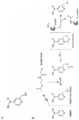
- Fig. 2A shows the structure of the newly developed DMAP-SH (DSH) catalyst
- Fig. 2B shows the assumed acetyl-CoA activation mechanism.
- DMAP cannot activate acetyl-CoA
- the new catalyst DMAP-SH incorporates a thiol-thioester exchange reaction between the newly introduced thiol group and the thioester group of acetyl-CoA.
- the acetyl group is activated through the reaction.
- the target protein can be acetylated with high selectivity by selecting an appropriate R group.
- LANA is known to bind to the H2A-H2B dimer (Barbera, A. J. et al., Science 2006, 311, 856-861), but H2BK120 acetylated with this catalyst system is LANA. It was positioned near the catalytic position predicted from the co-crystal structure of nucleosome and nucleosome (Fig. 7). Similarly, the PIP-DSH DNA binding site predicted from the sequence of PIP used and the crystal structure of the nucleosome (Vasudevan, D., Chua, EYD & Davey, CA, Journal of Molecular Biology 2010, 403, 1-10) H3K56 and H4K77 with advanced acetylation were positioned nearby (Fig. 8). These results indicate that by introducing an appropriate ligand into the developed catalyst, the target lysine residue can be acetylated with high selectivity, that is, a structure-based logical design is possible. Is shown.
- PIP can freely select a target DNA sequence by designing its sequence appropriately. Therefore, lysine (Tropberger, P. & Schneider, R., Nature Structural & Molecular Biology 2013) located at the DNA-histone interaction site, which is known to have a significant effect on the structure of the nucleosome, by using PIP. , 20, 657-661) can be freely positioned and acetylated.
- the artificial catalyst system of the present invention can be selectively acylated only by changing the acyl group donor combined with the catalyst. Furthermore, acylation can be carried out with high selectivity by targeting various sites as targets only by changing the molecule having the binding property to the target acylation region to be introduced into the catalyst. Therefore, it can be said that the system has both high versatility and excellent practicality.
- the artificial catalyst system of the present invention based on the concept of catalytic medicine can be applied to various reactions involving enzymes in the living body.
- the disease when a deficiency or inactivation of an enzyme in a living body is involved in a specific disease, it is possible to treat the disease with an artificial catalyst system that substitutes for the function of the enzyme.
- the invention can contribute widely to the medical field.
- An artificial catalyst system using a combination of a target acylation region-binding catalyst and acyl CoA or a derivative thereof can be used, for example, for the treatment of diseases caused by decreased acetylation of chromosomal proteins.
- Deacetylase inhibitors have little utility, and have high utility value in diseases caused by inactivation of histone acetylase.
- the present invention has succeeded in establishing a new artificial catalyst system based on the concept of catalytic medicine, and opens the way to new medicine that is essentially different from the conventional medical concept of functional regulation of endogenous enzymes. is there.
Landscapes
- Chemical & Material Sciences (AREA)
- Health & Medical Sciences (AREA)
- Organic Chemistry (AREA)
- General Health & Medical Sciences (AREA)
- Life Sciences & Earth Sciences (AREA)
- Medicinal Chemistry (AREA)
- Pharmacology & Pharmacy (AREA)
- Veterinary Medicine (AREA)
- Public Health (AREA)
- Animal Behavior & Ethology (AREA)
- Epidemiology (AREA)
- Biochemistry (AREA)
- General Chemical & Material Sciences (AREA)
- Genetics & Genomics (AREA)
- Proteomics, Peptides & Aminoacids (AREA)
- Molecular Biology (AREA)
- Biophysics (AREA)
- Chemical Kinetics & Catalysis (AREA)
- Analytical Chemistry (AREA)
- Nuclear Medicine, Radiotherapy & Molecular Imaging (AREA)
- Peptides Or Proteins (AREA)
- Medicines That Contain Protein Lipid Enzymes And Other Medicines (AREA)
- Pyridine Compounds (AREA)
- Plural Heterocyclic Compounds (AREA)
- Pharmaceuticals Containing Other Organic And Inorganic Compounds (AREA)
Abstract
下記構造を有する化合物は標的アシル化領域結合性を有するアシルCoA活性化触媒であり、アシルCoA若しくはその誘導体との組み合わせを利用することで、高い選択性で染色体タンパク質をアシル化できる人工触媒システムを確立することに成功した。 (Rは、標的アシル化領域への結合性を有する任意の分子を示す。)
Description
本発明は、生体内のアシル化機能と置き換えられる人工触媒システムに関し、特に、選択的な染色体タンパク質のアシル化を行うための人工触媒システムに関する。
生体内におけるタンパク質翻訳後修飾は生体機能制御において大きな役割を担っている。翻訳後修飾にはメチル化、リン酸化など種々の反応があるが、代表的な例としてヒストンのアセチル化がある。ヒストンは、染色体を構成する主要なタンパク質であり、DNAを折りたたんで核内に収納する役割を持つだけでなく、ヒストン中のリジン残基がヒストンアセチル化酵素によるアセチル化やヒストン脱アセチル化酵素による脱アセチル化を受けることで、染色体構造とそれに伴う遺伝子転写の動的制御に積極的に関与している(非特許文献1)。
ヒストンのアセチル化の亢進が遺伝子転写の亢進につながることから、ヒストン脱アセチル化酵素を阻害することによりがん抑制遺伝子の転写を促進する抗がん剤の開発が行われてきている。その代表例として、皮膚T細胞リンパ腫の薬剤であるZolinzaが挙げられる(非特許文献2)。
疾病の治療を目的とした低分子医薬の多くは、生体が内在的に持つ酵素の機能調節、特に阻害によってその薬効を発揮する。しかしながら、このような作用を持つ低分子医薬を用いた手法では、酵素自体の欠損や失活が疾病の原因である場合、その治療効果が期待できないという問題がある。例えば、ある種のB細胞リンパ腫では内在性ヒストンアセチル化酵素が失活しているため、ヒストン脱アセチル化酵素阻害剤による処置では、アセチル化の亢進が期待できないことが危惧されている(非特許文献3)。
さらに、最近になり、ヒストンにおけるアセチル化以外のアシル化修飾として、マロニル化、スクシニル化、グルタリル化、ブチリル化、2-ヒドロキシイソブチリル化、ビオチニル化が見出され、これらの修飾がヒストンの構造や機能などに関係していることが示唆されている(非特許文献4~9)。
Brownell, J.E. et al., Cell 1996, 84, 843-851
Richon, V.M. et al., Proc. Natl. Acad. Sci. USA 1996, 93, 5705-5708
Pasqualucci, L. et al., Nature 2011, 471, 189-195
Xie, Z. et al., Mol Cell Proteomics. 2012 May;11(5), 100-107
Peng, C. et al., Molecular & Cellular Proteomics 2011, 10, M111.012658.
Tan, M.J. et al., Cell Metabolism 2014, 19, 605-617
Chen, Y. et al., Molecular & Cellular Proteomics 2007, 6, 812-819
Dai, L.Z. et al., Nature Chemical Biology 2014, 10, 365-370
Stanley, J.S., Griffin, J.B. & Zempleni, J., European Journal of Biochemistry 2001, 268, 5424-5429
細胞は統合された化学反応の場であり、生命活動は触媒の一種である酵素の活性によって支えられている。従って、仮に、生体内の酵素機能と置き換えられる人工触媒システムが開発できれば、上記のような酵素の欠損や失活に起因する疾患の治療を効果的に行うことが可能となる。そこで、本発明は、生体内の酵素機能と置き換えられる人工触媒システムを開発し、当該システムを細胞内に導入することにより、「触媒医療」という新たな概念に基づく医療を実現することを目的とする。
この「触媒医療」の一例として、本発明は、生体内のアシル化機能と置き換えられる人工触媒システムを提供することを目的とする。本発明は、特に、選択的な染色体タンパク質のアシル化を行うことが可能な人工触媒システムを提供することを目的とする。
本発明者らは、上記課題を解決すべく、まず、各種アセチル化剤について、細胞質タンパク質に対するアセチル化の選択性につき検討を行った。その結果、EG5-PTAやN-メトキシジアセトアミド(NMD)は多くのタンパク質を非選択的にアセチル化する一方、生体が用いているアセチル基供与体であるアセチルCoAやその類縁体であるTEG-Acは非選択的なアセチル化を引き起こさないことが判明した(図1B)。この事実は、仮に、アセチルCoAのような非選択的反応の抑えられた低反応性アセチル基供与体を活性化しうる触媒を開発できれば、高い選択性でアセチル化し得る人工触媒システムの構築が可能であることを意味する。
そこで、本発明者らは、アセチルCoAを活性化しうる触媒について鋭意検討を行い、遂に新規触媒DMAP-SH(以下、「DSH」と略すことがある)を用いたアセチルCoA活性化機構を構想するに至った(図2)。この機構においては、DSHに導入されたチオール基がアセチルCoAのチオエステル基とチオール-チオエステル交換反応を起こすことにより、DSHがアセチル基を触媒分子内に取り込み、分子内反応を経てアセチル基を活性化する。ここで、本発明者らは、さらに、DSHに染色体上の特定領域に結合性を有する分子を導入し、DSHを標的部位の周辺領域に結合させることにより、高い選択性で標的部位をアセチル化しうるのではないかと考えた。
そこで、DNA配列特異的認識結合分子であるピロールイミダゾールポリアミド(PIP)(Dervan, P.B., Bioorganic & Medicinal Chemistry 2001, 9, 2215-2235)とヒストンタンパク質結合分子であるLANA(Barbera, A.J. et al., Science 2006, 311, 856-861)を導入した触媒(それぞれ「LANA-DSH」、「PIP-DSH」と称する)を合成し、それらを用いて上記構想の実現性の検証を行った。
まずタンパク質選択性について評価した結果、LANA-DSHあるいはPIP-DSHを用いることでヒストン選択的にアセチル化できることが判明した(図3A)。アセチルCoAに代えて、アセチルCoAの一部を切り出した誘導体を用いて実験を行った場合でも、同様にヒストン選択的なアセチル化が認められた。
次に、ヒストン中のリジン残基間選択性について評価したところ、LANA-DSHにおいては特にヒストンH2Bの120番目のリジン残基(H2BK120)が、PIP-DSHにおいては特にヒストンH3の36番目のリジン残基(H3K36)および56番目のリジン残基(H3K56)およびヒストンH4の77番目のリジン残基(H4K77)がアセチル化されていることが判明した(図3B、5、6)。これらアセチル化部位は、X線結晶構造から導かれるヌクレオソーム上のLANAとPIPの結合部位の近傍であった(図7、8)。以上から、標的アセチル化領域に結合性を有する分子が導入されたDSHとアセチルCoAとを組み合わせることで、標的部位を高い選択性でアセチル化できることが実証された。
さらに、本発明者らは、上記触媒と組み合わせるアシル基供与体として、アセチルCoA以外の各種アシルCoAを用いて検証した結果、マロニル化、グルタリル化、ブチリル化、2-ヒドロキシイソブチリル化、ビオチニル化といったアセチル化以外の各種アシル化を選択的に行うことも可能であることを見出した(図9)。
すなわち、本発明は、標的アシル化領域への結合性を有する新規なアシルCoA活性化触媒(以下、「標的アシル化領域結合性触媒」と称する)、並びに当該触媒とアシルCoA若しくはその誘導体との組み合わせを利用した高選択性染色体タンパク質アシル化システムに関し、より詳しくは、以下を提供するものである。
(1)下記構造を有する化合物。

(Rは、標的アシル化領域への結合性を有する任意の分子を示す。)
(2)(1)に記載の化合物とアシルCoA若しくはその誘導体との組み合わせを含む、染色体タンパク質をアシル化するための薬剤。
(2)(1)に記載の化合物とアシルCoA若しくはその誘導体との組み合わせを含む、染色体タンパク質をアシル化するための薬剤。
本発明により、標的アシル化領域結合性触媒とアシルCoA若しくはその誘導体との組み合わせを用いた高選択性染色体タンパク質アシル化システムが提供された。生体内で他のタンパク質との相互作用などを通じて機能を発揮している酵素の機能を、このような人工的な触媒システムで置き換えることができたということは、それ自体、極めて画期的で驚くべきことである。
本発明の人工触媒システムにおいては、触媒に導入する標的アシル化領域結合性分子を変更するだけで、アミノ酸残基レベルでアセチル化部位を自由に選択することができる。また、同一の触媒を用いながら、組み合わせるアシルCoA若しくはその誘導体の種類を変更するだけで、標的部位において、アセチル化やマロニル化などを含む各種のアシル化を行うことができる。従って、本発明の人工触媒システムは、高い汎用性と優れた実用性をも兼ね備えたシステムであるといえる。
本発明の人工触媒システムにより誘導されるアシル化は、生体内の酵素に非依存的であることから、当該システムにより、生体内の酵素を標的とした従来の医薬品とは本質的に作用機序が異なる新たな医療を提供することができる。これにより、例えば、染色体タンパク質のアシル化の異常に起因する疾患の治療において、従来の医薬品では治療効果を発揮し得ない患者をも対象とした医療への途を切り開くことができる。
<標的アシル化領域結合性触媒>
本発明は、標的アシル化領域結合性触媒、具体的には、下記の構造を有する化合物を提供する。
本発明は、標的アシル化領域結合性触媒、具体的には、下記の構造を有する化合物を提供する。

(Rは、標的アシル化領域への結合性を有する任意の分子を示す。)
本発明の標的アシル化領域結合性触媒は、本発明の人工触媒システムの一つの構成要素であり、アシルCoA若しくはその誘導体との組み合わせで、高い選択性でタンパク質のアシル化を行うことができる。
本発明の標的アシル化領域結合性触媒は、本発明の人工触媒システムの一つの構成要素であり、アシルCoA若しくはその誘導体との組み合わせで、高い選択性でタンパク質のアシル化を行うことができる。
本発明において「アシル化」とは、置換可能な水素原子をもった官能基にアシル基を導入することを意味する。本発明におけるアシル化としては、例えば、アセチル化、マロニル化、グルタリル化、ブチリル化、2-ヒドロキシイソブチリル化、ビオチニル化が挙げられるが、これらに制限されない。
本発明において「標的アシル化領域」とは、標的アシル化部位およびその周辺領域を意味する。ここで「周辺領域」とは、本発明の触媒が結合した場合に標的アシル化部位においてアシル化反応が生じる程度に、標的アシル化部位との近接性を有する領域を意味する。合成した触媒が標的アシル化部位の周辺領域に結合性を有するか否かは、例えば、本実施例に記載の方法で、合成した触媒が標的アシル化部位をアシル化しうるか否かで評価すればよい。
標的アシル化部位が特定の染色体タンパク質内に存在する場合、本発明の触媒は、当該標的アシル化部位の周辺領域に存在する染色体DNAに結合しても、当該標的アシル化部位の周辺領域に存在する染色体タンパク質に結合しても、それら両方に結合してもよい。
本発明の標的アシル化領域結合性触媒には、標的アシル化領域への結合性を有する任意の分子を導入することができることから、当該分子の構造に応じて、標的アシル化領域を複数箇所設定することもできる。
標的アシル化領域への結合性を有する分子を、標的アシル化領域結合性触媒に導入する場合、リンカーを介して導入してもよい。リンカーとしては、合成される標的アシル化領域結合性触媒における標的アシル化領域への結合能とアシルCoA若しくはその誘導体の活性化能を阻害しない限り、特に制限はない。
本発明の標的アシル化領域結合性触媒の2つの例を以下に示す。

PIP-DSHは、染色体DNAに結合する本発明の触媒の一態様である。PIPは、DNA配列特異的認識結合分子であり、分子構造内にピロールとイミダゾールを適切に配置することによって、任意の塩基配列特異性を付与することが可能である。従って、標的アシル化部位の周辺領域に存在する染色体DNA上の塩基配列を基にPIPを分子設計して、本発明の触媒に導入することにより、当該標的アシル化部位におけるアシル化を効率的に行うことができる。本実施例において用いたPIP-DSHでは、特に、ヒストンH3の36番目のリジン残基(H3K36)および56番目のリジン残基(H3K56)およびヒストンH4の77番目のリジン残基(H4K77)がアシル化されたが、当業者であれば、PIP内のピロールとイミダゾールの配置を適宜変更することにより、他のリジン残基を標的としてアシル化しうることは理解されたい。
一方、LANA-DSHは、染色体タンパク質に結合する本発明の触媒の一態様である。LANAは、ヒストンタンパク質結合分子であり、そのN末端領域がクロマチンのH2A-H2Bダイマーと結合する(図7)。従って、本発明の触媒にLANAを導入することにより、上記結合部位の周辺に存在するアシル化部位、特にヒストンH2Bの120番目のリジン残基(H2BK120)をアシル化することができる。
標的アシル化領域への結合性を有する分子としては、上記以外にも、例えば、ペプチド核酸(PNA)、アプタマー、あるいはCRISPR-Cas9システムのガイドRNAなどの利用も考えられる。ペプチド核酸(PNA)は、DNAの塩基と相補鎖を形成してDNA配列特異的に結合する分子である(Hyrup B. & Nielsen P.E., Bioorganic & Medicinal Chemistry 1996, 1, 5-23)。アプタマーは、標的に結合するような3次構造を持ったDNAあるいはRNA鎖であり、ヒストンテイルに結合するDNAアプタマーが報告されている(Hanyang Yu, et al., ChemBioChem 2011, 12, 2659-2666)。CRISPR-Cas9システムのガイドRNAは、標的DNAと相補鎖塩基対を形成することで、DNA配列特異的に標的へと結合する(Hsu P.D. et al., Cell 2014, 157, 1262-1278)。本発明の触媒にこれらの分子を導入することで、染色体タンパク質における様々な部位をアシル化の標的とすることができる。
本発明の標的アシル化領域結合性触媒は、導入されたチオール基がアセチルCoAのチオエステル基とチオール-チオエステル交換反応を起こすことにより、アセチル基を触媒分子内に取り込み、分子内反応を経てアセチル基を活性化する(図2)。この活性化機構により、アセチルCoA以外の各種アシルCoAを活性化することもできる(図9)。
<組み合わせ剤>
本実施例において、標的アシル化領域結合性触媒とアシルCoA若しくはその誘導体との組み合わせにより、染色体タンパク質をアシル化できることが見出された。従って、本発明は、上記標的アシル化領域結合性触媒とアシルCoA若しくはその誘導体との組み合わせを含む、染色体タンパク質をアシル化するための薬剤を提供する。また、本発明は、当該組み合わせを用いる、染色体タンパク質をアシル化する方法を提供する。
本実施例において、標的アシル化領域結合性触媒とアシルCoA若しくはその誘導体との組み合わせにより、染色体タンパク質をアシル化できることが見出された。従って、本発明は、上記標的アシル化領域結合性触媒とアシルCoA若しくはその誘導体との組み合わせを含む、染色体タンパク質をアシル化するための薬剤を提供する。また、本発明は、当該組み合わせを用いる、染色体タンパク質をアシル化する方法を提供する。
ここで「アシルCoAの誘導体」とは、アシルCoAの構造の一部が修飾された化合物であって、標的アシル化領域結合性触媒により活性化されることによりアシル基供与体として機能する化合物を意味する。アシルCoAの誘導体は、典型的には、以下の構造を有する。
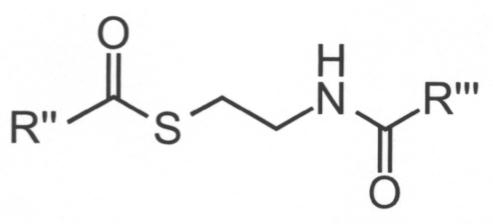
ここで、R''およびR'''は、任意の置換基を示す。R''は、アシル基を構成する置換基であり、目的とするアシル化の種類に応じて適宜選択すればよい。R'''としては、上記化合物が標的アシル化領域結合性触媒により活性化されることによりアシル基供与体として機能することを阻害しない限り、特に制限はない。
本実施例に用いたアシルCoA誘導体(アセチルCoA誘導体)の一例を以下に示す。

当該アセチルCoA誘導体が、アセチルCoAと同様に、アセチル基供与体として機能することが本実施例により証明されている。この事実は、アシル基供与体として機能する上でR'''の構造の自由度が高いことを示すものである。
アシル化される「染色体タンパク質」は、主としてヒストン(例えば、ヒストンH3およびH4)である。本発明の標的アシル化領域結合性触媒は、上記の通り、標的アシル化部位に応じて理論的な設計が可能であり、染色体上の様々な部位に結合特異性をもたせることができる。従って、ヒストン以外の染色体タンパク質のアシル化を目的とした利用も可能である。
染色体タンパク質のリジン残基のアシル化は、例えば、抗アシル化リジン抗体を用いたウェスタンブロッティング法により評価することが可能である(「材料と方法」における「ウエスタンブロッティング」の項を参照のこと)。特定のリジン残基(例えば、H3K56、H4K77)のアシル化を評価する場合には、アシル化された当該特定のリジン残基に特異的な抗体を用いればよい。
本発明の薬剤は、染色体タンパク質のアシル化のための試薬として、また、染色体タンパク質のアシル化の低下に起因する疾患などの治療のための医薬として用いることができる。
染色体タンパク質のアシル化(特にアセチル化)とがんとの関係が知られていることから、「染色体タンパク質のアシル化の低下に起因する疾患」は、好ましくはがんである。ある種のB細胞リンパ腫では内在性ヒストンアセチル化酵素が失活しているため、ヒストン脱アセチル化酵素阻害剤による処置では、アセチル化の亢進が期待できないことが危惧されている(Pasqualucci, L. et al., Nature 2011, 471, 189-195)。本発明の薬剤によれば、内在性ヒストンアセチル化酵素が失活している場合でも、その機能を補うことが可能であり、従来のヒストン脱アセチル化酵素阻害剤ではなし得ない薬効を発揮することができる。
また、本発明の薬剤は、他の抗がん剤や他のがん治療法(例えば、放射線療法、免疫療法)と併用してもよい。ヒストンのアセチル化がクロマチン構造を弛緩させることによりDNAの露出度を増大させ、DNA傷害性薬剤や放射線に対する染色体DNAの感受性を高めることが示唆されている(Oleinick et al., Int. J. Radiat. Biol. 1994, 66, 523-529、Gorisch SM, et al., J Cell Sci 2005, 118, 5825-5834、Camphausen K, et al. Int J Cancer 2005, 114, 380-366、Karagiannis TC & El-Osta A. Oncogene 2006, 25, 3885-3893、Kim MS, et al., Exp Cell Res 2005, 306, 94-102、Kim MS, et al., Cancer Res 2003, 63, 7291-7300、Piacentini P, et al., Virchows Arch 2006, 448, 797-804)。本発明の薬剤は、染色体タンパク質に作用して、標的部位のクロマチン構造を弛緩させることが考えられることから、DNAを標的とする薬剤(例えば、DNA傷害作用を有する抗がん剤)やDNAを標的とする治療法(例えば、放射線療法)と併用すれば、相乗効果も期待できる。
本発明の薬剤は、治療上の有用な特性を増進する補助部分と結合してもよい。代表的な有用な特性としては、例えば、標的領域(例えば、腫瘍)に対する化合物の送達を促進すること、標的領域において化合物の治療濃度を持続させること、化合物の薬物動態特性や薬力学的特性を改変すること、または化合物の治療指数または安全性プロフィールを改善すること、が挙げられる。
本発明の薬剤を医薬として用いる場合には、有効成分である標的アシル化領域結合性触媒およびアシルCoA若しくはその誘導体を、公知の製剤学的方法で製剤化することができる。本発明の薬剤が標的アシル化領域結合性触媒とアシルCoA若しくはその誘導体との「組み合わせを含む」とは、標的アシル化領域結合性触媒とアシルCoA若しくはその誘導体の双方を有効成分として含む単剤の形態であっても、標的アシル化領域結合性触媒を有効成分とする製剤とアシルCoA若しくはその誘導体を有効成分とする製剤との併用剤の形態であってもよいことを意味する。
製剤化において用いられる薬理学上許容される担体としては、例えば、滅菌水や生理食塩水、植物油、溶剤、基剤、乳化剤、懸濁剤、界面活性剤、安定剤、香味剤、芳香剤、賦形剤、ベヒクル、防腐剤、結合剤、希釈剤、等張化剤、無痛化剤、増量剤、崩壊剤、緩衝剤、コーティング剤、滑沢剤、着色剤、甘味剤、粘稠剤、矯味矯臭剤、溶解補助剤あるいはその他の添加剤などが挙げられるが、これらに制限されない。上記有効成分は、治療目的などに応じて、錠剤、散剤、顆粒剤、カプセル剤、液剤などの各種形態とすることができる。また、リポソーム送達系の形態で投与することもできる。当該リポソームには、治療上の有用な特性を増進する上記補助部分(例えば、抗体やリガンドなど)を付加することもできる。
患者への投与は、経口的な投与でも非経口的な投与でも可能である。非経口的な投与としては、例えば、静脈投与、動脈投与、筋肉内投与、胸腔内投与、腹腔内投与、標的部位(例えば、腫瘍)への直接投与などが挙げられる。本発明の薬剤が併用剤の場合には、各製剤は、同時に投与されてもよく、また、併用の効果を減殺しない範囲内で時間差をおいて投与されてもよい。
投与量は、目的の疾患を治療するのに有効な量であれば特に制限はなく、患者の年齢、体重、症状、健康状態、疾患の進行状況などに応じて、適宜選択すればよい。投与頻度としても、特に制限はなく、目的に応じて適宜選択することができ、例えば、1日あたりの投与量を、1日に1回で投与してもよいし、複数回に分けて投与してもよい。本発明の薬剤をヒトに投与する場合、有効成分の投与量の範囲は、1日当たり、通常、約0.01mg/kg体重~約500mg/kg体重、好ましくは、約0.1mg/kg体重~約100mg/kg体重である。ヒトに投与する場合、好ましくは、1日あたり1回、あるいは2~4回に分けて投与され、適当な間隔で繰り返すことが好ましい。
なお、本発明の薬剤をアシル化のための試薬として用いる場合、上記有効成分の他、必要に応じて、滅菌水や生理食塩水、緩衝剤、保存剤など、試薬として許容される他の成分を含むことができる。当該試薬は、目的に応じた対象(例えば、細胞やその分画物、組織、実験動物など)に投与して、染色体タンパク質をアシル化させることができる。
以下、実施例に基づいて本発明をより具体的に説明するが、本発明は以下の実施例に限定されるものではない。
[A.材料と方法]
1.細胞分画
約106個の細胞をトリプシン処理により培養ディッシュより剥がし、PBSで洗浄後、細胞ペレットを冷却したcell lysis buffer [50mM Tris(pH7.5), 300mM NaCl, 0.3% Triton X-100, protease inhibitor cocktail および1mM PMSF]で懸濁し、30分氷上に静置した。遠心(4℃, 1500rpmで2分間)後、上清を細胞質画分として回収した。
1.細胞分画
約106個の細胞をトリプシン処理により培養ディッシュより剥がし、PBSで洗浄後、細胞ペレットを冷却したcell lysis buffer [50mM Tris(pH7.5), 300mM NaCl, 0.3% Triton X-100, protease inhibitor cocktail および1mM PMSF]で懸濁し、30分氷上に静置した。遠心(4℃, 1500rpmで2分間)後、上清を細胞質画分として回収した。
2.ウエスタンブロッティング
タンパク質を4-20% SDS-PAGEゲルで分離し、PVDF膜に転写した後、TBSTに懸濁した5%スキムミルクによりブロッキングを行い、PVDF膜に1次抗体を反応させた。用いた1次抗体は以下の通りである。
タンパク質を4-20% SDS-PAGEゲルで分離し、PVDF膜に転写した後、TBSTに懸濁した5%スキムミルクによりブロッキングを行い、PVDF膜に1次抗体を反応させた。用いた1次抗体は以下の通りである。
Acetylated-lysine antibody(#9441, Cell Signaling), anti-acetyl histone H4(Lys77)(ABE186, Millipore), anti-acetyl histone H2B(Lys120)(ab176430, Abcam), malonylated-lysine antibody(PTM-901, PTM Biolabs), glutarylated-lysine antibody(PTM-1151, PTM Biolabs), butyrylated-lysine antibody(PTM-301, PTM Biolabs), 2-hydroisobutyrylated antibody(PTM-801, PTM Biolabs), streptavidin-HRP(#3999S, Cell Signaling)。
TBSTで洗浄後、2次抗体(Anti-Rabbit IgG, HRP-linked, NA934V, GE)と反応を行った。化学発光検出試薬Luminata Forte Western HRP Substrate(Millipore)によりPVDF膜を処理し、ImageQuantLAS 4000(GE healthcare life sciences)で検出を行った。
3.アセチル基供与体の反応性の比較
緩衝液(50mM HEPES, 150mM NaCl, 0.01% Triton, pH7.5)に細胞質画分(20%)とアセチル基供与体(1mM)を加え、室温で10時間反応させた後、抗アセチルリジン抗体を用いてウエスタンブロッティングを行った。
緩衝液(50mM HEPES, 150mM NaCl, 0.01% Triton, pH7.5)に細胞質画分(20%)とアセチル基供与体(1mM)を加え、室温で10時間反応させた後、抗アセチルリジン抗体を用いてウエスタンブロッティングを行った。
4.タンパク質およびリジン残基選択的アシル化反応
再構成ヌクレオソーム(33μg/mL 601 DNA)および細胞質画分(15%)を含む緩衝液(20mM Tris-HCl, pH7.5)に、Ligand-DSH(2~5μM), アシルCoA(1mM), TCEP(100μM)を加え、室温で5時間反応させた後、ウエスタンブロッティングを行った。
再構成ヌクレオソーム(33μg/mL 601 DNA)および細胞質画分(15%)を含む緩衝液(20mM Tris-HCl, pH7.5)に、Ligand-DSH(2~5μM), アシルCoA(1mM), TCEP(100μM)を加え、室温で5時間反応させた後、ウエスタンブロッティングを行った。
5.LC-MS/MSによる収率決定およびリジン残基選択性の網羅的解析
(1)サンプル調製
Ligand-DSH(2μM), アセチルCoA(1mM), TCEP(100μM)を緩衝液(20mM Tris-HCl, pH7.5)中で1時間反応させた後、再構成ヌクレオソーム(33μg/mL 601 DNA)を加えてさらに5時間反応させた(最終液量150μL)。冷却したトリクロロ酢酸(30uL)を加えて、氷上で30分間静置し、遠心後(4℃, 15000rpmで5分間)上清を捨てた。さらに遠心(4℃, 15000rpmで1分間)して再度上清を捨てた。冷却したアセトン(450μL)を加え、遠心後(4℃, 15000rpmで5分間)上清を捨て、さらに遠心(4℃, 15000rpmで1分間)して再度上清を捨てた。これをもう一度繰り返した。遠心エバポレーターで10分間乾燥した後、MilliQ(89μL), 10X DNase buffer(10μL), DNase I(1μL, #2270A, Takara)を加えて、37℃で30分間反応させた。1M硫酸(25μL)を加えて氷上で1時間静置した後、遠心(4℃, 15000rpmで5分間)して上清を回収した。再び遠心(4℃, 15000rpmで1分間)して上清を回収し、先の上清と合わせた。そこに冷却したアセトン(500μL)を加えてよく撹拌したのち、-30℃で一晩静置した。遠心後(4℃, 15000rpmで5分間)上清を捨て、さらに遠心(4℃, 15000rpmで1分間)して再度上清を捨てた。遠心エバポレーターで10分間乾燥した後、重炭酸アンモニウム水溶液(0.1M, 20μL)を加え、そこに直前に調製したプロピオン酸無水物とメタノールの混合物(1:3, 20μL)を加え、さらにアンモニア水(15μL)を加えて室温で30分間静置した。遠心エバポレーターで75分間乾燥した後、消化酵素で処理した。
(1)サンプル調製
Ligand-DSH(2μM), アセチルCoA(1mM), TCEP(100μM)を緩衝液(20mM Tris-HCl, pH7.5)中で1時間反応させた後、再構成ヌクレオソーム(33μg/mL 601 DNA)を加えてさらに5時間反応させた(最終液量150μL)。冷却したトリクロロ酢酸(30uL)を加えて、氷上で30分間静置し、遠心後(4℃, 15000rpmで5分間)上清を捨てた。さらに遠心(4℃, 15000rpmで1分間)して再度上清を捨てた。冷却したアセトン(450μL)を加え、遠心後(4℃, 15000rpmで5分間)上清を捨て、さらに遠心(4℃, 15000rpmで1分間)して再度上清を捨てた。これをもう一度繰り返した。遠心エバポレーターで10分間乾燥した後、MilliQ(89μL), 10X DNase buffer(10μL), DNase I(1μL, #2270A, Takara)を加えて、37℃で30分間反応させた。1M硫酸(25μL)を加えて氷上で1時間静置した後、遠心(4℃, 15000rpmで5分間)して上清を回収した。再び遠心(4℃, 15000rpmで1分間)して上清を回収し、先の上清と合わせた。そこに冷却したアセトン(500μL)を加えてよく撹拌したのち、-30℃で一晩静置した。遠心後(4℃, 15000rpmで5分間)上清を捨て、さらに遠心(4℃, 15000rpmで1分間)して再度上清を捨てた。遠心エバポレーターで10分間乾燥した後、重炭酸アンモニウム水溶液(0.1M, 20μL)を加え、そこに直前に調製したプロピオン酸無水物とメタノールの混合物(1:3, 20μL)を加え、さらにアンモニア水(15μL)を加えて室温で30分間静置した。遠心エバポレーターで75分間乾燥した後、消化酵素で処理した。
トリプシンの場合:重炭酸アンモニウム水溶液(0.1M, 50μL)およびトリプシン(1μg)を加えて37℃で21時間反応させた。
キモトリプシンの場合:100mM Tris-HCl, 10mM CaCl2(50μL, pH8.0)およびキモトリプシン(8μg)を加えて25℃で21時間反応させた。
5% ギ酸水溶液(25μL)を加えた後、遠心エバポレーターで75分間乾燥した。残渣を0.1% ギ酸水溶液(15μL)に溶かし、これをLC-MS/MSに用いた。
(2)LC-MS/MSのセットアップ
AB Sciex Triple TOF 4600
Eksigent ekspertTM MicroLC 200
カラム: 3C18-CL-120(0.3mm ID x 150mm)
直線勾配 2%-35%アセトニトリル/0.1%ギ酸, 25分, 5μL/分
サンプル量:5μL
ESI-Q-TOF MS, positive-ion mode.
(3)収率の決定方法
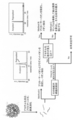
収率の決定方法の概要を図4に示した。
AB Sciex Triple TOF 4600
Eksigent ekspertTM MicroLC 200
カラム: 3C18-CL-120(0.3mm ID x 150mm)
直線勾配 2%-35%アセトニトリル/0.1%ギ酸, 25分, 5μL/分
サンプル量:5μL
ESI-Q-TOF MS, positive-ion mode.
(3)収率の決定方法
収率の決定方法の概要を図4に示した。
Method A
プリカーサーイオンを指定し、それぞれのプリカーサーイオンに対し最も強度の高い2つから4つのMS/MSフラグメントイオンを選択した。指定したプリカーサーイオンおよびMS/MSフラグメントイオンでイオン抽出(±0.5Da)し、以下の式に従って収率を算出した。それを選択したMS/MSフラグメントの全てについて行い、それらの平均を最終収率として決定した。
プリカーサーイオンを指定し、それぞれのプリカーサーイオンに対し最も強度の高い2つから4つのMS/MSフラグメントイオンを選択した。指定したプリカーサーイオンおよびMS/MSフラグメントイオンでイオン抽出(±0.5Da)し、以下の式に従って収率を算出した。それを選択したMS/MSフラグメントの全てについて行い、それらの平均を最終収率として決定した。
収率(%)=[A/A+P]×100
(ここで、Aはアセチル化ペプチドのピークエリアを示し、Pはプロピオニル化ペプチドのピークエリアを示す)
ひとつのペプチド断片に3つのリジンを含む場合、中央のリジンの収率は
[端2つのリジンどちらかにアセチル化が進行した収率-最端のリジンの収率]
として計算した。
(ここで、Aはアセチル化ペプチドのピークエリアを示し、Pはプロピオニル化ペプチドのピークエリアを示す)
ひとつのペプチド断片に3つのリジンを含む場合、中央のリジンの収率は
[端2つのリジンどちらかにアセチル化が進行した収率-最端のリジンの収率]
として計算した。
用いたプリカーサーイオンおよびフラグメントイオンは以下の通り。
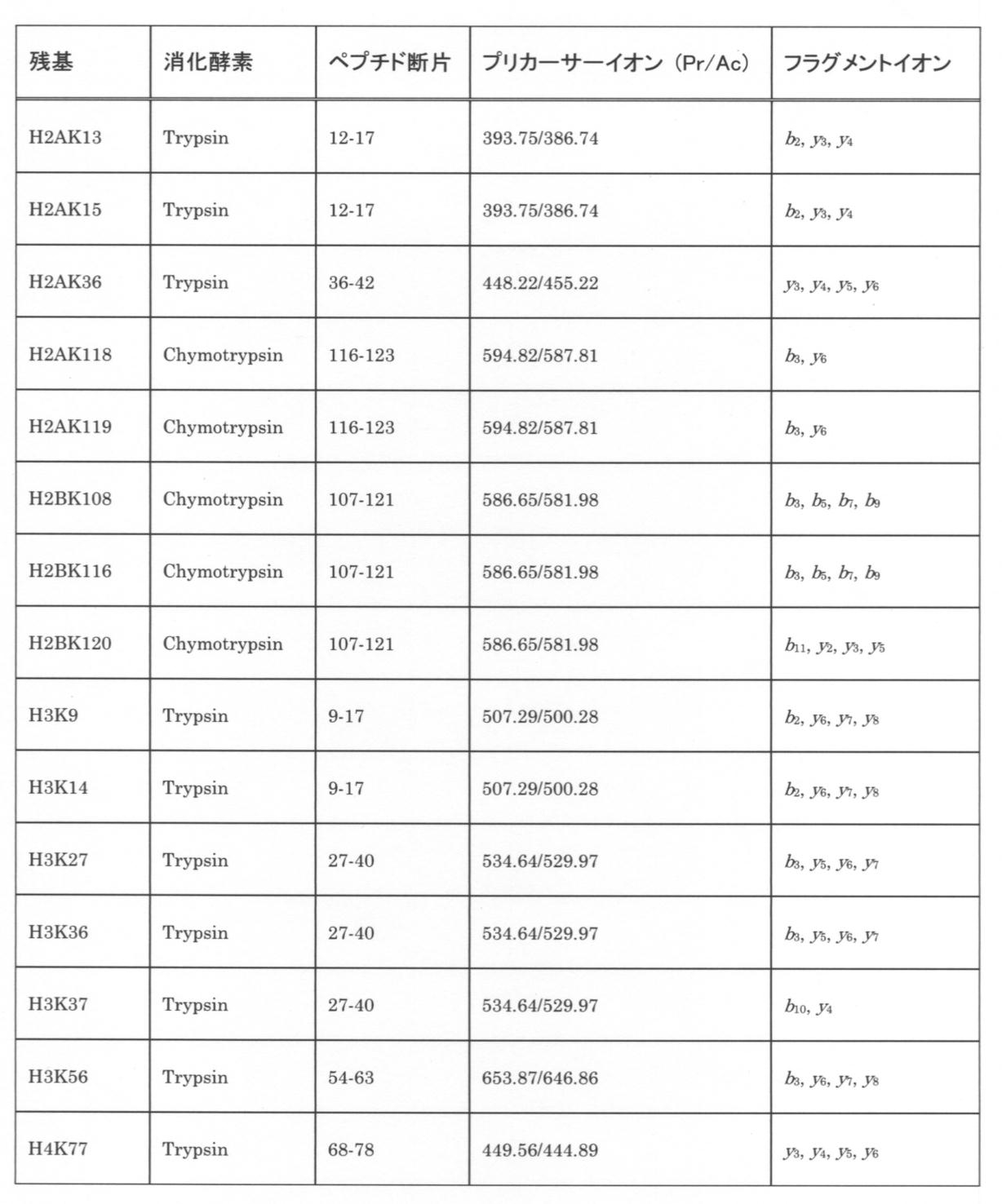
Method B
Information Dependent Acquisition Modeで測定を行うことで得られたクロマトグラムに対し、プリカーサーイオンを指定してイオン抽出(±0.5Da)したピークエリアから以下の式に従って収率を決定した。
Information Dependent Acquisition Modeで測定を行うことで得られたクロマトグラムに対し、プリカーサーイオンを指定してイオン抽出(±0.5Da)したピークエリアから以下の式に従って収率を決定した。
収率(%)=[A/A+P]×100
(ここで、Aはアセチル化ペプチドのピークエリアを示し、Pはプロピオニル化ペプチドのピークエリアを示す)
Method C
Information Dependent Acquisition Modeで測定を行うことで得られたクロマトグラムにおいて、プロピオニル化ペプチド断片は観測されるが、アセチル化ペプチド断片は観測されなかった。このため、サンプルを希釈することでプロピオニル化ペプチド断片の検出限界を算出し、アセチル化収率はその検出限界以下であるとして見積もった。
(ここで、Aはアセチル化ペプチドのピークエリアを示し、Pはプロピオニル化ペプチドのピークエリアを示す)
Method C
Information Dependent Acquisition Modeで測定を行うことで得られたクロマトグラムにおいて、プロピオニル化ペプチド断片は観測されるが、アセチル化ペプチド断片は観測されなかった。このため、サンプルを希釈することでプロピオニル化ペプチド断片の検出限界を算出し、アセチル化収率はその検出限界以下であるとして見積もった。
(4)合成
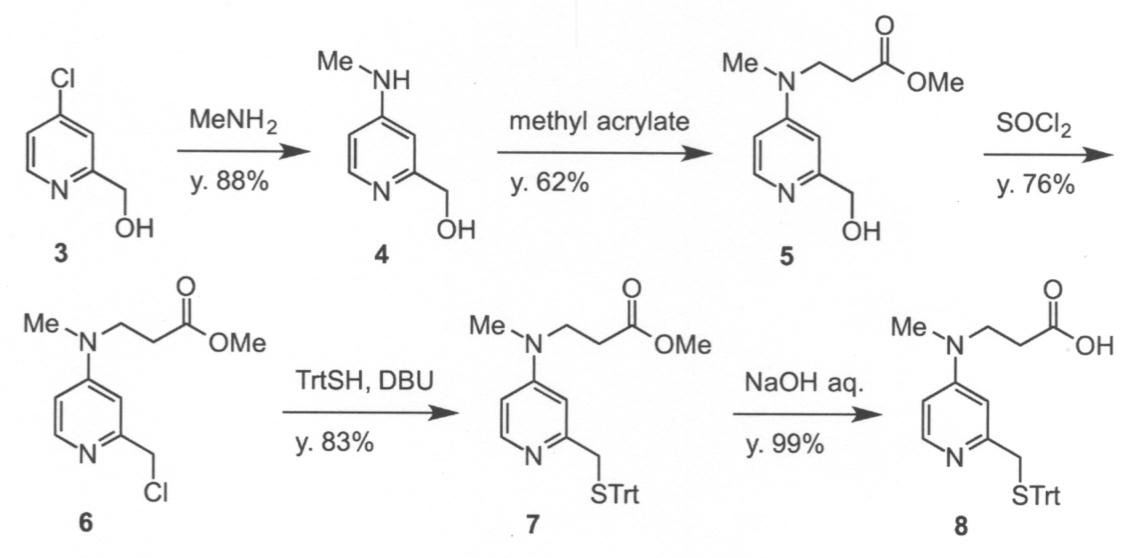
(4-(Methylamino)pyridin-2-yl)methanol (4):
化合物3(2.30g, 16.0mmol)を12Mメチルアミン水溶液(26.7ml)に溶解し、封管中、120度で18時間加熱した。溶媒を減圧留去したのち、残渣を塩化メチレン/メタノール溶液(4/1)に溶解し、炭酸カリウム(5g)を加えて4時間撹拌した。炭酸カリウムを濾過により除き、ろ液を濃縮することで化合物4(2.01g, 14.5mmol, 88%収率)を得た。
化合物3(2.30g, 16.0mmol)を12Mメチルアミン水溶液(26.7ml)に溶解し、封管中、120度で18時間加熱した。溶媒を減圧留去したのち、残渣を塩化メチレン/メタノール溶液(4/1)に溶解し、炭酸カリウム(5g)を加えて4時間撹拌した。炭酸カリウムを濾過により除き、ろ液を濃縮することで化合物4(2.01g, 14.5mmol, 88%収率)を得た。
1H NMR(CD3OD, 400MHz)δ 7.90(d, J = 6.2Hz, 1H), 6.67(d, J = 2.8Hz, 1H), 6.38(dd, J = 2.8, 6.2Hz, 1H), 4.51(s, 2H), 2.80(s, 3H); 13C NMR(CD3OD, 100 MHz) δ 161.7, 157.7, 148.9, 106.6, 104.3, 65.4, 29.2; ESI-MS m/z 139 [M+H]+.
Methyl 3-((2-(hydroxymethyl)pyridin-4-yl)(methyl)amino)propanoate (5):
化合物4(1.38g, 10.0mmol)をアクリル酸メチル(22.5ml)に溶解し、80度で18時間加熱した。溶媒を減圧留去したのち、シリカゲルカラムクロマトグラフィー(酢酸エチル/メタノール=1/0~0/1)で精製し、化合物5(1.39g, 6.20mmol, 62%収率)を得た。
Methyl 3-((2-(hydroxymethyl)pyridin-4-yl)(methyl)amino)propanoate (5):
化合物4(1.38g, 10.0mmol)をアクリル酸メチル(22.5ml)に溶解し、80度で18時間加熱した。溶媒を減圧留去したのち、シリカゲルカラムクロマトグラフィー(酢酸エチル/メタノール=1/0~0/1)で精製し、化合物5(1.39g, 6.20mmol, 62%収率)を得た。
1H NMR(CD3OD, 400MHz)δ 7.96(d, J = 6.2Hz, 1H), 6.77(d, J = 2.8Hz, 1H), 6.51(dd, J = 2.8, 6.2Hz, 1H), 4.52(s, 2H), 3.71(t, J = 7.3Hz, 2H), 3.61(s, 3H), 2.98(s, 3H), 2.58(t, J = 7.3Hz, 2H); 13C NMR(CD3OD, 100 MHz) δ 173.8, 161.8, 155.9, 149.1, 106.5, 104.1, 65.4, 52.3, 48.2, 37.9, 32.4; ESI-MS m/z 225 [M+H]+.
Methyl 3-((2-(chloromethyl)pyridin-4-yl)(methyl)amino)propanoate (6):
化合物5(640mg, 2.85mmol)を塩化メチレン(14.0ml)に溶解し、塩化チオニル(0.311ml, 4.28mmol)をゆっくりと滴下した。室温で10時間撹拌した後、炭酸カリウム水溶液を注意深く加え、水層を塩化メチレンで抽出、有機層を濃縮し、残渣をシリカゲルクロマトグラフィー(酢酸エチル/メタノール=1/0~0/1)で精製し、化合物6(529mg, 2.18mmol, 76%収率)を得た。
Methyl 3-((2-(chloromethyl)pyridin-4-yl)(methyl)amino)propanoate (6):
化合物5(640mg, 2.85mmol)を塩化メチレン(14.0ml)に溶解し、塩化チオニル(0.311ml, 4.28mmol)をゆっくりと滴下した。室温で10時間撹拌した後、炭酸カリウム水溶液を注意深く加え、水層を塩化メチレンで抽出、有機層を濃縮し、残渣をシリカゲルクロマトグラフィー(酢酸エチル/メタノール=1/0~0/1)で精製し、化合物6(529mg, 2.18mmol, 76%収率)を得た。
1H NMR(CD3OD, 500MHz)δ 8.04(d, J = 6.3Hz, 1H), 6.80(d, J = 2.3Hz, 1H), 6.61(dd, J = 2.3, 6.3Hz, 1H), 4.54(s, 2H), 3.75(t, J = 6.9Hz, 2H), 3.65(s, 3H), 3.02(s, 3H), 2.62(t, J = 6.9Hz, 2H); 13C NMR(CD3OD, 100MHz) δ 173.8, 157.6, 156.0, 149.7, 109.0, 107.5, 52.3, 48.2, 47.4, 37.9, 32.4; ESI-MS m/z 243 [M+H]+.
Methyl 3-(methyl(2-((tritylthio)methyl)pyridin-4-yl)amino)propanoate (7):
化合物6(922mg, 3.80mmol)を塩化メチレン(19.0ml)に溶解し、TrtSH(1.58g, 5.72mmol)およびDBU(0.852ml, 5.70mmol)を加え、室温で10時間撹拌した。炭酸カリウム水溶液を注意深く加え、水層を塩化メチレンで抽出、有機層を濃縮し、残渣をシリカゲルクロマトグラフィー(酢酸エチル/ヘキサン=1/1~酢酸エチル/メタノール=20/1)で精製し、化合物7(1.53g, 3.17mmol, 83%収率)を得た。
Methyl 3-(methyl(2-((tritylthio)methyl)pyridin-4-yl)amino)propanoate (7):
化合物6(922mg, 3.80mmol)を塩化メチレン(19.0ml)に溶解し、TrtSH(1.58g, 5.72mmol)およびDBU(0.852ml, 5.70mmol)を加え、室温で10時間撹拌した。炭酸カリウム水溶液を注意深く加え、水層を塩化メチレンで抽出、有機層を濃縮し、残渣をシリカゲルクロマトグラフィー(酢酸エチル/ヘキサン=1/1~酢酸エチル/メタノール=20/1)で精製し、化合物7(1.53g, 3.17mmol, 83%収率)を得た。
1H NMR(CD3OD, 500MHz)δ 7.90(d, J = 6.3Hz, 1H), 7.40-7.38(m, 6H), 7.22-7.19(m, 6H), 7.14-7.11(m, 3H), 6.38(dd, J = 2.3, 6.3Hz, 1H), 6.08(d, J = 2.3Hz, 1H), 3.56(s, 3H), 3.51(t, J = 6.9Hz, 2H), 3.33(s, 2H), 2.78(s, 3H), 2.43(t, J = 6.9Hz, 2H); 13C NMR(CD3OD, 125MHz) δ 173.5, 158.1, 155.3, 149.4, 145.9, 130.8, 129.0, 127.9, 107.1, 106.4, 68.6, 52.3, 48.0, 39.6, 37.8, 32.3; ESI-MS m/z 483 [M+H]+.
3-(Methyl(2-((tritylthio)methyl)pyridin-4-yl)amino)propanoic acid (8):
化合物7(1.45g, 3.00mmol)をメタノール(15ml)に溶解し、2M水酸化ナトリウム水溶液(7.50ml, 15.0mmol)を加えて、室温で3時間撹拌した。1M塩酸で中和した後、溶媒を留去し、シリカゲルクロマトグラフィー(酢酸エチル/メタノール=4/1~1/2)で精製し、化合物8(1.39g, 2.97mmol, 99%収率)を得た。
3-(Methyl(2-((tritylthio)methyl)pyridin-4-yl)amino)propanoic acid (8):
化合物7(1.45g, 3.00mmol)をメタノール(15ml)に溶解し、2M水酸化ナトリウム水溶液(7.50ml, 15.0mmol)を加えて、室温で3時間撹拌した。1M塩酸で中和した後、溶媒を留去し、シリカゲルクロマトグラフィー(酢酸エチル/メタノール=4/1~1/2)で精製し、化合物8(1.39g, 2.97mmol, 99%収率)を得た。
1H NMR(CD3OD, 500MHz)δ 7.79(d, J = 6.9Hz, 1H), 7.36-7.34(m, 6H), 7.24-7.20(m, 6H), 7.17-7.13(m, 3H), 6.58(dd, J = 2.7, 6.9Hz, 1H), 6.08(d, J = 2.7Hz, 1H), 3.60(t, J = 6.9Hz, 2H), 3.51(s, 2H), 2.94(s, 3H), 2.34(t, J = 6.9Hz, 2H); 13C NMR(CD3OD, 100MHz) δ 179.1, 156.9, 154.7, 145.6, 144.3, 130.8, 129.1, 128.1, 107.2, 106.5, 68.8, 50.4, 38.2, 37.0, 35.8; ESI-MS m/z 469 [M+H]+.

PIP-amine (9):
HATU, iPr2NEtを縮合剤、1-Methyl-1H-imidazole-2-carboxylic acid, 4-Amino-1-methyl-1H-pyrrole-2-carboxylic acid, 4-[(9-Fluorenylmethoxycarbonyl)amino]butanoic acidをビルディングブロックとして用いて、通常のFmoc-ペプチド固相合成法に従い2-Chlorotrityl chloride resin(100mg, 1.3mmol/g, 0.133mmol)上にPIP鎖を伸長した。TFA/TIPS/H2O(95/2.5/2.5)で樹脂からの切り出しを行い、HPLC(10% アセトニトリル/0.1% TFA水溶液→直線勾配10-100% 40分, flow: 10ml/分, 230nm, YMC-Pack ODS-AM: 20mm ID x 250mm)で精製しPIP-amine(9, 31.4mg, 0.0204mmol, 15%収率)を得た。
HATU, iPr2NEtを縮合剤、1-Methyl-1H-imidazole-2-carboxylic acid, 4-Amino-1-methyl-1H-pyrrole-2-carboxylic acid, 4-[(9-Fluorenylmethoxycarbonyl)amino]butanoic acidをビルディングブロックとして用いて、通常のFmoc-ペプチド固相合成法に従い2-Chlorotrityl chloride resin(100mg, 1.3mmol/g, 0.133mmol)上にPIP鎖を伸長した。TFA/TIPS/H2O(95/2.5/2.5)で樹脂からの切り出しを行い、HPLC(10% アセトニトリル/0.1% TFA水溶液→直線勾配10-100% 40分, flow: 10ml/分, 230nm, YMC-Pack ODS-AM: 20mm ID x 250mm)で精製しPIP-amine(9, 31.4mg, 0.0204mmol, 15%収率)を得た。
MALDI-TOF MS m/z Calcd: 1193.57 [M + H]+, Found: 1193.48. 保持時間: 19.9分.
PIP-DSTrt (10):
PIP-amine(15.4mg, 0.0100mmol)をDMF(0.18ml)に溶解し、8(23.4mg, 0.0500mmol), HATU(19.0mg, 0.0500mmol), iPr2NEt(0.0200ml, 0.115mmol)を加えて室温で9時間撹拌した。反応液を濃縮後、HPLC(10% アセトニトリル/0.1% TFA水溶液→直線勾配10-100% 40分, flow: 10ml/分, 230nm, YMC-Pack ODS-AM: 20mm ID x 250mm)で精製しPIP-DSTrt(10, 11.7mg, 0.00587mmol, 59%収率)を得た。
PIP-DSTrt (10):
PIP-amine(15.4mg, 0.0100mmol)をDMF(0.18ml)に溶解し、8(23.4mg, 0.0500mmol), HATU(19.0mg, 0.0500mmol), iPr2NEt(0.0200ml, 0.115mmol)を加えて室温で9時間撹拌した。反応液を濃縮後、HPLC(10% アセトニトリル/0.1% TFA水溶液→直線勾配10-100% 40分, flow: 10ml/分, 230nm, YMC-Pack ODS-AM: 20mm ID x 250mm)で精製しPIP-DSTrt(10, 11.7mg, 0.00587mmol, 59%収率)を得た。
MALDI-TOF MS m/z Calcd: 1643.75[M+H]+, Found: 1643.88. 保持時間: 26.1分.
PIP-DSH (1):
PIP-DSTrt(11.7mg, 0.00580mmol)にTIPS(20μl), MilliQ water(20μl)およびTFA(0.160ml)を加え、室温で30分撹拌した。反応液を濃縮後、HPLC(10% アセトニトリル/0.1% TFA水溶液→直線勾配 10-100% 40min, flow: 10ml/min, 230nm, YMC-Pack ODS-AM: 20mm ID x 250mm)で精製しPIP-DSH(1, 6.85mg, 0.00393mmol, 67%収率)を得た。
PIP-DSH (1):
PIP-DSTrt(11.7mg, 0.00580mmol)にTIPS(20μl), MilliQ water(20μl)およびTFA(0.160ml)を加え、室温で30分撹拌した。反応液を濃縮後、HPLC(10% アセトニトリル/0.1% TFA水溶液→直線勾配 10-100% 40min, flow: 10ml/min, 230nm, YMC-Pack ODS-AM: 20mm ID x 250mm)で精製しPIP-DSH(1, 6.85mg, 0.00393mmol, 67%収率)を得た。
MALDI-TOF MS m/z Calcd: 1401.64 [M+H]+, Found: 1401.76. 保持時間: 22.3分.
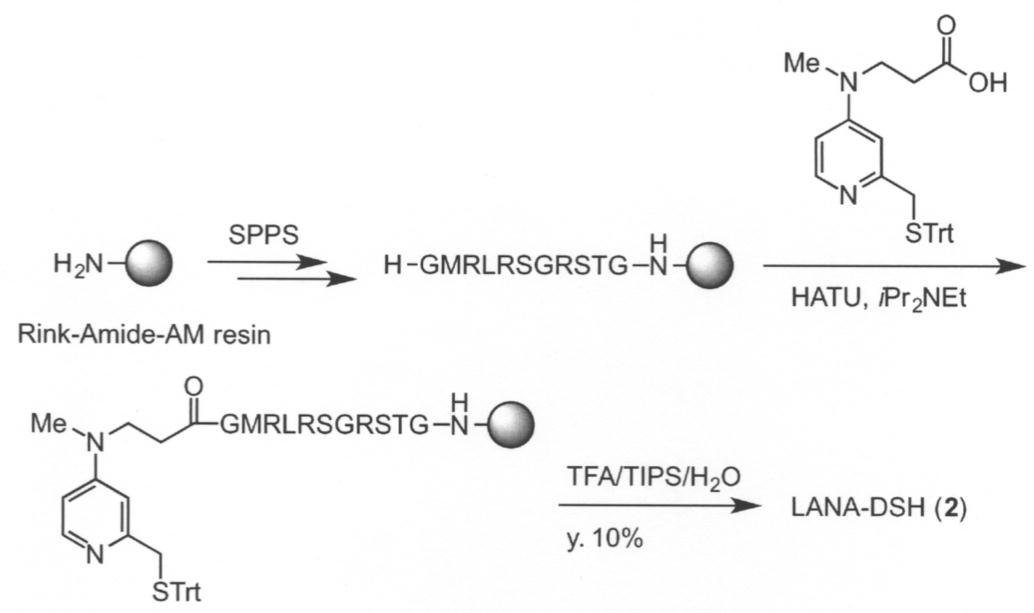
LANA-DSH (2):
DIC, HOBtを縮合剤として用いて、通常のFmoc-ペプチド固相合成法に従いRink-Amide-AM resin(75.3mg, 0.73mmol/g, 0.055mmol)上にH-GMRLRSGRSTG-を合成した。HATU, iPr2NEtを用いてN末端に化合物8を縮合させることで、樹脂状に保護LANA-DSHを合成した。TFA/TIPS/H2O(95/2.5/2.5)で脱保護および切り出しを行い、HPLC(直線勾配; 0-75% アセトニトリル/0.1% TFA水溶液, flow: 7ml/分, 30分, 254nm, YMC-Pack ODS-AM: 20mm ID x 250mm)で精製しLANA-DSH(2, 10.5mg, 0.00570mmol, 10%収率)を得た。
DIC, HOBtを縮合剤として用いて、通常のFmoc-ペプチド固相合成法に従いRink-Amide-AM resin(75.3mg, 0.73mmol/g, 0.055mmol)上にH-GMRLRSGRSTG-を合成した。HATU, iPr2NEtを用いてN末端に化合物8を縮合させることで、樹脂状に保護LANA-DSHを合成した。TFA/TIPS/H2O(95/2.5/2.5)で脱保護および切り出しを行い、HPLC(直線勾配; 0-75% アセトニトリル/0.1% TFA水溶液, flow: 7ml/分, 30分, 254nm, YMC-Pack ODS-AM: 20mm ID x 250mm)で精製しLANA-DSH(2, 10.5mg, 0.00570mmol, 10%収率)を得た。
ESI-MS m/z Calcd: 346.9[M+4H]4+, Found: 347.0. 保持時間: 28.2分.
[B.結果]
まず用いるアセチル化剤の反応性について検討した(図1)。数種類のアセチル化剤(図1A)について、生細胞より取得した細胞質画分と混合し、アセチル化リジン抗体を用いたウエスタンブロットにより検出した。その結果、EG5-PTAやNMDは多くのタンパク質を非選択的にアセチル化した一方、生体が用いているアセチル基供与体であるアセチルCoAやその類縁体であるTEG-Acはそのような非選択的なアセチル化を引き起こさないことが判明した(図1B)。
[B.結果]
まず用いるアセチル化剤の反応性について検討した(図1)。数種類のアセチル化剤(図1A)について、生細胞より取得した細胞質画分と混合し、アセチル化リジン抗体を用いたウエスタンブロットにより検出した。その結果、EG5-PTAやNMDは多くのタンパク質を非選択的にアセチル化した一方、生体が用いているアセチル基供与体であるアセチルCoAやその類縁体であるTEG-Acはそのような非選択的なアセチル化を引き起こさないことが判明した(図1B)。
上記の結果は、アセチルCoAのような非選択的反応の抑えられた低反応性アセチル基供与体を活性化できる触媒を開発することができれば、選択性の高い触媒系の構築が可能であることを意味する。
今回開発した新規触媒DMAP-SH(DSH)の構造を図2Aに、想定されるアセチルCoA活性化機構を図2Bに示した。DMAPはアセチルCoAを活性化できないが、新規触媒DMAP-SHは新たに導入したチオール基とアセチルCoAのチオエステル基が、チオール-チオエステル交換反応を起こすことによりアセチル基を触媒分子内に取り込み、分子内反応を経てアセチル基を活性化する。ここで適切なR基を選択することにより、標的タンパク質を選択性高くアセチル化することが可能であると考えられた。
本実施例では、DNA配列特異的認識結合分子としてPIP(Dervan, P. B., Bioorganic & Medicinal Chemistry 2001, 9, 2215-2235)を、ヒストンタンパク質結合分子としてLANA(Barbera, A. J. et al., Science 2006, 311, 856-861)を選択し、それぞれをDMAP-SHに結合させた分子を触媒として用いることとした。
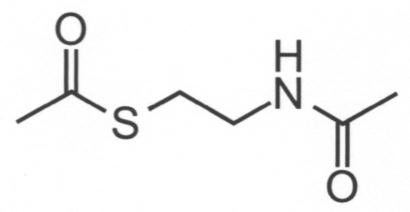
まずタンパク質選択性について評価した。既知の方法(Tachiwana, H. et al., Proceedings of the National Academy of Sciences of the United States of America 2010, 107, 10454-10459)に従って調製した再構成ヌクレオソームと生細胞より取得した細胞質画分を混合し、新たに開発した触媒がヒストンを選択的にアセチル化できるかを、アセチル化リジン抗体を用いたウエスタンブロットで評価した(図3A)。その結果、先の実験と同様、アセチルCoAのみを用いたときにはアセチル化が進行しなかったが、LANA-DSHあるいはPIP-DSHを用いることでヒストン選択的アセチル化を達成することができた。なお、アセチルCoAに代えて、アセチルCoAの一部を切り出した下記構造の分子を用いて実験を行ったところ、同様にヒストン選択的なアセチル化が認められた。
次に、ヒストン中のリジン残基間選択性について評価した。同様の反応を残基選択的アセチル化リジン抗体を用いたウエスタンブロットにて評価したところ、LANA-DSHにおいてはH2BK120が、PIP-DSHにおいてはH4K77が強くアセチル化されることが判明した(図3B)。
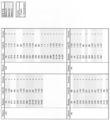
反応収率を決定し、残基選択性についてさらに詳細に調べる目的で、反応後のヌクレオソームを消化酵素で処理し、生じたペプチド断片をLC-MS/MSで解析した(図5、6)。その結果、LANA-DSHを用いた場合には、H2BK120が54%の収率でアセチル化され、また、リジン残基選択性が極めて高いことが判明した(図5)。PIP-DSHを用いた場合には、H3K36が14%、H3K56が9%、H4K77が14%の収率でアセチル化され、同様にリジン残基選択性が高いことが判明した(図6)。これらの結果は、X線結晶構造からも合理的に裏付けられた。すなわち、LANAはH2A-H2Bダイマーに結合することが知られているが(Barbera, A. J. et al., Science 2006, 311, 856-861)、本触媒系でアセチル化されたH2BK120はLANAとヌクレオソームの共結晶構造から予想される触媒位置の近傍に位置づけられた(図7)。同様に、用いたPIPの配列およびヌクレオソームの結晶構造(Vasudevan, D., Chua, E.Y.D. & Davey, C.A., Journal of Molecular Biology 2010, 403, 1-10)から予想されるPIP-DSHのDNA結合部位とアセチル化が進行したH3K56およびH4K77は近傍に位置づけられた(図8)。これらの結果は、開発した触媒に適切なリガンドを導入することにより、リガンドに応じて標的とするリジン残基を選択性高くアセチル化できること、すなわち、構造ベースの論理的なデザインが可能であることを示している。
特にPIPはその配列を適切にデザインすることで標的とするDNA配列を自由に選択することができる。従って、PIPを利用することにより、ヌクレオソームの構造に大きな影響を与えることが知られているDNA-ヒストン相互作用部位に位置するリジン(Tropberger, P. & Schneider, R., Nature Structural & Molecular Biology 2013, 20, 657-661)を、自在に位置を定めてアセチル化できる可能性がある。
近年、アセチル化以外のアシル化がヒストンに生じていることが明らかとなり注目を集めている。しかしながらその機能についてはほぼ未解明であり、エピジェネティクスにおける近年の重要課題となっている(Kebede, A. F., Schneider, R. & Daujat, S., Febs Journal 2015, 282, 1658-1674)。従って、これらアシル化を位置選択的にヒストンに導入することができる手法は、それらの機能解明を進める強力なツールとなることが予想される。
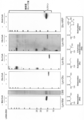
そこで、開発した触媒により、アセチル化以外のアシル化が可能であるかを検証した。その結果、LANA-DSHと各種アシルCoAを用いることで、マロニル化(非特許文献5)、グルタリル化(非特許文献6)、ブチリル化(非特許文献7)、2-ヒドロキシイソブチリル化(非特許文献8)、ビオチニル化(非特許文献9)が可能であることが判明した(図9)。
本発明の人工触媒システムは、触媒と組み合わせるアシル基供与体を変更するだけで、選択的な各種アシル化が可能である。また、触媒に導入する標的アシル化領域に結合性を有する分子を変更するだけで、様々な部位を標的として高い選択性でアシル化を行うことが可能である。従って、高い汎用性と優れた実用性を兼ね備えたシステムであると言える。
また、触媒医療の概念に基づく本発明の人工触媒システムは、生体内の酵素が関与する様々な反応に応用することが可能である。特に、生体内の酵素の欠損や失活が特定の疾患に関与している場合には、当該酵素の機能を代替する人工触媒システムにより、当該疾患の治療を行うことが可能となるため、本発明は広く医療分野に貢献しうる。
標的アシル化領域結合性触媒とアシルCoA若しくはその誘導体との組み合わせを用いた人工触媒システムは、例えば、染色体タンパク質のアセチル化の低下に起因する疾患の治療に利用可能であり、特に、従来のヒストン脱アセチル化酵素阻害剤が薬効を発揮し難い、ヒストンアセチル化酵素の失活に起因する疾患において高い利用価値を有する。
本発明は、触媒医療という概念に基づく新たな人工触媒システムの確立に成功したものであり、内在性酵素の機能調節という従来の医療概念と本質的に異なる新たな医療への途を切り開くものである。
本発明は、触媒医療という概念に基づく新たな人工触媒システムの確立に成功したものであり、内在性酵素の機能調節という従来の医療概念と本質的に異なる新たな医療への途を切り開くものである。
Claims (2)
- 下記構造を有する化合物。

- 請求項1に記載の化合物とアシルCoA若しくはその誘導体との組み合わせを含む、染色体タンパク質をアシル化するための薬剤。
Priority Applications (1)
| Application Number | Priority Date | Filing Date | Title |
|---|---|---|---|
| US15/755,938 US11021461B2 (en) | 2015-08-28 | 2016-08-29 | Artificial catalyst system for selective acylation of chromosome protein |
Applications Claiming Priority (2)
| Application Number | Priority Date | Filing Date | Title |
|---|---|---|---|
| JP2015169448A JP6675119B2 (ja) | 2015-08-28 | 2015-08-28 | 選択的な染色体タンパク質のアシル化を行うための人工触媒システム |
| JP2015-169448 | 2015-08-28 |
Publications (1)
| Publication Number | Publication Date |
|---|---|
| WO2017038760A1 true WO2017038760A1 (ja) | 2017-03-09 |
Family
ID=58187477
Family Applications (1)
| Application Number | Title | Priority Date | Filing Date |
|---|---|---|---|
| PCT/JP2016/075183 Ceased WO2017038760A1 (ja) | 2015-08-28 | 2016-08-29 | 選択的な染色体タンパク質のアシル化を行うための人工触媒システム |
Country Status (3)
| Country | Link |
|---|---|
| US (1) | US11021461B2 (ja) |
| JP (1) | JP6675119B2 (ja) |
| WO (1) | WO2017038760A1 (ja) |
Citations (4)
| Publication number | Priority date | Publication date | Assignee | Title |
|---|---|---|---|---|
| WO2010001933A1 (ja) * | 2008-07-01 | 2010-01-07 | 学校法人日本大学 | 標的遺伝子特異的ヒストン修飾制御剤 |
| WO2012100176A2 (en) * | 2011-01-20 | 2012-07-26 | University Of Rochester | Macrocyclic compounds with a hybrid peptidic/non-peptidic backbone and methods for their preparation |
| WO2015186785A1 (ja) * | 2014-06-04 | 2015-12-10 | 国立大学法人東京大学 | 生体内のアシル化機能と置き換えられる人工触媒システム |
| WO2016129680A1 (ja) * | 2015-02-12 | 2016-08-18 | 国立大学法人京都大学 | 特定遺伝子の発現を活性化するctb-piポリアミドコンジュゲート |
-
2015
- 2015-08-28 JP JP2015169448A patent/JP6675119B2/ja not_active Expired - Fee Related
-
2016
- 2016-08-29 WO PCT/JP2016/075183 patent/WO2017038760A1/ja not_active Ceased
- 2016-08-29 US US15/755,938 patent/US11021461B2/en not_active Expired - Fee Related
Patent Citations (4)
| Publication number | Priority date | Publication date | Assignee | Title |
|---|---|---|---|---|
| WO2010001933A1 (ja) * | 2008-07-01 | 2010-01-07 | 学校法人日本大学 | 標的遺伝子特異的ヒストン修飾制御剤 |
| WO2012100176A2 (en) * | 2011-01-20 | 2012-07-26 | University Of Rochester | Macrocyclic compounds with a hybrid peptidic/non-peptidic backbone and methods for their preparation |
| WO2015186785A1 (ja) * | 2014-06-04 | 2015-12-10 | 国立大学法人東京大学 | 生体内のアシル化機能と置き換えられる人工触媒システム |
| WO2016129680A1 (ja) * | 2015-02-12 | 2016-08-18 | 国立大学法人京都大学 | 特定遺伝子の発現を活性化するctb-piポリアミドコンジュゲート |
Non-Patent Citations (3)
| Title |
|---|
| HIROSHI SUGIYAMA: "Histone Deacetylase Sogai Kassei o Motsu Pyrrole-Imidazole Polyamide ni yoru Tokutei Idenshi no Kasseika", RESEARCH REPORTS OF UEHARA MEMORIAL FOUNDATION, vol. 23, 2009, pages 1 - 5 * |
| KOSHI,Y. ET AL.: "Target-Specific Chemical Acylation of Lectins by Ligand-Tethered DMAP Catalysts", JOURNAL OF THE AMERICAN CHEMICAL SOCIETY, vol. 130, 2008, pages 245 - 251, XP055373199 * |
| WANG,H. ET AL.: "Chemical Cell-Surface Receptor Engineering Using Affinity-Guided, Multivalent Organocatalysts", JOURNAL OF THE AMERICAN CHEMICAL SOCIETY, vol. 133, 2011, pages 12220 - 12228, XP055238986 * |
Also Published As
| Publication number | Publication date |
|---|---|
| JP6675119B2 (ja) | 2020-04-01 |
| US11021461B2 (en) | 2021-06-01 |
| JP2017043584A (ja) | 2017-03-02 |
| US20190047985A1 (en) | 2019-02-14 |
Similar Documents
| Publication | Publication Date | Title |
|---|---|---|
| CN110573507B (zh) | 小分子 | |
| CN112119085B (zh) | 稳定肽-介导的靶向蛋白降解 | |
| JP2020203934A (ja) | 脂肪酸、および生体分子へのコンジュゲーションにおけるその使用 | |
| JP6426103B2 (ja) | c−Metタンパク質アゴニスト | |
| US10557129B2 (en) | Peptides derived from human PCSK9 catalytic domain and uses thereof for promoting LDL-R activity | |
| CA3208661A1 (en) | Lipid nanoparticle compositions and methods of formulating the same | |
| US20240165245A1 (en) | Multivalent peptoid oligomers, pharmaceutical compositions and methods of using same | |
| Yang et al. | Effect of hydrophobicity on the anticancer activity of fatty-acyl-conjugated CM4 in breast cancer cells | |
| US20080306001A1 (en) | Transcriptional modulation of extracellular matrix (ecm) of dermal fibroblasts | |
| US20110270151A1 (en) | Image-guided energy deposition for targeted drug delivery | |
| WO2013142229A1 (en) | Designing novel peptides for inducing fibronectin matrix assembly | |
| JP2020517599A (ja) | 四級化ニコチンアミドアデニンジヌクレオチドサルベージ経路阻害剤コンジュゲート | |
| US20150087598A1 (en) | Treating muc1-expressing cancers with helicase inhibitors | |
| JP2016523825A (ja) | 腎毒性活性物質からの保護のための接合体 | |
| JP7069126B2 (ja) | 化学療法誘発性末梢性ニューロパシーおよび難聴を処置または予防するためのbcl-wポリペプチドおよび模倣物 | |
| WO2015069586A2 (en) | Dual molecular delivery of oligonucleotides and peptide containing conjugates | |
| US9206132B2 (en) | Use of a novel aminopyridine derivative to prevent or treat cancer | |
| TW202227074A (zh) | Sars cov-2抑制劑及其用途 | |
| JP6675119B2 (ja) | 選択的な染色体タンパク質のアシル化を行うための人工触媒システム | |
| WO2021132661A1 (ja) | ライブラリーの製造方法、環状ペプチド、FXIIa結合剤、及びIFNGR1結合剤 | |
| EP2087905A2 (en) | Interleukin-20 for treating and diagnosing conditions associated with neovascularisation | |
| JPWO2017126461A1 (ja) | がん治療用ペプチド及びそれを含む医薬組成物 | |
| JP6736462B2 (ja) | 生体内のアシル化機能と置き換えられる人工触媒システム | |
| TW200524576A (en) | Chemical compounds | |
| WO2025070731A1 (ja) | ペプチド |
Legal Events
| Date | Code | Title | Description |
|---|---|---|---|
| 121 | Ep: the epo has been informed by wipo that ep was designated in this application |
Ref document number: 16841792 Country of ref document: EP Kind code of ref document: A1 |
|
| NENP | Non-entry into the national phase |
Ref country code: DE |
|
| 122 | Ep: pct application non-entry in european phase |
Ref document number: 16841792 Country of ref document: EP Kind code of ref document: A1 |