WO2017022787A1 - 収縮力低下随伴性排尿筋過活動改善剤 - Google Patents
収縮力低下随伴性排尿筋過活動改善剤 Download PDFInfo
- Publication number
- WO2017022787A1 WO2017022787A1 PCT/JP2016/072753 JP2016072753W WO2017022787A1 WO 2017022787 A1 WO2017022787 A1 WO 2017022787A1 JP 2016072753 W JP2016072753 W JP 2016072753W WO 2017022787 A1 WO2017022787 A1 WO 2017022787A1
- Authority
- WO
- WIPO (PCT)
- Prior art keywords
- detrusor
- salt
- hydroxypentadecyl
- trimethyl
- cyclohexen
- Prior art date
- Legal status (The legal status is an assumption and is not a legal conclusion. Google has not performed a legal analysis and makes no representation as to the accuracy of the status listed.)
- Ceased
Links
- 0 C*C(C(C)(C)CC1)=C(C)C1=O Chemical compound C*C(C(C)(C)CC1)=C(C)C1=O 0.000 description 1
Images
Classifications
-
- A—HUMAN NECESSITIES
- A61—MEDICAL OR VETERINARY SCIENCE; HYGIENE
- A61K—PREPARATIONS FOR MEDICAL, DENTAL OR TOILETRY PURPOSES
- A61K31/00—Medicinal preparations containing organic active ingredients
- A61K31/12—Ketones
- A61K31/122—Ketones having the oxygen directly attached to a ring, e.g. quinones, vitamin K1, anthralin
-
- A—HUMAN NECESSITIES
- A61—MEDICAL OR VETERINARY SCIENCE; HYGIENE
- A61K—PREPARATIONS FOR MEDICAL, DENTAL OR TOILETRY PURPOSES
- A61K47/00—Medicinal preparations characterised by the non-active ingredients used, e.g. carriers or inert additives; Targeting or modifying agents chemically bound to the active ingredient
-
- A—HUMAN NECESSITIES
- A61—MEDICAL OR VETERINARY SCIENCE; HYGIENE
- A61P—SPECIFIC THERAPEUTIC ACTIVITY OF CHEMICAL COMPOUNDS OR MEDICINAL PREPARATIONS
- A61P13/00—Drugs for disorders of the urinary system
-
- A—HUMAN NECESSITIES
- A61—MEDICAL OR VETERINARY SCIENCE; HYGIENE
- A61P—SPECIFIC THERAPEUTIC ACTIVITY OF CHEMICAL COMPOUNDS OR MEDICINAL PREPARATIONS
- A61P13/00—Drugs for disorders of the urinary system
- A61P13/10—Drugs for disorders of the urinary system of the bladder
Definitions
- the present invention relates to urination associated with reduced contractility, comprising 3- (15-hydroxypentadecyl) -2,4,4-trimethyl-2-cyclohexen-1-one or a salt thereof, or a solvate thereof as an active ingredient.
- the present invention relates to a method for treating muscle overactivity.
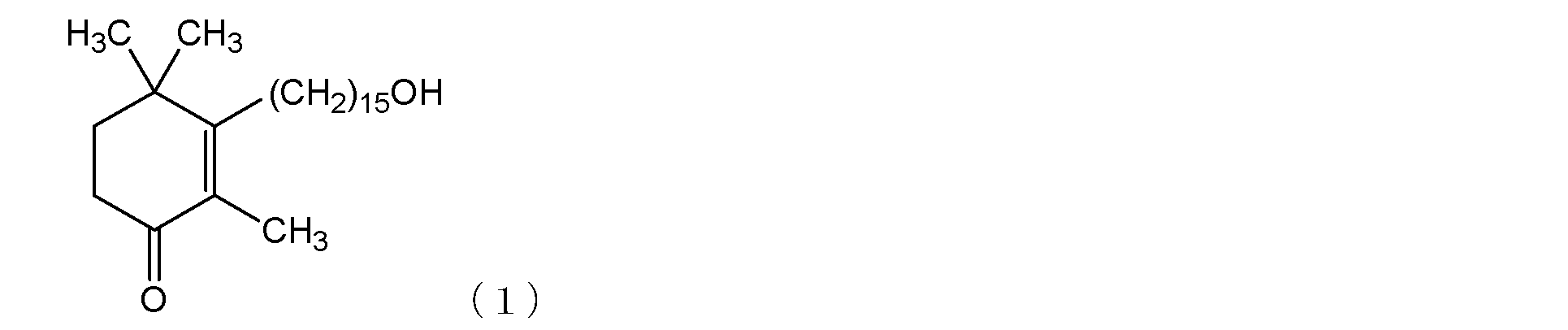
- Patent Document 1 describes that a cyclohexenone long-chain alcohol containing a compound represented by the formula (1) exhibits a nerve growth promoting action and is useful as a medicament for preventing and treating brain diseases such as dementia.
- Patent Document 2 describes that a cyclohexenone long-chain alcohol containing a compound represented by the formula (1) is useful as a therapeutic agent for dysuria.
- Patent Document 3 describes that the compound represented by the formula (1) is useful as a therapeutic agent for a disease based on vesicourethral dyssynergia.
- Patent Document 2 the above-mentioned action confirmed as an agent for treating urination disorder in Patent Document 2 is only an improvement action for dysuria with reduced bladder function (an improvement action for maximum urination volume, an action for improvement of bladder capacity and urination efficiency). It is not known at all that Compound 1 of the present invention is a compound that improves detrusor overactivity associated with reduced contractile force.
- Patent Document 3 uses a rat model in which a time lag between bladder detrusor contraction and urethral sphincter relaxation occurs 4 weeks after inducing urination disorder with strep-zocin (STZ).
- STZ strep-zocin
- the improvement effect (Example 1) and the improvement effect of the maximum single urination volume (Example 2) associated therewith have only been confirmed, and the compound 1 of the present invention has a combination of detrusor overactivity and contraction failure. There is no mention or suggestion that it is effective.
- the dysuria model described in the example of Patent Document 3 is a model that does not show detrusor overactivity as described in a reference example described later, and has a therapeutic effect on a disease having both detrusor overactivity and contraction failure. It is not a model that can evaluate.
- the normal urination function is that when the urine is stored, the detrusor does not contract but relaxes so that urine can be stored in the bladder, and the detrusor contracts only during urination.
- urinary storage disorder overactive bladder
- detrusor overactivity occurs during urine storage, and urine cannot be collected sufficiently.
- Anticholinergic agents and ⁇ 3 receptor agonists are effective for such pathological conditions.
- the pathological condition of urinary discharge disorder low activity bladder
- detrusor muscle contraction insufficiency occurs and an increase in residual urine volume becomes a problem.
- cholinesterase inhibitors and cholinergic agents are used.
- Non-Patent Document 1 Non-Patent Document 2
- Non-Patent Document 3 drugs effective against overactive bladder are ineffective or worsened against overactive bladder
- DHIC Detrusor hyperactivity with impaired contractility
- Diagnosis of detrusor overactivity associated with reduced contractile force in the clinic is based on simultaneous measurement of intravesical pressure and urine flow (Pressure-Flow Study). Detrusor overactivity during urination and detrusor contraction failure during urination (nomogram analysis (Valid) (Non-patent document 4, Non-patent document 5).
- overactive bladder is diagnosed with subjective symptoms (urinary urgency, urinary incontinence, frequent urination, etc.)
- underactive bladder is diagnosed with subjective symptoms (urinary dysfunction, urinary disruption, urination delay, abdominal pressure urination, (Residual urine sensation, urinary retention, etc.), urine flow measurement, residual urine volume measurement, etc., and confirming the coexistence of both diseases.
- An object of the present invention is to provide a method for treating detrusor overactivity associated with reduced contractile force by improving detrusor overactivity and detrusor contraction insufficiency.
- the present invention includes the following items: Item 1. Detrusor overactivity and detrusor contraction insufficiency including 3- (15-hydroxypentadecyl) -2,4,4-trimethyl-2-cyclohexen-1-one or a salt thereof, or a solvate thereof Therapeutic agents for diseases that have both (especially, diseases based on bladder / urethral dysfunction).
- Item 2. 3- (15-hydroxypentadecyl) -2,4,4-trimethyl-2-cyclohexen-1-one or a salt thereof, or a solvate thereof; In particular, therapeutic agents for diseases other than diseases based on bladder / urethral coordination failure).
- Item 3 Detrusor overactivity and urination including 3- (15-hydroxypentadecyl) -2,4,4-trimethyl-2-cyclohexen-1-one or a salt thereof, or a solvate thereof and a pharmaceutical carrier
- a pharmaceutical composition for treating a disease having muscle contraction failure especially a disease based on bladder / urethral coordination failure).
- Item 4. 3- (15-hydroxypentadecyl) -2,4,4-trimethyl-2-cyclohexen-1-one or a salt thereof, or a solvate thereof, and a pharmaceutical carrier, a concomitant decrease in contractility
- a pharmaceutical composition for treating muscle overactivity especially excluding diseases based on bladder / urethral coordination failure).
- Item 5 3- (15-Hydroxypentadecyl) -2,4,4 for the manufacture of a therapeutic agent for diseases with detrusor overactivity and detrusor contraction failure (especially, diseases based on bladder / urethral coordination failure) -Use of trimethyl-2-cyclohexen-1-one or a salt thereof, or a solvate thereof.
- Item 7. 3- (15-Hydroxypentadecyl) -2,4,4-trimethyl for use in the treatment of diseases with detrusor overactivity and detrusor contraction failure (especially, diseases based on bladder / urethral coordination failure) -2-cyclohexen-1-one or a salt thereof, or a solvate thereof.
- Urination comprising administering a therapeutically effective amount of 3- (15-hydroxypentadecyl) -2,4,4-trimethyl-2-cyclohexen-1-one or a salt thereof, or a solvate thereof
- a method of treating a disease having both muscle overactivity and detrusor muscle contraction failure (especially a disease based on bladder / urethral coordination failure).
- Item 13 Concomitant detrusor overactivity and detrusor contraction failure, including 3- (15-hydroxypentadecyl) -2,4,4-trimethyl-2-cyclohexen-1-one or a salt thereof or a solvate thereof Relief agent for symptoms in diseases.
- the symptom is any of urgency, urinary incontinence, frequent urination, urinary dysfunction, urinary lineage disruption, delayed urination, abdominal pressure urination, feeling of residual urine, urinary retention, decreased urine flow, and increased residual urine volume
- the term 13 The described alleviating agent.
- Item 15 The symptoms include urgency, urinary incontinence, and frequent urination, decreased urinary dysfunction, urinary tract interruption, delayed urination, abdominal pressure urination, residual urine sensation, urinary retention, decreased urine flow and increased residual urine volume.
- Item 13 which is either The described alleviating agent.
- Item 16 3- (15-Hydroxypentadecyl) -2,4,4-trimethyl-2-cyclohexen-1-one or a method thereof for producing a symptom reducing agent in a disease having both detrusor overactivity and detrusor contraction failure Use of salts or solvates thereof.
- Item 18 3- (15-hydroxypentadecyl) -2,4,4-trimethyl-2-cyclohexen-1-one or a salt thereof or a salt thereof for reducing symptoms in a disease having detrusor overactivity and detrusor contraction failure Solvate.
- Item 19 3- (15-hydroxypentadecyl) -2,4,4-trimethyl-2-cyclohexen-1-one or a salt thereof, or a solvate thereof.
- detrusor overactivity associated with reduced contractile force can be effectively treated.
- the compound 1 of the present invention is a known compound and can be produced, for example, according to the method described in International Publication WO1999 / 008987.
- the “disease having detrusor overactivity and detrusor contraction failure” as used in the present invention is a pathological condition in which detrusor overactivity during urination and detrusor contraction failure during urination coexist, specifically, a decrease in contractile force Concomitant detrusor overactivity (DHIC).
- DHIC contractile force Concomitant detrusor overactivity
- Diagnosis of detrusor overactivity associated with reduced contractile force is based on simultaneous measurement of intravesical pressure and urine flow (Pressure-Flow Study). Detrusor overactivity during urination and detrusor contraction failure during urination (nomogram analysis is effective) (JAMA, 257, p3076-3081 (1987); Rev Hosp Clin Fac Med Sao Paulo, 59, p206-215 (2004)).
- overactive bladder is diagnosed with subjective symptoms (urinary urgency, urinary incontinence, frequent urination, etc.)
- underactive bladder is diagnosed with subjective symptoms (urinary dysfunction, urinary disruption, urination delay, abdominal pressure urination, It can be carried out by confirming the coexistence of both diseases by using residual urine sensation, urinary retention etc.), urine flow measurement, residual urine volume measurement, etc.
- degenerative muscle overactivity (DHIC) associated with reduced contractile force is not limited to the cause of the disease as long as it is a pathological condition in which detrusor overactivity during urination and detrusor contraction failure during urination coexist.
- DHIC degenerative muscle overactivity
- -Decreased concomitant detrusor overactivity (DHIC) that is not caused by urethral coordination failure is preferred.
- the ⁇ method for treating a disease having both detrusor overactivity and detrusor contraction failure '' means a method for treating or improving a disease having both detrusor overactivity and detrusor contraction, a method for reducing symptoms in the disease, And maintenance therapy to prevent recurrence.
- the “treatment method for detrusor overactivity associated with reduced contractile force” as used in the present invention is a method for treating or improving detrusor overactivity associated with reduced contractile force, a method for reducing symptoms in the disease, and prevention of recurrence Includes maintenance therapy.
- symptoms in diseases with detrusor overactivity and detrusor contraction failure and detrusor overactivity associated with reduced contractile force include, for example, urgency, urinary incontinence, frequent urination, decreased urinary tract, and urethral disruption. And subjective symptoms such as delayed urination, abdominal pressure urination, residual urine sensation, urinary retention, and decreased urine flow, increased residual urine volume.
- the compound 1 of the present invention is one of urinary urgency, urinary incontinence and frequent urination, which is a symptom of detrusor overactivity, and urinary decline, urinary tract disruption, urination delay, abdominal pressure, which are symptoms of detrusor contraction failure Any of urination, residual urine sensation, urinary retention, decrease in urine flow and increase in residual urine volume can be alleviated simultaneously.
- the compound 1 of the present invention may form an acid adduct salt or a salt with a base, and is included in the present invention as long as the salt is a pharmaceutically acceptable salt.
- inorganic acids such as hydrochloric acid, hydrobromic acid, hydroiodic acid, sulfuric acid, nitric acid, phosphoric acid, formic acid, acetic acid, propionic acid, oxalic acid, malonic acid, succinic acid, fumaric acid, maleic acid
- Acid addition salts with organic acids such as lactic acid, malic acid, citric acid, tartaric acid, carbonic acid, picric acid, methanesulfonic acid, paratoluenesulfonic acid, glutamic acid, inorganic bases such as sodium, potassium, magnesium, calcium, aluminum
- salts and ammonium salts with organic bases such as methylamine, ethylamine, meglumine and ethanolamine, or basic amino acids such as lysine, arginine and ornith
- Examples of the solvent of the solvate of Compound 1 of the present invention include water, methanol, ethanol, isopropanol, acetonitrile, tetrahydrofuran, ethyl acetate, toluene, hexane, acetone, methyl ethyl ketone, methyl isobutyl ketone and the like.
- dosage forms can be produced by generally known pharmaceutical methods. There are no particular limitations on the dosage form, and oral preparations such as tablets, coated tablets, pills, powders, granules, capsules, solutions, suspensions, emulsions, and parenterals such as injections and suppositories. It can be illustrated.
- excipients such as lactose, sucrose, sodium chloride, glucose, urea, starch, calcium carbonate, kaolin, crystalline cellulose, silicic acid; water, ethanol, propanol, corn starch, Simple syrup, glucose solution, starch solution, gelatin solution, carboxymethylcellulose, shellac, methylcellulose, hydroxypropylcellulose, hydroxypropylmethylcellulose, potassium phosphate, polyvinylpyrrolidone, etc .; dried starch, sodium alginate, agar powder, laminaran powder Disintegrating agents such as sodium bicarbonate, calcium carbonate, polyoxyethylene sorbitan fatty acid esters, sodium lauryl sulfate, stearic acid monoglyceride, lactose; white sugar, stearic acid, potassium Disintegration inhibitors such as butter and hydrogenated oils; Absorption promoters such as quaternary ammonium salts and sodium lauryl s
- a carrier for example, excipients such as glucose, lactose, starch, cocoa butter, hydrogenated vegetable oil, kaolin, talc; binders such as gum arabic powder, tragacanth powder, gelatin, ethanol; Disintegrants such as laminaran and agar can be used.
- excipients such as glucose, lactose, starch, cocoa butter, hydrogenated vegetable oil, kaolin, talc
- binders such as gum arabic powder, tragacanth powder, gelatin, ethanol
- Disintegrants such as laminaran and agar can be used.
- Capsules are prepared by mixing with various carriers exemplified above and filling them into hard gelatin capsules, soft capsules and the like according to a conventional method.
- Oral liquid preparations, syrups, elixirs and the like can be produced by conventional methods using a flavoring / flavoring agent, buffer, stabilizer, etc.
- examples of the flavoring / flavoring agent include sucrose, orange peel, citric acid, tartaric acid, etc.
- examples of the buffering agent include sodium citrate
- examples of the stabilizer include tragacanth, gum arabic, and gelatin.
- polyethylene glycol, cacao butter, higher alcohol, higher alcohol esters, gelatin, semi-synthetic glyceride and the like can be used as a carrier.
- solutions, emulsions and suspensions are preferably sterilized and isotonic with blood.
- diluents such as water, aqueous lactic acid, ethyl alcohol, Propylene glycol, macrogol, ethoxylated isostearyl alcohol, polyoxyethylenated isostearyl alcohol, polyoxyethylene sorbitan fatty acid esters and the like can be used.
- a sufficient amount of sodium chloride, glucose or glycerin may be included in the pharmaceutical preparation to prepare an isotonic solution, and usual solubilizing agents, buffers, soothing agents, etc. may be added. May be. Furthermore, you may mix
- the administration method in the agent for improving deactivity of the detrusor associated with reduced contractile force of the present invention is not particularly limited, and is appropriately determined according to various administration forms, patient age, sex and other conditions, the degree of symptoms of the patient, and the like.
- tablets, pills, powders, granules, capsules, solutions, suspensions and emulsions are orally administered.
- the injection is administered alone or mixed with a normal fluid such as glucose or amino acid, and is administered intravenously, and if necessary, it is administered alone intraarterially, intramuscularly, intradermally, subcutaneously or intraperitoneally. Suppositories are administered rectally.
- the amount of the compound of the present invention or a salt thereof to be incorporated in each of the above dosage unit forms is not constant depending on the symptom of the patient to which the present invention is to be applied, or the dosage form thereof.
- it is desirable that the amount be about 0.01 to 1,000 mg, more preferably 1 to 800 mg, and even more preferably 5 to 500 mg.
- the daily dose of the drug having the above dosage form varies depending on the patient's symptoms, body weight, age, sex, etc., and cannot be determined unconditionally, but is usually about 0.005 to 5,000 mg per adult day,
- the dose is preferably 0.01 to 2,000 mg, more preferably 10 to 1600 mg, still more preferably 20 to 800 mg, and it is preferable to administer this once a day or divided into 2 to 4 times.
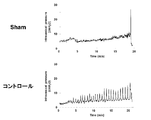
- Test Example 1 Preparation of a rat detrusor overactive detrusor overactivity model This model was prepared by partially constricting ( ⁇ 1.57 mm) the urethra of a 9-week-old female Sprague-Dawley rat. 6 weeks after model preparation, partial stenosis was released, and the next day, urinary bladder pressure and urination volume were measured under awakening, and nomogram analysis using Qmax (maximum urinary flow rate) and Pdet (detrusor muscle pressure) The detrusor contractile force during urination was evaluated.
- detrusor overactivity which is an index of overactive bladder
- an increase in residual urine volume which is an index of underactive bladder.
- Fig. 1 shows a typical chart of intravesical pressure. Significant detrusor overactivity and increased residual urine volume were observed in this dysuria rat (control) compared to Sham rats, and the characteristics of detrusor overactivity associated with reduced contractile force were observed (Table 1).
- this model of dysuria in rats shows that the detrusor overactivity during urine storage and the detrusor contractile force reduction by nomogram analysis, which are clinical diagnostic indicators of detrusor overactivity associated with reduced contractility, are observed within the same individual. It was confirmed to coexist. That is, it was revealed that this rat dysuria model can be evaluated as a model of detrusor overactivity associated with reduced contractile force.
- Test Example 2 Improvement effect on detrusor overactivity and detrusor muscle contraction insufficiency / decreased contractile force in rat model with reduced contractile force reduction 3- (15-hydroxypentadecyl)
- the effect of -2,4,4-trimethyl-2-cyclohexen-1-one (hereinafter referred to as “the present compound 1”) was examined.
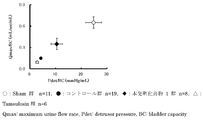
- a model was prepared in the same manner as in Test Example 1, and each evaluation drug (vehicle: 6% Gelucire, 1 mg of the compound of the present invention: 10 mg / kg) was orally administered twice a day for 4 weeks from 2 weeks after the preparation. On the day of the last administration, partial stenosis is released, and the following day, the bladder pressure and micturition are measured under awakening, and detrusor overactivity, which is an indicator of overactive bladder, and residual urine volume, which is an indicator of underactive bladder Evaluated. In addition, the detrusor muscle contraction force during urination was evaluated by nomogram analysis using Qmax and Pdet.
- Compound 1 of the present invention was found to have an improving effect on both detrusor overactivity and detrusor muscle contraction failure. .
- Table 2 shows the results.
- a significant increase in the amount of residual urine which is an index of underactive bladder, was observed compared to the Sham group.
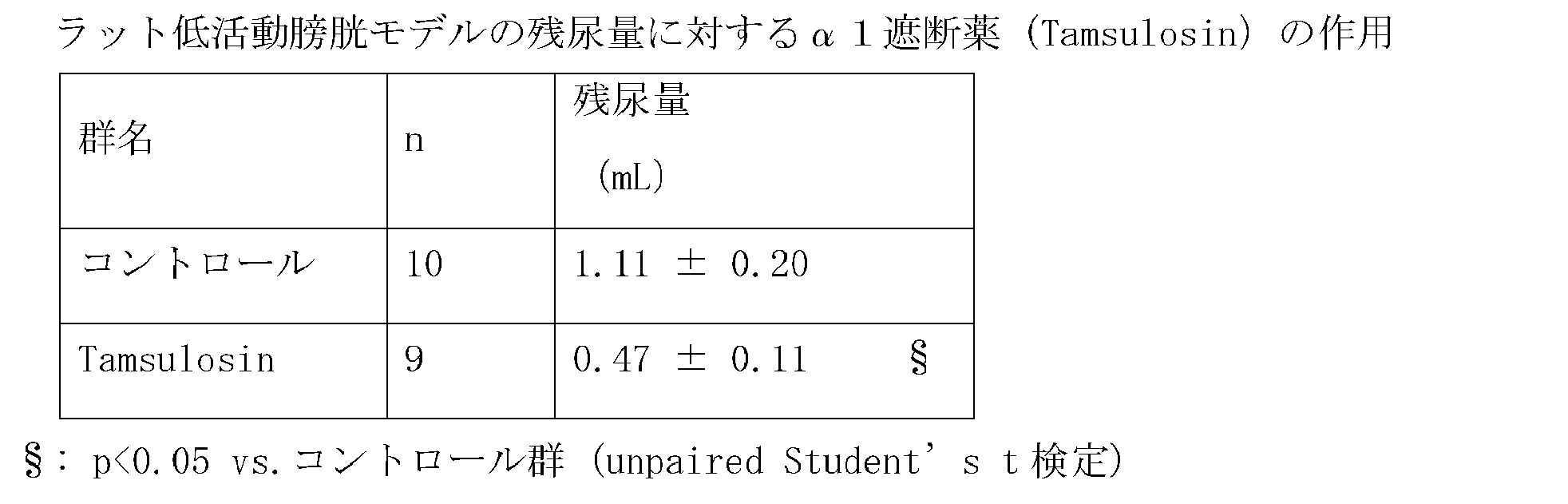
- Tamsulosin showed a significant decrease in the residual urine volume observed in the control group.
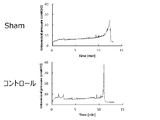
- Fig. 3 shows a typical chart of intravesical pressure.
- the characteristic continuous peak due to detrusor overactivity as seen in the urination disorder rat (control) in Test Example 1 was not observed. Therefore, since the rat dysuria model showing bladder / urethral dysfunction described in Test Example 1 of Patent Document 3 does not show symptoms of detrusor overactivity, it cannot be evaluated for detrusor overactivity associated with reduced contractile force. Indicated.
- ⁇ 1 blocker which is generally used as a dysuria treatment agent, is effective in underactive bladder (Comparative Example 2) and also reported effectiveness against overactive bladder (J Urol, 190, p1116-1122 (2013)), but in dysuria (depressed detrusor overactivity associated with reduced contractile force) coexisting with detrusor overactivity and detrusor contraction insufficiency (decreased contractile power), the effect is not observed (Comparative Example 1).
- the compound 1 of the present invention exhibits an improvement effect on both disorders in detrusor overactivity associated with detrusor overactivity and detrusor contraction insufficiency (decreased contractile force), and is associated with a decrease in contraction force. It was shown that it can be an effective therapeutic agent for detrusor overactivity (Test Example 2).
Landscapes
- Health & Medical Sciences (AREA)
- Animal Behavior & Ethology (AREA)
- Public Health (AREA)
- Veterinary Medicine (AREA)
- Chemical & Material Sciences (AREA)
- Life Sciences & Earth Sciences (AREA)
- General Health & Medical Sciences (AREA)
- Medicinal Chemistry (AREA)
- Pharmacology & Pharmacy (AREA)
- Epidemiology (AREA)
- Bioinformatics & Cheminformatics (AREA)
- Nuclear Medicine, Radiotherapy & Molecular Imaging (AREA)
- Organic Chemistry (AREA)
- Engineering & Computer Science (AREA)
- General Chemical & Material Sciences (AREA)
- Chemical Kinetics & Catalysis (AREA)
- Urology & Nephrology (AREA)
- Acyclic And Carbocyclic Compounds In Medicinal Compositions (AREA)
Abstract
Description

項1.3-(15-ヒドロキシペンタデシル)-2,4,4-トリメチル-2-シクロヘキセン-1-オンもしくはその塩、又はその溶媒和物を含む、排尿筋過活動及び排尿筋収縮不全を併せ持つ疾患(特に、膀胱・尿道協調不全に基づく疾患を除く)の治療剤。
本モデルは、9週齢 雌性 Sprague-Dawleyラットの尿道を部分狭窄(φ1.57 mm)し作製した。モデル作製6週後に部分狭窄を解除し、その翌日に、覚醒下にて膀胱内圧・排尿量を測定し、Qmax(最大尿流率)とPdet(排尿筋圧)を用いたノモグラム解析にて、排尿時の排尿筋収縮力を評価した。また、過活動膀胱の指標である排尿筋過活動と、低活動膀胱の指標である残尿量増大を評価した。
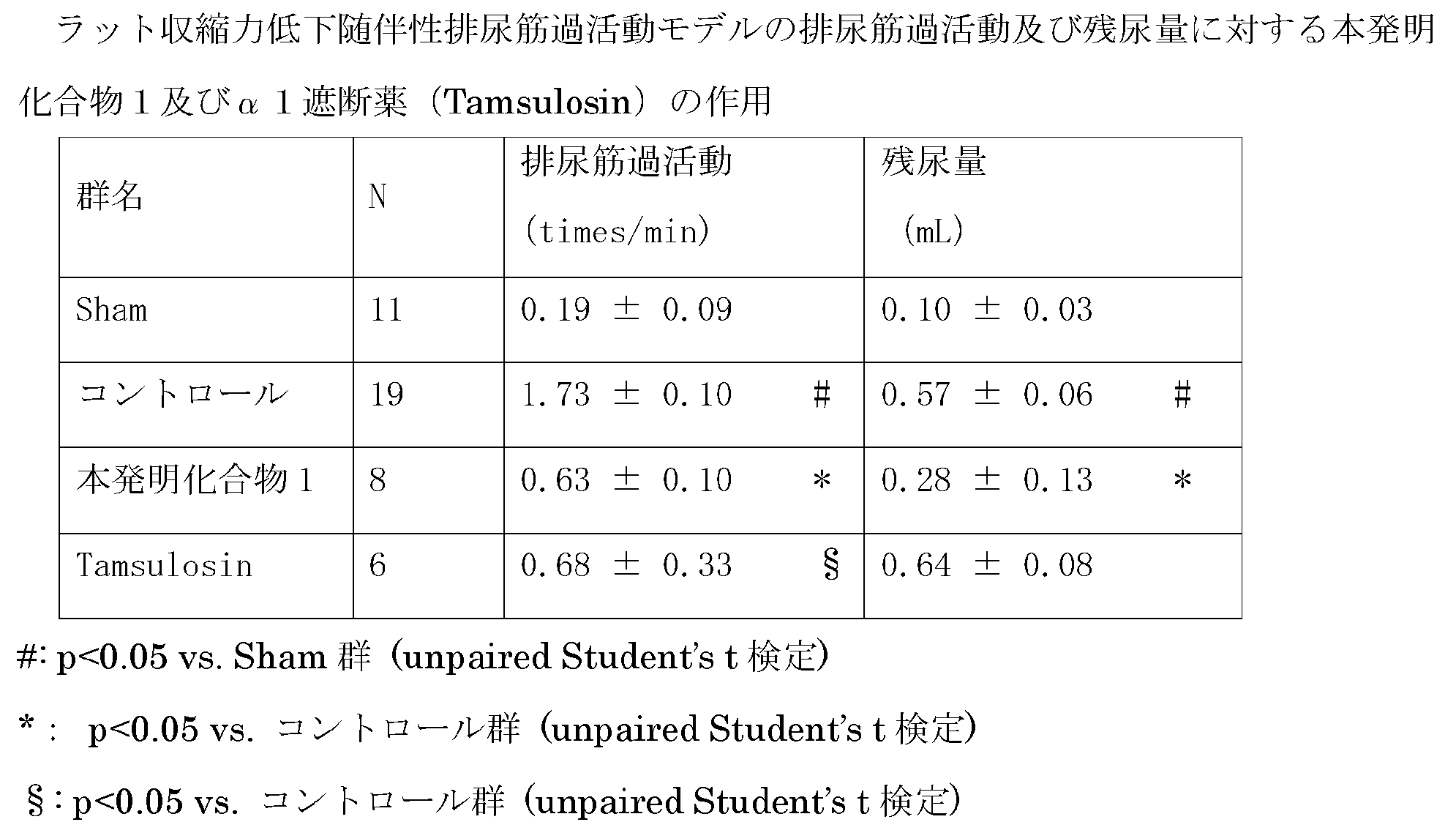
収縮力低下随伴性排尿筋過活動に対する3-(15-ヒドロキシペンタデシル)-2,4,4-トリメチル-2-シクロヘキセン-1-オン(以下、「本発明化合物1」)の効果を検討した。
排尿障害治療剤として広く使用されているα1遮断薬Tamsulosinについて、収縮力低下随伴性排尿筋過活動に対する効果を検討した。
WO2013/027806を参考に、低活動膀胱に対するα1遮断薬(Tamsulosin)の作用の効果を検討した。本排尿障害モデルは、10週齢 雌性 Wistarラットにストレプトゾトシン(STZ、65 mg/kg, i.p.)を処置し作製した。モデル作製4週後より、Tamsulosin(1 μg/kg/hr)を浸透圧ポンプにて皮下投与した。投与開始から4週後に、ウレタン麻酔下にて膀胱内圧・排尿量を測定し、低活動膀胱の指標として残尿量に対する作用を評価した。
特許文献3の試験例1の記載に基づき、ストレプ卜ゾ卜シン(STZ)により排尿障害を誘導させてから4週後、膀胱排尿筋の収縮と尿道括約筋の弛緩のタイムラグが生じているラットモデルを作成した。本モデルを用いてウレタン麻酔下にて膀胱内圧を測定し排尿筋過活動の有無を評価した。
Claims (12)
- 3-(15-ヒドロキシペンタデシル)-2,4,4-トリメチル-2-シクロヘキセン-1-オンもしくはその塩、又はその溶媒和物を含む、排尿筋過活動及び排尿筋収縮不全を併せ持つ疾患の治療剤。
- 3-(15-ヒドロキシペンタデシル)-2,4,4-トリメチル-2-シクロヘキセン-1-オンもしくはその塩、又はその溶媒和物を含む、収縮力低下随伴性排尿筋過活動の治療剤。
- 3-(15-ヒドロキシペンタデシル)-2,4,4-トリメチル-2-シクロヘキセン-1-オンもしくはその塩、又はその溶媒和物及び薬学的担体を含む、排尿筋過活動及び排尿筋収縮不全を併せ持つ疾患を治療するための医薬組成物。
- 3-(15-ヒドロキシペンタデシル)-2,4,4-トリメチル-2-シクロヘキセン-1-オンもしくはその塩、又はその溶媒和物及び薬学的担体を含む、収縮力低下随伴性排尿筋過活動を治療するための医薬組成物。
- 排尿筋過活動及び排尿筋収縮不全を併せ持つ疾患の治療剤を製造するための、3-(15-ヒドロキシペンタデシル)-2,4,4-トリメチル-2-シクロヘキセン-1-オンもしくはその塩、又はその溶媒和物の使用。
- 収縮力低下随伴性排尿筋過活動の治療剤を製造するための、3-(15-ヒドロキシペンタデシル)-2,4,4-トリメチル-2-シクロヘキセン-1-オンもしくはその塩、又はその溶媒和物の使用。
- 排尿筋過活動及び排尿筋収縮不全を併せ持つ疾患の治療に使用するための3-(15-ヒドロキシペンタデシル)-2,4,4-トリメチル-2-シクロヘキセン-1-オンもしくはその塩、又はその溶媒和物。
- 収縮力低下随伴性排尿筋過活動の治療に使用するための3-(15-ヒドロキシペンタデシル)-2,4,4-トリメチル-2-シクロヘキセン-1-オンもしくはその塩、又はその溶媒和物。
- 排尿筋過活動及び排尿筋収縮不全を併せ持つ疾患を治療するための3-(15-ヒドロキシペンタデシル)-2,4,4-トリメチル-2-シクロヘキセン-1-オンもしくはその塩、又はその溶媒和物の使用。
- 収縮力低下随伴性排尿筋過活動を治療するための3-(15-ヒドロキシペンタデシル)-2,4,4-トリメチル-2-シクロヘキセン-1-オンもしくはその塩、又はその溶媒和物の使用。
- 3-(15-ヒドロキシペンタデシル)-2,4,4-トリメチル-2-シクロヘキセン-1-オンもしくはその塩、又はその溶媒和物の治療的有効量を投与することを含む、排尿筋過活動及び排尿筋収縮不全を併せ持つ疾患を治療する方法。
- 収縮力低下随伴性排尿筋過活動の患者に3-(15-ヒドロキシペンタデシル)-2,4,4-トリメチル-2-シクロヘキセン-1-オンもしくはその塩、又はその溶媒和物の治療的有効量を投与することを含む、収縮力低下随伴性排尿筋過活動の治療方法。
Priority Applications (15)
| Application Number | Priority Date | Filing Date | Title |
|---|---|---|---|
| RU2018107515A RU2714444C2 (ru) | 2015-08-04 | 2016-08-03 | Средство, снижающее интенсивность гиперактивности детрузора с нарушенной сократимостью |
| MX2018001518A MX382014B (es) | 2015-08-04 | 2016-08-03 | Agente mejorador para hiperactividad del detrusor con deterioro de la contractilidad. |
| EP16833066.0A EP3332779B1 (en) | 2015-08-04 | 2016-08-03 | Ameliorating agent for detrusor hyperactivity with impaired contractility |
| HK18106741.9A HK1247106A1 (zh) | 2015-08-04 | 2016-08-03 | 逼尿肌过度活动伴收缩功能受损的改善剂 |
| CA2994648A CA2994648C (en) | 2015-08-04 | 2016-08-03 | Ameliorating agent for detrusor hyperactivity with impaired contractility |
| ES16833066T ES2836685T3 (es) | 2015-08-04 | 2016-08-03 | Agente para aliviar la hiperactividad del detrusor con deterioro de la contractilidad |
| KR1020187006188A KR102076137B1 (ko) | 2015-08-04 | 2016-08-03 | 수축력 저하 수반성 배뇨근 과활동 개선제 |
| CN201680045566.3A CN107921011A (zh) | 2015-08-04 | 2016-08-03 | 逼尿肌过度活动伴收缩功能受损的改善剂 |
| JP2017533103A JP6328856B2 (ja) | 2015-08-04 | 2016-08-03 | 収縮力低下随伴性排尿筋過活動改善剤 |
| BR112017028381-6A BR112017028381A2 (ja) | 2015-08-04 | 2016-08-03 | Contractile force fall complicated detrusor overactivity improvement agent |
| MYPI2018700358A MY197287A (en) | 2015-08-04 | 2016-08-03 | Ameliorating agent for detrusor hyperactivity with impaired contractility |
| KR1020197034935A KR20190134825A (ko) | 2015-08-04 | 2016-08-03 | 수축력 저하 수반성 배뇨근 과활동 개선제 |
| AU2016301689A AU2016301689B2 (en) | 2015-08-04 | 2016-08-03 | Ameliorating agent for detrusor hyperactivity with impaired contractility |
| SG11201710583RA SG11201710583RA (en) | 2015-08-04 | 2016-08-03 | Ameliorating agent for detrusor hyperactivity with impaired contractility |
| PH12018500176A PH12018500176A1 (en) | 2015-08-04 | 2018-01-23 | Ameliorating agent for detrusor hyperactivity with impaired contractility |
Applications Claiming Priority (2)
| Application Number | Priority Date | Filing Date | Title |
|---|---|---|---|
| US14/817,318 US20170035705A1 (en) | 2015-08-04 | 2015-08-04 | Detrusor hyperactivity with impaired contractility ameliorating agent |
| US14/817318 | 2015-08-04 |
Publications (1)
| Publication Number | Publication Date |
|---|---|
| WO2017022787A1 true WO2017022787A1 (ja) | 2017-02-09 |
Family
ID=57943093
Family Applications (1)
| Application Number | Title | Priority Date | Filing Date |
|---|---|---|---|
| PCT/JP2016/072753 Ceased WO2017022787A1 (ja) | 2015-08-04 | 2016-08-03 | 収縮力低下随伴性排尿筋過活動改善剤 |
Country Status (17)
| Country | Link |
|---|---|
| US (3) | US20170035705A1 (ja) |
| EP (1) | EP3332779B1 (ja) |
| JP (1) | JP6328856B2 (ja) |
| KR (2) | KR102076137B1 (ja) |
| CN (1) | CN107921011A (ja) |
| AU (1) | AU2016301689B2 (ja) |
| BR (1) | BR112017028381A2 (ja) |
| CA (1) | CA2994648C (ja) |
| ES (1) | ES2836685T3 (ja) |
| HK (1) | HK1247106A1 (ja) |
| MX (1) | MX382014B (ja) |
| MY (1) | MY197287A (ja) |
| PH (1) | PH12018500176A1 (ja) |
| RU (1) | RU2714444C2 (ja) |
| SG (1) | SG11201710583RA (ja) |
| TW (1) | TWI668005B (ja) |
| WO (1) | WO2017022787A1 (ja) |
Cited By (2)
| Publication number | Priority date | Publication date | Assignee | Title |
|---|---|---|---|---|
| WO2022004867A1 (ja) * | 2020-07-03 | 2022-01-06 | 大鵬薬品工業株式会社 | 排尿症状治療剤 |
| JP2022013286A (ja) * | 2020-07-03 | 2022-01-18 | 大鵬薬品工業株式会社 | 排尿症状治療剤 |
Citations (3)
| Publication number | Priority date | Publication date | Assignee | Title |
|---|---|---|---|---|
| JP2002241271A (ja) * | 2001-02-19 | 2002-08-28 | Meiji Milk Prod Co Ltd | 排尿障害治療剤 |
| JP2015067565A (ja) * | 2013-09-27 | 2015-04-13 | 大鵬薬品工業株式会社 | 3−(15−ヒドロキシペンタデシル)−2,4,4−トリメチル−2−シクロヘキセン−1−オン又はその塩を含有する医薬組成物 |
| JP2015086212A (ja) * | 2013-09-27 | 2015-05-07 | 大鵬薬品工業株式会社 | 膀胱・尿道協調不全改善剤 |
Family Cites Families (5)
| Publication number | Priority date | Publication date | Assignee | Title |
|---|---|---|---|---|
| EP1003706B1 (en) | 1997-08-13 | 2003-03-05 | Meiji Milk Products Company Limited | Cyclohexenone long-chain alcohol and medicament containing same |
| RU2193401C1 (ru) * | 2001-04-02 | 2002-11-27 | Аль-Шукри Салман Хасунович | Способ лечения гиперактивности мочевого пузыря |
| JPWO2006004115A1 (ja) * | 2004-07-05 | 2008-04-24 | 中外製薬株式会社 | 過活動膀胱治療剤 |
| DE602006014799D1 (de) * | 2005-01-18 | 2010-07-22 | Meiji Dairies Corp | Heilmittel gegen sensorische erkrankungen |
| JP2009292797A (ja) * | 2008-06-09 | 2009-12-17 | Kyoto Univ | 過活動膀胱治療剤 |
-
2015
- 2015-08-04 US US14/817,318 patent/US20170035705A1/en not_active Abandoned
-
2016
- 2016-05-16 US US15/155,526 patent/US9687457B2/en active Active
- 2016-08-03 CN CN201680045566.3A patent/CN107921011A/zh active Pending
- 2016-08-03 SG SG11201710583RA patent/SG11201710583RA/en unknown
- 2016-08-03 CA CA2994648A patent/CA2994648C/en active Active
- 2016-08-03 BR BR112017028381-6A patent/BR112017028381A2/ja not_active Application Discontinuation
- 2016-08-03 RU RU2018107515A patent/RU2714444C2/ru active
- 2016-08-03 KR KR1020187006188A patent/KR102076137B1/ko active Active
- 2016-08-03 MY MYPI2018700358A patent/MY197287A/en unknown
- 2016-08-03 HK HK18106741.9A patent/HK1247106A1/zh unknown
- 2016-08-03 EP EP16833066.0A patent/EP3332779B1/en active Active
- 2016-08-03 AU AU2016301689A patent/AU2016301689B2/en not_active Ceased
- 2016-08-03 ES ES16833066T patent/ES2836685T3/es active Active
- 2016-08-03 WO PCT/JP2016/072753 patent/WO2017022787A1/ja not_active Ceased
- 2016-08-03 KR KR1020197034935A patent/KR20190134825A/ko not_active Withdrawn
- 2016-08-03 JP JP2017533103A patent/JP6328856B2/ja not_active Expired - Fee Related
- 2016-08-03 TW TW105124867A patent/TWI668005B/zh active
- 2016-08-03 MX MX2018001518A patent/MX382014B/es unknown
-
2017
- 2017-05-19 US US15/599,890 patent/US20170252307A1/en not_active Abandoned
-
2018
- 2018-01-23 PH PH12018500176A patent/PH12018500176A1/en unknown
Patent Citations (3)
| Publication number | Priority date | Publication date | Assignee | Title |
|---|---|---|---|---|
| JP2002241271A (ja) * | 2001-02-19 | 2002-08-28 | Meiji Milk Prod Co Ltd | 排尿障害治療剤 |
| JP2015067565A (ja) * | 2013-09-27 | 2015-04-13 | 大鵬薬品工業株式会社 | 3−(15−ヒドロキシペンタデシル)−2,4,4−トリメチル−2−シクロヘキセン−1−オン又はその塩を含有する医薬組成物 |
| JP2015086212A (ja) * | 2013-09-27 | 2015-05-07 | 大鵬薬品工業株式会社 | 膀胱・尿道協調不全改善剤 |
Non-Patent Citations (4)
| Title |
|---|
| NOMIYA, M. ET AL.: "A neurotrophic agent, N- hexacosanol, prevents the development of bladder hyperactivity in a rat model of chronic bladder ischemia", J. UROLOGY, vol. 193, no. 4S, April 2015 (2015-04-01), pages e77, XP029153350 * |
| SAITO, M. ET AL.: "Effect of cyclohexenonic long-chain fatty alcohol on rat overactive bladder induced by bladder neck obstruction", EUR. J. PHARMACOL., vol. 501, 2004, pages 143 - 149, XP055361861 * |
| SHUKO KOKUBUN ET AL.: "Heisoku Boko ni Okeru Joshinkei to Boko Heikatsukin no Shushuku Shogai -Cyclohexenones Yudotai(TAC-302) no Joshinkei Yobo Koka", THE JAPANESE JOURNAL OF UROLOGY, vol. 102, no. 2, 2011, pages 352, XP009509045 * |
| WATANABE, T. ET AL.: "Effects of long- chain fatty alcohol on peripheral nerve conduction and bladder function in diabetic rats", LIFE SCIENCES, vol. 70, 2002, pages 2215 - 2224, XP055362530 * |
Cited By (2)
| Publication number | Priority date | Publication date | Assignee | Title |
|---|---|---|---|---|
| WO2022004867A1 (ja) * | 2020-07-03 | 2022-01-06 | 大鵬薬品工業株式会社 | 排尿症状治療剤 |
| JP2022013286A (ja) * | 2020-07-03 | 2022-01-18 | 大鵬薬品工業株式会社 | 排尿症状治療剤 |
Also Published As
| Publication number | Publication date |
|---|---|
| JP6328856B2 (ja) | 2018-05-23 |
| JPWO2017022787A1 (ja) | 2018-04-26 |
| CN107921011A (zh) | 2018-04-17 |
| US9687457B2 (en) | 2017-06-27 |
| EP3332779A1 (en) | 2018-06-13 |
| BR112017028381A2 (ja) | 2018-08-28 |
| RU2018107515A3 (ja) | 2019-09-05 |
| EP3332779B1 (en) | 2020-10-28 |
| HK1247106A1 (zh) | 2018-09-21 |
| KR20180038003A (ko) | 2018-04-13 |
| EP3332779A4 (en) | 2019-03-13 |
| US20170035706A1 (en) | 2017-02-09 |
| ES2836685T3 (es) | 2021-06-28 |
| CA2994648C (en) | 2020-04-07 |
| SG11201710583RA (en) | 2018-01-30 |
| MX2018001518A (es) | 2018-04-24 |
| AU2016301689B2 (en) | 2018-10-04 |
| TWI668005B (zh) | 2019-08-11 |
| RU2714444C2 (ru) | 2020-02-17 |
| PH12018500176A1 (en) | 2018-07-30 |
| US20170252307A1 (en) | 2017-09-07 |
| KR102076137B1 (ko) | 2020-02-11 |
| RU2018107515A (ru) | 2019-09-05 |
| MX382014B (es) | 2025-03-13 |
| TW201717924A (zh) | 2017-06-01 |
| CA2994648A1 (en) | 2017-02-09 |
| US20170035705A1 (en) | 2017-02-09 |
| MY197287A (en) | 2023-06-09 |
| AU2016301689A1 (en) | 2018-01-25 |
| KR20190134825A (ko) | 2019-12-04 |
Similar Documents
| Publication | Publication Date | Title |
|---|---|---|
| CN114786660A (zh) | 使用mtorc1调节剂的治疗方法 | |
| JP6328856B2 (ja) | 収縮力低下随伴性排尿筋過活動改善剤 | |
| JP5566521B1 (ja) | 膀胱・尿道協調不全改善剤 | |
| TW201210586A (en) | Methods of using diacerein as an adjunctive therapy for diabetes | |
| CN110290788A (zh) | 氨基甲酸酯化合物用于预防、缓解或治疗双相障碍的用途 | |
| TWI836234B (zh) | 排尿症狀治療劑 | |
| JP6894555B1 (ja) | 排尿症状治療剤 | |
| JP2013049653A (ja) | 女性の排尿障害の治療剤 | |
| JP2008513430A (ja) | 月経前症候群および月経前不快気分障害の処置のためのピンドロール | |
| HK40088174A (zh) | 排尿症状治疗剂 | |
| HK40088174B (zh) | 排尿症状治疗剂 | |
| HK40015213A (en) | Use of carbamate compounds for prevention, alleviation or treatment of bipolar disorder | |
| HK1222582B (zh) | 用於改善膀胱尿道协同失调的药剂 |
Legal Events
| Date | Code | Title | Description |
|---|---|---|---|
| 121 | Ep: the epo has been informed by wipo that ep was designated in this application |
Ref document number: 16833066 Country of ref document: EP Kind code of ref document: A1 |
|
| WWE | Wipo information: entry into national phase |
Ref document number: 11201710583R Country of ref document: SG |
|
| WWE | Wipo information: entry into national phase |
Ref document number: 12018500176 Country of ref document: PH |
|
| ENP | Entry into the national phase |
Ref document number: 2016301689 Country of ref document: AU Date of ref document: 20160803 Kind code of ref document: A |
|
| ENP | Entry into the national phase |
Ref document number: 2994648 Country of ref document: CA Ref document number: 2017533103 Country of ref document: JP Kind code of ref document: A |
|
| WWE | Wipo information: entry into national phase |
Ref document number: MX/A/2018/001518 Country of ref document: MX |
|
| NENP | Non-entry into the national phase |
Ref country code: DE |
|
| ENP | Entry into the national phase |
Ref document number: 20187006188 Country of ref document: KR Kind code of ref document: A |
|
| WWE | Wipo information: entry into national phase |
Ref document number: 2016833066 Country of ref document: EP Ref document number: 2018107515 Country of ref document: RU |
|
| REG | Reference to national code |
Ref country code: BR Ref legal event code: B01A Ref document number: 112017028381 Country of ref document: BR |
|
| ENP | Entry into the national phase |
Ref document number: 112017028381 Country of ref document: BR Kind code of ref document: A2 Effective date: 20171228 |