WO2017002892A1 - Atp測定におけるatp分解活性の低減方法 - Google Patents
Atp測定におけるatp分解活性の低減方法 Download PDFInfo
- Publication number
- WO2017002892A1 WO2017002892A1 PCT/JP2016/069371 JP2016069371W WO2017002892A1 WO 2017002892 A1 WO2017002892 A1 WO 2017002892A1 JP 2016069371 W JP2016069371 W JP 2016069371W WO 2017002892 A1 WO2017002892 A1 WO 2017002892A1
- Authority
- WO
- WIPO (PCT)
- Prior art keywords
- atp
- phosphate
- kinase
- types
- degradation
- Prior art date
- Legal status (The legal status is an assumption and is not a legal conclusion. Google has not performed a legal analysis and makes no representation as to the accuracy of the status listed.)
- Ceased
Links
Images









Classifications
-
- C—CHEMISTRY; METALLURGY
- C12—BIOCHEMISTRY; BEER; SPIRITS; WINE; VINEGAR; MICROBIOLOGY; ENZYMOLOGY; MUTATION OR GENETIC ENGINEERING
- C12Q—MEASURING OR TESTING PROCESSES INVOLVING ENZYMES, NUCLEIC ACIDS OR MICROORGANISMS; COMPOSITIONS OR TEST PAPERS THEREFOR; PROCESSES OF PREPARING SUCH COMPOSITIONS; CONDITION-RESPONSIVE CONTROL IN MICROBIOLOGICAL OR ENZYMOLOGICAL PROCESSES
- C12Q1/00—Measuring or testing processes involving enzymes, nucleic acids or microorganisms; Compositions therefor; Processes of preparing such compositions
- C12Q1/02—Measuring or testing processes involving enzymes, nucleic acids or microorganisms; Compositions therefor; Processes of preparing such compositions involving viable microorganisms
-
- C—CHEMISTRY; METALLURGY
- C12—BIOCHEMISTRY; BEER; SPIRITS; WINE; VINEGAR; MICROBIOLOGY; ENZYMOLOGY; MUTATION OR GENETIC ENGINEERING
- C12Q—MEASURING OR TESTING PROCESSES INVOLVING ENZYMES, NUCLEIC ACIDS OR MICROORGANISMS; COMPOSITIONS OR TEST PAPERS THEREFOR; PROCESSES OF PREPARING SUCH COMPOSITIONS; CONDITION-RESPONSIVE CONTROL IN MICROBIOLOGICAL OR ENZYMOLOGICAL PROCESSES
- C12Q1/00—Measuring or testing processes involving enzymes, nucleic acids or microorganisms; Compositions therefor; Processes of preparing such compositions
- C12Q1/48—Measuring or testing processes involving enzymes, nucleic acids or microorganisms; Compositions therefor; Processes of preparing such compositions involving transferase
-
- C—CHEMISTRY; METALLURGY
- C12—BIOCHEMISTRY; BEER; SPIRITS; WINE; VINEGAR; MICROBIOLOGY; ENZYMOLOGY; MUTATION OR GENETIC ENGINEERING
- C12Q—MEASURING OR TESTING PROCESSES INVOLVING ENZYMES, NUCLEIC ACIDS OR MICROORGANISMS; COMPOSITIONS OR TEST PAPERS THEREFOR; PROCESSES OF PREPARING SUCH COMPOSITIONS; CONDITION-RESPONSIVE CONTROL IN MICROBIOLOGICAL OR ENZYMOLOGICAL PROCESSES
- C12Q1/00—Measuring or testing processes involving enzymes, nucleic acids or microorganisms; Compositions therefor; Processes of preparing such compositions
- C12Q1/66—Measuring or testing processes involving enzymes, nucleic acids or microorganisms; Compositions therefor; Processes of preparing such compositions involving luciferase
Definitions
- the present invention relates to a method, a composition and a kit for measuring ATP.
- Adenosine triphosphate (hereinafter referred to as ATP) is a nucleotide found in every living body, and is used by cells as a substrate for storing and releasing energy. By measuring ATP, the state of cells such as life and death can be examined. Healthy cells are rich in ATP, and dead and dead cells are poor in ATP.
- Non-patent Document 1 a method is known in which luminescence is measured by reacting ATP with a substrate luciferin in the presence of luciferase. This reaction is catalyzed by luciferase and proceeds as follows in the presence of a divalent metal ion. Luciferin + ATP + O 2 ⁇ oxyluciferin + adenosine monophosphate (AMP) + pyrophosphate (PPi) + CO 2 + light Luciferase is found in bacteria, protozoa, mollusks, insects and the like. Insects having luciferase include beetles such as fireflies and click beetles. Numerous luciferase genes have been isolated and their nucleotide sequences have been determined.
- ATP When measuring ATP, ATP may be rapidly reduced, such as ATP is degraded into adenosine diphosphate (hereinafter referred to as ADP) due to the activity of an enzyme that degrades or converts endogenous ATP from serum or cells. It becomes a problem.
- ADP adenosine diphosphate
- luciferase uses ATP as a substrate
- an ATP measurement method using luciferase as a reporter molecule has this problem. This problem is particularly problematic in the technology for determining the viability of cells. This is because the cell extract contains various enzymes having ATP-degrading activity.
- ATP-degrading enzyme inhibitors include surfactants and chelating agents.
- many ATP-degrading enzyme inhibitors not only inhibit ATP-degrading enzyme activity inherent in cell samples and the like, but can also inhibit reporter molecules such as luciferase.
- the first approach divides the measurement into multiple stages.
- all or part of the endogenous ATPase activity of the sample is inactivated. Inactivation is performed, for example, by increasing the pH of the sample or using an ATP-degrading enzyme inhibitor.
- the surfactant can also be responsible for cell extraction.
- the means for inactivating the ATP-degrading enzyme activity is neutralized.
- the pH of the sample is readjusted, and an ATP-degrading enzyme inhibitor such as a surfactant is diluted.
- an ATP-degrading enzyme inhibitor such as a surfactant
- a reporter molecule such as luciferase is added and luminescence is measured.
- the second step and the third step are performed simultaneously as an improved method, but in this case, the method is also a two-step process.
- the advantage of the multi-step measurement method is that the intrinsic ATP-degrading activity can be sufficiently reduced by using a surfactant having a strong denaturing action as an ATP-degrading enzyme inhibitor.
- this method has a drawback that it is necessary to divide the measurement into multiple stages and the operation becomes complicated.
- the endogenous ATP-degrading enzyme inhibition step and the addition step of a substrate and a reporter molecule such as luciferase are performed as a single step.
- Patent Document 1 adds such a reagent containing a surfactant and luciferase as a single step, dissolves cells with the surfactant, and reduces the activity of the endogenous ATP-degrading enzyme while reducing the activity of such an interface.
- a method for measuring ATP by the action of luciferase that maintains a constant activity even in the presence of an active agent is disclosed. This single step approach has the advantage of being easy to operate.
- Patent Document 1 uses luciferase having excellent stability.
- Patent Document 2 describes an ADP measurement method using a luciferin-luciferase reagent containing pyruvate kinase and phosphoenolpyruvate. This method measures ADP to identify apoptotic or necrotic cells. This is a method utilizing the two-phase response of luciferase that ATP concentration decreases after initial luminescence or flash. That is, first measure the ATP concentration. When the initial luminous intensity reaches a substantially constant level, add a reagent that converts cellular ADP to ATP, and then measure the ADP concentration using the emitted light or its change over time. It is a multi-step measurement method.
- Patent Document 3 describes a chemistry using 1-methoxy-5-phenazine methyl sulfate (1-MPMS) and isoluminol (IL) because there is a problem in the stability of the reagent for the ATP determination method using the firefly luciferin-luciferase system.
- the luminescence method is described. D-glucose and ATP are converted to glucose-6-phosphate (G6P) and ADP using hexokinase (HK). The resulting ADP is regenerated to ATP and pyruvate by phosphoenolpyruvate (PEP) and pyruvate kinase.
- G6P that accumulates by cycling is brought to NADPH by glucose-6-phosphate dehydrogenase (G6PDH), which is colorimetrically determined.
- G6PDH glucose-6-phosphate dehydrogenase
- the described method is for use with ATP standard solutions or sample solutions containing ATP. This document does not describe surfactants or cell extraction.
- Patent Document 4 describes a method for quantifying a trace amount of ATP by an ATP amplification-cycling method. According to Patent Document 4, since adenylate kinase antagonizes with hexokinase in the ATP cycling method, an inactivation step at a high temperature is provided in order to deactivate adenylate kinase activity when ATP amplification is completed. ing. Therefore, the method disclosed in Patent Document 4 includes at least three steps of ATP amplification, heat inactivation, and measurement.
- Patent Document 5 describes a method for measuring soil microorganisms.
- cell extraction is first performed using a surfactant Triton-X100, and chromogen tetrazolium blue, glucose, NAD, glucokinase, acetate kinase, glucose-6-phosphate dehydrogenase, diaphorase are added thereto.
- a sample solution containing the sample is added to make a visual determination by coloring the pigment.
- Patent Document 6 describes a method for quantifying adenosine phosphate using a bioluminescent reagent and a method for quantifying substances involved in an ATP conversion reaction system.
- the disclosed ATP quantification method measures luminescence produced by reacting at least pyruvate-phosphate dikinase (PPDK), phosphoenolpyruvate (PEP), pyrophosphate, metal ions, luciferase, and luciferin with a sample. It is.
- the present invention provides a simple ATP measurement method that is hardly affected by the ATP degradation activity.
- the present inventors can carry out in a single step that can be used even with luciferase with low surfactant resistance without using a surfactant having a strong inhibitory or denaturing action.
- ATP a strong inhibitory or denaturing action.
- the inventors have found that by adding an agent, endogenous ATP degradation activity can be suppressed and ATP in a sample can be measured in a single step, and the present invention has been completed.
- the present inventors also enzymatically convert ADP generated by ATP degradation reaction etc. into ATP by adding one or more enzymes having ATP generating ability in the single step,
- the present invention has been completed by finding a method capable of maintaining the light emission amount.
- a method for measuring ATP comprising a single step of adding an ATP measurement reagent containing a cell extractant, an ATP detection agent, and an ATP degradation inhibitor that is not one or more surfactants to a sample.
- the ATP degradation inhibitor that is not a surfactant is a reaction product in an ATP degradation reaction by an ATP degrading enzyme.
- the ATP degradation inhibitor which is not the surfactant is creatine phosphate, phosphoenolpyruvate, acetyl phosphate, fructose 1,6-bisphosphate, riboflavin phosphate, inosine 5′-diphosphate, polyphosphate 2.
- the method according to 1 which is selected from the group consisting of pyrophosphate, phosphate, acetyl-CoA, D-cysteine, and combinations thereof.
- a reaction product in the ATP degradation reaction by the ATP degrading enzyme is creatine phosphate, phosphoenolpyruvate, acetyl phosphate, fructose 1,6-bisphosphate, riboflavin phosphate, inosine 5′-diphosphate, 3.
- the method according to 2 selected from the group consisting of polyphosphoric acid, pyrophosphoric acid, phosphoric acid, acetyl-CoA and combinations thereof.
- ATP measurement reagent further comprises one or more enzymes having ATP production ability.
- An enzyme capable of producing ATP is pyruvate kinase, pyruvate-phosphate dikinase, creatine kinase, acetate kinase, polyphosphate kinase, hexokinase, glucokinase, glycerol kinase, fructokinase, riboflavin kinase, phosphofructo 6.
- the sample comprises a microorganism, cultured cells, or a medium that may contain a microorganism.
- the ATP detection agent comprises luciferase and luciferin.
- cell viability is determined by ATP measurement.
- An ATP measurement composition for measurement by a single step comprising a cell extractant, an ATP detection agent, and an ATP degradation inhibitor that is not one or more surfactants.
- the ATP degradation inhibitor that is not a surfactant is a reaction product in an ATP degradation reaction by an ATP degrading enzyme.
- the ATP degradation inhibitor that is not the surfactant is creatine phosphate, phosphoenolpyruvate, acetyl phosphate, fructose 1,6-bisphosphate, riboflavin phosphate, inosine 5′-diphosphate, polyphosphate 11.
- a reaction product in the ATP degradation reaction by the ATP degrading enzyme is creatine phosphate, phosphoenolpyruvate, acetyl phosphate, fructose 1,6-bisphosphate, riboflavin phosphate, inosine 5′-diphosphate, 12.
- An enzyme capable of generating ATP is pyruvate kinase, pyruvate-phosphate dikinase, creatine kinase, acetate kinase, polyphosphate kinase, hexokinase, glucokinase, glycerol kinase, fructokinase, riboflavin kinase, phosphofructo 15.
- the ATP detection agent comprises luciferase and luciferin.
- a strong surfactant is used without requiring a two-stage or multi-stage operation in which a strong surfactant is used in the first stage and the surfactant is diluted in the second stage. Therefore, ATP can be measured well as a simple single step. That is, according to the present invention, it is possible to reduce the influence of ATP degradation activity existing in the measurement system, and ATP can be measured in a single step.
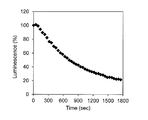
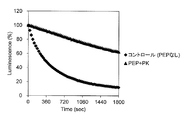
- the time-dependent change of the emitted light amount when the conventional luminescent reagent is used for a cell suspension is shown.
- the vertical axis is the percentage (%) relative to the start time.
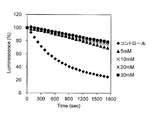
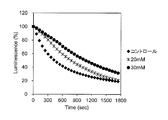
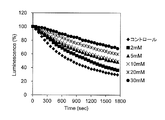
- the time-dependent change of the light emission amount (%) is shown when an ATP decomposition inhibitor (reagent that suppresses the decay of light emission amount) that is not various surfactants is added.
- the results (%) of luminescence measurement when acetyl phosphate is used at various concentrations are shown.
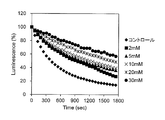
- the results (%) of luminescence measurement when creatine phosphate is used at various concentrations are shown.
- the results (%) of luminescence measurement when PEP is used at various concentrations are shown.
- the results (%) of luminescence measurement when fructose 1,6-bisphosphoric acid is used at each concentration are shown.
- the results (%) of the luminescence measurement when inosine 5'-diphosphate is used at each concentration are shown.
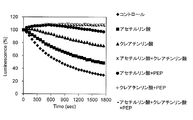
- the results (%) of luminescence measurement when an ATP degradation inhibitor that is not a surfactant is combined are shown.
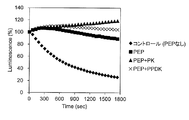
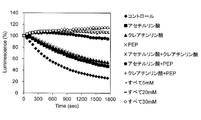
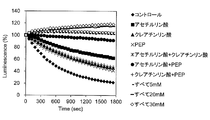
- generation ability is further added to ATP degradation inhibitor (PEP) which is not a surfactant is shown. Results are for B16 melanoma cells.
- generation ability is further added to the ATP degradation inhibitor (PEP) which is not a surfactant is shown.
- Results are for HepG2 cells.
- the result (%) of the light-emission quantity measurement when using a luciferase derived from Heike firefly and using acetyl phosphate at various concentrations is shown.
- the luminescence amount measurement results (%) are shown when luciferase derived from North American fireflies is used and acetyl phosphate is used at various concentrations.
- the result (%) of the light-emission quantity measurement when using geniferal luciferase and using acetyl phosphate at various concentrations is shown.
- the result (%) of the light-emission quantity measurement when using a luciferase derived from Heike firefly and using an ATP degradation inhibitor that is not a surfactant alone or in combination is shown.
- the results (%) of the amount of luminescence measured when a North American firefly-derived luciferase is used and an ATP degradation inhibitor that is not a surfactant is used alone or in combination are shown.
- the result (%) of the light-emission quantity measurement when using a geniferal luciferase and using an ATP degradation inhibitor that is not a surfactant alone or in combination is shown.
- the result (%) of the luminescence measurement at the time of using 3 types of phosphoric acid with respect to B16 melanoma cell is shown.
- the luminescence measurement results (%) when 3 types of phosphoric acid are used for HEK293 cells are shown.
- the result (%) of the luminescence measurement in the case of using three types of phosphate for HepG2 cells is shown.
- the luminescence amount measurement results (%) when riboflavin phosphate is used at various concentrations are shown.
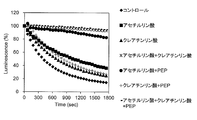
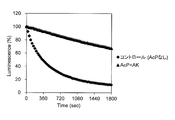
- the time-dependent change of light-emission amount (%) is shown when an ATP degradation inhibitor (AcP) that is not a surfactant and an enzyme (AK) capable of generating ATP is added.
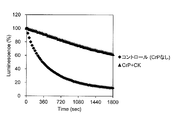
- the time-dependent change of light-emission amount (%) is shown when an ATP degradation inhibitor (CrP) that is not a surfactant and an enzyme (CK) capable of generating ATP is added.
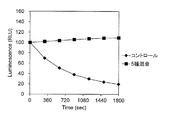
- the results (%) of luminescence measurement when an ATP degradation inhibitor that is not a surfactant is combined are shown.
- Results are for B16 melanoma cells.
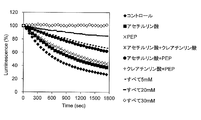
- the results (%) of luminescence measurement when an ATP degradation inhibitor that is not a surfactant is combined are shown.
- Results are for HEK293 cells.
- the results (%) of luminescence measurement when an ATP degradation inhibitor that is not a surfactant is combined are shown.
- Results are for HepG2 cells.
- the present invention provides a method for reducing ATP degradation activity in ATP measurement.
- This method includes a single step of adding an ATP measurement reagent containing a cell extractant, an ATP detection agent, and an ATP degradation inhibitor that is not one or more surfactants to a sample.
- This method can measure ATP by performing cell extraction, suppression of ATP degradation activity, and luminescence reaction in a single step. That is, the step of diluting the surfactant and the step of neutralizing are unnecessary, and the luminescence measurement can be performed as it is after the addition of the ATP measurement reagent to the sample.
- a cell extractant, an ATP detection agent, and an ATP degradation inhibitor that is not one or more surfactants are added to the sample as a single step.
- the single process means that the process is one stage when compared with the conventional multi-stage process. That is, all or part of the endogenous ATP-degrading enzyme activity of the sample was inactivated as the first step, and then the influence of an ATP-degrading enzyme inhibitor such as a surfactant was reduced by dilution or the like as the second step.
- the method of the present invention performs cell extraction, suppression of endogenous ATP degradation activity, and luminescence by luciferase as a single step. That is, in the method of the present invention, there are no separate steps such as diluting the surfactant, and cell extraction, suppression of ATP degradation activity, and luminescence reaction can proceed simultaneously in the test solution. As long as that is the case, the cell extractant, the ATP degradation activity inhibitor, and the ATP detection agent do not necessarily need to be added to the sample at the same time, and the cell extraction and ATP degradation activity can be suppressed without additional steps such as diluting the surfactant.
- the cell extractant, the ATP degradation activity inhibitor, and the ATP detector may be added sequentially.
- the cell extractant, the ATP degradation activity inhibitor and the ATP detector are added to the sample simultaneously.
- the method of the present invention does not include a step of diluting the surfactant between the addition of the cell extractant and the measurement of luminescence.
- Cell extractant Cell extractants typically include surfactants, and other examples include cell lysis reagents such as lysozyme (EC 3.2.1.17) and combinations thereof.
- surfactants that can be used in the present invention include nonionic surfactants, cationic surfactants, anionic surfactants, and zwitterionic surfactants.
- Nonionic surfactants include polyoxyethylene alkyl ethers, fatty acid sorbitan esters, alkyl polyglucosides, fatty acid diethanolamides, alkyl monoglyceryl ethers such as Triton-X100, Triton X-45, Tween 20, Tween 60, Tween 80, Span 60, Span80 and Thesit are listed, but not limited to them.
- Cationic surfactants include quaternary ammonium salts, pyridinium salts, phosphonium salts such as alkyltrimethylammonium salts, dialkyldimethylammonium salts, alkylbenzyldimethylammonium salts, alkylpyridinium salts, alkylphosphonium salts, imidazolium salts, alkylimidazoles.
- quaternary ammonium salts such as alkyltrimethylammonium salts, dialkyldimethylammonium salts, alkylbenzyldimethylammonium salts, alkylpyridinium salts, alkylphosphonium salts, imidazolium salts, alkylimidazoles.
- Examples thereof include a lithium salt, an isoquinonium salt, an alkylisoquinonium salt, cetyltrimethylammonium, or benzyldimethyldodecylammonium bromide.
- quaternary ammonium salts include decyltrimethylammonium chloride or bromide, dodecyltrimethylammonium chloride or bromidetetradecyltrimethylammonium chloride or bromide, hexadecyltrimethylammonium chloride or bromide, octadecyltrimethylammonium chloride or bromide, eicosyltrimethylammonium.
- Examples of the pyridinium salt include 1-decylpyridinium chloride or bromide, 1-dodecylpyridinium chloride or bromide, 1-tetradecylpyridinium chloride or bromide, 1-hexadecylpyridinium chloride or bromide, N-cetyl-2-methylpyridinium chloride N-cetyl-3-methylpyridinium chloride, N-cetyl-4-methylpyridinium chloride, 1-octadecylpyridinium chloride or bromide, 1-eicosylpyridinium chloride or bromide.
- Examples of phosphonium salts include tetraethylphosphonium chloride or bromide, tributylmethylphosphonium chloride, bromide or iodide, tetrabutylphosphonium chloride or bromide, tetra-n-octylphosphonium chloride or bromide, tributyldodecylphosphonium chloride or bromide, tributylhexadecylphosphonium Examples include chloride or bromide, methyltriphenylphosphonium chloride, bromide or iodide, tetraphenylphosphonium chloride or bromide.
- zwitterionic surfactant examples include, but are not limited to, sulfobetaine surfactants such as sulfobetaine 3-10, alkyldimethylamine oxide, alkylcarboxybetaine, CHAPS, CHAPSO, Big Chap, Brij and the like.
- anionic surfactant examples include deoxycholate, linear alkylbenzene sulfonate, alkyl sulfate, alpha-olefin sulfonate, polyoxyethylene alkyl ether sulfate, ⁇ -sulfo fatty acid ester salt and alkali of natural fatty acid Metal salts etc. are mentioned, For example, sodium dodecyl sulfate (SDS) is mentioned.
- the surfactant used in the present invention preferably does not adversely affect an ATP measurement enzyme, for example, a reporter molecule such as luciferase, or does not significantly reduce the activity thereof.
- the surfactant used in the present invention when an enzyme having ATP generating ability is used, preferably does not adversely affect the enzyme having ATP generating ability or does not significantly reduce their activity.
- having no adverse effect or not significantly reducing their activity means that ATP can be measured as a whole even if there is no effect or not. That is, the cell extractant is not particularly limited as long as it does not interfere with the ATP measurement reaction by the reagent of the present invention.
- the concentration of the surfactant in the measurement system is 0.0001 wt% to 5 wt%, 0.001 wt% to 3 wt%, 0.01 wt% to 2 wt%, 0.1 wt% to It may be 1.5% by weight.
- the reaction composition can also include an enzyme stabilizer such as bovine serum albumin or gelatin that protects reporter molecules such as luciferase from degradation.
- the reaction composition may also contain substances that improve pH adjustment and storage stability.
- suitable pH buffer HPES, Tricine, Tris, phosphate buffer, acetate buffer, etc.
- reducing agent dithiothreitol (DTT), 2-mercaptoethanol, etc.
- sugar glucose, sucrose, trehalose, etc.
- the ATP detection agent comprises luciferase and luciferin.
- metal ions such as magnesium, manganese, and calcium may also be included.
- Luciferase converts ATP, O 2 and luciferin to AMP, pyrophosphate, CO 2 and oxyluciferin, which results in luminescence.
- the luciferase may be a natural luciferase or a genetically engineered recombinant luciferase variant.
- the luciferase variant may be one that has been site-directed or randomly mutagenized. It may be a fusion protein with a protein having another function.
- the luciferase mutant may have a desired property such as one having improved heat resistance and one having improved surfactant resistance.
- the amount of luminescence of the luciferase is determined by relative luminescence intensity (RLU) obtained using a suitable luminescence measuring device, for example, a luminometer (manufactured by Bertoold, MicroLumat Plus LB9507 or LB96V, Kikkoman Biochemifa, Lumitester C-110, etc. ) As an index. Usually, luminescence generated upon conversion from luciferin to oxyluciferin is measured.
- RLU relative luminescence intensity
- the luciferase is not particularly limited as long as it uses ATP as a substrate, and those derived from bacteria, protozoa, animals, mollusks, and insects can be used.
- Insects include beetle luciferases, such as the genus Photinus, such as the North American firefly (Photinus pyralis), the genus Photuris, such as the Photouris lucicrescens, the Shoturis pennsylvanica, the genus Luciola, such as the Luciola crucia , Firefly (Luciola lateralis), Japanese firefly (Luciola parvula), mad firefly (genus Pyrocoelia), firefly (Lucidina biplagiata) firefly and Pyrophorus (Pyrophorus) from the click beetle.
- Numerous luciferase genes have been reported, and their nucleotide sequences and amino acid sequences can be obtained from known
- the luciferase gene may be a wild type or may have a mutation.
- the mutation may be a site-specific introduction or a random mutation.
- Known mutations include those that improve the amount of luminescence as described in JP-A-2011-188787, mutations that increase the persistence of luminescence as described in JP-A-2000-197484, and Japanese Patent No. 2666561. Mutations that change the emission wavelength as described in JP-A No. 2003-512071, mutations that increase the resistance to surfactants as described in JP-A No. 11-239493, and International Publication No. 99/02697 Mutations that increase the substrate affinity as described in the pamphlet, JP 10-512750 A or JP 2001-518799 A, Japanese Patent No. 3048466, JP 2000-197487 A, JP 9-9 Mutations that increase stability, as described in JP 510610 and JP 2003-518912 Including but not limited to this.
- the luciferase gene and its recombinant DNA can be prepared by conventional methods.
- Japanese Patent Publication No. 7-112434 describes a Heike firefly luciferase gene.
- JP-A-1-51086 describes a genji firefly luciferase gene.
- the luciferase gene can be incorporated into a vector such as a plasmid, bacteriophage, cosmid, etc., to transform or transduce an appropriate host.
- the host can be a microorganism, a bacterium such as E. coli, or a yeast.
- the transformed host capable of producing luciferase can be cultured by various known methods.
- tryptone, yeast extract, meat extract, peptone, corn steep liquor, or one or more nitrogen sources such as soybean or wheat bran leachate, sodium chloride, monopotassium phosphate, dipotassium phosphate, chloride
- nitrogen sources such as soybean or wheat bran leachate, sodium chloride, monopotassium phosphate, dipotassium phosphate, chloride
- inorganic salts such as magnesium, ferric chloride, magnesium sulfate, or manganese sulfate are added, and if necessary, saccharide raw materials, vitamins, and the like are added.
- the initial pH of the medium can be 7-9, for example.
- the culture can be performed, for example, at 30 to 40 ° C. for 2 to 24 hours by aeration and agitation culture, shaking culture, stationary culture, or the like. After the culture, luciferase is recovered from the culture by a known method.
- the cells are subjected to ultrasonic crushing treatment, grinding treatment or the like by a conventional method, or luciferase is extracted using a lytic enzyme such as lysozyme.
- a lytic enzyme such as lysozyme.
- the obtained extract is filtered, centrifuged, etc., nucleic acid is removed with streptomycin sulfate, if necessary, and ammonium sulfate, alcohol, acetone, etc. are added thereto and fractionated to obtain a crude enzyme.
- the crude enzyme may be further purified by various gel filtration and chromatographic techniques.
- a commercially available luciferase can also be used, for example, a luciferase of Kikkoman Biochemifa, catalog number 61314 can be used. This luciferase is described in JP-A-11-239493 (Patent No. 3794628), and its amino acid sequence is shown in SEQ ID NO: 1. Also, commercially available luciferases of molecular probes (registered trademark) from Sigma-Aldrich, Promega, and Life Technology can be used.
- the luciferin may be anything as long as it is recognized as a substrate by the luciferase used, and may be natural or chemically synthesized. Any known luciferin derivative can also be used.
- the basic skeleton of luciferin is imidazopyrazinone, and there are many tautomers. Examples of luciferin include, but are not limited to, firefly luciferin, bacterial luciferin, vargulin, dinoflagellate luciferin, and coelenterazine. Firefly luciferin is a substrate for firefly luciferase (EC 1.13.12.7).
- Bacterial luciferin is found in bacteria and fish and consists of long-chain aldehydes and reduced riboflavin phosphate. Vargulin is an imidazolopyrazine derivative found in midshipman fish and ostracods. The dinoflagellate luciferin is a chlorophyll derivative. Coelenterazine is found in radiolarians, combs, cnidarians, squids, hairy animals, pinnipeds, shrimps and fish.
- Luciferin derivatives can be those described in JP-A-2007-91695, JP-T 2010-523149 (International Publication No. 2008/127777) and the like.
- the final concentration in the luciferase measurement system is 0.001 ⁇ g protein / mL or more, 0.01 ⁇ g protein / mL or more, 0.02 ⁇ g protein / mL or more when the absorbance at 280 nm is luciferase concentration (mg protein / mL), 0.05 ⁇ g protein / mL or more, 0.10 ⁇ g protein / mL or more, 0.20 ⁇ g protein / mL or more, or 0.25 ⁇ g protein / mL or more.
- the final concentration in the luciferase measurement system is 1 ⁇ g protein / mL or less, 0.5 ⁇ g protein / mL or less, or 0.3 ⁇ g protein / mL or less when the absorbance at 280 nm is luciferase concentration (mg protein / mL). be able to.
- the final concentration of the luciferin or luciferin derivative in the measurement system may be 0.01 mM to 20 mM, 0.05 mM to 20 mM, 0.1 mM to 20 mM, 0.5 mM to 10 mM, such as 0.75 mM to 5 mM.
- ATP degradation inhibitor that is not a surfactant
- the method of the present invention uses an ATP degradation inhibitor in order to inhibit the ATP-degrading enzyme activity inherent in the measurement system.
- ATP-degrading enzyme refers to an enzyme that catalyzes a reaction that degrades the substrate ATP or converts ATP into another compound. Therefore, in this specification, ATP-degrading enzymes include not only enzymes that degrade ATP, such as ATPase (EC 3.6.1.3) and phosphatases, but also various transferases including phosphotransferases such as kinases and deamination reactions.
- Enzymes such as deaminase to be catalyzed, as well as enzymes that add functional groups to ATP, or bind ATP to other compounds such as adenylyltransferase and RNA polymerase, that is, convert ATP to another compound. Enzymes are also included. Therefore, the ATP-degrading enzyme can also be called an enzyme having ATP as a substrate, and these terms are interchangeable in this specification. If the sample is a cell, the ATP-degrading enzyme may be the medium, the serum contained in the medium, the enzyme contained in the cell, or any other ATP-degrading enzyme added to erase extracellular ATP contained in the medium. Is also included.
- the surfactant used for cell extraction can inhibit ATP-degrading enzyme present in cells depending on the type and concentration.
- a substance that suppresses endogenous ATP-degrading enzyme activity is referred to as an ATP degradation inhibitor that is not a surfactant. Therefore, even if a certain surfactant has an ATP degradation inhibitory action, it does not fall under the ATP degradation inhibitor that is not the surfactant of the present invention.
- an ATP degradation inhibitor that is not a surfactant is sometimes referred to as an ATP decay inhibitor.
- ATP degradation inhibitors that are not surfactants include reaction products of any ATP degrading enzyme, such as creatine phosphate, phosphoenolpyruvate, acetyl phosphate, fructose 1,6-bisphosphate, riboflavin phosphate, inosine 5 ′.
- ATP degrading enzyme such as creatine phosphate, phosphoenolpyruvate, acetyl phosphate, fructose 1,6-bisphosphate, riboflavin phosphate, inosine 5 ′.
- -In include but are not limited to diphosphate, polyphosphate, pyrophosphate, phosphate, and acetyl-CoA, and D-cysteine and combinations thereof. These may be naturally derived or chemically synthesized, and commercially available products can be used.
- polyphosphoric acid include those in which 10 to 1000, for example, 10 to 100 phosphoric acids are bonded in a straight chain.
- the ATP degradation inhibitor which is not the surfactant of the present invention can be provided as it is or as a salt.
- Any salt can be used, and examples thereof include, but are not limited to, sodium salt, potassium salt, lithium salt and the like.
- the creatine phosphate can be, but is not limited to, sodium creatine phosphate, disodium creatine phosphate, potassium creatine phosphate, dipotassium creatine phosphate, lithium creatine phosphate, dilithium creatine phosphate, and the like.
- Riboflavin phosphate may also be called riboflavin phosphate, flavin mononucleotide, riboflavin-5'-phosphate, such as sodium riboflavin phosphate, sodium potassium riboflavin phosphate, sodium riboflavin phosphate dihydrate, etc. Get but not limited to this.
- ATP degradation inhibitors Multiple ATP decomposition inhibitors that are not surfactants may be combined, one or more, two or more, three or more, four or more, five or more, six or more, seven or more, eight or more, 9 More than 10 species, more than 10 species, or more types may be combined.
- the ATP degradation inhibitor that is not a surfactant of the present invention is a reaction product in an ATP degradation reaction by an ATP degrading enzyme, or contains one or more thereof.
- ATP-degrading enzymes usually catalyze reactions in both directions of ATP-decomposing reaction and ATP-producing reaction. Equilibrium is usually determined by physiological conditions and substrate concentration. When a large amount of reaction product in the ATP decomposition reaction is present in the system, ATP decomposition is suppressed by reaction product inhibition.
- reaction products in the ATP degradation reaction by the ATP-degrading enzyme of the present invention include creatine phosphate, phosphoenolpyruvate, acetyl phosphate, fructose 1,6-bisphosphate, riboflavin phosphate, inosine 5′-diphosphate, polyphosphorus Examples include, but are not limited to, acid, pyrophosphate, phosphoric acid, acetyl-CoA, and combinations thereof.
- Reaction products in a plurality of ATP decomposition reactions may be combined, one or more, two or more, three or more, four or more, five or more, six or more, seven or more, eight or more, nine or more Or more types may be combined.
- Creatine phosphate is a reaction product of the ATP degradation activity of creatine kinase. Therefore, when creatine phosphate is present in a high concentration in the system, ATP degradation can be suppressed by reaction product inhibition.
- Phosphoenolpyruvate is the reaction product of the ATP degradation activity of pyruvate kinase. Therefore, when phosphoenolpyruvate is present in a high concentration in the system, ATP degradation can be suppressed by reaction product inhibition.
- Acetyl phosphate is a reaction product of the ATP degradation activity of acetate kinase. Therefore, when acetylated phosphoric acid is present in a high concentration in the system, ATP degradation can be suppressed by reaction product inhibition.
- Fructose 1,6-bisphosphate is a reaction product of phosphofructokinase. Therefore, when fructose 1,6-bisphosphate is present in a high concentration in the system, ATP degradation can be suppressed by reaction product inhibition.
- Inosine 5'-diphosphate (IDP • BR> J is a structure in which an amino group is eliminated from ADP and is very similar to ADP.
- ADP may be added to directly inhibit ATP degradation, but ADP may increase the amount of ATP by the reaction 2ADP ⁇ ⁇ ATP + AMP catalyzed by adenylate kinase (myokinase). Since commercially available ADP reagents contain a small amount of ATP, there is a risk of increasing ATP that is not derived from the sample.
- ATP When creatine phosphate and ADP in a product such as creatine kinase coexist, ATP may be generated from the added ADP by the ATP generation reaction, and ATP that is not derived from the specimen may be increased.
- the substance produced by these reactions is inosine 5'-triphosphate (ITP), which is not a substrate for luciferase and does not increase ATP that is not derived from the sample.
- ITP inosine 5'-triphosphate
- Pyrophosphate is adenylyltransferase and adenylate cyclase. This is a reaction product of ATP conversion reaction in RNA polymerase, etc.
- ATP degradation reaction can be suppressed by inhibiting the reaction product. If it is a reaction product and phosphoric acid is present in a high concentration in the system, ATP degradation can be suppressed by inhibiting the reaction product.
- Acid riboflavin is a reaction product of the ATP degradation activity of riboflavin kinase, so if a high concentration of riboflavin phosphate is present in the system, ATP degradation can be suppressed by inhibiting the reaction product.
- the mechanism of action of the ATP degradation inhibitor of the invention is not limited to this.
- the amount of the ATP degradation inhibitor that is not a surfactant can be appropriately set according to the type and strength of the ATP degrading enzyme activity contained in the sample to be measured.
- an ATP degradation inhibitor that is not a surfactant has a final concentration in the ATP measurement system of 0.1 mM, 0.2 mM, 0.5 mM, 1 mM, 2 mM, 3 mM, 4 mM, 5 mM, or 10 mM or more, 100 mM, 80 mM, 60 mM, 50 mM, 40 mM.
- the reagent can be added to the reagent to be 30 mM or less, for example, 0.1 mM to 100 mM, 1 mM to 100 mM, 2 mM to 80 mM, 3 mM to 60 mM, 4 mM to 50 mM, 5 mM to 40 mM, 5 mM to 30 mM, 10 mM to 30 mM, and the like.
- the amount of the ATP degradation inhibitor that is not a surfactant is, for example, referring to the examples of the present specification, after examining ATP degradation in the absence of addition, 0.1 mM, 0.5 mM, 1 mM, 2 mM, 5 mM, The degree of inhibition of ATP degradation at an appropriate final concentration such as 10 mM, 20 mM, or 30 mM can be examined and determined.
- the method of the present invention includes an embodiment in which one or more enzymes having ATP generating ability are also added in the single step. That is, the ATP measurement reagent may contain one or more enzymes having ATP production ability.
- the ATP-degrading enzyme present in the system is not a single type and often contains multiple types of ATP-degrading enzymes, and all ATP-degrading activities are completely stopped by non-surfactant ATP degradation inhibitors. It can be difficult. In that case, a signal can be stably obtained by converting a compound such as ADP produced by ATP decomposition into ATP with an enzyme having ATP generation ability.
- Any known enzyme can be used as the enzyme having ATP production ability, and examples thereof include, but are not limited to, kinases having ATP production ability.
- kinases capable of generating ATP include pyruvate kinase, pyruvate-phosphate dikinase, creatine kinase, acetate kinase, polyphosphate kinase, hexokinase, glucokinase, glycerol kinase, fructokinase, phosphofructokinase, and riboflavin kinase. , Fructose bisphosphatase and combinations thereof, but not limited thereto.
- Pyruvate kinase (EC 2.7.1.40) converts phosphoenolpyruvate to pyruvate in the glycolytic system, where ADP is converted to ATP. This reaction is an Ergon reaction with negative Gibbs energy and is irreversible under natural conditions. PEP + ADP ⁇ Pyruvate + ATP The reverse reaction is catalyzed by pyruvate carboxylase and phosphoenolpyruvate carboxykinase in gluconeogenesis to produce PEP and ADP from ATP and pyruvate. When cell extraction is performed, various enzymes are mixed in the system, and the above reaction can proceed in both directions.
- ADP can be converted to ATP. Further, if not only phosphoenolpyruvate but also pyruvate kinase is present in the system, it is considered that ADP is more converted to ATP.
- Creatine kinase (EC 2.7.3.2) mediates the conversion reaction between creatine and ATP and creatine phosphate and ADP. Creatine + ATP ⁇ ⁇ Creatine phosphate + ADP Creatine kinase (CK) is also called creatine phosphokinase (CPK) or phosphocreatine kinase. As used herein, these terms can be interchanged. Usually, creatine phosphate and ADP are produced from creatine and ATP in animal muscles and the like. However, this reaction is a reversible reaction, and if creatine phosphate and ADP are present in a high concentration in the system, the reaction proceeds in the reverse direction, and creatine and ATP can be generated.
- cytoplasmic creatine kinase is composed of two subunits B or M. Therefore, three isozymes, CK-MM, CK-BB and CK-MB may exist depending on the combination of subunits.
- the isozyme pattern varies depending on the tissue, but any combination can be used in the present invention.
- Pyruvate-phosphate dikinase (EC 2.7.9.1) is a reaction between ATP, pyruvate and orthophosphate and adenosine monophosphate (AMP), phosphoenolpyruvate (PEP) and pyrophosphate (PPi). Catalyze.
- PPDK Pyruvate-phosphate dikinase
- ATP pyruvate, phosphate phosphotransferase, pyruvate orthophosphate dikinase, pyruvate phosphate ligase. As used herein, these terms can be interchanged.
- PPDK usually converts pyruvic acid to PEP, and in the process, one ATP molecule is consumed and converted to AMP.
- the reaction is divided into the following three reversible reactions. 1.
- the enzyme PPDK binds to ATP and results in conversion to AMP and diphosphorylated PPDK.
- Diphosphorylated PPDK binds to inorganic phosphoric acid, resulting in diphosphoric acid and monophosphorylated PPDK.
- Monophosphorylated PPDK binds to pyruvic acid, yielding PEP and PPDK again.
- PEP binds to PPDK, producing monophosphorylated PPDK and pyruvate.
- Diphosphorylated PPDK and inorganic phosphoric acid are produced from diphosphoric acid and monophosphorylated PPDK.
- PPDK and ATP are produced from biphosphorylated PPDK and AMP.
- Acetate kinase (EC 2.7.2.1) catalyzes the conversion between ATP and acetic acid and ADP and acetylated phosphate in the presence of cations.
- Acetate kinase (AK) is also called ATP: acetate phosphotransferase, acetyl kinase. As used herein, these terms can be interchanged.
- ATP and acetic acid are used to generate ADP and acetylated phosphate, and ultimately promote the reaction to produce acetyl CoA. If the system contains acetylated phosphate and ADP generated from acetyl-CoA, it can be converted to acetic acid and ATP.
- Polyphosphate kinase (EC 2.7.4.1) catalyzes the reaction of converting polyphosphate (PolyP n ) and ADP to polyphosphate (PolyP n-1 ) and ATP.
- Polyphosphate kinase (PPK) is also called ATP: polyphosphate phosphotransferase. As used herein, these terms can be interchanged.
- PPK is involved in oxidative phosphorylation in vivo. If polyphosphoric acid (n) and ADP are present in the system, they can be converted to polyphosphoric acid (n-1) and ATP.
- Riboflavin kinase (EC 2.7.1.26), also described as FMNK, catalyzes the reaction of converting riboflavin and ATP to riboflavin phosphate (FMN) and ADP.
- FMNK riboflavin phosphate
- ATP + riboflavin ⁇ ⁇ ADP + FMN Riboflavin kinase belongs to ATP: riboflavin 5′-phosphotransferase (also referred to as flavokinase).
- Phosphofructokinase 1 (EC 2.7.1.11), also described as PFK1, converts fructose-6-phosphate (Fru6P) and ATP to fructose-1,6-bisphosphate (Fru1,6-BP) and ADP To catalyze the reaction.
- Fru6P + ATP ⁇ ⁇ Fru1,6-BP + ADP Phosphofructokinase 1 belongs to phosphofructokinase.
- phosphofructokinase 1 is sometimes referred to as Fru-1,6BPK.
- Fructose bisphosphatase (EC 3.1.3.11), also described as FBPase, is a reaction that converts fructose-1,6-bisphosphate (Fru1,6-BP) and ADP to fructose-6-phosphate (Fru6P) and ATP. Catalyze. Fru1,6-BP + ADP ⁇ ⁇ Fru6P + ATP Fructose bisphosphatase may be described as FBP or FBP1.
- any known ones such as those derived from microorganisms, bacteria, eukaryotes, protozoa, plants and animals can be used.
- commercially available ones are used. be able to.
- the amount of the enzyme having ATP generating ability can be appropriately set according to the target concentration and reaction system.
- the enzyme having ATP generation ability is added so that the activity unit in the measurement system is 0.001 U or more, 0.01 U or more, 0.1 U or more, 1 U or more, 2 U or more, 3 U or more, 4 U or more, or 5 U or more. be able to.
- the enzyme having ATP generation ability can be added so that the activity unit in the measurement system is 1000 U or less, 100 U or less, 50 U or less, 10 U or less, 9 U or less, 8 U or less, 7 U or less, or 6 U or less.
- the amount of the enzyme having ATP production ability can be determined by examining the degree of inhibition of ATP degradation at an appropriate final concentration.
- Samples to be measured include cultured cells, cell lysates, intact cells, microorganisms, or media that may contain cells or microorganisms, such as biopsies, food, beverages, cooking utensils, cotton swabs, medical supplies, clothing, etc. obtain.
- Cultured cells include insect cells, mammalian cells such as rat, mouse, monkey or human cells such as canine kidney tubular epithelial cells (MDCK), Chinese hamster ovary (CHO) cells, and cancer cell lines such as melanoma cells.
- MDCK canine kidney tubular epithelial cells
- CHO Chinese hamster ovary
- cancer cell lines such as melanoma cells.
- microorganisms include bacteria, yeasts, and protists.
- Examples of the medium that may contain microorganisms include soil, air, river water, drinking water, manufacturing water, food, beverages, and pharmaceuticals.
- ATP can be continuously measured with high accuracy by suppressing ATP degrading activity even for
- Measure cell viability by measuring ATP This can be used for screening for cytotoxic substances and cell proliferation substances. For example, by determining the cell viability in the presence of a candidate compound such as an anticancer agent and comparing it with the cell viability in the absence of the compound, the toxicity of the candidate compound to cells can be evaluated.
- ATP measurement not only enables drug toxicity assessments on cell viability, but also enables high-throughput screening to rapidly test compound libraries. Since the ATP content is almost constant for the same living cells, it is possible to prepare a calibration curve by measuring the ATP amount for a sample with a known number of living cells without adding a drug. Next, the amount of ATP in the sample after the addition of the drug candidate compound can be measured to determine the number of viable cells.
- the agent can be a cytotoxic compound, an apoptosis-inducing compound, a compound that affects cell proliferation, and the like.
- the presence or absence of microorganisms can be qualitatively or quantitatively determined by measuring ATP in the sample. This can be used for quantification of microorganisms in food products, hygiene monitoring, and the like. Since ATP is contained in all microorganisms and the content is almost constant in microorganisms, the ATP content is also obtained for samples with unknown microbial content by creating a calibration curve by measuring the ATP content of samples with known microbial content. Can be determined.
- the present invention provides an ATP measurement composition for measurement by a single step, comprising a cell extractant, an ATP detection agent, and an ATP degradation inhibitor that is not one or more surfactants.
- the ATP degradation inhibitor that is not the surfactant is creatine phosphate (hereinafter referred to as CrP), phosphoenolpyruvate (hereinafter referred to as PEP), acetyl phosphate (hereinafter referred to as AcP), fructose 1,6- Bisphosphate (hereinafter referred to as Fru-1,6BP), riboflavin phosphate (hereinafter referred to as FMNP), inosine 5′-diphosphate (hereinafter referred to as IDP), polyphosphate (hereinafter referred to as polyP n ), pyrophosphate (hereinafter referred to as PPi) , Phosphoric acid (hereinafter referred to as Pi), acetyl CoA (hereinafter referred to as AcCoA), D-cysteine (hereinafter referred to as D-Cys), and combinations thereof, but is not limited thereto.
- CrP creatine phosphate
- PEP phosphoenolpyr
- compositions of the present invention include, but are not limited to, the following combinations of ATP degradation inhibitors that are not surfactants: Combination of CrP and any of PEP, AcP, Fru-1,6BP, FMNP, IDP, polyP n , PPi, Pi, AcCoA or D-Cys (each 2 types mixed 1-1 to 2 types mixed 1-10, Or collectively described as 2 types mixed 1), And PEP, AcP, Fru-1,6BP, FMNP, IDP, polyP n, PPi, Pi, AcCoA or combination of any of the D-Cys (respectively two mixing 2-1-2 or mixed 2-9 or collectively, 2) And AcP, Fru-1,6BP, FMNP, IDP, polyP n, PPi, Pi, AcCoA or combination of any of the D-Cys (respectively two mixing 3-1 to 2-component mixture 3-8 or collectively 2, Species mixture 3)), Combination of Fru-1,6BP with FMNP, IDP, polyP n
- the composition of the present invention includes the following combinations. “/” Means “and”. CrP / PEP / AcP / Fru-1,6BP / FMNP (5-type mixture 1-1) --- / PEP / AcP / Fru-1,6BP / FMNP (4 types mixed 5-2) CrP / --- / AcP / Fru-1,6BP / FMNP (mixture of 4 types 2-2) CrP / PEP / --- / Fru-1,6BP / FMNP (4 types mixed 7-2) CrP / PEP / AcP / --------- / FMNP (4 types mixed 1-4) CrP / PEP / AcP / Fru-1,6BP / ---- (4 types mixed 1-5) CrP / PEP / AcP / --------- / ---- (3-type mixture 1-1).
- Combinations with kinases corresponding to ATP degradation inhibitors include the following: For creatine phosphate (CrP), creatine kinase (CK), For phosphoenolpyruvate (PEP), pyruvate-phosphate dikinase (PPDK) and / or pyruvate kinase (PK), For acetyl phosphate (AcP), acetate kinase (AK), For fructose 1,6-bisphosphate (Fru-1,6BP), phosphofructokinase (Fru-1,6BPK) and / or fructose bisphosphatase (FBPase), Riboflavin kinase (FMNK) for riboflavin phosphate (FMNP) For inosine 5′-diphosphate (IDP), creatine phosphate (CrP), creatine phosphate (CK), For phosphoenolpyruvate (PEP), pyruvate-
- the present invention includes, but is not limited to, the following combinations: 5-component 1-1 and CK, PK and / or PPDK, AK, Fru-1,6BPK and / or FBPase, FMNK Any combination of 1 or more, 2 or more, 3 or more, or 4 or more (for example, 5-type mixed 1-1 + CK, 5-type mixed 1-1 + PK, 5-type mixed 1-1 + PPDK, 5-type mixed 1-1 + AK, 5-type mixed 1 -1 + Fru-1,6BPK, 5-type mixed 1-1 + FBPase, 5-type mixed 1-1 + FMNK, etc.) Combination of 4 types of mixture 5-2 and one or more, 2 or more, 3 or more or 4 or more of PK and / or PPDK, AK, Fru-1,6BPK and / or FBPase, FMNK (for example, 4 types 5 -2 + PK, 4-type mixed 5-2 + PPDK, 4-type mixed 5-2 + AK, 4-type
- the ATP degradation inhibitor that is not the surfactant contained in the composition is a reaction product in an ATP degradation reaction by an ATP degrading enzyme or includes one or more thereof.
- the reaction product in the ATP degradation reaction by ATP degrading enzyme is creatine phosphate, phosphoenolpyruvate, acetyl phosphate, fructose 1,6-bisphosphate, riboflavin phosphate, inosine 5′-diphosphate, polyphosphorus It may be selected from the group consisting of acids, pyrophosphoric acid, phosphoric acid, acetyl-CoA, and combinations thereof, but is not limited thereto.
- the ATP measurement reagent further contains one or more enzymes capable of generating ATP.
- Enzymes capable of producing ATP are pyruvate kinase, pyruvate-phosphate dikinase, creatine kinase, acetate kinase, riboflavin kinase, polyphosphate kinase, hexokinase, glucokinase, glycerol kinase, fructokinase, phosphofructokinase, fructose It can be selected from the group consisting of bisphosphatase and combinations thereof, but is not limited thereto.
- the ATP detection agent may include luciferase and luciferin.
- the present invention provides an ATP measurement kit including the above ATP measurement reagent and instructions for use.
- Luciferase 0.25 ⁇ g protein / mL The absorbance at 280nm is the luciferase concentration (mg protein / mL).
- Magnesium acetate 10mM Ethylenediaminetetraacetic acid (EDTA) 1mM Dithiothreitol 0.1 mM BSA 0.4 wt% Tricine (pH 7.8) 100 mM Triton-X100 1% by weight
- Luminescence can be described as a relative luminescence unit (RLU) relative to a certain standard.
- RLU relative luminescence unit
- Tricine 100mM Ethylenediaminetetraacetic acid (EDTA) 1mM Magnesium acetate 10mM Dithiothreitol (DTT) 0.1 mM Bovine serum albumin (BSA) 0.4% by weight Luciferin 1.5 mM Luciferase 0.25 ⁇ g protein / mL TritonX-100 1% by weight
- 0.1 mL B16 melanoma cell suspension and 0.1 mL of the luminescent reagent with the above composition were mixed in a 96-well plate manufactured by Thermo, and the amount of luminescence was measured using a MicroLumat Plus LB 96V apparatus (manufactured by Bertoled). It was measured. Measurements were taken every 60 seconds.
- the calibration curve was prepared from the relationship between the cell concentration and the amount of luminescence by diluting a cell sample with a known concentration to 5 ⁇ 10 5 cells / mL and then preparing a 10-fold dilution series.
- Luminescent reagents include: The pH of the solution is 7.8.
- Tricine 100mM Ethylenediaminetetraacetic acid (EDTA) 1mM Magnesium acetate 10mM Dithiothreitol (DTT) 0.1 mM Bovine serum albumin (BSA) 0.4% by weight Luciferin 1.5 mM Luciferase 0.25 ⁇ g protein / mL TritonX-100 1% by weight Further, the following were tested as ATP degradation inhibitors that are not surfactants in order to suppress the attenuation of the amount of luminescence.
- Polyphosphate pyrophosphate acetyl phosphate creatine phosphate phosphoenolpyruvate (PEP) Acetyl CoA As a procedure for D-cysteine, a 96-well plate manufactured by Thermo is mixed with 0.1 mL of B16 melanoma cell suspension and 0.1 mL of a luminescent reagent (2 mM) containing a non-surfactant ATP degradation inhibitor. The amount of luminescence was measured using a Plus LB 96V apparatus (Berthold). B16 melanoma cells were obtained from DS Pharma Medical.
- DMEM medium containing 10% FBS (non-immobilized), 100 Unit / mL penicillin, 0.1 mg / mL streptomycin for 2-3 days, added with 0.05% trypsin-EDTA, and incubated for 3 minutes. DMEM medium was added and collected. Measurements were taken every 60 seconds.
- Pyrophosphate, phosphate, creatine phosphate, acetyl phosphate, PEP, etc. are reaction products of ATP degradation activity, and the degree of ATP degradation inhibitory effect varies, but all of them significantly inhibit ATP degradation. Therefore, it is considered that other various ATP degradation activity products have the same ATP degradation inhibitory effect.
- Example 2 Concentrations of non-surfactant ATP degradation inhibitors Among non-surfactant ATP degradation inhibitors, acetyl phosphate, creatine phosphate, phosphoenolpyruvate (PEP), fructose 1,6-bisphosphate, and inosine The influence of the 5′-diphosphate concentration was examined.
- a 96-well plate manufactured by Thermo is mixed with a 0.1 mL ⁇ ⁇ B16 melanoma cell suspension and a luminescence reagent (2-30 mM) containing 0.1 mL of each attenuation-suppressing reagent, and the MicroLumat Plus LB 96V device (Berthold) The amount of luminescence was measured using Measurements were taken every 60 seconds.
- Creatine phosphate had a concentration of 2 to 30 mM, and inhibited ATP degradation better than the control, and suppressed luminescence decay.
- the PEP concentration was 5 to 30 mM, and the attenuation of luminescence was suppressed well compared to the control.
- Acetylphosphoric acid at a concentration of 2 mM to 30 mM suppressed luminescence decay as compared to the control.
- Fructose 1,6-bisphosphate was 2 mM to 30 mM, and the attenuation of luminescence was suppressed compared to the control.
- Inosine 5'-diphosphate suppressed the attenuation of the amount of luminescence compared with the control at 20-30 mM.
- fructose 1,6-bisphosphate and inosine 5′-diphosphate which are reaction products of ATP-degrading enzymes, showed similar ATP degradation inhibitory effects. It is considered that the same result can be seen in the reaction product of ATP-degrading enzyme.
- Example 3 Combination of ATP degradation inhibitors that are not surfactants Among the ATP degradation inhibitors that are not surfactants, the effect of combining acetyl phosphate, creatine phosphate, and phosphoenolpyruvate (PEP) was investigated.
- Example 4-1 Combination with pyruvate kinase (PK) and pyruvate-phosphate dikinase (PPDK) Pyruvate kinase (PK) or pyruvate-phosphate dikinase (PPDK) The persistence of light emission when using was investigated.
- PK pyruvate kinase
- PPDK pyruvate-phosphate dikinase
- Luminescent reagents include: The pH of the solution is 7.8. Tricine 100mM EDTA 1mM Magnesium acetate 10mM DTT 0.1mM BSA 0.4 wt% Luciferin 1.5 mM Luciferase 0.25 ⁇ g protein / mL TritonX-100 1% by weight PEP 4.2mM KCl 40mM PPi 0.5mM However, the control does not contain PEP among the above components.
- 0.1 mL B16 melanoma cell suspension and 0.1 mL luminescence reagent containing PEP, PEP + PK (50 U / mL) or PEP + PPDK (4 U / mL) are mixed in Thermo 96-well plate, and MicroLumat Plus LB The amount of luminescence was measured using a 96V apparatus. Measurements were taken every 60 seconds.
- PK Pyruvate kinase
- PPDK pyruvate-phosphate dikinase
- kinases such as polyphosphate kinase, hexokinase, glucokinase, glycerol kinase, fructokinase, riboflavin kinase or phosphofructokinase are used together with their corresponding substrates instead of PK or PPDK. It is thought that it is obtained.
- Example 4-2 Combination of phosphoenolpyruvate (PEP) and pyruvate kinase (PK) on HepG2 cells The effect of a combination of phosphoenolpyruvate (PEP) and pyruvate kinase (PK) on HepG2 cells was tested.
- PEP phosphoenolpyruvate
- PK pyruvate kinase
- Luminescent reagents include: The pH of the solution is 7.8. Tricine 100mM EDTA 1mM Magnesium acetate 10mM DTT 0.1mM BSA 0.4 wt% Luciferin 1.5 mM Luciferase 0.25 ⁇ g protein / mL TritonX-100 1% by weight PEP 4.2mM KCl 40mM PPi 0.5mM However, the control does not contain PEP among the above components.
- the procedure is to mix 0.1 mL HepG2 cell suspension and 0.1 mL luminescent reagent containing PEP + PK (50 U / mL) in a Thermo 96-well plate, and measure the amount of luminescence using a MicroLumat Plus LB 96V device. did. Measurements were taken every 60 seconds.
- PK Pyruvate kinase
- Example 5 Action of ATP Degradation Inhibitor of the Present Invention on Various Luciferases The action of an ATP degradation inhibitor that is not a surfactant was investigated using various luciferases.
- Luminescent reagents include: The pH of the solution is 7.8. Tricine 100mM Magnesium acetate 10 mM DTT 0.1mM Luciferin 1.5 mM Luciferase concentration TritonX-100 1% by weight Furthermore, the following were tested as ATP degradation inhibitors which are not surfactants. Acetyl phosphate 2mM-30mM Heike firefly-derived luciferase was used from Kikkoman Biochemifa (catalog number 61314). The North American firefly luciferase from Sigma was used (catalog number L9501). Genji firefly luciferase manufactured by Kikkoman Biochemifa was used (catalog number 61315).
- the amount of luciferase added was 0.25 ⁇ g protein / mL for Heike firefly-derived luciferase, 0.05 ⁇ g / mL for North American firefly-derived luciferase, and 0.18 ⁇ g / mL for Genji firefly-derived luciferase so that the amount of luminescence was comparable.
- a 96-well plate manufactured by Thermo is mixed with a 0.1 mL B16 melanoma cell suspension and a luminescent reagent (0.1 mL) containing acetyl phosphate (2 to 30 mM), and the MicroLumat Plus BLB 96V device (Berthold) The amount of luminescence was measured using Measurements were taken every 60 seconds.
- the luminescent reagent and luciferase are the same as described above. The following were tested alone or in combination as ATP degradation inhibitors that were not surfactants.
- Acetyl phosphate 5 mM Creatine phosphate 5 mM PEP 5 mM As a procedure, 0.1 mL B16 melanoma cell suspension and 0.1 mL of each luminescence reagent (5 mM) were mixed in a 96-well plate manufactured by Thermo, and the MicroLumat Plus LB 96V device (Berthold) ) was used to measure the amount of luminescence. Measurements were taken every 60 seconds.
- Fig. 6-4, Fig. 6-5 and Fig. 6-6 The results are shown in Fig. 6-4, Fig. 6-5 and Fig. 6-6.
- any luciferase the use of the three types of phosphate compounds alone or in combination suppressed the attenuation of luminescence better than the control.
- the attenuation of the light emission amount was more strongly suppressed as compared with the case where an ATP degradation inhibitor that was not each surfactant was used alone.
- the combination of acetyl phosphate and creatine phosphate, the combination of acetyl phosphate and PEP, and the combination of acetyl phosphate, creatine phosphate and PEP maintained good luminescence for any luciferase.
- the method according to the present invention can be used without problems even in North American fireflies that are not stable against surfactants. That is, it was shown that the method according to the present invention is not limited to a specific luciferase, and any luciferase can be used in the present invention.
- Example 6 About the effect
- HEK293 cells human fetal kidney cells
- HEK293 cells were cultured for 2 to 3 days, 0.05% trypsin-EDTA was added and incubated for 3 minutes, and then DMEM medium was added and recovered.
- HepG2 was cultured for 4 to 5 days, 0.05% trypsin-EDTA was added and incubated at 37 ° C. for 4 minutes, and then DMEM medium was added and recovered.
- Luminescent reagents include: The pH of the solution is 7.8. Tricine 100mM Magnesium acetate 10mM DTT 0.1mM Luciferin 1.5 mM Luciferase 0.25 ⁇ g protein / mL TritonX-100 1% by weight Acetyl phosphate, creatine phosphate, and PEP were tested alone or in combination as ATP degradation inhibitors that are not surfactants. In the case of single, it was set to 5 mM, in the case of combination, all 5 mM, all 20 mM, or all 30 mM.
- Figs. 7-1, 7-2 and 7-3 The results are shown in Figs. 7-1, 7-2 and 7-3.
- the use of the three types of phosphoric acid compounds alone or in combination suppressed the attenuation of luminescence well compared to the control.
- the attenuation of the light emission amount was more strongly suppressed as compared with the case where an ATP degradation inhibitor that was not each surfactant was used alone.
- the combination of acetyl phosphate and creatine phosphate, the combination of acetyl phosphate and PEP, and the combination of acetyl phosphate, creatine phosphate and PEP sustained good luminescence in any cell.
- Example 7 Further ATP degradation inhibitor that is not a surfactant As a non-surfactant ATP degradation inhibitor, riboflavin sodium phosphate was examined. A luminescent reagent having the same composition as in Example 1 was used.
- a 96-well plate manufactured by Thermo is mixed with a luminescence reagent (2 mM) containing 0.1 mL0.1B16 melanoma cell suspension and 0.1 mL riboflavin sodium phosphate, and the MicroLumat Plus LB 96V device (Berthold) was used to measure the amount of luminescence.
- Riboflavin sodium phosphate was used so that the final concentration was 5 mM, 10 mM, or 20 mM.
- DMEM medium containing 10% FBS (non-immobilized), 100 ⁇ Unit / mL penicillin and 0.1 mg / mL streptomycin for 2-3 days, and 0.05% trypsin-EDTA was added and incubated for 3 minutes. DMEM medium was added and collected. Measurements were taken every 60 seconds.
- the riboflavin sodium phosphate-containing reagent maintained luminescence more than the control, suppressed the endogenous ATP degradation activity, and exhibited an attenuation suppression effect. Similar results were obtained when HEK293 cells were used instead of B16 melanoma cells.
- Example 8 Combination with acetate kinase (AK) and creatine kinase (CK) Sustained luminescence when acetate kinase (AK) or creatine kinase (CK) is further used in a system where an ATP degradation inhibitor that is not a surfactant is present Examined.
- Luminescent reagents include: The pH of the solution is 7.8. Tricine 100mM EDTA 1mM Magnesium acetate 10mM DTT 0.1mM BSA 0.4 wt% Luciferin 1.5 mM Luciferase 0.25 ⁇ g protein / mL TritonX-100 1% by weight Luminescence containing 0.1 mL HepG2 cell suspension and acetyl phosphate (5 mM) + AK (50 U / mL) or creatine phosphate (5 mM) + CK (50 U / mL) in a 96-well plate manufactured by Thermo Reagent 0.1 mL was mixed and the amount of luminescence was measured using a MicroLumat Plus LB 96V apparatus. Measurements were taken every 60 seconds.
- Acetic acid kinase was from Sigma, and creatine kinase (CK) was from Wako Pure Chemical Industries.
- the enzyme concentration was 50 ⁇ U / mL for both AK and CK.
- kinases such as polyphosphate kinase, hexokinase, glucokinase, glycerol kinase, fructokinase, riboflavin kinase, phosphofructokinase are used with their corresponding substrates.
- kinases such as polyphosphate kinase, hexokinase, glucokinase, glycerol kinase, fructokinase, riboflavin kinase, phosphofructokinase are used with their corresponding substrates.
- similar results are expected.
- Example 9 Further various combinations of ATP degradation inhibitors that are not surfactants Among the ATP degradation inhibitors that are not surfactants, acetyl phosphate, creatine phosphate, phosphoenolpyruvate (PEP), fructose 1,6-bisphosphate, And the effect when combining riboflavin phosphate was investigated. For convenience, this combination is sometimes referred to as “5-type mixture 1-1” or simply “5-type mix”.
- the procedure is to mix a 0.1 mL B16 melanoma cell, HEK293 cell, or HepG2 cell suspension and 0.1 mL of each luminescence reagent in a Thermo 96-well plate, and use the MicroLumatThe Plus LB 96V device.
- the amount of luminescence was measured using (manufactured by Berthold). Acetyl phosphate was used at 20 mM, creatine phosphate at 5 mM, PEP at 5 mM, D-fructose 1,6-bisphosphate trisodium hydrate at 5 mM, and riboflavin phosphate at 0.1 mM. 5 mM calcium chloride was also added to the system. Measurements were taken every 300 seconds.
- Example 9 among ATP degradation inhibitors that are not surfactants, acetyl phosphate, creatine phosphate, phosphoenolpyruvate (PEP), fructose 1,6-bisphosphate, and riboflavin phosphate are combined. The effect was shown (5 types mixed 1-1). Further, in Example 3, among the ATP degradation inhibitors that are not surfactants, an effect was obtained when acetyl phosphate, creatine phosphate, and phosphoenolpyruvate (PEP) were combined (3-type mixed 1-1 ).
- an ATP degradation inhibitor that is not a surfactant of any one of five types of acetyl phosphate, creatine phosphate, phosphoenolpyruvate (PEP), fructose 1,6-bisphosphate, and riboflavin phosphate It is considered that the attenuation of luminescence is also similarly suppressed for the four combinations excluding, and for the three combinations excluding any two surfactants that are not ATP degradation inhibitors.
- the attenuation of luminescence is similarly suppressed with four types of acetyl phosphate, creatine phosphate, phosphoenolpyruvate (PEP) and fructose 1,6-bisphosphate (mixture of 4 types 1-5).
- acetyl phosphate creatine phosphate
- PEP phosphoenolpyruvate
- riboflavin phosphate are also considered to suppress the attenuation of light emission (4 types 1-4).
- the attenuation of luminescence is similarly suppressed with four types of acetyl phosphate, phosphoenolpyruvate (PEP), fructose 1,6-bisphosphate, and riboflavin phosphate (mixture of four types 5-2).
- PEP phosphoenolpyruvate
- fructose 1,6-bisphosphate phosphoenolpyruvate
- riboflavin phosphate mixture of four types 5-2.
- the attenuation of luminescence is similarly suppressed by four kinds of creatine phosphate, phosphoenolpyruvate (PEP), fructose 1,6-bisphosphate, and riboflavin phosphate (mixture of four kinds 7-2).
- the method and composition of the present invention shows that ATP degradation is significantly suppressed in any cell. That is, the method and composition of the present invention can be used for any cell and is not limited to the type of cell used.
- endogenous ATP degrading activity derived from a cell extract can be suppressed, and ATP can be measured easily and accurately in a single step.
Landscapes
- Chemical & Material Sciences (AREA)
- Organic Chemistry (AREA)
- Life Sciences & Earth Sciences (AREA)
- Zoology (AREA)
- Wood Science & Technology (AREA)
- Proteomics, Peptides & Aminoacids (AREA)
- Health & Medical Sciences (AREA)
- Engineering & Computer Science (AREA)
- Microbiology (AREA)
- Immunology (AREA)
- Physics & Mathematics (AREA)
- Molecular Biology (AREA)
- Biotechnology (AREA)
- Biophysics (AREA)
- Analytical Chemistry (AREA)
- Biochemistry (AREA)
- Bioinformatics & Cheminformatics (AREA)
- General Engineering & Computer Science (AREA)
- General Health & Medical Sciences (AREA)
- Genetics & Genomics (AREA)
- Measuring Or Testing Involving Enzymes Or Micro-Organisms (AREA)
Abstract
ATP分解活性の影響を受けにくい簡便なATP測定法を提供する。 細胞抽出剤、ATP検出剤、1以上の界面活性剤ではないATP分解抑制剤、及び場合により1以上のATP生成能を有する酵素を試料に添加する工程を含む、ATPを測定する方法、組成物、及びキットを提供する。
Description
本発明は、ATPを測定する方法、組成物及びキットに関する。
アデノシン三リン酸(以下、ATPという)は、あらゆる生体内に見られるヌクレオチドであり、エネルギーを貯蔵したり、放出したりする基質として細胞に利用される。ATPを測定することで生死等の細胞の状態を調べることができる。健康な細胞はATPが多く、死んだ細胞や死滅寸前の細胞はATPが乏しい。
代表的なATP測定法としては、ルシフェラーゼの存在下でATPと基質ルシフェリンを反応させ、発光を測定する方法が知られている(非特許文献1)。この反応はルシフェラーゼにより触媒され、2価金属イオンの存在下での以下のように進行する。
ルシフェリン+ATP+O2→オキシルシフェリン+アデノシン一リン酸(AMP)+ピロリン酸(PPi)+CO2+光
ルシフェラーゼは細菌、原生動物、軟体動物、昆虫などに見出される。ルシフェラーゼを有する昆虫としては甲虫、例えばホタルやコメツキムシが挙げられる。ルシフェラーゼ遺伝子は多数単離されておりその塩基配列も決定されている。
ルシフェリン+ATP+O2→オキシルシフェリン+アデノシン一リン酸(AMP)+ピロリン酸(PPi)+CO2+光
ルシフェラーゼは細菌、原生動物、軟体動物、昆虫などに見出される。ルシフェラーゼを有する昆虫としては甲虫、例えばホタルやコメツキムシが挙げられる。ルシフェラーゼ遺伝子は多数単離されておりその塩基配列も決定されている。
ATPを測定する際、血清中或いは細胞由来の内在性のATPを分解又は変換する酵素の活性により、ATPがアデノシン二リン酸(以下、ADPという)に分解するなどATPが急速に減少することが問題となる。例えばルシフェラーゼはATPを基質として利用するのでルシフェラーゼをレポーター分子として用いたATP測定法はこの問題を有する。この問題は特に細胞の生死状態を判定する技術において問題となる。細胞抽出液にはATP分解活性を有する各種の酵素類が含まれているからである。
従来はこの問題に対し、ATP分解酵素阻害剤を系に添加するなどして内在性ATP分解酵素の活性を低減する方法が取られてきた。多くのATP分解酵素阻害剤が公知であり、界面活性剤、キレート剤などが挙げられる。しかしながら、多くのATP分解酵素阻害剤は、細胞試料等に内在するATP分解酵素活性を阻害するのみならず、ルシフェラーゼのようなレポーター分子も阻害し得る。
そこでATPを測定する際、内在性のATP分解活性をATP分解酵素阻害剤により抑制しつつルシフェラーゼ等のレポーター分子に対する負の影響を軽減するために、主として2つのアプローチが取られてきた。第1のアプローチは測定を多段階に分けるものである。この方法では第1の工程として試料の内在性ATP分解酵素活性の全部又は一部を不活性化する。不活性化は、例えば試料のpHを上昇させたり、ATP分解酵素阻害剤を用いたりすることにより行う。ATP分解酵素阻害剤として界面活性剤を用いる場合、当該界面活性剤は細胞抽出も担うことができる。その後、第2の工程として、ATP分解酵素活性を不活性化した手段を中和する。例えば試料のpHを再調整すること、界面活性剤等のATP分解酵素阻害剤を希釈化することが挙げられる。これにより試料をルシフェラーゼ等のレポーター分子に好ましい条件にしておく。その後、第3の工程としてルシフェラーゼ等のレポーター分子を添加し発光を測定する。改良法として第2工程と第3工程を同時に行う変法もあるが、その場合も方法は2段階である。多段階測定法の利点はATP分解酵素阻害剤として変性作用の強い界面活性剤等を使用することで、内在性のATP分解活性を十分に低減できることである。一方でこの方法は測定を多段階に分ける必要があり、操作が煩雑になるという欠点があった。
第2のアプローチは、内在性ATP分解酵素阻害工程と、基質及びルシフェラーゼ等のレポーター分子の添加工程とを単一の工程として行うものである。例えば、特許文献1は単一の工程として界面活性剤とルシフェラーゼとを含む試薬を添加し、界面活性剤により細胞を溶解させかつ内在性のATP分解酵素の活性を低下させつつ、そのような界面活性剤存在下でも一定の活性が維持されるルシフェラーゼの作用によりATPを測定する方法を開示している。この単一工程アプローチは操作が簡便となるという利点を有する。
このとき、界面活性剤を高濃度で使用したり、変性作用の強い界面活性剤を使用したりすればATP分解は抑制できるが、同時にルシフェラーゼの活性も損なうおそれがある。そこで界面活性剤等のATP分解酵素阻害剤も含む測定系におけるルシフェラーゼ活性を維持するためには、変異を導入するなどしてルシフェラーゼに界面活性剤耐性のようなATP分解酵素阻害剤耐性を付与する必要があった。例えば特許文献1では安定性に優れたルシフェラーゼを使用している。しかしながらルシフェラーゼに界面活性剤耐性等のATP分解酵素阻害剤耐性を付与するには限界があり、使用できるルシフェラーゼの種類が限定されてしまう。このためルシフェラーゼの安定性に影響されないATP分解活性の低減方法が求められていた。
特許文献2はピルビン酸キナーゼ及びホスホエノールピルビン酸を含むルシフェリン-ルシフェラーゼ試薬を用いたADP測定方法を記載している。この方法はアポトーシス又はネクローシス細胞を特定するためにADPを測定するものである。これは初期の発光又はフラッシュ後にATP濃度が低下するというルシフェラーゼの二相応答を利用した方法である。すなわちまずATP濃度を測定し、その初期光度が実質的に一定レベルに達したら、細胞ADPをATPに変換する試薬を添加し、その後発した光又はその経時的変化を用いてADP濃度を計測する多段階測定法である。
特許文献3はホタルルシフェリン-ルシフェラーゼ系によるATP定量法について、試薬の安定性に問題があることから、1-メトキシ-5-フェナジンメチルサルフェート(1-MPMS)及びイソルミノール(IL)を使用した化学発光法を記載している。ヘキソキナーゼ(HK)を用いてD-グルコース及びATPをグルコース-6-リン酸(G6P)及びADPとする。生じたADPは、ホスホエノールピルビン酸(PEP)とピルビン酸キナーゼによりATPとピルビン酸に再生される。サイクルを回すことによって蓄積するG6Pはグルコース-6-リン酸デヒドロゲナーゼ(G6PDH)によりNADPHをもたらし、これが比色定量される。記載されている方法は、ATP標準溶液又はATPを含む試料溶液に用いるものである。この文献には、界面活性剤や細胞抽出の記載はない。
特許文献4はATP増幅-サイクリング法による微量ATPの定量方法を記載している。特許文献4によれば、アデニル酸キナーゼがATPサイクリング法におけるヘキソキナーゼと拮抗してしまうことから、ATP増幅が終了した段階で、アデニル酸キナーゼ活性を失活させるべく、高温による不活化工程が設けられている。したがって特許文献4が開示している方法は、ATP増幅、熱不活化、測定の三段階を少なくとも含む。
特許文献5は土壌微生物の測定方法を記載している。開示されている方法は、まず界面活性剤Triton-X100を用いて細胞抽出を行い、これに色原体テトラゾリウムブルー、グルコース、NAD、グルコキナーゼ、酢酸キナーゼ、グルコース-6-リン酸デヒドロゲナーゼ、ジアホラーゼを含む試料溶液を添加して色素発色による目視判定を行うものである。
特許文献6は生物発光試薬を用いたアデノシンリン酸エステル定量法及びATP変換反応系に関与する物質の定量法を記載している。開示されているATP定量法は、少なくともピルビン酸-リン酸ジキナーゼ(PPDK)、ホスホエノールピルビン酸(PEP)、ピロリン酸、金属イオン、ルシフェラーゼ、ルシフェリンを、試料と反応させ生成する発光を測定するものである。
Marlene DeLuca, William D. McElroy, Biochemistry, 1974, 13 (5), pp 921-925
上記の諸問題に鑑み、ルシフェラーゼ等のレポーター分子の活性を阻害又は変性するほど強力な界面活性剤を使用することなく、細胞や血清由来のATP分解活性に起因するATP分解を抑制しつつ、ATP抽出から測定までを簡便な単一工程で行うことのできるATP測定方法が求められていた。
そこで本発明はATP分解活性の影響を受けにくい簡便なATP測定法を提供する。
上記の問題に鑑み、本発明者らは、強力な阻害又は変性作用を有する界面活性剤を使用することなく、界面活性剤耐性が低いルシフェラーゼでも使用可能な、単一工程にて行うことのできるATP測定方法について鋭意検討した結果、ATP分解酵素の平衡反応に関し、ATP分解反応の反応生成物を添加するとATPの分解が抑制されることに着目し、1以上の界面活性剤ではないATP分解抑制剤を添加することで内在性のATP分解活性を抑制し、試料中のATPを単一工程にて測定することができることを見出し、本発明を完成させた。
また別の実施形態において本発明者らは、前記単一工程において1以上のATP生成能を有する酵素も添加することにより、ATP分解反応等により生じるADPを酵素的にATPに変換することにより、発光量を維持することができる方法を見出し本発明を完成させた。
すなわち本発明は以下の実施形態を含む。
[1] 細胞抽出剤、ATP検出剤、及び1以上の界面活性剤ではないATP分解抑制剤を含むATP測定試薬を試料に添加する単一工程を含むATPを測定する方法。
[2] 前記界面活性剤ではないATP分解抑制剤が、ATP分解酵素によるATP分解反応における反応生成物である、1に記載の方法。
[3] 前記界面活性剤ではないATP分解抑制剤が、クレアチンリン酸、ホスホエノールピルビン酸、アセチルリン酸、フルクトース1,6-ビスリン酸、リン酸リボフラビン、イノシン5’-二リン酸、ポリリン酸、ピロリン酸、リン酸、アセチルCoA、D-システイン及びその組み合わせからなる群より選択される、1に記載の方法。
[4] 前記ATP分解酵素によるATP分解反応における反応生成物が、クレアチンリン酸、ホスホエノールピルビン酸、アセチルリン酸、フルクトース1,6-ビスリン酸、リン酸リボフラビン、イノシン5’-二リン酸、ポリリン酸、ピロリン酸、リン酸、アセチルCoA及びその組み合わせからなる群より選択される、2に記載の方法。
[5] 前記ATP測定試薬が1以上のATP生成能を有する酵素をさらに含む、1~4のいずれかに記載の方法。
[6] ATP生成能を有する酵素が、ピルビン酸キナーゼ、ピルビン酸-リン酸ジキナーゼ、クレアチンキナーゼ、酢酸キナーゼ、ポリリン酸キナーゼ、ヘキソキナーゼ、グルコキナーゼ、グリセロールキナーゼ、フルクトキナーゼ、リボフラビンキナーゼ、ホスホフルクトキナーゼ、フルクトースビスホスファターゼ及びその組み合わせからなる群より選択される、5に記載の方法。
[7] 試料が、微生物、培養細胞、又は微生物を含む可能性のある培地を含む、1~6のいずれかに記載の方法。
[8] ATP検出剤がルシフェラーゼ及びルシフェリンを含む、1~7のいずれかに記載の方法。
[9] ATP測定により細胞の生死判定を行う、1~8のいずれかに記載の方法。
[10] 細胞抽出剤、ATP検出剤、及び1以上の界面活性剤ではないATP分解抑制剤を含む、単一工程による測定のためのATP測定組成物。
[11] 前記界面活性剤ではないATP分解抑制剤が、ATP分解酵素によるATP分解反応における反応生成物である、10に記載の組成物。
[12] 前記界面活性剤ではないATP分解抑制剤が、クレアチンリン酸、ホスホエノールピルビン酸、アセチルリン酸、フルクトース1,6-ビスリン酸、リン酸リボフラビン、イノシン5’-二リン酸、ポリリン酸、ピロリン酸、リン酸、アセチルCoA、D-システイン及びその組み合わせからなる群より選択される、10に記載の組成物。
[13] 前記ATP分解酵素によるATP分解反応における反応生成物が、クレアチンリン酸、ホスホエノールピルビン酸、アセチルリン酸、フルクトース1,6-ビスリン酸、リン酸リボフラビン、イノシン5’-二リン酸、ポリリン酸、ピロリン酸、リン酸、アセチルCoA及びその組み合わせからなる群より選択される、11に記載の組成物。
[14] さらに1以上のATP生成能を有する酵素を含む、10~13のいずれかに記載の組成物。
[15] ATP生成能を有する酵素が、ピルビン酸キナーゼ、ピルビン酸-リン酸ジキナーゼ、クレアチンキナーゼ、酢酸キナーゼ、ポリリン酸キナーゼ、ヘキソキナーゼ、グルコキナーゼ、グリセロールキナーゼ、フルクトキナーゼ、リボフラビンキナーゼ、ホスホフルクトキナーゼ、フルクトースビスホスファターゼ及びその組み合わせからなる群より選択される、14に記載の組成物。
[16] ATP検出剤がルシフェラーゼ及びルシフェリンを含む、10~15のいずれかに記載の組成物。
[1] 細胞抽出剤、ATP検出剤、及び1以上の界面活性剤ではないATP分解抑制剤を含むATP測定試薬を試料に添加する単一工程を含むATPを測定する方法。
[2] 前記界面活性剤ではないATP分解抑制剤が、ATP分解酵素によるATP分解反応における反応生成物である、1に記載の方法。
[3] 前記界面活性剤ではないATP分解抑制剤が、クレアチンリン酸、ホスホエノールピルビン酸、アセチルリン酸、フルクトース1,6-ビスリン酸、リン酸リボフラビン、イノシン5’-二リン酸、ポリリン酸、ピロリン酸、リン酸、アセチルCoA、D-システイン及びその組み合わせからなる群より選択される、1に記載の方法。
[4] 前記ATP分解酵素によるATP分解反応における反応生成物が、クレアチンリン酸、ホスホエノールピルビン酸、アセチルリン酸、フルクトース1,6-ビスリン酸、リン酸リボフラビン、イノシン5’-二リン酸、ポリリン酸、ピロリン酸、リン酸、アセチルCoA及びその組み合わせからなる群より選択される、2に記載の方法。
[5] 前記ATP測定試薬が1以上のATP生成能を有する酵素をさらに含む、1~4のいずれかに記載の方法。
[6] ATP生成能を有する酵素が、ピルビン酸キナーゼ、ピルビン酸-リン酸ジキナーゼ、クレアチンキナーゼ、酢酸キナーゼ、ポリリン酸キナーゼ、ヘキソキナーゼ、グルコキナーゼ、グリセロールキナーゼ、フルクトキナーゼ、リボフラビンキナーゼ、ホスホフルクトキナーゼ、フルクトースビスホスファターゼ及びその組み合わせからなる群より選択される、5に記載の方法。
[7] 試料が、微生物、培養細胞、又は微生物を含む可能性のある培地を含む、1~6のいずれかに記載の方法。
[8] ATP検出剤がルシフェラーゼ及びルシフェリンを含む、1~7のいずれかに記載の方法。
[9] ATP測定により細胞の生死判定を行う、1~8のいずれかに記載の方法。
[10] 細胞抽出剤、ATP検出剤、及び1以上の界面活性剤ではないATP分解抑制剤を含む、単一工程による測定のためのATP測定組成物。
[11] 前記界面活性剤ではないATP分解抑制剤が、ATP分解酵素によるATP分解反応における反応生成物である、10に記載の組成物。
[12] 前記界面活性剤ではないATP分解抑制剤が、クレアチンリン酸、ホスホエノールピルビン酸、アセチルリン酸、フルクトース1,6-ビスリン酸、リン酸リボフラビン、イノシン5’-二リン酸、ポリリン酸、ピロリン酸、リン酸、アセチルCoA、D-システイン及びその組み合わせからなる群より選択される、10に記載の組成物。
[13] 前記ATP分解酵素によるATP分解反応における反応生成物が、クレアチンリン酸、ホスホエノールピルビン酸、アセチルリン酸、フルクトース1,6-ビスリン酸、リン酸リボフラビン、イノシン5’-二リン酸、ポリリン酸、ピロリン酸、リン酸、アセチルCoA及びその組み合わせからなる群より選択される、11に記載の組成物。
[14] さらに1以上のATP生成能を有する酵素を含む、10~13のいずれかに記載の組成物。
[15] ATP生成能を有する酵素が、ピルビン酸キナーゼ、ピルビン酸-リン酸ジキナーゼ、クレアチンキナーゼ、酢酸キナーゼ、ポリリン酸キナーゼ、ヘキソキナーゼ、グルコキナーゼ、グリセロールキナーゼ、フルクトキナーゼ、リボフラビンキナーゼ、ホスホフルクトキナーゼ、フルクトースビスホスファターゼ及びその組み合わせからなる群より選択される、14に記載の組成物。
[16] ATP検出剤がルシフェラーゼ及びルシフェリンを含む、10~15のいずれかに記載の組成物。
本明細書は本願の優先権の基礎となる日本国特許出願番号2015-131954号、2015-240570号の開示内容を包含する。
本発明の効果として、第1段階で強力な界面活性剤を使用し第2段階で当該界面活性剤を希釈するといった2段階若しくは多段階操作を要することなく、また強力な界面活性剤を使用することなく、簡便な単一工程として良好にATPを測定することができる。すなわち本発明によれば、測定系に存在するATP分解活性の影響を低減することができ、単一工程にてATPを測定することができる。
ある実施形態において、本発明はATP測定におけるATP分解活性の低減方法を提供する。この方法は細胞抽出剤、ATP検出剤、及び1以上の界面活性剤ではないATP分解抑制剤を含むATP測定試薬を試料に添加する単一工程を含む。この方法は細胞抽出、ATP分解活性の抑制、及び発光反応を単一の工程にて行いATPを測定することができる。つまり、界面活性剤を希釈するステップや中和するステップは不要であり、ATP測定試薬の試料への添加後、そのまま発光測定を行うことができる。
本発明の方法において、細胞抽出剤、ATP検出剤、及び1以上の界面活性剤ではないATP分解抑制剤は、単一工程として試料に添加される。ここで単一工程とは、従来の多段階工程と対比した場合に工程が1段階であることを意味する。すなわち、第1の工程として試料の内在性ATP分解酵素活性の全部又は一部を不活性化し、その後、第2の工程として希釈等により界面活性剤等のATP分解酵素阻害剤の影響を低減した後にルシフェラーゼを添加して測定を行う2段階又は多段階の測定法と異なり、本発明の方法は、細胞抽出、内在性ATP分解活性の抑制及び、ルシフェラーゼによる発光を単一の工程として行う。つまり本発明の方法では、界面活性剤を希釈する等の別途の工程は存在せず、細胞抽出、ATP分解活性の抑制、及び発光反応が試験溶液中で同時に進行し得る。その限りにおいて細胞抽出剤、ATP分解活性抑制剤、及びATP検出剤は必ずしも同時に試料に添加される必要はなく、界面活性剤を希釈する等の別途の工程なしに細胞抽出、ATP分解活性の抑制及び発光反応が試験溶液中で同時に進行しさえすれば、細胞抽出剤、ATP分解活性抑制剤、及びATP検出剤は逐次的に添加されてもよい。ある実施形態では細胞抽出剤、ATP分解活性抑制剤及びATP検出剤は同時に試料に添加される。ある実施形態において本発明の方法は、細胞抽出剤を添加してから発光を測定するまでの間に界面活性剤を希釈する工程を有しない。
細胞抽出剤
細胞抽出剤としては典型的には界面活性剤が挙げられ、他にはリゾチーム(EC 3.2.1.17)などの細胞溶解試薬及びこれらの組み合わせが挙げられる。ある実施形態において、本発明に用いることのできる界面活性剤としては、非イオン性界面活性剤、カチオン性界面活性剤、アニオン性界面活性剤、両イオン性界面活性剤が挙げられる。非イオン性界面活性剤としては、ポリオキシエチレンアルキルエーテル、脂肪酸ソルビタンエステル、アルキルポリグルコシド、脂肪酸ジエタノールアミド、アルキルモノグリセリルエーテル、例えばTriton-X100、Triton X-45、Tween20、Tween60、Tween80、Span60、Span80、Thesitが挙げられるがこれに限らない。カチオン性界面活性剤としては第四級アンモニウム塩、ピリジニウム塩、ホスホニウム塩、例えばアルキルトリメチルアンモニウム塩、ジアルキルジメチルアンモニウム塩、アルキルベンジルジメチルアンモニウム塩、アルキルピリジニウム塩、アルキルホスホニウム塩、イミダゾリウム塩、アルキルイミダゾリウム塩、イソキノニウム塩、アルキルイソキノニウム塩、セチルトリメチルアンモニウム又はベンジルジメチルドデシルアンモニウムブロミドなどが挙げられる。第四級アンモニウム塩としては、例えば、デシルトリメチルアンモニウムクロリド又はブロミド、ドデシルトリメチルアンモニウムクロリド又はブロミドテトラデシルトリメチルアンモニウムクロリド又はブロミド、ヘキサデシルトリメチルアンモニウムクロリド又はブロミド、オクタデシルトリメチルアンモニウムクロリド又はブロミド、エイコシルトリメチルアンモニウムクロリド又はブロミドが挙げられる。ピリジニウム塩としては、例えば、1-デシルピリジニウムクロリド又はブロミド、1-ドデシルピリジニウムクロリド又はブロミド、1-テトラデシルピリジニウムクロリド又はブロミド、1-ヘキサデシルピリジニウムクロリド又はブロミド、N-セチル-2-メチルピリジニウムクロリド、N-セチル-3-メチルピリジニウムクロリド、N-セチル-4-メチルピリジニウムクロリド、1-オクタデシルピリジニウムクロリド又はブロミド、1-エイコシルピリジニウムクロリド又はブロミドが挙げられる。ホスホニウム塩としては、例えば、テトラエチルホスホニウムクロリド又はブロミド、トリブチルメチルホスホニウムクロリド、ブロミド又はヨージド、テトラブチルホスホニウムクロリド又はブロミド、テトラ-n-オクチルホスホニウムクロリド又はブロミド、トリブチルドデシルホスホニウムクロリド又はブロミド、トリブチルヘキサデシルホスホニウムクロリド又はブロミド、メチルトリフェニルホスホニウムクロリド、ブロミド又はヨージド、テトラフェニルホスホニウムクロリド又はブロミドが挙げられる。両性イオン性界面活性剤としてはスルホベタイン系界面活性剤、例えばスルホベタイン3-10、アルキルジメチルアミンオキシド、アルキルカルボキシベタイン、CHAPS、CHAPSO、Big Chap、Brij等が挙げられるがこれに限らない。アニオン性界面活性剤としては、デオキシコール酸塩、直鎖状アルキルベンゼンスルホン酸塩、アルキル硫酸塩、アルファーオレフィンスルホン酸塩、ポリオキシエチレンアルキルエーテル硫酸塩、α-スルホ脂肪酸エステル塩及び天然脂肪酸のアルカリ金属塩などが挙げられ、例えばドデシル硫酸ナトリウム(SDS)が挙げられる。
細胞抽出剤
細胞抽出剤としては典型的には界面活性剤が挙げられ、他にはリゾチーム(EC 3.2.1.17)などの細胞溶解試薬及びこれらの組み合わせが挙げられる。ある実施形態において、本発明に用いることのできる界面活性剤としては、非イオン性界面活性剤、カチオン性界面活性剤、アニオン性界面活性剤、両イオン性界面活性剤が挙げられる。非イオン性界面活性剤としては、ポリオキシエチレンアルキルエーテル、脂肪酸ソルビタンエステル、アルキルポリグルコシド、脂肪酸ジエタノールアミド、アルキルモノグリセリルエーテル、例えばTriton-X100、Triton X-45、Tween20、Tween60、Tween80、Span60、Span80、Thesitが挙げられるがこれに限らない。カチオン性界面活性剤としては第四級アンモニウム塩、ピリジニウム塩、ホスホニウム塩、例えばアルキルトリメチルアンモニウム塩、ジアルキルジメチルアンモニウム塩、アルキルベンジルジメチルアンモニウム塩、アルキルピリジニウム塩、アルキルホスホニウム塩、イミダゾリウム塩、アルキルイミダゾリウム塩、イソキノニウム塩、アルキルイソキノニウム塩、セチルトリメチルアンモニウム又はベンジルジメチルドデシルアンモニウムブロミドなどが挙げられる。第四級アンモニウム塩としては、例えば、デシルトリメチルアンモニウムクロリド又はブロミド、ドデシルトリメチルアンモニウムクロリド又はブロミドテトラデシルトリメチルアンモニウムクロリド又はブロミド、ヘキサデシルトリメチルアンモニウムクロリド又はブロミド、オクタデシルトリメチルアンモニウムクロリド又はブロミド、エイコシルトリメチルアンモニウムクロリド又はブロミドが挙げられる。ピリジニウム塩としては、例えば、1-デシルピリジニウムクロリド又はブロミド、1-ドデシルピリジニウムクロリド又はブロミド、1-テトラデシルピリジニウムクロリド又はブロミド、1-ヘキサデシルピリジニウムクロリド又はブロミド、N-セチル-2-メチルピリジニウムクロリド、N-セチル-3-メチルピリジニウムクロリド、N-セチル-4-メチルピリジニウムクロリド、1-オクタデシルピリジニウムクロリド又はブロミド、1-エイコシルピリジニウムクロリド又はブロミドが挙げられる。ホスホニウム塩としては、例えば、テトラエチルホスホニウムクロリド又はブロミド、トリブチルメチルホスホニウムクロリド、ブロミド又はヨージド、テトラブチルホスホニウムクロリド又はブロミド、テトラ-n-オクチルホスホニウムクロリド又はブロミド、トリブチルドデシルホスホニウムクロリド又はブロミド、トリブチルヘキサデシルホスホニウムクロリド又はブロミド、メチルトリフェニルホスホニウムクロリド、ブロミド又はヨージド、テトラフェニルホスホニウムクロリド又はブロミドが挙げられる。両性イオン性界面活性剤としてはスルホベタイン系界面活性剤、例えばスルホベタイン3-10、アルキルジメチルアミンオキシド、アルキルカルボキシベタイン、CHAPS、CHAPSO、Big Chap、Brij等が挙げられるがこれに限らない。アニオン性界面活性剤としては、デオキシコール酸塩、直鎖状アルキルベンゼンスルホン酸塩、アルキル硫酸塩、アルファーオレフィンスルホン酸塩、ポリオキシエチレンアルキルエーテル硫酸塩、α-スルホ脂肪酸エステル塩及び天然脂肪酸のアルカリ金属塩などが挙げられ、例えばドデシル硫酸ナトリウム(SDS)が挙げられる。
ある実施形態において本発明に用いる界面活性剤は、好ましくはATP測定用酵素、例えばルシフェラーゼなどのレポーター分子等に悪影響を及ぼさない又はそれらの活性を有意に低減させないものである。さらなる実施形態において本発明に用いる界面活性剤は、ATP生成能を有する酵素を使用する場合は、好ましくはATP生成能を有する酵素に悪影響を及ぼさない又はそれらの活性を有意に低減させないものである。ここで悪影響を及ぼさない又はそれらの活性を有意に低減させない、とは、影響がないか又はあったとしても全体としてのATP測定ができることをいう。すなわち細胞抽出剤は本発明の試薬によるATP測定反応を妨害する量でなければ特に限定されない。例えば細胞抽出剤が界面活性剤を含む場合、当該界面活性剤の測定系における濃度は0.0001重量%~5重量%、0.001重量%~3重量%、0.01重量%~2重量%、0.1重量%~1.5重量%等であり得る。
反応組成物はまた、ルシフェラーゼ等のレポーター分子を分解から保護するウシ血清アルブミン又はゼラチンのような酵素安定化剤を含みうる。反応組成物はまた、pH調整や保存性を向上させる物質を添加してもよい。例えば適当なpH緩衝剤(HEPES、Tricine、Tris、リン酸緩衝液、酢酸緩衝液等)、還元剤(ジチオトレイトール(DTT)、2-メルカプトエタノール等)、糖(グルコース、スクロース、トレハロース等)等が挙げられる。
ATP検出剤
ある実施形態において、ATP検出剤は、ルシフェラーゼ及びルシフェリンを含む。この場合、マグネシウム、マンガン、カルシウムなどの金属イオンも含まれうる。ルシフェラーゼによりATP、O2及びルシフェリンはAMP、ピロリン酸、CO2及びオキシルシフェリンに変換され、このとき発光がもたらされる。ルシフェラーゼは、天然ルシフェラーゼでもよく、遺伝子工学的に操作された組換えルシフェラーゼ変異体であってもよい。ルシフェラーゼ変異体は、部位特異的突然変異導入又はランダム突然変異導入されたものであってもよい。他の機能を有するタンパク質との融合タンパク質でもよい。ルシフェラーゼ変異体は、耐熱性が向上したもの、界面活性剤耐性が向上したもの等、所望の性質を有するものでありうる。
ある実施形態において、ATP検出剤は、ルシフェラーゼ及びルシフェリンを含む。この場合、マグネシウム、マンガン、カルシウムなどの金属イオンも含まれうる。ルシフェラーゼによりATP、O2及びルシフェリンはAMP、ピロリン酸、CO2及びオキシルシフェリンに変換され、このとき発光がもたらされる。ルシフェラーゼは、天然ルシフェラーゼでもよく、遺伝子工学的に操作された組換えルシフェラーゼ変異体であってもよい。ルシフェラーゼ変異体は、部位特異的突然変異導入又はランダム突然変異導入されたものであってもよい。他の機能を有するタンパク質との融合タンパク質でもよい。ルシフェラーゼ変異体は、耐熱性が向上したもの、界面活性剤耐性が向上したもの等、所望の性質を有するものでありうる。
ルシフェラーゼの発光量は、適当な発光測定装置、例えば、ルミノメーター(ベルトールド社製、MicroLumat Plus LB9507或いはLB96V、キッコーマンバイオケミファ社製、ルミテスターC-110等)を用いて得られる相対発光強度(RLU)を指標に評価することができる。通常、ルシフェリンからオキシルシフェリンへの変換の際に生じる発光を測定する。
ルシフェラーゼは、ATPを基質とするものであれば、特に限定されないが細菌、原生動物、動物、軟体動物、昆虫由来のものを用いることができる。昆虫由来としては甲虫ルシフェラーゼが挙げられ、例えばフォーチヌス(Photinus)属、例えば北米ボタル(Photinus pyralis)、フォーツリス(Photuris)属、例えばPhoturis lucicrescens、Photuris pennsylvanica、ルシオラ(Luciola)属、例えばゲンジボタル(Luciola cruciata)、ヘイケボタル(Luciola lateralis)、ヒメボタル(Luciola parvula)、マドボタル(Pyrocoelia属)、オバボタル(Lucidina biplagiata)のホタルやピロフォールス(Pyrophorus)属のコメツキムシ由来のものが挙げられる。ルシフェラーゼ遺伝子は多数報告されており、GeneBankなどの公知のデータベースよりその塩基配列及びアミノ酸配列を取得することができる。
ルシフェラーゼ遺伝子は、野生型のものでもよく、変異を有するものでもよい。変異は、部位特異的に導入されたものでもよく、ランダム変異でもよい。公知の変異としては、特開2011-188787号公報に記載されるような発光量を向上させる変異、特開2000-197484号公報に記載されるような発光持続性を高める変異、特許第2666561号公報又は特表2003-512071号公報に記載されるような発光波長を変化させる変異、特開平11-239493号公報に記載されるような界面活性剤耐性を高める変異、国際公開第99/02697号パンフレット、特表平10-512750号公報又は特表2001-518799号公報に記載されるような基質親和性を高める変異、特許第3048466号公報、特開2000-197487号公報、特表平9-510610号公報及び特表2003-518912号公報に記載されるような、安定性を高める変異等が挙げられるがこれに限らない。
ルシフェラーゼ遺伝子及びその組換え体DNAは慣用法により調製できる。例えば、特公平7-112434号公報はヘイケボタルルシフェラーゼ遺伝子を記載している。また特開平1-51086号公報はゲンジボタルルシフェラーゼ遺伝子を記載している。
ルシフェラーゼ遺伝子は、プラスミド、バクテリオファージ、コスミド等のベクターに組み入れ、これで適当な宿主を形質転換する又は形質導入することができる。宿主は微生物、大腸菌等の細菌、酵母等でありうる。形質転換されルシフェラーゼ産生能を有する宿主は各種公知の方法で培養することができる。
培地としては、トリプトン、酵母エキス、肉エキス、ペプトン、コーンスティープリカー、或いはダイズ若しくは小麦ふすまの浸出液等の1以上の窒素源に、塩化ナトリウム、リン酸第1カリウム、リン酸第2カリウム、塩化マグネシウム、塩化第2鉄、硫酸マグネシウム、若しくは硫酸マンガン等の無機塩類を1種以上添加し、必要により糖質原料、ビタミン等を添加したものが挙げられる。
培地の初期pHは例えば7~9とすることができる。培養は例えば30~40℃で2~24時間、通気撹拌培養、振とう培養、静置培養等により行うことができる。培養後、公知の手法により培養物からルシフェラーゼを回収する。
具体的には、慣用法により菌体を超音波破砕処理、磨砕処理等に供するか、又はリゾチーム等の溶菌酵素を用いてルシフェラーゼを抽出する。得られた抽出液を濾過、遠心分離等し、必要によりストレプトマイシン硫酸塩等により核酸を除去し、これに硫酸アンモニウム、アルコール、アセトン等を加えて分画し、粗酵素を得ることができる。
粗酵素はさらに各種のゲルろ過やクロマトグラフィー手法により精製してもよい。市販されているルシフェラーゼを用いることもでき、例えばキッコーマンバイオケミファ社、カタログ番号61314のルシフェラーゼを使用しうる。このルシフェラーゼは特開平11-239493号公報(特許第3749628号)に記載されているものであり、そのアミノ酸配列を配列番号1に示す。また市販されているシグマ・アルドリッチ社、プロメガ社、ライフテクノロジー社のモレキュラープローブ(登録商標)のルシフェラーゼを用いることもできる。
ルシフェリンは、用いるルシフェラーゼにより基質として認識されるものであればどのようなものでもよく、天然のもの又は化学合成されたものでもよい。また任意の公知のルシフェリン誘導体を用いることもできる。ルシフェリンの基本骨格はイミダゾピラジノンであり、多くの互変異性体がある。ルシフェリンとしては、ホタルルシフェリン、バクテリアルシフェリン、ヴァルグリン、渦鞭毛藻類ルシフェリン、セレンテラジンが挙げられるがこれに限らない。ホタルルシフェリンはホタルルシフェラーゼ(EC 1.13.12.7)の基質である。バクテリアルシフェリンは細菌や魚類に見出され、長鎖アルデヒドと還元型のリン酸リボフラビンからなる。ヴァルグリン(vargulin)はガマアンコウ(midshipman fish)や貝虫(ostracods)に見出されるイミダゾロピラジン誘導体である。渦鞭毛藻類ルシフェリンはクロロフィル誘導体である。セレンテラジンは放散虫、有櫛動物、刺胞動物、イカ、毛顎動物、橈脚類、エビ、魚等に見出される。他にはラティア・ネリトイデス(Latia neritoides)のラティアルシフェリンである(E)-2-メチル-4-(2,6,6-トリメチル-1-シクロヘキシ-1-イリ)-1-ブテン-1-オールギ酸が挙げられる。ルシフェリン誘導体は特開2007-91695、特表2010-523149(国際公開2008/127677号)等に記載されているものであり得る。
ある実施形態においてルシフェラーゼの測定系における終濃度は、280nmにおける吸光度をルシフェラーゼ濃度(mg protein/mL)としたときに0.001μg protein/mL以上、0.01μg protein/mL以上、0.02μg protein/mL以上、0.05μg protein/mL以上、0.10μg protein/mL以上、0.20μg protein/mL以上、又は0.25μg protein/mL以上とすることができる。ある実施形態においてルシフェラーゼの測定系における終濃度は、280nmにおける吸光度をルシフェラーゼ濃度(mg protein/mL)としたときに1μg protein/mL以下、0.5μg protein/mL以下、0.3μg protein/mL以下とすることができる。ある実施形態においてルシフェリン又はルシフェリン誘導体の測定系における終濃度は0.01mM~20mM、0.05mM~20mM、0.1mM~20mM、0.5mM~10mM、例えば0.75mM~5mMとすることができる。
界面活性剤ではないATP分解抑制剤
本発明の方法は、測定系に内在するATP分解酵素活性を抑制するためにATP分解抑制剤を用いる。本明細書においてATP分解酵素とは、基質ATPを分解するか又はATPを別の化合物に変換する反応を触媒する酵素をいうものとする。したがって本明細書においてATP分解酵素は、ATPアーゼ(EC 3.6.1.3)やホスファターゼ等、ATPを分解する酵素のみならず、キナーゼのようなリン酸転移酵素を含む各種転移酵素や脱アミノ基反応を触媒するデアミナーゼ等の酵素、さらにはATPに官能基を付与したり、アデニル酸転移酵素やRNAポリメラーゼ等、ATPを他の化合物と結合させたりする酵素等、すなわち、ATPを別の化合物に変換する酵素も包含する。そのためATP分解酵素は、ATPを基質とする酵素と呼ぶこともでき、本明細書ではこれらの用語は相互に交換可能である。ATP分解酵素は、試料が細胞であれば、培地や培地に含まれる血清、細胞に内在する酵素が考えられるが、そのほか、培地に含まれる細胞外ATPを消去するために加えたATP分解酵素等も含まれる。
本発明の方法は、測定系に内在するATP分解酵素活性を抑制するためにATP分解抑制剤を用いる。本明細書においてATP分解酵素とは、基質ATPを分解するか又はATPを別の化合物に変換する反応を触媒する酵素をいうものとする。したがって本明細書においてATP分解酵素は、ATPアーゼ(EC 3.6.1.3)やホスファターゼ等、ATPを分解する酵素のみならず、キナーゼのようなリン酸転移酵素を含む各種転移酵素や脱アミノ基反応を触媒するデアミナーゼ等の酵素、さらにはATPに官能基を付与したり、アデニル酸転移酵素やRNAポリメラーゼ等、ATPを他の化合物と結合させたりする酵素等、すなわち、ATPを別の化合物に変換する酵素も包含する。そのためATP分解酵素は、ATPを基質とする酵素と呼ぶこともでき、本明細書ではこれらの用語は相互に交換可能である。ATP分解酵素は、試料が細胞であれば、培地や培地に含まれる血清、細胞に内在する酵素が考えられるが、そのほか、培地に含まれる細胞外ATPを消去するために加えたATP分解酵素等も含まれる。
細胞抽出に用いられる界面活性剤は、種類や濃度によっては、細胞内に存在するATP分解酵素を阻害することができる。そのような界面活性剤と区別するために、本明細書では、内在性ATP分解酵素活性を抑制する物質を、界面活性剤ではないATP分解抑制剤と呼ぶ。したがってある界面活性剤がATP分解抑制作用を有したとしても、それは本発明の界面活性剤ではないATP分解抑制剤に該当しない。本願明細書において界面活性剤ではないATP分解抑制剤をATP減衰抑制試薬ということがある。
界面活性剤ではないATP分解抑制剤としては、あらゆるATP分解酵素の反応生成物、例えばクレアチンリン酸、ホスホエノールピルビン酸、アセチルリン酸、フルクトース1,6-ビスリン酸、リン酸リボフラビン、イノシン5’-二リン酸、ポリリン酸、ピロリン酸、リン酸、及びアセチルCoA、並びにD-システイン並びにこれらの組み合わせが挙げられるが、これに限定されない。これらは天然由来ものでも化学合成したものでもよく、市販品を用いることができる。ポリリン酸は、例えば10~1000個、例えば10~100個のリン酸が直鎖状に結合したものが挙げられる。本発明の界面活性剤ではないATP分解抑制剤は、そのままの形態で、又は塩として提供されうる。塩としてはあらゆるものが使用可能であり、例えばナトリウム塩、カリウム塩、リチウム塩等が挙げられるがこれに限らない。一例としてクレアチンリン酸は、クレアチンリン酸ナトリウム、クレアチンリン酸二ナトリウム、クレアチンリン酸カリウム、クレアチンリン酸二カリウム、クレアチンリン酸リチウム、クレアチンリン酸二リチウムなどであり得るがこれに限らない。またリン酸リボフラビンは、リボフラビンリン酸、フラビンモノヌクレオチド、リボフラビン-5'-リン酸とも呼ばれることがあり、リン酸リボフラビンナトリウム、リン酸リボフラビンナトリウムカリウム、リン酸リボフラビンナトリウム・二水和物などであり得るがこれに限らない。他のATP分解抑制剤についても同様である。複数の界面活性剤ではないATP分解抑制剤を組み合わせてもよく、1種以上、2種以上、3種以上、4種以上、5種以上、6種以上、7種以上、8種以上、9種以上、10種以上、又はそれより多くの種類を組み合わせてもよい。
ある実施形態において、本発明の界面活性剤ではないATP分解抑制剤は、ATP分解酵素によるATP分解反応における反応生成物であるか又はこれを1以上含む。ATP分解酵素は通常、ATP分解反応及びATP生成反応の両方向の反応を触媒する。平衡は通常、生理的条件や基質濃度などにより決定される。系にATP分解反応における反応生成物が多量に存在すると、反応生成物阻害によりATP分解が抑制される。本発明のATP分解酵素によるATP分解反応における反応生成物としてはクレアチンリン酸、ホスホエノールピルビン酸、アセチルリン酸、フルクトース1,6-ビスリン酸、リン酸リボフラビン、イノシン5’-二リン酸、ポリリン酸、ピロリン酸、リン酸、アセチルCoA及びその組み合わせが挙げられるが、これに限らない。複数のATP分解反応における反応生成物を組み合わせてもよく、1種以上、2種以上、3種以上、4種以上、5種以上、6種以上、7種以上、8種以上、9種以上又はそれより多くの種類を組み合わせてもよい。
特定の論理に拘束されるものではないが、本発明のATP分解抑制剤の添加により、系に存在するATP分解が抑制されることの一部として以下の理由が考えられる。クレアチンリン酸はクレアチンキナーゼのATP分解活性の反応生成物である。したがって系にクレアチンリン酸が高濃度に存在すると反応生成物阻害によりATP分解が抑制されうる。ホスホエノールピルビン酸はピルビン酸キナーゼのATP分解活性の反応生成物である。したがって系にホスホエノールピルビン酸が高濃度に存在すると、反応生成物阻害によりATP分解が抑制されうる。アセチルリン酸は酢酸キナーゼのATP分解活性の反応生成物である。したがって系にアセチル化リン酸が高濃度に存在すると、反応生成物阻害によりATP分解が抑制されうる。フルクトース1,6―ビスリン酸は、ホスホフルクトキナーゼの反応生成物である。したがって系にフルクトース1,6-ビスリン酸が高濃度に存在すると、反応生成物阻害によりATP分解が抑制されうる。イノシン5’-二リン酸(IDP・BR>Jは、ADPからアミノ基を脱離させた構造であり、ADPと非常に類似した構造である。そのため、クレアチンキナーゼ、ピルビン酸キナーゼ、酢酸キナーゼなどの各種キナーゼやアルカリホスファターゼ、酸性ホスファターゼのホスファターゼの基質にもなりうる。そのため、IDPが系に高濃度に存在すると、反応生成物阻害によりIDPと類似した構造を有するATPの分解が抑制されうる。ATP分解を直接的に抑制するにはADPの添加も考えられるが、ADPはアデニル酸キナーゼ(ミオキナーゼ)が触媒する2ADP←→ATP+AMPという反応により、ATP量を増加させてしまう可能性がある。また市販されているADP試薬には微量のATPが含まれるため、検体に由来しないATPを増加させてしまう恐れがある。各種キナーゼ等のADPでない反応生成物、例えばクレアチンキナーゼにおけるクレアチンリン酸とADPとが共存すると、ATP生成反応により、添加したADPからATPを生成させてしまい、検体に由来しないATPを増加させてしまう恐れがある。一方、IDPではこれらの反応によって生成される物質はイノシン5’-三リン酸(ITP)であり、ルシフェラーゼの基質とはならず、検体に由来しないATPを増加させない。ピロリン酸はアデニル酸転移酵素やアデニル酸シクラーゼやRNAポリメラーゼなどにおけるATP変換反応の反応生成物である。したがって系にピロリン酸が高濃度で存在すると、反応生成物阻害によりATP分解反応が抑制されうる。リン酸はホスファターゼなどのATP分解反応における反応生成物であり、系にリン酸が高濃度で存在すると、反応生成物阻害によりATP分解が抑制されうる。リン酸リボフラビンはリボフラビンキナーゼのATP分解活性の反応生成物である。したがって系にリン酸リボフラビンが高濃度に存在すると反応生成物阻害によりATP分解が抑制されうる。上記の説明は単なる例示であり、本発明のATP分解抑制剤の作用機序はこれに限定されない。
界面活性剤ではないATP分解抑制剤の添加量は、種類や測定対象試料に含まれるATP分解酵素活性の強弱に応じて適宜設定することができる。例えば界面活性剤ではないATP分解抑制剤は、ATP測定系における終濃度が0.1mM、0.2mM、0.5mM、1mM、2mM、3mM、4mM、5mM又は10mM以上、100mM、80mM、60mM、50mM、40mM又は30mM以下、例えば0.1mM~100mM、1mM~100mM、2mM~80mM、3mM~60mM、4mM~50mM、5mM~40mM、5mM~30mM、10mM~30mM等となるよう試薬に添加することができる。界面活性剤ではないATP分解抑制剤の添加量は、例えば本明細書の実施例を参照して、無添加の場合のATP分解を調べた後、0.1mM、0.5mM、1mM、2mM、5mM、10mM、20mM、30mM等の適当な終濃度でのATP分解抑制の程度を調べ、決定することができる。
ATP生成能を有する酵素
ある実施形態において、本発明の方法は、前記単一工程において1以上のATP生成能を有する酵素も添加する態様を含む。すなわちATP測定試薬は1以上のATP生成能を有する酵素を含み得る。系内に存在するATP分解酵素は1種類ではなく、複数種類のATP分解酵素が含まれている場合が多く、界面活性剤でないATP分解抑制剤により、すべてのATP分解活性を完全に停止されることが困難な場合もある。その場合、ATP分解して生じたADPなどの化合物をATP生成能を有する酵素でATPに変換することにより、安定してシグナルを得ることができる。
ある実施形態において、本発明の方法は、前記単一工程において1以上のATP生成能を有する酵素も添加する態様を含む。すなわちATP測定試薬は1以上のATP生成能を有する酵素を含み得る。系内に存在するATP分解酵素は1種類ではなく、複数種類のATP分解酵素が含まれている場合が多く、界面活性剤でないATP分解抑制剤により、すべてのATP分解活性を完全に停止されることが困難な場合もある。その場合、ATP分解して生じたADPなどの化合物をATP生成能を有する酵素でATPに変換することにより、安定してシグナルを得ることができる。
ATP生成能を有する酵素としては、任意の公知のものを用いることができ、例えばATP生成能を有するキナーゼが挙げられるがこれに限らない。ATP生成能を有するキナーゼとしては、例えばピルビン酸キナーゼ、ピルビン酸-リン酸ジキナーゼ、クレアチンキナーゼ、酢酸キナーゼ、ポリリン酸キナーゼ、ヘキソキナーゼ、グルコキナーゼ、グリセロールキナーゼ、フルクトキナーゼ、ホスホフルクトキナーゼ、リボフラビンキナーゼ、フルクトースビスホスファターゼ及びその組み合わせが挙げられるがこれに限らない。
ピルビン酸キナーゼ(EC 2.7.1.40)は、解糖系においてホスホエノールピルビン酸をピルビン酸に変換し、その際、ADPがATPに変換される。この反応はギブスエネルギーが負の発エルゴン反応であり、天然の条件下では不可逆的である。
PEP+ADP→ピルビン酸+ATP
逆方向の反応は、糖新生において、ピルビン酸カルボキシラーゼ及びホスホエノールピルビン酸カルボキシキナーゼが触媒し、ATP及びピルビン酸からPEP及びADPを生じる。細胞抽出を行うと、系には種々の酵素が混在し、上記反応は両方向進行しうる。その際、ホスホエノールピルビン酸が高濃度に存在するとADPがATPに変換され得る。また、ホスホエノールピルビン酸のみならずピルビン酸キナーゼが系に存在すれば、よりADPがATPに変換されると考えられる。
PEP+ADP→ピルビン酸+ATP
逆方向の反応は、糖新生において、ピルビン酸カルボキシラーゼ及びホスホエノールピルビン酸カルボキシキナーゼが触媒し、ATP及びピルビン酸からPEP及びADPを生じる。細胞抽出を行うと、系には種々の酵素が混在し、上記反応は両方向進行しうる。その際、ホスホエノールピルビン酸が高濃度に存在するとADPがATPに変換され得る。また、ホスホエノールピルビン酸のみならずピルビン酸キナーゼが系に存在すれば、よりADPがATPに変換されると考えられる。
クレアチンキナーゼ(EC 2.7.3.2)は、クレアチン及びATPと、クレアチンリン酸及びADPとの間の変換反応を媒介する。
クレアチン+ATP←→クレアチンリン酸+ADP
クレアチンキナーゼ(CK)は別名をクレアチンホスホキナーゼ(CPK)又はホスホクレアチンキナーゼともいう。本明細書ではこれらの用語は互いに置き換えることができる。通常、動物の筋肉などではクレアチン及びATPからクレアチンリン酸及びADPを生じる。しかしながらこの反応は可逆反応であり、系にクレアチンリン酸及びADPが高濃度で存在すると、反応は逆方向に進行し、クレアチン及びATPが生じうる。生体内では細胞質性クレアチンキナーゼは2つのサブユニットB又はMから構成される。したがってサブユニットの組み合わせにより3種のアイソザイム、CK-MM、CK-BB及びCK-MBが存在しうる。アイソザイムパターンは組織によって異なるが、本発明ではどのような組み合わせも使用可能である。
クレアチン+ATP←→クレアチンリン酸+ADP
クレアチンキナーゼ(CK)は別名をクレアチンホスホキナーゼ(CPK)又はホスホクレアチンキナーゼともいう。本明細書ではこれらの用語は互いに置き換えることができる。通常、動物の筋肉などではクレアチン及びATPからクレアチンリン酸及びADPを生じる。しかしながらこの反応は可逆反応であり、系にクレアチンリン酸及びADPが高濃度で存在すると、反応は逆方向に進行し、クレアチン及びATPが生じうる。生体内では細胞質性クレアチンキナーゼは2つのサブユニットB又はMから構成される。したがってサブユニットの組み合わせにより3種のアイソザイム、CK-MM、CK-BB及びCK-MBが存在しうる。アイソザイムパターンは組織によって異なるが、本発明ではどのような組み合わせも使用可能である。
ピルビン酸-リン酸ジキナーゼ(EC 2.7.9.1)はATP、ピルビン酸、及びオルトリン酸と、アデノシン一リン酸(AMP)、ホスホエノールピルビン酸(PEP)及びピロリン酸(PPi)との間の反応を触媒する。
ATP+ピルビン酸+リン酸←→AMP+PEP+PPi
ピルビン酸-リン酸ジキナーゼ(PPDK)は別名をATP:ピルビン酸,リン酸ホスホトランスフェラーゼ、ピルビン酸オルトリン酸ジキナーゼ、ピルビン酸リン酸リガーゼともいう。本明細書ではこれらの用語は互いに置き換えることができる。PPDKは通常、ピルビン酸をPEPに変換し、そのプロセスでATPが1分子消費されAMPに変換される。反応は次の3つの可逆反応に分けられる。
1.酵素PPDKがATPに結合し、AMPに変換と二リン酸化PPDKを生じる。
2.二リン酸化PPDKが無機リン酸に結合し、二リン酸と一リン酸化PPDKを生じる。
3.一リン酸化PPDKがピルビン酸に結合し、PEPを生じるとともにPPDKを再び生じする。
ATP+ピルビン酸+リン酸←→AMP+PEP+PPi
ピルビン酸-リン酸ジキナーゼ(PPDK)は別名をATP:ピルビン酸,リン酸ホスホトランスフェラーゼ、ピルビン酸オルトリン酸ジキナーゼ、ピルビン酸リン酸リガーゼともいう。本明細書ではこれらの用語は互いに置き換えることができる。PPDKは通常、ピルビン酸をPEPに変換し、そのプロセスでATPが1分子消費されAMPに変換される。反応は次の3つの可逆反応に分けられる。
1.酵素PPDKがATPに結合し、AMPに変換と二リン酸化PPDKを生じる。
2.二リン酸化PPDKが無機リン酸に結合し、二リン酸と一リン酸化PPDKを生じる。
3.一リン酸化PPDKがピルビン酸に結合し、PEPを生じるとともにPPDKを再び生じする。
このとき、系に存在するPEP濃度が高いと反応は以下のように逆方向に進行する。

便宜上、反応段階は上と同じ番号で説明する。
3.PEPがPPDKに結合し、一リン酸化PPDK及びピルビン酸を生じる。
2.二リン酸と一リン酸化PPDKから二リン酸化PPDKと無機リン酸が生じる。
1.二リン酸化PPDKとAMPからPPDKとATPが生じる。
3.PEPがPPDKに結合し、一リン酸化PPDK及びピルビン酸を生じる。
2.二リン酸と一リン酸化PPDKから二リン酸化PPDKと無機リン酸が生じる。
1.二リン酸化PPDKとAMPからPPDKとATPが生じる。
酢酸キナーゼ(EC 2.7.2.1)は陽イオンの存在下で、ATP及び酢酸と、ADP及びアセチル化リン酸との間の変換を触媒する。
ATP+酢酸←→ADP+アセチル化リン酸
酢酸キナーゼ(AK)は別名をATP:酢酸ホスホトランスフェラーゼ、アセチルキナーゼともいう。本明細書ではこれらの用語は互いに置き換えることができる。生体内ではATP及び酢酸から、ADP及びアセチル化リン酸を生じ、最終的にはアセチルCoAを生成する反応を促進する。系にアセチルCoAから生じたアセチル化リン酸及びADPが存在する場合、これを酢酸及びATPに変換しうる。
ATP+酢酸←→ADP+アセチル化リン酸
酢酸キナーゼ(AK)は別名をATP:酢酸ホスホトランスフェラーゼ、アセチルキナーゼともいう。本明細書ではこれらの用語は互いに置き換えることができる。生体内ではATP及び酢酸から、ADP及びアセチル化リン酸を生じ、最終的にはアセチルCoAを生成する反応を促進する。系にアセチルCoAから生じたアセチル化リン酸及びADPが存在する場合、これを酢酸及びATPに変換しうる。
ポリリン酸キナーゼ(EC 2.7.4.1)は、ポリリン酸(PolyPn)及びADPを、ポリリン酸(PolyPn-1)及びATPに変換する反応を触媒する。
ADP+PolyPn←→ATP+PolyPn-1
ポリリン酸キナーゼ(PPK)は別名をATP:ポリリン酸ホスホトランスフェラーゼともいう。本明細書ではこれらの用語は互いに置き換えることができる。PPKは生体内では酸化的リン酸化に関与する。系にポリリン酸(n)及びADPが存在する場合、これをポリリン酸(n-1)及びATPに変換しうる。
ADP+PolyPn←→ATP+PolyPn-1
ポリリン酸キナーゼ(PPK)は別名をATP:ポリリン酸ホスホトランスフェラーゼともいう。本明細書ではこれらの用語は互いに置き換えることができる。PPKは生体内では酸化的リン酸化に関与する。系にポリリン酸(n)及びADPが存在する場合、これをポリリン酸(n-1)及びATPに変換しうる。
リボフラビンキナーゼ(EC 2.7.1.26)は、FMNKとも記載され、リボフラビン及びATPを、リン酸リボフラビン(FMN)及びADPに変換する反応を触媒する。
ATP+リボフラビン←→ADP+FMN
リボフラビンキナーゼはATP:リボフラビン5'-ホスホトランスフェラーゼ(フラボキナーゼともいう)に属する。
ATP+リボフラビン←→ADP+FMN
リボフラビンキナーゼはATP:リボフラビン5'-ホスホトランスフェラーゼ(フラボキナーゼともいう)に属する。
ホスホフルクトキナーゼ1(EC 2.7.1.11)は、PFK1とも記載され、フルクトース-6-リン酸(Fru6P)及びATPを、フルクトース-1,6-ビスリン酸(Fru1,6-BP)及びADPに変換する反応を触媒する。
Fru6P+ATP←→Fru1,6-BP+ADP
ホスホフルクトキナーゼ1はホスホフルクトキナーゼに属する。本明細書ではホスホフルクトキナーゼ1をFru-1,6BPKと記載することがある。
Fru6P+ATP←→Fru1,6-BP+ADP
ホスホフルクトキナーゼ1はホスホフルクトキナーゼに属する。本明細書ではホスホフルクトキナーゼ1をFru-1,6BPKと記載することがある。
フルクトースビスホスファターゼ(EC 3.1.3.11)は、FBPaseとも記載され、フルクトース-1,6-ビスリン酸(Fru1,6-BP)及びADPをフルクトース-6-リン酸(Fru6P)及びATPに変換する反応を触媒する。
Fru1,6-BP+ADP←→Fru6P+ATP
フルクトースビスホスファターゼはFBP、FBP1とも記載されることがある。
Fru1,6-BP+ADP←→Fru6P+ATP
フルクトースビスホスファターゼはFBP、FBP1とも記載されることがある。
ATP生成能を有する酵素は微生物由来、細菌由来、真核生物由来、原生生物由来、植物由来、動物由来のもの等、任意の公知のものを用いることができ、例えば市販されているものを用いることができる。ATP生成能を有する酵素の添加量は、目的の濃度や反応系に応じて適宜設定することができる。
ATP生成能を有する酵素としては種々のものが知られ、種々の基質を認識するが、本発明は特にそのATP生成能に着目する。したがって本明細書ではATP生成能を有する酵素の活性単位(U)を37℃でpH 7.8にて、1分当たり1.0μモルの基質をATPに変換する酵素量と定義する(1U=1μmol ATP/min, pH7.8, 37℃)。ある実施形態においてATP生成能を有する酵素は、測定系における活性単位が0.001U以上、0.01U以上、0.1U以上、1U以上、2U以上、3U以上、4U以上、又は5U以上となるよう添加することができる。ある実施形態においてATP生成能を有する酵素は、測定系における活性単位が1000U以下、100U以下、50U以下、10U以下、9U以下、8U以下、7U以下、又は6U以下となるよう添加することができる。ATP生成能を有する酵素の添加量は、適当な終濃度でのATP分解抑制の程度を調べ、決定することができる。
測定する試料は、培養細胞、細胞溶解物、無傷細胞、微生物、又は細胞や微生物を含む可能性のある媒体、例えば生検物、食品、飲料、調理器具、綿棒、医療用品、衣類等を含み得る。培養細胞としては、昆虫細胞、哺乳動物細胞、例えばラット、マウス、サル又はヒト細胞、例えばイヌ腎臓尿細管上皮細胞(MDCK)やチャイニーズハムスター卵巣(CHO)細胞、メラノーマ細胞のような癌細胞株が挙げられる。微生物としては、細菌、酵母、原生生物等が挙げられる。微生物を含む可能性のある媒体としては、土壌、空気、河川水、飲料水、製造用水、食品、飲料、医薬品等が挙げられる。本発明によれば、内在性ATP分解酵素活性が強い試料についても、ATP分解活性を抑制し高精度にて持続的にATPを測定できる。
ATPを測定することにより、細胞生存度のアッセイが可能となる。これは細胞毒性物質や細胞増殖物質のスクリーニングに利用することができる。例えば抗癌剤等の候補化合物の存在下での細胞生存度を決定し、当該化合物の非存在下での細胞生存度と比較することにより、該候補化合物の細胞に対する毒性を評価することができる。またATP測定は細胞生存度に対する薬剤の毒性評価を実現するのみならず、化合物ライブラルーを迅速に試験するハイスループットスクリーニングを可能にする。ATP含有量は同じ生存細胞でほぼ一定であるため、生存細胞数が既知の試料について、薬剤を添加せずにATP量を測定して検量線を作成することができる。次いで薬剤候補化合物添加後の試料のATP量を測定し、生存細胞数を決定することができる。薬剤は、細胞毒性化合物、アポトーシス誘導化合物、細胞増殖に影響を及ぼす化合物などであり得る。
さらに試料中のATPを測定することで微生物の存在又は不在を定性的に或いは定量的に決定することができる。これは食品製品への混入微生物の定量、衛生上の監視等に利用できる。ATPはあらゆる微生物に含有され、その含有量は微生物においてほぼ一定であるため、微生物量が既知の試料のATP量を測定して検量線を作成することにより、微生物量未知の試料についてもATP量を測定することで、含まれる微生物量を決定できる。
ある実施形態において本発明は細胞抽出剤、ATP検出剤、及び1以上の界面活性剤ではないATP分解抑制剤を含む、単一工程による測定のためのATP測定組成物を提供する。
ある実施形態において、前記界面活性剤ではないATP分解抑制剤は、クレアチンリン酸(以下、CrP)、ホスホエノールピルビン酸(以下、PEP)、アセチルリン酸(以下、AcP)、フルクトース1,6-ビスリン酸(以下、Fru-1,6BP)、リン酸リボフラビン(以下、FMNP)、イノシン5’-二リン酸(以下、IDP)、ポリリン酸(以下、polyPn)、ピロリン酸(以下、PPi)、リン酸(以下、Pi)、アセチルCoA(以下、AcCoA)、D-システイン(以下、D-Cys)、及びその組み合わせからなる群より選択されるものでありうるが、これに限らない。
例えば本発明の組成物は、以下の界面活性剤ではないATP分解抑制剤の組み合わせを包含するが、これに限らない:
CrPと、PEP、AcP、Fru-1,6BP、FMNP、IDP、polyPn、PPi、Pi、AcCoA又はD-Cysのいずれかとの組み合わせ(それぞれ2種混合1-1~2種混合1-10、あるいはまとめて2種混合1と表記する)、
PEPと、AcP、Fru-1,6BP、FMNP、IDP、polyPn、PPi、Pi、AcCoA又はD-Cysのいずれかとの組み合わせ(それぞれ2種混合2-1~2種混合2-9、あるいはまとめて2種混合2と表記する)、
AcPと、Fru-1,6BP、FMNP、IDP、polyPn、PPi、Pi、AcCoA又はD-Cysのいずれかとの組み合わせ(それぞれ2種混合3-1~2種混合3-8、あるいはまとめて2種混合3と表記する)、
Fru-1,6BPと、FMNP、IDP、polyPn、PPi、Pi、AcCoA又はD-Cysのいずれかとの組み合わせ(それぞれ2種混合4-1~2種混合4-7、あるいはまとめて2種混合4と表記する)、
FMNPと、IDP、polyPn、PPi、Pi、AcCoA又はD-Cysのいずれかとの組み合わせ(それぞれ2種混合5-1~2種混合5-6、あるいはまとめて2種混合5と表記する)、
IDPと、polyPn、PPi、Pi、AcCoA又はD-Cysのいずれかとの組み合わせ(それぞれ2種混合6-1~2種混合6-5、あるいはまとめて2種混合6と表記する)、
polyPnと、PPi、Pi、AcCoA又はD-Cysのいずれかとの組み合わせ(それぞれ2種混合7-1~2種混合7-4、あるいはまとめて2種混合7と表記する)、
PPiと、Pi、AcCoA又はD-Cysのいずれかとの組み合わせ(それぞれ2種混合8-1~2種混合8-3、あるいはまとめて2種混合8と表記する)、
Pと、AcCoA又はD-Cysのいずれかとの組み合わせ(それぞれ2種混合9-1~2種混合9-2、あるいはまとめて2種混合9と表記する)、
AcCoAとD-Cysとの組み合わせ(2種混合10と表記する)、
AcP及びCrPと、PEP、Fru-1,6BP、FMNP、IDP、polyPn、PPi、Pi、AcCoA又はD-Cysのいずれかとの組み合わせ(それぞれ3種混合1-1~3種混合1-9、あるいはまとめて3種混合1と表記する)、
AcP及びPEPと、CrP、Fru-1,6BP、FMNP、IDP、polyPn、PPi、Pi、AcCoA又はD-Cysのいずれかとの組み合わせ(それぞれ3種混合2-1~3種混合2-9、あるいはまとめて3種混合2と表記する)、
CrP及びPEPと、AcP、Fru-1,6BP、FMNP、IDP、polyPn、PPi、Pi、AcCoA又はD-Cysのいずれかとの組み合わせ(それぞれ3種混合3-1~3種混合3-9、あるいはまとめて3種混合3と表記する)、
AcP及びFru-1,6BPと、CrP、PEP、FMNP、IDP、polyPn、PPi、Pi、AcCoA又はD-Cysのいずれかとの組み合わせ(それぞれ3種混合4-1~3種混合4-9、あるいはまとめて3種混合4と表記する)、
AcP及びFMNPと、CrP、PEP、Fru-1,6BP、IDP、polyPn、PPi、Pi、AcCoA又はD-Cysのいずれかとの組み合わせ(それぞれ3種混合5-1~3種混合5-9、あるいはまとめて3種混合5と表記する)、
CrP及びFru-1,6BPと、AcP、PEP、FMNP、IDP、polyPn、PPi、Pi、AcCoA又はD-Cysのいずれかとの組み合わせ(それぞれ3種混合6-1~3種混合6-9、あるいはまとめて3種混合6と表記する)、
CrP及びFMNPと、AcP、Fru-1,6BP、PEP、IDP、polyPn、PPi、Pi、AcCoA又はD-Cysのいずれかとの組み合わせ(それぞれ3種混合7-1~3種混合7-9、あるいはまとめて3種混合7と表記する)、
PEP及びFru-1,6BPと、CrP、AcP、FMNP、IDP、polyPn、PPi、Pi、AcCoA又はD-Cysのいずれかとの組み合わせ(それぞれ3種混合8-1~3種混合8-9、あるいはまとめて3種混合8と表記する)、
PEP及びFMNPと、CrP、AcP、Fru-1,6BP、IDP、polyPn、PPi、Pi、AcCoA又はD-Cysのいずれかとの組み合わせ(それぞれ3種混合9-1~3種混合9-9、あるいはまとめて3種混合9と表記する)、
Fru-1,6BP及びFMNPと、CrP、AcP、PEP、IDP、polyPn、PPi、Pi、AcCoA又はD-Cysのいずれかとの組み合わせ(それぞれ3種混合10-1~3種混合10-9、あるいはまとめて3種混合10と表記する)、
AcP及びCrP及びPEPと、Fru-1,6BP、FMNP、IDP、polyPn、PPi、Pi、AcCoA又はD-Cysのいずれかとの組み合わせ(それぞれ4種混合1-1~4種混合1-8、あるいはまとめて4種混合1と表記する)、
AcP及びCrP及びFMNPと、Fru-1,6BP、PEP、IDP、polyPn、PPi、Pi、AcCoA又はD-Cysのいずれかとの組み合わせ(それぞれ4種混合2-1~4種混合2-8、あるいはまとめて4種混合2と表記する)、
AcP及びCrP及びFru-1,6BPと、FMNP、PEP、IDP、polyPn、PPi、Pi、AcCoA又はD-Cysのいずれかとの組み合わせ(それぞれ4種混合3-1~4種混合3-8、あるいはまとめて4種混合3と表記する)、
AcP及びPEP及びFMNPと、CrP、Fru-1,6BP、IDP、polyPn、PPi、Pi、AcCoA又はD-Cysのいずれかとの組み合わせ(それぞれ4種混合4-1~4種混合4-8、あるいはまとめて4種混合4と表記する)、
AcP及びPEP及びFru-1,6BPと、CrP、FMNP、IDP、polyPn、PPi、Pi、AcCoA又はD-Cysのいずれかとの組み合わせ(それぞれ4種混合5-1~4種混合5-8、あるいはまとめて4種混合5と表記する)、
AcP及びFMNP及びFru-1,6BPと、CrP、PEP、IDP、polyPn、PPi、Pi、AcCoA又はD-Cysのいずれかとの組み合わせ(それぞれ4種混合6-1~4種混合6-8、あるいはまとめて4種混合6と表記する)、
CrP及びPEP及びFru-1,6BPと、AcP、FMNP、IDP、polyPn、PPi、Pi、AcCoA又はD-Cysのいずれかとの組み合わせ(それぞれ4種混合7-1~4種混合7-8、あるいはまとめて4種混合7と表記する)、
CrP及びPEP及びFMNPと、AcP、Fru-1,6BP、IDP、polyPn、PPi、Pi、AcCoA又はD-Cysのいずれかとの組み合わせ(それぞれ4種混合8-1~4種混合8-8、あるいはまとめて4種混合8と表記する)、
PEP及びFru-1,6BP及びFMNP及と、AcP、CrP、IDP、polyPn、PPi、Pi、AcCoA又はD-Cysのいずれかとの組み合わせ(それぞれ4種混合9-1~4種混合9-8、あるいはまとめて4種混合9と表記する)、
CrP及びFru-1,6BP及びFMNPと、AcP、PEP、IDP、polyPn、PPi、Pi、AcCoA又はD-Cysのいずれかとの組み合わせ(それぞれ4種混合10-1~4種混合10-8、あるいはまとめて4種混合10と表記する)、
AcP及びCrP及びPEP及びFru-1,6BPと、FMNP、IDP、polyPn、PPi、Pi、AcCoA又はD-Cysのいずれかとの組み合わせ(それぞれ5種混合1-1~5種混合1-7、あるいはまとめて5種混合1と表記する)、
AcP及びCrP及びPEP及びFMNPと、Fru-1,6BP、IDP、polyPn、PPi、Pi、AcCoA又はD-Cysのいずれかとの組み合わせ(それぞれ5種混合2-1~5種混合2-7、あるいはまとめて5種混合2と表記する)、
AcP及びCrP及びFMNP及びFru-1,6BPと、PEP、IDP、polyPn、PPi、Pi、AcCoA又はD-Cysのいずれかとの組み合わせ(それぞれ5種混合3-1~5種混合3-7、あるいはまとめて5種混合3と表記する)、
AcP及びFMNP及びPEP及びFru-1,6BPと、CrP、IDP、polyPn、PPi、Pi、AcCoA又はD-Cysのいずれかとの組み合わせ(それぞれ5種混合4-1~5種混合4-7、あるいはまとめて5種混合4と表記する)、
FMNP及びCrP及びPEP及びFru-1,6BPと、AcP、IDP、polyPn、PPi、Pi、AcCoA又はD-Cysのいずれかとの組み合わせ(それぞれ5種混合5-1~5種混合5-7、あるいはまとめて5種混合5と表記する)。
CrPと、PEP、AcP、Fru-1,6BP、FMNP、IDP、polyPn、PPi、Pi、AcCoA又はD-Cysのいずれかとの組み合わせ(それぞれ2種混合1-1~2種混合1-10、あるいはまとめて2種混合1と表記する)、
PEPと、AcP、Fru-1,6BP、FMNP、IDP、polyPn、PPi、Pi、AcCoA又はD-Cysのいずれかとの組み合わせ(それぞれ2種混合2-1~2種混合2-9、あるいはまとめて2種混合2と表記する)、
AcPと、Fru-1,6BP、FMNP、IDP、polyPn、PPi、Pi、AcCoA又はD-Cysのいずれかとの組み合わせ(それぞれ2種混合3-1~2種混合3-8、あるいはまとめて2種混合3と表記する)、
Fru-1,6BPと、FMNP、IDP、polyPn、PPi、Pi、AcCoA又はD-Cysのいずれかとの組み合わせ(それぞれ2種混合4-1~2種混合4-7、あるいはまとめて2種混合4と表記する)、
FMNPと、IDP、polyPn、PPi、Pi、AcCoA又はD-Cysのいずれかとの組み合わせ(それぞれ2種混合5-1~2種混合5-6、あるいはまとめて2種混合5と表記する)、
IDPと、polyPn、PPi、Pi、AcCoA又はD-Cysのいずれかとの組み合わせ(それぞれ2種混合6-1~2種混合6-5、あるいはまとめて2種混合6と表記する)、
polyPnと、PPi、Pi、AcCoA又はD-Cysのいずれかとの組み合わせ(それぞれ2種混合7-1~2種混合7-4、あるいはまとめて2種混合7と表記する)、
PPiと、Pi、AcCoA又はD-Cysのいずれかとの組み合わせ(それぞれ2種混合8-1~2種混合8-3、あるいはまとめて2種混合8と表記する)、
Pと、AcCoA又はD-Cysのいずれかとの組み合わせ(それぞれ2種混合9-1~2種混合9-2、あるいはまとめて2種混合9と表記する)、
AcCoAとD-Cysとの組み合わせ(2種混合10と表記する)、
AcP及びCrPと、PEP、Fru-1,6BP、FMNP、IDP、polyPn、PPi、Pi、AcCoA又はD-Cysのいずれかとの組み合わせ(それぞれ3種混合1-1~3種混合1-9、あるいはまとめて3種混合1と表記する)、
AcP及びPEPと、CrP、Fru-1,6BP、FMNP、IDP、polyPn、PPi、Pi、AcCoA又はD-Cysのいずれかとの組み合わせ(それぞれ3種混合2-1~3種混合2-9、あるいはまとめて3種混合2と表記する)、
CrP及びPEPと、AcP、Fru-1,6BP、FMNP、IDP、polyPn、PPi、Pi、AcCoA又はD-Cysのいずれかとの組み合わせ(それぞれ3種混合3-1~3種混合3-9、あるいはまとめて3種混合3と表記する)、
AcP及びFru-1,6BPと、CrP、PEP、FMNP、IDP、polyPn、PPi、Pi、AcCoA又はD-Cysのいずれかとの組み合わせ(それぞれ3種混合4-1~3種混合4-9、あるいはまとめて3種混合4と表記する)、
AcP及びFMNPと、CrP、PEP、Fru-1,6BP、IDP、polyPn、PPi、Pi、AcCoA又はD-Cysのいずれかとの組み合わせ(それぞれ3種混合5-1~3種混合5-9、あるいはまとめて3種混合5と表記する)、
CrP及びFru-1,6BPと、AcP、PEP、FMNP、IDP、polyPn、PPi、Pi、AcCoA又はD-Cysのいずれかとの組み合わせ(それぞれ3種混合6-1~3種混合6-9、あるいはまとめて3種混合6と表記する)、
CrP及びFMNPと、AcP、Fru-1,6BP、PEP、IDP、polyPn、PPi、Pi、AcCoA又はD-Cysのいずれかとの組み合わせ(それぞれ3種混合7-1~3種混合7-9、あるいはまとめて3種混合7と表記する)、
PEP及びFru-1,6BPと、CrP、AcP、FMNP、IDP、polyPn、PPi、Pi、AcCoA又はD-Cysのいずれかとの組み合わせ(それぞれ3種混合8-1~3種混合8-9、あるいはまとめて3種混合8と表記する)、
PEP及びFMNPと、CrP、AcP、Fru-1,6BP、IDP、polyPn、PPi、Pi、AcCoA又はD-Cysのいずれかとの組み合わせ(それぞれ3種混合9-1~3種混合9-9、あるいはまとめて3種混合9と表記する)、
Fru-1,6BP及びFMNPと、CrP、AcP、PEP、IDP、polyPn、PPi、Pi、AcCoA又はD-Cysのいずれかとの組み合わせ(それぞれ3種混合10-1~3種混合10-9、あるいはまとめて3種混合10と表記する)、
AcP及びCrP及びPEPと、Fru-1,6BP、FMNP、IDP、polyPn、PPi、Pi、AcCoA又はD-Cysのいずれかとの組み合わせ(それぞれ4種混合1-1~4種混合1-8、あるいはまとめて4種混合1と表記する)、
AcP及びCrP及びFMNPと、Fru-1,6BP、PEP、IDP、polyPn、PPi、Pi、AcCoA又はD-Cysのいずれかとの組み合わせ(それぞれ4種混合2-1~4種混合2-8、あるいはまとめて4種混合2と表記する)、
AcP及びCrP及びFru-1,6BPと、FMNP、PEP、IDP、polyPn、PPi、Pi、AcCoA又はD-Cysのいずれかとの組み合わせ(それぞれ4種混合3-1~4種混合3-8、あるいはまとめて4種混合3と表記する)、
AcP及びPEP及びFMNPと、CrP、Fru-1,6BP、IDP、polyPn、PPi、Pi、AcCoA又はD-Cysのいずれかとの組み合わせ(それぞれ4種混合4-1~4種混合4-8、あるいはまとめて4種混合4と表記する)、
AcP及びPEP及びFru-1,6BPと、CrP、FMNP、IDP、polyPn、PPi、Pi、AcCoA又はD-Cysのいずれかとの組み合わせ(それぞれ4種混合5-1~4種混合5-8、あるいはまとめて4種混合5と表記する)、
AcP及びFMNP及びFru-1,6BPと、CrP、PEP、IDP、polyPn、PPi、Pi、AcCoA又はD-Cysのいずれかとの組み合わせ(それぞれ4種混合6-1~4種混合6-8、あるいはまとめて4種混合6と表記する)、
CrP及びPEP及びFru-1,6BPと、AcP、FMNP、IDP、polyPn、PPi、Pi、AcCoA又はD-Cysのいずれかとの組み合わせ(それぞれ4種混合7-1~4種混合7-8、あるいはまとめて4種混合7と表記する)、
CrP及びPEP及びFMNPと、AcP、Fru-1,6BP、IDP、polyPn、PPi、Pi、AcCoA又はD-Cysのいずれかとの組み合わせ(それぞれ4種混合8-1~4種混合8-8、あるいはまとめて4種混合8と表記する)、
PEP及びFru-1,6BP及びFMNP及と、AcP、CrP、IDP、polyPn、PPi、Pi、AcCoA又はD-Cysのいずれかとの組み合わせ(それぞれ4種混合9-1~4種混合9-8、あるいはまとめて4種混合9と表記する)、
CrP及びFru-1,6BP及びFMNPと、AcP、PEP、IDP、polyPn、PPi、Pi、AcCoA又はD-Cysのいずれかとの組み合わせ(それぞれ4種混合10-1~4種混合10-8、あるいはまとめて4種混合10と表記する)、
AcP及びCrP及びPEP及びFru-1,6BPと、FMNP、IDP、polyPn、PPi、Pi、AcCoA又はD-Cysのいずれかとの組み合わせ(それぞれ5種混合1-1~5種混合1-7、あるいはまとめて5種混合1と表記する)、
AcP及びCrP及びPEP及びFMNPと、Fru-1,6BP、IDP、polyPn、PPi、Pi、AcCoA又はD-Cysのいずれかとの組み合わせ(それぞれ5種混合2-1~5種混合2-7、あるいはまとめて5種混合2と表記する)、
AcP及びCrP及びFMNP及びFru-1,6BPと、PEP、IDP、polyPn、PPi、Pi、AcCoA又はD-Cysのいずれかとの組み合わせ(それぞれ5種混合3-1~5種混合3-7、あるいはまとめて5種混合3と表記する)、
AcP及びFMNP及びPEP及びFru-1,6BPと、CrP、IDP、polyPn、PPi、Pi、AcCoA又はD-Cysのいずれかとの組み合わせ(それぞれ5種混合4-1~5種混合4-7、あるいはまとめて5種混合4と表記する)、
FMNP及びCrP及びPEP及びFru-1,6BPと、AcP、IDP、polyPn、PPi、Pi、AcCoA又はD-Cysのいずれかとの組み合わせ(それぞれ5種混合5-1~5種混合5-7、あるいはまとめて5種混合5と表記する)。
例えば本発明の組成物は以下の組み合わせを包含する。「/」は「及び」の意味である。
CrP/PEP/AcP/Fru-1,6BP/FMNP(5種混合1-1)
---/PEP/AcP/Fru-1,6BP/FMNP(4種混合5-2)
CrP/---/AcP/Fru-1,6BP/FMNP(4種混合2-2)
CrP/PEP/---/Fru-1,6BP/FMNP(4種混合7-2)
CrP/PEP/AcP/---------/FMNP(4種混合1-4)
CrP/PEP/AcP/Fru-1,6BP/----(4種混合1-5)
CrP/PEP/AcP/---------/----(3種混合1-1)。
CrP/PEP/AcP/Fru-1,6BP/FMNP(5種混合1-1)
---/PEP/AcP/Fru-1,6BP/FMNP(4種混合5-2)
CrP/---/AcP/Fru-1,6BP/FMNP(4種混合2-2)
CrP/PEP/---/Fru-1,6BP/FMNP(4種混合7-2)
CrP/PEP/AcP/---------/FMNP(4種混合1-4)
CrP/PEP/AcP/Fru-1,6BP/----(4種混合1-5)
CrP/PEP/AcP/---------/----(3種混合1-1)。
上記の組み合わせは全て、それぞれの界面活性剤ではないATP分解抑制剤に対応するキナーゼとの組み合わせをさらに含みうる。界面活性剤ではないATP分解抑制剤に対応するキナーゼとの組み合わせとは、次のものを含む:
クレアチンリン酸(CrP)についてはクレアチンキナーゼ(CK)、
ホスホエノールピルビン酸(PEP)についてはピルビン酸-リン酸ジキナーゼ(PPDK)および/またはピルビン酸キナーゼ(PK)、
アセチルリン酸(AcP)については酢酸キナーゼ(AK)、
フルクトース1,6-ビスリン酸(Fru-1,6BP)についてはホスホフルクトキナーゼ(Fru-1,6BPK)および/またはフルクトースビスホスファターゼ(FBPase)、
リン酸リボフラビン(FMNP)についてはリボフラビンキナーゼ(FMNK)、
イノシン5’-二リン酸(IDP)については、クレアチンキナーゼ(CK)、ピルビン酸キナーゼ(PK)、酢酸キナーゼ(AK)、アルカリホスファターゼ(ALP)、および/または酸性ホスファターゼ(ACP)、
ポリリン酸(polyPn)についてはポリリン酸キナーゼ(PPK)、
ピロリン酸(PPi)についてはアデニル酸転移酵素、アデニル酸シクラーゼ、および/またはRNAポリメラーゼ、
リン酸(Pi)についてはアルカリホスファターゼ(ALP)、および/または酸性ホスファターゼ(ACP)。
クレアチンリン酸(CrP)についてはクレアチンキナーゼ(CK)、
ホスホエノールピルビン酸(PEP)についてはピルビン酸-リン酸ジキナーゼ(PPDK)および/またはピルビン酸キナーゼ(PK)、
アセチルリン酸(AcP)については酢酸キナーゼ(AK)、
フルクトース1,6-ビスリン酸(Fru-1,6BP)についてはホスホフルクトキナーゼ(Fru-1,6BPK)および/またはフルクトースビスホスファターゼ(FBPase)、
リン酸リボフラビン(FMNP)についてはリボフラビンキナーゼ(FMNK)、
イノシン5’-二リン酸(IDP)については、クレアチンキナーゼ(CK)、ピルビン酸キナーゼ(PK)、酢酸キナーゼ(AK)、アルカリホスファターゼ(ALP)、および/または酸性ホスファターゼ(ACP)、
ポリリン酸(polyPn)についてはポリリン酸キナーゼ(PPK)、
ピロリン酸(PPi)についてはアデニル酸転移酵素、アデニル酸シクラーゼ、および/またはRNAポリメラーゼ、
リン酸(Pi)についてはアルカリホスファターゼ(ALP)、および/または酸性ホスファターゼ(ACP)。
従ってある実施形態において本発明は以下の組み合わせを包含するがこれに限らない:5種混合1-1と、CK、PKおよび/またはPPDK、AK、Fru-1,6BPKおよび/またはFBPase、FMNKのいずれか1以上、2以上、3以上若しくは4以上との組み合わせ(例えば5種混合1-1+CK、5種混合1-1+PK、5種混合1-1+PPDK、5種混合1-1+AK、5種混合1-1+Fru-1,6BPK、5種混合1-1+FBPase、5種混合1-1+FMNK等)、
4種混合5-2と、PKおよび/またはPPDK、AK、Fru-1,6BPKおよび/またはFBPase、FMNKのいずれか1以上、2以上、3以上若しくは4以上との組み合わせ(例えば4種混合5-2+PK、4種混合5-2+PPDK、4種混合5-2+AK、4種混合5-2+Fru-1,6BPK、4種混合5-2+FBPase、4種混合5-2+FMNK)、
4種混合2-2と、CK、AK、Fru-1,6BPKおよび/またはFBPase、FMNKのいずれか1以上、2以上、3以上若しくは4以上との組み合わせ(例えば4種混合2-2+CK、4種混合2-2+AK、4種混合2-2+Fru-1,6BPK、4種混合2-2+FBPase、4種混合2-2+FMNK等)、
4種混合7-2と、CK、PKおよび/またはPPDK、Fru-1,6BPKおよび/またはFBPase、FMNKのいずれか1以上、2以上、3以上若しくは4以上との組み合わせ(例えば4種混合7-2+CK、4種混合7-2+PK、4種混合7-2+PPDK、4種混合7-2+Fru-1,6BPK、4種混合7-2+FBPase、4種混合7-2+FMNK等)、
4種混合1-4と、CK、PKおよび/またはPPDK、AK、FMNKのいずれか1以上との組み合わせ(例えば4種混合1-4+CK、4種混合1-4+PK、4種混合1-4+PPDK、4種混合1-4+AK、4種混合1-4+FMNK等)、4種混合1-5と、CK、PKおよび/またはPPDK、AK、Fru-1,6BPKおよび/またはFBPaseのいずれか1以上、2以上、3以上若しくは4以上との組み合わせ(例えば4種混合1-5+CK、4種混合1-5+PK、4種混合1-5+PPDK、4種混合1-5+AK、4種混合1-5+Fru-1,6BPK、4種混合1-5+FBPase等)、
3種混合1-1と、AK、CK、PKおよび/またはPPDKのいずれか1以上、2以上若しく3以上との組み合わせ(例えば3種混合1-1+AK、3種混合1-1+CK、3種混合1-1+PK、3種混合1-1+PPDK、例えば3種混合1-1+AK+CK、3種混合1-1+AK+PK、3種混合1-1+AK+PPDK、3種混合1-1+CK+PK、3種混合1-1+CK+PPDK、3種混合1-1+PK+PPDK、例えば3種混合1-1+AK+CK+PK、3種混合1-1+AK+CK+PPDK等)。
4種混合5-2と、PKおよび/またはPPDK、AK、Fru-1,6BPKおよび/またはFBPase、FMNKのいずれか1以上、2以上、3以上若しくは4以上との組み合わせ(例えば4種混合5-2+PK、4種混合5-2+PPDK、4種混合5-2+AK、4種混合5-2+Fru-1,6BPK、4種混合5-2+FBPase、4種混合5-2+FMNK)、
4種混合2-2と、CK、AK、Fru-1,6BPKおよび/またはFBPase、FMNKのいずれか1以上、2以上、3以上若しくは4以上との組み合わせ(例えば4種混合2-2+CK、4種混合2-2+AK、4種混合2-2+Fru-1,6BPK、4種混合2-2+FBPase、4種混合2-2+FMNK等)、
4種混合7-2と、CK、PKおよび/またはPPDK、Fru-1,6BPKおよび/またはFBPase、FMNKのいずれか1以上、2以上、3以上若しくは4以上との組み合わせ(例えば4種混合7-2+CK、4種混合7-2+PK、4種混合7-2+PPDK、4種混合7-2+Fru-1,6BPK、4種混合7-2+FBPase、4種混合7-2+FMNK等)、
4種混合1-4と、CK、PKおよび/またはPPDK、AK、FMNKのいずれか1以上との組み合わせ(例えば4種混合1-4+CK、4種混合1-4+PK、4種混合1-4+PPDK、4種混合1-4+AK、4種混合1-4+FMNK等)、4種混合1-5と、CK、PKおよび/またはPPDK、AK、Fru-1,6BPKおよび/またはFBPaseのいずれか1以上、2以上、3以上若しくは4以上との組み合わせ(例えば4種混合1-5+CK、4種混合1-5+PK、4種混合1-5+PPDK、4種混合1-5+AK、4種混合1-5+Fru-1,6BPK、4種混合1-5+FBPase等)、
3種混合1-1と、AK、CK、PKおよび/またはPPDKのいずれか1以上、2以上若しく3以上との組み合わせ(例えば3種混合1-1+AK、3種混合1-1+CK、3種混合1-1+PK、3種混合1-1+PPDK、例えば3種混合1-1+AK+CK、3種混合1-1+AK+PK、3種混合1-1+AK+PPDK、3種混合1-1+CK+PK、3種混合1-1+CK+PPDK、3種混合1-1+PK+PPDK、例えば3種混合1-1+AK+CK+PK、3種混合1-1+AK+CK+PPDK等)。
本明細書の教示及び実施例の記載に接した当業者であれば、試験する細胞または試料に応じて、上記のいずれの組み合わせが適当であるか、容易に決定することができる。
ある実施形態において、組成物に含まれる前記界面活性剤ではないATP分解抑制剤は、ATP分解酵素によるATP分解反応における反応生成物であるか又はこれを1以上含む。ある実施形態においてATP分解酵素によるATP分解反応における反応生成物はクレアチンリン酸、ホスホエノールピルビン酸、アセチルリン酸、フルクトース1,6-ビスリン酸、リン酸リボフラビン、イノシン5’-二リン酸、ポリリン酸、ピロリン酸、リン酸、アセチルCoA及びその組み合わせからなる群より選択されるものでありうるが、これに限定されない。
ある実施形態において前記ATP測定試薬はさらに1以上のATP生成能を有する酵素を含む。ATP生成能を有する酵素は、ピルビン酸キナーゼ、ピルビン酸-リン酸ジキナーゼ、クレアチンキナーゼ、酢酸キナーゼ、リボフラビンキナーゼ、ポリリン酸キナーゼ、ヘキソキナーゼ、グルコキナーゼ、グリセロールキナーゼ、フルクトキナーゼ、ホスホフルクトキナーゼ、フルクトースビスホスファターゼ及びその組み合わせからなる群より選択され得るが、これに限定されない。
ある実施形態においてATP検出剤はルシフェラーゼ及びルシフェリンを含み得る。
ある実施形態において本発明は、上記のATP測定試薬及び使用説明書を含む、ATP測定キットを提供する。
ルシフェラーゼを用いたアッセイ方法
以下にルシフェラーゼを用いたアッセイ方法を説明する。条件は例示的なものである。
以下にルシフェラーゼを用いたアッセイ方法を説明する。条件は例示的なものである。
以下を含むATP測定試薬を調製する。
ルシフェラーゼ 0.25μg protein/mL(280nmにおける吸光度をルシフェラーゼ濃度(mg protein/mL)とする。)
ルシフェリン 1.5mM
酢酸マグネシウム 10mM
エチレンジアミン四酢酸(EDTA) 1mM
ジチオトレイトール 0.1mM
BSA 0.4重量%
トリシン(pH 7.8) 100mM
Triton-X100 1重量%
上記のATP測定試薬0.1mLにATPを含む試料溶液0.1mLを添加し発光を測定する。発光量の測定は、MicroLumat Plus LB96V(ベルトールド社製)を用いて以下の設定条件で測定を行った。
測定温度: 25℃
測定時間: 30分
発光は、ある基準を定めて、それに対する相対発光単位(RLU)と記載することができる。ATP濃度が既知の基質溶液を用いて検量線を作成する。次いで、ATP濃度未知の試料溶液に上記のATP測定試薬を添加し同じ条件で発光を測定する。
ルシフェラーゼ 0.25μg protein/mL(280nmにおける吸光度をルシフェラーゼ濃度(mg protein/mL)とする。)
ルシフェリン 1.5mM
酢酸マグネシウム 10mM
エチレンジアミン四酢酸(EDTA) 1mM
ジチオトレイトール 0.1mM
BSA 0.4重量%
トリシン(pH 7.8) 100mM
Triton-X100 1重量%
上記のATP測定試薬0.1mLにATPを含む試料溶液0.1mLを添加し発光を測定する。発光量の測定は、MicroLumat Plus LB96V(ベルトールド社製)を用いて以下の設定条件で測定を行った。
測定温度: 25℃
測定時間: 30分
発光は、ある基準を定めて、それに対する相対発光単位(RLU)と記載することができる。ATP濃度が既知の基質溶液を用いて検量線を作成する。次いで、ATP濃度未知の試料溶液に上記のATP測定試薬を添加し同じ条件で発光を測定する。
以下、実施例を用いて本発明をさらに具体的に説明する。ただし、本発明の技術的範囲は、それらの例により何ら限定されるものではない。
[予備的実験]
細胞抽出液に含まれるATP分解酵素のATPに対する影響を調べるために、ルシフェリン及びヘイケボタル由来ルシフェラーゼ(キッコーマンバイオケミファ社、カタログ番号61314、以下、実施例1~4及び6において同じ)を含む従来の発光試薬を細胞懸濁液にそのまま使用した。発光試薬の組成は以下のとおりである。溶液のpHは7.8とする。
トリシン 100mM
エチレンジアミン四酢酸(EDTA) 1mM
酢酸マグネシウム 10mM
ジチオトレイトール(DTT) 0.1mM
ウシ血清アルブミン(BSA) 0.4重量%
ルシフェリン 1.5mM
ルシフェラーゼ 0.25μg protein/mL
TritonX-100 1重量%
手順としてはThermo社製の96ウェルプレートに、0.1mL B16メラノーマ細胞懸濁液及び0.1mLの上記組成の発光試薬を混合し、MicroLumat Plus LB 96V装置(ベルトールド社製)を用いてその発光量を測定した。測定は60秒毎に行った。
細胞抽出液に含まれるATP分解酵素のATPに対する影響を調べるために、ルシフェリン及びヘイケボタル由来ルシフェラーゼ(キッコーマンバイオケミファ社、カタログ番号61314、以下、実施例1~4及び6において同じ)を含む従来の発光試薬を細胞懸濁液にそのまま使用した。発光試薬の組成は以下のとおりである。溶液のpHは7.8とする。
トリシン 100mM
エチレンジアミン四酢酸(EDTA) 1mM
酢酸マグネシウム 10mM
ジチオトレイトール(DTT) 0.1mM
ウシ血清アルブミン(BSA) 0.4重量%
ルシフェリン 1.5mM
ルシフェラーゼ 0.25μg protein/mL
TritonX-100 1重量%
手順としてはThermo社製の96ウェルプレートに、0.1mL B16メラノーマ細胞懸濁液及び0.1mLの上記組成の発光試薬を混合し、MicroLumat Plus LB 96V装置(ベルトールド社製)を用いてその発光量を測定した。測定は60秒毎に行った。
結果を図1に示す。細胞懸濁液の発光量は経時的に減衰した。なおATP溶液中ではこのような発光量の減衰は見られない。したがって従来の試薬を用いてワンステップにて界面活性剤TritonX-100により細胞抽出しつつ、同時にルシフェラーゼにより発光を測定しようとすると、細胞懸濁液に含まれる内因性ATP分解酵素により、系に存在するATPが経時的に分解されることが分かる。
なお検量線は濃度既知の細胞サンプルを5×10⁵ cells/mLとなるよう希釈し、その後10倍毎の希釈系列を作製して、細胞濃度と発光量の関係から作成した。
[実施例1]
界面活性剤ではないATP分解抑制剤の検討
上記の問題に鑑み、細胞懸濁液に含まれる内因性ATP分解酵素による発光量の減衰を抑制すべく種々の界面活性剤ではないATP分解抑制剤を検討した。発光試薬は以下を含む。溶液のpHは7.8とする。
トリシン 100mM
エチレンジアミン四酢酸(EDTA) 1mM
酢酸マグネシウム 10mM
ジチオトレイトール(DTT) 0.1mM
ウシ血清アルブミン(BSA) 0.4重量%
ルシフェリン 1.5mM
ルシフェラーゼ 0.25μg protein/mL
TritonX-100 1重量%
さらに、発光量の減衰を抑制するために界面活性剤ではないATP分解抑制剤として次のものを試験した。
ポリリン酸
ピロリン酸
リン酸
アセチルリン酸
クレアチンリン酸
ホスホエノールピルビン酸(PEP)
アセチルCoA
D-システイン
手順としてはThermo社製の96ウェルプレートに、0.1mL B16メラノーマ細胞懸濁液及び0.1mLの各界面活性剤ではないATP分解抑制剤を含有する発光試薬(2mM)を混合し、MicroLumat Plus LB 96V装置(ベルトールド社製)を用いてその発光量を測定した。B16メラノーマ細胞はDSファーマメディカルより入手した。これを10%FBS(非動化済み)及び100 Unit/mLペニシリン、0.1mg/mLストレプトマイシンを含むDMEM培地にて2~3日培養し、0.05%トリプシン-EDTAを加えて3分間インキュベートしたのち、DMEM培地を加えて回収した。測定は60秒毎に行った。
界面活性剤ではないATP分解抑制剤の検討
上記の問題に鑑み、細胞懸濁液に含まれる内因性ATP分解酵素による発光量の減衰を抑制すべく種々の界面活性剤ではないATP分解抑制剤を検討した。発光試薬は以下を含む。溶液のpHは7.8とする。
トリシン 100mM
エチレンジアミン四酢酸(EDTA) 1mM
酢酸マグネシウム 10mM
ジチオトレイトール(DTT) 0.1mM
ウシ血清アルブミン(BSA) 0.4重量%
ルシフェリン 1.5mM
ルシフェラーゼ 0.25μg protein/mL
TritonX-100 1重量%
さらに、発光量の減衰を抑制するために界面活性剤ではないATP分解抑制剤として次のものを試験した。
ポリリン酸
ピロリン酸
リン酸
アセチルリン酸
クレアチンリン酸
ホスホエノールピルビン酸(PEP)
アセチルCoA
D-システイン
手順としてはThermo社製の96ウェルプレートに、0.1mL B16メラノーマ細胞懸濁液及び0.1mLの各界面活性剤ではないATP分解抑制剤を含有する発光試薬(2mM)を混合し、MicroLumat Plus LB 96V装置(ベルトールド社製)を用いてその発光量を測定した。B16メラノーマ細胞はDSファーマメディカルより入手した。これを10%FBS(非動化済み)及び100 Unit/mLペニシリン、0.1mg/mLストレプトマイシンを含むDMEM培地にて2~3日培養し、0.05%トリプシン-EDTAを加えて3分間インキュベートしたのち、DMEM培地を加えて回収した。測定は60秒毎に行った。
結果を図2に示す。発光をパーセンテージとして比較すると、いずれの減衰抑制試薬も、コントロールよりも発光が維持され、中でもクレアチンリン酸、アセチルリン酸、PEP、ポリリン酸が特に内在性ATP分解活性を抑制し、減衰抑制効果を示した。
ピロリン酸、リン酸、クレアチンリン酸、アセチルリン酸、PEPなどはATP分解活性の反応生成物であり、ATP分解抑制効果の程度についてはそれぞれ異なるが、いずれについても有意にATP分解を抑制することができたことから、他の種々のATP分解活性生成物に関しても同様のATP分解抑制効果があると考えられる。
[実施例2]
界面活性剤ではないATP分解抑制剤の濃度について
界面活性剤ではないATP分解抑制剤のうち、アセチルリン酸、クレアチンリン酸、ホスホエノールピルビン酸(PEP)、フルクトース1,6-ビスリン酸、及びイノシン5’-二リン酸の濃度による影響を調べた。
界面活性剤ではないATP分解抑制剤の濃度について
界面活性剤ではないATP分解抑制剤のうち、アセチルリン酸、クレアチンリン酸、ホスホエノールピルビン酸(PEP)、フルクトース1,6-ビスリン酸、及びイノシン5’-二リン酸の濃度による影響を調べた。
発光試薬は実施例1と同様のものを用いた。
手順としてはThermo社製の96ウェルプレートに、0.1mL B16メラノーマ細胞懸濁液及び0.1mLの各減衰抑制試薬を含有する発光試薬(2~30mM)を混合し、MicroLumat Plus LB 96V装置(ベルトールド社製)を用いてその発光量を測定した。測定は60秒毎に行った。
結果を図3-1~図3-5に示す。クレアチンリン酸は濃度2~30mMで、コントロールと比較して、良好にATP分解を阻害し、発光の減衰を抑制した。PEPは濃度5~30mMで、コントロールと比較して、良好に発光の減衰を抑制した。アセチルリン酸は濃度2mM~30mMで、コントロールと比較して、発光の減衰を抑制した。フルクトース1,6-ビスリン酸は2mM~30mMでコントロールと比較して発光量の減衰を抑制した。イノシン5’-二リン酸は20~30mMでコントロールと比較して発光量の減衰を抑制した。
以上より、界面活性剤ではないATP分解抑制剤(減衰抑制試薬)を種々の濃度で使用することにより有意に発光の減衰を抑制できることが分かった。
実施例1に加え、さらにATP分解酵素の反応生成物であるフルクトース1,6-ビスリン酸やイノシン5’-二リン酸においても同様のATP分解抑制効果が見られたことから、他の種々のATP分解酵素の反応生成物においても同様の結果が見られると考えられる。
[実施例3]
界面活性剤ではないATP分解抑制剤の組み合わせについて
界面活性剤ではないATP分解抑制剤のうち、アセチルリン酸、クレアチンリン酸、及びホスホエノールピルビン酸(PEP)を組み合わせた場合の効果を調べた。
界面活性剤ではないATP分解抑制剤の組み合わせについて
界面活性剤ではないATP分解抑制剤のうち、アセチルリン酸、クレアチンリン酸、及びホスホエノールピルビン酸(PEP)を組み合わせた場合の効果を調べた。
発光試薬は実施例1と同様のものを用いた。
手順としてはThermo社製の96ウェルプレートに、0.1mL B16メラノーマ細胞懸濁液及び0.1mLの各減衰抑制試薬を含有する発光試薬(各5mM)を混合し、MicroLumat Plus LB 96V装置(ベルトールド社製)を用いてその発光量を測定した。測定は60秒毎に行った。
結果を図4に示す。いずれの組み合わせについても、コントロールと比較して、良好に発光の減衰を抑制した。また、いずれの組み合わせについても、各界面活性剤ではないATP分解抑制剤を単独で使用した場合と比較して、発光量の減衰をより強く抑制した。特にアセチルリン酸とクレアチンリン酸との組み合わせ、アセチルリン酸とPEPとの組み合わせ、アセチルリン酸とクレアチンリン酸とPEPとの組み合わせについて、発光が良好に持続した。
[実施例4-1]
ピルビン酸キナーゼ(PK)及びピルビン酸-リン酸ジキナーゼ(PPDK)との組み合わせ
界面活性剤ではないATP分解抑制剤が存在する系にさらにピルビン酸キナーゼ(PK)又はピルビン酸-リン酸ジキナーゼ(PPDK)を用いた場合の発光の持続性を調べた。
ピルビン酸キナーゼ(PK)及びピルビン酸-リン酸ジキナーゼ(PPDK)との組み合わせ
界面活性剤ではないATP分解抑制剤が存在する系にさらにピルビン酸キナーゼ(PK)又はピルビン酸-リン酸ジキナーゼ(PPDK)を用いた場合の発光の持続性を調べた。
発光試薬は以下のものを含む。溶液のpHは7.8とする。
トリシン 100mM
EDTA 1mM
酢酸マグネシウム 10mM
DTT 0.1mM
BSA 0.4重量%
ルシフェリン 1.5mM
ルシフェラーゼ 0.25μg protein/mL
TritonX-100 1重量%
PEP 4.2mM
KCl 40mM
PPi 0.5mM
ただしコントロールは上記の成分のうち、PEPを含まない。
トリシン 100mM
EDTA 1mM
酢酸マグネシウム 10mM
DTT 0.1mM
BSA 0.4重量%
ルシフェリン 1.5mM
ルシフェラーゼ 0.25μg protein/mL
TritonX-100 1重量%
PEP 4.2mM
KCl 40mM
PPi 0.5mM
ただしコントロールは上記の成分のうち、PEPを含まない。
手順としてはThermo社製の96ウェルプレートに、0.1mL B16メラノーマ細胞懸濁液及びPEP、PEP+PK(50U/mL)又はPEP+PPDK(4U/mL)を含有する発光試薬0.1mLを混合し、MicroLumat Plus LB 96V装置を用いてその発光量を測定した。測定は60秒毎に行った。
ピルビン酸キナーゼ(PK)はバイオザイムラボラトリーズ社のものを使用し、ピルビン酸-リン酸ジキナーゼ(PPDK)はキッコーマンバイオケミファ社のものを使用した。酵素濃度はPKは50 U/mLであり、PPDKは4 U/mLであった。
結果を図5-1に示す。PEPを含まないコントロールよりもPEPを添加した系の方がATP分解は抑制された。しかしながら若干のATP分解が見られた。PEPを添加した場合と比較して、PEP及びPKを使用した場合、並びにPEP及びPPDKを使用した場合のいずれについても、発光量はさらに良好に維持された。
PKやPPDKに代えて、他のキナーゼ、例えばポリリン酸キナーゼ、ヘキソキナーゼ、グルコキナーゼ、グリセロールキナーゼ、フルクトキナーゼ、リボフラビンキナーゼや、ホスホフルクトキナーゼを対応するそれらの基質とともに用いても同様の結果が得られると考えられる。
[実施例4-2]
HepG2細胞に対するホスホエノールピルビン酸(PEP)とピルビン酸キナーゼ(PK)との組み合わせ
ホスホエノールピルビン酸(PEP)とピルビン酸キナーゼ(PK)との組み合わせの、HepG2細胞に対する影響について試験した。
HepG2細胞に対するホスホエノールピルビン酸(PEP)とピルビン酸キナーゼ(PK)との組み合わせ
ホスホエノールピルビン酸(PEP)とピルビン酸キナーゼ(PK)との組み合わせの、HepG2細胞に対する影響について試験した。
発光試薬は以下のものを含む。溶液のpHは7.8とする。
トリシン 100mM
EDTA 1mM
酢酸マグネシウム 10mM
DTT 0.1mM
BSA 0.4重量%
ルシフェリン 1.5mM
ルシフェラーゼ 0.25μg protein/mL
TritonX-100 1重量%
PEP 4.2mM
KCl 40mM
PPi 0.5mM
ただしコントロールは上記の成分のうち、PEPを含まない。
トリシン 100mM
EDTA 1mM
酢酸マグネシウム 10mM
DTT 0.1mM
BSA 0.4重量%
ルシフェリン 1.5mM
ルシフェラーゼ 0.25μg protein/mL
TritonX-100 1重量%
PEP 4.2mM
KCl 40mM
PPi 0.5mM
ただしコントロールは上記の成分のうち、PEPを含まない。
手順としてはThermo社製の96ウェルプレートに、0.1mL HepG2細胞懸濁液及びPEP+PK(50U/mL)を含有する発光試薬0.1mLを混合し、MicroLumat Plus LB 96V装置を用いてその発光量を測定した。測定は60秒毎に行った。
ピルビン酸キナーゼ(PK)はバイオザイムラボラトリーズ社のものを使用した。酵素濃度はPKは50 U/mLであった。
結果を図5-2に示す。PEPを含まないコントロールよりもPEP及びPKを使用した場合、発光量は良好に維持された。なお、PEPを添加するがPKを添加しない場合についても試験したところ、PEPを含まないコントロールよりも発光量は良好に維持された。ただし、PEPを添加するがPKを添加しない場合は、PEP及びPKを添加した場合ほどの発光量維持は見られなかった。
B16メラノーマ細胞やHepG2細胞に代えて、他のあらゆる細胞を用いる場合にも同様の結果が得られると考えられる。
[実施例5]
各種ルシフェラーゼに対する本発明のATP分解抑制剤の作用について
種々のルシフェラーゼを用いて界面活性剤ではないATP分解抑制剤の作用を調べた。
各種ルシフェラーゼに対する本発明のATP分解抑制剤の作用について
種々のルシフェラーゼを用いて界面活性剤ではないATP分解抑制剤の作用を調べた。
まず、種々のルシフェラーゼを使用し、界面活性剤ではないATP分解抑制剤のうち、アセチルリン酸を各種濃度で用いた場合のATP分解に対する影響を調べた。
発光試薬は以下のものを含む。溶液のpHは7.8とする。
トリシン 100mM
酢酸マグネシウム 10
mM
DTT 0.1mM
ルシフェリン 1.5mM
ルシフェラーゼ 各濃度
TritonX-100 1重量%
さらに、界面活性剤ではないATP分解抑制剤として次のものを試験した。
アセチルリン酸 2mM~30mM
ヘイケボタル由来ルシフェラーゼはキッコーマンバイオケミファ社のものを使用した(カタログ番号61314)。北米ボタル由来ルシフェラーゼはシグマ社のものを使用した(カタログ番号L9501)。ゲンジボタル由来ルシフェラーゼはキッコーマンバイオケミファ社製のものを使用した(カタログ番号61315)。ルシフェラーゼの添加量は、発光量が同程度になるようになるよう、ヘイケボタル由来ルシフェラーゼは0.25μg protein/mL、北米ボタル由来ルシフェラーゼは0.05μg/mL、ゲンジボタル由来ルシフェラーゼは0.18μg/mLを添加した。
トリシン 100mM
酢酸マグネシウム 10
mM
DTT 0.1mM
ルシフェリン 1.5mM
ルシフェラーゼ 各濃度
TritonX-100 1重量%
さらに、界面活性剤ではないATP分解抑制剤として次のものを試験した。
アセチルリン酸 2mM~30mM
ヘイケボタル由来ルシフェラーゼはキッコーマンバイオケミファ社のものを使用した(カタログ番号61314)。北米ボタル由来ルシフェラーゼはシグマ社のものを使用した(カタログ番号L9501)。ゲンジボタル由来ルシフェラーゼはキッコーマンバイオケミファ社製のものを使用した(カタログ番号61315)。ルシフェラーゼの添加量は、発光量が同程度になるようになるよう、ヘイケボタル由来ルシフェラーゼは0.25μg protein/mL、北米ボタル由来ルシフェラーゼは0.05μg/mL、ゲンジボタル由来ルシフェラーゼは0.18μg/mLを添加した。
手順としてはThermo社製の96ウェルプレートに、0.1mL B16メラノーマ細胞懸濁液及びアセチルリン酸(2~30mM)を含有する発光試薬(0.1mL)を混合し、MicroLumat Plus LB 96V装置(ベルトールド社製)を用いてその発光量を測定した。測定は60秒毎に行った。
結果を図6-1~図6-3に示す。種々のルシフェラーゼを用いた場合についても、アセチルリン酸は濃度2~30mMで、コントロールと比較して、良好にATP分解を阻害し、発光の減衰を抑制した。
次に、種々のルシフェラーゼを使用し、界面活性剤ではないATP分解抑制剤のうち、アセチルリン酸、クレアチンリン酸及びPEPを単独で、又は組み合わせて用いた場合の、ATP分解に対する影響を調べた。
発光試薬及びルシフェラーゼは上記と同様である。界面活性剤ではないATP分解抑制剤として次のものを単独で又は組み合わせて試験した。
アセチルリン酸 5 mM
クレアチンリン酸 5 mM
PEP 5 mM
手順としてはThermo社製の96ウェルプレートに、0.1mL B16メラノーマ細胞懸濁液及び0.1mLの各減衰抑制試薬を含有する発光試薬(各5mM)を混合し、MicroLumat Plus LB 96V装置(ベルトールド社製)を用いてその発光量を測定した。測定は60秒毎に行った。
アセチルリン酸 5 mM
クレアチンリン酸 5 mM
PEP 5 mM
手順としてはThermo社製の96ウェルプレートに、0.1mL B16メラノーマ細胞懸濁液及び0.1mLの各減衰抑制試薬を含有する発光試薬(各5mM)を混合し、MicroLumat Plus LB 96V装置(ベルトールド社製)を用いてその発光量を測定した。測定は60秒毎に行った。
結果を図6-4、図6-5、図6-6に示す。いずれのルシフェラーゼについても、3種のリン酸化合物の単独での使用により、又は組み合わせにより、コントロールと比較して、良好に発光の減衰を抑制した。また、いずれの組み合わせについても、各界面活性剤ではないATP分解抑制剤を単独で使用した場合と比較して、発光量の減衰をより強く抑制した。特にアセチルリン酸とクレアチンリン酸との組み合わせ、アセチルリン酸とPEPとの組み合わせ、アセチルリン酸とクレアチンリン酸とPEPとの組み合わせはいずれのルシフェラーゼについても発光を良好に持続させた。
これらの結果から、界面活性剤に対して安定でない北米ボタルでも問題なく本発明に係る方法が使用可能であることが示された。すなわち本発明に係る方法は特定のルシフェラーゼに限定されるものではなく、あらゆるルシフェラーゼを本発明において用いることができることが示された。
[実施例6]
各種細胞に対する本発明のATP分解抑制剤の作用について
種々の細胞を用いて本発明のATP分解抑制剤の作用を調べた。具体的にはB16メラノーマ細胞のみならず、ヒト胎児由来腎臓細胞(HEK293細胞)及びヒト肝癌由来細胞(HepG2細胞)を用いた。HEK293細胞及びHepG2細胞はDSファーマメディカルより入手した。細胞は10%FBS(非動化済み)及び100 Unit/mLペニシリン、0.1mg/mLストレプトマイシンを含むDMEM培地にて培養した。HEK293細胞は2~3日間培養し、0.05%トリプシン-EDTAを加えて3分間インキュベートしたのち、DMEM培地を加えて回収した。HepG2は4~5日間培養し、0.05%トリプシン-EDTAを加えて37℃にて4分間インキュベートしたのち、DMEM培地を加えて回収した。
各種細胞に対する本発明のATP分解抑制剤の作用について
種々の細胞を用いて本発明のATP分解抑制剤の作用を調べた。具体的にはB16メラノーマ細胞のみならず、ヒト胎児由来腎臓細胞(HEK293細胞)及びヒト肝癌由来細胞(HepG2細胞)を用いた。HEK293細胞及びHepG2細胞はDSファーマメディカルより入手した。細胞は10%FBS(非動化済み)及び100 Unit/mLペニシリン、0.1mg/mLストレプトマイシンを含むDMEM培地にて培養した。HEK293細胞は2~3日間培養し、0.05%トリプシン-EDTAを加えて3分間インキュベートしたのち、DMEM培地を加えて回収した。HepG2は4~5日間培養し、0.05%トリプシン-EDTAを加えて37℃にて4分間インキュベートしたのち、DMEM培地を加えて回収した。
発光試薬は以下のものを含む。溶液のpHは7.8とする。
トリシン 100mM
酢酸マグネシウム 10mM
DTT 0.1mM
ルシフェリン 1.5mM
ルシフェラーゼ 0.25μg protein/mL
TritonX-100 1重量%
界面活性剤ではないATP分解抑制剤としてアセチルリン酸、クレアチンリン酸、及びPEPを単独で又は組み合わせて試験した。単独の場合は5mM、組み合わせの場合はすべて5mM、すべて20mM又はすべて30mMとした。
トリシン 100mM
酢酸マグネシウム 10mM
DTT 0.1mM
ルシフェリン 1.5mM
ルシフェラーゼ 0.25μg protein/mL
TritonX-100 1重量%
界面活性剤ではないATP分解抑制剤としてアセチルリン酸、クレアチンリン酸、及びPEPを単独で又は組み合わせて試験した。単独の場合は5mM、組み合わせの場合はすべて5mM、すべて20mM又はすべて30mMとした。
手順としてはThermo社製の96ウェルプレートに、0.1mLの各種細胞の懸濁液及び0.1mLの各減衰抑制試薬を含有する発光試薬(単独の場合は各5mM、組み合わせる場合はすべて5mM、20mM又は30mM)を混合し、MicroLumat Plus LB 96V装置(ベルトールド社製)を用いてその発光量を測定した。測定は60秒毎に行った。
結果を図7-1、図7-2、図7-3に示す。いずれの細胞を用いた場合についても3種のリン酸化合物の単独での使用により、又は組み合わせにより、コントロールと比較して、良好に発光の減衰を抑制した。また、いずれの組み合わせについても、各界面活性剤ではないATP分解抑制剤を単独で使用した場合と比較して、発光量の減衰をより強く抑制した。特にアセチルリン酸とクレアチンリン酸との組み合わせ、アセチルリン酸とPEPとの組み合わせ、アセチルリン酸とクレアチンリン酸とPEPとの組み合わせはいずれの細胞についても発光を良好に持続させた。
[実施例7]
さらなる界面活性剤ではないATP分解抑制剤について
さらなる界面活性剤ではないATP分解抑制剤として、リン酸リボフラビンナトリウムについて検討した。発光試薬は実施例1と同じ組成のものを用いた。
さらなる界面活性剤ではないATP分解抑制剤について
さらなる界面活性剤ではないATP分解抑制剤として、リン酸リボフラビンナトリウムについて検討した。発光試薬は実施例1と同じ組成のものを用いた。
手順としてはThermo社製の96ウェルプレートに、0.1mL B16メラノーマ細胞懸濁液及び0.1mLのリン酸リボフラビンナトリウムを含有する発光試薬(2mM)を混合し、MicroLumat Plus LB 96V装置(ベルトールド社製)を用いてその発光量を測定した。リン酸リボフラビンナトリウムは、終濃度が5mM、10mMまたは20mMとなるよう用いた。これを10%FBS(非動化済み)及び100 Unit/mLペニシリン、0.1mg/mLストレプトマイシンを含むDMEM培地にて2~3日培養し、0.05%トリプシン-EDTAを加えて3分間インキュベートしたのち、DMEM培地を加えて回収した。測定は60秒毎に行った。
結果を図8に示す。いずれの濃度でも、リン酸リボフラビンナトリウム含有試薬ではコントロールよりも発光が維持され、内在性ATP分解活性を抑制し、減衰抑制効果を示した。B16メラノーマ細胞の代わりにHEK293細胞を用いた場合も同様の結果が得られた。
[実施例8]
酢酸キナーゼ(AK)及びクレアチンキナーゼ(CK)との組み合わせ
界面活性剤ではないATP分解抑制剤が存在する系にさらに酢酸キナーゼ(AK)又はクレアチンキナーゼ(CK)を用いた場合の発光の持続性を調べた。
酢酸キナーゼ(AK)及びクレアチンキナーゼ(CK)との組み合わせ
界面活性剤ではないATP分解抑制剤が存在する系にさらに酢酸キナーゼ(AK)又はクレアチンキナーゼ(CK)を用いた場合の発光の持続性を調べた。
発光試薬は以下のものを含む。溶液のpHは7.8とする。
トリシン 100mM
EDTA 1mM
酢酸マグネシウム 10mM
DTT 0.1mM
BSA 0.4重量%
ルシフェリン 1.5mM
ルシフェラーゼ 0.25μg protein/mL
TritonX-100 1重量%
手順としてはThermo社製の96ウェルプレートに、0.1mL HepG2細胞懸濁液及びアセチルリン酸(5mM)+AK(50U/mL)、又はクレアチンリン酸(5mM)+CK(50U/mL)を含有する発光試薬0.1mLを混合し、MicroLumat Plus LB 96V装置を用いてその発光量を測定した。測定は60秒毎に行った。
トリシン 100mM
EDTA 1mM
酢酸マグネシウム 10mM
DTT 0.1mM
BSA 0.4重量%
ルシフェリン 1.5mM
ルシフェラーゼ 0.25μg protein/mL
TritonX-100 1重量%
手順としてはThermo社製の96ウェルプレートに、0.1mL HepG2細胞懸濁液及びアセチルリン酸(5mM)+AK(50U/mL)、又はクレアチンリン酸(5mM)+CK(50U/mL)を含有する発光試薬0.1mLを混合し、MicroLumat Plus LB 96V装置を用いてその発光量を測定した。測定は60秒毎に行った。
酢酸キナーゼ(AK)はシグマ社のものを使用し、クレアチンキナーゼ(CK)は和光純薬工業社のものを使用した。酵素濃度はAK、CK、いずれも50 U/mLであった。
結果を図9及び図10に示す。アセチルリン酸(AcP)もAKも含まないコントロールと比較して、アセチルリン酸及びAKを添加した場合、発光量は良好に維持された。またクレアチンリン酸(CrP)もCKも含まないコントロールと比較して、クレアチンリン酸及びCKを添加した場合のいずれについても、発光量は良好に維持された。なお、アセチルリン酸を添加するがAKは添加しない場合、及びクレアチンリン酸を添加するがCKは添加しない場合についても試験したところ、それぞれコントロールよりも発光量が維持された。ただし、アセチルリン酸を添加するがAKは添加しない場合は、アセチルリン酸及びAKを添加した場合ほどの発光量維持は見られなかった。またクレアチンリン酸を添加するがCKは添加しない場合は、クレアチンリン酸及びCKを添加した場合ほどの発光量維持は見られなかった。HepG2細胞の代わりにB16細胞又はHEK293細胞を用いた場合も、ほぼ同様の結果が得られた。
PK、PPDK、酢酸キナーゼ、及びクレアチンキナーゼに代えて、他のキナーゼ、例えばポリリン酸キナーゼ、ヘキソキナーゼ、グルコキナーゼ、グリセロールキナーゼ、フルクトキナーゼ、リボフラビンキナーゼ、ホスホフルクトキナーゼを対応するそれらの基質とともに用いても同様の結果が得られると考えられる。
[実施例9]
界面活性剤ではないATP分解抑制剤のさらなる各種組み合わせについて
界面活性剤ではないATP分解抑制剤のうち、アセチルリン酸、クレアチンリン酸、ホスホエノールピルビン酸(PEP)、フルクトース1,6-ビスリン酸、及びリン酸リボフラビンを組み合わせた場合の効果を調べた。便宜上、この組み合わせを「5種混合1-1」あるいは単に「5種混合」と記載することがある。
界面活性剤ではないATP分解抑制剤のさらなる各種組み合わせについて
界面活性剤ではないATP分解抑制剤のうち、アセチルリン酸、クレアチンリン酸、ホスホエノールピルビン酸(PEP)、フルクトース1,6-ビスリン酸、及びリン酸リボフラビンを組み合わせた場合の効果を調べた。便宜上、この組み合わせを「5種混合1-1」あるいは単に「5種混合」と記載することがある。
発光試薬は実施例1と同様のものを用いた。
手順としてはThermo社製の96ウェルプレートに、0.1mL B16メラノーマ細胞、HEK293細胞、又はHepG2細胞の懸濁液及び0.1mLの各減衰抑制試薬を含有する発光試薬を混合し、MicroLumat Plus LB 96V装置(ベルトールド社製)を用いてその発光量を測定した。アセチルリン酸は20mM、クレアチンリン酸は5mM、PEPは5mM、D-フルクトース1,6-ビスリン酸三ナトリウム塩水和物は5mM、リン酸リボフラビンは0.1mMにて用いた。また5mMの塩化カルシウムも系に添加した。測定は300秒毎に行った。
結果を図11~図13に示す。いずれの細胞についても、上記5種の界面活性剤ではないATP分解抑制剤を混合した組成物はコントロール(いずれの界面活性剤ではないATP分解抑制剤も含まない)と比較して、良好に発光の減衰を抑制した。
本実施例9では界面活性剤ではないATP分解抑制剤のうち、アセチルリン酸、クレアチンリン酸、ホスホエノールピルビン酸(PEP)、フルクトース1,6-ビスリン酸、及びリン酸リボフラビンを組み合わせた場合の効果を示した(5種混合1-1)。また、実施例3では界面活性剤ではないATP分解抑制剤のうち、アセチルリン酸、クレアチンリン酸、及びホスホエノールピルビン酸(PEP)を組み合わせた場合の効果を示した(3種混合1-1)。よって、アセチルリン酸、クレアチンリン酸、ホスホエノールピルビン酸(PEP)、フルクトース1,6-ビスリン酸、及びリン酸リボフラビンの5種のうちのいずれか1種の界面活性剤ではないATP分解抑制剤を除いた4種の組み合わせについても、また、いずれか2種の界面活性剤ではないATP分解抑制剤を除いた3種の組み合わせについても、同様に発光の減衰が抑制されると考えられる。
例えばアセチルリン酸、クレアチンリン酸、ホスホエノールピルビン酸(PEP)及びフルクトース1,6-ビスリン酸の4種でも同様に発光の減衰が抑制されると考えられる(4種混合1-5)。
例えばアセチルリン酸、クレアチンリン酸、ホスホエノールピルビン酸(PEP)、及びリン酸リボフラビンの4種でも同様に発光の減衰が抑制されると考えられる(4種混合1-4)。
例えばアセチルリン酸、クレアチンリン酸、フルクトース1,6-ビスリン酸、及びリン酸リボフラビンの4種でも同様に発光の減衰が抑制されると考えられる(4種混合2-2)。
例えばアセチルリン酸、ホスホエノールピルビン酸(PEP)、フルクトース1,6-ビスリン酸、及びリン酸リボフラビンの4種でも同様に発光の減衰が抑制されると考えられる(4種混合5-2)。
例えばクレアチンリン酸、ホスホエノールピルビン酸(PEP)、フルクトース1,6-ビスリン酸、及びリン酸リボフラビンの4種でも同様に発光の減衰が抑制されると考えられる(4種混合7-2)。
細胞により、ATP分解酵素の量及び存在比は異なるため、添加するATP分解活性抑制剤の濃度、種類、組み合わせによりATP分解抑制の程度に差異が見られることがあり得るが、上記の結果は、本発明の方法及び組成物により、どのような細胞でも有意にATP分解が抑制されることを示している。すなわち本発明の方法及び組成物はあらゆる細胞に使用可能であり、用いる細胞の種類に限定されるものではない。
本発明によれば、細胞抽出液に由来する内在性のATP分解活性を抑制し、単一工程にて簡便かつ正確にATPを測定することができる。
本明細書で引用した全ての刊行物、特許及び特許出願はそのまま引用により本明細書に組み入れられるものとする。
Claims (16)
- 細胞抽出剤、ATP検出剤、及び1以上の界面活性剤ではないATP分解抑制剤を含むATP測定試薬を試料に添加する単一工程を含むATPを測定する方法。
- 前記界面活性剤ではないATP分解抑制剤が、ATP分解酵素によるATP分解反応における反応生成物である、請求項1に記載の方法。
- 前記界面活性剤ではないATP分解抑制剤が、クレアチンリン酸、ホスホエノールピルビン酸、アセチルリン酸、フルクトース1,6-ビスリン酸、リン酸リボフラビン、イノシン5’-二リン酸、ポリリン酸、ピロリン酸、リン酸、アセチルCoA、D-システイン及びその組み合わせからなる群より選択される、請求項1に記載の方法。
- 前記ATP分解酵素によるATP分解反応における反応生成物が、クレアチンリン酸、ホスホエノールピルビン酸、アセチルリン酸、フルクトース1,6-ビスリン酸、リン酸リボフラビン、イノシン5’-二リン酸、ポリリン酸、ピロリン酸、リン酸、アセチルCoA及びその組み合わせからなる群より選択される、請求項2に記載の方法。
- 前記ATP測定試薬が1以上のATP生成能を有する酵素をさらに含む、請求項1~4のいずれか1項に記載の方法。
- ATP生成能を有する酵素が、ピルビン酸キナーゼ、ピルビン酸-リン酸ジキナーゼ、クレアチンキナーゼ、酢酸キナーゼ、ポリリン酸キナーゼ、ヘキソキナーゼ、グルコキナーゼ、グリセロールキナーゼ、フルクトキナーゼ、リボフラビンキナーゼ、ホスホフルクトキナーゼ、フルクトースビスホスファターゼ及びその組み合わせからなる群より選択される、請求項5に記載の方法。
- 試料が、微生物、培養細胞、又は微生物を含む可能性のある培地を含む、請求項1~6のいずれか1項に記載の方法。
- ATP検出剤がルシフェラーゼ及びルシフェリンを含む、請求項1~7のいずれか1項に記載の方法。
- ATP測定により細胞の生死判定を行う、請求項1~8のいずれか1項に記載の方法。
- 細胞抽出剤、ATP検出剤、及び1以上の界面活性剤ではないATP分解抑制剤を含む、単一工程による測定のためのATP測定組成物。
- 前記界面活性剤ではないATP分解抑制剤が、ATP分解酵素によるATP分解反応における反応生成物である、請求項10に記載の組成物。
- 前記界面活性剤ではないATP分解抑制剤が、クレアチンリン酸、ホスホエノールピルビン酸、アセチルリン酸、フルクトース1,6-ビスリン酸、リン酸リボフラビン、イノシン5’-二リン酸、ポリリン酸、ピロリン酸、リン酸、アセチルCoA、D-システイン及びその組み合わせからなる群より選択される、請求項10に記載の組成物。
- 前記ATP分解酵素によるATP分解反応における反応生成物が、クレアチンリン酸、ホスホエノールピルビン酸、アセチルリン酸、フルクトース1,6-ビスリン酸、リン酸リボフラビン、イノシン5’-二リン酸、ポリリン酸、ピロリン酸、リン酸、アセチルCoA及びその組み合わせからなる群より選択される、請求項11に記載の組成物。
- さらに1以上のATP生成能を有する酵素を含む、請求項10~13のいずれか1項に記載の組成物。
- ATP生成能を有する酵素が、ピルビン酸キナーゼ、ピルビン酸-リン酸ジキナーゼ、クレアチンキナーゼ、酢酸キナーゼ、ポリリン酸キナーゼ、ヘキソキナーゼ、グルコキナーゼ、グリセロールキナーゼ、フルクトキナーゼ、リボフラビンキナーゼ、ホスホフルクトキナーゼ、フルクトースビスホスファターゼ及びその組み合わせからなる群より選択される、請求項14に記載の組成物。
- ATP検出剤がルシフェラーゼ及びルシフェリンを含む、請求項10~15のいずれか1項に記載の組成物。
Priority Applications (1)
| Application Number | Priority Date | Filing Date | Title |
|---|---|---|---|
| JP2017526419A JP6932638B2 (ja) | 2015-06-30 | 2016-06-30 | Atp測定におけるatp分解活性の低減方法 |
Applications Claiming Priority (4)
| Application Number | Priority Date | Filing Date | Title |
|---|---|---|---|
| JP2015-131954 | 2015-06-30 | ||
| JP2015131954 | 2015-06-30 | ||
| JP2015240570 | 2015-12-09 | ||
| JP2015-240570 | 2015-12-09 |
Publications (1)
| Publication Number | Publication Date |
|---|---|
| WO2017002892A1 true WO2017002892A1 (ja) | 2017-01-05 |
Family
ID=57608294
Family Applications (1)
| Application Number | Title | Priority Date | Filing Date |
|---|---|---|---|
| PCT/JP2016/069371 Ceased WO2017002892A1 (ja) | 2015-06-30 | 2016-06-30 | Atp測定におけるatp分解活性の低減方法 |
Country Status (2)
| Country | Link |
|---|---|
| JP (1) | JP6932638B2 (ja) |
| WO (1) | WO2017002892A1 (ja) |
Cited By (2)
| Publication number | Priority date | Publication date | Assignee | Title |
|---|---|---|---|---|
| JPWO2018147442A1 (ja) * | 2017-02-09 | 2019-12-26 | キッコーマン株式会社 | 生体関連サンプル及び生体関連器具の清浄度測定キット及び方法 |
| JPWO2021162123A1 (ja) * | 2020-02-14 | 2021-08-19 |
Citations (7)
| Publication number | Priority date | Publication date | Assignee | Title |
|---|---|---|---|---|
| JPH0847399A (ja) * | 1994-08-08 | 1996-02-20 | Eiken Chem Co Ltd | 生物発光の測定方法 |
| JPH1156393A (ja) * | 1997-08-21 | 1999-03-02 | Kikkoman Corp | Atpの測定法およびatp測定用試薬キット |
| JP2001204496A (ja) * | 2000-01-27 | 2001-07-31 | Asahi Kasei Corp | Atpの測定方法 |
| JP2002191396A (ja) * | 2000-10-20 | 2002-07-09 | Kikkoman Corp | ルシフェラーゼ発光反応の増強法 |
| WO2003044222A1 (fr) * | 2001-11-21 | 2003-05-30 | Unitika Ltd. | Procede de mesure atp permettant une evaluation visuelle et reactif utilise a cet effet |
| WO2006013837A1 (ja) * | 2004-08-05 | 2006-02-09 | Toyo B-Net Co., Ltd. | ルシフェラーゼ発光方法および発光試薬 |
| JP2006280365A (ja) * | 2005-03-10 | 2006-10-19 | Bussan Nanotech Research Institute Inc | アデノシン三リン酸の検出方法及び検出用試薬 |
-
2016
- 2016-06-30 WO PCT/JP2016/069371 patent/WO2017002892A1/ja not_active Ceased
- 2016-06-30 JP JP2017526419A patent/JP6932638B2/ja active Active
Patent Citations (7)
| Publication number | Priority date | Publication date | Assignee | Title |
|---|---|---|---|---|
| JPH0847399A (ja) * | 1994-08-08 | 1996-02-20 | Eiken Chem Co Ltd | 生物発光の測定方法 |
| JPH1156393A (ja) * | 1997-08-21 | 1999-03-02 | Kikkoman Corp | Atpの測定法およびatp測定用試薬キット |
| JP2001204496A (ja) * | 2000-01-27 | 2001-07-31 | Asahi Kasei Corp | Atpの測定方法 |
| JP2002191396A (ja) * | 2000-10-20 | 2002-07-09 | Kikkoman Corp | ルシフェラーゼ発光反応の増強法 |
| WO2003044222A1 (fr) * | 2001-11-21 | 2003-05-30 | Unitika Ltd. | Procede de mesure atp permettant une evaluation visuelle et reactif utilise a cet effet |
| WO2006013837A1 (ja) * | 2004-08-05 | 2006-02-09 | Toyo B-Net Co., Ltd. | ルシフェラーゼ発光方法および発光試薬 |
| JP2006280365A (ja) * | 2005-03-10 | 2006-10-19 | Bussan Nanotech Research Institute Inc | アデノシン三リン酸の検出方法及び検出用試薬 |
Cited By (5)
| Publication number | Priority date | Publication date | Assignee | Title |
|---|---|---|---|---|
| JPWO2018147442A1 (ja) * | 2017-02-09 | 2019-12-26 | キッコーマン株式会社 | 生体関連サンプル及び生体関連器具の清浄度測定キット及び方法 |
| JP7328763B2 (ja) | 2017-02-09 | 2023-08-17 | キッコーマン株式会社 | 生体関連サンプル及び生体関連器具の清浄度測定キット及び方法 |
| JPWO2021162123A1 (ja) * | 2020-02-14 | 2021-08-19 | ||
| CN115087743A (zh) * | 2020-02-14 | 2022-09-20 | 龟甲万株式会社 | 用于测定样本中的atp、以及amp和/或adp的液体组合物 |
| US20230085844A1 (en) * | 2020-02-14 | 2023-03-23 | Kikkoman Corporation | Liquid composition for measuring atp, and amp and/or adp in a sample |
Also Published As
| Publication number | Publication date |
|---|---|
| JP6932638B2 (ja) | 2021-09-08 |
| JPWO2017002892A1 (ja) | 2018-04-19 |
Similar Documents
| Publication | Publication Date | Title |
|---|---|---|
| JP6043399B2 (ja) | 改良ルシフェラーゼ・アッセイ | |
| JP2007330270A6 (ja) | 改良されたatp検出法 | |
| ES2791302T3 (es) | Métodos analíticos y de diagnóstico que utilizan apirasa de Shigella flexneri | |
| EP2771480B1 (en) | Methods for detecting adenosine monophosphate in biological samples | |
| Lopez et al. | Recombinant expression of ecto-nucleotide pyrophosphatase/phosphodiesterase 4 (NPP4) and development of a luminescence-based assay to identify inhibitors | |
| JP2026027542A (ja) | 試料中のatp、並びにamp及び/又はadpを測定するための液体組成物 | |
| JP6932638B2 (ja) | Atp測定におけるatp分解活性の低減方法 | |
| US20200024638A1 (en) | Biological sample and biological instrument cleanliness measurement kit and method | |
| US20040101922A1 (en) | Method for detecting transferase enzymatic activity | |
| EP1652934B1 (en) | Improved method of amplifying atp and use thereof | |
| Tanaka et al. | A sensitive method for detecting AMP by utilizing polyphosphate-dependent ATP regeneration and bioluminescence reactions | |
| EP4560025A1 (en) | Method and kit for detecting microorganism or cell, or detecting microorganism related substance or cell related substance | |
| JP2018126127A (ja) | 生体関連サンプル及び生体関連器具の清浄度測定キット及び方法 | |
| JP2009225784A (ja) | ピロリン酸の測定方法 | |
| Guranowski et al. | Adenosine-5'-O-phosphorylated and adenosine-5'-O-phosphorothioylated polyols as strong inhibitors of (symmetrical) and (asymmetrical) dinucleoside tetraphosphatases | |
| JPWO2020080249A1 (ja) | 酵素的測定方法及び酵素的測定用試薬 | |
| WO2024019166A1 (ja) | 溶液中の微生物若しくは細胞、又は微生物関連物質若しくは細胞関連物質を検出する方法及びキット | |
| Min et al. | ADP is produced by firefly luciferase but its synthesis is independent of the light emitting properties | |
| WO2023074687A1 (ja) | ピロリン酸又はホスホリボシルピロリン酸の測定方法、これらを測定するための測定用組成物及び試薬キット並びにこれらの増幅方法 | |
| Gu et al. | Based Assay for UDP-− A Homogeneous, High-Throughput-Compatible, Fluorescence Intensity | |
| Terentyeva et al. | Thymidine phosphorylating enzymes in the gonads of marine invertebrates | |
| WO2018156464A1 (en) | Characterization of s-adenosyl-l-methionine-consuming enzymes with 1-step ez-mtase: a universal coupled-assay | |
| Gonzalez Palmén | Homotrimeric dUTPases: Principles of Catalysis and Inhibitor Design | |
| WO2017180309A1 (en) | Direct activity assays and compositions for nucleotide pool sanitizing enzymes |
Legal Events
| Date | Code | Title | Description |
|---|---|---|---|
| 121 | Ep: the epo has been informed by wipo that ep was designated in this application |
Ref document number: 16818000 Country of ref document: EP Kind code of ref document: A1 |
|
| ENP | Entry into the national phase |
Ref document number: 2017526419 Country of ref document: JP Kind code of ref document: A |
|
| NENP | Non-entry into the national phase |
Ref country code: DE |
|
| 122 | Ep: pct application non-entry in european phase |
Ref document number: 16818000 Country of ref document: EP Kind code of ref document: A1 |