WO2016208865A1 - 유기 광전자 소자용 조성물, 유기 광전자 소자 및 표시 장치 - Google Patents
유기 광전자 소자용 조성물, 유기 광전자 소자 및 표시 장치 Download PDFInfo
- Publication number
- WO2016208865A1 WO2016208865A1 PCT/KR2016/004610 KR2016004610W WO2016208865A1 WO 2016208865 A1 WO2016208865 A1 WO 2016208865A1 KR 2016004610 W KR2016004610 W KR 2016004610W WO 2016208865 A1 WO2016208865 A1 WO 2016208865A1
- Authority
- WO
- WIPO (PCT)
- Prior art keywords
- substituted
- unsubstituted
- group
- formula
- independently
- Prior art date
- Legal status (The legal status is an assumption and is not a legal conclusion. Google has not performed a legal analysis and makes no representation as to the accuracy of the status listed.)
- Ceased
Links
- 0 Cc1cc(-c2ccccc2)cc(-c2cc(-c3cc(-c4nc(C(N=IN=CN)=I)nc(-c5ncncn5)n4)cc(*)c3)ccc2)c1 Chemical compound Cc1cc(-c2ccccc2)cc(-c2cc(-c3cc(-c4nc(C(N=IN=CN)=I)nc(-c5ncncn5)n4)cc(*)c3)ccc2)c1 0.000 description 7
- HHQGDZJKCDQYML-QATYYYJHSA-N C/C=N/C=C(/C)\C(\c1ccccc1C)=N/C=C Chemical compound C/C=N/C=C(/C)\C(\c1ccccc1C)=N/C=C HHQGDZJKCDQYML-QATYYYJHSA-N 0.000 description 1
- KLFXBYVLQOAGAV-UHFFFAOYSA-N Cc1ccccc1-c1cncnc1C Chemical compound Cc1ccccc1-c1cncnc1C KLFXBYVLQOAGAV-UHFFFAOYSA-N 0.000 description 1
- BVPPAMUDRQURRQ-UHFFFAOYSA-N Cc1nc(-c2ncncn2)nc(-c2ncncn2)n1 Chemical compound Cc1nc(-c2ncncn2)nc(-c2ncncn2)n1 BVPPAMUDRQURRQ-UHFFFAOYSA-N 0.000 description 1
- XSCHRSMBECNVNS-UHFFFAOYSA-N c(cc1)cc2c1nccn2 Chemical compound c(cc1)cc2c1nccn2 XSCHRSMBECNVNS-UHFFFAOYSA-N 0.000 description 1
- JWVCLYRUEFBMGU-UHFFFAOYSA-N c(cc1)cc2c1ncnc2 Chemical compound c(cc1)cc2c1ncnc2 JWVCLYRUEFBMGU-UHFFFAOYSA-N 0.000 description 1
- LCELKIMSXYPAID-UHFFFAOYSA-N c1ccc2NC3=CN=C=CN=C3c2c1 Chemical compound c1ccc2NC3=CN=C=CN=C3c2c1 LCELKIMSXYPAID-UHFFFAOYSA-N 0.000 description 1
- UHOVQNZJYSORNB-UHFFFAOYSA-N c1ccccc1 Chemical compound c1ccccc1 UHOVQNZJYSORNB-UHFFFAOYSA-N 0.000 description 1
- JUJWROOIHBZHMG-UHFFFAOYSA-N c1ccncc1 Chemical compound c1ccncc1 JUJWROOIHBZHMG-UHFFFAOYSA-N 0.000 description 1
- CZPWVGJYEJSRLH-UHFFFAOYSA-N c1cncnc1 Chemical compound c1cncnc1 CZPWVGJYEJSRLH-UHFFFAOYSA-N 0.000 description 1
- JIHQDMXYYFUGFV-UHFFFAOYSA-N c1ncncn1 Chemical compound c1ncncn1 JIHQDMXYYFUGFV-UHFFFAOYSA-N 0.000 description 1
Classifications
-
- C—CHEMISTRY; METALLURGY
- C09—DYES; PAINTS; POLISHES; NATURAL RESINS; ADHESIVES; COMPOSITIONS NOT OTHERWISE PROVIDED FOR; APPLICATIONS OF MATERIALS NOT OTHERWISE PROVIDED FOR
- C09K—MATERIALS FOR MISCELLANEOUS APPLICATIONS, NOT PROVIDED FOR ELSEWHERE
- C09K11/00—Luminescent materials, e.g. electroluminescent or chemiluminescent
- C09K11/06—Luminescent materials, e.g. electroluminescent or chemiluminescent containing organic luminescent materials
-
- C—CHEMISTRY; METALLURGY
- C07—ORGANIC CHEMISTRY
- C07D—HETEROCYCLIC COMPOUNDS
- C07D209/00—Heterocyclic compounds containing five-membered rings, condensed with other rings, with one nitrogen atom as the only ring hetero atom
- C07D209/56—Ring systems containing three or more rings
- C07D209/80—[b, c]- or [b, d]-condensed
- C07D209/82—Carbazoles; Hydrogenated carbazoles
- C07D209/86—Carbazoles; Hydrogenated carbazoles with only hydrogen atoms, hydrocarbon or substituted hydrocarbon radicals, directly attached to carbon atoms of the ring system
-
- H—ELECTRICITY
- H10—SEMICONDUCTOR DEVICES; ELECTRIC SOLID-STATE DEVICES NOT OTHERWISE PROVIDED FOR
- H10K—ORGANIC ELECTRIC SOLID-STATE DEVICES
- H10K85/00—Organic materials used in the body or electrodes of devices covered by this subclass
- H10K85/60—Organic compounds having low molecular weight
- H10K85/649—Aromatic compounds comprising a hetero atom
- H10K85/654—Aromatic compounds comprising a hetero atom comprising only nitrogen as heteroatom
-
- C—CHEMISTRY; METALLURGY
- C07—ORGANIC CHEMISTRY
- C07D—HETEROCYCLIC COMPOUNDS
- C07D251/00—Heterocyclic compounds containing 1,3,5-triazine rings
- C07D251/02—Heterocyclic compounds containing 1,3,5-triazine rings not condensed with other rings
- C07D251/12—Heterocyclic compounds containing 1,3,5-triazine rings not condensed with other rings having three double bonds between ring members or between ring members and non-ring members
- C07D251/14—Heterocyclic compounds containing 1,3,5-triazine rings not condensed with other rings having three double bonds between ring members or between ring members and non-ring members with hydrogen or carbon atoms directly attached to at least one ring carbon atom
- C07D251/24—Heterocyclic compounds containing 1,3,5-triazine rings not condensed with other rings having three double bonds between ring members or between ring members and non-ring members with hydrogen or carbon atoms directly attached to at least one ring carbon atom to three ring carbon atoms
-
- C—CHEMISTRY; METALLURGY
- C07—ORGANIC CHEMISTRY
- C07D—HETEROCYCLIC COMPOUNDS
- C07D403/00—Heterocyclic compounds containing two or more hetero rings, having nitrogen atoms as the only ring hetero atoms, not provided for by group C07D401/00
- C07D403/02—Heterocyclic compounds containing two or more hetero rings, having nitrogen atoms as the only ring hetero atoms, not provided for by group C07D401/00 containing two hetero rings
- C07D403/10—Heterocyclic compounds containing two or more hetero rings, having nitrogen atoms as the only ring hetero atoms, not provided for by group C07D401/00 containing two hetero rings linked by a carbon chain containing aromatic rings
-
- C—CHEMISTRY; METALLURGY
- C07—ORGANIC CHEMISTRY
- C07D—HETEROCYCLIC COMPOUNDS
- C07D495/00—Heterocyclic compounds containing in the condensed system at least one hetero ring having sulfur atoms as the only ring hetero atoms
- C07D495/02—Heterocyclic compounds containing in the condensed system at least one hetero ring having sulfur atoms as the only ring hetero atoms in which the condensed system contains two hetero rings
- C07D495/04—Ortho-condensed systems
-
- H—ELECTRICITY
- H10—SEMICONDUCTOR DEVICES; ELECTRIC SOLID-STATE DEVICES NOT OTHERWISE PROVIDED FOR
- H10K—ORGANIC ELECTRIC SOLID-STATE DEVICES
- H10K85/00—Organic materials used in the body or electrodes of devices covered by this subclass
- H10K85/60—Organic compounds having low molecular weight
- H10K85/615—Polycyclic condensed aromatic hydrocarbons, e.g. anthracene
- H10K85/622—Polycyclic condensed aromatic hydrocarbons, e.g. anthracene containing four rings, e.g. pyrene
-
- H—ELECTRICITY
- H10—SEMICONDUCTOR DEVICES; ELECTRIC SOLID-STATE DEVICES NOT OTHERWISE PROVIDED FOR
- H10K—ORGANIC ELECTRIC SOLID-STATE DEVICES
- H10K85/00—Organic materials used in the body or electrodes of devices covered by this subclass
- H10K85/60—Organic compounds having low molecular weight
- H10K85/649—Aromatic compounds comprising a hetero atom
- H10K85/657—Polycyclic condensed heteroaromatic hydrocarbons
-
- H—ELECTRICITY
- H10—SEMICONDUCTOR DEVICES; ELECTRIC SOLID-STATE DEVICES NOT OTHERWISE PROVIDED FOR
- H10K—ORGANIC ELECTRIC SOLID-STATE DEVICES
- H10K85/00—Organic materials used in the body or electrodes of devices covered by this subclass
- H10K85/60—Organic compounds having low molecular weight
- H10K85/649—Aromatic compounds comprising a hetero atom
- H10K85/657—Polycyclic condensed heteroaromatic hydrocarbons
- H10K85/6572—Polycyclic condensed heteroaromatic hydrocarbons comprising only nitrogen in the heteroaromatic polycondensed ring system, e.g. phenanthroline or carbazole
-
- C—CHEMISTRY; METALLURGY
- C09—DYES; PAINTS; POLISHES; NATURAL RESINS; ADHESIVES; COMPOSITIONS NOT OTHERWISE PROVIDED FOR; APPLICATIONS OF MATERIALS NOT OTHERWISE PROVIDED FOR
- C09K—MATERIALS FOR MISCELLANEOUS APPLICATIONS, NOT PROVIDED FOR ELSEWHERE
- C09K2211/00—Chemical nature of organic luminescent or tenebrescent compounds
- C09K2211/10—Non-macromolecular compounds
- C09K2211/1003—Carbocyclic compounds
- C09K2211/1007—Non-condensed systems
-
- C—CHEMISTRY; METALLURGY
- C09—DYES; PAINTS; POLISHES; NATURAL RESINS; ADHESIVES; COMPOSITIONS NOT OTHERWISE PROVIDED FOR; APPLICATIONS OF MATERIALS NOT OTHERWISE PROVIDED FOR
- C09K—MATERIALS FOR MISCELLANEOUS APPLICATIONS, NOT PROVIDED FOR ELSEWHERE
- C09K2211/00—Chemical nature of organic luminescent or tenebrescent compounds
- C09K2211/10—Non-macromolecular compounds
- C09K2211/1003—Carbocyclic compounds
- C09K2211/1011—Condensed systems
-
- C—CHEMISTRY; METALLURGY
- C09—DYES; PAINTS; POLISHES; NATURAL RESINS; ADHESIVES; COMPOSITIONS NOT OTHERWISE PROVIDED FOR; APPLICATIONS OF MATERIALS NOT OTHERWISE PROVIDED FOR
- C09K—MATERIALS FOR MISCELLANEOUS APPLICATIONS, NOT PROVIDED FOR ELSEWHERE
- C09K2211/00—Chemical nature of organic luminescent or tenebrescent compounds
- C09K2211/10—Non-macromolecular compounds
- C09K2211/1018—Heterocyclic compounds
-
- C—CHEMISTRY; METALLURGY
- C09—DYES; PAINTS; POLISHES; NATURAL RESINS; ADHESIVES; COMPOSITIONS NOT OTHERWISE PROVIDED FOR; APPLICATIONS OF MATERIALS NOT OTHERWISE PROVIDED FOR
- C09K—MATERIALS FOR MISCELLANEOUS APPLICATIONS, NOT PROVIDED FOR ELSEWHERE
- C09K2211/00—Chemical nature of organic luminescent or tenebrescent compounds
- C09K2211/10—Non-macromolecular compounds
- C09K2211/1018—Heterocyclic compounds
- C09K2211/1025—Heterocyclic compounds characterised by ligands
- C09K2211/1029—Heterocyclic compounds characterised by ligands containing one nitrogen atom as the heteroatom
-
- C—CHEMISTRY; METALLURGY
- C09—DYES; PAINTS; POLISHES; NATURAL RESINS; ADHESIVES; COMPOSITIONS NOT OTHERWISE PROVIDED FOR; APPLICATIONS OF MATERIALS NOT OTHERWISE PROVIDED FOR
- C09K—MATERIALS FOR MISCELLANEOUS APPLICATIONS, NOT PROVIDED FOR ELSEWHERE
- C09K2211/00—Chemical nature of organic luminescent or tenebrescent compounds
- C09K2211/10—Non-macromolecular compounds
- C09K2211/1018—Heterocyclic compounds
- C09K2211/1025—Heterocyclic compounds characterised by ligands
- C09K2211/1059—Heterocyclic compounds characterised by ligands containing three nitrogen atoms as heteroatoms
-
- C—CHEMISTRY; METALLURGY
- C09—DYES; PAINTS; POLISHES; NATURAL RESINS; ADHESIVES; COMPOSITIONS NOT OTHERWISE PROVIDED FOR; APPLICATIONS OF MATERIALS NOT OTHERWISE PROVIDED FOR
- C09K—MATERIALS FOR MISCELLANEOUS APPLICATIONS, NOT PROVIDED FOR ELSEWHERE
- C09K2211/00—Chemical nature of organic luminescent or tenebrescent compounds
- C09K2211/18—Metal complexes
- C09K2211/185—Metal complexes of the platinum group, i.e. Os, Ir, Pt, Ru, Rh or Pd
-
- H—ELECTRICITY
- H10—SEMICONDUCTOR DEVICES; ELECTRIC SOLID-STATE DEVICES NOT OTHERWISE PROVIDED FOR
- H10K—ORGANIC ELECTRIC SOLID-STATE DEVICES
- H10K2101/00—Properties of the organic materials covered by group H10K85/00
- H10K2101/10—Triplet emission
-
- H—ELECTRICITY
- H10—SEMICONDUCTOR DEVICES; ELECTRIC SOLID-STATE DEVICES NOT OTHERWISE PROVIDED FOR
- H10K—ORGANIC ELECTRIC SOLID-STATE DEVICES
- H10K2101/00—Properties of the organic materials covered by group H10K85/00
- H10K2101/90—Multiple hosts in the emissive layer
-
- H—ELECTRICITY
- H10—SEMICONDUCTOR DEVICES; ELECTRIC SOLID-STATE DEVICES NOT OTHERWISE PROVIDED FOR
- H10K—ORGANIC ELECTRIC SOLID-STATE DEVICES
- H10K2102/00—Constructional details relating to the organic devices covered by this subclass
- H10K2102/10—Transparent electrodes, e.g. using graphene
- H10K2102/101—Transparent electrodes, e.g. using graphene comprising transparent conductive oxides [TCO]
- H10K2102/103—Transparent electrodes, e.g. using graphene comprising transparent conductive oxides [TCO] comprising indium oxides, e.g. ITO
-
- H—ELECTRICITY
- H10—SEMICONDUCTOR DEVICES; ELECTRIC SOLID-STATE DEVICES NOT OTHERWISE PROVIDED FOR
- H10K—ORGANIC ELECTRIC SOLID-STATE DEVICES
- H10K50/00—Organic light-emitting devices
- H10K50/10—OLEDs or polymer light-emitting diodes [PLED]
- H10K50/11—OLEDs or polymer light-emitting diodes [PLED] characterised by the electroluminescent [EL] layers
-
- H—ELECTRICITY
- H10—SEMICONDUCTOR DEVICES; ELECTRIC SOLID-STATE DEVICES NOT OTHERWISE PROVIDED FOR
- H10K—ORGANIC ELECTRIC SOLID-STATE DEVICES
- H10K85/00—Organic materials used in the body or electrodes of devices covered by this subclass
- H10K85/30—Coordination compounds
- H10K85/341—Transition metal complexes, e.g. Ru(II)polypyridine complexes
- H10K85/342—Transition metal complexes, e.g. Ru(II)polypyridine complexes comprising iridium
-
- H—ELECTRICITY
- H10—SEMICONDUCTOR DEVICES; ELECTRIC SOLID-STATE DEVICES NOT OTHERWISE PROVIDED FOR
- H10K—ORGANIC ELECTRIC SOLID-STATE DEVICES
- H10K85/00—Organic materials used in the body or electrodes of devices covered by this subclass
- H10K85/60—Organic compounds having low molecular weight
- H10K85/615—Polycyclic condensed aromatic hydrocarbons, e.g. anthracene
-
- H—ELECTRICITY
- H10—SEMICONDUCTOR DEVICES; ELECTRIC SOLID-STATE DEVICES NOT OTHERWISE PROVIDED FOR
- H10K—ORGANIC ELECTRIC SOLID-STATE DEVICES
- H10K85/00—Organic materials used in the body or electrodes of devices covered by this subclass
- H10K85/60—Organic compounds having low molecular weight
- H10K85/615—Polycyclic condensed aromatic hydrocarbons, e.g. anthracene
- H10K85/626—Polycyclic condensed aromatic hydrocarbons, e.g. anthracene containing more than one polycyclic condensed aromatic rings, e.g. bis-anthracene
-
- H—ELECTRICITY
- H10—SEMICONDUCTOR DEVICES; ELECTRIC SOLID-STATE DEVICES NOT OTHERWISE PROVIDED FOR
- H10K—ORGANIC ELECTRIC SOLID-STATE DEVICES
- H10K85/00—Organic materials used in the body or electrodes of devices covered by this subclass
- H10K85/60—Organic compounds having low molecular weight
- H10K85/631—Amine compounds having at least two aryl rest on at least one amine-nitrogen atom, e.g. triphenylamine
- H10K85/636—Amine compounds having at least two aryl rest on at least one amine-nitrogen atom, e.g. triphenylamine comprising heteroaromatic hydrocarbons as substituents on the nitrogen atom
-
- Y—GENERAL TAGGING OF NEW TECHNOLOGICAL DEVELOPMENTS; GENERAL TAGGING OF CROSS-SECTIONAL TECHNOLOGIES SPANNING OVER SEVERAL SECTIONS OF THE IPC; TECHNICAL SUBJECTS COVERED BY FORMER USPC CROSS-REFERENCE ART COLLECTIONS [XRACs] AND DIGESTS
- Y02—TECHNOLOGIES OR APPLICATIONS FOR MITIGATION OR ADAPTATION AGAINST CLIMATE CHANGE
- Y02E—REDUCTION OF GREENHOUSE GAS [GHG] EMISSIONS, RELATED TO ENERGY GENERATION, TRANSMISSION OR DISTRIBUTION
- Y02E10/00—Energy generation through renewable energy sources
- Y02E10/50—Photovoltaic [PV] energy
- Y02E10/549—Organic PV cells
Definitions
- compositions for organic optoelectronic devices for organic optoelectronic devices, organic optoelectronic devices and display devices
- An organic optoelectronic device and a display device An organic optoelectronic device and a display device.
- An organic optoelectric diode is a device capable of converting electrical energy and light energy.
- Organic optoelectronic devices can be divided into two types according to the principle of operation.
- One is an optoelectronic device in which excitons formed by light energy are separated into electrons and holes, and the electrons and holes are transferred to other electrodes, respectively, to generate electric energy.
- Examples of the organic optoelectronic device may be an organic photoelectric device, an organic light emitting device, an organic solar cell and an organic photo conductor drum.
- organic light emitting diodes have recently attracted much attention as demand for flat panel displays increases.
- the organic light emitting device converts electrical energy into light by applying an electric current to the organic light emitting material.
- the organic light emitting device has a structure in which an organic layer is inserted between an anode and a cathode.
- the present invention provides an organic light emitting device using a highly efficient phosphorescent material.
- One embodiment provides a composition for an organic optoelectronic device that can implement high efficiency and long life.
- Another embodiment is an organic optoelectronic including the composition for an organic optoelectronic device Provided is an element.
- Another embodiment provides a display device including the organic optoelectronic device.
- the compound consisting of at least one compound represented by the following general formula (1), a compound represented by the following formula (2), and a combination of the moiety represented by the following formula (3) and the moiety represented by the following formula (4)
- a composition for an organic optoelectronic device comprising at least one second compound of the foregoing, and at least one third compound represented by the following general formula (5).
- Z are each independently N, C or CR a ,
- At least one of Z increase is N
- R 1 to R 6 , and R a are each independently hydrogen, deuterium, a substituted or unsubstituted C1 to C10 alkyl group, a substituted or unsubstituted C6 to C30 aryl group, a substituted or unsubstituted C2 to C30 heteroaryl group, or Combination of these,
- R 1 to R 6 , and R a are each independently present, or adjacent groups are connected to each other to form a ring,
- L 1 and L 2 are each independently a single bond, a substituted or unsubstituted C6 to C30 arylene group, a substituted or unsubstituted C2 to C30 heteroarylene group, or a combination thereof,
- nl 1,
- n2 and n3 are each independently an integer of 0 or 1
- L 3 to L 6 , and Y 1 are each independently a single bond, a substituted or unsubstituted C6 to C30 arylene group, a substituted or unsubstituted C2 to C30 heteroarylene group, or a combination thereof,
- Ar 1 is a substituted or unsubstituted C6 to C30 aryl group, a substituted or unsubstituted C2 to C30 heterocyclic group or a combination thereof,
- R 7 to R 10 are each independently hydrogen, deuterium, a substituted or unsubstituted C1 to C20 alkyl group, a substituted or unsubstituted C6 to C50 aryl group, a substituted or unsubstituted C2 to C50 heterocyclic group, or a combination thereof ,
- At least one of R 7 to R 10 , and Ar 1 includes a substituted or unsubstituted triphenylene group or a substituted or unsubstituted carbazole group,
- Y 2 and Y 3 are each independently a single bond, a substituted or unsubstituted C6 to C30 arylene group, a substituted or unsubstituted C2 to C30 heteroarylene group, or a combination thereof,
- Ar 2 and Ar 3 are each independently a substituted or unsubstituted C6 to C30 aryl group, a substituted or unsubstituted C2 to C30 heterocyclic group, or a combination thereof
- R 11 to R 14 are each independently hydrogen, deuterium, a substituted or unsubstituted C1 to C20 alkyl group, a substituted or unsubstituted C6 to C50 aryl group, a substituted or unsubstituted C2 to C50 heterocyclic group, or a combination thereof ego,
- Adjacent two * of Chemical Formula 3 are connected to two * of Chemical Formula 4 to form a fused ring, and * which does not form a fused ring in Chemical Formula 3 is each independently CR C ,
- R c is hydrogen, deuterium, a substituted or unsubstituted C1 to C10 alkyl group, a substituted or unsubstituted C6 to C12 aryl group, a substituted or unsubstituted C2 to C12 heterocyclic group, or a combination thereof;
- X 1 to X 12 are each independently N, C or CR d ,
- At least one of X 1 to X 6 is N,
- At least one of X 7 to X 12 is N,
- R d is each independently hydrogen, deuterium, a substituted or unsubstituted C1 to C30 alkyl group, a substituted or unsubstituted C1 to C30 alkenyl group, a substituted or unsubstituted C1 to C30 alkynyl group, a substituted or unsubstituted C6 to A C30 aryl group, a substituted or unsubstituted C6 to C30 aryloxy group, a substituted or unsubstituted C6 to C30 arylthio group, a substituted or unsubstituted C2 to C30 heterocyclic group, a hydroxy group, a thiol group, or a combination thereof , Rd are each independently, or adjacent R d are connected to each other to form a ring,
- L 7 is a single bond, a substituted or unsubstituted C6 to C30 arylene group, a substituted or unsubstituted C2 to C30 heteroarylene group, or a combination thereof,
- “Substituted” of the formula 1 to 5 is at least one hydrogen is deuterium, halogen group, hydroxy group, C1 to C40 silyl group, C1 to C30 alkyl group, C3 to C30 cycloalkyl group, C2 to C30 heterocycloalkyl group, C6 to C30 Aryl group, C2 to C30
- Heterocyclic groups C1 to C20 alkoxy groups, C1 to C10 trifluoroalkyl groups, or Mean substituted by cyano group.
- an organic optoelectronic device including the composition for an organic optoelectronic device is provided.
- a display device including the organic optoelectronic device is provided.
- 1 and 2 are cross-sectional views schematically illustrating an organic optoelectronic device according to an embodiment.
- substituted means that at least one hydrogen in a substituent or compound is deuterium, a halogen group, a hydroxy group, an amino group, a C1 to C30 amine group, a nitro group, a C1 to C40 silyl group, C1 to C30 Alkyl group, C1 to C30 alkenyl group, C1 to C30 alkynyl group, C1 to C10 alkylsilyl group, C3 to C30 cycloalkyl group, C2 to C30 heterocycloalkyl group, C6 to C30 aryl group, C2 to C30 heterocyclic group, C1 to C20 It means substituted by C1-C10 trifluoroalkyl group or cyano group, such as an alkoxy group and a trifluoromethyl group.
- Two adjacent substituents of a heterocycloalkyl group, a C6 to C30 aryl group, a C2 to C30 heterocyclic group, or a C1 to C20 alkoxy group may be linked to form a fused ring.
- the substituted C6 to C30 aryl group may be connected to another adjacent substituted C6 to C30 aryl group to form a substituted or unsubstituted fluorene ring, wherein the substituted C6 to C30 aryl group is selected from the adjacent C1 to C30 aryl group.
- It may be connected to an alkenyl group and the like to form a triphenylene ring, naphthalene ring, pyrazine ring, quinazoline ring, quinoxaline ring, phenanthroline ring and the like.
- hetero means one to three hetero atoms selected from the group consisting of N, 0, S, P, and Si in one functional group, and the remainder is carbon unless otherwise defined.
- an "alkyl group” is aliphatic
- the alkyl group may be a "saturated alkyl group" "that does not contain any double or triple bonds.
- the alkyl group may be an alkyl group of C1 to C30. More specifically, the alkyl group may be a C1 to C20 alkyl group or a C1 to C10 alkyl group.
- a C1 to C4 alkyl group means that the alkyl chain contains 1 to 4 carbon atoms, and methyl, ethyl, propyl, iso-propyl, ⁇ -butyl, iso-butyl, sec-butyl and t-butyl Selected from the group consisting of:
- alkyl group examples include methyl group, ethyl group, propyl group,
- An isopropyl group, a butyl group, an isobutyl group, t-butyl group, a pentyl group, a nucleosil group, a cyclopropyl group, a cyclobutyl group, a cyclopentyl group, a cyclonuclear group, etc. are meant.
- aryl group refers to a group of groups having one or more hydrocarbon aromatic moieties.
- All the elements of the hydrocarbon aromatic moiety have a P-orbital, and include a form in which these P-orbitals form a conjugate, such as a phenyl group, a naphthyl group, and the like.
- hydrocarbon aromatic moieties are linked through sigma bonds, such as biphenyl groups, terphenyl groups, quarterphenyl groups, etc.
- Aryl group are monocyclic, polycyclic or fused ring polycyclic (i.e.
- heterocyclic group refers to a heteroaryl group
- the heterocyclic group When the heterocyclic group is a fused ring, the heterocyclic group may include one or more heteroatoms in the whole or each ring.
- heteroaryl group means containing at least one hetero atom selected from the group consisting of N, 0, S, P and Si in place of carbon (C) in the aryl group.
- Two or more heteroaryl groups may be directly connected through sigma bonds, or when the C2 to C60 heteroaryl group includes two or more rings, two or more rings may be fused to each other.
- each ring may include 1 to 3 heteroatoms.
- the heteroaryl group may include, for example, a pyridinyl group, a pyrimidinyl group, a pyrazinyl group, a pyridazinyl group, a triazinyl group, a quinolinyl group, an isoquinolinyl group, and the like.
- a substituted or unsubstituted C6 to C30 aryl group and / or a substituted or unsubstituted C2 to C50 heterocyclic group is a substituted or unsubstituted phenyl group, a substituted or unsubstituted naphthyl group, a substituted or unsubstituted anthra Senyl group, substituted or unsubstituted phenanthryl group, substituted or unsubstituted naphthacenyl group, substituted or unsubstituted pyrenyl group, substituted or unsubstituted biphenyl group, substituted or unsubstituted P-terphenyl group, substituted or unsubstituted Substituted m-terphenyl group, substituted or unsubstituted chrysenyl group, substituted or unsubstituted triphenylenyl group, substituted or unsubstituted peryl
- Fluorenyl group substituted or unsubstituted indenyl group, substituted or unsubstituted furanyl group, substituted or unsubstituted thiophenyl group, substituted or unsubstituted pyrilyl group, substituted or unsubstituted pyrazolyl group, substituted or unsubstituted Substituted imidazolyl group, substituted or unsubstituted triazolyl group, substituted or unsubstituted oxazolyl group, substituted or unsubstituted thiazolyl group, substituted or unsubstituted oxadiazoleyl group, substituted or unsubstituted thiadiazole Diary, substituted or unsubstituted pyridinyl groups, substituted or unsubstituted pyrimidinyl groups, substituted or unsubstituted Pyrazinyl group, substituted or unsubstituted triazinyl group,
- Benzoxazineyl group substituted or unsubstituted benzthiazinyl group, substituted or unsubstituted acridinyl group, substituted or unsubstituted phenazineyl group, substituted or unsubstituted
- Phenothiazineyl group substituted or unsubstituted phenoxazineyl group, substituted or unsubstituted
- Carbazolyl group substituted or unsubstituted dibenzofuranyl group, or substituted or unsubstituted dibanzothiophenyl group, or a combination thereof, but is not limited thereto.
- a single bond refers to a bond directly connected without carbon or a hetero atom other than carbon, and specifically, L means a single bond means that a substituent linked to L is directly connected to the central core. do. That is, in the present specification, a single bond does not mean methylene or the like via carbon.
- the hole characteristic refers to a characteristic capable of forming holes by donating electrons when an electric field is applied, and injecting holes formed at the anode into the light emitting layer having conductive properties along the HOMO level, and emitting layer. It refers to a property that facilitates the movement of the hole formed in the anode and movement in the light emitting layer.
- the electron characteristic refers to a characteristic that can receive electrons when an electric field is applied, and has conductivity characteristics along the LUMO level, injects electrons formed at the cathode into the light emitting layer, moves electrons formed in the light emitting layer to the cathode, and It means a property that facilitates movement.
- a composition for an organic optoelectronic device according to one embodiment is described.
- the composition for an organic optoelectronic device according to one embodiment is represented by the formula
- ⁇ is each independently N, C or CR a , at least one of ⁇ is ⁇ , R 1 to R 6 , and R a are each independently hydrogen, deuterium, substituted or unsubstituted C1 to A C10 alkyl group, a substituted or unsubstituted C6 to C30 aryl group, a substituted or unsubstituted C2 to C30 heteroaryl group, or a combination thereof, R 1 to R 6 , and R a are each independently present, or adjacent groups Are connected to each other to form a ring, L 1 and L 2 are each independently a single bond, a substituted or unsubstituted C6 to C30 arylene group, a substituted or unsubstituted C2 to C30 heteroarylene group, or a combination thereof, nl is 1, n2 and n3 are each independently an integer of 0 or 1, and 1 ⁇ 2 + n3 ⁇ 2;
- L 3 to L 6 , and Y 1 are each independently a single bond, a substituted or unsubstituted C6 to C30 arylene group, a substituted or unsubstituted C2 to C30 heteroarylene group, or a combination thereof
- Ar 1 is a substituted or unsubstituted C6 to C30 aryl group, a substituted or unsubstituted C2 to C30 heterocyclic group, or a combination thereof
- R 7 to R 10 are each independently hydrogen, deuterium, substituted or unsubstituted A C1 to C20 alkyl group, a substituted or unsubstituted C6 to C50 aryl group, a substituted or unsubstituted C2 to C50 heterocyclic group, or a combination thereof, at least one of R 7 to R 10 and Ar 1 It comprises a substituted or unsubstituted triphenylmethyl group or a substituted or unsubstituted carbazole group, and [Formul
- X 2 and X 3 are each independently a single bond, a substituted or unsubstituted C6 to C30 arylene group, a substituted or unsubstituted C2 to C30 heteroarylene group, or a combination thereof
- Ar 2 And Ar 3 are each independently a substituted or unsubstituted C6 to C30 aryl group, a substituted or unsubstituted C2 to C30 heterocyclic group, or a combination thereof
- R 11 to R 14 are each independently hydrogen, deuterium, substituted Or an unsubstituted C1 to C20 alkyl group, a substituted or unsubstituted C6 to C50 aryl group, a substituted or unsubstituted C2 to C50 heterocyclic group, or a combination thereof
- two adjacent * of Formula 3 are represented by Formula 4 * a is connected to the two - to form a fused ring that form a fused ring in the formula (3) are each and independently
- X 1 to X 12 are each independently N, C or CR d , at least one of X to X 6 is N, at least one of X 7 to X 12 is N, each R c independently , Hydrogen, deuterium, substituted or unsubstituted C1 to C30 alkyl group, substituted or unsubstituted C1 to C30 alkenyl group, substituted or unsubstituted C1 to C30 alkynyl group, substituted or unsubstituted C6 to C30 aryl group, substituted or Unsubstituted C6 to C30 aryloxy group, substituted or unsubstituted C6 to C30 arylthio group, substituted or Unsubstituted C2 to C30 heterocyclic group, a hydroxy group, a thiol group, or a combination thereof, R d are each independently present, or adjacent R d are connected to each other to form a ring,
- L 7 is a single bond, a substituted or unsubstituted C6 to C30 arylene group, a substituted or unsubstituted C2 to C30 heteroarylene group, or a combination thereof,
- “Substituted” of the formula 1 to 5 is at least one hydrogen is deuterium, halogen group, hydroxy group, C1 to C40 silyl group, C1 to C30 alkyl group, C3 to C30 cycloalkyl group, C2 to C30 heterocycloalkyl group, C6 to C30 Aryl group, C2 to C30
- the first compound since the first compound includes at least one nitrogen-containing ring, the first compound has a structure that is susceptible to electrons when an electric field is applied, and thus the amount of electron injection is increased to have a bipolar characteristic having relatively strong electronic characteristics.
- the Crab 2 compound contains a carbazole moiety so that the hole characteristics are relatively strong.
- the first compound and the second compound are used together in the light emitting layer, there is an advantage that the light emission efficiency and lifespan characteristics can be improved by increasing the mobility of charge and increasing the stability.
- L 1 and L 2 of Chemical Formula 1 are each independently a single bond, a substituted or unsubstituted C6 to C30 arylene group, substituted as described above Or an unsubstituted C2 to C30 heteroarylene group,
- it may be a substituted or unsubstituted C6 to C30 arylene group.
- Biphenylene group substituted or unsubstituted terphenylene group, substituted or unsubstituted quarterphenylene group substituted or unsubstituted naphthylene group, substituted or unsubstituted anthracenylene group, substituted or unsubstituted triphenylenyl group, or It may be a substituted or unsubstituted phenanthrenylene group.
- Specific structural formulas for the linking groups are as described in Group 2 herein.
- R 1 R 2 of Formula 1 are each independently hydrogen, deuterium, a substituted or unsubstituted C1 to C10 alkyl group, a substituted or unsubstituted C6 to C30 aryl group, Substituted or unsubstituted C2 to C30
- R 1 and R 2 may be each independently selected from hydrogen, a substituted or unsubstituted phenyl group, a substituted or unsubstituted biphenyl group, or a combination thereof, but is not limited thereto.
- R 3 to R 6 of Formula 1 according to an embodiment of the present invention, as described above, hydrogen, deuterium, substituted or unsubstituted C1 to C10 alkyl group, substituted or unsubstituted C6 to C30 aryl group, substituted or unsubstituted It may be a ring C2 to C30 heteroaryl group or a combination thereof, R 3 to R 6 may be each independently or in a fused form in which adjacent groups are connected to each other to form a ring,
- it may be hydrogen, hydrogen, substituted or unsubstituted C6 to C30 aryl group, or substituted or unsubstituted C2 to C30 heteroaryl group,
- substituted or unsubstituted C6 to C30 aryl group examples include a substituted or unsubstituted phenyl group, a substituted or unsubstituted biphenyl group, a substituted or unsubstituted
- a quarterphenyl group a substituted or unsubstituted naphthyl group, a substituted or unsubstituted phenanthrenyl group, or a combination thereof,
- Examples of the substituted or unsubstituted C2 to C30 heteroaryl group include a substituted or unsubstituted pyridinyl group, a substituted or unsubstituted pyrimidinyl group, a substituted or unsubstituted quinolinyl group, a substituted or unsubstituted isoqui Nolinyl group, substituted or unsubstituted A quinazolinyl group, a substituted or unsubstituted phenanthlinyl group, or a combination thereof.
- R 3 to R 6 are connected to adjacent groups to be substituted or unsubstituted naphthyl group, substituted or unsubstituted quinolinyl group, substituted or unsubstituted isoquinolinyl group, substituted or unsubstituted quinazolinyl group, substituted or unsubstituted A phenanthrolinyl group, a substituted or unsubstituted triphenylenyl group, and the like can be formed.
- R 3 to R 6 may be selected from hydrogen or substituents listed in the following Group 1, but is not limited thereto.
- the first compound may be represented by any one of the following Chemical Formulas 1-1 to i-m.
- R 15 to R 28 are each independently hydrogen, deuterium, a substituted or unsubstituted C1 to C10 alkyl group, a substituted or unsubstituted C6 to C12 aryl group, a substituted or unsubstituted C2 to C30 heteroaryl group, or a combination thereof ego,
- Ar is a substituted or unsubstituted C6 to C30 aryl group, a substituted or unsubstituted C2 to C30 heterocyclic group, or a combination thereof,
- R 1 to R 6 , R a , and R 17 and R 18 are each independently present, or adjacent groups are connected to each other to form a ring,
- n4 is an integer of 0 to 2
- Formula 1-1 may be represented by any one of the following Formula 1-1 A to 1-IC.
- Formulas 1-lA to ⁇ - ⁇ ⁇ ⁇ ⁇ , ⁇ , ⁇ 1 to R 6 , R 15 to R 18 , nl and n2 are the same as described above, R 5a and R 5b , R 6a and R 6b , and Ar Is the same as defined above R 5 and R 6 ,
- Ar is a substituted or unsubstituted C6 to C30 aryl group, a substituted or unsubstituted C2 to C30 heterocyclic group, or a combination thereof.
- Formula 1-1 A may be represented by the following Formula 1-1-la or 1-1-2a according to the substitution position of Ar, but is not limited thereto.
- the formula 1-IB may be represented by any one of the following formulas 1-1 -lb to 1-1-7b according to the linking group of the aryl group portion and the substitution position of Ar, but is not limited thereto.
- formula 1-IC may be represented by the following formula l-1-lc since the linking position of R 15 is specified, but is not limited thereto.
- nl of Formula 1-1 is, for example, nl is an integer of 1
- n2 may be represented by the following formula 1-1 -c or l-1-d as an integer of 1, but is not limited thereto.
- Formula 1 I -c] Formula 1-1 -d]
- Ar is, for example, substituted or unsubstituted phenyl group, substituted or unsubstituted biphenyl group, substituted or unsubstituted terphenyl group, substituted or unsubstituted naphthyl group, substituted or unsubstituted pyridinyl group, substituted or unsubstituted Pyrimidinyl groups, substituted or unsubstituted triazinyl groups, substituted or unsubstituted quinolinyl groups, substituted or unsubstituted isoquinolinyl groups, substituted or unsubstituted phenanthlinyl groups, or substituted or unsubstituted quinas It may be a notednyl group.
- Ar may be selected from substituted or unsubstituted groups listed in Group 1, but is not limited thereto.
- * is a connection point
- Formula 1_ 1 may be represented by any one of the following Formulas ⁇ ⁇ e to 1-1 -m according to the position and number of nitrogen, but is not limited thereto.
- Formula 1 'I- e ] [Formula 1-1 -f]
- Formula 1-1 may be represented by the following Formula 1- ⁇ or 1- ⁇ .
- Formula ⁇ _ ⁇ ] [Formula 1- ⁇ ]
- R 1 and R 2 of Formula 1- ⁇ may be hydrogen, deuterium, or a substituted or unsubstituted C6 to C12 aryl group.
- all may be hydrogen, but is not limited thereto.
- R 3 to R 6 of Formula 1- ⁇ are each independently substituted or unsubstituted phenyl group, substituted or unsubstituted biphenyl group, substituted or unsubstituted terphenyl group, substituted or unsubstituted naphthyl group, substituted Or unsubstituted pyridyl group, substituted or unsubstituted pyrimidinyl group, substituted or unsubstituted triazinyl group, substituted or unsubstituted quinolinyl group, substituted or unsubstituted isoquinolinyl group, substituted or unsubstituted phen It may be a natrilinyl group or a substituted or unsubstituted quinazolinyl group. For example, it may be selected from substituted or unsubstituted groups listed in Group 1, but is not limited thereto.
- R 19 to R 22 of Formula 1- ⁇ are each independently hydrogen, a substituted or unsubstituted phenyl group, a substituted or unsubstituted biphenyl group, a substituted or unsubstituted naphthyl group, a substituted or unsubstituted pyridyl It may be a flag. For example, it may be selected from the substituted or unsubstituted groups listed in Group 1.
- Formula 1- ⁇ may be represented by any one of the following Formulas 1- ⁇ - a to ⁇ - ⁇ -h depending on the position and number of nitrogen, but is not limited thereto.
- ⁇ - ⁇ -a] [Formula ⁇ - ⁇ -b]
- the formula 1-m may be represented by the following formula 1- ⁇ or 1- ⁇ depending on the bonding position of the triphenylene group.
- R 1 to R 4 , and R 23 to R 28 of Formula 1-m are each independently hydrogen, deuterium, a substituted or unsubstituted C1 to C10 alkyl group, a substituted or unsubstituted C6 to C12 aryl group, or A combination thereof, L 1 is a substituted or unsubstituted phenylene group, a substituted or unsubstituted biphenylene group, or a substituted or unsubstituted group
- It may be a terphenylene group.
- the 6-membered ring substituted with the triphenylene group refers to all 6-membered rings directly or indirectly linked to the triphenylene group, and includes 6-membered rings composed of carbon atoms, nitrogen atoms, or a combination thereof.
- the total number of 6-membered rings substituted with the triphenylene group may be 6 or less.
- Formula 1 compound represented by the formula i-m includes a triphenylene group and at least one nitrogen-containing heteroaryl group.
- the first compound may include a ring containing at least one nitrogen, and thus may have a structure in which electrons are easily received when an electric field is applied, thereby lowering a driving voltage of the organic optoelectronic device to which the compound is applied.
- the compound represented by the chemical formula im is triphenylene which is easy to receive holes By including together the structure and electron accepting nitrogen-containing ring moiety
- L 1 is a substituted or unsubstituted phenylene group substituted or unsubstituted biphenylene group or a substituted or unsubstituted terphenylene group, a substituted or unsubstituted quarter It may be a phenylene group (quaterphenylene).
- L 1 may be, for example, one selected from substituted or unsubstituted groups listed in Group 2 below.
- the first compound represented by Chemical Formula l-m may preferably have at least two folding structures, for example, may have two to four folding structures.
- the first compound represented by Chemical Formula im has the above-described bending structure to properly localize and conjugate the triphenylene structure susceptible to holes and the nitrogen-containing ring portion susceptible to electrons in the bipolar structure described above. By controlling the flow of the system can exhibit excellent bipolar characteristics.
- the compound represented by Chemical Formula im can effectively prevent stacking of organic compounds according to the structure, thereby lowering process stability and lowering deposition temperature. The stacking prevention effect can be further increased when the linking group (L 1 ) is included in the compound 1 represented by Chemical Formula im.
- the structure having the linking group (L 1 ) may be represented by, for example, the following formulas lmc to imt. [Formula imc] [Formula lmd]
- Compound 1 represented by Formula 1 may be, for example, a compound listed in Group A, but is not limited thereto.
- the first compound described above may be used in combination with at least one crab di compound having a carbazole moiety or a carbazole derivative in a light emitting layer.
- the carbazole derivative is a structure derived based on a carbazole moiety, and means a fused carbazole moiety composed of, for example, a combination of a moiety represented by Formula 3 and a moiety represented by Formula 4.
- the Crab 2 compound may be represented by Chemical Formula 2.
- L 3 to L 6 of Formula 2 may each independently be a single bond, a substituted or unsubstituted C6 to C30 arylene group, a substituted or unsubstituted C2 to C30 heteroarylene group, Specifically, it may be a substituted or unsubstituted C6 to C30 arylene group.
- a single bond substituted or unsubstituted phenylene group, substituted or unsubstituted biphenylene group, substituted or unsubstituted terphenylene group, substituted or unsubstituted quarterphenylene group, substituted or unsubstituted naphthylene group, substituted Or an unsubstituted anthracenylene group, a substituted or unsubstituted triphenylenyl group, or a substituted or unsubstituted phenanthrenylene group.
- R 7 to R 10 of Chemical Formula 1 are as described above o
- R 7 ⁇ R 10 are each independently hydrogen, a substituted or unsubstituted 3 ⁇ 4 phenyl group, or a substituted or unsubstituted biphenyl group, a substituted or unsubstituted triphenylene group, a substituted or unsubstituted fluorenyl group, a substituted or Unsubstituted carbazoleyl, substituted or unsubstituted
- It may be selected from dibenzofuranyl group, substituted or unsubstituted dibenzothiophenyl group, or a combination thereof, but is not limited thereto.
- Formula 2 may be, for example represented by at least one of the following formula 2- 1 to 2-m.
- R 29 to R 41 are each independently hydrogen, deuterium, a substituted or unsubstituted C1 to C20 alkyl group, a substituted or unsubstituted C6 to C50 aryl group, a substituted or unsubstituted C2 to C50 heterocyclic group, or a combination thereof ,
- Y 4 is a single bond, a substituted or unsubstituted C6 to C30 arylene group, a substituted or unsubstituted C2 to C30 heteroarylene group, or a combination thereof,
- Ar 1 and Ar 4 are each independently a substituted or unsubstituted C6 to C30 aryl group, a substituted or unsubstituted C2 to C30 heterocyclic group or a combination thereof,
- n is one of integers from 0 to 4,
- Ar 1 and Ar 4 of Formula 2- 1 to 2- ⁇ are each independently a substituted or unsubstituted phenyl group, a substituted or unsubstituted biphenyl group, a substituted or unsubstituted terphenyl group, a substituted or unsubstituted Naphthyl group, substituted or unsubstituted anthracenyl group, substituted or unsubstituted carbazolyl group, substituted or unsubstituted benzofuranyl group, substituted or unsubstituted benzothiophenyl group, substituted or unsubstituted fluorenyl group, substituted or It may be an unsubstituted dibenzothiophenyl group, a substituted or unsubstituted dibenzofuranyl group, a substituted or unsubstituted pyridinyl group, or a combination thereof.
- Formula 2- 1 is one of the structures listed in Group 3 below, wherein ⁇ Y'-Ar 1 , * -Y 4 -Ar 4 may be one of the substituents listed in Group 4 below.
- Compound 2 represented by Formula 2 may be, for example, a compound listed in Group B to Group D, but is not limited thereto.
- Crab 2 compound may be represented by a combination of the moiety represented by Formula 3 and the moiety represented by Formula 4.
- the compound 2 consisting of a combination of the moiety represented by Formula 3 and the moiety represented by Formula 4 may be, for example represented by at least one of Formulas 3-1 to 3-V, but is not limited thereto.
- Y 2 , Y 3 , Ar 2 , and R 11 to R 14 are the same as described above.
- Ar 3 is as defined for Ar 2 .
- the second compound consisting of a combination of the moiety represented by Formula 3 and the moiety represented by Formula 4 may be, for example, a compound listed in Group E, but is not limited thereto.
- the Crab 2 compound is a compound having bipolar characteristics having relatively strong hole characteristics, and used together with the first compound in the light emitting layer to improve the mobility of charge and increase stability, thereby improving luminous efficiency and lifetime characteristics. .
- the ratio of the Crab 2 compound and the Crab 1 compound having a hole characteristic it is possible to control the mobility of the charge. Since the hole characteristics of the C 2 compound are relatively determined in relation to the first compound, weak electrons such as a substituted or unsubstituted pyridinyl group at any one of R 7 to R 10 and Ar 1 of Formula 2 Substituents having properties.
- first compound and the second compound may be included, for example, in a weight ratio of about 1: 9 to 9: 1, specifically, 2: 8 to 8: 2, 3: 7 to 7: 3, 4: 6 to 6 It may be included in a weight ratio of 4: 4 and 5: 5.
- a weight ratio of 4: 4 and 5: 5 By being included in the above range, bipolar characteristics can be implemented to improve efficiency and lifetime at the same time.
- the light emitting layer 32 may further include a crab 3 compound as a host in addition to the above-described crab 1 compound and the second compound.
- the third compound may be represented by Chemical Formula 5.
- X 1 to X 12 of Formula 3 may be each independently N, C or CR d , R d according to an embodiment of the present invention, as described above, each independently, hydrogen, deuterium, substituted or non- A substituted C1 to C30 alkyl group, a substituted or unsubstituted C1 to C30 alkenyl group, a substituted or unsubstituted C1 to C30 alkynyl group, a substituted or unsubstituted C6 to C30 aryl group, a substituted or unsubstituted C6 to C30 aryljade Time, Or a substituted or unsubstituted C6 to C30 arylthio group, a substituted or unsubstituted C2 to C30 heterologous hydroxy group, a thiol group, or a combination thereof.
- R d is each independently present, and specifically, hydrogen, deuterium, a substituted or unsubstituted C6 to C30 aryl group, a substituted or unsubstituted C2 to C30 heteroaryl group, or a combination thereof.
- it may be selected from a substituted or unsubstituted phenyl group, a substituted or unsubstituted biphenyl group, a substituted or unsubstituted terphenyl group, a substituted or unsubstituted pyridyl group, or a combination thereof, but is not limited thereto.
- R d may be linked to each other to form a ring, for example, substituted or unsubstituted benzofuran pyrimidine, substituted or unsubstituted benzothiophenpyrimidine, substituted or unsubstituted quinolinyl group, substituted And to form an unsubstituted isoquinolinyl group, a substituted or unsubstituted quinazolinyl group, a substituted or unsubstituted quinoxalinyl group, a substituted or unsubstituted phthalazinyl group, or a substituted or unsubstituted phenanthlinyl group. It may be, but is not limited thereto.
- Formula 5 may be represented by any one of the following Formulas 5-1 to 5- ⁇ .
- X 1 to 5- ⁇ X 1 to X 8 , X L 1 , X 12 , and L 7 are as described above, at least one of XX 4 , X 5 and X 6 is N, X 7 At least one of X 8 , X "and X 12 increases from N,
- W 1 and W 2 are each independently 0 or S,
- R 42 to R 45 are each independently hydrogen, deuterium, substituted or unsubstituted C1 To C20 alkyl group, substituted or unsubstituted C6 to C50 aryl group, substituted or unsubstituted C2 to C50 heterocyclic group, or a combination thereof,
- ET is a substituted or unsubstituted pyridinyl group, a substituted or unsubstituted pyrimidinyl group, a substituted or unsubstituted triazinyl group, a substituted or unsubstituted pyrazinyl group, a substituted or unsubstituted quinoxalinyl group, a substituted or unsubstituted A substituted quinazolinyl group, a substituted or unsubstituted phenanthlinyl group, or a combination thereof,
- Formula 5-1 may be, for example, represented by one of Formulas 5-1 -a to 5-I-f.
- R 46 to R 50 are each independently hydrogen, deuterium, a substituted or unsubstituted C1 to C20 alkyl group, a substituted or Unsubstituted C6 to C50 aryl group, substituted or unsubstituted
- formula 5- ⁇ may be represented by any one of the following formulas 5-na to 5-In.
- R 5 'to R are each independently hydrogen, deuterium, a substituted or unsubstituted C1 to C20 alkyl group, a substituted or unsubstituted C6 to C50 aryl group, a substituted or unsubstituted C2 to C50 heterocyclic group, or a combination thereof Can be.
- formula 5-m may be represented by any one of the following formulas 5-m-a to 5-m-c.
- W 1 and W 2 , R 42 to R 45 , R 51 , R 52 , and L 7 are as described above.
- L 7 may be selected from, for example, substituted or unsubstituted groups listed in Group 2 above.
- the third compound represented by Chemical Formula 5 may be, for example, a compound listed in Groups F to H, but is not limited thereto.
- the composition for an organic optoelectronic device has a first compound having a bipolar characteristic having a relatively strong electronic property, a second compound having a bipolar characteristic having a relatively strong hole characteristic, and an electron injection and electron transporting ability.
- the first compound, the second compound, and the third compound may be simultaneously included as a host in the light emitting layer 32,
- the C 1 compound may be specifically represented by Chemical Formula 1-1 or Chemical Formula im, and the second compound may be represented by Chemical Formula 2- 1,
- the third compound may be represented by Formula 5-1 or Formula 5- ⁇ .
- the first compound may be represented by Chemical Formula 1-IB or 1- ⁇ , and may be represented by Chemical Formula 1-I-3b as a more specific example of Chemical Formula 1-IB.
- the third compound may be represented by Chemical Formula 5-I-b, Chemical Formula 5-I-d, or Chemical Formula 5-n-k.
- the first compound may be represented by, for example, the formula il -c or ima, and the formula 1-1 -c may be represented by the formula il -j, Formula ima may be more specifically represented by im-g.
- the composition of the first compound and the second compound and the crab compound 3 may be included in a weight ratio of, for example, 90:10 to 10:90, and specifically, 90:10 to 10: 90,85: 15 to 15: 85,80: 20 to 20:80, 70:30 to 30:70, 60:40 to 40:60, and 50:50.
- the composition of the Crab 1 compound and the Crab 2 compound and the third compound may be included in a weight ratio of 90: 10,85: 15,80: 20 or 70:30.
- bipolar characteristics can be more effectively implemented, thereby improving efficiency and life at the same time, and significantly lowering the driving voltage.
- the first compound and the second compound may be included in a weight ratio of about 1:10 to 10: 1, for example, from 2: 8 to 8: 2,3: 7 to 7: 3,4: 6 to 6: 4, and 5: 5.
- the first compound and the crab 2 compound may be included in an increase ratio of 3: 7,4: 6 or 5: 5.
- the light emitting layer 32 may further include at least one compound in addition to the above-described Crab 1 compound and Crab 2 compound as a host.
- the light emitting layer 32 may further include a dopant.
- the dopant is a substance that is lightly mixed with the host to cause light emission, and a material such as a metal complex that emits light by multiple excitation which excites above a triplet state may be used.
- the dopant may be, for example, an inorganic, organic, or inorganic compound, and may be included in one kind or two kinds or more.
- the dopant may be a red, green or blue dopant, for example phosphorescent It may be a dopant.
- the phosphorescent dopant include an organometallic compound including Ir, Pt, Os, Ti, Zr, Hf, Eu, Tb, Tm, Fe, Co, Ni, Ru, Rh, Pd, or a combination thereof.
- the phosphorescent dopant may be, for example, a compound represented by Chemical Formula Z, but is not limited thereto.
- ⁇ is a metal
- L and X are the same or different from each other and a ligand forming a complex with ⁇ .
- the ⁇ can be, for example, Ir, Pt, Os, Ti, Zr, Hf, Eu, Tb, Tm, Fe, Co, Ni, Ru, Rh, Pd or combinations thereof, wherein L and X are, for example, bidentate It may be a ligand.
- the composition may be applied to the organic layer of the organic optoelectronic device, for example, the composition may be applied to the light emitting layer. Can be applied as a host of emissive layers, for example
- the composition may be formed by a dry film forming method or a solution process.
- the dry film forming method may be, for example, chemical vapor deposition, sputtering, plasma plating, and ion plating, and two or more compounds may be formed simultaneously, or a compound having the same deposition temperature may be mixed and formed together.
- the solution process can be, for example, inkjet printing, spin coating, slit coating, bar coating and / or dip coating.
- the organic optoelectronic device is not particularly limited as long as it is a device capable of converting electrical energy and light energy, organic light emitting device, organic photoelectric device,
- It may be any one selected from the group consisting of an organic solar cell, an organic transistor, an organic photosensitive drum, and an organic memory device.
- the organic optoelectronic device may include an anode and a cathode facing each other, and at least one organic layer positioned between the anode and the cathode, and the organic layer may include the composition described above.
- FIG. 1 is a cross-sectional view illustrating an organic light emitting diode according to an embodiment.
- organic light emitting diodes 100 face each other.
- the anode 1 10 may be made of a high work function conductor, for example, to facilitate hole injection, and may be made of metal, metal oxide and / or conductive polymer, for example.
- the cathode 120 is, for example, a metal such as nickel, platinum, vanadium, chromium, copper, zinc, gold or an alloy thereof; Zinc oxide, indium oxide, tin oxide ( ⁇ ),
- Metal oxides such as indium zinc oxide (IZO); Combinations of oxides with metals such as ZnO and A1 or Sn0 2 and Sb; Conductive polymers such as poly (3-methylthiophene), poly (3,4- (ethylene-1,2-dioxy) thiophene) (polyehtylenedioxythiophene: PEDOT), polypyrrole and polyaniline, and the like. It is not limited.
- the cathode 120 may be made of a low work function conductor, for example, to facilitate electron injection, and may be made of metal, metal oxide and / or conductive polymer, for example.
- the anode 1 10 is, for example, a metal such as magnesium, calcium, sodium, potassium, titanium, indium, yttrium, lithium, gadolinium, aluminum, silver, tin, lead, sesame, barium, or an alloy thereof; Multilayer structure materials such as LiF / Al, Li0 2 / Al, LiF / Ca, LiF / Al, and BaF 2 / Ca, but are not limited thereto.
- the organic layer 105 includes a light emitting layer 130 comprising the composition described above.
- FIG. 2 is a cross-sectional view illustrating an organic light emitting device according to another embodiment.
- the organic light emitting diode 200 includes an anode 1 10 and a cathode 120 facing each other as in the above-described embodiment, and
- the organic layer 105 includes an emission layer 130 and an auxiliary layer 140 positioned between the emission layer 130 and the cathode 120.
- the auxiliary layer 140 may facilitate charge injection and movement between the cathode 120 and the light emitting layer 130.
- the auxiliary layer 140 may be, for example, an electron transport layer, an electron injection layer, and / or an electron transport auxiliary layer.
- the organic layer 105 may further include at least one auxiliary layer positioned between the anode 1 10 and the light emitting layer 130.
- the organic light emitting diode described above may be applied to an organic light emitting diode display.
- intermediate 1-4 (20 g, 52 mmol) was dissolved in 1 L of dimethylfo mide (DMF), followed by bis (pinac ato) diboron (16 g, 62.5 mmol) and ( ⁇ , ⁇ - bis (diphenylphosphine) ferrocene) dichloropalladium (II) (Pd (dppf)) (0.4 g, 0.52 mmol) and potassium acetate (K (acac)) (13 g, 130 mmol) were added and heated to reflux for 5 hours at 150 ° C. I was. After completion of the reaction, add water to the reaction solution and filter the mixture,
- 1,3- 1? 1 01 ⁇ -5- ⁇ 101 "01? ⁇ 2 ⁇ 6 (10 ( ⁇ , 370 1 ⁇ 1) was dissolved in THF 2L, and phenylboronic acid (47.3 g, 388 mmol) and tetrakis (triphenylphosphine) palladium (1 (1 ) 1 ⁇ 11 3 ) 4 ) (1.5 1.36 11 ⁇ 101) were stirred and stirred in water as potassuim carbonate (K 2 CO 3 ) (127 g, 925 mmol). ) And heated to reflux for 12 hours at 80 ° C.
- K 2 CO 3 potassuim carbonate
- intermediate 1-7 (42 g, 85.8 mmol) was dissolved in 1 L of dimethylforamide (DMF), followed by bis (pinacolato) diboron (26 g, 103 mmol) and (1,1'-bis (diphenylphosphine) ferrocene ) Dichloropalladium (II) (Pd (dppf)) (0.7 g, 0.85 mmol) and potassium acetate (K (acac)) (58 g, 595 mmol) were added and heated to reflux for 5 hours at 150 ° C. After the reaction was completed, add water to the reaction solution and filter the mixture.
- DMF dimethylforamide
- 2-chloro-4,6-diphenyl-, 5-triazine 32 g, 76 mmol was dissolved in 1 L of THF, followed by intermediates 1-8 (44 g, 76 mmol) and tetrakis (triphenylphosphine).
- palladium (Pd (PPh 3 ) 4 ) (0.88 g, 0.76 mmol) was added thereto and stirred.
- Potassium carbonate (K 2 CO 3 ) saturated in water 26 g, 190 mmol was added thereto, and the resulting mixture was heated and refluxed at 80 ° C. for 12 hours.
- Ci 0 H 6 N 2 0 2 S C, 55.04; H, 2.77; N, 12.84; 0, 14.66; S, 14.69; found: C, 55.01;
- intermediate B-1 A mixture of intermediate B-1 (35.0 g, 0.17 mol) and urea (50.7 g, 0.84 mol) was stirred at 200 ° C for 2 hours in a 250 mL equilateral flask.
- the hot reaction mixture was cooled to room temperature, poured into sodium hydroxide solution, the impurities were filtered off, and the reaction product was acidified (HC1, 2N) to dry the obtained precipitate to obtain intermediate B-2.
- reaction solution was obtained by extracting with water and EA.
- composition of Compound A-275 and Compound B-30 and Compound H-59 were used at a weight ratio of 8: 2.
- the compound D and Liq are simultaneously deposited in a 1: 1 ratio on the emission layer to form an electron transport layer having a thickness of 300 A, and Liq 15 A and A ⁇ 200 ⁇ are sequentially vacuum deposited on the electron transport layer to form a cathode.
- An organic light emitting device was manufactured.
- the organic light emitting device has a structure having five organic thin film layers, specifically as follows.
- Compound B 1,4,5,8,9,11-hexaazatriphenylene-hexacarbonitrile (HAT-CN),
- An organic light emitting diode was manufactured according to the same method as Example 1 except for changing the mixing ratio of the composition of Compound A-275 and Compound B-30 with Compound H-59 to 7: 3.
- Example 3
- Example 4 An organic light emitting diode was manufactured according to the same method as Example 1 except for using the compound H-90 obtained in Synthesis Example 6 as the low 13 compound instead of the compound 3 H-59 as a light emitting layer.
- Example 4
- Example 5 An organic light emitting diode was manufactured according to the same method as Example 1 except for using the compound H-91 obtained in Synthesis Example 7 as a third compound instead of the third compound H-59.
- Example 5 An organic light emitting diode was manufactured according to the same method as Example 1 except for using the compound H-91 obtained in Synthesis Example 7 as a third compound instead of the third compound H-59.
- Example 5 An organic light emitting diode was manufactured according to the same method as Example 1 except for using the compound H-91 obtained in Synthesis Example 7 as a third compound instead of the third compound H-59.
- An organic light emitting diode was manufactured according to the same method as Example 1 except for using the compound H-173 obtained in Synthesis Example 8 as the third compound instead of the third compound H-59 in a light emitting layer.
- Example 7 An organic light emitting diode was manufactured according to the same method as Example 1 except for using the compound H-230 obtained in Synthesis Example 9 as a third compound instead of the third compound H-59.
- Example 7
- Example 8 An organic light emitting diode was manufactured according to the same method as Example 6 except for changing to 85:15.
- Example 8
- Example 9 An organic light emitting diode was manufactured according to the same method as Example 1 except for using the compound F-2 obtained in Synthesis Example 10 as a base 3 compound instead of the compound 3 H-59 as a light emitting layer.
- Example 9 An organic light emitting diode was manufactured according to the same method as Example 1 except for using the compound F-2 obtained in Synthesis Example 10 as a base 3 compound instead of the compound 3 H-59 as a light emitting layer.
- Example 10 An organic light emitting diode was manufactured according to the same method as Example 2 except for using the compound B-129 obtained in Synthesis Example 4 as a compound 12 instead of the second compound B-30.
- Example 10 An organic light emitting diode was manufactured according to the same method as Example 2 except for using the compound B-129 obtained in Synthesis Example 4 as a compound 12 instead of the second compound B-30.
- Example 10 An organic light emitting diode was manufactured according to the same method as Example 2 except for using the compound B-129 obtained in Synthesis Example 4 as a compound 12 instead of the second compound B-30.
- An organic light emitting diode was manufactured according to the same method as Example 1 except that Compound 13 was not used. evaluation
- the current value flowing through the unit device was measured by using a current-voltmeter (Keithley 2400) while increasing the voltage from 0V to 10V, and the measured current value was divided by the area to obtain a result.
- the luminance was measured by using a luminance meter (Minolta Cs-IOOOA) while increasing the voltage from 0V to 10V to obtain a result.
- a luminance meter Minolta Cs-IOOOA
- the power efficiency (lm / W) of the same current density (10 mA / cm 2 ) was calculated using the brightness, current density, and voltage measured from (1) and (2).
- the drive voltage of each device was measured at 15 mA / cm 2 using a current-voltmeter (KeitWey 2400).
- Example 1% Referring to Table 1, when the crab 3 host of the present invention is introduced as compared to Comparative Example 1 consisting of only the first host and the crab 2 host, the driving voltage is At the same time, the power efficiency is also greatly increased. This result is obtained by minimizing the trapping phenomenon caused by the difference in LUMO energy level between the dopant and the host by adding the compound of the present invention, which has excellent electron injection and electron transport ability, to the host, and significantly lowers the driving voltage. It is possible to fabricate an organic optoelectronic device having excellent efficiency and lifespan.
Landscapes
- Chemical & Material Sciences (AREA)
- Organic Chemistry (AREA)
- Engineering & Computer Science (AREA)
- Materials Engineering (AREA)
- Physics & Mathematics (AREA)
- Spectroscopy & Molecular Physics (AREA)
- Electroluminescent Light Sources (AREA)
- Plural Heterocyclic Compounds (AREA)
Abstract
화학식 1로 표현되는 적어도 1종의 제1 화합물, 화학식 2로 표현되는 화합물, 및 화학식 3으로 표현되는 모이어티와 화학식 4로 표현되는 모이어티의 조합으로 이루어진 화합물 중 적어도 1종의 제2 화합물, 및 화학식 5로 표현되는 적어도 1종의 제3 화합물을 포함하는 유기 광전자 소자용 조성물, 이를 포함하는 유기 광전자 소자 및 상기 유기 광전자 소자를 포함하는 표시 장치에 관한 것이다. 화학식 1 내지 5는 명세서에 기재한 바와 같다.
Description
【명세서】
【발명의 명칭】
유기 광전자 소자용 조성물, 유기 광전자 소자 및 표시 장치
【기술분야】
유기 광전자 소자 및 표시 장치에 관한 것이다.
【배경기술】
유기 광전자 소자 (organic optoelectric diode)는 전기 에너지와 광 에너지를 상호 전환할 수 있는 소자이다.
유기 광전자 소자는 동작 원리에 따라 크게 두 가지로 나눌 수 있다. 하나는 광 에너지에 의해 형성된 엑시톤 (exciton)이 전자와 정공으로 분리되고 상기 전자와 정공이 각각 다른 전극으로 전달되면서 전기 에너지를 발생하는 광전 소자이고, 다른 하나는 전극에 전압 또는 전류를 공급하여 전기
에너지로부터 광 에너지를 발생하는 발광 소자이다.
유기 광전자 소자의 예로는 유기 광전 소자, 유기 발광소자, 유기 태양 전지 및 유기 감광체 드럼 (organic photo conductor drum) 등을 들 수 있다.
이 중, 유기 발광 소자 (organic light emitting diode, OLED)는 근래 평판 표시 장치 (flat panel display device)의 수요 증가에 따라 크게 주목 받고 있다. 상기 유기 발광 소자는 유기 발광 재료에 전류를 가하여 전기 에너지를 빛으로 전환시키는 소자로서, 통상 양극 (anode)과 음극 (cathode) 사이에 유기 층이 삽입된 구조로 이루어져 있다.
장수명 풀 칼라 디스플레이의 가장 큰 문제가 되고 있는 요소 중의 하나는 발광 소자의 효율을 높이는 것이다. 따라서 인광 재료를 이용한 고효율 유기 발광 소자의 개발을 위해 많은 연구가 진행되고 있는 중이다. 본 발명에서는 이러한 문제점을 해결하기 위해 고효율 인광 재료를 이용한 유기 발광 소자를
제공하고자 한다.
【발명의 '상세한 설명】
【기술적 과제】
일 구현예는 고효율 및 장수명 특성을 구현할 수 있는 유기 광전자 소자용 조성물을 제공한다.
다른 구현예는 상기 유기 광전자 소자용 조성물을 포함하는 유기 광전자
소자를 제공한다.
또 다른 구현예는 상기 유기 광전자 소자를 포함하는 표시 장치를 제공한다.
【기술적 해결방법】
일 구현예에 따르면, 하기 화학식 1로 표현되는 적어도 1종의 게 1 화합물 하기 화학식 2로 표현되는 화합물, 및 하기 화학식 3으로 표현되는 모이어티와 하기 화학식 4로 표현되는 모이어티의 조합으로 이루어진 화합물 중 적어도 1종의 제 2 화합물, 및 하기 화학식 5로 표현되는 적어도 1종의 제 3화합물을 포함하는 유기 광전자 소자용 조성물을 제공한다.
[화학식 1]

상기 화학식 1에서,
Z는 각각 독립적으로 N, C 또는 CRa이고,
Z 증 적어도 하나는 N이고,
R1 내지 R6, 및 Ra는 각각 독립적으로 수소, 중수소, 치환 또는 비치환된 C1 내지 C10 알킬기, 치환 또는 비치환된 C6 내지 C30 아릴기, 치환 또는 비치환된 C2 내지 C30 헤테로아릴기 또는 이들의 조합이고,
R1 내지 R6, 및 Ra는 각각 독립적으로 존재하거나, 인접한 기는 서로 연결되어 고리를 형성하고,
L1 및 L2는 각각 독립적으로 단일결합, 치환 또는 비치환된 C6 내지 C30 아릴렌기, 치환 또는 비치환된 C2 내지 C30 헤테로아릴렌기 또는 이들의 조합이고,
nl은 1이고,
n2 및 n3은 각각 독립적으로 0 또는 1의 정수이고,
1 < η2 + η3 < 2이고;
화학식 2]

상기 화학식 2에서,
L3 내지 L6, 및 Y1은 각각 독립적으로, 단일 결합, 치환또는 비치환된 C6 내지 C30 아릴렌기, 치환 또는 비치환된 C2 내지 C30 헤테로아릴렌기, 또는 이들의 조합이고,
Ar1은 치환 또는 비치환된 C6 내지 C30 아릴기, 치환 또는 비치환된 C2 내지 C30 헤테로고리기 또는 이들의 조합이고,
R7 내지 R10는 각각 독립적으로 수소, 중수소, 치환 또는 비치환된 C1 내지 C20 알킬기, 치환 또는 비치환된 C6 내지 C50 아릴기, 치환 또는 비치환된 C2 내지 C50 헤테로고리기 또는 이들의 조합이고,
R7 내지 R10, 및 Ar1 중 적어도 하나는 치환 또는 비치환된 트리페닐렌기 또는 치환 또는 비치환된 카바졸기를 포함하고,
4]

상기 화학식 3 및 4에서,
Y2 및 Y3는 각각 독립적으로 단일 결합, 치환 또는 비치환된 C6 내지 C30 아릴렌기, 치환 또는 비치환된 C2 내지 C30 헤테로아릴렌기 또는 이들의 조합이고,
Ar2 및 Ar3는 각각 독립적으로 치환 또는 비치환된 C6 내지 C30 아릴기, 치환 또는 비치환된 C2 내지 C30 헤테로고리기, 또는 이들의 조합이고,
R11 내지 R14는 각각 독립적으로 수소, 중수소, 치환 또는 비치환된 C1 내지 C20 알킬기, 치환 또는 비치환된 C6 내지 C50 아릴기, 치환 또는 비치환된 C2 내지 C50 헤테로고리기, 또는 이들의 조합이고,
상기 화학식 3의 인접한 두 개의 *는 상기 화학식 4의 두 개의 *와 연결되어 융합고리를 형성하고 상기 화학식 3에서 융합고리를 형성하지 않은 *는 각각 독립적으로 CRC이고,
Rc는 수소, 중수소, 치환 또는 비치환된 C1 내지 C10 알킬기, 치환 또는 비치환된 C6 내지 C12 아릴기, 치환 또는 비치환된 C2 내지 C12 헤테로고리기, 또는 이들의 조합이고;
화학식 5]

상기 화학식 5에서,
X1 내지 X12는 각각 독립적으로 N, C 또는 CRd이고,
X1 내지 X6 중 적어도 하나는 N이고,
X7 내지 X12 중 적어도 하나는 N이고,
Rd는 각각 독립적으로, 수소, 중수소, 치환 또는 비치환된 C1 내지 C30 알킬기, 치환 또는 비치환된 C1 내지 C30 알케닐기, 치환 또는 비치환된 C1 내지 C30 알키닐기, 치환 또는 비치환된 C6 내지 C30 아릴기, 치환 또는 비치환된 C6 내지 C30 아릴옥시기, 치환 또는 비치환된 C6 내지 C30 아릴티오기, 치환 또는 비치환된 C2 내지 C30 헤테로고리기, 히드록시기, 티올기, 또는 이들의 조합이고, Rd는 각각 독립적으로 존재하거나, 인접한 R d는 서로 연결되어 고리를 형성하고,
L7은 단일결합, 치환 또는 비치환된 C6 내지 C30 아릴렌기, 치환 또는 비치환된 C2 내지 C30 헤테로아릴렌기 또는 이들의 조합이고,
상기 화학식 1 내지 5의 "치환''은 적어도 하나의 수소가 중수소, 할로겐기, 히드록시기, C1 내지 C40 실릴기, C1 내지 C30 알킬기, C3 내지 C30 시클로알킬기, C2 내지 C30 헤테로시클로알킬기, C6 내지 C30 아릴기, C2 내지 C30
헤테로고리기, C1 내지 C20 알콕시기, C1 내지 C10 트리플루오로알킬기 또는
시아노기로 치환된 것을 의미한다.
다른 구현예에 따르면, 상기 유기 광전자 소자용 조성물을 포함하는 유기 광전자 소자를 제공한다.
또 다른 구현예에 따르면, 상기 유기 광전자 소자를 포함하는 표시 장치를 제공한다.
【유리한 효과】
고효율 · 장수명의 유기 광전자 소자를 구현할 수 있다.
【도면의 간단한 설명】
도 1 및 도 2는 일 구현예에 따른 유기 광전자 소자를 개략적으로 도시한 단면도이다.
<부호의 설명 >
100, 200: 유기발광소자
105: 유기층
1 10: 애노드
120: 캐소드
130: 발광층
140: 보조층
【발명을 실시를 위한 최선의 형태】
이하, 본 발명의 구현예를 상세히 설명하기로 한다. 다만, 이는 예시로서 제시되는 것으로, 이에 의해 본 발명이 제한되지는 않으며 본 발명은 후술할 청구범위의 범주에 의해 정의될 뿐이다.
본 명세서에서 "치환"이란 별도의 정의가 없는 한, 치환기 또는 화합물 중의 적어도 하나의 수소가 중수소, 할로겐기, 히드록시기, 아미노기, C1 내지 C30 아민기, 니트로기, C1 내지 C40 실릴기, C1 내지 C30 알킬기, C1 내지 C30 알케닐기, C1 내지 C30 알키닐기, C1 내지 C10 알킬실릴기, C3 내지 C30 시클로알킬기, C2 내지 C30 헤테로시클로알킬기, C6 내지 C30 아릴기, C2 내지 C30 헤테로고리기, C1 내지 C20 알콕시기, 트리플루오로메틸기 등의 C1 내지 C10 트리플루오로알킬기 또는 시아노기로 치환된 것을 의미한다.
또한 상기 치환된 C1 내지 C30 아민기, C1 내지 C40 실릴기, C1 내지 C30 알킬기, C1 내지 C10 알킬실릴기, C3 내지 C30 시클로알킬기, C2 내지 C30
해테로시클로알킬기, C6 내지 C30 아릴기, C2 내지 C30 헤테로고리기, 또는 C1 내지 C20 알콕시기 중 인접한 두 개의 치환기가 연결되어 융합 고리를 형성할 수도 있다. 예를 들어, 상기 치환된 C6 내지 C30 아릴기는 인접한 또 다른 치환된 C6 내지 C30 아릴기와 연결되어 치환 또는 비치환된 플루오렌 고리를 형성할 수 있고, 상기 치환된 C6 내지 C30 아릴기는'인접한 C1 내지 C30
알케닐기 등과 연결되어 트리페닐렌 고리, 나프탈렌 고리, 피라진 고리, 퀴나졸린 고리, 퀴녹살린 고리, 페난트롤린 고리 등을 형성할 수 있다.
본 명세서에서 "헤테로"란 별도의 정의가 없는 한, 하나의 작용기 내에 N, 0, S, P 및 Si로 이루어진 군에서 선택되는 헤테로 원자를 1 내지 3개 함유하고, 나머지는 탄소인 것을 의미한다.
본 명세서에서 "알킬 (alkyl)기"란 별도의 정의가 없는 한, 지방족
탄화수소기를 의미한다. 알킬기는 어떠한 이중결합이나 삼중결합을 포함하고 있지 않은 "포화 알킬 (saturated alkyl)기 ' '일 수 있다.
상기 알킬기는 C1 내지 C30인 알킬기일 수 있다. 보다 구체적으로 알킬기는 C1 내지 C20 알킬기 또는 C1 내지 C10 알킬기일 수도 있다. 예를 들어, C1 내지 C4 알킬기는 알킬쇄에 1 내지 4 개의 탄소원자가 포함되는 것을 의미하며, 메틸, 에틸, 프로필, 이소-프로필 , η-부틸, 이소-부틸, sec-부틸 및 t-부틸로 이루어진 군에서 선택됨을 나타낸다.
상기 알킬기는 구체적인 예를 들어 메틸기, 에틸기, 프로필기,
이소프로필기, 부틸기, 이소부틸기, t-부틸기, 펜틸기, 핵실기, 시클로프로필기, 시클로부틸기, 시클로펜틸기, 시클로핵실기 등을 의미한다.
본 명세서에서 "아릴 (aryl)기"는 탄화수소 방향족 모이어티를 하나 이상 갖는 그룹을 총괄하는 개념으로서,
탄화수소 방향족 모이어티의 모든 원소가 P-오비탈올 가지면서, 이들 P- 오비탈이 공액 (conjugation)을 형성하고 있는 형태, 예컨대 페닐기, 나프틸기 등을 포함하고,
2 이상의 탄화수소 방향족 모이어티들이 시그마 결합을 통하여 연결된 형태, 예컨대 바이페닐기, 터페닐기, 쿼터페닐기 등을 포함하며,
2 이상의 탄화수소 방향족 모이어티들이 직접 또는 간접적으로 융합된 비방향족 융합 고리도 포함할 수 있다. 예컨대, 플루오레닐기 등을 들 수 있다.
아릴기는 모노시클릭, 폴리시클릭 또는 융합 고리 폴리시클릭 (즉,
탄소원자들의 인접한 쌍들을 나눠 가지는 고리) 작용기를 포 i1"한다.
본 명세서에서 "헤테로고리기 (heterocyclic group)"는 헤테로아릴기를
포함하는 상위 개념으로서, 아릴기, 시클로알킬기, 이들의 융합고리 또는 이들의 조합과 같은 고리 화합물 내에 탄소 (C) 대신 N, 0, S, P 및 Si로 이루어진 군에서 선택되는 헤테로 원자를 적어도 한 개를 함유하는 것을 의미한다. 상기
헤테로고리기가 융합고리인 경우, 상기 헤테로고리기 전체 또는 각각의 고리마다 헤테로 원자를 한 개 이상 포함할 수 있다.
일 예로 "헤테로아릴 (heteroaryl)기 "는 아릴기 내에 탄소 (C) 대신 N, 0, S, P 및 Si로 이루어진 군에서 선택되는 헤테로 원자를 적어도 한 개 함유하는 것을 의미한다. 2 이상의 헤테로아릴기는 시그마 결합올 통하여 직접 연결되거나, 상기 C2 내지 C60 헤테로아릴기가 2 이상의 고리를 포함할 경우, 2 이상의 고리들은 서로 융합될 수 있다. 상기 헤테로아릴기가 융합고리인 경우, 각각의 고리마다 상기 헤테로 원자를 1 내지 3개 포함할 수 있다.
상기 헤테로아릴기는 구체적인 예를 들어, 피리디닐기, 피리미디닐기, 피라지닐기, 피리다지닐기, 트리아지닐기, 퀴놀리닐기, 이소퀴놀리닐기 등을 포함할 수 있다.
보다 구체적으로, 치환 또는 비치환된 C6 내지 C30 아릴기 및 /또는 치환 또는 비치환된 C2 내지 C50 헤테로고리기는, 치환 또는 비치환된 페닐기, 치환 또는 비치환된 나프틸기, 치환 또는 비치환된 안트라세닐기 , 치환 또는 비치환된 페난트릴기, 치환 또는 비치환된 나프타세닐기 , 치환 또는 비치환된 피레닐기 , 치환 또는 비치환된 바이페닐기, 치환 또는 비치환된 P-터페닐기, 치환 또는 비치환된 m-터페닐기, 치환 또는 비치환된 크리세닐기, 치환 또는 비치환된 트리페닐레닐기, 치환 또는 비치환된 페릴레닐기, 치환 또는 비치환된
플루오레닐기, 치환 또는 비치환된 인데닐기, 치환 또는 비치환된 퓨라닐기, 치환 또는 비치환된 티오페닐기, 치환 또는 비치환된 피를릴기, 치환 또는 비치환된 피라졸릴기, 치환 또는 비치환된 이미다졸일기, 치환 또는 비치환된 트리아졸일기, 치환 또는 비치환된 옥사졸일기, 치환 또는 비치환된 티아졸일기, 치환 또는 비치환된 옥사디아졸일기, 치환 또는 비치환된 티아디아졸일기, 치환 또는 비치환된 피리디닐기, 치환 또는 비치환된 피리미디닐기, 치환 또는 비치환된
피라지닐기, 치환 또는 비치환된 트리아지닐기, 치환 또는 비치환된 벤조퓨라닐기, 치환 또는 비치환된 벤조티오페닐기, 치환 또는 비치환된 벤즈이미다졸일기, 치환 또는 비치환된 인돌일기, 치환 또는 비치환된 퀴놀리닐기, 치환 또는 비치환된 이소퀴놀리닐기, 치환 또는 비치환된 퀴나졸리닐기, 치환 또는 비치환된
퀴녹살리닐기 , 치환 또는 비치환된 나프티리디닐기 , 치환 또는 비치환된
벤즈옥사진일기, 치환 또는 비치환된 벤즈티아진일기, 치환 또는 비치환된 아크리디닐기, 치환 또는 비치환된 페나진일기, 치환 또는 비치환된
페노티아진일기 , 치환 또는 비치환된 페녹사진일기 , 치환 또는 비치환된
카바졸일기, 치환 또는 비치환된 디벤조퓨란일기, 또는 치환 또는 비치환된 디밴조티오펜일기, 또는 이들의 조합일 수 있으나, 이에 제한되지는 않는다.
본 명세서에서, 단일 결합이란 탄소 또는 탄소 이외의 헤테로 원자를 경유하지 않고 직접 연결되는 결합을 의미하는 것으로, 구체적으로 L이 단일 결합이라는 의미는 L과 연결되는 치환기가 중심 코어에 직접 연결되는 것을 의미한다. 즉, 본 명세서에서 단일 결합이란 탄소를 경유하는 메틸렌 등을 의미하는 것이 아니다.
본 명세서에서, 정공 특성이란, 전기장 (electric field)을 가했을 때 전자를 공여하여 정공을 형성할 수 있는 특성을 말하는 것으로 , HOMO 준위를 따라 전도 특성을 가져 양극에서 형성된 정공의 발광층으로의 주입, 발광층에서 형성된 정공의 양극으로의 이동 및 발광층에서의 이동을 용이하게 하는 특성을 의미한다. 또한 전자 특성이란, 전기장을 가했을 때 전자를 받올 수 있는 특성을 말하는 것으로, LUMO 준위를 따라 전도 특성을 가져 음극에서 형성된 전자의 발광층으로의 주입, 발광층에서 형성된 전자의 음극으로의 이동 및 발광층에서의 이동을 용이하게 하는 특성을 의미한다. 이하 일 구현예에 따른 유기 광전자 소자용 조성물에 대하여 설명한다. 일 구현예에 따른 유기 광전자 소자용 조성물은 하기 화학식 1로
표현되는 적어도 1종의 게 1 화합물, 하기 화학식 2로 표현되는 화합물, 및 하기 화학식 3으로 표현되는 모이어티와 하기 화학식 4로 표현되는 모이어티의 조합으로 이루어진 화합물 중 적어도 1종의 게 2 화합물, 및 하기 화학식 5로 표현되는 적어도 1종의 제 3 화합물을 포함할 수 있다.
화학식 1]

상기 화학식 1에서 , Ζ는 각각 독립적으로 N, C 또는 CRa이고 , Ζ 중 적어도 하나는 Ν이고, R1 내지 R6, 및 Ra는 각각 독립적으로 수소, 중수소, 치환 또는 비치환된 C1 내지 C10 알킬기, 치환 또는 비치환된 C6 내지 C30 아릴기, 치환 또는 비치환된 C2 내지 C30 헤테로아릴기, 또는 이들의 조합이고, R1 내지 R6, 및 Ra는 각각 독립적으로 존재하거나, 인접한 기는 서로 연결되어 고리를 형성하고, L1 및 L2는 각각 독립적으로 단일결합, 치환 또는 비치환된 C6 내지 C30 아릴렌기, 치환 또는 비치환된 C2 내지 C30 헤테로아릴렌기 또는 이들의 조합이고, nl은 1 이고 , n2 및 n3은 각각 독립적으로 0 또는 1의 정수이고, 1≤η2 + n3 < 2이고;
[화학식 2]

상기 화학식 2에서, L3 내지 L6, 및 Y1은 각각 독립적으로, 단일 결합, 치환 또는 비치환된 C6 내지 C30 아릴렌기, 치환 또는 비치환된 C2 내지 C30 헤테로아릴렌기 또는 이들의 조합이고, Ar1은 치환 또는 비치환된 C6 내지 C30 아릴기, 치환 또는 비치환된 C2 내지 C30 헤테로고리기, 또는 이들의 조합이고, R7 내지 R10는 각각 독립적으로 수소, 중수소, 치환 또는 비치환된 C1 내지 C20 알킬기, 치환 또는 비치환된 C6 내지 C50 아릴기, 치환 또는 비치환된 C2 내지 C50 헤테로고리기, 또는 이들의 조합이고, R7 내지 R10 및 Ar1 중 적어도 하나는
치환 또는 비치환된 트리페닐렌기 또는 치환 또는 비치환된 카바졸기를 포함하고 [화학식 3] [화학식 4]

상기 화학식 3 및 4에서 , Υ2 및 Υ3는 각각 독립적으로 단일 결합, 치환 또는 비치환된 C6 내지 C30 아릴렌기 , 치환 또는 비치환된 C2 내지 C30 헤테로아릴렌기, 또는 이들의 조합이고, Ar2 및 Ar3는 각각 독립적으로 치환 또는 비치환된 C6 내지 C30 아릴기, 치환 또는 비치환된 C2 내지 C30 헤테로고리기, 또는 이들의 조합이고, R11 내지 R14는 각각 독립적으로 수소, 중수소, 치환 또는 비치환된 C1 내지 C20 알킬기, 치환 또는 비치환된 C6 내지 C50 아릴기, 치환 또는 비치환된 C2 내지 C50 헤테로고리기, 또는 이들의 조합이고, 상기 화학식 3의 인접한 두 개의 *는 상기 화학식 4의 두 개의 *와 연결되어 융합고리를 형성하고 상기 화학식 3에서 융합고리를 형성하지 않은 *는 각각 독립적으로 CRC이고, ^는 수소, 중수소, 치환 또는 비치환된 C1 내지 C10 알킬기, 치환 또는 비치환된 C6 내지 C12 아릴기, 치환 또는 비치환된 C2 내지 C12 헤테로고리기, 또는 이들의 조합이고;
화학식 5]

상기 화학식 5에서, X1 내지 X12는 각각 독립적으로 N, C 또는 CRd이고, X 내지 X6 중 적어도 하나는 N이고, X7 내지 X12 중 적어도 하나는 N이고, Rc 각각 독립적으로, 수소, 중수소, 치환 또는 비치환된 C1 내지 C30 알킬기, 치환 또는 비치환된 C1 내지 C30 알케닐기, 치환 또는 비치환된 C1 내지 C30 알키닐기, 치환 또는 비치환된 C6 내지 C30 아릴기, 치환 또는 비치환된 C6 내지 C30 아릴옥시기, 치환 또는 비치환된 C6 내지 C30 아릴티오기, 치환 또는
비치환된 C2 내지 C30 헤테로고리기, 히드록시기, 티올기, 또는 이들의 조합이고, Rd는 각각 독립적으로 존재하거나, 인접한 R d는 서로 연결되어 고리를 형성하고,
L7은 단일결합, 치환 또는 비치환된 C6 내지 C30 아릴렌기, 치환 또는 비치환된 C2 내지 C30 헤테로아릴렌기 또는 이들의 조합이고,
상기 화학식 1 내지 5의 "치환''은 적어도 하나의 수소가 중수소, 할로겐기, 히드록시기, C1 내지 C40 실릴기, C1 내지 C30 알킬기, C3 내지 C30 시클로알킬기, C2 내지 C30 헤테로시클로알킬기, C6 내지 C30 아릴기, C2 내지 C30
헤테로고리기, C1 내지 C20 알콕시기, C1 내지 C10 트리플루오로알킬기 또는 시아노기로 치환된 것을 의미한다.
상기 제 1 화합물은 적어도 하나의 질소를 함유하는 고리를 포함함으로써, 전기장 인가 시 전자를 받기 쉬운 구조가 되어 전자 주입량이 증가되어 전자 특성이 상대적으로 강한 바이폴라 (bipolar) 특성을 가질 수 ¾다. 상기 게 2 화합물은 카바졸 모이어티를 포함함으로써 정공 특성이 상대적으로 강한
바이폴라 (bipolar) 특성을 가질 수 있다.
상기 제 1 화합물과 상기 제 2 화합물을 함께 발광층에 사용하는 경우, 전하의 이동성올 높이고 안정성을 높임으로써 발광 효율 및 수명 특성을 개선할 수 있는 장점이 있다.
반면, 도편트와 호스트 간 HOMO 에너지 레벨 차이로 인한 트랩 현상으로 인하여 전자 수송 능력이 급격히 감소하면서 유기 광전자 소자의 구동 전압올 증가시키는 문제가 있었다.
이에, 전자 주입 및 전자 수송 능력이 우수한 상기 제 3 화합물을 추가하여 도편트와 호스트 간 트랩 현상을 감소시키거나 최소화하고, 이로부터 구동 전압을 획기적으로 낮추면서도 효율 및 수명이 우수한 유기 광전자 소자를 제작하고자 하였다.
전자 주입 및 전자 수송 능력이 우수한 상기 게 3 화합물을 추가함으로써, 거 1 1 화합물과 제 2 화합물만 포함할 경우에 나타날 수 있는 구동 전압 상승의 문제점을 해결할 수 있고, 이로 인해 소자의 전력 효율 성능을 효과적으로 개선할 수 있다.
본 발명의 일 구현예에 따른 화학식 1의 L1 및 L2는 전술한 바와 같이 각각 독립적으로, 단일결합, 치환 또는 비치환된 C6 내지 C30 아릴렌기, 치환
또는 비치환된 C2 내지 C30 헤테로아릴렌기일 수 있고,
구체적으로는 치환 또는 비치환된 C6 내지 C30 아릴렌기일 수 있다. 예컨대, 단일결합, 치환 또는 비치환된 페닐렌기, 치환 또는 비치환된
바이페닐렌기, 치환 또는 비치환된 터페닐렌기, 치환 또는 비치환된 쿼터페닐렌기 치환 또는 비치환된 나프틸렌기, 치환 또는 비치환된 안트라세닐렌기, 치환 또는 비치환된 트리페닐레닐기, 또는 치환 또는 비치환된 페난트레닐렌기일 수 있다. 상기 연결기에 대한 구체 구조식은 본 명세서 내 그룹 2에 기재한 바와 같다.
본 발명의 일 구현예에 따른 화학식 1의 R1 R2는 전술한 바와 같이, 각각 독립적으로, 수소, 중수소, 치환또는 비치환된 C1 내지 C10 알킬기, 치환 또는 비치환된 C6 내지 C30 아릴기, 치환 또는 비치환된 C2 내지 C30
헤테로아릴기 또는 이들의 조합일 수 있고, 、
구체적으로는 수소, 중수소, 또는 치환 또는 비치환된 C6 내지 C30 아릴기일 수 있다. 예컨대, R1 및 R2는 각각 독립적으로 수소, 치환 또는 비치환된 페닐기, 또는 치환 또는 비치환된 바이페닐기, 또는 이들의 조합에서 선택될 수 있으나, 이에 한정되는 것은 아니다.
본 발명의 일 구현예에 따른 화학식 1의 R3 내지 R6은 전술한 바와 같이, 수소, 중수소, 치환 또는 비치환된 C1 내지 C10 알킬기, 치환 또는 비치환된 C6 내지 C30 아릴기, 치환 또는 비치환된 C2 내지 C30 헤테로아릴기 또는 이들의 조합일 수 있고, R3 내지 R6은 각각 독립적으로 존재하거나 인접한 기가 서로 연결되어 고리를 형성하는 융합된 형태일 수 있다,
구체적으로는 수소, 증수소, 치환 또는 비치환된 C6 내지 C30 아릴기, 또는 치환 또는 비치환된 C2 내지 C30 헤테로아릴기일 수 있고,
상기 치환 또는 비치환된 C6 내지 C30 아릴기의 예로서, 치환 또는 비치환된 페닐기, 치환 또는 비치환된 바이페닐기, 치환 또는 비치환된
쿼터페닐기, 치환 또는 비치환된 나프틸기, 치환 또는 비치환된 페난트레닐기, 또는 이들의 조합을 들 수 있고,
상기 치환 또는 비치환된 C2 내지 C30 헤테로아릴기의 예로서 , 치환 또는 비치환된 피리디닐기, 치환 또는 비치환된 피리미디닐기, 치환또는 비치환된 퀴놀리닐기, 치환 또는 비치환된 이소퀴놀리닐기, 치환 또는 비치환된
퀴나졸리닐기, 치환 또는 비치환된 페난트를리닐기, 또는 이들의 조합을 들 수 있다.
R3 내지 R6은 인접한 기가서로 연결되어 치환 또는 비치환된 나프틸기, 치환 또는 비치환된 퀴놀리닐기, 치환 또는 비치환된 이소퀴놀리닐기, 치환 또는 비치환된 퀴나졸리닐기, 치환 또는 비치환된 페난트롤리닐기, 치환 또는 비치환된 트리페닐레닐기 등을 형성할 수 있다.
상기 R3 내지 R6의 가장 구체적인 예는, 수소, 또는 하기 그룹 1에 나열된 치환기에서 선택될 수 있으나, 이에 한정되는 것은 아니다.
예컨대 상기 제 1 화합물은 하기 화학식 1- 1 내지 화학식 i-m 중 어느 하나로 표현될 수 있다.
[화학식 1- 1 ]

[화학식 1- Π ]


상기 화학식 1-1 내지 l-m에서, Ζ,Γ1 내지 Ιό,ΐΛ및 nl 내지 n3는 상기에서 정의한 바와 같고,
R15 내지 R28은 각각 독립적으로 수소, 중수소, 치환 또는 비치환된 C1 내지 C10 알킬기, 치환 또는 비치환된 C6 내지 C12 아릴기, 치환 또는 비치환된 C2 내지 C30 헤테로아릴기, 또는 이들의 조합이고,
Ar은 치환 또는 비치환된 C6 내지 C30 아릴기, 치환 또는 비치환된 C2 내지 C30 헤테로고리기, 또는 이들의 조합이고,
R1 내지 R6,Ra, 그리고 R17 및 R18은 각각 독립적으로 존재하거나, 인접한 기는 서로 연결되어 고리를 형성하고,
n4는 0 내지 2의 정수이고,
"치환 "은 상기에서 정의한 바와 같다.
일 구현예에 따르면, 상기 화학식 1-1은 하기 화학식 1-1 A 내지 1-IC 중 어느 하나로 표현될 수 있다.
[화학식 1- I A]


상기 화학식 1-lA 내지 Ι-Κ^μ^,Ζ,Γ1 내지 R6,R15 내지 R18,nl 및 n2는 전술한 바와 같고, R5a 및 R5b,R6a 및 R6b, 그리고 Ar은 상기 R5 및 R6의 정의와 동일하고,
"치환 "은 상기에서 정의한 바와 같다.
구체적으로, 여기서 Ar은 치환 또는 비치환된 C6 내지 C30 아릴기, 치환 또는 비치환된 C2 내지 C30 헤테로고리기, 또는 이들의 조합이다.
구체적으로 상기 화학식 1-1 A는 Ar의 치환 위치에 따라 하기 화학식 1-1- la또는 1-1 -2a로 표현될 수 있으나, 이에 한정되는 것은 아니다.
[화학식 1- I -la]


구체적으로 상기 화학식 1-IB는 아릴기 부분의 연결기 및 Ar의 치환 위치에 따라 하기 화학식 1-1 -lb내지 1-1 -7b중 어느 하나로 표현될 수 있으나, 이에 한정되는 것은 아니다.
[화학식 1- I -lb]

[화학식 1-1 -2b]


구체적으로 상기 화학식 1-IC는 R15의 연결 위치가 특정되어 하기 화학식 l-1-lc로 표현될 수 있으나, 이에 한정되는 것은 아니다.
[화학식 1- I -lc]

상기 화학식 1- I -la 내지 1- I -2a, 1- I -lb 내지 1- I -7b, 및 1- I -lc에서 , Z R1 내지 R6, R5a, R5b, R6a, R6b, R15 내지 R18,nl,n2, 및 Ar은 전술한 바와 같다. 한편, 상기 화학식 1-1의 nl은 예컨대 nl은 1의 정수이고, n2는 1의 정수로서 하기 화학식 1-1 -c 또는 l-1-d로 표현될 수 있으나, 이에 한정되는 것은 아니다.
화학식 1- I -c] 화학식 1- 1 -d]

상기 Ar은 예컨대, 치환 또는 비치환된 페닐기, 치환 또는 비치환된 바이페닐기, 치환 또는 비치환된 터페닐기, 치환 또는 비치환된 나프틸기, 치환 또는 비치환된 피리디닐기, 치환 또는 비치환된 피리미디닐기, 치환 또는 비치환된 트리아지닐기, 치환 또는 비치환된 퀴놀리닐기, 치환 또는 비치환된 이소퀴놀리닐기, 치환 또는 비치환된 페난트를리닐기, 또는 치환 또는 비치환된 퀴나졸리닐기일 수 있다.
더욱 구체적으로 상기 Ar은 하기 그룹 1에 나열된 치환또는 비치환된 기에서 선택될 수 있으나, 이에 한정.되는 것은 아니다.
[그룹 1]


상기 그룹 1에서, *은 연결 지점이다.
상기 화학식 1_ 1은 질소의 위치 및 개수에 따라 예컨대 하기 화학식 μ ΐ e 내지 1- 1 -m 중 어느 하나로 표현될 수 있으나, 이에 한정되는 것은 아니다. 화학식 1ᅳ I -e] [화학식 1- 1 -f]

[화학식 1- 1 -h]


l- I -1] [화학식 l- I -m]

상기 화학식 l-I-e 내지 Ι-Ι-π^ ΐ,ΙΙ1 내지 R6,R15 내지 R18, Ar, nl 내지 n4의 정의는 전술한 바와 같다.
일 구현예에 따르면, 상기 화학식 1-1은 하기 화학식 1-ΠΑ 또는 1-ΠΒ로 표현될 수 있다.
화학식 ι_ΠΑ] [화학식 1-ΠΒ]

상기 화학식 ΐ-ΠΑ 및 1-ΠΒ에서 ,Ζ,ΙΙ1 내지 R6,R19 내지 R22, 및 nl 내지 n3는 전술한 바와 같고,
구체적으로, 상기 화학식 1-Π의 R1 및 R2는 수소, 중수소, 또는 치환 또는 비치환된 C6 내지 C12 아릴기일 수 있다. 예컨대, 모두 수소일 수 있으나, 이에 한정되는 것은 아니다.
구체적으로, 상기 화학식 1-Π의 R3 내지 R6는 각각 독립적으로 치환 또는 비치환된 페닐기, 치환 또는 비치환된 바이페닐기, 치환 또는 비치환된 터페닐기, 치환 또는 비치환된 나프틸기, 치환 또는 비치환된 피리딜기, 치환 또는 비치환된 피리미디닐기, 치환 또는 비치환된 트리아지닐기, 치환 또는 비치환된 퀴놀리닐기, 치환 또는 비치환된 이소퀴놀리닐기, 치환 또는 비치환된 페난트를리닐기, 또는 치환 또는 비치환된 퀴나졸리닐기일 수 있다. 예컨대 상기 그룹 1에 나열된 치환 또는 비치환된 기에서 선택될 수 있으나, 이에 한정되는 것은 아니다.
구체적으로, 상기 화학식 1-Π의 R19 내지 R22는 각각 독립적으로 수소, 치환 또는 비치환된 페닐기, 치환 또는 비치환된 바이페닐기, 치환 또는 비치환된 나프틸기, 치환 또는 비치환된 피리딜기일 수 있다. 예컨대, 상기 그룹 1에 나열된 치환 또는 비치환된 기 중에서 선택될 수 있다.
여기서,"치환"은 상기에서 정의한 바와 같다.
상기 화학식 1-Π은 질소의 위치 및 개수에 따라 예컨대 하기 화학식 1-Π- a 내지 Ι-Π-h 중 어느 하나로 표현될 수 있으나, 이에 한정되는 것은 아니다.
ΐ-Π-a] [화학식 Ι-Π-b]

[화학식 ΐ-Π-c] [화학식 Ι-Π-d]

[화학식 Ι-Π-e [화학식 i-n-f]

[화학식 1-n-g] [화학식 i-n-h]

상기 화학식 ΐ-Π-a 내지 1-n-h에서 ,Ζ,ΙΙ1 내지 R6,R19 내지 R22, 및 n2 및
n3의 정의는 전술한 바와 같다.
일 구현예에 따르면, 상기 화학식 1-m은 트리페닐렌기의 결합 위치에 따라 하기 화학식 1-ΙΠΑ 또는 1-ΠΙΒ로 표현될 수 있다.
[화학식 1-mA] [화학식 1-mB]

상기 화학식 1-mA 및 1-ΙΠΒ에서 , Ζ, ΙΙ1 내지 R4, R23 내지 Γ 28, ΐΛ η1 및 η2는 전술한 바와 같다.
구체적으로, 상기 화학식 1-m의 R1 내지 R4, 및 R23 내지 R28은 각각 독립적으로 수소, 중수소, 치환 또는 비치환된 C1 내지 C10 알킬기, 치환 또는 비치환된 C6 내지 C12 아릴기 또는 이들의 조합이고, L1은 치환 또는 비치환된 페닐렌기, 치환 또는 비치환된 바이페닐렌기 또는 치환 또는 비치환된
터페닐렌기일 수 있다.
상기 트리페닐렌기에 치환된 6원환은 상기 트리페닐렌기에 직접 또는 간접적으로 연결된 모든 6원환을 말하는 것으로, 탄소 원자, 질소 원자 또는 이들의 조합으로 이루어진 6원환을 포함한다.
상기 화학식 1-m에서, 트리페닐렌기에 치환된 6원환의 총 개수는 6개 이하일 수 있다.
상기 화학식 i-m로 표현되는 게 1화합물은 트리페닐렌기와 적어도 하나의 질소 함유 헤테로아릴기를 포함한다.
상기 제 1 화합물은 적어도 하나의 질소를 함유하는 고리를 포함함으로써 전기장 인가시 전자를 받기 쉬운 구조가 될 수 있고, 이에 따라 상기 화합물을 적용한 유기 광전자 소자의 구동 전압을 낮출 수 있다.
또한 화학식 i-m로 표현되는 게 1 화합물은 정공을 받기 쉬운 트리페닐렌
구조와 전자를 받기 쉬운 질소 함유 고리 부분올 함께 포함함으로써
바이폴라 (bipolar) 구조를 형성하여 정공 및 전자의 흐름을 적절히 균형 맞출 수 있고, 이에 따라 상기 화합물을 적용한 유기 광전자 소자의 효율을 개선할 수 있다.
예컨대 상기 화학식 i-m에서, 연결기 (L1)가 없는 구조에서는 예컨대 하기 화학식 i-m-a또는 l-m-b로 표현될 수 있다.
[화학식 i-m-a] [화학식 l-m-b]

상기 화학식 i-m-a 및 i-m-b에서 , Ζ, Ϊ 1 내지 R4, R23 내지 R28은 전술한 바와 같다.
예컨대 상기 화학식 i-m에서, 연결기 (L1)가 있는 구조에서는 예컨대 L1은 치환 또는 비치환된 페닐렌기 치환 또는 비치환된 바이페닐렌기 또는 치환 또는 비치환된 터페닐렌기, 치환 또는 비치환된 쿼터페닐렌기 (quaterphenylene)일 수 있다. 상기 L1은 예컨대 하기 그룹 2에 나열된 치환 또는 비치환된 기에서 선택된 하나일 수 있다.

상기 그룹 2에서, *은 연결 지점이다.
상기 화학식 l-m로 표현되는 제 1 화합물은 바람직하게는 적어도 두 개의 꺾임 구조를 가질 수 있으며, 예컨대 두 개 내지 네 개의 꺾임 구조를 가질 수 있다.
상기 화학식 i-m로 표현되는 제 1화합물은 전술한 꺾임 구조를 가짐으로써 전술한 바이폴라 구조의 화합물 내에서 정공을 받기 쉬운 트리페닐렌 구조와 전자를 받기 쉬운 질소 함유 고리 부분을 적절히 구역화 (localization)하고 공액계의 흐름을 제어함으로써 우수한 바이폴라 (bipolar) 특성을 나타낼 수 있다. 또한 상기 화학식 i-m로 표현되는 게 1 화합물은 상기 구조에 따라 유기 화합물들의 스태킹 (stacking)을 효과적으로 방지하여 공정 안정성을 낮추는 동시에 증착 온도를 낮출 수 있다. 이러한 스태킹 방지 효과는 상기 화학식 i-m로 표현되는 게 1 화합물에서 연결기 (L1)를 포함하는 경우 더욱 높일 수 있다.
상기 i-m로 표현되는 게 1화합물에서, 연결기 (L1)가 있는 구조는 예컨대 하기 화학식 l-m-c 내지 i-m-t로 표현될 수 있다.
[화학식 i-m-c] [화학식 l-m-d]


[화학식 i-m-s] [화학식 i-m-t]

상기 화학식 l-m-c 내지 i-m-t에서 ,ζ,ι1 내지 R4,R23 내지 R28은 전술한 바와 같고, R29 내지 R31은 R23 내지 R28의 정의와 같다.
상기 화학식 1로 표현되는 게 1화합물은 예컨대 하기 그룹 A에 나열된 화합물일 수 있으나, 이에 한정되는 것은 아니다.
[그룹 A]
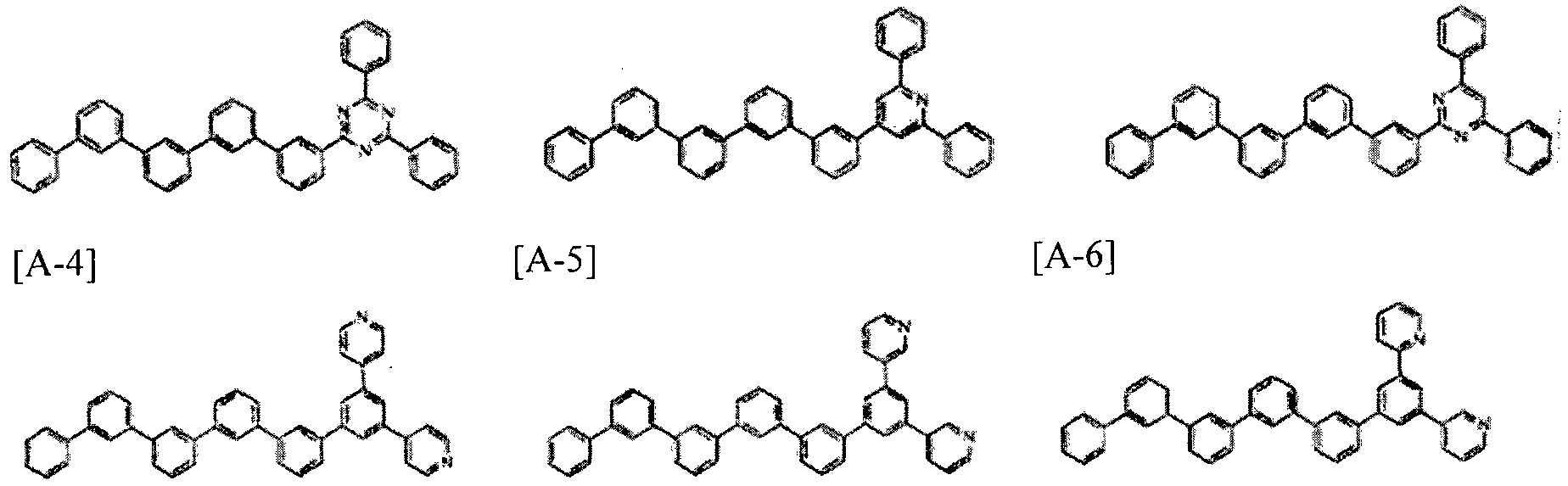


-v] [Z£-V] [ιε-ν]

T9l700/9l0ra¾/I3d £9880ί/9Τ0ί OAV


ΐ9ΐ700/9ΐ0ΖΗΜ/Χ3<Ι S9880Z/9T0Z OAV

ΐ9ΐ700/9ΐ0ΖΗΜ/Χ3<Ι S9880Z/9T0Z OAV
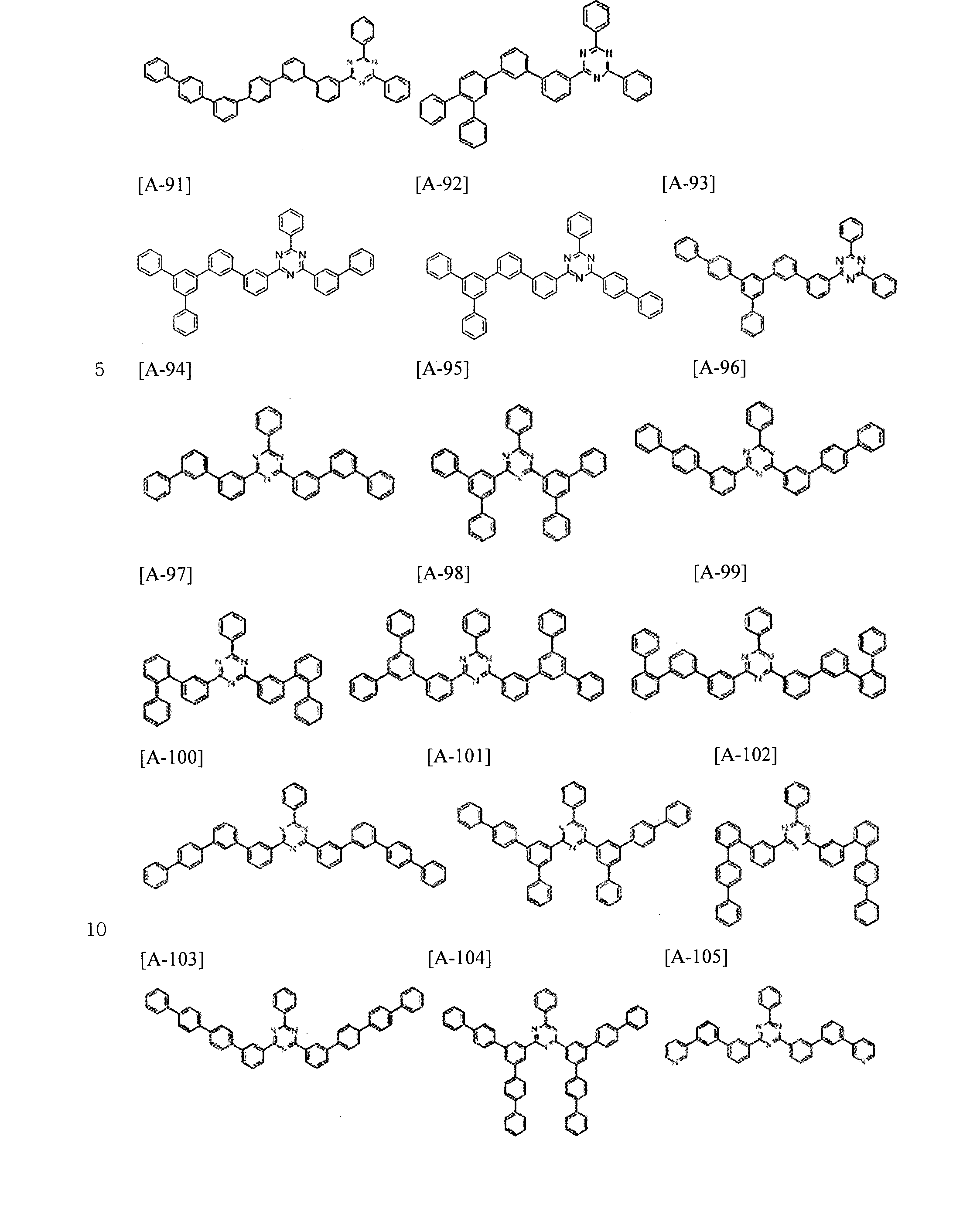
Τ9ΐ700/9ΐ0ΖΗΉ/Χ3<Ι S9880Z/9T0Z OAV

[따 V] [zz\-v] [\z\-v]

[on-v] [611 -V] [8U-V]

-y] [91 1 -V] [sn-v]
S
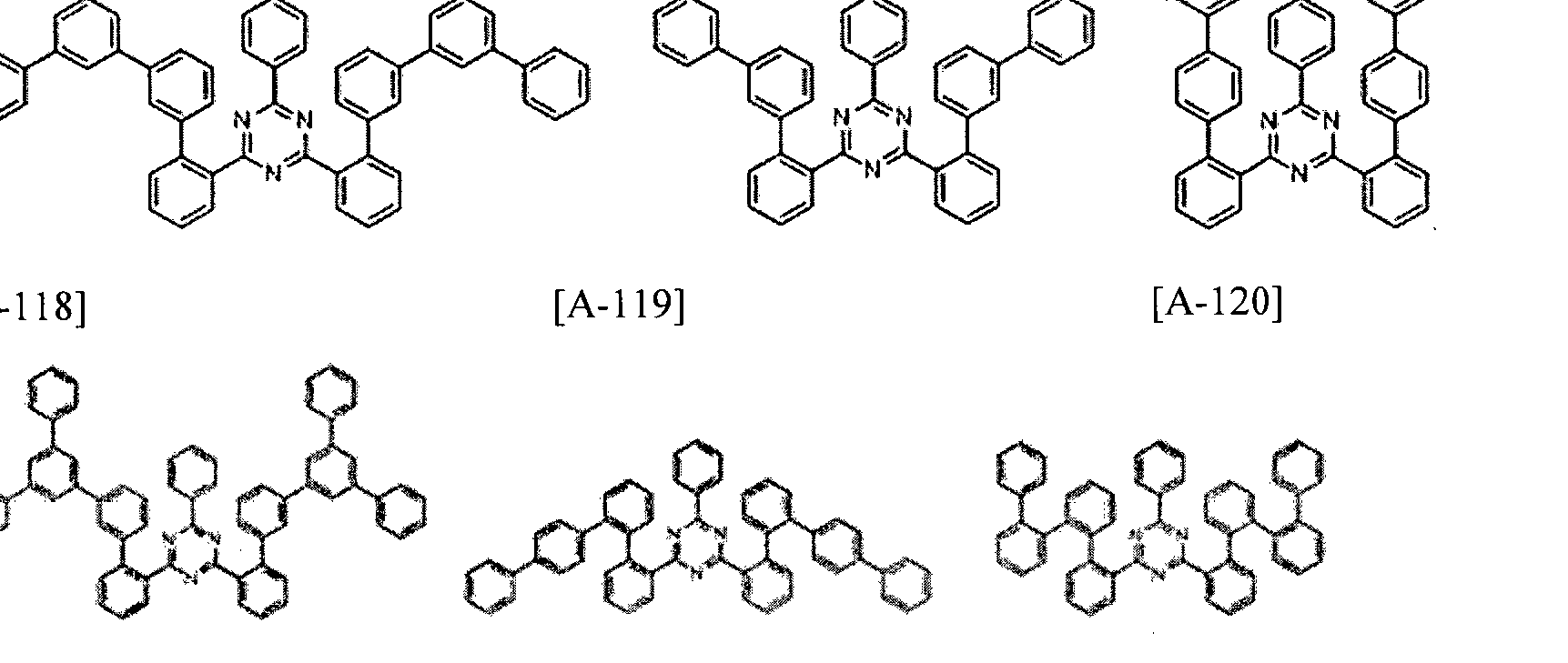
ni-v] [on-v] [601 -V]

[80I-V] [/.oi-v] [901-V]
9C
ΐ9ΐ700/9ΐ0ΖΗΜ/Χ3<Ι S9880Z/9T0Z OAV
//:/ O S9s09S2MI><i S9880Z9SZAV

ϋν-
O/AVZ9SZ S9880/:><ί/2Μ9Ϊ0

o
E6VS9U0V-

o


603-V] [20Z-V] [LOZ-Υ]

[861 -V] [L61

[£6l-V] [Z6I-V] [I6I-V] [061 ΐ9ΐ700/9ΐ0ΖΗΜ/Χ3<Ι S9880Z/9T0Z OAV

//:/ O S9S09S2M12 S9880Z9SZAV

◦
//:/ O S9S09S2M12 S9880Z9SZAV

i99ZjV:ν- 9Zv3---


: A

ϋΐ

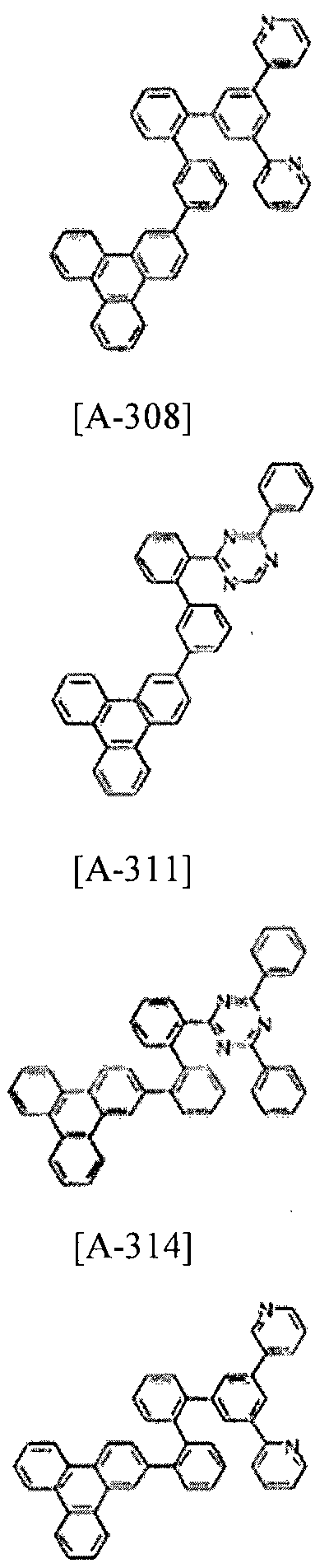


전술한 제 1 화합물은 카바졸 모이어티 또는 카바졸 유도체를 가지는 적어도 하나의 게 2화합물과 발광층에 함께 사용될 수 있다.
카바졸 유도체란, 카바졸 모이어티를 기본으로 하여 유도된 구조로서, 예컨대 상기 화학식 3으로 표현되는 모이어티와 상기 화학식 4로 표현되는 모이어티의 조합으로 이루어진 융합된 카바졸 모이어티를 의미한다.
상기 게 2 화합물은 상기 화학식 2로 표현될 수 있다.
본 발명의 일 구현예에 따른 상기 화학식 2의 L3 내지 L6은 각각 독립적으로, 단일결합, 치환 또는 비치환된 C6 내지 C30 아릴렌기, 치환 또는 비치환된 C2 내지 C30 헤테로아릴렌기일 수 있고, 구체적으로는 치환 또는 비치환된 C6 내지 C30 아릴렌기일 수 있다. 예컨대, 단일결합, 치환 또는 비치환된 페닐렌기, 치환 또는 비치환된 바이페닐렌기, 치환 또는 비치환된 터페닐렌기, 치환 또는 비치환된 쿼터페닐렌기, 치환 또는 비치환된 나프틸렌기, 치환 또는 비치환된 안트라세닐렌기, 치환 또는 비치환된 트리페닐레닐기, 또는 치환 또는 비치환된 페난트레닐렌기일 수 있다.
본 발명의 일 구현예에 따른 화학식 1의 R7 내지 R10은 전술한 바와 같 o 각각 독립적으로, 수소, 중수소, 치환 또는 비치환된 C1 내지 C20 알킬기, 치환
또는 비치환된 C6 내지 C50 아릴기, 치환 또는 비치환된 C2 내지 C50 해테로고리기 또는 이들의 조합일 수 있고,
구체적으로는 수소, 중수소, 치환 또는 비치환된 C6 내지 C30 아릴기, 또는 차환 또는 비치환된 C2 내지 C50 헤테로고리기일 수 있다. 예컨대, R7 내^ R10은 각각 독립적으로 수소, 치환 또는 비치환 ¾ 페닐기, 또는 치환 또는 비치환된 바이페닐기, 치환 또는 비치환된 트리페닐렌기, 치환 또는 비치환된 플루오레닐기, 치환 또는 비치환된 카바졸일기, 치환 또는 비치환된
디벤조퓨란일기, 치환 또는 비치환된 디벤조티오펜일기, 또는 이들의 조합에서 선택될 수 있으나, 이에 한정되는 것은 아니다.
상기 화학식 2는 예컨대 하기 화학식 2- 1 내지 2-m 중 적어도 하나로 표현될 수 있다.
[화학식 2- 1 ]

상기 화학식 2- 1 내지 2-m에서, L3 내지 ΙΛ Υ1, 및 R7 내지 R10은 전술한
바와 같고,
R29 내지 R41은각각 독립적으로 수소, 중수소, 치환 또는 비치환된 C1 내지 C20 알킬기, 치환 또는 비치환된 C6 내지 C50 아릴기, 치환 또는 비치환된 C2 내지 C50 헤테로고리기 또는 이들의 조합이고,
Y4는 단일 결합, 치환 또는 비치환된 C6 내지 C30 아릴렌기, 치환 또는 비치환된 C2 내지 C30 헤테로아릴렌기 또는 이들의 조합이고,
Ar1 및 Ar4는 각각 독립적으로 치환 또는 비치환된 C6 내지 C30 아릴기, 치환 또는 비치환된 C2 내지 C30 헤테로고리기 또는 이들의 조합이고,
m은 0 내지 4의 정수 중 하나이고,
여기서, "치환"은 상기에서 정의한 바와 같다.
구체적으로, 상기 화학식 2- 1 내지 2-ΠΙ의 Ar1 및 Ar4는 각각 독립적으로 치환 또는 비치환된 페닐기, 치환 또는 비치환된 바이페닐기, 치환 또는 비치환된 터페닐기, 치환 또는 비치환된 나프틸기, 치환 또는 비치환된 안트라세닐기, 치환 또는 비치환된 카바졸일기, 치환 또는 비치환된 벤조퓨라닐기, 치환 또는 비치환된 벤조티오페닐기, 치환 또는 비치환된 플루오레닐기, 치환 또는 비치환된 디벤조티오펜일기, 치환 또는 비치환된 디벤조퓨란일기, 치환 또는 비치환된 피리디닐기, 또는 이들의 조합일 수 있다.
구체적으로, 상기 화학식 2- 1는 하기 그룹 3에 나열된 구조 중 하나이고, 상기 ^Y'-Ar1, *-Y4-Ar4는 하기 그룹 4에 나열된 치환기 중 하나일 수 있다.

C-14 C-15
[그

B-16 B-17 B-18
상기 그룹 3 및 그룹 4에서, *은 연결 지점이다.
상기 화학식 2로 표현되는 게 2 화합물은 예컨대 하기 그룹 B 내지 그룹 D에 나열된 화합물일 수 있으나, 이에 한정되는 것은 아니다.
[그룹 B]
[B-1 [B-2] B-3]

ΓΒ-41 ΓΒ-51 . ΓΒ -6]


o
//:/ O S9S09S2M12 S9880Z9SZAV

-42] B-43] [B-44]


[B-51] [B-52] [B-53]

[B-54] [B-55] [B-56]
 /// O S9S09S2M12 S9880Z9SZA

/.969£--

o

[901-8] [soi-a] [爾 -a]

[εοι-a] koi-e] [ιοι

[36-e] [i6-a] [06-e]
6S
ΐ9ΐ700/9ΐ0ΖΗΜ/Χ3<Ι S9880Z/9T0Z OAV


o

-9] [D-10] [D-ll]

[D-16] [D-17]


또한, 상기 게 2 화합물은 상기 화학식 3으로 표현되는 모이어티와 상기 화학식 4로 표현되는 모이어티의 조합으로 표현될 수 있다.
상기 화학식 3으로 표현되는 모이어티와 상기 화학식 4로 표현되는 모이어티의 조합으로 이루어진 게 2화합물은 예컨대, 하기 화학식 3-1 내지 3-V 중 적어도 하나로 표현될 수 있으나, 이에 한정되는 것은 아니다.
[화학식 3-1] [화학식 3-Π] -ΙΠ]


상기 화학식 3- 1 내지 3-V에서, Y2, Y3, Ar2, 및 R11 내지 R14는 전술한 바와 같다. Ar3는 Ar2에 대하여 정의한 바와 같다.
상기 화학식 3으로 표현되는 모이어티와 상기 화학식 4로 표현되는 모이어티의 조합으로 이루어진 제 2 화합물은 예컨대 하기 그룹 E에 나열된 화합물일 수 있으나, 이에 한정되는 것은 아니다.
[그룹 E]
[E-1] [E-2] [E-3] [ E-5]

[E-6] [E-7] [E-8] [E-9] [E-10]

[E-ll] -12] [E-13] [E-14] [E-15]

[E-16] [E-1 -18 [E-19] E-20]

-21] [E-22] [E-24] [E-25]
 -26] [E-27] [E-2

[E-31] [E-32] [E-33] [E-34]

상기 게 2 화합물은 정공 특성이 상대적으로 강한 바이폴라 (bipolar) 특성을 가지는 화합물로, 상기 제 1 화합물과 함께 발광층에 사용되어 전하의 이동성을 높이고 안정성을 높임으로써 발광 효율 및 수명 특성을 개선시킬 수 있다. 또한 정공 특성을 가지는 상기 게 2 화합물과 상기 게 1 화합물의 비율을 조절함으로써 전하의 이동성을 조절할 수 있다. 상기 게 2 화합물의 정공 특성은 제 1 화합물과의 관계에서 상대적으로 결정되는 것이므로, 상기 화학식 2의 R7 내지 R10 및 Ar1중 어느 하나의 위치에서 치환 또는 비치환된 피리디닐기와 같은 약한 전자 특성을 갖는 치환기를 포함할 수 있다.
또한, 상기 제 1화합물과 제 2화합물은 예컨대 약 1 :9 내지 9: 1의 중량비로 포함될 수 있고, 구체적으로 2:8 내지 8:2, 3:7 내지 7:3, 4:6 내지 6:4, 그리고 5:5의 중량비로 포함될 수 있다. 상기 범위로 포함됨으로써 바이폴라 특성이 구현되어 효율과 수명을 동시에 개선할 수 있다.
발광층 (32)은 전술한 게 1 화합물과 제 2 화합물 외에 호스트로서 게 3 화합물을 더 포함할 수 있다.
상기 제 3 화합물은 상기 화학식 5로 표현될 수 있다.
상기 화학식 3의 X1 내지 X12는 각각 독립적으로 N, C 또는 CRd일 수 있고, 본 발명의 일 구현예에 따른 Rd는 전술한 바와 같이, 각각 독립적으로, 수소, 중수소, 치환 또는 비치환된 C1 내지 C30 알킬기, 치환 또는 비치환된 C1 내지 C30 알케닐기, 치환 또는 비치환된 C1 내지 C30 알키닐기, 치환 또는 비치환된 C6 내지 C30 아릴기, 치환 또는 비치환된 C6 내지 C30 아릴옥시기,
치환 또는 비치환된 C6 내지 C30 아릴티오기, 치환 또는 비치환된 C2 내지 C30 해테로고 히드록시기, 티올기, 또는 이들의 조합일 수 있다.
상기 Rd는 각각 독립적으로 존재하고, 구체적으로 수소, 중수소, 치환 또는 비치환된 C6 내지 C30 아릴기, 치환 또는 비치환된 C2 내지 C30 헤테로아릴기 또는 이들의 조합일 수 있다. 예컨대, 치환 또는 비치환된 페닐기, 또는 치환 또는 비치환된 바이페닐기, 치환 또는 비치환된 터페닐기, 치환 또는 비치환된 피리딜기, 또는 이들의 조합에서 선택될 수 있으나, 이에 한정되는 것은 아니다. 또한, 상기 인접한 Rd는 서로 연결되어 고리를 형성할 수 있고, 예컨대, 치환 또는 비치환된 벤조퓨란피리미딘, 치환 또는 비치환된 벤조티오펜피리미딘, 치환 또는 비치환된 퀴놀리닐기, 치환 또 비치환된 이소퀴놀리닐기, 치환또는 비치환된 퀴나졸리닐기, 치환 또는 비치환된 퀴녹살리닐기, 치환 또는 비치환된 프탈라지닐기, 또는 치환 또는 비치환된 페난트를리닐기를 형성할 수 있으나, 이에 한정되는 것은 아니다.
상기 화학식 5는 예컨대 하기 화학식 5- 1 내지 5-ΠΙ 중 어느 하나로 표현될 수 있다.
화학식 5- 1 ] . [화학식 5- Π ]

상기 화학식 5- 1 내지 5-ΠΙ에서, X1 내지 X8, XL 1, X12, 및 L7은 전술한 바와 같고, X X4, X5 및 X6 중 적어도 하나는 N이고, X7, X8, X" 및 X12 증 적어도 하나는 N이고,
W1 및 W2는 각각 독립적으로 0 또는 S이고,
R42 내지 R45은 각각 독립적으로 수소, 중수소, 치환 또는 비치환된 C1
내지 C20 알킬기, 치환 또는 비치환된 C6 내지 C50 아릴기, 치환 또는 비치환된 C2 내지 C50 헤테로고리기 또는 이들의 조합이고,
ET는 치환 또는 비치환된 피리디닐기, 치환 또는 비치환된 피리미디닐기, 치환 또는 비치환된 트리아지닐기, 치환 또는 비치환된 피라지닐기, 치환 또는 비치환된 퀴녹살리닐기, 치환 또는 비치환된 퀴나졸리닐기, 치환 또는 비치환된 페난트를리닐기, 또는 이들의 조합이고,
여기서, "치환"은 상기에서 정의한 바와 같다.
구체적으로, 상기 화학식 5-1은 예컨대 하기 화학식 5-1 -a내지 5-I-f 중 어 하나로 표현될 수 있다.
5-1 -a] [화학식 5-I-b [화학식 5-I-c]

화학식

상기 화학식 5-1 -a 내지 5-1-1"에서,1 및 ET는 전술한 바와 같고, R46 내지 R50은 각각 독립적으로 수소, 중수소, 치환 또는 비치환된 C1 내지 C20 알킬기, 치환 또는 비치환된 C6 내지 C50 아릴기, 치환 또는 비치환된
C2 내지 C50 헤테로고리기 또는 이들의 조합일 수 있다.
구체적으로, 상기 화학식 5-Π는 예컨대 하기 화학식 5-n-a 내지 5-I-n 중 어느 하나로 표현될 수 있다.
5-n-a 화학식 5-n-b]


[화학식 5-n-j] [화학식 5-n-k]
 화학식 5-Π-Ι] [화학식 5-Π-ηι]

상기 화학식 5- 1 -a 내지 5- 1 ^에서,] , 및 W2,R42 및 R43은 전술한 바와 같고,
R5' 내지 R"은 각각 독립적으로 수소, 중수소, 치환 또는 비치환된 C1 내지 C20 알킬기, 치환 또는 비치환된 C6 내지 C50 아릴기, 치환 또는 비치환된 C2 내지 C50 헤테로고리기 또는 이들의 조합일 수 있다.
구체적으로, 상기 화학식 5-m은 예컨대 하기 화학식 5-m-a 내지 5-m-c 중 어느 하나로 표현될 수 있다.
화학식 5-m-a

[화학식 5-m-b]


상기 화학식 5-m-a 내지 5-m-c에서, W1 및 W2,R42 내지 R45,R51,R52, 및 L7는 전술한 바와 같다.
본 발명의 일 구현예에서, L7은 예컨대 상기 그룹 2에 나열된 치환 또는 비치환된 기에서 선택될 수 있다.
상기 화학식 5로 표현되는 제 3 화합물은 예컨대 하기 그룹 F 내지 H에 나열된 화합물일 수 있으나, 이에 한정되는 것은 아니다.
[그룹 F] (그룹 F에 기재된 화합물 구조에서 해테로원자는 모두 "N"이다) F-l] ' [F-2] [F-3]

[F-7] [F-8] [F-9]


[그룹 G] (그룹 G에 기재된 화합물의 구조식에서 6각고리 화합물에 기재된 헤테로 원자는 "N"이며, 5각 고리에 포함된 헤테로원자는 'Ό"또는 "S"이다.) G-l] [G-2] [G-3] [G-4]

[G-5] [G-6] [G-7] [G-8]


[그룹 H] (그룹 H에 기재된 화합물의 구조식에서 6각고리 화합물에 기재된 헤테로 원자는 "N"이며, 5각 고리에 포함된 헤테로원자는 "0" 또는 "S"이다.)

ΐ9ΐ700/9ΐ0ΖΗΜ/Χ3<Ι S9880Z/9T0Z OAV
[H-19] [H-20] [H-21]


ΐ9ΐ700/9ΐ0ΖΗΜ/Χ3<Ι S9880Z/9T0Z OAV

o


ΐ9ΐ700/9ΐ0ΖΗΜ/Χ3<Ι S9880Z/9T0Z OAV

o
//:/ O S9S09S2M12 S9880Z9SZAV

o
//:/ O S9S09S2M12 S9880Z9SZAV

//:/ O S9s09S2MI><i S9880Z9SZAV
【됵£

t£/-lRI-

k6lHl-
//: S9s09S2MI><i


o


특히, 상기 게 3 화합물을 더욱 포함함으로써, 도펀트와호스트 간 트랩 현상을 감소시키거나 최소화하여 구동 전압을 낮추는 효과를 얻을 수 있다.
본 발명의 일 구현예에 따르면, 발광층 (32)에는 상기 제 1 화합물, 상기 제 2 화합물, 및 상기 제 3화합물이 동시에 호스트로서 포함될 수 있으며,
상기 게 1 화합물은 구체적으로 상기 화학식 1- 1 또는 화학식 i-m로 표현될 수 있고, 상기 제 2 화합물은 상기 화학식 2- 1로 표현될 수 있으며, 상기
제 3 화합물은 상기 화학식 5-1 또는 화학식 5-Π로 표현될 수 있다.
더욱 구체적으로, 제 1 화합물은 상기 화학식 1-IB 또는 1-ΙΠΑ로 표현될 수 있고, 상기 화학식 1- I B 의 더욱 구체적인 예로서 상기 화학식 1- I -3b로 표현될 수 있다.
또한, 제 3 화합물은 상기 화학식 화학식 5- I -b, 화학식 5- I -d, 또는 화학식 5-n-k로 표현될 수 있다.
본 발명의 또 다른 일 구현예에 따르면, 상기 제 1 화합물은 예컨대 상기 화학식 i-l -c, 또는 화학식 i-m-a로 표현될 수 있고, 상기 화학식 1-1 -c 은 화학식 i-l -j 로 표현될 수 있으며, 상기 화학식 i-m-a은 더욱 구체적으로 i-m- g로 표현될 수 있다.
상기 제 1 화합물 및 제 2 화합물의 조성물과 게 3 화합물은 예컨대 90:10 내지 10:90 의 중량비로 포함될 수 있으며, 구체적으로 90:10 내지 10:90,85:15 내지 15:85,80:20 내지 20:80,70:30 내지 30:70,60:40 내지 40:60, 50:50의 중량비로 포함될 수 있다. 바람직하게는, 상기 게 1 화합물 및 게 2 화합물의 조성물과 제 3 화합물은 90:10,85:15,80:20 또는 70:30의 중량비로 포함될 수 있다.
상기 범위로 포함됨으로써 바이폴라 특성이 더욱 효과적으로 구현되어 효율과 수명을 동시에 개선할 수 있을 뿐만 아니라, 구동 전압을 획기적으로 낮출 수 있다.
한편, 상기 상기 제 1 화합물과 제 2 화합물은 예컨대 약 1:10 내지 10:1의 중량비로 포함될 수 있고, 구체적으로 2:8 내지 8:2,3:7 내지 7:3,4:6 내지 6:4, 그리고 5:5의 중량비로 포함될 수 있다. 바람직하게는, 상기 제 1 화합물과 게 2 화합물은 3:7,4:6 또는 5:5의 증량비로 포함될 수 있다.
발광층 (32)은 호스트로서 전술한 게 1 화합물과 게 2 화합물 외에 1종 이상의 화합물을 더 포함할 수 있다.
발광층 (32)은 도펀트를 더 포함할 수 있다. 상기 도펀트는 상기 호스트에 미량 흔합되어 발광올 일으키는 물질로, 일반적으로 삼중항 상태 이상으로 여기시키는 다중항 여기 (multiple excitation)에 의해 발광하는 금속 착체 (metal complex)와 같은 물질이 사용될 수 있다. 상기 도편트는 예컨대 무기, 유기, 유무기 화합물일 수 있으며 , 1종 또는 2종 이상 포함될 수 있다.
상기 도펀트는 적색, 녹색 또는 청색의 도펀트일 수 있으며, 예컨대 인광
도편트일 수 있다. 상기 인광 도편트의 예로는 Ir, Pt, Os, Ti, Zr, Hf, Eu, Tb, Tm, Fe, Co, Ni, Ru, Rh, Pd 또는 이들의 조합을 포함하는 유기 금속화합물을 들 수 있다. 상기 인광 도편트는 예컨대 하기 화학식 Z로 표현되는 화합물을 사용할 수 있으나, 이에 한정되는 것은 아니다.
[화학식 Z]
L2MX
상기 화학식 Z에서 , Μ은 금속이고, L 및 X는 서로 같거나 다르며 Μ과 착화합물을 형성하는 리간드이다.
상기 Μ은 예컨대 Ir, Pt, Os, Ti, Zr, Hf, Eu, Tb, Tm, Fe, Co, Ni, Ru, Rh, Pd또는 이들의 조합일 수 있고, 상기 L 및 X는 예컨대 바이덴테이트 리간드일 수 있다. 상기 조성물은 유기 광전자 소자의 유기층에 적용될 수 있으며, 일 예로 상기 조성물은 발광층에 적용될 수 있다. 예컨대 발광층의 호스트로서 적용될 수 있다,
상기 조성물은 건식 성막법 또는 용액 공정으로 형성될 수 있다. 상기 건식 성막법은 예컨대 화학기상증착법, 스퍼터링, 플라즈마 도금 및 이온도금 일 수 있고, 둘 이상의 화합물을 동시에 성막하거나 증착 온도가 같은 화합물을 흔합하여 같이 성막할 수 있다. 상기 용액 공정은 예컨대 잉크젯 인쇄법, 스핀 코팅, 슬릿 코팅, 바 코팅 및 /또는 딥 코팅일 수 있다.
이하 상술한 조성물을 적용한 유기 광전자 소자를 설명한다.
상기 유기 광전자 소자는 전기 에너지와 광 에너지를 상호 전환할 수 있는 소자이면 특별히 한정되지 않으며, 유기발광소자, 유기광전소자,
유기태양전지, 유기트랜지스터, 유기 감광체 드럼 및 유기메모리소자로 이루어진 군에서 선택된 어느 하나일 수 있다.
상기 유기 광전자 소자는 서로 마주하는 애노드와 캐소드, 그리고 상기 애노드와 상기 캐소드 사이에 위치하는 적어도 1층의 유기층을 포함할 수 있고, 상기 유기층은 전술한 조성물을 포함할 수 있다.
여기서는 유기 광전자 소자의 일 예인 유기 발광 소자를 도면을 참고하여 설명한다.
도 1은 일 구현예에 따른 유기 발광 소자를 보여주는 단면도이다.
도 1을 참고하면, 일 구현예에 따른 유기 발광 소자 (100)는 서로 마주하는
애노드 (1 10)와 캐소드 (120), 그리고 애노드 (1 10)와 캐소드 (120) 사이에 위치하는 유기층 (105)을 포함한다.
애노드 (1 10)는 예컨대 정공 주입이 원활하도록 일 함수가 높은 도전체로 만들어질 수 있으며, 예컨대 금속, 금속 산화물 및 /또는 도전성 고분자로 만들어질 수 있다. 캐소드 (120)는 예컨대 니켈, 백금, 바나듐, 크롬, 구리, 아연, 금과 같은 금속 또는 이들의 합금; 아연산화물, 인듐산화물, 인듬주석산화물 (ΠΌ),
인듐아연산화물 (IZO)과 같은 금속 산화물; ZnO와 A1 또는 Sn02와 Sb와 같은 금속과 산화물의 조합; 폴리 (3-메틸티오펜), 폴리 (3,4- (에틸렌 -1 ,2- 디옥시)티오펜 )(polyehtylenedioxythiophene: PEDOT), 폴리피를 및 폴리아닐린과 같은 도전성 고분자 등을 들 수 있으나, 이에 한정되는 것은 아니다.
캐소드 (120)는 예컨대 전자 주입이 원활하도록 일 함수가 낮은 도전체로 만들어질 수 있으며, 예컨대 금속, 금속 산화물 및 /또는 도전성 고분자로 만들어질 수 있다. 애노드 (1 10)는 예컨대 마그네슘, 칼슘, 나트륨, 칼륨, 타이타늄, 인듐, 이트륨, 리튬, 가돌리늄, 알루미늄, 은, 주석, 납, 세슴, 바륨 등과 같은 금속 또는 이들의 합금; LiF/Al, Li02/Al, LiF/Ca, LiF/Al 및 BaF2/Ca과 같은 다층 구조 물질을 들 수 있으나, 이에 한정되는 것은 아니다.
유기층 (105)은 전술한 조성물을 포함하는 발광층 (130)을 포함한다.
도 2는 다른 구현예에 따른 유기 발광 소자를 보여주는 단면도이다.
도 2를 참고하면, 본 구현예에 따른 유기 발광 소자 (200)는 전술한 구현예와 마찬가지로 서로 마주하는 애노드 (1 10)와 캐소드 (120), 그리고
애노드 (1 10)와 캐소드 (120) 사이에 위치하는 유기층 (105)을 포함한다.
유기층 (105)은 발광층 (130) 및 발광층 (130)과 캐소드 (120) 사이에 위치하는 보조층 (140)을 포함한다. 보조층 (140)은 캐소드 (120)와 발광층 (130) 사이의 전하 주입 및 이동을 용이하게 할 수 있다. 보조층 (140)은 예컨대 전자수송층, 전자주입층 및 /또는 전자수송보조층일 수 있다.
도 1 및 도 2에서 유기층 (105)으로서 추가로 애노드 (1 10)와 발광층 (130) 사이에 위치하는 적어도 1층의 보조층을 더 포함할 수 있다.
상술한 유기 발광 소자는 유기 발광 표시 장치에 적용될 수 있다.
【발명을 실시를 위한 형태】
이하에서는 본 발명의 구체적인 실시예들을 제시한다. 다만, 하기에
기재된 실시예들은 본 발명을 구체적으로 예시하거나 설명하기 위한 것에 불과하며, 이로서 본 발명이 제한되어서는 아니된다ᅳ
이하, 본 발명의 합성예 및 실시예에 사용된 출발물질 및 반응물은 특별한 언급이 없는 경우, Sigma-Aldrich社 또는 TCI社에서 구입하였다. 제 1 화합물의 합성
(중간체의 합성)
중간체 1-1의 합성
[반웅식 1]

진공오븐에서 건조하였다. 이렇게 얻어진 잔사를 플래시 컬럼 크로마토그래피로 분리 정제하여 중간체 I-l (20 g, 85 %)을 얻었다.
HRMS (70 eV, EI+): m/z calcd for C18H21B02: 280.1635, found: 280
Elemental Analysis: C, 77 %; H, 8 %

질소 환경에서 중간체 I- 1 (20 g, 71 mmol)을 THF 1 L에 녹인 후, 여기에 1-
bromo-3 -iodobenzene (24 g, 85 mmol)와 tetrakis(triphenylphosphine)palladium (Pd(PPh3)4) (0.8 mg, 0.7 mmol)을 넣고 교반시켰다. 물에 포화된 potassuim carbonate (K2C03)(24.5 g, 177 mmol)을 넣고 80 °C에서 12시간 동안 가열하여 환류 시켰다. 반웅 완료 후 반웅액에 물을 넣고 dichloromethane(DCM)로 추출한다음 무수 MgS04로 수분을 제거한 후, 필터하고 감압 농축하였다. 이렇게 얻어진 잔사를 플래시 컬럼 크로마토그래피로 분리 정제하여 중간체 1-2 (30 g, 90 %)를 얻었다.
HRMS (70 eV, EI+): m/z calcd for C18H13Br: 309.1998, found 309 Elemental Analysis: C, 70 %; H, 4 % 중간체 1-3의 합성
[반웅식 3]

질소 환경에서 중간체 1-2 (25 g, 81 mmol)을 dimethylforamide(DMF) 1L에 녹인 후, 여기에 bis(pinacolato)dibK)ron (25 g, 97 mmol)와 (Ι , Ι'- bis(diphenylphosphine)ferrocene)dichloropalladium(II)(Pd(dppf))(0.7 g, 0.81 mmol), 그리고 potassium acetate (K(acac))(20 g, 203 mmol)을 넣고 150 °C에서 5시간 동안 가열하여 환류 시켰다. 반웅 완료 후 반웅액에 물을 넣고 흔합물을 필터한 후,
진공오븐에서 건조하였다. 이렇게 얻어진 잔사를 플래시 컬럼 크로마토그래피로 분리 정제하여 중간체 1-3 (27 g, 93 %)을 얻었다.
HRMS (70 eV, EI+): m/z calcd for C24H25B02: 356.1948, found: 356
Elemental Analysis: C, 81 %; H, 7 % 중간체 1-4의 합성
[반웅식 4]

HRMS (70 eV, EI+): m/z calcd for C24H17Br: 384.0514, found 384 Elemental Analysis: C, 75 %; H, 4 % 중간체 1-5의 합성
[반웅식 5]

진공오본에서 건조하였다. 이렇게 얻어진 잔사를 플래시 컬럼 크로마토그래피로 분리 정제하여 중간체 1-5 (19 g, 85 %)을 얻었다.
HRMS (70 eV, EI+): m/z calcd for C30H29BO2: 432.2261 , found: 432
Elemental Analysis: C, 83 %; H, 7 % 중간체 1-6의 합성
[반웅식 6]

질소 환경에서 1,3- 1?1:01^-5-^101"01?∞2∞6 (10(^, 370 1 ^1)을 THF 2L에 녹인 후, 여기에 phenylboronic acid (47.3 g, 388 mmol)와 tetrakis(triphenylphosphine)palladium (1 (1)1}113)4) (1.5 1.36 11^101)을 넣고 교반시켰다. 물에 포화된 potassuim carbonate (K2C03)(127g, 925 mmol)을 넣고 80°C에서 12시간 동안 가열하여 환류 시켰다. 반응 완료 후 반웅액에 물을 넣고 dichloromethane(DCM)으로 추출한 다음 무수 MgS04로 수분올 제거한 후, 필터하고 감압 농축하였다. 이렇게 얻어진 잔사를 플래시 컬럼 크로마토그래피로 분리 정제하여 중간체 1-6 (49g, 50 %)을 얻었다.
HRMS (70 eV, EI+): m/z calcd for C12H8BrCl: 265.9498, found 266 Elemental Analysis: C, 54 %; H, 3 % 중간체 1-7의 합성
[반응식 7]

질소 환경에서 중간체 1-6 (22.43g, 83.83 mmol)을 THF 500mL에 녹인 후, 여기에 중간체 1-5 (50.7g, 117.36mmol)와 tetrakis(triphenylphosphme)palladium
(Pd(PPh3)4) (2.9g, 2.5mmol)을 넣고 교반시켰다. 물에 포화된 potassuim carbonate (K2C03)(46g, 335.31mmol)을 넣고 80°C에서 12시간 동안 가열하여 환류 시켰다. 반웅 완료 후 반웅액에 물을 넣고 dichloromethane(DCM)으로 추출한 다음 무수 MgS04로 수분을 제거한 후, 필터하고 감압 농축하였다. 이렇게 얻어진 잔사를 플래시 컬럼 크로마토그래피로 분리 정제하여 중간체 I-7 (33g, 81%)을 얻었다.
HRMS (70eV, EI+): m/z calcd for C36H25C1: 492.1645, found 492 Elemental Analysis: C, 88 %; H, 5 %
중간체 1-8의 합성
[반웅식 8]

진공오븐에서 건조하였다. 이렇게 얻어진 잔사를 flash column chromatography로 분리 정제하여 중간체 1-8 (42 g, 85 %)을 얻었다.
HRMS (70 eV, EI+): m/z calcd for C42H37B02: 584.2887, found: 584.
Elemental Analysis: C, 86 %; H, 6 % 중간체 1-9의 합성
9]

1 - 9 질소 환경에서 2-bromotriphenylene(HX) g, 326 mmol)을 dimethylforamide(DMF) 1L에 녹인 후, 여기에 bis(pinacolato)diboron (99.2 g, 391 mmol)와 (Ι,Γ- bis(diphenylphosphine)ferrocene)dichloropalladium(II)(2.66 g, 3.26 mmol) 그리고 potassium acetate(80 g, 815 mmol)을 넣고 150 °C에서 5시간 동안 가열하여 환류 시켰다. 반웅 완료 후 반웅액에 물을 넣고 흔합물을 필터한 후, 진공오븐에서 건조하였다. 이렇게 얻어진 잔사를 flash column chromatography로 분리 정제하여
상기 중간체 1-9(1 13 g, 98 %)을 얻었다.
HRMS (70 eV, EI+): m/z calcd for C24H23B02: 354.1791, found: 354.
Elemental Analysis: C, 81 %; H, 7 % 중간체 i-io의 합성
[반웅식 10]

1 - 10
질소 환경에서 2-bromotriphenylene(32.7 g, 107 mmol)을 tetrahydrofuran(THF) 0.3 L에 녹인 후, 여기에 3-chloro phenylboronic acid(20 g, 128 mmol)와
tetrakis(triphenylphosphine)palladium(1.23 g, 1.07 mmol)^- 넣고 교반시켰다. 물에 포화된 potassuim carbonate(36.8 g, 267 mmol)을 넣고 80 °C에서 24시간 동안 가열하여 환류 시켰다. 반웅 완료 후 반웅액에 물을 넣고 dichloromethane(DCM)로 추출한 다음 무수 MgS04로 수분을 제거한 후, 필터하고 감압 농축하였다. 이렇게 얻어진 잔사를 flash column chromatography로 분리 정제하여 상기 중간체 1-10(22.6 g, 63 %)을 얻었다.
HRMS (70 eV, EI+): m/z calcd for C24H15C1: 338.0862, found: 338.
Elemental Analysis: C, 85 %; H, 5 % 중간체 1-1 1의 합성
[반웅식 1 1]

1 - 10 I - 11 질소 환경에서 상기 중간체 1-10(22.6 g, 66.7 mmol)를 dimethylforamide(DMF) 0.3 L에 녹인 후, 여기에 ^^^^(^^。^^。!^ 와 (1,1'- bis(diphenylphosphine)ferrocene)dichloropalladium(II)(0.54 g, 0.67 mmol) 그리고
potassium acetate( 16.4 g, 167 mmol)을 넣고 150 °C에서 48시간 동안 가열하여 환류 시켰다. 반웅 완료 후 반웅액에 물을 넣고 흔합물을 필터한 후, 진공오븐에서 건조하였다. 이렇게 얻어진 잔사를 flash column chromatography로 분리 정제하여 중간체 1-1 1(18.6 g, 65 %)을 얻었다.
HRMS (70 eV, EI+): m/z calcd for C30H27BO2: 430.2104, found: 430.
Elemental Analysis: C, 84 %; H, 6 % 중간체 1- 12의 합성

질소 환경에서 상기 중간체 1- 1 1 (50 g, 1 16 mmol)을 tetrahydrofuran(THF) 0.5 L에 녹인 후, 여기에 1 -1 ^^0-3-10(101 02∞6(39.4 139 1110101)와
tetrakis(triphenylphosphine)palladium(1.34 g, 1.16 mmol)-ir 넣고 교반시켰다. 물에 포화된 potassuim carbonate(40.1 g, 290 mmol)을 넣고 80 °C에서 12시간 동안 가열하여 환류 시켰다. 반응 완료 후 반웅액에 물을 넣고 dichloromethane(DCM)로 추출한 다음 무수 MgS04로 수분을 제거한 후, 필터하고 감압 농축하였다.
이렇게 얻어진 잔사를 flash column chromatography로 분리 정제하여 상기 중간체 I- 12(42.6 g, 80 %)을 얻었다.
HRMS (70 eV, EI+): m/z calcd for C30H19Br: 458.0670, found: 458.
Elemental Analysis: C, 78 %; H, 4 % 중간체 1- 13의 합성
13]

1 - 12 1 - 13 질소 환경에서 상기 중간체 1-12(40 g, 87.1 mmol)을 dimethylforamide(DMF) 0.3 L 녹인 후, 여기에 bis(pinacolato)diboron (26.5 g, 104 mmoi;^≥|" (1,1'- bis(diphenylphosphine)ferrocene)dichloropalladium(II)(0.71 g, 0.87 mmol) 그리고 potassium acetate(2L4 g, 218 mmol)을 넣고 150 °C에서 26시간 동안 가열하여 환류 시켰다. 반웅 완료 후 반웅액에 물을 넣고 흔합물을 필터한 후, 진공오븐에서 건조하였다. 이렇게 얻어진 잔사를 flash column chromatography로 분리 정제하여 상기 중간체 1-13(34 g, 77 %)을 얻었다.
HRMS (70 eV, EI+): m/z calcd for C36H31B02: 506.2417, found: 506.
Elemental Analysis: C, 85 %; H, 6 %
(최종 화합물의 합성)
합성예 1: 화합물 A-275의 합성
반웅식 14]

질소 환경에서 2-chloro-4,6-diphenyl-l ,3,5-triazine (10.6 g, 39.5 mmol)을 THF 1 L에 녹인 후, 여기에 중간체 1-13 (20 g, 39.5 mmol)와
tetrakis(triphenylphosphine)palladium (Pd(PPh3)4) (0.46 g, 0.4 mmol)을 넣고 교반시켰다. 물에 포화된 potassuim carbonate (K2C03)(13.6 g, 98.8 mmol)을 넣고 80 °C에서
12시간 동안 가열하여 환류 시켰다. 반옹 완료 후 반웅액에 물을 넣고
dichloromethane(DCM)로 추출한 다음 무수 MgS04로 수분을 제거한 후, 필터하고 감압 농축하였다. 이렇게 얻어진 잔사를 플래시 컬럼 크로마토그래피로 분리 정제하여 화합물 A-275(17.9 g, 74 %)를 얻었다.
HRMS (70 eV, EI+): m/z calcd for C45H29N3: 61 1.2361 , found 61 1 Elemental Analysis: C, 88 %; H, 5 % 합성예 2: 화합물 A-216의 합성
15]

질소 환경에서 2-chloro-4,6-diphenyl- ,5-triazine (32 g, 76 mmol)을 THF 1 L에 녹인 후, 여기에 중간체 1-8 (44 g, 76 mmol)와 tetrakis(triphenylphosphine)palladium (Pd(PPh3)4) (0.88 g, 0.76 mmol)을 넣고 교반시켰다. 물에 포화된 potassuim carbonate (K2C03)(26 g, 190 mmol)을 넣고 80 °C에서 12시간 동안 가열하여 환류 시켰다. 반응 완료 후 반웅액에 물을 넣고 dichloromethane(DCM)로 추출한 다음 무수 MgS04로 수분을 제거한 후, 필터하고 감압 농축하였다. 이렇게 얻어진 잔사를 플래시 컬럼 크로마토그래피로 분리 정제하여 화합물 A-216(41 g, 80 %)을 얻었다.
HRMS (70 eV, EI+): m/z calcd for C51H35N3: 689.2831 , found 689 Elemental Analysis: C, 89 %; H, 5 % 제 2 화합물의 합성
합성예 3: 화합물 B-30의 합성

질소 환경에서 상기 화합물 9-(4-(4,4'-biphenyl)carbazole)-3-yl bromide (12.33 g:
30.95 mmol)을 Toluene 0.2 L에 녹인 후, 여기에 (9-(3-(4-phenyl)phenyl)carbazole-3-yl boronic acid (12.37 g, 34.05 mmol) 와 tetrakis(triphenylphosphine)palladium( 1.07 g, 0.93 mmmol)을 넣고 교반시켰다. 물에 포화된 potassuim carbonate(12.83 g, 92.86 mmol)을 넣고 120 °C에서 12시간 동안 가열하여 환류 시켰다. 반응 완료 후 반웅액에 물을 넣고 dichloromethane(DCM)로 추출한 다음 무수 MgS04로 수분을 제거한 후, 필터하고 감압 농축하였다. 이렇게 얻어진 잔사를 플래시 컬럼 크로마토그래피로 분리 정제하여 화합물 B-30 (18.7 g, 92 %)을 얻었다.
HRMS (70 eV, EI+): m/z calcd for C48H32N2: 636.26, found: 636
Elemental Analysis: C, 91 %; H, 5 % 합성예 4: 화합물 B-129의 합성
17]

(9-(3 -(4-phenyl)phenyl)carbazole)-3 -yl bromide 43.2g(108.4 mm이)과 4,4,5,5,- tetramethyl-2-Phenyl-l ,3,2-dioxaborolane 14.5g(1 19 mmol)을 사용하여 화합물 B-30의 합성법과 동일한 방법을 사용하여 중간체 I-14 33g(77%)을 얻었다.
제 2 단계: 중간체 1-15의 합성 . 중간체 I-14 29.8g(75.28mmol) 과 N-Bromosuccinimide 14g(75.28 mmol)을 사용하여 상온에서 교반하였다. 반웅 완료 후 반웅액에 물을 넣고 dichloromethane
(DCM)로 추출한 다음 무수 MgS04로 수분을 제거한 후, 필터하고 감압
농축하였다. 이렇게 얻어진 잔사를 플래시 컬럼 크로마토그래피로 분리 정제하여 중간체 I-15 29g(81%)을 얻었다.
제 3 단계: 화합물 B-129의 합성
9-phenyl-3-(4,4,5,5,-tetramethyl-l ,3,2-dioxaborolan-2-yl)-9H-carbazole 9.7g(33.65 mmol)과 중간체 1-15 16g(33.65 mmol)을 사용하여 화합물 B-30의 합성법과 동일한 합성법을 사용하여 화합물 B-129 17g(79%)를 얻었다.
HRMS (70 eV, EI+): m/z calcd for C48H32N2: 636.2565, found: 636
Elemental Analysis: C, 90 %; H, 5 % 제 3 화합물의 합성

중간체 A(1) 중간체 A
중간체 A(l) (벤조 -1H-티에노 p,2-dl피리미딘 -2,4-디은)의 합성
2L 등근 플라스크에 메틸 3-아미노 -벤조 2-티오펜카르복실레이트 (237.5g,
1.15mol) 및 우레아 (39그 0g, 5.75mol)의 흔합물을 200 °C에서 2 시간 동안 교반 하였다. 고온의 반웅 흔합물을 상온으로 식힌 후, 수산화나트륨 용액에 붓고, 불순물을 여과하여 제거한 다음, 반웅물을 산성화하여 (HC1, 2N), 수득한 침전물을 건조시켜 중간체 A(l)을 수득하였다 (175g, 75 <¾).
calcd. Ci0H6N2O2S: C, 55.04; H, 2.77; N, 12.84; O, 14.66; S, 14.69; found: C, 55.01 ;
H, 2.79; N, 12.81 ; O, 14.69; S, 14.70
중간체 A (벤조 -2,4-디클로로-티에노 ,2-dl피리미딘)의 합성
3000 mL 등근 플라스크에 중간체 A(l) (벤조 -1H-티에노 [3,2-d]피리미딘 -2,4- 디온) (175 g, 0.80mol) 및 옥시염화인 (1000 mL)의 흔합물을 환류하에 8시간 동안 교반하였다. 반웅 흔합물을 상온으로 넁각시키고, 세게 교반하면서 얼음 /물에 부어, 침전물을 생성하였다. 이로부터 수득한 반웅물을 여과하여, 중간체 A (벤조 -2,4- 디클로로-티에노 [3,2-d]피리미딘) (175g, 85 %, 백색 고체)를 수득하였다. 생성된
중간체 A의 원소 분석 결과는 하기와 같다.
calcd. C10H4C12N2S: C, 47.08; H, 1.58; C1, 27.79; N, 10.98; S, 12.57; found: C, 47.03; H, 1.61 ; C1, 27.81 ; N, 10.98; S, 12.60

중간체 B-1 중간체 B-2 중간체 B 중간체 B-2 의 합성
250 mL 등근 플라스크에 중간체 B-1 (35.0g, 0.17mol) 및 우레아 (50.7g, 0.84mol)의 흔합물을 200 °C에서 2 시간 동안 교반하였다. 고온의 반웅 흔합물을 상온으로 식힌 후, 수산화나트륨용액에 붓고, 불순물을 여과하여 제거한 다음, 반응물을 산성화하여 (HC1, 2N), 수득한 침전물을 건조시켜 중간체 B-2를
수득하였다 (18,9g, 51 %).
calcd. C10H6N2O2S: C, 55.04; H, 2.77; N, 12.84; 0, 14.66; S, 14.69; found: C, 55.01 ; H, 2.77; N, 12.83; 0, 14.65; S, 14.63
중간체 B 의 합성
250 mL 등근 플라스크에 중간체 B-2 (18.9 g, 99.2mmol) 및 옥시염화인
(lOOmL)의 흔합물을 환류하에 6시간 동안 교반하였다. 반웅 흔합물을 상온으로 넁각시키고, 세게 교반하면서 얼음 /물에 부어, 침전물을 생성하였다. 이로부터 수득한 반웅물을 여과하여, 중간체 B을 수득하였다. (17.5g, 85 <¾ , 백색 고체)
calcd. C10H4C12N2S: C, 47.08; H, 1.58; C1, 27.79; N, 10.98; S, 12.57; found: C, 47.04; H, 1.53; C1, 27.74; N, 10.96; S, 12.44 합성예 5: 화합물 H-59의 합성
[반옹식 18]

중간체 A-i-i의 합성
2000 mL 플라스크에 중간체 A 70.0 g (274.4 mmol), 페닐보로닉에시드 33.5 g (274.4 mmol), 탄산칼륨 94.8 g (686.0 mmol), 테트라키스 (트리페닐포스핀) 팔라듐 (0) 15.9 g (13/7 mmol)을 1 ,4-다이옥산 800 mL, 물 400 mL 에 넣어준 후, 질소 기류 하에서 24시간 동안 50°C로 가열하였다. 이로부터 수득한 흔합물올 메탄을 3000 mL에 가하여 결정화된 고형분을 여과한 후, 모노클로로벤젠에 녹여
실리카겔 /셀라이트로 여과하고, 유기 용매를 적당량 제거한 후, 메탄올로
재결정하여 중간체 A-1-1 (59.4 g, 73%의 수율)을 수득하였다.
calcd. C 16H9C1N2S: C, 64.75; H, 3.06; C1, 1 1.95; N, 9.44; S, 10.80; found: C, 64.70; H, 3.02; CI, 1 1.93; N, 9.40; S, 10.73
중간체 A-1-2 의 합성
2 L 등근 플라스크에 중간체 A- 1-1 59.0 g (198.8 mmol), 3-클로로페닐 보로닉에시드 31.1 g (198.8 mmol), 탄산칼륨 68.7 g (497.0 mmol),
테트라키스 (트리페닐포스핀) 팔라듐 (0) 1 1.5 g (9.9 mmol)을 1 ,4-다이옥산 600 mL, 물 300 mL에 넣어준 후, 질소 기류 하에서 16시간 동안 가열하여 환류하였다.
이로부터 수득한 흔합물을 메탄을 2000 mL에 가하여 결정화된 고형분을 여과한 후, 모노클로로벤젠에 녹여 실리카겔 / 셀라이트로 여과하고, 유기 용매를 적당량 제거한 후, 메탄올로 재결정하여 중간체 A-l-2 (51.2 g, 69%의 수율)를 수득하였다. calcd. C22H13C1N2S: C, 70.87; H, 3.51 ; C1, 9.51 ; N, 7.51 ; S, 8.60; found C, 70.84; H, 3.46; C1, 9.50; N, 7.47; S, 8.58
중간체 A-1-3의 합성
1 L 플라스크에 중간체 A-1-2 (50.0 g, 134.1 mmol), 4,4,4',4', 5,5,5',5'-옥타메틸- 2,2'-바이 (1 , 3,2-다이옥사보로란 ) ( 40.9 g, 160.9 mmol), 아세트산칼륨 (KOAc, 39.5 g, 402.3 mmol) 및 Ι ,Γ-비스 (다이페닐포스피노) 페로센-팔라듐 (II)다이클로라이드 (6.6g, 8.1 mmol), 트리사이클로핵실포스핀 (5.6g, 20.1 mmol)을 Ν,Ν-다이메틸포름아마이드 500 mL에 넣은 후, 130 °C에서 24시간 교반하였다. 반웅 완료 후, 반웅 용액을 물과 EA로 추출하여 수득한 유기층으로부터 황산마그네슘을 사용하여 수분을 제거하고 농축하여, 컬럼 크로마토그래피로 정제하여 중간체 A-1-3을 흰색의 고체 (40.3 g, 수율 = 69 %)로 얻었다.
calcd. C28H25BN202S: C, 72.42; H, 5.43; B, 2.33; N, 6.03; 0, 6.89; S, 6.90; found:
C, 72.40; H, 5.42; B, 2.32; N, 6.00; 0, 6.82; S, 6.85
화합물 H-59의 합성
100 mL 플라스크에 중간체 A-1-3 5.0 g (10.8 mmol), 중간체 A-l -4 (2-chloro- 4,6-diphenyl-l ,3,5-triazine을 출발물질로 하고 중간체 1-8의 합성법과 같이
피나콜보론화 반웅 후 생성된 생성물과 l -bromo-3-iodobenzene와 중간체 1-12의 합성법과 같이 반웅시켜 제조함 ) 4.2 g (10.8 mmol), 탄산칼륨 3.7 g (27.0 mmol), 테트라키스 (트리페닐포스핀) 팔라듐 (0) 0.6 g (0.5 mmol)을 1,4_다이옥산 40 mL, 물 20 mL 에 넣어준 후, 질소 기류 하에서 16시간 동안 가열하여 환류하였다.
이로부터 수득한 흔합물을 메탄올 150 mL에 가하여 결정화된 고형분을 여과한 후, 모노클로로벤젠에 녹여 실리카겔 /셀라이트로 여과하고, 유기 용매를 적당량 제거한 후, 메탄올로 재결정하여 화합물 H-59 (4.7 g, 68%의 수율)을 수득하였다. calcd. C43H27N5S: C, 79.98; H, 4.21 ; N, 10.84; S, 4.97; found: C, 79.95; H, 4.20; N, 10.81 ; S, 4.92 합성예 6: 화합물 H-90의 합성

중간체 C-1-1의 합성
1000 mL 플라스크에 중간체 A-2-3 23.0 g (중간체 A-1-4를 출발물질하고 중간체 1-13의 합성법과 같이 반웅시켜 제조함 )(64.3 mmol), 1-브로모 -4-클로로벤젠 13.6 g (70.8 mmol), 탄산칼륨 17.8 g (128.6 mmol), 테트라키스 (트리페닐포스핀) 팔라듐 (0) 2.2 g (1.93 mmol)을 1 ,4-다이옥산 300 mL, 물 150 mL 에 넣어준 후, 질소 기류 하에서 24시간 동안 환류하였다. 이로부터 수득한 흔합물을 메탄올 1000 mL에 가하여 결정화된 고형분을 여과한 후, 물, 메탄을, 및 핵산으로 씻어주었다. 건조하여 중간체 C- 1- I을 흰색의 고체 (26.8 g, 99%의 수율)로 수득하였다.
calcd. C27H18C1N3: C, 77.23; H, 4.32; C1, 8.44; N, 10.01 ; found: C, 77.25; H, 4.30; C1, 8.42; N, 10.03
중간체 C-1-2 의 합성
500 mL 플라스크에 중간체 C-1 -1 (26.8 g, 63.8 mmol), 4,4,4',4*, 5,5,5',5'- 옥타메틸 -2,2'-바이 (1 ,3,2-다이옥사보로란) (19.5 g, 76.6 mmol), 아세트산칼륨 (KOAc, 18.8 g, 191.5 mmol) 및 Ι , Γ-비스 (다이페닐포스피노) 페로센- 팔라듐 (Π)다이클로라이드 (3.1 g, 3.8 mmol), 트리사이클로핵실포스핀 (4.3g, 15.3 mmol)을 Ν,Ν-다이메틸포름아마이드 300 mL에 넣은 후, 130 °C에서 24시간
교반하였다. 반웅 완료 후, 반웅 용액을 물과 EA로 추출하여 수득한
유기층으로부터 황산마그네슘을 사용하여 수분을 제거하고 농축하여, 컬럼 크로마토그래피로 정제하여 중간체 C-1 -2을 흰색의 고체 (22.5 g, 수율 = 69 %)로 얻었다.
calcd. C33H30BN3O2: C, 77.50; H, 5.91 ; B, 2.1 1 ; N, 8.22; O, 6.26; found: C, 77.52;
H, 5.89; B, 2.13; N, 8.18; O, 6.28
화합물 H-90의 합성
500 mL 플라스크에 중간체 C-l-2 20.0 g (39.1 mmol), 중간체 A-l-1 12.8 g (43.0 mmol), 탄산칼륨 10.8 g (78.2 mmol), 테트라키스 (트리페닐포스핀) 팔라듐 (0)
I .4 g ( 1.2 mmol)을 1 ,4-다이옥산 200 mL, 물 100 mL 에 넣어준 후, 질소 기류 하에서 12시간 동안 가열하여 환류하였다. 이로부터 수득한 흔합물을 메탄을 150 mL에 가하여 결정화된 고형분을 여과한 후, 디클로로벤젠에 녹여
실리카겔 /셀라이트로 여과하고, 유기 용매를 적당량 제거한 후, 메탄올로
재결정하여 화합물 H-90 (22.4 g, 89%의 수율)을 수득하였다.
calcd. C43H27N5S: C, 79.98; H, 4.21 ; N, 10.84; S, 4.97; found: C, 79.96; H, 4.23; N, 10.82; S, 4.99 합성예 Ί : 화합물 H-91의 합성

중간체 2의 합성
질소 환경에서 상기 화합물 2-(4-bromophenyl)-4,6-diphenyl-l,3,5-triazine (50 g, 128 mmol)올 THF 1 L에 녹인 후, 여기에 (4-chlorophenyl)boronic acid (24 g, 155 mmol)와 tetrakis(triphenylphosphine)palladium (1.5 g, 1.3 mmol)을 넣고 교반시켰다. 물에 포화된 potassuim carbonate(44 g, 320 mmol)을 넣고 80 °C에서 12시간 동안 가열하여 환류시켰다. 반웅 완료 후 반웅액에 물을 넣고
dichloromethane(DCM)으로 추출한 다음 무수 MgS04로 수분을 제거한 후, 필터하고 감압 농축하였다. 이렇게 얻어진 잔사를 플래시 컬럼 크로마토그래피로
분리 정제하여 상기 중간체 2 (2-(3'-chloro-[U'-biphenyl]-4-yl)-4,6-diphenyl-l,3,5- triazine) (51 g, 95 %)를 얻었다.
HRMS (70 eV, EI+): m/z calcd for C27H18C1N3: 419.1 189, found: 419.
Elemental Analysis: C, 77%; H, 4% 중간체 3의 합성
질소 환경에서 중간체 2 (50 g, 1 19 mmol)을 dimethylfommide(DMF) 1L에 녹인 후, 여기에 1 (1 1 01^0)(1 0« (36 142 11^01)와 (1,1'- bis(diphenylphosphine)ferrocene)dichloropalladium(II) ( 1 g, 1.19 mmol), 그리고 potassium acetate(29 g, 298 mmol)을 넣고 150 °C에서 48시간 동안 가열하여 환류 시켰다. 반웅 완료 후 반웅액에 물을 넣고 흔합물을 필터한 후, 진공오본에서 건조하였다. 이렇게 얻어진 잔사를 플래시 컬럼 크로마토그래피로 분리 정제하여 상기 중간체
3(54 g, 88 %)올 얻었다.
HRMS (70 eV, EI+): m/z calcd for C33H30BN3O2: 51 1.2431 , found: 51 1
Elemental Analysis: C, 77 %; H, 6 % 화합물 H-91의 합성
질소 환경에서 중간체 3 (20 g, 39 mmol)을 1,4 Dioxane 0.2 L에 녹인 후, 여기에 중간체 A-1-1 (1 1.5 g, 39 mmol)와 tetrakis(triphenylphosphine)palladium(0.45 g, 0.39 mmol)올 넣고 교반시켰다. 물에 포화된 potassuim carbonate( 13.5 g, 97 mmol)을 넣고 80 °C에서 20시간 동안 가열하여 환류 시켰다. 반웅 완료 후 반웅액에 물을 넣고 dichloromethane(DCM)로 추출한 다음 무수 MgS04로 수분을 제거한 후, 필터하고 감압 농축하였다. 이렇게 얻어진 잔사를 플래시 컬럼 크로마토그래피로 분리 정제하여 상기 화합물 H-91 (19 g, 79 %)을 얻었다.
HRMS (70 eV, EI+): m/z calcd for C43H27N5S: 645.1987, found: 645
Elemental Analysis: C, 80 %; H, 4 % 합성예 8: 화합물 H-173의 합성

중간체 B-1-1의 합성
500 mL 플라스크에 중간체 B 10.0 g (39.2 mmol), 페닐보론산 5.3 g (43.1 mmol), 탄산칼륨 13.5 g (98.0 mmol) 테트라키스 (트리페닐포스핀) 팔라듐 (0) 2.3 g (2.0 mmol)을 1 ,4-다이옥산 140 mL, 물 70 mL 에 넣어준 후, 질소 기류 하에서 10시간 동안 60 °C로 가열하였다. 이로부터 수득한 흔합물을 메탄올 450 mL에 가하여 결정화된 고형분을 여과한 후, 모노클로로벤젠에 녹여
실리카겔 /셀라이트로 여과하고, 유기 용매를 적당량 제거한 후, 메탄올로
재결정하여 중간체 B-1-1 (8.0 g, 69%의 수율)를 수득하였다.
calcd. C 16H9C1N2S: C, 64.75; H, 3.06; CI, 1 1.95; N, 9.44; S, 10.80; found: C, 64.72; H, 3.06; CI, 11.94; N, 9.42; S, 10.77
중간체 B-l-3의 합성
중간체 A-l-1 대신 중간체 B-1-1를 사용하였다는 점을 제외하고는, 상기 합성예 5의 중간체 A-1-2의 합성 방법과 동일한 방법을 이용하여, 중간체 B-1-3 (10.3 g, 65%의 수율) 를 합성하였다.
calcd. C22H13C1N2S: C, 70.87; H, 3.51 ; C1, 9.51 ; N, 7.51 ; S, 8.60; found: C, 70.83; H, 3.49; C1, 9.47; N, 7.50; S, 8.54
화합물 H-173의 합성
중간체 A-1-2 대신 중간체 B-1-3를 사용하였다는 점을 제외하고는, 상기 합성예 5의 화합물 중간체 A-1-3의 합성 방법과 동일하게 진행 후, 이의 생성물을 합성예 5의 H-59의 합성방법과 동일한 방법을 이용하여, 화합물 H-173 (4.1 g, 39%의 수율) 를 합성하였다.
calcd. C43H27N5S: C, 79.98; H, 4.21 ; N, 10.84; S, 4.97; found: C, 79.94; H, 4.17; N, 10.82; S, 4.95 합성예 9: 화합물 H-230의 합성
 중간체 A-2-2의 합성
500 mL플라스크에 중간체 A 10.0 g (39.2 mmol), 중간체 A-2-1 12.1 g (43.1 mmol), 탄산칼륨 13.5 g (98.0 mmol) 테트라키스 (트리페닐포스핀) 팔라듐 (0) 2.3 g (43.1 mmol)을 1 ,4-다이옥산 140 mL, 물 70 mL 에 넣어준 후, 질소 기류 하에서 12시간 동안 60 °C로 가열하였다. 이로부터 수득한 흔합물을 메탄올 500 mL에 가하여 결정화된 고형분을 여과한 후, 모노클로로벤젠에 녹여
실리카겔 /셀라이트로 여과하고, 유기 용매를 적당량 제거한 후, 메탄올로
재결정하여 중간체 A-2-2 (10.1 g, 69%의 수율)를 수득하였다.
calcd. C22H13C1N2S: C, 70.87; H, 3.51 ; C1, 9.51 ; N, 7.51 ; S, 8.60; found: C, 70.80; H, 3.50; CI, 9.47; N, 7.49; S, 8.60 화합물 H-230의 합성
250 mL플라스크에 중간체 A-2-2 10.0 g (26.8 mmol), 중간체 A-2-3 1 1.7 g (26.8 mmol), 탄산칼륨 9.3g (67.1 mmol) 테트라키스 (트리페닐포스핀) 팔라듐 (0) 1.6 g (1.3 mmol)을 1 ,4-다이옥산 90 mL, 물 45 mL 에 넣어준 후, 질소 기류 하에서 12시간 동안 70 °C로 가열하였다. 이로부터 수득한 흔합물을 메탄올 250 mL에 가하여 결정화된 고형분을 여과한 후, 모노클로로벤젠에 녹여
실리카겔 /셀라이트로 여과하고, 유기 용매를 적당량 제거한 후, 메탄올로
재결정하여 화합물 H-230 (12.4 g, 72%의 수율)를 수득하였다.
calcd. C43H27N5S: C, 79.98; H, 4.21 ; N, 10.84; S, 4.97; found: C, 79.97; H, 4.19; N, 10.81 ; S, 4.96 합성예 10: 화합물 F-2의 합성

중간체 D-l-2의 합성
500 mL 플라스크에 중간체 D-l-1 (구매가능, Aurora Building Blocks) 11.8 g
(39.2 mmol), 중간체 A-3-1 12.1 g (43.1 mmol), 탄산칼륨 13.5 g (98.0 mmol)
테트라키스 (트리페닐포스핀) 팔라듐 (0) 2.3 g (43.1 mmol)을 1 ,4-다이옥산 140 mL, 물 70 mL 에 넣어준 후, 질소 기류 하에서 12시간 동안 60 °C로 가열하였다.
이로부터 수득한 흔합물을 메탄올 500 mL에 가하여 결정화된 고형분을 여과한 후: 모노클로로벤젠에 녹여 실리카겔 /셀라이트로 여과하고, 유기 용매를 적당량 제거한 후, 메탄올로 재결정하여 중간체 D-l-2 (13.1 g, 80%의 수율)를 수득하였다. calcd. C28H19C1N2: C, 80.28; H, 4.57; C1, 8.46; N, 6.69; found: C, 80.25; H, 4.55; C1, 8.41 ; N, 6.68 화합물 F-2의 합성
250 mL플라스크에 중간체 D- 1-2 12.0 g (28.6 mmol), 중간체 A-2-3 12.5 g (28.6 mmol), 세슘카보네이트 (Cs2C03) 23.3 g (71.5 mmol), 트리스 (디벤질리덴-아세톤) 디팔라듐 (0) U g (0.6 mmol), 트리 t-부틸포스핀 0.9 mL (50% in 를루엔)을 1 ,4- 다이옥산 120 mL에 넣어준 후, 질소 기류 하에서 18시간 동안 1 H C로
가열하였다. 이로부터 수득한 흔합물을 메탄올 250 mL에 가하여 결정화된 고형분을 여과한 후, 모노클로로벤젠에 녹여 실리카겔 /셀라이트로 여과하고, 유기 용매를 적당량 제거한 후, 메탄올로 재결정하여 화합물 F-2 (13.8 g, 70%의 수율)를 수득하였다.
calcd. C49H33N5: C, 85.07; H, 4.81 ; N, 10.12; found: C, 85.09; H, 4.80; N, 10.10
유기 발광 소자의 제작
실시예 1
ITO (Indium tin oxide)가 1500 A 두께로 박막 코팅된 유리 기판을 증류수 초음파로 세척하였다. 증류수 세척이 끝나면 이소프로필 알코올, 아세톤, 메탄올 등의 용제로 초음파 세척을 하고 건조시킨 후 플라즈마 세정기로 이송 시킨 다음 산소 플라즈마를 이용하여 상기 기판을 10분간 세정 한 후 진공 증착기로 기판을 이송하였다. 이렇게 준비된 ΠΌ 투명 전극을 양극으로 사용하여 ΠΌ 기판 상부에 화합물 A을 진공 증착하여 700A 두께의 정공 주입층을 형성하고 상기 주입층 상부에 화합물 B를 50A의 두께로 증착한 후, 화합물 C를 1020A의 두께로 증착하여 정공수송층을 형성하였다. 정공수송층 상부에 합성예 1에서 얻은 제 1 화합물 A-275, 합성예 3에서 얻은 제 2 화합물 B-30, 및 합성예 5에서 얻은 제 3 화합물 H-59를 동시에 호스트로 사용하고 도판트로 트리스 (2- 페닐피리딘)이리듐 (ΙΠ) [Ir(ppy)3]를 10wt%로 도핑하여 진공 증착으로 400A 두께의 발광층을 형성하였다. 여기서 화합물 A-275와 화합물 B-30은 3:7 중량비율로 사용되었으며,
화합물 A-275 및 화합물 B-30의 조성물과 화합물 H-59는 8:2의 중량비율로 사용되었다.
이어서 상기 발광층 상부에 화합물 D와 Liq를 동시에 1 : 1 비율로 진공 증착하여 300 A 두께의 전자수송층을 형성하고 상기 전자수송층 상부에 Liq 15 A과 ΑΠ200Α을 순차적으로 진공 증착 하여 음극을 형성함으로써
유기발광소자를 제작하였다.
상기 유기발광소자는 5층의 유기 박막층을 가지는 구조로 되어 있으며, 구체적으로 다음과 같다.
ΠΌ/화합물 A(700A)/화합물 B(50A)/화합물 C(1020A)/EML[{(화합물 A- 275:화합물 B-30=3 :7 wt%):화합물 H-59}=8:2] :Ir(ppy)3 =
X:X: 10%](400 A)/화합물 D:Liq(300A)/Liq(15 A)/Al(l2()() A)의 구조로 제작하였다. (X= 중량비)
화합물 A: N4,N4'-diphenyl-N4,N4'-bis(9-phenyl-9H-carbazol-3-yl)biphenyl-4,4'- diamine
화합물 B: 1 ,4,5,8,9, 11 -hexaazatriphenylene-hexacarbonitrile (HAT-CN),
화합물 C:N-(biphenyl-4-yl)-9,9-dimethyl-N-(4-(9-phenyl-9H-carbazol-3-yl)p^
9H-fluoren-2-amine
화합물 D: 8-(4-(4,6-di(naphthalen-2-yl)-l ,3,5-triazin-2-yl)phenyl)quinoline 실시예 2
화합물 A-275 및 화합물 B-30의 조성물과 화합물 H-59의 흔합비를 7:3로 변경한 것을 제외하고는 실시예 1과 동일한 방법으로 유기발광소자를 제작하였다. 실시예 3
발광층에 게 3 화합물 H-59 대신 합성예 6에서 얻어진 화합물 H-90을 저 13 화합물로 사용한 것을 제외하고는 실시예 1과 동일한 방법으로 유기발광소자를 제작하였다. 실시예 4
발광층에 제 3 화합물 H-59 대신 합성예 7에서 얻어진 화합물 H-91을 제 3 화합물로 사용한 것을 제외하고는 실시예 1과 동일한 방법으로 유기발광소자를 제작하였다. 실시예 5
발광층에 제 3 화합물 H-59 대신 합성예 8에서 얻어진 화합물 H-173을 제 3 화합물로 사용한 것을 제외하고는 실시예 1과 동일한 방법으로 유기발광소자를 제작하였다ᅳ 실시예 6
발광층에 제 3 화합물 H-59 대신 합성예 9에서 얻어진 화합물 H-230을 제 3 화합물로 사용한 것을 제외하고는 실시예 1과 동일한 방법으로 유기발광소자를 제작하였다. 실시예 7
화합물 A-275 및 화합물 B-30의 조성물과 화합물 H-230의 흔합비를
85: 15로 변경한 것을 제외하고는 실시예 6과 동일한 방법으로 유기발광소자를 제작하였다.
실시예 8
발광층에 게 3 화합물 H-59 대신 합성예 10에서 얻어진 화합물 F-2를 거 ]3 화합물로 사용한 것을 제외하고는 실시예 1과 동일한 방법으로 유기발광소자를 제작하였다. 실시예 9
발광층에 제 2 화합물 B-30 대신 합성예 4에서 얻어진 화합물 B-129를 거 12 화합물로 사용한 것을 제외하고는 실시예 2와 동일한 방법으로 유기발광소자를 제작하였다. 실시예 10
발광층에 제 1 화합물 A-275 대신 합성예 2에서 얻어진 화합물 A-216을 거 1 1 화합물로 사용한 것을 제외하고는 실시예 9와 동일한 방법으로
유기발광소자를 제작하였다. 참고예 1
제 3 화합물을 사용하지 않은 것을 제외하고는, 상기 실시예 9와 동일한 방법으로 유기발광소자를 제작하였다. 참고예 2
거 13 화합물을 사용하지 않은 것을 제외하고는, 상기 실시예 10과 동일한 방법으로 유기발광소자를 제작하였다. 비교예 1
거 13 화합물을 사용하지 않은 것을 제외하고는 실시예 1과 동일한 방법으로 유기발광소자를 제작하였다. 평가
실시예 1 내지 실시예 10, 참고예 1 , 참고예 2, 및 비교예 1에 따른 유기발광소자의 구동전압, 및 발광효율 특성을 평가하였다.
구체적인 측정방법은 하기와 같고, 그 결과는 표 1과 같다.
(1) 전압변화에 따른 전류밀도의 변화 측정
제조된 유기발광소자에 대해, 전압을 0V 부터 10V까지 상승시키면서 전류-전압계 (Keithley 2400)를 이용하여 단위소자에 흐르는 전류값을 측정하고, 측정된 전류값을 면적으로 나누어 결과를 얻었다.
(2) 전압변화에 따른 휘도변화 측정
제조된 유기발광소자에 대해, 전압을 0V 부터 10V까지 상승시키면서 휘도계 (Minolta Cs-IOOOA)를 이용하여 그 때의 휘도를 측정하여 결과를 얻었다.
(3) 발광효율 측정
상기 (1) 및 (2)로부터 측정된 휘도와 전류밀도 및 전압을 이용하여 동일 전류밀도 (10 mA/cm2)의 전력 효율 (lm/W) 을 계산하였다.
(4) 구동전압 측정
전류-전압계 (KeitWey 2400)를 이용하여 15 mA/cm2에서 각 소자의 구동전압을 측정하였다.
[표 1]
겨 u호스
제 1호스트 및 Δ Δ 제 2 구동 전력 제 1 계 3 제 2호스트의 구동 전력
No. 호스 제 2호스 전압 (Vd 효율 (1 호스트 호스트 조서 Ί- 전압 효을
) m/W) : 제 3호스트 (%) (%) 비율
실시 122
A-275 B-30 30:70 H-59 80:20 3.83 84 40.2 예 1 % 실시 1 19
A-275 B-30 30:70 H-59 70:30 3.79 77 39.2 예 2 % 실시 120
A-275 B-30 30:70 H-90 80:20 3.93 80 39.6 예 3 % 실시 1 17
A-275 B-30 30:70 H-91 80:20 3.99 81 38.4 예 4 % 실시 1 13
A-275 B-30 30:70 H-173 80:20 4.12 83 37.2 예 5 % 실시 121
A-275 B-30 30:70 H-230 80:20 4.03 82 39.7 예 6 %
실시 1 19
A-275 B-30 30:70 H-230 85: 15 4.14 84 39.0 예 7 % 실시 1 17
A-275 B-30 30:70 F-2 80:20 4.07 82 38.4 예 8 % 실시 122
A-275 B- 129 30:70 H-59 70:30 4.13 93 40.9 예 9 % 실시 128
A-216 B-129 30:70 H-59 70:30 4.07 93 40.7 예 10 % 참고 100
A-275 B- 129 30:70 - - 4.72 100 33.5 예 1 % 참고 100
A-216 B- 129 30:70 - - 4.37 100 31.9 예 2 % 비교 100
A-275 B-30 30:70 - - 4.94 100 32.9 예 1 % 표 1을 참고하면, 제 1호스트 및 게 2호스트로만 구성된 비교예 1에 비하여 본 발명의 게 3호스트를 도입하는 경우 구동전압이 큰 폭으로 감소함과 동시에 전력 효율 또한 크게 증가하는 것을 확인할 수 있다. 이러한 결과는 전자 주입 및 전자 수송 능력이 우수한 본 발명의 게 3화합물을 호스트로 추가하여 도편트와 호스트 간 LUMO 에너지 레벨 차이로 인한 트랩 현상을 최소화함으로써 얻을 수 있는 것이며, 구동 전압을 획기적으로 낮추면서도 효율 및 수명이 우수한 유기 광전자 소자를 제작할 수 있게 한다.
본 발명은 상기 실시예들에 한정되는 것이 아니라 서로 다른 다양한 형태로 제조될 수 있으며, 본 발명이 속하는 기술분야에서 통상의 지식을 가진 자는 본 발명의 기술적 사상이나 필수적인 특징올 변경하지 않고서 다른 구체적인 형태로 실시될 수 있다는 것을 이해할 수 있올 것이다. 그러므로 이상에서 기술한 실시예들은 모든 면에서 예시적인 것이며 한정적이 아닌 것으로 이해해야만 한다.
Claims
【청구항 1】
하기 화학식 1로 표현되는 적어도 1종의 제 1 화합물,
하기 화학식 2로 표현되는 화합물, 및 하기 화학식 3으로 표현되는 모이어티와 하기 화학식 4로 표현되는 모이어티의 조합으로 이루어진 화합물 중 적어도 1종의 제 2 화합물, 및
하기 화학식 5로 표현되는 적어도 1종의 게 3 화합물
을 포함하는 유기 광전자 소자용 조성물:
[화학식 1

상기 화학식 1에서,.
Z는 각각 독립적으로 N, C 또는 CRa이고,
Z 중 적어도 하나는 N이고,
R1 내지 R6, 및 Ra는 각각 독립적으로 수소, 중수소, 치환 또는 비치환된 C1 내지 C10 알킬기, 치환 또는 비치환된 C6 내지 C30 아릴기, 치환 또는 비치환된 C2 내지 C30 헤테로아릴기 또는 이들의 조합이고,
R1 내지 R6, 및 Ra는 각각 독립적으로 존재하거나, 인접한 기는 서로 연결되어 고리를 형성하고,
L1 및 L2는 각각 독립적으로 단일결합, 치환 또는 비치환된 C6 내지 C30 아릴렌기, 치환 또는 비치환된 C2 내지 C30 헤테로아릴렌기 또는 이들의 조합이고,
nl은 1 이고,
n2 및 n3은 각각 독립적으로 0 또는 1의 정수이고,
1 < n2 + n3 < 2이고;
[화학식 2]

상기 화학식 2에서,
L3 내지 L6, 및 Υ1은 각각 독립적으로, 단일 결합, 치환또는비치환된 C6 내지 C30 아릴렌기, 치환 또는 비치환된 C2 내지 C30 헤테로아릴렌기, 또는 이들의 조합이고,
Ar1은 치환 또는 비치환된 C6 내지 C30 아릴기, 치환 또는 비치환된 C2 내지 C30 헤테로고리기 또는 이들의 조합이고,
R7 내지 R10는 각각 독립적으로 수소, 중수소, 치환 또는 비치환된 C1 내 C20 알킬기, 치환 또는 비치환된 C6 내지 C50 아릴기, 치환 또는 비치환된 C2 내지 C50 헤테로고리기 또는 이들의 조합이고,
R7 내지 R10 및 Ar1 충 적어도 하나는 치환 또는 비치환된 트리페닐렌기 또는 치환 또는 비치환된 카바졸기를 포함하고,
4]

상기 화학식 3 및 4에서,
Y2 및 Y3는 각각 독립적으로 단일 결합, 치환또는 비치환된 C6 내지 C30 아릴렌기, 치환 또는 비치환된 C2 내지 C30 헤테로아릴렌기 또는 이들의 조합이고,
Ar2 및 Ar3는 각각 독립적으로 치환 또는 비치환된 C6 내지 C30 아릴기, 치환 또는 비치환된 C2 내지 C30 헤테로고리기, 또는 이들의 조합이고,
" 내지 R14는 각각 독립적으로 수소, 중수소, 치환 또는 비치환된 C1 내지 C20 알킬기, 치환 또는 비치환된 C6 내지 C50 아릴기, 치환 또는 비치환된 C2 내지 헤테로고리기, 또는 이들의 조합이고,
상기 화학식 3의 인접한 두 개의 *는 상기 화학식 4의 두 개의 *와 연결되어 융합고리를 형성하고 상기 화학식 3에서 융합고리를 형성하지 않은 *는 각각 독립적으로 CRC이고,
Rc는 수소, 중수소, 치환 또는 비치환된 C1 내지 C10 알킬기, 치환 또는 비치환된 C6 내지 C12 아릴기, 치환 또는 비치환된 C2 내지 C12 헤테로고리기, 또는 이들의 조합이고;
[화학식 5]

상기 화학식 5에서,
X1 내지 X12는 각각 독립적으로 N, C 또는 CRd이고,
X1 내지 X6 중 적어도 하나는 N이고,
X7 내지 X12 중 적어도 하나는 N이고,
Rd는 각각 독립적으로, 수소, 중수소, 치환 또는 비치환된 C1 내지 C30 알킬기, 치환 또는 비치환된 C 1 내지 C30 알케닐기, 치환 또는 비치환된 C 1 내지 C30 알키닐기, 치환 또는 비치환된 C6 내지 C30 아릴기, 치환 또는 비치환된 C6 내지 C30 아릴옥시기, 치환 또는 비치환된 C6 내지 C30 아릴티오기, 치환 또는 비치환된 C2 내지 C30 헤테로고리기, 히드록시기, 티을기 , 또는 이들의 조합이고,
Rd는 각각 독립적으로 존재하거나, 인접한 Rd는 서로 연결되어 고리를 형성하고,
L7은 단일결합, 치환 또는 비치환된 C6 내지 C30 아릴렌기, 치환 또는 비치환된 C2 내지 C30 헤테로아릴렌기 또는 이들의 조합이고,
상기 화학식 1 내지 5의 "치환"은 적어도 하나의 수소가 중수소, 할로겐기, 히드록시기, C1 내지 C40 실릴기, C1 내지 C30 알킬기, C3 내지 C30 시클로알킬기 : C2 내지 C30 헤테로시클로알킬기, C6 내지 C30 아릴기, C2 내지 C30
헤테로고리기, CI 내지 C20 알콕시기, C1 내지 C10.트리플루오로알킬기 또는 시아노기로 치환된 것을 의미한다.
【청구항 2】
제 1항에서,
상기 화학식 1은 하기 화학식 1-1 내지 화학식 1-ΙΠ 중 어느 하나로 표현되는 유기 광전자 소자용 조성물:
[화학식 1-1]

[화학식 1-Π]

[화학식 1-ΙΠ]

Z는 각각 독립적으로 N, C 또는 CRa이고,
Z 중 적어도 하나는 N 이고,
R1 내지 R6, R15 내지 R28, 및 Ra는 독립적으로 수소, 중수소, 치환 또는 비치환된 C1 내지 C10 알킬기, 치환 또는 비치환된 C6 내지 C12 아릴기, 치환 또는 비치환된 C2 내지 C30 헤테로아릴기, 또는 이들의 조합이고,
Ar은 치환 또는 비치환된 C6 내지 C30 아릴기, 치환 또는 비치환된 C2 내지 C30 헤테로고리기, 또는 이들의 조합이고,
R1 내지 R6, Ra, 그리고 R17 및 R18은 각각 독립적으로 존재하거나, 인접한 기는 서로 연결되어 고리를 형성하고,
L1은 단일결합, 치환 또는 비치환된 C6 내지 C30 아릴렌기 , 치환 또는 비치환된 C2 내지 C30 해테로아릴렌기 또는 이들의 조합이고,
nl은 1의 정수이고,
n2는 0 또는 1의 정수이고,
n3 및 n4는 각각 독립적으로 0 내지 2의 정수이고,
1 < n2 + n3 < 2이고,
여기서, "치환"은 제 1항에서 정의한 바와 같다.
【청구항 3]
제 2항에서,
상기 화학식 1- 1은 하기 화학식 1- 1 A 내지 1- 1 C 중 어느 하나로 표현되는 유기 광전자 소자용 조성물:
[화학식 1- I A]
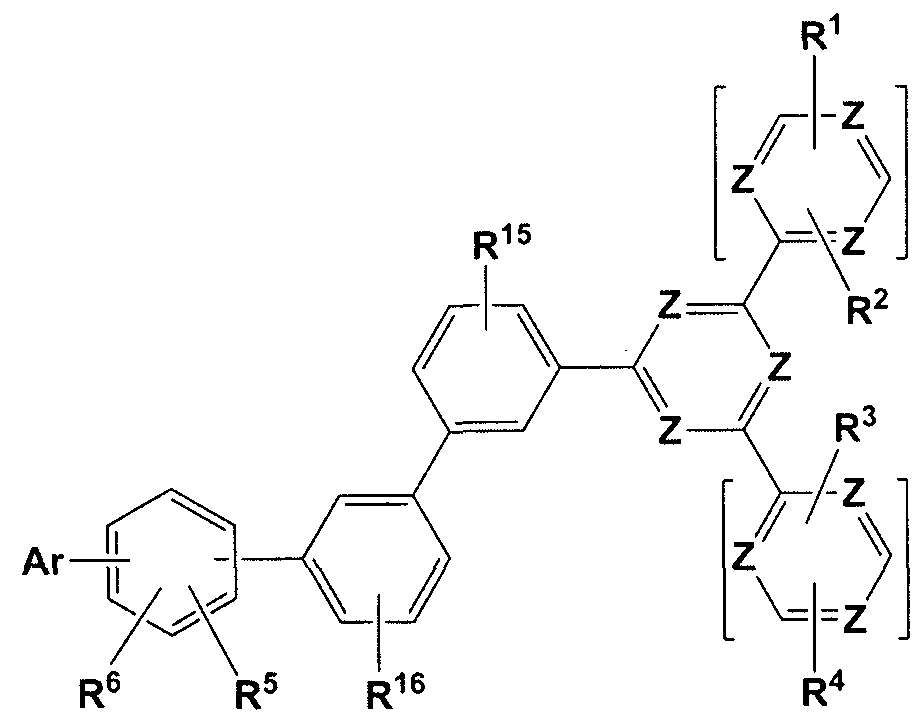

[화학식 1- I c]

상기 화학식 1- l A 내지 1- I C에서,
Z는 각각 독립적으로 N, C 또는 CRa이고,
Z 중 적어도 하나는 N 이고,
R1 내지 R6, Ra, R5a, R6a, R5b, R6b, 및 R15 내지 R18는 각각 독립적으로 수소, 중수소, 치환 또는 비치환된 C1 내지 C10 알킬기, 치환 또는 비치환된 C6 내지 C12 아릴기, 치환 또는 비치환된 C2 내지 C30 헤테로아릴기, 또는 이들의 조합이고,
R1 내지 R6, Ra, R5a, R6a, R5b, R6b, R17 및 R18은 각각 독립적으로 존재하거나 서로 인접한 기는 서로 연결되어 고리를 형성하고, -
Ar은 치환 또는 비치환된 C6 내지 C30 아릴기, 치환 또는 비치환된 C2 내지 C30 헤테로고리기, 또는 이들의 조합이고,
nl은 1의 정수이고,
n2는 0 또는 1의 정수이고,
여기서,"치환"은 게 1항에서 정의한 바와 같다.
【청구항 4】
제 2항에서,
상기 화학식 1-Π은 하기 화학식 1-ΠΑ 또는 1-ΠΒ로 표현되는 유기 광전자 소자용 조성물:
화학식 1-ΠΑ] [화학식 1-ΠΒ]

상기 화학식 1-ΠΑ 및 1-ΠΒ에서,
Z는 각각 독립적으로 N,C 또는 CRa이고,
Z 중 적어도 하나는 N 이고,
R1 내지 R6,R19 내지 R22, 및 Ra는 각각 독립적으로 수소, 중수소, 치환 또는 비치환된 C1 내지 C10 알킬기, 치환 또는 비치환된 C6 내지 C12 아릴기 치환 또는 비치환된 C2 내지 C30 해테로아릴기, 또는 이들의 조합이고,
R1 내지 R6,R19 내지 R22, 및 Ra는 각각 독립적으로 존재하거나 인접한 기는 서로 연결되어 고리를 형성하고,
nl은 1의 정수이고,
n2 및 n3은 각각 독립적으로 0 또는 1의 정수이고,
1 <n2 + n3 < 2이고,
여기서, "치환"은 제 1항에서 정의한 바와 같다.
【청구항 5]
거 12항에서,
상기 화학식 화학식 i-m은 하기 화학식 i-mA또는 ι-πΐΒ로 표현되는 유기 광전자 소자용 화합물:
하^ Ι -ΠΙΑ [화학식 μΐΠΒ]

상기 화학식 l-ΙΠΑ 및 ι-mB에서,
Z는 각각 독립적으로 N, C 또는 CRa이고,
Z 중 적어도 하나는 N 이고,
R1 내지 R4, R23 내지 R28, 및 Ra는 각각 독립적으로 수소, 중수소, 치환 또 비치환된 C1 내지 C10 알킬기, 치환 또는 비치환된 C6 내지 C12 아릴기: 치환 또는 비치환된 C2 내지 C30 헤테로아릴기, 또는 이들의 조합이고,
R1 내지 R4, 및 Ra는 각각 독립적으로 존재하거나 인접한 기는 서로 연결되어 고리를 형성하고,
L1은 단일결합, 치환 또는 비치환된 페닐렌기, 치환 또는 비치환된 바이페닐렌기 또는 치환 또는 비치환된 터페닐렌기이고,
nl은 1의 정수이고,
n2는 0 또는 1의 정수이고,
여기서, "치환"은 제 1항에서 정의한 바와 같다.
【청구항 6】ᅳ
제 1항에서,
상기 화학식 2는 하기 화학식 2- 1 내지 2-ΙΠ 중 어느 하나로 표현되는 유기 광전자 소자용 조성물:


상기 화학식 2- 1 내지 2-ΙΠ에서
L3 내지 L6, , 및 Υ4은 각각 독립적으로, 각각 독립적으로 단일 결합, 치환 또는 비치환된 C6 내지 C30 아릴렌기, 치환 또는 비치환된 C2 내지 C30 헤테로아릴렌기 또는 이들의 조합이고,
Arl 및 Ar4는 각각 독립적으로 치환 또는 비치환된 C6 내지 C30 아릴기, 치환 또는 비치환된 C2 내지 C30 헤테로고리기, 또는 이들의 조합이고,
R7 내지 R10, 및 R29 내지 R41은각각 독립적으로 수소, 중수소, 치환 또는 비치환된 C1 내지 C20 알킬기, 치환 또는 비치환된 C6 내지 C50 아릴기, 치환 또는 비치환된 C2 내지 C50 헤테로고리기 또는 이들의 조합이고,
m은 0 내지 4의 정수 중 하나이고,
여기서, "치환"은 제 1항에서 정의한 바와 같다.
【청구항 7】
제 6항에서,
상기 화학식 2- 1 내지 2-ΙΠ의 Ar1 및 Ar4은 각각 독립적으로, 치환 또는 비치환된 페닐기, 치환 또는 비치환된 바이페닐기, 치환 또는 비치환된 터페닐기, 치환 또는 비치환된 나프틸기, 치환 또는 비치환된 안트라세닐기, 치환 또는 비치환된 카바졸일기, 치환 또는 비치환된 벤조퓨라닐기, 치환 또는 비치환된 벤조티오페닐기, 치환 또는 비치환된 플루오레닐기, 치환 또는 비치환된
디벤조퓨란일기, 치환 또는 비치환된 디벤조티오펜일기, 치환 또는 비치환된 피리디닐기, 또는 이들의 조합인 유기 광전자 소자용 조성물.
【청구항 8】
거 16항에서,
상기 화학식 2- 1는 하기 그룹 3에 나열된 구조 중 하나이고, 상기
Ar1, *-Y4-Ar4는 하기 그룹 4에 나열된 치환기 중 하나인 유기 광전자 소자용 조성물:
그룹 3]

C-1 C-2 C-3 C-4

C-5 C-6 C-7

C-11 C-12 C-13

C-14 C-15
그룹 4]

B-16 B-17 B-18
상기 그룹 3 및 그룹 4에서, *은 연결 지점이다.
【청구항 9】
게 1항에서,
상기 화학식 3으로 표현되는 모이어티와 상기 화학식 4로 표현되는 모이어티의 조합으로 이루어진 게 2화합물은 하기 화학식 3- 1 내지 3-V 중 적어도 하나로 표현되는 유기 광전자 소자용 조성물:
3- 1 ] [화학식 3- Π ] [화학식 3-m]

-VI] [화학식

상기 화학식 3- 1 내지 3- V에서
Y2 및 Y3는 각각 독립적으로 단일 결합, 치환 또는 비치환된 C1 내지 C20 알킬렌기, 치환 또는 비치환된 C2 내지 C20 알케닐렌기, 치환 또는 비치환된 C6 내지 C30 아릴렌기, 치환 또는 비치환된 C2 내지 C30 해테로아릴렌기 또는 이들의 조합이고,
Ar2 및 Ar3는 각각 독립적으로 치환 또는 비치환된 C6 내지 C30 아릴기, 치환 또는 비치환된 C2 내지 C30 헤테로고리기 또는 이들의 조합이고,
R11 내지 R14는 각각 독립적으로 수소, 중수소, 치환 또는 비치환된 C1 내지 C20 알킬기, 치환 또는 비치환된 C6 내지 C50 아릴기, 치환 또는 비치환된 C2 내지 C50 헤테로고리기 또는 이들의 조합이고,
여기서, "치환"은 게 1항에서 정의한 바와 같다.
【청구항 10】
제 1항에서,
상기 화학식 5는 하기 화학식 5- 1 내지 5-m 중 어느 하나로 표현되는 유기 광전자 소자용 조성물:
ᄒ시

화학식 5-m]

상기 화학식 5- 1 내지 5-m에서,
X1 내지 X8, XU, 및 X12는 각각 독립적으로 N, C 또는 CRd이고,
X1, X4, X5 및 X6 중 적어도 하나는 N이고,
X7, Χ8, ΧΠ 및 X12 중 적어도 하나는 Ν이고,
W1 및 W2는 각각 독립적으로 0 또는 S이고,
Rd는 각각 독립적으로, 수소, 중수소, 치환 또는 비치환된 C1 내지 C30 알킬기, 치환 또는 비치환된 C1 내지 C30 알케닐기, 치환 또는 비치환된 C1 내 C30 알키닐기, 치환 또는 비치환된 C6 내지 C30 아릴기, 치환또는 비치환된 C6 내지 C30 아릴옥시기, 치환 또는 비치환된 C6 내지 C30 아릴티오기, 치환 또는 비치환된 C2 내지 C30 헤테로고리기, 히드록시기, 티을기, 또는 이들의 조합이고,
R' 각각 독립적으로 존재하거나, 인접한 Rd는 서로 연결되어 고리를 형성하고,
R42 내지 R45은 각각 독립적으로 수소, 중수소, 치환 또는 비치환된 C1 내지 C20 알킬기, 치환 또는 비치환된 C6 내지 C50 아릴기, 치환 또는 비치환된 C2 내지 C50 헤테로고리기 또는 이들의 조합이고,
L7은 각각 독립적으로 단일결합, 치환 또는 비치환된 C6 내지 C30
아릴렌기, 치환 또는 비치환된 C2 내지 C30 헤테로아릴렌기 또는 이들의 조합이고,
ET는 치환 또는 비치환된 피리디닐기, 치환 또는 비치환된 피리미디닐기, 치환 또는 비치환된 트리아지닐기, 치환 또는 비치환된 피라지닐기, 치환 또는 비치환된 퀴녹살리닐기, 치환 또는 비치환된 퀴나졸리닐기, 치환 또는 비치환된 페난트를리닐기, 또는 이들의 조합이고,
여기서, ' '치환 "은 제 1항에서 정의한 바와 같다.
【청구항 11】
제 10항에서,
상기 화학식 5- I은 하기 화학식 5- I -a 내지 5- I -f 중 어느 하나로 표현되는 유기 광전자 소자용 조성물:
[화학식 5- I -a] [화학식 5- I -b] [화학식 5- I -c]

화학식 5- I -d] [화학식 5- I -e] [화학식 5- I -f]

화학식 5- I -f]

상기 화학식 5- 1 -a 내지 5- I -f에서,
R46 내지 R50은 각각 독립적으로 수소, 중수소, 치환 또는 비치환된 C1 내지 C20 알킬기, 치환 또는 비치환된 C6 내지 C50 아릴기, 치환 또는 비치환된 C2 내지 C50 헤테로고리기 또는 이들의 조합이고,
L7은 각각 독립적으로 단일결합, 치환 또는 비치환된 C6 내지 C30 아릴렌기, 치환 또는 비치환된 C2 내지 C30 헤테로아릴렌기 또는 이들의
조합이고,
ET는 치환 또는 비치환된 피리디닐기, 치환 또는 비치환된 피리미디닐기, 치환 또는 비치환된 트리아지닐기, 치환 또는 비치환된 피라지닐기, 치환 또는 비치환된 퀴녹살리닐기, 치환 또는 비치환된 퀴나졸리닐기, 치환 또는 비치환된 페난트롤리닐기, 또는 이들의 조합이고,
여기서, "치환"은 게 1항에서 정의한 바와 같다.
【청구항 12】
제 10항에서,
상기 화학식 5-Π는 하기 화학식 5-n-a 내지 5- I -n 중 어느 하나로 표현되는 유기 광전자 소자용 조성물:
5-n-a] [화학식 5-n-b]

[화학식 5- Π -&


상기 화학식 5-n-a 내지 5- I -n에서
W2는 0 또는 S이고,
R42, R43, R51 내지 R57은 각각 독립적으로 수소, 중수소, 치환 또는 비치환된 C1 내지 C20 알킬기, 치환 또는 비치환된 C6 내지 C50 아릴기, 치환 또는 비치환된 C2 내지 C50 헤테로고리기 또는 이들의 조합이고,
L7은 각각 독립적으로 단일결합, 치환 또는 비치환된 C6 내지 C30 아릴렌기, 치환 또는 비치환된 C2 내지 C30 헤테로아릴렌기 또는 이들의 조합이고,
ET는 치환 또는 비치환된 피리디닐기, 치환 또는 비치환된 피리미디닐기, 치환 또는 비치환된 트리아지닐기, 치환 또는 비치환된 피라지닐기, 치환 또는 비치환된 퀴녹살리닐기, 치환 또는 비치환된 퀴나졸리닐기, 치환 또는 비치환된
페난트를리닐기, 또는 이들의 조합이고,
여기서, "치환"은 게 1항에서 정의한 바와 같다.
【청구항 13 ]
제 10항에서,
상기 화학식 5-m은 하기 화학식 5-in-a 내지 5-m-c 중 어느 하나로 표현되는 유기 광전자 소자용 조성물:
화학식 5-m-a]

상기 화학식 5-EI-a 내지 5-m-c에서,
W1 및 W2는 각각 독립적으로 0 또는 S이고,
R42 내지 R45, R51, 및 R52은 각각 독립적으로 수소, 중수소, 치환 또는 비치환된 C 1 내지 C20 알킬기, 치환 또는 비치환된 C6 내지 C50 아릴기, 치환 또는 비치환된 C2 내지 C50 헤테로고리기 또는 이들의 조합이고,
L7은 각각 독립적으로 단일결합, 치환 또는 비치환된 C6 내지 C30 아릴렌기, 치환 또는 비치환된 C2 내지 C30 헤테로아릴렌기 또는 이들의 조합이고,
여기서,"치환' '은 제 1항에서 정의한 바와 같다.
【청구항 14]
제 1항에서,
상기 제 1 화합물은 하기 화학식 1-1 또는 화학식 i-m로 표현되고, 상기 게 2 화합물은 하기 화학식 2-1로 표현되고,
상기 제 3 화합물은 하기 화학식 5-1 또는 화학식 5-Π로 표현되는 유기 광전자 소자용 조성물:
[화학식 1-1]

상기 화학식 1-1 및 i-m에서,
Z는 각각 독립적으로 N,C 또는 CRa이고,
Z 중 적어도 하나는 N 이고,
R1 내지 R6,R15 내지 R18,R23 내지 R28, 및 Ra는 각각 독립적으로 수소
중수소, 치환 또는 비치환된 C1 내지 C10 알킬기, 또는 치환 또는 비치환된 C6 내지 C12 아릴기이고,
Ar은 각각 독립적으로 치환 또는 비치환된 C6 내지 C30 아릴기, 치환 또는 비치환된 C2 내지 C30 헤테로고리기 또는 이들의 조합이고,
R1 내지 R6, R15 내지 R18, R23 내지 R2S, 및 Ra는 각각 독립적으로
존재하거나 인접한 기는 서로 연결되어 고리를 형성하고,
L1은 단일결합, 치환 또는 비치환된 페닐렌기, 치환 또는 비치환된
바이페닐렌기, 치환 또는 비치환된 터페닐렌기, 치환 또는 비치환된 쿼터페닐렌기, 치환 또는 비치환된 나프틸렌기, 치환 또는 비치환된 안트라세닐렌기, 치환 또는 비치환된 트리페닐레닐기, 또는 치환 또는 비치환된 페난트레닐렌기이고,
nl은 1의 정수이고,
n2 및 n3은 각각 독립적으로, 0 또는 1의 정수이고,
n4는 0 내지 2의 정수이고;
2- 1 ]

상기 화학식 2- I에서,
L3 내지 , Υ1, 및 Y4은 각각 독립적으로, 각각 독립적으로 단일 결합, 또는 치환 또는 비치환된 C6 내지 C30 아릴렌기이고,
Ar1 및 Ar4는 각각 독립적으로 치환 또는 비치환된 C6 내지 C30 아릴기, 치환 또는 비치환된 C2 내지 C30 헤테로고리기, 또는 이들의 조합이고,
R7 내지 R9및 R29 내지 R31은각각 독립적으로 수소, 증수소, 치환 또는 비치환된 C1 내지 C20 알킬기, 또는 치환 또는 비치환된 C6 내지 C50
아릴기이고,
m은 0 또는 1의 정수이고;
[화학식 5- 1 ]
X3 ^X
L7- -ΕΤ
X4 \ ^ X6
X5
화학식 5- Π ]

상기 화학식 5- 1 및 5- Π에서,
X1 내지 Χ8, Χ", 및 X12는 각각 독립적으로 Ν, C 또는 CRd이고,
X1, X4, X5 및 X6 중 적어도 하나는 N이고,
X7, X8, X1 1 및 X12 증 적어도 하나는 N이고,
W1 및 W2는 각각 독립적으로 0 또는 S이고,
R42, R43, 및 Rd는 각각 독립적으로, 수소, 중수소, 치환또는 비치환된 C1 내지 C30 알킬기, 치환 또는 비치환된 C6 내지 C30 아릴기, 또는 치환 또는 비치환된 C2 내지 C30 헤테로고리기이고,
R d는 각각 독립적으로 존재하거나, 인접한 R d는 서로 연결되어 고리를 형성하고,
L7은 단일결합, 치환 또는 비치환된 페닐렌기, 치환 또는 비치환된 바이페닐렌기, 치환 또는 비치환된 터페닐렌기, 치환 또는 비치환된 쿼터페닐렌기, 치환 또는 비치환된 나프틸렌기, 치환 또는 비치환된 안트라세닐렌기, 치환 또는 비치환된 트리페닐레닐기, 또는 치환 또는 비치환된 페난트레닐렌기이고,
ET는 치환 또는 비치환된 피리디닐기, 치환 또는 비치환된 피리미디닐기, 치환 또는 비치환된 트리아지닐기, 치환 또는 비치환된 피라지닐기, 치환 또는 비치환된 퀴녹살리닐기, 치환 또는 비치환된 퀴나졸리닐기, 치환 또는 비치환된 페난트를리닐기, 또는 이들의 조합이고,
여기서, "치환"은 제 1항에서 정의한 바와 같다.
【청구항 15]
제 14항에서,
상기 게 1 화합물은 하기 화학식 1-IB 또는 1-ΠΙΑ로 표현되는 유기 광전자 소자용 조성물:
[화학식 1- I B]

상기 화학식 1-IB에서,
Z는 각각 독립적으로 N,C 또는 CRa이고,
Z 중 적어도 하나는 N 이고,
R1 내지 R4,R15,R16,R5a,R6a,R5b, 및 R6b는 각각 독립적으로 수소, 중수소, 치환 또는 비치환된 C1 내지 C10 알킬기 , 또는 치환 또는 비치환된 C6 내지 C12 아릴기이고,
Ar은 각각 독립적으로 치환 또는 비치환된 C6 내지 C30 아릴기, 치환 또는 비치환된 C2 내지 C30 헤테로고리기 또는 이들의 조합이고,
R5a 및 R6a, 그리고 R5b 및 R6b은 각각 독립적으로 존재하거나 인접한 기는 서로 연결되어 고리를 형성하고,
nl은 1의 정수이고,
n2은 0 또는 1의 정수이고;

상기 화학식 ι-mA에서,
Z는 각각 독립적으로 N, C 또는 CRa이고,
Z 중 적어도 하나는 N 이고,
R1 내지 R4, R23 내지 R28, 및 Ra는 각각 독립적으로 수소, 중수소, 치환 또는 비치환된 C1 내지 C10 알킬기, 치환 또는 비치환된 C6 내지 C12 아릴기, 치환 또는 비치환된 C2 내지 C30 헤테로아릴기, 또는 이들의 조합이고,
R1 내지 R4, 및 Ra는 각각 독립적으로 존재하거나, 인접한 기는 서로 연결되어 고리를 형성하고,
L1은 단일결합, 치환 또는 비치환된 페닐렌기 , 치환 또는 비치환된 바이페닐렌기, 치환 또는 비치환된 터페닐렌기, 치환 또는 비치환된 쿼터페닐렌기 치환 또는 비치환된 나프틸렌기, 치환 또는 비치환된 안트라세닐렌기, 치환 또는 비치환된 트리페닐레닐기, 또는 치환 또는 비치환된 페난트레닐렌기이고,
nl은 1의 정수이고,
n2는 0 또는 1의 정수이고;
여기서,ᅳ'치환''은 제 1항에서 정의한 바와 같다.
【청구항 16]
제 14항에서,
상기 제 3 화합물은 하기 화학식 5- I -b, 화학식 5- I -d, 또는 화학식 5-n-d 로 표현되는 유기 광전자 소자용 조성물:
[화학식 5- I -b]

[화 5- I -d]

상기 화학식 5_ I -b, 화학식 I -d, 및 화학식 5- n -k에서,
W2는 O 또는 S이고,
R42, R43, R46, R47, 및 R51 내지 R53은 각각 독립적으로, 수소, 증수소, 치환 또 비치환된 C1 내지 C30 알킬기, 치환 또는 비치환된 C6 내지 C30 아릴기, 또는 치환 또는 비치환된 C2 내지 C30 헤테로고리기이고,
L7은 단일결합, 치환 또는 비치환된 페닐렌기, 치환 또는 비치환된 바이페닐렌기, 치환 또는 비치환된 터페닐렌기, 치환 또는 비치환된 쿼터페닐렌기 : 치환 또는 비치환된 나프틸렌기, 치환 또는 비치환된 안트라세닐렌기, 치환 또는 비치환된 트리페닐레닐기, 또는 치환 또는 비치환된 페난트레닐렌기이고,
ET는 치환 또는 비치환된 피리디닐기, 치환 또는 비치환된 피리미디닐기, 치환 또는 비치환된 트리아지닐기, 치환 또는 비치환된 피라지닐기, 치환 또는 비치환된 퀴녹살리닐기, 치환 또는 비치환된 퀴나졸리닐기, 치환 또는 비치환된 페난트를리닐기, 또는 이들의 조합이고,
여기서 치환' '은 게 1항에서 정의한 바와 같다.
【청구항 17]
거 U항에서,
인광 도편트를 더 포함하는 유기광전자소자용 조성물ᅳ
【청구항 18】
서로 마주하는 애노드와 캐소드, 그리고
상기 애노드와 상기 캐소드 사이에 위치하는 적어도 1층의 유기층 을 포함하고,
상기 유기층은 게 1항 내지 제 17항 중 어느 한 항에 따른 유기 광전자 소자용 조성물을 포함하는 유기 광전자 소자.
【청구항 19】
제 18항에 따른 유기 광전자 소자를 포함하는 표시 장치ᅳ
Priority Applications (2)
| Application Number | Priority Date | Filing Date | Title |
|---|---|---|---|
| CN201680003688.6A CN107001930B (zh) | 2015-06-26 | 2016-05-02 | 有机光电装置用组成物、有机光电装置及显示装置 |
| US15/517,206 US11450806B2 (en) | 2015-06-26 | 2016-05-02 | Composition for organic optoelectronic element, organic optoelectronic element, and display device |
Applications Claiming Priority (2)
| Application Number | Priority Date | Filing Date | Title |
|---|---|---|---|
| KR10-2015-0091331 | 2015-06-26 | ||
| KR1020150091331A KR101919438B1 (ko) | 2015-06-26 | 2015-06-26 | 유기 광전자 소자용 조성물, 유기 광전자 소자 및 표시 장치 |
Publications (1)
| Publication Number | Publication Date |
|---|---|
| WO2016208865A1 true WO2016208865A1 (ko) | 2016-12-29 |
Family
ID=57585822
Family Applications (1)
| Application Number | Title | Priority Date | Filing Date |
|---|---|---|---|
| PCT/KR2016/004610 Ceased WO2016208865A1 (ko) | 2015-06-26 | 2016-05-02 | 유기 광전자 소자용 조성물, 유기 광전자 소자 및 표시 장치 |
Country Status (5)
| Country | Link |
|---|---|
| US (1) | US11450806B2 (ko) |
| KR (1) | KR101919438B1 (ko) |
| CN (1) | CN107001930B (ko) |
| TW (1) | TWI594989B (ko) |
| WO (1) | WO2016208865A1 (ko) |
Families Citing this family (15)
| Publication number | Priority date | Publication date | Assignee | Title |
|---|---|---|---|---|
| CN109790461B (zh) * | 2016-12-08 | 2022-08-12 | 广州华睿光电材料有限公司 | 混合物、组合物及有机电子器件 |
| KR102146791B1 (ko) * | 2017-06-23 | 2020-08-21 | 삼성에스디아이 주식회사 | 유기 광전자 소자용 화합물, 유기 광전자 소자 및 표시 장치 |
| KR102129508B1 (ko) * | 2017-07-14 | 2020-07-02 | 삼성에스디아이 주식회사 | 유기 광전자 소자용 조성물, 유기 광전자 소자 및 표시 장치 |
| KR102450436B1 (ko) | 2017-08-01 | 2022-10-04 | 삼성디스플레이 주식회사 | 헤테로환 화합물 및 이를 포함하는 유기 전계 발광 소자 |
| KR102118142B1 (ko) * | 2017-09-27 | 2020-06-02 | 삼성에스디아이 주식회사 | 유기 광전자 소자용 화합물, 유기 광전자 소자 및 표시 장치 |
| KR102214895B1 (ko) * | 2017-12-26 | 2021-02-09 | 삼성에스디아이 주식회사 | 레지스트 하층막용 조성물 및 이를 이용한 패턴 형성 방법 |
| KR102637792B1 (ko) | 2018-03-22 | 2024-02-19 | 삼성디스플레이 주식회사 | 유기 발광 소자 및 이를 포함한 전자 장치 |
| US11077757B2 (en) * | 2018-05-03 | 2021-08-03 | Hyundai Motor Company | Vehicle and control method thereof |
| JP7299020B2 (ja) * | 2018-12-28 | 2023-06-27 | 三星電子株式会社 | 有機エレクトロルミネッセンス素子およびその製造方法 |
| US12501828B2 (en) | 2018-12-28 | 2025-12-16 | Samsung Electronics Co., Ltd. | Organic light-emitting device and apparatus including the same |
| KR102366291B1 (ko) | 2019-02-15 | 2022-02-21 | 삼성에스디아이 주식회사 | 유기 광전자 소자용 조성물, 유기 광전자 소자 및 표시 장치 |
| KR102365130B1 (ko) | 2019-02-15 | 2022-02-17 | 삼성에스디아이 주식회사 | 유기 광전자 소자용 조성물, 유기 광전자 소자 및 표시 장치 |
| KR102804493B1 (ko) * | 2019-04-30 | 2025-05-09 | 삼성디스플레이 주식회사 | 유기 발광 소자 |
| KR102555503B1 (ko) * | 2019-11-14 | 2023-07-12 | 삼성에스디아이 주식회사 | 유기 광전자 소자용 화합물, 유기 광전자 소자용 조성물, 유기 광전자 소자 및 표시 장치 |
| JP7443038B2 (ja) | 2019-12-04 | 2024-03-05 | 三星電子株式会社 | 化合物、組成物、液状組成物および有機エレクトロルミネッセンス素子 |
Citations (7)
| Publication number | Priority date | Publication date | Assignee | Title |
|---|---|---|---|---|
| CN101654430A (zh) * | 2009-09-22 | 2010-02-24 | 北京大学 | 一种宽带电子传输材料及其制备和应用 |
| WO2010067894A1 (en) * | 2008-12-12 | 2010-06-17 | Canon Kabushiki Kaisha | Triazine compound and organic light emitting device using the same |
| KR20100131745A (ko) * | 2009-06-08 | 2010-12-16 | 제일모직주식회사 | 유기광전소자용 조성물 및 이를 이용한 유기광전소자 |
| WO2012163465A1 (de) * | 2011-06-03 | 2012-12-06 | Merck Patent Gmbh | Organische elektrolumineszenzvorrichtung |
| KR20140014959A (ko) * | 2012-07-27 | 2014-02-06 | (주)피엔에이치테크 | 새로운 유기전계발광소자용 화합물 및 그를 포함하는 유기전계발광소자 |
| WO2014185595A1 (ko) * | 2013-05-16 | 2014-11-20 | 제일모직 주식회사 | 유기 광전자 소자용 발광 재료, 유기 광전자 소자 및 표시 장치 |
| KR20150028579A (ko) * | 2013-09-06 | 2015-03-16 | 제일모직주식회사 | 유기광전자소자용 조성물, 유기 광전자 소자 및 표시 장치 |
Family Cites Families (6)
| Publication number | Priority date | Publication date | Assignee | Title |
|---|---|---|---|---|
| US7990046B2 (en) * | 2002-03-15 | 2011-08-02 | Idemitsu Kosan Co., Ltd. | Material for organic electroluminescent devices and organic electroluminescent devices made by using the same |
| KR20120116282A (ko) | 2011-04-12 | 2012-10-22 | 롬엔드하스전자재료코리아유한회사 | 신규한 유기 발광 화합물 및 이를 채용하고 있는 유기 전계 발광 소자 |
| KR101920643B1 (ko) | 2014-01-10 | 2018-11-21 | 삼성에스디아이 주식회사 | 축합환 화합물, 및 이를 포함한 유기 발광 소자 |
| US9755159B2 (en) * | 2014-01-23 | 2017-09-05 | Universal Display Corporation | Organic materials for OLEDs |
| KR102059021B1 (ko) | 2015-06-19 | 2019-12-24 | 삼성에스디아이 주식회사 | 유기 광전자 소자용 조성물, 유기 광전자 소자 및 표시 장치 |
| KR102016015B1 (ko) | 2018-07-25 | 2019-08-30 | 경북보건대학교 산학협력단 | 노약자를 위한 보호조끼 기구 |
-
2015
- 2015-06-26 KR KR1020150091331A patent/KR101919438B1/ko active Active
-
2016
- 2016-05-02 CN CN201680003688.6A patent/CN107001930B/zh active Active
- 2016-05-02 WO PCT/KR2016/004610 patent/WO2016208865A1/ko not_active Ceased
- 2016-05-02 US US15/517,206 patent/US11450806B2/en active Active
- 2016-06-21 TW TW105119355A patent/TWI594989B/zh active
Patent Citations (7)
| Publication number | Priority date | Publication date | Assignee | Title |
|---|---|---|---|---|
| WO2010067894A1 (en) * | 2008-12-12 | 2010-06-17 | Canon Kabushiki Kaisha | Triazine compound and organic light emitting device using the same |
| KR20100131745A (ko) * | 2009-06-08 | 2010-12-16 | 제일모직주식회사 | 유기광전소자용 조성물 및 이를 이용한 유기광전소자 |
| CN101654430A (zh) * | 2009-09-22 | 2010-02-24 | 北京大学 | 一种宽带电子传输材料及其制备和应用 |
| WO2012163465A1 (de) * | 2011-06-03 | 2012-12-06 | Merck Patent Gmbh | Organische elektrolumineszenzvorrichtung |
| KR20140014959A (ko) * | 2012-07-27 | 2014-02-06 | (주)피엔에이치테크 | 새로운 유기전계발광소자용 화합물 및 그를 포함하는 유기전계발광소자 |
| WO2014185595A1 (ko) * | 2013-05-16 | 2014-11-20 | 제일모직 주식회사 | 유기 광전자 소자용 발광 재료, 유기 광전자 소자 및 표시 장치 |
| KR20150028579A (ko) * | 2013-09-06 | 2015-03-16 | 제일모직주식회사 | 유기광전자소자용 조성물, 유기 광전자 소자 및 표시 장치 |
Also Published As
| Publication number | Publication date |
|---|---|
| US20170309829A1 (en) | 2017-10-26 |
| CN107001930A (zh) | 2017-08-01 |
| TWI594989B (zh) | 2017-08-11 |
| TW201704219A (zh) | 2017-02-01 |
| CN107001930B (zh) | 2019-07-16 |
| US11450806B2 (en) | 2022-09-20 |
| KR20170001398A (ko) | 2017-01-04 |
| KR101919438B1 (ko) | 2018-11-16 |
Similar Documents
| Publication | Publication Date | Title |
|---|---|---|
| CN111584721B (zh) | 用于光电器件的组合物和有机光电器件及显示装置 | |
| CN110294703B (zh) | 用于有机光电器件的组合物、有机光电器件及显示器件 | |
| CN106554771B (zh) | 用于有机光电子器件的组合物、包含其的有机光电子器件及显示设备 | |
| CN109980112B (zh) | 组合物、有机光电子装置及显示装置 | |
| TWI500604B (zh) | 有機光電元件用組成物及有機光電元件及顯示元件 | |
| CN109415625B (zh) | 化合物及其组成物、有机光电装置及显示装置 | |
| TWI594989B (zh) | 有機光電裝置用組成物、有機光電裝置及顯示裝置 | |
| CN106929005B (zh) | 用于有机光电子器件的组合物、包含其的有机光电子器件及显示设备 | |
| JP6696753B2 (ja) | 有機光電子素子用化合物、有機光電子素子用組成物、有機光電子素子および表示装置 | |
| CN104471021B (zh) | 新的有机电致发光器件用化合物及包含该化合物的有机电致发光器件 | |
| CN111574995B (zh) | 用于光电器件的组合物和有机光电器件及显示装置 | |
| TWI655191B (zh) | 有機光電裝置與顯示裝置 | |
| CN113782689B (zh) | 用于有机光电装置的组合物、有机光电装置及显示装置 | |
| WO2017135510A1 (ko) | 유기 광전자 소자용 화합물, 유기 광전자 소자 및 표시 장치 | |
| CN110800122B (zh) | 有机电致发光器件 | |
| CN115244724B (zh) | 用于有机光电元件的组合物、有机光电元件和显示装置 | |
| CN107305925A (zh) | 用于有机光电器件的组合物和包含其的有机光电器件和显示器器件 | |
| CN115461339B (zh) | 新型化合物及包含其的有机发光器件 | |
| CN109952357A (zh) | 有机光电二极管与显示装置 | |
| CN111518017B (zh) | 含氮化合物、电子元件和电子装置 | |
| CN112794843A (zh) | 用于有机光电装置的化合物、用于有机光电装置的组合物、有机光电装置及显示装置 | |
| CN116903603A (zh) | 一种含有三嗪的杂环化合物及其有机电致发光器件 | |
| CN113200992B (zh) | 含氮化合物、有机电致发光器件和电子装置 | |
| CN112592333B (zh) | 用于有机光电装置的化合物、有机光电装置及显示装置 | |
| CN111247226A (zh) | 用于有机光电元件的组合物、有机光电元件和显示装置 |
Legal Events
| Date | Code | Title | Description |
|---|---|---|---|
| 121 | Ep: the epo has been informed by wipo that ep was designated in this application |
Ref document number: 16814578 Country of ref document: EP Kind code of ref document: A1 |
|
| WWE | Wipo information: entry into national phase |
Ref document number: 15517206 Country of ref document: US |
|
| NENP | Non-entry into the national phase |
Ref country code: DE |
|
| 122 | Ep: pct application non-entry in european phase |
Ref document number: 16814578 Country of ref document: EP Kind code of ref document: A1 |