WO2016190294A1 - 排ガス浄化用触媒、それを用いた排ガス浄化フィルタ及び排ガス浄化方法 - Google Patents
排ガス浄化用触媒、それを用いた排ガス浄化フィルタ及び排ガス浄化方法 Download PDFInfo
- Publication number
- WO2016190294A1 WO2016190294A1 PCT/JP2016/065268 JP2016065268W WO2016190294A1 WO 2016190294 A1 WO2016190294 A1 WO 2016190294A1 JP 2016065268 W JP2016065268 W JP 2016065268W WO 2016190294 A1 WO2016190294 A1 WO 2016190294A1
- Authority
- WO
- WIPO (PCT)
- Prior art keywords
- exhaust gas
- silver
- catalyst
- oxoacid salt
- salt
- Prior art date
- Legal status (The legal status is an assumption and is not a legal conclusion. Google has not performed a legal analysis and makes no representation as to the accuracy of the status listed.)
- Ceased
Links
Images

Classifications
-
- B—PERFORMING OPERATIONS; TRANSPORTING
- B01—PHYSICAL OR CHEMICAL PROCESSES OR APPARATUS IN GENERAL
- B01D—SEPARATION
- B01D53/00—Separation of gases or vapours; Recovering vapours of volatile solvents from gases; Chemical or biological purification of waste gases, e.g. engine exhaust gases, smoke, fumes, flue gases, aerosols
- B01D53/34—Chemical or biological purification of waste gases
- B01D53/92—Chemical or biological purification of waste gases of engine exhaust gases
- B01D53/94—Chemical or biological purification of waste gases of engine exhaust gases by catalytic processes
-
- B—PERFORMING OPERATIONS; TRANSPORTING
- B01—PHYSICAL OR CHEMICAL PROCESSES OR APPARATUS IN GENERAL
- B01J—CHEMICAL OR PHYSICAL PROCESSES, e.g. CATALYSIS OR COLLOID CHEMISTRY; THEIR RELEVANT APPARATUS
- B01J27/00—Catalysts comprising the elements or compounds of halogens, sulfur, selenium, tellurium, phosphorus or nitrogen; Catalysts comprising carbon compounds
- B01J27/02—Sulfur, selenium or tellurium; Compounds thereof
- B01J27/053—Sulfates
- B01J27/055—Sulfates with alkali metals, copper, gold or silver
-
- F—MECHANICAL ENGINEERING; LIGHTING; HEATING; WEAPONS; BLASTING
- F01—MACHINES OR ENGINES IN GENERAL; ENGINE PLANTS IN GENERAL; STEAM ENGINES
- F01N—GAS-FLOW SILENCERS OR EXHAUST APPARATUS FOR MACHINES OR ENGINES IN GENERAL; GAS-FLOW SILENCERS OR EXHAUST APPARATUS FOR INTERNAL-COMBUSTION ENGINES
- F01N3/00—Exhaust or silencing apparatus having means for purifying, rendering innocuous, or otherwise treating exhaust
- F01N3/02—Exhaust or silencing apparatus having means for purifying, rendering innocuous, or otherwise treating exhaust for cooling, or for removing solid constituents of, exhaust
- F01N3/021—Exhaust or silencing apparatus having means for purifying, rendering innocuous, or otherwise treating exhaust for cooling, or for removing solid constituents of, exhaust by means of filters
- F01N3/033—Exhaust or silencing apparatus having means for purifying, rendering innocuous, or otherwise treating exhaust for cooling, or for removing solid constituents of, exhaust by means of filters in combination with other devices
- F01N3/035—Exhaust or silencing apparatus having means for purifying, rendering innocuous, or otherwise treating exhaust for cooling, or for removing solid constituents of, exhaust by means of filters in combination with other devices with catalytic reactors
-
- F—MECHANICAL ENGINEERING; LIGHTING; HEATING; WEAPONS; BLASTING
- F01—MACHINES OR ENGINES IN GENERAL; ENGINE PLANTS IN GENERAL; STEAM ENGINES
- F01N—GAS-FLOW SILENCERS OR EXHAUST APPARATUS FOR MACHINES OR ENGINES IN GENERAL; GAS-FLOW SILENCERS OR EXHAUST APPARATUS FOR INTERNAL-COMBUSTION ENGINES
- F01N3/00—Exhaust or silencing apparatus having means for purifying, rendering innocuous, or otherwise treating exhaust
- F01N3/08—Exhaust or silencing apparatus having means for purifying, rendering innocuous, or otherwise treating exhaust for rendering innocuous
- F01N3/10—Exhaust or silencing apparatus having means for purifying, rendering innocuous, or otherwise treating exhaust for rendering innocuous by thermal or catalytic conversion of noxious components of exhaust
Definitions
- the present invention relates to an exhaust gas purification catalyst, an exhaust gas purification filter and an exhaust gas purification method using the same.
- PM particulate matter
- a purification filter Diesel Particulate Filter
- the PM collected by the DPF causes an increase in pressure loss and a decrease in the output of the internal combustion engine. Therefore, the PM is periodically raised to a high temperature (for example, heated to around 650 ° C.), and the PM is burned (oxidized and removed). ) To regenerate the DPF.
- Patent Document 1 discloses at least one selected from the group consisting of gold, silver, copper, iron, zinc, manganese and rare earth elements as an active component.
- a PM oxidation catalyst in which an element is supported on an alkaline earth metal hydroxide, oxide, carbonate or sulfate as a carrier component is disclosed.
- International Publication No. 2007/043442 discloses an oxidation catalyst composed of a carrier made of a complex oxide of cerium and zirconium and Ag or an oxide of Ag carried on the carrier. Yes.
- Patent Application Laid-Open No. 2007-196135 discloses using an oxidation catalyst obtained by firing boehmite on which silver is supported.
- the PM oxidation performance of the conventional PM oxidation catalyst as described in Patent Documents 1 to 3 changes depending on the use as described above, the timing for performing the regeneration process of the DPF and the temperature condition at that time are determined. Not only was it difficult to set, but when the catalyst was supported on a base material such as DPF, the base material could be destroyed by heat due to the oxidation of a large amount of PM. As described above, the conventional PM oxidation catalysts as described in Patent Documents 1 to 3 cannot sufficiently exhibit purification performance due to ash accumulation.
- Patent Document 4 discloses a carrier made of at least one metal salt selected from the group consisting of Ca sulfate and phosphate, and silver carried on the carrier.
- An exhaust gas purification apparatus including an oxidation catalyst including at least one silver-containing material selected from the group consisting of silver oxide, silver carbonate, silver sulfate, and silver phosphate is disclosed. According to the description of the publication, the exhaust gas purification device capable of sufficiently suppressing the reduction in the oxidation performance of the particulate matter due to the ash deposition and exhibiting the excellent oxidation performance of the particulate matter even after the ash deposition. It is possible to provide.
- the present invention has been made in view of the above-mentioned problems of the prior art, has a sufficiently high PM oxidation activity, and sufficiently suppresses a reduction in oxidation performance of particulate matter due to ash deposition. It is an object of the present invention to provide an exhaust gas purifying catalyst capable of exhibiting sufficiently high PM oxidation activity even after deposition, an exhaust gas purifying filter and an exhaust gas purifying method using the same.
- the present inventors have developed a silver oxo acid salt on a carrier containing at least one selected from the group consisting of barium oxo acid salt and strontium oxo acid salt.
- the exhaust gas purifying catalyst obtained surprisingly has a sufficiently high PM oxidation activity, and further the deterioration of the oxidation performance of the particulate matter due to the accumulation of ash is sufficiently suppressed.
- the present inventors have found that a sufficiently high PM oxidation activity can be exhibited even in the present invention, and the present invention has been completed.
- the exhaust gas purifying catalyst of the present invention comprises a carrier containing at least one selected from the group consisting of barium oxoacid salt and strontium oxoacid salt, and silver oxoacid salt carried on the carrier.
- the barium oxoacid salt is an oxoacid salt containing at least one selected from the group consisting of boron, phosphorus and sulfur
- the strontium oxoacid salt is a group consisting of boron, phosphorus and sulfur
- the barium oxoacid salt is at least one selected from the group consisting of barium sulfate (BaSO 4 ) and barium sulfite (BaSO 3 ), and the strontium oxoacid salt Is preferably at least one selected from the group consisting of strontium sulfate (SrSO 4 ) and strontium sulfite (SrSO 3 ).
- the silver oxoacid salt is at least one selected from the group consisting of silver sulfate (Ag 2 SO 4 ) and silver sulfite (Ag 2 SO 3 ). Is preferred.
- the supported amount of the silver oxoacid salt is 0.1 to 50% by mass in terms of metallic silver with respect to the total amount of the carrier and the silver oxoacid salt. Preferably there is.
- the exhaust gas purification filter of the present invention comprises a breathable base material and the exhaust gas purification catalyst of the present invention supported on the breathable base material.
- the exhaust gas purification method of the present invention is a method of oxidizing and removing particulate matter (PM) by contacting exhaust gas from an internal combustion engine with the exhaust gas purification catalyst of the present invention.
- the exhaust gas purification catalyst of the present invention, the exhaust gas purification filter using the exhaust gas purification method, and the exhaust gas purification method have sufficiently high PM oxidation activity and sufficiently reduce the oxidation performance of particulate matter due to ash deposition. Although the reason why it is suppressed and a sufficiently high PM oxidation activity can be exhibited even after ash deposition is not necessarily clear, the present inventors speculate as follows.
- the exhaust gas-purifying catalyst is a carrier containing at least one selected from the group consisting of the barium oxoacid salt and the strontium oxoacid salt, and the silver oxoacid supported on the carrier.
- the oxygen ion (O 2 ⁇ ) in the oxo acid ion of the silver oxo acid salt contained in the exhaust gas purifying catalyst of the present invention is converted into the silver ion (Ag + ) in the silver oxo acid salt. It is activated by giving electrons to carbon dioxide, and becomes carbon dioxide (CO 2 ) by receiving electrons from particulate matter (PM, mainly carbon: C).
- the carrier carrying the silver oxo acid salts of cerium oxide the case of a basic support such as a composite oxide containing (ceria CeO 2) or CeO 2, and oxoacid ions of cerium (Ce) ionic bond
- a basic support such as a composite oxide containing (ceria CeO 2) or CeO 2
- oxoacid ions of cerium (Ce) ionic bond oxygen is not activated.
- an acidic carrier such as titanium oxide (titania: TiO 2 ) or tin oxide (SnO 2 )
- the reduced Ag becomes stable, and thus re-oxidation by O 2 does not proceed.
- the carrier for the exhaust gas purifying catalyst of the present invention contains at least one selected from the group consisting of the barium oxoacid salt and the strontium oxoacid salt.
- a carrier such as barium (Ba) or strontium Since the oxo acid salt of (Sr) has moderate basicity / acidity, the present inventors infer that the above cycle proceeds without delay.
- the silver oxoacid salt supported on the carrier of the exhaust gas purifying catalyst of the present invention has a relatively low melting point (for example, 660 ° C. in Ag 2 SO 4 ) and high temperature (temperature at which PM is oxidized). In the region), it is considered that at least a part is in a molten state, and silver ions are dispersed so as to cover the entire surface of the carrier because it has melting properties on the carrier. Therefore, in the exhaust gas purifying catalyst comprising the silver oxoacid salt supported on the carrier, the contact point between Ag ions and PM is remarkably increased, and it becomes possible to obtain higher PM oxidation activity. The present inventors speculate.
- the silver oxo acid salt has a melting property on the carrier at a high temperature.
- the carrier having the oxo acid salt of barium (Ba) or strontium (Sr) of the present invention includes calcium sulfate (CaSO 4 ), calcium phosphate (Ca 3 (PO 4 ) 2 , CaHPO 4 , CaH 4 (PO 4 ) 2, etc. ) And the basic / acidity of the ash particles as a main component, the silver oxo acid salt on the carrier melts and the silver oxo acid salt, silver (Ag) or silver ion (Ag + ) can migrate to the ash particles in contact with the catalyst.
- the exhaust gas purifying catalyst of the present invention a sufficiently high PM oxidation activity can be achieved, and further, the deterioration of the oxidation performance of the particulate matter due to the ash deposition can be sufficiently suppressed.
- the present inventors infer that it is possible to exhibit a sufficiently high PM oxidation activity even in the case of the above.
- the present invention has a sufficiently high PM oxidation activity, and the deterioration of the oxidation performance of the particulate matter due to the ash deposition is sufficiently suppressed, and a sufficiently high PM oxidation activity is achieved even after the ash deposition. It is possible to provide an exhaust gas purification catalyst that can be exerted, an exhaust gas purification filter and an exhaust gas purification method using the same.
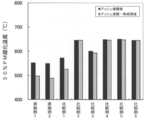
- 6 is a graph showing initial 50% PM oxidation temperatures of exhaust gas purifying catalysts obtained in Examples 1 and 2 and Comparative Examples 1 to 6. 6 is a graph showing 50% PM oxidation temperature of exhaust gas purifying catalysts after ash deposition and after ash deposition-heat treatment obtained in Examples 1-2 and Comparative Examples 1-6.
- the exhaust gas purifying catalyst of the present invention comprises a carrier containing at least one selected from the group consisting of barium oxoacid salt and strontium oxoacid salt, and silver oxoacid salt supported on the carrier.
- the barium oxoacid salt is an oxoacid salt containing at least one selected from the group consisting of boron, phosphorus and sulfur
- the strontium oxoacid salt is selected from the group consisting of boron, phosphorus and sulfur
- the silver oxoacid salt is an oxoacid salt containing at least one selected from the group consisting of phosphorus and sulfur.
- the catalyst for exhaust gas purification of the invention can exhibit sufficiently high PM oxidation activity, and further, the deterioration of the oxidation performance of particulate matter due to ash deposition is sufficiently suppressed, and even after ash deposition. It is possible to exhibit a sufficiently high PM oxidation activity. Therefore, the exhaust gas purifying catalyst of the present invention can be suitably employed as a PM oxidation catalyst for purifying exhaust gas by oxidizing and removing particulate matter (PM) in exhaust gas from an internal combustion engine such as a diesel engine. More preferably, the exhaust gas purifying catalyst of the present invention can be employed as a PM oxidation catalyst for diesel.
- PM particulate matter
- the carrier according to the present invention is a carrier comprising at least one selected from the group consisting of barium oxoacid salt and strontium oxoacid salt, wherein the barium oxoacid salt is composed of boron, phosphorus and sulfur. It is necessary that the strontium oxoacid salt includes at least one selected from the group consisting of boron, phosphorus, and sulfur. .
- the carrier containing at least one selected from the group consisting of barium oxoacid salt and strontium oxoacid salt is an oxoacid salt containing at least one selected from the group consisting of boron, phosphorus and sulfur. There are no particular restrictions except for certain.
- the carrier comprising at least one selected from the group consisting of barium oxoacid salt and strontium oxoacid salt
- the carrier comprises the barium oxoacid salt and strontium oxoacid salt.
- the carrier mainly contains at least one selected from the group consisting of the barium oxoacid salt and the strontium oxoacid salt, and has the effects of the present invention. It means that it is configured to include other components within a range that does not deteriorate. As other components, other metal oxides and additives used as a carrier for this type of application can be used.
- the content of at least one selected from the group consisting of the barium oxoacid salt and the strontium oxoacid salt in the carrier is 50% by mass or more with respect to 100% by mass of the total mass of the carrier. Is preferable, and it is more preferable that it is 80 mass% or more. If the content of at least one selected from the group consisting of barium oxoacid salt and strontium oxoacid salt in such a carrier is less than the lower limit, the effects of the present invention tend not to be sufficiently obtained.
- the oxo acid salt containing boron is not particularly limited, and besides borate (orthoborate), metaborate, tetraborate, perborate, hypoborate, Boronate, borate and the like can be used.
- borate (orthoborate) and metaborate are preferable from the viewpoint of being stable at high temperatures.
- the oxo acid salt containing phosphorus is not particularly limited, and specifically, phosphate (orthophosphate), diphosphate (pyrophosphate), polyphosphate (metaphosphate) , Phosphites and the like can be used. Among these, from the viewpoint of being stable at high temperatures, phosphates (orthophosphates), phosphites, and polyphosphates are preferable.
- the oxo acid salt containing sulfur is not particularly limited. Specifically, in addition to sulfate, sulfite, peroxomonosulfate, thiosulfate, dithionate, disulfite, dithionate , Disulfate, peroxodisulfate, polythionate, and the like can be used. Among these, from the viewpoint of being stable at high temperatures, sulfates and sulfites are preferable, and barium sulfate (BaSO 4 ) or strontium sulfate (SrSO 4 ) is more preferable.
- the barium oxoacid salt is at least one selected from the group consisting of barium sulfate (BaSO 4 ) and barium sulfite (BaSO 3 ), and the strontium oxo More preferably, the acid salt is at least one selected from the group consisting of strontium sulfate (SrSO 4 ) and strontium sulfite (SrSO 3 ).
- barium oxoacid salt and strontium oxoacid salt that can be contained in such a support
- other components other than the barium oxoacid salt and strontium oxoacid salt that can be contained in such a support include, for example, yttrium (Y) and lanthanum from the viewpoint of thermal stability and catalytic activity of the support.
- La praseodymium
- Pr cerium
- Ce cerium
- Nd neodymium
- promethium Pm
- Sm samarium
- Eu europium
- Gd gadolinium
- Tb terbium
- Dy dysprosium
- Ho holmium Rare earth
- Er erbium
- Tm thulium
- Yb ytterbium
- Lu magnesium
- Mg calcium (Ca), scandium (Sc), vanadium (V), alkali metals
- An oxide of a metal such as an alkaline earth metal or a transition metal can be used.
- the specific surface area of such a carrier is not particularly limited, but is preferably 0.5 to 200 m 2 / g, more preferably 1 to 100 m 2 / g. If the specific surface area exceeds the upper limit, the heat resistance of the support itself decreases, so the heat resistance of the catalyst tends to decrease. On the other hand, if the specific surface area is less than the lower limit, the active species (the silver oxoacid salt) is dispersed. Tend to decrease.
- Such a specific surface area can be calculated as a BET specific surface area from the adsorption isotherm using the BET isotherm adsorption equation.
- the shape of such a carrier is not particularly limited, but a conventionally known shape such as a ring shape, a spherical shape, a cylindrical shape, or a pellet shape can be used. From the viewpoint that a large amount of active species (the silver oxoacid salt) can be contained in a highly dispersible state, it is preferable to use a particulate material.
- the average primary particle size of the carrier particles is preferably 1 to 1000 nm, and more preferably 5 to 500 nm.
- the average primary particle diameter of such a carrier can be measured by calculating from the line width of the powder X-ray diffraction peak using the Scherrer's equation using an X-ray diffractometer. . Alternatively, such an average primary particle size can be calculated by analyzing an image with an electron microscope.
- the method for producing such a carrier is not particularly limited, but it is known that a carrier containing at least one selected from the group consisting of the barium oxoacid salt and the strontium oxoacid salt can be produced. These methods can be used as appropriate. Further, as such a carrier, a commercially available barium oxoacid salt and / or strontium oxoacid salt may be used, and the size may be appropriately adjusted by milling with a ball mill or the like.
- the silver oxoacid salt according to the present invention is an active species supported on a carrier including at least one selected from the group consisting of the barium oxoacid salt and the strontium oxoacid salt, and includes phosphorus and sulfur. It is necessary that the oxoacid salt contains at least one selected from the group consisting of: Such a silver oxo acid salt is not particularly limited except that it is an oxo acid salt containing at least one selected from the group consisting of phosphorus and sulfur. The silver oxo acid salt is not particularly limited as an oxo acid salt containing phosphorus.
- a phosphate orthophosphate, Ag 3 PO 4
- a diphosphate Pyrophosphate, Ag 4 P 2 O 7
- polyphosphate metalphosphate, AgPO 3
- phosphite and the like
- phosphate (orthophosphate), phosphite, and metaphosphate are preferable from the viewpoint of being stable at high temperatures, and silver orthophosphate (Ag 3 PO 4 ) is more preferable.
- the oxo acid salt containing sulfur is not particularly limited.
- the silver oxoacid salt according to the present invention is an oxoacid similar to the oxoacid salt in the carrier containing at least one selected from the group consisting of the barium oxoacid salt and the strontium oxoacid salt. Even a salt may be a different oxoacid salt.
- the silver oxoacid salt is at least one selected from the group consisting of silver sulfate (Ag 2 SO 4 ) and silver sulfite (Ag 2 SO 3 ). Is more preferable.
- the supported amount of the silver oxoacid salt used in the exhaust gas purifying catalyst of the present invention is not particularly limited, but metal silver (Ag) with respect to the total amount of the carrier and the silver oxoacid salt. In terms of conversion, it is preferably 0.1 to 50% by mass, and more preferably 1 to 40% by mass. If the amount of the silver oxoacid salt supported is less than the lower limit, the oxidation performance of the particulate matter tends to be not sufficiently advanced. On the other hand, if the amount exceeds the upper limit, the oxidation performance is low. The cost tends to increase because of saturation.
- the average crystallite size (average primary particle size) of such a silver oxoacid salt is not particularly limited, but is preferably 1 to 500 nm, and more preferably 2 to 100 nm. If the average crystallite size of the silver oxo acid salt is less than the lower limit, it strongly binds to the support and the activity tends to decrease, whereas if it exceeds the upper limit, the number of particles contributing to the reaction decreases, and the activity It tends to decrease.
- the average crystallite size (average primary particle size) of such a silver oxoacid salt is, for example, from the line width of a powder X-ray diffraction peak using an X-ray diffractometer, Scherrer's equation It can measure by calculating using. Alternatively, such an average crystallite size (average primary particle size) can be calculated by analyzing an image with an electron microscope.
- the method of supporting the silver oxoacid salt on a carrier containing at least one selected from the group consisting of barium oxoacid salt and strontium oxoacid salt is not particularly limited, but is a known method.
- Barium oxoacid salt and strontium oxoacid salt by using a method of coating (including firing if necessary) on a support containing oxygen and a vapor deposition method (for example, chemical vapor deposition, physical vapor deposition, sputter vapor deposition)
- a method of supporting on a carrier containing at least one selected from the group consisting of can be suitably employed.
- the exhaust gas-purifying catalyst in the present invention includes a carrier containing at least one selected from the group consisting of the barium oxoacid salt and the strontium oxoacid salt, and the silver oxoacid supported on the carrier.
- a carrier containing at least one selected from the group consisting of the barium oxoacid salt and the strontium oxoacid salt, and the silver oxoacid supported on the carrier.
- a salt and the form thereof is not particularly limited, it may be in the form of a pellet-shaped pellet catalyst or the like and may be supported on a filter such as DPF.
- the method for producing the exhaust gas purifying catalyst of the present invention is not particularly limited, and a known method can be appropriately used.
- the catalyst is selected from the group consisting of the barium oxoacid salt and the strontium oxoacid salt. It is produced by a step of impregnating a carrier containing at least one kind with an aqueous solution containing ions of the silver oxo acid salt, a step of heating and baking.
- the solution containing the silver oxoacid salt in a predetermined concentration is at least one selected from the group consisting of the barium oxoacid salt and the strontium oxoacid salt. It is possible to employ a method in which a solution containing a predetermined amount of the silver oxo acid salt is impregnated (supported) on the support, and then heated and fired.
- the heat-firing (firing step) after impregnating such a silver oxo acid salt may be carried out in the air.
- the firing temperature in such a firing step is preferably 200 to 700 ° C. When such a calcination temperature is lower than the lower limit, it becomes difficult to support the silver oxoacid salt on the support, and there is a tendency that sufficient PM oxidation activity of the exhaust gas purifying catalyst cannot be obtained. If it exceeds, the specific surface area of the support containing at least one selected from the group consisting of barium oxoacid salt and strontium oxoacid salt tends to decrease, and this tends to decrease the oxidation activity.
- the firing time is preferably from 0.1 to 100 hours.
- the exhaust gas purification filter of the present invention comprises a breathable base material (filter) and the exhaust gas purification catalyst of the present invention carried on the breathable base material.
- Such an exhaust gas purification filter of the present invention is not particularly limited except that the exhaust gas purification catalyst of the present invention is supported on a gas permeable substrate.
- a known breathable substrate (filter) can be appropriately used.
- a particulate filter, a monolith filter, a honeycomb filter, a pellet filter examples thereof include a filter, a plate-like filter, and a foamed ceramic filter.
- PM particulate matter
- the exhaust gas purifying catalyst of the present invention is supported on a particulate filter.
- the material of the breathable substrate of such an exhaust gas purification filter is not particularly limited, but a known material can be used as appropriate, for example, cordierite, silicon carbide, mullite, ceramics such as aluminum titanate, Examples thereof include metals such as stainless steel including chrome and aluminum.
- an exhaust gas purification filter it is preferable to use a filter having pores having an average pore diameter of 1 to 300 ⁇ m. By using a base material having such an average pore diameter, it becomes possible to oxidize and purify the particulate matter more efficiently.
- a coat layer is preferably formed by the exhaust gas purification catalyst of the present invention, and the thickness of the coat layer is preferably 0.025 to 25 ⁇ m. More preferably, the thickness is from 05 to 10 ⁇ m.
- the thickness of the coating layer is less than the lower limit, a carrier containing at least one selected from the group consisting of the barium oxoacid salt and the strontium oxoacid salt, and a silver oxoacid salt carried on the carrier, The surface of the filter cannot be sufficiently covered with the catalyst provided, and the contact point with the particulate matter tends to be reduced, and it tends to be difficult to provide a sufficiently high oxidation performance.
- the pores of the filter are blocked by a catalyst comprising a support containing at least one selected from the group consisting of the barium oxoacid salt and the strontium oxoacid salt and a silver oxoacid salt supported on the support.
- a catalyst comprising a support containing at least one selected from the group consisting of the barium oxoacid salt and the strontium oxoacid salt and a silver oxoacid salt supported on the support.
- the amount of the catalyst supported on the breathable base material is not particularly limited, but the amount can be appropriately adjusted according to an internal combustion engine or the like, and the breathable group
- the amount is preferably 1 to 300 g, more preferably 5 to 100 g, per 1 liter of material volume. If the supported amount is less than the lower limit, it tends to be difficult to exhibit sufficiently high catalyst performance. On the other hand, if the upper limit is exceeded, a catalyst comprising the support and the silver oxoacid salt is used. The pores of the air-permeable base material are clogged, and the pressure loss of the exhaust gas increases, and the engine efficiency tends to decrease.
- such an exhaust gas purification filter preferably has a porosity of 30 to 80% (more preferably 40 to 65%).
- porosity refers to the volume ratio of the hollow portion inside the breathable substrate.
- the porosity is less than the lower limit, the pores tend to be clogged by the particulate matter in the exhaust gas.
- the porosity exceeds the upper limit, it is difficult to collect the particulate matter in the exhaust gas. The strength of the filter tends to decrease.
- the method for supporting the exhaust gas purifying catalyst of the present invention on the breathable base material is not particularly limited.
- the barium oxoacid salt and the strontium oxoacid salt are previously used.
- a method comprising preparing a catalyst comprising a support containing at least one selected from the group consisting of: and a silver oxoacid salt supported on the support, and supporting the catalyst on a breathable substrate;
- the barium oxoacid salt and the strontium oxoacid are obtained by carrying out a step of supporting a carrier on a substrate and a step of supporting a silver oxoacid salt on the carrier supported on the breathable substrate.
- a method of supporting a catalyst comprising a support containing at least one selected from the group consisting of salts and a silver oxoacid salt supported on the support on a filter. Rukoto can.
- the method for supporting the catalyst, the carrier, and the silver oxo acid salt on the breathable substrate is not particularly limited, and a known method can be appropriately employed.
- a slurry such as a catalyst or a carrier is prepared, and the slurry is vented.
- a method of coating (subsequent firing if necessary) on the conductive substrate can be appropriately used.
- other known components that can be used as a catalyst for oxidizing a particulate material may be appropriately contained within a range not impairing the effects of the present invention.
- the exhaust gas purification method of the present invention is a method of oxidizing and removing particulate matter (PM) by bringing exhaust gas from an internal combustion engine into contact with the exhaust gas purification catalyst of the present invention.
- the method for bringing the exhaust gas into contact with the exhaust gas purification catalyst is not particularly limited, and a known method can be adopted as appropriate.
- the gas discharged from the internal combustion engine A method of bringing the exhaust gas from the internal combustion engine into contact with the exhaust gas purification catalyst by disposing the exhaust gas purification catalyst according to the present invention in a circulating exhaust gas pipe may be adopted.
- the exhaust gas purifying catalyst of the present invention used in the exhaust gas purifying method of the present invention has a sufficiently high PM oxidation activity, and further, a decrease in the oxidation performance of particulate matter due to ash deposition is sufficiently suppressed, It is possible to exhibit sufficiently high PM oxidation activity even after ash deposition.
- the particulate matter (PM) in the exhaust gas can be sufficiently removed by oxidation to purify the exhaust gas, and the particulate matter (PM) in the exhaust gas can be sufficiently removed by oxidation after the ash is deposited. It becomes possible to purify.
- the exhaust gas purification method of the present invention is suitably employed as a method for purifying particulate matter (PM) in exhaust gas discharged from an internal combustion engine such as a diesel engine, for example. Can do.
- Example 1 Ion-exchanged water is added to barium sulfate (BaSO 4 , manufactured by Wako Pure Chemical Industries, Ltd.), and a small nano-superdispersion machine (manufactured by Kotobuki Kogyo Co., Ltd., trade name “Wet Disperser” Nano-Superdispersion) is used with zirconia beads (diameter 50 ⁇ m). Machine milled with an ultra apex mill “UAM015”) for about 1 hour to obtain a barium sulfate slurry. When the particle size distribution of the obtained barium sulfate slurry was measured, the center particle size was about 0.5 ⁇ m.
- alumina sol (Nissan Chemical Industry Co., Ltd., trade name “AS-520”, average particle size 10 to 20 nm) corresponding to a solid content of 8% by mass was added to and mixed with the obtained barium sulfate slurry, and cordierite Particulate filter (DPF) base material (manufactured by NGK, diameter 30 mm x length 50 mm, porosity 60%, average pore diameter 30 ⁇ m) was impregnated so as to enter the inside of the partition pores, and then extra with a suction machine The slurry was removed, dried at 110 ° C. for about 3 hours, and then fired in the atmosphere at a firing temperature of 500 ° C. for 5 hours to obtain the base material on which the barium sulfate coating layer was formed.
- the supported amount (coat amount) of barium sulfate per liter of the base material (DPF) was 33 g / L.
- the base material on which the barium sulfate coating layer is formed is impregnated with an aqueous solution in which silver sulfate (Ag 2 SO 4 , manufactured by Wako Pure Chemical Industries, Ltd.) is dissolved in ion-exchanged water, and the temperature is 110 ° C.
- the catalyst for exhaust gas purification in a form supported on DPF silica sulfate / barium sulfate (Ag 2 SO 4 / BaSO 4 )
- DPF silver sulfate / barium sulfate (Ag 2 SO 4 / BaSO 4 )
- the supported amount of silver sulfate per liter of the base material (DPF) was 7.5 g / L in terms of silver.
- the supported amount of silver sulfate was 17% by mass in terms of metallic silver with respect to the total amount of the barium sulfate (carrier) and the silver sulfate (silver oxoacid salt).
- Example 2 Exhaust gas purification catalyst (silver sulfate / strontium sulfate (Ag)) supported by DPF in the same manner as in Example 1 except that strontium sulfate (SrSO 4 , manufactured by Wako Pure Chemical Industries, Ltd.) was used instead of barium sulfate. 2 SO 4 / SrSO 4 ) catalyzed particulate filter).
- strontium sulfate SrSO 4 , manufactured by Wako Pure Chemical Industries, Ltd.
- the supported amount (coat amount) of strontium sulfate per liter of the base material (DPF) is 33 g / L
- the supported amount of silver sulfate per liter of the base material (DPF) is 7.5 g / L in terms of silver.
- the supported amount of silver sulfate was 17% by mass in terms of metallic silver with respect to the total amount of strontium sulfate (carrier) and silver sulfate (silver oxoacid salt).
- the center particle size was about 0.7 ⁇ m.
- an alumina sol corresponding to a solid content of 8% by mass (manufactured by Nissan Chemical Industries, trade name “AS-520”, average particle size of 10 to 20 nm) is added to and mixed with the obtained calcium sulfate slurry.
- Particulate filter (DPF) base material (manufactured by NGK, diameter 30 mm x length 50 mm, porosity 60%, average pore diameter 30 ⁇ m) was impregnated so as to enter the inside of the partition pores, and then extra with a suction machine The slurry was removed, dried at 110 ° C.
- the supported amount (coat amount) of calcium sulfate per liter of the base material (DPF) was 33 g / L.
- the base material on which the calcium sulfate coating layer is formed is impregnated with an aqueous solution in which silver sulfate (Ag 2 SO 4 , manufactured by Wako Pure Chemical Industries, Ltd.) is dissolved in ion-exchanged water, and the temperature is 110 ° C.
- the catalyst for comparison a particulate filter with silver sulfate / calcium sulfate (Ag 2 SO 4 / CaSO 4 ) catalyst
- the supported amount of silver sulfate per liter of the base material (DPF) was 7.5 g / L in terms of silver.
- the supported amount of silver sulfate was 17% by mass in terms of metallic silver with respect to the total amount of calcium sulfate and silver sulfate.
- Example 2 Example 1 was used except that silver nitrate (manufactured by Wako Pure Chemical Industries, Ltd.) was used instead of silver sulfate and the base material on which the barium sulfate coating layer was formed was impregnated with an aqueous solution in which the silver nitrate was dissolved.
- a comparative catalyst particle filter with silver / barium sulfate (Ag / BaSO 4 ) catalyst
- the center particle size was about 0.5 ⁇ m.
- the supported amount (coat amount) of barium sulfate per liter of the base material (DPF) was 33 g / L
- the supported amount of silver per liter of the base material (DPF) was 7.5 g / L.
- the supported amount of silver was 19% by mass with respect to the total amount of barium sulfate and silver.
- silver nitrate was decomposed into silver and nitrate ions were removed by firing at 500 ° C. in the atmosphere.
- the substrate on which a coat layer of ceria (CeO 2 ) was formed was obtained by firing at a firing temperature of 500 ° C. in the atmosphere for 5 hours.
- the loading amount (coating amount) of ceria per liter of the base material (DPF) was 60 g / L.
- the base material on which the ceria coat layer is formed is impregnated with an aqueous solution in which silver nitrate (manufactured by Wako Pure Chemical Industries, Ltd.) is dissolved in ion-exchanged water, dried at 110 ° C. for about 3 hours,
- a comparative catalyst (a particulate filter with silver / ceria (Ag / CeO 2 ) catalyst) was produced by firing at a firing temperature of 500 ° C. for 5 hours.
- the amount of silver supported per liter of the base material (DPF) was 7.5 g / L. Further, the supported amount of silver was 11% by mass with respect to the total amount of CeO 2 and silver.
- DPF particulate filter with silver / ceria
- the supported amount of silver was 11% by mass with respect to the total amount of CeO 2 and silver.
- Comparative Example 4 A comparative catalyst (silver / alumina (Ag / Ag /)) was used in the same manner as in Comparative Example 3 except that alumina sol (manufactured by Nissan Chemical Industries, trade name “AS-520”, average particle size 10 to 20 nm) was used instead of ceria sol. Al 2 O 3 ) catalyst particulate filter) was prepared.
- the amount of alumina supported (coat amount) per 1 L of the substrate (DPF) was 30 g / L, and the amount of silver supported per 1 L of the substrate (DPF) was 7.5 g / L.
- the amount of silver supported was 20% by mass with respect to the total amount of alumina and silver.
- Alumina sol (manufactured by Nissan Chemical Industries, trade name “AS-520”, average particle size 10-20 nm) is a cordierite particulate filter (DPF) base material (manufactured by NGK, diameter 30 mm ⁇ length 50 mm, After impregnation so as to enter the inside of the partition pores having a porosity of 60% and an average pore diameter of 30 ⁇ m, the excess slurry is removed with a suction machine, dried at 110 ° C. for about 3 hours, and then fired at 500 ° C. in the atmosphere. By firing at a temperature for 5 hours, the above-mentioned base material on which a coat layer of alumina (Al 2 O 3 ) was formed was obtained. The amount of alumina supported (coat amount) per liter of the base material (DPF) was 30 g / L.
- DPF cordierite particulate filter
- a platinum dinitrodiammine nitric acid (Pt (NH 3 ) 2 (NO 2 ) 2 / HNO 3 ) aqueous solution in which platinum is dissolved and palladium are dissolved in the base material on which the alumina coat layer is formed.
- a predetermined amount of palladium nitrate (Pd (NO 3 ) 2 ) aqueous solution is impregnated, platinum and palladium are supported by a selective adsorption method, dried at 110 ° C. for about 3 hours, and then fired at a firing temperature of 500 ° C. in the atmosphere for 5 hours.
- a comparative catalyst platinum / palladium / alumina (Pt—Pd / Al 2 O 3 ) catalyst-attached particulate filter
- the supported amount of platinum and palladium per liter of the base material (DPF) was 0.6 g / L for platinum and 0.3 g / L for palladium.
- the supported amounts of platinum and palladium were 1.9% by mass for platinum and 0.97% by mass for palladium, respectively, with respect to the total amount of alumina, platinum and palladium.
- a cordierite particulate filter (DPF) base material (manufactured by NGK, diameter 30 mm x length 50 mm, porosity 60%, average pore diameter 30 ⁇ m) is directly used as a particulate filter for comparison (no catalyst supported) ) using.
- PM particulate matter generated by using a PM adhesion test combustion particle generator (Combustion Aerosol Standard; CAST, Matter Engineering) is used as air (20 L / min) at room temperature (25 ° C.).
- the catalyst obtained in Examples 1 and 2 and Comparative Examples 1 to 2 were passed through the particulate filter with catalyst or the particulate filter obtained in Examples 1 to 2 and Comparative Examples 1 to 6 together.
- the PM was adhered to each of the comparative catalysts obtained in 6 (PM adhesion treatment). Note that the PM adhesion amount was 2 g / L in all cases.
- a particulate filter with catalyst or particulate filter with PM attached is installed in a fixed bed flow type reactor (product name “CATA-5000”, manufactured by Best Sokki Co., Ltd.), and the catalyst input gas temperature is used as a pretreatment.
- N 2 gas was supplied at 500 L for 15 minutes at 15 L / min, and then cooled to room temperature.
- the supply gas was switched to 15 L / min of simulated exhaust gas composed of O 2 (10%), H 2 O (10%) and N 2 (remainder), and from 200 ° C. to 720 ° C. at a rate of temperature increase at 20 ° C./min.
- the temperature was raised, and the amount of PM oxidation was calculated from the CO 2 and CO concentrations in the output gas from the sample.
- the temperature at which 50% of the PM adhesion amount was oxidized that is, the 50% PM oxidation temperature was used. It can be said that the lower the 50% PM oxidation temperature, the higher the PM oxidation activity.
- Table 1 shows the results obtained as described above. Further, as an evaluation result of the PM oxidation activity of the catalyst after ash deposition and ash deposition-heat treatment, the exhaust gas purifying catalyst (catalyst particulate filter with catalyst) obtained in Examples 1 and 2 after ash deposition and ash deposition-heat treatment was obtained. ) And Comparative Examples 1 to 6 are graphs showing the 50% PM oxidation temperature of the comparative catalyst (catalyzed particulate filter or particulate filter) after ash deposition and after ash deposition-heat treatment, as shown in FIG.
- the particulate filters with catalysts of Examples 1 and 2 and Comparative Examples 1 to 4 have a 50% PM oxidation temperature as compared with the particulate filter of Comparative Example 6. The temperature was lowered. That is, it can be said that these particulate filters with catalyst catalyze PM oxidation.
- the 50% PM oxidation temperature of the particulate filter with catalyst of Comparative Example 5 is almost the same as that of Comparative Example 6.
- Pt—Pd / Al 2 O 3 has almost catalytic activity for PM oxidation. It was confirmed not to show.
- the particulate filter with catalyst of Examples 1 and 2 showed the highest PM oxidation activity among all the samples, and Ag 2 SO 4 supported on BaSO 4 and SrSO 4 supports showed particularly high PM oxidation activity. Expression was confirmed.
- the 50% PM oxidation temperature of the particulate filter with catalyst of Comparative Examples 2 and 4 is the same for both comparative catalysts after ash deposition and ash deposition-heat treatment. It became substantially the same as Comparative Example 6. That is, it was confirmed that these particulate filters with a catalyst lose catalytic activity once the ash is deposited.
- the 50% PM oxidation temperature after ash deposition was lower than that of Comparative Example 6, and ash was deposited on the catalyst. It can also be said that it can provide a catalytic action.
- the catalyzed particulate filters of Examples 1 and 2 showed the highest PM oxidation activity among all samples. This is considered that during the PM oxidation activity test, part of Ag 2 SO 4 supported on the BaSO 4 or SrSO 4 carrier moved to the ash particles and expressed the PM oxidation activity on the ash. Further, the exhaust gas purifying catalyst (particulate filter with catalyst) of Examples 1 and 2 after the ash deposition-heat treatment had higher PM oxidation activity than that after the ash deposition, and almost the same activity as the initial stage. This is presumably because Ag 2 SO 4 further moved to the ash particles by the heat treatment, and the number of active sites that express PM oxidation activity on the ash increased. From the above, it was confirmed that Ag 2 SO 4 supported on BaSO 4 or SrSO 4 carrier has particularly high ash resistance.
- an exhaust gas purification catalyst in which a silver oxo acid salt is supported on a support containing at least one selected from the group consisting of barium oxo acid salt and strontium oxo acid salt can be sufficiently obtained. It has been confirmed that it has a high level of PM oxidation activity, and that the deterioration of the oxidation performance of the particulate matter due to ash deposition is sufficiently suppressed, and that it exhibits sufficiently high PM oxidation activity even after ash deposition. From this, it was confirmed that the exhaust gas purifying catalyst of the present invention is useful as a catalyst for oxidizing PM.
- the present invention has a sufficiently high PM oxidation activity, and the deterioration of the oxidation performance of the particulate matter due to the ash deposition is sufficiently suppressed, and even after the ash deposition. It is possible to provide an exhaust gas purification catalyst capable of exhibiting a high degree of PM oxidation activity, an exhaust gas purification filter using the same, and an exhaust gas purification method.
- the exhaust gas purifying catalyst of the present invention the exhaust gas purifying filter and the exhaust gas purifying method using the same, a PM oxidation catalyst for purifying particulate matter contained in exhaust gas from an internal combustion engine such as a diesel engine, It is particularly useful as the exhaust gas purification filter or exhaust gas purification method used.
Landscapes
- Engineering & Computer Science (AREA)
- Chemical & Material Sciences (AREA)
- Chemical Kinetics & Catalysis (AREA)
- Combustion & Propulsion (AREA)
- Mechanical Engineering (AREA)
- General Engineering & Computer Science (AREA)
- Health & Medical Sciences (AREA)
- Environmental & Geological Engineering (AREA)
- Materials Engineering (AREA)
- Organic Chemistry (AREA)
- Biomedical Technology (AREA)
- Toxicology (AREA)
- Analytical Chemistry (AREA)
- General Chemical & Material Sciences (AREA)
- Oil, Petroleum & Natural Gas (AREA)
- Exhaust Gas Treatment By Means Of Catalyst (AREA)
- Catalysts (AREA)
- Exhaust Gas After Treatment (AREA)
- Processes For Solid Components From Exhaust (AREA)
Abstract
バリウムのオキソ酸塩及びストロンチウムのオキソ酸塩からなる群より選択される少なくとも1種を含む担体と、該担体に担持されている銀のオキソ酸塩とを備え、 前記バリウムのオキソ酸塩が、ホウ素、リン及び硫黄からなる群より選択される少なくとも1種を含むオキソ酸塩であり、 前記ストロンチウムのオキソ酸塩が、ホウ素、リン及び硫黄からなる群より選択される少なくとも1種を含むオキソ酸塩であり、 前記銀のオキソ酸塩が、リン及び硫黄からなる群より選択される少なくとも1種を含むオキソ酸塩である、 排ガス浄化用触媒。
Description
本発明は、排ガス浄化用触媒、並びにそれを用いた排ガス浄化フィルタ及び排ガス浄化方法に関する。
内燃機関から排出されるガスには、燃焼により生じた粒子状物質(PM:Particulate Matter)やオイル中の添加剤などからなるアッシュ(Ash)などの有害物質が含まれている。このような有害物質の中でも粒子状物質は動植物に悪影響を及ぼす大気汚染物質として知られている。そのため、内燃機関より排出される排ガス中に含まれる粒子状物質を捕集するために、浄化フィルタ(DPF:Diesel Particulate Filter)が用いられている。DPFで捕集されたPMは圧力損失の上昇を引き起こし、内燃機関の出力低下の原因となるため、定期的に高温に上げ(例えば、650℃付近まで昇温して)PMを燃焼(酸化除去)することにより、DPFの再生を行う。このとき、燃費改善や材料の耐久性向上のため、より低温で再生することが望ましく、DPFにPM酸化触媒を担持することが検討されている。このようなPM酸化触媒として、銀(Ag)を含有する触媒が高いPM酸化活性を示すことが知られている。
このようなPM酸化触媒としては、特開2003-170051号公報(特許文献1)には、活性成分として金、銀、銅、鉄、亜鉛、マンガン及び希土類元素からなる群より選ばれる少なくとも一種の元素が、担体成分としてアルカリ土類金属の水酸化物、酸化物、炭酸塩又は硫酸塩に担持されてなるPM酸化触媒が開示されている。また、国際公開第2007/043442号公報(特許文献2)には、セリウムとジルコニウムの複合酸化物からなる担体と前記担体に担持されたAg又はAgの酸化物とからなる酸化触媒が開示されている。さらに、特開2007-196135号公報(特許文献3)には、銀が担持されたベーマイトを焼成することにより得られる酸化触媒を用いることが開示されている。
しかしながら、特許文献1~3に記載のような従来のPM酸化触媒においては、使用時にガス中に含まれているアッシュが酸化触媒上に堆積された場合に、そのアッシュにより粒子状物質と酸化触媒との接触が妨げられて粒子状物質の浄化性能が低下していた。また、このようにして粒子状物質の浄化性能が低下した酸化触媒を再生させるためには排ガスを高温とする必要があり、触媒の浄化性能の再生処理に燃料を大量に消費していたことから、特許文献1~3に記載のような従来のPM酸化触媒を用いた場合には内燃機関の燃費の低下を招いてしまうという問題もあった。さらに、特許文献1~3に記載のような従来のPM酸化触媒は、上述のように使用によりPMの酸化性能が変化することから、DPFの再生処理を施す時期やその際の温度条件などを設定することが困難であったばかりか、触媒をDPFなどの基材に担持させていた場合には多量のPMの酸化による熱でその基材が破壊されてしまう場合もあった。このように、特許文献1~3に記載のような従来のPM酸化触媒においては、アッシュの堆積に起因して十分に浄化性能を発揮することができなかった。
また、特開2012-219715号公報(特許文献4)には、Caの硫酸塩及びリン酸塩からなる群より選択される少なくとも1種の金属塩からなる担体と、該担体に担持された銀、酸化銀、炭酸銀、硫酸銀及びリン酸銀からなる群より選択される少なくとも1種である銀含有物質とを備える酸化触媒を備える排ガス浄化装置が開示されている。同公報の記載によれば、アッシュの堆積による粒子状物質の酸化性能の低下が十分に抑制され、アッシュの堆積後においても優れた粒子状物質の酸化性能を発揮することが可能な排ガス浄化装置を提供することが可能となっている。
しかしながら、近年は、排ガス浄化用触媒に対する要求特性が益々高まっており、十分に高度なPM酸化活性を有し、しかもアッシュの堆積による粒子状物質の酸化性能の低下が十分に抑制され、アッシュの堆積後においても十分に高度なPM酸化活性を発揮することが可能な排ガス浄化用触媒が求められるようになってきた。
本発明は、上記従来技術の有する課題に鑑みてなされたものであり、十分に高度なPM酸化活性を有し、しかもアッシュの堆積による粒子状物質の酸化性能の低下が十分に抑制され、アッシュの堆積後においても十分に高度なPM酸化活性を発揮することが可能な排ガス浄化用触媒、それを用いた排ガス浄化フィルタ及び排ガス浄化方法を提供することを目的とする。
本発明者らは、上記目的を達成すべく鋭意研究を重ねた結果、バリウムのオキソ酸塩及びストロンチウムのオキソ酸塩からなる群より選択される少なくとも1種を含む担体に銀のオキソ酸塩を担持させることにより、驚くべきことに得られる排ガス浄化用触媒が十分に高度なPM酸化活性を有し、しかもアッシュの堆積による粒子状物質の酸化性能の低下が十分に抑制され、アッシュの堆積後においても十分に高度なPM酸化活性を発揮することが可能となることを見いだし、本発明を完成するに至った。
すなわち、本発明の排ガス浄化用触媒は、バリウムのオキソ酸塩及びストロンチウムのオキソ酸塩からなる群より選択される少なくとも1種を含む担体と、該担体に担持されている銀のオキソ酸塩とを備え、前記バリウムのオキソ酸塩が、ホウ素、リン及び硫黄からなる群より選択される少なくとも1種を含むオキソ酸塩であり、前記ストロンチウムのオキソ酸塩が、ホウ素、リン及び硫黄からなる群より選択される少なくとも1種を含むオキソ酸塩であり、前記銀のオキソ酸塩が、リン及び硫黄からなる群より選択される少なくとも1種を含むオキソ酸塩である。
本発明の排ガス浄化用触媒においては、前記バリウムのオキソ酸塩が、硫酸バリウム(BaSO4)及び亜硫酸バリウム(BaSO3)からなる群より選択される少なくとも1種であり、前記ストロンチウムのオキソ酸塩が、硫酸ストロンチウム(SrSO4)及び亜硫酸ストロンチウム(SrSO3)からなる群より選択される少なくとも1種であることが好ましい。
また、本発明の排ガス浄化用触媒においては、前記銀のオキソ酸塩が、硫酸銀(Ag2SO4)及び亜硫酸銀(Ag2SO3)からなる群より選択される少なくとも1種であることが好ましい。
さらに、本発明の排ガス浄化用触媒においては、前記銀のオキソ酸塩の担持量が、前記担体と前記銀のオキソ酸塩との総量に対して金属銀換算で0.1~50質量%であることが好ましい。
本発明の排ガス浄化フィルタは、通気性基材と、該通気性基材に担持されている上記本発明の排ガス浄化用触媒とを備えるものである。
また、本発明の排ガス浄化方法は、上記本発明の排ガス浄化用触媒に内燃機関からの排ガスを接触せしめて粒子状物質(PM)を酸化除去する方法である。
なお、本発明の排ガス浄化用触媒、それを用いた排ガス浄化フィルタ及び排ガス浄化方法によって、十分に高度なPM酸化活性を有し、しかもアッシュの堆積による粒子状物質の酸化性能の低下が十分に抑制され、アッシュの堆積後においても十分に高度なPM酸化活性を発揮することが可能となる理由は必ずしも定かではないが、本発明者らは以下のように推察する。
すなわち、本発明において、排ガス浄化用触媒は前記バリウムのオキソ酸塩及びストロンチウムのオキソ酸塩からなる群より選択される少なくとも1種を含む担体と、該担体に担持されている前記銀のオキソ酸塩とを備えており、本発明の排ガス浄化用触媒に含まれる銀のオキソ酸塩のオキソ酸イオン中の酸素イオン(O2-)が、銀のオキソ酸塩中の銀イオン(Ag+)に電子を与えることで活性化し、粒子状物質(PM、主に炭素:C)から電子を受けることで二酸化炭素(CO2)になる。あるいは、銀のオキソ酸塩中の銀イオン(Ag+)が粒子状物質(PM、主に炭素:C)と接触して還元されてメタル状態のAgになり、粒子状物質は酸化されて二酸化炭素(CO2)になる。そのあとAg(メタル)は気相中の酸素(O2)と接触することで酸化されて再度Agイオンとなり、その酸素からは酸素イオン(O2-)が生成される。このようなPMの酸化処理の一連の反応は下記反応式(1)~(2)で表すことができる。
(1) 4Ag++C+2O2-→4Ag+CO2
(2) 4Ag+O2→4Ag++2O2-
このようなサイクルにより、銀のオキソ酸塩は粒子状物質(PM)に触媒作用を与えることができるものと本発明者らは推察する。
(2) 4Ag+O2→4Ag++2O2-
このようなサイクルにより、銀のオキソ酸塩は粒子状物質(PM)に触媒作用を与えることができるものと本発明者らは推察する。
なお、銀のオキソ酸塩を担持した担体が、酸化セリウム(セリア:CeO2)やCeO2を含む複合酸化物のような塩基性担体の場合は、オキソ酸イオンがセリウム(Ce)イオンと結合してしまうため、酸素が活性化されない。また、酸化チタン(チタニア:TiO2)や酸化すず(SnO2)などの酸性担体の場合は、還元されたAgが安定になるため、O2による再酸化が進行しない。
本発明の排ガス浄化用触媒の担体は、前記バリウムのオキソ酸塩及びストロンチウムのオキソ酸塩からなる群より選択される少なくとも1種を含むものであり、このような担体のバリウム(Ba)やストロンチウム(Sr)の前記オキソ酸塩は、適度な塩基性/酸性を有するものであるため、上記のサイクルが滞ることなく進行するものと本発明者らは推察する。
また、本発明の排ガス浄化用触媒の前記担体に担持された前記銀のオキソ酸塩は、融点が比較的に低く(例えば、Ag2SO4では660℃)、高温(PMが酸化される温度領域)では少なくとも一部が溶融状態になっていると考えられ、担体上で溶融性を有するため銀イオンは担体表面全体を覆うように分散する。そのため、担体に担持された前記銀のオキソ酸塩を備える排ガス浄化用触媒においては、AgイオンとPMとの接触点が著しく増大し、より高度なPM酸化活性を得ることが可能になるものと本発明者らは推察する。
さらに、本発明の排ガス浄化用触媒においては、上記のように前記銀のオキソ酸塩は高温では担体上で溶融性を有する。本発明のバリウム(Ba)やストロンチウム(Sr)の前記オキソ酸塩を有する担体は、硫酸カルシウム(CaSO4)やリン酸カルシウム(Ca3(PO4)2、CaHPO4、CaH4(PO4)2など)を主成分とするアッシュ粒子と塩基性/酸性が比較的に似ているため、担体上の前記銀のオキソ酸塩が溶融して、前記銀のオキソ酸塩、銀(Ag)又は銀イオン(Ag+)が触媒と接触しているアッシュ粒子へ移動することが可能である。そして、アッシュ粒子の表面へ移動した前記銀のオキソ酸塩、銀(Ag)又は銀イオン(Ag+)は、アッシュ粒子の表面で粒子状物質(PM、主に炭素:C)と接触して、上記のような酸化反応(反応式(1)~(2))を引き起こすことができ、排ガス浄化用触媒やパティキュレートフィルターなどにアッシュが堆積してもPM酸化に触媒作用を与えることが可能となるものと本発明者らは推察する。
これにより、本発明の排ガス浄化用触媒においては、十分に高度なPM酸化活性を達成でき、しかもアッシュの堆積による粒子状物質の酸化性能の低下が十分に抑制することができ、アッシュの堆積後においても十分に高度なPM酸化活性を発揮することが可能になるものと本発明者らは推察する。
本発明によれば、十分に高度なPM酸化活性を有し、しかもアッシュの堆積による粒子状物質の酸化性能の低下が十分に抑制され、アッシュの堆積後においても十分に高度なPM酸化活性を発揮することが可能な排ガス浄化用触媒、それを用いた排ガス浄化フィルタ及び排ガス浄化方法を提供することが可能となる。
以下、本発明をその好適な実施形態に即して詳細に説明する。
[排ガス浄化用触媒]
先ず、本発明の排ガス浄化用触媒について説明する。本発明の排ガス浄化用触媒は、バリウムのオキソ酸塩及びストロンチウムのオキソ酸塩からなる群より選択される少なくとも1種を含む担体と、該担体に担持されている銀のオキソ酸塩とを備え、前記バリウムのオキソ酸塩が、ホウ素、リン及び硫黄からなる群より選択される少なくとも1種を含むオキソ酸塩であり、前記ストロンチウムのオキソ酸塩が、ホウ素、リン及び硫黄からなる群より選択される少なくとも1種を含むオキソ酸塩であり、前記銀のオキソ酸塩が、リン及び硫黄からなる群より選択される少なくとも1種を含むオキソ酸塩であるものである。このようなバリウムのオキソ酸塩及びストロンチウムのオキソ酸塩からなる群より選択される少なくとも1種を含む担体に、活性種として前記銀のオキソ酸塩を担持されているものとすることによって、本発明の排ガス浄化用触媒は、十分に高度なPM酸化活性を発揮することが可能なものとなり、しかもアッシュの堆積による粒子状物質の酸化性能の低下が十分に抑制され、アッシュの堆積後においても十分に高度なPM酸化活性を発揮することが可能なものとなる。したがって、本発明の排ガス浄化用触媒は、例えば、ディーゼルエンジンなどの内燃機関からの排ガス中の粒子状物質(PM)を酸化除去し排ガスを浄化するPM酸化触媒として好適に採用することができる。より好ましくは、本発明の排ガス浄化用触媒は、ディーゼル用PM酸化触媒として採用することができる。
先ず、本発明の排ガス浄化用触媒について説明する。本発明の排ガス浄化用触媒は、バリウムのオキソ酸塩及びストロンチウムのオキソ酸塩からなる群より選択される少なくとも1種を含む担体と、該担体に担持されている銀のオキソ酸塩とを備え、前記バリウムのオキソ酸塩が、ホウ素、リン及び硫黄からなる群より選択される少なくとも1種を含むオキソ酸塩であり、前記ストロンチウムのオキソ酸塩が、ホウ素、リン及び硫黄からなる群より選択される少なくとも1種を含むオキソ酸塩であり、前記銀のオキソ酸塩が、リン及び硫黄からなる群より選択される少なくとも1種を含むオキソ酸塩であるものである。このようなバリウムのオキソ酸塩及びストロンチウムのオキソ酸塩からなる群より選択される少なくとも1種を含む担体に、活性種として前記銀のオキソ酸塩を担持されているものとすることによって、本発明の排ガス浄化用触媒は、十分に高度なPM酸化活性を発揮することが可能なものとなり、しかもアッシュの堆積による粒子状物質の酸化性能の低下が十分に抑制され、アッシュの堆積後においても十分に高度なPM酸化活性を発揮することが可能なものとなる。したがって、本発明の排ガス浄化用触媒は、例えば、ディーゼルエンジンなどの内燃機関からの排ガス中の粒子状物質(PM)を酸化除去し排ガスを浄化するPM酸化触媒として好適に採用することができる。より好ましくは、本発明の排ガス浄化用触媒は、ディーゼル用PM酸化触媒として採用することができる。
(担体)
本発明にかかる担体は、バリウムのオキソ酸塩及びストロンチウムのオキソ酸塩からなる群より選択される少なくとも1種を含む担体であり、前記バリウムのオキソ酸塩が、ホウ素、リン及び硫黄からなる群より選択される少なくとも1種を含むオキソ酸塩であり、前記ストロンチウムのオキソ酸塩が、ホウ素、リン及び硫黄からなる群より選択される少なくとも1種を含むオキソ酸塩であることが必要である。このようなバリウムのオキソ酸塩及びストロンチウムのオキソ酸塩からなる群より選択される少なくとも1種を含む担体は、ホウ素、リン及び硫黄からなる群より選択される少なくとも1種を含むオキソ酸塩であること以外は特に制限されない。ここで、「バリウムのオキソ酸塩及びストロンチウムのオキソ酸塩からなる群より選択される少なくとも1種を含む担体」とは、前記担体が前記バリウムのオキソ酸塩及びストロンチウムのオキソ酸塩からなる群より選択される少なくとも1種のみから構成されるもの、或いは、前記担体が前記バリウムのオキソ酸塩及びストロンチウムのオキソ酸塩からなる群より選択される少なくとも1種を主として含みかつ本発明の効果を損なわない範囲で他の成分を含み構成されるものであることを意味する。他の成分としては、この種の用途の担体として用いられる他の金属酸化物や添加剤などを用いることができる。後者の場合、担体における前記バリウムのオキソ酸塩及びストロンチウムのオキソ酸塩からなる群より選択される少なくとも1種の含有量は、担体の全質量100質量%に対して50質量%以上であることが好ましく、80質量%以上であることがより好ましい。このような担体におけるバリウムのオキソ酸塩及びストロンチウムのオキソ酸塩からなる群より選択される少なくとも1種の含有量が前記下限未満では、本発明の効果が十分に得られない傾向にある。
本発明にかかる担体は、バリウムのオキソ酸塩及びストロンチウムのオキソ酸塩からなる群より選択される少なくとも1種を含む担体であり、前記バリウムのオキソ酸塩が、ホウ素、リン及び硫黄からなる群より選択される少なくとも1種を含むオキソ酸塩であり、前記ストロンチウムのオキソ酸塩が、ホウ素、リン及び硫黄からなる群より選択される少なくとも1種を含むオキソ酸塩であることが必要である。このようなバリウムのオキソ酸塩及びストロンチウムのオキソ酸塩からなる群より選択される少なくとも1種を含む担体は、ホウ素、リン及び硫黄からなる群より選択される少なくとも1種を含むオキソ酸塩であること以外は特に制限されない。ここで、「バリウムのオキソ酸塩及びストロンチウムのオキソ酸塩からなる群より選択される少なくとも1種を含む担体」とは、前記担体が前記バリウムのオキソ酸塩及びストロンチウムのオキソ酸塩からなる群より選択される少なくとも1種のみから構成されるもの、或いは、前記担体が前記バリウムのオキソ酸塩及びストロンチウムのオキソ酸塩からなる群より選択される少なくとも1種を主として含みかつ本発明の効果を損なわない範囲で他の成分を含み構成されるものであることを意味する。他の成分としては、この種の用途の担体として用いられる他の金属酸化物や添加剤などを用いることができる。後者の場合、担体における前記バリウムのオキソ酸塩及びストロンチウムのオキソ酸塩からなる群より選択される少なくとも1種の含有量は、担体の全質量100質量%に対して50質量%以上であることが好ましく、80質量%以上であることがより好ましい。このような担体におけるバリウムのオキソ酸塩及びストロンチウムのオキソ酸塩からなる群より選択される少なくとも1種の含有量が前記下限未満では、本発明の効果が十分に得られない傾向にある。
このような担体において、ホウ素を含むオキソ酸塩としては、特に制限されず、ホウ酸塩(オルトホウ酸塩)のほか、メタホウ酸塩、四ホウ酸塩、過ホウ酸塩、次ホウ酸塩、ボロン酸塩、ボリン酸塩などを用いることができる。これらの中でも、高温で安定であるという観点から、ホウ酸塩(オルトホウ酸塩)、メタホウ酸塩であることが好ましい。
また、リンを含むオキソ酸塩としては、特に制限されず、具体的には、リン酸塩(オルトリン酸塩)のほか、二リン酸塩(ピロリン酸塩)、ポリリン酸塩(メタリン酸塩)、亜リン酸塩などを用いることができる。これらの中でも、高温で安定であるという観点から、リン酸塩(オルトリン酸塩)、亜リン酸塩、ポリリン酸塩であることが好ましい。
さらに、硫黄を含むオキソ酸塩としては、特に制限されず、具体的には、硫酸塩のほか、亜硫酸塩、ペルオキソ一硫酸塩、チオ硫酸塩、亜ジチオン酸塩、二亜硫酸塩、ジチオン酸塩、二硫酸塩、ペルオキソ二硫酸塩、ポリチオン酸塩などを用いることができる。これらの中でも、高温で安定であるという観点から、硫酸塩、亜硫酸塩であることが好ましく、硫酸バリウム(BaSO4)又は硫酸ストロンチウム(SrSO4)であることがより好ましい。
また、本発明の排ガス浄化用触媒においては、前記バリウムのオキソ酸塩が、硫酸バリウム(BaSO4)及び亜硫酸バリウム(BaSO3)からなる群より選択される少なくとも1種であり、前記ストロンチウムのオキソ酸塩が、硫酸ストロンチウム(SrSO4)及び亜硫酸ストロンチウム(SrSO3)からなる群より選択される少なくとも1種であることが更に好ましい。
さらに、このような担体に含有され得る前記バリウムのオキソ酸塩及びストロンチウムのオキソ酸塩以外の他の成分としては、担体の熱安定性や触媒活性の観点から、例えば、イットリウム(Y)、ランタン(La)、プラセオジウム(Pr)、セリウム(Ce)、ネオジム(Nd)、プロメチウム(Pm)、サマリウム(Sm)、ユウロピウム(Eu)、ガドリニウム(Gd)、テルビウム(Tb)、ジスプロシウム(Dy)、ホルミウム(Ho)、エルビウム(Er)、ツリウム(Tm)、イッテルビウム(Yb)、ルテチウム(Lu)、マグネシウム(Mg)、カルシウム(Ca)、スカンジウム(Sc)、バナジウム(V)などの希土類、アルカリ金属、アルカリ土類金属、遷移金属などの金属の酸化物を用いることができる。
また、このような担体の比表面積としては、特に制限されないが、好ましくは0.5~200m2/gであり、より好ましくは1~100m2/gである。前記比表面積が前記上限を超えると、担体自体の耐熱性が低下するため、触媒の耐熱性が低下する傾向にあり、他方、前記下限未満では、活性種(前記銀のオキソ酸塩)の分散性が低下する傾向にある。このような比表面積は、吸着等温線からBET等温吸着式を用いてBET比表面積として算出することができる。
さらに、このような担体の形状としては、特に制限されないが、リング状、球状、円柱状、ペレット状など、従来公知の形状のものを用いることができる。なお、活性種(前記銀のオキソ酸塩)を分散性の高い状態で多く含有することができるという観点から、粒子状のものを用いることが好ましい。担体が粒子状のものである場合には、前記担体の粒子の平均一次粒子径が1~1000nmの粒子であることが好ましく、5~500nmの粒子であることがより好ましい。なお、このような担体の平均一次粒子径は、X線回折装置を用いて粉末X線回折ピークの線幅からシェラーの式(Scherrer’s equation)を用いて算出することにより測定することができる。あるいは、このような平均一次粒子径は、電子顕微鏡による画像の解析により算出することができる。
また、このような担体の製造方法としては、特に制限されないが、前記バリウムのオキソ酸塩及びストロンチウムのオキソ酸塩からなる群より選択される少なくとも1種を含む担体を製造することが可能な公知の方法を適宜利用することができる。また、このような担体としては市販のバリウムのオキソ酸塩及び/又はストロンチウムのオキソ酸塩などを利用してもよく、ボールミルなどによりミリングして、そのサイズを適宜調整してもよい。
(銀のオキソ酸塩)
本発明にかかる銀のオキソ酸塩は、前記バリウムのオキソ酸塩及びストロンチウムのオキソ酸塩からなる群より選択される少なくとも1種を含む担体に担持されている活性種であって、リン及び硫黄からなる群より選択される少なくとも1種を含むオキソ酸塩であることが必要である。このような前記銀のオキソ酸塩は、リン及び硫黄からなる群より選択される少なくとも1種を含むオキソ酸塩であること以外は特に制限されない。このような銀のオキソ酸塩として、リンを含むオキソ酸塩としては、特に制限されず、具体的には、リン酸塩(オルトリン酸塩、Ag3PO4)のほか、二リン酸塩(ピロリン酸塩、Ag4P2O7)、ポリリン酸塩(メタリン酸塩、AgPO3)、亜リン酸塩などを用いることができる。これらの中でも、高温で安定であるという観点から、リン酸塩(オルトリン酸塩)、亜リン酸塩、メタリン酸塩であることが好ましく、オルトリン酸銀(Ag3PO4)であることがより好ましい。また、硫黄を含むオキソ酸塩としては、特に制限されず、具体的には、硫酸塩のほか、亜硫酸塩、ペルオキソ一硫酸塩、チオ硫酸塩、亜ジチオン酸塩、二亜硫酸塩、ジチオン酸塩、二硫酸塩、ペルオキソ二硫酸塩、ポリチオン酸塩などを用いることができる。これらの中でも、高温で安定であるという観点から、硫酸塩、亜硫酸塩であることが好ましい。なお、このような本発明にかかる銀のオキソ酸塩は、前記バリウムのオキソ酸塩及びストロンチウムのオキソ酸塩からなる群より選択される少なくとも1種を含む担体におけるオキソ酸塩と同様のオキソ酸塩であっても、異なるオキソ酸塩であってよい。
本発明にかかる銀のオキソ酸塩は、前記バリウムのオキソ酸塩及びストロンチウムのオキソ酸塩からなる群より選択される少なくとも1種を含む担体に担持されている活性種であって、リン及び硫黄からなる群より選択される少なくとも1種を含むオキソ酸塩であることが必要である。このような前記銀のオキソ酸塩は、リン及び硫黄からなる群より選択される少なくとも1種を含むオキソ酸塩であること以外は特に制限されない。このような銀のオキソ酸塩として、リンを含むオキソ酸塩としては、特に制限されず、具体的には、リン酸塩(オルトリン酸塩、Ag3PO4)のほか、二リン酸塩(ピロリン酸塩、Ag4P2O7)、ポリリン酸塩(メタリン酸塩、AgPO3)、亜リン酸塩などを用いることができる。これらの中でも、高温で安定であるという観点から、リン酸塩(オルトリン酸塩)、亜リン酸塩、メタリン酸塩であることが好ましく、オルトリン酸銀(Ag3PO4)であることがより好ましい。また、硫黄を含むオキソ酸塩としては、特に制限されず、具体的には、硫酸塩のほか、亜硫酸塩、ペルオキソ一硫酸塩、チオ硫酸塩、亜ジチオン酸塩、二亜硫酸塩、ジチオン酸塩、二硫酸塩、ペルオキソ二硫酸塩、ポリチオン酸塩などを用いることができる。これらの中でも、高温で安定であるという観点から、硫酸塩、亜硫酸塩であることが好ましい。なお、このような本発明にかかる銀のオキソ酸塩は、前記バリウムのオキソ酸塩及びストロンチウムのオキソ酸塩からなる群より選択される少なくとも1種を含む担体におけるオキソ酸塩と同様のオキソ酸塩であっても、異なるオキソ酸塩であってよい。
さらに、本発明の排ガス浄化用触媒においては、前記銀のオキソ酸塩が、硫酸銀(Ag2SO4)及び亜硫酸銀(Ag2SO3)からなる群より選択される少なくとも1種であることが更に好ましい。
このような本発明の排ガス浄化用触媒において用いる前記銀のオキソ酸塩の担持量としては、特に制限されないが、前記担体と前記銀のオキソ酸塩との総量に対して、金属銀(Ag)換算で0.1~50質量%であることが好ましく、1~40質量%であることがより好ましい。このような銀のオキソ酸塩の担持量が前記下限未満では、粒子状物質の酸化性能を十分に高度なものとすることができなくなる傾向にあり、他方、前記上限を超えると、酸化性能が飽和してしまうためコストが高くなる傾向にある。
また、このような銀のオキソ酸塩の平均結晶子径(平均一次粒子径)としては、特に制限されないが、1~500nmであることが好ましく、2~100nmであることがより好ましい。このような銀のオキソ酸塩の平均結晶子径が前記下限未満では担体と強く結合し、活性が低下する傾向にあり、他方、前記上限を超えると反応に寄与する粒子数が減り、活性が低下する傾向にある。なお、このような銀のオキソ酸塩の平均結晶子径(平均一次粒子径)は、例えば、X線回折装置を用いて粉末X線回折ピークの線幅からシェラーの式(Scherrer’s equation)を用いて算出することにより測定することができる。あるいは、このような平均結晶子径(平均一次粒子径)は、電子顕微鏡による画像の解析により算出することができる。
さらに、このようなバリウムのオキソ酸塩及びストロンチウムのオキソ酸塩からなる群より選択される少なくとも1種を含む担体に銀のオキソ酸塩を担持する方法としては、特に制限されないが、公知の方法を適宜利用することができ、例えば、銀のオキソ酸塩或いはそれらの前駆体の分散液やゾルを用いて、バリウムのオキソ酸塩及びストロンチウムのオキソ酸塩からなる群より選択される少なくとも1種を含む担体に被覆(その後必要に応じて焼成)する方法や、蒸着法(例えば、化学蒸着法、物理蒸着法、スパッタ蒸着法)などを用いることによりバリウムのオキソ酸塩及びストロンチウムのオキソ酸塩からなる群より選択される少なくとも1種を含む担体に担持する方法などを適宜採用することができる。
(排ガス浄化用触媒)
本発明における排ガス浄化用触媒は、前述のバリウムのオキソ酸塩及びストロンチウムのオキソ酸塩からなる群より選択される少なくとも1種を含む担体と、該担体に担持されている前述の銀のオキソ酸塩とを備えているものであり、その形態としては、特に制限されないが、ペレット形状のペレット触媒の形態などとしてもよく、DPFなどのフィルタに担持した形態としてもよい。
本発明における排ガス浄化用触媒は、前述のバリウムのオキソ酸塩及びストロンチウムのオキソ酸塩からなる群より選択される少なくとも1種を含む担体と、該担体に担持されている前述の銀のオキソ酸塩とを備えているものであり、その形態としては、特に制限されないが、ペレット形状のペレット触媒の形態などとしてもよく、DPFなどのフィルタに担持した形態としてもよい。
(排ガス浄化用触媒の製造方法)
本発明の排ガス浄化用触媒の製造方法としては、特に制限されず、公知の方法を適宜利用することができ、例えば、前記バリウムのオキソ酸塩及びストロンチウムのオキソ酸塩からなる群より選択される少なくとも1種を含む担体に前記銀のオキソ酸塩のイオンなどを含む水溶液を含浸させる工程、加熱し焼成を行う工程により作製される。なお、前記含浸においては、具体的には、前記銀のオキソ酸塩を所定の濃度で含有する溶液を、前記バリウムのオキソ酸塩及びストロンチウムのオキソ酸塩からなる群より選択される少なくとも1種を含む担体に接触させることにより、所定量の前記銀のオキソ酸塩を含む溶液を前記担体に含浸(担持)させた後、これを加熱し焼成する方法を採用することができる。
本発明の排ガス浄化用触媒の製造方法としては、特に制限されず、公知の方法を適宜利用することができ、例えば、前記バリウムのオキソ酸塩及びストロンチウムのオキソ酸塩からなる群より選択される少なくとも1種を含む担体に前記銀のオキソ酸塩のイオンなどを含む水溶液を含浸させる工程、加熱し焼成を行う工程により作製される。なお、前記含浸においては、具体的には、前記銀のオキソ酸塩を所定の濃度で含有する溶液を、前記バリウムのオキソ酸塩及びストロンチウムのオキソ酸塩からなる群より選択される少なくとも1種を含む担体に接触させることにより、所定量の前記銀のオキソ酸塩を含む溶液を前記担体に含浸(担持)させた後、これを加熱し焼成する方法を採用することができる。
また、このような銀のオキソ酸塩を含浸させた後における加熱焼成(焼成工程)は大気中で実施してもよい。また、このような焼成工程における焼成温度としては200~700℃が好ましい。このような焼成温度が前記下限未満になると、銀のオキソ酸塩を担体に担持することが困難となり、排ガス浄化用触媒の十分なPM酸化活性が得られなくなる傾向にあり、他方、前記上限を超えると、バリウムのオキソ酸塩及びストロンチウムのオキソ酸塩からなる群より選択される少なくとも1種を含む担体の比表面積の低下が起こり易くなり、これにより酸化活性が低下してしまう傾向にある。また、焼成時間としては0.1~100時間が好ましい。このような焼成時間が前記下限未満になると銀のオキソ酸塩を担持することが困難となり、得られる排ガス浄化用触媒(PM酸化触媒)の酸化活性が低下する傾向にあり、他方、前記上限を超えてもそれ以上の効果は得られず、触媒を調製するためのコストの増大に繋がる傾向にある。
[排ガス浄化フィルタ]
次に、本発明の排ガス浄化フィルタについて説明する。本発明の排ガス浄化フィルタは、通気性基材(フィルタ)と、該通気性基材に担持されている前記本発明の排ガス浄化用触媒とを備えるものである。
次に、本発明の排ガス浄化フィルタについて説明する。本発明の排ガス浄化フィルタは、通気性基材(フィルタ)と、該通気性基材に担持されている前記本発明の排ガス浄化用触媒とを備えるものである。
このような本発明の排ガス浄化フィルタとしては、前記本発明の排ガス浄化用触媒を通気性基材に担持せしめてなること以外は特に制限されない。このような排ガス浄化フィルタの通気性基材としては、公知の通気性基材(フィルタ)を適宜利用することができ、例えば、パティキュレートフィルタ、モノリス状のフィルタ、ハニカム状のフィルタ、ペレット状のフィルタ、プレート状のフィルタ、発泡状セラミック製のフィルタなどが挙げられる。なお、前記本発明の排ガス浄化用触媒を通気性基材(フィルタ)に担持した形態のものとする場合においては、より高度な粒子状物質(PM)の酸化性能が得られることから、前記本発明の排ガス浄化用触媒をパティキュレートフィルタに担持した形態のものとすることがより好ましい。
また、このような排ガス浄化フィルタの通気性基材の材質としては、特に制限されないが、公知の材料を適宜利用することができ、例えば、コージエライト、炭化ケイ素、ムライト、チタン酸アルミニウムなどのセラミックス、クロム及びアルミニウムを含むステンレススチールなどの金属などが挙げられる。
さらに、このような排ガス浄化フィルタとしては、平均細孔径が1~300μmの細孔を有するものを用いることが好ましい。このような平均細孔径を有する基材を用いることで、より効率よく粒子状物質を酸化して浄化することが可能となる。
また、このような排ガス浄化フィルタとしては、前記本発明の排ガス浄化用触媒によるコート層が形成されていることが好ましく、そのコート層の厚みは0.025~25μmであることが好ましく、0.05~10μmであることがより好ましい。前記コート層の厚みが前記下限未満では前記バリウムのオキソ酸塩及びストロンチウムのオキソ酸塩からなる群より選択される少なくとも1種を含む担体と該担体に担持されている銀のオキソ酸塩とを備える触媒によりフィルタの表面を十分に被覆できず、粒子状物質との接触点が減少して十分に高度な酸化性能を付与することが困難となる傾向にあり、他方、前記上限を超えると、前記バリウムのオキソ酸塩及びストロンチウムのオキソ酸塩からなる群より選択される少なくとも1種を含む担体と該担体に担持されている銀のオキソ酸塩とを備える触媒によりフィルタの細孔が閉塞され、排ガスの圧力損失が増大してエンジン効率が低下する傾向にある。
さらに、このような排ガス浄化フィルタとしては、前記通気性基材に担持する前記触媒の量は、特に制限されないが、内燃機関などに応じてその量を適宜調整することができ、前記通気性基材の体積1リットルに対して1~300gであることが好ましく、5~100gであることがより好ましい。このような担持量が前記下限未満では、十分に高度な触媒性能を発揮することが困難となる傾向にあり、他方、前記上限を超えると前記担体と前記銀のオキソ酸塩とを備える触媒により前記通気性基材の細孔が閉塞され、排ガスの圧力損失が増大してエンジン効率が低下する傾向にある。
また、このような排ガス浄化フィルタとしては、気孔率が30~80%(より好ましくは40~65%)であるものが好ましい。ここにいう「気孔率」とは、前記通気性基材内部の空洞部分の体積率をいう。また、このような気孔率が前記下限未満では、排ガス中の粒子状物質により細孔が閉塞し易くなる傾向にあり、他方、前記上限を超えると、排ガス中の粒子状物質を捕集しにくくなるとともにフィルタの強度が低下する傾向にある。
さらに、このような排ガス浄化フィルタにおいては、前記通気性基材に前記本発明の排ガス浄化用触媒を担持する方法は特に制限されず、例えば、予め前記バリウムのオキソ酸塩及びストロンチウムのオキソ酸塩からなる群より選択される少なくとも1種を含む担体と該担体に担持されている銀のオキソ酸塩とを備える触媒を調製しておき、それを通気性基材に担持する方法や、通気性基材に対して担体を担持する工程と前記通気性基材に担持された前記担体に対し銀のオキソ酸塩を担持せしめる工程とを実施することにより前記バリウムのオキソ酸塩及びストロンチウムのオキソ酸塩からなる群より選択される少なくとも1種を含む担体と該担体に担持されている銀のオキソ酸塩とを備える触媒をフィルタに担持する方法などを適宜採用することができる。また、触媒や担体、銀のオキソ酸塩を通気性基材に担持する方法は特に制限されず、公知の方法を適宜採用でき、例えば、触媒又は担体などのスラリーを調製し、そのスラリーを通気性基材に被覆(その後必要に応じて焼成)する方法などを適宜利用することができる。なお、このような排ガス浄化用触媒としては本発明の効果を損なわない範囲において粒子状物質を酸化するための触媒に用いることが可能な公知の他の成分を適宜含有していてもよい。
[排ガス浄化方法]
次に、本発明の排ガス浄化方法について説明する。本発明の排ガス浄化方法は、前記本発明の排ガス浄化用触媒に内燃機関からの排ガスを接触せしめて粒子状物質(PM)を酸化除去する方法である。
次に、本発明の排ガス浄化方法について説明する。本発明の排ガス浄化方法は、前記本発明の排ガス浄化用触媒に内燃機関からの排ガスを接触せしめて粒子状物質(PM)を酸化除去する方法である。
このよう本発明の排ガス浄化方法において、前記排ガス浄化用触媒に排ガスを接触させる方法としては、特に制限されず、公知の方法を適宜採用することができ、例えば、内燃機関から排出されるガスが流通する排ガス管内に上記本発明にかかる排ガス浄化用触媒を配置することにより、排ガス浄化用触媒に対して内燃機関からの排ガスを接触させる方法を採用してもよい。
なお、本発明の排ガス浄化方法において用いる前記本発明の排ガス浄化用触媒は、十分に高度なPM酸化活性を有し、しかもアッシュの堆積による粒子状物質の酸化性能の低下が十分に抑制され、アッシュの堆積後においても十分に高度なPM酸化活性を発揮することが可能であり、このような本発明の排ガス浄化用触媒に、例えば、ディーゼルエンジンなどの内燃機関からの排ガスを接触させることで、十分に排ガス中の粒子状物質(PM)を酸化除去し排ガスを浄化することが可能となり、さらに、アッシュの堆積後においても十分に排ガス中の粒子状物質(PM)を酸化除去し排ガスを浄化することが可能となる。このような観点から、本発明の排ガス浄化方法は、例えば、ディーゼルエンジンなどの内燃機関から排出されるような排ガス中の粒子状物質(PM)を浄化するための方法などとして好適に採用することができる。
以下、実施例及び比較例に基づいて本発明をより具体的に説明するが、本発明は以下の実施例に限定されるものではない。
(実施例1)
硫酸バリウム(BaSO4、和光純薬工業社製)にイオン交換水を加え、ジルコニアビーズ(直径50μm)を用いて小型ナノ超分散機(寿工業社製、商品名「湿式分散機「ナノ超分散機 ウルトラアペックスミル」UAM015」)により約1時間ミリングして硫酸バリウムスラリーを得た。得られた硫酸バリウムスラリーの粒度分布を測定したところ、中心粒子径は約0.5μmであった。次いで、得られた硫酸バリウムスラリーに固形分8質量%に相当するアルミナゾル(日産化学工業社製、商品名「AS-520」、平均粒径10~20nm)を添加して混合し、コージェライト製のパティキュレートフィルター(DPF)基材(日本ガイシ社製、直径30mm×長さ50mm、気孔率60%、平均細孔径30μm)の隔壁細孔内部に入り込むように含浸させた後、吸引機で余分なスラリーを除去し、110℃で約3時間乾燥した後、大気中500℃の焼成温度で5時間焼成することにより、硫酸バリウムのコート層が形成された前記基材を得た。前記基材(DPF)の容量1L当たりの硫酸バリウムの担持量(コート量)は33g/Lであった。
硫酸バリウム(BaSO4、和光純薬工業社製)にイオン交換水を加え、ジルコニアビーズ(直径50μm)を用いて小型ナノ超分散機(寿工業社製、商品名「湿式分散機「ナノ超分散機 ウルトラアペックスミル」UAM015」)により約1時間ミリングして硫酸バリウムスラリーを得た。得られた硫酸バリウムスラリーの粒度分布を測定したところ、中心粒子径は約0.5μmであった。次いで、得られた硫酸バリウムスラリーに固形分8質量%に相当するアルミナゾル(日産化学工業社製、商品名「AS-520」、平均粒径10~20nm)を添加して混合し、コージェライト製のパティキュレートフィルター(DPF)基材(日本ガイシ社製、直径30mm×長さ50mm、気孔率60%、平均細孔径30μm)の隔壁細孔内部に入り込むように含浸させた後、吸引機で余分なスラリーを除去し、110℃で約3時間乾燥した後、大気中500℃の焼成温度で5時間焼成することにより、硫酸バリウムのコート層が形成された前記基材を得た。前記基材(DPF)の容量1L当たりの硫酸バリウムの担持量(コート量)は33g/Lであった。
次に、この硫酸バリウムのコート層が形成された前記基材に、硫酸銀(Ag2SO4、和光純薬工業社製)をイオン交換水に溶解させた水溶液を含浸させ、110℃の温度条件で約3時間乾燥した後、大気中500℃の焼成温度で5時間焼成することにより、DPFに担持された形態の排ガス浄化用触媒(硫酸銀/硫酸バリウム(Ag2SO4/BaSO4)触媒付パティキュレートフィルター)を製造した。なお、前記基材(DPF)の容量1L当たりの硫酸銀の担持量は銀換算で7.5g/Lであった。また、この硫酸銀の担持量は、前記硫酸バリウム(担体)と前記硫酸銀(銀のオキソ酸塩)との総量に対して金属銀換算で17質量%であった。
(実施例2)
硫酸バリウムの代わりに硫酸ストロンチウム(SrSO4、和光純薬工業社製)を用いた以外は、実施例1と同様にしてDPFに担持された形態の排ガス浄化用触媒(硫酸銀/硫酸ストロンチウム(Ag2SO4/SrSO4)触媒付パティキュレートフィルター)を製造した。なお、製造過程で得られた硫酸ストロンチウムスラリーの粒度分布を測定したところ中心粒子径は約0.6μmであった。また、基材(DPF)の容量1L当たりの硫酸ストロンチウムの担持量(コート量)は33g/L、基材(DPF)の容量1L当たりの硫酸銀の担持量は銀換算で7.5g/Lであった。また、この硫酸銀の担持量は、前記硫酸ストロンチウム(担体)と前記硫酸銀(銀のオキソ酸塩)との総量に対して金属銀換算で17質量%であった。
硫酸バリウムの代わりに硫酸ストロンチウム(SrSO4、和光純薬工業社製)を用いた以外は、実施例1と同様にしてDPFに担持された形態の排ガス浄化用触媒(硫酸銀/硫酸ストロンチウム(Ag2SO4/SrSO4)触媒付パティキュレートフィルター)を製造した。なお、製造過程で得られた硫酸ストロンチウムスラリーの粒度分布を測定したところ中心粒子径は約0.6μmであった。また、基材(DPF)の容量1L当たりの硫酸ストロンチウムの担持量(コート量)は33g/L、基材(DPF)の容量1L当たりの硫酸銀の担持量は銀換算で7.5g/Lであった。また、この硫酸銀の担持量は、前記硫酸ストロンチウム(担体)と前記硫酸銀(銀のオキソ酸塩)との総量に対して金属銀換算で17質量%であった。
(比較例1)
硫酸カルシウム0.5水和物(焼きセツコウ、和光純薬工業社製)を大気中500℃で3時間焼成して得た粉末にイオン交換水を加え、ジルコニアビーズ(直径50μm)を用いて小型ナノ超分散機(寿工業社製、商品名「湿式分散機「ナノ超分散機 ウルトラアペックスミル」UAM015」)により約1時間ミリングして硫酸カルシウムスラリーを得た。得られた硫酸バリウムスラリーの粒度分布を測定したところ、中心粒子径は約0.7μmであった。次いで、得られた硫酸カルシウムスラリーに固形分8質量%に相当するアルミナゾル(日産化学工業社製、商品名「AS-520」、平均粒径10~20nm)を添加して混合し、コージェライト製のパティキュレートフィルター(DPF)基材(日本ガイシ社製、直径30mm×長さ50mm、気孔率60%、平均細孔径30μm)の隔壁細孔内部に入り込むように含浸させた後、吸引機で余分なスラリーを除去し、110℃で約3時間乾燥した後、大気中500℃の焼成温度で5時間焼成することにより、硫酸カルシウムのコート層が形成された前記基材を得た。なお、前記基材(DPF)の容量1L当たりの硫酸カルシウムの担持量(コート量)は33g/Lであった。
硫酸カルシウム0.5水和物(焼きセツコウ、和光純薬工業社製)を大気中500℃で3時間焼成して得た粉末にイオン交換水を加え、ジルコニアビーズ(直径50μm)を用いて小型ナノ超分散機(寿工業社製、商品名「湿式分散機「ナノ超分散機 ウルトラアペックスミル」UAM015」)により約1時間ミリングして硫酸カルシウムスラリーを得た。得られた硫酸バリウムスラリーの粒度分布を測定したところ、中心粒子径は約0.7μmであった。次いで、得られた硫酸カルシウムスラリーに固形分8質量%に相当するアルミナゾル(日産化学工業社製、商品名「AS-520」、平均粒径10~20nm)を添加して混合し、コージェライト製のパティキュレートフィルター(DPF)基材(日本ガイシ社製、直径30mm×長さ50mm、気孔率60%、平均細孔径30μm)の隔壁細孔内部に入り込むように含浸させた後、吸引機で余分なスラリーを除去し、110℃で約3時間乾燥した後、大気中500℃の焼成温度で5時間焼成することにより、硫酸カルシウムのコート層が形成された前記基材を得た。なお、前記基材(DPF)の容量1L当たりの硫酸カルシウムの担持量(コート量)は33g/Lであった。
次に、この硫酸カルシウムのコート層が形成された前記基材に、硫酸銀(Ag2SO4、和光純薬工業社製)をイオン交換水に溶解させた水溶液を含浸させ、110℃の温度条件で約3時間乾燥した後、大気中500℃の焼成温度で5時間焼成することにより、比較用触媒(硫酸銀/硫酸カルシウム(Ag2SO4/CaSO4)触媒付パティキュレートフィルター)を作製した。なお、前記基材(DPF)の容量1L当たりの硫酸銀の担持量は銀換算で7.5g/Lであった。また、この硫酸銀の担持量は、硫酸カルシウムと硫酸銀との総量に対して金属銀換算で17質量%であった。
(比較例2)
硫酸銀の代わりに硝酸銀(和光純薬工業社製)を用い、硫酸バリウムのコート層が形成された前記基材に前記硝酸銀を溶解させた水溶液を含浸させた以外は、実施例1と同様にして比較用触媒(銀/硫酸バリウム(Ag/BaSO4)触媒付パティキュレートフィルター)を作製した。なお、この比較用触媒の作製過程において得られた硫酸バリウムスラリーの粒度分布を測定したところ中心粒子径は約0.5μmであった。また、基材(DPF)の容量1L当たりの硫酸バリウムの担持量(コート量)は33g/L、基材(DPF)の容量1L当たりの銀の担持量は7.5g/Lであった。この銀の担持量は、硫酸バリウムと銀との総量に対して19質量%であった。なお、上記比較用触媒の作製過程において、大気中500℃での焼成により硝酸銀は分解して銀となり、硝酸イオンは除去されていることを確認している。
硫酸銀の代わりに硝酸銀(和光純薬工業社製)を用い、硫酸バリウムのコート層が形成された前記基材に前記硝酸銀を溶解させた水溶液を含浸させた以外は、実施例1と同様にして比較用触媒(銀/硫酸バリウム(Ag/BaSO4)触媒付パティキュレートフィルター)を作製した。なお、この比較用触媒の作製過程において得られた硫酸バリウムスラリーの粒度分布を測定したところ中心粒子径は約0.5μmであった。また、基材(DPF)の容量1L当たりの硫酸バリウムの担持量(コート量)は33g/L、基材(DPF)の容量1L当たりの銀の担持量は7.5g/Lであった。この銀の担持量は、硫酸バリウムと銀との総量に対して19質量%であった。なお、上記比較用触媒の作製過程において、大気中500℃での焼成により硝酸銀は分解して銀となり、硝酸イオンは除去されていることを確認している。
(比較例3)
セリアゾル(多木化学社製、商品名「ニードラール」、型番「U-15」、CeO2含有量15質量%、コロイド粒子径約8nm)を、コージェライト製のパティキュレートフィルター(DPF)基材(日本ガイシ社製、直径30mm×長さ50mm、気孔率60%、平均細孔径30μm)の隔壁細孔内部に入り込むように含浸させた後、吸引機で余分なスラリーを除去し、110℃で約3時間乾燥した後、大気中500℃の焼成温度で5時間焼成することにより、セリア(CeO2)のコート層が形成された前記基材を得た。前記基材(DPF)の容量1L当たりのセリアの担持量(コート量)は60g/Lであった。
セリアゾル(多木化学社製、商品名「ニードラール」、型番「U-15」、CeO2含有量15質量%、コロイド粒子径約8nm)を、コージェライト製のパティキュレートフィルター(DPF)基材(日本ガイシ社製、直径30mm×長さ50mm、気孔率60%、平均細孔径30μm)の隔壁細孔内部に入り込むように含浸させた後、吸引機で余分なスラリーを除去し、110℃で約3時間乾燥した後、大気中500℃の焼成温度で5時間焼成することにより、セリア(CeO2)のコート層が形成された前記基材を得た。前記基材(DPF)の容量1L当たりのセリアの担持量(コート量)は60g/Lであった。
次に、このセリアのコート層が形成された前記基材に、硝酸銀(和光純薬工業社製)をイオン交換水に溶解させた水溶液を含浸させ、110℃で約3時間乾燥した後、大気中500℃の焼成温度で5時間焼成することにより、比較用触媒(銀/セリア(Ag/CeO2)触媒付パティキュレートフィルター)を作製した。前記基材(DPF)の容量1L当たりの銀の担持量は7.5g/Lであった。また、この銀の担持量は、CeO2と銀との総量に対して11質量%であった。なお、上記比較用触媒の作製過程において、大気中500℃での焼成により硝酸銀は分解して銀となり、硝酸イオンは除去されていることを確認している。
(比較例4)
セリアゾルの代わりにアルミナゾル(日産化学工業社製、商品名「AS-520」、平均粒径10~20nm)を用いた以外は、比較例3と同様にして比較用触媒(銀/アルミナ(Ag/Al2O3)触媒付パティキュレートフィルター)を作製した。なお、基材(DPF)の容量1L当たりのアルミナの担持量(コート量)は30g/L、基材(DPF)の容量1L当たりの銀の担持量は7.5g/Lであった。また、この銀の担持量は、アルミナと銀との総量に対して20質量%であった。なお、上記比較用触媒の作製過程において、大気中500℃での焼成により硝酸銀は分解して銀となり、硝酸イオンは除去されていることを確認している。
セリアゾルの代わりにアルミナゾル(日産化学工業社製、商品名「AS-520」、平均粒径10~20nm)を用いた以外は、比較例3と同様にして比較用触媒(銀/アルミナ(Ag/Al2O3)触媒付パティキュレートフィルター)を作製した。なお、基材(DPF)の容量1L当たりのアルミナの担持量(コート量)は30g/L、基材(DPF)の容量1L当たりの銀の担持量は7.5g/Lであった。また、この銀の担持量は、アルミナと銀との総量に対して20質量%であった。なお、上記比較用触媒の作製過程において、大気中500℃での焼成により硝酸銀は分解して銀となり、硝酸イオンは除去されていることを確認している。
(比較例5)
アルミナゾル(日産化学工業社製、商品名「AS-520」、平均粒径10~20nm)を、コージェライト製のパティキュレートフィルター(DPF)基材(日本ガイシ社製、直径30mm×長さ50mm、気孔率60%、平均細孔径30μm)の隔壁細孔内部に入り込むように含浸させた後、吸引機で余分なスラリーを除去し、110℃で約3時間乾燥した後、大気中500℃の焼成温度で5時間焼成することにより、アルミナ(Al2O3)のコート層が形成された前記基材を得た。前記基材(DPF)の容量1L当たりのアルミナの担持量(コート量)は30g/Lであった。
アルミナゾル(日産化学工業社製、商品名「AS-520」、平均粒径10~20nm)を、コージェライト製のパティキュレートフィルター(DPF)基材(日本ガイシ社製、直径30mm×長さ50mm、気孔率60%、平均細孔径30μm)の隔壁細孔内部に入り込むように含浸させた後、吸引機で余分なスラリーを除去し、110℃で約3時間乾燥した後、大気中500℃の焼成温度で5時間焼成することにより、アルミナ(Al2O3)のコート層が形成された前記基材を得た。前記基材(DPF)の容量1L当たりのアルミナの担持量(コート量)は30g/Lであった。
次に、このアルミナのコート層が形成された前記基材に、白金が溶解している白金ジニトロジアンミン硝酸(Pt(NH3)2(NO2)2/HNO3)水溶液及びパラジウムが溶解している硝酸パラジウム(Pd(NO3)2)水溶液を所定量含浸させ、選択吸着法により白金及びパラジウムを担持せしめ、110℃で約3時間乾燥した後、大気中500℃の焼成温度で5時間焼成することにより、比較用触媒(白金-パラジウム/アルミナ(Pt-Pd/Al2O3)触媒付パティキュレートフィルター)を作製した。なお、前記基材(DPF)の容量1L当たりの白金及びパラジウムの担持量は、白金が0.6g/L、パラジウムが0.3g/Lであった。また、この白金及びパラジウムの担持量は、アルミナと白金とパラジウムとの総量に対して、それぞれ白金が1.9質量%、パラジウムが0.97質量%であった。
(比較例6)
コージェライト製のパティキュレートフィルター(DPF)基材(日本ガイシ社製、直径30mm×長さ50mm、気孔率60%、平均細孔径30μm)を、比較用のパティキュレートフィルターとしてそのまま(触媒の担持なし)用いた。
コージェライト製のパティキュレートフィルター(DPF)基材(日本ガイシ社製、直径30mm×長さ50mm、気孔率60%、平均細孔径30μm)を、比較用のパティキュレートフィルターとしてそのまま(触媒の担持なし)用いた。
[実施例1~2及び比較例1~6で得られた触媒の特性の評価]
<PM酸化活性試験>
前記実施例1~2で得られた排ガス浄化用触媒(触媒付パティキュレートフィルター)及び比較例1~6で得られた比較用触媒(触媒付パティキュレートフィルター又はパティキュレートフィルター)をそれぞれ用いて、以下のようにしてPM酸化活性を測定した。
<PM酸化活性試験>
前記実施例1~2で得られた排ガス浄化用触媒(触媒付パティキュレートフィルター)及び比較例1~6で得られた比較用触媒(触媒付パティキュレートフィルター又はパティキュレートフィルター)をそれぞれ用いて、以下のようにしてPM酸化活性を測定した。
すなわち、先ず、PM付着試験燃焼粒子発生器(Combustion Aerosol Standard;CAST、Matter Engineering社製)を用いて発生させた粒子状物質(PM)を、室温(25℃)の空気(20L/分)と一緒に前記実施例1~2及び比較例1~6で得られた触媒付パティキュレートフィルター又はパティキュレートフィルターに通過させることによって、前記実施例1~2で得られた前記触媒及び比較例1~6で得られた前記比較用触媒のそれぞれに前記PMを付着させた(PM付着処理)。なお、PM付着量はいずれも2g/Lとした。
次に、PMを付着させた触媒付パティキュレートフィルター又はパティキュレートフィルターを固定床流通型反応装置(ベスト測器社製、商品名「CATA-5000」)に設置し、前処理として触媒入ガス温度500℃で15分間、N2ガスを15L/分で供給した後、室温まで冷却した。
次いで、供給ガスをO2(10%)、H2O(10%)及びN2(残部)からなる模擬排ガス15L/分に切り替え、20℃/分で昇温速度で200℃から720℃まで昇温し、試料からの出ガス中のCO2及びCO濃度からPM酸化量を算出した。PM酸化活性の指標として、PM付着量の50%が酸化したときの温度、すなわち、50%PM酸化温度を使用した。50%PM酸化温度が低いほど、PM酸化活性が高いと言える。
得られた結果を表1に示す。また、初期の触媒のPM酸化活性評価結果として、実施例1~2で得られた初期の排ガス浄化用触媒(触媒付パティキュレートフィルター)及び比較例1~6で得られた初期の比較用触媒(触媒付パティキュレートフィルター又はパティキュレートフィルター)における50%PM酸化温度を示すグラフを図1に示す。
<耐アッシュ性能試験>
前記実施例1~2で得られた排ガス浄化用触媒(触媒付パティキュレートフィルター)及び比較例1~6で得られた比較用触媒(触媒付パティキュレートフィルター又はパティキュレートフィルター)をそれぞれ用いて、以下のようにしてアッシュ堆積後及びアッシュ堆積-熱処理後のPM酸化活性を測定した。
前記実施例1~2で得られた排ガス浄化用触媒(触媒付パティキュレートフィルター)及び比較例1~6で得られた比較用触媒(触媒付パティキュレートフィルター又はパティキュレートフィルター)をそれぞれ用いて、以下のようにしてアッシュ堆積後及びアッシュ堆積-熱処理後のPM酸化活性を測定した。
すなわち、先ず、硫酸カルシウム0.5水和物(和光純薬工業社製、商品名「焼きセッコウ」)を大気中700℃で5時間焼成して模擬アッシュ粉末を得た。この粉末をエアロゾルジェネレータ(PALAS社製、商品名「RGB-1000」)を用いて33L/分の空気に分散させて、そのうちの18L/分の模擬アッシュを含むガスを前記実施例1~2及び比較例1~6で得られた触媒付パティキュレートフィルター又はパティキュレートフィルターに通過させた。処理時間は7時間であった。なお、アッシュ堆積量は、いずれも基材の体積当たり約10.5g/Lであった。
次に、アッシュ堆積後の前記実施例1~2及び比較例1~6の触媒付パティキュレートフィルター又はパティキュレートフィルターに対して、前記のPM酸化活性試験を同様の条件でそれぞれ実施した。得られた結果を、アッシュ堆積後のPM酸化活性とする。
次いで、この試料を1L/分のH2O(3%)を含む空気の気流中、600℃の温度条件で5時間熱処理した。そして、さらに前記のPM酸化活性試験を同様の条件でそれぞれ実施した。得られた結果を、アッシュ堆積-熱処理後のPM酸化活性とする。
以上により得られた結果を表1に示す。また、アッシュ堆積後及びアッシュ堆積-熱処理後の触媒のPM酸化活性評価結果として、実施例1~2で得られたアッシュ堆積後及びアッシュ堆積-熱処理後の排ガス浄化用触媒(触媒付パティキュレートフィルター)及び比較例1~6で得られたアッシュ堆積後及びアッシュ堆積-熱処理後の比較用触媒(触媒付パティキュレートフィルター又はパティキュレートフィルター)における50%PM酸化温度を示すグラフを図2に示す。

<評価結果>
表1、図1及び2に記載した結果からも明らかなように、本発明の実施例1~2の排ガス浄化用触媒は、十分に高度なPM酸化活性を有し、しかもアッシュの堆積による粒子状物質の酸化性能の低下が十分に抑制され、アッシュの堆積後においても十分に高度なPM酸化活性を発揮することが可能な排ガス浄化用触媒であることが確認された。
表1、図1及び2に記載した結果からも明らかなように、本発明の実施例1~2の排ガス浄化用触媒は、十分に高度なPM酸化活性を有し、しかもアッシュの堆積による粒子状物質の酸化性能の低下が十分に抑制され、アッシュの堆積後においても十分に高度なPM酸化活性を発揮することが可能な排ガス浄化用触媒であることが確認された。
なお、図1に記載した結果からも明らかなように、実施例1~2及び比較例1~4の触媒付パティキュレートフィルターでは、比較例6のパティキュレートフィルターと比べて50%PM酸化温度が低温化した。すなわち、これらの触媒付パティキュレートフィルターはPM酸化に触媒作用を与えると言える。一方、比較例5の触媒付パティキュレートフィルターの50%PM酸化温度は比較例6とほぼ同じであり、今回の実験条件ではPt-Pd/Al2O3はPM酸化に対してほとんど触媒活性を示さないことが確認された。また、実施例1~2の触媒付パティキュレートフィルターは、すべての試料の中で最も高いPM酸化活性を示し、BaSO4やSrSO4担体に担持されたAg2SO4が特に高いPM酸化活性を発現することが確認された。
また、図2に記載した結果からも明らかなように、比較例2及び4の触媒付パティキュレートフィルターの50%PM酸化温度は、アッシュ堆積後とアッシュ堆積-熱処理後のいずれの比較用触媒も比較例6とほぼ同じになった。すなわち、これらの触媒付パティキュレートフィルターは、一旦アッシュが堆積すると触媒活性を消失することが確認された。一方、実施例1と2及び比較例1と3の触媒付パティキュレートフィルターは、アッシュ堆積後の50%PM酸化温度が比較例6よりも低温化しており、触媒の上にアッシュが堆積しても触媒作用を与えることができると言える。アッシュ堆積後において実施例1及び2の触媒付パティキュレートフィルターは、全ての試料の中で最も高いPM酸化活性を示した。これは、PM酸化活性試験中に、BaSO4やSrSO4担体に担持されたAg2SO4の一部がアッシュ粒子へ移動し、アッシュ上でPM酸化活性を発現したものと考えられる。さらに、アッシュ堆積-熱処理後の実施例1及び2の排ガス浄化用触媒(触媒付パティキュレートフィルター)は、アッシュ堆積後よりPM酸化活性が高くなり、ほぼ初期とほぼ同等の活性となった。これは、熱処理によりAg2SO4がさらにアッシュ粒子へ移動し、アッシュ上でPM酸化活性を発現する活性サイトが多くなったためと考えられる。以上のことから、BaSO4やSrSO4担体に担持されたAg2SO4が特に高い耐アッシュ性能を有することが確認された。
以上の結果より、バリウムのオキソ酸塩及びストロンチウムのオキソ酸塩からなる群より選択される少なくとも1種を含む担体に銀のオキソ酸塩を担持させた排ガス浄化用触媒とすることにより、十分に高度なPM酸化活性を有し、しかもアッシュの堆積による粒子状物質の酸化性能の低下が十分に抑制され、アッシュの堆積後においても十分に高度なPM酸化活性を発揮することが確認された。これより、本発明の排ガス浄化用触媒はPMを酸化する触媒として有用であることが確認された。
以上説明したように、本発明によれば、十分に高度なPM酸化活性を有し、しかもアッシュの堆積による粒子状物質の酸化性能の低下が十分に抑制され、アッシュの堆積後においても十分に高度なPM酸化活性を発揮することが可能な排ガス浄化用触媒、それを用いた排ガス浄化フィルタ並びに排ガス浄化方法を提供することが可能となる。
したがって、本発明の排ガス浄化用触媒、それを用いた排ガス浄化フィルタ及び排ガス浄化方法は、ディーゼルエンジンなどの内燃機関からの排ガス中に含まれる粒子状物質を浄化するためのPM酸化触媒、それを用いた排ガス浄化フィルタ又は排ガス浄化方法などとして特に有用である。
Claims (6)
- バリウムのオキソ酸塩及びストロンチウムのオキソ酸塩からなる群より選択される少なくとも1種を含む担体と、該担体に担持されている銀のオキソ酸塩とを備え、
前記バリウムのオキソ酸塩が、ホウ素、リン及び硫黄からなる群より選択される少なくとも1種を含むオキソ酸塩であり、
前記ストロンチウムのオキソ酸塩が、ホウ素、リン及び硫黄からなる群より選択される少なくとも1種を含むオキソ酸塩であり、
前記銀のオキソ酸塩が、リン及び硫黄からなる群より選択される少なくとも1種を含むオキソ酸塩である、
排ガス浄化用触媒。 - 前記バリウムのオキソ酸塩が、硫酸バリウム(BaSO4)及び亜硫酸バリウム(BaSO3)からなる群より選択される少なくとも1種であり、
前記ストロンチウムのオキソ酸塩が、硫酸ストロンチウム(SrSO4)及び亜硫酸ストロンチウム(SrSO3)からなる群より選択される少なくとも1種である、請求項1に記載の排ガス浄化用触媒。 - 前記銀のオキソ酸塩が、硫酸銀(Ag2SO4)及び亜硫酸銀(Ag2SO3)からなる群より選択される少なくとも1種である、請求項1又は2に記載の排ガス浄化用触媒。
- 前記銀のオキソ酸塩の担持量が、前記担体と前記銀のオキソ酸塩との総量に対して金属銀換算で0.1~50質量%である、請求項1~3のうちのいずれか一項に記載の排ガス浄化用触媒。
- 通気性基材と、該通気性基材に担持されている請求項1~4のうちのいずれか一項に記載の排ガス浄化用触媒とを備える、排ガス浄化フィルタ。
- 請求項1~4のうちのいずれか一項に記載の排ガス浄化用触媒に内燃機関からの排ガスを接触せしめて粒子状物質(PM)を酸化除去する、排ガス浄化方法。
Applications Claiming Priority (2)
| Application Number | Priority Date | Filing Date | Title |
|---|---|---|---|
| JP2015-105317 | 2015-05-25 | ||
| JP2015105317A JP6392704B2 (ja) | 2015-05-25 | 2015-05-25 | 排ガス中の粒子状物質(pm)を酸化除去するためのpm酸化触媒、それを用いた排ガス浄化フィルタ及び排ガス浄化方法 |
Publications (1)
| Publication Number | Publication Date |
|---|---|
| WO2016190294A1 true WO2016190294A1 (ja) | 2016-12-01 |
Family
ID=57392813
Family Applications (1)
| Application Number | Title | Priority Date | Filing Date |
|---|---|---|---|
| PCT/JP2016/065268 Ceased WO2016190294A1 (ja) | 2015-05-25 | 2016-05-24 | 排ガス浄化用触媒、それを用いた排ガス浄化フィルタ及び排ガス浄化方法 |
Country Status (2)
| Country | Link |
|---|---|
| JP (1) | JP6392704B2 (ja) |
| WO (1) | WO2016190294A1 (ja) |
Citations (7)
| Publication number | Priority date | Publication date | Assignee | Title |
|---|---|---|---|---|
| JPH0655075A (ja) * | 1992-08-07 | 1994-03-01 | Sangi Co Ltd | 排気ガス浄化用触媒 |
| JPH06198131A (ja) * | 1992-12-28 | 1994-07-19 | Agency Of Ind Science & Technol | 窒素酸化物除去材及び窒素酸化物除去方法 |
| JPH09271674A (ja) * | 1996-04-04 | 1997-10-21 | Toyota Motor Corp | ディーゼル排ガス用酸化触媒 |
| JP2003170051A (ja) * | 2001-12-10 | 2003-06-17 | Nikki Chemcal Co Ltd | 粒子状物質燃焼用触媒および粒子状物質の除去方法 |
| JP2012219715A (ja) * | 2011-04-08 | 2012-11-12 | Toyota Central R&D Labs Inc | 排ガス浄化装置及びそれを用いた排ガス浄化方法 |
| JP2013006170A (ja) * | 2011-05-20 | 2013-01-10 | Akita Univ | 排気ガス浄化用触媒及び担体 |
| WO2013111457A1 (ja) * | 2012-01-23 | 2013-08-01 | エヌ・イーケムキャット株式会社 | 硫酸バリウムを含むアルミナ材料、それを用いた排気ガス浄化用触媒 |
-
2015
- 2015-05-25 JP JP2015105317A patent/JP6392704B2/ja not_active Expired - Fee Related
-
2016
- 2016-05-24 WO PCT/JP2016/065268 patent/WO2016190294A1/ja not_active Ceased
Patent Citations (7)
| Publication number | Priority date | Publication date | Assignee | Title |
|---|---|---|---|---|
| JPH0655075A (ja) * | 1992-08-07 | 1994-03-01 | Sangi Co Ltd | 排気ガス浄化用触媒 |
| JPH06198131A (ja) * | 1992-12-28 | 1994-07-19 | Agency Of Ind Science & Technol | 窒素酸化物除去材及び窒素酸化物除去方法 |
| JPH09271674A (ja) * | 1996-04-04 | 1997-10-21 | Toyota Motor Corp | ディーゼル排ガス用酸化触媒 |
| JP2003170051A (ja) * | 2001-12-10 | 2003-06-17 | Nikki Chemcal Co Ltd | 粒子状物質燃焼用触媒および粒子状物質の除去方法 |
| JP2012219715A (ja) * | 2011-04-08 | 2012-11-12 | Toyota Central R&D Labs Inc | 排ガス浄化装置及びそれを用いた排ガス浄化方法 |
| JP2013006170A (ja) * | 2011-05-20 | 2013-01-10 | Akita Univ | 排気ガス浄化用触媒及び担体 |
| WO2013111457A1 (ja) * | 2012-01-23 | 2013-08-01 | エヌ・イーケムキャット株式会社 | 硫酸バリウムを含むアルミナ材料、それを用いた排気ガス浄化用触媒 |
Also Published As
| Publication number | Publication date |
|---|---|
| JP2016215160A (ja) | 2016-12-22 |
| JP6392704B2 (ja) | 2018-09-19 |
Similar Documents
| Publication | Publication Date | Title |
|---|---|---|
| JP7518763B2 (ja) | 排気ガス浄化触媒 | |
| RU2698675C2 (ru) | Неорганический оксидный материал | |
| EP2689842A1 (en) | Catalyst for exhaust gas purification, method for producing same, and exhaust gas purification method using same | |
| CN105848780A (zh) | 氨分解催化剂 | |
| JP5565569B2 (ja) | 排ガス浄化用触媒 | |
| US10226755B2 (en) | NOx storage reduction catalyst for purifying exhaust gas and exhaust gas purification method using said catalyst | |
| CN112584928A (zh) | 废气净化催化剂用多孔结构体和使用其的废气净化催化剂以及废气净化方法 | |
| JP6990606B2 (ja) | 排ガス処理部材 | |
| JP6741666B2 (ja) | 排気ガス浄化触媒 | |
| JP6392704B2 (ja) | 排ガス中の粒子状物質(pm)を酸化除去するためのpm酸化触媒、それを用いた排ガス浄化フィルタ及び排ガス浄化方法 | |
| JP2017176900A (ja) | 排ガス浄化用触媒及びその製造方法、並びにそれを用いた排ガス浄化フィルタ及び排ガス浄化方法 | |
| CN117980068A (zh) | 铂族金属捕获材料 | |
| JP2017023999A (ja) | 排気ガス浄化用触媒 | |
| JP6061406B2 (ja) | Pm酸化触媒、それを用いた排ガス浄化フィルタ及び排ガス浄化方法 | |
| JP5956496B2 (ja) | 排ガス浄化用触媒、それを用いた排ガス浄化フィルタ及び排ガス浄化方法 | |
| JP2006192365A (ja) | 内燃機関用排ガス浄化触媒とその製造方法および排ガス浄化装置 | |
| JP2007029768A (ja) | 排ガス浄化用触媒の再生方法 | |
| JP2015047518A (ja) | 触媒付パティキュレートフィルタ及びその製造方法 | |
| JP5549453B2 (ja) | 排気ガス浄化用触媒 | |
| JP2012135742A (ja) | パティキュレート燃焼触媒、その製造方法、パティキュレートフィルター及びその製造方法 | |
| JP2015208712A (ja) | 排ガス浄化用触媒、並びにそれを用いた窒素酸化物の選択還元方法及び固体炭素成分の酸化除去方法 | |
| JP2019034291A (ja) | 排ガス浄化システム及び排ガス浄化方法 | |
| WO2016132212A1 (en) | Exhaust gas purifying catalyst, method of manufacturing the same, and method of purifying exhaust gas using the same | |
| JP6774654B2 (ja) | 排ガス浄化触媒及び排ガス浄化方法 | |
| KR20240064639A (ko) | 부분적으로 코팅된 촉매층을 갖는 미립자 필터 |
Legal Events
| Date | Code | Title | Description |
|---|---|---|---|
| 121 | Ep: the epo has been informed by wipo that ep was designated in this application |
Ref document number: 16799999 Country of ref document: EP Kind code of ref document: A1 |
|
| NENP | Non-entry into the national phase |
Ref country code: DE |
|
| 122 | Ep: pct application non-entry in european phase |
Ref document number: 16799999 Country of ref document: EP Kind code of ref document: A1 |