WO2016175312A1 - 5v級スピネル型リチウムマンガン含有複合酸化物 - Google Patents
5v級スピネル型リチウムマンガン含有複合酸化物 Download PDFInfo
- Publication number
- WO2016175312A1 WO2016175312A1 PCT/JP2016/063454 JP2016063454W WO2016175312A1 WO 2016175312 A1 WO2016175312 A1 WO 2016175312A1 JP 2016063454 W JP2016063454 W JP 2016063454W WO 2016175312 A1 WO2016175312 A1 WO 2016175312A1
- Authority
- WO
- WIPO (PCT)
- Prior art keywords
- spinel
- composite oxide
- type lithium
- lithium manganese
- containing composite
- Prior art date
- Legal status (The legal status is an assumption and is not a legal conclusion. Google has not performed a legal analysis and makes no representation as to the accuracy of the status listed.)
- Ceased
Links
Images


Classifications
-
- C—CHEMISTRY; METALLURGY
- C01—INORGANIC CHEMISTRY
- C01G—COMPOUNDS CONTAINING METALS NOT COVERED BY SUBCLASSES C01D OR C01F
- C01G53/00—Compounds of nickel
-
- H—ELECTRICITY
- H01—ELECTRIC ELEMENTS
- H01M—PROCESSES OR MEANS, e.g. BATTERIES, FOR THE DIRECT CONVERSION OF CHEMICAL ENERGY INTO ELECTRICAL ENERGY
- H01M4/00—Electrodes
- H01M4/02—Electrodes composed of, or comprising, active material
- H01M4/36—Selection of substances as active materials, active masses, active liquids
- H01M4/48—Selection of substances as active materials, active masses, active liquids of inorganic oxides or hydroxides
- H01M4/50—Selection of substances as active materials, active masses, active liquids of inorganic oxides or hydroxides of manganese
- H01M4/505—Selection of substances as active materials, active masses, active liquids of inorganic oxides or hydroxides of manganese of mixed oxides or hydroxides containing manganese for inserting or intercalating light metals, e.g. LiMn2O4 or LiMn2OxFy
-
- H—ELECTRICITY
- H01—ELECTRIC ELEMENTS
- H01M—PROCESSES OR MEANS, e.g. BATTERIES, FOR THE DIRECT CONVERSION OF CHEMICAL ENERGY INTO ELECTRICAL ENERGY
- H01M4/00—Electrodes
- H01M4/02—Electrodes composed of, or comprising, active material
- H01M4/36—Selection of substances as active materials, active masses, active liquids
- H01M4/48—Selection of substances as active materials, active masses, active liquids of inorganic oxides or hydroxides
- H01M4/52—Selection of substances as active materials, active masses, active liquids of inorganic oxides or hydroxides of nickel, cobalt or iron
- H01M4/525—Selection of substances as active materials, active masses, active liquids of inorganic oxides or hydroxides of nickel, cobalt or iron of mixed oxides or hydroxides containing iron, cobalt or nickel for inserting or intercalating light metals, e.g. LiNiO2, LiCoO2 or LiCoOxFy
-
- Y—GENERAL TAGGING OF NEW TECHNOLOGICAL DEVELOPMENTS; GENERAL TAGGING OF CROSS-SECTIONAL TECHNOLOGIES SPANNING OVER SEVERAL SECTIONS OF THE IPC; TECHNICAL SUBJECTS COVERED BY FORMER USPC CROSS-REFERENCE ART COLLECTIONS [XRACs] AND DIGESTS
- Y02—TECHNOLOGIES OR APPLICATIONS FOR MITIGATION OR ADAPTATION AGAINST CLIMATE CHANGE
- Y02E—REDUCTION OF GREENHOUSE GAS [GHG] EMISSIONS, RELATED TO ENERGY GENERATION, TRANSMISSION OR DISTRIBUTION
- Y02E60/00—Enabling technologies; Technologies with a potential or indirect contribution to GHG emissions mitigation
- Y02E60/10—Energy storage using batteries
Definitions
- the present invention relates to a spinel-type lithium manganese-containing composite oxide that can be used as a positive electrode active material of a lithium secondary battery, and in particular, a 5V-class spinel-type lithium manganese-containing composite having an operating potential of 4.5 V or more at a metal Li reference potential. Relates to oxides.
- Lithium secondary batteries have features such as high energy density and long life. For this reason, lithium secondary batteries are widely used as power sources for home appliances such as video cameras, portable electronic devices such as notebook computers and mobile phones, and power tools such as power tools. (EV) and hybrid electric vehicles (HEV) are also applied to large batteries.
- EV electric and hybrid electric vehicles (HEV) are also applied to large batteries.
- a lithium secondary battery is a secondary battery with a structure in which lithium is melted as ions from the positive electrode during charging, moves to the negative electrode and is stored, and reversely, lithium ions return from the negative electrode to the positive electrode during discharging. It is known to be caused by the potential of the positive electrode material.
- Examples of the positive electrode active material for this type of lithium secondary battery include lithium transition metal oxides such as LiCoO 2 , LiNiO 2 and LiMnO 2 having a layer structure, and manganese such as LiMn 2 O 4 and LiNi 0.5 Mn 1.5 O 4.
- a spinel-type lithium manganese-containing composite oxide having a spinel structure (Fd-3m) is known.
- This type of spinel-type lithium manganese-containing composite oxide has low raw material price, is non-toxic and safe, and has a strong property against overcharging, so that it can be used in electric vehicles (EV) and hybrid electric vehicles (HEV). It is attracting attention as a next-generation positive electrode active material for large batteries.
- spinel lithium transition metal oxide (LMO) capable of three-dimensional Li ion insertion / extraction is superior in output characteristics to lithium transition metal oxides such as LiCoO 2 having a layer structure. Therefore, it is expected to be used in applications that require excellent output characteristics such as EV batteries and HEV batteries.
- Patent Document 1 as a positive electrode active material of a lithium secondary battery exhibiting a 5V class electromotive force, high capacity obtained by adding spinel-type lithium manganese composite oxide with chromium as an essential additive component and further adding nickel or cobalt.
- a spinel type lithium manganese composite oxide positive electrode active material is disclosed.
- Patent Document 2 discloses a spinel crystal LiMn 2-yz Ni y M z O 4 that charges and discharges at a potential of 4.5 V or more with respect to Li metal (where M: Fe, Co, Ti, V , Mg, Zn, Ga, Nb, Mo, Cu, at least one selected from the group consisting of 0.25 ⁇ y ⁇ 0.6, 0 ⁇ z ⁇ 0.1) is disclosed.
- Patent Document 3 as a positive electrode active material capable of generating an electromotive force of 4.5 V or more and maintaining a discharge capacity, a general formula: Lia (M x Mn 2 ⁇ xy A y ) O 4 ( In the formula, 0.4 ⁇ x, 0 ⁇ y, x + y ⁇ 2, 0 ⁇ a ⁇ 1.2 M is selected from the group consisting of Ni, Co, Fe, Cr and Cu, and contains at least Ni A includes at least one metal element, A includes at least one metal element selected from Si and Ti, provided that when A includes only Ti, the value of the ratio y of A is 0.1 ⁇ y
- the positive electrode active material for secondary batteries characterized by including the spinel type lithium manganese complex oxide represented by this is disclosed.
- Patent Document 4 in a spinel-type lithium manganese-containing composite oxide having an operating potential of 4.5 V or more at a metal Li reference potential, a part of Mn sites in LiMn 2 O 4- ⁇ contains Li and Ni.
- a metal element M1 (M1 is a metal element containing at least one of Ni, Co and Fe) and another metal element M2 (M2 is Ti or Ti and Mg, Al, Ba, Cr and
- M1 is a metal element containing at least one of Ni, Co and Fe
- M2 is Ti or Ti and Mg, Al, Ba, Cr
- a spinel type lithium manganese-containing composite oxide is disclosed.
- the 5V-class spinel type lithium manganese-containing composite oxide having an operating potential of 4.5V or more is a problem that hardly occurs in the 4V class spinel-type lithium manganese-containing composite oxide, that is, generation of gas generated by reaction with the electrolyte. I had a characteristic problem of a large amount.
- the plateau region around 4.5V can be expanded, the high potential capacity region can be expanded, the energy density can be increased, and the amount of gas generated can be reduced. It has been found to increase. For this reason, it has been difficult for the 5V-class spinel type lithium manganese-containing composite oxide to simultaneously increase the energy density by expanding the high potential capacity region and to suppress the amount of gas generated.
- the present invention is intended to provide a new 5V-class spinel type lithium manganese-containing composite oxide that can achieve both expansion of the high potential capacity region and suppression of gas generation.
- the present invention relates to a spinel-type lithium manganese-containing composite oxide containing Li, Mn, and O and two or more elements other than these and having a working potential of 4.5 V or more at a metal Li reference potential,
- a spinel type lithium manganese-containing oxide characterized by the presence of three absorbance ABS peaks in the region of 435 to 525 cm ⁇ 1 is proposed.
- the spinel-type lithium manganese-containing composite oxide proposed by the present invention has an operating potential of 4.5 V or more at the metal Li reference potential, and can suppress gas generation and has a plateau region around 4.5 V. Since it can be enlarged and the high potential capacity region can be enlarged, the energy density can be improved. Therefore, according to the spinel type lithium manganese containing composite oxide which this invention proposes, expansion of a high potential capacity area and suppression of gas generation can be made compatible. Furthermore, by including Li, Mn, and O and two or more elements other than these, the crystal structure can be stabilized, and the cycle characteristics can be improved.
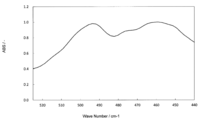
- Example 3 is a spectrum obtained by FT-IR of a spinel type lithium manganese-containing composite oxide powder (sample) obtained in Example 1.
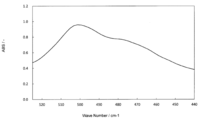
- 4 is a spectrum obtained by FT-IR of a spinel type lithium manganese-containing composite oxide powder (sample) obtained in Comparative Example 3.
- the wave number interval ⁇ X (1.9285 cm ⁇ 1 ) of the data and the amount of change ⁇ Y in the infrared absorptance ABS are calculated, and the X axis is the Wave Number and the Y axis. This is an approximate curve created from a drawn curve with ⁇ Y / ⁇ X as.
- the wave number interval ⁇ X (1.9285 cm ⁇ 1 ) of the data and the amount of change ⁇ Y in the infrared absorptance ABS are calculated, the X axis is the Wave Number, and the Y axis is This is an approximate curve created from a drawn curve with ⁇ Y / ⁇ X as.
- a spinel-type lithium manganese-containing composite oxide (referred to as “the present 5V class spinel”) according to an example of the embodiment of the present invention is fitted with a cubic crystal structure model of the space group Fd-3m (Origin Choice 2) and observed.
- 5V class spinel having a working potential of 4.5 V or more at a metal Li reference potential, wherein Rwp and S representing the degree of coincidence of strength and calculated intensity are Rwp ⁇ 10 or S ⁇ 2.5.
- Type lithium manganese-containing composite oxide is
- “having an operating potential of 4.5 V or higher at the metal Li reference potential” does not need to have only an operating potential of 4.5 V or higher as the plateau region, It is intended to include the case of having a part.
- the present invention is not limited to the lithium manganese-containing composite oxide composed only of “5V class lithium manganese-containing composite oxide” having an operating potential of 4.5 V or more as a plateau region.
- a “4V class lithium manganese-containing composite oxide” having an operating potential of less than 4.5 V as the plateau region may be included.
- the 5V-class lithium manganese-containing composite oxide only needs to occupy 30% by mass or more, preferably 50% by mass or more, and particularly preferably 80% by mass or more (including 100% by mass).
- a lithium-manganese-containing composite oxide is allowed.
- This 5V class spinel is a spinel-type lithium manganese-containing composite oxide containing Li, Mn, and O and two or more elements other than these.
- at least one element of the “two or more elements other than these” may be an element M1 selected from the group consisting of Ni, Co, and Fe, and the other one element may be Mg, Ti.
- Any element M2 selected from the group consisting of Al, Ba, Cr, W, Mo, Y, Zr and Nb may be used.
- the metal element M1 is a substitution element that mainly contributes to developing an operating potential of 4.5 V or higher at the metal Li reference potential, and examples thereof include Ni, Co, and Fe. It may be included, and other metal elements may be included as M1.
- the metal element M2 is a substitution element that mainly contributes to stabilizing the crystal structure and improving the characteristics.
- a substitution element that contributes to an improvement in capacity retention rate for example, Mg, Ti, Al, Ba, Cr, W , Mo, Y, Zr, and Nb. It suffices to contain at least one of these Mg, Ti, Al, Ba, Cr, W, Mo, Y, Zr and Nb, and M2 may contain other metal elements.
- a compound containing a spinel type lithium manganese containing composite oxide represented by the formula (1): Li [Li a Mn 2 -abc M1 b M2 c ] O 4 - ⁇ .
- M1 and M2 in the formula (1) are as described above.
- “a” may be 0.00 to 0.20, particularly 0.01 or more and 0.10 or less, and more preferably 0.02 or more and 0.08 or less. Even more preferred. “B” indicating the content of M1 may be 0.20 to 1.20, more preferably 0.30 or more and 1.10 or less, and more preferably 0.35 or more and 1.05 or less. Even more preferred. “C” indicating the content of M2 may be 0.001 to 0.400, more preferably 0.002 or more and 0.400 or less, particularly 0.005 or more and 0.30 or less, and more preferably 0. More preferably, it is 10 or more. In particular, by setting it to 0.10 or more, the amount of gas generated can be more effectively suppressed. Note that “4- ⁇ ” in each of the above formulas indicates that oxygen deficiency may be included, and a part of oxygen may be substituted with fluorine.
- this 5V class spinel may contain components other than Li, Mn, M1, M2 and O.
- other elements may be contained as long as each is 0.5 wt% or less. This is because this amount is considered to have little influence on the performance of the present 5V class spinel.
- a compound containing a spinel-type lithium manganese-containing composite oxide represented by the formula (2): Li [Li a Mn 2 -abc Ni b M 2 c ] O 4- ⁇ can be cited. it can.
- “a”, “b”, “c”, and “4- ⁇ ” are the same as those in the above formula (1).
- M2 in Formula (2) Mg, Ti, Al, Ba, Cr, W, Mo, Y, Zr, Co, Fe, Nb etc.
- Mg Ti, Al , Ba, Cr, W, Mo, Y, Zr, Co, Fe, and Nb
- M2 may include another metal element.
- M2 it is more preferable that M2 contains Ti or Al or these two elements.
- “a” may be 0.00 to 0.20, more preferably 0.01 or more and 0.10 or less, and more preferably 0.02 or more and 0.08 or less. Even more preferred.
- “B” indicating the content of M1 may be 0.20 to 0.70, particularly 0.30 or more and 0.60 or less, particularly 0.35 or more and 0.55 or less, and more preferably 0. More preferably, it is .49 or less. In particular, by setting it to 0.49 or less, the cycle characteristics in the high potential range can be improved more effectively.
- “C” indicating the content of M2 may be 0.001 to 0.400, more preferably 0.002 or more and 0.400 or less, particularly 0.005 or more and 0.300 or less, and more preferably 0. More preferably, it is 10 or more. In particular, the amount of gas generation can be more effectively suppressed by setting it to 0.10 or more.
- this 5V class spinel may contain B.
- B may contain a complex oxide phase containing Ni, Mn and B in addition to the spinel crystal phase.
- the complex oxide phase containing Ni, Mn, and B include a crystal phase of Ni 5 MnO 4 (BO 3 ) 2 .
- the fact that the crystal phase of Ni 5 MnO 4 (BO 3 ) 2 is contained means that the diffraction pattern obtained by X-ray diffraction (XRD) is collated with a PDF (Powder Diffraction File) number “01-079-1029”. Can be confirmed.
- the composite oxide containing Ni, Mn and B is presumed to exist on the surface and grain boundaries of the present 5V class spinel particles.
- the composite oxide phase is contained so that the content of B element in the present 5V class spinel is 0.02 to 0.80 mass%.
- the composite oxide phase should be contained so that the content is 0.05% by mass or more or 0.60% by mass or less, particularly 0.30% by mass or less, and particularly 0.25% by mass or less. Further preferred. If the content of B element is 0.02% by mass or more, the discharge capacity at a high temperature (for example, 45 ° C.) can be maintained, and if the content of B element is 0.80% by mass or less, rate characteristics Can be maintained, which is preferable.
- this 5V-class spinel is a cubic crystal structure model of space group Fd-3m (Origin Choice 2) in an X-ray diffraction pattern measured by a powder X-ray diffractometer (XRD) using CuK ⁇ 1 rays.
- Rwp and S representing the degree of coincidence between the observed intensity and the calculated intensity are 5V class spinels with Rwp ⁇ 10 or S ⁇ 2.5.
- Rwp is more preferably less than 8, particularly preferably less than 6, and S is more than 1.0 or more preferably less than 2.3, and more preferably less than 2.1.
- This 5V-class spinel is also characterized by the presence of three absorbance ABS peaks in the 435 to 525 cm ⁇ 1 section in the spectrum determined by FT-IR.
- 5V class spinel containing Li, Mn, and O and two or more other elements there are three absorbance ABS peaks in the section of 435 to 525 cm ⁇ 1.
- the shoulder near 4 V disappeared and the plateau region near 4.5 expanded, the high potential capacity region expanded, and the energy density increased compared to the case where three peaks did not exist. It was also found that gas generation can be suppressed.
- a 5V spinel-type lithium manganese-containing composite oxide is used as an object to be processed. It is preferable to perform an oxygen-containing atmosphere pressure heat treatment.
- the tap density of the 5V-class spinel is preferably 1.2 g / cm 3 or more, especially 1.3 g / cm 3 or more, or 3.0 g / cm 3 or less, and more preferably 1.5 g / cm 3 or more. It is particularly preferably 8 g / cm 3 or less.
- the electrode density can be increased, so that the volume energy density can be increased.
- this 5V-class spinel To increase the tap density of this 5V-class spinel to 1.2 g / cm 3 or more, add a substance that enhances the reactivity during firing, such as firing at a high temperature of 800 ° C. or higher, or a boron compound or a fluorine compound. It is preferable to produce the 5V-class spinel by firing and using dense raw materials. However, it is not limited to this method.
- the average primary particle size of the present 5V class spinel is preferably larger than 0.5 ⁇ m, more preferably 1.0 ⁇ m or more or 20 ⁇ m or less, and more preferably 2.0 ⁇ m or more or 15 ⁇ m or less. Furthermore, it is further more preferable that it exceeds 6.0 micrometers among them, and it is especially preferable that it is 8.5 micrometers or more especially among them. Thus, if the average primary particle size of this 5V class spinel is larger than 0.5 micrometer, a contact area with electrolyte solution can be reduced and the amount of gas generation can be reduced.
- the average primary particle size of the 5V class spinel In order to make the average primary particle size of the 5V class spinel larger than 0.5 ⁇ m, it is necessary to calcinate at a high temperature of 800 ° C. or higher, or to add a substance that enhances the reactivity during calcination such as a boron compound or a fluorine compound.
- the 5V-class spinel is preferably manufactured by firing. However, it is not limited to this method.
- primary particles mean the smallest unit particles surrounded by grain boundaries when observed with a SEM (scanning electron microscope, for example, 500 to 5000 times).
- the “present spinel particles” mean primary particles unless otherwise specified.
- the average diameter of the primary particles is observed with an SEM (scanning electron microscope, for example, 500 to 5000 times), 50 primary particles are arbitrarily selected, and the selected primary particle is selected using image analysis software.
- the average particle diameter of the particles can be calculated, and the 50 primary particle diameters can be averaged to obtain the “average diameter of primary particles”.
- the “secondary particles” mean particles that agglomerate such that a plurality of primary particles share a part of their outer periphery (grain boundary) and are isolated from other particles. is there.
- standard particle size distribution obtained by measuring by the laser diffraction scattering type particle size distribution measuring method has a meaning as an alternative value of the average diameter of the particle
- the specific surface area (SSA) of the present 5V class spinel is preferably 1.5 m 2 / g or less, especially 0.1 m 2 / g or more or 1.0 m 2 / g or less, and more preferably 0.1 m 2 / g or more. Or it is especially preferable that it is 0.8 m ⁇ 2 > / g or less.
- SSA specific surface area
- the present 5V class spinel preferably has a crystallite size of 100 nm or more. If the crystallite size is 100 nm or more, the ion conductivity can be increased, and the output can be increased. Further, by improving the output, it is possible to suppress the polarization during the cycle, and it is possible to suppress the discharge capacity from gradually decreasing with repeated charge and discharge at a high temperature. From this point of view, the crystallite size of the 5V class spinel is preferably 100 nm or more, more preferably 110 nm or more or 300 nm or less, particularly 120 nm or more or 250 nm or less, and more preferably 130 nm or more or 200 nm or less. Even more preferred.
- crystallite means the largest group that can be regarded as a single crystal, and can be obtained by XRD measurement and Rietveld analysis.
- the firing temperature, firing time, auxiliary agent for enhancing reactivity, firing atmosphere, raw material type, and the like it is preferable to adjust the firing temperature, firing time, auxiliary agent for enhancing reactivity, firing atmosphere, raw material type, and the like.
- the manufacturing method of the present 5V-class spinel may include an oxygen-containing atmospheric pressure heat treatment step using a spinel-type lithium manganese-containing composite oxide, preferably a 5V spinel-type lithium manganese-containing composite oxide as an object to be processed.
- the spinel-type lithium manganese-containing composite oxide as the object to be processed may be manufactured from raw materials as described later, or a product manufactured separately from the manufacturing method of the present 5V class spinel is obtained and You may use as a to-be-processed object.
- the manufacturing method provided with the raw material mixing process, the baking process, and the oxygen containing atmosphere pressurization heat treatment process in this order, and also the washing process can be mentioned.
- the cleaning steps can be inserted in an appropriate order. For example, it can be inserted before the raw material mixing step, after the raw material mixing step, before the firing step, after the firing step, before the oxygen-containing atmosphere pressure heat treatment step, or after the firing step.
- other steps can be added. For example, it is possible to further add a wet grinding process, a granulation process, a heat treatment process, and other processes.
- Formula (1) Li [Li a Mn 2 -abc M1 b M2 c ] O 4- ⁇ or Formula (2): Spinel type represented by Li [Li a Mn 2 -abc Ni b M2 c ] O 4- ⁇
- Examples of raw materials for producing the lithium manganese-containing composite oxide include lithium raw materials, manganese raw materials, M1 metal raw materials, M2 metal raw materials, and other examples such as boron raw materials.
- lithium raw material examples include lithium hydroxide (LiOH), lithium carbonate (Li 2 CO 3 ), lithium nitrate (LiNO 3 ), LiOH ⁇ H 2 O, lithium oxide (Li 2 O), other fatty acid lithium and lithium halide.
- the manganese raw material examples include manganese carbonate, manganese nitrate, manganese chloride, manganese dioxide, dimanganese trioxide, and trimanganese tetraoxide. Among these, manganese carbonate and manganese dioxide are preferable. Among these, electrolytic manganese dioxide obtained by an electrolytic method is particularly preferable.
- M1 metal raw material and the M2 metal raw material examples include carbonates, nitrates, chlorides, oxyhydroxides and hydroxides of M1 or M2 metals.
- a boron compound can also be mix
- any compound containing boron (B element) may be used.
- boric acid or lithium borate is preferably used.
- lithium borate include lithium metaborate (LiBO 2 ), lithium tetraborate (Li 2 B 4 O 7 ), lithium pentaborate (LiB 5 O 8 ), and lithium perborate (Li 2 B 2 O 5 ).
- the composite oxide phase containing Ni, Mn and B for example, a crystal phase of Ni 5 MnO 4 (BO 3 ) 2 may be generated in addition to the crystal phase of the present 5V class spinel. is there.
- the object to be processed for the cleaning step is, for example, each raw material before raw material mixing, raw material mixed powder after raw material mixing, processed powder after oxygen-containing atmosphere pressure heat treatment, processed product obtained in the firing step, and further described below.
- the processed powder obtained in the crushing / classifying step may be used. One or more of these may be washed.
- the object to be processed is washed with a polar solvent so as to release impurities contained in the powder.
- a polar solvent for example, it may be mixed with a polar solvent and stirred to form a slurry, and the obtained slurry may be solid-liquid separated by filtration or the like to remove impurities.
- solid-liquid separation may be performed in a later step.
- the slurry means a state in which the treated powder is dispersed in a polar solvent.
- water is preferably used as a polar solvent used for washing.
- the water may be city water, but is preferably ion-exchanged water or pure water that has been passed through a filter or a wet magnetic separator.
- the pH of water is preferably 4 to 10, and more preferably 5 or more and 9 or less.
- the liquid temperature at the time of washing it has been confirmed that the battery characteristics become better if the liquid temperature at the time of washing is low. From this viewpoint, it is preferably 5 to 70 ° C., and more preferably 60 ° C. or less. It is even more preferable that the temperature is 45 ° C. or less. Furthermore, it is even more preferable that the temperature is 30 ° C. or less.
- the reason why the battery characteristics are better if the liquid temperature during washing is low is that if the liquid temperature is too high, lithium in the lithium manganese-containing composite oxide is ion-exchanged with protons of ion-exchanged water and the lithium is released, resulting in a high temperature. It can be estimated that this is because it affects the characteristics.
- the amount of the polar solvent brought into contact with the workpiece (powder) is preferably adjusted so that the mass ratio (also referred to as “slurry concentration”) of the lithium manganese-containing composite oxide to the polar solvent is 10 to 70 wt%.
- the content it is more preferable to adjust the content to be 20 wt% or more or 60 wt% or less, and more preferably 30 wt% or more or 50 wt% or less. If the amount of the polar solvent is 10 wt% or more, it is easy to elute impurities such as SO 4 , and conversely if it is 60 wt% or less, a cleaning effect corresponding to the amount of the polar solvent can be obtained.
- each raw material or raw material mixed powder is put into the cleaning liquid, stirred, and then allowed to stand to remove the supernatant liquid. This method may be adopted.
- the supernatant when washing the processed product obtained in the firing step, that is, the spinel-type lithium manganese-containing composite oxide, the supernatant may be removed by adding it to the washing solution and stirring it, and then allowing it to stand.
- the spinel-type lithium manganese-containing composite oxide is preferably added to the cleaning liquid, stirred for 20 minutes, and then allowed to stand for 10 minutes to remove the spinel-type lithium manganese-containing composite oxide contained in the supernatant.
- the impurity amount of the spinel type lithium manganese-containing composite oxide for example, the sulfur content can be reduced.
- the spinel-type lithium manganese-containing composite oxide obtained by the oxygen-containing atmosphere pressure heat treatment is added to the cleaning liquid, stirred, and then allowed to stand.
- the supernatant liquid may be removed.
- the spinel-type lithium manganese-containing composite oxide is preferably added to the cleaning liquid, stirred for 20 minutes, and then allowed to stand for 10 minutes to remove the spinel-type lithium manganese-containing composite oxide contained in the supernatant.
- each raw material may be added simultaneously or in an appropriate order using a known mixer such as a mixer, and mixed by stirring in a wet or dry manner to obtain a raw material mixed powder.
- a known mixer such as a mixer
- wet mixing it is preferable to employ wet mixing.
- Examples of the dry mixing include a mixing method using a precision mixer that rotates the raw material mixed powder at a high speed.
- examples of the wet mixing include a method in which the raw material mixed powder is added to a liquid medium such as water or a dispersant and wet mixed to form a slurry.
- the raw material may be put into a liquid medium such as water and pulverized. It can be wet pulverized before mixing the raw materials, or can be wet pulverized after mixing the raw materials.
- a liquid medium such as water or a dispersant and wet-mix to make a slurry as described above, and then grind the resulting slurry with a wet-grinding machine do it. At this time, it is particularly preferable to grind to submicron order.
- the respective raw materials may be wet pulverized and mixed, and then further wet pulverized as necessary.
- a nickel compound and a nickel compound and a manganese compound are pulverized and classified as necessary so that the maximum particle size (Dmax) of the nickel compound or the manganese compound is 10 ⁇ m or less, particularly 5 ⁇ m or less, and more preferably 4 ⁇ m or less. It is preferable to adjust.
- the raw materials mixed as described above are preferably baked after being granulated to a predetermined size as required.
- granulation is not necessarily required.
- the granulation method may be either wet or dry as long as the various raw materials pulverized in the previous step are dispersed in the granulated particles.
- wet granulation it is necessary to sufficiently dry before firing.
- the drying method it may be dried by a known drying method such as a spray heat drying method, a hot air drying method, a vacuum drying method, a freeze drying method, etc.
- the spray heat drying method is preferable.
- the spray heat drying method is preferably performed using a heat spray dryer (spray dryer).
- a thermal spray dryer spray dryer
- the particle size distribution can be made sharper, and the secondary particles can be formed so as to contain agglomerated particles (secondary particles) formed by agglomeration. Forms can be prepared.
- firing is preferably performed in an atmosphere having an oxygen partial pressure of 0.015 MPa to 0.15 MPa, for example, in an air atmosphere. If the oxygen partial pressure is higher than 0.15 MPa, crystal growth cannot be promoted and the crystallite size cannot be increased. In addition, as will be described later, in order to promote crystal growth by firing, it is preferable that the oxygen partial pressure in the atmosphere is low. However, if the oxygen partial pressure during firing is too low, oxygen deficiency will increase and heat treatment will also occur. Since the strain cannot be recovered, baking is preferably performed at an oxygen partial pressure of 0.015 MPa or more.
- the oxygen partial pressure during firing is more preferably 0.015 MPa to 0.13 MPa, particularly 0.015 MPa to 0.12 MPa, particularly 0.015 MPa or more, or less than 0.08 MPa, and especially 0. More preferably, it is at least .015 MPa or less than 0.061 MPa.
- firing is preferably performed at a temperature higher than 770 ° C., particularly 800 ° C. or higher, particularly 850 ° C. or higher.
- firing temperature means the product temperature of the fired product measured by bringing a thermocouple into contact with the fired product in the firing furnace.
- the firing time that is, the time for maintaining the firing temperature may be 0.5 to 100 hours, although it depends on the firing temperature.
- the kind of baking furnace is not specifically limited. For example, it can be fired using a rotary kiln, a stationary furnace, or other firing furnace.
- the firing temperature is preferably higher than 770 ° C., more preferably 800 ° C. or higher, and particularly preferably 850 ° C. or higher.
- firing is preferably performed at 980 ° C. or lower, and particularly at 960 ° C. or lower. Is more preferable.
- baking is preferably performed at a temperature higher than 800 ° C., more preferably 840 ° C. or higher, and particularly preferably 880 ° C. or higher.
- firing temperature is preferably performed at 1000 ° C. or lower, and particularly at 980 ° C. or lower. Is more preferable.
- the workpiece to be subjected to the oxygen-containing atmosphere pressure heat treatment step is measured with a Karl Fischer moisture measuring device (also referred to as “KF moisture measuring device”) “KF moisture content in the range of room temperature to 300 ° C. (referred to as“ KF moisture ”). ) "Is 2% or less, and the sulfur content analyzed by ICP is preferably a spinel-type lithium manganese-containing composite oxide of less than 0.34 wt%. If the KF moisture is more than 2%, the atmosphere in the oxygen-containing atmosphere pressurizing furnace contains a large amount of water vapor, and the desired heat treatment atmosphere may not be created.
- the KF moisture is preferably 1% or less, particularly less than 5000 ppm, particularly 2000 ppm, and more preferably 1000 ppm or less.
- the sulfur content is 0.34 wt% or more, a large amount of sulfate such as Na 2 SO 4 or Li 2 SO 4 exists on the surface, which may hinder the heat treatment effect. From this viewpoint, the sulfur content is preferably less than 0.34 wt%, and particularly preferably less than 0.28 wt%.
- Such a spinel-type lithium manganese-containing composite oxide having KF moisture and sulfur content can be obtained, for example, by adjusting the conditions of the firing step and the cleaning step. For example, by firing the raw material before mixing at a high temperature of 600 ° C. or higher, washing the raw material before mixing, or washing the processed product obtained in the firing step, that is, the spinel-type lithium manganese-containing composite oxide,
- the sulfur content can be less than 0.34 wt%.
- the KF moisture content can be reduced to 2% or less by baking at a high temperature of 800 ° C. or higher in the baking step.
- the “KF moisture in the range of room temperature to 300 ° C.” measured by the KF moisture measuring device means that the measurement chamber of the KF moisture measuring device is heated to 170 ° C. with a nitrogen atmosphere, and then a sample is put in the measuring chamber. The amount of water released when the sample was allowed to stand at 170 ° C. for 45 minutes was measured to obtain “KF moisture (ppm) from room temperature to 170 ° C.”, and then the temperature was raised to 300 ° C. The amount of water released when left at 300 ° C. for 45 minutes was measured to obtain “KF moisture (ppm) from 170 ° C. to 300 ° C.”. ) ”And the above-mentioned“ KF moisture content (170 ° C. to 300 ° C.) (ppm) ”.
- the overall pressure of the processing atmosphere is higher than atmospheric pressure, and the oxygen partial pressure in the atmosphere is higher than the oxygen partial pressure in the atmosphere, and is 500 ° C.
- Heat treatment is preferably performed at a temperature higher than 850 ° C.
- the oxygen-containing atmosphere pressure heat treatment allows oxygen to be incorporated into the 5V spinel structure, thereby reducing oxygen deficiency and stabilizing the structure.
- the plateau region near 4.5V can be expanded and the high potential capacity region can be expanded, it can be considered that the energy density can be improved.
- the pressure atmosphere higher than the atmospheric pressure includes a case where the pressure rises to a pressure higher than the atmospheric pressure by heating the inside of the sealed container and raising the temperature of the gas in a certain volume.
- the treatment atmosphere in the oxygen-containing atmosphere pressure heat treatment step is a pressure in which the total pressure of the treatment atmosphere is greater than atmospheric pressure (0.1 MPa), for example, greater than 0.19 MPa, and in particular an atmosphere of 0.20 MPa or more. Is particularly preferred.
- atmospheric pressure is 1.5 MPa or less, especially 1.0 MPa or less. It is preferable to heat-treat with. Thus, by heat-treating in an oxygen-containing atmospheric pressure state, it becomes easier to take in oxygen, and oxygen vacancies can be further suppressed.
- the total pressure of the atmosphere during the oxygen-containing atmosphere pressure heat treatment is preferably controlled to be greater than 0.19 MPa and not more than 1.5 MPa, more preferably not less than 0.20 MPa or not more than 1.3 MPa, and more preferably 1.0 MPa.
- the following control is preferable.
- the treatment atmosphere in the pressurized atmosphere is preferably an oxygen partial pressure higher than, for example, 0.19 MPa, and particularly preferably an oxygen partial pressure of 0.20 MPa or more.
- the oxygen partial pressure is 1.5 MPa or less, particularly 1.0 MPa or less. It is preferable to heat-treat with.
- the oxygen partial pressure during the oxygen-containing atmosphere pressure heat treatment is greater than 0.19 MPa and is preferably controlled to 1.5 MPa, more preferably 0.20 MPa or more or 1.3 MPa or less, and particularly 1.0 MPa or less. It is preferable to control.
- the heat treatment temperature in the oxygen-containing atmosphere pressure heat treatment step that is, the holding temperature
- the heat treatment temperature in this step is higher than 500 ° C.
- the oxygen can be taken into the crystal structure and strain can be effectively reduced by performing the heat treatment while forcibly supplying oxygen.
- the heat treatment temperature is preferably higher than 500 ° C., more preferably 600 ° C. or higher, particularly 700 ° C. or higher, and particularly preferably higher than 700 ° C.
- the heat treatment temperature is too high, oxygen vacancies may increase and strain may not be recovered even by heat treatment.
- the heat treatment temperature is preferably lower than 850 ° C., and particularly 820 ° C. or less. Among them, the temperature is particularly preferably 800 ° C. or lower.
- this heat processing temperature means the product temperature of the processed material measured by making a thermocouple contact the processed material in a furnace.
- the total pressure of the treatment atmosphere is a pressure higher than atmospheric pressure, an oxygen partial pressure higher than 0.19 MPa, and a temperature higher than 500 ° C. and lower than 850 ° C.
- oxygen-containing atmosphere pressure heat treatment is performed at a temperature of 600 ° C. or higher or lower than 850 ° C., of which higher than 700 ° C. or 800 ° C.
- the heating rate at the time of heating to the above heat treatment temperature, that is, the holding temperature is preferably 0.1 ° C./min to 20 ° C./min, particularly 0.25 ° C./min or more or 10 ° C./min or less, In particular, it is more preferably 0.5 ° C./min or more or 5 ° C./min or less.
- the time for maintaining the heat treatment temperature needs to be at least 1 minute. In order to fully incorporate oxygen into the crystal structure, at least one minute is considered necessary. From this viewpoint, the time for maintaining the heat treatment temperature is preferably 5 minutes or more, particularly preferably 10 minutes or more. In addition, it is considered that the effect of incorporating oxygen into the crystal structure by heat treatment is sufficiently effective when the holding time is 200 hours or less.
- the temperature lowering rate after the heat treatment is preferably slow cooling at a cooling rate of 10 ° C./min or less to at least 500 ° C., particularly 0.1 ° C./min to 8 ° C./min, especially 0.2 ° C./min to More preferably, it is controlled to 5 ° C./min. Since oxygen taken in around 500 ° C. is considered to be stabilized, it can be considered that it is preferable to cool slowly at a rate of temperature decrease of 10 ° C./min or less until at least 500 ° C.
- heating is performed using an apparatus such as a pressure furnace (pressurizable pressure: 1.0 MPa), so that the overall pressure of the treatment atmosphere is higher than atmospheric pressure. And it can heat in the process atmosphere whose oxygen partial pressure in this atmosphere is higher than the oxygen partial pressure in air
- a pressure furnace pressurizable pressure: 1.0 MPa
- a manufacturing method including a raw material mixing step, a granulating step, a firing step, a heat treatment step, and an oxygen-containing atmosphere pressure heat treatment step in this order, and further including a cleaning step.
- the cleaning steps can be inserted in an appropriate order.
- Any one of the granulation step, the heat treatment step and the washing step, or two or more steps can be omitted, and other steps can be added.
- the raw material mixing step, wet pulverization step, granulation step, firing step, oxygen-containing atmosphere pressure heat treatment step and cleaning step may be carried out in the same manner as described above.
- the heat treatment step is preferably performed in an atmosphere of 500 to 850 ° C., preferably 600 ° C. or higher or 800 ° C. or lower for 0.5 to 300 hours in an air atmosphere to facilitate oxygen uptake.
- This 5V class spinel can be effectively used as a positive electrode active material for various lithium batteries after being crushed and classified as necessary.
- this 5V class spinel is used as a positive electrode active material for various lithium batteries, for example, this 5V class spinel, a conductive material made of carbon black or the like, and a binder made of Teflon (registered trademark) binder or the like are mixed. Thus, a positive electrode mixture can be produced.
- Such a positive electrode mixture is used for the positive electrode, a material that can occlude and desorb lithium such as lithium or carbon is used for the negative electrode, and a lithium salt such as lithium hexafluorophosphate (LiPF6) is used for the non-aqueous electrolyte.
- LiPF6 lithium hexafluorophosphate
- a lithium battery can be formed using a material dissolved in a mixed solvent such as ethylene carbonate-dimethyl carbonate.
- Lithium batteries configured in this way include, for example, notebook computers, mobile phones, cordless phones, video movies, LCD TVs, electric shavers, portable radios, headphone stereos, backup power supplies, memory cards, and other electronic devices, pacemakers, hearing aids It can be used as a drive power source for medical equipment such as electric vehicles.
- mobile phones that require excellent cycle characteristics
- portable computers such as PDAs (personal digital assistants) and notebook computers
- electric vehicles including hybrid vehicles
- power sources for driving power storage etc. It is valid.
- Example 1 Lithium carbonate having an average particle size (D50) of 7 ⁇ m, electrolytic manganese dioxide having an average particle size (D50) of 23 ⁇ m and a specific surface area of 40 m 2 / g, nickel hydroxide having an average particle size (D50) of 22 ⁇ m, an average particle size ( D50) 2 ⁇ m of titanium oxide and 60 ⁇ m of average particle diameter (D50) lithium tetraborate were weighed.
- An aqueous polycarboxylic acid ammonium salt solution (SN Dispersant 5468 manufactured by San Nopco Co., Ltd.) was added as a dispersant to the ion-exchanged water.
- the added amount of the dispersant was 6 wt% with respect to the total of the above-mentioned Li raw material, Ni raw material, Mn raw material, Ti raw material and B raw material, and was sufficiently dissolved and mixed in ion-exchanged water.
- the Ni raw material and the Mn raw material were added to the ion-exchanged water in which the dispersant was dissolved in advance, and mixed and stirred to obtain a slurry.
- the obtained slurry was pulverized with a wet pulverizer at 1300 rpm for 120 minutes.
- Li raw material, Ti raw material and B raw material were added, mixed and stirred, and a slurry having a solid content concentration of 40 wt% was prepared.
- the mixture was further pulverized with a wet pulverizer at 1300 rpm for 120 minutes to obtain a pulverized slurry having an average particle size (D50) of 0.60 ⁇ m or less.
- the obtained pulverized slurry was granulated and dried using a thermal spray dryer (spray dryer, “RL-10” manufactured by Okawara Chemical Co., Ltd.).
- a twin jet nozzle was used for spraying, and granulation drying was performed by adjusting the temperature so that the spray pressure was 0.15 MPa, the slurry supply amount was 375 ml / min, and the outlet temperature of the drying tower was 100 to 110 ° C. .
- the obtained granulated powder was baked by using a static electric furnace in an atmosphere having an oxygen partial pressure of 0.021 MPa so as to maintain 950 ° C. for 40 hours, and then 750 ° C. in an atmosphere having an oxygen partial pressure of 0.021 MPa.
- the fired powder obtained by the heat treatment was put in a mortar and crushed with a pestle, classified with a sieve having an opening of 53 ⁇ m, and the sieve was collected to obtain a spinel type lithium manganese-containing composite oxide powder.
- this spinel type lithium manganese-containing composite oxide powder was subjected to an oxygen-containing atmosphere pressure heat treatment using a pressure furnace (manufactured by Hiroki Co., Ltd.). That is, 200 g of spinel-type lithium manganese-containing composite oxide powder was filled in a magnetic crucible, and this magnetic crucible was placed in a pressure furnace. Thereafter, oxygen gas (oxygen concentration 99%) was introduced into the pressure furnace, the oxygen partial pressure was adjusted to 0.20 MPa, and the overall pressure of the processing atmosphere was adjusted to 0.21 MPa, and the temperature was increased by 1.7 ° C./min. Heat to 730 ° C.
- a pressure furnace manufactured by Hiroki Co., Ltd.
- the oxygen concentration was measured using an oxygen concentration meter (XPO-318 (New Cosmos Electric Co., Ltd.)). The same applies to Examples and Comparative Examples described later.
- the temperature at the time of the said baking and the heat processing is the product temperature of the processed material measured by making the thermocouple contact the processed material in a furnace. The same applies to Examples and Comparative Examples described later.
- Example 2 the spinel-type lithium manganese-containing composite oxide powder (sample) was prepared in the same manner as in Example 1 except that the weighing value of the raw material was changed, the firing temperature was changed to 940 ° C., and the firing time was changed to 37 hours. Obtained.
- the chemical analysis of the spinel-type lithium manganese-containing composite oxide powder (sample) obtained in Example 2 was performed, Li: 4.1 wt%, Ni: 15.6 wt%, Mn: 39.9 wt%, Ti: It was 5.0 wt% and B: 0.1 wt%.
- Example 3 In Example 2, as raw materials, lithium carbonate having an average particle diameter (D50) of 7 ⁇ m, electrolytic manganese dioxide having an average particle diameter (D50) of 23 ⁇ m and a specific surface area of 40 m 2 / g, and an average particle diameter (D50) of 22 ⁇ m as raw materials Of nickel hydroxide, titanium oxide having an average particle diameter (D50) of 2 ⁇ m, aluminum hydroxide having an average particle diameter (D50) of 2 ⁇ m, and lithium tetraborate having an average particle diameter (D50) of 60 ⁇ m are weighed.
- nickel hydroxide titanium oxide having an average particle diameter (D50) of 2 ⁇ m
- aluminum hydroxide having an average particle diameter (D50) of 2 ⁇ m
- lithium tetraborate having an average particle diameter (D50) of 60 ⁇ m
- the spinel-type lithium manganese-containing composite oxidation was carried out in the same manner as in Example 2 except that the Al raw material was added to ion-exchanged water in which the dispersant was dissolved in advance at the same time as the Mn raw material and Ni raw material, and mixed and stirred.
- a product powder (sample) was obtained.
- Example 4 Lithium carbonate having an average particle size (D50) of 7 ⁇ m, electrolytic manganese dioxide having an average particle size (D50) of 23 ⁇ m and a specific surface area of 40 m 2 / g, nickel hydroxide having an average particle size (D50) of 22 ⁇ m, an average particle size ( D50) Each 1 ⁇ m of titanium oxide was weighed. An aqueous polycarboxylic acid ammonium salt solution (SN Dispersant 5468 manufactured by San Nopco Co., Ltd.) was added as a dispersant to the ion-exchanged water.
- SN Dispersant 5468 manufactured by San Nopco Co., Ltd.
- the added amount of the dispersant was 6 wt% with respect to the total of the above-mentioned Li raw material, Ni raw material, Mn raw material, and Ti raw material, and was sufficiently dissolved and mixed in ion-exchanged water.
- the above-mentioned raw materials weighed were added, mixed and stirred, and a slurry with a solid content concentration of 40 wt% was prepared.
- the mixture was further pulverized with a wet pulverizer at 1300 rpm for 60 minutes to obtain a pulverized slurry having an average particle size (D50) of 0.60 ⁇ m or less.
- the obtained pulverized slurry was granulated and dried using a thermal spray dryer (spray dryer, “RL-10” manufactured by Okawara Chemical Co., Ltd.). At this time, a twin jet nozzle was used for spraying, granulation drying was performed by adjusting the temperature so that the spray pressure was 0.46 MPa, the slurry supply amount was 316 ml / min, and the outlet temperature of the drying tower was 100 to 110 ° C. .
- a thermal spray dryer spray dryer, “RL-10” manufactured by Okawara Chemical Co., Ltd.
- the obtained granulated powder was baked by using a static electric furnace in an atmosphere having an oxygen partial pressure of 0.021 MPa so as to maintain 880 ° C. for 22 hours, and then 740 ° C. in an atmosphere having an oxygen partial pressure of 0.021 MPa.
- the fired powder obtained by the heat treatment was put in a mortar and crushed with a pestle, classified with a sieve having an opening of 53 ⁇ m, and the sieve was collected to obtain a spinel type lithium manganese-containing composite oxide powder.
- this spinel type lithium manganese-containing composite oxide powder was subjected to an oxygen-containing atmosphere pressure heat treatment using a pressure furnace (manufactured by Hiroki Co., Ltd.). That is, 200 g of spinel-type lithium manganese-containing composite oxide powder was filled in a magnetic crucible, and this magnetic crucible was placed in a pressure furnace. Thereafter, oxygen gas (oxygen concentration 99%) was introduced into the pressure furnace, the oxygen partial pressure was adjusted to 0.20 MPa, and the overall pressure of the processing atmosphere was adjusted to 0.21 MPa, and the temperature was increased by 1.7 ° C./min. Heat to 730 ° C.
- a pressure furnace manufactured by Hiroki Co., Ltd.
- spinel lithium manganese-containing composite oxide powder (sample) Got.
- the chemical analysis of the spinel type lithium manganese containing complex oxide powder (sample) was carried out, it was Li: 4.1 wt%, Ni: 14.7 wt%, Mn: 41.4 wt%, Ti: 4.0 wt% .
- Example 5 In Example 4, as raw materials, lithium carbonate having an average particle size (D50) of 7 ⁇ m, electrolytic manganese dioxide having an average particle size (D50) of 23 ⁇ m and a specific surface area of 40 m 2 / g, and water having an average particle size (D50) of 22 ⁇ m Using nickel oxide, titanium oxide with an average particle diameter (D50) of 1 ⁇ m, and cerium oxide with an average particle diameter (D50) of 19 ⁇ m, changing the raw material weighing value, and spraying pressure during granulation drying to 0.48 MPa Except for the changed points, a spinel-type lithium manganese-containing composite oxide powder (sample) was obtained in the same manner as in Example 4.
- Example 5 When the chemical analysis of the spinel-type lithium manganese-containing composite oxide powder (sample) obtained in Example 5 was performed, Li: 4.1 wt%, Ni: 14.2 wt%, Mn: 40.0 wt%, Ti: It was 5.3 wt% and Ce: 0.8 wt%.
- Example 6 In Example 4, as raw materials, lithium carbonate having an average particle size (D50) of 7 ⁇ m, electrolytic manganese dioxide having an average particle size (D50) of 23 ⁇ m and a specific surface area of 40 m 2 / g, and water having an average particle size (D50) of 22 ⁇ m Using nickel oxide, titanium oxide with an average particle diameter (D50) of 1 ⁇ m, and yttrium oxide with an average particle diameter (D50) of 7 ⁇ m, changing the weighing value of the raw material, the spray pressure during granulation drying to 0.5 MPa Except for the changed points, a spinel-type lithium manganese-containing composite oxide powder (sample) was obtained in the same manner as in Example 4.
- Example 6 When the chemical analysis of the spinel-type lithium manganese-containing composite oxide powder (sample) obtained in Example 6 was performed, Li: 4.1 wt%, Ni: 14.2 wt%, Mn: 40.1 wt%, Ti: It was 5.3 wt%, Y: 0.5 wt%.
- Example 7 In Example 4, as raw materials, lithium carbonate having an average particle size (D50) of 7 ⁇ m, electrolytic manganese dioxide having an average particle size (D50) of 23 ⁇ m and a specific surface area of 40 m 2 / g, and water having an average particle size (D50) of 22 ⁇ m Using nickel oxide, titanium oxide with an average particle diameter (D50) of 1 ⁇ m, and niobium oxide with an average particle diameter (D50) of 70 ⁇ m, changing the weighing value of the raw material, and spraying pressure during granulation drying to 0.5 MPa Except for the changed points, a spinel-type lithium manganese-containing composite oxide powder (sample) was obtained in the same manner as in Example 4.
- Example 7 When the chemical analysis of the spinel-type lithium manganese-containing composite oxide powder (sample) obtained in Example 7 was performed, Li: 4.1 wt%, Ni: 14.1 wt%, Mn: 40.2 wt%, Ti: It was 5.3 wt% and Nb: 0.5 wt%.
- Example 8 In Example 4, as raw materials, lithium carbonate having an average particle size (D50) of 7 ⁇ m, electrolytic manganese dioxide having an average particle size (D50) of 23 ⁇ m and a specific surface area of 40 m 2 / g, and water having an average particle size (D50) of 22 ⁇ m Using nickel oxide, titanium oxide with an average particle diameter (D50) of 1 ⁇ m, and tungsten oxide with an average particle diameter (D50) of 62 ⁇ m, changing the weighing value of the raw material, and spraying pressure during granulation drying to 0.5 MPa A spinel-type lithium manganese-containing composite oxide powder (sample) was obtained in the same manner as in Example 4 except that the slurry supply rate was changed to 313 ml / min.
- Example 8 When the chemical analysis of the spinel-type lithium manganese-containing composite oxide powder (sample) obtained in Example 8 was performed, Li: 4.0 wt%, Ni: 14.0 wt%, Mn: 39.9 wt%, Ti: It was 5.3 wt% and W: 1.0 wt%.
- Example 9 In Example 3, as raw materials, lithium carbonate having an average particle diameter (D50) of 7 ⁇ m, electrolytic manganese dioxide having an average particle diameter (D50) of 23 ⁇ m and a specific surface area of 40 m 2 / g, and water having an average particle diameter (D50) of 22 ⁇ m Using nickel oxide, titanium oxide with an average particle diameter (D50) of 1 ⁇ m, and aluminum hydroxide with an average particle diameter (D50) of 2 ⁇ m, changing the weighing value of the raw material, the spray pressure during granulation drying is 0.14 MPa A spinel type lithium manganese-containing composite oxide powder (sample) was obtained in the same manner as in Example 3 except that the slurry supply amount was changed to 465 ml / min.
- Example 9 When the chemical analysis of the spinel-type lithium manganese-containing composite oxide powder (sample) obtained in Example 9 was performed, Li: 4.0 wt%, Ni: 15.7 wt%, Mn: 39.3 wt%, Ti: It was 5.2 wt% and Al: 0.15 wt%.
- SN Dispersant 5468 manufactured by San Nopco Co., Ltd.
- the addition amount of the dispersant was 6 wt% with respect to the total of the above-mentioned Li raw material, Ni raw material, and Mn raw material, and was sufficiently dissolved and mixed in ion-exchanged water.
- the weighed raw material was added to the ion-exchanged water in which the dispersant was dissolved in advance, and mixed and stirred to prepare a slurry having a solid content concentration of 40 wt%.
- the average particle size (D50) was adjusted to 0.60 ⁇ m or less by pulverizing at 1300 rpm for 120 minutes with a wet pulverizer.
- the obtained pulverized slurry was granulated and dried using a thermal spray dryer (spray dryer, “RL-10” manufactured by Okawara Chemical Co., Ltd.). At this time, a twin jet nozzle was used for spraying, and granulation drying was performed by adjusting the temperature so that the spray pressure was 0.19 MPa, the slurry supply amount was 350 ml / min, and the outlet temperature of the drying tower was 100 to 110 ° C. .
- a thermal spray dryer spray dryer, “RL-10” manufactured by Okawara Chemical Co., Ltd.
- the obtained granulated powder was baked by using a stationary electric furnace in an atmosphere having an oxygen partial pressure of 0.021 MPa so as to maintain 950 ° C. for 37 hours, and then 750 ° C. in an atmosphere having an oxygen partial pressure of 0.021 MPa.
- the fired powder obtained by the heat treatment was classified with a sieve having an opening of 53 ⁇ m, and the powder under the sieve was collected to obtain a spinel type lithium manganese-containing composite oxide powder (sample).
- the spinel-type lithium manganese-containing composite oxide powder (sample) thus obtained was subjected to chemical analysis.
- the results were Li: 3.9 wt%, Ni: 16.0 wt%, and Mn: 43.0 wt%. .
- An aqueous polycarboxylic acid ammonium salt solution (SN Dispersant 5468 manufactured by San Nopco Co., Ltd.) was added as a dispersant to the ion-exchanged water.
- the added amount of the dispersant was 6 wt% with respect to the total of the above-mentioned Li raw material, Ni raw material, Mn raw material, Ti raw material and B raw material, and was sufficiently dissolved and mixed in ion-exchanged water.
- the weighed raw material was added to the ion-exchanged water in which the dispersant was dissolved in advance, and mixed and stirred to prepare a slurry having a solid content concentration of 40 wt%. Subsequently, the mixture was further pulverized with a wet pulverizer at 1300 rpm for 60 minutes to obtain a pulverized slurry having an average particle size (D50) of 0.60 ⁇ m or less.
- D50 average particle size
- the obtained pulverized slurry was granulated and dried using a thermal spray dryer (spray dryer, “RL-10” manufactured by Okawara Chemical Co., Ltd.). At this time, a twin jet nozzle was used for spraying, granulation drying was performed by adjusting the temperature so that the spray pressure was 0.33 MPa, the slurry supply amount was 350 ml / min, and the outlet temperature of the drying tower was 100 to 110 ° C. .
- a thermal spray dryer spray dryer, “RL-10” manufactured by Okawara Chemical Co., Ltd.
- the obtained granulated powder was fired so as to maintain 880 ° C. for 37 hours in an atmosphere having an oxygen partial pressure of 0.021 MPa using a stationary electric furnace, and then 750 ° C. in an atmosphere having an oxygen partial pressure of 0.021 MPa.
- the fired powder obtained by heat treatment was crushed with a pestle and classified with a sieve having an opening of 53 ⁇ m to obtain a spinel-type lithium manganese-containing composite oxide powder.
- ⁇ Comparative Example 3 Lithium carbonate having an average particle size (D50) of 7 ⁇ m, electrolytic manganese dioxide having an average particle size (D50) of 23 ⁇ m and a specific surface area of 40 m 2 / g, nickel hydroxide having an average particle size (D50) of 22 ⁇ m, an average particle size ( D50) Each 2 ⁇ m of titanium oxide was weighed. An aqueous polycarboxylic acid ammonium salt solution (SN Dispersant 5468 manufactured by San Nopco Co., Ltd.) was added as a dispersant to the ion-exchanged water.
- SN Dispersant 5468 manufactured by San Nopco Co., Ltd.
- the addition amount of the dispersant was 6 wt% with respect to the total of the above-mentioned Li raw material, Ni raw material, Mn raw material and Ti raw material, and was sufficiently dissolved and mixed in ion-exchanged water.
- the weighed raw material was added to the ion-exchanged water in which the dispersant was dissolved in advance, and mixed and stirred to prepare a slurry having a solid content concentration of 40 wt%.
- the mixture was pulverized with a wet pulverizer at 1300 rpm for 60 minutes to obtain a pulverized slurry having an average particle size (D50) of 0.60 ⁇ m or less.
- the obtained pulverized slurry was granulated and dried using a thermal spray dryer (spray dryer, “RL-10” manufactured by Okawara Chemical Co., Ltd.). At this time, a twin jet nozzle was used for spraying, and granulation drying was performed by adjusting the temperature so that the spray pressure was 0.46 MPa, the slurry supply amount was 250 ml / min, and the outlet temperature of the drying tower was 100 to 110 ° C. .
- a thermal spray dryer spray dryer, “RL-10” manufactured by Okawara Chemical Co., Ltd.
- the obtained granulated powder was fired by using a static electric furnace in an atmosphere having an oxygen partial pressure of 0.021 MPa so as to maintain 750 ° C. for 37 hours.
- the obtained fired powder was crushed with a pestle and classified with a sieve having an opening of 53 ⁇ m to obtain a spinel-type lithium manganese-containing composite oxide powder (sample).
- the amount of water released into the tube is “170 ° C. to 300 ° C. KF moisture (ppm)”, the “room temperature to 170 ° C. KF moisture amount (ppm)” and the “170 ° C. to 300 ° C. KF moisture amount (ppm) ) ”Was defined as“ KF water content (ppm) ”.
- the water-soluble solvent used in the measurement was passed through a 60 ⁇ m filter, the solvent refractive index was 1.33, the particle permeability was transmissive, the particle refractive index was 2.46, the shape was non-spherical, and the measurement range was 0.133. ⁇ 704.0 ⁇ m, the measurement time was 30 seconds, and the average value measured twice was D50.
- the average primary particle size (primary particle average diameter) of the spinel-type lithium manganese nickel-containing composite oxide powder (sample) obtained in Examples and Comparative Examples obtained in Examples and Comparative Examples was measured as follows. did. Using a SEM (scanning electron microscope), the sample (powder) was observed at 1000 times, and particles having a size corresponding to D50 were selected. Next, in accordance with D50, the image was taken with the magnification changed from 2000 to 10,000 times.
- the D50 when the D50 is about 7 ⁇ m, when the D50 is about 10,000 ⁇ m, when the D50 is about 15 ⁇ m, the magnification is 5000 times, and when it is about 22 ⁇ m, the magnification is 2000 times, which is suitable for obtaining the average primary particle size in the image analysis software described later. Images can be taken.
- the average primary particle size of the selected particles was determined from the captured images using image analysis software (MAC-VIEW ver. 4 manufactured by Mountec Co., Ltd.).
- the average primary particle size is a cumulative 50% particle size (Heywood diameter: equivalent circle diameter) in volume distribution.
- the specific surface area (SSA) of the spinel-type lithium manganese-containing composite oxide powders (samples) obtained in the examples and comparative examples was measured as follows. First, 0.5 g of a sample (powder) is weighed in a glass cell for a flow method gas adsorption specific surface area measuring device MONOSORB LOOP (“Product Name MS-18” manufactured by Yuasa Ionics Co., Ltd.), and the MONOSORB LOOP pretreatment is performed. In the apparatus, the inside of the glass cell was replaced with nitrogen gas for 5 minutes at a gas amount of 30 mL / min, and then heat treatment was performed at 250 ° C. for 10 minutes in the nitrogen gas atmosphere. Then, the sample (powder) was measured by the BET single point method using the MONOSORB LOOP. The adsorbed gas at the time of measurement was a mixed gas of 30% nitrogen: 70% helium.
- the XRD measurement was performed under the following measurement condition 1 using an apparatus name “Ultima IV, manufactured by Rigaku Corporation” to obtain an XRD pattern.
- the crystal phase information was determined for the obtained XRD pattern, refined by the WPPF (Whole powder pattern fitting) method, and the lattice constant was obtained.
- the crystal phase information is attributed to cubic crystals of the space group Fd-3m (Origin Choice 2), Li at the 8a site, Mn at the 16d site, M1 element, M2 element, and the excess Li component at the 32e site.
- the seat occupancy at each site and the atomic displacement parameter B were set to 1, and calculation was repeated until Rwp and S representing the degree of coincidence between the observed intensity and the calculated intensity converged.
- the fact that the observed intensity and the calculated intensity are in good agreement means that the obtained sample is not limited to the space group and has a high reliability with a spinel crystal structure.
- XRD measurement condition 1 Radiation source: CuK ⁇ (line focal point), wavelength: 1.541836 ⁇ Operation axis: 2 ⁇ / ⁇ , Measurement method: Continuous, Count unit: cps Start angle: 15.0 °, end angle: 120.0 °, integration count: 1 sampling width: 0.01 °, scan speed: 1.0 ° / min Voltage: 40 kV, current: 40 mA Divergence slit: 0.2 mm, Divergence length restriction slit: 2 mm Scattering slit: 2 °, light receiving slit: 0.15 mm Offset angle: 0 ° Goniometer radius: 285 mm, optical system: concentrated method attachment: ASC-48 Slit: D / teX Ultra slit detector: D / teX Ultra Incident monochrome: CBO Ni-K ⁇ filter: No rotation speed: 50 rpm
- Fd-3m Ole Choice 2
- the parameter Beq. Is fixed at 1, and the index indicating the degree of coincidence between the observed intensity and the calculated intensity using the O's fractional coordinates and the seat occupancy at the 32e site as variables.
- the calculation was repeated until convergence with Rwp ⁇ 10.0 and GOF ⁇ 2.2.
- the crystallite size and strain were analyzed using a Gaussian function to obtain the crystallite size.
- XRD measurement condition 2 Radiation source: CuK ⁇ , operation axis: 2 ⁇ / ⁇ , measurement method: continuous, counting unit: cps Start angle: 10 °, end angle: 120 ° Detector: PSD Detector Type: VANTEC-1 High Voltage: 5585V Discr. Lower Level: 0.25V Discr.
- the absorbance ABS obtained above was confirmed, and the sample and KBr were adjusted so that the maximum value of the absorbance ABS appearing in the section where Wave Number was 400-700 cm ⁇ 1 was in the range of 0.5 to 1.0.
- the ratio of tablets, pellet thickness, etc. were adjusted as appropriate, and re-measurement was performed. Further, when comparing between samples, the comparison was performed after normalization (normalization) so that the maximum absorbance of the obtained spectrum was 1.
- the wave number interval ⁇ X (1.9285 cm ⁇ 1 ) of the data and the amount of change ⁇ Y in the infrared absorptance ABS are calculated.
- Number, Y-axis was ⁇ Y / ⁇ X, and a curve was drawn.
- An approximate curve was created from the drawn curve.
- the approximate curve was a moving average of 5 sections.
- the number of peaks was confirmed from the obtained approximate curve.
- the peak refers to a maximum value, and refers to a portion that protrudes upward in the approximate curve.
- the portion indicated by the downward arrow is a peak.
- the coating machine After coating this positive electrode mixture slurry on an aluminum foil as a current collector at a conveying speed of 20 cm / min using a coating machine, the coating machine is used to hold 70 ° C. for 2 minutes. After heating as described above, drying was performed so as to hold 120 ° C. for 2 minutes to form a positive electrode mixture layer to obtain an aluminum foil with a positive electrode mixture layer.
- the aluminum foil with the positive electrode mixture layer was punched out to 13 mm ⁇ after punching the electrode into a size of 50 mm ⁇ 100 mm and using a roll press machine to press and dense with a press linear pressure of 3 t / cm. Next, in a vacuum state, the mixture was heated from room temperature to 200 ° C.
- the negative electrode is a metal Li of ⁇ 14 mm ⁇ thickness 0.6 mm, and a separator (made of a porous polyethylene film) impregnated with an electrolytic solution in which LiPF 6 is dissolved to 1 mol / L in a carbonate-based mixed solvent is placed, A 2032 type coin battery was produced.
- a positive electrode for a coin battery was prepared in the same manner as described above.
- a negative electrode sheet coated with natural spherical graphite (Piotrek Co., Ltd., electrode capacity 1.6 mAh / cm 2 ) was used and punched out to a size of ⁇ 14 mm.
- a separator (made of a porous polyethylene film) impregnated with an electrolytic solution in which LiPF 6 was dissolved at 1 mol / L was placed in a carbonate-based mixed solvent to prepare a 2032 type coin battery.
- initial activation was performed by the method described below.
- the battery was charged at a constant current and a constant potential to 4.9 V at 0.1 C at 25 ° C., and then discharged at a constant current to 2.9 V at 0.1 C. This was repeated for 3 cycles.
- the actually set current value was calculated from the content of the positive electrode active material in the positive electrode.
- a charge / discharge test was performed by the method described below using the coin battery after initial activation as described above, and the high-temperature cycle life characteristics were evaluated. Place the cell in an environmental testing machine set so that the environmental temperature for charging and discharging the battery is 45 ° C., prepare to charge and discharge, and let it stand for 4 hours so that the cell temperature becomes the environmental temperature, then charge and discharge range was 4.9 V to 2.9 V, charge was performed at a constant current of 0.1 C constant current, and discharge was performed at a constant current of 0.1 C for one cycle, and then charge and discharge cycles were performed 200 times at 1 C. The C rate was calculated based on the discharge capacity at the third cycle at 25 ° C. during initial activation.
- Table 1 shows the high temperature cycle life characteristic values of the examples and the comparative examples as relative values when the high temperature cycle life characteristic value of the comparative example 2 is 100.
- the coating machine After coating this positive electrode mixture slurry on an aluminum foil as a current collector at a conveying speed of 20 cm / min using a coating machine, the coating machine is used to hold 70 ° C. for 2 minutes. After heating as described above, drying was performed so as to hold 120 ° C. for 2 minutes to form a positive electrode mixture layer to obtain an aluminum foil with a positive electrode mixture layer.
- the aluminum foil with the positive electrode mixture layer is punched into a size of 50 mm ⁇ 100 mm, and then pressed and dense at a press line pressure of 3 t / cm using a roll press machine, and then punched into a 40 mm ⁇ 29 mm square. It was. Next, in a vacuum state, the mixture was heated from room temperature to 200 ° C. and dried by heating so as to be held at 200 ° C. for 6 hours to obtain a positive electrode.
- the positive electrode sheet obtained above and a negative electrode sheet coated with natural spherical graphite (Piotrek Co., Ltd., electrode capacity 1.6 mAh / cm 2 ) were cut into a size of 3.1 cm ⁇ 4.2 cm to form a negative electrode.
- a separator type battery porous polyethylene film impregnated with an electrolytic solution in which LiPF 6 was dissolved at 1 mol / L in a carbonate-based mixed solvent was placed between the negative electrode and the negative electrode to produce a laminate type battery.
- the M element species in the following Table 1 means the constituent elements of the spinel-type lithium manganese-containing composite oxide other than Li, Mn, and O.
- the obtained lithium manganese-containing composite oxide was fitted with a cubic crystal structure model of space group Fd-3m (Origin Choice 2) by XRD measurement, and observed intensity and calculated intensity. It was confirmed that Rwp and S representing the degree of coincidence are 5V-class spinels with Rwp ⁇ 10 or S ⁇ 2.5. Further, in the spectrum obtained by FT-IR, it was confirmed to be a spinel-type lithium manganese-containing composite oxide having three absorbance ABS peaks in the region of 435 to 525 cm ⁇ 1 . In addition, from the results of the battery performance evaluation test, it was confirmed that the metal Li reference potential had an operating potential of 4.5 V or higher.
Landscapes
- Chemical & Material Sciences (AREA)
- Inorganic Chemistry (AREA)
- Organic Chemistry (AREA)
- Chemical Kinetics & Catalysis (AREA)
- Electrochemistry (AREA)
- General Chemical & Material Sciences (AREA)
- Battery Electrode And Active Subsutance (AREA)
- Inorganic Compounds Of Heavy Metals (AREA)
Abstract
高電位容量域の拡大とガス発生の抑制を両立させることができる、新たな5V級スピネル型リチウムマンガン含有複合酸化物を提供する。 Li、Mn及びOとこれら以外の2種以上の元素とを含む、金属Li基準電位で4.5V以上の作動電位を有するスピネル型リチウムマンガン含有複合酸化物であって、FT-IRで求められるスペクトルにおいて、435~525cm-1の区間に吸光度ABSのピークが3本存在することを特徴とする、スピネル型リチウムマンガン含有酸化物を提案する。
Description
本発明は、リチウム二次電池の正極活物質として用いることができるスピネル型リチウムマンガン含有複合酸化物、中でも、金属Li基準電位で4.5V以上の作動電位を有する5V級スピネル型リチウムマンガン含有複合酸化物に関する。
リチウム二次電池は、エネルギー密度が大きく、寿命が長いなどの特徴を有している。そのため、リチウム二次電池は、ビデオカメラ等の家電製品や、ノート型パソコン、携帯電話機等の携帯型電子機器、パワーツールなどの電動工具などの電源として広く用いられており、最近では、電気自動車(EV)やハイブリッド電気自動車(HEV)などに搭載される大型電池へも応用されている。
リチウム二次電池は、充電時には正極からリチウムがイオンとして溶け出して負極へ移動して吸蔵され、放電時には逆に負極から正極へリチウムイオンが戻る構造の二次電池であり、その高いエネルギー密度は正極材料の電位に起因することが知られている。
この種のリチウム二次電池の正極活物質としては、層構造をもつLiCoO2、LiNiO2、LiMnO2などのリチウム遷移金属酸化物のほか、LiMn2O4、LiNi0.5Mn1.5O4などのマンガン系のスピネル構造(Fd-3m)を有するスピネル型リチウムマンガン含有複合酸化物が知られている。
この種のスピネル型リチウムマンガン含有複合酸化物は、原料価格が安く、毒性がなく安全であり、しかも過充電に強い性質を有することから、電気自動車(EV)やハイブリッド電気自動車(HEV)などの大型電池用の次世代正極活物質として着目されている。また、3次元的にLiイオンの挿入・脱離が可能なスピネル型リチウム遷移金属酸化物(LMO)は、層構造をもつLiCoO2などのリチウム遷移金属酸化物に比べて出力特性に優れているため、EV用電池、HEV用電池などのように優れた出力特性が要求される用途に利用が期待されている。
中でも、LiMn2O4におけるMnサイトの一部を他の遷移金属(Cr、Co、Ni、Fe、Cu)で置換することで、5V付近に作動電位を持つことが知られるようになり、現在、金属Li基準電位で4.5V以上の作動電位を有する5V級スピネル型リチウムマンガン含有複合酸化物の開発が行われている。
例えば特許文献1には、5V級の起電力を示すリチウム二次電池の正極活物質として、スピネル型リチウムマンガン複合酸化物にクロムを必須添加成分とし、さらにニッケルまたはコバルトを添加してなる高容量スピネル型リチウムマンガン複合酸化物正極活物質が開示されている。
特許文献2には、Li金属に対して4.5V以上の電位で充放電を行うスピネル構造の結晶LiMn2-y-zNiyMzO4(但し、M:Fe,Co,Ti,V,Mg,Zn,Ga,Nb,Mo,Cuよりなる群から選ばれた少なくとも一種、0.25≦y≦0.6、0≦z≦0.1)が開示されている。
特許文献3には、4.5V以上もの起電力を発生し、且つ放電容量を維持することができる正極活物質として、一般式:Lia(MxMn2-x-yAy)O4(式中、0.4<x、0<y、x+y<2、0<a<1.2である。Mは、Ni、Co、Fe、CrおよびCuよりなる群から選ばれ、少なくともNiを含む一種以上の金属元素を含む。Aは、Si、Tiから選ばれる少なくとも一種の金属元素を含む。但し、AがTiだけを含む場合には、Aの比率yの値は、0.1<yである。)で表されるスピネル型リチウムマンガン複合酸化物を含むことを特徴とする二次電池用正極活物質が開示されている。
特許文献4には、金属Li基準電位で4.5V以上の作動電位を有するスピネル型リチウムマンガン含有複合酸化物において、LiMn2O4-δにおけるMnサイトの一部を、Liと、Niを含む金属元素M1(M1はNi、Co及びFeのうちの少なくとも一種を含む金属元素である)と、他の金属元素M2(M2はTiであるか、又は、TiとMg、Al、Ba、Cr及びNbのうちの少なくとも一種とを含む金属元素である)とで置換してなる結晶相を含有するスピネル型リチウムマンガン含有複合酸化物であって、Ni、Mn及びBを含む複合酸化物相を含有することを特徴とするスピネル型リチウムマンガン含有複合酸化物が開示されている。
特許文献5には、Li[NiyMn2-(a+b)-y-zLiaTibMz]O4(式中、0≦z≦0.3、0.3≦y<0.6であって、M=Al、Mg、Fe及びCoからなる群のうちから少なくとも1つ以上選ばれる金属元素)で示されるマンガン系スピネル型リチウム遷移金属酸化物であって、前記式において、a>0であり、b>0であり、2-(a+b)-y-z<1.7であり、かつ3≦b/a≦8であることを特徴とするマンガン系スピネル型リチウム遷移金属酸化物が開示されている。
4.5V以上の作動電位を有する5V級スピネル型リチウムマンガン含有複合酸化物は、4V級スピネル型リチウムマンガン含有複合酸化物では殆ど生じない課題、すなわち、電解液との反応により発生するガスの発生量が多いという特徴的な課題を抱えていた。
5V級スピネル型リチウムマンガン複合酸化物を使用すると、4.5V付近のプラトー領域を拡大し、高電位容量域を拡張することができ、エネルギー密度を高くすることができる一方、ガスの発生量が増加することが分かってきた。そのため、5V級スピネル型リチウムマンガン含有複合酸化物に関しては、高電位容量域を拡張してエネルギー密度を高くすることと、ガスの発生量を抑えることを両立させることが困難であった。
そこで、本願発明は、高電位容量域の拡大とガス発生の抑制を両立させることができる、新たな5V級スピネル型リチウムマンガン含有複合酸化物を提供せんとするものである。
本発明は、Li、Mn及びOとこれら以外の2種以上の元素とを含む、金属Li基準電位で4.5V以上の作動電位を有するスピネル型リチウムマンガン含有複合酸化物であって、FT-IRで求められるスペクトルにおいて、435~525cm-1の区間に吸光度ABSのピークが3本存在することを特徴とする、スピネル型リチウムマンガン含有酸化物を提案する。
本発明が提案するスピネル型リチウムマンガン含有複合酸化物は、金属Li基準電位で4.5V以上の作動電位を有し、それでいて、ガス発生を抑えることができると共に、4.5V付近のプラトー領域を拡大させることができ、高電位容量域を拡大させることができるため、エネルギー密度の向上を図ることもできる。よって、本発明が提案するスピネル型リチウムマンガン含有複合酸化物によれば、高電位容量域の拡大とガス発生の抑制を両立させることができる。さらに、Li、Mn及びOとこれら以外の2種以上の元素を含むことにより、結晶構造を安定化させることができ、サイクル特性を向上させることができる。
次に、本発明を実施するための形態例に基づいて本発明を説明する。但し、本発明が次に説明する実施形態に限定されるものではない。
<本5V級スピネル>
本発明の実施形態の一例に係るスピネル型リチウムマンガン含有複合酸化物(「本5V級スピネル」と称する)は、空間群Fd-3m(Origin Choice2)の立方晶の結晶構造モデルとフィッティングし、観測強度と計算強度の一致の程度を表わすRwp、SがRwp<10、またはS<2.5である5V級スピネルであって、金属Li基準電位で4.5V以上の作動電位を有する5V級スピネル型リチウムマンガン含有複合酸化物である。
本発明の実施形態の一例に係るスピネル型リチウムマンガン含有複合酸化物(「本5V級スピネル」と称する)は、空間群Fd-3m(Origin Choice2)の立方晶の結晶構造モデルとフィッティングし、観測強度と計算強度の一致の程度を表わすRwp、SがRwp<10、またはS<2.5である5V級スピネルであって、金属Li基準電位で4.5V以上の作動電位を有する5V級スピネル型リチウムマンガン含有複合酸化物である。
この際、「金属Li基準電位で4.5V以上の作動電位を有する」とは、プラトー領域として4.5V以上の作動電位のみを有している必要はなく、4.5V以上の作動電位を一部有している場合も包含する意である。
この観点から、プラトー領域として4.5V以上の作動電位を有する「5V級リチウムマンガン含有複合酸化物」のみからなるリチウムマンガン含有複合酸化物に限定するものではない。例えば、プラトー領域として4.5V未満の作動電位を有する「4V級リチウムマンガン含有複合酸化物」を含んでいてもよい。具体的には、当該5V級リチウムマンガン含有複合酸化物が30質量%以上を占めていればよく、好ましくは50質量%以上、その中でも特に好ましくは80質量%以上(100質量%含む)を占めるリチウムマンガン含有複合酸化物を許容するものである。
この観点から、プラトー領域として4.5V以上の作動電位を有する「5V級リチウムマンガン含有複合酸化物」のみからなるリチウムマンガン含有複合酸化物に限定するものではない。例えば、プラトー領域として4.5V未満の作動電位を有する「4V級リチウムマンガン含有複合酸化物」を含んでいてもよい。具体的には、当該5V級リチウムマンガン含有複合酸化物が30質量%以上を占めていればよく、好ましくは50質量%以上、その中でも特に好ましくは80質量%以上(100質量%含む)を占めるリチウムマンガン含有複合酸化物を許容するものである。
本5V級スピネルは、Li、Mn及びOとこれら以外の2種以上の元素とを含むスピネル型リチウムマンガン含有複合酸化物である。
この際、上記の「これら以外の2種以上の元素」のうちの少なくとも1元素は、Ni、Co及びFeからなる群から選択される元素M1であればよく、他の1元素はMg、Ti、Al、Ba、Cr、W、Mo、Y、Zr及びNbからなる群から選択される元素M2であればよい。
この際、上記の「これら以外の2種以上の元素」のうちの少なくとも1元素は、Ni、Co及びFeからなる群から選択される元素M1であればよく、他の1元素はMg、Ti、Al、Ba、Cr、W、Mo、Y、Zr及びNbからなる群から選択される元素M2であればよい。
本5V級スピネルの好ましい組成例として、LiMn2O4-δにおけるMnサイトの一部を、Liと、金属元素M1と、他の金属元素M2とで置換してなる結晶構造を有するスピネル型リチウムマンガン含有複合酸化物を含むものを挙げることができる。
上記金属元素M1は、主に金属Li基準電位で4.5V以上の作動電位を発現させるのに寄与する置換元素であり、Ni、Co及びFeなどを挙げることができ、これらのうち少なくとも一種を含んでいればよく、M1として他の金属元素を含んでいてもよい。
金属元素M2は、主に結晶構造を安定化させて特性を高めるのに寄与する置換元素であり、例えば容量維持率向上に寄与する置換元素として、例えばMg、Ti、Al、Ba、Cr、W、Mo、Y、Zr及びNbなどを挙げることができる。これらMg、Ti、Al、Ba、Cr、W、Mo、Y、Zr及びNbのうちの少なくとも一種を含んでいればよく、M2として他の金属元素を含んでいてもよい。
本5V級スピネルの一例として、式(1):Li[LiaMn2-a-b-cM1bM2c]O4-δで示されるスピネル型リチウムマンガン含有複合酸化物を含むものを挙げることができる。式(1)におけるM1及びM2は上述のとおりである。
上記式(1)において、「a」は、0.00~0.20であればよく、中でも0.01以上或いは0.10以下、その中でも0.02以上或いは0.08以下であるのがより一層好ましい。
M1の含有量を示す「b」は、0.20~1.20であればよく、中でも0.30以上或いは1.10以下、その中でも0.35以上或いは1.05以下であるのがより一層好ましい。
M2の含有量を示す「c」は、0.001~0.400であればよく、中でも0.002以上或いは0.400以下、その中でも0.005以上或いは0.30以下、さらにその中でも0.10以上であるのがより一層好ましい。特に0.10以上とすることで、より効果的にガス発生量を抑えることができる。
なお、上記各式における「4-δ」は、酸素欠損を含んでいてもよいことを示しており、酸素の一部がフッ素で置換されていてもよい。
M1の含有量を示す「b」は、0.20~1.20であればよく、中でも0.30以上或いは1.10以下、その中でも0.35以上或いは1.05以下であるのがより一層好ましい。
M2の含有量を示す「c」は、0.001~0.400であればよく、中でも0.002以上或いは0.400以下、その中でも0.005以上或いは0.30以下、さらにその中でも0.10以上であるのがより一層好ましい。特に0.10以上とすることで、より効果的にガス発生量を抑えることができる。
なお、上記各式における「4-δ」は、酸素欠損を含んでいてもよいことを示しており、酸素の一部がフッ素で置換されていてもよい。
但し、本5V級スピネルは、Li、Mn、M1、M2及びO以外の他の成分を含有してもよい。特にその他の元素をそれぞれ0.5重量%以下であれば含んでいてもよい。この程度の量であれば、本5V級スピネルの性能にほとんど影響しないと考えられるからである。
また、本5V級スピネルの一例として、式(2):Li[LiaMn2-a-b-cNibM2c]O4-δで示されるスピネル型リチウムマンガン含有複合酸化物を含むものを挙げることができる。
式(2)において、「a」、「b」、「c」及び「4-δ」は、上記式(1)のそれぞれと同様である。
また、式(2)におけるM2としては、Mg、Ti、Al、Ba、Cr、W、Mo、Y、Zr、Co、Fe、Nbなどを好ましい例として挙げることができ、これらMg、Ti、Al、Ba、Cr、W、Mo、Y、Zr、Co、Fe、Nbのうちの少なくとも一種を含んでいればよく、M2として他の金属元素を含んでいてもよい。
中でも、M2としてTi又はAl又はこれら二種の元素を含むのがより好ましい。
式(2)において、「a」、「b」、「c」及び「4-δ」は、上記式(1)のそれぞれと同様である。
また、式(2)におけるM2としては、Mg、Ti、Al、Ba、Cr、W、Mo、Y、Zr、Co、Fe、Nbなどを好ましい例として挙げることができ、これらMg、Ti、Al、Ba、Cr、W、Mo、Y、Zr、Co、Fe、Nbのうちの少なくとも一種を含んでいればよく、M2として他の金属元素を含んでいてもよい。
中でも、M2としてTi又はAl又はこれら二種の元素を含むのがより好ましい。
式(2)において、「a」は、0.00~0.20であればよく、中でも0.01以上或いは0.10以下、その中でも0.02以上或いは0.08以下であるのがより一層好ましい。
M1の含有量を示す「b」は、0.20~0.70であればよく、中でも0.30以上或いは0.60以下、その中でも0.35以上或いは0.55以下、さらにその中でも0.49以下であるのがより一層好ましい。特に、0.49以下とすることで、より効果的に高電位範囲のサイクル特性を向上させることができる。
M2の含有量を示す「c」は、0.001~0.400であればよく、中でも0.002以上或いは0.400以下、その中でも0.005以上或いは0.300以下、さらにその中でも0.10以上であるのがより一層好ましい。特に、0.10以上とすることで、より効果的にガス発生量を抑えることができる。
M1の含有量を示す「b」は、0.20~0.70であればよく、中でも0.30以上或いは0.60以下、その中でも0.35以上或いは0.55以下、さらにその中でも0.49以下であるのがより一層好ましい。特に、0.49以下とすることで、より効果的に高電位範囲のサイクル特性を向上させることができる。
M2の含有量を示す「c」は、0.001~0.400であればよく、中でも0.002以上或いは0.400以下、その中でも0.005以上或いは0.300以下、さらにその中でも0.10以上であるのがより一層好ましい。特に、0.10以上とすることで、より効果的にガス発生量を抑えることができる。
また、本5V級スピネルは、Bを含有していてもよい。この際、Bの存在状態としては、スピネルの結晶相のほかに、Ni、Mn及びBを含む複合酸化物相を含有していてもよい。
Ni、Mn及びBを含む前記複合酸化物相としては、例えばNi5MnO4(BO3)2の結晶相を挙げることができる。
Ni5MnO4(BO3)2の結晶相を含有することは、X線回折(XRD)により得られた回折パターンを、PDF(Powder Diffraction File)番号「01-079-1029」と照合することにより確認することができる。
Ni、Mn及びBを含む前記複合酸化物は、本5V級スピネル粒子の表面や粒界に存在しているものと推察される。
Ni、Mn及びBを含む前記複合酸化物相としては、例えばNi5MnO4(BO3)2の結晶相を挙げることができる。
Ni5MnO4(BO3)2の結晶相を含有することは、X線回折(XRD)により得られた回折パターンを、PDF(Powder Diffraction File)番号「01-079-1029」と照合することにより確認することができる。
Ni、Mn及びBを含む前記複合酸化物は、本5V級スピネル粒子の表面や粒界に存在しているものと推察される。
Ni、Mn及びBを含む前記複合酸化物相の含有量に関しては、本5V級スピネル中のB元素の含有量が0.02~0.80質量%となるように前記複合酸化物相を含有するのが好ましく、中でも0.05質量%以上或いは0.60質量%以下、その中でも0.30質量%以下、特に0.25質量%以下となるように前記複合酸化物相を含有するのがさらに好ましい。
B元素の含有量が0.02質量%以上であれば、高温(例えば45℃)での放電容量を維持することができ、B元素の含有量が0.80質量%以下であればレート特性を維持することができるから、好ましい。
B元素の含有量が0.02質量%以上であれば、高温(例えば45℃)での放電容量を維持することができ、B元素の含有量が0.80質量%以下であればレート特性を維持することができるから、好ましい。
<本5V級スピネルの特徴>
本5V級スピネルは、上述したように、CuKα1線を用いた粉末X線回折装置(XRD)により測定されるX線回折パターンにおいて、空間群Fd-3m(Origin Choice2)の立方晶の結晶構造モデルとフィッティングし、観測強度と計算強度の一致の程度を表わすRwp、SがRwp<10、またはS<2.5である5V級スピネルである。
この際、Rwp<10、またはS<2.5であれば、観測強度と計算強度が十分に一致しているといえる。このような観点から、Rwpは8未満がより好ましく、中でもさらに6未満が好ましく、Sは1.0よりは大きく、或いは2.3未満がより好ましく、中でもさらに2.1未満がより好ましい。
本5V級スピネルは、上述したように、CuKα1線を用いた粉末X線回折装置(XRD)により測定されるX線回折パターンにおいて、空間群Fd-3m(Origin Choice2)の立方晶の結晶構造モデルとフィッティングし、観測強度と計算強度の一致の程度を表わすRwp、SがRwp<10、またはS<2.5である5V級スピネルである。
この際、Rwp<10、またはS<2.5であれば、観測強度と計算強度が十分に一致しているといえる。このような観点から、Rwpは8未満がより好ましく、中でもさらに6未満が好ましく、Sは1.0よりは大きく、或いは2.3未満がより好ましく、中でもさらに2.1未満がより好ましい。
本5V級スピネルはまた、FT-IRで求められるスペクトルにおいて、435~525cm-1の区間に吸光度ABSのピークが3本存在するという特徴を有している。
本発明者が多くの試験を行った結果、Li、Mn及びOとこれら以外の2種以上の元素とを含む5V級スピネルに関しては、435~525cm-1の区間に吸光度ABSのピークが3本存在すると、ピークが3本存在しない場合と比較して、4V付近のショルダーが無くなり4.5付近のプラトー領域が拡大し、高電位容量域が拡張してエネルギー密度が高くなることが分かった。また、ガス発生も抑えられることが分かった。
本発明者が多くの試験を行った結果、Li、Mn及びOとこれら以外の2種以上の元素とを含む5V級スピネルに関しては、435~525cm-1の区間に吸光度ABSのピークが3本存在すると、ピークが3本存在しない場合と比較して、4V付近のショルダーが無くなり4.5付近のプラトー領域が拡大し、高電位容量域が拡張してエネルギー密度が高くなることが分かった。また、ガス発生も抑えられることが分かった。
なお、吸光度ABSのピークが存在するか否かは、FT-IRで求められるスペクトルが極大値を有しているか否かで判定することができる。なお、微分の考え方を導入することより、より明確にピークの有無を判定することができる。
このように、435~525cm-1の区間に吸光度ABSのピークが3本存在する本5V級スピネルを製造するには、後述するように、5Vスピネル型リチウムマンガン含有複合酸化物を被処理物として酸素含有雰囲気加圧熱処理を行うことが好ましい。
(タップ密度)
本5V級スピネルのタップ密度は1.2g/cm3以上であるのが好ましく、中でも1.3g/cm3以上或いは3.0g/cm3以下、その中でも1.5g/cm3以上或いは2.8g/cm3以下であるのが特に好ましい。
このように本5V級スピネルのタップ密度が1.2g/cm3以上であれば、電極密度を高めることができため、体積エネルギー密度を高めることができる。
本5V級スピネルのタップ密度は1.2g/cm3以上であるのが好ましく、中でも1.3g/cm3以上或いは3.0g/cm3以下、その中でも1.5g/cm3以上或いは2.8g/cm3以下であるのが特に好ましい。
このように本5V級スピネルのタップ密度が1.2g/cm3以上であれば、電極密度を高めることができため、体積エネルギー密度を高めることができる。
本5V級スピネルのタップ密度を1.2g/cm3以上とするには、800℃以上の高い温度で焼成したり、ホウ素化合物やフッ素化合物のように、焼成時の反応性を高める物質を添加して焼成したり、緻密な原料を使用したりして、本5V級スピネルを製造するのが好ましい。但し、この方法に限定するものではない。
(平均一次粒子サイズ)
本5V級スピネルの平均一次粒子サイズは0.5μmより大きいのが好ましく、中でも1.0μm以上或いは20μm以下であるのがさらに好ましく、その中でも2.0μm以上或いは15μm以下であるのがさらに好ましく、さらにその中でも6.0μmを超えるのがさらに好ましく、特にその中でも8.5μm以上であるのが特に好ましい。
このように本5V級スピネルの平均一次粒子サイズが0.5μmより大きければ、電解液との接触面積を低減することができ、ガス発生量を低減することができる。
本5V級スピネルの平均一次粒子サイズは0.5μmより大きいのが好ましく、中でも1.0μm以上或いは20μm以下であるのがさらに好ましく、その中でも2.0μm以上或いは15μm以下であるのがさらに好ましく、さらにその中でも6.0μmを超えるのがさらに好ましく、特にその中でも8.5μm以上であるのが特に好ましい。
このように本5V級スピネルの平均一次粒子サイズが0.5μmより大きければ、電解液との接触面積を低減することができ、ガス発生量を低減することができる。
本5V級スピネルの平均一次粒子サイズを0.5μmより大きくするには、800℃以上の高い温度で焼成したり、ホウ素化合物やフッ素化合物のように、焼成時の反応性を高める物質を添加して焼成したりして、本5V級スピネルを製造するのが好ましい。但し、この方法に限定するものではない。
なお、本発明において「1次粒子」とは、SEM(走査電子顕微鏡、例えば500~5000倍)で観察した際、粒界によって囲まれた最も小さな単位の粒子を意味する。「本スピネル粒子」は、特に言及しなければ、1次粒子の意味である。
そして、1次粒子の平均径は、SEM(走査電子顕微鏡、例えば500~5000倍)で観察して、任意に50個の1次粒子を選択し、画像解析ソフトを用いて、選ばれた一次粒子の平均粒子径を算出し、50個の1次粒子径を平均して「1次粒子の平均径」を求めることができる。
他方、本発明において「2次粒子」とは、複数の1次粒子がそれぞれの外周(粒界)の一部を共有するようにして凝集し、他の粒子と孤立した粒子を意味するものである。
そして、レーザー回折散乱式粒度分布測定法により測定して得られる体積基準粒度分布によるD50は、これら1次粒子及び2次粒子を含めた粒子の平均径の代替値としての意味を有する。
そして、1次粒子の平均径は、SEM(走査電子顕微鏡、例えば500~5000倍)で観察して、任意に50個の1次粒子を選択し、画像解析ソフトを用いて、選ばれた一次粒子の平均粒子径を算出し、50個の1次粒子径を平均して「1次粒子の平均径」を求めることができる。
他方、本発明において「2次粒子」とは、複数の1次粒子がそれぞれの外周(粒界)の一部を共有するようにして凝集し、他の粒子と孤立した粒子を意味するものである。
そして、レーザー回折散乱式粒度分布測定法により測定して得られる体積基準粒度分布によるD50は、これら1次粒子及び2次粒子を含めた粒子の平均径の代替値としての意味を有する。
(比表面積)
本5V級スピネルの比表面積(SSA)は1.5m2/g以下であるのが好ましく、中でも0.1m2/g以上或いは1.0m2/g以下、その中でも0.1m2/g以上或いは0.8m2/g以下であるのが特に好ましい。
このように比表面積が比較的小さければ、電解液との反応性が高くなり、5V級スピネルが特徴的に抱えている課題であるガス発生量を抑えることができる。
本5V級スピネルの比表面積(SSA)は1.5m2/g以下であるのが好ましく、中でも0.1m2/g以上或いは1.0m2/g以下、その中でも0.1m2/g以上或いは0.8m2/g以下であるのが特に好ましい。
このように比表面積が比較的小さければ、電解液との反応性が高くなり、5V級スピネルが特徴的に抱えている課題であるガス発生量を抑えることができる。
本5V級スピネルの比表面積(SSA)を1.5m2/g以下とする方法の一例として、5Vスピネル型リチウムマンガン含有複合酸化物を被処理物として酸素含有雰囲気加圧熱処理を行う方法を挙げることができる。
(結晶子サイズ)
本5V級スピネルは、結晶子サイズが100nm以上であるのが好ましい。
結晶子サイズが100nm以上であれば、イオン導電性を高めることができ、出力を高めることができる。また、出力向上により、サイクル時の分極を抑えることができ、高温時における充放電の繰り返しに伴って徐々に放電容量が低下するのを抑制することができる。
かかる観点から、本5V級スピネルの結晶子サイズは、100nm以上であるのが好ましく、中でも110nm以上或いは300nm以下、その中でも120nm以上或いは250nm以下、さらにその中でも130nm以上或いは200nm以下であるのがより一層好ましい。
本5V級スピネルは、結晶子サイズが100nm以上であるのが好ましい。
結晶子サイズが100nm以上であれば、イオン導電性を高めることができ、出力を高めることができる。また、出力向上により、サイクル時の分極を抑えることができ、高温時における充放電の繰り返しに伴って徐々に放電容量が低下するのを抑制することができる。
かかる観点から、本5V級スピネルの結晶子サイズは、100nm以上であるのが好ましく、中でも110nm以上或いは300nm以下、その中でも120nm以上或いは250nm以下、さらにその中でも130nm以上或いは200nm以下であるのがより一層好ましい。
ここで、「結晶子」とは、単結晶とみなせる最大の集まりを意味し、XRD測定しリートベルト解析を行なうことにより求めることができる。
本5V級スピネルの結晶子サイズを上記範囲に調整するには、焼成温度、焼成時間、反応性を高める助剤、焼成雰囲気、原料種などを調節するのが好ましい。
<本5V級スピネルの製造方法>
本5V級スピネルの製造方法の一例として、酸素含有雰囲気加圧熱処理工程を備えた製造方法を挙げることができる。
本5V級スピネルの製造方法の一例として、酸素含有雰囲気加圧熱処理工程を備えた製造方法を挙げることができる。
本5V級スピネルの製造方法としては、スピネル型リチウムマンガン含有複合酸化物、好ましくは5Vスピネル型リチウムマンガン含有複合酸化物を被処理物とする酸素含有雰囲気加圧熱処理工程を備えていればよい。この際、被処理物としてのスピネル型リチウムマンガン含有複合酸化物は、後述するように原料から製造してもよいし、本5V級スピネルの製造方法とは別に製造された物を入手して該被処理物として使用してもよい。
本5V級スピネルの製造方法の一例として、原料混合工程、焼成工程及び酸素含有雰囲気加圧熱処理工程をこの順に備えると共に、さらに洗浄工程を備えた製造方法を挙げることができる。
この際、洗浄工程は適宜順序で挿入することが可能である。例えば、原料混合工程の前に、原料混合工程の後に、焼成工程の前に、焼成工程の後に、酸素含有雰囲気加圧熱処理工程の前に、又は、焼成工程の後に挿入することも可能であるし、複数回洗浄工程を実施することも可能である。
また、上記工程の他に、他の工程を追加することも可能である。例えば、湿式粉砕工程、造粒工程、熱処理工程、その他の工程などをさらに追加することが可能である。また、各工程後に解砕して分級する解砕・分級工程を挿入することなどは必要に応じて実施するのが好ましい。
この際、洗浄工程は適宜順序で挿入することが可能である。例えば、原料混合工程の前に、原料混合工程の後に、焼成工程の前に、焼成工程の後に、酸素含有雰囲気加圧熱処理工程の前に、又は、焼成工程の後に挿入することも可能であるし、複数回洗浄工程を実施することも可能である。
また、上記工程の他に、他の工程を追加することも可能である。例えば、湿式粉砕工程、造粒工程、熱処理工程、その他の工程などをさらに追加することが可能である。また、各工程後に解砕して分級する解砕・分級工程を挿入することなどは必要に応じて実施するのが好ましい。
(原料)
ここでは、式(1):Li[LiaMn2-a-b-cM1bM2c]O4-δ又は式(2):Li[LiaMn2-a-b-cNibM2c]O4-δで示されるスピネル型リチウムマンガン含有複合酸化物を含有するものを製造するための原料について説明する。
但し、本発明の製造対象である本5V級スピネルは、上記式(1)(2)で示されるものに限定されるものではないから、原料は適宜変更可能である。
ここでは、式(1):Li[LiaMn2-a-b-cM1bM2c]O4-δ又は式(2):Li[LiaMn2-a-b-cNibM2c]O4-δで示されるスピネル型リチウムマンガン含有複合酸化物を含有するものを製造するための原料について説明する。
但し、本発明の製造対象である本5V級スピネルは、上記式(1)(2)で示されるものに限定されるものではないから、原料は適宜変更可能である。
式(1):Li[LiaMn2-a-b-cM1bM2c]O4-δ又は式(2):Li[LiaMn2-a-b-cNibM2c]O4-δで示されるスピネル型リチウムマンガン含有複合酸化物を製造するための原料としては、リチウム原料、マンガン原料、M1金属原料、M2金属原料、その他例えばホウ素原料などを挙げることができる。
リチウム原料としては、例えば水酸化リチウム(LiOH)、炭酸リチウム(Li2CO3)、硝酸リチウム(LiNO3)、LiOH・H2O、酸化リチウム(Li2O)、その他脂肪酸リチウムやリチウムハロゲン化物等を挙げることができる。
マンガン原料としては、例えば炭酸マンガン、硝酸マンガン、塩化マンガン、二酸化マンガン、三酸化二マンガン、四酸化三マンガン等を挙げることができ、中でも炭酸マンガン、二酸化マンガンが好ましい。その中でも、電解法によって得られる電解二酸化マンガンが特に好ましい。
M1金属原料及びM2金属原料としては、M1又はM2金属の炭酸塩、硝酸塩、塩化物、オキシ水酸化塩、水酸化物などを挙げることができる。
マンガン原料としては、例えば炭酸マンガン、硝酸マンガン、塩化マンガン、二酸化マンガン、三酸化二マンガン、四酸化三マンガン等を挙げることができ、中でも炭酸マンガン、二酸化マンガンが好ましい。その中でも、電解法によって得られる電解二酸化マンガンが特に好ましい。
M1金属原料及びM2金属原料としては、M1又はM2金属の炭酸塩、硝酸塩、塩化物、オキシ水酸化塩、水酸化物などを挙げることができる。
また、原料中にホウ素化合物を配合することもできる。
ホウ素化合物としては、ホウ素(B元素)を含有する化合物であればよく、例えばホウ酸或いはホウ酸リチウムを使用するのが好ましい。ホウ酸リチウムとしては、例えばメタ硼酸リチウム(LiBO2)、四硼酸リチウム(Li2B4O7)、五硼酸リチウム(LiB5O8)及び過硼酸リチウム(Li2B2O5)等の各種形態のものを用いることが可能である。
このようなホウ素化合物を配合すると、本5V級スピネルの結晶相のほかに、Ni、Mn及びBを含む前記複合酸化物相、例えばNi5MnO4(BO3)2の結晶相が生じることがある。
ホウ素化合物としては、ホウ素(B元素)を含有する化合物であればよく、例えばホウ酸或いはホウ酸リチウムを使用するのが好ましい。ホウ酸リチウムとしては、例えばメタ硼酸リチウム(LiBO2)、四硼酸リチウム(Li2B4O7)、五硼酸リチウム(LiB5O8)及び過硼酸リチウム(Li2B2O5)等の各種形態のものを用いることが可能である。
このようなホウ素化合物を配合すると、本5V級スピネルの結晶相のほかに、Ni、Mn及びBを含む前記複合酸化物相、例えばNi5MnO4(BO3)2の結晶相が生じることがある。
(洗浄工程)
洗浄工程に供する被処理物は、例えば、原料混合前の各原料、原料混合後の原料混合粉、酸素含有雰囲気加圧熱処理後の処理粉末、焼成工程で得られた処理物、さらには、後述する解砕・分級工程で得られた処理粉末であってもよい。これらのうちの一種類又は二種類以上を洗浄してもよい。
洗浄工程に供する被処理物は、例えば、原料混合前の各原料、原料混合後の原料混合粉、酸素含有雰囲気加圧熱処理後の処理粉末、焼成工程で得られた処理物、さらには、後述する解砕・分級工程で得られた処理粉末であってもよい。これらのうちの一種類又は二種類以上を洗浄してもよい。
洗浄工程では、被処理物(粉末)を、極性溶媒と接触させて、粉末中に含まれる不純物を離脱させるように洗浄するのが好ましい。
例えば、極性溶媒と混合し攪拌してスラリーとし、得られたスラリーをろ過などによって固液分離して不純物を除去するようにすればよい。この際、固液分離は後工程で行ってもよい。
なお、スラリーとは、極性溶媒中に処理粉末が分散した状態を意味する。
例えば、極性溶媒と混合し攪拌してスラリーとし、得られたスラリーをろ過などによって固液分離して不純物を除去するようにすればよい。この際、固液分離は後工程で行ってもよい。
なお、スラリーとは、極性溶媒中に処理粉末が分散した状態を意味する。
洗浄に用いる極性溶媒としては、水を用いるのが好ましい。
水としては、市水でもよいが、フィルターまたは湿式磁選機を通過させたイオン交換水や純水を用いるのが好ましい。
水のpHは4~10であるのが好ましく、中でも5以上或いは9以下であるのがさらに好ましい。
洗浄時の液温に関しては、洗浄時の液温が低ければ電池特性がより良好になることが確認されているため、かかる観点から、5~70℃であるのが好ましく、中でも60℃以下であるのがより一層好ましく、その中でも特に45℃以下であるのがより一層好ましい。さらには特に30℃以下であるのがより一層好ましい。
洗浄時の液温が低ければ電池特性がより良好になる理由は、液温が高過ぎると、リチウムマンガン含有複合酸化物中のリチウムがイオン交換水のプロトンとイオン交換してリチウムが抜けて高温特性に影響するためであると推定できる。
水としては、市水でもよいが、フィルターまたは湿式磁選機を通過させたイオン交換水や純水を用いるのが好ましい。
水のpHは4~10であるのが好ましく、中でも5以上或いは9以下であるのがさらに好ましい。
洗浄時の液温に関しては、洗浄時の液温が低ければ電池特性がより良好になることが確認されているため、かかる観点から、5~70℃であるのが好ましく、中でも60℃以下であるのがより一層好ましく、その中でも特に45℃以下であるのがより一層好ましい。さらには特に30℃以下であるのがより一層好ましい。
洗浄時の液温が低ければ電池特性がより良好になる理由は、液温が高過ぎると、リチウムマンガン含有複合酸化物中のリチウムがイオン交換水のプロトンとイオン交換してリチウムが抜けて高温特性に影響するためであると推定できる。
被処理物(粉末)と接触させる極性溶媒の量については、極性溶媒に対するリチウムマンガン含有複合酸化物の質量比(「スラリー濃度」とも称する)が10~70wt%となるように調整するのが好ましく、中でも20wt%以上或いは60wt%以下、その中でも30wt%以上或いは50wt%以下となるように調整するのがより一層好ましい。極性溶媒の量が10wt%以上であれば、SO4などの不純物を溶出させることが容易であり、逆に60wt%以下であれば、極性溶媒の量に見合った洗浄効果を得ることができる。
なお、原料混合前の各原料、及び、原料混合後の原料混合粉を洗浄する場合には、各原料又は原料混合粉を洗浄液に投入して撹拌後、静置して上澄み液を除去するなどの方法を採用すればよい。
また、焼成工程で得られた処理物、すなわちスピネル型リチウムマンガン含有複合酸化物を洗浄する際は、洗浄液に投入して撹拌後、静置して上澄み液を除去すればよい。例えば、スピネル型リチウムマンガン含有複合酸化物を洗浄液に投入して20分撹拌後、10分静置して上澄み液中に含まれるスピネル型リチウムマンガン含有複合酸化物を除去するのが好ましい。このように洗浄することで、スピネル型リチウムマンガン含有複合酸化物の不純物量、例えば硫黄含有量を低下させることができる。
また、酸素含有雰囲気加圧熱処理後の処理物を洗浄する際は、酸素含有雰囲気加圧熱処理して得られたスピネル型リチウムマンガン含有複合酸化物を洗浄液に投入して撹拌後、静置して上澄み液を除去すればよい。例えば、スピネル型リチウムマンガン含有複合酸化物を洗浄液に投入して20分撹拌後、10分静置して上澄み液中に含まれるスピネル型リチウムマンガン含有複合酸化物を除去するのが好ましい。
(原料の混合工程)
原料の混合は、原料を均一に混合できれば、その方法を特に限定するものではない。例えばミキサー等の公知の混合機を用いて各原料を同時又は適当な順序で加えて湿式又は乾式で攪拌混合して原料混合粉とすればよい。置換しにくい元素、例えばアルミニウムなどを添加する場合には湿式混合を採用するのが好ましい。
原料の混合は、原料を均一に混合できれば、その方法を特に限定するものではない。例えばミキサー等の公知の混合機を用いて各原料を同時又は適当な順序で加えて湿式又は乾式で攪拌混合して原料混合粉とすればよい。置換しにくい元素、例えばアルミニウムなどを添加する場合には湿式混合を採用するのが好ましい。
乾式混合としては、例えば高速で該原料混合粉を回転させる精密混合機を使用した混合方法を例示することができる。
他方、湿式混合としては、水や分散剤などの液媒体に上記原料混合粉を加えて湿式混合してスラリー化させる方法を挙げることができる。
他方、湿式混合としては、水や分散剤などの液媒体に上記原料混合粉を加えて湿式混合してスラリー化させる方法を挙げることができる。
(湿式粉砕工程)
湿式粉砕工程では、原料を水などの液媒体に投入して粉砕すればよい。原料を混合する前に湿式粉砕することもできるし、原料混合後に湿式粉砕することもできる。
原料混合後に湿式粉砕する場合は、上記のように、水や分散剤などの液媒体に上記原料混合粉を加えて湿式混合してスラリー化させた後、得られたスラリーを湿式粉砕機で粉砕すればよい。この際、特にサブミクロンオーダーまで粉砕するのが好ましい。サブミクロンオーダーまで粉砕した後、造粒及び焼成することにより、焼成反応前の各粒子の均一性を高めることができ、反応性を高めることができる。
他方、原料を混合する前に湿式粉砕する場合には、上記各原料をそれぞれ湿式粉砕し、混合した後、必要に応じてさらに湿式粉砕すればよい。
各原料をそれぞれ粉砕する場合には、原料混合時の均質性を高めるため、原料を混合する前に予め、Dmaxが大きい原料を先に粉砕しておくことが好ましい。例えばニッケル化合物を、必要に応じてニッケル化合物とマンガン化合物を、粉砕及び分級して、ニッケル化合物やマンガン化合物の最大粒径(Dmax)が10μm以下、中でも5μm以下、その中でも4μm以下になるように調整するのが好ましい。
湿式粉砕工程では、原料を水などの液媒体に投入して粉砕すればよい。原料を混合する前に湿式粉砕することもできるし、原料混合後に湿式粉砕することもできる。
原料混合後に湿式粉砕する場合は、上記のように、水や分散剤などの液媒体に上記原料混合粉を加えて湿式混合してスラリー化させた後、得られたスラリーを湿式粉砕機で粉砕すればよい。この際、特にサブミクロンオーダーまで粉砕するのが好ましい。サブミクロンオーダーまで粉砕した後、造粒及び焼成することにより、焼成反応前の各粒子の均一性を高めることができ、反応性を高めることができる。
他方、原料を混合する前に湿式粉砕する場合には、上記各原料をそれぞれ湿式粉砕し、混合した後、必要に応じてさらに湿式粉砕すればよい。
各原料をそれぞれ粉砕する場合には、原料混合時の均質性を高めるため、原料を混合する前に予め、Dmaxが大きい原料を先に粉砕しておくことが好ましい。例えばニッケル化合物を、必要に応じてニッケル化合物とマンガン化合物を、粉砕及び分級して、ニッケル化合物やマンガン化合物の最大粒径(Dmax)が10μm以下、中でも5μm以下、その中でも4μm以下になるように調整するのが好ましい。
(造粒工程)
上記の如く混合した原料は、必要に応じて所定の大きさに造粒した後、焼成するのが好ましい。但し、必ずしも造粒しなくてもよい。
造粒方法は、前工程で粉砕された各種原料が造粒粒子内で分散していれば、湿式でも乾式でもよく、押し出し造粒法、転動造粒法、流動造粒法、混合造粒法、噴霧乾燥造粒法、加圧成型造粒法、或いはロール等を用いたフレーク造粒法でもよい。但し、湿式造粒した場合には、焼成前に充分に乾燥させることが必要である。
上記の如く混合した原料は、必要に応じて所定の大きさに造粒した後、焼成するのが好ましい。但し、必ずしも造粒しなくてもよい。
造粒方法は、前工程で粉砕された各種原料が造粒粒子内で分散していれば、湿式でも乾式でもよく、押し出し造粒法、転動造粒法、流動造粒法、混合造粒法、噴霧乾燥造粒法、加圧成型造粒法、或いはロール等を用いたフレーク造粒法でもよい。但し、湿式造粒した場合には、焼成前に充分に乾燥させることが必要である。
乾燥方法としては、噴霧熱乾燥法、熱風乾燥法、真空乾燥法、フリーズドライ法などの公知の乾燥方法によって乾燥させればよく、中でも噴霧熱乾燥法が好ましい。噴霧熱乾燥法は、熱噴霧乾燥機(スプレードライヤー)を用いて行なうのが好ましい。熱噴霧乾燥機(スプレードライヤー)を用いて造粒することにより、粒度分布をよりシャープにすることができるばかりか、丸く凝集してなる凝集粒子(2次粒子)を含むように2次粒子の形態を調製することができる。
(焼成工程)
前記焼成工程では、酸素分圧が0.015MPa~0.15MPaの雰囲気下、例えば大気雰囲気下で焼成を行うのが好ましい。
酸素分圧が0.15MPaより高いと、結晶成長を促進させることができず、結晶子サイズを大きくすることができない。また、後述するように、焼成によって結晶成長を促すためには、雰囲気の酸素分圧が低い方が好ましいが、焼成する際の酸素分圧が低過ぎると、酸素欠損が増大して熱処理によっても歪みを回復させることができなくなるため、酸素分圧0.015MPa以上で焼成するのが好ましい。
かかる観点から、焼成時の酸素分圧は0.015MPa~0.13MPaであるのがさらに好ましく、特に0.015MPa~0.12MPa、中でも0.015MPa以上、或いは0.08MPa未満、その中でも特に0.015MPa以上、或いは0.061MPa未満であるのがさらに好ましい。
前記焼成工程では、酸素分圧が0.015MPa~0.15MPaの雰囲気下、例えば大気雰囲気下で焼成を行うのが好ましい。
酸素分圧が0.15MPaより高いと、結晶成長を促進させることができず、結晶子サイズを大きくすることができない。また、後述するように、焼成によって結晶成長を促すためには、雰囲気の酸素分圧が低い方が好ましいが、焼成する際の酸素分圧が低過ぎると、酸素欠損が増大して熱処理によっても歪みを回復させることができなくなるため、酸素分圧0.015MPa以上で焼成するのが好ましい。
かかる観点から、焼成時の酸素分圧は0.015MPa~0.13MPaであるのがさらに好ましく、特に0.015MPa~0.12MPa、中でも0.015MPa以上、或いは0.08MPa未満、その中でも特に0.015MPa以上、或いは0.061MPa未満であるのがさらに好ましい。
焼成温度は、高温焼成することにより、比表面積を低下させることができるため、770℃より高温、中でも800℃以上、特に850℃以上で焼成することが好ましい。
但し、焼成温度が高すぎると、酸素欠損が増大して熱処理によっても歪みを回復させることができなくなる可能性があるため、1000℃以下、中でも980℃以下で焼成するのが好ましい。
なお、この焼成温度とは、焼成炉内の焼成物に熱電対を接触させて測定される焼成物の品温を意味する。
焼成時間、すなわち上記焼成温度を保持する時間は、焼成温度にもよるが、0.5時間~100時間とすればよい。
焼成炉の種類は特に限定するものではない。例えばロータリーキルン、静置炉、その他の焼成炉を用いて焼成することができる。
但し、焼成温度が高すぎると、酸素欠損が増大して熱処理によっても歪みを回復させることができなくなる可能性があるため、1000℃以下、中でも980℃以下で焼成するのが好ましい。
なお、この焼成温度とは、焼成炉内の焼成物に熱電対を接触させて測定される焼成物の品温を意味する。
焼成時間、すなわち上記焼成温度を保持する時間は、焼成温度にもよるが、0.5時間~100時間とすればよい。
焼成炉の種類は特に限定するものではない。例えばロータリーキルン、静置炉、その他の焼成炉を用いて焼成することができる。
なお、ホウ素化合物やフッ素化合物のように、焼成時の反応性を高める物質が共存する場合、低温でも比表面積を低下させることができる。そのような場合、焼成温度は770℃より高い温度で焼成することが好ましく、中でも800℃以上、その中でも特に850℃以上で焼成することがより好ましい。但し、焼成温度が高すぎると、酸素欠損が増大して熱処理によっても歪みを回復させることができなくなる可能性があるため、980℃以下で焼成するのが好ましく、中でも960℃以下で焼成するのがより好ましい。
他方、上記のような焼成時に反応性を高める物質が共存しない場合は、800℃より高温で焼成することが好ましく、中でも840℃以上、その中でも特に880℃以上で焼成することがより好ましい。但し、焼成温度が高すぎると、酸素欠損が増大して熱処理によっても歪みを回復させることができなくなる可能性があるため、1000℃以下で焼成するのが好ましく、中でも980℃以下で焼成するのがより好ましい。
他方、上記のような焼成時に反応性を高める物質が共存しない場合は、800℃より高温で焼成することが好ましく、中でも840℃以上、その中でも特に880℃以上で焼成することがより好ましい。但し、焼成温度が高すぎると、酸素欠損が増大して熱処理によっても歪みを回復させることができなくなる可能性があるため、1000℃以下で焼成するのが好ましく、中でも980℃以下で焼成するのがより好ましい。
(酸素含有雰囲気加圧熱処理工程)
酸素含有雰囲気加圧熱処理工程に供する被処理物は、カールフィッシャー水分測定装置(「KF水分測定装置」とも称する)で測定される「室温~300℃範囲のKF水分量(「KF水分」と称する)」が2%以下であり、かつ、ICPにより分析される硫黄含有量が0.34wt%未満であるスピネル型リチウムマンガン含有複合酸化物であるのが好ましい。
前記KF水分が2%より大きいと、酸素含有雰囲気加圧炉内雰囲気が多量の水蒸気を含むこととなり、所望とする熱処理雰囲気を作れない可能性がある。また、水分を多量に含んだ状態で、熱処理することにより、表面水分と5VスピネルのLiがプロトン交換を起こすなどの副反応が起こる可能性がある。
かかる観点から、前記KF水分は1%以下であるのが好ましく、特に5000ppm未満、中でも2000ppm、その中でもさらに1000ppm以下が好ましい。
他方、硫黄含有量が0.34wt%以上ということは、表面に多量のNa2SO4やLi2SO4などの硫酸塩が存在することになり、熱処理効果が妨げられる可能性がある。かかる観点から、硫黄含有量は0.34wt%未満であるのが好ましく、特に0.28wt%未満が好ましい。
酸素含有雰囲気加圧熱処理工程に供する被処理物は、カールフィッシャー水分測定装置(「KF水分測定装置」とも称する)で測定される「室温~300℃範囲のKF水分量(「KF水分」と称する)」が2%以下であり、かつ、ICPにより分析される硫黄含有量が0.34wt%未満であるスピネル型リチウムマンガン含有複合酸化物であるのが好ましい。
前記KF水分が2%より大きいと、酸素含有雰囲気加圧炉内雰囲気が多量の水蒸気を含むこととなり、所望とする熱処理雰囲気を作れない可能性がある。また、水分を多量に含んだ状態で、熱処理することにより、表面水分と5VスピネルのLiがプロトン交換を起こすなどの副反応が起こる可能性がある。
かかる観点から、前記KF水分は1%以下であるのが好ましく、特に5000ppm未満、中でも2000ppm、その中でもさらに1000ppm以下が好ましい。
他方、硫黄含有量が0.34wt%以上ということは、表面に多量のNa2SO4やLi2SO4などの硫酸塩が存在することになり、熱処理効果が妨げられる可能性がある。かかる観点から、硫黄含有量は0.34wt%未満であるのが好ましく、特に0.28wt%未満が好ましい。
このようなKF水分及び硫黄含有量を有するスピネル型リチウムマンガン含有複合酸化物は、例えば焼成工程や洗浄工程の条件を調整することで得ることができる。例えば、混合前原料を600℃以上の高温で焼成したり、混合前原料を洗浄したり、焼成工程で得られた処理物、すなわちスピネル型リチウムマンガン含有複合酸化物を洗浄したりることで、硫黄含有量を0.34wt%未満にすることができる。他方、例えば、焼成工程で800℃以上の高温で焼成したりすることで、KF水分量を2%以下にすることができる。
なお、KF水分測定装置で測定される「室温~300℃範囲のKF水分」とは、KF水分測定装置の測定室内を窒素雰囲気として170℃に加熱した後、該測定室内にサンプルを入れて、該サンプルを170℃で45分間静置した際に放出される水分量を測定して「室温~170℃のKF水分(ppm)」を得た後、続いて300℃まで昇温し、該サンプルを300℃で45分間静置した際に放出される水分量を測定して「170℃~300℃のKF水分(ppm)」を得て、前記の「室温~170℃のKF水分量(ppm)」と前記の「170℃~300℃のKF水分量(ppm)」を合計して求めることができる。
酸素含有雰囲気加圧熱処理工程では、処理雰囲気の全体圧力が大気圧よりも高い圧力であって、かつ、該雰囲気における酸素分圧が大気中の酸素分圧よりも高い処理雰囲気おいて、500℃より高く850℃より低い温度で熱処理するのが好ましい。
このように酸素含有雰囲気加圧熱処理することにより、5V本スピネルの構造中に酸素が取り込まれることで、酸素欠損が低減し構造が安定化するため、たとえ上述のように高温焼成した場合であっても、4.5V付近のプラトー領域が拡大して高電位容量域を拡大させることができるため、エネルギー密度の向上を図ることができるものと考えることができる。
なお、大気圧よりも高い圧力雰囲気とは、密閉容器内を加熱して、一定容積内の気体を温度上昇させることで、圧力が上昇し、大気圧よりも高い圧力になる場合を含む。
このように酸素含有雰囲気加圧熱処理することにより、5V本スピネルの構造中に酸素が取り込まれることで、酸素欠損が低減し構造が安定化するため、たとえ上述のように高温焼成した場合であっても、4.5V付近のプラトー領域が拡大して高電位容量域を拡大させることができるため、エネルギー密度の向上を図ることができるものと考えることができる。
なお、大気圧よりも高い圧力雰囲気とは、密閉容器内を加熱して、一定容積内の気体を温度上昇させることで、圧力が上昇し、大気圧よりも高い圧力になる場合を含む。
酸素含有雰囲気加圧熱処理工程における処理雰囲気は、処理雰囲気の全体圧力が、大気圧(0.1MPa)よりも大きい圧力、例えば0.19MPaよりも大きく、中でも0.20MPa以上の雰囲気の圧力であるのが特に好ましい。但し、処理雰囲気の全体圧力が高すぎると、加圧炉の強度上の問題から製造が不安定となる可能性があるため、かかる観点からすると1.5MPa以下、中でも1.0MPa以下の雰囲気圧力で熱処理するのが好ましい。このように、酸素含有雰囲気加圧状態で熱処理することで、より一層酸素を取り込み易くなり、酸素欠損をより一層抑えることができる。かかる観点から、酸素含有雰囲気加圧熱処理時の雰囲気の全体圧力は0.19MPaより大きく、1.5MPa以下に制御するのが好ましく、中でも0.20MPa以上或いは1.3MPa以下、その中でも1.0MPa以下に制御するのが好ましい。
さらに、上記加圧雰囲気における処理雰囲気は、例えば0.19MPaより高い酸素分圧であるのが好ましく、中でも0.20MPa以上の酸素分圧であるのが特に好ましい。但し、該酸素分圧が高すぎると、加圧炉の強度上の問題から製造が不安定となる可能性があるため、かかる観点からすると1.5MPa以下、中でも1.0MPa以下の酸素分圧下で熱処理するのが好ましい。
かかる観点から、酸素含有雰囲気加圧熱処理時の酸素分圧は0.19MPaより大きく、1.5MPaに制御するのが好ましく、中でも0.20MPa以上或いは1.3MPa以下、その中でも1.0MPa以下に制御するのが好ましい。
かかる観点から、酸素含有雰囲気加圧熱処理時の酸素分圧は0.19MPaより大きく、1.5MPaに制御するのが好ましく、中でも0.20MPa以上或いは1.3MPa以下、その中でも1.0MPa以下に制御するのが好ましい。
酸素含有雰囲気加圧熱処理工程での熱処理温度、すなわち保持温度は500℃より高く850℃より低い温度に制御するのが好ましい。
本工程での熱処理温度が500℃より高ければ、酸素を強制的に供給しながら熱処理することにより、結晶構造中に酸素を取り込んで歪みを効果的に低減することができる。かかる観点から、熱処理温度は500℃より高温であることが好ましく、中でも600℃以上、その中でも700℃以上、その中でも700℃より高温であるのが特に好ましい。
他方、熱処理温度が高すぎると、酸素欠損が増大して熱処理によっても歪みを回復させることができなくなる可能性があるため、熱処理温度は850℃より低温であることが好ましく、中でも820℃以下、その中でも800℃以下であるのが特に好ましい。
なお、この熱処理温度とは、炉内の処理物に熱電対を接触させて測定される処理物の品温を意味する。
本工程での熱処理温度が500℃より高ければ、酸素を強制的に供給しながら熱処理することにより、結晶構造中に酸素を取り込んで歪みを効果的に低減することができる。かかる観点から、熱処理温度は500℃より高温であることが好ましく、中でも600℃以上、その中でも700℃以上、その中でも700℃より高温であるのが特に好ましい。
他方、熱処理温度が高すぎると、酸素欠損が増大して熱処理によっても歪みを回復させることができなくなる可能性があるため、熱処理温度は850℃より低温であることが好ましく、中でも820℃以下、その中でも800℃以下であるのが特に好ましい。
なお、この熱処理温度とは、炉内の処理物に熱電対を接触させて測定される処理物の品温を意味する。
好ましい酸素含有雰囲気加圧熱処理条件の一例として、処理雰囲気の全体圧力が大気圧よりも高い圧力であって、且つ、0.19MPaより高い酸素分圧であり、500℃より高く850℃より低い温度、中でも600℃以上或いは850℃より低く、その中でも700℃より高く或いは800℃以下の温度で酸素含有雰囲気加圧熱処理する条件を挙げることができる。
上記熱処理温度すなわち保持温度まで加熱する際の昇温速度は、0.1℃/min~20℃/minとするのが好ましく、中でも0.25℃/min以上或いは10℃/min以下、その中でも特に0.5℃/min以上或いは5℃/min以下とするのがさらに好ましい。
酸素含有雰囲気加圧熱処理工程で、上記熱処理温度を保持する時間は、少なくとも1分間以上である必要がある。結晶構造内に酸素を十分に取り込ませるためには、少なくとも1分間は必要であると考えられる。かかる観点から、上記熱処理温度を保持する時間は、好ましくは5分以上、特に好ましくは10分以上である。また、熱処理により、結晶構造内に酸素を取りこませる効果は保持時間が200時間以下であれば十分効果があると考えられる。
熱処理後の降温速度は、少なくとも500℃までは10℃/min以下の冷却速度でゆっくり冷却するのが好ましく、特に0.1℃/min~8℃/min、中でも特に0.2℃/min~5℃/minに制御するのがさらに好ましい。
500℃近辺で取り込んだ酸素が安定化すると考えられるため、少なくとも500℃まではゆっくり10℃/min以下の降温速度で冷却するのが好ましいと考えることができる。
500℃近辺で取り込んだ酸素が安定化すると考えられるため、少なくとも500℃まではゆっくり10℃/min以下の降温速度で冷却するのが好ましいと考えることができる。
このような酸素含有雰囲気加圧熱処理は、加圧炉(加圧可能圧力1.0MPa)のような装置を用いて加熱することにより、処理雰囲気の全体圧力が大気圧よりも高い圧力であって、かつ、該雰囲気における酸素分圧が大気中の酸素分圧よりも高い処理雰囲気において、加熱することができる。
(その他)
上記酸素含有雰囲気加圧熱処理工程の前又は後又は両方に、後述する洗浄工程を挿入することも可能である。
上記酸素含有雰囲気加圧熱処理工程の前又は後又は両方に、後述する洗浄工程を挿入することも可能である。
<他の実施形態>
本5V級スピネルの製造方法の他例として、原料混合工程、造粒工程、焼成工程、熱処理工程及び酸素含有雰囲気加圧熱処理工程をこの順に備えると共に、洗浄工程をさらに備えた製造方法を挙げることができる。
この際、洗浄工程は適宜順序で挿入することが可能である。例えば、上記工程のうちの1つの工程或いは2つ以上の工程の前に、或いは、後に挿入することも可能である。
造粒工程、熱処理工程及び洗浄工程のいずれか或いは2工程以上を省略することも可能であるし、また、他の工程を追加することも可能である。例えば、湿式粉砕工程、その他の工程などをさらに追加することが可能である。また、各工程後に解砕して分級する解砕・分級工程を挿入することなどは必要に応じて実施するのが好ましい。
本5V級スピネルの製造方法の他例として、原料混合工程、造粒工程、焼成工程、熱処理工程及び酸素含有雰囲気加圧熱処理工程をこの順に備えると共に、洗浄工程をさらに備えた製造方法を挙げることができる。
この際、洗浄工程は適宜順序で挿入することが可能である。例えば、上記工程のうちの1つの工程或いは2つ以上の工程の前に、或いは、後に挿入することも可能である。
造粒工程、熱処理工程及び洗浄工程のいずれか或いは2工程以上を省略することも可能であるし、また、他の工程を追加することも可能である。例えば、湿式粉砕工程、その他の工程などをさらに追加することが可能である。また、各工程後に解砕して分級する解砕・分級工程を挿入することなどは必要に応じて実施するのが好ましい。
原料混合工程、湿式粉砕工程、造粒工程、焼成工程、酸素含有雰囲気加圧熱処理工程及び洗浄工程については、それぞれ上記と同様に実施すればよい。
(熱処理工程)
熱処理工程は、大気雰囲気下において、500℃~850℃、好ましくは600℃以上或いは800℃以下の環境下に0.5~300時間置き、酸素を取り込みし易くするようにするのが好ましい。
熱処理工程は、大気雰囲気下において、500℃~850℃、好ましくは600℃以上或いは800℃以下の環境下に0.5~300時間置き、酸素を取り込みし易くするようにするのが好ましい。
(解砕・分級工程)
上記熱処理工程後、必要に応じて、解砕若しくは粉砕するのが好ましい。
この際、解砕の程度は一次粒子を崩壊させないようにするのが好ましい。
そして、解砕後は、分級するのが好ましい。
上記熱処理工程後、必要に応じて、解砕若しくは粉砕するのが好ましい。
この際、解砕の程度は一次粒子を崩壊させないようにするのが好ましい。
そして、解砕後は、分級するのが好ましい。
<本5V級スピネルの用途>
本5V級スピネルは、必要に応じて解砕・分級した後、各種リチウム電池の正極活物質として有効に利用することができる。
本5V級スピネルを各種リチウム電池の正極活物質として利用する場合、例えば、本5V級スピネルと、カーボンブラック等からなる導電材と、テフロン(登録商標)バインダー等からなる結着剤とを混合して正極合剤を製造することができる。そしてそのような正極合剤を正極に用い、負極にはリチウムまたはカーボン等のリチウムを吸蔵、脱蔵できる材料を用い、非水系電解質には六フッ化リン酸リチウム(LiPF6)等のリチウム塩をエチレンカーボネート-ジメチルカーボネート等の混合溶媒に溶解したものを用いてリチウム電池を構成することができる。
本5V級スピネルは、必要に応じて解砕・分級した後、各種リチウム電池の正極活物質として有効に利用することができる。
本5V級スピネルを各種リチウム電池の正極活物質として利用する場合、例えば、本5V級スピネルと、カーボンブラック等からなる導電材と、テフロン(登録商標)バインダー等からなる結着剤とを混合して正極合剤を製造することができる。そしてそのような正極合剤を正極に用い、負極にはリチウムまたはカーボン等のリチウムを吸蔵、脱蔵できる材料を用い、非水系電解質には六フッ化リン酸リチウム(LiPF6)等のリチウム塩をエチレンカーボネート-ジメチルカーボネート等の混合溶媒に溶解したものを用いてリチウム電池を構成することができる。
このように構成したリチウム電池は、例えばノート型パソコン、携帯電話、コードレスフォン子機、ビデオムービー、液晶テレビ、電気シェーバー、携帯ラジオ、ヘッドホンステレオ、バックアップ電源、メモリーカード等の電子機器、ペースメーカー、補聴器等の医療機器、電気自動車搭載用の駆動電源に使用することができる。中でも、優れたサイクル特性が要求される携帯電話機、PDA(携帯情報端末)やノート型パソコンなどの各種携帯型コンピュータ、電気自動車(ハイブリッド自動車を含む)、電力貯蔵用電源などの駆動用電源として特に有効である。
<語句の説明>
本明細書において「X~Y」(X,Yは任意の数字)と表現する場合、特にことわらない限り「X以上Y以下」の意と共に、「好ましくはXより大きい」或いは「好ましくはYより小さい」の意も包含する。
また、「X以上」(Xは任意の数字)或いは「Y以下」(Yは任意の数字)と表現した場合、「Xより大きいことが好ましい」或いは「Y未満であることが好ましい」旨の意図も包含する。
本明細書において「X~Y」(X,Yは任意の数字)と表現する場合、特にことわらない限り「X以上Y以下」の意と共に、「好ましくはXより大きい」或いは「好ましくはYより小さい」の意も包含する。
また、「X以上」(Xは任意の数字)或いは「Y以下」(Yは任意の数字)と表現した場合、「Xより大きいことが好ましい」或いは「Y未満であることが好ましい」旨の意図も包含する。
次に、実施例及び比較例に基づいて、本発明について更に説明する。但し、本発明が以下に示す実施例に限定されるものではない。
<実施例1>
平均粒径(D50)7μmの炭酸リチウムと、平均粒径(D50)23μmで比表面積が40m2/gの電解二酸化マンガンと、平均粒径(D50)22μmの水酸化ニッケルと、平均粒径(D50)2μmの酸化チタンと、平均粒径(D50)60μmの四ホウ酸リチウムをそれぞれ秤量した。
イオン交換水中へ、分散剤としてポリカルボン酸アンモニウム塩水溶液(サンノプコ(株)製 SNディスパーサント5468)を添加した。この際、分散剤の添加量は、前述のLi原料、Ni原料、Mn原料、Ti原料及びB原料の合計に対して、6wt%になるようにし、イオン交換水中へ十分に溶解混合させた。秤量しておいた原料のうち、Ni原料とMn原料だけを、あらかじめ分散剤を溶解させた前記イオン交換水中へ加えて、混合撹拌し、スラリーを得た。得られたスラリーを湿式粉砕機で1300rpm、120分間粉砕した。続いて、Li原料、Ti原料及びB原料を添加し、混合撹拌し、固形分濃度40wt%のスラリーを調整した。続いてさらに、湿式粉砕機で1300rpm、120分間粉砕して平均粒径(D50)0.60μm以下の粉砕スラリーを得た。
得られた粉砕スラリーを熱噴霧乾燥機(スプレードライヤー、大川原化工機(株)製「RL-10」)を用いて造粒乾燥させた。この際、噴霧にはツインジェットノズルを用い、噴霧圧を0.15MPa、スラリー供給量375ml/min、乾燥塔の出口温度100~110℃となるように温度を調節して造粒乾燥を行なった。
平均粒径(D50)7μmの炭酸リチウムと、平均粒径(D50)23μmで比表面積が40m2/gの電解二酸化マンガンと、平均粒径(D50)22μmの水酸化ニッケルと、平均粒径(D50)2μmの酸化チタンと、平均粒径(D50)60μmの四ホウ酸リチウムをそれぞれ秤量した。
イオン交換水中へ、分散剤としてポリカルボン酸アンモニウム塩水溶液(サンノプコ(株)製 SNディスパーサント5468)を添加した。この際、分散剤の添加量は、前述のLi原料、Ni原料、Mn原料、Ti原料及びB原料の合計に対して、6wt%になるようにし、イオン交換水中へ十分に溶解混合させた。秤量しておいた原料のうち、Ni原料とMn原料だけを、あらかじめ分散剤を溶解させた前記イオン交換水中へ加えて、混合撹拌し、スラリーを得た。得られたスラリーを湿式粉砕機で1300rpm、120分間粉砕した。続いて、Li原料、Ti原料及びB原料を添加し、混合撹拌し、固形分濃度40wt%のスラリーを調整した。続いてさらに、湿式粉砕機で1300rpm、120分間粉砕して平均粒径(D50)0.60μm以下の粉砕スラリーを得た。
得られた粉砕スラリーを熱噴霧乾燥機(スプレードライヤー、大川原化工機(株)製「RL-10」)を用いて造粒乾燥させた。この際、噴霧にはツインジェットノズルを用い、噴霧圧を0.15MPa、スラリー供給量375ml/min、乾燥塔の出口温度100~110℃となるように温度を調節して造粒乾燥を行なった。
得られた造粒粉を、静置式電気炉を用いて、酸素分圧0.021MPaの雰囲気において、950℃を40時間保持するように焼成した後、酸素分圧0.021MPaの雰囲気において750℃を37時間保持するように熱処理した。
熱処理して得られた焼成粉を乳鉢に入れて乳棒で解砕し、目開き53μmの篩で分級し、篩下を回収してスピネル型リチウムマンガン含有複合酸化物粉末を得た。
熱処理して得られた焼成粉を乳鉢に入れて乳棒で解砕し、目開き53μmの篩で分級し、篩下を回収してスピネル型リチウムマンガン含有複合酸化物粉末を得た。
次に、篩下を回収して得られたスピネル型リチウムマンガン含有複合酸化物粉末1kgを、pH6~7、温度25℃のイオン交換水2000mLを入れたプラスチックビーカー(容量5000mL)の中に投入し、攪拌機(プロペラ面積33cm2)を用いて400~550rpmの回転で20分間撹拌した。撹拌後、撹拌を停止して攪拌機を水中から取り出し、10分間静置した。そして、デカンテーションにより上澄み液を除去し、残りについて吸引ろ過器(ろ紙No.131)を使用して沈降物を回収し、回収した沈降物を120℃環境下で12時間乾燥させた。その後、品温が500℃となるように加熱した状態で7時間乾燥させた。乾燥後、目開き53μmの篩で分級し、篩下粉を回収してスピネル型リチウムマンガン含有複合酸化物粉末(KF水分量:90ppm、硫黄含有量:0.03%)を得た。
さらに、このスピネル型リチウムマンガン含有複合酸化物粉末を、加圧炉(株式会社広築製)を使用して酸素含有雰囲気加圧熱処理した。すなわち、スピネル型リチウムマンガン含有複合酸化物粉末200gを磁製るつぼに充填し、この磁製るつぼを加圧炉内に設置した。その後、酸素ガス(酸素濃度99%)を加圧炉内に流入させて、酸素分圧を0.20MPa、処理雰囲気の全体圧力を0.21MPaに調整して、1.7℃/minの昇温速度で730℃まで加熱して15時間保持し、その後、酸素流入を継続しながら、室温まで0.3℃/minの降温速度で冷却してスピネル型リチウムマンガン含有複合酸化物粉末(サンプル)を得た。
スピネル型リチウムマンガン含有複合酸化物粉末(サンプル)の化学分析を実施したところ、Li:4.0wt%、Ni:15.7wt%、Mn:39.3wt%、Ti:4.9wt%、B:0.1wt%であった。
スピネル型リチウムマンガン含有複合酸化物粉末(サンプル)の化学分析を実施したところ、Li:4.0wt%、Ni:15.7wt%、Mn:39.3wt%、Ti:4.9wt%、B:0.1wt%であった。
なお、酸素濃度は、酸素濃度計(XPO-318(新コスモス電機株式会社))を用い測定した。後述する実施例・比較例でも同じである。
また、上記焼成時及び熱処理時の温度は、炉内の処理物に熱電対を接触させて測定した処理物の品温である。後述する実施例・比較例でも同じである。
また、上記焼成時及び熱処理時の温度は、炉内の処理物に熱電対を接触させて測定した処理物の品温である。後述する実施例・比較例でも同じである。
<実施例2>
実施例1において、原料の秤量値を変更し、焼成温度を940℃、焼成時間を37時間に変更した以外は、実施例1と同様にしてスピネル型リチウムマンガン含有複合酸化物粉末(サンプル)を得た。
実施例2で得られたスピネル型リチウムマンガン含有複合酸化物粉末(サンプル)の化学分析を実施したところ、Li:4.1wt%、Ni:15.6wt%、Mn:39.9wt%、Ti:5.0wt%、B:0.1wt%であった。
実施例1において、原料の秤量値を変更し、焼成温度を940℃、焼成時間を37時間に変更した以外は、実施例1と同様にしてスピネル型リチウムマンガン含有複合酸化物粉末(サンプル)を得た。
実施例2で得られたスピネル型リチウムマンガン含有複合酸化物粉末(サンプル)の化学分析を実施したところ、Li:4.1wt%、Ni:15.6wt%、Mn:39.9wt%、Ti:5.0wt%、B:0.1wt%であった。
<実施例3>
実施例2において、原料として、原料に平均粒径(D50)7μmの炭酸リチウムと、平均粒径(D50)23μmで比表面積が40m2/gの電解二酸化マンガンと、平均粒径(D50)22μmの水酸化ニッケルと、平均粒径(D50)2μmの酸化チタンと、平均粒径(D50)2μmの水酸化アルミニウムと、平均粒径(D50)60μmの四ホウ酸リチウムを使用し、原料の秤量値を変更し、Al原料はMn原料とNi原料と同時にあらかじめ分散剤を溶解させたイオン交換水中へ加えて、混合撹拌した点以外は、実施例2と同様にしてスピネル型リチウムマンガン含有複合酸化物粉末(サンプル)を得た。
実施例2で得られたスピネル型リチウムマンガン含有複合酸化物粉末(サンプル)の化学分析を実施したところ、Li:4.0wt%、Ni:15.9wt%、Mn:40.8wt%、Ti:4.9wt%、Al:0.1wt%、B:0.1wt%であった。
実施例2において、原料として、原料に平均粒径(D50)7μmの炭酸リチウムと、平均粒径(D50)23μmで比表面積が40m2/gの電解二酸化マンガンと、平均粒径(D50)22μmの水酸化ニッケルと、平均粒径(D50)2μmの酸化チタンと、平均粒径(D50)2μmの水酸化アルミニウムと、平均粒径(D50)60μmの四ホウ酸リチウムを使用し、原料の秤量値を変更し、Al原料はMn原料とNi原料と同時にあらかじめ分散剤を溶解させたイオン交換水中へ加えて、混合撹拌した点以外は、実施例2と同様にしてスピネル型リチウムマンガン含有複合酸化物粉末(サンプル)を得た。
実施例2で得られたスピネル型リチウムマンガン含有複合酸化物粉末(サンプル)の化学分析を実施したところ、Li:4.0wt%、Ni:15.9wt%、Mn:40.8wt%、Ti:4.9wt%、Al:0.1wt%、B:0.1wt%であった。
<実施例4>
平均粒径(D50)7μmの炭酸リチウムと、平均粒径(D50)23μmで比表面積が40m2/gの電解二酸化マンガンと、平均粒径(D50)22μmの水酸化ニッケルと、平均粒径(D50)1μmの酸化チタンをそれぞれ秤量した。
イオン交換水中へ、分散剤としてポリカルボン酸アンモニウム塩水溶液(サンノプコ(株)製 SNディスパーサント5468)を添加した。この際、分散剤の添加量は、前述のLi原料、Ni原料、Mn原料、Ti原料の合計に対して、6wt%になるようにし、イオン交換水中へ十分に溶解混合させた。次に秤量しておいた前述の原料を添加し、混合撹拌し、固形分濃度40wt%のスラリーを調整した。続いてさらに、湿式粉砕機で1300rpm、60分間粉砕して平均粒径(D50)0.60μm以下の粉砕スラリーを得た。
得られた粉砕スラリーを熱噴霧乾燥機(スプレードライヤー、大川原化工機(株)製「RL-10」)を用いて造粒乾燥させた。この際、噴霧にはツインジェットノズルを用い、噴霧圧を0.46MPa、スラリー供給量316ml/min、乾燥塔の出口温度100~110℃となるように温度を調節して造粒乾燥を行なった。
平均粒径(D50)7μmの炭酸リチウムと、平均粒径(D50)23μmで比表面積が40m2/gの電解二酸化マンガンと、平均粒径(D50)22μmの水酸化ニッケルと、平均粒径(D50)1μmの酸化チタンをそれぞれ秤量した。
イオン交換水中へ、分散剤としてポリカルボン酸アンモニウム塩水溶液(サンノプコ(株)製 SNディスパーサント5468)を添加した。この際、分散剤の添加量は、前述のLi原料、Ni原料、Mn原料、Ti原料の合計に対して、6wt%になるようにし、イオン交換水中へ十分に溶解混合させた。次に秤量しておいた前述の原料を添加し、混合撹拌し、固形分濃度40wt%のスラリーを調整した。続いてさらに、湿式粉砕機で1300rpm、60分間粉砕して平均粒径(D50)0.60μm以下の粉砕スラリーを得た。
得られた粉砕スラリーを熱噴霧乾燥機(スプレードライヤー、大川原化工機(株)製「RL-10」)を用いて造粒乾燥させた。この際、噴霧にはツインジェットノズルを用い、噴霧圧を0.46MPa、スラリー供給量316ml/min、乾燥塔の出口温度100~110℃となるように温度を調節して造粒乾燥を行なった。
得られた造粒粉を、静置式電気炉を用いて、酸素分圧0.021MPaの雰囲気において、880℃を22時間保持するように焼成した後、酸素分圧0.021MPaの雰囲気において740℃を37時間保持するように熱処理した。
熱処理して得られた焼成粉を乳鉢に入れて乳棒で解砕し、目開き53μmの篩で分級し、篩下を回収してスピネル型リチウムマンガン含有複合酸化物粉末を得た。
熱処理して得られた焼成粉を乳鉢に入れて乳棒で解砕し、目開き53μmの篩で分級し、篩下を回収してスピネル型リチウムマンガン含有複合酸化物粉末を得た。
次に、篩下を回収して得られたスピネル型リチウムマンガン含有複合酸化物粉末1kgを、pH6~7、温度25℃のイオン交換水2000mLを入れたプラスチックビーカー(容量5000mL)の中に投入し、攪拌機(プロペラ面積33cm2)を用いて400~550rpmの回転で20分間撹拌した。撹拌後、撹拌を停止して攪拌機を水中から取り出し、10分間静置した。そして、デカンテーションにより上澄み液を除去し、残りについて吸引ろ過器(ろ紙No.131)を使用して沈降物を回収し、回収した沈降物を120℃環境下で12時間乾燥させた。その後、品温が500℃となるように加熱した状態で7時間乾燥させた。乾燥後、目開き53μmの篩で分級し、篩下粉を回収してスピネル型リチウムマンガン含有複合酸化物粉末を得た。
さらに、このスピネル型リチウムマンガン含有複合酸化物粉末を、加圧炉(株式会社広築製)を使用して酸素含有雰囲気加圧熱処理した。すなわち、スピネル型リチウムマンガン含有複合酸化物粉末200gを磁製るつぼに充填し、この磁製るつぼを加圧炉内に設置した。その後、酸素ガス(酸素濃度99%)を加圧炉内に流入させて、酸素分圧を0.20MPa、処理雰囲気の全体圧力を0.21MPaに調整して、1.7℃/minの昇温速度で730℃まで加熱して15時間保持し、その後、酸素流入を継続しながら、室温まで0.3℃/minの降温速度で冷却してスピネル型リチウムマンガン含有複合酸化物粉末(サンプル)を得た。
スピネル型リチウムマンガン含有複合酸化物粉末(サンプル)の化学分析を実施したところ、Li:4.1wt%、Ni:14.7wt%、Mn:41.4wt%、Ti:4.0wt%であった。
スピネル型リチウムマンガン含有複合酸化物粉末(サンプル)の化学分析を実施したところ、Li:4.1wt%、Ni:14.7wt%、Mn:41.4wt%、Ti:4.0wt%であった。
<実施例5>
実施例4において、原料として、平均粒径(D50)7μmの炭酸リチウムと、平均粒径(D50)23μmで比表面積が40m2/gの電解二酸化マンガンと、平均粒径(D50)22μmの水酸化ニッケルと、平均粒径(D50)1μmの酸化チタンと、平均粒径(D50)19μmの酸化セリウムを使用し、原料の秤量値を変更し、造粒乾燥時の噴霧圧を0.48MPaに変更した点以外は、実施例4と同様にしてスピネル型リチウムマンガン含有複合酸化物粉末(サンプル)を得た。
実施例5で得られたスピネル型リチウムマンガン含有複合酸化物粉末(サンプル)の化学分析を実施したところ、Li:4.1wt%、Ni:14.2wt%、Mn:40.0wt%、Ti:5.3wt%、Ce:0.8wt%であった。
実施例4において、原料として、平均粒径(D50)7μmの炭酸リチウムと、平均粒径(D50)23μmで比表面積が40m2/gの電解二酸化マンガンと、平均粒径(D50)22μmの水酸化ニッケルと、平均粒径(D50)1μmの酸化チタンと、平均粒径(D50)19μmの酸化セリウムを使用し、原料の秤量値を変更し、造粒乾燥時の噴霧圧を0.48MPaに変更した点以外は、実施例4と同様にしてスピネル型リチウムマンガン含有複合酸化物粉末(サンプル)を得た。
実施例5で得られたスピネル型リチウムマンガン含有複合酸化物粉末(サンプル)の化学分析を実施したところ、Li:4.1wt%、Ni:14.2wt%、Mn:40.0wt%、Ti:5.3wt%、Ce:0.8wt%であった。
<実施例6>
実施例4において、原料として、平均粒径(D50)7μmの炭酸リチウムと、平均粒径(D50)23μmで比表面積が40m2/gの電解二酸化マンガンと、平均粒径(D50)22μmの水酸化ニッケルと、平均粒径(D50)1μmの酸化チタンと、平均粒径(D50)7μmの酸化イットリウムを使用し、原料の秤量値を変更し、造粒乾燥時の噴霧圧を0.5MPaに変更した点以外は、実施例4と同様にしてスピネル型リチウムマンガン含有複合酸化物粉末(サンプル)を得た。
実施例6で得られたスピネル型リチウムマンガン含有複合酸化物粉末(サンプル)の化学分析を実施したところ、Li:4.1wt%、Ni:14.2wt%、Mn:40.1wt%、Ti:5.3wt%、Y:0.5wt%であった。
実施例4において、原料として、平均粒径(D50)7μmの炭酸リチウムと、平均粒径(D50)23μmで比表面積が40m2/gの電解二酸化マンガンと、平均粒径(D50)22μmの水酸化ニッケルと、平均粒径(D50)1μmの酸化チタンと、平均粒径(D50)7μmの酸化イットリウムを使用し、原料の秤量値を変更し、造粒乾燥時の噴霧圧を0.5MPaに変更した点以外は、実施例4と同様にしてスピネル型リチウムマンガン含有複合酸化物粉末(サンプル)を得た。
実施例6で得られたスピネル型リチウムマンガン含有複合酸化物粉末(サンプル)の化学分析を実施したところ、Li:4.1wt%、Ni:14.2wt%、Mn:40.1wt%、Ti:5.3wt%、Y:0.5wt%であった。
<実施例7>
実施例4において、原料として、平均粒径(D50)7μmの炭酸リチウムと、平均粒径(D50)23μmで比表面積が40m2/gの電解二酸化マンガンと、平均粒径(D50)22μmの水酸化ニッケルと、平均粒径(D50)1μmの酸化チタンと、平均粒径(D50)70μmの酸化ニオブを使用し、原料の秤量値を変更し、造粒乾燥時の噴霧圧を0.5MPaに変更した点以外は、実施例4と同様にしてスピネル型リチウムマンガン含有複合酸化物粉末(サンプル)を得た。
実施例7で得られたスピネル型リチウムマンガン含有複合酸化物粉末(サンプル)の化学分析を実施したところ、Li:4.1wt%、Ni:14.1wt%、Mn:40.2wt%、Ti:5.3wt%、Nb:0.5wt%であった。
実施例4において、原料として、平均粒径(D50)7μmの炭酸リチウムと、平均粒径(D50)23μmで比表面積が40m2/gの電解二酸化マンガンと、平均粒径(D50)22μmの水酸化ニッケルと、平均粒径(D50)1μmの酸化チタンと、平均粒径(D50)70μmの酸化ニオブを使用し、原料の秤量値を変更し、造粒乾燥時の噴霧圧を0.5MPaに変更した点以外は、実施例4と同様にしてスピネル型リチウムマンガン含有複合酸化物粉末(サンプル)を得た。
実施例7で得られたスピネル型リチウムマンガン含有複合酸化物粉末(サンプル)の化学分析を実施したところ、Li:4.1wt%、Ni:14.1wt%、Mn:40.2wt%、Ti:5.3wt%、Nb:0.5wt%であった。
<実施例8>
実施例4において、原料として、平均粒径(D50)7μmの炭酸リチウムと、平均粒径(D50)23μmで比表面積が40m2/gの電解二酸化マンガンと、平均粒径(D50)22μmの水酸化ニッケルと、平均粒径(D50)1μmの酸化チタンと、平均粒径(D50)62μmの酸化タングステンを使用し、原料の秤量値を変更し、造粒乾燥時の噴霧圧を0.5MPaに変更し、スラリー供給量313ml/minとした点以外は、実施例4と同様にしてスピネル型リチウムマンガン含有複合酸化物粉末(サンプル)を得た。
実施例8で得られたスピネル型リチウムマンガン含有複合酸化物粉末(サンプル)の化学分析を実施したところ、Li:4.0wt%、Ni:14.0wt%、Mn:39.9wt%、Ti:5.3wt%、W:1.0wt%であった。
実施例4において、原料として、平均粒径(D50)7μmの炭酸リチウムと、平均粒径(D50)23μmで比表面積が40m2/gの電解二酸化マンガンと、平均粒径(D50)22μmの水酸化ニッケルと、平均粒径(D50)1μmの酸化チタンと、平均粒径(D50)62μmの酸化タングステンを使用し、原料の秤量値を変更し、造粒乾燥時の噴霧圧を0.5MPaに変更し、スラリー供給量313ml/minとした点以外は、実施例4と同様にしてスピネル型リチウムマンガン含有複合酸化物粉末(サンプル)を得た。
実施例8で得られたスピネル型リチウムマンガン含有複合酸化物粉末(サンプル)の化学分析を実施したところ、Li:4.0wt%、Ni:14.0wt%、Mn:39.9wt%、Ti:5.3wt%、W:1.0wt%であった。
<実施例9>
実施例3において、原料として、平均粒径(D50)7μmの炭酸リチウムと、平均粒径(D50)23μmで比表面積が40m2/gの電解二酸化マンガンと、平均粒径(D50)22μmの水酸化ニッケルと、平均粒径(D50)1μmの酸化チタンと、平均粒径(D50)2μmの水酸化アルミニウムを使用し、原料の秤量値を変更し、造粒乾燥時の噴霧圧を0.14MPaに変更し、スラリー供給量465ml/minとした点以外は、実施例3と同様にしてスピネル型リチウムマンガン含有複合酸化物粉末(サンプル)を得た。
実施例9で得られたスピネル型リチウムマンガン含有複合酸化物粉末(サンプル)の化学分析を実施したところ、Li:4.0wt%、Ni:15.7wt%、Mn:39.3wt%、Ti:5.2wt%、Al:0.15wt%であった。
実施例3において、原料として、平均粒径(D50)7μmの炭酸リチウムと、平均粒径(D50)23μmで比表面積が40m2/gの電解二酸化マンガンと、平均粒径(D50)22μmの水酸化ニッケルと、平均粒径(D50)1μmの酸化チタンと、平均粒径(D50)2μmの水酸化アルミニウムを使用し、原料の秤量値を変更し、造粒乾燥時の噴霧圧を0.14MPaに変更し、スラリー供給量465ml/minとした点以外は、実施例3と同様にしてスピネル型リチウムマンガン含有複合酸化物粉末(サンプル)を得た。
実施例9で得られたスピネル型リチウムマンガン含有複合酸化物粉末(サンプル)の化学分析を実施したところ、Li:4.0wt%、Ni:15.7wt%、Mn:39.3wt%、Ti:5.2wt%、Al:0.15wt%であった。
<比較例1>
平均粒径(D50)7μmの炭酸リチウムと、平均粒径(D50)23μmで比表面積が40m2/gの電解二酸化マンガンと、平均粒径(D50)22μmの水酸化ニッケルとそれぞれ秤量した。
イオン交換水中へ、分散剤としてポリカルボン酸アンモニウム塩水溶液(サンノプコ(株)製 SNディスパーサント5468)を添加した。この際、分散剤の添加量は、前述のLi原料、Ni原料及びMn原料の合計に対して、6wt%になるようにし、イオン交換水中へ十分に溶解混合させた。秤量しておいた原料を、あらかじめ分散剤を溶解させた前記イオン交換水中へ加えて、混合撹拌して、固形分濃度40wt%のスラリーを調整した。
湿式粉砕機で1300rpm、120分間粉砕して平均粒径(D50)を0.60μm以下とした。
得られた粉砕スラリーを熱噴霧乾燥機(スプレードライヤー、大川原化工機(株)製「RL-10」)を用いて造粒乾燥させた。この際、噴霧にはツインジェットノズルを用い、噴霧圧を0.19MPa、スラリー供給量350ml/min、乾燥塔の出口温度100~110℃となるように温度を調節して造粒乾燥を行なった。
平均粒径(D50)7μmの炭酸リチウムと、平均粒径(D50)23μmで比表面積が40m2/gの電解二酸化マンガンと、平均粒径(D50)22μmの水酸化ニッケルとそれぞれ秤量した。
イオン交換水中へ、分散剤としてポリカルボン酸アンモニウム塩水溶液(サンノプコ(株)製 SNディスパーサント5468)を添加した。この際、分散剤の添加量は、前述のLi原料、Ni原料及びMn原料の合計に対して、6wt%になるようにし、イオン交換水中へ十分に溶解混合させた。秤量しておいた原料を、あらかじめ分散剤を溶解させた前記イオン交換水中へ加えて、混合撹拌して、固形分濃度40wt%のスラリーを調整した。
湿式粉砕機で1300rpm、120分間粉砕して平均粒径(D50)を0.60μm以下とした。
得られた粉砕スラリーを熱噴霧乾燥機(スプレードライヤー、大川原化工機(株)製「RL-10」)を用いて造粒乾燥させた。この際、噴霧にはツインジェットノズルを用い、噴霧圧を0.19MPa、スラリー供給量350ml/min、乾燥塔の出口温度100~110℃となるように温度を調節して造粒乾燥を行なった。
得られた造粒粉を、静置式電気炉を用いて、酸素分圧0.021MPaの雰囲気において、950℃を37時間保持するように焼成した後、酸素分圧0.021MPaの雰囲気において750℃を37時間保持するように熱処理した。
熱処理して得られた焼成粉を目開き53μmの篩で分級し、篩下粉を回収してスピネル型リチウムマンガン含有複合酸化物粉末(サンプル)を得た。
このようにして得られたスピネル型リチウムマンガン含有複合酸化物粉末(サンプル)の化学分析を実施したところ、Li:3.9wt%、Ni:16.0wt%、Mn:43.0wt%であった。
熱処理して得られた焼成粉を目開き53μmの篩で分級し、篩下粉を回収してスピネル型リチウムマンガン含有複合酸化物粉末(サンプル)を得た。
このようにして得られたスピネル型リチウムマンガン含有複合酸化物粉末(サンプル)の化学分析を実施したところ、Li:3.9wt%、Ni:16.0wt%、Mn:43.0wt%であった。
<比較例2>
平均粒径(D50)7μmの炭酸リチウムと、平均粒径(D50)23μmで比表面積が40m2/gの電解二酸化マンガンと、平均粒径(D50)22μmの水酸化ニッケルと、平均粒径(D50)2μmの酸化チタンと、平均粒径(D50)60μmの四ホウ酸リチウムをそれぞれ秤量した。
イオン交換水中へ、分散剤としてポリカルボン酸アンモニウム塩水溶液(サンノプコ(株)製 SNディスパーサント5468)を添加した。この際、分散剤の添加量は、前述のLi原料、Ni原料、Mn原料、Ti原料及びB原料の合計に対して、6wt%になるようにし、イオン交換水中へ十分に溶解混合させた。秤量しておいた原料を、あらかじめ分散剤を溶解させた前記イオン交換水中へ加えて、混合撹拌して、固形分濃度40wt%のスラリーを調整した。続いてさらに、湿式粉砕機で1300rpm、60分間粉砕して平均粒径(D50)を0.60μm以下の粉砕スラリーを得た。
得られた粉砕スラリーを熱噴霧乾燥機(スプレードライヤー、大川原化工機(株)製「RL-10」)を用いて造粒乾燥させた。この際、噴霧にはツインジェットノズルを用い、噴霧圧を0.33MPa 、スラリー供給量350ml/min、乾燥塔の出口温度100~110℃となるように温度を調節して造粒乾燥を行なった。
平均粒径(D50)7μmの炭酸リチウムと、平均粒径(D50)23μmで比表面積が40m2/gの電解二酸化マンガンと、平均粒径(D50)22μmの水酸化ニッケルと、平均粒径(D50)2μmの酸化チタンと、平均粒径(D50)60μmの四ホウ酸リチウムをそれぞれ秤量した。
イオン交換水中へ、分散剤としてポリカルボン酸アンモニウム塩水溶液(サンノプコ(株)製 SNディスパーサント5468)を添加した。この際、分散剤の添加量は、前述のLi原料、Ni原料、Mn原料、Ti原料及びB原料の合計に対して、6wt%になるようにし、イオン交換水中へ十分に溶解混合させた。秤量しておいた原料を、あらかじめ分散剤を溶解させた前記イオン交換水中へ加えて、混合撹拌して、固形分濃度40wt%のスラリーを調整した。続いてさらに、湿式粉砕機で1300rpm、60分間粉砕して平均粒径(D50)を0.60μm以下の粉砕スラリーを得た。
得られた粉砕スラリーを熱噴霧乾燥機(スプレードライヤー、大川原化工機(株)製「RL-10」)を用いて造粒乾燥させた。この際、噴霧にはツインジェットノズルを用い、噴霧圧を0.33MPa 、スラリー供給量350ml/min、乾燥塔の出口温度100~110℃となるように温度を調節して造粒乾燥を行なった。
得られた造粒粉を、静置式電気炉を用いて、酸素分圧0.021MPaの雰囲気において、880℃を37時間保持するように焼成した後、酸素分圧0.021MPaの雰囲気において750℃を37時間保持するように熱処理した。
熱処理して得られた焼成粉を乳棒で解砕し、目開き53μmの篩で分級し、スピネル型リチウムマンガン含有複合酸化物粉末を得た。
熱処理して得られた焼成粉を乳棒で解砕し、目開き53μmの篩で分級し、スピネル型リチウムマンガン含有複合酸化物粉末を得た。
次に、このように篩下粉を回収して得られたスピネル型リチウムマンガン含有複合酸化物粉末1kgを、pH6~7、温度25℃のイオン交換水2000mLを入れたプラスチックビーカー(容量5000mL)の中に投入し、攪拌機(プロペラ面積33cm2)を用いて400~550rpmの回転で20分間撹拌した。撹拌後、吸引ろ過器(ろ紙No.131)を使用して沈降物を回収し、回収した沈降物を120℃環境下で12時間乾燥させた。その後、品温が500℃となるように加熱した状態で7時間乾燥させた。乾燥後、目開き53μmの篩で分級し、篩下粉を回収してスピネル型リチウムマンガン含有複合酸化物粉末(サンプル)を得た。
得られたスピネル型リチウムマンガン含有複合酸化物粉末(サンプル)の化学分析を実施したところ、Li:3.9wt%、Ni:14.1wt%、Mn:44.1wt%、Ti:3.6wt%、B:0.1wt%であった。
得られたスピネル型リチウムマンガン含有複合酸化物粉末(サンプル)の化学分析を実施したところ、Li:3.9wt%、Ni:14.1wt%、Mn:44.1wt%、Ti:3.6wt%、B:0.1wt%であった。
<比較例3>
平均粒径(D50)7μmの炭酸リチウムと、平均粒径(D50)23μmで比表面積が40m2/gの電解二酸化マンガンと、平均粒径(D50)22μmの水酸化ニッケルと、平均粒径(D50)2μmの酸化チタンとをそれぞれ秤量した。
イオン交換水中へ、分散剤としてポリカルボン酸アンモニウム塩水溶液(サンノプコ(株)製 SNディスパーサント5468)を添加した。この際、分散剤の添加量は、前述のLi原料、Ni原料、Mn原料及びTi原料の合計に対して、6wt%になるようにし、イオン交換水中へ十分に溶解混合させた。秤量しておいた原料を、あらかじめ分散剤を溶解させた前記イオン交換水中へ加えて、混合撹拌して、固形分濃度40wt%のスラリーを調整した。湿式粉砕機で1300rpm、60分間粉砕して平均粒径(D50)を0.60μm以下の粉砕スラリーを得た。
得られた粉砕スラリーを熱噴霧乾燥機(スプレードライヤー、大川原化工機(株)製「RL-10」)を用いて造粒乾燥させた。この際、噴霧にはツインジェットノズルを用い、噴霧圧を0.46MPa、スラリー供給量250ml/min、乾燥塔の出口温度100~110℃となるように温度を調節して造粒乾燥を行なった。
平均粒径(D50)7μmの炭酸リチウムと、平均粒径(D50)23μmで比表面積が40m2/gの電解二酸化マンガンと、平均粒径(D50)22μmの水酸化ニッケルと、平均粒径(D50)2μmの酸化チタンとをそれぞれ秤量した。
イオン交換水中へ、分散剤としてポリカルボン酸アンモニウム塩水溶液(サンノプコ(株)製 SNディスパーサント5468)を添加した。この際、分散剤の添加量は、前述のLi原料、Ni原料、Mn原料及びTi原料の合計に対して、6wt%になるようにし、イオン交換水中へ十分に溶解混合させた。秤量しておいた原料を、あらかじめ分散剤を溶解させた前記イオン交換水中へ加えて、混合撹拌して、固形分濃度40wt%のスラリーを調整した。湿式粉砕機で1300rpm、60分間粉砕して平均粒径(D50)を0.60μm以下の粉砕スラリーを得た。
得られた粉砕スラリーを熱噴霧乾燥機(スプレードライヤー、大川原化工機(株)製「RL-10」)を用いて造粒乾燥させた。この際、噴霧にはツインジェットノズルを用い、噴霧圧を0.46MPa、スラリー供給量250ml/min、乾燥塔の出口温度100~110℃となるように温度を調節して造粒乾燥を行なった。
得られた造粒粉を、静置式電気炉を用いて、酸素分圧0.021MPaの雰囲気において、750℃を37時間保持するように焼成した。
得られた焼成粉を乳棒で解砕し、目開き53μmの篩で分級し、スピネル型リチウムマンガン含有複合酸化物粉末(サンプル)を得た。
得られたスピネル型リチウムマンガン含有複合酸化物粉末(サンプル)の化学分析を実施したところ、Li:4.0wt%、Ni:15.2wt%、Mn:39.7wt%、Ti:5.0wt%であった。
得られた焼成粉を乳棒で解砕し、目開き53μmの篩で分級し、スピネル型リチウムマンガン含有複合酸化物粉末(サンプル)を得た。
得られたスピネル型リチウムマンガン含有複合酸化物粉末(サンプル)の化学分析を実施したところ、Li:4.0wt%、Ni:15.2wt%、Mn:39.7wt%、Ti:5.0wt%であった。
<比較例4>
比較例3において、焼成温度を800℃に変更した以外、比較例3と同様にしてスピネル型リチウムマンガン含有複合酸化物粉末(サンプル)を得た。
スピネル型リチウムマンガン含有複合酸化物粉末(サンプル)の化学分析を実施したところ、Li:4.0wt%、Ni:15.2wt%、Mn:39.7wt%、Ti:5.0wt%であった。
比較例3において、焼成温度を800℃に変更した以外、比較例3と同様にしてスピネル型リチウムマンガン含有複合酸化物粉末(サンプル)を得た。
スピネル型リチウムマンガン含有複合酸化物粉末(サンプル)の化学分析を実施したところ、Li:4.0wt%、Ni:15.2wt%、Mn:39.7wt%、Ti:5.0wt%であった。
<各種物性値の測定方法>
実施例及び比較例で得られたスピネル型リチウムマンガン含有複合酸化物粉末(サンプル)の各種物性値を次のように測定した。
実施例及び比較例で得られたスピネル型リチウムマンガン含有複合酸化物粉末(サンプル)の各種物性値を次のように測定した。
(化学分析)
実施例及び比較例で得られたスピネル型リチウムマンガン含有複合酸化物粉末(サンプル)について、誘導結合プラズマ(ICP)発光分光分析により、各元素の含有量を測定した。硫黄量についても同様に測定した。
実施例及び比較例で得られたスピネル型リチウムマンガン含有複合酸化物粉末(サンプル)について、誘導結合プラズマ(ICP)発光分光分析により、各元素の含有量を測定した。硫黄量についても同様に測定した。
(カールフィッシャー法による水分量の測定方法)
実施例・比較例で得たスピネル型リチウム遷移金属酸化物(粉末)を、カールフィッシャー水分計(三菱化学株式会社製CA-100型)を用いて、窒素雰囲気中で170℃にした装置内で45分間加熱した際に放出される水分量を測定し、続いて300℃に昇温した後、300℃で45分間加熱した際に放出される水分量を測定した。
そして、窒素雰囲気中で170℃にした装置内で45分間加熱した際に放出される水分量の測定値を「室温~170℃のKF水分(ppm)」とし、300℃で45分間加熱した際に放出される水分量を「170℃~300℃のKF水分(ppm)」とし、前記「室温~170℃のKF水分量(ppm)」と前記「170℃~300℃のKF水分量(ppm)」の合計量を「KF水分量(ppm)」とした。
実施例・比較例で得たスピネル型リチウム遷移金属酸化物(粉末)を、カールフィッシャー水分計(三菱化学株式会社製CA-100型)を用いて、窒素雰囲気中で170℃にした装置内で45分間加熱した際に放出される水分量を測定し、続いて300℃に昇温した後、300℃で45分間加熱した際に放出される水分量を測定した。
そして、窒素雰囲気中で170℃にした装置内で45分間加熱した際に放出される水分量の測定値を「室温~170℃のKF水分(ppm)」とし、300℃で45分間加熱した際に放出される水分量を「170℃~300℃のKF水分(ppm)」とし、前記「室温~170℃のKF水分量(ppm)」と前記「170℃~300℃のKF水分量(ppm)」の合計量を「KF水分量(ppm)」とした。
(D50)
実施例及び比較例で得られたスピネル型リチウムマンガン含有複合酸化物粉末(サンプル)について、レーザー回折粒子径分布測定装置用自動試料供給機(日機装株式会社製「Microtorac SDC」)を用い、サンプル(粉体)を水溶性溶媒に投入し、40%の流速中、40Wの超音波を360秒間照射した後、日機装株式会社製レーザー回折粒度分布測定機「MT3000II」を用いて粒度分布を測定し、得られた体積基準粒度分布のチャートからD50を測定した。
なお、測定の際の水溶性溶媒は60μmのフィルターを通し、溶媒屈折率を1.33、粒子透過性条件を透過、粒子屈折率2.46、形状を非球形とし、測定レンジを0.133~704.0μm、測定時間を30秒とし、2回測定した平均値をD50とした。
実施例及び比較例で得られたスピネル型リチウムマンガン含有複合酸化物粉末(サンプル)について、レーザー回折粒子径分布測定装置用自動試料供給機(日機装株式会社製「Microtorac SDC」)を用い、サンプル(粉体)を水溶性溶媒に投入し、40%の流速中、40Wの超音波を360秒間照射した後、日機装株式会社製レーザー回折粒度分布測定機「MT3000II」を用いて粒度分布を測定し、得られた体積基準粒度分布のチャートからD50を測定した。
なお、測定の際の水溶性溶媒は60μmのフィルターを通し、溶媒屈折率を1.33、粒子透過性条件を透過、粒子屈折率2.46、形状を非球形とし、測定レンジを0.133~704.0μm、測定時間を30秒とし、2回測定した平均値をD50とした。
(平均一次粒子サイズ)
実施例及び比較例で得られた実施例及び比較例で得られたスピネル型リチウムマンガンニッケル含有複合酸化物粉末(サンプル)の平均一次粒子サイズ(1次粒子平均径)を、次のように測定した。
SEM(走査電子顕微鏡)を用いて、サンプル(粉体)を1000倍で観察し、D50に相当する大きさの粒子を選択した。次に、D50に応じて、2000~10000倍に倍率を変更して撮影した。撮影倍率を例示すると、D50が7μm程度の場合は10000倍、15μm程度の場合は5000倍、22μm程度の場合は2000倍にすると後述する画像解析ソフトでの平均一次粒子サイズを求めるのに適した画像が撮影できる。
撮影した画像を画像解析ソフト(株式会社マウンテック社製MAC-VIEW ver.4)を用いて、選択した粒子の平均一次粒子サイズを求めた。なお、平均一次粒子サイズとは、体積分布での累積50%粒径(Heywood径:円相当径)のことである。
また、平均一次粒子サイズを算出するためには、一次粒子を50個以上測定するのが好ましいため、測定個数が足りない場合は、D50に相当する大きさの粒子を追加選択して撮影し、合計して一次粒子が50個以上になるように測定を行った。
実施例及び比較例で得られた実施例及び比較例で得られたスピネル型リチウムマンガンニッケル含有複合酸化物粉末(サンプル)の平均一次粒子サイズ(1次粒子平均径)を、次のように測定した。
SEM(走査電子顕微鏡)を用いて、サンプル(粉体)を1000倍で観察し、D50に相当する大きさの粒子を選択した。次に、D50に応じて、2000~10000倍に倍率を変更して撮影した。撮影倍率を例示すると、D50が7μm程度の場合は10000倍、15μm程度の場合は5000倍、22μm程度の場合は2000倍にすると後述する画像解析ソフトでの平均一次粒子サイズを求めるのに適した画像が撮影できる。
撮影した画像を画像解析ソフト(株式会社マウンテック社製MAC-VIEW ver.4)を用いて、選択した粒子の平均一次粒子サイズを求めた。なお、平均一次粒子サイズとは、体積分布での累積50%粒径(Heywood径:円相当径)のことである。
また、平均一次粒子サイズを算出するためには、一次粒子を50個以上測定するのが好ましいため、測定個数が足りない場合は、D50に相当する大きさの粒子を追加選択して撮影し、合計して一次粒子が50個以上になるように測定を行った。
(比表面積)
実施例及び比較例で得られたスピネル型リチウムマンガン含有複合酸化物粉末(サンプル)の比表面積(SSA)を次のようにして測定した。
先ず、サンプル(粉体)0.5gを流動方式ガス吸着法比表面積測定装置MONOSORB LOOP(ユアサアイオニクス株式会社製「製品名MS‐18」)用ガラスセルに秤量し、前記MONOSORB LOOP用前処理装置にて、30mL/minのガス量にて5分間窒素ガスでガラスセル内を置換した後、前記窒素ガス雰囲気中で250℃10分間、熱処理を行った。その後、前記MONOSORB LOOPを用い、サンプル(粉体)をBET一点法にて測定した。
なお、測定時の吸着ガスは、窒素30%:ヘリウム70%の混合ガスを用いた。
実施例及び比較例で得られたスピネル型リチウムマンガン含有複合酸化物粉末(サンプル)の比表面積(SSA)を次のようにして測定した。
先ず、サンプル(粉体)0.5gを流動方式ガス吸着法比表面積測定装置MONOSORB LOOP(ユアサアイオニクス株式会社製「製品名MS‐18」)用ガラスセルに秤量し、前記MONOSORB LOOP用前処理装置にて、30mL/minのガス量にて5分間窒素ガスでガラスセル内を置換した後、前記窒素ガス雰囲気中で250℃10分間、熱処理を行った。その後、前記MONOSORB LOOPを用い、サンプル(粉体)をBET一点法にて測定した。
なお、測定時の吸着ガスは、窒素30%:ヘリウム70%の混合ガスを用いた。
(タップ密度)
実施例及び比較例で得られたスピネル型リチウムマンガン含有複合酸化物粉末(サンプル)30gを150mlのガラス製メスシリンダーに入れ、振とう比重測定器((株)蔵持科学器械製作所製 KRS‐409)を用いてストローク60mmで350回タップした時の粉体充填密度を求めた。
実施例及び比較例で得られたスピネル型リチウムマンガン含有複合酸化物粉末(サンプル)30gを150mlのガラス製メスシリンダーに入れ、振とう比重測定器((株)蔵持科学器械製作所製 KRS‐409)を用いてストローク60mmで350回タップした時の粉体充填密度を求めた。
(結晶構造の同定および格子定数)
XRD測定は、装置名「UltimaIV、(株)リガク製」を用い、下記測定条件1で測定を行って、XRDパターンを得た。統合粉末X線解析ソフトウェアPDXL((株)リガク製)を用いて、得られたXRDパターンについて結晶相情報を決定し、WPPF(Whole powder pattern fitting)法で精密化を行い、格子定数を求めた。ここで結晶相情報としては、空間群Fd-3m(Origin Choice2)の立方晶に帰属され、8aサイトにLi、16dサイトにMn、M1元素、M2元素、そして過剰なLi分a、32eサイトにOが占有されていると仮定し、各サイトの席占有率及び原子変位パラメータBを1とし、観測強度と計算強度の一致の程度を表わすRwp、Sが収束するまで繰り返し計算を行った。観測強度と計算強度が十分に一致しているということは、得られたサンプルが空間群に限定されず、スピネル型の結晶構造である信頼性が高いことを意味している。
XRD測定は、装置名「UltimaIV、(株)リガク製」を用い、下記測定条件1で測定を行って、XRDパターンを得た。統合粉末X線解析ソフトウェアPDXL((株)リガク製)を用いて、得られたXRDパターンについて結晶相情報を決定し、WPPF(Whole powder pattern fitting)法で精密化を行い、格子定数を求めた。ここで結晶相情報としては、空間群Fd-3m(Origin Choice2)の立方晶に帰属され、8aサイトにLi、16dサイトにMn、M1元素、M2元素、そして過剰なLi分a、32eサイトにOが占有されていると仮定し、各サイトの席占有率及び原子変位パラメータBを1とし、観測強度と計算強度の一致の程度を表わすRwp、Sが収束するまで繰り返し計算を行った。観測強度と計算強度が十分に一致しているということは、得られたサンプルが空間群に限定されず、スピネル型の結晶構造である信頼性が高いことを意味している。
=XRD測定条件1=
線源:CuKα(線焦点)、波長:1.541836Å
操作軸:2θ/θ、測定方法:連続、計数単位:cps
開始角度:15.0°、終了角度:120.0°、積算回数:1回
サンプリング幅:0.01°、スキャンスピード:1.0°/min
電圧:40kV、電流:40mA
発散スリット:0.2mm、発散縦制限スリット:2mm
散乱スリット:2°、受光スリット:0.15mm
オフセット角度:0°
ゴニオメーター半径:285mm、光学系:集中法
アタッチメント:ASC-48
スリット:D/teX Ultra用スリット
検出器:D/teX Ultra
インシデントモノクロ:CBO
Ni-Kβフィルター:無
回転速度:50rpm
線源:CuKα(線焦点)、波長:1.541836Å
操作軸:2θ/θ、測定方法:連続、計数単位:cps
開始角度:15.0°、終了角度:120.0°、積算回数:1回
サンプリング幅:0.01°、スキャンスピード:1.0°/min
電圧:40kV、電流:40mA
発散スリット:0.2mm、発散縦制限スリット:2mm
散乱スリット:2°、受光スリット:0.15mm
オフセット角度:0°
ゴニオメーター半径:285mm、光学系:集中法
アタッチメント:ASC-48
スリット:D/teX Ultra用スリット
検出器:D/teX Ultra
インシデントモノクロ:CBO
Ni-Kβフィルター:無
回転速度:50rpm
(結晶子サイズ)
結晶子サイズを求めるためのX線回折パターンの測定は、Cu‐Kα線を用いたX線回折装置(ブルカー・エイエックスエス株式会社製D8 ADVANCE)を使用し、下記測定条件2で測定を行った。
回折角2θ=10~120°の範囲より得られたX線回折パターンのピークについて解析用ソフトウエア(製品名「Topas Version3」)を用いて解析することにより、結晶子サイズを求めた。
なお、結晶構造は空間群Fd-3m(Origin Choice2)の立方晶に帰属され、その8aサイトにLiが存在し、16dサイトにMn、M1元素、M2元素、過剰なLi分aが存在し、32eサイトをOが占有していると仮定し、パラメータBeq.を1と固定し、32eサイトのOの分率座標と席占有率を変数として、観測強度と計算強度の一致の程度を表す指標Rwp<10.0、GOF<2.2を目安に収束するまで繰り返し計算を行った。なお、結晶子サイズ及び歪みはガウス関数を用いて解析を行い、結晶子サイズを求めた。
結晶子サイズを求めるためのX線回折パターンの測定は、Cu‐Kα線を用いたX線回折装置(ブルカー・エイエックスエス株式会社製D8 ADVANCE)を使用し、下記測定条件2で測定を行った。
回折角2θ=10~120°の範囲より得られたX線回折パターンのピークについて解析用ソフトウエア(製品名「Topas Version3」)を用いて解析することにより、結晶子サイズを求めた。
なお、結晶構造は空間群Fd-3m(Origin Choice2)の立方晶に帰属され、その8aサイトにLiが存在し、16dサイトにMn、M1元素、M2元素、過剰なLi分aが存在し、32eサイトをOが占有していると仮定し、パラメータBeq.を1と固定し、32eサイトのOの分率座標と席占有率を変数として、観測強度と計算強度の一致の程度を表す指標Rwp<10.0、GOF<2.2を目安に収束するまで繰り返し計算を行った。なお、結晶子サイズ及び歪みはガウス関数を用いて解析を行い、結晶子サイズを求めた。
=XRD測定条件2=
線源:CuKα、操作軸:2θ/θ、測定方法:連続、計数単位:cps
開始角度:10°、終了角度:120°
Detector:PSD
Detector Type:VANTEC-1
High Voltage:5585V
Discr. Lower Level:0.25V
Discr. Window Width:0.15V
Grid Lower Level:0.075V
Grid Window Width:0.524V
Flood Field Correction:Disabled
Primary radius:250mm
Secondary radius:250mm
Receiving slit width:0.1436626mm
Divergence angle:0.3°
Filament Length:12mm
Sample Length:25mm
Recieving Slit Length:12mm
Primary Sollers:2.623°
Secondary Sollers:2.623°
Lorentzian,1/Cos:0.004933548Th
線源:CuKα、操作軸:2θ/θ、測定方法:連続、計数単位:cps
開始角度:10°、終了角度:120°
Detector:PSD
Detector Type:VANTEC-1
High Voltage:5585V
Discr. Lower Level:0.25V
Discr. Window Width:0.15V
Grid Lower Level:0.075V
Grid Window Width:0.524V
Flood Field Correction:Disabled
Primary radius:250mm
Secondary radius:250mm
Receiving slit width:0.1436626mm
Divergence angle:0.3°
Filament Length:12mm
Sample Length:25mm
Recieving Slit Length:12mm
Primary Sollers:2.623°
Secondary Sollers:2.623°
Lorentzian,1/Cos:0.004933548Th
(赤外吸収スペクトル(FT-IR)の測定)
実施例及び比較例で得られたスピネル型リチウムマンガン含有複合酸化物粉末(サンプル)と、KBr錠剤とを質量比1:99の比率となるように秤量し、メノウ乳鉢内で混合してペレット成型を行い、装置にセットした。この時のペレットサイズは13φであった。
次に、フーリエ変換赤外分光光度計(FT-IR、株式会社Thermo Nicolet製「NEXUS 670 FTIR」)を使用して、赤外吸収スペクトルの測定を行った。Wave Number 400~700cm-1間を、波数分解能を4cm-1として吸光度ABSを測定した。このとき、データの波数間隔は1.9285cm-1であり、測定は積算回数を256回として行った。
実施例及び比較例で得られたスピネル型リチウムマンガン含有複合酸化物粉末(サンプル)と、KBr錠剤とを質量比1:99の比率となるように秤量し、メノウ乳鉢内で混合してペレット成型を行い、装置にセットした。この時のペレットサイズは13φであった。
次に、フーリエ変換赤外分光光度計(FT-IR、株式会社Thermo Nicolet製「NEXUS 670 FTIR」)を使用して、赤外吸収スペクトルの測定を行った。Wave Number 400~700cm-1間を、波数分解能を4cm-1として吸光度ABSを測定した。このとき、データの波数間隔は1.9285cm-1であり、測定は積算回数を256回として行った。
なお、上記で得られた吸光度ABSを確認し、Wave Numberが400-700cm-1の区間にあらわれる吸光度ABSの最大値が0.5~1.0の範囲内になるように、上記サンプルとKBr錠剤の比率や、ペレット厚みなどを適宜調整し直して、再測定を実施した。
また、サンプル間の比較を行う際には、得られたスペクトルの吸光度の最大値が1になるように規格化(ノーマライズ)をしてから比較を行った。
また、サンプル間の比較を行う際には、得られたスペクトルの吸光度の最大値が1になるように規格化(ノーマライズ)をしてから比較を行った。
得られた吸収スペクトルを元にして、図3及び図4に示すように、データの波数間隔ΔX(1.9285cm-1)と赤外吸収率ABSの変化量ΔYを計算し、X軸をWave Number、Y軸をΔY/ΔXとして、曲線を描いた。描かれた曲線から近似曲線を作成した。近似曲線は5区間の移動平均とした。
得られた近似曲線からピークの本数を確認した。ここで、ピークとは極大値をいい、上記近似曲線の中で上に凸になる部分をさしている。図3及び図4において、下向き矢印で示した部分がピークである。
得られた近似曲線からピークの本数を確認した。ここで、ピークとは極大値をいい、上記近似曲線の中で上に凸になる部分をさしている。図3及び図4において、下向き矢印で示した部分がピークである。
<電池評価>
実施例及び比較例で作製したスピネル型リチウムマンガン含有複合酸化物粉末(サンプル)を正極活物質として用いて、2032型コイン電池およびラミネート型電池を作製し、これを用いて以下に示す電池性能評価試験、サイクル特性評価試験およびガス発生評価試験を行った。
実施例及び比較例で作製したスピネル型リチウムマンガン含有複合酸化物粉末(サンプル)を正極活物質として用いて、2032型コイン電池およびラミネート型電池を作製し、これを用いて以下に示す電池性能評価試験、サイクル特性評価試験およびガス発生評価試験を行った。
(コイン電池の作製)
正極活物質として実施例及び比較例で作製したスピネル型リチウムマンガン含有複合酸化物粉末(サンプル)を89質量部と、アセチレンブラック5質量部と、ポリフッ化ビニリデン(PVDF)6質量部とを秤量して混合し、これに1-メチル-2-ピロリドン(NMP)100質量部を加えて正極合剤スラリー(固形分濃度50質量%)を調製した。このとき、予めPVDFをNMPに溶解させておき、正極活物質及びアセチレンブラックを加えて固練りして、正極合剤スラリー(固形分濃度50質量%)を調製した。
この正極合剤スラリーを、集電体であるアルミ箔上に、塗工機を用いて搬送速度20cm/minにて塗工した後、該塗工機を使用して70℃を2分間保持するように加熱した後、120℃を2分間保持するように乾燥させて、正極合剤層を形成して正極合剤層付きアルミ箔を得た。次に、この正極合剤層付きアルミ箔を、50mm×100mmのサイズに電極を打ち抜いてからロールプレス機を使用してプレス線圧3t/cmでプレス厚密した後、13mmφに打ち抜いた。次に、真空状態において、室温から200℃まで加熱し、200℃で6時間保持するように加熱乾燥し、正極とした。
負極はφ14mm×厚み0.6mmの金属Liとし、カーボネート系の混合溶媒に、LiPF6を1mol/Lになるように溶解させた電解液を含浸させたセパレータ(多孔性ポリエチレンフィルム製)を置き、2032型コイン電池を作製した。
正極活物質として実施例及び比較例で作製したスピネル型リチウムマンガン含有複合酸化物粉末(サンプル)を89質量部と、アセチレンブラック5質量部と、ポリフッ化ビニリデン(PVDF)6質量部とを秤量して混合し、これに1-メチル-2-ピロリドン(NMP)100質量部を加えて正極合剤スラリー(固形分濃度50質量%)を調製した。このとき、予めPVDFをNMPに溶解させておき、正極活物質及びアセチレンブラックを加えて固練りして、正極合剤スラリー(固形分濃度50質量%)を調製した。
この正極合剤スラリーを、集電体であるアルミ箔上に、塗工機を用いて搬送速度20cm/minにて塗工した後、該塗工機を使用して70℃を2分間保持するように加熱した後、120℃を2分間保持するように乾燥させて、正極合剤層を形成して正極合剤層付きアルミ箔を得た。次に、この正極合剤層付きアルミ箔を、50mm×100mmのサイズに電極を打ち抜いてからロールプレス機を使用してプレス線圧3t/cmでプレス厚密した後、13mmφに打ち抜いた。次に、真空状態において、室温から200℃まで加熱し、200℃で6時間保持するように加熱乾燥し、正極とした。
負極はφ14mm×厚み0.6mmの金属Liとし、カーボネート系の混合溶媒に、LiPF6を1mol/Lになるように溶解させた電解液を含浸させたセパレータ(多孔性ポリエチレンフィルム製)を置き、2032型コイン電池を作製した。
(電池性能評価試験)
上記のようにして準備した2032型コイン電池を用いて次に記述する方法で初期活性を行った。25℃にて0.1Cで4.999Vまで定電流定電位充電した後、0.1Cで3.0Vまで定電流放電した。これを3サイクル繰り返した。なお、実際に設定した電流値は正極中の正極活物質の含有量から算出した。
上記評価にて、4.999-4.5Vまでの放電容量をA、4.999-3.0Vまでの放電容量をBとし、A/Bを求めた。A/Bが大きくなるほど、高電位容量域が拡大していると考えることができる。
上記のようにして準備した2032型コイン電池を用いて次に記述する方法で初期活性を行った。25℃にて0.1Cで4.999Vまで定電流定電位充電した後、0.1Cで3.0Vまで定電流放電した。これを3サイクル繰り返した。なお、実際に設定した電流値は正極中の正極活物質の含有量から算出した。
上記評価にて、4.999-4.5Vまでの放電容量をA、4.999-3.0Vまでの放電容量をBとし、A/Bを求めた。A/Bが大きくなるほど、高電位容量域が拡大していると考えることができる。
(45℃サイクル特性評価)
上記と同様にコイン電池用の正極を準備した。負極は天然球状グラファイトを塗布した負極電極シート(パイオトレック株式会社 電極容量1.6mAh/cm2)を使用し、φ14mmのサイズに打ち抜いた。カーボネート系の混合溶媒に、LiPF6を1mol/Lになるように溶解させた電解液を含浸させたセパレータ(多孔性ポリエチレンフィルム製)を置き、2032型コイン電池を作製した。
上記のようにして準備した2032型コイン電池を用いて次に記述する方法で初期活性を行った。25℃にて0.1Cで4.9Vまで定電流定電位充電した後、0.1Cで2.9Vまで定電流放電した。これを3サイクル繰り返した。なお、実際に設定した電流値は正極中の正極活物質の含有量から算出した。
上記と同様にコイン電池用の正極を準備した。負極は天然球状グラファイトを塗布した負極電極シート(パイオトレック株式会社 電極容量1.6mAh/cm2)を使用し、φ14mmのサイズに打ち抜いた。カーボネート系の混合溶媒に、LiPF6を1mol/Lになるように溶解させた電解液を含浸させたセパレータ(多孔性ポリエチレンフィルム製)を置き、2032型コイン電池を作製した。
上記のようにして準備した2032型コイン電池を用いて次に記述する方法で初期活性を行った。25℃にて0.1Cで4.9Vまで定電流定電位充電した後、0.1Cで2.9Vまで定電流放電した。これを3サイクル繰り返した。なお、実際に設定した電流値は正極中の正極活物質の含有量から算出した。
上記のようにして初期活性を行った後のコイン電池を用いて下記に記述する方法で充放電試験し、高温サイクル寿命特性を評価した。電池を充放電する環境温度を45℃となるようにセットした環境試験機内にセルを入れ、充放電できるように準備し、セル温度が環境温度になるように4時間静置後、充放電範囲を4.9V~2.9Vとし、充電は0.1C定電流定電位、放電は0.1C定電流で1サイクル充放電行った後に、1Cにて充放電サイクルを200回行った。Cレートは初期活性時の25℃、3サイクル目の放電容量を元に計算した。
200サイクル目の放電容量を2サイクル目の放電容量で割り算して求めた数値の百分率(%)を高温サイクル寿命特性値として求めた。
表1には、各実施例及び比較例の高温サイクル寿命特性値を、比較例2の高温サイクル寿命特性値を100とした場合の相対値として示した。
200サイクル目の放電容量を2サイクル目の放電容量で割り算して求めた数値の百分率(%)を高温サイクル寿命特性値として求めた。
表1には、各実施例及び比較例の高温サイクル寿命特性値を、比較例2の高温サイクル寿命特性値を100とした場合の相対値として示した。
(ラミネート型電池の作製)
正極活物質として実施例及び比較例で作製したスピネル型リチウムマンガン含有複合酸化物粉末(サンプル)を89質量部と、アセチレンブラック5質量部と、ポリフッ化ビニリデン(PVDF)6質量部とを秤量して混合し、これに1-メチル-2-ピロリドン(NMP)100質量部を加えて正極合剤スラリー(固形分濃度50質量%)を調製した。このとき、予めPVDFをNMPに溶解させておき、正極活物質及びアセチレンブラックを加えて固練りして、正極合剤スラリー(固形分濃度50質量%)を調製した。
この正極合剤スラリーを、集電体であるアルミ箔上に、塗工機を用いて搬送速度20cm/minにて塗工した後、該塗工機を使用して70℃を2分間保持するように加熱した後、120℃を2分間保持するように乾燥させて、正極合剤層を形成して正極合剤層付きアルミ箔を得た。次に、この正極合剤層付きアルミ箔を、50mm×100mmのサイズに電極を打ち抜いてからロールプレス機を使用してプレス線圧3t/cmでプレス厚密した後、40mm×29mm角に打ち抜いた。次に、真空状態において、室温から200℃まで加熱し、200℃で6時間保持するように加熱乾燥し、正極とした。
正極活物質として実施例及び比較例で作製したスピネル型リチウムマンガン含有複合酸化物粉末(サンプル)を89質量部と、アセチレンブラック5質量部と、ポリフッ化ビニリデン(PVDF)6質量部とを秤量して混合し、これに1-メチル-2-ピロリドン(NMP)100質量部を加えて正極合剤スラリー(固形分濃度50質量%)を調製した。このとき、予めPVDFをNMPに溶解させておき、正極活物質及びアセチレンブラックを加えて固練りして、正極合剤スラリー(固形分濃度50質量%)を調製した。
この正極合剤スラリーを、集電体であるアルミ箔上に、塗工機を用いて搬送速度20cm/minにて塗工した後、該塗工機を使用して70℃を2分間保持するように加熱した後、120℃を2分間保持するように乾燥させて、正極合剤層を形成して正極合剤層付きアルミ箔を得た。次に、この正極合剤層付きアルミ箔を、50mm×100mmのサイズに電極を打ち抜いてからロールプレス機を使用してプレス線圧3t/cmでプレス厚密した後、40mm×29mm角に打ち抜いた。次に、真空状態において、室温から200℃まで加熱し、200℃で6時間保持するように加熱乾燥し、正極とした。
上記で得られた正極シートと天然球状グラファイトを塗布した負極電極シート(パイオトレック株式会社 電極容量1.6mAh/cm2)をを3.1cm×4.2cmの大きさに切り出して負極とし、正極と負極の間に、カーボネート系の混合溶媒に、LiPF6を1mol/Lになるように溶解させた電解液を含浸させたセパレータ(多孔性ポリエチレンフィルム)を置き、ラミネート型電池を作製した。
(ガス発生評価試験)
上記した方法で作製したラミネート型電池を12時間放置した後、25℃にて0.05Cで4.9Vまで定電流定電位充電した後、2.9Vまで定電流放電した。その後、測定環境温度を45℃にして4時間放置し、0.05Cにて4.9Vになるまで充電を行い、その電圧を7日間維持した後、2.9Vまで放電を行った。ここまでに発生するガス発生量(mL)は、浸漬容積法(アルキメデスの原理に基づく溶媒置換法)により計測した。得られたガス発生量と正極シート中の正極活物質量から、正極活物質量当たりのガス発生量(mL/g)を算出した。なお、表には比較例2の数値を100として指数で記載を行なった。
上記した方法で作製したラミネート型電池を12時間放置した後、25℃にて0.05Cで4.9Vまで定電流定電位充電した後、2.9Vまで定電流放電した。その後、測定環境温度を45℃にして4時間放置し、0.05Cにて4.9Vになるまで充電を行い、その電圧を7日間維持した後、2.9Vまで放電を行った。ここまでに発生するガス発生量(mL)は、浸漬容積法(アルキメデスの原理に基づく溶媒置換法)により計測した。得られたガス発生量と正極シート中の正極活物質量から、正極活物質量当たりのガス発生量(mL/g)を算出した。なお、表には比較例2の数値を100として指数で記載を行なった。
下記表1中のM元素種とは、Li、Mn及びO以外のスピネル型リチウムマンガン含有複合酸化物の構成元素の意味である。

(考察)
実施例1~9のいずれにおいても、得られたリチウムマンガン含有複合酸化物は、XRD測定より、空間群Fd-3m(Origin Choice2)の立方晶の結晶構造モデルとフィッティングし、観測強度と計算強度の一致の程度を表わすRwp、SがRwp<10、またはS<2.5である5V級スピネルであることが確認された。
また、FT-IRで求められるスペクトルにおいて、435~525cm-1の区間に吸光度ABSのピークが3本存在するスピネル型リチウムマンガン含有複合酸化物であることが確認された。また、電池性能評価試験の結果から、金属Li基準電位で4.5V以上の作動電位を有するものであることが確認された。
実施例1~9のいずれにおいても、得られたリチウムマンガン含有複合酸化物は、XRD測定より、空間群Fd-3m(Origin Choice2)の立方晶の結晶構造モデルとフィッティングし、観測強度と計算強度の一致の程度を表わすRwp、SがRwp<10、またはS<2.5である5V級スピネルであることが確認された。
また、FT-IRで求められるスペクトルにおいて、435~525cm-1の区間に吸光度ABSのピークが3本存在するスピネル型リチウムマンガン含有複合酸化物であることが確認された。また、電池性能評価試験の結果から、金属Li基準電位で4.5V以上の作動電位を有するものであることが確認された。
過去の技術文献から、Li,Ni,Mn及びOからなるスピネル型リチウムマンガン含有複合酸化物であれば、FT-IRで求められるスペクトルにおいて、435~525cm-1の区間に吸光度ABSのピークが3本存在することが確認されていた。しかし、Li,Ni,Mn及びOからなるスピネル型リチウムマンガン含有複合酸化物以外では、例えばLi、Mn及びOとこれら以外の2種以上の元素とを含むスピネル型リチウムマンガン含有複合酸化物などでは、当該範囲にピークが見られた例は確認されていなかった。
なお、特開2014-110176の段落[0040]に記載されている手法に準じて、実施例1~9で得られたリチウムマンガン含有複合酸化物についてラマン分光分析(測定条件はレーザー波長:532nm、対物レンズ:50倍、露光時間:10秒、積算回数:20回、測定範囲:100-1000nm)を行ったところ、実施例1~9で得られたリチウムマンガン含有複合酸化物のいずれについても、155~650cm-1の範囲に現れるピークは11本でないことがわかった。
以上の実施例の結果並びに、これまで本発明者が行ってきた試験結果から、Li、Mn及びOとこれら以外の2種以上の元素とを含む、金属Li基準電位で4.5V以上の作動電位を有するスピネル型リチウムマンガン含有複合酸化物であって、FT-IRで求められるスペクトルにおいて、435~525cm-1の区間に吸光度ABSのピークが3本存在するものは、ガス発生を抑えることができると共に、4.5V付近のプラトー領域を拡大させることができ、高電位容量域を拡大させることができ、エネルギー密度の向上を図ることもできることが分かった。また、Li、Mn及びOとこれら以外の2種以上の元素を含むことにより、結晶構造を安定化させることができ、サイクル特性を向上させることができることも分かった。
Claims (10)
- Li、Mn及びOとこれら以外の2種以上の元素とを含む、金属Li基準電位で4.5V以上の作動電位を有するスピネル型リチウムマンガン含有複合酸化物であって、
FT-IRで求められるスペクトルにおいて、435~525cm-1の区間に吸光度ABSのピークが3本存在することを特徴とする、スピネル型リチウムマンガン含有酸化物。 - 請求項1記載の「これら以外の2種以上の元素」のうちの少なくとも1元素は、Ni、Co及びFeからなる群から選択される元素であり、他の1元素はMg、Ti、Al、Ba、Cr、W、Mo、Y、Zr及びNbからなる群から選択される元素であることを特徴とする、請求項1に記載のスピネル型リチウムマンガン含有酸化物。
- 上記スピネル型リチウムマンガン含有複合酸化物が、式(1):Li[LiaMn2-a-b-cM1bM2c]O4-δ(M1は、Ni、Co及びFeからなる群から選択される一種又は二種以上の元素であり、M2は、Mg、Ti、Al、Ba、Cr、W、Mo、Y、Zr及びNbからなる群から選択される一種又は二種以上の元素であり、aは0.00~0.20、bは0.20~1.20、cは0.001~0.400である。)で表わされるものであることを特徴とする、請求項1又は2に記載のスピネル型リチウムマンガン含有複合酸化物。
- 上記スピネル型リチウムマンガン含有複合酸化物が、式(2):Li[LiaMn2-a-b-cNibM2c]O4-δ(M2は、Co、Fe、Mg、Ti、Al、Ba、Cr、W、Mo、Y、Zr及びNbからなる群から選択される一種又は二種以上の元素であり、aは0.00~0.20、bは0.20~0.70、cは0.001~0.400である。)で表わされるものであることを特徴とする、請求項1又は2に記載のスピネル型リチウムマンガン含有複合酸化物。
- 上記スピネル型リチウムマンガン含有複合酸化物が、式(2):Li[LiaMn2-a-b-cNibM2c]O4-δ(M2は、Ti又はAl又はこれら二種の元素であり、aは0.00~0.20、bは0.20~0.70、cは0.001~0.400である。)で表わされるものであることを特徴とする、請求項1又は2に記載のスピネル型リチウムマンガン含有複合酸化物。
- タップ密度が1.2g/cm3以上であることを特徴とする、請求項1~5の何れかに記載のスピネル型リチウムマンガン複合酸化物。
- 平均一次粒子サイズが0.5μmより大きいことを特徴とする、請求項1~6の何れかに記載のスピネル型リチウムマンガン複合酸化物。
- 比表面積(SSA)が1.5m2/g以下であることを特徴とする、請求項1~7の何れかに記載のスピネル型リチウムマンガン複合酸化物。
- 結晶子サイズが100nm以上であるであることを特徴とする、請求項1~8の何れかに記載のスピネル型リチウムマンガン複合酸化物。
- 請求項1~9の何れかに記載されたスピネル型リチウムマンガン含有複合酸化物を正極活物質として備えたリチウム二次電池。
Priority Applications (1)
| Application Number | Priority Date | Filing Date | Title |
|---|---|---|---|
| JP2017515623A JP6630724B2 (ja) | 2015-04-30 | 2016-04-28 | 5v級スピネル型リチウムマンガン含有複合酸化物 |
Applications Claiming Priority (2)
| Application Number | Priority Date | Filing Date | Title |
|---|---|---|---|
| JP2015-093289 | 2015-04-30 | ||
| JP2015093289 | 2015-04-30 |
Publications (1)
| Publication Number | Publication Date |
|---|---|
| WO2016175312A1 true WO2016175312A1 (ja) | 2016-11-03 |
Family
ID=57199203
Family Applications (1)
| Application Number | Title | Priority Date | Filing Date |
|---|---|---|---|
| PCT/JP2016/063454 Ceased WO2016175312A1 (ja) | 2015-04-30 | 2016-04-28 | 5v級スピネル型リチウムマンガン含有複合酸化物 |
Country Status (2)
| Country | Link |
|---|---|
| JP (1) | JP6630724B2 (ja) |
| WO (1) | WO2016175312A1 (ja) |
Cited By (3)
| Publication number | Priority date | Publication date | Assignee | Title |
|---|---|---|---|---|
| CN106861776A (zh) * | 2017-01-04 | 2017-06-20 | 潍坊学院 | 一种铁基锂离子提取材料的制备方法 |
| WO2023205993A1 (zh) * | 2022-04-25 | 2023-11-02 | 宁德时代新能源科技股份有限公司 | 尖晶石镍锰酸锂材料及其制备方法 |
| WO2024099774A1 (en) * | 2022-11-07 | 2024-05-16 | L'air Liquide, Societe Anonyme Pour L'etude Et L'exploitation Des Procedes Georges Claude | Method for producing spinel-type lithium-mixed transition metal oxide |
Citations (7)
| Publication number | Priority date | Publication date | Assignee | Title |
|---|---|---|---|---|
| WO2003075376A1 (en) * | 2002-03-01 | 2003-09-12 | Matsushita Electric Industrial Co., Ltd. | Anode active material, manufacturing method thereof, and non-aqueous electrolyte secondary battery |
| JP2004119333A (ja) * | 2002-09-30 | 2004-04-15 | Ngk Insulators Ltd | リチウムマンガン複合酸化物及びそれを正極活物質として用いたリチウム二次電池 |
| JP2011089969A (ja) * | 2009-10-26 | 2011-05-06 | Toyota Central R&D Labs Inc | 定量方法、プログラム及び定量装置 |
| WO2012132155A1 (ja) * | 2011-03-31 | 2012-10-04 | 戸田工業株式会社 | マンガンニッケル複合酸化物粒子粉末およびその製造方法、非水電解質二次電池用正極活物質粒子粉末およびその製造方法、ならびに非水電解質二次電池 |
| WO2014030764A1 (ja) * | 2012-08-24 | 2014-02-27 | 三井金属鉱業株式会社 | スピネル型リチウムマンガンニッケル含有複合酸化物 |
| WO2014185343A1 (ja) * | 2013-05-13 | 2014-11-20 | 日産自動車株式会社 | 固溶体活物質を含む正極活物質、該正極活物質を含む正極、および該正極を用いた非水電解質二次電池 |
| JP2014238976A (ja) * | 2013-06-07 | 2014-12-18 | 住友金属鉱山株式会社 | リチウム二次電池正極活物質と該正極活物質を用いたリチウム二次電池 |
-
2016
- 2016-04-28 JP JP2017515623A patent/JP6630724B2/ja active Active
- 2016-04-28 WO PCT/JP2016/063454 patent/WO2016175312A1/ja not_active Ceased
Patent Citations (7)
| Publication number | Priority date | Publication date | Assignee | Title |
|---|---|---|---|---|
| WO2003075376A1 (en) * | 2002-03-01 | 2003-09-12 | Matsushita Electric Industrial Co., Ltd. | Anode active material, manufacturing method thereof, and non-aqueous electrolyte secondary battery |
| JP2004119333A (ja) * | 2002-09-30 | 2004-04-15 | Ngk Insulators Ltd | リチウムマンガン複合酸化物及びそれを正極活物質として用いたリチウム二次電池 |
| JP2011089969A (ja) * | 2009-10-26 | 2011-05-06 | Toyota Central R&D Labs Inc | 定量方法、プログラム及び定量装置 |
| WO2012132155A1 (ja) * | 2011-03-31 | 2012-10-04 | 戸田工業株式会社 | マンガンニッケル複合酸化物粒子粉末およびその製造方法、非水電解質二次電池用正極活物質粒子粉末およびその製造方法、ならびに非水電解質二次電池 |
| WO2014030764A1 (ja) * | 2012-08-24 | 2014-02-27 | 三井金属鉱業株式会社 | スピネル型リチウムマンガンニッケル含有複合酸化物 |
| WO2014185343A1 (ja) * | 2013-05-13 | 2014-11-20 | 日産自動車株式会社 | 固溶体活物質を含む正極活物質、該正極活物質を含む正極、および該正極を用いた非水電解質二次電池 |
| JP2014238976A (ja) * | 2013-06-07 | 2014-12-18 | 住友金属鉱山株式会社 | リチウム二次電池正極活物質と該正極活物質を用いたリチウム二次電池 |
Cited By (3)
| Publication number | Priority date | Publication date | Assignee | Title |
|---|---|---|---|---|
| CN106861776A (zh) * | 2017-01-04 | 2017-06-20 | 潍坊学院 | 一种铁基锂离子提取材料的制备方法 |
| WO2023205993A1 (zh) * | 2022-04-25 | 2023-11-02 | 宁德时代新能源科技股份有限公司 | 尖晶石镍锰酸锂材料及其制备方法 |
| WO2024099774A1 (en) * | 2022-11-07 | 2024-05-16 | L'air Liquide, Societe Anonyme Pour L'etude Et L'exploitation Des Procedes Georges Claude | Method for producing spinel-type lithium-mixed transition metal oxide |
Also Published As
| Publication number | Publication date |
|---|---|
| JPWO2016175312A1 (ja) | 2018-02-22 |
| JP6630724B2 (ja) | 2020-01-15 |
Similar Documents
| Publication | Publication Date | Title |
|---|---|---|
| JP6391857B2 (ja) | スピネル型リチウムマンガン含有複合酸化物 | |
| JP6849812B2 (ja) | 全固体型リチウム二次電池用正極活物質 | |
| JP6655070B2 (ja) | 5v級スピネル型リチウムマンガン含有複合酸化物 | |
| US9240595B2 (en) | Spinel type lithium-manganese-nickel-containing composite oxide | |
| JPWO2019044734A1 (ja) | 全固体型リチウム二次電池用正極活物質 | |
| EP3351510B1 (en) | Spinel type lithium nickel manganese-containing composite oxide | |
| CN110402239B (zh) | 尖晶石型含锂镍锰复合氧化物 | |
| JP6630725B2 (ja) | 5v級スピネル型リチウムマンガン含有複合酸化物 | |
| JP6630724B2 (ja) | 5v級スピネル型リチウムマンガン含有複合酸化物 | |
| JP6649369B2 (ja) | 5v級スピネル型リチウムマンガン含有複合酸化物の製造方法 | |
| GB2529106A (en) | Positive electrode active material for lithium secondary battery |
Legal Events
| Date | Code | Title | Description |
|---|---|---|---|
| 121 | Ep: the epo has been informed by wipo that ep was designated in this application |
Ref document number: 16786588 Country of ref document: EP Kind code of ref document: A1 |
|
| ENP | Entry into the national phase |
Ref document number: 2017515623 Country of ref document: JP Kind code of ref document: A |
|
| NENP | Non-entry into the national phase |
Ref country code: DE |
|
| 122 | Ep: pct application non-entry in european phase |
Ref document number: 16786588 Country of ref document: EP Kind code of ref document: A1 |