WO2016175299A1 - 滅菌紙および滅菌包装体 - Google Patents
滅菌紙および滅菌包装体 Download PDFInfo
- Publication number
- WO2016175299A1 WO2016175299A1 PCT/JP2016/063405 JP2016063405W WO2016175299A1 WO 2016175299 A1 WO2016175299 A1 WO 2016175299A1 JP 2016063405 W JP2016063405 W JP 2016063405W WO 2016175299 A1 WO2016175299 A1 WO 2016175299A1
- Authority
- WO
- WIPO (PCT)
- Prior art keywords
- paper
- sterilized
- base material
- resin
- thermal adhesive
- Prior art date
- Legal status (The legal status is an assumption and is not a legal conclusion. Google has not performed a legal analysis and makes no representation as to the accuracy of the status listed.)
- Ceased
Links
Images


Classifications
-
- A—HUMAN NECESSITIES
- A61—MEDICAL OR VETERINARY SCIENCE; HYGIENE
- A61L—METHODS OR APPARATUS FOR STERILISING MATERIALS OR OBJECTS IN GENERAL; DISINFECTION, STERILISATION OR DEODORISATION OF AIR; CHEMICAL ASPECTS OF BANDAGES, DRESSINGS, ABSORBENT PADS OR SURGICAL ARTICLES; MATERIALS FOR BANDAGES, DRESSINGS, ABSORBENT PADS OR SURGICAL ARTICLES
- A61L2/00—Disinfection or sterilisation of materials or objects, in general; Accessories therefor
- A61L2/26—Accessories
-
- B—PERFORMING OPERATIONS; TRANSPORTING
- B65—CONVEYING; PACKING; STORING; HANDLING THIN OR FILAMENTARY MATERIAL
- B65D—CONTAINERS FOR STORAGE OR TRANSPORT OF ARTICLES OR MATERIALS, e.g. BAGS, BARRELS, BOTTLES, BOXES, CANS, CARTONS, CRATES, DRUMS, JARS, TANKS, HOPPERS, FORWARDING CONTAINERS; ACCESSORIES, CLOSURES, OR FITTINGS THEREFOR; PACKAGING ELEMENTS; PACKAGES
- B65D65/00—Wrappers or flexible covers; Packaging materials of special type or form
- B65D65/38—Packaging materials of special type or form
- B65D65/40—Applications of laminates for particular packaging purposes
-
- D—TEXTILES; PAPER
- D21—PAPER-MAKING; PRODUCTION OF CELLULOSE
- D21H—PULP COMPOSITIONS; PREPARATION THEREOF NOT COVERED BY SUBCLASSES D21C OR D21D; IMPREGNATING OR COATING OF PAPER; TREATMENT OF FINISHED PAPER NOT COVERED BY CLASS B31 OR SUBCLASS D21G; PAPER NOT OTHERWISE PROVIDED FOR
- D21H19/00—Coated paper; Coating material
- D21H19/10—Coatings without pigments
- D21H19/14—Coatings without pigments applied in a form other than the aqueous solution defined in group D21H19/12
- D21H19/20—Coatings without pigments applied in a form other than the aqueous solution defined in group D21H19/12 comprising macromolecular compounds obtained by reactions only involving carbon-to-carbon unsaturated bonds
-
- D—TEXTILES; PAPER
- D21—PAPER-MAKING; PRODUCTION OF CELLULOSE
- D21H—PULP COMPOSITIONS; PREPARATION THEREOF NOT COVERED BY SUBCLASSES D21C OR D21D; IMPREGNATING OR COATING OF PAPER; TREATMENT OF FINISHED PAPER NOT COVERED BY CLASS B31 OR SUBCLASS D21G; PAPER NOT OTHERWISE PROVIDED FOR
- D21H27/00—Special paper not otherwise provided for, e.g. made by multi-step processes
Definitions
- the present invention relates to a sterilized paper and a sterilized package.
- This application includes Japanese Patent Application No. 2015-93633 filed in Japan on April 30, 2015, Japanese Patent Application No. 2015-138140 filed in Japan on July 9, 2015, and Japanese Patent Application No. 2015-138140 on August 18, 2015. Priority is claimed based on Japanese Patent Application No. 2015-161415 filed in Japan, the contents of which are incorporated herein by reference.
- Equipment used for surgery or treatment must be sterilized before use, and such equipment is stored in a sterilized package and sterilized.
- a sterilization method implemented in hospitals, for example, an object to be sterilized such as a scalpel or forceps is sealed in a sterilization package, and then sterilized using a gas sterilization method, high-pressure steam sterilization method, radiation sterilization method, or the like.
- a gas sterilization method high-pressure steam sterilization method, radiation sterilization method, or the like.
- the package is put into a pressure-resistant container, the inside of the container is decompressed, the air inside the package is discharged, and then the ethylene oxide gas (EOG) or the like is filled in the container and the gas is filled inside the package. Infiltrate and sterilize.
- EOG ethylene oxide gas
- the package is exposed to high-temperature steam using an autoclave or the like, and sterilization is performed by repeatedly depressurizing and pressurizing.
- radiation sterilization method radiation is sterilized.
- high pressure steam sterilization and gas sterilization are often used from the viewpoint of cost and simplicity.
- the sterilized instrument is stored in the sterilized package until it is used for surgery or the like, and is opened and used when used for surgery or treatment. For this reason, sterilized packages can be opened easily even if doctors or practitioners use gloves in hospitals. Is peelable, or is manufactured using an easily tearable (easier to tear open) film. It is common that
- the sterilization package may be formed, for example, by detachably bonding sterilized paper to a molded container having a recess for accommodating a medical device. In this case, when the medical instrument is used, the sterilized paper is peeled off from the molded container, and the medical instrument accommodated in the molded container is taken out.
- Patent Document 1 is a sterilized bag paper provided with a thermoplastic resin layer on one side of a base paper, wherein the thermoplastic resin layer is a mixture of two kinds of synthetic resin emulsions and / or dispersions. Things are listed.
- Patent Document 2 describes a sterilized bag paper obtained by applying an acrylic copolymer to a base paper containing aluminate.
- Patent Document 3 describes a sterilized paper having a thermoplastic resin layer containing a hollow polymer pigment on the surface of a base paper.
- Patent Document 4 describes a sterilized paper in which a low air permeability base paper of 10 seconds or less is impregnated with an impregnating agent mainly composed of polyvinyl alcohol.
- a coating layer is provided on at least one side of a base paper, the coating layer is mainly crosslinked polyvinyl alcohol, and the dry weight after coating is 0.1 to 6 g / m 2 .
- Sterile bag paper is listed.
- Patent Document 6 describes a sterilized paper in which a low air permeability base paper of 20 seconds or less is impregnated with an impregnating agent mainly composed of an acrylic copolymer.
- Patent Document 7 discloses a technique relating to a package for easy-opening sterilization, in which a synthetic resin film substrate is used for one packaging material and a gas-permeable substrate is used for the other, and the peripheral edges of both substrates are thermally bonded.
- Patent Document 8 discloses a sterilized packaging comprising a paper base, a peelable resin layer formed on one side of the base, and a heat-weldable resin layer formed on the peelable resin layer. Techniques related to body mounts are described.
- Patent Document 9 discloses a sterilization method in which a heat seal layer provided on a peripheral portion of a release layer surface of a laminate provided with a release layer made of a resin and a pigment on a base paper is bonded to a support and heat sealed. A packaging bag is described.
- Patent Document 10 describes a sterilized paper having a print surf surface roughness of 2 ⁇ m or more and 5 ⁇ m or less on a surface to be thermocompression bonded.
- the present invention has the following configuration.
- a paper base material, and a thermal adhesive layer laminated on one surface of the paper base material The paper base material is a sterilized paper containing a polyacrylamide resin on at least one of the surfaces and having a concentration of the polyacrylamide resin larger than that on the center surface on the one surface.
- the thermal adhesive layer contains one or more selected from ethylene- (meth) acrylic acid copolymer, ethylene-vinyl acetate copolymer, acrylic ester polymer, polyethylene, and polybutene. The sterilized paper according to [1] or [2].
- a paper base and a thermal adhesive layer laminated on one surface of the paper base The paper base material includes a polyacrylamide resin on at least one of the surfaces, and the content of the polyacrylamide resin in the paper base material is 1.0 to 30% by mass with respect to the mass of the paper base material. Is sterile paper.
- the sterilized paper according to [8], wherein the glass transition point of the thermoadhesive resin is 70 ° C. or higher.
- the thermal adhesive resin includes one or more selected from ethylene- (meth) acrylic acid copolymers, ethylene-vinyl acetate copolymers, acrylic ester polymers, polyethylene, and polybutene.
- a paper base material composed of a fiber material containing hardwood pulp and conifer pulp, and a thermal adhesive layer laminated on the paper base material, The content of the softwood pulp with respect to the whole fiber material is 5 to 50% by mass with respect to the mass of the whole fiber material, The sterilized paper whose basic weight of the said paper base material is 100 g / m ⁇ 2 > or more.
- the sterilized paper according to [14] which has a tear strength measured by JIS P 8116 of 700 mN or more.
- the paper base material includes a wet paper strength enhancer, The sterilized paper according to [14] or [15], wherein the content of the wet paper strength enhancer in the entire paper base is 0.1% by mass or more based on the mass of the paper base.
- the paper base has a primer containing a polyacrylamide resin at least on the surface of the thermal adhesive layer, and the amount of the primer on the surface of the thermal adhesive layer is The sterilized paper according to any one of [14] to [16], which is 0.05 to 15 g / m 2 per unit area of the surface on the thermal adhesive layer side.
- the heat-bonding layer, sterile paper according to any one of [14] to [17] comprising a mean particle diameter D 50 is 3 ⁇ 15 [mu] m particulate heat adhesive resin.
- a sterilized package comprising the sterilized paper according to any one of [1] to [18] and a wrapping paper, a film, or a sterilized molded container adhered to the sterilized paper.
- the peel strength when the wrapping paper, the film or the sterilized molded container is peeled 180 ° from the sterilized packaging body at a peeling speed of 300 m / min according to JIS P 8113: 2006 is 200 to 1500 gf / 15 mm.
- the peel strength when the wrapping paper, the film or the sterilized molded container is peeled 180 ° from the sterilized packaging body at a peeling speed of 300 m / min according to JIS P 8113: 2006 is 200 to 1000 gf / 15 mm.
- the peeling strength when peeling the molded container for sterilization from the sterilized package by 180 ° at a peeling speed of 300 m / min according to JIS P 8113: 2006 is 500 gf / 15 mm or more. Sterile packaging.
- the easy peel property of sterilized paper can be improved, generation
- a sterilized paper according to a first embodiment of the present invention includes a paper base material and a thermal adhesive layer laminated on at least one surface of the paper base material. I have.
- at least the surface of the paper base on which the one thermal adhesive layer is present contains a polyacrylamide resin by applying a coating solution containing the polyacrylamide resin. Thereby, it becomes possible to cause peeling more easily between the paper substrate and the thermal adhesive layer. Therefore, it is possible to improve the easy peel property at the time of peeling the sterilized paper from the sterilized package, and to realize high peeling reliability.
- the thermal adhesive layer constituting the sterilized paper is not attached to the adherend side after the sterilized paper is peeled from the adherend. Will remain. For this reason, it can be easily confirmed that the sterilized paper and the adherend were adhered uniformly.
- FIG. 1 is a cross-sectional view schematically showing sterilized paper according to the first embodiment.
- the sterilized paper 11 As shown in FIG. 1, the sterilized paper 11 according to the first embodiment includes a paper base 12 and a thermal bonding layer 13 laminated on at least one surface of the paper base 12.
- the sterilized paper 11 is bonded to an adherend such as a wrapping paper, a film, or a sterilized molded container, and is preferably thermocompression bonded to form a sterilized package.
- adherends examples include polyolefins exemplified by polyethylene and polypropylene, polyesters exemplified by polyethylene terephthalate, etc., polyvinyl chloride, polyvinylidene chloride, ethylene / vinyl acetate copolymer resins, ethylene / acrylic copolymer resins or The film comprised by these laminated bodies etc. or the molded container for sterilization can be mentioned.
- the adherend is preferably a sterilized molded container formed of polypropylene.
- the sterilization package has a space for accommodating a container such as a medical device between the adherend and the sterilized paper 11 which is bonded to each other, preferably thermocompression bonded.
- the medical instrument as the container is not particularly limited as long as it is a medical instrument that is required to be sterilized before use. .
- the contents are sterilized by a sterilization method such as autoclave, ethylene oxide gas (EOG) sterilization, and ⁇ -ray sterilization.
- EOG ethylene oxide gas
- ⁇ -ray sterilization the sterilized paper 11 is peeled from the adherend and the container is taken out.
- the thermal adhesive layer 13 may be formed only on one side of the paper substrate 12, or may be formed on both one side and the opposite side.
- the thickness of the sterilized paper 11 is preferably 25 to 530 ⁇ m.
- the paper base 12 contains a polyacrylamide resin by applying a coating liquid containing a polyacrylamide resin (hereinafter also referred to as “undercoat”) to at least one surface of the base paper.
- undercoat a coating liquid containing a polyacrylamide resin
- the primer is applied to the side of the base paper on which the thermal adhesive layer 13 is provided.
- the surface of the base paper on which the thermal adhesive layer 13 is provided means the interface between the base paper and the thermal adhesive layer 13, and the same expression in this specification means the same aspect.
- a primer may be applied to both one side and the opposite side of the base paper.
- the base paper is a paper made from a papermaking raw material containing pulp slurry.
- the pulp used for the pulp slurry include wood pulp and non-wood pulp.
- the wood pulp include softwood pulp and hardwood pulp, and any of them may be used.
- the cooking method and bleaching method of wood pulp are not particularly limited.
- Non-wood pulp includes hemp pulp, kenaf pulp, bamboo pulp and the like. These pulps may be used alone or in combination of two or more. Materials other than pulp fibers, such as rayon fibers, nylon fibers, and other heat-sealing fibers, can be blended in the pulp slurry as auxiliary materials.
- the pulp slurry is obtained by beating the pulp in the presence of water.
- the pulp beating method and beating apparatus are not particularly limited, but for example, a double disc refiner (DDR) having high beating efficiency is preferably used.
- the beating of the pulp can be performed such that the freeness of the pulp (hereinafter also referred to as “standard freeness”) measured in accordance with JIS P 811-2: 2012 is 250 mL or more and 700 mL or less, and 250 mL or more and 600 mL or less. It is more preferable that the beating is performed, and it is more preferable that the beating is performed so as to be 300 mL to 500 mL.
- the standard freeness of the pulp to the upper limit value or less, it is possible to improve the strength of the paper and contribute to the improvement of the easy peel property.
- the relationship between pulp beating and paper strength it is difficult to obtain paper strength when the beating is not recommended. The reason for this is considered to be that the entanglement between the pulp fibers is weak and there are few points of interfiber bonding (hydrogen bonding), and the paper strength is improved by proceeding to some extent.
- the beating when the beating is promoted, the entanglement between the pulp fibers increases and the points of interfiber bonding increase, so that paper strength is obtained, but the voids of the fibers are reduced, and the air permeability of the base paper is reduced.
- the standard freeness of the pulp is within the above range, the paper strength can be sufficiently increased while maintaining the air permeability of the base paper, and thus the paper base 12, and the easy peel suitability of the sterilized paper 11 is further improved. It becomes possible.
- various paper additive chemicals can be added to pulp slurry obtained by beating to prepare a papermaking raw material.
- the internal additive include various fixing agents such as a sizing agent, paper strength enhancer, wet paper strength enhancer, sulfate band, and cationized starch.
- a water retention agent, a yield improver, an antifoaming agent, a filler, a colorant and the like can be arbitrarily added to the papermaking raw material as internal additives.
- the paper strength enhancer can include one or more selected from, for example, polyacrylamide resin, cationized starch, and polyvinyl alcohol.
- polyacrylamide resin e.g., polyacrylamide resin, cationized starch, and polyvinyl alcohol.
- Mw mass average molecular weight
- the polyacrylamide resin preferably has a mass average molecular weight of 10 million or less.
- the polyacrylamide resin contained in the paper strength enhancer preferably has a mass average molecular weight of 2 million to 10 million.
- the said mass average molecular weight of polyacrylamide resin is a polyethylene oxide conversion value measured by gel permeation chromatography (GPC).
- GPC gel permeation chromatography
- the polyacrylamide resin as a paper strength enhancer for example, an anionic, cationic, amphoteric or nonionic polyacrylic resin can be used, but it is particularly preferable to use an amphoteric polyacrylamide resin.
- the sizing agent those known as sizing agents can be used, and for example, one or more selected from alkenyl succinic acid, alkyl ketene dimer, rosin and the like can be included.
- the wet paper strength enhancer a known wet paper strength enhancer can be used, and for example, it contains one or more selected from polyamide epoxy resin, epichloro resin, melamine resin and the like. it can.
- a base paper can be obtained by, for example, papermaking the papermaking raw material prepared in this way by a conventional method.
- the basic weight of a base paper can be suitably set according to the basic weight of the paper base material 12, and the application quantity of a primer.
- the primer includes a polyacrylamide resin.
- the polyacrylamide resin is a polymer having a (meth) acrylamide unit.
- “(Meth) acrylamide” is a general term for acrylamide and methacrylamide.
- the polyacrylamide resin may have either one of acrylamide units or methacrylamide units, or may have both. Moreover, the polyacrylamide resin may have units other than the (meth) acrylamide unit.
- polyacrylamide resin contained in the primer examples include anionic polyacrylamide resin, cationic polyacrylamide resin, amphoteric polyacrylamide resin, and nonionic polyacrylamide resin. Each of these can be used as a paper strength agent in the papermaking field, and examples include those described in JP-A No. 2002-317393, JP-A No. 2004-231901, JP-A No. 2014-205938, and the like. It is done.
- a polyacrylamide resin may be used individually by 1 type, and may be used in combination of 2 or more type. In view of availability, an anionic polyacrylamide resin is preferable.
- the anionic polyacrylamide resin can contain an anionic functional group such as a carboxy group, a sulfonic acid group, a phosphoric acid group, or a salt thereof.
- anionic polyacrylamide resin include a copolymer of (meth) acrylamide and an anionic functional group-containing monomer (such as acrylic acid), and a poly (meth) acrylamide partial hydrolyzate.
- the polyacrylamide resin contained in the primer is preferably one having a mass average molecular weight of 50,000 to 500,000, and more preferably 50,000 to 300,000.
- the mass average molecular weight of the polyacrylamide resin is within the above range, the effect of suppressing fuzz on the surface of the paper substrate is more excellent. If the mass average molecular weight is not less than the lower limit of the above range, the effect of suppressing fuzz on the surface of the paper substrate 12 when the thermal adhesive layer 13 peels can be easily obtained.
- the mass average molecular weight is not more than the upper limit of the above range, the viscosity is low enough for the undercoat to be applied, and the preparation and application of the undercoat are easy.
- the concentration of the polyacrylamide resin in the primer can be increased, and the desired coating amount can be easily obtained.
- the said mass average molecular weight of polyacrylamide resin is a polyethylene oxide conversion value measured by gel permeation chromatography (GPC).
- the primer typically includes a liquid medium.
- the liquid medium is preferably one that dissolves polyacrylamide resin, and examples thereof include water.
- the undercoating agent may contain other components than the polyacrylamide resin as needed, as long as the effects of the present invention are not impaired.
- Other components include, but are not limited to, starch, modified starch, polyvinyl alcohol, modified polyvinyl alcohol, hydroxyethyl cellulose, methyl cellulose, carboxymethyl cellulose, gelatin, casein, gum arabic, diisobutylene / maleic anhydride copolymer Compound salts, water-soluble polymer compounds such as styrene / maleic anhydride copolymer salts, styrene-butadiene copolymer emulsions, acrylate copolymer emulsions, urethane resins, urea resins, styrene-acrylic resin emulsions, ethylene- Examples include aqueous polymer compounds such as acrylic resin emulsions, mold release agents, antifoaming agents, dispersants, wetting agents, colored dyes, colored pigments
- the content (concentration) of the polyacrylamide resin in the primer is preferably 50 to 100% by mass and more preferably 80 to 100% by mass with respect to the mass of the total solid content in the primer. If content of polyacrylamide resin is more than the lower limit of the said range, the easy peel suitability of sterilized paper can be made more favorable.
- the total solid content is the total amount obtained by removing the liquid medium from the primer, and is the total of the polyacrylamide resin and the other components.
- the amount of the primer applied to the base paper is set according to the content of the polyacrylamide resin in the primer.
- the coating amount of the primer on the surface of the base paper on which the thermal adhesive layer 13 is provided is 0 per unit area of the surface of the paper base 12 on the thermal adhesive layer 13 side in terms of the amount of polyacrylamide resin. It is preferably 0.05 to 20 g / m 2 , more preferably 0.1 to 15 g / m 2 , and still more preferably 0.2 to 10 g / m 2 .
- the paper base 12 and the thermal adhesive layer 13 are favorably peeled when the sterilized paper is peeled off, and the surface of the paper base 12 is fuzzy Material destruction is less likely to occur.
- the application amount of the polyacrylamide resin is less than or equal to the upper limit of the above range, uneven adhesion can be suppressed when heat-sealing sterilized paper.
- the undercoat can be applied substantially uniformly to the entire surface of the base paper on the side where the thermal adhesive layer 13 is provided, for example. On the other hand, the undercoat may be applied so as to have a predetermined pattern, for example, on the surface of the base paper on which the thermal adhesive layer 13 is provided.
- the component of the primer layer is not particularly limited.
- resins such as starch, polyvinyl alcohol, polyacrylamide resin, and styrene-butadiene resin, and pigments such as kaolin, talc, calcium carbonate, and white carbon are applied to the other surface. It can be included in the undercoat layer.
- polyacrylamide resin for example, the thing similar to what is used for the undercoat apply
- the primer applied on one side and the primer applied on the other side may be the same or different from each other.
- the amount applied is not particularly limited, but for example, in terms of solid content, 0 per unit area of the opposite surface of the paper substrate 12 on the heat bonding layer 13 side. 0.01 to 20 g / m 2 .
- the coating amount is preferably 0.01 to 5 g / m 2 or less, more preferably 0.01 to 3 g / m 2 , and 0.1 to 2 g / m 2 . More preferably it is.
- the coating amount is not more than the upper limit of the above range, the air permeability of the sterilized paper can be kept good.
- the primer is applied to one side and the other side of the base paper
- the ratio of the coating amount on one side to the coating amount on the other side can be set to 3: 7 to 7: 3.
- concentration of the polyacrylamide resin in the base paper larger than the center face on one side and the other side of the base paper.
- a case where a primer is not applied to the other side of the base paper can be adopted as an example of a preferred embodiment.
- the paper base 12 is obtained by applying a primer to at least one surface of a base paper and drying it.
- the method for applying the primer is not particularly limited, and various known wet coating methods can be used. For example, it can be performed using an on-machine size press device of a paper machine, a transfer roll coater (such as a shim sizer or a gate roll coater), a spray device, or the like.
- the type of paper machine for making the base paper is not particularly limited, such as a long net paper machine, a short net paper machine, a circular net paper machine, etc., but equipped with an on-machine coating machine. Is preferably used.
- the base paper after application contains polyacrylamide resin as the base coat.
- the base coat that has not soaked is dried on one side of the base paper, so that a layer containing a polyacrylamide resin on one side of the base paper ( Hereinafter, it is also referred to as “undercoat layer”).
- the obtained sterilized paper 11 has an undercoat layer containing a polyacrylamide resin between the paper base 12 and the thermal adhesive layer 13 provided on the paper base 12.
- an undercoat layer may not be provided on one side of the base paper.
- a paper base 12 is formed by applying a primer to one surface of a base paper.
- the paper substrate 12 since the undercoat gradually soaks into the inside from one side of the base paper, the paper substrate 12 has a configuration in which the concentration of the polyacrylamide resin gradually decreases from one side to the opposite side. For this reason, the density
- one surface of the paper substrate 12 can contain polyacrylamide resin at a high concentration, the paper substrate 12 and the heat provided on one surface of the paper substrate 12 when the sterilized paper 11 is peeled off. It becomes possible to cause good peeling with the adhesive layer 13.
- the concentration of the polyacrylamide resin in each region in the paper substrate 12 can be measured by, for example, pyrolysis-GCMS.
- pyrolysis-GCMS concentration of the polyacrylamide resin in each region in the paper substrate 12
- one side and the other side of the paper base material 12 and the divided surface obtained by dividing the paper base material 12 into two layers using an appropriate adhesive tape are each shaved with a razor or the like.
- the central surface of the paper base 12 is formed by connecting the midpoints of the average surface of one surface of the paper base 12 and the average surface of the other surface opposite to the one surface, for example.
- a paper base 12 can be formed by applying an undercoat containing polyacrylamide resin to one side and the other side of a base paper.
- the paper base 12 has a region where the concentration of the polyacrylamide resin gradually decreases from one surface toward the center surface. For this reason, it becomes possible to make the density
- the content of the polyacrylamide resin in the paper substrate 12 can be set to, for example, 1.0 to 30% by mass with respect to the mass of the paper substrate 12.
- the polyacrylamide resin can be contained in the paper base 12 at a high concentration, when the sterilized paper 11 is peeled off, the paper base 12 and a thermal adhesive layer provided on one surface of the paper base 12 are provided. Thus, it is possible to cause the separation to occur favorably with respect to 13. For this reason, it becomes possible to improve the easy peel property of sterilized paper.
- the content of the polyacrylamide resin not more than the above upper limit value, it becomes possible to improve the heat sealability of the sterilized paper.
- a paper substrate 12 containing a large amount of polyacrylamide resin by applying a primer containing polyacrylamide resin to at least one surface of the base paper. I found it.
- a paper base 12 containing 1.0% by mass or more of polyacrylamide resin is realized by applying a primer containing polyacrylamide resin to at least one surface of the base paper. .
- the basis weight of the paper substrate 12 is, for example, preferably 30 g / m 2 or more, more preferably 40 g / m 2 or more, and further preferably 45 g / m 2 or more. If the basis weight of the paper substrate 12 is equal to or more than the lower limit value, it is easy to obtain a strength that can withstand the peeling of the sterilized paper 11, and the substrate does not easily break during peeling.
- the upper limit of the basis weight of the paper substrate 12 is not limited particularly, it is preferred from the viewpoint of air permeability is 300 g / m 2 or less, more preferably 250 g / m 2, more preferably 200 g / m 2 or less .
- the basis weight of the paper substrate 12 is preferably 30 to 300 g / m 2 , more preferably 40 to 300 g / m 2 , and further preferably 45 to 250 g / m 2 .
- the basis weight of the paper base 12 and the base paper is measured in accordance with, for example, JIS P 8124: 2011.
- the density of the paper substrate 12 is preferably 0.60 to 1.20 g / cm 3 , for example, and more preferably 0.70 to 1.10 g / cm 3 . If the density of the paper substrate 12 is equal to or higher than the lower limit, it is easy to obtain a strength that can withstand easy peel, and the substrate does not easily break during peeling. If the density of the paper base 12 is equal to or less than the upper limit, air permeability can be maintained.
- the density of the paper substrate 12 is obtained by calculation from the measured values of thickness and basis weight, for example, by measuring the thickness in accordance with JIS P 8118: 1998.
- the thickness of the paper base 12 is preferably 25 to 500 ⁇ m.
- the first polyacrylamide resin added as an undercoat agent and the second polyacrylamide resin added as a paper strength enhancer are both included in the paper base material.
- the first polyacrylamide resin and the second polyacrylamide resin may be the same as each other, but are preferably different from each other.
- a first polyacrylamide resin having a mass average molecular weight of 50,000 to 500,000 and a second polyacrylamide resin having a mass average molecular weight of 2 million to 10 million are both contained in a paper base material. Can be included. Thereby, it becomes possible to more effectively suppress substrate destruction and fluffing in the paper substrate when the sterilized paper is peeled off.
- the thermal adhesive layer 13 is, for example, one or two selected from ethylene- (meth) acrylic acid copolymer, ethylene-vinyl acetate copolymer, acrylic ester polymer, polyethylene, polybutene, and polyethylene-polybutene mixture.
- the heat adhesive resin containing the above can be included.
- the content of the heat-adhesive resin in the heat-adhesive layer 13 can be appropriately adjusted within a range in which the desired effect of the heat-adhesive layer can be obtained, but it is, for example, 10 to 100% by mass with respect to the total mass of the heat-adhesive layer 13 can do.
- heat-adhesive resin as a main component of the heat-adhesive layer 13, and to include as a main component means to include 60 mass% or more with respect to the total mass of the heat-adhesive layer 13.
- the heat-adhesive resin in the heat-adhesive layer 13 contains ethylene-acrylic or ethylene-vinyl acetate copolymer as a main component.
- the heat bonding layer 13 can be formed, for example, by applying a heat sealing agent containing the above heat bonding resin and a liquid medium to one surface of the paper substrate 12 and drying. Note that, as described above, an undercoat containing polyacrylamide resin is applied to one surface of the paper substrate 12.
- the thermal adhesive layer 13 may be provided on one surface and the opposite surface of the paper substrate 12.
- the heat adhesive layer 13 is formed by applying a heat sealant to one side and the opposite side of the paper substrate 12 and drying. At this time, it is preferable that an undercoat containing polyacrylamide resin is applied to both one side and the opposite side of the paper substrate 12.
- the heat sealing agent may be an aqueous heat sealing agent in which the above materials are dissolved or dispersed in water, or may be a solvent heat sealing agent in which the above materials are dissolved in a solvent.
- the content of the material in the heat sealant is, for example, 1 to 60% by mass with respect to the mass of the entire heat sealant.
- a non-solvent thing can also be used as a heat seal agent.
- Examples of the solvent in the solvent heat sealant include toluene, xylene, ethyl acetate, butyl acetate, acetone, methyl ethyl ketone, methyl alcohol, ethyl alcohol, isopropyl alcohol, normal butyl alcohol, methyl cellosolve, and ethyl cellosolve.
- Examples of the water-based heat sealant include an ethylene-vinyl acetate copolymer emulsion, an ethylene- (meth) acrylic acid copolymer emulsion, an acrylate polymer emulsion, a polyethylene emulsion, and a polyethylene-polybutene mixture emulsion.
- the ethylene-vinyl acetate copolymer emulsion, the acrylate emulsion, and the polyethylene emulsion exhibit a stable peeling force and increase the burst strength measured according to ISO 2758 without increasing the burst strength. This is preferable because it has a high effect of suppressing the occurrence of inflection.
- a coating method of a heat seal agent It does not specifically limit as a coating method of a heat seal agent, It can carry out using various well-known wet coating methods. For example, a method similar to the method of applying the primer is mentioned. Drying of the applied heat sealant is preferable with drying equipment such as air dryers or infrared heaters that do not come into contact with the coating surface from the viewpoint of surely preventing contamination of the drying equipment. It can also be used.
- the coating amount of the heat bonding layer 13 (the dry coating amount of the heat sealing agent) is not particularly limited, and is appropriately selected according to the material of the adherend to which the heat bonding layer 13 is bonded and the heat sealing conditions. It is preferably 0.1 to 30 g / m 2 , more preferably 0.3 to 10 g / m 2 per unit area of the paper material 12. If the coating amount of the heat bonding layer 13 is not less than the above lower limit value, a satisfactory heat bonding force can be easily obtained. For example, when thermally bonded as a sterilization bag, the sterilized paper is difficult to peel off. If the coating amount of the thermal adhesive layer 13 is less than or equal to the above upper limit value, the paper substrate 12 is unlikely to break during easy peel.
- the thickness of the thermal adhesive layer 13 is preferably 0.01 to 30 ⁇ m.
- the thermal adhesive layer can be applied, for example, substantially uniformly over the entire surface of the paper substrate, and may be applied so as to have a predetermined pattern.
- the predetermined pattern may be a mode in which a certain repetitive pattern extends over the entire surface, or a mode that includes a portion that needs to be thermocompression bonded to the adherend and its vicinity when manufacturing a sterilized package. There may be.
- the sterilized paper 11 has an Oken-type air permeability measured according to JIS P 8117: 2009, for example, preferably 700 seconds or less, and more preferably 500 seconds or less. Particularly preferably, it is 300 seconds or less. Thereby, the air permeability of the sterilized paper 11 can be improved more effectively.
- the lower limit value of the Oken air permeability is not particularly limited, but may be 5 seconds, for example.
- the Oken type air permeability of the sterilized paper 11 is preferably 5 to 700 seconds, more preferably 5 to 500 seconds, and particularly preferably 5 to 300 seconds.
- the Oken type air permeability of the sterilized paper 11 can be controlled by appropriately selecting, for example, the pulp freeness, the basis weight of the paper base 12, and the amount of primer applied.
- the sterilized package obtained by thermocompression bonding of the sterilized paper 11 and the adherend is peeled off when the adherend is peeled 180 ° at a peeling speed of 300 m / min according to JIS P 8113: 2006.
- the strength is, for example, 200 to 1500 gf / 15 mm, and preferably 200 to 1000 gf / 15 mm.
- the sterilization packaging body excellent in the balance of an easy peel property and a heat seal property is obtained.
- the peel strength is more preferably 250 to 900 gf / 15 mm.
- the peel strength can be controlled, for example, by appropriately selecting the amount and type of primer applied, the type of thermal adhesive layer, and the like.
- the adherend is, for example, wrapping paper, a film, or a sterilized molded container.
- the peel strength measured according to JIS P 8113: 2006 is proportional to the peel line (stripping width) of the test object. Therefore, even when measured with a peel line other than 15 mm, the peel strength in units of gf / 15 mm can be obtained from the ratio of 15 mm to the peel line.
- the sterilized paper 11 includes a polyacrylamide resin by applying a primer containing a polyacrylamide resin to the surface of the paper base 12 on which the thermal adhesive layer 13 is provided, the easy peel suitability is obtained. Excellent.
- the thermal adhesive layer 13 is easily peeled off from the interface with the paper substrate 12 while adhering to the adherend.
- the material 12 is difficult to tear.
- the heat bonding layer 13 is peeled off, the surface of the paper base 12 is not easily fluffed and the paper pieces are hardly peeled off from the surface.
- the thermal adhesive layer 13 can be visually recognized on the adherend side, it can be easily confirmed that the adhesive has been adhered uniformly before peeling. Further, since the paper base 12 is not easily torn, the whole can be peeled at once when the sterilized paper 11 is peeled from the adherend by the easy peel method. Moreover, since fluffing and peeling of the paper pieces are suppressed, it is possible to prevent the fibers dropped from the fluffy parts and the peeled paper pieces from adhering to the adherend and the object to be accommodated.
- sterilization methods such as autoclave, ethylene oxide gas (EOG) sterilization, and ⁇ -ray sterilization as a method for sterilizing paper.
- EOG sterilization requires gas replacement after sterilization.
- air permeability can also be made excellent by the freeness of the pulp used for manufacture of the paper base material 12, and the basic weight of a paper base material. For this reason, it is possible to realize a sterilized paper particularly suitable for EOG sterilization.
- the sterilized paper with an easy peel property as described above, fluff at the time of peeling is suppressed, and a sterilized paper that can be used in an operating room with a high degree of cleanliness is provided. be able to. Further, the air permeability of the sterilized paper can be increased, and the time for replacing the sterilized gas after sterilization with air can be shortened. As described above, the sterilized paper of the present invention is extremely useful in practice and has an excellent balance between easy peel and air permeability.
- Polyacrylamide resin is a hydrogen that acts between pulp fibers by forming a hydrogen bond between the amide group in the molecule and the hydroxyl group in cellulose and hemicellulose molecules, or between the amide group of the polyacrylamide resin itself. Increase the number of bonds.
- the polyacrylamide resin is excellent in the effect of suppressing the above-mentioned substrate destruction and fluffing as compared with other water-soluble polymers such as polyvinyl alcohol and hydrophobized starch.
- the polyacrylamide resin has a low aqueous solution viscosity and excellent stability compared to other water-soluble polymers (the aqueous solution is difficult to gel). Therefore, sufficient applicability can be ensured and the concentration of the polyacrylamide resin in the paper substrate 12 can be increased.
- a sterilized paper according to a second embodiment of the present invention includes a paper base material and a thermal adhesive layer laminated on at least one surface of the paper base material. I have.
- the thermal adhesive layer includes a granular thermal adhesive resin.
- the sterilized paper according to the second embodiment has an Oken type air permeability measured in accordance with JIS P 8117: 2009 of 700 seconds or less.
- the thermal adhesive layer includes a granular thermal adhesive resin, and the Oken type air permeability is not more than 700 seconds and exhibits good air permeability.
- the heat-adhesive layer contains a granular heat-adhesive resin, the heat-adhesive layer is easily agglomerated and peeled when the sterilized paper is peeled off, so that the base material can be prevented from being broken in the paper base material.
- the air permeability of sterilized paper such as gas sterilization method using sterilization gas and high-pressure steam sterilization method using steam is required as well as radiation sterilization method of sterilizing by irradiation. It can also be applied to sterilization methods.
- the second embodiment it is possible to realize a sterilized paper that can be applied to various sterilization methods while suppressing substrate destruction at the time of peeling and realizing high peeling reliability.
- the base material destruction includes fluffing and peeling of the paper base material.
- the thermal adhesive layer remains on the adherend side after peeling the sterilized paper from the adherend. Become. Thereby, it becomes possible to easily confirm that the sterilized paper and the adherend are adhered uniformly.
- the second embodiment in order to realize a sterilized paper that can be applied to various sterilization methods such as a gas sterilization method, a high-pressure steam sterilization method, and a radiation sterilization method, it is also an object to improve the air permeability of the sterilized paper.
- FIG. 2 is a cross-sectional view schematically showing sterilized paper according to the second embodiment.
- the sterilized paper 21 As shown in FIG. 2, the sterilized paper 21 according to the second embodiment includes a paper base 22 and a thermal bonding layer 23 laminated on at least one surface of the paper base 22. Formation of sterilized package using sterilized paper 21, illustration of adherend in sterilized package, aspect of sterilized package, package, sterilization method, removal of package, surface on which thermal adhesive layer 23 is formed, As for the thickness of the sterilized paper 21, the formation of the sterilized package using the sterilized paper 11 described in the first embodiment, the example of the adherend in the sterilized package, the aspect of the sterilized package, the contents, and the sterilization process The method, the removal of the contents, the surface on which the thermal bonding layer 13 is formed, and the thickness of the sterilized paper 11 are the same.
- the paper base material 22 is obtained, for example, by papermaking a papermaking raw material containing pulp slurry. About the compounding of materials other than the pulp used as the pulp slurry and the auxiliary material, the same as the compounding aspect of the materials used in the pulp slurry and the material other than the pulp as the auxiliary material described in the first embodiment. It is.
- the method of obtaining the pulp slurry, and the range of the standard freeness of the pulp in the beating of the pulp and the effect thereof are the method of obtaining the pulp slurry described in the first embodiment, and the range of the standard freeness of the pulp in the beating of the pulp and the effect thereof. This is the same as the effect mode.
- the internal additive chemicals that can be added to the pulp slurry in the second embodiment are the same as the internal additive chemicals that can be added to the pulp slurry described in the first embodiment.
- a polyacrylamide resin-based paper strength enhancer is internally added to the paper base material 22, and the polyacrylamide resin is contained in the paper base material 22, thereby making the strength of the paper base material 22 more effective. It is possible to further improve the easy peel property.
- the water retention agent for example, carboxymethyl cellulose can be used, and as the filler, for example, calcium carbonate or talc can be used.
- the basis weight of the paper base material 22 and its effect are the same as the basis weight of the paper base material 12 and the effect thereof described in the first embodiment.
- the density of the paper substrate 22 is preferably 0.50 to 1.20 g / cm 3 , for example, and more preferably 0.65 to 1.10 g / cm 3 . If the density of the paper base material 22 is equal to or higher than the lower limit value, it is easy to obtain a strength that can withstand easy peel, and the base material breakage at the time of peeling is less likely to occur. If the density of the paper base material 22 is not more than the above upper limit value, air permeability can be maintained.
- the density of the paper base material 22 is obtained by calculation from the measured values of thickness and basis weight, for example, by measuring the thickness in accordance with JIS P 8118: 1998.
- the thickness of the paper substrate 22 is preferably 25 to 500 ⁇ m.
- the thermal adhesive layer 23 is made of a thermal adhesive resin.
- the thermal adhesive layer 23 includes a granular thermal adhesive resin (hereinafter also referred to as “granular thermal adhesive resin”) as described above. Thereby, it becomes possible to suppress the base material from being broken while improving the air permeability of the sterilized paper 21.
- the thermal adhesive layer 23 includes a plurality of granular thermal adhesive resins. The plurality of granular heat-adhesive resins contained in the heat-adhesive layer 23 may be in contact with each other or bonded, for example, and may exist as a cluster.
- the shape of the granular thermal adhesive layer is not particularly limited, but for example, from the viewpoint of improving the air permeability and suppressing the breakage of the base material, it is preferable that the granular thermal adhesive resin has a substantially spherical or substantially elliptical shape. preferable.
- the thermal adhesive layer containing the granular thermal adhesive resin is provided on the paper base material only by appropriately adjusting the production conditions of the sterilized paper based on the results of intensive studies by the present inventors. Sterile paper is realized.
- the manufacturing conditions such as the type of heat-adhesive resin applied to the paper substrate, physical properties such as particle diameter, glass transition point and minimum film-forming temperature, and drying conditions of the applied heat-adhesive resin
- the residual of the granular heat-adhesive resin can be affected.
- the second embodiment newly realizes a sterilized paper capable of improving the air permeability and suppressing the occurrence of the base material destruction.
- the thermal adhesive layer 23 can include, for example, a granular thermal adhesive resin having a particle diameter of 3 ⁇ m or more, and more preferably includes a granular thermal adhesive resin having a particle diameter of 5 ⁇ m or more.
- a granular thermal adhesive resin having a particle diameter of 3 ⁇ m or more and more preferably includes a granular thermal adhesive resin having a particle diameter of 5 ⁇ m or more.
- the thermal bonding layer 23 is not particularly limited, but preferably includes, for example, a granular thermal adhesive resin having a particle diameter of 30 ⁇ m or less, and more preferably includes a granular thermal adhesive resin having a particle diameter of 15 ⁇ m or less.
- the thermal bonding layer 23 preferably includes a granular thermal adhesive resin having a particle size of 3 to 30 ⁇ m, more preferably includes a granular thermal adhesive resin having a particle size of 3 to 15 ⁇ m, and a granular particle having a particle size of 5 to 15 ⁇ m. More preferably, it contains a heat-adhesive resin.
- the average particle diameter D 50 is 3 ⁇ m or more, and more preferably 5 ⁇ m or more.
- the granular heat adhesive resin contained in the heat-bonding layer 23, for example preferably has an average particle diameter D 50 is 15 ⁇ m or less, and more preferably less 13 .mu.m. Thereby, the heat sealability with respect to the adherend of the sterilized paper 21 can be further improved.
- the granular thermal adhesive resin contained in the thermal adhesive layer 23 has an average particle diameter D 50 of preferably 3 to 15 ⁇ m, more preferably 3 to 13 ⁇ m, and particularly preferably 5 to 13 ⁇ m. preferable.
- the average particle diameter D 50 of the granular thermal bonding resin is a median diameter, for example, by a laser diffraction scattering method (for example, manufactured by Shimadzu Corporation SALD2200, manufactured by HORIBA, Ltd. LB-500, manufactured by Nikkiso Co., Ltd. MT3300 etc.
- Centrifugal sedimentation method by means of a Coulter counter, or by observation with an electron microscope (for example, an arbitrary region of 50 ⁇ m ⁇ 50 ⁇ m of the thermal adhesive layer 23 is observed with an electron microscope, and 100 granular heats are observed from the region. select an adhesive resin can be obtained by calculating the average particle diameter D 50 thereof).
- the particle diameter of the granular heat-adhesive resin contained in the heat-adhesive layer is, for example, the type of heat-adhesive resin applied to the paper substrate 22, the particle diameter, the glass transition point, the Vicat softening point, and the minimum film-forming temperature. It is possible to control by adjusting the physical properties such as, and the production conditions such as the drying conditions of the applied heat-adhesive resin.
- the granular thermal adhesive resin contained in the thermal adhesive layer 23 has, for example, a glass transition point of 70 ° C. or higher. Thereby, even when the applied emulsion-type heat-adhesive resin as described later is dried by heating, it becomes easier for the heat-adhesive resin to maintain a granular shape. For this reason, granular heat-adhesive resin is included in the heat-adhesive layer 23, and it becomes possible to contribute to the improvement of the balance of the air permeability improvement in the sterilized paper 21, and suppression of base-material destruction.
- the glass transition point of the heat-adhesive resin is more preferably 75 ° C. or higher.
- the glass transition point of the heat-adhesive resin is preferably set to 180 ° C. or less, for example, from the viewpoint of improving the heat sealability of the sterilized paper 21 with respect to the adherend.
- the glass transition point of the granular thermal adhesive resin contained in the thermal adhesive layer 23 is preferably 70 to 180 ° C., more preferably 75 to 180 ° C.
- the glass transition point can be measured using, for example, differential scanning calorimetry.
- the granular thermal adhesive resin contained in the thermal adhesive layer 23 has, for example, a minimum film forming temperature of 70 ° C. or higher. This makes it easier for the heat-adhesive resin to maintain a granular shape even when it is dried by heating after applying the applied emulsion-type heat-adhesive resin as described later. For this reason, it becomes possible to contribute to the improvement of the balance of the air permeability improvement in the sterilized paper 21 and the suppression of the base material destruction. Further, the minimum film forming temperature of the thermoadhesive resin is more preferably 75 ° C. or higher. On the other hand, the minimum film-forming temperature of the heat-adhesive resin is preferably set to 180 ° C.
- the minimum film formation temperature of the granular thermal adhesive resin contained in the thermal adhesive layer 23 is preferably 70 to 180 ° C., more preferably 75 to 180 ° C.
- the thermal adhesive resin contained in the thermal adhesive layer 23 is, for example, one or more selected from ethylene- (meth) acrylic acid copolymer, ethylene-vinyl acetate copolymer, acrylic acid ester polymer, polyethylene, and polybutene. Two or more types can be included. Thereby, it becomes easier to realize the thermal adhesive layer 23 containing granular thermal adhesive resin. For this reason, it becomes possible to contribute to the improvement of the balance of the air permeability improvement in the sterilized paper 21 and the suppression of the base material destruction.
- the inclusion of one or more of ethylene- (meth) acrylic acid copolymer, ethylene-vinyl acetate copolymer, and acrylic acid ester polymer can improve the heat sealability of the sterilized paper 21. More preferable from the viewpoint of improvement.
- the content of the heat-adhesive resin in the heat-adhesive layer 23 can be adjusted as appropriate within a range in which the desired effect of the heat-adhesive layer can be obtained. can do.
- the case where the heat-adhesive resin in the heat-adhesive layer 23 includes an ethylene-vinyl acetate copolymer and an acrylate polymer as main components can be mentioned as one of preferred embodiments. .
- an ethylene- (meth) acrylic acid copolymer or ethylene -It is preferable to contain a vinyl acetate copolymer as a main component.
- the thermal adhesive layer 23 can include other components than the thermal adhesive resin, for example.
- content of the heat adhesive resin with respect to the whole heat bonding layer 23 is 80% mass or more, for example with respect to the mass of the whole heat bonding layer 23, and is 90% mass or more. It is more preferable. Thereby, the heat sealing property of the sterilized paper 21 can be improved more effectively.
- the upper limit value of the content of the heat-adhesive resin with respect to the entire heat-adhesive layer 23 is not particularly limited, and can be set to, for example, 100% by mass with respect to the mass of the entire heat-adhesive layer 23.
- the second embodiment it is preferable that no other layer is provided between the paper base material 22 and the thermal bonding layer 23. Thereby, manufacturing cost can be held down. According to the second embodiment, even when the thermal adhesive layer 23 is directly formed on the paper base material 22 as described above, excellent heat sealability and air permeability are achieved while suppressing the base material destruction at the time of peeling. It is possible to realize a sterilized paper having For example, another layer may be provided between the paper base 22 and the heat bonding layer 23. Although it does not specifically limit as another layer, For example, an undercoat etc. can be mentioned.
- the manufacturing method of the sterilized paper 21 according to the second embodiment includes, for example, a step of preparing a paper base 22, a thermal adhesive resin or a resin composition containing the same applied to the paper base 22, and dried to form particles. Forming a thermal adhesive layer 23 containing a thermal adhesive resin on the paper substrate 22.
- a thermal adhesive resin or a resin composition containing the same is applied to only one surface of the paper base material 22 and not applied to the other surface, or to one surface and the other surface of the paper base material 22
- a heat-adhesive resin or a resin composition containing the same is applied is exemplified.
- the said resin composition points out the composition containing thermoadhesive resin and another component.
- Other components are not particularly limited, and those that can be generally used as a material constituting the thermal adhesive layer of sterilized paper can be used.
- a water-based heat sealant in which a heat-adhesive resin or a resin composition containing the same is dispersed in water may be applied to the paper base material 22, and the heat-adhesive resin or a resin composition containing the heat-adhesive resin You may apply
- the content of the material containing the heat-adhesive resin in the heat-sealant, the solvent in the solvent-based heat-sealant, and the effect of the water-based heat-sealant and the effects thereof are described in the first embodiment, and the heat-adhesiveness in the heat-sealant It is the same as that of the content of the material containing resin, the solvent in a solvent type heat seal agent, the illustration of a water type heat seal agent, and its effect.
- the average particle diameter D 50 of the emulsion-type heat-adhesive resin is preferably for example at 3 ⁇ m or more, and more preferably 5 ⁇ m or more.
- the emulsion-type heat-adhesive resin having a relatively large particle size it becomes easier to include the granular heat-adhesive resin in the heat-adhesive layer 23. For this reason, it can contribute to the improvement of the balance of improvement of air permeability and suppression of substrate destruction.
- an emulsion-type heat-adhesive resin is, for example, preferably have an average particle diameter D 50 is 15 ⁇ m or less, and more preferably less 13 .mu.m.
- the average particle diameter D 50 of the emulsion type thermoadhesive resin is preferably 3 to 15 ⁇ m, more preferably 3 to 13 ⁇ m, and particularly preferably 5 to 13 ⁇ m.
- the glass transition point and the minimum film-forming temperature of the granular heat-adhesive resin applied to the paper substrate 22 are, for example, the glass transition point and the minimum film-forming temperature of the granular heat-adhesive resin that can be included in the above-described heat-adhesive layer 23. It is preferable to be within the same range from the viewpoint of improving the balance between improvement of heat sealability in the sterilized paper 21, improvement of air permeability, and suppression of substrate destruction.
- the application of the heat-adhesive resin or the resin composition is not particularly limited, and can be performed using various known wet application methods. For example, a method similar to the method of applying the primer described in the first embodiment can be used. Moreover, drying of these apply
- the drying of the heat-adhesive resin or resin composition is preferably performed under conditions of, for example, 60 to 130 ° C. and 30 seconds to 10 minutes. Thereby, it becomes easier to include in the thermal adhesive layer 23 the thermal adhesive resin that maintains the granular shape even after drying.
- the coating amount of the heat-adhesive resin is not particularly limited, and is appropriately selected according to the material of the adherend to which the heat bonding layer 23 is bonded and the heat sealing conditions.
- the coating amount is preferably, for example, 0.1 g / m 2 or more, more preferably 0.3 g / m 2 or more per unit area of the paper substrate 22.
- the coating amount is, for example, preferably 30 g / m 2 or less, and more preferably 10 g / m 2 or less.
- the coating amount of the heat-adhesive resin, in terms of solid content, per unit area of the paper substrate 22 is preferably 0.1 ⁇ 30g / m 2, more preferably 0.3 ⁇ 10g / m 2 .
- the above coating amount is set to the paper base.
- the coating amount in this case, for example, heat-adhesive resin is 3 preferably ⁇ 30 g / m 2, more preferably 5 ⁇ 30g / m 2, particularly preferably 6 ⁇ 30g / m 2.
- heat-adhesive resin is 3 preferably ⁇ 30 g / m 2, more preferably 5 ⁇ 30g / m 2, particularly preferably 6 ⁇ 30g / m 2.
- the sterilized paper 21 has a Oken air permeability measured according to JIS P 8117: 2009 of 700 seconds or less, more preferably 300 seconds or less, and preferably 100 seconds or less. Particularly preferred.
- the sterilized paper 21 can be suitably applied also in a gas sterilization method using a sterilization gas, a high-pressure steam sterilization method using steam, or the like, which requires air permeability of the sterilized paper. For this reason, it becomes possible to realize the sterilized paper 21 applicable to various sterilization methods such as a radiation sterilization method, a gas sterilization method, and a high-pressure steam sterilization method.
- the lower limit value of the Oken type air permeability is not particularly limited, but can be, for example, 3 seconds.
- the Oken type air permeability of the sterilized paper 21 is preferably 3 to 700 seconds, more preferably 3 to 300 seconds, and particularly preferably 3 to 100 seconds.
- Such air permeability can be realized by including a granular thermal adhesive resin in the thermal adhesive layer 23.
- the type and coating amount of the heat-adhesive resin, the drying conditions, the particle diameter of the granular heat-adhesive resin contained in the heat-adhesive layer 23, the pulp freeness, the basis weight of the paper substrate 22, etc. are appropriately selected. By doing so, it is possible to control the air permeability.
- the sterilized package obtained by thermocompression bonding the sterilized paper 21 and the adherend is peeled off when the adherend is peeled 180 ° at a peeling speed of 300 m / min according to JIS P 8113: 2006.
- the strength is, for example, 200 to 1500 gf / 15 mm.
- the sterilization packaging body excellent in the balance of an easy peel property and a heat seal property is obtained.
- the peel strength is more preferably 200 to 1000 gf / 15 mm, and particularly preferably 250 to 1000 gf / 15 mm.
- the peel strength is controlled by appropriately selecting, for example, the coating amount and type of the thermal adhesive resin, the drying conditions, the particle diameter of the granular thermal adhesive resin contained in the thermal adhesive layer 23, and the like. Is possible.
- the adherend is, for example, a wrapping paper, a film, or a molded container for sterilization.
- the air permeability can be improved while suppressing the destruction of the base material at the time of peeling.
- the paper base material 22 is not easily torn when the sterilized paper 21 is peeled in this way, the whole can be peeled at once when the sterilized paper 21 is peeled from the adherend by the easy peel method.
- fluffing and peeling of the paper pieces are suppressed, it is possible to prevent the fibers dropped from the fluffy parts and the peeled paper pieces from adhering to the adherend and the object to be accommodated.
- sterilization methods such as autoclave, ethylene oxide gas (EOG) sterilization, and ⁇ -ray sterilization as a method for sterilizing paper.
- EOG sterilization requires gas replacement after sterilization. Since the sterilized paper according to Embodiment 2 can achieve good air permeability as described above, it is possible to realize a sterilized paper particularly suitable for EOG sterilization.
- the sterilized paper 21 can be provided with an easy peel property. Thereby, the fluff at the time of peeling can be suppressed, and the sterilized paper which can be used in an operating room with a high cleanliness can be provided. Further, the air permeability of the sterilized paper 21 can be increased, and the time for replacing the sterilized gas after sterilization with air can be shortened. As described above, the sterilized paper of the present invention is extremely useful in practical use, which has an excellent balance between easy peel and air permeability.
- a sterilized paper according to a third embodiment of the present invention includes a paper base composed of a fiber material containing hardwood pulp and conifer pulp, and a paper base. And a laminated thermal adhesive layer.
- the content of softwood pulp with respect to the entire fiber material is 5 to 50% by mass with respect to the mass of the fiber material, and the basis weight of the paper substrate is 100 g / m 2 or more.
- the third embodiment realizes a sterilized paper excellent in peeling reliability after cooling and a sterilized package including the sterilized paper based on such knowledge.
- the peeling reliability can be evaluated by, for example, whether the sterilized paper after peeling is not torn, whether there is no paper residue in the molded container, or the like.
- the sterilized paper when the sterilized paper is peeled from the sterilized packaging body, it is required to suppress the tearing of the sterilized paper. Since there is a concern that it may easily occur, in the third embodiment, it is also an object to improve the peeling reliability after cooling the sterilized paper.
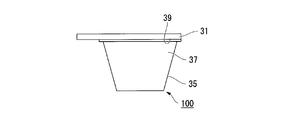
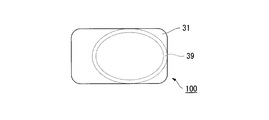
- FIGS. 4, 5A, and 5B are cross-sectional views schematically showing a sterilized paper according to the third embodiment
- FIG. 5A is a diagram schematically showing a top view of an example of the sterilized package according to the third embodiment
- FIG. 5B is a diagram schematically illustrating a side view of an example of a sterilized package according to the third embodiment.
- the sterilized paper 31 As shown in FIG. 4, the sterilized paper 31 according to the third embodiment includes a paper base 32 and a thermal bonding layer 33 laminated on at least one surface of the paper base 32. Formation of a sterilized package using the sterilized paper 31, an example of an adherend in the sterilized package, an aspect of the sterilized package, a container, a sterilization method, a removal of the container, a surface on which the thermal bonding layer 33 is formed, As for the thickness of the sterilized paper 31, the formation of the sterilized package using the sterilized paper 11, the example of the adherend in the sterilized package, the aspect of the sterilized package, the contents, and the sterilization process described in the first embodiment The method, the removal of the contents, the surface on which the thermal bonding layer 13 is formed, and the thickness of the sterilized paper 11 are the same.
- FIG. 5A and FIG. 5B are diagrams schematically showing a sterilization package 100 using a sterilization molded container as an adherend, which is an example of the sterilization package according to the third embodiment.
- 5A shows a top view
- FIG. 5B shows a side view.
- the sterilization package 100 is a space (accommodating portion 37) for accommodating an accommodation such as a medical instrument between the sterilized paper 31 and the molded container 35 that are thermocompression bonded to each other. ).
- the molded container 35 can be formed of the material exemplified in the first embodiment, and for example, a container formed of polypropylene can be used.
- the sterilized paper 31 is bonded to an adhesive surface 39 provided at the edge of the accommodating portion 37 of the packaging container 35.
- the width of the adhesive surface 39 in the top view is not particularly limited and can be appropriately selected depending on the size of the packaging container 35 and the like.
- the width of the adhesive surface 39 is 1 mm or more and 8 mm or less from the viewpoint of improving the adhesiveness of the sterilized paper 31 while miniaturizing the sterilized package 100. preferable.
- the packaging container 35 having such a narrow adhesive surface 39 it is preferable to increase the peel strength between the adhesive surface 39 and the sterilized paper 31, but according to the third embodiment, Even so, it is possible to realize the sterilized paper 31 having excellent peeling reliability after cooling.
- the paper base 32 is obtained, for example, by papermaking a papermaking raw material containing pulp slurry.
- the papermaking raw materials include hardwood pulp and softwood pulp.
- a paper base 32 made of a fiber material containing hardwood pulp and softwood pulp can be obtained.
- the said fiber material may contain the non-wood pulp mentioned above.
- the content of non-wood pulp with respect to the entire fiber material is 5% by mass or less from the viewpoint of reducing foreign matter in the paper base material 32 and the manufacturing cost, and the fiber material is non-wood. It is particularly preferred not to contain pulp.
- the fiber material does not contain non-wood pulp refers to a case where the content of non-wood pulp with respect to the entire fiber material is 0.1% by mass or less with respect to the mass of the entire fiber material.
- the content of the softwood pulp in the paper base material 32 is 5% by mass or more and 50% by mass or less with respect to the mass of the entire fiber material. Thereby, about the sterilized paper 31, the peeling reliability after cooling can be improved.
- the lower limit value of the content of the softwood pulp is more preferably 10% by mass and particularly preferably 15% by mass with respect to the mass of the entire fiber material from the viewpoint of improving the peeling reliability during cooling.
- the upper limit value of the content of the softwood pulp is more preferably 40% by mass, and particularly preferably 30% by mass with respect to the mass of the entire fiber material.
- the content of hardwood pulp in the paper base material 32 can be, for example, 50% by mass to 95% by mass with respect to the mass of the entire fiber material. Thereby, formation can be improved.
- the lower limit of the content of the hardwood pulp is more preferably 60% by mass, particularly 75% by mass with respect to the mass of the entire fiber material, from the viewpoint of improving surface properties, that is, improving printability. preferable.
- the upper limit value of the hardwood pulp content is more preferably 90% by mass, and particularly preferably 85% by mass, based on the mass of the entire fiber material.
- the method of obtaining a pulp slurry is the same as the aspect of the method of obtaining a pulp slurry demonstrated in this Embodiment 1.
- the beating of the pulp can be performed so that the freeness of the pulp measured in accordance with JIS P 811-2: 2012 (hereinafter also referred to as “standard freeness”) is 100 mL to 700 mL, and is 200 mL to 600 mL. It is more preferable that the beating is performed, and it is more preferable that the beating is performed so as to be 300 mL or more and 500 mL or less.
- standard freeness of the pulp to the above lower limit or more, the tear strength and air permeability of the paper can be improved more effectively. Further, by setting the standard freeness of the pulp to the upper limit value or less, it is possible to improve the strength of the paper and contribute to the improvement of the easy peel property.
- the paper strength can be sufficiently increased while maintaining the air permeability of the paper base material 32, and the tear strength can be improved. As a result, it is also possible to improve the peeling reliability of the sterilized paper 31 after cooling.
- the internal additive chemicals that can be added to the pulp slurry in the third embodiment are the same as the internal additive chemicals that can be added to the pulp slurry described in the second embodiment.
- the wet paper strength enhancer may include one or more selected from, for example, a polyamide epoxy resin, a polyethyleneimine resin, a polyamide polyamine-epichlorohydrin resin, a melamine resin, and the like.
- the content of the wet paper strength enhancer in the entire paper base is, for example, 0.05% by mass with respect to the total mass of the paper base 32. It is preferably 0.1% by mass or more, more preferably 0.3% by mass or more, and particularly preferably 0.5% by mass or more.
- the content of the wet paper strength enhancer in the entire paper base is, for example, 2.0% by mass or less with respect to the total mass of the paper base 32 from the viewpoint of collecting and reusing the waste paper. It is preferably 1.0% by mass or less.
- the content of the wet paper strength enhancer in the entire paper base is preferably 0.05 to 2.0% by weight, and 0.05 to 1.0% by weight with respect to the total weight of the paper base. % Is more preferable, and 0.1 to 1.0% by mass is particularly preferable.
- the basis weight of the paper base material 32 is 100 g / m 2 or more.
- the peeling reliability after cooling can be improved.
- the basis weight of the paper base material 32 is more preferably 110 g / m 2 or more.
- the upper limit of the basis weight of the paper substrate 32 is not limited particularly, it is preferred from the viewpoint of air permeability is 300 g / m 2 or less, 250 g / m 2, more preferably less, 200 g / m 2 or less is more preferable.
- the basis weight of the paper substrate 32 is preferably 100 to 300 g / m 2 , the basis weight of the paper substrate 32 is more preferably 100 to 250 g / m 2 , and the basis weight of the paper substrate 32 is 110 to 250 g / m 2. 2 is more preferable.
- the basis weight of the paper base material 32 is measured based on, for example, JIS P 8124: 2011.
- the peeling reliability after cooling means the peeling reliability after normal refrigerated storage. For example, after cooling at ⁇ 5 to 10 ° C. for 5 hours or more, or after cooling at 0 to 10 ° C. for 12 hours or more. Means peeling reliability.
- the density and thickness of the paper base material 32 are the same as the density and thickness aspects of the paper base material 22 described in the second embodiment.
- an undercoat agent may be applied to at least one surface of the paper substrate 32.
- the paper base material 32 has an undercoat on at least one surface side.
- the primer is applied to only one surface of the paper substrate 32, the primer is applied to the surface of the paper substrate 32 on which the thermal adhesive layer 33 is provided.
- an undercoat agent may be applied to both one side and the opposite side of the paper substrate 32.
- the primer includes a polyacrylamide resin.
- the polyacrylamide resin contained in the primer include those similar to the above-described aspect described in the first embodiment.
- the mass average molecular weight of the polyacrylamide resin contained in the primer and the effect thereof, the liquid medium contained in the primer, and other components other than the polyacrylamide resin that can be contained in the primer are described in Embodiment 1.
- the mass average molecular weight of the polyacrylamide resin contained in the primer and the effect thereof, the liquid medium contained in the primer, and the other components other than the polyacrylamide resin which can be contained in the primer are the same.
- the amount of the primer applied to the paper substrate 32 is set according to the content of the polyacrylamide resin in the primer.
- the coating amount of the primer on the surface of the paper base 32 on which the thermal adhesive layer 33 is provided is converted into the amount of polyacrylamide resin, and the unit area of the surface of the paper base 32 on the thermal adhesive layer 33 side. It is preferably 0.05 to 20 g / m 2 , more preferably 0.1 to 15 g / m 2 , and still more preferably 0.2 to 10 g / m 2 . Thereby, it becomes possible to improve heat-sealing property, suppressing the base-material destruction at the time of peeling.
- the paper base material 32 thus obtained contains the primer in an amount in the above numerical range in terms of the amount of polyacrylamide resin on the side where the thermal adhesive layer 33 is provided.
- Examples of the primer coating method and the drying method include the same methods as the primer coating method and the drying method described in the first embodiment.
- the thermal adhesive layer 33 is, for example, one or two selected from ethylene- (meth) acrylic acid copolymer, ethylene-vinyl acetate copolymer, acrylic ester polymer, polyethylene, polybutene, and polyethylene-polybutene mixture.
- the heat adhesive resin containing the above can be included.
- the content of the heat-adhesive resin in the heat-adhesive layer 33 can be adjusted as appropriate within a range in which the desired effect of the heat-adhesive layer can be obtained. can do.
- a heat-adhesive resin as a main component of the heat-adhesive layer 33, and to include as a main component means to include 60 mass% or more with respect to the total mass of the heat-adhesive layer 33.
- a heat-adhesive resin in the heat-adhesive layer 33 one or two of ethylene- (meth) acrylic acid copolymer, ethylene-vinyl acetate copolymer, and acrylic acid ester polymer are used. From the viewpoint of improving the heat sealability of the sterilized paper 31, it is more preferable to include seeds or more as a main component.
- the thermal adhesive layer 33 can include, for example, a granular thermal adhesive resin. Thereby, it becomes possible to more effectively suppress the destruction of the base material at the time of peeling while improving the air permeability of the sterilized paper 31.
- the thermal adhesive layer 33 includes a plurality of granular thermal adhesive resins. The plurality of granular heat-adhesive resins contained in the heat-adhesive layer 33 may be in contact with or bonded to each other, for example, and may exist as clusters.
- the shape of the granular thermal adhesive layer is not particularly limited, but for example, from the viewpoint of improving the air permeability and suppressing the breakage of the base material, it is preferable that the granular thermal adhesive resin has a substantially spherical or substantially elliptical shape. preferable.
- the sterilized paper 31 in which the thermal adhesive layer 33 including the granular thermal adhesive resin is provided on the paper base material 32 is realized.
- the kind of thermal adhesive resin applied to the paper base material 32, the particle diameter, the physical properties such as the glass transition point and the minimum film forming temperature, and the production conditions such as the drying conditions of the applied thermal adhesive resin are adjusted. It is considered that this may affect the remaining of the granular heat-adhesive resin.
- Particle size of the particulate heat adhesive resin contained in the heat-bonding layer 33, control of the average D 50 and particle size of the particle diameter, as described in the second embodiment, the particulate heat adhesive resin contained in the heat-bonding layer 23 This is the same as the aspect of controlling the particle diameter, the average particle diameter D 50 and the particle diameter.
- the glass transition point and the minimum film formation temperature of the granular thermal adhesive resin contained in the thermal adhesive layer 33 are the glass transition point of the granular thermal adhesive resin contained in the thermal adhesive layer 23 described in the second embodiment, and This is the same as the aspect of the minimum film formation temperature.
- thermal adhesive resin that can be included in the thermal adhesive layer 33
- Other components other than the thermal adhesive resin that can be included in the thermal adhesive layer 33 are the same as those of the components other than the thermal adhesive resin that can be included in the thermal adhesive layer 23 described in the second embodiment.
- the thermal adhesive layer 33 is formed, for example, by applying a thermal adhesive resin or a resin composition containing the same to the paper substrate 32 and drying it.
- a water-based heat sealant in which a heat-adhesive resin or a resin composition containing the same is dispersed in water may be applied to the paper substrate 32, and the heat-adhesive resin or a resin composition containing the heat-adhesive resin
- a solvent-based heat sealing agent in which a product is dispersed in a solvent may be applied to the paper substrate 32.
- a non-solvent thing can also be used as a heat seal agent.
- the content of the material containing the heat-adhesive resin in the heat-sealant, the solvent in the solvent-based heat-sealant, and the effect of the water-based heat-sealant and the effects thereof are described in the first embodiment, and the heat-adhesiveness in the heat-sealant It is the same as that of the content of the material containing resin, the solvent in a solvent type heat seal agent, the illustration of a water type heat seal agent, and its effect.
- the average particle diameter D 50 and the effect of emulsion type heat-adhesive resin has been described in the embodiment 2, the average of the emulsion type heat-adhesive resin it is similar to the embodiment of the particle diameter D 50 and its effect.
- the glass transition point and the minimum film-forming temperature of the granular thermal adhesive resin applied to the paper base material 32 are the glass transition point of the granular thermal adhesive resin applied to the paper base material 22 and the glass transition point described in the second embodiment. This is the same as the aspect of the minimum film formation temperature.
- the application of the heat-adhesive resin or the resin composition is not particularly limited, and can be performed using various known wet application methods. For example, the same method as the method for applying the primer described in the first embodiment can be used. Moreover, drying of these apply
- thermoadhesive resin or resin composition are the same as the drying conditions and effects of the thermoadhesive resin or resin composition described in the second embodiment.
- the coating amount of the heat-adhesive resin (the dry coating amount of the heat sealing agent) is not particularly limited, and is appropriately selected according to the material of the adherend to which the heat bonding layer 33 is bonded and the heat sealing conditions.
- the coating amount is preferably 0.1 g / m 2 or more, and more preferably 0.3 g / m 2 or more per unit area of the paper substrate 32. Thereby, satisfactory thermal adhesive force is easily obtained.
- the coating amount is, for example, preferably 30 g / m 2 or less, and more preferably 10 g / m 2 or less. Thereby, destruction of the paper base material 32 hardly occurs during easy peel.
- the thermal bonding layer 33 is less likely to exhibit spinnability, and contamination of the object is less likely to occur.
- the coating amount of the heat-adhesive resin, in terms of solid content, per unit area of the paper substrate 32 is preferably 0.1 ⁇ 30g / m 2, more preferably 0.3 ⁇ 10g / m 2 .
- the coating amount is set to the paper base. It can be 3 g / m 2 or more per unit area of the material 32, and is more preferably 5 g / m 2 or more.
- the coating amount in this case for example, heat-adhesive resin is preferably 3 ⁇ 30g / m 2, more preferably 5 ⁇ 30g / m 2, particularly preferably 5 ⁇ 10g / m 2.
- the coating amount of the thermal adhesive resin is approximately equal to the dry coating amount when the emulsion type thermal adhesive resin is applied.
- the thickness of the thermal adhesive layer 23 is preferably 0.01 to 30 ⁇ m.
- the sterilized paper 31 according to the third embodiment preferably has a tear strength in the MD (Machine Direction) direction measured by, for example, JIS P 8116 of 700 mN or more. Thereby, it can suppress more effectively that a tear arises when peeling the sterilized paper 31.
- the tear strength in the MD direction of the sterilized paper 31 is more preferably, for example, 800 mN or more, and particularly preferably 900 mN or more.
- the upper limit of the tear strength in the MD direction of the sterilized paper 31 is not particularly limited, but can be set to 1300 mN, for example.
- the tear strength in the MD direction of the sterilized paper 31 is preferably 700 to 1300 mN, more preferably 800 to 1300 mN, and particularly preferably 900 to 1300 mN.
- the sterilized paper 31 preferably has a tear strength in the CD (Cross Direction) direction measured by, for example, JIS P 8116 of 800 mN or more. Thereby, it can suppress more effectively that a tear arises when peeling the sterilized paper 31.
- the tear strength in the CD direction of the sterilized paper 31 is more preferably, for example, 900 mN or more, and particularly preferably 1000 mN or more.
- the upper limit of the tear strength in the CD direction of the sterilized paper 31 is not particularly limited, but can be set to, for example, 1500 mN.
- the tear strength in the CD direction of the sterilized paper 31 is preferably 800 to 1500 mN, more preferably 900 to 1500 mN, and particularly preferably 1000 to 1500 mN.
- the tear strength of the sterilized paper 31 can be controlled by appropriately adjusting, for example, the types and blending ratios of components constituting the paper base 32, the basis weight of the paper base 32, the freeness, and the like.
- the sterilized package formed by thermocompression bonding the sterilized paper 31 and the adherend is peeled off when the adherend is peeled 180 ° at a peeling speed of 300 m / min according to JIS P 8113: 2006.
- the strength is, for example, 500 to 1500 gf / 15 mm, another embodiment is 200 to 1500 gf / 15 mm, and yet another embodiment is 200 to 1000 gf / 15 mm.
- the sterilization packaging body excellent in the balance of an easy peel property and a heat seal property is obtained.
- FIGS. 5A and 5B sufficient adhesion can be realized even when the adhesion area between the sterilized paper 31 and the molded container 35 is small.
- the peel strength is controlled by, for example, appropriately selecting the coating amount and type of the thermal adhesive resin, the drying conditions, the particle diameter of the granular thermal adhesive resin contained in the thermal adhesive layer 33, and the like. Is possible.
- the adherend is, for example, a wrapping paper, a film, or a molded container for sterilization.
- the sterilized paper according to the first to third embodiments has been described with reference to the embodiment.
- the first to third embodiments are not limited to the above embodiment.
- Each configuration in the above embodiment, a combination thereof, and the like are examples, and the addition, omission, replacement, and other changes of the configuration can be made without departing from the spirit of the present invention.
- another layer may be provided between the paper base (12, 22, 32) of the sterilized paper (11, 21, 31) and the heat bonding layer (13, 23, 33).
- other layers include a water vapor barrier layer, an oxygen barrier layer, a print layer, a printability improving layer, an overprint layer, and a light shielding layer.
- the other layer provided between the paper substrate (12, 22, 32) and the thermal adhesive layer (13, 23, 33) may be one layer or two or more layers. Moreover, you may have a printing layer on both surfaces of a paper base material (12,22,32) in the range which air permeability and peeling strength do not deviate from the meaning of this invention. An overprint layer may be further provided on the print layer.
- the aspect of each element listed in each embodiment can also be applied to each element in each embodiment.
- one aspect of the sterilized paper in each embodiment according to the present invention is a sterilized paper that has a gas permeability that allows gas sterilization and high-pressure steam sterilization to be applied and that does not allow bacteria to permeate after sterilization.
- the former Japan Medical Equipment Manufacturers Association currently Japan Medical Device Technology Association (MT Japan) "Disposable medical device packaging material voluntary standard" bactericide test method It is a sterilized paper that is recognized as bactericidal.
- Example 1-1 [Manufacture of paper substrate] Hardwood bleached kraft pulp (LBKP) was beaten with DDR so that the Canadian standard freeness described in JIS P 811-2: 2012 was 350 mL, and a pulp slurry was obtained.
- An alkenyl succinic acid sizing agent (Fibrane 81K) which was absolutely dried and was previously dispersed with cationized starch (Pillar 3YK, manufactured by Pillar Starch Co., Ltd.) as an internal additive chemical to the pulp slurry, with an absolute dryness of 0.5% with respect to the pulp mass.
- a papermaking raw material was obtained by adding 0.4% of an epichloro resin wet paper strength enhancer.
- a gate roll coater attached to the papermaking machine is used to apply the following primer (A) on one side of the base paper to a coating amount after drying. It apply
- a paper substrate having a basis weight of 60 g / m 2 and a density of 0.7 g / cm 3 was obtained.
- the content of the polyacrylamide resin in the obtained paper substrate was 1.5% by mass.
- one side and the other side of the paper base material, and a split surface (center plane) obtained by dividing the paper base material into two layers using an adhesive tape are used to perform thermal decomposition GCMS by cutting each part.
- the concentration of the polyacrylamide resin on the opposite surface and the central surface was quantified and analyzed, the concentration of the polyacrylamide resin in the paper base material gradually decreased from one surface coated with the primer (A) toward the opposite surface side. It was confirmed that it was larger than the center plane on one side.
- Primer (A) An aqueous solution of anionic polyacrylamide resin (mass average molecular weight 200,000) (Polymerset (registered trademark) 512 manufactured by Arakawa Chemical Industries, Ltd.) was diluted with water to anionic polyacrylamide resin concentration of 9% by mass Adjusted).
- Example 1-2 A paper base and sterilized paper were produced in the same manner as in Example 1-1 except that the paper freeness of the pulp was changed to 550 mL in the production of the paper base of Example 1-1.
- Example 1-3 A paper substrate and sterilized paper were produced in the same manner as in Example 1-1 except that the basis weight of the paper substrate was 40 g / m 2 in the production of the paper substrate of Example 1-1.
- the content of the polyacrylamide resin in the obtained paper substrate was 2.0% by mass.
- Example 1-4 A paper base and sterilized paper were manufactured in the same manner as in Example 1-1 except that the basis weight of the paper base was changed to 150 g / m 2 in the manufacture of the paper base of Example 1-1. Content of polyacrylamide resin in the obtained paper base material was 1.0 mass%.
- Example 1-5 In the production of the paper base of Example 1-1, the same procedure as in Example 1-1 was performed, except that the coating amount after drying of the primer (A) on one side of the base paper was 8.0 g / m 2. Paper substrates and sterilized paper were produced. The content of the polyacrylamide resin in the obtained paper substrate was 10% by mass.
- Example 1-6 In the production of the paper base of Example 1-1, the same procedure as in Example 1-1 was performed, except that the coating amount after drying of the primer (A) on one side of the base paper was 0.1 g / m 2. Paper substrates and sterilized paper were produced. Content of polyacrylamide resin in the obtained paper base material was 1.0 mass%.
- Example 1-7 In the manufacture of the sterilized paper of Example 1-1, except that the heat sealant (D) was an ethylene-vinyl acetate copolymer emulsion heat sealant (E) (trade name: EA-H700, manufactured by Toyo Ink Co., Ltd.) Produced a paper base and sterilized paper in the same manner as in Example 1-1.
- E ethylene-vinyl acetate copolymer emulsion heat sealant
- Example 1-8> In the production of the paper substrate of Example 1-1, cationized starch (pillar 3YK) 0. instead of amphoteric polyacrylamide resin paper strength enhancer (trade name: Polystron OFT-3, manufactured by Arakawa Chemical Industries). 7% was added, and the paper base material and sterilization were performed in the same manner as in Example 1-1 except that the coating amount after drying of the primer (A) on one side of the base paper was 1.0 g / m 2. Paper was manufactured. The content of the polyacrylamide resin in the obtained paper substrate was 2.5% by mass.
- Example 1-9 A paper substrate and sterilized paper were produced in the same manner as in Example 1-1 except that the paper freeness of pulp was changed to 650 mL in the production of the paper substrate of Example 1-1.
- Example 1-10> In the production of the paper base material of Example 1-1, the paper was prepared in the same manner as in Example 1-1 except that the coating amount after drying of the primer (A) on one side of the base paper was 16 g / m 2. A substrate and sterilized paper were produced. The content of the polyacrylamide resin in the obtained paper substrate was 28% by mass.
- Example 1-10 the concentration of polyacrylamide resin on the one surface, the opposite surface, and the center surface of the paper substrate was quantified and analyzed in the same manner as in Example 1-1.
- the polyacrylamide resin concentration in the paper base material gradually decreased from one surface coated with the primer (A) to the opposite surface side, and it was confirmed that the surface was larger than the central surface.
- Example 1-1 In the production of the paper base material of Example 1-1, a paper base material and sterilized paper were produced in the same manner as in Example 1-1 except that the primer (A) was not applied. Content of polyacrylamide resin in the obtained paper base material was 0.7 mass%.
- Example 1-1 In the production of the paper substrate of Example 1-1, the following undercoat (B) was used instead of the undercoat (A) so that the coating amount after drying on one side of the base paper was 0.4 g / m 2.
- a paper base and sterilized paper were produced in the same manner as in Example 1-1 except that the above was changed.
- the content of the polyacrylamide resin in the obtained paper substrate was 0.9% by mass.
- Example 1-1 In the production of the paper base of Example 1-1, the following undercoat (C) was used instead of the undercoat (A), and the coating amount after drying on one side of the base paper was 0.8 g / m 2.
- a paper base and sterilized paper were sequentially produced in the same manner as in Example 1-1 except that the above was changed. Content of polyacrylamide resin in the obtained paper base material was 0.7 mass%.
- Example 1-1 the concentration of the polyacrylamide resin on the one surface, the opposite surface, and the center surface of the paper substrate was quantitatively analyzed in the same manner as in Example 1-1. It was confirmed that the polyacrylamide resin concentration in the paper substrate was substantially uniform throughout.
- Table 1 shows pulp freeness, paper substrate basis weight, type and amount of primer applied to base paper, heat for Examples 1-1 to 1-10 and Comparative Examples 1-1 to 1-3.
- the type of sealant and the content of polyacrylamide resin in the paper substrate are shown.
- the application amount (coating amount after drying) of the primer in each example is equal to the application amount as a water-soluble polymer (anionic polyacrylamide resin, polyvinyl alcohol, or hydrophobized starch) in the primer.
- thermocompression bonded material was prepared under the thermocompression bonding conditions of 150 ° C., 3.0 kgf / cm 2 and 1.1 seconds. It was confirmed by peeling by hand at the time of thermocompression bonding.
- the evaluation was made with “A” indicating that adhesion was possible and “B” indicating that adhesion was difficult.
- thermocompression product prepared by the above method was cut into a width of 15 mm to prepare a sample for measuring peel strength.
- the peel strength (gf / 15 mm) of the obtained peel strength measurement sample was measured according to JIS P 8113: 2006, using a tensile tester (model: Tensilon RTC-1250A, manufactured by Orientec Co., Ltd.) JIS P 8113: According to 2006, the sample PET, PE composite film, and sterilized paper were each chucked and measured by a 180 degree peel method at a peeling rate of 300 mm / min.
- the substrate destruction state of the sterilized paper was visually confirmed and evaluated according to the following criteria.
- the sterilized paper of Examples 1-1 to 1-10 had a peel strength of 200 to 1000 gf / 15 mm in the peel test, and no substrate destruction was observed during the peel test. From these results, it was confirmed that it was excellent in easy peel suitability. On the other hand, for Comparative Examples 1-1 to 1-3, in the peel test, the substrate was destroyed during the peel test. Table 2 also shows that sterilized paper having excellent air permeability was obtained in Examples 1-1 to 1-10. In particular, for Examples 1-1 to 1-4 and 1-6 to 1-9, sterilized paper having extremely excellent air permeability was obtained.
- Example 2-1> [Manufacture of paper substrate] A base paper was obtained in the same manner as in Example 1-1, and the base paper was used as a paper base material without applying and drying the primer (A).
- FIG. 3 is an electron micrograph of the thermal adhesive layer of the sterilized paper according to Example 2-1.
- FIG. 3 also shows that the thermal adhesive layer of the sterilized paper according to the present invention contains a granular thermal adhesive resin.
- the average particle size D 50 was measured by using a Shimadzu Corporation SALD2200.
- Example 2-2 A paper base and sterilized paper were manufactured in the same manner as in Example 2-1, except that the pulp freeness was 250 mL in the manufacture of the paper base of Example 2-1.
- Example 2-3 A paper substrate and sterilized paper were produced in the same manner as in Example 2-1, except that the basis weight of the paper substrate was 40 g / m 2 in the production of the paper substrate of Example 2-1.
- Example 2-4 A paper substrate and sterilized paper were produced in the same manner as in Example 2-1, except that the basis weight of the paper substrate was 150 g / m 2 in the production of the paper substrate of Example 2-1.
- Example 2-5 In the production of the sterilized paper of Example 2-1, the same procedure as in Example 2-1 was performed except that the coating amount after drying of the heat sealant on one side of the paper substrate was 1.0 g / m 2. Paper substrates and sterilized paper were produced.
- Example 2-6> [Manufacture of paper substrate] A paper base was produced in the same manner as in Example 2-1.
- Example 2-7 In the manufacture of the sterilized paper of Example 2-1, the application liquid was applied so that the application amount of the heat sealant after drying was 5.0 g / m 2 and dried with a cylinder dryer at 80 ° C. for 3 minutes. Thus, a heat bonding layer was formed. Except for the above, a paper base and sterilized paper were produced in the same manner as in Example 2-1.
- Example 2-8> In the manufacture of the sterilized paper of Example 2-7, 100 parts by mass of an ethylene-vinyl acetate copolymer emulsion (Chemical V200, manufactured by Mitsui Chemicals, glass transition temperature 85 ° C., average particle size 7 ⁇ m) as a heat sealant, and A coating solution was obtained by mixing 40 parts by mass of a 3% aqueous solution of carboxymethylcellulose (Serogen AG gum, manufactured by Daiichi Kogyo Seiyaku Co., Ltd.). And it apply
- an ethylene-vinyl acetate copolymer emulsion (Chemical V200, manufactured by Mitsui Chemicals, glass transition temperature 85 ° C
- the heat-adhesive layer of the obtained sterilized paper was observed with an electron microscope, and it was confirmed that the heat-adhesive layer had a granular heat sealant. It was also confirmed that a granular heat sealing agent having a particle diameter of 3 ⁇ m or more was present in the heat bonding layer.
- the average granular thermally adhesive resin particle diameter D 50 contained in the heat-bonding layer was in the range of about 8 ⁇ m or less than about 4 [mu] m.
- An ionomer heat sealant (trade name: Chemipearl S200, manufactured by Mitsui Chemicals, average particle size 0.5 ⁇ m, glass transition temperature 55 ° C.) was diluted to 20% with water to prepare a coating solution.
- the coating liquid was applied to one surface of the paper substrate obtained above using a bar coater, and dried with a blow dryer at 105 ° C. for 1 minute to form a thermal adhesive layer.
- thermocompression bonded material prepared by the above method was cut to a width of 15 mm to prepare a sample for measuring peel strength.
- the peel strength (gf / 15 mm) of the obtained peel strength measurement sample was determined in accordance with JIS P 8113: 2006 using a tensile tester (model: Tensilon RTC-1250A, manufactured by Orientec Corp.)
- the measurement was performed by chucking the ends of each of the PE composite film and the sterilized paper and peeling them at a peeling rate of 300 mm / min by a 180 ° peel method.
- the substrate destruction state of the sterilized paper was visually confirmed and evaluated according to the following criteria.
- the sterilized paper of Examples 2-1 to 2-8 has a low air permeability of 700 seconds or less, and sterilization is required to be permeable to sterilized paper such as gas sterilization method or high-pressure steam sterilization method.
- the method can also be suitably used.
- the sterilized papers of Examples 2-1 to 2-8 had a peel strength of 200 to 1500 gf / 15 mm in the peel test, and the evaluation result of the substrate destruction state in the peel test was A. From these results, it can be seen that sterilized paper applicable to various sterilization methods is obtained while suppressing destruction of the substrate. Moreover, in each Example, it has also confirmed that the sterilized paper excellent in easy peel suitability was obtained. On the other hand, in Comparative Examples 2-1 and 2-2, the air permeability exceeded 700 seconds. In Comparative Example 2-1, the evaluation result of the state of base material destruction was B.
- Example 3-1 [Manufacture of paper substrate] Hardwood bleached kraft pulp (LBKP) beaten so that the Canadian standard freeness (freeness) described in JIS P 811-2: 2012 is 300 mL by DDR, and the Canadian standard freeness is 400 mL.
- the pulp slurry was obtained by mixing softwood bleached kraft pulp (NBKP) beaten into In the pulp slurry, the content of the whole fiber material was 50% by mass for LBKP and 50% by mass for NBKP.
- an alkenyl succinic acid sizing agent (five) is obtained by completely drying with a cationized starch (pillar 3YK, manufactured by Pillar Starch Co., Ltd.) with a sulfuric acid band 0.2% with respect to the pulp mass.
- amphoteric polyacrylamide resin paper strength enhancer (PAM) (trade name: Polystron OFT-3, manufactured by Arakawa Chemical Industries, Ltd., mass average molecular weight 3 million) 0.5 %
- Polyamide polyamine-epichlorohydrin resin wet paper strength enhancer (trade name: WS4024) 0.5% was added to obtain a papermaking raw material.
- the papermaking raw material was made with a long paper machine to obtain a base paper.
- a paper base material having a basis weight of 100 g / m 2 and a density of 0.85 g / cm 3 was obtained.
- Sterile paper was obtained in the same manner as in Example 2-1, except that the heat sealant was applied so that the amount of the heat sealant applied after drying was 3 to 5 g / m 2 .
- Example 3-2> In the manufacture of the paper base material of Example 3-1, a pulp slurry was obtained so that the LBKP content was 95% by mass and the NBKP content was 5% by mass with respect to the entire fiber material. Except for the above, a paper base and sterilized paper were produced in the same manner as in Example 3-1.
- Example 3-3 A paper substrate and sterilized paper were produced in the same manner as in Example 3-1, except that the basis weight of the paper substrate was 120 g / m 2 in the production of the paper substrate of Example 3-1.
- Example 3-4 A paper base was prepared in the same manner as in Example 3-1, except that the addition amount of the polyamide polyamine-epichlorohydrin resin wet paper strength enhancer to the pulp mass was 0.1% in the production of the paper base of Example 3-1. Materials and sterilized paper were produced.
- Example 3-5 In the production of the paper base of Example 3-2, the gate coat coater attached to the paper machine is used to apply the following primer (A) so that the coating amount after drying is 0.5 g / m 2 on one side.
- a paper base and sterilized paper were produced in the same manner as in Example 3-2 except that the base was coated on one side of the paper base.
- Example 3-1 In the manufacture of the paper base material of Example 3-1, a pulp slurry was obtained so that the LBKP content was 100 mass% and the NBKP content was 0 mass% with respect to the entire fiber material. Except for the above, a paper base and sterilized paper were produced in the same manner as in Example 3-1.
- Example 3-2 A paper base and sterilized paper were manufactured in the same manner as in Example 3-1, except that the basis weight of the paper base was 90 g / m 2 in the manufacture of the paper base of Example 3-1.
- the peel strength (gf / 15 mm) of the obtained measurement sample was determined according to JIS P 8113: 2006 using a tensile tester (model: Tensilon RTC-1250A, manufactured by Orientec Co., Ltd.). It measured by chucking the edge part of each film and sterilized paper, and peeling at a peeling rate of 300 mm / min by a 180 degree peel method. In the case of tearing of sterilized paper, “F” is shown in Table 4.
- a molded container for blister pack made of polypropylene was prepared.
- the molded container had a recess for accommodating a medical instrument and a 4 mm wide adhesive surface provided at the edge of the recess.
- the obtained sterilized paper and the molded container are arranged so that the surface of the sterilized paper on the heat bonding layer side is in contact with the bonding surface of the molded container, and 190 ° C., 4.0 kgf /
- a blister pack (sterilized package) was produced by thermocompression bonding under the conditions of cm 2 and thermocompression bonding for 0.9 seconds.
- the blister pack was left in a 5 ° C. cooling environment for one day.
- sterilized paper was sandwiched between fingers and peeled off 180 ° vigorously.
- the sterilized paper after peeling was visually observed and evaluated according to the following criteria.
- the sterilized papers of Examples 3-1 to 3-5 obtained superior results in the tear test after cooling as compared with Comparative Examples 3-1 and 3-2.
- the sterilized paper excellent in the reliability at the time of easy peel after cooling is obtained.
Landscapes
- Health & Medical Sciences (AREA)
- Engineering & Computer Science (AREA)
- Mechanical Engineering (AREA)
- Epidemiology (AREA)
- Life Sciences & Earth Sciences (AREA)
- Animal Behavior & Ethology (AREA)
- General Health & Medical Sciences (AREA)
- Public Health (AREA)
- Veterinary Medicine (AREA)
- Chemical & Material Sciences (AREA)
- Chemical Kinetics & Catalysis (AREA)
- Paper (AREA)
Abstract
紙基材と、前記紙基材の一方の面に積層された熱接着層とを備える滅菌紙であって、前記紙基材が、少なくとも前記一方の面においてポリアクリルアミド樹脂を含み、かつ前記ポリアクリルアミド樹脂の濃度が前記一方の面において中心面よりも大きい滅菌紙、および、前記熱接着層が、粒状の熱接着性樹脂を含み、前記滅菌紙の王研式透気度が700秒以下である滅菌紙、ならびに、広葉樹パルプと、針葉樹パルプとを含む繊維材料により構成される紙基材と、前記紙基材に積層された熱接着層とを備え、前記繊維材料全体に対する前記針葉樹パルプの含有量が、前記繊維材料全体の質量に対して5~50質量%であり、前記紙基材の坪量が100g/m2以上である滅菌紙。
Description
本発明は、滅菌紙および滅菌包装体に関するものである。
本願は、2015年4月30日に日本に出願された特願2015-93633号、2015年7月9日に日本に出願された特願2015-138140号、および2015年8月18日に日本に出願された特願2015-161415号に基づき優先権を主張し、その内容をここに援用する。
本願は、2015年4月30日に日本に出願された特願2015-93633号、2015年7月9日に日本に出願された特願2015-138140号、および2015年8月18日に日本に出願された特願2015-161415号に基づき優先権を主張し、その内容をここに援用する。
手術や治療などに使用する器具類は、使用前に滅菌したものを用いることが必要であり、このような器具類は滅菌包装体に収納されて滅菌される。病院などで実施される滅菌方法としては、例えばメスや鉗子などの被滅菌物を滅菌包装体に入れて密封した後、ガス滅菌法、高圧蒸気滅菌法、放射線滅菌法などを用いて滅菌を行う方法が挙げられる。ガス滅菌法は、包装物を耐圧容器中に入れて容器内を減圧し、包装物内部の空気を排出させた後、エチレンオキサイドガス(EOG)などを容器内に満たして包装物内部にガスを浸透させて滅菌する。高圧蒸気滅菌法は、オートクレーブなどを用いて包装物を高温の蒸気に曝し、減圧と加圧を繰り返して滅菌する。放射線滅菌法は、放射線を照射して滅菌する。このうち、コストおよび簡便性の面から高圧蒸気滅菌およびガス滅菌が多く用いられている。
また、滅菌後の器具は手術などに使用するまでこの滅菌包装体内に収納され、手術や治療に用いる際に開封して使用される。そのため、滅菌包装体は病院内で医師や施術者が手袋を使用していても開封しやすいように、裏表の二枚の矩形のシートまたはフィルム等の薄葉体(以下、これらを「フィルム」と称する。)を剥離可能に接着したり、易裂開性(引裂き開封し易い)フィルムを用いて製造されており、開封に際しては、二枚のフィルムを剥離するピールオープン方式や、引裂き方式がとられているのが一般的である。
滅菌包装体は、たとえば滅菌紙を、医療器具を収容するための凹部を有する成形容器に剥離可能に接着することにより形成されることもある。この場合、医療器具の使用時には、滅菌紙を成形容器から剥離して、成形容器内に収容されている医療器具を取り出すこととなる。
滅菌包装体は、たとえば滅菌紙を、医療器具を収容するための凹部を有する成形容器に剥離可能に接着することにより形成されることもある。この場合、医療器具の使用時には、滅菌紙を成形容器から剥離して、成形容器内に収容されている医療器具を取り出すこととなる。
滅菌包装体に関する技術としては、たとえば特許文献1~10に記載のものが挙げられる。特許文献1には、基紙の片面に熱可塑性樹脂層を設けた滅菌バッグ紙であって、熱可塑性樹脂層が二種の合成樹脂エマルジョンおよび/またはディスパージョンの混合物であることを特徴とするものが記載されている。特許文献2には、アルミン酸塩を含有する基紙にアクリル系共重合体を塗工して得られる滅菌袋用紙が記載されている。特許文献3には、基紙の表面に中空ポリマー顔料を含有する熱可塑性樹脂層を有する滅菌紙が記載されている。特許文献4には、10秒以下の低透気度基紙に、ポリビニルアルコールを主成分とした含浸剤を含浸させた滅菌紙が記載されている。特許文献5には、基紙の少なくとも片面に塗工層を設け、該塗工層が主として架橋されたポリビニルアルコールであり、かつ塗工後の乾燥重量で0.1~6g/m2である滅菌袋用紙が記載されている。特許文献6には、20秒以下の低透気度基紙に、アクリル系共重合体を主成分とした含浸剤を含浸させた滅菌紙が記載されている。特許文献7には、一方の包装材に合成樹脂フィルム基材を用い、他方に透気性基材を用いて、両基材の周縁を熱接着してなる易開封性滅菌用包装体に関する技術が記載されている。特許文献8には、紙による基材と、該基材の片面に形成されている剥離性樹脂層と、該剥離性樹脂層の上に形成されている熱溶着性樹脂層とからなる滅菌包装体用の台紙に関する技術が記載されている。特許文献9には、基紙上に、樹脂と顔料からなる剥離層を設けた積層体の剥離層面の周縁部分に設けられたヒートシール層と、支持体とを接合し、ヒートシールしてなる滅菌用包装袋が記載されている。特許文献10には、熱圧着される面のプリントサーフ表面粗さが2μm以上5μm以下である滅菌紙が記載されている。
滅菌紙を剥離して開封する滅菌包装体においては、医療器具使用時に容易に開封できるためのイージーピール性が求められるのはもちろん、滅菌紙の剥離時における基材破壊に起因する紙粉の発生を抑制し、滅菌後の医療器具の再汚染を防ぐ必要がある。本発明は、これらの滅菌紙の剥離信頼性を向上させることを課題とする。
本発明は以下の構成を有する。
[1]紙基材と、前記紙基材の一方の面に積層された熱接着層とを備え、
前記紙基材は、少なくとも前記一方の面においてポリアクリルアミド樹脂を含み、かつ前記ポリアクリルアミド樹脂の濃度が前記一方の面において中心面よりも大きい滅菌紙。
[2]前記紙基材は、坪量が30g/m2以上である[1]に記載の滅菌紙。
[3]前記熱接着層は、エチレン-(メタ)アクリル酸共重合体、エチレン-酢酸ビニル共重合体、アクリル酸エステル重合体、ポリエチレン、およびポリブテンから選択される一種または二種以上を含む[1]または[2]に記載の滅菌紙。
[4]前記紙基材は、JIS P 8121-2:2012に準じて測定されるフリーネスが250mL以上700mL以下であるパルプを含む[1]~[3]のいずれか一項に記載の滅菌紙。
[5]前記紙基材は、質量平均分子量5万~50万のポリアクリルアミド樹脂を含む[1]~[4]のいずれか一項に記載の滅菌紙。
[6]前記紙基材は、質量平均分子量200万~1000万のポリアクリルアミド樹脂をさらに含む[5]に記載の滅菌紙。
[7]紙基材と、前記紙基材の一方の面に積層された熱接着層とを備え、
前記紙基材は、少なくとも前記一方の面においてポリアクリルアミド樹脂を含み、かつ前記紙基材中における前記ポリアクリルアミド樹脂の含有量が、前記紙基材の質量に対して1.0~30質量%である滅菌紙。
[8]紙基材と、前記紙基材の一方の面に積層された熱接着層とを備え、
前記熱接着層は、粒状の熱接着性樹脂を含み、
JIS P 8117:2009に準じて測定される王研式透気度が700秒以下である滅菌紙。
[9]前記熱接着性樹脂のガラス転移点が70℃以上である[8]に記載の滅菌紙。
[10]前記熱接着層は、粒子径3μm以上の熱接着性樹脂を含む[8]または[9]に記載の滅菌紙。
[11]前記熱接着性樹脂は、エチレン-(メタ)アクリル酸共重合体、エチレン-酢酸ビニル共重合体、アクリル酸エステル重合体、ポリエチレン、およびポリブテンから選択される一種または二種以上を含む[8]~[10]のいずれか一項に記載の滅菌紙。
[12]前記紙基材は、ポリアクリルアミド樹脂を含む[8]~[11]のいずれか一項に記載の滅菌紙。
[13]前記紙基材は、JIS P 8121-2:2012に準じて測定されるフリーネスが250mL以上700mL以下であるパルプを含む[8]~[12]のいずれか一項に記載の滅菌紙。
[14]広葉樹パルプと、針葉樹パルプとを含む繊維材料により構成される紙基材と、前記紙基材に積層された熱接着層とを備え、
前記繊維材料全体に対する前記針葉樹パルプの含有量が、前記繊維材料全体の質量に対して5~50質量%であり、
前記紙基材の坪量が100g/m2以上である滅菌紙。
[15]JIS P 8116により測定される引裂強度が700mN以上である[14]に記載の滅菌紙。
[16]前記紙基材は、湿潤紙力増強剤を含み、
前記紙基材全体における前記湿潤紙力増強剤の含有量が、前記紙基材の質量に対して0.1質量%以上である[14]または[15]に記載の滅菌紙。
[17]前記紙基材は、少なくとも前記熱接着層側の面において、ポリアクリルアミド樹脂を含む下塗り剤を有し、前記熱接着層側の面における前記下塗り剤の量が、前記紙基材の前記熱接着層側の面の単位面積当たり、0.05~15g/m2である[14]~[16]のいずれか一項に記載の滅菌紙。
[18]前記熱接着層は、平均粒子径D50が3~15μmである粒状熱接着性樹脂を含む[14]~[17]のいずれか一項に記載の滅菌紙。
[19][1]~[18]のいずれか一項に記載の滅菌紙と、前記滅菌紙に接着された包装紙、フィルムまたは滅菌用成形容器とを備える滅菌包装体。
[20]前記滅菌包装体から、前記包装紙、前記フィルムまたは前記滅菌用成形容器をJIS P 8113:2006に準じて剥離速度300m/分で180°剥離する際の剥離強度が200~1500gf/15mmである[19]に記載の滅菌包装体。
[21]前記滅菌包装体から、前記包装紙、前記フィルムまたは前記滅菌用成形容器をJIS P 8113:2006に準じて剥離速度300m/分で180°剥離する際の剥離強度が200~1000gf/15mmである[20]に記載の滅菌包装体。
[22]前記包装紙、フィルムまたは滅菌用成形容器は、ポリプロピレンにより形成される滅菌用成形容器である[19]に記載の滅菌包装体。
[23]前記滅菌包装体から、前記滅菌用成形容器をJIS P 8113:2006に準じて剥離速度300m/分で180°剥離する際の剥離強度が500gf/15mm以上である[22]に記載の滅菌包装体。
[1]紙基材と、前記紙基材の一方の面に積層された熱接着層とを備え、
前記紙基材は、少なくとも前記一方の面においてポリアクリルアミド樹脂を含み、かつ前記ポリアクリルアミド樹脂の濃度が前記一方の面において中心面よりも大きい滅菌紙。
[2]前記紙基材は、坪量が30g/m2以上である[1]に記載の滅菌紙。
[3]前記熱接着層は、エチレン-(メタ)アクリル酸共重合体、エチレン-酢酸ビニル共重合体、アクリル酸エステル重合体、ポリエチレン、およびポリブテンから選択される一種または二種以上を含む[1]または[2]に記載の滅菌紙。
[4]前記紙基材は、JIS P 8121-2:2012に準じて測定されるフリーネスが250mL以上700mL以下であるパルプを含む[1]~[3]のいずれか一項に記載の滅菌紙。
[5]前記紙基材は、質量平均分子量5万~50万のポリアクリルアミド樹脂を含む[1]~[4]のいずれか一項に記載の滅菌紙。
[6]前記紙基材は、質量平均分子量200万~1000万のポリアクリルアミド樹脂をさらに含む[5]に記載の滅菌紙。
[7]紙基材と、前記紙基材の一方の面に積層された熱接着層とを備え、
前記紙基材は、少なくとも前記一方の面においてポリアクリルアミド樹脂を含み、かつ前記紙基材中における前記ポリアクリルアミド樹脂の含有量が、前記紙基材の質量に対して1.0~30質量%である滅菌紙。
[8]紙基材と、前記紙基材の一方の面に積層された熱接着層とを備え、
前記熱接着層は、粒状の熱接着性樹脂を含み、
JIS P 8117:2009に準じて測定される王研式透気度が700秒以下である滅菌紙。
[9]前記熱接着性樹脂のガラス転移点が70℃以上である[8]に記載の滅菌紙。
[10]前記熱接着層は、粒子径3μm以上の熱接着性樹脂を含む[8]または[9]に記載の滅菌紙。
[11]前記熱接着性樹脂は、エチレン-(メタ)アクリル酸共重合体、エチレン-酢酸ビニル共重合体、アクリル酸エステル重合体、ポリエチレン、およびポリブテンから選択される一種または二種以上を含む[8]~[10]のいずれか一項に記載の滅菌紙。
[12]前記紙基材は、ポリアクリルアミド樹脂を含む[8]~[11]のいずれか一項に記載の滅菌紙。
[13]前記紙基材は、JIS P 8121-2:2012に準じて測定されるフリーネスが250mL以上700mL以下であるパルプを含む[8]~[12]のいずれか一項に記載の滅菌紙。
[14]広葉樹パルプと、針葉樹パルプとを含む繊維材料により構成される紙基材と、前記紙基材に積層された熱接着層とを備え、
前記繊維材料全体に対する前記針葉樹パルプの含有量が、前記繊維材料全体の質量に対して5~50質量%であり、
前記紙基材の坪量が100g/m2以上である滅菌紙。
[15]JIS P 8116により測定される引裂強度が700mN以上である[14]に記載の滅菌紙。
[16]前記紙基材は、湿潤紙力増強剤を含み、
前記紙基材全体における前記湿潤紙力増強剤の含有量が、前記紙基材の質量に対して0.1質量%以上である[14]または[15]に記載の滅菌紙。
[17]前記紙基材は、少なくとも前記熱接着層側の面において、ポリアクリルアミド樹脂を含む下塗り剤を有し、前記熱接着層側の面における前記下塗り剤の量が、前記紙基材の前記熱接着層側の面の単位面積当たり、0.05~15g/m2である[14]~[16]のいずれか一項に記載の滅菌紙。
[18]前記熱接着層は、平均粒子径D50が3~15μmである粒状熱接着性樹脂を含む[14]~[17]のいずれか一項に記載の滅菌紙。
[19][1]~[18]のいずれか一項に記載の滅菌紙と、前記滅菌紙に接着された包装紙、フィルムまたは滅菌用成形容器とを備える滅菌包装体。
[20]前記滅菌包装体から、前記包装紙、前記フィルムまたは前記滅菌用成形容器をJIS P 8113:2006に準じて剥離速度300m/分で180°剥離する際の剥離強度が200~1500gf/15mmである[19]に記載の滅菌包装体。
[21]前記滅菌包装体から、前記包装紙、前記フィルムまたは前記滅菌用成形容器をJIS P 8113:2006に準じて剥離速度300m/分で180°剥離する際の剥離強度が200~1000gf/15mmである[20]に記載の滅菌包装体。
[22]前記包装紙、フィルムまたは滅菌用成形容器は、ポリプロピレンにより形成される滅菌用成形容器である[19]に記載の滅菌包装体。
[23]前記滅菌包装体から、前記滅菌用成形容器をJIS P 8113:2006に準じて剥離速度300m/分で180°剥離する際の剥離強度が500gf/15mm以上である[22]に記載の滅菌包装体。
本発明によれば、滅菌紙のイージーピール性を向上させ、基材破壊に起因する紙粉の発生を抑制し、滅菌紙の高い剥離信頼性を実現することができる。
また、本発明のある態様によれば、滅菌紙の高い剥離信頼性を実現しつつ、各種滅菌法に適用することが可能な滅菌紙をも実現することができる。
また、本発明の別の態様によれば、滅菌紙の冷却後における剥離信頼性をも向上させることができる。
また、本発明のある態様によれば、滅菌紙の高い剥離信頼性を実現しつつ、各種滅菌法に適用することが可能な滅菌紙をも実現することができる。
また、本発明の別の態様によれば、滅菌紙の冷却後における剥離信頼性をも向上させることができる。
<第1の実施形態>
本発明の第1の実施形態(以下、「本実施形態1」とも言う。)に係る滅菌紙は、紙基材と、前記紙基材の少なくとも一方の面に積層された熱接着層とを備えている。また、前記紙基材の少なくとも上記一方の熱接着層の存在する面は、ポリアクリルアミド樹脂を含む塗布液が塗布されていることにより、ポリアクリルアミド樹脂を含む。これにより、紙基材と熱接着層の間において、より容易に剥離を生じさせることが可能となる。したがって、滅菌包装体から滅菌紙を剥離する際のイージーピール性を向上させ、高い剥離信頼性を実現することができる。
また、このように紙基材と熱接着層の間において剥離を生じさせることができることから、滅菌紙を構成していた熱接着層は、被着体から滅菌紙を剥離した後には被着体側に残存することとなる。このため、滅菌紙と被着体が一様に接着していたことが容易に確認できることとなる。
本発明の第1の実施形態(以下、「本実施形態1」とも言う。)に係る滅菌紙は、紙基材と、前記紙基材の少なくとも一方の面に積層された熱接着層とを備えている。また、前記紙基材の少なくとも上記一方の熱接着層の存在する面は、ポリアクリルアミド樹脂を含む塗布液が塗布されていることにより、ポリアクリルアミド樹脂を含む。これにより、紙基材と熱接着層の間において、より容易に剥離を生じさせることが可能となる。したがって、滅菌包装体から滅菌紙を剥離する際のイージーピール性を向上させ、高い剥離信頼性を実現することができる。
また、このように紙基材と熱接着層の間において剥離を生じさせることができることから、滅菌紙を構成していた熱接着層は、被着体から滅菌紙を剥離した後には被着体側に残存することとなる。このため、滅菌紙と被着体が一様に接着していたことが容易に確認できることとなる。
以下、本実施形態1に係る滅菌紙について、図1を参照し、実施形態を示して説明する。
図1は、本実施形態1に係る滅菌紙を模式的に示す断面図である。
図1は、本実施形態1に係る滅菌紙を模式的に示す断面図である。
(滅菌紙11)
図1に示すように、本実施形態1の滅菌紙11は、紙基材12と、紙基材12の少なくとも一方の面に積層された熱接着層13とを備えている。滅菌紙11は、たとえば包装紙、フィルム、または滅菌用成形容器等の被着体が接着されて、好ましくは熱圧着されて滅菌包装体を形成する。被着体の例としては、ポリエチレンやポリプロピレン等に例示されるポリオレフィン、ポリエチレンテレフタレート等に例示されるポリエステル、ポリ塩化ビニル、ポリ塩化ビニリデン、エチレン・酢酸ビニル共重合樹脂、エチレン・アクリル共重合樹脂またはこれらの積層体等により構成されるフィルムまたは滅菌用成形容器を挙げることができる。被着体としては、ポリプロピレンにより形成される滅菌用成形容器が好ましい。滅菌包装体は、たとえば互いに接着、好ましくは熱圧着された滅菌紙11と被着体の間において、医療器具等の収容物を収容するための空間を有する。収容物としての医療器具は、使用前に滅菌することが求められる医療器具であればとくに限定されないが、注射針、注射器、カテーテル、手袋、メス、鉗子、摂子、剪刀等を例示することができる。本実施形態1においては、たとえば滅菌包装体中に収容物を収容した状態で、オートクレーブ、エチレンオキサイドガス(EOG)滅菌、γ線滅菌等の滅菌方法により収容物に対して滅菌処理が行われる。そして、滅菌された収容物を使用する際に、被着体から滅菌紙11を剥離して収容物を取り出すこととなる。なお、熱接着層13は、紙基材12の一方の面のみに形成されていてもよく、一方の面および反対面の双方に形成されていてもよい。
滅菌紙11の厚みは、25~530μmであることが好ましい。
図1に示すように、本実施形態1の滅菌紙11は、紙基材12と、紙基材12の少なくとも一方の面に積層された熱接着層13とを備えている。滅菌紙11は、たとえば包装紙、フィルム、または滅菌用成形容器等の被着体が接着されて、好ましくは熱圧着されて滅菌包装体を形成する。被着体の例としては、ポリエチレンやポリプロピレン等に例示されるポリオレフィン、ポリエチレンテレフタレート等に例示されるポリエステル、ポリ塩化ビニル、ポリ塩化ビニリデン、エチレン・酢酸ビニル共重合樹脂、エチレン・アクリル共重合樹脂またはこれらの積層体等により構成されるフィルムまたは滅菌用成形容器を挙げることができる。被着体としては、ポリプロピレンにより形成される滅菌用成形容器が好ましい。滅菌包装体は、たとえば互いに接着、好ましくは熱圧着された滅菌紙11と被着体の間において、医療器具等の収容物を収容するための空間を有する。収容物としての医療器具は、使用前に滅菌することが求められる医療器具であればとくに限定されないが、注射針、注射器、カテーテル、手袋、メス、鉗子、摂子、剪刀等を例示することができる。本実施形態1においては、たとえば滅菌包装体中に収容物を収容した状態で、オートクレーブ、エチレンオキサイドガス(EOG)滅菌、γ線滅菌等の滅菌方法により収容物に対して滅菌処理が行われる。そして、滅菌された収容物を使用する際に、被着体から滅菌紙11を剥離して収容物を取り出すこととなる。なお、熱接着層13は、紙基材12の一方の面のみに形成されていてもよく、一方の面および反対面の双方に形成されていてもよい。
滅菌紙11の厚みは、25~530μmであることが好ましい。
(紙基材12)
紙基材12は、原紙の少なくとも一方の面に、ポリアクリルアミド樹脂を含む塗布液(以下、「下塗り剤」とも言う。)が塗布されることにより、ポリアクリルアミド樹脂を含むものである。下塗り剤が原紙の一方の面のみに塗布される場合、下塗り剤が塗布されるのは、原紙のうちの熱接着層13が設けられる側の面である。原紙のうちの熱接着層13が設けられる側の面とは、原紙と熱接着層13の界面を意味し、本明細書において同様の表現は同様の態様を意味する。一方で、本実施形態1においては、原紙の一方の面および反対面の双方に下塗り剤が塗布されていてもよい。
紙基材12は、原紙の少なくとも一方の面に、ポリアクリルアミド樹脂を含む塗布液(以下、「下塗り剤」とも言う。)が塗布されることにより、ポリアクリルアミド樹脂を含むものである。下塗り剤が原紙の一方の面のみに塗布される場合、下塗り剤が塗布されるのは、原紙のうちの熱接着層13が設けられる側の面である。原紙のうちの熱接着層13が設けられる側の面とは、原紙と熱接着層13の界面を意味し、本明細書において同様の表現は同様の態様を意味する。一方で、本実施形態1においては、原紙の一方の面および反対面の双方に下塗り剤が塗布されていてもよい。
原紙は、パルプスラリーを含む抄紙原料を抄紙したものである。
パルプスラリーに用いられるパルプとしては、木材パルプ、非木材パルプ等が挙げられる。木材パルプとしては、針葉樹パルプ、広葉樹パルプ等が挙げられ、いずれを用いてもよい。また、木材パルプの蒸解方法や漂白方法は、とくに限定されない。非木材パルプとしては、麻パルプ、ケナフパルプ、竹パルプ等が挙げられる。これらのパルプは1種を単独で用いてもよく、2種以上を組み合わせて用いてもよい。
レーヨン繊維やナイロン繊維、その他熱融着繊維など、パルプ繊維以外の材料も副資材としてパルプスラリーに配合することが可能である。
パルプスラリーに用いられるパルプとしては、木材パルプ、非木材パルプ等が挙げられる。木材パルプとしては、針葉樹パルプ、広葉樹パルプ等が挙げられ、いずれを用いてもよい。また、木材パルプの蒸解方法や漂白方法は、とくに限定されない。非木材パルプとしては、麻パルプ、ケナフパルプ、竹パルプ等が挙げられる。これらのパルプは1種を単独で用いてもよく、2種以上を組み合わせて用いてもよい。
レーヨン繊維やナイロン繊維、その他熱融着繊維など、パルプ繊維以外の材料も副資材としてパルプスラリーに配合することが可能である。
パルプスラリーは、パルプを水の存在下で叩解することにより得られる。
パルプの叩解方法、叩解装置はとくに限定されるものではないが、たとえば叩解効率が高いダブルディスクリファイナー(DDR)が好適に使用される。
パルプの叩解は、JIS P 8121-2:2012に準じて測定されるパルプのフリーネス(以下、「標準フリーネス」とも言う。)が250mL以上700mL以下となるように行うことができ、250mL以上600mL以下となるように行うことがより好ましく、300mL以上500mL以下となるように叩解を行うことがより好ましい。パルプの標準フリーネスを上記下限値以上とすることにより、紙の透気性を向上させることができる。また、パルプの標準フリーネスを上記上限値以下とすることにより、紙の強度を向上させて、イージーピール性の向上に寄与することができる。
一般にパルプの叩解と紙力の関係については、叩解をあまりすすめない状態では紙力は得られにくい。その理由としては、パルプ繊維同士のからみが弱く、繊維間結合(水素結合)のポイントも少ないためと考えられており、ある程度叩解を進めることで紙力は向上する。一方、叩解をすすめると、パルプ繊維同士のからみが増え、繊維間結合のポイントが増えるため、紙力は得られるが繊維の空隙が減少し、原紙の透気性が低下する。パルプの標準フリーネスが前記の値の範囲であれば、原紙、ひいては紙基材12の透気性を保ったまま紙力を充分に高くすることができ、滅菌紙11のイージーピール適性をさらに向上させることが可能となる。
パルプの叩解方法、叩解装置はとくに限定されるものではないが、たとえば叩解効率が高いダブルディスクリファイナー(DDR)が好適に使用される。
パルプの叩解は、JIS P 8121-2:2012に準じて測定されるパルプのフリーネス(以下、「標準フリーネス」とも言う。)が250mL以上700mL以下となるように行うことができ、250mL以上600mL以下となるように行うことがより好ましく、300mL以上500mL以下となるように叩解を行うことがより好ましい。パルプの標準フリーネスを上記下限値以上とすることにより、紙の透気性を向上させることができる。また、パルプの標準フリーネスを上記上限値以下とすることにより、紙の強度を向上させて、イージーピール性の向上に寄与することができる。
一般にパルプの叩解と紙力の関係については、叩解をあまりすすめない状態では紙力は得られにくい。その理由としては、パルプ繊維同士のからみが弱く、繊維間結合(水素結合)のポイントも少ないためと考えられており、ある程度叩解を進めることで紙力は向上する。一方、叩解をすすめると、パルプ繊維同士のからみが増え、繊維間結合のポイントが増えるため、紙力は得られるが繊維の空隙が減少し、原紙の透気性が低下する。パルプの標準フリーネスが前記の値の範囲であれば、原紙、ひいては紙基材12の透気性を保ったまま紙力を充分に高くすることができ、滅菌紙11のイージーピール適性をさらに向上させることが可能となる。
本実施形態1においては、たとえば叩解により得られたパルプスラリーに各種製紙用内添薬品を添加し、抄紙原料を調成することができる。内添薬品としては、たとえばサイズ剤、紙力増強剤、湿潤紙力増強剤、硫酸バンド、カチオン化デンプン等の各種の定着剤が挙げられる。また、これらの他にも内添薬品として保水剤、歩留向上剤、消泡剤、填料、着色剤などを、抄紙原料に対して任意に配合可能である。
紙力増強剤は、たとえばポリアクリルアミド樹脂、カチオン化デンプン、およびポリビニルアルコール等から選択される一種または二種以上を含むことができる。これらのうち、ポリアクリルアミド樹脂系紙力増強剤を内添することにより、原紙の強度をより効果的に向上させて、イージーピール性をさらに向上させることが可能となる。また、添加後紙力増強効果をもたせるため、ポリアクリルアミド樹脂の質量平均分子量(Mw)は200万以上であることが好ましい。また、操業上、粘度が高く添加が困難となることを避けるため、ポリアクリルアミド樹脂の質量平均分子量は1000万以下であることが好ましい。たとえば、紙力増強剤に含まれるポリアクリルアミド樹脂の質量平均分子量は、200万~1000万であることが好ましい。なお、ポリアクリルアミド樹脂の上記質量平均分子量は、ゲルパーミエーションクロマトグラフィー(GPC)により測定されるポリエチレンオキシド換算値である。また、紙力増強剤としてのポリアクリルアミド樹脂としては、たとえばアニオン性、カチオン性、両性、またはノニオン性のポリアクリル樹脂を用いることができるが、両性のポリアクリルアミド樹脂を用いることがとくに好ましい。
サイズ剤としては、サイズ剤として公知のものを使用することができ、たとえばアルケニルコハク酸、アルキルケテンダイマー、およびロジン等から選択される一種または二種以上を含むことができる。また、湿潤紙力増強剤は、湿潤紙力増強剤として公知のものを使用することができ、たとえばポリアミドエポキシ樹脂、エピクロル樹脂、およびメラミン樹脂等から選択される一種または二種以上を含むことができる。
サイズ剤としては、サイズ剤として公知のものを使用することができ、たとえばアルケニルコハク酸、アルキルケテンダイマー、およびロジン等から選択される一種または二種以上を含むことができる。また、湿潤紙力増強剤は、湿潤紙力増強剤として公知のものを使用することができ、たとえばポリアミドエポキシ樹脂、エピクロル樹脂、およびメラミン樹脂等から選択される一種または二種以上を含むことができる。
本実施形態1においては、たとえばこのように調成した抄紙原料を定法により抄紙することで原紙が得られる。なお、原紙の坪量は、紙基材12の坪量および下塗り剤の塗布量に応じて適宜設定することができる。
下塗り剤は、ポリアクリルアミド樹脂を含む。
本明細書において、ポリアクリルアミド樹脂とは、(メタ)アクリルアミド単位を有する重合体である。「(メタ)アクリルアミド」は、アクリルアミドおよびメタクリルアミドの総称である。ポリアクリルアミド樹脂は、アクリルアミド単位およびメタクリルアミド単位のいずれか一方を有してもよく、両方を有してもよい。また、ポリアクリルアミド樹脂は、(メタ)アクリルアミド単位以外の他の単位を有していてもよい。
本明細書において、ポリアクリルアミド樹脂とは、(メタ)アクリルアミド単位を有する重合体である。「(メタ)アクリルアミド」は、アクリルアミドおよびメタクリルアミドの総称である。ポリアクリルアミド樹脂は、アクリルアミド単位およびメタクリルアミド単位のいずれか一方を有してもよく、両方を有してもよい。また、ポリアクリルアミド樹脂は、(メタ)アクリルアミド単位以外の他の単位を有していてもよい。
下塗り剤中に含まれるポリアクリルアミド樹脂としては、アニオン性ポリアクリルアミド樹脂、カチオン性ポリアクリルアミド樹脂、両性ポリアクリルアミド樹脂、ノニオン性ポリアクリルアミド樹脂等が挙げられる。これらはそれぞれ、製紙分野における紙力剤等として公知のものを使用でき、たとえば特開2002-317393号公報、特開2004-231901号公報、特開2014-205938号公報等に記載のものが挙げられる。ポリアクリルアミド樹脂は、1種を単独で用いてもよく2種以上を組み合わせて用いてもよい。入手容易性の点では、アニオン性ポリアクリルアミド樹脂が好ましい。
アニオン性ポリアクリルアミド樹脂は、たとえばカルボキシ基、スルホン酸基、もしくはリン酸基、またはこれらの塩等のアニオン性官能基を含有することができる。このようなアニオン性ポリアクリルアミド樹脂としては、たとえば(メタ)アクリルアミドとアニオン性官能基含有モノマー(アクリル酸等)との共重合体、ポリ(メタ)アクリルアミドの部分加水分解物等が挙げられる。
下塗り剤中に含まれるポリアクリルアミド樹脂としては、質量平均分子量が5万~50万であるものが好ましく、5万~30万であるものがより好ましい。ポリアクリルアミド樹脂の質量平均分子量が前記の範囲内であれば、紙基材表面の毛羽立ちを抑える効果がより優れる。質量平均分子量が前記範囲の下限値以上であれば、熱接着層13が剥離する際の紙基材12の表面の毛羽立ちを抑える効果が得られやすい。質量平均分子量が前記範囲の上限値以下であれば、下塗り剤が塗布するのに充分に粘度が低く、下塗り剤の調製および塗布が容易である。また、下塗り剤中のポリアクリルアミド樹脂の濃度を高くでき、目的の塗布量が得られやすい。なお、ポリアクリルアミド樹脂の上記質量平均分子量は、ゲルパーミエーションクロマトグラフィー(GPC)により測定されるポリエチレンオキシド換算値である。
下塗り剤は、通常、液体媒体を含む。
液体媒体としては、ポリアクリルアミド樹脂を溶解するものが好ましく、たとえば水が挙げられる。
液体媒体としては、ポリアクリルアミド樹脂を溶解するものが好ましく、たとえば水が挙げられる。
下塗り剤は、必要に応じて、本発明の効果を損なわない範囲で、ポリアクリルアミド樹脂以外の他の成分を含んでもよい。
他の成分としては、とくに限定するものではないが、たとえばデンプン、変性デンプン、ポリビニルアルコール、変性ポリビニルアルコール、ヒドロキシエチルセルロース、メチルセルロース、カルボキシメチルセルロース、ゼラチン、カゼイン、アラビアガム、ジイソブチレン・無水マレイン酸共重合体塩、スチレン・無水マレイン酸共重合体塩等の水溶性高分子化合物、スチレン-ブタジエン共重合体エマルション、アクリル酸エステル共重合体エマルション、ウレタン樹脂、尿素樹脂、スチレン-アクリル樹脂エマルション、エチレン-アクリル樹脂エマルション等の水性高分子化合物、離型剤、消泡剤、分散剤、濡れ剤、有色染料、有色顔料、白色顔料等が挙げられる。これらはいずれか一種を単独で用いてもよく、二種以上を組合せて用いてもよい。
他の成分としては、とくに限定するものではないが、たとえばデンプン、変性デンプン、ポリビニルアルコール、変性ポリビニルアルコール、ヒドロキシエチルセルロース、メチルセルロース、カルボキシメチルセルロース、ゼラチン、カゼイン、アラビアガム、ジイソブチレン・無水マレイン酸共重合体塩、スチレン・無水マレイン酸共重合体塩等の水溶性高分子化合物、スチレン-ブタジエン共重合体エマルション、アクリル酸エステル共重合体エマルション、ウレタン樹脂、尿素樹脂、スチレン-アクリル樹脂エマルション、エチレン-アクリル樹脂エマルション等の水性高分子化合物、離型剤、消泡剤、分散剤、濡れ剤、有色染料、有色顔料、白色顔料等が挙げられる。これらはいずれか一種を単独で用いてもよく、二種以上を組合せて用いてもよい。
下塗り剤中のポリアクリルアミド樹脂の含有量(濃度)は、下塗り剤中の総固形分の質量に対し、50~100質量%が好ましく、80~100質量%がより好ましい。ポリアクリルアミド樹脂の含有量が前記範囲の下限値以上であれば、滅菌紙のイージーピール適性をより良好なものとすることができる。総固形分は、下塗り剤から液体媒体を除いた全量であり、ポリアクリルアミド樹脂と上記他の成分との合計である。
原紙への下塗り剤の塗布量は、下塗り剤中のポリアクリルアミド樹脂の含有量に応じて設定される。原紙のうちの熱接着層13が設けられる側の面における下塗り剤の塗布量は、ポリアクリルアミド樹脂の量に換算して、紙基材12の熱接着層13側の面の単位面積当たり、0.05~20g/m2であることが好ましく、0.1~15g/m2であることがより好ましく、0.2~10g/m2であることがさらに好ましい。ポリアクリルアミド樹脂の塗布量が前記範囲の下限値以上であれば、滅菌紙を剥離する際に紙基材12と熱接着層13とが良好に剥離し、紙基材12の表面の毛羽立ちや基材破壊が生じにくい。また、ポリアクリルアミド樹脂の塗布量が前記範囲の上限値以下であれば、滅菌紙をヒートシールする際に、接着ムラを抑えることができる。なお、下塗り剤は、たとえば原紙のうちの熱接着層13が設けられる側の面全体に対して略均一に塗布することができる。一方で、下塗り剤は、たとえば原紙のうちの熱接着層13が設けられる側の面に、所定のパターンを有するように塗布されていてもよい。
原紙のうちの熱接着層13が設けられる一面とは反対側の他面に下塗り剤が塗布される場合、その下塗り層の成分はとくに限定されない。たとえば澱粉、ポリビニルアルコール、ポリアクリルアミド樹脂、およびスチレンーブタジエン樹脂などの樹脂、ならびにカオリン、タルク、炭酸カルシウム、およびホワイトカーボンなどの顔料から選択される一種または二種以上を、他面に塗布される下塗り層中に含むことができる。なお、ポリアクリルアミド樹脂としては、とくに限定されないが、たとえば一面側に塗布される下塗り剤に使用されるものと同様のものを採用することができる。また、本実施形態1では、たとえば一面側に塗布される下塗り剤と、他面側に塗布される下塗り剤と、が互いに同様のものであってもよく、互いに異なるものであってもよい。
原紙の上記他面に下塗り剤を塗布する場合、その塗布量はとくに限定されないが、たとえば固形分量に換算して、紙基材12の熱接着層13側の反対の面の単位面積当たり、0.01~20g/m2とすることができる。本実施形態1においては、上記塗布量が0.01~5g/m2以下であることが好ましく、0.01~3g/m2であることがより好ましく、0.1~2g/m2であることがさらに好ましい。該塗布量が前記範囲の上限値以下であれば、滅菌紙の透気性を良好に保つことができる。また、原紙の他面における下塗り剤の塗布量をこのように調整することによって、原紙の一面、中心面、および他面におけるポリアクリルアミド樹脂の濃度を適切に制御することが容易となる。なお、原紙の一面および他面のそれぞれに下塗り剤を塗布する場合、とくに限定されないが、たとえば一面における塗布量と他面における塗布量の比を3:7~7:3とすることができる。これにより、原紙中におけるポリアクリルアミド樹脂の濃度を、原紙の一面および他面において中心面よりも大きくすることがさらに容易となる。なお、滅菌紙の製造コストを低減する観点からは、原紙の他面に下塗り剤を塗布しない場合を好ましい態様の一例として採用することができる。
原紙の上記他面に下塗り剤を塗布する場合、その塗布量はとくに限定されないが、たとえば固形分量に換算して、紙基材12の熱接着層13側の反対の面の単位面積当たり、0.01~20g/m2とすることができる。本実施形態1においては、上記塗布量が0.01~5g/m2以下であることが好ましく、0.01~3g/m2であることがより好ましく、0.1~2g/m2であることがさらに好ましい。該塗布量が前記範囲の上限値以下であれば、滅菌紙の透気性を良好に保つことができる。また、原紙の他面における下塗り剤の塗布量をこのように調整することによって、原紙の一面、中心面、および他面におけるポリアクリルアミド樹脂の濃度を適切に制御することが容易となる。なお、原紙の一面および他面のそれぞれに下塗り剤を塗布する場合、とくに限定されないが、たとえば一面における塗布量と他面における塗布量の比を3:7~7:3とすることができる。これにより、原紙中におけるポリアクリルアミド樹脂の濃度を、原紙の一面および他面において中心面よりも大きくすることがさらに容易となる。なお、滅菌紙の製造コストを低減する観点からは、原紙の他面に下塗り剤を塗布しない場合を好ましい態様の一例として採用することができる。
紙基材12は、上述のとおり、原紙の少なくとも一面に、下塗り剤を塗布し乾燥することにより得られる。下塗り剤の塗布方法としては、とくに限定されず、各種公知の湿式塗布法を利用して行うことができる。たとえば抄紙機のオンマシンサイズプレス装置やトランスファーロールコーター(シムサイザー、ゲートロールコーター等)、スプレー装置等を用いて行うことができる。また、オフマシンでは、一般的な塗工装置、例えばブレードコーター、エアーナイフコーター、ロールコーター、リバースロールコーター、シムサイザー、ゲートロールコーター、バーコーター、カーテンコーター、スロットダイコーター、グラビアコーター、チャンプレックスコーター、ブラシコーター、ツーロールコーター、ビルブレードコーター、ショートドウェルコーター等を用いて塗布することができる。
操業性、生産性を考慮すれば、下塗り剤の塗布および乾燥は、オンマシン式で行われることが好ましい。したがって、原紙を抄紙する抄紙機の形式については、長網抄紙機、短網抄紙機、円網抄紙機等、とくに限定されるものではないが、オンマシンで塗工機が装備されているものを用いることが好ましい。
操業性、生産性を考慮すれば、下塗り剤の塗布および乾燥は、オンマシン式で行われることが好ましい。したがって、原紙を抄紙する抄紙機の形式については、長網抄紙機、短網抄紙機、円網抄紙機等、とくに限定されるものではないが、オンマシンで塗工機が装備されているものを用いることが好ましい。
原紙の一面に塗布された下塗り剤は、少なくとも一部が原紙に浸み込むことから、塗布後の原紙内部には下塗り剤としてのポリアクリルアミド樹脂が含まれている。塗布された下塗り剤の一部のみが原紙に浸み込んだ場合には、浸み込まなかった下塗り剤が原紙の一面上で乾燥することにより、原紙の一面上にポリアクリルアミド樹脂を含む層(以下、「下塗り層」ともいう。)が形成されることとなる。この場合、得られる滅菌紙11は、紙基材12と、紙基材12上に設けられる熱接着層13との間に、ポリアクリルアミド樹脂を含む下塗り層を有することとなる。一方で、原紙の一面上には、下塗り層が設けられなくともよい。この場合であっても、原紙の一面およびその近傍に下塗り剤としてのポリアクリルアミド樹脂が含浸しているため、優れたイージーピール適性を有する滅菌紙が得られる。なお、下塗り層の有無は、紙基材12の表面と中層部分をかみそり等で削いで、熱分解GCMS(ガスクロマトグラフ質量分析)等で確認することが可能である。
本実施形態1においては、たとえば原紙の一面に下塗り剤を塗布して紙基材12を形成する。この場合、下塗り剤は原紙の一面から内部へ徐々に浸み込むことから、紙基材12はポリアクリルアミド樹脂の濃度が一面から反対面側に向けて漸減する構成を有することとなる。このため、紙基材12中におけるポリアクリルアミド樹脂の濃度を、紙基材12の一面において中心面よりも大きくすることができる。このように、紙基材12の一面にポリアクリルアミド樹脂を高濃度で含ませることができることから、滅菌紙11を剥離する際に、紙基材12と、紙基材12の一面に設けられる熱接着層13との間において良好に剥離を生じさせることが可能となる。したがって、滅菌紙のイージーピール性を向上させることが可能となる。
紙基材12中の各領域におけるポリアクリルアミド樹脂の濃度は、たとえば熱分解-GCMSにより測定することができる。本実施形態1においては、たとえば紙基材12の一面および反対面、ならびに紙基材12を適当な粘着テープを用いて2層に層分割した分割面について、それぞれの一部をかみそり等で削って熱分解GCMSを行うことにより一面、反対面、および中心面におけるポリアクリルアミド樹脂の濃度を確認することが可能である。また、本実施形態1において、紙基材12の中心面とは、たとえば紙基材12の一面の平均面と、一面とは反対の他面の平均面と、の中点を結んで形成される平面を指す。なお、一面の平均面と他面の平均面の中点とは、一面の特定点から他面の最短距離の中点のことをいう。また、各面の平均面とは、表面に凹凸形状がある場合は凹部と凸部の高さの平均の高さを通る面をいい、表面に凹凸形状がない場合は、各平均面は各面のことをいう。また、本実施形態1においては、たとえば原紙の一面および他面にポリアクリルアミド樹脂を含む下塗り剤を塗布して紙基材12を形成することもできる。この場合、紙基材12は、一面から中心面側に向けてポリアクリルアミド樹脂の濃度が漸減する領域を有する。このため、紙基材12中におけるポリアクリルアミド樹脂の濃度を、紙基材12の一面において中心面よりも大きくすることが可能となる。
紙基材12中の各領域におけるポリアクリルアミド樹脂の濃度は、たとえば熱分解-GCMSにより測定することができる。本実施形態1においては、たとえば紙基材12の一面および反対面、ならびに紙基材12を適当な粘着テープを用いて2層に層分割した分割面について、それぞれの一部をかみそり等で削って熱分解GCMSを行うことにより一面、反対面、および中心面におけるポリアクリルアミド樹脂の濃度を確認することが可能である。また、本実施形態1において、紙基材12の中心面とは、たとえば紙基材12の一面の平均面と、一面とは反対の他面の平均面と、の中点を結んで形成される平面を指す。なお、一面の平均面と他面の平均面の中点とは、一面の特定点から他面の最短距離の中点のことをいう。また、各面の平均面とは、表面に凹凸形状がある場合は凹部と凸部の高さの平均の高さを通る面をいい、表面に凹凸形状がない場合は、各平均面は各面のことをいう。また、本実施形態1においては、たとえば原紙の一面および他面にポリアクリルアミド樹脂を含む下塗り剤を塗布して紙基材12を形成することもできる。この場合、紙基材12は、一面から中心面側に向けてポリアクリルアミド樹脂の濃度が漸減する領域を有する。このため、紙基材12中におけるポリアクリルアミド樹脂の濃度を、紙基材12の一面において中心面よりも大きくすることが可能となる。
本実施形態1においては、紙基材12中におけるポリアクリルアミド樹脂の含有量を、紙基材12の質量に対して、たとえば1.0~30質量%とすることができる。このように、紙基材12にポリアクリルアミド樹脂を高濃度で含ませることができることから、滅菌紙11を剥離する際に、紙基材12と、紙基材12の一面に設けられる熱接着層13との間において良好に剥離を生じさせることが可能となる。このため、滅菌紙のイージーピール性を向上させることが可能となる。一方で、ポリアクリルアミド樹脂の含有量を上記上限値以下とすることにより、滅菌紙のヒートシール性を向上させることも可能となる。
紙力増強剤等としてポリアクリルアミド樹脂を紙基材中に内添する場合には、多量のポリアクリルアミド樹脂を含有する紙基材を製造することは困難であった。鋭意検討の結果、本発明者は、原紙の少なくとも一面にポリアクリルアミド樹脂を含む下塗り剤を塗布することによって、多量のポリアクリルアミド樹脂を含有する紙基材12を形成することが可能となることを見出した。本実施形態1は、このように原紙の少なくとも一面にポリアクリルアミド樹脂を含む下塗り剤を塗布することによって、1.0質量%以上のポリアクリルアミド樹脂を含有する紙基材12を実現するものである。
紙力増強剤等としてポリアクリルアミド樹脂を紙基材中に内添する場合には、多量のポリアクリルアミド樹脂を含有する紙基材を製造することは困難であった。鋭意検討の結果、本発明者は、原紙の少なくとも一面にポリアクリルアミド樹脂を含む下塗り剤を塗布することによって、多量のポリアクリルアミド樹脂を含有する紙基材12を形成することが可能となることを見出した。本実施形態1は、このように原紙の少なくとも一面にポリアクリルアミド樹脂を含む下塗り剤を塗布することによって、1.0質量%以上のポリアクリルアミド樹脂を含有する紙基材12を実現するものである。
紙基材12の坪量は、たとえば30g/m2以上であることが好ましく、40g/m2以上であることがより好ましく、45g/m2以上であることがさらに好ましい。紙基材12の坪量が前記下限値以上であれば、滅菌紙11の剥離に耐えうる強度が得られやすく、剥離時の基材破壊が起こりにくい。また、紙基材12の坪量の上限はとくに限定されないが、透気性の観点から300g/m2以下であることが好ましく、250g/m2以下がより好ましく、200g/m2以下がさらに好ましい。たとえば、紙基材12の坪量は、30~300g/m2であることが好ましく、40~300g/m2であることがより好ましく、45~250g/m2であることがさらに好ましい。紙基材12および原紙の坪量は、たとえばJIS P 8124:2011に準拠して測定される。
紙基材12の密度は、たとえば0.60~1.20g/cm3であることが好ましく、0.70~1.10g/cm3であることがより好ましい。紙基材12の密度が前記下限値以上であれば、イージーピールに耐えうる強度が得られやすく、剥離時の基材破壊が起こりにくい。紙基材12の密度が前記上限値以下であれば、透気性を保つことができる。紙基材12の密度は、たとえばJIS P 8118:1998に準拠して厚さを測定して、厚さと坪量の測定値から計算で求められる。紙基材12の厚みは、25~500μmであることが好ましい。
本実施形態1においては、たとえば下塗り剤として添加される第1のポリアクリルアミド樹脂と、紙力増強剤として添加される第2のポリアクリルアミド樹脂とを、ともに紙基材中に含む場合を好ましい態様の一例として挙げることができる。第1のポリアクリルアミド樹脂と第2のポリアクリルアミド樹脂は、互いに同じものであってもよいが、互いに異なるものであることが好ましい。本実施形態1においては、たとえば質量平均分子量5万~50万である第1のポリアクリルアミド樹脂と、質量平均分子量200万~1000万である第2のポリアクリルアミド樹脂とを、ともに紙基材中に含むことができる。これにより、滅菌紙を剥離する際の紙基材における基材破壊や毛羽立ちをより効果的に抑えることが可能となる。
(熱接着層13)
熱接着層13は、たとえばエチレン-(メタ)アクリル酸共重合体、エチレン-酢酸ビニル共重合体、アクリル酸エステル重合体、ポリエチレン、ポリブテン、およびポリエチレン-ポリブテン混合体から選択される一種または二種以上を含む熱接着性樹脂を含むことができる。熱接着層13中における熱接着性樹脂の含有量は、熱接着層の所望の効果が得られる範囲において適宜調整できるが、熱接着層13全体の質量に対して、たとえば10~100質量%とすることができる。とくに、熱接着層13の主成分として熱接着性樹脂を含むことが好ましく、主成分として含むとは、熱接着層13全体の質量に対して60質量%以上含むことを意味する。本実施形態1においては、熱接着層13中の熱接着性樹脂として、エチレン-アクリルもしくはエチレン-酢酸ビニル共重合体を主成分として含むことがとくに好ましい。
熱接着層13は、たとえばエチレン-(メタ)アクリル酸共重合体、エチレン-酢酸ビニル共重合体、アクリル酸エステル重合体、ポリエチレン、ポリブテン、およびポリエチレン-ポリブテン混合体から選択される一種または二種以上を含む熱接着性樹脂を含むことができる。熱接着層13中における熱接着性樹脂の含有量は、熱接着層の所望の効果が得られる範囲において適宜調整できるが、熱接着層13全体の質量に対して、たとえば10~100質量%とすることができる。とくに、熱接着層13の主成分として熱接着性樹脂を含むことが好ましく、主成分として含むとは、熱接着層13全体の質量に対して60質量%以上含むことを意味する。本実施形態1においては、熱接着層13中の熱接着性樹脂として、エチレン-アクリルもしくはエチレン-酢酸ビニル共重合体を主成分として含むことがとくに好ましい。
熱接着層13は、たとえば、上記の熱接着性樹脂と液体媒体とを含むヒートシール剤を、紙基材12の一方の面に塗布し乾燥することにより形成することができる。なお、紙基材12の一方の面には、上述のとおりポリアクリルアミド樹脂を含む下塗り剤が塗布されている。本実施形態1においては、紙基材12の一方の面および反対面に熱接着層13が設けられていてもよい。この場合、紙基材12の一方の面および反対面にヒートシール剤を塗布し、乾燥することにより熱接着層13が形成される。このとき、紙基材12の一方の面および反対面の双方に、ポリアクリルアミド樹脂を含む下塗り剤が塗布されていることが好ましい。
ヒートシール剤は、上記の材料が水に溶解または分散した水系ヒートシール剤でもよく、上記の材料が溶剤に溶解した溶剤系ヒートシール剤でもよい。これらの場合、ヒートシール剤中の上記の材料の含有量は、ヒートシール剤全体の質量に対して、たとえば1~60質量%である。また、ヒートシール剤として無溶媒のものも使用できる。
溶剤系ヒートシール剤における溶剤としては、トルエン、キシレン、酢酸エチル、酢酸ブチル、アセトン、メチルエチルケトン、メチルアルコール、エチルアルコール、イソプロピルアルコール、ノルマルブチルアルコール、メチルセロソルブ、エチルセロソルブ等が挙げられる。
水系ヒートシール剤としては、たとえば、エチレン-酢酸ビニル共重合体エマルション、エチレン-(メタ)アクリル酸共重合体エマルション、アクリル酸エステル重合体エマルション、ポリエチレンエマルション、ポリエチレン-ポリブテン混合体エマルション等が挙げられる。これらのなかでも、エチレン-酢酸ビニル共重合体エマルション、アクリル酸エステルエマルション、ポリエチレンエマルションが、安定した剥離力を発現し、且つISO2758に準じて測定した破裂強度を上昇させることなく紙基材表面のケバ立ちを抑える効果が高いため、好ましい。
ヒートシール剤は、上記の材料が水に溶解または分散した水系ヒートシール剤でもよく、上記の材料が溶剤に溶解した溶剤系ヒートシール剤でもよい。これらの場合、ヒートシール剤中の上記の材料の含有量は、ヒートシール剤全体の質量に対して、たとえば1~60質量%である。また、ヒートシール剤として無溶媒のものも使用できる。
溶剤系ヒートシール剤における溶剤としては、トルエン、キシレン、酢酸エチル、酢酸ブチル、アセトン、メチルエチルケトン、メチルアルコール、エチルアルコール、イソプロピルアルコール、ノルマルブチルアルコール、メチルセロソルブ、エチルセロソルブ等が挙げられる。
水系ヒートシール剤としては、たとえば、エチレン-酢酸ビニル共重合体エマルション、エチレン-(メタ)アクリル酸共重合体エマルション、アクリル酸エステル重合体エマルション、ポリエチレンエマルション、ポリエチレン-ポリブテン混合体エマルション等が挙げられる。これらのなかでも、エチレン-酢酸ビニル共重合体エマルション、アクリル酸エステルエマルション、ポリエチレンエマルションが、安定した剥離力を発現し、且つISO2758に準じて測定した破裂強度を上昇させることなく紙基材表面のケバ立ちを抑える効果が高いため、好ましい。
ヒートシール剤の塗布方法としては、とくに限定されず、各種公知の湿式塗布法を利用して行うことができる。たとえば下塗り剤の塗布方法と同様の方法が挙げられる。
塗布したヒートシール剤の乾燥は、乾燥設備の汚染を確実に抑制する観点から塗布面と接触しないエアードラーヤーや赤外線ヒーター等の乾燥設備による乾燥が好ましいが、シリンダードライヤーによる塗布面直接接触方式を用いることもできる。
塗布したヒートシール剤の乾燥は、乾燥設備の汚染を確実に抑制する観点から塗布面と接触しないエアードラーヤーや赤外線ヒーター等の乾燥設備による乾燥が好ましいが、シリンダードライヤーによる塗布面直接接触方式を用いることもできる。
熱接着層13の塗工量(ヒートシール剤の乾燥塗布量)は、とくに限定されず、熱接着層13が接着される被着体の材質やヒートシール条件に応じて適宜選択される。紙資材12の単位面積当たり、好ましくは0.1~30g/m2であり、より好ましくは0.3~10g/m2である。熱接着層13の塗工量が上記下限値以上であれば、満足な熱接着力が得られやすい。たとえば滅菌袋として熱接着された場合、滅菌紙がはがれにくい。熱接着層13の塗工量が上記上限値以下であれば、イージーピール時に紙基材12の破壊が発生しにくい。また、熱接着層13が曳糸性を発現しにくく、被収容物の汚染が生じにくい。熱接着層13の厚みは、0.01~30μmであることが好ましい。
なお、熱接着層は、たとえば紙基材の面全体に対して略均一に塗布することができ、一方で、所定のパターンを有するように塗布されていてもよい。所定のパターンとは、ある繰り返しパターンが面全体に広がる態様であってもよいし、滅菌包装体を製造する時に、被着体に熱圧着させる必要がある部分およびその近傍を含む形状の態様であってもよい。
なお、熱接着層は、たとえば紙基材の面全体に対して略均一に塗布することができ、一方で、所定のパターンを有するように塗布されていてもよい。所定のパターンとは、ある繰り返しパターンが面全体に広がる態様であってもよいし、滅菌包装体を製造する時に、被着体に熱圧着させる必要がある部分およびその近傍を含む形状の態様であってもよい。
本実施形態1において、滅菌紙11は、JIS P 8117:2009に準じて測定される王研式透気度が、たとえば700秒以下であることが好ましく、500秒以下であることがより好ましく、300秒以下であることがとくに好ましい。これにより、滅菌紙11の透気性をより効果的に向上させることができる。一方で、上記王研式透気度の下限値は、とくに限定されないが、たとえば5秒とすることができる。たとえば、滅菌紙11の王研式透気度は5~700秒が好ましく、5~500秒がより好ましく、5~300秒がとくに好ましい。なお、滅菌紙11の王研式透気度は、たとえばパルプのフリーネス、紙基材12の坪量、下塗り剤の塗布量等を適切に選択することによって制御することが可能である。
本実施形態1において、滅菌紙11と被着体を熱圧着して得られる滅菌包装体は、被着体をJIS P 8113:2006に準じて剥離速度300m/分で180°剥離する際の剥離強度が、たとえば200~1500gf/15mmであり、200~1000gf/15mmであることが好ましい。これにより、イージーピール性とヒートシール性のバランスに非常に優れた滅菌包装体が得られる。また、イージーピール性とヒートシール性のバランスをより効果的に向上させる観点からは、上記剥離強度が250~900gf/15mmであることがより好ましい。なお、上記剥離強度は、たとえば下塗り剤の塗布量や種類、熱接着層の種類等を適切に選択することによって制御することが可能である。なお、被着体は、たとえば包装紙、フィルム、または滅菌用成形容器である。
また、JIS P 8113:2006に準じて測定する剥離強度は、被検物の剥離線(剥離の幅)に比例する。したがって、15mm以外の剥離線で測定した場合でも、15mmと当該剥離線の比から、gf/15mmを単位とする剥離強度を求めることができる。
また、JIS P 8113:2006に準じて測定する剥離強度は、被検物の剥離線(剥離の幅)に比例する。したがって、15mm以外の剥離線で測定した場合でも、15mmと当該剥離線の比から、gf/15mmを単位とする剥離強度を求めることができる。
滅菌紙11にあっては、紙基材12のうちの熱接着層13が設けられる側の面にポリアクリルアミド樹脂を含む下塗り剤が塗布されることにより、ポリアクリルアミド樹脂を含むため、イージーピール適性に優れる。たとえば滅菌紙11を被着体に熱接着した後、被着体から剥離する際に、熱接着層13が、被着体側に付着したまま紙基材12との界面から剥離しやすく、紙基材12が破れにくい。また、熱接着層13が剥離したときに紙基材12の表面の毛羽立ちや該表面からの紙片の剥離が生じにくい。また、被着体側に熱接着層13が視認できるため、剥離前に一様に接着していたことが容易に確認できる。また、紙基材12が破れにくいため、滅菌紙11を被着体からイージーピール方式で剥離する際に、一度に全体を剥離することができる。また、毛羽立ちや紙片の剥離が抑制されているため、毛羽立った部分から脱落した繊維や剥離した紙片が被着体や被収容物に付着することを防止できる。
さらに、滅菌紙の滅菌方法はオートクレーブ、エチレンオキサイドガス(EOG)滅菌、γ線滅菌などのいくつか滅菌方法が挙げられるが、とくにEOG滅菌は滅菌後のガス置換を実施する必要がある。本実施形態1に係る滅菌紙11については、紙基材12の製造に使用するパルプのフリーネスや紙基材の坪量によって、透気性も優れたものとすることができる。このため、EOG滅菌にとくに好適な滅菌紙の実現が可能となる。
従来、滅菌紙で優れたイージーピール適性と透気性とを両立することは難しかった。
本実施形態1によれば、上述のように滅菌紙にイージーピール性を持たせることで、剥離時の毛羽を抑制し、クリーン度の高い手術室内で使用することが可能な滅菌紙を提供することができる。また、滅菌紙の透気性を高くして、滅菌後の滅菌ガスを空気に置換する時間を短縮することができる。このように、本発明の滅菌紙は、イージーピール性と透気性のバランスに優れた、実用上極めて有用なものである。
本実施形態1によれば、上述のように滅菌紙にイージーピール性を持たせることで、剥離時の毛羽を抑制し、クリーン度の高い手術室内で使用することが可能な滅菌紙を提供することができる。また、滅菌紙の透気性を高くして、滅菌後の滅菌ガスを空気に置換する時間を短縮することができる。このように、本発明の滅菌紙は、イージーピール性と透気性のバランスに優れた、実用上極めて有用なものである。
なお、ポリアクリルアミド樹脂を含む下塗り剤が、紙基材12のうちの熱接着層13が積層する側の面に塗布されていることで、熱接着層13が紙基材12から剥離する際の紙基材12の破壊や表面の毛羽立ち、表面からの紙片の脱落等を抑制できる理由は、以下のように考えられる。
ポリアクリルアミド樹脂は、分子内のアミド基が、セルロースおよびヘミセルロース分子中の水酸基との間に、あるいはポリアクリルアミド樹脂自身のアミド基との間に、水素結合を形成し、パルプ繊維間に作用する水素結合の数を増加させる。それによりパルプ繊維のネットワークの結合が強化され、被着体から熱接着層を剥離する際に、紙基材12から剥離した熱接着層13にパルプ繊維が取られるのを防ぐことができる。本発明者らの検討によれば、ポリアクリルアミド樹脂は、ポリビニルアルコールや疎水化デンプン等の他の水溶性高分子に比べて、上記のような基材破壊や毛羽立ちを抑制する効果に優れる。また、ポリアクリルアミド樹脂は、他の水溶性高分子に比べて、水溶液の粘度が低く、安定性に優れる(水溶液がゲル化しにくい)。そのため、充分な塗布性を確保して、紙基材12中におけるポリアクリルアミド樹脂の濃度を高くすることができる。
ポリアクリルアミド樹脂は、分子内のアミド基が、セルロースおよびヘミセルロース分子中の水酸基との間に、あるいはポリアクリルアミド樹脂自身のアミド基との間に、水素結合を形成し、パルプ繊維間に作用する水素結合の数を増加させる。それによりパルプ繊維のネットワークの結合が強化され、被着体から熱接着層を剥離する際に、紙基材12から剥離した熱接着層13にパルプ繊維が取られるのを防ぐことができる。本発明者らの検討によれば、ポリアクリルアミド樹脂は、ポリビニルアルコールや疎水化デンプン等の他の水溶性高分子に比べて、上記のような基材破壊や毛羽立ちを抑制する効果に優れる。また、ポリアクリルアミド樹脂は、他の水溶性高分子に比べて、水溶液の粘度が低く、安定性に優れる(水溶液がゲル化しにくい)。そのため、充分な塗布性を確保して、紙基材12中におけるポリアクリルアミド樹脂の濃度を高くすることができる。
<第2の実施形態>
本発明の第2の実施形態(以下、「本実施形態2」とも言う。)に係る滅菌紙は、紙基材と、前記紙基材の少なくとも一方の面に積層された熱接着層とを備えている。また、前記熱接着層は、粒状の熱接着性樹脂を含む。また、本実施形態2に係る滅菌紙は、JIS P 8117:2009に準じて測定される王研式透気度が700秒以下である。
本発明の第2の実施形態(以下、「本実施形態2」とも言う。)に係る滅菌紙は、紙基材と、前記紙基材の少なくとも一方の面に積層された熱接着層とを備えている。また、前記熱接着層は、粒状の熱接着性樹脂を含む。また、本実施形態2に係る滅菌紙は、JIS P 8117:2009に準じて測定される王研式透気度が700秒以下である。
本実施形態2においては、上述のとおり、熱接着層が粒状の熱接着性樹脂を含み、かつ王研式透気度が700秒以下と良好な透気性を示す。熱接着層が粒状の熱接着性樹脂を含むことにより、滅菌紙を剥離する際において熱接着層が凝集剥離しやすくなるため、紙基材において基材破壊が生じることを抑制することができる。また、良好な透気性を有するため、放射線を照射して滅菌する放射線滅菌法のみならず、滅菌ガスを用いるガス滅菌法や、蒸気を用いる高圧蒸気滅菌法等の滅菌紙の透気性が求められる滅菌法にも適用することが可能となる。このため、本実施形態2によれば、剥離時における基材破壊を抑制して、高い剥離信頼性を実現しつつ、各種滅菌法に適用することが可能な滅菌紙を実現することができる。なお、基材破壊とは、紙基材の毛羽立ちや剥離を含む。
また、このように滅菌紙を剥離する際に熱接着層において凝集剥離を生じさせることができることから、熱接着層は、被着体から滅菌紙を剥離した後には被着体側に残存することとなる。これにより、滅菌紙と被着体が一様に接着していたことを容易に確認することが可能となる。
また、このように滅菌紙を剥離する際に熱接着層において凝集剥離を生じさせることができることから、熱接着層は、被着体から滅菌紙を剥離した後には被着体側に残存することとなる。これにより、滅菌紙と被着体が一様に接着していたことを容易に確認することが可能となる。
本実施形態2においては、ガス滅菌法、高圧蒸気滅菌法、放射線滅菌法等の各種の滅菌法に適用しうる滅菌紙を実現するため、滅菌紙の透気性を向上させることも課題とする。
以下、本実施形態2に係る滅菌紙について、図2を参照し、実施形態を示して説明する。
図2は、本実施形態2に係る滅菌紙を模式的に示す断面図である。
図2は、本実施形態2に係る滅菌紙を模式的に示す断面図である。
(滅菌紙21)
図2に示すように、本実施形態2の滅菌紙21は、紙基材22と、紙基材22の少なくとも一方の面に積層した熱接着層23とを備えている。滅菌紙21を用いた滅菌包装体の形成、滅菌包装体における被着体の例示、滅菌包装体の態様、収容物、滅菌処理方法、収容物の取り出し、熱接着層23が形成される面、および滅菌紙21の厚みについては、本実施形態1で説明した、滅菌紙11を用いた滅菌包装体の形成、滅菌包装体における被着体の例示、滅菌包装体の態様、収容物、滅菌処理方法、収容物の取り出し、熱接着層13が形成される面、および滅菌紙11の厚みの態様と同様である。
図2に示すように、本実施形態2の滅菌紙21は、紙基材22と、紙基材22の少なくとも一方の面に積層した熱接着層23とを備えている。滅菌紙21を用いた滅菌包装体の形成、滅菌包装体における被着体の例示、滅菌包装体の態様、収容物、滅菌処理方法、収容物の取り出し、熱接着層23が形成される面、および滅菌紙21の厚みについては、本実施形態1で説明した、滅菌紙11を用いた滅菌包装体の形成、滅菌包装体における被着体の例示、滅菌包装体の態様、収容物、滅菌処理方法、収容物の取り出し、熱接着層13が形成される面、および滅菌紙11の厚みの態様と同様である。
(紙基材22)
紙基材22は、たとえばパルプスラリーを含む抄紙原料を抄紙することにより得られる。
パルプスラリーに用いられるパルプ、および副資材としてのパルプ以外の材料の配合については、本実施形態1で説明した、パルプスラリーに用いられるパルプ、および副資材としてのパルプ以外の材料の配合態様と同様である。
紙基材22は、たとえばパルプスラリーを含む抄紙原料を抄紙することにより得られる。
パルプスラリーに用いられるパルプ、および副資材としてのパルプ以外の材料の配合については、本実施形態1で説明した、パルプスラリーに用いられるパルプ、および副資材としてのパルプ以外の材料の配合態様と同様である。
また、パルプスラリーを得る方法、ならびにパルプの叩解におけるパルプの標準フリーネスの範囲およびその効果は、本実施形態1で説明したパルプスラリーを得る方法、ならびにパルプの叩解におけるパルプの標準フリーネスの範囲およびその効果の態様と同様である。
本実施形態2における、パルプスラリーに添加されうる内添薬品は、本実施形態1で説明した、パルプスラリーに添加されうる内添薬品の態様と同様である。
紙力増強剤として、ポリアクリルアミド樹脂系紙力増強剤を紙基材22に内添させて、紙基材22中にポリアクリルアミド樹脂を含ませることにより、紙基材22の強度をより効果的に向上させて、イージーピール性をさらに向上させることが可能となる。
なお、保水剤としては、たとえばカルボキシメチルセルロースを使用することができ、填料としては、たとえば炭酸カルシウムやタルク等を使用することができる。
なお、保水剤としては、たとえばカルボキシメチルセルロースを使用することができ、填料としては、たとえば炭酸カルシウムやタルク等を使用することができる。
紙基材22の坪量およびその効果は、本実施形態1で説明した、紙基材12の坪量およびその効果の態様と同様である。
紙基材22の密度は、たとえば0.50~1.20g/cm3であることが好ましく、0.65~1.10g/cm3であることがより好ましい。紙基材22の密度が前記下限値以上であれば、イージーピールに耐えうる強度が得られやすく、剥離時の基材破壊がさらに起こりにくくなる。紙基材22の密度が前記上限値以下であれば、透気性を保つことができる。紙基材22の密度は、たとえばJIS P 8118:1998に準拠して厚さを測定して、厚さと坪量の測定値から計算で求められる。紙基材22の厚みは、25~500μmであることが好ましい。
(熱接着層23)
熱接着層23は、熱接着性樹脂により構成される。本実施形態2において、熱接着層23は、上述のとおり粒状の熱接着性樹脂(以下、「粒状熱接着性樹脂」とも言う。)を含んでいる。これにより、滅菌紙21の透気性を向上させつつ、基材破壊が生じることを抑制することが可能となる。本実施形態2においては、たとえば熱接着層23中に複数の粒状熱接着性樹脂が含まれている。熱接着層23中に含まれる複数の粒状熱接着性樹脂は、たとえば互いに接触または接合していてもよく、クラスターとして存在していてもよい。また、粒状熱接着層の形状はとくに限定されないが、たとえば略球状または略楕円体状の粒状熱接着性樹脂が含まれていることが透気性の向上や基材破壊の抑制の観点からはとくに好ましい。
熱接着層23は、熱接着性樹脂により構成される。本実施形態2において、熱接着層23は、上述のとおり粒状の熱接着性樹脂(以下、「粒状熱接着性樹脂」とも言う。)を含んでいる。これにより、滅菌紙21の透気性を向上させつつ、基材破壊が生じることを抑制することが可能となる。本実施形態2においては、たとえば熱接着層23中に複数の粒状熱接着性樹脂が含まれている。熱接着層23中に含まれる複数の粒状熱接着性樹脂は、たとえば互いに接触または接合していてもよく、クラスターとして存在していてもよい。また、粒状熱接着層の形状はとくに限定されないが、たとえば略球状または略楕円体状の粒状熱接着性樹脂が含まれていることが透気性の向上や基材破壊の抑制の観点からはとくに好ましい。
紙基材上に熱接着層が設けられた滅菌紙の製造においては、たとえば紙基材上に熱接着性樹脂を塗布し、加熱により乾燥するという工程が行われる。しかしながら、これまでは、熱接着層中に粒状熱接着性樹脂が残存するよう当該工程を行うことについては、何らの検討もされていなかった。このため、透気性を向上させつつ、基材破壊が生じることを抑制することは困難であった。
本実施形態2では、本発明者らの鋭意検討の結果に基づいて滅菌紙の製造条件を適切に調整することによって初めて、粒状熱接着性樹脂を含む熱接着層が紙基材上に設けられた滅菌紙が実現される。たとえば紙基材に塗布される熱接着性樹脂の種類、粒子径、ガラス転移点や最低製膜温度等の物性、ならびに塗布された熱接着性樹脂の乾燥条件等の製造条件をそれぞれ調整することが、粒状熱接着性樹脂の残存に影響し得るものと考えられている。本実施形態2は、このようにして、透気性を向上させつつ、基材破壊が生じることを抑制することが可能な滅菌紙を新たに実現するものである。
本実施形態2では、本発明者らの鋭意検討の結果に基づいて滅菌紙の製造条件を適切に調整することによって初めて、粒状熱接着性樹脂を含む熱接着層が紙基材上に設けられた滅菌紙が実現される。たとえば紙基材に塗布される熱接着性樹脂の種類、粒子径、ガラス転移点や最低製膜温度等の物性、ならびに塗布された熱接着性樹脂の乾燥条件等の製造条件をそれぞれ調整することが、粒状熱接着性樹脂の残存に影響し得るものと考えられている。本実施形態2は、このようにして、透気性を向上させつつ、基材破壊が生じることを抑制することが可能な滅菌紙を新たに実現するものである。
熱接着層23は、たとえば粒子径3μm以上の粒状熱接着性樹脂を含むことができ、粒子径5μm以上の粒状熱接着性樹脂を含むことがより好ましい。このように、比較的大きな粒子径を有する熱接着性樹脂を含むことにより、粒状熱接着性樹脂間に空隙が生じやすくなることから、透気性の向上に寄与することができる。また、滅菌紙21を剥離する際の基材破壊をより効果的に抑制できる。一方で、熱接着層23は、とくに限定されないが、たとえば粒子径30μm以下の粒状熱接着性樹脂を含むことが好ましく、粒子径15μm以下の粒状熱接着性樹脂を含むことがより好ましい。これにより、滅菌紙21の被着体に対するヒートシール性をさらに向上させることができる。たとえば、熱接着層23は、粒子径3~30μmの粒状熱接着性樹脂を含むことが好ましく、粒子径3~15μmの粒状熱接着性樹脂を含むことがより好ましく、粒子径5~15μmの粒状熱接着性樹脂を含むことがさらに好ましい。
また、熱接着層23中に含まれる粒状熱接着性樹脂は、たとえば平均粒子径D50が3μm以上であることが好ましく、5μm以上であることがより好ましい。これにより、滅菌紙21における透気性の向上と、基材破壊の抑制と、のバランスをより効果的に向上させることができる。一方で、熱接着層23中に含まれる粒状熱接着性樹脂は、たとえば平均粒子径D50が15μm以下であることが好ましく、13μm以下であることがより好ましい。これにより、滅菌紙21の被着体に対するヒートシール性をさらに向上させることができる。たとえば、熱接着層23中に含まれる粒状熱接着性樹脂は、平均粒子径D50が3~15μmであることが好ましく、3~13μmであることがより好ましく、5~13μmであることが特に好ましい。なお、粒状熱接着性樹脂の平均粒子径D50は、メジアン径であり、たとえばレーザー回折・散乱法によるもの(たとえば、島津製作所社製 SALD2200、堀場製作所社製 LB-500、日機装社製 MT3300等)、遠心沈降方式、コールターカウンターによるもの、電子顕微鏡での観察によるもの(たとえば、電子顕微鏡で熱接着層23のうちの50μm×50μmの任意の領域を観察し、当該領域から100個の粒状熱接着性樹脂を選択してこれらの平均粒子径D50を算出する)により得ることができる。
なお、熱接着層中に含まれる粒状熱接着性樹脂の粒子径については、たとえば紙基材22に塗布する熱接着性樹脂の種類、粒子径、ガラス転移点やビカット軟化点、最低製膜温度等の物性、ならびに塗布された熱接着性樹脂の乾燥条件等の製造条件をそれぞれ調整することにより制御することが可能である。
熱接着層23中に含まれる粒状熱接着性樹脂は、たとえばガラス転移点が70℃以上である。これにより、塗布された後述するようなエマルション型熱接着性樹脂を加熱により乾燥する場合においても、熱接着性樹脂が粒状の形状を保つことがより容易となる。このため、熱接着層23中に粒状熱接着性樹脂を含ませ、滅菌紙21における透気性の向上と、基材破壊の抑制と、のバランスの向上に寄与することが可能となる。また、熱接着性樹脂のガラス転移点は、75℃以上であることがより好ましい。一方で、熱接着性樹脂のガラス転移点は、滅菌紙21の被着体に対するヒートシール性を向上させる観点から、たとえば180℃以下とすることが好ましい。たとえば、熱接着層23中に含まれる粒状熱接着性樹脂のガラス転移点は、70~180℃が好ましく、75~180℃がより好ましい。なお、ガラス転移点は、たとえば示差走査熱量測定等を用いて測定することができる。
熱接着層23中に含まれる粒状熱接着性樹脂は、たとえば最低成膜温度が70℃以上である。これにより、塗布された後述するようなエマルション型熱接着性樹脂を塗布した後、加熱により乾燥する場合においても、熱接着性樹脂が粒状の形状を保つことがより容易となる。このため、滅菌紙21における透気性の向上と、基材破壊の抑制と、のバランスの向上に寄与することが可能となる。また、熱接着性樹脂の最低成膜温度は、75℃以上であることがより好ましい。一方で、熱接着性樹脂の最低成膜温度は、滅菌紙21の被着体に対するヒートシール性を向上させる観点から、たとえば180℃以下とすることが好ましい。たとえば、熱接着層23中に含まれる粒状熱接着性樹脂の最低成膜温度は、70~180℃が好ましく、75~180℃がより好ましい。
熱接着層23中に含まれる熱接着性樹脂は、たとえばエチレン-(メタ)アクリル酸共重合体、エチレン-酢酸ビニル共重合体、アクリル酸エステル重合体、ポリエチレン、およびポリブテンから選択される一種または二種以上を含むことができる。これにより、粒状の熱接着性樹脂を含む熱接着層23を実現することがより容易となる。このため、滅菌紙21における透気性の向上と、基材破壊の抑制とのバランスの向上に寄与することが可能となる。これらの中でも、エチレン-(メタ)アクリル酸共重合体、エチレン-酢酸ビニル共重合体、およびアクリル酸エステル重合体のうちの一種または二種以上を含むことが、滅菌紙21のヒートシール性を向上させる観点からより好ましい。熱接着層23中における熱接着性樹脂の含有量は、熱接着層の所望の効果が得られる範囲において適宜調整できるが、熱接着層23全体の質量に対して、たとえば10~100質量%とすることができる。とくに、熱接着層23の主成分として熱接着性樹脂を含むことが好ましく、主成分として含むとは、熱接着層23全体の質量に対して60質量%以上含むことを意味する。本実施形態2においては、熱接着層23中の熱接着性樹脂として、エチレン-酢酸ビニル共重合体とアクリル酸エステル重合体とを主成分として含む場合を好ましい態様の一つとして挙げることができる。また、透気性の向上と、基材破壊の抑制とのバランスの向上に寄与する観点からは、熱接着層23中の熱接着性樹脂として、エチレン-(メタ)アクリル酸共重合体、またはエチレン-酢酸ビニル共重合体を主成分として含むことが好ましい。
熱接着層23は、たとえば熱接着性樹脂以外の他の成分を含むことができる。本実施形態2においては、熱接着層23全体に対する熱接着性樹脂の含有量が、熱接着層23全体の質量に対して、たとえば80%質量以上であることが好ましく、90%質量以上であることがより好ましい。これにより、滅菌紙21のヒートシール性をより効果的に向上させることができる。一方で、熱接着層23全体に対する熱接着性樹脂の含有量の上限値は、とくに限定されず、熱接着層23全体の質量に対して、たとえば100質量%とすることができる。
なお、本実施形態2においては、紙基材22と熱接着層23の間に、他の層が設けられていないことが好ましい。これにより、製造コストを抑えることができる。本実施形態2によれば、このように紙基材22上に直接熱接着層23を形成する場合であっても、剥離時における基材破壊を抑制しつつ、良好なヒートシール性と透気性を有する滅菌紙を実現することが可能である。なお、紙基材22と熱接着層23の間には、たとえば他の層が設けられていてもよい。他の層としては、とくに限定されないが、たとえば下塗り層等を挙げることができる。
本実施形態2に係る滅菌紙21の製造方法は、たとえば紙基材22を準備する工程と、熱接着性樹脂またはこれを含む樹脂組成物を紙基材22に塗布し、乾燥することによって粒状熱接着性樹脂を含む熱接着層23を紙基材22上に形成する工程と、を含む。本実施形態2においては、たとえば紙基材22の一面のみに熱接着性樹脂またはこれを含む樹脂組成物を塗布して他面には塗布しない場合や、紙基材22の一面および他面に熱接着性樹脂またはこれを含む樹脂組成物を塗布する場合が挙げられる。なお、上記樹脂組成物とは、熱接着性樹脂と、他の成分と、を含む組成物を指す。他の成分は、とくに限定されず、滅菌紙の熱接着層を構成する材料として一般的に使用され得るものを用いることができる。
本実施形態2においては、熱接着性樹脂またはこれを含む樹脂組成物を水に分散させた水系ヒートシール剤を紙基材22に塗布してもよく、熱接着性樹脂またはこれを含む樹脂組成物を溶剤に分散させた溶剤系ヒートシール剤を紙基材22に塗布してもよい。また、ヒートシール剤として無溶媒のものも使用できる。
ヒートシール剤における熱接着性樹脂を含む材料の含有量、溶剤系ヒートシール剤における溶剤、水系ヒートシール剤の例示およびその効果としては、本実施形態1で説明した、ヒートシール剤における熱接着性樹脂を含む材料の含有量、溶剤系ヒートシール剤における溶剤、水系ヒートシール剤の例示およびその効果と同様である。
ヒートシール剤における熱接着性樹脂を含む材料の含有量、溶剤系ヒートシール剤における溶剤、水系ヒートシール剤の例示およびその効果としては、本実施形態1で説明した、ヒートシール剤における熱接着性樹脂を含む材料の含有量、溶剤系ヒートシール剤における溶剤、水系ヒートシール剤の例示およびその効果と同様である。
水性ヒートシール剤としてエマルション型熱接着性樹脂を塗布する場合において、エマルション型熱接着性樹脂の平均粒子径D50は、たとえば3μm以上であることが好ましく、5μm以上であることがより好ましい。このように、比較的大きな粒子径を有するエマルション型熱接着性樹脂を使用することにより、熱接着層23中に粒状の熱接着性樹脂を含ませることがより容易となる。このため、透気性の向上と、基材破壊の抑制と、のバランスの向上に寄与することができる。一方で、エマルション型熱接着性樹脂は、たとえば平均粒子径D50が15μm以下であることが好ましく、13μm以下であることがより好ましい。これにより、滅菌紙21の被着体に対するヒートシール性をさらに向上させることができる。たとえば、エマルション型熱接着性樹脂の平均粒子径D50は、3~15μmであることが好ましく、3~13μmであることがより好ましく、5~13μmであることが特に好ましい。
紙基材22に塗布される粒状熱接着性樹脂のガラス転移点および最低成膜温度は、たとえば上述した熱接着層23中に含まれ得る粒状熱接着性樹脂のガラス転移点および最低成膜温度と同様の範囲内とすることが、滅菌紙21におけるヒートシール性の向上と、透気性の向上と、基材破壊の抑制と、のバランスを向上させる観点から好ましい。
熱接着性樹脂または樹脂組成物の塗布は、とくに限定されず、各種公知の湿式塗布法を利用して行うことができる。たとえば、本実施形態1で説明した下塗り剤の塗布方法と同様の方法が挙げられる。
また、これらの塗布した熱接着性樹脂または樹脂組成物の乾燥は、本実施形態1で説明した、塗布したヒートシール剤の乾燥と同様に行うことができる。
なお、操業性、生産性を考慮すれば、熱接着性樹脂または樹脂組成物の塗布および乾燥は、オンマシン式で行われることが好ましい。したがって、紙基材を抄紙する抄紙機の形式については、長網抄紙機、短網抄紙機、円網抄紙機等、とくに限定されるものではないが、オンマシンで塗工機が装備されているものを用いることが好ましい。
また、これらの塗布した熱接着性樹脂または樹脂組成物の乾燥は、本実施形態1で説明した、塗布したヒートシール剤の乾燥と同様に行うことができる。
なお、操業性、生産性を考慮すれば、熱接着性樹脂または樹脂組成物の塗布および乾燥は、オンマシン式で行われることが好ましい。したがって、紙基材を抄紙する抄紙機の形式については、長網抄紙機、短網抄紙機、円網抄紙機等、とくに限定されるものではないが、オンマシンで塗工機が装備されているものを用いることが好ましい。
熱接着性樹脂または樹脂組成物の乾燥は、たとえば60~130℃、30秒間~10分間の条件により行うことが好ましい。これにより、乾燥後においても粒状の形状を保った熱接着性樹脂を熱接着層23中に含ませることがより容易となる。
熱接着性樹脂の塗工量(ヒートシール剤の乾燥塗布量)は、とくに限定されず、熱接着層23が接着される被着体の材質やヒートシール条件に応じて適宜選択される。本実施形態2においては、上記塗工量が、紙基材22の単位面積当たり、たとえば0.1g/m2以上であることが好ましく、0.3g/m2以上であることがより好ましい。これにより、満足な熱接着力が得られやすい。たとえば滅菌袋として熱接着された場合、滅菌紙がはがれにくい。一方で、上記塗工量は、たとえば30g/m2以下であることが好ましく、10g/m2以下であることがより好ましい。これにより、イージーピール時に紙基材22の破壊が発生しにくい。また、熱接着層23が曳糸性を発現しにくく、被収容物の汚染が生じにくい。たとえば、熱接着性樹脂の塗工量は、固形分量に換算して、紙基材22の単位面積当たり、0.1~30g/m2が好ましく、0.3~10g/m2がより好ましい。
本実施形態2においては、とくに滅菌紙21のヒートシール性を向上させる観点や、滅菌紙21の剥離後に被着体側に熱接着層23を残存させる観点からは、上記塗工量を、紙基材22の単位面積当たり、3g/m2以上とすることができ、5g/m2以上とすることがより好ましく、6g/m2以上であることがとくに好ましい。この場合、たとえば熱接着性樹脂の塗工量は、3~30g/m2が好ましく、5~30g/m2がより好ましく、6~30g/m2がとくに好ましい。これまでは、3g/m2以上という高い塗工量とした場合、十分な透気性を有する滅菌紙を実現することは困難であった。本実施形態2によれば、粒状熱接着性樹脂を熱接着層23中に含むことから、このような高い塗工量を採用した場合であっても良好な透気性を実現することが可能となる。なお、熱接着性樹脂の塗工量は、エマルション型熱接着性樹脂を塗布する場合にはその乾燥塗布量と略等しい。熱接着層23の厚みは、0.01~30μmであることが好ましい。
本実施形態2においては、とくに滅菌紙21のヒートシール性を向上させる観点や、滅菌紙21の剥離後に被着体側に熱接着層23を残存させる観点からは、上記塗工量を、紙基材22の単位面積当たり、3g/m2以上とすることができ、5g/m2以上とすることがより好ましく、6g/m2以上であることがとくに好ましい。この場合、たとえば熱接着性樹脂の塗工量は、3~30g/m2が好ましく、5~30g/m2がより好ましく、6~30g/m2がとくに好ましい。これまでは、3g/m2以上という高い塗工量とした場合、十分な透気性を有する滅菌紙を実現することは困難であった。本実施形態2によれば、粒状熱接着性樹脂を熱接着層23中に含むことから、このような高い塗工量を採用した場合であっても良好な透気性を実現することが可能となる。なお、熱接着性樹脂の塗工量は、エマルション型熱接着性樹脂を塗布する場合にはその乾燥塗布量と略等しい。熱接着層23の厚みは、0.01~30μmであることが好ましい。
本実施形態2において、滅菌紙21は、JIS P 8117:2009に準じて測定される王研式透気度が700秒以下であり、300秒以下であることがより好ましく、100秒以下であることがとくに好ましい。これにより、滅菌紙の透気性が求められる、滅菌ガスを用いるガス滅菌法や、蒸気を用いる高圧蒸気滅菌法等においても好適に滅菌紙21を適用することができる。このため、放射線滅菌法、ガス滅菌法、および高圧蒸気滅菌法等の各種滅菌法に適用可能な滅菌紙21を実現することが可能となる。一方で、上記王研式透気度の下限値は、とくに限定されないが、たとえば3秒とすることができる。たとえば、滅菌紙21の王研式透気度は3~700秒が好ましく、3~300秒がより好ましく、3~100秒がとくに好ましい。なお、このような透気度は、粒状熱接着性樹脂を熱接着層23中に含むことにより実現され得る。また、熱接着性樹脂の種類や塗工量、乾燥条件、熱接着層23中に含まれる粒状熱接着性樹脂の粒子径、パルプのフリーネス、紙基材22の坪量等をそれぞれ適切に選択することによって上記透気度を制御することが可能である。
本実施形態2において、滅菌紙21と被着体を熱圧着して得られる滅菌包装体は、被着体をJIS P 8113:2006に準じて剥離速度300m/分で180°剥離する際の剥離強度が、たとえば200~1500gf/15mmである。これにより、イージーピール性とヒートシール性のバランスに非常に優れた滅菌包装体が得られる。また、イージーピール性とヒートシール性のバランスをより効果的に向上させる観点からは、上記剥離強度が200~1000gf/15mmであることがより好ましく、250~1000gf/15mmであることがとくに好ましい。なお、上記剥離強度は、たとえば熱接着性樹脂の塗工量や種類、乾燥条件、熱接着層23中に含まれる粒状熱接着性樹脂の粒子径等をそれぞれ適切に選択することによって制御することが可能である。なお、被着体は、たとえば包装紙、フィルム、または滅菌用成形容器である。
本実施形態2によれば、上述のとおり剥離時における基材破壊を抑制しつつ、透気性を向上させることができる。また、このように滅菌紙21を剥離する際に紙基材22が破れにくいことから、滅菌紙21を被着体からイージーピール方式で剥離する際に、一度に全体を剥離することができる。また、毛羽立ちや紙片の剥離が抑制されているため、毛羽立った部分から脱落した繊維や剥離した紙片が被着体や被収容物に付着することを防止できる。
さらに、滅菌紙の滅菌方法はオートクレーブ、エチレンオキサイドガス(EOG)滅菌、γ線滅菌などのいくつか滅菌方法が挙げられるが、とくにEOG滅菌は滅菌後のガス置換を実施する必要がある。本実施形態2に係る滅菌紙は、上述のとおり良好な透気性を実現することができるため、EOG滅菌にとくに好適な滅菌紙の実現が可能となる。
また、本実施形態2によれば、滅菌紙21にイージーピール性を持たせることもできる。これにより、剥離時の毛羽を抑制し、クリーン度の高い手術室内で使用することが可能な滅菌紙を提供することができる。また、滅菌紙21の透気性を高くして、滅菌後の滅菌ガスを空気に置換する時間を短縮することができる。このように、本発明の滅菌紙は、イージーピール性と透気性のバランスにも優れた、実用上極めて有用なものである。
<第3の実施形態>
本発明の第3の実施形態(以下、「本実施形態3」とも言う。)に係る滅菌紙は、広葉樹パルプと針葉樹パルプとを含む繊維材料により構成される紙基材と、紙基材に積層された熱接着層とを備えている。繊維材料全体に対する針葉樹パルプの含有量は、繊維材料の質量に対して5~50質量%であり、紙基材の坪量は100g/m2以上である。
本発明の第3の実施形態(以下、「本実施形態3」とも言う。)に係る滅菌紙は、広葉樹パルプと針葉樹パルプとを含む繊維材料により構成される紙基材と、紙基材に積層された熱接着層とを備えている。繊維材料全体に対する針葉樹パルプの含有量は、繊維材料の質量に対して5~50質量%であり、紙基材の坪量は100g/m2以上である。
滅菌紙については、冷却後における剥離信頼性の向上を図ることが重要となる場合がある。しかしながら、これまでは、冷却後における滅菌紙の剥離信頼性に関する検討はなされていなかった。本発明者は、鋭意検討の結果、滅菌紙を構成する紙基材について、針葉樹パルプの含有量と、坪量とを同時に制御することによって、冷却後における剥離信頼性の向上に寄与できることを新たに知見した。本実施形態3は、このような知見に基づいて、冷却後における剥離信頼性に優れた滅菌紙、および当該滅菌紙を備えた滅菌包装体を実現するものである。なお、剥離信頼性は、たとえば剥離した後の滅菌紙に破れがないか否か、成形容器に紙残りがないか否か等により評価できる。
上述のとおり、滅菌包装体から滅菌紙を剥離する際に滅菌紙の破れの発生の抑制が求められるところ、冷却環境下に保管された滅菌包装体においては、滅菌紙を剥離する際に破れが生じやすくなることが懸念されるため、本実施形態3においては、滅菌紙の冷却後における剥離信頼性を向上させることも課題とする。
以下、本実施形態3に係る滅菌紙および滅菌包装体について、図4、図5A及び図5Bを参照し、実施形態を示して説明する。
図4は、本実施形態3に係る滅菌紙を模式的に示す断面図であり、図5Aは、本実施形態3に係る滅菌包装体の一例の上面図を模式的に示す図であり、図5Bは、本実施形態3に係る滅菌包装体の一例の側面図を模式的に示す図である。
図4は、本実施形態3に係る滅菌紙を模式的に示す断面図であり、図5Aは、本実施形態3に係る滅菌包装体の一例の上面図を模式的に示す図であり、図5Bは、本実施形態3に係る滅菌包装体の一例の側面図を模式的に示す図である。
(滅菌紙31)
図4に示すように、本実施形態3の滅菌紙31は、紙基材32と、紙基材32の少なくとも一方の面に積層した熱接着層33とを備えている。滅菌紙31を用いた滅菌包装体の形成、滅菌包装体における被着体の例示、滅菌包装体の態様、収容物、滅菌処理方法、収容物の取り出し、熱接着層33が形成される面、および滅菌紙31の厚みについては、本実施形態1で説明した、滅菌紙11を用いた滅菌包装体の形成、滅菌包装体における被着体の例示、滅菌包装体の態様、収容物、滅菌処理方法、収容物の取り出し、熱接着層13が形成される面、および滅菌紙11の厚みの態様と同様である。
図4に示すように、本実施形態3の滅菌紙31は、紙基材32と、紙基材32の少なくとも一方の面に積層した熱接着層33とを備えている。滅菌紙31を用いた滅菌包装体の形成、滅菌包装体における被着体の例示、滅菌包装体の態様、収容物、滅菌処理方法、収容物の取り出し、熱接着層33が形成される面、および滅菌紙31の厚みについては、本実施形態1で説明した、滅菌紙11を用いた滅菌包装体の形成、滅菌包装体における被着体の例示、滅菌包装体の態様、収容物、滅菌処理方法、収容物の取り出し、熱接着層13が形成される面、および滅菌紙11の厚みの態様と同様である。
図5Aおよび図5Bは、本実施形態3に係る滅菌包装体の一例である、被着体として滅菌用成形容器を用いた滅菌包装体100を模式的に示す図である。図5Aは上面図を、図5Bは側面図を、それぞれ示している。図5Aおよび図5Bに示すように、滅菌包装体100は、たとえば互いに熱圧着された滅菌紙31と成形容器35との間において、医療器具等の収容物を収容するための空間(収容部37)を有する。成形容器35は、本実施形態1に例示した材料により形成することができ、たとえばポリプロピレンにより形成されるものを用いることができる。
図5Aおよび図5Bに示す例において、滅菌紙31は、包装容器35のうちの収容部37の縁に設けられた接着面39と接着されている。上面視における接着面39の幅は、とくに限定されず、包装容器35の大きさ等によって適宜選択することができる。たとえば収容物が注射針等の小さいものである場合においては、接着面39の幅は1mm以上8mm以下であることが滅菌包装体100を小型化しつつ、滅菌紙31の接着性を向上させる観点から好ましい。このような細い幅の接着面39を有する包装容器35を用いる場合においては接着面39と滅菌紙31との剥離強度を高くすることが好ましいが、本実施形態3によれば、このような場合であっても冷却後の剥離信頼性に優れた滅菌紙31を実現することが可能である。
(紙基材32)
紙基材32は、たとえばパルプスラリーを含む抄紙原料を抄紙することにより得られる。本実施形態3において、抄紙原料には広葉樹パルプと針葉樹パルプが含まれる。
パルプスラリーに用いられるパルプ、および副資材としてのパルプ以外の材料の配合については、本実施形態1で説明した、パルプスラリーに用いられるパルプ、および副資材としてのパルプ以外の材料の配合の態様と同様である。
紙基材32は、たとえばパルプスラリーを含む抄紙原料を抄紙することにより得られる。本実施形態3において、抄紙原料には広葉樹パルプと針葉樹パルプが含まれる。
パルプスラリーに用いられるパルプ、および副資材としてのパルプ以外の材料の配合については、本実施形態1で説明した、パルプスラリーに用いられるパルプ、および副資材としてのパルプ以外の材料の配合の態様と同様である。
本実施形態3においては、たとえば広葉樹パルプと針葉樹パルプを少なくとも含むパルプスラリーを抄紙することにより、広葉樹パルプと針葉樹パルプを含む繊維材料により構成される紙基材32を得ることができる。なお、上記繊維材料は、上述した非木材パルプを含んでいてもよい。一方で、紙基材32中における異物を低減する観点や製造コストを抑える観点からは、繊維材料全体に対する非木材パルプの含有量が5質量%以下であることがより好ましく、繊維材料が非木材パルプを含まないことがとくに好ましい。なお、繊維材料が非木材パルプを含まないとは、繊維材料全体に対する非木材パルプの含有量が、繊維材料全体の質量に対して、0.1質量%以下である場合を指す。
紙基材32中における針葉樹パルプの含有量は、繊維材料全体の質量に対して5質量%以上50質量%以下である。これにより、滅菌紙31について、冷却後の剥離信頼性を向上させることができる。針葉樹パルプの含有量の上記下限値は、冷却時の剥離信頼性を向上させる観点から、繊維材料全体の質量に対して10質量%であることがより好ましく、15質量%であることがとくに好ましい。一方で、地合の観点からは、針葉樹パルプの含有量の上記上限値が繊維材料全体の質量に対して40質量%であることがより好ましく、30質量%であることがとくに好ましい。
紙基材32中における広葉樹パルプの含有量は、たとえば繊維材料全体の質量に対して50質量%以上95質量%以下とすることができる。これにより、地合を良くすることができる。広葉樹パルプの含有量の上記下限値は、表面性の向上、すなわち印刷適性向上の観点から、繊維材料全体の質量に対して60質量%であることがより好ましく、75質量%であることがとくに好ましい。一方で、引裂強度の観点からは、広葉樹パルプの含有量の上記上限値が繊維材料全体の質量に対して90質量%であることがより好ましく、85質量%であることがとくに好ましい。
なお、パルプスラリーを得る方法は、本実施形態1で説明した、パルプスラリーを得る方法の態様と同様である。
パルプの叩解は、JIS P 8121-2:2012に準じて測定されるパルプのフリーネス(以下、「標準フリーネス」ともいう。)が100mL以上700mL以下となるように行うことができ、200mL以上600mL以下となるように行うことがより好ましく、300mL以上500mL以下となるように叩解を行うことがより好ましい。パルプの標準フリーネスを上記下限値以上とすることにより、紙の引裂強度や透気性をより効果的に向上させることができる。また、パルプの標準フリーネスを上記上限値以下とすることにより、紙の強度を向上させて、イージーピール性の向上に寄与することができる。
パルプの叩解は、JIS P 8121-2:2012に準じて測定されるパルプのフリーネス(以下、「標準フリーネス」ともいう。)が100mL以上700mL以下となるように行うことができ、200mL以上600mL以下となるように行うことがより好ましく、300mL以上500mL以下となるように叩解を行うことがより好ましい。パルプの標準フリーネスを上記下限値以上とすることにより、紙の引裂強度や透気性をより効果的に向上させることができる。また、パルプの標準フリーネスを上記上限値以下とすることにより、紙の強度を向上させて、イージーピール性の向上に寄与することができる。
一般にパルプの叩解と紙力の関係については、叩解をあまりすすめない状態では紙力は得られにくく、その理由としては、パルプ繊維同士のからみが弱く、繊維間結合(水素結合)のポイントも少ないためと考えられており、ある程度叩解を進めることで紙力は向上する。一方、叩解をすすめると、パルプ繊維同士のからみが増え、繊維間結合のポイントが増えるため、紙力は得られるが繊維の空隙が減少し、原紙の透気性が低下する。また、引裂強度が低下する傾向も見られる。パルプの標準フリーネスを前記の値の範囲とすることにより、紙基材32の透気性を保ったまま紙力を充分に高くすることができ、かつ引裂強度の向上を図ることもできる。これによって、滅菌紙31における冷却後の剥離信頼性を向上させることも可能となる。
本実施形態3における、パルプスラリーに添加されうる内添薬品は、本実施形態2で説明した、パルプスラリーに添加されうる内添薬品の態様と同様である。
湿潤紙力増強剤の別の例示の態様としては、たとえばポリアミドエポキシ樹脂、ポリエチレンイミン樹脂、ポリアミドポリアミン‐エピクロルヒドリン樹脂およびメラミン樹脂等から選択される一種または二種以上を含むことができる。本実施形態3において、湿潤時の強度を向上させる観点から、紙基材全体における湿潤紙力増強剤の含有量が、紙基材32全体の質量に対して、たとえば0.05質量%であることが好ましく、0.1質量%以上であることがより好ましく、0.3質量%以上であることがさらに好ましく、0.5質量%以上であることがとくに好ましい。一方で、紙基材全体における湿潤紙力増強剤の含有量は、損紙を回収して再利用する観点から、紙基材32全体の質量に対して、たとえば2.0質量%以下であることが好ましく、1.0質量%以下であることがより好ましい。たとえば、紙基材全体における湿潤紙力増強剤の含有量は、紙基材全体の質量に対して、0.05~2.0質量%であることが好ましく、0.05~1.0質量%であることがより好ましく、0.1~1.0質量%であることがとくに好ましい。
本実施形態3において、紙基材32の坪量は100g/m2以上である。これにより、滅菌紙31について、冷却後の剥離信頼性を向上させることができる。滅菌紙31の引裂強度を向上させる観点や、剥離信頼性を向上させる観点からは、たとえば紙基材32の坪量が110g/m2以上であることがより好ましい。一方で、紙基材32の坪量の上限はとくに限定されないが、透気性の観点から300g/m2以下であることが好ましく、250g/m2以下がより好ましく、200g/m2以下がさらに好ましい。たとえば、紙基材32の坪量は100~300g/m2が好ましく、紙基材32の坪量は100~250g/m2がより好ましく、紙基材32の坪量は110~250g/m2がさらに好ましい。紙基材32の坪量は、たとえばJIS P 8124:2011に準拠して測定される。
なお、冷却後の剥離信頼性とは、通常の冷蔵保存後の剥離信頼性を意味し、たとえば-5~10℃において5時間以上冷却した後、または0~10℃において12時間以上冷却した後の剥離信頼性を意味する。
なお、冷却後の剥離信頼性とは、通常の冷蔵保存後の剥離信頼性を意味し、たとえば-5~10℃において5時間以上冷却した後、または0~10℃において12時間以上冷却した後の剥離信頼性を意味する。
紙基材32の密度、および厚みは、本実施形態2で説明した、紙基材22の密度、および厚みの態様と同様である。
本実施形態3においては、紙基材32の少なくとも一方の面に、下塗り剤が塗布されていてもよい。これにより、紙基材32は、少なくとも一方の面側において下塗り剤を有することとなる。下塗り剤が紙基材32の一方の面のみに塗布される場合、下塗り剤が塗布されるのは、紙基材32のうちの熱接着層33が設けられる側の面である。一方で、本実施形態3においては、紙基材32の一方の面および反対面の双方に下塗り剤が塗布されていてもよい。
下塗り剤は、ポリアクリルアミド樹脂を含む。
下塗り剤中に含まれるポリアクリルアミド樹脂としては、本実施形態1で説明した上述の態様と同様のものが挙げられる。また、下塗り剤中に含まれるポリアクリルアミド樹脂の質量平均分子量およびその効果、下塗り剤に含まれる液体媒体、ならびに下塗り剤が含みうるポリアクリルアミド樹脂以外の他の成分については、本実施形態1で説明した、下塗り剤中に含まれるポリアクリルアミド樹脂の質量平均分子量およびその効果、下塗り剤に含まれる液体媒体、ならびに下塗り剤が含みうるポリアクリルアミド樹脂以外の他の成分の態様と同様である。
下塗り剤中に含まれるポリアクリルアミド樹脂としては、本実施形態1で説明した上述の態様と同様のものが挙げられる。また、下塗り剤中に含まれるポリアクリルアミド樹脂の質量平均分子量およびその効果、下塗り剤に含まれる液体媒体、ならびに下塗り剤が含みうるポリアクリルアミド樹脂以外の他の成分については、本実施形態1で説明した、下塗り剤中に含まれるポリアクリルアミド樹脂の質量平均分子量およびその効果、下塗り剤に含まれる液体媒体、ならびに下塗り剤が含みうるポリアクリルアミド樹脂以外の他の成分の態様と同様である。
紙基材32への下塗り剤の塗布量は、下塗り剤中のポリアクリルアミド樹脂の含有量に応じて設定される。紙基材32のうちの熱接着層33が設けられる側の面における下塗り剤の塗布量は、ポリアクリルアミド樹脂の量に換算して、紙基材32の熱接着層33側の面の単位面積当たり、0.05~20g/m2であることが好ましく、0.1~15g/m2であることがより好ましく、0.2~10g/m2であることがさらに好ましい。これにより、剥離する際の基材破壊を抑制しつつ、ヒートシール性を向上させることが可能となる。このようにして得られた紙基材32には、熱接着層33が設けられる面側において、下塗り剤が、ポリアクリルアミド樹脂の量に換算して上記数値範囲の量で含まれることとなる。
下塗り剤の塗布方法および乾燥方法としては、本実施形態1で説明した、下塗り剤の塗布方法および乾燥方法と同様の方法が挙げられる。
(熱接着層33)
熱接着層33は、たとえばエチレン-(メタ)アクリル酸共重合体、エチレン-酢酸ビニル共重合体、アクリル酸エステル重合体、ポリエチレン、ポリブテン、およびポリエチレン-ポリブテン混合体から選択される一種または二種以上を含む熱接着性樹脂を含むことができる。熱接着層33中における熱接着性樹脂の含有量は、熱接着層の所望の効果が得られる範囲において適宜調整できるが、熱接着層33全体の質量に対して、たとえば10~100質量%とすることができる。とくに、熱接着層33の主成分として熱接着性樹脂を含むことが好ましく、主成分として含むとは、熱接着層33全体の質量に対して60質量%以上含むことを意味する。本実施形態3においては、熱接着層33中の熱接着性樹脂として、エチレン-(メタ)アクリル酸共重合体、エチレン-酢酸ビニル共重合体、およびアクリル酸エステル重合体のうちの一種または二種以上を主成分として含むことが滅菌紙31のヒートシール性を向上させる観点からより好ましい。
熱接着層33は、たとえばエチレン-(メタ)アクリル酸共重合体、エチレン-酢酸ビニル共重合体、アクリル酸エステル重合体、ポリエチレン、ポリブテン、およびポリエチレン-ポリブテン混合体から選択される一種または二種以上を含む熱接着性樹脂を含むことができる。熱接着層33中における熱接着性樹脂の含有量は、熱接着層の所望の効果が得られる範囲において適宜調整できるが、熱接着層33全体の質量に対して、たとえば10~100質量%とすることができる。とくに、熱接着層33の主成分として熱接着性樹脂を含むことが好ましく、主成分として含むとは、熱接着層33全体の質量に対して60質量%以上含むことを意味する。本実施形態3においては、熱接着層33中の熱接着性樹脂として、エチレン-(メタ)アクリル酸共重合体、エチレン-酢酸ビニル共重合体、およびアクリル酸エステル重合体のうちの一種または二種以上を主成分として含むことが滅菌紙31のヒートシール性を向上させる観点からより好ましい。
熱接着層33は、たとえば粒状熱接着性樹脂を含むことができる。これにより、滅菌紙31の透気性を向上させつつ、剥離時において基材破壊が生じることをより効果的に抑制することが可能となる。本実施形態3においては、たとえば熱接着層33中に複数の粒状熱接着性樹脂が含まれている。熱接着層33中に含まれる複数の粒状熱接着性樹脂は、たとえば互いに接触または接合していてもよく、クラスターとして存在していてもよい。また、粒状熱接着層の形状はとくに限定されないが、たとえば略球状または略楕円体状の粒状熱接着性樹脂が含まれていることが透気性の向上や基材破壊の抑制の観点からはとくに好ましい。
本実施形態3では、滅菌紙31の製造条件を適切に調整することにより、粒状熱接着性樹脂を含む熱接着層33が紙基材32上に設けられた滅菌紙31が実現される。たとえば紙基材32に塗布される熱接着性樹脂の種類、粒子径、ガラス転移点や最低製膜温度等の物性、ならびに塗布された熱接着性樹脂の乾燥条件等の製造条件をそれぞれ調整することが、粒状熱接着性樹脂の残存に影響し得るものと考えられる。
本実施形態3では、滅菌紙31の製造条件を適切に調整することにより、粒状熱接着性樹脂を含む熱接着層33が紙基材32上に設けられた滅菌紙31が実現される。たとえば紙基材32に塗布される熱接着性樹脂の種類、粒子径、ガラス転移点や最低製膜温度等の物性、ならびに塗布された熱接着性樹脂の乾燥条件等の製造条件をそれぞれ調整することが、粒状熱接着性樹脂の残存に影響し得るものと考えられる。
熱接着層33に含まれる粒状熱接着性樹脂の粒子径、平均粒子径のD50および粒子径の制御は、本実施形態2で説明した、熱接着層23に含まれる粒状熱接着性樹脂の粒子径、平均粒子径のD50および粒子径の制御の態様と同様である。
熱接着層33中に含まれる粒状熱接着性樹脂のガラス転移点および最低成膜温度は、本実施形態2で説明した、熱接着層23中に含まれる粒状熱接着性樹脂のガラス転移点および最低成膜温度の態様と同様である。
熱接着層33が含みうる熱接着性樹脂以外の他の成分は、本実施形態2で説明した、熱接着層23が含みうる熱接着性樹脂以外の他の成分の態様と同様である。
熱接着層33は、たとえば熱接着性樹脂またはこれを含む樹脂組成物を紙基材32に塗布し、乾燥することによって形成される。本実施形態3においては、熱接着性樹脂またはこれを含む樹脂組成物を水に分散させた水系ヒートシール剤を紙基材32に塗布してもよく、熱接着性樹脂またはこれを含む樹脂組成物を溶剤に分散させた溶剤系ヒートシール剤を紙基材32に塗布してもよい。また、ヒートシール剤として無溶媒のものも使用できる。
ヒートシール剤における熱接着性樹脂を含む材料の含有量、溶剤系ヒートシール剤における溶剤、水系ヒートシール剤の例示およびその効果としては、本実施形態1で説明した、ヒートシール剤における熱接着性樹脂を含む材料の含有量、溶剤系ヒートシール剤における溶剤、水系ヒートシール剤の例示およびその効果と同様である。
ヒートシール剤における熱接着性樹脂を含む材料の含有量、溶剤系ヒートシール剤における溶剤、水系ヒートシール剤の例示およびその効果としては、本実施形態1で説明した、ヒートシール剤における熱接着性樹脂を含む材料の含有量、溶剤系ヒートシール剤における溶剤、水系ヒートシール剤の例示およびその効果と同様である。
水性ヒートシール剤としてエマルション型熱接着性樹脂を塗布する場合において、エマルション型熱接着性樹脂の平均粒子径D50およびその効果は、本実施形態2で説明した、エマルション型熱接着性樹脂の平均粒子径D50およびその効果の態様と同様である。
紙基材32に塗布される粒状熱接着性樹脂のガラス転移点および最低成膜温度は、本実施形態2で説明した、紙基材22に塗布される粒状熱接着性樹脂のガラス転移点および最低成膜温度の態様と同様である。
熱接着性樹脂または樹脂組成物の塗布は、とくに限定されず、各種公知の湿式塗布法を利用して行うことができる。たとえば、本実施形態1で説明した、下塗り剤の塗布方法と同様の方法が挙げられる。
また、これらの塗布した熱接着性樹脂または樹脂組成物の乾燥は、本実施形態1で説明した、塗布したヒートシール剤の乾燥と同様に行うことができる。
なお、操業性、生産性を考慮すれば、熱接着性樹脂または樹脂組成物の塗布および乾燥は、オンマシン式で行われることが好ましい。したがって、紙基材を抄紙する抄紙機の形式については、長網抄紙機、短網抄紙機、円網抄紙機等、とくに限定されるものではないが、オンマシンで塗工機が装備されているものを用いることが好ましい。
また、これらの塗布した熱接着性樹脂または樹脂組成物の乾燥は、本実施形態1で説明した、塗布したヒートシール剤の乾燥と同様に行うことができる。
なお、操業性、生産性を考慮すれば、熱接着性樹脂または樹脂組成物の塗布および乾燥は、オンマシン式で行われることが好ましい。したがって、紙基材を抄紙する抄紙機の形式については、長網抄紙機、短網抄紙機、円網抄紙機等、とくに限定されるものではないが、オンマシンで塗工機が装備されているものを用いることが好ましい。
熱接着性樹脂または樹脂組成物の乾燥条件およびその効果は、本実施形態2で説明した、熱接着性樹脂または樹脂組成物の乾燥条件およびその効果と同様である。
熱接着性樹脂の塗工量(ヒートシール剤の乾燥塗布量)は、とくに限定されず、熱接着層33が接着される被着体の材質やヒートシール条件に応じて適宜選択される。本実施形態3においては、上記塗工量が、紙基材32の単位面積当たり、たとえば0.1g/m2以上であることが好ましく、0.3g/m2以上であることがより好ましい。これにより、満足な熱接着力が得られやすい。一方で、上記塗工量は、たとえば30g/m2以下であることが好ましく、10g/m2以下であることがより好ましい。これにより、イージーピール時に紙基材32の破壊が発生しにくい。また、熱接着層33が曳糸性を発現しにくく、被収容物の汚染が生じにくい。たとえば、熱接着性樹脂の塗工量は、固形分量に換算して、紙基材32の単位面積当たり、0.1~30g/m2が好ましく、0.3~10g/m2がより好ましい。
本実施形態3においては、とくに滅菌紙31のヒートシール性を向上させる観点や、滅菌紙31の剥離後に被着体側に熱接着層33を残存させる観点からは、上記塗工量を、紙基材32の単位面積当たり、3g/m2以上とすることができ、5g/m2以上とすることがより好ましい。この場合、たとえば熱接着性樹脂の塗工量は、3~30g/m2が好ましく、5~30g/m2がより好ましく、5~10g/m2がとくに好ましい。これまでは、3g/m2以上という高い塗工量とした場合、十分な透気性を有する滅菌紙を実現することは困難であった。本実施形態3によれば、粒状熱接着性樹脂を熱接着層33中に含むことから、このような高い塗工量を採用した場合であっても良好な透気性を実現することが可能となる。なお、熱接着性樹脂の塗工量は、エマルション型熱接着性樹脂を塗布する場合にはその乾燥塗布量と略等しい。熱接着層23の厚みは、0.01~30μmであることが好ましい。
本実施形態3においては、とくに滅菌紙31のヒートシール性を向上させる観点や、滅菌紙31の剥離後に被着体側に熱接着層33を残存させる観点からは、上記塗工量を、紙基材32の単位面積当たり、3g/m2以上とすることができ、5g/m2以上とすることがより好ましい。この場合、たとえば熱接着性樹脂の塗工量は、3~30g/m2が好ましく、5~30g/m2がより好ましく、5~10g/m2がとくに好ましい。これまでは、3g/m2以上という高い塗工量とした場合、十分な透気性を有する滅菌紙を実現することは困難であった。本実施形態3によれば、粒状熱接着性樹脂を熱接着層33中に含むことから、このような高い塗工量を採用した場合であっても良好な透気性を実現することが可能となる。なお、熱接着性樹脂の塗工量は、エマルション型熱接着性樹脂を塗布する場合にはその乾燥塗布量と略等しい。熱接着層23の厚みは、0.01~30μmであることが好ましい。
本実施形態3に係る滅菌紙31は、たとえばJIS P 8116により測定されるMD(Machine Direction)方向の引裂強度が700mN以上であることが好ましい。これにより、滅菌紙31を剥離する際に破れが生じることをさらに効果的に抑制することができる。滅菌紙31のMD方向の引裂強度は、たとえば800mN以上であることがより好ましく、900mN以上であることがとくに好ましい。一方で、滅菌紙31のMD方向の引裂強度の上限は、とくに限定されないが、たとえば1300mNとすることができる。たとえば、滅菌紙31のMD方向の引裂強度は、700~1300mNであることが好ましく、800~1300mNであることがより好ましく、900~1300mNであることがとくに好ましい。
また、滅菌紙31は、たとえばJIS P 8116により測定されるCD(Cross Direction)方向の引裂強度が800mN以上であることが好ましい。これにより、滅菌紙31を剥離する際に破れが生じることをさらに効果的に抑制することができる。滅菌紙31のCD方向の引裂強度は、たとえば900mN以上であることがより好ましく、1000mN以上であることがとくに好ましい。一方で、滅菌紙31のCD方向の引裂強度の上限は、とくに限定されないが、たとえば1500mNとすることができる。たとえば、滅菌紙31のCD方向の引裂強度は、800~1500mNであることが好ましく、900~1500mNであることがより好ましく、1000~1500mNであることがとくに好ましい。
なお、滅菌紙31の引裂強度は、たとえば紙基材32を構成する成分の種類や配合割合、紙基材32の坪量やフリーネス等をそれぞれ適切に調整することにより制御できる。
また、滅菌紙31は、たとえばJIS P 8116により測定されるCD(Cross Direction)方向の引裂強度が800mN以上であることが好ましい。これにより、滅菌紙31を剥離する際に破れが生じることをさらに効果的に抑制することができる。滅菌紙31のCD方向の引裂強度は、たとえば900mN以上であることがより好ましく、1000mN以上であることがとくに好ましい。一方で、滅菌紙31のCD方向の引裂強度の上限は、とくに限定されないが、たとえば1500mNとすることができる。たとえば、滅菌紙31のCD方向の引裂強度は、800~1500mNであることが好ましく、900~1500mNであることがより好ましく、1000~1500mNであることがとくに好ましい。
なお、滅菌紙31の引裂強度は、たとえば紙基材32を構成する成分の種類や配合割合、紙基材32の坪量やフリーネス等をそれぞれ適切に調整することにより制御できる。
本実施形態3において、滅菌紙31と被着体とを熱圧着してなる滅菌包装体は、被着体をJIS P 8113:2006に準じて剥離速度300m/分で180°剥離する際の剥離強度が、たとえば500~1500gf/15mm、別の態様として200~1500gf/15mm、さらに別の態様として200~1000gf/15mmである。これにより、イージーピール性とヒートシール性のバランスに非常に優れた滅菌包装体が得られる。また、図5Aおよび図5Bに示すように滅菌紙31と成形容器35との接着面積が小さい場合であっても、十分な接着性を実現することが可能である。本実施形態3においては、このように比較的高い剥離強度を有する滅菌包装体100においても、冷却後の剥離信頼性を向上させることが可能となる。なお、上記剥離強度は、たとえば熱接着性樹脂の塗工量や種類、乾燥条件、熱接着層33中に含まれる粒状熱接着性樹脂の粒子径等をそれぞれ適切に選択することによって制御することが可能である。また、被着体は、たとえば包装紙、フィルム、または滅菌用成形容器である。
以上、本実施形態1~3に係る滅菌紙について、実施形態を示して説明したが、本実施形態1~3は上記実施形態に限定されない。上記実施形態における各構成およびそれらの組み合わせ等は一例であり、本発明の趣旨を逸脱しない範囲内で、構成の付加、省略、置換、およびその他の変更が可能である。
たとえば、滅菌紙(11、21、31)の紙基材(12、22、32)と熱接着層(13、23、33)との間に他の層を有してもよい。他の層としては、たとえば水蒸気バリア層、酸素バリア層、印刷層、印刷適性向上層、オーバープリント層、遮光層等が挙げられる。紙基材(12、22、32)と熱接着層(13、23、33)との間に設けられる他の層は1層でもよく2層以上でもよい。
また、透気度や剥離強度が本発明の趣旨を逸脱しない範囲で紙基材(12、22、32)の両面に印刷層を有してもよい。印刷層上にさらにオーバープリント層を有してもよい。
たとえば、滅菌紙(11、21、31)の紙基材(12、22、32)と熱接着層(13、23、33)との間に他の層を有してもよい。他の層としては、たとえば水蒸気バリア層、酸素バリア層、印刷層、印刷適性向上層、オーバープリント層、遮光層等が挙げられる。紙基材(12、22、32)と熱接着層(13、23、33)との間に設けられる他の層は1層でもよく2層以上でもよい。
また、透気度や剥離強度が本発明の趣旨を逸脱しない範囲で紙基材(12、22、32)の両面に印刷層を有してもよい。印刷層上にさらにオーバープリント層を有してもよい。
本発明においては、各実施形態で挙げられた各要素の態様は、それぞれの実施形態の各要素に適用することもできる。
また、本発明に係る各実施形態における滅菌紙の一つの側面としては、ガス滅菌法や高圧蒸気滅菌法を適用できる程度の透気性を有し、かつ、滅菌後に菌を透過させない滅菌紙である。本発明に係る各実施形態における滅菌紙の別の側面としては、旧日本医療器材工業会(現日本医療機器テクノロジー協会(MTジャパン)の「ディスポーザブル医療用具包装材料自主規格」の遮菌性試験法において遮菌性が認められる滅菌紙である。
また、本発明に係る各実施形態における滅菌紙の一つの側面としては、ガス滅菌法や高圧蒸気滅菌法を適用できる程度の透気性を有し、かつ、滅菌後に菌を透過させない滅菌紙である。本発明に係る各実施形態における滅菌紙の別の側面としては、旧日本医療器材工業会(現日本医療機器テクノロジー協会(MTジャパン)の「ディスポーザブル医療用具包装材料自主規格」の遮菌性試験法において遮菌性が認められる滅菌紙である。
以下に実施例を挙げて本発明を具体的に説明する。なお、本発明はこれらの例に何ら限定されるものではない。
<実施例1-1>
[紙基材の製造]
広葉樹晒クラフトパルプ(LBKP)をDDRにてJIS P 8121-2:2012に記載されるカナダ標準ろ水度(フリーネス)が350mLになるように叩解し、パルプスラリーを得た。該パルプスラリーに内添薬品として、パルプ質量に対し、絶乾で硫酸バンド0.5%、あらかじめカチオン化澱粉(ピラー3YK、ピラースターチ社製)で分散させたアルケニルコハク酸サイズ剤(ファイブラン81K,荒川化学工業社製)0.05%、両性ポリアクリルアミド系樹脂紙力増強剤(PAM)(商品名:ポリストロンOFT-3、荒川化学工業社製、質量平均分子量300万)0.7%、エピクロル樹脂湿潤紙力増強剤0.4%、を添加して抄紙原料を得た。該抄紙原料を長網抄紙機で抄紙して原紙を得た後、抄紙機に付設されたゲートロールコーターにて、下記の下塗り剤(A)を、原紙の一面上に乾燥後の塗布量が0.5g/m2となるように塗布および乾燥した。これにより、坪量60g/m2、密度0.7g/cm3の紙基材を得た。
得られた紙基材中におけるポリアクリルアミド樹脂の含有量は、1.5質量%であった。また、紙基材の一面および反対面、ならびに紙基材を粘着テープを用いて2層に層分割した分割面(中心面)について、それぞれの一部を削って熱分解GCMSを行うことにより一面、反対面、および中心面におけるポリアクリルアミド樹脂の濃度を定量して分析したところ、紙基材中のポリアクリルアミド樹脂濃度は、下塗り剤(A)を塗布した一面から反対面側に向けて漸減しており、一面において中心面よりも大きいことが確認された。
下塗り剤(A):アニオン性ポリアクリルアミド樹脂(質量平均分子量20万)の水溶液(荒川化学工業社製のポリマセット(登録商標)512を水で希釈してアニオン性ポリアクリルアミド樹脂濃度9質量%に調整したもの)。
[紙基材の製造]
広葉樹晒クラフトパルプ(LBKP)をDDRにてJIS P 8121-2:2012に記載されるカナダ標準ろ水度(フリーネス)が350mLになるように叩解し、パルプスラリーを得た。該パルプスラリーに内添薬品として、パルプ質量に対し、絶乾で硫酸バンド0.5%、あらかじめカチオン化澱粉(ピラー3YK、ピラースターチ社製)で分散させたアルケニルコハク酸サイズ剤(ファイブラン81K,荒川化学工業社製)0.05%、両性ポリアクリルアミド系樹脂紙力増強剤(PAM)(商品名:ポリストロンOFT-3、荒川化学工業社製、質量平均分子量300万)0.7%、エピクロル樹脂湿潤紙力増強剤0.4%、を添加して抄紙原料を得た。該抄紙原料を長網抄紙機で抄紙して原紙を得た後、抄紙機に付設されたゲートロールコーターにて、下記の下塗り剤(A)を、原紙の一面上に乾燥後の塗布量が0.5g/m2となるように塗布および乾燥した。これにより、坪量60g/m2、密度0.7g/cm3の紙基材を得た。
得られた紙基材中におけるポリアクリルアミド樹脂の含有量は、1.5質量%であった。また、紙基材の一面および反対面、ならびに紙基材を粘着テープを用いて2層に層分割した分割面(中心面)について、それぞれの一部を削って熱分解GCMSを行うことにより一面、反対面、および中心面におけるポリアクリルアミド樹脂の濃度を定量して分析したところ、紙基材中のポリアクリルアミド樹脂濃度は、下塗り剤(A)を塗布した一面から反対面側に向けて漸減しており、一面において中心面よりも大きいことが確認された。
下塗り剤(A):アニオン性ポリアクリルアミド樹脂(質量平均分子量20万)の水溶液(荒川化学工業社製のポリマセット(登録商標)512を水で希釈してアニオン性ポリアクリルアミド樹脂濃度9質量%に調整したもの)。
[滅菌紙の製造]
エチレン-酢酸ビニル共重合体エマルション系ヒートシール剤(商品名:EA-H700、東洋インキ社製)50質量部、およびアクリルエマルジョン(商品名:ヨドゾールAE-41、ヘンケルジャパン社製)50質量部を混合し、ヒートシール剤(D)を調製した。上記で得られた紙基材の下塗り剤(A)を塗布した一面に、バーコーターを用いて、ヒートシール剤(D)を乾燥後の塗布量が1.0g/m2となるように塗布および乾燥して熱接着層を形成した。これにより、滅菌紙を得た。
エチレン-酢酸ビニル共重合体エマルション系ヒートシール剤(商品名:EA-H700、東洋インキ社製)50質量部、およびアクリルエマルジョン(商品名:ヨドゾールAE-41、ヘンケルジャパン社製)50質量部を混合し、ヒートシール剤(D)を調製した。上記で得られた紙基材の下塗り剤(A)を塗布した一面に、バーコーターを用いて、ヒートシール剤(D)を乾燥後の塗布量が1.0g/m2となるように塗布および乾燥して熱接着層を形成した。これにより、滅菌紙を得た。
<実施例1-2>
実施例1-1の紙基材の製造において、パルプのフリーネスを550mLとした以外は実施例1-1と同様にして紙基材、滅菌紙を製造した。
実施例1-1の紙基材の製造において、パルプのフリーネスを550mLとした以外は実施例1-1と同様にして紙基材、滅菌紙を製造した。
<実施例1-3>
実施例1-1の紙基材の製造において、紙基材の坪量を40g/m2とした以外は実施例1-1と同様にして紙基材、滅菌紙を製造した。得られた紙基材中におけるポリアクリルアミド樹脂の含有量は、2.0質量%であった。
実施例1-1の紙基材の製造において、紙基材の坪量を40g/m2とした以外は実施例1-1と同様にして紙基材、滅菌紙を製造した。得られた紙基材中におけるポリアクリルアミド樹脂の含有量は、2.0質量%であった。
<実施例1-4>
実施例1-1の紙基材の製造において、紙基材の坪量を150g/m2とした以外は実施例1-1と同様にして紙基材、滅菌紙を製造した。得られた紙基材中におけるポリアクリルアミド樹脂の含有量は、1.0質量%であった。
実施例1-1の紙基材の製造において、紙基材の坪量を150g/m2とした以外は実施例1-1と同様にして紙基材、滅菌紙を製造した。得られた紙基材中におけるポリアクリルアミド樹脂の含有量は、1.0質量%であった。
<実施例1-5>
実施例1-1の紙基材の製造において、原紙の一面における下塗り剤(A)の乾燥後の塗布量が8.0g/m2となるようにした以外は実施例1-1と同様にして紙基材、滅菌紙を製造した。得られた紙基材中におけるポリアクリルアミド樹脂の含有量は、10質量%であった。
実施例1-1の紙基材の製造において、原紙の一面における下塗り剤(A)の乾燥後の塗布量が8.0g/m2となるようにした以外は実施例1-1と同様にして紙基材、滅菌紙を製造した。得られた紙基材中におけるポリアクリルアミド樹脂の含有量は、10質量%であった。
<実施例1-6>
実施例1-1の紙基材の製造において、原紙の一面における下塗り剤(A)の乾燥後の塗布量が0.1g/m2となるようにした以外は実施例1-1と同様にして紙基材、滅菌紙を製造した。得られた紙基材中におけるポリアクリルアミド樹脂の含有量は、1.0質量%であった。
実施例1-1の紙基材の製造において、原紙の一面における下塗り剤(A)の乾燥後の塗布量が0.1g/m2となるようにした以外は実施例1-1と同様にして紙基材、滅菌紙を製造した。得られた紙基材中におけるポリアクリルアミド樹脂の含有量は、1.0質量%であった。
<実施例1-7>
実施例1-1の滅菌紙の製造において、ヒートシール剤(D)をエチレン-酢酸ビニル共重合体エマルション系ヒートシール剤(E)(商品名:EA-H700、東洋インキ社製)とした以外は実施例1-1と同様にして紙基材、滅菌紙を製造した。
実施例1-1の滅菌紙の製造において、ヒートシール剤(D)をエチレン-酢酸ビニル共重合体エマルション系ヒートシール剤(E)(商品名:EA-H700、東洋インキ社製)とした以外は実施例1-1と同様にして紙基材、滅菌紙を製造した。
<実施例1-8>
実施例1-1の紙基材の製造において、両性ポリアクリルアミド系樹脂紙力増強剤(商品名:ポリストロンOFT-3、荒川化学工業社製)の代わりにカチオン化澱粉(ピラー3YK)0.7%を添加し、原紙の一面における下塗り剤(A)の乾燥後の塗布量が1.0g/m2となるようにした以外は、実施例1-1と同様にして紙基材、滅菌紙を製造した。得られた紙基材中におけるポリアクリルアミド樹脂の含有量は、2.5質量%であった。
実施例1-1の紙基材の製造において、両性ポリアクリルアミド系樹脂紙力増強剤(商品名:ポリストロンOFT-3、荒川化学工業社製)の代わりにカチオン化澱粉(ピラー3YK)0.7%を添加し、原紙の一面における下塗り剤(A)の乾燥後の塗布量が1.0g/m2となるようにした以外は、実施例1-1と同様にして紙基材、滅菌紙を製造した。得られた紙基材中におけるポリアクリルアミド樹脂の含有量は、2.5質量%であった。
<実施例1-9>
実施例1-1の紙基材の製造において、パルプのフリーネスを650mLとした以外は実施例1-1と同様にして紙基材、滅菌紙を製造した。
実施例1-1の紙基材の製造において、パルプのフリーネスを650mLとした以外は実施例1-1と同様にして紙基材、滅菌紙を製造した。
<実施例1-10>
実施例1-1の紙基材の製造において、原紙の一面における下塗り剤(A)の乾燥後の塗布量が16g/m2となるようにした以外は実施例1-1と同様にして紙基材、滅菌紙を製造した。得られた紙基材中におけるポリアクリルアミド樹脂の含有量は、28質量%であった。
実施例1-1の紙基材の製造において、原紙の一面における下塗り剤(A)の乾燥後の塗布量が16g/m2となるようにした以外は実施例1-1と同様にして紙基材、滅菌紙を製造した。得られた紙基材中におけるポリアクリルアミド樹脂の含有量は、28質量%であった。
なお、実施例1-2~1-10のいずれにおいても、実施例1-1と同様にして紙基材の一面、反対面、および中心面におけるポリアクリルアミド樹脂の濃度を定量して分析したところ、紙基材中のポリアクリルアミド樹脂濃度は、下塗り剤(A)を塗布した一面から反対面側に向けて漸減しており、一面において中心面よりも大きいことが確認された。
<比較例1-1>
実施例1-1の紙基材の製造において、下塗り剤(A)を塗布しなかった以外は実施例1-1と同様にして紙基材、滅菌紙を製造した。得られた紙基材中におけるポリアクリルアミド樹脂の含有量は、0.7質量%であった。
実施例1-1の紙基材の製造において、下塗り剤(A)を塗布しなかった以外は実施例1-1と同様にして紙基材、滅菌紙を製造した。得られた紙基材中におけるポリアクリルアミド樹脂の含有量は、0.7質量%であった。
<比較例1-2>
実施例1-1の紙基材の製造において、下塗り剤(A)の代わりに下記の下塗り剤(B)を用い、原紙の一面における乾燥後の塗布量が0.4g/m2となるようにした以外は、実施例1-1と同様にして紙基材、滅菌紙を製造した。得られた紙基材中におけるポリアクリルアミド樹脂の含有量は、0.9質量%であった。
下塗り剤(B):ポリビニルアルコール(商品名:PVA117、クラレ社製)の4質量%水溶液。
実施例1-1の紙基材の製造において、下塗り剤(A)の代わりに下記の下塗り剤(B)を用い、原紙の一面における乾燥後の塗布量が0.4g/m2となるようにした以外は、実施例1-1と同様にして紙基材、滅菌紙を製造した。得られた紙基材中におけるポリアクリルアミド樹脂の含有量は、0.9質量%であった。
下塗り剤(B):ポリビニルアルコール(商品名:PVA117、クラレ社製)の4質量%水溶液。
<比較例1-3>
実施例1-1の紙基材の製造において、下塗り剤(A)の代わりに下記の下塗り剤(C)を用い、原紙の一面における乾燥後の塗布量が0.8g/m2となるようにした以外は、実施例1-1と同様にして紙基材、滅菌紙を順次製造した。得られた紙基材中におけるポリアクリルアミド樹脂の含有量は、0.7質量%であった。
下塗り剤(C):疎水化デンプン(商品名:GRS-T110、王子コーンスターチ社製)の8質量%水溶液。
実施例1-1の紙基材の製造において、下塗り剤(A)の代わりに下記の下塗り剤(C)を用い、原紙の一面における乾燥後の塗布量が0.8g/m2となるようにした以外は、実施例1-1と同様にして紙基材、滅菌紙を順次製造した。得られた紙基材中におけるポリアクリルアミド樹脂の含有量は、0.7質量%であった。
下塗り剤(C):疎水化デンプン(商品名:GRS-T110、王子コーンスターチ社製)の8質量%水溶液。
なお、比較例1-1~1-3のいずれにおいても、実施例1-1と同様にして紙基材の一面、反対面、および中心面におけるポリアクリルアミド樹脂の濃度を定量して分析したところ、紙基材中のポリアクリルアミド樹脂濃度は全体において略均一であることが確認された。
表1に、実施例1-1~1-10、比較例1-1~1-3それぞれについて、パルプのフリーネス、紙基材の坪量、原紙に塗布した下塗り剤の種類および塗布量、ヒートシール剤の種類、ならびに紙基材中のポリアクリルアミド樹脂の含有量を示す。なお、各例における下塗り剤の塗布量(乾燥後の塗布量)は、下塗り剤中の水溶性高分子(アニオン性ポリアクリルアミド樹脂、ポリビニルアルコールまたは疎水化デンプン)としての塗布量に等しい。
<評価>
各例で得た滅菌紙について以下の評価を行い、結果を表2に示した。
各例で得た滅菌紙について以下の評価を行い、結果を表2に示した。
[王研式透気度の測定]
各実施例および各比較例について、得られた滅菌紙の王研式透気度を、JIS P 8117:2009に準じて測定した。
各実施例および各比較例について、得られた滅菌紙の王研式透気度を、JIS P 8117:2009に準じて測定した。
[フィルムとの接着]
各実施例および各比較例について、得られた滅菌紙と、ポリエチレンテレフタレート(PET)樹脂とポリエチレン(PE)樹脂の複合フィルムとを、滅菌紙の熱接着層側の面がポリエチレン樹脂側と接するように重ねて、熱プレス試験機を用いて、150℃、3.0kgf/cm2、1.1秒間の熱圧着条件で熱圧着物を作成した。熱圧着時に接着の可否を手で剥離し確認した。ここでは、接着が可能であったものを「A」、接着が困難であったものを「B」として、評価を行った。
各実施例および各比較例について、得られた滅菌紙と、ポリエチレンテレフタレート(PET)樹脂とポリエチレン(PE)樹脂の複合フィルムとを、滅菌紙の熱接着層側の面がポリエチレン樹脂側と接するように重ねて、熱プレス試験機を用いて、150℃、3.0kgf/cm2、1.1秒間の熱圧着条件で熱圧着物を作成した。熱圧着時に接着の可否を手で剥離し確認した。ここでは、接着が可能であったものを「A」、接着が困難であったものを「B」として、評価を行った。
[剥離強度の測定および基材破壊の状態の評価]
上記の方法で作成した熱圧着物を幅15mmに断裁して、剥離強度測定用サンプルを作成した。
上記の方法で作成した熱圧着物を幅15mmに断裁して、剥離強度測定用サンプルを作成した。
得られた剥離強度測定用サンプルの剥離強度(gf/15mm)を、JIS P 8113:2006に準じ、引張試験機(型式:テンシロンRTC-1250A、オリエンテック社製)を用いて、JIS P 8113:2006に準じて、サンプルのPETとPE複合フィルム、滅菌紙それぞれの端部をチャッキングして180度ピール法で剥離速度300mm/分で測定した。
また、剥離強度の測定の際、滅菌紙の基材破壊の状態を目視で確認し、以下の基準で評価した。
A:基材破壊が起こらなかった。
B:滅菌紙を剥離できたが、PET/PEフィルムに紙片やケバの付着が見られた。
C:基材破壊が発生した。
A:基材破壊が起こらなかった。
B:滅菌紙を剥離できたが、PET/PEフィルムに紙片やケバの付着が見られた。
C:基材破壊が発生した。

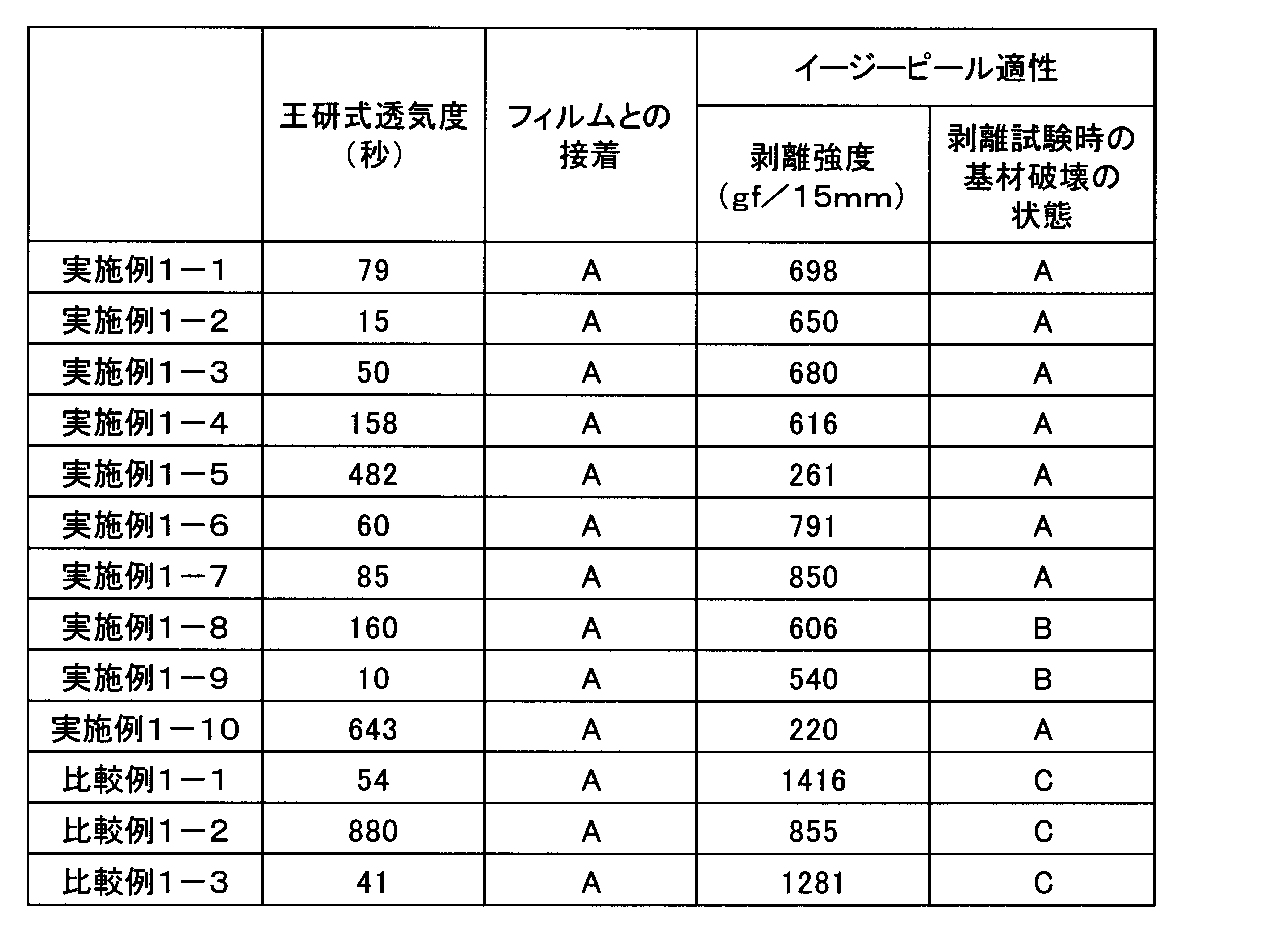
上記結果に示すとおり、実施例1-1~1-10の滅菌紙は、剥離試験での剥離強度が200~1000gf/15mmであり、また、剥離試験時に基材破壊が見られなかった。これらの結果から、イージーピール適性に優れることが確認できた。一方で、比較例1-1~1-3については、剥離試験において、剥離試験時に基材破壊が見られた。また、表2からは、実施例1-1~1-10において、透気性に優れる滅菌紙が得られていることも分かる。とくに、実施例1-1~1-4、1-6~1-9については、非常に優れた透気性を示す滅菌紙が得られた。
<実施例2-1>
[紙基材の製造]
実施例1-1と同様にして原紙を得、下塗り剤(A)を塗布および乾燥せずに、前記原紙を紙基材とした。
[紙基材の製造]
実施例1-1と同様にして原紙を得、下塗り剤(A)を塗布および乾燥せずに、前記原紙を紙基材とした。
[滅菌紙の製造]
ヒートシール剤であるエチレン-酢酸ビニル共重合体エマルション(ケミパールV200、三井化学社製、ガラス転移温度85℃、平均粒子径7μm、最低成膜温度80℃)100質量部を、水によって20%に希釈して塗布液を得た。次いで、上記塗布液を上記で得られた紙基材の一面にバーコーターを用いて塗布し、送風乾燥機にて105℃、1分の条件で乾燥して熱接着層を形成した。ここでは、乾燥後のヒートシール剤の塗布量が10.0g/m2となるように塗布した。これにより、滅菌紙を得た。
ヒートシール剤であるエチレン-酢酸ビニル共重合体エマルション(ケミパールV200、三井化学社製、ガラス転移温度85℃、平均粒子径7μm、最低成膜温度80℃)100質量部を、水によって20%に希釈して塗布液を得た。次いで、上記塗布液を上記で得られた紙基材の一面にバーコーターを用いて塗布し、送風乾燥機にて105℃、1分の条件で乾燥して熱接着層を形成した。ここでは、乾燥後のヒートシール剤の塗布量が10.0g/m2となるように塗布した。これにより、滅菌紙を得た。
得られた滅菌紙の熱接着層を電子顕微鏡により観察したところ、熱接着層が粒状の上記ヒートシール剤を有していることが確認された。また、熱接着層中に粒子径3μm以上30μm以下である粒状の上記ヒートシール剤が存在していることも確認した。また、熱接着層中に含まれる粒状の熱接着性樹脂の平均粒子径D50は、約4μm以上約8μm以下の範囲内であった。なお、図3は、実施例2-1に係る滅菌紙の熱接着層の電子顕微鏡写真である。図3からも、本発明に係る滅菌紙の熱接着層が粒状の熱接着性樹脂を含んでいることが分かる。
なお、平均粒子径D50は、島津製作所社製 SALD2200を用いて測定した。
なお、平均粒子径D50は、島津製作所社製 SALD2200を用いて測定した。
<実施例2-2>
実施例2-1の紙基材の製造において、パルプのフリーネスを250mLとした以外は実施例2-1と同様にして紙基材、滅菌紙を製造した。
実施例2-1の紙基材の製造において、パルプのフリーネスを250mLとした以外は実施例2-1と同様にして紙基材、滅菌紙を製造した。
<実施例2-3>
実施例2-1の紙基材の製造において、紙基材の坪量を40g/m2とした以外は実施例2-1と同様にして紙基材、滅菌紙を製造した。
実施例2-1の紙基材の製造において、紙基材の坪量を40g/m2とした以外は実施例2-1と同様にして紙基材、滅菌紙を製造した。
<実施例2-4>
実施例2-1の紙基材の製造において、紙基材の坪量を150g/m2とした以外は実施例2-1と同様にして紙基材、滅菌紙を製造した。
実施例2-1の紙基材の製造において、紙基材の坪量を150g/m2とした以外は実施例2-1と同様にして紙基材、滅菌紙を製造した。
<実施例2-5>
実施例2-1の滅菌紙の製造において、紙基材の一面におけるヒートシール剤の乾燥後の塗布量が1.0g/m2となるようにした以外は実施例2-1と同様にして紙基材、滅菌紙を製造した。
実施例2-1の滅菌紙の製造において、紙基材の一面におけるヒートシール剤の乾燥後の塗布量が1.0g/m2となるようにした以外は実施例2-1と同様にして紙基材、滅菌紙を製造した。
<実施例2-6>
[紙基材の製造]
実施例2-1と同様にして紙基材を製造した。
[紙基材の製造]
実施例2-1と同様にして紙基材を製造した。
[滅菌紙の製造]
エチレン-酢酸ビニル共重合体エマルション(ケミパールV200、三井化学社製、ガラス転移温度80℃、平均粒子径7μm)80質量部、およびアクリルエマルジョン(ヨドゾールAE-41、ヘンケルジャパン社製、ガラス転移温度5℃、平均粒子径0.6μm)20質量部を混合してヒートシール剤を得た。次いで、ヒートシール剤を上記で得られた紙基材の一面にバーコーターを用いて塗布し、送風乾燥機にて105℃、1分の条件で乾燥して熱接着層を形成した。ここでは、乾燥後のヒートシール剤の塗布量が10.0g/m2となるように塗布した。これにより、滅菌紙を得た。
エチレン-酢酸ビニル共重合体エマルション(ケミパールV200、三井化学社製、ガラス転移温度80℃、平均粒子径7μm)80質量部、およびアクリルエマルジョン(ヨドゾールAE-41、ヘンケルジャパン社製、ガラス転移温度5℃、平均粒子径0.6μm)20質量部を混合してヒートシール剤を得た。次いで、ヒートシール剤を上記で得られた紙基材の一面にバーコーターを用いて塗布し、送風乾燥機にて105℃、1分の条件で乾燥して熱接着層を形成した。ここでは、乾燥後のヒートシール剤の塗布量が10.0g/m2となるように塗布した。これにより、滅菌紙を得た。
<実施例2-7>
実施例2-1の滅菌紙の製造において、塗布液を乾燥後のヒートシール剤の塗布量が5.0g/m2となるように塗布し、シリンダードライヤーで80℃、3分の条件で乾燥して熱接着層を形成した。上記点以外は、実施例2-1と同様にして紙基材、滅菌紙を製造した。
実施例2-1の滅菌紙の製造において、塗布液を乾燥後のヒートシール剤の塗布量が5.0g/m2となるように塗布し、シリンダードライヤーで80℃、3分の条件で乾燥して熱接着層を形成した。上記点以外は、実施例2-1と同様にして紙基材、滅菌紙を製造した。
<実施例2-8>
実施例2-7の滅菌紙の製造において、ヒートシール剤であるエチレン-酢酸ビニル共重合体エマルション(ケミパールV200、三井化学社製、ガラス転移温度85℃、平均粒子径7μm)100質量部、およびカルボキシメチルセルロース(セロゲンAGガム、第一工業製薬社製)3%水溶液40質量部を混合して塗布液を得た。そして、この塗布液を得られた紙基材の一面に、乾燥後のヒートシール剤の塗布量が3.6g/m2となるように塗布した。上記点以外は、実施例2-7と同様にして紙基材、滅菌紙を製造した。
実施例2-7の滅菌紙の製造において、ヒートシール剤であるエチレン-酢酸ビニル共重合体エマルション(ケミパールV200、三井化学社製、ガラス転移温度85℃、平均粒子径7μm)100質量部、およびカルボキシメチルセルロース(セロゲンAGガム、第一工業製薬社製)3%水溶液40質量部を混合して塗布液を得た。そして、この塗布液を得られた紙基材の一面に、乾燥後のヒートシール剤の塗布量が3.6g/m2となるように塗布した。上記点以外は、実施例2-7と同様にして紙基材、滅菌紙を製造した。
実施例2-2~2-8について、得られた滅菌紙の熱接着層を電子顕微鏡により観察したところ、熱接着層が粒状のヒートシール剤を有していることが確認された。また、熱接着層中に粒子径3μm以上である粒状のヒートシール剤が存在していることも確認した。また、熱接着層中に含まれる粒状の熱接着性樹脂の平均粒子径D50は、約4μm以上約8μm以下の範囲内であった。
<比較例2-1>
[紙基材の製造]
実施例2-1と同様にして紙基材を製造した。
[紙基材の製造]
実施例2-1と同様にして紙基材を製造した。
[滅菌紙の製造]
エチレン-酢酸ビニル共重合体エマルション(商品名:EA-H700、東洋インキ社製、粒径0.8μm以下)50質量部、およびアクリルエマルジョン(商品名:ヨドゾールAE-41、ヘンケルジャパン社製、粒径0.6μm以下)50質量部を混合して得たヒートシール剤を、水で20%に希釈して塗布液を調製した。次いで、塗布液を上記で得られた紙基材の一面にバーコーターを用いて塗布し、送風乾燥機にて105℃、1分の条件で乾燥して熱接着層を形成した。ここでは、乾燥後のヒートシール剤の塗布量が10.0g/m2となるように塗布した。これにより、滅菌紙を得た。
エチレン-酢酸ビニル共重合体エマルション(商品名:EA-H700、東洋インキ社製、粒径0.8μm以下)50質量部、およびアクリルエマルジョン(商品名:ヨドゾールAE-41、ヘンケルジャパン社製、粒径0.6μm以下)50質量部を混合して得たヒートシール剤を、水で20%に希釈して塗布液を調製した。次いで、塗布液を上記で得られた紙基材の一面にバーコーターを用いて塗布し、送風乾燥機にて105℃、1分の条件で乾燥して熱接着層を形成した。ここでは、乾燥後のヒートシール剤の塗布量が10.0g/m2となるように塗布した。これにより、滅菌紙を得た。
<比較例2-2>
[紙基材の製造]
実施例2-1と同様にして紙基材を製造した。
[紙基材の製造]
実施例2-1と同様にして紙基材を製造した。
アイオノマー系ヒートシール剤(商品名:ケミパールS200、三井化学社製、平均粒径0.5μm、ガラス転移温度55℃)を、水で20%に希釈して塗布液を調製した。次いで、塗布液を上記で得られた紙基材の一面にバーコーターを用いて塗布し、送風乾燥機にて105℃、1分の条件で乾燥して熱接着層を形成した。ここでは、乾燥後のヒートシール剤の塗布量が10.0g/m2となるように塗布した。これにより、滅菌紙を得た。
比較例2-1および2-2で得られた滅菌紙の熱接着層を電子顕微鏡により観察したところ、熱接着層は粒状のヒートシール剤を有していなかった。
<評価>
各例で得た滅菌紙について以下の評価を行い、結果を表3に示した。
各例で得た滅菌紙について以下の評価を行い、結果を表3に示した。
[王研式透気度の測定]
各実施例および各比較例について、得られた滅菌紙の王研式透気度を、JIS P 8117:2009に準じて測定した。
各実施例および各比較例について、得られた滅菌紙の王研式透気度を、JIS P 8117:2009に準じて測定した。
[剥離試験]
各実施例および各比較例について、得られた滅菌紙と、ポリエチレンテレフタレート(PET)樹脂とポリエチレン(PE)樹脂の複合フィルムとを、滅菌紙の熱接着層側の面がポリエチレン樹脂側と接するように重ねて、熱プレス試験機を用いて、150℃、3.0kgf/cm2、1.1秒間の熱圧着条件で熱圧着物を作成した。
各実施例および各比較例について、得られた滅菌紙と、ポリエチレンテレフタレート(PET)樹脂とポリエチレン(PE)樹脂の複合フィルムとを、滅菌紙の熱接着層側の面がポリエチレン樹脂側と接するように重ねて、熱プレス試験機を用いて、150℃、3.0kgf/cm2、1.1秒間の熱圧着条件で熱圧着物を作成した。
上記の方法で作成した熱圧着物を幅15mmに断裁して、剥離強度測定用サンプルを作成した。得られた剥離強度測定用サンプルの剥離強度(gf/15mm)を、JIS P 8113:2006に準じ、引張試験機(型式:テンシロンRTC-1250A、オリエンテック社製)を用いて、サンプルのPETとPE複合フィルム、滅菌紙それぞれの端部をチャッキングして180度ピール法で剥離速度300mm/分で剥離することにより測定した。
また、剥離強度の測定の際、滅菌紙の基材破壊の状態を目視で確認し、以下の基準で評価した。
A:基材破壊が起こらなかった。
B:滅菌紙を剥離できたが、PET/PEフィルムに紙片やケバの付着が見られた。
C:基材破壊が発生した。
A:基材破壊が起こらなかった。
B:滅菌紙を剥離できたが、PET/PEフィルムに紙片やケバの付着が見られた。
C:基材破壊が発生した。
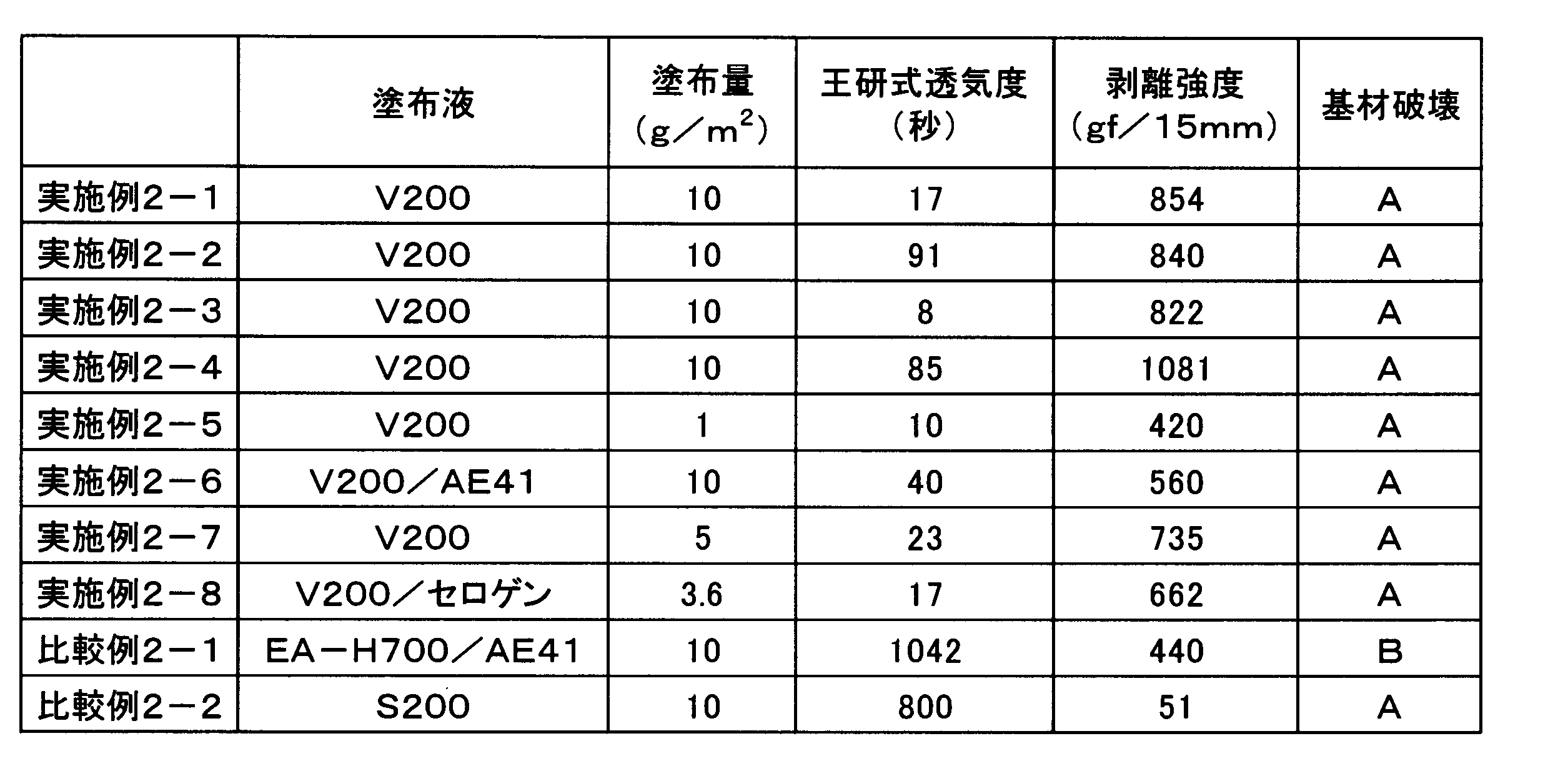
上記結果に示すとおり、実施例2-1~2-8の滅菌紙は、透気度が700秒以下と低く、ガス滅菌法や高圧蒸気滅菌法等の滅菌紙への透気性が求められる滅菌法にも好適に用いることができるものであった。また、実施例2-1~2-8の滅菌紙は、剥離試験での剥離強度が200~1500gf/15mmであり、かつ剥離試験での基材破壊の状態の評価結果がAであった。これらの結果から、基材破壊を抑制しつつ、各種の滅菌法に適用可能な滅菌紙が得られていることが分かる。また、各実施例においては、イージーピール適性に優れた滅菌紙が得られていることも確認できた。
一方で、比較例2-1および2-2については、透気度が700秒超過であった。また、比較例2-1については、基材破壊の状態の評価結果がBであった。
一方で、比較例2-1および2-2については、透気度が700秒超過であった。また、比較例2-1については、基材破壊の状態の評価結果がBであった。
<実施例3-1>
[紙基材の製造]
DDRにて、JIS P 8121-2:2012に記載されるカナダ標準ろ水度(フリーネス)が300mLとなるように叩解した広葉樹晒クラフトパルプ(LBKP)と、カナダ標準ろ水度が400mLとなるように叩解した針葉樹晒クラフトパルプ(NBKP)を混合してパルプスラリーを得た。パルプスラリー中において、繊維材料全体に対する含有量は、LBKPが50質量%であり、NBKPが50質量%であった。次いで、該パルプスラリーに内添薬品として、パルプ質量に対し、絶乾で硫酸バンド0.2%、あらかじめカチオン化澱粉(ピラー3YK、ピラースターチ社製)で分散させたアルケニルコハク酸サイズ剤(ファイブラン81K、荒川化学工業社製)0.05%、両性ポリアクリルアミド系樹脂紙力増強剤(PAM)(商品名:ポリストロンOFT‐3 荒川化学工業社製、質量平均分子量300万)0.5%、ポリアミドポリアミン-エピクロルヒドリン樹脂湿潤紙力増強剤(商品名:WS4024)0.5%、を添加して抄紙原料を得た。次いで、該抄紙原料を長網抄紙機で抄紙して原紙を得た。これにより、坪量100g/m2、密度0.85g/cm3の紙基材を得た。
[紙基材の製造]
DDRにて、JIS P 8121-2:2012に記載されるカナダ標準ろ水度(フリーネス)が300mLとなるように叩解した広葉樹晒クラフトパルプ(LBKP)と、カナダ標準ろ水度が400mLとなるように叩解した針葉樹晒クラフトパルプ(NBKP)を混合してパルプスラリーを得た。パルプスラリー中において、繊維材料全体に対する含有量は、LBKPが50質量%であり、NBKPが50質量%であった。次いで、該パルプスラリーに内添薬品として、パルプ質量に対し、絶乾で硫酸バンド0.2%、あらかじめカチオン化澱粉(ピラー3YK、ピラースターチ社製)で分散させたアルケニルコハク酸サイズ剤(ファイブラン81K、荒川化学工業社製)0.05%、両性ポリアクリルアミド系樹脂紙力増強剤(PAM)(商品名:ポリストロンOFT‐3 荒川化学工業社製、質量平均分子量300万)0.5%、ポリアミドポリアミン-エピクロルヒドリン樹脂湿潤紙力増強剤(商品名:WS4024)0.5%、を添加して抄紙原料を得た。次いで、該抄紙原料を長網抄紙機で抄紙して原紙を得た。これにより、坪量100g/m2、密度0.85g/cm3の紙基材を得た。
[滅菌紙の製造]
乾燥後のヒートシール剤の塗布量が3~5g/m2となるようにヒートシール剤を塗布した以外は、実施例2-1と同様にして、滅菌紙を得た。
乾燥後のヒートシール剤の塗布量が3~5g/m2となるようにヒートシール剤を塗布した以外は、実施例2-1と同様にして、滅菌紙を得た。
<実施例3-2>
実施例3-1の紙基材の製造において、繊維材料全体に対して、LBKPの含有量が95質量%となり、NBKPの含有量が5質量%となるようにパルプスラリーを得た。上記点以外は、実施例3-1と同様にして紙基材、滅菌紙を製造した。
実施例3-1の紙基材の製造において、繊維材料全体に対して、LBKPの含有量が95質量%となり、NBKPの含有量が5質量%となるようにパルプスラリーを得た。上記点以外は、実施例3-1と同様にして紙基材、滅菌紙を製造した。
<実施例3-3>
実施例3-1の紙基材の製造において、紙基材の坪量を120g/m2とした以外は実施例3-1と同様にして紙基材、滅菌紙を製造した。
実施例3-1の紙基材の製造において、紙基材の坪量を120g/m2とした以外は実施例3-1と同様にして紙基材、滅菌紙を製造した。
<実施例3-4>
実施例3-1の紙基材の製造において、パルプ質量に対するポリアミドポリアミン-エピクロルヒドリン樹脂湿潤紙力増強剤の添加量を0.1%とした以外は、実施例3-1と同様にして紙基材、滅菌紙を製造した。
実施例3-1の紙基材の製造において、パルプ質量に対するポリアミドポリアミン-エピクロルヒドリン樹脂湿潤紙力増強剤の添加量を0.1%とした以外は、実施例3-1と同様にして紙基材、滅菌紙を製造した。
<実施例3-5>
実施例3-2の紙基材の製造において、抄紙機に付設されたゲートロールコーターにて、下記の下塗り剤(A)を、乾燥後の塗布量が片面0.5g/m2となるように紙基材の片面に塗布した以外は実施例3-2と同様にして紙基材、滅菌紙を製造した。
下塗り剤(A):アニオン性ポリアクリルアミド樹脂(質量平均分子量20万)の水溶液(荒川化学工業社製のポリマセット(登録商標)512を水で希釈してアニオン性ポリアクリルアミド樹脂濃度9質量%に調整したもの)。
実施例3-2の紙基材の製造において、抄紙機に付設されたゲートロールコーターにて、下記の下塗り剤(A)を、乾燥後の塗布量が片面0.5g/m2となるように紙基材の片面に塗布した以外は実施例3-2と同様にして紙基材、滅菌紙を製造した。
下塗り剤(A):アニオン性ポリアクリルアミド樹脂(質量平均分子量20万)の水溶液(荒川化学工業社製のポリマセット(登録商標)512を水で希釈してアニオン性ポリアクリルアミド樹脂濃度9質量%に調整したもの)。
<比較例3-1>
実施例3-1の紙基材の製造において、繊維材料全体に対して、LBKPの含有量が100質量%となり、NBKPの含有量が0質量%となるようにパルプスラリーを得た。上記点以外は、実施例3-1と同様にして紙基材、滅菌紙を製造した。
実施例3-1の紙基材の製造において、繊維材料全体に対して、LBKPの含有量が100質量%となり、NBKPの含有量が0質量%となるようにパルプスラリーを得た。上記点以外は、実施例3-1と同様にして紙基材、滅菌紙を製造した。
<比較例3-2>
実施例3-1の紙基材の製造において、紙基材の坪量を90g/m2とした以外は実施例3-1と同様にして紙基材、滅菌紙を製造した。
実施例3-1の紙基材の製造において、紙基材の坪量を90g/m2とした以外は実施例3-1と同様にして紙基材、滅菌紙を製造した。
<評価>
各例で得た滅菌紙について以下の評価を行い、結果を表4に示した。なお、表4において、LBKP、NBKPについては繊維材料全体に対する含有量(%)を、湿潤紙力剤についてはパルプ質量に対する添加量(%)を、それぞれ示している。
各例で得た滅菌紙について以下の評価を行い、結果を表4に示した。なお、表4において、LBKP、NBKPについては繊維材料全体に対する含有量(%)を、湿潤紙力剤についてはパルプ質量に対する添加量(%)を、それぞれ示している。
[引裂強度の測定]
得られた滅菌紙のMD方向およびCD方向それぞれにおける引裂強度を、JIS P 8116に準じて測定した。
得られた滅菌紙のMD方向およびCD方向それぞれにおける引裂強度を、JIS P 8116に準じて測定した。
[剥離強度]
得られた滅菌紙と、ポリプロピレンからなるフィルムとを、滅菌紙の熱接着層側の面がフィルムと接するように重ねて、熱プレス試験機を用いて190℃、4.0kgf/cm2、0.9秒間の熱圧着条件で熱圧着物を作成した。次いで、当該熱圧着物を幅15mmに断裁して測定用サンプルを得た。次いで、得られた測定用サンプルの剥離強度(gf/15mm)を、JIS P 8113:2006に準じ、引張試験機(型式:テンシロンRTC-1250A、オリエンテック社製)を用いて、サンプルのポリプロピレン製フィルム、滅菌紙それぞれの端部をチャッキングして180度ピール法で剥離速度300mm/分で剥離することにより測定した。なお、滅菌紙に破れが生じたものについては、表4中において「F」と記した。
得られた滅菌紙と、ポリプロピレンからなるフィルムとを、滅菌紙の熱接着層側の面がフィルムと接するように重ねて、熱プレス試験機を用いて190℃、4.0kgf/cm2、0.9秒間の熱圧着条件で熱圧着物を作成した。次いで、当該熱圧着物を幅15mmに断裁して測定用サンプルを得た。次いで、得られた測定用サンプルの剥離強度(gf/15mm)を、JIS P 8113:2006に準じ、引張試験機(型式:テンシロンRTC-1250A、オリエンテック社製)を用いて、サンプルのポリプロピレン製フィルム、滅菌紙それぞれの端部をチャッキングして180度ピール法で剥離速度300mm/分で剥離することにより測定した。なお、滅菌紙に破れが生じたものについては、表4中において「F」と記した。
[冷却後の剥離信頼性]
ポリプロピレンからなるブリスターパック用成形容器を準備した。当該成形容器は、医療器具を収容するための凹部と、凹部の縁に設けられた4mm幅の接着面と、を有していた。次いで、得られた滅菌紙と、成形容器とを、滅菌紙の熱接着層側の面が成形容器の接着面と接するように配置し、熱プレス試験機を用いて190℃、4.0kgf/cm2、0.9秒間の熱圧着条件で熱圧着して、ブリスターパック(滅菌包装体)を作製した。
次いで、ブリスターパックを5℃の冷却環境下に一日放置した。次いで、冷却環境下からブリスターパックを取り出した直後に、滅菌紙を指で挟み勢いよく180°ピール剥離した。剥離後の滅菌紙を目視で観察し、以下の基準で評価を行った。
A:滅菌紙に破れがなく、かつ成形容器に紙残りがなかった
B:滅菌紙に上下面を貫通する破れはないが、成形容器に僅かな繊維状のケバが生じた
C:滅菌紙に上下面を貫通する破れが生じた
ポリプロピレンからなるブリスターパック用成形容器を準備した。当該成形容器は、医療器具を収容するための凹部と、凹部の縁に設けられた4mm幅の接着面と、を有していた。次いで、得られた滅菌紙と、成形容器とを、滅菌紙の熱接着層側の面が成形容器の接着面と接するように配置し、熱プレス試験機を用いて190℃、4.0kgf/cm2、0.9秒間の熱圧着条件で熱圧着して、ブリスターパック(滅菌包装体)を作製した。
次いで、ブリスターパックを5℃の冷却環境下に一日放置した。次いで、冷却環境下からブリスターパックを取り出した直後に、滅菌紙を指で挟み勢いよく180°ピール剥離した。剥離後の滅菌紙を目視で観察し、以下の基準で評価を行った。
A:滅菌紙に破れがなく、かつ成形容器に紙残りがなかった
B:滅菌紙に上下面を貫通する破れはないが、成形容器に僅かな繊維状のケバが生じた
C:滅菌紙に上下面を貫通する破れが生じた

上記結果に示すとおり、実施例3-1~3-5の滅菌紙は、比較例3-1および3-2と比較して、冷却後の破れ試験において優れた結果が得られた。このように、本発明によれば、冷却後にイージーピールした際の信頼性に優れた滅菌紙が得られることが分かる。
11 21 31 滅菌紙
12 22 32 紙基材
13 23 33 熱接着層
35 成形容器
37 収容部
39 接着面
100 滅菌包装体
12 22 32 紙基材
13 23 33 熱接着層
35 成形容器
37 収容部
39 接着面
100 滅菌包装体
Claims (23)
- 紙基材と、前記紙基材の一方の面に積層された熱接着層とを備え、
前記紙基材は、少なくとも前記一方の面においてポリアクリルアミド樹脂を含み、かつ前記ポリアクリルアミド樹脂の濃度が前記一方の面において中心面よりも大きい滅菌紙。 - 前記紙基材は、坪量が30g/m2以上である請求項1に記載の滅菌紙。
- 前記熱接着層は、エチレン-(メタ)アクリル酸共重合体、エチレン-酢酸ビニル共重合体、アクリル酸エステル重合体、ポリエチレン、およびポリブテンから選択される一種または二種以上を含む請求項1または2に記載の滅菌紙。
- 前記紙基材は、JIS P 8121-2:2012に準じて測定されるフリーネスが250mL以上700mL以下であるパルプを含む請求項1~3のいずれか一項に記載の滅菌紙。
- 前記紙基材は、質量平均分子量5万~50万のポリアクリルアミド樹脂を含む請求項1~4のいずれか一項に記載の滅菌紙。
- 前記紙基材は、質量平均分子量200万~1000万のポリアクリルアミド樹脂をさらに含む請求項5に記載の滅菌紙。
- 紙基材と、前記紙基材の一方の面に積層された熱接着層とを備え、
前記紙基材は、少なくとも前記一方の面においてポリアクリルアミド樹脂を含み、かつ前記紙基材中における前記ポリアクリルアミド樹脂の含有量が、前記紙基材の質量に対して1.0~30質量%である滅菌紙。 - 紙基材と、前記紙基材の一方の面に積層された熱接着層とを備え、
前記熱接着層は、粒状の熱接着性樹脂を含み、
JIS P 8117:2009に準じて測定される王研式透気度が700秒以下である滅菌紙。 - 前記熱接着性樹脂のガラス転移点が70℃以上である請求項8に記載の滅菌紙。
- 前記熱接着層は、粒子径3μm以上の熱接着性樹脂を含む請求項8または9に記載の滅菌紙。
- 前記熱接着性樹脂は、エチレン-(メタ)アクリル酸共重合体、エチレン-酢酸ビニル共重合体、アクリル酸エステル重合体、ポリエチレン、およびポリブテンから選択される一種または二種以上を含む請求項8~10のいずれか一項に記載の滅菌紙。
- 前記紙基材は、ポリアクリルアミド樹脂を含む請求項8~11のいずれか一項に記載の滅菌紙。
- 前記紙基材は、JIS P 8121-2:2012に準じて測定されるフリーネスが250mL以上700mL以下であるパルプを含む請求項8~12のいずれか一項に記載の滅菌紙。
- 広葉樹パルプと、針葉樹パルプとを含む繊維材料により構成される紙基材と、前記紙基材に積層された熱接着層とを備え、
前記繊維材料全体に対する前記針葉樹パルプの含有量が、前記繊維材料全体の質量に対して5~50質量%であり、
前記紙基材の坪量が100g/m2以上である滅菌紙。 - JIS P 8116により測定される引裂強度が700mN以上である請求項14に記載の滅菌紙。
- 前記紙基材は、湿潤紙力増強剤を含み、
前記紙基材全体における前記湿潤紙力増強剤の含有量が、前記紙基材の質量に対して0.1質量%以上である請求項14または15に記載の滅菌紙。 - 前記紙基材は、少なくとも前記熱接着層側の面において、ポリアクリルアミド樹脂を含む下塗り剤を有し、前記熱接着層側の面における前記下塗り剤の量が、前記紙基材の前記熱接着層側の面の単位面積当たり、0.05~15g/m2である請求項14~16のいずれか一項に記載の滅菌紙。
- 前記熱接着層は、平均粒子径D50が3~15μmである粒状熱接着性樹脂を含む請求項14~17のいずれか一項に記載の滅菌紙。
- 請求項1~18のいずれか一項に記載の滅菌紙と、前記滅菌紙に接着された包装紙、フィルムまたは滅菌用成形容器とを備える滅菌包装体。
- 前記滅菌包装体から、前記包装紙、前記フィルムまたは前記滅菌用成形容器をJIS P 8113:2006に準じて剥離速度300m/分で180°剥離する際の剥離強度が200~1500gf/15mmである請求項19に記載の滅菌包装体。
- 前記滅菌包装体から、前記包装紙、前記フィルムまたは前記滅菌用成形容器をJIS P 8113:2006に準じて剥離速度300m/分で180°剥離する際の剥離強度が200~1000gf/15mmである請求項20に記載の滅菌包装体。
- 前記包装紙、フィルムまたは滅菌用成形容器は、ポリプロピレンにより形成される滅菌用成形容器である請求項19に記載の滅菌包装体。
- 前記滅菌包装体から、前記滅菌用成形容器をJIS P 8113:2006に準じて剥離速度300m/分で180°剥離する際の剥離強度が500gf/15mm以上である請求項22に記載の滅菌包装体。
Applications Claiming Priority (6)
| Application Number | Priority Date | Filing Date | Title |
|---|---|---|---|
| JP2015-093633 | 2015-04-30 | ||
| JP2015093633A JP6477212B2 (ja) | 2015-04-30 | 2015-04-30 | 滅菌紙および滅菌包装体、ならびに滅菌紙の製造方法 |
| JP2015-138140 | 2015-07-09 | ||
| JP2015138140A JP6524828B2 (ja) | 2015-07-09 | 2015-07-09 | 滅菌紙および滅菌包装体 |
| JP2015161415A JP2017040015A (ja) | 2015-08-18 | 2015-08-18 | 滅菌紙および滅菌包装体 |
| JP2015-161415 | 2015-08-18 |
Publications (1)
| Publication Number | Publication Date |
|---|---|
| WO2016175299A1 true WO2016175299A1 (ja) | 2016-11-03 |
Family
ID=57198491
Family Applications (1)
| Application Number | Title | Priority Date | Filing Date |
|---|---|---|---|
| PCT/JP2016/063405 Ceased WO2016175299A1 (ja) | 2015-04-30 | 2016-04-28 | 滅菌紙および滅菌包装体 |
Country Status (2)
| Country | Link |
|---|---|
| TW (1) | TW201700833A (ja) |
| WO (1) | WO2016175299A1 (ja) |
Cited By (4)
| Publication number | Priority date | Publication date | Assignee | Title |
|---|---|---|---|---|
| WO2019086761A1 (en) * | 2017-11-01 | 2019-05-09 | Kemira Oyj | A polymer product for improving retention of hydrophobic internal sizing agents in manufacture of paper or board |
| JP2019115978A (ja) * | 2017-12-26 | 2019-07-18 | 王子ホールディングス株式会社 | ヒートシールシートおよびその製造方法 |
| CN116837663A (zh) * | 2023-07-07 | 2023-10-03 | 浙江恒川新材料有限公司 | 一种直封型环氧乙烷灭菌纸 |
| JP2023181253A (ja) * | 2020-12-10 | 2023-12-21 | 北越コーポレーション株式会社 | 包装用紙の製造方法 |
Families Citing this family (1)
| Publication number | Priority date | Publication date | Assignee | Title |
|---|---|---|---|---|
| CN111289422B (zh) * | 2020-04-07 | 2021-09-14 | 山东仁丰特种材料股份有限公司 | 一种滤纸透气度的预测方法 |
Citations (5)
| Publication number | Priority date | Publication date | Assignee | Title |
|---|---|---|---|---|
| JPH09290808A (ja) * | 1996-04-25 | 1997-11-11 | Tomoegawa Paper Co Ltd | 滅菌袋用紙 |
| JP2003171895A (ja) * | 2001-12-07 | 2003-06-20 | Tokushu Paper Mfg Co Ltd | 額装用マットボード原紙とそれを用いた額装用マットボード及びその製造方法 |
| JP2006223351A (ja) * | 2005-02-15 | 2006-08-31 | Oji Paper Co Ltd | 滅菌紙及び滅菌袋 |
| JP2007197858A (ja) * | 2006-01-25 | 2007-08-09 | Kohjin Co Ltd | 滅菌紙 |
| JP2011094279A (ja) * | 2009-10-02 | 2011-05-12 | Kohjin Co Ltd | 滅菌紙 |
-
2016
- 2016-04-28 TW TW105113330A patent/TW201700833A/zh unknown
- 2016-04-28 WO PCT/JP2016/063405 patent/WO2016175299A1/ja not_active Ceased
Patent Citations (5)
| Publication number | Priority date | Publication date | Assignee | Title |
|---|---|---|---|---|
| JPH09290808A (ja) * | 1996-04-25 | 1997-11-11 | Tomoegawa Paper Co Ltd | 滅菌袋用紙 |
| JP2003171895A (ja) * | 2001-12-07 | 2003-06-20 | Tokushu Paper Mfg Co Ltd | 額装用マットボード原紙とそれを用いた額装用マットボード及びその製造方法 |
| JP2006223351A (ja) * | 2005-02-15 | 2006-08-31 | Oji Paper Co Ltd | 滅菌紙及び滅菌袋 |
| JP2007197858A (ja) * | 2006-01-25 | 2007-08-09 | Kohjin Co Ltd | 滅菌紙 |
| JP2011094279A (ja) * | 2009-10-02 | 2011-05-12 | Kohjin Co Ltd | 滅菌紙 |
Cited By (8)
| Publication number | Priority date | Publication date | Assignee | Title |
|---|---|---|---|---|
| WO2019086761A1 (en) * | 2017-11-01 | 2019-05-09 | Kemira Oyj | A polymer product for improving retention of hydrophobic internal sizing agents in manufacture of paper or board |
| CN111433408A (zh) * | 2017-11-01 | 2020-07-17 | 凯米拉公司 | 用于改善纸或板的生产中疏水性浆内施胶剂的保留的聚合物产品 |
| US11339539B2 (en) | 2017-11-01 | 2022-05-24 | Kemira Oyj | Polymer product for improving retention of hydrophobic internal sizing agents in manufacture of paper or board |
| JP2019115978A (ja) * | 2017-12-26 | 2019-07-18 | 王子ホールディングス株式会社 | ヒートシールシートおよびその製造方法 |
| JP6996286B2 (ja) | 2017-12-26 | 2022-01-17 | 王子ホールディングス株式会社 | ヒートシールシート |
| JP2023181253A (ja) * | 2020-12-10 | 2023-12-21 | 北越コーポレーション株式会社 | 包装用紙の製造方法 |
| JP7648706B2 (ja) | 2020-12-10 | 2025-03-18 | 北越コーポレーション株式会社 | 包装用紙の製造方法 |
| CN116837663A (zh) * | 2023-07-07 | 2023-10-03 | 浙江恒川新材料有限公司 | 一种直封型环氧乙烷灭菌纸 |
Also Published As
| Publication number | Publication date |
|---|---|
| TW201700833A (zh) | 2017-01-01 |
Similar Documents
| Publication | Publication Date | Title |
|---|---|---|
| JP7143859B2 (ja) | ヒートシールシート、その製造方法及び滅菌包装体 | |
| JP2017040015A (ja) | 滅菌紙および滅菌包装体 | |
| JP6477212B2 (ja) | 滅菌紙および滅菌包装体、ならびに滅菌紙の製造方法 | |
| JP6996286B2 (ja) | ヒートシールシート | |
| TW201700833A (zh) | 滅菌紙及滅菌包裝體 | |
| JP6524828B2 (ja) | 滅菌紙および滅菌包装体 | |
| EP1325191B1 (en) | Saturating composition and its use | |
| JP2017124564A (ja) | ヒートシールシートおよびプレススルー包装体 | |
| JP6500772B2 (ja) | ヒートシールシート、その製造方法およびプレススルー包装体 | |
| JP6610347B2 (ja) | ヒートシールシートおよびプレススルー包装体 | |
| JP6676413B2 (ja) | 薬剤用プレススルー包装体 | |
| JP2008125760A (ja) | 滅菌バッグ | |
| JP2018024465A (ja) | プレススルー包装体 | |
| JP7380519B2 (ja) | ヒートシールシート、および滅菌包装体 | |
| JP2004293004A (ja) | 滅菌紙及び滅菌容器 | |
| JP2024153139A (ja) | ヒートシールシート、および滅菌包装体 | |
| WO2024075655A1 (ja) | ヒートシールシートおよび滅菌包装体 | |
| JP2011094279A (ja) | 滅菌紙 | |
| JP3965095B2 (ja) | 滅菌袋用紙およびその製造方法 | |
| JP6879092B2 (ja) | 滅菌紙、および、滅菌包装体 | |
| JP2024153140A (ja) | 滅菌紙、および滅菌包装体 | |
| JP2025080524A (ja) | ヒートシールシート、および、滅菌包装体 | |
| JP2025082199A (ja) | ヒートシールシート、滅菌紙、および、滅菌包装体 | |
| JP2025082204A (ja) | ヒートシールシート、滅菌紙、および、滅菌包装体、並びにヒートシールシートの製造方法 | |
| JP2010196188A (ja) | 滅菌紙 |
Legal Events
| Date | Code | Title | Description |
|---|---|---|---|
| 121 | Ep: the epo has been informed by wipo that ep was designated in this application |
Ref document number: 16786575 Country of ref document: EP Kind code of ref document: A1 |
|
| NENP | Non-entry into the national phase |
Ref country code: DE |
|
| 122 | Ep: pct application non-entry in european phase |
Ref document number: 16786575 Country of ref document: EP Kind code of ref document: A1 |