WO2016163179A1 - 変形検出センサおよびその製造方法 - Google Patents
変形検出センサおよびその製造方法 Download PDFInfo
- Publication number
- WO2016163179A1 WO2016163179A1 PCT/JP2016/056485 JP2016056485W WO2016163179A1 WO 2016163179 A1 WO2016163179 A1 WO 2016163179A1 JP 2016056485 W JP2016056485 W JP 2016056485W WO 2016163179 A1 WO2016163179 A1 WO 2016163179A1
- Authority
- WO
- WIPO (PCT)
- Prior art keywords
- magnetic
- resin
- detection sensor
- deformation detection
- cushion pad
- Prior art date
- Legal status (The legal status is an assumption and is not a legal conclusion. Google has not performed a legal analysis and makes no representation as to the accuracy of the status listed.)
- Ceased
Links
Images

Classifications
-
- G—PHYSICS
- G01—MEASURING; TESTING
- G01L—MEASURING FORCE, STRESS, TORQUE, WORK, MECHANICAL POWER, MECHANICAL EFFICIENCY, OR FLUID PRESSURE
- G01L1/00—Measuring force or stress, in general
- G01L1/12—Measuring force or stress, in general by measuring variations in the magnetic properties of materials resulting from the application of stress
- G01L1/122—Measuring force or stress, in general by measuring variations in the magnetic properties of materials resulting from the application of stress by using permanent magnets
-
- B—PERFORMING OPERATIONS; TRANSPORTING
- B60—VEHICLES IN GENERAL
- B60N—SEATS SPECIALLY ADAPTED FOR VEHICLES; VEHICLE PASSENGER ACCOMMODATION NOT OTHERWISE PROVIDED FOR
- B60N2/00—Seats specially adapted for vehicles; Arrangement or mounting of seats in vehicles
- B60N2/002—Seats provided with an occupancy detection means mounted therein or thereon
- B60N2/0021—Seats provided with an occupancy detection means mounted therein or thereon characterised by the type of sensor or measurement
- B60N2/003—Seats provided with an occupancy detection means mounted therein or thereon characterised by the type of sensor or measurement characterised by the sensor mounting location in or on the seat
- B60N2/0031—Seats provided with an occupancy detection means mounted therein or thereon characterised by the type of sensor or measurement characterised by the sensor mounting location in or on the seat mounted on the frame
-
- B—PERFORMING OPERATIONS; TRANSPORTING
- B60—VEHICLES IN GENERAL
- B60N—SEATS SPECIALLY ADAPTED FOR VEHICLES; VEHICLE PASSENGER ACCOMMODATION NOT OTHERWISE PROVIDED FOR
- B60N2/00—Seats specially adapted for vehicles; Arrangement or mounting of seats in vehicles
- B60N2/70—Upholstery springs ; Upholstery
- B60N2/7017—Upholstery springs ; Upholstery characterised by the manufacturing process; manufacturing upholstery or upholstery springs not otherwise provided for
-
- B—PERFORMING OPERATIONS; TRANSPORTING
- B60—VEHICLES IN GENERAL
- B60R—VEHICLES, VEHICLE FITTINGS, OR VEHICLE PARTS, NOT OTHERWISE PROVIDED FOR
- B60R21/00—Arrangements or fittings on vehicles for protecting or preventing injuries to occupants or pedestrians in case of accidents or other traffic risks
- B60R21/01—Electrical circuits for triggering passive safety arrangements, e.g. airbags, safety belt tighteners, in case of vehicle accidents or impending vehicle accidents
- B60R21/015—Electrical circuits for triggering passive safety arrangements, e.g. airbags, safety belt tighteners, in case of vehicle accidents or impending vehicle accidents including means for detecting the presence or position of passengers, passenger seats or child seats, and the related safety parameters therefor, e.g. speed or timing of airbag inflation in relation to occupant position or seat belt use
- B60R21/01512—Passenger detection systems
- B60R21/01516—Passenger detection systems using force or pressure sensing means
-
- G—PHYSICS
- G01—MEASURING; TESTING
- G01L—MEASURING FORCE, STRESS, TORQUE, WORK, MECHANICAL POWER, MECHANICAL EFFICIENCY, OR FLUID PRESSURE
- G01L5/00—Apparatus for, or methods of, measuring force, work, mechanical power, or torque, specially adapted for specific purposes
- G01L5/22—Apparatus for, or methods of, measuring force, work, mechanical power, or torque, specially adapted for specific purposes for measuring the force applied to control members, e.g. control members of vehicles, triggers
- G01L5/226—Apparatus for, or methods of, measuring force, work, mechanical power, or torque, specially adapted for specific purposes for measuring the force applied to control members, e.g. control members of vehicles, triggers to manipulators, e.g. the force due to gripping
- G01L5/228—Apparatus for, or methods of, measuring force, work, mechanical power, or torque, specially adapted for specific purposes for measuring the force applied to control members, e.g. control members of vehicles, triggers to manipulators, e.g. the force due to gripping using tactile array force sensors
-
- B—PERFORMING OPERATIONS; TRANSPORTING
- B60—VEHICLES IN GENERAL
- B60N—SEATS SPECIALLY ADAPTED FOR VEHICLES; VEHICLE PASSENGER ACCOMMODATION NOT OTHERWISE PROVIDED FOR
- B60N2210/00—Sensor types, e.g. for passenger detection systems or for controlling seats
- B60N2210/10—Field detection presence sensors
- B60N2210/16—Electromagnetic waves
Definitions
- the present invention relates to a deformation detection sensor, in particular, a deformation detection sensor suitable for detecting whether a person is seated in a car seat, and a method for manufacturing the same.
- an alarm system that detects whether a person is seated in a seat and wears a seat belt and issues a warning when the user is not wearing a seat belt has been put into practical use.
- This system usually detects a person's seating and issues a warning when the seat belt is not seated.
- This device combines a seating sensor that detects whether a person is seated and a device that detects that the seat belt is fixed to the buckle, so that the seat belt is not fixed to the buckle even if a person is seated. A warning is sometimes used.
- the seating sensor requires high durability because it must detect a person sitting many times. There is also a demand for a person who does not feel a foreign object when a person sits down.
- Patent Document 1 Japanese Patent Laying-Open No. 2012-108113 is a seating sensor that is placed on a seat and detects a seating of a person, and an opposing electrode is provided in a cushion member so that the human contact is made by electrical contact. What detects seating is disclosed. Since this sensor uses electrodes, wiring is absolutely necessary, and disconnection may occur when it is subjected to a large displacement, and there is a problem in durability. In addition, many electrodes are metallic, and a foreign object feels when a person is sitting, and even if the electrode is not metallic, there is a foreign object feeling due to other things.
- Patent Document 2 discloses a capacitive seat having a sensor electrode opposed to a dielectric and a capacitance sensor for measuring the capacitance between the sensor electrodes. A sensor is described. Since this sensor also uses electrodes, wiring is necessary, and there is a problem of durability as in the above-mentioned Patent Document 1. In addition, the use of electrodes does not wipe out the feeling of foreign matter.
- Patent Document 3 Japanese Patent Application Laid-Open No. 2007-212196 (Patent Document 3) includes a magnetic generator for generating magnetism attached to a displaceable flexible member, and a magnetic impedance element for detecting a magnetic field generated from the magnetic generator.
- a vehicle seat weight detection device is described that includes a magnetic sensor attached to a fixed member of a frame.
- a magnet having a predetermined size is used as the magnetic generator, and it is difficult to dispose it on the surface of the cushion material because there is no sense of foreign matter. If it is disposed on the inner layer of the cushion material, detection accuracy becomes a problem.
- Patent Document 4 describes a biological signal detection device including a permanent magnet and a magnetic sensor. Obviously, this device also uses a permanent magnet and has a feeling of foreign matter, so that it is difficult to dispose the cushion material on the surface layer. In addition, the arrangement in the cushion inner layer also has poor detection accuracy.
- the present inventors have already introduced a magnetic resin in which a magnetic filler is dispersed in a polymer foam in order to improve the durability of the deformation detection sensor and to obtain a material that does not cause a foreign object feeling. Although proposed, it was difficult to maintain stability and sensitivity over a wide temperature range (eg, ⁇ 20 ° C. to + 80 ° C.). As a result of diligent studies, the present inventors have found that excellent stability and sensitivity can be maintained even in a wide temperature range by controlling the glass transition point of the magnetic resin to ⁇ 30 ° C. or lower, and the present invention is achieved. It came.
- the present invention relates to a cushion pad comprising a magnetic resin in which a magnetic filler is dispersed in a resin, a polymer foam in which the magnetic resin is partly present, and a magnetic field caused by deformation of the cushion pad.
- Magnetic sensors to detect changes A deformation detection sensor comprising: The deformation detection sensor is characterized in that the magnetic resin has a glass transition point (Tg) of ⁇ 30 ° C. or lower.
- the present invention is also a method for manufacturing a deformation detection sensor comprising a cushion pad and a sensor for detecting deformation of the cushion pad, wherein the manufacturing method includes a step of dispersing a magnetic filler in a resin precursor liquid, a resin precursor A step of curing a body fluid to form a magnetic resin having a glass transition point of ⁇ 30 ° C.
- a step of disposing the magnetic resin in a cushion pad mold a step of injecting a polymer foam stock solution into the cushion pad mold, The step of foaming the polymer foam stock solution to form a cushion pad by integrating the magnetic resin and the polymer foam, and combining the cushion pad with a magnetic sensor for detecting a magnetic change caused by the deformation of the cushion pad
- a process for producing a deformation detection sensor comprising the steps is provided.
- the magnetic resin has a storage elastic modulus ratio E ′ (20 ° C./ ⁇ ) which is a ratio of a storage elastic modulus E ′ (20 ° C.) at 20 ° C. and a storage elastic modulus E ′ ( ⁇ 20 ° C.) at ⁇ 20 ° C. 20 ° C.) is preferably 0.2 or more.
- the magnetic resin and the polymer foam are preferably formed from polyurethane.
- the magnetic resin and the polymer foam are self-adhering.
- the polyurethane forming the magnetic resin preferably contains a main chain silicone-containing polyol.
- the main chain silicone-containing polyol preferably has a number average molecular weight (Mn) of 1,000 to 5,000, and the content of the main chain silicone-containing polyol in the resin of the magnetic resin is 20 to 80 wt. % Is preferred.
- the cushion pad is for in-vehicle use, and the deformation to be detected is a seated state of a person.
- the magnetic resin has little change in performance in a wide temperature range such as ⁇ 20 ° C. to + 80 ° C., and excellent stability and Sensitivity is obtained.
- transformation detection sensor of this invention exhibits the detection capability outstanding with respect to the change of the magnetic force resulting from a deformation
- the magnetic resin of the present invention has a dispersed magnetic filler, it is a cushion pad that has very little foreign material feeling and is comfortable to sit on compared to the case of using a solid magnet.
- the magnetic sensor detects the magnetic change of the magnetic filler in the magnetic resin, it may be installed at a distance, and unlike the deformation detection sensor that uses an electrode, no wiring is required to connect to the electrode. Thus, durability problems such as cutting of wiring are solved. Furthermore, since no wiring to connect to the electrodes is required, it is not necessary to install foreign substances in the polymer foam, and the manufacturing is simplified.
- FIG. 1 is a schematic cross-sectional view showing a case where the deformation detection sensor of the present invention is applied to a vehicle seat.
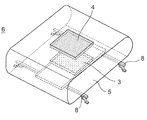
- FIG. 2 is a diagram schematically showing a perspective view of the cushion pad of the present invention.
- the vehicle-mounted seat using the deformation detection sensor of the present invention basically includes a seating portion 1, a backrest portion 2, and a magnetic sensor 3.
- the seating portion 1 includes a cushion pad 6 made of a magnetic resin 4 and a polymer foam 5 and an outer skin 7 covering the cushion pad 6, and the magnetic resin 4 is formed in a layer on a part of the seating surface of the polymer foam 5.
- the magnetic sensor 3 is preferably fixed to a pedestal 8 that supports a vehicle-mounted seat.
- the base 8 is fixed to a vehicle body (not shown) in the case of an automobile.
- FIG. 2 shows a perspective view of the cushion pad 6 of the present invention composed of the magnetic resin 4 and the polymer foam 5, and also shows the pedestal 8 and the magnetic sensor 3 placed thereon.
- the magnetic resin 4 is disposed above a place where a person is seated and is most susceptible to deformation.
- the outer skin 7 on the cushion pad 6 is not described.
- the outer skin 7 is made of leather, cloth, or synthetic resin, but is not limited thereto.
- Magnetic filler is dispersed in the magnetic resin 4, and the magnetic filler has a magnetic force by magnetization or other methods.
- the cushion pad 6 When a person sits on the seating portion 1, the cushion pad 6 is deformed, and the magnetic field changes accordingly.
- the magnetic sensor 3 detects the change in the magnetic field and recognizes that a person is seated.
- the cushion pad 6 having the magnetic resin 4 is on the bottom where a person is seated, and recognizes that the person is sitting, and issues a warning when, for example, the user is not wearing a seat belt. Can be.
- the cushion pad 6 of the present invention may be used for the backrest portion 2 corresponding to the person's back, and in that case, the posture of the person's sitting can be detected.
- Magnetic resin refers to a resin in which a magnetic filler (that is, an inorganic filler having magnetism) is dispersed.
- Magnetic fillers generally include rare earths, irons, cobalts, nickels, and oxides, but any of these may be used. Preferably, it is a rare earth system that can obtain a high magnetic force, but is not limited thereto. Particularly preferred are neodymium fillers.
- the shape of the magnetic filler is not particularly limited, and may be any of a spherical shape, a flat shape, a needle shape, a columnar shape, and an indefinite shape.
- the magnetic filler has an average particle size of 0.02 to 500 ⁇ m, preferably 0.1 to 400 ⁇ m, more preferably 0.5 to 300 ⁇ m. When the average particle size is smaller than 0.02 ⁇ m, the magnetic properties of the magnetic filler are deteriorated. If the average particle size exceeds 500 ⁇ m, the mechanical properties (brittleness) of the magnetic resin will deteriorate.
- the magnetic filler may be introduced into the resin after magnetization, but is preferably magnetized after being introduced into the resin.
- the polarity of the magnet can be easily controlled and the magnetic force can be easily detected.
- the magnetic resin of the present invention is characterized by a glass transition point (Tg) of ⁇ 30 ° C. or lower.
- the magnetic resin preferably has a glass transition point (Tg) of ⁇ 80 ° C. to ⁇ 30 ° C.
- the magnetic resin has a storage elastic modulus E ′ (20 ° C.) at 20 ° C. and a storage elasticity at ⁇ 20 ° C. in order to detect the deformation of the cushion pad with high sensitivity in a wide temperature range (especially low temperature range).
- the storage modulus ratio E ′ (20 ° C./ ⁇ 20° C.), which is the ratio to the modulus E ′ ( ⁇ 20 ° C.), is preferably 0.2 or more.
- any resin having a Tg within the above desired range can be used.
- the resin it is preferable to use a thermoplastic elastomer, a thermosetting elastomer, or a mixture thereof.
- thermoplastic elastomer examples include styrene-based thermoplastic elastomer, polyolefin-based thermoplastic elastomer, polyurethane-based thermoplastic elastomer, polyester-based thermoplastic elastomer, polyamide-based thermoplastic elastomer, polybutadiene-based thermoplastic elastomer, polyisoprene-based thermoplastic elastomer, A fluororubber-based thermoplastic elastomer can be used.
- thermosetting elastomer examples include polyisoprene rubber, polybutadiene rubber, styrene-butadiene rubber, polychloroprene rubber, nitrile rubber, diene synthetic rubber such as ethylene-propylene rubber, ethylene-propylene rubber, butyl rubber, acrylic rubber, Non-diene synthetic rubbers such as polyurethane rubber, fluorine rubber, silicone rubber, epichlorohydrin rubber, and natural rubber can be mentioned.
- thermosetting elastomers are preferable because they can suppress the sag of the magnetic resin that accompanies long-term use. More preferably, it is a polyurethane elastomer (also referred to as polyurethane rubber) or a silicone elastomer (also referred to as silicone rubber).
- the polyurethane elastomer is obtained by reacting an active hydrogen-containing compound with an isocyanate component.
- an active hydrogen-containing compound and a magnetic filler are mixed, and an isocyanate component is mixed therein to obtain a mixed solution.
- a liquid mixture can also be obtained by mixing a magnetic filler with an isocyanate component and mixing an active hydrogen-containing compound. The mixed liquid is poured into a mold subjected to a release treatment, and then heated to the curing temperature and cured to produce a magnetic resin.
- a magnetic resin when using a silicone elastomer as a resin component, a magnetic resin can be manufactured by putting a magnetic filler in a silicone resin precursor, mixing it, putting it in a mold, and then heating and curing it. In addition, you may add a solvent as needed.
- isocyanate component that can be used in the polyurethane elastomer
- compounds known in the field of polyurethane can be used.
- the isocyanate component may be modified such as urethane modification, allophanate modification, biuret modification, and isocyanurate modification.
- Preferred isocyanate components are 2,4-toluene diisocyanate, 2,6-toluene diisocyanate, 4,4'-diphenylmethane disissocyanate, more preferably 2,4-toluene diisocyanate, 2,6-toluene diisocyanate.
- the active hydrogen-containing compound those usually used in the technical field of polyurethane can be used.
- the glass transition temperature (Tg) of the magnetic resin is particularly easily set to ⁇ 30 ° C. or lower, and at a lower temperature than at normal temperature. It is preferable because the change in elastic modulus of the magnetic resin can be reduced at both high temperature and high temperature.
- the silicone-containing polyol has at least two active hydrogen groups at its terminal and has a silicone moiety (Si—O—Si) in its main chain or side chain. In the present invention, it has a silicone moiety in the main chain.
- Both a polyol (main chain type silicone-containing polyol) and a polyol having a silicone moiety in the side chain (side chain type silicone-containing polyol) can be used.
- a polyol having a silicone moiety in the main chain is preferred because it hardly causes phase separation in the polyurethane elastomer and the adhesiveness of the finally obtained magnetic resin is easily maintained.
- the number average molecular weight is preferably 1,000 to 5,000. If the number average molecular weight is less than 1,000, the special low-temperature improvement is not sufficient, and if the number average molecular weight exceeds 5,000, the silicone domain becomes too large, so that peeling easily occurs and characteristic stability is lowered. To do. Further, the content of the silicone-containing polyol is preferably 20 to 80% by weight of the total weight of the matrix. If the content of the silicone-containing polyol is less than 20% by weight, it is difficult to make the glass transition point below ⁇ 30 ° C., and if it exceeds 80% by weight, the adhesion to the polymer foam deteriorates due to the silicone component. In addition, the characteristic stability is deteriorated.
- silicone-containing polyol not only the silicone-containing polyol but also a compound known in the field of polyurethane can be used as the active hydrogen-containing compound.
- Polyester polyol such as polyester polyol, polycaprolactone polyol, reaction product of polyester glycol and alkylene carbonate such as polycaprolactone, and the like, and the reaction of the resulting reaction mixture with organic polyol.
- Polyester polycarbonate polyol reacted with dicarboxylic acid, esterification of polyhydroxyl compound and aryl carbonate High molecular weight polyol polycarbonate polyols obtained by the reaction can be mentioned. These may be used alone or in combination of two or more.
- Preferred active hydrogen-containing compounds are polytetramethylene glycol, polypropylene glycol, a copolymer of propylene oxide and ethylene oxide, 3-methyl-1,5-pentane adipate, more preferably a copolymer of polypropylene glycol, propylene oxide and ethylene oxide. It is a coalescence.
- the NCO index is preferably 0.3 to 1.2, more preferably 0.5 to 1.1, and still more preferably 0.7 to 1.05. If the NCO index is less than 0.3, the magnetic resin tends to be insufficiently cured, and if the NCO index is greater than 1.2, the elastic modulus increases and the magnetic sensor sensitivity tends to decrease.
- the amount of the magnetic filler in the resin is 1 to 450 parts by weight, preferably 2 to 400 parts by weight with respect to 100 parts by weight of the resin. If the amount is less than 1 part by weight, it is difficult to detect a change in the magnetic field. On the other hand, if it exceeds 450 parts by weight, the desired properties cannot be obtained, for example, the resin itself becomes brittle.
- the magnetic resin may be affixed with a polymer foam and a double-sided tape or an adhesive, but is more preferably integrated by self-adhesion.
- self-adhering there is little peeling of the magnetic resin from the polymer foam, the durability is high, and the magnetic resin has elasticity, so that it is soft and the sitting comfort is improved.
- the self-adhesion between the magnetic resin and the polymer foam is performed by chemical bonding or hydrogen bonding due to the urethane group and hydroxyl group present in the resin molecule.
- the thickness of the magnetic resin in an uncompressed state is preferably 300 to 5000 ⁇ m, more preferably 400 to 4500 ⁇ m, and still more preferably 500 to 4000 ⁇ m.
- the thickness is smaller than 300 ⁇ m, the handling property tends to be deteriorated due to brittleness when a required amount of filler is added.
- the thickness is larger than 5000 ⁇ m, the foreign object feeling is increased.
- the magnetic resin may be a non-foamed material containing no bubbles, but may be a foam containing bubbles from the viewpoint of improving stability and sensor sensitivity and from the viewpoint of weight reduction.
- a general resin foam can be used for the foam, but it is preferable to use a thermosetting resin foam in consideration of characteristics such as compression set.
- the thermosetting resin foam include a polyurethane resin foam and a silicone resin foam. Among these, a polyurethane resin foam is preferable.
- the above-mentioned isocyanate component and active hydrogen-containing compound can be used for the polyurethane resin foam.
- a sealing material may be provided on the outer periphery of the magnetic resin to the extent that the flexibility of the magnetic resin is not impaired.
- a thermoplastic resin a thermoplastic resin, a thermosetting resin, or a mixture thereof can be used.
- the thermoplastic resin include styrene-based thermoplastic resins, polyolefin-based thermoplastic resins, polyurethane-based thermoplastic resins, polyester-based thermoplastic resins, polyamide-based thermoplastic resins, polybutadiene-based thermoplastic resins, polyisoprene-based thermoplastic resins, Fluorine-based thermoplastic resin, ethylene / ethyl acrylate copolymer, ethylene / vinyl acetate copolymer, polyvinyl chloride, polyvinylidene chloride, chlorinated polyethylene, fluororesin, polyamide, polyethylene, polypropylene, polyethylene terephthalate, polybutylene terephthalate, polystyrene, polybutadiene
- thermosetting resin examples include polyisoprene rubber, polybutadiene rubber, styrene / butadiene rubber, polychloroprene rubber, diene-based synthetic rubber such as acrylonitrile / butadiene rubber, ethylene / propylene rubber, ethylene / propylene / diene rubber, butyl rubber, Non-diene rubbers such as acrylic rubber, polyurethane rubber, fluorine rubber, silicone rubber, epichlorohydrin rubber, natural rubber, polyurethane resin, silicone resin, epoxy resin and the like can be mentioned.
- thermoplastic resin, thermosetting resin or a mixture thereof as the sealing material for example, a film-like material can be suitably used.
- These films may be laminated, or may be a film including a metal foil such as an aluminum foil or a metal vapor deposition film in which a metal is vapor deposited on the film.
- the sealing material has an effect of preventing rust of the magnetic filler in the magnetic resin.
- the present invention also relates to a process for dispersing a magnetic filler in a resin precursor liquid, a process for curing the resin precursor liquid to form a magnetic resin having a glass transition point of ⁇ 30 ° C. or lower, a mold for a cushion pad
- a method for manufacturing a deformation detection sensor comprising a step of forming and a step of combining the cushion pad with a magnetic sensor for detecting a magnetic change caused by deformation of the cushion pad.
- a magnetic resin having a glass transition point of ⁇ 30 ° C. or lower can be produced by blending a magnetic filler with a resin precursor solution and reacting in a mold at the time of forming the resin.
- This magnetic resin is placed in a cushion pad mold, and then a polymer foam stock solution is injected. By foaming this polymer foam stock solution, a cushion pad in which the magnetic resin and the polymer foam are integrated is formed.
- the magnetic filler is unevenly distributed on one side in the resin. Moreover, it is preferable that the uneven distribution surface of a magnetic filler becomes a seating surface. When the magnetic filler is unevenly distributed in the magnetic resin, the adhesive force between the magnetic resin and the polymer foam becomes stronger.
- Polymer Foam A polymer foam is obtained by foaming a polymer foam stock solution as described above.
- a general resin foam can be used.
- a thermosetting resin foam is preferable, and more specifically, a polyurethane resin foam or a silicone resin foam is used.
- the stock solution contains an active hydrogen-containing compound such as a polyisocyanate component, a polyol, and water.
- an active hydrogen-containing compound such as a polyisocyanate component, a polyol, and water.
- polyisocyanate component a known compound in the field of polyurethane can be used without particular limitation.
- the polynuclear body (crude MDI) of diphenylmethane diisocyanate may be sufficient.
- Aliphatic diisocyanates such as ethylene diisocyanate, 2,2,4-trimethylhexamethylene diisocyanate, 1,6-hexamethylene diisocyanate, 1,4-cyclohexane diisocyanate, 4,4′-dicyclohexylmethane diisocyanate, isophorone diisocyanate, norbornane diisocyanate And alicyclic diisocyanates such as These may be used alone or in combination of two or more.
- the isocyanate may be modified by urethane modification, allophanate modification, biuret modification, isocyanurate modification or the like.
- active hydrogen-containing compounds include those usually used in the technical field of polyurethane.
- a polyester polyol such as polyester polyol, polycaprolactone polyol, a reaction product of polyester glycol such as polycaprolactone and alkylene carbonate, and the like, and an ethylene carbonate are reacted with a polyhydric alcohol.
- Polycarbonate polyols obtained by ether exchange reaction, such as a polymer polyol is a polyether polyol containing dispersed polymer particles. These may be used alone or in combination of two or more. Specific examples thereof include commercially available products (for example, EP3028, EP3033, EP828, POP3128, POP3428, and POP3628) manufactured by Mitsui Chemicals, Inc.
- those other than the above to be blended may be a commonly used crosslinking agent, foam stabilizer, catalyst, etc., and the type is not particularly limited.
- crosslinking agent examples include triethanolamine and diethanolamine.
- foam stabilizer examples include SF-2962, SRX-274C, 2969T manufactured by Toray Dow Corning Silicone Co., Ltd.
- catalyst examples include Dabco33LV (manufactured by Air Products Japan), Toyocat ET, SPF2, MR (manufactured by Tosoh Corporation) and the like.
- additives such as water, toner, flame retardant and the like can be appropriately used as necessary.
- flame retardants examples include CR530 and CR505 manufactured by Daihachi Chemical Co., Ltd.
- the cushion pad obtained by the above method can be combined with a magnetic sensor to obtain the deformation detection sensor of the present invention.
- the cushion pad includes a magnetic resin layer in a part thereof, and the magnetic field changes as the cushion pad is deformed by a person sitting.
- the magnetic sensor detects the change in the magnetic field and detects the seating of the person.
- a warning is issued while the seat belt is not fastened, and it is detected that the seat belt is fastened to the buckle, and the warning is turned off. May be.
- the magnetic resin is usually on the upper surface or the lower surface of the cushion pad, but the magnetic resin may be present inside the cushion pad as the deformation detection sensor.
- the magnetic sensor used in the present invention may be any sensor that is normally used for detecting a change in a magnetic field, such as a magnetoresistive element (for example, a semiconductor compound magnetoresistive element, an anisotropic magnetoresistive element (AMR), a giant magnetoresistive element).
- a magnetoresistive element for example, a semiconductor compound magnetoresistive element, an anisotropic magnetoresistive element (AMR), a giant magnetoresistive element.
- Examples include an element (GMR) or a tunnel magnetoresistive element (TMR)), a Hall element, an inductor, an MI element, a fluxgate sensor, and the like. From the viewpoint of having high sensitivity over a wider range, a Hall element is preferably used.
- the deformation detection sensor is used for applications other than in-vehicle cushion pads, for example, surface pressure distribution of robot hands, skin, beds, etc., tire road surface condition and air pressure, living body movement condition (motion capture, breathing condition, It can be used for detecting a muscle relaxed state, intrusion into a restricted access area, and foreign matter of a sliding door.
- Example 1 106.5 parts by weight of polyol C (polyether-modified main chain type reactive silicone, OH number 56, number of functional groups 2, Shin-Etsu Chemical Co., Ltd., X-22-4272) and bismuth octylate (Nippon Chemical Industrial Co., Ltd.) Company, PACCAT 25) Add 31.0 parts by weight of toluene to 0.24 parts by weight of a mixed solution, and add neodymium filler (NdFeB magnetic powder, MF-15P, average particle size 133 ⁇ m) 206. 5 parts by weight was added to prepare a filler dispersion.
- polyol C polyether-modified main chain type reactive silicone, OH number 56, number of functional groups 2, Shin-Etsu Chemical Co., Ltd., X-22-4272
- bismuth octylate Nippon Chemical Industrial Co., Ltd.
- PACCAT 25 neodymium filler
- prepolymer A 100.0 parts by weight was dissolved in 31.0 parts by weight of toluene to prepare a prepolymer solution.
- the filler dispersion liquid was added to this prepolymer solution, and mixing and defoaming were performed with a rotation / revolution mixer (manufactured by Shinky Corporation).
- the reaction solution was dropped onto a release-treated PET film having a 1.0 mm spacer and adjusted to a thickness of 1.0 mm with a nip roll. Thereafter, curing was performed at 80 ° C. for 1 hour to obtain a magnetic filler dispersed resin.
- the obtained magnetic filler-dispersed resin was magnetized at 2.0 T with a magnetizing device (manufactured by Tamagawa Seisakusho Co., Ltd.) to obtain a magnetic resin.
- Silicone content (wt%) weight of silicone-containing polyol (g) / weight of magnetic resin not including the weight of magnetic filler (g) ⁇ 100
- the glass transition point (Tg) and the storage elastic modulus (E ′) were measured using a dynamic viscoelasticity measuring apparatus (manufactured by METTLER TOLEDO, DMA861e). The measurement conditions were as follows. Measurement mode: Tensile mode Frequency: 1 Hz Temperature increase rate: 2.5 ° C / min Measurement temperature range: -100 to 100 ° C Sample shape: length 19.5mm, width 3.0mm, thickness 1.0mm The glass transition point was the tan ⁇ peak top temperature (° C.).
- the magnetic resin was cut into a 50 mm square, placed in a 400 mm square x 70 mm thick mold, and the mold temperature was adjusted to 62 ° C.
- a magnetic resin-containing polymer foam that is, a cushion pad
- the magnetic flux density change (Gauss) and characteristic stability (%) of this foam were measured as follows. The results are shown in Table 1.
- Average magnetic flux density change (Gauss) A Hall element (Asahi Kasei Electronics Co., Ltd., EQ-430L) was attached to an acrylic plate and attached to the lower surface of the magnetic resin of the produced magnetic resin-containing polymer foam. Next, a pressure of 10 kPa was applied using a 40 mm ⁇ surface indenter, and a change in magnetic flux density (Gauss) was obtained from a change in output voltage of the Hall element at this time. This change in magnetic flux density was measured five times, and the average value was defined as the average magnetic flux density change. The measurement temperatures were -20 ° C and 20 ° C.
- Characteristic stability Durability test of the manufactured cushion pad is performed 500,000 times at a pressure of 30 kPa in an environment of a temperature of 40 ° C. and a humidity of 60%, and the characteristic stability is determined from a change in average magnetic flux density before and after the durability test. Asked. The measurement temperature was 20 ° C.
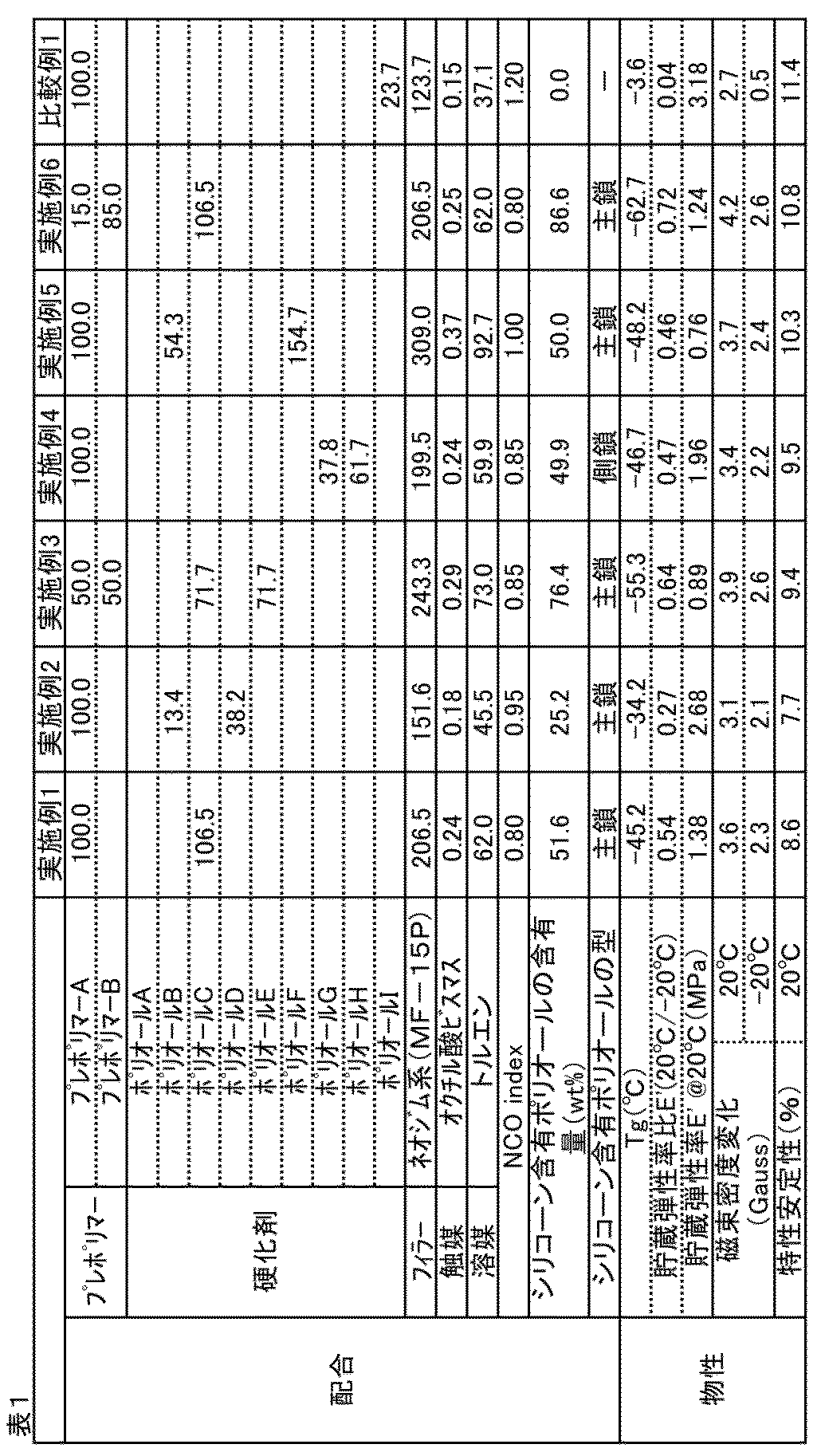
- Examples 2 to 6 and Comparative Example 1 A magnetic resin was prepared using the formulation described in Table 1, and a cushion pad was prepared in the same manner as in Example 1. Magnetic flux density change (Gauss) and characteristic stability were evaluated. The results are shown in Table 1.
- NCO index, silicone content (% by weight), silicone polymer type (main chain type or side chain type), glass transition point (Tg) of magnetic resin, storage elastic modulus ratio E ′ (20 ° C. / 20 ° C) and the storage modulus E ′ (20 ° C) at 20 ° C is also listed.
- polyols used are as follows.
- Polyol A polyoxypropylene glycol obtained by adding propylene oxide to glycerin as an initiator, OH value 56, functional group number 3 (EX-3030, manufactured by Asahi Glass Co., Ltd.).
- Polyol B Polyoxypropylene glycol obtained by adding propylene oxide with propylene glycol as an initiator, OHV56, functional group number 2 (EX-2020, manufactured by Asahi Glass Co., Ltd.).
- Polyol C A polyether-modified main chain type reactive silicone having a molecular weight of 2,000 silicone, OH number 56, functional group number 2 (X-22-4272 manufactured by Shin-Etsu Chemical Co., Ltd.).
- Polyol D A polyether-modified main chain type reactive silicone having a molecular weight of 1,000, OH number 112, and functional group number 2 (manufactured by JNC Corporation, FM-4411).
- Polyol E Polyether-modified main chain type reactive silicone having a molecular weight of 5,000 silicone, OH number 22, functional group number 2 (manufactured by JNC Corporation, FM-4421).
- Polyol F A polyether-modified main chain type reactive silicone having a molecular weight of 10,000, OH number 11, functional group number 2 (FM-4425, manufactured by JNC Corporation).
- Polyol G Polyether-modified side chain reactive silicone having a molecular weight of 1,000, OH number 112, number of functional groups 2 (manufactured by JNC Corporation, FM-DA11).
- Polyol H Polyether-modified side chain reactive silicone having a molecular weight of 5,000 silicone, OH number 22, functional group number 2 (JNC Corporation, FM-DA21).
- Polyol I Polyoxypropylene glycol obtained by adding propylene oxide to glycerol as an initiator, OH number 168, functional group number 3 (EX-1030, manufactured by Asahi Glass Co., Ltd.).
- Comparative Example 1 uses the above polyol I and does not use a silicone-containing polyol, and therefore uses a magnetic resin having a glass transition point (Tg) of ⁇ 3.6 ° C. Table 1 shows the results of the same measurements as in the examples.
- Example 4 the main chain type silicone of Example 1 was changed to a side chain type silicone. However, since the side chain type was more easily phase-separated and a silicone domain was formed, the adhesion to the foam layer was improved. Although it was bad and it was a little inferior in stability due to some floating, it was at a usable level.
- Example 5 the molecular weight of the silicone of Example 1 was changed from 2,000 to 10,000. However, since it tends to phase-separate due to high molecular weight, the adhesion to the foam layer is poor. The sensitivity was slightly inferior because of some floating, but it was at a usable level.
- Example 6 the silicone content of Example 1 was changed from 50% to 87%, but the adhesion to the foam layer was poor due to the increase in the amount of silicone component, and partly floated, so it was somewhat Although it was inferior in stability, it was a usable level.
- the deformation detection sensor of the present invention can be applied to a car seat or the like, and is excellent in withstanding long-term use.
- the deformation detection sensor of the present invention has stability and sensitivity in a wide temperature range (for example, ⁇ 20 ° C. to + 80 ° C.), does not feel a foreign object even when sitting, and does not get tired even if sitting for a long time.
Landscapes
- Engineering & Computer Science (AREA)
- Mechanical Engineering (AREA)
- Aviation & Aerospace Engineering (AREA)
- Transportation (AREA)
- Physics & Mathematics (AREA)
- General Physics & Mathematics (AREA)
- Chemical & Material Sciences (AREA)
- Analytical Chemistry (AREA)
- Manufacturing & Machinery (AREA)
- Polyurethanes Or Polyureas (AREA)
- Seats For Vehicles (AREA)
- Compositions Of Macromolecular Compounds (AREA)
Abstract
Description
該クッションパッドの変形に起因する磁気変化を検出する磁気センサ、
からなる変形検出センサであって、
該磁性樹脂がガラス転移点(Tg)-30℃以下を有することを特徴とする変形検出センサを提供する。
図1は、本発明の変形検出センサを車載用シートに応用する場合を示す模式断面図である。
図2は、本発明のクッションパッドの斜視図を模式的に表した図である。
本明細書において「磁性樹脂」とは、樹脂中に磁性フィラー(即ち、磁性を有する無機フィラー)が分散したものと言う。
本発明は、また、磁性フィラーを樹脂前駆体液に分散させる工程、樹脂前駆体液を硬化させてガラス転移点-30℃以下である磁性樹脂を形成する工程、クッションパッド用モールドに前記磁性樹脂を配設する工程、高分子発泡体原液をクッション用パッドモールドに注入する工程、前記高分子発泡体原液を発泡させて、磁性樹脂と高分子発泡体を一体化してクッションパッドを形成する工程、および該クッションパッドをクッションパッドの変形に起因する磁気変化を検出する磁気センサと組み合わせる工程、からなる変形検出センサの製造方法を提供する。
高分子発泡体は、上述のように、高分子発泡体原液を発泡させて得られる。高分子発泡体は、一般の樹脂発泡体を用いることができ、その中でも熱硬化性樹脂発泡体が好ましく、より具体的にはポリウレタン樹脂発泡体またはシリコーン樹脂発泡体が用いられる。ポリウレタン樹脂発泡体からなる高分子発泡体の場合、その原液は、ポリイソシアネート成分、ポリオール、水などの活性水素含有化合物を含むものである。ここで、使用できるポリイソシアネート成分、活性水素含有化合物については下記のものが挙げられる。
上記方法で得られたクッションパッドは、本発明では、磁気センサを組み合わせることにより、本発明の変形検出センサが得られる。クッションパッドには、磁性樹脂の層がその一部に存在し、クッションパッドが人の着座により変形することにより、磁場が変化する。その磁場の変化を磁気センサが検出して、人の着座を検出する。自動車のシートベルトの装着検出センサの場合、人の着座を検出した後に、シートベルトが固定されていない間警告を発し、シートベルトがバックルに固定されたことを検知して、警告を消すようにしてもよい。
反応容器にポリオールA(グリセリンを開始剤にプロピレンオキサイドを付加したポリオキシプロピレングリコール、OH価56、官能基数3、旭硝子株式会社製、EX-3030)85.2重量部を入れ、撹拌しながら減圧脱水を1時間行った。その後、反応容器内を窒素置換した。次いで、反応容器にトルエンジイソシアネート(三井化学株式会社製、2,4体=80%、NCO%=48.3%)14.8重量部を添加して、反応容器内の温度を80℃に保持しながら5時間反応させてイソシアネート末端プレポリマーA(NCO%=3.58%)を合成した。
反応容器にポリオールC(ポリエーテル変性主鎖型反応性シリコーン、OH価56、官能基数2、信越化学株式会社製、X-22-4272)85.2重量部を入れ、撹拌しながら減圧脱水を1時間行った。その後、反応容器内を窒素置換した。次いで、反応容器にトルエンジイソシアネート(三井化学株式会社製、2,4体=80%、NCO%=48.3%)14.8重量部を添加して、反応容器内の温度を80℃に保持しながら5時間反応させてイソシアネート末端プレポリマーB(NCO%=3.58%)を合成した。
次に、ポリオールC(ポリエーテル変性主鎖型反応性シリコーン、OH価56、官能基数2、信越化学株式会社製、X-22-4272)106.5重量部およびオクチル酸ビスマス(日本化学産業株式会社製、プキャット25)0.24重量部の混合液にトルエン31.0重量部を加え、そこにネオジム系フィラー(NdFeB磁粉、愛知製鋼株式会社製、MF-15P、平均粒径133μm)206.5重量部を添加し、フィラー分散液を調製した。また、プレポリマーA 100.0重量部をトルエン31.0重量部に溶解させ、プレポリマー溶液を調製した。このプレポリマー溶液に前記フィラー分散液を添加し、自転・公転ミキサー(シンキー株式会社製)にて混合、および脱泡を行った。この反応液を1.0mmのスペーサーを有する離型処理したPETフィルム上に滴下し、ニップロールにて厚み1.0mmに調整した。その後、80℃で1時間硬化を行って、磁性フィラー分散樹脂を得た。得られた該磁性フィラー分散樹脂を着磁装置(玉川製作所株式会社製)にて2.0Tで着磁することにより、磁性樹脂を得た。
シリコーン含有量(wt%)=シリコーン含有ポリオールの重量(g)/磁性フィラーの重量を含まない磁性樹脂の重量(g)×100
測定モード:引張モード
周波数:1Hz
昇温速度:2.5℃/min
測定温度範囲:-100~100℃
サンプル形状:長さ19.5mm、幅3.0mm、厚み1.0mm
なお、ガラス転移点はtanδのピークトップ温度(℃)とした。
ポリプロピレングリコール(三井化学株式会社製、EP-3028、OH価28)60.0重量部、ポリマーポリオール(三井化学株式会社製、POP-3128、OH価28)40.0重量部、ジエタノールアミン(三井化学株式会社製)2.0重量部、水3.0重量部、整泡剤(東レ・ダウ・コーニング・シリコーン株式会社製、SF-2962)1.0重量部およびアミン触媒(エアープロダクツジャパン株式会社製、Dabco33LV)0.5重量部を混合・撹拌し、混合液Aを調製し、23℃に温度を調節した。また、トルエンジイソシアネートとクルードMDIの80/20(重量比)混合物(三井化学株式会社製、TM-20、NCO%=44.8%)を23℃に温調し、混合液Bとした。
ホール素子(旭化成エレクトロニクス株式会社製、EQ-430L)をアクリル板に貼り付け、作製した磁性樹脂含有高分子発泡体の磁性樹脂の下面に貼り付けた。次に、40mmφの面圧子を用いて、10kPaの圧力を印加し、この時のホール素子の出力電圧変化より磁束密度変化(Gauss)を求めた。この磁束密度変化の測定を5回実施し、その平均値を平均磁束密度変化とした。なお、測定温度は-20℃、20℃とした。
作製したクッションパッドを、温度40℃、湿度60%の環境で、30kPaの圧力で50万回の耐久試験を行い、耐久試験前後での平均磁束密度変化から特性安定性を求めた。なお、測定温度は20℃とした。

使用する配合処方を表1に記載するものを用いて、磁性樹脂を作製し、実施例1と同様の方法でクッションパッドを作製して、磁束密度変化(Gauss)および特性安定性を評価した。結果を表1に示す。表1中には、NCO index、シリコーン含有量(重量%)、シリコーンポリマーのタイプ(主鎖型または側鎖型)、磁性樹脂のガラス転移点(Tg)、貯蔵弾性率比E’(20℃/-20℃)および20℃での貯蔵弾性率E’(20℃)も記載している。
ポリオールA:グリセリンを開始剤にプロピレンオキサイドを付加したポリオキシプロピレングリコール、OH価56、官能基数3(旭硝子株式会社製、EX-3030)。
ポリオールB:プロピレングリコールを開始剤にプロピレンオキサイドを付加したポリオキシプロピレングリコール、OHV56、官能基数2(旭硝子株式会社製、EX-2020)。
ポリオールC:シリコーンの分子量2,000のポリエーテル変性主鎖型反応性シリコーン、OH価56、官能基数2(信越化学株式会社製、X-22-4272)。
ポリオールD:シリコーンの分子量1,000のポリエーテル変性主鎖型反応性シリコーン、OH価112、官能基数2(JNC株式会社製、FM-4411)。
ポリオールE:シリコーンの分子量5,000のポリエーテル変性主鎖型反応性シリコーン、OH価22、官能基数2(JNC株式会社製、FM-4421)。
ポリオールF:シリコーンの分子量10,000のポリエーテル変性主鎖型反応性シリコーン、OH価11、官能基数2(JNC株式会社製、FM-4425)。
ポリオールG:シリコーンの分子量1,000のポリエーテル変性側鎖型反応性シリコーン、OH価112、官能基数2(JNC株式会社製、FM-DA11)。
ポリオールH:シリコーンの分子量5,000のポリエーテル変性側鎖型反応性シリコーン、OH価22、官能基数2(JNC株式会社製、FM-DA21)。
ポリオールI:グリセリンを開始剤にプロピレンオキサイドを付加したポリオキシプロピレングリコール、OH価168、官能基数3(旭硝子株式会社製、EX-1030)。
2…背もたれ部
3…磁気センサ
4…磁性樹脂
5…高分子発泡体
6…クッションパッド
7…外皮
8…台座
Claims (13)
- 樹脂に磁性フィラーが分散されている磁性樹脂と、該磁性樹脂がその一部に存在する高分子発泡体と、からなるクッションパッド、および
該クッションパッドの変形に起因する磁気変化を検出する磁気センサ、
からなる変形検出センサであって、
該磁性樹脂がガラス転移点(Tg)-30℃以下を有することを特徴とする変形検出センサ。 - 前記磁性樹脂が、20℃での貯蔵弾性率E’(20℃)と-20℃での貯蔵弾性率E’(-20℃)との比である貯蔵弾性率比E’(20℃/-20℃)0.2以上を有する、請求項1記載の変形検出センサ。
- 前記磁性樹脂および高分子発泡体が、ポリウレタンからなる、請求項1または2記載の変形検出センサ。
- 前記磁性樹脂と高分子発泡体とが、自己接着している、請求項3記載の変形検出センサ。
- 前記磁性樹脂を形成するポリウレタンが、主鎖型シリコーン含有ポリオールを含む、請求項3記載の変形検出センサ。
- 前記主鎖型シリコーン含有ポリオールが、数平均分子量(Mn)1,000~5,000を有し、前記磁性樹脂の樹脂中の主鎖型シリコーン含有ポリオールの含有量が、20~80重量%である、請求項5記載の変形検出センサ。
- 前記クッションパッドが、車載用であり、検出する変形が人の着座状態である、請求項1~6いずれか1項に記載の変形検出センサ。
- クッションパッドと、該クッションパッドの変形を検出するセンサとからなる変形検出センサの製造方法であって、該製造方法が、磁性フィラーを樹脂前駆体液に分散させる工程、樹脂前駆体液を硬化させてガラス転移点-30℃以下である磁性樹脂を形成する工程、クッションパッド用モールドに前記磁性樹脂を配設する工程、高分子発泡体原液をクッションパッド用モールドに注入する工程、前記高分子発泡体原液を発泡させて、磁性樹脂と高分子発泡体を一体化してクッションパッドを形成する工程、および該クッションパッドをクッションパッドの変形に起因する磁気変化を検出する磁気センサと組み合わせる工程、からなる変形検出センサの製造方法。
- 前記磁性樹脂が、20℃での貯蔵弾性率E’(20℃)と-20℃での貯蔵弾性率E’(-20℃)との比である貯蔵弾性率比E’(20℃/-20℃)0.2以上を有する、請求項8記載の変形検出センサの製造方法。
- 前記磁性樹脂および高分子発泡体が、ポリウレタンからなる、請求項8または9記載の変形検出センサの製造方法。
- 前記磁性樹脂と高分子発泡体とが、自己接着している、請求項10記載の変形検出センサの製造方法。
- 前記磁性樹脂を形成するポリウレタンが、主鎖型シリコーン含有ポリオールを含む、請求項10記載の変形検出センサの製造方法。
- 前記主鎖型シリコーン含有ポリオールが、数平均分子量(Mn)1,000~5,000を有し、前記磁性樹脂の樹脂中の主鎖型シリコーン含有ポリオールの含有量が、20~80重量%である、請求項12記載の変形検出センサの製造方法。
Priority Applications (3)
| Application Number | Priority Date | Filing Date | Title |
|---|---|---|---|
| CN201680014919.3A CN107428273A (zh) | 2015-04-09 | 2016-03-02 | 变形检测传感器及其制造方法 |
| US15/555,134 US20180073940A1 (en) | 2015-04-09 | 2016-03-02 | Deformation detection sensor and production of the same |
| JP2017511498A JPWO2016163179A1 (ja) | 2015-04-09 | 2016-03-02 | 変形検出センサおよびその製造方法 |
Applications Claiming Priority (2)
| Application Number | Priority Date | Filing Date | Title |
|---|---|---|---|
| JP2015-080329 | 2015-04-09 | ||
| JP2015080329 | 2015-04-09 |
Publications (1)
| Publication Number | Publication Date |
|---|---|
| WO2016163179A1 true WO2016163179A1 (ja) | 2016-10-13 |
Family
ID=57073188
Family Applications (1)
| Application Number | Title | Priority Date | Filing Date |
|---|---|---|---|
| PCT/JP2016/056485 Ceased WO2016163179A1 (ja) | 2015-04-09 | 2016-03-02 | 変形検出センサおよびその製造方法 |
Country Status (4)
| Country | Link |
|---|---|
| US (1) | US20180073940A1 (ja) |
| JP (1) | JPWO2016163179A1 (ja) |
| CN (1) | CN107428273A (ja) |
| WO (1) | WO2016163179A1 (ja) |
Families Citing this family (2)
| Publication number | Priority date | Publication date | Assignee | Title |
|---|---|---|---|---|
| JP2016203741A (ja) * | 2015-04-20 | 2016-12-08 | 東洋ゴム工業株式会社 | 変形検出センサおよびその製造方法 |
| CN109615808A (zh) * | 2018-12-28 | 2019-04-12 | 合肥盈川信息技术有限公司 | 一种食品安全样本感应非接触式物联网装置 |
Citations (4)
| Publication number | Priority date | Publication date | Assignee | Title |
|---|---|---|---|---|
| JP2011183686A (ja) * | 2010-03-09 | 2011-09-22 | Honda Motor Co Ltd | シート用クッション材の製造方法およびシート用クッション材 |
| WO2013147088A1 (ja) * | 2012-03-29 | 2013-10-03 | 株式会社ブリヂストン | シートパッド用ポリウレタンフォーム |
| WO2014061684A1 (ja) * | 2012-10-19 | 2014-04-24 | 東洋ゴム工業株式会社 | センサーおよびその製造方法 |
| WO2014112241A1 (ja) * | 2013-01-15 | 2014-07-24 | 東洋ゴム工業株式会社 | 高分子アクチュエータ |
Family Cites Families (4)
| Publication number | Priority date | Publication date | Assignee | Title |
|---|---|---|---|---|
| JPS62272415A (ja) * | 1986-05-20 | 1987-11-26 | 株式会社 ニフコ | 電磁誘導式無接点スイツチ |
| US20100198464A1 (en) * | 2009-01-30 | 2010-08-05 | Delphi Technologies, Inc. | Diagnosable magnetic switch assembly |
| US8998320B2 (en) * | 2009-02-24 | 2015-04-07 | GM Global Technology Operations LLC | Using resting load to augment active material actuator demand in power seats |
| DE102012005371B4 (de) * | 2012-03-16 | 2021-04-29 | Paragon Ag | Steuervorrichtung eines Bedienelements in einem Kraftfahrzeug |
-
2016
- 2016-03-02 US US15/555,134 patent/US20180073940A1/en not_active Abandoned
- 2016-03-02 CN CN201680014919.3A patent/CN107428273A/zh active Pending
- 2016-03-02 WO PCT/JP2016/056485 patent/WO2016163179A1/ja not_active Ceased
- 2016-03-02 JP JP2017511498A patent/JPWO2016163179A1/ja active Pending
Patent Citations (4)
| Publication number | Priority date | Publication date | Assignee | Title |
|---|---|---|---|---|
| JP2011183686A (ja) * | 2010-03-09 | 2011-09-22 | Honda Motor Co Ltd | シート用クッション材の製造方法およびシート用クッション材 |
| WO2013147088A1 (ja) * | 2012-03-29 | 2013-10-03 | 株式会社ブリヂストン | シートパッド用ポリウレタンフォーム |
| WO2014061684A1 (ja) * | 2012-10-19 | 2014-04-24 | 東洋ゴム工業株式会社 | センサーおよびその製造方法 |
| WO2014112241A1 (ja) * | 2013-01-15 | 2014-07-24 | 東洋ゴム工業株式会社 | 高分子アクチュエータ |
Also Published As
| Publication number | Publication date |
|---|---|
| CN107428273A (zh) | 2017-12-01 |
| US20180073940A1 (en) | 2018-03-15 |
| JPWO2016163179A1 (ja) | 2017-11-30 |
Similar Documents
| Publication | Publication Date | Title |
|---|---|---|
| WO2016002491A1 (ja) | クッションパッドの変形を検出するシステムおよびその製造方法 | |
| CN104736982B (zh) | 传感器及其制造方法 | |
| JP6097081B2 (ja) | センサとその製造方法 | |
| WO2015159860A1 (ja) | クッションパッドの変形を検出するシステムおよびその製造方法 | |
| JP6141720B2 (ja) | 触覚センサー | |
| JP6141721B2 (ja) | センサーの製造方法 | |
| JP2016205923A (ja) | 変形検出センサおよびその製造方法 | |
| JP6356583B2 (ja) | 密閉型二次電池の監視センサ、密閉型二次電池、及び、密閉型二次電池の監視方法 | |
| CN106415880A (zh) | 密闭型二次电池的变形检测传感器、密闭型二次电池、及密闭型二次电池的变形检测方法 | |
| WO2016163180A1 (ja) | 変形検出センサおよびその製造方法 | |
| JP2016203741A (ja) | 変形検出センサおよびその製造方法 | |
| TWI556491B (zh) | Deformation detection sensor for closed type secondary battery | |
| JPWO2016163179A1 (ja) | 変形検出センサおよびその製造方法 | |
| WO2015159857A1 (ja) | クッションパッドの変形を検出するシステムおよびその製造方法 | |
| JP2016200581A (ja) | 変形検出センサおよびその製造方法 | |
| JP2016200580A (ja) | 変形検出センサおよびその製造方法 |
Legal Events
| Date | Code | Title | Description |
|---|---|---|---|
| 121 | Ep: the epo has been informed by wipo that ep was designated in this application |
Ref document number: 16776348 Country of ref document: EP Kind code of ref document: A1 |
|
| ENP | Entry into the national phase |
Ref document number: 2017511498 Country of ref document: JP Kind code of ref document: A |
|
| WWE | Wipo information: entry into national phase |
Ref document number: 15555134 Country of ref document: US |
|
| NENP | Non-entry into the national phase |
Ref country code: DE |
|
| 122 | Ep: pct application non-entry in european phase |
Ref document number: 16776348 Country of ref document: EP Kind code of ref document: A1 |