WO2016159075A1 - 水中油型乳化組成物 - Google Patents
水中油型乳化組成物 Download PDFInfo
- Publication number
- WO2016159075A1 WO2016159075A1 PCT/JP2016/060388 JP2016060388W WO2016159075A1 WO 2016159075 A1 WO2016159075 A1 WO 2016159075A1 JP 2016060388 W JP2016060388 W JP 2016060388W WO 2016159075 A1 WO2016159075 A1 WO 2016159075A1
- Authority
- WO
- WIPO (PCT)
- Prior art keywords
- oil
- water
- emulsion composition
- content
- mass
- Prior art date
- Legal status (The legal status is an assumption and is not a legal conclusion. Google has not performed a legal analysis and makes no representation as to the accuracy of the status listed.)
- Ceased
Links
Images

Classifications
-
- A—HUMAN NECESSITIES
- A23—FOODS OR FOODSTUFFS; TREATMENT THEREOF, NOT COVERED BY OTHER CLASSES
- A23D—EDIBLE OILS OR FATS, e.g. MARGARINES, SHORTENINGS OR COOKING OILS
- A23D7/00—Edible oil or fat compositions containing an aqueous phase, e.g. margarines
-
- A—HUMAN NECESSITIES
- A23—FOODS OR FOODSTUFFS; TREATMENT THEREOF, NOT COVERED BY OTHER CLASSES
- A23L—FOODS, FOODSTUFFS OR NON-ALCOHOLIC BEVERAGES, NOT OTHERWISE PROVIDED FOR; PREPARATION OR TREATMENT THEREOF
- A23L29/00—Foods or foodstuffs containing additives; Preparation or treatment thereof
- A23L29/10—Foods or foodstuffs containing additives; Preparation or treatment thereof containing emulsifiers
-
- A—HUMAN NECESSITIES
- A23—FOODS OR FOODSTUFFS; TREATMENT THEREOF, NOT COVERED BY OTHER CLASSES
- A23L—FOODS, FOODSTUFFS OR NON-ALCOHOLIC BEVERAGES, NOT OTHERWISE PROVIDED FOR; PREPARATION OR TREATMENT THEREOF
- A23L7/00—Cereal-derived products; Malt products; Preparation or treatment thereof
- A23L7/10—Cereal-derived products
- A23L7/109—Types of pasta, e.g. macaroni or noodles
Definitions
- the present invention relates to an oil-in-water emulsion composition suitable for improving the looseness of instant noodles.
- Instant noodles are usually a process of mixing and kneading raw materials (mixing and kneading process), a process of rolling the kneaded dough to obtain a noodle band (rolling process), a process of cutting out the noodle band and obtaining a noodle string (cutting process) ), A process of steaming the noodle strings (steaming process), a process of molding the steamed noodles into a shape suitable for packaging (molding process), and a process of drying the molded noodles (drying process).
- the steaming step starch on the surface of the noodle strings is gelatinized ( ⁇ -ized) and the outer layer of the noodle strands is strengthened, so that cracks of the noodle strings in the subsequent drying step can be prevented. Moreover, since starch swells by the said steaming process, the hot water return time of instant noodles which are final products can be shortened. Therefore, the steaming process is an essential process in the production of instant noodles.
- the phenomenon that noodle strings are bound to each other also occurs due to gelatinization of the surface of the noodle strings by the steaming step. If noodle strings are bound together, molding defects are likely to occur in the subsequent molding process. Moreover, the instant noodles obtained have a binding portion that is difficult to return to hot water, and the texture becomes uneven. Thus, the steaming process greatly affects the quality of instant noodles.
- Patent Document 1 discloses that 100 parts by weight of edible oil and fat, 0.3 to 5.0 parts by weight of polyglycerol fatty acid ester of HLB 12 to 16, 0.2 to 3.0 parts by weight of enzyme-treated lecithin, and monoglycerol fatty acid ester of citric acid.
- An oil-in-water emulsifier obtained by mixing 1 to 15 parts by weight of one or more emulsifiers selected from the group consisting of monoglycerin fatty acid ester and lecithin, and 50 to 100 parts by weight of water, carbohydrates or a mixture of both.
- the processed grain balm agent as the main ingredient was described, and by attaching this balm agent to the noodles that had been boiled, the noodle strings were improved and the oil floatation when hot water was added was also suppressed. Is described.
- Patent Documents 2 and 3 include oils and fats, emulsifiers, polyhydric alcohols, water, and high oil emulsified oils and fats containing a specific amount of decaglycerin fatty acid ester of HLB15 or higher and / or sucrose stearate of HLB15 or higher. Noodles after storage by cooking the spaghetti cooked with boiled spaghetti or steamed fried noodles, or using the sauce prepared by blending this composition. It was described that the loosening was good. Further, in Patent Document 4, when the seasoning liquid obtained by mixing the above high oil emulsified oil and fat composition with salt is mixed with spaghetti that has been boiled, the spaghetti is stored at a low temperature, and then heated and eaten in a microwave oven. It is described that the noodle loosening was good.
- the present invention is excellent in emulsification stability, and by bringing it into contact with the noodle strings, oil droplets can be adhered more densely to the surface of the noodle strings, and the binding between the noodle strings can be effectively suppressed.
- the present invention relates to the provision of an oil-type emulsion composition. Moreover, this invention relates to provision of the manufacturing method of the instant noodle using the dilution liquid of the said composition and the said composition.
- the inventors of the present invention have disclosed a water-based dilution of an oil-in-water emulsion composition containing a specific amount of liquid oil, decaglycerin monolaurate, polyhydric alcohol, and water, the surface of which is ⁇ -bound and a binding portion. It has been found that when it is brought into contact with noodle strings, oil droplets can be closely adhered to the surface of the noodle strings while loosening the binding, and the rebinding of the noodle strings can be suppressed to a higher degree. The present invention has been further studied based on these findings and has been completed.
- the present invention 48 to 81% by mass of liquid oil and fat, 4 to 20% by mass of decaglycerin monolaurate, 10 to 30% by mass of polyhydric alcohol, and 4 to 20% by mass of water, and the following formula (a): An oil-in-water emulsion composition satisfying (b) and (c) is provided.
- (A) Content of the decaglycerin monolaurate: total content of the water and the polyhydric alcohol 15: 85 to 35:65
- this invention provides the dilution liquid of the oil-in-water type emulsion composition formed by diluting the said oil-in-water type emulsion composition with water or aqueous solution. Furthermore, the present invention provides a method for producing instant noodles, comprising bringing oil droplets onto the surface of the noodle strings by bringing the oil-in-water emulsion composition or a diluted solution thereof into contact with the noodle strings after the steaming step. Is to provide. In the present invention, the ratio of the content of each component is a mass ratio unless otherwise specified.
- the oil-in-water emulsified composition of the present invention has excellent emulsion stability, and by bringing it into contact with the noodle strings, oil droplets can be adhered more closely to the surface of the noodle strings, and the noodle strings are bound together. Can be effectively suppressed.
- the oil-in-water emulsion composition dilution of the present invention can make oil droplets adhere more densely to the surface of the noodle strings when brought into contact with the noodle strings, and effectively suppress binding between the noodle strings. be able to. According to the instant noodle production method of the present invention, it is possible to produce instant noodles excellent in quality, in which the binding between noodle strings is suppressed, hot water can be easily returned and loosened.
- oil-in-water emulsion composition of the present invention will be described.
- the oil-in-water emulsion composition of the present invention contains at least liquid oil, decaglycerin monolaurate, a polyhydric alcohol, and a specific amount of water.
- the liquid oil / fat constitutes an oil phase
- the decaglycerin monolaurate, the polyhydric alcohol, and the water constitute an aqueous phase.
- the liquid fat used in the present invention is a liquid fat at 20 ° C, and preferably a liquid fat at 5 ° C.
- liquid oil / fat at 20 ° C.” means oil / fat having a solid fat content of 1% by mass or less at 20 ° C.
- liquid oil / fat at 5 ° C.” means oil / fat having a solid fat content of 1% by mass or less at 5 ° C.
- the solid fat content of the fat is measured according to the method described in 2.2.9 Solid fat content NMR method of the standard fat analysis method established by the Japan Oil Chemical Association.
- the liquid oil used in the present invention is preferably vegetable oil.
- Examples of the vegetable oil include one selected from soybean oil, rapeseed oil, corn oil, cottonseed oil, safflower oil, olive oil, palm oil, rice oil, sunflower oil, sesame oil, and transesterified oil or fractionated oil thereof. Or 2 or more types of fats and oils are mentioned, The fats and oils chosen from soybean oil, rapeseed oil, and corn oil are preferable.
- the content of liquid oil is 48 to 81% by mass.
- the content of the liquid fat in the emulsion composition of the present invention is more preferably 50% by mass or more, and more preferably 55% by mass or more.
- the content of the liquid fat in the emulsion composition of the present invention is more preferably 70% by mass or less, more preferably 68% by mass or less, and more preferably 65% by mass or less. 62 mass% or less is more preferable, 60 mass% or less is more preferable, and 58 mass% or less is further more preferable.
- Decaglycerin monolaurate is used as an emulsifier in the emulsified composition of the present invention.
- the content of decaglycerin monolaurate is 4 to 20% by mass.
- the content of decaglycerin monolaurate in the emulsified composition of the present invention is more preferably 6% by mass or more, and further preferably 8% by mass or more.
- the content of decaglycerin monolaurate in the emulsified composition of the present invention is more preferably 15% by mass or less, and further preferably 10% by mass or less.
- the polyhydric alcohol used in the present invention is not particularly limited as long as it is water-soluble, but is preferably a compound having 3 or more hydroxyl groups in the molecule.
- the polyhydric alcohol include one or more selected from polyglycerin and sugar alcohol. From the viewpoint of reducing the emulsion stability and water activity, it is more preferable to use one or more sugar alcohols.
- the sugar alcohol it is more preferable to use one or more selected from glycerin, sorbitol, xylitol, mannitol, maltitol, lactitol, reduced starch syrup, and oligosaccharide alcohol, and among these, 1 selected from sorbitol and glycerin. It is preferable to use seeds or two kinds.
- the content of polyhydric alcohol is 10 to 30% by mass, preferably 11 to 28% by mass.
- the water used for this invention A tap water, purified water, distilled water, mineral water, etc. can be used.
- the water content is 4 to 20% by mass, preferably 5 to 18% by mass.
- the ratio of the content of decaglycerin monolaurate contained in the emulsified composition of the present invention and the total content of water and the polyhydric alcohol satisfies the following formula (1a) in terms of mass ratio.
- Formula (1a) [Content of decaglycerin monolaurate]: [Total content of water and polyhydric alcohol] 15: 85 to 35:65
- the ratio of the content of decaglycerin monolaurate contained in the emulsified composition of the present invention and the total content of water and polyhydric alcohol is expressed by the following formula in terms of mass ratio. It is preferable to satisfy (1b), and it is more preferable to satisfy the following formula (1c).
- the ratio of the content of decaglycerin monolaurate contained in the emulsified composition of the present invention to the content of water satisfies the following formula (2a) in terms of mass ratio.
- Formula (2a) [Content of decaglycerin monolaurate]: [Content of water] 30: 70 to 65:35
- the ratio of the content of decaglycerin monolaurate contained in the emulsified composition of the present invention to the content of water satisfies the following formula (2b) in terms of mass ratio. Is preferable, and it is more preferable that the following formula (2c) is satisfied.
- the ratio of the content of the polyhydric alcohol contained in the emulsified composition of the present invention and the content of water satisfies the following formula (3a) as a mass ratio.
- Formula (3a) [Polyhydric alcohol content]: [Water content] 45: 55 to 75:25
- the ratio between the content of the polyhydric alcohol contained in the emulsified composition of the present invention and the content of water preferably satisfies the following formula (3b) in terms of mass ratio. More preferably, the following formula (3c) is satisfied.
- Formula (3b) [Polyhydric alcohol content]: [Water content] 50: 50 to 73:27
- Formula (3c) [Polyhydric alcohol content]: [Water content] 60: 40 to 70:30
- the emulsified composition of the present invention is prepared by dissolving decaglycerin monolaurate in an aqueous solution obtained by mixing polyhydric alcohol and water to prepare an aqueous phase component, and adding liquid oil to the aqueous phase component. It is preferable to prepare by emulsifying and dispersing in an oil-in-water type. By adopting this method, an emulsified composition in which oil droplets having a finer and uniform particle diameter are dispersed can be obtained. For example, the water phase component heated to about 60 ° C. is stirred using a homomixer, and the liquid oil (oil phase component) heated to about 60 ° C. is added and stirred to emulsify and disperse the liquid oil. Thus, the emulsion composition of the present invention can be obtained.
- the emulsified composition of the present invention takes a form in which fine oil droplets are dispersed in an aqueous phase depending on the component composition.
- the volume-based median diameter of the oil droplets constituting the emulsion composition of the present invention is preferably 900 nm or less, more preferably 700 nm or less, and further preferably 600 nm or less. preferable.
- the volume-based average emulsified particle diameter is preferably 100 nm or more, more preferably 200 nm or more, and more preferably 250 nm or more from the viewpoint of production.
- the volume-based average emulsified particle diameter is within the above preferred range, the oil droplets constituting the emulsified composition of the present invention can be more closely attached to the surface of the noodle strings. As a result, the entire surface of the noodle strings is highly covered with oil droplets, and the binding suppression effect of the noodle strings can be further enhanced.
- the volume-based average emulsified particle diameter is a value measured by the method described in Examples described later.
- the emulsified composition of the present invention may contain other emulsifiers, seasoning components and the like as long as the effects of the present invention are not impaired in addition to the above-described components.
- the emulsified composition of the present invention is suitably used in order to suppress binding between pregelatinized noodle strings. That is, the emulsion composition of the present invention is an emulsion composition suitable as a binding inhibitor for noodle strings.
- a noodle band is cut out to prepare a noodle string, and after steaming the noodle string (after the so-called steaming step), the binding between the gelatinized noodle strings is unraveled and simultaneously the noodle string.
- oil droplets can be densely adhered to the surface of the noodle strings.
- the subsequent rebinding of the noodle strings can be effectively prevented, and the occurrence of molding defects can be satisfactorily suppressed in the subsequent molding process.
- the instant noodles thus obtained can be reconstituted in a more uniform manner, and the variation in texture can be satisfactorily suppressed.
- the emulsion composition of the present invention may be brought into direct contact with the surface of the noodle strings, or the emulsion composition of the present invention. May be diluted or mixed with other substances and then brought into contact with the surface of the noodle strings.
- the surface of the noodle strings is prepared by preparing a diluted solution obtained by diluting the emulsion composition of the present invention with water or an aqueous solution (hereinafter also referred to as the diluted solution of the present invention) and bringing the diluted solution into contact with the noodle strings. Adhere oil droplets to the surface.
- the contact between the diluent and the noodle strings can be performed by immersing the noodle strings in the diluent or spraying the diluent on the noodle strings.
- Oil droplets can be attached to the surface of the noodle strings by contact with the dilution liquid.
- the binding is loosened by moisture by contact with the diluent, and at the same time, oil droplets can be attached to the surface of the noodle strings. After bringing the diluted solution into contact with the noodle strings, excess water or the like may be removed by drying as desired.
- attaching oil droplets to the surface of the noodle strings means not only the state where oil droplets are present on the surface of the noodle strings, but also part of the oil droplets soaked into the dough of the noodle strings. May exist.
- the diluent of the present invention is also a composition in the form of an oil-in-water emulsion.
- the content of the liquid fat is preferably 1 to 20% by mass, more preferably 1.5 to 10% by mass, and further preferably 2 to 8% by mass.
- the dilution liquid of this invention may have the function to season noodles. For example, if the emulsified composition of the present invention is diluted with a saline solution to obtain the diluted solution of the present invention, saltiness can be imparted to the noodles by bringing this diluted solution into contact with the noodle strings.
- the salt content is adjusted to a desired concentration according to the type of instant noodles to be produced, but is usually in the range of 1 to 10% by mass.
- the dilution liquid of this invention may contain various seasonings, such as soy sauce, extracts, saccharides, an amino acid type seasoning, a nucleic acid type seasoning other than salt.
- the aqueous solution used for the preparation of the diluted solution of the present invention is preferably an aqueous solution in which the salt or seasoning is dissolved.
- dissolving the said salt, a seasoning, etc. in this dilution liquid is the dilution liquid which diluted the emulsion composition of this invention with the aqueous solution. Is included.
- the preferable volume-based average emulsified particle diameter of the oil droplets in the diluent of the present invention is the same as the preferred range of the volume-based average emulsified particle diameter in the above-described emulsion composition of the present invention.
- the liquid fats When bringing the noodle strings into contact with the emulsified composition or the diluted solution of the present invention, it is preferable to bring the liquid fats into contact with 0.01 to 0.8 parts by mass with respect to 100 parts by mass of the noodle strings. More preferably, contact is made so that 0.05 to 0.5 parts by mass adheres.
- the method for producing instant noodles of the present invention usually includes a step of blending and kneading raw materials (blending and kneading step), a step of rolling the kneaded dough to obtain a noodle strip (rolling step), and cutting the noodle strip into noodles
- a process of obtaining a line (cutting process), a process of steaming noodle strings (steaming process), a process of molding steamed noodles into a shape suitable for packaging (molding process), and a process of drying the molded noodles (drying process) At least.
- the emulsified composition or the diluted solution of the present invention is brought into contact with the noodle strings after the steaming step (noodle strings in which at least the starch on the surface is pregelatinized). Including depositing drops.
- noodle strings in which at least the starch on the surface is pregelatinized.
- depositing drops There is no restriction
- Oil droplets can be adhered to the surface of the noodle strings while loosening the binding of the gelatinized noodle strings with moisture by contact with the diluent.
- instant noodles are dry noodles that have undergone a drying process as described above, and are eaten after reconstitution with hot water.
- the instant noodles obtained by the production method of the present invention are excellent in moldability and yield because the binding of the noodle strings produced in the steaming process is well loosened and the subsequent rebinding is also highly suppressed.
- the hot water returns more evenly, and the texture when eating is excellent.
- the type of instant noodles obtained by the production method of the present invention is not particularly limited, and examples include Chinese noodles, udon and soba.
- the present invention discloses the following oil-in-water emulsion composition, oil-in-water emulsion composition diluent, and instant noodles.
- the liquid oil is preferably vegetable oil, more preferably soybean oil, rapeseed oil, corn oil, cottonseed oil, safflower oil, olive oil, palm oil, rice oil, sunflower oil, sesame oil, and transesterified oils thereof.
- the oil-in-water emulsion composition according to the above ⁇ 1> or ⁇ 2> which is one or more oils and fats selected from fractionated oils, more preferably oils and fats selected from soybean oil, rapeseed oil and corn oil object.
- the content of the liquid fat in the oil-in-water emulsion composition is preferably 50% by mass or more, more preferably 55% by mass or more.
- the content of liquid oil is preferably 70% by mass or less, more preferably 68% by mass or less, more preferably 65% by mass or less, more preferably 62% by mass or less, more preferably The oil-in-water emulsion composition according to any one of ⁇ 1> to ⁇ 4>, which is 60% by mass or less, more preferably 58% by mass or less.
- the content of liquid oil is preferably 50 to 70% by mass, more preferably 50 to 68% by mass, more preferably 50 to 65% by mass, and more preferably 50 to 62% by mass.
- the content of decaglycerin monolaurate in the oil-in-water emulsion composition is preferably 6% by mass or more, more preferably 8% by mass or more.
- the content of decaglycerin monolaurate in the oil-in-water emulsion composition is preferably 15% by mass or less, more preferably 10% by mass or less.
- ⁇ 9> Any one of the above ⁇ 1> to ⁇ 8>, wherein the content of decaglycerin monolaurate in the oil-in-water emulsion composition is preferably 6 to 15 mass%, more preferably 8 to 10 mass%.
- the polyhydric alcohol is preferably one or more selected from polyglycerin and sugar alcohol, more preferably one or more sugar alcohols.
- the one or more sugar alcohols are preferably one or two or more kinds selected from glycerin, sorbitol, xylitol, mannitol, maltitol, lactitol, reduced starch syrup, and oligosaccharide alcohol, ⁇ 10>
- ⁇ 12> The oil-in-water emulsion composition according to ⁇ 11>, wherein the one or more sugar alcohols are preferably one or two selected from sorbitol and glycerin.
- ⁇ 13> The oil-in-water emulsion composition according to any one of ⁇ 1> to ⁇ 12>, wherein the content of the polyhydric alcohol in the oil-in-water emulsion composition is preferably 11 to 28% by mass.
- ⁇ 14> The oil-in-water emulsion composition according to any one of ⁇ 1> to ⁇ 13>, wherein the water is preferably selected from tap water, purified water, distilled water, and mineral water.
- ⁇ 15> The oil-in-water emulsion composition according to any one of ⁇ 1> to ⁇ 14>, wherein the water content in the oil-in-water emulsion composition is preferably 5 to 18% by mass.
- the oil-in-water emulsion composition according to any one of ⁇ 1> to ⁇ 16>, wherein the composition is 60 to 60:40.
- volume-based average emulsified particle diameter of the oil droplets constituting the oil-in-water emulsion composition is preferably 100 nm or more, more preferably 200 nm or more, and further preferably 250 nm or more.
- the volume-based average emulsified particle diameter of the oil droplets constituting the oil-in-water emulsion composition is preferably 900 nm or less, more preferably 700 nm or less, and even more preferably 600 nm or less.
- the volume-based average emulsified particle size of the oil droplets constituting the oil-in-water emulsion composition is preferably 100 to 900 nm, more preferably 200 to 700 nm, still more preferably 250 to 600 nm, ⁇ 1> to ⁇ 20 >
- ⁇ 22> The oil-in-water emulsion composition according to any one of ⁇ 1> to ⁇ 21>, wherein the oil-in-water emulsion composition is preferably a binding inhibitor for noodle strings.
- the volume-based average emulsified particle diameter of the oil droplets constituting the oil-in-water emulsion composition dilution is preferably 100 nm or more, more preferably 200 nm or more, and further preferably 250 nm or more.
- the volume-based average emulsified particle diameter of the oil droplets constituting the diluted oil-in-water emulsion composition is preferably 100 to 900 nm, more preferably 200 to 700 nm, still more preferably 250 to 600 nm, ⁇ 23> to ⁇ 29>
- the oil-in-water emulsion composition dilution liquid according to any one of the above.
- ⁇ 31> Steamed with the oil-in-water emulsion composition according to any one of ⁇ 1> to ⁇ 22> or the diluted oil-in-water emulsion composition according to any one of ⁇ 23> to ⁇ 30>
- a method for producing instant noodles comprising bringing oil droplets onto the surface of the noodle strings by bringing them into contact with the noodle strings after the process.
- the instant noodle production method is preferably a step of blending and kneading the raw materials (mixing / kneading step), a step of rolling the kneaded dough to obtain a noodle strip (rolling step), and cutting the noodle strip into noodles
- a step of steaming noodle strings (the steaming step)
- a step of molding steamed noodles into a shape suitable for packaging (molding step)
- drying step drying the formed noodles
- ⁇ 35> The contact between the oil-in-water emulsion composition dilution and the noodle strings after the steaming step is preferably performed by spraying the oil-in-water emulsion composition dilution liquid on the surface of the noodle strings, ⁇ 31> to ⁇ 33>
- ⁇ 36> The production method according to any one of ⁇ 31> to ⁇ 35>, wherein the instant noodles are selected from Chinese noodles, udon, and soba.
- 70% sorbitol (trade name: sorbitol Kao, manufactured by Kao Corporation, sorbitol: 70% by mass, water: 30% by mass) or an aqueous solution of glycerin (manufactured by Kao Corporation) as a polyhydric alcohol (mixing ratio of glycerin and water is listed) 1-1 to Table 1-4), decaglycerin monolaurate (trade name: Ryoto Polyglycerin L-7D, manufactured by Mitsubishi Chemical Corporation) as an emulsifier, decaglycerin monomyristate (trade name: Ryo) Topolyglycerate M-7D (manufactured by Mitsubishi Chemical), decaglycerin monostearate (trade name: Sunsoft Q-18S, Taiyo Kagaku), decaglycerin monooleate (trade name: SY Glyster MO-7S, Sakamoto Yakuhin) Manufactured by Kogyo Co., Ltd.), decaglycerin monocap
- Test Example 1 Measurement of volume-based average emulsified particle diameter A sample obtained by diluting and dispersing each emulsified composition obtained in Preparation Example 1 in water was used as a sample, and a laser diffraction particle size distribution meter (trade name: SALD- 2100 (manufactured by Shimadzu Corporation) was used to measure the median diameter (volume basis, refractive index 1.70-0.20i). The results are shown in Table 1-1 to Table 1-4 (in the table, examples where the emulsified composition could not be prepared are indicated by “ ⁇ ”).
- Loose rate (%) 100 ⁇ [number of A evaluations] / [total number of A evaluations and B evaluations]
- oil-in-water emulsion compositions could not be prepared unless decaglycerin monolaurate was used as an emulsifier (Comparative Examples 1 to 8).
- the emulsion stability was inferior (Comparative Examples 9 to 11).
- an oil-in-water emulsion composition could not be prepared (Comparative Examples 12 and 13).
- FIG. 1 shows an electron micrograph (magnification 400 times) of the surface of the noodle strings immersed in the unraveling solution using the emulsified composition of Example 6 in the above-described loosening evaluation. As shown in FIG. 1, it can be seen that the oil droplets are densely attached over the entire surface of the noodle strings (in the photograph of FIG. 1, the particles attached to the surface are oil droplets).
Landscapes
- Chemical & Material Sciences (AREA)
- Life Sciences & Earth Sciences (AREA)
- Engineering & Computer Science (AREA)
- Food Science & Technology (AREA)
- Polymers & Plastics (AREA)
- Health & Medical Sciences (AREA)
- Nutrition Science (AREA)
- Oil, Petroleum & Natural Gas (AREA)
- Noodles (AREA)
- Edible Oils And Fats (AREA)
Abstract
液状油脂を48~81質量%、デカグリセリンモノラウレートを4~20質量%、多価アルコールを10~30質量%、及び水を4~20質量%含有し、且つ、下記式(a)、(b)及び(c)を満たす水中油型乳化組成物。
(a)前記デカグリセリンモノラウレートの含有量:前記水と前記多価アルコールの含有量の合計=15:85~35:65
(b)前記デカグリセリンモノラウレートの含有量:前記水の含有量=30:70~65:35
(c)前記多価アルコールの含有量:前記水の含有量=45:55~75:25
Description
本発明は、即席麺のほぐれ性を向上させるのに好適な水中油型乳化組成物に関する。
即席麺は通常、原料を配合して混練する工程(配合・混練工程)、混練した生地を圧延して麺帯を得る工程(圧延工程)、麺帯を切り出して麺線を得る工程(切り出し工程)、麺線を蒸す工程(蒸し工程)、蒸した麺をパッケージングに適した形状に成型する工程(成形工程)、成形した麺を乾燥する工程(乾燥工程)を経て製造される。
上記蒸し工程により、麺線表面の澱粉が糊化(α化)し、麺線外層が強化されるため、その後の乾燥工程における麺線のひび割れ等を防止することができる。また、上記蒸し工程により澱粉が膨潤するため、最終製品である即席麺の湯戻り時間を短縮することができる。したがって、上記蒸し工程は即席麺の製造において必須の工程とされている。
一方、上記蒸し工程による麺線表面の糊化により、麺線同士が結着する現象も生じる。麺線同士が結着するとその後の成形工程において成形不良が生じやすくなる。また、得られる即席麺は結着部分が湯戻りしにくく、食感が不均一となる。
このように、上記蒸し工程は即席麺の品質に大きく影響する。
上記蒸し工程により、麺線表面の澱粉が糊化(α化)し、麺線外層が強化されるため、その後の乾燥工程における麺線のひび割れ等を防止することができる。また、上記蒸し工程により澱粉が膨潤するため、最終製品である即席麺の湯戻り時間を短縮することができる。したがって、上記蒸し工程は即席麺の製造において必須の工程とされている。
一方、上記蒸し工程による麺線表面の糊化により、麺線同士が結着する現象も生じる。麺線同士が結着するとその後の成形工程において成形不良が生じやすくなる。また、得られる即席麺は結着部分が湯戻りしにくく、食感が不均一となる。
このように、上記蒸し工程は即席麺の品質に大きく影響する。
茹で麺や蒸し麺において、麺線同士の結着を防止するために、従来から麺線表面に食用油脂を噴霧する方法が知られている。また、麺線への油脂の付着性向上のために、油脂に乳化剤を添加し、これを麺線表面に付着させる方法も知られている。
例えば特許文献1には、食用油脂100重量部、HLB12~16のポリグリセリン脂肪酸エステル0.3~5.0重量部、酵素処理レシチン0.2~3.0重量部、クエン酸モノグリセリン脂肪酸エステル、モノグリセリン脂肪酸エステル及びレシチンからなる群より選ばれる1種以上の乳化剤1~15重量部、及び水、糖質又は両者の混合物50~100重量部を混合して得た水中油滴型乳化剤を主成分とする加工穀物のバラケ剤が記載され、このバラケ剤を茹で上げたうどんに付着させることにより、麺線のバラケ性を改善し、且つ、温水を加えた際の油浮きも抑えたことが記載されている。
また、特許文献2及び3には、油脂、乳化剤、多価アルコール、水、並びに、HLB15以上のデカグリセリン脂肪酸エステル及び/又はHLB15以上のショ糖ステアリン酸エステルを特定量含有する高油分乳化油脂組成物が記載され、この組成物をボイルしたスパゲッティや蒸した焼きそばに和えたり、この組成物を配合して調製したソースを用いて茹で上げたスパゲッティを調理したりすることで、保存後においても麺のほぐれが良好であったことが記載されている。
また、特許文献4には、上記の高油分乳化油脂組成物を食塩と混合した調味液を茹で上げたスパゲッティと和えると、このスパゲッティを低温で保存し、その後電子レンジで温めて食した際に、麺のほぐれが良好であったことが記載されている。
例えば特許文献1には、食用油脂100重量部、HLB12~16のポリグリセリン脂肪酸エステル0.3~5.0重量部、酵素処理レシチン0.2~3.0重量部、クエン酸モノグリセリン脂肪酸エステル、モノグリセリン脂肪酸エステル及びレシチンからなる群より選ばれる1種以上の乳化剤1~15重量部、及び水、糖質又は両者の混合物50~100重量部を混合して得た水中油滴型乳化剤を主成分とする加工穀物のバラケ剤が記載され、このバラケ剤を茹で上げたうどんに付着させることにより、麺線のバラケ性を改善し、且つ、温水を加えた際の油浮きも抑えたことが記載されている。
また、特許文献2及び3には、油脂、乳化剤、多価アルコール、水、並びに、HLB15以上のデカグリセリン脂肪酸エステル及び/又はHLB15以上のショ糖ステアリン酸エステルを特定量含有する高油分乳化油脂組成物が記載され、この組成物をボイルしたスパゲッティや蒸した焼きそばに和えたり、この組成物を配合して調製したソースを用いて茹で上げたスパゲッティを調理したりすることで、保存後においても麺のほぐれが良好であったことが記載されている。
また、特許文献4には、上記の高油分乳化油脂組成物を食塩と混合した調味液を茹で上げたスパゲッティと和えると、このスパゲッティを低温で保存し、その後電子レンジで温めて食した際に、麺のほぐれが良好であったことが記載されている。
本発明は、乳化安定性に優れ、且つ、麺線と接触させることにより、麺線表面に、より密に油滴を付着させることができ、麺線同士の結着を効果的に抑制できる水中油型乳化組成物の提供に関する。また本発明は、当該組成物の希釈液、及び当該組成物を用いた即席麺の製造方法の提供に関する。
本発明者らは、液状油脂と、デカグリセリンモノラウレートと、多価アルコールと、水を、それぞれ特定量含有する水中油型乳化組成物の水系希釈液を、表面がα化して結着部分を有する麺線と接触させると、当該結着をほぐしながら、麺線表面に油滴を密に付着させることができ、麺線同士の再結着をより高度に抑制できることを見い出した。
本発明はこれらの知見に基づきさらに検討を重ね、完成されるに至ったものである。
本発明はこれらの知見に基づきさらに検討を重ね、完成されるに至ったものである。
すなわち本発明は、
液状油脂を48~81質量%、デカグリセリンモノラウレートを4~20質量%、多価アルコールを10~30質量%、及び水を4~20質量%含有し、且つ、下記式(a)、(b)及び(c)を満たす水中油型乳化組成物を提供するものである。
(a)前記デカグリセリンモノラウレートの含有量:前記水と前記多価アルコールの含有量の合計=15:85~35:65
(b)前記デカグリセリンモノラウレートの含有量:前記水の含有量=30:70~65:35
(c)前記多価アルコールの含有量:前記水の含有量=45:55~75:25
液状油脂を48~81質量%、デカグリセリンモノラウレートを4~20質量%、多価アルコールを10~30質量%、及び水を4~20質量%含有し、且つ、下記式(a)、(b)及び(c)を満たす水中油型乳化組成物を提供するものである。
(a)前記デカグリセリンモノラウレートの含有量:前記水と前記多価アルコールの含有量の合計=15:85~35:65
(b)前記デカグリセリンモノラウレートの含有量:前記水の含有量=30:70~65:35
(c)前記多価アルコールの含有量:前記水の含有量=45:55~75:25
また、本発明は、前記水中油型乳化組成物を、水又は水溶液で希釈してなる水中油型乳化組成物の希釈液を提供するものである。
さらに本発明は、前記水中油型乳化組成物又はその希釈液と、蒸し工程後の麺線とを接触させることにより、前記麺線表面に油滴を付着させることを含む、即席麺の製造方法を提供するものである。
本発明において、各成分の含有量の比は、特に断りのない限り質量比である。
さらに本発明は、前記水中油型乳化組成物又はその希釈液と、蒸し工程後の麺線とを接触させることにより、前記麺線表面に油滴を付着させることを含む、即席麺の製造方法を提供するものである。
本発明において、各成分の含有量の比は、特に断りのない限り質量比である。
本発明の水中油型乳化組成物は、乳化安定性に優れ、且つ、麺線と接触させることにより、麺線表面に、より密に油滴を付着させることができ、麺線同士の結着を効果的に抑制できる。
本発明の水中油型乳化組成物希釈液は、麺線と接触させることにより、麺線表面に、より密に油滴を付着させることができ、麺線同士の結着を効果的に抑制することができる。
本発明の即席麺の製造方法によれば、麺線同士の結着が抑えられ、湯戻りしやすくほぐれやすい、品質に優れた即席麺を製造することができる。
本発明の上記及び他の特徴及び利点は、適宜添付の図面を参照して、下記の記載からより明らかになるであろう。
本発明の水中油型乳化組成物希釈液は、麺線と接触させることにより、麺線表面に、より密に油滴を付着させることができ、麺線同士の結着を効果的に抑制することができる。
本発明の即席麺の製造方法によれば、麺線同士の結着が抑えられ、湯戻りしやすくほぐれやすい、品質に優れた即席麺を製造することができる。
本発明の上記及び他の特徴及び利点は、適宜添付の図面を参照して、下記の記載からより明らかになるであろう。
本発明の水中油型乳化組成物について説明する。
本発明の水中油型乳化組成物(以下、「本発明の乳化組成物」ともいう。)は、少なくとも液状油脂と、デカグリセリンモノラウレートと、多価アルコールと、水を特定量含有する。本発明の乳化組成物において、前記液状油脂は油相を構成し、前記デカグリセリンモノラウレート、前記多価アルコール、及び前記水は水相を構成する。本発明の乳化組成物を構成する各成分について順に説明する。
本発明に用いる液状油脂は、20℃において液状の油脂であり、好ましくは5℃において液状の油脂である。本明細書において「20℃において液状の油脂」とは、20℃において固体脂含量が1質量%以下である油脂を意味する。また、「5℃において液状の油脂」とは、5℃において固体脂含量が1質量%以下である油脂を意味する。油脂の固体脂含量は、日本油化学協会制定の規準油脂分析試験法の2.2.9固体脂含量 NMR法 に記載の方法に従い測定される。
本発明に用いる液状油脂は、植物性油脂であることが好ましい。当該植物性油脂としては、例えば、大豆油、菜種油、コーン油、綿実油、サフラワー油、オリーブ油、パーム油、米油、ひまわり油、胡麻油、及びこれらのエステル交換油もしくは分別油から選ばれる1種又は2種以上の油脂が挙げられ、大豆油、菜種油、及びコーン油から選ばれる油脂が好ましい。
本発明に用いる液状油脂は、植物性油脂であることが好ましい。当該植物性油脂としては、例えば、大豆油、菜種油、コーン油、綿実油、サフラワー油、オリーブ油、パーム油、米油、ひまわり油、胡麻油、及びこれらのエステル交換油もしくは分別油から選ばれる1種又は2種以上の油脂が挙げられ、大豆油、菜種油、及びコーン油から選ばれる油脂が好ましい。
本発明の乳化組成物中、液状油脂の含有量は48~81質量%である。麺線同士の結着をより効果的に防ぐ観点及び乳化安定性の観点から、本発明の乳化組成物中、液状油脂の含有量は50質量%以上がより好ましく、55質量%以上がさらに好ましい。また、乳化組成物の流動性の観点から、本発明の乳化組成物中、液状油脂の含有量は70質量%以下がより好ましく、68質量%以下がより好ましく、65質量%以下がより好ましく、62質量%以下がより好ましく、60質量%以下がより好ましく、58質量%以下がさらに好ましい。
本発明の乳化組成物には、乳化剤としてデカグリセリンモノラウレートを用いる。本発明の乳化組成物中、デカグリセリンモノラウレートの含有量は4~20質量%である。乳化粒子をより微細化する観点から、本発明の乳化組成物中、デカグリセリンモノラウレートの含有量は6質量%以上がより好ましく、8質量%以上がさらに好ましい。また、麺の風味の観点から、本発明の乳化組成物中、デカグリセリンモノラウレートの含有量は15質量%以下がより好ましく、10質量%以下がさらに好ましい。デカグリセリンモノラウレートとは、ポリグリセリンの水酸基価(OHV)を測定し、下式(1)より算出される平均重合度(n)が10であるポリグリセリン1モルとラウリン酸1モルとをエステル化した反応物である。
OHV=56110(n+2)/(74n+18) ・・・(1)
OHV=56110(n+2)/(74n+18) ・・・(1)
本発明に用いる多価アルコールは、水溶性であれば特に制限はないが、分子内に水酸基を3個以上有する化合物が好ましい。上記多価アルコールとしては、例えば、ポリグリセリン及び糖アルコールから選ばれる1種又は2種以上が挙げられる。乳化安定性及び水分活性を低下させる観点から、1種又は2種以上の糖アルコールを用いることがより好ましい。糖アルコールとしては、グリセリン、ソルビトール、キシリトール、マンニトール、マルチトール、ラクチトール、還元水飴、及びオリゴ糖アルコールから選ばれる1種又は2種以上を用いることがより好ましく、なかでもソルビトール及びグリセリンから選ばれる1種又は2種を用いることが好ましい。
本発明の乳化組成物中、多価アルコールの含有量は10~30質量%であり、11~28質量%であることが好ましい。
本発明に用いる水に特に制限はなく、水道水、精製水、蒸留水、ミネラル水等を用いることができる。
本発明の乳化組成物中、水の含有量は4~20質量%であり、5~18質量%であることが好ましい。
本発明の乳化組成物中、水の含有量は4~20質量%であり、5~18質量%であることが好ましい。
本発明の乳化組成物中に含まれるデカグリセリンモノラウレートの含有量と、水と多価アルコールの含有量の合計との比は、質量比で下記式(1a)を満たす。
式(1a)
[デカグリセリンモノラウレートの含有量]:[水と多価アルコールの含有量の合計]=15:85~35:65
乳化粒子をより微細化する観点から、本発明の乳化組成物中に含まれるデカグリセリンモノラウレートの含有量と、水と多価アルコールの含有量の合計との比は、質量比で下記式(1b)を満たすことが好ましく、下記式(1c)を満たすことがより好ましい。
式(1b)
[デカグリセリンモノラウレートの含有量]:[水と多価アルコールの含有量の合計]=19:81~31:69
式(1c)
[デカグリセリンモノラウレートの含有量]:[水と多価アルコールの含有量の合計]=20:80~30:70
式(1a)
[デカグリセリンモノラウレートの含有量]:[水と多価アルコールの含有量の合計]=15:85~35:65
乳化粒子をより微細化する観点から、本発明の乳化組成物中に含まれるデカグリセリンモノラウレートの含有量と、水と多価アルコールの含有量の合計との比は、質量比で下記式(1b)を満たすことが好ましく、下記式(1c)を満たすことがより好ましい。
式(1b)
[デカグリセリンモノラウレートの含有量]:[水と多価アルコールの含有量の合計]=19:81~31:69
式(1c)
[デカグリセリンモノラウレートの含有量]:[水と多価アルコールの含有量の合計]=20:80~30:70
本発明の乳化組成物中に含まれるデカグリセリンモノラウレートの含有量と、水の含有量との比は、質量比で下記式(2a)を満たす。
式(2a)
[デカグリセリンモノラウレートの含有量]:[水の含有量]=30:70~65:35
乳化粒子をより微細化する観点から、本発明の乳化組成物中に含まれるデカグリセリンモノラウレートの含有量と、水の含有量との比は、質量比で下記式(2b)を満たすことが好ましく、下記式(2c)を満たすことがより好ましい。
式(2b)
[デカグリセリンモノラウレートの含有量]:[水の含有量]=35:65~63:37
式(2c)
[デカグリセリンモノラウレートの含有量]:[水の含有量]=40:60~60:40
式(2a)
[デカグリセリンモノラウレートの含有量]:[水の含有量]=30:70~65:35
乳化粒子をより微細化する観点から、本発明の乳化組成物中に含まれるデカグリセリンモノラウレートの含有量と、水の含有量との比は、質量比で下記式(2b)を満たすことが好ましく、下記式(2c)を満たすことがより好ましい。
式(2b)
[デカグリセリンモノラウレートの含有量]:[水の含有量]=35:65~63:37
式(2c)
[デカグリセリンモノラウレートの含有量]:[水の含有量]=40:60~60:40
本発明の乳化組成物中に含まれる多価アルコールの含有量と、水の含有量との比は、質量比で下記式(3a)を満たす。
式(3a)
[多価アルコールの含有量]:[水の含有量]=45:55~75:25
乳化粒子をより微細化する観点から、本発明の乳化組成物中に含まれる多価アルコールの含有量と、水の含有量との比は、質量比で下記式(3b)を満たすことが好ましく、下記式(3c)を満たすことがより好ましい。
式(3b)
[多価アルコールの含有量]:[水の含有量]=50:50~73:27
式(3c)
[多価アルコールの含有量]:[水の含有量]=60:40~70:30
式(3a)
[多価アルコールの含有量]:[水の含有量]=45:55~75:25
乳化粒子をより微細化する観点から、本発明の乳化組成物中に含まれる多価アルコールの含有量と、水の含有量との比は、質量比で下記式(3b)を満たすことが好ましく、下記式(3c)を満たすことがより好ましい。
式(3b)
[多価アルコールの含有量]:[水の含有量]=50:50~73:27
式(3c)
[多価アルコールの含有量]:[水の含有量]=60:40~70:30
本発明の乳化組成物は、デカグリセリンモノラウレートを、多価アルコールと水を混合してなる水溶液中に溶解して水相成分を調製し、この水相成分中に液状油脂を添加して水中油型に乳化分散させることにより調製することが好ましい。この方法を採用することにより、より微細で均一な粒径の油滴が分散してなる乳化組成物を得ることができる。
例えば、60℃程度まで加熱した水相成分を、ホモミキサーを用いて攪拌し、ここに同じく60℃程度まで加熱した上記液状油脂(油相成分)を加えて攪拌し、液状油脂を乳化分散させることにより本発明の乳化組成物を得ることができる。
例えば、60℃程度まで加熱した水相成分を、ホモミキサーを用いて攪拌し、ここに同じく60℃程度まで加熱した上記液状油脂(油相成分)を加えて攪拌し、液状油脂を乳化分散させることにより本発明の乳化組成物を得ることができる。
本発明の乳化組成物は、その成分組成によって、微細な油滴が水相中に分散した形態をとる。本発明の乳化組成物を構成する油滴の体積基準メジアン径、すなわち、体積基準平均乳化粒子径は900nm以下であることが好ましく、700nm以下であることがより好ましく、600nm以下であることがさらに好ましい。また、体積基準平均乳化粒子径は、製造上の観点から、100nm以上であることが好ましく、200nm以上であることがより好ましく、250nm以上であることがより好ましい。
体積基準平均乳化粒子径が上記好ましい範囲内であることにより、本発明の乳化組成物を構成する油滴を、麺線表面に、より密に付着させることが可能となる。その結果、麺線表面全体が油滴により高度に被覆された状態となり、麺線の結着抑制作用をより高めることができる。本明細書において体積基準平均乳化粒子径は、後述する実施例に記載の方法により測定される値である。
体積基準平均乳化粒子径が上記好ましい範囲内であることにより、本発明の乳化組成物を構成する油滴を、麺線表面に、より密に付着させることが可能となる。その結果、麺線表面全体が油滴により高度に被覆された状態となり、麺線の結着抑制作用をより高めることができる。本明細書において体積基準平均乳化粒子径は、後述する実施例に記載の方法により測定される値である。
本発明の乳化組成物は、上述した各成分の他、本発明の効果を損なわない範囲で他の乳化剤、調味成分等を含有してもよい。
本発明の乳化組成物は、α化した麺線同士の結着を抑制するために好適に用いられる。すなわち本発明の乳化組成物は、麺線の結着抑制剤として好適な乳化組成物である。
例えば、即席麺の製造において、麺帯を切り出して麺線を調製し、この麺線を蒸した後(所謂蒸し工程の後)に、α化した麺線同士の結着をほぐすと同時に麺線表面に本発明の乳化組成物を接触させると、麺線表面に油滴を密に付着させることができる。その結果、その後の麺線同士の再結着を効果的に防ぐことができ、後工程である成形工程において成形不良の発生を良好に抑えることができる。また、こうして得られた即席麺は、より均一に湯戻りし、食感のバラツキが良好に抑えられる。
例えば、即席麺の製造において、麺帯を切り出して麺線を調製し、この麺線を蒸した後(所謂蒸し工程の後)に、α化した麺線同士の結着をほぐすと同時に麺線表面に本発明の乳化組成物を接触させると、麺線表面に油滴を密に付着させることができる。その結果、その後の麺線同士の再結着を効果的に防ぐことができ、後工程である成形工程において成形不良の発生を良好に抑えることができる。また、こうして得られた即席麺は、より均一に湯戻りし、食感のバラツキが良好に抑えられる。
麺線表面に、本発明の乳化組成物中の油滴を付着させる方法に特に制限はなく、本発明の乳化組成物を直接麺線表面に接触させてもよいし、本発明の乳化組成物を希釈したり、他の物質と混合してから麺線表面に接触させたりしてもよい。好ましくは、本発明の乳化組成物を水又は水溶液で希釈した希釈液(以下、本発明の希釈液ともいう。)を調製し、この希釈液と麺線とを接触させることにより、麺線表面に油滴を付着させる。上記の希釈液と麺線との接触は、希釈液中に麺線を浸漬したり、希釈液を麺線に噴霧したりして行うことができる。上記の希釈液との接触により、麺線表面に油滴を付着させることができる。また、麺線がα化して結着している場合には、上記希釈液との接触により、当該結着が水分でほぐれ、同時に、麺線表面に油滴を付着させることができる。
希釈液と麺線とを接触させた後、所望により余分な水分等を乾燥除去してもよい。
希釈液と麺線とを接触させた後、所望により余分な水分等を乾燥除去してもよい。
本明細書において「麺線表面に油滴を付着させる」とは、麺線表面に油滴が存在している状態のみならず、油滴の一部が、麺線の生地中に浸み込んで存在していてもよい。
上記本発明の希釈液もまた、水中油型乳化形態の組成物である。本発明の希釈液中、液状油脂の含有量は1~20質量%が好ましく、1.5~10質量%がより好ましく、2~8質量%がさらに好ましい。
また、本発明の希釈液は、麺を味付けする機能を兼ね備えていてもよい。例えば、本発明の乳化組成物を、食塩水を用いて希釈して本発明の希釈液とすれば、この希釈液を麺線と接触させることにより、麺に塩味を付与することができる。
本発明の希釈液が食塩を含有する場合、食塩の含有量は、製造される即席麺の種類に応じて所望の濃度に調整されるが、通常は1~10質量%の範囲内とする。
また、本発明の希釈液は食塩の他、醤油、エキス類、糖類、アミノ酸系調味料、核酸系調味料等の各種調味料を含有してもよい。
本発明の希釈液の調製に用いる上記水溶液は、上記食塩ないし調味料を溶解した水溶液であることが好ましい。また、本発明の乳化組成物を水で希釈した後に、この希釈液中に上記食塩や調味料等を溶解して得られる希釈液は、本発明の乳化組成物を水溶液で希釈した希釈液に包含される。
また、本発明の希釈液は、麺を味付けする機能を兼ね備えていてもよい。例えば、本発明の乳化組成物を、食塩水を用いて希釈して本発明の希釈液とすれば、この希釈液を麺線と接触させることにより、麺に塩味を付与することができる。
本発明の希釈液が食塩を含有する場合、食塩の含有量は、製造される即席麺の種類に応じて所望の濃度に調整されるが、通常は1~10質量%の範囲内とする。
また、本発明の希釈液は食塩の他、醤油、エキス類、糖類、アミノ酸系調味料、核酸系調味料等の各種調味料を含有してもよい。
本発明の希釈液の調製に用いる上記水溶液は、上記食塩ないし調味料を溶解した水溶液であることが好ましい。また、本発明の乳化組成物を水で希釈した後に、この希釈液中に上記食塩や調味料等を溶解して得られる希釈液は、本発明の乳化組成物を水溶液で希釈した希釈液に包含される。
本発明の希釈液中の油滴の好ましい体積基準平均乳化粒子径は、上述した本発明の乳化組成物における体積基準平均乳化粒子径の好ましい範囲と同じである。
麺線と本発明の乳化組成物ないし希釈液とを接触させる際には、麺線100質量部に対し、液状油脂が0.01~0.8質量部付着するように接触させることが好ましく、0.05~0.5質量部付着するように接触させることがさらに好ましい。
続いて本発明の即席麺の製造方法(以下、単に「本発明の製造方法」という。)について説明する。
本発明の即席麺の製造方法は、通常、原料を配合して混練する工程(配合・混練工程)、混練した生地を圧延して麺帯を得る工程(圧延工程)、麺帯を切り出して麺線を得る工程(切り出し工程)、麺線を蒸す工程(蒸し工程)、蒸した麺をパッケージングに適した形状に成型する工程(成形工程)、及び、成形した麺を乾燥する工程(乾燥工程)を少なくとも経る。
本発明の製造方法は、本発明の乳化組成物ないし希釈液と、上記蒸し工程後の麺線(少なくとも表面の澱粉がα化した麺線)とを接触させ、この接触により麺線表面に油滴を付着させることを含む。本発明の希釈液と麺線との接触方法に特に制限はなく、本発明の希釈液中に麺線を浸漬したり、本発明の希釈液を麺線表面に噴霧したりすることで希釈液と麺線とを接触させることができる。希釈液との接触により、α化した麺線の結着を水分でほぐしながら、麺線表面に油滴を付着させることができる。
蒸し工程後の麺線と本発明の希釈液とを接触させる際には、当該麺線100質量部に対し、液状油脂が0.01~0.8質量部付着するように接触させることが好ましく、0.05~0.5質量部付着するように接触させることがさらに好ましい。
本発明の即席麺の製造方法は、通常、原料を配合して混練する工程(配合・混練工程)、混練した生地を圧延して麺帯を得る工程(圧延工程)、麺帯を切り出して麺線を得る工程(切り出し工程)、麺線を蒸す工程(蒸し工程)、蒸した麺をパッケージングに適した形状に成型する工程(成形工程)、及び、成形した麺を乾燥する工程(乾燥工程)を少なくとも経る。
本発明の製造方法は、本発明の乳化組成物ないし希釈液と、上記蒸し工程後の麺線(少なくとも表面の澱粉がα化した麺線)とを接触させ、この接触により麺線表面に油滴を付着させることを含む。本発明の希釈液と麺線との接触方法に特に制限はなく、本発明の希釈液中に麺線を浸漬したり、本発明の希釈液を麺線表面に噴霧したりすることで希釈液と麺線とを接触させることができる。希釈液との接触により、α化した麺線の結着を水分でほぐしながら、麺線表面に油滴を付着させることができる。
蒸し工程後の麺線と本発明の希釈液とを接触させる際には、当該麺線100質量部に対し、液状油脂が0.01~0.8質量部付着するように接触させることが好ましく、0.05~0.5質量部付着するように接触させることがさらに好ましい。
本発明において「即席麺」とは、上述の通り乾燥工程を経た乾麺であり、湯戻しして食される。本発明の製造方法により得られる即席麺は、蒸し工程において生じた麺線の結着が良好にほぐれており、その後の再結着も高度に抑えられているため、成形性に優れ歩留りが良好で、且つ、より均一に湯戻りし、食した際の食感に優れる。
本発明の製造方法で得られる即席麺の種類に特に制限はなく、中華麺、うどん、そば等が挙げられる。
上述した実施形態に関し、本発明は以下の水中油型乳化組成物、水中油型乳化組成物希釈液、及び即席麺を開示する。
<1>
液状油脂を48~81質量%、デカグリセリンモノラウレートを4~20質量%、多価アルコールを10~30質量%、及び水を4~20質量%含有し、且つ、下記式(a)、(b)及び(c)を満たす水中油型乳化組成物。
(a)前記デカグリセリンモノラウレートの含有量:前記水と前記多価アルコールの含有量の合計=15:85~35:65
(b)前記デカグリセリンモノラウレートの含有量:前記水の含有量=30:70~65:35
(c)前記多価アルコールの含有量:前記水の含有量=45:55~75:25
液状油脂を48~81質量%、デカグリセリンモノラウレートを4~20質量%、多価アルコールを10~30質量%、及び水を4~20質量%含有し、且つ、下記式(a)、(b)及び(c)を満たす水中油型乳化組成物。
(a)前記デカグリセリンモノラウレートの含有量:前記水と前記多価アルコールの含有量の合計=15:85~35:65
(b)前記デカグリセリンモノラウレートの含有量:前記水の含有量=30:70~65:35
(c)前記多価アルコールの含有量:前記水の含有量=45:55~75:25
<2>
前記液状油脂が、好ましくは5℃において液状の油脂である、前記<1>に記載の水中油型乳化組成物。
<3>
前記液状油脂が、好ましくは植物性油脂であり、より好ましくは、大豆油、菜種油、コーン油、綿実油、サフラワー油、オリーブ油、パーム油、米油、ひまわり油、胡麻油、及びこれらのエステル交換油もしくは分別油から選ばれる1種又は2種以上の油脂であり、より好ましくは大豆油、菜種油及びコーン油から選ばれる油脂である、前記<1>又は<2>に記載の水中油型乳化組成物。
<4>
前記水中油型乳化組成物中、液状油脂の含有量が、好ましくは50質量%以上、より好ましくは55質量%以上である、前記<1>~<3>のいずれか1つに記載の水中油型乳化組成物。
<5>
前記水中油型乳化組成物中、液状油脂の含有量が、好ましくは70質量%以下、より好ましくは68質量%以下、より好ましくは65質量%以下、より好ましくは62質量%以下、より好ましくは60質量%以下、さらに好ましくは58質量%以下である、前記<1>~<4>のいずれか1つに記載の水中油型乳化組成物。
<6>
前記水中油型乳化組成物中、液状油脂の含有量が、好ましくは50~70質量%、より好ましくは50~68質量%、より好ましくは50~65質量%、より好ましくは50~62質量%、より好ましくは55~60質量%、さらに好ましくは55~58質量%である、前記<1>~<5>のいずれか1つに記載の水中油型乳化組成物。
前記液状油脂が、好ましくは5℃において液状の油脂である、前記<1>に記載の水中油型乳化組成物。
<3>
前記液状油脂が、好ましくは植物性油脂であり、より好ましくは、大豆油、菜種油、コーン油、綿実油、サフラワー油、オリーブ油、パーム油、米油、ひまわり油、胡麻油、及びこれらのエステル交換油もしくは分別油から選ばれる1種又は2種以上の油脂であり、より好ましくは大豆油、菜種油及びコーン油から選ばれる油脂である、前記<1>又は<2>に記載の水中油型乳化組成物。
<4>
前記水中油型乳化組成物中、液状油脂の含有量が、好ましくは50質量%以上、より好ましくは55質量%以上である、前記<1>~<3>のいずれか1つに記載の水中油型乳化組成物。
<5>
前記水中油型乳化組成物中、液状油脂の含有量が、好ましくは70質量%以下、より好ましくは68質量%以下、より好ましくは65質量%以下、より好ましくは62質量%以下、より好ましくは60質量%以下、さらに好ましくは58質量%以下である、前記<1>~<4>のいずれか1つに記載の水中油型乳化組成物。
<6>
前記水中油型乳化組成物中、液状油脂の含有量が、好ましくは50~70質量%、より好ましくは50~68質量%、より好ましくは50~65質量%、より好ましくは50~62質量%、より好ましくは55~60質量%、さらに好ましくは55~58質量%である、前記<1>~<5>のいずれか1つに記載の水中油型乳化組成物。
<7>
前記水中油型乳化組成物中、デカグリセリンモノラウレートの含有量が、好ましくは6質量%以上、より好ましくは8質量%以上である、前記<1>~<6>のいずれか1つに記載の水中油型乳化組成物。
<8>
前記水中油型乳化組成物中、デカグリセリンモノラウレートの含有量が、好ましくは15質量%以下、より好ましくは10質量%以下である、前記<1>~<7>のいずれか1つに記載の水中油型乳化組成物。
<9>
前記水中油型乳化組成物中、デカグリセリンモノラウレートの含有量が、好ましくは6~15質量、より好ましくは8~10質量%である、前記<1>~<8>のいずれか1つに記載の水中油型乳化組成物。
前記水中油型乳化組成物中、デカグリセリンモノラウレートの含有量が、好ましくは6質量%以上、より好ましくは8質量%以上である、前記<1>~<6>のいずれか1つに記載の水中油型乳化組成物。
<8>
前記水中油型乳化組成物中、デカグリセリンモノラウレートの含有量が、好ましくは15質量%以下、より好ましくは10質量%以下である、前記<1>~<7>のいずれか1つに記載の水中油型乳化組成物。
<9>
前記水中油型乳化組成物中、デカグリセリンモノラウレートの含有量が、好ましくは6~15質量、より好ましくは8~10質量%である、前記<1>~<8>のいずれか1つに記載の水中油型乳化組成物。
<10>
前記多価アルコールが、好ましくはポリグリセリン及び糖アルコールから選ばれる1種又は2種以上であり、より好ましくは1種又は2種以上の糖アルコールである、前記<1>~<9>のいずれか1つに記載の水中油型乳化組成物。
<11>
前記1種又は2種以上の糖アルコールが、好ましくはグリセリン、ソルビトール、キシリトール、マンニトール、マルチトール、ラクチトール、還元水飴、及びオリゴ糖アルコールから選ばれる1種又は2種以上である、前記<10>に記載の水中油型乳化組成物。
<12>
前記1種又は2種以上の糖アルコールが、好ましくはソルビトール及びグリセリンから選ばれる1種又は2種である、前記<11>に記載の水中油型乳化組成物。
<13>
前記水中油型乳化組成物中、多価アルコールの含有量が、好ましくは11~28質量%である、前記<1>~<12>のいずれか1つに記載の水中油型乳化組成物。
前記多価アルコールが、好ましくはポリグリセリン及び糖アルコールから選ばれる1種又は2種以上であり、より好ましくは1種又は2種以上の糖アルコールである、前記<1>~<9>のいずれか1つに記載の水中油型乳化組成物。
<11>
前記1種又は2種以上の糖アルコールが、好ましくはグリセリン、ソルビトール、キシリトール、マンニトール、マルチトール、ラクチトール、還元水飴、及びオリゴ糖アルコールから選ばれる1種又は2種以上である、前記<10>に記載の水中油型乳化組成物。
<12>
前記1種又は2種以上の糖アルコールが、好ましくはソルビトール及びグリセリンから選ばれる1種又は2種である、前記<11>に記載の水中油型乳化組成物。
<13>
前記水中油型乳化組成物中、多価アルコールの含有量が、好ましくは11~28質量%である、前記<1>~<12>のいずれか1つに記載の水中油型乳化組成物。
<14>
前記水が、好ましくは水道水、精製水、蒸留水及びミネラル水から選ばれる、前記<1>~<13>のいずれか1つに記載の水中油型乳化組成物。
<15>
前記水中油型乳化組成物中、水の含有量が、好ましくは5~18質量%である、前記<1>~<14>のいずれか1つに記載の水中油型乳化組成物。
前記水が、好ましくは水道水、精製水、蒸留水及びミネラル水から選ばれる、前記<1>~<13>のいずれか1つに記載の水中油型乳化組成物。
<15>
前記水中油型乳化組成物中、水の含有量が、好ましくは5~18質量%である、前記<1>~<14>のいずれか1つに記載の水中油型乳化組成物。
<16>
好ましくは、前記デカグリセリンモノラウレートの含有量:前記水と前記多価アルコールの含有量の合計=19:81~31:69であり、より好ましくは、前記デカグリセリンモノラウレートの含有量:前記水と前記多価アルコールの含有量の合計=20:80~30:70である、前記<1>~<15>のいずれか1つに記載の水中油型乳化組成物。
<17>
好ましくは、前記デカグリセリンモノラウレートの含有量:前記水の含有量=35:65~63:37であり、より好ましくは、前記デカグリセリンモノラウレートの含有量:前記水の含有量=40:60~60:40である、前記<1>~<16>のいずれか1つに記載の水中油型乳化組成物。
<18>
好ましくは、前記多価アルコールの含有量:前記水の含有量=50:50~73:27であり、より好ましくは、前記デカグリセリンモノラウレートの含有量:前記水の含有量=60:40~70:30である、前記<1>~<17>のいずれか1つに記載の水中油型乳化組成物。
好ましくは、前記デカグリセリンモノラウレートの含有量:前記水と前記多価アルコールの含有量の合計=19:81~31:69であり、より好ましくは、前記デカグリセリンモノラウレートの含有量:前記水と前記多価アルコールの含有量の合計=20:80~30:70である、前記<1>~<15>のいずれか1つに記載の水中油型乳化組成物。
<17>
好ましくは、前記デカグリセリンモノラウレートの含有量:前記水の含有量=35:65~63:37であり、より好ましくは、前記デカグリセリンモノラウレートの含有量:前記水の含有量=40:60~60:40である、前記<1>~<16>のいずれか1つに記載の水中油型乳化組成物。
<18>
好ましくは、前記多価アルコールの含有量:前記水の含有量=50:50~73:27であり、より好ましくは、前記デカグリセリンモノラウレートの含有量:前記水の含有量=60:40~70:30である、前記<1>~<17>のいずれか1つに記載の水中油型乳化組成物。
<19>
前記水中油型乳化組成物を構成する油滴の体積基準平均乳化粒子径が、好ましくは100nm以上、より好ましくは200nm以上、さらに好ましくは250nm以上である、前記<1>~<18>のいずれか1つに記載の水中油型乳化組成物。
<20>
前記水中油型乳化組成物を構成する油滴の体積基準平均乳化粒子径が、好ましくは900nm以下、より好ましくは700nm以下、さらに好ましくは600nm以下である、前記<1>~<19>のいずれか1つに記載の水中油型乳化組成物。
<21>
前記水中油型乳化組成物を構成する油滴の体積基準平均乳化粒子径が、好ましくは100~900nm、より好ましくは200~700nm、さらに好ましくは250~600nmである、前記<1>~<20>のいずれか1つに記載の水中油型乳化組成物。
<22>
前記水中油型乳化組成物が、好ましくは麺線の結着抑制剤である、前記<1>~<21>のいずれか1つに記載の水中油型乳化組成物。
前記水中油型乳化組成物を構成する油滴の体積基準平均乳化粒子径が、好ましくは100nm以上、より好ましくは200nm以上、さらに好ましくは250nm以上である、前記<1>~<18>のいずれか1つに記載の水中油型乳化組成物。
<20>
前記水中油型乳化組成物を構成する油滴の体積基準平均乳化粒子径が、好ましくは900nm以下、より好ましくは700nm以下、さらに好ましくは600nm以下である、前記<1>~<19>のいずれか1つに記載の水中油型乳化組成物。
<21>
前記水中油型乳化組成物を構成する油滴の体積基準平均乳化粒子径が、好ましくは100~900nm、より好ましくは200~700nm、さらに好ましくは250~600nmである、前記<1>~<20>のいずれか1つに記載の水中油型乳化組成物。
<22>
前記水中油型乳化組成物が、好ましくは麺線の結着抑制剤である、前記<1>~<21>のいずれか1つに記載の水中油型乳化組成物。
<23>
前記<1>~<22>のいずれか1つに記載の水中油型乳化組成物を、水又は水溶液で希釈してなる水中油型乳化組成物希釈液。
<24>
前記水中油型乳化組成物希釈液中、前記液状油脂の含有量が好ましくは1~20質量%であり、より好ましくは1.5~10質量%である、前記<23>に記載の水中油型乳化組成物希釈液。
<25>
前記水中油型乳化組成物希釈液が食塩を含有する、前記<23>又は<24>に記載の水中油型乳化組成物希釈液。
<26>
前記水中油型乳化組成物希釈液中、食塩の含有量が、好ましくは1~10質量%である、前記<25>に記載の水中油型乳化組成物希釈液。
<27>
前記水中油型乳化組成物希釈液が、醤油、エキス類、糖類、アミノ酸、及び核酸から選ばれる1種又は2種以上の調味料を含有する、請求項<23>~<26>のいずれか1つに記載の水中油型乳化組成物希釈液。
前記<1>~<22>のいずれか1つに記載の水中油型乳化組成物を、水又は水溶液で希釈してなる水中油型乳化組成物希釈液。
<24>
前記水中油型乳化組成物希釈液中、前記液状油脂の含有量が好ましくは1~20質量%であり、より好ましくは1.5~10質量%である、前記<23>に記載の水中油型乳化組成物希釈液。
<25>
前記水中油型乳化組成物希釈液が食塩を含有する、前記<23>又は<24>に記載の水中油型乳化組成物希釈液。
<26>
前記水中油型乳化組成物希釈液中、食塩の含有量が、好ましくは1~10質量%である、前記<25>に記載の水中油型乳化組成物希釈液。
<27>
前記水中油型乳化組成物希釈液が、醤油、エキス類、糖類、アミノ酸、及び核酸から選ばれる1種又は2種以上の調味料を含有する、請求項<23>~<26>のいずれか1つに記載の水中油型乳化組成物希釈液。
<28>
前記水中油型乳化組成物希釈液を構成する油滴の体積基準平均乳化粒子径が、好ましくは100nm以上、より好ましくは200nm以上、さらに好ましくは250nm以上である、前記<23>~<27>のいずれか1つに記載の水中油型乳化組成物希釈液。
<29>
前記水中油型乳化組成物希釈液を構成する油滴の体積基準平均乳化粒子径が、好ましくは900nm以下、より好ましくは700nm以下、さらに好ましくは600nm以下である、前記<23>~<28>のいずれか1つに記載の水中油型乳化組成物希釈液。
<30>
前記水中油型乳化組成物希釈液を構成する油滴の体積基準平均乳化粒子径が、好ましくは100~900nm、より好ましくは200~700nm、さらに好ましくは250~600nmである、前記<23>~<29>のいずれか1つに記載の水中油型乳化組成物希釈液。
前記水中油型乳化組成物希釈液を構成する油滴の体積基準平均乳化粒子径が、好ましくは100nm以上、より好ましくは200nm以上、さらに好ましくは250nm以上である、前記<23>~<27>のいずれか1つに記載の水中油型乳化組成物希釈液。
<29>
前記水中油型乳化組成物希釈液を構成する油滴の体積基準平均乳化粒子径が、好ましくは900nm以下、より好ましくは700nm以下、さらに好ましくは600nm以下である、前記<23>~<28>のいずれか1つに記載の水中油型乳化組成物希釈液。
<30>
前記水中油型乳化組成物希釈液を構成する油滴の体積基準平均乳化粒子径が、好ましくは100~900nm、より好ましくは200~700nm、さらに好ましくは250~600nmである、前記<23>~<29>のいずれか1つに記載の水中油型乳化組成物希釈液。
<31>
前記<1>~<22>のいずれか1つに記載の水中油型乳化組成物又は前記<23>~<30>のいずれか1つに記載の水中油型乳化組成物希釈液と、蒸し工程後の麺線とを接触させることにより、前記麺線表面に油滴を付着させることを含む、即席麺の製造方法。
<32>
前記の蒸し工程後の麺線100質量部に対し、液状油脂が0.01~0.8質量部付着するように、前記水中油型乳化組成物又は前記水中油型乳化組成物希釈液と、前記の蒸し工程後の麺線とを接触させる、前記<31>に記載の即席麺の製造方法。
<33>
前記の即席麺の製造方法が、好ましくは、原料を配合して混練する工程(配合・混練工程)、混練した生地を圧延して麺帯を得る工程(圧延工程)、麺帯を切り出して麺線を得る工程(切り出し工程)、麺線を蒸す工程(前記蒸し工程)、蒸した麺をパッケージングに適した形状に成型する工程(成形工程)、及び、成形した麺を乾燥する工程(乾燥工程)を少なくとも含む、前記<31>又は<32>に記載の即席麺の製造方法。
<34>
前記水中油型乳化組成物又は前記水中油型乳化組成物希釈液と、蒸し工程後の麺線との接触を、好ましくは、前記水中油型乳化組成物中又は前記水中油型乳化組成物希釈液中に、蒸し工程後の麺線を浸漬して行う、前記<31>~<33>のいずれか1つに記載の即席麺の製造方法。
<35>
前記の水中油型乳化組成物希釈液と蒸し工程後の麺線との接触を、好ましくは、前記水中油型乳化組成物希釈液を麺線表面に噴霧して行う、前記<31>~<33>のいずれか1つに記載の即席麺の製造方法。
<36>
前記即席麺が、中華麺、うどん、及びそばから選ばれる、前記<31>~<35>のいずれか1つに記載の製造方法。
前記<1>~<22>のいずれか1つに記載の水中油型乳化組成物又は前記<23>~<30>のいずれか1つに記載の水中油型乳化組成物希釈液と、蒸し工程後の麺線とを接触させることにより、前記麺線表面に油滴を付着させることを含む、即席麺の製造方法。
<32>
前記の蒸し工程後の麺線100質量部に対し、液状油脂が0.01~0.8質量部付着するように、前記水中油型乳化組成物又は前記水中油型乳化組成物希釈液と、前記の蒸し工程後の麺線とを接触させる、前記<31>に記載の即席麺の製造方法。
<33>
前記の即席麺の製造方法が、好ましくは、原料を配合して混練する工程(配合・混練工程)、混練した生地を圧延して麺帯を得る工程(圧延工程)、麺帯を切り出して麺線を得る工程(切り出し工程)、麺線を蒸す工程(前記蒸し工程)、蒸した麺をパッケージングに適した形状に成型する工程(成形工程)、及び、成形した麺を乾燥する工程(乾燥工程)を少なくとも含む、前記<31>又は<32>に記載の即席麺の製造方法。
<34>
前記水中油型乳化組成物又は前記水中油型乳化組成物希釈液と、蒸し工程後の麺線との接触を、好ましくは、前記水中油型乳化組成物中又は前記水中油型乳化組成物希釈液中に、蒸し工程後の麺線を浸漬して行う、前記<31>~<33>のいずれか1つに記載の即席麺の製造方法。
<35>
前記の水中油型乳化組成物希釈液と蒸し工程後の麺線との接触を、好ましくは、前記水中油型乳化組成物希釈液を麺線表面に噴霧して行う、前記<31>~<33>のいずれか1つに記載の即席麺の製造方法。
<36>
前記即席麺が、中華麺、うどん、及びそばから選ばれる、前記<31>~<35>のいずれか1つに記載の製造方法。
本発明を実施例に基づきさらに詳細に説明するが、本発明はこれらに限定されるものではない。
[調製例1] 水中油型乳化組成物の調製
液状油脂としてナタネ油(日清オイリオ社製)又はコーン油(商品名:コーンサラダ油、日清オイリオ社製)を油相成分として用いた。
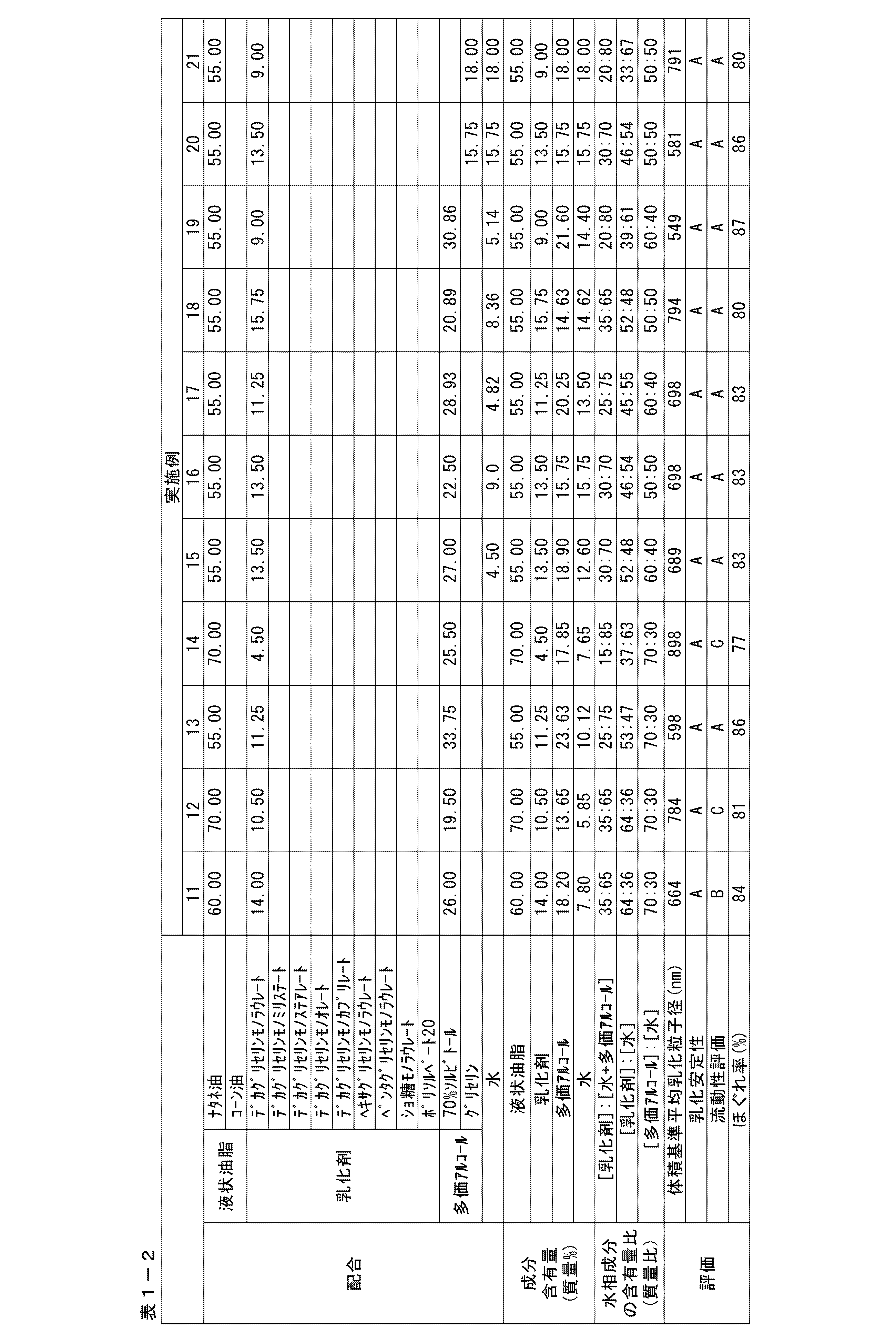
また、多価アルコールとして70%ソルビトール(商品名:ソルビトール花王、花王社製、ソルビトール:70質量%、水:30質量%)又はグリセリン(花王社製)の水溶液(グリセリンと水の混合比は表1-1~表1-4に記載の通り)と、乳化剤としてデカグリセリンモノラウレート(商品名:リョートーポリグリエステルL-7D、三菱化学社製)、デカグリセリンモノミリステート(商品名:リョートーポリグリエステルM-7D、三菱化学社製)、デカグリセリンモノステアレート(商品名:サンソフトQ-18S、太陽化学社製)、デカグリセリンモノオレート(商品名:SYグリスターMO-7S、阪本薬品工業社製)、デカグリセリンモノカプリレート(商品名:MCA-750、阪本薬品工業社製)、ヘキサグリセリンモノラウレート(商品名:SYグリスターML-750、阪本薬品工業社製)、ペンタグリセリンモノラウレート(商品名:サンソフトA-121E、太陽化学社製)、ショ糖モノラウレート(商品名:リョートーシュガーエステルL-1695、三菱化学社製)、又はポリソルベート20(商品名:レオドールTW-L120、花王社製)を下記表1-1~表1-4に示す割合(単位:質量部)で混合し、80℃に加温して水相を調製した。
液状油脂としてナタネ油(日清オイリオ社製)又はコーン油(商品名:コーンサラダ油、日清オイリオ社製)を油相成分として用いた。
また、多価アルコールとして70%ソルビトール(商品名:ソルビトール花王、花王社製、ソルビトール:70質量%、水:30質量%)又はグリセリン(花王社製)の水溶液(グリセリンと水の混合比は表1-1~表1-4に記載の通り)と、乳化剤としてデカグリセリンモノラウレート(商品名:リョートーポリグリエステルL-7D、三菱化学社製)、デカグリセリンモノミリステート(商品名:リョートーポリグリエステルM-7D、三菱化学社製)、デカグリセリンモノステアレート(商品名:サンソフトQ-18S、太陽化学社製)、デカグリセリンモノオレート(商品名:SYグリスターMO-7S、阪本薬品工業社製)、デカグリセリンモノカプリレート(商品名:MCA-750、阪本薬品工業社製)、ヘキサグリセリンモノラウレート(商品名:SYグリスターML-750、阪本薬品工業社製)、ペンタグリセリンモノラウレート(商品名:サンソフトA-121E、太陽化学社製)、ショ糖モノラウレート(商品名:リョートーシュガーエステルL-1695、三菱化学社製)、又はポリソルベート20(商品名:レオドールTW-L120、花王社製)を下記表1-1~表1-4に示す割合(単位:質量部)で混合し、80℃に加温して水相を調製した。
表1-1~表1-4に示す割合(単位:質量部)で、上記水相成分をホモミキサー(特殊機化工業社製)中で60℃、9000rpmで攪拌しながら、上記油相成分を徐々に添加して乳化分散した。添加終了後、上記撹拌条件で30分間撹拌し、次いで減圧下で脱気し、水中油型の乳化組成物である実施例1~21及び比較例1~21の乳化組成物を得た。得られた各乳化組成物を室温まで冷却し、ガラス瓶(容積:底面4cmφ×高さ7.5cm)に入れて蓋をして、20℃で30日間保存した後、下記の試験例に用いた。
[試験例1] 体積基準平均乳化粒子径の測定
上記調製例1で得られた各乳化組成物を水に希釈分散させたものを試料とし、レーザー回析式粒度分布計(商品名:SALD-2100、島津製作所社製)を用いてメジアン径(体積基準、屈折率1.70-0.20i)を測定した。結果を表1-1~表1-4に示す(表中、乳化組成物を調製できなかった例は「-」で示した)。
上記調製例1で得られた各乳化組成物を水に希釈分散させたものを試料とし、レーザー回析式粒度分布計(商品名:SALD-2100、島津製作所社製)を用いてメジアン径(体積基準、屈折率1.70-0.20i)を測定した。結果を表1-1~表1-4に示す(表中、乳化組成物を調製できなかった例は「-」で示した)。
[試験例2] 乳化安定性の評価
上記調製例1で得られた各乳化組成物を目視観察し、下記評価基準により乳化安定性を評価した。結果を表1-1~表1-4に示す(表中、乳化組成物を調製できなかった例は「-」で示した)。
上記調製例1で得られた各乳化組成物を目視観察し、下記評価基準により乳化安定性を評価した。結果を表1-1~表1-4に示す(表中、乳化組成物を調製できなかった例は「-」で示した)。
-乳化安定性の評価基準-
A:水中油型の均質な乳化分散状態が維持されている
B:水相の分離(クリーミング)が認められる
C:油相と水相が分離している
A:水中油型の均質な乳化分散状態が維持されている
B:水相の分離(クリーミング)が認められる
C:油相と水相が分離している
[試験例3] 乳化組成物の流動性の評価
上記調製例1で得られた各乳化組成物が入ったガラス瓶の蓋を外し、このガラス瓶の開口部を下側に向けて(より詳細には開口部を真下に向けた状態から約45°斜めに傾けて)、ガラス瓶から乳化組成物が流れでる状態を目視観察し、下記評価基準により乳化組成物の流動性を評価した。結果を表1-1~表1-4に示す。また、乳化安定性の評価がB又はCの乳化組成物は流動性の評価を行わなかった。
上記調製例1で得られた各乳化組成物が入ったガラス瓶の蓋を外し、このガラス瓶の開口部を下側に向けて(より詳細には開口部を真下に向けた状態から約45°斜めに傾けて)、ガラス瓶から乳化組成物が流れでる状態を目視観察し、下記評価基準により乳化組成物の流動性を評価した。結果を表1-1~表1-4に示す。また、乳化安定性の評価がB又はCの乳化組成物は流動性の評価を行わなかった。
-乳化組成物の流動性の評価基準-
A:20℃において、ガラス瓶から素早く流れ出る(乳化組成物の20℃における粘度:1×10⁴~2×10⁵mPa・s)
B:20℃において、ガラス瓶からゆっくりと流れ出る(乳化組成物の20℃における粘度:3×10⁵~2×10⁶mPa・s)
C:20℃において、流動性がなく、ガラス瓶から流れ出ない(乳化組成物の20℃における粘度:3×10⁶mPa・s以上)
A:20℃において、ガラス瓶から素早く流れ出る(乳化組成物の20℃における粘度:1×10⁴~2×10⁵mPa・s)
B:20℃において、ガラス瓶からゆっくりと流れ出る(乳化組成物の20℃における粘度:3×10⁵~2×10⁶mPa・s)
C:20℃において、流動性がなく、ガラス瓶から流れ出ない(乳化組成物の20℃における粘度:3×10⁶mPa・s以上)
[試験例4] ほぐれ性の評価
生めん(商品名:細麺、麺心屋社製)を沸騰水中で1分間茹でた後、湯切りし、イオン交換水で麺の表面のぬめりを除去した。得られた麺の20gを、上記調製例1で得た油中水型乳化組成物を、液状油脂の含有量が2.5質量%になるように水で希釈した希釈液(ほぐし液)30mL中に、30秒間浸漬した。次いで麺を取り出し、麺に付着した過剰の希釈液をエアーブローで除去し、カップに入れた。同様にして、ほぐし液に浸漬後、過剰の希釈液を除去した麺の入ったカップを9個用意した(合計10カップ)。各カップに入った麺について、当該カップに入れてから10分間静置後に、麺線10本を1本ずつ引き上げた。引き上げた合計100本(10本×10カップ)の麺線について、各々の麺線のほぐれ性を下記評価基準により評価した。この評価結果に基づき下記式からほぐれ率を算出した。結果を表1-1~表1-4に示す。なお、乳化安定性の評価がB又はCの乳化組成物については、ほぐれ性の評価を行わなかった。
生めん(商品名:細麺、麺心屋社製)を沸騰水中で1分間茹でた後、湯切りし、イオン交換水で麺の表面のぬめりを除去した。得られた麺の20gを、上記調製例1で得た油中水型乳化組成物を、液状油脂の含有量が2.5質量%になるように水で希釈した希釈液(ほぐし液)30mL中に、30秒間浸漬した。次いで麺を取り出し、麺に付着した過剰の希釈液をエアーブローで除去し、カップに入れた。同様にして、ほぐし液に浸漬後、過剰の希釈液を除去した麺の入ったカップを9個用意した(合計10カップ)。各カップに入った麺について、当該カップに入れてから10分間静置後に、麺線10本を1本ずつ引き上げた。引き上げた合計100本(10本×10カップ)の麺線について、各々の麺線のほぐれ性を下記評価基準により評価した。この評価結果に基づき下記式からほぐれ率を算出した。結果を表1-1~表1-4に示す。なお、乳化安定性の評価がB又はCの乳化組成物については、ほぐれ性の評価を行わなかった。
-ほぐれ性の評価基準-
A:麺線が切断されずに一本ずつ引き上げられる
B:麺線を引き上げた際に、麺線が切断されてしまう、又は、麺線に結着してからまった麺塊が浮上する
A:麺線が切断されずに一本ずつ引き上げられる
B:麺線を引き上げた際に、麺線が切断されてしまう、又は、麺線に結着してからまった麺塊が浮上する
ほぐれ率(%)=100×[A評価の本数]/[A評価の本数とB評価の本数の合計]



上記表1-3~1-4に示されるように、乳化剤としてデカグリセリンモノラウレートを用いないと、水中油型の乳化組成物を調製することができなかった(比較例1~8)。
また、液状油脂の含有量が本発明で規定するよりも少ないと、乳化安定性に劣る結果となった(比較例9~11)。逆に液状油脂の含有量が本発明で規定するよりも多いと、水中油型の乳化組成物を調製することができなかった(比較例12、13)。さらにデカグリセリンモノラウレートの含有量が本発明で規定するよりも多いと水中油型の乳化組成物を調製できず(比較例16)、逆にデカグリセリンモノラウレートの含有量が本発明で規定するよりも少ないと、ほぐれ率に劣る結果となった(比較例18)。
また、液状油脂、デカグリセリンモノラウレート、多価アルコール及び水の含有量がいずれも本発明で規定する範囲内にあっても、水相を構成する各成分の比が本発明の規定を満たさない場合には、麺のほぐれ率に劣る結果となった(比較例14、15、19~21)。
また、液状油脂の含有量が本発明で規定するよりも少ないと、乳化安定性に劣る結果となった(比較例9~11)。逆に液状油脂の含有量が本発明で規定するよりも多いと、水中油型の乳化組成物を調製することができなかった(比較例12、13)。さらにデカグリセリンモノラウレートの含有量が本発明で規定するよりも多いと水中油型の乳化組成物を調製できず(比較例16)、逆にデカグリセリンモノラウレートの含有量が本発明で規定するよりも少ないと、ほぐれ率に劣る結果となった(比較例18)。
また、液状油脂、デカグリセリンモノラウレート、多価アルコール及び水の含有量がいずれも本発明で規定する範囲内にあっても、水相を構成する各成分の比が本発明の規定を満たさない場合には、麺のほぐれ率に劣る結果となった(比較例14、15、19~21)。
これに対し、上記表1-1~1-2に示されるように、液状油脂、デカグリセリンモノラウレート、多価アルコール及び水を本発明で規定する量含有し、かつ、水相を構成する各成分の含有量の比も本発明の規定を満たす場合には、乳化安定性に優れた水中油型乳化組成物を調製することができ、得られた乳化組成物を希釈してなる希釈液を麺のほぐし液として用いると、麺のほぐれ率を各段に高めることができた(実施例1~21)。
上記のほぐれ性の評価において、実施例6の乳化組成物を用いたほぐし液に浸漬した麺線表面の電子顕微鏡写真(倍率400倍)を図1に示す。図1に示されるように、油滴が麺線表面全体にわたり密に付着いていることがわかる(図1の写真において、表面に付着している粒が油滴である)。
[試験例5] 即席中華麺の調製
水35質量部に食塩1.5質量部、粉末かん水(オリエンタル酵母工業社製)0.4質量部を溶解しかんすい水を調製した。このかん水を小麦粉100質量部に加え、15分間混合してそぼろ状の麺生地とした。
製麺ロールを用い、ロール間隙4.5mm、3.0mm、2.0mmの順に圧延し、麺帯をさらに製麺ロールで圧延し、約1.25mm厚の麺帯とした。その後、切刃♯18角を用いて麺線(幅1.25mm)に切り出し、長さ約30cmに切り、生中華麺を得た。得られた生中華麺を蒸し器において、3分間蒸し、蒸し中華麺を得た。蒸し中華めん80gを、上述した、実施例6の乳化組成物を用いたほぐし液100mLに浸漬し、金網上で直径10cmの円柱状に成型した。次いで余分なほぐし液をエアブローにて除去した後、熱風乾燥器において水分が10%程度になるように乾燥し、即席中華麺を調製した。
調製した即席中華麺を沸騰水で4分間湯戻しした。湯戻した麺は、箸を用いて麺を2~3回ほぐすだけで、麺全体が素早く簡単にほぐれた。
水35質量部に食塩1.5質量部、粉末かん水(オリエンタル酵母工業社製)0.4質量部を溶解しかんすい水を調製した。このかん水を小麦粉100質量部に加え、15分間混合してそぼろ状の麺生地とした。
製麺ロールを用い、ロール間隙4.5mm、3.0mm、2.0mmの順に圧延し、麺帯をさらに製麺ロールで圧延し、約1.25mm厚の麺帯とした。その後、切刃♯18角を用いて麺線(幅1.25mm)に切り出し、長さ約30cmに切り、生中華麺を得た。得られた生中華麺を蒸し器において、3分間蒸し、蒸し中華麺を得た。蒸し中華めん80gを、上述した、実施例6の乳化組成物を用いたほぐし液100mLに浸漬し、金網上で直径10cmの円柱状に成型した。次いで余分なほぐし液をエアブローにて除去した後、熱風乾燥器において水分が10%程度になるように乾燥し、即席中華麺を調製した。
調製した即席中華麺を沸騰水で4分間湯戻しした。湯戻した麺は、箸を用いて麺を2~3回ほぐすだけで、麺全体が素早く簡単にほぐれた。
本発明をその実施形態及び実施例とともに説明したが、我々は特に指定しない限り我々の発明を説明のどの細部においても限定しようとするものではなく、添付の請求の範囲に示した発明の精神と範囲に反することなく幅広く解釈されるべきであると考える。
本願は、2015年3月31日に日本国で特許出願された特願2015-072417に基づく優先権を主張するものであり、これはここに参照してその内容を本明細書の記載の一部として取り込む。
Claims (7)
- 液状油脂を48~81質量%、デカグリセリンモノラウレートを4~20質量%、多価アルコールを10~30質量%、及び水を4~20質量%含有し、且つ、下記式(a)、(b)及び(c)を満たす水中油型乳化組成物。
(a)前記デカグリセリンモノラウレートの含有量:前記水と前記多価アルコールの含有量の合計=15:85~35:65
(b)前記デカグリセリンモノラウレートの含有量:前記水の含有量=30:70~65:35
(c)前記多価アルコールの含有量:前記水の含有量=45:55~75:25 - 多価アルコールが、1種又は2種以上の糖アルコールである、請求項1に記載の水中油型乳化組成物。
- 麺線の結着抑制剤である、請求項1又は2に記載の水中油型乳化組成物。
- 体積基準平均乳化粒子径が100~900nmである、請求項1~3のいずれか1項に記載の水中油型乳化組成物。
- 請求項1~4のいずれか1項に記載の水中油型乳化組成物を、水又は水溶液で希釈してなる水中油型乳化組成物希釈液。
- 食塩を含有する、請求項5に記載の水中油型乳化組成物希釈液。
- 請求項1~4のいずれか1項に記載の水中油型乳化組成物又は請求項5もしくは6に記載の水中油型乳化組成物希釈液と、蒸し工程後の麺線とを接触させることにより、前記麺線表面に油滴を付着させることを含む、即席麺の製造方法。
Applications Claiming Priority (2)
| Application Number | Priority Date | Filing Date | Title |
|---|---|---|---|
| JP2015072417 | 2015-03-31 | ||
| JP2015-072417 | 2015-03-31 |
Publications (1)
| Publication Number | Publication Date |
|---|---|
| WO2016159075A1 true WO2016159075A1 (ja) | 2016-10-06 |
Family
ID=57006085
Family Applications (1)
| Application Number | Title | Priority Date | Filing Date |
|---|---|---|---|
| PCT/JP2016/060388 Ceased WO2016159075A1 (ja) | 2015-03-31 | 2016-03-30 | 水中油型乳化組成物 |
Country Status (2)
| Country | Link |
|---|---|
| JP (1) | JP6744112B2 (ja) |
| WO (1) | WO2016159075A1 (ja) |
Cited By (1)
| Publication number | Priority date | Publication date | Assignee | Title |
|---|---|---|---|---|
| JP2019180247A (ja) * | 2018-04-02 | 2019-10-24 | 片岡物産株式会社 | 油脂組成物、ココア粉末組成物およびココア粉末組成物の製造方法 |
Families Citing this family (1)
| Publication number | Priority date | Publication date | Assignee | Title |
|---|---|---|---|---|
| JP6264584B1 (ja) * | 2016-09-30 | 2018-01-24 | 株式会社サンセイアールアンドディ | 遊技機 |
Citations (3)
| Publication number | Priority date | Publication date | Assignee | Title |
|---|---|---|---|---|
| JP2010207155A (ja) * | 2009-03-11 | 2010-09-24 | Nippon Flour Mills Co Ltd | α化麺用高油分乳化油脂組成物及びその製造方法並びにこれを使用したα化麺用ソース及びα化麺 |
| JP2010246466A (ja) * | 2009-04-16 | 2010-11-04 | Nippon Flour Mills Co Ltd | 電子レンジ解凍調理麺用高油分乳化油脂組成物及びその製造方法並びにこれを使用した電子レンジ解凍調理麺用ソース及び電子レンジ解凍調理麺 |
| JP2014158464A (ja) * | 2013-01-23 | 2014-09-04 | Kao Corp | 麺帯用水中油型乳化組成物 |
Family Cites Families (1)
| Publication number | Priority date | Publication date | Assignee | Title |
|---|---|---|---|---|
| JP6043095B2 (ja) * | 2012-05-30 | 2016-12-14 | 日清オイリオグループ株式会社 | 香気性透明乳化食品 |
-
2016
- 2016-03-30 WO PCT/JP2016/060388 patent/WO2016159075A1/ja not_active Ceased
- 2016-03-30 JP JP2016067644A patent/JP6744112B2/ja active Active
Patent Citations (3)
| Publication number | Priority date | Publication date | Assignee | Title |
|---|---|---|---|---|
| JP2010207155A (ja) * | 2009-03-11 | 2010-09-24 | Nippon Flour Mills Co Ltd | α化麺用高油分乳化油脂組成物及びその製造方法並びにこれを使用したα化麺用ソース及びα化麺 |
| JP2010246466A (ja) * | 2009-04-16 | 2010-11-04 | Nippon Flour Mills Co Ltd | 電子レンジ解凍調理麺用高油分乳化油脂組成物及びその製造方法並びにこれを使用した電子レンジ解凍調理麺用ソース及び電子レンジ解凍調理麺 |
| JP2014158464A (ja) * | 2013-01-23 | 2014-09-04 | Kao Corp | 麺帯用水中油型乳化組成物 |
Cited By (1)
| Publication number | Priority date | Publication date | Assignee | Title |
|---|---|---|---|---|
| JP2019180247A (ja) * | 2018-04-02 | 2019-10-24 | 片岡物産株式会社 | 油脂組成物、ココア粉末組成物およびココア粉末組成物の製造方法 |
Also Published As
| Publication number | Publication date |
|---|---|
| JP6744112B2 (ja) | 2020-08-19 |
| JP2016192959A (ja) | 2016-11-17 |
Similar Documents
| Publication | Publication Date | Title |
|---|---|---|
| EP2850950B1 (en) | Production method for frozen noodles and composition for preventing freezer burn | |
| CN107109294A (zh) | 粉末油脂、包含该粉末油脂的食品、以及该粉末油脂的制造方法 | |
| JP6413143B2 (ja) | 電子レンジ解凍・加熱食品用組成物 | |
| JP6755731B2 (ja) | 油脂組成物 | |
| JP2018033335A (ja) | 油脂組成物 | |
| JP5654695B2 (ja) | 麺帯用水中油型乳化組成物 | |
| JP6744112B2 (ja) | 水中油型乳化組成物 | |
| JPWO2016084264A1 (ja) | 酸性乳化調味料 | |
| EP2850951B1 (en) | Frozen noodles and production method therefor | |
| JP6253219B2 (ja) | 油ちょう時間短縮剤 | |
| JP2000333604A (ja) | 食用油脂組成物およびその利用 | |
| JP2017158499A (ja) | 粉末油脂及び飲食品 | |
| JP5969949B2 (ja) | フィリング | |
| JP6960033B2 (ja) | 油脂組成物 | |
| JP4682106B2 (ja) | 麺のツヤ出し方法 | |
| JP5801945B2 (ja) | 麺帯用水中油型乳化組成物 | |
| JP2013132273A (ja) | 油中水型乳化組成物 | |
| JP4094241B2 (ja) | 麺類の製造法 | |
| JP2005087014A (ja) | パスタソース | |
| JP7157666B2 (ja) | ケーキドーナツ用生地及びケーキドーナツの製造方法 | |
| JP2006055080A (ja) | 練り込み用油脂組成物およびそれを用いた食品 | |
| JP3247542B2 (ja) | 麺類品質改良剤及び麺類の製造方法 | |
| JP7707532B2 (ja) | ペースト状食品組成物、及び、ペースト状食品組成物を用いた液状食品の製造方法 | |
| TW202228521A (zh) | 含澱粉食品用鬆散劑、含澱粉食品的鬆散性提高方法、含澱粉食品及其製造方法 | |
| JP2025034372A (ja) | 澱粉含有食品用ほぐれ剤 |
Legal Events
| Date | Code | Title | Description |
|---|---|---|---|
| 121 | Ep: the epo has been informed by wipo that ep was designated in this application |
Ref document number: 16772956 Country of ref document: EP Kind code of ref document: A1 |
|
| NENP | Non-entry into the national phase |
Ref country code: DE |
|
| 122 | Ep: pct application non-entry in european phase |
Ref document number: 16772956 Country of ref document: EP Kind code of ref document: A1 |