WO2016140189A1 - 光学活性α-フルオロアミノ酸化合物又はその塩の製造方法 - Google Patents
光学活性α-フルオロアミノ酸化合物又はその塩の製造方法 Download PDFInfo
- Publication number
- WO2016140189A1 WO2016140189A1 PCT/JP2016/056064 JP2016056064W WO2016140189A1 WO 2016140189 A1 WO2016140189 A1 WO 2016140189A1 JP 2016056064 W JP2016056064 W JP 2016056064W WO 2016140189 A1 WO2016140189 A1 WO 2016140189A1
- Authority
- WO
- WIPO (PCT)
- Prior art keywords
- group
- chain
- substituent
- cyclic
- salt
- Prior art date
- Legal status (The legal status is an assumption and is not a legal conclusion. Google has not performed a legal analysis and makes no representation as to the accuracy of the status listed.)
- Ceased
Links
- 0 CC(N(*)C(*)(*)F)=O Chemical compound CC(N(*)C(*)(*)F)=O 0.000 description 2
Classifications
-
- C—CHEMISTRY; METALLURGY
- C07—ORGANIC CHEMISTRY
- C07C—ACYCLIC OR CARBOCYCLIC COMPOUNDS
- C07C269/00—Preparation of derivatives of carbamic acid, i.e. compounds containing any of the groups, the nitrogen atom not being part of nitro or nitroso groups
- C07C269/06—Preparation of derivatives of carbamic acid, i.e. compounds containing any of the groups, the nitrogen atom not being part of nitro or nitroso groups by reactions not involving the formation of carbamate groups
-
- C—CHEMISTRY; METALLURGY
- C07—ORGANIC CHEMISTRY
- C07C—ACYCLIC OR CARBOCYCLIC COMPOUNDS
- C07C271/00—Derivatives of carbamic acids, i.e. compounds containing any of the groups, the nitrogen atom not being part of nitro or nitroso groups
- C07C271/06—Esters of carbamic acids
- C07C271/08—Esters of carbamic acids having oxygen atoms of carbamate groups bound to acyclic carbon atoms
- C07C271/10—Esters of carbamic acids having oxygen atoms of carbamate groups bound to acyclic carbon atoms with the nitrogen atoms of the carbamate groups bound to hydrogen atoms or to acyclic carbon atoms
- C07C271/22—Esters of carbamic acids having oxygen atoms of carbamate groups bound to acyclic carbon atoms with the nitrogen atoms of the carbamate groups bound to hydrogen atoms or to acyclic carbon atoms to carbon atoms of hydrocarbon radicals substituted by carboxyl groups
-
- C—CHEMISTRY; METALLURGY
- C07—ORGANIC CHEMISTRY
- C07C—ACYCLIC OR CARBOCYCLIC COMPOUNDS
- C07C319/00—Preparation of thiols, sulfides, hydropolysulfides or polysulfides
- C07C319/14—Preparation of thiols, sulfides, hydropolysulfides or polysulfides of sulfides
- C07C319/20—Preparation of thiols, sulfides, hydropolysulfides or polysulfides of sulfides by reactions not involving the formation of sulfide groups
-
- C—CHEMISTRY; METALLURGY
- C07—ORGANIC CHEMISTRY
- C07C—ACYCLIC OR CARBOCYCLIC COMPOUNDS
- C07C323/00—Thiols, sulfides, hydropolysulfides or polysulfides substituted by halogen, oxygen or nitrogen atoms, or by sulfur atoms not being part of thio groups
- C07C323/50—Thiols, sulfides, hydropolysulfides or polysulfides substituted by halogen, oxygen or nitrogen atoms, or by sulfur atoms not being part of thio groups containing thio groups and carboxyl groups bound to the same carbon skeleton
- C07C323/51—Thiols, sulfides, hydropolysulfides or polysulfides substituted by halogen, oxygen or nitrogen atoms, or by sulfur atoms not being part of thio groups containing thio groups and carboxyl groups bound to the same carbon skeleton having the sulfur atoms of the thio groups bound to acyclic carbon atoms of the carbon skeleton
- C07C323/60—Thiols, sulfides, hydropolysulfides or polysulfides substituted by halogen, oxygen or nitrogen atoms, or by sulfur atoms not being part of thio groups containing thio groups and carboxyl groups bound to the same carbon skeleton having the sulfur atoms of the thio groups bound to acyclic carbon atoms of the carbon skeleton with the carbon atom of at least one of the carboxyl groups bound to nitrogen atoms
-
- C—CHEMISTRY; METALLURGY
- C07—ORGANIC CHEMISTRY
- C07B—GENERAL METHODS OF ORGANIC CHEMISTRY; APPARATUS THEREFOR
- C07B53/00—Asymmetric syntheses
Definitions
- the present invention relates to a method for producing an optically active ⁇ -fluoroamino acid compound or a salt thereof.
- fluorine-containing organic compounds have interesting properties, they are widely used as pharmaceuticals, agricultural chemicals, new materials, etc., or synthetic intermediates thereof.
- amino acids are constituents such as peptides and proteins, and are essential components of the living body, and thus are optically active compounds widely used in medicines, agricultural chemicals, fertilizers, food additives and the like.
- An optically active compound having a fluorine atom at the ⁇ -position is expected as a physiologically active substance, and particularly an optically active ⁇ -fluoroamino acid has attracted attention (Non-patent Documents 1 and 2).
- Non-Patent Documents 3, 4 and 5 As a method for producing optically active ⁇ -fluoroamino acid, a production method by a multistage reaction in which a non-asymmetric racemic compound is combined with a Michael reaction, a fluorination reaction, or the like, or a production method by an asymmetric catalytic reaction Is known (Non-Patent Documents 3, 4 and 5), however, it is necessary to use a large number of steps or an expensive asymmetric catalyst.
- An object of the present invention is to provide a novel method for producing an optically active ⁇ -fluoroamino acid compound or a salt thereof.
- Another object of the present invention is to produce a variety of ⁇ -fluoroamino acid compounds or salts thereof at low cost without adding an asymmetric source such as an asymmetric catalyst or an asymmetric auxiliary group.
- the present inventors have conducted extensive research in view of the above problems. As a result, an electrophilic fluorinating agent is reacted with an amino acid compound or a salt thereof having two different protecting groups at the amino group site and having a protected carboxylic acid site in the presence of a metal amide compound. The inventors have found that an optically active amino acid compound having a fluorine atom at the ⁇ -position or a salt thereof is produced. Further research based on this knowledge has led to the completion of the present invention.
- the present invention provides the following method for producing an optically active ⁇ -fluoroamino acid compound or a salt thereof, and the optically active ⁇ -fluoroamino acid compound or a salt thereof.
- Item 1 General formula (1):
- R 1 , R 2 and R 3 are the same or different and each represents a chain or cyclic alkyl group, a chain or cyclic alkenyl group, a chain or cyclic alkynyl group, an aryl group, or heteroaryl Indicates a group.
- the alkyl group, alkenyl group, alkynyl group, aryl group and heteroaryl group in R 1 , R 2 and R 3 each may have a substituent.
- R 4 is the same or different and is a chain or cyclic alkyl group, a chain or cyclic alkenyl group, a chain or cyclic alkynyl group, an aryl group, a heteroaryl group, an OR 5 group, an SR 6 group, or an NR 7 R represents 8 groups.
- R 5 , R 6 , R 7 and R 8 are the same or different and each represents a hydrogen atom, a chain or cyclic alkyl group, a chain or cyclic alkenyl group, a chain or cyclic alkynyl group, aryl A alkyl group, an alkenyl group, an alkynyl group, an aryl group, and a heteroaryl group in R 5 , R 6 , R 7, and R 8 each may have a substituent. .
- R 1 may combine with R 3 to form a ring structure. * Indicates an asymmetric carbon.
- a production method comprising reacting an amino acid compound represented by the formula (1) or a salt thereof and an electrophilic fluorinating agent in the presence of a metal amide compound.
- Item 2. The production method according to Item 1, wherein R 4 is a chain-like alkoxy group which may have a substituent.
- Item 3. The production method according to any one of Items 1 and 2, wherein R 3 is a chain-like alkyl group which may have a substituent.
- Item 5. Item 5.
- R 1 , R 2 and R 3 are the same or different and each represents a chain or cyclic alkyl group, a chain or cyclic alkenyl group, a chain or cyclic alkynyl group, an aryl group, or heteroaryl Indicates a group.
- the alkyl group, alkenyl group, alkynyl group, aryl group and heteroaryl group in R 1 , R 2 and R 3 each may have a substituent.
- R 4 is the same or different and is a chain or cyclic alkyl group, a chain or cyclic alkenyl group, a chain or cyclic alkynyl group, an aryl group, a heteroaryl group, an OR 5 group, an SR 6 group, or an NR 7 R represents 8 groups.
- R 5 , R 6 , R 7 and R 8 are the same or different and each represents a hydrogen atom, a chain or cyclic alkyl group, a chain or cyclic alkenyl group, a chain or cyclic alkynyl group, aryl A alkyl group, an alkenyl group, an alkynyl group, an aryl group, and a heteroaryl group in R 5 , R 6 , R 7, and R 8 each may have a substituent. .
- R 1 may combine with R 3 to form a ring structure.
- the present invention is a novel method for producing an optically active ⁇ -fluoroamino acid compound or a salt thereof, in particular, an ⁇ -fluoroamino acid compound or a derivative thereof easily and with high optical purity from naturally occurring amino acids or derivatives thereof.
- the salt can be produced.
- the present invention does not require the addition of an asymmetric source such as an asymmetric catalyst or an asymmetric auxiliary group, and can easily and inexpensively produce a variety of ⁇ -fluoroamino acid compounds or salts thereof. It is.
- optically active ⁇ -fluoroamino acid compound or salt thereof The production method of the optically active ⁇ -fluoroamino acid compound or salt thereof and the optically active ⁇ -fluoroamino acid compound or salt thereof of the present invention will be described in detail below.
- Process for producing optically active ⁇ -fluoroamino acid or a salt thereof The process for producing an optically active ⁇ -fluoroamino acid compound or a salt thereof of the present invention has two different protecting groups at the amino group site, and the carboxylic acid site is protected.
- the amino acid compound or a salt thereof hereinafter sometimes referred to as “raw material compound”
- an electrophilic fluorinating agent are reacted in the presence of a metal amide compound.
- reaction formula-1 the amino acid compound represented by the general formula (2) or a salt thereof and an electrophilic fluorinating agent are reacted in the presence of a metal amide compound.
- An optically active ⁇ -fluoroamino acid compound represented by the general formula (1) or a salt thereof can be produced.
- ⁇ -Fluoroamino acid compound represented by general formula (1) or salt thereof The ⁇ -fluoroamino acid compound or salt thereof obtained by the production method of the present invention is a compound represented by the following general formula (1).
- the ⁇ -fluoroamino acid compound or a salt thereof according to the present invention has one or more asymmetric carbon atoms, and as represented by the following general formula (1A) or general formula (1B), ⁇ It is an optical isomer having an asymmetric carbon at the position.
- one enantiomer may be in excess, and the enantiomeric excess (ee) is preferably 30% ee or more, more preferably 80% ee or more, 90 % Ee or more is particularly preferable.
- Substituents R 1 , R 2 , R 3 and R 4 in the optically active ⁇ -fluoroamino acid compound represented by the general formula (1) or a salt thereof, and the amino acid compound represented by the general formula (2) or a salt thereof Is as follows.
- R 1 , R 2 , and R 3 are the same or different and each represents a chain or cyclic alkyl group, a chain or cyclic alkenyl group, a chain or cyclic alkynyl group, an aryl group, or a heteroaryl group Indicates.
- the alkyl group, alkenyl group, alkynyl group, aryl group and heteroaryl group in R 1 , R 2 and R 3 each may have a substituent.
- R 1 is preferably a chain or cyclic alkyl group which may have a substituent, and more preferably a linear or branched alkyl group which may have a substituent.
- R 2 is preferably a chain-like or cyclic alkyl group which may have a substituent, and more preferably a chain-like alkyl group which may have a substituent.
- the R 3 is preferably a chain or cyclic alkyl group which may have a substituent, more preferably a chain alkyl group which may have a substituent, and an alkoxyalkyl group (for example, carbon Particularly preferred is an alkyl group having 1 to 6 carbon atoms having an alkoxy group having 1 to 6 carbon atoms.
- R 4 is the same or different and is a chain or cyclic alkyl group, a chain or cyclic alkenyl group, a chain or cyclic alkynyl group, an aryl group, a heteroaryl group, an OR 5 group, an SR 6 group. Or an NR 7 R 8 group.
- R 5 , R 6 , R 7 and R 8 are the same or different and each represents a hydrogen atom, a chain or cyclic alkyl group, a chain or cyclic alkenyl group, a chain or cyclic alkynyl group, an aryl group, or A heteroaryl group, wherein the alkyl group, alkenyl group, alkynyl group, aryl group and heteroaryl group in R 5 , R 6 , R 7 and R 8 each may have a substituent.
- R 4 is preferably a linear or cyclic alkyl group which may have a substituent, and a linear or cyclic alkoxy group which may have a substituent, and has a substituent.
- a chain alkoxy group which may be substituted is more preferable, and a branched alkoxy group having 1 to 6 carbon atoms is particularly preferable.
- the “chain or cyclic alkyl group” is not particularly limited, and examples thereof include a linear, branched or cyclic alkyl group.
- the alkyl group may have a substituent, and preferably 1 to 6 substituents.
- R 9 , R 10 , R 11 and R 12 are the same groups as the above-mentioned R 5 , R 6 , R 7 and R 8 .
- R 13 represents an NH 2 group or an OH group.
- Examples of the unsubstituted linear alkyl group include a methyl group (hereinafter also referred to as “alanine side chain”), an ethyl group, an n-propyl group, an n-butyl group, an n-decyl group, and an n-octadecyl group.
- alkyl groups having 1 to 20 carbon atoms such as Among these, a methyl group, an ethyl group, an n-propyl group, and an n-butyl group are preferable, and a methyl group is more preferable.
- linear alkyl group having a substituent examples include benzyl group (hereinafter also referred to as “phenylalanine side chain”), 4-hydroxy-benzyl group (also referred to as tyrosine side chain), 4-benzyl A linear alkyl group having an aryl group which may have a substituent such as an oxy-benzyl group (hereinafter also referred to as “protected tyrosine side chain”); an imidazolylmethyl group (hereinafter referred to as “histidine side”); Linear alkyl group having a heteroaryl group such as 3-indoylmethyl group (hereinafter also referred to as “tryptophan side chain”); hydroxymethyl group (hereinafter also referred to as “serine side chain”) ), Benzyloxymethyl group (hereinafter also referred to as “protected serine side chain”), 2-hydroxyethyl group (hereinafter also referred to as “threonine side chain”), etc.
- a linear alkyl group having a carboxyl group such as a carboxyethyl group hereinafter also referred to as “glutamic acid side chain”
- an aminocarbonylmethyl group hereinafter also referred to as “asparagine side chain”
- an aminocarbonylethyl group (Hereinafter also referred to as “glutamine side chain”) or the like, a linear alkyl group having an
- Examples of the unsubstituted branched alkyl group include isopropyl group (hereinafter also referred to as “valine side chain”), isobutyl group (hereinafter also referred to as “leucine side chain”), s-butyl group (hereinafter referred to as “isoleucine”). And a branched alkyl group having 3 to 6 carbon atoms such as a t-butyl group.
- Examples of the branched alkyl group having a substituent include 2-methyloctadecyl group, 1,1,1,3,3,3-hexafluoro-2-propyl group, 2- (1,3 -Dihydroxy-2-hydroxymethyl) propylamino group, 1- (2-amino-1-hydroxy-2-hydroxymethyl) propyloxy group and the like.
- Examples of the unsubstituted cyclic alkyl group include cyclic alkyl groups having 3 to 8 carbon atoms such as a cyclopentyl group, a cyclohexyl group, and a cycloheptyl group.
- Examples of the cyclic alkyl group having a substituent include 2-hydroxycyclohexyl group, 2,3-dihydroxycyclohexyl group, 2-aminocyclohexyl group, 2,3-diaminocyclohexyl group, 2-mercaptocyclohexyl group and the like. It is done.
- n- is normal, “s-” is secondary (sec-), “t-” is tertiary (tert-), “i-” is iso, “p” is para, “ “m” means meta and “o” means ortho. Means.
- the amino acid compound (raw material compound) represented by the general formula (2) may be a natural amino acid or a compound derived from a non-natural amino acid.
- the amino acid may be an L-amino acid, a D-amino acid, or a mixture thereof.
- the type of amino acid is not particularly limited as long as it is a compound having an amino group and a carboxyl group, but it is preferable to use a compound derived from “ ⁇ -amino acid” which is abundant in nature.
- Natural amino acids include L-alanine, L-valine, L-leucine, L-isoleucine, L-serine, L-threonine, L-aspartic acid, L-glutamic acid, L-asparagine, L-glutamine, L-lysine , L-arginine, L-cysteine, L-methionine, L-phenylalanine, L-tyrosine, L-tryptophan, L-histidine, and L-proline.
- Non-natural amino acids mean all ⁇ -amino acid derivatives other than the above-mentioned natural amino acids 19 constituting the natural protein. Specifically, (1) non-natural amino acids in which side chain atoms in natural amino acids are substituted with other atoms, (2) optical isomers of natural amino acids, (3) substitution with side chains of natural amino acids Non-natural amino acids into which groups are introduced (4) Chemically synthesized amino acids other than the above-mentioned conditions (1) to (3).
- amino acid side chain means a side chain derived from an amino acid (H 2 N—CHR 1 —COOH) (here, R 1 group).
- the protecting group may be any group generally known as a group having a nitrogen atom or a protecting group for a hydroxyl group, and is not particularly limited.
- the amino acid side chain has a group having a nitrogen atom (for example, NH 2 group, NH group), the group having the nitrogen atom may be protected, and the protecting group for the group having a nitrogen atom
- the group having the nitrogen atom may be protected, and the protecting group for the group having a nitrogen atom
- alkoxycarbonyl groups having 1 to 5 carbon atoms such as t-butoxycarbonyl group (Boc group); methoxymethyl group (MOM group), methoxyethyl group, ethoxymethyl group, ethoxyethyl group, 2-methoxyethoxy group
- a methyl group having a substituent such as a methyl group, a benzyloxymethyl group, or a methylthiomethyl group
- 1 to 3 halogens such as a 2-iodoethoxycarbonyl group, a 2,2,2-trichloroethoxycarbonyl group, etc.
- a substituted alkoxycarbonyl group having 1 to 3 carbon atoms benzyloxycarbonyl group (Cbz group), o-nitrobenzyloxycarbonyl group, p-ni Substituted or unsubstituted methoxycarbonyl groups such as robenzyloxycarbonyl group, p-methoxybenzyloxycarbonyl group, 9-fluorenylmethyloxycarbonyl group; benzyl group (Bn group), p-methoxybenzyl group, 2,4- Substituted or unsubstituted benzyl group such as dimethoxybenzyl group, o-nitrobenzyl group, p-nitrobenzyl group; diphenylmethyl group, di-p-anisylmethyl group etc.
- substituted or unsubstituted diarylmethyl group ⁇ -methyl-benzyl group ⁇ -C 1 -C 4 alkyl-benzyl groups such as ⁇ -ethyl-benzyl group; trityl group; p-methoxyphenyl group, 2,4-dimethoxyphenyl group, o-nitrophenyl group, p-nitrophenyl group, Substituted phenyl groups such as 2,4-dinitrophenyl group; tri (C) such as trimethylsilyl group and t-butyldimethylsilyl group 1 -C 4 ) alkylsilyl group; tetrahydropyranyl group; acyl group such as acetyl group; substituted acetyl group such as trichloroacetyl group.
- hydroxyl protecting group examples include a C 1 -C 4 alkyl group such as a methyl group, an ethyl group, an n-propyl group, an isopropyl group, an n-butyl group, an s-butyl group, a t-butyl group; a methoxymethyl group (MOM group), methoxyethyl group, ethoxymethyl group, ethoxyethyl group, benzyloxymethyl group, 2-methoxyethoxymethyl group, t-butoxymethyl group, methylthiomethyl group, 2,2,2-trichloroethoxymethyl group, 1-methyl-1-methoxyethyl group, substituted methyl group such as trichloroethyl group or substituted ethyl group; tetrahydropyranyl group; benzyl group (Bn group), p-methoxybenzyl group, o-nitrobenzyl group, p-nitro Substitute
- halogens substituted C 1 ⁇ C 6 alkoxy Carbonyl group vinyloxy Carbonyl, C 2 ⁇ C 6 alkenyloxycarbonyl group such as allyloxycarbonyl; benzyloxycarbonyl, p- methoxybenzyloxycarbonyl, 2,4-dimethoxybenzyl oxycarbonyl, o- nitrobenzyloxycarbonyl, p- nitrobenzyloxycarbonyl , Substituted or unsubstituted methyloxycarbonyl groups such as 9-fluorenylmethyloxycarbonyl group and the like.
- the “chain or cyclic alkenyl group” is not particularly limited, and includes a linear, branched or cyclic alkenyl group.
- the alkenyl group may have a substituent, and preferably 1 to 6 substituents. There is no restriction
- linear or branched alkenyl group examples include a vinyl group, a 1-propenyl group, a 2-propenyl group, a 1-butenyl group, a 2-butenyl group, a 3-butenyl group, and a 1-methyl-2-propenyl group.
- Examples of the cyclic alkenyl group include a cyclobutenyl group, a cyclopentenyl group, a cyclohexenyl group, a cyclopentadienyl group, and a cycloheptenyl group.
- the “chain or cyclic alkynyl group” is not particularly limited, and includes a linear, branched or cyclic alkynyl group.
- the alkynyl group may have a substituent, and preferably 1 to 6 substituents. There is no restriction
- linear or branched alkynyl group examples include ethynyl group, 1-propynyl group, 2-propynyl group, 1-butynyl group, 2-butynyl group, 3-butynyl group, 1-methyl-2-propynyl Group, 3-methyl-1-butynyl group and the like.
- cyclic alkynyl group examples include a cyclodecynyl group, a cycloundecynyl group, a cyclododecynyl group, and the like.
- the “aryl group” is not particularly limited, and means, for example, an aromatic hydrocarbon cyclic group, preferably an aryl group having 6 to 14 carbon atoms, more preferably a phenyl group, 1- A naphthyl group, a 2-naphthyl group, an indenyl group, and an azulenyl group, particularly preferably a phenyl group.
- the aryl group may have a substituent, and preferably has 1 to 6 substituents. There is no restriction
- Examples of the aryl group having a substituent include 2-hydroxyphenyl group, 3-hydroxyphenyl group, 4-hydroxyphenyl group, 2,4-dihydroxyphenyl group, 2,4,6-trihydroxyphenyl group, 2-benzyloxy Phenyl group, 3-benzyloxyphenyl group, 4-benzyloxyphenyl group, 2-aminophenyl group, 3-aminophenyl group, 4-aminophenyl group, 2,4-diaminophenyl group, 2,4,6-tri Aminophenyl group, 2-mercaptophenyl group, 3-mercaptophenyl group, 4-mercaptophenyl group, 2,4-dimercaptophenyl group, 2,4,6-trimercaptophenyl group, 2,4-dichlorophenyl group, 4 -Methoxyphenyl group, 4-methoxycarbonyl group, 4-nitrophenyl group, pentafluoroph Group, tolyl group, xylyl group and the like
- heteroaryl group for example, an aromatic cyclic group having 5 to 10 atoms constituting a ring and containing 1 to 5 heteroatoms in the atoms constituting the ring is used.
- the heteroaryl group may have a substituent, and preferably 1 to 6 substituents. There is no restriction
- heteroaryl group examples include a furyl group, a thienyl group, a pyrrolyl group, an imidazolyl group, a triazolyl group, a tetrazolyl group, a thiazolyl group, a pyrazolyl group, an oxazolyl group, an isoxazolyl group, an isothiazolyl group, a furanyl group, a thiadiazolyl group, and an oxadiazolyl group.
- a heteroaryl group is preferably a furyl group, a thienyl group, an imidazolyl group, a pyrazolyl group, a pyridyl group, or an indolyl group, and more preferably a furyl group, a thienyl group, an imidazolyl group, a pyridyl group, or an indolyl group.
- heteroaryl group having a substituent examples include 3-chloro-2-pyridyl group, 3-hydroxy-2-pyridyl group, 3-amino-2-pyridyl group, 3-mercapto-2-pyridyl group, 2-chloro- Examples include a 3-thienyl group, a 2- (1,3-thiazolyl) group, etc.
- halogen atom in the present specification examples include a fluorine atom, a chlorine atom, a bromine atom, and an iodine atom.
- R 1 may combine with R 3 to form a ring structure.
- the group in which R 1 and R 3 are bonded together may be, for example, an alkylene chain having 1 to 6 carbon atoms.
- the alkylene chain may further have a substituent, and may be through a hetero atom such as an oxygen atom, a sulfur atom, or a nitrogen atom.
- examples of the compound represented by the general formula (2) forming the ring structure include proline, hydroxyproline, 3,4-dehydroproline, pipecolic acid, aziridinecarboxylic acid, and 2-azetidinecarboxylic acid. Examples thereof include compounds derived from acids and the like.
- the “salt” of the ⁇ -fluoroamino acid compound represented by the general formula (1) and the amino acid compound represented by the general formula (2) of the present invention is not particularly limited, and examples thereof include alkali metals such as sodium salts and potassium salts. Salts; alkaline earth metal salts such as magnesium salts and calcium salts; amine salts such as dimethylamine salts and triethylamine salts; inorganic acid salts such as hydrochlorides, perchlorates, sulfates and nitrates; acetates and methanesulfonic acid Examples thereof include organic acid salts such as salts.
- the salt of the ⁇ -fluoroamino acid compound of the present invention can be produced according to a usual salt production method, but is not limited to these methods.
- the compound of the present invention includes hydrates, hydrates and solvates of the compound of the present invention.
- the amino acid compound represented by the general formula (2) or a salt thereof The raw material compound used in the production method of the present invention is an amino acid compound represented by the following general formula (2) or a salt thereof (hereinafter also referred to as “amino acid compound”). Yes.) Since the amino acid compound represented by the general formula (2) or a salt thereof has optical activity, the compound represented by the general formula (1) or a salt thereof obtained by the production method of the present invention is optically active. It can be obtained as a body.
- the amino acid compound represented by the general formula (2) or a salt thereof is an optical compound having an asymmetric carbon at the ⁇ -position, as represented by the following general formula (2A) or general formula (2B). Isomer.
- Electrophilic fluorinating agent used in the present invention is not particularly limited as long as an electron deficient fluorine atom (F + ) becomes an active species. , Taylor, SD et al., Tetrahedron, 1999, 55, p.12431-12477).
- electrophilic fluorinating agent for example, N-fluoropyridinium salt, N-fluoroammonium salt, N-fluorosulfonimide compound and the like can be used. Of these, N-fluorosulfonimide compounds are preferred.
- N-fluoropyridinium salt examples include pyridinium fluoride triflate (NFPY), 2,4,6-trimethylpyridinium fluoride triflate (2,4,6-MeNFFPY), 2,6-dichloropyridinium fluoride triflate (2 , 6-ClNFPY), N, N′-difluoro-2,2′-bipyridinium bis (tetrafluoroborate) and the like.
- N-fluoroammonium salt for example, selectfluor (trademark), 1-fluoro-4-hydroxy-1,4-diazoniabicyclo [2.2.2] octanebistetrafluoroborate (NFTh) and the like are preferable.
- the N-fluorosulfonimide compound is not particularly limited, and examples thereof include compounds represented by the following general formula (3).
- R 14 , R 15 , R 16 , R 17 , R 18 , R 19 , R 20 , R 21 , R 22 and R 23 are the same or different and have a hydrogen atom or a substituent.
- the compound represented by the general formula (3) can be produced according to a known production method (for example, Shibata, N. et al., J. Fluor. Chem., 2011, 132, p.222-225). .
- the “alkyl group which may have a substituent” in the compound represented by the general formula (3) is the same as the chain or cyclic alkyl group described above.
- the alkyl group includes a halogen atom (for example, fluorine atom, chlorine atom, bromine atom, iodine atom), cyano group, nitro group, alkyl group (alkyl group having 1 to 6 carbon atoms), cycloalkyl group, aryl group ( For example, it may have 1 to 6 substituents such as a phenyl group, a naphthyl group, a heteroaryl group, an alkoxy group, an aryloxy group, a diarylamino group.
- alkoxy group which may have a substituent” in the compound represented by the general formula (3) is not particularly limited, and examples thereof include a methoxy group, an ethoxy group, an n-propyloxy group, an isopropyloxy group, n-butyloxy group, s-butyloxy group, t-butyloxy group, isobutyloxy group, n-pentyloxy group, 2,2-dimethylpropyloxy group, cyclopentyloxy group, n-hexyloxy group, cyclohexyloxy group, 2- Examples thereof include an alkoxy group having 1 to 10 carbon atoms such as a methylpentyloxy group, 2-ethylhexyloxy group, n-heptyloxy group, n-octyloxy group, n-nonyloxy group and n-decyloxy group.
- the alkoxy group includes a halogen atom (for example, fluorine atom, chlorine atom, bromine atom, iodine atom), cyano group, nitro group, alkyl group (alkyl group having 1 to 6 carbon atoms), cycloalkyl group, aryl group ( For example, it may have 1 to 6 substituents such as a phenyl group, a naphthyl group, a heteroaryl group, an alkoxy group, an aryloxy group, a diarylamino group.
- a halogen atom for example, fluorine atom, chlorine atom, bromine atom, iodine atom
- cyano group for example, fluorine atom, chlorine atom, bromine atom, iodine atom
- nitro group for example, alkyl group (alkyl group having 1 to 6 carbon atoms), cycloalkyl group, aryl group ( For example, it may have 1 to 6 substituent
- N-fluorosulfonimide compounds include N-fluorobenzenesulfonimide (NSFI), N-fluoro- (3,5-di-t-butyl-4-methoxy) benzenesulfonimide (NFBSI), N-fluoro.
- N-fluorobenzenesulfonimide N-fluorobenzenesulfonimide
- NFBSI N-fluoro-(trifluoro-phenyl) benzenesulfonimide
- N-fluoro-P-fluorobenzenesulfonimide, N-fluoro-o-benzenedisulfonimide, N-fluoro-p-toluenesulfonimide and the like are preferable, and N-fluorobenzenesulfonimide is more preferable.
- the amount of the electrophilic fluorinating agent is usually 1 to 100 mol, preferably 1 to 50 mol, more preferably 1 to 3 mol, relative to 1 mol of the amino acid compound as a raw material. .
- the metal amide compound is not particularly limited, and examples thereof include alkali metal amide compounds and alkaline earth metal amide compounds. Of these, alkali metal amide compounds are preferred.
- alkali metal amide compound examples include lithium dimethylamide, sodium dimethylamide, potassium dimethylamide, lithium diethylamide, sodium diethylamide, potassium diethylamide, lithium diisopropylamide, sodium diisopropylamide, potassium diisopropylamide and the like; lithium dicyclohexylamide Alkali metal dicycloalkylamide compounds such as sodium dicyclohexylamide and potassium dicyclohexylamide; alkali metal arylamide compounds such as lithium diphenylamide, sodium diphenylamide and potassium diphenylamide; lithium bis (trimethylsilyl) amide, sodium bis (trimethylsilyl) amide , Potassium bis Trimethylsilyl) amide; alkali metal bis (alkylsilyl) amide compounds such as lithium bis (triethylsilyl) amide, sodium bis (triethylsilyl) amide, potassium bis (triethylsilyl) amide; lithium
- the amount of the metal amide compound to be used is usually 1 to 7 mol, preferably 1 to 4 mol, more preferably 1 to 2 mol with respect to 1 mol of the amino acid compound as a raw material.
- the solvent used in the reaction may be an inert solvent that does not participate in the reaction.
- hydrocarbon solvents such as pentane, hexane, heptane, and octane
- dimethyl ether, diethyl ether (Et 2 O) Ether solvents such as dimethylformamide (DMF) and dimethylacetamide
- aromatic hydrocarbons such as benzene, toluene and xylene
- System solvents and mixed solvents thereof.
- toluene, THF and DMF are preferred, THF and DMF are more preferred, and a mixed solvent of THF and DMF is particularly preferred.
- the amount of the solvent used is usually 1 to 10000 parts by mass, preferably 50 to 5000 parts by mass, and more preferably 100 to 1000 parts by mass with respect to 100 parts by mass of the amino acid compound as a raw material.
- the total amount of the solvent used is usually 1 to 10000 parts by weight, preferably 50 to 5000 parts by weight, more preferably 100 parts by weight of the amino acid compound as a raw material. 100 to 1000 parts by mass.
- the mixing ratio of the mixed solvent is not particularly limited.
- the mixing ratio of the solvent 1 (for example, THF) and the solvent 2 (for example, DMF) is the volume ratio. Usually, it is in the range of 10: 1 to 1:10, preferably in the range of 6: 1 to 2: 1, more preferably in the range of 5: 1 to 3: 1.
- the reaction conditions in the production method of the present invention are appropriately selected depending on the substrate (reaction raw material), the electrophilic fluorinating agent, the type of metal amide compound, etc.
- the reaction temperature is usually ⁇ 200 ° C. to 300 ° C., preferably Is in the range of ⁇ 100 ° C. to 200 ° C., more preferably in the range of ⁇ 80 ° C. to 100 ° C.
- the reaction time in the production method of the present invention varies depending on the reaction temperature, but is usually in the range of 5 seconds to 100 hours, preferably 0.01 to 10 hours, more preferably 0.2 to 2.5 hours.
- the order of addition of the metal amide compound and the electrophilic fluorinating agent is not particularly limited, but (Method A): a step of adding a base metal amide compound to the amino acid compound (2) and reacting them (1) Then, a method comprising the step (2) of adding an electrophilic fluorinating agent to the reaction solution obtained in the step (1), or (Method B): the amino acid raw material compound (2) and the electrophilic fluorination A method comprising a step of adding a metal amide compound into a mixed agent is preferable.
- the reaction time in the above step (1) varies depending on the reaction temperature, but is usually within 1 hour, preferably 1 minute to 30 minutes, more preferably The range is 5 to 10 minutes.
- the reaction temperature may be the same in step (1) and step (2), or may be different.
- the solvent may be the same or different in step (1) and step (2).
- the production method of the present invention may be performed in an airtight container.
- an airtight container There is no restriction
- the production method of the present invention may be performed in an atmosphere of an inert gas such as nitrogen or argon.
- the reaction pressure in the production method of the present invention is not particularly limited, and the reaction may be performed at normal pressure or the reaction may be performed under pressure.
- the following synthetic intermediate is generated.
- the metal amide compound as a base By reacting the metal amide compound as a base with the amino acid compound represented by the general formula (2), the enolate (A) having asymmetry on the CN axis is generated. Thereafter, by reacting this enolate (A) with an electrophilic fluorinating agent, the target tetrasubstituted carbon-containing ⁇ -fluoroamino acid compound (1) is considered to be obtained with high stereoselectivity.
- the compound represented by general formula (2) or a salt thereof can be produced, for example, by protecting the amino group and carboxylic acid group of an amino acid.
- the compound represented by the general formula (2) is Kawabata, T. et al., Angew. Chem. Int. Ed., 2000, 39, p.2155-2157 or Barnes, DM et al., Org. Lett., 2009, 11, p.273-275.
- the salt of the compound represented by the general formula (2) can be produced according to the above-described ordinary salt production method for the compound represented by the general formula (2).
- the ⁇ -fluoroamino acid compound or a salt thereof obtained by the present invention can be obtained by deprotecting each protecting group by deprotecting each protecting group. Free ⁇ -fluoroamino acid) or a salt thereof can be produced.
- optically active ⁇ -fluoroamino acid or salt thereof obtained by the production method of the present invention can be used for various applications.
- an optically active ⁇ -fluoroamino acid or a salt thereof can be used as a pharmaceutical, agricultural chemical, fertilizer, food additive, polymer material or the like, or as a synthetic intermediate for these uses.
- optically active ⁇ -fluoroamino acid compound of the present invention or a salt thereof will be specifically described with reference to Examples and Comparative Examples.
- the examples are merely examples, and the present invention is not limited to the examples.
- Compound 2a to Compound 2g are prepared by known production methods (for example, Kawabata, T., et al., Angew. Chem. Int. Ed., 2000, 39, p. 2155-2157 and Barnes, DM et al., Org Lett., 2009, 11, p.273-275).
- Examples 2 to 6 (Production of compounds 1b to 1h) An ⁇ -fluoroamino acid compound (1) was produced in the same manner as in Example 1, except that the amino acid side chain (R 1 ) in the starting amino acid compound was replaced with the amino acid side chain shown in Table 1 below. The yield (%) and enantiomeric excess (ee) (%) are shown in Table 1.
- Example 2 compound 1b was synthesized by changing the amounts of compound 2b as a substrate, reaction reagent, and the like, and compound 1b was purified by recrystallization.
- Compound 2b production intermediate of ⁇ -fluoroamino acid derivative dissolved in tetrahydrofuran (11.6 mL) in tetrahydrofuran solution (0.50 M, 0.24 mL, 0.12 mmol) of potassium bis (trimethylsilyl) amide (1.01 g, 2.00 mmol) was added at ⁇ 78 ° C. under an argon atmosphere and stirred for 10 minutes.
- the present invention is a novel method for producing an optically active ⁇ -fluoroamino acid compound or a salt thereof.
- an ⁇ -fluoroamino acid compound or a salt thereof can be conveniently and highly optically purified from a naturally occurring amino acid. Can be manufactured.
Landscapes
- Chemical & Material Sciences (AREA)
- Organic Chemistry (AREA)
- Chemical Kinetics & Catalysis (AREA)
- Organic Low-Molecular-Weight Compounds And Preparation Thereof (AREA)
- Indole Compounds (AREA)
Abstract
本発明は、光学活性α-フルオロアミノ酸化合物又はその塩の新規な製造方法を提供することを目的とする。特に、天然に多く存在するアミノ酸を原料として、簡便に、かつ高い光学純度でα-フルオロアミノ酸化合物又はその塩を製造することを目的としている。一般式(1):(式中、R1、R2、R3、R4及び*は、明細書に定義されるとおりである。)で表される光学活性α-フルオロアミノ酸化合物又はその塩の製造方法であって、一般式(2):(式中、R1、R2、R3、R4及び*は、明細書に定義されるとおりである。) で表されるアミノ酸化合物又はその塩、及び求電子的フッ素化剤を、金属アミド化合物の存在下で反応させることを特徴とする、製造方法。
Description
本発明は、光学活性α-フルオロアミノ酸化合物又はその塩の製造方法に関する。
含フッ素有機化合物は、興味深い性質を有することから、医薬、農薬、新規材料等、あるいはこれらの合成中間体として幅広く利用されている。
一方、アミノ酸は、ペプチド、タンパク質等の構成成分であって、生体の必須成分であることから、医薬、農薬、肥料、食品添加物等に広く利用されている光学活性化合物である。
そして、α位にフッ素原子を有する光学活性化合物は、生理活性物質として期待されており、特に、光学活性α-フルオロアミノ酸が注目されている(非特許文献1及び2)。
これまでに、光学活性α-フルオロアミノ酸の製造方法としては、不斉でないラセミ化合物に対してマイケル反応、フッ素化反応等を組み合わせた多段階反応での製造方法、又は不斉触媒反応による製造方法が知られているが(非特許文献3、4及び5)、工程数が多かったり、高価な不斉触媒等を用いる必要があった。
Takeuchi, Y. et al., Chem. Commun., 2000, p.785-786
Bailey, P. D. et al., Tetrahedron, 2009, 65, p.1724-1736
Tongi A. et al., Synlett, 2007, p.1143-1147
Lu, Y. et al., Adv. Synth. Catal., 2010, 352, p.2778-2782
Lu, Y. et al., Org. Biomol. Chem., 2015, 13, p.2350-2359
本発明は、光学活性α-フルオロアミノ酸化合物又はその塩の新規な製造方法を提供することを目的とする。特に、本発明は、天然に豊富に存在するアミノ酸を原料として、簡便に、かつ高い光学純度でα-フルオロアミノ酸化合物又はその塩を製造できることを目的とする。
また、本発明は、不斉触媒又は不斉補助基のような不斉源を添加せずに、多様なα-フルオロアミノ酸化合物又はその塩を安価に製造することを目的としている。
本発明者等は、上記課題に鑑みて、鋭意研究を行った。その結果、アミノ基部位に異なる2つの保護基を有し、かつカルボン酸部位が保護されたアミノ酸化合物又はその塩に対して、金属アミド化合物の存在下で求電子的フッ素化剤を反応させることで、α位にフッ素原子を有する光学活性なアミノ酸化合物又はその塩を製造することを見出した。かかる知見に基づき更に研究を行うことにより、本発明を完成するに至った。
即ち、本発明は、以下の光学活性α-フルオロアミノ酸化合物又はその塩の製造方法、及び光学活性α-フルオロアミノ酸化合物又はその塩を提供する。
項1.
一般式(1):
項1.
一般式(1):

[式中、R1、R2、及びR3は、同一又は異なって、鎖状若しくは環状のアルキル基、鎖状若しくは環状のアルケニル基、鎖状若しくは環状のアルキニル基、アリール基、又はヘテロアリール基を示す。該R1、R2及びR3におけるアルキル基、アルケニル基、アルキニル基、アリール基、及びヘテロアリール基は、各々置換基を有していてもよい。R4は、同一又は異なって、鎖状若しくは環状のアルキル基、鎖状若しくは環状のアルケニル基、鎖状若しくは環状のアルキニル基、アリール基、ヘテロアリール基、OR5基、SR6基、又はNR7R8基を示す。該R4におけるアルキル基、アルケニル基、アルキニル基、アリール基、ヘテロアリール基、OR5基、SR6基、又はNR7R8基は、各々置換基を有していてもよい。
(ここで、R5、R6、R7及びR8は、同一又は異なって、水素原子、鎖状若しくは環状のアルキル基、鎖状若しくは環状のアルケニル基、鎖状若しくは環状のアルキニル基、アリール基、又はヘテロアリール基を示す。該R5、R6、R7及びR8におけるアルキル基、アルケニル基、アルキニル基、アリール基、及びヘテロアリール基は、各々置換基を有していてもよい。)
R1は、R3と共に結合して、環構造を形成していてもよい。
*は、不斉炭素を示す。]
で表される光学活性α-フルオロアミノ酸化合物又はその塩の製造方法であって、
一般式(2):
(ここで、R5、R6、R7及びR8は、同一又は異なって、水素原子、鎖状若しくは環状のアルキル基、鎖状若しくは環状のアルケニル基、鎖状若しくは環状のアルキニル基、アリール基、又はヘテロアリール基を示す。該R5、R6、R7及びR8におけるアルキル基、アルケニル基、アルキニル基、アリール基、及びヘテロアリール基は、各々置換基を有していてもよい。)
R1は、R3と共に結合して、環構造を形成していてもよい。
*は、不斉炭素を示す。]
で表される光学活性α-フルオロアミノ酸化合物又はその塩の製造方法であって、
一般式(2):
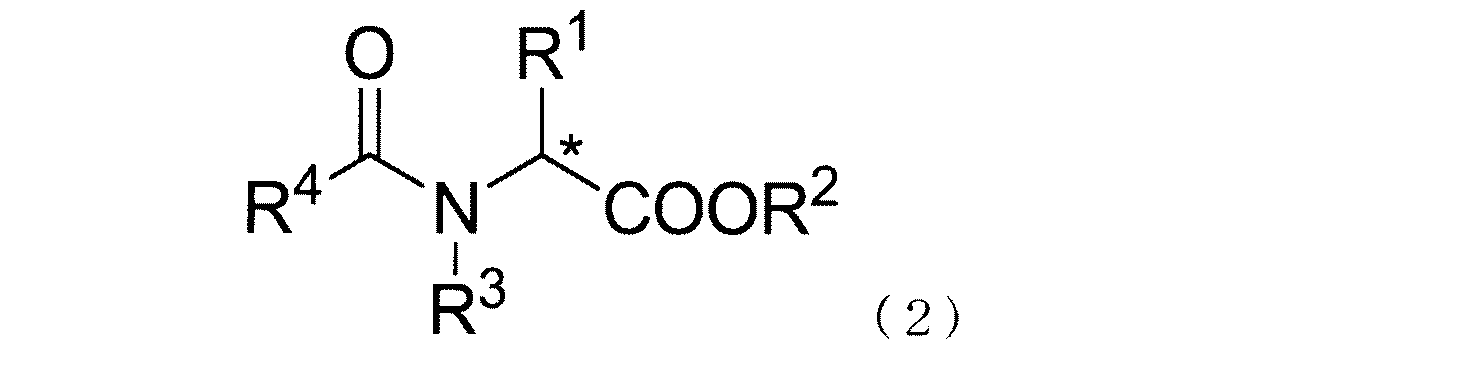
(式中、R1、R2、R3、R4及び*は、前記と同じ。)
で表されるアミノ酸化合物又はその塩、及び求電子的フッ素化剤を、金属アミド化合物の存在下で反応させることを特徴とする、製造方法。
項2.
前記R4が、置換基を有していてもよい鎖状のアルコキシ基である、項1に記載の製造方法。
項3.
前記R3が、置換基を有していてもよい鎖状のアルキル基である、項1又は2の何れか一項に記載の製造方法。
項4.
前記R2が、置換基を有していてもよい鎖状のアルキル基である、項1~3の何れか一項に記載の製造方法。
項5.
前記金属アミド化合物が、アルカリ金属アミド化合物又はアルカリ土類金属アミド化合物である、項1~4の何れか一項に記載の製造方法。
項6.
前記求電子的フッ素化剤が、置換基を有していてもよいN-フルオロ-ジベンゼンスルホンイミドである、項1~5の何れか一項に記載の製造方法。
項7.
下記一般式(1A)又は一般式(1B):
で表されるアミノ酸化合物又はその塩、及び求電子的フッ素化剤を、金属アミド化合物の存在下で反応させることを特徴とする、製造方法。
項2.
前記R4が、置換基を有していてもよい鎖状のアルコキシ基である、項1に記載の製造方法。
項3.
前記R3が、置換基を有していてもよい鎖状のアルキル基である、項1又は2の何れか一項に記載の製造方法。
項4.
前記R2が、置換基を有していてもよい鎖状のアルキル基である、項1~3の何れか一項に記載の製造方法。
項5.
前記金属アミド化合物が、アルカリ金属アミド化合物又はアルカリ土類金属アミド化合物である、項1~4の何れか一項に記載の製造方法。
項6.
前記求電子的フッ素化剤が、置換基を有していてもよいN-フルオロ-ジベンゼンスルホンイミドである、項1~5の何れか一項に記載の製造方法。
項7.
下記一般式(1A)又は一般式(1B):
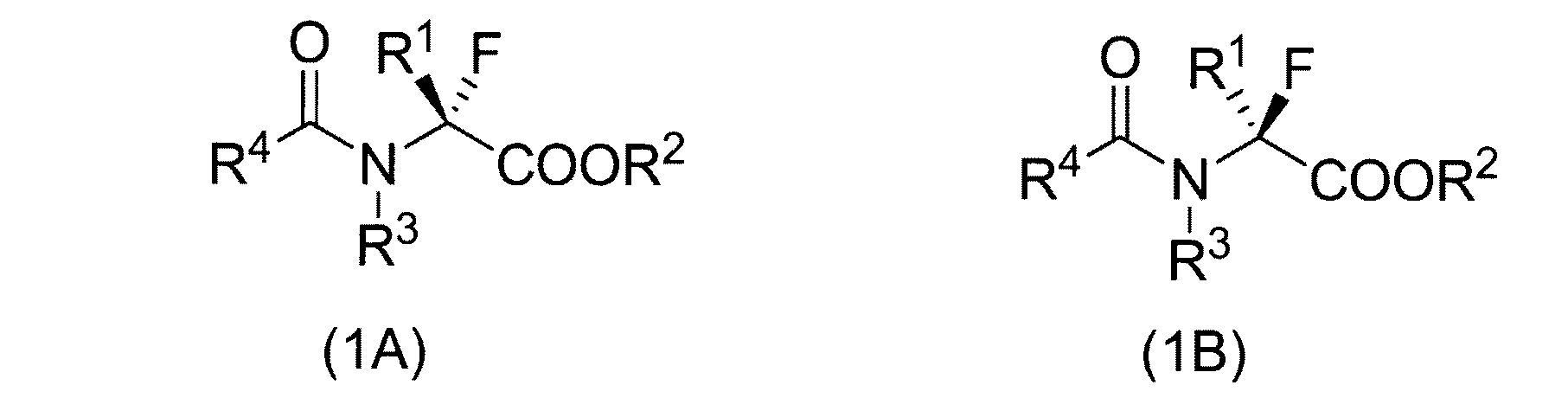
[式中、R1、R2、及びR3は、同一又は異なって、鎖状若しくは環状のアルキル基、鎖状若しくは環状のアルケニル基、鎖状若しくは環状のアルキニル基、アリール基、又はヘテロアリール基を示す。該R1、R2及びR3におけるアルキル基、アルケニル基、アルキニル基、アリール基、及びヘテロアリール基は、各々置換基を有していてもよい。R4は、同一又は異なって、鎖状若しくは環状のアルキル基、鎖状若しくは環状のアルケニル基、鎖状若しくは環状のアルキニル基、アリール基、ヘテロアリール基、OR5基、SR6基、又はNR7R8基を示す。該R4におけるアルキル基、アルケニル基、アルキニル基、アリール基、ヘテロアリール基、OR5基、SR6基、又はNR7R8基は、各々置換基を有していてもよい。
(ここで、R5、R6、R7及びR8は、同一又は異なって、水素原子、鎖状若しくは環状のアルキル基、鎖状若しくは環状のアルケニル基、鎖状若しくは環状のアルキニル基、アリール基、又はヘテロアリール基を示す。該R5、R6、R7及びR8におけるアルキル基、アルケニル基、アルキニル基、アリール基、及びヘテロアリール基は、各々置換基を有していてもよい。)
R1は、R3と共に結合して、環構造を形成していてもよい。]
で表される光学活性α-フルオロアミノ酸化合物又はその塩。
項8.
前記R4が、置換基を有していてもよい鎖状のアルコキシ基である、項7に記載の化合物又はその塩。
項9.
前記R3が、置換基を有していてもよい鎖状のアルキル基である、項7又は8に記載の化合物又はその塩。
項10.
前記R2が、置換基を有していてもよい鎖状のアルキル基である、項7~9の何れか一項に記載の化合物又はその塩。
(ここで、R5、R6、R7及びR8は、同一又は異なって、水素原子、鎖状若しくは環状のアルキル基、鎖状若しくは環状のアルケニル基、鎖状若しくは環状のアルキニル基、アリール基、又はヘテロアリール基を示す。該R5、R6、R7及びR8におけるアルキル基、アルケニル基、アルキニル基、アリール基、及びヘテロアリール基は、各々置換基を有していてもよい。)
R1は、R3と共に結合して、環構造を形成していてもよい。]
で表される光学活性α-フルオロアミノ酸化合物又はその塩。
項8.
前記R4が、置換基を有していてもよい鎖状のアルコキシ基である、項7に記載の化合物又はその塩。
項9.
前記R3が、置換基を有していてもよい鎖状のアルキル基である、項7又は8に記載の化合物又はその塩。
項10.
前記R2が、置換基を有していてもよい鎖状のアルキル基である、項7~9の何れか一項に記載の化合物又はその塩。
本発明は、光学活性α-フルオロアミノ酸化合物又はその塩の新規な製造方法であり、特に、天然に豊富に存在するアミノ酸又はその誘導体から、簡便に、かつ高い光学純度でα-フルオロアミノ酸化合物又はその塩を製造することができる。また、本発明は、不斉触媒又は不斉補助基のような不斉源を添加する必要がなく、簡便に、かつ安価に、多様なα-フルオロアミノ酸化合物又はその塩を製造することが可能である。
本発明の光学活性α-フルオロアミノ酸化合物又はその塩の製造方法及び光学活性α-フルオロアミノ酸化合物又はその塩について、以下詳細に説明する。
1.光学活性α-フルオロアミノ酸又はその塩の製造方法
本発明の光学活性α-フルオロアミノ酸化合物又はその塩の製造方法は、アミノ基部位に異なる2つの保護基を有し、かつカルボン酸部位が保護されたアミノ酸化合物又はその塩(以下、「原料化合物」ということもある)、及び求電子的フッ素化剤を、金属アミド化合物の存在下で反応させることを特徴とする。
本発明の光学活性α-フルオロアミノ酸化合物又はその塩の製造方法は、アミノ基部位に異なる2つの保護基を有し、かつカルボン酸部位が保護されたアミノ酸化合物又はその塩(以下、「原料化合物」ということもある)、及び求電子的フッ素化剤を、金属アミド化合物の存在下で反応させることを特徴とする。
具体的には、下記反応式-1に示すように、一般式(2)で表されるアミノ酸化合物又はその塩、及び求電子的フッ素化剤を、金属アミド化合物の存在下で反応させることで、一般式(1)で表される光学活性α-フルオロアミノ酸化合物又はその塩を製造することができる。
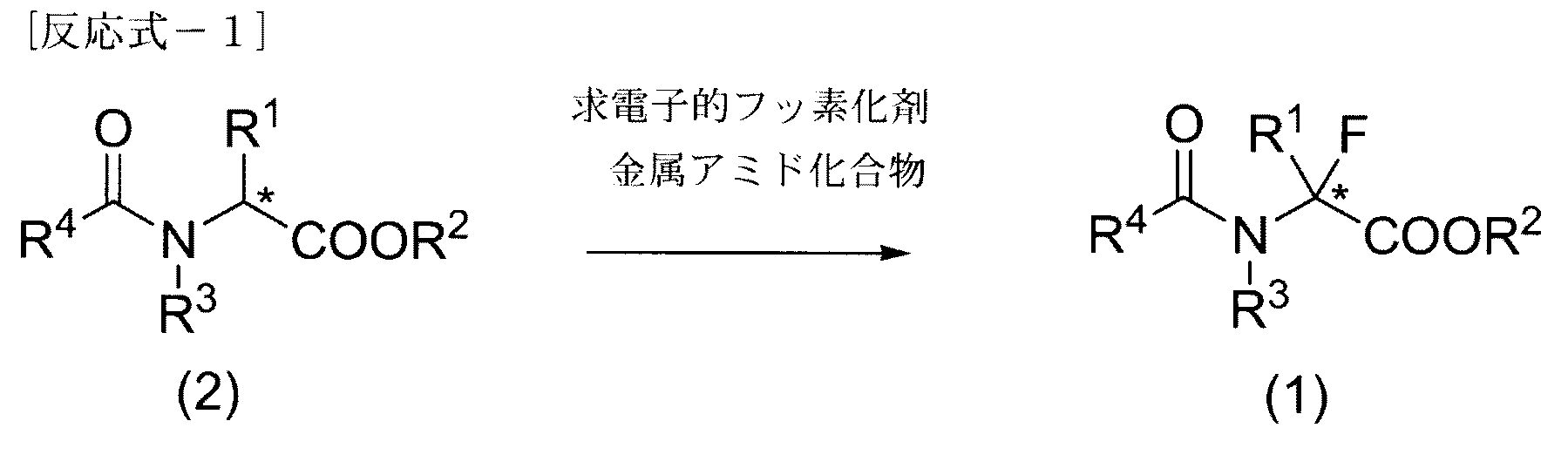
(式中、R1、R2、R3、R4及び*は、前記と同じ。)
一般式(1)で表わされるα-フルオロアミノ酸化合物又はその塩
本発明の製造方法によって得られるα-フルオロアミノ酸化合物又はその塩は、下記一般式(1)で表される化合物である。
本発明の製造方法によって得られるα-フルオロアミノ酸化合物又はその塩は、下記一般式(1)で表される化合物である。
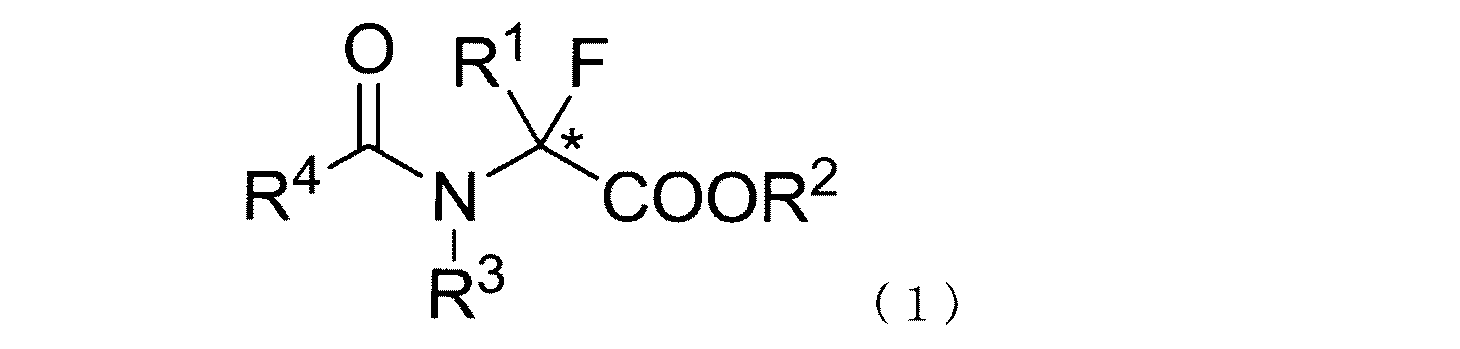
(式中、R1、R2、R3、R4及び*は、前記と同じ。)
具体的には、本発明のα-フルオロアミノ酸化合物又はその塩は、不斉炭素を1つ以上有しており、下記一般式(1A)又は一般式(1B)で表されるように、α位に不斉炭素を有した光学異性体である。
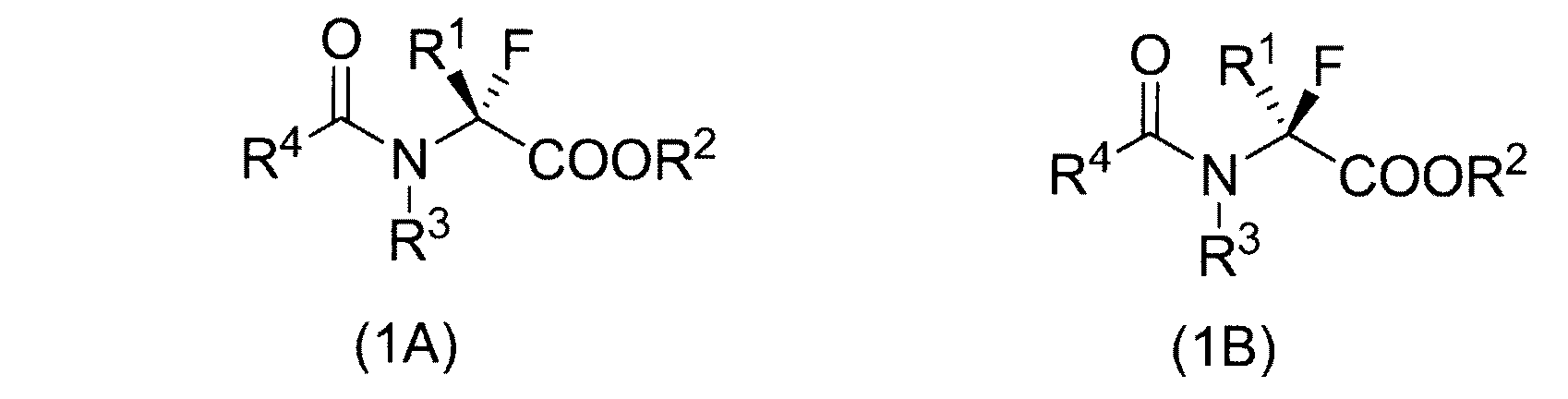
(式中、R1、R2、R3、R4及び*は、前記と同じ。)
本発明のα-フルオロアミノ酸化合物又はその塩としては、一方のエナンチオマーが過剰であればよく、そのエナンチオマー過剰率(ee)としては、30%ee以上が好ましく、80%ee以上がより好ましく、90%ee以上が特に好ましい。
本発明のα-フルオロアミノ酸化合物又はその塩としては、一方のエナンチオマーが過剰であればよく、そのエナンチオマー過剰率(ee)としては、30%ee以上が好ましく、80%ee以上がより好ましく、90%ee以上が特に好ましい。
上記一般式(1)で表される光学活性α-フルオロアミノ酸化合物又はその塩、及び一般式(2)で表されるアミノ酸化合物又はその塩における置換基R1、R2、R3及びR4は、以下のとおりである。
式中、R1、R2、及びR3は、同一又は異なって、鎖状若しくは環状のアルキル基、鎖状若しくは環状のアルケニル基、鎖状若しくは環状のアルキニル基、アリール基、又はヘテロアリール基を示す。該R1、R2及びR3におけるアルキル基、アルケニル基、アルキニル基、アリール基、及びヘテロアリール基は、各々置換基を有していてもよい。
中でも、上記R1は、置換基を有していてもよい鎖状若しくは環状のアルキル基が好ましく、置換基を有していてもよい直鎖状若しくは分岐鎖状のアルキル基がより好ましい。
上記R2は、置換基を有していてもよい鎖状若しくは環状のアルキル基が好ましく、置換基を有していてもよい鎖状のアルキル基がより好ましい。
上記該R3は、置換基を有していてもよい鎖状若しくは環状のアルキル基が好ましく、置換基を有していてもよい鎖状のアルキル基がより好ましく、アルコキシアルキル基(例えば、炭素数1~6のアルコキシ基を有する炭素数1~6のアルキル基)が特に好ましい。
式中、R4は、同一又は異なって、鎖状若しくは環状のアルキル基、鎖状若しくは環状のアルケニル基、鎖状若しくは環状のアルキニル基、アリール基、ヘテロアリール基、OR5基、SR6基、又はNR7R8基を示す。該R4におけるアルキル基、アルケニル基、アルキニル基、アリール基、ヘテロアリール基、OR5基、SR6基、又はNR7R8基は、各々置換基を有していてもよい。
(R5、R6、R7及びR8は、同一又は異なって、水素原子、鎖状若しくは環状のアルキル基、鎖状若しくは環状のアルケニル基、鎖状若しくは環状のアルキニル基、アリール基、又はヘテロアリール基を示す。該R5、R6、R7及びR8におけるアルキル基、アルケニル基、アルキニル基、アリール基、及びヘテロアリール基は、各々置換基を有していてもよい。)
中でも、上記R4は、置換基を有していてもよい鎖状若しくは環状のアルキル基、及び置換基を有していてもよい鎖状若しくは環状のアルコキシ基が好ましく、置換基を有していてもよい鎖状のアルコキシ基がより好ましく、炭素数1~6の分岐鎖状のアルコキシ基が特に好ましい。
(R5、R6、R7及びR8は、同一又は異なって、水素原子、鎖状若しくは環状のアルキル基、鎖状若しくは環状のアルケニル基、鎖状若しくは環状のアルキニル基、アリール基、又はヘテロアリール基を示す。該R5、R6、R7及びR8におけるアルキル基、アルケニル基、アルキニル基、アリール基、及びヘテロアリール基は、各々置換基を有していてもよい。)
中でも、上記R4は、置換基を有していてもよい鎖状若しくは環状のアルキル基、及び置換基を有していてもよい鎖状若しくは環状のアルコキシ基が好ましく、置換基を有していてもよい鎖状のアルコキシ基がより好ましく、炭素数1~6の分岐鎖状のアルコキシ基が特に好ましい。
本明細書中における各基の定義は以下のとおりである。
「鎖状若しくは環状アルキル基」としては、特に限定はなく、例えば、直鎖状、分岐状又は環状のアルキル基が挙げられる。該アルキル基は、置換基を有していてもよく、好ましくは1~6個の置換基を有していてもよい。該置換基としては、特に制限はなく、例えば、ハロゲン原子、シアノ基、ニトロ基、置換基を有していてもよいシクロアルキル基(例えば、炭素数3~10のシクロアルキル基)、置換基を有していてもよいアリール基(例えば、フェニル基、ナフチル基等)、置換基を有していてもよいヘテロアリール基、OR9基、SR10基、NR11R12基、グアニジノ基(-HN-C(=NH)-NH2)、COR13基等が挙げられる。
該R9、R10、R11及びR12は、上述したR5、R6、R7及びR8と同じ基である。該R13は、NH2基、又はOH基を示す。
無置換の直鎖状のアルキル基としては、例えば、メチル基(以下、「アラニン側鎖」ともいう)、エチル基、n-プロピル基、n-ブチル基、n-デシル基、n-オクタデシル基等の炭素数1~20のアルキル基が挙げられる。中でも、好ましくはメチル基、エチル基、n-プロピル基、及びn-ブチル基であり、より好ましくはメチル基である。
置換基を有している直鎖状のアルキル基としては、例えば、ベンジル基(以下、「フェニルアラニン側鎖」ともいう)、4-ヒドロキシ-ベンジル基(チロシン側鎖」ともいう)、4-ベンジルオキシ-ベンジル基(以下、「保護されたチロシン側鎖」ともいう))等の置換基を有していてよいアリール基を有する直鎖状のアルキル基;イミダゾイルメチル基(以下、「ヒスチジン側鎖」ともいう)、3-インドイルメチル基(以下、「トリプトファン側鎖」ともいう)等のヘテロアリール基を有する直鎖状のアルキル基;ヒドロキシメチル基(以下、「セリン側鎖」ともいう)、ベンジルオキシメチル基(以下、「保護されたセリン側鎖」ともいう)、2-ヒドロキシエチル基(以下、「トレオニン側鎖」ともいう)等の保護されていてもよいヒドロキシ基を有する直鎖状のアルキル基;チオールメチル基(以下、「システイン側鎖」ともいう)、メチルチオエチル基(以下、「メチオニン側鎖」ともいう)等の保護されていてもよいチオール基を有する直鎖状のアルキル基;アミノブチル基(以下、「リシン側鎖」ともいう)等のアミノ基を有する直鎖状のアルキル基;カルボキシメチル基(以下、「アスパラギン酸側鎖」ともいう)、カルボキシエチル基(以下、「グルタミン酸側鎖」ともいう)等のカルボキシル基を有する直鎖状のアルキル基;アミノカルボニルメチル基(以下、「アスパラギン側鎖」ともいう)、アミノカルボニルエチル基(以下、「グルタミン側鎖」ともいう)等のアミド基を有する直鎖状のアルキル基;グアニジノプロピル基(以下、「アルギニン側鎖」ともいう)等のグアニジノ基を有する直鎖状のアルキル基;2,2,2-トリフルオロエチル基等のハロゲン原子を有する直鎖状のアルキル基などが挙げられる。該アルキル基鎖の炭素数は、好ましくは炭素数1~10である。
無置換の分岐状のアルキル基としては、例えば、イソプロピル基(以下、「バリン側鎖」ともいう)、イソブチル基(以下、「ロイシン側鎖」ともいう)、s-ブチル基(以下、「イソロイシン側鎖」ともいう)、t-ブチル基等の炭素数3~6の分岐状のアルキル基などが挙げられる。
置換基を有している分岐鎖状のアルキル基としては、例えば、2-メチルオクタデシル基、1,1,1,3,3,3-ヘキサフルオロ-2-プロピル基、2-(1,3-ジヒドロキシ-2-ヒドロキシメチル)プロピルアミノ基、1-(2-アミノ-1-ヒドロキシ-2-ヒドロキシメチル)プロピルオキシ基等が挙げられる。
無置換の環状のアルキル基としては、例えば、シクロペンチル基、シクロヘキシル基、シクロヘプチル基等の炭素数3~8の環状のアルキル基等が挙げられる。
置換基を有している環状のアルキル基としては、2-ヒドロキシシクロヘキシル基、2,3-ジヒドロキシシクロヘキシル基、2-アミノシクロヘキシル基、2,3-ジアミノシクロヘキシル基、2-メルカプトシクロヘキシル基等が挙げられる。
なお、本明細書において、「n-」はnormal、「s-」はsecondary(sec-)、「t-」はtertiary(tert-)、「i-」はiso、「p」はパラ、「m」はメタ及び「o」はオルトを意味している。
を意味する。
を意味する。
本発明の製造方法において、一般式(2)で表わされるアミノ酸化合物(原料化合物)は、天然型アミノ酸、又は非天然型アミノ酸から誘導される化合物であってもよい。
即ち、アミノ酸としては、L-アミノ酸であってもよいし、D-アミノ酸であってもよいし、これらの混合物でもよい。また、アミノ酸の種類としては、アミノ基とカルボキシル基を有する化合物であれば特に限定はないが、天然に豊富に存在している「α-アミノ酸」から誘導される化合物を用いることが好ましい。
天然型アミノ酸としては、L-アラニン、L-バリン、L-ロイシン、L-イソロイシン、L-セリン、L-トレオニン、L-アスパラギン酸、L-グルタミン酸、L-アスパラギン、L-グルタミン、L-リシン、L-アルギニン、L-システイン、L-メチオニン、L-フェニルアラニン、L-チロシン、L-トリプトファン、L-ヒスチジン、L-プロリンが挙げられる。
非天然型アミノ酸としては、天然型タンパク質を構成する上記天然型アミノ酸19類以外の全てのα-アミノ酸誘導体を意味する。具体的には、(1)天然型アミノ酸中の側鎖原子を他の原子で置換した非天然型アミノ酸、(2)天然型アミノ酸の光学異性体、(3)天然型アミノ酸の側鎖に置換基を導入した非天然型アミノ酸(4)化学合成された前述(1)~(3)の条件を除くアミノ酸等が挙げられる。
該一般式(2)で表わされるアミノ酸化合物における置換基R1は、「アミノ酸側鎖」と言い換えることができる。つまり、本明細書において、アミノ酸側鎖とは、アミノ酸(H2N-CHR1-COOH)由来の側鎖(ここでいうR1基)を意味している。該アミノ酸側鎖としては、例えば、
-(CH2)3-NH-C(NH2)(=NH)(アルギニン側鎖)、
-(CH2)4NH2(リシン側鎖)、
-CH2OH(セリン側鎖)、
-CH(OH)CH3(スレオニン側鎖)、
-CH2-C6H4p-OH(チロシン側鎖)、
-CH2CONH2(アスパラギン側鎖)、
-CH2COOH(アスパラギン酸側鎖)、
-(CH2)2CONH2(グルタミン側鎖)、
-(CH2)2COOH(グルタミン酸側鎖)、
-CH2SH(システイン側鎖)、
-CH3(アラニン側鎖)、
-CH2C(C=CH-N=CH-NH-)(ヒスチジン側鎖)、
-CH(CH3)CH2CH3(イソロイシン側鎖)、
-CH2CH(CH3)2(ロイシン側鎖)、
-(CH2)2SCH3(メチオニン側鎖)、
-CH2C6H5(フェニルアラニン側鎖)、
-CH2-C(C=CH-NH-Ph-)(トリプトファン側鎖)、
-CH(CH3)2(バリン側鎖)
-(CH2)4-(プロリン側鎖)等が挙げられる。
-(CH2)3-NH-C(NH2)(=NH)(アルギニン側鎖)、
-(CH2)4NH2(リシン側鎖)、
-CH2OH(セリン側鎖)、
-CH(OH)CH3(スレオニン側鎖)、
-CH2-C6H4p-OH(チロシン側鎖)、
-CH2CONH2(アスパラギン側鎖)、
-CH2COOH(アスパラギン酸側鎖)、
-(CH2)2CONH2(グルタミン側鎖)、
-(CH2)2COOH(グルタミン酸側鎖)、
-CH2SH(システイン側鎖)、
-CH3(アラニン側鎖)、
-CH2C(C=CH-N=CH-NH-)(ヒスチジン側鎖)、
-CH(CH3)CH2CH3(イソロイシン側鎖)、
-CH2CH(CH3)2(ロイシン側鎖)、
-(CH2)2SCH3(メチオニン側鎖)、
-CH2C6H5(フェニルアラニン側鎖)、
-CH2-C(C=CH-NH-Ph-)(トリプトファン側鎖)、
-CH(CH3)2(バリン側鎖)
-(CH2)4-(プロリン側鎖)等が挙げられる。
これらアミノ酸側鎖は、保護基を有していてもよい。該保護基としては、窒素原子を有する基又は水酸基の保護基として一般的に知られている基であればよく、特に制限はない。
上記アミノ酸側鎖が窒素原子を有する基(例えば、NH2基、NH基)を有している場合、その窒素原子を有する基は保護されていてもよく、該窒素原子を有する基の保護基としては、例えば、t-ブトキシカルボニル基(Boc基)等の炭素数1~5のアルコキシカルボニル基;メトキシメチル基(MOM基)、メトキシエチル基、エトキシメチル基、エトキシエチル基、2-メトキシエトキシメチル基、ベンジルオキシメチル基、メチルチオメチル基等の置換基を有しているメチル基;2-ヨウ化エトキシカルボニル基、2,2,2-トリクロロエトキシカルボニル基等の1~3個のハロゲンで置換された炭素数1~3のアルコキシカルボニル基;ベンジルオキシカルボニル基(Cbz基)、o-ニトロベンジルオキシカルボニル基、p-ニトロベンジルオキシカルボニル基、p-メトキシベンジルオキシカルボニル基、9-フルオレニルメチルオキシカルボニル基等の置換又は無置換メトキシカルボニル基;ベンジル基(Bn基)、p-メトキシベンジル基、2,4-ジメトキシベンジル基、o-ニトロベンジル基、p-ニトロベンジル基等の置換又は無置換ベンジル基;ジフェニルメチル基、ジ-p-アニシルメチル基等に置換又は無置換ジアリールメチル基;α-メチル-ベンジル基、α-エチル-ベンジル基等のα-C1~C4アルキル-ベンジル基;トリチル基;p-メトキシフェニル基、2,4-ジメトキシフェニル基、o-ニトロフェニル基、p-ニトロフェニル基、2,4-ジニトロフェニル基等の置換フェニル基;トリメチルシリル基、t-ブチルジメチルシリル基等のトリ(C1~C4)アルキルシリル基;テトラヒドロピラニル基;アセチル基等のアシル基;トリクロロアセチル基等の置換アセチル基等が挙げられる。
水酸基の保護基としては、例えば、メチル基、エチル基、n-プロピル基、イソプロピル基、n-ブチル基、s-ブチル基、t-ブチル等基のC1~C4アルキル基;メトキシメチル基(MOM基)、メトキシエチル基、エトキシメチル基、エトキシエチル基、ベンジルオキシメチル基、2-メトキシエトキシメチル基、t-ブトキシメチル基、メチルチオメチル基、2,2,2-トリクロロエトキシメチル基、1-メチル-1-メトキシエチル基、トリクロロエチル基等の置換メチル基又は置換エチル基;テトラヒドロピラニル基;ベンジル基(Bn基)、p-メトキシベンジル基、o-ニトロベンジル基、p-ニトロベンジル基、p-クロロベンジル基、ジフェニルメチル基、トリフェニルメチル基等の置換又は無置換モノフェニルメチル基、ジフェニルメチル基又はトリフェニルメチル基;トリメチルシリル基、トリエチルシリル基、t-ブチルジメチルシリル基、t-ブチルジフェニルシリル基等の置換シリル基;ホルミル基、;アセチル基、イソブチリル基、ピバロイル基等のC2~C6アルカノイル基;ジクロロアセチル、トリクロロアセチル、トリフルオロアセチル等の1~3個のハロゲンで置換されたC2~C6アルカノイル基;ベンゾイル、トルイル、ナフトイル等のアリールカルボニル基;メトキシカルボニル、エトキシカルボニル、イソブトキシカルボニル等のC1~C6アルコキシカルボニル基;2-ヨウ化エトキシカルボニル、2,2,2-トリクロロエトキシカルボニル等の1~3個のハロゲンで置換されたC1~C6アルコキシカルボニル基;ビニルオキシカルボニル、アリルオキシカルボニル等のC2~C6アルケニルオキシカルボニル基;ベンジルオキシカルボニル、p-メトキシベンジルオキシカルボニル、2,4-ジメトキシベンジルオキシカルボニル、o-ニトロベンジルオキシカルボニル、p-ニトロベンジルオキシカルボニル、9-フルオレニルメチルオキシカルボニル基等の置換又は無置換メチルオキシカルボニル基などが挙げられる。
「鎖状若しくは環状のアルケニル基」としては、特に限定はなく、直鎖状、分岐鎖状、又は環状のアルケニル基が挙げられる。該アルケニル基は、置換基を有していてもよく、好ましくは1~6個の置換基を有していてもよい。該置換基としては、特に制限はなく、例えば、上述したアルキル基における置換基と同じ基が挙げられる。
直鎖状又は分岐鎖状のアルケニル基としては、例えば、ビニル基、1-プロペニル基、2-プロペニル基、1-ブテニル基、2-ブテニル基、3-ブテニル基、1-メチル-2-プロペニル基、2-メチル-2-プロペニル基、1-ペンテニル基、2-ペンテニル基、3-ペンテニル基、4-ペンテニル基、1-メチル-2-ブテニル基、2-メチル-2-ブテニル基、1-ヘキセニル基、2-ヘキセニル基、3-ヘキセニル基、4-ヘキセニル基、5-ヘキセニル基;イソプロペニル基、イソペンテニル基;2-クロロエテニル基、2-フルオロエテニル基、3,3,3-トリフルオロ-1-ペンテニル基、1,2,2-トリフルオロエテニル基、2,3,3-トリフルオロ-2-プロペニル基、2,3,3-トリヨード-2-プロペニル基、2-メトキシエテニル基等が挙げられる。
環状のアルケニル基としては、シクロブテニル基、シクロペンテニル基、シクロヘキセニル基、シクロペンタジエニル基、シクロヘプテニル基等が挙げられる。
「鎖状若しくは環状のアルキニル基」としては、特に限定はなく、直鎖状、分岐鎖状、又は環状のアルキニル基が挙げられる。該アルキニル基は、置換基を有していてもよく、好ましくは1~6個の置換基を有していてもよい。該置換基としては、特に制限はなく、例えば、上述したアルキル基における置換基と同じ基が挙げられる。
直鎖状若しくは分岐鎖状のアルキニル基としては、例えば、エチニル基、1-プロピニル基、2-プロピニル基、1-ブチニル基、2-ブチニル基、3-ブチニル基、1-メチル-2-プロピニル基、3-メチル-1-ブチニル基等が挙げられる。
環状のアルキニル基としては、例えば、シクロデシニル基、シクロウンデシニル基、シクロドデシニル基等が挙げられる。
「アリール基」としては、特に限定はなく、例えば、芳香族性の炭化水素環式基を意味し、好ましくは炭素数が6~14のアリール基であり、より好ましくは、フェニル基、1-ナフチル基、2-ナフチル基、インデニル基、及びアズレニル基であり、特に好ましくはフェニル基である。該アリール基は、置換基を有していてもよく、好ましくは1~6の置換基を有していてもよい。該置換基としては、特に制限はなく、例えば、上述したアルキル基における置換基と同じ基が挙げられる。
置換基を有するアリール基としては、2-ヒドロキシフェニル基、3-ヒドロキシフェニル基、4-ヒドロキシフェニル基、2,4-ジヒドロキシフェニル基、2,4,6-トリヒドロキシフェニル基、2-ベンジルオキシフェニル基、3-ベンジルオキシフェニル基、4-ベンジルオキシフェニル基、2-アミノフェニル基、3-アミノフェニル基、4-アミノフェニル基、2,4-ジアミノフェニル基、2,4,6-トリアミノフェニル基、2-メルカプトフェニル基、3-メルカプトフェニル基、4-メルカプトフェニル基、2,4-ジメルカプトフェニル基、2,4,6-トリメルカプトフェニル基、2,4-ジクロロフェニル基、4-メトキシフェニル基、4-メトキシカルボニル基、4-ニトロフェニル基、ペンタフルオロフェニル基、トリル基、キシリル基等が挙げられる。
「ヘテロアリール基」としては、例えば、環を構成する原子の数が5~10個であり、環を構成する原子中に1~5個のヘテロ原子を含有する芳香族性の環式基を意味する。ヘテロアリール基は、置換基を有していてもよく、好ましくは1~6個の置換基を有していてもよい。該置換基としては、特に制限はなく、例えば、上述したアルキル基における置換基と同じ基が挙げられる。
ヘテロアリール基の具体例としては、フリル基、チエニル基、ピロリル基、イミダゾリル基、トリアゾリル基、テトラゾリル基、チアゾリル基、ピラゾリル基、オキサゾリル基、イソオキサゾリル基、イソチアゾリル基、フラザニル基、チアジアゾリル基、オキサジアゾリル基、ピリジル基、ピラジニル基、ピリダジニル基、ピリミジニル基、トリアジニル基、プリニル基、プテリジニル基、キノリル基、イソキノリル基、ナフチリジニル基、キノキサリニル基、シンノリニル基、キナゾリニル基、フタラジニル基、イミダゾピリジル基、イミダゾチアゾリル基、イミダゾオキサゾリル基、ベンゾチアゾリル基、ベンゾオキサゾリル基、ベンズイミダゾリル基、インドリル基、イソインドリル基、インダゾリル基、ピロロピリジル基、チエノピリジル基、フロピリジル基、ベンゾチアジアゾリル基、ベンゾオキサジアゾリル基、ピリドピリミジニル基、ベンゾフリル基、ベンゾチエニル基、チエノフリル基等が挙げられる。中でも、ヘテロアリール基として好ましくは、フリル基、チエニル基、イミダゾリル基、ピラゾリル基、ピリジル基及びインドリル基であり、より好ましくはフリル基、チエニル基、イミダゾリル基、ピリジル基、及びインドリル基である。
置換基を有するヘテロアリール基としては、3-クロロ-2-ピリジル基、3-ヒドロキシ-2-ピリジル基、3-アミノ-2-ピリジル基、3-メルカプト-2-ピリジル基、2-クロロ-3-チエニル基、2-(1,3-チアゾリル)基等が挙げられる
本明細書におけるハロゲン原子としては、例えば、フッ素原子、塩素原子、臭素原子、ヨウ素原子等が挙げられる。
本明細書におけるハロゲン原子としては、例えば、フッ素原子、塩素原子、臭素原子、ヨウ素原子等が挙げられる。
R1は、R3と共に結合して環構造を形成していてもよい。該R1とR3とが共に結合した基としては、例えば、炭素数1~6のアルキレン鎖であってよい。該アルキレン鎖は、さらに置換基を有していてもよく、また、酸素原子、硫黄原子、窒素原子等のヘテロ原子を介していてもよい。具体的に、環構造を形成している一般式(2)で表される化合物としては、例えば、プロリン、ヒドロキシプロリン、3,4-デヒドロプロリン、ピペコリン酸、アジリジンカルボン酸、2-アゼチジンカルボン酸等から誘導される化合物が挙げられる。
本発明の一般式(1)で表わされるα-フルオロアミノ酸化合物及び一般式(2)で表わされるアミノ酸化合物の「塩」としては、特に制限はなく、例えば、ナトリウム塩、カリウム塩等のアルカリ金属塩;マグネシウム塩、カルシウム塩等のアルカリ土類金属塩;ジメチルアミン塩、トリエチルアミン塩等のアミン塩;塩酸塩、過塩素酸塩、硫酸塩、硝酸塩等の無機酸塩;酢酸塩、メタンスルホン酸塩等の有機酸塩などが挙げられる。本発明のα-フルオロアミノ酸化合物の塩は、通常の塩の製造方法に従って製造することができるが、これらの方法に限定されるものではない。
なお、本発明の化合物は、本発明化合物の含水物、水和物及び溶媒和物も包含される。
一般式(2)で表わされるアミノ酸化合物又はその塩
本発明の製造方法に用いられる原料化合物は、下記一般式(2)で表されるアミノ酸化合物又はその塩(以下、「アミノ酸化合物」ということもある。)である。該一般式(2)で表されるアミノ酸化合物又はその塩が光学活性を有していることから、本発明の製造方法によって得られる一般式(1)で表される化合物又はその塩が光学活性体として得ることができる。
本発明の製造方法に用いられる原料化合物は、下記一般式(2)で表されるアミノ酸化合物又はその塩(以下、「アミノ酸化合物」ということもある。)である。該一般式(2)で表されるアミノ酸化合物又はその塩が光学活性を有していることから、本発明の製造方法によって得られる一般式(1)で表される化合物又はその塩が光学活性体として得ることができる。

(式中、R1、R2、R3、R4及び*は、前記と同じ。)
具体的には、一般式(2)で表されるアミノ酸化合物又はその塩は、下記一般式(2A)又は一般式(2B)で表されるように、α位に不斉炭素を有した光学異性体である。
具体的には、一般式(2)で表されるアミノ酸化合物又はその塩は、下記一般式(2A)又は一般式(2B)で表されるように、α位に不斉炭素を有した光学異性体である。
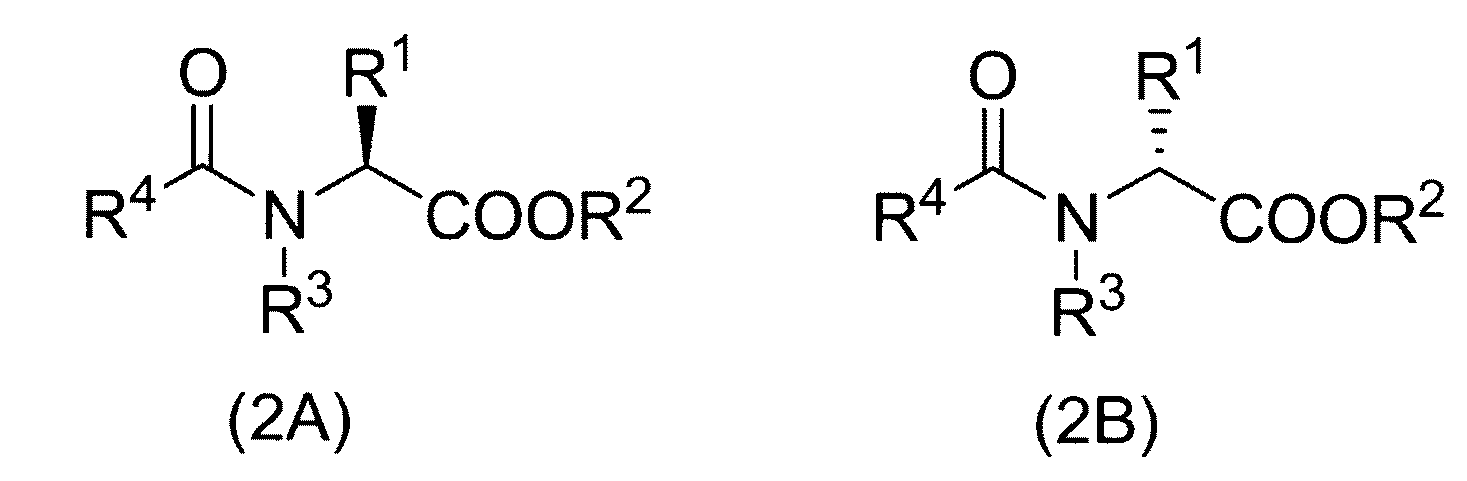
(式中、R1、R2、R3、R4及び*は、前記と同じ。)
求電子的フッ素化剤
本発明で使用される求電子的フッ素化剤としては、電子欠乏性のフッ素原子(F+)が活性種となるものであれば特に制限はなく、例えば、公知(例えば、Taylor, S. D. et al., Tetrahedron, 1999, 55, p.12431-12477)の試薬として使用されるものが挙げられる。具体的に求電子的フッ素化剤としては、例えば、N-フルオロピリジニウム塩、N-フルオロアンモニウム塩、N-フルオロスルホンイミド化合物等を用いることができる。中でも、N-フルオロスルホンイミド化合物が好ましい。
本発明で使用される求電子的フッ素化剤としては、電子欠乏性のフッ素原子(F+)が活性種となるものであれば特に制限はなく、例えば、公知(例えば、Taylor, S. D. et al., Tetrahedron, 1999, 55, p.12431-12477)の試薬として使用されるものが挙げられる。具体的に求電子的フッ素化剤としては、例えば、N-フルオロピリジニウム塩、N-フルオロアンモニウム塩、N-フルオロスルホンイミド化合物等を用いることができる。中でも、N-フルオロスルホンイミド化合物が好ましい。
N-フルオロピリジニウム塩としては、例えば、ピリジニウムフルオリドトリフラート(NFPY)、2,4,6-トリメチルピリジニウムフルオリドトリフラート(2,4,6-MeNFPY)、2,6-ジクロロピリジニウムフルオリドトリフラート(2,6-ClNFPY)、N,N’-ジフルオロ-2,2’-ビピリジニウムビス(テトラフルオロボラート)等が挙げられる。
N-フルオロアンモニウム塩としては、例えば、selectfluor(商標)、1-フルオロ-4-ヒドロキシ-1,4-ジアゾニアビシクロ[2.2.2]オクタンビステトラフルオロボラート(NFTh)等が好ましい。
N-フルオロスルホンイミド化合物としては、特に限定はなく、例えば、下記一般式(3)で表される化合物等が挙げられる。
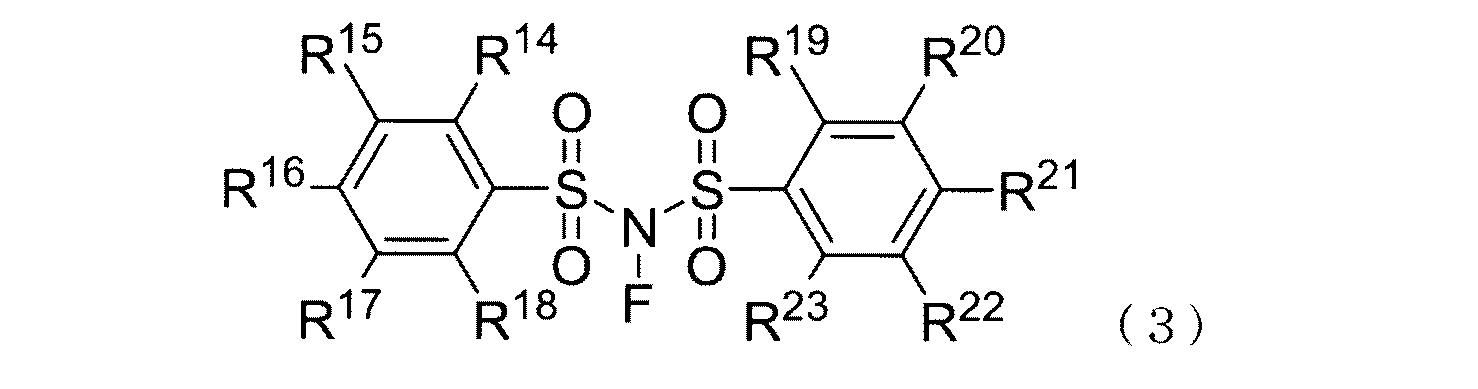
(式中、R14、R15、R16、R17、R18、R19、R20、R21、R22及びR23は、同一又は異なって、水素原子、置換基を有していてもよいアルキル基、又は置換基を有していてもよいアルコキシ基を示す。)
一般式(3)で表される化合物は、公知の製造方法(例えば、Shibata, N. et al., J. Fluor. Chem., 2011, 132, p.222-225)に従って製造することができる。
一般式(3)で表される化合物は、公知の製造方法(例えば、Shibata, N. et al., J. Fluor. Chem., 2011, 132, p.222-225)に従って製造することができる。
一般式(3)で表される化合物における「置換基を有していてもよいアルキル基」としては、上述した鎖状若しくは環状アルキル基と同じである。該アルキル基は、ハロゲン原子(例えば、フッ素原子、塩素原子、臭素原子、ヨウ素原子等)、シアノ基、ニトロ基、アルキル基(炭素数1~6のアルキル基)、シクロアルキル基、アリール基(例えば、フェニル基、ナフチル基等)、ヘテロアリール基、アルコキシ基、アリールオキシ基、ジアリールアミノ基等の置換基を1~6個有していてもよい。
一般式(3)で表される化合物における「置換基を有していてもよいアルコキシ基」としては、特に制限はなく、例えば、メトキシ基、エトキシ基、n-プロピルオキシ基、イソプロピルオキシ基、n-ブチルオキシ基、s-ブチルオキシ基、t-ブチルオキシ基、イソブチルオキシ基、n-ペンチルオキシ基、2,2-ジメチルプロピルオキシ基、シクロペンチルオキシ基、n-ヘキシルオキシ基、シクロヘキシルオキシ基、2-メチルペンチルオキシ基、2-エチルヘキシルオキシ基、n-ヘプチルオキシ基、n-オクチルオキシ基、n-ノニルオキシ基、n-デシルオキシ基等の炭素数1~10のアルコキシ基等が挙げられる。該アルコキシ基は、ハロゲン原子(例えば、フッ素原子、塩素原子、臭素原子、ヨウ素原子等)、シアノ基、ニトロ基、アルキル基(炭素数1~6のアルキル基)、シクロアルキル基、アリール基(例えば、フェニル基、ナフチル基等)、ヘテロアリール基、アルコキシ基、アリールオキシ基、ジアリールアミノ基等の置換基を1~6個有していてもよい。
中でも、N-フルオロスルホンイミド化合物としては、N-フルオロベンゼンスルホンイミド(NSFI)、N-フルオロ-(3,5-ジ-t-ブチル-4-メトキシ)ベンゼンスルホンイミド(NFBSI)、N-フルオロ-p-フルオロベンゼンスルホンイミド、N-フルオロ-o-ベンゼンジスルホンイミド、N-フルオロ-p-トルエンスルホンイミド等が好ましく、中でも、N-フルオロベンゼンスルホンイミドがより好ましい。
求電子的フッ素化剤の使用量としては、原料であるアミノ酸化合物1モルに対して、通常、1~100モルであり、好ましくは1~50モルであり、より好ましくは1~3モルである。
金属アミド化合物
金属アミド化合物としては、特に限定はなく、例えば、アルカリ金属アミド化合物、アルカリ土類金属アミド化合物等が挙げられる。中でも、アルカリ金属アミド化合物が好ましい。
金属アミド化合物としては、特に限定はなく、例えば、アルカリ金属アミド化合物、アルカリ土類金属アミド化合物等が挙げられる。中でも、アルカリ金属アミド化合物が好ましい。
アルカリ金属アミド化合物としては、リチウムジメチルアミド、ナトリウムジメチルアミド、カリウムジメチルアミド、リチウムジエチルアミド、ナトリウムジエチルアミド、カリウムジエチルアミド、リチウムジイソプロピルアミド、ナトリウムジイソプロピルアミド、カリウムジイソプロピルアミド等のアルカリ金属ジアルキルアミド化合物;リチウムジシクロヘキシルアミド、ナトリウムジシクロヘキシルアミド、カリウムジシクロヘキシルアミド等のアルカリ金属ジシクロアルキルアミド化合物;リチウムジフェニルアミド、ナトリウムジフェニルアミド、カリウムジフェニルアミド等のアルカリ金属アリールアミド化合物;リチウムビス(トリメチルシリル)アミド、ナトリウムビス(トリメチルシリル)アミド、カリウムビス(トリメチルシリル)アミド;リチウムビス(トリエチルシリル)アミド、ナトリウムビス(トリエチルシリル)アミド、カリウムビス(トリエチルシリル)アミド等のアルカリ金属ビス(アルキルシリル)アミド化合物;リチウムt-ブチル(トリメチルシリル)アミド、ナトリウムt-ブチル(トリメチルシリル)アミド、カリウムt-ブチル(トリメチルシリル)アミド等のアルカリ金属アルキル(トリアルキルシリル)アミドなどが挙げられる。中でもアルカリ金属ビス(アルキルシリル)アミド化合物が好ましく、カリウムビス(アルキルシリル)アミド化合物がより好ましく、カリウムビス(トリメチルシリル)アミドが特に好ましい。
金属アミド化合物の使用量としては、原料であるアミノ酸化合物1モルに対して、通常、1~7モルであり、好ましくは1~4モルであり、より好ましくは1~2モルである。
本発明において、反応に用いられる溶媒としては、反応に関与しない不活性な溶媒であればよく、例えば、ペンタン、ヘキサン、ヘプタン、オクタン等の炭化水素系溶媒;ジメチルエーテル、ジエチルエーテル(Et2O)、t-ブチルメチルエーテル、1,4-ジオキサン、テトラヒドロフラン(THF)等のエーテル系溶媒;ジメチルホルムアミド(DMF)、ジメチルアセトアミド等の非プロトン性極性溶媒;ベンゼン,トルエン、キシレン等の芳香族炭化水素系溶媒;これらの混合溶媒などが挙げられる。これらのうち、トルエン、THF及びDMFが好ましく、THF及びDMFがより好ましく、THF及びDMFの混合溶媒が特に好ましい。
溶媒の使用量としては、原料であるアミノ酸化合物100質量部に対して、通常、1~10000質量部であり、好ましくは50~5000質量部であり、より好ましくは100~1000質量部である。混合溶媒を使用する場合、その溶媒全体の使用量は、原料であるアミノ酸化合物100質量部に対して、通常、1~10000質量部であり、好ましくは50~5000質量部であり、より好ましくは100~1000質量部である。該混合溶媒の混合割合は、特に限定はなく、例えば、2種類の溶媒を用いる混合溶媒の場合は、溶媒1(例えば、THF)と溶媒2(例えば、DMF)との混合割合は、容量比で、通常10:1~1:10の範囲、好ましくは6:1~2:1の範囲であり、より好ましくは5:1~3:1の範囲である。
本発明の製造方法における反応条件は、基質(反応原料)、求電子的フッ素化剤、金属アミド化合物の種類等によって適宜選択されるが、反応温度は、通常、-200℃~300℃、好ましくは-100℃~200℃、より好ましくは-80℃~100℃の範囲である。
本発明の製造方法における反応時間は、反応温度で異なるが、通常、5秒~100時間、好ましくは0.01~10時間、より好ましくは0.2~2.5時間の範囲である。
上記金属アミド化合物及び求電子的フッ素化剤の添加順序としては、特に制限はないが、(方法A):アミノ酸化合物(2)に塩基である金属アミド化合物を添加して反応させる工程(1)、次いで、工程(1)で得られた反応液に、求電子的フッ素化剤を添加する工程(2)を備える方法、又は(方法B):アミノ酸原料化合物(2)と求電子的フッ素化剤とを混合させた中に、金属アミド化合物を添加する工程を備える方法が好ましい。例えば、上記(方法A)の場合における反応時間としては、上記工程(1)の反応時間は、反応温度で異なるが、通常、1時間以内であり、好ましくは1分~30分、より好ましくは5~10分の範囲である。反応温度は、工程(1)と工程(2)で同じであってもよく、又は異なっていてもよい。溶媒は、工程(1)と工程(2)で同じであってもよく、又は異なっていてもよい。
本発明の製造方法は、密閉容器中で行ってもよい。その容器としては、特に制限はなく、ステンレス製密閉容器、耐圧仕様のガラス製密閉容器等が挙げられる。
本発明の製造方法は、窒素、アルゴン等の不活性ガスの雰囲気下で行なってもよい。
本発明の製造方法における反応圧力は、特に制限はなく、常圧で反応を実施してもよいし、加圧下で反応を行ってもよい。
反応終了後、得られる反応混合物から、過剰の求電子的フッ素化剤、金属アミド化合物、未反応の原料化合物等を、蒸留、ろ過、遠心分離、シリカゲルクロマトグラフィー等の通常の分離方法により除去し、目的とする一般式(1)で表される化合物を取り出すことができる。
本発明の製造方法では、下記のような合成中間体が生成しているものと推測される。塩基である金属アミド化合物を一般式(2)で表わされるアミノ酸化合物に作用させることで、下記C-N軸に不斉を持つエノラート(A)が発生される。その後、このエノラート(A)と求電子的フッ素化剤とを反応させることで、目的とする四置換炭素含有α-フルオロアミノ酸化合物(1)が高立体選択的に得られるものと考えられる。

(式中、R1、R2、R3、R4及び*は、前記と同じ。波線は幾何異性体を示す。)
2.一般式(2)で表わされるアミノ酸化合物又はその塩の製造
一般式(2)で表される化合物又はその塩は、例えば、アミノ酸のアミノ基及びカルボン酸基を保護することで製造できる。具体的に一般式(2)で表される化合物は、Kawabata, T. et al., Angew. Chem. Int. Ed., 2000, 39, p.2155-2157又は Barnes, D. M. et al., Org. Lett., 2009, 11, p.273-275に記載された製造方法に従い得ることができる。一般式(2)で表される化合物の塩は、一般式(2)で表される化合物に対して、上述した通常の塩の製造方法に従って製造することができる。
一般式(2)で表される化合物又はその塩は、例えば、アミノ酸のアミノ基及びカルボン酸基を保護することで製造できる。具体的に一般式(2)で表される化合物は、Kawabata, T. et al., Angew. Chem. Int. Ed., 2000, 39, p.2155-2157又は Barnes, D. M. et al., Org. Lett., 2009, 11, p.273-275に記載された製造方法に従い得ることができる。一般式(2)で表される化合物の塩は、一般式(2)で表される化合物に対して、上述した通常の塩の製造方法に従って製造することができる。
3.一般式(1)で表わされるα-フルオロアミノ酸化合物又はその塩の脱保護反応 本発明によって得られるα-フルオロアミノ酸化合物又はその塩は、各々の保護基を脱保護することによりα-フルオロアミノ酸(フリーのα-フルオロアミノ酸)又はその塩を製造することができる。
脱保護の方法としては、公知の方法(例えば、Bodanszky, M and M.A. Ondetti, Peptide Synthesis, Interscience Publishers, New York (1966)、Schroeder and Luebke, The Peptide, Academic Press, New York (1965)、泉屋信夫他, ペプチド合成の基礎と実験, 丸善(1975)等を参照)が採用できる。
4.用途
本発明の製造方法で得られた光学活性α-フルオロアミノ酸又はその塩は、様々な用途に使用することができる。例えば、医薬、農薬、肥料、食品添加剤、高分子材料等の用途、又はこれら用途の合成中間体として光学活性α-フルオロアミノ酸又はその塩を用いることができる。
本発明の製造方法で得られた光学活性α-フルオロアミノ酸又はその塩は、様々な用途に使用することができる。例えば、医薬、農薬、肥料、食品添加剤、高分子材料等の用途、又はこれら用途の合成中間体として光学活性α-フルオロアミノ酸又はその塩を用いることができる。
以下、実施例及び比較例を示して、本発明の光学活性α-フルオロアミノ酸化合物又はその塩について具体的に説明する。ただし、実施例はあくまで一例であって、本発明は、実施例に限定されない。
実施例及び比較例において使用する原料を以下に示す。
<分析装置>
まず、本実施例における化合物の分析に用いた分析装置及び測定条件等について説明する。
(1)1H-NMRスペクトル
日本電子社製JNM-ECX400型用いて、本文中に記載の方法で測定した。
(2)19F-NMRスペクトル
日本電子社製JNM-ECX400型用いて、本文中に記載の方法で測定した。
(3)13C-NMRスペクトル
日本電子社製JNM-ECX400型用いて、本文中に記載の方法で測定した。
(4)光学純度(エナンチオマー過剰率)
キラルカラム(製品名:CHIRALPAK IA、ダイセル社製)を用いたHPLC(waters社製又は日本分光社製)で分析した。
まず、本実施例における化合物の分析に用いた分析装置及び測定条件等について説明する。
(1)1H-NMRスペクトル
日本電子社製JNM-ECX400型用いて、本文中に記載の方法で測定した。
(2)19F-NMRスペクトル
日本電子社製JNM-ECX400型用いて、本文中に記載の方法で測定した。
(3)13C-NMRスペクトル
日本電子社製JNM-ECX400型用いて、本文中に記載の方法で測定した。
(4)光学純度(エナンチオマー過剰率)
キラルカラム(製品名:CHIRALPAK IA、ダイセル社製)を用いたHPLC(waters社製又は日本分光社製)で分析した。
<製造例1~7>
化合物2a~化合物2gは、公知の製造方法(例えば、Kawabata, T., et al., Angew.Chem.Int.Ed., 2000, 39, p.2155-2157及びBarnes, D. M. et al., Org. Lett., 2009, 11, p.273-275)に従って、それぞれ製造した。
化合物2a~化合物2gは、公知の製造方法(例えば、Kawabata, T., et al., Angew.Chem.Int.Ed., 2000, 39, p.2155-2157及びBarnes, D. M. et al., Org. Lett., 2009, 11, p.273-275)に従って、それぞれ製造した。
実施例1(化合物1aの製造)

カリウムビス(トリメチルシリル)アミドのテトラヒドロフラン溶液(0.50 M, 0.72 mL, 0.36 mmol)に、テトラヒドロフラン(1.6 mL)に溶解させた化合物2a(α-フルオロアミノ酸誘導体の製造中間体)(120 mg, 0.30 mmol)をアルゴン雰囲気下-78℃にて加え、10分間撹拌した。この溶液に、ジメチルホルムアミド(0.60 ml)に溶解させたN-フルオロベンゼンスルホンイミド(284 mg, 0.90 mmol)を加え、同温にて5時間撹拌した。その後、この反応液に飽和アンモニウム水溶液を加え、酢酸エチルで抽出した。抽出液を無水硫酸ナトリウムで乾燥させた後、濾過し、濾液を濃縮した。得られた残渣をシリカゲルクロマトグラフィー[酢酸エチル:ヘキサン(容量比)=90:10]に供することにより、化合物1a(120 mg, 96%, 91% ee)を得た。収率(%)とエナンチオマー過剰率(ee)(%)を表1に示した。
化合物1a:ベンジル(R)-2-((tert-ブトキシカルボニル)(メトキシメチル)アミノ-2-フルオロ-3-フェニルプロパノエート)
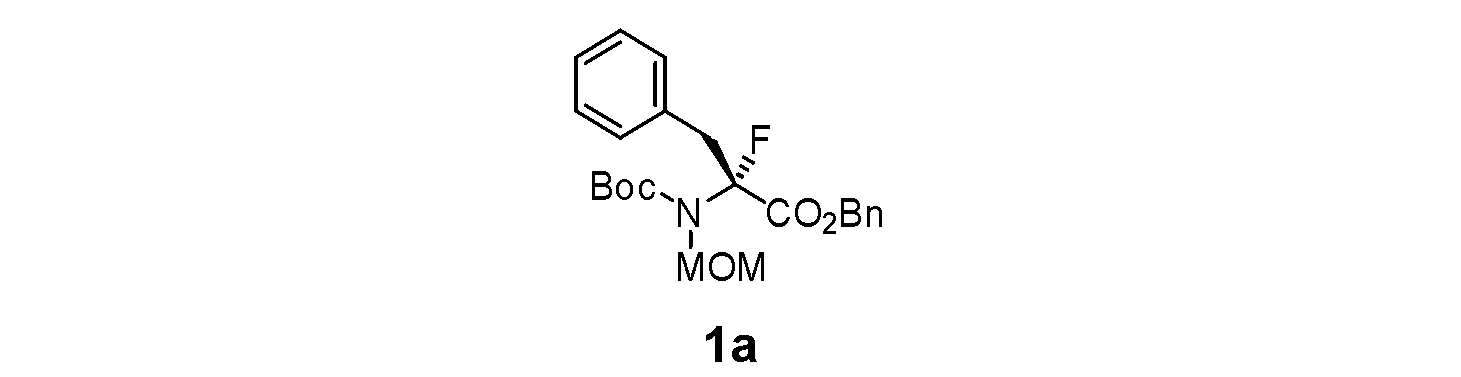
Colorless oil; 92% ee; [α]20
D= 35.0 (c=1.00, CHCl3); IR(neat) cm-1: 2980, 1776, 1721, 1456, 1368, 1294, 1214, 1175, 1105, 1080, 1050, 1026, 669; 1H-NMR (400 MHz, CDCl3) δ: 1.43 (s, 9H), 1.80 (d, J=19.2 Hz, 3H), 3.31 (q, 32.4 Hz, 13.3 Hz), 3.39 (s, 3H), 3.65 (t, 13.3 Hz), 4.87-4.97 (m, 3H), 5.14 (d, J=12.0 Hz, 1H), 7.09-7.11(m, 2H), 7.16-7.18 (m, 2H), 7.23-7.25 (m, 3H), 7.28-7.30 (m, 3H) ppm; 13C-NMR (100 MHz, CDCl3) δ:28.2, 41.2 (split by C-F coupling, 24.8 Hz), 55.6, 67.7, 75.2, 83.5, 101.4, 127.7, 128.5, 128.6, 128.7, 130.7, 133.0, 134.9, 154.1, 167.1 (split by C-F coupling, 34.3 Hz)ppm; 19F-NMR (376 MHz, CDCl3)δ: -122.8 ppm; HRMS (FAB): m/z [M+Na]+ = calcd for 440.1849 [C1H2FNO5Na]+, found 440.1852; LRMS (FAB): m/z [M+Na]+ = 440; HPLC condition: Chiralcel IA column, flow late: 1.0 mL/min, 1% IPA-hexane, 11.3 min (minor) and 13.0 min (major)
実施例2~6(化合物1b~1hの製造)
原料アミノ酸化合物におけるアミノ酸側鎖(R1)を下記表1に記載のアミノ酸側鎖に代えた以外は、実施例1と同様の方法で、α-フルオロアミノ酸化合物(1)を製造した。収率(%)とエナンチオマー過剰率(ee)(%)を表1に示した。
原料アミノ酸化合物におけるアミノ酸側鎖(R1)を下記表1に記載のアミノ酸側鎖に代えた以外は、実施例1と同様の方法で、α-フルオロアミノ酸化合物(1)を製造した。収率(%)とエナンチオマー過剰率(ee)(%)を表1に示した。

化合物1b:ベンジル(R)-3-(4-(ベンジルオキシ)フェニル)-2-((tert-ブトキシカルボニル)(メトキシメチル)アミノ)-2-フルオロプロパノエート
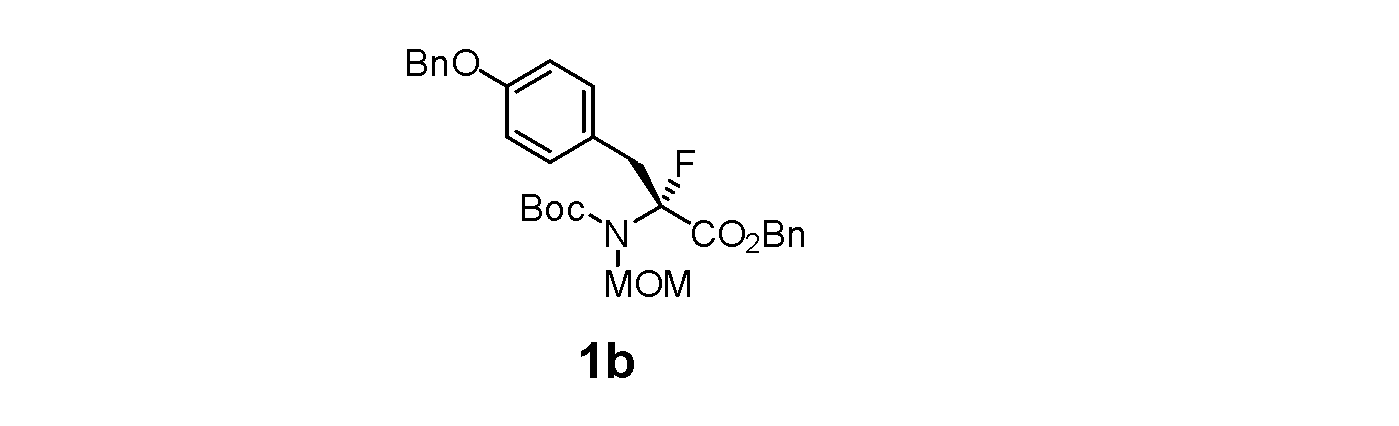
White solid; 97% ee; [α]20
D= 32.8 (c=1.00, CHCl3); IR(neat) cm-1: 2979, 1775, 1720, 1611, 1511, 1455, 1368, 1294, 1245, 1218, 1175, 1107, 1074, 1052. 1025, 911, 856, 833, 751, 697; 1H-NMR (400 MHz, CDCl3)δ: 1.44 (s, 9H), 3.27 (dd, J=33.0, 14.2 Hz, 1H), 3.40 (s, 3H), 3.60 (dd, J=14.2, 13.5 Hz, 1H), 4.89-5.05 (m, 5H), 5.13 (m, 1H), 6.79-6.96 (m, 2H), 7.01-7.19 (m, 4H), 7.28-7.45 (m, 8H), ppm; 13C-NMR (100 MHz, CDCl3)δ: 28.0, 40.1 (split by C-F coupling, 24.0 Hz), 55.4, 67.5, 69.9, 74.9, 77.2, 83.3, 100.1(split by C-F coupling, J=221.4 Hz), 114.6, 125.0, 127.5, 128.0, 128.3, 128.4, 128.5, 128.6, 131.6, 134.8, 137.0, 154.0, 158.3, 167.1 (split by C-F coupling, J=34.5 Hz) ppm; 19F-NMR (376 MHz, CDCl3)δ: -122.9 ppm; HRMS (FAB): m/z [M+Na]+ = calcd for 546.2268 [C1H2FNO5Na]+, found 546.2271; LRMS (FAB): m/z [M+Na]+ = 546; HPLC condition: Chiralcel IA column, flow late: 1.0 mL/min, 10% IPA-hexane, 6.9 min (minor) and 7.5 min (major)
化合物1c:ベンジル(R)-2-((tert-ブトキシカルボニル)(メトキシメチル)アミノ)-2-フルオロプロパノエート

84% ee;[α]20
D= 7.17 (c=1.00, CHCl3); IR(neat) cm-1: 2976, 1769, 1721, 1371, 1294, 1124, 913; 1H-NMR (400 MHz, CDCl3)δ:1.42 (s, 9H), 1.80 (d, J = 19.2 Hz, 3H), 3.32 (s, 3H), 4.84 (d, J = 11.9 Hz, 1H), 5.04 (d, J = 11.9 Hz, 1H), 5.20 (d, J = 12.4 Hz, 1H), 5.26 (d, J = 12.4 Hz, 1H), 7.35 (m, 5H) ppm; 13C-NMR (100 MHz, CDCl3)δ: 22.1 (split by C-F coupling, 26 Hz), 28.1, 55.4, 67.8, 75.2, 83.3, 97.0, 98.1 (split by C-F coupling, 212.1 Hz), 128.6, 135.2, 154.0, 169.0 (split by C-F coupling, 34.3 Hz) ppm; 19F-NMR (376 MHz, CDCl3)δ: -150.02; HRMS (FAB): m/z [M+Na]+ = calcd for [C17H24FNO5Na]+364.1536, found 364.1538; LRMS (FAB): m/z [M+Na]+ = 364; HPLC condition: Chiralcel IA column, flow late: 1.0 mL/min, 1% IPA-hexane, 9.1 min (miner) and 11.0 min (major)
化合物1d:ベンジル(R)-2-((tert-ブトキシカルボニル)(メトキシメチル)アミノ)-2-フルオロ-3-メチルブタノエート

Colorless oil; 92% ee; [α]20
D= 15.7 (c=0.81, CHCl3); IR(neat) cm-1: 2979, 1762, 1721, 1365, 1295, 1258, 1173, 1089, 1049, 1021; 1H-NMR (400 MHz, CDCl3) δ: 0.96 (d, J = 6.9 Hz, 3H), 1.02 (d, J = 6.9 Hz, 3H), 1.45 (s, 9H), 2.66 (sext, J = 6.9 Hz, 1H), 3.33 (s, 3H), 4.76 (d, J = 12.0 Hz, 1H), 5.15 (d, J = 12.0 Hz, 1H), 5.21 (s, 2H), 7.35 (m, 5H) ppm; 13C-NMR (100 MHz, CDCl3)δ: 17.0 (split by C-F coupling, 5.7 Hz), 17.8 (split by C-F coupling, 5.7 Hz), 31.8 (split by C-F coupling, 24.8 Hz), 55.6, 67.3, 75.4, 83.0, 98.1 (split by C-F coupling, 217.4 Hz), 128.3, 128.4, 128.7, 135.1, 154.7, 166.2 (split by C-F coupling, 33.4 Hz) ppm; 19F-NMR (376 MHz, CDCl3)δ: -122.7 ppm; HRMS (FAB): m/z [M+Na]+ = calcd for [C19H28FNO5Na]+392.1849, found 392.1848
; LRMS (FAB): m/z [M+Na]+ = 392
; HPLC condition: Chiralcel IA column, flow late: 1.0 mL/min, 1% IPA-hexane, 10.3 min (minor) and 12.3 min (major)
; LRMS (FAB): m/z [M+Na]+ = 392
; HPLC condition: Chiralcel IA column, flow late: 1.0 mL/min, 1% IPA-hexane, 10.3 min (minor) and 12.3 min (major)
化合物1e:ベンジル(R)-2-((tert-ブトキシカルボニル)(メトキシメチル)アミノ)-2-フルオロ-4-メチルペンタノエート
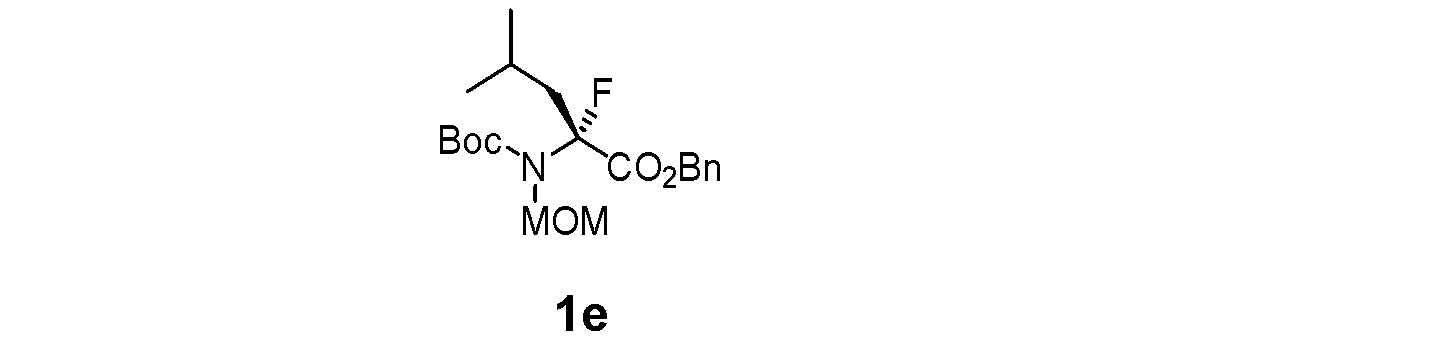
Colorless oil 90% yield; 91% ee; [α]20
D= 25.7 (c=1.00, CHCl3); IR(neat) cm-1: 2960, 1770, 1720, 1456, 1367, 1294, 1222, 1139, 1109, 1078, 1013, 944, 911, 855, 752, 698; 1H-NMR (400 MHz, CDCl3)δ: 0.83 (d, J = 6.6 Hz, 3H), 0.98 (d, J = 6.4 Hz ppm, 3H), 1.44 (s, 9 H), 1.91-2.08 (m, 2 H), 3.31 (s, 3H), 4.87 (d, J =11.9 Hz, 2 H), 5.04 (d, J =11.9, 2 H), 5.15-5.30 (m, 2 H), 7.29-7.39 (m, 5H) ppm; 13C-NMR (100 MHz, CDCl3)δ: 23.0 (split by C-F coupling, 3.8 Hz), 24.4 (split by C-F coupling, 28.6 Hz), 28.1, 42.8 (split by C-F coupling, 22.8 Hz), 55.4, 67.8, 74.9, 83.3, 100.5 (split by C-F coupling, 218.3 Hz), 128.5, 128.6, 128.7, 135.2, 154.2, 167.8 (split by C-F coupling, 35.3 Hz) ppm; 19F-NMR (376 MHz, CDCl3)δ: -122.15 ppm; HRMS (FAB): m/z [M+H]+ = calcd for 384.2186 [C20H31FNO5]+, found 384.2190; LRMS (FAB): m/z [M+H]+ = 384; HPLC condition: Chiralcel IA column, flow late: 1.0 mL/min, 1% IPA-hexane, 6.4 min (major) and 7.0 min (minor)
化合物1f:ベンジル(R)-2-((tert-ブトキシカルボニル)(メトキシメチル)アミノ)-2-フルオロ-4-(メチルチオ)ブタノエート

Colorless oil 91% yield; 82% ee; [α]20
D= (c=1.00, CHCl3); IR(neat) cm-1; 1H-NMR (400 MHz, CDCl3)δ: 1.45 (s, 9H), 1.98 (s, 3H), 2.16-2.22(m, 2H), 2.55-2.58 (m, 2H), 3.31 (s, 3H), 4.85 (d, J=11.9 Hz, 1H) 5.13 (d, 11.9 Hz), 5.23 (s, 2H), 7.34-7.39 (m, 5H) ppm; 13C-NMR (100 MHz, CDCl3)δ: 15.7, 27.6, 27.7, 28.2, 35.0 (split by C-F coupling, 24.8 Hz), 55.5, 67.9, 75.1, 83.6, 99.3 (split by C-F coupling, 217.3 Hz), 128.8, 129.0, 135.1, 154.1, 167.2 (split by C-F coupling, 35.3 Hz) ppm; 19F-NMR (376 MHz, CDCl3)δ: -123.8 ppm; HRMS (FAB): m/z [M+Na]+ = calcd for 424.1543[C1H2FNO5Na]+, found 424.1564; HPLC condition: Chiralcel IA column, flow late: 1.0 mL/min, 1% IPA-hexane, 14.7 min (minor) and 17.6 min (major)
実施例7(化合物1gの製造)
実施例7(化合物1gの製造)

化合物2g(R1=ベンジルオキシメチル基(ベンジル基を有するセリン側鎖))α-フルオロアミノ酸誘導体の製造中間体(43 mg, 0.10 mmol)とN-フルオロベンゼンスルフォンイミド(95 mg, 0.30 mmol)のテトラヒドロフラン(0.56 mL)とジメチルホルムアミド(0.20 mL)の混合溶液に対し、カリウムヘキサメチルジシラジドのテトラヒドロフラン溶液(0.50 M, 0.24 mL, 0.12 mmol)をアルゴン雰囲気下、-78°Cにて加え、同温にて5時間撹拌した。その後、この反応液に飽和アンモニウム水溶液を加え、酢酸エチルで抽出した。抽出液を無水硫酸ナトリウムで乾燥させた後、濾過し、濾液を濃縮した。得られた残渣をシリカゲルクロマトグラフィー[酢酸エチル:ヘキサン(容量比)=90:10]に供することにより、化合物1g(40.2 mg, 90%, 80% ee)を得た。
化合物1g:ベンジル(R)-3-(ベンジルオキシ)-2-((tert-ブトキシカルボニル)(メトキシメチル)アミノ)-2-フルオロプロパノエート
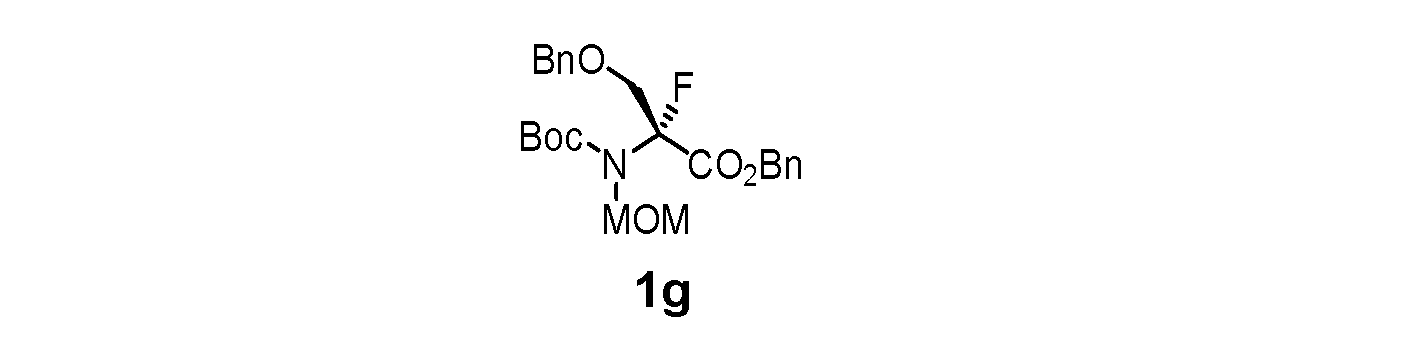
Colorless oil 90% yield; 80% ee; [α]20
D= 17.2 (c=1.00, CHCl3); IR(neat) cm-1: 2979, 1934, 1779, 1723, 1455, 1368, 1296, 1256, 1159, 1105, 1049, 965, 912, 853, 740, 698; 1H-NMR (400 MHz, CDCl3)δ: 1.44 (s, 9H), 3.29 (s, 3H), 4.00 (m, 1H), 4.11 (m, 1H), 4.48 (d, J=12.3 Hz, 1H), 4.63 (d, J=12.3 Hz, 1H), 4.84 (d, J=11.9, 1H), 4.98 (d, J=11.9, 1H), 5.24 (m, 2H), 7.21-7.35(m, 10H) ppm; 13C-NMR (100 MHz, CDCl3)δ: 28.1, 55.5, 67.9, 70.6 (split by C-F coupling, 27.7 Hz), 74.0, 75.5, 83.6, 98.4, 100.6, 127.9, 128.0, 128.5, 128.6, 128.7, 135.2, 137.1, 153.8, 16f6.6(split by C-F coupling, 235.3 Hz) ppm; 19F-NMR (376 MHz, CDCl3)δ: -126.3 ppm; HRMS (FAB): m/z [M+Na]+ = calcd for 470.1955 [C1H2FNO5Na]+, found 470.1954
; LRMS (FAB): m/z [M+Na]+ = 470; HPLC condition: Chiralcel XX column, flow late: 1.0 mL/min, 1% IPA-hexane, 10.1 min (minor) and 11.6 min (major)
; LRMS (FAB): m/z [M+Na]+ = 470; HPLC condition: Chiralcel XX column, flow late: 1.0 mL/min, 1% IPA-hexane, 10.1 min (minor) and 11.6 min (major)
実施例8(化合物1bの製造)

実施例2において、基質である化合物2b、及び反応試薬等の量を変更して化合物1bの合成を行い、再結晶により化合物1bを精製した。カリウムビス(トリメチルシリル)アミドのテトラヒドロフラン溶液(0.50 M, 0.24 mL, 0.12 mmol)に、テトラヒドロフラン(11.6 mL)に溶解させた化合物2b(α-フルオロアミノ酸誘導体の製造中間体)(1.01 g, 2.00 mmol)をアルゴン雰囲気下-78℃にて加え、10分間撹拌した。この溶液に、ジメチルホルムアミド(4 mL)に溶解させたN-フルオロベンゼンスルホンイミド(1.89 g, 6.00 mmol)を加え、同温にて5時間撹拌した。その後、この反応液に飽和アンモニウム水溶液を加え、酢酸エチルで抽出した。抽出液を無水硫酸ナトリウムで乾燥させた後、濾過し、濾液を濃縮した。得られた残渣をシリカゲルクロマトグラフィー[酢酸エチル:ヘキサン(容量比)=90:10]に供することにより、化合物1b(964.3 mg, 1.84 mmol, 96% ee)を得た。その後、化合物1b(964.3 mg, 1.84 mmol, 96% ee)をヘキサンと酢酸エチルの混合溶液に再溶解し、-20℃にて静置することで結晶を得た。得られた結晶をろ取することで、化合物1b (865.2 mg, 1.65 mmol, 99% ee)を得た。
実施例9~12(化合物1h~1kの製造)
原料アミノ酸化合物におけるアミノ酸側鎖(R1)を下記表2に記載のアミノ酸側鎖(R1)に代えた以外は、実施例1と同様の方法で、α-フルオロアミノ酸化合物(1)を製造した。収率(%)とエナンチオマー過剰率(ee)(%)を表2に示した。
原料アミノ酸化合物におけるアミノ酸側鎖(R1)を下記表2に記載のアミノ酸側鎖(R1)に代えた以外は、実施例1と同様の方法で、α-フルオロアミノ酸化合物(1)を製造した。収率(%)とエナンチオマー過剰率(ee)(%)を表2に示した。

化合物1h:
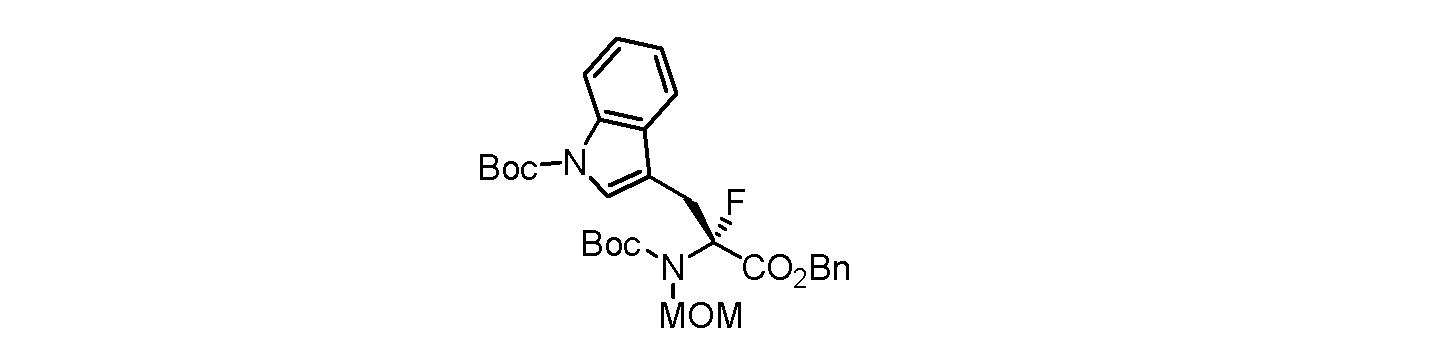
Colorless oil; 80% ee; [α]20
D= 16.9 (c=1.00, CHCl3); IR(neat) cm-1: 2979, 2937, 1727, 1454, 1368, 1296, 1258, 1158, 1090, 858, 749; 1H-NMR (400 MHz, CDCl3)δ: 1.44 (s, 9H), 1.63 (s, 9H), 3.42 (s, 3H), 3.49 (d, J = 14.6 Hz, 1H), 3.57 (d, J = 14.6 Hz, 1H), 3.72 (dd, J = 13.8 Hz, 1H), 4.79 (d, J = 12.0 Hz, 1H), 4.88 (d, J = 12.0 Hz, 1H), 5.02 (d, J = 12.1 Hz, 1H), 5.18 (d, J = 12.1 Hz, 1H), 7.19 ‐7.20 (m, 1H), 7.21 ‐ 7.25 (m, 5H), 7.27 ‐7.32 (m, 1H), 7.47 ‐ 7.53 (m, 2H), 8.06 ‐8.15 (m, 1H). ppm; 13C-NMR (100 MHz, CDCl3)δ: 28.2, 28.4, 30.9 (split by C-F coupling, J = 26.0 Hz), 55.7, 67.9, 75.3, 83.5, 83.8, 100.0 (split by C-F coupling, J = 221.2 Hz), 111.9, 115.4, 119.4, 122.7, 124.6, 126.1, 130.5, 134.7, 135.4, 149.6, 154.1, 167.4 (split by C-F coupling, J = 35.1 Hz) ppm; 19F-NMR (376 MHz, CDCl3)δ: -120.5 ppm; HRMS (ESI): m/z [M+Na]+ = calcd for 579.2477 [C30H37FNO7Na]+, found 579.2465; HPLC condition: Chiralcel AD-H column, flow late: 1.0 mL/min, 1% IPA-hexane, 24.8 min (minor) and 27.4 min (major)
化合物1i:

Colorless oil; 94% ee; [α]20
D= 10.5 (c=0.96, CHCl3); IR(neat) cm-1: ; 1H-NMR (400 MHz, CDCl3)δ: 0.94 ‐1.10 (m, 1H), 1.38 ‐ 1.50 (m, 3H), 1.44 (s, 9H), 1.45 (s, 9H), 1.81 ‐2.12 (m, 1H), 2.15 ‐ 2.30 (m, 1H), 3.05 ‐3.17 (m, 2H), 3.25 (s, 3H), 3.31 (s, 3H), 4.57 ‐ 4.70 (m, 2H), 4.84 (d, J = 11.8 Hz, 1H), 5.05 (d, J = 11.8 Hz, 1H), 5.12 ‐5.29 (m, 2H), 7.30 ‐ 7.41 (m, 5H). ppm; 13C-NMR (100 MHz, CDCl3)δ: 20.8, 28.1, 28.4, 29.0, 34.5 (split by C-F coupling, J = 27.3 Hz), 46.0, 55.4, 55.5, 74.9, 78.7, 79.2, 80.2, 83.3, 99.9 (split by C-F coupling, J = 217.2 Hz), 128.6, 128.9, 129.6, 135.2, 154.1, 154.1 167.5 (split by C-F coupling, J = 32.7 Hz) ppm; 19F-NMR (376 MHz, CDCl3)δ: -124.70 ppm; HRMS (FAB): m/z [M+Na]+ = calcd for 565.2901 [C27H43FN2O8Na]+, found 565.2905; LRMS (FAB): m/z [M+Na]+ = 565; HPLC condition: Chiralcel IB column, flow late: 1.0 mL/min, 1% IPA-hexane, 13.3 min (major) and 13.9 min (minor)
化合物1j:
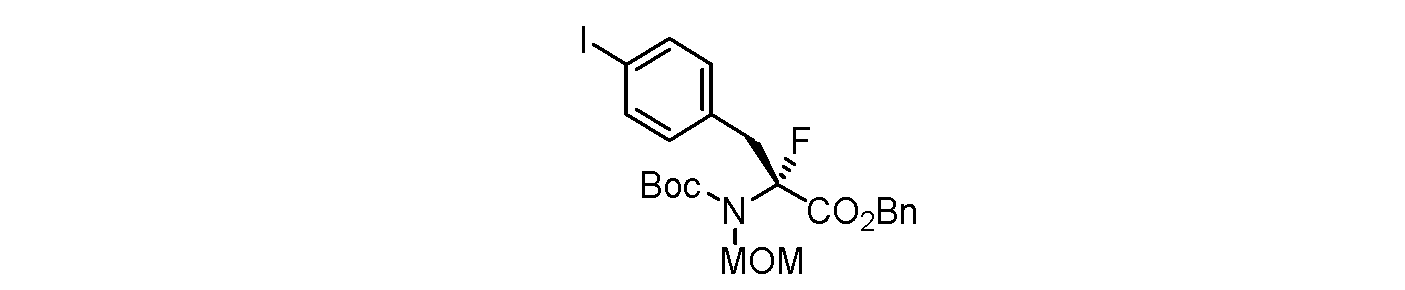
White solid; 88% yield ; 95% ee; [α]20
D= 35.2 (c=1.00, CHCl3); IR(neat) cm-1: 2979, 1775, 1721, 1482, 1401, 1367, 1294, 1175, 1105, 1053, 1027, 963, 911, 855, 752, 698; 1H-NMR (400 MHz, CDCl3)δ: 1.44 (s, 9H), 3.22 (dd, J = 13.6 Hz, 32.8 Hz, 1H), 3.39 (s, 3H), 3.58 (dd, J = 13.3, 13.6, 1H), 4.95 (m, 3H), 5.14 (dd, J = 1.6 Hz, 10.1 Hz, 1H), 6.86 (d, J = 7.8 Hz, 2H), 7.08-7.10 (m, 2H), 7.33-7.34 (m, 3H), 7.51 (d, J = 8.2 Hz, 2H) ppm; 13C-NMR (100 MHz, CDCl3)δ: 28.1, 40.6 (split by C-F coupling, 23.9 Hz), 55.6, 68.8, 75.2, 83.6, 93.7, 100.0 (split by C-F coupling, 221.2 Hz), 128.7, 128.7, 128.7, 128.9, 132.6, 134.6, 137.5, 154.0, 167.0 (split by C-F coupling, 33.4 Hz) ppm ; 19F-NMR (376 MHz, CDCl3)δ: -122.6 ppm; HRMS (FAB): m/z [M+Na]+ = calcd for 566.0816 [C23H28FNO5Na]+, found 566.0810; LRMS (FAB): m/z [M+Na]+ = 566; HPLC condition: Chiralcel IB column, flow late: 1.0 mL/min, 1% IPA-hexane, 9.3 min (major) and 10.5 min (minor)
化合物1k:

Colorless oil; 94% ee; [α]20
D= 39.7 (c=1.14, CHCl3); IR(neat) cm-1: 2979, 1766, 1723, 1454, 1407, 1363, 1299, 1262, 1170, 1092, 1028,757, 697; 1H-NMR (400 MHz, CDCl3)δ: 1.49 (s, 9H), 3.17 (s, 3H), 4.34 (dd, J = 11.1, 0.9 Hz, 1H), 4.77 (dd, J = 11.1, 2.4 Hz, 1H), 5.17 (d, J = 12.4 Hz, 1H), 5.20 (s, 1H), 7.23 ‐7.28 (m, 2H), 7.28 ‐ 7.31 (m, 3H), 7.34 ‐7.39 (m, 3H), 7.62 ‐ 7.66 (m, 2H) ppm; 13C-NMR (100 MHz, CDCl3)δ: 28.1, 55.7, 68.1, 76.5, 76.5, 83.4, 100.3 (split by C-F coupling, J = 221.7 Hz), 126.9, 127.0, 128.4, 128.5, 128.5, 128.5, 128.6, 129.9, 133.36 (split by C-F coupling, J = 26.7 Hz), 135.1, 154.7, 154.8, 167.11 (split by C-F coupling, J = 35.2 Hz) ppm; 19F-NMR (376 MHz, CDCl3)δ: -126.21 ppm; HRMS (FAB): m/z [M+Na]+ = 426.1693 calcd for [C22H26FNO5Na]+, found 426.1692; LRMS (FAB): m/z [M+Na]+ = 426; HPLC condition: Chiralcel IA column, flow late: 1.0 mL/min, 1% IPA-hexane, 5.7 min (major) and 6.0 min (minor)
本発明は、光学活性なα-フルオロアミノ酸化合物又はその塩の新規な製造方法であり、特に、天然に多く存在するアミノ酸から、簡便に、かつ高い光学純度でα-フルオロアミノ酸化合物又はその塩を製造することができる。
Claims (10)
- 一般式(1):

(ここで、R5、R6、R7及びR8は、同一又は異なって、水素原子、鎖状若しくは環状のアルキル基、鎖状若しくは環状のアルケニル基、鎖状若しくは環状のアルキニル基、アリール基、又はヘテロアリール基を示す。該R5、R6、R7及びR8におけるアルキル基、アルケニル基、アルキニル基、アリール基、及びヘテロアリール基は、各々置換基を有していてもよい。)
R1は、R3と共に結合して、環構造を形成していてもよい。
*は、不斉炭素を示す。]
で表される光学活性α-フルオロアミノ酸化合物又はその塩の製造方法であって、
一般式(2):
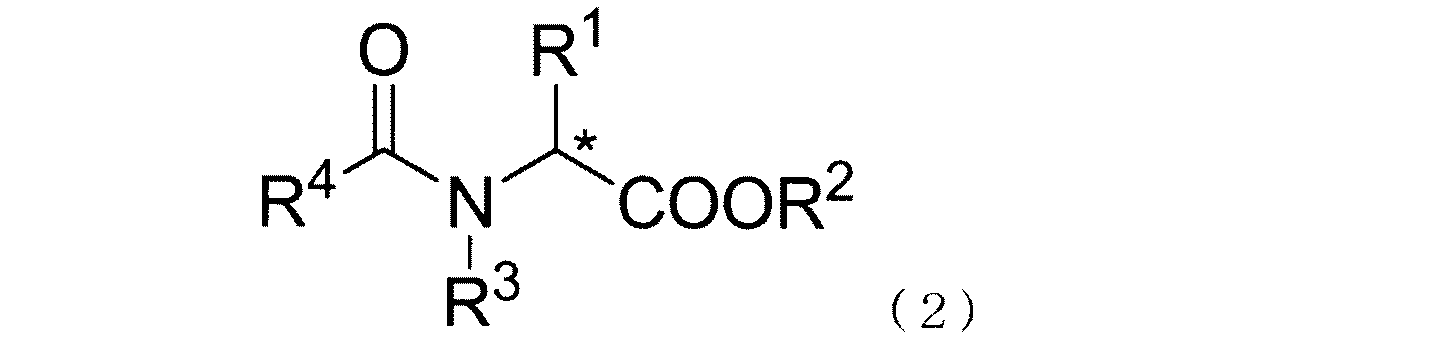
で表されるアミノ酸化合物又はその塩、及び求電子的フッ素化剤を、金属アミド化合物の存在下で反応させることを特徴とする、製造方法。 - 前記R4が、置換基を有していてもよい鎖状のアルコキシ基である、請求項1に記載の製造方法。
- 前記R3が、置換基を有していてもよい鎖状のアルキル基である、請求項1又は2の何れか一項に記載の製造方法。
- 前記R2が、置換基を有していてもよい鎖状のアルキル基である、請求項1~3の何れか一項に記載の製造方法。
- 前記金属アミド化合物が、アルカリ金属アミド化合物又はアルカリ土類金属アミド化合物である、請求項1~4の何れか一項に記載の製造方法。
- 前記求電子的フッ素化剤が、置換基を有していてもよいN-フルオロ-ジベンゼンスルホンイミドである、請求項1~5の何れか一項に記載の製造方法。
- 下記一般式(1A)又は一般式(1B):
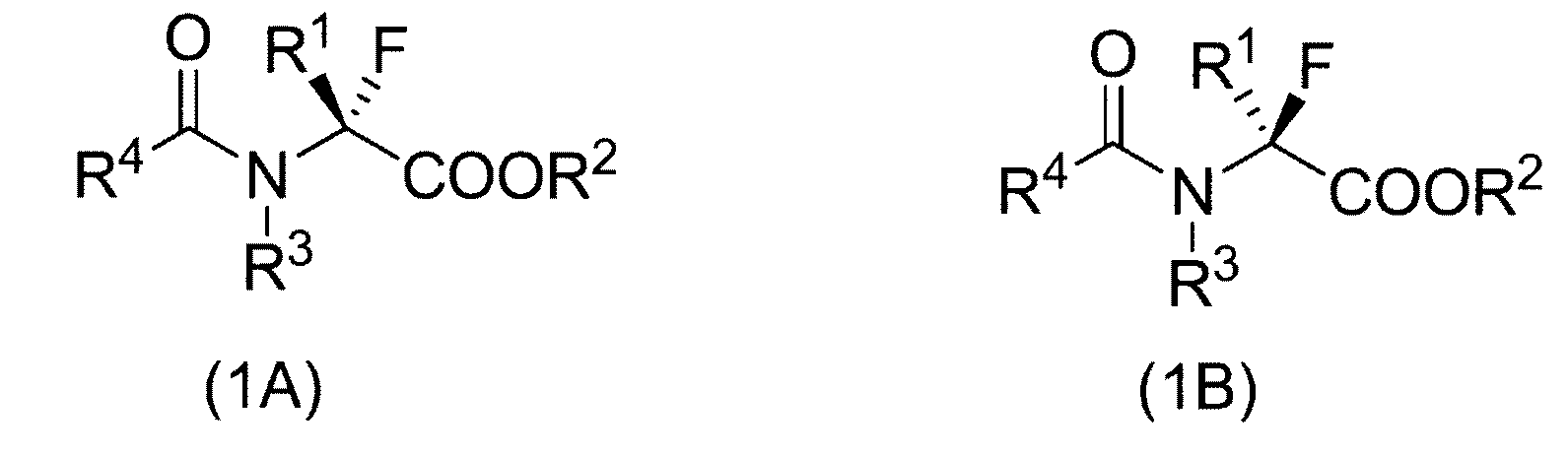
(ここで、R5、R6、R7及びR8は、同一又は異なって、水素原子、鎖状若しくは環状のアルキル基、鎖状若しくは環状のアルケニル基、鎖状若しくは環状のアルキニル基、アリール基、又はヘテロアリール基を示す。該R5、R6、R7及びR8におけるアルキル基、アルケニル基、アルキニル基、アリール基、及びヘテロアリール基は、各々置換基を有していてもよい。)
R1は、R3と共に結合して、環構造を形成していてもよい。]
で表される光学活性α-フルオロアミノ酸化合物又はその塩。 - 前記R4が、置換基を有していてもよい鎖状のアルコキシ基である、請求項7に記載の化合物又はその塩。
- 前記R3が、置換基を有していてもよい鎖状のアルキル基である、請求項7又は8に記載の化合物又はその塩。
- 前記R2が、置換基を有していてもよい鎖状のアルキル基である、請求項7~9の何れか一項に記載の化合物又はその塩。
Priority Applications (1)
| Application Number | Priority Date | Filing Date | Title |
|---|---|---|---|
| JP2017503469A JPWO2016140189A1 (ja) | 2015-03-04 | 2016-02-29 | 光学活性α−フルオロアミノ酸化合物又はその塩の製造方法 |
Applications Claiming Priority (2)
| Application Number | Priority Date | Filing Date | Title |
|---|---|---|---|
| JP2015042131 | 2015-03-04 | ||
| JP2015-042131 | 2015-03-04 |
Publications (1)
| Publication Number | Publication Date |
|---|---|
| WO2016140189A1 true WO2016140189A1 (ja) | 2016-09-09 |
Family
ID=56848363
Family Applications (1)
| Application Number | Title | Priority Date | Filing Date |
|---|---|---|---|
| PCT/JP2016/056064 Ceased WO2016140189A1 (ja) | 2015-03-04 | 2016-02-29 | 光学活性α-フルオロアミノ酸化合物又はその塩の製造方法 |
Country Status (2)
| Country | Link |
|---|---|
| JP (1) | JPWO2016140189A1 (ja) |
| WO (1) | WO2016140189A1 (ja) |
Cited By (2)
| Publication number | Priority date | Publication date | Assignee | Title |
|---|---|---|---|---|
| WO2023243699A1 (ja) * | 2022-06-17 | 2023-12-21 | シンクレスト株式会社 | α位にフッ素を有するアミノ酸及びその誘導体 |
| US12667572B2 (en) | 2021-01-26 | 2026-06-30 | Schrödinger, Inc. | Tricyclic compounds useful in the treatment of cancer, autoimmune and inflammatory disorders |
Citations (2)
| Publication number | Priority date | Publication date | Assignee | Title |
|---|---|---|---|---|
| WO2012157504A1 (ja) * | 2011-05-13 | 2012-11-22 | 国立大学法人京都大学 | β-ラクタム化合物およびその製造方法 |
| JP2013028573A (ja) * | 2011-07-29 | 2013-02-07 | Kyoto Univ | アミノ酸誘導体およびその製造方法 |
-
2016
- 2016-02-29 WO PCT/JP2016/056064 patent/WO2016140189A1/ja not_active Ceased
- 2016-02-29 JP JP2017503469A patent/JPWO2016140189A1/ja active Pending
Patent Citations (2)
| Publication number | Priority date | Publication date | Assignee | Title |
|---|---|---|---|---|
| WO2012157504A1 (ja) * | 2011-05-13 | 2012-11-22 | 国立大学法人京都大学 | β-ラクタム化合物およびその製造方法 |
| JP2013028573A (ja) * | 2011-07-29 | 2013-02-07 | Kyoto Univ | アミノ酸誘導体およびその製造方法 |
Non-Patent Citations (6)
| Title |
|---|
| DAIKI MONGUCHI: "Asymmetric Intramolecular Conjugate Addition of Chiral Enolates via Nonequilibrium", JOURNAL OF THE PHARMACEUTICAL SOCIETY OF JAPAN, vol. 126, 1 August 2006 (2006-08-01), pages 617 - 627 * |
| FUJI,K. ET AL.: "Memory of Chirality - A New Principle in Enolate Chemistry", CHEMISTRY A EUROPEAN JOURNAL, vol. 4, no. 3, 10 March 1998 (1998-03-10), pages 373 - 376 * |
| HAN,X. ET AL.: "Highly Enantioselective Amination Reactions of Fluorinated Keto Esters Catalyzed by Novel Chiral Guanidines Derived from Cinchona Alkaloids", ADVANCED SYNTHESIS & CATALYSIS, vol. 352, 26 October 2010 (2010-10-26), pages 2778 - 2782 * |
| KAWABATA,T. ET AL.: "A Chiral Nonracemic Enolate with Dynamic Axial Chirality: Direct Asymmetric alpha-Methylation of a-Amino Acid Derivatives", ANGEWANDTE CHEMIE INTERNATIONAL EDITION, vol. 39, 16 June 2000 (2000-06-16), pages 2155 - 2157 * |
| KAWABATA,T. ET AL.: "Memory of Chirality: Asymmetric Induction Based on the Dynamic Chirality of Enolates", TOPICS IN STEREOCHEMISTRY, vol. 23, 27 February 2003 (2003-02-27), pages 175 - 205 * |
| MOHAR,B. ET AL.: "Enantioselective and diastereoselective synthesis of fluorinated dipeptides by late electrophilic fluorination", TETRAHEDRON LETTERS, vol. 46, pages 5029 - 5031, XP025385642, DOI: doi:10.1016/j.tetlet.2005.05.074 * |
Cited By (2)
| Publication number | Priority date | Publication date | Assignee | Title |
|---|---|---|---|---|
| US12667572B2 (en) | 2021-01-26 | 2026-06-30 | Schrödinger, Inc. | Tricyclic compounds useful in the treatment of cancer, autoimmune and inflammatory disorders |
| WO2023243699A1 (ja) * | 2022-06-17 | 2023-12-21 | シンクレスト株式会社 | α位にフッ素を有するアミノ酸及びその誘導体 |
Also Published As
| Publication number | Publication date |
|---|---|
| JPWO2016140189A1 (ja) | 2017-12-14 |
Similar Documents
| Publication | Publication Date | Title |
|---|---|---|
| US7968748B2 (en) | Process for resolving racemic mixtures and a diastereoisomeric complex of a resolving agent and an enantiomer of interest | |
| US20090054525A1 (en) | Selective androgen receptor modulators | |
| KR20110116167A (ko) | 2-아실아미노-3-디페닐프로판산의 제조 및 분할 방법 | |
| US20170050983A1 (en) | Method for producing inhibitor of activated blood coagulation factor x (fxa) | |
| JPWO1996023756A1 (ja) | α−ハロケトン、α−ハロヒドリン及びエポキシドの製造法 | |
| JP6370316B2 (ja) | エナンチオマー濃縮された3−アミノピペリジンの調製のためのプロセス | |
| Hashem et al. | Synthesis and reactions of some 2 (3h) and 2 (5h) furanone derivatives: a comparative study | |
| JPWO2016140189A1 (ja) | 光学活性α−フルオロアミノ酸化合物又はその塩の製造方法 | |
| JP2009543815A (ja) | キラルなアミノカルボニル化合物の製造方法 | |
| Mlostoń et al. | Synthesis of β-amino-α-trifluoromethyl alcohols and their applications in organic synthesis | |
| US9828340B2 (en) | Asymmetric synthesis of a substituted pyrrolidine-2-carboxamide | |
| KR101430116B1 (ko) | 스트레커 반응용 촉매를 사용하는 키랄성 α-아미노나이트릴의 제조방법 | |
| JP5647790B2 (ja) | N−カルバモイル−tert−ロイシンの製造法 | |
| CN100484914C (zh) | 1-氨基甲酰基环烷基羧酸化合物及其制备方法和用途 | |
| US20160102045A1 (en) | METHOD FOR SYNTHESIZING OPTICALLY ACTIVE a-AMINO ACID USING CHIRAL METAL COMPLEX COMPRISING AXIALLY CHIRAL N-(2-ACYLARYL)-2-[5,7-DIHYDRO-6H-DIBENZO[c,e]AZEPIN-6-YL] ACETAMIDE COMPOUND AND AMINO ACID | |
| US6825353B2 (en) | Process for producing quinolonecarboxylic acids and intermediates thereof | |
| EP1918275A1 (en) | Production method of diphenylalanine - NI(II) complex | |
| JPWO2012157504A1 (ja) | β−ラクタム化合物およびその製造方法 | |
| WO2007099894A1 (ja) | 硫黄酸化物を用いる汎用的な脱保護法 | |
| CN104364229B (zh) | 通过使用氨基酸的邓盐合成二酰胺基胶凝剂 | |
| Coniglio et al. | Acylmethanesulfonamides as new acylating agents for primary amines | |
| Tomassetti et al. | Retention of stereochemistry in the microwave assisted synthesis of 1H-tetrazole bioisosteric moiety from chiral phenyl-acetic acid derivatives | |
| JP2005041854A (ja) | 光学活性n−(2−置換−3−ハロプロピオニル)アミノ酸類及びその製造方法、並びにそれを用いた光学活性n−(2−置換−3−アシルチオプロピオニル)アミノ酸類の製造方法 | |
| JP4211484B2 (ja) | 光学活性ナフチルアルコール類、その製造方法およびその中間体 | |
| JP4520779B2 (ja) | (4r)又は(4s)−4−イソプロピル−5,5−ジアリール−2−オキサゾリジノンの製造法 |
Legal Events
| Date | Code | Title | Description |
|---|---|---|---|
| 121 | Ep: the epo has been informed by wipo that ep was designated in this application |
Ref document number: 16758882 Country of ref document: EP Kind code of ref document: A1 |
|
| ENP | Entry into the national phase |
Ref document number: 2017503469 Country of ref document: JP Kind code of ref document: A |
|
| NENP | Non-entry into the national phase |
Ref country code: DE |
|
| 122 | Ep: pct application non-entry in european phase |
Ref document number: 16758882 Country of ref document: EP Kind code of ref document: A1 |