WO2016139786A1 - 蛍光誘導体化試薬及びアミン分析方法 - Google Patents
蛍光誘導体化試薬及びアミン分析方法 Download PDFInfo
- Publication number
- WO2016139786A1 WO2016139786A1 PCT/JP2015/056416 JP2015056416W WO2016139786A1 WO 2016139786 A1 WO2016139786 A1 WO 2016139786A1 JP 2015056416 W JP2015056416 W JP 2015056416W WO 2016139786 A1 WO2016139786 A1 WO 2016139786A1
- Authority
- WO
- WIPO (PCT)
- Prior art keywords
- histamine
- group
- fluorescence
- derivatization reagent
- polyamine
- Prior art date
- Legal status (The legal status is an assumption and is not a legal conclusion. Google has not performed a legal analysis and makes no representation as to the accuracy of the status listed.)
- Ceased
Links
- 0 *c1nc(O*c(cc2)c(cc3)c4c2ccc2c4c3ccc2)nc(*)n1 Chemical compound *c1nc(O*c(cc2)c(cc3)c4c2ccc2c4c3ccc2)nc(*)n1 0.000 description 1
Images



Classifications
-
- C—CHEMISTRY; METALLURGY
- C09—DYES; PAINTS; POLISHES; NATURAL RESINS; ADHESIVES; COMPOSITIONS NOT OTHERWISE PROVIDED FOR; APPLICATIONS OF MATERIALS NOT OTHERWISE PROVIDED FOR
- C09K—MATERIALS FOR MISCELLANEOUS APPLICATIONS, NOT PROVIDED FOR ELSEWHERE
- C09K11/00—Luminescent materials, e.g. electroluminescent or chemiluminescent
- C09K11/06—Luminescent materials, e.g. electroluminescent or chemiluminescent containing organic luminescent materials
-
- C—CHEMISTRY; METALLURGY
- C07—ORGANIC CHEMISTRY
- C07D—HETEROCYCLIC COMPOUNDS
- C07D251/00—Heterocyclic compounds containing 1,3,5-triazine rings
- C07D251/02—Heterocyclic compounds containing 1,3,5-triazine rings not condensed with other rings
- C07D251/12—Heterocyclic compounds containing 1,3,5-triazine rings not condensed with other rings having three double bonds between ring members or between ring members and non-ring members
-
- C—CHEMISTRY; METALLURGY
- C07—ORGANIC CHEMISTRY
- C07D—HETEROCYCLIC COMPOUNDS
- C07D251/00—Heterocyclic compounds containing 1,3,5-triazine rings
- C07D251/02—Heterocyclic compounds containing 1,3,5-triazine rings not condensed with other rings
- C07D251/12—Heterocyclic compounds containing 1,3,5-triazine rings not condensed with other rings having three double bonds between ring members or between ring members and non-ring members
- C07D251/26—Heterocyclic compounds containing 1,3,5-triazine rings not condensed with other rings having three double bonds between ring members or between ring members and non-ring members with only hetero atoms directly attached to ring carbon atoms
-
- C—CHEMISTRY; METALLURGY
- C09—DYES; PAINTS; POLISHES; NATURAL RESINS; ADHESIVES; COMPOSITIONS NOT OTHERWISE PROVIDED FOR; APPLICATIONS OF MATERIALS NOT OTHERWISE PROVIDED FOR
- C09K—MATERIALS FOR MISCELLANEOUS APPLICATIONS, NOT PROVIDED FOR ELSEWHERE
- C09K11/00—Luminescent materials, e.g. electroluminescent or chemiluminescent
- C09K11/08—Luminescent materials, e.g. electroluminescent or chemiluminescent containing inorganic luminescent materials
- C09K11/61—Luminescent materials, e.g. electroluminescent or chemiluminescent containing inorganic luminescent materials containing fluorine, chlorine, bromine, iodine or unspecified halogen elements
-
- G—PHYSICS
- G01—MEASURING; TESTING
- G01N—INVESTIGATING OR ANALYSING MATERIALS BY DETERMINING THEIR CHEMICAL OR PHYSICAL PROPERTIES
- G01N21/00—Investigating or analysing materials by the use of optical means, i.e. using sub-millimetre waves, infrared, visible or ultraviolet light
- G01N21/62—Systems in which the material investigated is excited whereby it emits light or causes a change in wavelength of the incident light
- G01N21/63—Systems in which the material investigated is excited whereby it emits light or causes a change in wavelength of the incident light optically excited
- G01N21/64—Fluorescence; Phosphorescence
-
- G—PHYSICS
- G01—MEASURING; TESTING
- G01N—INVESTIGATING OR ANALYSING MATERIALS BY DETERMINING THEIR CHEMICAL OR PHYSICAL PROPERTIES
- G01N31/00—Investigating or analysing non-biological materials by the use of the chemical methods specified in the subgroup; Apparatus specially adapted for such methods
-
- G—PHYSICS
- G01—MEASURING; TESTING
- G01N—INVESTIGATING OR ANALYSING MATERIALS BY DETERMINING THEIR CHEMICAL OR PHYSICAL PROPERTIES
- G01N33/00—Investigating or analysing materials by specific methods not covered by groups G01N1/00 - G01N31/00
- G01N33/02—Food
-
- C—CHEMISTRY; METALLURGY
- C09—DYES; PAINTS; POLISHES; NATURAL RESINS; ADHESIVES; COMPOSITIONS NOT OTHERWISE PROVIDED FOR; APPLICATIONS OF MATERIALS NOT OTHERWISE PROVIDED FOR
- C09K—MATERIALS FOR MISCELLANEOUS APPLICATIONS, NOT PROVIDED FOR ELSEWHERE
- C09K2211/00—Chemical nature of organic luminescent or tenebrescent compounds
- C09K2211/10—Non-macromolecular compounds
- C09K2211/1003—Carbocyclic compounds
- C09K2211/1011—Condensed systems
-
- C—CHEMISTRY; METALLURGY
- C09—DYES; PAINTS; POLISHES; NATURAL RESINS; ADHESIVES; COMPOSITIONS NOT OTHERWISE PROVIDED FOR; APPLICATIONS OF MATERIALS NOT OTHERWISE PROVIDED FOR
- C09K—MATERIALS FOR MISCELLANEOUS APPLICATIONS, NOT PROVIDED FOR ELSEWHERE
- C09K2211/00—Chemical nature of organic luminescent or tenebrescent compounds
- C09K2211/10—Non-macromolecular compounds
- C09K2211/1018—Heterocyclic compounds
-
- G—PHYSICS
- G01—MEASURING; TESTING
- G01N—INVESTIGATING OR ANALYSING MATERIALS BY DETERMINING THEIR CHEMICAL OR PHYSICAL PROPERTIES
- G01N31/00—Investigating or analysing non-biological materials by the use of the chemical methods specified in the subgroup; Apparatus specially adapted for such methods
- G01N31/22—Investigating or analysing non-biological materials by the use of the chemical methods specified in the subgroup; Apparatus specially adapted for such methods using chemical indicators
Definitions
- the present invention relates to a fluorescent derivatization reagent used for analysis of nonvolatile amines such as histamine and tyramine using high performance liquid chromatography (HPLC) and an amine analysis method using the fluorescent derivatization reagent.
- nonvolatile amines such as histamine and tyramine using high performance liquid chromatography (HPLC)
- HPLC high performance liquid chromatography
- Nonvolatile amines such as histamine (Him) and tyramine (Tym) are bioactive substances produced by the degradation of proteins and amino acids by microorganisms, and excessive intake of these amines may cause allergic food poisoning. It is known to be. Therefore, the amount of non-volatile amines contained in food is regulated in many countries around the world.
- soy sauce is a traditional Japanese fermented food (condiment). Since soy sauce is produced by fermenting soybean and wheat with microorganisms such as lactic acid bacteria and yeast, histamine and tyramine derived from soybean protein are produced in the production process. Therefore, it is important in terms of quality control to know the amount of histamine and tyramine contained in soy sauce. There is a need for a method for easily and highly sensitively measuring the amount of non-volatile amines in the soy sauce production process.
- dansyl fluorescence derivatization-HPLC analysis and HPLC-tandem mass spectrometry shown in the Food Sanitation Inspection Guidelines are common.
- the dansyl fluorescence derivatization-HPLC analysis method has a problem that it requires complicated pretreatment operations and is inferior in sensitivity and selectivity.
- LC-MS / MS is excellent in sensitivity and selectivity, it is difficult to implement in a small and medium-sized food factory because it uses an expensive and large-scale apparatus.
- Patent Documents 1 and 2 an excimer fluorescence derivatization-HPLC method using a reagent containing a compound having a pyrene group (pyrene reagent) has been developed (Patent Documents 1 and 2).
- a polyamine having two or more amino groups in one molecule is fluorescently derivatized with a pyrene reagent to introduce a plurality of pyrene groups into one molecule of the polyamine, and the resulting excited dimer is formed.
- a polyamine (ie, labeled polyamine) having a body excited-state dimer, hereinafter referred to as “excimer” is separated using HPLC, and the intensity of the fluorescence (excimer fluorescence) is measured.
- the problem to be solved by the present invention is to provide a highly sensitive and selective amine analysis method, and to improve the storage stability and analytical reproducibility of the fluorescent derivatization reagent used in the analysis method. is there.
- the compound used as a fluorescent derivatization reagent for amine is based on pyrene, to which a reactive functional group with an amino group or a phenolic hydroxyl group is bonded.
- a reactive functional group with an amino group or a phenolic hydroxyl group is bonded.
- the present inventor has found that 2-chloro-4-methoxy-6-substituted-1,3,5- It has been found that pyrene derivatives having a reactive functional group such as triazine are effective.
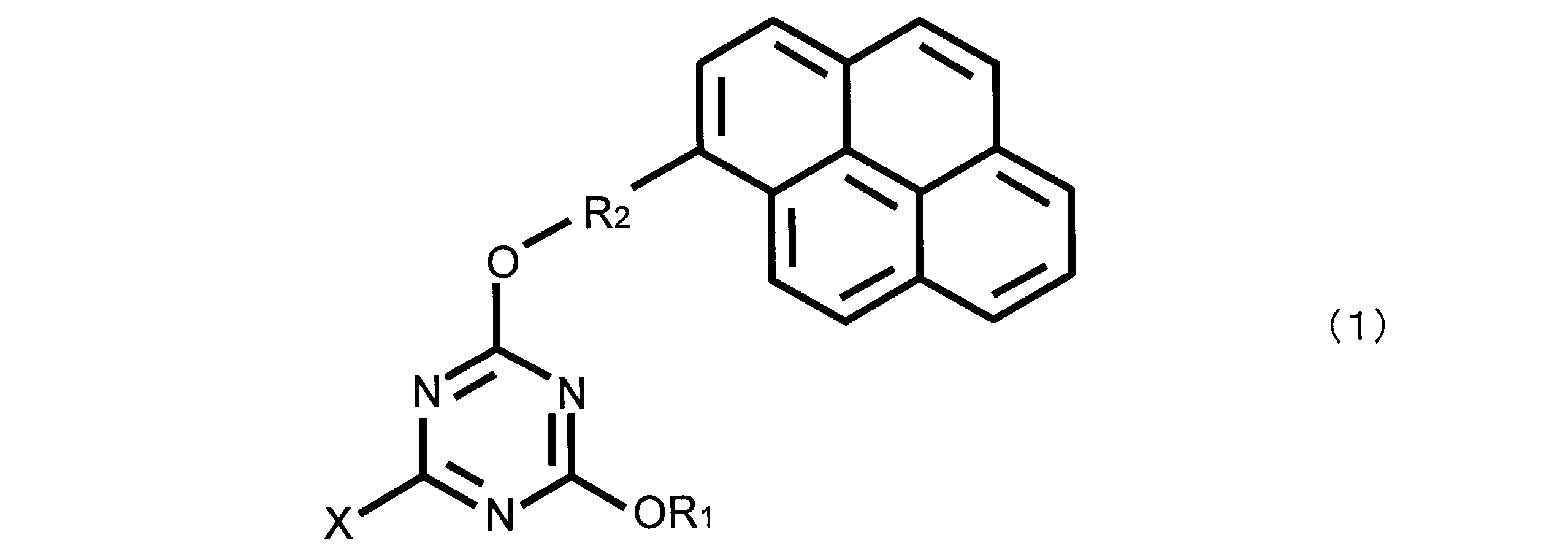
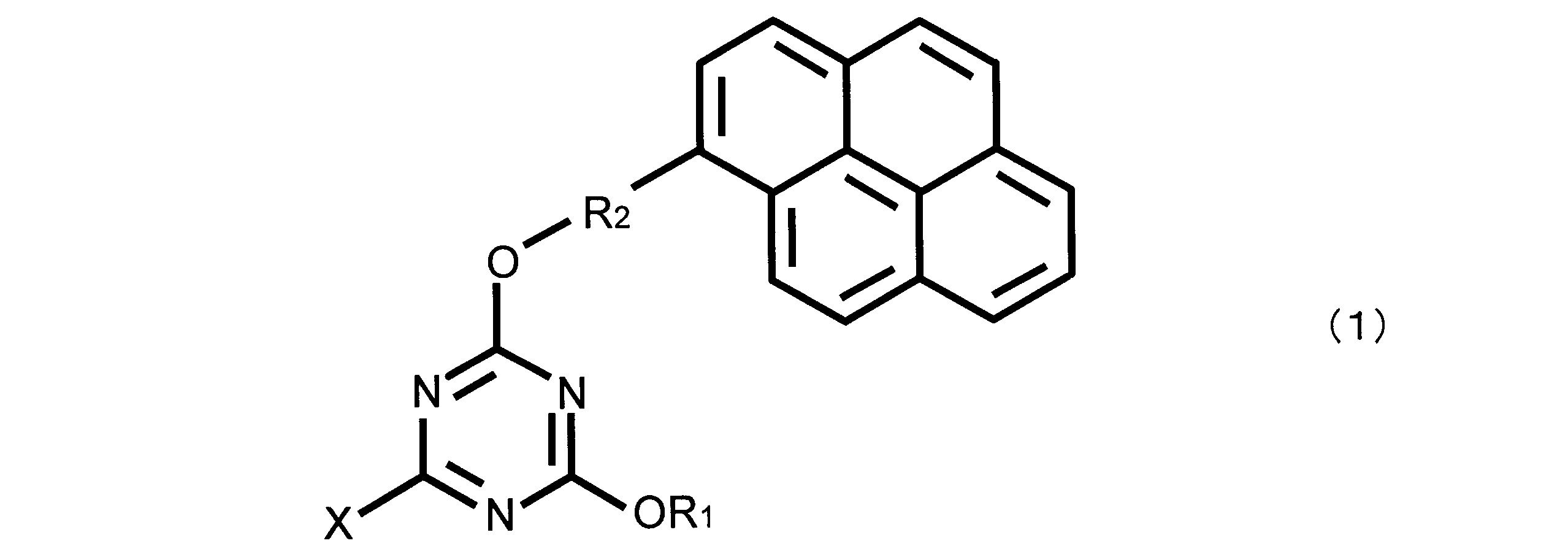
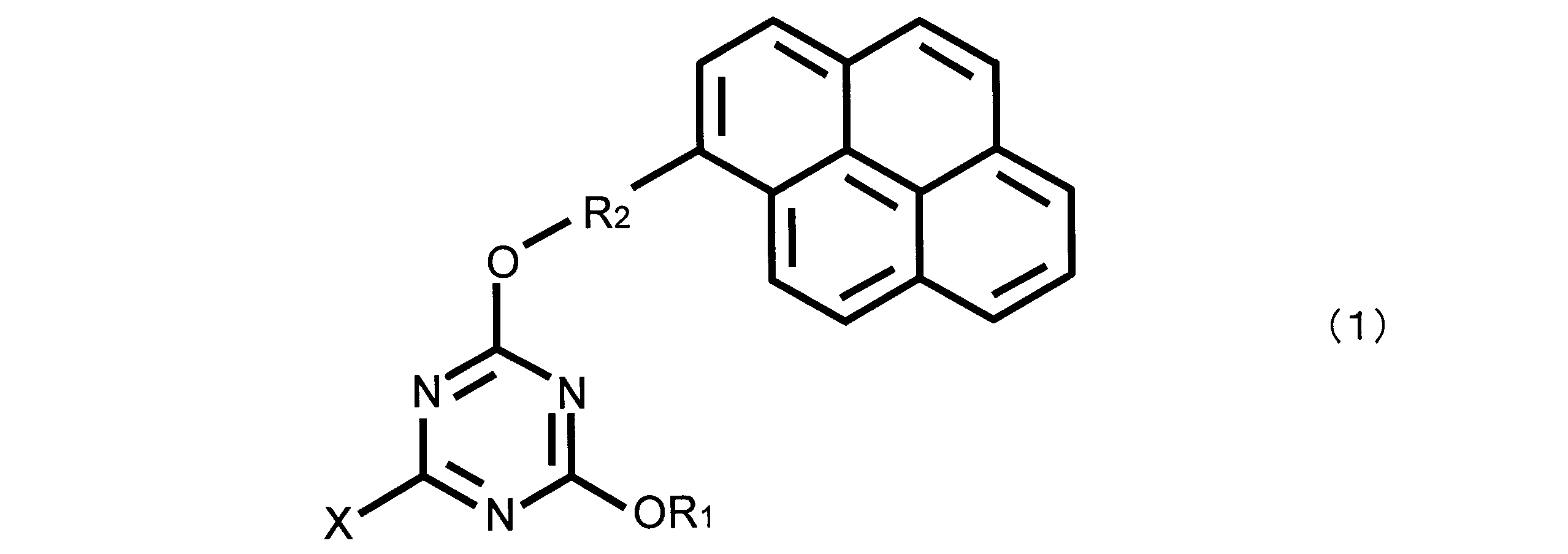
- the fluorescent derivatization reagent according to the present invention has the following general formula (1): It is characterized by including the novel compound represented by these.
- X represents a halogen element
- R 1 represents an alkyl group
- R 2 represents an alkyl chain.
- X is preferably Cl (chlorine), which has excellent reactivity with amino groups and phenolic hydroxyl groups.
- R 1 is an alkyl group having 1 to 4 carbon atoms
- R 2 Is preferably an alkyl chain having 1 to 4 carbon atoms.
- Pyrene alcohol is one of the starting compounds of the compound represented by the general formula (1), but pyrene alkyl alcohol having an alkyl chain having 1 to 4 carbon atoms is commercially available and easily available. Therefore, also from this point, the alkyl chain preferably has 1 to 4 carbon atoms.
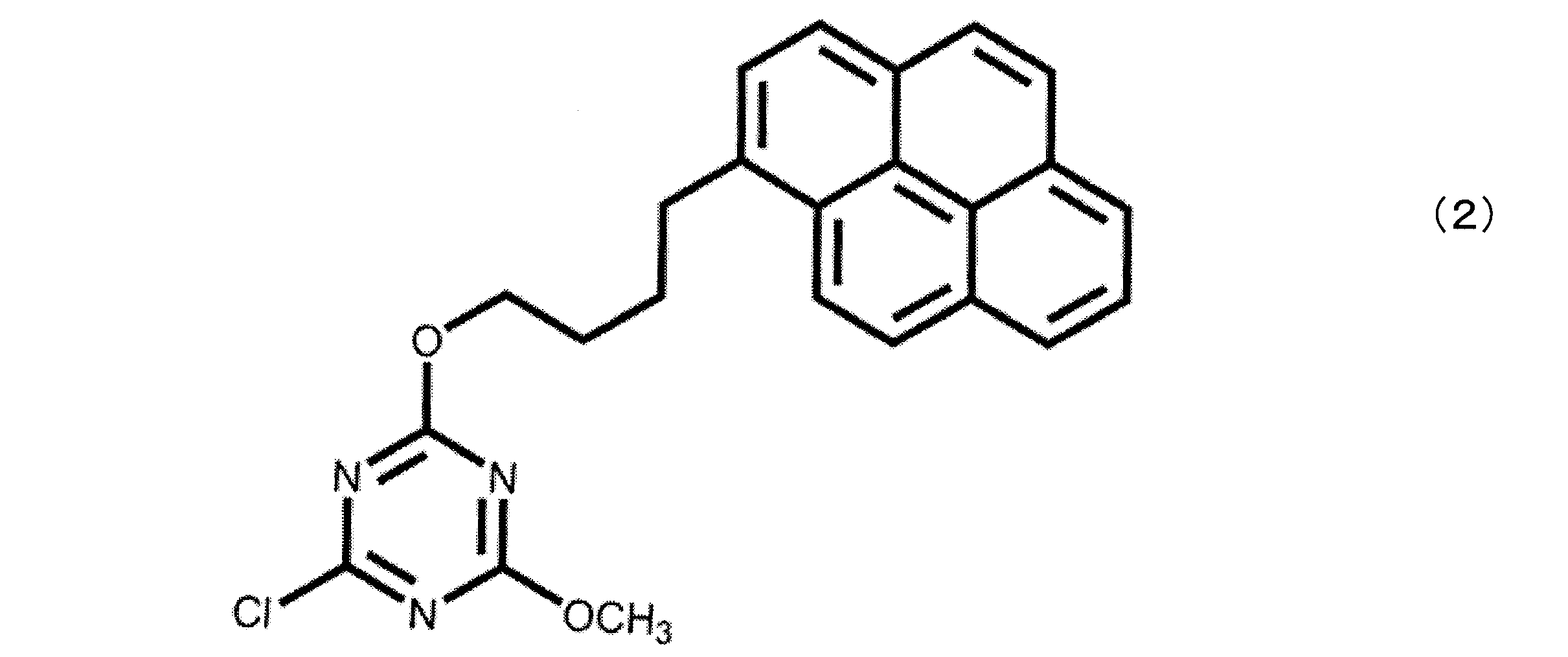
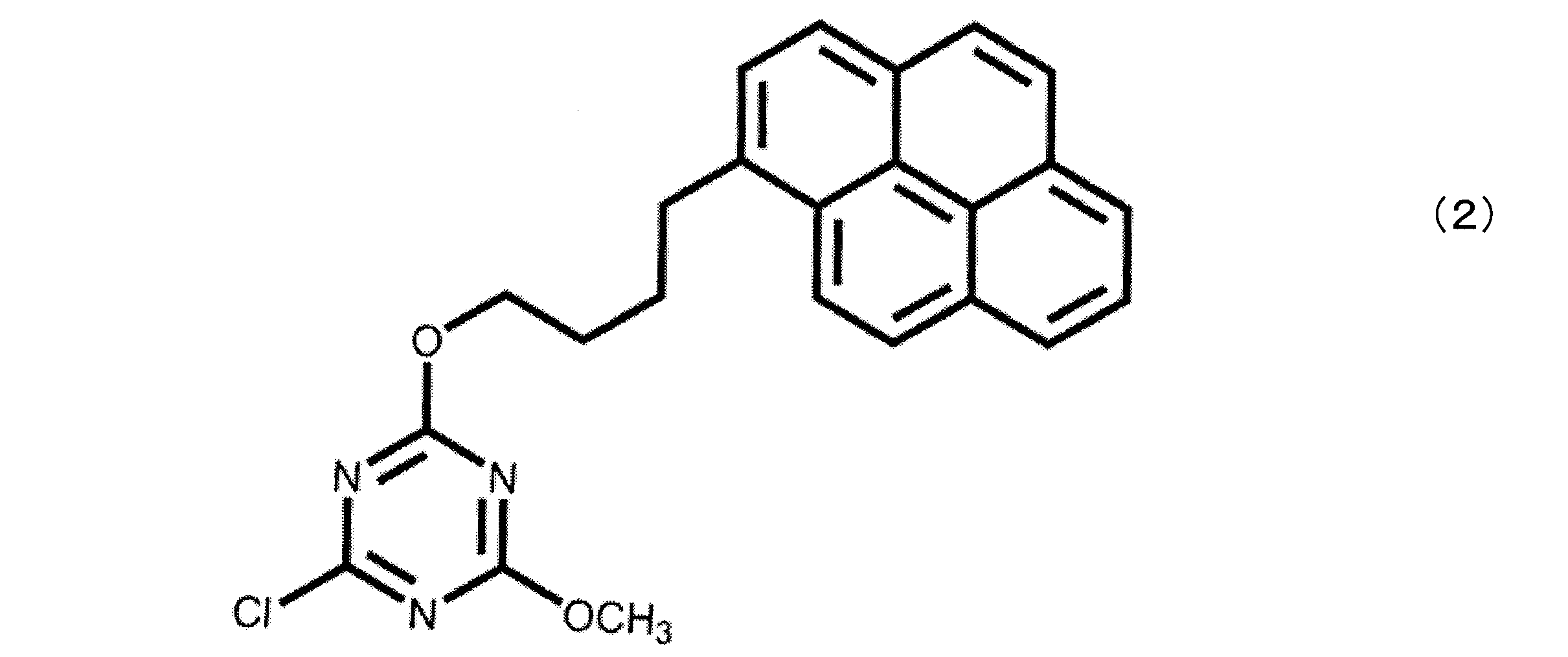
- the fluorescent derivatization reagent according to the present invention is a compound (2-chloro-4-methoxy) represented by the following formula (2), wherein X is Cl (chlorine), R 1 is a methyl group, and R 2 is a butyl chain. Preferably, it contains -6- (4- (pyren-1-yl) butoxy) -1,3,5-triazine).
- the halogen group of the compound represented by the general formula (1) is selectively bonded to an amino group or a phenolic hydroxyl group. Therefore, when the target substance is a substance having a plurality of amino groups in the same molecule (polyamine) or a substance having an amino group and a phenolic hydroxyl group in the same molecule (monoamine), the target substance reacts with the compound. An excimer of pyrene is formed and emits excimer fluorescence. Therefore, the target substance can be detected by measuring the intensity of this excimer fluorescence.
- a substance having only one amino group in the same molecule or a substance having only one phenolic hydroxyl group in the same molecule is a substance that emits fluorescence by reacting with the compound. Therefore, the fluorescent derivatization reagent according to the present invention can also be used for fluorescent derivatization (labeling) of such substances. In this case, since the wavelength of excimer fluorescence (475 nm) is different from the wavelength of fluorescence emitted from pyrene alone (375 nm), both can be detected by measuring the fluorescence intensity of each wavelength.
- the amine analysis method according to the present invention includes: The intensity of excimer fluorescence emitted by derivatizing a polyamine having a plurality of amino groups in the same molecule and / or a monoamine having an amino group and a phenolic hydroxyl group in the same molecule with a fluorescent derivatization reagent having a pyrene group.
- the fluorescent derivatization reagent is represented by the following formula (2): And 2-chloro-4-methoxy-6- (4- (pyren-1-yl) butoxy) -1,3,5-triazine represented by the formula:
- the fluorescent derivatization reagent according to the present invention selectively binds to an amino group or a phenolic hydroxyl group, and further binds to a plurality of amino groups in the same molecule or a substance having an amino group and a phenolic hydroxyl group in the same molecule. Since excimer fluorescence is emitted, the amount of the substance can be measured selectively and with high sensitivity by measuring the intensity of the excimer fluorescence.
- the fluorescent derivatization reagent according to the present invention has excellent storage stability because of its low hygroscopicity, and can maintain reactivity for a long period of time even in a state dissolved in a solvent as compared with conventional fluorescent derivatization reagents. it can.
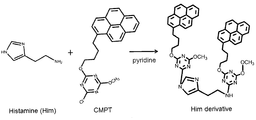
- CMPT 2-(2-dichloro-6-methoxy-1,3,5-triazine and 1-pyrenebutanol, showing a synthesis example of CMPT which is one embodiment of the present invention.
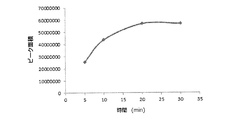
- the graph which shows the relationship between reaction time when a histamine ACN solution is melt
- the graph which shows the relationship between the density
- the results of HPLC analysis (a), HPLC conditions (c) and MS results (b) when histamine was fluorescently derivatized with CMPT at a CMPT concentration of 20 mM and a reaction time of 20 minutes are shown.
- the graph which shows the relationship between excimer fluorescence intensity and storage time.
- the compound according to the present invention is a compound useful as an excimer fluorescent derivatization reagent represented by the following general formula (1).
- X represents a halogen element
- R 1 represents an alkyl group
- R 2 represents an alkyl chain.
- X is Cl (chlorine)
- R 1 is a methyl group
- R 2 is a butyl chain.
- 2-chloro-4-methoxy-6- (4- (pyren-1-yl) butoxy) -1,3,5-triazine (2-chloro-4-methoxy-) represented by the following formula (2) 6- (4- (pyren-1-yl) butoxy) -1,3,5-triazine (CMPT)) is excellent in terms of reactivity with polyamines and storage stability.
- CMPT 2-chloro-4-methoxy-6- (4- (pyren-1-yl) butoxy) -1,3,5-triazine
- histamine is the subject of analysis.
- polyamines other than histamine or monoamines having an amino group and a phenolic hydroxyl group in the same molecule such as tyramine.
- CMPT CMPT
- a pyrene group is a fluorescent site and a Cl group is a reactive site.
- CMPT solvent Three types of bases (potassium carbonate, collidine, pyridine (Pyridine)) to search for a base and a solvent suitable for excimer fluorescence derivatization reaction of histamine using CMPT, The state of the solution was observed when CMPT was dissolved in seven types of solvents (DMF (N, N-dimethylformamide), DMSO (Dimethyl sulfoxide), THF (tetrahydrofuran), ACN (acetonitrile), ethyl acetate, chloroform, acetone)). .
- DMF N, N-dimethylformamide
- DMSO Dimethyl sulfoxide
- THF tetrahydrofuran
- ACN acetonitrile
- ethyl acetate chloroform, acetone
- Table 1 shows that DMF is excellent as a solvent for CMPT.
- the bases of potassium carbonate, collidine, and pyridine were not different in solubility of CMPT, precipitation of CMPT was observed when water was added in a solution using potassium carbonate. As will be described later, it is not preferable to use potassium carbonate, considering that water is added in the pretreatment for separating histamine in soy sauce.
- the intensity of excimer fluorescence was higher with pyridine than with collidine. Therefore, in this example, pyridine was employed as a base used for histamine analysis.
- FIGS. 2 and 3 are obtained by dissolving 10 ⁇ L of histamine in ACN solution in 3 ⁇ L of pyridine and 20 ⁇ L of CMPT in DMF, and then derivatizing histamine with HPLC.
- Fig. 3 shows the results of separation of fluorescent derivatized histamine and detection of its excimer fluorescence intensity.
- FIG. 2 shows the relationship between the reaction time and the fluorescence intensity (area) when the CMPT concentration is 20 mM and the reaction temperature is 50 ° C.
- FIG. 3 shows the relationship between the CMPT concentration and the fluorescence intensity when the reaction temperature is set to 50 ° C. and the reaction time is set to 20 minutes.
- the fluorescence intensity gradually increased until the reaction time was 20 minutes, but the fluorescence intensity hardly changed after 20 minutes. Further, as can be seen from FIG. 3, the fluorescence intensity gradually increased in the concentration range up to 20 mM, but the fluorescence intensity hardly changed in the concentration range higher than 20 mM. From the viewpoint of shortening the time required for histamine analysis and reducing the amount of CMPT used for histamine analysis, the reaction time for excimer fluorescence derivatization in histamine analysis according to this example was set to 20 minutes, and the CMPT concentration was set to 20 mM.
- FIG. 4 (a) The HPLC analysis result of histamine (50 ppm standard product) performed under these conditions is shown in FIG. 4 (a), and the HPLC conditions at this time are shown in FIG. 4 (b). Further, from FIG. 4 (c) showing the result of MS analysis of a substance in which excimer fluorescence was detected by HPLC analysis, it was confirmed that a substance in which CMPT2 molecules were bonded to one histamine molecule was generated.
- CMPT was dissolved in DMF to prepare a solution. This solution was stored at room temperature, and then histamine was fluorescently derivatized using this solution. The obtained fluorescent derivatized histamine was separated using HPLC, and the intensity of the excimer fluorescence was determined. As a result, the relationship between excimer fluorescence intensity and storage time was as shown in FIG. As can be seen from FIG. 5, CMPT was able to be fluorescently derivatized without lowering its reactivity with histamine for 40 days or more even in a DMF solution. This indicates that CMPT is superior in storage stability in a solution state as compared with conventional excimer fluorescent derivatization reagents.
- Magnesium sulfate is added to salt out proteins and the like, and sodium hydroxide is added to adjust the pH and increase the amount of molecular histamine.
- the present inventor examined pretreatment conditions suitable for derivatizing histamine with CMPT with reference to this pretreatment method. Specifically, when a sample containing histamine having a known concentration is separated into an acetonitrile layer and an aqueous layer, the ratio of histamine recovered in the acetonitrile layer (recovery rate (%)) is set to a sodium hydroxide concentration of 1. When changed to ⁇ 4M (FIG. 6B), both unheated acetonitrile and heated acetonitrile were used (FIG. 6C).
- the recovery rate of histamine was 25% when the concentration of sodium hydroxide was 1M, but the recovery rate of histamine was 45% in the range of 2M to 4M. From the above, it is considered that the concentration range of 2M to 4M is appropriate for sodium hydroxide used for the pretreatment of soy sauce.
- the peak shape of the fluorescent derivatized histamine is symmetrical, but when unheated ACN is used, the fluorescent derivatized histamine is asymmetrical. It was a shape. This is probably because the protein in the sample could not be sufficiently removed when non-heated ACN was used, and the fluorescence peak of the protein-derived substance overlapped with the fluorescence peak derived from histamine. Therefore, it seems that it is preferable to use heated ACN for pretreatment of soy sauce rather than unheated ACN.
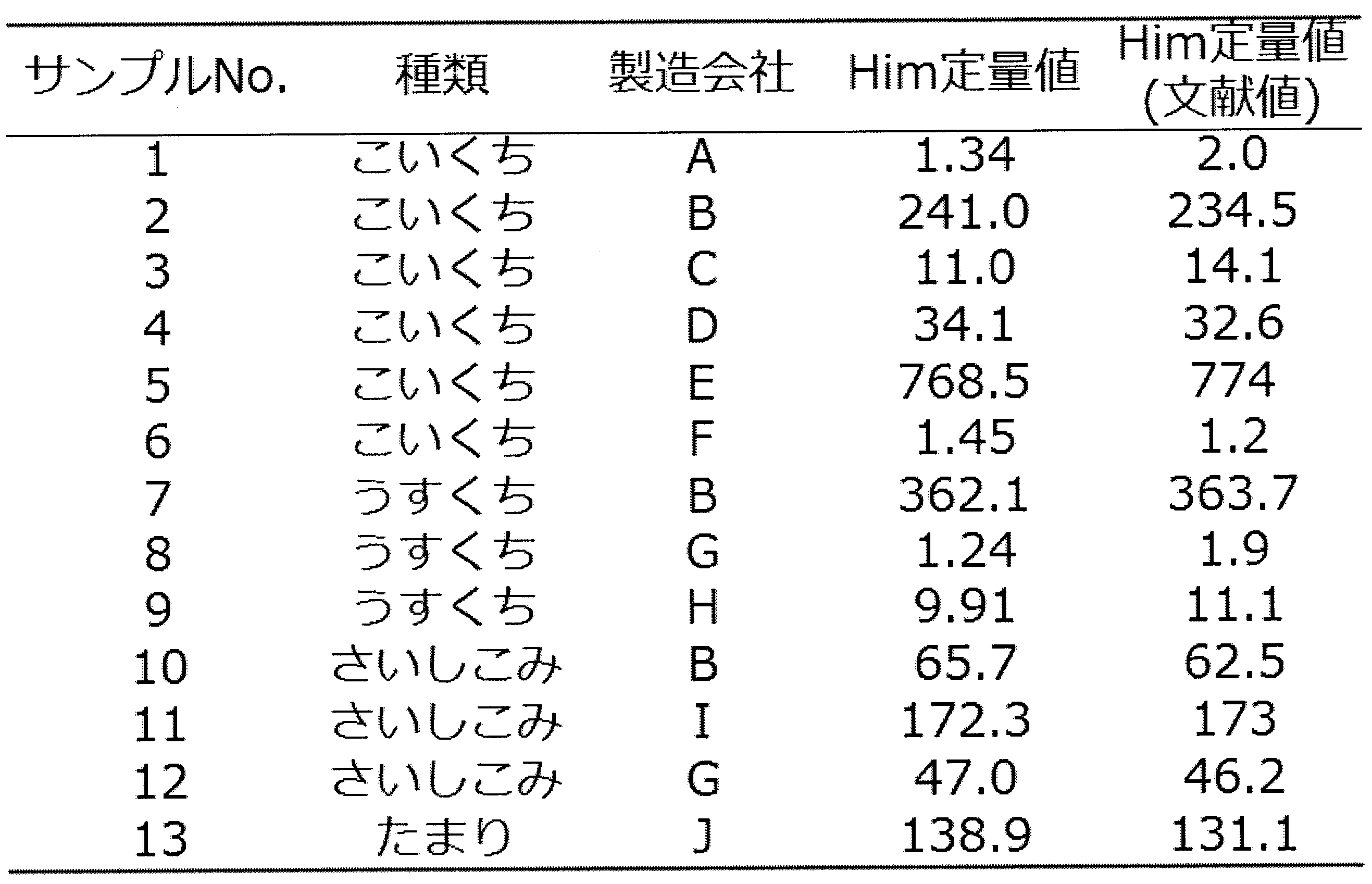
- Table 2 shows the detection limit (Limit of detection, LOD), lower limit of quantitation (Limit of quantitation, LOQ), linearity, and calibration curve range at this time. From Table 2, it was found that the histamine analysis according to this example can obtain sufficient linearity and sensitivity to analyze histamine in soy sauce.
Landscapes
- Chemical & Material Sciences (AREA)
- Organic Chemistry (AREA)
- Health & Medical Sciences (AREA)
- Life Sciences & Earth Sciences (AREA)
- Engineering & Computer Science (AREA)
- Pathology (AREA)
- Immunology (AREA)
- General Physics & Mathematics (AREA)
- General Health & Medical Sciences (AREA)
- Physics & Mathematics (AREA)
- Analytical Chemistry (AREA)
- Biochemistry (AREA)
- Food Science & Technology (AREA)
- Materials Engineering (AREA)
- Medicinal Chemistry (AREA)
- Inorganic Chemistry (AREA)
- Nuclear Medicine, Radiotherapy & Molecular Imaging (AREA)
- Molecular Biology (AREA)
- Investigating Or Analysing Biological Materials (AREA)
- Investigating Or Analyzing Non-Biological Materials By The Use Of Chemical Means (AREA)
- Investigating, Analyzing Materials By Fluorescence Or Luminescence (AREA)
- Investigating Or Analysing Materials By The Use Of Chemical Reactions (AREA)
Abstract
Description
なお、ここではピレン試薬を用いてポリアミンを分析する場合について説明したが、最近では、1分子中にアミノ基とフェノール性水酸基を有するチラミン等のモノアミンもピレン試薬で蛍光誘導体化されることによりエキシマーを形成することが分かっている。従って、上述したピレン試薬を用いてモノアミンを分析する場合にも同様の問題が生じる。
具体的には、本発明に係る蛍光誘導体化試薬は、以下の一般式(1)

同一分子内に複数のアミノ基を有するポリアミン及び/又は同一分子内にアミノ基とフェノール性水酸基を有するモノアミンを、ピレン基を有する蛍光誘導体化試薬で誘導体化することにより発せられるエキシマー蛍光の強度の測定結果に基づき前記ポリアミン及び/又はモノアミンを分析する方法であって、
前記蛍光誘導体化試薬が、下記の式(2)
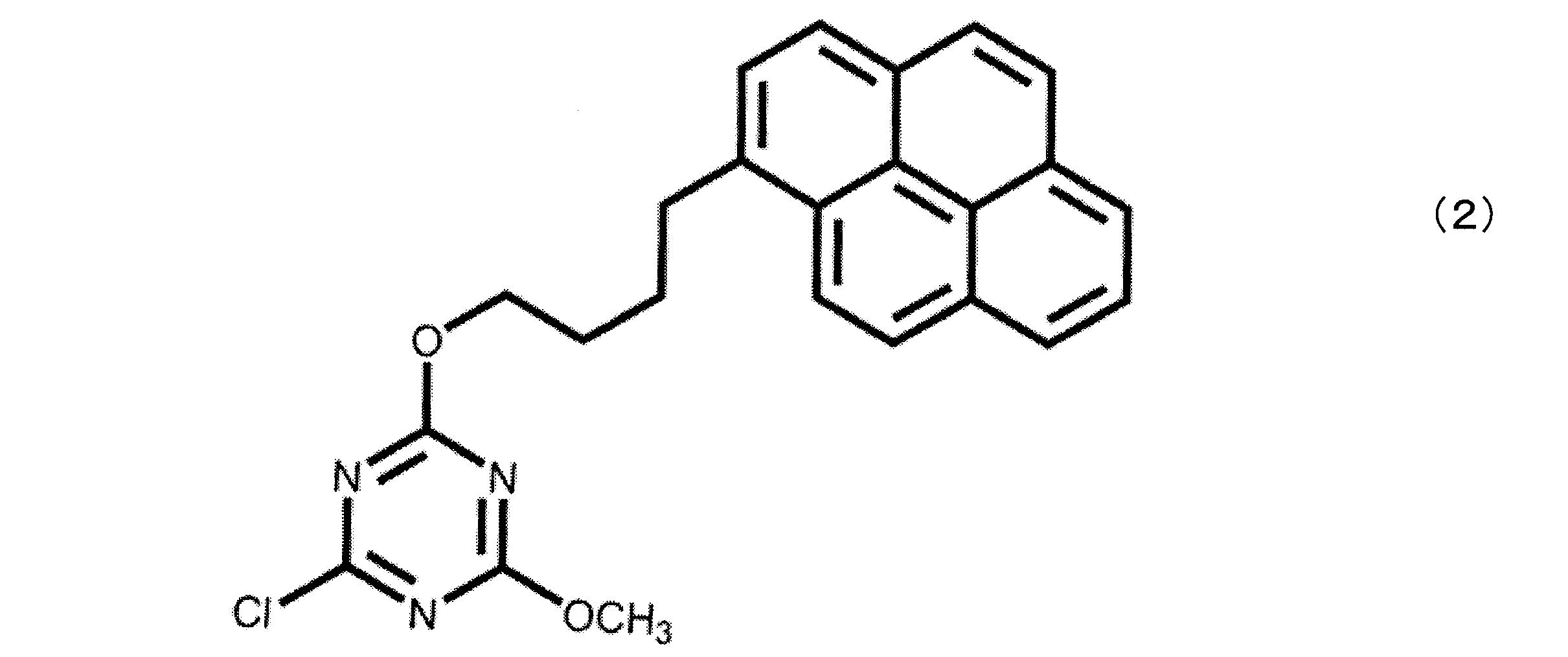


図1に示すように、2,4-ジクロロ-6-メトキシ-1,3,5-トリアジン(2,4-dichloro-6-methoxy-1,3,5-triazine)1当量と1-ピレンブタノール(1-pyrenebutanol)1当量に、コリジン(Collidine)1.2当量を加え、室温で24時間放置した。この溶液を高速液体クロマトグラフ(HPLC装置)で分離した後、再結晶化して精製した。得られた生成物をNMR分析及び質量分析(MS)で確認したところ、以下の式で表される化合物(CMPT)であると同定された。

CMPTを用いたヒスタミンのエキシマー蛍光誘導体化反応に適した塩基及び溶媒を探索するために3種類の塩基(炭酸カリウム、コリジン(Collidine)、ピリジン(Pyridine))と、7種類の溶媒(DMF(N,N-dimethylformamide)、DMSO(Dimethyl sulfoxide)、THF(tetrahydrofuran)、ACN(acetonitrile)、酢酸エチル、クロロホルム、アセトン)にCMPTを溶かしたときの溶液の状態を観察した。その結果を表1に示す。表1中「×」は、CMPTが完全に溶解しなかった塩基と溶媒の組み合わせを示す。

図2及び図3は、ヒスタミンのACN溶液10μLをピリジン3μL、CMPTのDMF溶液20μLに溶解し、ヒスタミンを蛍光誘導体化した後、HPLCで蛍光誘導体化ヒスタミンを分離してそのエキシマー蛍光強度を検出した結果を示す。図2は、CMPTの濃度を20mMに、反応温度を50℃に設定したときの、反応時間と蛍光強度(面積)との関係を示す。また、図3は反応温度を50℃に、反応時間を20分に設定したときの、CMPTの濃度と蛍光強度の関係を示す。図2から分かるように、反応時間が20分までは蛍光強度が徐々に増加したが、20分以降は蛍光強度はほとんど変化しなかった。また、図3から分かるように、20mMまでの濃度範囲では蛍光強度が徐々に増加したが、20mMよりも大きい濃度範囲では蛍光強度はほとんど変化しなかった。ヒスタミン分析に要する時間の短縮、ヒスタミン分析に使用するCMPT量の低減の観点から、本実施例に係るヒスタミン分析におけるエキシマー蛍光誘導体化の反応時間を20分に、CMPT濃度を20mMに設定した。
CMPTをDMFに溶解して溶液を作製し、この溶液を室温で保存した後、この溶液を用いてヒスタミンを蛍光誘導体化した。得られた蛍光誘導体化ヒスタミンをHPLCを用いて分離し、そのエキシマー蛍光の強度を求めた。その結果、エキシマー蛍光強度と保存時間の関係は図5に示すようになった。図5から分かるように、CMPTはDMF溶液の状態でも40日以上、ヒスタミンとの反応性が低下せず、蛍光誘導体化することができた。このことから、CMPTは従来のエキシマー蛍光誘導体化試薬に比べると、溶液状態での保存安定性に優れることが分かる。
醤油に含まれるアミン類をLC-MS/MSで分析する場合、アミン類とその他の成分(塩分、有機酸、タンパク質、メラノイジン、アミノ酸等)を分離する前処理が必要である。この前処理法として、非特許文献4に記載された方法が知られている。この方法では、醤油(20μL)に0.1Mの硫酸マグネシウム(20μL)、1M の水酸化ナトリウム(20μL、pH10)、及びアセトニトリル320μLを添加し、遠心処理によりアミン類を含むアセトニトリル層とそれ以外の成分を含む水層に分離する(図6(a)参照)。硫酸マグネシウムはタンパク質等の塩析のために、水酸化ナトリウムはpHを調整して分子型のヒスタミン量を増やすために添加される。本発明者は、この前処理法を参考に、ヒスタミンをCMPTで蛍光誘導体化する場合に適した前処理条件を検討した。
具体的には、濃度が既知のヒスタミンを含む試料をアセトニトリル層と水層に分離したときに該アセトニトリル層に回収されたヒスタミンの割合(回収率(%))を、水酸化ナトリウムの濃度を1~4Mに変化させたとき(図6(b)、非加熱のアセトニトリルと加熱したアセトニトリルを用いたとき(図6(c))の両方について調べた。


Claims (6)
- 一般式(1)
ここで、Xはハロゲン元素を、R1はアルキル基を、R2はアルキル鎖を表す。 - 前記化合物が、式(2)
- 同一分子内に複数のアミノ基を有するポリアミン又は同一分子内にアミノ基とフェノール性水酸基を有するモノアミンを、ピレン基を有する蛍光誘導体化試薬で誘導体化することにより発せられるエキシマー蛍光の強度の測定結果に基づき前記ポリアミン又はモノアミンを分析する方法であって、
前記蛍光誘導体化試薬が、一般式(1)

ここで、Xはハロゲン元素を、R1はアルキル基を、R2はアルキル鎖を表す。 - 前記蛍光誘導体化試薬が、式(2)

- 下記の一般式(1)
ここで、Xはハロゲン元素を、R1はアルキル基を、R2はアルキル鎖を表す。 - 式(2)
Priority Applications (3)
| Application Number | Priority Date | Filing Date | Title |
|---|---|---|---|
| PCT/JP2015/056416 WO2016139786A1 (ja) | 2015-03-04 | 2015-03-04 | 蛍光誘導体化試薬及びアミン分析方法 |
| US15/555,866 US11078412B2 (en) | 2015-03-04 | 2015-03-04 | Polyamine and tyramine analysis method using pyrene containing fluorescence derivatization reagent and excimer fluorescence |
| JP2017503278A JP6478255B2 (ja) | 2015-03-04 | 2015-03-04 | 蛍光誘導体化試薬及びアミン分析方法 |
Applications Claiming Priority (1)
| Application Number | Priority Date | Filing Date | Title |
|---|---|---|---|
| PCT/JP2015/056416 WO2016139786A1 (ja) | 2015-03-04 | 2015-03-04 | 蛍光誘導体化試薬及びアミン分析方法 |
Publications (1)
| Publication Number | Publication Date |
|---|---|
| WO2016139786A1 true WO2016139786A1 (ja) | 2016-09-09 |
Family
ID=56849242
Family Applications (1)
| Application Number | Title | Priority Date | Filing Date |
|---|---|---|---|
| PCT/JP2015/056416 Ceased WO2016139786A1 (ja) | 2015-03-04 | 2015-03-04 | 蛍光誘導体化試薬及びアミン分析方法 |
Country Status (3)
| Country | Link |
|---|---|
| US (1) | US11078412B2 (ja) |
| JP (1) | JP6478255B2 (ja) |
| WO (1) | WO2016139786A1 (ja) |
Cited By (1)
| Publication number | Priority date | Publication date | Assignee | Title |
|---|---|---|---|---|
| WO2023074128A1 (ja) * | 2021-10-28 | 2023-05-04 | 野村マイクロ・サイエンス株式会社 | エンドトキシン検出方法及びエンドトキシン検出装置、精製水製造設備及び注射用水製造設備、並びに精製水製造方法及び注射用水製造方法 |
Citations (6)
| Publication number | Priority date | Publication date | Assignee | Title |
|---|---|---|---|---|
| JPH10142228A (ja) * | 1996-11-07 | 1998-05-29 | Bunshi Bio Photonics Kenkyusho:Kk | ポリアミン分析方法 |
| JPH10170514A (ja) * | 1996-12-06 | 1998-06-26 | Asahi Chem Ind Co Ltd | ヒスタミンの蛍光強度測定方法 |
| JP2001242174A (ja) * | 2000-03-02 | 2001-09-07 | Chemicals Evaluation & Research Institute | ヒスタミン又はヒスチジンの分析方法 |
| JP2005160399A (ja) * | 2003-12-03 | 2005-06-23 | Kikkoman Corp | ヒスタミンの定量法 |
| US20080227116A1 (en) * | 2005-11-18 | 2008-09-18 | Albert Missbichler | Histaminase Determination |
| JP2009143821A (ja) * | 2007-12-12 | 2009-07-02 | Univ Fukuoka | 蛍光誘導体化試薬ならびに蛍光誘導体化方法 |
Family Cites Families (6)
| Publication number | Priority date | Publication date | Assignee | Title |
|---|---|---|---|---|
| US3157651A (en) * | 1964-11-17 | Triazine compounds | ||
| US3316263A (en) * | 1962-09-13 | 1967-04-25 | Velsicol Chemical Corp | 2-(substituted phenylthio)-4, 6-dialkoxy-1, 3, 5-triazines |
| CH510682A (de) * | 1968-09-10 | 1971-07-31 | Ciba Geigy Ag | Verfahren zur Herstellung von Dihalogentriazinderivaten |
| JP3967783B2 (ja) * | 1996-07-31 | 2007-08-29 | 富士フイルム株式会社 | 顔料分散組成物及びそれを用いた着色感光性組成物 |
| EP2461154B1 (en) * | 2010-12-03 | 2013-03-13 | Honeywell International Inc. | Composition and method for preparing a fluorescence quenching based oxygen sensor comprising the composition |
| TWI651310B (zh) * | 2014-02-20 | 2019-02-21 | 日商日本煙草產業股份有限公司 | 三化合物及其醫藥用途 |
-
2015
- 2015-03-04 JP JP2017503278A patent/JP6478255B2/ja active Active
- 2015-03-04 US US15/555,866 patent/US11078412B2/en active Active
- 2015-03-04 WO PCT/JP2015/056416 patent/WO2016139786A1/ja not_active Ceased
Patent Citations (6)
| Publication number | Priority date | Publication date | Assignee | Title |
|---|---|---|---|---|
| JPH10142228A (ja) * | 1996-11-07 | 1998-05-29 | Bunshi Bio Photonics Kenkyusho:Kk | ポリアミン分析方法 |
| JPH10170514A (ja) * | 1996-12-06 | 1998-06-26 | Asahi Chem Ind Co Ltd | ヒスタミンの蛍光強度測定方法 |
| JP2001242174A (ja) * | 2000-03-02 | 2001-09-07 | Chemicals Evaluation & Research Institute | ヒスタミン又はヒスチジンの分析方法 |
| JP2005160399A (ja) * | 2003-12-03 | 2005-06-23 | Kikkoman Corp | ヒスタミンの定量法 |
| US20080227116A1 (en) * | 2005-11-18 | 2008-09-18 | Albert Missbichler | Histaminase Determination |
| JP2009143821A (ja) * | 2007-12-12 | 2009-07-02 | Univ Fukuoka | 蛍光誘導体化試薬ならびに蛍光誘導体化方法 |
Non-Patent Citations (2)
| Title |
|---|
| HIDEYUKI YOSHIDA: "Highly Selective Derivatization Method Based on Intramolecular Excimer-Forming Fluorescence", JOURNAL OF JAPAN SOCIETY FOR ANALYTICAL CHEMISTRY, vol. 55, 26 May 2006 (2006-05-26), pages 213 - 221 * |
| TATSUKI NAKANO: "Shinki Excimer Keiko Yudotaika Shiyaku ni yoru Shoyuchu Histamine no Kokando Kosentakuteki Bunsekiho no Kaihatsu", THE PHARMACEUTICAL SOCIETY OF JAPAN DAI 135 NENKAI HAPPYO YOSHI, 26W-PM04S, 2 February 2015 (2015-02-02) * |
Cited By (1)
| Publication number | Priority date | Publication date | Assignee | Title |
|---|---|---|---|---|
| WO2023074128A1 (ja) * | 2021-10-28 | 2023-05-04 | 野村マイクロ・サイエンス株式会社 | エンドトキシン検出方法及びエンドトキシン検出装置、精製水製造設備及び注射用水製造設備、並びに精製水製造方法及び注射用水製造方法 |
Also Published As
| Publication number | Publication date |
|---|---|
| US20180051205A1 (en) | 2018-02-22 |
| JPWO2016139786A1 (ja) | 2018-02-22 |
| JP6478255B2 (ja) | 2019-03-06 |
| US11078412B2 (en) | 2021-08-03 |
Similar Documents
| Publication | Publication Date | Title |
|---|---|---|
| JP6699645B2 (ja) | アミノ官能性化合物の分析方法及び分析試薬 | |
| CN106883849B (zh) | 一种含氮硫参杂的石墨烯量子点及其制备方法与在制备赖氨酸荧光检测试剂上的应用 | |
| CN105866316B (zh) | 一种同时检测食品中氨基酸和生物胺的分析方法 | |
| Zhao et al. | Determination of aliphatic amines using N-succinimidyl benzoate as a new derivatization reagent in gas chromatography combined with solid-phase microextraction | |
| Dong et al. | Design, synthesis and characterization of tracers and development of a fluorescence polarization immunoassay for the rapid detection of ractopamine in pork | |
| Li et al. | Simultaneous determination of biogenic amines and estrogens in foodstuff by an improved HPLC method combining with fluorescence labeling | |
| Meussen et al. | A fast and accurate UPLC method for analysis of proteinogenic amino acids | |
| Szterk et al. | Simultaneous determination of free amino acids, l-carnosine, purine, pyrimidine, and nucleosides in meat by liquid chromatography/single quadrupole mass spectrometry | |
| Wang et al. | Fluorescence polarization immunoassay for Alternaria mycotoxin tenuazonic acid detection and molecular modeling studies of antibody recognition | |
| Sun et al. | Determination of thiophenols with a novel fluorescence labelling reagent: analysis of industrial wastewater samples with SPE extraction coupled with HPLC | |
| Elbashir et al. | Simultaneous determination of polyamines and acetylpolyamines in human urine by capillary electrophoresis with fluorescence detection | |
| Jiang et al. | High-performance fluorescence platform for real-time non-destructive and visual screening of meat freshness | |
| Zhang et al. | Sensitive determination of melamine leached from tableware by reversed phase high-performance liquid chromatography using 10-methyl-acridone-2-sulfonyl chloride as a pre-column fluorescent labeling reagent | |
| Wang et al. | 3-Iodoacetylaminobenzanthrone as a fluorescent derivatizing reagent for thiols in high-performance liquid chromatography | |
| Johannesen et al. | Glycan analysis via derivatization with a fluorogenic pyrylium dye | |
| JP6478255B2 (ja) | 蛍光誘導体化試薬及びアミン分析方法 | |
| Zotou et al. | Enhancing fluorescence lc analysis of biogenic amines in fish tissues by precolumn derivatization with naphthalene-2, 3-dicarboxaldehyde | |
| Beach et al. | Capillary electrophoresis–tandem mass spectrometry for multiclass analysis of polar marine toxins | |
| Huang et al. | Sensitive turn-on fluorescent detection of tartrazine based on fluorescence resonance energy transfer | |
| Zhu et al. | Determination of biogenic amines in alcoholic beverages using a novel fluorogenic compound as derivatizing reagent | |
| You et al. | Development of a precolumn derivatization method for the determination of free amines in wastewater by high-performance liquid chromatography via fluorescent detection with 9-(2-hydroxyethyl) acridone | |
| Cao et al. | Analytical potential of 6‐oxy‐(N‐succinimidyl acetate)‐9‐(2'‐methoxycarbonyl) fluorescein for the determination of amino compounds by capillary electrophoresis with laser‐induced fluorescence detection | |
| KR101010899B1 (ko) | 발리올아민의 uv 분석방법 | |
| Varriale et al. | On the possibility of ephedrine detection: time-resolved fluorescence resonance energy transfer (FRET)-based approach | |
| Zhang et al. | Separation of free amino acids and catecholamines in human plasma and rabbit vitreous samples using a new fluorogenic reagent 3‐(4‐bromobenzoyl)‐2‐quinolinecarboxaldehyde with CE‐LIF detection |
Legal Events
| Date | Code | Title | Description |
|---|---|---|---|
| 121 | Ep: the epo has been informed by wipo that ep was designated in this application |
Ref document number: 15883953 Country of ref document: EP Kind code of ref document: A1 |
|
| ENP | Entry into the national phase |
Ref document number: 2017503278 Country of ref document: JP Kind code of ref document: A |
|
| NENP | Non-entry into the national phase |
Ref country code: DE |
|
| WWE | Wipo information: entry into national phase |
Ref document number: 15555866 Country of ref document: US |
|
| 122 | Ep: pct application non-entry in european phase |
Ref document number: 15883953 Country of ref document: EP Kind code of ref document: A1 |