WO2016136823A1 - 容器入り外用製剤 - Google Patents
容器入り外用製剤 Download PDFInfo
- Publication number
- WO2016136823A1 WO2016136823A1 PCT/JP2016/055478 JP2016055478W WO2016136823A1 WO 2016136823 A1 WO2016136823 A1 WO 2016136823A1 JP 2016055478 W JP2016055478 W JP 2016055478W WO 2016136823 A1 WO2016136823 A1 WO 2016136823A1
- Authority
- WO
- WIPO (PCT)
- Prior art keywords
- preparation
- resin
- container
- mass
- external preparation
- Prior art date
- Legal status (The legal status is an assumption and is not a legal conclusion. Google has not performed a legal analysis and makes no representation as to the accuracy of the status listed.)
- Ceased
Links
Classifications
-
- A—HUMAN NECESSITIES
- A61—MEDICAL OR VETERINARY SCIENCE; HYGIENE
- A61K—PREPARATIONS FOR MEDICAL, DENTAL OR TOILETRY PURPOSES
- A61K9/00—Medicinal preparations characterised by special physical form
- A61K9/06—Ointments; Bases therefor; Other semi-solid forms, e.g. creams, sticks, gels
-
- A—HUMAN NECESSITIES
- A61—MEDICAL OR VETERINARY SCIENCE; HYGIENE
- A61K—PREPARATIONS FOR MEDICAL, DENTAL OR TOILETRY PURPOSES
- A61K31/00—Medicinal preparations containing organic active ingredients
- A61K31/70—Carbohydrates; Sugars; Derivatives thereof
- A61K31/7008—Compounds having an amino group directly attached to a carbon atom of the saccharide radical, e.g. D-galactosamine, ranimustine
-
- A—HUMAN NECESSITIES
- A61—MEDICAL OR VETERINARY SCIENCE; HYGIENE
- A61K—PREPARATIONS FOR MEDICAL, DENTAL OR TOILETRY PURPOSES
- A61K9/00—Medicinal preparations characterised by special physical form
- A61K9/08—Solutions
Definitions
- the present invention relates to an external preparation in a container. More specifically, the present invention relates to a stable external preparation in which coloring of an external preparation containing glucosamine or a salt thereof or a derivative thereof filled in a container is suppressed.
- Glucosamine or a salt thereof or a derivative thereof is one of the constituent sugars of mucopolysaccharide, and is contained in animal skin, cartilage, shellfish shell chitin such as shark and shrimp, etc. From crustacean shells.
- Glucosamine or a salt thereof or a derivative thereof may be obtained by partially hydrolyzing chitin with glucosamine hydrochloride, glucosamine sulfate or chitin obtained by hydrolysis with hydrochloric acid or sulfuric acid, and allowing an enzyme such as chitinase to act on it.
- N-acetylglucosamine obtained by substituting the hydroxyl group with an acetylamino group.
- N-acetylglucosamine is expected to be effective in preventing knee pain and skin aging caused by aging.
- liquid preparations such as lotions and gels are used for external preparations.
- Aqueous preparations are commercially available. These preparations can be used by filling various containers such as tubes.
- Patent Document 1 describes that glucosamine may be blended in a preparation filled in a paper pack or a plastic container. Has been.
- Patent Document 2 liquid enteral nutrition composition and its coloring suppression method
- Patent Document 3 carbonyl compound removing material
- Patent Document 4 suppression of Maillard reaction of food and drink.
- glucosamines an external preparation containing glucosamine or a salt thereof or a derivative thereof (hereinafter sometimes collectively referred to as “glucosamines”) into a container (tube or the like) in which phenol butyral is used as an internal material. It has been found that discoloration of the preparation may be caused over time and storage stability is lowered. Patent Document 1 does not disclose at all whether or not glucosamines are stably present in the container.
- An object of the present invention is to provide a stable external preparation (contained external preparation in a container) by suppressing coloration with time of a glucosamine-containing external preparation filled in a container.
- an external preparation containing glucosamines is formed by combining the innermost layer with at least two of epoxy resin, phenol resin and melamine resin. It has been found that coloration with time can be suppressed by filling a container that is a layer containing a resin (hereinafter, collectively referred to as a composite resin) or one nylon-based resin among polyamide, polyimide, and polyamideimide. . Furthermore, it discovered that reaction with glucosamines and resin contained in the innermost layer of a container by this combination was suppressed, and the glucosamines external preparation (external preparation in a container) excellent in stability was obtained.
- the present invention is as follows.
- An external preparation in a container in which the external preparation is filled in a container The innermost layer of the container is a resin containing a combination of at least two of an epoxy resin, a phenol resin and a melamine resin, or a layer containing one nylon-based resin among polyamide, polyimide and polyamideimide,
- the external preparation contains at least one selected from glucosamine, glucosamine salts and derivatives thereof, External preparation in a container.
- (2) The container-containing external preparation according to (1), wherein the innermost layer of the container is a layer containing one resin selected from epoxyphenol, epoxyphenolmelamine or polyamideimide.
- the Maillard reaction is an L. C. This is a saccharification reaction discovered by Maillard, in which a brown pigment is produced by a non-enzymatic condensation reaction between an amino acid and a reducing sugar.
- the Maillard reaction can be roughly divided into a first stage involving reversible addition and transfer reactions and a second stage involving irreversible oxidation, elimination, hydrolysis, transfer, condensation and the like.
- the amino group of the amino acid and the carbonyl group of the reducing sugar such as glucose react non-enzymatically to form a Schiff base, and then through the intermediate enaminol, the Amadori transfer reaction Amadori compound is produced by such as.
- compounds such as Amadori compounds, ⁇ -dicarbonyl compounds and Schiff bases produced from Amadori compounds are further subjected to degradation reactions, lipid peroxidation reactions, transfer reactions, and condensation reactions to produce glycation end products (AGEs: Generate Advanced Glycation End Products). It is considered that the series of reactions may deteriorate the color, fragrance, physical properties, and the like of pharmaceuticals, quasi drugs, cosmetics, and foods.
- Patent Documents 2 to 4 do not disclose anything about maintaining the storage stability of the preparation by suppressing coloring of the preparation containing glucosamines.
- glucosamine-containing external preparation which is stable and filled with a container in which coloring of the preparation over time is suppressed.
- the present invention is an external preparation filled in a container, that is, an external preparation in a container, and is composed of a container and an external preparation filled in the container.
- the inside of the container is preferably filled with the external preparation without any gaps, but there may be a void in the container.
- the external preparation (the contents of the container) according to the present invention contains at least one selected from glucosamine, a salt of glucosamine, and derivatives thereof (glucosamines).
- glucosamine a salt of glucosamine
- derivatives thereof glucosamines
- any of synthetic products, fermentation products, and chitin degradation products derived from strawberries, shrimps and the like can be used, and the origin is not particularly limited. Absent.
- Glucosamine is a compound represented by the chemical formula C 6 H 13 NO 5, sulfate as salts of the glucosamine, include salts such as hydrochloride, as the derivative include N- acetylglucosamine.
- glucosamines one kind may be used alone, or two or more kinds may be used in combination. Among these, at least one selected from N-acetylglucosamine, glucosamine sulfate and glucosamine hydrochloride is preferable, and N-acetylglucosamine is particularly preferable.
- the content of glucosamine or a salt thereof or a derivative thereof with respect to the whole preparation for external use (when two or more of them are contained, the total content thereof) is preferably 0.1 to 20% by mass, More preferred is 0.1 to 10% by mass, and particularly preferred is 1 to 10% by mass.
- the preparation for external use according to the present invention is a coloring pigment such as a tar dye or iron oxide; a preservative such as paraben or phenoxyethanol; a silicone oil such as dimethylpolysiloxane, methylphenylpolysiloxane, or cyclic silicone; Vegetable oils such as squalane, rice squalane, rice germ oil, jojoba oil, castor oil, safflower oil, olive oil, macadamia nut oil, sunflower oil; ester oils such as octyldodecyl myristate, cetyl palmitate, isostearyl isostearate, isopropyl myristate Lower alcohols such as ethanol and isopropanol; higher fatty acids such as stearic acid, myristic acid, isostearic acid, oleic acid, iso-type long-chain fatty acids and anteiso-type long-chain fatty acids; terpen
- Natural surfactants pigments such as titanium oxide and zinc oxide; antioxidants such as dibutylhydroxytoluene; inorganic salts such as sodium chloride, magnesium chloride, sodium sulfate, potassium nitrate, sodium sulfate, sodium metasilicate, and calcium chloride; Organic acids such as sodium acetate, potassium acetate, sodium oxalate, sodium aspartate, sodium lactate, dichloroacetic acid, mevalonic acid, glycyrrhizic acid and their salts; ethanolamine hydrochloride, ammonium nitrate, arginine hydrochloride, diisopropylamine salt, urea, decarboxyl Organic amines such as carnosine and salts thereof; Chelating agents such as edetic acid; thickening of xanthan gum, carboxyvinyl polymer, carrageenan, pectin, alkyl-modified carboxyvinyl polymer, agar, hypromellose,
- Agents gelling agents
- neutralizing agents such as potassium hydroxide, diisopropanolamine, triethanolamine
- ultraviolet absorbers such as hydroxymethoxybenzophenone sulfonate
- Polyhydric alcohols such as propylene glycol, diglycerin and raffinose
- vitamins such as various amino acids, ascorbic acid, biotin and tocopherol
- vitamin derivatives such as ascorbic acid sulfate ester salt, ascorbic acid phosphate ester salt and nicotinic acid tocopherol, etc. It can mix
- blend suitably within the range which achieves the objective of this invention.
- the dosage form of the external preparation according to the present invention is not particularly limited, and examples thereof include gels, solutions, creams, lotions, etc. Among them, particularly preferred dosage forms are gels or solutions.
- These preparations can be prepared by conventional methods.
- the liquid preparation can be prepared by dissolving or dispersing the glucosamines in water, ethanol, polyhydric alcohol, or a mixture thereof.
- the said gelling agent can be mix
- the innermost layer that is, the layer in contact with the external preparation (content), a resin formed by combining at least two or more of an epoxy resin, a phenol resin and a melamine resin, or polyamide
- a resin formed by combining at least two or more of an epoxy resin, a phenol resin and a melamine resin, or polyamide there is no particular limitation as long as it is one of the layers containing one nylon resin among polyimide and polyamideimide, and the shape and material can be appropriately selected according to the purpose.
- the material may be a resin material formed only by the innermost layer, and other layers (for example, a gas barrier layer, an adhesive layer, a surface protective layer, an intermediate layer, a light shielding layer, etc.) are outside the innermost layer.
- the resin forming the other layer is not particularly limited and may be a known resin appropriately selected according to the purpose. Examples thereof include vinyl chloride resins, ⁇ -olefin polymers (eg, polyethylene, polypropylene, etc.), Examples thereof include thermoplastic resins such as polyester resins (for example, PET, PBT, polyarylate, etc.) and styrene resins (for example, PS, AS resin, ABS resin, etc.).
- the container preferably includes a lid or the like so that it can be sealed to some extent.
- Examples of the resin (composite resin) obtained by combining at least two of epoxy resin, phenol resin, and melamine resin include epoxy phenol and epoxy phenol melamine.
- the coating film hardness can be changed in a wide range by changing the ratio of epoxy resin, phenol resin, and melamine resin, and the ratio is not limited.
- Examples of the epoxy resin include a bisphenol A type, a novolac type, and a cycloaliphatic type, and may be appropriately used depending on the purpose.
- the nylon resin is either polyamide, polyimide or polyamideimide.
- Examples of the polyamide include nylon 6, nylon 66, nylon 610, nylon 11, nylon 12, and transparent nylon.
- the nylon resin is particularly preferably polyamideimide.
- the resin contained in the innermost layer may be a chemically synthesized product or a commercially available product.
- the resin contained in the innermost layer according to the present invention is preferably epoxyphenol, epoxyphenolmelamine or polyamideimide.
- the innermost layer may further contain an additive appropriately selected according to the purpose.
- the additive is not particularly limited and may be a known additive appropriately selected according to the purpose.
- a solubilizer, antioxidant, moisturizer, anti-aging agent, anti-degradation agent, ultraviolet absorption Agents, metal complexes, light stabilizers, antibacterial / preservatives, and fragrances are examples of the innermost layer.
- the innermost layer is preferably a layer made of the composite resin or the nylon resin (that is, the content of the composite resin or the nylon resin in the innermost layer is 100% by mass).
- Example 1 5 parts by mass of N-acetylglucosamine (5% by mass with respect to the total mass of the gel after preparation), 0.8 part by mass of the carboxyvinyl polymer (total amount of the gel after preparation) in a purified water / isopropanol (mass ratio: 2/1) mixture 0.8% by mass with respect to the mass), an appropriate amount of pH adjuster was added and stirred to dissolve uniformly.
- a gel agent was prepared using purified water / isopropanol (mass ratio: 2/1) in a total amount of 100 parts by mass (post-preparation gel agent total mass: 100 g).
- the prepared gel agent is filled with 15 g in an aluminum tube whose innermost layer resin is epoxyphenol (a tube in which an epoxyphenol layer (innermost layer) is formed on the content side of an aluminum foil layer). It was.
- Comparative Example 1 The gel prepared by the manufacturing method of Example 1 is placed in an aluminum tube whose innermost resin is phenol butyral (a tube in which a layer made of phenol butyral (the innermost layer) is formed on the contents side of the layer made of aluminum foil). Filled with 15 g to be Comparative Example 1.
- Table 1 shows the constitution of the container-containing external preparation (tube-containing gel) obtained in Example 1 and Comparative Example 1.
- the unit of numerical values in Table 1 is “parts by mass”, and “total 100” means that the component is contained so that the total amount of the external preparation combined with other components is 100 parts by mass. (The same shall apply hereinafter).
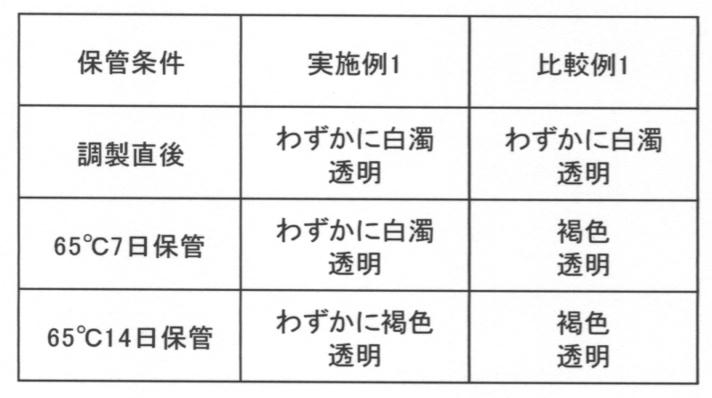
- Example 1 The external preparations in containers of Example 1 and Comparative Example 1 were stored at 65 ° C. for 7 days for 14 days, then the external preparation in the container was transferred to a transparent glass screw tube, and the degree of coloring was visually observed. In addition, immediately after the preparation of the external preparation in the same container and when it was stored at room temperature for 7 days and 14 days, the degree of coloring was observed for comparison with the preparation after storage at 65 ° C. (result) The results are shown in Table 2. In Comparative Example 1, the external preparation was colored brown after being stored at 65 ° C. for 7 days. In contrast, in Example 1, the external preparation was not colored after being stored at 65 ° C. for 7 days. In Example 1, the external preparation was slightly brownish after storage at 65 ° C.
- the total amount of purified water / isopropanol was 100 parts by mass (total gel mass after preparation: 100 g).
- the prepared gel was filled with 15 g in an aluminum tube whose innermost layer resin was epoxyphenol (a tube in which an epoxyphenol layer (innermost layer) was formed on the contents side of an aluminum foil layer). It was.
- Example 3 The gel prepared by the production method of Example 2 was prepared by using an aluminum tube whose innermost layer resin was epoxyphenol melamine (a tube in which an epoxyphenol melamine layer (innermost layer) was formed on the contents side of an aluminum foil layer) 15 g was filled in, and it was set as Example 3.
- epoxyphenol melamine a tube in which an epoxyphenol melamine layer (innermost layer) was formed on the contents side of an aluminum foil layer
- Example 4 The gel agent prepared by the manufacturing method of Example 2 is placed in an aluminum tube whose innermost layer resin is polyamideimide (a tube in which a layer made of polyamideimide (innermost layer) is formed on the content side of the layer made of aluminum foil). 15g was filled and it was set as Example 4.
- polyamideimide a tube in which a layer made of polyamideimide (innermost layer) is formed on the content side of the layer made of aluminum foil. 15g was filled and it was set as Example 4.
- Comparative Example 2 The gel prepared by the manufacturing method of Example 2 is placed in an aluminum tube whose innermost layer resin is phenol butyral (a tube in which a phenol butyral layer (innermost layer) is formed on the contents side of the aluminum foil layer). Filled with 15 g to be Comparative Example 2.
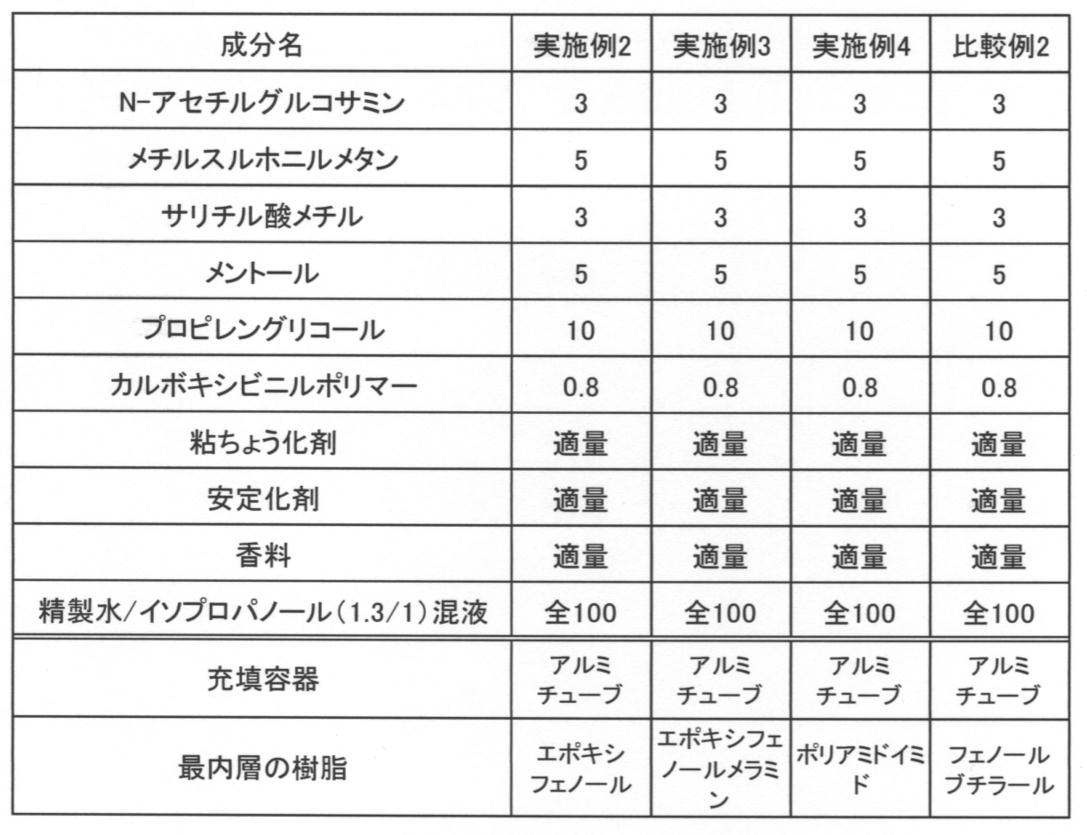
- Table 3 shows the constitution of the external preparation (contained in tube) obtained in Example 2, Example 3, Example 4, and Comparative Example 2.
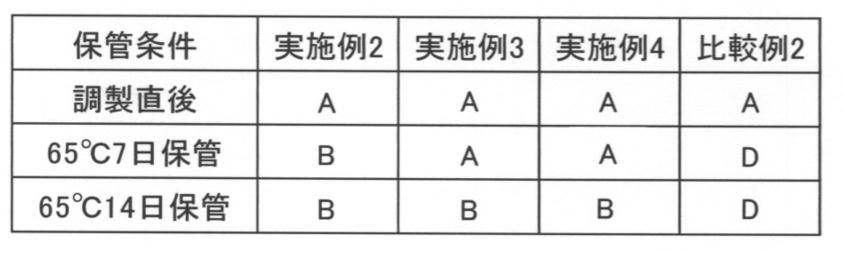
- Example 2 The external preparations in containers of Example 2, Example 3, Example 4, and Comparative Example 2 were evaluated at 65 ° C. for 7 days and 14 days, and the degree of coloring of the external preparation in the container was evaluated according to the following criteria. In addition, immediately after the preparation of the external preparation in the same container and when it was stored at room temperature for 7 days and 14 days, the degree of coloring was observed for comparison with the preparation after storage at 65 ° C. A: Not colored B: Slightly brownish C: Browned D: Extremely browned (result) The results are shown in Table 4. In Comparative Example 2, the external preparation was colored brown after being stored at 65 ° C. for 7 days. In comparison, in Example 2, Example 3, and Example 4, coloring of the external preparation was suppressed even after storage at 65 ° C.
- Example 5 0.1 parts by mass of carboxyvinyl polymer in purified water (0.1% by mass with respect to the total mass of the gel after preparation), 1 part by mass of glucosamine sulfate (1% by mass with respect to the total mass of the gel after preparation), isopropanol 20 parts by mass (20% by mass with respect to the total mass of the gel after preparation) and an appropriate amount of sodium hydroxide were added in this order and stirred to dissolve uniformly.
- Purified water was added to prepare a gel agent so that the total amount was 100 parts by mass (total gel mass after preparation: 100 g).
- the prepared gel is filled with 15 g in an aluminum tube whose innermost layer resin is epoxyphenol (a tube in which a layer (the innermost layer) made of epoxyphenol is formed on the content side of the layer made of aluminum foil). It was.
- Example 6 0.1 parts by mass of carboxyvinyl polymer in purified water (0.1% by mass with respect to the total mass of the gel after preparation), 3 parts by mass of glucosamine hydrochloride (3% by mass with respect to the total mass of the gel after preparation), isopropanol 30 parts by mass (30% by mass with respect to the total mass of the gel after preparation) and an appropriate amount of sodium hydroxide were added in this order and stirred to dissolve uniformly.
- Purified water was added to prepare a gel agent so that the total amount was 100 parts by mass (total gel mass after preparation: 100 g).
- the prepared gel was filled with 10 g in an aluminum tube whose innermost layer resin was epoxyphenol (a tube in which an epoxyphenol layer (innermost layer) was formed on the contents side of an aluminum foil layer). It was.
- Example 3 The gel prepared by the manufacturing method of Example 5 is placed in an aluminum tube whose innermost layer resin is phenol butyral (a tube in which a phenol butyral layer (innermost layer) is formed on the content side of an aluminum foil layer). Filled with 15 g to be Comparative Example 3.
- Example 4 The gel prepared by the manufacturing method of Example 6 is placed in an aluminum tube whose innermost resin is phenol butyral (a tube in which a layer made of phenol butyral (the innermost layer) is formed on the content side of the layer made of aluminum foil). Filled with 15 g to be Comparative Example 4.
- Table 5 shows the constitution of the external preparation (contained in tube) obtained in Example 5, Example 6, Comparative Example 3, and Comparative Example 4.
- Example 5 The external preparations in containers of Example 5, Example 6, Comparative Example 3, and Comparative Example 4 were stored at 65 ° C. for 7 days, and the coloring degree of the preparation was evaluated according to the criteria of Test Example 2. Also, immediately after the preparation of the external preparation in the same container and when stored for 7 days at room temperature, the degree of coloring was observed for comparison with the preparation after storage at 65 ° C. (result) The results are shown in Table 6. In Comparative Examples 3 and 4, the external preparation was colored brown after being stored at 65 ° C. for 7 days. In contrast, in Examples 5 and 6, coloring of the external preparation was suppressed after storage at 65 ° C. for 7 days.
- the coloration of the external preparation was the same as the preparation immediately after preparation in both Examples and Comparative Examples, and the evaluation was A, but when stored at 65 ° C. for 7 days, The coloring degree of the preparation for external use was particularly large compared with the case of storage.
Landscapes
- Health & Medical Sciences (AREA)
- Life Sciences & Earth Sciences (AREA)
- Epidemiology (AREA)
- Chemical & Material Sciences (AREA)
- Medicinal Chemistry (AREA)
- Pharmacology & Pharmacy (AREA)
- Animal Behavior & Ethology (AREA)
- General Health & Medical Sciences (AREA)
- Public Health (AREA)
- Veterinary Medicine (AREA)
- Molecular Biology (AREA)
- Cosmetics (AREA)
- Medical Preparation Storing Or Oral Administration Devices (AREA)
- Medicinal Preparation (AREA)
- Pharmaceuticals Containing Other Organic And Inorganic Compounds (AREA)
Abstract
最内層が、エポキシ樹脂、フェノール樹脂及びメラミン樹脂のうち少なくとも2つ以上を組み合わせてなる樹脂、又は、ポリアミド、ポリイミド及びポリアミドイミドのうち1つのナイロン系樹脂を含む層である容器に充填された、グルコサミン、グルコサミンの塩及びこれらの誘導体から選ばれる少なくとも1種を含有する外用製剤。
Description
本発明は容器入り外用製剤に関する。更に詳しくは、容器に充填された、グルコサミンもしくはその塩又はこれらの誘導体を含有する外用製剤の着色が抑制された安定な外用製剤に関するものである。
グルコサミンもしくはその塩又はこれらの誘導体はムコ多糖類の構成糖の1種で、動物の皮膚や軟骨、蟹やエビなどの甲骨類の殻のキチン等に含まれており、主に蟹やエビなどの甲殻類の殻から調製される。グルコサミンもしくはその塩又はこれらの誘導体には、キチンを塩酸又は硫酸で加水分解して得られるグルコサミン塩酸塩やグルコサミン硫酸塩、キチンを酸で部分加水分解し、これにキチナーゼのような酵素を作用させて分解し、ヒドロキシル基をアセチルアミノ基に置換して得られるN-アセチルグルコサミンなどがある。これらの中でも特にN-アセチルグルコサミンは、加齢によって引き起こされるひざの痛みや肌の老化を防止する効果が期待されており、内服のサプリメントの他、外用製剤では化粧水などの液剤やゲル剤等の水性製剤が市販されている。これらの製剤はチューブ等の各種容器に充填して使用することが可能であり、例えば、特許文献1には、紙パックやプラスチック容器に充填された製剤にグルコサミンを配合してもよいことが記載されている。
また、従来、メイラード反応を抑制するための検討がなされており、液状経腸栄養組成物及びその着色抑制方法(特許文献2)、カルボニル化合物除去材(特許文献3)、飲食品のメイラード反応抑制方法(特許文献4)、といった技術が開示されている。
本発明者らは、グルコサミンもしくはその塩又はこれらの誘導体(以下、場合により「グルコサミン類」と総称する)を配合した外用製剤をフェノールブチラールが内面素材として使用された容器(チューブ等)に充填すると、経時的に製剤の変色が引き起こされることがあり、保存安定性が低下することを見出した。なお、特許文献1には、容器内でグルコサミン類が安定して存在するか否かについて何ら開示されていない。本発明は、容器に充填されたグルコサミン類含有外用製剤の経時的な着色を抑制し、安定な外用製剤(容器入り外用製剤)を提供することを目的とする。
本発明者らが上記課題を解決するために鋭意検討を行った結果、グルコサミン類を含有する外用製剤を、最内層が、エポキシ樹脂、フェノール樹脂及びメラミン樹脂のうち少なくとも2つ以上を組み合わせてなる樹脂(以下、場合により複合樹脂と総称する)、又は、ポリアミド、ポリイミド及びポリアミドイミドのうち1つのナイロン系樹脂を含む層である容器に充填することにより、経時的な着色を抑制できることを見出した。さらには、かかる組み合わせにより、グルコサミン類と容器の最内層に含まれる樹脂との反応が抑制され、安定性に優れたグルコサミン類外用製剤(容器入り外用製剤)が得られることを見出した。すなわち、本発明は、以下のとおりである。
(1)外用製剤が容器に充填されている容器入り外用製剤であって、
前記容器の最内層が、エポキシ樹脂、フェノール樹脂及びメラミン樹脂のうち少なくとも2つ以上を組み合わせてなる樹脂、又は、ポリアミド、ポリイミド及びポリアミドイミドのうち1つのナイロン系樹脂を含む層であり、
前記外用製剤が、グルコサミン、グルコサミンの塩及びこれらの誘導体から選ばれる少なくとも1種を含有する、
容器入り外用製剤。
(2)前記容器の最内層が、エポキシフェノール、エポキシフェノールメラミン又はポリアミドイミドから選ばれる1つの樹脂を含む層である、(1)に記載の容器入り外用製剤。
(3)前記外用製剤の剤形がゲル剤又は液剤である、(1)又は(2)に記載の容器入り外用製剤。
(4)前記外用製剤が、N-アセチルグルコサミン、グルコサミン硫酸塩及びグルコサミン塩酸塩から選ばれる少なくとも1種を含有している、(1)~(3)のいずれかに記載の容器入り外用製剤。
(1)外用製剤が容器に充填されている容器入り外用製剤であって、
前記容器の最内層が、エポキシ樹脂、フェノール樹脂及びメラミン樹脂のうち少なくとも2つ以上を組み合わせてなる樹脂、又は、ポリアミド、ポリイミド及びポリアミドイミドのうち1つのナイロン系樹脂を含む層であり、
前記外用製剤が、グルコサミン、グルコサミンの塩及びこれらの誘導体から選ばれる少なくとも1種を含有する、
容器入り外用製剤。
(2)前記容器の最内層が、エポキシフェノール、エポキシフェノールメラミン又はポリアミドイミドから選ばれる1つの樹脂を含む層である、(1)に記載の容器入り外用製剤。
(3)前記外用製剤の剤形がゲル剤又は液剤である、(1)又は(2)に記載の容器入り外用製剤。
(4)前記外用製剤が、N-アセチルグルコサミン、グルコサミン硫酸塩及びグルコサミン塩酸塩から選ばれる少なくとも1種を含有している、(1)~(3)のいずれかに記載の容器入り外用製剤。
なお、グルコサミン類含有外用製剤の経時的な変色の主な原因の一つは、グルコサミンもしくはその塩又はこれらの誘導体の有するアミノ基及び還元糖が分子同士でメイラード反応を引き起こすことにあると推察される。メイラ-ド反応とは、1912年にL.C.Maillardにより発見された、アミノ酸と還元糖との非酵素的な縮合反応により褐色の色素が生成する糖化反応である。メイラ-ド反応を大略すると、可逆的な付加及び転移反応を伴う前期段階と、不可逆的な酸化、脱離、加水分解、転移、縮合等を伴う後期段階とに分けられる。前期段階では、アミノ酸が有するアミノ基とグルコ-スなどの還元糖が有するカルボニル基とが非酵素的に反応してシッフ塩基を形成した後、中間体のエナミノ-ルを経由し、アマドリ転移反応などによってアマドリ化合物を生成する。後期段階では、アマドリ化合物、アマドリ化合物より生成したα-ジカルボニル化合物及びシッフ塩基などの化合物が、更に分解反応、脂質過酸化反応、転移反応や縮合反応を経由して、終末糖化産物(AGEs:Advanced Glycation End Products)を生成する。これらの一連の反応により、医薬品、医薬部外品、化粧品、食品の色、香り、物性などが劣化するおそれがあると考えられている。なお、特許文献2~4には、グルコサミン類を含有する製剤の着色を抑制して製剤の保存安定性を維持することについては何ら開示されていない。
本発明により、製剤の経時的な着色が抑制された安定な、容器に充填されているグルコサミン類含有外用製剤の提供が可能となる。
本発明は、容器に充填されている外用製剤、すなわち容器入り外用製剤であって、容器と前記容器に充填されている外用製剤とからなる。前記容器内は前記外用製剤に隙間無く充たされていることが好ましいが、前記容器内に空所があってもよい。
本発明に係る外用製剤(容器の内容物)は、グルコサミン、グルコサミンの塩及びこれらの誘導体(グルコサミン類)から選ばれる少なくとも1種を含有する。本発明に使用するグルコサミンもしくはその塩又はこれらの誘導体は、合成物、発酵産物、及び、蟹、エビ等に由来するキチン分解産物のいずれも使用可能であり、その由来は特に限定されるものではない。グルコサミンは、化学式C6H13NO5で示される化合物であり、前記グルコサミンの塩としては硫酸塩、塩酸塩などの塩類が挙げられ、前記誘導体としてはN-アセチルグルコサミンが挙げられる。このようなグルコサミン類としては、1種を単独で用いても2種以上を組み合わせて用いてもよい。中でも好ましくは、N-アセチルグルコサミン、グルコサミン硫酸塩及びグルコサミン塩酸塩から選ばれる少なくとも1種であり、特に好ましくはN-アセチルグルコサミンである。前記外用製剤全体に対するグルコサミンもしくはその塩又はこれらの誘導体の含有量(これらのうちの2種以上が含有される場合はそれらの合計含有量)は、好ましくは0.1~20質量%であり、より好ましくは0.1~10質量%であり、特に好ましくは1~10質量%である。
なお、本発明に係る外用製剤は上記の他に、タール系色素、酸化鉄等の着色顔料;パラベン、フェノキシエタノール等の防腐剤;ジメチルポリシロキサン、メチルフェニルポリシロキサン、環状シリコーン等のシリコーン油;オリーブスクワラン、米スクワラン、米胚芽油、ホホバ油、ヒマシ油、紅花油、オリーブ油、マカデミアナッツ油、ヒマワリ油等の植物油;ミリスチン酸オクチルドデシル、パルミチン酸セチル、イソステアリン酸イソステアリル、ミリスチン酸イソプロピル等のエステル油;エタノール、イソプロパノール等の低級アルコール類;ステアリン酸、ミリスチン酸、イソステアリン酸、オレイン酸、イソ型長鎖脂肪酸、アンテイソ型長鎖脂肪酸等の高級脂肪酸;リモネン、水素添加ビサボロール等のテルペン類;トリカプリル・カプリン酸グリセリル、2-エチルヘキサン酸グリセリル、トリイソ型長鎖脂肪酸グリセリル、トリパルミチン酸グリセリル等のトリグリセリド;セチル硫酸ナトリウム、N-ステアロイル-L-グルタミン酸塩等の陰イオン界面活性剤;ポリオキシエチレンアルキルエーテル、ポリオキシエチレン脂肪酸エステル、ポリオキシエチレン多価アルコール脂肪酸エステル、ポリオキシエチレン硬化ヒマシ油、多価アルコール脂肪酸エステル、ポリグリセリン脂肪酸エステル、変性シリコーン、蔗糖エステル等の非イオン界面活性剤;テトラアルキルアンモニウム塩等の陽イオン界面活性剤;ベタイン型、スルホベタイン型、スルホアミノ酸型等の両性界面活性剤;レシチン、リゾフォスファチジルコリン、セラミド、セレブロシド等の天然系界面活性剤;酸化チタン、酸化亜鉛等の顔料;ジブチルヒドロキシトルエン等の抗酸化剤;塩化ナトリウム、塩化マグネシウム、硫酸ナトリウム、硝酸カリウム、硫酸ナトリウム、メタ珪酸ナトリウム、塩化カルシウム等の無機塩類;クエン酸ナトリウム、酢酸カリウム、琥珀酸ナトリウム、アスパラギン酸ナトリウム、乳酸ナトリウム、ジクロロ酢酸、メバロン酸、グリチルリチン酸等の有機酸及びその塩;塩酸エタノールアミン、硝酸アンモニウム、塩酸アルギニン、ジイソプロピルアミン塩、尿素、デカルボキシカルノシン等の有機アミン類及びその塩;エデト酸等のキレート剤;キサンタンガム、カルボキシビニルポリマー、カラギーナン、ペクチン、アルキル変性カルボキシビニルポリマー、寒天、ヒプロメロース等の増粘剤(ゲル化剤);水酸化カリウム、ジイソプロパノールアミン、トリエタノールアミン等の中和剤;ヒドロキシメトキシベンゾフェノンスルフォン酸塩等の紫外線吸収剤;ジプロピレングリコール、1,3ブチレングリコール、グリセリン、ソルビトール、プロピレングリコール、ジグリセリン、ラフィノース等の多価アルコール;各種アミノ酸、アスコルビン酸、ビオチン、トコフェロール等のビタミン類;及びアスコルビン酸硫酸エステル塩、アスコルビン酸燐酸エステル塩、ニコチン酸トコフェロール等のビタミン誘導体等を、本発明の目的を達成する範囲内で適宜配合することができる。
本発明に係る外用製剤の剤形としては、特に限定されず、例えば、ゲル剤、液剤、クリーム剤、ローション剤などが挙げられ、中でも特に好ましい剤形はゲル剤又は液剤である。これらの製剤は、常法により調製可能である。例えば液剤は、前記グルコサミン類を、水、エタノール、多価アルコール又はこれらの混液に溶解または分散させて調製することができる。また、このような液剤に適当な前記ゲル化剤を配合してゲル剤を調製することができる。
本発明に係る容器としては、その最内層、すなわち、前記外用製剤(内容物)と接する層が、エポキシ樹脂、フェノール樹脂及びメラミン樹脂のうち少なくとも2つ以上を組み合わせてなる樹脂、又は、ポリアミド、ポリイミド及びポリアミドイミドのうち1つのナイロン系樹脂を含む層、のいずれかであれば特に制限はなく、目的に応じて形状や素材を適宜選択することができる。前記素材としては、前記最内層のみで形成された樹脂素材であってもよく、その他の層(例えば、ガスバリア層、接着層、表面保護層、中間層、遮光層等)が前記最内層の外側(最内層の内容物(外用製剤)に接する面と反対の面上)に積層されていてもよい。その他の層を形成する樹脂としては、特に制限はなく、目的に応じて適宜選択した公知の樹脂が挙げられ、例えば、塩化ビニル系樹脂、α-オレフィン系ポリマー(例えば、ポリエチレン、ポリプロピレン等)、ポリエステル系樹脂(例えば、PET、PBT、ポリアリレート等)、スチレン系樹脂(例えば、PS、AS樹脂、ABS樹脂等)等の熱可塑性樹脂などが挙げられる。また、前記容器としては、ある程度密封できるように蓋等を備えていることが好ましい。
エポキシ樹脂、フェノール樹脂及びメラミン樹脂のうち少なくとも2つ以上を組み合わせてなる樹脂(複合樹脂)としては、例えば、エポキシフェノール、エポキシフェノールメラミンなどが挙げられる。エポキシフェノール及びエポキシフェノールメラミンにおいては、エポキシ樹脂、フェノール樹脂、メラミン樹脂の比率を変えることで塗膜硬度を広い範囲で変えることができ、前記比率の制限はない。前記エポキシ樹脂としては、ビスフェノールA型、ノボラック型、環状脂肪族型が挙げられ、目的に応じて適宜使い分けてよい。
前記ナイロン系樹脂は、ポリアミド、ポリイミド又はポリアミドイミドのいずれかである。前記ポリアミドとしては、例えば、ナイロン6、ナイロン66、ナイロン610、ナイロン11、ナイロン12、透明ナイロンが挙げられる。前記ナイロン系樹脂としては、特にポリアミドイミドであることが好ましい。
前記最内層に含まれる樹脂は化学合成品でもよく、市販品であってもよい。本発明に係る最内層に含まれる樹脂としては、好ましくはエポキシフェノール、エポキシフェノールメラミン又はポリアミドイミドである。
また、前記最内層としては、前記複合樹脂及び前記ナイロン系樹脂の他に、目的に応じて適宜選択した添加剤などが更に含有されていてもよい。前記添加剤としては、特に制限はなく、目的に応じて適宜選択した公知の添加剤が挙げられるが、例えば、溶解補助剤、酸化防止剤、保湿剤、老化防止剤、劣化防止剤、紫外線吸収剤、金属錯体、光安定剤、抗菌・防腐剤、香料などが挙げられる。前記最内層としては、前記複合樹脂又は前記ナイロン系樹脂からなる層(すなわち、前記最内層における前記複合樹脂又は前記ナイロン系樹脂の含有量が100質量%)であることが好ましい。
以下に、実施例、比較例及び試験例を示し、本発明を詳細に説明するが、本発明は、下記の例に限定されるものではない。
(実施例1)
精製水/イソプロパノール(質量比:2/1)混液にN-アセチルグルコサミン5質量部(調製後ゲル剤全質量に対して5質量%)、カルボキシビニルポリマー0.8質量部(調製後ゲル剤全質量に対して0.8質量%)、pH調節剤適量を添加して攪拌し、均一に溶解させた。精製水/イソプロパノール(質量比:2/1)混液で全量を100質量部(調製後ゲル剤全質量:100g)とし、ゲル剤を調製した。調製したゲル剤は最内層の樹脂がエポキシフェノールのアルミチューブ(アルミ箔からなる層の内容物側にエポキシフェノールからなる層(最内層)が形成されたチューブ)内に15g充填し、実施例1とした。
精製水/イソプロパノール(質量比:2/1)混液にN-アセチルグルコサミン5質量部(調製後ゲル剤全質量に対して5質量%)、カルボキシビニルポリマー0.8質量部(調製後ゲル剤全質量に対して0.8質量%)、pH調節剤適量を添加して攪拌し、均一に溶解させた。精製水/イソプロパノール(質量比:2/1)混液で全量を100質量部(調製後ゲル剤全質量:100g)とし、ゲル剤を調製した。調製したゲル剤は最内層の樹脂がエポキシフェノールのアルミチューブ(アルミ箔からなる層の内容物側にエポキシフェノールからなる層(最内層)が形成されたチューブ)内に15g充填し、実施例1とした。
(比較例1)
実施例1の製法で調製したゲル剤を、最内層の樹脂がフェノールブチラールのアルミチューブ(アルミ箔からなる層の内容物側にフェノールブチラールからなる層(最内層)が形成されたチューブ)内に15g充填し、比較例1とした。
実施例1の製法で調製したゲル剤を、最内層の樹脂がフェノールブチラールのアルミチューブ(アルミ箔からなる層の内容物側にフェノールブチラールからなる層(最内層)が形成されたチューブ)内に15g充填し、比較例1とした。
(試験例1)
実施例1及び比較例1で得られた容器入り外用製剤(チューブ入りゲル剤)の構成を表1に示す。なお、表1中の数値の単位は「質量部」であり、「全100」とは、他の成分と合わせた外用製剤の全量が100質量部となるように当該成分が含有されていることを示す(以下同じ)。
実施例1及び比較例1で得られた容器入り外用製剤(チューブ入りゲル剤)の構成を表1に示す。なお、表1中の数値の単位は「質量部」であり、「全100」とは、他の成分と合わせた外用製剤の全量が100質量部となるように当該成分が含有されていることを示す(以下同じ)。

実施例1、比較例1の容器入り外用製剤は、65℃で7日、14日間保管後、容器内の外用製剤を透明なガラススクリュー管に移し、その着色度合いを目視で観察した。また、同容器入り外用製剤の調製直後及びそれらを室温で7日、14日間保管した場合についても、65℃で保管後の製剤との比較のため、着色度合いを観察した。
(結果)
結果は表2に示した。比較例1では、65℃で7日間保管後、外用製剤が褐色に着色した。それと比較して、実施例1では、65℃で7日間保管後、外用製剤に着色はなかった。また、実施例1では、65℃で14日間保管後、外用製剤がわずかに褐色を帯びたものの、同条件で保管後の比較例1よりも外用製剤の着色が抑制された。また、室温で7日、14日間保管した場合、外用製剤の着色は実施例1、比較例1ともに調製直後の製剤と変わらず着色はなかったが、65℃で7日、14日間保管した場合は、比較例1において室温保存の場合と比べて外用製剤の着色度合いが特に大きかった。
(結果)
結果は表2に示した。比較例1では、65℃で7日間保管後、外用製剤が褐色に着色した。それと比較して、実施例1では、65℃で7日間保管後、外用製剤に着色はなかった。また、実施例1では、65℃で14日間保管後、外用製剤がわずかに褐色を帯びたものの、同条件で保管後の比較例1よりも外用製剤の着色が抑制された。また、室温で7日、14日間保管した場合、外用製剤の着色は実施例1、比較例1ともに調製直後の製剤と変わらず着色はなかったが、65℃で7日、14日間保管した場合は、比較例1において室温保存の場合と比べて外用製剤の着色度合いが特に大きかった。
(調製例)ゲル剤
(実施例2)
精製水/イソプロパノール(質量比:1.3/1)混液にN-アセチルグルコサミン3質量部(調製後ゲル剤全質量に対して3質量%)、メチルスルホニルメタン5質量部(調製後ゲル剤全質量に対して5質量%)、サリチル酸メチル3質量部(調製後ゲル剤全質量に対して3質量%)、メントール5質量部(調製後ゲル剤全質量に対して5質量%)、プロピレングリコール10質量部(調製後ゲル剤全質量に対して10質量%)、カルボキシビニルポリマー0.8質量部(調製後ゲル剤全質量に対して0.8質量%)、粘ちょう化剤適量、安定化剤適量、香料適量を添加して、攪拌し均一に溶解させた。精製水/イソプロパノール(質量比:1.3/1)混液で全量を100質量部(調製後ゲル剤全質量:100g)とした。調製したゲル剤は最内層の樹脂がエポキシフェノールのアルミチューブ(アルミ箔からなる層の内容物側にエポキシフェノールからなる層(最内層)が形成されたチューブ)内に15g充填し、実施例2とした。
(実施例2)
精製水/イソプロパノール(質量比:1.3/1)混液にN-アセチルグルコサミン3質量部(調製後ゲル剤全質量に対して3質量%)、メチルスルホニルメタン5質量部(調製後ゲル剤全質量に対して5質量%)、サリチル酸メチル3質量部(調製後ゲル剤全質量に対して3質量%)、メントール5質量部(調製後ゲル剤全質量に対して5質量%)、プロピレングリコール10質量部(調製後ゲル剤全質量に対して10質量%)、カルボキシビニルポリマー0.8質量部(調製後ゲル剤全質量に対して0.8質量%)、粘ちょう化剤適量、安定化剤適量、香料適量を添加して、攪拌し均一に溶解させた。精製水/イソプロパノール(質量比:1.3/1)混液で全量を100質量部(調製後ゲル剤全質量:100g)とした。調製したゲル剤は最内層の樹脂がエポキシフェノールのアルミチューブ(アルミ箔からなる層の内容物側にエポキシフェノールからなる層(最内層)が形成されたチューブ)内に15g充填し、実施例2とした。
(実施例3)
実施例2の製法で調製したゲル剤を、最内層の樹脂がエポキシフェノールメラミンのアルミチューブ(アルミ箔からなる層の内容物側にエポキシフェノールメラミンからなる層(最内層)が形成されたチューブ)内に15g充填し、実施例3とした。
実施例2の製法で調製したゲル剤を、最内層の樹脂がエポキシフェノールメラミンのアルミチューブ(アルミ箔からなる層の内容物側にエポキシフェノールメラミンからなる層(最内層)が形成されたチューブ)内に15g充填し、実施例3とした。
(実施例4)
実施例2の製法で調製したゲル剤を、最内層の樹脂がポリアミドイミドのアルミチューブ(アルミ箔からなる層の内容物側にポリアミドイミドからなる層(最内層)が形成されたチューブ)内に15g充填し、実施例4とした。
実施例2の製法で調製したゲル剤を、最内層の樹脂がポリアミドイミドのアルミチューブ(アルミ箔からなる層の内容物側にポリアミドイミドからなる層(最内層)が形成されたチューブ)内に15g充填し、実施例4とした。
(比較例2)
実施例2の製法で調製したゲル剤を、最内層の樹脂がフェノールブチラールのアルミチューブ(アルミ箔からなる層の内容物側にフェノールブチラールからなる層(最内層)が形成されたチューブ)内に15g充填し、比較例2とした。
実施例2の製法で調製したゲル剤を、最内層の樹脂がフェノールブチラールのアルミチューブ(アルミ箔からなる層の内容物側にフェノールブチラールからなる層(最内層)が形成されたチューブ)内に15g充填し、比較例2とした。
(試験例2)
実施例2、実施例3、実施例4、及び比較例2で得られた容器入り外用製剤(チューブ入りゲル剤)の構成を表3に示す。
実施例2、実施例3、実施例4、及び比較例2で得られた容器入り外用製剤(チューブ入りゲル剤)の構成を表3に示す。
実施例2、実施例3、実施例4、比較例2の容器入り外用製剤は、65℃で7日、14日間保管後、容器内の外用製剤の着色度合いを以下の基準により評価した。また、同容器入り外用製剤の調製直後及びそれらを室温で7日、14日間保管した場合についても、65℃で保管後の製剤との比較のため、着色度合いを観察した。
A:着色はない
B:わずかな褐色を帯びている
C:褐色に着色している
D:著しく褐色に着色している
(結果)
結果は表4に示した。比較例2では、65℃で7日間保管後、外用製剤が褐色に着色した。それと比較して、実施例2、実施例3、実施例4では、65℃で14日間保管後も外用製剤の着色は抑制された。また、室温で7日、14日間保管した場合、外用製剤の着色は実施例、比較例ともに調製直後の製剤と変わらず評価はAであったが、65℃で7日、14日間保管した場合は、比較例2において室温保存の場合と比べて外用製剤の着色度合いが特に大きかった。
A:着色はない
B:わずかな褐色を帯びている
C:褐色に着色している
D:著しく褐色に着色している
(結果)
結果は表4に示した。比較例2では、65℃で7日間保管後、外用製剤が褐色に着色した。それと比較して、実施例2、実施例3、実施例4では、65℃で14日間保管後も外用製剤の着色は抑制された。また、室温で7日、14日間保管した場合、外用製剤の着色は実施例、比較例ともに調製直後の製剤と変わらず評価はAであったが、65℃で7日、14日間保管した場合は、比較例2において室温保存の場合と比べて外用製剤の着色度合いが特に大きかった。
(実施例5)
精製水にカルボキシビニルポリマー0.1質量部(調製後ゲル剤全質量に対して0.1質量%)、グルコサミン硫酸塩1質量部(調製後ゲル剤全質量に対して1質量%)、イソプロパノール20質量部(調製後ゲル剤全質量に対して20質量%)、水酸化ナトリウム適量の順に添加して攪拌し、均一に溶解させた。全量を100質量部(調製後ゲル剤全質量:100g)となるように精製水を添加してゲル剤を調製した。調製したゲル剤は最内層の樹脂がエポキシフェノールのアルミチューブ(アルミ箔からなる層の内容物側にエポキシフェノールからなる層(最内層)が形成されたチューブ)内に15g充填し、実施例5とした。
精製水にカルボキシビニルポリマー0.1質量部(調製後ゲル剤全質量に対して0.1質量%)、グルコサミン硫酸塩1質量部(調製後ゲル剤全質量に対して1質量%)、イソプロパノール20質量部(調製後ゲル剤全質量に対して20質量%)、水酸化ナトリウム適量の順に添加して攪拌し、均一に溶解させた。全量を100質量部(調製後ゲル剤全質量:100g)となるように精製水を添加してゲル剤を調製した。調製したゲル剤は最内層の樹脂がエポキシフェノールのアルミチューブ(アルミ箔からなる層の内容物側にエポキシフェノールからなる層(最内層)が形成されたチューブ)内に15g充填し、実施例5とした。
(実施例6)
精製水にカルボキシビニルポリマー0.1質量部(調製後ゲル剤全質量に対して0.1質量%)、グルコサミン塩酸塩3質量部(調製後ゲル剤全質量に対して3質量%)、イソプロパノール30質量部(調製後ゲル剤全質量に対して30質量%)、水酸化ナトリウム適量の順に添加して攪拌し、均一に溶解させた。全量を100質量部(調製後ゲル剤全質量:100g)となるように精製水を添加してゲル剤を調製した。調製したゲル剤は最内層の樹脂がエポキシフェノールのアルミチューブ(アルミ箔からなる層の内容物側にエポキシフェノールからなる層(最内層)が形成されたチューブ)内に10g充填し、実施例6とした。
精製水にカルボキシビニルポリマー0.1質量部(調製後ゲル剤全質量に対して0.1質量%)、グルコサミン塩酸塩3質量部(調製後ゲル剤全質量に対して3質量%)、イソプロパノール30質量部(調製後ゲル剤全質量に対して30質量%)、水酸化ナトリウム適量の順に添加して攪拌し、均一に溶解させた。全量を100質量部(調製後ゲル剤全質量:100g)となるように精製水を添加してゲル剤を調製した。調製したゲル剤は最内層の樹脂がエポキシフェノールのアルミチューブ(アルミ箔からなる層の内容物側にエポキシフェノールからなる層(最内層)が形成されたチューブ)内に10g充填し、実施例6とした。
(比較例3)
実施例5の製法で調製したゲル剤を、最内層の樹脂がフェノールブチラールのアルミチューブ(アルミ箔からなる層の内容物側にフェノールブチラールからなる層(最内層)が形成されたチューブ)内に15g充填し、比較例3とした。
実施例5の製法で調製したゲル剤を、最内層の樹脂がフェノールブチラールのアルミチューブ(アルミ箔からなる層の内容物側にフェノールブチラールからなる層(最内層)が形成されたチューブ)内に15g充填し、比較例3とした。
(比較例4)
実施例6の製法で調製したゲル剤を、最内層の樹脂がフェノールブチラールのアルミチューブ(アルミ箔からなる層の内容物側にフェノールブチラールからなる層(最内層)が形成されたチューブ)内に15g充填し、比較例4とした。
実施例6の製法で調製したゲル剤を、最内層の樹脂がフェノールブチラールのアルミチューブ(アルミ箔からなる層の内容物側にフェノールブチラールからなる層(最内層)が形成されたチューブ)内に15g充填し、比較例4とした。
(試験例3)
実施例5、実施例6、比較例3、及び比較例4で得られた容器入り外用製剤(チューブ入りゲル剤)の構成を表5に示す。
実施例5、実施例6、比較例3、及び比較例4で得られた容器入り外用製剤(チューブ入りゲル剤)の構成を表5に示す。
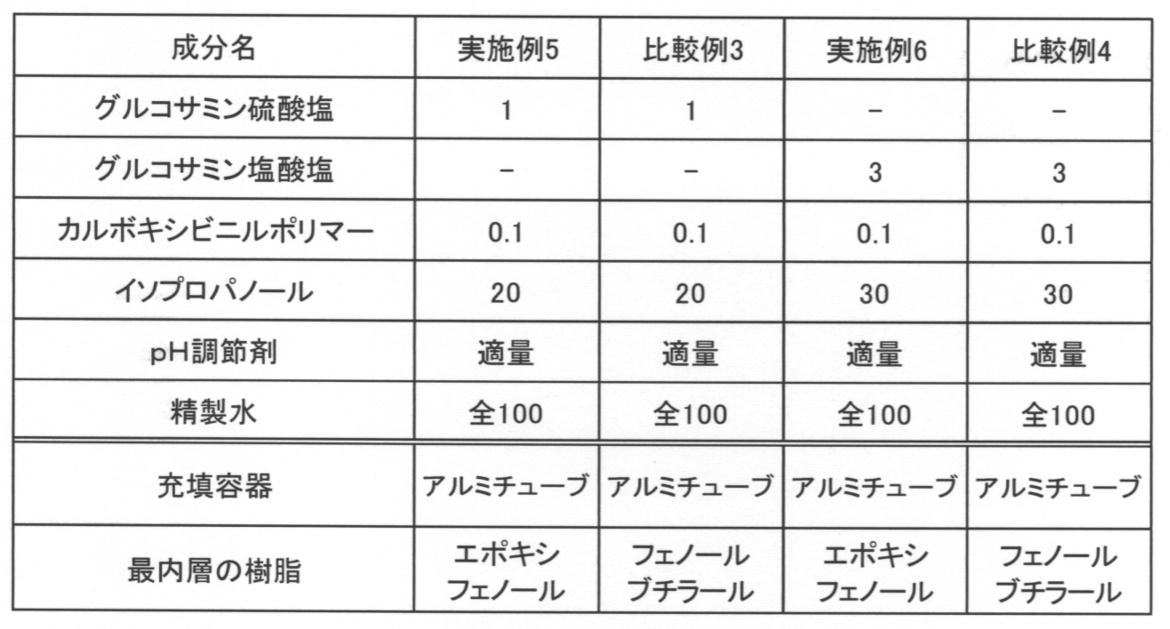
実施例5、実施例6、比較例3、比較例4の容器入り外用製剤は、65℃で7日間保管後、製剤の着色度合いを試験例2の基準により評価した。また、同容器入り外用製剤の調製直後及びそれらを室温で7日間保管した場合についても、65℃で保管後の製剤との比較のため、着色度合いを観察した。
(結果)
結果は表6に示した。比較例3、比較例4では、65℃で7日間保管後、外用製剤が褐色に着色した。それと比較して、実施例5、実施例6では、65℃で7日間保管後、外用製剤の着色は抑制された。また、室温で7日間保管した場合、外用製剤の着色は実施例、比較例ともに調製直後の製剤と変わらず評価はAであったが、65℃で7日間保管した場合は、比較例において室温保存の場合と比べて外用製剤の着色度合いが特に大きかった。
(結果)
結果は表6に示した。比較例3、比較例4では、65℃で7日間保管後、外用製剤が褐色に着色した。それと比較して、実施例5、実施例6では、65℃で7日間保管後、外用製剤の着色は抑制された。また、室温で7日間保管した場合、外用製剤の着色は実施例、比較例ともに調製直後の製剤と変わらず評価はAであったが、65℃で7日間保管した場合は、比較例において室温保存の場合と比べて外用製剤の着色度合いが特に大きかった。

本発明により、容器に充填されたグルコサミン類を配合する外用製剤にとして、着色が抑制された安定な外用製剤を提供することが可能となった。これにより、より商品価値の高い容器に充填されたグルコサミン類配合外用製剤の市販を通じて、医薬品産業等の発展が期待される。
Claims (4)
- 外用製剤が容器に充填されている容器入り外用製剤であって、
前記容器の最内層が、エポキシ樹脂、フェノール樹脂及びメラミン樹脂のうち少なくとも2つ以上を組み合わせてなる樹脂、又は、ポリアミド、ポリイミド及びポリアミドイミドのうち1つのナイロン系樹脂を含む層であり、
前記外用製剤が、グルコサミン、グルコサミンの塩及びこれらの誘導体から選ばれる少なくとも1種を含有する、
容器入り外用製剤。 - 前記容器の最内層が、エポキシフェノール、エポキシフェノールメラミン又はポリアミドイミドから選ばれる1つの樹脂を含む層である、請求項1に記載の容器入り外用製剤。
- 前記外用製剤の剤形がゲル剤又は液剤である、請求項1又は2に記載の容器入り外用製剤。
- 前記外用製剤が、N-アセチルグルコサミン、グルコサミン硫酸塩及びグルコサミン塩酸塩から選ばれる少なくとも1種を含有している、請求項1~3のいずれか1項に記載の容器入り外用製剤。
Priority Applications (1)
| Application Number | Priority Date | Filing Date | Title |
|---|---|---|---|
| JP2017502433A JPWO2016136823A1 (ja) | 2015-02-25 | 2016-02-24 | 容器入り外用製剤 |
Applications Claiming Priority (2)
| Application Number | Priority Date | Filing Date | Title |
|---|---|---|---|
| JP2015035545 | 2015-02-25 | ||
| JP2015-035545 | 2015-02-25 |
Publications (1)
| Publication Number | Publication Date |
|---|---|
| WO2016136823A1 true WO2016136823A1 (ja) | 2016-09-01 |
Family
ID=56788800
Family Applications (1)
| Application Number | Title | Priority Date | Filing Date |
|---|---|---|---|
| PCT/JP2016/055478 Ceased WO2016136823A1 (ja) | 2015-02-25 | 2016-02-24 | 容器入り外用製剤 |
Country Status (2)
| Country | Link |
|---|---|
| JP (1) | JPWO2016136823A1 (ja) |
| WO (1) | WO2016136823A1 (ja) |
Citations (6)
| Publication number | Priority date | Publication date | Assignee | Title |
|---|---|---|---|---|
| JP2001002551A (ja) * | 1999-06-18 | 2001-01-09 | Kanebo Ltd | 角層ヒアルロン酸量増強剤 |
| JP2004018433A (ja) * | 2002-06-14 | 2004-01-22 | Lion Corp | .容器入り皮膚外用剤 |
| JP2004083432A (ja) * | 2002-08-23 | 2004-03-18 | Rohto Pharmaceut Co Ltd | エラスターゼ阻害剤 |
| JP2004083434A (ja) * | 2002-08-23 | 2004-03-18 | Rohto Pharmaceut Co Ltd | コラーゲン合成促進剤 |
| JP2009285423A (ja) * | 2008-06-02 | 2009-12-10 | Kowa Co | 外用製剤 |
| WO2016002840A1 (ja) * | 2014-07-01 | 2016-01-07 | 大正製薬株式会社 | 透明水性外用製剤 |
-
2016
- 2016-02-24 WO PCT/JP2016/055478 patent/WO2016136823A1/ja not_active Ceased
- 2016-02-24 JP JP2017502433A patent/JPWO2016136823A1/ja active Pending
Patent Citations (6)
| Publication number | Priority date | Publication date | Assignee | Title |
|---|---|---|---|---|
| JP2001002551A (ja) * | 1999-06-18 | 2001-01-09 | Kanebo Ltd | 角層ヒアルロン酸量増強剤 |
| JP2004018433A (ja) * | 2002-06-14 | 2004-01-22 | Lion Corp | .容器入り皮膚外用剤 |
| JP2004083432A (ja) * | 2002-08-23 | 2004-03-18 | Rohto Pharmaceut Co Ltd | エラスターゼ阻害剤 |
| JP2004083434A (ja) * | 2002-08-23 | 2004-03-18 | Rohto Pharmaceut Co Ltd | コラーゲン合成促進剤 |
| JP2009285423A (ja) * | 2008-06-02 | 2009-12-10 | Kowa Co | 外用製剤 |
| WO2016002840A1 (ja) * | 2014-07-01 | 2016-01-07 | 大正製薬株式会社 | 透明水性外用製剤 |
Non-Patent Citations (2)
| Title |
|---|
| TAKEO MITSUI ET AL.: "Shin Keshohingaku, 2nd edition,", NANZANDO CO., LTD, 18 January 2001 (2001-01-18), pages 259 - 274, ISBN: 4-525-78252-8 * |
| YOSHIHIRO TANIGUCHI ET AL.: "Glucosamine no Riyojo no Tokusei", THE FOOD INDUSTRY, vol. 43, no. 8, 30 April 2000 (2000-04-30), pages 62 - 66 * |
Also Published As
| Publication number | Publication date |
|---|---|
| JPWO2016136823A1 (ja) | 2017-11-30 |
Similar Documents
| Publication | Publication Date | Title |
|---|---|---|
| Christaki et al. | Cyclodextrins for the delivery of Bioactive compounds from Natural sources: Medicinal, Food and cosmetics Applications | |
| KR102098427B1 (ko) | 히알루론산 겔 및 그의 제조 방법 | |
| CN104244916B (zh) | 组合物、包含该组合物的皮肤外用剂、或功能性食品 | |
| EP2471539B1 (en) | Transdermal composition of phosphatidylcholine and method for producing same | |
| JP6352560B2 (ja) | アスコルビン酸及び/又はその塩を含有する外用組成物 | |
| JP6847871B2 (ja) | ウロリチン類含有水溶液、その乾燥固形組成物、および、それらの製造方法、ならびにウロリチン類の安定化方法 | |
| Imran et al. | Ascorbyl palmitate: A comprehensive review on its characteristics, synthesis, encapsulation and applications | |
| Huang et al. | Liposomes as delivery system for applications in meat products | |
| JP6530187B2 (ja) | コラーゲンペプチド含有組成物 | |
| WO2015016054A1 (ja) | 乳化組成物 | |
| JP6569642B2 (ja) | 内用液剤 | |
| US20110123463A1 (en) | Topical compositions | |
| JPWO2018025944A1 (ja) | カロテノイド含有組成物及びカロテノイド安定化剤 | |
| JP6787633B2 (ja) | ウロリチン類含有水溶液、その乾燥固形組成物、および、それらの製造方法、ならびにウロリチン類の安定化方法および水溶化方法 | |
| JP5530058B2 (ja) | カロテノイドが安定化された水性製剤 | |
| JPWO2004096283A1 (ja) | ソフトカプセル皮膜及びソフトカプセル | |
| JPWO2016136823A1 (ja) | 容器入り外用製剤 | |
| Domiszewski et al. | Effect of graphene and graphene oxide addition to polyethylene film on lipid quality of African catfish (Clarias gariepinus) fillets during refrigerated storage | |
| JP2017019725A (ja) | ウロリチン類を含有するメラニン産生抑制剤 | |
| JP6757130B2 (ja) | アズレン化合物を有する組成物、並びにアズレン化合物の変色防止剤及び変色防止方法 | |
| Rather et al. | Valorization of chili seed by-product: extraction of essential oil and its potential application in nanoemulsion development | |
| JP6566322B2 (ja) | 透明水性外用製剤 | |
| WO2016080495A1 (ja) | 外用組成物 | |
| JP2017014154A (ja) | ウロリチン類を含有するヒアルロン酸産生促進剤 | |
| JP2018039769A (ja) | ウロリチン類を含有する前駆脂肪細胞分化抑制剤 |
Legal Events
| Date | Code | Title | Description |
|---|---|---|---|
| 121 | Ep: the epo has been informed by wipo that ep was designated in this application |
Ref document number: 16755567 Country of ref document: EP Kind code of ref document: A1 |
|
| ENP | Entry into the national phase |
Ref document number: 2017502433 Country of ref document: JP Kind code of ref document: A |
|
| NENP | Non-entry into the national phase |
Ref country code: DE |
|
| 122 | Ep: pct application non-entry in european phase |
Ref document number: 16755567 Country of ref document: EP Kind code of ref document: A1 |