WO2016125578A1 - 1,3-ブタジエンの製造方法 - Google Patents
1,3-ブタジエンの製造方法 Download PDFInfo
- Publication number
- WO2016125578A1 WO2016125578A1 PCT/JP2016/051387 JP2016051387W WO2016125578A1 WO 2016125578 A1 WO2016125578 A1 WO 2016125578A1 JP 2016051387 W JP2016051387 W JP 2016051387W WO 2016125578 A1 WO2016125578 A1 WO 2016125578A1
- Authority
- WO
- WIPO (PCT)
- Prior art keywords
- butadiene
- catalyst
- ethanol
- producing
- fraction
- Prior art date
- Legal status (The legal status is an assumption and is not a legal conclusion. Google has not performed a legal analysis and makes no representation as to the accuracy of the status listed.)
- Ceased
Links
Classifications
-
- C—CHEMISTRY; METALLURGY
- C07—ORGANIC CHEMISTRY
- C07C—ACYCLIC OR CARBOCYCLIC COMPOUNDS
- C07C1/00—Preparation of hydrocarbons from one or more compounds, none of them being a hydrocarbon
- C07C1/20—Preparation of hydrocarbons from one or more compounds, none of them being a hydrocarbon starting from organic compounds containing only oxygen atoms as heteroatoms
-
- C—CHEMISTRY; METALLURGY
- C07—ORGANIC CHEMISTRY
- C07C—ACYCLIC OR CARBOCYCLIC COMPOUNDS
- C07C11/00—Aliphatic unsaturated hydrocarbons
- C07C11/12—Alkadienes
- C07C11/16—Alkadienes with four carbon atoms
- C07C11/167—1, 3-Butadiene
-
- C—CHEMISTRY; METALLURGY
- C07—ORGANIC CHEMISTRY
- C07B—GENERAL METHODS OF ORGANIC CHEMISTRY; APPARATUS THEREFOR
- C07B61/00—Other general methods
Definitions
- It relates to a method for producing 1,3-butadiene from ethanol.
- Butadiene production from ethanol is a technology with an industrial track record in the past, but lost its competitiveness with the completion of butadiene extractive distillation technology from C4 fraction obtained from naphtha crackers. Currently not used except. However, in recent years, there are concerns about the expansion of the global butadiene supply-demand gap accompanying the growth in the number of automobiles, especially in Asia, and the lighter cracker raw materials, and there is an increasing interest in the ETB process that can produce butadiene alone.
- an MgO—SiO 2 catalyst to which a metal such as Ag, Cu, Ni, Zn or the like is added for the purpose of imparting ethanol dehydrogenation ability Patent Document 5, Non-Patent Documents 3 to 6
- An MgO—SiO 2 catalyst (Patent Document 5) to which an element such as tantalum is added has been developed for the purpose of improving selectivity.
- Ta 2 O 5 / SiO 2 (Patent Document 6, Non-Patent Document 6) and ZrO 2 / SiO 2 (Patent Document 7, Non-Patent Document 6) are known as catalysts for producing butadiene from ethanol and acetaldehyde. .
- Patent Document 8 Ag—ZrO 2 —SiO 2 in which ethanol dehydrogenation ability is imparted to these catalysts has been reported.
- ZnO—Al 2 O 3 Non-patent Documents 7 and 8
- Sepiolite Non-patent Document 9
- Patent Documents 9 to 11 technologies related to ethanol and acetaldehyde recycling (Patent Documents 9 to 11) have also been proposed.
- none of the prior art has been devised to improve the 1,3-butadiene concentration in the C4 fraction, and the C4 fraction (crude butadiene) produced through the ETB process is obtained from a conventional cracker. It was thought to be purified through a butadiene extraction unit in the same manner as a C4 fraction containing about several tens of percent of butenes and butanes.
- the type, loading, and reaction conditions of the catalyst having a butadiene selectivity of 98 mol% or more in the C4 fraction that does not require purification in the butadiene extraction unit of the C4 fraction obtained from the ETB process are as follows. It is intended to provide.
- the catalyst is composed of Group 4 and Group 5 elements (A) and metal oxide (B) in the periodic table, and the ratio of (A) is in the range of 0.2 wt% to 30 wt% as an oxide.
- the method for producing 1,3-butadiene as described in [4], wherein [6] The method for producing 1,3-butadiene according to [5], wherein the metal oxide (B) is a substance containing silicon dioxide.
- the 1,3-butadiene concentration in the C4 fraction increases, so that the number of butadiene extraction units can be reduced. Therefore, it is possible to reduce construction costs and butadiene production costs.
- the ratio of 1,3-butadiene in the C4 fraction comprising butanes, butenes and butadienes in the product is set to 98 mol% or more. , 3-butadiene production method.
- the raw material used in the present invention contains at least ethanol.
- the ethanol is not particularly limited, and examples include ethanol derived from biomass such as sugar cane and corn, ethanol derived from petroleum, coal, or natural gas. In addition, if ethanol derived from biomass is used, it can contribute to greenhouse gas reduction.
- the raw material of the present invention may be ethanol alone or may contain acetaldehyde together with ethanol.
- the molar ratio of ethanol to acetaldehyde is in the range of 95: 5 to 40:60, preferably 90:10 to 50:50, more preferably 85:15 to 60:40. is there.
- acetaldehyde one produced by ethanol dehydrogenation can be used.
- a known copper catalyst or silver catalyst disclosed in JP-A Nos. 2005-342675 and 2011-532 is used.
- Cu-based materials, metals of group 8 of the periodic table of elements such as Ni, Pd, and Pt can be suitably used, and those containing Cu are more preferable.
- Cu alone or a material containing a two-component metal obtained by adding a transition metal element such as Cr, Co, Ni, Fe, or Mn to this can be used, and a material containing Cu and Ni is preferably used.
- those containing a metal having three or more components are also preferably used.
- those in which these are further supported on silicon dioxide, aluminum oxide, titanium oxide, zeolite or the like can be used.
- the reaction conditions are not particularly limited, and the reaction is usually carried out in the range of about 200 to 300 ° C. under conditions that produce a predetermined amount of acetaldehyde.
- the catalyst used in the present invention contains Group 4 and Group 5 elements (A) in the periodic table.
- the element (A) examples include titanium, zirconium, hafnium, vanadium, niobium, tantalum and the like.
- the element ( A) is preferably any of zirconium, hafnium and tantalum, more preferably zirconium or tantalum.
- These elements (A) are fixed to the metal oxide (B) in the state of metal, oxide, hydroxide, salt or the like.
- the proportion of element (A) in the catalyst is selected so that the proportion of 1,3-butadiene in the C4 fraction is 98 mol% or more.
- the range of 0.2 to 10% by weight is preferable when the element (A) is zirconium as an oxide, and the range of 0.2 to 30% by weight is preferable when tantalum is used.
- the element (A) is more preferably in the range of 0.5 to 8.0% by weight, still more preferably 1.0 to 5.0% by weight.
- the 1,3-butadiene ratio in the C4 fraction is high, and the butadiene yield can be increased. If the content of the element (A) is too large, the butenes formation reaction, which is a side reaction, is promoted, so that the 1,3-butadiene ratio in the C4 fraction decreases. On the other hand, if the content of element (A) is too small, the number of active sites is so small that the butadiene yield decreases.
- metal oxide (B) examples include silicon dioxide, magnesium oxide, aluminum oxide, zirconium oxide, titanium oxide, and zeolite (aluminosilicate). These can be used alone or in admixture of two or more. Of these, those containing silicon dioxide are preferred.
- Examples of those containing silicon dioxide include amorphous silica, silica sol, silica gel, and colloidal silica. Further, mesoporous silica such as MCM-41, FSM-16, SBA-15, and zeolite can also be used.
- Such a catalyst is prepared by, for example, dissolving a chloride salt, nitrate, sulfate, phosphate, or alkoxide containing the element (A) in water or an organic solvent, impregnating the metal oxide (B), and then heating. It can be prepared by drying and baking.
- the impregnation method a known method can be adopted, and examples thereof include a spray method, a coating method, a pore filling method, and a selective adsorption method.
- after mixing the precursor of an element (A) and a metal oxide (B) it can also prepare by performing processes, such as heating, concentration, and hydrothermal synthesis, and drying and baking.
- Examples of the precursor of the element (A) and the metal oxide (B) include alkoxides, chloride salts, nitrates, sulfates, phosphates, metal oxide sols, and the like. You may add the organic compound used as a structure directing agent to what mixed the precursor of an element (A) and a metal oxide (B).
- the shape of the catalyst is not particularly limited, and a known shape such as a granular shape, a columnar shape, a cylindrical shape, or a honeycomb shape can be used.
- Method for producing 1,3-butadiene The method for producing 1,3-butadiene of the present invention is characterized in that the raw material is brought into contact with the catalyst under heating.
- a known method such as a batch method, a semi-batch method, or a continuous method can be adopted.
- the continuous method is adopted, large-scale synthesis is possible, the operation workload is light, and the unreacted raw material can be reused in the reaction system to improve the raw material ethanol usage rate to an extremely high level. For this reason, it is preferable to employ a continuous system that can separate and recover 1,3-butadiene simply and efficiently.
- Examples of the method for bringing the raw material into contact with the catalyst include a suspension bed method, a fluidized bed method, and a fixed bed method.
- the present invention may be either a gas phase method or a liquid phase method, but it is preferable to use a gas phase method.
- the raw material gas for example, ethanol gas, preferably a mixture of ethanol gas and acetaldehyde gas
- the raw material gas may be supplied to the reactor without dilution, such as nitrogen, helium, argon, water vapor, etc. It may be appropriately diluted with an inert gas and supplied to the reactor.
- acetaldehyde may be added to a raw material containing ethanol, and the molar ratio (EtOH: AcH) of ethanol and acetaldehyde (total amount after addition) may be set to the above ratio.
- the reaction temperature is appropriately selected so that the proportion of 1,3-butadiene in the C4 fraction is 98 mol% or more. For example, it is in the range of about 260 to 450 ° C., preferably 300 to 400 ° C. If the temperature is too high, the proportion of 1,3-butadiene in the C4 fraction will decrease. On the other hand, if the temperature is too low, the butadiene yield decreases.
- the reaction pressure can be appropriately set in a wide range from normal pressure to high pressure, but is preferably set to 1.0 MPa or less from the viewpoints of production efficiency and apparatus configuration.
- the contact time between the raw material and the catalyst can be controlled by adjusting the feed rate of the raw material, and the weight space velocity (WHSV) per unit catalyst is 1.0 to 40 g-(EtOH + AcH) ⁇ g -cat -1 ⁇ h -1 , preferably in the range of 2.0 to 20 g-(EtOH + AcH) ⁇ g -cat -1 ⁇ h -1 .
- WHSV weight space velocity
- reaction product is separated and purified into light gas, C4 fraction, heavy fraction, water, ethanol, acetaldehyde, etc., by separation means such as distillation, extraction, etc., or a separation means combining these. Can do.
- the present invention by bringing a raw material containing ethanol and acetaldehyde into contact with a specific catalyst under predetermined conditions, 1,3-butadiene in a C4 fraction comprising butanes, butenes and butadienes in the product is obtained. Is 98 mol% or more. For this reason, the C4 fraction can be used as a raw material for synthetic rubber or the like without purification by a butadiene extraction unit, leading to a reduction in construction cost and manufacturing cost of the butadiene extraction unit. The availability is high.
- Preparation Example 3 0.22 g of zirconium oxynitrate dihydrate was dissolved in 5.0 ml of ion-exchanged water, and supported on 5.0 g of Carrêtct G-6 (manufactured by Fuji Silysia Chemical Co., Ltd.) by the pore filling method. After drying at 120 ° C., the catalyst was calcined at 500 ° C. under air flow to obtain a ZrO 2 / SiO 2 (supported amount 2.0% by weight) catalyst.
- the ratio of 1,3-butadiene in the C4 fraction of MgO—SiO 2 which is a general ETB catalyst, is lower than 98%, whereas ZrO 2 / SiO 2 (1.0 wt%), Ta Examples 1 and 2 using 2 O 5 / SiO 2 (1.6 wt%) are 98% or more.
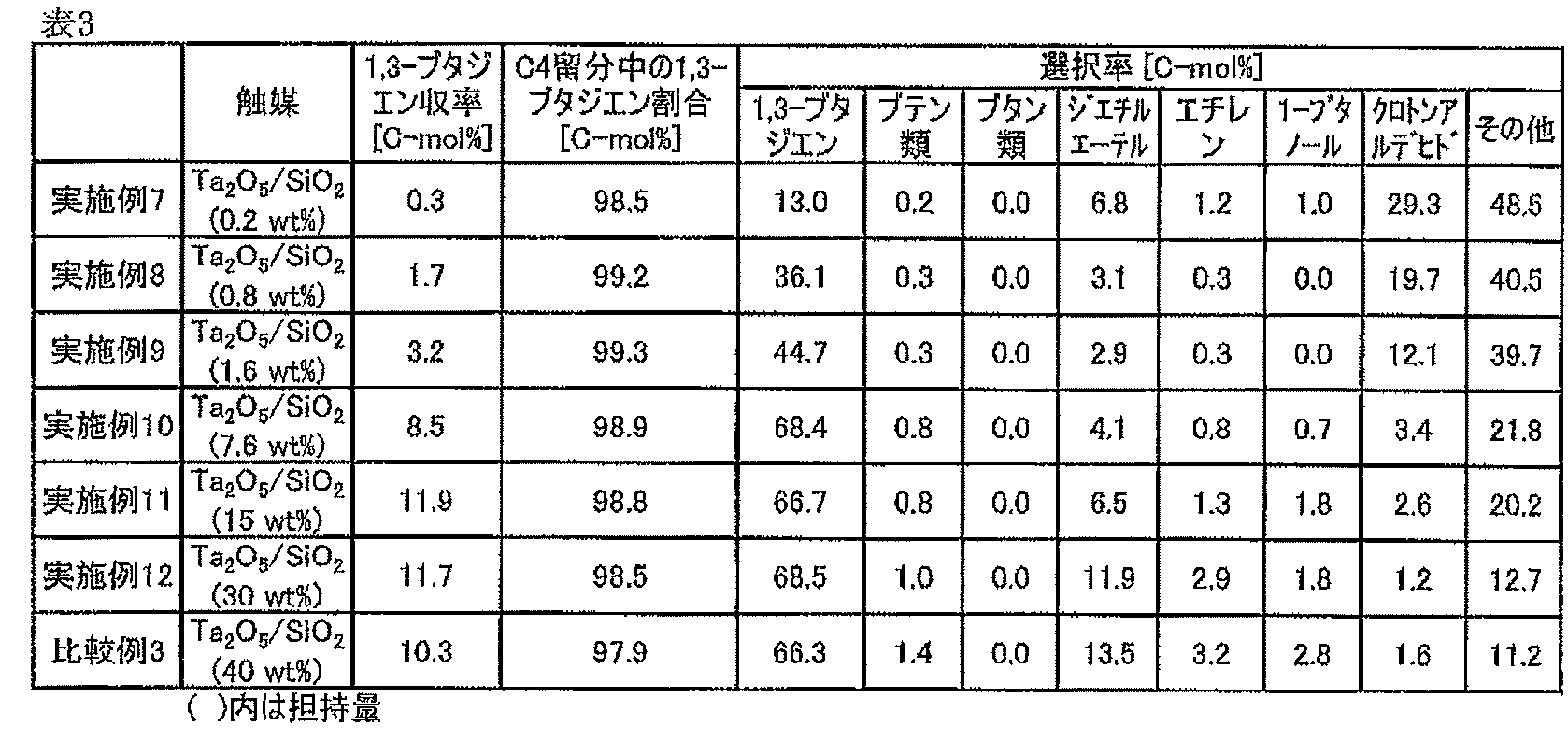
- Ta 2 O 5 / is Ta 2 O 5 amount of SiO 2 is 1,3-butadiene fraction in the C4 fraction in the range of 0.2 to 30% by weight was 98% or more, Ta 2 When the amount of O 5 was 40% by weight, the 1,3-butadiene ratio in the C4 fraction was lower than 98%. The smaller the amount of Ta 2 O 5 in Ta 2 O 5 / SiO 2, the lower the 1,3-butadiene yield.
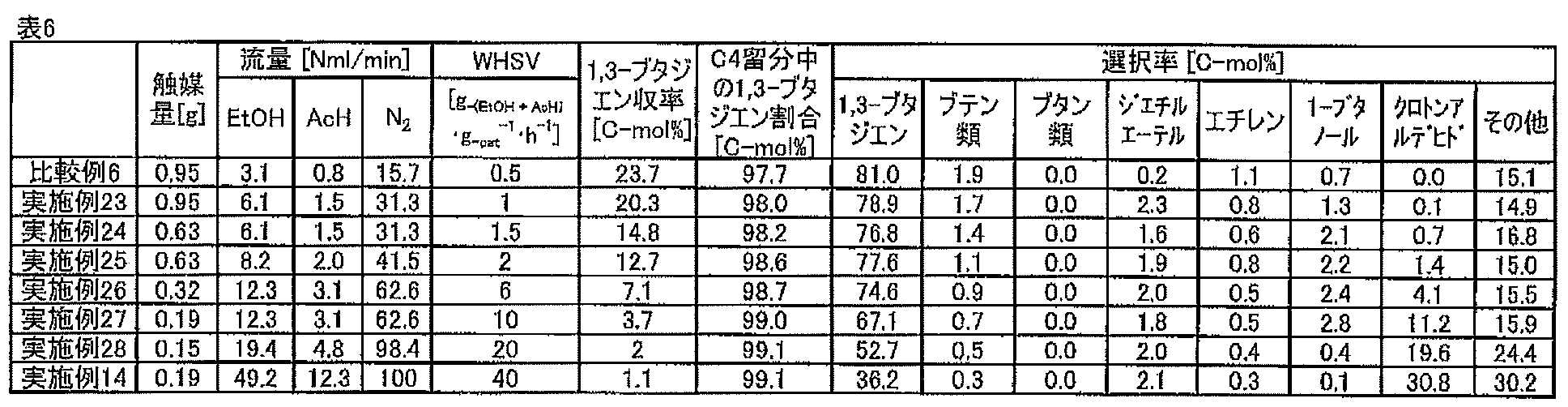
- the temperature was raised to 300 ° C. while flowing nitrogen into the reactor, and ethanol, acetaldehyde and nitrogen were mixed as raw material gases at the flow rates shown in Table 6 and supplied to the reactor.
- the gas composition at the outlet of the reactor 6 to 15 minutes after the start of the reaction was determined by gas chromatography.
- the temperature was raised to 300 ° C. while flowing nitrogen into the reactor, and ethanol, acetaldehyde and nitrogen were mixed as raw material gases at the flow rates shown in Table 7 and supplied to the reactor.
- the gas composition at the outlet of the reactor 6 to 15 minutes after the start of the reaction was determined by gas chromatography.
Landscapes
- Chemical & Material Sciences (AREA)
- Organic Chemistry (AREA)
- Organic Low-Molecular-Weight Compounds And Preparation Thereof (AREA)
Abstract
ETBプロセスから得られるC4留分のブタジエン抽出ユニットでの精製を必要としないような、C4留分中のブタジエン選択率が98mol%以上となる製造方法を提供する。エタノールを含む原料を触媒に接触させることにより、生成物中のブタン類、ブテン類、ブタジエン類からなるC4留分中の1,3-ブタジエンの割合を98mol%以上とすることを特徴とする。前記運転温度が260℃から450℃の範囲であり、WHSVが1.0~40g-(EtOH+AcH)・g-cat
-1・h-1の範囲である。前記触媒が周期表第4族および第5族の元素を含有する。
Description
エタノールからの1,3-ブタジエンを製造する方法に関する。
エタノールからのブタジエン製造(ETB)は、過去に工業実績のある技術であるが、ナフサクラッカーより得られたC4留分からのブタジエン抽出蒸留技術の完成に伴い競争力を失ったため、一部の地域を除いて現在では使用されていない。しかしながら、近年、アジアを中心とした自動車普及台数の伸びとクラッカー原料の軽質化に伴う世界的なブタジエン需給ギャップの拡大が懸念されており、ブタジエンを単産できるETBプロセスへの関心が高まっている。
ETBプロセスには、一段でエタノールをブタジエンに変換する一段法(Lebedev法)と、まずエタノールを脱水素してアセトアルデヒドを合成し、エタノールとアセトアルデヒドからブタジエンを合成する二段法(American法)がある。
・一段法
2CH3CH2OH→CH2=CH-CH=CH2+2H2O+H2
・二段法
CH3CH2OH→CH3CHO+H2
CH3CH2OH+CH3CHO→CH2=CH-CH=CH2+2H2O
このような反応の際に使用されるETB触媒について、数多くの特許文献・非特許文献が公表されている。たとえばMgO(特許文献1)およびMgO-SiO2(特許文献2~4、非特許文献1、2)がエタノールからのブタジエン製造に活性を示すことが知られていた。これに加え、エタノール脱水素能を付与する目的でAg、Cu、Ni、Zn等の金属を添加したMgO-SiO2触媒(特許文献5、非特許文献3~6)や、1,3-ブタジエン選択性を向上させる目的でタンタル等の元素を添加したMgO-SiO2触媒(特許文献5)も開発されている。一方、Ta2O5/SiO2(特許文献6、非特許文献6)やZrO2/SiO2(特許文献7、非特許文献6)は、エタノールおよびアセトアルデヒドからのブタジエン製造触媒として知られている。近年、これらの触媒にエタノール脱水素能を付与したAg-ZrO2-SiO2(特許文献8)が報告されている。他に、ZnO-Al2O3(非特許文献7、8)、セピオライト(非特許文献9)等の報告がある。
・一段法
2CH3CH2OH→CH2=CH-CH=CH2+2H2O+H2
・二段法
CH3CH2OH→CH3CHO+H2
CH3CH2OH+CH3CHO→CH2=CH-CH=CH2+2H2O
このような反応の際に使用されるETB触媒について、数多くの特許文献・非特許文献が公表されている。たとえばMgO(特許文献1)およびMgO-SiO2(特許文献2~4、非特許文献1、2)がエタノールからのブタジエン製造に活性を示すことが知られていた。これに加え、エタノール脱水素能を付与する目的でAg、Cu、Ni、Zn等の金属を添加したMgO-SiO2触媒(特許文献5、非特許文献3~6)や、1,3-ブタジエン選択性を向上させる目的でタンタル等の元素を添加したMgO-SiO2触媒(特許文献5)も開発されている。一方、Ta2O5/SiO2(特許文献6、非特許文献6)やZrO2/SiO2(特許文献7、非特許文献6)は、エタノールおよびアセトアルデヒドからのブタジエン製造触媒として知られている。近年、これらの触媒にエタノール脱水素能を付与したAg-ZrO2-SiO2(特許文献8)が報告されている。他に、ZnO-Al2O3(非特許文献7、8)、セピオライト(非特許文献9)等の報告がある。
プロセスに関する特許として、エタノールおよびアセトアルデヒドのリサイクルに関する技術(特許文献9~11)も提案されている。 しかしながら、従来技術でC4留分中の1,3-ブタジエン濃度を向上させるべく創意工夫しているものはなく、ETBプロセスを経て製造したC4留分(粗ブタジエン)は、従来のクラッカーから得られたブテン類、ブタン類を数十%程度含んだC4留分と同様にブタジエン抽出ユニットを通して精製すると考えられていた。
Bulletin of the Chemical Society of Japan, vol.45, p.655-659 (1972)
Applied Catalysis, vol.43, p.117-131 (1988)
Acta Chimica Academiae Scientiarum Hungaricae Tomus, vol.50, p.161-166 (1966)
Catalysis Today, vol. 198, p.338-344 (2012)
Catalysis Letters, vol. 36, p.95 (1996)
Industrial and Engineering Chemistry, vol. 42, p.359-372 (1950)
Industrial and Engineering Chemistry Process Design and Development, vol.2, p.45-51 (1963)
Journal of Catalysis, vol. 7, p.152-158 (1967)
International Congress of Catalysis 8th, vol. 5, p. V647-V657 (1984)
本発明は、ETBプロセスから得られるC4留分のブタジエン抽出ユニットでの精製を必要としないような、C4留分中のブタジエン選択率が98mol%以上となる触媒の種類、担持量、反応条件を提供することを目的としている。
このような状況のもと、本発明者らは、上記課題を解決すべく鋭意検討した結果、以下の構成により、本発明を完成するに至った。
[1]エタノールを含む原料を触媒に接触させることにより、
生成物中のブタン類、ブテン類、ブタジエン類からなるC4留分中の1,3-ブタジエンの割合を98mol%以上とすることを特徴とする、1,3-ブタジエンの製造方法。
[2]運転温度が260℃から450℃の範囲である[1]に記載の1,3-ブタジエンの製造方法。
[1]エタノールを含む原料を触媒に接触させることにより、
生成物中のブタン類、ブテン類、ブタジエン類からなるC4留分中の1,3-ブタジエンの割合を98mol%以上とすることを特徴とする、1,3-ブタジエンの製造方法。
[2]運転温度が260℃から450℃の範囲である[1]に記載の1,3-ブタジエンの製造方法。
[3]WHSVが原料エタノールと原料アセトアルデヒドの合計値として1.0~40g-(EtOH+AcH)・g-cat
-1・h-1の範囲である[1]または[2]に記載の1,3-ブタジエンの製造方法。
[4]前記触媒が周期表第4族および第5族の元素を含有することを特徴とする[1]~[3]のいずれかに記載の1,3-ブタジエンの製造方法。
[4]前記触媒が周期表第4族および第5族の元素を含有することを特徴とする[1]~[3]のいずれかに記載の1,3-ブタジエンの製造方法。
[5]前記触媒が周期表第4族および第5族の元素(A)と金属酸化物(B)からなり、(A)の割合が酸化物として0.2重量%から30重量%の範囲であることを特徴とする[4]に記載の1,3-ブタジエンの製造方法。
[6]金属酸化物(B)が二酸化ケイ素を含む物質であることを特徴とする[5]に記載の1,3-ブタジエンの製造方法。
[6]金属酸化物(B)が二酸化ケイ素を含む物質であることを特徴とする[5]に記載の1,3-ブタジエンの製造方法。
[7]元素(A)がジルコニウム、ハフニウム、タンタルのうちのいずれかであることを特徴とする[4]~[6]のいずれかに記載の1,3-ブタジエンの製造方法。
[8]元素(A)がジルコニウムまたはタンタルであることを特徴とする[4]~[6]のいずれかに記載の1,3-ブタジエンの製造方法。
[8]元素(A)がジルコニウムまたはタンタルであることを特徴とする[4]~[6]のいずれかに記載の1,3-ブタジエンの製造方法。
[9]前記元素(A)がジルコニウムであり、(A)の割合が酸化物として0.2~10重量%の範囲にあることを特徴とする[8]に記載の1,3-ブタジエンの製造方法。
[10]前記元素(A)がタンタルであり、(A)の割合が酸化物として0.2~30重量%の範囲にあることを特徴とする[8]に記載の1,3-ブタジエンの製造方法。
[10]前記元素(A)がタンタルであり、(A)の割合が酸化物として0.2~30重量%の範囲にあることを特徴とする[8]に記載の1,3-ブタジエンの製造方法。
本発明によれば、C4留分(ブタン類、ブテン類、ブタジエン類)中の1,3-ブタジエン濃度が高くなることにより、ブタジエン抽出ユニットを削減できる。そのため、建設費およびブタジエン製造コストを低減することが可能となる。
以下、本発明を実施するための形態について説明する。
本発明では、エタノールを含む原料を触媒に接触させることにより、生成物中のブタン類、ブテン類、ブタジエン類からなるC4留分中の1,3-ブタジエンの割合を98mol%以上とする、1,3-ブタジエンの製造方法である。
[原料]
本発明で使用される原料は、少なくともエタノールを含む。エタノールとしては、特に限定されることが無く、例えば、サトウキビやトウモロコシなどのバイオマス由来のエタノールや、石油、石炭若しくは天然ガス由来のエタノールなどを挙げることができる。なお、バイオマス由来のエタノールを使用すれば、温室効果ガス削減に貢献することができる。
[原料]
本発明で使用される原料は、少なくともエタノールを含む。エタノールとしては、特に限定されることが無く、例えば、サトウキビやトウモロコシなどのバイオマス由来のエタノールや、石油、石炭若しくは天然ガス由来のエタノールなどを挙げることができる。なお、バイオマス由来のエタノールを使用すれば、温室効果ガス削減に貢献することができる。
本発明の原料は、エタノール単独でもよいが、エタノールと共にアセトアルデヒドを含有していてもよい。
アセトアルデヒドを含有する場合、エタノールとアセトアルデヒドのモル比(EtOH:AcH)は、95:5~40:60、好ましくは90:10~50:50、さらに好ましくは85:15~60:40の範囲にある。
アセトアルデヒドはエタノールの脱水素反応により製造したものを使用することができる。エタノールの脱水素反応では、例えば、特開2005-342675号公報、特開2011-532号公報公報などに開示された公知の銅触媒や銀触媒が使用される。具体的には、Cu系や、Ni、Pd、Pt等の元素周期表8族の金属等を好適に用いることができ、中でもCuを含有するものが更に好ましい。例えばCu単独あるいはこれにCr、Co、Ni、Fe、Mn等の遷移金属元素を加えた2成分の金属を含むものが挙げられ、CuとNiを含有するものが好ましく用いられる。更に3成分以上の金属を含むものも好ましく用いられる。またこれらをさらに二酸化ケイ素、酸化アルミニウム、酸化チタン、ゼオライト等に担持させたもの等も用いられる。
反応条件としては特に制限されるものではなく、通常200~300℃程度の範囲で、所定のアセトアルデヒド生成量となるような条件で反応を行う。
[触媒]
本発明で使用される触媒は、周期表第4族および第5族の元素(A)を含有する。
[触媒]
本発明で使用される触媒は、周期表第4族および第5族の元素(A)を含有する。
元素(A)としては、チタン、ジルコニウム、ハフニウム、バナジウム、ニオブ、タンタルなどが挙げられ、1,3-ブタジエン選択率向上、C4留分中の1,3-ブタジエン割合向上の点で、元素(A)がジルコニウム、ハフニウム、タンタルのうちのいずれかであることが好ましく、さらにジルコニウムまたはタンタルであることがより好ましい。
これらの元素(A)は、金属酸化物(B)に、金属、酸化物、水酸化物、塩などの状態で固定される。
触媒中の元素(A)の割合は、C4留分中の1,3-ブタジエンの割合を98mol%以上となるように選択される。
好ましくは、酸化物として元素(A)がジルコニウムの場合には0.2~10重量%の範囲、タンタルの場合には0.2~30重量%の範囲がよい。また、元素(A)はより好ましくは0.5~8.0重量%、さらに好ましくは1.0~5.0重量%の範囲にある。
この範囲で元素(A)を含むと、C4留分中の1,3-ブタジエン割合が高く、ブタジエン収率を高くできる。なお、元素(A)の含有量が多すぎると副反応であるブテン類生成反応が促進されるためにC4留分中の1,3-ブタジエン割合が低下する。一方、元素(A)含有量が少なすぎると活性点が少ないためにブタジエン収率が低下する。
この範囲で元素(A)を含むと、C4留分中の1,3-ブタジエン割合が高く、ブタジエン収率を高くできる。なお、元素(A)の含有量が多すぎると副反応であるブテン類生成反応が促進されるためにC4留分中の1,3-ブタジエン割合が低下する。一方、元素(A)含有量が少なすぎると活性点が少ないためにブタジエン収率が低下する。
金属酸化物(B)としては、具体的には、二酸化ケイ素、酸化マグネシウム、酸化アルミニウム、酸化ジルコニウム、酸化チタン、ゼオライト(アルミノ珪酸塩)などを挙げることができる。これらは、単独で、または2種以上を混合して使用することができる。これらのうち、二酸化ケイ素を含むものが好ましい。
二酸化ケイ素を含むものとしては、アモルファスシリカ、シリカゾル、シリカゲル、コロイダルシリカなどが挙げられる。また、MCM-41、FSM-16、SBA-15などのメソポーラスシリカや、ゼオライトも使用可能である。
このような触媒は、例えば、前記元素(A)を含む塩化物塩、硝酸塩、硫酸塩、燐酸塩、アルコキシドを水や有機溶媒に溶解させ、金属酸化物(B)に含浸させたのち、加熱、乾燥・焼成することで調製できる。含浸方法としては、公知の手法が採用でき、噴霧法、コーティング法、またはポアフィリング法また選択吸着法などが挙げられる。また、元素(A)および金属酸化物(B)の前駆体を混合したのちに加熱や濃縮、水熱合成などの処理を施し、乾燥・焼成することで調製することもできる。元素(A)および金属酸化物(B)の前駆体としてはアルコキシドや塩化物塩、硝酸塩、硫酸塩、燐酸塩、金属酸化物ゾルなどが挙げられる。元素(A)および金属酸化物(B)の前駆体を混合したものに、構造規定剤となる有機化合物を加えても構わない。
触媒の形状としては特に制限されるものではなく、粒状、円柱状、円筒状、ハニカム状など公知の形状であっても使用できる。
[1,3-ブタジエンの製造方法]
本発明の1,3-ブタジエンの製造方法は、加熱下で、前記原料を前記触媒に接触させることを特徴とする。かかる製造方法は、回分式、半回分式、連続式等の周知の方式を採用できる。連続式を採用すると、大量合成が可能であり、運転作業負荷が軽い上に、未反応原料を反応系に再利用することにより原料のエタノールの使用率を極めて高いレベルに向上させることができる。そのため、簡便且つ効率的に1,3-ブタジエンを分離、回収することができる連続式を採用することが好ましい。
[1,3-ブタジエンの製造方法]
本発明の1,3-ブタジエンの製造方法は、加熱下で、前記原料を前記触媒に接触させることを特徴とする。かかる製造方法は、回分式、半回分式、連続式等の周知の方式を採用できる。連続式を採用すると、大量合成が可能であり、運転作業負荷が軽い上に、未反応原料を反応系に再利用することにより原料のエタノールの使用率を極めて高いレベルに向上させることができる。そのため、簡便且つ効率的に1,3-ブタジエンを分離、回収することができる連続式を採用することが好ましい。
原料を上記触媒に接触させる方法としては、例えば、懸濁床方式、流動床方式、固定床方式等を挙げることができる。また、本発明は、気相法、液相法のいずれであってもよいが、気相法を用いることが好ましい。
気相で反応を行う場合、原料ガス(例えば、エタノールガス、好ましくはエタノールガスとアセトアルデヒドガスの混合物)は、希釈することなく反応器に供給してもよく、窒素、ヘリウム、アルゴン、水蒸気、などの不活性ガスにより適宜希釈して反応器に供給してもよい。
反応時に、エタノールを含む原料にアセトアルデヒドを添加してもよく、エタノールとアセトアルデヒド(添加後の総量)のモル比(EtOH:AcH)が前記の比率となるようにすればよい。
反応温度としては、C4留分中の1,3-ブタジエンの割合を98mol%以上となるように適宜選択される。例えば260~450℃程度、好ましくは300~400℃の範囲にある。温度が高すぎると、C4留分中の1,3-ブタジエン割合が低下する。一方、温度が低すぎるとブタジエン収率が低下する。
反応圧力は、常圧から高圧までの広い範囲で適宜設定できるが、製造効率や装置構成などの観点から、1.0MPa以下に設定することが好ましい。
原料と触媒との接触時間は、原料の供給速度を調整することによりコントロールすることができ、単位触媒あたりの重量空間速度(WHSV)は1.0~40g-(EtOH+AcH)・g-cat
-1・h-1、好ましくは2.0~20g-(EtOH+AcH)・g-cat
-1・h-1の範囲が好ましい。この範囲で接触させると、所定のブタジエン割合を達成でき、収率が高い。WHSVが低すぎるとC4留分中の1,3-ブタジエン割合が低下する。一方、WHSVが高すぎるとブタジエン収率が低下する。
反応終了後、反応生成物は、例えば、蒸留、抽出等の分離手段や、これらを組み合わせた分離手段により、軽質ガス、C4留分、重質分、水、エタノール、アセトアルデヒド等に分離精製することができる。
本発明では、エタノールとアセトアルデヒドとを含む原料を、特定の触媒に所定の条件で接触させることにより、生成物中のブタン類、ブテン類、ブタジエン類から成るC4留分中の1,3-ブタジエンの割合が98mol%以上となる。このため、ブタジエン抽出ユニットによる精製を行わなくても、上記C4留分を合成ゴム等の原料として使用することが出来、ブタジエン抽出ユニットの建設費・製造コストの削減につながることから、産業上の利用可能性は高い。
[実施例]
以下、本発明を実施例によりさらに詳しく説明するが、本発明はこれらの実施例に何ら限定されるものではない。
<触媒調製>
以下、本発明を実施例によりさらに詳しく説明するが、本発明はこれらの実施例に何ら限定されるものではない。
<触媒調製>
調製例1
オキシ硝酸ジルコニウム二水和物0.022gをイオン交換水5.0mlに溶解させ、ポアフィリング法にてキャリアクトG-6(富士シリシア化学(株)製)5.0gに担持した。120℃乾燥後、空気流通下500℃で焼成し、ZrO2/SiO2(担持量0.2重量%)触媒を得た。
オキシ硝酸ジルコニウム二水和物0.022gをイオン交換水5.0mlに溶解させ、ポアフィリング法にてキャリアクトG-6(富士シリシア化学(株)製)5.0gに担持した。120℃乾燥後、空気流通下500℃で焼成し、ZrO2/SiO2(担持量0.2重量%)触媒を得た。
調製例2
オキシ硝酸ジルコニウム二水和物0.11gをイオン交換水5.0mlに溶解させ、ポアフィリング法にてキャリアクトG-6(富士シリシア化学(株)製)5.0gに担持した。120℃乾燥後、空気流通下500℃で焼成し、ZrO2/SiO2(担持量1.0重量%)触媒を得た。
オキシ硝酸ジルコニウム二水和物0.11gをイオン交換水5.0mlに溶解させ、ポアフィリング法にてキャリアクトG-6(富士シリシア化学(株)製)5.0gに担持した。120℃乾燥後、空気流通下500℃で焼成し、ZrO2/SiO2(担持量1.0重量%)触媒を得た。
調製例3
オキシ硝酸ジルコニウム二水和物0.22gをイオン交換水5.0mlに溶解させ、ポアフィリング法にてキャリアクトG-6(富士シリシア化学(株)製)5.0gに担持した。120℃乾燥後、空気流通下500℃で焼成し、ZrO2/SiO2(担持量2.0重量%)触媒を得た。
オキシ硝酸ジルコニウム二水和物0.22gをイオン交換水5.0mlに溶解させ、ポアフィリング法にてキャリアクトG-6(富士シリシア化学(株)製)5.0gに担持した。120℃乾燥後、空気流通下500℃で焼成し、ZrO2/SiO2(担持量2.0重量%)触媒を得た。
調製例4
オキシ硝酸ジルコニウム二水和物1.2gをイオン交換水5.0mlに溶解させ、ポアフィリング法にてキャリアクトG-6(富士シリシア化学(株)製)5.0gに担持した。120℃乾燥後、空気流通下500℃で焼成し、ZrO2/SiO2(担持量10重量%)触媒を得た。
オキシ硝酸ジルコニウム二水和物1.2gをイオン交換水5.0mlに溶解させ、ポアフィリング法にてキャリアクトG-6(富士シリシア化学(株)製)5.0gに担持した。120℃乾燥後、空気流通下500℃で焼成し、ZrO2/SiO2(担持量10重量%)触媒を得た。
調製例5
オキシ硝酸ジルコニウム二水和物2.2gをイオン交換水5.0mlに溶解させ、ポアフィリング法にてキャリアクトG-6(富士シリシア化学(株)製)5.0gに担持した。120℃乾燥後、空気流通下500℃で焼成し、ZrO2/SiO2(担持量17重量%)触媒を得た。
オキシ硝酸ジルコニウム二水和物2.2gをイオン交換水5.0mlに溶解させ、ポアフィリング法にてキャリアクトG-6(富士シリシア化学(株)製)5.0gに担持した。120℃乾燥後、空気流通下500℃で焼成し、ZrO2/SiO2(担持量17重量%)触媒を得た。
調製例6
塩化タンタル0.016gをエタノール50mlに溶解させ、キャリアクトG-6(富士シリシア化学(株)製)5.0gを加えて2時間撹拌したのち、エバポレーターを用いてエタノールを蒸発させた。120℃乾燥後、空気流通下500℃で焼成し、Ta2O5/SiO2(担持量0.2重量%)触媒を得た。
塩化タンタル0.016gをエタノール50mlに溶解させ、キャリアクトG-6(富士シリシア化学(株)製)5.0gを加えて2時間撹拌したのち、エバポレーターを用いてエタノールを蒸発させた。120℃乾燥後、空気流通下500℃で焼成し、Ta2O5/SiO2(担持量0.2重量%)触媒を得た。
調製例7
塩化タンタル0.066gをエタノール50mlに溶解させ、キャリアクトG-6(富士シリシア化学(株)製)5.0gを加えて2時間撹拌したのち、エバポレーターを用いてエタノールを蒸発させた。120℃乾燥後、空気流通下500℃で焼成し、Ta2O5/SiO2(担持量0.8重量%)触媒を得た。
塩化タンタル0.066gをエタノール50mlに溶解させ、キャリアクトG-6(富士シリシア化学(株)製)5.0gを加えて2時間撹拌したのち、エバポレーターを用いてエタノールを蒸発させた。120℃乾燥後、空気流通下500℃で焼成し、Ta2O5/SiO2(担持量0.8重量%)触媒を得た。
調製例8
塩化タンタル0.13gをエタノール50mlに溶解させ、キャリアクトG-6(富士シリシア化学(株)製)5.0gを加えて2時間撹拌したのち、エバポレーターを用いてエタノールを蒸発させた。120℃乾燥後、空気流通下500℃で焼成し、Ta2O5/SiO2(担持量1.6重量%)触媒を得た。
塩化タンタル0.13gをエタノール50mlに溶解させ、キャリアクトG-6(富士シリシア化学(株)製)5.0gを加えて2時間撹拌したのち、エバポレーターを用いてエタノールを蒸発させた。120℃乾燥後、空気流通下500℃で焼成し、Ta2O5/SiO2(担持量1.6重量%)触媒を得た。
調製例9
塩化タンタル0.67gをエタノール50mlに溶解させ、キャリアクトG-6(富士シリシア化学(株)製)5.0gを加えて2時間撹拌したのち、エバポレーターを用いてエタノールを蒸発させた。120℃乾燥後、空気流通下500℃で焼成し、Ta2O5/SiO2(担持量7.6重量%)触媒を得た。
塩化タンタル0.67gをエタノール50mlに溶解させ、キャリアクトG-6(富士シリシア化学(株)製)5.0gを加えて2時間撹拌したのち、エバポレーターを用いてエタノールを蒸発させた。120℃乾燥後、空気流通下500℃で焼成し、Ta2O5/SiO2(担持量7.6重量%)触媒を得た。
調製例10
塩化タンタル1.43gをエタノール50mlに溶解させ、キャリアクトG-6(富士シリシア化学(株)製)5.0gを加えて2時間撹拌したのち、エバポレーターを用いてエタノールを蒸発させた。120℃乾燥後、空気流通下500℃で焼成し、Ta2O5/SiO2(担持量15重量%)触媒を得た。
塩化タンタル1.43gをエタノール50mlに溶解させ、キャリアクトG-6(富士シリシア化学(株)製)5.0gを加えて2時間撹拌したのち、エバポレーターを用いてエタノールを蒸発させた。120℃乾燥後、空気流通下500℃で焼成し、Ta2O5/SiO2(担持量15重量%)触媒を得た。
調製例11
塩化タンタル3.47gをエタノール50mlに溶解させ、キャリアクトG-6(富士シリシア化学(株)製)5.0gを加えて2時間撹拌したのち、エバポレーターを用いてエタノールを蒸発させた。120℃乾燥後、空気流通下500℃で焼成し、Ta2O5/SiO2(担持量30重量%)触媒を得た。
塩化タンタル3.47gをエタノール50mlに溶解させ、キャリアクトG-6(富士シリシア化学(株)製)5.0gを加えて2時間撹拌したのち、エバポレーターを用いてエタノールを蒸発させた。120℃乾燥後、空気流通下500℃で焼成し、Ta2O5/SiO2(担持量30重量%)触媒を得た。
調製例12
塩化タンタル5.44gをエタノール50mlに溶解させ、キャリアクトG-6(富士シリシア化学(株)製)5.0gを加えて2時間撹拌したのち、エバポレーターを用いてエタノールを蒸発させた。120℃乾燥後、空気流通下500℃で焼成し、Ta2O5/SiO2(担持量40重量%)触媒を得た。
塩化タンタル5.44gをエタノール50mlに溶解させ、キャリアクトG-6(富士シリシア化学(株)製)5.0gを加えて2時間撹拌したのち、エバポレーターを用いてエタノールを蒸発させた。120℃乾燥後、空気流通下500℃で焼成し、Ta2O5/SiO2(担持量40重量%)触媒を得た。
調製例13
硝酸マグネシウム六水和物151gを240mlのイオン交換水に溶解させ、スノーテックスO(ST-O)(日産化学工業(株)製)31gと混合し、70℃で1時間保持した。その後、アンモニア水(25%)144gを250mlのイオン交換水に希釈したものをゆっくりと滴下し、沈殿物を得た。この沈殿物を洗浄し、120℃乾燥後、空気流通下500℃で焼成し、MgO-SiO2複合酸化物を得た。
硝酸マグネシウム六水和物151gを240mlのイオン交換水に溶解させ、スノーテックスO(ST-O)(日産化学工業(株)製)31gと混合し、70℃で1時間保持した。その後、アンモニア水(25%)144gを250mlのイオン交換水に希釈したものをゆっくりと滴下し、沈殿物を得た。この沈殿物を洗浄し、120℃乾燥後、空気流通下500℃で焼成し、MgO-SiO2複合酸化物を得た。
<反応試験>
実施例1-2、比較例1
表1に記載の触媒0.38gを固定床流通型反応器に充填し、以下の反応条件で実験を行った。
実施例1-2、比較例1
表1に記載の触媒0.38gを固定床流通型反応器に充填し、以下の反応条件で実験を行った。
反応器に窒素を流しながら340℃まで昇温し、原料ガスとしてエタノール(12.3Nml/min)とアセトアルデヒド(3.1Nml/min)および窒素(6.8Nml/min)を混合して反応器に供給した(WHSV=5.0g-(EtOH+AcH)・g-cat
-1・h-1)。反応開始6~15分後の反応器出口ガス組成をガスクロマトグラフにより求めた。
結果を表1に示す。

実施例3~6、比較例2
表2に記載の触媒0.19gを固定床流通型反応器に充填し、以下の反応条件で実験を行った。反応器に窒素を流しながら300℃まで昇温し、原料ガスとしてエタノール(12.3Nml/min)とアセトアルデヒド(3.1Nml/min)および窒素(25.0Nml/min)を混合して反応器に供給した(WHSV=10g-(EtOH+AcH)・g-cat -1・h-1)。反応開始6~15分後の反応器出口ガス組成をガスクロマトグラフにより求めた。
結果を表2に示す。
表2に記載の触媒0.19gを固定床流通型反応器に充填し、以下の反応条件で実験を行った。反応器に窒素を流しながら300℃まで昇温し、原料ガスとしてエタノール(12.3Nml/min)とアセトアルデヒド(3.1Nml/min)および窒素(25.0Nml/min)を混合して反応器に供給した(WHSV=10g-(EtOH+AcH)・g-cat -1・h-1)。反応開始6~15分後の反応器出口ガス組成をガスクロマトグラフにより求めた。
結果を表2に示す。

ZrO2担持量0.2~10重量%の範囲であれば、C4留分中の1,3-ブタジエン割合が98%以上となる。
実施例7~12、比較例3
表3に記載の触媒0.19gを固定床流通型反応器に充填し、以下の反応条件で実験を行った。反応器に窒素を流しながら300℃まで昇温し、原料ガスとしてエタノール(12.3Nml/min)とアセトアルデヒド(3.1Nml/min)および窒素(25.0Nml/min)を混合して反応器に供給した(WHSV=10g-(EtOH+AcH)・g-cat -1・h-1)。反応開始6~15分後の反応器出口ガス組成をガスクロマトグラフにより求めた。
実施例7~12、比較例3
表3に記載の触媒0.19gを固定床流通型反応器に充填し、以下の反応条件で実験を行った。反応器に窒素を流しながら300℃まで昇温し、原料ガスとしてエタノール(12.3Nml/min)とアセトアルデヒド(3.1Nml/min)および窒素(25.0Nml/min)を混合して反応器に供給した(WHSV=10g-(EtOH+AcH)・g-cat -1・h-1)。反応開始6~15分後の反応器出口ガス組成をガスクロマトグラフにより求めた。
結果を表3に示す。
実施例13~16、比較例4
ZrO2/SiO2(1.0重量%)0.19gを固定床流通型反応器に充填し、以下の反応条件で実験を行った。
ZrO2/SiO2(1.0重量%)0.19gを固定床流通型反応器に充填し、以下の反応条件で実験を行った。
反応器に窒素を流しながら表4に記載の温度まで昇温し、原料ガスとしてエタノール(49.2Nml/min)とアセトアルデヒド(12.3Nml/min)および窒素(100Nml/min)を混合して反応器に供給した(WHSV=40g-(EtOH+AcH)・g-cat
-1・h-1)。反応開始6~15分後の反応器出口ガス組成をガスクロマトグラフにより求めた。
結果を表4に示す。
結果を表4に示す。

実施例17~22、比較例5
Ta2O5/SiO2(1.6重量%)0.19gを固定床流通型反応器に充填し、以下の反応条件で実験を行った。
反応器に窒素を流しながら表5に記載の温度まで昇温し、原料ガスとしてエタノール(49.2Nml/min)とアセトアルデヒド(12.3Nml/min)および窒素(100Nml/min)を混合して反応器に供給した(WHSV=40g-(EtOH+AcH)・g-cat
-1・h-1)。反応開始6~15分後の反応器出口ガス組成をガスクロマトグラフにより求めた。
結果を表5に示す。

比較例6、実施例23~28、実施例14
ZrO2/SiO2(1.0重量%)を表6に記載の量、固定床流通型反応器に充填し、以下の反応条件で実験を行った。
反応器に窒素を流しながら300℃まで昇温し、原料ガスとしてエタノールとアセトアルデヒドおよび窒素を表6に記載の流量で混合して反応器に供給した。反応開始6~15分後の反応器出口ガス組成をガスクロマトグラフにより求めた。
結果を表6に示す。
比較例7、実施例29~31、実施例18
Ta2O5/SiO2(1.6重量%)を表7に記載の量、固定床流通型反応器に充填し、以下の反応条件で実験を行った。
反応器に窒素を流しながら300℃まで昇温し、原料ガスとしてエタノールとアセトアルデヒドおよび窒素を表7に記載の流量で混合して反応器に供給した。反応開始6~15分後の反応器出口ガス組成をガスクロマトグラフにより求めた。
結果を表7に示す。

Claims (10)
- エタノールを含む原料を触媒に接触させることにより、
生成物中のブタン類、ブテン類、ブタジエン類からなるC4留分中の1,3-ブタジエンの割合を98mol%以上とすることを特徴とする、1,3-ブタジエンの製造方法。 - 反応温度が260℃から450℃の範囲である請求項1に記載の1,3-ブタジエンの製造方法。
- WHSVが原料エタノールと原料アセトアルデヒドの合計値として1.0~40g-(EtOH+AcH)・g-cat -1・h-1の範囲である請求項1または2に記載の1,3-ブタジエンの製造方法。
- 前記触媒が周期表第4族および第5族の元素を含有することを特徴とする請求項1~3のいずれかに記載の1,3-ブタジエンの製造方法。
- 前記触媒が周期表第4族および第5族の元素(A)と金属酸化物(B)からなり、(A)の割合が酸化物として0.2重量%から30重量%の範囲であることを特徴とする請求項4に記載の1,3-ブタジエンの製造方法。
- 金属酸化物(B)が二酸化ケイ素を含む物質であることを特徴とする請求項5に記載の1,3-ブタジエンの製造方法。
- 元素(A)がジルコニウム、ハフニウム、タンタルのうちのいずれかであることを特徴とする請求項4~6のいずれかに記載の1,3-ブタジエンの製造方法。
- 元素(A)がジルコニウムまたはタンタルであることを特徴とする請求項4~6のいずれかに記載の1,3-ブタジエンの製造方法。
- 前記元素(A)がジルコニウムであり、(A)の割合が酸化物として0.2~10重量%の範囲にあることを特徴とする請求項8に記載の1,3-ブタジエンの製造方法。
- 前記元素(A)がタンタルであり、(A)の割合が酸化物として0.2~30重量%の範囲にあることを特徴とする請求項8に記載の1,3-ブタジエンの製造方法。
Applications Claiming Priority (2)
| Application Number | Priority Date | Filing Date | Title |
|---|---|---|---|
| JP2015-020280 | 2015-02-04 | ||
| JP2015020280 | 2015-02-04 |
Publications (1)
| Publication Number | Publication Date |
|---|---|
| WO2016125578A1 true WO2016125578A1 (ja) | 2016-08-11 |
Family
ID=56563929
Family Applications (1)
| Application Number | Title | Priority Date | Filing Date |
|---|---|---|---|
| PCT/JP2016/051387 Ceased WO2016125578A1 (ja) | 2015-02-04 | 2016-01-19 | 1,3-ブタジエンの製造方法 |
Country Status (1)
| Country | Link |
|---|---|
| WO (1) | WO2016125578A1 (ja) |
Cited By (2)
| Publication number | Priority date | Publication date | Assignee | Title |
|---|---|---|---|---|
| JP2018171587A (ja) * | 2017-03-31 | 2018-11-08 | 日揮株式会社 | エタノールからの1,3−ブタジエン製造触媒およびプロセス |
| JP2022547817A (ja) * | 2019-09-16 | 2022-11-16 | シントス ドボリ 7 スプウカ ズ オグラニザツィーノン オトゥポビエジャルノシチョン スプウカ ヤフナ | 1,3-ブタジエン製造用の担持タンタル触媒 |
Citations (2)
| Publication number | Priority date | Publication date | Assignee | Title |
|---|---|---|---|---|
| US2421361A (en) * | 1942-09-29 | 1947-05-27 | Carbide & Carbon Chem Corp | Process for making diolefins |
| US2524848A (en) * | 1946-07-13 | 1950-10-10 | Koppers Co Inc | Process |
-
2016
- 2016-01-19 WO PCT/JP2016/051387 patent/WO2016125578A1/ja not_active Ceased
Patent Citations (2)
| Publication number | Priority date | Publication date | Assignee | Title |
|---|---|---|---|---|
| US2421361A (en) * | 1942-09-29 | 1947-05-27 | Carbide & Carbon Chem Corp | Process for making diolefins |
| US2524848A (en) * | 1946-07-13 | 1950-10-10 | Koppers Co Inc | Process |
Non-Patent Citations (1)
| Title |
|---|
| TAE-WAN KIM ET AL.: "Butadiene production from bioethanol and acetaldehyde over tantalum oxide-supported spherical silica catalysts for circulating fluidized bed", CHEMICAL ENGINEERING JOURNAL, vol. 278, 16 October 2014 (2014-10-16), pages 217 - 223 * |
Cited By (3)
| Publication number | Priority date | Publication date | Assignee | Title |
|---|---|---|---|---|
| JP2018171587A (ja) * | 2017-03-31 | 2018-11-08 | 日揮株式会社 | エタノールからの1,3−ブタジエン製造触媒およびプロセス |
| JP2022547817A (ja) * | 2019-09-16 | 2022-11-16 | シントス ドボリ 7 スプウカ ズ オグラニザツィーノン オトゥポビエジャルノシチョン スプウカ ヤフナ | 1,3-ブタジエン製造用の担持タンタル触媒 |
| JP7758660B2 (ja) | 2019-09-16 | 2025-10-22 | シントス ドボリ 7 スプウカ ズ オグラニザツィーノン オトゥポビエジャルノシチョン | 1,3-ブタジエン製造用の担持タンタル触媒 |
Similar Documents
| Publication | Publication Date | Title |
|---|---|---|
| JP6084963B2 (ja) | 1,3−ブタジエンの製造方法 | |
| CN101674883B (zh) | 铁酸锌催化剂、其制备方法以及使用该铁酸锌催化剂制备1,3-丁二烯的方法 | |
| CN103298771B (zh) | 高产率制备1,3-丁二烯的方法 | |
| US9713804B2 (en) | Catalyst composition for the dehydrogenation of alkanes | |
| CN102123790A (zh) | 用于烃的脱氢的催化剂 | |
| JP2015507528A (ja) | アルカンの脱水素化に有用な亜鉛および/またはマンガンアルミネート触媒 | |
| JP6595606B2 (ja) | オレフィンを製造するための触媒及びプロセス | |
| JP2011148720A (ja) | ブタジエンの製造方法 | |
| CN101896267A (zh) | 混合型铁酸锰催化剂、其制备方法、以及使用该催化剂制备1,3-丁二烯的方法 | |
| WO2018010359A1 (zh) | 一种双功能催化剂的制备方法及应用 | |
| US10787611B2 (en) | Process to convert synthesis gas to olefins using a bifunctional chromium/zinc oxide-SAPO-34 catalyst | |
| US11040338B2 (en) | Process of preparing catalyst; platinum-tin on zinc aluminate-calcium aluminate-zeolite catalyst for selective light alkane dehydrogenation | |
| CN106311214A (zh) | 一种非贵金属脱氢催化剂的制备方法和应用 | |
| EP3604260A1 (en) | Single-stage method of butadiene production | |
| WO2019095986A1 (zh) | 一种由合成气直接制取芳烃的方法 | |
| WO2016111203A1 (ja) | 1,3-ブタジエンの製造方法 | |
| JP2018171587A (ja) | エタノールからの1,3−ブタジエン製造触媒およびプロセス | |
| CN109926087B (zh) | 轻质烷烃脱氢用沸石负载型催化剂和其制备方法 | |
| JP2023535309A (ja) | 改質usyゼオライト脱水素触媒によるパラフィン系ナフサの処理 | |
| WO2016125578A1 (ja) | 1,3-ブタジエンの製造方法 | |
| JP6446033B2 (ja) | 不飽和炭化水素の製造方法 | |
| CN105709786B (zh) | 一种丁二烯选择性加氢、1‑丁烯异构催化剂及其制备方法和应用 | |
| CN115634678A (zh) | 一种乙烷脱氢催化剂及乙烷脱氢同时制备乙烯和氢气的方法 | |
| CN117920190A (zh) | 脱氢催化剂及其制备方法和应用和烷烃脱氢方法 | |
| CN102875316A (zh) | 干气与苯烷基化制乙苯的方法 |
Legal Events
| Date | Code | Title | Description |
|---|---|---|---|
| 121 | Ep: the epo has been informed by wipo that ep was designated in this application |
Ref document number: 16746409 Country of ref document: EP Kind code of ref document: A1 |
|
| NENP | Non-entry into the national phase |
Ref country code: DE |
|
| 122 | Ep: pct application non-entry in european phase |
Ref document number: 16746409 Country of ref document: EP Kind code of ref document: A1 |
|
| NENP | Non-entry into the national phase |
Ref country code: JP |