WO2016104611A1 - 酸化珪素膜研磨用研磨液組成物 - Google Patents
酸化珪素膜研磨用研磨液組成物 Download PDFInfo
- Publication number
- WO2016104611A1 WO2016104611A1 PCT/JP2015/086041 JP2015086041W WO2016104611A1 WO 2016104611 A1 WO2016104611 A1 WO 2016104611A1 JP 2015086041 W JP2015086041 W JP 2015086041W WO 2016104611 A1 WO2016104611 A1 WO 2016104611A1
- Authority
- WO
- WIPO (PCT)
- Prior art keywords
- polishing
- silicon oxide
- oxide film
- ceria
- less
- Prior art date
- Legal status (The legal status is an assumption and is not a legal conclusion. Google has not performed a legal analysis and makes no representation as to the accuracy of the status listed.)
- Ceased
Links
Classifications
-
- B—PERFORMING OPERATIONS; TRANSPORTING
- B24—GRINDING; POLISHING
- B24B—MACHINES, DEVICES, OR PROCESSES FOR GRINDING OR POLISHING; DRESSING OR CONDITIONING OF ABRADING SURFACES; FEEDING OF GRINDING, POLISHING, OR LAPPING AGENTS
- B24B37/00—Lapping machines or devices; Accessories
-
- C—CHEMISTRY; METALLURGY
- C09—DYES; PAINTS; POLISHES; NATURAL RESINS; ADHESIVES; COMPOSITIONS NOT OTHERWISE PROVIDED FOR; APPLICATIONS OF MATERIALS NOT OTHERWISE PROVIDED FOR
- C09K—MATERIALS FOR MISCELLANEOUS APPLICATIONS, NOT PROVIDED FOR ELSEWHERE
- C09K3/00—Materials not provided for elsewhere
- C09K3/14—Anti-slip materials; Abrasives
-
- H—ELECTRICITY
- H10—SEMICONDUCTOR DEVICES; ELECTRIC SOLID-STATE DEVICES NOT OTHERWISE PROVIDED FOR
- H10P—GENERIC PROCESSES OR APPARATUS FOR THE MANUFACTURE OR TREATMENT OF DEVICES COVERED BY CLASS H10
- H10P52/00—Grinding, lapping or polishing of wafers, substrates or parts of devices
Definitions
- a method for manufacturing a semiconductor substrate is referred to as a shallow trench isolation process (hereinafter referred to as an STI process) for electrical isolation between semiconductor elements such as a DRAM or a flash memory element.
- Such an STI process includes a step of forming a trench using etching or photolithography in a substrate to be polished including a silicon substrate and a polishing stopper layer, a step of filling the trench with an insulating material such as silicon oxide, and an excessive amount. It comprises a leveling step for removing the step height generated by the insulating material by polishing.
- CMP method chemical mechanical polishing method
- a slurry composition containing abrasive particles and various chemical components is supplied between a polishing pad of a polishing apparatus and a substrate to be polished, and the substrate to be polished and the polishing pad are brought into contact with each other so as to be relative to each other.
- This is a method of mechanically polishing the substrate to be polished with the abrasive particles or the like, and chemically polishing the substrate to be polished by the action of the chemical component or the like (see Patent Documents 1 and 3, etc.). .
- an insulating material such as silicon oxide disposed above the silicon substrate is selectively removed, and a trench filled with the insulating material is generated.
- the polishing rate difference between the silicon oxide film and the polysilicon film, that is, the polishing selectivity is not sufficiently high, and the polysilicon thin film has many polishing scratches. Will occur.
- polishing of the polysilicon film (polishing stop film) is suppressed as much as possible, the polishing of the silicon oxide film can be advanced at a high speed, and further, the generation of polishing flaws is exhibited.
- Polishing composition for polishing silicon oxide film in which suppression is suppressed, method for manufacturing semiconductor substrate using the same, polishing method for semiconductor substrate, and polishing for polishing silicon oxide film for polishing silicon oxide film on polysilicon film Use of the liquid composition is provided.
- polishing composition for polishing a silicon oxide film is a polysilicon disposed in contact with the silicon oxide film under the silicon oxide film and the silicon oxide film in a semiconductor substrate manufacturing process.
- the particle shape of the abrasive particles is spherical, a high polishing rate cannot be expressed due to a decrease in frictional resistance with the surface to be polished, but the ceria-coated silica particles contained in the polishing liquid composition of the present invention Then, by coating fine granular ceria on the silica particles, it has a structure with fine irregularities on the particle surface. For example, even if the silica particle shape is substantially spherical, this special particle structure Thus, it is presumed that the frictional force of the abrasive particles with respect to the surface to be polished is improved from that of the substantially spherical silica particles, and a high polishing rate is expressed.
- the combination of the water-soluble polymer (component A) and the ceria-coated silica particles (component B) allows high-speed polishing of the silicon oxide film while suppressing the polishing of the polysilicon film as much as possible.
- the high polishing selectivity that it can be made to progress is exhibited, and the generation of polishing flaws on the exposed polysilicon film can also be suppressed. Due to this high polishing selectivity and the effect of suppressing generation of polishing flaws, the present invention can provide a highly smooth surface including a silicon oxide film and a polysilicon film.
- the present invention is a water-soluble polymer (component A) containing a PEG chain, used in the polishing of a silicon oxide film performed in a process of forming a shallow trench isolation structure in the process of manufacturing a semiconductor substrate.
- the present invention relates to a polishing liquid composition for polishing a silicon oxide film containing ceria-coated silica particles (component B) and an aqueous medium (component C).
- component B ceria-coated silica particles
- component C aqueous medium
- the polishing composition of the present invention has a — (CH 2 CH 2 O) n — (where n is an average added mole of ethylene oxide group (EO)) from the viewpoint of improving polishing selectivity and reducing polishing scratches.
- the water-soluble polymer may be either a polymer containing a PEG chain in the main chain or a polymer containing a PEG chain in the side chain, and preferably a PEG chain in the side chain from the viewpoint of improving polishing selectivity.
- the water-soluble polymer may be in an unneutralized state or a neutralized state with an alkali.
- the alkali used for neutralization is preferably K, Na hydroxide or ammonia.
- water-soluble means having a solubility of 2 g / 100 mL or more in water (20 ° C.).
- the weight average molecular weight of the PEG chain of component A is preferably 200 or more, more preferably 300 or more, still more preferably 400 or more, still more preferably 600 or more, and still more preferably, from the viewpoint of improving polishing selectivity and reducing polishing scratches.
- polishing rate of the silicon oxide film necessary for high productivity preferably 200000 or less, More preferably, it is 180,000 or less, More preferably, it is 150,000 or less, More preferably, it is 130,000 or less, More preferably, it is 90000 or less, More preferably, it is 25,000 or less, More preferably, it is 18000 or less, More preferably, it is 10,000 or less, More preferably, it is 6500 or less.
- the average number of added moles in the PEG chain is preferably 5 or more, more preferably 9 or more, still more preferably 13 or more, still more preferably 20 or more, still more preferably 45 or more, from the viewpoint of improving polishing selectivity and reducing polishing scratches. More preferably, it is 65 or more, more preferably 90 or more, and from the viewpoint of ensuring the polishing rate of the silicon oxide film necessary for high productivity, preferably 250 or less, more preferably 200 or less, still more preferably Is 150 or less.
- the weight average molecular weight of the PEG chain is the viewpoint of suppressing polishing of the polysilicon film. Therefore, it is preferably 200 or more, more preferably 300 or more, still more preferably 600 or more, still more preferably 1000 or more, still more preferably 2000 or more, still more preferably 3000 or more, still more preferably 4000 or more, and high productivity.
- it is 45 or more, more preferably 65 or more, more preferably 90 or more, and from the viewpoint of ensuring the polishing rate of the silicon oxide film necessary for high productivity, preferably 250 or less, more preferably 200 or less, more preferably 150 or less.
- the weight average molecular weight of the PEG chain is the viewpoint of suppressing polishing of the polysilicon film. From the viewpoint of ensuring the polishing rate of the silicon oxide film necessary for high productivity, it is preferably 200 or more, more preferably 400 or more, still more preferably 1000 or more, still more preferably 4000 or more. Is 10,000 or less, more preferably 6500 or less, and still more preferably 5500 or less.
- the weight average molecular weight (Mw) of the PEG chain in the water-soluble polymer (component A) is a value measured using gel permeation chromatography (GPC) described in Examples described later.
- the water-soluble polymer (component A) contained in the polishing liquid composition of the present invention is preferably made of polyethylene glycol or monomethoxy polyethylene glycol mono (meth) acrylate from the viewpoint of improving polishing selectivity and reducing polishing scratches.
- One kind of water It is a polymer.
- the (meth) acrylate is preferably an alkyl (meth) acrylate (the number of carbon atoms in the alkyl group is preferably 1-18, more preferably 8-16, from the viewpoint of improving polishing selectivity and reducing polishing scratches.
- the anionic group is preferably at least one selected from a carboxylic acid group, a sulfuric acid group, and a phosphoric acid group from the viewpoint of acid dissociation constant (pKa), more preferably a carboxylic acid group and a phosphoric acid group. At least one selected from the group consisting of carboxylic acid groups.
- the water-soluble polymer (component A) containing an anionic group is preferably (meth) acrylic acid and monomethoxypolyethylene glycol mono (meth) acrylate from the viewpoint of improving polishing selectivity and reducing polishing scratches.
- Copolymer, copolymer of (meth) acrylate having an anionic group and monomethoxypolyethylene glycol mono (meth) acrylate, alkyl (meth) acrylate, (meth) acrylic acid and monomethoxypolyethylene glycol mono (meth) acrylate At least one water-soluble polymer selected from the group consisting of these copolymers, their alkali metal salts, and their ammonium salts, more preferably (meth) acrylic acid and monomethoxypolyethylene glycol mono (meta).
- Copolymer with acrylate having carboxylic acid group Copolymers of (meth) acrylate and monomethoxypolyethylene glycol mono (meth) acrylate, copolymers of (meth) acrylate having a phosphate group and monomethoxypolyethylene glycol mono (meth) acrylate, and alkali metals thereof
- the weight average molecular weight of component A is preferably 200 or more, more preferably 300 or more, still more preferably 600 or more, still more preferably 1000 or more, still more preferably 2000 or more, further from the viewpoint of improving polishing selectivity and reducing polishing scratches.
- it is 3000 or more, more preferably 4000 or more, and from the viewpoint of ensuring the polishing rate of the silicon oxide film necessary for high productivity, preferably 300,000 or less, more preferably 270000 or less, and even more preferably 150,000 or less, more preferably 130,000 or less, further preferably 90000 or less, further preferably 25000 or less, further preferably 18000 or less, further preferably 10,000 or less, and further preferably 6500 or less.
- the weight average molecular weight (Mw) of the water-soluble polymer (component A) contained in the polishing liquid composition of the present invention is preferably a polymer containing a PEG chain in the main chain from the viewpoint of polishing selectivity and polishing scratch reduction.
- a polymer containing a PEG chain in the side chain from the viewpoint of polishing selectivity, it is preferably 10,000 or more, more preferably 12,000 or more, still more preferably 15,000 or more, still more preferably 16000 or more, and further preferably 45,000 or more. From the viewpoint of reducing polishing scratches and securing the polishing rate of the silicon oxide film necessary for high productivity, it is preferably 300,000 or less, more preferably 290000 or less, still more preferably 280000 or less, and even more preferably 270000 or less. From the viewpoint of further improving polishing selectivity and ease of blending, it is more preferably 90000 or less, more preferably 70000 or less.
- weight average molecular weight (Mw) of water-soluble polymer is the value measured using GPC (gel permeation chromatography) as described in the below-mentioned Example.
- the water-soluble polymer (component A) contained in the polishing liquid composition of the present invention is selected from one or more monomers A selected from (meth) acrylic acid and (meth) acrylate, polyethylene glycol and polyethylene glycol esters.
- the structural unit derived from B is preferably (5/95) or more, more preferably (25/75) or more, still more preferably (40/60) or more, and even more preferably (55/45) or more.
- the ratio is preferably (99/1) or less, more preferably (95/5) or less, still more preferably (90/10) or less, and still more preferably (85/15) or less.
- the average secondary particle diameter of the ceria-coated silica particles measured by a dynamic light scattering method is preferably 100 nm or more, more preferably 150 nm or more, and preferably 300 nm or less, more preferably 250 nm or less. It is. When the average secondary particle diameter of the ceria-coated silica particles is large, the polishing rate of the silicon oxide film is increased.
- the average secondary particle diameter of the ceria-coated silica particles can be measured by the method described in Examples described later.
- the average secondary particle diameter of the ceria-coated silica particles measured by the dynamic light scattering method is also referred to as the average particle diameter measured by the dynamic light scattering method, and the primary or secondary particles of a plurality of granular ceria are It is a broad concept that includes primary or secondary particles of silica particles attached (bonded).
- the ceria that covers the silica particles has crystallinity, and the shape of the abrasive particles contained in the polishing liquid composition of the present invention is: It is granular and is preferably approximately spherical. Further, the average primary particle diameter measured by transmission electron microscopic observation of granular ceria is preferably 5 nm or more, more preferably 7.5 nm or more, still more preferably 10 nm or more, and preferably from the viewpoint of the polishing rate. It is 40 nm or less, more preferably 30 nm or less, still more preferably 25 nm or less.
- the average primary particle diameter of the granular ceria covering the silica particles is preferably 5 nm or more, the synthesis of the granular ceria becomes easy, and when the average ceria is preferably 40 nm or less, the granular ceria is uniformly coated on the silica particles to effectively generate polishing flaws. Can be suppressed.
- the average primary particle diameter of granular ceria can be measured by the method as described in the Example mentioned later.
- the ⁇ potential at pH 6 of the ceria-coated silica particles is preferably less than 0 mV, more preferably ⁇ 25 mV or less, and even more preferably ⁇ 40 mV or less. From the viewpoint of ease of production, it is preferably ⁇ 60 mV or more.
- the zeta potential can be measured by the method described in the examples.
- the ⁇ potential at pH 4 is preferably less than 0 mV, more preferably ⁇ 20 mV or less, even more preferably ⁇ 28 mV or less, from the viewpoint of dispersibility of the ceria-coated silica particles, and from the viewpoint of ease of production of the abrasive composition. Therefore, it is preferably ⁇ 60 mV or more.
- the preferred range of the ⁇ potential at pH 8 is the same as the ⁇ potential at pH 6.
- the silica particles coated with granular ceria are preferably colloidal silica from the viewpoint of improving the polishing rate of the silicon oxide film and reducing polishing scratches, and the shape thereof is preferably substantially spherical.
- the average primary particle diameter measured by transmission electron microscopic observation of silica particles used for the preparation of ceria silica-coated particles is preferably 15 nm or more, more preferably 20 nm or more, and further preferably 40 nm or more from the viewpoint of polishing rate. And preferably 300 nm or less, more preferably 200 nm or less, still more preferably 150 nm or less.
- the average primary particle diameter of the silica particles is preferably 15 nm or more, the polishing rate of the silicon oxide film can be effectively improved, and when it is 300 nm or less, the generation of polishing flaws can be effectively suppressed.
- the average primary particle diameter of a silica particle can be measured by the method as described in the Example mentioned later.
- the amount of ceria used for coating the silica particles is expressed as a mass ratio to silica (silica / ceria), preferably 0.5 or more, more preferably 0.67 or more, Preferably it is 0.8 or more, and preferably 4.0 or less, more preferably 3.0 or less, and still more preferably 2.5 or less.
- Increasing the coating amount of ceria can increase the polishing rate of the silicon oxide film, and decreasing the coating amount of ceria suppresses the formation of ceria aggregates that cannot be coated on silica particles and become free. Thus, the generation of polishing scratches can be suppressed.
- the coating amount varies depending on the particle diameter of the granular ceria to be coated, good polishing characteristics can be obtained by covering with the generally described mass ratio.
- the amount of ceria used for coating silica particles means the mass of ceria converted from the amount of ceria source used.
- a method for producing ceria-coated silica particles can be performed by depositing ceria on silica particles. For example, a method in which an aqueous solution in which cerium nitrate is dissolved is dropped into a dispersion of silica particles to deposit ceria on the silica particles, a method by thermal hydrolysis of ammonium cerium nitrate, a method using alkoxide, etc. Any conventionally known method may be used as long as it can produce cerium hydroxide or cerium oxide. When producing cerium hydroxide on silica particles, cerium hydroxide may be converted to cerium oxide by hydrothermal treatment or firing. The ceria-coated silica particles produced by these methods may be used after being loosened so that the particles adhered to each other are separated by firing.
- the content of the ceria-coated silica particles (component B) in the polishing composition of the present invention is that of the water-soluble polymer (component A), ceria-coated silica particles (component B), and the aqueous medium (component C).
- the total mass is 100% by mass, it is preferably 0.1% by mass or more, more preferably 0.1% by mass from the viewpoint of improving the polishing selectivity and ensuring the polishing rate of the silicon oxide film necessary for ensuring high productivity. 2 mass% or more, more preferably 0.25 mass% or more, still more preferably 0.5 mass% or more, and from the same viewpoint, preferably 5.0 mass% or less, more preferably 2.5 mass% or more. It is not more than mass%, more preferably not more than 2.0 mass%, still more preferably not more than 1.5 mass%.
- the polishing liquid composition of the present invention contains an aqueous medium.
- the aqueous medium include water and a mixture of water and a water-soluble solvent.
- the water-soluble solvent include lower alcohols such as methanol, ethanol, and isopropanol, and ethanol is preferable from the viewpoint of safety in the polishing process.
- the aqueous medium is more preferably water such as ion-exchanged water, distilled water or ultrapure water from the viewpoint of improving the quality of the semiconductor substrate.
- the content of the aqueous medium (component C) in the polishing liquid composition of the present invention is the total mass of the water-soluble polymer (component A), ceria-coated silica particles (component B), and aqueous medium (component C) being 100. If it is mass%, what is necessary is just the remainder except a copolymer (component A) and a ceria coat silica particle (component B).
- the polishing composition of the present invention may contain a pH adjuster, a polishing aid other than Component A, and inorganic particles other than Component B as abrasive particles, as long as the effects of the present invention are not impaired.
- the content of these optional components is preferably 0.001% by mass or more, more preferably 0.0025% by mass or more, and further preferably 0.01% by mass or more, from the viewpoint of ensuring the polishing rate of the silicon oxide film. From the viewpoint of improving polishing selectivity, it is preferably 1% by mass or less, more preferably 0.5% by mass or less, and still more preferably 0.1% by mass or less.
- the polishing composition of the present invention preferably contains no fluorine compound from the viewpoint of improving the wettability of the substrate surface after polishing.
- the polishing composition of the present invention can be used by adjusting its pH within the range where the effects of the present invention are not impaired.
- the pH adjuster used in the case of low adjustment is not particularly limited as long as it is an acidic compound.
- inorganic acids such as hydrochloric acid, nitric acid, and sulfuric acid
- organic acids such as acetic acid, oxalic acid, citric acid, and malic acid
- examples include acids.
- hydrochloric acid, nitric acid and acetic acid are preferable from the viewpoint of versatility, and hydrochloric acid and acetic acid are more preferable.
- an anionic compound and a nonionic compound are preferable from the viewpoint of improving dispersibility of the ceria-coated silica particles, and an anionic surfactant and a nonionic surfactant are more preferable.
- the anionic surfactant include anionic polymers such as polyacrylic acid, alkyl ether acetates, alkyl ether phosphates, and alkyl ether sulfates.
- nonionic surfactants include nonionic polymers such as polyacrylamide, and polyoxyalkylene alkyl ethers.
- the inorganic particles other than Component B are preferably silica particles and ceria particles, and more preferably silica particles.
- the amount of inorganic particles other than component B with respect to 100 parts by mass of component B in the polishing liquid composition of the present invention is preferably 10 parts by mass or less, more preferably 1 part by mass or less, from the viewpoint of polishing rate and polishing selectivity. Preferably it is 0 mass part.
- the polishing composition of the present invention contains a water-soluble polymer containing PEG chains (component A), ceria-coated silica particles (component B), and an aqueous medium (component C).
- the polishing composition of the present invention includes, for example, a step of mixing an aqueous dispersion of the water-soluble polymer (component A), the aqueous medium (component C), and the ceria-coated silica particles (component B). It can be manufactured by a method.
- the pH of the polishing composition of the present invention at 25 ° C. is preferably 3 or more from the viewpoint of protecting the polishing apparatus, improving the polishing rate of the silicon oxide film, improving the polishing selectivity, and improving the dispersibility of the ceria-coated silica particles. More preferably 4 or more, still more preferably 5 or more, and still more preferably 5.5 or more, and improvement of controllability of polishing conditions, improvement of polishing selectivity, suppression of polishing of polysilicon film, and ceria-coated silica From the viewpoint of improving the dispersibility of the particles, it is preferably 9 or less, more preferably 8.5 or less, still more preferably 7.5 or less, and even more preferably 6.5 or less.
- the details of the pH measurement conditions are as shown in the examples.
- a ceria-coated silica particle dispersion obtained by dispersing a part of molecules in a first aqueous medium, and an aqueous polishing aid solution obtained by dissolving a water-soluble polymer containing the remaining PEG chains in a second aqueous medium It may be configured.
- the ceria-coated silica particle dispersion and the polishing aid aqueous solution may be mixed before being supplied to the surface to be polished, or they may be supplied separately and mixed on the surface of the substrate to be polished. .
- the polishing liquid composition of this embodiment is in the state concentrated in the range which does not impair the stability. It may be stored and supplied. In this case, it is preferable in that the production / transport cost can be reduced.
- This concentrated liquid can be appropriately diluted with the above-mentioned aqueous medium as necessary and used in the polishing step.
- the dilution ratio is preferably 5 to 100 times.
- the polishing composition of the present invention can be suitably used for polishing performed in the step of forming an element isolation structure of a semiconductor substrate.
- a silicon substrate is exposed to oxygen in an oxidation furnace to grow a silicon dioxide layer on the surface, and then a polysilicon film ( A polishing stopper film is formed by, for example, a CVD method (chemical vapor deposition method).
- a photolithography technique is applied to a substrate including a silicon substrate and a polishing stopper film disposed on one main surface side of the silicon substrate, for example, a substrate in which a polysilicon film is formed on a silicon dioxide layer of a silicon substrate. Is used to form a trench.
- a silicon oxide (SiO 2 ) film for filling a trench is formed by a CVD method using silane gas and oxygen gas to obtain a substrate to be polished in which the polysilicon film is covered with the silicon oxide film.
- the silicon oxide film the trench is filled with silicon oxide of the silicon oxide film, and the surface opposite to the silicon substrate side surface of the polishing stopper film is covered with the silicon oxide film.
- the surface opposite to the surface on the silicon substrate side of the silicon oxide film thus formed has a step formed corresponding to the unevenness of the lower layer.
- the silicon oxide film is polished by CMP until at least the surface opposite to the silicon substrate side surface of the polishing stopper film (polysilicon film) is exposed. More preferably, the surface of the silicon oxide film and the polishing stopper film are The silicon oxide film is polished until the surface is flush with the surface.
- the polishing composition of the present invention is used in the step of polishing by this CMP method.
- a polishing composition for polishing a silicon oxide film for polishing a silicon oxide film on a polysilicon film comprising the following components A to C.
- Component A Water-soluble polymer containing PEG chain
- Component B Ceria-coated silica particles in which at least a part of the surface of silica particles is coated with granular ceria
- Component C Aqueous medium ⁇ 2>
- the polyethylene glycol chain contained in component A The weight average molecular weight is preferably 200 or more, more preferably 300 or more, still more preferably 400 or more, still more preferably 600 or more, still more preferably 1000 or more, still more preferably 2000 or more, still more preferably 3000 or more, and still more preferably 4000.
- the silicon oxide film polishing polishing composition according to ⁇ 1> to. ⁇ 3> The average added mole number of ethylene oxide groups in the PEG chain is preferably 5 or more, more preferably 9 or more, still more preferably 13 or more, still more preferably 20 or more, still more preferably 45 or more, and still more preferably 65.
- the water-soluble polymer is a polymer containing a PEG chain in the side chain, and the weight average molecular weight of the PEG chain is preferably 200 or more, more preferably 400 or more, still more preferably 1000 or more, and still more preferably.
- the polishing composition for polishing a silicon oxide film according to ⁇ 1> which is 4000 or more, preferably 10,000 or less, more preferably 6500 or less, and still more preferably 5500 or less.
- the average added mole number of ethylene oxide groups in the PEG chain is preferably 4 or more, more preferably 9 or more, still more preferably 20 or more, still more preferably 45 or more, still more preferably 65 or more, and even more preferably.
- the component A is preferably a polyethylene glycol, monomethoxy polyethylene glycol mono (meth) acrylate homopolymer, a copolymer of (meth) acrylic acid and monomethoxy polyethylene glycol mono (meth) acrylate, (meta ) Copolymer of acrylate and monomethoxypolyethylene glycol mono (meth) acrylate, Copolymer of alkyl (meth) acrylate, (meth) acrylic acid and monomethoxypolyethylene glycol mono (meth) acrylate, polyvinyl alcohol and polyethylene glycol At least one water-soluble polymer selected from the group consisting of these copolymers, alkali metal salts thereof, and ammonium salts thereof, more preferably polyethylene glycol, monomethoxy polyethylene glycol.
- the (meth) acrylate is preferably an alkyl (meth) acrylate (the number of carbon atoms of the alkyl group is preferably 1 to 18, more preferably 8 to 16); 2-hydroxyethyl (meth) acrylate, (Meth) acrylate having a hydroxyl group such as hydroxypropyl (meth) acrylate, 2-methoxyethyl (meth) acrylate, 2-ethoxyethyl (meth) acrylate, mono- (2-hydroxyethyl) methacrylic acid phosphate And (meth) acrylates having a phosphate group such as mono- (2-hydroxyethyl) methacrylate phosphate (the alkyl group preferably has 1 to 18 carbon atoms, more preferably 1 to 16 carbon atoms).
- the weight average molecular weight (Mw) of the water-soluble polymer (component A) is preferably 200 or more, more preferably 300 or more, still more preferably 600 or more, still more preferably 1000 or more, still more preferably 2000 or more, More preferably 3000 or more, still more preferably 4000 or more, preferably 300000 or less, more preferably 270000 or less, still more preferably 150,000 or less, still more preferably 130,000 or less, still more preferably 90000 or less, still more preferably 25000 or less,
- the polishing composition for polishing a silicon oxide film according to any one of ⁇ 1> to ⁇ 11>, more preferably 18000 or less, further preferably 10,000 or less, and further preferably 6500 or less.
- the weight average molecular weight (Mw) of the water-soluble polymer (component A) is preferably 200 or more, more preferably 300 or more, still more preferably 600 or more, in the case of a polymer containing a PEG chain in the main chain.
- Mw weight average molecular weight
- it is 1000 or more, more preferably 2000 or more, still more preferably 3000 or more, still more preferably 4000 or more, preferably 200000 or less, more preferably 180000 or less, still more preferably 150,000 or less, even more preferably 130,000 or less, More preferably, it is 90000 or less, more preferably 25000 or less, more preferably 18000 or less, further preferably 10,000 or less, and further preferably 6500 or less.
- the content of the water-soluble polymer (component A) is the total mass of the water-soluble polymer (component A), the ceria-coated silica particles (component B), and the aqueous medium (component C) being 100.
- mass% it is preferably 0.05 mass% or more, more preferably 0.1 mass% or more, still more preferably 0.2 mass% or more, still more preferably 0.25 mass% or more, preferably 5 ⁇ 1> to ⁇ 13>, wherein the content is not more than mass%, more preferably not more than 2.5 mass%, still more preferably not more than 1.0 mass%, and still more preferably not more than 0.75 mass%.
- a polishing liquid composition for polishing silicon oxide film is preferably 0.05 mass% or more, more preferably 0.1 mass% or more, still more preferably 0.2 mass% or more, still more preferably 0.25 mass% or more, preferably 5 ⁇ 1> to ⁇ 13>, wherein the content is not more than mass%, more preferably not more than 2.5 mass
- the polishing composition for polishing a silicon oxide film according to any one of the above.
- the average primary particle diameter of the granular ceria is more preferably 7.5 nm or more, further preferably 10 nm or more, more preferably 30 nm or less, and further preferably 25 nm or less, described in ⁇ 15>.
- the average primary particle diameter of the silica particles is more preferably 20 nm or more, further preferably 40 nm or more, more preferably 200 nm or less, and further preferably 150 nm or less, ⁇ 15> or ⁇ 16>
- the mass ratio (silica / ceria) is more preferably 0.67 or more, further preferably 0.8 or more, more preferably 3.0 or less, still more preferably 2.5 or less.
- the average secondary particle diameter of the ceria-coated silica particles measured by a dynamic light scattering method is preferably 100 nm or more, more preferably 150 nm or more, preferably 300 nm or less, more preferably 250 nm or less.
- the ⁇ potential at pH 6 of the ceria-coated silica particles is preferably less than 0 mV, more preferably ⁇ 25 mV or less, still more preferably ⁇ 40 mV or less, and preferably ⁇ 60 mV or more.
- the ceria-coated silica particles have a ⁇ potential at pH 4 of preferably less than 0 mV, more preferably ⁇ 25 mV or less, still more preferably ⁇ 28 mV or less, and preferably ⁇ 60 mV or more.
- the ⁇ potential at pH 8 of the ceria-coated silica particles is preferably less than 0 mV, more preferably ⁇ 25 mV or less, still more preferably ⁇ 40 mV or less, and preferably ⁇ 60 mV or more.
- the content of the ceria-coated silica particles (component B) is 100 masses of the total mass of the water-soluble polymer (component A), ceria-coated silica particles (component B), and the aqueous medium (component C).
- % Preferably 0.1% by mass or more, more preferably 0.2% by mass or more, still more preferably 0.25% by mass or more, still more preferably 0.5% by mass or more, and preferably 5.% by mass. Any one of ⁇ 1> to ⁇ 22>, which is 0% by mass or less, more preferably 2.5% by mass or less, still more preferably 2.0% by mass or less, and still more preferably 1.5% by mass or less.
- a polishing liquid composition for polishing a silicon oxide film according to the description.
- a method for polishing a semiconductor substrate using ⁇ 30> Use of the polishing composition for polishing a silicon oxide film according to any one of ⁇ 1> to ⁇ 27>, for polishing a silicon oxide film on a polysilicon film.
- the oxidation on the polysilicon film of a substrate to be polished having a silicon oxide film and a polysilicon film disposed below and in contact with the silicon oxide film
- the polishing composition for polishing a silicon oxide film according to any one of ⁇ 1> to ⁇ 27> for polishing the silicon oxide film until the silicon film is removed.
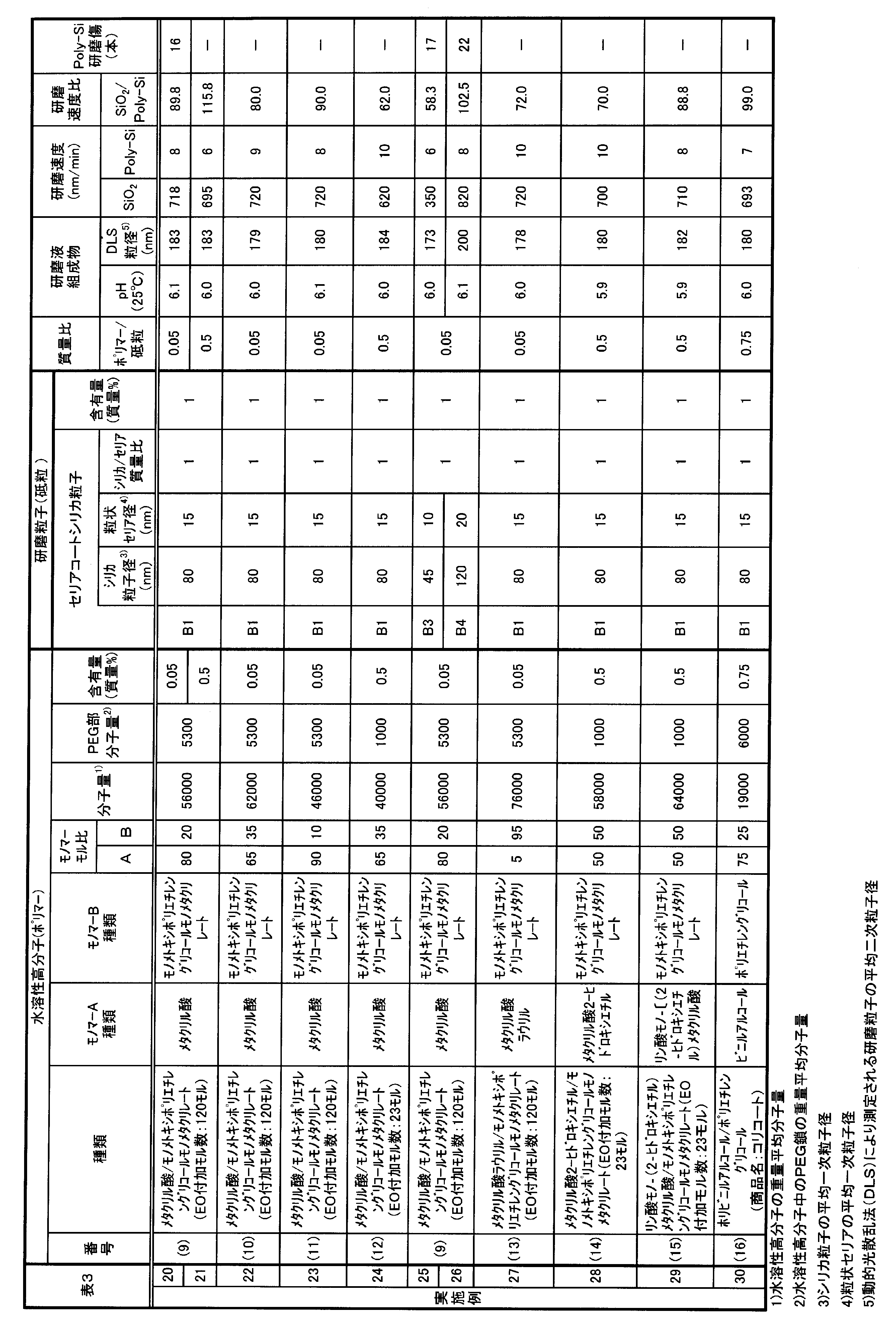
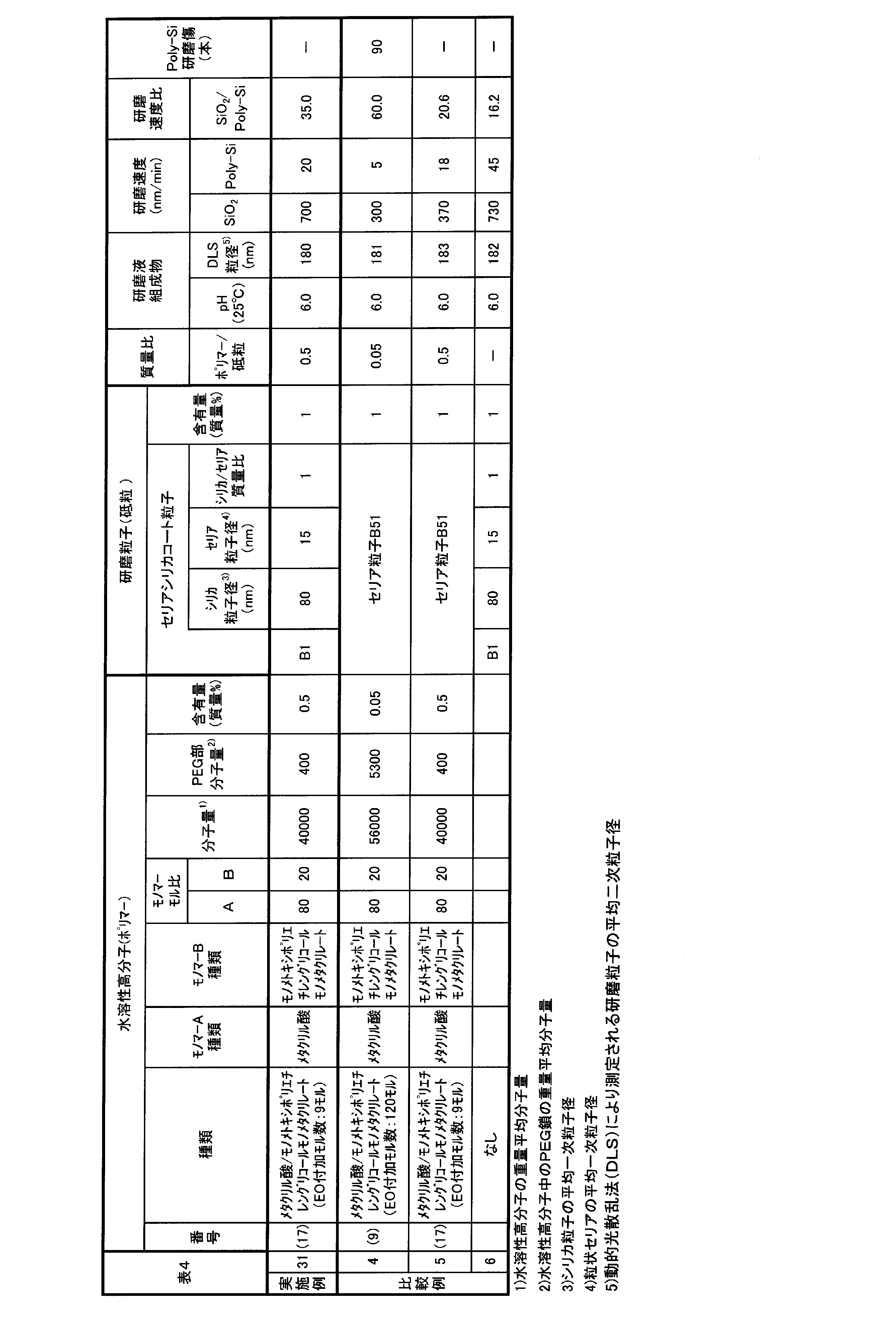
- Examples 2 to 4 were prepared in the same manner as in [Preparation Example 1 of Polishing Liquid Composition], except that the amount of each component was adjusted so that the composition and pH of the polishing liquid composition described in Tables 2 to 4 were obtained. 31 and Comparative Examples 1 to 6 were obtained.
- As a pH adjuster 1 mol / L hydrochloric acid was used when adjusting the pH low, and 1 mass% aqueous ammonia was used when adjusting the pH high.
- a dissolved aqueous solution was dropped, and simultaneously, a 3% by mass aqueous ammonia solution was dropped separately, and cerium was deposited on the spherical silica particles while maintaining the pH at about 8.
- the spherical silica aqueous dispersion was heated to maintain at 50 ° C.
- the reaction solution was aged by heating at 100 ° C. for 4 hours to crystallize the deposited ceria. Thereafter, the obtained particles were separated by filtration and sufficiently washed with water, and then dried at 100 ° C. with a dryer.
- the dried powder obtained in this state may be used for the preparation of the polishing composition, but here the dried powder is further baked at 1000 ° C.
- ceria-coated silica particles B1 having an average primary particle size of 110 nm.
- the silica particle surfaces were coated with granular ceria.
- ⁇ Method 2 for producing ceria-coated silica particles> The method for producing ceria-coated silica particles used for the preparation of the polishing liquid compositions of Examples 8 and 9 is as follows.
- the average amount of cerium nitrate used as the CeO 2 raw material was the same as in the ⁇ Method 1 for producing ceria-coated silica particles> except that the amount was 1/3 of that in the case of ⁇ Method 1 for producing ceria-coated silica particles>.
- Ceria-coated silica particles B2 having a primary particle size of 110 nm were obtained. When the ceria-coated silica particles B2 were observed with a TEM (transmission electron microscope), the silica particle surfaces were coated with granular ceria.
- ⁇ Method 3 for producing ceria-coated silica particles> The method for producing ceria-coated silica particles used for the preparation of the polishing liquid compositions of Examples 10, 11, and 25 is as follows. Instead of a 20% by mass aqueous dispersion of spherical silica particles having an average primary particle diameter of 80 nm (manufactured by JGC Catalysts & Chemicals, Cataloid SI-80PW), spherical silica particles having an average primary particle diameter of 45 nm (manufactured by JGC Catalysts & Chemicals, Ceria-coated silica particles B3 having an average primary particle diameter of 65 nm were obtained in the same manner as in ⁇ Method 1 for producing ceria-coated silica particles> except that a 20% by mass aqueous dispersion of cataloid SI-45P) was used. . When the ceria-coated silica particles B3 were observed with
- ⁇ Method 4 for producing ceria-coated silica particles> The method for producing ceria-coated silica particles used for the preparation of the polishing liquid compositions of Examples 12, 13, and 26 is as follows. Instead of a 20% by mass aqueous dispersion of spherical silica particles having an average primary particle size of 80 nm (manufactured by JGC Catalysts & Chemicals, Cataloid SI-80PW), spherical silica particles having an average primary particle size of 120 nm (manufactured by JGC Catalysts & Chemicals, Ceria-coated silica particles B4 having an average primary particle size of 160 nm were obtained in the same manner as in ⁇ Method 1 for producing ceria-coated silica particles> except that a 20% by mass aqueous dispersion of cataloid SI-120P) was used. .
- ceria-coated silica particles were produced under the condition that all charged ceria sources were precipitated. Therefore, it is inferred that the charged mass ratio (silica / celica) and the mass ratio calculated from the mass of silica and ceria in the dissolved ceria-coated silica particles (silica / ceria) are almost the same. Is done.
- Table 1 shows the zeta potentials of the ceria-coated silica particles B1 to B4 and the ceria particles B51.
- PEGMA EO average addition mole number 120
- PEGMA EO average addition mole number 9 and 23
- the commercial item made by Kyoeisha Chemical
- the product was dissolved in tetrahydrofuran (THF), added dropwise to methanol, and the product was isolated twice to purify the product.
- the obtained purified product was dried under reduced pressure at 60 ° C. all day and night to obtain a polymer (weight average molecular weight 76000, molar ratio 5/95).
- This polymer was dissolved in water to prepare a polymer solution having a solid content concentration of 2% by mass.
- Water-soluble polymer (16) a copolymer of polyvinyl alcohol and polyethylene glycol (trade name Kollicoat, manufactured by BASF) was used.
- B-1 Average secondary particle diameter of abrasive particles measured by dynamic light scattering method (DLS) As the average secondary particle diameter of abrasive particles, an abrasive particle slurry having a solid content concentration of 0.1% by mass is prepared. This was measured by Malvern Co., Ltd., Zetasizer Nano ZS (dynamic light scattering method), and the obtained volume average particle diameter was defined as the above average secondary particle diameter, and is shown as DLS particle diameter in Tables 2-4. It was.
- DLS dynamic light scattering method
- (B-2) Average primary particle diameter of silica particles The average primary particle diameter of silica particles before and after ceria coating was determined by measuring the size of 50 silica particles using images obtained from a TEM (transmission electron microscope). Were obtained on average and are shown in Tables 2 to 4. The average primary particle diameter of the silica particles did not change before and after ceria coating.
- the average primary particle diameter of granular ceria on silica particles is the particle diameter of 100 granular ceria on silica particles using an image obtained from a TEM (transmission electron microscope). Were obtained and averaged, and are shown in Tables 2 to 4.
- powder of ceria-coated silica particles is subjected to powder X-ray diffraction measurement, and the Scherrer formula is used, using the half-width and diffraction angle of the peak of ceria (1,1,1) plane that appears around 29-30 °. It is good also considering the crystallite diameter obtained more as an average primary particle diameter.
- (B-4) Average primary particle diameter of the abrasive particles The average primary particle diameter of the abrasive particles was obtained by measuring the size of 50 abrasive particles using an image obtained from a TEM (transmission electron microscope) and averaging them. Obtained.
- the average primary particle diameters of the ceria-coated silica particles B1 to B4 used for the preparation of the polishing liquid compositions of Examples 1 to 31 and Comparative Example 6 are as described above, and the polishing liquid compositions of Comparative Examples 1 to 5 are the same.
- the average primary particle diameter of the ceria particles B51 used for the preparation was 120 nm.
- (B-5) Zeta potential of abrasive particles 100 g of an ion-exchanged water suspension containing 1% by mass of abrasive particles was prepared and subjected to ultrasonic treatment for 10 minutes to obtain a dispersion. 1 g of the dispersion, 40 g or more of ion-exchanged water, an aqueous hydrochloric acid solution and aqueous ammonia as a pH adjuster are mixed, the abrasive particle concentration is 0.02% by mass, and the pH is 4.0 and 6.0, respectively. A measurement sample of 8.0 was obtained. Using the obtained measurement sample, ⁇ potential was measured by “Zeta Sizer Nano ZS type” manufactured by Malvern.
- (C) Measurement method of weight average molecular weight of polymer Measurement of weight average molecular weight of water-soluble polymers (1) to (17) and weight average molecular weight of PEG chain used in the preparation of polishing liquid compositions of Examples and Comparative Examples The method is as follows. The weight average molecular weight of the water-soluble polymers (1) to (17) and the weight average molecular weight of the PEG chain were measured by gel permeation chromatography (GPC) under the following conditions. [GPC conditions] Detector: Shodex RI SE-61 differential refractive index detector Column: G4000PWXL and G2500PWXL manufactured by Tosoh Corporation were used in series.
- polishing rate of oxide film As a polishing apparatus, “MA-300” manufactured by Musashino Electronics Co., Ltd. having a surface plate diameter of 300 mm was used. As the polishing pad, a hard urethane pad “IC-1000 / Sub400” manufactured by Nitta Haas was used. The polishing pad was attached to the surface plate of the polishing apparatus. The test piece was set in a holder of an apparatus having a diameter of 120 mm, and the holder was placed on the polishing pad so that the surface of the test piece on which the silicon oxide film was formed faced down (so that the oxide film faces the polishing pad).
- a weight was placed on the holder so that the load applied to the test piece was 300 g weight / cm 2 .
- the polishing composition While dropping the polishing composition at a speed of 50 mL / min on the center of the surface plate to which the polishing pad is attached, each of the surface plate and the holder is rotated in the same direction of rotation at 90 r / min for 2 minutes to obtain an oxide film.
- the specimen was polished. After polishing, the substrate was washed with ultrapure water and dried, and the oxide film test piece was used as a measurement object by an optical interference type film thickness measuring device described later.
- polishing rate of polysilicon film Polishing of polysilicon film, measurement of film thickness, and calculation of polishing rate in the same manner as in [Measurement of polishing rate of oxide film] except that a polysilicon film test piece is used instead of an oxide film test piece as a test piece. Went.
- the polishing rates of the polysilicon film (Poly-Si) are shown in Tables 2 to 4 below.
- polishing scratch is a scratch having a length of 1 ⁇ m or more detected by an optical microscope.
- Examples 1 to 31 include ceria-coated silica particles (component B) as abrasive particles and a water-soluble polymer (component A) containing a PEG chain as a polishing aid.
- component B ceria-coated silica particles
- component A water-soluble polymer
- the polishing liquid composition of the present invention exhibits high polishing selectivity that suppresses polishing of a polysilicon film (polishing stop film) as much as possible, and allows polishing of a silicon oxide film to proceed at a high speed. Since generation
Landscapes
- Engineering & Computer Science (AREA)
- Chemical & Material Sciences (AREA)
- Mechanical Engineering (AREA)
- Materials Engineering (AREA)
- Organic Chemistry (AREA)
- Mechanical Treatment Of Semiconductor (AREA)
- Finish Polishing, Edge Sharpening, And Grinding By Specific Grinding Devices (AREA)
Abstract
Description
成分A:ポリエチレングリコール鎖を含む水溶性高分子
成分B:シリカ粒子の表面の少なくとも一部が粒状セリアで被覆されたセリアコートシリカ粒子
成分C:水系媒体
本発明の研磨液組成物は、研磨選択性向上、及び研磨傷の低減の観点から、-(CH2CH2O)n-(ここで、nは、エチレンオキサイド基(EO)の平均付加モル数であり、整数を表わす。)で表わされるPEG鎖を含む水溶性高分子(成分A)を含む。PEG鎖を含む水溶性高分子は、ポリエチレングリコール、PEG鎖を構造内に持つホモポリマー、及びPEG鎖を構造内に持つコポリマーから選ばれる少なくとも1種の水溶性高分子である。当該水溶性高分子は、主鎖にPEG鎖を含む高分子、側鎖にPEG鎖を含む高分子のいずれであってもよく、研磨選択性向上の観点から、好ましくは側鎖にPEG鎖を含む水溶性高分子である。また、当該水溶性高分子は、未中和の状態、アルカリにより中和された状態のどちらでもよい。中和に用いるアルカリはK、Naの水酸化物又はアンモニアが好ましい。ここで、「水溶性」とは、水(20℃)に対して2g/100mL以上の溶解度を有することをいう。
本発明の研磨液組成物に含まれる前記研磨粒子は、高い生産性の為に必要な酸化珪素膜の研磨速度を確保し、研磨傷を低減させる観点から、シリカ粒子の表面の少なくとも一部が粒状セリアで被覆されたセリアコートシリカ粒子(成分B)を含む。
本発明の研磨液組成物は、水系媒体を含有する。水系媒体としては、水、及び水と水に可溶な溶媒との混合物が挙げられる。前記水に可溶な溶媒としては、メタノール、エタノール、イソプロパノール等の低級アルコールが挙げられ、研磨工程での安全性の観点からエタノールが好ましい。また、前記水系媒体としては、半導体基板の品質向上の観点からイオン交換水、蒸留水、超純水等の水からなるとより好ましい。
本発明の研磨液組成物は、本発明の効果を損なわない範囲で、pH調整剤、成分A以外の研磨助剤、研磨粒子として成分B以外の無機粒子等を含有してもよい。これらの任意成分の含有量は、酸化珪素膜の研磨速度確保の観点から、好ましくは0.001質量%以上、より好ましくは0.0025質量%以上、更に好ましくは0.01質量%以上であり、そして、研磨選択性の向上の観点から、好ましくは1質量%以下、より好ましくは0.5質量%以下、更に好ましくは0.1質量%以下である。本発明の研磨液組成物は、研磨後の基板表面の濡れ性向上の観点から、フッ素化合物を含まない方が好ましい。
本発明の研磨液組成物は、PEG鎖を含む水溶性高分子(成分A)、セリアコートシリカ粒子(成分B)及び水系媒体(成分C)を含有する。本発明の研磨液組成物は、例えば、前記水溶性高分子(成分A)、前記水系媒体(成分C)、及び前記セリアコートシリカ粒子(成分B)の水分散液を混合する工程を含む製造方法によって製造できる。好ましくは、研磨助剤としてのPEG鎖を含む水溶性高分子を水系媒体に溶解して得られる研磨助剤水溶液と、セリアコートシリカ粒子を水系媒体に分散して得られるセリアコートシリカ粒子分散液とを用意し、研磨助剤水溶液を攪拌しながら、前記セリアコートシリカ粒子分散液と、必要に応じて前記pH調整剤等のその他の成分を、研磨助剤水溶液に添加(滴下)して研磨液組成物を得ることができる。
本発明の研磨液組成物は、半導体基板の素子分離構造を形成する工程で行われる研磨に好適に使用できる。本発明の半導体基板の製造方法の具体例としては、まず、シリコン基板を酸化炉内で酸素に晒すことよりその表面に二酸化シリコン層を成長させ、次いで、当該二酸化シリコン層上にポリシリコン膜(研磨停止膜)を、例えばCVD法(化学気相成長法)にて形成する。次に、シリコン基板と前記シリコン基板の一方の主面側に配置された研磨停止膜とを含む基板、例えば、シリコン基板の二酸化シリコン層上にポリシリコン膜が形成された基板に、フォトリソグラフィー技術を用いてトレンチを形成する。次いで、例えば、シランガスと酸素ガスを用いたCVD法により、トレンチ埋め込み用の酸化珪素(SiO2)膜を形成し、ポリシリコン膜が酸化珪素膜で覆われた被研磨基板を得る。酸化珪素膜の形成により、前記トレンチは酸化珪素膜の酸化珪素で満たされ、研磨停止膜のシリコン基板側の面の反対面は酸化珪素膜によって被覆される。
成分A:PEG鎖を含む水溶性高分子
成分B:シリカ粒子の表面の少なくとも一部が粒状セリアで被覆されたセリアコートシリカ粒子
成分C:水系媒体
<2> 前記成分Aが含むポリエチレングリコール鎖の重量平均分子量が、好ましくは200以上、より好ましくは300以上、更に好ましくは400以上、更に好ましくは600以上、更に好ましくは1000以上、更に好ましくは2000以上、更に好ましくは3000以上、更に好ましくは4000以上であり、好ましくは200000以下、より好ましくは180000以下、更に好ましくは150000以下、更に好ましくは130000以下、更に好ましくは90000以下、更に好ましくは25000以下、更に好ましくは18000以下、更に好ましくは10000以下、更に好ましくは6500以下である、前記<1>に記載の酸化珪素膜研磨用研磨液組成物。
<3> 前記PEG鎖におけるエチレンオキサイド基の平均付加モル数は、好ましくは5以上、より好ましくは9以上、更に好ましくは13以上、更に好ましくは20以上、更に好ましくは45以上、更に好ましくは65以上、更に好ましくは90以上であり、好ましくは250以下、より好ましくは200以下、更に好ましくは150以下である、前記<2>に記載の酸化珪素膜研磨用研磨液組成物。
<4> 前記水溶性高分子が主鎖にPEG鎖を含む高分子であり、前記PEG鎖の重量平均分子量が、好ましくは200以上、より好ましくは300以上、更に好ましくは600以上、更に好ましくは1000以上、更に好ましくは2000以上、更に好ましくは3000以上、更に好ましくは4000以上であり、好ましくは200000以下、より好ましくは180000以下、更に好ましくは150000以下、更に好ましくは130000以下、更に好ましくは90000以下、更に好ましくは25000以下、更に好ましくは18000以下、更に好ましくは10000以下、更に好ましくは6500以下である、前記<1>に記載の酸化珪素膜研磨用研磨液組成物。
<5> 前記PEG鎖におけるエチレンオキサイド基の平均付加モル数は、好ましくは5以上、より好ましくは13以上、更に好ましくは20以上、更に好ましくは45以上、更に好ましくは65以上、更により好ましくは90以上であり、好ましくは250以下、より好ましくは200以下、更に好ましくは150以下である、前記<4>に記載の酸化珪素膜研磨用研磨液組成物。
<6> 前記水溶性高分子が側鎖にPEG鎖を含む高分子であり、前記PEG鎖の重量平均分子量が、好ましくは200以上、より好ましくは400以上、更に好ましくは1000以上、更に好ましくは4000以上であり、好ましくは10000以下、より好ましくは6500以下、更に好ましくは5500以下である、前記<1>に記載の酸化珪素膜研磨用研磨液組成物。
<7> 前記PEG鎖におけるエチレンオキサイド基の平均付加モル数は、好ましくは4以上、より好ましくは9以上、更に好ましくは20以上、更に好ましくは45以上、更に好ましくは65以上、更により好ましくは90以上であり、好ましくは250以下、より好ましくは200以下、更に好ましくは150以下である、前記<6>に記載の酸化珪素膜研磨用研磨液組成物。
<8> 前記水溶性高分子は、好ましくはアニオン性基を有し、より好ましくはカルボン酸基、硫酸基、及びリン酸基から選ばれる少なくとも1種のアニオン性基を有し、更に好ましくはカルボン酸基、及びリン酸基から選ばれる少なくとも1種のアニオン性基を有し、更により好ましくはカルボン酸基を有する、前記<1>~<7>のいずれかに記載の酸化珪素膜研磨用研磨液組成物。
<9> 前記成分Aが、好ましくはポリエチレングリコール、モノメトキシポリエチレングリコールモノ(メタ)アクリレートの単独重合体、(メタ)アクリル酸とモノメトキシポリエチレングリコールモノ(メタ)アクリレートとの共重合体、(メタ)アクリレートとモノメトキシポリエチレングリコールモノ(メタ)アクリレートとの共重合体、アルキル(メタ)アクリレートと(メタ)アクリル酸とモノメトキシポリエチレングリコールモノ(メタ)アクリレートとの共重合体、ポリビニルアルコールとポリエチレングリコールの共重合体、これらのアルカリ金属塩、及びこれらのアンモニウム塩からなる群から選ばれる少なくとも1種の水溶性高分子であり、より好ましくはポリエチレングリコール、モノメトキシポリエチレングリコールモノ(メタ)アクリレートの単独重合体、(メタ)アクリレートとモノメトキシポリエチレングリコールモノ(メタ)アクリレートとの共重合体、アルキル(メタ)アクリレートと(メタ)アクリル酸とモノメトキシポリエチレングリコールモノ(メタ)アクリレートとの共重合体、これらのアルカリ金属塩、及びこれらのアンモニウム塩からなる群から選ばれる少なくとも1種の水溶性高分子であり、更に好ましくは(メタ)アクリル酸とモノメトキシポリエチレングリコールモノ(メタ)アクリレートとの共重合体、アニオン基を有する(メタ)アクリレートとモノメトキシポリエチレングリコールモノ(メタ)アクリレートとの共重合体、アルキル(メタ)アクリレートと(メタ)アクリル酸とモノメトキシポリエチレングリコールモノ(メタ)アクリレートとの共重合体、これらのアルカリ金属塩、及びこれらのアンモニウム塩からなる群から選ばれる少なくとも1種の水溶性高分子であり、更により好ましくは(メタ)アクリル酸とモノメトキシポリエチレングリコールモノ(メタ)アクリレートとの共重合体、カルボン酸基を有する(メタ)アクリレートとモノメトキシポリエチレングリコールモノ(メタ)アクリレートとの共重合体、リン酸基を有する(メタ)アクリレートとモノメトキシポリエチレングリコールモノ(メタ)アクリレートとの共重合体、これらのアルカリ金属塩、及びこれらのアンモニウム塩からなる群から選ばれる少なくとも1種の水溶性高分子であり、更により好ましくは、メタクリル酸/モノメトキシポリエチレングリコールモノメタクリレート、そのアルカリ金属塩、及びそのアンモニウム塩からなる群から選ばれる少なくとも1種の水溶性高分子である、前記<1>~<8>のいずれかに記載の酸化珪素膜研磨用研磨液組成物。
<10>前記(メタ)アクリレートは、好ましくは(メタ)アクリル酸アルキル(アルキル基の炭素数は、好ましくは1~18、より好ましくは8~16);(メタ)アクリル酸2-ヒドロキシエチル、(メタ)アクリル酸ヒドロキシプロピル等のヒドロキシル基を有する(メタ)アクリレート、(メタ)アクリル酸2―メトキシエチル、(メタ)アククリル酸2―エトキシエチル;リン酸モノ‐(2-ヒドロキシエチル)メタクリル酸,及びリン酸モノ‐(2-ヒドロキシエチル)メタクリル酸アルキル(アルキル基の炭素数は、好ましくは1~18、より好ましくは1~16)等のリン酸基を有する(メタ)アクリレートから選ばれる少なくとも1種である、前記<9>に記載の酸化珪素膜研磨用研磨液組成物。
<11>前記水溶性高分子(成分A)が、(メタ)アクリル酸及び(メタ)アクリレートから選ばれる1種以上のモノマーAとポリエチレングリコール及びポリエチレングリコールのエステルから選ばれる1種以上のモノマーBとの共重合体である場合、共重合体1分子中に含まれるモノマーAに由来の構成単位とモノマーBに由来の構成単位のモル比(モノマーAに由来の構成単位/モノマーBに由来の構成単位)は、好ましくは(5/95)以上、より好ましくは(25/75)以上、更に好ましくは(40/60)以上、更により好ましくは(55/45)以上であり、好ましくは(99/1)以下、より好ましくは(95/5)以下、更に好ましくは(90/10)以下、更により好ましくは(85/15)以下である、前記<1>~<10>のいずれかに記載の酸化珪素膜研磨用研磨液組成物。
<12> 前記水溶性高分子(成分A)の重量平均分子量(Mw)は、好ましくは200以上、より好ましくは300以上、更に好ましくは600以上、更に好ましくは1000以上、更に好ましくは2000以上、更に好ましくは3000以上、更に好ましくは4000以上であり、好ましくは300000以下、より好ましくは270000以下、更により好ましくは150000以下、更に好ましくは130000以下、更に好ましくは90000以下、更に好ましくは25000以下、更に好ましくは18000以下、更に好ましくは10000以下、更に好ましくは6500以下である、前記<1>~<11>のいずれかに記載の酸化珪素膜研磨用研磨液組成物。
<13> 前記水溶性高分子(成分A)の重量平均分子量(Mw)は、主鎖にPEG鎖を含む高分子では、好ましくは200以上、より好ましくは300以上、更に好ましくは600以上、更に好ましくは1000以上、更に好ましくは2000以上、更に好ましくは3000以上、更により好ましくは4000以上であり、好ましくは200000以下、より好ましくは180000以下、更に好ましくは150000以下、更により好ましくは130000以下、更に好ましくは90000以下、更に好ましくは25000以下、更に好ましくは18000以下、更に好ましくは10000以下、更に好ましくは6500以下であり、側鎖にPEG鎖を含む高分子では、好ましくは10000以上、より好ましくは12000以上、更に好ましくは15000以上、更により好ましくは16000以上、更に好ましくは45000以上であり、好ましくは300000以下、より好ましくは290000以下、更に好ましくは280000以下、更に好ましくは270000以下、更に好ましくは90000以下、更に好ましくは70000以下である、前記<1>~<11>のいずれかに記載の酸化珪素膜研磨用研磨液組成物。
<14> 前記水溶性高分子(成分A)の含有量は、前記水溶性高分子(成分A)と前記セリアコートシリカ粒子(成分B)と前記水系媒体(成分C)の質量の合計を100質量%とすると、好ましくは0.05質量%以上、より好ましくは0.1質量%以上、更に好ましくは0.2質量%以上、更により好ましくは0.25質量%以上であり、好ましくは5質量%以下、より好ましくは2.5質量%以下、更に好ましくは1.0質量%以下、更により好ましくは0.75質量%以下である、前記<1>~<13>のいずれかに記載の酸化珪素膜研磨用研磨液組成物。
<15> 前記成分Bが、透過型電子顕微観察により測定される平均一次粒子径が好ましくは15nm以上300nm以下のシリカ粒子が、透過型電子顕微観察により測定される平均一次粒子径が好ましくは5nm以上40nm以下の粒状セリアで被覆され、且つセリアとシリカの質量比(シリカ/セリア)が好ましくは0.5以上4.0以下のセリアコートシリカ粒子である、前記<1>~<14>のいずれかに記載の酸化珪素膜研磨用研磨液組成物。
<16> 前記粒状セリアの前記平均一次粒子径が、より好ましくは7.5nm以上、更に好ましくは10nm以上であり、より好ましくは30nm以下、更に好ましくは25nm以下である、前記<15>に記載の酸化珪素膜研磨用研磨液組成物。
<17> 前記シリカ粒子の前記平均一次粒子径は、より好ましくは20nm以上、更に好ましくは40nm以上であり、より好ましくは200nm以下、更に好ましくは150nm以下である、前記<15>又は<16>に記載の酸化珪素膜研磨用研磨液組成物。
<18> 前記質量比(シリカ/セリア)が、より好ましくは0.67以上、更に好ましくは0.8以上であり、より好ましくは3.0以下、更に好ましくは2.5以下である、前記<15>~<17>のいずれかに記載の酸化珪素膜研磨用研磨液組成物。
<19> 動的光散乱法により測定される前記セリアコートシリカ粒子の平均二次粒子径は、好ましくは100nm以上、より好ましくは150nm以上であり、好ましくは300nm以下、より好ましくは250nm以下である、前記<1>~<18>のいずれかに記載の酸化珪素膜研磨用研磨液組成物。
<20> 前記セリアコートシリカ粒子のpH6におけるζ電位が、好ましくは0mV未満、より好ましくは-25mV以下、更に好ましくは-40mV以下であり、好ましくは-60mV以上である、前記<1>~<19>のいずれかに記載の酸化珪素膜研磨用研磨液組成物。
<21> 前記セリアコートシリカ粒子のpH4におけるζ電位が、好ましくは0mV未満、より好ましくは-25mV以下、更に好ましくは-28mV以下であり、好ましくは-60mV以上である、前記<1>~<20>のいずれかに記載の酸化珪素膜研磨用研磨液組成物。
<22> 前記セリアコートシリカ粒子のpH8におけるζ電位が、好ましくは0mV未満、より好ましくは-25mV以下、更に好ましくは-40mV以下であり、好ましくは-60mV以上である、前記<1>~<21>のいずれかに記載の酸化珪素膜研磨用研磨液組成物。
<23> 前記セリアコートシリカ粒子(成分B)の含有量は、前記水溶性高分子(成分A)とセリアコートシリカ粒子(成分B)と前記水系媒体(成分C)の質量の合計を100質量%とすると、好ましくは0.1質量%以上、より好ましくは0.2質量%以上、更に好ましくは0.25質量%以上、更により好ましくは0.5質量%以上であり、好ましくは5.0質量%以下、より好ましくは2.5質量%以下、更に好ましくは2.0質量%以下、更により好ましくは1.5質量%以下である、前記<1>~<22>のいずれかに記載の酸化珪素膜研磨用研磨液組成物。
<24>前記水溶性高分子(成分A)と前記セリアコートシリカ粒子(成分B)の質量比(水溶性高分子の質量/セリアコートシリカ粒子の質量)は、好ましくは0.02以上、より好ましくは0.1以上、更に好ましくは0.2以上であり、好ましくは25以下、より好ましくは10以下、更に好ましくは1以下である、前記<1>~<23>のいずれかに記載の酸化珪素膜研磨用研磨液組成物。
<25>前記酸化珪素膜研磨用研磨液組成物の25℃におけるpHは、好ましくは3以上、より好ましくは4以上、更に好ましくは5以上、更により好ましくは5.5以上であり、好ましくは9以下、より好ましくは8.5以下、更に好ましくは7.5以下、更により好ましくは6.5以下である、前記<1>~<24>のいずれかに記載の酸化珪素膜研磨用研磨液組成物。
<26> 酸化珪素膜とポリシリコン膜の研磨速度比(酸化珪素膜の研磨速度/ポリシリコン膜の研磨速度)が、好ましくは50以上、より好ましくは52以上、更に好ましくは54以上、更により好ましくは55以上である、前記<1>~<25>のいずれかに記載の酸化珪素膜研磨用研磨液組成物。
<27> 前記酸化珪素膜研磨用研磨液組成物は、使用時混合されるいわゆる2液型であり、上記水系媒体(成分C)が、第1水系媒体と第2水系媒体とに分かれており、前記酸化珪素膜研磨用研磨液組成物は、前記セリアコートシリカ粒子とPEG鎖を含む水溶性高分子の一部を第1水系媒体に分散して得られるセリアコートシリカ粒子分散液と、残余のPEG鎖を含む水溶性高分子を第2水系媒体に溶解して得られる研磨助剤水溶液とから構成されている、前記<1>~<26>のいずれかに記載の酸化珪素膜研磨用研磨液組成物。
<28> 酸化珪素膜と前記酸化珪素膜の下に前記酸化珪素膜に接して配置されたポリシリコン膜を有する被研磨基板の、前記酸化珪素膜を、研磨液組成物を用いて前記ポリシリコン膜上の前記酸化珪素膜が除去されるまで研磨する工程を含み、前記研磨液組成物として、前記<1>~<27>のいずれかに記載の酸化珪素膜研磨用研磨液組成物を用いる、半導体基板の製造方法。
<29> 酸化珪素膜と前記酸化珪素膜の下に前記酸化珪素膜に接して配置されたポリシリコン膜を有する被研磨基板の、前記酸化珪素膜を、研磨液組成物を用いて前記ポリシリコン膜上の前記酸化珪素膜が除去されるまで研磨する工程を含み、前記研磨液組成物として、前記<1>~<27>のいずれかの項に記載の酸化珪素膜研磨用研磨液組成物を用いる、半導体基板の研磨方法。
<30> ポリシリコン膜上の酸化珪素膜を研磨するための、<1>~<27>のいずれかに記載の酸化珪素膜研磨用研磨液組成物の使用。
<31> 半導体基板の製造工程において、酸化珪素膜と前記酸化珪素膜の下に前記酸化珪素膜に接して配置されたポリシリコン膜とを有する被研磨基板の、前記ポリシリコン膜上の前記酸化珪素膜が除去されるまで、前記酸化珪素膜を研磨するための、<1>~<27>のいずれかに記載の酸化珪素膜研磨用研磨液組成物の使用。
〔研磨液組成物の調製例1〕
水溶性高分子(成分A)としてポリエチレングリコールと、イオン交換水とを均一に混合し、研磨助剤水溶液を得た。前記研磨助剤水溶液を攪拌しながら、当該水溶液中に、セリアコートシリカ粒子分散液(分散媒:イオン交換水)と、pH調整剤としての1N塩酸水溶液を加え、更にイオン交換水を加えて濃度調整を行い、実施例1の研磨液組成物を得た。各成分の質量比は、表1に記載した研磨液組成物の組成及びpHとなるように、調整した。尚、表2~4に記載の水溶性高分子と研磨粒子の各含有量は、水溶性高分子と研磨粒子と水系媒体(イオン交換水)の質量の合計を100質量%とした場合の値である。
表2~4に記載した研磨液組成物の組成及びpHとなるように、各成分の量を調整した他は、〔研磨液組成物の調製例1〕と同様の方法で、実施例2~31及び比較例1~6の研磨液組成物を得た。pH調整剤としては、pHを低く調整する場合は1mol/L塩酸を用い、pHを高く調整する場合は1質量%アンモニア水を用いた。
<セリアコートシリカ粒子の製造方法1>
実施例1~7、14~24、27~31、比較例6の研磨液組成物の調製に用いたセリアコートシリカ粒子の製造方法は下記の通りである。まず、平均一次粒子径が80nmの球状シリカ粒子(日揮触媒化成工業製、カタロイドSI-80PW)の20質量%水分散液を調製し、当該球状シリカ水分散液に、CeO2原料として硝酸セリウムを溶解させた水溶液を滴下し、同時に3質量%のアンモニア水溶液を別途滴下して、pHを約8に維持しながらセリウムを球状シリカ粒子上に沈着させた。この滴下の間、球状シリカ水分散液は50℃に維持するために加温した。滴下終了後、反応液を100℃に4時間の加熱することにより熟成して、沈着させたセリアを結晶化させた。その後、得られた粒子を濾別、水での洗浄を十分に実施したのち、乾燥機にて100℃で乾燥させた。この状態で得られた乾燥粉を研磨液組成物の調製に使用してもよいが、ここでは更に乾燥粉について1000℃で2時間焼成を行った後、焼成によって相互にくっついた粒子同士を分離するために得られた焼成粉末をほぐして平均一次粒子径が110nmのセリアコートシリカ粒子B1を得た。当該セリアコートシリカ粒子B1をTEM(透過型電子顕微鏡)にて観察したところ、シリカ粒子表面が粒状セリアで被覆されていた。
実施例8、9の研磨液組成物の調製に用いたセリアコートシリカ粒子の製造方法は下記の通りである。
CeO2原料として使用する硝酸セリウム量を<セリアコートシリカ粒子の製造方法1>の場合の1/3量としたこと以外は、<セリアコートシリカ粒子の製造方法1>と同様の方法にて平均一次粒子径が110nmのセリアコートシリカ粒子B2を得た。当該セリアコートシリカ粒子B2をTEM(透過型電子顕微鏡)にて観察したところ、シリカ粒子表面が粒状セリアで被覆されていた。
実施例10、11、25の研磨液組成物の調製に用いたセリアコートシリカ粒子の製造方法は下記の通りである。平均一次粒子径が80nmの球状シリカ粒子(日揮触媒化成工業製、カタロイドSI-80PW)の20質量%水分散液に代えて、平均一次粒子径が45nmの球状シリカ粒子(日揮触媒化成工業製、カタロイドSI-45P)の20質量%水分散液を用いたこと以外は、<セリアコートシリカ粒子の製造方法1>と同様の方法にて平均一次粒子径が65nmのセリアコートシリカ粒子B3を得た。当該セリアコートシリカ粒子B3をTEM(透過型電子顕微鏡)にて観察したところ、シリカ粒子表面が粒状セリアで被覆されていた。
実施例12、13、26の研磨液組成物の調製に用いたセリアコートシリカ粒子の製造方法は下記の通りである。平均一次粒子径が80nmの球状シリカ粒子(日揮触媒化成工業製、カタロイドSI-80PW)の20質量%水分散液に代えて、平均一次粒子径が120nmの球状シリカ粒子(日揮触媒化成工業製、カタロイドSI-120P)の20質量%水分散液を用いたこと以外は、<セリアコートシリカ粒子の製造方法1>と同様の方法にて平均一次粒子径が160nmのセリアコートシリカ粒子B4を得た。

後述の[水溶性高分子の合成方法又はその詳細]において、PEGMA(EO平均付加モル数120)は、特許第3874917号に記載の方法に準じて、エステル化反応により合成し、未反応物として残留するメタクリル酸を留去により、1重量%未満にしたものを用いた。尚、EO平均付加モル数9及び23のPEGMAについては、市販品(共栄社化学製)を用いた。
<水溶性高分子(1)~(6)の詳細>
重量平均分子量300、600、2000、6000、20000、又は100000のポリエチレングリコール(1)~(6)として、市販品(和光純薬工業製)を用いた。
水溶性高分子(7)及び水溶性高分子(8)は、各々、特開2012-167053号公報の記載を参考にして合成した。重量平均分子量の調整は、重合開始剤の濃度を調整することで実施した。
温度計、攪拌機、滴下装置、窒素導入菅、及び冷却菅を備えた反応器に、蒸留水281.4gを仕込み、蒸留水を撹拌しながら反応器内を窒素置換をし、窒素雰囲気中で蒸留水を80℃に昇温した。続いて、PEGMA(EO平均付加モル数120) 336.5gとメタクリル酸22.2gと2 -メルカプトエタノール1.89gを水238.2gに溶解したものと、過硫酸アンモニウム3.68gを水45gに溶解したものの二者をそれぞれ1.5時間かけて前記反応器内に滴下した。引き続き、過硫酸アンモニウム1.47gを水1 5gに溶解したものを30分かけて前記反応器内に滴下し、その後1時間同温度(80℃)で熟成した。熟成終了後に48%水酸化ナトリウム18.7gで中和して、重量平均分子量56000のメタクリル酸(MAA)/モノメトキシポリエチレングリコールモノメタクリレート(PEGMA)(モル比:80/20)共重合体を得た。その後、水にて調整して、固形分濃度10質量%のポリマー溶液を得た。
各モノマーの使用量を、PEGMA(EO平均付加モル数120) 3588.3g、メタクリル酸17.2gとしたこと以外は、<水溶性高分子(9)の合成方法>と同様にして、MAA/PEGMA共重合体(重量平均分子量62000、モル比65/35)を得、同様に水にて調整して、固形分濃度10質量%のポリマー溶液を得た。
各モノマーの使用量を、PEGMA(EO平均付加モル数120) 165.8g、メタクリル酸24.0gとしたこと以外は、<水溶性高分子(9)の合成方法>と同様にして、MAA/PEGMA共重合体(重量平均分子量46000、モル比90/10)を得、同様に水にて調整して、固形分濃度10質量%のポリマー溶液を得た。
各モノマーの使用量を、PEGMA(EO平均付加モル数23) 117.2gとメタクリル酸17.2gとしたこと以外は、[水溶性高分子(9)の合成方法]と同様にして、MAA/PEGMA共重合体(重量平均分子量40000、モル比65/35)を得、同様に水にて調整して、固形分濃度10質量%のポリマー溶液を得た。
撹拌機付きガラス製反応容器(四つ口フラスコ)に、PEGMA(EO平均付加モル数120)157.4g及びラウリルメタクリレート0.39gを仕込み、これにアゾビスイソブチロニトリル0.075gを加え、重合溶媒としての酢酸エチル180.0g中で80℃、20時間の条件で重合反応を行った。重合反応終了後、得られた反応液をメタノールに滴下し沈殿させ、生成物を単離した。生成物をテトラヒドロフラン(THF)に溶解し、これをメタノールに滴下し、生成物を単離するという操作を更に二回行い、生成物を精製した。得られた精製物を一昼夜60℃にて減圧乾燥してポリマー(重量平均分子量76000、モル比5/95)を得た。このポリマーを水に溶解させて、固形分濃度2質量%のポリマー溶液を調製した。
撹拌機付きガラス製反応容器(四つ口フラスコ)に水366gを仕込み、水を撹拌しながら容器内を窒素置換し、窒素雰囲気中で水を80℃まで昇温した。PEGMA(EO平均付加モル数23)270gとメタクリル酸2-ヒドロキシエチル32.5gと3-メルカプトプロピオン酸4.5gを混合したものと過硫酸アンモニウム8.4gを水48gに溶解したものの2者を、それぞれ1.5時間かけて、前記反応容器内に滴下した。1時間の熟成後、過硫酸アンモニウム1.8gを水10gに溶解したものを、前記反応容器内に30分かけて滴下し、その後1.5時間同温度(80℃)で熟成した。熟成終了後に32質量%水酸化ナトリウム水溶液44.4gで中和し、重量平均分子量(Mw)が58000、モル比50/50のポリマーを得、水にて調整して、固形分濃度10質量%のポリマー溶液を得た。
撹拌機付きガラス製反応容器(四つ口フラスコ)に水366gを仕込み、水を撹拌しながら容器内を窒素置換をし、窒素雰囲気中で水を80℃まで昇温した。PEGMA(EO平均付加モル数23)270gとリン酸モノ-(2-ヒドロキシエチル)メタクリル酸エステル52.4gと3-メルカプトプロピオン酸4.5gを混合したものと過硫酸アンモニウム8.4gを水48gに溶解したものの2者を、それぞれ1.5時間かけて、前記反応容器内に滴下した。1時間の熟成後、過硫酸アンモニウム1.8gを水10gに溶解したものを、前記反応容器内に30分かけて滴下し、その後1.5時間同温度(80℃)で熟成した。熟成終了後に32質量%水酸化ナトリウム水溶液44.4gで中和し、重量平均分子量(Mw)が64000、モル比50/50のポリマーを得、水にて調整して、固形分濃度10質量%のポリマー溶液を得た。
水溶性高分子(16)として、ポリビニルアルコールとポリエチレングリコールの共重合体(商品名コリコート、BASF社製)を用いた。
各モノマーの使用量を、PEGMA(EO平均付加モル数9) 30.2gとメタクリル酸22.2gとしたこと以外は、[水溶性高分子(9)の合成方法]と同様にして、MAA/PEGMA共重合体(重量平均分子量40000、モル比80/20)を得、同様に水にて調整して、固形分濃度10質量%のポリマー溶液を得た。
(a)研磨液組成物のpH測定
研磨液組成物の25℃におけるpH値は、pHメータ(東亜電波工業株式会社、HM-30G)を用いて測定した値であり、電極の研磨液組成物への浸漬後1分後の数値である。
研磨粒子の平均二次粒子径は、固形分濃度が0.1質量%の研磨粒子スラリーを準備し、これをマルバーン社製、ゼータサイザーナノZS(動的光散乱法)にて測定し、得られた体積平均粒子径を前記平均二次粒子径とし、表2~4においてDLS粒径として示した。
セリアコート前後のシリカ粒子の平均一次粒子径は、TEM(透過型電子顕微鏡)より得られる画像を用い、シリカ粒子50個の大きさを計測しこれらを平均して得、表2~4に示した。シリカ粒子の平均一次粒子径は、セリアコート前後で変動はなかった。
シリカ粒子上の粒状セリアの平均一次粒子径は、TEM(透過型電子顕微鏡)より得られる画像を用い、シリカ粒子上の粒状セリア100個の粒子径を計測し、これらを平均して得、表2~4に示した。別法として、セリアコートシリカ粒子の粉体を粉末X線回折測定にかけ、29~30°付近に出現するセリアの(1,1,1)面のピークの半値幅、回折角度を用い、シェラー式より得られる結晶子径を平均一次粒子径としてもよい。
シェラー式:結晶子径(Å)=K×λ/(β×cosθ)
K:シェラー定数、λ:X線の波長=1.54056Å、β:半値幅、θ:回折角2θ/θ
研磨粒子の平均一次粒子径は、TEM(透過型電子顕微鏡)より得られる画像を用い、研磨粒子50個の大きさを計測しこれらを平均して得た。実施例1~31及び比較例6の研磨液組成物の調製に用いたセリアコートシリカ粒子B1~B4の平均一次粒子径は、上記のとおりであり、比較例1~5の研磨液組成物の調製に用いたセリア粒子B51の平均一次粒子径は、120nmであった。
研磨粒子を1質量%含有するイオン交換水懸濁液を100g調製し、10分間超音波処理して分散液を得た。前記分散液1gと、イオン交換水40g以上と、pH調整剤として塩酸水溶液及びアンモニア水とを混合し、研磨粒子濃度が0.02質量%であって、pHがそれぞれ4.0、6.0、8.0の測定試料を得た。得られた測定試料を用い、マルバーン社製「ゼータサイザーナノZS型」により、ζ電位を測定した。
実施例及び比較例の研磨液組成物の調製に用いた水溶性高分子(1)~(17)の重量平均分子量及びPEG鎖の重量平均分子量の測定方法は下記の通りである。
水溶性高分子(1)~(17)の重量平均分子量及びPEG鎖の重量平均分子量は、ゲル・パーミエーション・クロマトグラフィー(GPC)によって下記条件で測定した。
[GPC条件]
検出器:ショーデックスRI SE-61示差屈折率検出器
カラム:東ソー株式会社製のG4000PWXLとG2500PWXLを直列につないだものを使用した。
溶離液:0.2Mリン酸緩衝液/アセトニトリル=90/10(容量比)で0.5g/100mLの濃度に調整し、20μLを用いた。
カラム温度:40℃
流速:1.0mL/min
標準ポリマー:分子量が既知の単分散ポリエチレングリコール
[試験片の作成]
シリコンウェーハの片面に、TEOS-プラズマCVD法で厚さ2000nmの酸化珪素膜(酸化膜)を形成したものから、40mm×40mmの正方形片を切り出し、酸化膜試験片を得た。同様に、シリコンウェーハの片面に、まず熱酸化膜を100nm形成させたのち、CVD法で厚さ500nmのポリシリコン膜(Poly-Si膜)を形成したものから、40mm×40mmの正方形片を切り出し、ポリシリコン膜試験片を得た。
研磨装置として、定盤径300mmのムサシノ電子社製「MA-300」を用いた。また、研磨パッドとしては、ニッタ・ハース社製の硬質ウレタンパッド「IC-1000/Sub400」を用いた。前記研磨装置の定盤に、前記研磨パッドを貼り付けた。前記試験片を直径120mmの装置のホルダーにセットし、試験片の酸化珪素膜を形成した面が下になるように(酸化膜が研磨パッドに面するように)ホルダーを研磨パッドに載せた。さらに、試験片にかかる荷重が300g重/cm2となるように、錘をホルダーに載せた。研磨パッドを貼り付けた定盤の中心に、研磨液組成物を50mL/minの速度で滴下しながら、定盤及びホルダーのそれぞれを同じ回転方向に90r/minで2分間回転させて、酸化膜試験片の研磨を行った。研磨後、超純水を用いて洗浄し、乾燥して、酸化膜試験片を後述の光干渉式膜厚測定装置による測定対象とした。
酸化膜(SiO2)の研磨速度(nm/min)
=[研磨前の酸化膜厚さ(nm)-研磨後の酸化膜厚さ(nm)]/研磨時間(min)
試験片として酸化膜試験片の代わりにポリシリコン膜試験片を用いること以外は、前記[酸化膜の研磨速度の測定]と同様に、ポリシリコン膜の研磨、膜厚の測定及び研磨速度の算出を行った。ポリシリコン膜(Poly-Si)の研磨速度を下記表2~4に示す。
酸化珪素膜の研磨速度に対するポリシリコン膜の研磨速度の比(SiO2/Poly-Si)を研磨速度比とし、下記式により算出した。研磨速度比の値が大きいほど、研磨選択性が良好であるため、段差解消に対する能力が高い。結果を下記表2~4に示す。
研磨速度比(SiO2/Poly-Si)
=酸化珪素膜の研磨速度(nm/min)/ポリシリコン膜の研磨速度(nm/min)
測定機器:光学顕微鏡(ビジョンテック社製、VMX-3100)
評価:研磨後、洗浄及び乾燥した、ポリシリコン膜試験片を平坦基板に貼り付け、光源を照射後、暗視野条件で観察して、研磨傷を計測した。尚、本開示において「研磨傷」とは、光学顕微鏡により検出される長さが1μm以上の傷である。

Claims (11)
- ポリシリコン膜上の酸化珪素膜を研磨する酸化珪素膜研磨用研磨液組成物であって、下記成分A~Cを含む、酸化珪素膜研磨用研磨液組成物。
成分A:ポリエチレングリコール鎖を含む水溶性高分子
成分B:シリカ粒子の表面の少なくとも一部が粒状セリアで被覆されたセリアコートシリカ粒子
成分C:水系媒体 - 前記成分Aが含むポリエチレングリコール鎖の重量平均分子量が、1000以上200000以下である、請求項1に記載の酸化珪素膜研磨用研磨液組成物。
- 前記成分Bは、平均一次粒子径が15nm以上300nm以下のシリカ粒子が平均一次粒子径が5nm以上40nm以下の粒状セリアで被覆され、且つセリアとシリカの質量比(シリカ/セリア)が0.5以上4.0以下のセリアコートシリカ粒子である、請求項1又は2に記載の酸化珪素膜研磨用研磨液組成物。
- 前記水溶性高分子は、アニオン性基を更に有する請求項1から3のいずれかの項に記載の酸化珪素膜研磨用研磨液組成物。
- 前記成分Aが、ポリエチレングリコール、モノメトキシポリエチレングリコールモノ(メタ)アクリレートの単独重合体、(メタ)アクリレートとモノメトキシポリエチレングリコールモノ(メタ)アクリレートとの共重合体、アルキル(メタ)アクリレートと(メタ)アクリル酸とモノメトキシポリエチレングリコールモノ(メタ)アクリレートとの共重合体、これらのアルカリ金属塩、及びこれらのアンモニウム塩からなる群から選ばれる少なくとも1種の水溶性高分子である、請求項1から4のいずれかの項に記載の酸化珪素膜研磨用研磨液組成物。
- 前記酸化珪素膜研磨用研磨液組成物中の前記成分Aの含有量は、前記水溶性高分子(成分A)と前記セリアコートシリカ粒子(成分B)と前記水系媒体(成分C)の質量の合計を100質量%とすると、0.05質量%以上5質量%以下である請求項1から5のいずれかの項に記載の酸化珪素膜研磨用研磨液組成物。
- 酸化珪素膜とポリシリコン膜の研磨速度比(酸化珪素膜の研磨速度/ポリシリコン膜の研磨速度)が50以上である、請求項1から6のいずれかの項に記載の酸化珪素膜研磨用研磨液組成物。
- 酸化珪素膜と前記酸化珪素膜の下に前記酸化珪素膜に接して配置されたポリシリコン膜を有する被研磨基板の、前記酸化珪素膜を、研磨液組成物を用いて前記ポリシリコン膜上の前記酸化珪素膜が除去されるまで研磨する工程を含み、
前記研磨液組成物として、請求項1から7のいずれかの項に記載の酸化珪素膜研磨用研磨液組成物を用いる、半導体基板の製造方法。 - 酸化珪素膜と前記酸化珪素膜の下に前記酸化珪素膜に接して配置されたポリシリコン膜を有する被研磨基板の、前記酸化珪素膜を、研磨液組成物を用いて前記ポリシリコン膜上の前記酸化珪素膜が除去されるまで研磨する工程を含み、
前記研磨液組成物として、請求項1から7のいずれかの項に記載の酸化珪素膜研磨用研磨液組成物を用いる、半導体基板の研磨方法。 - ポリシリコン膜上の酸化珪素膜を研磨するための、請求項1から7のいずれかに記載の酸化珪素膜研磨用研磨液組成物の使用。
- 半導体基板の製造工程において、酸化珪素膜と前記酸化珪素膜の下に前記酸化珪素膜に接して配置されたポリシリコン膜とを有する被研磨基板の、前記ポリシリコン膜上の前記酸化珪素膜が除去されるまで、前記酸化珪素膜を研磨するための、請求項1から7のいずれかに記載の酸化珪素膜研磨用研磨液組成物の使用。
Priority Applications (2)
| Application Number | Priority Date | Filing Date | Title |
|---|---|---|---|
| SG11201705202PA SG11201705202PA (en) | 2014-12-26 | 2015-12-24 | Polishing solution composition for silicon oxide film polishing |
| JP2016566446A JP6563957B2 (ja) | 2014-12-26 | 2015-12-24 | 酸化珪素膜研磨用研磨液組成物 |
Applications Claiming Priority (2)
| Application Number | Priority Date | Filing Date | Title |
|---|---|---|---|
| JP2014266685 | 2014-12-26 | ||
| JP2014-266685 | 2014-12-26 |
Publications (1)
| Publication Number | Publication Date |
|---|---|
| WO2016104611A1 true WO2016104611A1 (ja) | 2016-06-30 |
Family
ID=56150624
Family Applications (1)
| Application Number | Title | Priority Date | Filing Date |
|---|---|---|---|
| PCT/JP2015/086041 Ceased WO2016104611A1 (ja) | 2014-12-26 | 2015-12-24 | 酸化珪素膜研磨用研磨液組成物 |
Country Status (4)
| Country | Link |
|---|---|
| JP (1) | JP6563957B2 (ja) |
| SG (1) | SG11201705202PA (ja) |
| TW (1) | TWI680167B (ja) |
| WO (1) | WO2016104611A1 (ja) |
Cited By (6)
| Publication number | Priority date | Publication date | Assignee | Title |
|---|---|---|---|---|
| JP2023506487A (ja) * | 2019-12-12 | 2023-02-16 | バーサム マテリアルズ ユーエス,リミティド ライアビリティ カンパニー | 低酸化物トレンチディッシングシャロートレンチアイソレーション化学的機械平坦化研磨 |
| WO2023084951A1 (ja) * | 2021-11-15 | 2023-05-19 | 東亞合成株式会社 | 化学機械研磨用の添加剤及びその製造方法、並びに、研磨液組成物 |
| JP2023072896A (ja) * | 2021-11-15 | 2023-05-25 | 東亞合成株式会社 | 化学機械研磨用の添加剤及びその製造方法、並びに、研磨液組成物 |
| CN116656244A (zh) * | 2023-07-20 | 2023-08-29 | 包头天骄清美稀土抛光粉有限公司 | 用于鳍式场效应晶体管的化学机械抛光组合物及制备方法 |
| JP2024516576A (ja) * | 2021-04-16 | 2024-04-16 | インテグリス・インコーポレーテッド | 誘電材料を研磨するためのcmp組成物 |
| WO2025023040A1 (ja) * | 2023-07-21 | 2025-01-30 | Agc株式会社 | 研磨剤及びその製造方法、研磨剤用添加液の製造方法、研磨方法、並びに、半導体部品の製造方法 |
Families Citing this family (1)
| Publication number | Priority date | Publication date | Assignee | Title |
|---|---|---|---|---|
| US11549034B2 (en) * | 2018-08-09 | 2023-01-10 | Versum Materials Us, Llc | Oxide chemical mechanical planarization (CMP) polishing compositions |
Citations (6)
| Publication number | Priority date | Publication date | Assignee | Title |
|---|---|---|---|---|
| JP2003297781A (ja) * | 2002-02-05 | 2003-10-17 | Degussa Ag | 水性分散液、その製造方法及びその使用 |
| JP2009212378A (ja) * | 2008-03-05 | 2009-09-17 | Hitachi Chem Co Ltd | Cmp研磨液、基板の研磨方法及び電子部品 |
| JP2012238831A (ja) * | 2011-01-25 | 2012-12-06 | Hitachi Chem Co Ltd | Cmp研磨液及びその製造方法、複合粒子の製造方法、並びに基体の研磨方法 |
| WO2013125446A1 (ja) * | 2012-02-21 | 2013-08-29 | 日立化成株式会社 | 研磨剤、研磨剤セット及び基体の研磨方法 |
| JP2015054970A (ja) * | 2013-09-12 | 2015-03-23 | ユービーマテリアルズ インコーポレイテッド | 研磨粒子の製造方法及び研磨スラリーの製造方法 |
| JP2015054967A (ja) * | 2013-09-12 | 2015-03-23 | ユービーマテリアルズ インコーポレイテッド | 研磨粒子、研磨スラリー及びこれを用いた半導体素子の製造方法 |
Family Cites Families (1)
| Publication number | Priority date | Publication date | Assignee | Title |
|---|---|---|---|---|
| TWI361830B (en) * | 2006-10-13 | 2012-04-11 | Anji Microelectronics Co Ltd | Chemical mechanical polishing slurry for polishing polysilicon |
-
2015
- 2015-12-24 SG SG11201705202PA patent/SG11201705202PA/en unknown
- 2015-12-24 WO PCT/JP2015/086041 patent/WO2016104611A1/ja not_active Ceased
- 2015-12-24 JP JP2016566446A patent/JP6563957B2/ja active Active
- 2015-12-25 TW TW104143898A patent/TWI680167B/zh active
Patent Citations (6)
| Publication number | Priority date | Publication date | Assignee | Title |
|---|---|---|---|---|
| JP2003297781A (ja) * | 2002-02-05 | 2003-10-17 | Degussa Ag | 水性分散液、その製造方法及びその使用 |
| JP2009212378A (ja) * | 2008-03-05 | 2009-09-17 | Hitachi Chem Co Ltd | Cmp研磨液、基板の研磨方法及び電子部品 |
| JP2012238831A (ja) * | 2011-01-25 | 2012-12-06 | Hitachi Chem Co Ltd | Cmp研磨液及びその製造方法、複合粒子の製造方法、並びに基体の研磨方法 |
| WO2013125446A1 (ja) * | 2012-02-21 | 2013-08-29 | 日立化成株式会社 | 研磨剤、研磨剤セット及び基体の研磨方法 |
| JP2015054970A (ja) * | 2013-09-12 | 2015-03-23 | ユービーマテリアルズ インコーポレイテッド | 研磨粒子の製造方法及び研磨スラリーの製造方法 |
| JP2015054967A (ja) * | 2013-09-12 | 2015-03-23 | ユービーマテリアルズ インコーポレイテッド | 研磨粒子、研磨スラリー及びこれを用いた半導体素子の製造方法 |
Cited By (11)
| Publication number | Priority date | Publication date | Assignee | Title |
|---|---|---|---|---|
| JP2023506487A (ja) * | 2019-12-12 | 2023-02-16 | バーサム マテリアルズ ユーエス,リミティド ライアビリティ カンパニー | 低酸化物トレンチディッシングシャロートレンチアイソレーション化学的機械平坦化研磨 |
| JP7667785B2 (ja) | 2019-12-12 | 2025-04-23 | バーサム マテリアルズ ユーエス,リミティド ライアビリティ カンパニー | 低酸化物トレンチディッシングシャロートレンチアイソレーション化学的機械平坦化研磨 |
| JP2024516576A (ja) * | 2021-04-16 | 2024-04-16 | インテグリス・インコーポレーテッド | 誘電材料を研磨するためのcmp組成物 |
| JP7749692B2 (ja) | 2021-04-16 | 2025-10-06 | インテグリス・インコーポレーテッド | 誘電材料を研磨するためのcmp組成物 |
| WO2023084951A1 (ja) * | 2021-11-15 | 2023-05-19 | 東亞合成株式会社 | 化学機械研磨用の添加剤及びその製造方法、並びに、研磨液組成物 |
| JPWO2023084951A1 (ja) * | 2021-11-15 | 2023-05-19 | ||
| JP2023072896A (ja) * | 2021-11-15 | 2023-05-25 | 東亞合成株式会社 | 化学機械研磨用の添加剤及びその製造方法、並びに、研磨液組成物 |
| JP7740360B2 (ja) | 2021-11-15 | 2025-09-17 | 東亞合成株式会社 | 化学機械研磨用の添加剤及びその製造方法、並びに、研磨液組成物 |
| JP7815701B2 (ja) | 2021-11-15 | 2026-02-18 | 東亞合成株式会社 | 化学機械研磨用の添加剤及びその製造方法、並びに、研磨液組成物 |
| CN116656244A (zh) * | 2023-07-20 | 2023-08-29 | 包头天骄清美稀土抛光粉有限公司 | 用于鳍式场效应晶体管的化学机械抛光组合物及制备方法 |
| WO2025023040A1 (ja) * | 2023-07-21 | 2025-01-30 | Agc株式会社 | 研磨剤及びその製造方法、研磨剤用添加液の製造方法、研磨方法、並びに、半導体部品の製造方法 |
Also Published As
| Publication number | Publication date |
|---|---|
| TWI680167B (zh) | 2019-12-21 |
| TW201629169A (zh) | 2016-08-16 |
| SG11201705202PA (en) | 2017-07-28 |
| JP6563957B2 (ja) | 2019-08-21 |
| JPWO2016104611A1 (ja) | 2017-10-12 |
Similar Documents
| Publication | Publication Date | Title |
|---|---|---|
| JP6563957B2 (ja) | 酸化珪素膜研磨用研磨液組成物 | |
| JP6352060B2 (ja) | 酸化珪素膜研磨用研磨液組成物 | |
| JP6422325B2 (ja) | 半導体基板用研磨液組成物 | |
| US8900335B2 (en) | CMP polishing slurry and method of polishing substrate | |
| JP3649279B2 (ja) | 基板の研磨方法 | |
| TWI763779B (zh) | 研磨用組成物、其製造方法以及使用此組成物之研磨方法及基板之製造方法 | |
| JP6375623B2 (ja) | 研磨剤、研磨剤セット及び基体の研磨方法 | |
| JP5552475B2 (ja) | 酸化セリウム製造方法、これから得られる酸化セリウムおよびこれを含むcmpスラリー | |
| JP6510812B2 (ja) | 酸化珪素膜研磨用研磨粒子 | |
| JP4963825B2 (ja) | 研磨用シリカゾルおよびそれを含有してなる研磨用組成物 | |
| JP2009290188A (ja) | 研磨剤及び研磨方法 | |
| KR102942538B1 (ko) | 연마용 조성물, 연마 방법 및 반도체 기판의 제조 방법 | |
| TW201829679A (zh) | 二氧化鈰研磨粒 | |
| TW202142644A (zh) | 研磨用組合物、研磨方法及半導體基板之製造方法 | |
| JP6783609B2 (ja) | 金属酸化物粒子分散液 | |
| JP7356932B2 (ja) | 研磨用組成物及び研磨方法 | |
| KR101874999B1 (ko) | 화학-기계적 연마 슬러리 조성물 | |
| JP6797665B2 (ja) | 研磨液組成物 | |
| WO2022004197A1 (ja) | 砥粒の製造方法、化学機械研磨用組成物及び化学機械研磨方法 | |
| WO2013175976A1 (ja) | Cmp用研磨材組成物及び該cmp用研磨材組成物を使用したデバイスウェハの製造方法 | |
| JP6958774B1 (ja) | 砥粒の製造方法、化学機械研磨用組成物及び化学機械研磨方法 | |
| JP4604727B2 (ja) | Cmp研磨剤用添加液 | |
| JP4608925B2 (ja) | Cmp研磨剤用添加液 | |
| JP4501694B2 (ja) | Cmp研磨剤用添加液 | |
| WO2025115883A1 (ja) | 研磨組成物 |
Legal Events
| Date | Code | Title | Description |
|---|---|---|---|
| 121 | Ep: the epo has been informed by wipo that ep was designated in this application |
Ref document number: 15873179 Country of ref document: EP Kind code of ref document: A1 |
|
| ENP | Entry into the national phase |
Ref document number: 2016566446 Country of ref document: JP Kind code of ref document: A |
|
| NENP | Non-entry into the national phase |
Ref country code: DE |
|
| WWE | Wipo information: entry into national phase |
Ref document number: 11201705202P Country of ref document: SG |
|
| 122 | Ep: pct application non-entry in european phase |
Ref document number: 15873179 Country of ref document: EP Kind code of ref document: A1 |