WO2016063336A1 - 情報端末装置、テレビ放送受信装置、およびコンテンツの提供方法 - Google Patents
情報端末装置、テレビ放送受信装置、およびコンテンツの提供方法 Download PDFInfo
- Publication number
- WO2016063336A1 WO2016063336A1 PCT/JP2014/077879 JP2014077879W WO2016063336A1 WO 2016063336 A1 WO2016063336 A1 WO 2016063336A1 JP 2014077879 W JP2014077879 W JP 2014077879W WO 2016063336 A1 WO2016063336 A1 WO 2016063336A1
- Authority
- WO
- WIPO (PCT)
- Prior art keywords
- unit
- viewing
- information terminal
- content
- terminal device
- Prior art date
- Legal status (The legal status is an assumption and is not a legal conclusion. Google has not performed a legal analysis and makes no representation as to the accuracy of the status listed.)
- Ceased
Links
Images









Classifications
-
- H—ELECTRICITY
- H04—ELECTRIC COMMUNICATION TECHNIQUE
- H04N—PICTORIAL COMMUNICATION, e.g. TELEVISION
- H04N21/00—Selective content distribution, e.g. interactive television or video on demand [VOD]
- H04N21/40—Client devices specifically adapted for the reception of or interaction with content, e.g. set-top-box [STB]; Operations thereof
- H04N21/43—Processing of content or additional data, e.g. demultiplexing additional data from a digital video stream; Elementary client operations, e.g. monitoring of home network or synchronising decoder's clock; Client middleware
- H04N21/442—Monitoring of processes or resources, e.g. detecting the failure of a recording device, monitoring the downstream bandwidth, the number of times a movie has been viewed, the storage space available from the internal hard disk
-
- H—ELECTRICITY
- H04—ELECTRIC COMMUNICATION TECHNIQUE
- H04N—PICTORIAL COMMUNICATION, e.g. TELEVISION
- H04N21/00—Selective content distribution, e.g. interactive television or video on demand [VOD]
- H04N21/40—Client devices specifically adapted for the reception of or interaction with content, e.g. set-top-box [STB]; Operations thereof
- H04N21/45—Management operations performed by the client for facilitating the reception of or the interaction with the content or administrating data related to the end-user or to the client device itself, e.g. learning user preferences for recommending movies, resolving scheduling conflicts
- H04N21/462—Content or additional data management e.g. creating a master electronic programme guide from data received from the Internet and a Head-end or controlling the complexity of a video stream by scaling the resolution or bit-rate based on the client capabilities
Definitions
- the present invention relates to an information terminal device, a television broadcast receiving device, and a content providing method, and more particularly to a technique effective for providing content to the information terminal device.
- Recent television broadcast receiving apparatuses are provided with a viewing reservation or recording reservation function in order to prevent a user from overlooking a program that the user wants to view.
- a viewing reservation or recording reservation function there is, for example, Japanese Patent Application Laid-Open No. 2011-114661 (Patent Document 1).
- Patent Document 1 Japanese Patent Application Laid-Open No. 2011-114661
- Patent Document 1 Japanese Patent Application Laid-Open No. 2011-114661
- the video information reproducing apparatus specifies a reservation terminal for performing viewing reservation, and if the reservation terminal does not exist in the vicinity even when the reservation date and time is reached, the viewing reservation is made. The recorded video is recorded.
- the usability for the user may not be sufficient in various usage environments and usage situations. For example, when you try to record a program reserved for viewing, if it overlaps with the time of another program that has already been reserved for recording, or if the storage capacity for recording is insufficient, the program reserved for viewing There is a possibility that the problem that the video cannot be recorded. Furthermore, there is a problem that it is impossible to cope with various situations such as inability to view live broadcasts of sports programs in real time.
- An object of the present invention is to provide a technique capable of improving user convenience by presenting an optimal content providing mode.
- a typical information terminal device includes a reception unit, a content communication unit, a display unit, a radio wave intensity detection unit, and a determination control processing unit.
- the receiving unit receives broadcast waves.
- the content communication unit receives content distributed via a network.
- the display unit displays content distributed over the network from a television broadcast receiving device that receives broadcast waves or broadcast wave content received by the receiving unit.
- the radio wave intensity detection unit detects the radio wave intensity of the broadcast wave received by the reception unit.
- the determination control processing unit determines the provision mode of the content reserved for viewing based on the radio field intensity of the radio field intensity detection unit and whether or not the network distribution by the television broadcast receiving apparatus is possible, and displays the content on the display unit.
- the judgment control processing unit inquires of the television broadcast receiving device whether or not network distribution is possible. Then, when the radio wave intensity detected by the radio wave intensity detection unit is at a level at which broadcast waves can be stably received and the inquiry result can be distributed over the network, the reception unit receives the broadcast waves and provides the content. It is determined that the first providing mode and the second providing mode for providing content by network distribution can be used, and the first and second providing modes are displayed on the display unit, respectively.
- the receiving unit receives the broadcast wave and provides the content when the radio wave intensity is at a level at which the broadcast wave can be stably received but the reply from the TV broadcast receiving apparatus is not network-distributable. It judges that it can utilize, and displays a 1st provision mode on a display part.
- the provision mode for providing content by network distribution from the TV broadcast receiving device is used.
- the second mode is displayed on the display unit by determining that it is possible.
- a typical television broadcast receiving apparatus includes a broadcast receiving unit that receives broadcast waves of a television broadcast, a communication unit that distributes content received by the broadcast receiving unit over a network, and an information terminal device that is connected via the network.
- a distribution determination unit that determines whether or not network distribution is possible when an inquiry about whether or not network distribution is possible is received.
- the distribution determination unit determines whether or not the information terminal device is an authenticated device, and when it is determined that the information terminal device is an authenticated device, network distribution to the information terminal device is possible When it is determined that the information terminal device is not an authenticated device, the information terminal device is replied that network distribution is impossible.
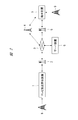
- FIG. 1 It is explanatory drawing which shows an example of a structure in the television broadcast program provision system by this Embodiment 1.
- FIG. 1 It is explanatory drawing which shows the other example of the structure in the television broadcast program provision system by this Embodiment 1.
- FIG. 11 is an explanatory diagram illustrating an example of a screen display displayed on the information terminal device in the processes of steps S401B to S401E of FIG. It is a flowchart which shows an example in the process of step S317 of FIG. It is a flowchart which shows an example of a process of step S502 in FIG. FIG.
- FIG. 14 is an explanatory diagram showing an example of display on the mobile terminal device in the processing of steps S502B to S502D in FIG. It is explanatory drawing which shows an example of the display of the portable terminal device by the process of step S511 in FIG. 12 is a flowchart illustrating a detailed operation example of viewing reservation message processing according to the second embodiment. It is a flowchart which shows an example of a process of step S604 of FIG. It is explanatory drawing which shows an example of the display of the portable terminal device by the process of step S604 in FIG. It is a block diagram which shows an example of a structure of the information terminal device by this Embodiment 3. It is a flowchart which shows an example of the process of FIG.8 S310 by the information terminal device and television broadcast receiver of FIG. It is a flowchart which shows an example of a process of step S705 of FIG.
- the constituent elements are not necessarily indispensable unless otherwise specified and apparently essential in principle. Needless to say.
- FIG. 1 is an explanatory diagram showing an example of a configuration in the television broadcast program providing system according to the first embodiment.
- FIG. 2 is an explanatory diagram showing another example of the configuration of the television broadcast program providing system according to the first embodiment.
- FIG. 1 is a schematic diagram illustrating a configuration example when viewing inside the house
- FIG. 2 is a schematic diagram illustrating a configuration example when viewing outside the house.
- the television broadcast program providing system shown in FIG. 1 includes a television broadcast receiving device 1, a router device 2, an information terminal device 7, and a broadcasting station 8.
- the television broadcast program providing system shown in FIG. 2 includes a television broadcast receiving device 1, a router device 2, the Internet 3, a base station 4, a wireless access point 5, a server device 6, an information terminal device 7, and broadcast stations 8 and 9. .
- the television broadcast receiver 1 operates as a master unit that distributes content such as broadcast programs.
- the information terminal device 7 operates as a child device that views content distributed from the television broadcast receiving device 1 that is a parent device. Further, the television broadcast receiving device 1 and the information terminal device 7 receive the broadcast wave transmitted from the broadcast station 8.
- the broadcast station 8 from which the television broadcast receiver 1 receives broadcast waves and the broadcast station 9 from which the information terminal device 7 receives broadcast waves may be the same broadcast station.
- the information terminal device 7 has a wireless communication function such as Wi-Fi (registered trademark), is connected to a local network or the Internet via the router device 2 or the wireless access point 5, and is connected to the television broadcast receiving device 1. Information such as broadcast programs can be transmitted and received between them.
- Wi-Fi registered trademark
- the information terminal device 7 has mobile communication functions such as W-CDMA (Wideband Code Division Multiple Access), GSM (Global System for Mobile communications) (registered trademark), and LTE (Long Term Evolution).
- W-CDMA Wideband Code Division Multiple Access
- GSM Global System for Mobile communications
- LTE Long Term Evolution
- the information terminal device 7 can connect to the Internet 3 through the base station 4 of the mobile communication network and transmit / receive information such as a broadcast program to / from the television broadcast receiving device 1.
- the server device 6 is a server that provides broadcast program information or the like according to a request from the television broadcast receiving device 1 or the information terminal device 7 via the Internet 3.
- the television broadcast receiving device 1, the router device 2, the wireless access point 5, and the information terminal device 7 each have an IP (Internet Protocol) address for identifying themselves on the Internet. Each communication unit is given a 48-bit MAC (Media Access Control) address.
- IP Internet Protocol
- Each communication unit is given a 48-bit MAC (Media Access Control) address.
- the router device 2 and the wireless access point 5 may be operated as a DHCP server by DHCP (Dynamic Host Configuration Protocol), and the IP address of each device may be assigned from here.
- DHCP Dynamic Host Configuration Protocol
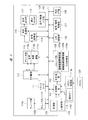
- FIG. 3 is a block diagram illustrating a configuration example of the television broadcast receiver 1 in FIGS. 1 and 2.
- the television broadcast receiver 1 has a system bus 100 as shown in FIG.
- the system bus 100 is a data communication path for performing data transmission / reception between the main control unit 101 and each functional block unit in the television broadcast receiver 1.
- the main control unit 101 serving as a distribution determination unit is configured by, for example, a CPU (Central Processing Unit) and controls the entire television broadcast receiving apparatus 1 according to an operating system, various application programs, and the like stored in the main storage unit 102. .
- a CPU Central Processing Unit
- a LAN (Local Area Network) communication unit 106 as a communication unit is, for example, an Ethernet (registered trademark) port, a wireless interface based on the Wi-Fi standard, or the like.
- the LAN communication unit 106 is connected to the router device 2 shown in FIGS. 1 and 2 by wire or wirelessly, and communicates with the information terminal device 7 via a network including the router device 2.
- the clock unit 103 includes time information included in broadcast signals input via the tuner units 110a and 110b, time information of an NTP (Network (Time Protocol) server on the Internet 3 acquired via the LAN communication unit 106, and the like. Use to manage the time.
- NTP Network (Time Protocol) server on the Internet 3 acquired via the LAN communication unit 106, and the like.
- the operation input unit 118 is an instruction input unit that inputs an operation instruction to the television broadcast receiving apparatus 1.
- the operation input unit 118 includes an operation key 118 a in which button switches are arranged and a remote control reception unit 118 b that receives an infrared signal from the remote control 120. Configured.
- the operation input unit 118 outputs an operation instruction input by the user to the main control unit 101.
- keys 118a for example, keys such as on / off of the main power supply of the television broadcast receiving apparatus 1, channel selection, and volume change are arranged.
- keys such as standby on / off, channel selection, volume change, program guide display, and recording are arranged.
- the main control unit 101 controls the television broadcast receiving apparatus 1 in accordance with an operation key 118a of the user or an input from the remote controller 120.
- the person detection unit 104 is a sensor that detects whether or not there is a person around the television broadcast receiving apparatus 1. For example, the human detection unit 104 detects whether a person is present around by detecting movement of the heat source or detecting a difference between the temperature of the heat source and the ambient temperature.
- the human detection unit 104 includes an amplifier circuit (not shown) and an ADC (Analog-to-Digital Converter) (not shown).
- a detection signal from the human detection unit 104 (hereinafter referred to as a human detection signal) is amplified by an amplifier circuit, converted into a digital signal by an ADC, and supplied to the main control unit 101.
- the temperature change detected by the person detection unit 104 becomes large.
- the temperature change detected by the person detection unit 104 is small.
- the main control unit 101 can determine whether or not there is a person around the television broadcast receiving apparatus 1 by referring to the value of the human detection signal supplied from the human detection unit 104.
- the storage unit 105 includes a linked device management information storage area 105a, a program recording / viewing information storage area 105b, and another information storage area 105c.
- the storage unit 105 includes a storage device such as a flash ROM (Read Only Memory), an SSD (Solid State Drive), or an HDD (Hard Disk Drive).
- the cooperative device management information storage area 105a is an area for storing information related to the information terminal device 7 that cooperates with the television broadcast receiver 1.
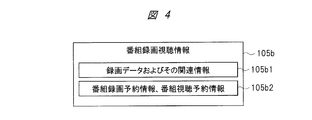
- FIG. 4 is an explanatory diagram showing a detailed configuration example of the program recording / viewing information storage area included in the storage unit 105 of FIG.
- the program recording / viewing information storage area 105b includes at least two storage areas 105b1 and 105b2.
- the storage area 105b1 is an area for storing recorded data of a broadcast program, in other words, a recorded program and various types of information related to the recorded program such as a title of the recorded program and a broadcast time.
- the storage area 105b2 which is a viewing information storage unit, is an area for storing information related to a broadcast program viewing reservation, information related to a broadcast program recording reservation, and the like for the television broadcast receiving apparatus 1.
- the television broadcast receiving apparatus 1 in FIG. 3 functions by downloading a new application from a server outside the home (not shown) via the LAN communication unit 106 and the router apparatus 2 outside the apparatus shown in FIG. It can be extended.
- the downloaded new application is stored in the other information storage area 105c described above.
- the new application stored in the other information storage area 105 c is expanded on the main storage unit 102 and executed by the main control unit 101. Thereby, the television broadcast receiver 1 can implement various new functions.
- the encryption / decryption processing unit 107 distributes the broadcast program input via the tuner units 110 a and 110 b and the recorded data stored in the storage unit 105, that is, the recorded program to the information terminal device 7 and the like via the LAN communication unit 106. When doing so, the content data is encrypted.
- the encryption / decryption processing unit 107 decrypts the content data received by the LAN communication unit 106 via the Internet.
- an encryption method for example, DTCP + (Digital Transmission Content Protection) is used.
- the external interface (I / F) unit 108 is an interface for extending the function of the television broadcast receiving apparatus 1.
- the external interface unit 108 is, for example, a USB (Universal Serial Bus) interface or the like, and is connected to an input device such as a keyboard, a memory card, an HDD device, or the like. Perform input / output.
- a USB Universal Serial Bus
- the TV broadcast receiving apparatus 1 when the TV broadcast receiving apparatus 1 records a broadcast program on an HDD device connected to the outside, the HDD device may be connected to the external interface unit 108.
- the audio / video input unit 109 is for inputting a video signal / audio signal from an external device.
- HDMI High-Definition Multimedia Interface
- the tuner units 110a and 110b serving as broadcast receiving units each receive a broadcast program of television broadcasting. Specifically, the tuner units 110a and 110b respectively extract channel data selected by the user from broadcast waves received by an antenna (not shown).
- the data is not particularly limited, but is TS data in which video / audio or data signals are multiplexed and compression-coded based on the MPEG2-TS (Transport Stream) standard or the like.
- Each of the tuner units 110a and 110b demodulates the TS data and outputs it to the transcoder 111 and the separation unit 112.
- the main control unit 101 selects the separation unit 112, the transcoder 111, or the system bus 100 as a data output destination in the tuner units 110a and 110b.
- the storage unit 105 or the external interface unit 108 is selected.
- the broadcast program received by the tuner units 110a, 110b is recorded in the storage unit 105, a memory card or HDD device connected to the external interface unit 108, etc. can do.
- the tuner units 110a and 110b are both tuner units for terrestrial digital broadcasting.
- terrestrial digital broadcasting for two channels can be received simultaneously.
- a necessary tuner unit can be appropriately selected from various tuner units such as for terrestrial digital broadcasting, BS (Broadcasting Satellite) broadcasting, CS (Communication Satellite) broadcasting, and for each selected tuner unit, The number of loads can be determined as appropriate.
- the transcoder 111 as a data conversion unit converts the data format of the broadcast program received by the tuner units 110 a and 110 b and the recorded data recorded in the storage unit 105. Specifically, the transcoder 111 converts TS data having a predetermined data format (for example, MPEG2-TS format) into data having another data format according to the recording mode set by the user.
- a predetermined data format for example, MPEG2-TS format
- the recording modes include, for example, TS (broadcast image quality), XP (high image quality), SP (standard image quality), LP (low image quality), and the like.
- TS broadcast image quality
- XP high image quality
- SP standard image quality
- LP low image quality
- the rate and storage capacity required for recording are different.
- the recording mode is the TS mode
- the TS data input from the tuner units 110a and 110b is stored in the program recording / viewing information storage area 105b without being transcoded by the transcoder 111.
- the compression encoding method for example, MPEG2 or H.264 is used. H.264 or the like is used.
- the main control unit 101 selects the data input source and output destination in the transcoder 111. Specifically, the main control unit 101 selects the tuner units 110 a and 110 b or the system bus 100 as the data input source of the transcoder 111. When selecting the system bus 100, more specifically, for example, the storage unit 105, the external interface unit 108, or the like is selected.
- the transcoder 111 receives TS data (for example, MPEG2-TS format) from the tuner units 110a and 110b.
- TS data for example, MPEG2-TS format
- the transcoder 111 stores recorded data (for example, MPEG2-TS format) already stored in the storage area 105b1 (FIG. 4) of the program recording / viewing information storage area 105b of the storage unit 105. Entered.
- recorded data for example, MPEG2-TS format
- recorded data for example, MPEG2-TS format
- a memory card, HDD device, or the like connected to the external interface unit 108 is input to the transcoder 111.
- the main control unit 101 selects the system bus 100 as the data output destination of the transcoder 111, and more specifically, the encryption / decryption processing unit 107, the storage unit 105, the external interface unit 108, and the like. select.
- the encryption / decryption processing unit 107 is selected when the information terminal device 7 performs network viewing.
- the storage unit 105 and the external interface unit 108 are selected when it is desired to store data whose data format has been converted using the transcoder 111.
- the separation unit 112 separates the input data for each data type and outputs the data to the decoder unit 113. Specifically, the separation unit 112 separates the input data into packetized video data, audio data, and accompanying information data, the audio data to the audio decoder 113a, the video data to the video decoder 113b, The accompanying information data is output to the information decoder 113c.
- the main control unit 101 selects the tuner units 110a and 110b or the system bus 100 as the data input source in the separation unit 112.
- the system bus 100 is selected, more specifically, for example, the storage unit 105, the external interface unit 108, or the like is selected.
- the separation unit 112 stores recorded data already stored in the program recording / viewing information storage area 105b of the storage unit 105 or a memory connected to the external interface unit 108. Recording data already stored in a card or HDD device is input.
- the audio decoder 113a decodes the audio data output from the separation unit 112 and outputs it to the audio processing unit 116 as an audio signal.
- the video decoder 113b decodes the video data output from the separation unit 112 and outputs the video data to the video processing unit 114 as a video signal.
- the information decoder 113c processes the accompanying information data output from the separation unit 112, and includes SI (Service Information) including broadcast program information such as program identification information, program name, genre, broadcast start / end date and time of each program in particular. Get information.
- SI Service Information
- the video processing unit 114 performs format conversion on the input video signal as necessary. Alternatively, the video processing unit 114 superimposes a program table image generated by the main control unit 101, a menu image in various settings, and other OSD (On Screen Display) signals on the input video signal. I do.
- the main control unit 101 can generate an image of a program guide based on the broadcast program information acquired by the information decoder 113c.
- the display output unit 115 is a display device such as a liquid crystal panel, for example, and displays the video signal processed by the video processing unit 114.
- the audio output unit 117 is a speaker and outputs the audio signal processed by the audio processing unit 116.
- FIG. 3 shows a configuration example of a television device with a recording function, for example, as an example of a television broadcast receiving device, but of course it is not limited to this.
- the TV broadcast receiving apparatus can be replaced by a TV broadcast recording / reproducing apparatus such as an HDD recorder, a cable TV broadcast, a satellite broadcast set-top box, or the like.
- the display output unit 115 and the audio output unit 117 may be omitted from the configuration example shown in FIG. 3, and the same video / audio may be presented on the display and the speaker of the externally connected television apparatus.
- the storage area 105b1 of FIG. 4 is provided in an HDD device connected to the external interface unit 108, and the storage area 105b2 of FIG. 4 is stored in the main storage unit 102. It may be configured.
- FIG. 5 is a block diagram illustrating an internal configuration example of the information terminal device 7 in FIGS. 1 and 2.
- the information terminal device 7 is a smartphone will be described as an example.
- the system bus 700 is a data communication path for performing data transmission / reception between the main control unit 701 and each block in the information terminal device 7.
- the main control unit 701 serving as a determination control processing unit is configured by a CPU or the like, and controls each block by executing a basic operation program such as an operating system and various application software stored in the main storage unit 702, and controls various blocks. Perform the process.
- the timer unit 703 acquires time information provided by the NTP server existing on the Internet 3 via the wireless communication unit 719a, and manages the time. Alternatively, the timing unit 703 manages the time by acquiring the data of NITZ (Network Identity and Time Zone) provided by the mobile communication network via the base station communication unit 719b.
- NITZ Network Identity and Time Zone
- the storage unit 704 includes an individual information storage area 704a, a linked device management information storage area 704b, and another information storage area 704c.
- the individual information storage area 704a stores user personal information, terminal authentication information, and the like.
- the cooperation device management information storage area 704b stores information related to devices that cooperate with the information terminal device 7.
- the other information storage area 704c stores various application programs that operate on the information terminal device 7 and their setting values.
- All or part of the functions of the main storage unit 702 may be replaced by a partial area of the storage unit 704.
- the storage unit 704 needs to hold the stored information even when power is not supplied to the information terminal device 7 from the outside. For this reason, for example, a nonvolatile device such as a flash ROM, SSD, or HDD is used.
- the extension interface unit 705 uses, for example, a USB interface, and transmits / receives data to / from an external device.
- a GPS (Global Positioning System) receiving unit 706 receives a signal from a GPS satellite in the sky. Thereby, the current position of the information terminal device 7 can be detected.
- the gyro sensor 707 is a sensor that detects the angular velocity of the information terminal device 7.
- the geomagnetic sensor 708 is a sensor that detects the direction in which the information terminal device 7 is facing.
- the acceleration sensor 709 is a sensor that detects the acceleration of the information terminal device 7 and can detect the movement and tilt of the information terminal device 7. With these sensors, the position, movement, tilt, direction, and the like of the information terminal device 7 can be detected in detail.
- the touch panel 710 includes an operation input unit 710a and a display unit 710b.
- the display unit 710b displays an image or an image such as a liquid crystal panel, and can display, for example, a broadcast program received by the tuner unit 718 or a broadcast program or a recorded program distributed from the television broadcast receiver 1. .
- the operation input unit 710a is disposed on the display surface of the display unit 710b.
- the operation input unit 710a is, for example, a touch pad type input device such as a capacitance type, and detects a touch operation with a finger or a touch pen as an operation input.
- gestures such as swipe, flick, and tap are detected. Thereby, an operation input to the information terminal device 7 becomes possible.
- Swipe is a gesture that moves a finger in a specific direction while touching the touch panel with the finger.
- a flick is a gesture for releasing a finger after moving the finger at a speed equal to or higher than a predetermined value after touching the touch panel with the finger.
- a tap is a gesture that is quickly released after touching the touch panel with a finger.
- the image processing unit 711 performs still image or moving image image data input from the imaging unit 712 or still image or moving image image data stored in the storage unit 704 via the system bus 700 as necessary. Processing such as format conversion is performed and displayed on the display unit 710b.
- the image processing unit 711 also converts the format of the still image or moving image image data distributed via the Internet 3 or the video data corresponding to the broadcast program input from the video decoder 716b as necessary. Is displayed on the display unit 710b.
- the audio processing unit 714 performs processing such as format conversion on the audio data input from the audio input unit 715 or the audio data stored in the storage unit 704 via the system bus 700 as necessary, and outputs the audio Output to the unit 713.
- the audio processing unit 714 performs a process such as format conversion on the audio data distributed via the Internet 3 or the audio data corresponding to the broadcast program video input from the audio decoder 716a as necessary. To the audio output unit 713.
- the imaging unit 712 is, for example, a camera that inputs image data of a still image or a moving image of a surrounding area or an object by converting light input from a lens into an electric signal.
- the audio output unit 713 is a speaker and outputs the audio signal processed by the audio processing unit 714.
- the voice input unit 715 is a microphone and converts a user's voice or the like into voice data.
- a tuner unit 718 serving as a receiving unit extracts data of a channel selected by the user from a broadcast wave received by an antenna (not shown), and outputs the data to the separation unit 717. Further, the tuner unit 718 includes a radio wave intensity detection unit 718a that detects the radio wave intensity of the received signal. The radio field intensity information detected by the radio field intensity detection unit 718a is input to the main control unit 701 via the system bus 700.
- a service that includes high-definition video and audio hereinafter referred to as full segment
- a service that has a wide reception area hereinafter referred to as one-segment
- the tuner unit 718 is a tuner unit that supports one-segment digital terrestrial broadcasting.
- the separating unit 717 and the decoder unit 716 have functions equivalent to those of the separating unit 112 and the decoder unit 113 in the television broadcast receiving apparatus 1, and description thereof is omitted here.
- the communication processing unit 719 serving as a content communication unit includes a wireless communication unit 719a and a base station communication unit 719b, and is configured to be able to communicate with the television broadcast receiver 1 via a network.
- the wireless communication unit 719a is connected to the router device 2 or the wireless access point 5 shown in FIGS. 1 and 2 and transmits / receives information to / from them. Communication with the router device 2 or the wireless access point 5 is performed by wireless communication such as Wi-Fi.
- the base station communication unit 719b performs telephone communication, that is, telephone call and information transmission / reception by wireless communication with the base station 4 of the mobile communication network.
- the decoding processing unit 720 receives data such as a broadcast program or a recorded program distributed from the television broadcast receiving apparatus 1 via the network by the communication processing unit 719 and performs a process of decoding the received data.
- the radio wave intensity is used to determine whether or not the broadcast wave can be received stably.
- the C / N value carrier-to-noise ratio value
- BER Bit Error Rate
- RSSI Receiveived Signal Strength Indicator
- the information terminal device 7 is not limited to a smartphone, but may be a tablet terminal device, a PDA (Personal Digital Assistant), a notebook personal computer, or the like.
- the configuration example of the information terminal device 7 illustrated in FIG. 5 includes a number of configurations that are not particularly essential, such as the GPS reception unit 706, for the sake of convenience. There is no loss of effect.
- the information terminal device 7 may further include functional blocks not shown such as a short-range wireless communication function and an electronic money settlement function.
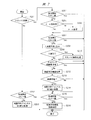
- FIG. 6 is a flowchart showing an example of the operation after the main power is turned on by the operation key 118a of the television broadcast receiving apparatus 1.
- the flowchart shown in FIG. 6 is executed mainly when the main control unit 101 shown in FIG. 3 controls each functional block unit constituting the television broadcast receiving apparatus 1.
- step S101 an operation input by the user's operation key 118a and the remote controller 120 is taken in (step S101), and a branching process based on the presence / absence of the operation input (step S102) is performed. If the presence of an operation input is captured (Yes), a branching process (step S103) is performed depending on whether or not an instruction to turn off the main power switch is input by the operation key 118a.
- main power off transition processing (step S104) is performed to turn off the power supply to most of the functional block units except for a part of the time measuring unit 103 and the like. End the sequence.
- step S103 if an instruction to turn off the main power switch has not been input (No), it is a standby state in which the power consumption of the television broadcast receiver 1 is reduced by turning off the display of the display output unit 115 or the like.
- a branch process (step S105) is performed.
- step S106 branch processing is performed depending on whether or not the user's instruction is an operation input for canceling standby by the remote controller 120.
- standby cancellation processing step S107
- step S113 standby cancellation processing
- the standby state is continued and the process proceeds to step S113. If it is not in the standby state in the process of step S105 (No), the branch process of step S108 is performed according to the user's instruction by the operation input.
- step S108 if “channel switching” is instructed, the process branches to the channel switching process (step S109) and then proceeds to the process of step S113.
- the main control unit 101 controls the tuner units 110a and 110b, so that the broadcast program data of the channel selected by the user is output from the tuner units 110a and 110b, and the selected channel is displayed on the display output unit 115. Broadcast program is displayed.
- step S108 when “program guide” is instructed and inputted, the process branches to the program guide display / reservation process (step S110) and then proceeds to the process of step S113.
- the main control unit 101 acquires SI information including broadcast program information obtained from the information decoder 113c, displays the program guide on the display output unit 115, and reserves viewing or recording. Processing such as reservation.
- the broadcast program information may be obtained from the server device 6 shown in FIG.
- step S108 if “standby” is instructed, the process branches to the standby transition process (step S111) and then proceeds to the process of step S113.
- step S111 a process such as turning off the display of the display output unit 115 is performed, and the television broadcast receiving apparatus 1 is set in a standby state.
- step S108 when “other operations” such as changing the size of audio output is input, the process corresponding to the instruction (step S112) is performed, and then viewing / recording reservation in step S113 is performed. Proceed to information reading process.
- step S113 a process of reading information related to a broadcast program viewing reservation stored in the storage area 105b2 and information related to a broadcast program recording reservation is performed.
- the main control unit 101 fetches the current time information from the time measuring unit 103 (step S114), and confirms whether a request for network viewing, that is, network distribution is received from the information terminal device 7 via the LAN communication unit 106. (Step S115).
- step S116 a branching process based on whether or not there is a viewing reservation is performed.
- step S116 if there is no viewing reservation after the current time (No), the process proceeds to a branch process (step S118) depending on whether or not there is a recording reservation.
- step S118 the recording reservation is performed after the current time. If there is no recording (No), the process proceeds to a branching process (S120) depending on whether or not there is a network viewing request, and if there is a recording reservation after the current time (Yes), the reserved program recording process (step S118) is performed. Then, the process proceeds to the branch process of step S120.
- step S120 if there is no network viewing request that is a request for viewing a broadcast program or a recorded program distributed via the network in the information terminal device 7 (No), the operation input capture in step S101 is acquired. Returning to the processing, the processing from step S101 is continued.
- step S121 If there is a network viewing request (No), after performing the network viewing process (step S121), the process returns to the operation input capturing process of step S101, and the process from step S101 is continued.
- FIG. 7 is a flowchart showing an example of detailed operation of the process of step S117 of FIG.
- the main control unit 101 performs a branch process (step S201) depending on whether or not it is in a standby state. If it is not in the standby state (No), the current time is viewed based on the viewing reservation information acquired in the viewing / recording reservation information reading process in step S113 and the current time information acquired in the time information capturing process in step S114.
- a branching process (step S202) is performed depending on whether or not a time t0 or more before the broadcast start time of the reserved program. The time t0 is about 1 second or more, for example.
- step S202 the process ends when the current time is a predetermined time t0 or more before the broadcast start time of the program reserved for viewing (Yes).
- the main control unit 101 controls the tuner unit 110a to switch to the channel corresponding to the program reserved for viewing.
- Step S203 is performed, and the reserved program viewing process ends.
- step S201 in the standby state (No), a branch process based on whether or not the current time is a predetermined time t1 or more before the broadcast start time of the program reserved for viewing (for example, 5 minutes or more). Step S204) is performed.
- step S204 the reserved program viewing is terminated if the current time is a predetermined time t1 or more before the broadcast start time of the program reserved for viewing (Yes). If the current time is within the predetermined time t1 from the broadcast start time of the program reserved for viewing (No), the process proceeds to a branching process (step S205) depending on whether or not an email for viewing reservation confirmation has been transmitted.
- step S205 if the e-mail has been transmitted (Yes), the process proceeds to a branch process (step S207) depending on whether the current time is at least t2 before the broadcast start time of the program reserved for viewing.
- the time t2 is about 30 seconds or more, for example.
- step S206 an e-mail notifying that the start time of the broadcast program reserved for viewing is close to the destination registered in advance is transmitted (step S206), and the process proceeds to branching process S207.
- branch process S207 if the current time is a predetermined time t2 or more before the broadcast start time of the program reserved for viewing (Yes), the reserved program viewing process is terminated.
- the current time is within a predetermined time t2 from the broadcast start time of the program reserved for viewing (No)
- the human detection signal output from the human detection unit 104 is captured (step S208), and the TV broadcast receiving apparatus 1 is surrounded.
- the process proceeds to a branch process (step S209) depending on whether or not there is a person.
- step S209 when it is determined that there is a person around the television broadcast receiving apparatus 1 (Yes), the standby release process such as turning on the display output unit 115 to display the broadcast program (step S211). ) To complete the reserved program viewing process.
- step S211 a branching process depending on whether there is a network viewing request from the information terminal apparatus 7.
- step S211 If there is a network viewing request (Yes) in the branching process of step S211, the reserved program viewing process is terminated. If there is no network viewing request (No), recording permission / inhibition confirmation processing (step S212) is performed.
- the recording time of the program reserved for viewing is not duplicated with the recording time of other recording reservations already stored in the program recording / viewing information storage area 105b, or recording data is stored. It is confirmed whether or not the program reserved for viewing can be recorded depending on whether there is a free space in the storage area.
- the storage area for storing the recording data is, for example, the program recording viewing information storage area 105b or an externally connected HDD device.
- step S213 After confirming whether recording is possible, in the branching process (step S213), if recording is not possible (No), the process is terminated.
- the main control unit 101 controls the tuner unit 110b to perform a process of switching to a channel corresponding to the program reserved for viewing (step S214), and the program whose current time is reserved for viewing.
- the process proceeds to a branching process (step S215) depending on whether or not a predetermined time t3 or more before the broadcast start time.
- the time t3 is about 3 seconds or more, for example.
- step S215 if the current time is more than the predetermined time t3 before the broadcast start time of the program reserved for viewing (Yes), the process returns to the branch process of step S215 again to broadcast the program whose current time is reserved for viewing. A process of recording the program reserved for viewing at the time point within the predetermined time t3 from the start time (step S216) is performed, and the process is terminated.
- step S216 when a program reserved for viewing is recorded, it is desirable to record in a recording mode (TS mode) in which recording can be performed without using the transcoder 111.
- TS mode recording mode
- the program reserved for viewing can be viewed on the information terminal apparatus 7 via the network through the transcoder 111 of the television broadcast receiving apparatus 1. It becomes.
- the reserved program is recorded by determining whether or not there is a person around the television broadcast receiving apparatus 1 by capturing the human detection signal output from the human detection unit 104. It is also possible to deal with the case where the information terminal device owned by the user is not used as the reservation terminal, such as when viewing reservation is made with the remote control 120 of FIG. As a result, even if the broadcast program reserved for viewing is forgotten, it is possible to prevent the broadcast program from being overlooked.
- the determination as to whether or not there is a person around the television broadcast receiving apparatus 1 is performed by using other techniques such as, for example, providing a camera and determining whether or not there is a person based on an image captured by the camera. You may make it perform.
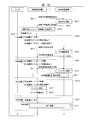
- FIG. 8 is a flowchart showing an example of operations of the information terminal device 7 and the television broadcast receiving device 1.
- FIG. 6 shows an example of an operation when viewing a broadcast program or a recorded program by the information terminal device 7 and the television broadcast receiving device 1.
- an operation input is performed by the user via a touch panel 710 (to be described later) of the information terminal device 7, whereby a request for starting a program viewing application for viewing a broadcast program or a recorded program is made (step S301).
- the main control unit 701 of the information terminal device 7 that has received the activation request activates the program viewing application (step S302).
- the information terminal device 7 that has activated the program viewing application acquires the radio wave intensity information of the broadcast wave received by the tuner unit 718 from the radio wave intensity detection unit 718a (step S303).
- a cooperation base unit response request including the terminal identification information of the information terminal device 7 is transmitted to the television broadcast receiving device 1 that has been previously paired with the information terminal device 7 (step S304).
- the pairing process is performed between the television broadcast receiving device 1 and the information terminal device 7 via the home network constructed by the router device 2 in the home where the television broadcast receiving device 1 as shown in FIG. This is performed by appropriately executing authentication processing.
- the information terminal device 7 stores the device identification information, MAC address, IP address, and the like of the television broadcast receiving device 1 as the viewing cooperation parent device in the cooperation device management information storage area 704b.
- the television broadcast recording / reception device 1 stores the terminal identification information, MAC address, IP address, and the like of the information terminal device 7 as the viewing cooperation slave unit in the cooperation device management information storage area 105a.
- the authentication process can use a known technique.
- the television broadcast receiving device 1 that has received the cooperation master device response request from the information terminal device 7 is based on the terminal identification information that has been previously paired and stored in the cooperation device management information storage area 105a. It is confirmed whether or not cooperation with the information terminal device 7 that has transmitted the response request is possible (step S305).
- the transcoder 111 when the transcoder 111 is used during recording in a recording mode other than the TS mode or when another information terminal device is already viewing the network, the information terminal device 7 cannot perform the network viewing. Judge that cooperation is impossible. *
- the television broadcast receiving device 1 that has confirmed whether or not cooperation is possible returns a cooperation base unit response including the result of whether or not cooperation is possible to the information terminal device 7 (step S306).
- a viewing reservation message presence check process (step S307) is performed.
- Step S307 for example, when the television broadcast receiving apparatus 1 is in a standby state and within a predetermined time t1 of the broadcast start time of the program reserved for viewing, it is determined that there is a viewing reservation message, and branch processing ( Step S308) is executed.
- Step S308 a message notifying that the broadcast start time of the program reserved for viewing is approaching is transmitted from the television broadcast receiving apparatus 1 to the information terminal apparatus 7 (step S309), and a viewing reservation message process (described later) ( Step S310) is executed.
- the process is repeated until the user instructs the end of the program viewing application (step S311).
- the information terminal device 7 displays a process selection screen for selecting a process to be executed on the display unit 710b (S312).
- step S313 when a selection input by the user is received (step S313), the information terminal device 7 performs a branching process according to the received selection input (step S314).
- step S314 When [viewing setting] is selected as the provision mode, the information terminal device 7 executes setting processing such as image quality in network viewing and on / off of subtitles (step S315).
- program viewing / recording reservation processing in the television broadcast receiving apparatus 1 is executed (step S316). Furthermore, when [view program] is selected as the providing mode, a viewing process of the broadcast program received by the information terminal device 7, the broadcast program received by the television broadcast receiving device 1, or the recorded program is executed (step S317). ).
- step S318 the information terminal device 7 executes an end process (step S318), exits the repeat process of step S311 and ends the program viewing application (step S319).
- FIG. 9 is a flowchart showing an example of detailed operation of the process in step S310 of FIG.
- step S401 processing for displaying a message regarding viewing reservation and a processing selection screen on the display unit 710b of the information terminal device is performed.
- step S403 processing for displaying a message regarding viewing reservation and a processing selection screen on the display unit 710b of the information terminal device is performed.
- step S403 when the “network viewing” provision mode is selected, a broadcast program distribution request for the channel reserved for viewing is transmitted to the television broadcast receiver 1 (step S404).
- the channel selection by the tuner unit 110b is set to the channel reserved for viewing under the control of the main control unit 101 (step S405).
- the television broadcast receiving device 1 that has set the channel distributes the broadcast program broadcast on the set channel to the information terminal device 7, and the information terminal device 7 displays the distributed broadcast program on the display unit 710b ( Step S406).
- the main control unit 701 of the information terminal device 7 controls the tuner unit 718 to switch to the channel corresponding to the program reserved for viewing (step S407). Is displayed on the display unit 710b (step S408). If the “end” provision mode is selected, processing for ending the viewing reservation message processing is performed (step S409). Thereby, it is possible to easily determine in what form the broadcast program is viewed in the user's usage environment.
- the tuner unit 718 since the user does not know whether or not the tuner unit 718 can receive the one-segment broadcasting wave, the tuner unit 718 performs the one-seg reception operation. As a result, it becomes clear for the first time that 1Seg cannot be received. Then, after knowing that 1Seg cannot be received, operations such as network viewing are performed.
- the user can determine what viewing is possible by simply confirming the processing selection screen displayed on the information terminal device 7, and the broadcast program can be determined. It is possible to reduce frequent operations and the like until viewing.
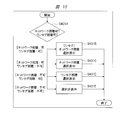
- FIG. 10 is a flowchart showing an example of the process of step S401 in FIG.
- step S401A a branching process is performed depending on whether or not network viewing is possible and whether or not one-segment broadcasting is possible.
- Whether or not network viewing is possible is determined to be possible to view the network when cooperation is possible based on the result of cooperation availability returned from the television broadcast receiving device 1 to the information terminal device 7 in the process of step S306 in FIG.
- remote viewing may be restricted on a channel basis by a broadcast wave control signal. Therefore, when determining that the control signal of the channel that broadcasts the program reserved for viewing is an inhibit, the main control unit 101 determines that cooperation is not possible because the network cannot be viewed.
- whether or not one-seg broadcasting can be viewed is determined as one-segment viewing is possible when the reception intensity is greater than a predetermined value, based on the reception intensity information acquired by the process of step S303 in FIG.
- the TV broadcast receiving apparatus 1 is equipped with a tuner corresponding to BS broadcast or CS broadcast. If the program reserved for viewing is a BS broadcast or CS broadcast program, the tuner installed in the information terminal apparatus 7 is installed. Since it cannot be viewed, it is determined that 1Seg viewing is not possible.
- step S401A when network viewing is possible and one-segment viewing is possible, screen display for selecting one-segment broadcasting viewing and network viewing is performed (step S401B).
- step S401C a screen display for selecting network viewing is displayed. If network viewing is not possible and one-seg viewing is possible, screen display for selecting one-seg broadcasting viewing is performed (step S401D). When network viewing and one-segment viewing are impossible, viewing selection display is not performed (step S401E).
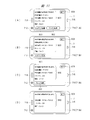
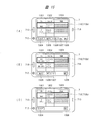
- FIG. 11 is an explanatory diagram showing an example of a screen display displayed on the information terminal device 7 in the processing of steps S401B to S401E of FIG.
- FIG. 11A shows an example of a screen display of the information terminal device 7 in the process of step S401B of FIG.
- a message 900 related to viewing reservation is displayed on the display unit 710b of the touch panel 710. Also, a network viewing selection button 901 and a one-segment broadcasting viewing selection button 902 are displayed below the touch panel 710, and a selection button 903 for selecting the end of the viewing reservation message process is displayed on the upper right of the touch panel 710. indicate.
- FIG. 11B is an example of a screen display of the information terminal device 7 in the process of step S401C of FIG.
- step S401C in FIG. 10 on the touch panel 710 of the information terminal device 7, as shown in FIG. 11B, a message 900 regarding viewing reservation is displayed on the display unit 710b.
- a network viewing selection button 901 is displayed on the lower left side of the touch panel 710, and a selection button 903 for selecting the end of the viewing reservation message process is displayed on the upper right side of the touch panel 710.
- FIG. 11C shows an example of the screen display in the process of step 701D of FIG.
- a message 900 relating to viewing reservation is displayed on the display unit 710b of the touch panel 710.
- a one-segment broadcast view selection button 902 is displayed on the lower left side of the touch panel 710, and a selection button 903 for selecting the end of the viewing reservation message process is displayed on the upper right side of the touch panel 710.
- FIG. 11D shows an example of a screen display in the process of step S401E of FIG.
- a message 900 relating to viewing reservation is displayed on the display unit 710b of the touch panel 710, and a selection button 903 for selecting the end of viewing reservation message processing is displayed on the upper right side of the touch panel 710.
- step S402 of FIG. 9 When the user taps the button portion displayed on the information terminal device 7 shown in FIG. 11, the process selection input in the process of step S402 of FIG. 9 is performed, and the branch process of step S403 corresponding to the tapped button is performed. Executed.
- the tuner unit 718 of the information terminal device 7 based on the received response information of the broadcast wave received by the tuner unit 718 of the information terminal device 7 and the result of the cooperative parent device response including the result of availability of cooperation with the television broadcast receiving device 1, whether or not viewing by broadcast wave is possible and It is possible to determine whether or not the network can be viewed and to present a method by which the information terminal device 7 can view the program reserved for viewing.
- FIG. 12 is a flowchart showing an example of the process in step S317 of FIG.
- the information terminal device 7 repeatedly executes the processing S ⁇ b> 501 together with the television broadcast receiving device 1.
- the information terminal device 7 first performs processing for displaying a viewing selection screen (step S502). On the viewing selection screen, it is possible to select whether to view a broadcast program currently being broadcast, to view a recorded program already stored in the storage unit 105 of the television broadcast receiving apparatus 1 or the like, or to end the viewing. It has become.
- the user performs viewing selection input (step S503) based on the viewing selection screen. Based on this selection input, the information terminal device 7 executes a branch process S504 together with the television broadcast receiving device 1.
- step S503 When the user selects the “broadcast program viewing” provision mode in the viewing selection input in step S503, a branching process based on whether or not network viewing is possible (step S505) is performed.
- step S505 if network viewing is possible, a broadcast program information acquisition request is transmitted from the information terminal device 7 to the television broadcast receiving device 1 (step S506).
- the television broadcast receiving apparatus 1 that has received the broadcast program information acquisition request acquires broadcast program information such as program identification information, program name, genre, and broadcast start / end date / time of each program from the information decoder 113c (step S507).
- broadcast program information such as program identification information, program name, genre, and broadcast start / end date / time of each program from the information decoder 113c (step S507).
- the television broadcast receiver 1 returns the acquired broadcast program information to the information terminal device 7 (step S508).
- the television broadcast receiving apparatus 1 is equipped with a tuner compatible with BS broadcast and CS broadcast in addition to terrestrial digital broadcast, broadcast program information corresponding to BS broadcast and CS broadcast is also acquired and returned.
- a branching process (step S509) is performed depending on whether or not one-segment viewing is possible. If the one-segment viewing is possible in the branching process in step S509, broadcast program information such as program identification information, program name, genre, and broadcast start / end date / time of each program is acquired from the information decoder 716c (step S510). ).
- the main control unit 701 controls the tuner unit 718 to change the channel selection while changing the channel selection. Get information.
- the broadcast program information is acquired from the information decoder 113c or the information decoder 716c.
- the broadcast program information is acquired from the server device 6 by connecting to the Internet 3 via the communication processing unit 719. May be.
- the information terminal device 7 displays the broadcast program information on the display unit 710b based on the acquired broadcast program information (step S511). Based on the broadcast program information displayed on the display unit 710b, the user selects and inputs a broadcast program to be viewed (step S512). The information terminal device 7 executes branch processing S513 together with the television broadcast receiving device 1 based on this selection input.
- step S513 when a network viewing program is selected, a distribution request for the selected broadcast program is transmitted to the television broadcast receiver 1 (step S514).
- the channel selection by the tuner unit 110b is set to the channel of the program selected by the user under the control of the main control unit 101 (step S515).
- the television broadcast receiving apparatus 1 that has set the channel distributes the broadcast program broadcast on the set channel to the information terminal apparatus 7, and the information terminal apparatus 7 displays the distributed broadcast program on the display unit 710b (step S516). ).
- step S513 when a one-segment broadcasting program is selected, the main control unit 701 of the information terminal device 7 controls the tuner unit 718 to switch to a channel corresponding to the program selected by the user. (Step S517), the program of the channel is displayed on the display unit 710b (Step S518).
- step S504 when the user selects the “recorded program viewing” providing mode in the viewing selection input of step S503, the information terminal device 7 transmits a recorded program information acquisition request to the television broadcast receiving device 1. (Step S519).
- the television broadcast receiving apparatus 1 acquires the recorded program viewing information storage area 105b such as the storage unit 105, specifically, the recorded program information stored in the storage area 105b2 of FIG. 4 (step S520), and uses it as an information terminal apparatus. 7 (step S521).
- the information terminal device 7 displays the recorded program information on the display unit 710b based on the recorded program information sent from the television broadcast receiving device 1 (step S522).
- the user selects and inputs a recorded program to be viewed based on the recorded program information displayed on the display unit 710b (step S523).
- the information terminal device 7 transmits a distribution request for the selected recorded program to the television broadcast receiving device 1 (step S524).
- the television broadcast receiving apparatus 1 controls the storage unit 105 in response to the distribution request, and sets the state so that the recorded program requested to be distributed can be reproduced (step S525).
- the television broadcast receiving apparatus 1 distributes the recorded program requested to be distributed.
- the information terminal device 7 displays the distributed recorded program on the display unit 710b (step S526).
- step S504 when the “end” providing mode is selected by the user, the information terminal device 7 executes the ending process (step S527), exits the repeating process of step S501, and ends the viewing process. To do.
- the broadcast program being broadcast and the broadcast program recorded on the television broadcast receiver 1 can be displayed on the display unit 710b of the information terminal device 7, the user can easily search for the broadcast program that the user wants to view. it can.
- FIG. 13 is a flowchart showing an example of the process of step S502 in FIG.
- a branch process (step S502A) is performed depending on whether or not the network can be viewed and whether or not the one-segment broadcasting can be viewed.
- step S502A when network viewing is possible, screen display for selecting viewing of a broadcast program and a recorded program is performed (step 502B).
- step S502C a screen display for selecting broadcast program viewing is displayed. Furthermore, when neither network viewing nor one-segment broadcasting viewing is possible, a screen display is displayed informing that the program cannot be viewed (step S502D).
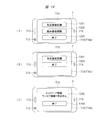
- FIG. 14 is an explanatory diagram showing an example of display on the information terminal device 7 in the processing of steps S502B to S502D in FIG.
- FIG. 14A shows an example of a screen display in the process of step S502B of FIG. 13, and a selection button 1201 for viewing a broadcast program is displayed above the display unit 710b of the touch panel 710.
- a selection button 1202 for viewing a recorded program is displayed below the selection button 1201, and a selection button 1203 for selecting the end of the viewing selection process is displayed below the selection button 1201.
- FIG. 14B shows an example of screen display in the process of step S502C of FIG.
- a selection button 1201 for viewing a broadcast program is displayed above the display unit 710b of the touch panel 710, and a selection button 1203 for selecting the end of the viewing selection process is displayed below the selection button 1201.
- FIG. 14C shows an example of screen display in the process of step S502D of FIG.
- a message 1200 is displayed above the display unit 710b of the touch panel 710 that network viewing and one-segment viewing are not possible.
- a selection button 1203 for selecting the end of the viewing selection process is displayed below the display unit 710b.
- step S503 in FIG. 12 When the user taps the displayed button part shown in FIG. 14, the process selection input in step S503 in FIG. 12 is performed, and the branch process corresponding to the button (step S504 in FIG. 12) is executed.
- FIG. 13 is an explanatory diagram showing an example of display on the information terminal device 7 by the broadcast program display process which is the process of step S511 of FIG.
- FIG. 15 is an explanatory diagram showing an example of display on the information terminal device 7 by the process of step S511 in FIG.
- the TV broadcast receiving apparatus 1 is equipped with a tuner corresponding to terrestrial digital broadcasting, a tuner corresponding to BS broadcasting, and a tuner corresponding to CS broadcasting.
- FIG. 15A is an example of broadcast program display when network viewing and one-segment viewing are possible.
- the channel name 1301 is displayed on the left side of the display unit 710b of the touch panel 710, and the program name 1302 of each channel is displayed on the right side thereof. On the right side of the program name 1302, program content 1303 is displayed.
- Selection buttons 1304 to 1308 are displayed below the channel name 1301, the program name 1302, and the program content 1303 from the left to the right.
- a selection button 1304 is a button for selecting a broadcast program guide for one-segment broadcasting.
- the selection button 1305 is a button for selecting a broadcast program table of terrestrial digital broadcasting received by the television broadcast receiving apparatus 1 through network viewing.
- a selection button 1306 is a button for selecting a broadcast program guide for BS broadcasting, and a selection button 1307 is a button for selecting a broadcast program guide for CS broadcasting.
- the selection button 1308 is a button for ending the broadcast program display process.
- FIG. 15B shows an example of broadcast program display on the information terminal device 7 when network viewing is possible and one-segment viewing is impossible.
- a channel name 1301, a program name 1302, and a program content 1303 are displayed above the display portion 710b of the touch panel 710, as in FIG.
- Selection buttons 1305 to 1308 are displayed from the lower left side to the right side of the display unit 710b of the touch panel 710, respectively. These selection buttons 1305 to 1308 are the same as those in FIG.
- FIG. 15C shows an example of broadcast program display on the information terminal device 7 when network viewing is impossible and one-segment viewing is possible.
- a channel name 1301, a program name 1302, and a program content 1303 are displayed above the display portion 710b of the touch panel 710, as in FIG. Below these, a selection button 1304 for selecting a broadcast program guide for one-segment broadcasting is displayed on the left side, and a selection button 1308 for ending the processing is displayed on the right side.
- the main control unit 701 may not display the program guide or display that it cannot be viewed because the network cannot be viewed on the channel whose control signal is the inhibit.
- FIG. 16 is a flowchart showing a detailed operation example of the viewing reservation message process according to the second embodiment.
- a recording availability confirmation request for inquiring whether or not a program reserved for viewing can be recorded is transmitted from the information terminal device 7 to the television broadcast receiving device 1 (step S601).
- the television broadcast receiving apparatus 1 confirms whether or not the program reserved for viewing can be recorded (step S602), and returns a recording availability confirmation response to the information terminal apparatus 7 (step S603).
- the recording time of the program reserved for viewing is stored to check whether the recording time of another recording reservation already stored in the program recording / viewing information storage area 105b overlaps. Whether or not the program reserved for viewing can be recorded is confirmed based on whether there is a free space in the storage area, for example, the program recording / viewing information storage area 105b or the HDD device connected externally.
- step S604 a message relating to viewing reservation and a process selection screen are displayed on the display unit 710b of the information terminal device 7 (step S604).
- step S605 the selection input by the user (step S605) is received, the information terminal device 7 performs a branching process according to the received selection input.
- step S606 When one of the recording modes [Recording], [One-Seg Viewing / Recording], or [Network Viewing / Recording] is selected, a branch process (step S606) is executed.
- a recording reservation request for the program reserved for viewing is transmitted to the television broadcast receiver 1 (step S607).
- the television broadcast receiving apparatus 1 updates the recording reservation information stored in the program recording / viewing information storage area 105b based on the received program recording reservation request (step S608), and returns a reservation acceptance response to the information terminal apparatus 7. (Step S609).
- a TS mode that does not use the transcoder 111 is desirable. Thereby, even when there is only one transcoder 111, the information terminal device 7 can view the network while recording.
- step S610 a branching process
- a broadcast program distribution request for the channel reserved for viewing is transmitted to the television broadcast receiver 1 (step S611).
- the channel selection by the tuner unit 110b is set to the channel reserved for viewing under the control of the main control unit 101 (step S612).
- the television broadcast receiving device 1 that has set the channel distributes the broadcast program broadcast on the set channel to the information terminal device 7, and the information terminal device 7 displays the distributed broadcast program on the display unit 710b ( Step S613).
- step S614 a branching process
- step S614 the main control unit 701 of the information terminal device 7 controls the tuner unit 718 to switch to the channel corresponding to the program reserved for viewing (step S615), and the program reserved for viewing is displayed on the display unit 710b. It is displayed (step S616).
- step S617 branch processing (step S617) is executed.
- step S617 a process for ending the viewing reservation message process is performed (step S618).
- FIG. 17 is a flowchart showing an example of the process of step S604 of FIG.
- a branch process (step S604A) is performed depending on whether or not a program reserved for viewing can be recorded. Whether recording is possible is determined based on the result of the recording availability confirmation response returned from the television broadcast receiving apparatus 1 to the information terminal apparatus 7 in the process of step S603 in FIG.
- step S604A if recording is not possible (No), the process proceeds to step S604B.
- the processing in step S604B is the same as the processing in steps S401A to S401E in FIG.
- step S604C a branch process based on whether or not network viewing is possible and whether or not one-segment broadcasting is possible is performed.
- step S604C when network viewing is possible and one-segment viewing is possible, screen display for selecting one-segment broadcasting viewing, network viewing, and recording of a reserved viewing program is performed (step S604D).
- a screen display for selecting network viewing and recording of the reserved viewing program is displayed (step S604E). If network viewing is not possible and one-seg viewing is possible, screen display for selecting one-seg broadcasting viewing and recording of a reserved viewing program is performed (step S604F). When the network viewing and the one-segment viewing are impossible, a screen display for selecting recording of the viewing reserved program is performed (step S604G).
- FIG. 18 is an explanatory diagram showing an example of display on the information terminal device 7 by the process of step S604 in FIG.
- FIGS. 18A to 18D show examples of screen display in the process of step S604B of FIG. 17, that is, the processes of steps S401A to S401E of FIG. Since the screen display is the same as in FIG. 11D, description thereof is omitted.
- FIG. 18E shows an example of the display screen in step S604D of FIG.
- a message 900 relating to viewing reservation is displayed on the display portion 710b of the touch panel 710.
- a selection button 904 for selecting recording of the network viewing and viewing reservation program is displayed, and on the right side thereof, a selection button 905 for selecting recording of the one-segment broadcasting viewing and viewing reservation program is displayed.
- a selection button 901 for selecting network viewing is displayed, and on the right side thereof, a selection button 902 for selecting one-segment viewing is displayed.
- a selection button 906 for selecting recording of the viewing reservation program is displayed.
- a selection button 903 for selecting the end of the viewing reservation message process is displayed.
- FIG. 18 (F) shows an example of the screen display in step S604E of FIG.
- the screen display example shown in FIG. 18 (F) is different from FIG. 18 (E) in that a selection button 902 for selecting one-segment viewing and a selection button 905 for selecting recording of one-segment broadcasting viewing / viewing reserved program are displayed. There is no point.
- FIG. 18G shows an example of screen display in step S604F of FIG.
- the screen display example shown in FIG. 18G is different from FIG. 18E in that the selection button 901 for selecting network viewing and the selection button 904 for selecting network viewing and recording of a reserved viewing program are not displayed. Is a point.
- FIG. 18H shows an example of screen display in step S604G of FIG.
- the screen display example shown in FIG. 18G is different from FIG. 18E in that only a selection button 906 for selecting recording of a viewing reservation program and a selection button 903 for selecting the end of viewing reservation message processing are displayed. The other buttons are not displayed.
- step S605 in FIG. 16 When the user taps the displayed button part, the process selection input in the process of step S605 in FIG. 16 is performed, and the branch process of step S606 corresponding to the selected button is executed.
- the TV broadcast program providing system can view the broadcast wave based on the reception intensity information of the broadcast wave of the information terminal device 7, the cooperation parent device response including the result of cooperation availability, and the availability of recording of the program reserved for viewing. It is possible to determine whether or not the image can be viewed, whether or not the image can be viewed on the network, and whether or not recording is possible. Accordingly, it is possible to present an optimum method for viewing a program reserved for viewing in real time or by recording.
- the recorded program can be viewed even if you cannot watch because the strength of the radio wave received during 1Seg viewing or network viewing has decreased.
- the program can be viewed later, and the program reserved for viewing can be surely viewed.
- FIG. 19 is a block diagram showing an example of the configuration of the information terminal device 7 according to the third embodiment.
- the same functional block units as those in FIG. 5 of the first embodiment are denoted by the same reference numerals, and the description thereof is omitted.
- the information terminal device 7 in FIG. 19 is different from the information terminal device 7 in FIG. 5 in that a communication amount measurement unit 719b1 is provided in the base station communication unit 719b.
- the communication amount measuring unit 719b1 measures a data communication amount for a predetermined period in the mobile communication network, for example, about one month.
- step S310 the viewing reservation message process of step S310 shown in FIG. 8 when the information terminal device 7 of FIG. 19 is used will be described.
- FIG. 20 is a flowchart showing an example of the process of step S310 of FIG. 8 by the information terminal device 7 and the television broadcast receiver 1 of FIG.
- the data communication amount for a predetermined period in the mobile communication network is acquired from the communication amount measurement unit 719b1 (step S701). Then, a recording availability confirmation request for inquiring whether the program reserved for viewing is recordable from the information terminal device 7 is transmitted to the television broadcast receiving device 1 (step S702).
- the television broadcast receiving apparatus 1 confirms whether or not the program reserved for viewing can be recorded (step S703), and returns a recording availability confirmation response to the information terminal apparatus 7 (step S704).
- step S706 a message relating to viewing reservation and a process selection screen are displayed on the display unit 710b of the information terminal device (step S705), and the process proceeds to step S706.
- the processing in step S706 is the same as the processing in steps S605 to S618 in FIG.
- FIG. 21 is a flowchart showing an example of the process of step S705 of FIG.
- step S705A is performed by comparing the data communication amount of the predetermined period acquired in the processing of step S701 in FIG. 20 with a preset limit amount of data communication amount.
- step S705A when the data communication amount during the predetermined period is equal to or less than the preset limit of the data communication amount (Yes), the process proceeds to step S705B, and steps S614A to S614G in FIG. Process.
- step S705A if the data communication amount for a predetermined period is equal to or greater than the preset data communication amount limit (No), whether or not the program reserved for viewing can be recorded and one-seg broadcasting can be viewed.
- step S705C A branch process depending on whether or not is performed.
- step S705D When recording is possible and one-seg viewing is possible, a screen display for selecting one-seg broadcast viewing and recording of a reserved program as shown in FIG. 18G is performed (step S705D).
- step S705E When recording is impossible and one-seg viewing is possible, a screen display for selecting one-seg broadcasting viewing as shown in FIG. 18C is performed (step S705E).
- step S705F When recording is possible and one-seg viewing is impossible, a screen display for selecting recording of a viewing reservation program as shown in FIG. 18H is performed (step S705F). When recording and one-segment viewing are impossible, screen display without viewing selection display as shown in FIG. 18D is performed (step S705G).
- the information terminal device 7 corresponds to a communication speed limiting function implemented by a contracted mobile phone carrier company.
- the communication speed limit function when the total amount of data communication per month is equal to or less than a predetermined amount (for example, about 7 GB), the data communication speed is not limited, and for example, high-speed data communication of about 75 Mbps is possible.
- the data communication speed within the following month is limited to a low speed, for example, about 128 kbps or less. For this reason, if the total amount of data communication exceeds a predetermined amount due to data communication through network viewing, the data communication speed is limited, and the usability of various services by data communication decreases.
- a predetermined limit amount for example, about 5 GBytes
- the data communication amount is limited without performing network viewing.
- a program reserved for viewing is viewed by receiving a one-segment broadcast by a tuner installed in the information terminal device 7 or recorded by the television broadcast receiving device 1 for later viewing.
- the television broadcast program providing system broadcasts based on the broadcast wave reception intensity information of the information terminal device 7, the cooperation master unit response including the result of cooperation availability, the availability of recording of the program reserved for viewing, and the data communication amount. It is determined whether or not viewing by waves is possible, whether or not viewing is possible via a network, and whether recording is possible. Accordingly, it is possible to present an optimum method for viewing a program reserved for viewing in real time or by recording.
- the recorded program can be viewed even if the received radio wave intensity is reduced during one-seg viewing or network viewing.
- the program can be viewed later, and the program reserved for viewing can be surely viewed.
- each of the above-described configurations, functions, and the like may be realized by software by interpreting and executing a program that realizes each function by the processor.
- Information such as programs, tables, and files for realizing each function can be stored in the main storage unit 102 or storage unit 105 of the television broadcast receiving apparatus 1, the main storage unit 702 or storage unit 704 of the information terminal device 7, or the like. .
- control lines and information lines indicate what is considered necessary for the explanation, and not all the control lines and information lines on the product are necessarily shown. Actually, it may be considered that almost all the components are connected to each other.
Landscapes
- Engineering & Computer Science (AREA)
- Databases & Information Systems (AREA)
- Multimedia (AREA)
- Signal Processing (AREA)
- Computer Networks & Wireless Communication (AREA)
- Two-Way Televisions, Distribution Of Moving Picture Or The Like (AREA)
- Television Signal Processing For Recording (AREA)
Abstract
コンテンツの最適な提供モードを提示することにより、ユーザの利便性を向上させる。情報端末装置7は、チューナ部718、タッチパネル710、電波強度検出部718a、および主制御部701を有する。チューナ部718は、放送波を受信する。通信処理部719は、ネットワークを介して配信される放送番組を受信する。タッチパネル710は、放送波を受信するテレビ放送受信装置からネットワーク配信される放送番組または前記受信部が受信した放送番組を表示する。電波強度検出部718aは、受信部が受信する放送波の電波強度を検出する。そして、主制御部701は、電波強度検出部718aの電波強度およびテレビ放送受信装置からのネットワーク配信の可否に基づいて、視聴予約した放送番組の提供モードを判定してタッチパネル710の表示部710bに表示する。
Description
本発明は、情報端末装置、テレビ放送受信装置、およびコンテンツの提供方法に関し、特に、情報端末装置へのコンテンツの提供に有効な技術に関する。
近年のテレビ放送受信装置では、ユーザが視聴したい番組の見逃しを防ぐために、視聴予約、あるいは録画予約機能などを設けている。この種の予約技術としては、例えば特開2011-114661号公報(特許文献1)がある。この公報には、課題として「視聴予約をした場合でも、その視聴予約にしたがって映像再生を開始する時刻に、ユーザが映像情報再生装置の周辺にいるとは限らない。例えば、一度外出した後に自宅に戻ってきて映像を視聴することを想定して視聴予約した場合、視聴予約を設定していたこと自体を忘れて自宅に戻らなかった場合や、視聴予約を設定したことを覚えていても自宅に戻れない場合などが考えられる。このような場合には、ユーザが視聴予約をしているにも関わらず、見たい番組を見る機会を失ってしまう。」と記載されている。
この課題の解決手段として、「本発明に係る映像情報再生装置は、視聴予約を行う予約端末を特定しておき、予約日時になってもその予約端末が周辺に存在しない場合には、視聴予約した映像を録画する。」と記載されている。
上記した特許文献1の技術では、様々な使用環境、使用状況において、ユーザにとっての使い勝手が十分でない場合がある。例えば、視聴予約した番組を録画しようとしたときに、既に録画予約されていた他の番組の時間と重複していた場合または録画するストレージ部の容量が不十分な場合などでは、視聴予約した番組の録画ができないという問題が生じる恐れがある。さらには、スポーツ番組の実況中継等をリアルタイムで視聴できないなどの種々の状況に対応することができないという問題が生じる。
本発明の目的は、最適なコンテンツの提供モードを提示することにより、ユーザの利便性を向上させることのできる技術を提供することにある。
本発明の前記ならびにその他の目的と新規な特徴については、本明細書の記述および添付図面から明らかになるであろう。
本願において開示される発明のうち、代表的なものの概要を簡単に説明すれば、次のとおりである。
すなわち、代表的な情報端末装置は、受信部、コンテンツ通信部、表示部、電波強度検出部、および判定制御処理部を有する。受信部は、放送波を受信する。コンテンツ通信部は、ネットワークを介して配信されるコンテンツを受信する。表示部は、放送波を受信するテレビ放送受信装置からネットワーク配信されるコンテンツまたは受信部が受信した放送波のコンテンツを表示する。
電波強度検出部は、受信部が受信する放送波の電波強度を検出する。判定制御処理部は、電波強度検出部の電波強度およびテレビ放送受信装置によるネットワーク配信の可否に基づいて、視聴予約したコンテンツの提供モードを判定して表示部に表示する。
特に、判定制御処理部は、テレビ放送受信装置にネットワーク配信が可能か否かの問い合わせを行う。そして、電波強度検出部が検出した電波強度が放送波を安定して受信できるレベルであり、かつ問い合わせ結果がネットワーク配信が可能の場合に、受信部が放送波を受信してコンテンツを提供する第1の提供モードおよびネットワーク配信によってコンテンツを提供する第2の提供モードが利用できると判断し、第1および第2の提供モードを表示部にそれぞれ表示する。
また、電波強度が放送波を安定して受信できるレベルであるがテレビ放送受信装置からの返信がネットワーク配信が不可である場合に、受信部が放送波を受信してコンテンツを提供する提供モードが利用できると判断して第1の提供モードを表示部に表示する。
さらに、電波強度が放送波を安定して受信できるレベルでないがテレビ放送受信装置からの返信がネットワーク配信が可能である場合に、テレビ放送受信装置からのネットワーク配信によってコンテンツを提供する提供モードが利用できると判断して第2のモードを表示部に表示する。
また、代表的なテレビ放送受信装置は、テレビ放送の放送波を受信する放送受信部と、放送受信部が受信したコンテンツをネットワーク配信する通信部と、ネットワークを介して接続される情報端末装置から、ネットワーク配信が可能か否かの問い合わせを受け取った際に、ネットワーク配信の可否を判定する配信判定部と、を有する。
そして、配信判定部は、情報端末装置が認証された機器であるか否かを判定し、情報端末装置が認証された機器であると判定した際に、情報端末装置に対してネットワーク配信が可能であると返答し、情報端末装置が認証された機器でないと判定した際に、情報端末装置に対してネットワーク配信が不可であると返答する。
本願において開示される発明のうち、代表的なものによって得られる効果を簡単に説明すれば以下のとおりである。
ユーザの利便性を向上させることができる。
以下の実施の形態においては便宜上その必要があるときは、複数のセクションまたは実施の形態に分割して説明するが、特に明示した場合を除き、それらはお互いに無関係なものではなく、一方は他方の一部または全部の変形例、詳細、補足説明等の関係にある。
また、以下の実施の形態において、要素の数等(個数、数値、量、範囲等を含む)に言及する場合、特に明示した場合および原理的に明らかに特定の数に限定される場合等を除き、その特定の数に限定されるものではなく、特定の数以上でも以下でもよい。
さらに、以下の実施の形態において、その構成要素(要素ステップ等も含む)は、特に明示した場合および原理的に明らかに必須であると考えられる場合等を除き、必ずしも必須のものではないことは言うまでもない。
同様に、以下の実施の形態において、構成要素等の形状、位置関係等に言及するときは特に明示した場合および原理的に明らかにそうではないと考えられる場合等を除き、実質的にその形状等に近似または類似するもの等を含むものとする。このことは、上記数値および範囲についても同様である。また、実施の形態を説明するための全図において、同一の部材には原則として同一の符号を付し、その繰り返しの説明は省略する。
以下、実施の形態を詳細に説明する。
(実施の形態1)
〈テレビ放送番組提供システムの構成例〉
図1は、本実施の形態1によるテレビ放送番組提供システムにおける構成の一例を示す説明図である。図2は、本実施の形態1によるテレビ放送番組提供システムにおける構成の他例を示す説明図である。
〈テレビ放送番組提供システムの構成例〉
図1は、本実施の形態1によるテレビ放送番組提供システムにおける構成の一例を示す説明図である。図2は、本実施の形態1によるテレビ放送番組提供システムにおける構成の他例を示す説明図である。
図1においては、宅内で視聴する場合の構成例を示した概略図であり、図2は、宅外で視聴する場合の構成例を示した概略図である。
まず、図1に示すテレビ放送番組提供システムは、テレビ放送受信装置1、ルータ装置2、情報端末装置7、および放送局8を有する。図2に示すテレビ放送番組提供システムは、テレビ放送受信装置1、ルータ装置2、インターネット3、基地局4、無線アクセスポイント5、サーバ装置6、情報端末装置7、および放送局8,9を有する。
図1および図2において、テレビ放送受信装置1は、放送番組などのコンテンツを配信する親機として動作する。情報端末装置7は、親機であるテレビ放送受信装置1から配信されたコンテンツを視聴する子機として動作する。また、テレビ放送受信装置1および情報端末装置7は、放送局8から送信された放送波を受信する。
続いて、図2において、テレビ放送受信装置1が放送波を受信する放送局8と情報端末装置7が放送波を受信する放送局9は同じ放送局であってもよい。
情報端末装置7は、Wi-Fi(登録商標)などによる無線通信機能を有しており、ルータ装置2あるいは無線アクセスポイント5を介してローカルネットワークまたはインターネットと接続し、テレビ放送受信装置1との間で放送番組などの情報を送受信することができる。
また、情報端末装置7は、W-CDMA(Wideband Code Division Multiple Access)、GSM(Global System for Mobile communications)(登録商標)やLTE(Long Term Evolution)などの移動体通信機能を有している。
これにより、情報端末装置7は、移動体通信網の基地局4を介してインターネット3と接続を行い、テレビ放送受信装置1との間で放送番組などの情報を送受信することができる。
また、サーバ装置6はインターネット3を介してテレビ放送受信装置1、あるいは情報端末装置7からの要求により放送番組情報などを提供するサーバである。
テレビ放送受信装置1、ルータ装置2、無線アクセスポイント5、および情報端末装置7は、それぞれインターネット上で自身を識別するIP(Internet Protocol)アドレスを所有する。また、各々の通信部には、48ビットのMAC(Media Access Control)アドレスが与えられている。各装置へのIPアドレスの設定は、DHCP(Dynamic Host Configuration Protocol)により、例えばルータ装置2や無線アクセスポイント5をDHCPサーバとして動作させ、ここから各装置のIPアドレスを割り振るようにすればよい。
〈テレビ放送受信装置のハードウェア構成例〉
図3は、図1および図2におけるテレビ放送受信装置1の構成例を示すブロック図である。
図3は、図1および図2におけるテレビ放送受信装置1の構成例を示すブロック図である。
テレビ放送受信装置1は、図3に示すように、システムバス100を有する。システムバス100は、主制御部101とテレビ放送受信装置1内の各機能ブロック部との間でデータ送受信を行うためのデータ通信路である。
配信判定部である主制御部101は、例えばCPU(Central Processing Unit)などで構成され、主記憶部102に記憶されたオペレーティングシステムや各種のアプリケーションプログラムなどに従ってテレビ放送受信装置1の全体を制御する。
通信部であるLAN(Local Area Network)通信部106は、例えば、イーサネット(登録商標)ポートや、Wi-Fi規格に基づく無線インターフェースなどである。LAN通信部106は、図1および図2に示したルータ装置2との間で有線あるいは無線によって接続され、ルータ装置2を含めたネットワークを介して情報端末装置7との間で通信を行う。
計時部103は、チューナ部110a,110b経由にて入力された放送信号に含まれる時刻情報や、LAN通信部106を介して取得した、インターネット3上のNTP(Network Time Protocol)サーバの時刻情報などを利用して時刻を管理する。
操作入力部118は、テレビ放送受信装置1に対する操作指示の入力を行う指示入力部であり、ここでは、ボタンスイッチを並べた操作キー118aおよびリモコン120からの赤外線信号を受信するリモコン受信部118bにて構成される。操作入力部118は、ユーザの入力した操作指示を主制御部101に出力する。
操作キー118aとしては、例えばテレビ放送受信装置1の主電源のオン/オフ、チャンネルの選択、および音量の変更などのキーが配置されている。リモコン120には、スタンバイのオン/オフ、チャンネルの選択、音量の変更、番組表の表示、および録画などのキーが配置されている。
これにより、主制御部101は、ユーザの操作キー118a、あるいはリモコン120による入力に従ってテレビ放送受信装置1を制御する。
人検知部104は、テレビ放送受信装置1の周囲に人が存在するか否かを検知するセンサである。この人検知部104は、例えば、熱源の移動を検出することによって、あるいは熱源の温度と周囲の温度との差を検出することによって、周囲に人が存在するか否かを検知する。
人検知部104は、図示しない増幅回路および同じく図示しないADC(Analog to Digital Converter)などを有する。人検知部104の検知信号(以下、人感信号という)は、増幅回路によって増幅された後、ADCによってデジタル信号に変換されて、主制御部101に供給される。
テレビ放送受信装置1の周囲に人が居る場合、より正確には、人検知部104の検出範囲に人が居る場合には、人検知部104により検出される温度変化が大きくなる。一方、テレビ放送受信装置1の周囲に人が居ない場合には、人検知部104により検出される温度変化が小さくなる。
このため主制御部101は、人検知部104から供給される人感信号の値を参照することにより、テレビ放送受信装置1の周囲に人がいるか否かを判定することができる。
ストレージ部105は、連携機器管理情報記憶領域105a、番組録画視聴情報記憶領域105b、およびその他情報記憶領域105cを有する。ストレージ部105は、例えばフラッシュROM(Read Only Memory)、SSD(Solid State Drive)、またはHDD(Hard Disk Drive)などの記憶デバイスにて構成される。
連携機器管理情報記憶領域105aは、テレビ放送受信装置1と連携する情報端末装置7に関する情報などを記憶する領域である。
続いて、番組録画視聴情報記憶領域105bの構成について説明する。
図4は、図3のストレージ部105が有する番組録画視聴情報記憶領域の詳細な構成例を示す説明図である。
番組録画視聴情報記憶領域105bは、図4に示すように、少なくとも2個の記憶領域105b1,105b2を含んでいる。記憶領域105b1は、放送番組の録画データ、言い換えれば録画番組と、例えば、録画番組のタイトルや放送時間といった録画番組に関連する各種情報とを記憶する領域である。
視聴情報格納部である記憶領域105b2は、テレビ放送受信装置1を対象として、放送番組の視聴予約に関する情報や、放送番組の録画予約に関する情報などを記憶する領域である。
また、図3のテレビ放送受信装置1は、LAN通信部106および図2に示した装置外部のルータ装置2やインターネット3を介して図示しない宅外のサーバから新規アプリケーションをダウンロードすることにより、機能拡張が可能であるものとする。
この際、ダウンロードされた新規アプリケーションは、前述したその他情報記憶領域105cに記憶される。その他情報記憶領域105cに記憶された新規アプリケーションは、主記憶部102上に展開されて、主制御部101によって実行される。これにより、テレビ放送受信装置1は、多種の新規機能を実現可能である。
暗号/復号処理部107は、チューナ部110a,110b経由で入力された放送番組や、ストレージ部105に記憶された録画データ、すなわち録画番組をLAN通信部106を介して情報端末装置7などに配信する際に、コンテンツデータを暗号化する。
あるいは、その逆に、暗号/復号処理部107は、インターネットを介してLAN通信部106で受信したコンテンツデータを復号化する。暗号化方式としては、例えば、DTCP+(Digital Transmission Content Protection)などが用いられる。
外部インターフェース(I/F)部108は、テレビ放送受信装置1の機能を拡張するためのインターフェースである。外部インターフェース部108は、具体的には、例えばUSB(Universal Serial Bus)インターフェースなどであり、キーボードなどの入力機器、あるいはメモリカード類やHDD装置などが接続され、これらとの間で種々のデータの入出力を行う。
例えば、テレビ放送受信装置1が外部に接続されたHDD装置に放送番組の録画を行う場合、当該HDD装置を外部インターフェース部108に接続すればよい。音声/映像入力部109は、外部機器からの映像信号/音声信号を入力するためのものであり、例えばHDMI(High-Definition Multimedia Interface)(登録商標)が用いられる。
放送受信部となるチューナ部110a,110bは、テレビ放送の放送番組をそれぞれ受信する。具体的には、チューナ部110a,110bは、図示しないアンテナによって受信された放送波からユーザが選局したチャンネルのデータをそれぞれ抽出する。
当該データは、特に限定はされないが、MPEG2-TS(Transport Stream)規格などに基づいて、映像・音声またはデータ信号が多重化ならびに圧縮符号化されたTSデータとなっている。チューナ部110a,110bのそれぞれは、当該TSデータを復調し、それをトランスコーダ111および分離部112に出力する。
ここで、主制御部101は、チューナ部110a,110bにおけるデータの出力先として、分離部112、トランスコーダ111、またはシステムバス100を選択する。
システムバス100を選択する場合、より詳細には、例えば、ストレージ部105や、外部インターフェース部108などを選択する。ストレージ部105や、外部インターフェース部108などを選択することで、ストレージ部105や、あるいは外部インターフェース部108に接続されたメモリカードやHDD装置などに、チューナ部110a,110bで受信した放送番組を録画することができる。
なお、ここでは、一例として、チューナ部110a,110bは、共に、地上デジタル放送向けのチューナ部であるものとする。この場合、2チャンネル分の地上デジタル放送を同時に受信することができる。
ただし、チューナ部の種類や数は、必要に応じて適宜変更することが可能である。例えば、地上デジタル放送向け、BS(Broadcasting Satellite)放送向け、CS(Communication Satellite)放送向けといった各種チューナ部の中から必要なチューナ部を適宜選択することができ、かつ、選択したチューナ部毎に、その搭載数も適宜定めることができる。
データ変換部であるトランスコーダ111は、チューナ部110a,110bが受信した放送番組や、ストレージ部105に録画された録画データのデータ形式を変換する。具体的には、トランスコーダ111は、所定のデータ形式(例えばMPEG2-TS形式)を持つTSデータなどを、ユーザの設定した録画モードに従って別のデータ形式を持つデータに変換する。
なお、録画モードには、例えばTS(放送画質)、XP(高画質)、SP(標準画質)、LP(低画質)などがあり、それぞれの録画モードにより録画の画質、圧縮率、伝送のビットレート、録画に必要な記憶容量などが異なる。
なお、録画モードがTSモードである場合、チューナ部110a,110bから入力されたTSデータは、トランスコーダ111によりトランスコードされることなく番組録画視聴情報記憶領域105bに格納される。また、圧縮符号化方式としては、例えばMPEG2、あるいはH.264などが用いられる。
ここで、主制御部101は、トランスコーダ111におけるデータの入力元および出力先を選択する。具体的には、主制御部101は、トランスコーダ111のデータの入力元として、チューナ部110a,110bまたはシステムバス100を選択する。システムバス100を選択する場合、より詳細には、例えば、ストレージ部105や、外部インターフェース部108などを選択する。
チューナ部110a,110bが選択される場合、トランスコーダ111には、チューナ部110a,110bからのTSデータ(例えばMPEG2-TS形式)が入力される。
ストレージ部105が選択される場合、トランスコーダ111には、ストレージ部105の番組録画視聴情報記憶領域105bの記憶領域105b1(図4)に既に記憶されている録画データ(例えばMPEG2-TS形式)が入力される。
外部インターフェース部108が選択される場合、トランスコーダ111には、外部インターフェース部108に接続されたメモリカードやHDD装置などに既に記憶されている録画データ(例えばMPEG2-TS形式)が入力される。
また、主制御部101は、トランスコーダ111のデータの出力先として、システムバス100を選択して、より詳細には、暗号/復号処理部107や、ストレージ部105や、外部インターフェース部108などを選択する。
暗号/復号処理部107は、情報端末装置7にて、ネットワーク視聴を行う場合などに選択される。ストレージ部105や外部インターフェース部108は、トランスコーダ111を用いてデータ形式が変換されたデータを記憶したい場合などに選択される。
分離部112は、入力されたデータを各種データ種別毎に分離して、デコーダ部113に出力する。具体的には、分離部112は、入力されたデータを、パケット化された映像データと音声データと付随情報データとに分離し、音声データを音声デコーダ113aに、映像データを映像デコーダ113bに、付随情報データを情報デコーダ113cにそれぞれ出力する。
ここで、主制御部101は、分離部112におけるデータの入力元として、チューナ部110a,110bまたはシステムバス100を選択する。システムバス100を選択する場合、より詳細には、例えば、ストレージ部105や、外部インターフェース部108等を選択する。
ストレージ部105や外部インターフェース部108が選択される場合、分離部112には、ストレージ部105の番組録画視聴情報記憶領域105bに既に記憶されている録画データや、外部インターフェース部108に接続されたメモリカードやHDD装置などに既に記憶されている録画データなどが入力される。
音声デコーダ113aは、分離部112から出力された音声データをデコードして、音声信号として音声処理部116に出力する。映像デコーダ113bは、分離部112から出力された映像データをデコードして、映像信号として映像処理部114に出力する。
情報デコーダ113cは、分離部112から出力された付随情報データを処理して、特に各番組の番組識別情報、番組名、ジャンル、放映開始/終了日時などの放送番組情報を含むSI(Service Information)情報などを取得する。
映像処理部114は、入力された映像信号に対して、必要に応じてフォーマット変換を行う。あるいは、映像処理部114は、入力された映像信号に対して、主制御部101において生成した番組表の画像や各種設定などでのメニュー画像、その他のOSD(On Screen Display)信号の重畳処理などを行う。なお、主制御部101は、情報デコーダ113cで取得した放送番組情報に基づいて、番組表の画像などを生成することができる。
表示出力部115は、例えば液晶パネルのような表示デバイスであり、映像処理部114にて処理した映像信号を表示する。音声出力部117は、スピーカであり、音声処理部116において処理した音声信号を出力する。
図3では、テレビ放送受信装置の一例として、例えば録画機能付きのテレビ装置などの構成例を示しているが、勿論これに限定されるものではない。テレビ放送受信装置は、例えばHDDレコーダなどのようなテレビ放送録画再生装置や、ケーブルテレビ放送や衛星放送のセット・トップ・ボックスなどによって代替することも可能である。
その場合は、図3に示す構成例から表示出力部115および音声出力部117を省略して、外部接続されたテレビ装置のディスプレイおよびスピーカに同様の映像・音声を提示する構成とすればよい。
また、ストレージ部105を設けずに、例えば、図4の記憶領域105b1を外部インターフェース部108に接続されたHDD装置などに設け、該図4の記憶領域105b2を主記憶部102に記憶するように構成してもよい。
〈情報端末装置のハードウェア構成例〉
図5は、図1および図2における情報端末装置7の内部構成例を示すブロック図である。ここでは、情報端末装置7がスマートフォンである場合を例に説明する。
図5は、図1および図2における情報端末装置7の内部構成例を示すブロック図である。ここでは、情報端末装置7がスマートフォンである場合を例に説明する。
システムバス700は、主制御部701と、情報端末装置7内の各ブロックとの間でデータ送受信を行うためのデータ通信路である。
判定制御処理部となる主制御部701は、CPUなどで構成され、主記憶部702に記憶されたオペレーティングシステムなどの基本動作プログラムや各種アプリケーションソフトウェアを実行することによって、各ブロックを制御し、各種の処理を行う。
計時部703は、インターネット3上に存在するNTPサーバが提供する時刻情報を無線通信部719aを介して取得し、時刻を管理する。あるいは、計時部703は、移動体通信網で提供されるNITZ(Network Identity and Time Zone)のデータなどを、基地局通信部719bを介して取得して時刻を管理する。
ストレージ部704は、個別情報記憶領域704a、連携機器管理情報記憶領域704b、およびその他情報記憶領域704cを備える。個別情報記憶領域704aは、ユーザの個人情報や端末の認証情報などを記憶する。
連携機器管理情報記憶領域704bは、情報端末装置7と連携する機器に関する情報などを記憶する。その他情報記憶領域704cは、情報端末装置7で動作する各種アプリケーションプログラムやその設定値などを記憶する。
ストレージ部704の一部領域を以って主記憶部702の機能の全部または一部を代替してもよい。ストレージ部704は、情報端末装置7に外部から電源が供給されていない状態であっても記憶している情報を保持する必要がある。このため、例えば、フラッシュROMやSSD、HDDなどの不揮発性のデバイスが用いられる。
拡張インターフェース部705は、例えばUSBインターフェースが用いられ、外部機器との間でデータの送受信を行う。GPS(Global Positioning System)受信部706は、上空にあるGPS衛星からの信号を受信するものである。これにより、情報端末装置7の現在位置を検出することができる。
ジャイロセンサ707は、情報端末装置7の角速度を検出するセンサである。地磁気センサ708は、情報端末装置7の向いている方向を検出するセンサである。加速度センサ709は、情報端末装置7の加速度を検出するセンサであり、情報端末装置7の動きや傾きを検出することができる。これらのセンサにより、情報端末装置7の位置、動き、傾き、方角などを詳細に検出することができる。
タッチパネル710は、操作入力部710aおよび表示部710bを備える。表示部710bは、液晶パネルなど映像や画像を表示するものであり、例えば、チューナ部718にて受信した放送番組やテレビ放送受信装置1から配信される放送番組や録画番組を表示することができる。
操作入力部710aは、表示部710bの表示面に配置される。操作入力部710aは、例えば静電容量式などのタッチパッド方式の入力デバイスであり、指やタッチペンなどによる接触操作を操作入力として検出するものである。
具体的には、例えば、スワイプ、フリック、およびタップなどのジェスチャーを検出する。これによって、情報端末装置7への操作入力が可能となる。
スワイプは、指でタッチパネルにタッチした後にタッチしたまま指を特定の方向に移動させるジェスチャーである。フリックは、指でタッチパネルにタッチした後に所定値以上の速度で指を移動させてから指をリリースさせるジェスチャーである。タップは、指でタッチパネルにタッチした後に素早くリリースするジェスチャーである。
画像処理部711は、撮像部712から入力された静止画像や動画像の画像データまたはシステムバス700を介してストレージ部704に記憶された静止画像や動画像の画像データに対して必要に応じてフォーマット変換などの処理を行い、表示部710bに表示する。
また、画像処理部711は、インターネット3を介して配信された静止画像や動画像の画像データあるいは映像デコーダ716bから入力される放送番組に対応した映像データに対しても必要に応じてフォーマット変換などの処理を行い、表示部710bに表示する。
音声処理部714は、音声入力部715から入力された音声データまたはシステムバス700を介してストレージ部704に記憶された音声データに対して、必要に応じてフォーマット変換などの処理を行い、音声出力部713に出力する。
さらに、音声処理部714は、インターネット3を介して配信された音声データあるいは音声デコーダ716aから入力される放送番組の映像に対応した音声データに対して、必要に応じてフォーマット変換などの処理を行い、音声出力部713に出力する。
撮像部712は、例えば、レンズから入力した光を電気信号に変換することにより周囲や対象物の静止画像や動画像の画像データを入力するカメラである。音声出力部713はスピーカであり、音声処理部714で処理された音声信号を出力する。音声入力部715はマイクであり、使用者の声などを音声データに変換する。
受信部であるチューナ部718は、図示しないアンテナによって受信された放送波からユーザが選局したチャンネルのデータを抽出し、分離部717に出力する。また、チューナ部718は、受信した信号の電波強度を検出する電波強度検出部718aを有している。電波強度検出部718aが検出した電波強度情報は、システムバス700を介して主制御部701に入力される。
なお、地上デジタル放送では、高品位な映像音声を含めたサービス(以下、フルセグという)と、低品位な映像音声ながら受信エリアが広いサービス(以下、ワンセグという)のように、複数のサービス形態がある。
情報端末装置7に搭載するチューナとしては、一般にワンセグのみに対応したチューナが用いられるが、フルセグに対応したチューナあるいはワンセグとフルセグの両方に対応したチューナを用いてもよい。ここでは、一例として、チューナ部718は、地上デジタル放送のワンセグに対応したチューナ部とする。
分離部717およびデコーダ部716は、テレビ放送受信装置1における分離部112およびデコーダ部113と同等の機能を有するものであり、ここでは説明を省略する。
コンテンツ通信部となる通信処理部719は、無線通信部719aおよび基地局通信部719bを備えており、ネットワークを介してテレビ放送受信装置1との間の通信が可能な構成となっている。
無線通信部719aは、図1および図2に示すルータ装置2または無線アクセスポイント5に接続され、これらとの間で情報の送受信を行う。ルータ装置2または無線アクセスポイント5との通信は、Wi-Fiなどの無線通信で行われるものとする。基地局通信部719bは、移動体通信網の基地局4との間の無線通信により、電話通信、すなわち通話および情報の送受信を行う。
復号処理部720は、テレビ放送受信装置1からネットワークを介して配信された放送番組や録画番組などのデータを通信処理部719にて受信し、受信したデータを復号化する処理を行う。
なお、電波強度は、放送波の受信が安定に行えるか否かを判断するために用いられ、受信した信号のC/N値(搬送波対雑音比の値)、受信信号からデータを復号する際のBER(Bit Error Rate)、RSSI(Received Signal Strength Indicator)などを用いて検出を行う。
また、情報端末装置7は、スマートフォンに限らず、タブレット端末装置や、PDA(Personal Digital Assistants)や、ノート型パーソナルコンピュータなどであってもよい。
また、図5に示した情報端末装置7の構成例は、便宜上、GPS受信部706などを代表に特に必須ではない構成も多数含んでおり、これらを備えない構成であっても本実施の形態の効果を損なうことはない。また、情報端末装置7には、近距離無線通信機能、電子マネー決済機能などの図示していない機能ブロックがさらに加えられていてもよい。
以下、テレビ放送番組視聴システムの動作例について説明する。
〈テレビ放送番組提供システムの全体動作例〉
図6は、テレビ放送受信装置1の操作キー118aにより主電源をオンした後の動作の一例を示すフローチャートである。図6に示すフローチャートは、主に図3に示す主制御部101がテレビ放送受信装置1を構成する各機能ブロック部を制御することにより実行される。
図6は、テレビ放送受信装置1の操作キー118aにより主電源をオンした後の動作の一例を示すフローチャートである。図6に示すフローチャートは、主に図3に示す主制御部101がテレビ放送受信装置1を構成する各機能ブロック部を制御することにより実行される。
まず、ユーザの操作キー118aおよびリモコン120による操作入力の取り込みを行い(ステップS101)、操作入力の有無による分岐処理(ステップS102)を行う。操作入力有が取り込まれた場合(Yes)には、操作キー118aにより主電源スイッチのオフが指示入力されたか否かによる分岐処理(ステップS103)を行う。
主電源スイッチのオフが指示入力された場合(Yes)には、計時部103などの一部を除くほとんどの機能ブロック部の電源供給をオフする主電源オフ移行処理(ステップS104)を行い、動作シーケンスを終了する。
ステップS103の処理において、主電源スイッチのオフが指示入力されていない場合(No)には、表示出力部115の表示をオフするなどによってテレビ放送受信装置1の消費電力を低減するスタンバイ状態か否かによる分岐処理(ステップS105)を行う。
テレビ放送受信装置1がスタンバイ状態の場合(Yes)には、ユーザの指示がリモコン120によるスタンバイを解除する操作入力か否かにより分岐処理(ステップS106)を行う。スタンバイ状態を解除する指示入力の場合(Yes)には、表示出力部115をオンして放送番組の表示を行うなどのスタンバイ解除処理(ステップS107)を行い、ステップS113の処理に進む。スタンバイを解除する指示入力以外の場合(No)には、スタンバイ状態を継続して、ステップS113の処理に進む。ステップS105の処理において、スタンバイ状態でない場合(No)には、操作入力によるユーザの指示に従ってステップS108の分岐処理を行う。
ステップS108の処理において、「チャンネル切り替え」が指示入力された場合には、チャンネル切り替え処理(ステップS109)に分岐した後、ステップS113の処理に進む。このチャンネル切り替え処理では、主制御部101がチューナ部110a,110bを制御することにより、チューナ部110a,110bからユーザが選択したチャンネルの放送番組データが出力され、表示出力部115に選択したチャンネルの放送番組が表示される。
また、ステップS108の処理において、「番組表」が指示入力された場合には、番組表表示/予約処理(ステップS110)に分岐した後、ステップS113の処理に進む。
このステップS110の番組表表示/予約処理では、主制御部101が情報デコーダ113cから得られる放送番組情報を含むSI情報などを取得し、番組表を表示出力部115に表示し、視聴予約あるいは録画予約などの処理を行う。なお、放送番組情報は、図2に示すサーバ装置6から取得するようにしてもよい。
ステップS108の処理において、「スタンバイ」が指示入力された場合には、スタンバイ移行処理(ステップS111)に分岐した後、ステップS113の処理に進む。このステップS111のスタンバイ移行処理では、表示出力部115の表示をオフするなどの処理を行い、テレビ放送受信装置1をスタンバイ状態にする。
ステップS108の処理において、音声出力の大きさを変える等、「その他の操作」が指示入力された場合には、指示に対応した処理(ステップS112)を行った後、ステップS113の視聴/録画予約情報読み込み処理に進む。
ステップS113の視聴/録画予約情報読み込み処理では、記憶領域105b2に記憶された放送番組の視聴予約に関する情報や、放送番組の録画予約に関する情報を読み込む処理を行う。
続いて、主制御部101は、計時部103から現在の時刻情報を取り込み(ステップS114)、LAN通信部106を介して情報端末装置7からネットワーク視聴、すなわちネットワーク配信の要求を受信しているか確認する(ステップS115)。
そして、読み込んだ視聴/録画予約情報と現在時刻情報とに基づいて、視聴予約の有無による分岐処理(ステップS116)を行う。このステップS116の分岐処理では、現在時刻以降に視聴予約がない場合(No)には、録画予約の有無による分岐処理(ステップS118)に進む。
現在時刻以降に視聴予約がある場合(Yes)には、予約番組視聴処理(ステップS117を行った後、ステップS118の分岐処理に進む。このステップS118の分岐処理においては、現在時刻以降に録画予約がない場合(No)、ネットワーク視聴要求の有無による分岐処理(S120)に進む。また、現在時刻以降に録画予約がある場合(Yes)には、予約番組録画処理(ステップS118)を行った後、ステップS120の分岐処理に進む。
ステップS120の分岐処理では、情報端末装置7にてネットワークを介して配信された放送番組や録画番組などを視聴する要求であるネットワーク視聴要求がない場合(No)には、ステップS101の操作入力取り込み処理に戻り、このステップS101からの処理を継続する。
ネットワーク視聴要求がある場合(No)には、ネットワーク視聴処理(ステップS121)を行った後、ステップS101の操作入力取り込み処理に戻り、ステップS101からの処理を継続する。
〈予約番組視聴処理の詳細な動作例〉
続いて、図6のステップS117の処理である予約番組視聴処理の詳細な動作について説明する。
続いて、図6のステップS117の処理である予約番組視聴処理の詳細な動作について説明する。
図7は、図6のステップS117の処理の詳細な動作の一例を示すフローチャートである。
まず、主制御部101は、スタンバイ状態か否かによる分岐処理(ステップS201)を行う。スタンバイ状態でない場合(No)には、ステップS113の視聴/録画予約情報読み込み処理にて取得した視聴予約情報とステップS114の時刻情報取り込み処理にて取得した現在時刻情報に基づいて、現在時刻が視聴予約した番組の放送開始時刻より時間t0以上前か否かによる分岐処理(ステップS202)を行う。時間t0は、例えば1秒以上前程度とする。
このステップS202の分岐処理では、現在時刻が視聴予約した番組の放送開始時刻より所定時間t0以上前の場合(Yes)であると処理が終了となる。また、現在時刻が視聴予約した番組の放送開始時刻より所定時間t0以内の場合(No)、主制御部101は、チューナ部110aを制御することにより、視聴予約した番組に対応するチャンネルに切り替える処理(ステップS203)を行い、予約番組視聴処理が終了となる。
視聴予約した番組に対応するチャンネルに切り替えることにより、チューナ部110aから視聴予約した放送番組のデータが出力され、視聴予約した放送番組が表示出力部115に表示される。
ステップS201の分岐処理において、スタンバイ状態の場合(No)には、現在時刻が視聴予約した番組の放送開始時刻より所定時間t1以上前(例えば5分以上前とする)か否かによる分岐処理(ステップS204)を行う。
このステップS204の分岐処理では、現在時刻が視聴予約した番組の放送開始時刻より所定時間t1以上前(Yes)であると予約番組視聴を終了する。現在時刻が視聴予約した番組の放送開始時刻より所定時間t1以内の場合(No)には、視聴予約確認のためのメールを送信済か否かによる分岐処理(ステップS205)に進む。
ステップS205の分岐処理において、メール送信済の場合(Yes)には、現在時刻が視聴予約した番組の放送開始時刻より時間t2以上前か否かによる分岐処理(ステップS207)に進む。ここで、時間t2は、例えば30秒以上前程度とする。
メール送信していない場合(No)には、予め登録された宛先に視聴予約された放送番組の開始時刻が近いことを通知するメールを送信(ステップS206)し、分岐処理S207に進む。
分岐処理S207では、現在時刻が視聴予約した番組の放送開始時刻より所定時間t2以上前の場合(Yes)には、予約番組視聴処理を終了する。現在時刻が視聴予約した番組の放送開始時刻より所定時間t2以内の場合(No)には、人検知部104から出力される人感信号を取り込み(ステップS208)、テレビ放送受信装置1の周囲に人がいるか否かによる分岐処理(ステップS209)に進む。
ステップS209の分岐処理において、テレビ放送受信装置1の周囲に人がいると判断した場合(Yes)には、表示出力部115をオンして放送番組の表示を行うなどのスタンバイ解除処理(ステップS211)を行い、予約番組視聴処理を終了する。
テレビ放送受信装置1の周囲に人がいないと判断した場合(No)には、情報端末装置7からのネットワーク視聴要求の有無による分岐処理(ステップS211)に進む。
ステップS211の分岐処理において、ネットワーク視聴要求がある場合(Yes)には、予約番組視聴処理を終了する。ネットワーク視聴要求がない場合(No)には、録画可否確認処理(ステップS212)を行う。
ステップS212の録画可否確認処理では、例えば視聴予約した番組の録画時間が、番組録画視聴情報記憶領域105bに既に記憶されている他の録画予約の録画時間と重複していないか、録画データを格納する記憶領域の容量に空きがあるかなどにより、視聴予約した番組の録画が可能か否かを確認する。録画データを格納する記憶領域とは、例えば番組録画視聴情報記憶領域105bあるいは外部接続されたHDD装置などである。
録画可否を確認した後、分岐処理(ステップS213)において、録画できない場合(No)には処理を終了する。録画可能な場合(Yes)には、主制御部101は、チューナ部110bを制御することにより、視聴予約した番組に対応するチャンネルに切り替える処理(ステップS214)を行い、現在時刻が視聴予約した番組の放送開始時刻より所定時間t3以上前か否かによる分岐処理(ステップS215)に進む。ここで、時間t3は、例えば3秒以上前程度とする。
ステップS215の分岐処理において、現在時刻が視聴予約した番組の放送開始時刻より所定時間t3以上前の場合(Yes)には、再度ステップS215の分岐処理に戻り、現在時刻が視聴予約した番組の放送開始時刻より所定時間t3以内になった時点で視聴予約した番組を録画する処理(ステップS216)を行い、処理を終了する。
なお、ステップS216において、視聴予約した番組を録画する場合には、トランスコーダ111を使用しないで録画することが可能な録画モード(TSモード)で行うのが望ましい。
これにより、テレビ放送受信装置1で視聴予約した番組を録画開始した後に、視聴予約した番組をテレビ放送受信装置1のトランスコーダ111を介して情報端末装置7でネットワークを介して視聴することが可能となる。
上記した例では、人検知部104から出力される人感信号を取り込むことでテレビ放送受信装置1の周囲に人がいるか否かを判断して視聴予約番組を録画するようにしており、例えば通常のリモコン120で視聴予約した場合のように予約端末としてユーザが所有する情報端末装置を使用しない場合にも対応可能である。これによって、視聴予約した放送番組を忘れた場合であっても、該放送番組の見損じを防止することができる。
なお、テレビ放送受信装置1の周囲に人がいるか否かの判断は、例えばカメラなどを設け、該カメラによって撮像した画像により人がいるか否かを判断するなどの、他の技術を用いることによって行うようにしてもよい。
〈情報端末装置の番組提供動作例〉
図8は、情報端末装置7およびテレビ放送受信装置1の動作の一例を示すフローチャートである。この図6では、情報端末装置7およびテレビ放送受信装置1による放送番組あるいは録画番組を視聴する際の動作の一例を示している。
図8は、情報端末装置7およびテレビ放送受信装置1の動作の一例を示すフローチャートである。この図6では、情報端末装置7およびテレビ放送受信装置1による放送番組あるいは録画番組を視聴する際の動作の一例を示している。
まず、ユーザにより情報端末装置7の後述するタッチパネル710を介して操作入力が行われことにより、放送番組あるいは録画番組を視聴するための番組視聴アプリケーションの起動要求が行われる(ステップS301)。起動要求を受け付けた情報端末装置7の主制御部701は、番組視聴アプリケーションを起動する(ステップS302)。
番組視聴アプリケーションを起動した情報端末装置7は、チューナ部718が受信している放送波の電波強度情報を電波強度検出部718aから取得する(ステップS303)。
続いて、予め情報端末装置7とのペアリング処理が行われているテレビ放送受信装置1に、情報端末装置7の端末識別情報を含む連携親機応答要求を送信する(ステップS304)。
ペアリング処理は、図1に示すようなテレビ放送受信装置1が設置された宅内において、ルータ装置2によって構築された宅内ネットワークを介して、テレビ放送受信装置1と情報端末装置7との間で適宜認証処理を実行することにより行われる。
情報端末装置7は、認証処理が成功すると、視聴連携親機としてテレビ放送受信装置1の装置識別情報、MACアドレスおよびIPアドレスなどを連携機器管理情報記憶領域704bに記憶させる。
また、テレビ放送録受信装置1は、視聴連携子機として情報端末装置7の端末識別情報、MACアドレス、およびIPアドレスなどを連携機器管理情報記憶領域105aに記憶させる。なお、認証処理は、公知の技術を用いることができる。
そして、情報端末装置7からの連携親機応答要求を受信したテレビ放送受信装置1は、連携機器管理情報記憶領域105aに記憶された予めペアリング処理された端末識別情報に基づいて、連携親機応答要求を送信した情報端末装置7との連携可否を確認する(ステップS305)。
例えばTSモード以外の録画モードで録画中あるいは既に他の情報端末装置がネットワーク視聴しているなどによりトランスコーダ111が使用されている場合には、情報端末装置7ではネットワーク視聴を行えないことから、連携不可と判断する。
連携可否を確認したテレビ放送受信装置1は、情報端末装置7に対して連携可否の結果を含む連携親機応答を返信する(ステップS306)。また、視聴予約メッセージ有無確認処理(ステップS307)を行う。
ステップS307の視聴予約メッセージ有無確認処理では、例えばテレビ放送受信装置1がスタンバイ状態で、視聴予約した番組の放送開始時間の所定時間t1以内の場合に、視聴予約メッセージ有と判断し、分岐処理(ステップS308)を実行する。
ステップS308の分岐処理では、視聴予約した番組の放送開始時間が迫っていることを通知するメッセージをテレビ放送受信装置1から情報端末装置7に送信し(ステップS309)、後述する視聴予約メッセージ処理(ステップS310)を実行する。
次に、情報端末装置7においては、ユーザにより番組視聴アプリケーション終了が指示されるまで繰り返し処理を行う(ステップS311)。繰り返し処理S311において、情報端末装置7は、実行する処理を選択するための処理選択画面を表示部710bに表示する(S312)。
まず、ユーザによる選択入力を受け付けると(ステップS313)、情報端末装置7は、受け付けた選択入力に応じた分岐処理を行う(ステップS314)。情報端末装置7は、提供モードとして[視聴設定]が選択された場合、ネットワーク視聴における画質、字幕のオン/オフなどの設定処理を実行する(ステップS315)。
また、提供モードとして[番組視聴/録画予約]が選択された場合には、テレビ放送受信装置1での番組視聴/録画予約処理を実行する(ステップS316)。さらに、提供モードとして[番組視聴]が選択された場合には、情報端末装置7で受信した放送番組、テレビ放送受信装置1で受信した放送番組、または録画番組の視聴処理を実行する(ステップS317)。
また、情報端末装置7は、提供モードとして[終了]が選択された場合、終了処理を実行し(ステップS318)、ステップS311の繰り返し処理を抜けて、番組視聴アプリケーションを終了する(ステップS319)。
次に、図8のステップS310の処理である視聴予約メッセージ処理における詳細な動作について、図9を用いて説明する。
図9は、図8のステップS310の処理の詳細な動作の一例を示すフローチャートである。
視聴予約メッセージ処理では、まず、視聴予約に関するメッセージおよび処理選択画面を情報端末装置の表示部710bに表示する処理を行う(ステップS401)。ユーザによる選択入力(ステップS402)を受け付けると、情報端末装置7は、受け付けた選択入力に応じた分岐処理(ステップS403)を行う。
ステップS403の分岐処理において、[ネットワーク視聴]の提供モードを選択した場合には、視聴予約したチャンネルの放送番組の配信要求をテレビ放送受信装置1に送信する(ステップS404)。
テレビ放送受信装置1では、主制御部101の制御によりチューナ部110bによるチャンネルの選局を視聴予約したチャンネルに設定する(ステップS405)。チャンネルを設定したテレビ放送受信装置1は、設定したチャンネルで放送されている放送番組を情報端末装置7に配信し、該情報端末装置7は、配信された放送番組を表示部710bに表示する(ステップS406)。
また、[ワンセグ視聴]の提供モードを選択した場合には、情報端末装置7の主制御部701がチューナ部718を制御することにより、視聴予約した番組に対応するチャンネルに切り替えて(ステップS407)、表示部710bに表示する(ステップS408)。[終了]の提供モードを選択した場合には、視聴予約メッセージ処理を終了する処理を行う(ステップS409)。これにより、ユーザの使用環境において、どのような形態で放送番組を視聴するかを容易に判別することができる。
例えば、予約視聴メッセージの表示がなく、ワンセグなどの放送波が受信できない環境において、ユーザが情報端末装置7のチューナ部718によってワンセグを受信して視聴を行う場合について考える。
この場合、ユーザは、チューナ部718がワンセグの放送波を受信できるか否かがわからないために、該チューナ部718によるワンセグの受信動作を行うことになる。それにより、はじめてワンセグが受信できないことが判明する。そして、ワンセグが受信できないことがわかった後に、ネットワーク視聴などの動作を行うことになる。
一方、予約視聴メッセージの表示される場合、ユーザは、情報端末装置7に表示された処理選択画面を確認するだけで、どのような視聴が可能であるかを判別することが可能となり、放送番組を視聴するまでの頻繁な操作などを低減することができる。
続いて、図9のステップS401の処理である視聴予約に関するメッセージおよび処理選択画面を表示する処理について説明する。
図10は、図9におけるステップS401の処理の一例を示すフローチャートである。
図10において、まず、ネットワーク視聴が可能か否かおよびワンセグ放送の視聴が可能か否かによる分岐処理(ステップS401A)を行う。
ネットワーク視聴の可否は、図8のステップS306の処理において、テレビ放送受信装置1から情報端末装置7に対して返信された連携可否の結果により、連携可能な場合にネットワーク視聴可能と判断される。
また、リアルタイムのネットワーク視聴、すなわちリアルタイムのネットワーク配信を行う場合については、放送波の制御信号によってチャンネル単位などでリモート視聴が制限される場合がある。よって、主制御部101は、視聴予約した番組を放送するチャンネルの制御信号がインヒビットとなっていると判断した際には、ネットワーク視聴を行えないので連携不可と判断する。
また、リアルタイムのネットワーク視聴、すなわちリアルタイムのネットワーク配信を行う場合については、放送波の制御信号によってチャンネル単位などでリモート視聴が制限される場合がある。よって、主制御部101は、視聴予約した番組を放送するチャンネルの制御信号がインヒビットとなっていると判断した際には、ネットワーク視聴を行えないので連携不可と判断する。
また、ワンセグ放送の視聴可否は、図8のステップS303の処理により取得した受信強度情報によって、受信強度が所定値よりも大きい場合にワンセグ視聴可能と判断する。
ただし、テレビ放送受信装置1には、BS放送あるいはCS放送に対応したチューナが搭載されており、視聴予約した番組がBS放送あるいはCS放送の番組の場合には、情報端末装置7に搭載したチューナでは視聴できないことからワンセグ視聴不可と判断する。
ステップS401Aの分岐処理において、ネットワーク視聴が可能で、ワンセグ視聴が可能な場合には、ワンセグ放送視聴とネットワーク視聴を選択する画面表示を行う(ステップS401B)。
ネットワーク視聴が可能で、ワンセグ視聴が不可能の場合には、ネットワーク視聴を選択する画面表示を行う(ステップS401C)。ネットワーク視聴が不可能で、ワンセグ視聴が可能な場合には、ワンセグ放送視聴を選択する画面表示を行う(ステップS401D)。ネットワーク視聴およびワンセグ視聴が不可能の場合には、視聴選択の表示を行わない(ステップS401E)。
図11は、図10のステップS401B~S401Eの処理において情報端末装置7に表示される画面表示の一例を示す説明図である。
図11(A)は、図10のステップS401Bの処理における情報端末装置7の画面表示の一例を示したものである。
図10のステップS401Bの処理において、情報端末装置7のタッチパネル710には、図11(A)に示すように、該タッチパネル710の表示部710bに視聴予約に関するメッセージ900を表示する。また、タッチパネル710の下方には、ネットワーク視聴の選択ボタン901、およびワンセグ放送視聴の選択ボタン902をそれぞれ表示し、タッチパネル710の右上方には、視聴予約メッセージ処理の終了を選択する選択ボタン903を表示する。
図11(B)は、図10のステップS401Cの処理における情報端末装置7の画面表示の例である。
図10のステップS401Cの処理において、情報端末装置7のタッチパネル710には、図11(B)に示すように、表示部710bに視聴予約に関するメッセージ900を表示する。タッチパネル710の左下方には、ネットワーク視聴の選択ボタン901を表示し、タッチパネル710の右上方には、視聴予約メッセージ処理の終了を選択する選択ボタン903を表示する。
図11(C)は、図10のステップ701Dの処理における画面表示の一例を示したものである。
この場合、タッチパネル710の表示部710bには、視聴予約に関するメッセージ900を表示する。また、タッチパネル710の左下方には、ワンセグ放送視の選択ボタン902を表示し、該タッチパネル710の右上方には、視聴予約メッセージ処理の終了を選択する選択ボタン903を表示する。
図11(D)は、図10のステップS401Eの処理における画面表示の一例を示したものである。
この場合、タッチパネル710の表示部710bには、視聴予約に関するメッセージ900を表示し、該タッチパネル710の右上方には、視聴予約メッセージ処理の終了を選択する選択ボタン903を表示する。
ユーザは、図11に示す情報端末装置7に表示されたボタン部分をタップすることにより、図9のステップS402の処理における処理選択入力が行われ、タップしたボタンに対応したステップS403の分岐処理が実行される。
以上、視聴予約に関するメッセージおよび処理選択画面を表示する処理では、視聴予約された番組がある場合に、視聴予約された番組の開始時間が迫っていることを通知することができる。
また、情報端末装置7のチューナ部718が受信している放送波の受信強度情報、テレビ放送受信装置1との連携可否の結果を含む連携親機応答に基づいて、放送波による視聴の可否およびネットワークによる視聴の可否を判断し、視聴予約した番組を情報端末装置7で視聴可能な方法を提示することができる。
提示された視聴方法を選択することによって、宅外においてリアルタイムで視聴予約した番組を視聴可能となり、視聴したい番組の見逃しを低減することが可能となり、ユーザの利便性を向上することができる。
続いて、図8のステップS317の番組視聴処理について、図12を用いて説明する。
図12は、図8のステップS317の処理における一例を示すフローチャートである。
図12において、情報端末装置7は、テレビ放送受信装置1と共に繰り返し処理S501を実行する。
ステップS501の繰り返し処理において、情報端末装置7は、まず、視聴選択画面を表示する処理を行う(ステップS502)。視聴選択画面では、現在放送されている放送番組を視聴するか、テレビ放送受信装置1のストレージ部105などに既に記憶された録画番組をネットワーク視聴するか、視聴を終了するか、が選択可能となっている。
ユーザは、この視聴選択画面に基づいて、視聴選択入力(ステップS503)を行う。情報端末装置7は、この選択入力に基づき、テレビ放送受信装置1と共に分岐処理S504を実行する。
ステップS503の視聴選択入力において、ユーザが[放送番組視聴]の提供モードを選択した場合には、ネットワーク視聴が可否による分岐処理(ステップS505)を行う。
ステップS505の分岐処理において、ネットワーク視聴が可能な場合には、情報端末装置7から放送番組情報取得要求をテレビ放送受信装置1に送信する(ステップS506)。
放送番組情報取得要求を受信したテレビ放送受信装置1は、情報デコーダ113cから各番組の番組識別情報、番組名、ジャンル、および放映開始/終了日時などの放送番組情報を取得する(ステップS507)。
テレビ放送受信装置1は、情報端末装置7に取得した放送番組情報を返信する(ステップS508)。ここで、テレビ放送受信装置1が地上デジタル放送以外にBS放送およびCS放送に対応したチューナを搭載している場合には、BS放送およびCS放送に対応した放送番組情報も取得して返信する。
続いて、ワンセグ視聴可否による分岐処理(ステップS509)を行う。このステップS509の分岐処理において、ワンセグ視聴が可能な場合には、情報デコーダ716cから各番組の番組識別情報、番組名、ジャンル、および放映開始/終了日時などの放送番組情報を取得する(ステップS510)。
ここで、ワンセグ放送では、チューナ部718で選択されたチャンネルの放送番組情報のみしか取得できないことから、主制御部701はチューナ部718を制御して、チャンネルの選択を変えながら各チャンネルの放送番組情報を取得する。
なお、上記の例では情報デコーダ113cあるいは情報デコーダ716cから放送番組情報を取得するものとしたが、通信処理部719を介してインターネット3に接続し、サーバ装置6から放送番組情報を取得するようにしてもよい。
そして、情報端末装置7は、取得した放送番組情報に基づいて、放送番組情報を表示部710bに表示する(ステップS511)。ユーザは、この表示部710bに表示された放送番組情報に基づいて、視聴する放送番組の選択入力(ステップS512)を行い。情報端末装置7は、この選択入力に基づいて、テレビ放送受信装置1と共に分岐処理S513を実行する。
ステップS513の分岐処理において、ネットワーク視聴の番組を選択した場合には、選択した放送番組の配信要求をテレビ放送受信装置1に送信する(ステップS514)。
テレビ放送受信装置1では、主制御部101の制御によりチューナ部110bによるチャンネルの選局をユーザが選択した番組のチャンネルに設定する(ステップS515)。チャンネルを設定したテレビ放送受信装置1は、設定したチャンネルで放送されている放送番組を情報端末装置7に配信し、情報端末装置7は配信された放送番組を表示部710bに表示する(ステップS516)。
また、ステップS513の分岐処理において、ワンセグ放送の番組を選択した場合には、情報端末装置7の主制御部701がチューナ部718を制御することにより、ユーザが選択した番組に対応するチャンネルに切り替えて(ステップS517)、該チャンネルの番組を表示部710bに表示する(ステップS518)。
ステップS504の分岐処理において、ステップS503の視聴選択入力にてユーザが[録画番組視聴]の提供モードを選択した場合には、情報端末装置7から録画番組情報取得要求をテレビ放送受信装置1に送信する(ステップS519)。
テレビ放送受信装置1は、ストレージ部105などの番組録画視聴情報記憶領域105b、具体的には図4の記憶領域105b2に記憶された録画番組情報を取得し(ステップS520)、それを情報端末装置7に送信する(ステップS521)。
情報端末装置7は、テレビ放送受信装置1から送られた録画番組情報に基づいて、録画番組情報を表示部710bに表示する(ステップS522)。
ユーザは、この表示部710bに表示された録画番組情報に基づき、視聴する録画番組の選択入力を行う(ステップS523)。情報端末装置7は、この選択入力に応じて、選択された録画番組の配信要求をテレビ放送受信装置1に送信する(ステップS524)。
テレビ放送受信装置1は、この配信要求を受け付けると、それに応じてストレージ部105を制御し、配信要求された録画番組を再生できる状態に設定する(ステップS525)。
以降、テレビ放送受信装置1は、配信要求された録画番組を配信する。情報端末装置7は、配信された録画番組を表示部710bに表示する(ステップS526)。
ステップS504の分岐処理において、ユーザによって[終了]の提供モードが選択された場合、情報端末装置7は、終了処理(ステップS527)を実行し、ステップS501の繰り返し処理を抜けて、視聴処理を終了する。
このように、放送中の放送番組およびテレビ放送受信装置1に録画した放送番組を情報端末装置7の表示部710bに表示することができるので、ユーザが視聴したい放送番組を容易に検索することができる。
次に、図12のステップS502の処理である視聴選択画面表示処理について、図13を用いて説明する。
図13は、図12におけるステップS502の処理の一例を示すフローチャートである。
まず、ネットワーク視聴の可否およびワンセグ放送視聴の可否による分岐処理(ステップS502A)を行う。このステップS502Aの分岐処理において、ネットワーク視聴が可能な場合には、放送番組と録画番組の視聴を選択する画面表示を行う(ステップ502B)。
また、ネットワーク視聴が不可能で、ワンセグ放送の視聴が可能な場合には、放送番組視聴を選択する画面表示を行う(ステップS502C)。さらに、ネットワーク視聴およびワンセグ放送視聴がいずれも不可能な場合には、番組視聴できないことを知らせる画面表示を行う(ステップS502D)。
図14は、図13のステップS502B~S502Dの処理における情報端末装置7の表示の一例を示す説明図である。
図14(A)は、図13のステップS502Bの処理における画面表示の例を示しており、タッチパネル710の表示部710bの上方には、放送番組を視聴する選択ボタン1201を表示されている。該選択ボタン1201の下方には、録画番組を視聴する選択ボタン1202が表示され、その下方には、視聴選択処理の終了を選択する選択ボタン1203が表示されている。
図14(B)は、図13のステップS502Cの処理における画面表示の例を示している。タッチパネル710の表示部710bの上方には、放送番組を視聴する選択ボタン1201が表示され、該選択ボタン1201の下方には、視聴選択処理の終了を選択する選択ボタン1203が表示される。
図14(C)は、図13のステップS502Dの処理における画面表示の例を示している。タッチパネル710の表示部710bの上方には、ネットワーク視聴およびワンセグ視聴ができないことがメッセージ1200として表示されている。また、表示部710bの下方には、視聴選択処理の終了を選択する選択ボタン1203が表示される。
ユーザが図14に示す表示されたボタン部分をタップすることにより、図12のステップS503における処理選択入力が行われ、ボタンに対応した分岐処理(図12のステップS504)が実行される。
続いて、図12のステップS511の処理である放送番組表示処理による情報端末装置7の表示の一例を示す説明図である。
図15は、図12におけるステップS511の処理による情報端末装置7の表示の一例を示す説明図である。
この例では、テレビ放送受信装置1に地デジ放送に対応するチューナ、BS放送に対応するチューナ、およびCS放送に対応するチューナがそれぞれ搭載されている場合の例とする。
図15(A)はネットワーク視聴とワンセグ視聴が可能な場合の放送番組表示の例である。
情報端末装置7において、タッチパネル710の表示部710bの左側には、チャンネル名1301が表示され、その右側には、各チャンネルの番組名1302が表示される。番組名1302の右側には、番組内容1303が表示される。
チャンネル名1301、番組名1302、および番組内容1303の下方には、左側から右側にかけて、選択ボタン1304~1308がそれぞれ表示されている。選択ボタン1304は、ワンセグ放送の放送番組表を選択するボタンである。
選択ボタン1305は、ネットワーク視聴によりテレビ放送受信装置1で受信している地デジ放送の放送番組表を選択するボタンである。選択ボタン1306は、BS放送の放送番組表を選択するボタンであり、選択ボタン1307は、CS放送の放送番組表を選択するボタンである。選択ボタン1308は、放送番組表示処理を終了するボタンである。
図15(B)は、ネットワーク視聴が可能で、ワンセグ視聴が不可能な場合の情報端末装置7における放送番組表示の例を示している。
情報端末装置7において、タッチパネル710の表示部710bの上方には、図15(A)と同様に、チャンネル名1301、番組名1302、および番組内容1303が表示されている。
タッチパネル710の表示部710bの下方の左側から右側にかけて、選択ボタン1305~1308がそれぞれ表示されている。これら選択ボタン1305~1308については、図15(A)と同様である。
図15(C)は、ネットワーク視聴が不可能で、ワンセグ視聴が可能な場合の情報端末装置7における放送番組表示の例を示している。
情報端末装置7において、タッチパネル710の表示部710bの上方には、図15(A)と同様に、チャンネル名1301、番組名1302、および番組内容1303が表示されている。それら下方には、左側にワンセグ放送の放送番組表を選択する選択ボタン1304が表示され、右側には、処理を終了する選択ボタン1308が表示されている。
以上のように、視聴可能な放送番組の番組表だけが情報端末装置7に表示されるため、視聴したい番組を選択後に視聴できないなどの問題を解決することができる。
なお、リアルタイムのネットワーク視聴、すなわちリアルタイムのネットワーク配信を行う場合については、放送波の制御信号によってチャンネル単位などでリモート視聴が制限される場合がある。よって、主制御部701は、制御信号がインヒビットとなっているチャンネルについてはネットワーク視聴を行えないので番組表の表示を行わない、或いは視聴できない旨を表示するようにしてもよい。
(実施の形態2)
本実施の形態2では、前記実施の形態1の図8におけるステップS310の視聴予約メッセージ処理の他の処理例について説明する。
本実施の形態2では、前記実施の形態1の図8におけるステップS310の視聴予約メッセージ処理の他の処理例について説明する。
図16は、実施の形態2による視聴予約メッセージ処理の詳細な動作例を示すフローチャートである。
まず、情報端末装置7から視聴予約されている番組が録画可能かを問い合わせる録画可否確認要求をテレビ放送受信装置1に送信する(ステップS601)。テレビ放送受信装置1では、視聴予約された番組が録画可能か否かを確認して(ステップS602)、録画可否確認応答を情報端末装置7に返信する(ステップS603)。
ステップS602の録画可否確認処理は、例えば視聴予約した番組の録画時間が番組録画視聴情報記憶領域105bに既に記憶されている他の録画予約の録画時間と重複していないか、録画データを格納する記憶領域、例えば番組録画視聴情報記憶領域105bあるいは外部接続されたHDD装置などの容量に空きがあるかなどにより、視聴予約した番組の録画が可能か否かを確認する。
そして、視聴予約に関するメッセージおよび処理選択画面を情報端末装置7の表示部710bに表示する(ステップS604)。ユーザによる選択入力(ステップS605)を受け付けると、情報端末装置7は、受け付けた選択入力に応じた分岐処理を行う。
[録画]、[ワンセグ視聴・録画]、または[ネットワーク視聴・録画]のいずれかの提供モードを選択した場合には、分岐処理(ステップS606)を実行する。
ステップS606の分岐処理では、視聴予約した番組の録画予約要求をテレビ放送受信装置1に送信する(ステップS607)。テレビ放送受信装置1では、受信した番組録画予約要求に基づいて番組録画視聴情報記憶領域105bに記憶された録画予約情報を更新して(ステップS608)、予約受け付け応答を情報端末装置7に返信する(ステップS609)。
ここで、録画のモードとしては、トランスコーダ111を使用しないTSモードが望ましい。これにより、トランスコーダ111が1つしかない場合にも、録画しながら情報端末装置7にてネットワーク視聴が可能となる。
続いて、[ネットワーク視聴]または[ネットワーク視聴・録画]のいずれかの提供モードを選択した場合には、分岐処理(ステップS610)を実行する。
このステップS610の分岐処理では、視聴予約したチャンネルの放送番組の配信要求をテレビ放送受信装置1に送信する(ステップS611)。テレビ放送受信装置1では、主制御部101からの制御によりチューナ部110bによるチャンネルの選局を視聴予約したチャンネルに設定する(ステップS612)。
チャンネルを設定したテレビ放送受信装置1は、設定したチャンネルで放送されている放送番組を情報端末装置7に配信し、該情報端末装置7は、配信された放送番組を表示部710bに表示する(ステップS613)。
そして、[ワンセグ視聴]または[ワンセグ視聴・録画]のいずれかの提供モードを選択した場合には、分岐処理(ステップS614)を実行する。
ステップS614の分岐処理では、情報端末装置7の主制御部701がチューナ部718を制御することにより、視聴予約した番組に対応するチャンネルに切り替え(ステップS615)、視聴予約した番組を表示部710bに表示する(ステップS616)。
[終了]の提供モードを選択した場合には、分岐処理(ステップS617)を実行する。ステップS617の分岐処理では、視聴予約メッセージ処理を終了する処理を行う(ステップS618)。
次に、図16のステップS604の処理である視聴予約に関するメッセージおよび処理選択画面を表示する処理について、図17を用いて説明する。
図17は、図16のステップS604の処理の一例を示すフローチャートである。
まず、視聴予約された番組の録画の可否による分岐処理(ステップS604A)を行う。録画の可否は、図16のステップS603の処理においてテレビ放送受信装置1から情報端末装置7に対して返信された録画可否確認応答の結果により判断される。
ステップS604Aの分岐処理において、録画できない場合(No)には、ステップS604Bに進む。このステップS604Bの処理は、図10のステップS401A~ステップS401Eの処理と同じである。
ステップS604Aの分岐処理において、録画が可能な場合(Yes)には、ネットワーク視聴が可能か否かおよびワンセグ放送の視聴が可能か否かによる分岐処理(ステップS604C)を行う。
このステップS604Cの分岐処理において、ネットワーク視聴が可能で、ワンセグ視聴が可能な場合には、ワンセグ放送視聴とネットワーク視聴および視聴予約番組の録画を選択する画面表示を行う(ステップS604D)。
ネットワーク視聴が可能で、ワンセグ視聴が不可能の場合には、ネットワーク視聴および視聴予約番組の録画を選択する画面表示を行う(ステップS604E)。ネットワーク視聴が不可能で、ワンセグ視聴が可能な場合には、ワンセグ放送視聴および視聴予約番組の録画を選択する画面表示を行う(ステップS604F)。ネットワーク視聴およびワンセグ視聴が不可能の場合には、視聴予約番組の録画を選択する画面表示を行う(ステップS604G)。
図18は、図17におけるステップS604の処理による情報端末装置7の表示の一例を示す説明図である。
図18(A)~図18(D)は、図17のステップS604Bの処理、すなわち図10のステップS401A~ステップS401Eの処理における画面表示の例を示したものであり、図11(A)~図11(D)と同じ画面表示となっているので、説明は省略する。
図18(E)は、図17のステップS604Dにおける表示画面の例を示している。
図18(E)に示すように、タッチパネル710の表示部710bには、視聴予約に関するメッセージ900が表示される。
表示部710bの下方左側には、ネットワーク視聴および視聴予約番組の録画を選択する選択ボタン904が表示され、その右側には、ワンセグ放送視聴および視聴予約番組の録画の選択する選択ボタン905が表示される。
選択ボタン904の下方には、ネットワーク視聴を選択する選択ボタン901が表示され、その右側には、ワンセグ視聴を選択する選択ボタン902が表示される。選択ボタン902の右側には、視聴予約番組の録画を選択する選択ボタン906が表示される。タッチパネル710の表示部710bの右上方には、視聴予約メッセージ処理の終了を選択する選択ボタン903が表示される。
図18(F)は、図17のステップS604Eにおける画面表示の例を示したものである。
この図18(F)に示す画面表示例が図18(E)と異なるところは、ワンセグ視聴を選択する選択ボタン902とワンセグ放送視聴および視聴予約番組の録画を選択する選択ボタン905が表示されていない点である。
図18(G)は、図17のステップS604Fにおける画面表示の例を示したものである。
この図18(G)に示す画面表示例が図18(E)と異なるところは、ネットワーク視聴を選択する選択ボタン901およびネットワーク視聴および視聴予約番組の録画を選択する選択ボタン904が表示されていない点である。
図18(H)は、図17のステップS604Gにおける画面表示の例を示したものである。
この図18(G)に示す画面表示例が図18(E)と異なるところは、視聴予約番組の録画を選択する選択ボタン906と視聴予約メッセージ処理の終了を選択する選択ボタン903のみが表示され、その他のボタンについては、表示されていない点である。
ユーザが表示されたボタン部分をタップすることにより、図16のステップS605の処理における処理選択入力が行われ、選択されたボタンに対応したステップS606の分岐処理が実行される。
以上により、テレビ放送番組提供システムは、情報端末装置7の放送波の受信強度情報、連携可否の結果を含む連携親機応答、および視聴予約した番組の録画の可否に基づいて、放送波による視聴の可否、ネットワークによる視聴の可否および録画の可否を判断することができる。それにより、視聴予約した番組をリアルタイムあるいは録画して視聴する最適な方法を提示することができる。
また、録画を選択することにより、例えば電車に乗った場合などにおいて、ワンセグ視聴あるいはネットワーク視聴の途中で受信している電波の強度が低下して視聴ができなくなった場合にも、録画した番組を後から視聴することができ、視聴予約した番組を確実に視聴することが可能となる。
(実施の形態3)
図19は、本実施の形態3による情報端末装置7の構成の一例を示すブロック図である。なお、図19においては、前記実施の形態1の図5と同一の機能ブロック部には同じ番号を付し、説明を省略する。
図19は、本実施の形態3による情報端末装置7の構成の一例を示すブロック図である。なお、図19においては、前記実施の形態1の図5と同一の機能ブロック部には同じ番号を付し、説明を省略する。
図19の情報端末装置7において、図5の情報端末装置7との違いは、基地局通信部719bに通信量計測部719b1を設けている点である。この通信量計測部719b1は、移動体通信網での所定の期間、例えば1ヶ月程度のデータ通信量を計測するものである。
次に、図19の情報端末装置7を用いた場合の図8に示すステップS310の視聴予約メッセージ処理について説明する。
図20は、図19の情報端末装置7およびテレビ放送受信装置1による図8のステップS310の処理の一例を示すフローチャートである。
図20において、図16と同一処理部分については同じ番号を付し、説明を省略する。
まず、通信量計測部719b1から移動体通信網での所定の期間のデータ通信量を取得する(ステップS701)。そして、情報端末装置7から視聴予約されている番組が録画可能かを問い合わせる録画可否確認要求をテレビ放送受信装置1に送信する(ステップS702)。
テレビ放送受信装置1では、視聴予約された番組を録画可能か否かを確認し(ステップS703)、録画可否確認応答を情報端末装置7に返信する(ステップS704)。
続いて、視聴予約に関するメッセージおよび処理選択画面を情報端末装置の表示部710bに表示し(ステップS705)、ステップS706の処理に進む。このステップS706の処理は、図16のステップS605~ステップS618の処理と同様である。
次に、図20のステップS705による視聴予約に関するメッセージおよび処理選択画面を表示する処理例について説明する。
図21は、図20のステップS705の処理の一例を示すフローチャートである。
まず、図20のステップS701の処理にて取得した所定の期間のデータ通信量と予め設定したデータ通信量の制限量とを比較して分岐処理(ステップS705A)を行う。
このステップS705Aの分岐処理において、所定の期間のデータ通信量が予め設定したデータ通信量の制限量以下の場合(Yes)には、ステップS705Bの処理に進み、図16のステップS614A~ステップS614Gの処理を行う。
ステップS705Aの分岐処理において、所定の期間のデータ通信量が予め設定したデータ通信量の制限量以上の場合(No)には、視聴予約した番組が録画可能か否かおよびワンセグ放送の視聴が可能か否かによる分岐処理(ステップS705C)を行う。
録画が可能で、ワンセグ視聴が可能な場合には、図18(G)に示すようなワンセグ放送視聴と視聴予約番組の録画を選択する画面表示を行う(ステップS705D)。録画が不可能で、ワンセグ視聴が可能な場合には、図18(C)に示すようなワンセグ放送視聴を選択する画面表示を行う(ステップS705E)。
録画が可能で、ワンセグ視聴が不可能な場合には、図18(H)に示すような視聴予約番組の録画を選択する画面表示を行う(ステップS705F)。録画およびワンセグ視聴が不可能の場合には、図18(D)に示すような視聴選択表示のない画面表示を行う(ステップS705G)。
情報端末装置7は、契約する携帯電話キャリア会社が実施する通信速度制限機能に対応するものとする。通信速度制限機能では、月毎のデータ通信総量が所定量(例えば7GByte程度)以下の場合は、データ通信速度の制限を行わず、例えば75Mbps程度の高速データ通信が可能となる。
一方、月毎のデータ通信総量が所定量を超えた場合には、以降の月内のデータ通信速度を低速、例えば128kbps以下程度に制限するものである。このため、ネットワーク視聴によるデータ通信により、データ通信総量が所定量以上となるとデータ通信速度が制限され、データ通信による種々のサービスの使い勝手が低下する。
このため、通信速度が制限されるデータ通信量以下の所定の制限量(例えば5GByte程度)を超えた場合には、ネットワーク視聴を行わず、データ通信量を制限する。
一方、視聴予約した番組は、情報端末装置7に搭載したチューナによりワンセグ放送を受信して視聴、あるいはテレビ放送受信装置1で録画して後から視聴する。
以上により、テレビ放送番組提供システムは、情報端末装置7の放送波の受信強度情報、連携可否の結果を含む連携親機応答、視聴予約した番組の録画の可否およびデータ通信量に基づいて、放送波による視聴の可否、ネットワークによる視聴の可否および録画の可否を判断する。それにより、視聴予約した番組をリアルタイムあるいは録画して視聴する最適な方法を提示することができる。
また、通信速度制限を避けつつ、視聴予約した番組の視聴を可能とすることができる。さらに、録画を選択することにより、例えば電車に乗った場合などにおいて、ワンセグ視聴あるいはネットワーク視聴の途中で受信している電波の強度が低下して視聴ができなくなった場合にも、録画した番組を後から視聴することができ、視聴予約した番組を確実に視聴することが可能となる。
以上、本発明者によってなされた発明を実施の形態に基づき具体的に説明したが、本発明は前記実施の形態に限定されるものではなく、その要旨を逸脱しない範囲で種々変更可能であることはいうまでもない。
なお、上記の実施の形態は、本発明を分かりやすく説明するために詳細に説明したものであり、必ずしも説明した全ての構成を備えるものに限定されるものではない。また、各実施の形態の構成の一部について、他の構成の追加・削除・置換をすることが可能である。また、上記の各構成、機能、処理部、処理手段等は、それらの一部又は全部を、例えば集積回路で設計する等によりハードウェアで実現しても良い。
また、上記の各構成、機能等は、プロセッサがそれぞれの機能を実現するプログラムを解釈し、実行することによりソフトウェアで実現しても良い。各機能を実現するプログラム、テーブル、ファイル等の情報は、テレビ放送受信装置1の主記憶部102またはストレージ部105や情報端末装置7の主記憶部702またはストレージ部704などに格納することができる。
また、制御線や情報線は説明上必要と考えられるものを示しており、製品上必ずしも全ての制御線や情報線を示しているとは限らない。実際には殆ど全ての構成が相互に接続されていると考えても良い。
1 テレビ放送受信装置
2 ルータ装置
3 インターネット
4 基地局
5 無線アクセスポイント
6 サーバ装置
7 情報端末装置
8 放送局
9 放送局
100 システムバス
101 主制御部
102 主記憶部
103 計時部
104 人検知部
105 ストレージ部
105a 連携機器管理情報記憶領域
105b 番組録画視聴情報記憶領域
105c 他情報記憶領域
105b1 記憶領域
105b2 記憶領域
106 LAN通信部
107 暗号/復号処理部
108 外部インターフェース部
109 音声/映像入力部
110a チューナ部
110b チューナ部
111 トランスコーダ
112 分離部
113 デコーダ部
113a 音声デコーダ
113b 映像デコーダ
113c 情報デコーダ
114 映像処理部
115 表示出力部
116 音声処理部
117 音声出力部
118 操作入力部
118a 操作キー
118b リモコン受信部
120 リモコン
700 システムバス
701 主制御部
702 主記憶部
703 計時部
704 ストレージ部
704a 個別情報記憶領域
704b 連携機器管理情報記憶領域
704c 他情報記憶領域
705 拡張インターフェース部
706 GPS受信部
707 ジャイロセンサ
708 地磁気センサ
709 加速度センサ
710 タッチパネル
710a 操作入力部
710b 表示部
711 画像処理部
712 撮像部
713 音声出力部
714 音声処理部
715 音声入力部
716 デコーダ部
716b 映像デコーダ
716a 音声デコーダ
716c 情報デコーダ
717 分離部
718 チューナ部
718a 電波強度検出部
719 通信処理部
719a 無線通信部
719b 基地局通信部
719b1 通信量計測部
720 復号処理部
2 ルータ装置
3 インターネット
4 基地局
5 無線アクセスポイント
6 サーバ装置
7 情報端末装置
8 放送局
9 放送局
100 システムバス
101 主制御部
102 主記憶部
103 計時部
104 人検知部
105 ストレージ部
105a 連携機器管理情報記憶領域
105b 番組録画視聴情報記憶領域
105c 他情報記憶領域
105b1 記憶領域
105b2 記憶領域
106 LAN通信部
107 暗号/復号処理部
108 外部インターフェース部
109 音声/映像入力部
110a チューナ部
110b チューナ部
111 トランスコーダ
112 分離部
113 デコーダ部
113a 音声デコーダ
113b 映像デコーダ
113c 情報デコーダ
114 映像処理部
115 表示出力部
116 音声処理部
117 音声出力部
118 操作入力部
118a 操作キー
118b リモコン受信部
120 リモコン
700 システムバス
701 主制御部
702 主記憶部
703 計時部
704 ストレージ部
704a 個別情報記憶領域
704b 連携機器管理情報記憶領域
704c 他情報記憶領域
705 拡張インターフェース部
706 GPS受信部
707 ジャイロセンサ
708 地磁気センサ
709 加速度センサ
710 タッチパネル
710a 操作入力部
710b 表示部
711 画像処理部
712 撮像部
713 音声出力部
714 音声処理部
715 音声入力部
716 デコーダ部
716b 映像デコーダ
716a 音声デコーダ
716c 情報デコーダ
717 分離部
718 チューナ部
718a 電波強度検出部
719 通信処理部
719a 無線通信部
719b 基地局通信部
719b1 通信量計測部
720 復号処理部
Claims (16)
- 放送波を受信する受信部と、
ネットワークを介して配信されるコンテンツを受信するコンテンツ通信部と、
前記放送波を受信するテレビ放送受信装置からネットワーク配信されるコンテンツまたは前記受信部が受信した前記放送波のコンテンツを表示する表示部と、
前記受信部が受信する放送波の電波強度を検出する電波強度検出部と、
前記電波強度検出部の電波強度および前記テレビ放送受信装置による前記ネットワーク配信の可否に基づいて、視聴予約したコンテンツの提供モードを判定して前記表示部に表示する判定制御処理部と、
を有する、情報端末装置。 - 請求項1記載の情報端末装置において、
前記判定制御処理部は、前記テレビ放送受信装置にネットワーク配信が可能か否かの問い合わせを行い、前記電波強度検出部が検出した前記電波強度が放送波を安定して受信できるレベルであり、かつ前記テレビ放送受信装置からの返信が前記ネットワーク配信が可能である場合に、前記受信部が放送波を受信して前記コンテンツを提供する第1の提供モードおよび前記ネットワーク配信によって前記コンテンツを提供する第2の提供モードが利用できると判断し、前記第1および前記第2の提供モードを選択メニューとして前記表示部にそれぞれ表示し、前記電波強度が放送波を安定して受信できるレベルであるが前記テレビ放送受信装置からの返信が前記ネットワーク配信が不可である場合に、前記受信部が放送波を受信して前記コンテンツを提供する提供モードが利用できると判断して前記第1の提供モードを選択メニューとして前記表示部に表示し、前記電波強度が放送波を安定して受信できるレベルでないが前記テレビ放送受信装置からの返信が前記ネットワーク配信が可能である場合に、前記テレビ放送受信装置からのネットワーク配信によって前記コンテンツを提供する提供モードが利用できると判断して前記第2の提供モードを選択メニューとして前記表示部に表示する、情報端末装置。 - 請求項2記載の情報端末装置において、
前記判定制御処理部は、前記第1の提供モードが選択された際に、視聴予約されたコンテンツの放送チャンネルを選択して受信するように前記受信部を制御する、情報端末装置。 - 請求項2記載の情報端末装置において、
前記判定制御処理部は、前記第2の提供モードが選択された際に、前記ネットワークを介して前記テレビ放送受信装置に前記ネットワーク配信を要求する、情報端末装置。 - 請求項2記載の情報端末装置において、
さらに、前記判定制御処理部は、前記ネットワークを介して、前記テレビ放送受信装置に新たなコンテンツを録画できるか否かを問い合わせ、前記コンテンツが録画可能であれば、前記テレビ放送受信装置によって前記コンテンツを録画する第3の提供モードを追加して前記表示部に表示する、情報端末装置。 - 請求項5記載の情報端末装置において、
さらに、前記ネットワークによるデータ通信量を計測する通信量測定部を有し、
前記判定制御処理部は、予め設定された期間毎に通信量測定部が測定したデータ通信量とデータ通信制限量とを比較し、前記通信量測定部が測定したデータ通信量がデータ通信制限量よりも多いと判定すると、前記第2の提供モードを前記表示部に表示しない、情報端末装置。 - テレビ放送の放送波を受信する放送受信部と、
前記放送受信部が受信したコンテンツをネットワーク配信する通信部と、
ネットワークを介して接続される情報端末装置から、前記ネットワーク配信が可能か否かの問い合わせを受け取った際に、前記ネットワーク配信の可否を判定する配信判定部と、
を有し、
前記配信判定部は、前記情報端末装置が認証された機器であるか否かを判定し、前記情報端末装置が認証された機器であると判定した際に、前記情報端末装置に対して前記ネットワーク配信が可能であると返答し、前記情報端末装置が認証された機器でないと判定した際に、前記情報端末装置に対して前記ネットワーク配信が不可であると返答する、テレビ放送受信装置。 - 請求項7記載のテレビ放送受信装置において、
さらに、放送受信部が受信した放送波のコンテンツを録画するストレージ部と、
前記ストレージ部に前記コンテンツを録画する際に、前記放送受信部が受信した放送波のデータ形式を変換するデータ変換部と、
を有し、
前記配信判定部は、前記情報端末装置からネットワーク配信が可能か否かの問い合わせを受け取った際に、前記データ変換部が動作中であるか否かを判定し、前記データ変換部が動作中であると判定した際に、前記情報端末装置に対して前記ネットワーク配信が不可であると返答する、テレビ放送受信装置。 - 請求項8記載のテレビ放送受信装置において、
さらに、前記テレビ放送受信装置の周辺に人が存在するか否かを検知する人検知部と、
コンテンツの視聴予約の情報を格納する視聴情報格納部と、
を有し、
前記配信判定部は、前記視聴情報格納部を参照して視聴予約されたコンテンツがあるか否かを判定し、視聴予約されたコンテンツがある場合、前記コンテンツの放送開始時間前に前記人検知部が人の存在を検出したか否かを判断し、人の存在を検出しない場合に前記ストレージ部に視聴予約された前記コンテンツを録画する、テレビ放送受信装置。 - 請求項9記載のテレビ放送受信装置において、
前記配信判定部は、視聴予約された前記コンテンツを録画する際に、録画モードを前記データ変換部によるデータ形式の変換が不要なモードとする、テレビ放送受信装置。 - ネットワークを介してテレビ放送の放送波を受信するテレビ放送受信装置に接続される情報端末装置によるコンテンツの提供方法であって、
前記情報端末装置は、
前記放送波の電波強度が放送波を安定して受信できるレベルであるか否かを判定するステップと、
前記テレビ放送受信装置にコンテンツのネットワーク配信ができるか否かを問い合わせ、前記テレビ放送受信装置からの返答に基づいて、前記ネットワーク配信ができるか否かを判定するステップと、
前記電波強度および前記テレビ放送受信装置による前記ネットワーク配信の可否に基づいて、視聴予約したコンテンツの提供モードを判定して表示するステップと、
を有し、
前記テレビ放送受信装置は、前記情報端末装置からネットワーク配信が可能か否かの問い合わせを受け取った際に、前記情報端末装置が認証された機器であるか否かを判定するステップと、
前記情報端末装置が認証された機器であると判定した際に、前記情報端末装置に対して前記ネットワーク配信が可能であると返答し、前記情報端末装置が認証された機器でないと判定した際に、前記情報端末装置に対して前記ネットワーク配信が不可であると返答するステップと、
を有する、コンテンツの提供方法。 - 請求項11記載のコンテンツの提供方法において、
前記視聴予約したコンテンツの提供モードを判定して表示するステップは、前記電波強度が放送波を安定して受信できるレベルであり、かつ前記テレビ放送受信装置からのネットワーク配信が可能である場合に、前記情報端末装置が放送波を受信して前記コンテンツを提供する第1の提供モードおよび前記ネットワーク配信によって前記コンテンツを提供する第2の提供モードが利用できると判断し、前記第1および前記第2の提供モードを選択メニューとして前記情報端末装置が備えた表示部にそれぞれ表示し、前記電波強度が放送波を安定して受信できるレベルであるが前記ネットワーク配信が不可である場合に、前記情報端末装置が放送波を受信して前記コンテンツを提供する提供モードが利用できると判断して前記第1の提供モードを選択メニューとして前記表示部に表示し、前記電波強度が放送波を安定して受信できるレベルでないが前記ネットワーク配信が可能である場合に、前記テレビ放送受信装置からのネットワーク配信によって前記コンテンツを提供する提供モードが利用できると判断して前記第2の提供モードを選択メニューとして前記表示部に表示する、コンテンツの提供方法。 - 請求項12記載のコンテンツの提供方法において、
さらに、前記情報端末装置は、前記第1の提供モードが選択された際に、視聴予約されたコンテンツの放送チャンネルを選択して放送波を受信するステップを有する、コンテンツの提供方法。 - 請求項12記載のコンテンツの提供方法において、
前記情報端末装置は、前記第2の提供モードが選択された際に、前記ネットワークを介して前記テレビ放送受信装置に前記ネットワーク配信を要求するステップを有する、コンテンツの提供方法。 - 請求項12記載のコンテンツの提供方法において、
さらに、前記テレビ放送受信装置は、受信したコンテンツを録画するストレージ部を備え、
前記情報端末装置は、前記ネットワークを介して、前記テレビ放送受信装置に新たなコンテンツを前記ストレージ部に録画できるか否かを問い合わせ、前記コンテンツが録画可能か否かを判定するステップと、
前記テレビ放送受信装置から返答を受け取り、前記コンテンツの録画が可能であると判定した際に、前記テレビ放送受信装置によって前記コンテンツを録画する第3の提供モードを追加して前記表示部に表示するステップと、
を有する、コンテンツの提供方法。 - 請求項15記載のコンテンツの提供方法において、
さらに、前記テレビ放送受信装置は、前記テレビ放送受信装置の周辺に人が存在するか否かを検知する人検知部を有し、
前記テレビ放送受信装置は、
視聴予約されたコンテンツがあるか否かを判定するステップと、
視聴予約されたコンテンツがあると判定した際に、前記コンテンツの開始時間前に前記人検知部による人の存在を検出したか否かを判断するステップと、
人の存在を検出しない場合に視聴予約された前記コンテンツを前記ストレージ部に録画するステップと、
を有する、コンテンツの提供方法。
Priority Applications (1)
| Application Number | Priority Date | Filing Date | Title |
|---|---|---|---|
| PCT/JP2014/077879 WO2016063336A1 (ja) | 2014-10-20 | 2014-10-20 | 情報端末装置、テレビ放送受信装置、およびコンテンツの提供方法 |
Applications Claiming Priority (1)
| Application Number | Priority Date | Filing Date | Title |
|---|---|---|---|
| PCT/JP2014/077879 WO2016063336A1 (ja) | 2014-10-20 | 2014-10-20 | 情報端末装置、テレビ放送受信装置、およびコンテンツの提供方法 |
Publications (1)
| Publication Number | Publication Date |
|---|---|
| WO2016063336A1 true WO2016063336A1 (ja) | 2016-04-28 |
Family
ID=55760411
Family Applications (1)
| Application Number | Title | Priority Date | Filing Date |
|---|---|---|---|
| PCT/JP2014/077879 Ceased WO2016063336A1 (ja) | 2014-10-20 | 2014-10-20 | 情報端末装置、テレビ放送受信装置、およびコンテンツの提供方法 |
Country Status (1)
| Country | Link |
|---|---|
| WO (1) | WO2016063336A1 (ja) |
Cited By (1)
| Publication number | Priority date | Publication date | Assignee | Title |
|---|---|---|---|---|
| CN112425180A (zh) * | 2019-06-04 | 2021-02-26 | 海信视像科技股份有限公司 | 信息终端、系统、方法及存储介质 |
Citations (7)
| Publication number | Priority date | Publication date | Assignee | Title |
|---|---|---|---|---|
| JP2001358966A (ja) * | 2000-06-14 | 2001-12-26 | Sony Corp | テレビ受信システム、選局装置および表示装置 |
| JP2004193920A (ja) * | 2002-12-11 | 2004-07-08 | Toshiba Corp | 番組配信システム及び受信装置 |
| JP2006245807A (ja) * | 2005-03-01 | 2006-09-14 | Hitachi Ltd | データ処理装置及びデータ処理システム |
| WO2009087711A1 (ja) * | 2008-01-07 | 2009-07-16 | Mitsubishi Electric Corporation | デジタル放送システム及び放送受信機 |
| JP2011078107A (ja) * | 2010-10-27 | 2011-04-14 | Jvc Kenwood Holdings Inc | 放送受信機、制御方法及びプログラム |
| JP2011114661A (ja) * | 2009-11-27 | 2011-06-09 | Sharp Corp | 映像情報再生装置、映像情報再生方法、映像情報再生プログラム、記憶媒体 |
| JP2012034021A (ja) * | 2010-07-28 | 2012-02-16 | Jvc Kenwood Corp | 情報提供システム、情報処理装置 |
-
2014
- 2014-10-20 WO PCT/JP2014/077879 patent/WO2016063336A1/ja not_active Ceased
Patent Citations (7)
| Publication number | Priority date | Publication date | Assignee | Title |
|---|---|---|---|---|
| JP2001358966A (ja) * | 2000-06-14 | 2001-12-26 | Sony Corp | テレビ受信システム、選局装置および表示装置 |
| JP2004193920A (ja) * | 2002-12-11 | 2004-07-08 | Toshiba Corp | 番組配信システム及び受信装置 |
| JP2006245807A (ja) * | 2005-03-01 | 2006-09-14 | Hitachi Ltd | データ処理装置及びデータ処理システム |
| WO2009087711A1 (ja) * | 2008-01-07 | 2009-07-16 | Mitsubishi Electric Corporation | デジタル放送システム及び放送受信機 |
| JP2011114661A (ja) * | 2009-11-27 | 2011-06-09 | Sharp Corp | 映像情報再生装置、映像情報再生方法、映像情報再生プログラム、記憶媒体 |
| JP2012034021A (ja) * | 2010-07-28 | 2012-02-16 | Jvc Kenwood Corp | 情報提供システム、情報処理装置 |
| JP2011078107A (ja) * | 2010-10-27 | 2011-04-14 | Jvc Kenwood Holdings Inc | 放送受信機、制御方法及びプログラム |
Cited By (1)
| Publication number | Priority date | Publication date | Assignee | Title |
|---|---|---|---|---|
| CN112425180A (zh) * | 2019-06-04 | 2021-02-26 | 海信视像科技股份有限公司 | 信息终端、系统、方法及存储介质 |
Similar Documents
| Publication | Publication Date | Title |
|---|---|---|
| CN107071532B (zh) | 图像显示装置 | |
| US8682248B2 (en) | Method and system for reproducing contents, and computer-readable recording medium thereof | |
| KR101341494B1 (ko) | 사용자 단말 위치 정보 제공 방법 및 장치 | |
| EP3226126B1 (en) | Image display apparatus | |
| AU2013203017B2 (en) | Method and system for reproducing contents, and computer-readable recording medium thereof | |
| KR101945812B1 (ko) | 이동 단말기, 및 그 동작방법 | |
| US10674219B2 (en) | Method and system for reproducing contents, and computer-readable recording medium thereof | |
| EP2688268A1 (en) | Sharing content | |
| KR101829834B1 (ko) | 영상 표시 기기 및 그에 따른 영상 표시 방법 | |
| US10270549B2 (en) | Method of audio/video broadcast play out handover and corresponding apparatus | |
| JP2013247544A (ja) | 携帯端末装置 | |
| KR20130044618A (ko) | 미디어 카드, 미디어 장치, 컨텐츠 서버 및 그 동작방법 | |
| KR102815592B1 (ko) | 디스플레이 장치 및 그의 동작 방법 | |
| WO2016063336A1 (ja) | 情報端末装置、テレビ放送受信装置、およびコンテンツの提供方法 | |
| JP6302062B2 (ja) | 電子機器及び方法及びプログラム | |
| KR20190028027A (ko) | 디스플레이 장치 | |
| KR101276823B1 (ko) | 근거리 통신을 이용한 예약 기능을 구비한 방송 수신기 및그 제어방법 | |
| KR102646576B1 (ko) | 디스플레이 장치 | |
| AU2015203637B2 (en) | Method and system for reproducing contents, and computer-readable recording medium thereof | |
| EP2966872A1 (en) | Digital broadcasting reception system and method for controlling a second device with a set top box remote control unit | |
| WO2015198442A1 (ja) | テレビ放送受信装置、情報端末装置及びネットワーク視聴方法 | |
| KR20250067352A (ko) | 디스플레이 장치 및 그의 동작 방법 | |
| JP2007189397A (ja) | パネルディスプレイ装置およびコンテンツ提供方法 | |
| KR20190019766A (ko) | 디스플레이 장치 및 그의 동작 방법 | |
| WO2014192155A1 (ja) | 電子機器及びその制御方法 |
Legal Events
| Date | Code | Title | Description |
|---|---|---|---|
| 121 | Ep: the epo has been informed by wipo that ep was designated in this application |
Ref document number: 14904453 Country of ref document: EP Kind code of ref document: A1 |
|
| NENP | Non-entry into the national phase |
Ref country code: DE |
|
| 122 | Ep: pct application non-entry in european phase |
Ref document number: 14904453 Country of ref document: EP Kind code of ref document: A1 |
|
| NENP | Non-entry into the national phase |
Ref country code: JP |