WO2016006455A1 - アンカー層形成用組成物、アンカー層、粘着剤層付光学フィルム、及び、画像表示装置 - Google Patents
アンカー層形成用組成物、アンカー層、粘着剤層付光学フィルム、及び、画像表示装置 Download PDFInfo
- Publication number
- WO2016006455A1 WO2016006455A1 PCT/JP2015/068249 JP2015068249W WO2016006455A1 WO 2016006455 A1 WO2016006455 A1 WO 2016006455A1 JP 2015068249 W JP2015068249 W JP 2015068249W WO 2016006455 A1 WO2016006455 A1 WO 2016006455A1
- Authority
- WO
- WIPO (PCT)
- Prior art keywords
- meth
- optical film
- weight
- anchor layer
- group
- Prior art date
- Legal status (The legal status is an assumption and is not a legal conclusion. Google has not performed a legal analysis and makes no representation as to the accuracy of the status listed.)
- Ceased
Links
Classifications
-
- C—CHEMISTRY; METALLURGY
- C09—DYES; PAINTS; POLISHES; NATURAL RESINS; ADHESIVES; COMPOSITIONS NOT OTHERWISE PROVIDED FOR; APPLICATIONS OF MATERIALS NOT OTHERWISE PROVIDED FOR
- C09D—COATING COMPOSITIONS, e.g. PAINTS, VARNISHES OR LACQUERS; FILLING PASTES; CHEMICAL PAINT OR INK REMOVERS; INKS; CORRECTING FLUIDS; WOODSTAINS; PASTES OR SOLIDS FOR COLOURING OR PRINTING; USE OF MATERIALS THEREFOR
- C09D5/00—Coating compositions, e.g. paints, varnishes or lacquers, characterised by their physical nature or the effects produced; Filling pastes
- C09D5/08—Anti-corrosive paints
-
- B—PERFORMING OPERATIONS; TRANSPORTING
- B05—SPRAYING OR ATOMISING IN GENERAL; APPLYING FLUENT MATERIALS TO SURFACES, IN GENERAL
- B05D—PROCESSES FOR APPLYING FLUENT MATERIALS TO SURFACES, IN GENERAL
- B05D1/00—Processes for applying liquids or other fluent materials
- B05D1/02—Processes for applying liquids or other fluent materials performed by spraying
-
- B—PERFORMING OPERATIONS; TRANSPORTING
- B05—SPRAYING OR ATOMISING IN GENERAL; APPLYING FLUENT MATERIALS TO SURFACES, IN GENERAL
- B05D—PROCESSES FOR APPLYING FLUENT MATERIALS TO SURFACES, IN GENERAL
- B05D1/00—Processes for applying liquids or other fluent materials
- B05D1/18—Processes for applying liquids or other fluent materials performed by dipping
-
- B—PERFORMING OPERATIONS; TRANSPORTING
- B05—SPRAYING OR ATOMISING IN GENERAL; APPLYING FLUENT MATERIALS TO SURFACES, IN GENERAL
- B05D—PROCESSES FOR APPLYING FLUENT MATERIALS TO SURFACES, IN GENERAL
- B05D1/00—Processes for applying liquids or other fluent materials
- B05D1/28—Processes for applying liquids or other fluent materials performed by transfer from the surfaces of elements carrying the liquid or other fluent material, e.g. brushes, pads, rollers
-
- B—PERFORMING OPERATIONS; TRANSPORTING
- B05—SPRAYING OR ATOMISING IN GENERAL; APPLYING FLUENT MATERIALS TO SURFACES, IN GENERAL
- B05D—PROCESSES FOR APPLYING FLUENT MATERIALS TO SURFACES, IN GENERAL
- B05D1/00—Processes for applying liquids or other fluent materials
- B05D1/30—Processes for applying liquids or other fluent materials performed by gravity only, i.e. flow coating
- B05D1/305—Curtain coating
-
- B—PERFORMING OPERATIONS; TRANSPORTING
- B32—LAYERED PRODUCTS
- B32B—LAYERED PRODUCTS, i.e. PRODUCTS BUILT-UP OF STRATA OF FLAT OR NON-FLAT, e.g. CELLULAR OR HONEYCOMB, FORM
- B32B27/00—Layered products comprising a layer of synthetic resin
-
- C—CHEMISTRY; METALLURGY
- C09—DYES; PAINTS; POLISHES; NATURAL RESINS; ADHESIVES; COMPOSITIONS NOT OTHERWISE PROVIDED FOR; APPLICATIONS OF MATERIALS NOT OTHERWISE PROVIDED FOR
- C09D—COATING COMPOSITIONS, e.g. PAINTS, VARNISHES OR LACQUERS; FILLING PASTES; CHEMICAL PAINT OR INK REMOVERS; INKS; CORRECTING FLUIDS; WOODSTAINS; PASTES OR SOLIDS FOR COLOURING OR PRINTING; USE OF MATERIALS THEREFOR
- C09D201/00—Coating compositions based on unspecified macromolecular compounds
- C09D201/02—Coating compositions based on unspecified macromolecular compounds characterised by the presence of specified groups, e.g. terminal or pendant functional groups
- C09D201/025—Coating compositions based on unspecified macromolecular compounds characterised by the presence of specified groups, e.g. terminal or pendant functional groups containing nitrogen atoms
-
- C—CHEMISTRY; METALLURGY
- C09—DYES; PAINTS; POLISHES; NATURAL RESINS; ADHESIVES; COMPOSITIONS NOT OTHERWISE PROVIDED FOR; APPLICATIONS OF MATERIALS NOT OTHERWISE PROVIDED FOR
- C09D—COATING COMPOSITIONS, e.g. PAINTS, VARNISHES OR LACQUERS; FILLING PASTES; CHEMICAL PAINT OR INK REMOVERS; INKS; CORRECTING FLUIDS; WOODSTAINS; PASTES OR SOLIDS FOR COLOURING OR PRINTING; USE OF MATERIALS THEREFOR
- C09D201/00—Coating compositions based on unspecified macromolecular compounds
- C09D201/02—Coating compositions based on unspecified macromolecular compounds characterised by the presence of specified groups, e.g. terminal or pendant functional groups
- C09D201/06—Coating compositions based on unspecified macromolecular compounds characterised by the presence of specified groups, e.g. terminal or pendant functional groups containing oxygen atoms
-
- C—CHEMISTRY; METALLURGY
- C09—DYES; PAINTS; POLISHES; NATURAL RESINS; ADHESIVES; COMPOSITIONS NOT OTHERWISE PROVIDED FOR; APPLICATIONS OF MATERIALS NOT OTHERWISE PROVIDED FOR
- C09D—COATING COMPOSITIONS, e.g. PAINTS, VARNISHES OR LACQUERS; FILLING PASTES; CHEMICAL PAINT OR INK REMOVERS; INKS; CORRECTING FLUIDS; WOODSTAINS; PASTES OR SOLIDS FOR COLOURING OR PRINTING; USE OF MATERIALS THEREFOR
- C09D5/00—Coating compositions, e.g. paints, varnishes or lacquers, characterised by their physical nature or the effects produced; Filling pastes
-
- C—CHEMISTRY; METALLURGY
- C09—DYES; PAINTS; POLISHES; NATURAL RESINS; ADHESIVES; COMPOSITIONS NOT OTHERWISE PROVIDED FOR; APPLICATIONS OF MATERIALS NOT OTHERWISE PROVIDED FOR
- C09D—COATING COMPOSITIONS, e.g. PAINTS, VARNISHES OR LACQUERS; FILLING PASTES; CHEMICAL PAINT OR INK REMOVERS; INKS; CORRECTING FLUIDS; WOODSTAINS; PASTES OR SOLIDS FOR COLOURING OR PRINTING; USE OF MATERIALS THEREFOR
- C09D5/00—Coating compositions, e.g. paints, varnishes or lacquers, characterised by their physical nature or the effects produced; Filling pastes
- C09D5/16—Antifouling paints; Underwater paints
-
- C—CHEMISTRY; METALLURGY
- C09—DYES; PAINTS; POLISHES; NATURAL RESINS; ADHESIVES; COMPOSITIONS NOT OTHERWISE PROVIDED FOR; APPLICATIONS OF MATERIALS NOT OTHERWISE PROVIDED FOR
- C09D—COATING COMPOSITIONS, e.g. PAINTS, VARNISHES OR LACQUERS; FILLING PASTES; CHEMICAL PAINT OR INK REMOVERS; INKS; CORRECTING FLUIDS; WOODSTAINS; PASTES OR SOLIDS FOR COLOURING OR PRINTING; USE OF MATERIALS THEREFOR
- C09D7/00—Features of coating compositions, not provided for in group C09D5/00; Processes for incorporating ingredients in coating compositions
- C09D7/40—Additives
-
- C—CHEMISTRY; METALLURGY
- C09—DYES; PAINTS; POLISHES; NATURAL RESINS; ADHESIVES; COMPOSITIONS NOT OTHERWISE PROVIDED FOR; APPLICATIONS OF MATERIALS NOT OTHERWISE PROVIDED FOR
- C09D—COATING COMPOSITIONS, e.g. PAINTS, VARNISHES OR LACQUERS; FILLING PASTES; CHEMICAL PAINT OR INK REMOVERS; INKS; CORRECTING FLUIDS; WOODSTAINS; PASTES OR SOLIDS FOR COLOURING OR PRINTING; USE OF MATERIALS THEREFOR
- C09D7/00—Features of coating compositions, not provided for in group C09D5/00; Processes for incorporating ingredients in coating compositions
- C09D7/40—Additives
- C09D7/60—Additives non-macromolecular
- C09D7/61—Additives non-macromolecular inorganic
-
- C—CHEMISTRY; METALLURGY
- C09—DYES; PAINTS; POLISHES; NATURAL RESINS; ADHESIVES; COMPOSITIONS NOT OTHERWISE PROVIDED FOR; APPLICATIONS OF MATERIALS NOT OTHERWISE PROVIDED FOR
- C09D—COATING COMPOSITIONS, e.g. PAINTS, VARNISHES OR LACQUERS; FILLING PASTES; CHEMICAL PAINT OR INK REMOVERS; INKS; CORRECTING FLUIDS; WOODSTAINS; PASTES OR SOLIDS FOR COLOURING OR PRINTING; USE OF MATERIALS THEREFOR
- C09D7/00—Features of coating compositions, not provided for in group C09D5/00; Processes for incorporating ingredients in coating compositions
- C09D7/40—Additives
- C09D7/60—Additives non-macromolecular
- C09D7/63—Additives non-macromolecular organic
-
- C—CHEMISTRY; METALLURGY
- C09—DYES; PAINTS; POLISHES; NATURAL RESINS; ADHESIVES; COMPOSITIONS NOT OTHERWISE PROVIDED FOR; APPLICATIONS OF MATERIALS NOT OTHERWISE PROVIDED FOR
- C09J—ADHESIVES; NON-MECHANICAL ASPECTS OF ADHESIVE PROCESSES IN GENERAL; ADHESIVE PROCESSES NOT PROVIDED FOR ELSEWHERE; USE OF MATERIALS AS ADHESIVES
- C09J133/00—Adhesives based on homopolymers or copolymers of compounds having one or more unsaturated aliphatic radicals, each having only one carbon-to-carbon double bond, and at least one being terminated by only one carboxyl radical, or of salts, anhydrides, esters, amides, imides, or nitriles thereof; Adhesives based on derivatives of such polymers
- C09J133/04—Homopolymers or copolymers of esters
-
- C—CHEMISTRY; METALLURGY
- C09—DYES; PAINTS; POLISHES; NATURAL RESINS; ADHESIVES; COMPOSITIONS NOT OTHERWISE PROVIDED FOR; APPLICATIONS OF MATERIALS NOT OTHERWISE PROVIDED FOR
- C09J—ADHESIVES; NON-MECHANICAL ASPECTS OF ADHESIVE PROCESSES IN GENERAL; ADHESIVE PROCESSES NOT PROVIDED FOR ELSEWHERE; USE OF MATERIALS AS ADHESIVES
- C09J133/00—Adhesives based on homopolymers or copolymers of compounds having one or more unsaturated aliphatic radicals, each having only one carbon-to-carbon double bond, and at least one being terminated by only one carboxyl radical, or of salts, anhydrides, esters, amides, imides, or nitriles thereof; Adhesives based on derivatives of such polymers
- C09J133/04—Homopolymers or copolymers of esters
- C09J133/06—Homopolymers or copolymers of esters of esters containing only carbon, hydrogen and oxygen, the oxygen atom being present only as part of the carboxyl radical
- C09J133/08—Homopolymers or copolymers of acrylic acid esters
-
- C—CHEMISTRY; METALLURGY
- C09—DYES; PAINTS; POLISHES; NATURAL RESINS; ADHESIVES; COMPOSITIONS NOT OTHERWISE PROVIDED FOR; APPLICATIONS OF MATERIALS NOT OTHERWISE PROVIDED FOR
- C09J—ADHESIVES; NON-MECHANICAL ASPECTS OF ADHESIVE PROCESSES IN GENERAL; ADHESIVE PROCESSES NOT PROVIDED FOR ELSEWHERE; USE OF MATERIALS AS ADHESIVES
- C09J133/00—Adhesives based on homopolymers or copolymers of compounds having one or more unsaturated aliphatic radicals, each having only one carbon-to-carbon double bond, and at least one being terminated by only one carboxyl radical, or of salts, anhydrides, esters, amides, imides, or nitriles thereof; Adhesives based on derivatives of such polymers
- C09J133/04—Homopolymers or copolymers of esters
- C09J133/06—Homopolymers or copolymers of esters of esters containing only carbon, hydrogen and oxygen, the oxygen atom being present only as part of the carboxyl radical
- C09J133/10—Homopolymers or copolymers of methacrylic acid esters
-
- C—CHEMISTRY; METALLURGY
- C09—DYES; PAINTS; POLISHES; NATURAL RESINS; ADHESIVES; COMPOSITIONS NOT OTHERWISE PROVIDED FOR; APPLICATIONS OF MATERIALS NOT OTHERWISE PROVIDED FOR
- C09J—ADHESIVES; NON-MECHANICAL ASPECTS OF ADHESIVE PROCESSES IN GENERAL; ADHESIVE PROCESSES NOT PROVIDED FOR ELSEWHERE; USE OF MATERIALS AS ADHESIVES
- C09J7/00—Adhesives in the form of films or foils
- C09J7/20—Adhesives in the form of films or foils characterised by their carriers
-
- C—CHEMISTRY; METALLURGY
- C09—DYES; PAINTS; POLISHES; NATURAL RESINS; ADHESIVES; COMPOSITIONS NOT OTHERWISE PROVIDED FOR; APPLICATIONS OF MATERIALS NOT OTHERWISE PROVIDED FOR
- C09J—ADHESIVES; NON-MECHANICAL ASPECTS OF ADHESIVE PROCESSES IN GENERAL; ADHESIVE PROCESSES NOT PROVIDED FOR ELSEWHERE; USE OF MATERIALS AS ADHESIVES
- C09J7/00—Adhesives in the form of films or foils
- C09J7/20—Adhesives in the form of films or foils characterised by their carriers
- C09J7/22—Plastics; Metallised plastics
-
- C—CHEMISTRY; METALLURGY
- C09—DYES; PAINTS; POLISHES; NATURAL RESINS; ADHESIVES; COMPOSITIONS NOT OTHERWISE PROVIDED FOR; APPLICATIONS OF MATERIALS NOT OTHERWISE PROVIDED FOR
- C09J—ADHESIVES; NON-MECHANICAL ASPECTS OF ADHESIVE PROCESSES IN GENERAL; ADHESIVE PROCESSES NOT PROVIDED FOR ELSEWHERE; USE OF MATERIALS AS ADHESIVES
- C09J7/00—Adhesives in the form of films or foils
- C09J7/20—Adhesives in the form of films or foils characterised by their carriers
- C09J7/22—Plastics; Metallised plastics
- C09J7/25—Plastics; Metallised plastics based on macromolecular compounds obtained otherwise than by reactions involving only carbon-to-carbon unsaturated bonds
-
- C—CHEMISTRY; METALLURGY
- C09—DYES; PAINTS; POLISHES; NATURAL RESINS; ADHESIVES; COMPOSITIONS NOT OTHERWISE PROVIDED FOR; APPLICATIONS OF MATERIALS NOT OTHERWISE PROVIDED FOR
- C09J—ADHESIVES; NON-MECHANICAL ASPECTS OF ADHESIVE PROCESSES IN GENERAL; ADHESIVE PROCESSES NOT PROVIDED FOR ELSEWHERE; USE OF MATERIALS AS ADHESIVES
- C09J7/00—Adhesives in the form of films or foils
- C09J7/30—Adhesives in the form of films or foils characterised by the adhesive composition
- C09J7/38—Pressure-sensitive adhesives [PSA]
-
- C—CHEMISTRY; METALLURGY
- C09—DYES; PAINTS; POLISHES; NATURAL RESINS; ADHESIVES; COMPOSITIONS NOT OTHERWISE PROVIDED FOR; APPLICATIONS OF MATERIALS NOT OTHERWISE PROVIDED FOR
- C09J—ADHESIVES; NON-MECHANICAL ASPECTS OF ADHESIVE PROCESSES IN GENERAL; ADHESIVE PROCESSES NOT PROVIDED FOR ELSEWHERE; USE OF MATERIALS AS ADHESIVES
- C09J7/00—Adhesives in the form of films or foils
- C09J7/50—Adhesives in the form of films or foils characterised by a primer layer between the carrier and the adhesive
-
- G—PHYSICS
- G02—OPTICS
- G02B—OPTICAL ELEMENTS, SYSTEMS OR APPARATUS
- G02B5/00—Optical elements other than lenses
- G02B5/30—Polarising elements
-
- C—CHEMISTRY; METALLURGY
- C09—DYES; PAINTS; POLISHES; NATURAL RESINS; ADHESIVES; COMPOSITIONS NOT OTHERWISE PROVIDED FOR; APPLICATIONS OF MATERIALS NOT OTHERWISE PROVIDED FOR
- C09J—ADHESIVES; NON-MECHANICAL ASPECTS OF ADHESIVE PROCESSES IN GENERAL; ADHESIVE PROCESSES NOT PROVIDED FOR ELSEWHERE; USE OF MATERIALS AS ADHESIVES
- C09J133/00—Adhesives based on homopolymers or copolymers of compounds having one or more unsaturated aliphatic radicals, each having only one carbon-to-carbon double bond, and at least one being terminated by only one carboxyl radical, or of salts, anhydrides, esters, amides, imides, or nitriles thereof; Adhesives based on derivatives of such polymers
- C09J133/04—Homopolymers or copolymers of esters
- C09J133/14—Homopolymers or copolymers of esters of esters containing halogen, nitrogen, sulfur or oxygen atoms in addition to the carboxy oxygen
-
- C—CHEMISTRY; METALLURGY
- C09—DYES; PAINTS; POLISHES; NATURAL RESINS; ADHESIVES; COMPOSITIONS NOT OTHERWISE PROVIDED FOR; APPLICATIONS OF MATERIALS NOT OTHERWISE PROVIDED FOR
- C09J—ADHESIVES; NON-MECHANICAL ASPECTS OF ADHESIVE PROCESSES IN GENERAL; ADHESIVE PROCESSES NOT PROVIDED FOR ELSEWHERE; USE OF MATERIALS AS ADHESIVES
- C09J2203/00—Applications of adhesives in processes or use of adhesives in the form of films or foils
- C09J2203/318—Applications of adhesives in processes or use of adhesives in the form of films or foils for the production of liquid crystal displays
-
- C—CHEMISTRY; METALLURGY
- C09—DYES; PAINTS; POLISHES; NATURAL RESINS; ADHESIVES; COMPOSITIONS NOT OTHERWISE PROVIDED FOR; APPLICATIONS OF MATERIALS NOT OTHERWISE PROVIDED FOR
- C09J—ADHESIVES; NON-MECHANICAL ASPECTS OF ADHESIVE PROCESSES IN GENERAL; ADHESIVE PROCESSES NOT PROVIDED FOR ELSEWHERE; USE OF MATERIALS AS ADHESIVES
- C09J2301/00—Additional features of adhesives in the form of films or foils
- C09J2301/30—Additional features of adhesives in the form of films or foils characterized by the chemical, physicochemical or physical properties of the adhesive or the carrier
- C09J2301/302—Additional features of adhesives in the form of films or foils characterized by the chemical, physicochemical or physical properties of the adhesive or the carrier the adhesive being pressure-sensitive, i.e. tacky at temperatures inferior to 30°C
-
- C—CHEMISTRY; METALLURGY
- C09—DYES; PAINTS; POLISHES; NATURAL RESINS; ADHESIVES; COMPOSITIONS NOT OTHERWISE PROVIDED FOR; APPLICATIONS OF MATERIALS NOT OTHERWISE PROVIDED FOR
- C09J—ADHESIVES; NON-MECHANICAL ASPECTS OF ADHESIVE PROCESSES IN GENERAL; ADHESIVE PROCESSES NOT PROVIDED FOR ELSEWHERE; USE OF MATERIALS AS ADHESIVES
- C09J2433/00—Presence of (meth)acrylic polymer
-
- C—CHEMISTRY; METALLURGY
- C09—DYES; PAINTS; POLISHES; NATURAL RESINS; ADHESIVES; COMPOSITIONS NOT OTHERWISE PROVIDED FOR; APPLICATIONS OF MATERIALS NOT OTHERWISE PROVIDED FOR
- C09J—ADHESIVES; NON-MECHANICAL ASPECTS OF ADHESIVE PROCESSES IN GENERAL; ADHESIVE PROCESSES NOT PROVIDED FOR ELSEWHERE; USE OF MATERIALS AS ADHESIVES
- C09J2433/00—Presence of (meth)acrylic polymer
- C09J2433/003—Presence of (meth)acrylic polymer in the primer coating
-
- C—CHEMISTRY; METALLURGY
- C09—DYES; PAINTS; POLISHES; NATURAL RESINS; ADHESIVES; COMPOSITIONS NOT OTHERWISE PROVIDED FOR; APPLICATIONS OF MATERIALS NOT OTHERWISE PROVIDED FOR
- C09J—ADHESIVES; NON-MECHANICAL ASPECTS OF ADHESIVE PROCESSES IN GENERAL; ADHESIVE PROCESSES NOT PROVIDED FOR ELSEWHERE; USE OF MATERIALS AS ADHESIVES
- C09J2479/00—Presence of polyamine or polyimide
- C09J2479/02—Presence of polyamine or polyimide polyamine
- C09J2479/021—Presence of polyamine or polyimide polyamine in the barrier layer
Definitions
- the present invention relates to an anchor layer forming composition, an anchor layer, an optical film with an adhesive layer, and an image display device.
- liquid crystal display devices and organic EL display devices for example, in liquid crystal display devices, it is indispensable to dispose polarizing elements on both sides of the liquid crystal cell, and in general, a polarizing film is attached.
- polarizing films various optical elements have been used for display panels such as liquid crystal panels and organic EL panels in order to improve the display quality of displays.
- a front plate is used to protect an image display device such as a liquid crystal display device, an organic EL display device, a CRT, or a PDP, to give a high-class feeling, or to differentiate a design.
- These members used in image display devices such as liquid crystal display devices and organic EL display devices and members used together with image display devices such as a front plate include, for example, retardation plates for preventing coloration and viewing angles of liquid crystal displays.
- a viewing angle widening film for improving the contrast a brightness enhancement film for enhancing the contrast of the display, a hard coat film used for imparting scratch resistance to the surface, and for preventing reflection on the image display device.
- Surface-treated films such as antireflection films such as antiglare-treated films, antireflective films, and low-reflective films are used. These films are collectively called optical films.
- an adhesive is usually used.
- the adhesion between the optical film and the display panel such as the liquid crystal cell and the organic EL panel, or the front plate or the optical film is usually in close contact with each other using an adhesive to reduce the loss of light. ing.
- an optical film with a pressure-sensitive adhesive layer provided in advance as a pressure-sensitive adhesive layer on one side of the optical film is generally used because it has a merit that a drying step is not required to fix the optical film. Used for.
- the optical film easily contracts and expands under heating and humidification conditions, and when the adhesion between the optical film and the pressure-sensitive adhesive is low, the optical film and the pressure-sensitive adhesive layer may float or peel off.
- the shrinkage stress applied to the optical film also increases, and the floating and peeling are more likely to occur.
- an anchor layer for example, an undercoat layer containing an organometallic compound such as an organozirconium compound and an oxazoline group-containing resin (see, for example, Patent Document 1), a compound containing an oxazoline group-containing polymer and a plurality of carboxyl groups The layer which consists of a mixture with these is known (for example, refer patent document 2).
- the anchor layer containing the oxazoline group-containing polymer used in Patent Documents 1 and 2 for example, when the elastic modulus of the pressure-sensitive adhesive layer is relatively high, the adhesion between the base material (optical film) and the pressure-sensitive adhesive layer decreases. The durability and reworkability of the optical film with the pressure-sensitive adhesive layer may be insufficient, and problems such as chipping of the pressure-sensitive adhesive layer may occur, and the performance is not sufficient.
- this invention is for anchor layer formation which can form the anchor layer which can improve the adhesiveness of the said adhesive layer and the said optical film by interposing between an optical film and an adhesive layer.
- An object is to provide a composition.
- the present invention can exhibit excellent durability and reworkability, and can suppress the occurrence of chipping of the adhesive layer, and an image using the optical film with the adhesive layer and the optical film with the adhesive layer.
- Another object is to provide a display device.
- the present invention relates to an anchor layer-forming composition
- an anchor layer-forming composition comprising an oxazoline group-containing polymer and an ionic compound having a cationic component and an anionic component having a sulfonyl group.
- the anion component is represented by the general formula (1): (C n F 2n + 1 SO 2 ) N ⁇ (SO 2 C m F 2m + 1 ) (1) (Wherein n and m are each independently an integer of 1 to 10) And at least one anion component selected from the group consisting of (SO 2 F) 2 N ⁇ and CF 3 SO 3 — .
- the cation component is a lithium cation.
- the ionic compound is preferably bis (nonafluorobutanesulfonyl) imide lithium and / or bis (trifluoromethanesulfonyl) imide lithium.
- the present invention relates to an anchor layer characterized by being formed from the anchor layer forming composition.
- this invention contains the adhesive layer formed from an adhesive composition, the said anchor layer, and an optical film, and the said anchor layer is interposed between the said optical film and the said adhesive layer. It is related with the optical film with an adhesive layer characterized by these.
- the pressure-sensitive adhesive composition preferably contains a (meth) acrylic polymer obtained by polymerizing a monomer component containing a (meth) acrylic acid ester and a carboxyl group-containing monomer, and the carboxyl group-containing monomer is (meth) It is preferably 0.05 to 20% by weight based on all monomer components constituting the acrylic polymer.
- the present invention relates to an image display device using the optical film with an adhesive layer.
- the composition for forming an anchor layer of the present invention contains an oxazoline group-containing polymer and an ionic compound having an anion component having a cation component and a sulfonyl group, the composition is optically transmitted through the anchor layer formed from the composition.
- the adhesiveness of the said adhesive layer and the said optical film can be improved.
- the optical film with an adhesive layer containing the anchor layer formed from the composition for forming an anchor layer of the present invention has excellent durability and reworkability, and can suppress the occurrence of chipping of the adhesive layer. It is.
- Anchor layer forming composition The anchor layer forming composition of the present invention is characterized by containing an oxazoline group-containing polymer and an ionic compound having a cationic component and an anionic component having a sulfonyl group.
- the oxazoline group-containing polymer includes, for example, a main chain composed of an acrylic skeleton or a styrene skeleton, and has an oxazoline group in a side chain of the main chain, and includes a main chain composed of an acrylic skeleton.
- An oxazoline group-containing acrylic polymer having an oxazoline group in the side chain of the chain is preferred.
- Examples of the oxazoline group include a 2-oxazoline group, a 3-oxazoline group, and a 4-oxazoline group, and among these, a 2-oxazoline group is preferable.
- the 2-oxazoline group is generally represented by the following general formula (2).
- R 1 to R 4 each independently represents a hydrogen atom, a halogen atom, an alkyl group, an aralkyl group, a phenyl group, or a substituted phenyl group.
- the oxazoline group-containing polymer may have a polyoxyalkylene group in addition to the oxazoline group.
- the number average molecular weight of the oxazoline group-containing polymer is preferably 5,000 or more, more preferably 10,000 or more, and usually 1,000,000 or less. If the number average molecular weight is lower than 5,000, the anchor layer may have insufficient strength, causing cohesive failure, and the anchoring force may not be improved. When the number average molecular weight is higher than 1,000,000, workability may be inferior.
- the oxazoline group-containing polymer has an oxazoline value of, for example, 1,500 g solid / eq. Or less, preferably 1,200 g solid / eq. The following is more preferable.
- the oxazoline number is 1,500 g solid / eq. If it is larger, the amount of the oxazoline group contained in the molecule decreases, and the anchoring power may not be improved.
- the oxazoline group-containing polymer contains an oxazoline group-containing polymer in the anchor layer. It reacts with a functional group in the agent layer and can adhere firmly.
- oxazoline group-containing polymer examples include oxazoline group-containing acrylic polymers such as Epochros WS-300, Epocros WS-500, and Epocros WS-700 manufactured by Nippon Shokubai Co., Ltd.
- oxazoline group-containing acrylic / styrene-based polymers such as Epocros K-1000 series and Epocros K-2000 series, which can be used alone or in combination of two or more.
- the content of the oxazoline group-containing polymer is preferably 0.005 to 5% by weight, more preferably 0.01 to 3% by weight, and 0.01 to 1% by weight in the anchor layer forming composition. More preferably, it is particularly preferably 0.01 to 0.5% by weight.
- the content of the oxazoline group-containing polymer is preferably 10% by weight or more, more preferably 20% by weight or more in the anchor layer formed from the anchor layer forming composition.
- the composition for forming an anchor layer of the present invention comprises an ionic compound having a cationic component and an anionic component having a sulfonyl group together with the oxazoline group-containing polymer, and is formed from the composition.
- the optical film with the adhesive layer formed by interposing the anchor layer between the optical film and the adhesive layer has high adhesion between the adhesive layer and the optical film, and the durability of the adhesive layer It also has excellent reworkability and can suppress the occurrence of chipping in the pressure-sensitive adhesive layer.
- the anionic component of the ionic compound has a sulfonyl group, and more specifically, for example, the following general formula (1): (C n F 2n + 1 SO 2 ) N ⁇ (SO 2 C m F 2m + 1 ) (1) (Wherein n and m are each independently an integer of 1 to 10) From the viewpoint of adhesiveness, at least one anion component selected from the group consisting of (SO 2 F) 2 N ⁇ and CF 3 SO 3 — is preferable.
- anion component represented by the general formula (1) include bis (trifluoromethanesulfonyl) imide anion, bis (pentafluoroethanesulfonyl) imide anion, bis (heptafluoropropanesulfonyl) imide anion, bis (Nonafluorobutanesulfonyl) imide anion, bis (undecafluoropentanesulfonyl) imide anion, bis (tridecafluorohexanesulfonyl) imide anion, bis (pentadecafluoroheptanesulfonyl) imide anion, trifluoromethanesulfonyl nonafluorobutanesulfonylimide Anion, heptafluoropropanesulfonyl trifluoromethanesulfonylimide anion, pentafluoroethanesulfonyl nonafluorobutanesulfon
- anion component represented by the general formula (3) examples include hexafluoropropane-1,3-disulfonimide anion.
- anion component of the ionic compound in addition to the anion component represented by the general formula (1), for example, (SO 2 F) 2 N ⁇ , CF 3 SO 3 — and the like are preferably used. it can.
- the cation component examples include alkali metal ions such as lithium, sodium, and potassium, and together with the anion component, constitute an alkali metal salt as an ionic compound.
- alkali metal ions such as lithium, sodium, and potassium
- an ionic compound having a lithium ion is preferable because it has a catalytic ability to further promote the reaction between the oxazoline group and the carbonyl group in the pressure-sensitive adhesive.
- examples of the cation component include organic cations, and together with the anion component, constitutes an organic cation-anion salt as an ionic compound.
- organic cation include pyridinium cation, piperidinium cation, pyrrolidinium cation, cation having pyrroline skeleton, cation having pyrrole skeleton, imidazolium cation, tetrahydropyrimidinium cation, dihydropyrimidinium cation , Pyrazolium cation, pyrazolinium cation, tetraalkylammonium cation, trialkylsulfonium cation, tetraalkylphosphonium cation and the like.
- the ionic compound include, for example, bis (trifluoromethanesulfonyl) imide lithium, bis (pentafluoroethanesulfonyl) imide lithium, bis (heptafluoropropanesulfonyl) imide lithium, bis (nonafluorobutanesulfonyl) imide lithium, Bis (undecafluoropentanesulfonyl) imide lithium, bis (tridecafluorohexanesulfonyl) imide lithium, bis (pentadecafluoroheptanesulfonyl) imide lithium, trifluoromethanesulfonyl nonafluorobutanesulfonylimide lithium, heptafluoropropanesulfonyl trifluoromethanesulfonyl Imidolithium, pentafluoroethanesulfonyl nonafluorobutanesulfonylimide lithium,
- bis (trifluoromethanesulfonyl) imide lithium bis (nonafluorobutanesulfonyl) imide lithium, and the like are preferable.
- ionic compounds examples include EF-N445 (bis (nonafluorobutanesulfonyl) imide lithium), EF-N115 (bis (trifluoromethanesulfonyl) imide lithium) manufactured by Mitsubishi Materials Electronics Chemical Co., Ltd., and Nippon Shokubai Co., Ltd. Li (SO 2 F) 2 N, LiCF 3 SO 3 manufactured by Morita Chemical Co., Ltd., and the like can be used alone or in combination of two or more.
- the content of the ionic compound is preferably 0.001 to 5% by weight, more preferably 0.005 to 3% by weight, and 0.01 to 2% by weight in the anchor layer forming composition. It is particularly preferred. By making content of an ionic compound into the said range, since the adhesiveness of the adhesive layer formed from an adhesive composition and an optical film can be improved, it is preferable.
- the content of the ionic compound is preferably 1 to 500 parts by weight and more preferably 1 to 200 parts by weight with respect to 100 parts by weight of the oxazoline group-containing polymer.
- the solvent used in the anchor layer forming composition is not particularly limited, but an aqueous solvent is preferable.
- the aqueous solvent include those containing 60% by weight or more of water, and the water content is preferably 70% by weight or more, more preferably 90% by weight or more. 95% by weight or more, more preferably 97% by weight or more, further preferably 99% by weight or more, and particularly preferably 100% by weight (water alone).
- a mixed solvent containing 60 to 100% by weight of water and 0 to 40% by weight of alcohol can be used, but the alcohol content is preferably 40% by weight or less of the solvent composition, It is more preferably 30% by weight or less, further preferably 10% by weight or less, further preferably 5% by weight or less, further preferably 3% by weight or less, and 1% by weight or less. It is more preferred that no alcohol is used.
- the aqueous solvent is removed in the drying step at the time of forming the anchor layer, if the alcohol content in the aqueous solvent exceeds the above range, components such as a plasticizer from the surface of the optical film in contact with the anchor layer Is eluted, and as a result, the affinity between the optical film and the pressure-sensitive adhesive layer formed from the pressure-sensitive adhesive composition may decrease.
- the alcohol those that are hydrophilic at room temperature (25 ° C.), particularly those that can be mixed with water at an arbitrary ratio are preferable.
- an alcohol having 1 to 6 carbon atoms is preferable, an alcohol having 1 to 4 carbon atoms is more preferable, and an alcohol having 1 to 3 carbon atoms is further preferable.
- Specific examples of such alcohols include, for example, methanol, ethanol, n-propanol, isopropyl alcohol, n-butanol, isobutanol, sec-butanol, tert-butanol, n-amyl alcohol, isoamyl alcohol, sec-amyl alcohol.
- Tert-amyl alcohol 1-ethyl-1-propanol, 2-methyl-1-butanol, n-hexanol, and cyclohexanol. These may be used alone or in combination of two or more. be able to.
- a polythiophene polymer can be added to the anchor layer forming composition of the present invention from the viewpoint of the conductive performance and optical properties of the anchor layer. .
- polythiophene polymer various forms can be used, but water-soluble or water-dispersible ones can be preferably used.
- the water-soluble means a case where the solubility in 100 g of water is 5 g or more.
- the solubility of the water-soluble polythiophene polymer in 100 g of water is preferably 20 to 30 g.
- Water-dispersible polythiophene polymers are those in which polythiophene polymers are dispersed in water in the form of fine particles. Aqueous dispersions have low liquid viscosity and are easy to apply to thin films, as well as excellent coating layer uniformity. ing.
- the size of the fine particles is preferably 1 ⁇ m or less from the viewpoint of the uniformity of the anchor layer.
- the water-soluble or water-dispersible polythiophene polymer preferably has a hydrophilic functional group in the molecule.
- hydrophilic functional groups include sulfone groups, amino groups, amide groups, imino groups, quaternary ammonium bases, hydroxyl groups, mercapto groups, hydrazino groups, carboxyl groups, sulfate ester groups, phosphate ester groups, or salts thereof.
- Etc By having a hydrophilic functional group in the molecule, it becomes easy to dissolve in water or to be easily dispersed in water in the form of fine particles, whereby the water-soluble or water-dispersible polythiophene polymer can be easily prepared.
- the polystyrene-equivalent weight average molecular weight of the polythiophene polymer is preferably 400,000 or less, and more preferably 300,000 or less. When the weight average molecular weight exceeds the above range, the water solubility or water dispersibility tends not to be satisfied. When a composition is prepared using such a polymer, the polymer is contained in the composition. There is a tendency that it is difficult to form an anchor layer having a uniform film thickness due to residual solids or increased viscosity.
- water-soluble or water-dispersible polythiophene polymer examples include Denatron series (for example, Denatron P-580W) manufactured by Nagase ChemteX Corporation.
- the content of the polythiophene polymer in the anchor layer forming composition is preferably 0.005 to 5% by weight, more preferably 0.01 to 3% by weight, and 0.01 to 1% by weight. More preferably, it is particularly preferably 0.01 to 0.5% by weight.
- the content of the polythiophene polymer is preferably 80 to 300 parts by weight, and more preferably 90 to 200 parts by weight with respect to 100 parts by weight of the oxazoline group-containing polymer.
- the anchor layer forming composition used in the present invention may contain a binder component in order to improve anchoring properties and adhesion between the optical film and the pressure-sensitive adhesive layer.
- the binder component examples include a polyurethane resin binder such as a water-soluble or water-dispersible polyurethane resin binder, an epoxy resin binder, an isocyanate resin binder, and a polyester resin system from the viewpoint of improving the anchoring force of the pressure-sensitive adhesive.
- a polyurethane resin binder such as a water-soluble or water-dispersible polyurethane resin binder, an epoxy resin binder, an isocyanate resin binder, and a polyester resin system from the viewpoint of improving the anchoring force of the pressure-sensitive adhesive.
- a binder etc. can be mentioned.
- the content of the binder resin is preferably 5% by weight or less, more preferably 0.005 to 5% by weight in the anchor layer forming composition.
- An additive may be blended in the anchor layer forming composition as necessary.
- the additive include a leveling agent, an antifoaming agent, a thickener, and an antioxidant.
- leveling agents for example, those having an acetylene skeleton are preferable.
- the solid content concentration of the anchor layer forming composition is preferably 0.01 to 10% by weight, more preferably 0.01 to 3% by weight, and more preferably 0.1 to 3% by weight. Is more preferable.
- Anchor layer The anchor layer of the present invention is formed from the anchor layer forming composition. A method for forming the anchor layer will be described later.
- optical film with pressure-sensitive adhesive layer of the present invention includes a pressure-sensitive adhesive layer formed from a pressure-sensitive adhesive composition, the anchor layer, and an optical film, and the anchor layer includes the optical film and the pressure-sensitive adhesive. It is characterized by being interposed between the agent layer.
- optical film As an optical film used for the optical film with an adhesive layer of this invention, what is used for formation of image display apparatuses, such as a liquid crystal display device, is used, The kind in particular is not restrict
- a polarizing film is mentioned as an optical film.
- a polarizing film having a transparent protective film on one or both sides of a polarizer is generally used.
- the polarizer is not particularly limited, and various types can be used.
- polarizers include dichroic iodine and dichroic dyes on hydrophilic polymer films such as polyvinyl alcohol films, partially formalized polyvinyl alcohol films, and ethylene / vinyl acetate copolymer partially saponified films.
- hydrophilic polymer films such as polyvinyl alcohol films, partially formalized polyvinyl alcohol films, and ethylene / vinyl acetate copolymer partially saponified films.
- examples thereof include polyene-based oriented films such as those obtained by adsorbing substances and uniaxially stretched, polyvinyl alcohol dehydrated products and polyvinyl chloride dehydrochlorinated products.
- a polarizer composed of a polyvinyl alcohol film and a dichroic material such as iodine is preferable.
- the thickness of these polarizers is not particularly limited, but is generally about 5 to 80 ⁇ m.
- a polarizer obtained by dyeing a polyvinyl alcohol film with iodine and uniaxially stretching it can be produced, for example, by dyeing polyvinyl alcohol in an aqueous iodine solution and stretching it 3 to 7 times the original length. If necessary, it can be immersed in an aqueous solution such as potassium iodide which may contain boric acid, zinc sulfate, zinc chloride or the like. Further, if necessary, the polyvinyl alcohol film may be immersed in water and washed before dyeing.
- Stretching may be performed after dyeing with iodine, may be performed while dyeing, or may be dyed with iodine after stretching.
- the film can be stretched even in an aqueous solution such as boric acid or potassium iodide or in a water bath.
- thermoplastic resin excellent in transparency, mechanical strength, thermal stability, moisture barrier property, isotropy and the like is used.
- thermoplastic resins include cellulose resins such as triacetyl cellulose, polyester resins, polyethersulfone resins, polysulfone resins, polycarbonate resins, polyamide resins, polyimide resins, polyolefin resins, (meth) acrylic resins, cyclic Examples thereof include polyolefin resins (norbornene resins), polyarylate resins, polystyrene resins, polyvinyl alcohol resins, and mixtures thereof.
- a transparent protective film is bonded to one side of the polarizer by an adhesive layer.
- thermosetting resin such as a system or an ultraviolet curable resin
- One or more kinds of arbitrary appropriate additives may be contained in the transparent protective film.
- the additive examples include an ultraviolet absorber, an antioxidant, a lubricant, a plasticizer, a mold release agent, a coloring inhibitor, a flame retardant, a nucleating agent, an antistatic agent, a pigment, and a coloring agent.
- the content of the thermoplastic resin in the transparent protective film is preferably 50 to 100% by weight, more preferably 50 to 99% by weight, still more preferably 60 to 98% by weight, It is particularly preferred that it is -97% by weight.
- content of the said thermoplastic resin in a transparent protective film is less than 50 weight%, there exists a possibility that the high transparency etc. which a thermoplastic resin originally has cannot fully be expressed.
- optical film examples include liquid crystal display devices such as a reflection plate, an anti-transmission plate, a retardation plate (including wavelength plates such as 1/2 and 1/4), a visual compensation film, a brightness enhancement film, and a surface treatment film. What becomes an optical layer which may be used for formation of etc. is mentioned. These can be used alone as an optical film, or can be laminated on the polarizing plate for practical use, and one or more layers can be used.
- the surface treatment film is also provided by bonding to the front plate.
- Anti-reflective films such as hard coat films used to impart surface scratch resistance, anti-glare treated films to prevent reflection on image display devices, anti-reflective films, low-reflective films, etc. Is mentioned.
- the front plate is attached to the surface of the image display device in order to protect the image display device such as a liquid crystal display device, an organic EL display device, a CRT, or a PDP, to give a high-class feeling, or to differentiate by design. It is provided together.
- the front plate is used as a support for a ⁇ / 4 plate in 3D-TV. For example, in a liquid crystal display device, it is provided above the polarizing plate on the viewing side.
- An optical film in which the optical layer is laminated on a polarizing plate can be formed by a method of sequentially laminating separately in the manufacturing process of a liquid crystal display device or the like.
- an appropriate adhesive means such as a pressure-sensitive adhesive layer can be used.
- the pressure-sensitive adhesive composition forming the pressure-sensitive adhesive layer in the present invention can be acrylic, synthetic rubber-based, rubber-based, silicone-based pressure-sensitive adhesives, etc., but has transparency and heat resistance. From such a viewpoint, an acrylic pressure-sensitive adhesive having a (meth) acrylic polymer as a base polymer is preferable.
- the (meth) acrylic polymer serving as the base polymer of the acrylic pressure-sensitive adhesive is preferably obtained by polymerizing a monomer component containing a (meth) acrylic acid ester and a carboxyl group-containing monomer.
- (meth) acrylic acid ester means acrylic acid ester and / or methacrylic acid ester, and (meth) of the present invention has the same meaning.
- (meth) acrylic acid esters examples include methyl (meth) acrylate, ethyl (meth) acrylate, n-butyl (meth) acrylate, t-butyl (meth) acrylate, isobutyl (meth) acrylate, and hexyl (meth).
- the content of the (meth) acrylic acid ester is preferably 60% by weight or more, more preferably 70% by weight or more, and more preferably 80% by weight or more in all monomer components constituting the (meth) acrylic polymer. More preferably, it is more preferably 90% by weight or more.
- carboxyl group-containing monomer a monomer having a polymerizable functional group having an unsaturated double bond such as a (meth) acryloyl group or a vinyl group and having a carboxyl group can be used without particular limitation.
- the carboxyl group-containing monomer include acrylic acid, methacrylic acid, carboxyethyl (meth) acrylate, carboxypentyl (meth) acrylate, itaconic acid, maleic acid, fumaric acid, and crotonic acid. These may be used alone or in combination. Can be used.
- the content of the carboxyl group-containing monomer is preferably 0.05 to 20% by weight, more preferably 0.05 to 10% by weight, based on the total monomer components constituting the (meth) acrylic polymer. More preferably, it is 5 to 10% by weight.
- the carboxyl group-containing monomer is within the above range, the adhesive property between the pressure-sensitive adhesive layer formed from the pressure-sensitive adhesive composition and the optical film can be improved, and the adhesive property with the glass to which the pressure-sensitive adhesive layer is bonded is also improved. This is preferable because it can improve the mechanical stability of the emulsion adhesive (liquid).
- the monomer component may contain other polymerizable monomers other than the (meth) acrylic acid ester and the carboxyl group-containing monomer.
- the other polymerizable monomer is not particularly limited as long as it has a polymerizable functional group related to an unsaturated double bond such as a (meth) acryloyl group or a vinyl group.
- a hydroxyl group-containing monomer, an alkoxy group examples thereof include silyl group-containing monomers.
- hydroxyl group-containing monomer those having a polymerizable functional group having an unsaturated double bond such as a (meth) acryloyl group or a vinyl group and having a hydroxyl group can be used without particular limitation.
- examples of the hydroxyl group-containing monomer include 2-hydroxyethyl (meth) acrylate, 3-hydroxypropyl (meth) acrylate, 4-hydroxybutyl (meth) acrylate, 6-hydroxyhexyl (meth) acrylate, 8-hydroxyoctyl ( And (meth) acrylate, 10-hydroxydecyl (meth) acrylate, 12-hydroxylauryl (meth) acrylate, (4-hydroxymethylcyclohexyl) methyl (meth) acrylate, and the like. Two or more kinds can be mixed and used.
- the content of the hydroxyl group-containing monomer is preferably 10% by weight or less, more preferably 0 to 5% by weight, and more preferably 0.01 to 4% by weight based on all monomer components constituting the (meth) acrylic polymer. % Is more preferable.
- alkoxysilyl group-containing monomer examples include alkoxysilyl group-containing (meth) acrylate monomers and alkoxysilyl group-containing vinyl monomers.
- alkoxysilyl group-containing (meth) acrylate monomer examples include (meth) acryloyloxymethyl-trimethoxysilane, (meth) acryloyloxymethyl-triethoxysilane, 2- (meth) acryloyloxyethyl-trimethoxysilane, 2 -(Meth) acryloyloxyethyl-triethoxysilane, 3- (meth) acryloyloxypropyl-trimethoxysilane, 3- (meth) acryloyloxypropyl-triethoxysilane, 3- (meth) acryloyloxypropyl-triethoxysilane, 3- (meth) acryloyloxypropyl-tripropoxysilane (Meth) acrylo
- alkoxysilyl group-containing vinyl monomer for example, vinyltrialkoxysilane such as vinyltrimethoxysilane, vinyltriethoxysilane, vinyltripropoxysilane, vinyltriisopropoxysilane, vinyltributoxysilane, etc.
- Vinylalkyldialkoxysilanes and vinyldialkylalkoxysilanes such as vinylmethyltrimethoxysilane, vinylmethyltriethoxysilane, ⁇ -vinylethyltrimethoxysilane, ⁇ -vinylethyltriethoxysilane, ⁇ -vinylpropyltrimethoxysilane , ⁇ -vinylpropyltriethoxysilane, ⁇ -vinylpropyltripropoxysilane, ⁇ -vinylpropyltriisopropoxysilane, ⁇ -vinylpropyltributoxysilane, etc.
- Other alkyltrialkoxysilane these correspond and (vinyl) alkyl dialkoxy silanes, and the like (vinyl alkyl) dialkyl (mono) alkoxysilanes.
- the content of the alkoxysilyl group-containing monomer is preferably 5% by weight or less, more preferably 0 to 3% by weight, and more preferably 0.01 to 1%, based on all monomer components constituting the (meth) acrylic polymer. More preferably, it is% by weight.
- a phosphoric acid group containing monomer is mentioned as a copolymerization monomer.
- the phosphoric acid group-containing monomer include the following general formula (4): (Wherein R 5 represents a hydrogen atom or a methyl group, R 6 represents an alkylene group having 1 to 4 carbon atoms, m represents an integer of 2 or more, and M 1 and M 2 each independently represent a hydrogen atom. Or a cation)
- R 5 represents a hydrogen atom or a methyl group
- R 6 represents an alkylene group having 1 to 4 carbon atoms
- m represents an integer of 2 or more
- M 1 and M 2 each independently represent a hydrogen atom. Or a cation
- m is 2 or more, preferably 4 or more and usually 40 or less, and m represents the degree of polymerization of the oxyalkylene group.
- the polyoxyalkylene group include a polyoxyethylene group and a polyoxypropylene group, and these polyoxyalkylene groups may be random, block or graft units.
- the cation according to the salt of the phosphate group is not particularly limited, for example, an alkali metal such as sodium or potassium, for example, an inorganic cation such as an alkaline earth metal such as calcium or magnesium, for example, a quaternary amine And organic cations.
- the proportion of the phosphate group-containing monomer is preferably 10% by weight or less, and more preferably 5% by weight or less, based on all monomer components constituting the (meth) acrylic polymer.
- the other copolymerization monomer is not particularly limited as long as it has a polymerizable functional group related to an unsaturated double bond such as a (meth) acryloyl group or a vinyl group.
- a polymerizable functional group related to an unsaturated double bond such as a (meth) acryloyl group or a vinyl group.
- Cyano group-containing monomers for example, functional monomers such as 2-methacryloyloxyethyl isocyanate; for example, olefinic monomers such as ethylene, propylene, isoprene, butadiene, isobutylene; For example, halogen atom-containing monomers such as vinyl chloride; N-vinylcarboxylic acid amides, and the like.
- copolymerizable monomers include maleimide monomers such as N-cyclohexylmaleimide, N-isopropylmaleimide, N-laurylmaleimide, and N-phenylmaleimide; for example, N-methylitaconimide, N-ethylitaconimide, N Itaconimide monomers such as butyl itaconimide, N-octyl itaconimide, N-2-ethylhexylitaconimide, N-cyclohexyl itaconimide, N-lauryl itaconimide; N- (meth) acryloyloxymethylene succinimide, N- Succinimide monomers such as (meth) acryloyl-6-oxyhexamethylene succinimide and N- (meth) acryloyl-8-oxyoctamethylene succinimide; for example, styrene sulfonic acid Examples include sulfonic acid group
- glycol-based acrylic ester monomers such as polyethylene glycol (meth) acrylate, polypropylene glycol (meth) acrylate, methoxyethylene glycol (meth) acrylate, and methoxypolypropylene glycol (meth) acrylate
- examples include, for example, tetrahydrofurfuryl (meth) acrylate, a heterocyclic ring such as fluorine (meth) acrylate, and an acrylate monomer containing a halogen atom.
- a polyfunctional monomer can be used as the copolymerizable monomer.
- the polyfunctional monomer include compounds having two or more unsaturated double bonds such as a (meth) acryloyl group and a vinyl group.
- alkylene glycol di (meth) acrylates such as ethylene glycol di (meth) acrylate and (mono or poly) propylene glycol di (meth) acrylate such as propylene glycol di (meth) acrylate, neopentyl glycol Di (meth) acrylate, 1,6-hexanediol di (meth) acrylate, pentaerythritol di (meth) acrylate, trimethylolpropane tri (meth) acrylate, pen Esterified product of (meth) acrylic acid and polyhydric alcohol such as erythritol tri (meth) acrylate and dipentaerythritol hexa (meth) acrylate; polyfunctional vinyl compound such as divinylbenzene; allyl (meth) acrylate, (meth) Examples thereof include compounds having a reactive unsaturated double bond such as vinyl acrylate.
- polyester (meta) having two or more unsaturated double bonds such as (meth) acryloyl group and vinyl group as functional groups similar to the monomer component is added to a skeleton such as polyester, epoxy, and urethane.
- a skeleton such as polyester, epoxy, and urethane.
- Acrylate, epoxy (meth) acrylate, urethane (meth) acrylate, and the like can also be used.
- the proportion of the copolymerization monomer other than the hydroxyl group-containing monomer, carboxyl group-containing monomer, alkoxysilyl group-containing monomer, and phosphate group-containing monomer is preferably 30% by weight or less, more preferably 0 to 20% by weight in the monomer component. More preferred is ⁇ 10% by weight.
- the weight average molecular weight of the (meth) acrylic polymer used in the present invention is preferably in the range of 1,200,000 to 3,000,000, more preferably 1,200,000 to 2,700,000, and even more preferably 1,200,000 to 2,500,000. If the weight average molecular weight is less than 1,200,000, it may not be preferable in terms of heat resistance. Moreover, when the weight average molecular weight is less than 1,200,000, the low molecular weight component increases in the pressure-sensitive adhesive composition, and the low molecular weight component bleeds out from the pressure-sensitive adhesive layer, which may impair transparency. Moreover, the pressure-sensitive adhesive layer obtained using a (meth) acrylic polymer having a weight average molecular weight of less than 1,200,000 may have poor solvent resistance and mechanical properties.
- the weight average molecular weight is larger than 3 million, a large amount of dilution solvent is required to adjust the viscosity for coating, which is not preferable from the viewpoint of cost. Moreover, it is preferable from a viewpoint of corrosion resistance and durability because a weight average molecular weight exists in the said range.
- the weight average molecular weight is a value calculated by polystyrene conversion measured by GPC (gel permeation chromatography).
- the production of such a (meth) acrylic polymer can be appropriately selected from known production methods such as solution polymerization, bulk polymerization, emulsion polymerization, and various radical polymerizations, and is not particularly limited. Further, the (meth) acrylic polymer obtained may be any of a random copolymer, a block copolymer, a graft copolymer, and the like. Moreover, as a (meth) acrylic-type polymer, it can also be set as the aqueous dispersion containing a (meth) acrylic-type polymer, and can also be set as the aqueous dispersion containing the emulsion particle
- solution polymerization for example, ethyl acetate or toluene is used as a polymerization solvent.
- the reaction is carried out under an inert gas stream such as nitrogen and a polymerization initiator is added, usually at about 50 to 70 ° C. under reaction conditions for about 5 to 30 hours.
- the polymerization initiator, chain transfer agent, emulsifier and the like used for radical polymerization are not particularly limited and can be appropriately selected and used.
- the weight average molecular weight of a (meth) acrylic-type polymer can be controlled by the usage-amount of a polymerization initiator and a chain transfer agent, and reaction conditions, The usage-amount is suitably adjusted according to these kinds.
- polymerization initiator examples include 2,2′-azobisisobutyronitrile, 2,2′-azobis (2-amidinopropane) dihydrochloride, 2,2′-azobis [2- (5-methyl-2 -Imidazolin-2-yl) propane] dihydrochloride, 2,2'-azobis (2-methylpropionamidine) disulfate, 2,2'-azobis (N, N'-dimethyleneisobutylamidine), 2,2 Azo initiators such as' -azobis [N- (2-carboxyethyl) -2-methylpropionamidine] hydrate (trade name: VA-057, manufactured by Wako Pure Chemical Industries, Ltd.), potassium persulfate, Persulfates such as ammonium sulfate, di (2-ethylhexyl) peroxydicarbonate, di (4-tert-butylcyclohexyl) peroxydicarbonate, -Sec-butylperoxydicarbon
- the polymerization initiator may be used alone, or may be used in combination of two or more, but the total content is 100 weight of monomer component forming the (meth) acrylic polymer.
- the amount is preferably about 0.005 to 1 part by weight with respect to parts.
- chain transfer agent examples include lauryl mercaptan, glycidyl mercaptan, mercaptoacetic acid, 2-mercaptoethanol, thioglycolic acid, 2-ethylhexyl thioglycolate, and 2,3-dimercapto-1-propanol.
- the chain transfer agent may be used alone or in combination of two or more, but the total content is 0.1 parts by weight with respect to 100 parts by weight of the total amount of monomer components. Less than or equal to
- silane coupling agents can be added in order to improve adhesion under high-temperature and high-humidity conditions.
- the silane coupling agent one having any appropriate functional group can be used. Examples of the functional group include vinyl group, epoxy group, amino group, mercapto group, (meth) acryloxy group, acetoacetyl group, isocyanate group, styryl group, polysulfide group and the like.
- vinyl group-containing silane coupling agents such as vinyltriethoxysilane, vinyltripropoxysilane, vinyltriisopropoxysilane, vinyltributoxysilane; ⁇ -glycidoxypropyltrimethoxysilane, ⁇ -glycol Epoxy group-containing silane coupling agents such as sidoxypropyltriethoxysilane, 3-glycidoxypropylmethyldiethoxysilane, 2- (3,4-epoxycyclohexyl) ethyltrimethoxysilane; ⁇ -aminopropyltrimethoxysilane, N- ⁇ - (aminoethyl) - ⁇ -aminopropylmethyldimethoxysilane, N- (2-aminoethyl) 3-aminopropylmethyldimethoxysilane, ⁇ -triethoxysilyl-N- (1,3-dimethylbutylidene) Propylamine, N
- the silane coupling agent may be used alone or in combination of two or more, but the total content is based on 100 parts by weight of the base polymer (solid content),
- the amount is preferably 1 part by weight or less, more preferably 0.01 to 1 part by weight, and further preferably 0.02 to 0.8 part by weight.
- an unreacted coupling agent component is generated, which is not preferable from the viewpoint of durability.
- the silane coupling agent when the silane coupling agent can be copolymerized with the monomer component by radical polymerization, the silane coupling agent can be used as the monomer component.
- the ratio is preferably 0.005 to 0.7 parts by weight with respect to 100 parts by weight of the base polymer (solid content).
- a crosslinking agent can be added to the pressure-sensitive adhesive composition used in the present invention.
- a polyfunctional compound is used, and an organic cross-linking agent and a polyfunctional metal chelate are exemplified.
- the organic crosslinking agent include an epoxy crosslinking agent, an isocyanate crosslinking agent, a carbodiimide crosslinking agent, an imine crosslinking agent, an oxazoline crosslinking agent, an aziridine crosslinking agent, and a peroxide crosslinking agent.
- a polyfunctional metal chelate is one in which a polyvalent metal atom is covalently or coordinately bonded to an organic compound.
- polyvalent metal atoms examples include Al, Cr, Zr, Co, Cu, Fe, Ni, V, Zn, In, Ca, Mg, Mn, Y, Ce, Sr, Ba, Mo, La, Sn, Ti, and the like.
- examples of the atom in the organic compound that is covalently bonded or coordinated include an oxygen atom, and examples of the organic compound include an alkyl ester, an alcohol compound, a carboxylic acid compound, an ether compound, and a ketone compound.
- These crosslinking agents can be used alone or in combination of two or more. Among these, a peroxide type crosslinking agent and an isocyanate type crosslinking agent are preferable.
- the isocyanate-based crosslinking agent refers to a compound having two or more isocyanate groups (including isocyanate-regenerating functional groups in which isocyanate groups are temporarily protected by blocking agents or quantification) in one molecule.
- isocyanate-based crosslinking agent examples include aromatic isocyanates such as tolylene diisocyanate and xylene diisocyanate, alicyclic isocyanates such as isophorone diisocyanate, and aliphatic isocyanates such as hexamethylene diisocyanate.
- lower aliphatic polyisocyanates such as butylene diisocyanate and hexamethylene diisocyanate
- alicyclic isocyanates such as cyclopentylene diisocyanate, cyclohexylene diisocyanate and isophorone diisocyanate
- 2,4-tolylene diisocyanate Aromatic diisocyanates such as 4,4'-diphenylmethane diisocyanate, xylylene diisocyanate, polymethylene polyphenyl isocyanate, trimethylolpropane / tolylene diisocyanate trimer adduct (trade name: Coronate L, manufactured by Nippon Polyurethane Industry Co., Ltd.) ), Trimethylolpropane / hexamethylene diisocyanate trimer adduct (trade name: Coronate HL, manufactured by Nippon Polyurethane Industry Co., Ltd.), hexa Isocyanurate
- peroxide-based crosslinking agent examples include di (2-ethylhexyl) peroxydicarbonate, di (4-t-butylcyclohexyl) peroxydicarbonate, di-sec-butylperoxydicarbonate, and t-butylperoxyneodecanoate.
- di (4-t-butylcyclohexyl) peroxydicarbonate, dilauroyl peroxide, and dibenzoyl peroxide which are particularly excellent in crosslinking reaction efficiency, are preferably used.
- the blending ratio of the crosslinking agent in the pressure-sensitive adhesive composition is not particularly limited, but it is usually blended at a ratio of about 10 parts by weight or less of the crosslinking agent (solid content) with respect to 100 parts by weight of the base polymer (solid content).
- the blending ratio of the crosslinking agent is preferably about 0.01 to 10 parts by weight, more preferably about 0.01 to 5 parts by weight.
- a peroxide crosslinking agent it is preferably about 0.05 to 1 part by weight, preferably about 0.06 to 0.5 part by weight, based on 100 parts by weight of the base polymer (solid content). Is more preferable.
- the pressure-sensitive adhesive composition used in the present invention includes a viscosity modifier, a release modifier, a tackifier, a plasticizer, a softener, glass fiber, glass beads, metal powder, and other inorganic materials as necessary.
- Various additives such as powder fillers, pigments, colorants (pigments, dyes, etc.), pH adjusters (acids or bases), antioxidants, UV absorbers, etc. Agents can also be used as appropriate.
- the manufacturing method of the optical film with an adhesive layer of this invention is not specifically limited,
- the composition for anchor layer formation is apply
- the pressure-sensitive adhesive composition, the anchor layer forming composition, and the optical film are as described above.
- the easy adhesion treatment process which performs an easy adhesion process to the anchor layer formation surface side of an optical film can be included,
- the composition for anchor layer formation is an optical film. Apply to the easy-adhesion treated surface.
- Examples of the easy adhesion treatment include corona treatment and plasma treatment. By performing corona treatment or plasma treatment on the anchor layer forming surface side of the optical film, the adhesion between the optical film and the pressure-sensitive adhesive layer can be further enhanced.
- the anchor layer forming composition is preferably applied on the optical film so that the coating thickness before drying is 20 ⁇ m or less. If the coating thickness before drying is too thick (the coating amount of the anchor layer forming composition is large), the coating thickness is likely to be affected by the solvent, which may promote the generation of cracks. On the other hand, if it is too thin, the adhesiveness between the optical film and the pressure-sensitive adhesive layer becomes insufficient, and the durability may deteriorate. From the viewpoint of preventing the occurrence of cracks and improving durability, the thickness is preferably 2 to 17 ⁇ m, more preferably 4 to 13 ⁇ m.
- the coating thickness before drying can be calculated from the thickness of the anchor layer after drying and the ratio of the binder resin amount in the anchor layer forming composition.
- the application method of the anchor layer forming composition is not particularly limited, and for example, a coating method such as a coating method, a dipping method, or a spray method can be used.
- the anchor layer forming composition is applied and then dried, but the drying temperature and drying time are not particularly limited. For example, it is preferably dried at 20 to 70 ° C. for about 5 to 200 seconds.
- the thickness of the anchor layer after drying is preferably 3 to 300 nm, more preferably 5 to 180 nm, and even more preferably 11 to 90 nm. If it is less than 3 nm, it may not be sufficient in securing the anchoring properties of the optical film and the pressure-sensitive adhesive layer. On the other hand, if the thickness exceeds 300 nm, the anchor layer is too thick and insufficient strength tends to cause cohesive failure in the anchor layer, and sufficient anchoring properties may not be obtained.
- the optical film with an adhesive layer of the present invention can be produced by forming an anchor layer on the optical film and forming an adhesive layer on the anchor layer of the obtained optical film with an anchor layer.
- the method for laminating the pressure-sensitive adhesive layer is not particularly limited, and is a method for forming the pressure-sensitive adhesive layer by applying the pressure-sensitive adhesive composition on the anchor layer of the optical film with an anchor layer, and a method for providing the pressure-sensitive adhesive layer.
- a transfer method using a mold film may be used.
- Various methods are used for the application process of the pressure-sensitive adhesive composition. Specifically, for example, roll coat, kiss roll coat, gravure coat, reverse coat, roll brush, spray coat, dip roll coat, bar coat, knife coat, air knife coat, curtain coat, lip coat, die coater, etc. Examples thereof include an extrusion coating method.
- the coating amount is controlled so that the formed pressure-sensitive adhesive layer has a predetermined thickness (thickness after drying).
- the thickness of the pressure-sensitive adhesive layer is usually about 1 to 100 ⁇ m, preferably 5 to 50 ⁇ m, and more preferably 10 to 40 ⁇ m.
- the applied pressure-sensitive adhesive composition is dried.
- the drying temperature is usually about 80 to 170 ° C., preferably 80 to 160 ° C.
- the drying time is usually about 0.5 to 30 minutes, and preferably 1 to 10 minutes.
- constituent material of the release film examples include porous materials such as plastic film, paper, cloth, and nonwoven fabric, nets, foam sheets, metal foils, and appropriate thin leaves such as laminates thereof.
- a plastic film is preferably used from the viewpoint of excellent surface smoothness.
- plastic film examples include polyethylene film, polypropylene film, polybutene film, polybutadiene film, polymethylpentene film, polyvinyl chloride film, vinyl chloride copolymer film, polyethylene terephthalate film, polybutylene terephthalate film, polyurethane film, and ethylene. -Vinyl acetate copolymer film.
- the thickness of the release film is usually about 5 to 200 ⁇ m, preferably about 5 to 100 ⁇ m.
- release and antifouling treatment with a silicone-based, fluorine-based, long-chain alkyl-based or fatty acid amide-based release agent, silica powder, etc., coating type, kneading type, An antistatic treatment such as a vapor deposition type can also be performed.
- the release property from the pressure-sensitive adhesive layer can be further improved by appropriately performing a release treatment such as silicone treatment, long-chain alkyl treatment, or fluorine treatment on the surface of the release film.
- the pressure-sensitive adhesive layer When the pressure-sensitive adhesive layer is exposed, the pressure-sensitive adhesive layer may be protected with a release film until practical use.
- said peeling film can be used as a separator of an optical film with an adhesive layer as it is, and can simplify in a process surface.
- the anchoring force of the optical film with an adhesive layer of the present invention is preferably 20 N / 25 mm or more, and more preferably 25 N / 25 mm or more.
- the anchor layer forming composition contains an oxazoline group-containing polymer and an ionic compound having a cationic component and an anionic component having a sulfonyl group.
- a high anchoring force can be exerted by interposing the anchor layer formed from between the optical film and the pressure-sensitive adhesive layer. The throwing force is measured by the method described in the examples.
- the optical film with an adhesive layer of the present invention can be preferably used for forming various image display devices such as a liquid crystal display device.
- the liquid crystal display device can be formed according to the conventional method. That is, a liquid crystal display device is generally formed by appropriately assembling components such as a liquid crystal cell, an optical film with an adhesive layer, and an illumination system as necessary, and incorporating a drive circuit. There is no particular limitation except that the optical film with the pressure-sensitive adhesive layer according to the present invention is used.
- the liquid crystal cell any type such as a TN type, STN type, ⁇ type, VA type, IPS type, or the like can be used.
- Appropriate liquid crystal display devices such as a liquid crystal display device in which an optical film with an adhesive layer is disposed on one side or both sides of a display panel such as a liquid crystal cell, or a lighting system using a backlight or a reflector can be formed.
- the optical film with an adhesive layer by this invention can be installed in the one side or both sides of display panels, such as a liquid crystal cell.
- they may be the same or different.
- a single layer or a suitable part such as a diffusing plate, an antiglare layer, an antireflection film, a protective plate, a prism array, a lens array sheet, a light diffusing plate, a backlight, etc.
- a diffusing plate for example, a diffusing plate, an antiglare layer, an antireflection film, a protective plate, a prism array, a lens array sheet, a light diffusing plate, a backlight, etc.
- a protective plate such as a prism array, a lens array sheet, a light diffusing plate, a backlight, etc.
- a prism array such as a prism array, a lens array sheet, a light diffusing plate, a backlight, etc.
- organic electroluminescence device organic EL display device: OLED
- a transparent electrode, an organic light emitting layer, and a metal electrode are sequentially laminated on a transparent substrate to form a light emitter (organic electroluminescent light emitter).
- the organic light emitting layer is a laminate of various organic thin films, for example, a laminate of a hole injection layer made of a triphenylamine derivative and the like and a light emitting layer made of a fluorescent organic solid such as anthracene, Alternatively, a structure having various combinations such as a laminate of such a light-emitting layer and an electron injection layer made of a perylene derivative, or a stack of these hole injection layer, light-emitting layer, and electron injection layer is known. It has been.
- holes and electrons are injected into the organic light-emitting layer by applying a voltage to the transparent electrode and the metal electrode, and the energy generated by recombination of these holes and electrons excites the phosphor material. Then, light is emitted on the principle that the excited fluorescent material emits light when returning to the ground state.
- the mechanism of recombination in the middle is the same as that of a general diode, and as can be predicted from this, the current and the emission intensity show strong nonlinearity with rectification with respect to the applied voltage.
- an organic EL display device in order to extract light emitted from the organic light emitting layer, at least one of the electrodes must be transparent, and a transparent electrode usually formed of a transparent conductor such as indium tin oxide (ITO) is used as an anode. It is used as On the other hand, in order to facilitate electron injection and increase luminous efficiency, it is important to use a material having a small work function for the cathode, and usually metal electrodes such as Mg—Ag and Al—Li are used.
- ITO indium tin oxide
- the organic light emitting layer is formed of a very thin film having a thickness of about 10 nm. For this reason, the organic light emitting layer transmits light almost completely like the transparent electrode. As a result, light that is incident from the surface of the transparent substrate at the time of non-light emission, passes through the transparent electrode and the organic light emitting layer, and is reflected by the metal electrode is again emitted to the surface side of the transparent substrate.
- the display surface of the organic EL display device looks like a mirror surface.
- an organic EL display device comprising an organic electroluminescent light emitting device comprising a transparent electrode on the surface side of an organic light emitting layer that emits light upon application of a voltage and a metal electrode on the back side of the organic light emitting layer, the surface of the transparent electrode While providing a polarizing plate on the side, a retardation plate can be provided between the transparent electrode and the polarizing plate.
- the retardation plate and the polarizing plate have a function of polarizing light incident from the outside and reflected by the metal electrode, there is an effect that the mirror surface of the metal electrode is not visually recognized by the polarization action.
- the mirror surface of the metal electrode can be completely shielded by configuring the retardation plate with a quarter-wave plate and adjusting the angle formed by the polarization direction of the polarizing plate and the retardation plate to ⁇ / 4. .
- linearly polarized light becomes generally elliptically polarized light by the phase difference plate, but becomes circularly polarized light particularly when the phase difference plate is a quarter wavelength plate and the angle formed by the polarization direction of the polarizing plate and the phase difference plate is ⁇ / 4. .
- This circularly polarized light is transmitted through the transparent substrate, the transparent electrode, and the organic thin film, reflected by the metal electrode, is again transmitted through the organic thin film, the transparent electrode, and the transparent substrate, and becomes linearly polarized light again on the retardation plate. And since this linearly polarized light is orthogonal to the polarization direction of a polarizing plate, it cannot permeate
- Example 1 (Preparation of adhesive composition) In a reaction vessel equipped with a cooling tube, a nitrogen introduction tube, a thermometer and a stirrer, 100 parts by weight of butyl acrylate, 5 parts by weight of acrylic acid, 0.075 parts by weight of hydroxyl ethyl acrylate, and benzoyl peroxide ( 1 part by weight of BOP) was added together with ethyl acetate to 100 parts by weight of monomer (solid content), and the mixture was reacted at 60 ° C. for 7 hours under a nitrogen gas stream. Thereafter, ethyl acetate was added to the reaction solution to obtain a solution containing a (meth) acrylic acid ester copolymer having a weight average molecular weight of 1,600,000 (solid content concentration: 30% by weight).
- Trimethylolpropane / tolylene diisocyanate trimer adduct (trade name) as a crosslinking agent with respect to 100 parts by weight of the solid content of the solution (solid content concentration: 30% by weight) containing the obtained acrylate copolymer.
- Coronate L manufactured by Nippon Polyurethane Industry Co., Ltd.
- ⁇ -glycidoxypropyltrimethoxysilane (trade name: KBM-403, manufactured by Shin-Etsu Chemical Co., Ltd.) 0 as a silane coupling agent 0.075 weight part was mix
- anchor layer forming composition Preparation of anchor layer forming composition
- an oxazoline group-containing polymer (Epocross WS-700 manufactured by Nippon Shokubai Co., Ltd.) 0.25% by weight, bis (nonafluorobutanesulfonyl) imidolithium (trade name: EF-N445, Mitsubishi Materials Electronics Chemical Co., Ltd.) )
- An anchor layer-forming composition (1) was prepared by mixing at 0.05% by weight.
- the composition for forming an anchor layer (1) is applied to the side having no protective layer (polarizer side) of the single protective polarizing film so that the coating thickness is about 10 ⁇ m using wire bar # 5, and 30
- the film was dried at 3 ° C. for 3 minutes to obtain an anchor layer-attached polarizing film having an anchor layer having a thickness of about 50 nm.
- the pressure-sensitive adhesive composition (1) was coated on a polyester film (PET film) treated with a release agent, and heat-treated at 150 ° C. for 2 minutes to form a pressure-sensitive adhesive layer having a thickness of 20 ⁇ m. This was stuck on the anchor layer surface of the polarizing film with an anchor layer to produce an adhesive optical film.
- Examples 2-7 An adhesive optical film was produced in the same manner as in Example 1 except that the composition of the anchor layer forming composition (1) used in Example 1 was changed to the composition shown in Table 1.
- Example 8 A pressure-sensitive adhesive optical film was produced in the same manner as in Example 1 except that the single-protective polarizing film was changed to a double-sided protective polarizing film and an anchor layer was formed on one protective film of the double-sided protective polarizing film.
- Example 9 (Preparation of adhesive composition) In a reaction vessel equipped with a cooling tube, a nitrogen introduction tube, a thermometer and a stirring device, 98.8 parts by weight of butyl acrylate, 0.2 parts by weight of acrylic acid, 1.0 part by weight of 4-hydroxyl butyl acrylate, and an initiator 1 part by weight of azobisisobutyronitrile (AIBN) with ethyl acetate was added to 100 parts by weight of the monomer (solid content) and reacted at 60 ° C. for 7 hours in a nitrogen gas stream. Thereafter, ethyl acetate was added to the reaction solution to obtain a solution containing a (meth) acrylic acid ester copolymer having a weight average molecular weight of 1,500,000 (solid content concentration: 30% by weight).
- AIBN azobisisobutyronitrile
- a trimethylolpropane adduct of xylylene diisocyanate (trade name: D110N, as a crosslinking agent) with respect to 100 parts by weight of a solid content of a solution (solid content concentration: 30% by weight) containing the obtained acrylic ester copolymer. 0.15 parts by weight of Mitsui Chemicals Co., Ltd.) and 0.2 parts by weight of an acetoacetyl group-containing silane coupling agent (trade name: A-100, manufactured by Soken Chemical Co., Ltd.) (2) was obtained.
- Example 2 a pressure-sensitive adhesive optical film was produced in the same manner as in Example 2 except that the pressure-sensitive adhesive composition (1) was changed to the pressure-sensitive adhesive composition (2).
- Example 10 (Preparation of adhesive composition)
- reaction components 92 parts by weight of butyl acrylate, 1 part by weight of acrylic acid, 5 parts by weight of cyclohexyl methacrylate, mono [poly (propylene oxide) methacrylate] phosphate ester (average degree of polymerization of propylene oxide of about 5.0) 2 parts by weight, 0.03 part by weight of 3-methacryloyloxypropyl-trimethoxysilane (KBM-503, manufactured by Shin-Etsu Chemical Co., Ltd.) was added and mixed to prepare a monomer mixture.
- KBM-503, manufactured by Shin-Etsu Chemical Co., Ltd. 3-methacryloyloxypropyl-trimethoxysilane
- Example 1 A pressure-sensitive adhesive optical film was produced in the same manner as in Example 1 except that the pressure-sensitive adhesive composition (1) was changed to the water-dispersed acrylic pressure-sensitive adhesive (3).
- Example 11 (Preparation of adhesive composition)
- reaction components 88 parts of butyl acrylate, 5 parts of acrylic acid, 5 parts of cyclohexyl methacrylate, 2 parts of mono [poly (propylene oxide) methacrylate] phosphate (average polymerization degree of propylene oxide of about 5.0)
- 0.03 part of 3-methacryloyloxypropyl-trimethoxysilane KBM-503, manufactured by Shin-Etsu Chemical Co., Ltd.
- Example 1 A pressure-sensitive adhesive optical film was prepared in the same manner as in Example 1 except that the pressure-sensitive adhesive composition (1) was changed to the water-dispersed acrylic pressure-sensitive adhesive (4).
- Examples 12-17 An adhesive-type optical film was produced in the same manner as in Example 11 except that the composition of the anchor layer forming composition and the polarizing film were changed to those shown in Table 1.
- Example 18 Preparation of adhesive composition
- reaction components in the container 91 parts by weight of 2-ethylhexyl acrylate, 4 parts by weight of acrylic acid, 5 parts by weight of cyclohexyl methacrylate, 3-methacryloyloxypropyl-triethoxysilane (trade name: KBM-503, Shin-Etsu Chemical Co., Ltd.) (Product made) 0.04 weight part was added and mixed, and the monomer mixture was prepared.
- a water-dispersed acrylic pressure-sensitive adhesive (5) was prepared by adding 3 parts by weight of 10% aqueous ammonia to 100 parts by weight of the aqueous dispersion (emulsion).
- Example 1 A pressure-sensitive adhesive optical film was produced in the same manner as in Example 1 except that the pressure-sensitive adhesive composition (1) was changed to the water-dispersed acrylic pressure-sensitive adhesive (5).
- Examples 19-27 A pressure sensitive adhesive optical film was produced in the same manner as in Example 18 except that the composition of the anchor layer forming composition and the polarizing film were changed to those shown in Table 1.
- Comparative Examples 1-6 A pressure-sensitive adhesive optical film was produced in the same manner as in Example 1 except that the composition of the anchor layer forming composition and the polarizing film were changed to those shown in Table 2 in Example 1.
- Example 9 a pressure-sensitive adhesive type optical film was produced in the same manner as in Example 9 except that the composition of the anchor layer forming composition was changed to that shown in Table 2.
- Example 10 a pressure-sensitive adhesive optical film was produced in the same manner as in Example 10 except that the composition of the anchor layer forming composition was changed to that shown in Table 2.
- Example 11 a pressure-sensitive adhesive optical film was produced in the same manner as in Example 11 except that the composition of the anchor layer forming composition and the polarizing film were changed to those shown in Table 2.
- Example 18 an adhesive-type optical film was produced in the same manner as in Example 18 except that the composition of the anchor layer forming composition and the polarizing film were changed to those shown in Table 2.
- the PET film of the optical film with the pressure-sensitive adhesive layer produced in Examples and Comparative Examples was peeled off, and an ITO film (125 tetraite OES, manufactured by Oike Kogyo Co., Ltd.) was attached to the peeled surface.
- the film was cut to a width of 25 mm, and the polarizing film with the pressure-sensitive adhesive layer was peeled off at a speed of 300 mm / min in the 180 ° direction by a tensile tester, and the peeling force (N / 25 mm) at that time was defined as the anchoring force.
- TC-310 ORGATICS TC-310, titanium lactate, Matsumoto Fine Chemical Co., Ltd.
- B-510 Denatron B-510, solution containing urethane polymer, Nagase ChemteX EF-N445: Bis (nonafluorobutanesulfonyl) Imidolithium, Mitsubishi Materials EF-N115 manufactured by Real Electronic Chemical Co., Ltd .: bis (trifluoromethanesulfonyl) imide lithium, Li (SO 2 F) 2 N manufactured by Mitsubishi Materials Electronic Chemical Co., Ltd. LiCF 3 SO 3 manufactured by Nippon Shokubai Co., Ltd .: Morita Chemical Made by Kogyo Co., Ltd.
Landscapes
- Chemical & Material Sciences (AREA)
- Organic Chemistry (AREA)
- Life Sciences & Earth Sciences (AREA)
- Engineering & Computer Science (AREA)
- Materials Engineering (AREA)
- Wood Science & Technology (AREA)
- Physics & Mathematics (AREA)
- Chemical Kinetics & Catalysis (AREA)
- General Physics & Mathematics (AREA)
- Optics & Photonics (AREA)
- Inorganic Chemistry (AREA)
- Adhesives Or Adhesive Processes (AREA)
- Adhesive Tapes (AREA)
- Polarising Elements (AREA)
- Liquid Crystal (AREA)
- Laminated Bodies (AREA)
- Paints Or Removers (AREA)
Abstract
Description
(CnF2n+1SO2)N-(SO2CmF2m+1) (1)
(式中、n、mは、それぞれ独立して、1~10の整数である)
で表されるアニオン成分、(SO2F)2N-、及び、CF3SO3 -からなる群から選択される少なくとも1種のアニオン成分であることが好ましい。
本発明のアンカー層形成用組成物は、オキサゾリン基含有ポリマー、並びに、カチオン成分及びスルホニル基を有するアニオン成分を有するイオン性化合物を含有することを特徴とする。

(CnF2n+1SO2)N-(SO2CmF2m+1) (1)
(式中、n、mは、それぞれ独立して、1~10の整数である)
で表されるアニオン成分、(SO2F)2N-、及び、CF3SO3 -からなる群から選択される少なくとも1種のアニオン成分であることが、接着性の観点から好ましい。
CF2(CpF2pSO2)2N- (3)
(式中、pは1~10の整数)
で表される環構造を有するものも用いることができる。
本発明のアンカー層は、前記アンカー層形成用組成物から形成されることを特徴とする。アンカー層の形成方法については、後述する。
本発明の粘着剤層付光学フィルムは、粘着剤組成物から形成される粘着剤層、前記アンカー層、及び、光学フィルムを含み、前記アンカー層は前記光学フィルムと前記粘着剤層との間に介在していることを特徴とする。
本発明の粘着剤層付光学フィルムに用いる光学フィルムとしては、液晶表示装置等の画像表示装置の形成に用いられるものが使用され、その種類は特に制限されない。例えば、光学フィルムとしては偏光フィルムが挙げられる。偏光フィルムは偏光子の片面又は両面には透明保護フィルムを有するものが一般に用いられる。
本発明における粘着剤層を形成する粘着剤組成物は、アクリル系、合成ゴム系、ゴム系、シリコーン系等の粘着剤等とすることができるが、透明性、耐熱性などの観点から、(メタ)アクリル系ポリマーをベースポリマーとするアクリル系粘着剤が好ましい。

で表されるリン酸基含有モノマーが挙げられる。
本発明の粘着剤層付光学フィルムの製造方法は、特に限定されるものではないが、光学フィルム上にアンカー層形成用組成物を塗布、乾燥して、アンカー層を形成し、形成されたアンカー層上に、粘着剤組成物から形成される粘着剤層を積層することにより、製造することができる。
本発明の粘着剤層付光学フィルムは、液晶表示装置等の各種画像表示装置の形成などに好ましく用いることができる。液晶表示装置の形成は、従来に準じて行いうる。すなわち、液晶表示装置は一般に、液晶セル等と粘着剤層付光学フィルム、及び必要に応じての照明システム等の構成部品を適宜に組み立てて駆動回路を組み込むことなどにより形成されるが、本発明においては、本発明による粘着剤層付光学フィルムを用いる点を除いて特に限定は無く、従来に準じうる。液晶セルについても、例えばTN型やSTN型、π型、VA型、IPS型などの任意なタイプのものを用いうる。
(粘着剤組成物の調製)
冷却管、窒素導入管、温度計及び撹拌装置を備えた反応容器に、ブチルアクリレート100重量部、アクリル酸5重量部、ヒドロキシルエチルアクリレート0.075重量部、及び、開始剤として、過酸化ベンゾイル(BOP)をモノマー(固形分)100重量部に対して1重量部を酢酸エチルと共に加えて、窒素ガス気流下、60℃で7時間反応させた。その後、その反応液に、酢酸エチルを加えて、重量平均分子量160万の(メタ)アクリル酸エステル共重合体を含有する溶液を得た(固形分濃度30重量%)。
水溶媒中に、オキサゾリン基含有ポリマー(日本触媒(株)製エポクロスWS-700)0.25重量%、ビス(ノナフルオロブタンスルホニル)イミドリチウム(商品名:EF-N445、三菱マテリアル電子化成(株)製)0.05重量%となるように混合してアンカー層形成用組成物(1)を調製した。
アンカー層形成用組成物(1)を、ワイヤーバー#5を用いて塗布厚みが約10μmとなるように、片保護偏光フィルムの保護層を有さない側(偏光子側)に塗布し、30℃で3分間乾燥して、厚みが約50nmのアンカー層を有するアンカー層付偏光フィルムを得た。粘着剤組成物(1)を、剥離剤で処理したポリエステルフィルム(PETフィルム)にコーティングし、150℃で2分間加熱処理して、厚さ20μmの粘着剤層を形成した。これを前記アンカー層付偏光フィルムのアンカー層面に貼着し、粘着型光学フィルムを作製した。
実施例1で使用したアンカー層形成用組成物(1)の組成を表1に記載の組成に変更した以外は、実施例1と同様にして、粘着型光学フィルムを作製した。
片保護偏光フィルムを両面保護偏光フィルムに変更して、両面保護偏光フィルムの一方の保護フィルム上にアンカー層を形成した以外は、実施例1と同様にして粘着剤型光学フィルムを作製した。
(粘着剤組成物の調製)
冷却管、窒素導入管、温度計及び撹拌装置を備えた反応容器に、ブチルアクリレート98.8重量部、アクリル酸0.2重量部、4-ヒドロキシルブチルアクリレート1.0重量部、及び、開始剤として、アゾビスイソブチロニトリル(AIBN)をモノマー(固形分)100重量部に対して1重量部を酢酸エチルと共に加えて、窒素ガス気流下、60℃で7時間反応させた。その後、その反応液に、酢酸エチルを加えて、重量平均分子量150万の(メタ)アクリル酸エステル共重合体を含有する溶液を得た(固形分濃度30重量%)。
(粘着剤組成物の調製)
容器に、反応成分として、アクリル酸ブチル92重量部、アクリル酸1重量部、メタクリル酸シクロヘキシル5重量部、モノ[ポリ(プロピレンオキシド)メタクリレート]リン酸エステル(プロピレンオキシドの平均重合度約5.0)2重量部、3-メタクリロイルオキシプロピル-トリメトキシシラン(KBM-503、信越化学(株)製)0.03重量部を加えて混合し、モノマー混合物を調製した。
次いで、調製したモノマー混合物388gに、反応性乳化剤アクアロンHS-10(第一工業製薬(株))46.6g、イオン交換水109gを加え、ホモジナイザー(特殊機化(株)製)を用いて、5分間、5000(1/min)で乳化し、モノマープレエマルションを調製した。
(粘着剤組成物の調製)
容器に、反応成分として、アクリル酸ブチル88部、アクリル酸5部、メタクリル酸シクロヘキシル5部、モノ[ポリ(プロピレンオキシド)メタクリレート]リン酸エステル(プロピレンオキシドの平均重合度約5.0)2部、3-メタクリロイルオキシプロピル-トリメトキシシラン(KBM-503、信越化学(株)製)0.03部を加えて混合し、モノマー混合物を調製した。
次いで、調製したモノマー混合物388gに、反応性乳化剤アクアロンHS-10(第一工業製薬(株))46.6g、イオン交換水109gを加え、ホモジナイザー(特殊機化(株)製)を用いて、5分間、5000(1/min)で乳化し、モノマープレエマルションを調製した。
アンカー層形成用組成物の組成、偏光フィルムを、表1に記載のものに変更した以外は、実施例11と同様の方法にて粘着剤型光学フィルムを作製した。
(粘着剤組成物の調製)
容器に反応成分として、2-エチルヘキシルアクリレート91重量部、アクリル酸4重量部、メタクリル酸シクロヘキシル5重量部、3-メタクリロイルオキシプロピル-トリエトキシシラン(商品名:KBM-503、信越化学工業(株)製)0.04重量部を加えて混合し、モノマー混合物を調製した。
次いで、調製したモノマー混合物66.4gに、反応性乳化剤エレミノールJS-20(商品名、三洋化成(株)製)24.8g、イオン交換水431.2gを加え、ホモジナイザー(特殊機化(株)製)を用いて、5分間、3000(1/min)で乳化し、モノマープレエマルション(5-1)を調製した。
次いで、調製したモノマー混合物995.5gに、反応性乳化剤エレミノールJS-20(三洋化成(株)製)13.9g部、および水826gを加えて、ホモミキサー(特殊機化工業(株)製)を用い、5分間、3000rpmで攪拌し、モノマーエマルション(5-2)を調製した。
上記水分散液(エマルション)100重量部に、濃度10%のアンモニア水3重量部を添加して、水分散型アクリル系粘着剤(5)を調製した。
アンカー層形成用組成物の組成、偏光フィルムを、表1に記載のものに変更した以外は、実施例18と同様の方法にて粘着剤型光学フィルムを作製した。
実施例1において、アンカー層形成用組成物の組成、偏光フィルムを、表2に記載のものに変更した以外は、実施例1と同様の方法にて粘着剤型光学フィルムを作製した。
実施例9において、アンカー層形成用組成物の組成を、表2に記載のものに変更した以外は、実施例9と同様の方法にて粘着剤型光学フィルムを作製した。
実施例10において、アンカー層形成用組成物の組成を、表2に記載のものに変更した以外は、実施例10と同様の方法にて粘着剤型光学フィルムを作製した。
実施例11において、アンカー層形成用組成物の組成、偏光フィルムを、表2に記載のものに変更した以外は、実施例11と同様の方法にて粘着剤型光学フィルムを作製した。
実施例18において、アンカー層形成用組成物の組成、偏光フィルムを、表2に記載のものに変更した以外は、実施例18と同様の方法にて粘着剤型光学フィルムを作製した。
実施例及び比較例で作製した粘着剤層付光学フィルムのPETフィルムを剥離し、その剥離面にITOフィルム(125テトライトOES、尾池工業(株)製)を貼付させた。幅25mmに切断し、引張試験機で180度方向に300mm/分の速度で粘着剤層付偏光フィルムを剥離し、その際の剥離力(N/25mm)を投錨力とした。
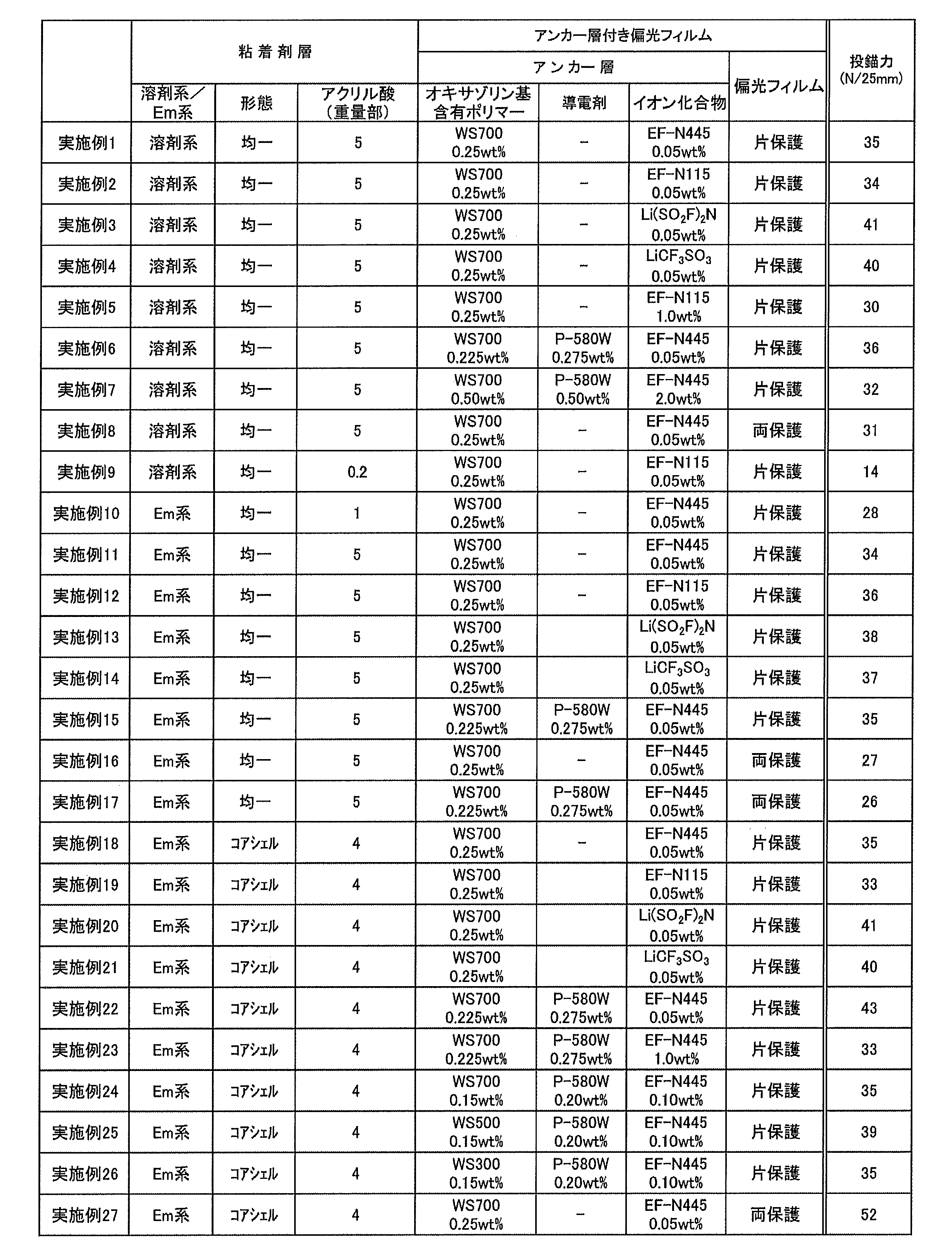

P-580W:デナトロンP-580W、チオフェン系ポリマーを10~50重量%含む溶液、ナガセケムテックス(株)製
WS-700:エポクロスWS-700、オキサゾリン基含有アクリルポリマーを含む溶液、(株)日本触媒製
WS-500:エポクロスWS-500、オキサゾリン基含有アクリルポリマーを含む溶液、(株)日本触媒製
WS-300:エポクロスWS-300、オキサゾリン基含有アクリルポリマーを含む溶液、(株)日本触媒製
TC-310:オルガチックスTC-310、チタンラクテート、マツモトファインケミカル(株)製
B-510:デナトロンB-510、ウレタン系ポリマーを含む溶液、ナガセケムテックス製
EF-N445:ビス(ノナフルオロブタンスルホニル)イミドリチウム、三菱マテリアル電子化成(株)製
EF-N115:ビス(トリフルオロメタンスルホニル)イミドリチウム、三菱マテリアル電子化成(株)製
Li(SO2F)2N:(株)日本触媒製
LiCF3SO3:森田化学工業(株)製
Claims (9)
- オキサゾリン基含有ポリマー、並びに、カチオン成分及びスルホニル基を有するアニオン成分を有するイオン性化合物を含有することを特徴とする、アンカー層形成用組成物。
- 前記アニオン成分が、一般式(1):
(CnF2n+1SO2)N-(SO2CmF2m+1) (1)
(式中、n、mは、それぞれ独立して、1~10の整数である)
で表されるアニオン成分、(SO2F)2N-、及び、CF3SO3 -からなる群から選択される少なくとも1種のアニオン成分であることを特徴とする、請求項1に記載のアンカー層形成用組成物。 - 前記カチオン成分が、リチウムカチオンであることを特徴とする、請求項1又は2に記載のアンカー層形成用組成物。
- イオン性化合物が、ビス(ノナフルオロブタンスルホニル)イミドリチウム及び/又はビス(トリフルオロメタンスルホニル)イミドリチウムであることを特徴とする、請求項1~3のいずれかに記載のアンカー層形成用組成物。
- 請求項1~4のいずれかに記載のアンカー層形成用組成物から形成されることを特徴とする、アンカー層。
- 粘着剤組成物から形成される粘着剤層、請求項5に記載のアンカー層、及び、光学フィルムを含み、前記アンカー層は前記光学フィルムと前記粘着剤層との間に介在していることを特徴とする、粘着剤層付光学フィルム。
- 前記粘着剤組成物は、(メタ)アクリル酸エステル及びカルボキシル基含有モノマーを含むモノマー成分を重合して得られる(メタ)アクリル系ポリマーを含むことを特徴とする、請求項6に記載の粘着剤層付光学フィルム。
- 前記カルボキシル基含有モノマーは、(メタ)アクリル系ポリマーを構成する全モノマー成分中0.05~20重量%であることを特徴とする、請求項7に記載の粘着剤層付光学フィルム。
- 請求項6~8のいずれかに記載の粘着剤層付光学フィルムを用いることを特徴とする、画像表示装置。
Priority Applications (3)
| Application Number | Priority Date | Filing Date | Title |
|---|---|---|---|
| KR1020167029353A KR20170028873A (ko) | 2014-07-08 | 2015-06-24 | 앵커층 형성용 조성물, 앵커층, 점착제층이 형성된 광학 필름, 및 화상 표시 장치 |
| CN201580027260.0A CN106414634A (zh) | 2014-07-08 | 2015-06-24 | 锚固层形成用组合物、锚固层、带有粘合剂层的光学膜、以及图像显示装置 |
| US15/315,489 US20170183543A1 (en) | 2014-07-08 | 2015-06-24 | Anchor layer formation composition, anchor layer, optical film provided with adhesive layer, and image display device |
Applications Claiming Priority (2)
| Application Number | Priority Date | Filing Date | Title |
|---|---|---|---|
| JP2014140710A JP6378559B2 (ja) | 2014-07-08 | 2014-07-08 | アンカー層形成用組成物、アンカー層、粘着剤層付光学フィルム、及び、画像表示装置 |
| JP2014-140710 | 2014-07-08 |
Publications (1)
| Publication Number | Publication Date |
|---|---|
| WO2016006455A1 true WO2016006455A1 (ja) | 2016-01-14 |
Family
ID=55064093
Family Applications (1)
| Application Number | Title | Priority Date | Filing Date |
|---|---|---|---|
| PCT/JP2015/068249 Ceased WO2016006455A1 (ja) | 2014-07-08 | 2015-06-24 | アンカー層形成用組成物、アンカー層、粘着剤層付光学フィルム、及び、画像表示装置 |
Country Status (6)
| Country | Link |
|---|---|
| US (1) | US20170183543A1 (ja) |
| JP (1) | JP6378559B2 (ja) |
| KR (1) | KR20170028873A (ja) |
| CN (1) | CN106414634A (ja) |
| TW (1) | TWI727924B (ja) |
| WO (1) | WO2016006455A1 (ja) |
Cited By (1)
| Publication number | Priority date | Publication date | Assignee | Title |
|---|---|---|---|---|
| WO2018199739A1 (en) * | 2017-04-26 | 2018-11-01 | Nitto Denko Corporation | Pressure-sensitive adhesive sheet |
Families Citing this family (20)
| Publication number | Priority date | Publication date | Assignee | Title |
|---|---|---|---|---|
| EP3272529B1 (en) | 2015-03-18 | 2022-05-04 | Riken Technos Corporation | Hard coat laminated film |
| CN107405859B (zh) | 2015-03-18 | 2020-04-17 | 理研科技株式会社 | 成型体 |
| KR102748410B1 (ko) | 2015-03-18 | 2024-12-31 | 리껭테크노스 가부시키가이샤 | 점착 필름 |
| US11065851B2 (en) | 2015-03-18 | 2021-07-20 | Riken Technos Corporation | Multilayer hard coating film |
| US11352473B2 (en) | 2015-03-18 | 2022-06-07 | Riken Technos Corporation | Hard coat laminated film and method for producing same |
| EP3666522B1 (en) | 2015-03-18 | 2022-07-06 | Riken Technos Corporation | Anti-glare hard coat laminated film |
| US11433651B2 (en) | 2015-03-18 | 2022-09-06 | Riken Technos Corporation | Hard coat laminated film |
| EP3659803A1 (en) * | 2015-03-18 | 2020-06-03 | Riken Technos Corporation | Transparent resin laminate |
| TWI745316B (zh) | 2015-11-25 | 2021-11-11 | 日商理研科技股份有限公司 | 門體 |
| US11774166B2 (en) | 2015-11-25 | 2023-10-03 | Riken Technos Corporation | Door body |
| JP6644534B2 (ja) | 2015-12-08 | 2020-02-12 | リケンテクノス株式会社 | ハードコート積層フィルム |
| KR102097817B1 (ko) * | 2016-09-08 | 2020-04-07 | 주식회사 엘지화학 | 고분자 조성물 |
| EP3808800B1 (en) | 2016-09-14 | 2022-01-05 | Riken Technos Corporation | Hard coat laminated film |
| JP7064313B2 (ja) | 2016-11-25 | 2022-05-10 | リケンテクノス株式会社 | ハードコート積層フィルム |
| EP3583636B1 (en) | 2017-02-20 | 2023-05-24 | Novaled GmbH | Electronic semiconducting device, method for preparing the electronic semiconducting device and compound |
| JP6952494B2 (ja) * | 2017-05-25 | 2021-10-20 | 住友化学株式会社 | 接着剤組成物及び偏光板 |
| US11667766B2 (en) | 2018-01-26 | 2023-06-06 | Hewlett-Packard Development Company, L.P. | Three-dimensional printing |
| JP7228957B2 (ja) * | 2018-02-16 | 2023-02-27 | 日東電工株式会社 | 粘着剤層付き光学フィルム、インセル型液晶パネルおよび液晶表示装置 |
| JP7036623B2 (ja) * | 2018-02-28 | 2022-03-15 | 積水化学工業株式会社 | 積層体 |
| WO2020122146A1 (ja) * | 2018-12-14 | 2020-06-18 | 日東電工株式会社 | 粘着剤層付き偏光フィルム |
Citations (2)
| Publication number | Priority date | Publication date | Assignee | Title |
|---|---|---|---|---|
| JP2007070611A (ja) * | 2005-08-08 | 2007-03-22 | Nitto Denko Corp | 粘着フィルム |
| JP2013234276A (ja) * | 2012-05-10 | 2013-11-21 | Sanko Kagaku Kogyo Kk | 制電性水性ウレタン樹脂乳化物、その製造方法およびそれを用いた制電性塗料、制電性被覆物、制電性接着剤並びに制電性結合剤 |
Family Cites Families (6)
| Publication number | Priority date | Publication date | Assignee | Title |
|---|---|---|---|---|
| JP2005241989A (ja) * | 2004-02-26 | 2005-09-08 | Nitto Denko Corp | 帯電防止性光学フィルム、帯電防止性粘着型光学フィルム、それらの製造方法および画像表示装置 |
| US7759442B2 (en) * | 2005-01-26 | 2010-07-20 | Nitto Denko Corporation | Adhesive composition, adhesive optical film and image display device |
| JP4722781B2 (ja) | 2005-12-15 | 2011-07-13 | 日東電工株式会社 | 粘着型光学フィルムおよび画像表示装置 |
| JP5425258B2 (ja) * | 2012-04-16 | 2014-02-26 | 日東電工株式会社 | 粘着剤組成物、粘着剤層、粘着剤層付偏光フィルムおよび画像形成装置 |
| JP2013234279A (ja) * | 2012-05-10 | 2013-11-21 | Mitsubishi Paper Mills Ltd | 色素増感型太陽電池用色素、半導体電極及び色素増感型太陽電池 |
| JP5707365B2 (ja) * | 2012-06-08 | 2015-04-30 | 日東電工株式会社 | 粘着剤層付光学フィルムの製造方法 |
-
2014
- 2014-07-08 JP JP2014140710A patent/JP6378559B2/ja not_active Expired - Fee Related
-
2015
- 2015-06-24 WO PCT/JP2015/068249 patent/WO2016006455A1/ja not_active Ceased
- 2015-06-24 US US15/315,489 patent/US20170183543A1/en not_active Abandoned
- 2015-06-24 CN CN201580027260.0A patent/CN106414634A/zh active Pending
- 2015-06-24 KR KR1020167029353A patent/KR20170028873A/ko not_active Ceased
- 2015-07-01 TW TW104121300A patent/TWI727924B/zh active
Patent Citations (2)
| Publication number | Priority date | Publication date | Assignee | Title |
|---|---|---|---|---|
| JP2007070611A (ja) * | 2005-08-08 | 2007-03-22 | Nitto Denko Corp | 粘着フィルム |
| JP2013234276A (ja) * | 2012-05-10 | 2013-11-21 | Sanko Kagaku Kogyo Kk | 制電性水性ウレタン樹脂乳化物、その製造方法およびそれを用いた制電性塗料、制電性被覆物、制電性接着剤並びに制電性結合剤 |
Cited By (5)
| Publication number | Priority date | Publication date | Assignee | Title |
|---|---|---|---|---|
| WO2018199739A1 (en) * | 2017-04-26 | 2018-11-01 | Nitto Denko Corporation | Pressure-sensitive adhesive sheet |
| CN110573587A (zh) * | 2017-04-26 | 2019-12-13 | 日东电工株式会社 | 压敏粘合片 |
| JP2020517798A (ja) * | 2017-04-26 | 2020-06-18 | 日東電工株式会社 | 粘着シート |
| CN110573587B (zh) * | 2017-04-26 | 2022-06-14 | 日东电工株式会社 | 压敏粘合片 |
| JP7293127B2 (ja) | 2017-04-26 | 2023-06-19 | 日東電工株式会社 | 粘着シート |
Also Published As
| Publication number | Publication date |
|---|---|
| TW201609910A (zh) | 2016-03-16 |
| JP6378559B2 (ja) | 2018-08-22 |
| CN106414634A (zh) | 2017-02-15 |
| TWI727924B (zh) | 2021-05-21 |
| KR20170028873A (ko) | 2017-03-14 |
| JP2016017138A (ja) | 2016-02-01 |
| US20170183543A1 (en) | 2017-06-29 |
Similar Documents
| Publication | Publication Date | Title |
|---|---|---|
| JP6378559B2 (ja) | アンカー層形成用組成物、アンカー層、粘着剤層付光学フィルム、及び、画像表示装置 | |
| US10883022B2 (en) | Pressure-sensitive adhesive composition for optical film, pressure-sensitive adhesive layer for optical film, pressure-sensitive adhesive layer-attached optical film, liquid crystal display device, and laminate | |
| JP6251548B2 (ja) | 光学フィルム用水分散型粘着剤組成物、粘着剤層、粘着型光学フィルム、及び、画像表示装置 | |
| US10266629B2 (en) | Pressure-sensitive adhesive composition for optical film, pressure-sensitive adhesive layer for optical film, pressure-sensitive adhesive optical film, and image display device | |
| JP6093624B2 (ja) | 光学フィルム用粘着剤層、粘着剤層付光学フィルム、及び、画像表示装置 | |
| JP5425258B2 (ja) | 粘着剤組成物、粘着剤層、粘着剤層付偏光フィルムおよび画像形成装置 | |
| JP6522289B2 (ja) | 粘着剤層付偏光フィルム、積層体、及び、画像表示装置 | |
| JP5624448B2 (ja) | 水分散型粘着剤組成物、粘着剤層、粘着部材および画像表示装置 | |
| JP6664867B2 (ja) | 粘着剤層付光学部材、画像表示装置、及び、粘着剤層付光学部材の製造方法 | |
| WO2014208695A1 (ja) | 粘着剤層付偏光フィルム、積層体、及び、画像表示装置 | |
| WO2015083448A1 (ja) | 偏光フィルム、粘着剤層付偏光フィルムおよび画像表示装置 | |
| WO2015102086A1 (ja) | アクリル系粘着剤組成物、アクリル系粘着剤層、粘着剤層付き基材フィルム、積層体、及び画像表示装置 | |
| JP2013148722A (ja) | 粘着剤層付光学フィルムおよび画像表示装置 | |
| JP2012116986A (ja) | 光学フィルム用粘着剤層、粘着型光学フィルム、画像表示装置 | |
| CN105518097A (zh) | 水分散型粘合剂组合物、粘合剂层、粘合型光学膜及图像显示装置 | |
| JP6068543B2 (ja) | 液晶パネル及び画像表示装置 | |
| JP2011140641A (ja) | 光学フィルム用粘着剤層、粘着型光学フィルム、その製造方法および画像表示装置 | |
| JP2022003390A (ja) | 光学機能層付偏光フィルムおよび液晶表示装置 | |
| JPWO2018164052A1 (ja) | 光学機能層付光学部材 | |
| JP2012111871A (ja) | 光学フィルム用粘着剤層、粘着型光学フィルムおよび画像表示装置 |
Legal Events
| Date | Code | Title | Description |
|---|---|---|---|
| 121 | Ep: the epo has been informed by wipo that ep was designated in this application |
Ref document number: 15818758 Country of ref document: EP Kind code of ref document: A1 |
|
| ENP | Entry into the national phase |
Ref document number: 20167029353 Country of ref document: KR Kind code of ref document: A |
|
| WWE | Wipo information: entry into national phase |
Ref document number: 15315489 Country of ref document: US |
|
| NENP | Non-entry into the national phase |
Ref country code: DE |
|
| 122 | Ep: pct application non-entry in european phase |
Ref document number: 15818758 Country of ref document: EP Kind code of ref document: A1 |