WO2015159878A1 - 吸収性物品 - Google Patents
吸収性物品 Download PDFInfo
- Publication number
- WO2015159878A1 WO2015159878A1 PCT/JP2015/061447 JP2015061447W WO2015159878A1 WO 2015159878 A1 WO2015159878 A1 WO 2015159878A1 JP 2015061447 W JP2015061447 W JP 2015061447W WO 2015159878 A1 WO2015159878 A1 WO 2015159878A1
- Authority
- WO
- WIPO (PCT)
- Prior art keywords
- layer
- absorbent article
- contact surface
- skin contact
- absorbent
- Prior art date
- Legal status (The legal status is an assumption and is not a legal conclusion. Google has not performed a legal analysis and makes no representation as to the accuracy of the status listed.)
- Ceased
Links
Images


Classifications
-
- A—HUMAN NECESSITIES
- A61—MEDICAL OR VETERINARY SCIENCE; HYGIENE
- A61F—FILTERS IMPLANTABLE INTO BLOOD VESSELS; PROSTHESES; DEVICES PROVIDING PATENCY TO, OR PREVENTING COLLAPSING OF, TUBULAR STRUCTURES OF THE BODY, e.g. STENTS; ORTHOPAEDIC, NURSING OR CONTRACEPTIVE DEVICES; FOMENTATION; TREATMENT OR PROTECTION OF EYES OR EARS; BANDAGES, DRESSINGS OR ABSORBENT PADS; FIRST-AID KITS
- A61F13/00—Bandages or dressings; Absorbent pads
- A61F13/15—Absorbent pads, e.g. sanitary towels, swabs or tampons for external or internal application to the body; Supporting or fastening means therefor; Tampon applicators
- A61F13/51—Absorbent pads, e.g. sanitary towels, swabs or tampons for external or internal application to the body; Supporting or fastening means therefor; Tampon applicators characterised by the outer layers of the pads
- A61F13/511—Topsheet, i.e. the permeable cover or layer facing the skin
-
- A—HUMAN NECESSITIES
- A61—MEDICAL OR VETERINARY SCIENCE; HYGIENE
- A61F—FILTERS IMPLANTABLE INTO BLOOD VESSELS; PROSTHESES; DEVICES PROVIDING PATENCY TO, OR PREVENTING COLLAPSING OF, TUBULAR STRUCTURES OF THE BODY, e.g. STENTS; ORTHOPAEDIC, NURSING OR CONTRACEPTIVE DEVICES; FOMENTATION; TREATMENT OR PROTECTION OF EYES OR EARS; BANDAGES, DRESSINGS OR ABSORBENT PADS; FIRST-AID KITS
- A61F13/00—Bandages or dressings; Absorbent pads
- A61F13/15—Absorbent pads, e.g. sanitary towels, swabs or tampons for external or internal application to the body; Supporting or fastening means therefor; Tampon applicators
- A61F13/53—Absorbent pads, e.g. sanitary towels, swabs or tampons for external or internal application to the body; Supporting or fastening means therefor; Tampon applicators characterised by the absorbing medium
- A61F13/539—Absorbent pads, e.g. sanitary towels, swabs or tampons for external or internal application to the body; Supporting or fastening means therefor; Tampon applicators characterised by the absorbing medium characterised by the connection of the absorbent layers with each other or with the outer layers
Definitions
- the present invention relates to an absorbent article.
- Patent Document 1 discloses a sanitary napkin with improved cushioning properties such as a surface sheet that touches the skin of the wearer.
- the surface sheet is composed of a nonwoven fabric provided with raised fibers having a number of raised fibers of 8 / cm or more and a raised height of 5 mm or less. Since the surface sheet is composed of the nonwoven fabric having such raised fibers, the cushioning property of the surface sheet is enhanced. Therefore, the touch of the sanitary napkin is improved.
- an object of the present invention is to provide an absorbent article capable of realizing a tactile sensation such that the absorbent article follows the skin and improving the wearing feeling.
- the absorbent article according to the present disclosure has a product front-rear direction and a product width direction orthogonal to the product front-rear direction, an absorbent layer that absorbs bodily fluids, and a skin contact surface side of the wearer than the absorbent layer
- the surface layer is provided with a liquid permeable region through which the liquid permeates from the skin contact surface side to the absorbent layer side at a position overlapping the absorbent layer in plan view.
- average surface coefficient of friction during 50 gf / cm 2 load (MIU) is greater than 0.15, the skin contact surface of the liquid permeable region, the average surface coefficient of friction during 50 gf / cm 2 load
- MIU average surface coefficient of friction during 50 gf / cm 2 load
- the variation (MMD) is less than 0.007, and the liquid permeable region Abutment surface was measured toward the non-skin contact surface from, 50 gf / cm 2 the absorbent compressive hardness of the article when the load (LC) is greater than 0.4, the skin of the liquid permeable region
- the gist is that the compressive energy (WC) of the absorbent article measured at a load of 50 gf / cm 2 measured from the contact surface toward the non-skin contact surface is smaller than 5.5 g ⁇ cm / cm 2. To do.
- the absorbent article according to the present disclosure has a product front-rear direction and a product width direction orthogonal to the product front-rear direction, an absorbent layer that absorbs body fluid, and a skin contact of the wearer than the absorbent layer
- An absorbent article comprising a surface layer located on the surface side and a back layer located on the non-skin contact surface side of the wearer relative to the absorbent layer, wherein the skin contact surface side of the surface layer is The gist is that the gel is arranged.
- the absorbent article according to the present disclosure has a product front-rear direction and a product width direction orthogonal to the product front-rear direction, an absorbent layer that absorbs body fluid, and a skin contact of the wearer than the absorbent layer
- An absorbent article comprising: a surface layer located on the surface side; and a back layer located on the non-skin contact surface side of the wearer with respect to the absorbent layer, wherein the surface layer has a thermoplasticity of 1.5 dtex or less It is composed of a nonwoven fabric containing fibers, and the basis weight of the nonwoven fabric is 10 g / m 2 or more and 35 g / m 2 or less.
- FIG. 2 is a schematic cross-sectional view taken along the line AA shown in FIG. It is the top view seen from the skin contact surface side of the absorptive article concerning a 2nd embodiment.
- FIG. 4 is a schematic cross-sectional view of the BB cross section shown in FIG. 3. It is the top view seen from the skin contact surface side of the absorbent article which concerns on 3rd Embodiment.
- FIG. 4 is a schematic cross-sectional view of the CC cross section shown in FIG. 3.
- FIG. 1 is a plan view of the absorbent article
- FIG. 2 is a cross-sectional view taken along the line AA shown in FIG.
- the absorbent article 1 according to the first embodiment is, for example, a sanitary napkin.
- the absorbent article according to the embodiment is a sanitary napkin for daytime. Accordingly, in the absorbent article according to the present embodiment, the length of the front region located on the front side of the wearer in the product front-rear direction and the rear region located on the rear side of the wearer are substantially the same.
- region between a pair of wing parts mentioned later is a center area
- the front side of the central region is a front side region, and the rear side of the central region is a rear side region.
- a daytime sanitary napkin is described as an example, but the absorbent article according to the present invention can also be applied to a night sanitary napkin.
- the sanitary napkin for night use is configured such that the rear region located on the rear side of the wearer is longer than the front region located on the front side of the wearer in the product longitudinal direction.
- the absorbent article 1 includes an absorbent layer 30 that absorbs bodily fluids, a surface layer 10 that is located closer to the wearer's skin contact surface than the absorbent layer 30, and a non-skin contact surface side of the wearer relative to the absorbent layer 30. And a back surface layer 20 located on the surface.
- the absorption layer 30 is disposed between the front surface layer 10 and the back surface layer 20. Therefore, the absorption layer 30 is indicated by a broken line in FIG.
- the absorbent layer 30 is disposed in the center portion of the absorbent article 1 in the product front-rear direction L and the product width direction W.
- the absorbent layer 30 is disposed at the center of the absorbent article 1 in the product longitudinal direction L and the product width direction W.
- the absorbent article 1 includes a wing portion 43 provided on the outer side of the absorbent layer 30 in the product width direction W orthogonal to the product longitudinal direction L in a plan view shown in FIG. In addition, the absorbent article does not need to be provided with the wing part.
- the surface layer 10 includes a liquid permeable sheet 11 as a surface sheet, a gel 12 disposed discontinuously on the skin contact surface side of the liquid permeable sheet, and a skin contact at the end of the liquid permeable sheet in the product width direction. And a side sheet 13 disposed on the contact surface side.
- the liquid permeable sheet 11 contains at least one of resin and fiber.
- the liquid permeable sheet 11 is not particularly limited as long as the liquid permeable sheet 11 is a sheet-like material having a structure that transmits liquid, such as a nonwoven fabric, a woven fabric, a perforated plastic sheet, and a mesh sheet. Either natural fibers or chemical fibers can be used as the woven or non-woven material.
- Gel 12 is a continuous line in the product front-rear direction, and is arranged in five rows at intervals in the product width direction.
- the gel 12 is configured to be in a gel state (a state that is neither solid nor liquid) at about body temperature (35 ° to 40 °).
- the gel is, for example, a polyurethane composition in which an alcohol component and an organic polyisocyanate are mixed.
- the total amount of the alcohol component is 100 parts by weight
- the number of functional groups is 2.4 to 3.0
- the molecular weight is 3,000. It can be constituted by a polyurethane composition containing 99.5 to 90 parts by weight of 6,000 polyol and 0.5 to 10 parts by weight of secondary or tertiary higher monoalcohol.
- the gel should just be a gel of adhesive resin, and is not limited to the gel which consists of polyurethane gels.
- examples of other sticky gels include silicon gel, polystyrene gel, acrylic gel, polyvinyl chloride gel, and gelatin gel.
- the above-mentioned polyurethane gel is preferable because it is excellent in adhesiveness, peelability and followability to the skin, and a plasticizer is not added.
- the arrangement of the gel 12 is not limited to the configuration of the first embodiment, and various configurations can be adopted.
- the gel 12 is a linear shape extending in the product width direction, and may be arranged at intervals in the product front-rear direction, or may be a plurality of dots arranged intermittently, or a sheet.
- the shape may be a plurality of slits or the like.
- the product width direction inner side end portion of the side sheet 13 covers the product width direction outer side end portion of the liquid permeable sheet 11.
- the end portion in the product width direction of the side sheet 13 extends outward in the product width direction from the absorbent layer 30 and is positioned at the outer end portion in the product width direction of the wing portion 43.
- the side sheet 13 is not particularly limited as long as it is a sheet-like material having a structure that does not transmit liquid, such as a nonwoven fabric, a woven fabric, an apertured film, or a mesh sheet.
- the surface layer 10 may include the liquid permeable sheet 11 and the gel 12 and may not include the side sheet 13.
- the back layer 20 has a liquid-impermeable sheet 21.
- the liquid-impermeable sheet 21 has a length that is substantially the same as the length of the surface layer 10.
- the liquid impermeable sheet 21 is made of a material different from that of the surface layer.
- a polyethylene sheet, a laminated nonwoven fabric mainly composed of polypropylene, a breathable resin film, a spunbond, a sheet obtained by bonding a breathable resin film to a nonwoven fabric such as spunlace, and the like can be used.
- the absorbent layer 30 has a laminate 31 containing hydrophilic fibers and pulp.
- the laminated body 31 is formed of a material that can absorb body fluid such as menstrual blood. Examples include pulverized pulp, cellulose such as cotton, regenerated cellulose such as rayon and fibril rayon, semi-synthetic cellulose such as acetate and triacetate, particulate polymer, fibrous polymer, thermoplastic hydrophobic chemical fiber, or hydrophilic treatment.
- the thermoplastic hydrophobic chemical fibers, air bonded pulp treated with chemical bonds, etc. can be used alone or in combination.
- the laminate 31 according to the present embodiment is configured by wrapping a pulp obtained by laminating cotton-like pulp, synthetic pulp, or the like with a basis weight of about 50 to 700 g / m 2 with protective paper (not shown).
- the protective paper is for maintaining the shape of the pulp, and for example, crepe paper or tissue paper can be used.
- the absorbent layer 30 has a shape extending in the front-rear direction of the product.
- the length of the absorbent layer 30 in the product front-rear direction is shorter than the length of the back layer 20 in the product front-rear direction.
- the length of the absorbent layer 30 in the product width direction W corresponds to the crotch interval of adult women, and is generally 50 to 80 mm.
- the absorption layer 30 is bonded to the back surface layer 20 with an adhesive such as hot melt.
- the periphery of the surface layer 10 and the back surface layer 20 is joined, and the absorption layer 30 is enclosed.
- a joining method of the surface layer 10 and the back surface layer 20 it is possible to combine any one or more of heat embossing, an ultrasonic wave, or a hot melt adhesive.
- an adhesive (not shown) is applied to the surface in contact with the undergarment in a plurality of regions.
- the adhesive In a state before use, the adhesive is in contact with a release sheet (not shown).
- the release sheet prevents the adhesive from deteriorating before use. And a peeling sheet peels by a wearer at the time of use.
- the absorbent article which does not have a peeling sheet you may be comprised so that it may prevent that an adhesive deteriorates before use with the packaging sheet which wraps an absorbent article separately.
- the absorbent article 1 may be formed with a compressed portion obtained by compressing the surface layer 10 and the absorbent layer 30 in the thickness direction.
- the surface layer 10 includes a liquid permeable region RA and a liquid impermeable region RB.
- the liquid permeation area RA is an area through which liquid permeates from the skin contact surface side to the absorption layer side.
- the liquid permeable region RA is a region where the liquid permeable sheet 11 is disposed and the gel 12 is not disposed.
- the liquid impermeable region RB is a region where the liquid permeable sheet 11 is arranged and the gel 12 is arranged, and a region where the side sheet 13 is arranged.
- the liquid permeable region RA is provided at a position overlapping the absorption layer in plan view. Therefore, the body fluid discharged from the wearer is guided to the absorption layer 30 through the liquid permeable region RA.
- the skin contact surface of the gel 12 is applied to the wearer's skin.
- the gel can conform (enter) into the unevenness of the wearer's skin. Therefore, a certain resistance feeling can be obtained instead of a feeling that the surface does not have a resistance feeling.
- the absorbent article is pushed in the thickness direction, a certain amount of pushing can be obtained, and when the pushed force is released, the gel can return to its original thickness. By these, the tactile sensation that the absorbent article follows the skin can be obtained.
- the gel 12 is discontinuously arranged in at least one of the product width directions. Therefore, the body fluid discharged from the wearer reaches the absorption layer 30 through the liquid permeable region RA between the gels 12 and is absorbed by the absorption layer 30.
- the average surface friction coefficient (MIU) at 50 gf / cm 2 load on the skin contact surface of the surface layer 10 according to the first embodiment is larger than 0.15. Further, in the skin contact surface of the liquid permeable region, 50 gf / cm 2 Changes in average surface coefficient of friction during load (MMD) is less than 0.007.
- the average surface friction coefficient is an index indicating the texture of the liquid permeable region, and the larger the value, the greater the surface resistance and slime. When the average surface friction coefficient is larger than 0.15, the tactile sensation such that the absorbent article follows the skin becomes more excellent.
- the upper limit of the average surface friction coefficient is not particularly limited, but is usually 1.0.
- the variation of the average surface friction coefficient (MMD) is an index indicating the variation of the friction coefficient, and the larger the value, the greater the roughness of the surface.
- the average surface friction coefficient and the variation (MMD) of the average surface friction coefficient can be measured by the following method. Samples were prepared for a friction distance of 30 mm, and the average surface friction coefficient (MIU) and average surface friction of the sample were measured using a surface friction coefficient measuring device (KES-FB4-AUTO-A) manufactured by Kato Tech Co., Ltd. The coefficient variation (MMD) was measured.
- the measurement conditions were a standard friction element (fingerprint type), a load at friction 50 gf / cm 2 (1.0197 kgf / cm 2 ), and a measurement sensitivity L (sensitivity 100 g / V). Other conditions such as the friction distance and the friction speed are as specified in the apparatus specifications (friction distance 30 mm, analysis distance 20 mm, sample moving speed 1 mm / sec).
- Average surface friction coefficient is an average value of the friction coefficient of the sample surface measured over an analysis distance of 20 mm.
- the variation in mean surface friction coefficient (MMD) is the average deviation of the coefficient of friction of the sample surface measured over an analysis distance of 20 mm.
- region which concerns on 1st Embodiment toward the non-skin contact surface side is 0.4.
- the compression energy of the absorbent article under a load of 50 gf / cm 2 measured from the skin contact surface of the liquid permeation region to the non-skin contact surface is less than 5.5 g ⁇ cm / cm 2 .
- the compression hardness of the absorbent article at a load of 50 gf / cm 2 indicates the compressibility of the absorbent article with a small force, and the larger the value, the more the hardness at the time of compression is expressed.
- the compression energy (WC) indicates that the greater the value, the easier the compression.
- the compression energy means the compression work (WC value).
- the compression hardness (LC) and compression energy (WC) of the absorbent article can be measured by the following methods.
- the compression displacement of the sample was measured using a compression tester (KES-FB3) manufactured by Kato Tech.
- An absorbent article is set on the compression tester so that the skin is compressed from the skin contact surface of the liquid permeation region toward the non-skin contact surface, and the pressure plate is a circular pressure plate of 2 cm 2 and is 0.02 mm.
- the sample was compressed to 50 gf / cm 2 at a speed of / sec, and the compression hardness (LC) and compression energy (WC) were measured.
- the compression deformation rate was 0.02 mm / sec
- the maximum compression load was 50 gf / cm 2 .
- the surface roughness (SMD) of the skin contact surface of the liquid permeable region is 1.8 ⁇ m or less.
- the surface roughness (SMD) is an index indicating the surface texture (for example, roughness, roughness, unevenness) of the liquid permeation region. The smaller the value, the smaller the roughness, the less roughness, the unevenness, and the smoothness. A fine sense of texture is obtained, and a tactile sensation such that the absorbent article follows the skin becomes more excellent.
- the minimum of surface roughness (SMD) is not specifically limited, Usually, it is 1.0 micrometer or more.
- the surface roughness (SMD) is measured by a KES (Kawabata Evaluation System) method.
- the surface roughness can be measured by the following method. Using a surface testing machine (KES-FB4-AUTO-A) manufactured by Kato Tech Co., Ltd., the variation in the vertical thickness of the sample surface was measured. Measurement conditions were as follows: a load of 0.098 N was applied to a 0.5 mm diameter piano wire having a width of 5 mm, a friction distance of 30 mm, an analysis distance of 20 mm, and a sample moving speed of 1 mm / sec.
- KES-FB4-AUTO-A surface testing machine manufactured by Kato Tech Co., Ltd.
- Surface layer 10 is greater than the average surface coefficient of friction during 50 gf / cm 2 load (MIU) of 0.15, and 50 gf / cm 2 Changes in average surface coefficient of friction during load (MMD) is from 0.007
- MIU average surface coefficient of friction during load
- MMD average surface coefficient of friction during load
- the compression hardness (LC) of the absorbent article at 50 gf / cm 2 load measured from the skin contact surface of the liquid permeation region toward the non-skin contact surface is greater than 0.4 and 50 gf / compression energy of the absorbent article during cm 2 load (WC) is smaller than 5.5 g ⁇ cm / cm 2, more easily feel the user is soft and absorbent articles.
- the compressive hardness (LC) of the absorbent article is greater than 0.4, and the compressive energy (WC) of the absorbent article when loaded with 50 gf / cm 2 is smaller than 5.5 g ⁇ cm / cm 2.
- the user imagines the feeling of wearing when wearing it by the tactile sensation felt when touching the absorbent article with a finger during use. And a user forms the impression with respect to the wearing feeling with respect to the product, imagining attaching an absorbent article to skin.
- the tactile sensation that the absorbent article follows the skin when the user touches the absorbent article with the hand the expectation for the wearability of the absorbent article becomes stronger, than the conventional absorbent article, It is possible to give a better impression of wearing comfort.
- Absorbent articles can be used with confidence.
- the surface roughness (SMD) on the skin contact surface side of the liquid permeable region is 1.8 ⁇ m or less, the surface of the liquid permeable region is smooth and the texture is fine. Therefore, when the liquid permeable region touches the skin, it is easy to realize a feeling that the surface of the liquid permeable region follows the skin.
- the rubber hardness of the gel is less than 15 °.
- the rubber hardness of the gel is preferably less than 10 °, more preferably less than 5 °.
- the rubber hardness of the gel is less than 15 °, it becomes easier to become familiar with the skin. Especially when touched with a finger, it becomes easy to become familiar with the finger. A soft impression is obtained when the finger press and the deformation when the finger press is released return. By being more familiar with the skin such as a finger, a sense of expectation before use and a sense of security for use can be obtained.
- the rubber hardness conforms to the “JIS K 6253-3: 2012” standard and can be measured using a durometer.
- the second embodiment is different from the first embodiment in the configuration of the surface layer 10 and the absorption layer 30.
- the surface layer 10 of the second embodiment includes a liquid permeable sheet 11, a side sheet 13, and a gel 41.
- the absorption layer 30 is made of a gel 41.
- the gel 41 functions as both the surface layer 10 and the absorption layer 30.
- the liquid permeable sheet 11 is formed with an opening 11A including the center of the absorbent layer 30 in the product width direction and extending in the product front-rear direction.
- the liquid permeable sheet 11 covers a part of the surface of the gel 41.
- the gel 41 is made of the same material as the gel 12 of the first embodiment.
- the gel 41 has a plurality of holes 42 penetrating from the skin contact surface to the non-skin contact surface.
- a part of the skin contact surface of the gel 41 is covered with the liquid permeable sheet 11.
- the gel in the portion covered with the liquid permeable sheet 11 and the side sheet 13 constitutes the absorption layer 30.
- the portion where the gel is not covered by the liquid permeable sheet 11 and the side sheet 13 constitutes the surface layer 10.
- the part where the gel 41 is covered with the side sheet 13 becomes the liquid impermeable region RB.
- the portion where the gel 41 is not covered by the side sheet 13 (the portion where the gel 41 is covered only by the liquid permeable sheet 11 and the portion where the opening 11A of the liquid permeable sheet 11 is disposed) is the liquid permeable region RA.
- the gel 41 located closer to the non-skin contact surface than the portion where the gel 41 is not covered by the liquid-permeable sheet 11 (the portion where the opening 11A is disposed) constitutes the absorbent layer 30.
- the skin contact surface of the gel 41 is applied to the wearer's skin.
- the gel can conform (enter) into the unevenness of the wearer's skin. Therefore, a certain resistance feeling can be obtained instead of a feeling that the surface does not have a resistance feeling.
- a certain resistance feeling can be obtained instead of a feeling that the surface does not have a resistance feeling.
- the article is pushed in the thickness direction, a certain amount of pushing is obtained, and when the article is returned from pushing, a feeling of returning to the original thickness is obtained. By these, the tactile sensation that the absorbent article follows the skin can be obtained.
- the body fluid when the body fluid is discharged, the body fluid enters the hole 42 of the gel 41 in the liquid permeation region RA, and the body fluid is retained in the hole 42 of the gel 41, or the body fluid retained in the hole 42 is retained in the gel 41. Can be absorbed by.
- the gel 41 may be formed with a recess that is recessed from the skin contact surface side toward the non-skin contact side instead of the hole.
- the body fluid When the body fluid is discharged, the body fluid enters the gel in which a plurality of recesses are formed, and the body fluid can be held in the recess of the gel 41, or the body fluid held in the recess can be absorbed by the gel 41.
- the third embodiment is different from the first embodiment in the configuration of the surface layer 10 and the absorption layer 30.
- the surface layer 10 of the third embodiment includes a liquid permeable sheet 11 and a side sheet 13.
- the absorbent layer 30 has the same configuration as that of the first embodiment, and includes hydrophilic fibers and pulp. In the third embodiment, no gel is provided.
- the liquid permeable sheet 11 according to the third embodiment is made of a nonwoven fabric containing thermoplastic fibers of 1.5 dtex or less.
- the basis weight of the nonwoven fabric is 10 g / m 2 or more and 35 g / m 2 or less.
- a part of the liquid permeable sheet 11 is covered with the side sheet 13.
- the portion of the liquid permeable sheet 11 covered with the side sheet 13 becomes the liquid impermeable region RB.
- a portion where the liquid permeable sheet 11 is not covered by the side sheet 13 becomes a liquid permeable region RA.
- the liquid permeable sheet 11 is a liquid permeable sheet. Therefore, the portion where the liquid-permeable sheet 11 is covered by the side sheet 13 is a liquid-impermeable region, and the portion where the liquid-permeable sheet 11 is not covered by the side sheet 13 is a liquid-permeable region.
- the liquid permeable sheet 11 according to the third embodiment is composed of the following upper layer fiber configuration and lower layer fiber configuration, with the upper layer having a basis weight of 7 g / m 2 and the lower layer having a basis weight of 15 g / m 2 . It is a nonwoven fabric sheet having an overall basis weight of 22 g / m 2 .
- the upper layer having a basis weight of 7 g / m 2
- the lower layer having a basis weight of 15 g / m 2
- It is a nonwoven fabric sheet having an overall basis weight of 22 g / m 2 .
- the composite fiber having the following configuration is supplied to the first card machine as the third fiber (fiber configuration for the lower layer), and the mass per unit area is 15 g / m 2.
- the first web is made into a lower layer of the nonwoven fabric sheet by a predetermined processing.
- Fiber core component Polyethylene terephthalate (PET, melting point approx. 260 ° C.)
- Fiber sheath component High density polyethylene (HDPE, melting point approx. 130 ° C) ⁇ Fineness: 2.2 dtex ⁇ Fiber length: 45mm
- Second upper layer fiber Core component PET (melting point 260 ° C.) ⁇ Sheath component: HDPE (melting point 130 ° C) ⁇ Fineness: 2.2 dtex ⁇ Fiber length: 45mm
- the fiber weight ratio in the upper layer fibers of the first upper layer fiber and the second upper layer fiber is 70% for the first upper layer fiber and 30% for the second upper layer fiber.
- the first upper layer fiber and the second upper layer fiber are supplied to the second card machine at a predetermined mixing ratio to obtain a second web, which is superimposed on the first web to obtain a composite web.
- the composite web passes through the dryer.
- heated air at a temperature (for example, 140 ° C.) capable of melting the surface of the fibers constituting the web is blown onto the composite web, and the various fibers are partially welded to each other to have a certain strength. Become a non-woven sheet.
- the composite web that comes out of the dryer is made into a non-woven sheet that can be used as an absorbent article when it is cooled to room temperature.
- the liquid permeable sheet 11 may not be a non-woven fabric having irregularities patterned on the surface (for example, the concave portions and the convex portions are aligned with each other at a pitch of 1.5 mm), or may have irregularities. . However, in the liquid permeable sheet 11 having irregularities, it is preferable to have a 1.3 dtex fiber layer on the concave surface.
- the liquid permeable region RA of the surface layer is composed of a nonwoven fabric containing thermoplastic fibers of 1.5 dtex or less. Therefore, fibers enter into the irregularities on the skin surface, and a certain level of resistance and slime feel are generated on the surface of the liquid permeable region. Therefore, the user can realize a tactile sensation such that the absorbent article follows the skin.
- the basis weight of the nonwoven fabric constituting the liquid-permeable sheet 11 because it is less 10 g / m 2 or more 35 g / m 2, since there is a tendency to return amount at the time of deformation is increased, it touched absorbent article to the skin It becomes easy to maintain the state, and a tactile sensation such that the absorbent article follows the skin can be realized. With a moderate resistance in the liquid-permeable region and the softness of the entire absorbent article 1B, it is possible to effectively realize a tactile sensation such that the absorbent article follows the skin.
- fibers of 1.5 dtex or less are narrower than the irregularities caused by the fingerprints of the fingers.
- the tactile organ is stimulated to feel “delicate and soft”.
- “Fine” here is expressed as a very sensitive meaning that can be understood by lightly touching. Therefore, when the user touches the absorbent article with his / her hand, the sense of expectation becomes stronger due to the tactile sensation that the absorbent article follows the skin.
- the absorbent article is not limited to a sanitary napkin, but may be an absorbent article having an absorbent layer, such as a panty liner, a urine picking pad, or a disposable diaper.
- an absorbent layer such as a panty liner, a urine picking pad, or a disposable diaper.
- the mother can feel the tactile sensation that the absorbent article follows the skin by touching with a finger or the like when the mother wears the disposable diaper.
- the demand of users (mothers) of disposable diapers has been increasing, and in particular, when wearing on infants, there is an increasing awareness of wanting to eliminate the burden on the infant's skin or to reduce the burden as much as possible. .
- the user can feel a gentle image on the skin of the infant and can get a sense of security.
- Table 1 shows the comparative evaluation results of the surface layer. As shown in Table 1, tests were conducted on the surface layers according to Examples 1 and 2, and Comparative Examples 1 and 2.
- the upper layer having a basis weight of 7 g / m 2 comprising a thermoplastic fiber 1.3 dtex, weight per unit area consisting of an upper layer having a basis weight of 15 g / m 2 are air-through nonwoven fabric sheet of 22 g / m 2.
- the surface layer according to Example 2 is obtained by discontinuously applying a gel to the skin contact surface side of the surface layer according to Example 1.
- the surface layer according to Comparative Example 1 is an air-through nonwoven fabric sheet having a basis weight of 22 g / m 2 , which includes an upper layer having a basis weight of 7 g / m 2 containing a 2.2 dtex thermoplastic fiber and a lower layer having a basis weight of 15 g / m 2 .
- the surface layer according to Comparative Example 2 is an air-through nonwoven fabric sheet in which irregularities with a width of 5 mm are formed on the surface layer according to Comparative Example 1.
- Table 1 shows the average surface friction coefficient (MIU), variation of average surface friction coefficient (MMD), compression hardness (LC), and compression energy (WC) of each surface layer.
- the comparative evaluation test was conducted by 30 women using napkins.
- the samples according to Examples 1 and 2 and Comparative Examples 1 and 2 are placed on a desk, and the woman who is the practitioner touches the surface of the sample, and then the practitioner picks up the sample and touches the sample. The following questions were asked about the touch.
- QUESTION 1 “Is it preferable for tactile sensation and touch compared to the napkin that I usually use?” A sample in which the ratio of the number of people who answered “preferred” to the question 1 was 60% or more had good sensory evaluation (tactile sensation) and was evaluated as “good”. In addition, a sample in which the ratio of the number of people who answered “preferred” to the question 1 was less than 60% was evaluated as x because the sensory evaluation (tactile feeling) was not good.
- QUESTION 2 “What is the expression of the feel and feel of the sample?”
- the sensory evaluation (tactile feeling) was not good, and the evaluation was x.
- the sensory evaluation (tactile feeling) was good, and it was evaluated as “good”.
- the surface layer according to Comparative Example 1 has an average surface friction coefficient (MIU) of 0.15 or less (does not satisfy the conditions of the present invention), and the average surface friction coefficient variation (MMD) is smaller than 0.007 ( Satisfying the conditions of the present invention, a good result could not be obtained by comparative evaluation.
- the surface layer according to Comparative Example 2 has an average surface friction coefficient (MIU) larger than 0.15 (the conditions of the present invention are satisfied), and the average surface friction coefficient variation (MMD) is 0.007 or more (the present invention). The above condition was not satisfied), and good results could not be obtained by comparative evaluation.
- the average surface friction coefficient (MIU) is larger than 0.15 (the condition of the present invention is satisfied), and the variation of the average surface friction coefficient (MMD) is smaller than 0.007. (The condition of the present invention was satisfied), and good results could be obtained by comparative evaluation. From this, the average surface friction coefficient (MIU) is larger than 0.15 and the variation of the average surface friction coefficient (MMD) is smaller than 0.007, whereby the absorbent article follows the skin. It was found that such a tactile sensation can be effectively realized.
- Comparative Example 1 the compression hardness (LC) is 0.4 or less (does not satisfy the conditions of the present invention), and the compression energy (WC) is 5.5 g ⁇ cm / cm 2 or more (the present invention). However, it was not possible to obtain good results in Comparative Evaluation 1.
- Example 1, Example 2, and Comparative Example 2 the compression hardness (LC) is larger than 0.4 (the conditions of the present invention are satisfied), and the compression energy (WC) is 5.5 g ⁇ cm / cm. It was smaller than 2 (satisfying the conditions of the present invention), and a favorable result could be obtained with Comparative Evaluation 1. Accordingly, the absorbent article follows the skin when the compression hardness (LC) is larger than 0.4 and the compression energy (WC) is smaller than 5.5 g ⁇ cm / cm 2. It was found that it was possible to effectively realize a tactile feel.
- an absorbent article capable of realizing a tactile sensation such that the absorbent article follows the skin and improving the wearing feeling.
Landscapes
- Health & Medical Sciences (AREA)
- Epidemiology (AREA)
- Engineering & Computer Science (AREA)
- Biomedical Technology (AREA)
- Heart & Thoracic Surgery (AREA)
- Vascular Medicine (AREA)
- Life Sciences & Earth Sciences (AREA)
- Animal Behavior & Ethology (AREA)
- General Health & Medical Sciences (AREA)
- Public Health (AREA)
- Veterinary Medicine (AREA)
- Absorbent Articles And Supports Therefor (AREA)
Abstract
肌に吸収性物品が追従してくるような触感を実現し、装着感を向上させることができる吸収性物品を提供する。吸収性物品の液透過領域(RA)の肌当接面における、50gf/cm2荷重時の平均表面摩擦係数(MIU)は、0.15よりも大きい。液透過領域(RA)の肌当接面における、50gf/cm2荷重時の平均表面摩擦係数の変動(MMD)は、0.007よりも小さい。液透過領域(RA)の肌当接面から非肌当接面に向けて測定した、50gf/cm2荷重時の前記吸収性物品の圧縮硬さ(LC)は、0.4よりも大きい。液透過領域(RA)の肌当接面から非肌当接面に向けて測定した、50gf/cm2荷重時の吸収性物品の圧縮エネルギー(WC)は、5.5g・cm/cm2よりも小さい。
Description
本発明は、吸収性物品に関する。
従来より、表面シート等のクッション性を高めたり、表面シートの滑らかさを高めたりして、吸収性物品の肌触りを向上させることが行われている。例えば、特許文献1には、着用者の肌に触れる表面シート等のクッション性を高めた生理用ナプキンが開示されている。
特許文献1の生理用ナプキンは、起毛する繊維の本数が8本/cm以上であり且つ起毛高さが5mm以下である起毛繊維を備えた不織布によって表面シートが構成されている。このような起毛繊維を有する不織布によって表面シートが構成されているため、表面シートのクッション性が高まる。よって、生理用ナプキンの肌触りが向上する。
しかし、近年、吸収性物品の装着感に対する要求が高くなっており、更なる肌触りの向上が求められている。このような観点で本出願人が鋭意研究を重ねた結果、表面シートの滑らかさやクッション性のみならず、肌に吸収性物品が追従してくるような触感が装着感の向上に貢献することがわかった。
そこで、本発明は、肌に吸収性物品が追従してくるような触感を実現し、装着感を向上させることができる吸収性物品を提供することを目的とする。
本開示に係る吸収性物品は、製品前後方向と、前記製品前後方向に直交する製品幅方向とを有し、体液を吸収する吸収層と、前記吸収層よりも着用者の肌当接面側に位置する表面層と、前記吸収層よりも着用者の非肌当接面側に位置する裏面層と、を備える吸収性物品であって、前記表面層は、樹脂及び繊維の少なくとも一方を含んでおり、前記表面層には、肌当接面側から吸収層側に液が透過する液透過領域が前記吸収層と平面視にて重なる位置に設けられており、前記液透過領域の肌当接面における、50gf/cm2荷重時の平均表面摩擦係数(MIU)は、0.15よりも大きく、前記液透過領域の肌当接面における、50gf/cm2荷重時の平均表面摩擦係数の変動(MMD)は、0.007よりも小さく、前記液透過領域の前記肌当接面から前記非肌当接面に向けて測定した、50gf/cm2荷重時の前記吸収性物品の圧縮硬さ(LC)は、0.4よりも大きく、前記液透過領域の前記肌当接面から前記非肌当接面に向けて測定した、50gf/cm2荷重時の前記吸収性物品の圧縮エネルギー(WC)は、5.5g・cm/cm2よりも小さいことを要旨とする。
また、本開示に係る吸収性物品は、製品前後方向と、前記製品前後方向に直交する製品幅方向とを有し、体液を吸収する吸収層と、前記吸収層よりも着用者の肌当接面側に位置する表面層と、前記吸収層よりも着用者の非肌当接面側に位置する裏面層と、を備える吸収性物品であって、前記表面層の肌当接面側には、ゲルが配置されていることを要旨とする。
また、本開示に係る吸収性物品は、製品前後方向と、前記製品前後方向に直交する製品幅方向とを有し、体液を吸収する吸収層と、前記吸収層よりも着用者の肌当接面側に位置する表面層と、前記吸収層よりも着用者の非肌当接面側に位置する裏面層と、を備える吸収性物品であって、前記表面層は、1.5dtex以下の熱可塑性繊維を含む不織布によって構成され、前記不織布の目付は、10g/m2以上35g/m2以下であることを要旨とする。
図面を参照して、第1の実施形態に係る吸収性物品1について説明する。図1は、吸収性物品の平面図であり、図2は、図1に示すA-A断面図である。第1の実施形態に係る吸収性物品1は、例えば、生理用ナプキンである。
実施の形態に係る吸収性物品は、昼用の生理用ナプキンである。したがって、本実施の形態に係る吸収性物品は、製品前後方向において着用者の前側に位置する前側領域と、着用者の後側に位置する後側領域との長さが略同じである。
なお、後述する一対のウイング部の間の領域は、着用者の排泄口が当接する排泄口当接領域を含む中央領域である。中央領域よりも前側が前側領域となり、中央領域よりも後側が後側領域となる。
なお、本実施の形態では、昼用の生理用ナプキンを例に挙げて説明しているが、本発明に係る吸収性物品は、夜用の生理用ナプキンにおいても適用することができる。夜用の生理用ナプキンは、製品前後方向において着用者の前側に位置する前側領域よりも、着用者の後側に位置する後側領域の方が長く構成されている。
吸収性物品1は、体液を吸収する吸収層30と、吸収層30よりも着用者の肌当接面側に位置する表面層10と、吸収層30よりも着用者の非肌当接面側に位置する裏面層20と、を備える。吸収層30は、表面層10と裏面層20との間に配設される。従って、吸収層30は、図1において破線で示される。吸収層30は、吸収性物品1の製品前後方向L及び製品幅方向Wにおける中央部分に配設される。
吸収層30は、吸収性物品1の製品前後方向L及び製品幅方向Wにおける中央部分に配設される。吸収性物品1は、図1に示す平面視にて、製品前後方向Lに直交する製品幅方向Wにおいて吸収層30の外側に設けられるウイング部43を備える。なお、吸収性物品は、ウイング部を備えていなくてもよい。
表面層10は、表面シートとしての液透過性シート11と、液透過性シートの肌当接面側において不連続に配置されたゲル12と、液透過性シートの製品幅方向端部の肌当接面側に配置されたサイドシート13と、を有する。
液透過性シート11は、樹脂及び繊維の少なくとも一方を含んでいる。液透過性シート11は、不織布、織布、有孔プラスチックシート、メッシュシート等、液体を透過する構造のシート状の材料であれば、特に限定されない。織布や不織布の素材としては、天然繊維、化学繊維のいずれも使用できる。
ゲル12は、製品前後方向に連続した線状であり、製品幅方向に間隔を空けて5列に配置されている。ゲル12は、体温程度(35°~40°)においてゲル状(固体でもなく、液体でもな状態)となるように構成されている。
ゲルは、例えば、アルコール成分と有機ポリイソシアネートとを混合させたポリウレタン組成物であって、アルコール成分の合計量を100重量部とした時、官能基数2.4~3.0、分子量3,000~6,000のポリオールを99.5~90重量部と、二級若しくは三級の高級モノアルコールを0.5~10重量部含有するポリウレタン組成物によって構成できる。
なお、ゲルは、粘着性のある樹脂のゲルであればよく、ポリウレタンゲルからなるゲルに限定されない。他の粘着性のあるゲルとしては、シリコンゲル、ポリスチレンゲル、アクリルゲル、ポリ塩化ビニルゲル、ゼラチンゲルを例示できる。これらの中でも、粘着性、剥離性及び肌への追随性に優れ、また、可塑剤が添加されない点から上記のポリウレタンゲルが好ましい。
ゲル12の配置は、第1の実施形態の構成に限られず、種々の構成を採用できる。例えば、ゲル12は、製品幅方向に延びる線状であって、製品前後方向に間隔を空けて配置されていてもよいし、複数間欠的に配置された点状であってもよいし、シート形状であって、スリット等の切れ込みが複数形成されていてもよい。
サイドシート13の製品幅方向内側端部は、液透過性シート11の製品幅方向外側端部を覆う。サイドシート13の製品幅方向外側端部は、吸収層30よりも製品幅方向外側に延出し、ウイング部43の製品幅方向外側端部に位置する。サイドシート13は、不織布、織布、開孔フィルム、メッシュシート等、液体を透過しない構造のシート状の材料であれば、特に限定されない。
なお、表面層10は、液透過性シート11とゲル12を含み、かつサイドシート13を含まない構成であってもよい。
裏面層20は、液不透過性シート21を有する。液不透過性シート21は、表面層10の長さと略同一の長さを有する。液不透過性シート21は、表面層と異なる材料からなる。ポリエチレンシート、ポリプロピレン等を主体としたラミネート不織布、通気性の樹脂フィルム、スパンボンド、又はスパンレース等の不織布に通気性の樹脂フィルムが接合されたシートなどを用いることができる。
吸収層30は、親水性繊維、パルプを含む積層体31を有する。積層体31は、経血などの体液を吸収可能な材料によって形成される。例として、粉砕パルプ、コットン等のセルロース、レーヨン、フィブリルレーヨン等の再生セルロース、アセテート、トリアセテート等の半合成セルロース、粒子状ポリマー、繊維状ポリマー、熱可塑性疎水性化学繊維、もしくは親水化処理を施した熱可塑性疎水性化学繊維、ケミカルボンド処理されたエアレイドパルプ等を単独又は混合して用いることができる。
本実施の形態に係る積層体31は、綿状パルプや合成パルプ等を目付50~700g/m2程度に積層したパルプを保護紙(図示せず)で包むことによって構成されている。保護紙は、パルプの形状を保持するためのものであり、例えばクレープ紙やティッシュペーパーなどを用いることができる。
吸収層30は、製品前後方向に延びる形状である。吸収層30の製品前後方向の長さは、裏面層20の製品前後方向の長さよりも短い。吸収層30の製品幅方向Wの長さは、成人女性の股間隔に対応しており、概ね50~80mmである。吸収層30は、ホットメルトなどの接着剤によって裏面層20に接着される。
吸収性物品1では、表面層10及び裏面層20の周縁が接合されて、吸収層30が内封される。表面層10と裏面層20との接合方法としては、ヒートエンボス加工、超音波、又はホットメルト接着剤のいずれか一つ、又は複数を組み合わせることが可能である。
裏面層20において、下着と接触する表面には、複数の領域において粘着剤(図示せず)が塗布されている。使用前の状態では、粘着剤は、図示しない剥離シートに接している。剥離シートは、使用前に粘着剤が劣化するのを防止している。そして、使用時に着用者によって剥離シートが剥離される。
なお、剥離シートを有しない吸収性物品においては、吸収性物品を個別に包装する包装シートによって使用前に粘着剤が劣化するのを防止するように構成されていてもよい。
また、吸収性物品1には、表面層10及び吸収層30を厚み方向に圧縮した圧搾部が形成されていてもよい。
次いで、第1の実施の形態に表面層について詳細に説明する。表面層10は、液透過領域RAと、液不透過領域RBと、を有する。液透過領域RAは、肌当接面側から吸収層側に液が透過する領域である。具体的には、液透過領域RAは、液透過性シート11が配置され、かつゲル12が配置されていない領域である。また、液不透過領域RBは、液透過性シート11が配置され、かつゲル12が配置されている領域、及びサイドシート13が配置された領域である。液透過領域RAは、吸収層と平面視にて重なる位置に設けられている。よって、着用者から排出された体液は、液透過領域RAを介して吸収層30に導かれる。
このように構成された吸収性物品1Aを着用者が装着すると、着用者の肌にゲル12の肌当接面が当てられる。ゲルの態様の物質により、着用者が触れたときに、着用者の肌の凹凸にゲルが馴染む(入り込む)ことができる。よって、単に表面が抵抗感のない感覚ではなく、一定の抵抗感が得られるようになる。更には、吸収性物品の厚み方向に押したときに、一定の押し込み量が得られ、かつ押した力を解除した際にゲルが元の厚みに戻ろうとする戻り感が得られる。これらにより、肌に吸収性物品が追従してくるような触感を得ることができる。
また、ゲル12は、製品幅方向の少なくとも一方において不連続に配置されている。よって、着用者から排出された体液は、ゲル12間の液透過領域RAを介して吸収層30に到達し、吸収層30に吸収される。
第1の実施形態に係る表面層10の肌当接面における、50gf/cm2荷重時の平均表面摩擦係数(MIU)は、0.15よりも大きい。また、液透過領域の肌当接面における、50gf/cm2荷重時の平均表面摩擦係数の変動(MMD)は、0.007よりも小さい。
平均表面摩擦係数は、液透過領域の風合いを示す指標であり、値が大きい程表面の抵抗感、ヌメリ感が大きくなることを示す。平均表面摩擦係数が0.15よりも大きいことにより、肌に吸収性物品が追従してくるような触感がより優れたものとなる。平均表面摩擦係数の上限は特に限定されないが、通常1.0である。また、平均表面摩擦係数の変動(MMD)は、摩擦係数のばらつきを示す指標であり、値が大きい程、表面のざらつき感が大きくなることを示す。
平均表面摩擦係数及び平均表面摩擦係数の変動(MMD)は、以下の方法によって測定できる。摩擦距離30mmに合わせてサンプルを用意し、カトーテック(株)製の表面摩擦係数測定器(KES-FB4-AUTO-A)を用いて、当該サンプルの平均表面摩擦係数(MIU)及び平均表面摩擦係数の変動(MMD)を測定した。測定条件は、標準摩擦子(指紋タイプ)、摩擦時の荷重50gf/cm2(1.0197kgf/cm2)、測定感度L(感度100g/V)とした。摩擦距離、摩擦速度等その他の条件は装置仕様通りである(摩擦距離30mm、解析距離20mm、試料移動速度1mm/sec)。
平均表面摩擦係数(MIU)は、20mmの解析距離にわたって測定したサンプル表面の摩擦係数の平均値である。平均表面摩擦係数の変動(MMD)は、20mmの解析距離にわたって測定したサンプル表面の摩擦係数の平均偏差である。
また、第1の実施形態に係る液透過領域の肌当接面側から非肌当接面側に向けて測定した、50gf/cm2荷重時の吸収性物品の圧縮硬さは、0.4よりも大きく、液透過領域の肌当接面から非肌当接面に向けて測定した、50gf/cm2荷重時の吸収性物品の圧縮エネルギーは、5.5g・cm/cm2よりも小さい。50gf/cm2荷重時の吸収性物品の圧縮硬さは、吸収性物品の小さな力での圧縮性を示しており、値が大きくなるほど圧縮時の硬さが発現していることとなる。圧縮エネルギー(WC)は、値が大きくなるほど、圧縮されやすいことを示している。なお、圧縮エネルギーは、圧縮仕事量(WC値)のことを意味する。
吸収性物品の圧縮硬さ(LC)及び圧縮エネルギー(WC)は、以下の方法によって測定できる。カトーテック(株)製の圧縮試験機(KES-FB3)を用いて、試料の圧縮変位量を測定した。液透過領域の肌当接面から非肌当接面に向けて圧縮するように、圧縮試験機に吸収性物品をセットし、加圧板は2cm2の円形の加圧板を用いて、0.02mm/secのスピードで50gf/cm2まで圧縮し、圧縮硬さ(LC)及び圧縮エネルギー(WC)を計測した。測定条件として、圧縮変形速度を0.02mm/sec、圧縮最大荷重を50gf/cm2とした。
液透過領域の肌当接面の表面粗さ(SMD)は、1.8μm以下である。表面粗さ(SMD)とは、液透過領域の表面風合い(例えば、ザラツキ、粗さ、凹凸感)を示す指標であり、値が小さい程ザラツキが小さく、粗さ、凹凸感が無く、なめらかでキメが細かい感覚が得られ、肌に吸収性物品が追従してくるような触感がより優れたものとなる。表面粗さ(SMD)の下限は特に限定されないが、通常1.0μm以上である。表面粗さ(SMD)は、KES(Kawabata Evaluation System)法によって測定されるものである。
表面粗さの測定方法は、以下の方法によって測定できる。カトーテック(株)製の表面試験機(KES-FB4-AUTO-A)を用いて、試料表面の上下厚み変動を測定した。測定条件は5mm幅の0.5mm径ピアノ線に0.098Nの荷重をかけ、摩擦距離30mm、解析距離20mm、試料移動速度1mm/secとした。
表面層10は、50gf/cm2荷重時の平均表面摩擦係数(MIU)が0.15よりも大きく、かつ50gf/cm2荷重時の平均表面摩擦係数の変動(MMD)は、0.007よりも小さいため、表面に抵抗感、ヌメリ感が大きくなる。例えば、表面の抵抗感が少なすぎると、使用中に肌と吸収性物品がこすれるおそれがある。しかし、液透過領域の表面に一定以上の抵抗感、ヌメリ感を設けることにより、肌に吸収性物品が追従してくるような触感を実現できる。
更に、液透過領域の肌当接面から非肌当接面に向けて測定した、50gf/cm2荷重時の吸収性物品の圧縮硬さ(LC)が0.4よりも大きく、かつ50gf/cm2荷重時の吸収性物品の圧縮エネルギー(WC)は、5.5g・cm/cm2よりも小さいため、使用者が吸収性物品を柔らかいと感じ易くなる。また、吸収性物品の圧縮硬さ(LC)が0.4よりも大きく、かつ50gf/cm2荷重時の吸収性物品の圧縮エネルギー(WC)が5.5g・cm/cm2よりも小さいことにより肌に吸収性物品に触れた状態を維持し易くなり、肌に吸収性物品が追従してくるような触感を実現できる。液透過領域の適度な抵抗感と吸収性物品1全体の柔らかさによって、肌に吸収性物品が追従してくるような触感を効果的に実現できる。
また、使用者は、使用時に指で吸収性物品に触れたときに感じる触感により、装着したときの装着感を想像する。そして、使用者は、肌に吸収性物品を付けることを想像しながら、その製品に対しての装着感に対する印象を形成する。使用者が手で吸収性物品に触れたときの肌に吸収性物品が追従してくるような触感によって、その吸収性物品の装着性に対する期待感が強くなり、従来の吸収性物品よりも、つけ心地がより優れた印象を与えることが可能となる。安心して吸収性物品を使用することができる。
また、液透過領域の肌当接面側の表面粗さ(SMD)は、1.8μm以下であるため、液透過領域の表面がなめらかでキメが細かい触感となる。よって、肌に液透過領域が触れた際に、液透過領域の表面が肌に追従するような感触を実現しやすくなる。
ゲルのゴム硬度は、15°未満である。ゲルのゴム硬度は、10°未満であることが好ましく、5°未満であることがより好ましい。ゲルのゴム硬度が15°未満であることにより、肌に対してより馴染み易くなる。特に指で触った際に、指へ馴染み易くなる。指による押し込み及び指の押し込みを解除した際の変形が戻る際において、やわらかい印象となる。指等の肌に対してよりなじむことにより、使用前の期待感及び使用に対する安心感を得ることができる。なお、ゴム硬度は、「JIS K 6253-3:2012」規格に準じたものであり、デュロメータを用いて測定することができる。
次いで、第2の実施形態に係る吸収性物品1Aについて説明する。なお、以下変形例の説明においては、上述した実施形態に係る吸収性物品1と同一部分には同一の符号を付して、相違する部分を主として説明する。
第2の実施形態は、表面層10と吸収層30の構成が、第1の実施形態と異なる。第2の実施形態の表面層10は、液透過性シート11と、サイドシート13と、ゲル41と、を有する。吸収層30は、ゲル41からなる。ゲル41は、表面層10及び吸収層30の両方として機能している。
液透過性シート11には、吸収層30の製品幅方向中央を含み、かつ製品前後方向に延びる開口11Aが形成されている。液透過性シート11は、ゲル41の表面の一部を覆う。
ゲル41は、第1の実施形態のゲル12と同様の材質によって構成される。ゲル41は、肌当接面から非肌当接面に貫通した孔42が複数形成されている。ゲル41の肌当接面の一部は、液透過性シート11に覆われている。液透過性シート11及びサイドシート13によって覆われた部分のゲルは、吸収層30を構成する。液透過性シート11及びサイドシート13によってゲルが覆われていない部分(開口11Aが配置された部分)は、表面層10を構成する。
サイドシート13によってゲル41が覆われた部分は、液不透過領域RBとなる。サイドシート13によってゲル41が覆われていない部分(液透過性シート11のみによってゲル41が覆われた部分、及び液透過性シート11の開口11Aが配置された部分)は、液透過領域RAとなる。液透過性シート11によってゲル41が覆われていない部分(開口11Aが配置された部分)よりも非肌当接面側に位置するゲル41は、吸収層30を構成する。
このように構成された吸収性物品1Aを着用者が装着すると、着用者の肌にゲル41の肌当接面が当てられる。ゲルの態様の物質により、着用者が触れたときに、着用者の肌の凹凸にゲルが馴染む(入り込む)ことができる。よって、単に表面が抵抗感のない感覚ではなく、一定の抵抗感が得られるようになる。更には、物品の厚み方向に押したときに、一定の押し込み量が得られ、押し込みから戻ったときには、ゲルが元の厚みに戻ろうとする戻り感が得られる。これらにより、肌に吸収性物品が追従してくるような触感を得ることができる。また、体液が排出された際は、液透過領域RAにおけるゲル41の孔42内に体液が浸入し、ゲル41の孔42内に体液を保持したり、孔42内に保持した体液をゲル41によって吸収したりできる。
なお、ゲル41の配置は、第2の実施形態の構成に限られず、種々の構成を採用できる。例えば、ゲル41は、孔部の代わりに、肌当接面側から非肌当接側に向かって凹む凹部が形成されていてもよい。体液が排出された際は、複数の凹部が形成されたゲルに体液が浸入し、ゲル41の凹部内に体液を保持したり、凹部内に保持した体液をゲル41によって吸収したりできる。
次いで、第3の実施形態に係る吸収性物品1Bについて説明する。第3の実施形態は、表面層10と吸収層30の構成が、第1の実施形態と異なる。第3の実施形態の表面層10は、液透過性シート11と、サイドシート13と、を有する。吸収層30は、第1の実施形態と同様の構成であり、親水性繊維、パルプを含む。第3の実施形態は、ゲルが設けられていない。
第3の実施形態に係る液透過性シート11は、1.5dtex以下の熱可塑性繊維を含む不織布によって構成されている。不織布の目付は、10g/m2以上35g/m2以下である。液透過性シート11の一部は、サイドシート13に覆われている。サイドシート13によって覆われた部分の液透過性シート11は、液不透過領域RBとなる。サイドシート13によって液透過性シート11が覆われていない部分は、液透過領域RAとなる。
なお、液透過性シート11は、液透過性のシートである。よって、サイドシート13によって液透過性シート11が覆われた部分は、液不透過領域であり、サイドシート13によって液透過性シート11が覆われていない部分は、液透過領域である。
第3の実施の形態に係る液透過性シート11は、以下に示す上層の繊維構成と下層の繊維構成とによって構成されており、上層が目付7g/m2及び下層が目付15g/m2の全体の目付が22g/m2の不織布シートである。以下、具体的な構成について説明する。
(a)下層の構成
後述の第1工程にて、第1カード機に第3繊維(下層用の繊維構成)として下記構成の複合繊維を供給して、単位面積当たりの質量が15g/m2の第1ウエブとし、所定の加工により不織布シートの下層とする。
・繊維の芯成分:ポリエチレンテレフタレート(PET、融点約260℃)
・繊維の鞘成分:高密度ポリエチレン(HDPE、融点約130℃)
・繊度:2.2dtex
・繊維長:45mm
後述の第1工程にて、第1カード機に第3繊維(下層用の繊維構成)として下記構成の複合繊維を供給して、単位面積当たりの質量が15g/m2の第1ウエブとし、所定の加工により不織布シートの下層とする。
・繊維の芯成分:ポリエチレンテレフタレート(PET、融点約260℃)
・繊維の鞘成分:高密度ポリエチレン(HDPE、融点約130℃)
・繊度:2.2dtex
・繊維長:45mm
(b) 第1上層繊維
・芯成分:PET(融点260℃)
・鞘成分:HDPE(融点130℃)
・繊度:1.3dtex
・繊維長:35mm
・芯成分:PET(融点260℃)
・鞘成分:HDPE(融点130℃)
・繊度:1.3dtex
・繊維長:35mm
(c) 第2上層繊維
・芯成分:PET(融点260℃)
・鞘成分:HDPE(融点130℃)
・繊度:2.2dtex
・繊維長:45mm
・芯成分:PET(融点260℃)
・鞘成分:HDPE(融点130℃)
・繊度:2.2dtex
・繊維長:45mm
また、第1上層繊維と第2上層繊維の上層繊維中における繊維重量比率は、第1上層繊維が70%、第2上層繊維が30%である。
(d)不織布シートの製造方法
第1工程では、第3繊維を第1カード機に供給し、第1ウエブを得る。
第1工程では、第3繊維を第1カード機に供給し、第1ウエブを得る。
第2工程では、第1上層繊維・第2上層繊維を所定の混合比率にて第2カード機に供給し、第2ウエブを得て、それを第1ウエブに重ね、複合ウエブを得る。
第3工程では、複合ウエブがドライヤーを通過する。ドライヤーでは、ウエブを構成する繊維の表面を溶融させることのできる温度(例えば140℃)の加熱空気が複合ウエブに吹き付けられて、各種繊維どうしが部分的に互いに溶着して、一定の強度を有する不織布シートになる。
最終、ドライヤーを出た複合ウエブは、それが室温にまで冷却されることによって吸収性物品として使用することのできる不織布シートとする。
なお、液透過性シート11は、表面にパターンニングされた凹凸(例えば、1.5mmピッチで凹部と凸部とが互いにならぶ)を有する不織布でなくてもよいし、凹凸を有していても良い。但し、凹凸を有する液透過性シート11において、凹部表面には、1.3dtexの繊維層を有することが好ましい。
表面層の液透過領域RAは、1.5dtex以下の熱可塑性繊維を含む不織布によって構成されている。よって、肌の表面の凹凸内に繊維が入り込み、液透過領域の表面に一定以上の抵抗感、ヌメリ感が生じる。よって、使用者は、肌に吸収性物品が追従してくるような触感を実現できる。
また、液透過性シート11を構成する不織布の目付は、10g/m2以上35g/m2以下であるため、変形時の戻り量が多くなる傾向にあるため、肌に吸収性物品に触れた状態を維持し易くなり、肌に吸収性物品が追従してくるような触感を実現できる。液透過領域の適度な抵抗感と吸収性物品1B全体の柔らかさによって、肌に吸収性物品が追従してくるような触感を効果的に実現できる。
また、一般的に、1.5dtex以下の繊維は、指の指紋による凹凸よりも狭い。例えば、指の指紋による凸に対して複数の繊維が当たると、触覚器官が刺激されて「繊細で柔らかい」という感触を受ける。ここでの「繊細」とは、軽く触ることによって分かる非常にセンシティブな意味として表現している。よって、肌に吸収性物品が追従してくるような触感によって、使用者が手で吸収性物品に触れたときに、期待感が強くなる。
上述したように、本発明の実施形態を通じて本発明の内容を開示したが、この開示の一部をなす論述及び図面は、本発明を限定するものであると理解すべきではない。この開示から当業者には様々な代替実施の形態、実施例及び運用技術が明らかとなる。
吸収性物品は、生理用ナプキンのみならず、パンティーライナーや尿取りパッド、使い捨ておむつ等、吸収層を有する吸収性物品であればよい。例えば、乳幼児用の使い捨ておむつにおいては、母親が、着用者に装着する際に指等で触ることにより、肌に吸収性物品が追従してくるような触感を体感できる。近年、使い捨ておむつのユーザ(母親)の要求は高まっており、特に、乳幼児に着用する場合には、乳幼児の肌への負担を皆無にしたい、或いはできるだけ負担を減らしたいとの意識が高まっている。乳幼児用の使い捨ておむつの液透過領域を肌に追従するような触感とすることにより、乳幼児の肌へ優しいイメージをユーザが感じ、安心感を得ることができる。
次いで、表面層の比較評価について説明する。表1は、表面層の比較評価結果を示す。表1に示すように、実施例1及び実施例2、及び比較例1及び2に係る表面層について試験を実施した。
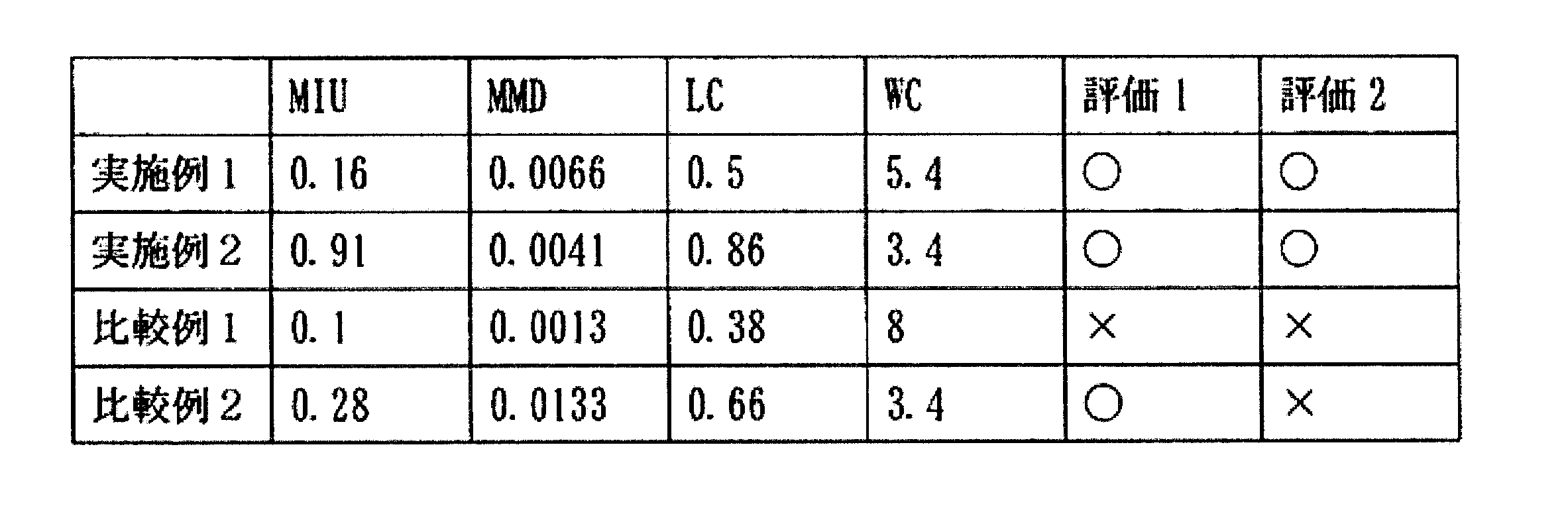
実施例1に係る表面層は、1.3dtexの熱可塑性繊維を含む目付7g/m2の上層と、目付15g/m2の上層とからなる目付が22g/m2のエアスルー不織布シートである。実施例2に係る表面層は、実施例1に係る表面層の肌当接面側にゲルを不連続的に塗布したものである。比較例1に係る表面層は、2.2dtexの熱可塑性繊維を含む目付7g/m2の上層と、目付15g/m2の下層とからなる目付が22g/m2のエアスルー不織布シートである。比較例2に係る表面層は、比較例1に係る表面層に5mm幅の凹凸を形成したエアスルー不織布シートである。各表面層の平均表面摩擦係数(MIU)、平均表面摩擦係数の変動(MMD)、圧縮硬さ(LC)及び圧縮エネルギー(WC)を表1に示す。
比較評価の試験は、ナプキンを使用している女性30名が実施した。実施例1~2、及び比較例1~2に係るサンプルを机の上におき、実施者である女性が当該サンプルの表面を触り、次いで、実施者がサンプルを手に取り、サンプルの触感・肌触りについて、以下の質問をした。
質問1:「普段使用しているナプキンと比べて、触感・肌触りについて好ましいか?」。当該質問1に対して「好ましい」と答えた人数の比率が60%以上のサンプルを官能評価(触感)が良好であり、○と評価した。また、質問1に対して「好ましい」と答えた人数の比率が60%未満のサンプルを官能評価(触感)が良好でなく、×と評価した。
質問2:「サンプルの触感・肌触りを言葉で表現すると何か?」。当該質問2に対する答えが、「ふかふか、やわらかい(硬軟感)、さらさら(ドライ感)」のいずれの場合には、官能評価(触感)が良好でなく、×と評価した。当該質問2に対する答えが、「しっとり、きめ細かい、なめらかの湿度感、滑り感」のいずれかの場合には、官能評価(触感)が良好であり、○と評価した。
比較例1に係る表面層は、平均表面摩擦係数(MIU)が0.15以下であり(本発明の条件を満たさない)、平均表面摩擦係数の変動(MMD)が0.007よりも小さく(本発明の条件を満たす)、比較評価で良好な結果を得ることができなかった。一方、比較例2に係る表面層は、平均表面摩擦係数(MIU)が0.15より大きく(本発明の条件を満たす)、平均表面摩擦係数の変動(MMD)が0.007以上(本発明の条件を満たさない)であり、比較評価で良好な結果を得ることができなかった。また、実施例1及び実施例2は、平均表面摩擦係数(MIU)が0.15より大きく(本発明の条件を満たす)、かつ平均表面摩擦係数の変動(MMD)が0.007よりも小さく(本発明の条件を満たす)、比較評価で良好な結果を得ることができた。このことから、平均表面摩擦係数(MIU)は、0.15よりも大きく、かつ平均表面摩擦係数の変動(MMD)が0.007よりも小さいことにより、肌に吸収性物品が追従してくるような触感を効果的に実現できることがわかった。
また、比較例1は、圧縮硬さ(LC)が0.4以下であり(本発明の条件を満たさない)、圧縮エネルギー(WC)が5.5g・cm/cm2以上であり(本発明の条件を満たさない)、比較評価1で良好な結果を得ることができなかった。一方、実施例1、実施例2及び比較例2は、圧縮硬さ(LC)が0.4よりも大きく(本発明の条件を満たす)、圧縮エネルギー(WC)が5.5g・cm/cm2よりも小さく(本発明の条件を満たす)、比較評価1で良好な結果を得ることができた。このことから、圧縮硬さ(LC)が0.4よりも大きく、かつ圧縮エネルギー(WC)が5.5g・cm/cm2よりも小さいことにより、肌に吸収性物品が追従してくるような触感を効果的に実現できることがわかった。
なお、2014年4月15日に出願された日本国特許出願第2014-083883号の全内容が、参照により、本明細書に組み込まれる。
本発明によれば、肌に吸収性物品が追従してくるような触感を実現し、装着感を向上させることができる吸収性物品を提供できる。
1、1A、1B :吸収性物品
10 :表面層
11 :液透過性シート
11A :開口
12 :ゲル
13 :サイドシート
20 :裏面層
21 :液不透過性シート
30 :吸収層
31 :積層体
41 :ゲル
42 :孔
43 :ウイング部
L :製品前後方向
RA :液透過領域
RB :液不透過領域
W :製品幅方向
10 :表面層
11 :液透過性シート
11A :開口
12 :ゲル
13 :サイドシート
20 :裏面層
21 :液不透過性シート
30 :吸収層
31 :積層体
41 :ゲル
42 :孔
43 :ウイング部
L :製品前後方向
RA :液透過領域
RB :液不透過領域
W :製品幅方向
Claims (9)
- 製品前後方向と、前記製品前後方向に直交する製品幅方向とを有し、
体液を吸収する吸収層と、前記吸収層よりも着用者の肌当接面側に位置する表面層と、前記吸収層よりも着用者の非肌当接面側に位置する裏面層と、を備える吸収性物品であって、
前記表面層は、樹脂及び繊維の少なくとも一方を含んでおり、
前記表面層には、肌当接面側から吸収層側に液が透過する液透過領域が前記吸収層と平面視にて重なる位置に設けられており、
前記液透過領域の肌当接面における、50gf/cm2荷重時の平均表面摩擦係数(MIU)は、0.15よりも大きく、
前記液透過領域の肌当接面における、50gf/cm2荷重時の平均表面摩擦係数の変動(MMD)は、0.007よりも小さく、
前記液透過領域の前記肌当接面から前記非肌当接面に向けて測定した、50gf/cm2荷重時の前記吸収性物品の圧縮硬さ(LC)は、0.4よりも大きく、
前記液透過領域の前記肌当接面から前記非肌当接面に向けて測定した、50gf/cm2荷重時の前記吸収性物品の圧縮エネルギー(WC)は、5.5g・cm/cm2よりも小さい、吸収性物品。 - 前記液透過領域の肌当接面の表面粗さ(SMD)は、1.8μm以下である、請求項1に記載の吸収性物品。
- 前記表面層は、前記吸収層を覆い、かつ繊維及び樹脂の少なくとも一方を含む液透過性シートと、前記液透過性シートの肌当接面側において不連続に配置された樹脂製のゲルと、を有する、請求項1又は請求項2に記載の吸収性物品。
- 前記表面層及び前記吸収層は、複数の孔が形成された樹脂製のゲルによって構成されている、請求項1又は請求項2に記載の吸収性物品。
- 前記表面層の液透過領域は、1.5dtex以下の熱可塑性繊維を含む不織布によって構成され、
前記不織布の目付は、10g/m2以上35g/m2以下である、請求項1又は請求項2に記載の吸収性物品。 - 製品前後方向と、前記製品前後方向に直交する製品幅方向とを有し、
体液を吸収する吸収層と、前記吸収層よりも着用者の肌当接面側に位置する表面層と、前記吸収層よりも着用者の非肌当接面側に位置する裏面層と、を備える吸収性物品であって、
前記表面層の肌当接面側には、ゲルが配置されている、吸収性物品。 - 前記ゲルは、前記製品前後方向及び前記製品幅方向の少なくとも一方において不連続に配置されている、請求項6に記載の吸収性物品。
- 前記ゲルのゴム硬度は、15°未満である、請求項3、請求項4、請求項6及び請求項7のいずれかに記載の吸収性物品。
- 製品前後方向と、前記製品前後方向に直交する製品幅方向とを有し、
体液を吸収する吸収層と、前記吸収層よりも着用者の肌当接面側に位置する表面層と、前記吸収層よりも着用者の非肌当接面側に位置する裏面層と、を備える吸収性物品であって、
前記表面層は、1.5dtex以下の熱可塑性繊維を含む不織布によって構成され、
前記不織布の目付は、10g/m2以上35g/m2以下である、吸収性物品。
Priority Applications (1)
| Application Number | Priority Date | Filing Date | Title |
|---|---|---|---|
| JP2016513790A JP6342481B2 (ja) | 2014-04-15 | 2015-04-14 | 吸収性物品 |
Applications Claiming Priority (2)
| Application Number | Priority Date | Filing Date | Title |
|---|---|---|---|
| JP2014-083883 | 2014-04-15 | ||
| JP2014083883 | 2014-04-15 |
Publications (1)
| Publication Number | Publication Date |
|---|---|
| WO2015159878A1 true WO2015159878A1 (ja) | 2015-10-22 |
Family
ID=54324083
Family Applications (1)
| Application Number | Title | Priority Date | Filing Date |
|---|---|---|---|
| PCT/JP2015/061447 Ceased WO2015159878A1 (ja) | 2014-04-15 | 2015-04-14 | 吸収性物品 |
Country Status (2)
| Country | Link |
|---|---|
| JP (1) | JP6342481B2 (ja) |
| WO (1) | WO2015159878A1 (ja) |
Cited By (1)
| Publication number | Priority date | Publication date | Assignee | Title |
|---|---|---|---|---|
| CN114848302A (zh) * | 2018-09-28 | 2022-08-05 | 花王株式会社 | 吸收性物品 |
Citations (6)
| Publication number | Priority date | Publication date | Assignee | Title |
|---|---|---|---|---|
| JP2002065743A (ja) * | 2000-09-04 | 2002-03-05 | Uni Charm Corp | 連続フィラメントおよび吸収シートを用いた吸収性物品 |
| JP2002085451A (ja) * | 2000-05-10 | 2002-03-26 | Uni Charm Corp | 油性成分を含んだ層を有するシート、および前記シートを用いた製品 |
| JP2004344532A (ja) * | 2003-05-23 | 2004-12-09 | Daio Paper Corp | 体液吸収性物品、体液吸収性物品の評価方法及び体液吸収性物品の製造方法 |
| JP2009136488A (ja) * | 2007-12-06 | 2009-06-25 | Kao Corp | 吸収性物品の表面シート |
| WO2012105602A1 (ja) * | 2011-02-02 | 2012-08-09 | ダイワボウホールディングス株式会社 | 顕在捲縮性複合短繊維とその製造方法、繊維集合物および衛生物品 |
| JP2013078375A (ja) * | 2011-09-30 | 2013-05-02 | Unicharm Corp | 吸収性物品 |
Family Cites Families (7)
| Publication number | Priority date | Publication date | Assignee | Title |
|---|---|---|---|---|
| US20060062816A1 (en) * | 2001-10-01 | 2006-03-23 | Gatto Joseph A | Sanitary napkins with hydrophobic lotions |
| US20030082219A1 (en) * | 2001-10-01 | 2003-05-01 | The Procter & Gamble Company | Skin care compositions comprising low concentrations of skin treatment agents |
| JP2004255176A (ja) * | 2003-02-05 | 2004-09-16 | Asahi Kasei Fibers Corp | 吸収性物品用表面材及びそれを用いた吸収性物品 |
| US7407561B2 (en) * | 2003-05-13 | 2008-08-05 | Ciba Specialty Chemicals Water Treatments Ltd. | Use of water-soluble crosslinked cationic polymers for controlling deposition of pitch and stickies in papermaking |
| US8211078B2 (en) * | 2005-02-17 | 2012-07-03 | The Procter And Gamble Company | Sanitary napkins capable of taking complex three-dimensional shape in use |
| JP5731948B2 (ja) * | 2011-04-06 | 2015-06-10 | 旭化成せんい株式会社 | 熱可塑性不織布 |
| WO2014022988A1 (en) * | 2012-08-08 | 2014-02-13 | Daiwabo Holdings Co., Ltd. | Nonwoven, sheet for absorbent article from the same, and absorbent article using the same |
-
2015
- 2015-04-14 WO PCT/JP2015/061447 patent/WO2015159878A1/ja not_active Ceased
- 2015-04-14 JP JP2016513790A patent/JP6342481B2/ja not_active Expired - Fee Related
Patent Citations (6)
| Publication number | Priority date | Publication date | Assignee | Title |
|---|---|---|---|---|
| JP2002085451A (ja) * | 2000-05-10 | 2002-03-26 | Uni Charm Corp | 油性成分を含んだ層を有するシート、および前記シートを用いた製品 |
| JP2002065743A (ja) * | 2000-09-04 | 2002-03-05 | Uni Charm Corp | 連続フィラメントおよび吸収シートを用いた吸収性物品 |
| JP2004344532A (ja) * | 2003-05-23 | 2004-12-09 | Daio Paper Corp | 体液吸収性物品、体液吸収性物品の評価方法及び体液吸収性物品の製造方法 |
| JP2009136488A (ja) * | 2007-12-06 | 2009-06-25 | Kao Corp | 吸収性物品の表面シート |
| WO2012105602A1 (ja) * | 2011-02-02 | 2012-08-09 | ダイワボウホールディングス株式会社 | 顕在捲縮性複合短繊維とその製造方法、繊維集合物および衛生物品 |
| JP2013078375A (ja) * | 2011-09-30 | 2013-05-02 | Unicharm Corp | 吸収性物品 |
Cited By (2)
| Publication number | Priority date | Publication date | Assignee | Title |
|---|---|---|---|---|
| CN114848302A (zh) * | 2018-09-28 | 2022-08-05 | 花王株式会社 | 吸收性物品 |
| CN114848302B (zh) * | 2018-09-28 | 2022-10-28 | 花王株式会社 | 吸收性物品 |
Also Published As
| Publication number | Publication date |
|---|---|
| JPWO2015159878A1 (ja) | 2017-04-13 |
| JP6342481B2 (ja) | 2018-06-13 |
Similar Documents
| Publication | Publication Date | Title |
|---|---|---|
| TWI317275B (ja) | ||
| AU779156B2 (en) | Absorbent article | |
| KR102003105B1 (ko) | 흡수성 물품 | |
| JP3408078B2 (ja) | 吸収性物品 | |
| JP4739957B2 (ja) | 陰唇間パッド | |
| JP5727246B2 (ja) | 吸収性物品 | |
| JP2001340382A (ja) | 吸収性物品 | |
| JP2004097693A (ja) | 陰唇間パッド | |
| JP6411309B2 (ja) | 吸収性物品 | |
| JP2012239720A (ja) | 吸収性物品 | |
| JPWO2002094153A1 (ja) | 陰唇間パッド | |
| CN103957858B (zh) | 吸收构造体和采用该吸收构造体的吸收性穿着物品 | |
| JP3737251B2 (ja) | 吸収性物品 | |
| JP6342481B2 (ja) | 吸収性物品 | |
| CN101291644B (zh) | 吸收性物品 | |
| JP4712533B2 (ja) | 吸収性物品 | |
| JP3423810B2 (ja) | 吸収性物品の表面シート | |
| JP7351664B2 (ja) | 吸収性物品 | |
| CN101027028A (zh) | 吸收性物品 | |
| JPH10295724A (ja) | 体液処理用吸収性物品 | |
| JP6310289B2 (ja) | 吸収性物品 | |
| TWI826666B (zh) | 吸收性物品 | |
| JP4061148B2 (ja) | 吸収性物品 | |
| JP3243208U (ja) | 生理用物品 | |
| JP2021065585A (ja) | 吸収性物品 |
Legal Events
| Date | Code | Title | Description |
|---|---|---|---|
| 121 | Ep: the epo has been informed by wipo that ep was designated in this application |
Ref document number: 15780178 Country of ref document: EP Kind code of ref document: A1 |
|
| ENP | Entry into the national phase |
Ref document number: 2016513790 Country of ref document: JP Kind code of ref document: A |
|
| NENP | Non-entry into the national phase |
Ref country code: DE |
|
| 122 | Ep: pct application non-entry in european phase |
Ref document number: 15780178 Country of ref document: EP Kind code of ref document: A1 |