WO2015152227A1 - 内部標準物質試薬 - Google Patents
内部標準物質試薬 Download PDFInfo
- Publication number
- WO2015152227A1 WO2015152227A1 PCT/JP2015/060100 JP2015060100W WO2015152227A1 WO 2015152227 A1 WO2015152227 A1 WO 2015152227A1 JP 2015060100 W JP2015060100 W JP 2015060100W WO 2015152227 A1 WO2015152227 A1 WO 2015152227A1
- Authority
- WO
- WIPO (PCT)
- Prior art keywords
- formula
- reagent
- internal standard
- porous member
- stable isotope
- Prior art date
- Legal status (The legal status is an assumption and is not a legal conclusion. Google has not performed a legal analysis and makes no representation as to the accuracy of the status listed.)
- Ceased
Links
Classifications
-
- G—PHYSICS
- G01—MEASURING; TESTING
- G01N—INVESTIGATING OR ANALYSING MATERIALS BY DETERMINING THEIR CHEMICAL OR PHYSICAL PROPERTIES
- G01N33/00—Investigating or analysing materials by specific methods not covered by groups G01N1/00 - G01N31/00
- G01N33/48—Biological material, e.g. blood, urine; Haemocytometers
- G01N33/50—Chemical analysis of biological material, e.g. blood, urine; Testing involving biospecific ligand binding methods; Immunological testing
- G01N33/68—Chemical analysis of biological material, e.g. blood, urine; Testing involving biospecific ligand binding methods; Immunological testing involving proteins, peptides or amino acids
- G01N33/6803—General methods of protein analysis not limited to specific proteins or families of proteins
- G01N33/6848—Methods of protein analysis involving mass spectrometry
-
- C—CHEMISTRY; METALLURGY
- C07—ORGANIC CHEMISTRY
- C07B—GENERAL METHODS OF ORGANIC CHEMISTRY; APPARATUS THEREFOR
- C07B59/00—Introduction of isotopes of elements into organic compounds ; Labelled organic compounds per se
- C07B59/001—Acyclic or carbocyclic compounds
-
- C—CHEMISTRY; METALLURGY
- C07—ORGANIC CHEMISTRY
- C07C—ACYCLIC OR CARBOCYCLIC COMPOUNDS
- C07C229/00—Compounds containing amino and carboxyl groups bound to the same carbon skeleton
- C07C229/02—Compounds containing amino and carboxyl groups bound to the same carbon skeleton having amino and carboxyl groups bound to acyclic carbon atoms of the same carbon skeleton
- C07C229/04—Compounds containing amino and carboxyl groups bound to the same carbon skeleton having amino and carboxyl groups bound to acyclic carbon atoms of the same carbon skeleton the carbon skeleton being acyclic and saturated
- C07C229/22—Compounds containing amino and carboxyl groups bound to the same carbon skeleton having amino and carboxyl groups bound to acyclic carbon atoms of the same carbon skeleton the carbon skeleton being acyclic and saturated the carbon skeleton being further substituted by oxygen atoms
-
- C—CHEMISTRY; METALLURGY
- C07—ORGANIC CHEMISTRY
- C07B—GENERAL METHODS OF ORGANIC CHEMISTRY; APPARATUS THEREFOR
- C07B2200/00—Indexing scheme relating to specific properties of organic compounds
- C07B2200/05—Isotopically modified compounds, e.g. labelled
-
- G—PHYSICS
- G01—MEASURING; TESTING
- G01N—INVESTIGATING OR ANALYSING MATERIALS BY DETERMINING THEIR CHEMICAL OR PHYSICAL PROPERTIES
- G01N2458/00—Labels used in chemical analysis of biological material
- G01N2458/15—Non-radioactive isotope labels, e.g. for detection by mass spectrometry
Definitions
- the present invention relates to an internal standard substance reagent used for amino acid analysis in a sample using mass spectrometry. More specifically, the present invention relates to an internal standard substance reagent containing acylcarnitine labeled with a stable isotope as an active ingredient. The present invention also relates to a method for stabilizing an internal standard substance reagent containing acylcarnitine labeled with a stable isotope as an active ingredient at room temperature.
- Acylcarnitine is a compound formed by combining fatty acid and carnitine when the fatty acid is transported to the inner mitochondrial membrane in vivo. More specifically, acylcarnitine is produced from acyl CoA and carnitine by the action of carnitine palmitoyltransferase I present in the outer mitochondrial membrane. Acylcarnitine can be acetylated according to the carbon chain length of its fatty acid moiety, whether it is linear or branched, the presence and number of unsaturated bonds, the substitution of hydrogen atoms bonded to the carbon chain with oxygen atoms or hydroxy groups, etc.
- acyl carnitine To do free carnitine to which a fatty acid is not bound is also included in acylcarnitine.
- acylcarnitine In order to evaluate metabolic abnormalities in the medical field, it is extremely useful to analyze acylcarnitine in biological samples such as blood and urine. For example, it is an essential analytical item for screening for congenital metabolic abnormalities in newborns. Has been.
- Patent Document 1 by measuring acylcarnitine in plasma by mass spectrometry and obtaining a profile of acylcarnitine, in addition to fatty acid oxidation disorders (MCAD, VLCAD, SCAD, MAD, LCHAD, and CPTII), some For diagnosis of organic acidemia (propionic acidemia, methylmalonic acidemia, isovaleric acidemia, type 1 glutaric acidemia, 3-methylcrotonyl CoA carboxylase deficiency, ⁇ -ketothiolase deficiency, etc.) It is stated that it can be used.
- organic acidemia propionic acidemia, methylmalonic acidemia, isovaleric acidemia, type 1 glutaric acidemia, 3-methylcrotonyl CoA carboxylase deficiency, ⁇ -ketothiolase deficiency, etc.
- mass spectrometry is widely used as an analysis method for acylcarnitine in a biological sample.
- an internal standard substance is used as a stable isotope-labeled acylcarnitine.
- a stable isotope-labeled acylcarnitine internal standard is purchased separately from a reagent manufacturer, or by purchasing a kit such as NeoBase non-derivatized MSMS kit (manufactured by PerkinElmer) shown in Non-Patent Document 1. It is available.
- these internal standard substances are supplied only in lyophilized products, and it is essential to add an appropriate liquid and completely dissolve it before use.
- Non-Patent Document 2 describes that when acylcarnitine is stored in a liquid state, it cannot be stored for a long time due to hydrolysis. Further, Non-Patent Document 3 describes that when the filter paper blood to which acylcarnitine is added is stored at room temperature, the measured value is affected after 14 days. In Non-Patent Document 2 based on this, filter paper blood is described. It is concluded that specimens should be thoroughly stored at refrigeration (-30 ° C), not at room temperature (21 ° C). Thus, a method for stably storing acylcarnitine at room temperature has not been established.
- NeoBase Non-derivativeized MSMS kit PerkinElmer
- Stability of acylcarnitine in liquid samples 2011 Health and Labor Sciences Research Grant Grant (Next Generation Breeding Fundamental Research Project for Overcoming Growth Diseases), Research Project Title, Newborn Mass by Introducing Tandem Mass Research on the establishment and quality improvement of the screening system ”, Kiyoji Yamaguchi et al., Pp. 40-43, Ministry of Health, Labor and Welfare 2012 Fingerhut R. , Et al. , Anal Chem, 2009 MayI1; 81 (9): 3571-3575.
- the inventors of the present invention conducted extensive studies on the method for stabilizing acylcarnitine at room temperature storage, and surprisingly, when acylcarnitine itself was impregnated into a filter paper and stored in a dried state, It has been found that even when stored at room temperature for a long period of time, it can be stably stored without undergoing hydrolysis, and the present invention has been completed.
- the present invention has the following configuration.
- An internal standard substance reagent for mass spectrometry characterized in that the compound of formula 1 labeled with a stable isotope can be eluted in a solution and held in a porous member in a dry state.
- Formula 1 (CH 3) 3 N + CH 2 CH (OR 1) CH 2 COO - (In Formula 1, R 1 represents a hydrogen atom or a saturated or unsaturated fatty acid residue having 2 to 30 carbon atoms, and the hydrogen atom bonded to the fatty acid residue is substituted with an oxygen atom or a hydroxy group.
- the internal standard substance reagent for mass spectrometry as described in (1) above, and a sample extract containing methanol or a stable isotope-labeled test target amino acid can be eluted in the solution and kept dry.
- a sample pretreatment kit for mass spectrometry including a porous member.
- a stable isotope-labeled compound of Formula 1 that can be eluted in a solution and retained in a porous member in a dry state, and stable at room temperature storage of an internal standard substance reagent for mass spectrometry Method.
- Formula 1 (CH 3) 3 N + CH 2 CH (OR 1) CH 2 COO - (In Formula 1, R 1 represents a hydrogen atom or a saturated or unsaturated fatty acid residue having 2 to 30 carbon atoms, and the hydrogen atom bonded to the fatty acid residue is substituted with an oxygen atom or a hydroxy group. May be good.)
- an acylcarnitine internal standard reagent that does not need to be dissolved at the time of use and can be stored at room temperature is provided.
- acylcarnitine refers to a group of compounds represented by Formula 1.
- Formula 1 (CH 3) 3 N + CH 2 CH (OR 1) CH 2 COO -
- R 1 represents a hydrogen atom or a saturated or unsaturated fatty acid residue having 2 to 30 carbon atoms, and the hydrogen atom bonded to the fatty acid residue is substituted with an oxygen atom or a hydroxy group. May be good.
- saturated or unsaturated fatty acid residue examples include residues in which a hydrogen atom is eliminated from the carboxy group of the fatty acid shown in Table 1. Among these, a fatty acid residue having 2 to 18 carbon atoms is preferably used. used. The fatty acid residue may be linear or branched.
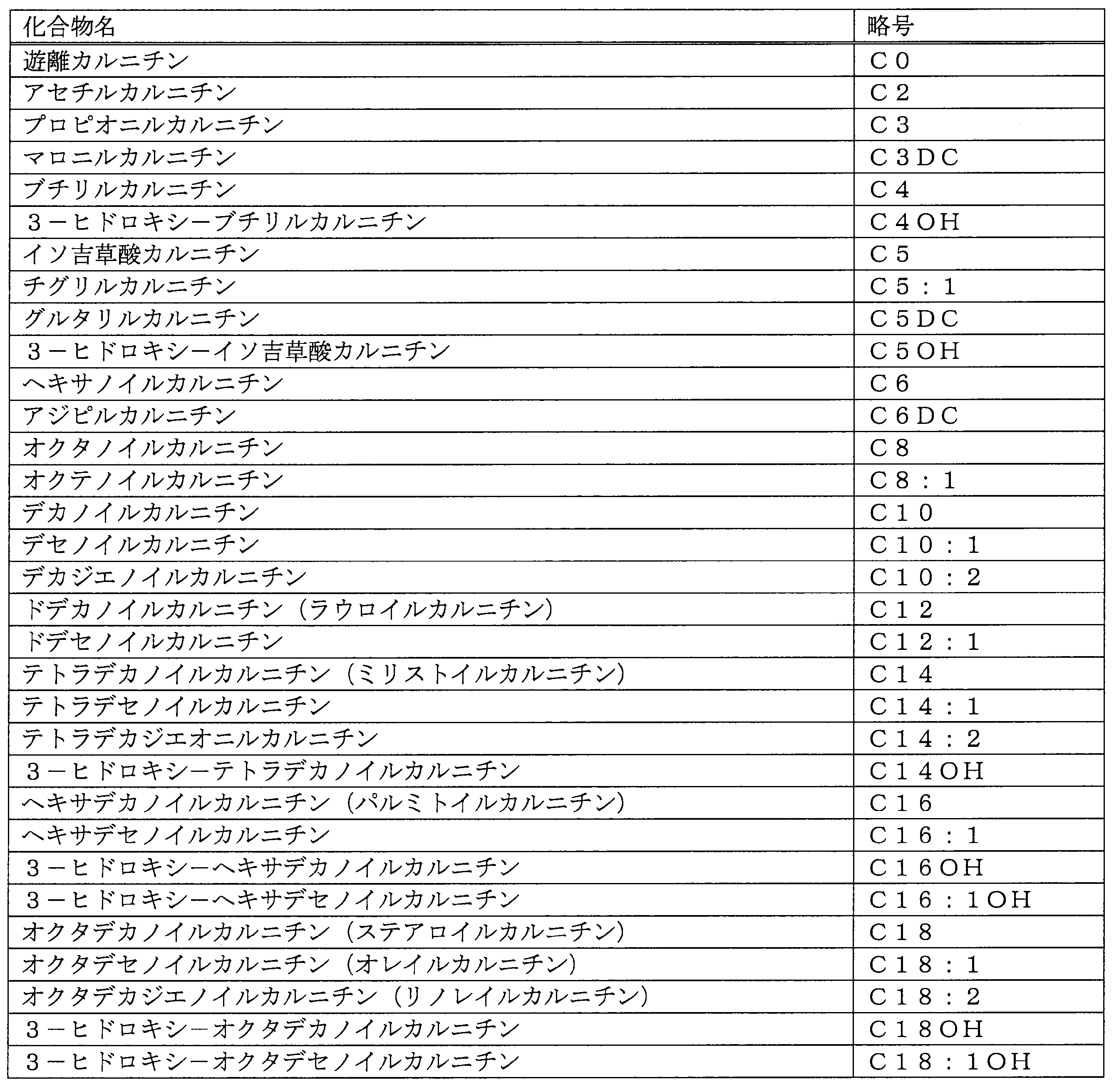
- acylcarnitine suitable in the present invention is acylcarnitine, which is a clinical analysis item. They are listed in Table 2. In the present invention, one or more of these are held by the porous member.
- the present invention is an internal standard substance reagent for mass spectrometry comprising the compound of formula 1 labeled with the stable isotope, wherein the compound can be eluted in a solution and held in a porous member in a dry state. It is characterized by.
- the compound of formula 1 is retained in the porous member by immersing the porous member in a solution of the compound and drying it, dropping the solution of the compound 1 into the porous member, It is possible to hold by a well-known method such as a method of drying, a method of infiltrating the porous member by injecting the solution of the compound into the porous member, and a method of drying the solution.
- the compound 1 may be held on the porous member by holding the whole member or a part thereof.
- the amount of the compound of Formula 1 held in the porous member is not particularly limited, but is preferably 10 ng or more and 1000 ng or less. If the amount of the compound to be retained is less than 10 ng, the concentration of the compound eluate may be affected by adsorption of the compound onto the filter paper. On the contrary, if the amount of the compound to be retained is more than 1000 ng, the upper limit of the allowable amount of impregnation into the filter paper may be exceeded and the compound may be precipitated. In addition, the operation of the compound eluate may be complicated, for example, by diluting the compound eluate. Examples of stable isotopes include labels with radioactive isotopes such as hydrogen, carbon, nitrogen, and oxygen, and specifically, stable isotopes selected from the group consisting of 2 H, 13 C, 15 N, and 18 O. The body is mentioned.
- the porous member means that the acylcarnitine is insoluble in the sample extract and can be eluted in the solution and kept in a dry state, as long as the acylcarnitine is stored at room temperature. It can be used without limitation as long as it has the ability to do so.
- porous member which consists of filter paper, a nonwoven fabric, a woven fabric, or a sheet-like foam is mentioned.
- known natural polymers and synthetic polymers can be used, for example, cotton, wool, cellulose, polystyrene, polyolefin, polyurethane, nitrocellulose, cellulose acetate, polyester, epoxy resin, phenol resin, silk, fibroin, Examples include lignin, hemicellulose, chitin, ebonite, rubber, glass, quartz and ceramics. Of these, natural polymers are preferable, cellulose and cotton are more preferable, and cellulose is particularly preferable.
- Examples of the filter paper include filter paper defined in JIS P3801 (1995) or TAPPI (Technical Association of the PulpandPaper Industry) T205.
- Examples of the nonwoven fabric include polyolefin nonwoven fabric, nitrocellulose nonwoven fabric, cellulose acetate nonwoven fabric, polyester nonwoven fabric, epoxy nonwoven fabric, glass nonwoven fabric, and ceramic nonwoven fabric.
- Examples of the woven cloth include cotton cloth, wool cloth, cellulose cloth, polyolefin cloth, nitrocellulose cloth, cellulose acetate cloth, epoxy cloth, glass cloth, and ceramic cloth.
- the sheet-like foam examples include foamed polystyrene, foamed polyolefin, foamed polyurethane, foamed polyester, foamed epoxy resin, foamed glass, and foamed ceramic.
- filter paper, nonwoven fabric and sheet-like foam are preferable, filter paper and nonwoven fabric are more preferable, and particularly preferable. It is filter paper.
- the thickness (mm) of the porous member can be selected as appropriate, but is preferably 0.1 or more, more preferably 0.2 or more, and particularly preferably 0.3 or more. Moreover, 3.0 or less is preferable, More preferably, it is 1.0 or less, Most preferably, it is 0.6 or less.
- the size (area) (cm 2 ) of the porous member can be freely set in consideration of operability during storage and transportation. Further, the pore diameter of the porous member can be freely set and selected.
- the internal standard reagent can be used as follows. Blood is collected by an appropriate method from the individual to be examined, blood is soaked in the filter paper, and the filter paper blood is prepared and dried. After the dried filter paper blood is placed in a well of a microplate, the internal standard reagent of the present invention is placed in the same well, a sample extract containing methanol is added to the well, and the sample is extracted. The measurement sample from which the acylcarnitine to be examined is extracted is subjected to mass spectrometry.
- the sample extract is preferably obtained by diluting methanol with light water, and the concentration of methanol is preferably 80% or more.
- the test target amino acid labeled with a stable isotope can be eluted in a solution and held in the porous member in a dry state. By doing so, it can be used simultaneously for detection of so-called organic acid metabolism abnormality and amino acid metabolism abnormality, so that convenience can be improved.
- the acylcarnitine and the test amino acid can be held in separate porous members in consideration of versatility, and both porous members can be used simultaneously.
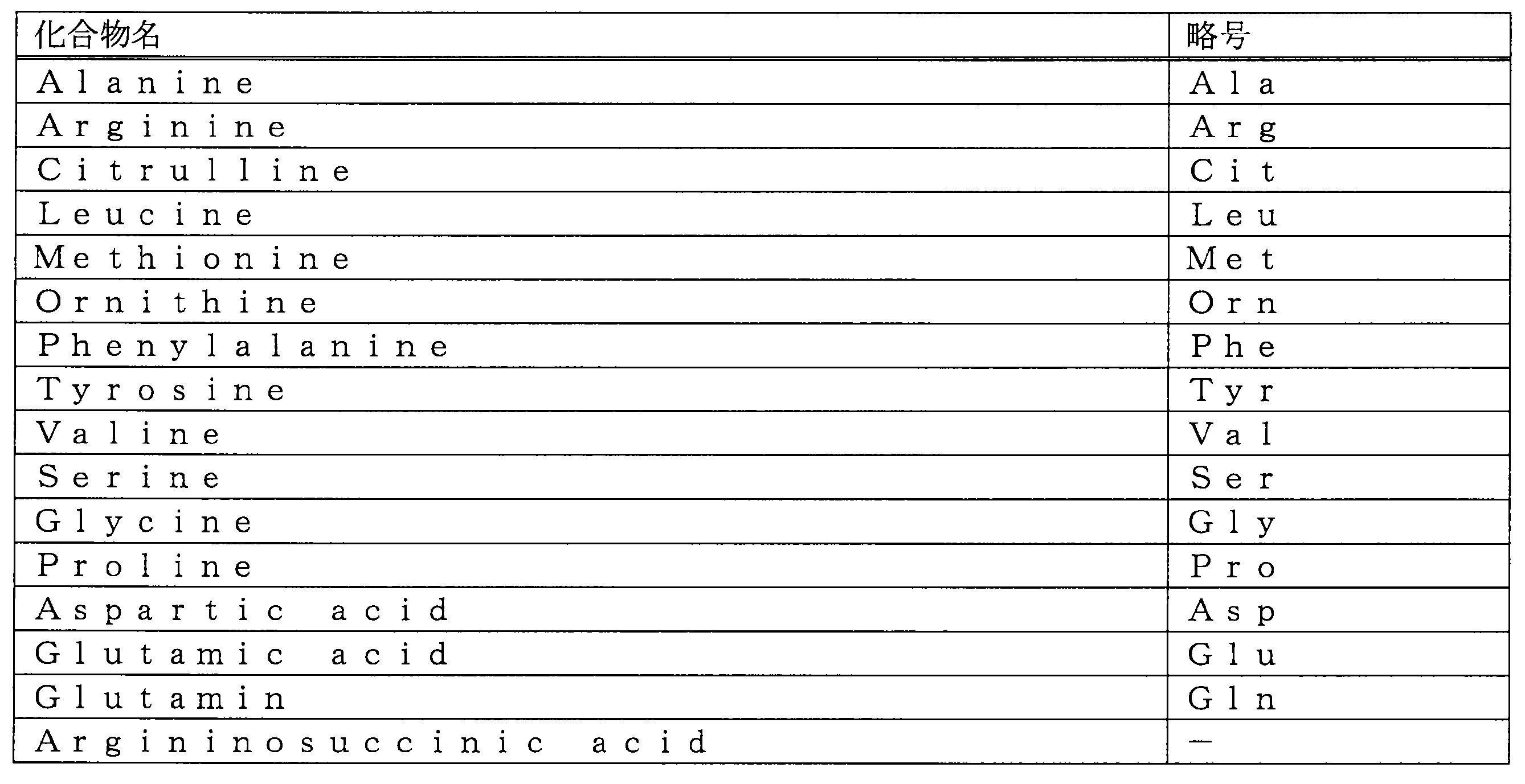
- the amino acid to be tested refers to an amino acid that is an analysis item in amino acid metabolism abnormality screening, and is one or more listed in Table 3.
- the amount of the amino acid to be infiltrated into the porous member is not particularly limited, and can be appropriately set within a detectable range. Further, the amount of impregnation may be different for each amino acid to be examined. A preferable range of the amount of impregnation is 10 ⁇ mol / L or more and 1000 ⁇ mol / L or less when eluted, and it can be set as appropriate according to the amount of solvent added for elution.
- the present invention also provides a sample pretreatment kit for mass spectrometry including the mass spectrometry internal standard substance reagent described in (1) above.
- the kit combination includes a sample extract containing methanol and / or a stable isotope-labeled test target amino acid.
- the amino acid to be examined may be present in any form, but is preferably in a state where it can be eluted in a solution and held in a porous member in a dry state.
- the present invention also provides a pretreatment kit as described in (6) above, wherein the internal standard substance reagent for mass spectrometry as described in (1) above is housed in a well of a microplate.
- the present invention relates to a room temperature of an internal standard substance reagent for mass spectrometry, characterized in that the compound of formula 1 labeled with a stable isotope can be eluted in a solution and held in a porous member in a dry state.
- a method of stabilization on storage is also provided.
- Formula 1 (CH 3) 3 N + CH 2 CH (OR 1) CH 2 COO - (In Formula 1, R 1 represents a hydrogen atom or a saturated or unsaturated fatty acid residue having 2 to 30 carbon atoms, and the hydrogen atom bonded to the fatty acid residue is substituted with an oxygen atom or a hydroxy group. May be good.)
- Example 1 [Internal standard solution: Preparation of IS solution] 2 H-labeled acetyl acylcarnitines: C2 (Larodan Fine Co., Catalog No. 71-1732) was dissolved in light water, to prepare an IS solution of 9.12 ⁇ mol / L. [Carrier for holding internal standard substance: Preparation of IS reagent] 0.03 mL of the above IS solution was added to a filter paper (Advantech Toyo Co., Ltd. for newborn mass screening) in a spot shape, and dried with a drier to prepare an IS reagent. The prepared IS reagent was hermetically sealed together with a desiccant stick in an aluminum bag.
- the residual rate of the IS reagent of Example 1 after storage at 45 ° C. for 24 hours was 100%, but the residual rate of the IS solution of Comparative Example 1 after storage at 45 ° C. for 24 hours was 8%.
- the internal standard reagent of the present invention was confirmed to be excellent in temperature stability.
- an acylcarnitine internal standard reagent that does not need to be dissolved at the time of use and can be stored at room temperature is provided.
Landscapes
- Chemical & Material Sciences (AREA)
- Life Sciences & Earth Sciences (AREA)
- Organic Chemistry (AREA)
- Health & Medical Sciences (AREA)
- Engineering & Computer Science (AREA)
- Molecular Biology (AREA)
- Physics & Mathematics (AREA)
- Biomedical Technology (AREA)
- Immunology (AREA)
- Urology & Nephrology (AREA)
- Bioinformatics & Computational Biology (AREA)
- Hematology (AREA)
- Bioinformatics & Cheminformatics (AREA)
- Food Science & Technology (AREA)
- Pathology (AREA)
- Proteomics, Peptides & Aminoacids (AREA)
- Biophysics (AREA)
- Microbiology (AREA)
- Spectroscopy & Molecular Physics (AREA)
- Analytical Chemistry (AREA)
- Biotechnology (AREA)
- Cell Biology (AREA)
- Biochemistry (AREA)
- General Health & Medical Sciences (AREA)
- General Physics & Mathematics (AREA)
- Medicinal Chemistry (AREA)
- Other Investigation Or Analysis Of Materials By Electrical Means (AREA)
Abstract
室温での保存安定性に優れ、かつ簡便な操作で使用することができる質量分析用内部標準物質試薬の提供。 安定同位体標識された式1の化合物を、溶液中に溶出可能かつ乾燥状態で、多孔性部材に保持させる。 式1:(CH3)3N+CH2CH(OR1)CH2COO- (式1中、R1は水素原子、又は炭素数2~30の飽和もしくは不飽和の脂肪酸残基を表し、該脂肪酸残基に結合する水素原子は、酸素原子又はヒドロキシ基で置換されていてもよい。)
Description
本発明は、質量分析法を利用した試料中のアミノ酸分析に用いられる内部標準物質試薬に関する。より詳細には、安定同位体標識されたアシルカルニチンを有効成分とする内部標準物質試薬に関する。また、安定同位体標識されたアシルカルニチンを有効成分とする内部標準物質試薬の室温保存での安定化方法に関する。
アシルカルニチンは、生体内において脂肪酸がミトコンドリア内膜へ運搬される際に、脂肪酸とカルニチンとが結合して生成される化合物である。より詳しくは、ミトコンドリア外膜に存在するカルニチンパルミトイルトランスフェラーゼIの作用によりアシルCoAとカルニチンからアシルカルニチンが生成される。アシルカルニチンは、その脂肪酸部分の炭素鎖長、直鎖であるか分岐鎖である、不飽和結合の有無と数、炭素鎖に結合する水素原子の酸素原子又はヒドロキシ基への置換などにより、アセチルカルニチン、プロピオニルカルニチン、イソ吉草酸カルニチン、ステアロイルカルニチン、オレイルカルニチン、リノレイルカルニチン、マロニルカルニチン、3-ヒドロキシカルニチンなどに細分化されるが、本明細書においては、それらを総称してアシルカルニチンと記述する。また、本明細書においては脂肪酸が結合していない遊離カルニチンも、アシルカルニチンに含めるものとする。
医療の分野において代謝異常の評価を行うために、血液や尿などの生物試料中のアシルカルニチンを分析することは極めて有用であり、例えば新生児を対象とした先天性代謝異常スクリーニングの必須分析項目とされている。
特許文献1には、質量分析法により血漿中のアシルカルニチンを測定し、アシルカルニチンのプロファイルを得ることで、脂肪酸酸化障害(MCAD、VLCAD、SCAD、MAD、LCHAD、及びCPTII)に加え、一部の有機酸血症(プロピオン酸血症、メチルマロン酸血症、イソ吉草酸血症、1型グルタル酸血症、3-メチルクロトニルCoAカルボキシラーゼ欠損症、β-ケトチオラーゼ欠損症など)の診断に利用できると記載されている。
上記したように生物試料中のアシルカルニチンの分析方法としては、質量分析法が広く普及しているが、質量分析法により生物試料中のアシルカルニチンを定量的に分析する場合には、内部標準物質として安定同位体標識されたアシルカルニチンを使用する必要がある。安定同位体標識されたアシルカルニチン内部標準物質は、試薬メーカーから個別に購入するか、あるいは非特許文献1に示されるNeoBase非誘導体化MSMSキット(PerkinElmer社製)のようなキットを購入することにより入手可能である。しかしながら、これらの内部標準物質は凍結乾燥品でのみ供給されており、使用前に適切な液体を添加して完全に溶解させる工程が必須であった。
一方、非特許文献2には、アシルカルニチンを溶液とし液体状態で保存した場合、加水分解を受けるため長期保存ができないことが記載されている。また、非特許文献3には、アシルカルニチンを添加したろ紙血を室温保存した場合、14日後から測定値に影響がでることが記載されており、これを踏まえた非特許文献2では、ろ紙血検体であっても常温(21℃)ではなく、冷凍(―30℃)での保管の徹底を結論している。このようにアシルカルニチンを室温で安定保存する方法は確立されていなかった。
「3040-0010 NeoBase Non-derivatized MSMS kit(PerkinElmer社)」の使用説明書
「液体サンプル中のアシルカルニチンの安定性について」、平成23年度厚生労働科学研究費補助金(成育疾患克服等次世代育成基盤研究事業)分担研究報告書、研究課題名「タンデムマス導入による新生児マススクリーニング体制の整備と質的向上に関する研究」、山口清次ら、40―43頁 厚生労働省 2012年
Fingerhut R., et al.,Anal Chem, 2009 MayI1;81(9):3571-3575
本発明者らは、アシルカルニチンの室温保存での安定化方法について、鋭意検討を行ったところ、驚くべきことに、アシルカルニチンそれ自体をろ紙に含浸させ乾燥させた状態で保存した場合には、室温で長期間保存した場合でも、加水分解をうけることなく安定に保存できることを見出し、本発明を完成させた。
本発明は、以下の構成を有する。
(1)安定同位体標識された式1の化合物が、溶液中に溶出可能かつ乾燥状態で、多孔性部材に保持されていることを特徴とする、質量分析用内部標準物質試薬。
式1:(CH3)3N+CH2CH(OR1)CH2COO-
(式1中、R1は水素原子、又は炭素数2~30の飽和もしくは不飽和の脂肪酸残基を表し、該脂肪酸残基に結合する水素原子は、酸素原子又はヒドロキシ基で置換されていてもよい。)
(2)安定同位体が、2H、13C、15N及び18Oからなる群より選ばれる安定同位体である、上記(1)に記載の試薬。
(3)多孔性部材が、ろ紙、不織布、織布及びシート状発泡体からなる群より選ばれる部材である、上記(1)又は(2)に記載の試薬。
(4)さらに安定同位体標識された検査対象アミノ酸が溶液中に溶出可能かつ乾燥状態で当該多孔性部材に保持されている、上記(1)~(3)に記載の試薬。
(5)上記(1)に記載の質量分析用内部標準物質試薬、及びメタノールを含有する試料抽出液又は安定同位体標識された検査対象アミノ酸を溶液中に溶出可能かつ乾燥状態に保持している多孔性部材を含む質量分析用試料前処理キット。
(6)上記(1)に記載の質量分析用内部標準物質試薬がマイクロプレートのウェル(well)中に収納されている、上記(5)に記載の前処理キット。
(7)安定同位体標識された式1の化合物を、溶液中に溶出可能かつ乾燥状態で、多孔性部材に保持させることを特徴とする、質量分析用内部標準物質試薬の室温保存での安定化方法。
式1:(CH3)3N+CH2CH(OR1)CH2COO-
(式1中、R1は水素原子、又は炭素数2~30の飽和もしくは不飽和の脂肪酸残基を表し、該脂肪酸残基に結合する水素原子は、酸素原子又はヒドロキシ基で置換されていてもよい。)
(1)安定同位体標識された式1の化合物が、溶液中に溶出可能かつ乾燥状態で、多孔性部材に保持されていることを特徴とする、質量分析用内部標準物質試薬。
式1:(CH3)3N+CH2CH(OR1)CH2COO-
(式1中、R1は水素原子、又は炭素数2~30の飽和もしくは不飽和の脂肪酸残基を表し、該脂肪酸残基に結合する水素原子は、酸素原子又はヒドロキシ基で置換されていてもよい。)
(2)安定同位体が、2H、13C、15N及び18Oからなる群より選ばれる安定同位体である、上記(1)に記載の試薬。
(3)多孔性部材が、ろ紙、不織布、織布及びシート状発泡体からなる群より選ばれる部材である、上記(1)又は(2)に記載の試薬。
(4)さらに安定同位体標識された検査対象アミノ酸が溶液中に溶出可能かつ乾燥状態で当該多孔性部材に保持されている、上記(1)~(3)に記載の試薬。
(5)上記(1)に記載の質量分析用内部標準物質試薬、及びメタノールを含有する試料抽出液又は安定同位体標識された検査対象アミノ酸を溶液中に溶出可能かつ乾燥状態に保持している多孔性部材を含む質量分析用試料前処理キット。
(6)上記(1)に記載の質量分析用内部標準物質試薬がマイクロプレートのウェル(well)中に収納されている、上記(5)に記載の前処理キット。
(7)安定同位体標識された式1の化合物を、溶液中に溶出可能かつ乾燥状態で、多孔性部材に保持させることを特徴とする、質量分析用内部標準物質試薬の室温保存での安定化方法。
式1:(CH3)3N+CH2CH(OR1)CH2COO-
(式1中、R1は水素原子、又は炭素数2~30の飽和もしくは不飽和の脂肪酸残基を表し、該脂肪酸残基に結合する水素原子は、酸素原子又はヒドロキシ基で置換されていてもよい。)
本発明によれば、使用時に溶解の必要が無く、かつ室温での保存が可能なアシルカルニチン内部標準物質試薬が提供される。
本発明において、アシルカルニチンとは、式1で表される化合物群をいう。
式1:(CH3)3N+CH2CH(OR1)CH2COO-
(式1中、R1は水素原子、又は炭素数2~30の飽和もしくは不飽和の脂肪酸残基を表し、該脂肪酸残基に結合する水素原子は、酸素原子又はヒドロキシ基で置換されていてもよい。)
式1:(CH3)3N+CH2CH(OR1)CH2COO-
(式1中、R1は水素原子、又は炭素数2~30の飽和もしくは不飽和の脂肪酸残基を表し、該脂肪酸残基に結合する水素原子は、酸素原子又はヒドロキシ基で置換されていてもよい。)
飽和又は不飽和の脂肪酸残基としては、表1に記載の脂肪酸のカルボキシ基から水素原子が脱離した残基が挙げられ、これらのうち、炭素数2~18の脂肪酸残基が、好適に使用される。該脂肪酸残基は、直鎖又は分岐鎖のいずれであってもよい。

本発明で好適なアシルカルニチンは、臨床での分析項目とされているアシルカルニチンである。それらを表2に記載した。本発明ではこれらの1種類以上を多孔性部材に保持させる。
本発明は、上記安定同位体標識された式1の化合物を含む質量分析用内部標準物質試薬であって、該化合物が溶液中に溶出可能かつ乾燥状態で、多孔性部材に保持されていることを特徴としている。
式1の化合物の多孔性部材への保持は、該化合物の溶液に多孔性部材を浸漬し、これを乾燥させる方法、該化合物1の溶液を滴下して多孔性部材に浸み込ませ、これを乾燥する方法、多孔性部材に該化合物の溶液をインジェクションすることにより浸み込ませ、これを乾燥する方法、など周知の方法により保持させることが可能である。
式1の化合物の多孔性部材への保持は、部材の全体への保持でもよく、その一部への保持であってもよい。一部への保持の場合、他の一部に化合物1以外で同時に溶出させたい物質を保持させることもできる。
多孔性部材に保持されている式1の化合物量は、特に限定されていないが10ng以上、1000ng以下が好ましい。保持させる化合物量が10ng未満であると、該化合物のろ紙への吸着により、該化合物溶出液の濃度に影響を及ぼす場合がある。逆に保持させる化合物量が1000ngより多いと、ろ紙への含浸許容量の上限を超え、該化合物が析出する場合がある。また該化合物溶出液の希釈操作が必要になるなど、かえって操作が煩雑となる場合がある。
安定同位体の例としては、水素、炭素、窒素、酸素等の放射性同位体による標識が挙げられ、具体的には、2H、13C、15N及び18Oからなる群から選ばれる安定同位体が挙げられる。
式1の化合物の多孔性部材への保持は、該化合物の溶液に多孔性部材を浸漬し、これを乾燥させる方法、該化合物1の溶液を滴下して多孔性部材に浸み込ませ、これを乾燥する方法、多孔性部材に該化合物の溶液をインジェクションすることにより浸み込ませ、これを乾燥する方法、など周知の方法により保持させることが可能である。
式1の化合物の多孔性部材への保持は、部材の全体への保持でもよく、その一部への保持であってもよい。一部への保持の場合、他の一部に化合物1以外で同時に溶出させたい物質を保持させることもできる。
多孔性部材に保持されている式1の化合物量は、特に限定されていないが10ng以上、1000ng以下が好ましい。保持させる化合物量が10ng未満であると、該化合物のろ紙への吸着により、該化合物溶出液の濃度に影響を及ぼす場合がある。逆に保持させる化合物量が1000ngより多いと、ろ紙への含浸許容量の上限を超え、該化合物が析出する場合がある。また該化合物溶出液の希釈操作が必要になるなど、かえって操作が煩雑となる場合がある。
安定同位体の例としては、水素、炭素、窒素、酸素等の放射性同位体による標識が挙げられ、具体的には、2H、13C、15N及び18Oからなる群から選ばれる安定同位体が挙げられる。
本発明において多孔性部材とは、アシルカルニチンを室温で保存した場合の安定性を損なわないことを限度として、試料抽出液に不溶性で、かつアシルカルニチンを溶液中に溶出可能でかつ乾燥状態で保持できる能力を有していれば制限なく使用することができる。
多孔性部材としては公知のものが使用でき、例えばろ紙、不織布、織布又はシート状発泡体等からなる多孔性部材が挙げられる。材質としては、公知の天然高分子及び合成高分子等が使用でき、例えば、綿、羊毛、セルロース、ポリスチレン、ポリオレフィン、ポリウレタン、ニトロセルロース、セルロースアセテート、ポリエステル、エポキシ樹脂、フェノール樹脂、絹、フィブロイン、リグニン、ヘミセルロース、キチン、エボナイト、ゴム、ガラス、石英及びセラミックス等が挙げられる。これらのうち、天然高分子が好ましく、さらに好ましくはセルロース及び綿であり、特に好ましくはセルロースである。
ろ紙としては、例えば、JIS P3801(1995年)又はTAPPI(Technical AssociationofthePulpandPaperIndustry)T205に規定されるろ紙等が挙げられる。不織布としては、例えば、ポリオレフィン不織布、ニトロセルロース不織布、セルロースアセテート不織布、ポリエステル不織布、エポキシ不織布、ガラス不織布及びセラミックス不織布等が挙げられる。織布としては、例えば、綿布、羊毛布、セルロース布、ポリオレフィン布、ニトロセルロース布、セルロースアセテート布、エポキシ布、ガラス布及びセラミックス布等が挙げられる。シート状発泡体としては、例えば、発泡ポリスチレン、発泡ポリオレフィン、発泡ポリウレタン、発泡ポリエステル、発泡エポキシ樹脂、発泡ガラス及び発泡セラミックス等が挙げられる。これらのうち、単位体積又は単位面積当たりに吸収する液体の量が一定になりやすいという(定量精度向上)観点から、ろ紙、不織布及びシート状発泡体が好ましく、さらに好ましくはろ紙及び不織布、特に好ましくはろ紙である。
多孔性部材の厚さ(mm)は、適宜選択することができるが、0.1以上が好ましく、さらに好ましくは0.2以上、特に好ましくは0.3以上である。また3.0以下が好ましく、さらに好ましくは1.0以下、特に好ましくは0.6以下である。多孔性部材の大きさ(面積)(cm2)は、保管及び輸送時などの操作性を考慮して自由に設定できる。
また、多孔性部材の孔径は自由に設定選択できる。
また、多孔性部材の孔径は自由に設定選択できる。
本発明は、内部標準物質試薬は、以下のようにして使用することができる。
検査対象の個体より適宜な方法で採血を行い、ろ紙に血液を浸み込ませ、ろ紙血を作製し乾燥させる。該乾燥したろ紙血をマイクロプレートのウェル(well)に入れた後、本発明の内部標準物質試薬を同じwellに入れ、メタノールを含む試料抽出液をwellに添加し、試料の抽出を行う。検査対象であるアシルカルニチンが抽出された測定試料を質量分析する。
検査対象の個体より適宜な方法で採血を行い、ろ紙に血液を浸み込ませ、ろ紙血を作製し乾燥させる。該乾燥したろ紙血をマイクロプレートのウェル(well)に入れた後、本発明の内部標準物質試薬を同じwellに入れ、メタノールを含む試料抽出液をwellに添加し、試料の抽出を行う。検査対象であるアシルカルニチンが抽出された測定試料を質量分析する。
上記、試料抽出液は、メタノールを軽水で希釈したものが好適であり、メタノールの濃度は80%以上が好適である。
本発明の内部標準物質試薬にはさらに、安定同位体標識された検査対象アミノ酸を溶液中に溶出可能かつ乾燥状態で前記多孔性部材に保持させることができる。こうすることにより、いわゆる有機酸代謝異常の検出とアミノ酸代謝異常の検出に同時に使用することができるので、利便性を向上させることができる。なお、アシルカルニチンと検査対象アミノ酸は、汎用性を考慮し、別々の多孔性部材に保持させ、両多孔性部材を同時に使用することも可能である。
本発明において、検査対象アミノ酸とは、アミノ酸代謝異常スクリーニングでの分析項目とされているアミノ酸をいい、表3に記載の1以上をいう。検査対象アミノ酸の多孔性部材への含浸量は、特に限定されず、検出可能な範囲で適宜設定することができる。また、検査対象アミノ酸それぞれで異なる含浸量であってもよい。好ましい含浸量の範囲としては、溶出された時の濃度が10μmol/L以上1000μmol/L以下であり、溶出のために添加する溶媒量に応じて、適宜設定することができる。
本発明は、上記(1)に記載の質量分析用内部標準物質試薬を含む質量分析用試料前処理キットも提供する。キットの組み合わせとしては、メタノールを含有する試料抽出液、及び/又は安定同位体標識された検査対象アミノ酸が挙げられる。検査対象アミノ酸は、存在形態を問わないが、溶液中に溶出可能かつ乾燥状態で多孔性部材に保持されている状態が好ましい。
また、本発明は、上記(1)に記載の質量分析用内部標準物質試薬がマイクロプレートのwell中に収納されている、上記(6)に記載の前処理キットも提供する。
さらにまた、本発明は、安定同位体標識された式1の化合物を、溶液中に溶出可能かつ乾燥状態で、多孔性部材に保持させることを特徴とする、質量分析用内部標準物質試薬の室温保存での安定化方法も提供する。
式1:(CH3)3N+CH2CH(OR1)CH2COO-
(式1中、R1は水素原子、又は炭素数2~30の飽和もしくは不飽和の脂肪酸残基を表し、該脂肪酸残基に結合する水素原子は、酸素原子又はヒドロキシ基で置換されていてもよい。)
式1:(CH3)3N+CH2CH(OR1)CH2COO-
(式1中、R1は水素原子、又は炭素数2~30の飽和もしくは不飽和の脂肪酸残基を表し、該脂肪酸残基に結合する水素原子は、酸素原子又はヒドロキシ基で置換されていてもよい。)
以下、実施例により本発明を詳細に説明するが、本発明は以下の実施例に限定されるものではない。
実施例1
〔内部標準物質溶液:IS液の調製〕
2H標識アセチルアシルカルニチン:C2(Larodan Fine社、カタログ番号71-1732)を軽水に溶解し、9.12μmol/LのIS液を調製した。
〔内部標準物質を保持する担体:IS試薬の調製〕
上記IS液0.03 mLを、ろ紙(アドバンテック東洋社、新生児マススクリーニング用)にスポット状に添加し、ドライヤーで乾燥させIS試薬を調製した。調製したIS試薬は、アルミ袋中に、乾燥剤スティックと一緒に密封封入した。
〔内部標準物質溶液:IS液の調製〕
2H標識アセチルアシルカルニチン:C2(Larodan Fine社、カタログ番号71-1732)を軽水に溶解し、9.12μmol/LのIS液を調製した。
〔内部標準物質を保持する担体:IS試薬の調製〕
上記IS液0.03 mLを、ろ紙(アドバンテック東洋社、新生児マススクリーニング用)にスポット状に添加し、ドライヤーで乾燥させIS試薬を調製した。調製したIS試薬は、アルミ袋中に、乾燥剤スティックと一緒に密封封入した。
〔安定性確認試験〕
上記アルミ袋に封入されたIS試薬を、45℃で24時間保存後、後述する性能試験を実施し、保存直前のピーク面積との相対比(残存率%)を求めた。
〔性能試験〕
IS試薬をパンチにより直径0.3cmの円盤状に切断した。該切断したIS試薬の1片を、マイクロプレートの1wellに投入した。そこに80%メタノールを含む軽水100μLを添加し、45分間静置後、後述するタンデムマス分析を行いピーク面積を算出した。
〔タンデムマス分析方法〕
(1)タンデムマス装置:4000 Q Trap(AB SCIEX社)
(2)Ionization mode:ESI
(3)Ion source:Turbo Ion Spray
(4)スキャンタイプ:MRM
(5)Polarity:Positive
(6)注入サンプル量:5μL
〔比較試験:比較例1〕
上記IS液を、ガラス容器に気密封入し、45℃で、24時間保存後、タンデムマス分析を行いピーク面積を算出し、保存直前のピーク面積との相対比(残存率%)を求めた。 成績と比較した。
上記アルミ袋に封入されたIS試薬を、45℃で24時間保存後、後述する性能試験を実施し、保存直前のピーク面積との相対比(残存率%)を求めた。
〔性能試験〕
IS試薬をパンチにより直径0.3cmの円盤状に切断した。該切断したIS試薬の1片を、マイクロプレートの1wellに投入した。そこに80%メタノールを含む軽水100μLを添加し、45分間静置後、後述するタンデムマス分析を行いピーク面積を算出した。
〔タンデムマス分析方法〕
(1)タンデムマス装置:4000 Q Trap(AB SCIEX社)
(2)Ionization mode:ESI
(3)Ion source:Turbo Ion Spray
(4)スキャンタイプ:MRM
(5)Polarity:Positive
(6)注入サンプル量:5μL
〔比較試験:比較例1〕
上記IS液を、ガラス容器に気密封入し、45℃で、24時間保存後、タンデムマス分析を行いピーク面積を算出し、保存直前のピーク面積との相対比(残存率%)を求めた。 成績と比較した。
実施例1のIS試薬の45℃、24時間保存後の残存率は100%であったが、比較例1のIS液の45℃、24時間保存後の残存率は8%であった。本発明の内部標準物質試薬は、温度安定性に優れていることが確認された。
本発明によれば、使用時に溶解の必要が無く、かつ室温での保存が可能なアシルカルニチン内部標準物質試薬が提供させる。
Claims (7)
- 安定同位体標識された式1の化合物が、溶液中に溶出可能かつ乾燥状態で、多孔性部材に保持されていることを特徴とする、質量分析用内部標準物質試薬。
式1:(CH3)3N+CH2CH(OR1)CH2COO-
(式1中、R1は水素原子、又は炭素数2~30の飽和もしくは不飽和の脂肪酸残基を表し、該脂肪酸残基に結合する水素原子は、酸素原子又はヒドロキシ基で置換されていてもよい。) - 安定同位体が、2H、13C、15N及び18Oからなる群より選ばれる安定同位体である、請求項1に記載の試薬。
- 多孔性部材が、ろ紙、不織布、織布及びシート状発泡体からなる群より選ばれる部材である、請求項1又は2に記載の試薬。
- さらに、安定同位体標識された検査対象アミノ酸が、溶液中に溶出可能かつ乾燥状態で当該多孔性部材に保持されている、請求項1乃至3のいずれか1項に記載の試薬。
- 請求項1に記載の質量分析用内部標準物質試薬、及びメタノールを含有する試料抽出液もしくは安定同位体標識された検査対象アミノ酸を溶液中に溶出可能かつ乾燥状態に保持している多孔性部材を含む質量分析用試料前処理キット。
- 質量分析用内部標準物質試薬がマイクロプレートのウェル(well)中に収納されている、請求項5に記載の前処理キット。
- 安定同位体標識された式1の化合物を、溶液中に溶出可能かつ乾燥状態で、多孔性部材に保持させることを特徴とする、質量分析用内部標準物質試薬の室温保存での安定化方法。
式1:(CH3)3N+CH2CH(OR1)CH2COO-
(式1中、R1は水素原子、又は炭素数2~30の飽和もしくは不飽和の脂肪酸残基を表し、該脂肪酸残基に結合する水素原子は、酸素原子又はヒドロキシ基で置換されていてもよい。)
Applications Claiming Priority (2)
| Application Number | Priority Date | Filing Date | Title |
|---|---|---|---|
| JP2014074018A JP2017101924A (ja) | 2014-03-31 | 2014-03-31 | 内部標準物質試薬 |
| JP2014-074018 | 2014-03-31 |
Publications (1)
| Publication Number | Publication Date |
|---|---|
| WO2015152227A1 true WO2015152227A1 (ja) | 2015-10-08 |
Family
ID=54240547
Family Applications (1)
| Application Number | Title | Priority Date | Filing Date |
|---|---|---|---|
| PCT/JP2015/060100 Ceased WO2015152227A1 (ja) | 2014-03-31 | 2015-03-31 | 内部標準物質試薬 |
Country Status (2)
| Country | Link |
|---|---|
| JP (1) | JP2017101924A (ja) |
| WO (1) | WO2015152227A1 (ja) |
Cited By (1)
| Publication number | Priority date | Publication date | Assignee | Title |
|---|---|---|---|---|
| WO2019045079A1 (ja) * | 2017-08-31 | 2019-03-07 | 積水メディカル株式会社 | コレステロール引き抜き能の測定方法 |
Families Citing this family (2)
| Publication number | Priority date | Publication date | Assignee | Title |
|---|---|---|---|---|
| WO2020044497A1 (ja) * | 2018-08-30 | 2020-03-05 | 国立大学法人 東京大学 | Nafld又はnashの検出又はリスクの予測方法、nafld又はnashを検出するための診断薬キット、対象における肝線維化の進行度の判定方法、及び対象における肝線維化の進行度を判定するための診断薬キット |
| JP6592627B1 (ja) * | 2019-03-12 | 2019-10-16 | 国立大学法人 東京大学 | Nafld又はnashの検出又はリスクの予測方法、nafld又はnashを検出するための診断薬キット、対象における肝線維化の進行度の判定方法、及び対象における肝線維化の進行度を判定するための診断薬キット |
Citations (2)
| Publication number | Priority date | Publication date | Assignee | Title |
|---|---|---|---|---|
| US20030199102A1 (en) * | 1999-12-29 | 2003-10-23 | Perkinelmer Life Sciences, Inc. | Test tray, kit and methods for bodily fluid testing for newborn screening by tandem mass spectrometry |
| JP2008547031A (ja) * | 2005-06-30 | 2008-12-25 | バイオクラテス ライフ サイエンシズ アクチェンゲゼルシャフト | 代謝産物特性の定量分析のための装置 |
-
2014
- 2014-03-31 JP JP2014074018A patent/JP2017101924A/ja active Pending
-
2015
- 2015-03-31 WO PCT/JP2015/060100 patent/WO2015152227A1/ja not_active Ceased
Patent Citations (2)
| Publication number | Priority date | Publication date | Assignee | Title |
|---|---|---|---|---|
| US20030199102A1 (en) * | 1999-12-29 | 2003-10-23 | Perkinelmer Life Sciences, Inc. | Test tray, kit and methods for bodily fluid testing for newborn screening by tandem mass spectrometry |
| JP2008547031A (ja) * | 2005-06-30 | 2008-12-25 | バイオクラテス ライフ サイエンシズ アクチェンゲゼルシャフト | 代謝産物特性の定量分析のための装置 |
Non-Patent Citations (1)
| Title |
|---|
| MASAKI TAKAYANAGI: "Abnormalities of carnitine metabolism in human diseases", JOURNAL OF ANALYTICAL BIO- SCIENCE, vol. 35, no. 4, 30 September 2012 (2012-09-30), pages 281 - 292 * |
Cited By (5)
| Publication number | Priority date | Publication date | Assignee | Title |
|---|---|---|---|---|
| WO2019045079A1 (ja) * | 2017-08-31 | 2019-03-07 | 積水メディカル株式会社 | コレステロール引き抜き能の測定方法 |
| JPWO2019045079A1 (ja) * | 2017-08-31 | 2020-10-29 | 積水メディカル株式会社 | コレステロール引き抜き能の測定方法 |
| JP7211591B2 (ja) | 2017-08-31 | 2023-01-24 | 積水メディカル株式会社 | コレステロール引き抜き能の測定方法 |
| JP2023052133A (ja) * | 2017-08-31 | 2023-04-11 | 積水メディカル株式会社 | コレステロール引き抜き能の測定方法 |
| JP7474448B2 (ja) | 2017-08-31 | 2024-04-25 | 積水メディカル株式会社 | コレステロール引き抜き能の測定方法 |
Also Published As
| Publication number | Publication date |
|---|---|
| JP2017101924A (ja) | 2017-06-08 |
Similar Documents
| Publication | Publication Date | Title |
|---|---|---|
| Mochalski et al. | Suitability of different polymer bags for storage of volatile sulphur compounds relevant to breath analysis | |
| Kataoka et al. | Recent progress in solid-phase microextraction and its pharmaceutical and biomedical applications | |
| Steeghs et al. | The suitability of Tedlar bags for breath sampling in medical diagnostic research | |
| Oburger et al. | Evaluation of a novel tool for sampling root exudates from soil-grown plants compared to conventional techniques | |
| CN112903884A (zh) | 一种同时检测邻苯二甲酸酯类化合物及其代谢产物的方法及其应用 | |
| Rankin-Turner et al. | A headspace collection chamber for whole body volatilomics | |
| Wzorek et al. | Application of GC-MS with a SPME and thermal desorption technique for determination of dimethylamine and trimethylamine in gaseous samples for medical diagnostic purposes | |
| WO2015152227A1 (ja) | 内部標準物質試薬 | |
| Wang et al. | Silk fiber for in-tube solid-phase microextraction to detect aldehydes by chemical derivatization | |
| Shin et al. | Acetaldehyde and hexanaldehyde from cultured white cells | |
| Davarani et al. | Determination of N-nitrosodiethanolamine in cosmetic products by headspace solid phase microextraction using a novel aluminum hydroxide grafted fused silica fiber followed by gas chromatography–mass spectrometry analysis | |
| Rounbehler et al. | Nitrosamine air sampling sorbents compared for quantitative collection and artifact formation | |
| CN114354820A (zh) | 一种检测干血片样本中环孢霉素药物浓度的试剂盒及检测方法 | |
| Alvarez-Martin et al. | SPME-GC–MS for the off-gassing analysis of a complex museum object | |
| JP2018105829A (ja) | 血液検査キット及び血液分析方法 | |
| Enggrob et al. | The influence of hydrolysis and derivatization on the determination of amino acid content and isotopic ratios in dual‐labeled (13C, 15N) white clover | |
| Gashimova et al. | Evaluation of the possibility of volatile organic compounds determination in exhaled air by gas chromatography for the noninvasive diagnostics of lung cancer | |
| JP2017012129A (ja) | 血液分析方法及び血液検査キット | |
| Kononikhin et al. | Study of the molecular composition of exhaled breath condensate by high-resolution mass spectrometry | |
| JP2012122974A (ja) | シアル酸の測定方法 | |
| Dolch et al. | Breath gas analysis | |
| Gorbunov et al. | Optimization of the Conditions of Analysis of Exhaled Air by Gas Chromatography–Mass Spectrometry for the Noninvasive Diagnostics of Lung Cancer | |
| JP2018532997A (ja) | 多床収着剤管及びその使用 | |
| Foote et al. | Determination of non-protein-bound zinc in human serum using ultrafiltration and atomic absorption spectrometry with electrothermal atomisation | |
| JP6168674B2 (ja) | アシルカルニチン組成物 |
Legal Events
| Date | Code | Title | Description |
|---|---|---|---|
| 121 | Ep: the epo has been informed by wipo that ep was designated in this application |
Ref document number: 15772631 Country of ref document: EP Kind code of ref document: A1 |
|
| NENP | Non-entry into the national phase |
Ref country code: DE |
|
| 122 | Ep: pct application non-entry in european phase |
Ref document number: 15772631 Country of ref document: EP Kind code of ref document: A1 |
|
| NENP | Non-entry into the national phase |
Ref country code: JP |