WO2015115580A1 - 二軸延伸ポリアミドフィルムおよびその製造方法 - Google Patents
二軸延伸ポリアミドフィルムおよびその製造方法 Download PDFInfo
- Publication number
- WO2015115580A1 WO2015115580A1 PCT/JP2015/052605 JP2015052605W WO2015115580A1 WO 2015115580 A1 WO2015115580 A1 WO 2015115580A1 JP 2015052605 W JP2015052605 W JP 2015052605W WO 2015115580 A1 WO2015115580 A1 WO 2015115580A1
- Authority
- WO
- WIPO (PCT)
- Prior art keywords
- film
- biaxially stretched
- polyamide film
- stretched polyamide
- stretching
- Prior art date
- Legal status (The legal status is an assumption and is not a legal conclusion. Google has not performed a legal analysis and makes no representation as to the accuracy of the status listed.)
- Ceased
Links
Images


Classifications
-
- B—PERFORMING OPERATIONS; TRANSPORTING
- B29—WORKING OF PLASTICS; WORKING OF SUBSTANCES IN A PLASTIC STATE IN GENERAL
- B29C—SHAPING OR JOINING OF PLASTICS; SHAPING OF MATERIAL IN A PLASTIC STATE, NOT OTHERWISE PROVIDED FOR; AFTER-TREATMENT OF THE SHAPED PRODUCTS, e.g. REPAIRING
- B29C55/00—Shaping by stretching, e.g. drawing through a die; Apparatus therefor
- B29C55/02—Shaping by stretching, e.g. drawing through a die; Apparatus therefor of plates or sheets
- B29C55/10—Shaping by stretching, e.g. drawing through a die; Apparatus therefor of plates or sheets multiaxial
- B29C55/12—Shaping by stretching, e.g. drawing through a die; Apparatus therefor of plates or sheets multiaxial biaxial
- B29C55/16—Shaping by stretching, e.g. drawing through a die; Apparatus therefor of plates or sheets multiaxial biaxial simultaneously
-
- B—PERFORMING OPERATIONS; TRANSPORTING
- B29—WORKING OF PLASTICS; WORKING OF SUBSTANCES IN A PLASTIC STATE IN GENERAL
- B29C—SHAPING OR JOINING OF PLASTICS; SHAPING OF MATERIAL IN A PLASTIC STATE, NOT OTHERWISE PROVIDED FOR; AFTER-TREATMENT OF THE SHAPED PRODUCTS, e.g. REPAIRING
- B29C55/00—Shaping by stretching, e.g. drawing through a die; Apparatus therefor
- B29C55/005—Shaping by stretching, e.g. drawing through a die; Apparatus therefor characterised by the choice of materials
-
- C—CHEMISTRY; METALLURGY
- C08—ORGANIC MACROMOLECULAR COMPOUNDS; THEIR PREPARATION OR CHEMICAL WORKING-UP; COMPOSITIONS BASED THEREON
- C08J—WORKING-UP; GENERAL PROCESSES OF COMPOUNDING; AFTER-TREATMENT NOT COVERED BY SUBCLASSES C08B, C08C, C08F, C08G or C08H
- C08J5/00—Manufacture of articles or shaped materials containing macromolecular substances
- C08J5/18—Manufacture of films or sheets
-
- C—CHEMISTRY; METALLURGY
- C08—ORGANIC MACROMOLECULAR COMPOUNDS; THEIR PREPARATION OR CHEMICAL WORKING-UP; COMPOSITIONS BASED THEREON
- C08J—WORKING-UP; GENERAL PROCESSES OF COMPOUNDING; AFTER-TREATMENT NOT COVERED BY SUBCLASSES C08B, C08C, C08F, C08G or C08H
- C08J2377/00—Characterised by the use of polyamides obtained by reactions forming a carboxylic amide link in the main chain; Derivatives of such polymers
-
- C—CHEMISTRY; METALLURGY
- C08—ORGANIC MACROMOLECULAR COMPOUNDS; THEIR PREPARATION OR CHEMICAL WORKING-UP; COMPOSITIONS BASED THEREON
- C08J—WORKING-UP; GENERAL PROCESSES OF COMPOUNDING; AFTER-TREATMENT NOT COVERED BY SUBCLASSES C08B, C08C, C08F, C08G or C08H
- C08J2377/00—Characterised by the use of polyamides obtained by reactions forming a carboxylic amide link in the main chain; Derivatives of such polymers
- C08J2377/02—Polyamides derived from omega-amino carboxylic acids or from lactams thereof
Definitions
- the present invention relates to a biaxially stretched polyamide film excellent in impact resistance and dimensional stability.
- the biaxially stretched polyamide film has excellent mechanical strength such as tensile strength, puncture strength, pinhole strength, impact strength strength, and excellent gas barrier properties and heat resistance. For this reason, a laminated film in which a biaxially stretched polyamide film is used as a front substrate and a sealant made of a polyolefin film is bonded to the surface by a method such as dry lamination or extrusion lamination is used as a packaging material for sterilization treatment such as boil and retort. First, it is used in a wide range of fields.
- a tenter type simultaneous biaxial stretching method As a method for producing a biaxially stretched polyamide film, there are a tenter type simultaneous biaxial stretching method, a tubular type simultaneous biaxial stretching method, and a tenter type sequential biaxial stretching method.
- the tubular simultaneous biaxial stretching method is advantageous in that the equipment cost of the equipment is cheaper than other methods, but it is difficult to increase the thickness accuracy of the film, and in terms of quality stability and productivity, the tenter simultaneous The biaxial stretching method is superior.
- marking was performed in the direction perpendicular to the film traveling direction (longitudinal direction, MD) (lateral direction, TD) before stretching after stretching.
- the straight line is deformed into a bow shape with a delayed central portion after the drawing / heat treatment is completed.
- the balance between the physical properties of the film in the vertical and horizontal directions for example, the balance of dimensional stability, varies along the TD of the film, and stretching by the tenter is a cause of impairing the uniformity of the physical properties of the film. .
- the unstretched film before stretching, the unstretched film is made to absorb water, and a process for plasticizing the unstretched film is provided. It has excellent balance of physical properties in the lateral direction.
- the biaxially stretched polyamide film obtained by the tenter-type simultaneous biaxial stretching method tends to have lower impact resistance than the biaxially stretched polyamide film obtained by other stretching methods.
- the tenter-type simultaneous biaxial stretching method when the unstretched film is biaxially stretched without absorbing water, as described above, the bowing phenomenon becomes remarkable, and the obtained biaxially stretched polyamide film has a longitudinal direction and a lateral direction. The physical property balance is inferior.
- a method for improving the bowing phenomenon there is a method in which an unstretched film does not absorb water, and a stretched zone is divided and a specific stretching temperature is adopted to perform simultaneous biaxial stretching, thereby improving dimensional stability. It is known that a film can be obtained (for example, Patent Document 1).
- a method for improving impact resistance a method is known in which a resin having rubber-like elasticity such as a thermoplastic elastomer is added to a polyamide resin (for example, Patent Document 2).
- An object of this invention is to provide the biaxially stretched polyamide film excellent in impact resistance and dimensional stability.
- the inventor of the present invention has reached the present invention as a result of intensive studies in order to solve the above problems. That is, the gist of the present invention is as follows.
- a biaxially stretched polyamide film obtained by stretching a polyamide resin having a relative viscosity of 2.8 to 3.1, Impact strength measured under conditions of ⁇ 5 ° C. is 1.0 J or more, and 45 ° with respect to the transverse direction (TD) of the film measured after 100 ° C. hot water for 5 minutes hydrothermal treatment
- TD transverse direction
- Biaxially stretched polyamide film characterized in that the diagonal difference in hot water shrinkage expressed by the absolute value of the difference between the hot water shrinkage in the direction and the hot water shrinkage in the direction of 135 degrees is 2.5% or less .
- the longitudinal stretching ratio in simultaneous biaxial stretching is 2.5 times or more, and the area ratio represented by the product of the longitudinal stretching ratio and the transverse stretching ratio is 7 times or more
- the manufacturing method of the biaxially stretched polyamide film of description is (4) After simultaneous biaxial stretching, heat treatment is performed at a heat treatment temperature of 140 to 215 ° C. in the heat treatment zone, and the heat treatment temperature in the latter half of the heat treatment zone is higher than the heat treatment temperature in the first half.
- Examples of the polyamide resin constituting the biaxially stretched polyamide film of the present invention include nylon 6 using ⁇ -caprolactam as a main raw material.
- Examples of other polyamide resins include polyamide resins obtained by polycondensation of lactams having three or more members, ⁇ -amino acids, dibasic acids and diamines.
- examples of the lactam include enantolactam, capryllactam, lauryllactam and the like in addition to the above-described ⁇ -caprolactam.
- examples of ⁇ -amino acids include 6-aminocaproic acid, 7-aminoheptanoic acid, 9-aminononanoic acid, 11-aminoundecanoic acid and the like.
- Dibasic acids include adipic acid, glutaric acid, pimelic acid, suberic acid, azelaic acid, sebacic acid, undecanedioic acid, dodecadioic acid, hexadecadioic acid, eicosandioic acid, eicosadienedioic acid, 2,2 , 4-trimethyladipic acid, terephthalic acid, isophthalic acid, 2,6-naphthalenedicarboxylic acid, xylylenedicarboxylic acid and the like.
- diamine examples include ethylene diamine, trimethylene diamine, tetramethylene diamine, hexamethylene diamine, pentamethylene diamine, undecamethylene diamine, 2,2,4 (or 2,4,4) -trimethylhexamethylene diamine, cyclohexane diamine, bis -(4,4'-aminocyclohexyl) methane, metaxylylenediamine, nonanediamine, decanediamine and the like.
- nylon 6 for example, nylon 6, 7, 11, 12, 6.6, 6.9, 6.11, 6.12, 6T, 9T, 10T, 6I, MXD6 (meta-xylene dipanamide 6), 6 / 6.6, 6/12, 6 / 6T, 6 / 6I, 6 / MXD6 and the like.
- nylon 6 is preferred because of its excellent balance between heat resistance and mechanical properties.
- the biaxially stretched polyamide film of the present invention may be composed of the above-described polyamide resin alone, or may be a mixture or multilayer of two or more kinds.
- the polyamide resin used in the present invention needs to have a relative viscosity of 2.8 to 3.1, and preferably 2.85 to 3.05. If the relative viscosity of the polyamide resin is less than 2.8, the tensile strength and impact strength tend to decrease, and the melt viscosity becomes too low to make it difficult to form a sheet. On the other hand, if the relative viscosity of the polyamide resin exceeds 3.1, the melt viscosity becomes high and suitable for the tubular simultaneous biaxial stretching, but when the tenter simultaneous biaxial stretching, the molten resin is filtered. In doing so, the pressure loss is large, extra extrusion energy is required, and the production cost increases.
- additives such as a lubricant, an antistatic agent, an antioxidant, a crystal nucleus material, a weathering agent, a flame retardant, a plasticizer, and a release agent can be added.
- additives for the purpose of improving impact properties such as polyolefins and elastomers, since they may lower the tensile strength.
- the biaxially stretched polyamide film of the present invention is obtained by stretching the above polyamide resin.
- Unstretched films and uniaxially stretched films have low tensile strength and large anisotropy, and thus are not suitable as a surface base material for producing packaging bags.
- the impact strength measured under the condition of ⁇ 5 ° C. needs to be 1.0 J or more, preferably 1.1 J or more, and 1.2 J or more. Preferably there is. If the impact strength of the biaxially stretched polyamide film is less than 1.0 J, the resulting packaging bag may be broken when dropped or pierced by the outside or contents.
- the biaxially stretched polyamide film of the present invention is measured at 100 ° C. in hot water for 5 minutes after hot water treatment, with 45% hot water shrinkage and 135 ° direction in the transverse direction (TD) of the film.
- the diagonal difference of the hot water shrinkage expressed by the absolute value of the difference from the hot water shrinkage needs to be 2.5% or less, preferably 2.0% or less, % Or less is more preferable.
- Biaxially stretched polyamide film has insufficient dimensional stability when the slant difference in hot water shrinkage exceeds 2.5%, causing color misalignment during printing, Twist and warp occur due to the influence of temperature and humidity, resulting in poor flatness.
- a gripping error may occur at the gripping portion of the filling machine or a seal failure may occur.
- the bag breaking rate upon impact from the outside increases.
- the biaxially stretched polyamide film of the present invention can be produced by stretching an unstretched film using a known simultaneous biaxial stretching method.
- an unstretched film before stretching is plasticized by absorbing water in order to facilitate stretching, but in the present invention, it is necessary to use an unstretched film having a low water absorption rate. That is, in the present invention, it is necessary to use a film having a water absorption of 1% by mass or less as the unstretched film, and the water absorption of the unstretched film is preferably 0.8% by mass or less. It is more preferable that it is 0.6 mass% or less.
- the water absorption of the unstretched film exceeds 1% by mass, the biaxially stretched polyamide film obtained by stretching tends to reduce the oblique difference in hot water shrinkage, but the impact resistance is inferior.
- the biaxial stretching needs to be carried out by the simultaneous biaxial stretching method in order to enhance the impact strength and dimensional stability of the resulting film in a balanced manner.
- a biaxially stretched polyamide film with high impact strength can also be obtained by the sequential biaxial stretching method, but the properties such as dimensional stability are inferior to those obtained by the simultaneous biaxial stretching method, and it is comprehensively used as a packaging film. Is inferior.
- the simultaneous biaxial stretching is preferably performed by a tenter method. When simultaneous biaxial stretching is performed by a tubular method, it is difficult to increase the thickness accuracy of the film, and the tenter simultaneous biaxial stretching method is superior in terms of quality stability and productivity.
- the tenter type simultaneous biaxial stretching can be performed using a tenter such as a pantograph type tenter, a screw type tenter, or a linear motor type tenter.
- a tenter such as a pantograph type tenter, a screw type tenter, or a linear motor type tenter.
- the linear motor type tenter in which each clip is driven independently by a linear motor system, can control the variable frequency driver to set the longitudinal draw ratio change arbitrarily finely and control it accurately and smoothly. It is most preferable to use a biaxially stretched polyamide film that has flexibility and reduces the bowing phenomenon and improves the uniformity of physical properties in the width direction.
- the stretching ratio of the unstretched film is preferably 2.5 times or more in the longitudinal direction (MD), and the longitudinal stretching ratio and the transverse direction (TD) are stretched. It is preferable that the area magnification represented by the product with the magnification is 7 times or more.
- the transverse draw ratio is also preferably 2.5 times or more, the longitudinal draw ratio and the transverse draw ratio are more preferably 2.5 to 4.5 times, respectively, and the area ratio is 7 to 12 times. It is more preferable.
- the draw ratio is less than the above-mentioned ratio, the resulting biaxially stretched polyamide film may have extremely poor mechanical properties.
- a specific stretching locus and biaxially stretch the unstretched film By adopting a specific stretching locus and biaxially stretching, a biaxially stretched polyamide film with reduced bowing phenomenon and improved dimensional stability can be obtained.
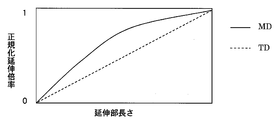
- the drawing trajectory employed in the present invention is shown in FIGS.
- the horizontal axis indicates “stretched part length”
- the vertical axis indicates “normalized stretch ratio”.
- the normalized stretching ratio is obtained by dividing the actual stretching ratio in the machine direction (MD) and the transverse direction (TD) at an arbitrary point in the stretching process by the maximum ratio.
- MD machine direction
- TD transverse direction
- stretching proceeds at a constant speed in the transverse direction (TD), whereas stretching in the longitudinal direction (MD) is in a state of being shifted from the transverse direction (TD).
- the longitudinal draw ratio locus and the transverse draw ratio locus do not match.
- the longitudinal draw ratio locus and the transverse draw ratio locus can be arbitrarily selected, and the longitudinal draw ratio locus and the transverse draw ratio locus may be matched, or the longitudinal draw ratio locus and the transverse draw ratio locus are misaligned as shown in FIGS. It is good also as a state.
- the normalized stretching ratio at the stretching start point is 0, and the normalized stretching ratio at the stretching end point is 1, any point along the film longitudinal direction during the stretching process
- the normalized longitudinal draw ratio is greater than the normalized transverse draw ratio.
- the normalized transverse draw ratio is preferably less than 1, and more preferably the normalized transverse draw ratio is less than 0.7.
- the stretching temperature is preferably 45 to 80 ° C, more preferably 45 to 70 ° C, and further preferably 50 to 65 ° C. If the stretching temperature is less than 45 ° C., the unstretched film tends to break during the stretching process. On the other hand, when the stretching temperature exceeds 80 ° C., the obtained biaxially stretched polyamide film has an insufficient stretch orientation effect and tends to decrease the tensile strength.
- the film after simultaneous biaxial stretching is preferably heat treated in the heat treatment zone.
- the heat treatment temperature is preferably 140 to 215 ° C., more preferably 170 to 213 ° C., and further preferably 190 to 210 ° C.
- the heat treatment temperature is less than 140 ° C.
- the resulting biaxially stretched film has a high thermal shrinkage rate.
- the heat treatment temperature exceeds 215 ° C.
- the heat treatment zone is preferably composed of a plurality of zones having different heat treatment temperatures.
- the heat treatment temperature is relatively low and the heat treatment temperature is increased toward the latter half of the heat treatment zone. It is preferable.
- the bowing phenomenon of the biaxially stretched polyamide film can be reduced by making the heat treatment temperature in the latter half of the heat treatment zone higher than the heat treatment temperature in the first half.
- the biaxially stretched polyamide film is relaxed by 0.3 to 7.0%, preferably 1.0 to 6.0%, more preferably 2.0 to 5.0% in the longitudinal and transverse directions of the film in the heat treatment step. It is preferable to carry out the treatment. By performing this relaxation treatment, the dimensional stability of the biaxially stretched polyamide film can be enhanced.
- the biaxially stretched polyamide film of the present invention can be packaged with a heat-sealing film such as a polyethylene film or a polypropylene film, and then heat-sealed in a bag shape to produce a packaging bag.
- a heat-sealing film such as a polyethylene film or a polypropylene film
- the packaging bag of this invention can be used suitably as packaging bags, such as a foodstuff and a drink.
- the packaging bag after filling the contents has improved impact resistance, and there is a concern of bag breakage when dropping the bag. Is reduced.
- the biaxially stretched polyamide film constituting the packaging bag is excellent in dimensional stability, misalignment in color matching at the time of printing is suppressed, and the packaging bag has reduced twist and warpage. . Furthermore, since the impact resistance of the biaxially stretched polyamide film is improved, the dimensional stability as a packaging bag is also improved, so these act synergistically, and the packaging bag is broken bag, etc. Concern is greatly reduced.
- the lateral direction (TD) of the film is 0 degree at a position of 1000 mm to the left and right from the center of the biaxially stretched polyamide film having a width of 2300 mm obtained in Examples and Comparative Examples.
- strip-shaped test pieces were sampled with the directions of 45 degrees and 135 degrees oblique to 0 degrees as the longitudinal direction.
- the dimension of the test piece was 10 mm in width x 100 mm in length.
- the obtained test pieces in the oblique 45 ° direction and the test pieces in the oblique 135 ° direction were each subjected to hot water treatment in 100 ° C. hot water for 5 minutes. After standing for 2 hours at 23 ° C.
- the lengthwise dimension of the test piece is measured, and the hot water shrinkage of the test piece in the oblique 45 degree direction and the test in the oblique 135 degree direction are calculated according to the following formula.
- Obtain the hot water shrinkage rate of each piece and further calculate the diagonal difference of the hot water shrinkage rate at each 1000 mm position from the center of the film to the left and right by the absolute value of the difference of each hot water shrinkage rate, and average them did.
- the original length is the length of the test piece before performing the hot water treatment.
- the original length (L0 45 ) and the original length (L0 135 ) are both 100 mm.
- Impact strength A piece of film is taken from the center of a biaxially stretched polyamide film having a width of 2300 mm from the position of 1000 mm to the left and right, fixed between ring metal plates, and a circular film test piece having a diameter of 7 cm ⁇ . Was created respectively.
- a film impact tester manufactured by Toyo Seiki Co., Ltd.
- the impact strength required for punching a circular film specimen was measured and averaged in an atmosphere of ⁇ 5 ° C.
- an impact head having a weight of 30 kg and a diameter of 12.7 mm ⁇ (0.5 inch ⁇ ) was used.
- the thickness of the film was measured, and the value converted into a thickness of 15 ⁇ m was taken as the impact strength.
- Bag drop test Film pieces were sampled from positions of 1000 mm to the left and right from the center of the biaxially stretched polyamide film having a width of 2300 mm.
- an adhesive layer consisting of a combination of DIC Graphics Dick Dry LX500 (polyurethane-based main agent) / KR90S (polyisocyanate-based curing agent) is applied to a dry film thickness of 3 ⁇ m,
- a corona surface and an adhesive surface of a 50 ⁇ m-thick unstretched polypropylene film (Mitsui Chemicals, Inc., RXC-22) were laminated at a nip temperature of 50 ° C., and an aging treatment of 40 ° C.
- ⁇ 72 hr was performed to obtain a laminated film.
- a laminate film of MD 300 mm ⁇ TD 200 mm was cut out from the obtained laminate film, then half-folded, sealed on four sides using an impulse sealer with a seal width of 10 mm, and a packaging bag with an outer size of 200 mm ⁇ 150 mm containing 400 ml of water was obtained. Created.
- the prepared packaging bag was left in a 5 ° C. environment for 24 hours, then dropped from a height of 1.5 m in a 5 ° C. environment, and the number of broken bags or water leaking bags was examined. The evaluation was carried out with 5 packaging bags.
- Example 1 A polyamide 6 having a relative viscosity of 3.0 measured at 25 ° C. in 96% concentrated sulfuric acid was melt-extruded from a T-die at a temperature of 260 ° C., cooled on a drum at 15 ° C., and substantially 150 ⁇ m thick. A non-oriented unstretched film was obtained. Subsequently, this unstretched film was introduced into a linear motor-driven simultaneous biaxial stretching machine with a water absorption of 0.5% by mass, preheated at 60 ° C., and stretched at 65 ° C. under a longitudinal stretching ratio of 3.0 times. Simultaneous biaxial stretching was performed at a transverse stretching ratio of 3.3 times.
- the frequency of the driver of the linear motor was adjusted so that the longitudinal stretching magnification locus was as shown in FIG. That is, when the stretching ratio is normalized, the normalized stretching ratio at the stretching start point is 0, and the normalized stretching ratio at the stretching end point is 1, any point along the film longitudinal direction during the stretching process , The normalized longitudinal draw ratio was set to show a value greater than the normalized transverse draw ratio.
- heat treatment was performed in a heat treatment zone in which the first half was set to 205 ° C. and the second half was set to 212 ° C., and each film was subjected to a relaxation treatment of 2.0% in the vertical and horizontal directions, and a corona discharge treatment was performed on one side.
- a simultaneous biaxially stretched polyamide film having a thickness of 2300 mm and a thickness of 15 ⁇ m was obtained.
- Table 1 shows the results of various evaluations of the obtained simultaneous biaxially stretched polyamide film.
- the biaxially stretched polyamide films obtained in Examples 1 to 10 have a reduced bowing phenomenon, improved impact resistance, and a small oblique difference in hot water shrinkage.
- the packaged bag was very rarely broken or leaked in the bag drop test.
- Comparative Example 1 since a polyamide resin having a relative viscosity less than the lower limit specified in the present invention was used, the obtained biaxially stretched polyamide film had a reduced impact strength, and the produced packaging bag was subjected to a bag drop test. The rate of bag breakage was high.
- Comparative Example 2 since a polyamide resin having a relative viscosity exceeding the upper limit specified in the present invention was used, the obtained biaxially stretched polyamide film had a large bowing amount and a large oblique difference in hot water shrinkage. Although the impact strength was sufficient, the produced packaging bag was broken in the bag drop test.
Landscapes
- Engineering & Computer Science (AREA)
- Chemical & Material Sciences (AREA)
- Mechanical Engineering (AREA)
- Manufacturing & Machinery (AREA)
- Chemical Kinetics & Catalysis (AREA)
- Health & Medical Sciences (AREA)
- Materials Engineering (AREA)
- Medicinal Chemistry (AREA)
- Polymers & Plastics (AREA)
- Organic Chemistry (AREA)
- Shaping By String And By Release Of Stress In Plastics And The Like (AREA)
- Manufacture Of Macromolecular Shaped Articles (AREA)
- Bag Frames (AREA)
- Wrappers (AREA)
Abstract
相対粘度が2.8~3.1であるポリアミド樹脂を延伸してなる二軸延伸ポリアミドフィルムであって、-5℃の条件下で測定される衝撃強度が1.0J以上であり、かつ100℃熱水中、5分間の熱水処理後に測定される、フィルムの横方向(TD)に対して45度方向の熱水収縮率と135度方向の熱水収縮率との差の絶対値で表される熱水収縮率の斜め差が2.5%以下であることを特徴とする二軸延伸ポリアミドフィルム。
Description
本発明は、耐衝撃性、寸法安定性に優れた二軸延伸ポリアミドフィルムに関する。
二軸延伸ポリアミドフィルムは、引張強度、突刺強度、ピンホール強度、耐衝撃強度などの機械的強度に優れ、かつガスバリア性、耐熱性に優れている。このため、二軸延伸ポリアミドフィルムを表基材とし、これにポリオレフィンフィルムからなるシーラントをドライラミネートや押し出しラミネートなどの方法で貼合した積層フィルムは、ボイルやレトルト等の殺菌処理用の包装材料をはじめとして、幅広い分野に使用されている。
二軸延伸ポリアミドフィルムの製造方法には、テンター式同時二軸延伸法や、チューブラー式同時二軸延伸法、テンター式逐次二軸延伸法がある。
チューブラー式同時二軸延伸法は、装置の設備コストが他の方法より安い点で有利であるが、フィルムの厚み精度を高めることが難しく、品質安定性や生産性の面でも、テンター式同時二軸延伸法の方が優れている。
テンター式同時二軸延伸法やテンター式逐次二軸延伸法では、延伸後にボーイング現象(延伸前に、フィルムの進行方向(縦方向、MD)に対して直角方向(横方向、TD)にマークした直線が、延伸・熱処理終了後に、中央部が遅れた形の弓型に変形する現象)が生じる。その結果、フィルムの縦方向と横方向の物性のバランス、例えば、寸法安定性のバランスは、フィルムのTDに沿って異なり、テンターによる延伸は、フィルムの物性の均一性を損ねる原因となっている。
チューブラー式同時二軸延伸法は、装置の設備コストが他の方法より安い点で有利であるが、フィルムの厚み精度を高めることが難しく、品質安定性や生産性の面でも、テンター式同時二軸延伸法の方が優れている。
テンター式同時二軸延伸法やテンター式逐次二軸延伸法では、延伸後にボーイング現象(延伸前に、フィルムの進行方向(縦方向、MD)に対して直角方向(横方向、TD)にマークした直線が、延伸・熱処理終了後に、中央部が遅れた形の弓型に変形する現象)が生じる。その結果、フィルムの縦方向と横方向の物性のバランス、例えば、寸法安定性のバランスは、フィルムのTDに沿って異なり、テンターによる延伸は、フィルムの物性の均一性を損ねる原因となっている。
一般的なテンター式同時二軸延伸法では、延伸する前に、未延伸フィルムに吸水させて、未延伸フィルムを可塑化する工程を設けているため、得られる二軸延伸ポリアミドフィルムは、縦方向、横方向の物性バランスに優れたものとなっている。しかし、テンター式同時二軸延伸法で得られる二軸延伸ポリアミドフィルムは、他の延伸方法により得られる二軸延伸ポリアミドフィルムに比べて、耐衝撃性が低くなる傾向がある。一方、テンター式同時二軸延伸法では、吸水させずに未延伸フィルムを二軸延伸すると、上述のように、ボーイング現象が著しくなり、得られる二軸延伸ポリアミドフィルムは、縦方向、横方向の物性バランスに劣るものとなる。
ボーイング現象を改善する方法として、未延伸フィルムに吸水させずに、延伸ゾーンを分割し、特定の延伸温度を採用して同時二軸延伸する方法があり、これにより、寸法安定性が改善したポリアミドフィルムが得られることが知られている(例えば、特許文献1)。
一方、耐衝撃性を改善する方法として、ポリアミド樹脂に、熱可塑性エラストマーなどのゴム状弾性を有する樹脂を添加する方法が知られている(例えば、特許文献2)。
一方、耐衝撃性を改善する方法として、ポリアミド樹脂に、熱可塑性エラストマーなどのゴム状弾性を有する樹脂を添加する方法が知られている(例えば、特許文献2)。
しかしながら、特許文献1の方法では、耐衝撃性が十分な二軸延伸フィルムが得られるが、ボーイング現象の低減が未だ不十分であった。また、特許文献2の方法では、フィルムの耐衝撃性、耐屈曲疲労性の向上は図れるが、寸法安定性や耐熱性が低下する問題があった。
本発明は、耐衝撃性、寸法安定性に優れた二軸延伸ポリアミドフィルムを提供することを目的とする。
本発明は、耐衝撃性、寸法安定性に優れた二軸延伸ポリアミドフィルムを提供することを目的とする。
本発明者は、前記課題を解決するために鋭意研究を重ねた結果、本発明に到達した。
すなわち、本発明の要旨は下記の通りである。
(1)相対粘度が2.8~3.1であるポリアミド樹脂を延伸してなる二軸延伸ポリアミドフィルムであって、
-5℃の条件下で測定される衝撃強度が1.0J以上であり、かつ
100℃熱水中、5分間の熱水処理後に測定される、フィルムの横方向(TD)に対して45度方向の熱水収縮率と135度方向の熱水収縮率との差の絶対値で表される熱水収縮率の斜め差が2.5%以下であることを特徴とする二軸延伸ポリアミドフィルム。
(2)上記(1)記載の二軸延伸ポリアミドフィルムを製造するための方法であって、吸水率が1質量%以下である未延伸フィルムを同時二軸延伸することを特徴とする二軸延伸ポリアミドフィルムの製造方法。
(3)同時二軸延伸における縦延伸倍率が2.5倍以上であり、かつ縦延伸倍率と横延伸倍率の積で表される面積倍率が7倍以上であることを特徴とする(2)記載の二軸延伸ポリアミドフィルムの製造方法。
(4)同時二軸延伸後に、熱処理ゾーンにて140~215℃の熱処理温度で熱処理を実施し、かつ熱処理ゾーンの後半部の熱処理温度を、前半部の熱処理温度よりも高くすることを特徴とする(2)または(3)記載の二軸延伸ポリアミドフィルムの製造方法。
(5)同時二軸延伸を、リニアモーター方式で駆動するテンターで実施することを特徴とする(2)~(4)のいずれかに記載の二軸延伸ポリアミドフィルムの製造方法。
(6)上記(1)記載の二軸延伸ポリアミドフィルムを用いた包装袋。
すなわち、本発明の要旨は下記の通りである。
(1)相対粘度が2.8~3.1であるポリアミド樹脂を延伸してなる二軸延伸ポリアミドフィルムであって、
-5℃の条件下で測定される衝撃強度が1.0J以上であり、かつ
100℃熱水中、5分間の熱水処理後に測定される、フィルムの横方向(TD)に対して45度方向の熱水収縮率と135度方向の熱水収縮率との差の絶対値で表される熱水収縮率の斜め差が2.5%以下であることを特徴とする二軸延伸ポリアミドフィルム。
(2)上記(1)記載の二軸延伸ポリアミドフィルムを製造するための方法であって、吸水率が1質量%以下である未延伸フィルムを同時二軸延伸することを特徴とする二軸延伸ポリアミドフィルムの製造方法。
(3)同時二軸延伸における縦延伸倍率が2.5倍以上であり、かつ縦延伸倍率と横延伸倍率の積で表される面積倍率が7倍以上であることを特徴とする(2)記載の二軸延伸ポリアミドフィルムの製造方法。
(4)同時二軸延伸後に、熱処理ゾーンにて140~215℃の熱処理温度で熱処理を実施し、かつ熱処理ゾーンの後半部の熱処理温度を、前半部の熱処理温度よりも高くすることを特徴とする(2)または(3)記載の二軸延伸ポリアミドフィルムの製造方法。
(5)同時二軸延伸を、リニアモーター方式で駆動するテンターで実施することを特徴とする(2)~(4)のいずれかに記載の二軸延伸ポリアミドフィルムの製造方法。
(6)上記(1)記載の二軸延伸ポリアミドフィルムを用いた包装袋。
本発明によれば、耐衝撃性、寸法安定性に優れた二軸延伸ポリアミドフィルムが得られる。
本発明の二軸延伸ポリアミドフィルムを構成するポリアミド樹脂としては、たとえば、ε-カプロラクタムを主原料としたナイロン6を挙げることができる。また、その他のポリアミド樹脂としては、3員環以上のラクタム、ω-アミノ酸、二塩基酸とジアミン等の重縮合によって得られるポリアミド樹脂を挙げることができる。
具体的には、ラクタムとしては、先に示したε-カプロラクタムの他に、エナントラクタム、カプリルラクタム、ラウリルラクタムなどを挙げることができる。
ω-アミノ酸としては、6-アミノカプロン酸、7-アミノヘプタン酸、9-アミノノナン酸、11-アミノウンデカン酸などを挙げることができる。
二塩基酸としては、アジピン酸、グルタル酸、ピメリン酸、スベリン酸、アゼライン酸、セバシン酸、ウンデカンジオン酸、ドデカジオン酸、ヘキサデカジオン酸、エイコサンジオン酸、エイコサジエンジオン酸、2,2,4-トリメチルアジピン酸、テレフタル酸、イソフタル酸、2,6-ナフタレンジカルボン酸、キシリレンジカルボン酸などを挙げることができる。
ジアミンとしては、エチレンジアミン、トリメチレンジアミン、テトラメチレンジアミン、ヘキサメチレンジアミン、ペンタメチレンジアミン、ウンデカメチレンジアミン、2,2,4(または2,4,4)-トリメチルヘキサメチレンジアミン、シクロヘキサンジアミン、ビス-(4,4′-アミノシクロヘキシル)メタン、メタキシリレンジアミン、ノナンジアミン、デカンジアミン等を挙げることができる。
ω-アミノ酸としては、6-アミノカプロン酸、7-アミノヘプタン酸、9-アミノノナン酸、11-アミノウンデカン酸などを挙げることができる。
二塩基酸としては、アジピン酸、グルタル酸、ピメリン酸、スベリン酸、アゼライン酸、セバシン酸、ウンデカンジオン酸、ドデカジオン酸、ヘキサデカジオン酸、エイコサンジオン酸、エイコサジエンジオン酸、2,2,4-トリメチルアジピン酸、テレフタル酸、イソフタル酸、2,6-ナフタレンジカルボン酸、キシリレンジカルボン酸などを挙げることができる。
ジアミンとしては、エチレンジアミン、トリメチレンジアミン、テトラメチレンジアミン、ヘキサメチレンジアミン、ペンタメチレンジアミン、ウンデカメチレンジアミン、2,2,4(または2,4,4)-トリメチルヘキサメチレンジアミン、シクロヘキサンジアミン、ビス-(4,4′-アミノシクロヘキシル)メタン、メタキシリレンジアミン、ノナンジアミン、デカンジアミン等を挙げることができる。
そして、これらを重縮合して得られる重合体またはこれらの共重合体としては、たとえば、ナイロン6、7、11、12、6.6、6.9、6.11、6.12、6T、9T、10T、6I、MXD6(メタキシレンジパンアミド6)、6/6.6、6/12、6/6T、6/6I、6/MXD6等が挙げられる。中でも、耐熱性と機械特性のバランスに優れるナイロン6が好ましい。
本発明の二軸延伸ポリアミドフィルムは、上記したポリアミド樹脂単独からなるものでも、あるいは、2種以上を混合または複層にしてものでもよい。
本発明の二軸延伸ポリアミドフィルムは、上記したポリアミド樹脂単独からなるものでも、あるいは、2種以上を混合または複層にしてものでもよい。
本発明に用いるポリアミド樹脂は、相対粘度が2.8~3.1であることが必要であり、2.85~3.05であることが好ましい。
ポリアミド樹脂の相対粘度が2.8未満であると、引張強度や衝撃強度が低下し易いうえ、溶融粘度が低くなりすぎてシート状に製膜するのが困難になる。一方、ポリアミド樹脂の相対粘度が3.1を超えると、溶融粘度が高くなって、チューブラー式同時二軸延伸には適切となるが、テンター式同時二軸延伸の際は、溶融樹脂をろ過する際の圧力損失が大きく、余分な押出エネルギーが必要となり、生産コストが高くなる。
ポリアミド樹脂の相対粘度が2.8未満であると、引張強度や衝撃強度が低下し易いうえ、溶融粘度が低くなりすぎてシート状に製膜するのが困難になる。一方、ポリアミド樹脂の相対粘度が3.1を超えると、溶融粘度が高くなって、チューブラー式同時二軸延伸には適切となるが、テンター式同時二軸延伸の際は、溶融樹脂をろ過する際の圧力損失が大きく、余分な押出エネルギーが必要となり、生産コストが高くなる。
本発明に用いるポリアミド樹脂には、通常公知の添加剤、例えば滑材や帯電防止剤、酸化防止剤、結晶核材、耐候剤、難燃剤、可塑剤、離形剤などを添加することができる。なお、衝撃性の改善を目的とする添加剤、例えばポリオレフィン類やエラストマーなどは、引張強度などを低下させる場合があるため、添加しないことが好ましい。
本発明の二軸延伸ポリアミドフィルムは、上記ポリアミド樹脂を延伸してなるものである。未延伸フィルムや一軸延伸フィルムは、引張強度が低く、異方性が大きいため、包装袋を作成する際の表基材として適当なものではない。
本発明の二軸延伸ポリアミドフィルムは、-5℃の条件下で測定される衝撃強度は1.0J以上であることが必要であり、1.1J以上であることが好ましく、1.2J以上であることが好ましい。
二軸延伸ポリアミドフィルムの衝撃強度が1.0J未満であると、得られる包装袋は、落下した場合や、外部あるいは内容物による突き刺しにより、破袋する恐れがある。
二軸延伸ポリアミドフィルムの衝撃強度が1.0J未満であると、得られる包装袋は、落下した場合や、外部あるいは内容物による突き刺しにより、破袋する恐れがある。
本発明の二軸延伸ポリアミドフィルムは、100℃熱水中、5分間の熱水処理後に測定される、フィルムの横方向(TD)に対して45度方向の熱水収縮率と135度方向の熱水収縮率との差の絶対値で表される熱水収縮率の斜め差は、2.5%以下であることが必要であり、2.0%以下であることが好ましく、1.5%以下であることがより好ましい。
二軸延伸ポリアミドフィルムは、熱水収縮率の斜め差が2.5%を超えると、寸法安定性が不足し、印刷時の色合わせにズレが生じたり、包装袋とした際に、雰囲気の温度や湿度の影響により、ひねりや反りが生じ、平面性に劣るものとなる。また、内容物充填時に、充填機の掴み部で掴みミスが生じたり、シール不良が生じる懸念が高まる。さらには、包装袋の歪みに起因し、外部から衝撃を受けた際の破袋率が高まる。
二軸延伸ポリアミドフィルムは、熱水収縮率の斜め差が2.5%を超えると、寸法安定性が不足し、印刷時の色合わせにズレが生じたり、包装袋とした際に、雰囲気の温度や湿度の影響により、ひねりや反りが生じ、平面性に劣るものとなる。また、内容物充填時に、充填機の掴み部で掴みミスが生じたり、シール不良が生じる懸念が高まる。さらには、包装袋の歪みに起因し、外部から衝撃を受けた際の破袋率が高まる。
次に、本発明の二軸延伸ポリアミドフィルムの製造方法について説明をする。
本発明の二軸延伸ポリアミドフィルムは、未延伸フィルムを公知の同時二軸延伸方法を用いて延伸することにより製造することができる。
本発明の二軸延伸ポリアミドフィルムは、未延伸フィルムを公知の同時二軸延伸方法を用いて延伸することにより製造することができる。
通常、延伸する前の未延伸フィルムは、延伸をしやすくするため、吸水させて可塑化されるが、本発明では、吸水率が低い未延伸フィルムを使用することが必要である。すなわち、本発明では、未延伸フィルムとして、吸水率が1質量%以下であるものを使用することが必要であり、未延伸フィルムの吸水率は、0.8質量%以下であることが好ましく、0.6質量%以下であることがより好ましい。
未延伸フィルムの吸水率が1質量%を超えると、延伸して得られる二軸延伸ポリアミドフィルムは、熱水収縮率の斜め差が低減する傾向にあるが、耐衝撃性が劣るものとなる。
未延伸フィルムの吸水率が1質量%を超えると、延伸して得られる二軸延伸ポリアミドフィルムは、熱水収縮率の斜め差が低減する傾向にあるが、耐衝撃性が劣るものとなる。
本発明の製造方法において、二軸延伸は、得られるフィルムの衝撃強度と寸法安定性をバランスよく高めるために、同時二軸延伸法により実施されることが必要である。逐次二軸延伸法によっても、衝撃強度の高い二軸延伸ポリアミドフィルムが得られるが、寸法安定性などの特性は、同時二軸延伸法により得られたものより劣り、総合的に包装用フィルムとしては劣るものとなる。
同時二軸延伸は、テンター方式により実施されることが好ましい。チューブラー方式で同時二軸延伸した場合、フィルムの厚み精度を高めることが難しく、品質安定性や生産性の面でも、テンター式同時二軸延伸法の方が優れている。
テンター式同時二軸延伸は、例えば、パンタグラフ方式テンター、スクリュー方式テンター、リニアモーター式テンターなどテンターを用いて行うことができる。なかでも、個々のクリップがリニアモーター方式で単独に駆動されているリニアモーター式テンターは、可変周波数ドライバを制御することで、縦延伸倍率変化を任意に細かく設定し、しかも正確に滑らかに制御できる柔軟性を有しており、これを用いると、ボーイング現象が低減され、幅方向の物性の均一性が向上した二軸延伸ポリアミドフィルムが得られることから、最も好ましいものである。
同時二軸延伸は、テンター方式により実施されることが好ましい。チューブラー方式で同時二軸延伸した場合、フィルムの厚み精度を高めることが難しく、品質安定性や生産性の面でも、テンター式同時二軸延伸法の方が優れている。
テンター式同時二軸延伸は、例えば、パンタグラフ方式テンター、スクリュー方式テンター、リニアモーター式テンターなどテンターを用いて行うことができる。なかでも、個々のクリップがリニアモーター方式で単独に駆動されているリニアモーター式テンターは、可変周波数ドライバを制御することで、縦延伸倍率変化を任意に細かく設定し、しかも正確に滑らかに制御できる柔軟性を有しており、これを用いると、ボーイング現象が低減され、幅方向の物性の均一性が向上した二軸延伸ポリアミドフィルムが得られることから、最も好ましいものである。
同時二軸延伸において、未延伸フィルムを延伸する倍率は、縦方向(MD)の縦延伸倍率が2.5倍以上であることが好ましく、また縦延伸倍率と、横方向(TD)の横延伸倍率との積で表される面積倍率が7倍以上であることが好ましい。
横延伸倍率も2.5倍以上であることが好ましく、縦延伸倍率と横延伸倍率は、それぞれ2.5~4.5倍であることがより好ましく、面積倍率は、7~12倍であることがより好ましい。
延伸倍率が上記倍率未満であると、得られる二軸延伸ポリアミドフィルムは、機械特性が著しく劣るものとなることがある。
横延伸倍率も2.5倍以上であることが好ましく、縦延伸倍率と横延伸倍率は、それぞれ2.5~4.5倍であることがより好ましく、面積倍率は、7~12倍であることがより好ましい。
延伸倍率が上記倍率未満であると、得られる二軸延伸ポリアミドフィルムは、機械特性が著しく劣るものとなることがある。
本発明の製造方法においては、特定の延伸軌跡を採用して、未延伸フィルムを二軸延伸することが好ましい。特定の延伸軌跡を採用して二軸延伸することにより、ボーイング現象が低減し、寸法安定性が高められた二軸延伸ポリアミドフィルムを得ることができる。
本発明において採用した延伸軌跡を図1~3に示す。図中の横軸は「延伸部長さ」を示し、縦軸は「正規化延伸倍率」を示す。正規化延伸倍率とは、延伸工程の任意の点における縦方向(MD)、横方向(TD)のそれぞれ実際の延伸倍率を、それぞれの最高倍率で除したものである。
図1~3は、いずれも、横方向(TD)には、一定速度で延伸が進むのに対し、縦方向(MD)には、それぞれ横方向(TD)とはズレを生じた状態で延伸が進むことを示しており、図1~3の延伸軌跡では、縦延伸倍率軌跡と横延伸倍率軌跡とは一致していない。
縦延伸倍率軌跡と横延伸倍率軌跡は任意に選択でき、縦延伸倍率軌跡と横延伸倍率軌跡を一致させてもよいし、図1~3のように縦延伸倍率軌跡と横延伸倍率軌跡がズレた状態としてもよい。
本発明においては、図2または図3のように縦延伸倍率軌跡を横延伸倍率軌跡より先行させることが好ましい。すなわち、延伸倍率を正規化して、延伸開始点での正規化延伸倍率を0、延伸終了点での正規化延伸倍率を1としたときに、延伸行程中のフィルム縦方向に沿った任意の点において、正規化縦延伸倍率が正規化横延伸倍率以上の値を示すことが好ましい。
本発明においては、耐衝撃性を高めた上で、ボーイング現象を低減し、寸法安定性を高めた二軸延伸ポリアミドフィルムとするためには、図2のような延伸軌跡を採用することが特に好ましい。また、図3のように、正規化横延伸倍率が1に達するよりも前に、正規化縦延伸倍率を1にすることも好ましい。すなわち、正規化縦延伸倍率が1に達したときに、正規化横延伸倍率が1未満であることが好ましく、正規化横延伸倍率が0.7未満であることがさらに好ましい。図3のような延伸軌跡を採用することで、特にボーイング現象を低減した二軸延伸ポリアミドフィルムを得ることができる。
本発明において採用した延伸軌跡を図1~3に示す。図中の横軸は「延伸部長さ」を示し、縦軸は「正規化延伸倍率」を示す。正規化延伸倍率とは、延伸工程の任意の点における縦方向(MD)、横方向(TD)のそれぞれ実際の延伸倍率を、それぞれの最高倍率で除したものである。
図1~3は、いずれも、横方向(TD)には、一定速度で延伸が進むのに対し、縦方向(MD)には、それぞれ横方向(TD)とはズレを生じた状態で延伸が進むことを示しており、図1~3の延伸軌跡では、縦延伸倍率軌跡と横延伸倍率軌跡とは一致していない。
縦延伸倍率軌跡と横延伸倍率軌跡は任意に選択でき、縦延伸倍率軌跡と横延伸倍率軌跡を一致させてもよいし、図1~3のように縦延伸倍率軌跡と横延伸倍率軌跡がズレた状態としてもよい。
本発明においては、図2または図3のように縦延伸倍率軌跡を横延伸倍率軌跡より先行させることが好ましい。すなわち、延伸倍率を正規化して、延伸開始点での正規化延伸倍率を0、延伸終了点での正規化延伸倍率を1としたときに、延伸行程中のフィルム縦方向に沿った任意の点において、正規化縦延伸倍率が正規化横延伸倍率以上の値を示すことが好ましい。
本発明においては、耐衝撃性を高めた上で、ボーイング現象を低減し、寸法安定性を高めた二軸延伸ポリアミドフィルムとするためには、図2のような延伸軌跡を採用することが特に好ましい。また、図3のように、正規化横延伸倍率が1に達するよりも前に、正規化縦延伸倍率を1にすることも好ましい。すなわち、正規化縦延伸倍率が1に達したときに、正規化横延伸倍率が1未満であることが好ましく、正規化横延伸倍率が0.7未満であることがさらに好ましい。図3のような延伸軌跡を採用することで、特にボーイング現象を低減した二軸延伸ポリアミドフィルムを得ることができる。
未延伸フィルムを同時二軸延伸する場合の延伸温度は、45~80℃であることが好ましく、45~70℃であることがより好ましく、50~65℃であることがさらに好ましい。延伸温度が45℃未満であると、未延伸フィルムは、延伸過程で破断しやすくなる。一方、延伸温度が80℃を超えると、得られる二軸延伸ポリアミドフィルムは、延伸配向効果が不十分となり、引張強度が低下する傾向がある。
同時二軸延伸後のフィルムは、熱処理ゾーンにおいて、熱処理することが好ましい。熱処理温度は、140~215℃であることが好ましく、170~213℃であることがより好ましく、190~210℃であることがさらに好ましい。熱処理温度が140℃未満であると、得られる二軸延伸フィルムは、熱収縮率が大きくなり、一方、熱処理温度が215℃を超えると、二軸延伸ポリアミドフィルムの機械特性が低下する傾向がある。
熱処理ゾーンは、熱処理温度の異なる複数のゾーンにより構成されていることが好ましく、延伸直後のフィルムが入る熱処理ゾーン前半部は、熱処理温度を比較的低温とし、熱処理ゾーン後半部にかけて熱処理温度を高くすることが好ましい。このように、熱処理ゾーンの後半部の熱処理温度を、前半部の熱処理温度よりも高くすることで、二軸延伸ポリアミドフィルムのボーイング現象を低減することができる。
熱処理ゾーンは、熱処理温度の異なる複数のゾーンにより構成されていることが好ましく、延伸直後のフィルムが入る熱処理ゾーン前半部は、熱処理温度を比較的低温とし、熱処理ゾーン後半部にかけて熱処理温度を高くすることが好ましい。このように、熱処理ゾーンの後半部の熱処理温度を、前半部の熱処理温度よりも高くすることで、二軸延伸ポリアミドフィルムのボーイング現象を低減することができる。
二軸延伸ポリアミドフィルムは、上記熱処理工程において、フィルムの縦横方向に0.3~7.0%、好ましくは1.0~6.0%、より好ましくは2.0~5.0%の弛緩処理を行うことが好ましい。この弛緩処理を行うことによって、二軸延伸ポリアミドフィルムの寸法安定性を高めることができる。
本発明の二軸延伸ポリアミドフィルムは、ポリエチレンフィルムやポリプロピレンフィルム等の熱封かん性フィルムと貼り合せた後、袋状に熱封かんを行うことで、包装袋を作成することができる。
本発明の包装袋は、特に食品、飲料等の包装袋として好適に用いることができる。特に、包装袋を構成する二軸延伸ポリアミドフィルムが耐衝撃性に優れているため、内容物を充填した後の包装袋は、耐衝撃性が向上しており、落袋時の破袋の懸念が低減されたものとなる。また、包装袋を構成する二軸延伸ポリアミドフィルムが寸法安定性に優れているため、印刷時の色合わせでのズレが抑制されており、包装袋は、ひねりや反りが低減されたものとなる。さらには、二軸延伸ポリアミドフィルムの耐衝撃性が向上しているのに加え、包装袋としての寸法安定性も向上しているため、これらが相乗的に作用し、包装袋は、破袋等の懸念が大幅に低減されたものとなっている。
本発明の包装袋は、特に食品、飲料等の包装袋として好適に用いることができる。特に、包装袋を構成する二軸延伸ポリアミドフィルムが耐衝撃性に優れているため、内容物を充填した後の包装袋は、耐衝撃性が向上しており、落袋時の破袋の懸念が低減されたものとなる。また、包装袋を構成する二軸延伸ポリアミドフィルムが寸法安定性に優れているため、印刷時の色合わせでのズレが抑制されており、包装袋は、ひねりや反りが低減されたものとなる。さらには、二軸延伸ポリアミドフィルムの耐衝撃性が向上しているのに加え、包装袋としての寸法安定性も向上しているため、これらが相乗的に作用し、包装袋は、破袋等の懸念が大幅に低減されたものとなっている。
以下、本発明の実施例を詳細に説明するが、本発明はこれらの実施例に限定されない。
特性の測定は下記方法によりおこなった。
(1)相対粘度
ポリアミド樹脂を96%硫酸に濃度1.0g/dlとなるよう溶解させた試料溶液(液温25℃)を、ウベローデ型粘度計を用いて測定した。
(1)相対粘度
ポリアミド樹脂を96%硫酸に濃度1.0g/dlとなるよう溶解させた試料溶液(液温25℃)を、ウベローデ型粘度計を用いて測定した。
(2)吸水率
未延伸フィルムから切り出したサンプル片の質量Wと、それを減圧下80℃で24時間乾燥した後の質量Wdから次式により求めた。
吸水率(%)=(W-Wd)/W×100
未延伸フィルムから切り出したサンプル片の質量Wと、それを減圧下80℃で24時間乾燥した後の質量Wdから次式により求めた。
吸水率(%)=(W-Wd)/W×100
(3)引張破断強度
JIS K 7127に準じて23℃×50%RH雰囲気にて引張破断強度を測定した。試験片幅は10mm、引張速度は500mm/minとした。
JIS K 7127に準じて23℃×50%RH雰囲気にて引張破断強度を測定した。試験片幅は10mm、引張速度は500mm/minとした。
(4)熱水収縮率の斜め差
実施例、比較例において得られた、幅2300mmの二軸延伸ポリアミドフィルムの中央部から左右に各1000mmの位置において、フィルムの横方向(TD)を0度とした時に、0度に対し斜め45度と135度の方向を長手方向として、それぞれ短冊状の試験片を採取した。なお、試験片の寸法は幅10mm×長さ100mmとした。
得られた斜め45度方向の試験片および斜め135度方向の試験片について、それぞれ100℃熱水中で5分間、熱水処理した。
23℃、50%RH下、2時間放置した後、試験片の長さ方向の寸法を測定し、下記式により、斜め45度方向の試験片の熱水収縮率、および斜め135度方向の試験片の熱水収縮率を求め、さらに各々の熱水収縮率の差の絶対値により、フィルムの中央部から左右に各1000mmの位置における熱水収縮率の斜め差をそれぞれ算出し、それらを平均した。なお、下記式において、原長とは熱水処理を行う前の試験片の長さであり、本発明においては原長(L045)、原長(L0135)は、ともに100mmである。
斜め45度方向の熱水収縮率(%)={原長(L045)-熱水処理後長(L45)}/原長(L045)×100
斜め135度方向の熱水収縮率(%)={原長(L0135)-熱水処理後長(L135)}/原長(L0135)×100
熱水収縮率の斜め差(%)=|(斜め45度方向の熱水収縮率)-(斜め135度方向の熱水収縮率)|
実施例、比較例において得られた、幅2300mmの二軸延伸ポリアミドフィルムの中央部から左右に各1000mmの位置において、フィルムの横方向(TD)を0度とした時に、0度に対し斜め45度と135度の方向を長手方向として、それぞれ短冊状の試験片を採取した。なお、試験片の寸法は幅10mm×長さ100mmとした。
得られた斜め45度方向の試験片および斜め135度方向の試験片について、それぞれ100℃熱水中で5分間、熱水処理した。
23℃、50%RH下、2時間放置した後、試験片の長さ方向の寸法を測定し、下記式により、斜め45度方向の試験片の熱水収縮率、および斜め135度方向の試験片の熱水収縮率を求め、さらに各々の熱水収縮率の差の絶対値により、フィルムの中央部から左右に各1000mmの位置における熱水収縮率の斜め差をそれぞれ算出し、それらを平均した。なお、下記式において、原長とは熱水処理を行う前の試験片の長さであり、本発明においては原長(L045)、原長(L0135)は、ともに100mmである。
斜め45度方向の熱水収縮率(%)={原長(L045)-熱水処理後長(L45)}/原長(L045)×100
斜め135度方向の熱水収縮率(%)={原長(L0135)-熱水処理後長(L135)}/原長(L0135)×100
熱水収縮率の斜め差(%)=|(斜め45度方向の熱水収縮率)-(斜め135度方向の熱水収縮率)|
(5)衝撃強度
幅2300mmの二軸延伸ポリアミドフィルムの中央部から左右に各1000mmの位置からそれぞれフィルム片を採取し、リング状の金属板にはさんで固定し、直径7cmφの円形フィルム試験片をそれぞれ作成した。フィルムインパクトテスター(東洋精機社製)を使用し、-5℃の雰囲気下で、円形フィルム試験片の打ち抜きに要した衝撃強度をそれぞれ測定し、平均した。測定には、重量30kg、直径12.7mmφ(0.5インチφ)のインパクトヘッドを用いた。衝撃強度の測定前にフィルムの厚みを測定しておき、15μmの厚みに換算した値を衝撃強度とした。
幅2300mmの二軸延伸ポリアミドフィルムの中央部から左右に各1000mmの位置からそれぞれフィルム片を採取し、リング状の金属板にはさんで固定し、直径7cmφの円形フィルム試験片をそれぞれ作成した。フィルムインパクトテスター(東洋精機社製)を使用し、-5℃の雰囲気下で、円形フィルム試験片の打ち抜きに要した衝撃強度をそれぞれ測定し、平均した。測定には、重量30kg、直径12.7mmφ(0.5インチφ)のインパクトヘッドを用いた。衝撃強度の測定前にフィルムの厚みを測定しておき、15μmの厚みに換算した値を衝撃強度とした。
(6)ボーイング量(B量)
幅700mmの未延伸フィルムにおいて、縦方向(MD)に対して直角方向(横方向、TD)に線を引き、延伸後に弓形に変形した線の変形量の最大位置(フィルム中央部)から、もとの線のところまでの距離(H)を測定した。この距離(H)とフィルム幅(W)とから、次式によってボーイング量(B量)を求めた。B量は小さいほど好ましい。
B量(%)=H/W×100
H:変形量の最大位置からもとの線までの距離(mm)
W:延伸後のフィルム幅(mm)
幅700mmの未延伸フィルムにおいて、縦方向(MD)に対して直角方向(横方向、TD)に線を引き、延伸後に弓形に変形した線の変形量の最大位置(フィルム中央部)から、もとの線のところまでの距離(H)を測定した。この距離(H)とフィルム幅(W)とから、次式によってボーイング量(B量)を求めた。B量は小さいほど好ましい。
B量(%)=H/W×100
H:変形量の最大位置からもとの線までの距離(mm)
W:延伸後のフィルム幅(mm)
(7)落袋試験
幅2300mmの二軸延伸ポリアミドフィルムの中央部から左右に各1000mmの位置からフィルム片を採取した。フィルム片のコロナ処理面に、DICグラフィックス社製ディックドライLX500(ポリウレタン系の主剤)/KR90S(ポリイソシアネート系の硬化剤)の組み合わせからなる接着剤層を乾燥膜厚3μmになるよう塗布し、厚さ50μmの無延伸ポリプロピレンフィルム(三井化学東セロ社製RXC-22)のコロナ面と接着剤面をニップ温度50℃でラミネートし、40℃×72hrのエージング処理を行い、ラミネートフィルムを得た。得られたラミネートフィルムからMD300mm×TD200mmのラミネートフィルムを切り出した後に半折し、シール幅10mmでインパルスシーラーを用いて4方をシールして、水400mlの入った外寸200mm×150mmの包装袋を作成した。
作成した包装袋を5℃環境で24hr放置した後、5℃環境で1.5mの高さから落下させ、破袋あるいは水漏れを起こした袋の個数を調べた。なお、評価は5袋の包装袋で実施した。
幅2300mmの二軸延伸ポリアミドフィルムの中央部から左右に各1000mmの位置からフィルム片を採取した。フィルム片のコロナ処理面に、DICグラフィックス社製ディックドライLX500(ポリウレタン系の主剤)/KR90S(ポリイソシアネート系の硬化剤)の組み合わせからなる接着剤層を乾燥膜厚3μmになるよう塗布し、厚さ50μmの無延伸ポリプロピレンフィルム(三井化学東セロ社製RXC-22)のコロナ面と接着剤面をニップ温度50℃でラミネートし、40℃×72hrのエージング処理を行い、ラミネートフィルムを得た。得られたラミネートフィルムからMD300mm×TD200mmのラミネートフィルムを切り出した後に半折し、シール幅10mmでインパルスシーラーを用いて4方をシールして、水400mlの入った外寸200mm×150mmの包装袋を作成した。
作成した包装袋を5℃環境で24hr放置した後、5℃環境で1.5mの高さから落下させ、破袋あるいは水漏れを起こした袋の個数を調べた。なお、評価は5袋の包装袋で実施した。
実施例1
96%濃硫酸中、25℃で測定した相対粘度3.0のポリアミド6を用いて、温度260℃でTダイより溶融押出しし、15℃のドラム上で冷却して厚さ150μmの実質的に無配向の未延伸フィルムを得た。
続いて、この未延伸フィルムを吸水率0.5質量%で、リニアモーター駆動の同時二軸延伸機に導き、60℃で予熱後、延伸温度65℃条件下、縦延伸倍率3.0倍、横延伸倍率3.3倍に同時二軸延伸した。この際、リニアモーターのドライバの周波数を調整して、縦延伸倍率軌跡を図2に示すような軌跡とした。すなわち、延伸倍率を正規化して、延伸開始点での正規化延伸倍率を0、延伸終了点での正規化延伸倍率を1としたときに、延伸行程中のフィルム縦方向に沿った任意の点において、正規化縦延伸倍率が正規化横延伸倍率以上の値を示すように設定をした。
次に、前半部が205℃に、後半部が212℃に設定された熱処理ゾーンで熱処理し、フィルムの縦横方向にそれぞれ2.0%の弛緩処理を施し、片面にコロナ放電処理を行い、幅2300mm、厚さ15μmの同時二軸延伸ポリアミドフィルムを得た。
96%濃硫酸中、25℃で測定した相対粘度3.0のポリアミド6を用いて、温度260℃でTダイより溶融押出しし、15℃のドラム上で冷却して厚さ150μmの実質的に無配向の未延伸フィルムを得た。
続いて、この未延伸フィルムを吸水率0.5質量%で、リニアモーター駆動の同時二軸延伸機に導き、60℃で予熱後、延伸温度65℃条件下、縦延伸倍率3.0倍、横延伸倍率3.3倍に同時二軸延伸した。この際、リニアモーターのドライバの周波数を調整して、縦延伸倍率軌跡を図2に示すような軌跡とした。すなわち、延伸倍率を正規化して、延伸開始点での正規化延伸倍率を0、延伸終了点での正規化延伸倍率を1としたときに、延伸行程中のフィルム縦方向に沿った任意の点において、正規化縦延伸倍率が正規化横延伸倍率以上の値を示すように設定をした。
次に、前半部が205℃に、後半部が212℃に設定された熱処理ゾーンで熱処理し、フィルムの縦横方向にそれぞれ2.0%の弛緩処理を施し、片面にコロナ放電処理を行い、幅2300mm、厚さ15μmの同時二軸延伸ポリアミドフィルムを得た。
実施例2~10、比較例1~4
表1のように各種条件を変更した以外は実施例1と同様に行い、厚さ15μmの同時二軸延伸ポリアミドフィルムを得た。
表1のように各種条件を変更した以外は実施例1と同様に行い、厚さ15μmの同時二軸延伸ポリアミドフィルムを得た。
得られた同時二軸延伸ポリアミドフィルムについて、各種評価を行った結果を表1に示す。

実施例1~10で得られた二軸延伸ポリアミドフィルムは、ボーイング現象が低減され、耐衝撃性が向上し、熱水収縮率の斜め差が小さいものであり、この二軸延伸ポリアミドフィルムから作成された包装袋は、落袋試験において破袋あるいは水漏れすることが極めて少なかった。
比較例1では、相対粘度が本願発明で規定する下限値未満であるポリアミド樹脂を用いたため、得られた二軸延伸ポリアミドフィルムは、衝撃強度が低下し、作成した包装袋は、落袋試験において破袋率が高いものであった。
比較例2では、相対粘度が本願発明で規定する上限値を超えたポリアミド樹脂を用いたため、得られた二軸延伸ポリアミドフィルムは、ボーイング量が大きく、熱水収縮率の斜め差が大きいものであり、衝撃強度は十分であったが、作成した包装袋は、落袋試験において破袋が発生した。
比較例3、4では、吸水率が本願発明で規定する範囲を超える未延伸ポリアミドフィルムを二軸延伸したため、得られた二軸延伸フィルムは、衝撃強度が低下し、作成した包装袋は、破袋率が高いものであった。
比較例2では、相対粘度が本願発明で規定する上限値を超えたポリアミド樹脂を用いたため、得られた二軸延伸ポリアミドフィルムは、ボーイング量が大きく、熱水収縮率の斜め差が大きいものであり、衝撃強度は十分であったが、作成した包装袋は、落袋試験において破袋が発生した。
比較例3、4では、吸水率が本願発明で規定する範囲を超える未延伸ポリアミドフィルムを二軸延伸したため、得られた二軸延伸フィルムは、衝撃強度が低下し、作成した包装袋は、破袋率が高いものであった。
Claims (6)
- 相対粘度が2.8~3.1であるポリアミド樹脂を延伸してなる二軸延伸ポリアミドフィルムであって、
-5℃の条件下で測定される衝撃強度が1.0J以上であり、かつ
100℃熱水中、5分間の熱水処理後に測定される、フィルムの横方向(TD)に対して45度方向の熱水収縮率と135度方向の熱水収縮率との差の絶対値で表される熱水収縮率の斜め差が2.5%以下であることを特徴とする二軸延伸ポリアミドフィルム。 - 請求項1記載の二軸延伸ポリアミドフィルムを製造するための方法であって、吸水率が1質量%以下である未延伸フィルムを同時二軸延伸することを特徴とする二軸延伸ポリアミドフィルムの製造方法。
- 同時二軸延伸における縦延伸倍率が2.5倍以上であり、かつ縦延伸倍率と横延伸倍率の積で表される面積倍率が7倍以上であることを特徴とする請求項2記載の二軸延伸ポリアミドフィルムの製造方法。
- 同時二軸延伸後に、熱処理ゾーンにて140~215℃の熱処理温度で熱処理を実施し、かつ熱処理ゾーンの後半部の熱処理温度を、前半部の熱処理温度よりも高くすることを特徴とする請求項2または3記載の二軸延伸ポリアミドフィルムの製造方法。
- 同時二軸延伸を、リニアモーター方式で駆動するテンターで実施することを特徴とする請求項2~4のいずれかに記載の二軸延伸ポリアミドフィルムの製造方法。
- 請求項1記載の二軸延伸ポリアミドフィルムを用いた包装袋。
Applications Claiming Priority (2)
| Application Number | Priority Date | Filing Date | Title |
|---|---|---|---|
| JP2014-015677 | 2014-01-30 | ||
| JP2014015677A JP2017061035A (ja) | 2014-01-30 | 2014-01-30 | 二軸延伸ポリアミドフィルムおよびその製造方法 |
Publications (1)
| Publication Number | Publication Date |
|---|---|
| WO2015115580A1 true WO2015115580A1 (ja) | 2015-08-06 |
Family
ID=53757148
Family Applications (1)
| Application Number | Title | Priority Date | Filing Date |
|---|---|---|---|
| PCT/JP2015/052605 Ceased WO2015115580A1 (ja) | 2014-01-30 | 2015-01-30 | 二軸延伸ポリアミドフィルムおよびその製造方法 |
Country Status (3)
| Country | Link |
|---|---|
| JP (1) | JP2017061035A (ja) |
| TW (1) | TW201538301A (ja) |
| WO (1) | WO2015115580A1 (ja) |
Citations (4)
| Publication number | Priority date | Publication date | Assignee | Title |
|---|---|---|---|---|
| JP2000198139A (ja) * | 1999-01-05 | 2000-07-18 | Unitika Ltd | 二軸延伸ポリアミドフィルムの製造方法 |
| JP2002370278A (ja) * | 2001-06-14 | 2002-12-24 | Unitika Ltd | 同時二軸延伸フィルムの製造方法 |
| JP2008081616A (ja) * | 2006-09-28 | 2008-04-10 | Unitika Ltd | 二軸延伸ポリアミドフィルム及びその製造方法 |
| JP2010076159A (ja) * | 2008-09-25 | 2010-04-08 | Unitika Ltd | ポリアミド系樹脂フィルムおよびその製造方法 |
-
2014
- 2014-01-30 JP JP2014015677A patent/JP2017061035A/ja active Pending
-
2015
- 2015-01-29 TW TW104102988A patent/TW201538301A/zh unknown
- 2015-01-30 WO PCT/JP2015/052605 patent/WO2015115580A1/ja not_active Ceased
Patent Citations (4)
| Publication number | Priority date | Publication date | Assignee | Title |
|---|---|---|---|---|
| JP2000198139A (ja) * | 1999-01-05 | 2000-07-18 | Unitika Ltd | 二軸延伸ポリアミドフィルムの製造方法 |
| JP2002370278A (ja) * | 2001-06-14 | 2002-12-24 | Unitika Ltd | 同時二軸延伸フィルムの製造方法 |
| JP2008081616A (ja) * | 2006-09-28 | 2008-04-10 | Unitika Ltd | 二軸延伸ポリアミドフィルム及びその製造方法 |
| JP2010076159A (ja) * | 2008-09-25 | 2010-04-08 | Unitika Ltd | ポリアミド系樹脂フィルムおよびその製造方法 |
Also Published As
| Publication number | Publication date |
|---|---|
| JP2017061035A (ja) | 2017-03-30 |
| TW201538301A (zh) | 2015-10-16 |
Similar Documents
| Publication | Publication Date | Title |
|---|---|---|
| CN1074988C (zh) | 双轴定向聚酰胺系树脂薄膜及其制法 | |
| JP5999085B2 (ja) | 延伸ポリアミドフィルム | |
| TWI668119B (zh) | Gas barrier laminated film and packaging bag | |
| JP7114837B2 (ja) | ラミネートフィルム | |
| CN103958579B (zh) | 一种双轴取向聚酰胺类树脂薄膜及其制造方法 | |
| JP2024091932A (ja) | 二軸延伸ポリアミド系樹脂フィルム | |
| US11794457B2 (en) | Multilayered stretched polyamide film | |
| TWI653137B (zh) | 二軸延伸聚醯胺膜及其製造方法 | |
| JP2015150842A (ja) | 二軸延伸ポリアミドフィルムおよびその製造方法 | |
| JP2017077623A (ja) | 二軸延伸ポリアミドフィルムおよびその製造方法 | |
| WO2015115580A1 (ja) | 二軸延伸ポリアミドフィルムおよびその製造方法 | |
| CN113573905A (zh) | 层叠拉伸聚酰胺膜 | |
| JP6990480B1 (ja) | ポリアミド6樹脂フィルム | |
| CN113348066B (zh) | 双轴取向聚酰胺膜及聚酰胺膜压延卷 | |
| JP7141674B2 (ja) | ポリアミドフィルムおよびこれを用いた積層体、包装材 | |
| JP6851918B2 (ja) | ポリアミド系多層フィルム | |
| HK1229763A1 (en) | Biaxially stretched polyamide film and method for producing same | |
| HK1233290B (zh) | 聚酰胺系膜及其制造方法 |
Legal Events
| Date | Code | Title | Description |
|---|---|---|---|
| 121 | Ep: the epo has been informed by wipo that ep was designated in this application |
Ref document number: 15743149 Country of ref document: EP Kind code of ref document: A1 |
|
| NENP | Non-entry into the national phase |
Ref country code: DE |
|
| 122 | Ep: pct application non-entry in european phase |
Ref document number: 15743149 Country of ref document: EP Kind code of ref document: A1 |
|
| NENP | Non-entry into the national phase |
Ref country code: JP |