WO2015099092A1 - 負帯電性重合トナーの製造方法 - Google Patents
負帯電性重合トナーの製造方法 Download PDFInfo
- Publication number
- WO2015099092A1 WO2015099092A1 PCT/JP2014/084418 JP2014084418W WO2015099092A1 WO 2015099092 A1 WO2015099092 A1 WO 2015099092A1 JP 2014084418 W JP2014084418 W JP 2014084418W WO 2015099092 A1 WO2015099092 A1 WO 2015099092A1
- Authority
- WO
- WIPO (PCT)
- Prior art keywords
- stage
- polymerizable monomer
- polymerization
- toner
- suspension
- Prior art date
- Legal status (The legal status is an assumption and is not a legal conclusion. Google has not performed a legal analysis and makes no representation as to the accuracy of the status listed.)
- Ceased
Links
Classifications
-
- G—PHYSICS
- G03—PHOTOGRAPHY; CINEMATOGRAPHY; ANALOGOUS TECHNIQUES USING WAVES OTHER THAN OPTICAL WAVES; ELECTROGRAPHY; HOLOGRAPHY
- G03G—ELECTROGRAPHY; ELECTROPHOTOGRAPHY; MAGNETOGRAPHY
- G03G9/00—Developers
- G03G9/08—Developers with toner particles
- G03G9/0802—Preparation methods
- G03G9/0804—Preparation methods whereby the components are brought together in a liquid dispersing medium
- G03G9/0806—Preparation methods whereby the components are brought together in a liquid dispersing medium whereby chemical synthesis of at least one of the toner components takes place
-
- G—PHYSICS
- G03—PHOTOGRAPHY; CINEMATOGRAPHY; ANALOGOUS TECHNIQUES USING WAVES OTHER THAN OPTICAL WAVES; ELECTROGRAPHY; HOLOGRAPHY
- G03G—ELECTROGRAPHY; ELECTROPHOTOGRAPHY; MAGNETOGRAPHY
- G03G9/00—Developers
- G03G9/08—Developers with toner particles
- G03G9/087—Binders for toner particles
- G03G9/08784—Macromolecular material not specially provided for in a single one of groups G03G9/08702 - G03G9/08775
- G03G9/08791—Macromolecular material not specially provided for in a single one of groups G03G9/08702 - G03G9/08775 characterised by the presence of specified groups or side chains
-
- G—PHYSICS
- G03—PHOTOGRAPHY; CINEMATOGRAPHY; ANALOGOUS TECHNIQUES USING WAVES OTHER THAN OPTICAL WAVES; ELECTROGRAPHY; HOLOGRAPHY
- G03G—ELECTROGRAPHY; ELECTROPHOTOGRAPHY; MAGNETOGRAPHY
- G03G9/00—Developers
- G03G9/08—Developers with toner particles
- G03G9/087—Binders for toner particles
- G03G9/08784—Macromolecular material not specially provided for in a single one of groups G03G9/08702 - G03G9/08775
- G03G9/08795—Macromolecular material not specially provided for in a single one of groups G03G9/08702 - G03G9/08775 characterised by their chemical properties, e.g. acidity, molecular weight, sensitivity to reactants
-
- G—PHYSICS
- G03—PHOTOGRAPHY; CINEMATOGRAPHY; ANALOGOUS TECHNIQUES USING WAVES OTHER THAN OPTICAL WAVES; ELECTROGRAPHY; HOLOGRAPHY
- G03G—ELECTROGRAPHY; ELECTROPHOTOGRAPHY; MAGNETOGRAPHY
- G03G9/00—Developers
- G03G9/08—Developers with toner particles
- G03G9/087—Binders for toner particles
- G03G9/08784—Macromolecular material not specially provided for in a single one of groups G03G9/08702 - G03G9/08775
- G03G9/08797—Macromolecular material not specially provided for in a single one of groups G03G9/08702 - G03G9/08775 characterised by their physical properties, e.g. viscosity, solubility, melting temperature, softening temperature, glass transition temperature
-
- G—PHYSICS
- G03—PHOTOGRAPHY; CINEMATOGRAPHY; ANALOGOUS TECHNIQUES USING WAVES OTHER THAN OPTICAL WAVES; ELECTROGRAPHY; HOLOGRAPHY
- G03G—ELECTROGRAPHY; ELECTROPHOTOGRAPHY; MAGNETOGRAPHY
- G03G9/00—Developers
- G03G9/08—Developers with toner particles
- G03G9/097—Plasticisers; Charge controlling agents
- G03G9/09733—Organic compounds
- G03G9/0975—Organic compounds anionic
Definitions
- the present invention relates to an electrostatic image developing toner (polymerized toner) that can be used for developing an image forming apparatus using electrophotography such as a copying machine, a facsimile machine, and a printer.
- a method of forming a desired image by developing an electrostatic latent image with toner for developing an electrostatic image is widely used.
- an electrostatic latent image formed on a photoreceptor is developed with a toner in which other particles such as an external additive and a carrier are blended with colored resin particles as necessary, and then paper or OHP. After transferring to a recording material such as a sheet, the toner is fixed to obtain a printed matter.
- the toner is required to have the following various characteristics.
- a process that consumes a large amount of energy is a process of fixing the toner transferred onto a transfer material such as paper, that is, a so-called fixing process.
- a heat roll of 150 ° C. or higher is used for fixing, and the energy consumption of the fixing process can be reduced by lowering the heat roll temperature.
- it is necessary to increase the fixing temperature because the time for a transfer material such as paper to pass through the fixing roll is shortened. However, this has the problem of increasing energy consumption.
- the required toner characteristics include stable image characteristics (environmental stability) even in various environments (high temperature and high humidity environment and low temperature and low humidity environment), and repeated printing. Characteristics such as that the image does not deteriorate (print durability) can be given.
- toners are roughly classified into those produced by a pulverization method and a polymerization method.
- the pulverization method produces colored resin particles by a method of pulverizing and classifying solids of a colored resin obtained by a method of melt-kneading a binder resin and a colorant or a method of polymerizing a mixture containing a monomer and a colorant.
- the polymerization method is, for example, a suspension polymerization method in which droplets of a polymerizable monomer composition containing a polymerizable monomer and a colorant are formed, and the droplets are polymerized to produce colored resin particles.
- An emulsion polymerization aggregation method in which an emulsified polymerizable monomer is polymerized to obtain resin fine particles and aggregated with a colorant or the like to produce colored resin particles.
- the colored resin particles obtained by the pulverization method are indefinite, whereas the colored resin particles obtained by the polymerization method are almost spherical and have a small particle size and a sharp particle size distribution.
- a toner whose shape and particle size distribution are highly controlled such as a toner obtained by a polymerization method (so-called polymerized toner), has come to be used.
- a so-called core-shell structure in which a resin having a low glass transition point is coated with a resin having a high glass transition point has been proposed.
- Patent Document 1 in a method for producing toner particles by a suspension polymerization method, first, polymer particles having a glass transition temperature of 80 ° C. or less are formed as core components (nuclear particles), and then the core components are formed. By adding a monomer that forms a polymer having a glass transition temperature higher than that of the polymer, the polymerization reaction is continued, and a shell component coating layer having a high glass transition temperature is formed on the surface of the core component. It has been proposed to make a mold toner.
- Patent Document 2 discloses a method of producing a capsule toner for heat and pressure fixing, which includes a heat-meltable core material containing a thermoplastic resin and a colorant, and an outer shell provided so as to cover the surface of the core material.
- Encapsulated particles in which the core material and the hydrophilic outer shell material are dispersed in an aqueous dispersion medium and the hydrophilic outer shell material is coated on the core surface by an in situ polymerization method are used as precursor particles, and then the precursor At least a vinyl polymerizable monomer and a vinyl polymerizable initiator are added to an aqueous suspension of body particles and absorbed in the precursor particles, and then the monomer components in the precursor particles are polymerized.
- the toner of the above-mentioned patent document is insufficient to provide a toner for developing an electrostatic charge image having both heat-resistant storage stability and low-temperature fixability.
- An object of the present invention is to provide a method for producing a negatively chargeable polymer toner that is excellent in the balance between heat-resistant storage stability and low-temperature fixability, has excellent fine line reproducibility, and generates less fog.
- the present inventors have found that the above-mentioned problems can be solved by adding a part of the polymerizable monomer at a specific timing when producing the negatively chargeable polymerized toner.
- the first-stage polymerizable monomer composition containing at least the first-stage polymerizable monomer, the colorant and the charge control agent is suspended in the aqueous dispersion medium containing the dispersion stabilizer.
- the polymerization conversion rate in the polymerization step and the first-stage polymerization step is 5 to 95%, a second-stage polymerizable monomer satisfying the following formula (1) is further added to perform suspension polymerization.
- Tg 1 Tg 2 formula (1)
- Tg 1 represents the glass transition temperature (° C.) of the polymer obtained by polymerizing the first-stage polymerizable monomer
- Tg 2 represents the second-stage polymerizable monomer polymerized. The glass transition temperature (° C.) of each polymer is shown.
- the first-stage polymerizable monomer composition containing at least the first-stage polymerizable monomer, the colorant and the charge control agent is suspended in the aqueous dispersion medium containing the dispersion stabilizer.
- a third-stage polymerization step for carrying out suspension polymerization, and a method for producing a negatively chargeable polymerized toner comprising the steps of:
- the electric control agent is obtained by copolymerizing vinyl aromatic hydrocarbon, (meth) acrylate and sulfonic acid group-containing (meth) acrylamide, and the copolymerization ratio of sulfonic acid group-containing (meth) acrylamide is 0.8.
- Tg 1 represents the glass transition temperature (° C.) of the polymer obtained by polymerizing the first-stage polymerizable monomer
- Tg 2 represents the second-stage polymerizable monomer polymerized.
- Tg 1 + 2 ⁇ Tg 3 formula (2) (In the above formula (2), Tg 1 + 2 is the glass transition temperature (° C.) of the polymer obtained by polymerizing the first-stage polymerizable monomer and the second-stage polymerizable monomer, and Tg 3 is the three (The glass transition temperature (° C.) of the polymer obtained by polymerizing the stage polymerizable monomer is shown respectively.)
- Tg 1 is preferably 5 ° C. to 180 ° C. higher than Tg 2 .
- Tg 3 is preferably 10 ° C. to 100 ° C. higher than Tg 1 + 2 .
- the charge control agent preferably has a weight average molecular weight of 5,000 to 30,000.
- the amount of the charge control agent is preferably 0.1 to 8 parts by mass with respect to 100 parts by mass of the polymerizable monomer.
- a negatively chargeable polymer toner of the present invention when a specific copolymer is used as the charge control agent and the polymerization conversion rate in the first stage polymerization step falls within a specific range, Polymerization is performed by adding a second-stage polymerizable monomer constituting a polymer having a glass transition temperature Tg 2 lower than the glass transition temperature Tg 1 of the polymer obtained by polymerizing the eye-polymerizable monomer.
- the first method for producing a negatively chargeable polymerized toner of the present invention comprises a first-stage polymerizable monomer composition containing at least a first-stage polymerizable monomer, a colorant and a charge control agent, and a dispersion stabilizer.
- a suspension step of obtaining a suspension in which droplets of the first-stage polymerizable monomer composition are dispersed by suspending in the aqueous dispersion medium, and using the suspension in the presence of a polymerization initiator A first-stage polymerization step in which suspension polymerization is performed, and a second-stage polymerizable monomer satisfying the following formula (1) is further added when the polymerization conversion in the first-stage polymerization step becomes 5 to 95%
- a second-stage polymerization step in which suspension polymerization is performed wherein the charge control agent comprises a vinyl aromatic hydrocarbon, (meth) acrylate, and a sulfonic acid group-containing (meta ) Obtained by copolymerization with acrylamide and containing sulfonic acid groups Copolymerization ratio of meth) acrylamide is characterized in that 0.8 to 4.0 mass%.
- Tg 1 Tg 2 formula (1)
- Tg 1 represents the glass transition temperature (° C.) of the polymer obtained by polymerizing the first-stage polymerizable monomer
- Tg 2 represents the second-stage polymerizable monomer polymerized. The glass transition temperature (° C.) of each polymer is shown.
- the second production method of the negatively chargeable polymerized toner of the present invention comprises a first-stage polymerizable monomer composition containing at least a first-stage polymerizable monomer, a colorant and a charge control agent, and a dispersion stabilizer.
- the first stage polymerization step in which suspension polymerization is carried out at the time when the polymerization conversion in the first stage polymerization step is 5 to 95%, a second stage polymerizable monomer satisfying the above formula (1) is further added.
- the charge control agent is obtained by copolymerizing a vinyl aromatic hydrocarbon, (meth) acrylate, and a sulfonic acid group-containing (meth) acrylamide, and is a sulfonic acid group-containing (meth) acrylamide.
- the copolymerization ratio is 0.8 to 4.0% by mass.
- Tg 1 + 2 ⁇ Tg 3 formula (2) (In the above formula (2), Tg 1 + 2 is the glass transition temperature (° C.) of the polymer obtained by polymerizing the first-stage polymerizable monomer and the second-stage polymerizable monomer, and Tg 3 is the three (The glass transition temperature (° C.) of the polymer obtained by polymerizing the stage polymerizable monomer is shown respectively.)
- the second production method is obtained by adding a third stage polymerization step to the first production method.
- the first manufacturing method will be mainly described.
- paragraph polymerization process shall serve as description of a 2nd manufacturing method.
- the expression “(meth) acrylate” is a generic term for both acrylate and methacrylate.
- the expression “(meth) acrylamide” is a generic term for both acrylamide and methacrylamide.
- the negatively chargeable polymer toner obtained by the present invention contains at least a binder resin obtained by polymerizing the first-stage polymerizable monomer and the second-stage polymerizable monomer, and colored resin particles containing a colorant.
- the manufacturing method of the colored resin particles used in the present invention the colored resin particles obtained by the manufacturing method, the manufacturing method of the negatively chargeable polymerization toner of the present invention using the colored resin particles, and the negative obtained by the manufacturing method.
- the chargeable polymerization toner will be described in order.
- the colored resin particles used in the present invention are produced by a suspension polymerization method including the following process.
- Step of preparing the first-stage polymerizable monomer composition First, the first-stage polymerizable monomer, the colorant and the charge control agent, and other additives such as a molecular weight modifier added as necessary are mixed, The first-stage polymerizable monomer composition is prepared. For mixing at the time of preparing the first-stage polymerizable monomer composition, for example, a media type disperser is used.
- the polymerizable monomer means a monomer having a polymerizable functional group, and the polymerizable monomer is polymerized to become a binder resin. It is preferable to use a monovinyl monomer as the main component of the polymerizable monomer.
- Examples of the monovinyl monomer include styrene; styrene derivatives such as vinyl toluene and ⁇ -methylstyrene; acrylic acid and methacrylic acid; methyl acrylate, ethyl acrylate, propyl acrylate, butyl acrylate, acrylic acid 2
- Acrylic esters such as ethylhexyl and dimethylaminoethyl acrylate
- methacrylic esters such as methyl methacrylate, ethyl methacrylate, propyl methacrylate, butyl methacrylate, 2-ethylhexyl methacrylate and dimethylaminoethyl methacrylate
- acrylonitrile And nitrile compounds such as methacrylonitrile
- amide compounds such as acrylamide and methacrylamide
- olefins such as ethylene, propylene, and butylene.
- the first-stage polymerizable monomer means a polymerizable monomer used for polymerization from the first-stage polymerization step (that is, the first polymerization step) among the polymerizable monomers used in the present invention. Refers to that.
- a crosslinkable polymerizable monomer means a monomer having two or more polymerizable functional groups.
- the crosslinkable polymerizable monomer include aromatic divinyl compounds such as divinylbenzene, divinylnaphthalene, and derivatives thereof; alcohols having two or more hydroxyl groups such as ethylene glycol dimethacrylate and diethylene glycol dimethacrylate; Ester compounds in which two or more carboxylic acids having carbon-carbon double bonds are ester-bonded; other divinyl compounds such as N, N-divinylaniline and divinyl ether; compounds having three or more vinyl groups; Can be mentioned.
- crosslinkable polymerizable monomers can be used alone or in combination of two or more.
- the crosslinkable polymerizable monomer is usually 0.1 to 3 parts by mass, preferably 0.3 to 2 parts per 100 parts by mass of the total amount of monovinyl monomers used in the present invention. It is desirable to use at a ratio of parts by mass.
- a macromonomer as a part of the polymerizable monomer because the balance between the storage stability (heat resistance) and the low-temperature fixability of the obtained toner is improved.
- the macromonomer has a polymerizable carbon-carbon unsaturated double bond at the end of the molecular chain, and is a reactive oligomer or polymer having a number average molecular weight of usually 1,000 to 30,000.
- the macromonomer is preferably one that gives a polymer having a higher Tg than the glass transition temperature of the polymer obtained by polymerizing the monovinyl monomer (hereinafter sometimes referred to as “Tg”).
- Tg glass transition temperature of the polymer obtained by polymerizing the monovinyl monomer
- the macromonomer is preferably used in an amount of 0.03 to 5 parts by weight, more preferably 0.05 to 1 part by weight, based on 100 parts by weight of the total amount of monovinyl monomers used in the present invention.
- a colorant is used.
- black, cyan, yellow, and magenta colorants can be used.
- the black colorant for example, carbon black, titanium black, magnetic powder such as zinc zinc oxide and nickel iron oxide can be used.
- cyan colorant for example, a copper phthalocyanine compound, a derivative thereof, and an anthraquinone compound can be used. Specifically, C.I. I. Pigment blue 2, 3, 6, 15, 15: 1, 15: 2, 15: 3, 15: 4, 16, 17: 1, 60, and the like.
- yellow colorant examples include compounds such as monoazo pigments, azo pigments such as disazo pigments, and condensed polycyclic pigments.
- monoazo pigments examples include compounds such as monoazo pigments, azo pigments such as disazo pigments, and condensed polycyclic pigments.
- azo pigments such as disazo pigments
- condensed polycyclic pigments examples include compounds such as monoazo pigments, azo pigments such as disazo pigments, and condensed polycyclic pigments.
- magenta colorant examples include compounds such as monoazo pigments, azo pigments such as disazo pigments, and condensed polycyclic pigments.
- each colorant can be used alone or in combination of two or more.
- the amount of the colorant is preferably 1 to 10 parts by mass with respect to 100 parts by mass of the total amount of monovinyl monomers used in the present invention.
- a softener can be added to the polymerizable monomer composition from the viewpoint of improving the releasability of the toner from the fixing roll during fixing.
- Any softener can be used without particular limitation as long as it is generally used as a toner softener.
- the softener preferably contains an ester wax and / or a hydrocarbon wax.
- an ester wax and / or a hydrocarbon wax By using these waxes as a softening agent, the balance between low-temperature fixability and heat-resistant storage stability can be made suitable.
- the ester wax suitably used as a softener in the present invention is more preferably a polyfunctional ester wax, for example, a pentaerythritol ester compound such as pentaerythritol tetrapalmitate, pentaerythritol tetrabehenate, pentaerythritol tetrastearate, etc.
- a pentaerythritol ester compound such as pentaerythritol tetrapalmitate, pentaerythritol tetrabehenate, pentaerythritol tetrastearate, etc.
- the ester wax is preferably used in an amount of 1 to 10 parts by weight, more preferably 2 to 7 parts by weight, based on 100 parts by weight of the monovinyl monomer.
- the melting point of the ester wax is usually 50 to 90 ° C, preferably 60 to 85 ° C, more preferably 65 to 75 ° C.
- hydrocarbon wax suitably used as a softening agent in the present invention examples include polyolefin waxes such as polyethylene wax and polypropylene wax; Fischer-Tropsch wax; petroleum wax such as paraffin wax and microstalline wax, among others. Fischer-Tropsch wax and petroleum wax are preferable, petroleum wax is more preferable, and paraffin wax is particularly preferable.
- the number average molecular weight of the hydrocarbon wax is preferably 300 to 800, more preferably 400 to 600. Further, the penetration of the hydrocarbon wax measured by JIS K2235 5.4 is preferably 1 to 10, and more preferably 2 to 7.
- the hydrocarbon wax is preferably used in an amount of 0.5 to 8 parts by mass, more preferably 1 to 5 parts by mass with respect to 100 parts by mass of the monovinyl monomer.
- the melting point of the hydrocarbon wax is usually 40 to 100 ° C., preferably 50 to 80 ° C., more preferably 60 to 75 ° C.
- the softening agent for example, natural wax such as jojoba; mineral wax such as ozokerite;
- the softener is preferably used in combination of one or more waxes as described above.
- the total content of the softening agent is preferably 0.1 to 30 parts by mass, more preferably 1 to 20 parts by mass with respect to 100 parts by mass of the monovinyl monomer.
- a sulfonic acid group-containing copolymer obtained by copolymerizing vinyl aromatic hydrocarbon, (meth) acrylate, and sulfonic acid group-containing (meth) acrylamide is used as the charge control agent.
- This sulfonic acid group-containing copolymer is sometimes referred to as a charge control resin.
- the sulfonic acid group-containing copolymer is colorless enough to obtain a color toner.
- a sulfonic acid group is contained in the copolymer, whereby the sulfonic acid group-containing copolymer is used as a negatively chargeable charge control agent. Can do.
- the copolymerization ratio of the sulfonic acid group-containing (meth) acrylamide in the sulfonic acid group-containing copolymer must be in the range of 0.8 to 4.0% by mass, preferably 1.0 to 3%. Within the range of 0.5% by mass, more preferably within the range of 1.5 to 3% by mass.
- the copolymerization ratio of the sulfonic acid group-containing (meth) acrylamide is less than 0.8% by mass, the effect of imparting negative chargeability is small. Conversely, when it exceeds 4.0% by mass, the polymerizable monomer at the time of polymerization is obtained.
- the dispersion stability of the droplets of the composition is lowered, and a polymerized toner having a uniform particle size cannot be obtained.
- the environmental stability of the image quality deteriorates even if the copolymerization ratio of the sulfonic acid group-containing (meth) acrylamide is too small or too large.
- the sulfonic acid group includes a salt thereof (sulfonic acid group).
- the copolymerization ratio (mass%) of the sulfonic acid group-containing (meth) acrylamide in the sulfonic acid group-containing copolymer is measured by, for example, elemental analysis such as fluorescent X-ray analysis (XRF), It can be calculated from the result.
- XRF fluorescent X-ray analysis
- the mass of the sulfonic acid group-containing (meth) acrylamide used was compared with that of the vinyl aromatic hydrocarbon, (meth) acrylate and sulfonic acid group-containing (meth) acrylamide.
- the value divided by the total mass can be used as the copolymerization ratio (% by mass) of the sulfonic acid group-containing (meth) acrylamide in the sulfonic acid group-containing copolymer.
- a sulfonic acid group-containing copolymer By copolymerizing vinyl aromatic hydrocarbons, a sulfonic acid group-containing copolymer can be obtained stably.
- the glass transition temperature (Tg) of the sulfonic acid group-containing copolymer can be controlled within a desired range, thereby improving the heat resistance.
- the fixing temperature can be relatively lowered without impairing the storage stability.
- the compatibility between the sulfonic acid group-containing copolymer and the polymer component of the polymerized toner can be improved.
- a polymerized toner having uniform characteristics can be obtained.
- the copolymerization ratio (by mass) of the vinyl aromatic hydrocarbon and (meth) acrylate is usually 99: 1 to 50:50, preferably 95: 5 to 70:30.
- the weight average molecular weight (Mw) of the sulfonic acid group-containing copolymer used in the present invention is a polystyrene conversion value measured by gel permeation chromatography (GPC) using tetrahydrofuran, and is 5,000 to 30,000. It is necessary to be within the range, preferably 8,000 to 25,000, more preferably 10,000 to 20,000. If the weight-average molecular weight of the sulfonic acid group-containing copolymer is too large, the size of the droplets of the polymerizable monomer composition becomes nonuniform during polymerization, making it difficult to obtain a polymerized toner having a uniform particle size.
- the vinyl aromatic hydrocarbon used in the production of the sulfonic acid group-containing copolymer is a compound (monomer) having a structure in which a vinyl group is bonded to the aromatic hydrocarbon.
- Specific examples include styrene, ⁇ - Methylstyrene, 2-methylstyrene, 3-methylstyrene, 4-methylstyrene, 2-ethylstyrene, 3-ethylstyrene, 4-ethylstyrene, 2-propylstyrene, 3-propylstyrene, 4-propylstyrene, 2- Isopropylstyrene, 3-isopropylstyrene, 4-isopropylstyrene, 2-chlorostyrene, 3-chlorostyrene, 4-chlorostyrene, 2-methyl- ⁇ -methylstyrene, 3-methyl- ⁇ -methylstyrene, 4-methyl- ⁇
- the (meth) acrylate used for the production of the sulfonic acid group-containing copolymer is an acrylic ester or a methacrylic ester.
- Specific examples include methyl acrylate, ethyl acrylate, propyl acrylate, isopropyl acrylate, acrylic Acrylic acid esters such as n-butyl acid, isobutyl acrylate, n-amyl acrylate, isoamyl acrylate, n-hexyl acrylate, 2-ethylhexyl acrylate, hydroxypropyl acrylate, lauryl acrylate; methyl methacrylate, Ethyl methacrylate, propyl methacrylate, isopropyl methacrylate, n-butyl methacrylate, isobutyl methacrylate, n-amyl methacrylate, isoamyl methacrylate, n-hexyl methacrylate, 2-ethyl
- Examples of the sulfonic acid group-containing (meth) acrylamide used for the production of the sulfonic acid group-containing copolymer include 2-acrylamide-2-methylpropanesulfonic acid, 2-acrylamide-n-butanesulfonic acid, and 2-acrylamide- n-hexanesulfonic acid, 2-acrylamide-n-octanesulfonic acid, 2-acrylamide-n-dodecanesulfonic acid, 2-acrylamide-n-tetradecanesulfonic acid, 2-acrylamido-2-methylpropanesulfonic acid, 2-acrylamide -2-phenylpropanesulfonic acid, 2-acrylamido-2,2,4-trimethylpentanesulfonic acid, 2-acrylamido-2-methylphenylethanesulfonic acid, 2-acrylamido-2- (4-chlorophenyl) propanesulfonic acid, 2-Acry Amido-2-carboxymethylpropanesulfonic acid, 2-acryla
- the sulfonic acid group-containing copolymer used in the present invention can be obtained by copolymerizing each monomer component by any polymerization method such as emulsion polymerization, dispersion polymerization, suspension polymerization, and solution polymerization. .
- the solution polymerization method is preferable because the copolymerization ratio and the weight average molecular weight can be easily adjusted.
- the polymerization initiator used for the production of the sulfonic acid group-containing copolymer include 2,2′-azobisisobutyronitrile, 2,2′-azobis (2,4-dimethylvaleronitrile), 2,2 ′.
- -Azobis (4-methoxy-2,4-dimethylvaleronitrile), 2,2'-azobisisobutyrate, 4,4'-azobis (4-cyanopentanoic acid), 4,4'-azobis ( 4-cyanovaleric acid), 2,2′-azobis (2-amidinopropane) dibasic acid, 2,2-azobis-2-methyl-N-1,1-bis (hydroxymethyl) -2-hydroxydiethylpropion Azo compounds such as amides and 1,1′-azobis (1-cyclohexanecarbonitrile); 2,2′-azobis (2-amidinopropane) dihydrochloride, 2,2′-azobis (N, N -Dimethyleneisobutylamidine), 2,2'-azobis (N, N'-dimethyleneisobutylamidine) dihydrochloride and other diamine compounds; methyl ethyl peroxide, di-t-butyl peroxide, acetyl peroxide, dicumyl
- the amount of the polymerization initiator used can be arbitrarily selected according to the target weight average molecular weight, but is usually 0.01 to 10 parts by mass, preferably 0, with respect to 100 parts by mass of the total amount of monomers. 1 to 5 parts by mass.
- an anionic polymerization initiator such as alkali metal, butyl lithium, a reaction product of alkali metal and naphthalene, or the like can be used.
- the hydrocarbon compounds include aromatic hydrocarbon compounds such as benzene, toluene, xylene; saturated hydrocarbon organic compounds such as n-hexane, cyclohexane, methylcyclohexane, ethylcyclohexane, nonane, decane, decalin, dodecane, etc.
- the oxygen-containing organic compound examples include methanol, ethanol, n-propyl alcohol, isopropyl alcohol, n-butyl alcohol, isobutyl alcohol, sec-butyl alcohol, amyl alcohol, isoamyl alcohol, methyl isobutyl carbinol, 2- Compounds having a hydroxyl group such as ethyl butanol, 2-ethylhexanol, cyclohexanol, furfuryl alcohol, tetrahydrofurfuryl alcohol, ethylene glycol, hexylene glycol, glycerin; propyl ether, isopropyl ether, butyl ether, isobutyl ether , N-amyl ether, isoamyl ether, methyl butyl ether, methyl isobutyl ether, methyl n-amyl ether, methyl isoamyl ether, ethyl Aliphatic saturated
- the polymerization temperature and polymerization time can be arbitrarily selected depending on the polymerization method and the type of polymerization initiator used, but are usually about 50 to 200 ° C., and the polymerization time is about 0.5 to 20 hours.
- a commonly known additive for example, a polymerization aid such as an amine can be used in combination.
- the method of recovering the sulfonic acid group-containing copolymer from the system after polymerization is a method of adding a poor solvent to precipitate the copolymer, a method of removing the solvent with steam, a method of removing the solvent under reduced pressure, or heat melting. A method of removing the solvent, a method of freeze-drying, a method of polymerizing at a high concentration and adding it directly to the toner polymerization system, etc. are used.
- the content of the charge control agent is usually 0.1 to 8 parts by weight, preferably 0.2 to 5 parts by weight with respect to 100 parts by weight of the polymerizable monomer (preferably monovinyl monomer). More preferably 0.3 to 3 parts by mass. If the charge control agent is less than 0.1 parts by mass, charging may be insufficient and fog may occur. Conversely, if it exceeds 8 parts by mass, fog may occur in a low temperature and low humidity environment.
- a molecular weight modifier when polymerizing a polymerizable monomer that is polymerized to become a binder resin.
- the molecular weight modifier is not particularly limited as long as it is generally used as a molecular weight modifier for toners.
- t-dodecyl mercaptan t-dodecyl mercaptan, n-dodecyl mercaptan, n-octyl mercaptan, and 2,2, Mercaptans such as 4,6,6-pentamethylheptane-4-thiol; tetramethylthiuram disulfide, tetraethylthiuram disulfide, tetrabutylthiuram disulfide, N, N′-dimethyl-N, N′-diphenylthiuram disulfide, N, And thiuram disulfides such as N′-dioctadecyl-N, N′-diisopropylthiuram disulfide; These molecular weight modifiers may be used alone or in combination of two or more.
- the molecular weight modifier is usually used in a proportion of 0.01 to 10 parts by mass, preferably 0.1 to 5 parts by mass, with respect to 100 parts by mass of the total amount of monovinyl monomers used in the present invention. It is desirable.
- 1-2 Suspension process to obtain a suspension (droplet formation process)
- the first-stage polymerizable monomer composition containing at least the first-stage polymerizable monomer, the colorant and the charge control agent is suspended in an aqueous dispersion medium containing a dispersion stabilizer.
- a suspension in which droplets of the first-stage polymerizable monomer composition are dispersed is obtained.
- the method for forming droplets is not particularly limited, and examples thereof include (in-line type) emulsifying disperser (trade name: Milder, manufactured by Ebara Manufacturing Co., Ltd.), high-speed emulsifying disperser (product name: Primix Co., Ltd., trade name: TK). This is carried out using a device capable of strong stirring, such as a homomixer MARK II).
- the polymerization initiator used in the first-stage polymerization step may be added after the first-stage polymerizable monomer composition is dispersed in the aqueous dispersion medium and before droplet formation. It may be added to the first-stage polymerizable monomer composition before being dispersed.
- persulfates such as potassium persulfate and ammonium persulfate: 4,4′-azobis (4-cyanovaleric acid), 2,2′-azobis (2-methyl-N- (2- Hydroxyethyl) propionamide), 2,2′-azobis (2-amidinopropane) dihydrochloride, 2,2′-azobis (2,4-dimethylvaleronitrile), and 2,2′-azobisisobutyronitrile Azo compounds such as: di-t-butyl peroxide, benzoyl peroxide, t-butyl peroxy-2-ethylhexanoate, t-butyl peroxy-2-methylbutanoate, t-butyl peroxy-2 -Ethylbutanoate, t-hexylperoxy-2-ethylbutanoate, diisopropylperoxydicarbonate, di-t-butylperoxy Oxy isophthalate, and
- peroxyesters are preferable because non-aromatic peroxyesters, that is, peroxyesters having no aromatic ring, are preferable because initiator efficiency is good and the amount of remaining polymerizable monomers can be reduced. More preferred.
- the addition amount of the polymerization initiator used in the first stage polymerization step is preferably 0.1 to 20 parts by mass, more preferably 100 parts by mass of the total amount of monovinyl monomers used in the present invention.
- the amount is 0.3 to 15 parts by mass, and particularly preferably 1 to 10 parts by mass.
- the polymerization initiator used in the first stage polymerization step may also serve as the polymerization initiator in the second stage polymerization step. That is, in the second-stage polymerization step, a polymerization initiator is not particularly added, and the polymerization initiator added before the first-stage polymerization step may be involved in both the first-stage polymerization step and the second-stage polymerization step.
- the aqueous dispersion medium refers to a medium containing water as a main component.
- the aqueous dispersion medium preferably contains a dispersion stabilizer.
- the dispersion stabilizer include sulfates such as barium sulfate and calcium sulfate; carbonates such as barium carbonate, calcium carbonate and magnesium carbonate; phosphates such as calcium phosphate; metals such as aluminum oxide and titanium oxide.
- the said dispersion stabilizer can be used 1 type or in combination of 2 or more types.
- inorganic compounds particularly colloids of poorly water-soluble metal hydroxides are preferred.
- a colloid of an inorganic compound, particularly a poorly water-soluble metal hydroxide the particle size distribution of the colored resin particles can be narrowed, and the residual amount of the dispersion stabilizer after washing can be reduced.
- the toner can reproduce the image clearly and has excellent environmental stability.
- Polymerization process In the manufacturing method of this invention, it has at least a 1st-stage polymerization process and a 2nd-stage polymerization process as a polymerization process.
- these two steps and preferably the third-stage polymerization step that follows them will be described in order.
- First-stage polymerization step In the first-stage polymerization step in the present invention, suspension polymerization is performed in the presence of a polymerization initiator using a suspension containing at least a first-stage polymerizable monomer, a colorant, and a charge control agent. It is a process. Suspension polymerization begins primarily by heating the first stage polymerizable monomer composition.
- the heating temperature (polymerization temperature) of the first-stage polymerizable monomer composition is preferably 50 ° C. or higher, more preferably 60 to 95 ° C.
- the first-stage polymerizable monomer is defined by the glass transition temperature Tg 1 of a polymer obtained by polymerizing the first-stage polymerizable monomer.
- Tg glass transition temperature of the polymer
- the calculated Tg can be calculated by the following formulas (I) and (II).
- the glass transition temperature (K) of the homopolymer of the monomer is shown respectively.
- Tg 100 ° C.
- the glass transition temperature is calculated by calculating the glass transition temperature Tg 2 of the polymer obtained by polymerizing the second-stage polymerizable monomer, the first-stage polymerizable monomer and the second-stage polymerizable monomer being polymerized. for also the polymer glass transition temperature Tg 1 + 2 of comprising, a three-stage polymerizing the glass transition temperature Tg 3 of the polymer monomer is polymerized, can be carried out in the same manner.
- the second-stage polymerization step in the present invention comprises a second-stage polymerizable monomer that satisfies the following formula (1) when the polymerization conversion in the first-stage polymerization step is 5 to 95%. Further, it is a step of adding and performing suspension polymerization.
- Tg 1 is the glass transition temperature (° C.) of the polymer obtained by polymerizing the first-stage polymerizable monomer
- Tg 2 is the weight obtained by polymerizing the second-stage polymerizable monomer.
- the glass transition temperature (° C.) of the coalescence is shown respectively.
- the second-stage polymerizable monomer refers to a polymerizable monomer used for suspension polymerization from the second-stage polymerization step among the polymerizable monomers used in the present invention. .
- the glass transition temperature on the outermost surface is higher than that at the center, and the low-temperature fixability is deteriorated.
- the polymerization conversion rate in the first-stage polymerization step is 5 to 95%, for example, when n-butyl acrylate is further added as the second-stage polymerizable monomer, acrylic acid is also present at the end of the polymerization.
- the distribution of the styrene monomer units in the resulting polymer is expected to be more homogeneous than when the second-stage polymerization step is not performed. Since the distribution of the glass transition temperature in such a polymer becomes more uniform as compared with the case where the second-stage polymerization is not performed, it is considered that the low-temperature fixability is improved.
- the second-stage polymerizable monomer those similar to the first-stage polymerizable monomer can be used within the range of the glass transition temperature defined in the above formula (1).
- the second-stage polymerization constituting a polymer having a glass transition temperature lower than 60.5 ° C.
- a sex monomer may be used.
- the first-stage polymerizable monomer at least one of styrene and a styrene derivative having a relatively high glass transition temperature can be used.
- the second-stage polymerizable monomer at least one of acrylic acid ester and methacrylic acid ester having a relatively low glass transition temperature can be used.
- a polymerizable monomer having a homopolymer glass transition temperature of 100 ° C. or higher is used as the first-stage polymerizable monomer, and a homopolymer glass transition temperature of 10 ° C. is used as the second-stage polymerizable monomer.
- a polymerizable monomer having a temperature of 0 ° C. or lower can be used in combination.
- a part of the polymerizable monomer having a glass transition temperature of the homopolymer of 10 ° C. or lower may be used as the first-stage polymerizable monomer together with the polymerizable monomer having a glass transition temperature of the homopolymer of 100 ° C. or higher. Good.
- Examples of combinations of the first-stage polymerizable monomer and the second-stage polymerizable monomer include a combination using styrene as the first-stage polymerizable monomer and n-butyl acrylate as the second-stage polymerizable monomer.
- a combination using styrene as the first-stage polymerizable monomer, and n-butyl acrylate as the second-stage polymerizable monomer; and styrene and n-acrylate as the first-stage polymerizable monomer is preferred.
- Preferred is a combination of butyl and n-butyl acrylate as the second-stage polymerizable monomer.
- This step is started when the polymerization conversion rate in the first stage polymerization step becomes 5 to 95%.
- the second stage polymerization process is started without sufficiently proceeding with the first stage polymerization process.
- the obtained toner is inferior in low-temperature fixability.
- the first stage polymerization process is started after the polymerization conversion rate exceeds 95%, the glass transition temperature of the polymer existing on the toner surface is lowered because the start of the second stage polymerization process is too late.
- the obtained toner is inferior in heat resistant storage stability.
- the second stage polymerization step is preferably started when the polymerization conversion rate in the first stage polymerization step becomes 20 to 90%, and is started when the polymerization conversion rate becomes 30 to 85%. Is more preferable.
- Tg 1 is preferably 5 ° C. to 180 ° C. higher than Tg 2 .
- Tg 2 is less than 5 ° C.
- Tg 1 and Tg 2 exceeds 180 ° C.
- the glass transition temperature on the surface of the toner particles becomes low, and the heat resistant storage stability may be lowered.
- Tg 1 it is more preferably higher 100 ⁇ 140 ° C. than Tg 2.
- the use ratio of the first-stage polymerizable monomer is too higher than the above, the resulting colored resin particles become too hard, and as a result, the low-temperature fixability may be poor.
- the usage-amount of a 2nd-stage polymerizable monomer is too higher than the above, as a result of the colored resin particle obtained becoming too soft, there exists a possibility that it may be inferior to heat-resistant storage stability.
- the charging ratio of the first-stage polymerizable monomer and the second-stage polymerizable monomer is substantially the same as the ratio of monomer units in the obtained polymer.
- the above-described polymerization initiator may be added as necessary. However, the polymerization may be continued using the polymerization initiator added in the first stage polymerization step as it is without adding a new polymerization initiator in the second stage polymerization step.
- the polymerization temperature in the second-stage polymerization step is preferably 50 ° C. or higher, more preferably 60 to 95 ° C., similarly to the polymerization temperature in the first-stage polymerization step.
- Third-stage polymerization step In the present invention, it is preferable to further perform a third-stage polymerization step after the second-stage polymerization step.
- the third-stage polymerization step is a third-stage polymerizable monomer that satisfies the polymerization initiator and the following formula (2) when the polymerization conversion rate up to the second-stage polymerization step is 95% or more. Is further added to the suspension polymerization.
- Tg 1 + 2 ⁇ Tg 3 formula (2) In the above formula (2), Tg 1 + 2 is the glass transition temperature (° C.) of the polymer obtained by polymerizing the first-stage polymerizable monomer and the second-stage polymerizable monomer, and Tg 3 is the third-stage polymerizable.
- the third-stage polymerizable monomer is a polymerizable monomer used for suspension polymerization from the third-stage polymerization step among the polymerizable monomers used in the present invention. Refers to the body.
- a polymer having a glass transition temperature Tg 3 higher than the glass transition temperature Tg 1 + 2 of the colored resin particles on the outside of the colored resin particles formed up to the second stage polymerization step. can be coated.
- the colored resin particles by coating the colored resin particles with a substance having a higher glass transition temperature, it is possible to balance low-temperature fixability and heat-resistant storage stability.
- the glass transition temperature Tg 1 + 2 of the polymer obtained by polymerizing the first-stage polymerizable monomer and the second-stage polymerizable monomer is an average glass of colored resin particles obtained by polymerization until the second-stage polymerization step. Represents the transition temperature.
- Tg 1 + 2 can be calculated by utilizing the additivity of the glass transition temperature of the polymer described above. For example, when 75 parts by mass of styrene and 15 parts by mass of n-butyl acrylate are used as the first-stage polymerizable monomer and 10 parts by mass of n-butyl acrylate are used as the second-stage polymerizable monomer, Tg 1 + 2 of a polymer obtained by polymerizing monomers is as follows.
- This step is started when the polymerization conversion rate up to the second stage polymerization step becomes 95% or more.
- the third stage polymerization process is started when the polymerization conversion rate is less than 95%, the second stage polymerization process is not sufficiently advanced, so the third stage polymerization process is started.
- the glass transition temperature of the polymer existing on the toner surface becomes too low, so that the obtained toner is inferior in heat resistant storage stability.
- the third stage polymerization step is preferably started when the polymerization conversion rate up to the second stage polymerization step is 96% or more, and is started when the polymerization conversion rate is 98% or more. Is more preferable.
- Tg 3 is preferably 10 to 100 ° C. higher than Tg 1 + 2 .
- Tg 3 and Tg 1 + 2 are preferably 10 to 100 ° C. higher than Tg 1 + 2 .
- Tg 3 and Tg 1 + 2 are less than 10 ° C., there is sufficient glass between the polymer polymerized before the second-stage polymerization step and the polymer polymerized by the third-stage polymerization step. Since there is no difference in transition temperature, the resulting toner may be inferior in heat resistant storage stability.
- Tg 3 and Tg 1 + 2 exceeds 100 ° C., the glass transition temperature between the polymer polymerized before the second stage polymerization step and the polymer polymerized by the third stage polymerization step. Therefore, the obtained toner may be inferior in low-temperature fixability.
- Tg 3 is more preferably 30 to 90 ° C. higher than Tg 1 + 2
- Tg 3 is more preferably 50 to 75 ° C. higher than Tg 1 + 2 .
- the third-stage polymerizable monomer is the same as the first-stage polymerizable monomer and the second-stage polymerizable monomer described above within the range of the glass transition temperature defined in the above formula (2).
- Examples of the polymerization initiator used for the polymerization of the third-stage polymerizable monomer include persulfate metal salts such as potassium persulfate and ammonium persulfate; 2,2′-azobis (2-methyl-N- (2-hydroxy Water-soluble azo initiators such as ethyl) propionamide) and 2,2′-azobis- (2-methyl-N- (1,1-bis (hydroxymethyl) 2-hydroxyethyl) propionamide); Can be mentioned. These can be used alone or in combination of two or more.
- the amount of the polymerization initiator is preferably 0.1 to 30 parts by mass, more preferably 1 to 20 parts by mass with respect to 100 parts by mass of the third-stage polymerizable monomer.
- the polymerization temperature in the third stage polymerization step is preferably 50 ° C. or higher, more preferably 60 to 95 ° C.
- the polymerization reaction time is preferably 1 to 20 hours, and more preferably 2 to 15 hours.
- washing, filtration, dehydration, and drying steps For the aqueous dispersion of colored resin particles obtained by polymerization, filtration, removal of the dispersion stabilizer is removed according to a known method after the completion of the polymerization, washing, dehydration, and drying. The operation is preferably repeated several times as necessary.
- an inorganic compound when used as the dispersion stabilizer, it is preferable to dissolve and remove the dispersion stabilizer in water by adding an acid or alkali to the aqueous dispersion of the colored resin particles.
- an acid or alkali When a colloid of a poorly water-soluble inorganic hydroxide is used as the dispersion stabilizer, it is preferable to adjust the pH of the colored resin particle aqueous dispersion to 6.5 or less by adding an acid.
- the acid to be added inorganic acids such as sulfuric acid, hydrochloric acid, and nitric acid, and organic acids such as formic acid and acetic acid can be used. Particularly, since the removal efficiency is large and the burden on the manufacturing equipment is small, Sulfuric acid is preferred.
- dehydration and filtration methods there are no particular limitations on the dehydration and filtration methods, and various known methods can be used. Examples thereof include a centrifugal filtration method, a vacuum filtration method, and a pressure filtration method. Also, the drying method is not particularly limited, and various methods can be used.
- Colored resin particles Colored resin particles are obtained by the suspension polymerization method described above. Hereinafter, the colored resin particles constituting the toner will be described.
- the volume average particle diameter (Dv) of the colored resin particles is preferably 4 to 12 ⁇ m, more preferably 5 to 10 ⁇ m.
- Dv volume average particle diameter
- the volume average particle diameter (Dv) of the colored resin particles is preferably 4 to 12 ⁇ m, more preferably 5 to 10 ⁇ m.
- Dv is less than 4 ⁇ m, the fluidity of the toner is lowered, the transferability may be deteriorated, and the image density may be lowered.
- Dv exceeds 12 ⁇ m the resolution of the image may decrease.
- the ratio (Dv / Dn) of the volume average particle diameter (Dv) to the number average particle diameter (Dn) of the colored resin particles is preferably 1.0 to 1.3, and more preferably 1. 0 to 1.2. If Dv / Dn exceeds 1.3, transferability, image density, and resolution may decrease.
- the volume average particle diameter and the number average particle diameter of the colored resin particles can be measured using, for example, a particle size analyzer (trade name: Multisizer, manufactured by Beckman Coulter).
- the average circularity of the colored resin particles in the present invention is preferably 0.96 to 1.00, more preferably 0.97 to 1.00, and 0.98 to More preferably, it is 1.00.
- the average circularity of the colored resin particles is less than 0.96, the fine line reproducibility of printing may be deteriorated.
- the circularity is defined as a value obtained by dividing the circumference of a circle having the same projected area as the particle image by the circumference of the projected image of the particle.
- the average circularity in the present invention is used as a simple method for quantitatively expressing the shape of the particles, and is an index indicating the degree of unevenness of the colored resin particles.
- the average circularity is determined by the colored resin particles. 1 is shown in the case of a perfect sphere, and the value becomes smaller as the surface shape of the colored resin particles becomes more complicated.
- the colored resin particles are mixed and stirred together with an external additive and subjected to an external addition treatment, whereby the external additive is attached to the surface of the colored resin particles, thereby producing a one-component toner ( Developer) is preferable.
- the one-component toner may be further mixed and stirred together with carrier particles to form a two-component developer.
- the stirrer that performs the external addition treatment is not particularly limited as long as the stirrer can attach the external additive to the surface of the colored resin particles.
- an FM mixer (trade name, manufactured by Nippon Coke Kogyo Co., Ltd.), Super Mixer (: trade name, manufactured by Kawada Seisakusho Co., Ltd.), Q mixer (: trade name, manufactured by Nihon Coke Kogyo Co., Ltd.), mechano-fusion system (: trade name, manufactured by Hosokawa Micron), and mechano mill (: trade name, manufactured by Okada Seiko Co., Ltd.)
- the external addition treatment can be performed using a stirrer capable of mixing and stirring.
- External additives include inorganic fine particles made of silica, titanium oxide, aluminum oxide, zinc oxide, tin oxide, calcium carbonate, calcium phosphate, cerium oxide, etc .; polymethyl methacrylate resin, silicone resin, melamine resin, etc. Organic fine particles; and the like. Among these, inorganic fine particles are preferable, and among inorganic fine particles, silica and titanium oxide are preferable, and fine particles made of silica are particularly preferable. These external additives can be used alone, but two or more kinds can be used in combination. Among these, it is preferable to use two or more types of silica having different particle diameters in combination.
- the external additive it is desirable to use the external additive at a ratio of usually 0.05 to 6 parts by mass, preferably 0.2 to 5 parts by mass with respect to 100 parts by mass of the colored resin particles.
- a ratio of usually 0.05 to 6 parts by mass preferably 0.2 to 5 parts by mass with respect to 100 parts by mass of the colored resin particles.
- the added amount of the external additive is less than 0.05 parts by mass, a transfer residue may occur. If the amount of the external additive exceeds 6 parts by mass, fog may occur.
- the toner of the present invention is a toner having an excellent balance between heat resistant storage stability and low temperature fixability.
- a heat resistant temperature determined by the following method can be mentioned. After a predetermined amount of toner is put in a container and sealed, the container is left under a predetermined temperature condition. After a predetermined time has passed, the toner is transferred from the container onto a sieve and set on a powder measuring machine (trade name: Powder Tester PT-X, manufactured by Hosokawa Micron). After vibrating for a predetermined time under the condition of a predetermined amplitude, the mass of the toner remaining on the sieve is measured, and this is defined as the mass of the aggregated toner. The maximum temperature at which the mass of the aggregated toner is equal to or less than a predetermined threshold is determined as the heat resistant temperature of the toner.
- the heat-resistant temperature is preferably 55 ° C or higher.
- the heat resistant temperature is less than 55 ° C., blocking is likely to occur when exposed to high heat, and the quality after transportation may not be guaranteed.
- the heat-resistant temperature is high and the heat-resistant storage stability is excellent, if the minimum fixing temperature is too high, a large amount of energy is required for fixing with the image forming apparatus, which is not environmentally preferable. .
- composition and properties of the sulfonic acid group-containing copolymers 1 to 5 are shown in Table 1.
- ST (wt%) represents the addition amount (mass%) of styrene
- 2EHA (wt%) represents the addition amount (mass%) of 2-ethylhexyl acrylate
- AAMPS (Wt%)” means the added amount (mass%) of 2-acrylamido-2-methylpropanesulfonic acid, respectively.
- carbon black trade name: # 25B, manufactured by Mitsubishi Chemical Corporation
- the first-stage polymerizable monomer composition is added to the magnesium hydroxide colloid dispersion obtained as described above, and further stirred, to which t-butylperoxy-2-ethylbutanoate ( 4.4 parts of Kayaku Akzo, trade name: Trigonox 27) were added.
- t-butylperoxy-2-ethylbutanoate 4.4 parts of Kayaku Akzo, trade name: Trigonox 27
- the glass transition temperature Tg 1 of the polymer first stage polymerizable monomer formed by polymerization is 80.0 ° C..
- the dispersion liquid formed into droplets was put into a reactor, and the temperature was raised to 90 ° C. to conduct a polymerization reaction (first stage polymerization step).
- first stage polymerization step 20 parts of n-butyl acrylate was added as a second-stage polymerizable monomer and reacted at 90 ° C. for 4 hours (second-stage polymerization step).
- the glass transition temperature Tg 2 of the polymer obtained by polymerizing the second-stage polymerizable monomer is ⁇ 54 ° C. Therefore, Tg 1 is 134 ° C. higher than Tg 2 .
- 2,2 ′ which is a polymerization initiator dissolved in 3.0 parts of methyl methacrylate as a third-stage polymerizable monomer and 30 parts of ion-exchanged water.
- -0.3 parts of azobis- (2-methyl-N- (1,1-bis (hydroxymethyl) 2-hydroxyethyl) propionamide) (manufactured by Wako Pure Chemical Industries, Ltd., trade name: VA-086) was added.
- the reaction was continued at 90 ° C. for 3 hours (third stage polymerization step). Thereafter, the reaction was stopped, and an aqueous dispersion of colored resin particles having a core-shell structure was obtained.
- the glass transition temperature Tg1 + 2 of the polymer formed by polymerizing the first-stage polymerizable monomer and the second-stage polymerizable monomer is 43.7 ° C.
- the glass transition temperature Tg 3 of the polymer the third stage polymerizable monomer is polymerized is 105 ° C.. Therefore, Tg 3 is 61.3 ° C. higher than Tg 1 + 2 .
- the aqueous dispersion of colored resin particles obtained above was dropped with sulfuric acid while stirring at room temperature until the pH was 6.5 or lower. Subsequently, filtration separation was performed, 500 parts of ion-exchanged water was added to the obtained solid content to make a slurry again, and water washing treatment (washing, filtration, dehydration) was repeated several times. Subsequently, filtration separation is performed, and the obtained solid content is put in a container of a dryer, and dried at 40 ° C. for 48 hours.
- the volume average particle diameter (Dv) is 7.10 ⁇ m, and the particle diameter distribution (Dv / Dn). Of 1.16 and an average circularity of 0.987 were obtained.
- Example 2 In Example 1, 0.8 parts of the sulfonic acid group-containing copolymer 2 obtained in Production Example 2 was used instead of 0.8 part of the sulfonic acid group-containing copolymer 1 as a charge control agent, and The negatively chargeable polymerized toner of Example 2 was prepared in the same manner as in Example 1 except that the start of the second stage polymerization process was changed when the polymerization conversion in the first stage polymerization process reached 56%. Manufactured. The test results are shown in Table 2.
- Example 3 In Example 1, 0.8 parts of the sulfonic acid group-containing copolymer 3 obtained in Production Example 3 was used as the charge control agent in place of 0.8 part of the sulfonic acid group-containing copolymer 1; and The negatively chargeable polymerized toner of Example 3 was prepared in the same manner as in Example 1 except that the start of the second stage polymerization process was changed when the polymerization conversion in the first stage polymerization process reached 55%. Manufactured. The test results are shown in Table 2.
- Example 4 In Example 1, the start time of the second stage polymerization step was changed when the polymerization conversion rate in the first stage polymerization step reached 39%, by the same method as in Example 1, A negatively charged polymerized toner was produced. The test results are shown in Table 2.
- Example 5 In Example 1, the start time of the second stage polymerization step was changed when the polymerization conversion rate in the first stage polymerization step reached 80%, in the same manner as in Example 1, A negatively charged polymerized toner was produced. The test results are shown in Table 2.
- Example 1 In Example 1, except that 75 parts of styrene and 25 parts of n-butyl acrylate were used instead of 75 parts of styrene and 5 parts of n-butyl acrylate as the first-stage polymerizable monomer.
- the first polymerization step was carried out in the same manner as in Example 1. Thereafter, the reaction was carried out at 90 ° C. for 4 hours, and when the polymerization conversion rate reached 99.8%, the steps after the third-stage polymerization step were carried out in the same manner as in Example 1, A chargeable polymerized toner was produced. That is, in Comparative Example 1, the second-stage polymerization step in Example 1 was not performed.
- the test results are shown in Table 2.
- Example 2 In Example 1, instead of using 75 parts of styrene and 5 parts of n-butyl acrylate as the first-stage polymerizable monomer, polymerization was performed using 75 parts of styrene and 25 parts of n-butyl acrylate, and charge control was performed. Example 1 was used except that 0.8 part of the sulfonic acid group-containing copolymer 4 obtained in Production Example 4 was used instead of 0.8 part of the sulfonic acid group-containing copolymer 1 as an agent. The first stage polymerization step was carried out by the method. Thereafter, the reaction was carried out at 90 ° C.
- Example 2 A chargeable polymerized toner was produced. That is, in Comparative Example 2, the second stage polymerization step in Example 1 was not performed. The test results are shown in Table 2.
- Example 3 In Example 1, 75 parts of styrene was used instead of 75 parts of styrene and 5 parts of n-butyl acrylate as the first-stage polymerizable monomer, and the sulfonic acid group-containing copolymer was used as the charge control agent.
- Example 4 In Example 1, 0.8 parts of the sulfonic acid group-containing copolymer 4 obtained in Production Example 4 was used instead of 0.8 part of the sulfonic acid group-containing copolymer 1 as a charge control agent, and The negatively chargeable polymerized toner of Comparative Example 4 was prepared in the same manner as in Example 1 except that the start of the second stage polymerization process was changed when the polymerization conversion in the first stage polymerization process reached 4%. Manufactured. The test results are shown in Table 2.
- Example 5 In Example 1, 0.8 parts of the sulfonic acid group-containing copolymer 4 obtained in Production Example 4 was used instead of 0.8 part of the sulfonic acid group-containing copolymer 1 as a charge control agent, and The negatively chargeable polymerization toner of Comparative Example 5 was prepared in the same manner as in Example 1 except that the start of the second stage polymerization step was changed when the polymerization conversion in the first stage polymerization step reached 98%. Manufactured. The test results are shown in Table 2.
- Example 6 In Example 1, instead of using 75 parts of styrene and 5 parts of n-butyl acrylate as the first-stage polymerizable monomer, 79 parts of styrene and 1 part of 2-ethylhexyl acrylate were used, and as a charge control agent, In place of 0.8 part of the sulfonic acid group-containing copolymer 1 0.8 parts of the sulfonic acid group-containing copolymer 5 obtained in Production Example 5 above, and at the start of the second stage polymerization step, Changed when the polymerization conversion rate in the first stage polymerization process reached 52%, and instead of using 20 parts of n-butyl acrylate as the second stage polymerizable monomer, 20 parts of 2-ethylhexyl acrylate was used.
- Example 2 The glass transition temperature Tg 1 of the polymer obtained by polymerizing the first-stage polymerizable monomer is 96.1 degrees.
- the glass transition temperature Tg 2 of the polymer obtained by polymerizing the second-stage polymerizable monomer is ⁇ 77 ° C. Therefore, Tg 1 is 173 ° C. higher than Tg 2 .
- the glass transition temperature Tg 1 + 2 of the polymer obtained by polymerizing the first-stage polymerizable monomer and the second-stage polymerizable monomer is 44.2 ° C., and the third-stage polymerizable monomer is polymerized.
- the glass transition temperature Tg 3 of and formed by polymer is 105 ° C.. Therefore, Tg 3 is 60.8 ° C. higher than Tg 1 + 2 .
- Table 1 The test results are shown in Table 1.
- Colored resin particle characteristics and toner characteristics (a) Volume average particle diameter (Dv), number average particle diameter (Dn), and particle diameter distribution (Dv / Dn) of colored resin particles
- Dv Volume average particle diameter
- Dn number average particle diameter
- Dv / Dn particle diameter distribution
- Aperture diameter 100 ⁇ m
- medium Isoton II
- number of measured particles volume average particle diameter (Dv)
- the mass of the toner remaining on the sieve is measured, and this is regarded as the mass of the aggregated toner.
- the maximum temperature of 5% or less was defined as the heat resistant temperature, and the heat resistant storage stability was evaluated.
- the tape peeling operation means that an adhesive tape (manufactured by Sumitomo 3M Co., Ltd., trade name: Scotch Mending Tape 810-3-18) is applied to the measurement part (solid black area) of the test paper and pressed with a constant pressure. It is a series of operations for attaching and then peeling the adhesive tape in a direction along the paper at a constant speed. The image density was measured using a reflection densitometer (manufactured by Macbeth, trade name: RD918). In this fixing test, the minimum fixing roll temperature at which the fixing rate is 80% or more was defined as the minimum fixing temperature of the toner.
- the line width is determined based on the line width formed on the first sheet of print paper, with the full width of the line image at the half value of the maximum density as the line width.
- the number of continuously printed sheets that can maintain the difference of 10 ⁇ m or less was examined.
- L / L low-temperature and low-humidity
- White printing is performed after the 10,000th continuous printing, and printing is stopped halfway, and the toner on the non-image area on the photoconductor after development is peeled off with adhesive tape and pasted on new printing paper. I attached.
- the color tone was measured, expressed as Lab space coordinates, and the color difference ⁇ E was calculated to obtain a fog value. Smaller values indicate less fog.
- Table 2 shows the measurement and evaluation results of the polymerized toners of Examples 1 to 5 and Comparative Examples 1 to 6.
- St means styrene
- BA means n-butyl acrylate
- 2-EHA means 2-ethylhexyl acrylate
- MMA means methyl methacrylate.
- the toner of Comparative Example 1 is a toner produced without performing the second stage polymerization step in the present invention.
- the toner of Comparative Example 1 has a minimum fixing temperature as high as 145 ° C. Therefore, it can be seen that the toner of Comparative Example 1 produced without performing the second-stage polymerization step in the present invention has a problem that the low-temperature fixability is inferior.
- the toners of Comparative Examples 2 to 5 are examined.
- the toners of Comparative Examples 2 to 5 are toners containing the sulfonic acid group-containing copolymer 4 having a copolymerization ratio of 2-acrylamido-2-methylpropanesulfonic acid of 10.0% by mass.
- Dv / Dn of the toners of Comparative Examples 2 to 5 is as large as 1.34 or more. This is because it is difficult to obtain a toner having a uniform particle size because the copolymerization ratio exceeds 4.0% by mass. Such non-uniform particle size of the toner adversely affects fine line reproducibility and chargeability.
- the toners of Comparative Examples 2 to 5 have a thin line reproducibility evaluation number as low as 5,000 or less, an HH fog value as high as 1.5 or more, and an LL fog value as 0.9 or more. high.
- the toners of Comparative Examples 2 to 5 containing a sulfonic acid group-containing copolymer having a copolymerization ratio of 2-acrylamido-2-methylpropanesulfonic acid exceeding 4.0% by mass as the charge control agent are obtained with uniform particles. It can be seen that since the diameter is difficult to obtain, the charging property is poor, and as a result, the reproducibility of the thin line is inferior and fogging is likely to occur.
- the toner of Comparative Example 4 is a toner obtained by starting the second stage polymerization process when the polymerization conversion rate in the first stage polymerization process reaches 4%.
- the toner of Comparative Example 4 has a minimum fixing temperature as high as 145 ° C. Therefore, it can be seen that the polymerized toner of Comparative Example 4 produced by starting the second-stage polymerization process when the polymerization conversion rate in the first-stage polymerization process is too low has a problem that the low-temperature fixability is inferior.
- the toner of Comparative Example 5 is a toner obtained by starting the second stage polymerization process when the polymerization conversion rate in the first stage polymerization process reaches 98%.
- the toner of Comparative Example 5 has a heat resistant temperature as low as 51 ° C. Therefore, it can be seen that the toner of Comparative Example 5 produced by starting the second-stage polymerization process after the polymerization conversion rate in the first-stage polymerization process is sufficiently high has a problem of poor heat-resistant storage stability.
- the toner of Comparative Example 6 is a toner including the sulfonic acid group-containing copolymer 5 having a copolymerization ratio of 2-acrylamido-2-methylpropanesulfonic acid of 0.5% by mass. From Table 2, the toner of Comparative Example 6 has a high HH fog value of 5.5 and an LL fog value of 1.5. These fog values are the highest among the toners measured this time.
- the toner of Comparative Example 6 containing a sulfonic acid group-containing copolymer having a copolymerization ratio of 2-acrylamido-2-methylpropanesulfonic acid of less than 0.8% by mass as a charge control agent particularly causes fogging. I understand that it is easy.
- the toners of Examples 1 to 5 are all sulfonic acid group-containing copolymers having a copolymerization ratio of 2-acrylamido-2-methylpropanesulfonic acid of 1.0 to 3.5% by mass. And a glass transition temperature lower than the glass transition temperature Tg 1 of a polymer obtained by polymerizing the first-stage polymerizable monomer when the polymerization conversion rate in the first-stage polymerization step is 39 to 80%.
- tg 2 is a toner produced a two-stage polymerizable monomer mer constituting the polymer was further added with. From Table 2, the toners of Examples 1 to 5 all have a heat resistant temperature of 55 ° C. or higher and have excellent heat resistant storage stability.
- the toners of Examples 1 to 5 all have a minimum fixing temperature of 140 ° C. or less and have excellent low-temperature fixing properties. Furthermore, the number of thin line reproducibility is as high as 8,000 or more, the HH fog value is as low as 1.2 or less, and the LL fog value is as low as 0.7 or less. Therefore, the toners of Examples 1 to 5 manufactured by the manufacturing method satisfying the above-described conditions can achieve a good balance between improvement in heat-resistant storage stability and improvement in low-temperature fixability, which have been in a trade-off relationship, and are excellent. It can be seen that the toner has fine line reproducibility and little fogging.
- Example 4 the polymerization conversion rate in the first stage polymerization step when starting the second stage polymerization step was 39%, and this polymerization conversion rate was the lowest among Examples 1 to 5. Therefore, the lowest fixing temperature is the highest among Examples 1 to 5.
- the polymerization conversion rate in the first-stage polymerization step when starting the second-stage polymerization step in Example 5 is 80%, and this polymerization conversion rate is the highest among Examples 1 to 5. Therefore, the heat resistant temperature is the lowest among Examples 1 to 5.
Landscapes
- Physics & Mathematics (AREA)
- General Physics & Mathematics (AREA)
- Spectroscopy & Molecular Physics (AREA)
- Developing Agents For Electrophotography (AREA)
Abstract
耐熱保存性と低温定着性のバランスに優れ、優れた細線再現性を有しかつカブリの発生が少ない負帯電性重合トナーの製造方法を提供する。少なくとも一段目重合性単量体、着色剤及び帯電制御剤を含有する一段目重合性単量体組成物を、分散安定化剤を含有する水系分散媒体中に懸濁させることにより、一段目重合性単量体組成物の液滴が分散した懸濁液を得る懸濁工程、前記懸濁液を用いて重合開始剤の存在下で懸濁重合を行う一段目重合工程、並びに前記一段目重合工程における重合転化率が5~95%となったときに、下記式(1)を満たす二段目重合性単量体をさらに添加して懸濁重合を行う二段目重合工程、を有する負帯電性重合トナーの製造方法であって、前記帯電制御剤は、ビニル芳香族炭化水素と(メタ)アクリレートとスルホン酸基含有(メタ)アクリルアミドとを共重合して得られ、且つスルホン酸基含有(メタ)アクリルアミドの共重合割合が0.8~4.0質量%であることを特徴とする負帯電性重合トナーの製造方法。 Tg1>Tg2 式(1) (上記式(1)中、Tg1は前記一段目重合性単量体が重合してなる重合体のガラス転移温度(℃)を、Tg2は前記二段目重合性単量体が重合してなる重合体のガラス転移温度(℃)を、それぞれ示す。)
Description
本発明は、複写機、ファクシミリ、及びプリンター等の、電子写真法を利用した画像形成装置の現像に用いることが出来る静電荷像現像用トナー(重合トナー)に関するものである。
静電潜像を静電荷像現像用トナーにより現像して所望の画像を形成する方法が広く実施されている。例えば、電子写真法では、感光体に形成された静電潜像を、着色樹脂粒子に必要に応じて外添剤やキャリア等の他の粒子を配合してなるトナーにより現像し、紙やOHPシート等の記録材に転写した後、トナーを定着させて印刷物を得る。
トナーには以下のような各種の特性が要求されている。
まず、電子写真方式の複写機、プリンター等においては、消費電力低減とともに高速印刷が要求されている。電子写真方式の中で、特に消費エネルギーの多い工程は、紙などの転写材上に転写されたトナーを定着する工程、いわゆる定着工程である。一般に、定着のために150℃以上の熱ロールが使用され、この熱ロール温度を下げることで定着工程のエネルギー消費を低減できる。また、高速印刷に対応するには、紙などの転写材が定着ロールを通過する時間が短くなるため、定着温度を上げる必要がある。しかしそのことはエネルギー消費を大きくさせてしまう問題がある。消費電力低減と高速印刷の要求の両立をはかるため、トナーの定着温度を下げることが不可欠になってきている。
その他に、要求されているトナーの特性としては、様々な環境下(高温高湿環境下及び低温低湿環境下)でも画像特性が安定していること(環境安定性)、印刷枚数を重ねても画像が劣化しないこと(印字耐久性)などの特性があげられる。
まず、電子写真方式の複写機、プリンター等においては、消費電力低減とともに高速印刷が要求されている。電子写真方式の中で、特に消費エネルギーの多い工程は、紙などの転写材上に転写されたトナーを定着する工程、いわゆる定着工程である。一般に、定着のために150℃以上の熱ロールが使用され、この熱ロール温度を下げることで定着工程のエネルギー消費を低減できる。また、高速印刷に対応するには、紙などの転写材が定着ロールを通過する時間が短くなるため、定着温度を上げる必要がある。しかしそのことはエネルギー消費を大きくさせてしまう問題がある。消費電力低減と高速印刷の要求の両立をはかるため、トナーの定着温度を下げることが不可欠になってきている。
その他に、要求されているトナーの特性としては、様々な環境下(高温高湿環境下及び低温低湿環境下)でも画像特性が安定していること(環境安定性)、印刷枚数を重ねても画像が劣化しないこと(印字耐久性)などの特性があげられる。
一般に、トナーは、粉砕法及び重合法により製造されたものに大別される。
粉砕法は、結着樹脂と着色剤を溶融混練する方法、又はモノマーと着色剤を含有する混合物を重合させる方法により得た着色樹脂の固形物を粉砕し、分級する方法により着色樹脂粒子を製造する。
一方、重合法は、例えば重合性単量体と着色剤を含有する重合性単量体組成物の液滴を形成し、該液滴を重合させて着色樹脂粒子を製造する懸濁重合法や、乳化させた重合性単量体を重合し、樹脂微粒子を得て、着色剤等と凝集させ、着色樹脂粒子を製造する乳化重合凝集法などが挙げられる。粉砕法で得られる着色樹脂粒子が不定形であるのに対して、重合法で得られる着色樹脂粒子は形状が球形に近く、小粒径でシャープな粒径分布をもつ。特に、画像再現性や精細性等の画質を向上させる観点から、重合法により得られるトナー(いわゆる重合トナー)のように、形状や粒径分布が高度に制御されたトナーが用いられるようになってきた。また、低温定着性と耐熱保存性を両立させるトナーの構造として、低ガラス転移点を有する樹脂を、高ガラス転移点を有する樹脂で被覆した、いわゆるコアシェル構造が提案されている。
粉砕法は、結着樹脂と着色剤を溶融混練する方法、又はモノマーと着色剤を含有する混合物を重合させる方法により得た着色樹脂の固形物を粉砕し、分級する方法により着色樹脂粒子を製造する。
一方、重合法は、例えば重合性単量体と着色剤を含有する重合性単量体組成物の液滴を形成し、該液滴を重合させて着色樹脂粒子を製造する懸濁重合法や、乳化させた重合性単量体を重合し、樹脂微粒子を得て、着色剤等と凝集させ、着色樹脂粒子を製造する乳化重合凝集法などが挙げられる。粉砕法で得られる着色樹脂粒子が不定形であるのに対して、重合法で得られる着色樹脂粒子は形状が球形に近く、小粒径でシャープな粒径分布をもつ。特に、画像再現性や精細性等の画質を向上させる観点から、重合法により得られるトナー(いわゆる重合トナー)のように、形状や粒径分布が高度に制御されたトナーが用いられるようになってきた。また、低温定着性と耐熱保存性を両立させるトナーの構造として、低ガラス転移点を有する樹脂を、高ガラス転移点を有する樹脂で被覆した、いわゆるコアシェル構造が提案されている。
例えば、特許文献1には、懸濁重合法によりトナー粒子を製造する方法において、先ず、ガラス転移温度が80℃以下の重合体粒子をコア成分(核体粒子)として形成し、次いで、コア成分の重合体よりもガラス転移温度が高い重合体を形成する単量体を添加して重合反応を継続し、コア成分の表面にガラス転移温度の高いシェル成分の被覆層を形成することにより、カプセル型トナーを作製することが提案されている。
特許文献2には、熱可塑性樹脂と着色剤を含有する熱溶融性芯材と、芯材の表面を被覆するよう設けた外殻とにより構成される熱圧力定着用カプセルトナーの製造方法において、芯材構成材料と親水性外殻材を水系分散媒体中に分散させin situ重合法により、親水性外殻材を芯材表面に被覆してなるカプセル化粒子を前駆体粒子とし、次いで該前駆体粒子の水系懸濁液に少なくともビニル重合性単量体とビニル重合性開始剤を添加して、前駆体粒子中に吸収させた後、該前駆体粒子中の単量体成分を重合させることが提案されている。
しかしながら、前記特許文献のトナーでは、耐熱保存性と低温定着性を両立する静電荷像現像用トナーを提供するに不十分であった。
本発明の課題は、耐熱保存性と低温定着性のバランスに優れ、優れた細線再現性を有しかつカブリの発生が少ない負帯電性重合トナーの製造方法を提供することにある。
本発明者らは、負帯電性重合トナーを製造する際、重合性単量体の一部を特定のタイミングで添加することにより、上述の問題を解決出来ることを見出した。
すなわち、本発明によれば、少なくとも一段目重合性単量体、着色剤及び帯電制御剤を含有する一段目重合性単量体組成物を、分散安定化剤を含有する水系分散媒体中に懸濁させることにより、一段目重合性単量体組成物の液滴が分散した懸濁液を得る懸濁工程、前記懸濁液を用いて重合開始剤の存在下で懸濁重合を行う一段目重合工程、並びに前記一段目重合工程における重合転化率が5~95%となったときに、下記式(1)を満たす二段目重合性単量体をさらに添加して懸濁重合を行う二段目重合工程、を有する負帯電性重合トナーの製造方法であって、前記帯電制御剤は、ビニル芳香族炭化水素と(メタ)アクリレートとスルホン酸基含有(メタ)アクリルアミドとを共重合して得られ、且つスルホン酸基含有(メタ)アクリルアミドの共重合割合が0.8~4.0質量%であることを特徴とする負帯電性重合トナーの第1の製造方法が提供される。
Tg1>Tg2 式(1)
(上記式(1)中、Tg1は前記一段目重合性単量体が重合してなる重合体のガラス転移温度(℃)を、Tg2は前記二段目重合性単量体が重合してなる重合体のガラス転移温度(℃)を、それぞれ示す。)
Tg1>Tg2 式(1)
(上記式(1)中、Tg1は前記一段目重合性単量体が重合してなる重合体のガラス転移温度(℃)を、Tg2は前記二段目重合性単量体が重合してなる重合体のガラス転移温度(℃)を、それぞれ示す。)
また、本発明によれば、少なくとも一段目重合性単量体、着色剤及び帯電制御剤を含有する一段目重合性単量体組成物を、分散安定化剤を含有する水系分散媒体中に懸濁させることにより、一段目重合性単量体組成物の液滴が分散した懸濁液を得る懸濁工程、前記懸濁液を用いて重合開始剤の存在下で懸濁重合を行う一段目重合工程、前記一段目重合工程における重合転化率が5~95%となったときに、下記式(1)を満たす二段目重合性単量体をさらに添加して懸濁重合を行う二段目重合工程、並びに前記二段目重合工程までの重合転化率が95%以上となったときに、重合開始剤、及び下記式(2)を満たす三段目重合性単量体をさらに添加して懸濁重合を行う三段目重合工程、を有する負帯電性重合トナーの製造方法であって、前記帯電制御剤は、ビニル芳香族炭化水素と(メタ)アクリレートとスルホン酸基含有(メタ)アクリルアミドとを共重合して得られ、且つスルホン酸基含有(メタ)アクリルアミドの共重合割合が0.8~4.0質量%であることを特徴とする負帯電性重合トナーの第2の製造方法が提供される。
Tg1>Tg2 式(1)
(上記式(1)中、Tg1は前記一段目重合性単量体が重合してなる重合体のガラス転移温度(℃)を、Tg2は前記二段目重合性単量体が重合してなる重合体のガラス転移温度(℃)を、それぞれ示す。)
Tg1+2<Tg3 式(2)
(上記式(2)中、Tg1+2は前記一段目重合性単量体及び前記二段目重合性単量体が重合してなる重合体のガラス転移温度(℃)を、Tg3は前記三段目重合性単量体が重合してなる重合体のガラス転移温度(℃)を、それぞれ示す。)
Tg1>Tg2 式(1)
(上記式(1)中、Tg1は前記一段目重合性単量体が重合してなる重合体のガラス転移温度(℃)を、Tg2は前記二段目重合性単量体が重合してなる重合体のガラス転移温度(℃)を、それぞれ示す。)
Tg1+2<Tg3 式(2)
(上記式(2)中、Tg1+2は前記一段目重合性単量体及び前記二段目重合性単量体が重合してなる重合体のガラス転移温度(℃)を、Tg3は前記三段目重合性単量体が重合してなる重合体のガラス転移温度(℃)を、それぞれ示す。)
本発明においては、前記一段目重合性単量体と前記二段目重合性単量体の質量割合が、一段目重合性単量体:二段目重合性単量体=60:40~95:5であることが好ましい。
本発明においては、前記式(1)において、Tg1がTg2より5℃~180℃高いことが好ましい。
本発明においては、前記式(2)において、Tg3がTg1+2より10℃~100℃高いことが好ましい。
本発明においては、前記帯電制御剤の重量平均分子量が5,000~30,000であることが好ましい。
本発明においては、前記帯電制御剤の量が重合性単量体100質量部に対して0.1~8質量部であることが好ましい。
上記の如き本発明の負帯電性重合トナーの製造方法によれば、帯電制御剤として特定の共重合体を用い、かつ一段目重合工程における重合転化率が特定の範囲となったときに、一段目重合性単量体が重合してなる重合体のガラス転移温度Tg1よりも低いガラス転移温度Tg2を有する重合体を構成する二段目重合性単量体を加えてさらに重合を行うことにより、耐熱保存性と低温定着性のバランスに優れ、優れた細線再現性を有しかつカブリの発生が少ない負帯電性重合トナーが提供される。
本発明の負帯電性重合トナーの第1の製造方法は、少なくとも一段目重合性単量体、着色剤及び帯電制御剤を含有する一段目重合性単量体組成物を、分散安定化剤を含有する水系分散媒体中に懸濁させることにより、一段目重合性単量体組成物の液滴が分散した懸濁液を得る懸濁工程、前記懸濁液を用いて重合開始剤の存在下で懸濁重合を行う一段目重合工程、並びに前記一段目重合工程における重合転化率が5~95%となったときに、下記式(1)を満たす二段目重合性単量体をさらに添加して懸濁重合を行う二段目重合工程、を有する負帯電性重合トナーの製造方法であって、前記帯電制御剤は、ビニル芳香族炭化水素と(メタ)アクリレートとスルホン酸基含有(メタ)アクリルアミドとを共重合して得られ、且つスルホン酸基含有(メタ)アクリルアミドの共重合割合が0.8~4.0質量%であることを特徴とする。
Tg1>Tg2 式(1)
(上記式(1)中、Tg1は前記一段目重合性単量体が重合してなる重合体のガラス転移温度(℃)を、Tg2は前記二段目重合性単量体が重合してなる重合体のガラス転移温度(℃)を、それぞれ示す。)
Tg1>Tg2 式(1)
(上記式(1)中、Tg1は前記一段目重合性単量体が重合してなる重合体のガラス転移温度(℃)を、Tg2は前記二段目重合性単量体が重合してなる重合体のガラス転移温度(℃)を、それぞれ示す。)
本発明の負帯電性重合トナーの第2の製造方法は、少なくとも一段目重合性単量体、着色剤及び帯電制御剤を含有する一段目重合性単量体組成物を、分散安定化剤を含有する水系分散媒体中に懸濁させることにより、一段目重合性単量体組成物の液滴が分散した懸濁液を得る懸濁工程、前記懸濁液を用いて重合開始剤の存在下で懸濁重合を行う一段目重合工程、前記一段目重合工程における重合転化率が5~95%となったときに、上記式(1)を満たす二段目重合性単量体をさらに添加して懸濁重合を行う二段目重合工程、並びに前記二段目重合工程までの重合転化率が95%以上となったときに、重合開始剤、及び下記式(2)を満たす三段目重合性単量体をさらに添加して懸濁重合を行う三段目重合工程、を有する負帯電性重合トナーの製造方法であって、前記帯電制御剤は、ビニル芳香族炭化水素と(メタ)アクリレートとスルホン酸基含有(メタ)アクリルアミドとを共重合して得られ、且つスルホン酸基含有(メタ)アクリルアミドの共重合割合が0.8~4.0質量%であることを特徴とする。
Tg1+2<Tg3 式(2)
(上記式(2)中、Tg1+2は前記一段目重合性単量体及び前記二段目重合性単量体が重合してなる重合体のガラス転移温度(℃)を、Tg3は前記三段目重合性単量体が重合してなる重合体のガラス転移温度(℃)を、それぞれ示す。)
Tg1+2<Tg3 式(2)
(上記式(2)中、Tg1+2は前記一段目重合性単量体及び前記二段目重合性単量体が重合してなる重合体のガラス転移温度(℃)を、Tg3は前記三段目重合性単量体が重合してなる重合体のガラス転移温度(℃)を、それぞれ示す。)
上記第2の製造方法は、上記第1の製造方法に、さらに三段目重合工程を加えたものである。以下、主に上記第1の製造方法について説明する。なお、三段目重合工程の説明は、第2の製造方法の説明をも兼ねるものとする。
本発明において、「(メタ)アクリレート」との表現は、アクリレート及びメタクリレートの両方を総称するものとする。また、本発明において、「(メタ)アクリルアミド」との表現は、アクリルアミド及びメタクリルアミドの両方を総称するものとする。
本発明により得られる負帯電性重合トナーは、少なくとも、一段目重合性単量体及び二段目重合性単量体が重合した結着樹脂、並びに着色剤を含む着色樹脂粒子を含有する。
以下、本発明に用いられる着色樹脂粒子の製造方法、当該製造方法により得られる着色樹脂粒子、当該着色樹脂粒子を用いた本発明の負帯電性重合トナーの製造方法及び当該製造方法により得られる負帯電性重合トナーについて、順に説明する。
以下、本発明に用いられる着色樹脂粒子の製造方法、当該製造方法により得られる着色樹脂粒子、当該着色樹脂粒子を用いた本発明の負帯電性重合トナーの製造方法及び当該製造方法により得られる負帯電性重合トナーについて、順に説明する。
1.着色樹脂粒子の製造方法
本発明に用いられる着色樹脂粒子は、以下に示すプロセスを含む懸濁重合法により製造される。
本発明に用いられる着色樹脂粒子は、以下に示すプロセスを含む懸濁重合法により製造される。
1-1.一段目重合性単量体組成物の調製工程
まず、一段目重合性単量体、着色剤及び帯電制御剤、さらに必要に応じて添加される分子量調整剤等のその他の添加物を混合し、一段目重合性単量体組成物の調製を行う。一段目重合性単量体組成物を調製する際の混合には、例えば、メディア型分散機を用いる。
まず、一段目重合性単量体、着色剤及び帯電制御剤、さらに必要に応じて添加される分子量調整剤等のその他の添加物を混合し、一段目重合性単量体組成物の調製を行う。一段目重合性単量体組成物を調製する際の混合には、例えば、メディア型分散機を用いる。
本発明において重合性単量体とは、重合可能な官能基を有するモノマーのことをいい、重合性単量体が重合して結着樹脂となる。重合性単量体の主成分として、モノビニル単量体を使用することが好ましい。モノビニル単量体としては、例えば、スチレン;ビニルトルエン、及びα-メチルスチレン等のスチレン誘導体;アクリル酸、及びメタクリル酸;アクリル酸メチル、アクリル酸エチル、アクリル酸プロピル、アクリル酸ブチル、アクリル酸2-エチルヘキシル、及びアクリル酸ジメチルアミノエチル等のアクリル酸エステル;メタクリル酸メチル、メタクリル酸エチル、メタクリル酸プロピル、メタクリル酸ブチル、メタクリル酸2-エチルヘキシル、及びメタクリル酸ジメチルアミノエチル等のメタクリル酸エステル;アクリロニトリル、及びメタクリロニトリル等のニトリル化合物;アクリルアミド、及びメタクリルアミド等のアミド化合物;エチレン、プロピレン、及びブチレン等のオレフィン;が挙げられる。これらのモノビニル単量体は、それぞれ単独で、あるいは2種以上組み合わせて用いることができる。これらのうち、モノビニル単量体として、スチレン、スチレン誘導体、及びアクリル酸エステル若しくはメタクリル酸エステルが、好適に用いられる。
本発明において一段目重合性単量体とは、本発明に使用される重合性単量体のうち、一段目重合工程(すなわち最初の重合工程)から重合に使用される重合性単量体のことを指す。
本発明において一段目重合性単量体とは、本発明に使用される重合性単量体のうち、一段目重合工程(すなわち最初の重合工程)から重合に使用される重合性単量体のことを指す。
ホットオフセット改善及び保存性改善のために、モノビニル単量体とともに、任意の架橋性の重合性単量体を用いることが好ましい。架橋性の重合性単量体とは、2つ以上の重合可能な官能基を持つモノマーのことをいう。架橋性の重合性単量体としては、例えば、ジビニルベンゼン、ジビニルナフタレン、及びこれらの誘導体等の芳香族ジビニル化合物;エチレングリコールジメタクリレート、及びジエチレングリコールジメタクリレート等の2個以上の水酸基を持つアルコールに炭素-炭素二重結合を有するカルボン酸が2つ以上エステル結合したエステル化合物;N,N-ジビニルアニリン、及びジビニルエーテル等の、その他のジビニル化合物;3個以上のビニル基を有する化合物;等を挙げることができる。これらの架橋性の重合性単量体は、それぞれ単独で、あるいは2種以上組み合わせて用いることができる。
本発明では、架橋性の重合性単量体を、本発明に使用されるモノビニル単量体の総量100質量部に対して、通常、0.1~3質量部、好ましくは0.3~2質量部の割合で用いることが望ましい。
本発明では、架橋性の重合性単量体を、本発明に使用されるモノビニル単量体の総量100質量部に対して、通常、0.1~3質量部、好ましくは0.3~2質量部の割合で用いることが望ましい。
また、さらに、重合性単量体の一部として、マクロモノマーを用いると、得られるトナーの保存性(耐熱性)と低温定着性とのバランスが良好になるので好ましい。マクロモノマーは、分子鎖の末端に重合可能な炭素-炭素不飽和二重結合を有するもので、数平均分子量が、通常、1,000~30,000の反応性の、オリゴマー又はポリマーである。マクロモノマーは、モノビニル単量体を重合して得られる重合体のガラス転移温度(以下、「Tg」と称することがある。)よりも、高いTgを有する重合体を与えるものが好ましい。マクロモノマーは、本発明に使用されるモノビニル単量体の総量100質量部に対して、好ましくは0.03~5質量部、さらに好ましくは0.05~1質量部用いることが望ましい。
本発明では、着色剤を用いるが、カラートナーを作製する場合、ブラック、シアン、イエロー、マゼンタの着色剤を用いることができる。
ブラック着色剤としては、例えば、カーボンブラック、チタンブラック、並びに酸化鉄亜鉛、及び酸化鉄ニッケル等の磁性粉等を用いることができる。
ブラック着色剤としては、例えば、カーボンブラック、チタンブラック、並びに酸化鉄亜鉛、及び酸化鉄ニッケル等の磁性粉等を用いることができる。
シアン着色剤としては、例えば、銅フタロシアニン化合物、その誘導体、及びアントラキノン化合物等が利用できる。具体的には、C.I.ピグメントブルー2、3、6、15、15:1、15:2、15:3、15:4、16、17:1、及び60等が挙げられる。
イエロー着色剤としては、例えば、モノアゾ顔料、及びジスアゾ顔料等のアゾ系顔料、縮合多環系顔料等の化合物が用いられ、C.I.ピグメントイエロー3、12、13、14、15、17、62、65、73、74、83、93、97、120、138、155、180、181、185、186、及び213等が挙げられる。
マゼンタ着色剤としては、例えば、モノアゾ顔料、及びジスアゾ顔料等のアゾ系顔料、縮合多環系顔料等の化合物が用いられ、C.I.ピグメントレッド31、48、57:1、58、60、63、64、68、81、83、87、88、89、90、112、114、122、123、144、146、149、150、163、170、184、185、187、202、206、207、209、237、238、251、254、255、269及びC.I.ピグメントバイオレット19等が挙げられる。
本発明では、各着色剤は、それぞれ単独で、あるいは2種以上組み合わせて用いることができる。着色剤の量は、本発明に使用されるモノビニル単量体の総量100質量部に対して、好ましくは1~10質量部である。
その他の添加物として、定着時におけるトナーの定着ロールからの離型性を改善する観点から、重合性単量体組成物には、軟化剤を添加することができる。軟化剤としては、一般にトナーの軟化剤として用いられるものであれば、特に制限無く用いることができる。
上記軟化剤としては、エステルワックス及び/又は炭化水素系ワックスを含有することが好ましい。これらのワックスを軟化剤として使用することにより、低温定着性と耐熱保存性とのバランスを好適にすることができる。
本発明において軟化剤として好適に用いられるエステルワックスは、多官能エステルワックスがより好適であり、例えば、ペンタエリスリトールテトラパルミテート、ペンタエリスリトールテトラベヘネート、ペンタエリスリトールテトラステアレート等のペンタエリスリトールエステル化合物;へキサグリセリンテトラベヘネートテトラパルミテート、ヘキサグリセリンオクタベヘネート、ペンタグリセリンヘプタベヘネート、テトラグリセリンヘキサベヘネート、トリグリセリンペンタベヘネート、ジグリセリンテトラベヘネート、グリセリントリベヘネート等のグリセリンエステル化合物;ジペンタエリスリトールヘキサミリステート、ジペンタエリスリトールヘキサパルミテート等のジペンタエリスリトールエステル化合物;等が挙げられる。
エステルワックスは、モノビニル単量体100質量部に対して、好ましくは1~10質量部用いられ、より好ましくは2~7質量部用いられる。
エステルワックスの融点は、通常、50~90℃、好ましくは60~85℃、より好ましくは65~75℃である。
エステルワックスは、モノビニル単量体100質量部に対して、好ましくは1~10質量部用いられ、より好ましくは2~7質量部用いられる。
エステルワックスの融点は、通常、50~90℃、好ましくは60~85℃、より好ましくは65~75℃である。
本発明において軟化剤として好適に用いられる炭化水素系ワックスは、ポリエチレンワックス、及びポリプロピレンワックス等のポリオレフィンワックス;フィッシャートロプシュワックス;パラフィンワックス、及びマイクロスタリンワックス等の石油系ワックス等が挙げられ、中でも、フィッシャートロプシュワックス、石油系ワックスが好ましく、石油系ワックスがより好ましく、パラフィンワックスが特に好ましい。
炭化水素系ワックスの数平均分子量は、300~800であることが好ましく、400~600であることがより好ましい。また、JIS K2235 5.4で測定される炭化水素系ワックスの針入度は、1~10であることが好ましく、2~7であることがより好ましい。
炭化水素系ワックスは、モノビニル単量体100質量部に対して、好ましくは0.5~8質量部用いられ、より好ましくは1~5質量部用いられる。
炭化水素系ワックスの融点は、通常、40~100℃、好ましくは50~80℃、より好ましくは60~75℃である。
炭化水素系ワックスの数平均分子量は、300~800であることが好ましく、400~600であることがより好ましい。また、JIS K2235 5.4で測定される炭化水素系ワックスの針入度は、1~10であることが好ましく、2~7であることがより好ましい。
炭化水素系ワックスは、モノビニル単量体100質量部に対して、好ましくは0.5~8質量部用いられ、より好ましくは1~5質量部用いられる。
炭化水素系ワックスの融点は、通常、40~100℃、好ましくは50~80℃、より好ましくは60~75℃である。
上記軟化剤の他にも、例えば、ホホバ等の天然ワックス;オゾケライト等の鉱物系ワックス;等を用いることができる。
軟化剤は、上述した1種又は2種以上のワックスを組み合わせて用いることが好ましい。
上記軟化剤の総含有量は、モノビニル単量体100質量部に対して、好ましくは0.1~30質量部であり、より好ましくは1~20質量部である。
軟化剤は、上述した1種又は2種以上のワックスを組み合わせて用いることが好ましい。
上記軟化剤の総含有量は、モノビニル単量体100質量部に対して、好ましくは0.1~30質量部であり、より好ましくは1~20質量部である。
本発明では、帯電制御剤として、ビニル芳香族炭化水素と(メタ)アクリレートとスルホン酸基含有(メタ)アクリルアミドとを共重合して得られるスルホン酸基含有共重合体を使用する。このスルホン酸基含有共重合体は、帯電制御樹脂ということがある。該スルホン酸基含有共重合体は、カラートナーを得るのに充分な程度に無色である。スルホン酸基含有(メタ)アクリルアミドを共重合することにより、共重合体中にスルホン酸基を含有させ、それによって、該スルホン酸基含有共重合体を負帯電性の帯電制御剤として使用することができる。スルホン酸基含有共重合体中のスルホン酸基含有(メタ)アクリルアミドの共重合割合は、0.8~4.0質量%の範囲内にあることが必要であり、好ましくは1.0~3.5質量%の範囲内であり、更に好ましくは1.5~3質量%の範囲内である。スルホン酸基含有(メタ)アクリルアミドの共重合割合が0.8質量%未満では、負帯電性の付与効果が小さく、逆に、4.0質量%を越えると、重合時の重合性単量体組成物の液滴の分散安定性が低下して、均一な粒径の重合トナーを得ることができない。また、スルホン酸基含有(メタ)アクリルアミドの共重合割合が過小でも過大でも、画質の環境安定性が悪くなる。
なお、本発明においてスルホン酸基とは、その塩(スルホン酸塩基)も含む。
なお、本発明においてスルホン酸基とは、その塩(スルホン酸塩基)も含む。
スルホン酸基含有共重合体中のスルホン酸基含有(メタ)アクリルアミドの共重合割合(質量%)は、例えば、蛍光X線分析(XRF)等による元素分析によって、硫黄含有量を測定し、その結果から算出することができる。
また、スルホン酸基含有共重合体を合成した場合には、使用したスルホン酸基含有(メタ)アクリルアミドの質量を、ビニル芳香族炭化水素、(メタ)アクリレート及びスルホン酸基含有(メタ)アクリルアミドの総質量により除した値を、スルホン酸基含有共重合体中のスルホン酸基含有(メタ)アクリルアミドの共重合割合(質量%)とすることができる。
また、スルホン酸基含有共重合体を合成した場合には、使用したスルホン酸基含有(メタ)アクリルアミドの質量を、ビニル芳香族炭化水素、(メタ)アクリレート及びスルホン酸基含有(メタ)アクリルアミドの総質量により除した値を、スルホン酸基含有共重合体中のスルホン酸基含有(メタ)アクリルアミドの共重合割合(質量%)とすることができる。
ビニル芳香族炭化水素を共重合させることにより、スルホン酸基含有共重合体を安定して得ることができる。ビニル芳香族炭化水素と(メタ)アクリレートとの共重合割合を調整することにより、スルホン酸基含有共重合体のガラス転移温度(Tg)を所望の範囲に制御することができ、それによって、耐熱保存性を損なうことなく、定着温度を比較的低くすることができる。また、ビニル芳香族炭化水素と(メタ)アクリレートとを組み合わせて使用することにより、スルホン酸基含有共重合体と重合トナーの重合体成分との相溶性を向上させることができ、帯電性その他の諸特性が均質な重合トナーとすることができる。ビニル芳香族炭化水素と(メタ)アクリレートとの共重合割合(質量基準)は、通常、99:1~50:50、好ましくは95:5~70:30である。
本発明で使用するスルホン酸基含有共重合体の重量平均分子量(Mw)は、テトラヒドロフランを用いたゲルパーミエーションクロマトグラフィー(GPC)によって測定されるポリスチレン換算値で、5,000~30,000の範囲内であることが必要であり、好ましくは8,000~25,000、より好ましくは10,000~20,000の範囲内である。スルホン酸基含有共重合体の重量平均分子量が大きすぎると、重合時に重合性単量体組成物の液滴の大きさが不均一になり、均一な粒径の重合トナーを得ることが困難で、ひいては、流動性や耐熱保存性が低下傾向を示し、画質の環境依存性や耐久性も悪くなり、さらに、定着温度を低くすることが困難となる。スルホン酸基含有共重合体の重量平均分子量が小さすぎると、得られる重合トナーの流動性が不充分となり、耐熱保存性も低下し、さらには、画質の環境依存性や耐久性も悪くなる傾向を示す。以下に、本発明で使用するスルホン酸基含有共重合体の原料及び製造方法について詳述する。
スルホン酸基含有共重合体の製造に使用するビニル芳香族炭化水素は、芳香族炭化水素にビニル基が結合した構造を有する化合物(単量体)であり、具体例としては、スチレン、α-メチルスチレン、2-メチルスチレン、3-メチルスチレン、4-メチルスチレン、2-エチルスチレン、3-エチルスチレン、4-エチルスチレン、2-プロピルスチレン、3-プロピルスチレン、4-プロピルスチレン、2-イソプロピルスチレン、3-イソプロピルスチレン、4-イソプロピルスチレン、2-クロロスチレン、3-クロロスチレン、4-クロロスチレン、2-メチル-α-メチルスチレン、3-メチル-α-メチルスチレン、4-メチル-α-メチルスチレン、2-エチル-α-メチルスチレン、3-エチル-α-メチルスチレン、4-エチル-α-メチルスチレン、2-プロピル-α-メチルスチレン、3-プロピル-α-メチルスチレン、4-プロピル-α-メチルスチレン、2-イソプロピル-α-メチルスチレン、3-イソプロピル-α-メチルスチレン、4-イソプロピル-α-メチルスチレン、2-クロロ-α-メチルスチレン、3-クロロ-α-メチルスチレン、4-クロロ-α-メチルスチレン、2,3-ジメチルスチレン、3,4-ジメチルスチレン、2,4-ジメチルスチレン、2,6-ジメチルスチレン、2,3-ジエチルスチレン、3,4-ジエチルスチレン、2,4-ジエチルスチレン、2,6-ジエチルスチレン、2-メチル-3-エチルスチレン、2-メチル-4-エチルスチレン、2-クロロ-4-メチルスチレン、2,3-ジメチル-α-メチルスチレン、3,4-ジメチル-α-メチルスチレン、2,4-ジメチル-α-メチルスチレン、2,6-ジメチル-α-メチルスチレン、2,3-ジエチル-α-メチルスチレン、3,4-ジエチル-α-メチルスチレン、2,4-ジエチル-α-メチルスチレン、2,6-ジエチル-α-メチルスチレン、2-エチル-3-メチル-α-メチルスチレン、2-メチル-4-プロピル-α-メチルスチレン、2-クロロ-4-エチル-α-メチルスチレンなどが挙げられる。これらのビニル芳香族炭化水素は、それぞれ単独で、あるいは2種以上を組み合わせて使用することができる。
スルホン酸基含有共重合体の製造に使用する(メタ)アクリレートは、アクリル酸エステルまたはメタクリル酸エステルであり、具体例としては、アクリル酸メチル、アクリル酸エチル、アクリル酸プロピル、アクリル酸イソプロピル、アクリル酸n-ブチル、アクリル酸イソブチル、アクリル酸n-アミル、アクリル酸イソアミル、アクリル酸n-ヘキシル、アクリル酸2-エチルヘキシル、アクリル酸ヒドロキシプロピル、アクリル酸ラウリルなどのアクリル酸エステル類;メタクリル酸メチル、メタクリル酸エチル、メタクリル酸プロピル、メタクリル酸イソプロピル、メタクリル酸n-ブチル、メタクリル酸イソブチル、メタクリル酸n-アミル、メタクリル酸イソアミル、メタクリル酸n-ヘキシル、メタクリル酸2-エチルヘキシル、メタクリル酸ヒドロキシプロピル、メタクリル酸ラウリルなどのメタクリル酸エステル類;などの化合物が挙げられる。これらの(メタ)アクリレートは、それぞれ単独で、あるいは2種以上を組み合わせて使用することができる。
スルホン酸基含有共重合体の製造に使用するスルホン酸基含有(メタ)アクリルアミドとしては、例えば、2-アクリルアミド-2-メチルプロパンスルホン酸、2-アクリルアミド-n-ブタンスルホン酸、2-アクリルアミド-n-ヘキサンスルホン酸、2-アクリルアミド-n-オクタンスルホン酸、2-アクリルアミド-n-ドデカンスルホン酸、2-アクリルアミド-n-テトラデカンスルホン酸、2-アクリルアミド-2-メチルプロパンスルホン酸、2-アクリルアミド-2-フェニルプロパンスルホン酸、2-アクリルアミド-2,2,4-トリメチルペンタンスルホン酸、2-アクリルアミド-2-メチルフェニルエタンスルホン酸、2-アクリルアミド-2-(4-クロロフェニル)プロパンスルホン酸、2-アクリルアミド-2-カルボキシメチルプロパンスルホン酸、2-アクリルアミド-2-(2-ピリジン)プロパンスルホン酸、2-アクリルアミド-1-メチルプロパンスルホン酸、3-アクリルアミド-3-メチルブタンスルホン酸、2-メタクリルアミド-n-デカンスルホン酸、4-メタクリルアミドベンゼンスルホン酸などを挙げることができる。これらのスルホン酸基含有(メタ)アクリルアミドは、それぞれ単独で、あるいは2種以上を組み合わせて使用することができる。
本発明で使用するスルホン酸基含有共重合体は、各単量体成分を、乳化重合、分散重合、懸濁重合、溶液重合などの任意の重合法により、共重合することにより得ることができる。これらの重合法の中でも、共重合割合及び重量平均分子量の調整が容易である点で、溶液重合法が好ましい。スルホン酸基含有共重合体の製造に用いられる重合開始剤としては、2,2’-アゾビスイソブチロニトリル、2,2’-アゾビス(2,4-ジメチルバレロニトリル)、2,2’-アゾビス(4-メトキシ-2,4-ジメチルバレロニトリル)、2,2’-アゾビスイソブチレート、4,4’-アゾビス(4-シアノペンタノイック酸)、4,4’-アゾビス(4-シアノ吉草酸)、2,2’-アゾビス(2-アミジノプロパン)二塩基酸、2,2-アゾビス-2-メチル-N-1,1-ビス(ヒドロキシメチル)-2-ヒドロキシジエチルプロピオンアミド、1,1’-アゾビス(1-シクロヘキサンカルボニトリル)などのアゾ化合物;2,2’-アゾビス(2-アミジノプロパン)ジヒドロクロライド、2,2’-アゾビス(N,N’-ジメチレンイソブチルアミジン)、2,2’-アゾビス(N,N’-ジメチレンイソブチルアミジン)ジヒドロクロライドなどのジアミン化合物;メチルエチルパーオキシド、ジ-t-ブチルパーオキシド、アセチルパーオキシド、ジクミルパーオキシド、ラウロイルパーオキシド、ベンゾイルパーオキシド、t-ブチルパーオキシ-2-エチルヘキサノエート、ジ-イソプロピルパーオキシジカーボネート、ジ-t-ブチルパーオキシイソフタレートなどの過酸化物;を挙げることができる。
重合開始剤の使用量は、目的とする重量平均分子量に合わせて任意に選択することができるが、単量体全量100質量部に対して、通常、0.01~10質量部、好ましくは0.1~5質量部である。溶液重合では、アルカリ金属、ブチルリチウム、アルカリ金属とナフタレンの反応物等のアニオン重合開始剤を用いることもできる。
溶液重合等で用いる溶剤や分散剤は、適宜選択することができる。具体的に、炭化水素化合物としては、ベンゼン、トルエン、キシレン等の芳香族炭化水素系化合物;n-ヘキサン、シクロヘキサン、メチルシクロヘキサン、エチルシクロヘキサン、ノナン、デカン、デカリン、ドデカンなどの飽和炭化水素系有機化合物;が挙げられる。含酸素系有機化合物としては、メタノール、エタノ-ル、n-プロピルアルコール、イソプロピルアルコール、n-ブチルアルコール、イソブチルアルコール、第二ブチルアルコール、アミルアルコール、イソアミルアルコール、メチルイソブチルカルビノ-ル、2-エチルブタノ-ル、2-エチルヘキサノ-ル、シクロヘキサノ-ル、フルフリルアルコール、テトラヒドロフルフリルアルコール、エチレングリコール、ヘキシレングリコール、グリセリンなどのヒドロキシル基を有する化合物;プロピルエーテル、イソプロピルエーテル、ブチルエーテル、イソブチルエーテル、n-アミルエーテル、イソアミルエーテル、メチルブチルエーテル、メチルイソブチルエーテル、メチルn-アミルエーテル、メチルイソアミルエーテル、エチルプロピルエーテル、エチルイソプロピルエーテル、エチルブチルエーテル、エチルイソブチルエーテル、エチルn-アミルエーテル、エチルイソアミルエーテルなどの脂肪族飽和系エーテル類;アリルエーテル、エチルアリルエーテルなどの脂肪族不飽和系エーテル類;アニソール、フェネトール、フェニルエーテル、ベンジルエーテルなどの芳香族エーテル類;テトラヒドロフラン、テトラヒドロピラン、ジオキサンなどの環状エーテル類;エチレングリコールモノメチルエーテル、エチレングリコールモノエチルエーテル、エチレングリコールモノブチルエーテル、ジエチレングリコールモノメチルエーテル、ジエチレングリコールモノエチルエーテル、ジエチレングリコールモノブチルエーテルなどのエチレングリコール類;ギ酸、酢酸、無水酢酸、酪酸などの有機酸類;ギ酸ブチル、ギ酸アミル、酢酸プロピル、酢酸イソプロピル、酢酸ブチル、酢酸第二ブチル、酢酸アミル、酢酸イソアミル、酢酸2-エチルヘキシル、酢酸シクロヘキシル、酢酸ブチルシクロヘキシル、プロピオン酸エチル、プロピオン酸ブチル、プロピオン酸アミル、酪酸ブチル、炭酸ジエチル、シュウ酸ジエチル、乳酸メチル、乳酸エチル、乳酸ブチル、リン酸トリエチルなどの有機酸エステル類;メチルイソプロピルケトン、メチルイソブチルケトン、エチルイソブチルケトン、ジイソブチルケトン、アセチルアセトン、ジアセトンアルコール、シクロヘキサノン、シクロペンタノン、メチルシクロヘキサノン、シクロヘプタノンなどのケトン類;1,4-ジオキサン、イソホロン、フルフラールなどのその他の含酸素有機化合物などが挙げられる。
重合温度及び重合時間は、重合法や使用する重合開始剤の種類などにより任意に選択できるが、通常、約50~200℃であり、重合時間は、0.5~20時間程度である。重合に際しては、通常知られている添加剤、例えば、アミンなどの重合助剤を併用することもできる。重合後の系からスルホン酸基含有共重合体を回収する方法は、貧溶剤を加えて共重合体を沈殿させる方法、スチームで溶剤を除去する方法、減圧で溶剤を除去する方法、加熱溶融で溶剤を除去する方法、凍結乾燥する方法、高濃度で重合しそのままトナー重合系に添加する方法等が用いられる。
帯電制御剤の含有量は、重合性単量体(好適にはモノビニル単量体)100質量部に対して、通常0.1~8質量部であり、好ましくは0.2~5質量部であり、更に好ましくは0.3~3質量部である。帯電制御剤が0.1質量部より少ないと帯電が不十分となりカブリが発生する場合があり、逆に8質量部より多いと低温低湿環境下でカブリが発生する場合がある。
また、その他の添加物として、重合して結着樹脂となる重合性単量体を重合する際に、分子量調整剤を用いることが好ましい。
分子量調整剤としては、一般にトナー用の分子量調整剤として用いられているものであれば、特に限定されず、例えば、t-ドデシルメルカプタン、n-ドデシルメルカプタン、n-オクチルメルカプタン、及び2,2,4,6,6-ペンタメチルヘプタン-4-チオール等のメルカプタン類;テトラメチルチウラムジスルフィド、テトラエチルチウラムジスルフィド、テトラブチルチウラムジスルフィド、N,N’-ジメチル-N,N’-ジフェニルチウラムジスルフィド、N,N’-ジオクタデシル-N,N’-ジイソプロピルチウラムジスルフィド等のチウラムジスルフィド類;等が挙げられる。これらの分子量調整剤は、それぞれ単独で、あるいは2種以上を組み合わせて用いてもよい。
本発明では、分子量調整剤を、本発明に使用されるモノビニル単量体の総量100質量部に対して、通常0.01~10質量部、好ましくは0.1~5質量部の割合で用いることが望ましい。
分子量調整剤としては、一般にトナー用の分子量調整剤として用いられているものであれば、特に限定されず、例えば、t-ドデシルメルカプタン、n-ドデシルメルカプタン、n-オクチルメルカプタン、及び2,2,4,6,6-ペンタメチルヘプタン-4-チオール等のメルカプタン類;テトラメチルチウラムジスルフィド、テトラエチルチウラムジスルフィド、テトラブチルチウラムジスルフィド、N,N’-ジメチル-N,N’-ジフェニルチウラムジスルフィド、N,N’-ジオクタデシル-N,N’-ジイソプロピルチウラムジスルフィド等のチウラムジスルフィド類;等が挙げられる。これらの分子量調整剤は、それぞれ単独で、あるいは2種以上を組み合わせて用いてもよい。
本発明では、分子量調整剤を、本発明に使用されるモノビニル単量体の総量100質量部に対して、通常0.01~10質量部、好ましくは0.1~5質量部の割合で用いることが望ましい。
1-2.懸濁液を得る懸濁工程(液滴形成工程)
本工程では、少なくとも一段目重合性単量体、着色剤及び帯電制御剤を含有する一段目重合性単量体組成物を、分散安定化剤を含有する水系分散媒体中に懸濁させることにより、一段目重合性単量体組成物の液滴が分散した懸濁液を得る。液滴形成の方法は特に限定されないが、例えば、(インライン型)乳化分散機(株式会社荏原製作所製、商品名:マイルダー)、高速乳化分散機(プライミクス株式会社製、商品名:T.K.ホモミクサー MARK II型)等の強攪拌が可能な装置を用いて行う。
本工程では、少なくとも一段目重合性単量体、着色剤及び帯電制御剤を含有する一段目重合性単量体組成物を、分散安定化剤を含有する水系分散媒体中に懸濁させることにより、一段目重合性単量体組成物の液滴が分散した懸濁液を得る。液滴形成の方法は特に限定されないが、例えば、(インライン型)乳化分散機(株式会社荏原製作所製、商品名:マイルダー)、高速乳化分散機(プライミクス株式会社製、商品名:T.K.ホモミクサー MARK II型)等の強攪拌が可能な装置を用いて行う。
一段目重合工程に使用される重合開始剤は、一段目重合性単量体組成物が水系分散媒体中へ分散された後、液滴形成前に添加されても良いが、水系分散媒体中へ分散される前の一段目重合性単量体組成物へ添加されても良い。
重合開始剤としては、過硫酸カリウム、及び過硫酸アンモニウム等の過硫酸塩:4,4’-アゾビス(4-シアノバレリック酸)、2,2’-アゾビス(2-メチル-N-(2-ヒドロキシエチル)プロピオンアミド)、2,2’-アゾビス(2-アミジノプロパン)ジヒドロクロライド、2,2’-アゾビス(2,4-ジメチルバレロニトリル)、及び2,2’-アゾビスイソブチロニトリル等のアゾ化合物;ジ-t-ブチルパーオキシド、ベンゾイルパーオキシド、t-ブチルパーオキシ-2-エチルヘキサノエート、t-ブチルパーオキシ-2-メチルブタノエート、t-ブチルパーオキシ-2-エチルブタノエート、t-ヘキシルパーオキシ-2-エチルブタノエート、ジイソプロピルパーオキシジカーボネート、ジ-t-ブチルパーオキシオキシイソフタレート、及びt-ブチルパーオキシイソブチレート等の有機過酸化物等が挙げられる。これらは、それぞれ単独で、あるいは2種以上組み合わせて用いることができる。これらの中で、残留重合性単量体を少なくすることができ、印字耐久性も優れることから、有機過酸化物を用いるのが好ましい。
重合開始剤としては、過硫酸カリウム、及び過硫酸アンモニウム等の過硫酸塩:4,4’-アゾビス(4-シアノバレリック酸)、2,2’-アゾビス(2-メチル-N-(2-ヒドロキシエチル)プロピオンアミド)、2,2’-アゾビス(2-アミジノプロパン)ジヒドロクロライド、2,2’-アゾビス(2,4-ジメチルバレロニトリル)、及び2,2’-アゾビスイソブチロニトリル等のアゾ化合物;ジ-t-ブチルパーオキシド、ベンゾイルパーオキシド、t-ブチルパーオキシ-2-エチルヘキサノエート、t-ブチルパーオキシ-2-メチルブタノエート、t-ブチルパーオキシ-2-エチルブタノエート、t-ヘキシルパーオキシ-2-エチルブタノエート、ジイソプロピルパーオキシジカーボネート、ジ-t-ブチルパーオキシオキシイソフタレート、及びt-ブチルパーオキシイソブチレート等の有機過酸化物等が挙げられる。これらは、それぞれ単独で、あるいは2種以上組み合わせて用いることができる。これらの中で、残留重合性単量体を少なくすることができ、印字耐久性も優れることから、有機過酸化物を用いるのが好ましい。
有機過酸化物の中でも、開始剤効率がよく、残留する重合性単量体も少なくすることができることから、パーオキシエステルが好ましく、非芳香族パーオキシエステルすなわち芳香環を有しないパーオキシエステルがより好ましい。
一段目重合工程に使用される重合開始剤の添加量は、本発明に使用されるモノビニル単量体の総量100質量部に対して、好ましくは0.1~20質量部であり、さらに好ましくは0.3~15質量部であり、特に好ましくは1~10質量部である。
なお、一段目重合工程に使用される重合開始剤は、二段目重合工程における重合開始剤を兼ねてもよい。すなわち、二段目重合工程において特に重合開始剤を添加せず、一段目重合工程前に添加された重合開始剤を、一段目重合工程及び二段目重合工程の両方に関与させてもよい。
なお、一段目重合工程に使用される重合開始剤は、二段目重合工程における重合開始剤を兼ねてもよい。すなわち、二段目重合工程において特に重合開始剤を添加せず、一段目重合工程前に添加された重合開始剤を、一段目重合工程及び二段目重合工程の両方に関与させてもよい。
本発明において、水系分散媒体とは、水を主成分とする媒体のことを言う。
本発明において、水系分散媒体には、分散安定化剤を含有させることが好ましい。分散安定化剤としては、例えば、硫酸バリウム、及び硫酸カルシウム等の硫酸塩;炭酸バリウム、炭酸カルシウム、及び炭酸マグネシウム等の炭酸塩;リン酸カルシウム等のリン酸塩;酸化アルミニウム、及び酸化チタン等の金属酸化物;水酸化アルミニウム、水酸化マグネシウム、及び水酸化第二鉄等の金属水酸化物;等の無機化合物や、ポリビニルアルコール、メチルセルロース、及びゼラチン等の水溶性高分子;アニオン性界面活性剤;ノニオン性界面活性剤;両性界面活性剤;等の有機化合物が挙げられる。上記分散安定化剤は1種又は2種以上を組み合わせて用いることができる。
上記分散安定化剤の中でも、無機化合物、特に難水溶性の金属水酸化物のコロイドが好ましい。無機化合物、特に難水溶性の金属水酸化物のコロイドを用いることにより、着色樹脂粒子の粒径分布を狭くすることができ、また、洗浄後の分散安定化剤残存量を少なくできるため、得られるトナーが画像を鮮明に再現することができ、且つ環境安定性が優れたものとなる。
1-3.重合工程
本発明の製造方法においては、重合工程として、少なくとも一段目重合工程及び二段目重合工程を有する。以下、これら2つの工程、及び好ましくはこれらに続く三段目の重合工程について、順に説明する。
本発明の製造方法においては、重合工程として、少なくとも一段目重合工程及び二段目重合工程を有する。以下、これら2つの工程、及び好ましくはこれらに続く三段目の重合工程について、順に説明する。
1-3-1.一段目重合工程
本発明における一段目重合工程は、少なくとも一段目重合性単量体、着色剤及び帯電制御剤を含有する懸濁液を用いて、重合開始剤の存在下で懸濁重合を行う工程である。
懸濁重合は、主に、一段目重合性単量体組成物を加熱することにより始まる。一段目重合性単量体組成物の加熱温度(重合温度)は、好ましくは50℃以上であり、更に好ましくは60~95℃である。
本発明における一段目重合工程は、少なくとも一段目重合性単量体、着色剤及び帯電制御剤を含有する懸濁液を用いて、重合開始剤の存在下で懸濁重合を行う工程である。
懸濁重合は、主に、一段目重合性単量体組成物を加熱することにより始まる。一段目重合性単量体組成物の加熱温度(重合温度)は、好ましくは50℃以上であり、更に好ましくは60~95℃である。
後述する式(1)に示されるように、一段目重合性単量体は、当該一段目重合性単量体が重合してなる重合体のガラス転移温度Tg1により規定される。
ところで、重合体のガラス転移温度(以下、Tgと称する場合がある。)は、絶対温度での加成性が成り立つことが知られている。したがって、一段目重合性単量体として、2種類以上のモノマーを用いた場合には、以下の式(I)及び式(II)により計算Tgを算出することができる。
計算Tg(K)=(MA+MB+MC+・・・)/[(MA/TgA)+(MB/TgB)+(MC/TgC)+・・・] 式(I)
計算Tg(℃)=計算Tg(K)-273 式(II)
(なお、上記式(I)中、MA、MB、MC、・・・は、各モノマーの添加量(質量部)を、TgA、TgB、TgC、・・・は、各モノマーのホモポリマーのガラス転移温度(K)を、それぞれ示す。)
例えば、一段目重合性単量体としてスチレン(ホモポリマーのTg=100℃)75質量部とアクリル酸n-ブチル(ホモポリマーのTg=-55℃)15質量部を用いる場合には、これら単量体が重合してなる重合体のTg1は、以下の通りである。
Tg1=[75(質量部)+15(質量部)]/[{75(質量部)/(100+273(K))}+{15(質量部)/(-55+273(K))}]
=90/(0.201+0.0688)
=333.5(K)=60.5(℃)
このようなガラス転移温度の計算は、二段目重合性単量体が重合してなる重合体のガラス転移温度Tg2、一段目重合性単量体及び二段目重合性単量体が重合してなる重合体のガラス転移温度Tg1+2、三段目重合性単量体が重合してなる重合体のガラス転移温度Tg3についても、同様に行うことができる。
ところで、重合体のガラス転移温度(以下、Tgと称する場合がある。)は、絶対温度での加成性が成り立つことが知られている。したがって、一段目重合性単量体として、2種類以上のモノマーを用いた場合には、以下の式(I)及び式(II)により計算Tgを算出することができる。
計算Tg(K)=(MA+MB+MC+・・・)/[(MA/TgA)+(MB/TgB)+(MC/TgC)+・・・] 式(I)
計算Tg(℃)=計算Tg(K)-273 式(II)
(なお、上記式(I)中、MA、MB、MC、・・・は、各モノマーの添加量(質量部)を、TgA、TgB、TgC、・・・は、各モノマーのホモポリマーのガラス転移温度(K)を、それぞれ示す。)
例えば、一段目重合性単量体としてスチレン(ホモポリマーのTg=100℃)75質量部とアクリル酸n-ブチル(ホモポリマーのTg=-55℃)15質量部を用いる場合には、これら単量体が重合してなる重合体のTg1は、以下の通りである。
Tg1=[75(質量部)+15(質量部)]/[{75(質量部)/(100+273(K))}+{15(質量部)/(-55+273(K))}]
=90/(0.201+0.0688)
=333.5(K)=60.5(℃)
このようなガラス転移温度の計算は、二段目重合性単量体が重合してなる重合体のガラス転移温度Tg2、一段目重合性単量体及び二段目重合性単量体が重合してなる重合体のガラス転移温度Tg1+2、三段目重合性単量体が重合してなる重合体のガラス転移温度Tg3についても、同様に行うことができる。
1-3-2.二段目重合工程
本発明における二段目重合工程は、一段目重合工程における重合転化率が5~95%となったときに、下記式(1)を満たす二段目重合性単量体をさらに添加して懸濁重合を行う工程である。
Tg1>Tg2 式(1)
上記式(1)中、Tg1は一段目重合性単量体が重合してなる重合体のガラス転移温度(℃)を、Tg2は二段目重合性単量体が重合してなる重合体のガラス転移温度(℃)を、それぞれ示す。
本発明において二段目重合性単量体とは、本発明に使用される重合性単量体のうち、二段目重合工程から懸濁重合に使用される重合性単量体のことを指す。
本発明における二段目重合工程は、一段目重合工程における重合転化率が5~95%となったときに、下記式(1)を満たす二段目重合性単量体をさらに添加して懸濁重合を行う工程である。
Tg1>Tg2 式(1)
上記式(1)中、Tg1は一段目重合性単量体が重合してなる重合体のガラス転移温度(℃)を、Tg2は二段目重合性単量体が重合してなる重合体のガラス転移温度(℃)を、それぞれ示す。
本発明において二段目重合性単量体とは、本発明に使用される重合性単量体のうち、二段目重合工程から懸濁重合に使用される重合性単量体のことを指す。
従来の技術水準では、低いガラス転移温度を有する重合体が外側に配置されたトナーにおいて、トナーの保存性の低下が予測されていた。
しかし、そのような従来の予測に反し、本発明者らは、一段目重合工程において重合させた重合体を、当該重合体よりも低いガラス転移温度を有する重合体により被覆することによって、従来よりも優れた低温定着性が得られることを見出し、多段重合による重合トナーの製造方法を完成させた。
しかし、そのような従来の予測に反し、本発明者らは、一段目重合工程において重合させた重合体を、当該重合体よりも低いガラス転移温度を有する重合体により被覆することによって、従来よりも優れた低温定着性が得られることを見出し、多段重合による重合トナーの製造方法を完成させた。
ガラス転移温度のより低い重合体を構成するモノマーを後に添加することにより低温定着性が向上する理由は、未だ明らかではない。
しかし、例えば、一段目重合性単量体としてスチレン及びアクリル酸n-ブチルを混合したものを用いた場合、アクリル酸n-ブチルの方がその反応性の高さゆえに先に重合に費やされ、重合の終盤においてスチレンが多く残る結果、スチレン単量体単位の割合は、重合体粒子の中心部よりも重合体粒子の最表面の方が高くなると推測される。このような重合体においては、最表面のガラス転移温度が中心部よりも高くなり、低温定着性が悪くなると予測される。
一方、一段目重合工程の重合転化率が5~95%のときに、例えば、二段目重合性単量体としてアクリル酸n-ブチルをさらに添加した場合には、重合の終盤においてもアクリル酸n-ブチルが比較的多く残る結果、得られる重合体におけるスチレン単量体単位の分布は、二段目重合工程を行わない場合と比較して、より均質になると予想される。このような重合体におけるガラス転移温度の分布は、二段目重合を行わない場合と比較してより均一になるため、低温定着性が向上すると考えられる。
しかし、例えば、一段目重合性単量体としてスチレン及びアクリル酸n-ブチルを混合したものを用いた場合、アクリル酸n-ブチルの方がその反応性の高さゆえに先に重合に費やされ、重合の終盤においてスチレンが多く残る結果、スチレン単量体単位の割合は、重合体粒子の中心部よりも重合体粒子の最表面の方が高くなると推測される。このような重合体においては、最表面のガラス転移温度が中心部よりも高くなり、低温定着性が悪くなると予測される。
一方、一段目重合工程の重合転化率が5~95%のときに、例えば、二段目重合性単量体としてアクリル酸n-ブチルをさらに添加した場合には、重合の終盤においてもアクリル酸n-ブチルが比較的多く残る結果、得られる重合体におけるスチレン単量体単位の分布は、二段目重合工程を行わない場合と比較して、より均質になると予想される。このような重合体におけるガラス転移温度の分布は、二段目重合を行わない場合と比較してより均一になるため、低温定着性が向上すると考えられる。
二段目重合性単量体としては、上記式(1)に規定されるガラス転移温度の条件の範囲内において、一段目重合性単量体と同様のものが使用できる。例えば、一段目重合性単量体としてスチレン75質量部とアクリル酸n-ブチル15質量部を用いた場合には、60.5℃より低いガラス転移温度を有する重合体を構成する二段目重合性単量体を使用すればよい。
一段目重合性単量体として、ガラス転移温度の比較的高い、スチレン及びスチレン誘導体の少なくともいずれか1つを用いることができる。また、二段目重合性単量体として、ガラス転移温度の比較的低い、アクリル酸エステル及びメタクリル酸エステルの少なくともいずれか1つを用いることができる。
また、本発明においては、一段目重合性単量体としてホモポリマーのガラス転移温度が100℃以上の重合性単量体を、二段目重合性単量体としてホモポリマーのガラス転移温度が10℃以下となる重合性単量体を組み合わせて用いることができる。ホモポリマーのガラス転移温度が100℃以上の重合性単量体としては、スチレン(ホモポリマーのTg=100℃)、メタクリル酸メチル(ホモポリマーのTg=105℃)、アクリロニトリル(ホモポリマーのTg=125℃)、メタクリロニトリル(ホモポリマーのTg=120℃)等が挙げられる。また、ホモポリマーのガラス転移温度が10℃以下となる重合性単量体としては、アクリル酸2-エチルヘキシル(ホモポリマーのTg=-70℃)、アクリル酸n-ブチル(ホモポリマーのTg=-55℃)、アクリル酸エチル(ホモポリマーのTg=-24℃)、アクリル酸メチル(ホモポリマーのTg=10℃)等が挙げられる。ホモポリマーのガラス転移温度が10℃以下となる重合性単量体の一部は、ホモポリマーのガラス転移温度が100℃以上の重合性単量体と共に一段目重合性単量体として用いてもよい。
一段目重合性単量体と二段目重合性単量体の組み合わせの例としては、一段目重合性単量体としてスチレン、二段目重合性単量体としてアクリル酸n-ブチルを用いる組み合わせ;一段目重合性単量体としてスチレン、二段目重合性単量体としてアクリル酸2-エチルヘキシルを用いる組み合わせ;一段目重合性単量体としてスチレン及びアクリル酸n-ブチル、二段目重合性単量体としてアクリル酸n-ブチルを用いる組み合わせ;一段目重合性単量体としてスチレン及びアクリル酸2-エチルヘキシル、二段目重合性単量体としてアクリル酸2-エチルヘキシルを用いる組み合わせ;等が挙げられる。
これらのうち、特に、一段目重合性単量体としてスチレン、二段目重合性単量体としてアクリル酸n-ブチルを用いる組み合わせ;並びに、一段目重合性単量体としてスチレン及びアクリル酸n-ブチル、二段目重合性単量体としてアクリル酸n-ブチルを用いる組み合わせ;が好ましい。
また、本発明においては、一段目重合性単量体としてホモポリマーのガラス転移温度が100℃以上の重合性単量体を、二段目重合性単量体としてホモポリマーのガラス転移温度が10℃以下となる重合性単量体を組み合わせて用いることができる。ホモポリマーのガラス転移温度が100℃以上の重合性単量体としては、スチレン(ホモポリマーのTg=100℃)、メタクリル酸メチル(ホモポリマーのTg=105℃)、アクリロニトリル(ホモポリマーのTg=125℃)、メタクリロニトリル(ホモポリマーのTg=120℃)等が挙げられる。また、ホモポリマーのガラス転移温度が10℃以下となる重合性単量体としては、アクリル酸2-エチルヘキシル(ホモポリマーのTg=-70℃)、アクリル酸n-ブチル(ホモポリマーのTg=-55℃)、アクリル酸エチル(ホモポリマーのTg=-24℃)、アクリル酸メチル(ホモポリマーのTg=10℃)等が挙げられる。ホモポリマーのガラス転移温度が10℃以下となる重合性単量体の一部は、ホモポリマーのガラス転移温度が100℃以上の重合性単量体と共に一段目重合性単量体として用いてもよい。
一段目重合性単量体と二段目重合性単量体の組み合わせの例としては、一段目重合性単量体としてスチレン、二段目重合性単量体としてアクリル酸n-ブチルを用いる組み合わせ;一段目重合性単量体としてスチレン、二段目重合性単量体としてアクリル酸2-エチルヘキシルを用いる組み合わせ;一段目重合性単量体としてスチレン及びアクリル酸n-ブチル、二段目重合性単量体としてアクリル酸n-ブチルを用いる組み合わせ;一段目重合性単量体としてスチレン及びアクリル酸2-エチルヘキシル、二段目重合性単量体としてアクリル酸2-エチルヘキシルを用いる組み合わせ;等が挙げられる。
これらのうち、特に、一段目重合性単量体としてスチレン、二段目重合性単量体としてアクリル酸n-ブチルを用いる組み合わせ;並びに、一段目重合性単量体としてスチレン及びアクリル酸n-ブチル、二段目重合性単量体としてアクリル酸n-ブチルを用いる組み合わせ;が好ましい。
本工程は、一段目重合工程における重合転化率が5~95%となったときに開始される。当該重合転化率が5%未満のときに一段目重合工程を開始する場合には、未だ一段目重合工程が十分に進まないまま二段目重合工程を開始することとなるため、後述する比較例4に示すように、得られるトナーが低温定着性に劣る。一方、当該重合転化率が95%を超えた後に一段目重合工程を開始する場合には、二段目重合工程の開始が遅すぎるため、トナー表面に存在する重合体のガラス転移温度が低くなりすぎる結果、後述する比較例5に示すように、得られるトナーが耐熱保存性に劣る。
二段目重合工程は、一段目重合工程における重合転化率が20~90%となったときに開始されるのが好ましく、当該重合転化率が30~85%となったときに開始されるのがより好ましい。
二段目重合工程は、一段目重合工程における重合転化率が20~90%となったときに開始されるのが好ましく、当該重合転化率が30~85%となったときに開始されるのがより好ましい。
前記式(1)において、Tg1がTg2より5℃~180℃高いことが好ましい。Tg1とTg2の差が5℃未満である場合には、一段目重合工程により重合される重合体と、二段目重合工程により重合される重合体との間に、十分なガラス転移温度の差が生じないため、得られるトナーが低温定着性に劣るおそれがある。一方、Tg1とTg2の差が180℃を超える場合には、トナー粒子表面のガラス転移温度が低くなり、耐熱保存性が低下するおそれがある。
前記式(1)において、Tg1がTg2より50~160℃高いことがより好ましく、Tg1がTg2より100~140℃高いことがさらに好ましい。
前記式(1)において、Tg1がTg2より50~160℃高いことがより好ましく、Tg1がTg2より100~140℃高いことがさらに好ましい。
一段目重合性単量体と二段目重合性単量体の質量割合が、一段目重合性単量体:二段目重合性単量体=60:40~95:5であることが好ましく、65:35~75:25であることがより好ましい。一段目重合性単量体の使用割合が上記よりも高すぎる場合には、得られる着色樹脂粒子が硬くなりすぎる結果、低温定着性に劣るおそれがある。また、二段目重合性単量体の使用割合が上記よりも高すぎる場合には、得られる着色樹脂粒子が柔らかくなりすぎる結果、耐熱保存性に劣るおそれがある。
なお、一段目重合性単量体と二段目重合性単量体の仕込み比は、得られる重合体における単量体単位の比と実質的に同じである。
なお、一段目重合性単量体と二段目重合性単量体の仕込み比は、得られる重合体における単量体単位の比と実質的に同じである。
二段目重合工程においては、上述した重合開始剤を必要に応じて加えてもよい。しかし、二段目重合工程において新たに重合開始剤を追加することなく、一段目重合工程において加えた重合開始剤をそのまま使用して重合を続けてもよい。
二段目重合工程における重合温度は、一段目重合工程における重合温度と同様に、好ましくは50℃以上であり、更に好ましくは60~95℃である。
1-3-3.三段目重合工程
本発明においては、二段目重合工程後に、さらに三段目重合工程を行うことが好ましい。三段目重合工程とは、上述した二段目重合工程までの重合転化率が95%以上となったときに、重合開始剤、及び下記式(2)を満たす三段目重合性単量体をさらに添加して懸濁重合を行う工程である。
Tg1+2<Tg3 式(2)
上記式(2)中、Tg1+2は一段目重合性単量体及び二段目重合性単量体が重合してなる重合体のガラス転移温度(℃)を、Tg3は三段目重合性単量体が重合してなる重合体のガラス転移温度(℃)を、それぞれ示す。
本発明の好適な態様において、三段目重合性単量体とは、本発明に使用される重合性単量体のうち、三段目重合工程から懸濁重合に使用される重合性単量体のことを指す。
本発明においては、二段目重合工程後に、さらに三段目重合工程を行うことが好ましい。三段目重合工程とは、上述した二段目重合工程までの重合転化率が95%以上となったときに、重合開始剤、及び下記式(2)を満たす三段目重合性単量体をさらに添加して懸濁重合を行う工程である。
Tg1+2<Tg3 式(2)
上記式(2)中、Tg1+2は一段目重合性単量体及び二段目重合性単量体が重合してなる重合体のガラス転移温度(℃)を、Tg3は三段目重合性単量体が重合してなる重合体のガラス転移温度(℃)を、それぞれ示す。
本発明の好適な態様において、三段目重合性単量体とは、本発明に使用される重合性単量体のうち、三段目重合工程から懸濁重合に使用される重合性単量体のことを指す。
三段目重合工程を行うことにより、二段目重合工程までに形成された着色樹脂粒子の外側に、当該着色樹脂粒子のガラス転移温度Tg1+2よりも高いガラス転移温度Tg3を有する重合体を被覆することができる。このように、着色樹脂粒子を、より高いガラス転移温度を有する物質で被覆することにより、低温定着性と耐熱保存性とのバランスを取ることができる。
一段目重合性単量体及び二段目重合性単量体が重合してなる重合体のガラス転移温度Tg1+2は、二段目重合工程までに重合して得られた着色樹脂粒子の平均ガラス転移温度を表す。Tg1+2は、上述した重合体のガラス転移温度の加成性を利用することにより算出できる。例えば、一段目重合性単量体としてスチレン75質量部とアクリル酸n-ブチル15質量部を用い、二段目重合性単量体としてアクリル酸n-ブチル10質量部を用いる場合には、これら単量体が重合してなる重合体のTg1+2は、以下の通りである。
Tg1+2=[75(質量部)+25(質量部)]/[{75(質量部)/(100+273(K))}+{25(質量部)/(-55+273(K))}]
=100/(0.201+0.115)
=317(K)=44(℃)
したがって、一段目重合性単量体としてスチレン75質量部とアクリル酸n-ブチル15質量部を用い、二段目重合性単量体としてアクリル酸n-ブチル10質量部を用いた場合には、44℃より高いガラス転移温度を有する重合体を構成する三段目重合性単量体を使用することが好ましい。
Tg1+2=[75(質量部)+25(質量部)]/[{75(質量部)/(100+273(K))}+{25(質量部)/(-55+273(K))}]
=100/(0.201+0.115)
=317(K)=44(℃)
したがって、一段目重合性単量体としてスチレン75質量部とアクリル酸n-ブチル15質量部を用い、二段目重合性単量体としてアクリル酸n-ブチル10質量部を用いた場合には、44℃より高いガラス転移温度を有する重合体を構成する三段目重合性単量体を使用することが好ましい。
本工程は、二段目重合工程までの重合転化率が95%以上となったときに開始される。当該重合転化率が95%未満のときに三段目重合工程を開始する場合には、未だ二段目重合工程が十分に進まないまま三段目重合工程を開始することとなるため、二段目重合性単量体の多くが三段目重合工程に費やされる結果、トナー表面に存在する重合体のガラス転移温度が低くなりすぎることにより、得られるトナーが耐熱保存性に劣る。
三段目重合工程は、二段目重合工程までの重合転化率が96%以上となったときに開始されるのが好ましく、当該重合転化率が98%以上となったときに開始されるのがより好ましい。
三段目重合工程は、二段目重合工程までの重合転化率が96%以上となったときに開始されるのが好ましく、当該重合転化率が98%以上となったときに開始されるのがより好ましい。
上記式(2)において、Tg3がTg1+2より10~100℃高いことが好ましい。Tg3とTg1+2の差が10℃未満である場合には、二段目重合工程以前に重合された重合体と、三段目重合工程により重合される重合体との間に、十分なガラス転移温度の差が生じないため、得られるトナーが耐熱保存性に劣るおそれがある。一方、Tg3とTg1+2の差が100℃を超える場合には、二段目重合工程以前に重合された重合体と、三段目重合工程により重合される重合体との間のガラス転移温度の差が大きすぎるため、得られるトナーが低温定着性に劣るおそれがある。
上記式(2)において、Tg3がTg1+2より30~90℃高いことがより好ましく、Tg3がTg1+2より50~75℃高いことがさらに好ましい。
上記式(2)において、Tg3がTg1+2より30~90℃高いことがより好ましく、Tg3がTg1+2より50~75℃高いことがさらに好ましい。
三段目重合性単量体としては、上記式(2)に規定されるガラス転移温度の条件の範囲内において、上述した一段目重合性単量体及び二段目重合性単量体と同様なものが使用できる。その中でも、スチレン、アクリロニトリル、及びメチルメタクリレート等の、Tgが80℃を超える重合体が得られる単量体を、単独であるいは2種以上組み合わせて使用することが好ましい。
三段目重合性単量体の重合に用いる重合開始剤としては、過硫酸カリウム、及び過硫酸アンモニウム等の、過硫酸金属塩;2,2’-アゾビス(2-メチル-N-(2-ヒドロキシエチル)プロピオンアミド)、及び2,2’-アゾビス-(2-メチル-N-(1,1-ビス(ヒドロキシメチル)2-ヒドロキシエチル)プロピオンアミド)等の、アゾ系開始剤;等の水溶性重合開始剤を挙げることができる。これらは、それぞれ単独で、あるいは2種以上組み合わせて用いることができる。重合開始剤の量は、三段目重合性単量体100質量部に対して、好ましくは、0.1~30質量部、より好ましくは1~20質量部である。
三段目重合工程における重合温度は、好ましくは50℃以上であり、更に好ましくは60~95℃である。また、重合の反応時間は好ましくは1~20時間であり、更に好ましくは2~15時間である。
1-4.洗浄、ろ過、脱水、及び乾燥工程
重合により得られた着色樹脂粒子の水分散液については、重合終了後に、公知の方法に従い、ろ過、分散安定化剤の除去を行う洗浄、脱水、及び乾燥の操作が、必要に応じて数回繰り返されることが好ましい。
重合により得られた着色樹脂粒子の水分散液については、重合終了後に、公知の方法に従い、ろ過、分散安定化剤の除去を行う洗浄、脱水、及び乾燥の操作が、必要に応じて数回繰り返されることが好ましい。
上記の洗浄の方法としては、分散安定化剤として無機化合物を使用した場合、着色樹脂粒子の水系分散液への酸又はアルカリの添加により、分散安定化剤を水に溶解し除去することが好ましい。分散安定化剤として、難水溶性の無機水酸化物のコロイドを使用した場合、酸を添加して、着色樹脂粒子水系分散液のpHを6.5以下に調整することが好ましい。添加する酸としては、硫酸、塩酸、及び硝酸等の無機酸、並びに蟻酸、及び酢酸等の有機酸を用いることができるが、除去効率の大きいことや製造設備への負担が小さいことから、特に硫酸が好適である。
脱水、ろ過の方法は、種々の公知の方法等を用いることができ、特に限定されない。例えば、遠心ろ過法、真空ろ過法、加圧ろ過法等を挙げることができる。また、乾燥の方法も、特に限定されず、種々の方法が使用できる。
2.着色樹脂粒子
上述した懸濁重合法により着色樹脂粒子が得られる。以下、トナーを構成する着色樹脂粒子について述べる。
上述した懸濁重合法により着色樹脂粒子が得られる。以下、トナーを構成する着色樹脂粒子について述べる。
着色樹脂粒子の体積平均粒径(Dv)は、好ましくは4~12μmであり、更に好ましくは5~10μmである。Dvが4μm未満である場合には、トナーの流動性が低下し、転写性が悪化したり、画像濃度が低下したりする場合がある。Dvが12μmを超える場合には、画像の解像度が低下する場合がある。
また、着色樹脂粒子は、その体積平均粒径(Dv)と個数平均粒径(Dn)との比(Dv/Dn)が、好ましくは1.0~1.3であり、更に好ましくは1.0~1.2である。Dv/Dnが1.3を超える場合には、転写性、画像濃度及び解像度の低下が起こる場合がある。着色樹脂粒子の体積平均粒径、及び個数平均粒径は、例えば、粒度分析計(ベックマン・コールター製、商品名:マルチサイザー)等を用いて測定することができる。
本発明における着色樹脂粒子の平均円形度は、画像再現性の観点から、0.96~1.00であることが好ましく、0.97~1.00であることがより好ましく、0.98~1.00であることがさらに好ましい。
上記着色樹脂粒子の平均円形度が0.96未満の場合、印字の細線再現性が悪くなるおそれがある。
上記着色樹脂粒子の平均円形度が0.96未満の場合、印字の細線再現性が悪くなるおそれがある。
本発明において、円形度は、粒子像と同じ投影面積を有する円の周囲長を、粒子の投影像の周囲長で除した値として定義される。また、本発明における平均円形度は、粒子の形状を定量的に表現する簡便な方法として用いたものであり、着色樹脂粒子の凹凸の度合いを示す指標であり、平均円形度は着色樹脂粒子が完全な球形の場合に1を示し、着色樹脂粒子の表面形状が複雑になるほど小さな値となる。
3.重合トナーの製造方法
本発明においては、上記着色樹脂粒子を、外添剤と共に混合攪拌して外添処理を行うことにより、着色樹脂粒子の表面に、外添剤を付着させて1成分トナー(現像剤)とすることが好ましい。なお、1成分トナーは、さらにキャリア粒子と共に混合攪拌して2成分現像剤としてもよい。
本発明においては、上記着色樹脂粒子を、外添剤と共に混合攪拌して外添処理を行うことにより、着色樹脂粒子の表面に、外添剤を付着させて1成分トナー(現像剤)とすることが好ましい。なお、1成分トナーは、さらにキャリア粒子と共に混合攪拌して2成分現像剤としてもよい。
外添処理を行う攪拌機は、着色樹脂粒子の表面に外添剤を付着させることができる攪拌装置であれば特に限定されず、例えば、FMミキサー(:商品名、日本コークス工業社製)、スーパーミキサー(:商品名、川田製作所社製)、Qミキサー(:商品名、日本コークス工業社製)、メカノフュージョンシステム(:商品名、ホソカワミクロン社製)、及びメカノミル(:商品名、岡田精工社製)等の混合攪拌が可能な攪拌機を用いて外添処理を行うことができる。
外添剤としては、シリカ、酸化チタン、酸化アルミニウム、酸化亜鉛、酸化錫、炭酸カルシウム、燐酸カルシウム、及び酸化セリウム等からなる無機微粒子;ポリメタクリル酸メチル樹脂、シリコーン樹脂、及びメラミン樹脂等からなる有機微粒子;等が挙げられる。これらの中でも、無機微粒子が好ましく、無機微粒子の中でも、シリカ、及び酸化チタンが好ましく、特にシリカからなる微粒子が好適である。 なお、これらの外添剤は、それぞれ単独で用いることもできるが、2種以上を併用して用いることができる。中でも粒径の異なる2種以上のシリカを併用することが好ましい。
本発明では、外添剤を、着色樹脂粒子100質量部に対して、通常、0.05~6質量部、好ましくは0.2~5質量部の割合で用いることが望ましい。外添剤の添加量が0.05質量部未満の場合には転写残が発生することがある。外添剤の添加量が6質量部を超える場合にはカブリが発生することがある。
4.本発明のトナー
本発明のトナーは、耐熱保存性と低温定着性のバランスに優れるトナーである。
耐熱保存性の指標としては、例えば、以下の方法により決定した耐熱温度が挙げられる。
所定量のトナーを容器に入れて密閉した後、当該容器を所定の温度条件下放置する。所定時間経過後、容器からトナーを篩の上に移し、粉体測定機(ホソカワミクロン社製、商品名:パウダテスタPT-X)等にセットする。所定の振幅の条件下で所定時間振動した後、篩上に残ったトナーの質量を測定し、これを凝集したトナーの質量とする。この凝集したトナーの質量が所定の閾値以下となる最大の温度を、そのトナーの耐熱温度に決定する。
本発明のトナーは、耐熱保存性と低温定着性のバランスに優れるトナーである。
耐熱保存性の指標としては、例えば、以下の方法により決定した耐熱温度が挙げられる。
所定量のトナーを容器に入れて密閉した後、当該容器を所定の温度条件下放置する。所定時間経過後、容器からトナーを篩の上に移し、粉体測定機(ホソカワミクロン社製、商品名:パウダテスタPT-X)等にセットする。所定の振幅の条件下で所定時間振動した後、篩上に残ったトナーの質量を測定し、これを凝集したトナーの質量とする。この凝集したトナーの質量が所定の閾値以下となる最大の温度を、そのトナーの耐熱温度に決定する。
低温定着性の指標としては、例えば、以下の方法により決定した最低定着温度が挙げられる。
所定のプリンターを用いて、所定の温度におけるトナーの定着率を測定する。定着率は、当該プリンターにより試験用紙に印刷した黒ベタ領域の、所定のテープ剥離操作前後の画像濃度の比率から計算する。即ち、テープ剥離前の画像濃度をID(前)、テープ剥離後の画像濃度をID(後)とすると、定着率は、次式から算出することができる。なお、画像濃度は、反射型濃度計(マクベス社製、商品名:RD918)等を用いて測定する。
定着率(%)=(ID(後)/ID(前))×100
この定着試験において、定着率が所定の閾値以上となる定着温度を、そのトナーの最低定着温度に決定する。
所定のプリンターを用いて、所定の温度におけるトナーの定着率を測定する。定着率は、当該プリンターにより試験用紙に印刷した黒ベタ領域の、所定のテープ剥離操作前後の画像濃度の比率から計算する。即ち、テープ剥離前の画像濃度をID(前)、テープ剥離後の画像濃度をID(後)とすると、定着率は、次式から算出することができる。なお、画像濃度は、反射型濃度計(マクベス社製、商品名:RD918)等を用いて測定する。
定着率(%)=(ID(後)/ID(前))×100
この定着試験において、定着率が所定の閾値以上となる定着温度を、そのトナーの最低定着温度に決定する。
耐熱温度は、55℃以上であることが好ましい。耐熱温度が55℃未満である場合には、高熱にさらされた場合にブロッキングが生じやすく、輸送後の品質が保証できなくなるおそれがある。また、耐熱温度が高く、いくら耐熱保存性に優れていたとしても、最低定着温度が高すぎる場合には、画像形成装置で定着させるときに多大なエネルギーを必要とすることから環境的に好ましくない。
以下に、実施例及び比較例を挙げて、本発明を更に具体的に説明するが、本発明は、これらの実施例のみに限定されるものではない。なお、部及び%は、特に断りのない限り質量基準である。
本実施例及び比較例において行った試験方法は以下のとおりである。
本実施例及び比較例において行った試験方法は以下のとおりである。
1.スルホン酸基含有共重合体の製造
[製造例1]
3Lの反応容器に、トルエン900部、スチレン83部、2-エチルヘキシルアクリレート14.5部、2-アクリルアミド-2-メチルプロパンスルホン酸2.5部、及び2,2’-アゾビス(2,4-ジメチルバレロニトリル)2.4部を仕込み、攪拌しながら、80℃で8時間共重合反応させた。反応終了後、凍結乾燥により溶剤を除去し、重量平均分子量18,000、ガラス転移温度が56.2℃のスルホン酸基含有共重合体1を得た。その特性を表1に示す。
[製造例1]
3Lの反応容器に、トルエン900部、スチレン83部、2-エチルヘキシルアクリレート14.5部、2-アクリルアミド-2-メチルプロパンスルホン酸2.5部、及び2,2’-アゾビス(2,4-ジメチルバレロニトリル)2.4部を仕込み、攪拌しながら、80℃で8時間共重合反応させた。反応終了後、凍結乾燥により溶剤を除去し、重量平均分子量18,000、ガラス転移温度が56.2℃のスルホン酸基含有共重合体1を得た。その特性を表1に示す。
[製造例2~5]
製造例1において、共重合に使用するモノマーの使用量を表1のように変更した以外は、製造例1と同様にして、スルホン酸基含有共重合体2~5を得た。その特性を表1に示す。
製造例1において、共重合に使用するモノマーの使用量を表1のように変更した以外は、製造例1と同様にして、スルホン酸基含有共重合体2~5を得た。その特性を表1に示す。
スルホン酸基含有共重合体1~5の組成及び特性を表1に示す。なお、下記表1中、「ST(wt%)」とはスチレンの添加量(質量%)を、「2EHA(wt%)」とは2-エチルヘキシルアクリレートの添加量(質量%)を、「AAMPS(wt%)」とは2-アクリルアミド-2-メチルプロパンスルホン酸の添加量(質量%)を、それぞれ意味する。

2.軟化剤の製造
[製造例6]
温度計、窒素導入管、攪拌機、ディーンスタークトラップ及びジムロート冷却管を備えたる反応容器に、ヘキサグリセリン100部及びベヘン酸605部(ヘキサグリセリンの8.2モル当量)を加え、窒素気流下220℃で、反応により生じる水を留去しつつ15時間常圧で反応を行って、エステル化粗生成物を得た。
このエステル化粗生成物にトルエン20部及びイソプロパノール25部を添加し、エステル化粗生成物の酸価の1.5倍当量に相当する量の10%水酸化カリウム水溶液190部を加え、70℃で30分間攪拌した。30分間静置した後水層部を除去して脱酸工程を終了した。次いで、20部のイオン交換水を入れて70℃で30分間攪拌した後、30分間静置後に水層部を除去した。除去した水層のpHが中性になるまで水洗を4回繰り返した。エステル層を180℃、1kPaの条件下で減圧して溶媒を留去し、ろ過を行い、最終目的物であるヘキサグリセリンオクタベヘネートを得た。
[製造例6]
温度計、窒素導入管、攪拌機、ディーンスタークトラップ及びジムロート冷却管を備えたる反応容器に、ヘキサグリセリン100部及びベヘン酸605部(ヘキサグリセリンの8.2モル当量)を加え、窒素気流下220℃で、反応により生じる水を留去しつつ15時間常圧で反応を行って、エステル化粗生成物を得た。
このエステル化粗生成物にトルエン20部及びイソプロパノール25部を添加し、エステル化粗生成物の酸価の1.5倍当量に相当する量の10%水酸化カリウム水溶液190部を加え、70℃で30分間攪拌した。30分間静置した後水層部を除去して脱酸工程を終了した。次いで、20部のイオン交換水を入れて70℃で30分間攪拌した後、30分間静置後に水層部を除去した。除去した水層のpHが中性になるまで水洗を4回繰り返した。エステル層を180℃、1kPaの条件下で減圧して溶媒を留去し、ろ過を行い、最終目的物であるヘキサグリセリンオクタベヘネートを得た。
3.トナーの製造
[実施例1]
一段目重合性単量体としてモノビニル単量体であるスチレン75部及びn-ブチルアクリレート5部、マクロモノマーとしてポリメタクリル酸エステルマクロモノマー(東亜合成化学工業社製、商品名:AA6、Tg=94℃)0.25部、及びブラックの着色剤としてカーボンブラック(三菱化学社製、商品名:#25B)7部を、メディア型湿式粉砕機を用いて湿式粉砕を行った。湿式粉砕により得られた混合物に、帯電制御剤として上記製造例1で得られたスルホン酸基含有共重合体1 0.8部、軟化剤として上記製造例6で合成したヘキサグリセリンオクタベヘネート2部及び融点68℃のパラフィンワックス(日本精蝋社製、商品名:HNP-11)4部、並びに分子量調整剤としてテトラエチルチウラムジスルフィド(大内新興化学工業株式会社製、商品名:ノクセラーTET-G)1.0部を混合、溶解して、一段目重合性単量体組成物を得た。
[実施例1]
一段目重合性単量体としてモノビニル単量体であるスチレン75部及びn-ブチルアクリレート5部、マクロモノマーとしてポリメタクリル酸エステルマクロモノマー(東亜合成化学工業社製、商品名:AA6、Tg=94℃)0.25部、及びブラックの着色剤としてカーボンブラック(三菱化学社製、商品名:#25B)7部を、メディア型湿式粉砕機を用いて湿式粉砕を行った。湿式粉砕により得られた混合物に、帯電制御剤として上記製造例1で得られたスルホン酸基含有共重合体1 0.8部、軟化剤として上記製造例6で合成したヘキサグリセリンオクタベヘネート2部及び融点68℃のパラフィンワックス(日本精蝋社製、商品名:HNP-11)4部、並びに分子量調整剤としてテトラエチルチウラムジスルフィド(大内新興化学工業株式会社製、商品名:ノクセラーTET-G)1.0部を混合、溶解して、一段目重合性単量体組成物を得た。
他方、イオン交換水200部に塩化マグネシウム10.0部を溶解した水溶液に、イオン交換水50部に水酸化ナトリウム7.0部を溶解した水溶液を攪拌下で徐々に添加して、水酸化マグネシウムコロイド分散液を調製した。
上記により得られた水酸化マグネシウムコロイド分散液に、一段目重合性単量体組成物を投入し、さらに攪拌して、そこへ重合開始剤としてt-ブチルパーオキシ-2-エチルブタノエート(化薬アクゾ社製、商品名:トリゴノックス27)4.4部を添加した。重合開始剤が添加された分散液に、架橋剤としてジビニルベンゼン0.7部を添加後、インライン型乳化分散機(太平洋機工社製、商品名:キャビトロン)を用いて15,000rpmの回転数で1分間高剪断攪拌して、一段目重合性単量体組成物の液滴形成を行った(懸濁工程)。
なお、一段目重合性単量体が重合してなる重合体のガラス転移温度Tg1は、80.0℃である。
なお、一段目重合性単量体が重合してなる重合体のガラス転移温度Tg1は、80.0℃である。
液滴形成された分散液を、反応器に入れ、90℃に昇温して重合反応を行った(一段目重合工程)。重合転化率が58%に達したところで、二段目重合性単量体として、n-ブチルアクリレート20部を添加し、90℃で4時間反応を行った(二段目重合工程)。なお、二段目重合性単量体が重合してなる重合体のガラス転移温度Tg2は、-54℃である。したがって、Tg1はTg2より134℃高い。
その後、重合転化率が99.8%に達したところで、三段目重合性単量体としてメチルメタアクリレート3.0部と、イオン交換水30部に溶解した重合開始剤である2,2’-アゾビス-(2-メチル-N-(1,1-ビス(ヒドロキシメチル)2-ヒドロキシエチル)プロピオンアミド)(和光純薬工業社製、商品名:VA-086)0.3部を添加し、90℃で3時間反応を継続した(三段目重合工程)。その後、反応を停止し、コアシェル構造を有する着色樹脂粒子の水分散液を得た。
なお、一段目重合性単量体及び二段目重合性単量体が重合してなる重合体のガラス転移温度Tg1+2は、43.7℃である。また、三段目重合性単量体が重合してなる重合体のガラス転移温度Tg3は、105℃である。したがって、Tg3はTg1+2より61.3℃高い。
その後、重合転化率が99.8%に達したところで、三段目重合性単量体としてメチルメタアクリレート3.0部と、イオン交換水30部に溶解した重合開始剤である2,2’-アゾビス-(2-メチル-N-(1,1-ビス(ヒドロキシメチル)2-ヒドロキシエチル)プロピオンアミド)(和光純薬工業社製、商品名:VA-086)0.3部を添加し、90℃で3時間反応を継続した(三段目重合工程)。その後、反応を停止し、コアシェル構造を有する着色樹脂粒子の水分散液を得た。
なお、一段目重合性単量体及び二段目重合性単量体が重合してなる重合体のガラス転移温度Tg1+2は、43.7℃である。また、三段目重合性単量体が重合してなる重合体のガラス転移温度Tg3は、105℃である。したがって、Tg3はTg1+2より61.3℃高い。
上記により得られた着色樹脂粒子の水分散液を、室温下で、攪拌しながら硫酸を滴下し、pHが6.5以下となるまで酸洗浄を行った。次いで、濾過分離を行い、得られた固形分にイオン交換水500部を加えて再スラリー化させて、水洗浄処理(洗浄・濾過・脱水)を数回繰り返し行った。次いで、濾過分離を行い、得られた固形分を乾燥機の容器内に入れ、40℃で48時間乾燥を行い、体積平均粒径(Dv)が7.10μm、粒径分布(Dv/Dn)が1.16及び平均円形度が0.987の着色樹脂粒子を得た。
乾燥した着色樹脂粒子100部に、環状シラザンで疎水化処理されたシリカ微粒子1部(個数一次平均粒径:7nm)と、アミノ変性シリコーンオイルで疎水化処理されたシリカ微粒子(個数一次平均粒径:35nm)1部とを添加し、高速攪拌機(日本コークス社製、商品名:FMミキサー)を用いて混合し、実施例1の負帯電性重合トナーを製造した。試験結果を表2に示す。
[実施例2]
実施例1において、帯電制御剤として、スルホン酸基含有共重合体1 0.8部の替わりに上記製造例2で得られたスルホン酸基含有共重合体2 0.8部を用い、かつ、二段目重合工程の開始時を、一段目重合工程の重合転化率が56%に達したときに変更したこと以外は、実施例1と同様の方法により、実施例2の負帯電性重合トナーを製造した。試験結果を表2に示す。
実施例1において、帯電制御剤として、スルホン酸基含有共重合体1 0.8部の替わりに上記製造例2で得られたスルホン酸基含有共重合体2 0.8部を用い、かつ、二段目重合工程の開始時を、一段目重合工程の重合転化率が56%に達したときに変更したこと以外は、実施例1と同様の方法により、実施例2の負帯電性重合トナーを製造した。試験結果を表2に示す。
[実施例3]
実施例1において、帯電制御剤として、スルホン酸基含有共重合体1 0.8部の替わりに上記製造例3で得られたスルホン酸基含有共重合体3 0.8部を用い、かつ、二段目重合工程の開始時を、一段目重合工程の重合転化率が55%に達したときに変更したこと以外は、実施例1と同様の方法により、実施例3の負帯電性重合トナーを製造した。試験結果を表2に示す。
実施例1において、帯電制御剤として、スルホン酸基含有共重合体1 0.8部の替わりに上記製造例3で得られたスルホン酸基含有共重合体3 0.8部を用い、かつ、二段目重合工程の開始時を、一段目重合工程の重合転化率が55%に達したときに変更したこと以外は、実施例1と同様の方法により、実施例3の負帯電性重合トナーを製造した。試験結果を表2に示す。
[実施例4]
実施例1において、二段目重合工程の開始時を、一段目重合工程の重合転化率が39%に達したときに変更したこと以外は、実施例1と同様の方法により、実施例4の負帯電性重合トナーを製造した。試験結果を表2に示す。
実施例1において、二段目重合工程の開始時を、一段目重合工程の重合転化率が39%に達したときに変更したこと以外は、実施例1と同様の方法により、実施例4の負帯電性重合トナーを製造した。試験結果を表2に示す。
[実施例5]
実施例1において、二段目重合工程の開始時を、一段目重合工程の重合転化率が80%に達したときに変更したこと以外は、実施例1と同様の方法により、実施例5の負帯電性重合トナーを製造した。試験結果を表2に示す。
実施例1において、二段目重合工程の開始時を、一段目重合工程の重合転化率が80%に達したときに変更したこと以外は、実施例1と同様の方法により、実施例5の負帯電性重合トナーを製造した。試験結果を表2に示す。
[比較例1]
実施例1において、一段目重合性単量体として、スチレン75部及びn-ブチルアクリレート5部を使用する替わりにスチレン75部及びn-ブチルアクリレート25部を使用して重合したこと以外は、実施例1と同様の方法により一段目重合工程を実施した。その後、90℃で4時間反応を行い、重合転化率が99.8%に達したところで、実施例1と同様の方法により、三段目重合工程以降の工程を実施し、比較例1の負帯電性重合トナーを製造した。すなわち、比較例1においては、実施例1における二段目重合工程を行わなかった。試験結果を表2に示す。
実施例1において、一段目重合性単量体として、スチレン75部及びn-ブチルアクリレート5部を使用する替わりにスチレン75部及びn-ブチルアクリレート25部を使用して重合したこと以外は、実施例1と同様の方法により一段目重合工程を実施した。その後、90℃で4時間反応を行い、重合転化率が99.8%に達したところで、実施例1と同様の方法により、三段目重合工程以降の工程を実施し、比較例1の負帯電性重合トナーを製造した。すなわち、比較例1においては、実施例1における二段目重合工程を行わなかった。試験結果を表2に示す。
[比較例2]
実施例1において、一段目重合性単量体として、スチレン75部及びn-ブチルアクリレート5部を使用する替わりにスチレン75部及びn-ブチルアクリレート25部を使用して重合し、かつ、帯電制御剤として、スルホン酸基含有共重合体1 0.8部の替わりに上記製造例4で得られたスルホン酸基含有共重合体4 0.8部を用いたこと以外は、実施例1と同様の方法により一段目重合工程を実施した。その後、90℃で4時間反応を行い、重合転化率が99.8%に達したところで、実施例1と同様の方法により、三段目重合工程以降の工程を実施し、比較例2の負帯電性重合トナーを製造した。すなわち、比較例2においては、実施例1における二段目重合工程を行わなかった。試験結果を表2に示す。
実施例1において、一段目重合性単量体として、スチレン75部及びn-ブチルアクリレート5部を使用する替わりにスチレン75部及びn-ブチルアクリレート25部を使用して重合し、かつ、帯電制御剤として、スルホン酸基含有共重合体1 0.8部の替わりに上記製造例4で得られたスルホン酸基含有共重合体4 0.8部を用いたこと以外は、実施例1と同様の方法により一段目重合工程を実施した。その後、90℃で4時間反応を行い、重合転化率が99.8%に達したところで、実施例1と同様の方法により、三段目重合工程以降の工程を実施し、比較例2の負帯電性重合トナーを製造した。すなわち、比較例2においては、実施例1における二段目重合工程を行わなかった。試験結果を表2に示す。
[比較例3]
実施例1において、一段目重合性単量体として、スチレン75部及びn-ブチルアクリレート5部を使用する替わりにスチレン75部を使用し、かつ、帯電制御剤として、スルホン酸基含有共重合体1 0.8部の替わりに上記製造例4で得られたスルホン酸基含有共重合体4 0.8部を用い、かつ、二段目重合性単量体としてn-ブチルアクリレートの添加量を20部から25部に変更し、かつ二段目重合工程の開始時を、一段目重合工程の重合転化率が63%に達したときに変更したこと以外は、実施例1と同様の方法により、比較例3の負帯電性重合トナーを製造した。試験結果を表2に示す。
実施例1において、一段目重合性単量体として、スチレン75部及びn-ブチルアクリレート5部を使用する替わりにスチレン75部を使用し、かつ、帯電制御剤として、スルホン酸基含有共重合体1 0.8部の替わりに上記製造例4で得られたスルホン酸基含有共重合体4 0.8部を用い、かつ、二段目重合性単量体としてn-ブチルアクリレートの添加量を20部から25部に変更し、かつ二段目重合工程の開始時を、一段目重合工程の重合転化率が63%に達したときに変更したこと以外は、実施例1と同様の方法により、比較例3の負帯電性重合トナーを製造した。試験結果を表2に示す。
[比較例4]
実施例1において、帯電制御剤として、スルホン酸基含有共重合体1 0.8部の替わりに上記製造例4で得られたスルホン酸基含有共重合体4 0.8部を用い、かつ、二段目重合工程の開始時を、一段目重合工程の重合転化率が4%に達したときに変更したこと以外は、実施例1と同様の方法により、比較例4の負帯電性重合トナーを製造した。試験結果を表2に示す。
実施例1において、帯電制御剤として、スルホン酸基含有共重合体1 0.8部の替わりに上記製造例4で得られたスルホン酸基含有共重合体4 0.8部を用い、かつ、二段目重合工程の開始時を、一段目重合工程の重合転化率が4%に達したときに変更したこと以外は、実施例1と同様の方法により、比較例4の負帯電性重合トナーを製造した。試験結果を表2に示す。
[比較例5]
実施例1において、帯電制御剤として、スルホン酸基含有共重合体1 0.8部の替わりに上記製造例4で得られたスルホン酸基含有共重合体4 0.8部を用い、かつ、二段目重合工程の開始時を、一段目重合工程の重合転化率が98%に達したときに変更したこと以外は、実施例1と同様の方法により、比較例5の負帯電性重合トナーを製造した。試験結果を表2に示す。
実施例1において、帯電制御剤として、スルホン酸基含有共重合体1 0.8部の替わりに上記製造例4で得られたスルホン酸基含有共重合体4 0.8部を用い、かつ、二段目重合工程の開始時を、一段目重合工程の重合転化率が98%に達したときに変更したこと以外は、実施例1と同様の方法により、比較例5の負帯電性重合トナーを製造した。試験結果を表2に示す。
[比較例6]
実施例1において、一段目重合性単量体として、スチレン75部及びn-ブチルアクリレート5部を使用する替わりにスチレン79部及び2-エチルヘキシルアクリレート1部を使用し、かつ、帯電制御剤として、スルホン酸基含有共重合体1 0.8部の替わりに上記製造例5で得られたスルホン酸基含有共重合体5 0.8部を用い、かつ、二段目重合工程の開始時を、一段目重合工程の重合転化率が52%に達したときに変更し、かつ、二段目重合性単量体として、n-ブチルアクリレート20部を使用する替わりに2-エチルヘキシルアクリレート20部を使用し、かつ、三段目重合工程の開始時を、二段目重合工程までの重合転化率が99.5%に達したときに変更したこと以外は、実施例1と同様の方法により、比較例6の負帯電性重合トナーを製造した。試験結果を表2に示す。
なお、一段目重合性単量体が重合してなる重合体のガラス転移温度Tg1は、96.1度である。また、二段目重合性単量体が重合してなる重合体のガラス転移温度Tg2は、-77℃である。したがって、Tg1はTg2より173℃高い。また、一段目重合性単量体及び二段目重合性単量体が重合してなる重合体のガラス転移温度Tg1+2は、44.2℃であり、三段目重合性単量体が重合してなる重合体のガラス転移温度Tg3は、105℃である。したがって、Tg3はTg1+2より60.8℃高い。試験結果を表1に示す。
実施例1において、一段目重合性単量体として、スチレン75部及びn-ブチルアクリレート5部を使用する替わりにスチレン79部及び2-エチルヘキシルアクリレート1部を使用し、かつ、帯電制御剤として、スルホン酸基含有共重合体1 0.8部の替わりに上記製造例5で得られたスルホン酸基含有共重合体5 0.8部を用い、かつ、二段目重合工程の開始時を、一段目重合工程の重合転化率が52%に達したときに変更し、かつ、二段目重合性単量体として、n-ブチルアクリレート20部を使用する替わりに2-エチルヘキシルアクリレート20部を使用し、かつ、三段目重合工程の開始時を、二段目重合工程までの重合転化率が99.5%に達したときに変更したこと以外は、実施例1と同様の方法により、比較例6の負帯電性重合トナーを製造した。試験結果を表2に示す。
なお、一段目重合性単量体が重合してなる重合体のガラス転移温度Tg1は、96.1度である。また、二段目重合性単量体が重合してなる重合体のガラス転移温度Tg2は、-77℃である。したがって、Tg1はTg2より173℃高い。また、一段目重合性単量体及び二段目重合性単量体が重合してなる重合体のガラス転移温度Tg1+2は、44.2℃であり、三段目重合性単量体が重合してなる重合体のガラス転移温度Tg3は、105℃である。したがって、Tg3はTg1+2より60.8℃高い。試験結果を表1に示す。
4.重合トナーの評価
上記実施例1~実施例5、及び比較例1~比較例6の重合トナーについて、着色樹脂粒子特性及びトナー特性、並びに印字特性を調べた。詳細は以下の通りである。
上記実施例1~実施例5、及び比較例1~比較例6の重合トナーについて、着色樹脂粒子特性及びトナー特性、並びに印字特性を調べた。詳細は以下の通りである。
4-1.着色樹脂粒子特性及びトナー特性
(a)着色樹脂粒子の体積平均粒径(Dv)、個数平均粒径(Dn)及び粒径分布(Dv/Dn)
測定試料(着色樹脂粒子)を約0.1g秤量し、ビーカーに取り、分散剤としてアルキルベンゼンスルホン酸水溶液(富士フイルム社製、商品名:ドライウエル)0.1mLを加えた。そのビーカーへ、更にアイソトンIIを10~30mL加え、20W(Watt)の超音波分散機で3分間分散させた後、粒径測定機(ベックマン・コールター社製、商品名:マルチサイザー)を用いて、アパーチャー径;100μm、媒体;アイソトンII、測定粒子個数;100,000個の条件下で、着色樹脂粒子の体積平均粒径(Dv)、及び個数平均粒径(Dn)を測定し、粒径分布(Dv/Dn)を算出した。
(a)着色樹脂粒子の体積平均粒径(Dv)、個数平均粒径(Dn)及び粒径分布(Dv/Dn)
測定試料(着色樹脂粒子)を約0.1g秤量し、ビーカーに取り、分散剤としてアルキルベンゼンスルホン酸水溶液(富士フイルム社製、商品名:ドライウエル)0.1mLを加えた。そのビーカーへ、更にアイソトンIIを10~30mL加え、20W(Watt)の超音波分散機で3分間分散させた後、粒径測定機(ベックマン・コールター社製、商品名:マルチサイザー)を用いて、アパーチャー径;100μm、媒体;アイソトンII、測定粒子個数;100,000個の条件下で、着色樹脂粒子の体積平均粒径(Dv)、及び個数平均粒径(Dn)を測定し、粒径分布(Dv/Dn)を算出した。
(b)着色樹脂粒子の平均円形度
容器中に、予めイオン交換水10mLを入れ、その中に分散剤として界面活性剤(アルキルベンゼンスルホン酸)0.02gを加え、更に測定試料(着色樹脂粒子)0.02gを加え、超音波分散機で60W(Watt)、3分間分散処理を行った。測定時の着色樹脂粒子濃度が3,000~10,000個/μLとなるように調整し、0.4μm以上の円相当径の着色樹脂粒子1,000~10,000個についてフロー式粒子像分析装置(シメックス社製、商品名:FPIA-2100)を用いて測定した。測定値から平均円形度を求めた。
円形度は下記計算式1に示され、平均円形度は、その平均をとったものである。
計算式1:(円形度)=(粒子の投影面積に等しい円の周囲長)/(粒子投影像の周囲長)
容器中に、予めイオン交換水10mLを入れ、その中に分散剤として界面活性剤(アルキルベンゼンスルホン酸)0.02gを加え、更に測定試料(着色樹脂粒子)0.02gを加え、超音波分散機で60W(Watt)、3分間分散処理を行った。測定時の着色樹脂粒子濃度が3,000~10,000個/μLとなるように調整し、0.4μm以上の円相当径の着色樹脂粒子1,000~10,000個についてフロー式粒子像分析装置(シメックス社製、商品名:FPIA-2100)を用いて測定した。測定値から平均円形度を求めた。
円形度は下記計算式1に示され、平均円形度は、その平均をとったものである。
計算式1:(円形度)=(粒子の投影面積に等しい円の周囲長)/(粒子投影像の周囲長)
(c)トナーの耐熱温度
容量100mLのポリエチレン製容器にトナーを20g充填し、水の浸入がないよう、蓋をシールして密閉し、55℃に設定した恒温水槽(ヤマト科学社製:BK300)内の水中に該容器を沈め、8時間経過した後に取り出した。取り出した容器からトナーを42メッシュの篩(目開き355μm)の上にできるだけ振動を与えないように移し、粉体測定機(ホソカワミクロン社製、商品名:パウダテスタPT-X)にセットした。篩の振幅を1.0mmに設定して、30秒間振動した後、篩上に残ったトナーの質量を測定し、これを凝集したトナーの質量とみなし、凝集したトナー質量が仕込んだトナー質量の5%以下となる最高の温度を耐熱温度とし、耐熱保存性を評価した。
容量100mLのポリエチレン製容器にトナーを20g充填し、水の浸入がないよう、蓋をシールして密閉し、55℃に設定した恒温水槽(ヤマト科学社製:BK300)内の水中に該容器を沈め、8時間経過した後に取り出した。取り出した容器からトナーを42メッシュの篩(目開き355μm)の上にできるだけ振動を与えないように移し、粉体測定機(ホソカワミクロン社製、商品名:パウダテスタPT-X)にセットした。篩の振幅を1.0mmに設定して、30秒間振動した後、篩上に残ったトナーの質量を測定し、これを凝集したトナーの質量とみなし、凝集したトナー質量が仕込んだトナー質量の5%以下となる最高の温度を耐熱温度とし、耐熱保存性を評価した。
2-2.印字特性
(a)定着温度の測定
市販の非磁性一成分現像方式のプリンター(印刷速度:20枚/分)の定着ロールの温度を変化できるように改造したプリンターを用いて、定着試験を行った。定着試験は、改造プリンターの定着ロールの温度を5℃刻みで変化させ、それぞれの温度でのトナーの定着率を測定した。
定着率は、改造プリンターで試験用紙に印刷した黒ベタ領域の、テープ剥離操作前後の画像濃度の比率から計算した。即ち、テープ剥離前の画像濃度をID(前)、テープ剥離後の画像濃度をID(後)とすると、定着率は、次式から算出することができる。
定着率(%)=(ID(後)/ID(前))×100
ここで、テープ剥離操作とは、試験用紙の測定部分(黒ベタ領域)に粘着テープ(住友スリーエム社製、商品名:スコッチメンディングテープ810-3-18)を貼り、一定圧力で押圧して付着させ、その後、一定速度で紙に沿った方向に粘着テープを剥離する一連の操作である。また、画像濃度は、反射型濃度計(マクベス社製、商品名:RD918)を用いて測定した。
この定着試験において、定着率が80%以上になる最低定着ロール温度をトナーの最低定着温度とした。
(a)定着温度の測定
市販の非磁性一成分現像方式のプリンター(印刷速度:20枚/分)の定着ロールの温度を変化できるように改造したプリンターを用いて、定着試験を行った。定着試験は、改造プリンターの定着ロールの温度を5℃刻みで変化させ、それぞれの温度でのトナーの定着率を測定した。
定着率は、改造プリンターで試験用紙に印刷した黒ベタ領域の、テープ剥離操作前後の画像濃度の比率から計算した。即ち、テープ剥離前の画像濃度をID(前)、テープ剥離後の画像濃度をID(後)とすると、定着率は、次式から算出することができる。
定着率(%)=(ID(後)/ID(前))×100
ここで、テープ剥離操作とは、試験用紙の測定部分(黒ベタ領域)に粘着テープ(住友スリーエム社製、商品名:スコッチメンディングテープ810-3-18)を貼り、一定圧力で押圧して付着させ、その後、一定速度で紙に沿った方向に粘着テープを剥離する一連の操作である。また、画像濃度は、反射型濃度計(マクベス社製、商品名:RD918)を用いて測定した。
この定着試験において、定着率が80%以上になる最低定着ロール温度をトナーの最低定着温度とした。
(b)細線再現性
細線再現性試験には、前述と同様のプリンターを用い、現像装置のトナーカートリッジに、トナーを充填した後、印字用紙をセットした。
常温常湿(N/N)環境下(温度:23℃、湿度:50%)で、24時間放置した後、同環境下にて、2×2ドットライン(幅約85μm)で連続して線画像を形成し、10,000枚まで連続印刷を行った。
500枚毎に、印字評価システム(YA-MA社製、商品名:RT2000)を用いて線画像の濃度分布データを採取した。
採取した線画像の濃度分布データより、濃度の最大値の半値における線画像の線の全幅を線幅とし、1枚目に採取した印字用紙に形成された線幅を基準にして、当該線幅の差を10μm以下に維持できる連続印刷枚数を調べた。
細線再現性試験には、前述と同様のプリンターを用い、現像装置のトナーカートリッジに、トナーを充填した後、印字用紙をセットした。
常温常湿(N/N)環境下(温度:23℃、湿度:50%)で、24時間放置した後、同環境下にて、2×2ドットライン(幅約85μm)で連続して線画像を形成し、10,000枚まで連続印刷を行った。
500枚毎に、印字評価システム(YA-MA社製、商品名:RT2000)を用いて線画像の濃度分布データを採取した。
採取した線画像の濃度分布データより、濃度の最大値の半値における線画像の線の全幅を線幅とし、1枚目に採取した印字用紙に形成された線幅を基準にして、当該線幅の差を10μm以下に維持できる連続印刷枚数を調べた。
(c)カブリ試験
市販の非磁性一成分現像方式プリンター(印刷速度:28枚/分)に印字用紙をセットし、現像装置にトナーを入れ、温度35℃、湿度80%RHの高温高湿(H/H)環境下及び温度10℃、湿度20%RHの低温低湿(L/L)環境下でそれぞれ24時間放置した後、同環境にて、5%印字濃度で3枚連続印字を行った。
その後、各環境下において、5%濃度で初期から連続印字を行った。連続印字10,000枚目の後に白ベタ印字を行い、そして印字を途中で停止し、現像後の感光体上にある非画像部のトナーを粘着テープで剥ぎ取り、それを新しい印字用紙に貼り付けた。前述の反射型濃度計を用いて、その色調を測定し、それぞれLab空間の座標として表し、色差ΔEを算出して、カブリ値とした。この値の小さい方が、カブリが少ないことを示す。
市販の非磁性一成分現像方式プリンター(印刷速度:28枚/分)に印字用紙をセットし、現像装置にトナーを入れ、温度35℃、湿度80%RHの高温高湿(H/H)環境下及び温度10℃、湿度20%RHの低温低湿(L/L)環境下でそれぞれ24時間放置した後、同環境にて、5%印字濃度で3枚連続印字を行った。
その後、各環境下において、5%濃度で初期から連続印字を行った。連続印字10,000枚目の後に白ベタ印字を行い、そして印字を途中で停止し、現像後の感光体上にある非画像部のトナーを粘着テープで剥ぎ取り、それを新しい印字用紙に貼り付けた。前述の反射型濃度計を用いて、その色調を測定し、それぞれLab空間の座標として表し、色差ΔEを算出して、カブリ値とした。この値の小さい方が、カブリが少ないことを示す。
実施例1~実施例5、及び比較例1~比較例6の重合トナーの測定及び評価結果を表2に示す。
なお、下記表2中、「St」とはスチレンを、「BA」とはn-ブチルアクリレートを、「2-EHA」とは2-エチルヘキシルアクリレートを、「MMA」とはメチルメタクリレートを、それぞれ意味する。
なお、下記表2中、「St」とはスチレンを、「BA」とはn-ブチルアクリレートを、「2-EHA」とは2-エチルヘキシルアクリレートを、「MMA」とはメチルメタクリレートを、それぞれ意味する。
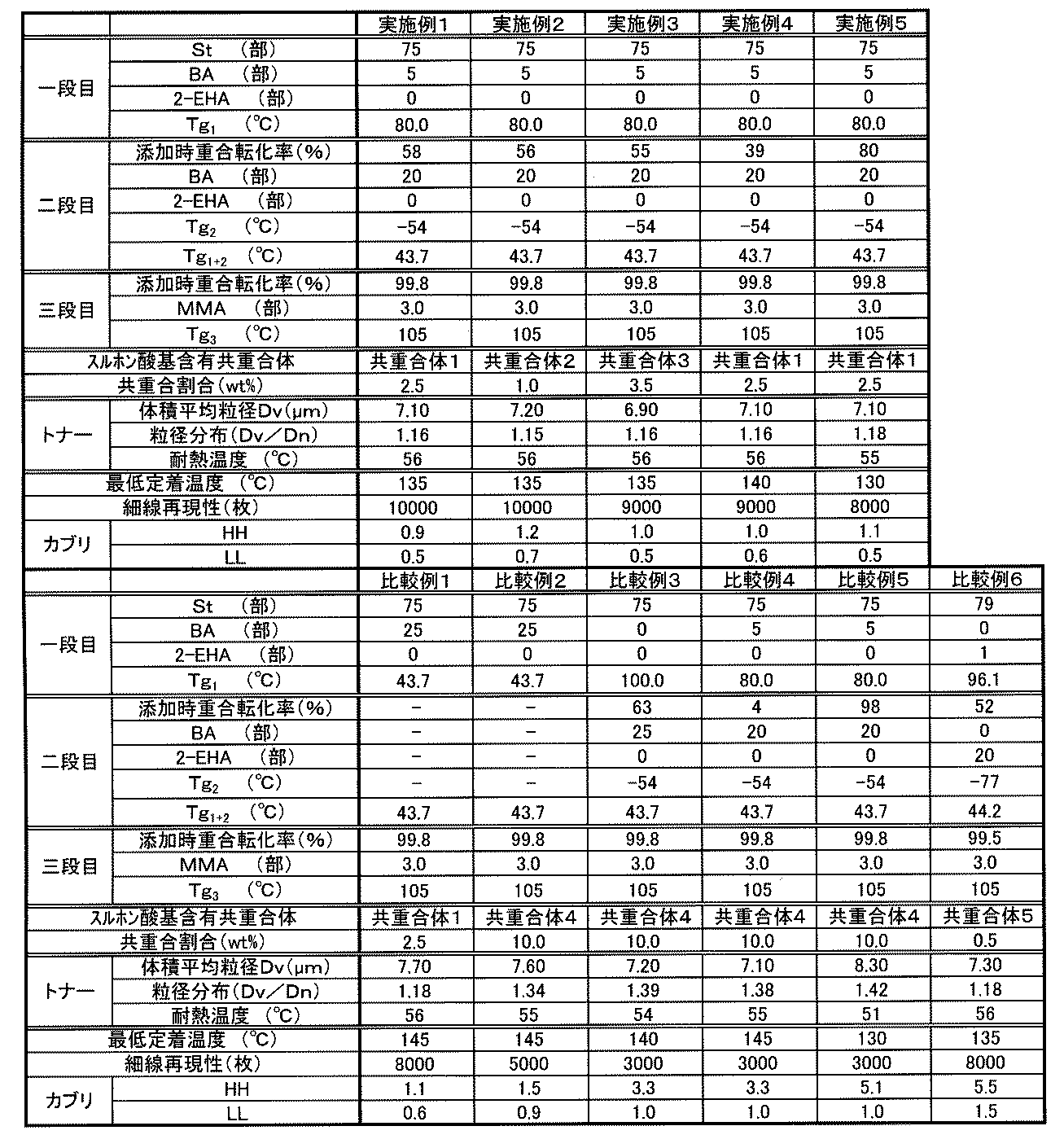
5.トナーの評価のまとめ
以下、主に表2を参照しながら、トナーの評価結果について検討する。
表2より、比較例1のトナーは、本発明における二段目重合工程を行わずに製造したトナーである。比較例1のトナーは、最低定着温度が145℃と高い。したがって、本発明における二段目重合工程を行わずに製造された比較例1のトナーは、低温定着性に劣るという問題があることが分かる。
以下、主に表2を参照しながら、トナーの評価結果について検討する。
表2より、比較例1のトナーは、本発明における二段目重合工程を行わずに製造したトナーである。比較例1のトナーは、最低定着温度が145℃と高い。したがって、本発明における二段目重合工程を行わずに製造された比較例1のトナーは、低温定着性に劣るという問題があることが分かる。
次に、比較例2~5のトナーについて検討する。表2より、比較例2~5のトナーは、2-アクリルアミド-2-メチルプロパンスルホン酸の共重合割合が10.0質量%のスルホン酸基含有共重合体4を含むトナーである。
表2より、比較例2~5のトナーのDv/Dnは1.34以上と大きい。これは、上記共重合割合が4.0質量%を超えるため、均一な粒径のトナーが得られにくくなったことによる。
このようにトナーの粒径が不均一であることは、特に細線再現性及び帯電性に悪影響を及ぼしている。表2より、比較例2~5のトナーは、細線再現性の評価枚数が5,000枚以下と少なく、HHカブリの値が1.5以上と高く、LLカブリの値が0.9以上と高い。
以上より、帯電制御剤として2-アクリルアミド-2-メチルプロパンスルホン酸の共重合割合が4.0質量%を超えるスルホン酸基含有共重合体を含む比較例2~5のトナーは、均一な粒径が得られにくいため帯電性に乏しく、その結果、細線再現性に劣り、さらにカブリが生じやすいことが分かる。
表2より、比較例2~5のトナーのDv/Dnは1.34以上と大きい。これは、上記共重合割合が4.0質量%を超えるため、均一な粒径のトナーが得られにくくなったことによる。
このようにトナーの粒径が不均一であることは、特に細線再現性及び帯電性に悪影響を及ぼしている。表2より、比較例2~5のトナーは、細線再現性の評価枚数が5,000枚以下と少なく、HHカブリの値が1.5以上と高く、LLカブリの値が0.9以上と高い。
以上より、帯電制御剤として2-アクリルアミド-2-メチルプロパンスルホン酸の共重合割合が4.0質量%を超えるスルホン酸基含有共重合体を含む比較例2~5のトナーは、均一な粒径が得られにくいため帯電性に乏しく、その結果、細線再現性に劣り、さらにカブリが生じやすいことが分かる。
さらに、比較例4のトナーは、一段目重合工程の重合転化率が4%に達したときに二段目重合工程を開始して得られたトナーである。比較例4のトナーは、最低定着温度が145℃と高い。したがって、一段目重合工程の重合転化率が低すぎるときに二段目重合工程を開始して製造された比較例4の重合トナーは、低温定着性に劣るという問題があることが分かる。
一方、比較例5のトナーは、一段目重合工程の重合転化率が98%に達したときに二段目重合工程を開始して得られたトナーである。比較例5のトナーは、耐熱温度が51℃と低い。したがって、一段目重合工程の重合転化率が十分高くなった後に二段目重合工程を開始して製造された比較例5のトナーは、耐熱保存性に劣るという問題があることが分かる。
一方、比較例5のトナーは、一段目重合工程の重合転化率が98%に達したときに二段目重合工程を開始して得られたトナーである。比較例5のトナーは、耐熱温度が51℃と低い。したがって、一段目重合工程の重合転化率が十分高くなった後に二段目重合工程を開始して製造された比較例5のトナーは、耐熱保存性に劣るという問題があることが分かる。
続いて、比較例6のトナーについて検討する。表2より、比較例6のトナーは、2-アクリルアミド-2-メチルプロパンスルホン酸の共重合割合が0.5質量%のスルホン酸基含有共重合体5を含むトナーである。
表2より、比較例6のトナーは、HHカブリの値が5.5、LLカブリの値が1.5といずれも高い。これらのカブリの値は、今回測定したトナー中いずれも最も高い。
以上より、帯電制御剤として2-アクリルアミド-2-メチルプロパンスルホン酸の共重合割合が0.8質量%未満であるスルホン酸基含有共重合体を含む比較例6のトナーは、カブリが特に生じやすいことが分かる。
表2より、比較例6のトナーは、HHカブリの値が5.5、LLカブリの値が1.5といずれも高い。これらのカブリの値は、今回測定したトナー中いずれも最も高い。
以上より、帯電制御剤として2-アクリルアミド-2-メチルプロパンスルホン酸の共重合割合が0.8質量%未満であるスルホン酸基含有共重合体を含む比較例6のトナーは、カブリが特に生じやすいことが分かる。
一方、表2より、実施例1~5のトナーは、いずれも、2-アクリルアミド-2-メチルプロパンスルホン酸の共重合割合が1.0~3.5質量%のスルホン酸基含有共重合体を用い、かつ、一段目重合工程における重合転化率が39~80%となったときに、一段目重合性単量体が重合してなる重合体のガラス転移温度Tg1よりも低いガラス転移温度Tg2を有する重合体を構成する二段目重合性単量体をさらに添加して製造されたトナーである。
表2より、実施例1~5のトナーは、いずれも耐熱温度が55℃以上であり、優れた耐熱保存性を有する。また、表2より、実施例1~5のトナーは、いずれも最低定着温度が140℃以下であり、優れた低温定着性を有する。さらに、細線再現性の評価枚数が8,000枚以上と多く、HHカブリの値が1.2以下と低く、LLカブリの値が0.7以下と低い。
したがって、上述した条件を満たす製造方法により製造された実施例1~5のトナーは、従来は背反の関係にあった耐熱保存性の向上と低温定着性の向上をバランスよく達成できると共に、優れた細線再現性を有しかつカブリの発生の少ないトナーであることが分かる。
表2より、実施例1~5のトナーは、いずれも耐熱温度が55℃以上であり、優れた耐熱保存性を有する。また、表2より、実施例1~5のトナーは、いずれも最低定着温度が140℃以下であり、優れた低温定着性を有する。さらに、細線再現性の評価枚数が8,000枚以上と多く、HHカブリの値が1.2以下と低く、LLカブリの値が0.7以下と低い。
したがって、上述した条件を満たす製造方法により製造された実施例1~5のトナーは、従来は背反の関係にあった耐熱保存性の向上と低温定着性の向上をバランスよく達成できると共に、優れた細線再現性を有しかつカブリの発生の少ないトナーであることが分かる。
なお、実施例4における、二段目重合工程を開始する際の、一段目重合工程における重合転化率は39%であり、この重合転化率は、実施例1~5の中で最も低い。したがって、最低定着温度が実施例1~5の中で最も高くなる。
また、実施例5における、二段目重合工程を開始する際の、一段目重合工程における重合転化率は80%であり、この重合転化率は、実施例1~5の中で最も高い。したがって、耐熱温度が実施例1~5の中で最も低くなる。
Claims (7)
- 少なくとも一段目重合性単量体、着色剤及び帯電制御剤を含有する一段目重合性単量体組成物を、分散安定化剤を含有する水系分散媒体中に懸濁させることにより、一段目重合性単量体組成物の液滴が分散した懸濁液を得る懸濁工程、
前記懸濁液を用いて重合開始剤の存在下で懸濁重合を行う一段目重合工程、並びに
前記一段目重合工程における重合転化率が5~95%となったときに、下記式(1)を満たす二段目重合性単量体をさらに添加して懸濁重合を行う二段目重合工程、を有する負帯電性重合トナーの製造方法であって、
前記帯電制御剤は、ビニル芳香族炭化水素と(メタ)アクリレートとスルホン酸基含有(メタ)アクリルアミドとを共重合して得られ、且つスルホン酸基含有(メタ)アクリルアミドの共重合割合が0.8~4.0質量%であることを特徴とする負帯電性重合トナーの製造方法。
Tg1>Tg2 式(1)
(上記式(1)中、Tg1は前記一段目重合性単量体が重合してなる重合体のガラス転移温度(℃)を、Tg2は前記二段目重合性単量体が重合してなる重合体のガラス転移温度(℃)を、それぞれ示す。) - 少なくとも一段目重合性単量体、着色剤及び帯電制御剤を含有する一段目重合性単量体組成物を、分散安定化剤を含有する水系分散媒体中に懸濁させることにより、一段目重合性単量体組成物の液滴が分散した懸濁液を得る懸濁工程、
前記懸濁液を用いて重合開始剤の存在下で懸濁重合を行う一段目重合工程、
前記一段目重合工程における重合転化率が5~95%となったときに、下記式(1)を満たす二段目重合性単量体をさらに添加して懸濁重合を行う二段目重合工程、並びに
前記二段目重合工程までの重合転化率が95%以上となったときに、重合開始剤、及び下記式(2)を満たす三段目重合性単量体をさらに添加して懸濁重合を行う三段目重合工程、を有する負帯電性重合トナーの製造方法であって、
前記帯電制御剤は、ビニル芳香族炭化水素と(メタ)アクリレートとスルホン酸基含有(メタ)アクリルアミドとを共重合して得られ、且つスルホン酸基含有(メタ)アクリルアミドの共重合割合が0.8~4.0質量%であることを特徴とする負帯電性重合トナーの製造方法。
Tg1>Tg2 式(1)
(上記式(1)中、Tg1は前記一段目重合性単量体が重合してなる重合体のガラス転移温度(℃)を、Tg2は前記二段目重合性単量体が重合してなる重合体のガラス転移温度(℃)を、それぞれ示す。)
Tg1+2<Tg3 式(2)
(上記式(2)中、Tg1+2は前記一段目重合性単量体及び前記二段目重合性単量体が重合してなる重合体のガラス転移温度(℃)を、Tg3は前記三段目重合性単量体が重合してなる重合体のガラス転移温度(℃)を、それぞれ示す。) - 前記一段目重合性単量体と前記二段目重合性単量体の質量割合が、一段目重合性単量体:二段目重合性単量体=60:40~95:5であることを特徴とする請求項1又は2に記載の負帯電性重合トナーの製造方法。
- 前記式(1)において、Tg1がTg2より5℃~180℃高いことを特徴とする請求項1乃至3のいずれか一項に記載の負帯電性重合トナーの製造方法。
- 前記式(2)において、Tg3がTg1+2より10℃~100℃高いことを特徴とする請求項2乃至4のいずれか一項に記載の負帯電性重合トナーの製造方法。
- 前記帯電制御剤の重量平均分子量が5,000~30,000であることを特徴とする請求項1乃至5のいずれか一項に記載の負帯電性重合トナーの製造方法。
- 前記帯電制御剤の量が重合性単量体100質量部に対して0.1~8質量部であることを特徴とする請求項1乃至6のいずれか一項に記載の負帯電性重合トナーの製造方法。
Priority Applications (1)
| Application Number | Priority Date | Filing Date | Title |
|---|---|---|---|
| JP2015555028A JPWO2015099092A1 (ja) | 2013-12-26 | 2014-12-25 | 負帯電性重合トナーの製造方法 |
Applications Claiming Priority (2)
| Application Number | Priority Date | Filing Date | Title |
|---|---|---|---|
| JP2013-269604 | 2013-12-26 | ||
| JP2013269604 | 2013-12-26 |
Publications (1)
| Publication Number | Publication Date |
|---|---|
| WO2015099092A1 true WO2015099092A1 (ja) | 2015-07-02 |
Family
ID=53478932
Family Applications (1)
| Application Number | Title | Priority Date | Filing Date |
|---|---|---|---|
| PCT/JP2014/084418 Ceased WO2015099092A1 (ja) | 2013-12-26 | 2014-12-25 | 負帯電性重合トナーの製造方法 |
Country Status (2)
| Country | Link |
|---|---|
| JP (1) | JPWO2015099092A1 (ja) |
| WO (1) | WO2015099092A1 (ja) |
Cited By (3)
| Publication number | Priority date | Publication date | Assignee | Title |
|---|---|---|---|---|
| CN105153803A (zh) * | 2015-10-16 | 2015-12-16 | 佛山市明朝科技开发有限公司 | 一种本体聚合建筑陶瓷用彩色陶瓷墨粉及其制备方法 |
| JP2017067925A (ja) * | 2015-09-29 | 2017-04-06 | 日本ゼオン株式会社 | 負帯電性トナーの製造方法 |
| JP2019168713A (ja) * | 2015-09-29 | 2019-10-03 | 日本ゼオン株式会社 | 負帯電性トナーの製造方法 |
Citations (8)
| Publication number | Priority date | Publication date | Assignee | Title |
|---|---|---|---|---|
| WO1997001131A1 (en) * | 1995-06-21 | 1997-01-09 | Nippon Zeon Co., Ltd. | Process for producing toner for developing electrostatically charged images |
| JPH11174732A (ja) * | 1997-12-10 | 1999-07-02 | Oki Data Corp | 熱圧力定着用カプセルトナーとその製造方法 |
| JPH11184165A (ja) * | 1997-12-17 | 1999-07-09 | Nippon Zeon Co Ltd | 静電荷像現像用トナー及びその製造方法 |
| JP2004004506A (ja) * | 2002-03-27 | 2004-01-08 | Nippon Zeon Co Ltd | 静電荷像現像用トナー |
| JP2006064960A (ja) * | 2004-08-26 | 2006-03-09 | Kyocera Chemical Corp | 静電潜像現像用トナー |
| WO2006070870A1 (ja) * | 2004-12-28 | 2006-07-06 | Zeon Corporation | 静電荷像現像用トナー |
| JP2007065667A (ja) * | 2005-08-30 | 2007-03-15 | Xerox Corp | 乳化凝集トナー、現像システム、画像形成方法 |
| JP2010243759A (ja) * | 2009-04-06 | 2010-10-28 | Konica Minolta Business Technologies Inc | 静電荷像現像用トナー、画像形成方法 |
-
2014
- 2014-12-25 WO PCT/JP2014/084418 patent/WO2015099092A1/ja not_active Ceased
- 2014-12-25 JP JP2015555028A patent/JPWO2015099092A1/ja active Pending
Patent Citations (8)
| Publication number | Priority date | Publication date | Assignee | Title |
|---|---|---|---|---|
| WO1997001131A1 (en) * | 1995-06-21 | 1997-01-09 | Nippon Zeon Co., Ltd. | Process for producing toner for developing electrostatically charged images |
| JPH11174732A (ja) * | 1997-12-10 | 1999-07-02 | Oki Data Corp | 熱圧力定着用カプセルトナーとその製造方法 |
| JPH11184165A (ja) * | 1997-12-17 | 1999-07-09 | Nippon Zeon Co Ltd | 静電荷像現像用トナー及びその製造方法 |
| JP2004004506A (ja) * | 2002-03-27 | 2004-01-08 | Nippon Zeon Co Ltd | 静電荷像現像用トナー |
| JP2006064960A (ja) * | 2004-08-26 | 2006-03-09 | Kyocera Chemical Corp | 静電潜像現像用トナー |
| WO2006070870A1 (ja) * | 2004-12-28 | 2006-07-06 | Zeon Corporation | 静電荷像現像用トナー |
| JP2007065667A (ja) * | 2005-08-30 | 2007-03-15 | Xerox Corp | 乳化凝集トナー、現像システム、画像形成方法 |
| JP2010243759A (ja) * | 2009-04-06 | 2010-10-28 | Konica Minolta Business Technologies Inc | 静電荷像現像用トナー、画像形成方法 |
Cited By (4)
| Publication number | Priority date | Publication date | Assignee | Title |
|---|---|---|---|---|
| JP2017067925A (ja) * | 2015-09-29 | 2017-04-06 | 日本ゼオン株式会社 | 負帯電性トナーの製造方法 |
| JP2019168713A (ja) * | 2015-09-29 | 2019-10-03 | 日本ゼオン株式会社 | 負帯電性トナーの製造方法 |
| CN105153803A (zh) * | 2015-10-16 | 2015-12-16 | 佛山市明朝科技开发有限公司 | 一种本体聚合建筑陶瓷用彩色陶瓷墨粉及其制备方法 |
| CN105153803B (zh) * | 2015-10-16 | 2018-02-23 | 佛山市明朝科技开发有限公司 | 一种本体聚合建筑陶瓷用彩色陶瓷墨粉及其制备方法 |
Also Published As
| Publication number | Publication date |
|---|---|
| JPWO2015099092A1 (ja) | 2017-03-23 |
Similar Documents
| Publication | Publication Date | Title |
|---|---|---|
| JP6489119B2 (ja) | トナーセット | |
| JP5598640B1 (ja) | 静電荷像現像用トナー | |
| JP5925421B2 (ja) | 静電荷像現像用トナー | |
| JP2014130202A (ja) | 静電荷像現像用トナー | |
| JP2019070835A (ja) | 負帯電性トナー及びその製造方法 | |
| JP6690694B2 (ja) | 重合トナーの製造方法 | |
| JP5845570B2 (ja) | 静電荷像現像用トナー及びその製造方法 | |
| WO2015099092A1 (ja) | 負帯電性重合トナーの製造方法 | |
| JP5987900B2 (ja) | 静電荷像現像用トナー | |
| US10353306B2 (en) | Method for producing negatively chargeable toner, and negatively chargeable toner | |
| CN108780288B (zh) | 带正电性黑色调色剂 | |
| JP6973448B2 (ja) | 負帯電性トナーの製造方法 | |
| JP6244800B2 (ja) | 静電荷像現像用トナー | |
| JP7183679B2 (ja) | 重合トナーの製造方法 | |
| CN112805632B (zh) | 静电图像显影用调色剂用蜡及包含其的静电图像显影用调色剂 | |
| JPWO2005083527A1 (ja) | 静電荷像現像用トナー | |
| JPWO2016152525A1 (ja) | 静電荷像現像用トナー | |
| JP6540432B2 (ja) | 負帯電性トナーの製造方法 | |
| WO2015122536A1 (ja) | イエロートナー | |
| JP2023125146A (ja) | トナー | |
| JPWO2019131543A1 (ja) | イエロートナー |
Legal Events
| Date | Code | Title | Description |
|---|---|---|---|
| 121 | Ep: the epo has been informed by wipo that ep was designated in this application |
Ref document number: 14875675 Country of ref document: EP Kind code of ref document: A1 |
|
| ENP | Entry into the national phase |
Ref document number: 2015555028 Country of ref document: JP Kind code of ref document: A |
|
| NENP | Non-entry into the national phase |
Ref country code: DE |
|
| 122 | Ep: pct application non-entry in european phase |
Ref document number: 14875675 Country of ref document: EP Kind code of ref document: A1 |