WO2015080147A1 - 活性エネルギー線硬化型樹脂組成物、及びそれを用いた表示素子用スペーサー及び/またはカラーフィルター保護膜 - Google Patents
活性エネルギー線硬化型樹脂組成物、及びそれを用いた表示素子用スペーサー及び/またはカラーフィルター保護膜 Download PDFInfo
- Publication number
- WO2015080147A1 WO2015080147A1 PCT/JP2014/081223 JP2014081223W WO2015080147A1 WO 2015080147 A1 WO2015080147 A1 WO 2015080147A1 JP 2014081223 W JP2014081223 W JP 2014081223W WO 2015080147 A1 WO2015080147 A1 WO 2015080147A1
- Authority
- WO
- WIPO (PCT)
- Prior art keywords
- compound
- meth
- acid
- resin composition
- acrylate
- Prior art date
- Legal status (The legal status is an assumption and is not a legal conclusion. Google has not performed a legal analysis and makes no representation as to the accuracy of the status listed.)
- Ceased
Links
Classifications
-
- G—PHYSICS
- G03—PHOTOGRAPHY; CINEMATOGRAPHY; ANALOGOUS TECHNIQUES USING WAVES OTHER THAN OPTICAL WAVES; ELECTROGRAPHY; HOLOGRAPHY
- G03F—PHOTOMECHANICAL PRODUCTION OF TEXTURED OR PATTERNED SURFACES, e.g. FOR PRINTING, FOR PROCESSING OF SEMICONDUCTOR DEVICES; MATERIALS THEREFOR; ORIGINALS THEREFOR; APPARATUS SPECIALLY ADAPTED THEREFOR
- G03F7/00—Photomechanical, e.g. photolithographic, production of textured or patterned surfaces, e.g. printing surfaces; Materials therefor, e.g. comprising photoresists; Apparatus specially adapted therefor
- G03F7/004—Photosensitive materials
- G03F7/027—Non-macromolecular photopolymerisable compounds having carbon-to-carbon double bonds, e.g. ethylenic compounds
-
- C—CHEMISTRY; METALLURGY
- C08—ORGANIC MACROMOLECULAR COMPOUNDS; THEIR PREPARATION OR CHEMICAL WORKING-UP; COMPOSITIONS BASED THEREON
- C08G—MACROMOLECULAR COMPOUNDS OBTAINED OTHERWISE THAN BY REACTIONS ONLY INVOLVING UNSATURATED CARBON-TO-CARBON BONDS
- C08G59/00—Polycondensates containing more than one epoxy group per molecule; Macromolecules obtained by polymerising compounds containing more than one epoxy group per molecule using curing agents or catalysts which react with the epoxy groups
- C08G59/14—Polycondensates modified by chemical after-treatment
- C08G59/1433—Polycondensates modified by chemical after-treatment with organic low-molecular-weight compounds
- C08G59/1438—Polycondensates modified by chemical after-treatment with organic low-molecular-weight compounds containing oxygen
- C08G59/1455—Monocarboxylic acids, anhydrides, halides, or low-molecular-weight esters thereof
-
- C—CHEMISTRY; METALLURGY
- C08—ORGANIC MACROMOLECULAR COMPOUNDS; THEIR PREPARATION OR CHEMICAL WORKING-UP; COMPOSITIONS BASED THEREON
- C08G—MACROMOLECULAR COMPOUNDS OBTAINED OTHERWISE THAN BY REACTIONS ONLY INVOLVING UNSATURATED CARBON-TO-CARBON BONDS
- C08G59/00—Polycondensates containing more than one epoxy group per molecule; Macromolecules obtained by polymerising compounds containing more than one epoxy group per molecule using curing agents or catalysts which react with the epoxy groups
- C08G59/14—Polycondensates modified by chemical after-treatment
- C08G59/1433—Polycondensates modified by chemical after-treatment with organic low-molecular-weight compounds
- C08G59/1438—Polycondensates modified by chemical after-treatment with organic low-molecular-weight compounds containing oxygen
- C08G59/1455—Monocarboxylic acids, anhydrides, halides, or low-molecular-weight esters thereof
- C08G59/1461—Unsaturated monoacids
-
- C—CHEMISTRY; METALLURGY
- C08—ORGANIC MACROMOLECULAR COMPOUNDS; THEIR PREPARATION OR CHEMICAL WORKING-UP; COMPOSITIONS BASED THEREON
- C08G—MACROMOLECULAR COMPOUNDS OBTAINED OTHERWISE THAN BY REACTIONS ONLY INVOLVING UNSATURATED CARBON-TO-CARBON BONDS
- C08G59/00—Polycondensates containing more than one epoxy group per molecule; Macromolecules obtained by polymerising compounds containing more than one epoxy group per molecule using curing agents or catalysts which react with the epoxy groups
- C08G59/14—Polycondensates modified by chemical after-treatment
- C08G59/1433—Polycondensates modified by chemical after-treatment with organic low-molecular-weight compounds
- C08G59/1438—Polycondensates modified by chemical after-treatment with organic low-molecular-weight compounds containing oxygen
- C08G59/1455—Monocarboxylic acids, anhydrides, halides, or low-molecular-weight esters thereof
- C08G59/1461—Unsaturated monoacids
- C08G59/1466—Acrylic or methacrylic acids
-
- C—CHEMISTRY; METALLURGY
- C09—DYES; PAINTS; POLISHES; NATURAL RESINS; ADHESIVES; COMPOSITIONS NOT OTHERWISE PROVIDED FOR; APPLICATIONS OF MATERIALS NOT OTHERWISE PROVIDED FOR
- C09D—COATING COMPOSITIONS, e.g. PAINTS, VARNISHES OR LACQUERS; FILLING PASTES; CHEMICAL PAINT OR INK REMOVERS; INKS; CORRECTING FLUIDS; WOODSTAINS; PASTES OR SOLIDS FOR COLOURING OR PRINTING; USE OF MATERIALS THEREFOR
- C09D131/00—Coating compositions based on homopolymers or copolymers of compounds having one or more unsaturated aliphatic radicals, each having only one carbon-to-carbon double bond, and at least one being terminated by an acyloxy radical of a saturated carboxylic acid, of carbonic acid, or of a haloformic acid; Coating compositions based on derivatives of such polymers
- C09D131/06—Homopolymers or copolymers of esters of polycarboxylic acids
-
- G—PHYSICS
- G02—OPTICS
- G02B—OPTICAL ELEMENTS, SYSTEMS OR APPARATUS
- G02B5/00—Optical elements other than lenses
- G02B5/20—Filters
- G02B5/22—Absorbing filters
- G02B5/223—Absorbing filters containing organic substances, e.g. dyes, inks or pigments
-
- G—PHYSICS
- G02—OPTICS
- G02F—OPTICAL DEVICES OR ARRANGEMENTS FOR THE CONTROL OF LIGHT BY MODIFICATION OF THE OPTICAL PROPERTIES OF THE MEDIA OF THE ELEMENTS INVOLVED THEREIN; NON-LINEAR OPTICS; FREQUENCY-CHANGING OF LIGHT; OPTICAL LOGIC ELEMENTS; OPTICAL ANALOGUE/DIGITAL CONVERTERS
- G02F1/00—Devices or arrangements for the control of the intensity, colour, phase, polarisation or direction of light arriving from an independent light source, e.g. switching, gating or modulating; Non-linear optics
- G02F1/01—Devices or arrangements for the control of the intensity, colour, phase, polarisation or direction of light arriving from an independent light source, e.g. switching, gating or modulating; Non-linear optics for the control of the intensity, phase, polarisation or colour
- G02F1/13—Devices or arrangements for the control of the intensity, colour, phase, polarisation or direction of light arriving from an independent light source, e.g. switching, gating or modulating; Non-linear optics for the control of the intensity, phase, polarisation or colour based on liquid crystals, e.g. single liquid crystal display cells
- G02F1/133—Constructional arrangements; Operation of liquid crystal cells; Circuit arrangements
- G02F1/1333—Constructional arrangements; Manufacturing methods
- G02F1/1335—Structural association of cells with optical devices, e.g. polarisers or reflectors
- G02F1/133509—Filters, e.g. light shielding masks
- G02F1/133514—Colour filters
- G02F1/133519—Overcoatings
-
- G—PHYSICS
- G02—OPTICS
- G02F—OPTICAL DEVICES OR ARRANGEMENTS FOR THE CONTROL OF LIGHT BY MODIFICATION OF THE OPTICAL PROPERTIES OF THE MEDIA OF THE ELEMENTS INVOLVED THEREIN; NON-LINEAR OPTICS; FREQUENCY-CHANGING OF LIGHT; OPTICAL LOGIC ELEMENTS; OPTICAL ANALOGUE/DIGITAL CONVERTERS
- G02F1/00—Devices or arrangements for the control of the intensity, colour, phase, polarisation or direction of light arriving from an independent light source, e.g. switching, gating or modulating; Non-linear optics
- G02F1/01—Devices or arrangements for the control of the intensity, colour, phase, polarisation or direction of light arriving from an independent light source, e.g. switching, gating or modulating; Non-linear optics for the control of the intensity, phase, polarisation or colour
- G02F1/13—Devices or arrangements for the control of the intensity, colour, phase, polarisation or direction of light arriving from an independent light source, e.g. switching, gating or modulating; Non-linear optics for the control of the intensity, phase, polarisation or colour based on liquid crystals, e.g. single liquid crystal display cells
- G02F1/133—Constructional arrangements; Operation of liquid crystal cells; Circuit arrangements
- G02F1/1333—Constructional arrangements; Manufacturing methods
- G02F1/1339—Gaskets; Spacers; Sealing of cells
- G02F1/13398—Spacer materials; Spacer properties
-
- G—PHYSICS
- G03—PHOTOGRAPHY; CINEMATOGRAPHY; ANALOGOUS TECHNIQUES USING WAVES OTHER THAN OPTICAL WAVES; ELECTROGRAPHY; HOLOGRAPHY
- G03F—PHOTOMECHANICAL PRODUCTION OF TEXTURED OR PATTERNED SURFACES, e.g. FOR PRINTING, FOR PROCESSING OF SEMICONDUCTOR DEVICES; MATERIALS THEREFOR; ORIGINALS THEREFOR; APPARATUS SPECIALLY ADAPTED THEREFOR
- G03F7/00—Photomechanical, e.g. photolithographic, production of textured or patterned surfaces, e.g. printing surfaces; Materials therefor, e.g. comprising photoresists; Apparatus specially adapted therefor
- G03F7/0005—Production of optical devices or components in so far as characterised by the lithographic processes or materials used therefor
- G03F7/0007—Filters, e.g. additive colour filters; Components for display devices
-
- G—PHYSICS
- G03—PHOTOGRAPHY; CINEMATOGRAPHY; ANALOGOUS TECHNIQUES USING WAVES OTHER THAN OPTICAL WAVES; ELECTROGRAPHY; HOLOGRAPHY
- G03F—PHOTOMECHANICAL PRODUCTION OF TEXTURED OR PATTERNED SURFACES, e.g. FOR PRINTING, FOR PROCESSING OF SEMICONDUCTOR DEVICES; MATERIALS THEREFOR; ORIGINALS THEREFOR; APPARATUS SPECIALLY ADAPTED THEREFOR
- G03F7/00—Photomechanical, e.g. photolithographic, production of textured or patterned surfaces, e.g. printing surfaces; Materials therefor, e.g. comprising photoresists; Apparatus specially adapted therefor
- G03F7/004—Photosensitive materials
- G03F7/0048—Photosensitive materials characterised by the solvents or agents facilitating spreading, e.g. tensio-active agents
-
- G—PHYSICS
- G03—PHOTOGRAPHY; CINEMATOGRAPHY; ANALOGOUS TECHNIQUES USING WAVES OTHER THAN OPTICAL WAVES; ELECTROGRAPHY; HOLOGRAPHY
- G03F—PHOTOMECHANICAL PRODUCTION OF TEXTURED OR PATTERNED SURFACES, e.g. FOR PRINTING, FOR PROCESSING OF SEMICONDUCTOR DEVICES; MATERIALS THEREFOR; ORIGINALS THEREFOR; APPARATUS SPECIALLY ADAPTED THEREFOR
- G03F7/00—Photomechanical, e.g. photolithographic, production of textured or patterned surfaces, e.g. printing surfaces; Materials therefor, e.g. comprising photoresists; Apparatus specially adapted therefor
- G03F7/004—Photosensitive materials
- G03F7/038—Macromolecular compounds which are rendered insoluble or differentially wettable
- G03F7/0388—Macromolecular compounds which are rendered insoluble or differentially wettable with ethylenic or acetylenic bands in the side chains of the photopolymer
-
- C—CHEMISTRY; METALLURGY
- C08—ORGANIC MACROMOLECULAR COMPOUNDS; THEIR PREPARATION OR CHEMICAL WORKING-UP; COMPOSITIONS BASED THEREON
- C08G—MACROMOLECULAR COMPOUNDS OBTAINED OTHERWISE THAN BY REACTIONS ONLY INVOLVING UNSATURATED CARBON-TO-CARBON BONDS
- C08G59/00—Polycondensates containing more than one epoxy group per molecule; Macromolecules obtained by polymerising compounds containing more than one epoxy group per molecule using curing agents or catalysts which react with the epoxy groups
- C08G59/18—Macromolecules obtained by polymerising compounds containing more than one epoxy group per molecule using curing agents or catalysts which react with the epoxy groups ; e.g. general methods of curing
- C08G59/20—Macromolecules obtained by polymerising compounds containing more than one epoxy group per molecule using curing agents or catalysts which react with the epoxy groups ; e.g. general methods of curing characterised by the epoxy compounds used
- C08G59/32—Epoxy compounds containing three or more epoxy groups
- C08G59/3218—Carbocyclic compounds
-
- G—PHYSICS
- G02—OPTICS
- G02B—OPTICAL ELEMENTS, SYSTEMS OR APPARATUS
- G02B5/00—Optical elements other than lenses
- G02B5/20—Filters
- G02B5/201—Filters in the form of arrays
Definitions
- the present invention relates to an active energy ray-curable resin composition, a display element spacer and / or a color filter protective film.
- a color liquid crystal display device has a structure in which a color filter and an electrode substrate such as a TFT substrate are opposed to each other, a gap of about 1 to 10 ⁇ m is provided, a liquid crystal compound is filled in the gap, and the periphery is sealed with a sealing material. Have taken.
- the color filter has a black matrix layer formed in a predetermined pattern on the transparent substrate to shield the boundary between pixels, and usually red (R), green (G), A colored layer in which blue (B) is arranged in a predetermined order, a protective film, and a transparent electrode film are stacked in this order from the side close to the transparent substrate.
- An alignment film is provided on the inner surface side of the color filter and the electrode substrate facing the color filter. Further, in the gap, in order to maintain a uniform and uniform cell gap between the color filter and the electrode substrate, pearls having a constant particle diameter are dispersed as spacers, or columns or stripes having a height corresponding to the cell gap. Shaped spacers are formed.
- a color image is obtained by controlling the light transmittance of the liquid crystal layer behind each pixel colored in each color.
- Such color filters are used not only in color liquid crystal display devices but also in other display devices such as EL and rear projection displays.
- the above colored layer, protective film and spacer can be formed using a resin.
- the colored layer needs to be formed in a predetermined pattern for each color pixel.
- the protective film is preferably one that can cover only the region where the colored layer is formed on the transparent substrate in consideration of the adhesion and sealing property of the seal portion.
- the spacer must be accurately provided in the black matrix layer forming region, that is, in the non-display region. For this reason, a colored layer, a protective film, and a columnar spacer have been formed using a curable resin that can easily limit a region to be cured by a photomask.
- Patent Document 1 a photosensitive resin produced by neutralizing an acid-modified epoxy acrylate of a cresol novolak epoxy resin with a primary amino compound is used as a polymer component of a photosensitive resin composition for a photospacer and a color filter. Yes.
- a composition containing a salt of a primary amino compound and water has poor applicability and flatness, and cannot be said to be sufficiently compatible with a slit coater or the like.
- cresol novolac epoxy resin or acid-modified epoxy acrylate of phenol novolac epoxy resin is used as the polymer component of the photosensitive resin composition for photospacer.
- the radiation sensitivity and developability were inferior and the level was not satisfactory.
- Patent Document 3 a reaction product obtained by adding acrylic acid or dimethylolpropionic acid to cresol novolac epoxy resin as a polymer component of a protective film for a color filter or a resist ink composition for a flexible printed wiring board is caprolactone-modified, and then tetrahydroanhydride is modified. Active energy ray curable resin modified with phthalic acid is used.
- the polymer component that is the main component of the composition is excellent in developability and flexibility, but has a problem that it is inferior in the elastic recovery rate required as a photospacer.
- Patent Document 4 discloses that a resin composition containing an unsaturated group-containing polycarboxylic acid is suitable for a solder resist, but does not describe a display element spacer or a color filter protective film at all. .
- Japanese Unexamined Patent Publication No. 2004-109752 Japanese Unexamined Patent Publication No. 2007-010885 Japanese Laid-Open Patent Publication No. 2004-300026 Japanese Patent No. 2704661
- the present invention is an active energy ray-curable resin composition that improves the above-mentioned problems of the prior art and has good developability, curability, and high-speed coating properties, and has heat-resistant transparency, flatness, flexibility, and toughness.
- An object of the present invention is to provide a display element spacer and a color filter protective film excellent in the above.
- the present invention (1) Reactive polycarboxylic acid compound (A), reactive compound (B) other than reactive polycarboxylic acid compound (A), photopolymerization initiator (C), and organic solvent (D)
- An active energy ray-curable resin composition for a spacer or color filter protective film wherein the reactive polycarboxylic acid compound (A) is one per molecule with the epoxy resin (a) represented by the general formula (1)
- the above compound (b) having a polymerizable ethylenically unsaturated group and one or more carboxyl groups, and if necessary, a compound having at least two hydroxyl groups and one or more carboxyl groups in one molecule
- this active energy ray hardening-type resin composition which is the reactive polycarboxylic acid compound (A) obtained by making a polybasic acid anhydride (d) react further with the reaction product (E) with this.
- the reactive polycarboxylic acid compound (A) includes an epoxy resin (a) represented by the general formula (1) and one or more polymerizable ethylenically unsaturated groups in one molecule.
- a polybasic acid anhydride is further added to the reaction product (E) of the compound (b) having one or more carboxyl groups and the compound (c) having at least two hydroxyl groups and one or more carboxyl groups in one molecule.
- the present invention relates to a display element spacer or an active energy ray-curable resin composition for a color filter protective film according to (1), which is a reactive polycarboxylic acid compound (A) obtained by reacting the product (d).
- this invention relates to the spacer for display elements formed from the active energy ray hardening-type resin composition as described in said (1) or (2).
- the present invention further relates to a color filter protective film formed from the active energy ray-curable resin composition according to (1) or (2).
- the active energy ray-curable resin composition containing the reactive polycarboxylic acid compound (A) of the present invention has excellent developability, high radiation sensitivity, and excellent heat-resistant transparency, flatness, flexibility, and toughness.
- the display element spacer and the color filter protective film can be provided.
- the reactive polycarboxylic acid compound (A) in the present invention comprises an epoxy resin (a) represented by the general formula (1), one or more polymerizable ethylenically unsaturated groups and one or more carboxyls in one molecule.
- the reactive polycarboxylic acid compound (A) in the present invention is obtained by reacting the reaction product (E) of the epoxy resin (a) with the compound (b) with the polybasic acid anhydride (d) or by reacting with the epoxy resin. It is obtained by reacting a polybasic acid anhydride (d) with a reaction product (E) of (a), a compound (b) and a compound (c).
- the characteristics of the present invention are exhibited by introducing an ethylenically unsaturated group and a hydroxyl group into the molecular chain by an epoxy carboxylation reaction.
- the epoxy resin (a) represented by the general formula (1) in the present invention is (4 (4 (1,1-bis (p-hydroxyphenyl) -ethyl) ⁇ , ⁇ -dimethylbenzyl) phenol) (hereinafter referred to as phenol).
- Compound (PA1)) and epihalohydrin are obtained.
- This epoxy resin is shown as the following representative structure.
- the epoxy resin (a) used in the present invention is more preferably a solid at normal temperature.
- the epoxy resin (a) having a softening point of 50 to 100 ° C. or a melting point of 50 to 190 ° C. is usually used, but the softening point is 60 to 100 ° C. or the melting point of 60 to 190 ° C. Those are preferred.
- the epoxy equivalent is 130 to 500 g / eq.
- Examples of the epihalohydrin used in the reaction of the phenol compound (PA1) with epihalohydrin include epichlorohydrin, ⁇ -methylepichlorohydrin, ⁇ -methylepichlorohydrin, epibromohydrin, and the like, which are easily industrially available in the present invention. Epichlorohydrin is preferred.
- the amount of epihalohydrin to be used is generally 2 to 15 mol, preferably 4 to 10 mol, per 1 mol of the hydroxyl group of the phenol compound (PA1).
- an alkali metal hydroxide In the epoxidation reaction, it is preferable to use an alkali metal hydroxide.
- the alkali metal hydroxide include sodium hydroxide and potassium hydroxide.
- the alkali metal hydroxide may be used as a solid or an aqueous solution thereof.
- an aqueous solution of alkali metal hydroxide is continuously added to the reaction system, and water and epihalohydrin are continuously distilled under reduced pressure or normal pressure. Then, liquid separation is performed to remove water, and the epoxidation reaction can be carried out by continuously returning the epihalohydrin to the reaction system.
- the amount of the alkali metal hydroxide used is usually 0.90 to 1.5 mol, preferably 1.01 to 1.25 mol, more preferably 1 mol per mol of the hydroxyl group of the phenol compound (PA1). 1.01 to 1.15 mol.
- quaternary ammonium salts such as tetramethylammonium chloride, tetramethylammonium bromide, trimethylbenzylammonium chloride, tetramethylphosphonium chloride, tetramethylphosphonium bromide, trimethylbenzylphosphonium chloride,
- a quaternary phosphonium salt such as triphenylbenzylphosphonium chloride or triphenylethyl bromide may be added as a catalyst.
- the amount of these quaternary salts used is usually 0.1 to 15 g, preferably 0.2 to 10 g, per 1 mol of the hydroxyl group of the phenol compound (PA1).
- an alcohol such as methanol, ethanol and isopropyl alcohol
- an ether such as tetrahydrofuran and dioxane
- an aprotic polar solvent such as dimethyl sulfone, dimethyl sulfoxide, and dimethylimidazolidinone
- the amount used is usually 2 to 50% by weight, preferably 4 to 20% by weight, based on the amount of epihalohydrin used.
- the amount used is usually 5 to 100% by weight, preferably 10 to 80% by weight, based on the amount of epihalohydrin used.
- the reaction temperature is usually 30 to 90 ° C, preferably 35 to 80 ° C.
- the reaction time is usually 0.5 to 10 hours, preferably 1 to 8 hours.
- This reaction may be performed under normal pressure or reduced pressure, and may be performed under water-epihalohydrin azeotropic dehydration conditions under reduced pressure conditions.
- the reaction product of these epoxidation reactions can be purified by removing epihalohydrin, a solvent, or the like under heating and reduced pressure after washing with water or without washing with water.
- the recovered reaction product is dissolved in a solvent such as toluene or methyl isobutyl ketone, and an aqueous solution of an alkali metal hydroxide such as sodium hydroxide or potassium hydroxide is prepared.
- a solvent such as toluene or methyl isobutyl ketone
- an alkali metal hydroxide such as sodium hydroxide or potassium hydroxide
- the amount of alkali metal hydroxide used is usually 0.01 to 0.3 mol, preferably 0.05 to 0.00 mol, based on 1 mol of the hydroxyl group of the phenol compound (PA1) used for epoxidation. 2 moles.
- the reaction temperature is usually 50 to 120 ° C., and the reaction time is usually 0.5 to 2 hours.
- the epoxy resin thus obtained includes a part of the epoxy resin added with the solvent and water, and a part of the epoxy resin in which halogen cannot be closed.
- the epoxy resin (a) which is a reaction product of the phenol compound (PA1) and epihalohydrin thus obtained, is excellent in productivity and handleability, and further provides high mechanical strength to the cured product. Those satisfying the conditions are preferred.
- the epoxy equivalent is preferably 195 to 245 g / eq. , More preferably 200 to 240 g / eq. It is. 2.
- two phenolic compounds (PA1) connected by epihalohydrin are 30 area% or less, three connected are 20 area% or less, more preferably two are connected by 25 area%. In the following, three connected elements are 15 area% or less. The remainder corresponds to the monomer of the epoxy resin (a).
- the compound (b) having one or more polymerizable ethylenically unsaturated groups and one or more carboxyl groups in one molecule in the present invention is reacted in order to impart reactivity to active energy rays. is there.
- ethylenically unsaturated groups and carboxyl groups are present in the molecule.
- These include monocarboxylic acid compounds and polycarboxylic acid compounds.
- monocarboxylic acid compounds having one carboxyl group in one molecule include (meth) acrylic acids, crotonic acid, ⁇ -cyanocinnamic acid, cinnamic acid, or saturated or unsaturated dibasic acid and unsaturated group-containing monocarboxylic acid compounds.
- (meth) acrylic acids include (meth) acrylic acid, ⁇ -styrylacrylic acid, ⁇ -furfurylacrylic acid, (meth) acrylic acid dimer, saturated or unsaturated dibasic acid anhydride and 1 A half-reaction product of a (meth) acrylate derivative having one hydroxyl group in the molecule and a half-ester reaction product, a half-ester reaction product of a saturated or unsaturated dibasic acid and a monoglycidyl (meth) acrylate derivative.
- esters include esters.
- polycarboxylic acid compounds having two or more carboxyl groups in one molecule include (meth) acrylate derivatives having a plurality of hydroxyl groups in one molecule and half-esters which are equimolar reactants, saturated or unsaturated dicarboxylic acids. And half-esters which are equimolar reactants of a basic acid and a glycidyl (meth) acrylate derivative having a plurality of epoxy groups.
- the compound (b) those having no hydroxyl group in the compound are preferable.
- the compound (c) having at least two hydroxyl groups and one or more carboxyl groups in one molecule which is used as necessary in the present invention, is reacted for the purpose of introducing hydroxyl groups into the carboxylate compound. It is.
- Specific examples of the compound (c) having at least two hydroxyl groups and one or more carboxyl groups in one molecule in the present invention include, for example, dimethylolpropionic acid, dimethylolbutanoic acid, dimethylolacetic acid, dimethylolbutyric acid, and dimethylol.
- Examples thereof include polyhydroxy-containing monocarboxylic acids such as valeric acid and dimethylol caproic acid. Particularly preferable examples include dimethylolpropionic acid and the like.
- the compound (b) and the compound (c) are preferably monocarboxylic acids. Even when carboxylic acid and polycarboxylic acid are used in combination, the value represented by the total molar amount of monocarboxylic acid / the total molar amount of polycarboxylic acid is preferably 15 or more.
- the charge ratio of the total amount of carboxylic acids of the epoxy resin (a) and the compound (b) and the compound (c) used as necessary in this reaction should be appropriately changed according to the use. That is, when all epoxy groups are carboxylated, unreacted epoxy groups do not remain, so that the storage stability as a reactive epoxy carboxylate compound is high. In this case, only the reactivity due to the introduced double bond is used.
- the total amount of the compound (b) and the compound (c) that is used as needed is 90 to 90 equivalents per 1 equivalent of the epoxy resin (a). It is preferable that it is 120 equivalent%. Within this range, it is possible to manufacture under relatively stable conditions. If the total amount of compound (b) and compound (c) used as needed is larger than this, excess compound (b) and compound (c) will remain, such being undesirable.
- the total amount of the compound (b) and the compound (c) used as necessary is 20 to 90 equivalent% with respect to 1 equivalent of the epoxy resin (a). Is preferred.
- the reaction by the further epoxy group does not proceed sufficiently. In this case, sufficient attention must be paid to gelation during the reaction and stability over time of the reactive epoxycarboxylate compound (E).
- the compound (b): compound (c) is 95: 5 to 5:95, further 95: 5 to 40: A range of 60 is preferred. Within this range, the sensitivity to active energy rays is good, and sufficient hydroxyl groups can be introduced to react the reactive epoxycarboxylate compound (E) with the polybasic acid anhydride (d).
- the carboxylation reaction can be performed without solvent or diluted with a solvent.
- the solvent that can be used here is not particularly limited as long as it is an inert solvent for the carboxylation reaction.
- the amount of the solvent preferably used should be adjusted as appropriate depending on the viscosity and use of the resin to be obtained, but is preferably 90 to 30 parts by weight, more preferably 80 to 50 parts by weight with respect to 100 parts by weight of the solid content. Used to be.
- aromatic hydrocarbon solvents such as toluene, xylene, ethylbenzene and tetramethylbenzene
- aliphatic hydrocarbon solvents such as hexane, octane and decane, and mixtures thereof
- petroleum ether white
- examples include gasoline, solvent naphtha, ester solvents, ether solvents, ketone solvents, and the like.
- ester solvents include alkyl acetates such as ethyl acetate, propyl acetate, and butyl acetate, cyclic esters such as ⁇ -butyrolactone, ethylene glycol monomethyl ether acetate, diethylene glycol monomethyl ether monoacetate, diethylene glycol monoethyl ether monoacetate, triethylene Mono, such as glycol monoethyl ether monoacetate, diethylene glycol monobutyl ether monoacetate, propylene glycol monomethyl ether acetate, butylene glycol monomethyl ether acetate, or polyalkylene glycol monoalkyl ether monoacetates, dialkyl glutarate, dialkyl succinate, dialkyl adipate Polycarboxylic acid alkyl esters such as And the like.
- alkyl acetates such as ethyl acetate, propyl acetate, and butyl acetate
- cyclic esters such as ⁇ -but
- ether solvents include alkyl ethers such as diethyl ether and ethyl butyl ether, glycols such as ethylene glycol dimethyl ether, ethylene glycol diethyl ether, dipropylene glycol dimethyl ether, dipropylene glycol diethyl ether, triethylene glycol dimethyl ether, and triethylene glycol diethyl ether.
- alkyl ethers such as diethyl ether and ethyl butyl ether
- glycols such as ethylene glycol dimethyl ether, ethylene glycol diethyl ether, dipropylene glycol dimethyl ether, dipropylene glycol diethyl ether, triethylene glycol dimethyl ether, and triethylene glycol diethyl ether.
- examples include ethers and cyclic ethers such as tetrahydrofuran.
- ketone solvent examples include acetone, methyl ethyl ketone, methyl propyl ketone, methyl isobutyl ketone, cyclohexanone, isophorone and the like.
- reaction can be performed in a single or mixed organic solvent such as other reactive compounds (B) described later.
- a curable composition when used as a curable composition, it can be used directly as a composition, which is preferable.
- the amount of the catalyst used is the reaction product, that is, the epoxy resin (a), the carboxylic acid compound (b), and the compound (c) used as necessary.
- the amount is usually 0.1 to 10 parts by weight per 100 parts by weight of the total amount of the reaction product.
- the reaction temperature at that time is usually 60 to 150 ° C., and the reaction time is preferably 5 to 60 hours.
- catalysts that can be used include, for example, triethylamine, benzyldimethylamine, triethylammonium chloride, benzyltrimethylammonium bromide, benzyltrimethylammonium iodide, triphenylphosphine, triphenylstibine, methyltriphenylstibine, chromium octoate, octane.
- catalysts include, for example, triethylamine, benzyldimethylamine, triethylammonium chloride, benzyltrimethylammonium bromide, benzyltrimethylammonium iodide, triphenylphosphine, triphenylstibine, methyltriphenylstibine, chromium octoate, octane.
- Examples thereof include known general basic catalysts such as zirconium acid.
- hydroquinone monomethyl ether 2-methylhydroquinone, hydroquinone, diphenylpicrylhydrazine, diphenylamine, 3,5-di-tert-butyl-4hydroxytoluene or the like as a thermal polymerization inhibitor.
- This reaction ends with the time when the acid value of the sample is 5 mgKOH / g or less, preferably 3 mgKOH / g or less, while sampling appropriately.
- a preferred molecular weight range of the reactive epoxycarboxylate compound (E) thus obtained is a polystyrene-reduced weight average molecular weight in GPC in the range of 1,000 to 50,000, more preferably 2,000 to 30,000. It is.
- the acid addition step is performed for the purpose of obtaining a reactive polycarboxylic acid compound (A) by introducing a carboxyl group into the reactive epoxycarboxylate compound (E) obtained in the previous step. That is, a carboxyl group is introduced through an ester bond by adding a polybasic acid anhydride (d) to a hydroxyl group generated by a carboxylation reaction.
- polybasic acid anhydride (d) for example, any compound having an acid anhydride structure in the molecule can be used.
- the alkaline aqueous solution developability, heat resistance, hydrolysis resistance, etc. are excellent.
- Succinic anhydride, phthalic anhydride, tetrahydrophthalic anhydride, hexahydrophthalic anhydride, itaconic anhydride, 3-methyl-tetrahydrophthalic anhydride, 4-methyl-hexahydrophthalic anhydride, trimellitic anhydride or maleic anhydride Acid is particularly preferred.
- the reaction for adding the polybasic acid anhydride (d) can be performed by adding the polybasic acid anhydride (d) to the carboxylation reaction solution.
- the amount added should be changed as appropriate according to the application.
- the addition amount of the polybasic acid anhydride (d) is, for example, when the reactive polycarboxylic acid compound (A) of the present invention is to be used as an alkali development type resist, the polybasic acid anhydride (d) is finally added.
- the solid content acid value (based on JISK5601-2-1: 1999) of the reactive polycarboxylic acid compound (A) thus obtained is 40 to 120 mg ⁇ KOH / g, more preferably 60 to 120 mg ⁇ KOH / g. It is preferable to charge the calculated value as follows. When the solid content acid value at this time is within this range, the aqueous alkaline resin developability of the photosensitive resin composition of the present invention exhibits good developability. That is, good patternability and a wide control range for over-development are possible, and no excess acid anhydride remains.
- the amount of the catalyst used is the reaction product, that is, the epoxy compound (a), the carboxylic acid compound (b), and the compound (c) used as necessary. 0.1 to 10 parts by weight with respect to 100 parts by weight of the total amount of the reaction product obtained by adding the reactive epoxycarboxylate compound (E) and polybasic acid anhydride (d) obtained from It is.
- the reaction temperature at that time is usually 60 to 150 ° C., and the reaction time is preferably 5 to 60 hours.
- catalysts that can be used include, for example, triethylamine, benzyldimethylamine, triethylammonium chloride, benzyltrimethylammonium bromide, benzyltrimethylammonium iodide, triphenylphosphine, triphenylstibine, methyltriphenylstibine, chromium octoate, octane.
- examples include zirconium acid.
- the acid addition reaction can be performed without a solvent or diluted with a solvent.
- the solvent that can be used here is not particularly limited as long as it is an inert solvent for the acid addition reaction.
- it may be subjected directly to the acid addition reaction that is the next step without removing the solvent, provided that both reactions are inert. it can.
- the solvent that can be used may be the same as that used in the carboxylation reaction.
- the amount of the solvent preferably used should be adjusted as appropriate depending on the viscosity and use of the resin to be obtained, but is preferably 90 to 30 parts by weight, more preferably 80 to 50 parts by weight with respect to 100 parts by weight of the solid content. Used to be
- This reaction is terminated when the acid value of the reaction product is in the range of plus or minus 10% of the set acid value while sampling appropriately.
- the polystyrene-equivalent weight average molecular weight in GPC is in the range of 1,000 to 50,000, more preferably 2,000 to 30,000.
- the proportion of the reactive polycarboxylic acid compound (A) used in the resin composition is usually about 5 to 69% by weight, preferably about 8 to 59% by weight.
- Examples of the reactive compound (B) that can be used in the present invention include so-called reactive oligomers such as radical reaction type acrylates, cation reaction type other epoxy compounds, and vinyl compounds sensitive to both.
- radical reaction type acrylates examples include monofunctional (meth) acrylate, bifunctional (meth) acrylate, trifunctional or higher (meth) acrylate, urethane (meth) acrylate oligomer, polyester (meth) acrylate oligomer, epoxy ( And (meth) acrylate oligomers.
- Monofunctional (meth) acrylates include, for example, acryloylmorpholine; hydroxyl group-containing (meth) acrylates such as 2-hydroxyethyl (meth) acrylate, 2-hydroxypropyl (meth) acrylate, and 4-hydroxybutyl (meth) acrylate; cyclohexane -1,4-dimethanol mono (meth) acrylate, tetrahydrofurfuryl (meth) acrylate, isobornyl (meth) acrylate, dicyclopentanyl (meth) acrylate, dicyclopentenyl (meth) acrylate, dicyclopentenyloxyethyl ( Aliphatic (meth) acrylates such as (meth) acrylate, phenoxyethyl (meth) acrylate, phenyl (poly) ethoxy (meth) acrylate, p-cumylphenoxyethyl (meth) acrylate Tribromopheny
- Bifunctional (meth) acrylates include 1,4-butanediol di (meth) acrylate, 1,6-hexanediol di (meth) acrylate, 1,9-nonanediol di (meth) acrylate, tricyclodecane dimethanol (Meth) acrylate, bisphenol A (poly) ethoxy di (meth) acrylate, bisphenol A (poly) propoxy di (meth) acrylate, bisphenol F (poly) ethoxy di (meth) acrylate, ethylene glycol di (meth) acrylate, (poly) ethylene Di (meth) acrylate of ⁇ -caprolactone adduct of glycol di (meth) acrylate hydroxybivalate neopentyl glycol (for example, KAYARAD HX-220, HX-620, etc., manufactured by Nippon Kayaku Co., Ltd.) Can.
- trifunctional or more polyfunctional (meth) acrylates ditrimethylolpropane tetra (meth) acrylate, trimethylolpropane tri (meth) acrylate, trimethyloloctane tri (meth) acrylate, trimethylolpropane polyethoxytri (meth) acrylate , Methylols such as trimethylolpropane (poly) propoxytri (meth) acrylate, trimethylolpropane (poly) ethoxy (poly) propoxytri (meth) acrylate; pentaerythritol tri (meth) acrylate, pentaerythritol polyethoxytetra (meta) ) Acrylate, pentaerythritol (poly) propoxytetra (meth) acrylate, pentaerythritol tetra (meth) acrylate, dipentaerythritol Erythrito
- Examples of (poly) ester (meth) acrylate oligomers include glycols such as ethylene glycol, diethylene glycol, triethylene glycol, propylene glycol, dipropylene glycol, tripropylene glycol, neopentyl glycol, polyethylene glycol, and (poly) propylene glycol.
- urethane (meth) acrylate oligomer examples include diol compounds (for example, ethylene glycol, diethylene glycol, triethylene glycol, propylene glycol, dipropylene glycol, tripropylene glycol, 1,4-butanediol, neopentyl glycol, 1,6 -Hexanediol, 1,8-octanediol, 1,9-nonanediol, 2-methyl-1,8-octanediol, 3-methyl-1,5-pentanediol, 2,4-diethyl-1,5- Pentanediol, 2-butyl-2-ethyl-1,3-propanediol, cyclohexane-1,4-dimethanol, polyethylene glycol, polypropylene glycol, bisphenol A polyethoxydiol, bisphenol A polyprop Or a reaction product of these diol compounds with a dibasic
- Polyester diol and organic polyisocyanate for example, chain saturated hydrocarbon isocyanate such as tetramethylene diisocyanate, hexamethylene diisocyanate, 2,2,4-trimethylhexamethylene diisocyanate, 2,4,4-trimethylhexamethylene diisocyanate, isophorone diisocyanate
- chain saturated hydrocarbon isocyanate such as tetramethylene diisocyanate, hexamethylene diisocyanate, 2,2,4-trimethylhexamethylene diisocyanate, 2,4,4-trimethylhexamethylene diisocyanate, isophorone diisocyanate
- Norbornane diisocyanate dicyclohexylmethane diisocyanate, methylenebis (4-cyclohexylisocyanate), hydrogenated diphenylmethane diisocyanate, hydrogenated xylene dii Cyanate
- cyclic saturated hydrocarbon isocyanate such as hydrogenated toluen
- the epoxy (meth) acrylate oligomer is a carboxylate compound of an epoxy group-containing compound and (meth) acrylic acid.
- phenol novolac type epoxy (meth) acrylate cresol novolac type epoxy (meth) acrylate, trishydroxyphenylmethane type epoxy (meth) acrylate, dicyclopentadienephenol type epoxy (meth) acrylate, bisphenol A type epoxy (meth) acrylate Bisphenol F type epoxy (meth) acrylate, biphenol type epoxy (meth) acrylate, bisphenol-A novolak type epoxy (meth) acrylate, naphthalene skeleton-containing epoxy (meth) acrylate, glyoxal type epoxy (meth) acrylate, heterocyclic epoxy (Meth) acrylate etc. are mentioned.
- vinyl compounds include vinyl ethers, styrenes, and other vinyl compounds.
- vinyl ethers include ethyl vinyl ether, propyl vinyl ether, hydroxyethyl vinyl ether, and ethylene glycol divinyl ether.
- styrenes include styrene, methyl styrene, and ethyl styrene.
- Other vinyl compounds include triallyl isocyanurate and trimethallyl isocyanurate.
- the cation-reactive monomer is not particularly limited as long as it is generally a compound having an epoxy group.
- the reactive compound (B) is most preferably monofunctional, bifunctional, trifunctional or higher (meth) acrylate, etc., from the viewpoints of good polymerizability and improved strength of the resulting spacer and the like. .
- the reactive compound (B) of the present invention may be used alone or in combination of two or more.
- the proportion of the reactive compound (B) used in the composition is preferably 30 parts by weight to 250 parts by weight, and 50 parts by weight to 200 parts by weight with respect to 100 parts by weight of the reactive polycarboxylic acid compound (A). More preferred.
- the amount of the reactive compound (B) used is 30 parts by weight to 250 parts by weight, the sensitivity of the composition, the heat resistance of the resulting display element spacer and the like, and the elastic properties become better.
- the reactive polycarboxylic acid compound (A) and a reactive compound (B) other than the reactive polycarboxylic acid compound (A) are polymerized in response to active energy rays.
- Is an ingredient that produces an active species that can initiate Examples of such photopolymerization initiator (C) include O-acyl oxime compounds, acetophenone compounds, biimidazole compounds and the like.
- O-acyloxime compound examples include ethanone-1- [9-ethyl-6- (2-methylbenzoyl) -9H-carbazol-3-yl] -1- (O-acetyloxime), 1- [9- Ethyl-6-benzoyl-9H-carbazol-3-yl] -octane-1-one oxime-O-acetate, 1- [9-ethyl-6- (2-methylbenzoyl) -9H-carbazol-3-yl]- Ethan-1-one oxime-O-benzoate, 1- [9-n-butyl-6- (2-ethylbenzoyl) -9H-carbazol-3-yl] -ethane-1-one oxime-O-benzoate, ethanone-1 -[9-Ethyl-6- (2-methyl-4-tetrahydrofuranylbenzoyl) -9H-carbazol-3-yl] -1- (O-acetyloxime
- ethanone-1- [9-ethyl-6- (2-methylbenzoyl) -9H-carbazol-3-yl] -1- (O-acetyloxime) ethanone-1- [9-ethyl-6 -(2-Methyl-4-tetrahydrofuranylmethoxybenzoyl) -9H-carbazol-3-yl] -1- (O-acetyloxime) or ethanone-1- [9-ethyl-6- ⁇ 2-methyl-4- (2,2-dimethyl-1,3-dioxolanyl) methoxybenzoyl ⁇ -9H-carbazol-3-yl] -1- (O-acetyloxime) is preferred.
- These O-acyloxime compounds may be used alone or in combination of two or more.
- acetophenone compounds include ⁇ -aminoketone compounds and ⁇ -hydroxyketone compounds.
- Examples of the ⁇ -aminoketone compound include 2-benzyl-2-dimethylamino-1- (4-morpholinophenyl) -butan-1-one, 2-dimethylamino-2- (4-methylbenzyl) -1- (4 -Morpholin-4-yl-phenyl) -butan-1-one, 2-methyl-1- (4-methylthiophenyl) -2-morpholinopropan-1-one, and the like.
- Examples of the ⁇ -hydroxyketone compound include 1-phenyl-2-hydroxy-2-methylpropan-1-one, 1- (4-i-propylphenyl) -2-hydroxy-2-methylpropan-1-one, 4- (2-hydroxyethoxy) phenyl- (2-hydroxy-2-propyl) ketone, 1-hydroxycyclohexyl phenylketone and the like can be mentioned.
- ⁇ -aminoketone compounds are preferred, and 2-benzyl-2-dimethylamino-1- (4-morpholinophenyl) -butan-1-one or 2-dimethylamino-2- (4-methylbenzyl) -1- (4-Morpholin-4-yl-phenyl) -butan-1-one is more preferred.
- biimidazole compound examples include 2,2′-bis (2-chlorophenyl) -4,4 ′, 5,5′-tetrakis (4-ethoxycarbonylphenyl) -1,2′-biimidazole, 2,2 ′.
- the photopolymerization initiator (C) As the photopolymerization initiator (C), a commercially available product may be used. For example, 2-methyl-1- (4-methylthiophenyl))-2-morpholinopropan-1-one (Irgacure 907), 2 -(4-Methylbenzyl) -2- (dimethylamino) -1- (4-morpholinophenyl) -butan-1-one (Irgacure 379), Ethanone-1- [9-ethyl-6- (2-methyl Benzoyl) -9H-carbazol-3-yl] -1- (O-acetyloxime) (Irgacure OXE02) (Ciba Specialty Chemicals).
- 2-methyl-1- (4-methylthiophenyl))-2-morpholinopropan-1-one Irgacure 907
- the amount of the component (C) used is usually 1% by weight or more and 10% by weight or less when the solid content of the resin composition of the present invention is 100% by weight, preferably Is 1% by weight or more and 7% by weight or less.
- the photopolymerization initiator (C) can be used in combination with a curing accelerator (F).
- the curing accelerator that can be used in combination include triethanolamine, diethanolamine, N-methyldiethanolamine, 2-methylaminoethylbenzoate, dimethylaminoacetophenone, p-dimethylaminobenzoic acid isoamino ester, amines such as EPA, 2- And hydrogen donors such as mercaptobenzothiazole.
- the amount of these curing accelerators used is usually 0 wt% or more and 5 wt% or less when the solid content of the resin composition of the present invention is 100 wt%.
- organic solvent (D) a solvent in which each constituent component is uniformly dissolved or dispersed and does not react with each constituent component is preferably used.
- organic solvent (D) include the above-described aromatic hydrocarbon solvents, aliphatic hydrocarbon solvents, and mixtures thereof such as petroleum ether, white gasoline, solvent naphtha, ester solvents, ether solvents.
- ketone solvents for example, alcohols, ethylene glycol monoalkyl ethers, propylene glycol monoalkyl ethers, diethylene glycol monoalkyl ethers, diethylene glycol monoalkyl ether acetates, dipropylene glycol monoalkyl ethers, dipropylene
- examples include glycol monoalkyl ether acetates, lactic acid esters, aliphatic carboxylic acid esters, amides, and ketones. These may be used alone or in admixture of two or more.
- examples of the organic solvent (D) include alcohols such as benzyl alcohol; ethylene glycol monoalkyl ethers such as ethylene glycol monomethyl ether, ethylene glycol monoethyl ether, ethylene glycol monopropyl ether, and ethylene glycol monobutyl ether.
- alcohols such as benzyl alcohol
- ethylene glycol monoalkyl ethers such as ethylene glycol monomethyl ether, ethylene glycol monoethyl ether, ethylene glycol monopropyl ether, and ethylene glycol monobutyl ether.
- Propylene glycol monoalkyl ethers such as propylene glycol monomethyl ether, propylene glycol monoethyl ether, propylene glycol monopropyl ether, propylene glycol monobutyl ether; diethylene glycol monoalkyl ethers such as diethylene glycol monomethyl ether and diethylene glycol monoethyl ether; diethylene glycol monomethyl ether; Acetate, die Diethylene glycol monoalkyl ether acetates such as lenglycol monoethyl ether acetate, diethylene glycol monopropyl ether acetate, diethylene glycol monobutyl ether acetate; dipropylene glycol monomethyl ether, dipropylene glycol monoethyl ether, dipropylene glycol monopropyl ether, dipropylene glycol mono Dipropylene glycol monoalkyl ethers such as butyl ether; dipropylene glycol monoalkyl ethers such as dipropylene glycol
- the solid content concentration in the composition is usually 10% by weight to 40% by weight, and preferably 15% by weight to 35% by weight.
- the viscosity of the composition at 25 ° C. is usually 1.0 mPa ⁇ s or more and 1,000 mPa ⁇ s or less. Preferably, it is 2.0 mPa ⁇ s or more and 100 mPa ⁇ s or less.
- Examples of the alkali-soluble resin (G) used as necessary in the photosensitive resin composition of the present invention include a monomer having a hydroxyl group, an acid anhydride having an ethylenic double bond, and a monomer having a carboxyl group.
- a monomer having a phenolic hydroxyl group a monomer having a phenolic hydroxyl group, a monomer having a sulfonic acid group, another monomer, and the above-mentioned monofunctional (meth) acrylate it can.
- the monomer having a hydroxyl group examples include 2-hydroxyethyl (meth) acrylate, 2-hydroxypropyl (meth) acrylate, 3-hydroxypropyl (meth) acrylate, 4-hydroxybutyl (meth) acrylate, 5- Hydroxypentyl (meth) acrylate, 6-hydroxyhexyl (meth) acrylate, 4-hydroxycyclohexyl (meth) acrylate, neopentyl glycol mono (meth) acrylate, 3-chloro-2-hydroxypropyl (meth) acrylate, glycerin mono ( (Meth) acrylate, 2-hydroxyethyl vinyl ether, 4-hydroxybutyl vinyl ether, cyclohexanediol monovinyl ether, 2-hydroxyethyl allyl ether, N-hydroxymethyl (meta) Acrylamide, N, N-bis (hydroxymethyl) (meth) acrylamide.
- acid anhydride having an ethylenic double bond examples include maleic anhydride, itaconic anhydride, citraconic anhydride, phthalic anhydride, 3-methylphthalic anhydride, methyl-5-norbornene-2,3-dicarboxylic anhydride Examples thereof include acid, 3,4,5,6-tetrahydrophthalic anhydride, cis-1,2,3,6-tetrahydrophthalic anhydride, and 2-buten-1-ylsuccinic anhydride.
- the monomer having a carboxyl group examples include acrylic acid, methacrylic acid, vinyl acetic acid, crotonic acid, itaconic acid, maleic acid, fumaric acid, cinnamic acid, and salts thereof.
- the monomer having an epoxy group examples include glycidyl (meth) acrylate and 3,4-epoxycyclohexylmethyl acrylate.
- Examples of the monomer having a phenolic hydroxyl group include o-hydroxystyrene, m-hydroxystyrene, and p-hydroxystyrene.
- one or more hydrogen atoms of these benzene rings are an alkyl group such as a methyl group, an ethyl group or an n-butyl group; an alkoxy group such as a methoxy group, an ethoxy group or an n-butoxy group; a halogen atom; A haloalkyl group in which one or more hydrogen atoms are substituted with a halogen atom; a nitro group; a cyano group; a monomer in which an amide group or the like is substituted.
- Examples of the monomer having a sulfonic acid group include vinyl sulfonic acid, styrene sulfonic acid, (meth) allyl sulfonic acid, 2-hydroxy-3- (meth) allyloxypropane sulfonic acid, and (meth) acrylic acid-2-sulfoethyl.
- Other monomers include hydrocarbon olefins, vinyl ethers, isopropenyl ethers, allyl ethers, vinyl esters, allyl esters, (meth) acrylic esters, (meth) acrylamides, aromatic Examples thereof include vinyl compounds, chloroolefins, and conjugated dienes. These compounds may contain a functional group, and examples of the functional group include a carbonyl group and an alkoxy group.
- (meth) acrylic acid esters and (meth) acrylamides are preferable because the partition walls formed from the composition are excellent in heat resistance.
- the alkali-soluble resin (G) When copolymerizing the alkali-soluble resin (G), it can be produced by radical polymerization of an unsaturated compound in the presence of a polymerization initiator in a solvent.
- the above-mentioned solvent can be used, may be used independently, and may mix and use 2 or more types.
- radical polymerization initiators As the polymerization initiator used in the polymerization reaction for producing the alkali-soluble resin (G), those generally known as radical polymerization initiators can be used.
- the radical polymerization initiator include 2,2′-azobisisobutyronitrile (AIBN), 2,2′-azobis- (2,4-dimethylvaleronitrile), 2,2′-azobis- (4- Azo compounds such as methoxy-2,4-dimethylvaleronitrile); organic peroxides such as benzoyl peroxide, lauroyl peroxide, t-butylperoxypivalate, 1,1′-bis- (t-butylperoxy) cyclohexane and Examples include hydrogen oxide.
- the peroxide may be used together with a reducing agent to form a redox initiator.
- a molecular weight modifier can be used to adjust the molecular weight.
- the molecular weight modifier include halogenated hydrocarbons such as chloroform and carbon tetrabromide; mercaptans such as n-hexyl mercaptan, n-octyl mercaptan, n-dodecyl mercaptan, t-dodecyl mercaptan, thioglycolic acid; Xanthogens such as xanthogen sulfide and diisopropylxanthogen disulfide; terpinolene, ⁇ -methylstyrene dimer and the like.
- Monomers having a phenolic hydroxyl group such as monomers having a hydroxyl group, acid anhydrides having an ethylenic double bond, monomers having a carboxyl group, monomers having an epoxy group, sulfonic acid groups
- a compound (f) having a functional group capable of binding to the reactive group and an ethylenic double bond with respect to the monomer (e) having a reactive group such as a monomer having Can be mentioned.
- An acid anhydride (f) having an ethylenic double bond with respect to the monomer (e) having a hydroxyl group (2) A compound (f) having an isocyanate group and an ethylenic double bond with respect to the monomer (e) having a hydroxyl group, (3) Compound (f) having an acyl chloride group and an ethylenic double bond with respect to monomer (e) having a hydroxyl group, (4)
- the acid anhydride (e) having an ethylenic double bond the compound (f) having a hydroxyl group and an ethylenic double bond, (5) Compound (f) having an epoxy group and an ethylenic double bond with respect to monomer (e) having a carboxyl group, (6) A compound (f) having a carboxyl group and an ethylenic double bond with respect to the monomer (e) having an epoxy group.
- Specific examples of the compound having an isocyanate group and an ethylenic double bond include 2- (meth) acryloyloxyethyl isocyanate and 1,1- (bis (meth) acryloyloxymethyl) ethyl isocyanate.
- Specific examples of the compound having an acyl chloride group and an ethylenic double bond include (meth) acryloyl chloride.
- Specific examples of the compound having a hydroxyl group and an ethylenic double bond include the above-described monomers having a hydroxyl group.
- Specific examples of the compound having an epoxy group and an ethylenic double bond include the above-described monomers having an epoxy group.
- Specific examples of the compound having a carboxyl group and an ethylenic double bond include the above-described monomers having a carboxyl group.
- the solvent used for the reaction is the solvent exemplified in the synthesis of the copolymer. Can be used.
- a polymerization inhibitor a publicly known polymerization inhibitor can be used, and specific examples include 2,6-di-t-butyl-p-cresol.
- a catalyst or a neutralizing agent may be added.
- a tin compound or the like can be used.
- the tin compound include dibutyltin dilaurate, dibutyltin di (maleic acid monoester), dioctyltin dilaurate, dioctyltin di (maleic acid monoester), and dibutyltin diacetate.
- a basic catalyst when a monomer having a hydroxyl group is reacted with a compound having an acyl chloride group and an ethylenic double bond, a basic catalyst can be used.
- the basic catalyst include triethylamine, pyridine, dimethylaniline, tetramethylurea and the like.
- the Mw of the alkali-soluble resin (G) is preferably 2 ⁇ 10 3 to 1 ⁇ 10 5, and more preferably 5 ⁇ 10 3 to 5 ⁇ 10 4 .
- the photosensitive resin composition of the present invention includes a surfactant, a leveling agent, an antifoaming agent, a filler, an ultraviolet absorber, a light stabilizer, an antioxidant, a polymerization inhibitor, a crosslinking agent, if necessary. It is also possible to add adhesion assistants, pigments, dyes and the like to impart the desired functionality. Fluorine compounds, silicone compounds, acrylic compounds, etc. as leveling agents and antifoaming agents, benzotriazole compounds, benzophenone compounds, triazine compounds, etc. as ultraviolet absorbers, hindered amines as light stabilizers, etc.
- antioxidants such as phenol compounds
- polymerization inhibitors include methoquinone, methylhydroquinone, hydroquinone and the like
- crosslinking agents include the polyisocyanates and melamine compounds.
- resins not showing reactivity to active energy rays for example, other epoxy resins, phenol resins, urethane resins, polyester resins, ketone formaldehyde resins, cresol resins, xylene resins, diallyl phthalate resins, Styrene resins, guanamine resins, natural and synthetic rubbers, acrylic resins, polyolefin resins, and modified products thereof can also be used. These are preferably used in the resin composition in the range of up to 40 parts by weight.
- the reactive polycarboxylic acid compound (A) is usually 5 to 69% by weight, preferably 8 to 59% by weight, and the other reactive compound (B) in the composition.
- the other reactive compound (B) in the composition usually 3 to 64 wt%, preferably 5 to 59 wt%
- photopolymerization initiator (C) is usually 1 to 10 wt%, preferably 1 to 7 wt%
- organic solvent (D) is usually 60 to 90 wt%. , Preferably 65 to 85% by weight. If necessary, other components may be usually contained in an amount of 0 to 80% by weight.
- the display element spacer formed from the composition is suitably included in the present invention.
- the method for forming the display element spacer is as follows: (1) A step of applying the composition onto a substrate to form a coating film, (2) A step of irradiating at least a part of the coating film with radiation, (3) a step of developing the coating film irradiated with the radiation, and (4) a step of heating the developed coating film.
- the active energy ray-curable resin composition of the present invention is uniformly applied on a substrate by a known method such as roll coating, spin coating, spray coating, slit coating, and the like, and dried to form a photosensitive resin composition layer.
- a known coating apparatus can be used, and examples thereof include a spin coater, an air knife coater, a roll coater, a bar coater, a curtain coater, a gravure coater, and a comma coater.
- a spin coater an air knife coater, a roll coater, a bar coater, a curtain coater, a gravure coater, and a comma coater.
- drying temperature 50 degreeC or more is preferable, More preferably, it is 70 degreeC or more, Moreover, less than 150 degreeC is preferable, More preferably, it is 120 degreeC or less.
- the drying time is preferably 30 seconds or longer, more preferably 1 minute or longer, and preferably 20 minutes or shorter, more preferably 10 minutes or shorter.
- the photosensitive resin composition layer is exposed with active energy rays through a predetermined photomask.
- a mask opening having a diameter of about 5 to 10 ⁇ m area of about 20 to 100 ⁇ m 2
- a diameter of 6 to 12 ⁇ m area of 30 to 120 ⁇ m 2
- a range can be formed.
- the active energy ray-curable resin composition of the present invention is easily cured by active energy rays.
- Specific examples of the active energy rays include electromagnetic waves such as ultraviolet rays, visible rays, infrared rays, X rays, gamma rays and laser rays, particle rays such as alpha rays, beta rays and electron rays. Of these, ultraviolet rays, laser beams, visible rays, or electron beams are preferred in view of suitable applications of the present invention.
- the exposure amount is not particularly limited, but is preferably 20 to 1,000 mJ / cm 2 .
- an organic solvent may be used as the developer used for development, but an alkaline aqueous solution is preferably used.
- alkaline aqueous solution examples include aqueous solutions of inorganic salts such as sodium hydroxide, potassium hydroxide, sodium carbonate, potassium carbonate, and sodium bicarbonate; organic salts such as hydroxytetramethylammonium and hydroxytetraethylammonium.
- aqueous solution of these can be used singly or in combination of two or more, and surfactants such as anionic surfactant, cationic surfactant, amphoteric surfactant and nonionic surfactant, and water-soluble organic solvents such as methanol and ethanol Can also be used.
- concentration of alkali in the alkaline aqueous solution is preferably 0.1 to 5% by weight from the viewpoint of obtaining appropriate developability.
- a developing method there are a dipping method, a shower method, a liquid piling method, and a vibration dipping method.
- the temperature of the developer is preferably 25 to 40 ° C.
- the development time is appropriately determined according to the film thickness and the solubility of the resist.
- heating may be performed as necessary.
- the baking temperature is preferably 120 to 250 ° C.
- the baking time varies depending on the type of the heating device, but can be, for example, 5 minutes to 30 minutes when the heating process is performed on a hot plate, and 30 minutes to 90 minutes when the heating process is performed in the oven.
- the step baking method etc. which perform a heating process 2 times or more can also be used.
- the thickness of the spacer thus formed is preferably 0.1 ⁇ m to 8 ⁇ m, more preferably 0.1 ⁇ m to 6 ⁇ m, and particularly preferably 0.1 ⁇ m to 4 ⁇ m.
- the spacer formed in the forming method is a spacer that has no unevenness in coating, has a high degree of flatness, is flexible, and has a small plastic deformation. It can be suitably used for display elements such as liquid crystal display elements and organic EL display elements.
- the color filter protective film is preferably 0.5 ⁇ m to 100 ⁇ m, more preferably 1 ⁇ m to 10 ⁇ m.
- Examples 1-1 to 1-3 [Preparation of Reactive Polycarboxylic Acid Compound (A)]
- tetrahydrophthalic anhydride (abbreviated as THPA) as the polybasic acid anhydride (d) in the reactive epoxycarboxylate compound (E) solution is 65 wt.
- THPA tetrahydrophthalic anhydride
- Propylene glycol monomethyl ether monoacetate was added so as to be part and heated to 100 ° C., followed by acid addition reaction to obtain a reactive polycarboxylic acid compound (A) solution.
- the solid content acid value (AV: mgKOH / g) is shown in Table 1.
- AV tetrahydrophthalic anhydride
- THPA tetrahydrophthalic anhydride
- Table 1 propylene glycol as a solvent to be 65 parts by weight with respect to 100 parts by weight of solid content.
- Comparative Example 1-3 [Preparation of reactive caprolactone-modified polycarboxylic acid compound for comparison] 200 g of cresol novolac type epoxy resin EOCN-103S (Nippon Kayaku, epoxy equivalent 200 g / eq), 58 g of acrylic acid, 40 g of dimethylolpropionic acid, 3 g of triphenylphosphine, 3 g of propylene glycol monomethyl ether as a solvent Acetate was added so that the solid content would be 80% by weight of the reaction solution, and reacted at 100 ° C. for 24 hours. Further, 68 g of ⁇ -caprolactone was added and reacted for 8 hours.
- tetrahydrophthalic anhydride (abbreviated as THPA) is added as a polybasic acid anhydride, and propylene glycol monomethyl ether monoacetate is added as a solvent to 65 parts by weight with respect to 100 parts by weight of solid content, and heated to 100 ° C. Then, an acid addition reaction was performed to obtain a comparative reactive caprolactone-modified polycarboxylic acid compound solution.
- H Silicone surfactant (manufactured by Toray Dow Corning Silicone, SH8400 FLUID)
- Example 2-1 As a reactive polycarboxylic acid compound (A), a solution containing an amount corresponding to 100 parts by weight (solid content) of the reaction product obtained in Example 1-1 was added as a reactive compound (B) (B-1). 100 parts by weight, 10 parts by weight of (C-1) as a photopolymerization initiator (C), PGMEA and DEGDM as organic solvents are added so as to obtain a desired solid content concentration, and (H- 1)
- the composition (S-1) was prepared by mixing 0.3 parts by weight and filtering through a membrane filter having a pore size of 0.2 ⁇ m.
- the numerical value of the organic solvent in Table 2 is a mass ratio of PGMEA and DEGDM.
- Example 2-2 to 2-3 and Comparative Examples 2-1 to 2-3 were carried out in the same manner as in Example 2-1, except that the types and amounts of the components were as shown in Table 2.
- a composition was prepared.
- the numerical value of the organic solvent in Table 2 is a mass ratio of PGMEA and DEGDM.
- viscosity The viscosity (mPa ⁇ s) of each composition at 25 ° C. was measured using an E-type viscometer (manufactured by Toki Sangyo Co., Ltd., TV-200).
- Solid content concentration 0.3 g of the composition is precisely grounded on an aluminum dish, about 1 g of diethylene glycol dimethyl ether is added, and then dried on a hot plate at 175 ° C. for 60 minutes, and the solid content in the composition is determined from the weight before and after drying. The concentration (mass%) was determined.
- the composition is applied onto a 100 ⁇ 100 mm chromium film using a slit die coater (manufactured by Techno Machine Co., Ltd., Rika Die), dried under reduced pressure to 0.5 Torr, and then heated to 100 ° C. on a hot plate.
- the film was pre-baked for 2 minutes to form a coating film, and further exposed at an exposure amount of 200 mJ / cm 2 to form a film having a film thickness of 4 ⁇ m from the upper surface of the chromium film-forming glass. Under the sodium lamp, the appearance of the coating film was observed with the naked eye.
- streak unevenness one or a plurality of straight line unevenness that can be applied or crossed in the direction of application
- haze unevenness cloudy unevenness
- pin mark unevenness points that can be formed on the substrate support pins
- the film thickness of the coating film on the chromium-deposited glass produced as described above was measured using a needle contact type measuring machine (manufactured by Tokyo Seimitsu Co., Ltd., Surfcom).
- the film thickness uniformity was calculated from the following equation by measuring the film thickness at nine measurement points.
- the nine measurement points are (X [mm], Y [mm]) are (50, 10), (50, 20), (50, 30), where X is the minor axis direction of the substrate and Y is the major axis direction. ), (50, 40), (50, 50), (50, 60), (50, 70), (50, 80), (50, 90).
- the film thickness uniformity is 2% or less, it can be determined that the film thickness uniformity is good.
- Film thickness uniformity (%) ⁇ FT (X, Y) max ⁇ FT (X, Y) min ⁇ ⁇ 100 / ⁇ 2 ⁇ FT (X, Y) avg. ⁇
- FT (X, Y) max is the maximum value in the film thickness at nine measurement points
- FT (X, Y) min is the minimum value in the film thickness at nine measurement points
- the composition is applied onto a 100 mm ⁇ 100 mm ITO-sputtered glass substrate using a spin coating method, and then prebaked on a 90 ° C. hot plate for 3 minutes to form a coating film having a thickness of 3.5 ⁇ m. did.
- the obtained coating film was exposed using a UV exposure apparatus (Oak Manufacturing Co., Ltd., model HMW-680GW) through a photomask in which a circular pattern having a diameter of 12 ⁇ m was formed as an opening.
- a UV exposure apparatus OEM Co., Ltd., model HMW-680GW
- compression performance A spacer having a cylindrical pattern was formed on the substrate by operating in the same manner as in the evaluation of radiation sensitivity except that the exposure amount was the exposure amount corresponding to the sensitivity determined in the above-described evaluation of radiation sensitivity. At that time, the diameter of the photomask through which exposure was performed was changed so that the diameter of the bottom of the pattern after post-baking would be 20 ⁇ m.
- This spacer is subjected to a compression test with a load of 50 mN using a micro compression tester (Fischer Scope H100C, manufactured by Fisher Instruments Co., Ltd.) and a 50 ⁇ m square flat indenter.
- the spacer has a compression performance having both a high recovery rate and flexibility.
- Total light transmittance A 50 mm ⁇ 50 mm non-alkali glass substrate was applied using a spin coater, dried under reduced pressure to 0.5 Torr, pre-baked on a hot plate at 100 ° C. for 2 minutes to form a coating film, and further 200 mJ / cm By exposing with the exposure amount of 2 , the film
- substrate which has the said cured coating film was measured using the haze meter (The Nippon Denshoku Industries Co., Ltd. make, TC-H3DPK).
- the evaluation substrate having the cured coating film was heat-treated at 250 ° C. for 1 hour, and the transmittance of light having wavelengths of 400 nm and 540 nm was measured using a spectrophotometer (manufactured by Hitachi, Ltd., U-3310).
- the active energy ray-curable compositions containing the reactive polycarboxylic acid compound (A) in Examples 2-1 to 2-3 of the present invention are comparative examples 2-1 to 2-2.
- the developability and curability were good and the heat-resistant transparency, flatness, flexibility, and toughness were excellent.
- Example 2-1 and Example 2-2 which also used DMPA (c) for the preparation of the reactive polycarboxylic acid (A), had better compression than Example 2-3, which did not use it. It has been found to have performance.
- the active energy ray-curable composition of the present invention has good developability, curability, and high-speed coating property, and is excellent in heat-resistant transparency, flatness, flexibility, and toughness. Can be formed. Therefore, the composition is suitable as a material for forming a liquid crystal display element, a spacer for a display element such as an organic EL, and a color filter protective film.
Landscapes
- Physics & Mathematics (AREA)
- Chemical & Material Sciences (AREA)
- General Physics & Mathematics (AREA)
- Health & Medical Sciences (AREA)
- Nonlinear Science (AREA)
- Spectroscopy & Molecular Physics (AREA)
- Organic Chemistry (AREA)
- Optics & Photonics (AREA)
- Chemical Kinetics & Catalysis (AREA)
- Emergency Medicine (AREA)
- Medicinal Chemistry (AREA)
- Polymers & Plastics (AREA)
- General Chemical & Material Sciences (AREA)
- Mathematical Physics (AREA)
- Crystallography & Structural Chemistry (AREA)
- Materials Engineering (AREA)
- Wood Science & Technology (AREA)
- Engineering & Computer Science (AREA)
- Life Sciences & Earth Sciences (AREA)
- Materials For Photolithography (AREA)
- Macromonomer-Based Addition Polymer (AREA)
- Optical Filters (AREA)
- Liquid Crystal (AREA)
- Epoxy Resins (AREA)
Abstract
Description
特許文献4では、不飽和基含有ポリカルボン酸を含有する樹脂組成物がソルダーレジストに適していることが開示されているが、表示素子用スペーサーやカラーフィルター保護膜については全く記載がされていない。
(1)反応性ポリカルボン酸化合物(A)、反応性ポリカルボン酸化合物(A)以外の反応性化合物(B)、光重合開始剤(C)及び有機溶剤(D)を含有する表示素子用スペーサーまたはカラーフィルター保護膜用活性エネルギー線硬化型樹脂組成物であって、反応性ポリカルボン酸化合物(A)が、一般式(1)で示されるエポキシ樹脂(a)と一分子中に1個以上の重合可能なエチレン性不飽和基と1個以上のカルボキシル基を有する化合物(b)、及び必要に応じて一分子中に少なくとも2個以上の水酸基と一個以上のカルボキシル基を有する化合物(c)との反応物(E)に、更に多塩基酸無水物(d)を反応させて得られる反応性ポリカルボン酸化合物(A)である、該活性エネルギー線硬化型樹脂組成物に関する。
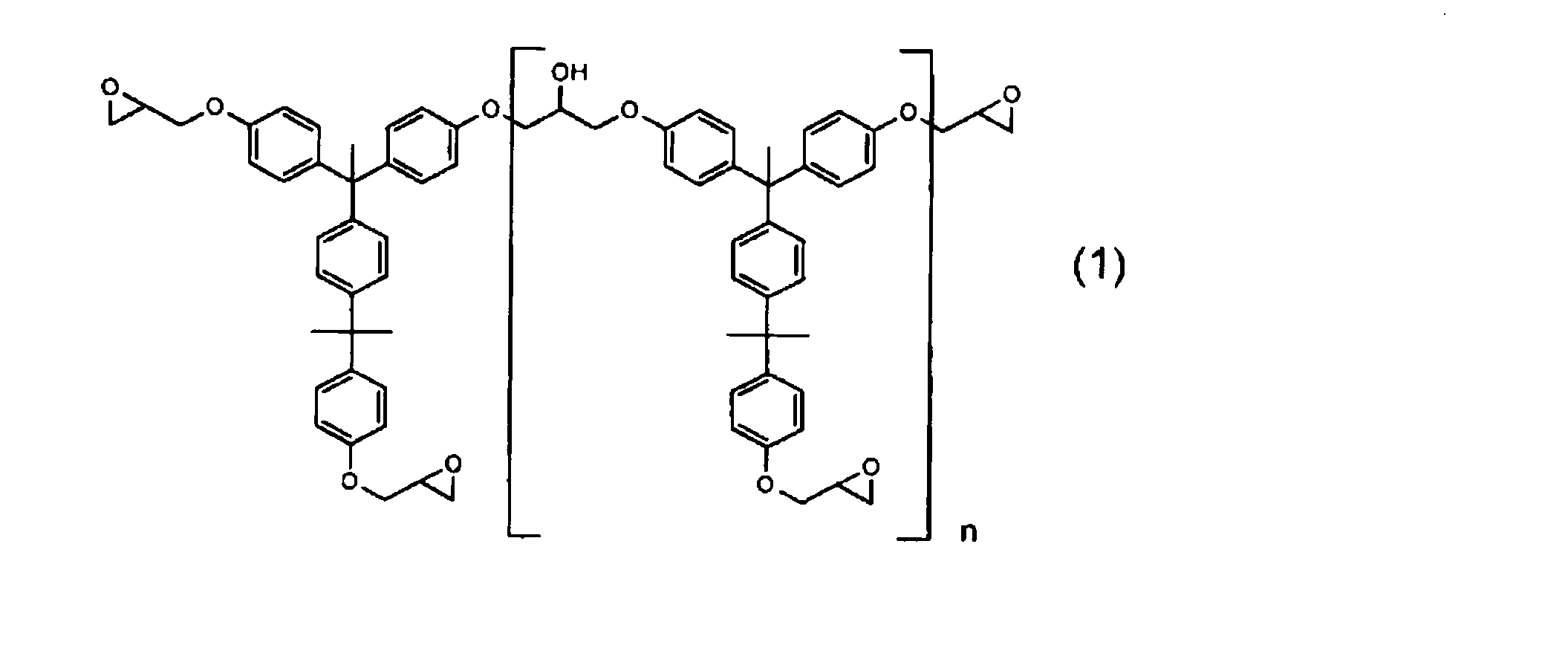
(2)さらに本発明は、反応性ポリカルボン酸化合物(A)が、一般式(1)で示されるエポキシ樹脂(a)と一分子中に1個以上の重合可能なエチレン性不飽和基と1個以上のカルボキシル基を有する化合物(b)、及び一分子中に少なくとも2個以上の水酸基と一個以上のカルボキシル基を有する化合物(c)との反応物(E)に、更に多塩基酸無水物(d)を反応させて得られる反応性ポリカルボン酸化合物(A)である、前記(1)に記載の表示素子用スペーサーまたはカラーフィルター保護膜用活性エネルギー線硬化型樹脂組成物に関する。
(3)さらに本発明は、前記(1)又は(2)に記載の活性エネルギー線硬化型樹脂組成物から形成される表示素子用スペーサーに関する。
(4)さらに本発明は、前記(1)又は(2)に記載の活性エネルギー線硬化型樹脂組成物から形成されるカラーフィルター保護膜に関する。
本発明における反応性ポリカルボン酸化合物(A)は、一般式(1)で示されるエポキシ樹脂(a)と一分子中に1個以上の重合可能なエチレン性不飽和基と1個以上のカルボキシル基を有する化合物(b)、及び必要に応じて一分子中に少なくとも2個以上の水酸基と一個以上のカルボキシル基を有する化合物(c)との反応物(E)に、更に多塩基酸無水物(d)を反応させて得られる。
本発明においては、エポキシカルボキシレート化反応により、分子鎖中にエチレン性不飽和基と水酸基を導入することで、本発明の特徴が発揮されるものである。
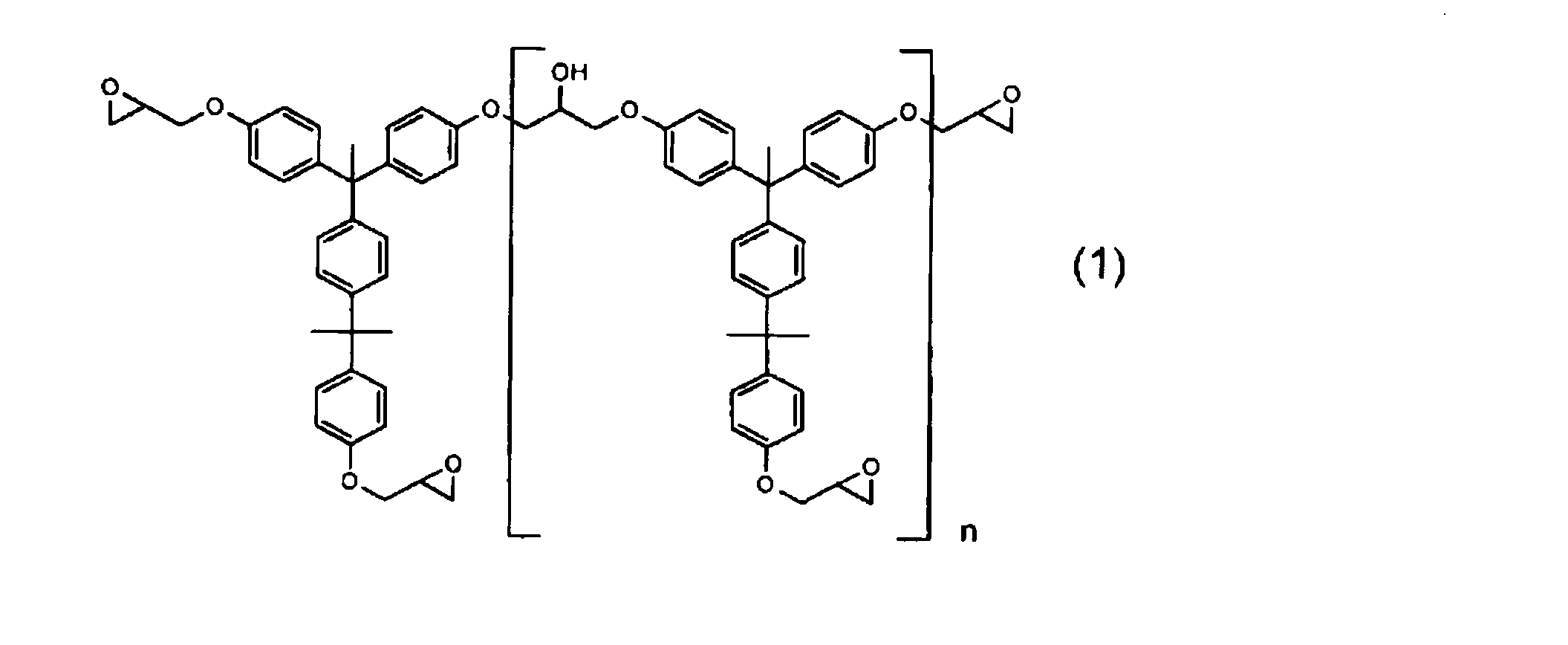
また、本発明において用いられるエポキシ樹脂(a)は常温で固体のものがより好ましい。本発明においては通常、軟化点が50~100℃、もしくは融点が50~190℃であるエポキシ樹脂(a)が使用されるが、軟化点が60~100℃、もしくは融点が60~190℃のものが好ましい。また、エポキシ当量が130~500g/eq.のものが本発明においては通常用いられ得るが、好ましくは150~400g/eq.、さらに好ましくは170~300g/eq.である。エポキシ当量が小さすぎると硬く、もろくなりやすい傾向が強く、エポキシ当量が大きすぎる場合、硬度が出にくい、ガラス転移点が低くなることがある。
1.エポキシ当量が好ましくは195~245g/eq.、より好ましくは200~240g/eq.である。
2.ゲルパーミエーションクロマトグラフィーにおいて、フェノール化合物(PA1)同士がエピハロヒドリンによって2つ繋がったものが30面積%以下、3つ繋がったものが20面積%以下、より好ましくは2つ繋がったものが25面積%以下、3つ繋がったものが15面積%以下である。残余としてはエポキシ樹脂(a)の単量体が該当する。
一分子中に一個のカルボキシル基を有するモノカルボン酸化合物としては、例えば(メタ)アクリル酸類やクロトン酸、α-シアノ桂皮酸、桂皮酸、或いは飽和または不飽和二塩基酸と不飽和基含有モノグリシジル化合物との反応物が挙げられる。上記において(メタ)アクリル酸類としては、例えば(メタ)アクリル酸、β-スチリルアクリル酸、β-フルフリルアクリル酸、(メタ)アクリル酸二量体、飽和または不飽和二塩基酸無水物と1分子中に1個の水酸基を有する(メタ)アクリレート誘導体と当モル反応物である半エステル類、飽和または不飽和二塩基酸とモノグリシジル(メタ)アクリレート誘導体類との当モル反応物である半エステル類等が挙げられる。
これらのうち最も好ましくは、活性エネルギー線硬化型樹脂組成物としたときの感度の点で(メタ)アクリル酸、(メタ)アクリル酸とε-カプロラクトンとの反応生成物または桂皮酸が挙げられる。化合物(b)としては、化合物中に水酸基を有さないものが好ましい。
本発明における一分子中に少なくとも2個以上の水酸基と一個以上のカルボキシル基を有する化合物(c)の具体例としては、例えば、ジメチロールプロピオン酸、ジメチロールブタン酸、ジメチロール酢酸、ジメチロール酪酸、ジメチロール吉草酸、ジメチロールカプロン酸等のポリヒドロキシ含有モノカルボン酸類等を挙げることができる。特に好ましいものとしては、例えばジメチロールプロピオン酸等が挙げられる。
この反応におけるエポキシ樹脂(a)と化合物(b)および必要に応じて用いられる化合物(c)のカルボン酸総計の仕込み割合としては、用途に応じて適宜変更されるべきものである。即ち、全てのエポキシ基をカルボキシレート化した場合は、未反応のエポキシ基が残存しないために、反応性エポキシカルボキシレート化合物としての保存安定性は高い。この場合は、導入した二重結合による反応性のみを利用することになる。
反応性ポリカルボン酸化合物(A)の当該樹脂組成物中における使用割合は、通常5~69重量%、好ましくは8~59重量%程度である。
(1)水酸基を有する単量体(e)に対し、エチレン性二重結合を有する酸無水物(f)、
(2)水酸基を有する単量体(e)に対し、イソシアネート基とエチレン性二重結合を有する化合物(f)、
(3)水酸基を有する単量体(e)に対し、塩化アシル基とエチレン性二重結合を有する化合物(f)、
(4)エチレン性二重結合を有する酸無水物(e)に対し、水酸基とエチレン性二重結合を有する化合物(f)、
(5)カルボキシル基を有する単量体(e)に対し、エポキシ基とエチレン性二重結合を有する化合物(f)、
(6)エポキシ基を有する単量体(e)に対し、カルボキシル基とエチレン性二重結合を有する化合物(f)。
当該組成物から形成される表示素子用スペーサーは、本発明に好適に含まれる。当該表示素子用スペーサーの形成方法は、
(1)当該組成物を、基板上に塗布して塗膜を形成する工程、
(2)上記塗膜の少なくとも一部に放射線を照射する工程、
(3)上記放射線が照射された塗膜を現像する工程、及び
(4)上記現像された塗膜を加熱する工程
当該形成方法において形成されたスペーサーは、塗布ムラがなく高度な平坦性を有し、柔軟で塑性変形の小さなスペーサーである。液晶表示素子、有機EL表示素子等の表示素子に好適に使用できる。
1)エポキシ当量:JISK7236:2001に準じた方法で測定した。
2)軟化点:JISK7234:1986に準じた方法で測定した。
3)酸価:JISK0070:1992に準じた方法で測定した
[反応性ポリカルボン酸化合物(A)の調製]
エポキシ樹脂(a)としてNC-6300H(日本化薬製;一般式(1)のn=0(64%),n=1(23%),n=2以上(13%);エポキシ当量230g/eq)を表1中記載量、化合物(b)としてアクリル酸(略称AA、Mw=72)を表1中記載量、化合物(c)としてジメチロールプロピオン酸(略称DMPA、Mw=134)を表1中記載量加えた。触媒としてトリフェニルフォスフィン3g、溶剤としてプロピレングリコールモノメチルエーテルモノアセテートを固形分が反応液の80重量%となるように加え、100℃で24時間反応させ、反応性エポキシカルボキシレート化合物(E)溶液を得た。固形分酸価(AV:mgKOH/g)5以下を反応終点とし、次反応に進んだ。酸価測定は、反応溶液にて測定し固形分としての酸価に換算した。
次いで、反応性エポキシカルボキシレート化合物(E)溶液に多塩基酸無水物(d)として、テトラヒドロ無水フタル酸(略称THPA)を表1記載量、及び溶剤として固形分100重量部に対して65重量部となるようプロピレングリコールモノメチルエーテルモノアセテートを添加、100℃に加熱した後、酸付加反応させ反応性ポリカルボン酸化合物(A)溶液を得た。固形分酸価(AV:mgKOH/g)を表1中に記載した。
[比較用反応性ポリカルボン酸化合物の調製]
クレゾールノボラック型エポキシ樹脂EOCN-103S(日本化薬製、エポキシ当量200g/eq)を表1中記載量、化合物(b)としてアクリル酸を表1中記載量、化合物(c)としてジメチロールプロピオン酸(略称DMPA、Mw=134)を表1中記載量加えた。触媒としてトリフェニルフォスフィン3g、溶剤としてプロピレングリコールモノメチルエーテルモノアセテートを固形分が反応液の80重量%となるように加え、100℃で24時間反応させ、カルボキシレート化合物溶液を得た。固形分酸価(AV:mgKOH/g)5mgKOH/g以下を反応終点とし、次反応に進んだ。
次いで、反応性エポキシカルボキシレート化合物溶液に多塩基酸無水物として、テトラヒドロ無水フタル酸(略称THPA)を表1記載量、及び溶剤として固形分100重量部に対して65重量部となるようプロピレングリコールモノメチルエーテルモノアセテートを添加、100℃に加熱した後、酸付加反応させ比較用反応性ポリカルボン酸化合物溶液を得た。固形分酸価(AV:mgKOH/g)を表1中に記載した。
[比較用反応性カプロラクトン変性ポリカルボン酸化合物の調製]
クレゾールノボラック型エポキシ樹脂EOCN-103S(日本化薬製、エポキシ当量200g/eq)を200g、アクリル酸を58g、ジメチロールプロピオン酸を40g、触媒としてトリフェニルフォスフィン3g、溶剤としてプロピレングリコールモノメチルエーテルモノアセテートを固形分が反応液の80重量%となるように加え、100℃で24時間反応させた。さらに、ε-カプロラクトンを68g添加し、8時間反応させた。次いで、多塩基酸無水物として、テトラヒドロ無水フタル酸(略称THPA)を91g、及び溶剤として固形分100重量部に対して65重量部となるようプロピレングリコールモノメチルエーテルモノアセテートを添加、100℃に加熱した後、酸付加反応させ比較用反応性カプロラクトン変性ポリカルボン酸化合物溶液を得た。固形分酸価(AV:mgKOH/g)は、70mgKOH/gであった。

また、実施例及び比較例で用いた各成分の詳細を以下に示す。
<反応性化合物(B)>
B-1:ジペンタエリスリトールヘキサアクリレートとジペンタエリスリトールペンタアクリレートとの混合物(KAYARAD DPHA、日本化薬製)
<光重合開始剤(C)>
C-1:エタノン-1-〔9-エチル-6-(2-メチルベンゾイル)-9H-カルバゾール-3-イル〕-1-(O-アセチルオキシム)(イルガキュアOXE02、BASF社製)
<有機溶剤(D)>
PGMEA:プロピレングリコールモノメチルエーテルアセテート
DEGDM:ジエチレングリコールジメチルエーテル
<界面活性剤(H)>
H-1:シリコーン系界面活性剤(東レ・ダウコーニング・シリコーン社製、SH8400FLUID)
実施例2-1
反応性ポリカルボン酸化合物(A)として、実施例1-1で得られた反応物 100重量部(固形分)に相当する量を含む溶液に、反応性化合物(B)として(B-1)100重量部、光重合開始剤(C)として(C-1)10重量部、有機溶剤としてPGMEA、DEGDMを所望の固形分濃度となるように添加し、界面活性剤(H)として(H-1)0.3重量部を混合し、孔径0.2μmのメンブランフィルタで濾過することにより、当該組成物(S-1)を調製した。なお、表2中の有機溶剤の数値は、PGMEAとDEGDMの質量比である。
各成分の種類及び配合量を表2に記載の通りとした以外は、実施例2-1と同様に操作して実施例2-2~2-3及び比較例2-1~2-3の組成物を調製した。なお、表2中の有機溶剤の数値は、PGMEAとDEGDMの質量比である。
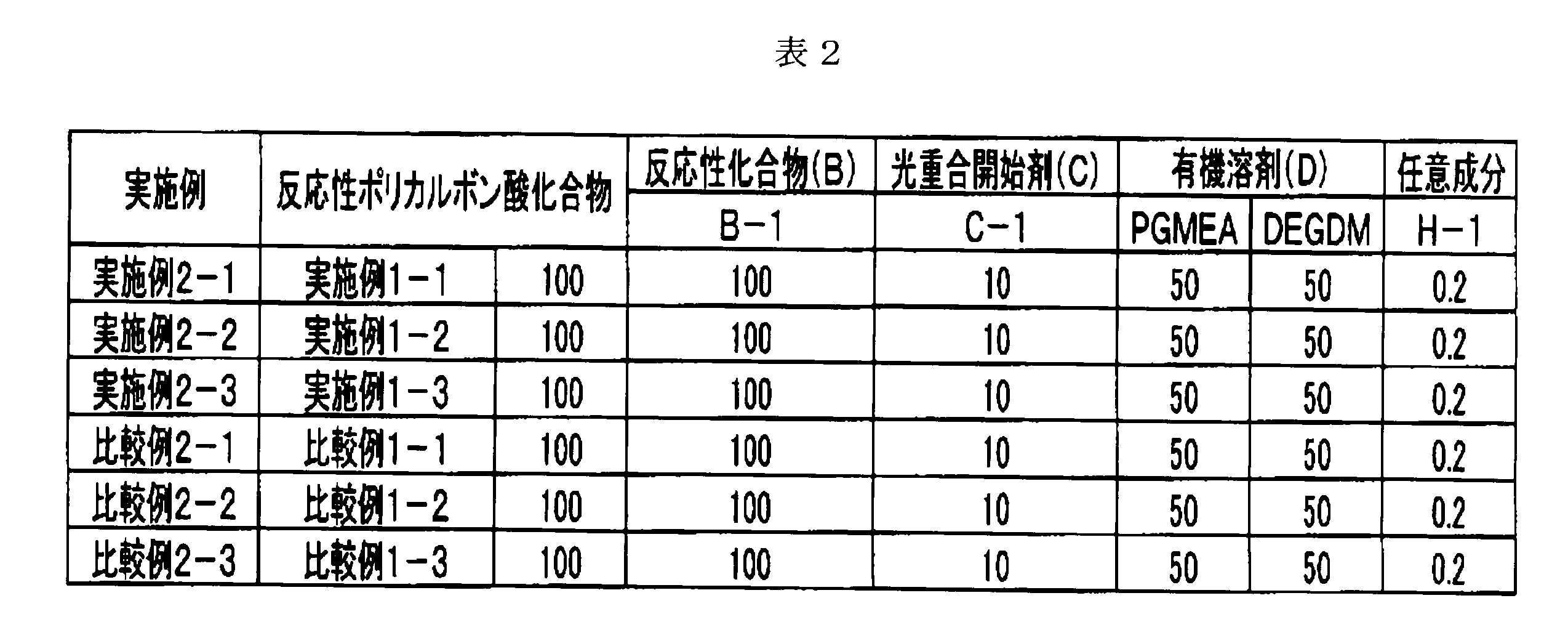
実施例2-1~2-3及び比較例2-1~2-3の組成物、及びその塗膜から形成されるスペーサーについて下記の評価をした。評価結果を表3にあわせて示す。
E型粘度計(東機産業(株)製、TV-200)を用いて、25℃における各組成物の粘度(mPa・s)を測定した。
当該組成物0.3gをアルミ皿に精坪し、ジエチレングリコールジメチルエーテル約1gを加えたのち、175℃で60分間ホットプレート上にて乾固させて、乾燥前後の重量から当該組成物中の固形分濃度(質量%)を求めた。
100×100mmのクロム成膜ガラス上に、当該組成物をスリットダイコーター((株)テクノマシーン製、理化ダイ)を用いて塗布し0.5Torrまで減圧乾燥した後、ホットプレート上で100℃にて2分間プレベークして塗膜を形成し、さらに200mJ/cm2の露光量で露光することにより、クロム成膜ガラスの上面からの膜厚が4μmの膜を形成した。ナトリウムランプ下において、肉眼によりこの塗膜の外観の観察を行った。このとき、塗膜の全体における筋ムラ(塗布方向又はそれに交差する方向にできる一本または複数本の直線のムラ)、モヤムラ(雲状のムラ)、ピン跡ムラ(基板支持ピン上にできる点状のムラ)の出現状況を調べた。これらのムラのいずれもほとんど見えない場合を「○(良好)」、いずれかが少し見える場合を「△(やや不良)」、はっきりと見える場合を「×(不良)」と判断した。
上述のようにして作製したクロム成膜ガラス上の塗膜の膜厚を、針接触式測定機(東京精密(株)製、サーフコム)を用いて測定した。膜厚均一性は、9つの測定点における膜厚を測定し、下記式から計算した。9つの測定点は基板の短軸方向をX、長軸方向をYとすると、(X[mm]、Y[mm])が、(50、10)、(50、20)、(50、30)、(50、40)、(50、50)、(50、60)、(50、70)、(50、80)、(50、90)である。膜厚均一性が2%以下の場合は、膜厚均一性は良好と判断できる。
100mm×100mmの無アルカリガラス基板上にスリットコーターを用いて塗布し塗布条件として、下地とノズルの距離150μm、露光後の膜厚が2.5μmとなるように、ノズルから塗布液を吐出し、ノズルの移動速度を120mm/sec.~200mm/sec.の範囲で変量し、液切れによる筋状のムラが発生しない最大速度を求めた。この時、180mm/sec.以上の速度でも筋状のムラが発生しない場合は、高速塗布に対応が可能であると判断できる。
100mm×100mmのITOスパッタしたガラス基板上にスピンコート法を用いて、当該組成物を塗布したのち、90℃のホットプレート上で3分間プレベークすることにより、膜厚3.5μmの塗膜を形成した。次いで、得られた塗膜に、開口部として直径12μmの円状パターンが形成されたフォトマスクを介して、紫外線露光装置((株)オーク製作所、型式HMW-680GW)を用いて露光した。その後、0.05質量%水酸化カリウム水溶液により25℃にて60秒間現像したのち、純水で1分間洗浄し、さらに230℃のオーブン中で30分間ポストベークすることにより、パターン状被膜からなるスペーサーを形成した。このとき、ポストベーク後の残膜率(ポストベーク後の被膜の膜厚×100/露光後(ポストベーク前)膜厚)が90%以上となる最小の露光量を調べ、この値を感度とした。この値が55mJ/cm2以下であった場合、感度は良好であるといえる。
(現像残渣)
また、基板上表面を目視により観察し、残留物の有無を確認した。評価基準は以下の通り。
○…残留物なし。
△…残留物わずかにあり。
×…残留物が多い
露光量を上記放射線感度の評価で決定した感度に相当する露光量とした以外は、放射線感度の評価と同様に操作して基板上に円柱状パターンからなるスペーサーを形成した。その際、ポストベーク後のパターン底部の直径が20μmとなるように、露光時に介するフォトマスクの直径を変更した。このスペーサーにつき、微小圧縮試験機(フィッシャースコープH100C、フィッシャーインストルメンツ(株)製)を用い、50μm角状の平面圧子を使用し、50mNの荷重にて圧縮試験を行い、荷重に対する圧縮変位量の変化を測定し、50mNの荷重時の変位量と50mNの荷重を取り除いた時の変位量から回復率(%)を算出した。このとき、回復率が70%以上であり、かつ50mNの荷重時の変位が0.15μm以上であった場合、高い回復率及び柔軟性の双方を具備した圧縮性能を有するスペーサーであるといえる。
50mm×50mmの無アルカリガラス基板上にスピンコーターを用いて塗布し、0.5Torrまで減圧乾燥した後、ホットプレート上で100℃にて2分間プレベークして塗膜を形成し、さらに200mJ/cm2の露光量で露光することにより、膜厚が4μmの膜を形成した。上記硬化塗膜を有する評価基板をヘイズメーター(日本電色工業(株)製、TC-H3DPK)を使用し測定した。
上記硬化塗膜を有する評価基板を250℃×1hr熱処理し、400nm、540nmの波長光の透過率を分光光度計(日立製作所(株)製、U-3310)を使用して測定した。

なお、本出願は、2013年11月28日付で出願された日本国特許出願(特願2013-246535)に基づいており、その全体が引用により援用される。また、ここに引用されるすべての参照は全体として取り込まれる。
Claims (4)
- 反応性ポリカルボン酸化合物(A)、反応性ポリカルボン酸化合物(A)以外の反応性化合物(B)、光重合開始剤(C)及び有機溶剤(D)を含有する表示素子用スペーサーまたはカラーフィルター保護膜用活性エネルギー線硬化型樹脂組成物であって、
反応性ポリカルボン酸化合物(A)が、一般式(1)で示されるエポキシ樹脂(a)と一分子中に1個以上の重合可能なエチレン性不飽和基と1個以上のカルボキシル基を有する化合物(b)、及び必要に応じて一分子中に少なくとも2個以上の水酸基と一個以上のカルボキシル基を有する化合物(c)との反応物(E)に、更に多塩基酸無水物(d)を反応させて得られる反応性ポリカルボン酸化合物(A)である、該活性エネルギー線硬化型樹脂組成物。

- 反応性ポリカルボン酸化合物(A)が、一般式(1)で示されるエポキシ樹脂(a)と一分子中に1個以上の重合可能なエチレン性不飽和基と1個以上のカルボキシル基を有する化合物(b)、及び一分子中に少なくとも2個以上の水酸基と一個以上のカルボキシル基を有する化合物(c)との反応物(E)に、更に多塩基酸無水物(d)を反応させて得られる反応性ポリカルボン酸化合物(A)である、請求項1に記載の表示素子用スペーサーまたはカラーフィルター保護膜用活性エネルギー線硬化型樹脂組成物。
- 請求項1又は2に記載の活性エネルギー線硬化型樹脂組成物から形成される表示素子用スペーサー。
- 請求項1又は2に記載の活性エネルギー線硬化型樹脂組成物から形成されるカラーフィルター保護膜。
Priority Applications (3)
| Application Number | Priority Date | Filing Date | Title |
|---|---|---|---|
| KR1020167014234A KR102246473B1 (ko) | 2013-11-28 | 2014-11-26 | 활성 에너지선 경화형 수지 조성물, 그것을 사용한 표시소자용 스페이서 및/또는 컬러필터 보호막 |
| CN201480065048.9A CN105849639B (zh) | 2013-11-28 | 2014-11-26 | 活性能量射线固化型树脂组合物以及使用该组合物的显示元件用间隔物和/或滤色片保护膜 |
| JP2015550957A JP6357485B2 (ja) | 2013-11-28 | 2014-11-26 | 活性エネルギー線硬化型樹脂組成物、及びそれを用いた表示素子用スペーサー及び/またはカラーフィルター保護膜 |
Applications Claiming Priority (2)
| Application Number | Priority Date | Filing Date | Title |
|---|---|---|---|
| JP2013-246535 | 2013-11-28 | ||
| JP2013246535 | 2013-11-28 |
Publications (1)
| Publication Number | Publication Date |
|---|---|
| WO2015080147A1 true WO2015080147A1 (ja) | 2015-06-04 |
Family
ID=53199086
Family Applications (1)
| Application Number | Title | Priority Date | Filing Date |
|---|---|---|---|
| PCT/JP2014/081223 Ceased WO2015080147A1 (ja) | 2013-11-28 | 2014-11-26 | 活性エネルギー線硬化型樹脂組成物、及びそれを用いた表示素子用スペーサー及び/またはカラーフィルター保護膜 |
Country Status (5)
| Country | Link |
|---|---|
| JP (1) | JP6357485B2 (ja) |
| KR (1) | KR102246473B1 (ja) |
| CN (1) | CN105849639B (ja) |
| TW (1) | TWI635131B (ja) |
| WO (1) | WO2015080147A1 (ja) |
Cited By (3)
| Publication number | Priority date | Publication date | Assignee | Title |
|---|---|---|---|---|
| JP2016199631A (ja) * | 2015-04-07 | 2016-12-01 | 日本化薬株式会社 | 白色活性エネルギー線硬化性樹脂組成物 |
| JP2018123311A (ja) * | 2017-01-31 | 2018-08-09 | 日本化薬株式会社 | 反応性ポリカルボン酸化合物、それを用いた活性エネルギー線硬化型樹脂組成物、その硬化物及びその用途 |
| WO2024252940A1 (ja) * | 2023-06-06 | 2024-12-12 | 住友化学株式会社 | 化合物及びそれを含む組成物 |
Citations (5)
| Publication number | Priority date | Publication date | Assignee | Title |
|---|---|---|---|---|
| JPH03245149A (ja) * | 1990-02-23 | 1991-10-31 | Hitachi Chem Co Ltd | 感光性樹脂組成物及び感光性エレメント |
| JPH05178950A (ja) * | 1991-09-30 | 1993-07-20 | Nippon Kayaku Co Ltd | 樹脂組成物、ソルダーレジスト樹脂組成物及びこれらの硬化物 |
| JPH08134145A (ja) * | 1994-11-07 | 1996-05-28 | Nippon Kayaku Co Ltd | 樹脂組成物、レンズ用組成物及びその硬化物 |
| JP2005037516A (ja) * | 2003-07-17 | 2005-02-10 | Sumitomo Chemical Co Ltd | 感放射線性樹脂組成物 |
| JP2006259710A (ja) * | 2005-02-17 | 2006-09-28 | Sumitomo Chemical Co Ltd | 感光性樹脂組成物 |
Family Cites Families (17)
| Publication number | Priority date | Publication date | Assignee | Title |
|---|---|---|---|---|
| JP2704661B2 (ja) | 1989-09-13 | 1998-01-26 | 日本化薬株式会社 | 不飽和基含有ポリカルボン酸樹脂、これを含む樹脂組成物、ソルダーレジスト樹脂組成物及びそれらの硬化物 |
| JP4150236B2 (ja) | 2002-09-20 | 2008-09-17 | 太陽インキ製造株式会社 | 感光性樹脂組成物、及びそれらを用いたスペーサー又はカラーフィルターの形成方法 |
| CN1717598A (zh) * | 2002-11-29 | 2006-01-04 | 大赛璐化学工业株式会社 | 滤色片用感光性着色组合物、滤色片及其制法 |
| JP3901658B2 (ja) | 2003-03-31 | 2007-04-04 | 太陽インキ製造株式会社 | 活性エネルギー線硬化性樹脂、及びそれを用いる組成物並びに硬化物 |
| US7282324B2 (en) * | 2004-01-05 | 2007-10-16 | Microchem Corp. | Photoresist compositions, hardened forms thereof, hardened patterns thereof and metal patterns formed using them |
| TW200710570A (en) * | 2005-05-31 | 2007-03-16 | Taiyo Ink Mfg Co Ltd | Composition for forming adhesive pattern, multilayer structure obtained by using same, and method for producing such multilayer structure |
| JP4837315B2 (ja) | 2005-06-29 | 2011-12-14 | 凸版印刷株式会社 | フォトスペーサ用感光性樹脂組成物及びそれを用いた液晶表示装置用カラーフィルタ |
| TWI416174B (zh) * | 2006-06-01 | 2013-11-21 | Nippon Steel & Sumikin Chem Co | 濾色片用光阻組成物及其製造方法以及使用該組成物之濾色片 |
| JP5096814B2 (ja) * | 2007-07-04 | 2012-12-12 | 東京応化工業株式会社 | 着色感光性組成物 |
| JP2009075261A (ja) * | 2007-09-19 | 2009-04-09 | Nippon Kayaku Co Ltd | 感光性樹脂組成物、及びそれを用いて得られたマイクロチップ |
| JP5137674B2 (ja) * | 2008-04-26 | 2013-02-06 | 日本化薬株式会社 | Mems用感光性樹脂組成物及びその硬化物 |
| JP5137673B2 (ja) * | 2008-04-26 | 2013-02-06 | 日本化薬株式会社 | Mems用感光性樹脂組成物及びその硬化物 |
| JP5247396B2 (ja) * | 2008-07-02 | 2013-07-24 | 日本化薬株式会社 | Mems用感光性樹脂組成物及びその硬化物 |
| WO2011158794A1 (ja) * | 2010-06-15 | 2011-12-22 | 日本化薬株式会社 | 着色樹脂組成物、着色硬化膜、カラーフィルター、表示装置及び固体撮像素子 |
| TW201302921A (zh) * | 2011-05-30 | 2013-01-16 | Nippon Kayaku Kk | 彩色濾光片用色素、使用該色素之著色樹脂組成物及包括該樹脂組成物之彩色濾光片 |
| US11635688B2 (en) * | 2012-03-08 | 2023-04-25 | Kayaku Advanced Materials, Inc. | Photoimageable compositions and processes for fabrication of relief patterns on low surface energy substrates |
| JP6021621B2 (ja) * | 2012-12-07 | 2016-11-09 | 日本化薬株式会社 | 活性エネルギー線硬化型樹脂組成物、及びそれを用いた表示素子用スペーサー及び/またはカラーフィルター保護膜 |
-
2014
- 2014-11-26 JP JP2015550957A patent/JP6357485B2/ja active Active
- 2014-11-26 CN CN201480065048.9A patent/CN105849639B/zh active Active
- 2014-11-26 KR KR1020167014234A patent/KR102246473B1/ko active Active
- 2014-11-26 WO PCT/JP2014/081223 patent/WO2015080147A1/ja not_active Ceased
- 2014-11-28 TW TW103141304A patent/TWI635131B/zh active
Patent Citations (5)
| Publication number | Priority date | Publication date | Assignee | Title |
|---|---|---|---|---|
| JPH03245149A (ja) * | 1990-02-23 | 1991-10-31 | Hitachi Chem Co Ltd | 感光性樹脂組成物及び感光性エレメント |
| JPH05178950A (ja) * | 1991-09-30 | 1993-07-20 | Nippon Kayaku Co Ltd | 樹脂組成物、ソルダーレジスト樹脂組成物及びこれらの硬化物 |
| JPH08134145A (ja) * | 1994-11-07 | 1996-05-28 | Nippon Kayaku Co Ltd | 樹脂組成物、レンズ用組成物及びその硬化物 |
| JP2005037516A (ja) * | 2003-07-17 | 2005-02-10 | Sumitomo Chemical Co Ltd | 感放射線性樹脂組成物 |
| JP2006259710A (ja) * | 2005-02-17 | 2006-09-28 | Sumitomo Chemical Co Ltd | 感光性樹脂組成物 |
Cited By (4)
| Publication number | Priority date | Publication date | Assignee | Title |
|---|---|---|---|---|
| JP2016199631A (ja) * | 2015-04-07 | 2016-12-01 | 日本化薬株式会社 | 白色活性エネルギー線硬化性樹脂組成物 |
| JP2018123311A (ja) * | 2017-01-31 | 2018-08-09 | 日本化薬株式会社 | 反応性ポリカルボン酸化合物、それを用いた活性エネルギー線硬化型樹脂組成物、その硬化物及びその用途 |
| JP7021960B2 (ja) | 2017-01-31 | 2022-02-17 | 日本化薬株式会社 | 反応性ポリカルボン酸化合物、それを用いた活性エネルギー線硬化型樹脂組成物、その硬化物及びその用途 |
| WO2024252940A1 (ja) * | 2023-06-06 | 2024-12-12 | 住友化学株式会社 | 化合物及びそれを含む組成物 |
Also Published As
| Publication number | Publication date |
|---|---|
| KR20160091339A (ko) | 2016-08-02 |
| TWI635131B (zh) | 2018-09-11 |
| JPWO2015080147A1 (ja) | 2017-03-16 |
| CN105849639A (zh) | 2016-08-10 |
| KR102246473B1 (ko) | 2021-04-30 |
| CN105849639B (zh) | 2019-10-22 |
| TW201529710A (zh) | 2015-08-01 |
| JP6357485B2 (ja) | 2018-07-11 |
Similar Documents
| Publication | Publication Date | Title |
|---|---|---|
| JP6184087B2 (ja) | 活性エネルギー線硬化型樹脂組成物、及びそれを用いた表示素子用スペーサー及び/またはカラーフィルター保護膜 | |
| JP6021621B2 (ja) | 活性エネルギー線硬化型樹脂組成物、及びそれを用いた表示素子用スペーサー及び/またはカラーフィルター保護膜 | |
| JP6095104B2 (ja) | 活性エネルギー線硬化型樹脂組成物、表示素子用着色スペーサー及びブラックマトリックス | |
| JP6075763B2 (ja) | 活性エネルギー線硬化型樹脂組成物、及びそれを用いた表示素子用着色スペーサー及び/またはブラックマトリックス | |
| JP2008116493A (ja) | 感光性樹脂組成物 | |
| JP6357485B2 (ja) | 活性エネルギー線硬化型樹脂組成物、及びそれを用いた表示素子用スペーサー及び/またはカラーフィルター保護膜 | |
| JP6506175B2 (ja) | 活性エネルギー線硬化型樹脂組成物、及びそれを用いた表示素子用スペーサー及び/またはカラーフィルター保護膜 | |
| JP6510427B2 (ja) | 活性エネルギー線硬化型樹脂組成物、及びそれを用いた表示素子用スペーサー及び/またはカラーフィルター保護膜 |
Legal Events
| Date | Code | Title | Description |
|---|---|---|---|
| 121 | Ep: the epo has been informed by wipo that ep was designated in this application |
Ref document number: 14865132 Country of ref document: EP Kind code of ref document: A1 |
|
| ENP | Entry into the national phase |
Ref document number: 2015550957 Country of ref document: JP Kind code of ref document: A |
|
| ENP | Entry into the national phase |
Ref document number: 20167014234 Country of ref document: KR Kind code of ref document: A |
|
| NENP | Non-entry into the national phase |
Ref country code: DE |
|
| 122 | Ep: pct application non-entry in european phase |
Ref document number: 14865132 Country of ref document: EP Kind code of ref document: A1 |