WO2015079529A1 - 質量分析方法、質量分析装置、及び質量分析データ処理プログラム - Google Patents
質量分析方法、質量分析装置、及び質量分析データ処理プログラム Download PDFInfo
- Publication number
- WO2015079529A1 WO2015079529A1 PCT/JP2013/082007 JP2013082007W WO2015079529A1 WO 2015079529 A1 WO2015079529 A1 WO 2015079529A1 JP 2013082007 W JP2013082007 W JP 2013082007W WO 2015079529 A1 WO2015079529 A1 WO 2015079529A1
- Authority
- WO
- WIPO (PCT)
- Prior art keywords
- mass
- ion
- ions
- product
- product ion
- Prior art date
- Legal status (The legal status is an assumption and is not a legal conclusion. Google has not performed a legal analysis and makes no representation as to the accuracy of the status listed.)
- Ceased
Links
Images


Classifications
-
- H—ELECTRICITY
- H01—ELECTRIC ELEMENTS
- H01J—ELECTRIC DISCHARGE TUBES OR DISCHARGE LAMPS
- H01J49/00—Particle spectrometers or separator tubes
- H01J49/004—Combinations of spectrometers, tandem spectrometers, e.g. MS/MS, MSn
- H01J49/0045—Combinations of spectrometers, tandem spectrometers, e.g. MS/MS, MSn characterised by the fragmentation or other specific reaction
- H01J49/005—Combinations of spectrometers, tandem spectrometers, e.g. MS/MS, MSn characterised by the fragmentation or other specific reaction by collision with gas, e.g. by introducing gas or by accelerating ions with an electric field
-
- G—PHYSICS
- G01—MEASURING; TESTING
- G01N—INVESTIGATING OR ANALYSING MATERIALS BY DETERMINING THEIR CHEMICAL OR PHYSICAL PROPERTIES
- G01N30/00—Investigating or analysing materials by separation into components using adsorption, absorption or similar phenomena or using ion-exchange, e.g. chromatography or field flow fractionation
- G01N30/02—Column chromatography
- G01N30/62—Detectors specially adapted therefor
- G01N30/72—Mass spectrometers
- G01N30/7233—Mass spectrometers interfaced to liquid or supercritical fluid chromatograph
- G01N30/724—Nebulising, aerosol formation or ionisation
- G01N30/7266—Nebulising, aerosol formation or ionisation by electric field, e.g. electrospray
-
- H—ELECTRICITY
- H01—ELECTRIC ELEMENTS
- H01J—ELECTRIC DISCHARGE TUBES OR DISCHARGE LAMPS
- H01J49/00—Particle spectrometers or separator tubes
- H01J49/0027—Methods for using particle spectrometers
- H01J49/0036—Step by step routines describing the handling of the data generated during a measurement
-
- H—ELECTRICITY
- H01—ELECTRIC ELEMENTS
- H01J—ELECTRIC DISCHARGE TUBES OR DISCHARGE LAMPS
- H01J49/00—Particle spectrometers or separator tubes
- H01J49/004—Combinations of spectrometers, tandem spectrometers, e.g. MS/MS, MSn
- H01J49/0045—Combinations of spectrometers, tandem spectrometers, e.g. MS/MS, MSn characterised by the fragmentation or other specific reaction
-
- H—ELECTRICITY
- H01—ELECTRIC ELEMENTS
- H01J—ELECTRIC DISCHARGE TUBES OR DISCHARGE LAMPS
- H01J49/00—Particle spectrometers or separator tubes
- H01J49/26—Mass spectrometers or separator tubes
- H01J49/34—Dynamic spectrometers
- H01J49/42—Stability-of-path spectrometers, e.g. monopole, quadrupole, multipole, farvitrons
- H01J49/4205—Device types
- H01J49/421—Mass filters, i.e. deviating unwanted ions without trapping
- H01J49/4215—Quadrupole mass filters
Definitions
- MRM Multiple Reaction Monitoring
- the present invention relates to an apparatus and a mass spectrometry data processing program.
- MS / MS analysis tandem analysis
- mass spectrometry A method called MS / MS analysis (tandem analysis) is widely used as one method of mass spectrometry in order to perform identification, structural analysis, or quantification of a substance having a large molecular weight.
- mass spectrometers There are various types of mass spectrometers for performing MS / MS analysis, but the tandem quadrupole mass spectrometer is usually used because of its relatively simple structure and easy operation and handling. It is done.
- ions derived from a compound generated by an ion source are introduced into a previous quadrupole mass filter (usually described as Q1), and a specific mass-to-charge ratio m / z is obtained. Having ions are selected as precursor ions.
- This precursor ion is introduced into a collision cell in which a quadrupole type (or higher multipole type) ion guide (usually described as q2) is incorporated.
- a collision-induced dissociation (CID) gas such as argon is supplied into the collision cell, and the precursor ions collide with the CID gas and cleave in the collision cell to generate various product ions.
- the product ions are introduced into a subsequent quadrupole mass filter (usually described as Q3), and product ions having a specific mass-to-charge ratio m / z are sorted and reach the detector for detection.
- MRM measurement mode One mode of MS / MS measurement in a tandem quadrupole mass spectrometer is an MRM measurement mode.
- MRM measurement mode the mass-to-charge ratio of ions that can pass through the front quadrupole mass filter and the rear quadrupole mass filter is fixed, and the intensity (quantity) of a specific product ion with respect to a specific precursor ion is measured.
- MRM measurement ions and neutral particles derived from non-measurement target compounds and contaminant components can be removed by a two-stage mass filter, so that an ion intensity signal having a high S / N ratio can be obtained. Therefore, MRM measurement is particularly effective for quantifying trace components.
- tandem quadrupole mass spectrometer may be used alone, but is often used in combination with a liquid chromatograph (LC) or a gas chromatograph (GC).
- LC liquid chromatograph
- GC gas chromatograph
- LC / MS / MS using a tandem quadrupole mass spectrometer as a liquid chromatograph detector is often used for quantitative analysis of compounds in samples containing many compounds or samples containing impurities.
- the mass-to-charge ratio of the target precursor ion is correlated with the retention time of the target compound.
- the product ion mass-to-charge ratio (hereinafter referred to as “MRM transition”) must be set as one of the measurement conditions.
- MRM transition By setting an optimal MRM transition for each target compound, the signal intensity of ions derived from each target compound can be obtained with high accuracy and sensitivity, and the quantification of the compound is performed with high accuracy and high sensitivity. be able to.
- the MRM transition can be set manually by an analyst, but it takes time and effort to manually set the MRM transition.
- the MRM transition is set as follows. First, the analyst specifies only the mass-to-charge ratio of the precursor ion derived from the target compound. Then, a product ion scan measurement for a designated precursor ion is performed on a known sample containing the compound, and a predetermined number of product ion peaks are selected in descending order of signal intensity in the product ion spectrum obtained thereby. A combination of the precursor ion designated by the analyst and the product ion corresponding to the selected peak is defined as an MRM transition.
- product ions generated depends on parameters such as the magnitude of the collision energy (CE) voltage applied to cleave the precursor ions, and the product ions generated only under certain limited conditions have a large signal intensity.
- CE collision energy
- product ions having a low signal intensity are more suitable for quantification than product ions having a large signal intensity. Therefore, for example, a method has been proposed in which product ions are selected in descending order of appearance frequency in product ion spectra obtained by performing product ion scan measurement a plurality of times (for example, Patent Documents 1 and 2).
- a predetermined number of product ion peaks are selected in descending order of signal intensity or appearance frequency.
- the mass of product ions to be selected is selected.
- the charge ratio is not taken into account, and product ions that are not necessarily ions that characterize the structure of the compound may be selected.
- One ion that is not suitable for selection as a product ion is one in which the precursor ion is not cleaved and is detected as a product ion (ie, the precursor ion itself). If the precursor ion is a monovalent ion, if it is detected as a product ion without cleavage, the mass-to-charge ratio of the precursor ion and the product ion will be the same, so the analyst will recognize that it is inappropriate as a product ion It is possible to reset the MRM transition.
- the precursor ion is a monovalent ion
- the precursor ion itself can be selected if the mass-to-charge ratio range smaller than the precursor ion mass-to-charge ratio is set as the product ion measurement range. Can be avoided.
- some of the product ions whose valence is reduced due to cleavage of the multivalent precursor ion include those having a mass-to-charge ratio larger than the mass-to-charge ratio of the precursor ion. The range of mass to charge ratio cannot be limited.
- the analyst since the mass-to-charge ratio changes when the valence changes, the analyst does not realize that the ion is substantially the same as the precursor ion, and sets an MRM transition that uses this ion as the product ion, causing qualitative errors or quantification. There was a problem that an error might be caused.
- a problem to be solved by the present invention is a mass spectrometry method and apparatus capable of selecting a product ion suitable for qualitative and quantitative determination of a target compound when determining an MRM transition that is a parameter for MRM measurement, and Is to provide a program.
- a first aspect of the present invention made to solve the above problems is a precursor set for a sample using a mass spectrometer having a mass separation unit on the front and rear sides of a collision cell for cleaving ions.
- a mass spectrometry method for selecting a product ion corresponding to a precursor ion by performing a product ion scan for ions a) Set the mass-to-charge ratio based on information about unselected ions entered by the user, b) In the product ion spectrum obtained by the product ion scan, product ions satisfying a predetermined standard within a range excluding the set mass-to-charge ratio are selected.
- the information input by the user is typically a numerical value of the mass-to-charge ratio, but other than this, information that can uniquely determine the mass-to-charge ratio from that information, such as the ionic formula of unselected ions. That's fine.
- the above-mentioned standard it is possible to select a product ion having the highest mass peak intensity, or to select a product ion having the highest mass peak appearance frequency.
- product ions generated from the target compound are not characteristic ions for the target compound, and unwanted ions are excluded, and product ions are selected. . Therefore, a product ion suitable for measuring the target compound can be selected.
- the undesired ions include the same ions as the precursor ions, ions having only a valence changed from the precursor ions, isotope ions, and dehydrated ions of the precursor ions.
- the mass-to-charge ratio of the product ion set in the MRM transition of the target compound is close to the mass-to-charge ratio of the product ion generated from the contaminant component.
- the MRM transition may not be used.
- the second aspect of the present invention which has been made to solve the above problems, is a product for a precursor ion having a mass separation part before and after a collision cell for cleaving ions and set for a sample.
- a mass spectrometer that selects product ions corresponding to the precursor ions by performing ion scanning, a) an unselected ion setting unit that sets a mass-to-charge ratio based on information about unselected ions input by the user; b) In the product ion spectrum obtained by the product ion scan, a product ion selection unit that selects product ions that satisfy a predetermined criterion within a range excluding the set mass-to-charge ratio; It is characterized by providing.
- the third aspect of the present invention which has been made to solve the above-mentioned problems, is set for a sample using a mass spectrometer having a mass separation unit on the front and rear sides of a collision cell for cleaving ions.
- Possible computers a) an unselected ion setting unit that sets a mass-to-charge ratio based on information about unselected ions input by the user; b) In the product ion spectrum obtained by the product ion scan, a product ion selection unit that selects product ions that satisfy a predetermined criterion within a range excluding the set mass-to-charge ratio; It is made to operate as.
- the mass spectrometer In the mass spectrometry method, the mass spectrometer, and the mass spectrometry data processing program according to the present invention, after excluding unwanted ions that do not characterize the target compound even if it is a product ion generated from the target compound, Select product ions. Therefore, a product ion suitable for measuring the target compound can be selected.
- FIG. 1 is a configuration diagram of a main part of the liquid chromatograph mass spectrometer of the present embodiment.
- the liquid chromatograph unit 1 includes a mobile phase container 10 in which a mobile phase is stored, a pump 11 that sucks the mobile phase and delivers it at a constant flow rate, and a mobile phase. And an injector 12 for injecting a predetermined amount of sample prepared in advance.
- a column is not used, but it is included in the sample when analyzing the actual sample.
- a column 13 (broken line) is used to separate various compounds in the time direction.
- the pump 11 sucks the mobile phase from the mobile phase container 10 and delivers it at a constant flow rate.
- a fixed amount of sample liquid is introduced into the mobile phase from the injector 12 and is introduced into the mass spectrometer 2 along the flow of the mobile phase.
- the mass spectrometer 2 includes first and second intermediates whose degree of vacuum is increased stepwise between an ionization chamber 20 that is substantially atmospheric pressure and a high-vacuum analysis chamber 23 that is evacuated by a vacuum pump (not shown).
- This is a configuration of a multistage differential exhaust system including vacuum chambers 21 and 22.
- the ionization chamber 20 is provided with an electrospray ionization probe (ESI probe) 201 that sprays while applying a charge to the sample solution, and a small-diameter heating is provided between the ionization chamber 20 and the first intermediate vacuum chamber 21 at the subsequent stage. It communicates through the capillary 202.
- ESI probe electrospray ionization probe
- the first intermediate vacuum chamber 21 and the second intermediate vacuum chamber 22 are separated by a skimmer 212 having a small hole at the top, and ions are focused in the first intermediate vacuum chamber 21 and the second intermediate vacuum chamber 22, respectively.
- ion guides 211 and 221 for transporting to the subsequent stage are installed.
- the analysis chamber 23 sandwiches a collision cell 232 in which a multipole ion guide (q2) 233 is installed, and the former quadrupole mass filter (Q1) 231 that separates ions according to the mass-to-charge ratio, A post-stage quadrupole mass filter (Q3) 234 for separating the gas in accordance with the mass-to-charge ratio, and an ion detector 235 are installed.
- CID gas such as argon or nitrogen is continuously or intermittently supplied into the collision cell 232.
- the power supply unit 24 applies predetermined voltages to the electrospray ionization probe 201, the ion guides 211, 221, 233, the quadrupole mass filters 231, 234, and the like.
- Each of the quadrupole mass filters 231 and 234 has a pre-rod electrode for correcting the disturbance of the electric field at the inlet end in front of the main rod electrode.
- the pre-rod electrode is different from the main rod electrode. A voltage can be applied.
- the mass spectrometer 2 when the eluate from the column 13 reaches the ESI probe 201, the eluate is sprayed while an electric charge is applied to the tip of the probe 201.
- the charged droplets formed by spraying are refined while being disrupted by the action of electrostatic force due to the applied charge, and in the process, the solvent is vaporized and ions derived from the compound are generated.
- the ions are sent to the first intermediate vacuum chamber 21 through the heating capillary 202, converged by the ion guide 211, and sent to the second intermediate vacuum chamber 22 through a small hole at the top of the skimmer 212.
- the ions derived from the compound are converged by the ion guide 221, sent to the analysis chamber 23, and introduced into the space in the long axis direction of the front quadrupole mass filter 231.
- the ionization method is not limited to the electrospray ionization method, and an atmospheric pressure chemical ionization method, an atmospheric pressure photoionization method, or the like may be used.
- a predetermined voltage (high-frequency voltage and DC voltage) is applied to each rod electrode of the front-stage quadrupole mass filter 231 and the rear-stage quadrupole mass filter 234 from the power supply unit 24. Is applied), and CID gas is supplied into the collision cell 232 continuously or intermittently.
- CID gas is supplied into the collision cell 232 continuously or intermittently.
- the various ions sent to the front quadrupole mass filter 231 only ions having a specific mass-to-charge ratio corresponding to the voltage applied to each rod electrode of the front quadrupole mass filter 231 are included in the filter 231. And is introduced into the collision cell 232 as a precursor ion.
- the precursor ions collide with the CID gas and dissociate, and various product ions are generated.
- various product ions are introduced into the post-stage quadrupole mass filter 234, only product ions having a specific mass-to-charge ratio corresponding to the voltage applied to each rod electrode of the post-stage quadrupole mass filter 234 Passes through the filter 234, reaches the ion detector 235, and is detected.
- the ion detector 235 is, for example, a pulse count type detector, and outputs a number of pulse signals corresponding to the number of incident ions to the data processing unit 4 as detection signals.
- the data processing unit 4 includes a storage unit 41, and includes a non-selected ion setting unit 42, a product ion scan execution unit 43, a product ion selection unit 44, and an MRM transition determination unit 45 as functional blocks. Further, as appropriate between the control unit 5 that controls the operation of each unit such as the pump 11 and the injector 12 of the liquid chromatograph unit 1, the power supply unit 24 of the mass spectrometer 2, and the CID gas supply unit (not shown). It is configured to send and receive signals.
- the entity of the data processing unit 4 is a personal computer, and the function as the data processing unit 4 can be exhibited by executing data processing software installed in the computer in advance.
- An input unit 6 and a display unit 7 are connected to the data processing unit 4.
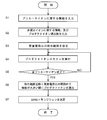
- FIG. 2 is a flowchart of a process for determining MRM measurement conditions
- FIG. 3 is an example of a product ion spectrum obtained by performing a product ion scan using the liquid chromatograph mass spectrometer of this embodiment.
- the analyst sets one or more ions appearing as a peak having an intensity of a predetermined value or more in the mass spectrum obtained by the MS analysis of the target compound performed in advance as a precursor ion, and inputs the mass charge of the precursor ion through the input unit 6.
- Information such as a ratio is input (step S1).
- information on unselected ions and the number of product ions selected are input (step S2).
- the information regarding the non-selected ions is typically a numerical value of the mass-to-charge ratio, but an ion formula may be input.
- the number of product ions selected is one. The number of types of precursor ions and the number of product ions selected can be changed as appropriate.
- non-selected ions include ions for which information that characterizes the target compound cannot be obtained, for example, isotope ions of the precursor ion, ions in which only the valence of the precursor ion is changed without changing the mass, and precursors. Ion dehydration ions and the like can be appropriately set.
- the non-selected ion setting unit 42 sets a mass-to-charge ratio corresponding to the non-selected ions. For example, when a mass-to-charge ratio value is input by an analyst, a range of ⁇ 1u (that is, a mass-to-charge ratio range that can be regarded as the same ion) is excluded from the range. Set.
- a mass-to-charge ratio is obtained from the molecular formula, and a range having a predetermined width (for example, ⁇ 1 u) around the value is set as an exclusion range of the mass-to-charge ratio. (Step S3).
- the non-selected ion setting unit 42 assumes that the precursor ion is (M + 5H) 5+ from the value of the mass-to-charge ratio and the valence input by the analyst, and this ion is not cleaved and only the valence is obtained.
- Calculate the mass-to-charge ratio of ions that have changed from monovalent to tetravalent. That is, the mass-to-charge ratios corresponding to (M + H) + , (M + 2H) 2+ , (M + 3H) 3+ , and (M + 4H) 4+ are m / z 3001, 1501, 1001 , 751.
- CE collision energy
- the product ion scan execution unit 43 determines whether the product ion scan is completed for all the precursor ions input by the analyst (step S5).
- one type of product ion is used.
- the precursor ions are sequentially changed to execute a product ion scan, and product ion spectra are acquired for all the precursor ions.
- the MRM transition determination unit 45 determines a pair of a precursor ion and a product ion corresponding to this mass peak as an MRM transition (step S7). Also, a method file in which the MRM transition is associated with the product ion scan execution condition is created.
- An MRM method with 20V was created.
- the mass-to-charge ratio of the product ions is larger than the mass-to-charge ratio of the precursor ions because the valence of ions has decreased in the collision cell.
- the conventional method automatically selects the mass peak with the highest intensity, so that m / on the product ion spectrum acquired under the condition that CE is 10V.
- this peak is a mass peak corresponding to the precursor ion itself, and since the target compound cannot be characterized as a product ion, it is inappropriate.
- precursor ion isotope ions, ions in which only the valence of the precursor ion is changed, precursor ion dehydration ions, and the like are also inappropriate as product ions. When the intensity of is high, such ions are selected.
- the above-described embodiment is an example, and can be appropriately changed in accordance with the gist of the present invention.
- the case of a liquid chromatograph mass spectrometer has been described.
- the configuration of the apparatus is not limited to this, and any apparatus configuration using a mass spectrometer may be used.
- one mass-to-charge ratio exclusion range is set for one non-selected ion input by the analyst.
- information on precursor ions and information on non-selected ions input by the analyst Based on the above, a plurality of mass to charge ratio exclusion ranges can be set.
- an isotope ion or a dehydrated ion of the precursor ion can be automatically set as a non-selected ion.
- the case where the product ion scan is executed under a plurality of conditions in which only the magnitude of the collision energy (CE) is changed has been described as an example, but other conditions such as the resolution of Q1 and Q3, for example, are set. It is also possible to perform a product ion scan under appropriately changed conditions, and to determine the MRM transition from the product ion spectrum obtained thereby.
- CE collision energy
Landscapes
- Chemical & Material Sciences (AREA)
- Analytical Chemistry (AREA)
- Chemical Kinetics & Catalysis (AREA)
- Life Sciences & Earth Sciences (AREA)
- Physics & Mathematics (AREA)
- Health & Medical Sciences (AREA)
- Dispersion Chemistry (AREA)
- Biochemistry (AREA)
- General Health & Medical Sciences (AREA)
- General Physics & Mathematics (AREA)
- Immunology (AREA)
- Pathology (AREA)
- Other Investigation Or Analysis Of Materials By Electrical Means (AREA)
- Electron Tubes For Measurement (AREA)
Abstract
Description
まず、分析者は、ターゲットとする化合物由来のプリカーサイオンの質量電荷比のみを指定する。すると、該化合物を含む既知の試料に対し、指定されたプリカーサイオンに関するプロダクトイオンスキャン測定が実施され、それによって得られるプロダクトイオンスペクトルにおいて信号強度が大きい順に所定個数のプロダクトイオンピークが選出される。そして、分析者が指定したプリカーサイオンと選出されたピークに対応するプロダクトイオンの組み合わせをMRMトランジションとする。
しかし、多価のプリカーサイオンが開裂して価数が減少したプロダクトイオンの中には、プリカーサイオンの質量電荷比よりも大きい質量電荷比を有するものが含まれるため、上述のようにプロダクトイオンの質量電荷比の範囲を限定することができない。また、価数が変化すると質量電荷比が異なるため、プリカーサイオンと実質的に同じイオンであることに分析者が気づかず、このイオンをプロダクトイオンとするMRMトランジションを設定し、定性を誤ったり定量に誤差を生じたりする場合がある、という問題があった。
a) 使用者により入力される非選出イオンに関する情報に基づいて質量電荷比を設定し、
b) プロダクトイオンスキャンによって得られたプロダクトイオンスペクトルにおいて、前記設定された質量電荷比を除いた範囲内で予め決められた基準を満たすプロダクトイオンを選出する
ことを特徴とする。
上記基準としては、マスピークの強度が最も大きいプロダクトイオンを選択する、というものや、マスピークの出現頻度が最も高いプロダクトイオンを選択する、というものなどを用いることができる。
上記予め決められた基準を満たすプロダクトイオンを、使用者によって指定された数、選出する
ことが好ましい。
a) 使用者により入力される非選出イオンに関する情報に基づいて質量電荷比を設定する非選出イオン設定部と、
b) プロダクトイオンスキャンによって得られたプロダクトイオンスペクトルにおいて、前記設定された質量電荷比を除いた範囲内で予め決められた基準を満たすプロダクトイオンを選出するプロダクトイオン選出部と、
を備えることを特徴とする。
a) 使用者により入力される非選出イオンに関する情報に基づいて質量電荷比を設定する非選出イオン設定部と、
b) プロダクトイオンスキャンによって得られたプロダクトイオンスペクトルにおいて、前記設定された質量電荷比を除いた範囲内で予め決められた基準を満たすプロダクトイオンを選出するプロダクトイオン選出部と、
として動作させることを特徴とする。
プリカーサイオンの種類の数やプロダクトイオンの選出数は適宜に変更することができる。また、非選出イオンとしては、上記例のほか、目的化合物を特徴付ける情報が得られないイオン、例えば、プリカーサイオンの同位体イオン、質量が変化せずプリカーサイオンの価数のみが変化したイオン、プリカーサイオンの脱水イオン、等を適宜に設定することができる。
また、非選出イオン設定部42は、分析者により入力された質量電荷比の値と価数から、プリカーサイオンを(M+5H)5+と仮定し、このイオンが開裂せず価数のみが1価~4価に変化したイオンの質量電荷比を計算する。即ち、(M+H)+、(M+2H)2+、(M+3H)3+、及び(M+4H)4+にそれぞれ対応する質量電荷比をm/z=3001, 1501, 1001, 751と計算する。そして、プロダクトイオンスキャン測定対象となる質量電荷比の範囲内(本実施例ではm/z=50~1200)にある値(m/z=1001, 751)をそれぞれ中心として所定の幅を有する範囲(m/z=750~752, 1000~1002)を、質量電荷比の除外範囲として自動的に追加設定する。
最後に、MRMトランジション決定部45が、このマスピークに対応するプリカーサイオンとプロダクトイオンの組をMRMトランジションに決定する(ステップS7)。また、このMRMトランジションと、プロダクトイオンスキャンの実施条件とを紐付けたメソッドファイルを作成する。
また、上述したように、プリカーサイオンの同位体イオンや、プリカーサイオンの価数のみが変化したイオン、プリカーサイオンの脱水イオン等も同様にプロダクトイオンとして不適切であるが、そうしたイオンに対応するマスピークの強度が大きい場合には、こうしたイオンが選出されてしまう。
上記実施例では、液体クロマトグラフ質量分析装置の場合について説明したが、装置の構成はこれに限らず、質量分析装置を用いる装置構成であればよい。
また、上記実施例では、分析者により入力された1つの非選出イオンに対して1つの質量電荷比の除外範囲を設定したが、分析者により入力されたプリカーサイオンの情報や非選出イオンの情報に基づいて、複数の質量電荷比の除外範囲を設定するように構成することができる。例えば、分析者がプリカーサイオンの分子式を入力した場合に、該プリカーサイオンの同位体イオンや脱水イオン等を自動的に非選出イオンに設定することができる。
さらに、上記実施例では、衝突エネルギー(CE)の大きさのみを変更した複数の条件下でプロダクトイオンスキャンを実行する場合を例に説明したが、その他、例えばQ1やQ3の分解能等の条件を適宜に変更した条件下でプロダクトイオンスキャンを実行し、それにより得られたプロダクトイオンスペクトルからMRMトランジションを決定するように構成することもできる。
10…移動相容器
11…ポンプ
12…インジェクタ
13…カラム
2…質量分析装置
20…イオン化室
201…エレクトロスプレイイオン化用プローブ
202…加熱キャピラリ
21…第1中間真空室
211…イオンガイド
212…スキマー
22…第2中間真空室
221…イオンガイド
23…分析室
231…前段四重極マスフィルタ
232…コリジョンセル
233…多重極イオンガイド
234…後段四重極マスフィルタ
235…イオン検出器
24…電源部
4…データ処理部
41…記憶部
42…非選出イオン設定部
43…プロダクトイオンスキャン実行部
44…プロダクトイオン選出部
45…MRMトランジション決定部
5…制御部
6…入力部
7…表示部
Claims (6)
- イオンを開裂させるコリジョンセルを挟んで前後に質量分離部を有する質量分析装置を用いて、試料に対して設定されたプリカーサイオンについてプロダクトイオンスキャンを行うことによって該プリカーサイオンに対応するプロダクトイオンを選出する質量分析方法であって、
a) 使用者により入力される非選出イオンに関する情報に基づいて質量電荷比を設定し、
b) プロダクトイオンスキャンによって得られたプロダクトイオンスペクトルにおいて、前記設定された質量電荷比を除いた範囲内で予め決められた基準を満たすプロダクトイオンを選出する
ことを特徴とする質量分析方法。 - 前記質量電荷比が、幅を有する範囲として設定されることを特徴とする請求項1に記載の質量分析方法。
- 前記幅が使用者による入力指示に応じて決定されることを特徴とする請求項2に記載の質量分析方法。
- 使用者により入力指示された数のプロダクトイオンを選出することを特徴とする請求項1から3のいずれかに記載の質量分析方法。
- イオンを開裂させるコリジョンセルを挟んで前後に質量分離部を有し、試料に対して設定されたプリカーサイオンについてプロダクトイオンスキャンを行うことによって該プリカーサイオンに対応するプロダクトイオンを選出する質量分析装置であって、
a) 使用者により入力される非選出イオンに関する情報に基づいて質量電荷比を設定する非選出イオン設定部と、
b) プロダクトイオンスキャンによって得られたプロダクトイオンスペクトルにおいて、前記設定された質量電荷比を除いた範囲内で予め決められた基準を満たすプロダクトイオンを選出するプロダクトイオン選出部と、
を備えることを特徴とする質量分析装置。 - イオンを開裂させるコリジョンセルを挟んで前後に質量分離部を有する質量分析装置を用いて、試料に対して設定されたプリカーサイオンについてプロダクトイオンスキャンを行うことによって得られたプロダクトイオンスペクトルから該プリカーサイオンに対応するプロダクトイオンを選出する質量分析データ処理プログラムであって、前記プロダクトイオンスペクトルが保存された記憶部にアクセス可能なコンピュータを、
a) 使用者により入力される非選出イオンに関する情報に基づいて質量電荷比を設定する非選出イオン設定部と、
b) プロダクトイオンスキャンによって得られたプロダクトイオンスペクトルにおいて、前記設定された質量電荷比を除いた範囲内で予め決められた基準を満たすプロダクトイオンを選出するプロダクトイオン選出部と、
として動作させることを特徴とする質量分析データ処理プログラム。
Priority Applications (4)
| Application Number | Priority Date | Filing Date | Title |
|---|---|---|---|
| US15/039,924 US9799499B2 (en) | 2013-11-28 | 2013-11-28 | Mass spectrometric method, mass spectrometer, and mass spectrometric data processing program |
| JP2015550263A JP6176334B2 (ja) | 2013-11-28 | 2013-11-28 | 質量分析方法、質量分析装置、及び質量分析データ処理プログラム |
| PCT/JP2013/082007 WO2015079529A1 (ja) | 2013-11-28 | 2013-11-28 | 質量分析方法、質量分析装置、及び質量分析データ処理プログラム |
| CN201380081237.0A CN105793701B (zh) | 2013-11-28 | 2013-11-28 | 质量分析方法和质量分析装置 |
Applications Claiming Priority (1)
| Application Number | Priority Date | Filing Date | Title |
|---|---|---|---|
| PCT/JP2013/082007 WO2015079529A1 (ja) | 2013-11-28 | 2013-11-28 | 質量分析方法、質量分析装置、及び質量分析データ処理プログラム |
Publications (1)
| Publication Number | Publication Date |
|---|---|
| WO2015079529A1 true WO2015079529A1 (ja) | 2015-06-04 |
Family
ID=53198518
Family Applications (1)
| Application Number | Title | Priority Date | Filing Date |
|---|---|---|---|
| PCT/JP2013/082007 Ceased WO2015079529A1 (ja) | 2013-11-28 | 2013-11-28 | 質量分析方法、質量分析装置、及び質量分析データ処理プログラム |
Country Status (4)
| Country | Link |
|---|---|
| US (1) | US9799499B2 (ja) |
| JP (1) | JP6176334B2 (ja) |
| CN (1) | CN105793701B (ja) |
| WO (1) | WO2015079529A1 (ja) |
Cited By (4)
| Publication number | Priority date | Publication date | Assignee | Title |
|---|---|---|---|---|
| JP2018205013A (ja) * | 2017-05-31 | 2018-12-27 | 三栄源エフ・エフ・アイ株式会社 | アントシアニン色素の定量方法 |
| WO2019229839A1 (ja) * | 2018-05-29 | 2019-12-05 | 株式会社島津製作所 | 質量分析装置及び質量分析方法 |
| EP3447484A4 (en) * | 2016-02-29 | 2020-01-29 | Shimadzu Corporation | MASS SPECTROMETER |
| JP2020035604A (ja) * | 2018-08-29 | 2020-03-05 | 日本電子株式会社 | 質量分析装置及び方法 |
Families Citing this family (7)
| Publication number | Priority date | Publication date | Assignee | Title |
|---|---|---|---|---|
| US9941106B2 (en) * | 2014-06-11 | 2018-04-10 | Micromass Uk Limited | Quadrupole robustness |
| JP6645585B2 (ja) * | 2016-08-23 | 2020-02-14 | 株式会社島津製作所 | 質量分析データ処理装置、質量分析データ処理方法、及び質量分析データ処理プログラム |
| WO2018109895A1 (ja) * | 2016-12-15 | 2018-06-21 | 株式会社島津製作所 | 質量分析装置 |
| GB2561378B (en) * | 2017-04-12 | 2022-10-12 | Micromass Ltd | Optimised targeted analysis |
| JP6973640B2 (ja) * | 2018-05-30 | 2021-12-01 | 株式会社島津製作所 | イメージング質量分析データ処理装置 |
| CN114631022B (zh) * | 2019-11-11 | 2024-07-09 | 株式会社岛津制作所 | 质谱分析方法和质谱分析装置 |
| CN112071737B (zh) * | 2020-03-20 | 2024-04-16 | 昆山聂尔精密仪器有限公司 | 一种离子激发和离子选择信号的生成方法和装置 |
Citations (1)
| Publication number | Priority date | Publication date | Assignee | Title |
|---|---|---|---|---|
| JP2013224858A (ja) * | 2012-04-20 | 2013-10-31 | Shimadzu Corp | クロマトグラフタンデム四重極型質量分析装置 |
Family Cites Families (15)
| Publication number | Priority date | Publication date | Assignee | Title |
|---|---|---|---|---|
| WO2002025265A1 (en) * | 2000-09-20 | 2002-03-28 | Hitachi, Ltd. | Probing method using ion trap mass spectrometer and probing device |
| US7498568B2 (en) * | 2005-04-29 | 2009-03-03 | Agilent Technologies, Inc. | Real-time analysis of mass spectrometry data for identifying peptidic data of interest |
| US7528365B2 (en) * | 2006-02-07 | 2009-05-05 | Applera Corporation | Chemical noise reduction for mass spectrometry |
| US8271203B2 (en) * | 2006-07-12 | 2012-09-18 | Dh Technologies Development Pte. Ltd. | Methods and systems for sequence-based design of multiple reaction monitoring transitions and experiments |
| CN101918826B (zh) * | 2007-12-20 | 2013-06-05 | 株式会社岛津制作所 | 质量分析系统 |
| JP5579706B2 (ja) * | 2008-05-30 | 2014-08-27 | ディーエイチ テクノロジーズ デベロップメント プライベート リミテッド | 差動移動度分光計用のカーテンガスに調整剤を提供するための方法およびシステム |
| WO2010089798A1 (ja) * | 2009-02-05 | 2010-08-12 | 株式会社島津製作所 | Ms/ms型質量分析装置 |
| JP5505110B2 (ja) | 2010-06-14 | 2014-05-28 | 株式会社島津製作所 | クロマトグラフ質量分析装置 |
| US20120108448A1 (en) * | 2010-11-03 | 2012-05-03 | Agilent Technologies, Inc. | System and method for curating mass spectral libraries |
| JP5408107B2 (ja) * | 2010-11-10 | 2014-02-05 | 株式会社島津製作所 | Ms/ms型質量分析装置及び同装置用プログラム |
| JP5533612B2 (ja) * | 2010-12-07 | 2014-06-25 | 株式会社島津製作所 | イオントラップ飛行時間型質量分析装置 |
| CN103282768B (zh) * | 2010-12-28 | 2015-09-30 | 株式会社岛津制作所 | 色谱质量分析装置 |
| JP5967078B2 (ja) * | 2011-04-04 | 2016-08-10 | 株式会社島津製作所 | 質量分析装置及び質量分析方法 |
| JP5799618B2 (ja) * | 2011-07-06 | 2015-10-28 | 株式会社島津製作所 | Ms/ms型質量分析装置及び同装置用プログラム |
| EP3268978A1 (en) * | 2015-03-12 | 2018-01-17 | Thermo Finnigan LLC | Methods for data-dependent mass spectrometry of mixed biomolecular analytes |
-
2013
- 2013-11-28 US US15/039,924 patent/US9799499B2/en active Active
- 2013-11-28 JP JP2015550263A patent/JP6176334B2/ja active Active
- 2013-11-28 WO PCT/JP2013/082007 patent/WO2015079529A1/ja not_active Ceased
- 2013-11-28 CN CN201380081237.0A patent/CN105793701B/zh active Active
Patent Citations (1)
| Publication number | Priority date | Publication date | Assignee | Title |
|---|---|---|---|---|
| JP2013224858A (ja) * | 2012-04-20 | 2013-10-31 | Shimadzu Corp | クロマトグラフタンデム四重極型質量分析装置 |
Non-Patent Citations (2)
| Title |
|---|
| EIJI UENO: "Application of gas chromatography/ mass spectrometry for residue analysis of pesticides Residue analysis of pesticides in foods using GC-MS and GC-MS/MS (Part I", JOURNAL OF PESTICIDE SCIENCE, vol. 36, no. 4, 20 November 2011 (2011-11-20), pages 554 - 558 * |
| MASAHIKO TAKINO: "Application of liquid chromatography/mass spectrometry for residue analysis of pesticides (part II) Residue analysis of pesticides in food using LC-MS/MS and LC-Q/TOFMS", JOURNAL OF PESTICIDE SCIENCE, vol. 37, no. 3, 20 August 2012 (2012-08-20), pages 297 - 302 * |
Cited By (8)
| Publication number | Priority date | Publication date | Assignee | Title |
|---|---|---|---|---|
| EP3447484A4 (en) * | 2016-02-29 | 2020-01-29 | Shimadzu Corporation | MASS SPECTROMETER |
| US10665442B2 (en) | 2016-02-29 | 2020-05-26 | Shimadzu Corporation | Mass spectrometer |
| JP2018205013A (ja) * | 2017-05-31 | 2018-12-27 | 三栄源エフ・エフ・アイ株式会社 | アントシアニン色素の定量方法 |
| WO2019229839A1 (ja) * | 2018-05-29 | 2019-12-05 | 株式会社島津製作所 | 質量分析装置及び質量分析方法 |
| JPWO2019229839A1 (ja) * | 2018-05-29 | 2021-04-08 | 株式会社島津製作所 | 質量分析装置及び質量分析方法 |
| JP7063381B2 (ja) | 2018-05-29 | 2022-05-09 | 株式会社島津製作所 | 質量分析装置及び質量分析方法 |
| JP2020035604A (ja) * | 2018-08-29 | 2020-03-05 | 日本電子株式会社 | 質量分析装置及び方法 |
| JP7199878B2 (ja) | 2018-08-29 | 2023-01-06 | 日本電子株式会社 | 質量分析装置及び方法 |
Also Published As
| Publication number | Publication date |
|---|---|
| CN105793701A (zh) | 2016-07-20 |
| CN105793701B (zh) | 2018-11-06 |
| JPWO2015079529A1 (ja) | 2017-03-16 |
| US20170032947A1 (en) | 2017-02-02 |
| JP6176334B2 (ja) | 2017-08-09 |
| US9799499B2 (en) | 2017-10-24 |
Similar Documents
| Publication | Publication Date | Title |
|---|---|---|
| JP6176334B2 (ja) | 質量分析方法、質量分析装置、及び質量分析データ処理プログラム | |
| JP6176049B2 (ja) | タンデム四重極型質量分析装置 | |
| JP6269810B2 (ja) | 質量分析方法及び質量分析装置 | |
| US10121644B2 (en) | Mass spectrometer and mass spectrometry method | |
| JP6737396B2 (ja) | 質量分析装置及びクロマトグラフ質量分析装置 | |
| JP6202103B2 (ja) | 質量分析装置及び質量分析方法 | |
| JP5206005B2 (ja) | 質量分析装置 | |
| US10768151B2 (en) | Techniques for display and processing of mass spectral data | |
| JP6465190B2 (ja) | 質量分析方法及び質量分析装置 | |
| US9983180B2 (en) | Mass spectrometry method, chromatograph mass spectrometer, and program for mass spectrometry | |
| WO2015019461A1 (ja) | 三連四重極型質量分析装置 | |
| JP6870406B2 (ja) | タンデム四重極型質量分析装置および該装置の制御パラメータ最適化方法 | |
| JP6649642B2 (ja) | 質量分析装置及び質量分析装置用プログラム |
Legal Events
| Date | Code | Title | Description |
|---|---|---|---|
| 121 | Ep: the epo has been informed by wipo that ep was designated in this application |
Ref document number: 13898201 Country of ref document: EP Kind code of ref document: A1 |
|
| ENP | Entry into the national phase |
Ref document number: 2015550263 Country of ref document: JP Kind code of ref document: A |
|
| NENP | Non-entry into the national phase |
Ref country code: DE |
|
| WWE | Wipo information: entry into national phase |
Ref document number: 15039924 Country of ref document: US |
|
| 122 | Ep: pct application non-entry in european phase |
Ref document number: 13898201 Country of ref document: EP Kind code of ref document: A1 |