WO2015076359A1 - プロテアソーム阻害性化合物 - Google Patents
プロテアソーム阻害性化合物 Download PDFInfo
- Publication number
- WO2015076359A1 WO2015076359A1 PCT/JP2014/080859 JP2014080859W WO2015076359A1 WO 2015076359 A1 WO2015076359 A1 WO 2015076359A1 JP 2014080859 W JP2014080859 W JP 2014080859W WO 2015076359 A1 WO2015076359 A1 WO 2015076359A1
- Authority
- WO
- WIPO (PCT)
- Prior art keywords
- group
- compound
- proteasome
- pharmaceutically acceptable
- atom
- Prior art date
- Legal status (The legal status is an assumption and is not a legal conclusion. Google has not performed a legal analysis and makes no representation as to the accuracy of the status listed.)
- Ceased
Links
- 0 CC(C)C[C@@](B1O[C@@](C)([C@@](C2)C(C)(C)[C@@]2C2)[C@@]2O1)NC(C(*(C)C*C(N*(C)CC(C)C(COCc1ccccc1)COCc1ccccc1)=O)NC(C)=O)=O Chemical compound CC(C)C[C@@](B1O[C@@](C)([C@@](C2)C(C)(C)[C@@]2C2)[C@@]2O1)NC(C(*(C)C*C(N*(C)CC(C)C(COCc1ccccc1)COCc1ccccc1)=O)NC(C)=O)=O 0.000 description 1
Images


Classifications
-
- C—CHEMISTRY; METALLURGY
- C07—ORGANIC CHEMISTRY
- C07F—ACYCLIC, CARBOCYCLIC OR HETEROCYCLIC COMPOUNDS CONTAINING ELEMENTS OTHER THAN CARBON, HYDROGEN, HALOGEN, OXYGEN, NITROGEN, SULFUR, SELENIUM OR TELLURIUM
- C07F5/00—Compounds containing elements of Groups 3 or 13 of the Periodic Table
- C07F5/02—Boron compounds
- C07F5/025—Boronic and borinic acid compounds
-
- A—HUMAN NECESSITIES
- A61—MEDICAL OR VETERINARY SCIENCE; HYGIENE
- A61P—SPECIFIC THERAPEUTIC ACTIVITY OF CHEMICAL COMPOUNDS OR MEDICINAL PREPARATIONS
- A61P35/00—Antineoplastic agents
-
- A—HUMAN NECESSITIES
- A61—MEDICAL OR VETERINARY SCIENCE; HYGIENE
- A61P—SPECIFIC THERAPEUTIC ACTIVITY OF CHEMICAL COMPOUNDS OR MEDICINAL PREPARATIONS
- A61P43/00—Drugs for specific purposes, not provided for in groups A61P1/00-A61P41/00
Definitions
- the present invention relates to a novel compound having proteasome inhibitory activity, a proteasome inhibitor containing the compound, a pharmaceutical composition containing the compound as an active ingredient, particularly a pharmaceutical composition for treating a proteasome-related disease such as cancer.
- ubiquitin-proteasome system Proteolysis called ubiquitin-proteasome system is used to break down proteins that are no longer necessary for eukaryotic cells, such as they cannot be folded normally, become inactivated by external stress such as active oxygen, or reach the end of their lives. It is known that a system exists.
- the ubiquitin-proteasome system is a marker that is formed by modifying a protein that is no longer needed with a protein consisting of 76 amino acids called ubiquitin, and the protein is recognized and decomposed by a huge enzyme complex called a proteasome. .
- the ubiquitin-proteasome system not only processes the degradation of unwanted proteins, but also quantitatively regulates cell cycle-related factors, signal transduction factors, transcription factors, etc. It has been clarified that it is also involved in the control of apoptosis, and it has been found that it is a system related to the basis of life activity. And as abnormalities occur in this ubiquitin-proteasome system, it is known that various modulations are caused to cells, and by controlling the function of this ubiquitin-proteasome system, it is thought that abnormalities in ubiquitin-proteasome are involved. The possibility of treating various diseases and malignant cells in which apoptosis is difficult to induce is pointed out, and proteasome inhibitors are attracting attention as therapeutic agents for various diseases.
- Proteasome is a huge enzyme complex that recognizes and degrades all proteins labeled with ubiquitin.
- This complex is called a 19S complex or 11S complex at both ends of a cylindrical structure called a core particle (CP, 20S proteasome) in which four ring structures composed of two ⁇ rings and two ⁇ rings are stacked. It has a shape in which the structure is bound, and proteolysis is performed in the cavity portion in the 20S proteasome.
- molecules constituting the core particle molecules called ⁇ 1, ⁇ 2, and ⁇ 5 are known to have different catalytic activities such as caspase-like, trypsin-like, and chymotrypsin-like, respectively.
- proteasome inhibitors for example, compounds such as bortezomib or ester compounds thereof (for example, Patent Documents 1 to 5), compounds having a peptide-like structure such as belactocin, and the like are known.
- Bortezomib (trade name: Velcade), whose compound name is N-2-pyrazinecarbonyl-L-phenylalanine-L-leucineboronic acid, was first approved in Japan as a treatment for refractory multiple myeloma Proteasome inhibitor. Although the mechanism of action on cancer cells has not been completely elucidated, it has been found that cancer cells stop abnormal cell division and induce apoptosis by accumulation of unwanted proteins in the cells.
- proteasome inhibitors as pharmaceutical preparations.
- they have strong side effects.
- peripheral neuropathy e.g., peripheral neuropathy, gastrointestinal disorders such as vomiting and diarrhea, and myelosuppression are recognized as side effects. This is considered to occur because the proteasome is present in both normal cells and abnormal cells in common, thereby inhibiting the proteasome in normal cells. Therefore, development of a proteasome inhibitor that selectively exerts an effect only in abnormal cells is desired.
- proteasome inhibitors are expected to be effective therapeutic agents not only in currently approved multiple myeloma but also in other solid tumors.
- side effects are a problem when proteasome inhibitors are used in the treatment of diseases. Therefore, development of a novel proteasome inhibitor having an inhibitory action and protease selectivity different from those of conventional proteasome inhibitors is required.
- the object of the present invention is to solve the problems of the prior art, is highly proteasome-selective, and is more irreversible, so there are few side effects even at high doses, which is equivalent to or equivalent to conventional proteasome inhibitory compounds.
- Non-Patent Document 1 a novel proteasome-inhibiting compound, which improves the currently known proteasome-inhibiting compound, belactocin, and has a proteasome-inhibiting activity higher than that of belactocin.
- Non-Patent Document 1 a novel proteasome-inhibiting compound, which improves the currently known proteasome-inhibiting compound, belactocin, and has a proteasome-inhibiting activity higher than that of belactocin.
- such a compound has a large number of asymmetry points in its skeleton, and further improvement is necessary in terms of practicality as a pharmaceutical from the viewpoint of complexity of synthesis, membrane permeability, biological stability, and the like. I faced a new challenge.
- a 1 and A 2 are each independently a 5-membered or 6-membered aromatic ring, and one or more hydrogen atoms present in the aromatic ring are optionally halogen, hydroxyl group, nitro group, amino group , May be substituted with a group selected from a cyano group or a C1-10 alkyl group, S 1 and S 2 are each independently C1-5 alkylene, and among the carbon atoms present in the alkylene, any one of carbon atoms not adjacent to X and A 1 or A 2 is arbitrary.
- R 1 is a C1-5 alkyl group
- R 2 is a C1-10 hydrocarbon group
- one or two or more carbon atoms present in R 1 and R 2 are replaced with oxygen atoms, nitrogen atoms or sulfur atoms, provided that when two or more atoms are replaced, these atoms are Not adjacent to each other
- One or more hydrogen atoms present in R 1 and R 2 may be optionally substituted with a substituent selected from halogen, hydroxyl group, carboxyl group, nitro group, amino group or cyano group
- Y 1 and Y 2 are each independently a hydrogen atom or a boronyl protecting group
- Y 1 and Y 2 may be combined to form a ring structure
- m and n are independently of each other, 1, 2 or 3.
- One or two or more hydrogen atoms of the alkylene group may be optionally substituted with a group selected from halogen, hydroxyl group, nitro group, amino group or cyano group, and Two hydrogen atoms of one carbon atom may be substituted with one oxygen atom to form a carbonyl group, Or formula III
- ring Y ′ is a C4-10 cycloalkenyl group or arylene group, and one or more ring carbon atoms constituting Y ′ are optionally replaced with an oxygen atom, a nitrogen atom or a sulfur atom.
- One or two or more hydrogen atoms of each ring member atom may optionally be a group selected from a halogen, a C1-4 alkyl group, a hydroxyl group, a carboxyl group, a nitro group, an amino group, or a cyano group. May be substituted, or two hydrogen atoms of one carbon atom may be substituted with one oxygen atom to form a carbonyl group. Or a pharmaceutically acceptable salt thereof.
- a proteasome inhibitor comprising an effective amount of the compound of [1] to [8] or a pharmaceutically acceptable salt thereof.
- a pharmaceutical composition for treating a proteasome-related disease comprising at least one compound of [1] to [8] or a pharmaceutically acceptable salt thereof.
- the pharmaceutical composition according to [10], wherein the proteasome-related disease is a tumor.
- the novel compound which has the proteasome inhibitory activity which is comparable to the conventional compound which has proteasome inhibitory activity, and exhibits suitable protease selectivity and the stability (biostability) in a biological environment is provided. Therefore, the compound of the present invention can be used as an excellent antitumor agent compared with an antitumor agent containing a conventional proteasome inhibitor compound, such as sufficient antitumor activity and few side effects.
- FIG. 1 is a graph showing the results of a reversibility test of the compound of the present invention (bottom) and bortezomib (top), which is a known proteasome inhibitory compound. It can be seen that when bortezomib is washed, the inhibitory activity is greatly reduced, whereas the inhibitory activity of the compound of the present invention is hardly reduced.
- FIG. 2 is a graph comparing the results of a reversibility test of Compound 4a of the present invention, Compound 11a having a structure similar to the compound of the present invention, and bortezomib, which is a known proteasome inhibitory compound.
- the vertical axis of the graph shows the ratio when the control chymotrypsin-like proteasome activity is taken as 100%. It can be seen that the similar compound 11a and bortezomib greatly recovers chymotrypsin-like proteasome activity when washed, whereas compound 4a of the present invention keeps chymotrypsin-like proteasome activity low.
- the present invention relates to a novel compound having proteasome inhibitory activity.
- the compound of this aspect has the following general formula: It is a compound which has a structure represented by these.
- proteasome inhibitory compound means a compound having an activity of inhibiting the enzymatic reaction of the proteasome.
- the proteasome is an enzyme complex, and is considered to have a plurality of enzyme activities such as chymotrypsin-like activity, trypsin-like activity, and caspase-like activity. If any one of them can be inhibited, the “proteasome of the present invention is used. It corresponds to “inhibitory compound”. Of course, it may be possible to simultaneously inhibit a plurality of enzyme activities.
- the proteasome-inhibiting compound of the present invention is a compound suitable as a pharmaceutical composition as described herein. Thus, when referring simply to a “compound” or “proteasome inhibiting compound”, it is intended to include “pharmaceutically acceptable salts thereof” unless otherwise indicated.
- alkyl or “alkyl group” includes saturated linear or branched alkyl groups, and unsaturated linear or branched alkyl groups such as alkenyl and alkynyl groups.
- alkylene or “alkylene group” means a group in which one hydrogen atom is eliminated from the alkyl.
- cycloalkyl or “cycloalkyl group” includes cyclic saturated alkyl groups and unsaturated cyclic alkyl groups such as alkenyl and alkynyl groups.
- Groups are also encompassed by “cycloalkyl”. Therefore, the number of carbon atoms in the cycloalkyl in which the number of carbon atoms is specified means the number of carbon atoms in the whole group including the number of carbon atoms contained in these substituted alkyl groups.
- aryl or “aryl group” means an aromatic hydrocarbon group, such as a group in which a ring member atom is further substituted with an alkyl group or a cycloalkyl group, such as 2-methylphenyl, A group in which a hydrogen atom of an alkyl group or a cycloalkyl group is substituted with an aryl group is also included in the “aryl group”. Therefore, the number of carbon atoms in the aryl group in which the number of carbon atoms is specified means the number of carbon atoms in the whole group including the number of carbon atoms contained in these substituted alkyl groups.
- the term “hydrocarbon group” is a term encompassing all the “alkyl group”, “cycloalkyl group” and “aryl group”.
- protecting group is a group for inactivating the reaction activity of a functional group to be protected, and can be easily eliminated by an appropriate reaction to yield the original functional group.
- boronyl group protecting group includes an ether protecting group, an acetal protecting group, an acyl protecting group, etc., which are protecting groups for the hydroxy group of the boronyl group.
- Examples of the protecting group for the boronyl group include Although not limited thereto, a pinanediol group, a pinacol group, a methyl group, a phenyl group and the like can be mentioned.
- S 1 and S 2 may be the same or different independently from each other, and mean alkylene having 1 to 5 carbon atoms. Both S 1 and S 2 may be saturated alkylene or unsaturated alkylene, but are preferably saturated alkylene.
- the number of carbon atoms may be any as long as it is 1 to 5 (C1 to 5), preferably 2 or 3, and most preferably 3.
- any one of carbon atoms at both ends that is, a carbon atom adjacent to A 1 or A 2 and a carbon atom other than a carbon atom adjacent to X is ,
- Optionally may be replaced by S or O, preferably O.
- S 1 and S 2 are most preferably —CH 2 —O—CH 2 —.
- a 1 and A 2 are each independently a 5-membered or 6-membered aromatic ring, and one or more hydrogen atoms present in the aromatic ring are optionally halogen, hydroxyl group, It may be substituted with a group selected from a nitro group, an amino group, a cyano group, and a C1-10 alkyl group.
- Such an aromatic ring is preferably phenyl, pyridyl, furanyl, thiophenyl, naphthyl, biphenyl and the like, and most preferably phenyl.
- X represents C or N, preferably C.
- the number of asymmetric points in the skeleton of the compound is small. Accordingly, it is preferable that X is not an asymmetric center, that is, -S 1 -A 1 and -S 2 -A 2 are the same.
- X is not an asymmetric center, that is, -S 1 -A 1 and -S 2 -A 2 are the same.
- m and n may be any integer as long as they do not adversely affect the proteasome inhibitory activity of the whole compound, but if too large, the compound itself becomes too large to bind to the proteasome, and is small. Number is preferred. Thus, in a preferred embodiment, m and n are 1, 2 or 3. m and n are independent of each other, and may be the same number or different numbers.
- R 1 and R 2 independently of each other may be any hydrocarbon group of C1 to 12, and one or more carbon atoms present in the hydrocarbon group are oxygen atoms May be replaced by a nitrogen atom or a sulfur atom, but when two or more atoms are replaced, these atoms are not adjacent to each other.
- one or more hydrogen atoms of the hydrocarbon group may be optionally substituted with a substituent such as halogen, hydroxyl group, carboxyl group, nitro group, amino group, cyano group.
- R 1 may be any hydrocarbon group as long as it does not adversely affect the proteasome inhibitory activity of the whole compound, but is preferably a C1-6 hydrocarbon group, more preferably a C1-5 alkyl group. is there.
- R 1 include, but are not limited to, methyl, ethyl, propyl, butyl, pentyl, isopropyl, isobutyl, isopentyl, t-butyl, vinyl, 2-propen-2-yl, and the like.
- R 2 may be any hydrocarbon group as long as it does not adversely affect the proteasome inhibitory activity of the whole compound, and is a C1-7 hydrocarbon group in a preferred embodiment, and C1-5 in a more preferred embodiment. It is an alkyl group. In another preferred embodiment, R 2 is a natural amino acid side chain.
- In represents a proteasome inhibitory active site.
- a known proteasome-inhibiting compound, belactocin A has a portion that binds to a portion called S1 pocket present in the proteasome CP, and in contrast to threonine 1 (Thr1) that is a proteasome active site, It is believed that the ⁇ -lactone ring opens and binds by acylating the threonine residue, thereby inhibiting the enzyme activity.
- the structure in the above general formula I Is presumed to exhibit proteasome inhibitory activity by binding to the S1 pocket present in the CP of the proteasome and binding of In to Thr1, which is the proteasome active site.
- In preferably has a site that easily forms a bond such as a hydrogen bond or an electrophilic attack on the hydroxyl group present in the side chain of threonine.
- proteasome inhibitory active sites present in compounds known as proteasome inhibitory compounds are also preferred as In of the present invention.
- Examples of In include, but are not limited to, a ⁇ -lactone ring, a boronic acid, a boronic acid ester, an epoxide, and the like, and more preferably a structure having high in vivo stability such as a boronic acid and a boronic acid ester. It is.
- In is a boronic acid or boronic ester.
- the proteasome inhibitory compound of the present invention has the following formula I It is a compound represented by these.
- a 1 , A 2 , S 1 , S 2 , X, R 1 , R 2 , m and n are as defined above.
- Y 1 and Y 2 are each independently a hydrogen atom or a protecting group for a boronyl group. Y 1 and Y 2 may be combined to form a ring structure. Examples of Y 1 and Y 2 include, but are not limited to, the above-described protecting groups for the boronyl group.
- Y is a C1-10 alkylene group, and among the carbon atoms present in the alkylene, any one of the carbon atoms not adjacent to O is optionally an oxygen atom, a nitrogen atom or a sulfur atom.
- one or more hydrogen atoms of the alkylene group may be optionally substituted with a group selected from a halogen, a hydroxyl group, a nitro group, an amino group, or a cyano group.
- two hydrogen atoms of one carbon atom may be substituted with one oxygen atom to form a carbonyl group.
- ring Y ′ is a C4-10 cycloalkenyl group or arylene group, and one or more ring carbon atoms constituting Y ′ are optionally an oxygen atom, a nitrogen atom or a sulfur atom.
- —B (OY 1 ) OY 2 is It is. These structures are also known as inhibitory active sites of known proteasome inhibitory compounds.
- the compounds of the present invention have the formula IV Where m and n are as defined above. It is a compound represented by these.
- Any known synthesis method can be used alone or in combination for the synthesis of the compound of the present invention. It will be understood by those skilled in the art that an optimum synthesis method for the compound of the present invention can be appropriately selected and necessary conditions can be appropriately determined. In the following examples, some examples of the synthesis of specific compounds included in the present invention are shown, but it is understood by those skilled in the art that alternative synthetic methods may be used. It is.
- proteasome inhibitor containing the compound of the present invention is a compound having proteasome inhibitory activity as described above. Accordingly, proteasome inhibitors comprising an effective amount of a compound of the invention are also included in the invention.
- the “effective amount” means the amount of an active ingredient necessary for achieving the use of the composition, that is, for the composition to function effectively, and there is an adverse effect exceeding the benefit of the use of the active ingredient. An amount that does not occur is preferred. The amount varies depending on the use of the composition, the method of use, the type of compound used as an active ingredient, and the conditions of the intended use. For example, in vitro tests using cultured cells, model animals such as mice and rats, etc. It can be appropriately determined by a test method well known to those skilled in the art, such as a test in the above.
- the proteasome inhibitor of the present invention contains at least one compound of the present invention as an active ingredient, but further contains other compounds of the present invention and / or known proteasome inhibitory compounds as long as the proteasome inhibitory activity is not adversely affected. It's okay.
- a component for effectively achieving the proteasome inhibitory activity effect of the compound of the present invention such as a pharmaceutically acceptable carrier and other optional components such as excipients may be included. These other components are well known in the art, and those skilled in the art can appropriately select these components according to the purpose and method of use.
- composition containing the compound of the present invention is a novel compound, has the property of inhibiting the activity of the proteasome, and also has in vivo stability. It is suitable as. Accordingly, pharmaceutical compositions comprising an effective amount of a compound of the present invention are also encompassed by the present invention.
- the pharmaceutical composition of the present invention can be suitably used particularly for treating a proteasome-related disease, that is, a disease whose pathological condition is improved by inhibiting the function of the proteasome.
- proteasome-related disease means a disease in which the activity of the proteasome is related to the onset or exacerbation of the disease.
- the ubiquitin-proteasome system is considered to perform protein quality control in vivo, and homeostasis cannot be maintained due to an abnormality in this system, which leads to cell abnormalities.
- proteasome-related diseases include, but are not limited to, neurodegenerative diseases such as Alzheimer's disease, Parkinson's disease, polyglutamine disease, prion disease, amyotrophic lateral sclerosis, tumors such as cancer, rheumatism And other immune system diseases.
- Proteasome-inhibiting compounds fail by inhibiting abnormal degradation of normal proteins in cells that cannot maintain homeostasis as a result of excessive degradation of normal proteins due to abnormal ubiquitination of normal proteins and increased proteasome expression Can be eliminated and lead to apoptosis. Therefore, the pharmaceutical composition of the present invention can be suitably used particularly for the treatment of proteasome-related diseases.
- Proteasome-inhibiting compounds are known to have therapeutic effects, particularly in cancer, and are approved as pharmaceuticals. For example, in tumor cells, it is known that various normal proteins such as p53 are abnormally ubiquitinated, and excessive degradation of these normal proteins plays a part in the cause of tumorigenesis. Conceivable. Proteasome-inhibiting compounds can lead tumor cells to apoptosis by inhibiting abnormal degradation of normal cells. Accordingly, in a preferred embodiment, the pharmaceutical composition of the present invention is used to treat cancer.
- tumor includes benign tumors and malignant tumors (cancer, malignant neoplasm).
- cancer includes hematopoietic tumors, including blood cancers, epithelial malignant tumors (cancer, carcinoma) and non-epithelial malignant tumors (sarcoma, sarcoma).
- Examples of cancer treated with the pharmaceutical composition of the present invention include, but are not limited to, blood cancer, colon cancer, skin cancer and the like.
- the pharmaceutical composition of the present invention contains at least one compound of the present invention as an active ingredient.
- other pharmaceutical compounds of the present invention and // Known proteasome inhibitory compounds may be included.
- it may contain other optional components such as a component for effectively achieving the proteasome inhibitory activity effect of the compound of the present invention, such as a pharmaceutically acceptable carrier and a surfactant, and an excipient. .
- a component for effectively achieving the proteasome inhibitory activity effect of the compound of the present invention such as a pharmaceutically acceptable carrier and a surfactant, and an excipient.
- these other components are well known in the art, and those skilled in the art can appropriately select these components according to the purpose and method of use.
- the dosage form of the pharmaceutical composition containing the proteasome-inhibiting compound of the present invention as an active ingredient is not particularly limited, but tablets, solutions, oil emulsions (emulsion formulations), polymer nanoparticles, liposome formulations, Particulate preparations bound to beads having a diameter of several ⁇ m, preparations attached with lipids, microsphere preparations, microcapsule preparations and the like can be mentioned, and those skilled in the art can appropriately select a suitable dosage form.
- Examples of the administration method of the pharmaceutical composition of the present invention include any known administration method such as intradermal administration, subcutaneous administration, intramuscular administration, and intravenous administration.
- the dosage of the proteasome-inhibiting compound of the present invention in the preparation can be appropriately adjusted according to the disease to be treated, the age, body weight, etc. of the patient, but is usually 1 mg to 1000 mg, preferably 10 mg to 100 mg per day. Preferably, it is administered once.
- the present invention is also a method for preventing and / or treating cancer in a subject, comprising an effective amount of one or more proteasome-inhibiting compounds of the present invention. In a method comprising administering to a subject in need thereof.
- the “subject” in the present invention may be any individual organism as long as it can suffer from cancer, but preferably human and non-human mammals (eg, mouse, rat, guinea pig, hamster, etc.) Dentates, primates such as chimpanzees, cloven-hoofed animals such as cows, goats, and sheep, terridae such as horses, rabbits, dogs, and cats), and more preferably human individuals.
- the subject may be healthy or afflicted with some disease, but when cancer prevention and / or treatment is intended, the subject is typically afflicted with cancer.
- the cancer is a cancer in which abnormally increased proteasome expression is observed.
- proteasome inhibitory compound of the present invention used in the prevention / treatment method of the present invention examples include any of those described herein.
- the specific dose of the active ingredient depends on various conditions relating to the subject in need thereof, such as severity of symptoms, general health status of the subject, age, weight, subject sex, diet, timing and frequency of administration, It can be determined in consideration of the drug used in combination, the response to treatment, the dosage form, compliance with the treatment, and the like.
- a specific dose for example, in the case of the proteasome inhibitory compound of the present invention, it is usually preferable to administer 1 mg to 1000 mg, preferably 10 mg to 100 mg once a day.
- any known appropriate administration method such as intradermal administration, subcutaneous administration, intramuscular administration, intravenous administration and the like can be used.
- the prevention / treatment method of the present invention may further include a step of selecting a subject for which administration of the proteasome-inhibiting compound is effective as the subject of prevention / treatment before the administration step.
- This aspect of the present invention may further include the step of determining the presence or absence of abnormally enhanced proteasome expression in the subject tumor cells prior to the selecting step. Presence / absence of abnormally increased proteasome expression in the subject can be determined by any known technique.
- the target compounds 6a to 11a were also synthesized by a similar method.
- the Bn group of compound 13a was removed and then condensed with 16 to give compound 18a.
- the Boc group of 18a was removed and then condensed with the corresponding carboxylic acid or acyl chloride to obtain the target compounds 6a to 9a.
- the Bn group of compound 14a was removed, and then condensed with CH 3 NH 2 or 4- (benzyloxy) butan-1-amine to obtain the target compound 10a or 11a, respectively. Details of each synthesis reaction are shown below.
- the flask was purged with hydrogen and the reaction mixture was stirred under a hydrogen atmosphere for 3 hours.
- the reaction mixture was filtered through a celite pad and the filtrate was concentrated in vacuo to give the corresponding carboxylic acid as a white amorphous solid.
- reaction mixture is concentrated in vacuo, the residue is dissolved in AcOEt, washed with 1M HCl, saturated NaHCO 3 and brine, dried over Na 2 SO 4 , and the solvent is removed under reduced pressure to provide compound 18a ( 2.07 g, 4.04 mmol, 68% yield over 3 steps) was obtained as a colorless viscous oil.
- the flask was purged with hydrogen and the reaction mixture was stirred under a hydrogen atmosphere for 2 hours.
- the reaction mixture was filtered through a celite pad and the filtrate was concentrated in vacuo to give the corresponding carboxylic acid 19a as a white amorphous solid.
- Example 2 Proteasome Inhibition Assay The inhibitory activity of various compounds synthesized in Example 1 and other proteasome inhibitory compounds on the human 20S proteasome is shown in Asai et al., Biochem Pharmacol. 2004 Jan 15; 67 (2): 227-34. The procedure was as described. Briefly, 3 nM human 20S proteasome was prepared by reacting various compounds and DMSO in reaction buffer (50 mM Tris-HCl (pH 7.5), 25 mM KCl, 10 mM NaCl, 1 mM MgCl 2 , 0.018% SDS).
- reaction buffer 50 mM Tris-HCl (pH 7.5), 25 mM KCl, 10 mM NaCl, 1 mM MgCl 2 , 0.018% SDS.
- Suc-LLVY-AMC which is a chymotrypsin-like activity-selective substrate
- 75 ⁇ M Suc-LLVY-AMC which is a chymotrypsin-like activity-selective substrate
- the fluorescence intensity of the degradation product AMC was measured with a microplate reader.
- the activity value when treated with DMSO alone was taken as 100%, and the inhibitory activity of various compounds was determined.
- results are shown in Table 2 and Table 3. As can be seen from the table below, all of the compounds showed a sufficient inhibitory effect on the chymotrypsin-like activity of proteasome CP. Among them, compounds 3a-9a, 11a and 3b-5b are bortezomib which are known proteasome inhibitory compounds. Inhibiting activity equivalent to
- Example 3 Cell growth inhibition assay (1) Colon cancer cell line HCT 116
- HCT 116 strain which is a human colon cancer cell line.
- the experiment was performed according to the product protocol using Cell counting kit-8 (Dojindo Laboratories). Cells were seeded in a 96-well microtiter plate at 3000 cells / well and treated with the test compound for 72 hours. The results are shown in Table 4. As can be seen from Table 4, any compound other than Compound 10a was able to effectively inhibit the growth of HCT 116.
- MM Multiple myeloma cell line MM.
- MM which is a multiple myeloma cell line instead of the colon cancer cell line HCT116.
- 1S and MM Using 1R, the growth inhibitory effect on the cells of the compound of the present invention was verified by the same method as in (1) above.
- MM The 1S cell line is dexamethasone-sensitive human multiple myeloma cells, MM.
- 1R is dexamethasone-resistant human multiple myeloma cells, all of which were obtained from ATCC.
- the compound of the present invention was able to suppress cell proliferation to an extent comparable to that of existing proteasome inhibitors. Moreover, like existing proteasome inhibitors, cell proliferation could be suppressed regardless of the presence or absence of resistance to dexamethasone.
- Example 4 Inhibitory Activity Reversibility Assay
- a reversibility assay was performed using compounds 4a, 11a and bortezomib. 15 nM 20S proteasome was preincubated with each inhibitory compound at 25 ° C. for 12 hours. 37.5 ⁇ M Suc-LLVY-amc was then added as a substrate to initiate the “standard assay” reaction of the 20S proteasome. After incubation at 25 ° C. for 1 hour, fluorescence (excitation light: 390 nm, emission light: 450 nm) of each reaction was measured with a VersaMax Pro microplate reader (Molecular Devices).
- each pre-incubated reaction mixture was subjected to a Microcon Centrifugal Filter (100 kDa molecular weight cut) prior to reaction with substrate to remove inhibitors not bound to the 20S proteasome. Off) and washed 5 times with assay buffer by centrifuging at 11,000 ⁇ g for 3 min. Thereafter, the reaction was carried out by adding a substrate in the same manner as in the “standard assay”.
- Example 5 Protease selectivity assay To verify the proteasome specificity of the inhibitory activity of the compounds of the present invention, a protease selectivity assay was performed using compound 4a and bortezomib. It was performed as described in Arastu-Kapur et al., Clin. Cancer Res .. 2011, 17 (9), 2734-2743.
- cathepsin A the activity of 22 ng / mL cathepsin A (R & D systems) and 40 ⁇ M Mca-Arg-Pro-Pro-Gly-Phe-Ser-Ala-Phe-Lys (Dnp)- After incubation with OH (R & D systems) mixed with assay buffer (50 mM MOPS, pH 5.5) at 25 ° C. for 2 hours, fluorescence (excitation light: 320 nm, emission light: 405 nm) of each reaction was obtained. Measured.
- cathepsin B the activity of cathepsin B (R & D systems) at 40 ng / mL and 10 ⁇ M Z-Leu-Arg-AMC (R & D systems) as a substrate mixed in assay buffer (25 mM MES, pH 5.0) Then, each reaction product was measured for fluorescence (excitation light: 380 nm, emission light: 460 nm).
- cathepsin G the activity of 8.0 ⁇ U / mL cathepsin G (R & D systems) and 200 ⁇ M Suc-Ala-Ala-Pro-Phe-AMC (Bachem) as an assay buffer (50 mM Tris-HCl, pH 7) were used.
- the present invention provides a novel proteasome inhibitory compound.
- a novel proteasome inhibitory compound has irreversible inhibitory activity, high proteasome inhibitory selectivity, and high in vivo stability while having inhibitory activity equivalent to previously known proteasome inhibitory compounds. It can be said that it has many advantages compared to conventional proteasome inhibitory compounds in its use as an active ingredient. Therefore, it is particularly useful as a therapeutic agent for proteasome-related diseases such as cancer.
Landscapes
- Chemical & Material Sciences (AREA)
- Organic Chemistry (AREA)
- Health & Medical Sciences (AREA)
- Chemical Kinetics & Catalysis (AREA)
- General Chemical & Material Sciences (AREA)
- Medicinal Chemistry (AREA)
- Nuclear Medicine, Radiotherapy & Molecular Imaging (AREA)
- Pharmacology & Pharmacy (AREA)
- Life Sciences & Earth Sciences (AREA)
- Animal Behavior & Ethology (AREA)
- General Health & Medical Sciences (AREA)
- Public Health (AREA)
- Veterinary Medicine (AREA)
- Engineering & Computer Science (AREA)
- Bioinformatics & Cheminformatics (AREA)
- Pharmaceuticals Containing Other Organic And Inorganic Compounds (AREA)
Abstract
本発明は、プロテアソーム阻害活性を有する新規な化合物、該化合物を含む医薬組成物、とくにがんなどのプロテアソーム関連疾患を処置するための医薬組成物、前記化合物を用いたプロテアソーム関連疾患を処置する方法等を提供することを目的とする。下記一般式Iで表される化合物を提供することにより、上記目的が達成された。
Description
本発明は、プロテアソーム阻害活性を有する新規な化合物、該化合物を含むプロテアソーム阻害剤、該化合物を有効成分とする医薬組成物、特にがんなどのプロテアソーム関連疾患を処置するための医薬組成物に関する。
真核生物の細胞には、正常にフォールディングできない、活性酸素などの外部ストレスにより失活する、寿命を迎える、などの理由で不要となったタンパク質を分解するためのユビキチン・プロテアソーム系と呼ばれるタンパク質分解系が存在することが知られている。ユビキチン・プロテアソーム系は、不要となったタンパク質を複数のユビキチンと呼ばれる76アミノ酸からなるタンパク質で修飾することにより目印とし、かかるタンパク質をプロテアソームと呼ばれる巨大な酵素複合体で認識して分解するものである。
近年の研究により、ユビキチン・プロテアソーム系は、不要タンパク質の分解処理だけでなく、細胞周期関連因子、シグナル伝達因子および転写因子などの量的調節なども行っており、細胞分裂、DNA修復、免疫反応、アポトーシスの制御などにも関与していることが明らかにされてきており、生命活動の根幹に関わる系であることが分かってきた。そしてこのユビキチン・プロテアソーム系に異常が生じると、細胞に様々な変調をきたすことが知られてくるにつれ、このユビキチン・プロテアソーム系の働きを制御することにより、ユビキチン・プロテアソームの異常が関与すると考えられる多様な疾患や、アポトーシスの誘導が困難である悪性細胞を処置できる可能性が指摘され、種々の疾患に対する治療薬として、プロテアソーム阻害剤が注目されている。
プロテアソームは、ユビキチン標識されたあらゆるタンパク質を認識し、分解する巨大な酵素複合体である。この複合体は、コア粒子(CP、20Sプロテアソーム)と呼ばれる、2つのαリングおよび2つのβリングからなる4つのリング構造が積み重なった筒状構造体の両端に19S複合体または11S複合体と呼ばれる構造が結合した形状をしており、20Sプロテアソームにある空洞部分でタンパク質分解が行われる。コア粒子を構成する分子のうち、β1、β2およびβ5と呼ばれる分子がそれぞれカスパーゼ様、トリプシン様、キモトリプシン様という異なる触媒活性を有することが知られている。
このプロテアソームの活性を阻害することで、プロテアソームの異常活性化を正常に近づけたり、不要タンパク質を細胞内に蓄積させることでアポトーシスを誘導したりして疾患を処置することができると考えられている。プロテアソーム阻害剤としては、例えばボルテゾミブなどの化合物またはそのエステル化合物(例えば特許文献1~5など)、ベラクトシンなどのペプチド様構造を有する化合物などが知られている。
ボルテゾミブ(商品名:ベルケイド)は、化合物名をN-2-ピラジンカルボニル-L-フェニルアラニン-L-ロイシンボロン酸といい、難治性の多発性骨髄腫の治療薬として、日本で最初に認可されたプロテアソーム阻害剤である。がん細胞に対する作用メカニズムは完全に解明されていないものの、がん細胞の異常な細胞分裂を停止したり、細胞内の不要タンパク質の蓄積によりアポトーシスを誘導したりすることがわかっている。
ボルテゾミブ(商品名:ベルケイド)は、化合物名をN-2-ピラジンカルボニル-L-フェニルアラニン-L-ロイシンボロン酸といい、難治性の多発性骨髄腫の治療薬として、日本で最初に認可されたプロテアソーム阻害剤である。がん細胞に対する作用メカニズムは完全に解明されていないものの、がん細胞の異常な細胞分裂を停止したり、細胞内の不要タンパク質の蓄積によりアポトーシスを誘導したりすることがわかっている。
Kawamura et al., J. Med. Chem. 2013, 56, 3689-3700
Kawamura et al., J. Med. Chem. 2014, 57, 2726-2735
従来のプロテアソーム阻害剤を医薬製剤として用いる場合の最大の問題点は、強い副作用を有していることである。例えばボルテゾミブでは、末梢神経障害、嘔吐や下痢などの消化管障害、骨髄抑制などが副作用として認められる。これはプロテアソームが正常細胞にも異常細胞にも共通して存在することにより、正常細胞においてもプロテアソームを阻害してしまうために生じると考えられている。したがって、異常細胞においてのみ選択的に効果を発揮するプロテアソーム阻害剤の開発が望まれている。
一方、近年の生物学的研究により、血液癌においてプロテアソーム阻害によって影響される重要な異常シグナル伝達経路が、固形腫瘍においても存在することが示されてきている。また、がん細胞は正常細胞よりプロテアソームの発現が亢進しており、プロテアソーム阻害剤に対する感受性が高いことも知られている。したがってプロテアソーム阻害剤は、現在認可されている多発性骨髄腫のみならず、他の固形腫瘍などにおいても有効な治療剤となり得ることが期待される。しかしながら上述のとおり、プロテアソーム阻害剤を疾患の処置に用いる場合、副作用が問題となる。したがって従来のプロテアソーム阻害剤とは異なる阻害作用、プロテアーゼ選択性を有する新規なプロテアソーム阻害剤の開発が求められている。
したがって本発明の目的は、従来技術の問題点を解決でき、高度にプロテアソーム選択的であり、阻害反応がより不可逆的であるため高用量でも副作用が少なく、従来のプロテアソーム阻害性化合物と同等またはそれ以上のプロテアソーム阻害活性を有する新規な化合物、該化合物を含む医薬組成物、とくにがんなどのプロテアソーム関連疾患を処置するための医薬組成物、前記化合物を用いたプロテアソーム関連疾患を処置する方法等を提供することにある。
本発明者らは、上記課題を解決するために新規なプロテアソーム阻害性化合物を模索する中で、現在知られているプロテアソーム阻害性化合物であるベラクトシンを改良し、ベラクトシン以上のプロテアソーム阻害活性を有する化合物を開発した(非特許文献1)。しかしながらかかる化合物はその骨格中に多数の不斉点を有するものであり、合成の煩雑さや膜透過性、生物学的安定性などの観点から、医薬としての実用性の点ではさらなる改良が必要であるという新たな課題に直面した。そこで、さらにかかる化合物のペプチド骨格部分を改良し、プロテアソーム活性を保持したままで非ペプチド化し、さらにβ-ラクトン部分をペプチドボロン酸エステルに置換することで、十分なプロテアソーム阻害活性、良好な阻害選択性、およびがん細胞の増殖抑制活性を発揮し、さらに容易に合成することも可能であることを見出し、本発明を完成させた。
すなわち本発明は以下に関する:
[1]以下の式I
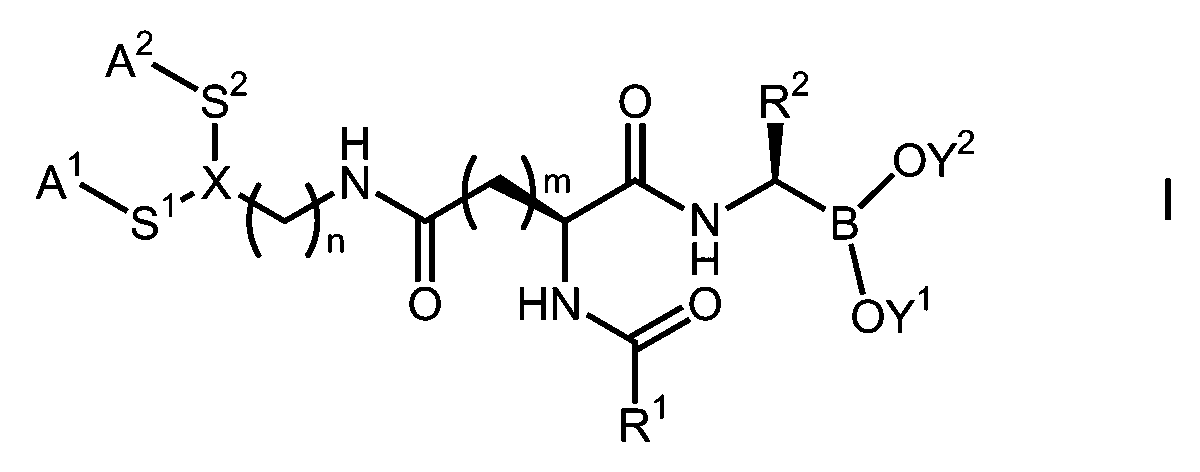
式中、
A1およびA2は、互いに独立して、5員または6員の芳香環であり、該芳香環に存在する1または2以上の水素原子は、任意にハロゲン、ヒドロキシル基、ニトロ基、アミノ基、シアノ基またはC1~10のアルキル基から選択される基で置換されていてもよく、
S1およびS2は、互いに独立して、C1~5のアルキレンであり、該アルキレンに存在する炭素原子のうち、XおよびA1もしくはA2に隣接していない炭素原子のいずれか1つが任意に酸素原子で置き換えられていてもよく、
Xは、CまたはNであり、
R1は、C1~5のアルキル基であり、
R2は、C1~10の炭化水素基であり、
ここでR1およびR2に存在する1または2以上の炭素原子は、酸素原子、窒素原子または硫黄原子で置き換えられていく、ただし2以上の原子が置き換えられている場合は、これらの原子は互いに隣接せず、
R1およびR2に存在する1または2以上の水素原子は、任意にハロゲン、ヒドロキシル基、カルボキシル基、ニトロ基、アミノ基またはシアノ基から選択される置換基で置換されていてもよく、
Y1およびY2は、互いに独立して、水素原子またはボロニル基の保護基であり、ここでY1およびY2が一緒になって環構造を形成してもよく、
mおよびnは、互いに独立して、1、2または3である、
で表される化合物、またはその薬学的に許容可能な塩。
[1]以下の式I
A1およびA2は、互いに独立して、5員または6員の芳香環であり、該芳香環に存在する1または2以上の水素原子は、任意にハロゲン、ヒドロキシル基、ニトロ基、アミノ基、シアノ基またはC1~10のアルキル基から選択される基で置換されていてもよく、
S1およびS2は、互いに独立して、C1~5のアルキレンであり、該アルキレンに存在する炭素原子のうち、XおよびA1もしくはA2に隣接していない炭素原子のいずれか1つが任意に酸素原子で置き換えられていてもよく、
Xは、CまたはNであり、
R1は、C1~5のアルキル基であり、
R2は、C1~10の炭化水素基であり、
ここでR1およびR2に存在する1または2以上の炭素原子は、酸素原子、窒素原子または硫黄原子で置き換えられていく、ただし2以上の原子が置き換えられている場合は、これらの原子は互いに隣接せず、
R1およびR2に存在する1または2以上の水素原子は、任意にハロゲン、ヒドロキシル基、カルボキシル基、ニトロ基、アミノ基またはシアノ基から選択される置換基で置換されていてもよく、
Y1およびY2は、互いに独立して、水素原子またはボロニル基の保護基であり、ここでY1およびY2が一緒になって環構造を形成してもよく、
mおよびnは、互いに独立して、1、2または3である、
で表される化合物、またはその薬学的に許容可能な塩。
[2]式Iの-B(OY1)OY2部分の構造が、以下の式II

式中、YはC1~10のアルキレン基であって、該アルキレンに存在する炭素原子のうち、Oに隣接していない炭素原子のいずれか1つが任意に酸素原子、窒素原子または硫黄原子で置き換えられていてもよく、また該アルキレン基が有する1または2以上の水素原子は、ハロゲン、ヒドロキシル基、ニトロ基、アミノ基またはシアノ基から選択される基で任意に置換されていてもよく、また1つの炭素原子が有する2つの水素原子が1つの酸素原子に置換されてカルボニル基を形成してもよい、
または式III

式中、環Y’は、C4~10のシクロアルケニル基またはアリーレン基であって、Y’を構成する1または2以上の環員炭素原子は、任意に酸素原子、窒素原子または硫黄原子で置き換えられていてもよく、各環員原子が有する1または2以上の水素原子はハロゲン、C1~4アルキル基、ヒドロキシル基、カルボキシル基、ニトロ基、アミノ基またはシアノ基から選択される基で任意に置換されていてもよく、また1つの炭素原子が有する2つの水素原子が1つの酸素原子に置換されてカルボニル基を形成してもよい、
で表される構造である、[1]の化合物、またはその薬学的に許容可能な塩。
または式III
で表される構造である、[1]の化合物、またはその薬学的に許容可能な塩。
[3]式Iの-B(OY1)OY2部分の構造が、
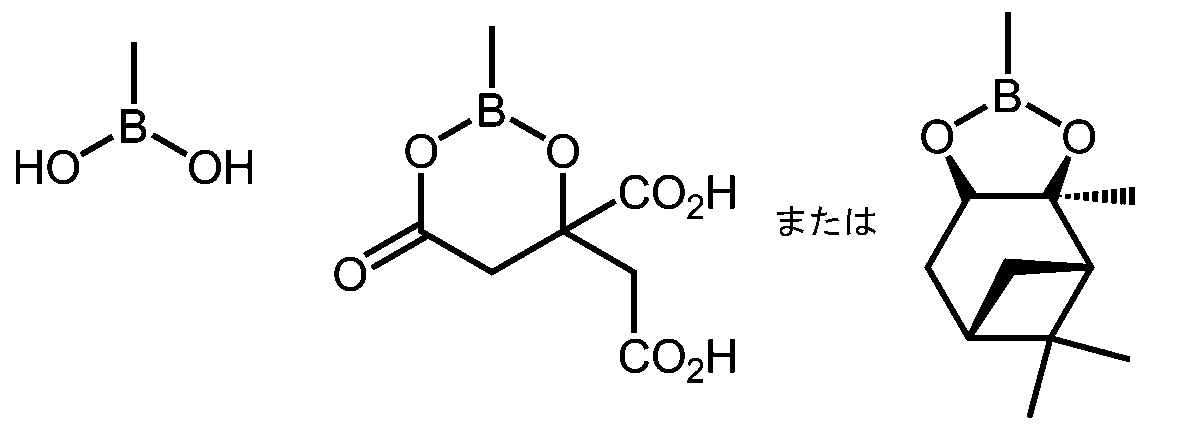
である、[1]または[2]の化合物、またはその薬学的に許容可能な塩。
[4]R2が、イソブチル基、シクロヘキシルメチル基またはベンジル基である、[1]~[3]の化合物、またはその薬学的に許容可能な塩。
[5]S1およびS2が、ともに、-C-C-C-または-C-O-C-である、[1]~[4]の化合物、またはその薬学的に許容可能な塩。
[6]A1およびA2が、ともにフェニルである、[1]~[5]の化合物、またはその薬学的に許容可能な塩。
[7]Xが、Cである、[1]~[6]の化合物、またはその薬学的に許容可能な塩。
[4]R2が、イソブチル基、シクロヘキシルメチル基またはベンジル基である、[1]~[3]の化合物、またはその薬学的に許容可能な塩。
[5]S1およびS2が、ともに、-C-C-C-または-C-O-C-である、[1]~[4]の化合物、またはその薬学的に許容可能な塩。
[6]A1およびA2が、ともにフェニルである、[1]~[5]の化合物、またはその薬学的に許容可能な塩。
[7]Xが、Cである、[1]~[6]の化合物、またはその薬学的に許容可能な塩。
[8]以下の式IV
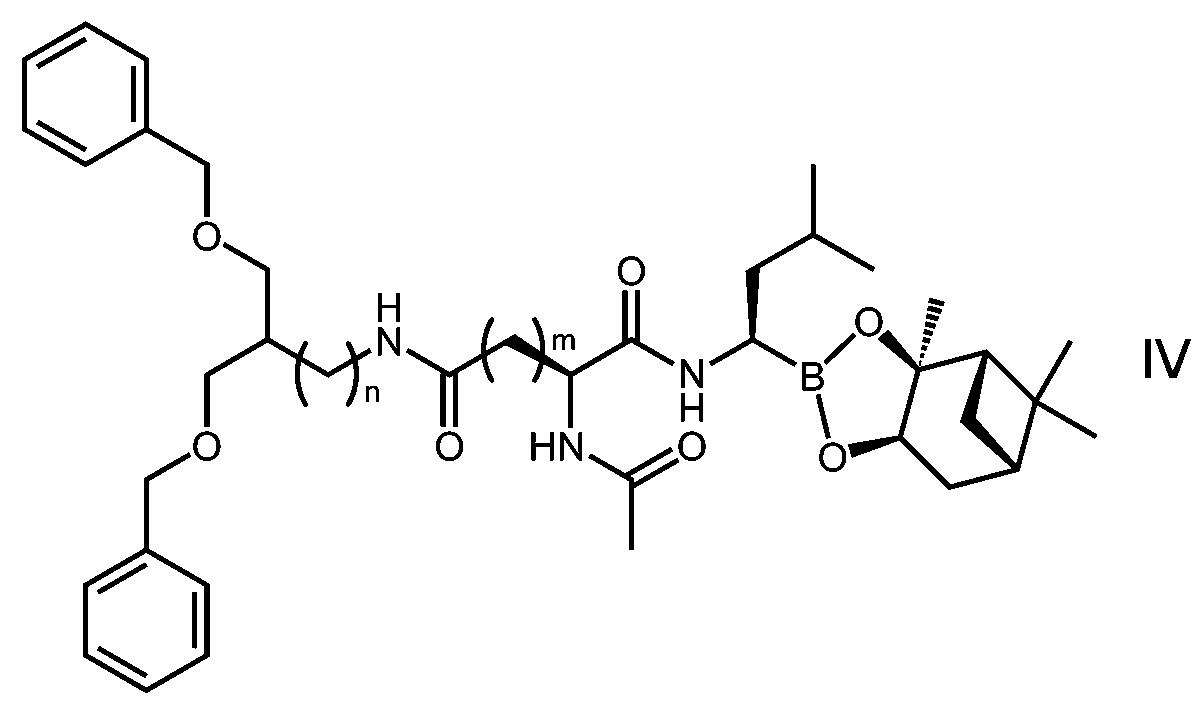
式中、
mおよびnは、互いに独立して、1、2または3である、
で表される化合物、またはその薬学的に許容可能な塩。
[9]有効量の[1]~[8]の化合物またはその薬学的に許容可能な塩を含む、プロテアソーム阻害剤。
[10][1]~[8]の化合物またはその薬学的に許容可能な塩を少なくとも1種含む、プロテアソーム関連疾患を処置するための医薬組成物。
[11]プロテアソーム関連疾患が、腫瘍である、[10]の医薬組成物。
mおよびnは、互いに独立して、1、2または3である、
で表される化合物、またはその薬学的に許容可能な塩。
[9]有効量の[1]~[8]の化合物またはその薬学的に許容可能な塩を含む、プロテアソーム阻害剤。
[10][1]~[8]の化合物またはその薬学的に許容可能な塩を少なくとも1種含む、プロテアソーム関連疾患を処置するための医薬組成物。
[11]プロテアソーム関連疾患が、腫瘍である、[10]の医薬組成物。
本発明によれば、従来のプロテアソーム阻害活性を有する化合物と遜色ないプロテアソーム阻害活性を有し、かつ好適なプロテアーゼ選択性および生体内環境における安定性(バイオスタビリティ)を発揮する新規化合物が提供される。したがって本発明の化合物は、十分な抗腫瘍活性および少ない副作用など、従来のプロテアソーム阻害性化合物を含む抗腫瘍剤と比較して優れた抗腫瘍剤として用いることができる。
以下本発明について詳細に説明する。
(1)本発明の化合物
本発明は一側面において、プロテアソーム阻害活性を有する新規な化合物に関する。
本側面の化合物は、一態様において以下の一般式
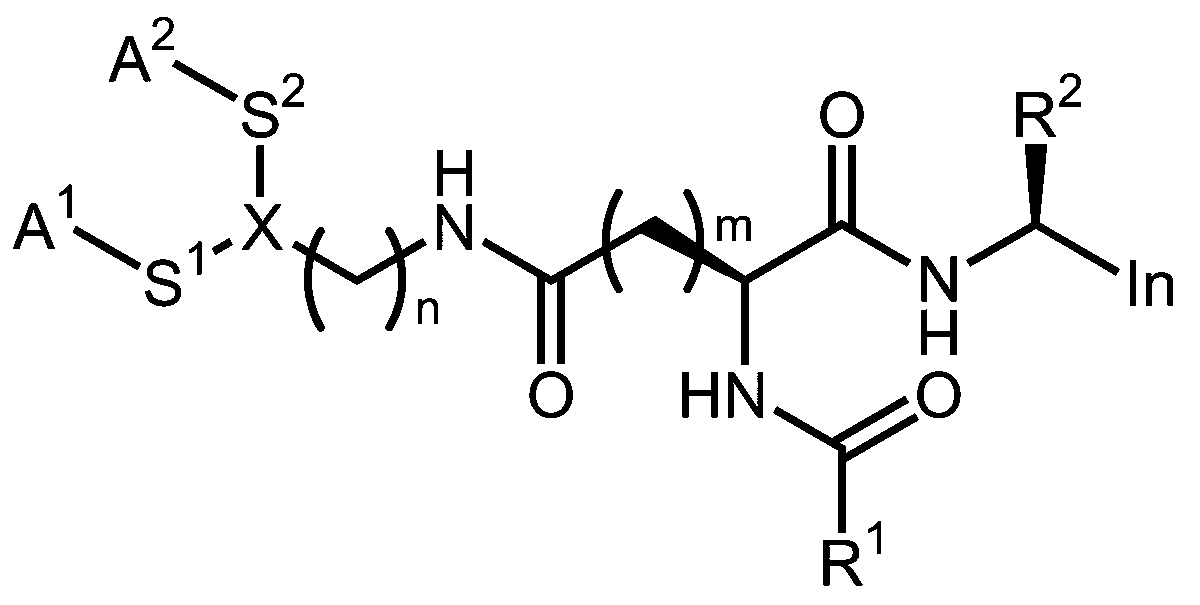
で表される構造を有する化合物である。
(1)本発明の化合物
本発明は一側面において、プロテアソーム阻害活性を有する新規な化合物に関する。
本側面の化合物は、一態様において以下の一般式
本発明において「プロテアソーム阻害性化合物」という語は、プロテアソームの酵素反応を阻害する活性を有する化合物を意味する。プロテアソームは酵素複合体であり、例えばキモトリプシン様活性、トリプシン様活性、カスパーゼ様活性など複数の酵素活性を有すると考えられているが、そのいずれか1つでも阻害することができれば本発明の「プロテアソーム阻害性化合物」に該当する。もちろん複数の酵素活性を同時に阻害することができてもよい。また、本発明のプロテアソーム阻害性化合物は、本明細書中で述べるとおり、医薬組成物として好適な化合物である。したがって、単に「化合物」または「プロテアソーム阻害性化合物」という場合、別段の記載がない限り、「その薬学的に許容可能な塩」も含むことを意図している。
本発明において「アルキル」または「アルキル基」という語は、飽和の直鎖もしくは分枝鎖アルキル基、ならびにアルケニル基およびアルキニル基などの不飽和の直鎖もしくは分枝鎖アルキル基を含む。本発明において「アルキレン」または「アルキレン基」は、前記アルキルから水素原子が一つ脱離した基を意味する。
本発明において「シクロアルキル」または「シクロアルキル基」という語は、環状の飽和アルキル基、ならびにアルケニル基およびアルキニル基などの不飽和の環状アルキル基を含む。また、例えば2-メチルシクロヘキシルなどの、環員原子にさらにアルキル基またはシクロアルキル基が置換されている基や、2-シクロヘキシルエチルなどの、アルキル基の水素原子がシクロアルキル基に置換されている基も「シクロアルキル」に包含される。したがって炭素原子数が指定されているシクロアルキルにおける炭素原子数は、これらの置換アルキル基に含まれる炭素数も包含した基全体での炭素原子数を意味する。
本発明において「シクロアルキル」または「シクロアルキル基」という語は、環状の飽和アルキル基、ならびにアルケニル基およびアルキニル基などの不飽和の環状アルキル基を含む。また、例えば2-メチルシクロヘキシルなどの、環員原子にさらにアルキル基またはシクロアルキル基が置換されている基や、2-シクロヘキシルエチルなどの、アルキル基の水素原子がシクロアルキル基に置換されている基も「シクロアルキル」に包含される。したがって炭素原子数が指定されているシクロアルキルにおける炭素原子数は、これらの置換アルキル基に含まれる炭素数も包含した基全体での炭素原子数を意味する。
本発明において「アリール」または「アリール基」は、芳香族炭化水素基を意味し、例えば2-メチルフェニルなどの、環員原子にさらにアルキル基またはシクロアルキル基が置換されている基や、ベンジルなどの、アルキル基またはシクロアルキル基の水素原子がアリール基に置換されている基も「アリール基」に包含される。したがって炭素原子数が指定されているアリール基における炭素原子数は、これらの置換アルキル基に含まれる炭素数も包含した基全体での炭素原子数を意味する。
本発明において「炭化水素基」という語は、前記「アルキル基」、「シクロアルキル基」および「アリール基」を全て包含する語である。
本発明において「炭化水素基」という語は、前記「アルキル基」、「シクロアルキル基」および「アリール基」を全て包含する語である。
本発明において「保護基」という語は、保護対象となる官能基の反応活性を不活性化するための基であって、適切な反応により容易に脱離して元の官能基を生じさせることができる基を意味する。例えば「ボロニル基の保護基」といった場合、ボロニル基の有するヒドロキシ基の保護基であるエーテル系保護基、アセタール系保護基、アシル系保護基などが包含され、ボロニル基の保護基の例としては、これに限定するものではないが、ピナンジオール基、ピナコール基、メチル基、フェニル基などが挙げられる。
上記一般式において、S1およびS2は、互いに独立して同一でも異なってもよく、炭素原子数が1~5のアルキレンを意味する。S1およびS2は共に飽和アルキレンであっても不飽和アルキレンであってもよいが、好ましくは飽和アルキレンである。炭素原子の数は1~5個(C1~5)であればいずれであってもよいが、好ましくは2個または3個であり、最も好ましくは3個である。
ここでS1およびS2の炭素数が3以上である場合、両端の炭素原子、すなわちA1またはA2に隣接する炭素原子およびXに隣接する炭素原子以外の炭素原子のいずれか1つは、任意にSまたはOに置き換えられてよく、好ましくはOに置き換えられている。したがって、S1およびS2は、最も好ましくは-CH2-O-CH2-である
ここでS1およびS2の炭素数が3以上である場合、両端の炭素原子、すなわちA1またはA2に隣接する炭素原子およびXに隣接する炭素原子以外の炭素原子のいずれか1つは、任意にSまたはOに置き換えられてよく、好ましくはOに置き換えられている。したがって、S1およびS2は、最も好ましくは-CH2-O-CH2-である
上記一般式において、A1およびA2は、互いに独立して、5員または6員の芳香環であり、該芳香環に存在する1または2以上の水素原子は、任意にハロゲン、ヒドロキシル基、ニトロ基、アミノ基、シアノ基、C1~10のアルキル基から選択される基で置換されていてもよい。かかる芳香環としては、好ましくはフェニル、ピリジル、フラニル、チオフェニル、ナフチル、ビフェニルなどであり、最も好ましいのはフェニルである。
上記一般式において、XはCまたはNを表し、好ましくはCである。また、合成の簡便さなどの観点から、化合物の骨格中に不斉点が少ないことが好ましい。したがってXは不斉中心ではない、すなわち-S1-A1と-S2-A2が同一であることが好ましい。
したがって、最も好ましい一態様において、上記一般式における構造
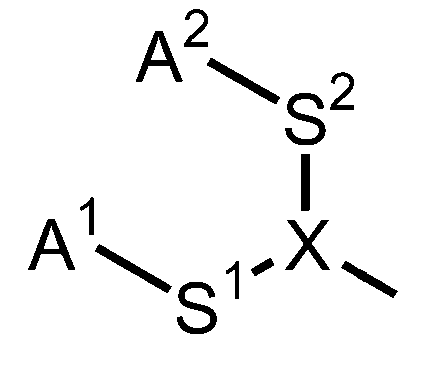
は
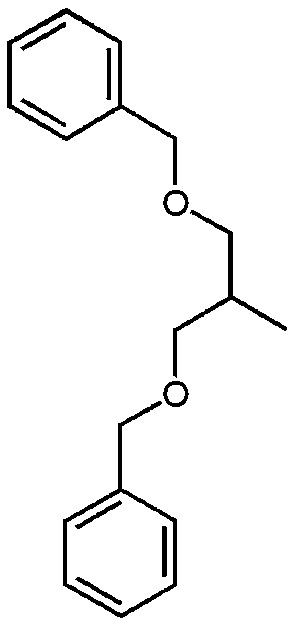
の構造を有する
上記一般式において、XはCまたはNを表し、好ましくはCである。また、合成の簡便さなどの観点から、化合物の骨格中に不斉点が少ないことが好ましい。したがってXは不斉中心ではない、すなわち-S1-A1と-S2-A2が同一であることが好ましい。
したがって、最も好ましい一態様において、上記一般式における構造
上記一般式において、mおよびnは化合物全体のプロテアソーム阻害活性に悪影響を与えない限りいかなる整数であってもよいが、あまり大きすぎると化合物自体が大きくなりすぎてプロテアソームに結合しにくくなるため、小さい数の方が好ましい。したがって好ましい一態様において、mおよびnは1、2または3である。mとnとは互いに独立しており、同じ数であってもよいし異なる数であってもよい。
上記一般式において、R1およびR2は、互いに独立して、C1~12の任意の炭化水素基であってよく、また該炭化水素基に存在する1または2以上の炭素原子は、酸素原子、窒素原子または硫黄原子で置き換えられていてもよいが、2以上の原子が置き換えられている場合は、これらの原子は互いに隣接しない。また、該炭化水素基が有する1または2以上の水素原子は、任意にハロゲン、ヒドロキシル基、カルボキシル基、ニトロ基、アミノ基、シアノ基などの置換基で置換されていてもよい。
上記一般式において、R1およびR2は、互いに独立して、C1~12の任意の炭化水素基であってよく、また該炭化水素基に存在する1または2以上の炭素原子は、酸素原子、窒素原子または硫黄原子で置き換えられていてもよいが、2以上の原子が置き換えられている場合は、これらの原子は互いに隣接しない。また、該炭化水素基が有する1または2以上の水素原子は、任意にハロゲン、ヒドロキシル基、カルボキシル基、ニトロ基、アミノ基、シアノ基などの置換基で置換されていてもよい。
R1は、化合物全体のプロテアソーム阻害活性に悪影響を与えない限り、いかなる炭化水素基であってもよいが、好ましくはC1~6の炭化水素基であり、より好ましくはC1~5のアルキル基である。R1の例としては、これに限定するものではないが、例えばメチル、エチル、プロピル、ブチル、ペンチル、イソプロピル、イソブチル、イソペンチル、t-ブチル、ビニル、2-プロペン-2-イルなどが挙げられる。
R2は、化合物全体のプロテアソーム阻害活性に悪影響を与えない限り、いかなる炭化水素基であってもよく、好ましい一態様においてはC1~7の炭化水素基であり、より好ましい態様においてはC1~5のアルキル基である。また、別の好ましい一態様において、R2は天然アミノ酸の側鎖である。
R2は、化合物全体のプロテアソーム阻害活性に悪影響を与えない限り、いかなる炭化水素基であってもよく、好ましい一態様においてはC1~7の炭化水素基であり、より好ましい態様においてはC1~5のアルキル基である。また、別の好ましい一態様において、R2は天然アミノ酸の側鎖である。
上記一般式において、Inはプロテアソーム阻害活性部位を表す。公知のプロテアソーム阻害性化合物であるベラクトシンAは、プロテアソームのCPに存在するS1ポケットと呼ばれる部分と結合する部分を有し、またプロテアソーム活性部位であるトレオニン1(Thr1)に対して、ベラクトシンA中のβ-ラクトン環が開環してトレオニン残基をアシル化することで結合し、酵素活性を阻害すると考えられている。本発明の化合物の一態様において、上記一般式中の構造

が、プロテアソームのCPに存在するS1ポケットに結合し、Inがプロテアソーム活性部位であるThr1に結合することでプロテアソーム阻害活性を発揮すると推定される。したがってInとしては、トレオニンの側鎖に存在する水酸基に対して、例えば水素結合あるいは求電子的に攻撃可能であるなど、結合を形成しやすい部位を有していることが好ましい。また、プロテアソーム阻害性化合物として公知の化合物に存在するプロテアソーム阻害活性部位もまた、本願発明のInとして好ましい。Inとしては、これに限定するものではないが、例えばβ-ラクトン環、ボロン酸、ボロン酸エステル、エポキシドなどが挙げられ、より好ましくはボロン酸、ボロン酸エステルなど、生体内安定性の高い構造である。したがって本発明の好ましい一態様において、Inはボロン酸またはボロン酸エステルである。
したがって、好ましい一態様において、本発明のプロテアソーム阻害性化合物は、以下の式I

で表される化合物である。
上記式I中、A1、A2、S1、S2、X、R1、R2、mおよびnは上記で定義したとおりである。
上記式I中、Y1およびY2は、互いに独立して、水素原子またはボロニル基の保護基である。また、Y1およびY2が一緒になって環構造を形成してもよい。Y1およびY2の例としては、これに限定するものではないが、上述のボロニル基の保護基が挙げられる。
上記式I中、Y1およびY2は、互いに独立して、水素原子またはボロニル基の保護基である。また、Y1およびY2が一緒になって環構造を形成してもよい。Y1およびY2の例としては、これに限定するものではないが、上述のボロニル基の保護基が挙げられる。
また、上記式I中の構造である-B(OY1)OY2において、Y1およびY2が一緒になって環構造を形成する場合、例えば下記一般式IIおよびIII
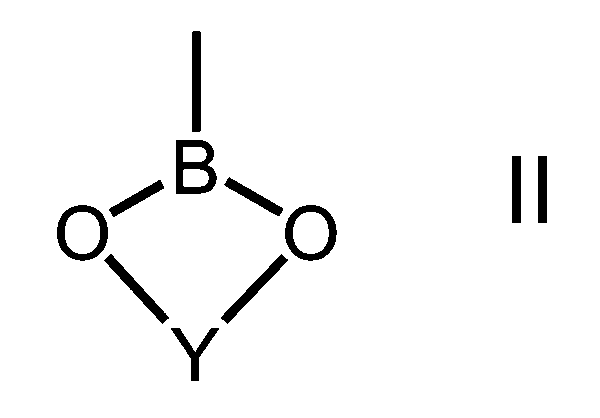
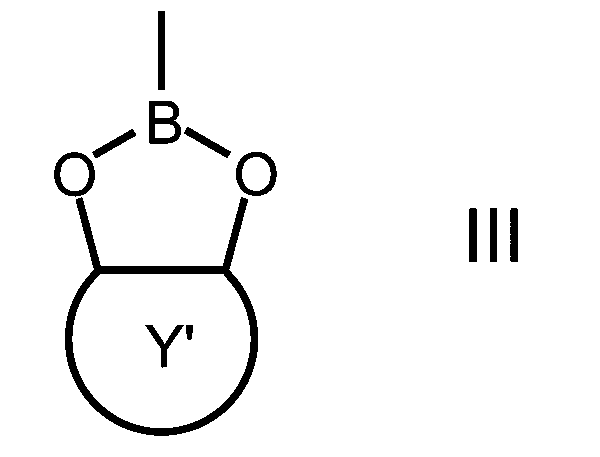
などの構造をとり得る。
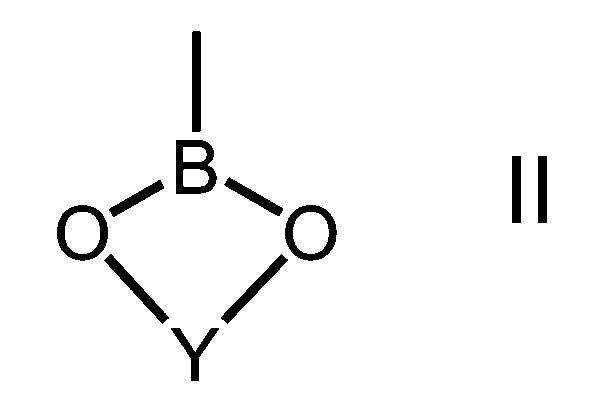
上記式IIにおいて、YはC1~10のアルキレン基であって、該アルキレンに存在する炭素原子のうち、Oに隣接していない炭素原子のいずれか1つが任意に酸素原子、窒素原子または硫黄原子で置き換えられていてもよく、また該アルキレン基が有する1または2以上の水素原子は、ハロゲン、ヒドロキシル基、ニトロ基、アミノ基またはシアノ基から選択される基で任意に置換されていてもよく、また1つの炭素原子が有する2つの水素原子が1つの酸素原子に置換されてカルボニル基を形成してもよい。
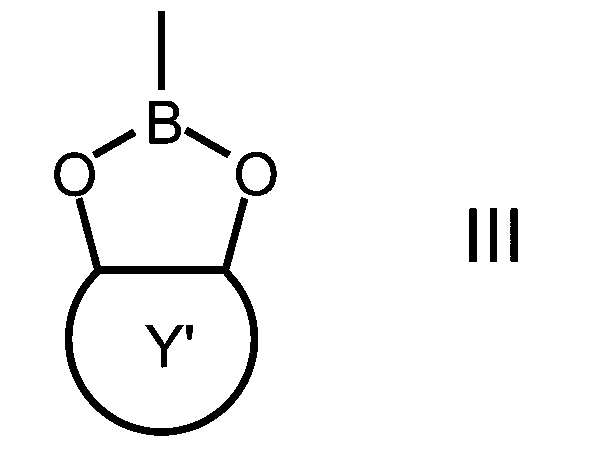
また上記式IIIにおいて、環Y’は、C4~10のシクロアルケニル基またはアリーレン基であって、Y’を構成する1または2以上の環員炭素原子は、任意に酸素原子、窒素原子または硫黄原子で置き換えられていてもよく、各環員原子が有する1または2以上の水素原子はハロゲン、C1~4アルキル基、ヒドロキシル基、カルボキシル基、ニトロ基、アミノ基またはシアノ基から選択される基で任意に置換されていてもよく、また1つの炭素原子が有する2つの水素原子が1つの酸素原子に置換されてカルボニル基を形成してもよい。
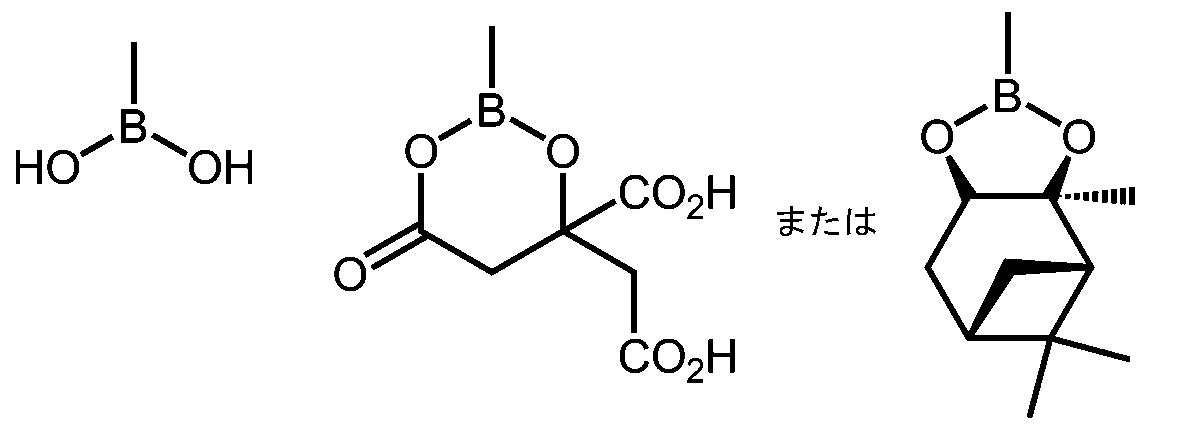
さらに好ましい一態様において、-B(OY1)OY2は
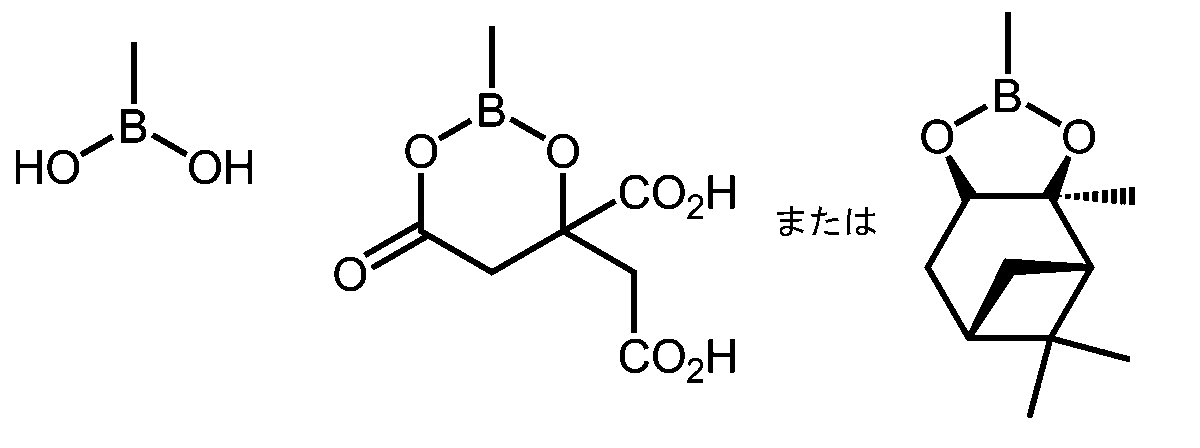
である。これらの構造もまた公知のプロテアソーム阻害性化合物の阻害活性部位として知られた構造である。
上記に鑑みると、本願発明の化合物の非常に好ましい一態様において、本発明の化合物は下記式IV
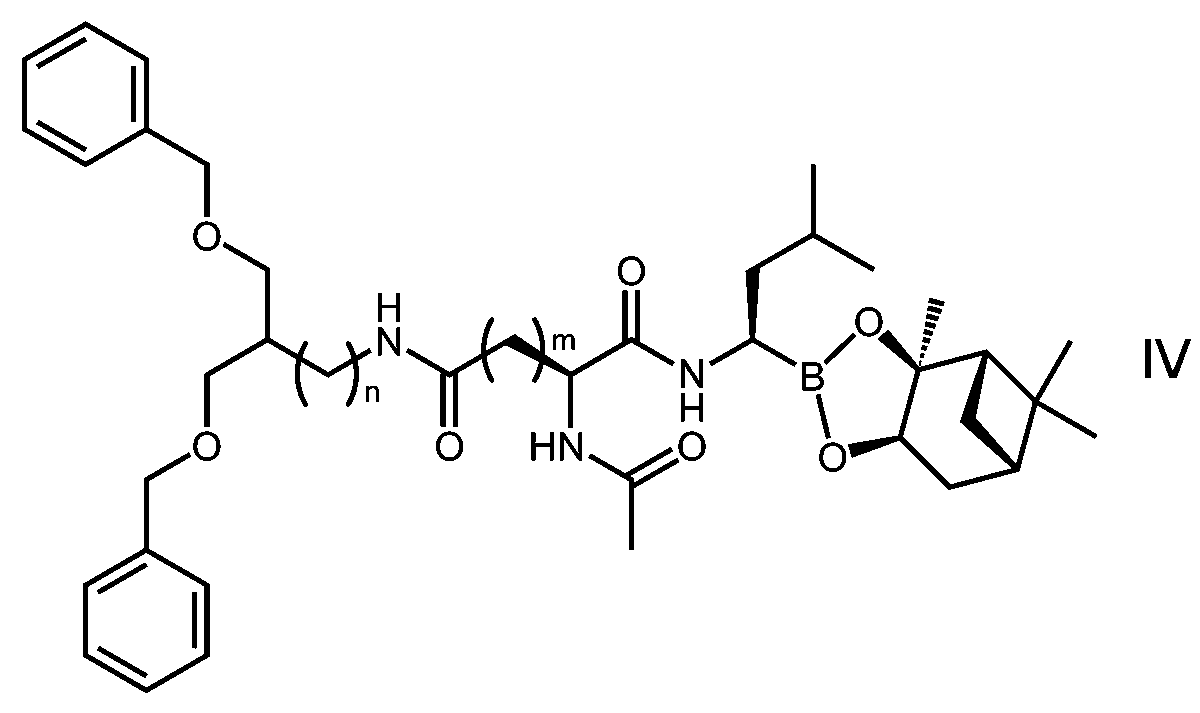
式中、mおよびnは上記で定義したとおりである、
で表される化合物である。
で表される化合物である。
本発明の化合物の合成には、任意の公知の合成方法を単独で、または組み合わせて用いることができる。当業者であれば、本発明の化合物に最適の合成方法を適宜選択し、必要な条件を適宜求めることが可能であると理解される。下記例において、本発明に包含される具体的化合物の一部の合成例を示しているが、代替可能な別の合成方法を用いてもよいことは、当業者には当然に理解されるものである。
(2)本発明の化合物を含むプロテアソーム阻害剤
本発明の化合物は、上述のとおり、プロテアソーム阻害活性を有する化合物である。したがって有効量の本発明の化合物を含むプロテアソーム阻害剤も本発明に含まれる。
本発明において「有効量」とは、組成物の用途を達成するため、すなわち組成物が有効に機能するために必要な有効成分の量を意味し、該有効成分の使用による利益を超える悪影響が生じない量が好ましい。かかる量は組成物の用途、使用方法、有効成分として用いられる化合物の種類、および使用対象の条件などにより変化するが、例えば培養細胞などを用いたin vitro試験や、マウス、ラットなどのモデル動物における試験など、当業者によく知られた試験法により適宜決定することができる。
本発明の化合物は、上述のとおり、プロテアソーム阻害活性を有する化合物である。したがって有効量の本発明の化合物を含むプロテアソーム阻害剤も本発明に含まれる。
本発明において「有効量」とは、組成物の用途を達成するため、すなわち組成物が有効に機能するために必要な有効成分の量を意味し、該有効成分の使用による利益を超える悪影響が生じない量が好ましい。かかる量は組成物の用途、使用方法、有効成分として用いられる化合物の種類、および使用対象の条件などにより変化するが、例えば培養細胞などを用いたin vitro試験や、マウス、ラットなどのモデル動物における試験など、当業者によく知られた試験法により適宜決定することができる。
本発明のプロテアソーム阻害剤は、有効成分として少なくとも一種の本発明の化合物を含むものであるが、プロテアソーム阻害活性に悪影響がない限り、さらに他の本発明の化合物および/または公知のプロテアソーム阻害性化合物を含んでよい。また、例えば医薬として許容されるキャリアーなどの本発明の化合物のプロテアソーム阻害活性効果を効果的に達成するための成分や、賦形剤など、他の任意の成分を含んでもよい。これらの他の成分は当該技術分野において周知であり、当業者はその目的や使用方法に応じて、これらの成分を適宜選択することが可能である。
(3)本発明の化合物を含む医薬組成物
本発明の化合物は新規化合物であり、プロテアソームの活性を阻害する性質を有し、また生体内安定性も有しているため、医薬組成物の成分として好適である。したがって、有効量の本発明の化合物を含む医薬組成物もまた、本発明に包含される。本発明の医薬組成物は、特にプロテアソーム関連疾患、すなわちプロテアソームの機能を阻害することで病態が改善する疾患を処置するために好適に用いることができる。
本発明の化合物は新規化合物であり、プロテアソームの活性を阻害する性質を有し、また生体内安定性も有しているため、医薬組成物の成分として好適である。したがって、有効量の本発明の化合物を含む医薬組成物もまた、本発明に包含される。本発明の医薬組成物は、特にプロテアソーム関連疾患、すなわちプロテアソームの機能を阻害することで病態が改善する疾患を処置するために好適に用いることができる。
本発明において「プロテアソーム関連疾患」とは、プロテアソームの活性が疾患の発症や増悪へ関係する疾患を意味する。ユビキチン・プロテアソーム系は、生体内においてタンパク質の品質管理を行っていると考えられており、このシステムに異常が生じることでホメオスタシスが維持できなくなり、細胞の異常化が起こると考えられている。プロテアソーム関連疾患の例としては、これに限定するものではないが、例えばアルツハイマー病、パーキンソン病、ポリグルタミン病、プリオン病、筋萎縮性側索硬化症などの神経変性疾患、癌などの腫瘍、リューマチを含む免疫系疾患などが挙げられる。
プロテアソーム阻害性化合物は、正常なタンパク質の異常ユビキチン化やプロテアソーム発現の亢進により、正常タンパク質が過剰に分解された結果ホメオスタシスが維持できなくなった細胞において、正常タンパク質の異常分解を抑制することにより機能不全を解消し、アポトーシスに導くことが可能である。したがって本発明の医薬組成物は、特にプロテアソーム関連疾患の処置に好適に用いることができる。
プロテアソーム阻害性化合物は、特にがんにおいて治療効果があることが知られており、医薬として認可もされている。例えば腫瘍細胞においては、p53などの種々の正常タンパク質が異常にユビキチン化されていることが知られており、これらの正常タンパク質を過剰に分解することが腫瘍化の原因の一端を担っていると考えられる。プロテアソーム阻害性化合物は、正常細胞の異常分解を抑制することで腫瘍細胞をアポトーシスへと導くことができる。したがって好ましい一態様において、本発明の医薬組成物は、がんを処置するために用いられる。
プロテアソーム阻害性化合物は、特にがんにおいて治療効果があることが知られており、医薬として認可もされている。例えば腫瘍細胞においては、p53などの種々の正常タンパク質が異常にユビキチン化されていることが知られており、これらの正常タンパク質を過剰に分解することが腫瘍化の原因の一端を担っていると考えられる。プロテアソーム阻害性化合物は、正常細胞の異常分解を抑制することで腫瘍細胞をアポトーシスへと導くことができる。したがって好ましい一態様において、本発明の医薬組成物は、がんを処置するために用いられる。
本発明において「腫瘍(tumor)」は、良性腫瘍および悪性腫瘍(がん、悪性新生物)を含む。「がん(cancer)」は、血液癌を含む造血系の腫瘍、上皮性の悪性腫瘍(癌、carcinoma)と非上皮性の悪性腫瘍(肉腫、sarcoma)とを含む。
本発明の医薬組成物によって処置されるがんの例としては、これに限定するものではないが、例えば血液癌、大腸癌、皮膚癌などが挙げられる。
本発明の医薬組成物によって処置されるがんの例としては、これに限定するものではないが、例えば血液癌、大腸癌、皮膚癌などが挙げられる。
本発明の医薬組成物は、有効成分として少なくとも一種の本発明の化合物を含むものであるが、薬理効果に悪影響がなく、また使用による利益を超える悪影響が生じない限り、さらに他の本発明の化合物および/または公知のプロテアソーム阻害性化合物を含んでよい。また、例えば医薬として許容されるキャリアー、界面活性剤などの、本発明の化合物のプロテアソーム阻害活性効果を効果的に達成するための成分や、賦形剤など、他の任意の成分を含んでもよい。これらの他の成分は当該技術分野において周知であり、当業者はその目的や使用方法に応じて、これらの成分を適宜選択することが可能である。
また、本発明のプロテアソーム阻害性化合物を有効成分とする医薬組成物の剤形としては、特に限定はないが、錠剤、液剤、油乳濁液(エマルション製剤)、高分子ナノ粒子、リポソーム製剤、直径数μmのビーズに結合させた粒子状の製剤、リピッドを結合させた製剤、マイクロスフェア製剤、マイクロカプセル製剤などが挙げられ、当業者であれば適宜好適な剤形を選択することができる。
本発明の医薬組成物の投与方法としては、皮内投与、皮下投与、筋肉内投与、静脈内投与などの既知の任意の投与方法が挙げられる。製剤中の本発明のプロテアソーム阻害性化合物の投与量は、治療目的の疾患、患者の年齢、体重等により適宜調整することができるが、通常1mg~1000mg、好ましくは10mg~100mgを1日に1回投与するのが好ましい。
本発明の医薬組成物の投与方法としては、皮内投与、皮下投与、筋肉内投与、静脈内投与などの既知の任意の投与方法が挙げられる。製剤中の本発明のプロテアソーム阻害性化合物の投与量は、治療目的の疾患、患者の年齢、体重等により適宜調整することができるが、通常1mg~1000mg、好ましくは10mg~100mgを1日に1回投与するのが好ましい。
(4)がんの予防および/または治療方法
本発明はまた、対象におけるがんを予防および/または治療する方法であって、1種または2種以上の本発明のプロテアソーム阻害性化合物の有効量を、それを必要とする対象に投与する工程を含む方法にも関する。
本発明における「対象」は、がんに罹患し得る生物個体であればいかなる生物個体であってもよいが、好ましくはヒトおよび非ヒト哺乳動物(例えば、マウス、ラット、モルモット、ハムスターなどの齧歯類、チンパンジーなどの霊長類、ウシ、ヤギ、ヒツジなどの偶蹄目、ウマなどの奇蹄目、ウサギ、イヌ、ネコなど)の個体であり、より好ましくはヒトの個体である。本発明において、対象は健常であっても、何らかの疾患に罹患していてもよいものとするが、がんの予防および/または治療が企図される場合には、典型的にはがんに罹患しているか、罹患するリスクを有する対象を意味する。本発明の一態様において、がんはプロテアソーム発現の異常亢進が認められるがんである。
本発明はまた、対象におけるがんを予防および/または治療する方法であって、1種または2種以上の本発明のプロテアソーム阻害性化合物の有効量を、それを必要とする対象に投与する工程を含む方法にも関する。
本発明における「対象」は、がんに罹患し得る生物個体であればいかなる生物個体であってもよいが、好ましくはヒトおよび非ヒト哺乳動物(例えば、マウス、ラット、モルモット、ハムスターなどの齧歯類、チンパンジーなどの霊長類、ウシ、ヤギ、ヒツジなどの偶蹄目、ウマなどの奇蹄目、ウサギ、イヌ、ネコなど)の個体であり、より好ましくはヒトの個体である。本発明において、対象は健常であっても、何らかの疾患に罹患していてもよいものとするが、がんの予防および/または治療が企図される場合には、典型的にはがんに罹患しているか、罹患するリスクを有する対象を意味する。本発明の一態様において、がんはプロテアソーム発現の異常亢進が認められるがんである。
本発明の予防/治療方法に用いる本発明のプロテアソーム阻害性化合物としては、本明細書に記載の任意のものが挙げられる。有効成分の具体的な用量は、それを必要とする対象に関する種々の条件、例えば、症状の重篤度、対象の一般健康状態、年齢、体重、対象の性別、食事、投与の時期および頻度、併用している医薬、治療への反応性、剤形、および治療に対するコンプライアンスなどを考慮して決定され得る。
具体的な用量としては、例えば、本発明のプロテアソーム阻害性化合物の場合、通常1mg~1000mg、好ましくは10mg~100mgを1日に1回投与するのが好ましい。また、投与方法としては、皮内投与、皮下投与、筋肉内投与、静脈内投与などの既知の任意の適切な投与方法を用いることができる。
具体的な用量としては、例えば、本発明のプロテアソーム阻害性化合物の場合、通常1mg~1000mg、好ましくは10mg~100mgを1日に1回投与するのが好ましい。また、投与方法としては、皮内投与、皮下投与、筋肉内投与、静脈内投与などの既知の任意の適切な投与方法を用いることができる。
本発明の予防/治療方法は、投与する工程の前に、プロテアソーム阻害性化合物の投与が有効である対象を、予防/治療の対象として選択する工程をさらに含んでよい。本発明のこの態様は、上記選択する工程の前に、対象の腫瘍細胞においてプロテアソーム発現の異常亢進の有無を決定する工程をさらに含んでもよい。対象のプロテアソーム発現の異常亢進の有無は、既知の任意の手法により行うことができる。
本明細書中で言及する全ての特許、出願および他の出版物は、その全体を参照により本明細書に援用する。
以下、実施例により本発明を具体的に説明するが、本発明はこれらの実施例に限定されない。
以下、実施例により本発明を具体的に説明するが、本発明はこれらの実施例に限定されない。
例1.化合物3a~11aおよび3b~5bの合成
化合物3a~11aおよび3b~5bの合成の概要を、以下のスキーム1に示す。これらのペプチドボロン酸のピナンジオールエステルは、シリカゲルカラムクロマトグラフィ条件下で不安定であるため、全ての目的化合物は逆相カラムクロマトグラフィで精製した。

化合物3a~11aおよび3b~5bの合成の概要を、以下のスキーム1に示す。これらのペプチドボロン酸のピナンジオールエステルは、シリカゲルカラムクロマトグラフィ条件下で不安定であるため、全ての目的化合物は逆相カラムクロマトグラフィで精製した。
上記スキーム1における試薬および条件は以下の通り。
(a)Boc-Asp(OBn)-OH、PivCl、Et3N、CH2Cl2、0℃から室温
(b)Boc-Glu(OBn)-OH、PivCl、Et3N、CH2Cl2、0℃から室温
(c)TFA、CH2Cl2、0℃から室温
(d)Ac2O、Et3N、CH2Cl2、0℃
(e)Pd/C、H2、THF
(a)Boc-Asp(OBn)-OH、PivCl、Et3N、CH2Cl2、0℃から室温
(b)Boc-Glu(OBn)-OH、PivCl、Et3N、CH2Cl2、0℃から室温
(c)TFA、CH2Cl2、0℃から室温
(d)Ac2O、Et3N、CH2Cl2、0℃
(e)Pd/C、H2、THF
(f)化合物15、EDC、HOAt、DIEA、CH2Cl2、-18℃から室温
(g)化合物16、EDC、HOAt、DIEA、CH2Cl2、-18℃から室温
(h)化合物17、EDC、HOAt、DIEA、CH2Cl2、-18℃から室温
(i)R-Cl、Et3N、CH2Cl2、0℃
(j)R-OH、PivCl、Et3N、CH2Cl2、0℃から室温
(k)CH3NH2・HCl、EDC、HOAt、DIEA、CH2Cl2、0℃から室温
(l)4-(ベンジルオキシ)ブタン-1-アミン・HCl、EDC、HOAt、DIEA、CH2Cl2、-18℃から室温
(g)化合物16、EDC、HOAt、DIEA、CH2Cl2、-18℃から室温
(h)化合物17、EDC、HOAt、DIEA、CH2Cl2、-18℃から室温
(i)R-Cl、Et3N、CH2Cl2、0℃
(j)R-OH、PivCl、Et3N、CH2Cl2、0℃から室温
(k)CH3NH2・HCl、EDC、HOAt、DIEA、CH2Cl2、0℃から室温
(l)4-(ベンジルオキシ)ブタン-1-アミン・HCl、EDC、HOAt、DIEA、CH2Cl2、-18℃から室温
ロイシンボロン酸のピナンジオールエステル(化合物12)を、酸無水物法によりBoc-Asp(OBn)-OHまたはBoc-Glu(OBn)-OHと縮合させ、化合物13aまたは13bをそれぞれ得た。化合物13aおよび13bのBoc基をTFA/CH2Cl2で処置して除去した後、得られたアミノ基をAc2Oでアセチル化して、化合物14aおよび14bをそれぞれ得た。化合物14aおよび14bのBn基を、水素化分解し、その後化合物15~17と縮合することにより、化合物3a~5aおよび3b~5bをそれぞれ得た。
目的化合物6a~11aも類似の方法で合成した。化合物13aのBn基を除去し、その後16と縮合させて化合物18aを得た。18aのBoc基を除去し、その後対応するカルボン酸または塩化アシルと縮合して、目的化合物6a~9aを得た。化合物14aのBn基を除去し、その後CH3NH2または4-(ベンジルオキシ)ブタン-1-アミンと縮合することにより、目的化合物10aまたは11aをそれぞれ得た。各合成反応の詳細は以下に示す。
(1)(S)-ベンジル3-アセトアミド-4-(((R)-3-メチル-1-((3aS,4S,6S,7aR)-3a,5,5-トリメチルヘキサヒドロ-4,6-メタノベンゾ[d][1,3,2]ジオキサボロル-2-イル)ブチル)アミノ)-4-オキソブタノアート(化合物14a)
Boc-Asp(OBn)-OH(3.84g、11.9mmol、2.0等量)をジクロロメタン(DCM)120mlに溶解した溶液に、トリエチルアミン(1.66ml、11.9mmol、2.0等量)およびPivCl(1.47ml、11.9mmol、2.0等量)を0℃で添加した。0℃を保って1時間後、反応混合物を真空下で濃縮し、残渣を酢酸エチル(AcOEt)に溶解し、水およびブラインで洗浄し、Na2SO4で乾燥させ、そして溶媒を減圧下で除去して、対応する酸無水物を無色の油状物質として得た。
Boc-Asp(OBn)-OH(3.84g、11.9mmol、2.0等量)をジクロロメタン(DCM)120mlに溶解した溶液に、トリエチルアミン(1.66ml、11.9mmol、2.0等量)およびPivCl(1.47ml、11.9mmol、2.0等量)を0℃で添加した。0℃を保って1時間後、反応混合物を真空下で濃縮し、残渣を酢酸エチル(AcOEt)に溶解し、水およびブラインで洗浄し、Na2SO4で乾燥させ、そして溶媒を減圧下で除去して、対応する酸無水物を無色の油状物質として得た。
塩酸アミン化合物12(1.79g、5.95mmol)をDCM(150ml)に溶解した溶液に、トリエチルアミン(2.48ml、17.9mmol、3.0等量)および前記酸無水物をDCM(30ml)に溶解した溶液を、0℃で添加した。0℃を保って5分後、反応混合物を室温まで温めた。室温を保って14時間後、反応混合物を真空下で濃縮し、残渣をAcOEtに溶解し、1MのHCl、飽和NaHCO3およびブラインで洗浄し、Na2SO4で乾燥させ、そして溶媒を減圧下で除去して、化合物13aを白色のアモルファス固体として得た。
前記アモルファス固体をDCM(60ml)に溶解した溶液に、トリフルオロ酢酸(TFA、12ml)を0℃で添加した。0℃を保って5分後、反応混合物を室温まで温めた。室温を保って15時間後、反応混合物を真空下で濃縮し、対応するアミンを茶色の粘性油状物質として得た。
前記アモルファス固体をDCM(60ml)に溶解した溶液に、トリフルオロ酢酸(TFA、12ml)を0℃で添加した。0℃を保って5分後、反応混合物を室温まで温めた。室温を保って15時間後、反応混合物を真空下で濃縮し、対応するアミンを茶色の粘性油状物質として得た。
前記粘性油状物質をDCM(60ml)に溶解した溶液に、トリエチルアミン(2.48ml、17.9mmol、3.0等量)およびAc2O(1.12ml、11.9mmol、2.0等量)を、0℃で添加した。0℃を保って5分後、反応混合物を室温まで温めた。室温を保って20分後、反応混合物を真空下で濃縮し、残渣を酢酸エチル(AcOEt)に溶解し、1MのHCl、飽和NaHCO3およびブラインで洗浄し、Na2SO4で乾燥させ、そして溶媒を減圧下で除去した。粗生成物をシリカゲルカラムクロマトグラフィ(n-ヘキサン/AcOEt 1:1~1:2)で精製し、化合物14a(2.07g、4.04mmol、3工程の収率68%)を白色のアモルファス固体として得た。

(2)(S)-ベンジル4-アセトアミド-5-(((R)-3-メチル-1-((3aS,4S,6S,7aR)-3a,5,5-トリメチルヘキサヒドロ-4,6-メタノベンゾ[d][1,3,2]ジオキサボロル-2-イル)ブチル)アミノ)-5-オキソペンタノアート(化合物14b)
上記(1)と同様に、Boc-Asp(OBn)-OHの代わりにBoc-Glu(OBn)-OHを用いて、塩酸アミン12(1.25g、4.15mmol)から化合物14b(1.84g、3.49mmol、3工程の収率84%、白色のアモルファス固体)を合成した。
上記(1)と同様に、Boc-Asp(OBn)-OHの代わりにBoc-Glu(OBn)-OHを用いて、塩酸アミン12(1.25g、4.15mmol)から化合物14b(1.84g、3.49mmol、3工程の収率84%、白色のアモルファス固体)を合成した。
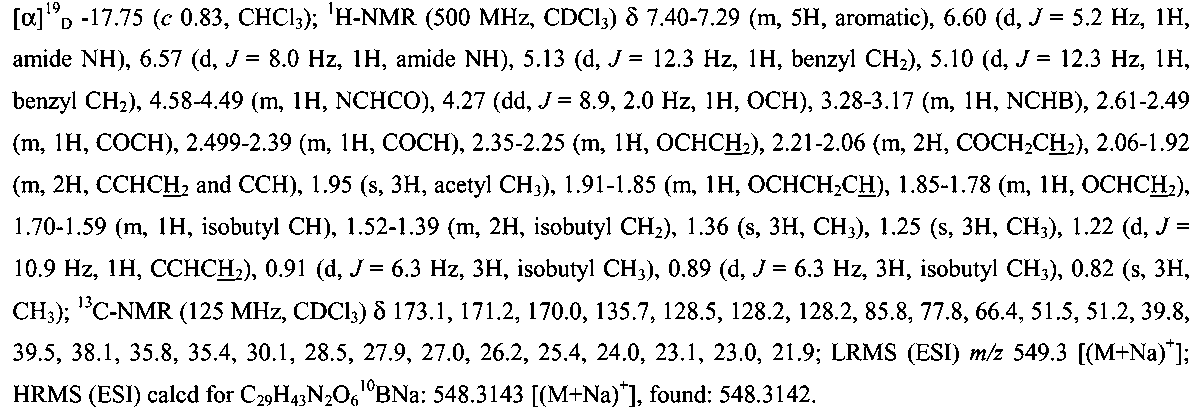
(3)(S)-2-アセトアミド-N 4 -(3-(ベンジルオキシ)-2-((ベンジルオキシ)メチル)プロピル)-N 1 -((R)-3-メチル-1-((3aS,4S,6S,7aR)-3a,5,5-トリメチルヘキサヒドロ-4,6-メタノベンゾ[d][1,3,2]ジオキサボロル-2-イル)ブチル)スクシンアミド(化合物3a)
化合物14a(77.5mg、0.151mmol、1.1等量)をテトラヒドロフラン(THF、6.0ml)に溶解した溶液に、Pd/C(50mg)を添加した。フラスコを水素でパージし、反応混合物を水素雰囲気下で3時間攪拌した。反応混合物を、セライトパッドを通してろ過し、ろ過物を真空下で濃縮し、対応するカルボン酸を白色のアモルファス固体として得た。
化合物14a(77.5mg、0.151mmol、1.1等量)をテトラヒドロフラン(THF、6.0ml)に溶解した溶液に、Pd/C(50mg)を添加した。フラスコを水素でパージし、反応混合物を水素雰囲気下で3時間攪拌した。反応混合物を、セライトパッドを通してろ過し、ろ過物を真空下で濃縮し、対応するカルボン酸を白色のアモルファス固体として得た。
アミン化合物15(39.1mg、0.137mmol、1.0等量)をDCM(2.0ml)に溶解した溶液に、上記で得られたアモルファス固体をDCM(1.5ml)に溶解した溶液、1-ヒドロキシ-7-アザベンゾトリアゾール(HOAt、20.5mg、0.151mmol、1.1等量)、N,N-ジイソプロピルエチルアミン(DIEA、25.6μl、0.151mmol、1.1等量)および1-エチル-3-(3-ジメチルアミノプロピル)カルボジイミド塩酸塩(EDC・HCl、28.9mg、0.151mmol、1.1等量)を-18℃で添加した。-18℃を保って10分後、反応混合物を0℃まで温めた。0℃に保って2時間後、反応混合物をAcOEtで希釈し、1MのHCl、飽和NaHCO3およびブラインで洗浄し、Na2SO4で乾燥させ、溶媒を減圧下で除去した。粗生成物を逆相HPLC(Mightysil RP-18 250-20(5μm)、アセトニトリル/H2O 70:30)で精製して、化合物3a(64.5mg、0.0935mmol、化合物15からの収率68%)を無色の粘性油状物質として得た。
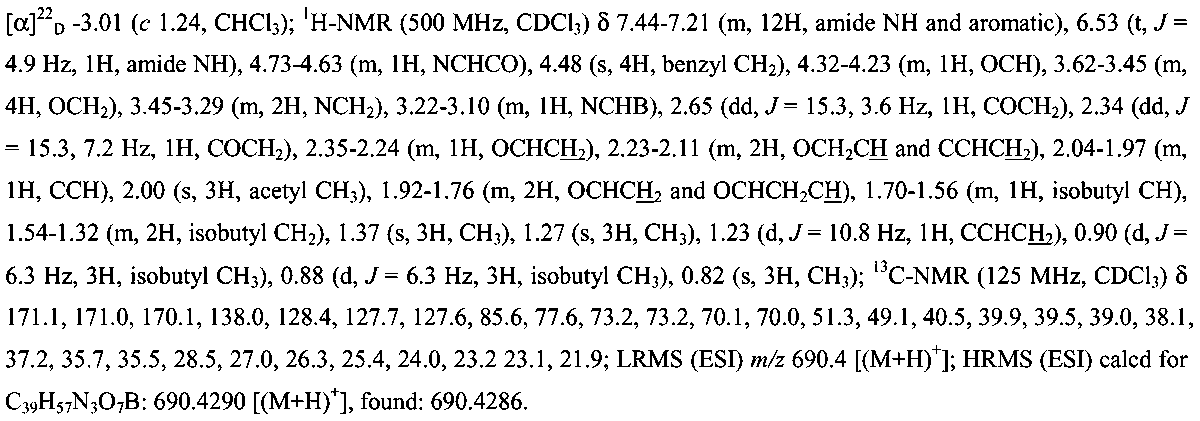
(4)(S)-2-アセトアミド-N 4 -(4-(ベンジルオキシ)-3-((ベンジルオキシ)メチル)ブチル)-N 1 -((R)-3-メチル-1-((3aS,4S,6S,7aR)-3a,5,5-トリメチルヘキサヒドロ-4,6-メタノベンゾ[d][1,3,2]ジオキサボロル-2-イル)ブチル)スクシンアミド(化合物4a)
上記(3)と同様に、アミン化合物16(51.7mg、0.173mmol)から化合物4a(93.9mg、0.133mmol、収率77%、無色の粘性油状物質)を合成した。
上記(3)と同様に、アミン化合物16(51.7mg、0.173mmol)から化合物4a(93.9mg、0.133mmol、収率77%、無色の粘性油状物質)を合成した。
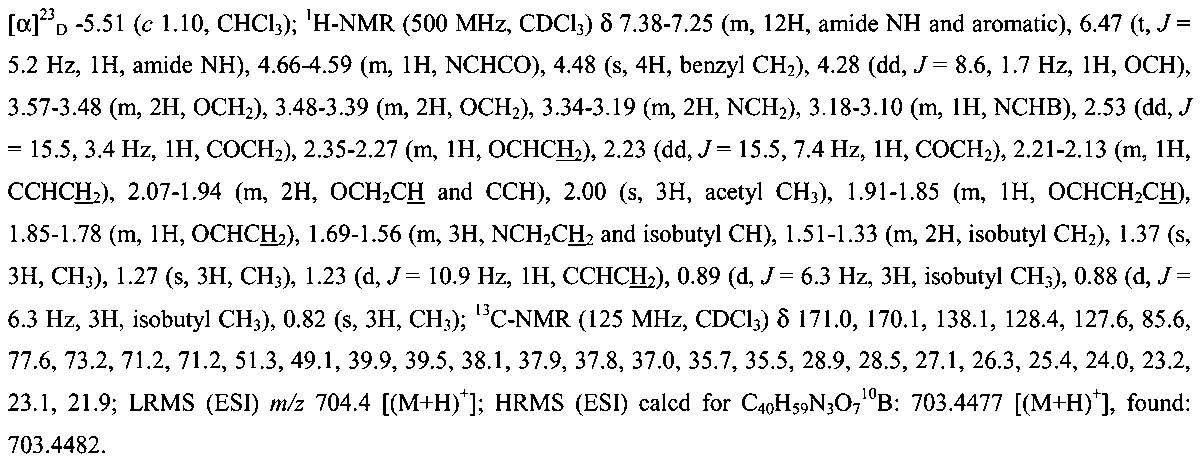
(5)(S)-2-アセトアミド-N 4 -(5-(ベンジルオキシ)-4-((ベンジルオキシ)メチル)ペンチル)-N 1 -((R)-3-メチル-1-((3aS,4S,6S,7aR)-3a,5,5-トリメチルヘキサヒドロ-4,6-メタノベンゾ[d][1,3,2]ジオキサボロル-2-イル)ブチル)スクシンアミド(化合物5a)
上記(3)と同様に、アミン化合物17(61.0mg、0.195mmol)から化合物5a(98.6mg、0.137mmol、収率71%、無色の粘性油状物質)を合成した。
上記(3)と同様に、アミン化合物17(61.0mg、0.195mmol)から化合物5a(98.6mg、0.137mmol、収率71%、無色の粘性油状物質)を合成した。

(6)(S)-2-アセトアミド-N 5 -(3-(ベンジルオキシ)-2-((ベンジルオキシ)メチル)プロピル)-N 1 -((R)-3-メチル-1-((3aS,4S,6S,7aR)-3a,5,5-トリメチルヘキサヒドロ-4,6-メタノベンゾ[d][1,3,2]ジオキサボロル-2-イル)ブチル)ペンタンジアミド(化合物3b)
上記(3)と同様に、化合物14aの代わりに化合物14bを用いて、アミン化合物15(36.8mg、0.129mmol)から化合物3b(71.1mg、0.101mmol、収率78%、無色の粘性油状物質)を合成した。
上記(3)と同様に、化合物14aの代わりに化合物14bを用いて、アミン化合物15(36.8mg、0.129mmol)から化合物3b(71.1mg、0.101mmol、収率78%、無色の粘性油状物質)を合成した。

(7)(S)-2-アセトアミド-N 5 -(4-(ベンジルオキシ)-3-((ベンジルオキシ)メチル)ブチル)-N 1 -((R)-3-メチル-1-((3aS,4S,6S,7aR)-3a,5,5-トリメチルヘキサヒドロ-4,6-メタノベンゾ[d][1,3,2]ジオキサボロル-2-イル)ブチル)ペンタンジアミド(化合物4b)
上記(3)と同様に、化合物14aの代わりに化合物14bを用いて、アミン化合物16(50.2mg、0.168mmol)から化合物4b(101mg、0.141mmol、収率84%、無色の粘性油状物質)を合成した。
上記(3)と同様に、化合物14aの代わりに化合物14bを用いて、アミン化合物16(50.2mg、0.168mmol)から化合物4b(101mg、0.141mmol、収率84%、無色の粘性油状物質)を合成した。
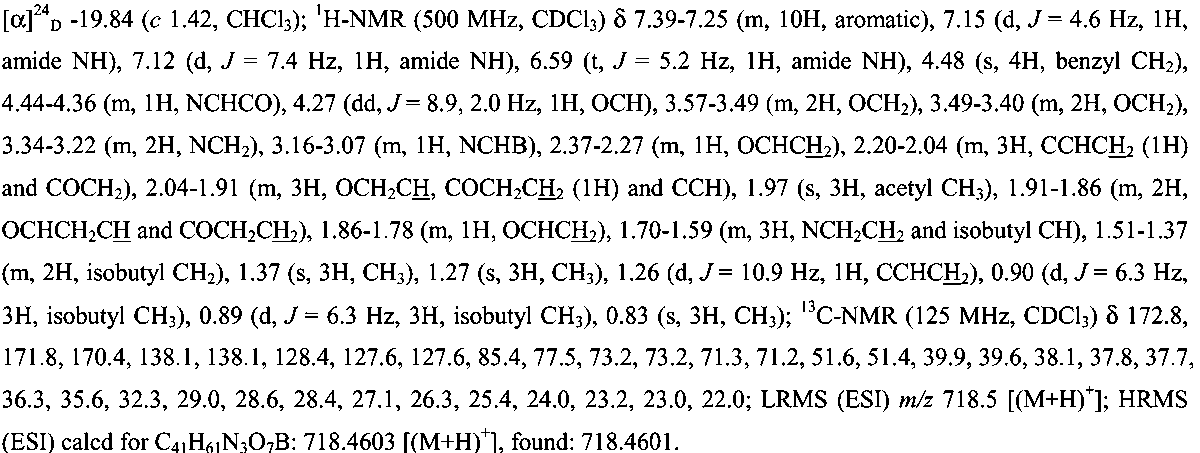
(8)(S)-2-アセトアミド-N 5 -(5-(ベンジルオキシ)-4-((ベンジルオキシ)メチル)ペンチル)-N 1 -((R)-3-メチル-1-((3aS,4S,6S,7aR)-3a,5,5-トリメチルヘキサヒドロ-4,6-メタノベンゾ[d][1,3,2]ジオキサボロル-2-イル)ブチル)ペンタンジアミド(化合物5b)
上記(3)と同様に、化合物14aの代わりに化合物14bを用いて、アミン化合物17(61mg、0.195mmol)から化合物5b(107mg、0.146mmol、収率75%、無色の粘性油状物質)を合成した。
上記(3)と同様に、化合物14aの代わりに化合物14bを用いて、アミン化合物17(61mg、0.195mmol)から化合物5b(107mg、0.146mmol、収率75%、無色の粘性油状物質)を合成した。

(9)(S)-N 4 -(4-(ベンジルオキシ)-3-((ベンジルオキシ)メチル)ブチル)-2-(2,5-ジクロロベンズアミド)-N 1 -((R)-3-メチル-1-((3aS,4S,6S,7aR)-3a,5,5-トリメチルヘキサヒドロ-4,6-メタノベンゾ[d][1,3,2]ジオキサボロル-2-イル)ブチル)スクシンアミド(化合物6a)
Boc-Asp(OBn)-OH(25.6mg、0.0792mmol、1.0等量)をDCM(1.0ml)に溶解した溶液に、トリエチルアミン(11.0μl、0.0792mmol、1.0等量)およびPivCl(9.75μl、0.0792mmol、1.0等量)を0℃で添加した。0℃を保って1時間後、反応混合物を真空下で濃縮し、残渣をAcOEtに溶解し、水およびブラインで洗浄し、Na2SO4で乾燥させ、そして溶媒を減圧下で除去して、対応する酸無水物を無色の油状物質として得た。
Boc-Asp(OBn)-OH(25.6mg、0.0792mmol、1.0等量)をDCM(1.0ml)に溶解した溶液に、トリエチルアミン(11.0μl、0.0792mmol、1.0等量)およびPivCl(9.75μl、0.0792mmol、1.0等量)を0℃で添加した。0℃を保って1時間後、反応混合物を真空下で濃縮し、残渣をAcOEtに溶解し、水およびブラインで洗浄し、Na2SO4で乾燥させ、そして溶媒を減圧下で除去して、対応する酸無水物を無色の油状物質として得た。
化合物12(23.9mg、0.0792mmol)をDCM(1.0ml)に溶解した溶液に、トリエチルアミン(27.6μl、0.198mmol、2.5等量)および前記酸無水物をDCM(1.0ml)に溶解した溶液を、0℃で添加した。0℃を保って5分後、反応混合物を室温まで温め、30分間攪拌した。反応混合物を真空下で濃縮し、残渣をAcOEtに溶解し、1MのHCl、飽和NaHCO3およびブラインで洗浄し、Na2SO4で乾燥させ、そして溶媒を減圧下で除去して、化合物13aを白色のアモルファス固体として得た。
前記粘性油状物質をTHF(1.0ml)に溶解した溶液に、Pd/C(45mg)を添加した。フラスコを水素でパージし、反応混合物を水素雰囲気下で90分間攪拌した。反応混合物を、セライトパッドを通してろ過し、ろ過物を真空下で濃縮し、対応するカルボン酸を白色のアモルファス固体として得た。
前記粘性油状物質をTHF(1.0ml)に溶解した溶液に、Pd/C(45mg)を添加した。フラスコを水素でパージし、反応混合物を水素雰囲気下で90分間攪拌した。反応混合物を、セライトパッドを通してろ過し、ろ過物を真空下で濃縮し、対応するカルボン酸を白色のアモルファス固体として得た。
前記アモルファス固体をDCM(1.0ml)に溶解した溶液に、アミン化合物16(23.7mg、0.0792mmol、1.0等量)HOAt(10.8mg、0.0792mmol、1.0等量)、DIEA(13.5μl、0.0792mmol、1.0等量)、およびEDC・HCl(15.2mg、0.0792mmol、1.0等量)を、-18℃で添加した。-18℃を保って5分後、反応混合物を室温まで温め、16時間攪拌した。反応混合物を真空下で濃縮し、残渣をAcOEtに溶解し、1MのHCl、飽和NaHCO3およびブラインで洗浄し、Na2SO4で乾燥させ、そして溶媒を減圧下で除去して、化合物18a(2.07g、4.04mmol、3工程の収率68%)を無色の粘性油状物質として得た。
前記粘性油状物質をDCM(500μl)に溶解した溶液に、TFA(500μl)を0℃で添加した。0℃を保って5分後、反応混合物を室温まで温め、3時間攪拌した。反応混合物を真空下で濃縮し、対応するアミンを茶色の粘性油状物質として得た。
前記粘性油状物質をDCM(1.0ml)に溶解した溶液に、トリエチルアミン(22.0μl、0.158mmol、2.0等量)および2,5-ジクロロベンゾイルクロリド(16.6mg、0.0792mmol、1.0等量)を、0℃で添加した。0℃を保って3時間後、反応混合物を真空下で濃縮し、残渣をAcOEtに溶解し、1MのHCl、飽和NaHCO3およびブラインで洗浄し、Na2SO4で乾燥させ、そして溶媒を減圧下で除去した。粗生成物を逆相HPLC(Mightysil RP-18 250-20(5μm)、アセトニトリル/H2O 70:30)で精製し、化合物6a(33.7mg、0.0404mmol、5工程の収率49%)を無色の粘性油状物質として得た。
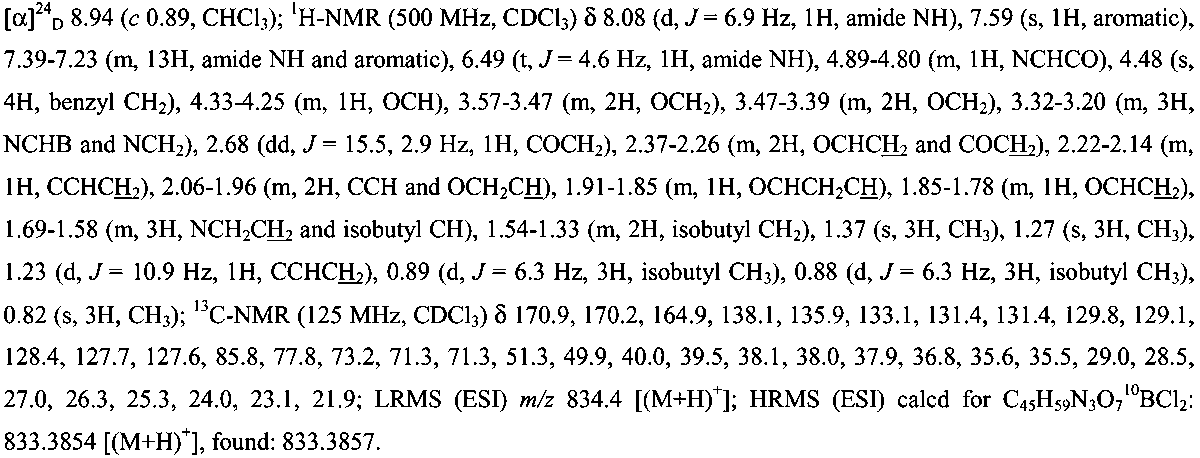
(10)(S)-2-ベンズアミド-N 4 -(4-(ベンジルオキシ)-3-((ベンジルオキシ)メチル)ブチル)-N 1 -((R)-3-メチル-1-((3aS,4S,6S,7aR)-3a,5,5-トリメチルヘキサヒドロ-4,6-メタノベンゾ[d][1,3,2]ジオキサボロル-2-イル)ブチル)スクシンアミド(化合物7a)
上記(9)と同様に、2,5-ジクロロベンゾイルクロリドの代わりにベンゾイルクロリドを用いて、化合物12(25.2mg、0.0835mmol)から化合物7a(33.9mg、0.0443mmol、5工程の収率53%、無色の粘性油状物質)を合成した。
上記(9)と同様に、2,5-ジクロロベンゾイルクロリドの代わりにベンゾイルクロリドを用いて、化合物12(25.2mg、0.0835mmol)から化合物7a(33.9mg、0.0443mmol、5工程の収率53%、無色の粘性油状物質)を合成した。
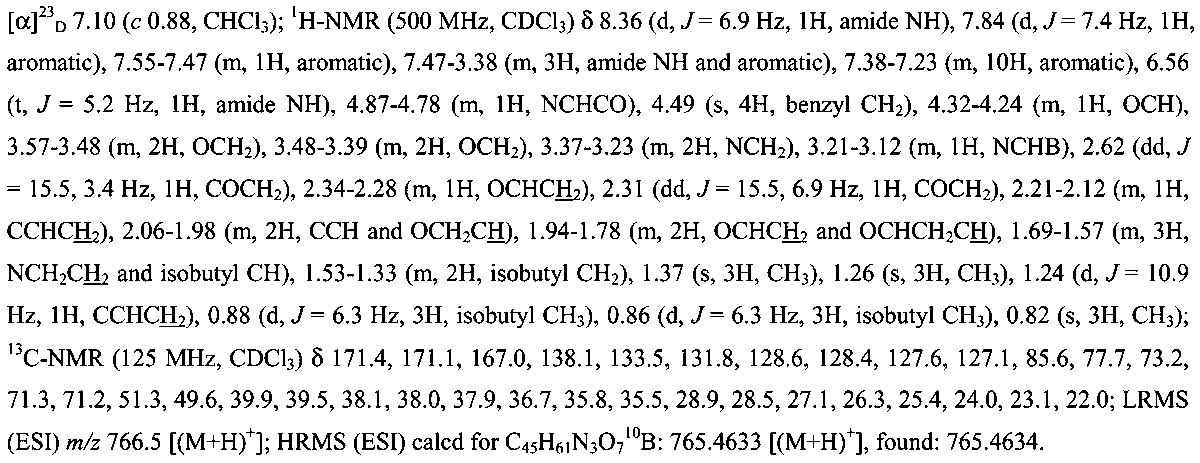
(11)(S)-N 4 -(4-(ベンジルオキシ)-3-((ベンジルオキシ)メチル)ブチル)-N 1 -((R)-3-メチル-1-((3aS,4S,6S,7aR)-3a,5,5-トリメチルヘキサヒドロ-4,6-メタノベンゾ[d][1,3,2]ジオキサボロル-2-イル)ブチル)-2-(ピラジン-2-カルボキサミド)スクシンアミド(化合物8a)
上記(9)と同様に、2,5-ジクロロベンゾイルクロリドの代わりにピラジンカルボン酸およびPivClを用いて、化合物12(23.7mg、0.0787mmol)から化合物8a(28.4mg、0.0370mmol、5工程の収率47%、無色の粘性油状物質)を合成した。
上記(9)と同様に、2,5-ジクロロベンゾイルクロリドの代わりにピラジンカルボン酸およびPivClを用いて、化合物12(23.7mg、0.0787mmol)から化合物8a(28.4mg、0.0370mmol、5工程の収率47%、無色の粘性油状物質)を合成した。
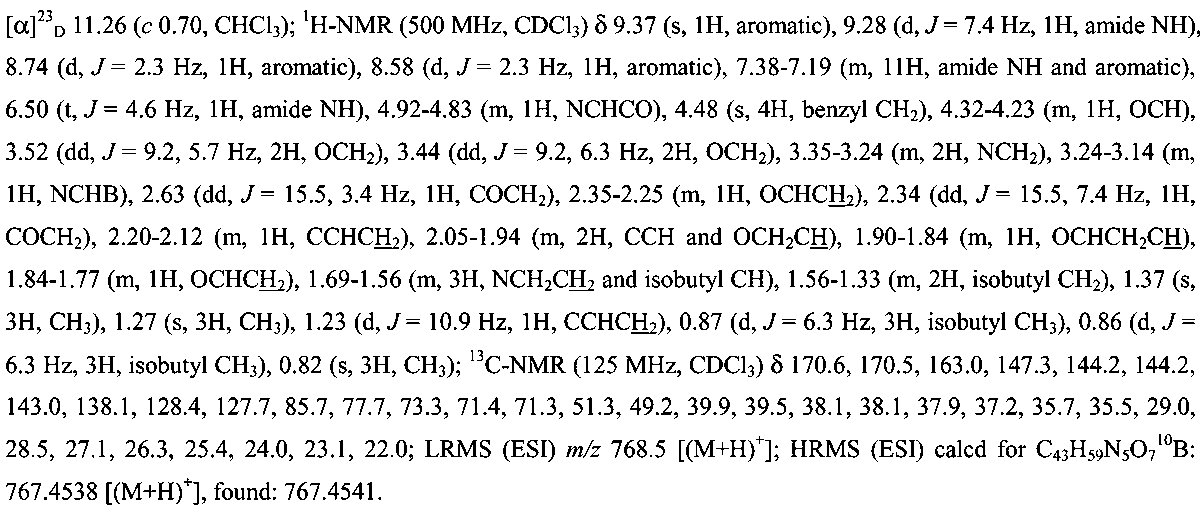
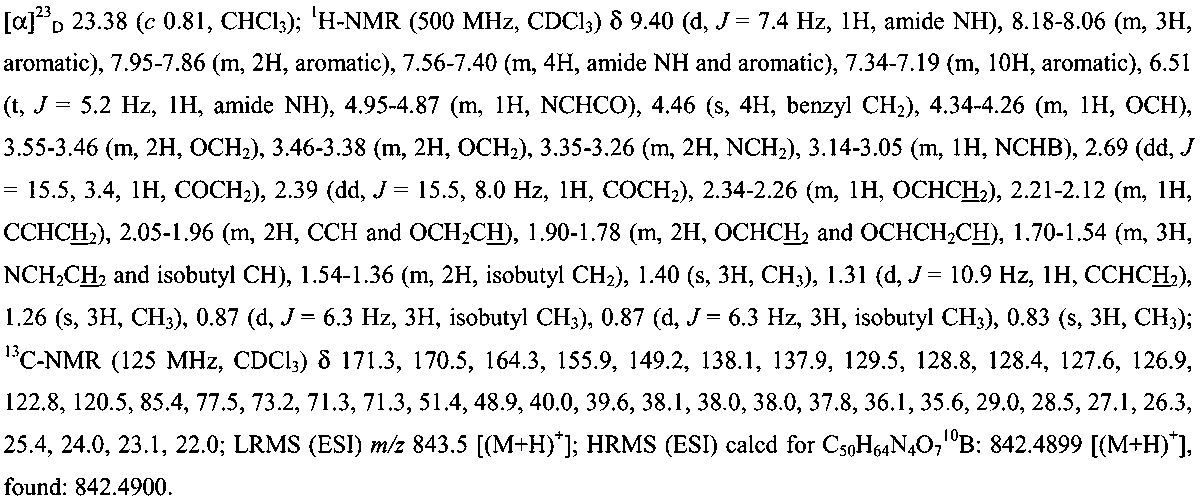
(12)(S)-N 4 -(4-(ベンジルオキシ)-3-((ベンジルオキシ)メチル)ブチル)-N 1 -((R)-3-メチル-1-((3aS,4S,6S,7aR)-3a,5,5-トリメチルヘキサヒドロ-4,6-メタノベンゾ[d][1,3,2]ジオキサボロル-2-イル)ブチル)-2-(6-フェニルピコリンアミド)スクシンアミド(化合物9a)
上記(9)と同様に、2,5-ジクロロベンゾイルクロリドの代わりにピラジンカルボン酸およびPivClを用いて、化合物12(23.7mg、0.0787mmol)から化合物9a(35.0mg、0.0415mmol、5工程の収率54%、無色の粘性油状物質)を合成した。
上記(9)と同様に、2,5-ジクロロベンゾイルクロリドの代わりにピラジンカルボン酸およびPivClを用いて、化合物12(23.7mg、0.0787mmol)から化合物9a(35.0mg、0.0415mmol、5工程の収率54%、無色の粘性油状物質)を合成した。
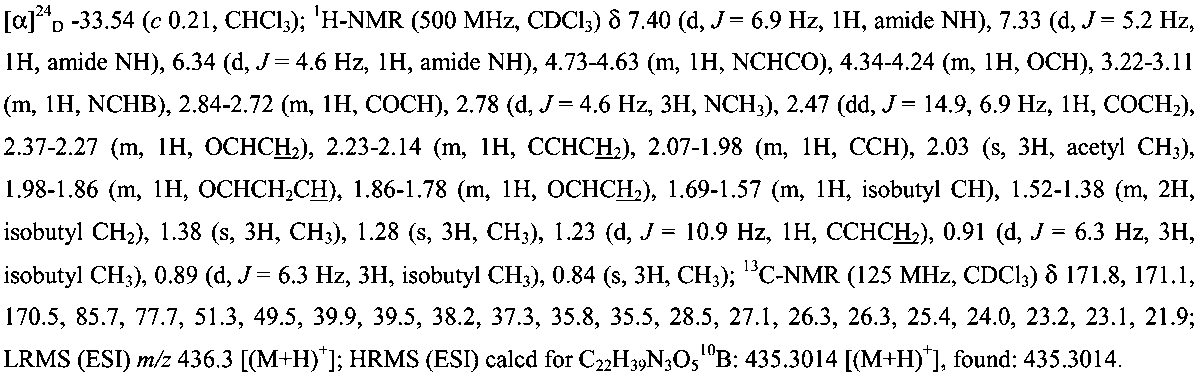
(13)(S)-2-アセトアミド-N 4 -メチル-N 1 -((R)-3-メチル-1-((3aS,4S,6S,7aR)-3a,5,5-トリメチルヘキサヒドロ-4,6-メタノベンゾ[d][1,3,2]ジオキサボロル-2-イル)ブチル)スクシンアミド(化合物10a)
ベンジルエステル14a(93.5mg、0.1825mmol)をTHF(2.0ml)に溶解した溶液に、Pd/C(90.0mg)を添加した。フラスコを水素でパージし、反応混合物を水素雰囲気下で2時間攪拌した。反応混合物を、セライトパッドを通してろ過し、ろ過物を真空下で濃縮し、対応するカルボン酸19aを白色のアモルファス固体として得た。
ベンジルエステル14a(93.5mg、0.1825mmol)をTHF(2.0ml)に溶解した溶液に、Pd/C(90.0mg)を添加した。フラスコを水素でパージし、反応混合物を水素雰囲気下で2時間攪拌した。反応混合物を、セライトパッドを通してろ過し、ろ過物を真空下で濃縮し、対応するカルボン酸19aを白色のアモルファス固体として得た。
前記アモルファス固体をDCM(2.0ml)に溶解した溶液に、CH3NH2・HCl(43.9mg、0.650mmol、3.5等量)、HOAt(25.2mg、0.185mmol、1.0等量)、DIEA(252μl、1.48mmol、8.0等量)、およびEDC・HCl(39.1mg、0.204mmol、1.1等量)を、0℃で添加した。0℃を保って5分後、反応混合物を室温まで温め、19時間攪拌した。反応混合物を真空下で濃縮し、残渣をAcOEtに溶解し、1MのHCl、飽和NaHCO3およびブラインで洗浄し、Na2SO4で乾燥させ、そして溶媒を減圧下で除去した。粗生成物を逆相HPLC(Mightysil RP-18 250-20(5μm)、アセトニトリル/H2O 60:40)で精製し、化合物10a(14.3mg、0.0329mmol、2工程の収率18%)を無色の粘性油状物質として得た。
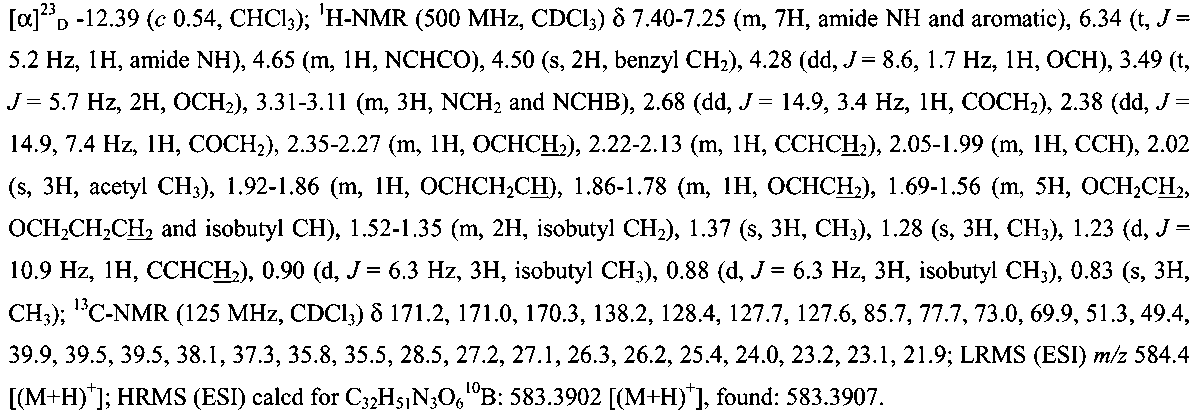
(14)(S)-2-アセトアミド-N 4 -(4-(ベンジルオキシ)ブチル)-N 1 -((R)-3-メチル-1-((3aS,4S,6S,7aR)-3a,5,5-トリメチルヘキサヒドロ-4,6-メタノベンゾ[d][1,3,2]ジオキサボロル-2-イル)ブチル)スクシンアミド(化合物11a)
ベンジルエステル14a(89.2mg、0.174mmol)をTHF(2.0ml)に溶解した溶液に、Pd/C(90.0mg)を添加した。フラスコを水素でパージし、反応混合物を水素雰囲気下で2時間攪拌した。反応混合物を、セライトパッドを通してろ過し、ろ過物を真空下で濃縮し、対応するカルボン酸19aを白色のアモルファス固体として得た。
ベンジルエステル14a(89.2mg、0.174mmol)をTHF(2.0ml)に溶解した溶液に、Pd/C(90.0mg)を添加した。フラスコを水素でパージし、反応混合物を水素雰囲気下で2時間攪拌した。反応混合物を、セライトパッドを通してろ過し、ろ過物を真空下で濃縮し、対応するカルボン酸19aを白色のアモルファス固体として得た。
tert-ブチル(4-(ベンジルオキシ)ブチル)カルバマート(48.6mg、0.174mmol、1.0等量)を、4MのHCl入りAcOEt(2ml)に溶解し、室温で1時間攪拌した。反応混合物を真空下で濃縮し、対応するアミンを無色の粘性油状物質として得た。
化合物19aをDCM(2.0ml)に溶解した溶液に、上記アミン、DIEA(88.8μl、0.522mmol、3.0等量)、HOAt(23.7mg、0.174mmol、1.0等量)およびEDC・HCl(33.4mg、0.174mmol、1.0等量)を、-18℃で添加した。-18℃を保って10分後、反応混合物を室温まで温め、3時間攪拌した。反応混合物を真空下で濃縮し、残渣をAcOEtに溶解し、1MのHCl、飽和NaHCO3およびブラインで洗浄し、Na2SO4で乾燥させ、そして溶媒を減圧下で除去した。粗生成物を逆相HPLC(Mightysil RP-18 250-20(5μm)、アセトニトリル/H2O 65:35)で精製し、化合物11a(77.2mg、0.132mmol、2工程の収率76%)を無色の粘性油状物質として得た。
化合物19aをDCM(2.0ml)に溶解した溶液に、上記アミン、DIEA(88.8μl、0.522mmol、3.0等量)、HOAt(23.7mg、0.174mmol、1.0等量)およびEDC・HCl(33.4mg、0.174mmol、1.0等量)を、-18℃で添加した。-18℃を保って10分後、反応混合物を室温まで温め、3時間攪拌した。反応混合物を真空下で濃縮し、残渣をAcOEtに溶解し、1MのHCl、飽和NaHCO3およびブラインで洗浄し、Na2SO4で乾燥させ、そして溶媒を減圧下で除去した。粗生成物を逆相HPLC(Mightysil RP-18 250-20(5μm)、アセトニトリル/H2O 65:35)で精製し、化合物11a(77.2mg、0.132mmol、2工程の収率76%)を無色の粘性油状物質として得た。
各化合物の構造的特徴を以下の表1に示す。

例2.プロテアソーム阻害アッセイ
上記例1で合成した各種化合物および他のプロテアソーム阻害性化合物の、ヒト20Sプロテアソームに対する阻害活性を、Asai et al., Biochem Pharmacol. 2004 Jan 15;67(2):227-34.に記載されているとおりの方法で行った。簡潔には、3nMのヒト20Sプロテアソームは、反応バッファー(50mMのTris-HCl(pH7.5)、25mMのKCl、10mMのNaCl、1mMのMgCl2、0.018%SDS)中で各種化合物およびDMSOと5分間前処理した後、キモトリプシン様活性選択的な基質である75μMのSuc-LLVY-AMCと25℃で60分間反応させ、その分解物であるAMCの蛍光強度をマイクロプレートリーダーにて測定した。DMSOのみで処理をした際の活性値を100%とし、各種化合物の阻害活性を求めた。
上記例1で合成した各種化合物および他のプロテアソーム阻害性化合物の、ヒト20Sプロテアソームに対する阻害活性を、Asai et al., Biochem Pharmacol. 2004 Jan 15;67(2):227-34.に記載されているとおりの方法で行った。簡潔には、3nMのヒト20Sプロテアソームは、反応バッファー(50mMのTris-HCl(pH7.5)、25mMのKCl、10mMのNaCl、1mMのMgCl2、0.018%SDS)中で各種化合物およびDMSOと5分間前処理した後、キモトリプシン様活性選択的な基質である75μMのSuc-LLVY-AMCと25℃で60分間反応させ、その分解物であるAMCの蛍光強度をマイクロプレートリーダーにて測定した。DMSOのみで処理をした際の活性値を100%とし、各種化合物の阻害活性を求めた。
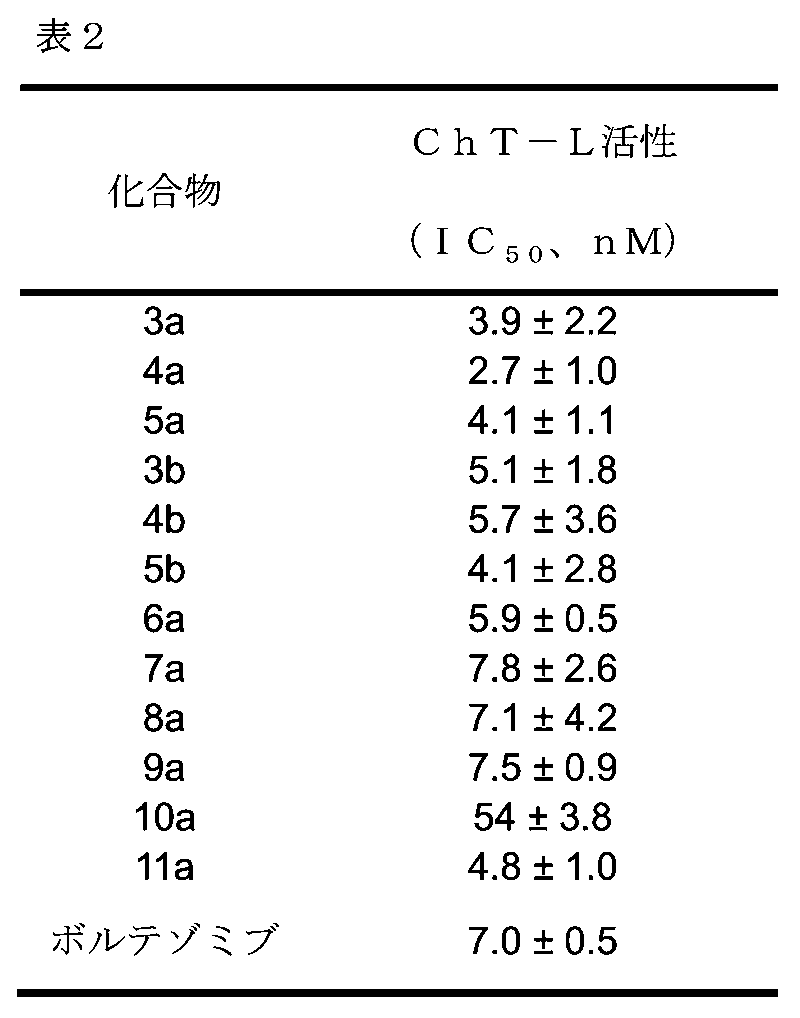
結果を表2および表3に示す。下記表から分かるとおり、いずれの化合物もプロテアソームCPのキモトリプシン様活性に対して十分な阻害効果を示したが、中でも化合物3a~9a、11aおよび3b~5bが、公知のプロテアソーム阻害性化合物であるボルテゾミブと同等の阻害活性を示した。

例3.細胞増殖阻害アッセイ
(1)大腸癌細胞株HCT 116
上記で合成した本発明の化合物の細胞に対する増殖阻害効果を、ヒト大腸癌細胞株であるHCT 116株を用いて検証した。実験は、Cell counting kit-8(同仁化学研究所)を用いて、製品プロトコルにしたがって行った。96ウェルのマイクロタイタープレートに、3000個/ウェルとなるように細胞を播種し、試験化合物で72時間処理した。
結果を表4に示す。表4から分かるとおり、化合物10a以外のいずれの化合物もHCT 116の増殖を効果的に阻害することが可能であった。
(1)大腸癌細胞株HCT 116
上記で合成した本発明の化合物の細胞に対する増殖阻害効果を、ヒト大腸癌細胞株であるHCT 116株を用いて検証した。実験は、Cell counting kit-8(同仁化学研究所)を用いて、製品プロトコルにしたがって行った。96ウェルのマイクロタイタープレートに、3000個/ウェルとなるように細胞を播種し、試験化合物で72時間処理した。
結果を表4に示す。表4から分かるとおり、化合物10a以外のいずれの化合物もHCT 116の増殖を効果的に阻害することが可能であった。

(2)多発性骨髄腫細胞株
大腸がん細胞株HCT 116に代えて多発性骨髄腫細胞株であるMM.1SおよびMM.1Rを用い、上記(1)と同様の方法により本発明の化合物の細胞に対する増殖阻害効果を検証した。MM.1S細胞株はデキサメタゾン感受性のヒト多発性骨髄腫細胞であり、MM.1Rはデキサメタゾン耐性のヒト多発性骨髄腫細胞であり、いずれの細胞もATCCより入手した。
大腸がん細胞株HCT 116に代えて多発性骨髄腫細胞株であるMM.1SおよびMM.1Rを用い、上記(1)と同様の方法により本発明の化合物の細胞に対する増殖阻害効果を検証した。MM.1S細胞株はデキサメタゾン感受性のヒト多発性骨髄腫細胞であり、MM.1Rはデキサメタゾン耐性のヒト多発性骨髄腫細胞であり、いずれの細胞もATCCより入手した。
結果を表5に示す。表5からわかるとおり、本発明の化合物は、既存のプロテアソーム阻害剤と比較して遜色ない程度に細胞増殖を抑制することが可能であった。また、既存のプロテアソーム阻害剤と同様、デキサメタゾンに対する耐性の有無にかかわらず、細胞増殖を抑制することができた。MM.1S細胞およびMM.1R細胞に対して増殖抑制を示す各化合物の濃度は、HCT 116細胞に対して増殖抑制を示す濃度よりも低濃度となる傾向にあった。

例4.阻害活性の可逆性アッセイ
阻害活性の可逆性(安定性)を確認するため、化合物4a、11aおよびボルテゾミブを用いて可逆性アッセイを行った。15nMの20Sプロテアソームを、各阻害性化合物と共に25℃で12時間プレインキュベートした。その後37.5μMのSuc-LLVY-amcを基質として添加し、20Sプロテアソームの「標準(standard)アッセイ」反応を開始した。25℃で1時間インキュベートした後、各反応物の蛍光(励起光:390nm、放出光:450nm)をVersaMax Pro microplate reader(Molecular Devices)で計測した。各「洗浄(wash-out)アッセイ」反応については、20Sプロテアソームと結合していない阻害剤を除去するために、基質との反応前に、プレインキュベートした各反応混合物をMicrocon Centrifugal Filter(100kDa分子量カットオフ)にロードし、11,000×gで3分間遠心することにより、アッセイバッファで5回洗浄した。その後「標準アッセイ」と同様に基質を添加して反応を行った。
阻害活性の可逆性(安定性)を確認するため、化合物4a、11aおよびボルテゾミブを用いて可逆性アッセイを行った。15nMの20Sプロテアソームを、各阻害性化合物と共に25℃で12時間プレインキュベートした。その後37.5μMのSuc-LLVY-amcを基質として添加し、20Sプロテアソームの「標準(standard)アッセイ」反応を開始した。25℃で1時間インキュベートした後、各反応物の蛍光(励起光:390nm、放出光:450nm)をVersaMax Pro microplate reader(Molecular Devices)で計測した。各「洗浄(wash-out)アッセイ」反応については、20Sプロテアソームと結合していない阻害剤を除去するために、基質との反応前に、プレインキュベートした各反応混合物をMicrocon Centrifugal Filter(100kDa分子量カットオフ)にロードし、11,000×gで3分間遠心することにより、アッセイバッファで5回洗浄した。その後「標準アッセイ」と同様に基質を添加して反応を行った。
結果を図1および図2に示す。図1および図2から分かるとおり、化合物11aおよびボルテゾミブは洗浄するとキモトリプシン様活性が大幅に上昇しているのに対し、本発明の化合物は洗浄後もほとんど上昇していない。したがって本発明の化合物は、20Sプロテアソームと強く結合し、容易に阻害活性が低下しないものと考えられる。特に化合物4aと11aは、R3部分の構造が異なるのみであり、このことからR3部分が分岐構造となることによって、20Sプロテアソームとの結合が強まり、安定した阻害活性を発揮するものと考えられる。
例5.プロテアーゼ選択性アッセイ
本発明の化合物が有する阻害活性のプロテアソーム特異性を検証するため、化合物4aおよびボルテゾミブを用いてプロテアーゼ選択性アッセイを行った。Arastu-Kapur et al., Clin. Cancer Res.. 2011, 17(9), 2734-2743に記載されているとおりの方法で行った。簡潔には、カテプシンAについては、22ng/mLのカテプシンA(R&D systems)の活性を、基質として40μMのMca-Arg-Pro-Pro-Gly-Phe-Ser-Ala-Phe-Lys(Dnp)-OH(R&D systems)をアッセイバッファ(50mMのMOPS、pH5.5)に混合したものを用いて25℃で2時間インキュベートした後、各反応物の蛍光(励起光:320nm、放出光:405nm)を計測した。カテプシンBについては、40ng/mLのカテプシンB(R&D systems)の活性を、基質として10μMのZ-Leu-Arg-AMC(R&D systems)をアッセイバッファ(25mMのMES、pH5.0)に混合したものを用いて25℃で30分間インキュベートした後、各反応物の蛍光(励起光:380nm、放出光:460nm)を計測した。カテプシンGについては、8.0μU/mLのカテプシンG(R&D systems)の活性を、基質として200μMのSuc-Ala-Ala-Pro-Phe-AMC(Bachem)をアッセイバッファ(50mMのTris-HCl、pH7.5 150mM NaCl)に混合したものを用いて25℃で1時間インキュベートした後、各反応物の蛍光(励起光:380nm、放出光:460nm)を計測した。HtrA2/Omiについては、7.5μg/mLのHtrA2/Omi(R&D systems)の活性を、基質として40μMのMca-IRRVSYSF(K-Dnp)K(INNOVAGEN)をアッセイバッファ(50mMのTris-HCl、pH8.0)に混合したものを用いて37℃で1時間インキュベートした後、各反応物の蛍光(励起光:320nm、放出光:405nm)を計測した。
本発明の化合物が有する阻害活性のプロテアソーム特異性を検証するため、化合物4aおよびボルテゾミブを用いてプロテアーゼ選択性アッセイを行った。Arastu-Kapur et al., Clin. Cancer Res.. 2011, 17(9), 2734-2743に記載されているとおりの方法で行った。簡潔には、カテプシンAについては、22ng/mLのカテプシンA(R&D systems)の活性を、基質として40μMのMca-Arg-Pro-Pro-Gly-Phe-Ser-Ala-Phe-Lys(Dnp)-OH(R&D systems)をアッセイバッファ(50mMのMOPS、pH5.5)に混合したものを用いて25℃で2時間インキュベートした後、各反応物の蛍光(励起光:320nm、放出光:405nm)を計測した。カテプシンBについては、40ng/mLのカテプシンB(R&D systems)の活性を、基質として10μMのZ-Leu-Arg-AMC(R&D systems)をアッセイバッファ(25mMのMES、pH5.0)に混合したものを用いて25℃で30分間インキュベートした後、各反応物の蛍光(励起光:380nm、放出光:460nm)を計測した。カテプシンGについては、8.0μU/mLのカテプシンG(R&D systems)の活性を、基質として200μMのSuc-Ala-Ala-Pro-Phe-AMC(Bachem)をアッセイバッファ(50mMのTris-HCl、pH7.5 150mM NaCl)に混合したものを用いて25℃で1時間インキュベートした後、各反応物の蛍光(励起光:380nm、放出光:460nm)を計測した。HtrA2/Omiについては、7.5μg/mLのHtrA2/Omi(R&D systems)の活性を、基質として40μMのMca-IRRVSYSF(K-Dnp)K(INNOVAGEN)をアッセイバッファ(50mMのTris-HCl、pH8.0)に混合したものを用いて37℃で1時間インキュベートした後、各反応物の蛍光(励起光:320nm、放出光:405nm)を計測した。
結果を表6に示す。表6から分かるとおりボルテゾミブはカテプシンAおよびカテプシンGに対しても阻害活性を示したのに対し、本発明の化合物はいずれのプロテアーゼに対しても阻害活性を示さなかった。したがって本発明の化合物は高いプロテアソーム選択性を有していると考えられる。

本発明により、新規なプロテアソーム阻害性化合物が提供される。かかる化合物は従前知られたプロテアソーム阻害性化合物と同等の阻害活性を有しながら、不可逆的な阻害活性および高いプロテアソーム阻害選択性、および高い生体内での安定性を有しているため、医薬製剤中の有効成分としての使用において、従来のプロテアソーム阻害性化合物と比較して多くの利点を有しているといえる。したがって、特にがんなどのプロテアソーム関連疾患の治療剤として有用である。
Claims (11)
- 以下の式I

A1およびA2は、互いに独立して、5員または6員の芳香環であり、該芳香環に存在する1または2以上の水素原子は、任意にハロゲン、ヒドロキシル基、ニトロ基、アミノ基、シアノ基またはC1~10のアルキル基から選択される基で置換されていてもよく、
S1およびS2は、互いに独立して、C1~5のアルキレンであり、該アルキレンに存在する炭素原子のうち、XおよびA1もしくはA2に隣接していない炭素原子のいずれか1つが任意に酸素原子で置き換えられていてもよく、
Xは、CまたはNであり、
R1は、C1~5のアルキル基であり、
R2は、C1~10の炭化水素基であり、
ここでR1およびR2に存在する1または2以上の炭素原子は、酸素原子、窒素原子または硫黄原子で置き換えられていく、ただし2以上の原子が置き換えられている場合は、これらの原子は互いに隣接せず、
R1およびR2に存在する1または2以上の水素原子は、任意にハロゲン、ヒドロキシル基、カルボキシル基、ニトロ基、アミノ基またはシアノ基から選択される置換基で置換されていてもよく、
Y1およびY2は、互いに独立して、水素原子またはボロニル基の保護基であり、ここでY1およびY2が一緒になって環構造を形成してもよく、
mおよびnは、互いに独立して、1、2または3である、
で表される化合物、またはその薬学的に許容可能な塩。 - 式Iの-B(OY1)OY2部分の構造が、以下の式II
または式III
で表される構造である、請求項1に記載の化合物、またはその薬学的に許容可能な塩。 - 式Iの-B(OY1)OY2部分の構造が、
- R2が、イソブチル基、シクロヘキシルメチル基またはベンジル基である、請求項1~3のいずれか一項に記載の化合物、またはその薬学的に許容可能な塩。
- S1およびS2が、ともに、-C-C-C-または-C-O-C-である、請求項1~4のいずれか一項に記載の化合物、またはその薬学的に許容可能な塩。
- A1およびA2が、ともにフェニルである、請求項1~5のいずれか一項に記載の化合物、またはその薬学的に許容可能な塩。
- Xが、Cである、請求項1~6のいずれか一項に記載の化合物、またはその薬学的に許容可能な塩。
- 以下の式IV

mおよびnは、互いに独立して、1、2または3である、
で表される化合物、またはその薬学的に許容可能な塩。 - 有効量の請求項1~8のいずれか一項に記載の化合物またはその薬学的に許容可能な塩を含む、プロテアソーム阻害剤。
- 請求項1~8のいずれか一項に記載の化合物またはその薬学的に許容可能な塩を少なくとも1種含む、プロテアソーム関連疾患を処置するための医薬組成物。
- プロテアソーム関連疾患が、腫瘍である、請求項10に記載の医薬組成物。
Priority Applications (1)
| Application Number | Priority Date | Filing Date | Title |
|---|---|---|---|
| JP2015549201A JP6468562B2 (ja) | 2013-11-21 | 2014-11-21 | プロテアソーム阻害性化合物 |
Applications Claiming Priority (2)
| Application Number | Priority Date | Filing Date | Title |
|---|---|---|---|
| JP2013-241039 | 2013-11-21 | ||
| JP2013241039 | 2013-11-21 |
Publications (1)
| Publication Number | Publication Date |
|---|---|
| WO2015076359A1 true WO2015076359A1 (ja) | 2015-05-28 |
Family
ID=53179618
Family Applications (1)
| Application Number | Title | Priority Date | Filing Date |
|---|---|---|---|
| PCT/JP2014/080859 Ceased WO2015076359A1 (ja) | 2013-11-21 | 2014-11-21 | プロテアソーム阻害性化合物 |
Country Status (2)
| Country | Link |
|---|---|
| JP (1) | JP6468562B2 (ja) |
| WO (1) | WO2015076359A1 (ja) |
Cited By (5)
| Publication number | Priority date | Publication date | Assignee | Title |
|---|---|---|---|---|
| JP2018536635A (ja) * | 2015-10-15 | 2018-12-13 | コーネル・ユニバーシティーCornell University | プロテアソーム阻害剤およびその用途 |
| CN113105486A (zh) * | 2021-02-24 | 2021-07-13 | 南京师范大学 | 一种硼酸酯类化合物及其药学上可接受的盐、其制备方法及其用途 |
| US11203613B2 (en) | 2017-10-11 | 2021-12-21 | Cornell University | Peptidomimetic proteasome inhibitors |
| US11202817B2 (en) | 2014-08-18 | 2021-12-21 | Cornell University | Dipeptidomimetics as inhibitors of human immunoproteasomes |
| USRE49816E1 (en) | 2014-01-10 | 2024-01-30 | Cornell University | Dipeptides as inhibitors of human immunoproteasomes |
Citations (3)
| Publication number | Priority date | Publication date | Assignee | Title |
|---|---|---|---|---|
| JPH10510245A (ja) * | 1994-10-28 | 1998-10-06 | プロスクリプト・インコーポレーテッド | ボロン酸エステルおよびボロン酸化合物、合成および使用 |
| JP2004517931A (ja) * | 2001-01-25 | 2004-06-17 | アメリカ合衆国 | ボロン酸化合物製剤 |
| WO2013033396A2 (en) * | 2011-08-30 | 2013-03-07 | Trustees Of Tufts College | Fap-activated proteasome inhibitors for treating solid tumors |
-
2014
- 2014-11-21 WO PCT/JP2014/080859 patent/WO2015076359A1/ja not_active Ceased
- 2014-11-21 JP JP2015549201A patent/JP6468562B2/ja not_active Expired - Fee Related
Patent Citations (3)
| Publication number | Priority date | Publication date | Assignee | Title |
|---|---|---|---|---|
| JPH10510245A (ja) * | 1994-10-28 | 1998-10-06 | プロスクリプト・インコーポレーテッド | ボロン酸エステルおよびボロン酸化合物、合成および使用 |
| JP2004517931A (ja) * | 2001-01-25 | 2004-06-17 | アメリカ合衆国 | ボロン酸化合物製剤 |
| WO2013033396A2 (en) * | 2011-08-30 | 2013-03-07 | Trustees Of Tufts College | Fap-activated proteasome inhibitors for treating solid tumors |
Non-Patent Citations (1)
| Title |
|---|
| KAWAMURA, S. ET AL.: "Structurally novel highly potent proteasome inhibitors created by the structure-based hybridization of nonpeptidic belactosin derivatives and peptide boronates", JOURNAL OF MEDICINAL CHEMISTRY, vol. 57, 2014, pages 2726 - 2735 * |
Cited By (10)
| Publication number | Priority date | Publication date | Assignee | Title |
|---|---|---|---|---|
| USRE49816E1 (en) | 2014-01-10 | 2024-01-30 | Cornell University | Dipeptides as inhibitors of human immunoproteasomes |
| US11202817B2 (en) | 2014-08-18 | 2021-12-21 | Cornell University | Dipeptidomimetics as inhibitors of human immunoproteasomes |
| US12016896B2 (en) | 2014-08-18 | 2024-06-25 | Cornell University | Dipeptidomimetics as inhibitors of human immunoproteasomes |
| JP2018536635A (ja) * | 2015-10-15 | 2018-12-13 | コーネル・ユニバーシティーCornell University | プロテアソーム阻害剤およびその用途 |
| US11066397B2 (en) | 2015-10-15 | 2021-07-20 | Cornell University | Proteasome inhibitors and uses thereof |
| US11629141B2 (en) | 2015-10-15 | 2023-04-18 | Cornell University | Proteasome inhibitors and uses thereof |
| US11203613B2 (en) | 2017-10-11 | 2021-12-21 | Cornell University | Peptidomimetic proteasome inhibitors |
| US11732005B2 (en) | 2017-10-11 | 2023-08-22 | Cornell University | Peptidomimetic proteasome inhibitors |
| CN113105486A (zh) * | 2021-02-24 | 2021-07-13 | 南京师范大学 | 一种硼酸酯类化合物及其药学上可接受的盐、其制备方法及其用途 |
| CN113105486B (zh) * | 2021-02-24 | 2023-08-15 | 南京师范大学 | 一种硼酸酯类化合物及其药学上可接受的盐、其制备方法及其用途 |
Also Published As
| Publication number | Publication date |
|---|---|
| JP6468562B2 (ja) | 2019-02-13 |
| JPWO2015076359A1 (ja) | 2017-03-16 |
Similar Documents
| Publication | Publication Date | Title |
|---|---|---|
| Hennessy et al. | Discovery of a novel class of dimeric Smac mimetics as potent IAP antagonists resulting in a clinical candidate for the treatment of cancer (AZD5582) | |
| JP6871310B2 (ja) | ジペプチド及びトリペプチドエポキシケトンプロテアーゼ阻害剤 | |
| CN105814028B (zh) | 作为免疫调节剂的1,2,4‑*二唑衍生物 | |
| JP6468562B2 (ja) | プロテアソーム阻害性化合物 | |
| CA2777749C (en) | Therapeutic peptides comprising a disubstituted beta-amino acid for treating microbial infections or tumours | |
| Cohen et al. | Orally bioavailable antagonists of inhibitor of apoptosis proteins based on an azabicyclooctane scaffold | |
| Liang et al. | Structure, functions and selective inhibitors of HDAC6 | |
| DE60209227T2 (de) | 2-((n-(2-amino-3-(heteroaryl- oder -aryl)propionyl)aminoacyl)amino)-alkylboronsäurederivate | |
| JP4144811B2 (ja) | ペプチジル−2−アミノ−1−ヒドロキシアルカンスルホン酸システインプロテアーゼインヒビター | |
| Orabi et al. | Selective growth inhibition of human malignant melanoma cells by syringic acid-derived proteasome inhibitors | |
| US20200253995A1 (en) | Method to treat hypercholesterolemia by modulation of proprotein convertase subtilisin/kexin type 9 (pcsk9) protein activity with small molecule ligands | |
| CA2943817C (en) | Tripeptide epoxyketone compound constructed by heterocycle and preparation method and use thereof | |
| JP2021121602A (ja) | 小分子インテグリン受容体−リガンドアゴニストアジュバントを含む免疫治療のための新規組成物及び方法 | |
| Schmitz et al. | Cathepsin B inhibitors: combining dipeptide nitriles with an occluding loop recognition element by click chemistry | |
| WO2017151587A1 (en) | Aza-peptide aldehydes and ketones | |
| CN103387601B (zh) | 抗登革热病毒(denv)杂环肽类化合物及其制备方法和用途 | |
| Pacifico et al. | Synthesis and biological activity of peptide α-ketoamide derivatives as proteasome inhibitors | |
| Navo et al. | Synthesis of N β-Substituted α, β-Diamino Acids via Stereoselective N-Michael Additions to a Chiral Bicyclic Dehydroalanine | |
| JP2016501848A (ja) | 大環状化合物及びその使用 | |
| Shields et al. | Design and synthesis of acyclic boronic acid arginase inhibitors | |
| Marastoni et al. | Naphthoquinone amino acid derivatives, synthesis and biological activity as proteasome inhibitors | |
| JP2013503829A (ja) | 特に医薬に使用するための新規な多機能ペプチダーゼインヒビター | |
| Fatino et al. | Total synthesis of reniochalistatin E | |
| US6153585A (en) | Arylsulfonanilide derivatives | |
| US20240383869A1 (en) | Arylacetyl inhibitors of tg2 and uses thereof |
Legal Events
| Date | Code | Title | Description |
|---|---|---|---|
| 121 | Ep: the epo has been informed by wipo that ep was designated in this application |
Ref document number: 14864020 Country of ref document: EP Kind code of ref document: A1 |
|
| ENP | Entry into the national phase |
Ref document number: 2015549201 Country of ref document: JP Kind code of ref document: A |
|
| NENP | Non-entry into the national phase |
Ref country code: DE |
|
| 122 | Ep: pct application non-entry in european phase |
Ref document number: 14864020 Country of ref document: EP Kind code of ref document: A1 |