WO2015046137A1 - 離型フィルム及び基材レス両面粘着シート - Google Patents
離型フィルム及び基材レス両面粘着シート Download PDFInfo
- Publication number
- WO2015046137A1 WO2015046137A1 PCT/JP2014/075062 JP2014075062W WO2015046137A1 WO 2015046137 A1 WO2015046137 A1 WO 2015046137A1 JP 2014075062 W JP2014075062 W JP 2014075062W WO 2015046137 A1 WO2015046137 A1 WO 2015046137A1
- Authority
- WO
- WIPO (PCT)
- Prior art keywords
- film
- release
- release film
- layer
- coating
- Prior art date
- Legal status (The legal status is an assumption and is not a legal conclusion. Google has not performed a legal analysis and makes no representation as to the accuracy of the status listed.)
- Ceased
Links
Images

Classifications
-
- C—CHEMISTRY; METALLURGY
- C09—DYES; PAINTS; POLISHES; NATURAL RESINS; ADHESIVES; COMPOSITIONS NOT OTHERWISE PROVIDED FOR; APPLICATIONS OF MATERIALS NOT OTHERWISE PROVIDED FOR
- C09J—ADHESIVES; NON-MECHANICAL ASPECTS OF ADHESIVE PROCESSES IN GENERAL; ADHESIVE PROCESSES NOT PROVIDED FOR ELSEWHERE; USE OF MATERIALS AS ADHESIVES
- C09J133/00—Adhesives based on homopolymers or copolymers of compounds having one or more unsaturated aliphatic radicals, each having only one carbon-to-carbon double bond, and at least one being terminated by only one carboxyl radical, or of salts, anhydrides, esters, amides, imides, or nitriles thereof; Adhesives based on derivatives of such polymers
- C09J133/04—Homopolymers or copolymers of esters
- C09J133/06—Homopolymers or copolymers of esters of esters containing only carbon, hydrogen and oxygen, the oxygen atom being present only as part of the carboxyl radical
- C09J133/062—Copolymers with monomers not covered by C09J133/06
- C09J133/066—Copolymers with monomers not covered by C09J133/06 containing -OH groups
-
- B—PERFORMING OPERATIONS; TRANSPORTING
- B32—LAYERED PRODUCTS
- B32B—LAYERED PRODUCTS, i.e. PRODUCTS BUILT-UP OF STRATA OF FLAT OR NON-FLAT, e.g. CELLULAR OR HONEYCOMB, FORM
- B32B27/00—Layered products comprising a layer of synthetic resin
- B32B27/06—Layered products comprising a layer of synthetic resin as the main or only constituent of a layer, which is next to another layer of the same or of a different material
- B32B27/08—Layered products comprising a layer of synthetic resin as the main or only constituent of a layer, which is next to another layer of the same or of a different material of synthetic resin
-
- B—PERFORMING OPERATIONS; TRANSPORTING
- B32—LAYERED PRODUCTS
- B32B—LAYERED PRODUCTS, i.e. PRODUCTS BUILT-UP OF STRATA OF FLAT OR NON-FLAT, e.g. CELLULAR OR HONEYCOMB, FORM
- B32B27/00—Layered products comprising a layer of synthetic resin
- B32B27/18—Layered products comprising a layer of synthetic resin characterised by the use of special additives
- B32B27/20—Layered products comprising a layer of synthetic resin characterised by the use of special additives using fillers, pigments, thixotroping agents
-
- B—PERFORMING OPERATIONS; TRANSPORTING
- B32—LAYERED PRODUCTS
- B32B—LAYERED PRODUCTS, i.e. PRODUCTS BUILT-UP OF STRATA OF FLAT OR NON-FLAT, e.g. CELLULAR OR HONEYCOMB, FORM
- B32B27/00—Layered products comprising a layer of synthetic resin
- B32B27/36—Layered products comprising a layer of synthetic resin comprising polyesters
-
- B—PERFORMING OPERATIONS; TRANSPORTING
- B32—LAYERED PRODUCTS
- B32B—LAYERED PRODUCTS, i.e. PRODUCTS BUILT-UP OF STRATA OF FLAT OR NON-FLAT, e.g. CELLULAR OR HONEYCOMB, FORM
- B32B7/00—Layered products characterised by the relation between layers; Layered products characterised by the relative orientation of features between layers, or by the relative values of a measurable parameter between layers, i.e. products comprising layers having different physical, chemical or physicochemical properties; Layered products characterised by the interconnection of layers
- B32B7/04—Interconnection of layers
- B32B7/06—Interconnection of layers permitting easy separation
-
- B—PERFORMING OPERATIONS; TRANSPORTING
- B32—LAYERED PRODUCTS
- B32B—LAYERED PRODUCTS, i.e. PRODUCTS BUILT-UP OF STRATA OF FLAT OR NON-FLAT, e.g. CELLULAR OR HONEYCOMB, FORM
- B32B7/00—Layered products characterised by the relation between layers; Layered products characterised by the relative orientation of features between layers, or by the relative values of a measurable parameter between layers, i.e. products comprising layers having different physical, chemical or physicochemical properties; Layered products characterised by the interconnection of layers
- B32B7/04—Interconnection of layers
- B32B7/12—Interconnection of layers using interposed adhesives or interposed materials with bonding properties
-
- C—CHEMISTRY; METALLURGY
- C09—DYES; PAINTS; POLISHES; NATURAL RESINS; ADHESIVES; COMPOSITIONS NOT OTHERWISE PROVIDED FOR; APPLICATIONS OF MATERIALS NOT OTHERWISE PROVIDED FOR
- C09J—ADHESIVES; NON-MECHANICAL ASPECTS OF ADHESIVE PROCESSES IN GENERAL; ADHESIVE PROCESSES NOT PROVIDED FOR ELSEWHERE; USE OF MATERIALS AS ADHESIVES
- C09J7/00—Adhesives in the form of films or foils
- C09J7/40—Adhesives in the form of films or foils characterised by release liners
-
- B—PERFORMING OPERATIONS; TRANSPORTING
- B32—LAYERED PRODUCTS
- B32B—LAYERED PRODUCTS, i.e. PRODUCTS BUILT-UP OF STRATA OF FLAT OR NON-FLAT, e.g. CELLULAR OR HONEYCOMB, FORM
- B32B2255/00—Coating on the layer surface
- B32B2255/10—Coating on the layer surface on synthetic resin layer or on natural or synthetic rubber layer
-
- B—PERFORMING OPERATIONS; TRANSPORTING
- B32—LAYERED PRODUCTS
- B32B—LAYERED PRODUCTS, i.e. PRODUCTS BUILT-UP OF STRATA OF FLAT OR NON-FLAT, e.g. CELLULAR OR HONEYCOMB, FORM
- B32B2255/00—Coating on the layer surface
- B32B2255/26—Polymeric coating
-
- B—PERFORMING OPERATIONS; TRANSPORTING
- B32—LAYERED PRODUCTS
- B32B—LAYERED PRODUCTS, i.e. PRODUCTS BUILT-UP OF STRATA OF FLAT OR NON-FLAT, e.g. CELLULAR OR HONEYCOMB, FORM
- B32B2307/00—Properties of the layers or laminate
- B32B2307/70—Other properties
- B32B2307/748—Releasability
-
- B—PERFORMING OPERATIONS; TRANSPORTING
- B32—LAYERED PRODUCTS
- B32B—LAYERED PRODUCTS, i.e. PRODUCTS BUILT-UP OF STRATA OF FLAT OR NON-FLAT, e.g. CELLULAR OR HONEYCOMB, FORM
- B32B2405/00—Adhesive articles, e.g. adhesive tapes
-
- B—PERFORMING OPERATIONS; TRANSPORTING
- B32—LAYERED PRODUCTS
- B32B—LAYERED PRODUCTS, i.e. PRODUCTS BUILT-UP OF STRATA OF FLAT OR NON-FLAT, e.g. CELLULAR OR HONEYCOMB, FORM
- B32B2457/00—Electrical equipment
-
- C—CHEMISTRY; METALLURGY
- C09—DYES; PAINTS; POLISHES; NATURAL RESINS; ADHESIVES; COMPOSITIONS NOT OTHERWISE PROVIDED FOR; APPLICATIONS OF MATERIALS NOT OTHERWISE PROVIDED FOR
- C09D—COATING COMPOSITIONS, e.g. PAINTS, VARNISHES OR LACQUERS; FILLING PASTES; CHEMICAL PAINT OR INK REMOVERS; INKS; CORRECTING FLUIDS; WOODSTAINS; PASTES OR SOLIDS FOR COLOURING OR PRINTING; USE OF MATERIALS THEREFOR
- C09D183/00—Coating compositions based on macromolecular compounds obtained by reactions forming in the main chain of the macromolecule a linkage containing silicon, with or without sulfur, nitrogen, oxygen, or carbon only; Coating compositions based on derivatives of such polymers
- C09D183/04—Polysiloxanes
-
- C—CHEMISTRY; METALLURGY
- C09—DYES; PAINTS; POLISHES; NATURAL RESINS; ADHESIVES; COMPOSITIONS NOT OTHERWISE PROVIDED FOR; APPLICATIONS OF MATERIALS NOT OTHERWISE PROVIDED FOR
- C09J—ADHESIVES; NON-MECHANICAL ASPECTS OF ADHESIVE PROCESSES IN GENERAL; ADHESIVE PROCESSES NOT PROVIDED FOR ELSEWHERE; USE OF MATERIALS AS ADHESIVES
- C09J2433/00—Presence of (meth)acrylic polymer
- C09J2433/005—Presence of (meth)acrylic polymer in the release coating
-
- C—CHEMISTRY; METALLURGY
- C09—DYES; PAINTS; POLISHES; NATURAL RESINS; ADHESIVES; COMPOSITIONS NOT OTHERWISE PROVIDED FOR; APPLICATIONS OF MATERIALS NOT OTHERWISE PROVIDED FOR
- C09J—ADHESIVES; NON-MECHANICAL ASPECTS OF ADHESIVE PROCESSES IN GENERAL; ADHESIVE PROCESSES NOT PROVIDED FOR ELSEWHERE; USE OF MATERIALS AS ADHESIVES
- C09J2467/00—Presence of polyester
- C09J2467/006—Presence of polyester in the substrate
-
- C—CHEMISTRY; METALLURGY
- C09—DYES; PAINTS; POLISHES; NATURAL RESINS; ADHESIVES; COMPOSITIONS NOT OTHERWISE PROVIDED FOR; APPLICATIONS OF MATERIALS NOT OTHERWISE PROVIDED FOR
- C09J—ADHESIVES; NON-MECHANICAL ASPECTS OF ADHESIVE PROCESSES IN GENERAL; ADHESIVE PROCESSES NOT PROVIDED FOR ELSEWHERE; USE OF MATERIALS AS ADHESIVES
- C09J2483/00—Presence of polysiloxane
- C09J2483/006—Presence of polysiloxane in the substrate
Definitions
- the present invention relates to a release film and a substrate-less double-sided pressure-sensitive adhesive sheet, and relates to a release film having excellent oligomer sealing performance and foreign matter inspection performance and a substrate-less double-sided pressure-sensitive adhesive sheet having the release film.
- a base-less double-sided pressure-sensitive adhesive sheet is known as one of pressure-sensitive adhesive sheets.
- the substrate-less double-sided PSA sheet consists of a laminate structure in which a light release film with a relatively low peel strength and a heavy release film with a relatively high peel strength are laminated on both sides of the adhesive layer. After the removal, the double-sided pressure-sensitive adhesive sheet becomes only the pressure-sensitive adhesive layer having no supporting substrate.
- the substrate-less double-sided pressure-sensitive adhesive sheet As a method of using the substrate-less double-sided pressure-sensitive adhesive sheet, first, the light release film is peeled off, and one surface of the exposed pressure-sensitive adhesive layer is adhered to the object surface of the other side to be bonded, and after the adhesion, the heavy release film is further peeled off, A processing step in which the other surface of the exposed pressure-sensitive adhesive layer is bonded to different object surfaces and thereby the surfaces are bonded to each other is exemplified (Patent Document 1).
- the substrate-less double-sided pressure-sensitive adhesive sheet has attracted attention because of its good workability, and its application is expanding. It is also used for members for various optical applications such as mobile phones and tablet computers.
- a capacitive touch panel is rapidly expanding its application as an information terminal by a multi-touch operation in which a screen operation is performed with two fingers.
- a polyester film base material component hereinafter abbreviated as OL
- OL polyester film base material component
- Measures to prevent foreign matter from flowing out include inspecting with optical evaluation by bonding to the other member with the adhesive layer provided on the second release film (heavy release side). In that case, when an inspection is performed through an optical member having a polarizing action, the inspection visual field may become dark depending on the angle. Moreover, in the optical visual evaluation in the state which bonded the release film, the granular feeling resulting from the particle
- the solution subject is a release film required for the member for electrostatic capacitance type touch panels, and a flat panel base material, and is especially highly transparent which dislikes a foreign material.
- Substrate-less double-sided pressure-sensitive adhesive sheet especially used under high-temperature conditions with spattering, and prevents high-quality separation that prevents contamination of processes with severe cleanliness during processing and has excellent foreign matter inspection. It is to provide a mold film.
- a base polyester film has a first coating layer obtained by coating a coating solution containing a quaternary ammonium base-containing polymer, a polyethylene glycol-containing acrylate polymer and a crosslinking agent on at least one surface. And having a second coating layer formed by coating a coating agent containing at least one organosiloxane compound on at least one first coating layer and having a thickness of 10 to 100 nm, and at least one first coating layer.
- a release layer having a release layer on the coating layer, and the amount of oligomer deposition on the film surface after heat-treating the release layer surface at 150 ° C. for 60 minutes is 0.5 mg / m 2 or less Be on film.
- the substrate-less double-sided pressure-sensitive adhesive sheet necessary for mobile and television applications, for example, capacitive touch panel members and flat panel substrates, particularly used under high-temperature conditions involving sputtering.
- the release film used for the base material-less double-sided pressure-sensitive adhesive sheet can be provided with a high-quality release film having a high OL sealing function and excellent in foreign matter inspection. Industrial value is high.
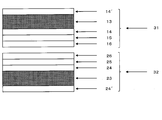
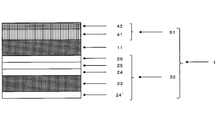
- Schematic explanatory drawing showing the configuration of the release film of the present invention Schematic explanatory drawing showing the configuration of the substrate-less double-sided PSA sheet of the present invention
- the base polyester film used in the release film of the present invention is a polyester film extruded by a so-called extrusion method that is melt-extruded from an extrusion die, and, if necessary, in the biaxial direction of the longitudinal direction and the lateral direction.
- An oriented film is an oriented film.
- the above polyester is obtained by polycondensation of an aromatic dicarboxylic acid and an aliphatic glycol.
- aromatic dicarboxylic acid include terephthalic acid and 2,6-naphthalenedicarboxylic acid
- aliphatic glycol include ethylene glycol, diethylene glycol, and 1,4-cyclohexanedimethanol.
- Representative polyesters include polyethylene terephthalate (PET), polyethylene-2,6-naphthalene dicarboxylate (PEN), and the like.
- the polyester may be a homopolyester or a copolyester.
- a copolyester it is a copolymer containing 30 mol% or less of the third component.
- the dicarboxylic acid component of the copolyester include isophthalic acid, phthalic acid, terephthalic acid, 2,6-naphthalenedicarboxylic acid, adipic acid, sebacic acid, and one kind of oxycarboxylic acid (for example, P-oxybenzoic acid).
- glycol component examples include one or more types such as ethylene glycol, diethylene glycol, propylene glycol, butanediol, 1,4-cyclohexanedimethanol, neopentyl glycol and the like.
- the base polyester film is a laminated polyester film having a polyester layer containing 3000 to 30000 ppm of a polymer containing at least two epoxy groups in the molecular chain on both surfaces in order to further enhance the OL sealing function. May be.
- the content of the epoxy group is less than 3000 ppm, the acid catalyst deactivation ability of the carboxyl group due to the epoxy group is not sufficient, and when the content exceeds 30000 ppm, the viscosity of the polyester is increased by cross-linking by a chemical reaction between the epoxy group and the carboxyl group. As a result, it becomes difficult to extrude with a polyester extruder.
- the type of the polymer having at least two epoxy groups in the molecular chain is not particularly limited as long as it is a polymer compatible with the polyester resin.
- polyester resin acrylic resin, polyurethane resin, polycarbonate resin, styrene Resin, polyimide resin, polyamide resin, polyolefin resin, a mixture thereof, a copolymer, and the like.
- a resin that is particularly preferably used is a copolymer of an acrylic resin and a styrene resin.
- the molecular weight of the polymer having at least two epoxy groups in the molecular chain is not particularly limited as long as it is compatible with the polyester resin, but the average molar molecular weight is usually 350 to 8000 g / mol, preferably 400 to 3000 g. / Mol, more preferably 500 to 3000 g / mol.
- the thickness of the polyester film for OL sealing function is usually 2 ⁇ m or more, preferably 4 ⁇ m or more, more preferably 5 ⁇ m or more, and particularly preferably 6 ⁇ m or more. When the thickness is less than 4 ⁇ m, the OL sealing function tends not to be sufficiently exhibited.
- the base polyester film it is preferable to blend particles mainly for the purpose of imparting slipperiness and preventing the occurrence of scratches in each step.
- the kind of the particle to be blended is not particularly limited as long as it is a particle capable of imparting slipperiness. Specific examples thereof include silica, calcium carbonate, magnesium carbonate, barium carbonate, calcium sulfate, calcium phosphate, and phosphoric acid. Examples of the particles include magnesium, kaolin, aluminum oxide, and titanium oxide. Further, heat-resistant organic particles as described in JP-B-59-5216, JP-A-59-217755 and the like may be used.
- thermosetting urea resins examples include thermosetting urea resins, thermosetting phenol resins, thermosetting epoxy resins, benzoguanamine resins, and the like.
- precipitated particles obtained by precipitating and finely dispersing a part of a metal compound such as a catalyst during the polyester production process can also be used.
- the shape of the particles to be used is not particularly limited, and any of a spherical shape, a block shape, a rod shape, a flat shape, and the like may be used. Moreover, there is no restriction
- the average particle size of the particles used is usually in the range of 0.01 to 3 ⁇ m, preferably 0.1 to 2 ⁇ m.
- the slipperiness may not be sufficiently imparted.
- the thickness exceeds 3 ⁇ m, transparency may be lowered due to an aggregate of the particles during film formation, and breakage is likely to occur, resulting in a problem in productivity.
- the base polyester film may be a laminated polyester film having polyester layers containing core-shell type particles having an average particle diameter of 0.5 to 3.0 ⁇ m on both surfaces for improving visibility.
- the advantage of using the core-shell type organic particles is the resin followability when the polyester film is stretched. Specifically, in the film-forming process that imparts easy testability to the polyester film, a special stretching prescription that increases the stretching ratio in the running direction of the film or in the direction perpendicular to the running direction may be used. Occasionally, ordinary inorganic particles and simple organic particles cannot follow the stretching of the polyester and generate voids. This void causes light to be refracted and scattered, and gives a grainy appearance by visual inspection.
- the outer shell and the inner core molecular weight, crosslink density, hardness can be adjusted as appropriate, and by adjusting the above, the occurrence of voids is prevented, and the graininess is eliminated. Foreign objects can be found more clearly.
- the shape of the core / shell type organic particles to be used is not particularly limited, and any shape such as a spherical shape, a lump shape, a rod shape, a flat shape, etc. can be used as long as the resin following property is prevented so as to prevent the generation of voids. Also good. Moreover, there is no restriction
- the average particle size of the core-shell type organic particles used is usually in the range of 0.5 to 3.0 ⁇ m, preferably 1.0 to 2.0 ⁇ m.
- the average particle size is less than 0.5 ⁇ m, sufficient slipperiness cannot be imparted, and haze is increased in order to provide sufficient slipperiness.
- the thickness exceeds 3.0 ⁇ m, the transparency may be lowered due to the aggregate of the particles during film formation, and it is easy to cause breakage, which is a problem in terms of productivity. Become.
- the particle content in the base polyester film is usually in the range of 0.001 to 5% by weight, preferably 0.005 to 3% by weight.
- the particle content is less than 0.001% by weight, the slipperiness of the film may be insufficient.
- the content exceeds 5% by weight, the transparency of the film is insufficient. There is a case.
- the method for adding particles to the polyester layer is not particularly limited, and a conventionally known method can be adopted.
- it can be added at any stage for producing the polyester constituting each layer, but it is preferably added after completion of esterification or transesterification.
- a method of blending a slurry of particles dispersed in ethylene glycol or water with a vented kneading extruder and a polyester raw material, or a blending of dried particles and a polyester raw material using a kneading extruder is done by methods.
- a production example of the polyester film will be specifically described, but is not limited to the following production example. That is, a method of using the polyester raw material described above and cooling and solidifying a molten sheet extruded from a die with a cooling roll to obtain an unstretched sheet is preferable. In this case, in order to improve the flatness of the sheet, it is preferable to improve the adhesion between the sheet and the rotary cooling drum, and an electrostatic application adhesion method and / or a liquid application adhesion method is preferably employed. Next, the obtained unstretched sheet is stretched in the biaxial direction. In that case, first, the unstretched sheet is stretched in one direction by a roll or a tenter type stretching machine.
- the stretching temperature is usually 70 to 120 ° C., preferably 80 to 110 ° C., and the stretching ratio is usually 2.5 to 7.0 times, preferably 3.0 to 6.0 times.
- the film is stretched in the direction perpendicular to the first stretching direction.
- the stretching temperature is usually 70 to 170 ° C.
- the stretching ratio is usually 3.0 to 7.0 times, preferably 3.5 to 6 times. .0 times.
- heat treatment is performed at a temperature of 180 to 270 ° C. under tension or relaxation within 30% to obtain a biaxially oriented film.
- a method in which stretching in one direction is performed in two or more stages can be employed. In that case, it is preferable to carry out so that the draw ratios in the two directions finally fall within the above ranges.
- the simultaneous biaxial stretching method is a method in which the aforementioned unstretched sheet is stretched and oriented simultaneously in the machine direction and the width direction in a state where the temperature is normally controlled at 70 to 120 ° C., preferably 80 to 110 ° C. Is 4 to 50 times, preferably 7 to 35 times, and more preferably 10 to 25 times in terms of area magnification. Subsequently, heat treatment is performed at a temperature of 170 to 250 ° C. under tension or under relaxation within 30% to obtain a stretched oriented film.
- a conventionally known stretching method such as a screw method, a pantograph method, or a linear driving method can be employed.
- the thickness of the release film of the present invention is preferably within a range that does not reduce the yield during film formation and the yield during functional coating processing, and further, the stiffness in the subsequent adhesive process is not guaranteed. Must not. Usually, it is 150 ⁇ m or less, preferably 25 to 150 ⁇ m, more preferably 38 to 150 ⁇ m. If the film thickness is less than 25 ⁇ m, the stiffness in the pressure-sensitive adhesive process is not guaranteed, and there is a problem that the workability is deteriorated. If it is thicker than 150 ⁇ m, scratches occur at the time of functional coating processing, the sagging becomes severe, and adhesion in the next process Processing of the agent becomes difficult, and problems such as not being able to wind a lot in the adhesive process occur.
- the first coating layer (which is a layer adjacent to the polyester substrate) constituting the release film of the present invention
- it may be provided by in-line coating, which treats the film surface during the stretching process of the polyester film, or may be applied off-system on the film once manufactured, and may be adopted off-line coating. May be used in combination. Since coating can be performed simultaneously with film formation, in-line coating is preferably used in that the production can be handled at low cost and the thickness of the first coating layer can be changed by the draw ratio.
- the in-line coating is not limited to the following, for example, in the sequential biaxial stretching, a coating treatment can be performed particularly before the lateral stretching after the longitudinal stretching is finished.
- a coating layer is provided on a polyester film by in-line coating, coating can be performed simultaneously with film formation, and the coating layer can be processed at a high temperature, and a film suitable as a polyester film can be produced.
- the first coating layer has an essential requirement to use a coating solution containing a quaternary ammonium base-containing polymer for the purpose of preventing oligomer components from entering the process and preventing contamination.
- quaternary ammonium base-containing polymer those having a constituent element containing a quaternary ammonium base in the main chain or side chain in the molecule are targeted.
- Specific examples include pyrrolidinium ring, quaternized alkylamine, further copolymerized with acrylic acid or methacrylic acid, quaternized N-alkylaminoacrylamide, vinylbenzyltrimethylammonium salt, 2-hydroxy-3- And methacryloxypropyltrimethylammonium salt.
- these may be combined or copolymerized with other binder polymers.
- anion that serves as a counter ion for these quaternary ammonium salts include ions such as halogen, alkyl sulfate, alkyl sulfonate, and nitric acid.
- counter ions other than halogen are preferable for the use of the present invention in that heat resistance is particularly good.
- the molecular weight of the quaternary ammonium base-containing polymer if the molecular weight is too low, it may be easily removed from the coating layer, resulting in degradation of performance over time or problems such as blocking of the coating layer. Moreover, when the molecular weight is low, the heat stability tends to be inferior.
- the number average molecular weight of the quaternary ammonium base-containing polymer is usually 1000 or more, preferably 2000 or more, and more preferably 5000 or more.
- the upper limit of the number average molecular weight is preferably 500,000 or less.
- these compounds may be used independently and may be used in combination of 2 or more types.
- the blending amount of the quaternary ammonium base-containing polymer in the first coating layer is preferably in the range of 20 to 70% by weight, more preferably in the range of 40 to 70% by weight in terms of dry weight. When it is out of the range, it becomes difficult to obtain a desired OL sealing effect.
- polyethylene glycol-containing acrylate polymer in the coating solution for the purpose of improving the stretch following property when forming the first coating layer.
- the number average molecular weight of the polyethylene glycol-containing acrylate polymer is usually 1000 or more, preferably 2000 or more, and more preferably 5000 or more.
- the upper limit of the number average molecular weight is preferably 500,000 or less.
- these compounds may be used independently and may be used in combination of 2 or more types.
- a polyethylene glycol-containing alkyl acrylate polymer in combination in order to further improve stretchability.
- the chain length of the alkyl chain is not particularly limited as long as it is in a range that can be polymerized as a polymer.
- the content of the polyethylene glycol-containing alkyl acrylate polymer is preferably in the range of 5 to 40% by weight in order to improve stretchability. When it is out of the range, problems such as insufficient stretch followability at the time of forming the first coating layer occur.
- the quaternary ammonium base-containing polymer and the polyethylene glycol-containing acrylate polymer may be a mixture or may be copolymerized in advance, and are not particularly limited as long as the gist of the present invention is not impaired. . Moreover, when making it copolymerize, a conventionally well-known manufacturing method can be used.
- a crosslinking agent in combination as a coating solution for the purpose of further improving the durability of the first coating layer.
- Specific examples include methylolated or alkylolized urea, melamine, guanamine, oxazoline, epoxy compound, acrylamide, polyamide compound, epoxy compound, aziridine compound, isocyanate compound, titanium coupling agent, zirco-aluminate coupling agent, poly Examples thereof include carbodiimide.
- melamine cross-linking agents are preferred in terms of good coating properties and durable adhesion, particularly for the purposes of the present invention.
- the melamine crosslinking agent is not particularly limited, but melamine, a methylolated melamine derivative obtained by condensing melamine and formaldehyde, a compound partially or completely etherified by reacting methylolated melamine with a lower alcohol, And a mixture thereof can be used.
- the melamine crosslinking agent may be either a monomer or a condensate composed of a dimer or higher polymer, or a mixture thereof.
- the lower alcohol used for the etherification methyl alcohol, ethyl alcohol, isopropyl alcohol, n-butanol, isobutanol and the like can be preferably used.
- the functional group has an imino group, a methylol group, or an alkoxymethyl group such as a methoxymethyl group or a butoxymethyl group in one molecule, and an imino group type methylated melamine, a methylol group type melamine, or a methylol group type methylated group.
- Melamine fully alkyl methylated melamine and the like can be used. Of these, methylolated melamine is most preferred. Furthermore, an acidic catalyst such as p-toluenesulfonic acid can be used in combination for the purpose of promoting the thermal curing of the melamine crosslinking agent.
- the oxazoline cross-linking agent is a compound having an oxazoline ring in the molecule, and includes a monomer having an oxazoline ring and a polymer synthesized using an oxazoline compound as one of raw material monomers.
- Isocyanate compound refers to a compound having an isocyanate group in the molecule, specifically hexamethylene diisocyanate, trimethylhexamethylene diisocyanate, cyclohexylene diisocyanate, xylylene diisocyanate, isophorone diisocyanate, naphthalene diisocyanate, tolylene diisocyanate, and the like. And polymers and derivatives thereof.
- Examples of the epoxy compound include a compound containing an epoxy group in the molecule, a prepolymer and a cured product thereof.
- a typical example is a condensate of epichlorohydrin and bisphenol A.
- a reaction product of a low molecular polyol with epichlorohydrin gives an epoxy resin having excellent water solubility.
- cross-linking agents may be used alone or in combination of two or more. Furthermore, when consideration is given to application to in-line coating, it is preferable to have water solubility or water dispersibility.
- the “binder polymer” used in the present invention is a number average molecular weight (Mn) measured by gel permeation chromatography (GPC) according to a polymer compound safety evaluation flow scheme (November 1985, sponsored by the Chemical Substances Council). ) Is a polymer compound having a molecular weight of 1000 or more and having a film-forming property.
- binder polymer examples include polyester resin, acrylic resin, polyvinyl (polyvinyl alcohol, polyvinyl chloride, vinyl chloride vinyl acetate copolymer, etc.), polyurethane resin, polyalkylene glycol, polyalkyleneimine, methylcellulose, hydroxycellulose, starch. And the like.
- Analysis of the components in the coating solution for forming the first coating layer can be performed by surface analysis such as TOF-SIMS.
- the first coating layer When providing the first coating layer by in-line coating, apply the above-mentioned series of compounds as an aqueous solution or water dispersion onto a polyester film with a coating solution adjusted to a solid content concentration of about 0.1 to 50% by weight. It is preferable to produce a laminated polyester film as described above. Moreover, in the range which does not impair the main point of this invention, a small amount of organic solvents may be contained in the coating liquid for the purpose of improving dispersibility in water, improving film-forming properties, and the like. Only one type of organic solvent may be used, or two or more types may be used as appropriate.
- the thickness of the first coating layer is usually 0.02 to 0.10 g / m 2 (that is, 20 to 100 nm), more preferably 0.03 to 0.08 g / m 2 , and further preferably 0.04 to 0. The range is 0.07 g / m 2 .
- the film thickness is less than 0.02 g / m 2, sufficient OL sealing performance cannot be obtained, and when it exceeds 0.1 g / m 2 , the curing of silicone is severely inhibited, and a release coating film is not formed. In addition, the cost increases.
- Examples of the method for providing the first coating layer include conventionally known coating methods such as reverse gravure coating, direct gravure coating, roll coating, die coating, bar coating, and curtain coating.
- coating method there is an example described in “Coating Method”, published by Yoji Harasaki, published in 1979.
- the drying and curing conditions for forming the first coating layer are not particularly limited.
- the coating layer is usually 80 to 200 ° C. for 3 to 40 seconds, preferably 100.
- Heat treatment is preferably performed at about 180 ° C. for 3 to 40 seconds as a guide.
- the first coating layer is provided by in-line coating, it is usually preferable to perform heat treatment at 70 to 280 ° C. for 3 to 200 seconds as a guide.
- the base polyester film in the present invention may be subjected to surface treatment such as corona treatment or plasma treatment in advance.
- the formation of the second coating layer laminated on the first layer will be described.
- the above-described coating stretching method in-line coating
- a so-called off-line coating applied outside the system on the polyester film having the coating layer once manufactured may be employed. Any method may be adopted.
- the second coating layer is formed by coating a coating agent containing at least one organosiloxane compound.
- Urethane acrylic compounds may have an adverse effect when an acrylic molecular unit forms a release layer, but organosiloxane compounds do not have such problems. Examples of organosiloxane compounds are shown below. Various substituents of the organosiloxane of the following formula are variously changed. (R 1 ) (R 3 ) 2 Si— (O—Si (R 1 ) (R 3 )) n— (O—Si (R 2 ) (R 3 )) mR 3
- R 1 and R 2 are each independently an organic group containing an epoxy group such as a ⁇ -glycidoxypropyl group, a 3,4-epoxycyclohexylethyl group, or a methoxy group
- R 3 is an alkoxy group such as a methoxy group or an ethoxy group, or a group represented by the following formula.
- R 4 is the same epoxy group-containing organic group or alkoxy group as the R 1 group or R 2 group.
- the organosiloxane include ⁇ -glycidoxypropyltrimethoxysilane, 2- (3,4-epoxycyclohexyl) ethyltrimethoxysilane, 2- (3,4-epoxycyclohexyl) ethyltriethoxysilane, 5 , 6-epoxyhexyltriethoxysilane, tetraethoxysilane, metolaethoxysilane, and other monomers, and hydrolyzable organisms of these monomers or mixtures of these monomers.
- the organic solvent for dissolving the second coating layer forming material is preferably one containing at least one alcohol solvent selected from ethanol, propanol, i-propanol, butanol, i-butanol, t-butanol, pentanol and the like.
- inorganic particles may be contained for the purpose of improving the adhesion and slipperiness of the second coating layer, and specific examples include silica, alumina, kaolin, calcium carbonate, titanium oxide, barium salt and the like.
- an antifoaming agent if the material has a low influence on the curing reaction inhibition of the release layer described later, an antifoaming agent, a coating property improver, a thickener, an organic lubricant, an organic polymer particle, an antioxidant, if necessary.
- An agent, an ultraviolet absorbent foaming agent, a dye, and the like may be contained.
- only one type of organic solvent may be used for the purpose of improving dispersibility, improving film forming property, etc., and two or more types may be used as appropriate.
- the coating amount (after drying) of the second coating layer is usually 10 to 100 nm, preferably 20 to 100 nm.
- the coating amount is less than 10 nm, the uniformity of the coating thickness may be insufficient, and the amount of OL deposited from the surface of the B layer after heat treatment increases.
- the thickness exceeds 100 nm, the coating film is brittle even if it has OL sealing performance, and scratches are likely to occur in the drying process and then the winding process after coating, and the film appearance tends to become cloudy.
- the surface roughness (Sa) of the second coating layer is preferably 10 nm or less. When the surface roughness exceeds 10 nm, the OL sealing performance tends to decrease. Furthermore, in order to exhibit sealing performance, Sa is preferably 8 nm or less. As a method of controlling this Sa, it is important that clusters (aggregates) are not generated as much as possible with the coating liquid before coating. As a result of the examination, it was found that the Sa can be controlled when the solution haze is usually 1.0% or less, preferably 0.5% or less.
- a conventionally known coating method such as reverse gravure coating, direct gravure coating, roll coating, die coating, bar coating, curtain coating or the like can be used.
- the coating method there is an example described in “Coating Method” Tsuji Shoten published by Yuji Harasaki in 1979.
- heat treatment is usually performed at 120 ° C. or more, preferably 120 to 200 ° C. for 3 to 40 seconds, more preferably 120 to 160 ° C. for 3 to 40 seconds. Heat treatment is performed. When the heat treatment is not performed at 120 ° C. or higher, the coating film formation is incomplete and the amount of OL deposited increases.
- OL oligomer
- OL oligomer
- the 1st application layer and the 2nd application layer which have OL sealing performance independently, but by combining these, the structure which complements the adhesion
- the OL sealing performance can be achieved more efficiently than making either one of the films with the same thickness (the thickness of the first coating layer + the second coating layer). Further, even if only the second coating layer is applied to a certain extent so as to exceed 100 nm, a desired OL sealing performance can be imparted. Cause inhibition of curing. Further, when the film thickness is large, the cost is also a big problem for production.
- the technical key of the present invention is that the combination of the first and second coating layer layers and the thickness are important, and it is considered that a synergistic effect is brought about in the OL sealing performance.
- the release layer provided on the coating layer (first coating layer) and (second coating layer) in the present invention is not particularly limited as long as it contains a material having releasability.
- the one containing a curable silicone resin is preferable because the releasability is improved.
- a type having a curable silicone resin as a main component may be used, or a modified silicone type by graft polymerization with an organic resin such as a urethane resin, an epoxy resin, or an alkyd resin may be used.
- any of the curing reaction types such as an addition type, a condensation type, an ultraviolet curable type, an electron beam curable type, and a solventless type can be used.
- curable silicone resin examples include KS-774, KS-775, KS-778, KS-779H, KS-847H, KS-856, X-62-2422, X-manufactured by Shin-Etsu Chemical Co., Ltd.
- Examples include DKQ3-203, DKQ3-204, DKQ3-205, DKQ3-210, and the like.
- a release control agent may be used in combination to adjust the release property of the release layer.
- a release control agent may be used in combination to adjust the release property of the release layer.
- a silane compound having an amino group may be added to the release layer.
- the coating amount of the release layer that can use a conventionally known coating method such as reverse roll coating, gravure coating, bar coating, doctor blade coating, etc. is usually 0.01 to 1 g / We are in the range of m 2.
- a coating layer such as an adhesive layer, an antistatic layer, and an oligomer precipitation preventing layer may be provided on the surface where the release layer is not provided, and the polyester film is subjected to a surface treatment such as corona treatment or plasma treatment. May be.
- drying and / or curing (thermal curing, ionizing radiation curing, etc.) of the adhesive layer or release layer coating can be performed individually or simultaneously. When performing simultaneously, it is preferable to carry out at the temperature of 80 degreeC or more.
- the drying and curing conditions are preferably 80 ° C. or higher and 10 seconds or longer. If the drying temperature is less than 80 ° C. or the curing time is less than 10 seconds, the coating film is incompletely cured, and the coating film tends to fall off.
- a transition metal catalyst is preferably used in order to make the coating layer of the release film clean and strong.
- the content of the transition metal catalyst in the coating layer is in the range of 1.0 to 5.0% by weight, preferably 3.0 to 4.0% by weight.
- a component containing nitrogen or the like containing surplus electrons contained in the first and second coating layers installed for the purpose of OL sealing Since the silicone curing reaction is inhibited, the adhesion of the coating film may be lowered, and the defect of peeling force and the curing reaction in the coating layer become insufficient, resulting in problems such as deterioration of the surface condition.
- the amount of metal in the coating layer was measured by a film FP method using a fluorescent X-ray analyzer (model “XRF-1500” manufactured by Shimadzu Corporation).
- the amount of elements in the film can be determined by measurement.
- the detection limit in this method is usually about 1 ppm.
- SAICAS the sample film is obliquely cut to expose the cross-section, and then the coating layer is applied to the polyester film using TOF-SIMS (time-of-flight mass spectrometry mass spectrum).
- TOF-SIMS time-of-flight mass spectrometry mass spectrum
- the amount of hydrogen (H 2 ) gas generated from the release film is preferably suppressed to 60 ppm or less, more preferably Is 40 ppm or less.
- a silicone resin with a small amount of functional groups is used for the purpose of adjusting the release of the release layer.
- a method of selecting a type having a small amount of Si—H groups derived from a crosslinking agent is exemplified.
- the release film of the present invention can be used even in applications involving sputtering of inorganic metal oxides such as highly transparent conductive substrates, and after the release layer surface of the release film is heat-treated (150 ° C., 60 minutes) , OL amounts extracted by dimethylformamide from the surface, is preferably 0.50 mg / m 2 or less, more preferably 0.20 mg / m 2, particularly preferably not more than 0.10 mg / m 2.
- OL exceeds 0.50 mg / m 2 , for example, in the sputtering process, OL occurs during heating due to scratches on the film attached with a roll or the like, and is temporarily attached to the final product after bonding. This may cause problems in the inspection process that involves a decrease in the transparency of the pressure-sensitive adhesive, a decrease in the adhesive strength of the pressure-sensitive adhesive layer, and optical evaluation, and further causes a process contamination.
- the release film of the present invention can also be used in a normal pressure-sensitive adhesive process.
- the amount of OL extracted from the surface with dimethylformamide after heat treatment is performed on the release layer surface of the release film. , is preferably 0.20 mg / m 2 or less, more preferably 0.15 mg / m 2 or less, particularly preferably 0.01 mg / m 2 or less.
- OL exceeds 0.20 mg / m 2 , for example, due to scratches attached with a roll or the like in the adhesion process, OL is generated during heating, resulting in a decrease in transparency of the adhesive and a decrease in adhesive strength of the adhesive layer. This causes troubles in the inspection process involving optical evaluation, and further causes problems such as causing process contamination.
- Means for satisfying the range of the inclination (orientation angle) of the orientation principal axis of the second release film of the present invention is a stretching ratio, and a stretching temperature as long as productivity does not decrease as a stretching condition during film formation. Is to devise.
- the pressure-sensitive adhesive layer in the present invention means a layer composed of an adhesive material, and conventionally known materials can be used as long as the gist of the present invention is not impaired. As one specific example, the case where an acrylic adhesive is used will be described below.
- the acrylic pressure-sensitive adhesive means a pressure-sensitive adhesive layer containing, as a base polymer, an acrylic polymer formed using an acrylic monomer as an essential monomer component.
- the acrylic polymer has (meth) acrylic acid alkyl ester and / or (meth) acrylic acid alkoxyalkyl ester having a linear or branched alkyl group as an essential monomer component (more preferably as a main monomer component). ) It is preferably an acrylic polymer to be formed.
- the acrylic polymer is preferably an acrylic polymer formed using (meth) acrylic acid alkyl ester and acrylic acid alkoxyalkyl ester having a linear or branched alkyl group as essential monomer components.
- the pressure-sensitive adhesive layer of the present invention is an acrylic pressure-sensitive adhesive layer formed using (meth) acrylic acid alkyl ester and acrylic acid alkoxyalkyl ester having a linear or branched alkyl group as essential monomer components. preferable.
- the monomer component forming the acrylic polymer that is the base polymer in the pressure-sensitive adhesive layer of the present invention further contains a polar group-containing monomer, a polyfunctional monomer, and other copolymerizable monomers. It may be contained as a polymerization monomer component.
- said "(meth) acryl” represents “acryl” and / or "methacryl", and others are the same.
- the content of the acrylic polymer as the base polymer in the pressure-sensitive adhesive layer of the present invention is preferably 60% by weight or more based on the total weight (100% by weight) of the pressure-sensitive adhesive layer. Preferably it is 80 weight% or more.
- a (meth) acrylic acid alkyl ester having a linear or branched alkyl group (hereinafter sometimes simply referred to as “(meth) acrylic acid alkyl ester”) is used. It can be used suitably.
- (meth) acrylic acid alkyl ester examples include methyl (meth) acrylate, ethyl (meth) acrylate, propyl (meth) acrylate, isopropyl (meth) acrylate, butyl (meth) acrylate, (meth ) Isobutyl acrylate, s-butyl (meth) acrylate, t-butyl (meth) acrylate, pentyl (meth) acrylate, isopentyl (meth) acrylate, hexyl (meth) acrylate, heptyl (meth) acrylate , Octyl (meth) acrylate, 2-ethylhexyl (meth) acrylate, isooctyl (meth) acrylate, nonyl (meth) acrylate, isononyl (meth) acrylate, decyl (meth) acrylate, (meth) acrylic acid I
- the (meth) acrylic acid alkyl ester may be used alone or in combination of two or more. Among them, (meth) acrylic acid alkyl esters having 2 to 14 carbon atoms in the alkyl group are preferable, and (meth) acrylic acid alkyl esters having 2 to 10 carbon atoms in the alkyl group are more preferable.
- Examples of the polar group-containing monomer include, for example, (meth) acrylic acid, itaconic acid, maleic acid, fumaric acid, crotonic acid, isocrotonic acid and other carboxyl group-containing monomers or anhydrides thereof (such as maleic anhydride) Hydroxyalkyl (meth) acrylates such as 2-hydroxyethyl (meth) acrylate, 3-hydroxypropyl (meth) acrylate, 4-hydroxybutyl (meth) acrylate, 6-hydroxyhexyl (meth) acrylate, Hydroxyl group (hydroxyl group) -containing monomers such as vinyl alcohol and allyl alcohol; (meth) acrylamide, N, N-dimethyl (meth) acrylamide, N-methylol (meth) acrylamide, N-methoxymethyl (meth) acrylamide, N -Butoxymethyl (meth) acrylamide, N-hydro Amide group-containing monomers such as ethyl acrylamide; Amino
- Sulfonic acid group-containing monomer of 2-hydroxyethyl Chestnut phosphoric acid group-containing monomers such as acryloyl phosphate; cyclohexyl maleimide, imide group-containing monomers such as isopropyl maleimide; 2-methacryloyloxy such acryloyl isocyanate group-containing monomers such as methacryloyloxyethyl isocyanate.
- the polar group-containing monomers can be used alone or in combination of two or more.
- polyfunctional monomer examples include hexanediol di (meth) acrylate, butanediol di (meth) acrylate, (poly) ethylene glycol di (meth) acrylate, (poly) propylene glycol di (meth) acrylate, Neopentyl glycol di (meth) acrylate, pentaerythritol di (meth) acrylate, pentaerythritol tri (meth) acrylate, dipentaerythritol hexa (meth) acrylate, trimethylolpropane tri (meth) acrylate, tetramethylol methanetri (meth) Examples include acrylate, allyl (meth) acrylate, vinyl (meth) acrylate, divinylbenzene, epoxy acrylate, polyester acrylate, and urethane acrylate.
- the said polyfunctional monomer can also be used individually or in combination of 2 or more types.
- the content of the polyfunctional monomer is preferably 0.5% by weight or less with respect to 100% by weight of the monomer component forming the acrylic polymer.
- the content exceeds 0.5% by weight for example, the cohesive force of the pressure-sensitive adhesive layer becomes too high, and the stress relaxation property is lowered.
- copolymerizable monomers (other copolymerizable monomers) other than the polar group-containing monomer and multifunctional monomer examples include cyclopentyl (meth) acrylate and cyclohexyl (meth) acrylate.
- the acrylic polymer can be prepared by polymerizing the above monomer components by a conventionally known or conventional polymerization method.
- the polymerization method of the acrylic polymer include a solution polymerization method, an emulsion polymerization method, a bulk polymerization method, and a polymerization method by active energy ray irradiation (active energy ray polymerization method).
- the solution polymerization method and the active energy ray polymerization method are preferable in terms of transparency, water resistance, production cost and the like.
- Examples of the active energy rays irradiated in the above active energy ray polymerization (photopolymerization) include ionizing radiation such as ⁇ rays, ⁇ rays, ⁇ rays, neutron rays, electron rays, and ultraviolet rays, among others. Ultraviolet rays are suitable for the use of the present invention. Further, the irradiation energy, irradiation time, irradiation method, and the like of the active energy ray are not particularly limited as long as they do not impair the gist of the present invention.
- solvents include esters such as ethyl acetate and n-butyl acetate; aromatic hydrocarbons such as toluene and benzene; aliphatic hydrocarbons such as n-hexane and n-heptane; cyclohexane and methylcyclohexane Organic solvents such as ketones such as methyl ethyl ketone and methyl isobutyl ketone.
- a solvent can be used individually or in combination of 2 or more types.
- a polymerization initiator such as a thermal polymerization initiator or a photopolymerization initiator (photoinitiator) can be used depending on the type of polymerization reaction.
- a polymerization initiator can also be used individually or in combination of 2 or more types.
- the photopolymerization initiator is not particularly limited, but is a benzoin ether photopolymerization initiator, an acetophenone photopolymerization initiator, an ⁇ -ketol photopolymerization initiator, an aromatic sulfonyl chloride photopolymerization initiator, Photoactive oxime photopolymerization initiators, benzoin photopolymerization initiators, benzyl photopolymerization initiators, benzophenone photopolymerization initiators, ketal photopolymerization initiators, thioxanthone photopolymerization initiators, and the like can be used.
- the amount of the photopolymerization initiator used is not particularly limited as long as it does not impair the gist of the present invention.
- the amount of the photopolymerization initiator is 0.1% relative to 100 parts by weight of the total amount of monomer components forming the acrylic polymer. A range of 01 to 0.2 parts by weight is preferred.
- benzoin ether photopolymerization initiator examples include, for example, benzoin methyl ether, benzoin ethyl ether, benzoin propyl ether, benzoin isopropyl ether, benzoin isobutyl ether, 2,2-dimethoxy-1,2-diphenylethane-1-one And anisole methyl ether.
- acetophenone photopolymerization initiator examples include 2,2-diethoxyacetophenone, 2,2-dimethoxy-2-phenylacetophenone, 1-hydroxycyclohexyl phenyl ketone, 4-phenoxydichloroacetophenone, and 4- (t-butyl). Examples include dichloroacetophenone.
- Examples of the ⁇ -ketol photopolymerization initiator include 2-methyl-2-hydroxypropiophenone, 1- [4- (2-hydroxyethyl) phenyl] -2-methylpropan-1-one, and the like.
- Specific examples of the aromatic sulfonyl chloride photopolymerization initiator include 2-naphthalenesulfonyl chloride.
- Examples of the photoactive oxime photopolymerization initiator include 1-phenyl-1,1-propanedione-2- (o-ethoxycarbonyl) -oxime.
- Examples of the benzoin photopolymerization initiator include benzoin.
- Examples of the benzyl photopolymerization initiator include benzyl.
- benzophenone photopolymerization initiator examples include benzophenone, benzoylbenzoic acid, 3,3′-dimethyl-4-methoxybenzophenone, polyvinylbenzophenone, ⁇ -hydroxycyclohexyl phenyl ketone, and the like.
- ketal photopolymerization initiator examples include benzyldimethyl ketal.
- thioxanthone photopolymerization initiator examples include thioxanthone, 2-chlorothioxanthone, 2-methylthioxanthone, 2,4-dimethylthioxanthone, isopropylthioxanthone, 2,4-diisopropylthioxanthone, dodecylthioxanthone and the like.
- thermal polymerization initiator examples include azo polymerization initiators [for example, 2,2′-azobisisobutyronitrile, 2,2′-azobis-2-methylbutyronitrile, 2,2′-azobis. (2-methylpropionic acid) dimethyl, 4,4′-azobis-4-cyanovaleric acid, azobisisovaleronitrile, 2,2′-azobis (2-amidinopropane) dihydrochloride, 2,2′-azobis [ 2- (5-Methyl-2-imidazolin-2-yl) propane] dihydrochloride, 2,2′-azobis (2-methylpropionamidine) disulfate, 2,2′-azobis (N, N′-di) Methyleneisobutylamidine) dihydrochloride], peroxide polymerization initiators (eg, dibenzoyl peroxide, tert-butylpermaleate, etc.), red Box-type polymerization initiators and the like.
- a cross-linking agent for example, rosin derivative resin, polyterpene resin, petroleum resin, oil-soluble, if necessary) Phenol resins, etc.
- a tackifier for example, rosin derivative resin, polyterpene resin, petroleum resin, oil-soluble, if necessary
- Phenol resins, etc. rosin derivative resin, polyterpene resin, petroleum resin, oil-soluble, if necessary
- anti-aging agents fillers, colorants (pigments and dyes, etc.), UV absorbers, antioxidants, chain transfer agents, plasticizers, softeners, surfactants, antistatic agents, etc.
- An additive can be used in the range which does not impair the characteristic of this invention.
- various general solvents can also be used.
- the type of the solvent is not particularly limited, and those exemplified as the solvent used in the above solution polymerization can be used.
- the cross-linking agent can control the gel fraction of the pressure-sensitive adhesive layer by cross-linking the base polymer of the pressure-sensitive adhesive layer.
- crosslinking agents isocyanate crosslinking agents, epoxy crosslinking agents, melamine crosslinking agents, peroxide crosslinking agents, urea crosslinking agents, metal alkoxide crosslinking agents, metal chelate crosslinking agents, metal salt crosslinking agents Agents, carbodiimide crosslinking agents, oxazoline crosslinking agents, aziridine crosslinking agents, amine crosslinking agents, and the like, and isocyanate crosslinking agents and epoxy crosslinking agents can be preferably used.
- a crosslinking agent can also be used individually or in combination of 2 or more types.
- the base material-less double-sided pressure-sensitive adhesive sheet of the present invention when an acrylic pressure-sensitive adhesive composition is used at the time of forming a pressure-sensitive adhesive layer, which is a constituent unit, for example, an optical member (for example, a surface protective layer, a touch panel, And the display surface of the image display unit) is replaced with a transparent adhesive sheet having a refractive index close to that of an optical member compared to air, thereby improving light transmission and brightness of the image display device.
- the pressure-sensitive adhesive layer itself is preferably designed flexibly.
- the storage elastic modulus (G ′) in dynamic viscoelasticity is preferably 1.0 ⁇ 10 5 Pa or less, and more preferably 5.0 ⁇ 10 4 Pa or less.
- the storage elastic modulus (G ′) exceeds 1.0 ⁇ 10 5 Pa, for example, when a gap existing between optical members is filled, the filled adhesive layer does not reach every corner, and peels off at the end, Or, problems such as floating occur.
- the thickness of the pressure-sensitive adhesive layer constituting the substrate-less double-sided pressure-sensitive adhesive sheet in the present invention is in the range of 4 ⁇ m to 200 ⁇ m, preferably 25 ⁇ m to 150 ⁇ m.
- the thickness of the pressure-sensitive adhesive layer is 4 ⁇ m or less, for example, the gap generated between the optical members is too large, and it may be difficult to fill the entire area with the pressure-sensitive adhesive layer. A peeling defect called crying separation may occur.
- the thickness of the pressure-sensitive adhesive layer exceeds 200 ⁇ m, the pressure-sensitive adhesive layer thickness becomes excessively thicker than the gap generated between the optical members, and the excess pressure-sensitive adhesive layer components protrude from between the optical members. May occur.
- the peel strength of the first release film 31 corresponding to the light release side with respect to the pressure-sensitive adhesive layer 11 is preferably 5 to 15 gf / 50 mm.
- the peeling force of the first release film is less than 5 gf / 50 mm, the release film may be easily peeled in a scene that does not need to be peeled.
- the peeling force of the first release film exceeds 15 gf / 50 mm, a peeling phenomenon called “floating” occurs between the second release film and the adhesive layer in the step of peeling the first release film.
- the 1st release film 31 peels easily from the adhesive layer 11 in the scene which does not need to peel originally before use by making the peeling force of the 1st release film 31 or more into a fixed value or more. Alternatively, it is possible to prevent the first release film 31 from floating from the pressure-sensitive adhesive layer 11.
- the peeling force of the second release film 32 corresponding to the heavy peeling side is preferably 15 to 50 gf / 50 mm, and more preferably 17 to 40 gf / 50 mm.
- the peeling force of the second release film is less than 15 gf / 50 mm, there arises a problem such that a part of the second release film is peeled off when the first release film is peeled off.
- the peeling force of a 2nd mold release film exceeds 50 gf / 50mm, malfunctions, such as the component derived from the adhesion layer remaining in a 2nd mold release film, will arise.
- the base material-less double-sided pressure-sensitive adhesive sheet of the present invention preferably provides a difference in peel force between the first release film and the second release film in addition to the above-described peel force adjustment.
- the peeling force of the second release film 32 is usually 2.0 times or more, preferably 3.0 times or more of the peeling force of the first release film 31.
- the peeling force of the second release film 32 is less than 2.0 times the peeling force of the first release film 31, the second release film 32 adheres when the first release film 31 on the light release side is peeled off. The phenomenon of floating from the agent layer 11 occurs, causing problems such as the adhesive layer component remaining on the second release film 32 or zipping.
- an optical inspection of the pressure-sensitive adhesive coating process may be required.
- the orientation angle of the second release film is preferably 12 degrees or less in total width, more preferably 9 degrees or less, and particularly preferably 6 degrees or less.
- the orientation angle is larger than 12 degrees, in the optical inspection, the light interference color becomes easy to see, and there arises a problem that the foreign matter inspection becomes difficult.
- productivity deterioration such as film breakage usually occurs.
- mechanical properties change significantly as compared with the normal release film substrate, so that deterioration of the processing properties also becomes a problem.
- the transparent conductive film As the constituent material of the transparent conductive film, metal oxides are preferably used from the viewpoints of transparency, durability, and weather resistance. Tin oxide (ITO), antimony-containing indium tin compound (ATO), tin oxide, zinc oxide (ZnO), indium zinc oxide (In 2 O 3 —ZnO) and the like are particularly preferably used.
- the method for forming the transparent conductive film is not particularly limited, and a conventionally known method can be employed. Specific examples include vacuum deposition, sputtering, and ion plating.
- Preparation of the standard sample was performed by accurately weighing the preliminarily collected oligomer (cyclic trimer) and dissolving it in the accurately weighed DMF.
- concentration of the standard sample is preferably in the range of 0.001 to 0.01 mg / ml.
- Coat thickness of the first and second coating layers and the release layer A cross section of the release film was cut out by a freezing ultrathin section method, and a laminated film portion was observed at an accelerating voltage of 100 kV using a transmission electron microscope H-7100FA manufactured by Hitachi, Ltd. by a stained ultrathin section method by RuO 4 staining. , Took a photo shoot. The thickness of the laminated film was measured from the cross-sectional photograph.
- Release layer surface release characteristics The release characteristics were evaluated from the situation when the release film was peeled off from the laminated film having the adhesive layer. Judgment is based on the following criteria. ⁇ Criteria> A: The release film is peeled off cleanly, and the adhesive does not adhere to the release layer. B: The adhesive adheres to the release film.
- Release layer surface coating film adhesion The surface of the release layer of the release film was rubbed with a finger three times, and then a tape was applied to the rubbed portion to evaluate whether there was a catch when the tape was peeled off. Judgment is based on the following criteria. ⁇ Criteria> A: As before the rubbing with a finger, it does not get caught when the tape is peeled off. B: The coating film rubbed with a finger falls off and feels caught when the tape is peeled off.
- the recovered DMF was supplied to a liquid chromatography (manufactured by Shimadzu Corporation: LC-7A) to determine the amount of OL in DMF, and this value was divided by the film area in contact with DMF to obtain the amount of OL on the film surface (mg / M 2 ).
- the amount of oligomer in DMF was determined from the peak area ratio between the standard sample peak area and the measured sample peak area (absolute calibration curve method).
- the standard sample was prepared by accurately weighing OL (cyclic trimer) collected in advance and dissolving it in DMF accurately weighed.
- the concentration of the standard sample is preferably in the range of 0.001 to 0.01 mg / ml.
- the conditions for the liquid chromatograph were as follows.
- Molding film formability When producing a polyester film, the film-forming yield is evaluated from the film breakage and film-forming characteristics under the stretching conditions. Further, in the subsequent film formation of the first coating layer and the second coating layer, the processing yield including appearance and characteristics is evaluated. Judgment is based on the following criteria. ⁇ Criteria> A: Sufficient continuity can be secured (level at which implementation and sale are possible) B: Sufficient continuity cannot be ensured (it is difficult to implement and costs do not match)
- Adhesive processing characteristics A) Adhesive processing step roll soiling In the adhesive step, the roll soiling of the heating roll and / or the metal roll when the release film was quantitatively used was evaluated. Judgment is based on the following criteria. ⁇ Criteria> A: Roll dirt does not occur even if processed over 10,000m (practicable level) B: Roll stains occur before processing 10,000 m (difficult level)
- Adhesive processing step contamination The degree of contamination in the adhesive drying step when a release film was quantitatively used in the adhesive step was evaluated. Judgment is based on the following criteria. ⁇ Criteria> A: Contamination is not noticeable even after 1 week of production (practicable level) B: Whitish contamination occurs before production for one week (difficult to implement)
- Peel ratio of the first and second release films -Adhesive layer 11 was provided on the surface of the second release layer on the surface of the heavy release layer, and the other side was cut into a size of 50 mm x 300 mm after aging for 4 days with a plain film attached. Then, the peeling force of the second release film is measured. A sample film on the light release side, the pressure-sensitive adhesive layer 11 is provided on the surface of the first release layer, and the release film on the heavy release side is bonded to the opposite side, and after aging for 4 days, 50 mm ⁇ 300 mm After cutting to size, the peel force of the first release film is measured.
- the peeling force For the peeling force, a tensile tester (“Intesco model 2001 type” manufactured by Intesco Co., Ltd.) was used, and 180 ° peeling was performed under the condition of a tensile speed of 300 mm / min.
- the release force (F) on the release layer surface side of the first and second release films is expressed as gf / 50 mm.
- the peel force ratio means the second release film peel force / first release film peel force measured above. Judgment is based on the following criteria. ⁇ Criteria> A: 2.0 times or more B: Lower than 2.0 times, or crying, glue residue occurs
- Second release film foreign matter inspection property (polarization inspection): Taking the polarizing plate inspection into consideration, the width direction of the release film obtained by applying a release agent on the film and having a dryer temperature of 120 ° C. and a line speed of 30 m / min is parallel to the alignment axis of the polarizing film. As described above, the release film was adhered to the polarizing film through the pressure-sensitive adhesive to obtain a polarizing plate.
- black metal powder (foreign matter) having a size of 50 ⁇ m or more was mixed between the pressure-sensitive adhesive and the polarizing film so as to be 50 / m 2 .
- a polarizing plate for inspection is superimposed on the polarizing plate release film mixed with the foreign matter thus obtained so that the orientation axis is orthogonal to the width direction of the release film, and white light is irradiated from the polarizing plate side. Then, it was visually observed from a polarizing plate for inspection, and whether or not a foreign matter mixed between the adhesive and the polarizing film was found under crossed Nicols was evaluated according to the following criteria. In the observation, A4 size samples were cut out from a total of three locations in the center and both ends in the width direction of the obtained film. Judgment is based on the following criteria. ⁇ Criteria> A: Good recognition of foreign matter B: Poor recognition of foreign matter
- the polyester used in the examples and comparative examples was prepared as follows. ⁇ Method for producing polyester (a)> Using 100 parts by weight of dimethyl terephthalate and 60 parts by weight of ethylene glycol as starting materials, adding tetrabutoxy titanate as a catalyst to the reactor, setting the reaction start temperature to 150 ° C., and gradually increasing the reaction temperature as methanol is distilled off. It was 230 degreeC after 3 hours. After 4 hours, the transesterification reaction was substantially completed, and then a polycondensation reaction was performed for 4 hours. That is, the temperature was gradually raised from 230 ° C. to 280 ° C. On the other hand, the pressure was gradually reduced from normal pressure, and finally 0.3 mmHg.
- the reaction was stopped at a time corresponding to an intrinsic viscosity of 0.61 due to a change in the stirring power of the reaction vessel, and the polymer was discharged under nitrogen pressure to obtain a polyester (a) having an intrinsic viscosity of 0.61.
- polyester (b) ⁇ Method for producing polyester (b)>
- 0.2 part of silica particles having an average particle diameter of 2.0 ⁇ m dispersed in ethylene glycol was added, and the polycondensation reaction was stopped at a time corresponding to an intrinsic viscosity of 0.61.
- a polyester (b) having an intrinsic viscosity of 0.61 was obtained using a method similar to the method for producing polyester (a).
- the obtained polyester (c) had an intrinsic viscosity of 0.65 and an oligomer (cyclic trimer) content of 0.97% by weight.
- polyester (e) ⁇ Method for producing polyester (e)>
- the content of ethylene glycol slurry of divinylbenzene / styrene copolymer crosslinked particles having an average particle diameter of 1.0 ⁇ m is 0.6% by weight with respect to polyester.
- a polyester (e) was obtained using the same method as the method for producing the polyester (a) except that the polyester (a) was added.
- the obtained polyester (e) had an intrinsic viscosity of 0.63.
- Example 1 ⁇ Manufacture of release film>
- the mixed raw materials in which the polyesters (a) and (b) are mixed at a ratio of 80% and 20%, respectively, are used as the outermost layer (surface layer) raw material, and the polyester (a) is used as the intermediate layer raw material in two extruders.
- 2 and 3 layers (I / II / I) on a cooling roll which is extruded from a die and melted at 290 ° C. and then set to a surface temperature of 40 ° C. using an electrostatic application adhesion method. Were coextruded and cooled and solidified to obtain an unstretched sheet. Subsequently, the film was stretched 3.5 times in the machine direction at a film temperature of 100 ° C.
- the compound used in order to comprise a 1st application layer is as follows.
- D1 Alumina surface modified colloidal silica (average particle size: 50
- the following coating agent was applied by a reverse gravure coating method so that the coating amount (after drying) was 0.05 g / m 2 , and then 120 ° C., 30 It heat-processed for 2 seconds and the 1st release film base material which provided the 2nd application layer was obtained.
- the release agent having the following release agent composition so that the coating amount (after drying) is 0.1 g / m 2. It was applied by a gravure coating method, and a release layer was installed under conditions of a dryer temperature of 120 ° C. and a line speed of 30 m / min to obtain a roll-shaped first release film.
- the mold release agent composition used in order to comprise a mold release layer is as follows.
- ⁇ Releasing agent composition> ⁇ Releasing layer composition-1 Curable silicone resin (KS-847H: manufactured by Shin-Etsu Chemical) 20 parts Catalyst (PL-50T: manufactured by Shin-Etsu Chemical) 2.0 parts MEK / toluene mixed solvent (mixing ratio is 1: 1)
- ⁇ Releasing layer composition-2 Curable silicone resin LTC303E: manufactured by Toray Dow Corning) 20 parts addition type platinum catalyst (SRX212: manufactured by Toray Dow Corning) 2.0 parts MEK / toluene / n-heptane mixed solvent (mixing ratio is 1: 1: 1)
- Examples 2 to 40 and Comparative Examples 1 to 7 By changing the various conditions in the table in the same manner as in Example 1, release film substrates shown in Tables 1 to 4 below and release films shown in Tables 5 and 6 were obtained.
- Example 41 ⁇ Manufacture of double-sided pressure-sensitive adhesive sheet>
- coating the coating liquid comprised from the following acrylic adhesive composition on the mold release layer of the mold release film L15 obtained by the said description with an applicator a hot-air circulation Using a furnace, heat treatment was performed at 100 ° C. for 5 minutes to obtain an adhesive layer having a coating amount (after drying) of 25 g / m 2 .
- Acrylic adhesive layer forming composition (monomer composition) 2-ethylhexyl acrylate 70% by weight 2-methoxyethyl acrylate 29% by weight 4-hydroxybutyl acrylate 1% by weight 0.1 part of Nippon Polyurethane Coronate L was added to 100 parts by weight of the monomer composition to obtain an acrylic pressure-sensitive adhesive layer forming composition.
- the release layer of the release film L1 obtained as described above and a 25 ⁇ m pressure-sensitive adhesive layer were bonded together to obtain a substrate-less double-sided pressure-sensitive adhesive sheet described in Example 41. Aging was performed at 60 ° C. for 4 days to complete a substrate-less double-sided PSA sheet.
- Table 7 shows the evaluation results of the obtained substrate-less double-sided pressure-sensitive adhesive sheet.
- the first release film on the light side of the base material-less double-sided pressure-sensitive adhesive sheet of Example 41 thus obtained was peeled off and a transparent base material (Mitsubishi Resin T600E23) was bonded to the T600E23 surface side (the second release film was temporarily
- a sintered body material of 95% by weight of indium oxide and 5% by weight of tin oxide in an atmosphere of 0.4 Pa composed of 95% argon gas and 5% oxygen gas was used for the surface opposite to the attached surface).
- An ITO film (transparent conductive thin film) having a thickness of 25 nm was formed by reactive sputtering. Thereafter, 150 ° C., line speed 3 m / min. Then, crystallization was performed to obtain a transparent conductive film member.
- Example 41 the first and second release film types and the pressure-sensitive adhesive thickness were changed, and a comparative study was performed as shown in Table 7.
- the present invention is a release film necessary for a capacitive touch panel member and a flat panel substrate, and particularly a highly transparent substrate-less double-sided pressure-sensitive adhesive sheet that dislikes foreign matter, and in particular, sputtering.
- Quality control is strict because it can be used under high-temperature conditions, and can prevent high-quality release film with excellent contamination inspection while preventing contamination of processes with severe cleanliness during processing. It can utilize suitably for an optical use.
Landscapes
- Chemical & Material Sciences (AREA)
- Organic Chemistry (AREA)
- Laminated Bodies (AREA)
- Adhesive Tapes (AREA)
- Paints Or Removers (AREA)
Abstract
静電容量方式のタッチパネル用部材やフラットパネル基材に必要な離型フィルムであり、特に、異物を嫌う高透明な基材レス両面粘着シート、その中で特に、スパッタを伴う高温条件下に使用されるものであって、加工時にクリーン度が厳しい工程の汚染を防ぎ、かつ、異物検査性に優れる高品質の離型フィルムを提供する。 基材ポリエステルフィルムの少なくとも片面に、四級アンモニウム塩基含有ポリマー、ポリエチレングリコール含有アクリレートポリマーおよび架橋剤を含有する塗布液を塗布して得られた第一塗布層を有し、少なくとも一方の第一塗布層上に、少なくとも一種のオルガノシロキサン化合物を含有する塗布剤を塗布して形成され且つ厚みが10~100nmの第二塗布層を有し、更に、少なくとも一方の第二塗布層上に離型層を有し、当該離型層面を150℃、60分で熱処理した後のフィルム表面のオリゴマー析出量が0.5mg/m2以下である離型フィルム。
Description
本発明は、離型フィルム及び基材レス両面粘着シートに関し、優れたオリゴマー封止性能と異物検査性能を有する離型フィルム及び当該離型フィルムを有する基材レス両面粘着シートに関するものである。
従来、物体間を面接着する粘着シートは種々知られており、粘着シートの1つとして基材レス両面粘着シートが知られている。基材レス両面粘着シートは、粘着層の両面に剥離力の相対的に低い軽剥離フィルムと、剥離力の相対的に高い重剥離フィルムが積層された積層体構成からなり、両面の剥離フィルムを除去した後には、支持基材を有さない粘着層のみとなる両面粘着シートである。
基材レス両面粘着シートの使用方法として、まず軽剥離フィルムが剥がされ、露出した粘着層の一方の表面が貼り合わせる相手方の物体面に接着され、その接着後、さらに重剥離フィルムが剥がされ、露出された粘着層の他方の面が、異なる物体面に接着され、これにより物体間が面接着される加工工程が例示される(特許文献1)。
近年、基材レス両面粘着シートは、その作業性良好な点が注目され、用途が広がりつつあり、各種光学用途の部材、例えば、携帯電話、タブレットパソコン、等にも使用されている。特に、静電容量方式のタッチパネルは、二本の指で画面操作を行うマルチタッチ操作により、情報端末としての用途が急速に拡大する状況にある。
このような用途では、一段と人の目に近いところで見られることとなる、また、最近の基材や光源(LEDなど)の技術発展により、従来ならば見えることのなかった微小な異物が発見されることになってきている。そのため、基材レス両面粘着シートを光学用途に使用する場合には、基材レス両面粘着シートだけでなく、組み合わせる離型フィルムにおいても、従来よりも一段と厳しい、異物の発生源対策、流出防止対策が求められ、より高度な品質の離型フィルムが必要とされる状況にある。
また、従来の離型フィルム、特に、基材にポリエステルフィルムを用いた離型テルフィルムでは、工程中の加熱によって、ポリエステルフィルム基材成分(ここでは、オリゴマーを示し、以後、OLと略すことがある)が発生する。このOLが異物となり、品質歩留りを落とすことがある。
上記の異物の発生源対策としては、この離型フィルムにおけるOL発生を抑制する技術が1つ挙げられる。既存技術としては、OL量の少ないポリエステル原料を用いる方法、OL封止層を設ける方法(特許文献1、3)、また、前記2つの技術を合わせる方法などが挙げられる。しかし、前者では、効力が不足することがあり、後者では、OL封止層の成分の微量な転写が原因で、最終シリコーン加工時に、シリコーン製膜が上手くできないという課題がある。つまり、離型フィルム技術では、シリコーン離型層を安定して、塗工するための、OL封止層付与技術が求められている。
異物の流出防止対策としては、第2離型フィルム(重剥離側)の上に粘着剤層を設けた状態で、相手方部材に貼り合わせて、光学的評価を伴う検査を実施する場合がある。その場合、偏光作用のある光学部材を通して検査を行う際に、角度により検査視野が暗くなる場合がある。また、離型フィルムを貼り合わせた状態での光学的目視評価において、離型フィルムの粒子起因の粒状感は、目視検査の妨げになることがある。
本発明は、上記実情に鑑みなされたものであって、その解決課題は、静電容量方式のタッチパネル用部材やフラットパネル基材に必要な離型フィルムであり、特に、異物を嫌う高透明な基材レス両面粘着シート、その中で特に、スパッタを伴う高温条件下に使用されるものであって、加工時にクリーン度が厳しい工程の汚染を防ぎ、かつ、異物検査性に優れる高品質の離型フィルムを提供することにある。
本発明者は、鋭意検討した結果、特定の構成を有する離型フィルムによれば、上記課題を容易に解決できることを見いだし、本発明を完成するに至った。
すなわち、本発明の要旨は、基材ポリエステルフィルムの少なくとも片面に、四級アンモニウム塩基含有ポリマー、ポリエチレングリコール含有アクリレートポリマーおよび架橋剤を含有する塗布液を塗布して得られた第一塗布層を有し、少なくとも一方の第一塗布層上に、少なくとも一種のオルガノシロキサン化合物を含有する塗布剤を塗布して形成され且つ厚みが10~100nmの第2塗布層を有し、更に、少なくとも一方の第2塗布層上に離型層を有し、当該離型層面を150℃、60分で熱処理した後のフィルム表面のオリゴマー析出量が0.5mg/m2以下であることを特徴とする離型フィルムに存する。
本発明によれば、モバイルやテレビ用途、例えば、静電容量方式のタッチパネル用部材やフラットパネル基材に必要な基材レス両面粘着シート、その中で特に、スパッタを伴う高温条件下に使用される基材レス両面粘着シートに使用される離型フィルムであって、高度なOL封止機能を有し、かつ、異物検査性に優れる高品質の離型フィルムを提供することができるため、その工業的価値は高い。
本発明の離型フィルムで用いる基材ポリエステルフィルムは、押出口金から溶融押し出される、いわゆる押出法により、押し出されたポリエステルフィルムであって、必要に応じ、縦方向および横方向の二軸方向に配向させたフィルムである。
上記のポリエステルは、芳香族ジカルボン酸と脂肪族グリコールとを重縮合させて得られる。芳香族ジカルボン酸としては、テレフタル酸、2,6-ナフタレンジカルボン酸などが挙げられ、脂肪族グリコールとしては、エチレングリコール、ジエチレングリコール、1,4-シクロヘキサンジメタノール等が挙げられる。代表的なポリエステルとしては、ポリエチレンテレフタレ-ト(PET)、ポリエチレン-2,6-ナフタレンジカルボキシレート(PEN)等が例示される。
また、上記のポリエステルは、ホモポリエステルであっても共重合ポリエステルであってもよい。共重合ポリエステルの場合は、30モル%以下の第三成分を含有した共重合体である。共重合ポリエステルのジカルボン酸成分としては、イソフタル酸、フタル酸、テレフタル酸、2,6-ナフタレンジカルボン酸、アジピン酸、セバシン酸、および、オキシカルボン酸(例えば、P-オキシ安息香酸など)の一種または、二種以上が挙げられ、グリコール成分として、エチレングリコール、ジエチレングリコール、プロピレングリコール、ブタンジオール、1,4-シクロヘキサンジメタノール、ネオペンチルグリコール等の一種または二種以上が挙げられる。
基材ポリエステルフィルムは、OL封止機能を更に高めるために、その両表面に、分子鎖中に少なくとも2個のエポキシを基含有するポリマーを3000~30000ppm含有するポリエステル層を有する積層ポリエステルフィルムであってもよい。エポキシ基の含有量が3000ppm未満とした場合、エポキシ基によるカルボキシル基の酸触媒失活能が十分でなく、30000ppmを超える場合は、エポキシ基とカルボキシル基の化学反応による架橋化によりポリエステルの粘度が上昇し、ポリエステルの押出機による押出が困難となる。
分子鎖に少なくとも2つのエポキシ基を有するポリマーの種類は、ポリエステル樹脂と相溶性を有するポリマーであれば特に制限されないが、例えば、ポリエステル系樹脂、アクリル系樹脂、ポリウレタン系樹脂、ポリカーボネート系樹脂、スチレン系樹脂、ポリイミド系樹脂、ポリアミド系樹脂、ポリオレフィン系樹脂、これらの混合体、共重合体などが挙げられる。特に好適に用いられる樹脂としてはアクリル系樹脂とスチレン系樹脂の共重合体が挙げられる。
また、分子鎖に少なくとも2つのエポキシ基を有するポリマーの分子量は、ポリエステル樹脂と相溶性を有する範囲であれば特に制限されないが、平均モル分子量として、通常350~8000g/モル、好ましくは400~3000g/モル、より好ましくは500~3000g/モルである。
上記のOL封止機能用ポリエステルフィルムの厚みは、通常2μm以上、好ましくは4μm以上、更に好ましくは5μm以上、特に好ましくは6μm以上である。厚みが4μm未満の場合、OL封止機能が十分に発揮されない傾向がある。
基材ポリエステルフィルム中には、易滑性の付与および各工程での傷発生防止を主たる目的として、粒子を配合することが好ましい。配合する粒子の種類は、易滑性付与可能な粒子であれば特に限定されるものではなく、具体例としては、例えば、シリカ、炭酸カルシウム、炭酸マグネシウム、炭酸バリウム、硫酸カルシウム、リン酸カルシウム、リン酸マグネシウム、カオリン、酸化アルミニウム、酸化チタン等の粒子が挙げられる。また、特公昭59-5216号公報、特開昭59-217755号公報等に記載されているような耐熱性有機粒子を用いてもよい。この他の耐熱性有機粒子の例として、熱硬化性尿素樹脂、熱硬化性フェノール樹脂、熱硬化性エポキシ樹脂、ベンゾグアナミン樹脂等が挙げられる。さらに、ポリエステル製造工程中、触媒等の金属化合物の一部を沈殿、微分散させた析出粒子を用いることもできる。
一方、使用する粒子の形状に関しても特に限定されるわけではなく、球状、塊状、棒状、扁平状等のいずれを用いてもよい。また、その硬度、比重、色等についても特に制限はない。これら一連の粒子は、必要に応じて2種類以上を併用してもよい。
また、用いる粒子の平均粒径は、通常0.01~3μm、好ましくは0.1~2μmの範囲である。平均粒径が0.01μm未満の場合には、易滑性を十分に付与できない場合がある。一方、3μmを超える場合には、フィルムの製膜時に、その粒子の凝集物のために透明性が低下することがあるほかに、破断などを起こしやすくなり、生産性の面で問題となる。
また、基材ポリエステルフィルムは、視認性向上のために、その両表面に、平均粒子径0.5~3.0μmのコア・シェル型粒子を含有するポリエステル層を有する積層ポリエステルフィルムであってもよい。コア・シェル型の有機粒子を使用する優位性は、ポリエステルフィルム延伸時の樹脂追従性にある。詳しくは、ポリエステルフィルムに易検査性を付与する製膜工程において、フィルムの走行方向、もしくは、走行方向に対して垂直方向に、延伸倍率を大きくする特殊な延伸処方を用いることがあるが、このときに、通常の無機粒子、単純な有機粒子では、ポリエステルの延伸に追従できずに、ボイドを発生させる。このボイドが、光を屈折、散乱させ、目視検査で粒状感を与える原因となる。コア・シェル型の有機粒子では、外側のシェルと、中側のコアの分子量、架橋密度、硬度を適宜調整することができ、調整することで、前記のボイド発生を防ぎ、粒状感がなくなり、異物をより明確に見つけることができる。
一方、使用するコア・シェル型の有機粒子の形状に関しても特に限定されるわけではなく、ボイド発生を防ぐように樹脂追従性があれば、球状、塊状、棒状、扁平状等のいずれを用いてもよい。また、その硬度、比重、色等についても特に制限はない。これら一連の粒子は、必要に応じて2種類以上を併用してもよい。
また、用いるコア・シェル型の有機粒子の平均粒径は、通常0.5~3.0μm、好ましくは1.0~2.0μmの範囲である。平均粒径が0.5μm未満の場合には、易滑性を十分に付与できない、また、十分な易滑性を出すために、ヘーズが上がる不具合がある。一方、3.0μmを超える場合には、フィルムの製膜時に、その粒子の凝集物のために透明性が低下することがある他に、破断などを起こし易くなり、生産性の面で問題になる。
さらに前記の基材ポリエステルフィルム(単層ポリエステルフィルム又は積層ポリエステルフィルム)中の粒子含有量は、通常0.001~5重量%、好ましくは0.005~3重量%の範囲である。粒子含有量が0.001重量%未満の場合には、フィルムの易滑性が不十分な場合があり、一方、5重量%を超えて添加する場合には、フィルムの透明性が不十分な場合がある。
ポリエステル層中に粒子を添加する方法としては、特に限定されるものではなく、従来公知の方法を採用しうる。例えば、各層を構成するポリエステルを製造する任意の段階において添加することができるが、好ましくはエステル化もしくはエステル交換反応終了後、添加するのが良い。
また、ベント付き混練押出機を用い、エチレングリコールまたは水などに分散させた粒子のスラリーとポリエステル原料とをブレンドする方法、または、混練押出機を用い、乾燥させた粒子とポリエステル原料とをブレンドする方法などによって行われる。
なお、離型フィルム基材中には、シリコーン離型層への硬化反応阻害に影響を及ぼさない限り、上述の粒子以外に必要に応じて従来公知の酸化防止剤、帯電防止剤、熱安定剤、潤滑剤、染料、顔料等を添加することができる。
次に、ポリエステルフィルムの製造例について具体的に説明するが、以下の製造例に何ら限定されるものではない。すなわち、先に述べたポリエステル原料を使用し、ダイから押し出された溶融シートを冷却ロールで冷却固化して未延伸シートを得る方法が好ましい。この場合、シートの平面性を向上させるためシートと回転冷却ドラムとの密着性を高めることが好ましく、静電印加密着法および/または液体塗布密着法が好ましく採用される。次に得られた未延伸シートは二軸方向に延伸される。その場合、まず、前記の未延伸シートを一方向にロールまたはテンター方式の延伸機により延伸する。延伸温度は、通常70~120℃、好ましくは80~110℃であり、延伸倍率は通常2.5~7.0倍、好ましくは3.0~6.0倍である。次いで、一段目の延伸方向と直交する方向に延伸するが、その場合、延伸温度は通常70~170℃であり、延伸倍率は通常3.0~7.0倍、好ましくは3.5~6.0倍である。そして、引き続き180~270℃の温度で緊張下または30%以内の弛緩下で熱処理を行い、二軸配向フィルムを得る。上記の延伸においては、一方向の延伸を2段階以上で行う方法を採用することもできる。その場合、最終的に二方向の延伸倍率がそれぞれ上記範囲となるように行うのが好ましい。
また、ポリエステルフィルムの製造に関しては、同時二軸延伸法を採用することもできる。同時二軸延伸法は、前記の未延伸シートを通常70~120℃、好ましくは80~110℃で温度コントロールされた状態で機械方向および幅方向に同時に延伸し配向させる方法であり、延伸倍率としては、面積倍率で4~50倍、好ましくは7~35倍、さらに好ましくは10~25倍である。そして、引き続き、170~250℃の温度で緊張下または30%以内の弛緩下で熱処理を行い、延伸配向フィルムを得る。上述の延伸方式を採用する同時二軸延伸装置に関しては、スクリュー方式、パンタグラフ方式、リニアー駆動方式等、従来公知の延伸方式を採用することができる。
本発明の離型フィルムの厚みは、フィルム製膜時の歩留まり、機能性塗膜加工時の歩留まりを落とさない範囲が好ましく、さらに、その後の粘着剤工程でのコシを担保されるものでなくてはならない。通常150μm以下、好ましくは25~150μm、さらに好ましくは、38~150μmの範囲である。フィルム厚みが25μmより薄い場合、粘着剤工程でのコシを担保されず、加工性を落とす不具合があり、150μmより厚い場合、機能性塗膜加工時にキズが入る、たるみが酷くなり次工程の粘着剤加工が困難になり、また、粘着剤工程で、多く巻けないなどの不具合が生じる。
次に、本発明の離型フィルムを構成する第一塗布層(ポリエステル基材に隣接する層である)の形成について説明する。第一塗布層に関してはポリエステルフィルムの延伸工程中にフィルム表面を処理する、インラインコーティングにより設けられてもよく、一旦製造したフィルム上に系外で塗布する、オフラインコーティングを採用してもよく、両者を併用してもよい。製膜と同時に塗布が可能であるため、製造が安価に対応可能であり、第一塗布層の厚みを延伸倍率により変化させることができるという点でインラインコーティングが好ましく用いられる。
インラインコーティングについては、以下に限定するものではないが、例えば、逐次二軸延伸においては、特に縦延伸が終了した横延伸前にコーティング処理を施すことができる。インラインコーティングによりポリエステルフィルム上に塗布層が設けられる場合には、製膜と同時に塗布が可能になると共に塗布層を高温で処理することができ、ポリエステルフィルムとして好適なフィルムを製造できる。
第一塗布層は、工程へのオリゴマー成分の進入、汚染防止を図ることを目的として、四級アンモニウム塩基含有ポリマーを含有する塗布液を使用することを必須の要件とするものである。
4級アンモニウム塩基含有ポリマーに関しては、分子中の主鎖や側鎖に、4級アンモニウム塩基を含む構成要素を有するものが対象となる。具体例としては、ピロリジウム環、アルキルアミンの4級化物、さらにこれらをアクリル酸やメタクリル酸と共重合したもの、N-アルキルアミノアクリルアミドの4級化物、ビニルベンジルトリメチルアンモニウム塩、2-ヒドロキシ3-メタクリルオキシプロピルトリメチルアンモニウム塩等が挙げられる。さらに、これらを組み合わせたり、あるいは他のバインダーポリマーと共重合させたりしても構わない。また、これら4級アンモニウム塩の対イオンとなるアニオンとしては、例えば、ハロゲン、アルキルサルフェート、アルキルスルホネート、硝酸等のイオンが挙げられる。中でも、ハロゲン以外の対イオンが、特に耐熱性が良好となる点で本発明の用途上好ましい。
また、4級アンモニウム塩基含有ポリマーの分子量に関して、分子量が低すぎる場合は、塗布層中から容易に除去されて経時的に性能が低下、あるいは塗布層のブロッキング等の不具合を生じることがある。また、分子量が低いと耐熱安定性に劣る傾向がある。
かかる観点より、4級アンモニウム塩基含有ポリマーの数平均分子量は、通常、1000以上、好ましくは2000以上、さらに好ましくは5000以上である。一方、数平均分子量が高すぎる場合は、塗布液の粘度が高くなりすぎる等の不具合を生じることがあるので、数平均分子量の上限は500、000以下を目安にするのが好ましい。また、これらの化合物は単独で用いてもよいし、2種類以上組み合わせて用いてもよい。
第一塗布層中における四級アンモニウム塩基含有ポリマーの配合量は、乾燥重量比で20~70重量%の範囲であるのが好ましく、さらに好ましくは40~70重量%の範囲である。当該範囲を外れる場合、所望するOL封止効果を得るのが困難になる。
本発明において、第一塗布層形成時における延伸追従性を良好とすることを目的として、塗布液中に、ポリエチレングリコール含有アクリレートポリマーを含有することを必須とする。具体的には、ポリエチレングリコールモノアクリレート、ポリプロピレングリコールモノアクリレート、ポリエチレングリコールジアクリレート(ポリエチレグリコール単位の重合度は4~14の範囲が好ましい)、ポリプロピレングリコールジアクリレート、ポリテトラメチレングリコールジアクリレート、ポリ(エチレングリコール-テトラメチレングリコール)ジアクリレート、ポリ(プロピレングリコール-テトラメチレングリコール)ジアクリレート、ポリエチレングリコール-ポリプロピレングリコール-ポリエチレングリコールジアクリレート、ポリプロピレングリコール-ポリブチレングリコールモノメタクリレート、メトキシポリエチレングリコールモノメタクリレート、メトキシポリエチレングリコールモノアクリレート、オクトキシポリエチレングリコール-ポリプロピレングリコールモノメタクリレート、オクトキシポリエチレングリコール-ポリプロピレングリコールモノアクリレート、ラウロキシポリエチレングリコールモノメタクリレート、ラウロキシポリエチレングリコールモノアクリレート、ステアロキシポリエチレングリコールモノメタクリレート、ステアロキシポリエチレングリコールモノアクリレート、アリロキシポリエチレングリコールモノメタクリレート、アリロキシポリエチレングリコールモノアクリレート等を出発原料とする重合体が例示される。
ポリエチレングリコール含有アクリレートポリマーの数平均分子量は、通常1000以上、好ましくは2000以上、さらに好ましくは5000以上である。一方、数平均分子量が高すぎる場合は、塗布液の粘度が高くなりすぎる等の不具合を生じることがある。かかる観点より、数平均分子量の上限は500、000以下を目安にするのが好ましい。また、これらの化合物は単独で用いてもよいし、2種類以上組み合わせて用いてもよい。
本発明において、さらに延伸追従性を良好とするために、ポリエチレングリコール含有アルキルアクリレートポリマーを併用するのがよい。アルキル鎖の鎖長については従来から、ポリマーとして重合可能な範囲であれば、特に限定されるわけではない。ポリエチレングリコール含有アルキルアクリレートポリマーの含有量は、延伸追従性を良好とするために5~40重量%の範囲が好ましい。当該範囲を外れる場合、第一塗布層形成時における延伸追従性が不十分になる等の不具合を生じる。
前記の四級アンモニウム塩基含有ポリマーおよびポリエチレングリコール含有アクリレートポリマーは混合物であってもよいし、あらかじめ、共重合されていてもよく、本発明の要旨を損なわない範囲においては特に限定されるわけではない。また、共重合化させる場合には、従来公知の製造方法を用いることができる。
本発明において、第一塗布層のさらなる耐久性向上を目的として、塗布液として架橋剤を併用する必要がある。具体例として、メチロール化またはアルキロール化した尿素、メラミン、グアナミン、オキサゾリン、エポキシ化合物、アクリルアミド、ポリアミド化合物、エポキシ化合物、アジリジン化合物、イソシアネート化合物、チタンカップリング剤、ジルコ-アルミネートカップリング剤、ポリカルボジイミド等が挙げられる。
架橋剤の中でも、特に本発明の用途上、塗布性、耐久密着性が良好となる点で、メラミン架橋剤が好ましい。メラミン架橋剤としては、特に限定されるものではないが、メラミン、メラミンとホルムアルデヒドを縮合して得られるメチロール化メラミン誘導体、メチロール化メラミンに低級アルコールを反応させて部分的あるいは完全エーテル化した化合物、およびこれらの混合物などを用いることができる。
また、メラミン架橋剤は、単量体、あるいは2量体以上の多量体からなる縮合物のいずれであってもよく、あるいはこれらの混合物を用いてもよい。上記エーテル化に用いる低級アルコールとしては、メチルアルコール、エチルアルコール、イソプロピルアルコール、n-ブタノール、イソブタノールなどを好ましく使用することができる。官能基としては、イミノ基、メチロール基、あるいはメトキシメチル基やブトキシメチル基等のアルコキシメチル基を1分子中に有するもので、イミノ基型メチル化メラミン、メチロール基型メラミン、メチロール基型メチル化メラミン、完全アルキル型メチル化メラミンなどを用いることができる。それらの中でもメチロール化メラミンが最も好ましい。さらに、メラミン架橋剤の熱硬化促進を目的として、例えば、p-トルエンスルホン酸などの酸性触媒を併用することもできる。
オキサゾリン架橋剤としては、分子内にオキサゾリン環を持つ化合物であり、オキサゾリン環を有するモノマーや、オキサゾリン化合物を原料モノマーの1つとして合成されるポリマーも含まれる。
イソシアネート化合物としては、分子内にイソシアネート基を持つ化合物を指し、具体的には、ヘキサメチレンジイソシアネート、トリメチルヘキサメチレンジイソシアネート、シクロヘキシレンジイソシアネート、キシリレンジイソシアネート、イソホロンジイソシアネート、ナフタレンジイソシアネート、トリレンジイソシアネートや、これらの重合体、誘導体等が挙げられる。
エポキシ化合物としては、例えば、分子内にエポキシ基を含む化合物、そのプレポリマーおよび硬化物が挙げられる。代表的な例は、エピクロロヒドリンとビスフェノールAとの縮合物である。特に、低分子ポリオールのエピクロロヒドリンとの反応物は、水溶性に優れたエポキシ樹脂を与える。
これらの架橋剤は、単独で用いてもよいし、複数種を混合して用いてもよい。さらにインラインコーティングへの適用等を配慮した場合、水溶性または水分散性を有することが好ましい。
本発明において、本発明の要旨を損なわない範囲において、塗布層中にバインダーポリマーを併用することも可能である。
本発明において使用する「バインダーポリマー」とは高分子化合物安全性評価フロースキーム(昭和60年11月 化学物質審議会主催)に準じて、ゲルパーミエーションクロマトグラフィー(GPC)測定による数平均分子量(Mn)が1000以上の高分子化合物で、かつ造膜性を有するものと定義する。
バインダーポリマーの具体例としては、ポリエステル樹脂、アクリル樹脂、ポリビニル(ポリビニルアルコール、ポリ塩化ビニル、塩化ビニル酢酸ビニル共重合体等)、ポリウレタン樹脂、ポリアルキレングリコール、ポリアルキレンイミン、メチルセルロース、ヒドロキシセルロース、でんぷん類等が挙げられる。
第一塗布層を形成させるための塗布液中の成分の分析は、例えば、TOF-SIMS等の表面分析によって行うことができる。
インラインコーティングによって第一塗布層を設ける場合は、上述の一連の化合物を水溶液または水分散体として、固形分濃度が0.1~50重量%程度を目安に調整した塗布液をポリエステルフィルム上に塗布する要領にて積層ポリエステルフィルムを製造するのが好ましい。また、本発明の主旨を損なわない範囲において、水への分散性改良、造膜性改良等を目的として、塗布液中には少量の有機溶剤を含有していてもよい。有機溶剤は1種類のみでもよく、適宜、2種類以上を使用してもよい。
第一塗布層の膜厚は、通常0.02~0.10g/m2(すなわち、20~100nm)、より好ましくは0.03~0.08g/m2、さらに好ましくは0.04~0.07g/m2の範囲である。膜厚が0.02g/m2未満の場合は十分なOL封止性能が得られず、0.1g/m2を超える場合は、シリコーンの硬化阻害が激しく、離型塗膜が形成されない、また、コストアップとなる。
第一塗布層を設ける方法は、リバースグラビアコート、ダイレクトグラビアコート、ロールコート、ダイコート、バーコート、カーテンコート等、従来公知の塗工方式を挙げることができる。塗工方式に関しては「コーティング方式」槇書店 原崎勇次著 1979年発行に記載例がある。
第一塗布層を形成する際の乾燥および硬化条件に関しては、特に限定されるわけではなく、例えば、オフラインコーティングにより塗布層を設ける場合、通常、80~200℃で3~40秒間、好ましくは100~180℃で3~40秒間を目安として熱処理を行うのが良い。
一方、インラインコーティングにより第一塗布層を設ける場合、通常、70~280℃で3~200秒間を目安として熱処理を行うのが良い。
また、オフラインコーティングあるいはインラインコーティングに係わらず、必要に応じて熱処理と紫外線照射等の活性エネルギー線照射とを併用してもよい。本発明における基材ポリエステルフィルムには、予め、コロナ処理、プラズマ処理等の表面処理を施してもよい。
次に第一層上に積層する第二塗布層の形成について説明する。第二塗布層に関しては、上述の塗布延伸法(インラインコーティング)を用いてもよく、一旦製造した上述塗布層を有するポリエステルフィルム上に系外で塗布する、いわゆるオフラインコーティングを採用してもよく、何れの手法を採用してもよい。
第二塗布層は、少なくとも一種のオルガノシロキサン化合物を含有する塗布剤を塗布して形成される。ウレタンアクリル系化合物は、アクリルの分子ユニットが離型層形成の際に悪影響を及ぼすことがあるが、オルガノシロキサン化合物ではこのような問題はない。オルガノシロキサン化合物の例を以下に示す。下記式のオルガノシロキサンの置換基を様々代えたものである。
(R1)(R3)2Si-(O-Si(R1)(R3))n-(O-Si(R2)(R3))m-R3
(R1)(R3)2Si-(O-Si(R1)(R3))n-(O-Si(R2)(R3))m-R3
上記式中、R1およびR2は、それぞれ独立して、γ-グリシドキシプロピル基、3,4-エポキシシクロヘキシルエチル基などのようなエポキシ基を含有する有機基、または、メトキシ基、エトキシ基などのアルコキシ基であり、R3はメトキシ基、エトキシ基などのアルコキシ基、または下記式で示される基である。
-O-Si(R3)2(R4)
上記式中、R4はR1基またはR2基と同じ、エポキシ基含有有機基またはアルコキシ基である。このオルガノシロキサンとして具体的には、γ-グリシドキシプロピルトリメトキシシラン、2-(3,4-エポキシシクロヘキシル)エチルトリメトキシシラン、2-(3,4-エポキシシクロヘキシル)エチルトリエトキシシラン、5,6-エポキシヘキシルトリエトキシシラン、テトラエトキシシラン、メトラエトキシシランなどの単量体、およびこれら単量体もしくはこれら単量体の混合物の加水分解性生物が例示される。
第二塗布層形成材料を溶解する有機溶剤はエタノール、プロパノール、i-プロパノール、ブタノール、i-ブタノール、t-ブタノールおよびペンタノール等から選択された少なくとも一種のアルコール系溶剤を含有するものが好ましい。
さらに第二塗布層の固着性、滑り性改良を目的として、無機系粒子を含有してもよく、具体例としてはシリカ、アルミナ、カオリン、炭酸カルシウム、酸化チタン、バリウム塩等が挙げられる。
また、後述の離型層の硬化反応阻害に影響が低い材料であれば、必要に応じて消泡剤、塗布性改良剤、増粘剤、有機系潤滑剤、有機系高分子粒子、酸化防止剤、紫外線吸収剤発泡剤、染料等が含有されてもよい。
本発明の要旨を越えない範囲において、分散性改良、造膜性改良等を目的として、使用する有機溶剤は一種類のみでもよく、適宜、二種類以上を使用してもよい。
第二塗布層の塗布量(乾燥後)は、通常10~100nm、好ましくは20~100nmの範囲である。塗布量が10nm未満の場合には、塗布厚みの均一性が不十分な場合があり、熱処理後、B層表面から析出するOL量が多くなる。一方、100nmを超えると、OL封止性能はあっても、塗膜が脆く、塗布後、乾燥工程、ついで巻取り工程の中でキズが発生しやすい、また、フィルム外観が曇りやすくなる。
第二塗布層表面の粗さ(Sa)は10nm以下であることが好ましい。表面粗さが10nmを超えると、OL封止性能が低下する傾向がある。さらに、封止性能を発揮させるためには、好ましくはSaが8nm以下である。このSaを制御する方法として、塗布前の塗液剤でクラスター(会合体)をできるだけ生成させないことが重要である。検討の結果、溶液ヘーズが通常1.0%以下、好ましくは0.5%以下であれば、上記のSaを制御できることが分かった。
第二塗布層を設ける方法はリバースグラビアコート、ダイレクトグラビアコート、ロールコート、ダイコート、バーコート、カーテンコート等、従来公知の塗工方式を用いることができる。塗工方式に関しては「コーティング方式」槇書店 原崎勇次著1979年発行に記載例がある。
第二塗布層を形成する際の硬化条件に関しては、通常120℃以上で熱処理するが、好ましくは120~200℃で3~40秒間、さらに好ましくは120~160℃で3~40秒間を目安として熱処理を行う。120℃以上で加熱処理されない場合、塗膜形成が不完全で、OLの析出量が多くなる。
本発明おいて、OL(オリゴマー)とは、熱処理後、結晶化してフィルム表面に析出する低分子量物のうちの環状三量体と定義する。
本発明において、単独でOL封止性能がある、第一塗布層、第二塗布層だが、これらを組み合わせることで、膜内の密着性相互作用、また、互いの間隙を補い合う構成を取り、どちらか一方の膜を同程度の厚み(第一塗布層+第二塗布層の厚み)にするよりも、効率的にOL封止性能を出すことができる。また、第二塗布層のみでも、100nmを超えるような、ある程度厚塗りを実施すれば、所望のOL封止性能を付与することができるが、前記不具合を生じることはもとより、離型層形成時、硬化阻害を引き起こす。更に、膜厚が厚い場合、コストが高くなることも生産に対する大きな課題となる。本発明の技術的な鍵は、この第一,第二塗布層層の組み合わせ、厚みの組み合わせが重要で、OL封止性能においても相乗効果をもたらしていると考えられる。
本発明における塗布層(第一塗布層)、(第二塗布層)上に設けられる離型層は、離型性を有する材料を含有していれば、特に限定されるものではない。その中でも、硬化型シリコーン樹脂を含有するものによれば離型性が良好となるので好ましい。硬化型シリコーン樹脂を主成分とするタイプでもよいし、ウレタン樹脂、エポキシ樹脂、アルキッド樹脂等の有機樹脂とのグラフト重合等による変性シリコーンタイプ等を使用してもよい。
硬化型シリコーン樹脂の種類としては、付加型・縮合型・紫外線硬化型・電子線硬化型・無溶剤型等何れの硬化反応タイプでも用いることができる。
硬化型シリコーン樹脂の具体例を挙げると、信越化学工業(株)製KS-774、KS-775、KS-778、KS-779H、KS-847H、KS-856、X-62-2422、X-62-2461、X-62-1387、X-62-5039、X-62-5040、KNS-3051、X-62-1496、KNS320A、KNS316、X-62-1574A/B、X-62-7052、X-62-7028A/B、X-62-7619、X-62-7213、モメンティブ・パフォーマンス・マテリアルズ製YSR-3022、TPR-6700、TPR-6720、TPR-6721、TPR6500、TPR6501、UV9300、UV9425、XS56-A2775、XS56-A2982、UV9430、TPR6600、TPR6604、TPR6605、東レ・ダウコーニング(株)製SRX357、SRX211、SD7220、SD7292、LTC750A、LTC760A、LTC303E、LTC856、LTC855、LTC300、SP7259、BY24-468C、SP7248S、BY24-452、DKQ3-202、DKQ3-203、DKQ3-204、DKQ3-205、DKQ3-210等が例示される。さらに離型層の剥離性等を調整するために剥離コントロール剤を併用してもよい。さらに離型層の剥離性等を調整するために剥離コントロール剤を併用してもよい。また、上述のとおり、離型層中にアミノ基を有するシラン化合物を添加することもある。
離型層を設ける方法としては、リバースロールコート、グラビアコート、バーコート、ドクターブレードコート等、従来公知の塗工方式を用いることができる離型層の塗布量は、通常0.01~1g/m2の範囲である。
離型層が設けられていない面には、接着層、帯電防止層、オリゴマー析出防止層等の塗布層を設けてもよく、また、ポリエステルフィルムにはコロナ処理、プラズマ処理等の表面処理を施してもよい。
また、粘着剤層または離型層の塗膜の乾燥および/または硬化(熱硬化、電離放射線硬化等)は、それぞれ個別または同時に行うことができる。同時に行う場合には、80℃以上の温度で行うことが好ましい。乾燥および硬化の条件としては、80℃以上で10秒以上が好ましい。乾燥温度が80℃未満または硬化時間が10秒未満では塗膜の硬化が不完全であり、塗膜が脱落しやすくなる。
本発明において、離型フィルムの塗布層を綺麗かつ頑丈にするため、遷移金属系触媒を用いることが好ましい。塗布層中の遷移金属系触媒含有量は、1.0~5.0重量%、好ましくは3.0~4.0重量%の範囲である。塗布層中の遷移金属系触媒含有量が1.0重量%よりも低い場合、OL封止目的で設置した第一,第二塗布層に含まれる余剰電子を含む窒素などを含有する成分が、シリコーンの硬化反応阻害を起こすため、塗膜密着性の低下のおそれがあり、また、剥離力の不具合、塗布層での硬化反応が不十分になるため、面状悪化などの不具合が生じる。本発明では、上記塗布層中の遷移金属系触媒含有量を鋭意調整することで、達成できるが、相乗効果として、塗膜密着性を向上させることに成功した。一方、塗布層中の遷移金属系触媒の含有量が5.0重量%を超える場合には、コストがかかることがあり、また、反応性が高まり、ゲル異物が発生する、そのためポットライフが著しく短くなる、等の工程不具合を生じる。
上記の遷移金属系触媒の含有量の測定として、塗布層中金属量を蛍光X線分析装置((株)島津製作所社製型式「XRF-1500」)を用いて、フィルムFP法により、単枚測定でフィルム中の元素量を求めることが出来る。なお、本方法での検出限界は、通常1ppm程度である。また、別法として、SAICASを用いて、試料フィルムに斜め切削を行い、断面を露出させ、その後、該当塗布層部分をTOF-SIMS(飛行時間型質量分析マススペクトル)を用いて、ポリエステルフィルム塗布層中に含まれる遷移金属を含む触媒量を求めることが出来る。
作製後1日おいた離型フィルムにおいて、経時での剥離安定性を確保するために、バイアル瓶(20mL)中に水酸化カリウム5重量%を溶解した1-ブタノール溶液3mlを添加し、さらに離型フィルム(40cm2)を浸漬し、当該バイアル瓶(20mL)を50℃で1時間熱処理した後、離型フィルムから発生する水素(H2)ガス量を60ppm以下に抑えることが好ましく、さらに好ましくは40ppm以下である。離型フィルムから発生する水素(H2)ガス量が60ppmを超える場合、粘着剤層と離型フィルムの離型層とが貼り合わされた状態で長期間放置した際、経時での剥離変動が大きく、本来剥離する必要がある場面において、剥離困難になる等の不具合を生じる。
離型フィルムにおいて、前記水素(H2)ガス発生量を60ppm以下に抑制するための具体的手法として、例えば、離型層の剥離調整を目的として、官能基量の少ないシリコーン樹脂を使用する、剥離コントロール剤を併用する場合には架橋剤由来のSi-H基量が少ないタイプのものを選択する等の手法が例示される。
従来、当業者においては剥離力を重剥離化させる手法として、汎用的に使用されるのは架橋剤由来のSi-H基を増量する目的で、架橋剤量を多量に添加する手法等が挙げられる。しかしながら、当該手法は架橋剤由来のSi-H基量が経時で吸湿等の影響により減少するに伴い、剥離変動が大きくなる。そのため、粘着剤塗布後、長期間、離型フィルムの離型層と粘着剤層とが貼り合わされた状態で保管した場合、離型フィルムを剥離させる際に重剥離化する等の不具合を生じる。
本発明の離型フィルムは、高透明導電基材など、無機金属酸化物などのスパッタを伴う用途でも使用可能とするため、離型フィルムの離型層面を熱処理(150℃、60分間)した後、表面からジメチルホルムアミドにより抽出されるOL量は、0.50mg/m2以下であることが好ましく、さらに好ましくは0.20mg/m2以下、特に好ましくは0.10mg/m2以下である。OLが0.50mg/m2を超える場合、例えば、スパッタ工程において、ロールなどで付いたフィルム上の傷が原因で、加熱時に、OLが発生し、貼り合せ後の最終製品に仮着されている粘着剤の透明性低下、粘着剤層の粘着力低下、光学的評価を伴う検査工程において支障を来たすことがあり、さらには、工程汚染を引き起こす等の不具合を生じる。
また、本発明の離型フィルムは、通常粘着剤工程でも当然使用可能で、離型フィルムの離型層面を熱処理(180℃、10分間)した後、表面からジメチルホルムアミドにより抽出されるOL量は、0.20mg/m2以下であることが好ましく、さらに好ましくは0.15mg/m2以下、特に好ましくは0.01mg/m2以下である。OLが0.20mg/m2を超える場合、例えば、粘着工程における、ロールなどで付いた傷が原因で、加熱時に、OLが発生し、粘着剤の透明性低下、粘着剤層の粘着力低下、光学的評価を伴う検査工程において支障を来たし、さらには、工程汚染を引き起こす等の不具合を生じる。
本発明の第2離型フィルムの配向主軸の傾き(配向角)の範囲を満足させるための手段は、製膜時に延伸条件として、生産性を落とさない程度で、延伸倍率比、また、延伸温度を工夫することにある。
次に本発明において、離型フィルムを用いた、タッチパネル用途の基材レス両面粘着シートについても作製実施を行っているが、基材レス両面粘着シートを構成する粘着剤層について、以下に説明する。本発明における粘着剤層とは粘着性を有する材料から構成される層を意味し、本発明における主旨を損なわない範囲において、従来から公知の材料を用いることができる。具体例の一つとして、アクリル系粘着剤を使用する場合について、以下に説明する。
本発明において、アクリル系粘着剤とは、アクリル系モノマーを必須の単量体(モノマー)成分として形成されるアクリル系ポリマーをベースポリマーとして含有する粘着剤層のことを意味する。当該アクリル系ポリマーは、直鎖または分岐鎖状のアルキル基を有する(メタ)アクリル酸アルキルエステルおよび/または(メタ)アクリル酸アルコキシアルキルエステルを必須のモノマー成分として(さらに好ましくは、主たるモノマー成分として)形成されるアクリル系ポリマーであることが好ましい。さらに、アクリル系ポリマーは、直鎖または分岐鎖状のアルキル基を有する(メタ)アクリル酸アルキルエステルおよびアクリル酸アルコキシアルキルエステルを必須のモノマー成分として形成されたアクリル系ポリマーであることが好ましい。
本発明の粘着剤層は、直鎖または分岐鎖状のアルキル基を有する(メタ)アクリル酸アルキルエステルおよびアクリル酸アルコキシアルキルエステルを必須のモノマー成分として形成されたアクリル系粘着剤層であることが好ましい。
また、本発明の粘着剤層におけるベースポリマーであるアクリル系ポリマーを形成するモノマー成分には、さらに、極性基含有単量体、多官能性単量体やその他の共重合性単量体が共重合モノマー成分として含まれていてもよい。なお、上記の「(メタ)アクリル」とは、「アクリル」および/または「メタクリル」を表し、他も同様である。また、特に限定されないが、ベースポリマーであるアクリル系ポリマーの本発明の粘着剤層中の含有量は、粘着剤層の総重量(100重量%)に対して、60重量%以上が好ましく、さらに好ましくは80重量%以上である。
上記アクリル系ポリマーを形成するモノマー成分として、直鎖または分岐鎖状のアルキル基を有する(メタ)アクリル酸アルキルエステル(以下、単に「(メタ)アクリル酸アルキルエステル」と略記する場合がある)を好適に用いることができる。上記(メタ)アクリル酸アルキルエステルの具体例として、(メタ)アクリル酸メチル、(メタ)アクリル酸エチル、(メタ)アクリル酸プロピル、(メタ)アクリル酸イソプロピル、(メタ)アクリル酸ブチル、(メタ)アクリル酸イソブチル、(メタ)アクリル酸s-ブチル、(メタ)アクリル酸t-ブチル、(メタ)アクリル酸ペンチル、(メタ)アクリル酸イソペンチル、(メタ)アクリル酸ヘキシル、(メタ)アクリル酸ヘプチル、(メタ)アクリル酸オクチル、(メタ)アクリル酸2-エチルヘキシル、(メタ)アクリル酸イソオクチル、(メタ)アクリル酸ノニル、(メタ)アクリル酸イソノニル、(メタ)アクリル酸デシル、(メタ)アクリル酸イソデシル、(メタ)アクリル酸ウンデシル、(メタ)アクリル酸ドデシル、(メタ)アクリル酸トリデシル、(メタ)アクリル酸テトラデシル、(メタ)アクリル酸ペンタデシル、(メタ)アクリル酸ヘキサデシル、(メタ)アクリル酸ヘプタデシル、(メタ)アクリル酸オクタデシル、(メタ)アクリル酸ノナデシル、(メタ)アクリル酸エイコシルなどのアルキル基の炭素数が1~20の(メタ)アクリル酸アルキルエステル等が例示される。また、(メタ)アクリル酸アルキルエステルは単独、または2種以上を併用してもよい。中でも、アルキル基の炭素数が2~14の(メタ)アクリル酸アルキルエステルが好ましく、より好ましくはアルキル基の炭素数が2~10の(メタ)アクリル酸アルキルエステルである。
上記極性基含有単量体としては、例えば、(メタ)アクリル酸、イタコン酸、マレイン酸、フマル酸、クロトン酸、イソクロトン酸などのカルボキシル基含有単量体またはその無水物(無水マレイン酸など);(メタ)アクリル酸2-ヒドロキシエチル、(メタ)アクリル酸3-ヒドロキシプロピル、(メタ)アクリル酸4-ヒドロキシブチル、(メタ)アクリル酸6-ヒドロキシヘキシル等の(メタ)アクリル酸ヒドロキシアルキル、ビニルアルコール、アリルアルコールなどのヒドロキシル基(水酸基)含有単量体;(メタ)アクリルアミド、N,N-ジメチル(メタ)アクリルアミド、N-メチロール(メタ)アクリルアミド、N-メトキシメチル(メタ)アクリルアミド、N-ブトキシメチル(メタ)アクリルアミド、N-ヒドロキシエチルアクリルアミドなどのアミド基含有単量体;(メタ)アクリル酸アミノエチル、(メタ)アクリル酸ジメチルアミノエチル、(メタ)アクリル酸t-ブチルアミノエチルなどのアミノ基含有単量体;(メタ)アクリル酸グリシジル、(メタ)アクリル酸メチルグリシジルなどのグリシジル基含有単量体;アクリロニトリルやメタクリロニトリルなどのシアノ基含有単量体;N-ビニル-2-ピロリドン、(メタ)アクリロイルモルホリンの他、N-ビニルピリジン、N-ビニルピペリドン、N-ビニルピリミジン、N-ビニルピペラジン、N-ビニルピロール、N-ビニルイミダゾール、N-ビニルオキサゾール等の複素環含有ビニル系単量体;ビニルスルホン酸ナトリウムなどのスルホン酸基含有単量体;2-ヒドロキシエチルアクリロイルフォスフェートなどのリン酸基含有単量体;シクロヘキシルマレイミド、イソプロピルマレイミドなどのイミド基含有単量体;2-メタクリロイルオキシエチルイソシアネートなどのイソシアネート基含有単量体などが挙げられる。上記極性基含有単量体は単独または2種類以上を組み合わせて使用することもできる。
上記多官能性単量体としては、例えば、ヘキサンジオールジ(メタ)アクリレート、ブタンジオールジ(メタ)アクリレート、(ポリ)エチレングリコールジ(メタ)アクリレート、(ポリ)プロピレングリコールジ(メタ)アクリレート、ネオペンチルグリコールジ(メタ)アクリレート、ペンタエリスリトールジ(メタ)アクリレート、ペンタエリスリトールトリ(メタ)アクリレート、ジペンタエリスリトールヘキサ(メタ)アクリレート、トリメチロールプロパントリ(メタ)アクリレート、テトラメチロールメタントリ(メタ)アクリレート、アリル(メタ)アクリレート、ビニル(メタ)アクリレート、ジビニルベンゼン、エポキシアクリレート、ポリエステルアクリレート、ウレタンアクリレートなどが挙げられる。上記多官能性単量体は単独または2種類以上を組み合わせて使用することもできる。
上記多官能性単量体の含有量は、アクリル系ポリマーを形成するモノマー成分100重量%に対して0.5重量%以下が好ましい。当該含有量が0.5重量%を超えると、例えば、粘着剤層の凝集力が高くなりすぎ、応力緩和性が低下する。
また、上記極性基含有単量体や多官能性単量体以外の共重合性単量体(その他の共重合性単量体)としては、例えば、シクロペンチル(メタ)アクリレート、シクロヘキシル(メタ)アクリレート、イソボルニル(メタ)アクリレート等の脂環式炭化水素基を有する(メタ)アクリル酸エステルやフェニル(メタ)アクリレート等の芳香族炭化水素基を有する(メタ)アクリル酸エステルなどの前述の(メタ)アクリル酸アルキルエステル、(メタ)アクリル酸アルコキシアルキルエステルや極性基含有単量体や多官能性単量体以外の(メタ)アクリル酸エステル;酢酸ビニル、プロピオン酸ビニルなどのビニルエステル類;スチレン、ビニルトルエンなどの芳香族ビニル化合物;エチレン、ブタジエン、イソプレン、イソブチレンなどのオレフィンまたはジエン類;ビニルアルキルエーテルなどのビニルエーテル類;塩化ビニルなどが挙げられる。
上記アクリル系ポリマーは、上記のモノマー成分を従来から公知あるいは慣用の重合方法により重合して調製することができる。アクリル系ポリマーの重合方法としては、例えば、溶液重合方法、乳化重合方法、塊状重合方法や活性エネルギー線照射による重合方法(活性エネルギー線重合方法)などが挙げられる。上記の中でも透明性、耐水性、製造コスト等の点で、溶液重合方法、活性エネルギー線重合方法が好ましい。
上記の活性エネルギー線重合(光重合)に際して照射される活性エネルギー線として、例えば、α線、β線、γ線、中性子線、電子線などの電離性放射線や、紫外線などが挙げられ、中でも、紫外線が本発明の用途上、好適である。また、活性エネルギー線の照射エネルギー、照射時間、照射方法などは本発明の主旨を損なわない範囲であれば、特に限定されるわけではない。
また、前記溶液重合に際しては、各種の一般的な溶剤を用いることができる。このような溶剤としては、酢酸エチル、酢酸n-ブチル等のエステル類;トルエン、ベンゼン等の芳香族炭化水素類;n-ヘキサン、n-ヘプタン等の脂肪族炭化水素類;シクロヘキサン、メチルシクロヘキサン等の脂環式炭化水素類;メチルエチルケトン、メチルイソブチルケトン等のケトン類などの有機溶剤が挙げられる。溶剤は単独でまたは2種以上組み合わせて使用することができる。
上記のアクリル系ポリマーの調製に際しては、重合反応の種類に応じて、熱重合開始剤や光重合開始剤(光開始剤)などの重合開始剤を用いることができる。重合開始剤は単独または、2種類以上を組み合わせて使用することもできる。
上記光重合開始剤に関しては、特に限定されるわけではなく、ベンゾインエーテル系光重合開始剤、アセトフェノン系光重合開始剤、α-ケトール系光重合開始剤、芳香族スルホニルクロリド系光重合開始剤、光活性オキシム系光重合開始剤、ベンゾイン系光重合開始剤、ベンジル系光重合開始剤、ベンゾフェノン系光重合開始剤、ケタール系光重合開始剤、チオキサントン系光重合開始剤等を用いることができる。光重合開始剤の使用量に関しては、本発明の主旨を損なわない範囲であれば、特に限定されるわけではないが、例えば、アクリル系ポリマーを形成するモノマー成分全量100重量部に対して0.01~0.2重量部の範囲が好ましい。
ベンゾインエーテル系光重合開始剤の具体例として、例えば、ベンゾインメチルエーテル、ベンゾインエチルエーテル、ベンゾインプロピルエーテル、ベンゾインイソプロピルエーテル、ベンゾインイソブチルエーテル、2,2-ジメトキシ-1,2-ジフェニルエタン-1-オン、アニソールメチルエーテルなどが挙げられる。アセトフェノン系光重合開始剤としては、例えば、2,2-ジエトキシアセトフェノン、2,2-ジメトキシ-2-フェニルアセトフェノン、1-ヒドロキシシクロヘキシルフェニルケトン、4-フェノキシジクロロアセトフェノン、4-(t-ブチル)ジクロロアセトフェノンなどが挙げられる。α-ケトール系光重合開始剤としては、例えば、2-メチル-2-ヒドロキシプロピオフェノン、1-[4-(2-ヒドロキシエチル)フェニル]-2-メチルプロパン-1-オンなどが挙げられる。芳香族スルホニルクロリド系光重合開始剤の具体例としては、2-ナフタレンスルホニルクロライドなどが挙げられる。光活性オキシム系光重合開始剤としては、例えば、1-フェニル-1,1-プロパンジオン-2-(o-エトキシカルボニル)-オキシムなどが挙げられる。ベンゾイン系光重合開始剤には、例えば、ベンゾインなどが含まれる。ベンジル系光重合開始剤には、例えば、ベンジルなどが含まれる。
ベンゾフェノン系光重合開始剤の具体例として、ベンゾフェノン、ベンゾイル安息香酸、3、3′-ジメチル-4-メトキシベンゾフェノン、ポリビニルベンゾフェノン、α-ヒドロキシシクロヘキシルフェニルケトンなどが例示される。ケタール系光重合開始剤の具体例として、ベンジルジメチルケタールなどが含まれる。チオキサントン系光重合開始剤の具体例として、チオキサントン、2-クロロチオキサントン、2-メチルチオキサントン、2,4-ジメチルチオキサントン、イソプロピルチオキサントン、2,4-ジイソプロピルチオキサントン、ドデシルチオキサントンなどが含まれる。
ベンゾフェノン系光重合開始剤の具体例として、ベンゾフェノン、ベンゾイル安息香酸、3、3′-ジメチル-4-メトキシベンゾフェノン、ポリビニルベンゾフェノン、α-ヒドロキシシクロヘキシルフェニルケトンなどが例示される。ケタール系光重合開始剤の具体例として、ベンジルジメチルケタールなどが含まれる。チオキサントン系光重合開始剤の具体例として、チオキサントン、2-クロロチオキサントン、2-メチルチオキサントン、2,4-ジメチルチオキサントン、イソプロピルチオキサントン、2,4-ジイソプロピルチオキサントン、ドデシルチオキサントンなどが含まれる。
上記熱重合開始剤の具体例として、アゾ系重合開始剤[例えば、2,2´-アゾビスイソブチロニトリル、2,2´-アゾビス-2-メチルブチロニトリル、2,2´-アゾビス(2-メチルプロピオン酸)ジメチル、4,4´-アゾビス-4-シアノバレリアン酸、アゾビスイソバレロニトリル、2,2´-アゾビス(2-アミジノプロパン)ジヒドロクロライド、2,2´-アゾビス[2-(5-メチル-2-イミダゾリン-2-イル)プロパン]ジヒドロクロライド、2,2´-アゾビス(2-メチルプロピオンアミジン)二硫酸塩、2,2´-アゾビス(N,N´-ジメチレンイソブチルアミジン)ジヒドロクロライドなど]、過酸化物系重合開始剤(例えば、ジベンゾイルペルオキシド、tert-ブチルペルマレエートなど)、レドックス系重合開始剤などが挙げられる。熱重合開始剤の使用量としては、本発明の主旨を損なわない範囲であれば、特に限定されるわけではない。
本発明における粘着剤層の一形態として使用するアクリル系粘着剤層には、必要に応じて、架橋剤、架橋促進剤、粘着付与剤(例えば、ロジン誘導体樹脂、ポリテルペン樹脂、石油樹脂、油溶性フェノール樹脂など)、老化防止剤、充填剤、着色剤(顔料や染料など)、紫外線吸収剤、酸化防止剤、連鎖移動剤、可塑剤、軟化剤、界面活性剤、帯電防止剤などの公知の添加剤を、本発明の特性を損なわない範囲で用いることができる。また、粘着剤層を形成する際には、各種の一般的な溶剤を用いることもできる。溶剤の種類としては、特に限定されず、前述の溶液重合に用いる溶剤として例示されたものなどを用いることができる。
上記架橋剤は、粘着剤層のベースポリマーを架橋することにより、粘着剤層のゲル分率をコントロールすることができる。架橋剤としては、イソシアネート系架橋剤、エポキシ系架橋剤、メラミン系架橋剤、過酸化物系架橋剤の他、尿素系架橋剤、金属アルコキシド系架橋剤、金属キレート系架橋剤、金属塩系架橋剤、カルボジイミド系架橋剤、オキサゾリン系架橋剤、アジリジン系架橋剤、アミン系架橋剤などが挙げられ、イソシアネート系架橋剤やエポキシ系架橋剤を好適に用いることできる。架橋剤は単独または2種類以上を組み合わせて用いることもできる。
次に、本発明における基材レス両面粘着シートにおいては、その構成単位である、粘着剤層形成時にアクリル系粘着剤組成物を使用する場合、例えば、光学部材(例えば、表面保護層、タッチパネル、および画像表示ユニットの表示面等)間に存在する空隙を、空気と比較して屈折率が光学部材に近い透明な粘着シートで置換することにより、光透過性を向上させ、画像表示装置の輝度やコントラストの低下を抑えることを考慮する場合、粘着剤層自体を柔軟に設計するのが好ましい。例えば、動的粘弾性における貯蔵弾性率(G`)は1.0×10⁵Pa以下であることが好ましく、さらに好ましくは5.0×10⁴Pa以下がよい。貯蔵弾性率(G`)が、1.0×10⁵Paを越える場合、例えば、光学部材間に存在する空隙を埋める場合、充填した粘着剤層が隅々まで届かず、端部で剥がれ、あるいは浮きが生じる等の不具合を生じる。
本発明における基材レス両面粘着シートを構成する粘着剤層厚みとして、4μm~200μm、好ましくは25μm~150μmの範囲がよい。当該粘着層厚みが4μm以下の場合、例えば、光学部材間に生じる空隙の方が大きくなりすぎて、隅々まで、粘着剤層で充填させるのが困難であることがあり、また、糊残りや泣き別れと呼ばれる剥離不具合が生じることがある。一方、粘着剤層厚みが200μmをこえる場合には、光学部材間に生じる空隙よりも粘着剤層厚みの方が厚くなりすぎて、余剰分の粘着剤層成分が光学部材間からはみ出す等の不具合を生じることがある。
次に、本発明の粘着剤層と離型フィルムとの剥離について説明する。軽剥離側に相当する第1離型フィルム31の粘着剤層11に対する剥離力は、5~15gf/50mmが好ましい。第1離型フィルムの剥離力が5gf/50mm未満では、本来剥離する必要のない場面において、離型フィルムが容易に剥離する場合がある。また、第1離型フィルムの剥離力が、15gf/50mmを越えた場合は、第1離型フィルムを剥す工程で第2離型フィルムと粘着層の間で浮きと呼ばれる剥がれ現象が発生する。
第1離型フィルム31の剥離力の絶対値を低く抑えることにより、第2離型フィルム32の剥離力の絶対値を低くしても、両離型フィルム31、32の剥離力差を大きくすることが可能となる。また、第1離型フィルム31の剥離力を一定の値以上とすることによって、使用前に、本来剥離する必要のない場面において、第1離型フィルム31が粘着剤層11から容易に剥離する、あるいは、第1離型フィルム31が粘着剤層11から浮いてしまう現象を防止することが可能となる。
一方、重剥離側に相当する第2離型フィルム32の剥離力は、15~50gf/50mmが好ましく、さらに好ましくは17~40gf/50mmである。第2離型フィルムの剥離力が15gf/50mm未満では、第1離型フィルムを剥す時に、第2離型フィルムの一部が剥離する等の不具合を生じる。また、第2離型フィルムの剥離力が50gf/50mmを越えた場合は、第2離型フィルムに粘着層由来の成分が残留する等の不具合を生じる。
本発明の基材レス両面粘着シートは、上述の剥離力調整に加えて、第1離型フィルムと第2離型フィルムの剥離力差を設けることが好ましい。第2離型フィルム32の剥離力は、第1離型フィルム31の剥離力の通常、2.0倍以上、好ましくは3.0倍以上とするのが好ましい。第2離型フィルム32の剥離力が第1離型フィルム31の剥離力の2.0倍未満では、軽剥離側の第1離型フィルム31を剥がした時に、第2離型フィルム32が粘着剤層11から浮く現象が発生し、第2離型フィルム32への粘着層成分の残留、あるいはジッピング等の不具合を生じる。
本発明の基材レス両面粘着シートに使用される重剥離側の離型フィルム、つまり、第2離型フィルムにおいて、粘着剤塗工工程の光学検査が必要な場合があり、その場合、異物や光干渉色の発生を低減するには、離型フィルムの配向主軸の傾き(配向角)の最適化が非常に重要である。
第2離型フィルムの配向角は、好ましくは、全幅で12度以下、更に好ましくは9度以下、特に好ましくは6度以下である。配向角が12度よりも大きい場合には、光学検査において、光干渉色が見えやすくなり、異物検査が困難になる不具合が生じる。ただし、全幅6°以下を保証するためには、後述の延伸処方の工夫が必要であるが、フィルム破断などの生産性悪化が通常起こる。また、後工程の離型フィルム加工において、機械特性が、通常離型フィルム基材と比較して著しく変化するため、加工特性の低下も問題となる。
本発明では、透明導電膜作製にて、特性を確認したが、透明導電膜の構成材料としては、透明性、耐久性、耐候性の観点から金属酸化物が好適に使用されるが、特にインジウム錫酸化物(ITO)、アンチモン含有インジウム錫化合物(ATO)、酸化錫、酸化亜鉛(ZnO)、インジウム亜鉛酸化物(In2O3-ZnO)などが特に好ましく使用される。透明導電膜の形成方法については、特に限定されるわけではなく、従来公知の方法を採用することができる。具体的には真空蒸着法、スパッタリング法、イオンプレーティング法などが挙げられる。
以下、本発明を実施例によりさらに詳細に説明するが、本発明はその要旨を越えない限り、以下の実施例に限定されるものではない。また、本発明で用いた測定法および評価方法は次のとおりである。
(1)ポリエステルの固有粘度の測定:
ポリエステルに非相溶な他のポリマー成分および顔料を除去したポリエステル1gを精秤し、フェノール/テトラクロロエタン=50/50(重量比)の混合溶媒100mlを加えて溶解させ、30℃で測定した。
ポリエステルに非相溶な他のポリマー成分および顔料を除去したポリエステル1gを精秤し、フェノール/テトラクロロエタン=50/50(重量比)の混合溶媒100mlを加えて溶解させ、30℃で測定した。
(2)平均粒径(d50:μm)の測定:
遠心沈降式粒度分布測定装置(株式会社島津製作所社製SA-CP3型)を使用して測定した等価球形分布における積算(重量基準)50%の値を平均粒径とした。
遠心沈降式粒度分布測定装置(株式会社島津製作所社製SA-CP3型)を使用して測定した等価球形分布における積算(重量基準)50%の値を平均粒径とした。
(3)ポリエステル原料に含有される含有オリゴマー量の測定方法:
ポリエステル原料を約200mg秤量し、クロロホルム/HFIP(ヘキサフルオロ-2-イソプロパノル)の比率3:2の混合溶媒2mlに溶解させる。溶解後、クロロホルム20mlを追加した後、メタノール10mlを少しずつ加える。沈殿物を濾過により除去し、さらに沈殿物をクロロホルム/メタノールの比率2:1の混合溶媒で洗浄し、濾液・洗浄液を回収し、エバポレーターにより濃縮、その後、乾固させる。乾固物をDMF(ジメチルホルムアミド)25mlに溶解後、この溶液を液体クロマトグラフィー(島津製作所製:LC-7A)に供給して、DMF中のオリゴマー量を求め、この値をクロロホルム/HFIP混合溶媒に溶解させたポリエステル原料量で割って、含有オリゴマー量(重量%)とする。DMF中のオリゴマー量は、標準試料ピーク面積と測定試料ピーク面積のピーク面積比より求めた(絶対検量線法)。
ポリエステル原料を約200mg秤量し、クロロホルム/HFIP(ヘキサフルオロ-2-イソプロパノル)の比率3:2の混合溶媒2mlに溶解させる。溶解後、クロロホルム20mlを追加した後、メタノール10mlを少しずつ加える。沈殿物を濾過により除去し、さらに沈殿物をクロロホルム/メタノールの比率2:1の混合溶媒で洗浄し、濾液・洗浄液を回収し、エバポレーターにより濃縮、その後、乾固させる。乾固物をDMF(ジメチルホルムアミド)25mlに溶解後、この溶液を液体クロマトグラフィー(島津製作所製:LC-7A)に供給して、DMF中のオリゴマー量を求め、この値をクロロホルム/HFIP混合溶媒に溶解させたポリエステル原料量で割って、含有オリゴマー量(重量%)とする。DMF中のオリゴマー量は、標準試料ピーク面積と測定試料ピーク面積のピーク面積比より求めた(絶対検量線法)。
標準試料の作成は、予め分取したオリゴマー(環状三量体)を正確に秤量し、正確に秤量したDMFに溶解し作成した。標準試料の濃度は、0.001~0.01mg/mlの範囲が好ましい。
なお、液体クロマトグラフの条件は下記のとおりとした。
移動相A:アセトニトリル
移動相B:2%酢酸水溶液
カラム:三菱化学(株)製『MCIGEL ODS 1HU』
カラム温度:40℃
流速:1ml/分
検出波長:254nm
移動相A:アセトニトリル
移動相B:2%酢酸水溶液
カラム:三菱化学(株)製『MCIGEL ODS 1HU』
カラム温度:40℃
流速:1ml/分
検出波長:254nm
(4)積層ポリエステル層の厚み:
フィルム小片をエポキシ樹脂にて固定成形した後、ミクロトームで切断し、フィルムの断面を透過型電子顕微鏡写真にて観察した。その断面のうちフィルム表面とほぼ平行に2本、明暗によって界面が観察される。その2本の界面とフィルム表面までの距離を10枚の写真から測定し、平均値を積層厚さとした。
フィルム小片をエポキシ樹脂にて固定成形した後、ミクロトームで切断し、フィルムの断面を透過型電子顕微鏡写真にて観察した。その断面のうちフィルム表面とほぼ平行に2本、明暗によって界面が観察される。その2本の界面とフィルム表面までの距離を10枚の写真から測定し、平均値を積層厚さとした。
(5)塗布液の溶液ヘーズの測定:
日本電色製のヘーズメーターNDH-300Aを用い、石英セルに塗布液を入れ、透過法により測定した。3回の測定平均値を採用した。
日本電色製のヘーズメーターNDH-300Aを用い、石英セルに塗布液を入れ、透過法により測定した。3回の測定平均値を採用した。
(6)離型層面側表面粗さ測定:
東陽テクニカ製のAFMNano-Rを用い、ポリエステルフィルムに塗布液を塗工し、乾燥後したものを測定試料とした。コンタクトモードにより、測定範囲5μm×5μmで表面粗さSa(nm)を測定した。3回の平均値を用いた。
東陽テクニカ製のAFMNano-Rを用い、ポリエステルフィルムに塗布液を塗工し、乾燥後したものを測定試料とした。コンタクトモードにより、測定範囲5μm×5μmで表面粗さSa(nm)を測定した。3回の平均値を用いた。
(7)第一、第二塗布層、離型層のコート厚み:
離型フィルムの断面を凍結超薄切片法にて切り出し、RuO4染色による染色超薄切片法により、日立製作所製透過型電子顕微鏡H-7100FA型を用い、加速電圧100kVにて積層膜部の観察、写真撮影を行った。その断面写真から積層膜の厚みを測定した。
離型フィルムの断面を凍結超薄切片法にて切り出し、RuO4染色による染色超薄切片法により、日立製作所製透過型電子顕微鏡H-7100FA型を用い、加速電圧100kVにて積層膜部の観察、写真撮影を行った。その断面写真から積層膜の厚みを測定した。
(8)離型層面側の熱処理後に発生する水素(H2)ガス量の定量:
作製後1日おいた離型フィルムについて、あらかじめ、試料フィルム40cm2分を切り出し、秤量する。測定に使用する分量を5mm2角に再度切り出し、ガスクロマトグラフィー専用の20mlバイアル瓶に試料フィルムを充填する(38μmの離型フィルムでは約0.213gに相当する)。次に水酸化カリウム5重量%を溶解したブタノール溶液(ブタノール19gに水酸化カリウム1gを添加して作製)3mlをピペッターで分取し、試料フィルム全量が水酸化カリウム5重量%ブタノール溶液に浸漬するように添加する。その後、クリンパーを用いて、バイアル瓶を密栓し、ヒーティングブロック(型式:HF21、ヤマト科学製)を用いて、50℃、1時間熱処理する。その後、下記ガスクロマトグラフィー測定装置を用いて、試料フィルムから発生する水素(H2)ガス量を定量分析し、次のような基準で判断する。
作製後1日おいた離型フィルムについて、あらかじめ、試料フィルム40cm2分を切り出し、秤量する。測定に使用する分量を5mm2角に再度切り出し、ガスクロマトグラフィー専用の20mlバイアル瓶に試料フィルムを充填する(38μmの離型フィルムでは約0.213gに相当する)。次に水酸化カリウム5重量%を溶解したブタノール溶液(ブタノール19gに水酸化カリウム1gを添加して作製)3mlをピペッターで分取し、試料フィルム全量が水酸化カリウム5重量%ブタノール溶液に浸漬するように添加する。その後、クリンパーを用いて、バイアル瓶を密栓し、ヒーティングブロック(型式:HF21、ヤマト科学製)を用いて、50℃、1時間熱処理する。その後、下記ガスクロマトグラフィー測定装置を用いて、試料フィルムから発生する水素(H2)ガス量を定量分析し、次のような基準で判断する。
《ガスクロマトグラフィー測定条件》
装置:EAGanalyzer(SENSORTEC Co,Ltd)
測定条件:pressure Gauge Low:0.05MPa; High:0.05MPa
カラム温度:50℃
カラム流量:30.0sccm
シリンジ注入量:1cc
測定時間:5min
装置:EAGanalyzer(SENSORTEC Co,Ltd)
測定条件:pressure Gauge Low:0.05MPa; High:0.05MPa
カラム温度:50℃
カラム流量:30.0sccm
シリンジ注入量:1cc
測定時間:5min
(9)離型層剥離力の評価:
離型フィルムの離型層表面に両面粘着テープ(日東電工製「No.502」)の片面を貼り付けた後、50mm×300mmのサイズにカットした後、室温にて1時間放置後の剥離力を測定する。剥離力は、引張試験機((株)インテスコ製「インテスコモデル2001型」)を使用し、引張速度300mm/分の条件下、180°剥離を行った。離型フィルムの離型層表面の剥離力は、gf/50mmで表される。
離型フィルムの離型層表面に両面粘着テープ(日東電工製「No.502」)の片面を貼り付けた後、50mm×300mmのサイズにカットした後、室温にて1時間放置後の剥離力を測定する。剥離力は、引張試験機((株)インテスコ製「インテスコモデル2001型」)を使用し、引張速度300mm/分の条件下、180°剥離を行った。離型フィルムの離型層表面の剥離力は、gf/50mmで表される。
(10)離型層面離型特性:
粘着層を有する積層フィルムより離型フィルムを剥がした時の状況より、離型特性を評価した。次のような基準で判断する。
《判定基準》
A:離型フィルムが綺麗に剥がれ、粘着剤が離型層に付着する現象が見られない
B:離型フィルムに粘着剤が付着する
粘着層を有する積層フィルムより離型フィルムを剥がした時の状況より、離型特性を評価した。次のような基準で判断する。
《判定基準》
A:離型フィルムが綺麗に剥がれ、粘着剤が離型層に付着する現象が見られない
B:離型フィルムに粘着剤が付着する
(11)離型層面塗膜密着性:
離型フィルムの離型層表面を指で3回擦って、その後、擦った部分にテープを貼り、テープを剥離するときにひっかかりがあるかを評価した。次のような基準で判断する。
《判定基準》
A:指で擦る前と同様に、テープ剥離時にひっかかりを感じない。
B:指で擦った部分の塗膜が脱落し、テープ剥離時にひっかかりを感じる。
離型フィルムの離型層表面を指で3回擦って、その後、擦った部分にテープを貼り、テープを剥離するときにひっかかりがあるかを評価した。次のような基準で判断する。
《判定基準》
A:指で擦る前と同様に、テープ剥離時にひっかかりを感じない。
B:指で擦った部分の塗膜が脱落し、テープ剥離時にひっかかりを感じる。
(12)離型フィルムの配向主軸の向き(配向角)の測定:
カールツァイス社製偏光顕微鏡を用いて、ポリエステルフィルムの配向を観察し、ポリエステルフィルム面内の主配向軸の方向がポリエステルフィルムの幅方向に対して何度傾いているかを測定し配向角とした。この測定を得られたフィルムの中央部と両端の計3カ所について実施し、3カ所の内で最も大きい配向角の値を最大配向角とした。
カールツァイス社製偏光顕微鏡を用いて、ポリエステルフィルムの配向を観察し、ポリエステルフィルム面内の主配向軸の方向がポリエステルフィルムの幅方向に対して何度傾いているかを測定し配向角とした。この測定を得られたフィルムの中央部と両端の計3カ所について実施し、3カ所の内で最も大きい配向角の値を最大配向角とした。
(13)離型フィルムの透過率測定:
JIS-K7105に準じ、日本電色工業社製積分球式濁度計NDH-300Aにより離型フィルムの全光線透過率を測定した。
JIS-K7105に準じ、日本電色工業社製積分球式濁度計NDH-300Aにより離型フィルムの全光線透過率を測定した。
(14)離型フィルムのヘーズ(濁度)測定:
JIS-K7105に準じ、日本電色工業社製積分球式濁度計NDH-300Aにより離型フィルムの全光線透過率を測定した。
JIS-K7105に準じ、日本電色工業社製積分球式濁度計NDH-300Aにより離型フィルムの全光線透過率を測定した。
(15)離型層表面から抽出されるOLの測定:
あらかじめ、未熱処理の離型フィルムを空気中、150℃で60分間加熱する。その後、熱処理をした該フィルムを上部が開いている縦横10cm、高さ3cmの箱の内面にできるだけ密着させて箱形の形状とする。離型層面が内側となるようにする。次いで、上記の方法で作成した箱の中にDMF(ジメチルホルムアミド)4mlを入れて3分間放置した後、DMFを回収する。回収したDMFを液体クロマトグラフィー(島津製作所製:LC-7A)に供給して、DMF中のOL量を求め、この値を、DMFを接触させたフィルム面積で割って、フィルム表面OL量(mg/m2)とする。
あらかじめ、未熱処理の離型フィルムを空気中、150℃で60分間加熱する。その後、熱処理をした該フィルムを上部が開いている縦横10cm、高さ3cmの箱の内面にできるだけ密着させて箱形の形状とする。離型層面が内側となるようにする。次いで、上記の方法で作成した箱の中にDMF(ジメチルホルムアミド)4mlを入れて3分間放置した後、DMFを回収する。回収したDMFを液体クロマトグラフィー(島津製作所製:LC-7A)に供給して、DMF中のOL量を求め、この値を、DMFを接触させたフィルム面積で割って、フィルム表面OL量(mg/m2)とする。
DMF中のオリゴマー量は、標準試料ピーク面積と測定試料ピーク面積のピーク面積比より求めた(絶対検量線法)。標準試料の作成は、あらかじめ分取したOL(環状三量体)を正確に秤量し、正確に秤量したDMFに溶解し作成した。標準試料の濃度は、0.001~0.01mg/mlの範囲が好ましい。なお、液体クロマトグラフの条件は下記のとおりとした。
移動相A:アセトニトリル
移動相B:2%酢酸水溶液
カラム:三菱化学(株)製『MCIGEL ODS 1HU』
カラム温度:40℃
流速:1ml/分
検出波長:254nm
表面OL量の良し悪しを、次のような基準で判断する。
《判定基準》
A:0.10mg/m2より値が低い
B:0.10~0.20mg/m2
C:0.20~0.50mg/m2
D:0.50mg/m2より値が高い
移動相B:2%酢酸水溶液
カラム:三菱化学(株)製『MCIGEL ODS 1HU』
カラム温度:40℃
流速:1ml/分
検出波長:254nm
表面OL量の良し悪しを、次のような基準で判断する。
《判定基準》
A:0.10mg/m2より値が低い
B:0.10~0.20mg/m2
C:0.20~0.50mg/m2
D:0.50mg/m2より値が高い
(16)離型フィルム外観:
塗布膜の厚みによる外観の不具合を評価した。以下基準に従って評価を行った。次のような基準で判断する。
《判定基準》
A:透明性が高く綺麗なもの
B:少し白っぽい
C:白く曇っている
塗布膜の厚みによる外観の不具合を評価した。以下基準に従って評価を行った。次のような基準で判断する。
《判定基準》
A:透明性が高く綺麗なもの
B:少し白っぽい
C:白く曇っている
(17)離型フィルム製膜性:
ポリエステルフィルム作製の際に、延伸条件によるフィルムの破断、製膜特性から、製膜歩留まりについて評価する。また、その後の、第一塗布層、第二塗布層製膜の際に、外観、特性を始めとする加工歩留まりについて評価する。次のような基準で判断する。
《判定基準》
A:連続性が十分確保できる(実施、販売可能なレベル)
B:連続性が十分確保できない(実施が困難なレベルで、コストが合わない)
ポリエステルフィルム作製の際に、延伸条件によるフィルムの破断、製膜特性から、製膜歩留まりについて評価する。また、その後の、第一塗布層、第二塗布層製膜の際に、外観、特性を始めとする加工歩留まりについて評価する。次のような基準で判断する。
《判定基準》
A:連続性が十分確保できる(実施、販売可能なレベル)
B:連続性が十分確保できない(実施が困難なレベルで、コストが合わない)
(18)粘着剤加工特性:
A)粘着剤加工工程ロール汚れ
粘着剤工程において、定量的に離型フィルムを使用した時の、加温ロール、かつ/もしくは、金属ロールのロール汚れを評価した。次のような基準で判断する。
《判定基準》
A:10000m以上加工してもロール汚れが起こらない(実施可能なレベル)
B:10000m加工しないうちに、ロール汚れが起こる(実施が困難なレベル)
A)粘着剤加工工程ロール汚れ
粘着剤工程において、定量的に離型フィルムを使用した時の、加温ロール、かつ/もしくは、金属ロールのロール汚れを評価した。次のような基準で判断する。
《判定基準》
A:10000m以上加工してもロール汚れが起こらない(実施可能なレベル)
B:10000m加工しないうちに、ロール汚れが起こる(実施が困難なレベル)
B)粘着剤加工工程汚染
粘着剤工程において、定量的に離型フィルムを使用した時の、粘着剤乾燥工程における、汚染の度合いを評価した。次のような基準で判断する。
《判定基準》
A:1週間生産しても、汚染が目立たない(実施可能なレベル)
B:1週間生産しないうちに、白っぽい汚染が発生する(実施が困難なレベル)
粘着剤工程において、定量的に離型フィルムを使用した時の、粘着剤乾燥工程における、汚染の度合いを評価した。次のような基準で判断する。
《判定基準》
A:1週間生産しても、汚染が目立たない(実施可能なレベル)
B:1週間生産しないうちに、白っぽい汚染が発生する(実施が困難なレベル)
C)粘着剤加工生産性
粘着剤工程において、上記A),B)を満たさない、また、異物検査性が悪く、不良を出してしまうかを総合的に評価した。次のような基準で判断する。
《判定基準》
A:粘着剤工程汚染が無く、かつ、異物検査性も良好(実施可能なレベル)
B:粘着剤工程汚染がある、もしくは、異物検査性に不良(実施が困難なレベル)
粘着剤工程において、上記A),B)を満たさない、また、異物検査性が悪く、不良を出してしまうかを総合的に評価した。次のような基準で判断する。
《判定基準》
A:粘着剤工程汚染が無く、かつ、異物検査性も良好(実施可能なレベル)
B:粘着剤工程汚染がある、もしくは、異物検査性に不良(実施が困難なレベル)
D)加工時の粘着剤へのOL発生
離型フィルム10000m以上用いて、粘着剤(最高温度150℃、15m/分、炉長100m)加工したときの、粘着剤へのオリゴマーの結晶発生の度合いを評価する。次のような基準で判断する。
《判定基準》
A:OL発生がない
B:OL発生がある
離型フィルム10000m以上用いて、粘着剤(最高温度150℃、15m/分、炉長100m)加工したときの、粘着剤へのオリゴマーの結晶発生の度合いを評価する。次のような基準で判断する。
《判定基準》
A:OL発生がない
B:OL発生がある
E)加工品の耐久評価
ガラスに本発明の離型フィルム付粘着剤を貼り合わせて、下記(1)~(3)の条件で順に熱、湿度の処理を行ったときの、粘着剤へのオリゴマーの結晶発生の度合いを評価する。
(1)160℃×60分
(2)85℃×85%RH×240時間
(3)155℃×2時間
次のような基準で判断する。
《判定基準》
A:OL発生がない
B:OL発生がある
ガラスに本発明の離型フィルム付粘着剤を貼り合わせて、下記(1)~(3)の条件で順に熱、湿度の処理を行ったときの、粘着剤へのオリゴマーの結晶発生の度合いを評価する。
(1)160℃×60分
(2)85℃×85%RH×240時間
(3)155℃×2時間
次のような基準で判断する。
《判定基準》
A:OL発生がない
B:OL発生がある
F)ジッピングの発生状況
実施例、比較例で得られたサンプルをカット版サイズに打ち抜き、その剥離時に、粘着剤層と離型フィルムの剥離状況を観察し、ジッピングの発生を3段階で評価した。
実施例、比較例で得られたサンプルをカット版サイズに打ち抜き、その剥離時に、粘着剤層と離型フィルムの剥離状況を観察し、ジッピングの発生を3段階で評価した。
《判定基準》
A:極めて円滑に剥離し、剥離スジがなく、剥離音も発生しない
B:剥離スジが見られ、剥離の音が発生し、ジッピングが発生する
A:極めて円滑に剥離し、剥離スジがなく、剥離音も発生しない
B:剥離スジが見られ、剥離の音が発生し、ジッピングが発生する
G)第1、第2離型フィルムの剥離性
軽剥離側の第1離型フィルムを剥がした時の、第2離型フィルムの離型層と粘着剤界面の状況により評価した。
軽剥離側の第1離型フィルムを剥がした時の、第2離型フィルムの離型層と粘着剤界面の状況により評価した。
《判定基準》
A:第2離型フィルムの離型層と粘着剤界面に異常が見られない
B:第2離型フィルムの離型層と粘着剤界面で、明確な浮きが見られる
A:第2離型フィルムの離型層と粘着剤界面に異常が見られない
B:第2離型フィルムの離型層と粘着剤界面で、明確な浮きが見られる
(19)第1、第2離型フィルムの剥離比:
・重剥離側の試料フィルム、第2離型層表面に粘着剤層11を設け、反対側には、プレーンのフィルムを貼り合せた状態で、4日エージング後、50mm×300mmのサイズにカットした後、第2離型フィルムの剥離力を測定する。
・軽剥離側の試料フィルム、第1離型層表面に粘着剤層11を設け、反対側には、重剥離側の離型フィルムを貼り合せた状態で、4日エージング後、50mm×300mmのサイズにカットした後、第1離型フィルムの剥離力を測定する。
剥離力は、引張試験機((株)インテスコ製「インテスコモデル2001型」)を使用し、引張速度300mm/分の条件下、180°剥離を行った。第1,2離型フィルムの離型層面側の剥離力(F)は、gf/50mmで表される。
剥離力比は、上記で測定した第2離型フィルム剥離力÷第1離型フィルム剥離力を意味する。次のような基準で判断する。
《判定基準》
A:2.0倍以上である
B:2.0倍よりも低いか、泣き別れ、糊残りが起こる
・重剥離側の試料フィルム、第2離型層表面に粘着剤層11を設け、反対側には、プレーンのフィルムを貼り合せた状態で、4日エージング後、50mm×300mmのサイズにカットした後、第2離型フィルムの剥離力を測定する。
・軽剥離側の試料フィルム、第1離型層表面に粘着剤層11を設け、反対側には、重剥離側の離型フィルムを貼り合せた状態で、4日エージング後、50mm×300mmのサイズにカットした後、第1離型フィルムの剥離力を測定する。
剥離力は、引張試験機((株)インテスコ製「インテスコモデル2001型」)を使用し、引張速度300mm/分の条件下、180°剥離を行った。第1,2離型フィルムの離型層面側の剥離力(F)は、gf/50mmで表される。
剥離力比は、上記で測定した第2離型フィルム剥離力÷第1離型フィルム剥離力を意味する。次のような基準で判断する。
《判定基準》
A:2.0倍以上である
B:2.0倍よりも低いか、泣き別れ、糊残りが起こる
(20)第1、2離型フィルム異物検査性(目視):
蛍光灯下、透過、反射法で検査をした際に、透明性が保たれ、異物、キズを見つけやすいかどうかを評価した。なお、観察の際には、得られたフィルムの幅方向に対し中央部と両端部の計3ヶ所から、それぞれA4サイズのサンプルを切り出して実施した。
次のような基準で判断する。
《判定基準》
A:異物認知性良好
B:異物認知性不良
蛍光灯下、透過、反射法で検査をした際に、透明性が保たれ、異物、キズを見つけやすいかどうかを評価した。なお、観察の際には、得られたフィルムの幅方向に対し中央部と両端部の計3ヶ所から、それぞれA4サイズのサンプルを切り出して実施した。
次のような基準で判断する。
《判定基準》
A:異物認知性良好
B:異物認知性不良
(21)第2離型フィルム異物検査性(偏光検査):
偏光板検査を考慮に入れて、フィルム上に離型剤を塗布しドライヤー温度120℃、ライン速度30m/minの条件で得た離型フィルムの幅方向が、偏光フィルムの配向軸と平行となるように、粘着剤を介して離型フィルムを偏光フィルムに密着させ偏光板とした。ここで上記偏光板を作成する際、粘着剤と偏光フィルムとの間に50μm以上の大きさを持つ黒色の金属粉(異物)を50個/m2となるように混入させた。このようにして得られた異物を混入させた偏光板離型フィルム上に配向軸が離型フィルム幅方向と直交するように検査用の偏光板を重ね合わせ、偏光板側より白色光を照射し、検査用の偏光板より目視にて観察し、クロスニコル下で粘着剤と偏光フィルムとの間に混入させた異物を見いだせるかどうかを下記基準に従い評価した。なお、観察の際には、得られたフィルムの幅方向に対し中央部と両端部の計3ヶ所から、それぞれA4サイズのサンプルを切り出して実施した。次のような基準で判断する。
《判定基準》
A:異物認知性良好
B:異物認知性不良
偏光板検査を考慮に入れて、フィルム上に離型剤を塗布しドライヤー温度120℃、ライン速度30m/minの条件で得た離型フィルムの幅方向が、偏光フィルムの配向軸と平行となるように、粘着剤を介して離型フィルムを偏光フィルムに密着させ偏光板とした。ここで上記偏光板を作成する際、粘着剤と偏光フィルムとの間に50μm以上の大きさを持つ黒色の金属粉(異物)を50個/m2となるように混入させた。このようにして得られた異物を混入させた偏光板離型フィルム上に配向軸が離型フィルム幅方向と直交するように検査用の偏光板を重ね合わせ、偏光板側より白色光を照射し、検査用の偏光板より目視にて観察し、クロスニコル下で粘着剤と偏光フィルムとの間に混入させた異物を見いだせるかどうかを下記基準に従い評価した。なお、観察の際には、得られたフィルムの幅方向に対し中央部と両端部の計3ヶ所から、それぞれA4サイズのサンプルを切り出して実施した。次のような基準で判断する。
《判定基準》
A:異物認知性良好
B:異物認知性不良
(22)透明導電膜部材加工性:
作製した基材レス粘着剤シートの重剥離側の離型フィルムを剥離し、透明フィルム基材(三菱樹脂製 T600E23)を貼り合せ、スパッタ機でITO(インジウムチタン酸化物)を150℃、ライン速度3m/min.の条件でスパッタを行ったときの加工特性を評価した。下記基準に従い評価した。
《判定基準》
A:問題なく、均一なITO膜形成を確認した。
B:均一なITO膜形成が出来なかった。
作製した基材レス粘着剤シートの重剥離側の離型フィルムを剥離し、透明フィルム基材(三菱樹脂製 T600E23)を貼り合せ、スパッタ機でITO(インジウムチタン酸化物)を150℃、ライン速度3m/min.の条件でスパッタを行ったときの加工特性を評価した。下記基準に従い評価した。
《判定基準》
A:問題なく、均一なITO膜形成を確認した。
B:均一なITO膜形成が出来なかった。
(23)透明導電膜部材加工後のOL発生:
作製した基材レス粘着剤シートの重剥離側の離型フィルムを剥離し、透明フィルム基材(三菱樹脂製 T600E23)を貼り合せ、ITO(インジウムチタン酸化物)加工後、得られたロールから巻きだしたフィルムサンプルにて、OL性能の評価を行った。下記基準に従い評価した。
《判定基準》
A:OL発生がない。
B:≧0.5個/m2のOL発生があった。
作製した基材レス粘着剤シートの重剥離側の離型フィルムを剥離し、透明フィルム基材(三菱樹脂製 T600E23)を貼り合せ、ITO(インジウムチタン酸化物)加工後、得られたロールから巻きだしたフィルムサンプルにて、OL性能の評価を行った。下記基準に従い評価した。
《判定基準》
A:OL発生がない。
B:≧0.5個/m2のOL発生があった。
(24)総合評価
製膜性、シリコーン、粘着剤、スパッタ加工性、機能性、等を考慮に入れた評価を行う。次のような基準で判断する。
《判定基準》
A:生産しても十分に製品として供給できる(不良率が加工製品に対し、不良率100ppmよりも低い)
B:生産性が悪いか、光学検査での不具合が多発する(不良率が加工製品に対し、1000ppm以上)、あるいは目視透過で、外観が悪い
製膜性、シリコーン、粘着剤、スパッタ加工性、機能性、等を考慮に入れた評価を行う。次のような基準で判断する。
《判定基準》
A:生産しても十分に製品として供給できる(不良率が加工製品に対し、不良率100ppmよりも低い)
B:生産性が悪いか、光学検査での不具合が多発する(不良率が加工製品に対し、1000ppm以上)、あるいは目視透過で、外観が悪い
実施例および比較例において使用したポリエステルは、以下のようにして準備したものである。
<ポリエステル(a)の製造方法>
テレフタル酸ジメチル100重量部とエチレングリコール60重量部とを出発原料とし、触媒としてテトラブトキシチタネートを加えて反応器にとり、反応開始温度を150℃とし、メタノールの留去とともに徐々に反応温度を上昇させ、3時間後に230℃とした。4時間後、実質的にエステル交換反応を終了させた後、4時間重縮合反応を行った。
すなわち、温度を230℃から徐々に昇温し280℃とした。一方、圧力は常圧より徐々に減じ、最終的には0.3mmHgとした。反応開始後、反応槽の攪拌動力の変化により、極限粘度0.61に相当する時点で反応を停止し、窒素加圧下ポリマーを吐出させ、極限粘度0.61のポリエステル(a)を得た。
<ポリエステル(a)の製造方法>
テレフタル酸ジメチル100重量部とエチレングリコール60重量部とを出発原料とし、触媒としてテトラブトキシチタネートを加えて反応器にとり、反応開始温度を150℃とし、メタノールの留去とともに徐々に反応温度を上昇させ、3時間後に230℃とした。4時間後、実質的にエステル交換反応を終了させた後、4時間重縮合反応を行った。
すなわち、温度を230℃から徐々に昇温し280℃とした。一方、圧力は常圧より徐々に減じ、最終的には0.3mmHgとした。反応開始後、反応槽の攪拌動力の変化により、極限粘度0.61に相当する時点で反応を停止し、窒素加圧下ポリマーを吐出させ、極限粘度0.61のポリエステル(a)を得た。
<ポリエステル(b)の製造方法>
ポリエステル(a)の製造方法において、エチレングリコールに分散させた平均粒子径2.0μmのシリカ粒子0.2部を加えて、極限粘度0.61に相当する時点で重縮合反応を停止した以外は、ポリエステル(a)の製造方法と同様の方法を用いて、極限粘度0.61のポリエステル(b)を得た。
ポリエステル(a)の製造方法において、エチレングリコールに分散させた平均粒子径2.0μmのシリカ粒子0.2部を加えて、極限粘度0.61に相当する時点で重縮合反応を停止した以外は、ポリエステル(a)の製造方法と同様の方法を用いて、極限粘度0.61のポリエステル(b)を得た。
<ポリエステル(c)の製造方法>
テレフタル酸ジメチル100重量部とエチレングリコール60重量部とを出発原料とし、触媒として酢酸マグネシウム・四水塩0.09重量部を反応器にとり、反応開始温度を150℃とし、メタノールの留去とともに徐々に反応温度を上昇させ、3時間後に230℃とした。4時間後、実質的にエステル交換反応を終了させた。この反応混合物にエチルアシッドフォスフェート0.04部を添加した後、三酸化アンチモン0.04部を加えて、4時間重縮合反応を行った。すなわち、温度を230℃から徐々に昇温し280℃とした。一方、圧力は常圧より徐々に減じ、最終的には0.3mmHgとした。反応開始後、反応槽の攪拌動力の変化により、極限粘度0.63に相当する時点で反応を停止し、窒素加圧下ポリマーを吐出させた。得られたポリエステル(c)の極限粘度は0.65、オリゴマー(環状三量体)の含有量は0.97重量%であった。
テレフタル酸ジメチル100重量部とエチレングリコール60重量部とを出発原料とし、触媒として酢酸マグネシウム・四水塩0.09重量部を反応器にとり、反応開始温度を150℃とし、メタノールの留去とともに徐々に反応温度を上昇させ、3時間後に230℃とした。4時間後、実質的にエステル交換反応を終了させた。この反応混合物にエチルアシッドフォスフェート0.04部を添加した後、三酸化アンチモン0.04部を加えて、4時間重縮合反応を行った。すなわち、温度を230℃から徐々に昇温し280℃とした。一方、圧力は常圧より徐々に減じ、最終的には0.3mmHgとした。反応開始後、反応槽の攪拌動力の変化により、極限粘度0.63に相当する時点で反応を停止し、窒素加圧下ポリマーを吐出させた。得られたポリエステル(c)の極限粘度は0.65、オリゴマー(環状三量体)の含有量は0.97重量%であった。
<ポリエステル(d)の製造方法>
エポキシ基含有ポリマーを30重量%含有したポリエステルマスターバッチとして「UVA3000PET」(BASFジャパン株式会社製 ポリエステル(d))を使用した。極限粘度0.51であった。
エポキシ基含有ポリマーを30重量%含有したポリエステルマスターバッチとして「UVA3000PET」(BASFジャパン株式会社製 ポリエステル(d))を使用した。極限粘度0.51であった。
<ポリエステル(e)の製造方法>
ポリエステル(a)の製造方法において、エチルアシッドフォスフェートを添加後、平均粒子径1.0μmのジビニルベンゼン/スチレン共重合架橋粒子のエチレングリコールスラリーを粒子のポリエステルに対する含有量が0.6重量%となるように添加した以外は、ポリエステル(a)の製造方法と同様の方法を用いてポリエステル(e)を得た。得られたポリエステル(e)は極限粘度0.63であった。
ポリエステル(a)の製造方法において、エチルアシッドフォスフェートを添加後、平均粒子径1.0μmのジビニルベンゼン/スチレン共重合架橋粒子のエチレングリコールスラリーを粒子のポリエステルに対する含有量が0.6重量%となるように添加した以外は、ポリエステル(a)の製造方法と同様の方法を用いてポリエステル(e)を得た。得られたポリエステル(e)は極限粘度0.63であった。
実施例1:
〈離型フィルムの製造〉
ポリエステル(a)、(b)をそれぞれ80%、20%の割合で混合した混合原料を最外層(表層)の原料とし、ポリエステル(a)を中間層の原料として、2台の押出機に各々を供給し、各々290℃で溶融した後、口金から押出し静電印加密着法を用いて表面温度を40℃に設定した冷却ロール上に、2種3層(I/II/I)の厚み構成で共押出し冷却固化させて未延伸シートを得た。
次いで、ロール周速差を利用してフィルム温度100℃にて縦方向に3.5倍延伸した後、この縦延伸フィルムの片面に、次に下記塗布剤を塗布量(乾燥後)が0.03g/m2になるように塗布した後、テンターに導き、横方向に120℃で4.2倍延伸し、220℃で10秒間の熱処理を行い、その後180℃で幅方向に4%の弛緩を加え、幅4500mm、第一塗布層を有する厚さ25μm(表層各2μm、中間層21μm)の離型フィルムを得た。得られた離型フィルムの特性を表5に示す。
〈離型フィルムの製造〉
ポリエステル(a)、(b)をそれぞれ80%、20%の割合で混合した混合原料を最外層(表層)の原料とし、ポリエステル(a)を中間層の原料として、2台の押出機に各々を供給し、各々290℃で溶融した後、口金から押出し静電印加密着法を用いて表面温度を40℃に設定した冷却ロール上に、2種3層(I/II/I)の厚み構成で共押出し冷却固化させて未延伸シートを得た。
次いで、ロール周速差を利用してフィルム温度100℃にて縦方向に3.5倍延伸した後、この縦延伸フィルムの片面に、次に下記塗布剤を塗布量(乾燥後)が0.03g/m2になるように塗布した後、テンターに導き、横方向に120℃で4.2倍延伸し、220℃で10秒間の熱処理を行い、その後180℃で幅方向に4%の弛緩を加え、幅4500mm、第一塗布層を有する厚さ25μm(表層各2μm、中間層21μm)の離型フィルムを得た。得られた離型フィルムの特性を表5に示す。
なお、第一塗布層を構成するために使用した化合物は以下のとおりである。
(化合物例)
・4級アンモニウム塩基含有ポリマー(A1):
2-ヒドロキシ3-メタクリルオキシプロピルトリメチルアンモニウム塩ポリマー
対イオン:メチルスルホネート 数平均分子量:30000
・ポリエチレングリコール含有アクリレートポリマー(B1):
ポリエチレングリコール含有モノアクリレートポリマー 数平均分子量:20000
・ポリエチレングリコール含有アクリレートポリマー(B2):
オクトキシポリエチレングリコール-ポリプロピレングリコールモノアクリレートポリマー 数平均分子量:32000
・架橋剤(C1):メラミン架橋剤(DIC社製:ベッカミン「MAS」)
・架橋剤(C2):オキサゾリン架橋剤(日本触媒製:エポクロス「WS500」)
・粒子(D1):アルミナ表面変性コロイダルシリカ(平均粒径:50nm)
・粒子(D2):コロイダルシリカ(平均粒径:70nm)
(化合物例)
・4級アンモニウム塩基含有ポリマー(A1):
2-ヒドロキシ3-メタクリルオキシプロピルトリメチルアンモニウム塩ポリマー
対イオン:メチルスルホネート 数平均分子量:30000
・ポリエチレングリコール含有アクリレートポリマー(B1):
ポリエチレングリコール含有モノアクリレートポリマー 数平均分子量:20000
・ポリエチレングリコール含有アクリレートポリマー(B2):
オクトキシポリエチレングリコール-ポリプロピレングリコールモノアクリレートポリマー 数平均分子量:32000
・架橋剤(C1):メラミン架橋剤(DIC社製:ベッカミン「MAS」)
・架橋剤(C2):オキサゾリン架橋剤(日本触媒製:エポクロス「WS500」)
・粒子(D1):アルミナ表面変性コロイダルシリカ(平均粒径:50nm)
・粒子(D2):コロイダルシリカ(平均粒径:70nm)
得られた離型フィルム基材の第一塗布層上に、下記塗布剤を塗布量(乾燥後)が0.05g/m2になるようにリバースグラビアコート方式により塗布した後、120℃、30秒間熱処理し、第二塗布層を付与した第1離型フィルム基材を得た。
第二塗布層を構成するために使用した塗布剤組成は以下のとおりである。
《塗布剤組成》
オルガノシロキサン(エチルシリケート48:コルコート社)
:0.9重量%(溶媒100重量%に対して)
i-プロパノール/ブタノール=6/4混合溶媒で希釈し0.9重量%とした。
《塗布剤組成》
オルガノシロキサン(エチルシリケート48:コルコート社)
:0.9重量%(溶媒100重量%に対して)
i-プロパノール/ブタノール=6/4混合溶媒で希釈し0.9重量%とした。
得られた離型フィルム基材の第一,第二塗布層上に、下記に示す離型剤組成からなる離型剤を塗布量(乾燥後)が0.1g/m2になるようにリバースグラビアコート方式により塗布し、ドライヤー温度120℃、ライン速度30m/minの条件で離型層を設置し、ロール状の第1離型フィルムを得た。
なお、離型層を構成するために使用した離型剤組成は以下のとおりである。
《離型剤組成》
・離型層組成-1
硬化型シリコーン樹脂(KS-847H:信越化学製) 20部
触媒(PL-50T:信越化学製) 2.0部
MEK/トルエン混合溶媒(混合比率は1:1)
・離型層組成-2
硬化型シリコーン樹脂(LTC303E:東レ・ダウコーニング製)
20部
付加型白金触媒(SRX212:東レ・ダウコーニング製) 2.0部
MEK/トルエン/n-ヘプタン混合溶媒(混合比率は1:1:1)
・離型層組成-3
硬化型シリコーン樹脂(LTC856:東レ・ダウコーニング製)
20部
付加型白金触媒(SRX212:東レ・ダウコーニング製) 2.0部
MEK/トルエン/n-ヘプタン混合溶媒(混合比率は1:1:1)
・離型層組成-4
硬化型シリコーン樹脂(KS-847H:信越化学製) 17部
剥離コントロール剤(KS-3800:信越化学社製) 3部
付加型白金触媒(PL-50T:信越化学製) 2.0部
MEK/トルエン/n-ヘプタン混合溶媒(混合比率は1:1:1)
・離型層組成-5
硬化型シリコーン樹脂(X-62-5039:信越化学社製) 14部
剥離コントロール剤(KS-3800:信越化学社製) 6部
架橋剤(X-92-185:信越化学社製) 1.0部
触媒(PL-5000:信越化学社製) 2.0部
MEK/トルエン/n-ヘプタン混合溶媒(混合比率は1:1:1)
・離型層組成-6
硬化型シリコーン樹脂(X-62-5039:信越化学社製) 12部
剥離コントロール剤(KS-3800:信越化学社製) 8部
架橋剤(X-92-185:信越化学社製) 1.0部
触媒(PL-5000:信越化学社製) 2.0部
MEK/トルエン/n-ヘプタン混合溶媒(混合比率は1:1:1)
《離型剤組成》
・離型層組成-1
硬化型シリコーン樹脂(KS-847H:信越化学製) 20部
触媒(PL-50T:信越化学製) 2.0部
MEK/トルエン混合溶媒(混合比率は1:1)
・離型層組成-2
硬化型シリコーン樹脂(LTC303E:東レ・ダウコーニング製)
20部
付加型白金触媒(SRX212:東レ・ダウコーニング製) 2.0部
MEK/トルエン/n-ヘプタン混合溶媒(混合比率は1:1:1)
・離型層組成-3
硬化型シリコーン樹脂(LTC856:東レ・ダウコーニング製)
20部
付加型白金触媒(SRX212:東レ・ダウコーニング製) 2.0部
MEK/トルエン/n-ヘプタン混合溶媒(混合比率は1:1:1)
・離型層組成-4
硬化型シリコーン樹脂(KS-847H:信越化学製) 17部
剥離コントロール剤(KS-3800:信越化学社製) 3部
付加型白金触媒(PL-50T:信越化学製) 2.0部
MEK/トルエン/n-ヘプタン混合溶媒(混合比率は1:1:1)
・離型層組成-5
硬化型シリコーン樹脂(X-62-5039:信越化学社製) 14部
剥離コントロール剤(KS-3800:信越化学社製) 6部
架橋剤(X-92-185:信越化学社製) 1.0部
触媒(PL-5000:信越化学社製) 2.0部
MEK/トルエン/n-ヘプタン混合溶媒(混合比率は1:1:1)
・離型層組成-6
硬化型シリコーン樹脂(X-62-5039:信越化学社製) 12部
剥離コントロール剤(KS-3800:信越化学社製) 8部
架橋剤(X-92-185:信越化学社製) 1.0部
触媒(PL-5000:信越化学社製) 2.0部
MEK/トルエン/n-ヘプタン混合溶媒(混合比率は1:1:1)
実施例2~40、比較例1~7:
実施例1同様の方法で、表中の種々条件を変更することで、下記表1~4の離型フィルム基材、表5及び表6の離型フィルムを得た。
実施例1同様の方法で、表中の種々条件を変更することで、下記表1~4の離型フィルム基材、表5及び表6の離型フィルムを得た。

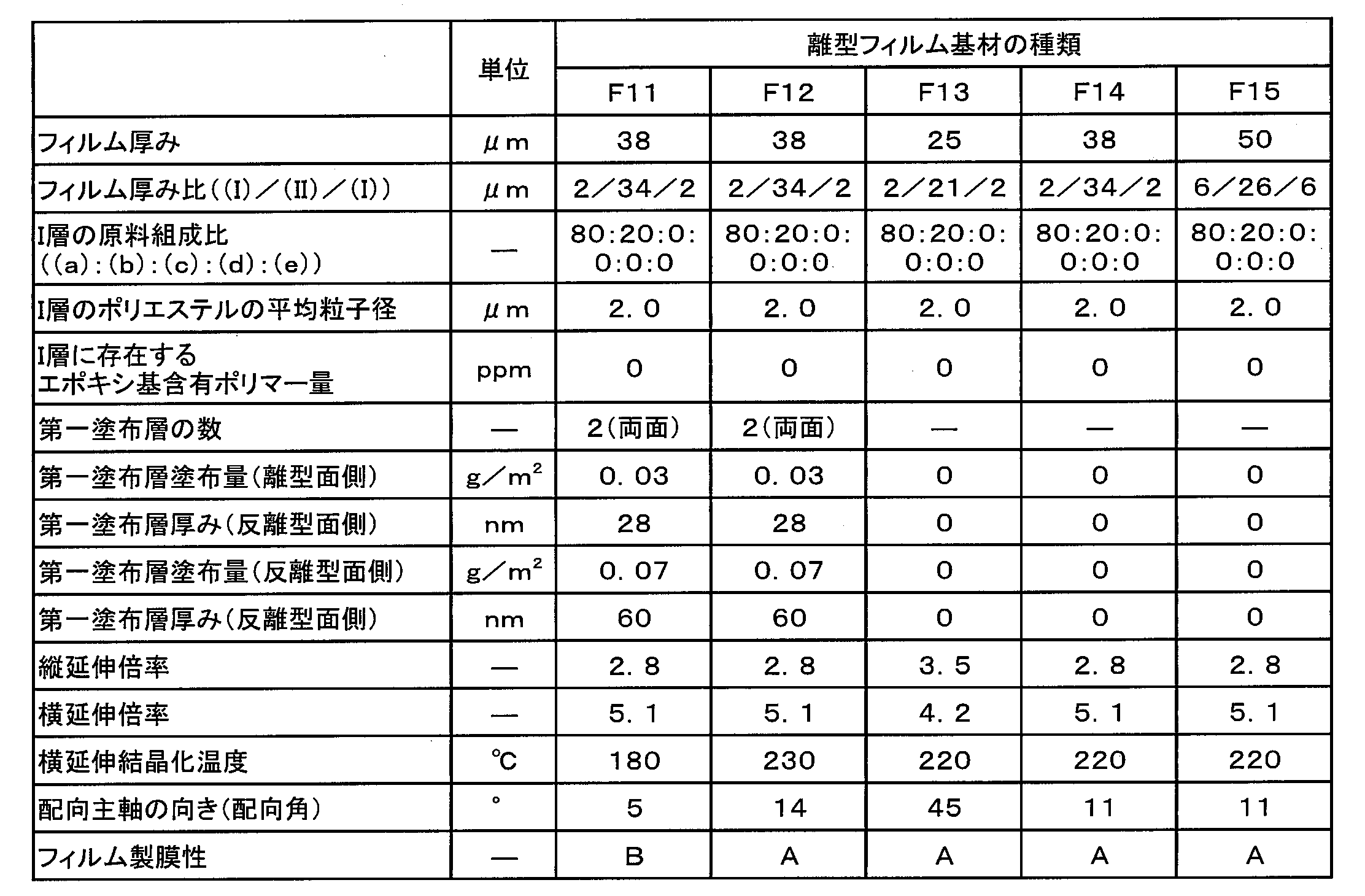
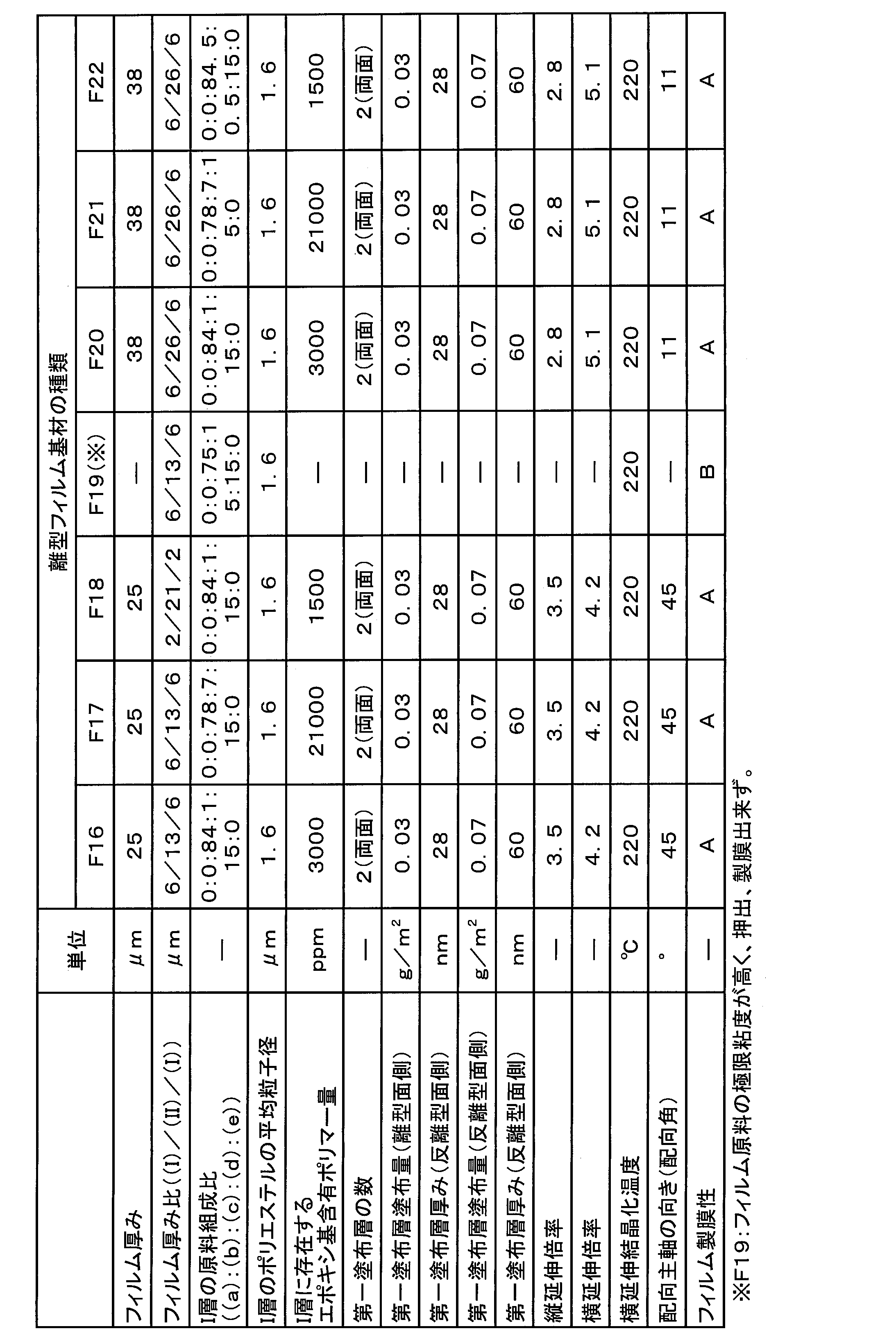
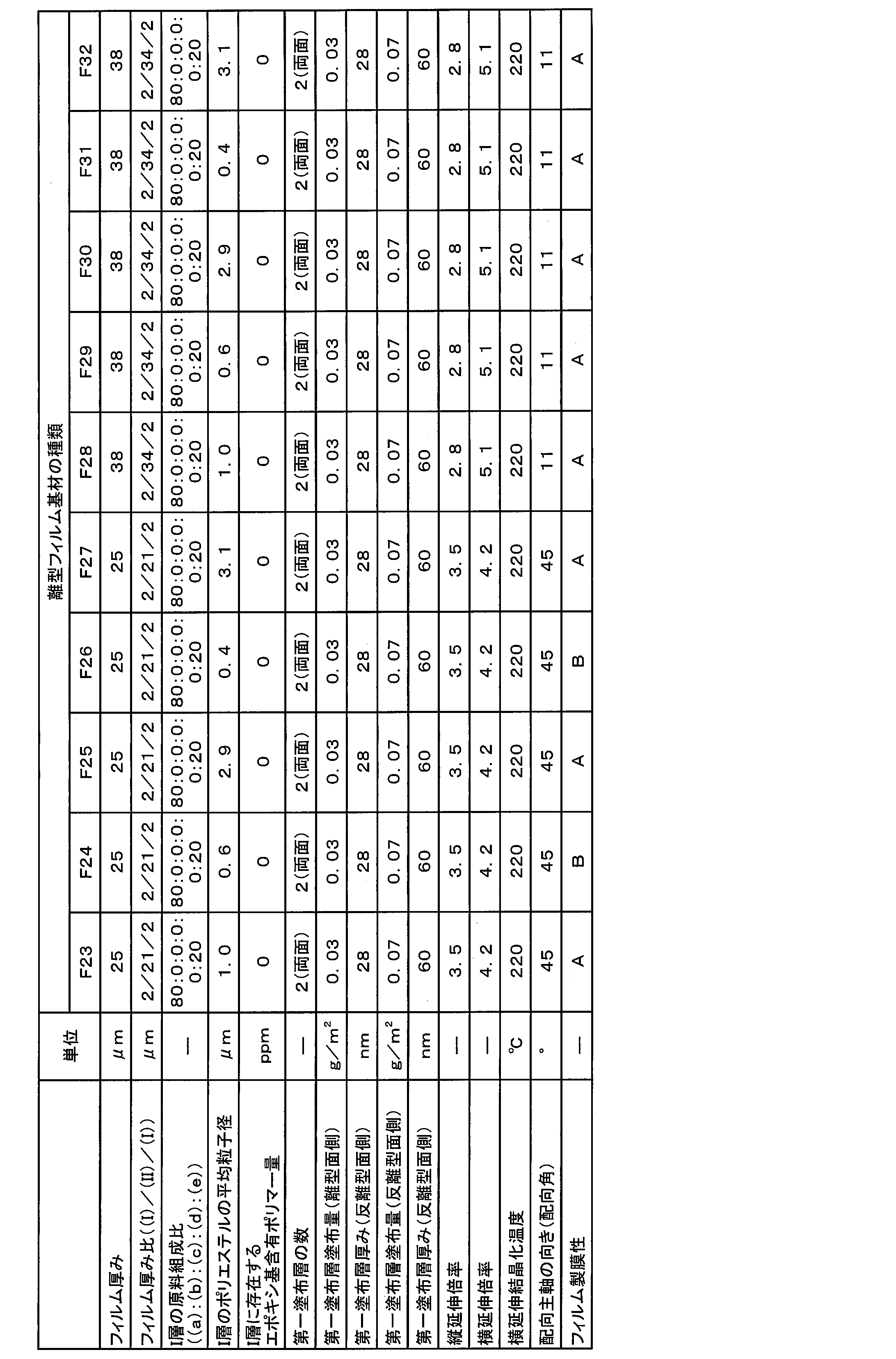
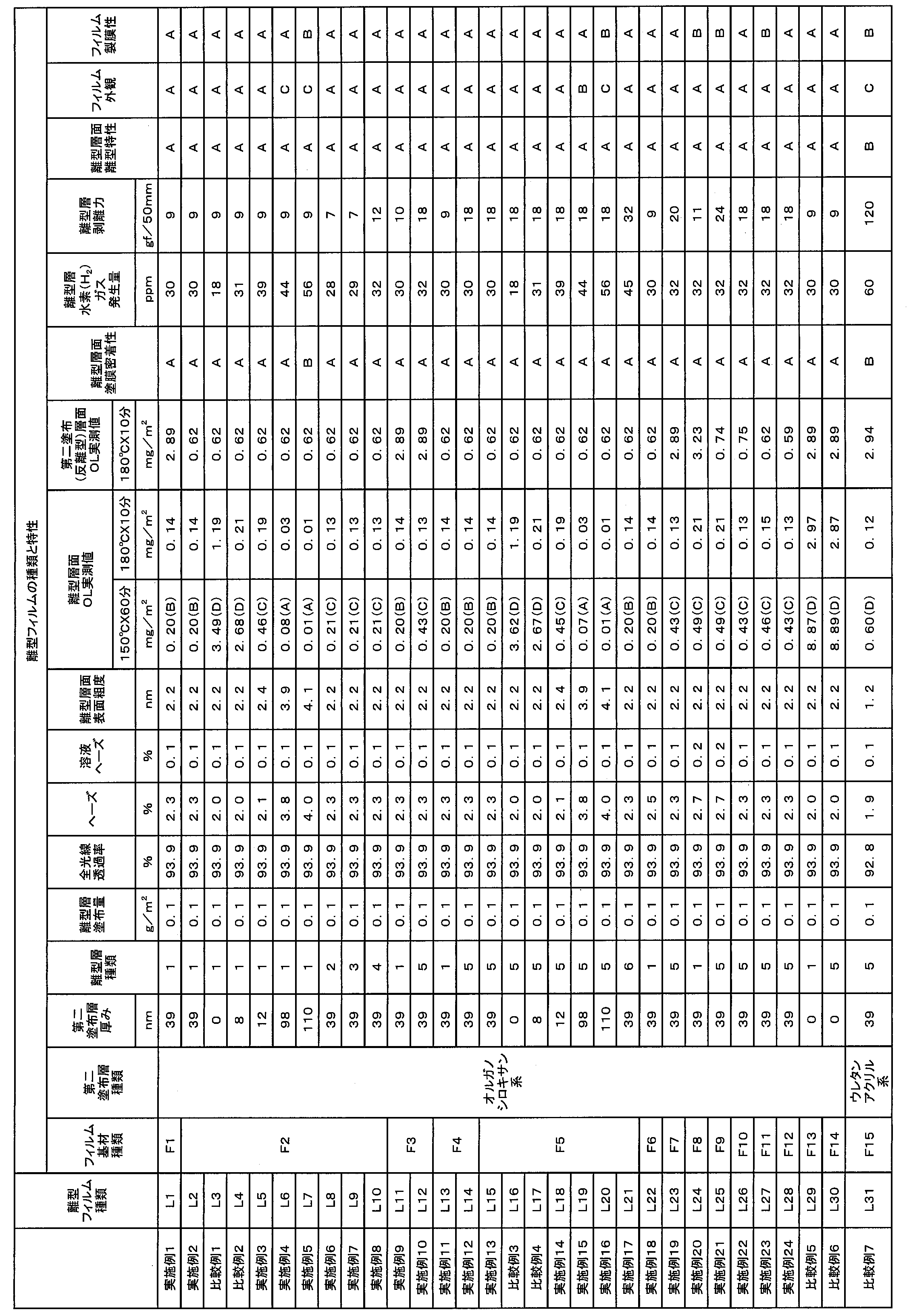

実施例41:
〈基材レス両面粘着シートの製造〉
第2離型フィルムとして、上記記載の得られた離型フィルムL15の離型層上に、下記アクリル系粘着剤組成物から構成される塗布液をアプリケータにて塗工した後、熱風式循環炉を用いて、100℃、5分間熱処理し、塗布量(乾燥後)が25g/m2の粘着剤層を得た。
・アクリル系粘着剤層形成用組成物
(モノマー配合組成)
アクリル酸2-エチルヘキシル 70重量%
アクリル酸2-メトキシエチル 29重量%
アクリル酸4-ヒドロキシブチル 1重量%
上記モノマー組成100重量部に対して、日本ポリウレタン製コロネートLを0.1部添加し、アクリル系粘着剤層形成用組成物を得た。
第1離型フィルムとして、上記記載の得られた離型フィルムL1の離型層と25μmの粘着剤層とを貼り合わせて、実施例41記載の基材レス両面粘着シートを得た。60℃、4日エージングを行い、基材レス両面粘着シートを完成させた。得られた基材レス両面粘着シートの評価結果を表7に示す。
〈基材レス両面粘着シートの製造〉
第2離型フィルムとして、上記記載の得られた離型フィルムL15の離型層上に、下記アクリル系粘着剤組成物から構成される塗布液をアプリケータにて塗工した後、熱風式循環炉を用いて、100℃、5分間熱処理し、塗布量(乾燥後)が25g/m2の粘着剤層を得た。
・アクリル系粘着剤層形成用組成物
(モノマー配合組成)
アクリル酸2-エチルヘキシル 70重量%
アクリル酸2-メトキシエチル 29重量%
アクリル酸4-ヒドロキシブチル 1重量%
上記モノマー組成100重量部に対して、日本ポリウレタン製コロネートLを0.1部添加し、アクリル系粘着剤層形成用組成物を得た。
第1離型フィルムとして、上記記載の得られた離型フィルムL1の離型層と25μmの粘着剤層とを貼り合わせて、実施例41記載の基材レス両面粘着シートを得た。60℃、4日エージングを行い、基材レス両面粘着シートを完成させた。得られた基材レス両面粘着シートの評価結果を表7に示す。
〈透明導電膜部材加工性確認〉
得られた実施例41の基材レス両面粘着シートの軽側の第1離型フィルムを剥離し、透明基材(三菱樹脂製T600E23)を貼り合せ、T600E23面側(第2離型フィルムが仮着されている面と反対面)に、アルゴンガス95%と酸素ガス5%とからなる0.4Paの雰囲気下で、酸化インジウム95重量%、酸化スズ5重量%の焼結体材料を用いた反応性スパッタリング法により、厚さ25nmのITO膜(透明導電性薄膜)を形成した。その後、150℃、ライン速度3m/min.で、結晶化を行い、透明導電膜部材を得た。
得られた実施例41の基材レス両面粘着シートの軽側の第1離型フィルムを剥離し、透明基材(三菱樹脂製T600E23)を貼り合せ、T600E23面側(第2離型フィルムが仮着されている面と反対面)に、アルゴンガス95%と酸素ガス5%とからなる0.4Paの雰囲気下で、酸化インジウム95重量%、酸化スズ5重量%の焼結体材料を用いた反応性スパッタリング法により、厚さ25nmのITO膜(透明導電性薄膜)を形成した。その後、150℃、ライン速度3m/min.で、結晶化を行い、透明導電膜部材を得た。
実施例42~65、比較例8~12:
実施例41において、第1,2離型フィルム種の変更、粘着剤厚みの変更を行い、表7のように、比較検討を行った。
実施例41において、第1,2離型フィルム種の変更、粘着剤厚みの変更を行い、表7のように、比較検討を行った。
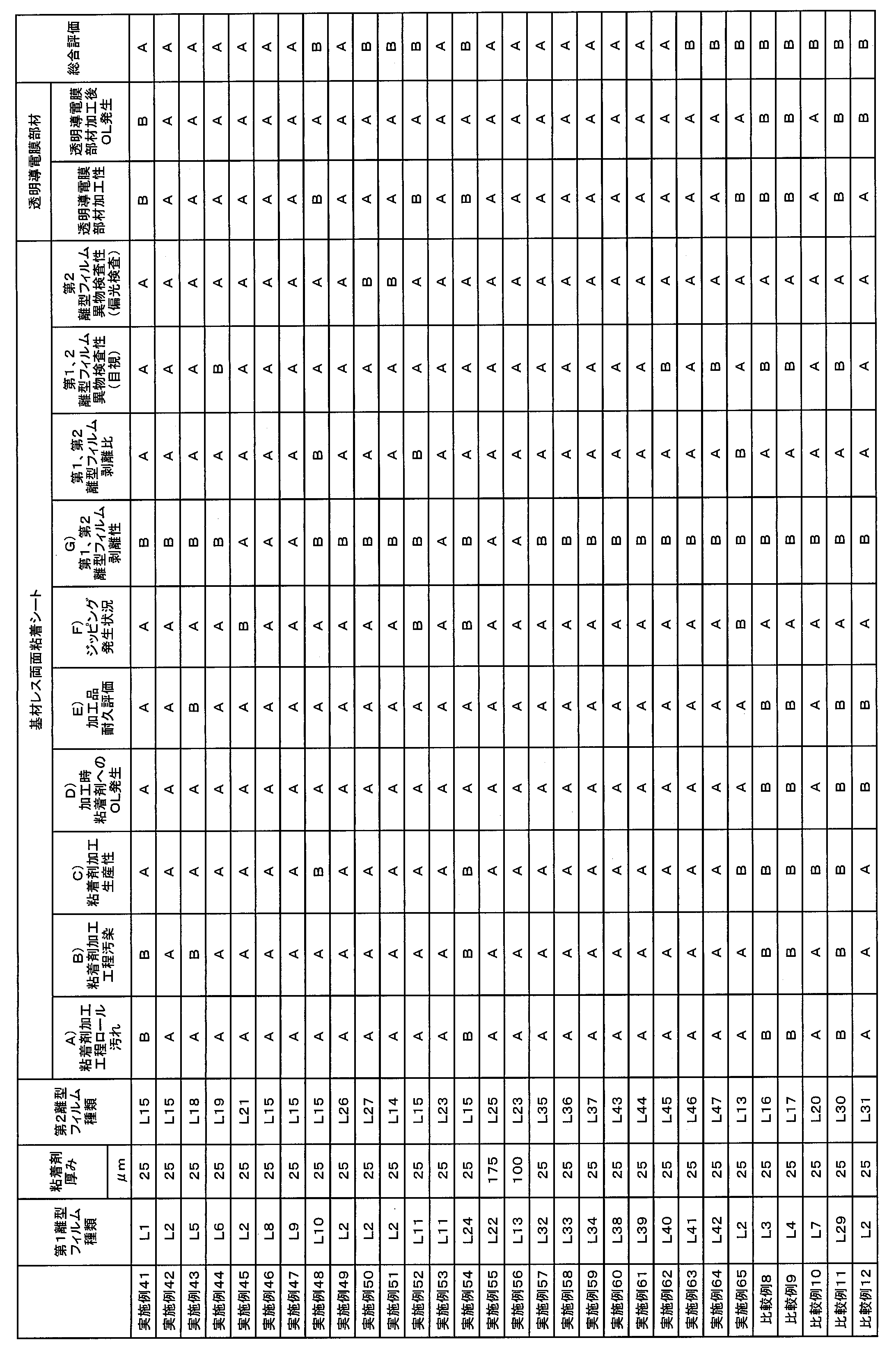
本発明によれば、静電容量方式のタッチパネル用部材やフラットパネル基材に必要な離型フィルムであり、特に、異物を嫌う高透明な基材レス両面粘着シート、その中で特に、スパッタを伴う高温条件下に使用されるものであって、加工時にクリーン度が厳しい工程の汚染を防ぎ、かつ、異物検査性に優れる高品質の離型フィルムを提供することができるため、品質管理が厳しい光学用途へ好適に利用することができる。
1 基材レス両面粘着シート付き透明導電膜部材
10 基材レス両面粘着シート
11 粘着剤層
13 第1離型フィルム基材のポリエステル中間層:I層
14 第1離型フィルム基材のポリエステル表層:II層
14′第1離型フィルム基材のポリエステル表層:II層
15 第1離型フィルムの第一塗布層
16 第1離型フィルムの第二塗布層
17 第1離型フィルムの離型層
23 第2離型フィルム基材のポリエステル中間層:I層
24 第2離型フィルム基材のポリエステル表層:II層
24′第2離型フィルム基材のポリエステル表層:II層
25 第2離型フィルムの第一塗布層
26 第2離型フィルムの第二塗布層
27 第2離型フィルムの離型層
31 第1離型フィルム
32 第2離型フィルム
41 透明導電膜部材フィルム基材
42 透明導電膜
51 透明導電膜部材
10 基材レス両面粘着シート
11 粘着剤層
13 第1離型フィルム基材のポリエステル中間層:I層
14 第1離型フィルム基材のポリエステル表層:II層
14′第1離型フィルム基材のポリエステル表層:II層
15 第1離型フィルムの第一塗布層
16 第1離型フィルムの第二塗布層
17 第1離型フィルムの離型層
23 第2離型フィルム基材のポリエステル中間層:I層
24 第2離型フィルム基材のポリエステル表層:II層
24′第2離型フィルム基材のポリエステル表層:II層
25 第2離型フィルムの第一塗布層
26 第2離型フィルムの第二塗布層
27 第2離型フィルムの離型層
31 第1離型フィルム
32 第2離型フィルム
41 透明導電膜部材フィルム基材
42 透明導電膜
51 透明導電膜部材
Claims (7)
- 基材ポリエステルフィルムの少なくとも片面に、四級アンモニウム塩基含有ポリマー、ポリエチレングリコール含有アクリレートポリマーおよび架橋剤を含有する塗布液を塗布して得られた第一塗布層を有し、少なくとも一方の第一塗布層上に、少なくとも一種のオルガノシロキサン化合物を含有する塗布剤を塗布して形成され且つ厚みが10~100nmの第二塗布層を有し、更に、少なくとも一方の第二塗布層上に離型層を有し、当該離型層面を150℃、60分で熱処理した後のフィルム表面のオリゴマー析出量が0.5mg/m2以下であることを特徴とする離型フィルム。
- 第1塗布層の厚みが20~100nmである請求項1記載の離型フィルム。
- 基材ポリエステルフィルムが、その両表面に、分子鎖中に少なくとも2個のエポキシ基を含有するポリマーを3000~30000ppm含有するポリエステル層を有する積層ポリエステルフィルムである請求項1又は2に記載の離型フィルム。
- 基材ポリエステルフィルムが、その両表面に、平均粒子径0.5~3.0μmのコア・シェル型粒子を含有するポリエステル層を有する積層ポリエステルフィルムである請求項1又は2に記載の離型フィルム。
- 粘着剤層の両面に剥離力の相対的に低い第1離型フィルムと剥離力の相対的に高い第2離型フィルムを積層して成る基材レス両面粘着シートであって、第1離型フィルムと第2離型フィルムの何れか一方に請求項1~4の何れかに記載の離型フィルムを使用してなることを特徴とする基材レス両面粘着シート。
- 第2離型フィルムの厚みが150μm以下の範囲であり、厚みが第1離型フィルム≦第2離型フィルムである請求項6記載の基材レス両面粘着シート。
- 第2離型フィルムの配向主軸の傾き(配向角)が12度以下である請求項5又は6に記載の基材レス両面粘着シート。
Applications Claiming Priority (6)
| Application Number | Priority Date | Filing Date | Title |
|---|---|---|---|
| JP2013203551 | 2013-09-30 | ||
| JP2013203550 | 2013-09-30 | ||
| JP2013203552 | 2013-09-30 | ||
| JP2013-203551 | 2013-09-30 | ||
| JP2013-203552 | 2013-09-30 | ||
| JP2013-203550 | 2013-09-30 |
Publications (1)
| Publication Number | Publication Date |
|---|---|
| WO2015046137A1 true WO2015046137A1 (ja) | 2015-04-02 |
Family
ID=52743273
Family Applications (1)
| Application Number | Title | Priority Date | Filing Date |
|---|---|---|---|
| PCT/JP2014/075062 Ceased WO2015046137A1 (ja) | 2013-09-30 | 2014-09-22 | 離型フィルム及び基材レス両面粘着シート |
Country Status (2)
| Country | Link |
|---|---|
| JP (1) | JP2015091646A (ja) |
| WO (1) | WO2015046137A1 (ja) |
Cited By (3)
| Publication number | Priority date | Publication date | Assignee | Title |
|---|---|---|---|---|
| JP2015223729A (ja) * | 2014-05-27 | 2015-12-14 | 三菱樹脂株式会社 | 積層体 |
| JP2018062079A (ja) * | 2016-10-11 | 2018-04-19 | 三菱ケミカル株式会社 | 離型フィルム |
| CN110450490A (zh) * | 2019-08-02 | 2019-11-15 | 安徽国风塑业股份有限公司 | 一种bope薄膜及其制备方法 |
Families Citing this family (1)
| Publication number | Priority date | Publication date | Assignee | Title |
|---|---|---|---|---|
| JP2017200975A (ja) * | 2016-05-06 | 2017-11-09 | 王子ホールディングス株式会社 | 粘着シート及び積層体 |
Citations (5)
| Publication number | Priority date | Publication date | Assignee | Title |
|---|---|---|---|---|
| JPH08294988A (ja) * | 1995-04-26 | 1996-11-12 | Teijin Ltd | 離型フイルム |
| JP2011152704A (ja) * | 2010-01-27 | 2011-08-11 | Mitsubishi Plastics Inc | ポリエステルフィルム |
| WO2012098967A1 (ja) * | 2011-01-18 | 2012-07-26 | 東レ株式会社 | 積層ポリエステルフィルムおよびハードコートフィルム |
| JP2013091785A (ja) * | 2011-10-08 | 2013-05-16 | Mitsubishi Plastics Inc | 基材レス両面粘着シート |
| JP2013180458A (ja) * | 2012-03-01 | 2013-09-12 | Mitsubishi Plastics Inc | 積層ポリエステルフィルム |
Family Cites Families (4)
| Publication number | Priority date | Publication date | Assignee | Title |
|---|---|---|---|---|
| JP5271008B2 (ja) * | 2008-09-02 | 2013-08-21 | 帝人デュポンフィルム株式会社 | 積層体 |
| JP2011084037A (ja) * | 2009-10-19 | 2011-04-28 | Teijin Ltd | 二軸配向多層積層フィルム |
| JP2012183733A (ja) * | 2011-03-07 | 2012-09-27 | Mitsubishi Plastics Inc | 離型フィルム |
| JP5988604B2 (ja) * | 2012-02-20 | 2016-09-07 | 三菱樹脂株式会社 | 積層ポリエステルフィルム |
-
2014
- 2014-09-22 WO PCT/JP2014/075062 patent/WO2015046137A1/ja not_active Ceased
- 2014-09-29 JP JP2014198090A patent/JP2015091646A/ja active Pending
Patent Citations (5)
| Publication number | Priority date | Publication date | Assignee | Title |
|---|---|---|---|---|
| JPH08294988A (ja) * | 1995-04-26 | 1996-11-12 | Teijin Ltd | 離型フイルム |
| JP2011152704A (ja) * | 2010-01-27 | 2011-08-11 | Mitsubishi Plastics Inc | ポリエステルフィルム |
| WO2012098967A1 (ja) * | 2011-01-18 | 2012-07-26 | 東レ株式会社 | 積層ポリエステルフィルムおよびハードコートフィルム |
| JP2013091785A (ja) * | 2011-10-08 | 2013-05-16 | Mitsubishi Plastics Inc | 基材レス両面粘着シート |
| JP2013180458A (ja) * | 2012-03-01 | 2013-09-12 | Mitsubishi Plastics Inc | 積層ポリエステルフィルム |
Cited By (3)
| Publication number | Priority date | Publication date | Assignee | Title |
|---|---|---|---|---|
| JP2015223729A (ja) * | 2014-05-27 | 2015-12-14 | 三菱樹脂株式会社 | 積層体 |
| JP2018062079A (ja) * | 2016-10-11 | 2018-04-19 | 三菱ケミカル株式会社 | 離型フィルム |
| CN110450490A (zh) * | 2019-08-02 | 2019-11-15 | 安徽国风塑业股份有限公司 | 一种bope薄膜及其制备方法 |
Also Published As
| Publication number | Publication date |
|---|---|
| JP2015091646A (ja) | 2015-05-14 |
Similar Documents
| Publication | Publication Date | Title |
|---|---|---|
| JP6492572B2 (ja) | 表面保護フィルム | |
| CN107428135B (zh) | 脱模膜 | |
| CN101080442B (zh) | 光学用双轴取向聚酯薄膜 | |
| JP6492573B2 (ja) | 表面保護フィルム | |
| CN104781359B (zh) | 无基材双面粘接片 | |
| JP2015078251A (ja) | 基材レス両面粘着シート | |
| JP2012159548A (ja) | 偏光板用離型ポリエステルフィルム | |
| JP6287136B2 (ja) | 表面保護フィルム | |
| WO2015046137A1 (ja) | 離型フィルム及び基材レス両面粘着シート | |
| JP2002275296A (ja) | 表面保護フィルム用積層ポリエステルフィルム及び表面保護フィルム | |
| JP2012137567A (ja) | 偏光板用離型ポリエステルフィルム | |
| JP2013001817A (ja) | 基材レス両面粘着シート | |
| JP2015091905A (ja) | 基材レス両面粘着シート | |
| WO2012173033A1 (ja) | 離型ポリエステルフィルム | |
| JP2013001816A (ja) | 基材レス両面粘着シート | |
| JP2015074732A (ja) | 基材レス両面粘着シート | |
| JP2015071736A (ja) | 透明導電膜基材用塗布フィルム | |
| JP6046462B2 (ja) | 基材レス両面粘着シート | |
| JP2015027735A (ja) | 離型ポリエステルフィルム | |
| JP2015016676A (ja) | 離型ポリエステルフィルム | |
| JP2015016677A (ja) | 離型ポリエステルフィルム | |
| JP2015091904A (ja) | 基材レス両面粘着シート | |
| JP2014152278A (ja) | 光学基材用粘着シート | |
| JP2015104916A (ja) | 表面保護フィルム | |
| JP2014173014A (ja) | 光学基材用粘着シート |
Legal Events
| Date | Code | Title | Description |
|---|---|---|---|
| 121 | Ep: the epo has been informed by wipo that ep was designated in this application |
Ref document number: 14849222 Country of ref document: EP Kind code of ref document: A1 |
|
| NENP | Non-entry into the national phase |
Ref country code: DE |
|
| 122 | Ep: pct application non-entry in european phase |
Ref document number: 14849222 Country of ref document: EP Kind code of ref document: A1 |