WO2015037630A1 - 高周波振動撹拌のエネルギーと、その撹拌機の振動羽根を両極として水の電気分解により発生するナノ・マイクロバブルの破裂エネルギーの共用で、ある元素から他の元素に変換させる技術及び処理方法、並びに放射性セシウム137及び134等の放射性物質の無害化する技術及び方法 - Google Patents
高周波振動撹拌のエネルギーと、その撹拌機の振動羽根を両極として水の電気分解により発生するナノ・マイクロバブルの破裂エネルギーの共用で、ある元素から他の元素に変換させる技術及び処理方法、並びに放射性セシウム137及び134等の放射性物質の無害化する技術及び方法 Download PDFInfo
- Publication number
- WO2015037630A1 WO2015037630A1 PCT/JP2014/073960 JP2014073960W WO2015037630A1 WO 2015037630 A1 WO2015037630 A1 WO 2015037630A1 JP 2014073960 W JP2014073960 W JP 2014073960W WO 2015037630 A1 WO2015037630 A1 WO 2015037630A1
- Authority
- WO
- WIPO (PCT)
- Prior art keywords
- cesium
- frequency
- vibrating
- detoxification
- converting
- Prior art date
- Legal status (The legal status is an assumption and is not a legal conclusion. Google has not performed a legal analysis and makes no representation as to the accuracy of the status listed.)
- Ceased
Links
Images

Classifications
-
- G—PHYSICS
- G21—NUCLEAR PHYSICS; NUCLEAR ENGINEERING
- G21F—PROTECTION AGAINST X-RADIATION, GAMMA RADIATION, CORPUSCULAR RADIATION OR PARTICLE BOMBARDMENT; TREATING RADIOACTIVELY CONTAMINATED MATERIAL; DECONTAMINATION ARRANGEMENTS THEREFOR
- G21F9/00—Treating radioactively contaminated material; Decontamination arrangements therefor
- G21F9/04—Treating liquids
- G21F9/20—Disposal of liquid waste
- G21F9/22—Disposal of liquid waste by storage in a tank or other container
-
- G—PHYSICS
- G21—NUCLEAR PHYSICS; NUCLEAR ENGINEERING
- G21F—PROTECTION AGAINST X-RADIATION, GAMMA RADIATION, CORPUSCULAR RADIATION OR PARTICLE BOMBARDMENT; TREATING RADIOACTIVELY CONTAMINATED MATERIAL; DECONTAMINATION ARRANGEMENTS THEREFOR
- G21F9/00—Treating radioactively contaminated material; Decontamination arrangements therefor
- G21F9/04—Treating liquids
-
- G—PHYSICS
- G21—NUCLEAR PHYSICS; NUCLEAR ENGINEERING
- G21F—PROTECTION AGAINST X-RADIATION, GAMMA RADIATION, CORPUSCULAR RADIATION OR PARTICLE BOMBARDMENT; TREATING RADIOACTIVELY CONTAMINATED MATERIAL; DECONTAMINATION ARRANGEMENTS THEREFOR
- G21F9/00—Treating radioactively contaminated material; Decontamination arrangements therefor
- G21F9/04—Treating liquids
- G21F9/06—Processing
-
- G—PHYSICS
- G21—NUCLEAR PHYSICS; NUCLEAR ENGINEERING
- G21G—CONVERSION OF CHEMICAL ELEMENTS; RADIOACTIVE SOURCES
- G21G7/00—Conversion of chemical elements not provided for in other groups of this subclass
Definitions
- the present invention shares the energy of high-frequency vibration agitation and the burst energy of nano / micro bubbles generated by electrolysis of water using the vibration blades of the high-frequency vibration agitator as both poles.
- radioactive cesium 137 and 134 are constant.
- the present invention relates to an element conversion from barium to platinum or the like by time treatment, that is, a technique and a processing method for converting from one element to another element, and a system and a processing method for detoxifying radioactive materials such as radioactive cesium 137 and 134.
- Radioactive elements cesium 134 and cesium 137 released in the atmosphere from the Fukushima Daiichi Nuclear Power Station are about 2 years and about 30 years, respectively. Means that it takes a long time. In principle, detoxification is possible, but it is necessary to input a large amount of energy, and so far no technically effective means has been obtained.
- the URL (for example, Non-Patent Document 1) has information that the radioactive cesium is detoxified by photosynthetic bacteria and bacteria, but based on this, there is no report that the detoxification of the radioactive substance has been put into practical use. . At present, no method for industrial detoxification has been found. When detoxifying, it is considered necessary to put a large amount of energy locally into the radioactive element.
- the present invention has an object to render a radioactive substance harmless by generating strong energy generated when the nano / micro bubbles burst.
- a treatment tank a high-frequency vibration motor fixed to the upper stage of the treatment tank, two vibration bars extending downward from the treatment tank connected to the stage, and a lower part of the vibration bar
- a high-frequency vibration agitating device configured to include the multi-stage vibration blade, wherein the high-frequency vibration motor is controlled by an inverter, and the multi-stage vibration blade is placed in a liquid containing a radioactive substance in the treatment tank.
- a detoxification system such as cesium 134 and cesium 137, which is characterized in that the radioactive substance in the liquid is detoxified by vibrating at a frequency of 100 to 200 Hz.
- the first vibrating blade is physically and electrically connected to the right vibrating bar and physically connected to the left vibrating bar.
- the second vibrating blade is physically connected to the first right vibrating bar, but is electrically insulated from the left vibrating bar.
- a plurality of vibrating blades are electrically connected, and the left and right vibrating bars are electrically insulated by alternately repeating insulation on the left and right vibrating bars.
- a DC power source is connected to the left and right vibrating rods via a rectifier, and an electrolysis circuit is formed in which the plurality of vibrating blades alternately serve as anodes and cathodes.
- cesium 1 Detoxification systems such as 4 and cesium-137.
- a pipe is provided at the top of the treatment tank, and the pipe is connected to the top of the bubbling tank so that radioactive cesium is not released into the atmosphere, and electrolysis in the treatment tank is performed in the liquid of the bubbling tank.
- the oxyhydrogen gas (OHMASA-GAS) generated in step (2) is blown into the element, the technology for converting from one element to another element described in (2) above, and cesium 134 and cesium 137 Detoxification system.
- the detoxification treatment temperature is set to 20 to 40 ° C., the treatment method for converting from one element to another element according to (4) or (5), and cesium 134 and cesium 137 Detoxification method.
- (10) It is characterized in that, in place of the step of adding calcium chloride, a step of adding a 10-30% slurry solution obtained by mixing hen egg shells pulverized to a particle size of several ⁇ m to several tens of ⁇ m with pure water is provided.
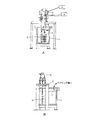
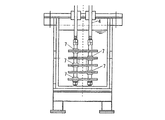
- FIG. 1 It is sectional drawing of an electrode combined type high frequency vibration stirring apparatus, A is front sectional drawing, B is side sectional drawing Cross section of bubbling tank Enlarged view of the multistage vibrating blade part of the electrode combined type high frequency vibration stirring apparatus shown in FIG.
- the system used for detoxifying the radioactive cesiums 134 and 137 includes the electrode combined high-frequency vibration agitator shown in FIG. 1 and the bubbling tank (cushion tank) shown in FIG.
- the electrode combined high-frequency vibration stirrer is made of transparent heat-resistant resin and is equipped with a treatment tank 1 with a width of 200 mm, a depth of 300 mm, and a height of 250 mm.
- the tank capacity is about 12L.
- a high-frequency vibration motor 3 (200 V ⁇ 150 W) is fixed to the upper stage of the processing tank 1, and two vibrating bars 4 are connected to this stage, and the vibrating bar 4 extends downward into the processing tank 1. Yes.
- a multistage vibrating blade 5 is attached to the lower part of the vibrating bar 4.
- the high-frequency vibration motor 3 can be set so that the multistage vibration blade 5 vibrates at a frequency of 100 to 200 Hz in the liquid of the processing tank 1 by controlling using the inverter 6.
- two multistage vibrating blades 5 are attached to the vibrating rod 4, but the first vibrating blade is physically and electrically connected to the right vibrating rod.
- the left vibrating bar is physically connected, but is electrically insulated by the insulator 7.
- the second vibrating blade is physically connected to the first right vibrating bar, but is electrically insulated by the insulator 7 and physically and electrically connected to the left vibrating bar. Yes.
- the left and right vibrating bars are electrically insulated by electrically connecting the vibrating blades and alternately repeating the insulation between the left and right vibrating bars.
- a DC voltage application circuit that is, an electrolysis circuit, in which a DC power source is connected to the left and right vibrating bars via the rectifier 8 and the plurality of vibrating blades 5 are alternately anodes and cathodes.
- the processing tank 1 can be operated to perform only high-frequency vibration or electrolysis simultaneously with high-frequency vibration.
- a DC voltage DC 12 V ⁇ 20 A
- DC 12 V ⁇ 20 A DC voltage
- FIG. 2 is a cross-sectional view showing a bubbling tank, that is, a cushion tank made of a transparent resin and having a diameter of 100 mm and a height of 230 m.
- a bubbling tank that is, a cushion tank made of a transparent resin and having a diameter of 100 mm and a height of 230 m.
- the bubbling tank is provided so that radioactive cesium accompanies the oxyhydrogen gas (OHMASA-GAS) generated by electrolysis in the vibration stirrer and is not released into the atmosphere.
- oxyhydrogen gas OMASA-GAS
- potassium hydroxide 3 It is connected with the top part of the processing tank 1 with piping so that the gas produced
- radioactive cesium was detoxified by the following operation procedure.
- the contaminated water used for detoxification was collected on October 17, 2012 at a certain place in Fukushima Prefecture.
- the procedure for detoxification with only high-frequency stirring is as follows. 1) Charge 12 L of radioactively contaminated water 2 to the treatment tank 1 of the high-frequency stirrer that also serves as an electrode. 2) The inverter 6 sets the frequency of the high-frequency vibration motor 3 and energizes it. 3) A detoxification process is performed for a predetermined time. 4) Turn off the high-frequency vibration motor 3. 5) After stirring and homogenizing the contaminated liquid 2 in the treatment tank 1 for 3 minutes, 1 L of the treatment liquid is sampled and the amount of radioactive element is measured.
- the amount of radioactive element in the final process was measured by operating a germanium semiconductor detector (manufacturer: PGY, model: NIGC 16190 SD) for 3600 seconds (1 hour).
- the procedure for detoxification using high-frequency agitation and electrolysis in combination with the expectation of the powerful burst energy effect of nano / micro bubbles generated during water electrolysis is as follows. 1) Charge 12 L of radioactively contaminated water 2 to the treatment tank 1 of the high-frequency stirrer that also serves as an electrode. 2) The treatment tank 1 is charged so that the potassium hydroxide concentration is 3%. 3) The inverter 6 sets the frequency of the high-frequency vibration motor 3 and energizes it. 4) Turn on the rectifier 8 for electrolysis. 5) Set the electrolysis current value to DC7V, 11A (this starts the detoxification process). 6) A detoxification process is performed for a predetermined time. 7) Turn off the rectifier 8 for electrolysis. 8) Turn off the high frequency vibration motor 3. 9) After stirring and homogenizing the contaminated liquid 2 in the treatment tank 1 for 3 minutes, 1 L of the treatment liquid is sampled and the amount of radioactive element is measured.
- the “vibrating plate of a vibration stirrer can be used as both an anode and a cathode” as disclosed in Japanese Patent No. 4269318 can be used. Yes.
- Table 1 shows the results of a detoxification experiment for 22 days at a frequency of 160 Hz using a high-frequency agitator for contaminated water containing radioactive cesium 137 and 134.
- the detoxification rate after about 3 weeks of treatment was about 20%.
- Table 2 shows the results of a detoxification experiment in which electrolysis is used in combination with Example 1 (the frequency is also 160 Hz).
- the detoxification rate in the treatment for about 2 weeks was about 50%, and further about 50% in the treatment for about 2 weeks (about 75% of the amount before the treatment).
- Example 1 detoxification rate 20%
- the detoxification rate was significantly improved when electrolysis was used in combination. This confirmed the effect of the powerful burst energy of the nano / micro bubbles generated during electrolysis.
- cesium 137 in the bubbling tank is 21 to 23 Bq
- cesium 134 is 10 to 12 Bq
- each has a concentration of about 1/1000 of the original contaminated water. It can be seen that the amount of radioactive elements associated with (OHMASA-GAS) is small.
- Tables 4 to 7 show the results of the detoxification experiment using electrolysis in the same manner as in Example 2 and setting the frequency of the high-frequency stirrer to 120 Hz, 140 Hz, 160 Hz (Example 2), 180 Hz, and 190 Hz.
- cesium 133 (reagent) was used and elemental conversion experiment of cesium 133 was performed with high-frequency stirring and electrolysis combined, as shown in Table 10, cesium 133 was converted into barium and platinum after approximately 2 weeks of treatment. I was able to confirm. In addition, it is estimated that the intermediate value is larger than the final value as a result of conversion to another element.
- the measuring instrument used for elemental analysis was an ICP mass spectrometer (HP-4500, model: NIGC16190 SD) manufactured by Yokogawa Analytical System Co., Ltd., so that the concentration of cesium 133 was 350 mg / L. A sample of 0.5 L was taken and measured.
- Example 6 it was demonstrated that “calcium” can be elementally converted to “nickel” and “cobalt” that are extremely valuable. Therefore, as a calcium source, egg shells whose daily discharge is several tens to several hundreds of tons and whose processing costs are enormous are problematic, are pulverized by a pulverizer to a particle size of several to several tens of ⁇ m. Then, an experiment was conducted in which the slurry was poured into pure water to form a slurry having a concentration of 10 to 30%, which was treated in the same manner as in Example 6 and converted into valuable cobalt and nickel.
- the radioactive element is converted into another element and the concentration can be significantly reduced. Therefore, it can be applied to detoxify the radioactive element and is currently becoming a big problem. , I think it will help to prevent contaminated water leaking from the Fukushima Daiichi Nuclear Power Station.
- any element can be converted at any time, and its contribution is extremely high.
Landscapes
- Engineering & Computer Science (AREA)
- Physics & Mathematics (AREA)
- General Engineering & Computer Science (AREA)
- High Energy & Nuclear Physics (AREA)
- Chemical & Material Sciences (AREA)
- Chemical Kinetics & Catalysis (AREA)
- General Chemical & Material Sciences (AREA)
- Environmental & Geological Engineering (AREA)
- Water Treatment By Electricity Or Magnetism (AREA)
- Processing Of Solid Wastes (AREA)
Applications Claiming Priority (2)
| Application Number | Priority Date | Filing Date | Title |
|---|---|---|---|
| JP2013-188323 | 2013-09-11 | ||
| JP2013188323A JP2015055527A (ja) | 2013-09-11 | 2013-09-11 | 高周波振動撹拌のエネルギーと、その撹拌機の振動羽根を両極として水の電気分解により発生するナノ・マイクロバブルの破裂エネルギーの共用で、ある元素から他の元素に変換させる技術及び処理方法、並びに放射性セシウム137及び134等の放射性物質の無害化する技術及び方法 |
Publications (1)
| Publication Number | Publication Date |
|---|---|
| WO2015037630A1 true WO2015037630A1 (ja) | 2015-03-19 |
Family
ID=52665732
Family Applications (1)
| Application Number | Title | Priority Date | Filing Date |
|---|---|---|---|
| PCT/JP2014/073960 Ceased WO2015037630A1 (ja) | 2013-09-11 | 2014-09-10 | 高周波振動撹拌のエネルギーと、その撹拌機の振動羽根を両極として水の電気分解により発生するナノ・マイクロバブルの破裂エネルギーの共用で、ある元素から他の元素に変換させる技術及び処理方法、並びに放射性セシウム137及び134等の放射性物質の無害化する技術及び方法 |
Country Status (2)
| Country | Link |
|---|---|
| JP (1) | JP2015055527A (enExample) |
| WO (1) | WO2015037630A1 (enExample) |
Cited By (1)
| Publication number | Priority date | Publication date | Assignee | Title |
|---|---|---|---|---|
| CN116240406A (zh) * | 2021-12-08 | 2023-06-09 | 核工业北京化工冶金研究院 | 一种采用微纳米气泡的砂岩铀矿强氧化浸出方法 |
Citations (2)
| Publication number | Priority date | Publication date | Assignee | Title |
|---|---|---|---|---|
| JP2008063669A (ja) * | 2001-12-03 | 2008-03-21 | Japan Techno Co Ltd | 水素−酸素ガス発生装置及びそれを用いた水素−酸素ガス発生方法 |
| JP2009028667A (ja) * | 2007-07-27 | 2009-02-12 | Japan Techno Co Ltd | 水の改質方法 |
Family Cites Families (1)
| Publication number | Priority date | Publication date | Assignee | Title |
|---|---|---|---|---|
| US7666370B2 (en) * | 2006-01-19 | 2010-02-23 | Japan Nuclear Fuel Limited | Sodium salt recycling process for use in wet reprocessing process of spent nuclear fuel |
-
2013
- 2013-09-11 JP JP2013188323A patent/JP2015055527A/ja active Pending
-
2014
- 2014-09-10 WO PCT/JP2014/073960 patent/WO2015037630A1/ja not_active Ceased
Patent Citations (2)
| Publication number | Priority date | Publication date | Assignee | Title |
|---|---|---|---|---|
| JP2008063669A (ja) * | 2001-12-03 | 2008-03-21 | Japan Techno Co Ltd | 水素−酸素ガス発生装置及びそれを用いた水素−酸素ガス発生方法 |
| JP2009028667A (ja) * | 2007-07-27 | 2009-02-12 | Japan Techno Co Ltd | 水の改質方法 |
Non-Patent Citations (1)
| Title |
|---|
| "Omasa Gas Shindo Hassei Sochi de Cesium ga Balium ni! Mugaika ni Seiko!", SHIROKI MASASHIRO NO BLOG, 2 January 2013 (2013-01-02), Retrieved from the Internet <URL:http://masashirou.exblog.jp/m2013-01-01> [retrieved on 20141015] * |
Cited By (1)
| Publication number | Priority date | Publication date | Assignee | Title |
|---|---|---|---|---|
| CN116240406A (zh) * | 2021-12-08 | 2023-06-09 | 核工业北京化工冶金研究院 | 一种采用微纳米气泡的砂岩铀矿强氧化浸出方法 |
Also Published As
| Publication number | Publication date |
|---|---|
| JP2015055527A (ja) | 2015-03-23 |
Similar Documents
| Publication | Publication Date | Title |
|---|---|---|
| Maurice et al. | Dismantling of printed circuit boards enabling electronic components sorting and their subsequent treatment open improved elemental sustainability opportunities | |
| US20230116725A1 (en) | Method For Converting Elements, Such As Calcium, Copper, Magnesium, And Cesium, Into More Useful Elements, And A Method For Making Radioactive Substances Harmless By Applying This Element Conversion Method | |
| RU2648263C1 (ru) | Способ обработки сырой воды, содержащей тритиевую воду | |
| DK104782A (da) | Fremgangsmaade til genvinding af aedelmetaller og en elektrolysator til anvendelse ved denne fremgangsmaade | |
| JP6788899B2 (ja) | 高効率乾式再処理用電解槽および電解法 | |
| WO2015037630A1 (ja) | 高周波振動撹拌のエネルギーと、その撹拌機の振動羽根を両極として水の電気分解により発生するナノ・マイクロバブルの破裂エネルギーの共用で、ある元素から他の元素に変換させる技術及び処理方法、並びに放射性セシウム137及び134等の放射性物質の無害化する技術及び方法 | |
| JP2019512606A (ja) | 使用済み陰極線管の処理方法 | |
| RU2403301C1 (ru) | Способ активационного выщелачивания металлов из руд и концентратов | |
| EP2576850B1 (en) | Method for recovering noble metals and other byproducts from ore | |
| JP2022023989A (ja) | カルシウム、銅、マグネシウム、セシウムなどの元素をより有用な元素に変換する方法及びこの元素変換技術を応用して放射性物質を無害化する方法 | |
| US20110214999A1 (en) | Method and process for element and/or compound extraction, separation, and purification | |
| RU2713733C1 (ru) | Способ дезактивации графитовых радиоактивных отходов | |
| JP5789731B1 (ja) | トリチウム水を含む原料水の処理方法 | |
| JP2017094315A (ja) | 交流電解水溶液製造方法並びに金属粒子および金属イオンを除去する方法。 | |
| Hao et al. | Rapid preparation of Uranium and Thorium alpha sources by electroplating technique | |
| EP3951800B1 (en) | Method for decontaminating tritium-radiation-polluted water | |
| RU2485193C1 (ru) | Способ извлечения урана из руд | |
| JP2020097010A (ja) | 交流電解水蒸気製造方法並びに製造装置および金属粒子や金属イオンを除去する方法 | |
| Shim et al. | Consideration on the Conversion Characteristic of Uranium Ions to Metal in the LiCl-KCl Salt With the Aid of Yttrium Metal | |
| CN208762322U (zh) | 一种用于重金属废水及混合物无害处理装置 | |
| JP2020056763A (ja) | 放射性汚染水処理設備 | |
| Brossard et al. | Dechlorination, dissolution and purification of weapon grade plutonium oxide contaminated with chlorides: tests performed in the CEA Atalante Facility for the aqueous polishing part of MOX Fuel Fabrication Facility | |
| CN203486991U (zh) | 重金属滤除装置 | |
| Norman | Extraction of Heavy Metals from Fly Ash using Electrochemical Methods | |
| CN115780501A (zh) | 一种脱氯修复氯代烃污染土壤的方法及装置 |
Legal Events
| Date | Code | Title | Description |
|---|---|---|---|
| 121 | Ep: the epo has been informed by wipo that ep was designated in this application |
Ref document number: 14844592 Country of ref document: EP Kind code of ref document: A1 |
|
| DPE1 | Request for preliminary examination filed after expiration of 19th month from priority date (pct application filed from 20040101) | ||
| NENP | Non-entry into the national phase |
Ref country code: DE |
|
| 122 | Ep: pct application non-entry in european phase |
Ref document number: 14844592 Country of ref document: EP Kind code of ref document: A1 |