WO2015022962A1 - 脂質代謝促進剤 - Google Patents
脂質代謝促進剤 Download PDFInfo
- Publication number
- WO2015022962A1 WO2015022962A1 PCT/JP2014/071301 JP2014071301W WO2015022962A1 WO 2015022962 A1 WO2015022962 A1 WO 2015022962A1 JP 2014071301 W JP2014071301 W JP 2014071301W WO 2015022962 A1 WO2015022962 A1 WO 2015022962A1
- Authority
- WO
- WIPO (PCT)
- Prior art keywords
- mol
- lipid metabolism
- arginine
- alanine
- phenylalanine
- Prior art date
- Legal status (The legal status is an assumption and is not a legal conclusion. Google has not performed a legal analysis and makes no representation as to the accuracy of the status listed.)
- Ceased
Links
Images








Classifications
-
- A—HUMAN NECESSITIES
- A61—MEDICAL OR VETERINARY SCIENCE; HYGIENE
- A61K—PREPARATIONS FOR MEDICAL, DENTAL OR TOILETRY PURPOSES
- A61K31/00—Medicinal preparations containing organic active ingredients
- A61K31/33—Heterocyclic compounds
- A61K31/395—Heterocyclic compounds having nitrogen as a ring hetero atom, e.g. guanethidine or rifamycins
- A61K31/41—Heterocyclic compounds having nitrogen as a ring hetero atom, e.g. guanethidine or rifamycins having five-membered rings with two or more ring hetero atoms, at least one of which being nitrogen, e.g. tetrazole
- A61K31/4164—1,3-Diazoles
- A61K31/4172—Imidazole-alkanecarboxylic acids, e.g. histidine
-
- A—HUMAN NECESSITIES
- A23—FOODS OR FOODSTUFFS; TREATMENT THEREOF, NOT COVERED BY OTHER CLASSES
- A23L—FOODS, FOODSTUFFS OR NON-ALCOHOLIC BEVERAGES, NOT OTHERWISE PROVIDED FOR; PREPARATION OR TREATMENT THEREOF
- A23L2/00—Non-alcoholic beverages; Dry compositions or concentrates therefor; Preparation or treatment thereof
- A23L2/52—Adding ingredients
-
- A—HUMAN NECESSITIES
- A23—FOODS OR FOODSTUFFS; TREATMENT THEREOF, NOT COVERED BY OTHER CLASSES
- A23L—FOODS, FOODSTUFFS OR NON-ALCOHOLIC BEVERAGES, NOT OTHERWISE PROVIDED FOR; PREPARATION OR TREATMENT THEREOF
- A23L33/00—Modifying nutritive qualities of foods; Dietetic products; Preparation or treatment thereof
- A23L33/10—Modifying nutritive qualities of foods; Dietetic products; Preparation or treatment thereof using additives
- A23L33/17—Amino acids, peptides or proteins
- A23L33/175—Amino acids
-
- A—HUMAN NECESSITIES
- A61—MEDICAL OR VETERINARY SCIENCE; HYGIENE
- A61K—PREPARATIONS FOR MEDICAL, DENTAL OR TOILETRY PURPOSES
- A61K31/00—Medicinal preparations containing organic active ingredients
- A61K31/185—Acids; Anhydrides, halides or salts thereof, e.g. sulfur acids, imidic, hydrazonic or hydroximic acids
- A61K31/19—Carboxylic acids, e.g. valproic acid
- A61K31/195—Carboxylic acids, e.g. valproic acid having an amino group
- A61K31/197—Carboxylic acids, e.g. valproic acid having an amino group the amino and the carboxyl groups being attached to the same acyclic carbon chain, e.g. gamma-aminobutyric acid [GABA], beta-alanine, epsilon-aminocaproic acid or pantothenic acid
- A61K31/198—Alpha-amino acids, e.g. alanine or edetic acid [EDTA]
-
- A—HUMAN NECESSITIES
- A61—MEDICAL OR VETERINARY SCIENCE; HYGIENE
- A61K—PREPARATIONS FOR MEDICAL, DENTAL OR TOILETRY PURPOSES
- A61K31/00—Medicinal preparations containing organic active ingredients
- A61K31/33—Heterocyclic compounds
- A61K31/395—Heterocyclic compounds having nitrogen as a ring hetero atom, e.g. guanethidine or rifamycins
- A61K31/40—Heterocyclic compounds having nitrogen as a ring hetero atom, e.g. guanethidine or rifamycins having five-membered rings with one nitrogen as the only ring hetero atom, e.g. sulpiride, succinimide, tolmetin, buflomedil
- A61K31/401—Proline; Derivatives thereof, e.g. captopril
-
- A—HUMAN NECESSITIES
- A61—MEDICAL OR VETERINARY SCIENCE; HYGIENE
- A61K—PREPARATIONS FOR MEDICAL, DENTAL OR TOILETRY PURPOSES
- A61K31/00—Medicinal preparations containing organic active ingredients
- A61K31/33—Heterocyclic compounds
- A61K31/395—Heterocyclic compounds having nitrogen as a ring hetero atom, e.g. guanethidine or rifamycins
- A61K31/40—Heterocyclic compounds having nitrogen as a ring hetero atom, e.g. guanethidine or rifamycins having five-membered rings with one nitrogen as the only ring hetero atom, e.g. sulpiride, succinimide, tolmetin, buflomedil
- A61K31/403—Heterocyclic compounds having nitrogen as a ring hetero atom, e.g. guanethidine or rifamycins having five-membered rings with one nitrogen as the only ring hetero atom, e.g. sulpiride, succinimide, tolmetin, buflomedil condensed with carbocyclic rings, e.g. carbazole
- A61K31/404—Indoles, e.g. pindolol
- A61K31/405—Indole-alkanecarboxylic acids; Derivatives thereof, e.g. tryptophan, indomethacin
-
- A—HUMAN NECESSITIES
- A61—MEDICAL OR VETERINARY SCIENCE; HYGIENE
- A61P—SPECIFIC THERAPEUTIC ACTIVITY OF CHEMICAL COMPOUNDS OR MEDICINAL PREPARATIONS
- A61P3/00—Drugs for disorders of the metabolism
-
- A—HUMAN NECESSITIES
- A61—MEDICAL OR VETERINARY SCIENCE; HYGIENE
- A61P—SPECIFIC THERAPEUTIC ACTIVITY OF CHEMICAL COMPOUNDS OR MEDICINAL PREPARATIONS
- A61P3/00—Drugs for disorders of the metabolism
- A61P3/04—Anorexiants; Antiobesity agents
-
- A—HUMAN NECESSITIES
- A61—MEDICAL OR VETERINARY SCIENCE; HYGIENE
- A61P—SPECIFIC THERAPEUTIC ACTIVITY OF CHEMICAL COMPOUNDS OR MEDICINAL PREPARATIONS
- A61P43/00—Drugs for specific purposes, not provided for in groups A61P1/00-A61P41/00
-
- A—HUMAN NECESSITIES
- A23—FOODS OR FOODSTUFFS; TREATMENT THEREOF, NOT COVERED BY OTHER CLASSES
- A23V—INDEXING SCHEME RELATING TO FOODS, FOODSTUFFS OR NON-ALCOHOLIC BEVERAGES AND LACTIC OR PROPIONIC ACID BACTERIA USED IN FOODSTUFFS OR FOOD PREPARATION
- A23V2002/00—Food compositions, function of food ingredients or processes for food or foodstuffs
Definitions
- the present invention relates to a lipid metabolism promoter containing arginine, alanine and / or phenylalanine as an active ingredient in a high concentration.
- VAAM Vespa Amino Acid Mixture
- Amino acid composition containing a specific molar ratio of alanine, arginine, aspartic acid, glutamic acid, glycine, histidine, isoleucine, leucine, lysine, methionine, phenylalanine, proline, serine, threonine, tryptophan, tyrosine, valine and glutamine Is known to promote the process of using body fat under anaerobic exercise for kinetic energy production (Patent Document 4). Furthermore, it is also known that a composition containing an amino acid having an insulin secretion function is useful for stamina recovery and nutritional supplementation when physical strength is exhausted by exercise or the like (Patent Document 5).
- an amino acid composition containing at least a certain amount of arginine, glutamine, and branched chain amino acids (Patent Document 6), a physical strength enhancer for infants and an athletic performance improver containing at least a certain amount of arginine and glutamine (Patent Document) 7) is also known.
- An object of the present invention is to provide a lipid metabolism promoter capable of more effectively promoting lipid metabolism and efficiently reducing body fat.
- the present inventors conducted extensive research on materials that promote fat metabolism and reduce body fat efficiently, and found that arginine, phenylalanine, and alanine, which are major amino acids with dietary experience, were increased.
- the present inventors have found that the amino acid mixture contained in the concentration has a high lipid metabolism promoting action and an anti-obesity action, thereby completing the present invention.
- the present invention includes the following aspects.
- An amino acid mixture containing at least two amino acids selected from the group consisting of arginine, alanine, and phenylalanine is contained, and the total amount of the at least two amino acids is 60 mol with respect to 100 mol of the total amino acid amount.
- a lipid metabolism promoter comprising the above molar ratio.
- amino acid mixture further contains glycine and contains arginine, alanine, phenylalanine, and glycine in a molar ratio of 85 moles or more with respect to 100 moles of the total amino acid in total.
- amino acid mixture further contains glycine and contains arginine, alanine, phenylalanine, and glycine in a molar ratio of 85 moles or more with respect to 100 moles of the total amino acid in total.
- lipid metabolism promoter according to any one of [4].
- amino acid mixture further contains only proline, lysine, tyrosine, threonine, leucine, valine, isoleucine, glutamic acid, tryptophan, histidine, serine, methionine, and aspartic acid as other amino acids. 4] and the lipid metabolism promoter according to any one of [6].
- [11] Increased blood glycerol concentration, suppression of weight gain, increased blood free fatty acid concentration, increased blood glucagon concentration, decreased blood cortisol concentration, increased blood total ketone body concentration, increased blood 3-hydroxybutyric acid concentration, and The lipid metabolism promoter according to any one of the above [1] to [10], which is for promoting lipid metabolism accompanied by at least one selected from the group consisting of an increased expression level of UCP-1 in brown adipose tissue.
- the present invention further includes the following aspects.
- Lipid metabolism promoters [e] The lipid metabolism promoter according to the above [d], containing 8-30 mol of arginine, 18-30 mol of alanine, 10-20 mol of phenylalanine, and 20-27 mol of glycine, [f] The lipid metabolism promoter according to [d] or [e], wherein the total number of moles of arginine, alanine, phenylalanine, and glycine is 100 moles with respect to a total of 100 moles of all moles of amino acids.
- the above [a] or [d] further contains only proline, lysine, tyrosine, threonine, leucine, valine, isoleucine, glutamic acid, tryptophan, histidine, serine, methionine, and aspartic acid as other amino acids.
- the described lipid metabolism promoter [h] Furthermore, the lipid metabolism promoter according to [b] or [e] above, which contains only the following amino acids as other amino acids in the following molar ratio: 0.01-4 mol proline 0.01-2 mol lysine 0.01-2 mol tyrosine 0.01-2 mol threonine 0.01-2 mol leucine 0.01-2 mol valine 0.01-2 mol isoleucine 0.01 to 2 mol Glutamic acid 0.01 to 1 mol Tryptophan 0.01 to 1 mol Histidine 0.01 to 1 mol Serine 0.01 to 1 mol Methionine 0.01 to 0.2 mol Aspartic acid 0.01 to 0.1 mol [i] The lipid metabolism promoter according to any one of [a] to [h] above, wherein the lipid metabolism promoter is ingested in a state where secretion of adrenaline is enhanced, [j] The lipid metabolism promoter according to the above [i], wherein the state in which the secretion of adrenaline is
- the lipid metabolism promoter of the present invention has an effect of promoting lipid metabolism, and can effectively exhibit an effect of promoting lipid metabolism particularly in the state of enhanced adrenaline secretion.
- the change rate of the blood glycerol concentration obtained in Example 1 (glycerol AUC change rate; Glycerol AUC change (% of Vehicle group) is shown.
- the transition of the amount of change in blood glycerol concentration ( ⁇ glycerol) obtained in Example 2 is shown.
- the transition of the amount of change in blood glycerol concentration ( ⁇ glycerol) obtained in Example 3 is shown. Mean value ⁇ standard error.
- * P ⁇ 0.05 (vs. Vehicle group, Fisher's PLSD test).
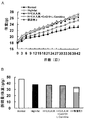
- the transition of the body weight measured in Example 4 (FIG. 4A) and the amount of food intake / body weight during the test period (FIG. 4B) are shown.
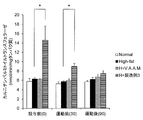
- concentration obtained in Example 9 is shown. *: P ⁇ 0.05 (vs. High-fat group, Fisher's PLSD test). The measurement result of the carnitine palmitoyltransferase activity in the liver obtained in Example 9 is shown. *: P ⁇ 0.05 (vs. High-fat group, Fisher's PLSD test). The measurement result of the acyl CoA oxidase activity in the liver obtained in Example 9 is shown. *: P ⁇ 0.05 (vs. High-fat group, Fisher's PLSD test). The amount of change in blood glycerol concentration ( ⁇ glycerol) obtained in Example 12 is shown.
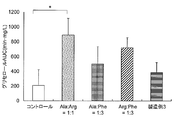
- Example 14 The measurement result of blood glycerol AUC (min ⁇ mg / L) obtained in Example 13 is shown. *: P ⁇ 0.05 (vs. control group, Fisher's PLSD test). The measurement result of blood glycerol AUC (min ⁇ mg / L) obtained in Example 14 is shown.
- the present invention is not limited to the following preferred embodiments, and can be freely changed within a range in which the effects of the present invention are exhibited.
- the present invention includes an amino acid mixture containing at least two amino acids selected from the group consisting of arginine, alanine, and phenylalanine, and the total amount of the at least two amino acids is 60 mol per 100 mol of the total amino acid.
- the present invention relates to a lipid metabolism promoter comprising a molar ratio of at least a mole.
- the present invention also relates to a lipid metabolism promoter further containing glycine as a component of an amino acid mixture in addition to at least two amino acids selected from the group consisting of arginine, alanine, and phenylalanine.
- the lipid metabolism promoter of the present invention contains arginine, alanine, and phenylalanine, or arginine, alanine, phenylalanine, and glycine as active ingredients.
- Arginine which is an active ingredient of the present invention, is one of the non-essential amino acids, and there are D-form and L-form.
- L-Arginine Cas No. Is 74-79-3, and its alias is (S) -2-amino-5-guanidinopentanoic acid, (S) -2-amino-5- (amidinoamino) valeric acid, L-(+) -Arginine, Argi U.
- Arg and R may be used as abbreviations for arginine.
- Arginine is easily soluble in water and formic acid, soluble in dilute hydrochloric acid, and hardly soluble in ethanol (16th revised Japanese Pharmacopoeia).
- Arginine is known to be contained in various materials and foods such as various proteins such as meat. Arginine is biosynthesized as an intermediate of the urea cycle, but it is rapidly degraded, making it an essential amino acid in children. Arginine is known to be involved in promoting secretion of growth hormone and improving immune function.
- Alanine which is an active ingredient of the present invention, is one of the non-essential amino acids, and there are D-form and L-form.
- L-alanine Cas No. Is 56-41-7, and aliases thereof are (S) -2-aminopropionic acid, (2S) -2-aminopropanoic acid, ⁇ -alanine, and L-(+)-alanine.
- Ala and A may be used as abbreviations for alanine.
- Alanine is easily soluble in water and formic acid and hardly soluble in ethanol (16th revised Japanese Pharmacopoeia).
- Alanine is known to be contained in various materials such as various proteins and foods.
- Alanine is a kind of amino acid constituting a protein and is known to be a material for connective tissue.
- L-Phenylalanine Cas No. are 63-91-2, and their alias names are (S) - ⁇ -aminobenzenepropanoic acid, (2S) -2-amino-3-phenylpropanoic acid, (S) -3-phenyl-2-amino Propionic acid, L- ⁇ -phenylalanine, and L-( ⁇ )-phenylalanine.
- Phe and F are used as abbreviations for phenylalanine.
- Phenylalanine is easily soluble in formic acid, slightly insoluble in water, soluble in dilute hydrochloric acid, and hardly soluble in ethanol (16th revision Japanese Pharmacopoeia). It is known that phenylalanine is contained in various materials such as various proteins and foods.
- Glycine is one of the non-essential amino acids.
- Glycine Cas No. Is 56-40-6, and its alternative names are 2-aminoacetic acid, ⁇ -aminoacetic acid, glycolixyl, glycochol.
- Gly and G may be used as abbreviations for glycine.
- Glycine is easily soluble in water and formic acid and hardly soluble in ethanol (16th revision Japanese Pharmacopoeia).
- Glycine is known to be contained in various materials and foods such as collagen, gelatin, and shellfish.
- Glycine has glycogenic properties and is known to be a component such as hemoglobin and liver enzymes, and to be a neurotransmitter in the central nervous system.
- arginine, phenylalanine, alanine, glycine or other amino acids may be free bases or hydrates, organic acids (acetic acid, tartaric acid, fatty acids, etc.), organic bases, inorganic acids (hydrochloric acid, Hydrobromic acid, nitric acid, sulfuric acid, perchloric acid, etc.) and inorganic bases (potassium, sodium, zinc, etc.) may form salts.
- arginine, phenylalanine, alanine, and glycine may use any of D body and L body.
- arginine, phenylalanine, alanine, glycine or other amino acids are squeezed, concentrated, purified, crystallized, or various solvents from materials and foods containing a large amount of arginine, phenylalanine, alanine, glycine or other amino acids. It can obtain by extracting with.
- water or commonly used solvents such as alcohols, hydrocarbons, organic acids, organic bases, inorganic acids, inorganic bases, supercritical fluids, etc. may be used alone or in combination. Is possible.
- a chemically synthesized product can also be used.
- arginine, phenylalanine, alanine, glycine or other amino acids may be used in combination of those derived from a plurality of them.
- the lipid metabolism promoter of the present invention contains, as an active ingredient, a combination of at least two amino acids selected from the group consisting of arginine, alanine, and phenylalanine, for example, arginine, alanine, and phenylalanine.
- the total number of moles of arginine, alanine and phenylalanine is 60 moles or more, 70 moles or more, 80 moles with respect to 100 moles of the total moles of all amino acids contained (total amino acid amount).
- At least two amino acids selected from the group consisting of arginine, alanine, and phenylalanine can be contained in an amount of 90 mol or more or 100 mol.
- the total amount of arginine, alanine, and phenylalanine is 95 mol or less and 90 mol or less with respect to 100 mol of the total number of moles of all contained amino acids (total amino acid amount). , 80 mol or less, or 75 mol or less.
- the molar ratio of 100 moles of the total number of moles of arginine, alanine, and phenylalanine to 100 moles of the total number of moles of all amino acids contained (total amino acid amount) is included in the lipid metabolism promoter.
- the amino acids are only arginine, alanine, and phenylalanine, that is, the amino acid mixture contained in the lipid metabolism promoter is composed of arginine, alanine, and phenylalanine, but other similar descriptions in this specification are also included. It is understood as well.
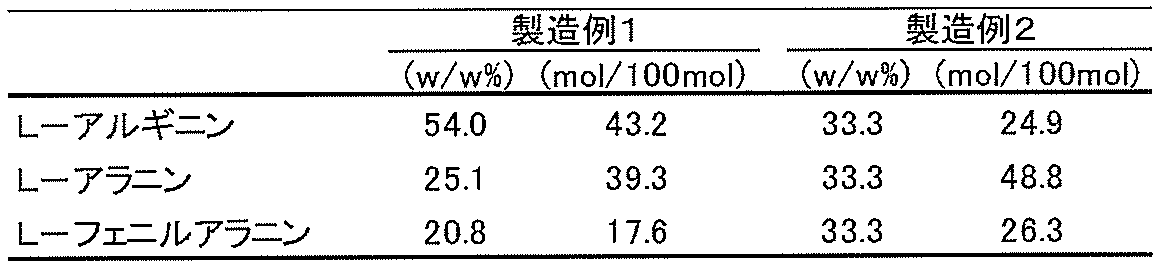
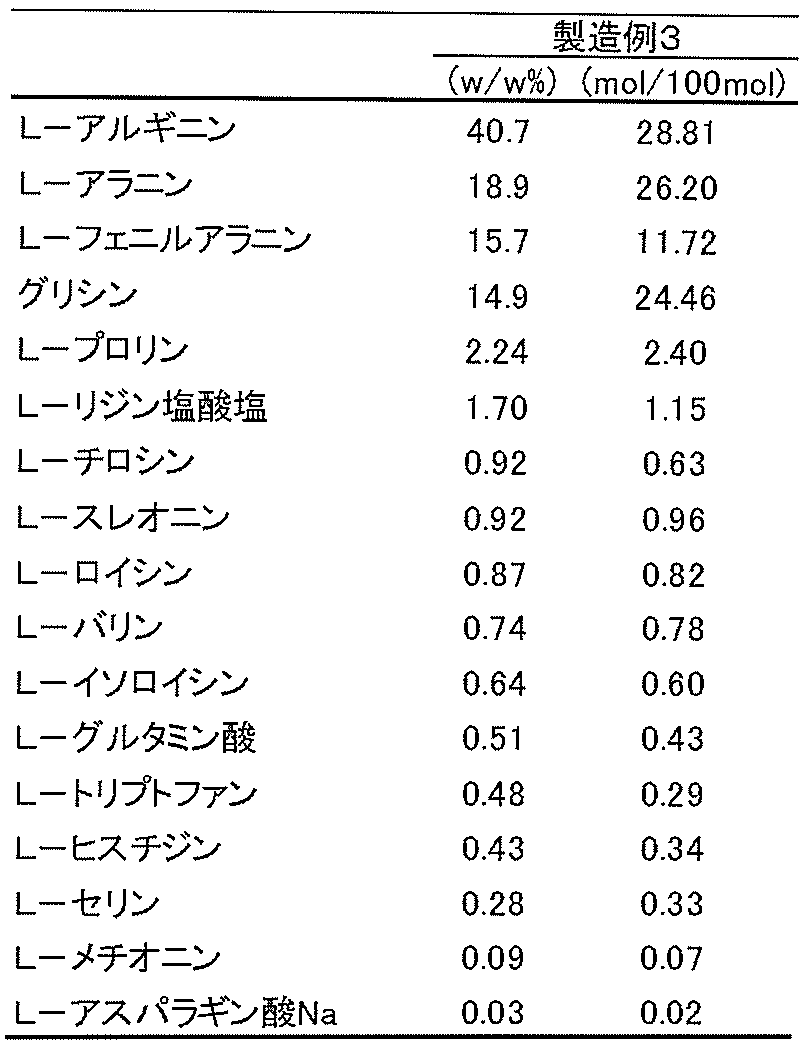
- Examples of the composition of the lipid metabolism promoter include lipid metabolism promoters (Production Example 1, Production Example 2, and Production Example 3) having the structures shown in Tables 2 and 3, but are not limited to this example. .
- the molar ratio corresponding to the blending amounts of arginine, alanine, and phenylalanine contained in the lipid metabolism promoter of the present invention may be any value.
- the molar ratio of arginine is 8 to 30 mol
- alanine is 18 to 30 mol
- phenylalanine is 10 to 20 mol with respect to 100 mol of the total amino acid contained therein.
- the lipid metabolism promoter of the present invention comprises 25 to 30 mol of arginine, 25 to 30 mol of alanine, and 10 to 15 mol of phenylalanine with respect to 100 mol of the total amino acid contained therein.
- the lipid metabolism promoter of the present invention comprises 8 to 50 mol of arginine, 18 to 50 mol of alanine, and 10 to 70 mol of phenylalanine with respect to 100 mol of the total amino acid contained therein. You may contain by the molar ratio of.
- the lipid metabolism promoter of the present invention contains arginine, alanine, and phenylalanine, and the total amount thereof is in a molar ratio of 100 moles with respect to 100 moles of the total amino acid contained in the lipid metabolism promoter of the present invention.
- the lipid metabolism promoter of the present invention contains 8-50 mol of arginine and alanine with respect to 100 mol of the total amino acid contained therein. 18 to 50 mol and phenylalanine can be contained in a molar ratio of 10 to 70 mol.
- the lipid metabolism promoter of the present invention may also contain arginine at a molar ratio of 8 to 30 mol, alanine at 20 to 35 mol, and phenylalanine at 10 to 55 mol with respect to 100 mol of the total amino acid contained therein. Good.
- the lipid metabolism promoter of the present invention may contain a relatively large amount of phenylalanine.
- the lipid metabolism promoter of the present invention can further contain glycine as an active ingredient in addition to at least two amino acids selected from the group consisting of arginine, alanine, and phenylalanine.
- glycine as an active ingredient in addition to at least two amino acids selected from the group consisting of arginine, alanine, and phenylalanine.
- arginine, alanine, phenylalanine, and glycine Can also be contained as an active ingredient.
- the total number of moles of arginine, alanine, phenylalanine, and glycine is 85 moles or more, 90 moles or more with respect to 100 moles of the total number of moles of all contained amino acids (total amino acid amount), It can contain at least two amino acids selected from the group consisting of arginine, alanine, and phenylalanine and glycine in an amount of 95 moles or more, or a molar ratio of 100 moles.
- the total amount of arginine, alanine, phenylalanine and glycine is 99 mol or less and 95 mol with respect to 100 mol of the total number of moles of all amino acids contained (total amino acid amount).
- the amount may be 92 mol or less, or 90 mol or less.
- the molar ratio corresponding to each blending amount of arginine, alanine, phenylalanine and glycine contained in the lipid metabolism promoter of the present invention may be any value.
- the lipid metabolism promoter of the present invention contains 8 to 30 mol of arginine, 18 to 30 mol of alanine, 10 to 20 mol of phenylalanine, and 20 to 20 mol of glycine with respect to 100 mol of the total amino acid contained therein. It can be contained in a molar ratio of 27 mol.
- the lipid metabolism promoter of the present invention is, for example, 25 to 30 mol of arginine, 25 to 30 mol of alanine, 10 to 15 mol of phenylalanine, 22 to 27 mol of glycine, with respect to 100 mol of the total amino acid contained therein. You may contain by the molar ratio of.
- lipid metabolism promoter of the present invention As a composition example of the lipid metabolism promoter of the present invention, a lipid metabolism promoter (Production Example 3) having the structure shown in Table 3 can be exemplified, but the present invention is not limited to this example. Since arginine, alanine, phenylalanine, and glycine are suitable for eating and drinking and oral intake because of their taste and smell, the lipid metabolism promoter of the present invention containing these in a high concentration is excellent in flavor. Therefore, the lipid metabolism promoter of the present invention has an advantage that does not impair the flavor of foods and drinks and pharmaceuticals to which this is added.
- the lipid metabolism promoter of the present invention may further contain other amino acids.
- the other amino acids may be 20 kinds of amino acids that usually constitute biological proteins.
- the other amino acid may be a natural amino acid or a non-natural amino acid.
- the lipid metabolism promoter of the present invention further contains only proline, lysine, tyrosine, threonine, leucine, valine, isoleucine, glutamic acid, tryptophan, histidine, serine, methionine, and aspartic acid as other amino acids. It may be.
- those that do not inhibit the lipid metabolism promoting effect of the lipid metabolism promoting agent of the present invention can be used preferentially.
- the molar ratio corresponding to the amount of each of the other amino acids contained in the lipid metabolism promoter of the present invention may be any value.
- 0.01 to 4 mol of proline, 0.01 to 2 mol of lysine, and 0.01 to 2 of tyrosine with respect to 100 mol of the total amino acid contained therein.
- arginine is 25-30 mol
- alanine is 25-30 mol
- phenylalanine is 10-15 mol
- glycine is 22-27 mol
- proline is 0.1-4 mol
- Aspartic acid can be contained in a molar ratio of 0.01 to 0.1 mol.
- lipid metabolism promoter of the present invention 27-30 mol of arginine, 25-28 mol of alanine, 10-13 mol of phenylalanine, 23-26 mol of glycine, 2-3 mol of proline, and lysine 0.6 to 1.6 mol, tyrosine 0.1 to 1.1 mol, threonine 0.5 to 1.5 mol, leucine 0.3 to 1.3 mol, and valine 0.3 to 1.
- fat refers to neutral fat.
- Neutral fat catabolism is divided into neutral fat breakdown into glycerol and fatty acids and fatty acid combustion ( ⁇ oxidation).
- the mechanism of fat breakdown can be generally outlined as follows.
- Adrenaline secretion increases due to exercise load, bathing, cold stimulation, and the like.
- cyclic AMP (cAMP) is synthesized from ATP.
- a hormone-sensitive lipase converts triacylglycerol into free fatty acid and monoacylglycerol.
- Monoacylglycerol lipase converts monoacylglycerol into glycerol and free fatty acids.
- ⁇ Combustion ( ⁇ oxidation) of the produced fatty acid is generally outlined as follows.
- Fatty acids are transported to the liver and catalyzed and activated by the enzyme acyl CoA synthetase present on the cytoplasmic side of the mitochondrial outer membrane to become fatty acyl CoA.
- the mitochondrial inner membrane does not directly permeate acyl-CoA, it temporarily binds to carnitine to produce fatty acyl carnitine.
- Fatty acid acylcarnitines pass through the inner mitochondrial membrane and into the matrix by facilitated diffusion through the acylcarnitine / carnitine transporter.
- the fatty acid acyl CoA is regenerated by being transferred from carnitine to coenzyme A present in mitochondria by the catalyst of the enzyme carnitine acyltransferase II.
- Fatty acyl CoA that has entered mitochondria is oxidized by enzymes in the matrix.
- the ⁇ -oxidation reaction consists of four stages of reaction, and 2 carbons are separated as acetyl CoA from the carboxy terminus of the fatty acyl chain each time.
- Dehydrogenase desaturates ⁇ and ⁇ positions, and hydratase adds ⁇ OH, dehydrogenase binds ⁇ position to keto group, thiolase binds CoA to ⁇ position, and ⁇ and ⁇ positions are cleaved. This produces carbon chain fatty acyl-CoA and acetyl CoA.
- acetoacetyl CoA A part of acetyl CoA becomes acetoacetyl CoA, and acetoacetic acid is produced via 3-hydroxy-3-methylglutaryl CoA (HMG-CoA). Acetoacetic acid is converted to acetone by decarboxylation or reduced to ⁇ -hydroxybutyric acid.
- HMG-CoA 3-hydroxy-3-methylglutaryl CoA
- Acetoacetic acid and ⁇ -hydroxybutyric acid produced in the liver are transported to cells in tissues other than the liver (central nervous system, cardiac muscle, skeletal muscle, kidney, adrenal gland, etc.) and ATP is produced in the mitochondrial TCA circuit and electron transport system. Used for.
- fatty acids are decomposed in brown fat cells and converted to heat under the action of UCP-1 (Uncoupling protein 1, mitochondrial uncoupling protein). More specifically, when noradrenaline binds to the ⁇ 3 receptor on brown fat, UCP-1 also called thermogenin is opened, the membrane potential (mitochondrial proton concentration gradient) is eliminated, and ATP synthesis is not performed. Oxidation of a substrate such as a fatty acid is remarkably enhanced and heat production occurs. That is, ⁇ -oxidation of fatty acids is promoted and heat energy is released.
- UCP-1 Uncoupling protein 1, mitochondrial uncoupling protein
- ketone bodies acetoacetic acid, ⁇ -hydroxybutyric acid, acetone
- the lipid metabolism promoter of the present invention containing arginine, phenylalanine, alanine and glycine at a high concentration, or a combination of two or more of arginine, phenylalanine and alanine. It was found that lipid metabolism promoters promote lipid metabolism.
- the lipid metabolism promoting effect of the lipid metabolism promoting agent of the present invention could be confirmed in a state in which exercise load was actually applied and adrenaline secretion was enhanced ( Example 4 and Example 5).
- the lipid metabolism promoter of the present invention can metabolize fat more efficiently, particularly in a state where secretion of adrenaline is continuously increased.
- the lipid metabolism promoter of the present invention can be suitably used for acting in a subject with an increased state of adrenaline secretion.
- the adrenaline hypersecretion state is not particularly limited, it is preferably a state in which stimulation by exercise, stress, exposure to cold, bathing, eating, etc. is received.
- the lipid metabolism promoter of the present invention is administered to a subject in a state of increased adrenergic secretion, or increased adrenergic secretion. What is necessary is just to administer to the subject (For example, the subject before exercise
- Example 4 the expression level of UCP-1 in brown adipose tissue increased in animals administered with the lipid metabolism promoter of the present invention. From this, it was found that the lipid metabolism promoter of the present invention increases the decomposition of fat and increases the conversion efficiency from fatty acid to heat.
- ketone body formation and glucagon secretion during exercise increased.
- Glucagon has a function of promoting the use of glycogen and the production of ketone bodies. From this, it was also found that the lipid metabolism promoter of the present invention increases the efficiency of conversion from fatty acid to energy when glucose-derived energy metabolism is insufficient. When attention is paid to the time course of the ketone body concentration, the production of ketone bodies is greatly increased after the exercise load (time 30 to time 90). From this, it was found that the conversion from fatty acid to energy increased during exercise continued to be high after the end of exercise.
- the amount of change in the respiratory exchange ratio during aerobic exercise decreased in humans administered the lipid metabolism promoter of the present invention.
- the respiratory exchange ratio is one index of energy metabolism, and a decrease in this value indicates that the contribution of lipids in energy metabolism has increased. This also indicates that the lipid metabolism promoter of the present invention increases the efficiency of conversion from fatty acid to energy (Example 5).
- Cortisol is a kind of glucocorticoid, and is a hormone that increases secretion from the adrenal cortex when stressed. Since the increase in cortisol has a function of promoting the decomposition of glycogen and protein into sugar, the increase increases lipid metabolism. However, if the state of high cortisol secretion continues, muscle glycogen and liver glycogen are consumed early, and exercise performance decreases. In addition, there are adverse effects on the body such as decreased immune function and atrophy of muscles and organs. Therefore, during exercise, the cortisol level preferably returns to a steady value at an early stage.
- the lipid metabolism promoter of the present invention promotes lipid metabolism without affecting insulin secretion or blood glucose (Example 5). If exercise is performed with increased insulin secretion, hypoglycemia may occur during exercise. Since the lipid metabolism promoter of the present invention does not affect the secretion of insulin, it can efficiently produce lipid-derived energy without causing hypoglycemia during exercise.
- lipid metabolism promoter of the present invention exerts a lipid metabolism promoting effect without affecting the secretion of growth hormone, adrenaline and noradrenaline (Example 5).
- the lipid metabolism promoter of the present invention promotes all processes of decomposition from fat to fatty acid, conversion from fatty acid to heat, and conversion from fatty acid to energy.
- the lipid metabolism promoter of the present invention can be used to promote both the decomposition of fat into fatty acids and the conversion of fatty acids into heat.
- the lipid metabolism promoter of the present invention is an index of lipid metabolism, such as blood glycerol concentration increase, weight gain suppression, blood free fatty acid concentration increase, blood glucagon concentration increase, blood cortisol concentration decrease, blood total Accompanied by at least one, preferably two or more, more preferably all selected from the group consisting of increased ketone body concentration, increased blood 3-hydroxybutyric acid concentration, and increased UCP-1 expression level in brown adipose tissue It can be used for promoting lipid metabolism.
- the lipid metabolism promoter of the present invention can also be used as a further indicator for promoting lipid metabolism accompanied by increased carnitine palmitoyltransferase activity in the liver and / or increased acyl CoA oxidase activity in the liver.
- These indicators can be measured by a conventional method, and for example, reference can be made to the description of Examples below.
- the increase, decrease, or increase in these lipid metabolism indicators may be judged in comparison with a control group (for example, placebo group) under the same conditions except that the lipid metabolism promoter of the present invention is not administered or ingested. If a certain tendency is shown, it can be judged that there is an effect thereof, but it is more preferable that a statistically significant difference is shown.
- the lipid metabolism promoter of the present invention can be used in any form, for example, as it is or added to a food or drink or a medicine for promoting lipid metabolism.
- the amount of arginine, alanine, and phenylalanine added to the lipid metabolism promoter varies depending on the dosage form, symptom, body weight, use, etc., and is not particularly limited.
- the total amount can be set to 0.2 to 100 w / w% (weight / weight%), preferably 0.3 to 100 w / w%, more preferably 0.4 to 100 w / w. % Can be set.
- the present invention also provides a method of promoting lipid metabolism in a subject, comprising administering or ingesting the lipid metabolism promoter of the present invention to the subject.
- the subject is preferably an animal desired to promote lipid metabolism, but is not limited to humans, domestic animals (pigs, horses, etc.), pets (dogs, cats, etc.), experimental (test) animals (mouse, Mammals including rodents such as rats and rabbits) are preferred.
- preferred subjects include subjects with dyslipidemia or obesity, genetic predisposition to obesity, subjects with lifestyle or environmental risks, subjects in whom weight loss or weight maintenance is desired, or exercise, Examples include subjects that are or will be placed in a state of hyperadrenergic secretion due to stress or the like. Since the lipid metabolism promoter of the present invention has the effect of efficiently promoting lipid metabolism, fat can be efficiently consumed even in obese people who tend to degrade fat slowly and less than normal people. Can be used for burning.
- the daily intake (dose) of the lipid metabolism promoter is not particularly limited because it varies depending on age, symptoms, body weight, use, etc.
- the total intake can be set to 0.3 to 30 g, 0.8 to 8 g, 1 to 5 g, 1.3 to 3.5 g, 1.5 g or 3 g as a solid content.
- the daily intake of arginine is 0.06 to 12 g (or 0.4 to 70 mmol), 0.2 to 4 g (or 1 to 21 mmol), 0.4 to 2 g (or 2 to 2 mmol). 11 mmol), 1.2 g (7 mmol), 1 g (6 mmol), or 0.6 g (4 mmol).
- the daily intake of alanine is 0.03 to 10 g (or 0.3 to 112 mmol), 0.09 to 3 g (or 1 to 34 mmol), 0.2 to 2 g (or 2 to 2 mmol). 17 mmol), 1 g (11 mmol), 0.6 g (6 mmol), or 0.3 g (3 mmol).
- the daily intake of phenylalanine is 0.02 to 10 g (or 0.1 to 61 mmol), 0.08 to 3 g (or 0.5 to 18 mmol), 0.2 to 2 g (or 0.9-9 mmol), 1 g (6 mmol), 0.5 g (3 mmol), or 0.2 g (1 mmol).
- the daily intake of glycine is 4 g or less (or 59 mmol or less), 1.3 g or less (or 18 mmol or less), 0.7 g or less (or 9 mmol or less), 0.02 to 4 g ( Or 0.3-59 mmol), 0.07-1 g (or 1-18 mmol), 0.1-0.7 g (or 2-9 mmol), 0.4 g (6 mmol) or 0.2 g (3 Mmol).
- lipid metabolism promoter of the present invention may be used simultaneously with or before and after intake of foods and beverages and pharmaceuticals having a conventionally known lipid metabolism promotion effect.
- Examples of the actual form of the lipid metabolism promoter of the present invention include forms added to tablets (tablets), capsules, granules, powders, syrups, liquids, suspensions, drinks, foods and drinks, and the like. This can be taken or administered orally, by tube, intravenously and the like.
- the lipid metabolism promoter of the present invention is administered by adding it to a special-purpose food such as a food for specified health use, a nutritional functional food, a dietary supplement or a supplement, or by adding it to a pharmaceutical product. Therefore, it is expected to promote lipid metabolism.
- a special-purpose foods such as foods for specified health use, functional nutritional foods, dietary supplements and supplements
- consumers can expect to promote lipid metabolism while clearly distinguishing them from general foods.
- the food and drink may be for consumption by non-human animals such as domestic animals and pets.
- the present invention also provides foods and pharmaceuticals containing the lipid metabolism promoter of the present invention, such as foods and drinks and pharmaceuticals for promoting lipid metabolism.
- an agent consisting only of the lipid metabolism promoter of the present invention and an auxiliary for formulation can also be produced.
- adjuvants for formulation include excipients, binders, disintegrants, lubricants, flavoring agents, solubilizers, suspension agents, and coating agents. These may be those that can be normally used in the field of food and beverage or pharmaceutical preparation technology. Further, an appropriate amount of vitamins, minerals, organic acids, sugars, peptides, amino acids not mentioned above, and the like may be added to these. As other components, those which do not inhibit the lipid metabolism promoting effect of the lipid metabolism promoting agent of the present invention can be used preferentially.
- the lipid metabolism promoter of the present invention includes various foods (milk, soft drinks, fermented milk, yogurt, cheese, bread, biscuits, crackers, pizza crusts, prepared powdered milk, liquid foods, foods for the sick, nutritional foods, frozen foods. , Processed foods and other commercially available foods) and may be ingested. These foods may be in the form of liquid, paste, gel, solid or powder.
- the food containing the lipid metabolism promoter of the present invention can be produced using water, protein, carbohydrates, lipids, vitamins, minerals, organic acids, organic bases, fruit juices, flavors and the like.
- the protein include whole milk powder, skim milk powder, partially skim milk powder, casein, whey powder, whey protein, whey protein concentrate, whey protein isolate, whey protein hydrolyzate, ⁇ -casein, ⁇ -casein, ⁇ - Casein, ⁇ -lactoglobulin, ⁇ -lactalbumin, lactoferrin, soy protein, chicken egg protein, meat protein and other animal and vegetable proteins, their degradation products, butter, whey minerals, cream, whey, non-protein nitrogen, sialic acid And various milk-derived components such as phospholipids and lactose.
- a peptide such as casein phosphopeptide or an amino acid.
- the saccharide include saccharides, processed starch (in addition to text phosphorus, soluble starch, British starch, oxidized starch, starch ester, starch ether, etc.), dietary fiber, and the like.
- lipids for example, lard, fish oil, etc., these fractionated oils, hydrogenated oils, transesterified oils and other animal oils, palm oil, safflower oil, corn oil, rapeseed oil, coconut oil, etc.
- vegetable oils such as oil, hydrogenated oil, and transesterified oil.
- vitamins include vitamin A, carotene, vitamin B group, vitamin C, vitamin D group, vitamin E, vitamin K group, vitamin P, vitamin Q, niacin, nicotinic acid, pantothenic acid, biotin, inositol, choline,
- examples include folic acid.
- minerals include calcium, potassium, magnesium, sodium, copper, iron, manganese, zinc, selenium and the like.
- examples of the organic acid include malic acid, citric acid, lactic acid, tartaric acid, erythorbic acid, and the like. These components can be used alone or in combination of a plurality of types, and a synthetic product and / or a food containing a lot of these may be used. These foods may be in the form of liquid, paste, gel, solid or powder.
- the lipid metabolism promoter of the present invention can efficiently promote lipid metabolism by ingesting before or during the state in which the secretion of adrenaline continuously increases, as well as during normal life and medical treatment. For example, it is known that adrenaline secretion is continuously increased in subjects who are subjected to exercise load, cold exposure, stress load, bathing, and eating a lot. Therefore, the lipid metabolism promoter of the present invention may be taken before exercise load, cold exposure, stress load, etc. or with exercise load, cold exposure, stress load, etc. Alternatively, the lipid metabolism promoter of the present invention may be taken before or during bathing. A person with a tendency toward multiple eating may take the quality metabolism promoter of the present invention.
- the present invention relates to the use (use method) of a combination of at least two amino acids selected from the group consisting of arginine, alanine, and phenylalanine, for example, a combination of arginine, alanine, and phenylalanine, for producing a lipid metabolism promoter. Further, the present invention also provides a use in which the total number of moles of arginine, alanine, and phenylalanine is 60 moles or more with respect to 100 moles of the total number of moles of all amino acids.
- the present invention also relates to a combination of at least two amino acids selected from the group consisting of arginine, alanine, and phenylalanine, for example, arginine, alanine, and phenylalanine, and the total number of moles of arginine, alanine, and phenylalanine contains amino acids.
- a method of promoting lipid metabolism excluding medical practice, characterized by ingesting a composition containing a molar ratio of 60 moles or more with respect to 100 moles of all moles (total amino acid amount) ).
- Example 1 Comparison of various amino acids and conventional amino acid composition (VAAM) in lipid metabolism promoting effect (1) Material and method [test sample] ⁇ V. A. A. M.M. : Amino acid mixture (VAAM) having the composition shown in Table 1 was prepared by suspending in water for injection (Otsuka Pharmaceutical Co., Ltd.) at a concentration of 1 g / 10 ml.
- L-alanine (Ala), L-methionine (Met), L-phenylalanine (Phe), L-arginine (Arg), glycine (Gly) at a concentration of 1 g / 10 ml each for water for injection (Otsuka Pharmaceutical) ) And suspended.
- VAAM group alanine group, methionine group, phenylalanine group, arginine group, glycine group
- test sample dose 1 g / kg was orally
- FIG. 1 shows the change rate of blood glycerol concentration (glycerol AUC change rate [Glycerol AUC change]). All of the alanine group, methionine group, phenylalanine group, arginine group and glycine group A. A. M.M. It was higher than the group.
- alanine, methionine, phenylalanine, arginine, and glycine have a higher lipid metabolism promoting effect than conventional amino acid compositions.
- Example 2 Comparison of Lipid Metabolism Promoter of the Present Invention (Production Example 1) and Single Amino Acid in Lipid Metabolism Promoting Effect (1) Materials and Methods [Test Sample] “Production Example 1”: An amino acid mixture having the composition shown in Table 2 (Production Example 1) was prepared by suspending in water for injection (Otsuka Pharmaceutical Co., Ltd.) at a concentration of 2.7 g / 10 ml. In 10 ml, 1.2 g of L-arginine, 0.57 g of L-alanine and 0.47 g of L-phenylalanine are contained.
- Arginine L-arginine was prepared by suspending in water for injection (Otsuka Pharmaceutical Co., Ltd.) at a concentration of 1.2 g / 10 ml.
- Alanine L-alanine was prepared by suspending in water for injection (Otsuka Pharmaceutical Co., Ltd.) at a concentration of 0.57 g / 10 ml.
- Phenylalanine L-phenylalanine was prepared by suspending in water for injection (Otsuka Pharmaceutical Co., Ltd.) at a concentration of 0.47 g / 10 ml.
- VAAM group “Production Example 1” group, arginine group, alanine group, phenylalanine group) or water for injection (vehicle group) was orally administered at 5 ml / kg. After 30 minutes, blood was collected again (time 0
- Glycerol fluorescence assay kit (Glycerol Fluorometric Assay Kit; Cayman Chemical Company) was used to measure glycerol in plasma according to the attached protocol. A value obtained by subtracting the measured value of time-30 from the measured value at each measurement was calculated, and this was used as the amount of change in blood glycerol concentration.
- FIG. 2 shows the amount of change in blood glycerol concentration ( ⁇ glycerol).
- the amount of change in blood glycerol concentration was higher than that in the Vehicle group.
- the “Production Example 1” group was significantly higher than the Vehicle group (p ⁇ 0.05) blood glycerol concentration change.
- the amount of change in blood glycerol concentration was significantly higher in the phenylalanine group than in the Vehicle group only 30 minutes after adrenaline administration (time 30). The other groups were not significantly different from the Vehicle group.
- alanine, phenylalanine, and arginine were more effective in promoting lipid metabolism when ingested in combination of three types than when ingested alone.
- Example 3 Comparison of Lipid Metabolism Promoter of the Present Invention (Production Example 3) and Conventional Amino Acid Composition (VAAM) in Lipid Metabolism Promoting Effect (1) Materials and Methods [Test Sample] ⁇ V. A. A. M.M. An amino acid mixture (VAAM) having the composition shown in Table 1 was prepared by suspending it in water for injection (Otsuka Pharmaceutical Co., Ltd.) at a concentration of 3 g / 10 ml.
- “Production Example 3” An amino acid mixture having the composition shown in Table 3 (Production Example 3) was prepared by suspending it in water for injection (Otsuka Pharmaceutical Co., Ltd.) at a concentration of 3 g / 10 ml.
- VAAM group “Production Example 3” group
- Water for injection Vehicle for injection
- Blood glycerol Glycerol Assay Kit (Cayman Chemical Company) was used to measure glycerol in plasma according to the attached protocol. A value obtained by subtracting the measured value of time-30 from the measured value at each measurement was calculated, and this was used as the amount of change in blood glycerol concentration.
- FIG. 3 shows the amount of change in blood glycerol concentration.
- the “Production Example 3” group includes V. A. A. M.M. The amount of change in blood glycerol concentration was higher than that in the group. At 30 minutes (time 30) and 45 minutes (time 45) after adrenaline administration, the “Production Example 3” group showed a significantly higher (p ⁇ 0.05) change in blood glycerol concentration than the Vehicle group. .
- the lipid metabolism promoter of the present invention containing highly alanine, phenylalanine, and arginine has a higher lipid metabolism promoting effect than the conventional amino acid composition.
- Example 4 Lipid metabolism promoting effect of lipid metabolism promoter of the present invention (Production Example 3) in animals fed with a high fat diet and subjected to exercise load (1) Materials and methods [Test sample and food] -0.1% CMC solution: Prepared by dissolving carboxymethylcellulose (Wako Pure Chemical Industries, Ltd.) in distilled water for injection at a concentration of 0.1 w / v%.
- VAAM Amino acid mixture
- V. A. A. M.M. + CoQ10 + L-Carnitine 1 g / 10 ml of the amino acid mixture (VAAM) having the composition shown in Table 1, Coenzyme Q10 (CoQ10, Taiyo Kagaku) as CoQ10, 10 mg / 10 ml, L-carnitine (San-Eigen F. was prepared by suspending in a 0.1% CMC solution to a concentration of 68 mg / 10 ml.
- “Production Example 3” An amino acid mixture having the composition shown in Table 3 (Production Example 3) was prepared by suspending it in a 0.1% CMC solution at a concentration of 1 g / 10 ml.
- AIN-93M Oriental Yeast Industry: The composition is shown in Table 5.
- AIN-93 A standard purified feed for nutritional research using mice and rats published in 1993 (AIN-93) by the National Institute of Nutrition (AIN).
- HFD-60 Oriental Yeast Industry
- Test sample H + VAAM group, H + VAAM + CoQ10 + L-Carnitine group, H + "Production Example 3" group
- 0.1% CMC solution Normal group, High-fat group
- the test sample or 0.1% CMC solution was prepared and used once a week, and administered at the dose shown in Table 6 (dosing volume 10 mL / kg).
- UCP-1 expression level in brown adipose tissue Using a mouse mitochondrial brown fat uncoupling protein 1 (UCP1) ELISA Kit (CUSABIO), UCP-1 expression level in brown adipose tissue was measured.
- UCP1 ELISA Kit CUSABIO
- FIG. 4 shows the results of body weight measurement and food intake / body weight during the test period.
- the body weight was significantly increased from the third day (day 3) compared with the Normal group.
- the “Production Example 3” group a significant body weight-suppressing effect was observed on the 3rd to 42nd day (day 3 to day 42) compared with the High-fat group.
- the + CoQ10 + L-Carnitine group there was no difference in body weight compared to the High-fat group.
- Food intake / body weight during the study period was lower in each group fed HFD-60 than in the group fed AIN-93M, but differed between groups fed HFD-60 Was not recognized.
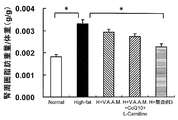
- FIG. 5 shows the fat weight around the kidney.
- the weight increased significantly in the High-fat group compared to the Normal group.
- the production example 3 group significantly suppressed the increase of the adipose tissue weight as compared with the high-fat group.
- the + CoQ10 + L-Carnitine group showed no difference in adipose tissue weight compared to the High-fat group.
- FIG. 6 shows the expression level of UCP-1 in brown adipose tissue. There was no change in UCP-1 expression level in the High-fat group compared to the Normal group. In the Production Example 3 group, the expression level of UCP-1 was significantly increased as compared with the High-fat group. On the other hand, V. A. A. M.M. Groups and V.A. A. A. M.M. In the + CoQ10 + L-Carnitine group, there was no difference in the expression level of UCP-1 compared to the High-fat group.
- Example 5 Confirmation of the effect of the lipid metabolism promoter of the present invention on the effect of promoting lipid metabolism (1) Materials and methods [Test food] The following two types of test foods were prepared using capsules (Japanese Pharmacopoeia Cellulose White Capsule (vegetable) No. 00) whose appearance could not be identified from the appearance.
- the subject was judged to be tired when two or more of the following criteria (1) to (4) were satisfied. Further, the maximum oxygen intake obtained immediately before it was determined that the patient was tired was defined as VO 2 max.
- Bicycle exercise is performed using a bicycle ergometer, increasing the exercise intensity by 100 W at 0 to 1 minute after the start of exercise, and 25 W every minute after that, until the tiredness is exhausted. (Multi-step gradual exercise test).
- a double-blind crossover comparison test was conducted on 12 male subjects 20.5 ⁇ 0.2 years old (average value ⁇ standard error) thus selected.
- the first test (VS1) was performed with an interval of 14 days from VS0. In VS1, one of two kinds of test foods was ingested, and bicycle exercise, blood collection, collection and analysis of exhalation gas, and heart rate measurement were performed. Further, a second test (VS2) was performed with an interval of 7 days from VS1. In VS2, a test food different from VS1 was ingested, and bicycle exercise, blood sampling, collection and analysis of exhaled gas, and heart rate measurement were performed.
- test VS1 and test VS2 Ingestion of test food: The test food was swallowed without chewing using water or white water.
- Bicycle exercise VO 2 max measured at VS0 using a bicycle ergometer for 60 minutes from 30 minutes after intake of test food to 90 minutes after intake of test food (time 30 to 90) under conditions of 60 rpm. Of 50% exercise intensity.
- Measurement of heart rate It was carried out continuously for 150 minutes immediately after taking test food to 150 minutes after taking test food (time 0 to time 150).
- Respiration exchange ratio The collected exhalation was measured with a gas analyzer for each breath, and the concentration of O 2 and CO 2 in the exhalation and the flow rate of the exhalation were measured. Based on this measured value, oxygen uptake (VO 2 ) (ml / body weight kg / min)), carbon dioxide production (VCO 2 (ml / body weight kg / min)) and respiratory exchange ratio (VCO 2 / VO 2) ) was calculated. Furthermore, the amount of change in the respiratory exchange ratio ( ⁇ VCO 2 / VO 2 ) was determined by subtracting the group average value of the respiratory exchange ratio at time 0 from the respiratory exchange ratio at each time point.
- Blood glycerol Serum glycerol was measured using an enzyme method according to the attached manual.
- Blood free fatty acid The concentration of free fatty acid in serum was measured using an enzyme-UV method.
- -Glucagon in blood The concentration of glucagon in plasma was measured using the RIA2 antibody (Double-antibody Radioimmunoassay) method.
- Blood insulin Serum insulin concentration was measured using the CLIA (Chemiluminescent Immunoassay) method.
- -Blood glucose The blood glucose level was measured using an enzyme method.
- -Total ketone body in blood The total ketone concentration in serum (total of 3-hydroxybutyric acid and acetoacetic acid) was measured using an enzymatic method.
- Serum acetoacetate concentration was measured using an enzymatic method.
- -Blood growth hormone The concentration of growth hormone in serum was measured using the CLEIA method.
- -Adrenaline in blood The adrenaline concentration in plasma was measured using HPLC (High Performance Liquid Chromatography) method.
- Plasma noradrenaline concentration was measured using HPLC method.
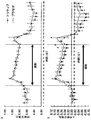
- FIG. 7 shows the results of changes in the respiratory exchange ratio over time ( ⁇ VCO 2 / VO 2 ).
- ⁇ VCO 2 / VO 2 changed at a lower value in the active group from the start of exercise to after the end of exercise, and a significant decrease was observed at time 85 and 90 (min) compared to the placebo group during exercise.
- both groups once increased at time 95 and 100 (min), but then decreased rapidly to time 135 (min).
- time 125 and 135 (min) did not significant difference between time 125 and 135 (min)
- the active group showed a lower average value.
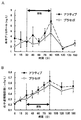
- FIG. 8 shows the measurement results of blood glycerol concentration and free fatty acid concentration over time.
- the concentration of blood glycerol was higher in the active group than in the active group, although no significant difference was observed at time 45 and 90 (min) during exercise.
- the blood free fatty acid shows a higher average value in the active group from the start of exercise (time 30 (minutes)) to the end of the test (time 150 (minutes)), and the highest average value in time 90 (minutes) during exercise. Indicated.
- FIG. 9 shows the results of measurement of blood cortisol, glucagon, insulin concentration and blood glucose over time.
- Cortisol rose to time 0-15 (min) before exercise, but decreased thereafter. In time 15 to 75 (min), the value of the active group was lower, and a significant difference was recognized in time 45 (min).
- FIG. 10 shows the results of measuring the concentration of total ketone bodies, 3-hydroxybutyric acid, and acetoacetic acid in the blood over time.
- Total ketone bodies and 3-hydroxybutyric acid decrease in both the active group and the placebo group until time 45 (min) during exercise (15 minutes after the start of exercise), but then begin to increase until time 45 to 150 (min) The amount of increase was larger in the active group, and the average value was maximum at time 120 (minutes). A significant difference was observed in the measured value of time 60 (min).
- time 120 and time 150 the production of ketone bodies in the active group tended to increase greatly.
- FIG. 11 shows the results of measuring the concentrations of growth hormone, adrenaline and noradrenaline in blood.
- Growth hormone increased in both the active group and the placebo group from the start of the test (time 0), and showed almost the same transition. There was no significant difference between the active group and the placebo group.
- the values of adrenaline and noradrenaline increased with the start of exercise (time 30) and decreased with the end of exercise (time 90). In both cases, there was no significant difference between the active group and the placebo group.
- the lipid metabolism promoting agent of the present invention has a lipid metabolism promoting effect upon exercise load in humans. Furthermore, it was also found that the lipid metabolism promoter of the present invention exerts a lipid metabolism promoting effect without affecting the secretion of insulin, growth hormone, adrenaline and noradrenaline.
- Example 6 Manufacture of beverages blended with the lipid metabolism promoter of the present invention
- the production example 3 shown in Table 3 is 1.5 w / v%, sweetener 1.0 w / v%, acidulant 0.9 w / v%, and thickener.
- a beverage was prepared according to a conventional method by blending at a concentration of 0.2 w / v%. Beverage 200 When ml is ingested, 3 g of Production Example 3 can be ingested.
- Example 7 Manufacture of a tablet containing the lipid metabolism promoter of the present invention 50 wt / w% of the production example 3 shown in Table 3 was combined with 50 w / w% of excipient, binder, disintegrant, and lubricant, Tablets were manufactured according to a conventional method.
- Example 8 Preparation of supplement containing the lipid metabolism promoter of the present invention L-arginine 1 g (5.7 mmol), L-alanine 1 g (11 mmol), L-phenylalanine 1 g (6.1 mmol) Excipients were added to and filled into capsules.
- Example 9 Measurement of lipid metabolism index (1) Materials and methods [Test sample] The test sample was prepared by suspending an amino acid mixture having the composition shown in Table 3 (Production Example 3) and an amino acid mixture having the composition shown in Table 1 (VAAM) in distilled water. did.
- test sample was forcibly orally administered to mice using a sonde every day for 4 days after the acclimation period, excluding the last day.
- exercise force running
- the exercise load by the treadmill was 40 minutes at a speed of 15 m / min.
- the test sample was administered 30 minutes before the exercise load by the treadmill.
- the animals were fasted for 18 hours from the 4th day to the 5th day after the start of administration.
- Dissection was performed 5 days after the start of administration. On the day of the dissection, each group was divided into three groups in order to examine temporal changes from the time of administration. Specifically, a group dissected before administration (pre-administration (0)), a group dissected 30 minutes after administration (before exercise (30)), and a group dissected after 60 minutes of treadmill exercise (30 minutes after administration) ( After exercise (90)), the test sample was administered on the day of dissection and exercise exercise was performed, and blood collection and dissection were performed. The collected livers were weighed, immediately frozen in liquid nitrogen, and stored frozen at ⁇ 80 ° C. until ⁇ -oxidation-related enzymes were measured.
- ⁇ -oxidation-related enzyme activity (carnitine palmitoyltransferase activity, acyl CoA oxidase activity) in the liver was measured by the following procedure. First, the liver was homogenized, centrifuged, and the supernatant was collected to obtain a total liver homogenate fraction. For this fraction, carnitine palmitoyltransferase activity was measured by using a partly modified method of Marlwell et al.
- acyl CoA oxidase activity was measured for the liver homogenate fraction by partially modifying the method of Hashimoto et al. Specifically, 50 mM potassium phosphate buffer (final concentration 0.1 mM palmitoyl CoA, 10.6 mM phenol, 0.82 mM 4-aminoantipyrine, 10 ⁇ M FAD, 4 U peroxidase (horse radish) and 0.2 mg bovine albumin ( The total liver homogenate fraction obtained at pH 7.4) was added, and the absorbance was monitored at 30 ° C. and 500 nm for 11 minutes (total amount 200 ⁇ L).
- the amount of protein in the obtained liver total homogenate fraction was measured using the BCA method.
- TaKaRa BCA Protein Assay Kit T9300A was used and measured according to the attached manual.
- FIG. 12 shows the measurement results of blood glucagon concentration.
- the H + Production Example 3 group showed a significant increase in blood glucagon concentration before exercise (30 minutes after administration) compared to the High-fat group. That is, it was shown that the lipid metabolism promoter of the present invention can efficiently promote lipid metabolism during exercise by enhancing the secretion of glucagon having a lipolysis promoting action before exercise.
- FIG. 13 shows the measurement results of carnitine palmitoyltransferase activity.
- the H + Production Example 3 group showed a significant increase in carnitine palmitoyltransferase activity before administration and before exercise (30 minutes after administration) compared to the High-fat group.
- FIG. 14 shows the measurement results of acyl CoA oxidase activity.
- the H + Production Example 3 group showed a significant increase in acyl CoA oxidase activity before administration compared to the High-fat group.
- Carnitine palmitoyltransferase and acyl-CoA oxidase which are liver ⁇ -oxidation-related enzymes, are known to be rate-determining stages of lipid metabolism. Therefore, the lipid metabolism promoter of the present invention can enhance the activity of these ⁇ -oxidation-related enzymes. Has also been shown to promote lipid metabolism.
- the lipid metabolism promoter of the present invention containing highly alanine, phenylalanine and arginine exhibits a high lipid metabolism promoting effect.
- blood was collected from the tail vein (30 minutes before administration; time-30), and the test sample was immediately orally administered (5 ml / kg) at a dose of 1 g / kg to the body weight of the rat.
- blood was collected again (time 0) and immediately followed by intraperitoneal administration of adrenaline ((R)-( ⁇ )-epinephrine, Wako Pure Chemical Industries, Ltd.) at a dose of 0.2 mg / kg (8 ml / kg). kg). Thereafter, blood was collected over time every 15 minutes (time 15, 30, 45, 60, 75, 90) until 90 minutes after administration of adrenaline. Plasma was obtained from the collected blood, and blood glycerol was measured.
- Glycerol was measured in plasma using a glycerol assay kit (Cayman Chemical Company) according to the attached protocol. A value obtained by subtracting the measured value of time 0 from the measured value at each measurement was calculated, and this was used as the amount of change in blood glycerol concentration.
- blood was collected from the tail vein (time-30), and the test sample was immediately orally administered (5 ml / kg) at a dose of 1 g / kg relative to the rat body weight.
- blood was collected again (time 0) and immediately followed by intraperitoneal administration of adrenaline ((R)-( ⁇ )-epinephrine, Wako Pure Chemical Industries, Ltd.) at a dose of 0.2 mg / kg (8 ml / kg). kg). Thereafter, blood was collected over time every 15 minutes (time 15, 30, 45, 60, 75, 90) until 90 minutes after administration of adrenaline. Plasma was obtained from the collected blood and the blood glycerol concentration was measured.
- Glycerol was measured in plasma using a glycerol assay kit (Cayman Chemical Company) according to the attached protocol. A value obtained by subtracting the measured value of time 0 from the measured value at each measurement was calculated, and this was used as the amount of change in blood glycerol concentration.
- blood was collected from the tail vein (time-30), and the test sample was immediately orally administered (5 ml / kg) at a dose of 1 g / kg relative to the rat body weight.
- blood was collected again (time 0) and immediately followed by intraperitoneal administration of adrenaline ((R)-( ⁇ )-epinephrine, Wako Pure Chemical Industries, Ltd.) at a dose of 0.2 mg / kg (8 ml / kg). kg). Thereafter, blood was collected over time every 15 minutes (time 15, 30, 45, 60, 75, 90) until 90 minutes after administration of adrenaline. Plasma was obtained from the collected blood and the blood glycerol concentration was measured.
- Glycerol was measured in plasma using a glycerol assay kit (Cayman Chemical Company) according to the attached protocol. A value obtained by subtracting the measured value of time 0 from the measured value at each measurement was calculated, and this was used as the amount of change in blood glycerol concentration.
- FIG. 15 shows the amount of change in blood glycerol concentration ( ⁇ glycerol).
- Arginine (Arg): Phenylalanine (Phe) 2.5: 7.5 group and 5: 5 group had a higher level of change in blood glycerol concentration than the control group. It was also found that arginine and phenylalanine showed the highest lipid metabolism promoting effect when mixed at 1: 3.
- Example 13 Measurement of lipid metabolism index (1) Materials and methods [Test sample] As test samples, (i) a 1: 1 weight ratio mixture of alanine and arginine, (ii) a 1: 3 weight ratio mixture of alanine and phenylalanine, which showed high lipolytic ability in each of Examples 10 to 12, iii) A 1: 3 weight ratio mixture of arginine and phenylalanine, and (iv) an amino acid mixture (Production Example 3) having the composition shown in Table 3 were each prepared by suspending in water for injection (Otsuka Pharmaceutical).
- blood was collected from the tail vein (time-30), and the test sample was immediately orally administered (5 ml / kg) at a dose of 1 g / kg relative to the rat body weight.
- blood was collected again (time 0) and immediately followed by intraperitoneal administration of adrenaline ((R)-( ⁇ )-epinephrine, Wako Pure Chemical Industries, Ltd.) at a dose of 0.2 mg / kg (8 ml / kg). kg). Thereafter, blood was collected over time every 15 minutes (time 15, 30, 45, 60, 75, 90) until 90 minutes after administration of adrenaline. Plasma was obtained from the collected blood, and blood glycerol was measured.
- Glycerol was measured in plasma using a glycerol assay kit (Cayman Chemical Company) according to the attached protocol. Based on the value obtained by subtracting the measured value of time 0 from the measured value at each measurement, blood glycerol AUC (area under the blood concentration-time curve) of time 0 to time 90 was calculated.
- FIG. 16 shows the calculated blood glycerol AUC (min ⁇ mg / L).
- Arg 1: 1 group
- Ala: Phe 1: 3 group
- Arg: Phe 1: 3 group
- Production Example 3 group blood glycerol AUC was higher than that in the control group .
- Example 14 Measurement of lipid metabolism index (1) Materials and methods [Test sample] As test samples, (i) a 1: 1 weight ratio mixture of alanine and arginine, which showed the highest lipolytic ability in Example 13, and a mixing ratio was determined based on the results of Examples 10-12 (ii) alanine and A mixture prepared by suspending a 1: 1: 3 weight ratio mixture of arginine and phenylalanine and (iii) a 1: 1: 6 weight ratio mixture of alanine, arginine and phenylalanine in water for injection (Otsuka Pharmaceutical Co., Ltd.) was used.
- blood was collected from the tail vein (time-30), and the test sample was immediately orally administered (5 ml / kg) at a dose of 1 g / kg relative to the rat body weight.
- blood was collected again (time 0) and immediately followed by intraperitoneal administration of adrenaline ((R)-( ⁇ )-epinephrine, Wako Pure Chemical Industries, Ltd.) at a dose of 0.2 mg / kg (8 ml / kg). kg). Thereafter, blood was collected over time every 15 minutes (time 15, 30, 45, 60, 75, 90) until 90 minutes after administration of adrenaline. Plasma was obtained from the collected blood, and blood glycerol was measured.
- Glycerol was measured in plasma using a glycerol assay kit (Cayman Chemical Company) according to the attached protocol. A value obtained by subtracting the measured value of time 0 from the measured value at each measurement was calculated, and this was used as the amount of change in blood glycerol concentration. Based on the value obtained by subtracting the measured value of time 0 from the measured value at each measurement, blood glycerol AUC (area under the blood concentration-time curve) of time 0 to time 90 was calculated.
- FIG. 17 shows the calculated blood glycerol AUC (min ⁇ mg / L).
- the blood glycerol AUC was high.
- the lipid metabolism promoter of the present invention containing a combination of two or three of alanine, phenylalanine, and arginine exhibits a high lipid metabolism promoting effect.
- lipid metabolism promoter According to the lipid metabolism promoter according to the present invention, a lipid metabolism promoter that can effectively promote fat consumption and can bring about a higher body fat reduction effect even at the same amount of exercise. Development of products using it becomes possible.
Landscapes
- Health & Medical Sciences (AREA)
- Life Sciences & Earth Sciences (AREA)
- Chemical & Material Sciences (AREA)
- Animal Behavior & Ethology (AREA)
- Veterinary Medicine (AREA)
- Public Health (AREA)
- Medicinal Chemistry (AREA)
- General Health & Medical Sciences (AREA)
- Pharmacology & Pharmacy (AREA)
- Engineering & Computer Science (AREA)
- Epidemiology (AREA)
- Nuclear Medicine, Radiotherapy & Molecular Imaging (AREA)
- Bioinformatics & Cheminformatics (AREA)
- General Chemical & Material Sciences (AREA)
- Chemical Kinetics & Catalysis (AREA)
- Organic Chemistry (AREA)
- Polymers & Plastics (AREA)
- Hematology (AREA)
- Obesity (AREA)
- Diabetes (AREA)
- Nutrition Science (AREA)
- Food Science & Technology (AREA)
- Proteomics, Peptides & Aminoacids (AREA)
- Mycology (AREA)
- Child & Adolescent Psychology (AREA)
- Acyclic And Carbocyclic Compounds In Medicinal Compositions (AREA)
- Pharmaceuticals Containing Other Organic And Inorganic Compounds (AREA)
- Coloring Foods And Improving Nutritive Qualities (AREA)
- Non-Alcoholic Beverages (AREA)
Abstract
Description
プロリン 0.01~4モル
リジン 0.01~2モル
チロシン 0.01~2モル
スレオニン 0.01~2モル
ロイシン 0.01~2モル
バリン 0.01~2モル
イソロイシン 0.01~2モル
グルタミン酸 0.01~1モル
トリプトファン 0.01~1モル
ヒスチジン 0.01~1モル
セリン 0.01~1モル
メチオニン 0.01~0.2モル
アスパラギン酸 0.01~0.1モル
[b] アルギニンを8~30モル、アラニンを18~30モル、フェニルアラニンを10~20モル、のモル比で含有する、前記[a]に記載の脂質代謝促進剤、
[c] アルギニン、アラニン、及びフェニルアラニンのモル数の合計が、アミノ酸全てのモル数の合計100モルに対して100モルある、前記[a]又は[b]に記載の脂質代謝促進剤、
[d] アルギニン、アラニン、フェニルアラニン、及びグリシンを有効成分として含有し、アルギニン、アラニン、フェニルアラニン、及びグリシンのモル数の合計が、アミノ酸全てのモル数の合計100モルに対して85モル以上である、脂質代謝促進剤、
[e] アルギニンを8~30モル、アラニンを18~30モル、フェニルアラニンを10~20モル、グリシンを20~27モル、のモル比で含有する、前記[d]に記載の脂質代謝促進剤、
[f] アルギニン、アラニン、フェニルアラニン、及びグリシンのモル数の合計が、アミノ酸全てのモル数の合計100モルに対して100モルある、前記[d]又は[e]に記載の脂質代謝促進剤、
[g] さらに、他のアミノ酸としてプロリン、リジン、チロシン、スレオニン、ロイシン、バリン、イソロイシン、グルタミン酸、トリプトファン、ヒスチジン、セリン、メチオニン、及びアスパラギン酸のみを含有する、前記[a]又は[d]に記載の脂質代謝促進剤、
[h] さらに、他のアミノ酸として下記のアミノ酸のみを、下記のモル比で含有する、前記[b]又は[e]に記載の脂質代謝促進剤、
プロリンを0.01~4モル
リジンを0.01~2モル
チロシンを0.01~2モル
スレオニンを0.01~2モル
ロイシンを0.01~2モル
バリンを0.01~2モル
イソロイシンを0.01~2モル
グルタミン酸を0.01~1モル
トリプトファンを0.01~1モル
ヒスチジンを0.01~1モル
セリンを0.01~1モル
メチオニンを0.01~0.2モル
アスパラギン酸を0.01~0.1モル
[i] アドレナリンの分泌が亢進する状態で摂取することを特徴とする、前記[a]~[h]のいずれか1つに記載の脂質代謝促進剤、
[j] アドレナリンの分泌が亢進する状態が、運動、ストレス、寒冷暴露、入浴、又は多食による刺激を受ける状態である、前記[i]に記載の脂質代謝促進剤、
[k] 褐色脂肪組織中のUCP-1の発現量を増加することを特徴とする、前記[a]~[j]のいずれか1つに記載の脂質代謝促進剤、
[l] 脂肪から脂肪酸への分解を促進することを特徴とする、前記[a]~[j]のいずれか1つに記載の脂質代謝促進剤、
[m] 脂肪酸から熱への変換を促進することを特徴とする、前記[a]~[j]のいずれか1つに記載の脂質代謝促進剤、
[n] 脂肪酸からエネルギーへの変換を促進することを特徴とする、前記[a]~[j]のいずれか1つに記載の脂質代謝促進剤。
脂質代謝促進効果における、各種アミノ酸と従来のアミノ酸組成物(V.A.A.M.)の比較
(1)材料及び方法
[被検試料]
・V.A.A.M.:表1に示す組成のアミノ酸混合物(V.A.A.M.)を、1g/10mlの濃度で注射用水(大塚製薬)に懸濁して調製した。

6週齢のWistar系雄性ラット(SLC社)を1週間予備飼育して試験に用いた。体重に基づいて群分けし(Vehicle群、V.A.A.M.群、アラニン群、メチオニン群、フェニルアラニン群、アルギニン群、グリシン群の7群、各n=6)、18時間絶食した(ただし、水は自由摂取とした)。
血中グリセロール:グリセロールアッセイキット(Glycerol Assay Kit;Cayman Chemical Campany)を用い、付属の手順書に従って、血漿中のグリセロールを測定した。各測定時における測定値からtime-30の測定値を差し引いた値を算出し、これを血中グリセロール濃度の変化量とした。次いで、血中グリセロール濃度の変化量について、time0~75の曲線下面積(AUC)を算出した。さらに、各アミノ酸群のAUCについて、Vehicle群のAUCに対する変化率(%)を算出した。
図1に血中グリセロール濃度の変化率(グリセロールAUC変化率[Glycerol AUC change])を示す。アラニン群、メチオニン群、フェニルアラニン群、アルギニン群、グリシン群はいずれも、V.A.A.M.群より高い値を示した。
脂質代謝促進効果における、本発明の脂質代謝促進剤(製造例1)と単独のアミノ酸の比較
(1)材料及び方法
[被検試料]
・「製造例1」:表2に示す組成のアミノ酸混合物(製造例1)を、2.7g/10mlの濃度で注射用水(大塚製薬)に懸濁して調製した。10ml中に、L-アルギニン1.2g、L-アラニン0.57g及びL-フェニルアラニン0.47gが含まれる。
6週齢のWistar系雄性ラット(SLC社)を1週間予備飼育して試験に用いた。体重に基づいて群分けし(Vehicle群、「製造例1」群、アルギニン群、アラニン群、フェニルアラニン群の5群、各n=6)、18時間絶食した(ただし、水は自由摂取とした)。
血中グリセロール:グリセロール蛍光アッセイキット(Glycerol Fluorometric Assay Kit;Cayman Chemical Campany)を用い、付属の手順書に従って、血漿中のグリセロールを測定した。各測定時における測定値からtime-30の測定値を差し引いた値を算出し、これを血中グリセロール濃度の変化量とした。
測定値は、平均値±標準誤差で示した。データは統計ソフトStat View 5.0-Jを使用して、F検定による等分散の検定後、FisherのPLSDによって検定した。有意水準は5%とした。
図2に血中グリセロール濃度の変化量(Δグリセロール)を示す。「製造例1」群は、Vehicle群よりも、血中グリセロール濃度の変化量が高水準で推移した。アドレナリン投与後15分、30分、45分、60分、及び75分(time15、30、45、60、75)において、「製造例1」群はVehicle群と比較して有意に高い(p<0.05)な血中グリセロール濃度の変化量を示した。フェニルアラニン群はアドレナリン投与後30分(time30)のみ、Vehicle群よりも血中グリセロール濃度の変化量が有意に高くなった。他の群はVehicle群と有意な差を認めなかった。
脂質代謝促進効果における、本発明の脂質代謝促進剤(製造例3)と従来のアミノ酸組成物(V.A.A.M.)の比較
(1)材料及び方法
[被検試料]
・V.A.A.M.:表1に示す組成のアミノ酸混合物(V.A.A.M.)を、3g/10mlの濃度で注射用水(大塚製薬)に懸濁して調製した。
6週齢のWistar系雄性ラット(SLC社)を1週間予備飼育して試験に用いた。体重に基づいて群分けし(Vehicle群、V.A.A.M.群、「製造例3」群の3群、各n=7)、18時間絶食した(ただし、水は自由摂取とした)。
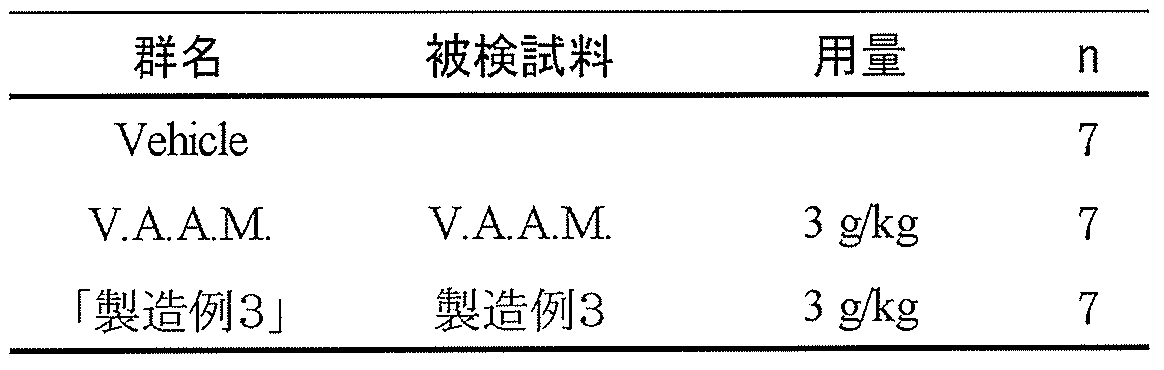
血中グリセロール:Glycerol Assay Kit (Cayman Chemical Campany)を用い、付属の手順書に従って、血漿中のグリセロールを測定した。各測定時における測定値からtime-30の測定値を差し引いた値を算出し、これを血中グリセロール濃度の変化量とした。
測定値は、平均値±標準誤差で示した。データは統計ソフトStat View 5.0-Jを使用して、F検定による等分散の検定後、FisherのPLSDによって検定した。有意水準は5%とした。
図3に血中グリセロール濃度の変化量を示す。「製造例3」群は、V.A.A.M.群よりも、血中グリセロール濃度の変化量が高水準で推移した。アドレナリン投与後30分(time30)及び45分(time45)において、「製造例3」群はVehicle群と比較して有意に高い(p<0.05)な血中グリセロール濃度の変化量を示した。
高脂肪食を給餌して運動負荷をかけた動物における、本発明の脂質代謝促進剤(製造例3)の脂質代謝促進効果
(1)材料及び方法
[被検試料及び餌]
・0.1%CMC溶液:カルボキシメチルセルロース(和光純薬)を0.1w/v%の濃度で注射用蒸留水に溶解して調製した。

3週齢のC57BL/6J系雄性マウス(クレア社)を1週間予備飼育及び1週間のトレッドミルへの馴化をした後に試験に用いた。体重に基づいて群分けし(day0)(Normal群(n=9)、High-fat群(n=10)、H+V.A.A.M.群(n=9)、H+V.A.A.M.+CoQ10+L-Carnitine群(n=10)、H+「製造例3」群(n=10)の5群)、以降、群分けから42日後の試験最終日(day42)までAIN-93M(Normal群)又はHFD-60(High-fat群、H+V.A.A.M.群、H+V.A.A.M.+CoQ10+L-Carnitine群、H+「製造例3」群)を自由摂取させた(ただし、水は自由摂取とした)。
被検試料(H+V.A.A.M.群、H+V.A.A.M.+CoQ10+L-Carnitine群、H+「製造例3」群)又は0.1%CMC溶液(Normal群、High-fat群)を、試験最終日を除く42日間毎日(day0~day41)、ゾンデを用いて強制経口投与した。被験試料又は0.1%CMC溶液は1週間に1度調製して使用し、表6に示す用量(投与容量10mL/kg)で投与した。
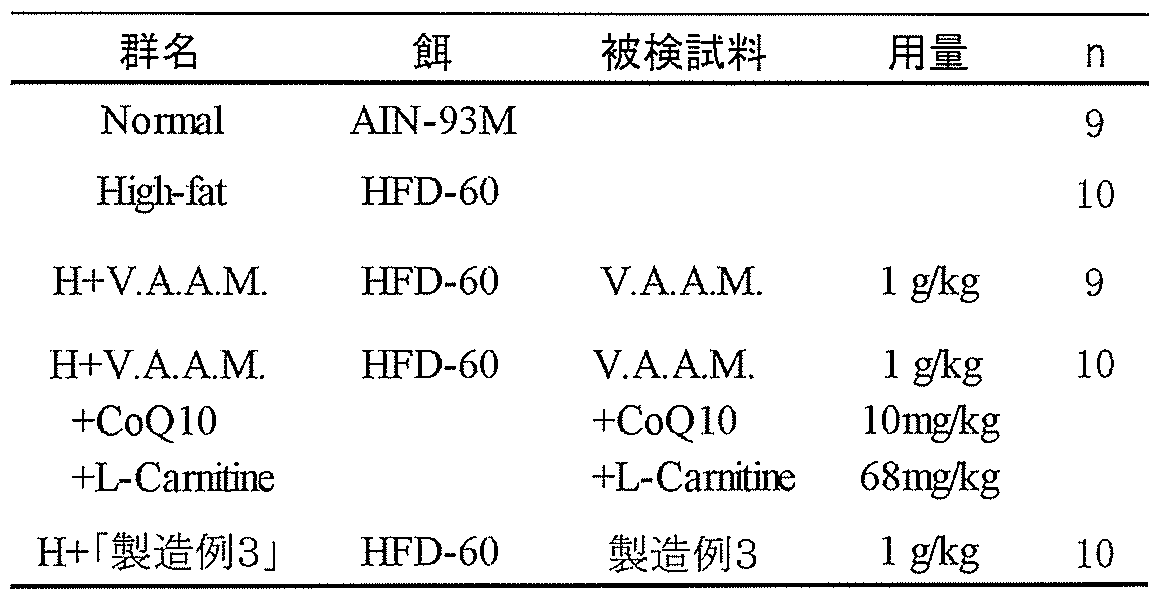
群分け~試験最終日(day0~day42)の期間中、1週間に3回の頻度で、トレッドミルによる運動負荷(15m/分~20m/分、40分間)を行った。
群分け~試験最終日(day0~day42)の期間中、3日に1回の頻度で、体重測定を行った。
試験最終日(day42)に解剖して腎周囲脂肪組織及び褐色脂肪組織の重量を測定し、褐色脂肪組織中のUCP-1発現量を測定した。
褐色脂肪組織中のUCP-1発現量:Mouse mitochondrial brown fat uncoupling protein 1 (UCP1) ELISA Kit (CUSABIO)を用い、付属の手順書に従って、褐色脂肪組織中のUCP-1発現量を測定した。
測定値は、平均値±標準誤差で示した。データは統計ソフトStat View 5.0-Jを使用して、F検定による等分散の検定後、FisherのPLSDによって検定した。有意水準は5%とした。
図4に、体重測定及び試験期間中の摂餌量/体重の結果を示す。High-fat群において、Normal群と比較して投与3日目(day3)より有意に体重増加が見られた。「製造例3」群では、High-fat群と比較して投与3~42日目(day3~day42)にかけて有意な体重抑制効果が見られた。一方で、V.A.A.M.群及びV.A.A.M.+CoQ10+L-Carnitine群はHigh-fat群と比較して体重に差異を認めなかった。試験期間中の摂餌量/体重は、AIN-93Mを給餌した群よりもHFD-60を給餌した各群の方が低い値を示したが、HFD-60を給餌した各群の間に差異は認められなかった。
脂質代謝促進効果における、本発明の脂質代謝促進剤の効果確認
(1)材料及び方法
[試験食品]
内容物の有無を外観上識別不能なカプセル(日本薬局方セルロースホワイトカプセル(植物性)00号)を用い、下記2種類の試験食品を調製した。
被験者の選別をするために、20歳以上の男性に対し、事前の血液生化学検査、血液学的検査及び自転車運動を実施した(VS0)。自転車運動では、運動開始から疲労困憊するまでに要する時間及び最大酸素摂取量(VO2max)の測定を行なった。さらに事前アンケートで生活習慣の確認を行い、これらの結果に基づいて、健康でかつ運動開始から疲労困憊するまでに要する時間とVO2maxに偏りのないことを条件に、被験者の選抜を行なった。
VS0から14日の間隔をあけて1回目の試験(VS1)を実施した。VS1では2種類の試験食品のうち一方を摂取し、自転車運動、採血、呼気ガスの採取・分析、及び心拍数の測定を行なった。さらに、VS1から7日の間隔をあけて2回目の試験(VS2)を行った。VS2ではVS1とは異なる試験食品を摂取し、自転車運動、採血、呼気ガスの採取・分析、及び心拍数の測定を行なった。
・試験食品の摂取:前記の試験食品を、水又は白湯を用いて噛まずに飲み込んで摂取させた。
・呼吸交換比:採取した呼気を呼吸毎にガス分析装置で測定し、呼気中のO2及びCO2の濃度、呼気の流量を測定した。この測定値に基づいて、酸素摂取量(VO2)(ml/体重kg/min))、二酸化炭素産生量(VCO2(ml/体重kg/min))及び呼吸交換比(VCO2/VO2)を算出した。さらに、各時点の呼吸交換比からtime0の呼吸交換比の各群平均値を差し引いて、呼吸交換比の変化量(ΔVCO2/VO2)を求めた。
試験で得た各測定値、算出値又は換算値は1標本t検定で評価した。
図7に、経時的な呼吸交換比の変化量(ΔVCO2/VO2)の結果を示す。ΔVCO2/VO2は、運動開始から運動終了後までアクティブ群の方が低い値で推移し、運動時ではtime85、90(分)でプラセボ群に比べて有意な低下が認められた。運動終了時ではtime95、100(分)に両群とも一旦上昇するが、その後time135(分)まで急激に低下した。特にtime125~135(分)の間では、有意な差は見られなかったものの、アクティブ群の方が低い平均値を示した。
本発明の脂質代謝促進剤を配合した飲料の製造
表3に示す製造例3を1.5w/v%、甘味料1.0w/v%、酸味料0.9w/v%、及び増粘剤0.2w/v%の濃度で配合し、常法に従って飲料を製造した。飲料200
mlを摂取すると、製造例3を3g摂取することができる。
本発明の脂質代謝促進剤を配合したタブレットの製造
表3に示す製造例3を50w/w%、賦形剤、結合剤、崩壊剤、及び滑沢剤を合わせて50w/w%配合し、常法に従ってタブレットを製造した。
本発明の脂質代謝促進剤を配合したサプリメントの製造
L-アルギニン1g(5.7ミリモル)、L-アラニン1g(11ミリモル)、L-フェニルアラニン1g(6.1ミリモル)の割合で混合し、これに賦形剤を添加して、カプセルに充填した。
脂質代謝指標の測定
(1)材料及び方法
[被検試料]
被検試料は、表3に示す組成のアミノ酸混合物(製造例3)、及び表1に示す組成のアミノ酸混合物(V.A.A.M.)を、それぞれ蒸留水に懸濁することにより調製した。
3週齢の雄マウスC57BL/6J(日本クレア社)を5日間予備飼育し、さらに2日間トレッドミルへの馴化を行った後、実験に用いた。馴化期間終了後、体重を測定し各群の平均体重が同様となるように群分け(Normal群、High-fat群、H+V.A.A.M.群、及びH+製造例3群)を行った。水は自由摂取とした。
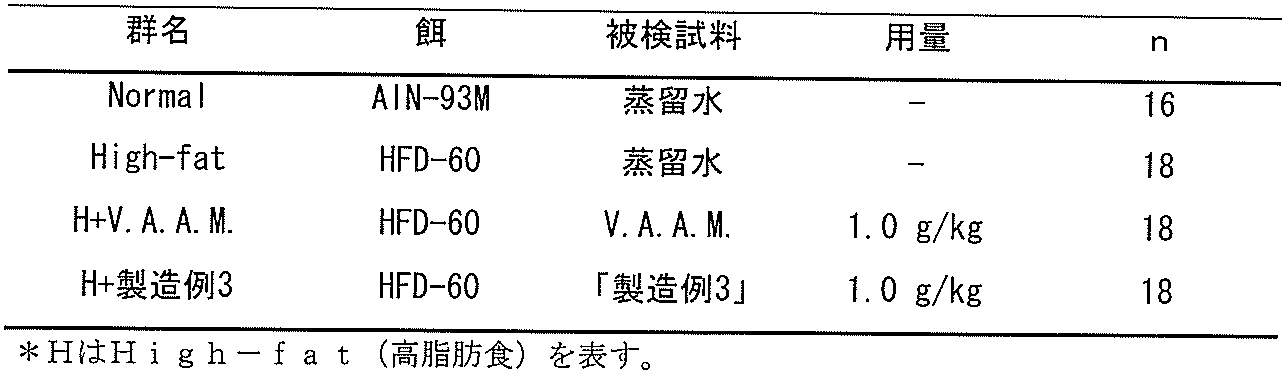
得られた血液について、血清中のグルカゴン濃度(血中グルカゴン濃度)を、グルカゴン比色定量ELISAキット Mercodia Glucagon ELISA Kit(Mercodia)を用いて付属の手順書に従って測定した。
各種測定値は、平均値±標準誤差で示した。データは統計ソフトStat View 5.0-Jを使用し、各群の分散の等質性をF検定にて確認後、多群の検定をFisherのPLSDによって行った。有意水準は両側5%とした。
図12に、血中グルカゴン濃度の測定結果を示す。H+製造例3群は、High-fat群と比較して運動前(投与後30分)において血中グルカゴン濃度の有意な上昇を示した。すなわち本発明の脂質代謝促進剤は、脂肪分解促進作用を有するグルカゴンの分泌を運動前に亢進させることにより、運動時の脂質代謝を効率的に促進できることが示された。
脂質代謝指標の測定
(1)材料及び方法
[被検試料]
被検試料として、(i)アラニン(アラニン:アルギニン=10:0)、(ii)アラニンとアルギニンの7.5:2.5混合物、(iii)アラニンとアルギニンの5:5混合物、(iv)アラニンとアルギニンの2.5:7.5混合物、(v)アルギニン(アラニン:アルギニン=0:10)を、それぞれ注射用水(大塚製薬)に懸濁して調製したものを使用した。
6週齢のWistar系雄性ラット(SLC社)を予備飼育後、試験に用いた。試験前日の朝、ラットの体重を測定し、平均体重が同様となるように群分けした。試験系の概略及び群構成を以下の表8に示す。

グリセロールアッセイキット(Cayman Chemical Campany)を用い、付属の手順書に従って、血漿中のグリセロールを測定した。各測定時における測定値からtime0の測定値を差し引いた値を算出し、これを血中グリセロール濃度の変化量とした。
アラニン(Ala):アルギニン(Arg)=2.5:7.5群、5:5群、7.5:2.5群、10:0群は、コントロール群よりも、血中グリセロール濃度の変化量が高水準で推移した。また、アラニンとアルギニンは、1:1で混合すると最も高い脂質代謝促進効果を示すことがわかった。
脂質代謝指標の測定
(1)材料及び方法
[被検試料]
被検試料として、(i)アラニン(アラニン:フェニルアラニン=10:0)、(ii)アラニンとフェニルアラニンの7.5:2.5混合物、(iii)アラニンとフェニルアラニンの5:5混合物、(iv)アラニンとフェニルアラニンの2.5:7.5混合物、(v)フェニルアラニン(アラニン:フェニルアラニン=0:10)を、それぞれ注射用水(大塚製薬)に懸濁して調製したものを使用した。
6週齢のWistar系雄性ラット(SLC社)を予備飼育後、試験に用いた。試験前日の朝、ラットの体重を測定し、平均体重が同様となるように群分けした。試験系の概略及び群構成を以下の表9に示す。
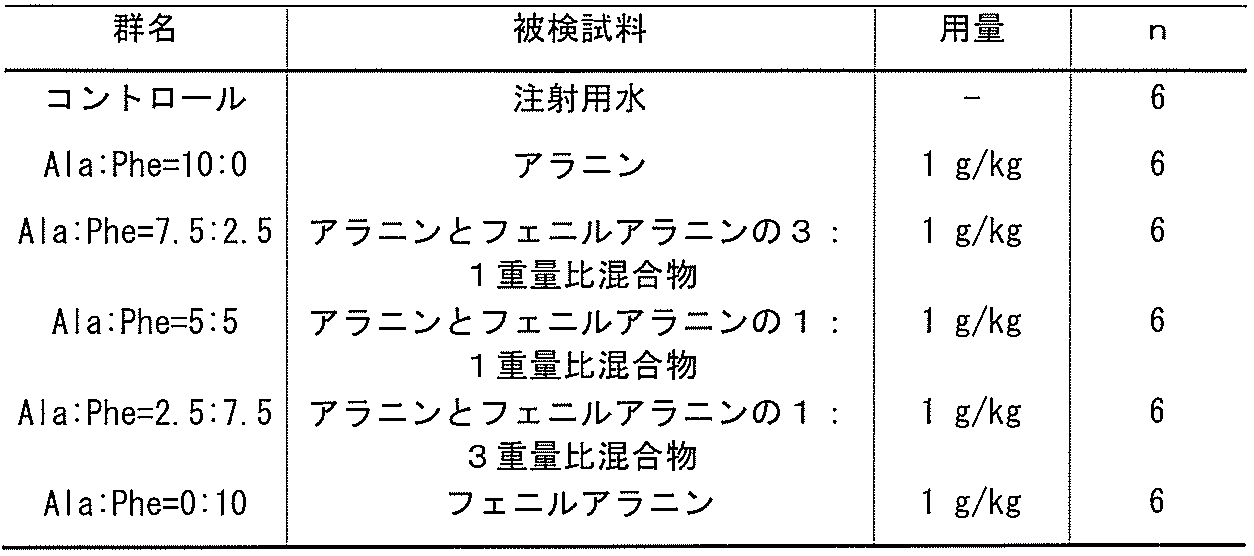
グリセロールアッセイキット(Cayman Chemical Campany)を用い、付属の手順書に従って、血漿中のグリセロールを測定した。各測定時における測定値からtime0の測定値を差し引いた値を算出し、これを血中グリセロール濃度の変化量とした。
アラニン(Ala):フェニルアラニン(Phe)=2.5:7.5群、5:5群、7.5:2.5群、10:0群は、control群よりも、血中グリセロール濃度の変化量が高水準で推移した。また、アラニンとフェニルアラニンは、1:3で混合すると最も高い脂質代謝促進効果を示すことがわかった。
脂質代謝指標の測定
(1)材料及び方法
[被検試料]
被検試料として、(i)アルギニン(アルギニン:フェニルアラニン=10:0)、(ii)アルギニンとフェニルアラニンの7.5:2.5混合物、(iii)アルギニンとフェニルアラニンの5:5混合物、(iv)アルギニンとフェニルアラニンの2.5:7.5混合物、(v)フェニルアラニン(アルギニン:フェニルアラニン=0:10)を、それぞれ注射用水(大塚製薬)に懸濁して調製したものを使用した。
6週齢のWistar系雄性ラット(SLC社)を予備飼育後、試験に用いた。試験前日の朝、ラットの体重を測定し、平均体重が同様となるように群分けした。試験系の概略及び群構成を以下の表10に示す。
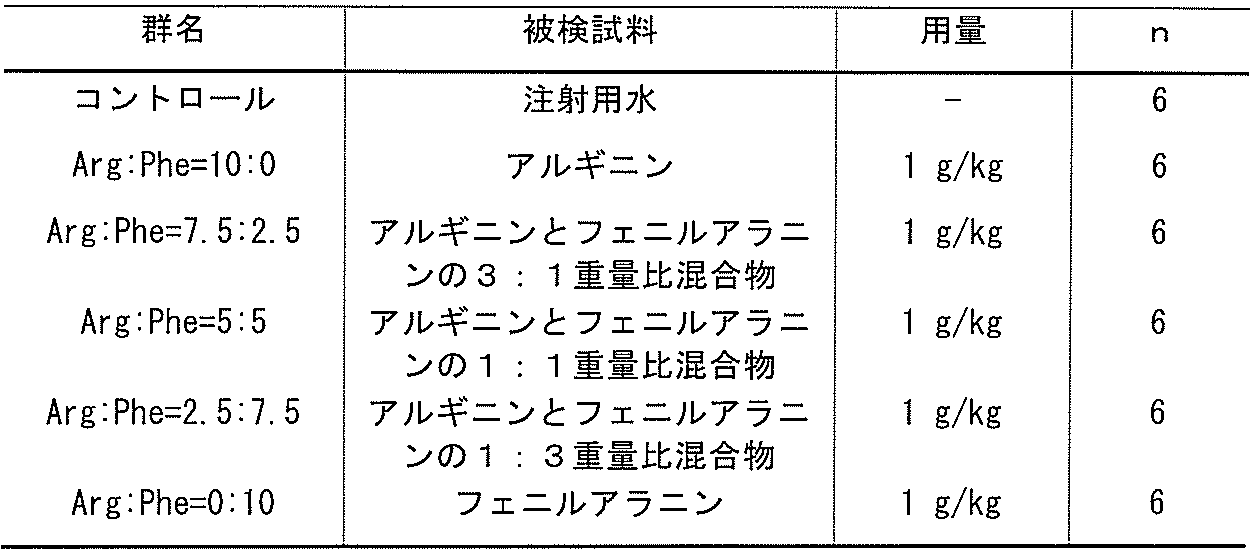
グリセロールアッセイキット(Cayman Chemical Campany)を用い、付属の手順書に従って、血漿中のグリセロールを測定した。各測定時における測定値からtime0の測定値を差し引いた値を算出し、これを血中グリセロール濃度の変化量とした。
図15に血中グリセロール濃度の変化量(Δグリセロール)を示す。アルギニン(Arg):フェニルアラニン(Phe)=2.5:7.5群と5:5群は、コントロール群よりも、血中グリセロール濃度の変化量が高水準で推移した。また、アルギニンとフェニルアラニンは、1:3で混合すると最も高い脂質代謝促進効果を示すことがわかった。
脂質代謝指標の測定
(1)材料及び方法
[被検試料]
被検試料として、実施例10~12の中でそれぞれ高い脂肪分解能を示した、(i)アラニンとアルギニンの1:1重量比混合物、(ii)アラニンとフェニルアラニンの1:3重量比混合物、(iii)アルギニンとフェニルアラニンの1:3重量比混合物、(iv)表3に示す組成のアミノ酸混合物(製造例3)を、それぞれ注射用水(大塚製薬)に懸濁して調製したものを使用した。
6週齢のWistar系雄性ラット(SLC社)を予備飼育後、試験に用いた。試験前日の朝、ラットの体重を測定し、平均体重が同様となるように群分けした。試験系の概略及び群構成を以下の表11に示す。

グリセロールアッセイキット(Cayman Chemical Campany)を用い、付属の手順書に従って、血漿中のグリセロールを測定した。各測定時における測定値からtime0の測定値を差し引いた値に基づいて、time0~time90の血中グリセロールAUC(血中濃度-時間曲線下面積)を算出した。
測定値は、平均値±標準誤差で示した。データは統計ソフトStat View 5.0-Jを使用して、F検定による等分散の検定後、FisherのPLSDによって検定した。有意水準は5%とした。
図16に算出された血中グリセロールAUC(min・mg/L)を示す。Ala:Arg=1:1群、Ala:Phe=1:3群、Arg:Phe=1:3群、及び製造例3群の全てにおいて、コントロール群と比較して、血中グリセロールAUCが高かった。
脂質代謝指標の測定
(1)材料及び方法
[被検試料]
被検試料として、実施例13で最も高い脂肪分解能を示した(i)アラニンとアルギニンの1:1重量比混合物、実施例10~12の結果を踏まえて配合比を定めた(ii)アラニンとアルギニンとフェニルアラニンの1:1:3重量比混合物、(iii)アラニンとアルギニンとフェニルアラニンの1:1:6重量比混合物を、それぞれ注射用水(大塚製薬)に懸濁して調製したものを使用した。
6週齢のWistar系雄性ラット(SLC社)を予備飼育後、試験に用いた。試験前日の朝、ラットの体重を測定し、平均体重が同様となるように群分けした。試験系の概略及び群構成を以下の表12に示す。

グリセロールアッセイキット(Cayman Chemical Campany)を用い、付属の手順書に従って、血漿中のグリセロールを測定した。各測定時における測定値からtime0の測定値を差し引いた値を算出し、これを血中グリセロール濃度の変化量とした。各測定時における測定値からtime0の測定値を差し引いた値に基づいて、time0~time90の血中グリセロールAUC(血中濃度-時間曲線下面積)を算出した。
図17に算出された血中グリセロールAUC(min・mg/L)を示す。アラニン(Ala):アルギニン(Arg)=1:1群と、アラニン(Ala):アルギニン(Arg):フェニルアラニン(Phe)=1:1:3群と1:1:6群は、コントロール群と比較して、血中グリセロールAUCが高かった。
Claims (11)
- アルギニン、アラニン、及びフェニルアラニンからなる群より選択される少なくとも2つのアミノ酸を含むアミノ酸混合物を含有し、かつ前記少なくとも2つのアミノ酸をそれらの合計量で全アミノ酸量100モルに対して60モル以上のモル比で含む、脂質代謝促進剤。
- 前記アミノ酸混合物がアルギニン、アラニン、及びフェニルアラニンを含有する、請求項1に記載の脂質代謝促進剤。
- アルギニン、アラニン、及びフェニルアラニンを、全アミノ酸量100モルに対し、アルギニン:アラニン:フェニルアラニン=8~30モル:18~30モル:10~20モルのモル比で含有する、請求項1又は2に記載の脂質代謝促進剤。
- アルギニン、アラニン、及びフェニルアラニンの配合量が、(i)アルギニン:アラニン=1.5:1~1:1.5、(ii)アラニン:フェニルアラニン=4:1~1:4、及び(iii)アルギニン:フェニルアラニン=1:1~1:4の少なくとも1つの重量比を満たす、請求項1~3のいずれか1項に記載の脂質代謝促進剤。
- アルギニン、アラニン、及びフェニルアラニンをそれらの合計量で全アミノ酸量100モルに対して100モルのモル比で含む、請求項1~4のいずれか1項に記載の脂質代謝促進剤。
- 前記アミノ酸混合物が、グリシンをさらに含有し、アルギニン、アラニン、フェニルアラニン、及びグリシンをそれらの合計量で全アミノ酸量100モルに対して85モル以上のモル比で含む、請求項1~4のいずれか1項に記載の脂質代謝促進剤。
- 前記アミノ酸混合物が他のアミノ酸としてプロリン、リジン、チロシン、スレオニン、ロイシン、バリン、イソロイシン、グルタミン酸、トリプトファン、ヒスチジン、セリン、メチオニン、及びアスパラギン酸のみをさらに含有する、請求項1~4及び6のいずれか1項に記載の脂質代謝促進剤。
- 前記アミノ酸混合物が、他のアミノ酸を、全アミノ酸量100モルに対して下記のモル比で含む、請求項7に記載の脂質代謝促進剤。
プロリン 0.01~4モル
リジン 0.01~2モル
チロシン 0.01~2モル
スレオニン 0.01~2モル
ロイシン 0.01~2モル
バリン 0.01~2モル
イソロイシン 0.01~2モル
グルタミン酸 0.01~1モル
トリプトファン 0.01~1モル
ヒスチジン 0.01~1モル
セリン 0.01~1モル
メチオニン 0.01~0.2モル
アスパラギン酸 0.01~0.1モル - アドレナリン分泌亢進状態で作用させるための、請求項1~8のいずれか1項に記載の脂質代謝促進剤。
- アドレナリン分泌亢進状態が、運動、ストレス、寒冷暴露、入浴、又は多食による刺激を受けた状態である、請求項9に記載の脂質代謝促進剤。
- 血中グリセロール濃度上昇、体重増加抑制、血中遊離脂肪酸濃度上昇、血中グルカゴン濃度上昇、血中コルチゾール濃度低減、血中総ケトン体濃度上昇、血中3-ヒドロキシ酪酸濃度上昇、及び褐色脂肪組織中のUCP-1発現量増加からなる群から選択される少なくとも1つを伴う脂質代謝促進用の、請求項1~10のいずれか1項に記載の脂質代謝促進剤。
Priority Applications (4)
| Application Number | Priority Date | Filing Date | Title |
|---|---|---|---|
| HK16110675.3A HK1222545B (zh) | 2013-08-14 | 2014-08-12 | 脂质代谢促进剂 |
| CN201480044983.7A CN105451732B (zh) | 2013-08-14 | 2014-08-12 | 脂质代谢促进剂 |
| JP2015531825A JP6518189B2 (ja) | 2013-08-14 | 2014-08-12 | 脂質代謝促進剤 |
| SG11201600934TA SG11201600934TA (en) | 2013-08-14 | 2014-08-12 | Agent for enhancing lipid metabolism |
Applications Claiming Priority (2)
| Application Number | Priority Date | Filing Date | Title |
|---|---|---|---|
| JP2013-168690 | 2013-08-14 | ||
| JP2013168690A JP2016102064A (ja) | 2013-08-14 | 2013-08-14 | 脂質代謝促進剤 |
Publications (1)
| Publication Number | Publication Date |
|---|---|
| WO2015022962A1 true WO2015022962A1 (ja) | 2015-02-19 |
Family
ID=52468347
Family Applications (1)
| Application Number | Title | Priority Date | Filing Date |
|---|---|---|---|
| PCT/JP2014/071301 Ceased WO2015022962A1 (ja) | 2013-08-14 | 2014-08-12 | 脂質代謝促進剤 |
Country Status (4)
| Country | Link |
|---|---|
| JP (2) | JP2016102064A (ja) |
| CN (1) | CN105451732B (ja) |
| SG (1) | SG11201600934TA (ja) |
| WO (1) | WO2015022962A1 (ja) |
Cited By (3)
| Publication number | Priority date | Publication date | Assignee | Title |
|---|---|---|---|---|
| WO2017142052A1 (ja) * | 2016-02-19 | 2017-08-24 | 株式会社明治 | アミノ酸含有組成物 |
| JP2019034894A (ja) * | 2017-08-10 | 2019-03-07 | 株式会社明治 | 脂質代謝促進のための組成物 |
| JP2019147824A (ja) * | 2019-05-14 | 2019-09-05 | 株式会社東洋新薬 | 黒生姜含有組成物 |
Families Citing this family (1)
| Publication number | Priority date | Publication date | Assignee | Title |
|---|---|---|---|---|
| JP2022501321A (ja) * | 2018-09-27 | 2022-01-06 | ソシエテ・デ・プロデュイ・ネスレ・エス・アー | インスリン抵抗性及び/又は糖尿病の予防のための、ヒスチジンとグリシンと他のアミノ酸の使用 |
Citations (3)
| Publication number | Priority date | Publication date | Assignee | Title |
|---|---|---|---|---|
| JP2004352696A (ja) * | 2003-05-30 | 2004-12-16 | Institute Of Physical & Chemical Research | アミノ酸組成物及び補液 |
| WO2008105368A1 (ja) * | 2007-02-28 | 2008-09-04 | Meiji Dairies Corporation | アミノ酸組成物 |
| JP2009001507A (ja) * | 2007-06-19 | 2009-01-08 | Ss Pharmaceut Co Ltd | 体脂肪減少剤およびその利用 |
Family Cites Families (5)
| Publication number | Priority date | Publication date | Assignee | Title |
|---|---|---|---|---|
| JP2518692B2 (ja) * | 1989-06-14 | 1996-07-24 | 理化学研究所 | 筋力持続剤,滋養強壮剤,輸液用剤,栄養補給剤,疲労回復剤及び乳酸生成調節剤 |
| JP4128524B2 (ja) * | 2001-06-08 | 2008-07-30 | 独立行政法人理化学研究所 | 体温上昇性アミノ酸群飲食用及び医療用の剤 |
| US20040265473A1 (en) * | 2001-07-31 | 2004-12-30 | Kazunori Mawatari | Ergogenic food compositons |
| JP2006340672A (ja) * | 2005-06-09 | 2006-12-21 | Ebs Kk | ウエスト周囲径およびヒップ周囲径低減効果を有する食品 |
| JP2007161498A (ja) * | 2005-12-09 | 2007-06-28 | Toray Ind Inc | 抗菌性粒状体およびその製造方法 |
-
2013
- 2013-08-14 JP JP2013168690A patent/JP2016102064A/ja active Pending
-
2014
- 2014-08-12 CN CN201480044983.7A patent/CN105451732B/zh active Active
- 2014-08-12 SG SG11201600934TA patent/SG11201600934TA/en unknown
- 2014-08-12 JP JP2015531825A patent/JP6518189B2/ja active Active
- 2014-08-12 WO PCT/JP2014/071301 patent/WO2015022962A1/ja not_active Ceased
Patent Citations (3)
| Publication number | Priority date | Publication date | Assignee | Title |
|---|---|---|---|---|
| JP2004352696A (ja) * | 2003-05-30 | 2004-12-16 | Institute Of Physical & Chemical Research | アミノ酸組成物及び補液 |
| WO2008105368A1 (ja) * | 2007-02-28 | 2008-09-04 | Meiji Dairies Corporation | アミノ酸組成物 |
| JP2009001507A (ja) * | 2007-06-19 | 2009-01-08 | Ss Pharmaceut Co Ltd | 体脂肪減少剤およびその利用 |
Non-Patent Citations (1)
| Title |
|---|
| JOBGEN W. ET AL.: "Dietary L-arginine supplementation reduces white fat gain and enhances skeletal muscle and brown fat masses in diet-induced obese rats", J.NUTR., vol. 139, 2009, pages 230 - 237 * |
Cited By (4)
| Publication number | Priority date | Publication date | Assignee | Title |
|---|---|---|---|---|
| WO2017142052A1 (ja) * | 2016-02-19 | 2017-08-24 | 株式会社明治 | アミノ酸含有組成物 |
| JPWO2017142052A1 (ja) * | 2016-02-19 | 2018-12-13 | 株式会社明治 | アミノ酸含有組成物 |
| JP2019034894A (ja) * | 2017-08-10 | 2019-03-07 | 株式会社明治 | 脂質代謝促進のための組成物 |
| JP2019147824A (ja) * | 2019-05-14 | 2019-09-05 | 株式会社東洋新薬 | 黒生姜含有組成物 |
Also Published As
| Publication number | Publication date |
|---|---|
| JP6518189B2 (ja) | 2019-05-22 |
| JP2016102064A (ja) | 2016-06-02 |
| CN105451732A (zh) | 2016-03-30 |
| JPWO2015022962A1 (ja) | 2017-03-02 |
| HK1222545A1 (zh) | 2017-07-07 |
| SG11201600934TA (en) | 2016-03-30 |
| CN105451732B (zh) | 2019-11-05 |
Similar Documents
| Publication | Publication Date | Title |
|---|---|---|
| López-Martínez et al. | Protein and sport: Alternative sources and strategies for bioactive and sustainable sports nutrition | |
| US8388949B2 (en) | Compositions comprising pantothenic acid and their use for stimulating appetite | |
| JP5581071B2 (ja) | ミトコンドリア機能向上剤 | |
| JP2009536016A (ja) | アミノ酸を含む食品組成物 | |
| JP2008509213A (ja) | 糖尿病患者のための食物製品 | |
| JP2015120715A (ja) | アミノ酸組成物を含有する疲労防止剤 | |
| CN106983854A (zh) | 用于苯丙酮尿症和其他代谢疾病的营养控制的糖巨肽药用食物 | |
| JP6518189B2 (ja) | 脂質代謝促進剤 | |
| TW201501654A (zh) | 包含具有刺激脂聯素性質之肽組份之營養組成物及其用途 | |
| JP5173230B2 (ja) | アミノ酸組成物及び飲食物 | |
| JPWO2015022962A6 (ja) | 脂質代謝促進剤 | |
| JP4394155B2 (ja) | 脂質代謝改善剤 | |
| US20070196442A1 (en) | Method for improving the oral administration of alpha-lipoic acid | |
| JP2016073292A (ja) | 筋肉増強剤 | |
| EP2029231B1 (fr) | Utilisation de l'alpha-lactalbumine pour la regulation de la glycemie | |
| US9987243B2 (en) | Use of trans-palmitoleate in identifying and treating metabolic disease | |
| Jain et al. | Efficacy of l-cysteine in increasing circulatory hydrogen sulfide, nitrite, and 25-hydroxyvitamin D levels in Zucker diabetic fatty rats and in vitro treatment of hydrogen sulfide and nitrite in upregulating vitamin D hydroxylase genes in monocytes | |
| HK1222545B (zh) | 脂质代谢促进剂 | |
| Komorowski et al. | Inositol-Stabilized Arginine Silicate: A Novel Nitric Oxide-Boosting Ingredient for Sports Nutrition and Improved Cognition | |
| JP2019034894A (ja) | 脂質代謝促進のための組成物 | |
| Gonzalez Soto | Investigating the Effects of Milk Protein Vs. Soy Protein on Omega-3 Polyunsaturated Fatty Acid Metabolism and Energy Balance: Evidence from Preclinical and Clinical Models | |
| JP2021181408A (ja) | パーキンソン病治療用組成物及びカテコール類血中濃度向上用組成物 | |
| HK40128720A (zh) | 用於促进儿童的发育的组合物 | |
| CN112135531A (zh) | 终生干预期间超重或肥胖成年人的胰岛素控制 | |
| JP2001231496A (ja) | 栄養組成物 |
Legal Events
| Date | Code | Title | Description |
|---|---|---|---|
| WWE | Wipo information: entry into national phase |
Ref document number: 201480044983.7 Country of ref document: CN |
|
| 121 | Ep: the epo has been informed by wipo that ep was designated in this application |
Ref document number: 14836952 Country of ref document: EP Kind code of ref document: A1 |
|
| ENP | Entry into the national phase |
Ref document number: 2015531825 Country of ref document: JP Kind code of ref document: A |
|
| NENP | Non-entry into the national phase |
Ref country code: DE |
|
| 122 | Ep: pct application non-entry in european phase |
Ref document number: 14836952 Country of ref document: EP Kind code of ref document: A1 |