WO2015020162A1 - アクアポリン3の発現亢進剤及び組織修復促進剤 - Google Patents
アクアポリン3の発現亢進剤及び組織修復促進剤 Download PDFInfo
- Publication number
- WO2015020162A1 WO2015020162A1 PCT/JP2014/070920 JP2014070920W WO2015020162A1 WO 2015020162 A1 WO2015020162 A1 WO 2015020162A1 JP 2014070920 W JP2014070920 W JP 2014070920W WO 2015020162 A1 WO2015020162 A1 WO 2015020162A1
- Authority
- WO
- WIPO (PCT)
- Prior art keywords
- aquaporin
- alcohol
- ursolic acid
- water
- tissue repair
- Prior art date
- Legal status (The legal status is an assumption and is not a legal conclusion. Google has not performed a legal analysis and makes no representation as to the accuracy of the status listed.)
- Ceased
Links
Images
Classifications
-
- A—HUMAN NECESSITIES
- A61—MEDICAL OR VETERINARY SCIENCE; HYGIENE
- A61K—PREPARATIONS FOR MEDICAL, DENTAL OR TOILETRY PURPOSES
- A61K8/00—Cosmetics or similar toiletry preparations
- A61K8/18—Cosmetics or similar toiletry preparations characterised by the composition
- A61K8/96—Cosmetics or similar toiletry preparations characterised by the composition containing materials, or derivatives thereof of undetermined constitution
- A61K8/97—Cosmetics or similar toiletry preparations characterised by the composition containing materials, or derivatives thereof of undetermined constitution from algae, fungi, lichens or plants; from derivatives thereof
-
- A—HUMAN NECESSITIES
- A61—MEDICAL OR VETERINARY SCIENCE; HYGIENE
- A61K—PREPARATIONS FOR MEDICAL, DENTAL OR TOILETRY PURPOSES
- A61K31/00—Medicinal preparations containing organic active ingredients
- A61K31/185—Acids; Anhydrides, halides or salts thereof, e.g. sulfur acids, imidic, hydrazonic or hydroximic acids
- A61K31/19—Carboxylic acids, e.g. valproic acid
-
- A—HUMAN NECESSITIES
- A61—MEDICAL OR VETERINARY SCIENCE; HYGIENE
- A61K—PREPARATIONS FOR MEDICAL, DENTAL OR TOILETRY PURPOSES
- A61K36/00—Medicinal preparations of undetermined constitution containing material from algae, lichens, fungi or plants, or derivatives thereof, e.g. traditional herbal medicines
- A61K36/18—Magnoliophyta (angiosperms)
- A61K36/185—Magnoliopsida (dicotyledons)
- A61K36/53—Lamiaceae or Labiatae (Mint family), e.g. thyme, rosemary or lavender
- A61K36/538—Schizonepeta
-
- A—HUMAN NECESSITIES
- A61—MEDICAL OR VETERINARY SCIENCE; HYGIENE
- A61K—PREPARATIONS FOR MEDICAL, DENTAL OR TOILETRY PURPOSES
- A61K8/00—Cosmetics or similar toiletry preparations
- A61K8/18—Cosmetics or similar toiletry preparations characterised by the composition
- A61K8/30—Cosmetics or similar toiletry preparations characterised by the composition containing organic compounds
- A61K8/63—Steroids; Derivatives thereof
-
- A—HUMAN NECESSITIES
- A61—MEDICAL OR VETERINARY SCIENCE; HYGIENE
- A61P—SPECIFIC THERAPEUTIC ACTIVITY OF CHEMICAL COMPOUNDS OR MEDICINAL PREPARATIONS
- A61P17/00—Drugs for dermatological disorders
-
- A—HUMAN NECESSITIES
- A61—MEDICAL OR VETERINARY SCIENCE; HYGIENE
- A61P—SPECIFIC THERAPEUTIC ACTIVITY OF CHEMICAL COMPOUNDS OR MEDICINAL PREPARATIONS
- A61P17/00—Drugs for dermatological disorders
- A61P17/02—Drugs for dermatological disorders for treating wounds, ulcers, burns, scars, keloids, or the like
-
- A—HUMAN NECESSITIES
- A61—MEDICAL OR VETERINARY SCIENCE; HYGIENE
- A61P—SPECIFIC THERAPEUTIC ACTIVITY OF CHEMICAL COMPOUNDS OR MEDICINAL PREPARATIONS
- A61P43/00—Drugs for specific purposes, not provided for in groups A61P1/00-A61P41/00
-
- A—HUMAN NECESSITIES
- A61—MEDICAL OR VETERINARY SCIENCE; HYGIENE
- A61Q—SPECIFIC USE OF COSMETICS OR SIMILAR TOILETRY PREPARATIONS
- A61Q19/00—Preparations for care of the skin
-
- A—HUMAN NECESSITIES
- A61—MEDICAL OR VETERINARY SCIENCE; HYGIENE
- A61K—PREPARATIONS FOR MEDICAL, DENTAL OR TOILETRY PURPOSES
- A61K2236/00—Isolation or extraction methods of medicinal preparations of undetermined constitution containing material from algae, lichens, fungi or plants, or derivatives thereof, e.g. traditional herbal medicine
-
- A—HUMAN NECESSITIES
- A61—MEDICAL OR VETERINARY SCIENCE; HYGIENE
- A61K—PREPARATIONS FOR MEDICAL, DENTAL OR TOILETRY PURPOSES
- A61K2800/00—Properties of cosmetic compositions or active ingredients thereof or formulation aids used therein and process related aspects
- A61K2800/74—Biological properties of particular ingredients
- A61K2800/78—Enzyme modulators, e.g. Enzyme agonists
Definitions
- the present invention relates to an aquaporin 3 expression enhancer and a tissue repair promoter.
- Aquaporin (hereinafter sometimes abbreviated as AQP) is a six-transmembrane protein discovered by Agre in 1992 and is an important protein that functions as a water channel that regulates the amount of water in cells. Aquaporins exist universally from bacteria to mammals, and so far, 13 types of aquaporins from AQP0 to AQP12 have been confirmed in mammals.
- Aquaporin 3 (AQP3), which is a type of water channel, is abundant in skin keratinocytes and is known to exhibit water and glycerol transport promoting action, and is an important component for physiological skin moisturization.
- the expression of aquaporin 3 is significantly reduced at the site of skin inflammation, and it is suggested that the change in the expression level of aquaporin 3 is closely related to the formation of dry symptoms associated with various skin diseases.
- aquaporin 3 is also involved in the promotion of keratinocyte proliferation or migration, and is considered to be involved in promoting healing at the time of wounding (see, for example, JP-A-2011-32191).
- Ursolic acid is a kind of pentacyclic triterpenic acid. Ursolic acid is known to exhibit an inhibitory action on melanin production (for example, see JP 2013-32300 A) and an antioxidant action (for example, see JP 2012-51940 A).
- An object of the present invention is to provide a new use of ursolic acid.
- Another object of the present invention is to provide a novel aquaporin 3 expression enhancer and a novel bioactive agent based on the aquaporin 3 expression enhancing action.
- the present invention is as follows. ⁇ 1> An aquaporin 3 expression enhancer containing ursolic acid as an active ingredient. ⁇ 2> A tissue repair promoter containing ursolic acid as an active ingredient. ⁇ 3> The tissue repair promoter according to ⁇ 2>, wherein the tissue repair promotion is at least one granulation formation promotion selected from the group consisting of ulcers, pressure sores, trauma and surgical wounds. ⁇ 4> Obtaining an alcohol extract extracted from a plant using alcohol, mixing and dispersing the obtained alcohol extract in a mixture of alcohol, hydrocarbon and water to obtain an alcohol layer A method for producing ursolic acid, comprising: mixing and dispersing the alcohol layer in water to obtain a water-insoluble layer.
- ⁇ 5> A method for enhancing the expression of aquaporin 3 comprising administering ursolic acid to a subject.
- ⁇ 6> A method for promoting tissue repair, comprising administering ursolic acid to a subject.
- ⁇ 7> The tissue repair promotion method according to ⁇ 6>, wherein the tissue repair promotion is at least one granulation formation promotion selected from the group consisting of ulcers, pressure sores, trauma, and surgical wounds.
- Ursolic acid for use in promoting tissue repair Ursolic acid for use in promoting tissue repair.
- Ursolic acid for use in promoting tissue repair according to ⁇ 8> wherein the tissue repair promotion is at least one granulation promotion selected from the group consisting of ulcers, pressure sores, trauma and surgical wounds.
- a new use of ursolic acid can be provided. Furthermore, according to the present invention, a novel aquaporin 3 expression enhancer and a novel bioactive agent based on the aquaporin 3 expression enhancing action can be provided.
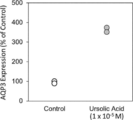
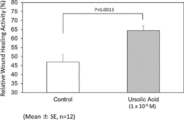
- FIG. 3 is a graph showing the action of ursolic acid on the expression level of aquaporin 3 according to Example 2. It is a graph which shows the effect
- the aquaporin 3 expression enhancer and tissue repair promoter of the present invention are bioactive agents containing ursolic acid as an active ingredient.
- the aquaporin 3 expression enhancer of the present invention has an action of enhancing the expression of aquaporin 3 and a tissue repair promoting action based on the action of enhancing the expression of aquaporin 3 on cells.
- aquaporin 3 expression enhancers and tissue repair promoters are collectively referred to as “bioactive agents”.
- the term “process” is not limited to an independent process, and is included in the term if the intended purpose of the process is achieved even when it cannot be clearly distinguished from other processes. .
- a numerical range indicated using “to” indicates a range including the numerical values described before and after “to” as the minimum value and the maximum value, respectively.
- the amount of each component in the composition when there are a plurality of substances corresponding to each component in the composition, the plurality of substances present in the composition unless otherwise specified. Means the total amount.
- the “cell” is not particularly limited as long as it is a cell expressing aquaporin 3.
- Skin cells include epidermal cells (keratinocytes), pigment cells (melanocytes), Langerhans cells, ⁇ -dendritic cells, and Merkel cells, among which epidermal cells (keratinocytes) are preferred.
- keratinocytes epidermal cells
- pigment cells melanocytes
- Langerhans cells Langerhans cells
- ⁇ -dendritic cells ⁇ -dendritic cells
- Merkel cells among which epidermal cells (keratinocytes) are preferred. The present invention will be described below.
- Ursolic acid which is an active ingredient in the bioactive agent according to the present invention, is a compound represented by the chemical formula C 30 H 48 O 3 (molecular weight 456.7, CAS registration number 77-52-1). It is represented by
- ursolic acid any of commonly used synthetic products and plant-derived extracts can be used.
- plant-derived extracts such as apple, basil, bilberry, cranberry, elderflower, peppermint, rosemary, lavender, oregano, thyme, hawthorn and prune can be used.
- a commercial item can be used for ursolic acid. Examples of commercially available products include Ursolic acid (Sigma Ardrich), Ursolic acid (Santa Cruz), Ursolic acid (Tokyo Chemical Industry), ursolic acid (Wako Pure Chemical Industries), and the like.
- ursolic acid has an action of enhancing the expression of aquaporin 3, it is useful as an active ingredient of a medicament for the treatment of a disease state caused by an abnormal function of aquaporin 3.
- Abnormal function of aquaporin 3 refers to the state of aquaporin 3 in tissue cells under pathological conditions, which is different from the state of aquaporin 3 in healthy tissue cells, a decrease in aquaporin 3 function, decrease in the number of aquaporin 3 in cells Etc.
- An aquaporin 3 expression enhancer containing ursolic acid as an active ingredient can be specifically used as a tissue repair promoter, but is not limited to these uses, and is not limited to tissues or organs that express aquaporin 3. It can be used for prevention and treatment of diseases.
- the aquaporin 3 expression enhancer according to the present invention contains ursolic acid as an active ingredient.
- the expression enhancer of aquaporin 3 can enhance the expression of aquaporin 3 in the cell, compared to when ursolic acid is not used.
- the aquaporin 3 expression enhancer has an action of promoting tissue repair.
- the aquaporin 3 expression enhancer can be expected to have an effect of improving skin moisture retention function, improving skin turnover, preventing dry skin, improving rough skin by drying, improving pruritus, and beautifying skin.
- the agent that enhances the expression of aquaporin 3 only needs to have an action of enhancing the expression of aquaporin 3 in the cell as compared with when ursolic acid is not used.
- the action of enhancing the expression of aquaporin 3 in the cell is not particularly limited. For example, it can be evaluated by measuring the expression level of aquaporin 3 in the cell. Specifically, as an evaluation method, aquaporin expression levels of cultured cells, commercially available three-dimensional epidermis models, cells derived from the stratum corneum collected by tape stripping or the like, or skin-derived epidermis cell lines expressing aquaporin 3 are obtained by Western blotting.
- Examples include a measurement method, a method for measuring the expression level of aquaporin 3 mRNA by PCR method and Northern blot method, a method for measuring cell membrane water permeability by the stopped flow method, a method for measuring cell membrane permeability of labeled glycerol, and the like.
- the aquaporin 3 expression enhancer preferably increases the expression level of aquaporin 3 by 1.5 to 4 times when the expression level of aquaporin 3 in the cell is measured compared to when ursolic acid is not used. More preferably, it is increased 2 to 4 times, and more preferably 3 to 4 times.
- the measuring method of the expression level of aquaporin 3 is Horie I et al. , Biochem Biophys Res Commun, 387, 564-8, 2009. Examples of cultured cells used for evaluation include keratinocyte strain DJ-M1 cells (RIKEN Cell Bank), Primary Human Keratinocyte Cells (Life Technologies), normal human epidermal keratinocytes (Kurabo), and the like.
- Examples of commercially available three-dimensional skin models used for evaluation include LaboCyte Epimodel (Japan Tissue Engineering Co., Ltd.), EPI-200 (Kurabo Co., Ltd.), TESTSKIN (TOYOBO Co., Ltd.) and the like.
- tissue repair promoter contains ursolic acid as an active ingredient. Thereby, the tissue repair promoter can promote the repair of a wound generated in a tissue which is an aggregate of cells as compared with when ursolic acid is not used.
- tissue that are aggregates of cells include the digestive tract such as skin, airways, stomach, and small intestine, and preferably skin.
- Examples of the wound include at least one selected from the group consisting of burns, frostbite, ulcers, pressure sores, trauma and surgical wounds.
- Examples of the tissue repair include promoting granulation of the wound site, promoting healing of the wound site (wound healing), promoting regeneration of the airway and gastrointestinal mucosal epithelium, and the like.
- the tissue repair promotion is at least one granulation promotion selected from the group consisting of ulcers, pressure sores, trauma and surgical wounds.
- the tissue repair promoting action can be evaluated by measuring the migration ability of keratinocytes and the repair ability of experimental trauma of animals.
- the evaluation of the migration ability of keratinocytes may be performed according to the method described in paragraph [0037] of JP 2011-32191 A.
- the content of ursolic acid in the composition varies depending on the dosage form. Generally, it is preferably 0.0000001% by mass to 1% by mass, more preferably 0.0001% by mass to 0.05% by mass, and particularly preferably 0.001% by mass to 0.01% by mass.
- the form of the bioactive agent is not particularly limited.
- it may be in the form of a composition containing other components described later (carriers acceptable as pharmaceuticals and cosmetics, and other optional components as required).
- carriers acceptable as pharmaceuticals and cosmetics, and other optional components as required examples include an oil composition, an emulsified composition, and a powder composition.
- the oil composition, emulsion composition, and powder composition can be prepared according to a known method.
- the bioactive agent according to the present invention can be administered orally or parenterally. From the viewpoint of the action of enhancing the expression of aquaporin 3, it is preferably administered parenterally. Specifically, local administration capable of directly administering ursolic acid to skin cells is preferred, and transdermal administration is more preferred.
- the dose of the physiologically active agent according to the present invention varies depending on the dosage form and the like, but in general, it can be 1 mg to 15 mg as an active ingredient per kg body weight per day, preferably 2 mg to 10 mg. More preferably 3 mg to 5 mg.
- composition containing the bioactive agent according to the present invention can be appropriately selected according to the form, purpose, etc. of the composition of the present invention.
- Preferable examples of other components include emulsifiers and other additive components.
- additive components in addition to the above components, additive components that are usually used in the fields of pharmaceuticals, functional foods, cosmetics, and the like may be appropriately added to the composition of the present invention according to the form.
- the other additive component can be contained in the composition of the present invention as an oil-soluble or water-soluble additive component depending on its characteristics.
- additive components include polyhydric alcohols such as glycerin and 1,3-butylene glycol; glucose, fructose, lactose, maltose, sucrose, pectin, copper carrageenan, locust bean gum, guar gum, hydroxypropyl guar gum, xanthan gum , Karaya gum, tamarind seed polysaccharide, gum arabic, gum tragacanth, hyaluronic acid, sodium hyaluronate, sodium chondroitin sulfate, dextrin, etc .; sugar alcohols such as sorbitol, mannitol, maltitol, lactose, maltotriitol, xylitol Inorganic salts such as sodium chloride and sodium sulfate; casein, albumin, methylated collagen, hydrolyzed collagen, water-soluble collagen, gelatin, etc.
- polyhydric alcohols such as glycerin and 1,3-butylene
- Protein glycine, alanine, valine, leucine, isoleucine, serine, threonine, aspartic acid, glutamic acid, cystine, methionine, lysine, hydroxylysine, arginine, histidine, phenylalanine, tyrosine, tryptophan, proline, hydroxyproline, acetylhydroxyproline, etc.
- Amino acids and derivatives thereof synthetic polymers such as carboxyvinyl polymer, sodium polyacrylate, polyvinyl alcohol, polyethylene glycol, ethylene oxide / propylene oxide block copolymer; water-soluble cellulose derivatives such as hydroxyethyl cellulose and methyl cellulose; Based on the function, for example, a functional component, an excipient, a viscosity modifier, a radical scavenger and the like may be included.
- various other medicinal ingredients, pH adjusters, pH buffering agents, ultraviolet absorbers, preservatives, fragrances, coloring agents, and other additives that are usually used in the application are used in combination. be able to.
- the bioactive agent can be used as a pharmaceutical, a cosmetic, a functional food, or the like.
- the bioactive agent can be administered to humans and livestock. Examples of domestic animals include dogs, monkeys, cats, cows, horses and sheep.
- the bioactive agent can be used in a method for enhancing the expression of aquaporin 3 containing ursolic acid as an active ingredient.
- the bioactive agent can also be used in a tissue repair promoting method containing ursolic acid as an active ingredient.
- a method for producing ursolic acid includes obtaining an alcohol extract extracted from plants using alcohol (hereinafter referred to as “extraction step”), and mixing the obtained alcohol extract with alcohol, hydrocarbon and water.
- An alcohol layer is obtained by mixing and dispersing in a liquid (hereinafter referred to as “separation step”), and an alcohol layer obtained is mixed and dispersed in water to obtain a water-insoluble layer (hereinafter referred to as “isolation step”).
- the manufacturing method of ursolic acid may include processes other than an extraction process, a separation process, and an isolation process.
- An extraction process is a process of obtaining the extract extracted from the plant using alcohol.
- a plant that has been appropriately cut or pulverized is dispersed in alcohol and extracted from room temperature under heating to obtain an alcohol extract.
- the alcohol used for extraction include 50 w / w% to 100 w / w% methyl alcohol, 20 w / w% to 100 w / w% ethyl alcohol, 10 w / w% to 100 w / w% propanol, or 10 w / w%.
- butanol may be used, preferably 70 w / w% to 100 w / w% methyl alcohol or 50 w / w% to 100 w / w% ethyl alcohol.
- ketones such as acetone
- liquid fatty acid esters such as linoleic acid glyceride
- glycols such as ethylene glycol
- the method of cutting or pulverizing the plant may be performed by a known method, for example, a method of cutting or pulverizing the plant using a pestle or a mortar until the plant becomes powdery.
- the extraction temperature may be from room temperature to under heating, and specific examples include 0 ° C. to 100 ° C., preferably 20 ° C. to 90 ° C.
- the extraction time may be from several minutes to several days. For example, the extraction may be performed until the color of the plant moves to the extract.
- the extraction step may include a stirring step for stirring the alcohol as necessary.
- the stirring speed is not particularly limited.
- the alcohol extract can be obtained, for example, by a filtration step in which a plant is filtered to remove an extraction residue.
- the separation step is a step of obtaining an alcohol layer by mixing and dispersing the obtained alcohol extract in a mixture of alcohol, hydrocarbon and water.
- mixing liquid a mixed liquid of alcohol, hydrocarbon and water
- stirring to stir the alcohol extracted liquid and the mixed liquid as necessary.
- a process may be included.
- the stirring speed is not particularly limited.
- the separation step may include an alcohol layer separation step in which the obtained alcohol extract is mixed and dispersed in the mixed solution and then left for a certain period of time until the alcohol layer is separated to separate the alcohol layer.
- the method for separating the alcohol layer is not particularly limited, and a known method can be adopted.
- the isolation step is a step of obtaining a water-insoluble layer by mixing and dispersing the obtained alcohol layer in water.
- a stirring step of stirring the alcohol layer and water may be included as necessary.
- the stirring speed is not particularly limited.
- the isolation step includes a water-insoluble layer fractionation step in which the obtained alcohol layer is mixed and dispersed in water and then left for a certain period of time until the water-insoluble layer separates, and the water-insoluble layer is fractionated. Also good.
- the method for separating the water-insoluble layer is not particularly limited, and a known method can be adopted.
- the manufacturing method of ursolic acid may include a purification step of purifying ursolic acid from the obtained water-insoluble layer in addition to the extraction step, the separation step, and the isolation step.
- the method for purifying ursolic acid from the water-insoluble layer is not limited, and a known method can be employed. Examples thereof include a method using column chromatography using silica gel, alumina and a hydrophobic chromatographic carrier.
- the plant may be either an undried plant or a dried plant.
- examples of undried plants include herbal medicines, herbs and fruits.
- the dried plant may be either a sun-dried plant or a freeze-dried plant, but is preferably a sun-dried plant from the viewpoint of recovery efficiency.
- any plant may be used as long as it contains ursolic acid.
- Examples include Lamiaceae, Rosaceae, Azalea, Honeysuckle, etc.
- the flower ears of Schizonepeta tenuifolia Briquet belonging to the family Lamiaceae, Rosemary of the genus Rosmarina and Rosmarinus officinalis L.
- Examples include apple skins belonging to the genus Apple.
- the alcohol examples include lower alcohols (methanol, ethanol, propyl alcohol, isopropyl alcohol, etc.), polyhydric alcohols (glycerin, propylene glycol, etc.) and the like. These alcohols may be used alone or as a mixture of two or more alcohols. Moreover, as alcohol, a lower alcohol is preferable and methanol is especially preferable.
- the amount of the alcohol in which the plant is dispersed can be about 2 to 100 times, preferably 3 to 30 times the amount of alcohol with respect to the total mass of the plant.
- alcohol hydrocarbon: water is 1: 1: 1 to 5: 2: 1: 1, 2: 2: 1 to 1: 1: 2, on a volume basis.
- a mixed solution of 3: 2: 1 to 3: 2: 2 can be used.
- the alcohol include lower alcohols (methanol, ethanol, propyl alcohol, isopropyl alcohol, etc.) and polyhydric alcohols (glycerin, propylene glycol, etc.). Lower alcohols are preferred, and methanol is more preferred.
- the hydrocarbon include benzene and hexane, but hexane is preferably used.
- the amount of the mixed solution for mixing and dispersing the alcohol extract may be about 2 to 100 times, preferably 10 to 50 times, the total volume of the alcohol extract.
- the amount of water used to mix and disperse the alcohol layer is about 0.1 to 2 times, preferably 0.5 to 1.5 times, the total volume of the alcohol layer. it can.
- the water-insoluble component constituting the water-insoluble layer can be used as it is as the bioactive agent of the present invention.
- Example 1 Production of ursolic acid
- the obtained alcohol extract was mixed and dispersed in 1000 ml of a mixed solution of methanol, hexane and water (210: 90: 70 (volume basis)), and after 30 minutes, the methanol layer was separated by a separating funnel, Evaporate to dryness (methanol layer 24 g).
- the obtained methanol layer is mixed and dispersed in 500 ml of water, and after 20 minutes, the water-insoluble layer is separated by centrifugation (3.8 g of water-insoluble layer).
- the obtained water-insoluble layer was applied to a silica gel column having a loading volume of 200 mL, and chloroform: methanol: water (7: 2: 0.1) 200 mL, chloroform: methanol: water (7: 3: 0.5) 200 mL and methanol. Elution was successively performed with 200 mL, and the fourth to fourth fractions (eluate amount: 20 mL to 100 mL) were collected and concentrated to dryness to obtain about 100 mg of ursolic acid.
- Example 2 Effect of ursolic acid on expression level of aquaporin 3
- the keratinocyte strain DJ-M1 cells are 10 v / v% fetal bovine serum (FBS), 100 units / ml penicillin, 100 ⁇ g / ml streptomycin, 1 v / v% MEM Non-Essential Amino Acids (GIBCO).
- FBS fetal bovine serum
- GIBCO MEM Non-Essential Amino Acids
- the MEM medium is replaced with serum-free medium supplemented with 0.005 mg / ml ursolic acid (Sigma Aldrich) and left to stand for 24 hours.
- the cells treated with ursolic acid were obtained.
- the cells treated with ursolic acid were washed with PBS, scraped using a cell scraper, and centrifuged to obtain a pellet.
- Lysis buffer 50 mM Tris-HCl: pH 7.5, 150 mM NaCl, 5 mM EDTA, 1% NP-40, 0.1% SDS, 0.5% deoxycholate, 1% v / v protease inhibitor cocktail
- 0.05 ml of (Sigma Aldrich) was added, solubilized by pipetting, and centrifuged again to obtain the supernatant as a cell lysate.
- polyacrylamide gel electrophoresis SDS-PAGE
- Western blotting were performed as follows.
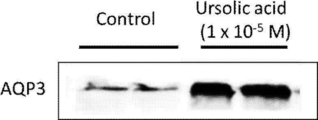
- FIG. 1 is a photograph of a membrane (a band corresponding to aquaporin 3) obtained by Western blotting.
- FIG. 2 is a graph obtained by quantifying the amount of protein in each band with an image analyzer (LAS-1000, Fujifilm) based on the results of Western blotting.
- the vertical axis of FIG. 2 shows the ratio (%) of the expression level of aquaporin 3 to the amount of ⁇ -actin as a control, and the horizontal axis shows the amount (M) of ursolic acid used for ursolic acid treatment. Show.
- Example 3 Effect of ursolic acid on migration ability of keratinocytes
- the confluent culture MSM medium of keratinocyte strain DJ-M1 cells was replaced with a serum-free medium supplemented with 0.005 mg / ml ursolic acid and cultured for 24 hours.
- the cells at the bottom of the culture dish were brought into contact with the tip of a 200 ⁇ l pipette tip, and the cells were detached by moving linearly while maintaining a constant pressure, and the scratch width was measured (Initial Wound).
- the serum-free medium was replaced with a medium containing 1 v / v% FBS and 0.005 mg / ml ursolic acid, and further cultured for 24 hours, and the scratch width was measured again.
- the scratch width was measured at 5 locations per dish, and the average value was taken as one data.
- the cell migration ability was calculated as the difference between the Initial Wound and the final scratch width (Relative Wound Healing Activity).
- Example 4 Production of ursolic acid
- 300 g of dried mussel (spear) was dispersed in methanol to obtain a methanol extract. Thereafter, the methanol extract was partitioned with hexane / water (7: 3), and a fraction insoluble in hexane and water was fractionated into 20 fractions by silica gel column chromatography (Merck). About each obtained fraction, the effect
- FIG. As a result, a strong aquaporin 3 expression enhancing activity was recognized in the component constituting the third fraction eluted with CHCl 3 : MeOH: H 2 O 7: 2: 0.2.
- the component constituting the third fraction using NMR and FAB-MS, the component was identified as ursolic acid.
Landscapes
- Health & Medical Sciences (AREA)
- Life Sciences & Earth Sciences (AREA)
- General Health & Medical Sciences (AREA)
- Veterinary Medicine (AREA)
- Public Health (AREA)
- Animal Behavior & Ethology (AREA)
- Engineering & Computer Science (AREA)
- Epidemiology (AREA)
- Chemical & Material Sciences (AREA)
- Natural Medicines & Medicinal Plants (AREA)
- Medicinal Chemistry (AREA)
- Pharmacology & Pharmacy (AREA)
- Nuclear Medicine, Radiotherapy & Molecular Imaging (AREA)
- Birds (AREA)
- General Chemical & Material Sciences (AREA)
- Chemical Kinetics & Catalysis (AREA)
- Organic Chemistry (AREA)
- Biotechnology (AREA)
- Botany (AREA)
- Dermatology (AREA)
- Microbiology (AREA)
- Mycology (AREA)
- Bioinformatics & Cheminformatics (AREA)
- Alternative & Traditional Medicine (AREA)
- Medical Informatics (AREA)
- Medicines Containing Plant Substances (AREA)
- Cosmetics (AREA)
- Acyclic And Carbocyclic Compounds In Medicinal Compositions (AREA)
Abstract
ウルソール酸を有効成分として含有するアクアポリン3の発現亢進剤及び組織修復促進剤。
Description
本発明は、アクアポリン3の発現亢進剤及び組織修復促進剤に関する。
アクアポリン(aquaporin:以下AQPと略すことがある)は、アグレにより1992年に発見された膜6回貫通タンパクで、細胞内の水分量を調節する水チャネルとして機能する重要なタンパクである。アクアポリンは細菌から哺乳類に至るまで普遍的に存在しており、これまでに哺乳類で、AQP0からAQP12まで13種類のアクアポリンが確認されている。
水チャネルの一種であるアクアポリン3(AQP3)は、皮膚ケラチノサイトに多く存在し、水やグリセロールの輸送促進作用を示すことが知られており、皮膚の生理的保湿に重要な成分である。
また、アクアポリン3の発現は皮膚炎症部位で著明に低下しており、アクアポリン3の発現量の変動が種々の皮膚疾患に伴う乾燥症状の形成と密接な関係にあることが示唆されている。さらに、アクアポリン3はケラチノサイトの増殖又は遊走能の亢進にも関わり、創傷時の治癒促進に関与すると考えられている(例えば、特開2011-32191号公報参照)。
また、アクアポリン3の発現は皮膚炎症部位で著明に低下しており、アクアポリン3の発現量の変動が種々の皮膚疾患に伴う乾燥症状の形成と密接な関係にあることが示唆されている。さらに、アクアポリン3はケラチノサイトの増殖又は遊走能の亢進にも関わり、創傷時の治癒促進に関与すると考えられている(例えば、特開2011-32191号公報参照)。
ウルソール酸(ursolic acid)は、5環性トリテルペン酸の一種である。ウルソール酸は、メラニン産生抑制作用(例えば、特開2013-32300号公報参照)や、抗酸化作用(例えば、特開2012-51940号公報参照)を示すことが知られている。
しかしながら、ウルソール酸がアクアポリン3の発現亢進作用又は組織修復促進作用を示すことは知られていなかった。
本発明の課題は、ウルソール酸の新たな用途を提供することである。
また、本発明の課題は、新規なアクアポリン3の発現亢進剤、及びアクアポリン3の発現亢進作用に基づく新規な生理活性剤を提供することである。
本発明の課題は、ウルソール酸の新たな用途を提供することである。
また、本発明の課題は、新規なアクアポリン3の発現亢進剤、及びアクアポリン3の発現亢進作用に基づく新規な生理活性剤を提供することである。
本発明は以下の通りである。
<1> ウルソール酸を有効成分として含有するアクアポリン3の発現亢進剤。
<2> ウルソール酸を有効成分として含有する組織修復促進剤。
<3> 組織修復促進が、潰瘍、褥瘡、外傷及び手術創からなる群より選ばれる少なくとも1種の肉芽形成促進である<2>に記載の組織修復促進剤。
<4> 植物からアルコールを用いて抽出したアルコール抽出液を得ることと、得られたアルコール抽出液を、アルコール、炭化水素及び水の混合液に混合分散させてアルコール層を得ることと、得られたアルコール層を、水に混合分散させて水不溶層を得ることと、を含む、ウルソール酸の製造方法。
<5> ウルソール酸を対象に投与することを含むアクアポリン3の発現亢進方法。
<6> ウルソール酸を対象に投与することを含む組織修復促進方法。
<7> 組織修復促進が、潰瘍、褥瘡、外傷及び手術創からなる群より選ばれる少なくとも1種の肉芽形成促進である<6>に記載の組織修復促進方法。
<8> 組織修復促進に使用するためのウルソール酸。
<9> 組織修復促進が、潰瘍、褥瘡、外傷及び手術創からなる群より選ばれる少なくとも1種の肉芽形成促進である<8>に記載の組織修復促進に使用するためのウルソール酸。
<1> ウルソール酸を有効成分として含有するアクアポリン3の発現亢進剤。
<2> ウルソール酸を有効成分として含有する組織修復促進剤。
<3> 組織修復促進が、潰瘍、褥瘡、外傷及び手術創からなる群より選ばれる少なくとも1種の肉芽形成促進である<2>に記載の組織修復促進剤。
<4> 植物からアルコールを用いて抽出したアルコール抽出液を得ることと、得られたアルコール抽出液を、アルコール、炭化水素及び水の混合液に混合分散させてアルコール層を得ることと、得られたアルコール層を、水に混合分散させて水不溶層を得ることと、を含む、ウルソール酸の製造方法。
<5> ウルソール酸を対象に投与することを含むアクアポリン3の発現亢進方法。
<6> ウルソール酸を対象に投与することを含む組織修復促進方法。
<7> 組織修復促進が、潰瘍、褥瘡、外傷及び手術創からなる群より選ばれる少なくとも1種の肉芽形成促進である<6>に記載の組織修復促進方法。
<8> 組織修復促進に使用するためのウルソール酸。
<9> 組織修復促進が、潰瘍、褥瘡、外傷及び手術創からなる群より選ばれる少なくとも1種の肉芽形成促進である<8>に記載の組織修復促進に使用するためのウルソール酸。
本発明によれば、ウルソール酸の新たな用途を提供することができる。
また、本発明によれば、新規なアクアポリン3の発現亢進剤、及びアクアポリン3の発現亢進作用に基づく新規な生理活性剤を提供することができる。
また、本発明によれば、新規なアクアポリン3の発現亢進剤、及びアクアポリン3の発現亢進作用に基づく新規な生理活性剤を提供することができる。
本発明のアクアポリン3の発現亢進剤及び組織修復促進剤は、ウルソール酸を有効成分とした生理活性剤である。
本発明のアクアポリン3の発現亢進剤は、細胞に対して、アクアポリン3の発現亢進作用を有し、且つアクアポリン3の発現亢進作用に基づく組織修復促進作用を有する。
なお、本明細書では、特に断らない限り、アクアポリン3の発現亢進剤及び組織修復促進剤を「生理活性剤」と総称する。
本発明のアクアポリン3の発現亢進剤は、細胞に対して、アクアポリン3の発現亢進作用を有し、且つアクアポリン3の発現亢進作用に基づく組織修復促進作用を有する。
なお、本明細書では、特に断らない限り、アクアポリン3の発現亢進剤及び組織修復促進剤を「生理活性剤」と総称する。
本明細書において「工程」との語は、独立した工程だけではなく、他の工程と明確に区別できない場合であってもその工程の所期の目的が達成されれば、本用語に含まれる。また本明細書において「~」を用いて示された数値範囲は、「~」の前後に記載される数値をそれぞれ最小値及び最大値として含む範囲を示す。
本発明において、組成物中の各成分の量について言及する場合、組成物中に各成分に該当する物質が複数存在する場合には、特に断らない限り、組成物中に存在する当該複数の物質の合計量を意味する。
本明細書において「細胞」とは、アクアポリン3を発現する細胞であれば特に限定されない。具体的には、気道上皮細胞、腎上皮細胞、消化管上皮細胞及び皮膚細胞が挙げられる。皮膚細胞には、表皮細胞(ケラチノサイト)、色素細胞(メラノサイト)、ランゲルハンス細胞、α樹状細胞、メルケル細胞が含まれ、中でも表皮細胞(ケラチノサイト)が好ましい。
以下、本発明について説明する。
本発明において、組成物中の各成分の量について言及する場合、組成物中に各成分に該当する物質が複数存在する場合には、特に断らない限り、組成物中に存在する当該複数の物質の合計量を意味する。
本明細書において「細胞」とは、アクアポリン3を発現する細胞であれば特に限定されない。具体的には、気道上皮細胞、腎上皮細胞、消化管上皮細胞及び皮膚細胞が挙げられる。皮膚細胞には、表皮細胞(ケラチノサイト)、色素細胞(メラノサイト)、ランゲルハンス細胞、α樹状細胞、メルケル細胞が含まれ、中でも表皮細胞(ケラチノサイト)が好ましい。
以下、本発明について説明する。
<生理活性剤>
本発明にかかる生理活性剤において有効成分となるウルソール酸は、化学式C30H48O3(分子量456.7、CAS登録番号77-52-1)で表される化合物であり、以下の構造式で表される。
本発明にかかる生理活性剤において有効成分となるウルソール酸は、化学式C30H48O3(分子量456.7、CAS登録番号77-52-1)で表される化合物であり、以下の構造式で表される。

ウルソール酸としては、一般的に用いられる合成物及び植物由来の抽出物等のいずれをも使用することができる。
ウルソール酸は、リンゴ、バジル、ビルベリー、クランベリー、エルダーフラワー、ペパーミント、ローズマリー、ラベンダー、オレガノ、タイム、サンザシ、プルーン等の植物由来の抽出物を用いることができる。
また、ウルソール酸は市販品を使用することができる。市販品としては例えば、Ursolic acid(SigmaArdrich社)、Ursolic acid(Santa Cruz社)、Ursolic acid(東京化成工業社)、ウルソル酸(和光純薬工業社)等を挙げることができる。
ウルソール酸は、リンゴ、バジル、ビルベリー、クランベリー、エルダーフラワー、ペパーミント、ローズマリー、ラベンダー、オレガノ、タイム、サンザシ、プルーン等の植物由来の抽出物を用いることができる。
また、ウルソール酸は市販品を使用することができる。市販品としては例えば、Ursolic acid(SigmaArdrich社)、Ursolic acid(Santa Cruz社)、Ursolic acid(東京化成工業社)、ウルソル酸(和光純薬工業社)等を挙げることができる。
ウルソール酸は、アクアポリン3の発現亢進作用を有するため、アクアポリン3の機能異常に起因する病態の治療のための医薬の有効成分として有用である。
アクアポリン3の機能異常とは、健常な組織内細胞のアクアポリン3の状態とは異なる、病態下の組織内細胞のアクアポリン3の状態をいい、アクアポリン3の機能減退、細胞におけるアクアポリン3の数の減少等を含む。
ウルソール酸を有効成分として含有するアクアポリン3の発現亢進剤は、具体的には、組織修復促進剤として用いることができるが、これらの用途のみに限定されず、アクアポリン3を発現する組織や器官の疾病の予防及び治療のために用いることができる。
アクアポリン3の機能異常とは、健常な組織内細胞のアクアポリン3の状態とは異なる、病態下の組織内細胞のアクアポリン3の状態をいい、アクアポリン3の機能減退、細胞におけるアクアポリン3の数の減少等を含む。
ウルソール酸を有効成分として含有するアクアポリン3の発現亢進剤は、具体的には、組織修復促進剤として用いることができるが、これらの用途のみに限定されず、アクアポリン3を発現する組織や器官の疾病の予防及び治療のために用いることができる。
(アクアポリン3の発現亢進剤)
本発明にかかるアクアポリン3の発現亢進剤は、有効成分としてウルソール酸を含有する。これにより、アクアポリン3の発現亢進剤は、ウルソール酸未使用時に比べて、細胞中のアクアポリン3の発現を亢進させることができる。また、アクアポリン3の発現亢進剤は、組織修復を促進する作用を有する。
さらに、アクアポリン3の発現亢進剤には、皮膚水分保持機能向上、皮膚ターンオーバーの改善、皮膚の乾燥防止、乾燥等による肌荒れの改善、掻痒感の改善、美肌等の効果が期待できる。
本発明にかかるアクアポリン3の発現亢進剤は、有効成分としてウルソール酸を含有する。これにより、アクアポリン3の発現亢進剤は、ウルソール酸未使用時に比べて、細胞中のアクアポリン3の発現を亢進させることができる。また、アクアポリン3の発現亢進剤は、組織修復を促進する作用を有する。
さらに、アクアポリン3の発現亢進剤には、皮膚水分保持機能向上、皮膚ターンオーバーの改善、皮膚の乾燥防止、乾燥等による肌荒れの改善、掻痒感の改善、美肌等の効果が期待できる。
アクアポリン3の発現亢進剤は、ウルソール酸の未使用時に比べて、細胞中のアクアポリン3の発現を亢進する作用を有するものであればよい。
細胞内のアクアポリン3の発現亢進作用は、特に限定されるものではないが、例えば、細胞中のアクアポリン3の発現量を測定することにより評価することができる。
評価方法としては具体的には、培養細胞、市販の三次元表皮モデル、テープストリッピング等で採取した角層由来の細胞又はアクアポリン3を発現する皮膚由来の表皮細胞株のアクアポリン発現量をウェスタンブロッティングにより測定する方法、PCR法及びノーザンブロット法によりアクアポリン3mRNA発現量を測定する方法、ストップトフロー法による細胞膜水透過性を測定する方法、標識グリセロールの細胞膜透過性を測定する方法等が挙げられる。
細胞内のアクアポリン3の発現亢進作用は、特に限定されるものではないが、例えば、細胞中のアクアポリン3の発現量を測定することにより評価することができる。
評価方法としては具体的には、培養細胞、市販の三次元表皮モデル、テープストリッピング等で採取した角層由来の細胞又はアクアポリン3を発現する皮膚由来の表皮細胞株のアクアポリン発現量をウェスタンブロッティングにより測定する方法、PCR法及びノーザンブロット法によりアクアポリン3mRNA発現量を測定する方法、ストップトフロー法による細胞膜水透過性を測定する方法、標識グリセロールの細胞膜透過性を測定する方法等が挙げられる。
アクアポリン3の発現亢進剤は、細胞内のアクアポリン3の発現量を測定した際に、ウルソール酸未使用時に比べて、アクアポリン3の発現量が、1.5倍~4倍に増加することが好ましく、2倍~4倍に増加することがより好ましく、3倍~4倍に増加することがさらに好ましい。
なお、アクアポリン3の発現量の測定方法は、Horie I et al., Biochem Biophys Res Commun,387, 564-8, 2009に記載の方法に準じればよい。
評価に用いる培養細胞として、例えばケラチノサイト株DJ-M1細胞(理研細胞銀行)、Primary Human Keratinocyte Cells(ライフテクノロジーズ社)、正常ヒト表皮角化細胞(クラボウ社)等が挙げられる。
評価に用いる市販の三次元表皮モデルとしては、LaboCyte Epimodel(株式会社ジャパン・ティッシュ・エンジニアリング)、EPI-200(クラボウ社)、TESTSKIN(TOYOBO社)等が挙げられる。
なお、アクアポリン3の発現量の測定方法は、Horie I et al., Biochem Biophys Res Commun,387, 564-8, 2009に記載の方法に準じればよい。
評価に用いる培養細胞として、例えばケラチノサイト株DJ-M1細胞(理研細胞銀行)、Primary Human Keratinocyte Cells(ライフテクノロジーズ社)、正常ヒト表皮角化細胞(クラボウ社)等が挙げられる。
評価に用いる市販の三次元表皮モデルとしては、LaboCyte Epimodel(株式会社ジャパン・ティッシュ・エンジニアリング)、EPI-200(クラボウ社)、TESTSKIN(TOYOBO社)等が挙げられる。
(組織修復促進剤)
本発明にかかる組織修復促進剤は、有効成分としてウルソール酸を含有する。これにより、組織修復促進剤は、細胞の集合体である組織に生じた創傷の修復を、ウルソール酸未使用時に比べて促進させることができる。
細胞の集合体である組織としては、皮膚、気道、胃及び小腸等の消化管が挙げられ、好ましくは皮膚が挙げられる。
本発明にかかる組織修復促進剤は、有効成分としてウルソール酸を含有する。これにより、組織修復促進剤は、細胞の集合体である組織に生じた創傷の修復を、ウルソール酸未使用時に比べて促進させることができる。
細胞の集合体である組織としては、皮膚、気道、胃及び小腸等の消化管が挙げられ、好ましくは皮膚が挙げられる。
創傷としては、火傷、凍傷、潰瘍、褥瘡、外傷及び手術創からなる群より選ばれる少なくとも1種が挙げられる。
また、組織修復としては、創傷部位の肉芽形成を促進させること、創傷部位の治癒(創傷治癒)を促進させること、気道及び消化管粘膜上皮の再生を促進すること等が挙げられる。
好ましくは、組織修復促進が、潰瘍、褥瘡、外傷及び手術創からなる群より選ばれる少なくとも1種の肉芽形成促進であることが挙げられる。
また、組織修復としては、創傷部位の肉芽形成を促進させること、創傷部位の治癒(創傷治癒)を促進させること、気道及び消化管粘膜上皮の再生を促進すること等が挙げられる。
好ましくは、組織修復促進が、潰瘍、褥瘡、外傷及び手術創からなる群より選ばれる少なくとも1種の肉芽形成促進であることが挙げられる。
組織修復促進作用は、具体的には、ケラチノサイトの遊走能、動物の実験的外傷の修復能を測定することにより評価することができる。
例えば、ケラチノサイトの遊走能の評価は、特開2011-32191号公報の段落[0037]に記載の方法に準じて行えばよい。
例えば、ケラチノサイトの遊走能の評価は、特開2011-32191号公報の段落[0037]に記載の方法に準じて行えばよい。
本発明にかかる生理活性剤を組成物の形態で用いる場合、当該組成物におけるウルソール酸の含有量は、剤型によって異なる。
一般に組成物の全質量に対して、好ましくは0.0000001質量%~1質量%であり、より好ましくは0.0001質量%~0.05質量%であり、特に好ましくは0.001質量%~0.01質量%である。
一般に組成物の全質量に対して、好ましくは0.0000001質量%~1質量%であり、より好ましくは0.0001質量%~0.05質量%であり、特に好ましくは0.001質量%~0.01質量%である。
本発明にかかる生理活性剤を使用する場合、生理活性剤の形態には特に制限はない。ウルソール酸の他、後述する他の成分(医薬や化粧品として許容可能な担体や、必要に応じた他の任意成分)を含む組成物の形態としてもよい。
組成物の形態としては、オイル組成物、乳化組成物、粉末組成物等が挙げられる。オイル組成物、乳化組成物、粉末組成物は、公知の方法に従い調製することができる。
組成物の形態としては、オイル組成物、乳化組成物、粉末組成物等が挙げられる。オイル組成物、乳化組成物、粉末組成物は、公知の方法に従い調製することができる。
本発明にかかる生理活性剤は、経口的又は非経口的に投与することができる。アクアポリン3の発現亢進作用の観点から、非経口的に投与することが好ましく、具体的には、ウルソール酸を直接皮膚細胞へ投与可能な局所投与が好ましく、経皮投与がより好ましい。
本発明にかかる生理活性剤の投与量としては、剤型等によって異なるが、一般に、1日あたり、体重kgあたり、有効成分として1mg~15mgとすることができ、好ましくは2mg~10mgとすることができ、より好ましくは3mg~5mgとすることができる。
本発明にかかる生理活性剤の投与量としては、剤型等によって異なるが、一般に、1日あたり、体重kgあたり、有効成分として1mg~15mgとすることができ、好ましくは2mg~10mgとすることができ、より好ましくは3mg~5mgとすることができる。
本発明にかかる生理活性剤を含む組成物に含有される他の成分は、本発明の組成物の形態、目的等に応じて適宜選択することができる。他の成分の好適な例としては、例えば、乳化剤、その他の添加成分等が挙げられる。
その他の添加成分としては、上記成分の他、医薬品、機能性食品、化粧品等の分野において通常用いられる添加成分を、本発明の組成物に、その形態に応じて適宜含有させてもよい。他の添加成分は、その特性によって、油溶性又は水溶性の添加成分として、本発明の組成物に含有させることができる。
例えば、その他の添加成分としては、グリセリン、1,3-ブチレングリコール等の多価アルコール;グルコース、果糖、乳糖、麦芽糖、ショ糖、ペクチン、カッパーカラギーナン、ローカストビーンガム、グアーガム、ヒドロキシプロピルグアガム、キサンタンガム、カラヤガム、タマリンド種子多糖、アラビアガム、トラガカントガム、ヒアルロン酸、ヒアルロン酸ナトリウム、コンドロイチン硫酸ナトリウム、デキストリン等の単糖類又は多糖類;ソルビトール、マンニトール、マルチトール、ラクトース、マルトトリイトール、キシリトール等の糖アルコール;塩化ナトリウム、硫酸ナトリウム等の無機塩;カゼイン、アルブミン、メチル化コラーゲン、加水分解コラーゲン、水溶性コラーゲン、ゼラチン等の分子量5000超のタンパク質;グリシン、アラニン、バリン、ロイシン、イソロイシン、セリン、スレオニン、アスパラギン酸、グルタミン酸、シスチン、メチオニン、リジン、ヒドロキシリジン、アルギニン、ヒスチジン、フェニルアラニン、チロシン、トリプトファン、プロリン、ヒドロキシプロリン、アセチルヒドロキシプロリン等のアミノ酸及びそれらの誘導体;カルボキシビニルポリマー、ポリアクリル酸ナトリウム、ポリビニルアルコール、ポリエチレングリコール、酸化エチレン・酸化プロピレンブロック共重合体等の合成高分子;ヒドロキシエチルセルロース・メチルセルロース等の水溶性セルロース誘導体;等を挙げることができ、その機能に基づいて、例えば機能性成分、賦形剤、粘度調整剤、ラジカル捕捉剤等として含んでもよい。
その他、本発明においては、例えば、種々の薬効成分、pH調整剤、pH緩衝剤、紫外線吸収剤、防腐剤、香料、着色剤等、通常、その用途で使用される他の添加物を併用することができる。
その他、本発明においては、例えば、種々の薬効成分、pH調整剤、pH緩衝剤、紫外線吸収剤、防腐剤、香料、着色剤等、通常、その用途で使用される他の添加物を併用することができる。
生理活性剤は、医薬品、化粧料又は機能性食品等として用いることができる。
また、生理活性剤は、ヒト及び家畜に投与することができる。家畜としては、イヌ、サル、ネコ、ウシ、ウマ、ヒツジ等が挙げられる。
また、生理活性剤は、ヒト及び家畜に投与することができる。家畜としては、イヌ、サル、ネコ、ウシ、ウマ、ヒツジ等が挙げられる。
なお、生理活性剤は、ウルソール酸を有効成分として含有するアクアポリン3の発現亢進方法に使用することができる。また、生理活性剤は、ウルソール酸を有効成分として含有する組織修復促進方法に使用することもできる。
<ウルソール酸の製造方法>
ウルソール酸の製造方法は、植物からアルコールを用いて抽出したアルコール抽出液を得ること(以下、「抽出工程」と称する。)と、得られたアルコール抽出液を、アルコール、炭化水素及び水の混合液に混合分散させてアルコール層を得ること(以下、「分離工程」と称する。)と、得られたアルコール層を、水に混合分散させて水不溶層を得ること(以下、「単離工程」と称する。)と、を含む。
これにより、高純度なウルソール酸を得ることができる。
また、ウルソール酸の製造方法は、抽出工程、分離工程及び単離工程以外の工程を含んでいてもよい。
ウルソール酸の製造方法は、植物からアルコールを用いて抽出したアルコール抽出液を得ること(以下、「抽出工程」と称する。)と、得られたアルコール抽出液を、アルコール、炭化水素及び水の混合液に混合分散させてアルコール層を得ること(以下、「分離工程」と称する。)と、得られたアルコール層を、水に混合分散させて水不溶層を得ること(以下、「単離工程」と称する。)と、を含む。
これにより、高純度なウルソール酸を得ることができる。
また、ウルソール酸の製造方法は、抽出工程、分離工程及び単離工程以外の工程を含んでいてもよい。
抽出工程は、植物からアルコールを用いて抽出した抽出物を得る工程である。好ましくは、抽出工程において、適度に切断又は粉砕した植物を、アルコールに分散させ、室温から加温下で抽出することによりアルコール抽出液を得ることが挙げられる。
抽出に用いるアルコールとしては、例えば50w/w%~100w/w%のメチルアルコール、20w/w%~100w/w%のエチルアルコール、10w/w%~100w/w%のプロパノール又は10w/w%~100w/w%のブタノールを用いてもよく、70w/w%~100w/w%のメチルアルコール又は50w/w%~100w/w%のエチルアルコールが好ましい。またアルコールの他に、ケトン類、例えばアセトン、液状の脂肪酸エステル類、例えばリノール酸ギリセライド及びグリコール類例えばエチレングリコール等を用いることもできる。抽出工程においてアルコール以外を用いた場合にも、以下に記載されるアルコールを用いた抽出工程、分離工程及び単離工程の条件を適用してよい。
抽出に用いるアルコールとしては、例えば50w/w%~100w/w%のメチルアルコール、20w/w%~100w/w%のエチルアルコール、10w/w%~100w/w%のプロパノール又は10w/w%~100w/w%のブタノールを用いてもよく、70w/w%~100w/w%のメチルアルコール又は50w/w%~100w/w%のエチルアルコールが好ましい。またアルコールの他に、ケトン類、例えばアセトン、液状の脂肪酸エステル類、例えばリノール酸ギリセライド及びグリコール類例えばエチレングリコール等を用いることもできる。抽出工程においてアルコール以外を用いた場合にも、以下に記載されるアルコールを用いた抽出工程、分離工程及び単離工程の条件を適用してよい。
植物を切断又は粉砕する方法は、公知の方法により行えばよく、例えば植物が粉末状になるまで鋏又は臼を用いて切断又は粉砕する方法が挙げられる。
抽出温度は、室温から加温下であればよく、具体的には、0℃~100℃が挙げられ、20℃~90℃が好ましい。
抽出時間は、数分から数日間が挙げられ、例えば植物の色が抽出液に移るまでの間抽出を行えばよい。
抽出温度は、室温から加温下であればよく、具体的には、0℃~100℃が挙げられ、20℃~90℃が好ましい。
抽出時間は、数分から数日間が挙げられ、例えば植物の色が抽出液に移るまでの間抽出を行えばよい。
また、抽出工程においては、必要に応じてアルコールを攪拌する撹拌工程を含んでいてもよい。撹拌速度は特に制限されるものではない。
アルコール抽出液は、例えば植物を濾過して抽出残渣を除去する濾過工程により得ることができる。
アルコール抽出液は、例えば植物を濾過して抽出残渣を除去する濾過工程により得ることができる。
分離工程は、得られたアルコール抽出液を、アルコール、炭化水素及び水の混合液に混合分散させてアルコール層を得る工程である。
得られたアルコール抽出液を、アルコール、炭化水素及び水の混合液(以下、「混合液」と称する。)に混合分散する場合には、必要に応じてアルコール抽出液及び混合液を撹拌する撹拌工程を含んでいてもよい。撹拌速度は特に制限されるものではない。
分離工程は、得られたアルコール抽出液を、混合液に混合分散した後に、アルコール層が分離するまでの一定時間放置し、アルコール層を分取するアルコール層分取工程を含んでいてもよい。アルコール層を分取する方法は特に制限はされず、公知の方法を採用することができる。
得られたアルコール抽出液を、アルコール、炭化水素及び水の混合液(以下、「混合液」と称する。)に混合分散する場合には、必要に応じてアルコール抽出液及び混合液を撹拌する撹拌工程を含んでいてもよい。撹拌速度は特に制限されるものではない。
分離工程は、得られたアルコール抽出液を、混合液に混合分散した後に、アルコール層が分離するまでの一定時間放置し、アルコール層を分取するアルコール層分取工程を含んでいてもよい。アルコール層を分取する方法は特に制限はされず、公知の方法を採用することができる。
単離工程は、得られたアルコール層を、水に混合分散させて水不溶層を得る工程である。
得られたアルコール層を水に混合分散する場合には、必要に応じてアルコール層及び水を撹拌する撹拌工程を含んでいてもよい。撹拌速度は特に制限されるものではない。
単離工程は、得られたアルコール層を、水に混合分散したのちに、水不溶層が分離するまでの一定時間放置し、水不溶層を分取する水不溶層分取工程を含んでいてもよい。
水不溶層を分取する方法は特に制限はされず、公知の方法を採用することができる。
得られたアルコール層を水に混合分散する場合には、必要に応じてアルコール層及び水を撹拌する撹拌工程を含んでいてもよい。撹拌速度は特に制限されるものではない。
単離工程は、得られたアルコール層を、水に混合分散したのちに、水不溶層が分離するまでの一定時間放置し、水不溶層を分取する水不溶層分取工程を含んでいてもよい。
水不溶層を分取する方法は特に制限はされず、公知の方法を採用することができる。
また、ウルソール酸の製造方法は、抽出工程、分離工程及び単離工程に加えて、得られた水不溶層から、ウルソール酸を精製する精製工程を含んでいてもよい。
ウルソール酸を水不溶層から精製する方法としては、限定されるものではなく、公知の方法を採用することができる。例えば、シリカゲル、アルミナ及び疎水クロマト担体を用いたカラムクロマト等を用いた方法が挙げられる。
ウルソール酸を水不溶層から精製する方法としては、限定されるものではなく、公知の方法を採用することができる。例えば、シリカゲル、アルミナ及び疎水クロマト担体を用いたカラムクロマト等を用いた方法が挙げられる。
植物は、ウルソール酸を含有する植物であれば、未乾燥植物及び乾燥植物のいずれであってもよい。
未乾燥植物としては、生薬、ハーブ、果物等が挙げられる。
乾燥植物としては、天日乾燥又は凍結乾燥した植物のいずれであってもよいが、回収効率の観点より、天日乾燥した植物であることが好ましい。
未乾燥植物としては、生薬、ハーブ、果物等が挙げられる。
乾燥植物としては、天日乾燥又は凍結乾燥した植物のいずれであってもよいが、回収効率の観点より、天日乾燥した植物であることが好ましい。
植物の種類としては、ウルソール酸を含有する植物であればいずれの植物であってもよい。例えば、シソ科、バラ科、ツツジ科、スイカズラ科等が挙げられる。
具体的には、シソ科のオドリコソウ亜科に属するケイガイ(Schizonepeta tenuifolia Briquet(var.japonica Kitagawa))の花穂、シソ科のマンネンロウ属に属するローズマリー(Rosmarinus officinalis L.)及びバラ科のナシ亜科リンゴ属に属するリンゴの皮等が挙げられる。
具体的には、シソ科のオドリコソウ亜科に属するケイガイ(Schizonepeta tenuifolia Briquet(var.japonica Kitagawa))の花穂、シソ科のマンネンロウ属に属するローズマリー(Rosmarinus officinalis L.)及びバラ科のナシ亜科リンゴ属に属するリンゴの皮等が挙げられる。
アルコールとしては、低級アルコール(メタノール、エタノール、プロピルアルコール、イソプロピルアルコール等)、多価アルコール(グリセリン、プロピレングリコール等)等を挙げることができる。これらのアルコールは単独で用いてもよいし、2種類以上のアルコールを混合して用いてもよい。
また、アルコールとしては、低級アルコールが好ましく、メタノールが特に好ましい。
植物を分散するアルコールの量は、植物の全質量に対して約2倍量~100倍量、好ましくは3倍量~30倍量のアルコールを用いることができる。
また、アルコールとしては、低級アルコールが好ましく、メタノールが特に好ましい。
植物を分散するアルコールの量は、植物の全質量に対して約2倍量~100倍量、好ましくは3倍量~30倍量のアルコールを用いることができる。
アルコール、炭化水素及び水の混合液としては、体積基準で、アルコール:炭化水素:水が、1:1:1~5:2:1:1、2:2:1~1:1:2、又は3:2:1~3:2:2である混合液を用いることができる。
アルコールとしては、低級アルコール(メタノール、エタノール、プロピルアルコール、イソプロピルアルコール等)、多価アルコール(グリセリン、プロピレングリコール等)等を挙げることができるが、低級アルコールが好ましく、中でもメタノールを用いることがより好ましい。
炭化水素としては、ベンゼン、ヘキサン等が挙げられるが、ヘキサンを用いることが好ましい。
アルコール抽出液を混合分散する混合液の量としては、アルコール抽出液の全体積に対して約2倍量~100倍量、好ましくは10倍量~50倍量の混合液を用いることができる。
アルコールとしては、低級アルコール(メタノール、エタノール、プロピルアルコール、イソプロピルアルコール等)、多価アルコール(グリセリン、プロピレングリコール等)等を挙げることができるが、低級アルコールが好ましく、中でもメタノールを用いることがより好ましい。
炭化水素としては、ベンゼン、ヘキサン等が挙げられるが、ヘキサンを用いることが好ましい。
アルコール抽出液を混合分散する混合液の量としては、アルコール抽出液の全体積に対して約2倍量~100倍量、好ましくは10倍量~50倍量の混合液を用いることができる。
アルコール層を混合分散する水の量としては、アルコール層の全体積に対して約0.1倍量~2倍量、好ましくは0.5倍量~1.5倍量の水を用いることができる。
このようにして得られた水不溶層にはウルソール酸が含有されているため、水不溶層を構成する水不溶性成分を、そのまま本発明の生理活性剤として利用することができる。
以下、本発明を実施例にて詳細に説明する。しかしながら、本発明はそれらに何ら限定されるものではない。
[実施例1:ウルソール酸の製造]
乾燥ケイガイ300g(ウチダ社製)にメタノール3000mlを加え、2時間かけて70℃で加熱抽出し、アルコール抽出液30gを得る。
得られたアルコール抽出液を、メタノール、ヘキサン及び水の混合液(210:90:70(容積基準))1000mlに混合分散させて、30分経過後、メタノール層を分液ロートにより分取し、蒸発乾固させる(メタノール層24g)。得られたメタノール層を、水500mlに混合分散させて、20分経過後、水不溶層を遠心により分取する(水不溶層3.8g)。得られた水不溶層を、積載容積200mLのシリカゲルカラムに供し、クロロホルム:メタノール:水(7:2:0.1)200mL、クロロホルム:メタノール:水(7:3:0.5)200mL及びメタノール200mLで順次溶出し、得られた第3分画から第4分画(溶出液量20mL~100mL)を分取、濃縮乾固させて、約100mgのウルソール酸を得た。
乾燥ケイガイ300g(ウチダ社製)にメタノール3000mlを加え、2時間かけて70℃で加熱抽出し、アルコール抽出液30gを得る。
得られたアルコール抽出液を、メタノール、ヘキサン及び水の混合液(210:90:70(容積基準))1000mlに混合分散させて、30分経過後、メタノール層を分液ロートにより分取し、蒸発乾固させる(メタノール層24g)。得られたメタノール層を、水500mlに混合分散させて、20分経過後、水不溶層を遠心により分取する(水不溶層3.8g)。得られた水不溶層を、積載容積200mLのシリカゲルカラムに供し、クロロホルム:メタノール:水(7:2:0.1)200mL、クロロホルム:メタノール:水(7:3:0.5)200mL及びメタノール200mLで順次溶出し、得られた第3分画から第4分画(溶出液量20mL~100mL)を分取、濃縮乾固させて、約100mgのウルソール酸を得た。
[実施例2:アクアポリン3の発現量に対するウルソール酸の作用]
ケラチノサイト株DJ-M1細胞(理研細胞銀行)は、10v/v%ウシ胎児血清(FBS)、100units/mlのペニシリン、100μg/mlストレプトマイシン、1v/v% MEM Non-Essential Amino Acids(GIBCO社)を含むMEM培地を用いて、5v/v%二酸化炭素、37°Cで静置培養した。
ケラチノサイト株DJ-M1細胞をコンフルエンシー80%~90%まで培養後、MEM培地を、ウルソール酸(シグマアルドリッチ社)0.005mg/mlを添加した無血清培地に置換し、24時間静置して、ウルソール酸処理した細胞を得た。
ウルソール酸処理した細胞を、PBSで洗浄し、セルスクレイパーを用いて掻き取り、遠心してペレットを得た。
得られたペレットにLysis buffer(50mM Tris-HCl:pH7.5、150mM NaCl、5mM EDTA、1% NP-40、0.1% SDS、0.5% deoxycholate、1%v/v protease inhibitor cocktail)(シグマアルドリッチ社)を0.05ml加え、ピペッティングして可溶化し、再度、遠心して、その上清を細胞溶解液として得た。
細胞溶解液を試料として以下の通りポリアクリルアミドゲル電気泳動(SDS-PAGE)及びウェスタンブロッティングを行った。
細胞溶解液10μlを、12v/v% polyacrylamide gelでSDS-PAGEを行い、細胞溶解液に含まれる各種タンパクを各バンドに分離後、PVDF膜(サーモサイエンス社)に転写した。
転写したPVDF膜は5%スキムミルク液中、室温で1時間振盪してブロッキングし、その後、1:1000に希釈した抗アクアポリン3(AQP3)抗体(アロモン社)を用いて一次抗体反応(4°C、overnight)を行い、0.1v/v%のTween20/PBSで洗浄した後、horseradish peroxidase(HRP)-標識抗ウサギIgG抗体(1:20000)(サンタクルズ社)を用いて二次抗体反応(室温、1h)を行った。
さらに、メンブレンを洗浄後、ECL(登録商標)advance Western blotting analysis system(GE Healthcare Life Science社)を用いて抗体反応を検出した。
なお、polyacrylamide gelへの試料のロード量が均一であることは、一次抗体に抗β-アクチン抗体を用いた同様の実験で検証した。
ケラチノサイト株DJ-M1細胞(理研細胞銀行)は、10v/v%ウシ胎児血清(FBS)、100units/mlのペニシリン、100μg/mlストレプトマイシン、1v/v% MEM Non-Essential Amino Acids(GIBCO社)を含むMEM培地を用いて、5v/v%二酸化炭素、37°Cで静置培養した。
ケラチノサイト株DJ-M1細胞をコンフルエンシー80%~90%まで培養後、MEM培地を、ウルソール酸(シグマアルドリッチ社)0.005mg/mlを添加した無血清培地に置換し、24時間静置して、ウルソール酸処理した細胞を得た。
ウルソール酸処理した細胞を、PBSで洗浄し、セルスクレイパーを用いて掻き取り、遠心してペレットを得た。
得られたペレットにLysis buffer(50mM Tris-HCl:pH7.5、150mM NaCl、5mM EDTA、1% NP-40、0.1% SDS、0.5% deoxycholate、1%v/v protease inhibitor cocktail)(シグマアルドリッチ社)を0.05ml加え、ピペッティングして可溶化し、再度、遠心して、その上清を細胞溶解液として得た。
細胞溶解液を試料として以下の通りポリアクリルアミドゲル電気泳動(SDS-PAGE)及びウェスタンブロッティングを行った。
細胞溶解液10μlを、12v/v% polyacrylamide gelでSDS-PAGEを行い、細胞溶解液に含まれる各種タンパクを各バンドに分離後、PVDF膜(サーモサイエンス社)に転写した。
転写したPVDF膜は5%スキムミルク液中、室温で1時間振盪してブロッキングし、その後、1:1000に希釈した抗アクアポリン3(AQP3)抗体(アロモン社)を用いて一次抗体反応(4°C、overnight)を行い、0.1v/v%のTween20/PBSで洗浄した後、horseradish peroxidase(HRP)-標識抗ウサギIgG抗体(1:20000)(サンタクルズ社)を用いて二次抗体反応(室温、1h)を行った。
さらに、メンブレンを洗浄後、ECL(登録商標)advance Western blotting analysis system(GE Healthcare Life Science社)を用いて抗体反応を検出した。
なお、polyacrylamide gelへの試料のロード量が均一であることは、一次抗体に抗β-アクチン抗体を用いた同様の実験で検証した。
上述の方法により得られたアクアポリン3の発現量の測定結果を図1及び図2に示す。
図1は、ウェスタンブロッティングにより得られたメンブレン(アクアポリン3に該当するバンド)の写真である。
図2は、ウェスタンブロッティングの結果に基づき、各バンドのタンパク量を画像解析装置(LAS-1000、フジフイルム社)にて定量化して得られたグラフである。なお、図2の縦軸はコントロールであるβ-アクチン量に対する、アクアポリン3の発現量の比率(%)を示しており、横軸はウルソール酸処理に用いたウルソール酸の添加量(M)を示す。
図1は、ウェスタンブロッティングにより得られたメンブレン(アクアポリン3に該当するバンド)の写真である。
図2は、ウェスタンブロッティングの結果に基づき、各バンドのタンパク量を画像解析装置(LAS-1000、フジフイルム社)にて定量化して得られたグラフである。なお、図2の縦軸はコントロールであるβ-アクチン量に対する、アクアポリン3の発現量の比率(%)を示しており、横軸はウルソール酸処理に用いたウルソール酸の添加量(M)を示す。
図1及び図2の結果から明らかである通り、ウルソール酸添加により、アクアポリン3の発現亢進が認められた。
[実施例3:ケラチノサイトの遊走能に対するウルソール酸の作用]
ケラチノサイト株DJ-M1細胞のコンフルエントカルチャーのMSM培地を、ウルソール酸0.005mg/ml添加無血清培地に置換し、24時間培養した。
培養皿底部の細胞を200μlピペットチップの先端を接触させ、一定の圧力を維持したまま直線的に移動させることで細胞を剥離(scratch)し、このscratch幅を測定した(Initial Wound)。
無血清培地を、1v/v%FBS及び0.005mg/mlのウルソール酸を含む培地に置換後、さらに24時間培養し、再びscratch幅を測定した。
Scratch幅は1ディッシュ当り5ヶ所で測定し、その平均値を1つのデータとした。
細胞遊走能は、Initial Woundと最終的なscratch幅との差(Relative Wound Healing Activity)として算出した。
ケラチノサイト株DJ-M1細胞のコンフルエントカルチャーのMSM培地を、ウルソール酸0.005mg/ml添加無血清培地に置換し、24時間培養した。
培養皿底部の細胞を200μlピペットチップの先端を接触させ、一定の圧力を維持したまま直線的に移動させることで細胞を剥離(scratch)し、このscratch幅を測定した(Initial Wound)。
無血清培地を、1v/v%FBS及び0.005mg/mlのウルソール酸を含む培地に置換後、さらに24時間培養し、再びscratch幅を測定した。
Scratch幅は1ディッシュ当り5ヶ所で測定し、その平均値を1つのデータとした。
細胞遊走能は、Initial Woundと最終的なscratch幅との差(Relative Wound Healing Activity)として算出した。
図3の結果から明らかである通り、ウルソール酸添加によりケラチノサイトの遊走能が促進され、in vitroの実験的創傷の回復が促進された。
[実施例4:ウルソール酸の製造]
乾燥ケイガイ(荊芥)300gをメタノールに分散し、メタノール抽出エキスを得た。その後、メタノール抽出液を、ヘキサン/水(7:3)で分配し、ヘキサン及び水に不溶性画分をシリカゲルカラムクロマトグラフィ(メルク社)により20分画した。
得られた各画分について、実施例1と同様にアクアポリン3の発現量に対する作用を確認した。その結果、CHCl3:MeOH:H2O=7:2:0.2で溶出した第3画分を構成する成分に強いアクアポリン3の発現亢進活性を認めた。
第3画分を構成する成分を、NMR及びFAB-MSを用いて構造解析した結果、当該成分はウルソール酸と同定した。
乾燥ケイガイ(荊芥)300gをメタノールに分散し、メタノール抽出エキスを得た。その後、メタノール抽出液を、ヘキサン/水(7:3)で分配し、ヘキサン及び水に不溶性画分をシリカゲルカラムクロマトグラフィ(メルク社)により20分画した。
得られた各画分について、実施例1と同様にアクアポリン3の発現量に対する作用を確認した。その結果、CHCl3:MeOH:H2O=7:2:0.2で溶出した第3画分を構成する成分に強いアクアポリン3の発現亢進活性を認めた。
第3画分を構成する成分を、NMR及びFAB-MSを用いて構造解析した結果、当該成分はウルソール酸と同定した。
2013年8月9日に出願された日本国特許出願2013-166326の開示は、その全体が参照により本明細書に取り込まれる。本明細書に記載された全ての文献、特許出願、および技術規格は、個々の文献、特許出願、および技術規格が参照により取り込まれることが具体的かつ個々に記された場合と同程度に、本明細書中に参照により取り込まれる。本発明の例示的実施形態についての以上の記載は例示および説明の目的でされたものであり、網羅的であることあるいは発明を開示されている形態そのものに限定することを意図するものではない。明らかなことではあるが、多くの改変あるいは変更が当業者には自明である。上記実施形態は発明の原理及び実用的応用を最もうまく説明し、想定される特定の用途に適するような種々の実施形態や種々の改変と共に他の当業者が発明を理解できるようにするために選択され、記載された。本発明の範囲は以下の請求項およびその均等物によって規定されることが意図されている。
Claims (4)
- ウルソール酸を有効成分として含有するアクアポリン3の発現亢進剤。
- ウルソール酸を有効成分として含有する組織修復促進剤。
- 組織修復促進が、潰瘍、褥瘡、外傷及び手術創からなる群より選ばれる少なくとも1種の肉芽形成促進である請求項2に記載の組織修復促進剤。
- 植物からアルコールを用いて抽出したアルコール抽出液を得ることと、
得られたアルコール抽出液を、アルコール、炭化水素及び水の混合液に混合分散させてアルコール層を得ることと、
得られたアルコール層を、水に混合分散させて水不溶層を得ることと、
を含む、ウルソール酸の製造方法。
Applications Claiming Priority (2)
| Application Number | Priority Date | Filing Date | Title |
|---|---|---|---|
| JP2013166326A JP2015034149A (ja) | 2013-08-09 | 2013-08-09 | アクアポリン3の発現亢進剤及び組織修復促進剤 |
| JP2013-166326 | 2013-08-09 |
Publications (1)
| Publication Number | Publication Date |
|---|---|
| WO2015020162A1 true WO2015020162A1 (ja) | 2015-02-12 |
Family
ID=52461490
Family Applications (1)
| Application Number | Title | Priority Date | Filing Date |
|---|---|---|---|
| PCT/JP2014/070920 Ceased WO2015020162A1 (ja) | 2013-08-09 | 2014-08-07 | アクアポリン3の発現亢進剤及び組織修復促進剤 |
Country Status (2)
| Country | Link |
|---|---|
| JP (1) | JP2015034149A (ja) |
| WO (1) | WO2015020162A1 (ja) |
Families Citing this family (1)
| Publication number | Priority date | Publication date | Assignee | Title |
|---|---|---|---|---|
| JP7751280B2 (ja) * | 2021-06-16 | 2025-10-08 | 日本メナード化粧品株式会社 | コラーゲン産生促進剤、mmp-2阻害剤、細胞増殖促進剤及び内用剤 |
Citations (1)
| Publication number | Priority date | Publication date | Assignee | Title |
|---|---|---|---|---|
| JP2009545633A (ja) * | 2006-08-30 | 2009-12-24 | ザ プロクター アンド ギャンブル カンパニー | より濃く、より豊かな毛髪の外観を向上させることができるヘアケア組成物 |
-
2013
- 2013-08-09 JP JP2013166326A patent/JP2015034149A/ja active Pending
-
2014
- 2014-08-07 WO PCT/JP2014/070920 patent/WO2015020162A1/ja not_active Ceased
Patent Citations (1)
| Publication number | Priority date | Publication date | Assignee | Title |
|---|---|---|---|---|
| JP2009545633A (ja) * | 2006-08-30 | 2009-12-24 | ザ プロクター アンド ギャンブル カンパニー | より濃く、より豊かな毛髪の外観を向上させることができるヘアケア組成物 |
Non-Patent Citations (7)
| Title |
|---|
| "Jisedai no Kinosei Genryo Barnet-sha ( America ) no Shinseihin", FRAGRANCE JOURNAL, vol. 31, no. 3, 2003, pages 101 - 102 * |
| BUDAVARI,S., EDITOR, THE MERCK INDEX, TWELFTH EDITION, 1996, pages 1686 - 1687 * |
| LIU, J.: "Pharmacology of oleanolic acid and ursolic acid", JOURNAL OF ETHNOPHARMACOLOGY, vol. 49, no. 2, 1995, pages 57 - 68, XP002571740, DOI: doi:10.1016/0378-8741(95)90032-2 * |
| LIU,W. ET AL.: "Ursolic acid inhibits cigarette smoke extract-induced human bronchial epithelial cell injury and prevents development of lung cancer", MOLECULES, vol. 17, no. 8, 2012, pages 9104 - 9115 * |
| MUKHERJEE,H. ET AL.: "Evaluation of the wound healing activity of Shorea robusta, an Indian ethnomedicine, and its isolated constituent(s) in topical formulation", JOURNAL OF ETHNOPHARMACOLOGY, vol. 149, no. 1, 2013, pages 335 - 343, XP055277401, DOI: doi:10.1016/j.jep.2013.06.045 * |
| RINGBOM,T. ET AL.: "Ursolic acid from Plantago major, a selective inhibitor of cyclooxygenase- 2 catalyzed prostaglandin biosynthesis", JOURNAL OF NATURAL PRODUCTS, vol. 61, no. 10, 1998, pages 1212 - 1215 * |
| YASUTOMO NISHIMORI: "Collagen Fiber Bundles and Wrinkling", JOURNAL OF JAPANESE COSMETIC SCIENCE SOCIETY, vol. 27, no. 4, 2003, pages 294 - 297 * |
Also Published As
| Publication number | Publication date |
|---|---|
| JP2015034149A (ja) | 2015-02-19 |
Similar Documents
| Publication | Publication Date | Title |
|---|---|---|
| US20230255911A1 (en) | Compositions of bioactive fulvate fractions and uses thereof | |
| CN106456478A (zh) | 没食子酸及其衍生物的化妆品和医药应用 | |
| JP5027001B2 (ja) | 酵素処理ローヤルゼリー及びそれを含有する皮膚繊維芽細胞の増殖促進剤 | |
| JP6259209B2 (ja) | コラーゲン産生促進剤 | |
| JP5890100B2 (ja) | 皮膚コラーゲン産生促進剤 | |
| JP2016056116A (ja) | コラーゲン産生促進用組成物 | |
| WO2007132900A1 (ja) | 皮膚保湿剤および皮膚炎治療剤 | |
| KR20120113201A (ko) | 판두라틴 에이 또는 보에센베르기아 판두라타 추출물을 함유하는 아토피성 피부질환의 예방 및 치료용 조성물 | |
| JP7498466B2 (ja) | 皮膚潰瘍の治療または改善のための竜眼肉含有混合生薬抽出物を含む局所用組成物およびその使用 | |
| JP2022187483A (ja) | オートファジー促進用組成物 | |
| JP5564735B2 (ja) | アクアポリン3の発現調節剤 | |
| WO2015020162A1 (ja) | アクアポリン3の発現亢進剤及び組織修復促進剤 | |
| JP5702961B2 (ja) | グルタチオン産生促進剤及びグルタチオン産生促進作用を有する医薬品 | |
| JP5548561B2 (ja) | 皮膚繊維芽細胞増殖促進剤及び皮膚コラーゲン産生促進剤 | |
| JP6688585B2 (ja) | バリア機能改善剤 | |
| JP7578245B2 (ja) | 皮膚再生および皮膚創傷の治療または改善のための竜眼肉含有混合生薬抽出物を含む局所用組成物およびその使用 | |
| JP7408269B2 (ja) | メラノソーム分解促進剤 | |
| JP2010202569A (ja) | 抗アレルギー及び抗炎症用組成物 | |
| EP3171883A1 (en) | Seaweed extract and composition useful against cancer cells | |
| WO2026084415A1 (ko) | Ampk 활성 펩타이드 및 이의 용도 | |
| WO2024117921A1 (en) | Pollen-based compositions and extracts for stimulating hyaluronic acid production | |
| TWI566777B (zh) | 香椿萃取物作為過氧化小體增生活化受體α活化劑之用途 | |
| CN121176638A (zh) | 玉米醇溶蛋白水解物在炎症抑制与抗氧化调控的保健食品中的应用 | |
| CN119868479A (zh) | 新鲜天麻提取物及其制备方法和应用 | |
| JP2014040378A (ja) | アディポネクチン低下抑制組成物 |
Legal Events
| Date | Code | Title | Description |
|---|---|---|---|
| 121 | Ep: the epo has been informed by wipo that ep was designated in this application |
Ref document number: 14833651 Country of ref document: EP Kind code of ref document: A1 |
|
| NENP | Non-entry into the national phase |
Ref country code: DE |
|
| 122 | Ep: pct application non-entry in european phase |
Ref document number: 14833651 Country of ref document: EP Kind code of ref document: A1 |