WO2014196464A1 - 着色感光性組成物及び新規化合物 - Google Patents
着色感光性組成物及び新規化合物 Download PDFInfo
- Publication number
- WO2014196464A1 WO2014196464A1 PCT/JP2014/064411 JP2014064411W WO2014196464A1 WO 2014196464 A1 WO2014196464 A1 WO 2014196464A1 JP 2014064411 W JP2014064411 W JP 2014064411W WO 2014196464 A1 WO2014196464 A1 WO 2014196464A1
- Authority
- WO
- WIPO (PCT)
- Prior art keywords
- group
- atom
- carbon atoms
- substituted
- halogen atom
- Prior art date
- Legal status (The legal status is an assumption and is not a legal conclusion. Google has not performed a legal analysis and makes no representation as to the accuracy of the status listed.)
- Ceased
Links
- VAYCBEIMJNGBGH-UHFFFAOYSA-N C=CC(OC1CC2OC2CC1)=O Chemical compound C=CC(OC1CC2OC2CC1)=O VAYCBEIMJNGBGH-UHFFFAOYSA-N 0.000 description 1
Classifications
-
- G—PHYSICS
- G02—OPTICS
- G02B—OPTICAL ELEMENTS, SYSTEMS OR APPARATUS
- G02B5/00—Optical elements other than lenses
- G02B5/20—Filters
- G02B5/22—Absorbing filters
- G02B5/223—Absorbing filters containing organic substances, e.g. dyes, inks or pigments
-
- C—CHEMISTRY; METALLURGY
- C09—DYES; PAINTS; POLISHES; NATURAL RESINS; ADHESIVES; COMPOSITIONS NOT OTHERWISE PROVIDED FOR; APPLICATIONS OF MATERIALS NOT OTHERWISE PROVIDED FOR
- C09B—ORGANIC DYES OR CLOSELY-RELATED COMPOUNDS FOR PRODUCING DYES, e.g. PIGMENTS; MORDANTS; LAKES
- C09B11/00—Diaryl- or thriarylmethane dyes
- C09B11/04—Diaryl- or thriarylmethane dyes derived from triarylmethanes, i.e. central C-atom is substituted by amino, cyano, alkyl
- C09B11/10—Amino derivatives of triarylmethanes
- C09B11/12—Amino derivatives of triarylmethanes without any OH group bound to an aryl nucleus
-
- C—CHEMISTRY; METALLURGY
- C09—DYES; PAINTS; POLISHES; NATURAL RESINS; ADHESIVES; COMPOSITIONS NOT OTHERWISE PROVIDED FOR; APPLICATIONS OF MATERIALS NOT OTHERWISE PROVIDED FOR
- C09B—ORGANIC DYES OR CLOSELY-RELATED COMPOUNDS FOR PRODUCING DYES, e.g. PIGMENTS; MORDANTS; LAKES
- C09B11/00—Diaryl- or thriarylmethane dyes
- C09B11/28—Pyronines ; Xanthon, thioxanthon, selenoxanthan, telluroxanthon dyes
-
- C—CHEMISTRY; METALLURGY
- C09—DYES; PAINTS; POLISHES; NATURAL RESINS; ADHESIVES; COMPOSITIONS NOT OTHERWISE PROVIDED FOR; APPLICATIONS OF MATERIALS NOT OTHERWISE PROVIDED FOR
- C09B—ORGANIC DYES OR CLOSELY-RELATED COMPOUNDS FOR PRODUCING DYES, e.g. PIGMENTS; MORDANTS; LAKES
- C09B69/00—Dyes not provided for by a single group of this subclass
- C09B69/02—Dyestuff salts, e.g. salts of acid dyes with basic dyes
- C09B69/06—Dyestuff salts, e.g. salts of acid dyes with basic dyes of cationic dyes with organic acids or with inorganic complex acids
-
- G—PHYSICS
- G03—PHOTOGRAPHY; CINEMATOGRAPHY; ANALOGOUS TECHNIQUES USING WAVES OTHER THAN OPTICAL WAVES; ELECTROGRAPHY; HOLOGRAPHY
- G03F—PHOTOMECHANICAL PRODUCTION OF TEXTURED OR PATTERNED SURFACES, e.g. FOR PRINTING, FOR PROCESSING OF SEMICONDUCTOR DEVICES; MATERIALS THEREFOR; ORIGINALS THEREFOR; APPARATUS SPECIALLY ADAPTED THEREFOR
- G03F7/00—Photomechanical, e.g. photolithographic, production of textured or patterned surfaces, e.g. printing surfaces; Materials therefor, e.g. comprising photoresists; Apparatus specially adapted therefor
- G03F7/0005—Production of optical devices or components in so far as characterised by the lithographic processes or materials used therefor
- G03F7/0007—Filters, e.g. additive colour filters; Components for display devices
-
- G—PHYSICS
- G03—PHOTOGRAPHY; CINEMATOGRAPHY; ANALOGOUS TECHNIQUES USING WAVES OTHER THAN OPTICAL WAVES; ELECTROGRAPHY; HOLOGRAPHY
- G03F—PHOTOMECHANICAL PRODUCTION OF TEXTURED OR PATTERNED SURFACES, e.g. FOR PRINTING, FOR PROCESSING OF SEMICONDUCTOR DEVICES; MATERIALS THEREFOR; ORIGINALS THEREFOR; APPARATUS SPECIALLY ADAPTED THEREFOR
- G03F7/00—Photomechanical, e.g. photolithographic, production of textured or patterned surfaces, e.g. printing surfaces; Materials therefor, e.g. comprising photoresists; Apparatus specially adapted therefor
- G03F7/004—Photosensitive materials
- G03F7/027—Non-macromolecular photopolymerisable compounds having carbon-to-carbon double bonds, e.g. ethylenic compounds
-
- G—PHYSICS
- G03—PHOTOGRAPHY; CINEMATOGRAPHY; ANALOGOUS TECHNIQUES USING WAVES OTHER THAN OPTICAL WAVES; ELECTROGRAPHY; HOLOGRAPHY
- G03F—PHOTOMECHANICAL PRODUCTION OF TEXTURED OR PATTERNED SURFACES, e.g. FOR PRINTING, FOR PROCESSING OF SEMICONDUCTOR DEVICES; MATERIALS THEREFOR; ORIGINALS THEREFOR; APPARATUS SPECIALLY ADAPTED THEREFOR
- G03F7/00—Photomechanical, e.g. photolithographic, production of textured or patterned surfaces, e.g. printing surfaces; Materials therefor, e.g. comprising photoresists; Apparatus specially adapted therefor
- G03F7/004—Photosensitive materials
- G03F7/09—Photosensitive materials characterised by structural details, e.g. supports, auxiliary layers
- G03F7/105—Photosensitive materials characterised by structural details, e.g. supports, auxiliary layers having substances, e.g. indicators, for forming visible images
Definitions
- the present invention relates to a colored photosensitive composition that can be polymerized by energy rays, and a color filter that uses the colored photosensitive composition, and a dye that is designed to have a desired hue and has improved solubility and heat resistance.
- the present invention relates to a novel compound suitable for a dye.
- Compounds having high intensity absorption for specific light include recording layers of optical recording media such as CD-R, DVD-R, DVD + R, BD-R, liquid crystal display (LCD), plasma display panel (PDP) ), An electroluminescence display (ELD), a cathode ray tube display (CRT), a fluorescent display tube, and an optical display element such as a field emission display.
- optical recording media such as CD-R, DVD-R, DVD + R, BD-R, liquid crystal display (LCD), plasma display panel (PDP) ), An electroluminescence display (ELD), a cathode ray tube display (CRT), a fluorescent display tube, and an optical display element such as a field emission display.
- an optical filter for an image display device such as a liquid crystal display device (LCD), a plasma display panel (PDP), an electroluminescence display (ELD), a cathode ray tube display device (CRT), a fluorescent display tube, a field emission display, etc.
- Various compounds that absorb light having a wavelength of ⁇ 1100 nm are used as light absorbers. These light absorbers are required to have particularly steep light absorption, that is, having a small half-value width of ⁇ max and not to lose its function due to light, heat, or the like.
- An optical filter mainly used for a liquid crystal display includes a color filter.
- three primary colors of RGB have been used for a color filter, but it is difficult to have a pure RGB hue with a single color material, and a pure RGB hue using a plurality of color materials. Efforts have been made to get closer to. Therefore, color materials such as yellow, orange and purple are required instead of RGB.
- Organic and / or inorganic pigments have been used as light absorbers for color filters due to their high heat resistance. However, since they are pigments, there is a problem in that the luminance of a display device is lowered. This problem has been solved by increasing the brightness of the. However, with the trend toward lower power consumption, development of color filters using dyes has become active.
- Patent Documents 1 and 2 disclose a colored resin composition for a color filter containing a triarylmethane dye having a specific structure
- Patent Document 4 discloses a triarylmethane dye having a polymerizable group in an anion.
- a photosensitive coloring composition containing a monomer is disclosed.
- the triarylmethane dyes described in these documents are not satisfactory in terms of heat resistance.
- Patent Document 3 discloses a xanthylium salt useful for medical use, but there is no description or suggestion that the xanthylium salt can be used in a colored photosensitive composition for a color filter.
- an object of the present invention is to provide a colored photosensitive composition (colored alkali-developable photosensitive composition) using the above dye.
- Another object of the present invention is an optical filter using the colored photosensitive composition (colored alkali-developable photosensitive composition), particularly suitable for an image display device such as a liquid crystal display panel without reducing luminance. It is to provide a color filter.
- Another object of the present invention is to provide a novel compound suitable for a dye having excellent solubility and heat resistance.
- the present inventor has found that a compound having a specific structure is excellent in heat resistance and excellent in solubility in a colored photosensitive composition (colored alkali-developable photosensitive composition).
- the colored photosensitive composition (colored alkali-developable photosensitive composition) does not decrease the luminance of the optical filter (particularly the color filter) and is suitable for a color filter for an image display device such as a liquid crystal display panel.
- the present invention has been made on the basis of the above findings, and is a dye (A) comprising a compound represented by the following general formula (I), a polymerizable compound (B) having an ethylenically unsaturated bond, and a photopolymerization initiator ( A colored photosensitive composition containing C) is provided.
- a dye (A) comprising a compound represented by the following general formula (I), a polymerizable compound (B) having an ethylenically unsaturated bond, and a photopolymerization initiator ( A colored photosensitive composition containing C) is provided.
- R 1 , R 2 , R 3 , R 4 , R 5 , R 6 , R 7 , R 8 , R 9 and R 10 are each independently a hydrogen atom, a halogen atom, a cyano group, or a nitro group.
- R 11 , R 12 , R 13 , R 14 , R 15 and R 16 each independently represent a hydroxyl group, a halogen atom, a cyano group or a nitro group, A cyano group, a nitro group, a hydroxyl group or a substituted or unsubstituted alkyl group having 1 to 8 carbon atoms
- Substituted with an alkyl group having 1 to 4 carbon atoms, a halogen atom, a cyano group or a vinyl group, or an unsubstituted phenyl group or an alkyl group having 1 to 4 carbon atoms, a halogen atom, a cyano group or a vinyl group Represents an unsubstituted
- R 11 and R 12 , R 13 and R 14 , and R 15 and R 16 may be linked to form a 3- to 6-membered heterocyclic ring
- R 3 and R 4 and R 7 and R 8 are linked via a single bond, oxygen atom, sulfur atom, selenium atom, CR 17 R 18 , CO, NR 19 , PR 20 or SO 2 to form a ring.
- R 4 and R 5 , R 6 and R 7 may be linked to form a 6-membered ring
- X represents a single bond, an oxygen atom, a sulfur atom, a selenium atom, CR 17 R 18 , CO, NR 19 , PR 20 or SO 2
- R 17 and R 18 are each independently a hydrogen atom, a halogen atom, or an unsubstituted alkyl group having 1 to 8 carbon atoms, a halogen atom, or an unsubstituted carbon atom of 1
- R 19 and R 20 each independently represents a hydrogen atom, a halogen atom-substituted or unsubstituted alkyl group having 1 to 8 carbon atoms
- An q ⁇ represents a q-valent anion
- q represents 1 or 2
- p represents a coefficient for keeping the charge neutral.
- the present invention also provides a colored alkali-developable photosensitive composition containing the dye (A), an alkali-developable polymerizable compound (B ′) having an ethylenically unsaturated bond, and a photopolymerization initiator (C). It provides things.
- the present invention also provides a cured product of the colored photosensitive composition or the colored alkali-developable photosensitive composition and a color filter for a display device using the cured product.
- the present invention provides a compound represented by the following general formula (II).
- R 1 ′ , R 2 ′ , R 3 ′ , R 4 ′ , R 5 ′ , R 6 ′ , R 7 ′ , R 8 ′ , R 9 ′ and R 10 ′ are each independently hydrogen Represents an atom, halogen atom, cyano group, nitro group or hydroxyl group
- R 11 ′ , R 12 ′ , R 13 ′ , R 14 ′ , R 15 ′ and R 16 ′ each independently represent a hydroxyl group, a halogen atom, a cyano group or a nitro group, A cyano group, a nitro group, a hydroxyl group or a substituted or unsubstituted alkyl group having 1 to 8 carbon atoms
- R 11 ′ and R 12 ′ , R 13 ′ and R 14 ′ , and R 15 ′ and R 16 ′ may be linked to form a 3- to 6-membered heterocyclic ring
- R 3 ′ and R 4 ′ and R 7 ′ and R 8 ′ are each bonded via a single bond, oxygen atom, sulfur atom, selenium atom, CR 17 ′ R 18 ′ , CO, NR 19 ′ , PR 20 or SO 2.
- R 4 ′ and R 5 ′ , R 6 ′ and R 7 ′ may be linked to form a 6-membered ring
- X ′ represents a single bond, oxygen atom, sulfur atom, selenium atom, CR 17 ′ R 18 ′ , CO, NR 19 ′ , PR 20 ′ or SO 2
- R 17 ′ and R 18 ′ each independently represent a hydrogen atom, a halogen atom-substituted or unsubstituted alkyl group having 1 to 8 carbon atoms, or a halogen atom-substituted or unsubstituted carbon atom.
- R 19 ′ and R 20 ′ each independently represent a hydrogen atom, a halogen atom-substituted or unsubstituted alkyl group having 1 to 8 carbon atoms
- An q ⁇ represents a q-valent anion
- q represents 1 or 2
- p represents a coefficient for keeping the charge neutral.
- at least one of R 1 ′ , R 2 ′ , R 3 ′ , R 4 ′ , R 5 ′ , R 6 ′ , R 7 ′ , R 8 ′ , R 9 ′ and R 10 ′ is a hydrogen atom. Not. )
- the colored photosensitive composition and colored alkali-developable photosensitive composition of the present invention containing a compound having a specific structure are excellent in solubility and heat resistance. .
- the cured product is suitable for a color filter for a display device.
- the coloring composition of the present invention comprises a dye (A) (hereinafter also referred to as a dye (A)) comprising at least one compound represented by the general formula (I), a polymerizable compound having an ethylenically unsaturated bond ( B) (including a polymerizable compound (B ′) having an ethylenically unsaturated bond having an alkali-soluble substituent that gives alkali developability), a photopolymerization initiator (C), and a colorant (if necessary)
- a dye (A) comprising at least one compound represented by the general formula (I), a polymerizable compound having an ethylenically unsaturated bond ( B) (including a polymerizable compound (B ′) having an ethylenically unsaturated bond having an alkali-soluble substituent that gives alkali developability), a photopolymerization initiator (C), and a colorant (if necessary)
- B including a polymerizable compound having
- the dye (A) used in the present invention only needs to contain at least one compound represented by the above general formula (I), and can be used alone or in combination.
- a known dye can be used as the dye (A).
- Known dyes include, for example, azo dyes, anthraquinone dyes, indigoid dyes, triarylmethane dyes, xanthene dyes, alizarin dyes, acridine dyes, stilbene dyes, thiazole dyes, naphthol dyes, quinoline dyes, nitro dyes, indamine dyes, oxazine dyes. , Phthalocyanine dyes, cyanine dyes, and the like. These may be used in combination.
- Examples of the alkyl group having 1 to 8 atoms include methyl, ethyl, propyl, iso-propyl, butyl, sec-butyl, tert-butyl, iso-butyl, amyl, iso-amyl, tert-amyl, hexyl and 2-hexyl.
- R 1 , R 2 , R 3 , R 4 , R 5 , R 6 , R 7 , R 8 , R 9 , R 10 , R 11 , R 12 , R 13 , R 14 , R 15 and R 16 and X are R 17 and R 18 when represented by CR 17 R 18 , R 19 when X is represented by NR 19 , a cyano group represented by R 20 when X is represented by PR 20 , a nitro group, a hydroxyl group, As the alkyl group having 1 to 8 carbon atoms substituted with a halogen atom, part or all of the hydrogen atoms in the above alkyl group having 1 to 8 carbon atoms are cyano group, nitro group, hydroxyl group, halogen atom A group substituted with R 1 , R 2 , R 3 , R 4 , R 5 , R 6 , R 7 , R 8 , R 9 and R 10 and when X is represented by CR 17 R 18 , R 17 and
- R 1 and R 11 , R 2 and R 12 , R 5 and R 13 , R 6 and R 14 , R 9 and R 15, and R 10 and R 16 may be linked together.
- the 6-membered ring include a piperidine ring, a pyridine ring, a pyrimidine ring, a quinoline ring, and an isoquinoline ring.
- Examples of the 3- to 6-membered heterocyclic ring that can be formed by linking R 11 and R 12 , R 13 and R 14 , and R 15 and R 16 include a piperidine ring, piperazine ring, pyrrolidine ring, morpholine ring, thiol Examples include morpholine ring, pyridine ring, pyrazine ring, pyrimidine ring, quinoline ring, isoquinoline ring, imidazole ring, oxazole ring, imidazolidine ring, pyrazolidine ring, isoxazolidine ring, isothiazolidine ring and the like.
- the 6-membered ring that can be formed by linking R 4 and R 5 , R 6 and R 7 includes a benzene ring, These rings may be condensed or substituted with other rings.
- Examples of the anion represented by An q- in the general formula (I) include monovalent and divalent ones.
- monovalent ones include halide ions such as chloride ion, bromide ion, iodide ion and fluoride ion; perchlorate ion, chlorate ion, thiocyanate ion, hexafluorophosphate ion, hexafluoroantimony Inorganic anions such as acid ions and tetrafluoroborate ions; methanesulfonate ions, dodecylsulfonate ions, benzenesulfonate ions, toluenesulfonate ions, trifluoromethanesulfonate ions, naphthalenesulfonate ions, diphenylamine-4- Sulfonate ion, 2-amino-4-methyl-5-chlorobenzenesulfonate ion, 2-a
- Organic sulfonate anions such as sulfonate ions described in the above; octyl phosphate ion, dodecyl phosphate ion, octadecyl phosphate ion, phenyl phosphate ion, nonylphenyl phosphate ion, 2,2′-methylenebis (4 6-di-t-butylphenyl) phosphonate ion
- Organophosphate anions bistrifluoromethylsulfonylimide ion, bisperfluorobutanesulfonylimide ion, perfluoro-4-ethylcyclohexanesulfonate ion, tetrakis (pentafluorophenyl) borate ion, tris (fluoroalkylsulfonyl) Carbanion etc.
- a benzene disulfonic acid ion, a naphthalene disulfonic acid ion, etc. are mentioned, for example.
- quencher anions that have the function of deexciting (quenching) active molecules in the excited state
- ferrocenes having an anionic group such as a carboxyl group, phosphonic acid group, or sulfonic acid group on the cyclopentadienyl ring.
- Metallocene compound anions such as luteocene can also be used as necessary.
- p is selected so that the charge is neutral throughout the molecule.
- quencher anion examples include, for example, JP-A-60-234892, JP-A-5-43814, JP-A-5-305770, JP-A-6-239028, JP-A-9-309886.
- Examples of the anion represented by An q- in the general formula (I) include a monovalent organic sulfonic acid anion, bistrifluoromethylsulfonylimide ion, bisperfluorobutanesulfonylimide ion, perfluoro-4- Ethylcyclohexanesulfonate ion, benzenedisulfonate ion, and naphthalenedisulfonate ion are preferable from the viewpoint of heat resistance, and bistrifluoromethylsulfonylimide ion is more preferable.
- R 11 , R 12 , R 13 , R 14 , R 15 and R 16 are each a polar group, particularly an alkyl group having 1 to 8 carbon atoms substituted or unsubstituted with a hydroxyl group from the viewpoint of solvent solubility.
- X is preferably an oxygen atom or a sulfur atom from the viewpoint of availability.
- the manufacturing method of the compound represented with the said general formula (I) is not specifically limited, For example, when X in the said general formula (I) is an oxygen atom, it can manufacture according to following Reaction Formula. In addition, also when X is other than an oxygen atom, it can manufacture according to the following manufacturing method. It can also be produced according to known methods described in Journal of Organic Chemistry (2009), 74 (8), 3183-3185.
- the compound represented by the general formula (I) can be used singly or in combination, and the total content is preferably in the dye (A). Is 50 to 100% by mass, more preferably 70 to 100% by mass. When the content of the compound represented by the general formula (I) of the present invention is less than 50% by mass, the solubility in a solvent may be lowered, or the heat resistance may be lowered.
- the content of the dye (A) in the colored composition of the present invention is preferably 0.01 to 50% by mass, more preferably 0.1 to 30% by mass. If the content of the dye (A) is less than 0.01% by mass, a color having a desired concentration may not be obtained in the cured product of the colored composition of the present invention. In some cases, precipitation of the dye (A) may occur.
- the polymerizable compound (B) having an ethylenically unsaturated bond is not particularly limited, and those conventionally used in photosensitive compositions can be used.
- ethylene, propylene, butylene, isobutylene can be used.
- Unsaturated polybasic acids such as polyfunctional (meth) acrylates; 2-hydroxyethyl (meth) acrylate, 2-hydroxypropyl (meth) acrylate, glycidyl (meth) acrylate; A1-No.
- A4 methyl (meth) acrylate, butyl (meth) acrylate, isobutyl (meth) acrylate, tert-butyl (meth) acrylate, cyclohexyl (meth) acrylate, n-octyl (meth) acrylate, ( Isooctyl (meth) acrylate, isononyl (meth) acrylate, stearyl (meth) acrylate, lauryl (meth) acrylate, methoxyethyl (meth) acrylate, dimethylaminomethyl (meth) acrylate, dimethyl (meth) acrylate Aminoethyl, aminopropyl (meth) acrylate, dimethylaminopropyl (meth) acrylate, ethoxyethyl (meth) acrylate, poly (ethoxy) ethyl (meth) acrylate, butoxyethoxyethyl (
- polymerizable compounds can be used alone or in admixture of two or more, and when used in admixture of two or more, they are copolymerized in advance and used as a copolymer. May be.
- the colored composition of the present invention as the polymerizable compound (B) having an ethylenically unsaturated bond, a polymerizable compound (B) having an ethylenically unsaturated bond having an alkali-soluble substituent that imparts alkali developability.
- a polymerizable compound (B) having an ethylenically unsaturated bond having an alkali-soluble substituent that imparts alkali developability When ') (hereinafter also referred to as an alkali-developable compound (B') having an ethylenically unsaturated bond) is used, the colored photosensitive composition of the present invention becomes a colored alkaline-developable photosensitive composition.
- alkali-developable compound (B ′) having an ethylenically unsaturated bond examples include (meth) acrylic acid, methyl (meth) acrylate, ethyl (meth) acrylate, propyl (meth) acrylate, isopropyl (meth) acrylate, Butyl (meth) acrylate, isobutyl (meth) acrylate, t-butyl (meth) acrylate, benzyl (meth) acrylate, phenyl (meth) acrylate, cyclohexyl (meth) acrylate, phenoxyethyl (meth) acrylate, 2-ethylhexyl ( (Meth) acrylates such as (meth) acrylate, isobornyl (meth) acrylate, 2-hydroxyethyl (meth) acrylate, tetrahydrofurfuryl (meth) acrylate; N-vinylpyrroli
- a copolymer of (meth) acrylic acid, and an isocyanate compound having an unsaturated bond such as Karenz MOI and AOI manufactured by Showa Denko K.K.
- a polyphenylmethane type epoxy resin having a functional epoxy group, obtained by reacting an unsaturated monobasic acid with an epoxy group such as an epoxy compound represented by the following general formula (III), and further reacting with a polybasic acid anhydride Resins can be used. These monomers can be used individually by 1 type or in mixture of 2 or more types.
- the alkali developable compound (B ′) having an ethylenically unsaturated bond preferably contains
- X 1 is a direct bond, a methylene group, an alkylidene group having 1 to 4 carbon atoms, an alicyclic hydrocarbon group having 3 to 20 carbon atoms, —O—, —S—, —SO 2 —, —SS—, —SO—, —CO—, —OCO—, or a substituent represented by the following formula (A), (B) or (C), wherein the alkylidene group may be substituted with a halogen atom
- R 31 , R 32 , R 33 and R 34 are each independently a hydrogen atom, an alkyl group having 1 to 5 carbon atoms, an alkoxy group having 1 to 8 carbon atoms, or an alkenyl having 2 to 5 carbon atoms. Represents a group or a halogen atom, and the alkyl group, alkoxy group and alkenyl group may be substituted with a halogen atom, and m is an integer of 0 to 10.
- Y 2 represents a phenyl group which may be substituted by an alkyl group having 1 to 10 carbon atoms or an alkoxy group having 1 to 10 carbon atoms, an alkyl group having 1 to 10 carbon atoms, or 1 carbon atom
- Y 1 represents an alkyl group having 1 to 10 carbon atoms or an alkoxy group having 1 to 10 carbon atoms.
- alkenyl group having 2 to 10 carbon atoms or a halogen atom the alkyl group, alkoxy group and alkenyl group in Y 1 may be substituted with a halogen atom, and b is an integer of 0 to 5.
- Y 3 and Y 4 are each independently an alkyl group having 1 to 10 carbon atoms which may be substituted with a halogen atom, or an aryl having 6 to 20 carbon atoms which may be substituted with a halogen atom.
- Examples of the unsaturated monobasic acid that acts on the epoxy group of the epoxy compound include acrylic acid, methacrylic acid, crotonic acid, cinnamic acid, sorbic acid, hydroxyethyl methacrylate / malate, and the like. Examples thereof include hydroxyethyl acrylate / malate, hydroxypropyl methacrylate / malate, hydroxypropyl acrylate / malate, and dicyclopentadiene / malate.
- the polybasic acid anhydride to be acted after the unsaturated monobasic acid is allowed to act is biphenyltetracarboxylic dianhydride, tetrahydrophthalic anhydride, succinic anhydride, maleic anhydride, trimellitic anhydride , Pyromellitic anhydride, 2,2'-3,3'-benzophenone tetracarboxylic anhydride, ethylene glycol bisanhydro trimellitate, glycerol tris anhydro trimellitate, hexahydro phthalic anhydride, methyl tetrahydro phthalic anhydride Acid, nadic anhydride, methyl nadic anhydride, trialkyltetrahydrophthalic anhydride, hexahydrophthalic anhydride, 5- (2,5-dioxotetrahydrofuryl) -3-methyl-3-cyclohexene-1,2- Dicarboxylic anhydride, trialkyltetra
- the reaction molar ratio of the epoxy compound, the unsaturated monobasic acid and the polybasic acid anhydride is preferably as follows. That is, in an epoxy adduct having a structure in which 0.1 to 1.0 carboxyl groups of the unsaturated monobasic acid are added to one epoxy group of the epoxy compound, the hydroxyl group 1 of the epoxy adduct is It is preferable that the ratio of the acid anhydride structure of the polybasic acid anhydride is 0.1 to 1.0. Reaction of the said epoxy compound, the said unsaturated monobasic acid, and the said polybasic acid anhydride can be performed in accordance with a conventional method.
- a monofunctional or polyfunctional epoxy compound may be used together with the alkali-developable compound having an ethylenically unsaturated bond. It can.
- the alkali-developable compound having an ethylenically unsaturated bond preferably has a solid content acid value in the range of 5 to 120 mgKOH / g, and the use amount of the monofunctional or polyfunctional epoxy compound satisfies the acid value. It is preferable to select as follows.
- Examples of the monofunctional epoxy compound include glycidyl methacrylate, methyl glycidyl ether, ethyl glycidyl ether, propyl glycidyl ether, isopropyl glycidyl ether, butyl glycidyl ether, isobutyl glycidyl ether, t-butyl glycidyl ether, pentyl glycidyl ether, hexyl glycidyl ether, heptyl Glycidyl ether, octyl glycidyl ether, nonyl glycidyl ether, decyl glycidyl ether, undecyl glycidyl ether, dodecyl glycidyl ether, tridecyl glycidyl ether, tetradecyl glycidyl ether, pentadecy
- the polyfunctional epoxy compound it is preferable to use one or more selected from the group consisting of bisphenol-type epoxy compounds and glycidyl ethers as the polyfunctional epoxy compound because a colored alkali-developable photosensitive composition with better characteristics can be obtained.
- the bisphenol type epoxy compound an epoxy compound represented by the above general formula (III) can be used, and for example, a bisphenol type epoxy compound such as a hydrogenated bisphenol type epoxy compound can also be used.
- glycidyl ethers examples include ethylene glycol diglycidyl ether, propylene glycol diglycidyl ether, 1,4-butanediol diglycidyl ether, 1,6-hexanediol diglycidyl ether, 1,8-octanediol diglycidyl ether, 1 , 10-decanediol diglycidyl ether, 2,2-dimethyl-1,3-propanediol diglycidyl ether, diethylene glycol diglycidyl ether, triethylene glycol diglycidyl ether, tetraethylene glycol diglycidyl ether, hexaethylene glycol diglycidyl ether 1,4-cyclohexanedimethanol diglycidyl ether, 1,1,1-tri (glycidyloxymethyl) propane, 1,1,1-tri (g Glycidyl oxymethyl) ethane, 1,1,1-tri (g
- novolac epoxy compounds such as phenol novolac epoxy compounds, biphenyl novolac epoxy compounds, cresol novolac epoxy compounds, bisphenol A novolac epoxy compounds, dicyclopentadiene novolac epoxy compounds; 3,4-epoxy-6-methyl Cycloaliphatic epoxy such as cyclohexylmethyl-3,4-epoxy-6-methylcyclohexanecarboxylate, 3,4-epoxycyclohexylmethyl-3,4-epoxycyclohexanecarboxylate, 1-epoxyethyl-3,4-epoxycyclohexane Compound: Glycidyl esters such as diglycidyl phthalate, diglycidyl tetrahydrophthalate, glycidyl dimer, tetraglycidyl diamino Glycidylamines such as phenylmethane, triglycidyl-p-aminophenol and N, N-diglycidylaniline; hetero
- polymerizable compounds (B) having an ethylenically unsaturated bond including the alkali developable compound (B ′) having the ethylenically unsaturated bond
- the alkali developable compound (B ′) having the ethylenically unsaturated bond from the viewpoint of compatibility, alkali developability and heat resistance, Unsaturated aliphatic hydrocarbons, unsaturated polybasic acids, polyfunctional acrylates having an acid value, and (meth) acrylic esters are preferred, and unsaturated aliphatic hydrocarbons and unsaturated polybasic acids are more preferred.
- the content of the polymerizable compound (B) having the ethylenically unsaturated bond is the content of the present invention.
- the solid content of the coloring composition is preferably 30 to 99% by mass, particularly preferably 60 to 95% by mass. If the content of the polymerizable compound (B) having an ethylenically unsaturated bond is less than 30% by mass, the mechanical strength of the cured product is insufficient and cracks occur, or if it has alkali developability, development failure occurs. If it is larger than 99% by mass, curing due to exposure will be insufficient and tack will occur, or if it has alkali developability, the development time will be longer and the cured part will be filmed with alkali. There is a case.
- Photopolymerization initiator (C) As the photopolymerization initiator (C), conventionally known compounds can be used. For example, benzophenone, phenylbiphenyl ketone, 1-hydroxy-1-benzoylcyclohexane, benzoin, benzyldimethyl ketal, 1-benzyl- 1-dimethylamino-1- (4′-morpholinobenzoyl) propane, 2-morpholyl-2- (4′-methylmercapto) benzoylpropane, thioxanthone, 1-chloro-4-propoxythioxanthone, isopropylthioxanthone, diethylthioxanthone, ethyl Anthraquinone, 4-benzoyl-4'-methyldiphenyl sulfide, benzoin butyl ether, 2-hydroxy-2-benzoylpropane, 2-hydroxy-2- (4'-isopropyl) benzoylpropane, 4-
- N-1414, N-1717, N-1919, and PZ-4. 8 (manufactured by (Corporation) ADEKA Corporation) NCI-831, NCI-930, IRGACURE369, IRGACURE907, IRGACURE OXE 01, IRGACURE OXE 02 (BASF (Co.) Co., Ltd.).
- photopolymerization initiators (C) from the viewpoint of sensitivity and color tone, 2-morpholylu 2- (4′-methylmercapto) benzoylpropane, 9-n-butyl-3,6-bis (2′-morpholinoisopetite). Royl) carbazole is preferred, and 2-morpholylu 2- (4′-methylmercapto) benzoylpropane is more preferred.
- the content of the photopolymerization initiator (C) is preferably 0.1 to 30% by mass, particularly preferably 0.5 to 10% by mass in the colored composition of the present invention.
- the content of the photopolymerization initiator (C) is less than 0.1% by mass, curing by exposure may be insufficient.
- the initiator (C) is contained in the resin composition. May precipitate.
- the coloring composition of the present invention may further contain a color material (D) other than the dye (A).
- a color material (D) other than the dye (A) can be used alone or in admixture of two or more.
- Examples of the colorant (D) include nitroso compounds, nitro compounds, azo compounds, diazo compounds, xanthene compounds, quinoline compounds, anthraquinone compounds, coumarin compounds, phthalocyanine compounds, isoindolinone compounds, isoindoline compounds, quinacridone compounds, Anthanthrone compounds, perinone compounds, perylene compounds, diketopyrrolopyrrole compounds, thioindigo compounds, dioxazine compounds, triphenylmethane compounds, quinophthalone compounds, naphthalene tetracarboxylic acids; lake pigments; carbon blacks obtained by furnace method, channel method, thermal method Or carbon black such as acetylene black, ketjen black or lamp black; the above carbon black adjusted and coated with epoxy resin
- the carbon black previously dispersed with a resin in a solvent to adsorb 20 to 200 mg / g of resin, the carbon black treated with an acidic or alkaline surface, the average
- pigments can also be used.
- the content of the coloring material (D) is preferably 0 to 350 parts by mass, more preferably 100 parts by mass of the polymerizable compound (B) having an ethylenically unsaturated bond. Is 0 to 250 parts by mass. When it exceeds 350 parts by mass, the light transmittance of the colored composition of the present invention, particularly the cured product using the colored alkali-developable photosensitive composition, and the color filter for display device is lowered, and the luminance of the display device is lowered. Therefore, it is not preferable.
- a solvent can be further added to the colored composition of the present invention.
- the solvent is usually a solvent that can dissolve or disperse each of the above components (the dye (A) comprising the compound represented by the above general formula (I)) as necessary, for example, methyl ethyl ketone, methyl amyl ketone.
- Ketones such as diethyl ketone, acetone, methyl isopropyl ketone, methyl isobutyl ketone, cyclohexanone, 2-heptanone; ethyl ether, dioxane, tetrahydrofuran, 1,2-dimethoxyethane, 1,2-diethoxyethane, dipropylene glycol dimethyl ether Ether solvents such as methyl acetate, ethyl acetate, acetic acid-n-propyl, isopropyl acetate, n-butyl acetate, cyclohexyl acetate, ethyl lactate, dimethyl succinate, texanol, etc .; ethylene glycol monomethyl ether, ethylene glycol Cellosolve solvents such as methanol monoethyl ether; alcohol solvents such as methanol, ethanol, iso- or n-propanol, iso- or n-
- ketones, ether ester solvents, etc. particularly propylene glycol-1-monomethyl ether-2-acetate, cyclohexanone, and the like are preferable because the compatibility between the resist and the photopolymerization initiator is good in the colored composition.
- the amount of the solvent used is such that the concentration of the composition other than the solvent is preferably 5 to 30% by mass, and if it is less than 5% by mass, it is difficult to increase the film thickness. Yes, it is not preferable because it cannot absorb light of a desired wavelength sufficiently, and when it is larger than 30% by mass, the storage stability of the composition due to the precipitation of the composition may be reduced, or the handling may be reduced because the viscosity is improved. There is.
- the coloring composition of the present invention can further contain an inorganic compound.
- the inorganic compound include metal oxides such as nickel oxide, iron oxide, iridium oxide, titanium oxide, zinc oxide, magnesium oxide, calcium oxide, potassium oxide, silica, and alumina; lamellar clay mineral, miloli blue, calcium carbonate, Magnesium carbonate, cobalt, manganese, glass powder, mica, talc, kaolin, ferrocyanide, various metal sulfates, sulfides, selenides, aluminum silicate, calcium silicate, aluminum hydroxide, platinum, gold, silver, copper Among these, titanium oxide, silica, layered clay mineral, silver and the like are preferable.
- the content of the inorganic compound is preferably 0.1 to 50 parts by mass, more preferably 0, relative to 100 parts by mass of the polymerizable compound (B) having the ethylenically unsaturated bond.
- These inorganic compounds can be used alone or in combination of two or more.
- inorganic compounds are used, for example, as fillers, antireflection agents, conductive agents, stabilizers, flame retardants, mechanical strength improvers, special wavelength absorbers, ink repellents, and the like.
- a dispersant can be added.
- any colorant or inorganic compound can be used as long as it can disperse and stabilize, and commercially available dispersants such as BYK series manufactured by BYK Chemie can be used, and polyester having a basic functional group, Polymer dispersant made of polyether, polyurethane, having a nitrogen atom as a basic functional group, the functional group having a nitrogen atom is an amine and / or a quaternary salt thereof, and an amine value of 1 to 100 mgKOH / g Those are preferably used.
- the coloring composition of the present invention includes, if necessary, thermal polymerization inhibitors such as p-anisole, hydroquinone, pyrocatechol, t-butylcatechol, phenothiazine; plasticizer; adhesion promoter; filler; Conventional additives such as an agent, a leveling agent, a surface conditioner, an antioxidant, an ultraviolet absorber, a dispersion aid, a coagulation inhibitor, a catalyst, an effect accelerator, a cross-linking agent, and a thickener can be added.
- thermal polymerization inhibitors such as p-anisole, hydroquinone, pyrocatechol, t-butylcatechol, phenothiazine
- plasticizer such as p-anisole, hydroquinone, pyrocatechol, t-butylcatechol, phenothiazine
- adhesion promoter such as an agent, a leveling agent, a surface conditioner, an antioxidant, an ultraviolet absorber, a dispersion aid
- the colored composition of the present invention optional components other than the dye (A), the polymerizable compound (B) having the ethylenically unsaturated bond, and the photopolymerization initiator (C) (however, the colorant (D) and
- the content of the solvent (excluding the solvent) is appropriately selected according to the purpose of use and is not particularly limited, but is preferably a total with respect to 100 parts by mass of the polymerizable compound (B) having the ethylenically unsaturated bond. And 50 parts by mass or less.
- the colored composition of the present invention improves the properties of the cured product comprising the colored composition of the present invention by using another organic polymer together with the polymerizable compound (B) having the ethylenically unsaturated bond.
- the organic polymer include polystyrene, polymethyl methacrylate, methyl methacrylate-ethyl acrylate copolymer, poly (meth) acrylic acid, styrene- (meth) acrylic acid copolymer, (meth) acrylic acid-methyl methacrylate.
- Copolymer ethylene-vinyl chloride copolymer, ethylene-vinyl copolymer, polyvinyl chloride resin, ABS resin, nylon 6, nylon 66, nylon 12, urethane resin, polycarbonate polyvinyl butyral, cellulose ester, polyacrylamide, saturated Polyester, phenolic resin, phenoxy resin, polyamideimide resin, polyamic acid resin, epoxy resin, and the like.
- polystyrene, (meth) acrylic acid-methyl methacrylate copolymer, and epoxy resin are included.
- the amount used is preferably 10 to 500 parts by mass with respect to 100 parts by mass of the polymerizable compound (B) having the ethylenically unsaturated bond.
- a chain transfer agent a sensitizer, a surfactant, a silane coupling agent, a melamine compound and the like can be used in combination with the coloring composition of the present invention.
- a sulfur atom-containing compound is generally used.
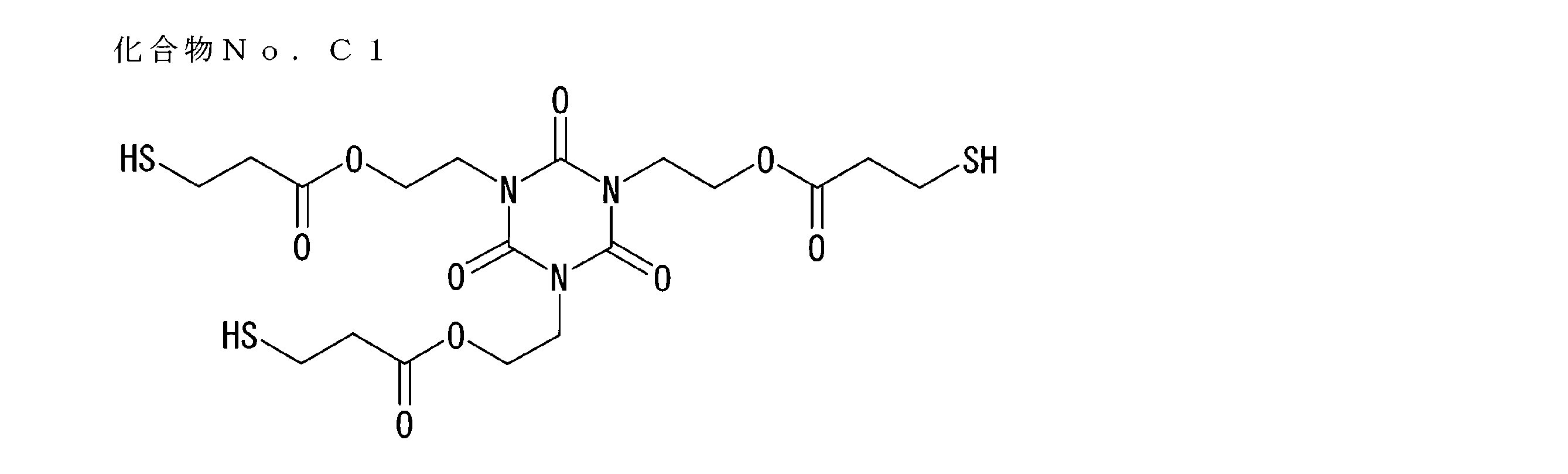
- Alkyl compounds trimethylolpropane tris (3-mercaptoisobutyrate), butanediol bis (3-mercaptoisobutyrate), hexanedithiol, decanedithiol, 1,4- Methyl mercaptobenzene, butanediol bisthiopropionate, butanediol bisthioglycolate, ethylene glycol bisthioglycolate, trimethylolpropane tristhioglycolate, butanediol bisthiopropionate, trimethylolpropane tristhiopropionate , Trimethylolpropane tristhioglycolate, pentaerythritol tetrakisthiopropionate, pentaerythritol tetrakisthioglycolate, trishydroxyethyl tristhiopropionate, the following compound no. C1, aliphatic polyfunctional thiol
- the surfactant examples include fluorine surfactants such as perfluoroalkyl phosphates and perfluoroalkyl carboxylates, anionic surfactants such as higher fatty acid alkali salts, alkyl sulfonates, and alkyl sulfates, and higher amines. Cationic surfactants such as halogenates and quaternary ammonium salts, nonionic surfactants such as polyethylene glycol alkyl ethers, polyethylene glycol fatty acid esters, sorbitan fatty acid esters and fatty acid monoglycerides, amphoteric surfactants, silicone surfactants Surfactants such as agents can be used, and these may be used in combination.
- fluorine surfactants such as perfluoroalkyl phosphates and perfluoroalkyl carboxylates
- anionic surfactants such as higher fatty acid alkali salts, alkyl sulfonates, and alkyl sulfates,
- silane coupling agent for example, a silane coupling agent manufactured by Shin-Etsu Chemical Co., Ltd. can be used. Among them, an isocyanate group, a methacryloyl group, or an epoxy group, such as KBE-9007, KBM-502, and KBE-403, can be used. A silane coupling agent is preferably used.
- Examples of the melamine compound include all or part of active methylol groups (CH 2 OH groups) in nitrogen compounds such as (poly) methylol melamine, (poly) methylol glycoluril, (poly) methylol benzoguanamine, and (poly) methylol urea. Mention may be made of compounds in which (at least two) are alkyl etherified.
- examples of the alkyl group constituting the alkyl ether include a methyl group, an ethyl group, and a butyl group, which may be the same as or different from each other.
- the methylol group that is not alkyletherified may be self-condensed within one molecule, or may be condensed between two molecules to form an oligomer component.
- hexamethoxymethyl melamine, hexabutoxymethyl melamine, tetramethoxymethyl glycoluril, tetrabutoxymethyl glycoluril and the like can be used.
- alkyl etherified melamines such as hexamethoxymethyl melamine and hexabutoxymethyl melamine are preferable.
- the coloring composition of the present invention is a known means such as spin coater, roll coater, bar coater, die coater, curtain coater, various printing, dipping, soda glass, quartz glass, semiconductor substrate, metal, paper, plastic, etc. It can be applied on the supporting substrate. Further, once applied on a supporting substrate such as a film, it can be transferred onto another supporting substrate, and the application method is not limited.
- the active light source used for curing the colored composition of the present invention one that emits light having a wavelength of 300 to 450 nm can be used, for example, ultrahigh pressure mercury, mercury vapor arc, carbon arc. And xenon arc.
- the laser direct drawing method that directly forms an image from digital information such as a computer without using a mask improves not only productivity but also resolution and positional accuracy.
- the laser beam light having a wavelength of 340 to 430 nm is preferably used, but an argon ion laser, a helium neon laser, a YAG laser, a semiconductor laser, etc. are visible to infrared region. Those that emit light are also used. When these lasers are used, a sensitizing dye that absorbs light in the visible to infrared region is added.
- the colored composition of the present invention is a liquid crystal display panel for color display such as a photocurable paint or varnish, a photocurable adhesive, a printed board or a color TV, a PC monitor, a portable information terminal, a digital camera, Color filters, color filters for CCD image sensors, electrode materials for plasma display panels, powder coatings, printing inks, printing plates, adhesives, dental compositions, resin for stereolithography, gel coats, photoresists for electronics, Electroplating resist, etching resist, both liquid and dry film, solder resist, forming a structure in the manufacturing process of plasma display panel, electroluminescent display device, and LCD for manufacturing color filters for various display applications
- the colored alkali-developable photosensitive composition of the present invention is used for the purpose of forming a pixel of a color filter, and in particular, a photosensitizer for forming a color filter for a display device for an image display device such as a liquid crystal display panel or an organic EL. It is useful as a sex composition.
- the color filter for display devices of the present invention may have red, green, blue, orange, purple and black optical elements in addition to the cured product of the present invention.
- the color filter for display device includes (1) a step of forming a coating film of the colored composition of the present invention (particularly a colored alkali-developable photosensitive composition) on a substrate, and (2) a predetermined pattern shape on the coating film. Preferably formed by a step of irradiating actinic light through a mask having, (3) a step of developing a film after exposure with a developer (particularly an alkali developer), and (4) a step of heating the film after development. Is done.
- the colored composition of the present invention is also useful as a colored composition for an ink jet system or a transfer system without a development step.
- the production of a color filter for use in a liquid crystal display panel or the like is made by repeating the above steps (1) to (4) using a coloring composition of the present invention or other combinations and combining patterns of two or more colors. Can do.
- the compound of the present invention is a novel compound represented by the above general formula (II).
- the halogen atom represented by R 20 ′ a cyano group, a nitro group, or an alkyl group having 1 to 8 carbon atoms substituted with a hydroxyl group includes the above general formula ( Examples of the alkyl group having 1 to 8 carbon atoms substituted with a halogen atom, a cyano group, a nitro group or a hydroxyl group represented by R 1 to R 20 in I)
- R 1 ′ , R 2 ′ , R 3 ′ , R 4 ′ , R 5 ′ , R 6 ′ , R 7 ′ , R 8 ′ , R 9 ′ and R 10 ′ and X ′ are CR 17 ′ R 18 ′ R 17 ′ and R 18 ′ when represented, R 19 ′ when X ′ is represented by NR 19 ′ , and C 1-8 represented by R 20 ′ when X is represented by PR 20 ′
- Examples of the alkoxy group include those exemplified as the alkoxy group having 1 to 8 carbon atoms represented by R 1 to R 20 in the general formula (I).
- R 1 ′ , R 2 ′ , R 3 ′ , R 4 ′ , R 5 ′ , R 6 ′ , R 7 ′ , R 8 ′ , R 9 ′ and R 10 ′ and X ′ are CR 17 ′ R 18 ′ when represented by R 17 'and R 18', X 'is NR 19' are replaced by halogen atoms represented by R 19 ', X' is 'R 20 when represented by' PR 20 when represented by Examples of the alkoxy group having 1 to 8 carbon atoms include those exemplified as the alkoxy group having 1 to 8 carbon atoms substituted by the halogen atom represented by R 1 to R 20 in the general formula (I). Is mentioned.
- halogen atom represented by ' , R 14' , R 15 ' and R 16' include those exemplified as the halogen atoms represented by R 1 to R 16 in the general formula (I).
- R 1 ′ and R 11 ′ , R 2 ′ and R 12 ′ , R 5 ′ and R 13 ′ , R 6 ′ and R 14 ′ , R 9 ′ and R 15 ′ and R 10 ′ and R 16 ′ are linked.
- R 1 and R 11 , R 2 and R 12 , R 5 and R 13 , R 6 and R 14 , R 9 and R 15, and R 10 in the above general formula (I) What was illustrated as a 6-membered ring which R ⁇ 1 > can connect and form is mentioned.
- the 6-membered ring that can be formed by linking R 4 ′ and R 5 ′ and R 6 ′ and R 7 ′ includes R 4 and R 5 and R 6 and R 7 in the general formula (I). What was illustrated as a 6-membered ring which can be formed is mentioned.
- Examples of the 3- to 6-membered heterocyclic ring that can be formed by connecting R 11 ′ and R 12 ′ , R 13 ′ and R 14 ′ , and R 15 ′ and R 16 ′ include R 11 and R 12 , R 13 And R 14 , and R 15 and R 16 may be linked together to those exemplified as 3- to 6-membered heterocycles.
- Examples of the anion represented by An q- include those exemplified in the above general formula (I).
- R 4 ′ and R 7 ′ are preferably a substituent other than a hydrogen atom from the viewpoint of heat resistance, more preferably an electron-withdrawing group, and particularly preferably a halogen atom, especially a halogen atom.
- R 11 ′ , R 12 ′ , R 13 ′ , R 14 ′ , R 15 ′ and R 16 ′ are substituted or unsubstituted alkyl having 1 to 8 carbon atoms from the viewpoint of solvent solubility. Groups are preferred.
- X ′ is preferably an oxygen atom or a sulfur atom from the viewpoint of availability.
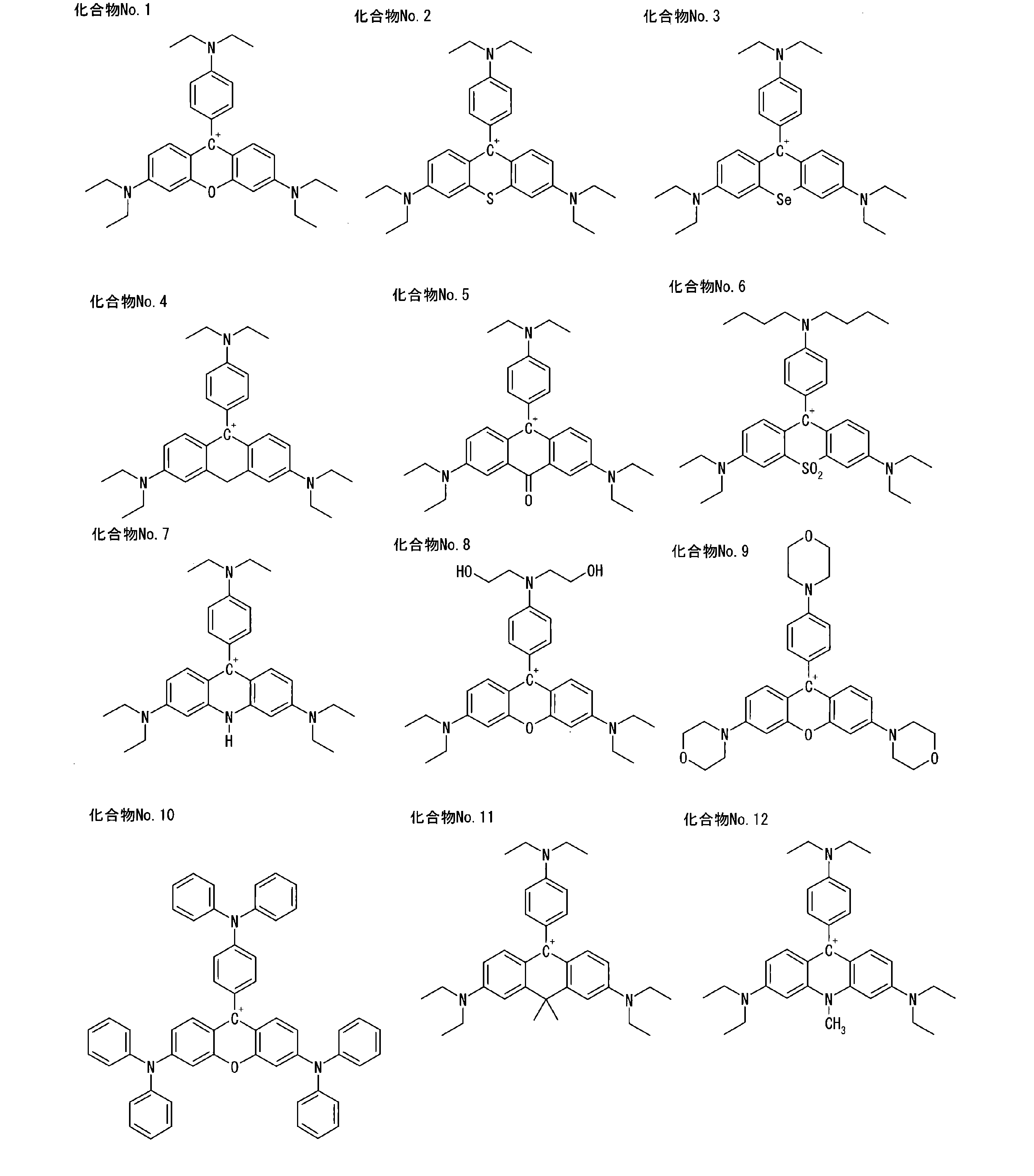
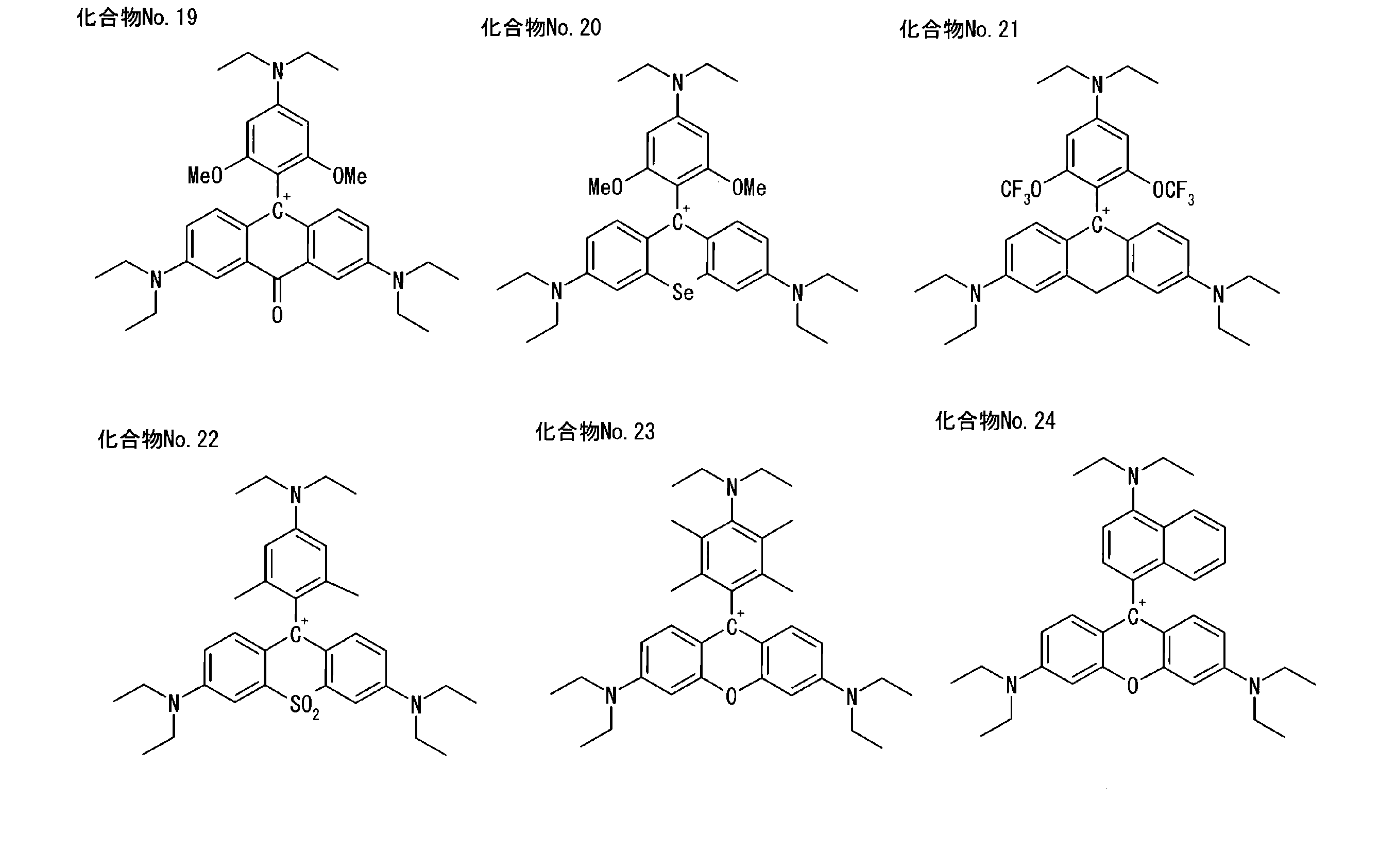
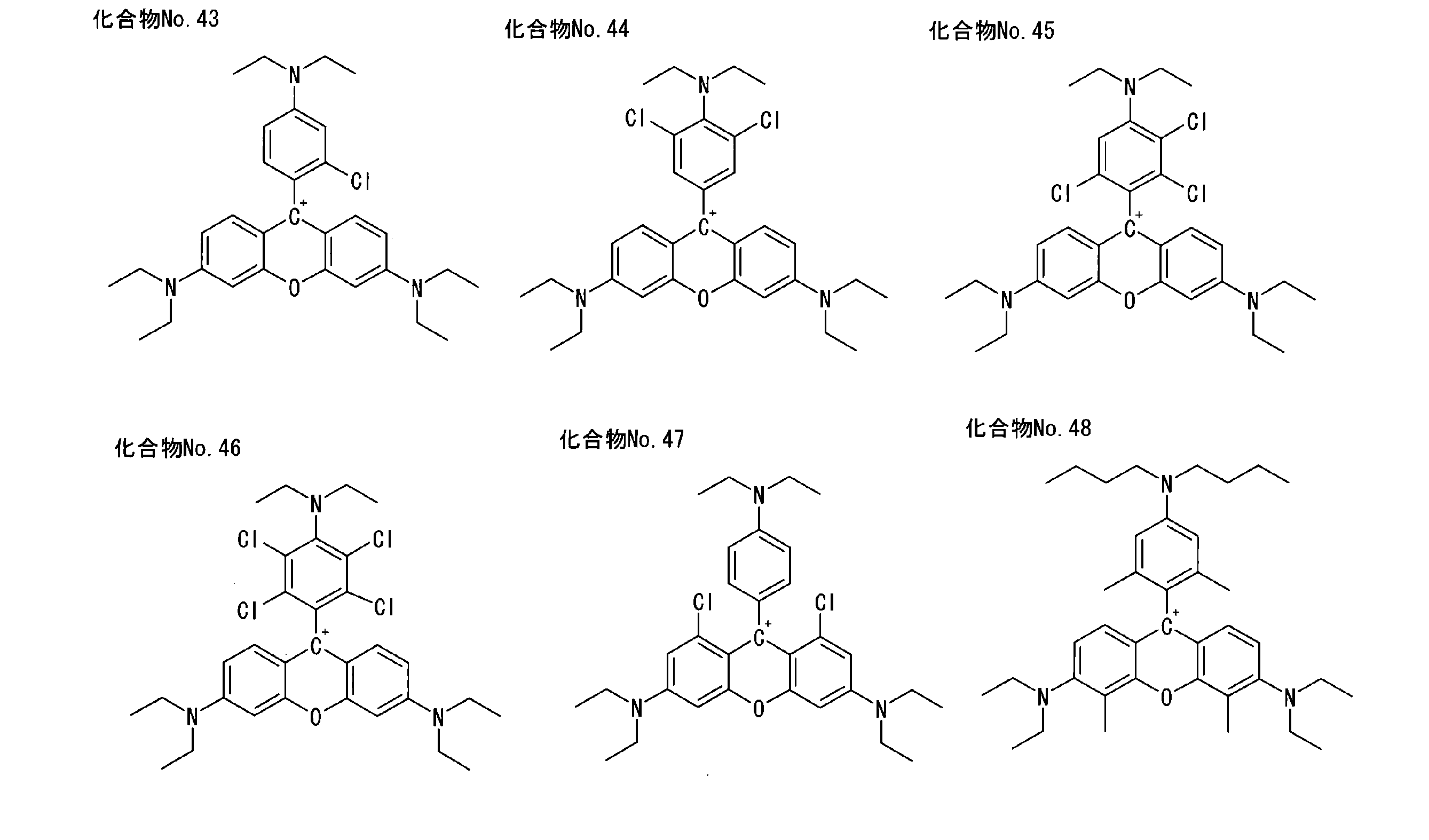
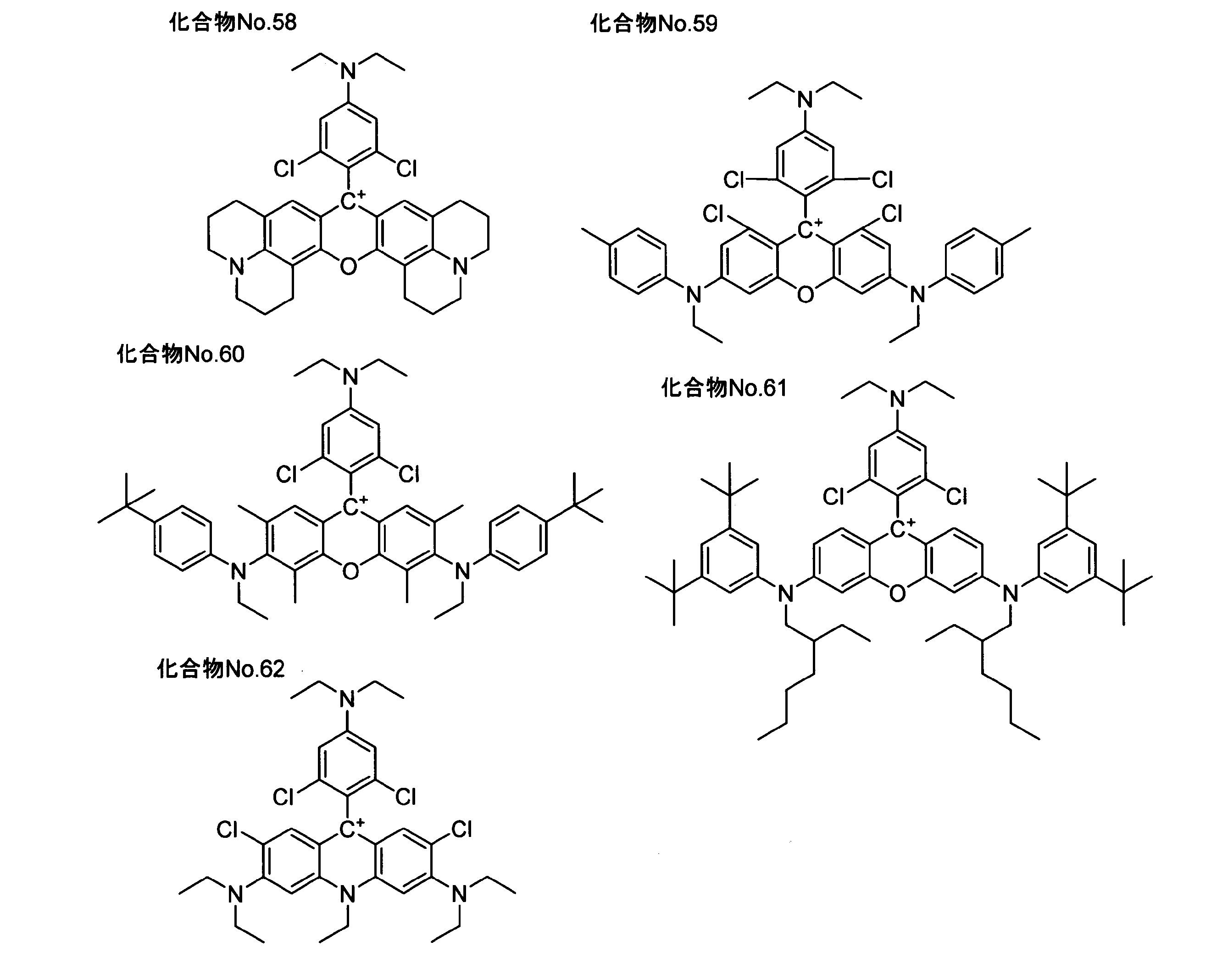
- the compound No. 1 corresponds to the formula (II). 19-No. 24, Compound No. 25-No. 38, no. 41-No. 56, 58 to 62.
- the compound represented by the general formula (II) is used as a dye in the above-described colored alkali-developable photosensitive composition, as well as an optical filter used for a display or an optical lens, a silver salt photographic photosensitive material, a dyed product. , Paints, optical recording dyes and the like.
- Examples 1-1 to 1-4 show synthesis examples of the compounds of the present invention
- Examples 2-1 to 2-5 are colored alkali-developable photosensitive composition Nos. 1-No.
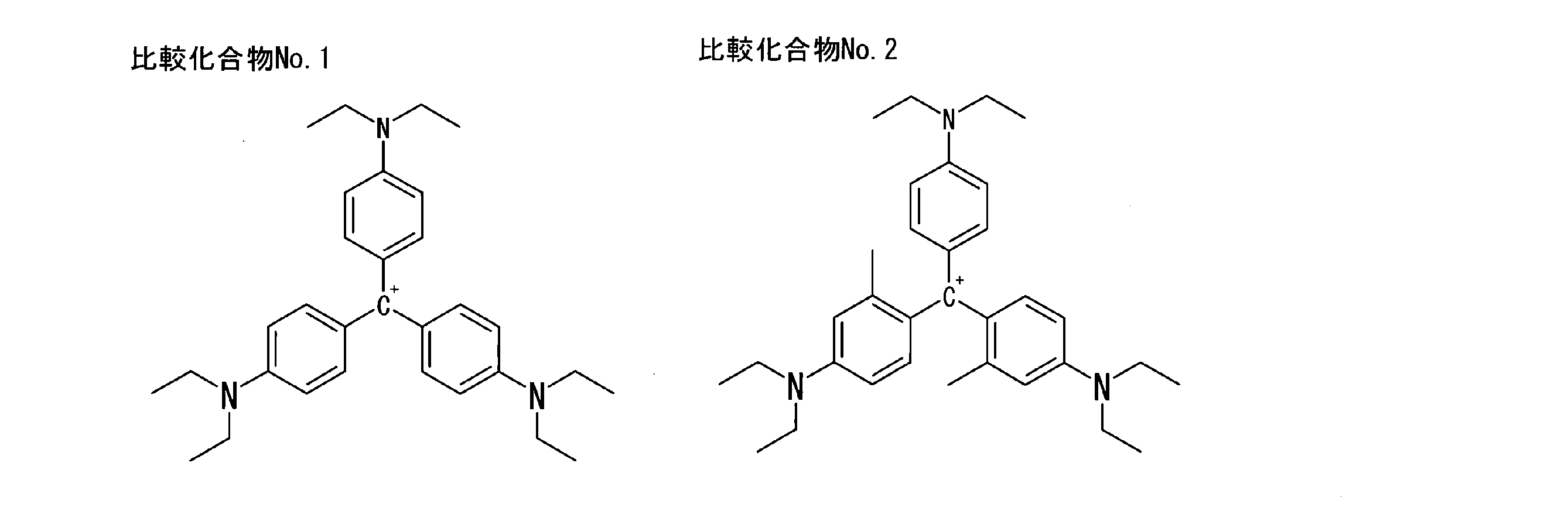
- Comparative Example 2-1 and 2-2 are comparative colored alkali-developable photosensitive composition Nos. 1-No. 2 shows a preparation example.
- the colored alkali-developable photosensitive composition Nos. Obtained in Examples 2-1 to 2-5 were used.
- 1-No. In Comparative Evaluation Examples 1-1 to 1-2, the comparatively colored alkali-developable photosensitive composition No. 5 obtained in Comparative Examples 2-1 to 2-2 was evaluated. 1-No. The heat resistance of 2 was evaluated.
- Evaluation Example 2-1 the colored alkali-developable photosensitive composition No.
- Example 2-2 1 obtained in Example 2-2 was used. 1 was evaluated.
- Comparative Evaluation Example 2-2 the comparatively colored alkali-developable photosensitive composition No. 1 obtained in Comparative Example 2-2 was evaluated. As the solubility of 1, the solubility of the dye in the composition was evaluated.
- Step 2 The leuco body obtained in Step 1, 0.05 mol, p-chloranil 0.75 mol, acetic acid 0.25 mol and hydrochloric acid 0.025 mol were mixed and stirred at 60 ° C. for 1 hour. The solid was filtered off, chloroform was added to the filtrate, and the aqueous layer was neutralized with an aqueous sodium bicarbonate solution. After adding 0.005 mol of potassium bis (trifluoromethanesulfonyl) imide and salt exchange, washing with water was performed to distill off the solvent from the organic layer.
- the colored alkali-developable photosensitive composition using the compound of the present invention as a dye has little change in color difference, high heat resistance, and high solubility. Therefore, the compound of the present invention and the colored alkali-developable photosensitive composition of the present invention using this as a dye are useful for color filters for display devices.
Landscapes
- Chemical & Material Sciences (AREA)
- Organic Chemistry (AREA)
- Physics & Mathematics (AREA)
- General Physics & Mathematics (AREA)
- Inorganic Chemistry (AREA)
- Optics & Photonics (AREA)
- Engineering & Computer Science (AREA)
- Architecture (AREA)
- Structural Engineering (AREA)
- Spectroscopy & Molecular Physics (AREA)
- Optical Filters (AREA)
- Materials For Photolithography (AREA)
- Liquid Crystal (AREA)
Abstract
Description
これらの光吸収剤には、光吸収が特別に急峻であること、即ちλmaxの半値幅が小さいこと、また光や熱等により機能が失われないことが求められている。
カラーフィルタに用いられる光吸収剤には、耐熱性の高さにより有機及び/又は無機顔料が用いられてきたが、顔料であるため表示装置としての輝度を低下させてしまうという問題があり、光源の輝度を高めることでこの問題を解決してきた。しかし、低消費電力化の流れに伴い、染料を用いたカラーフィルタの開発が盛んになっている。
しかし、染料濃度を高めると、成膜後に形成画素からの色素の溶出や析出が見られることや、成膜後に加熱処理(ポストべーク)を施した場合に、隣接画素間や積層構造中の上下層間で混色が生じやすいことが問題となっている。
しかし、これらの文献に記載のトリアリールメタン系色素は耐熱性の点で満足できるものではなかった。
また、特許文献3には、医療用途に有用なキサンチリウム塩が開示されているが、該キサンチリウム塩をカラーフィルタ用着色感光性組成物に用いうる旨は記載も示唆もされていない。
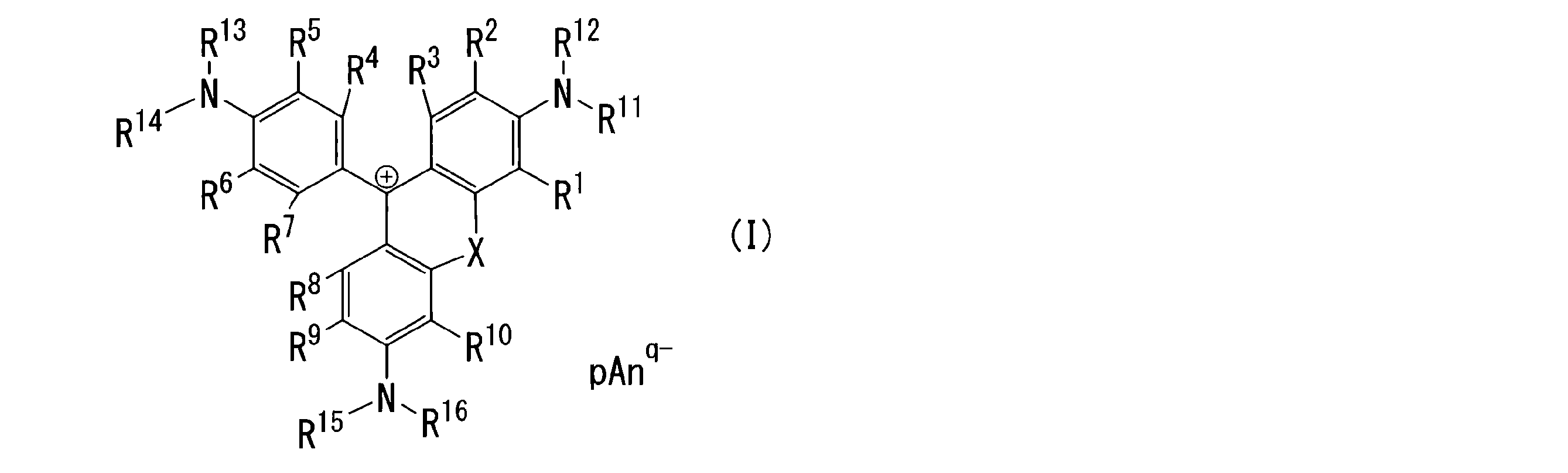
ハロゲン原子で置換されているか若しくは無置換の炭素原子数1~8のアルキル基又は
ハロゲン原子で置換されているか若しくは無置換の炭素原子数1~8のアルコキシ基を表し、
R11、R12、R13、R14、R15及びR16は、それぞれ独立に、水酸基、ハロゲン原子、シアノ基又はニトロ基を表すか、
シアノ基、ニトロ基、水酸基若しくはハロゲン原子で置換されているかあるいは無置換の炭素原子数1~8のアルキル基、
炭素原子数1~4のアルキル基、ハロゲン原子、シアノ基若しくはビニル基で置換されているかあるいは無置換のフェニル基又は
炭素原子数1~4のアルキル基、ハロゲン原子、シアノ基若しくはビニル基で置換されているかあるいは無置換のベンジル基を表し、
R1とR11、R2とR12、R5とR13、R6とR14、R9とR15及びR10とR16は、連結して6員環を形成していてもよく、
R11とR12、R13とR14、及びR15とR16は、連結して3~6員環の複素環を形成していてもよく、
R3とR4及びR7とR8は、単結合、酸素原子、硫黄原子、セレン原子、CR17R18、CO、NR19、PR20又はSO2を介して連結して環を形成していてもよく、
R4とR5、R6とR7は、連結して6員環を形成していてもよく、
Xは、単結合、酸素原子、硫黄原子、セレン原子、CR17R18、CO、NR19、PR20又はSO2を表し、
R17及びR18は、それぞれ独立に、水素原子、ハロゲン原子で置換されているかあるいは無置換の炭素原子数1~8のアルキル基又はハロゲン原子で置換されている若しくは無置換の炭素原子数1~8のアルコキシ基を表し、
R19及びR20は、それぞれ独立に、水素原子又はハロゲン原子で置換されているか若しくは無置換の炭素原子数1~8のアルキル基を表し、
Anq-はq価のアニオンを表し、qは1又は2を表し、pは電荷を中性に保つ係数を表す。)
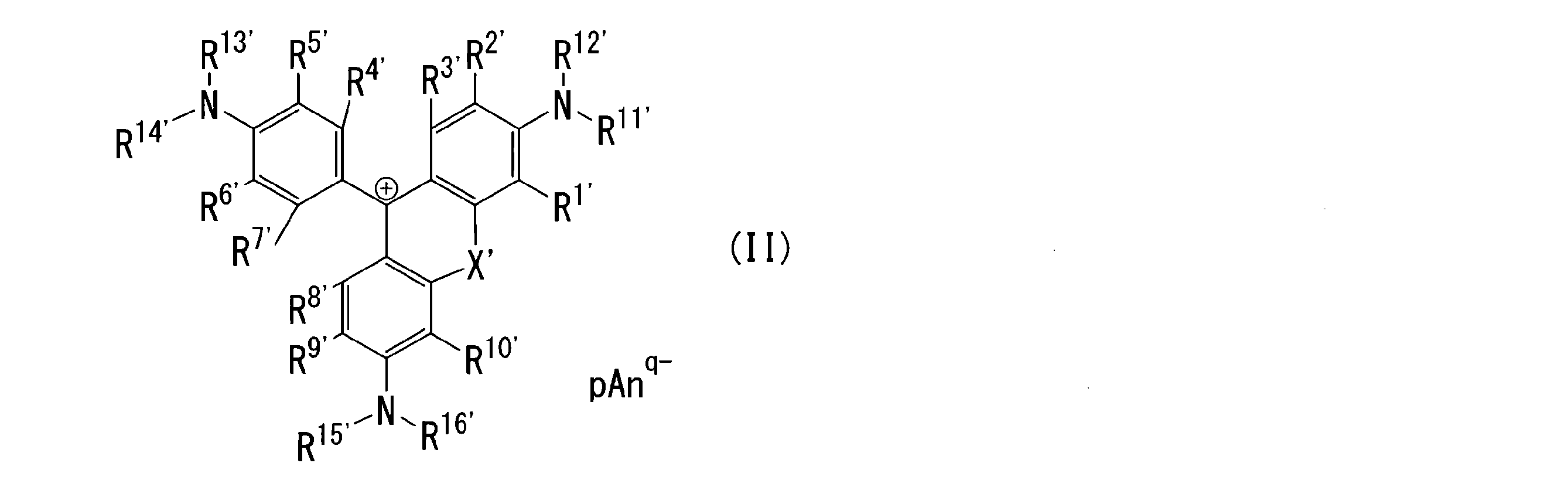
ハロゲン原子で置換されているか若しくは無置換の炭素原子数1~8のアルキル基又は
ハロゲン原子で置換されている若しくは無置換の炭素原子数1~8のアルコキシ基を表し、
R11'、R12'、R13'、R14'、R15'及びR16'は、それぞれ独立に、水酸基、ハロゲン原子、シアノ基又はニトロ基を表すか、
シアノ基、ニトロ基、水酸基若しくはハロゲン原子で置換されているかあるいは無置換の炭素原子数1~8のアルキル基、
炭素原子数1~4のアルキル基、ハロゲン原子、シアノ基若しくはビニル基で置換されているかあるいは無置換のフェニル基又は、
炭素原子数1~4のアルキル基、ハロゲン原子、シアノ基若しくはビニル基で置換されているかあるいは無置換のベンジル基を表し、
R1'とR11'、R2'とR12'、R5'とR13'、R6'とR14'、R9'とR15'及びR10'とR16'は、連結して6員環を形成していてもよく、
R11'とR12'、R13'とR14'、及びR15'とR16'は、連結して3~6員環の複素環を形成していてもよく、
R3'とR4'及びR7'とR8'は、単結合、酸素原子、硫黄原子、セレン原子、CR17'R18'、CO、NR19'、PR20又はSO2を介して連結して環を形成していてもよく、
R4'とR5'、R6'とR7'は、連結して6員環を形成していてもよく、
X’は、単結合、酸素原子、硫黄原子、セレン原子、CR17'R18'、CO、NR19'、PR20'又はSO2を表し、
R17'及びR18'は、それぞれ独立に、水素原子、ハロゲン原子で置換されている若しくは無置換の炭素原子数1~8のアルキル基又はハロゲン原子で置換されている若しくは無置換の炭素原子数1~8のアルコキシ基を表し、
R19'及びR20'は、それぞれ独立に、水素原子又はハロゲン原子で置換されている若しくは無置換の炭素原子数1~8のアルキル基を表し、
Anq-はq価のアニオンを表し、qは1又は2を表し、pは電荷を中性に保つ係数を表す。
但し、R1'、R2'、R3'、R4'、R5'、R6'、R7'、R8'、R9'及びR10'のうち、少なくとも一つは水素原子でない。)
本発明で用いられる染料(A)は、上記一般式(I)で表される化合物を少なくとも一種含有していればよく、単独又は複数種を組み合わせて用いることができる。また、染料(A)には、上記一般式(I)で表される化合物以外に公知の染料を用いることも可能である。公知の染料としては例えば、アゾ染料、アントラキノン染料、インジゴイド染料、トリアリールメタン染料、キサンテン染料、アリザリン染料、アクリジン染料、スチルベン染料、チアゾール染料、ナフトール染料、キノリン染料、ニトロ染料、インダミン染料、オキサジン染料、フタロシアニン染料、シアニン染料等の染料等が挙げられ、これらは複数を混合して用いてもよい。
R1、R2、R3、R4、R5、R6、R7、R8、R9、R10、R11、R12、R13、R14、R15及びR16並びにXがCR17R18で表されるときR17及びR18、XがNR19で表されるときR19、XがPR20で表されるときR20で表されるシアノ基、ニトロ基、水酸基、ハロゲン原子で置換されている炭素原子数1~8のアルキル基としては、上記炭素原子数1~8のアルキル基中の水素原子の一部又は全部が、シアノ基、ニトロ基、水酸基、ハロゲン原子で置換されている基が挙げられ、
R1、R2、R3、R4、R5、R6、R7、R8、R9及びR10並びにXがCR17R18で表されるときR17及びR18、XがNR19で表されるときR19、XがPR20で表されるときR20で表される炭素原子数1~8のアルコキシ基としては、メチルオキシ、エチルオキシ、iso-プロピルオキシ、ブチルオキシ、sec-ブチルオキシ、tert-ブチルオキシ、iso-ブチルオキシ、アミルオキシ、iso-アミルオキシ、tert-アミルオキシ、ヘキシルオキシ、2-ヘキシルオキシ、3-ヘキシルオキシ、シクロヘキシルオキシ、4-メチルシクロヘキシルオキシ、ヘプチルオキシ、2-ヘプチルオキシ、3-ヘプチルオキシ、iso-ヘプチルオキシ、tert-ヘプチルオキシ、1-オクチルオキシ、iso-オクチルオキシ、tert-オクチルオキシ等が挙げられ、
R1、R2、R3、R4、R5、R6、R7、R8、R9及びR10並びにXがCR17R18で表されるときR17及びR18、XがNR19で表されるときR19、XがPR20で表されるときR20で表されるハロゲン原子で置換されている炭素原子数1~8のアルコキシ基としては、上記炭素原子数1~8のアルコキシ基中の水素原子の一部又は全部が、ハロゲン原子で置換されている基が挙げられ、
上記一般式(I)におけるR1、R2、R3、R4、R5、R6、R7、R8、R9、R10、R11、R12、R13、R14、R15及びR16で表されるハロゲン原子としては、フッ素、塩素、臭素、ヨウ素が挙げられる。
R11とR12、R13とR14、及びR15とR16が連結して形成し得る3~6員環の複素環としては、ピペリジン環、ピペラジン環、ピロリジン環、モルフォリン環、チオモルフォリン環、ピリジン環、ピラジン環、ピリミジン環、キノリン環、イソキノリン環、イミダゾール環、オキサゾール環、イミダゾリジン環、ピラゾリジン環、イソオキサゾリジン環、イソチアゾリジン環等が挙げられる。
R4とR5、R6とR7が連結して形成し得る6員環としてはベンゼン環が挙げられ、
これらの環は他の環と縮合されていたり、置換されていたりしていてもよい。
例えば一価のものとしては、塩化物イオン、臭化物イオン、ヨウ化物イオン、フッ化物イオン等のハロゲン化物イオン;過塩素酸イオン、塩素酸イオン、チオシアン酸イオン、ヘキサフルオロリン酸イオン、ヘキサフルオロアンチモン酸イオン、テトラフルオロホウ酸イオン等の無機系陰イオン;メタンスルホン酸イオン、ドデシルスルホン酸イオン、ベンゼンスルホン酸イオン、トルエンスルホン酸イオン、トリフルオロメタンスルホン酸イオン、ナフタレンスルホン酸イオン、ジフェニルアミン-4-スルホン酸イオン、2-アミノ-4-メチル-5-クロロベンゼンスルホン酸イオン、2-アミノ-5-ニトロベンゼンスルホン酸イオン、フタロシアニンスルホン酸イオン、重合性置換基を有するスルホン酸イオン、特開平10-235999号公報、特開平10-337959号公報、特開平11-102088号公報、特開2000-108510号公報、特開2000-168223号公報、特開2001-209969号公報、特開2001-322354号公報、特開2006-248180号公報、特開2006-297907号公報、特開平8-253705号公報、特表2004-503379号公報、特開2005-336150号公報、国際公開2006/28006号公報等に記載されたスルホン酸イオン等の有機スルホン酸系陰イオン;オクチルリン酸イオン、ドデシルリン酸イオン、オクタデシルリン酸イオン、フェニルリン酸イオン、ノニルフェニルリン酸イオン、2,2’-メチレンビス(4,6-ジ-t-ブチルフェニル)ホスホン酸イオン等の有機リン酸系陰イオン、ビストリフルオロメチルスルホニルイミドイオン、ビスパーフルオロブタンスルホニルイミドイオン、パーフルオロ-4-エチルシクロヘキサンスルホン酸イオン、テトラキス(ペンタフルオロフェニル)ホウ酸イオン、トリス(フルオロアルキルスルホニル)カルボアニオン等が挙げられる。
二価のものとしては、例えば、ベンゼンジスルホン酸イオン、ナフタレンジスルホン酸イオン等が挙げられる。また、励起状態にある活性分子を脱励起させる(クエンチングさせる)機能を有するクエンチャー陰イオンやシクロペンタジエニル環にカルボキシル基やホスホン酸基、スルホン酸基等の陰イオン性基を有するフェロセン、ルテオセン等のメタロセン化合物陰イオン等も、必要に応じて用いることができる。
また、pは、分子全体で電荷が中性となるように選択される。





R11、R12、R13、R14、R15及びR16は、溶媒溶解性の点から、極性基、特に水酸基で置換されている又は無置換の炭素原子数1~8のアルキル基が好ましい。
Xは、入手容易性の点から、酸素原子又は硫黄原子が好ましい。
尚、Xが酸素原子以外である場合にも、下記製造方法に準じて製造することができる。また、Journal of Organic Chemistry(2009),74(8),3183-3185に記載の公知の方法等に従って製造することもできる。

上記エチレン性不飽和結合を有する重合性化合物(B)としては、特に限定されず、従来、感光性組成物に用いられているものを用いることができるが、例えば、エチレン、プロピレン、ブチレン、イソブチレン、塩化ビニル、塩化ビニリデン、フッ化ビニリデン、テトラフルオロエチレン等の不飽和脂肪族炭化水素;(メタ)アクリル酸、α―クロルアクリル酸、イタコン酸、マレイン酸、シトラコン酸、フマル酸、ハイミック酸、クロトン酸、イソクロトン酸、ビニル酢酸、アリル酢酸、桂皮酸、ソルビン酸、メサコン酸、コハク酸モノ[2-(メタ)アクリロイロキシエチル]、フタル酸モノ[2-(メタ)アクリロイロキシエチル]、ω-カルボキシポリカプロラクトンモノ(メタ)アクリレート等の両末端にカルボキシ基と水酸基とを有するポリマーのモノ(メタ)アクリレート、ヒドロキシエチル(メタ)アクリレート・マレート、ヒドロキシプロピル(メタ)アクリレート・マレート、ジシクロペンタジエン・マレート或いは1個のカルボキシル基と2個以上の(メタ)アクリロイル基とを有する多官能(メタ)アクリレート等の不飽和多塩基酸;(メタ)アクリル酸-2-ヒドロキシエチル、(メタ)アクリル酸-2-ヒドロキシプロピル、(メタ)アクリル酸グリシジル、下記化合物No.A1~No.A4、(メタ)アクリル酸メチル、 (メタ)アクリル酸ブチル、(メタ)アクリル酸イソブチル、(メタ)アクリル酸-t-ブチル、(メタ)アクリル酸シクロヘキシル、(メタ)アクリル酸n-オクチル、(メタ)アクリル酸イソオクチル、(メタ)アクリル酸イソノニル、(メタ)アクリル酸ステアリル、(メタ)アクリル酸ラウリル、(メタ)アクリル酸メトキシエチル、(メタ)アクリル酸ジメチルアミノメチル、(メタ)アクリル酸ジメチルアミノエチル、(メタ)アクリル酸アミノプロピル、(メタ)アクリル酸ジメチルアミノプロピル、(メタ)アクリル酸エトキシエチル、(メタ)アクリル酸ポリ(エトキシ)エチル、(メタ)アクリル酸ブトキシエトキシエチル、(メタ)アクリル酸エチルヘキシル、(メタ)アクリル酸フェノキシエチル、(メタ)アクリル酸テトラヒドロフリル、(メタ)アクリル酸ビニル、(メタ)アクリル酸アリル、(メタ)アクリル酸ベンジル、エチレングリコールジ(メタ)アクリレート、ジエチレングリコールジ(メタ)アクリレート、トリエチレングリコールジ(メタ)アクリレート、ポリエチレングリコールジ(メタ)アクリレート、プロピレングリコールジ(メタ)アクリレート、1,4-ブタンジオールジ(メタ)アクリレート、1,6-ヘキサンジオールジ(メタ)アクリレート、トリメチロールエタントリ(メタ)アクリレート、トリメチロールプロパントリ(メタ)アクリレート、ジペンタエリスリトールペンタ(メタ)アクリレート、ジペンタエリスリトールヘキサ(メタ)アクリレート、ペンタエリスリトールテトラ(メタ)アクリレート、ペンタエリスリトールトリ(メタ)アクリレート、トリシクロデカンジメチロールジ(メタ)アクリレート、トリ[(メタ)アクリロイルエチル]イソシアヌレート、ポリエステル(メタ)アクリレートオリゴマー等の不飽和一塩基酸及び多価アルコール又は多価フェノールのエステル;(メタ)アクリル酸亜鉛、(メタ)アクリル酸マグネシウム等の不飽和多塩基酸の金属塩;マレイン酸無水物、イタコン酸無水物、シトラコン酸無水物、メチルテトラヒドロ無水フタル酸、テトラヒドロ無水フタル酸、トリアルキルテトラヒドロ無水フタル酸、5-(2,5-ジオキソテトラヒドロフリル)-3-メチル-3-シクロヘキセン-1,2-ジカルボン酸無水物、トリアルキルテトラヒドロ無水フタル酸-無水マレイン酸付加物、ドデセニル無水コハク酸、無水メチルハイミック酸等の不飽和多塩基酸の酸無水物;(メタ)アクリルアミド、メチレンビス-(メタ)アクリルアミド、ジエチレントリアミントリス(メタ)アクリルアミド、キシリレンビス(メタ)アクリルアミド、α-クロロアクリルアミド、N-2-ヒドロキシエチル(メタ)アクリルアミド等の不飽和一塩基酸及び多価アミンのアミド;アクロレイン等の不飽和アルデヒド;(メタ)アクリロニトリル、α-クロロアクリロニトリル、シアン化ビニリデン、シアン化アリル等の不飽和ニトリル;スチレン、4-メチルスチレン、4-エチルスチレン、4-メトキシスチレン、4-ヒドロキシスチレン、4-クロロスチレン、ジビニルベンゼン、ビニルトルエン、ビニル安息香酸、ビニルフェノール、ビニルスルホン酸、4-ビニルベンゼンスルホン酸、ビニルベンジルメチルエーテル、ビニルベンジルグリシジルエーテル等の不飽和芳香族化合物;メチルビニルケトン等の不飽和ケトン;ビニルアミン、アリルアミン、N-ビニルピロリドン、ビニルピペリジン等の不飽和アミン化合物;アリルアルコール、クロチルアルコール等のビニルアルコール;ビニルメチルエーテル、ビニルエチルエーテル、n-ブチルビニルエーテル、イソブチルビニルエーテル、アリルグリシジルエーテル等のビニルエーテル;マレイミド、N-フェニルマレイミド、N-シクロヘキシルマレイミド等の不飽和イミド類;インデン、1-メチルインデン等のインデン類;1,3-ブタジエン、イソプレン、クロロプレン等の脂肪族共役ジエン類;ポリスチレン、ポリメチル(メタ)アクリレート、ポリ-n-ブチル(メタ)アクリレート、ポリシロキサン等の重合体分子鎖の末端にモノ(メタ)アクリロイル基を有するマクロモノマー類;ビニルクロリド、ビニリデンクロリド、ジビニルスクシナート、ジアリルフタラート、トリアリルホスファート、トリアリルイソシアヌラート、ビニルチオエーテル、ビニルイミダゾール、ビニルオキサゾリン、ビニルカルバゾール、ビニルピロリドン、ビニルピリジン、水酸基含有ビニルモノマー及びポリイソシアネート化合物のビニルウレタン化合物、水酸基含有ビニルモノマー及びポリエポキシ化合物のビニルエポキシ化合物、ペンタエリスリトールトリアクリレート、ジペンタエリスリトールペンタアクリレート等の水酸基含有多官能アクリレートとトリレンジイソシアネート、ヘキサメチレンジイソシアネート等の多官能イソシアネートの反応物、ペンタエリスリトールトリアクリレート、ジペンタエリスリトールペンタアクリレート等の水酸基含有多官能アクリレートと無水コハク酸、無水フタル酸、テトラヒドロ無水フタル酸等の二塩基酸無水物の反応物である酸価を有する多官能アクリレートが挙げられる。







また、上記不飽和一塩基酸を作用させた後に作用させる上記多塩基酸無水物としては、ビフェニルテトラカルボン酸二無水物、テトラヒドロ無水フタル酸、無水コハク酸、無水マレイン酸、トリメリット酸無水物、ピロメリット酸無水物、2,2'-3,3'-ベンゾフェノンテトラカルボン酸無水物、エチレングリコールビスアンヒドロトリメリテート、グリセロールトリスアンヒドロトリメリテート、ヘキサヒドロ無水フタル酸、メチルテトラヒドロ無水フタル酸、ナジック酸無水物、メチルナジック酸無水物、トリアルキルテトラヒドロ無水フタル酸、ヘキサヒドロ無水フタル酸、5-(2,5-ジオキソテトラヒドロフリル)-3-メチル-3-シクロヘキセン-1,2-ジカルボン酸無水物、トリアルキルテトラヒドロ無水フタル酸-無水マレイン酸付加物、ドデセニル無水コハク酸、無水メチルハイミック酸等が挙げられる。
上記エポキシ化合物、上記不飽和一塩基酸及び上記多塩基酸無水物の反応は、常法に従って行なうことができる。
その他、フェノールノボラック型エポキシ化合物、ビフェニルノボラック型エポキシ化合物、クレゾールノボラック型エポキシ化合物、ビスフェノールAノボラック型エポキシ化合物、ジシクロペンタジエンノボラック型エポキシ化合物等のノボラック型エポキシ化合物;3,4-エポキシ-6-メチルシクロヘキシルメチル-3,4-エポキシ-6-メチルシクロヘキサンカルボキシレート、3,4-エポキシシクロヘキシルメチル-3,4-エポキシシクロヘキサンカルボキシレート、1-エポキシエチル-3,4-エポキシシクロヘキサン等の脂環式エポキシ化合物;フタル酸ジグリシジルエステル、テトラヒドロフタル酸ジグリシジルエステル、ダイマー酸グリシジルエステル等のグリシジルエステル類;テトラグリシジルジアミノジフェニルメタン、トリグリシジル-p-アミノフェノール、N,N-ジグリシジルアニリン等のグリシジルアミン類;1,3-ジグリシジル-5,5-ジメチルヒダントイン、トリグリシジルイソシアヌレート等の複素環式エポキシ化合物;ジシクロペンタジエンジオキシド等のジオキシド化合物;ナフタレン型エポキシ化合物、トリフェニルメタン型エポキシ化合物、ジシクロペンタジエン型エポキシ化合物等を用いることもできる。
上記光重合開始剤(C)としては、従来既知の化合物を用いることが可能であり、例えば、ベンゾフェノン、フェニルビフェニルケトン、1-ヒドロキシ-1-ベンゾイルシクロヘキサン、ベンゾイン、ベンジルジメチルケタール、1-ベンジル-1-ジメチルアミノ-1-(4'-モルホリノベンゾイル)プロパン、2-モルホリル-2-(4'-メチルメルカプト)ベンゾイルプロパン、チオキサントン、1-クロル-4-プロポキシチオキサントン、イソプロピルチオキサントン、ジエチルチオキサントン、エチルアントラキノン、4-ベンゾイル-4'-メチルジフェニルスルフィド、ベンゾインブチルエーテル、2-ヒドロキシ-2-ベンゾイルプロパン、2-ヒドロキシ-2-(4'-イソプロピル)ベンゾイルプロパン、4-ブチルベンゾイルトリクロロメタン、4-フェノキシベンゾイルジクロロメタン、ベンゾイル蟻酸メチル、1,7-ビス(9'-アクリジニル)ヘプタン、9-n-ブチル-3,6-ビス(2'-モルホリノイソブチロイル)カルバゾール、2-メチル-4,6-ビス(トリクロロメチル)-s-トリアジン、2-フェニル-4,6-ビス(トリクロロメチル)-s-トリアジン、2-ナフチル-4,6-ビス(トリクロロメチル)-s-トリアジン、2,2-ビス(2-クロロフェニル)-4,5,4’,5’-テトラフェニル-1-2’-ビイミダゾール、4、4-アゾビスイソブチロニトリル、トリフェニルホスフィン、カンファーキノン、過酸化ベンゾイル等が挙げられ、市販品としては、N-1414、N-1717、N-1919、PZ-408、NCI-831、NCI-930((株)ADEKA社製)、IRGACURE369、IRGACURE907、IRGACURE OXE 01、IRGACURE OXE 02(BASF(株)社製)等が挙げられる。
他の有機重合体を使用する場合、その使用量は、上記エチレン性不飽和結合を有する重合性化合物(B)100質量部に対して、好ましくは10~500質量部である。
また、本発明の表示デバイス用カラーフィルタは、本発明の硬化物の他に、赤、緑、青、橙、紫及び黒の光学要素を有していてもよい。
液晶表示パネル等に用いるカラーフィルタの製造は、本発明又はそれ以外の着色組成物を用いて、上記(1)~(4)の工程を繰り返し行い、2色以上のパターンを組み合わせて作成することができる。
R1'、R2'、R3'、R4'、R5'、R6'、R7'、R8'、R9'、R10'、R11'、R12'、R13'、R14'、R15'及びR16'並びにX'がCR17'R18'で表されるときR17'及びR18'、X'がNR19'で表されるときR19'、X'がPR20'で表されるときR20'で表されるハロゲン原子、シアノ基、ニトロ基、水酸基で置換されている炭素原子数1~8のアルキル基としては、上記一般式(I)のR1~R20で表されるハロゲン原子、シアノ基、ニトロ基、水酸基で置換されている炭素原子数1~8のアルキル基として例示したものが挙げられる。
R1'、R2'、R3'、R4'、R5'、R6'、R7'、R8'、R9'及びR10'並びにX'がCR17'R18'で表されるときR17'及びR18'、X'がNR19'で表されるときR19'、XがPR20'で表されるときR20'で表される炭素原子数1~8のアルコキシ基としては、上記一般式(I)のR1~R20で表される炭素原子数1~8のアルコキシ基として例示したものが挙げられる。
R1'、R2'、R3'、R4'、R5'、R6'、R7'、R8'、R9'及びR10'並びにX'がCR17'R18'で表されるときR17'及びR18'、X'がNR19'で表されるときR19'、X'がPR20'で表されるときR20'で表されるハロゲン原子で置換されている炭素原子数1~8のアルコキシ基としては、上記一般式(I)のR1~R20で表されるハロゲン原子で置換されている炭素原子数1~8のアルコキシ基として例示したものが挙げられる。
R1'、R2'、R3'、R4'、R5'、R6'、R7'、R8'、R9'、R10'、R11'、R12'、R13'、R14'、R15'及びR16'で表されるハロゲン原子としては上記一般式(I)のR1~R16で表されるハロゲン原子として例示したものが挙げられる。
R1'とR11'、R2'とR12'、R5'とR13'、R6'とR14'、R9'とR15'及びR10'とR16'が連結して形成し得る6員環としては、上記一般式(I)においてR1とR11、R2とR12、R5とR13、R6とR14、R9とR15及びR10とR1が連結して形成し得る6員環として例示したものが挙げられる。
R4'とR5'及びR6'とR7'が連結して形成し得る6員環としては、上記一般式(I)においてR4とR5及びR6とR7が連結して形成し得る6員環として例示したものが挙げられる。
R11'とR12'、R13'とR14'、及びR15'とR16'が連結して形成し得る3~6員環の複素環としては、R11とR12、R13とR14、及びR15とR16が連結して形成し得る3~6員環の複素環として例示したものが挙げられる。
Anq-で表される陰イオンとしては、上記一般式(I)において例示したものが挙げられる。
R4'及びR7'の一方又は両方が、耐熱性の点から、水素原子以外の置換基であることが好ましく、更に電子吸引基が好ましく、特にハロゲン原子、とりわけハロゲン原子が好ましい。R11'、R12'、R13'、R14'、R15'及びR16'は、溶媒溶解性の点から、水酸基で置換されている又は無置換の炭素原子数1~8のアルキル基が好ましい。
X’は、入手容易性の点から、酸素原子又は硫黄原子が好ましい。
評価例1-1~1-5では、実施例2-1~2-5で得られた着色アルカリ現像性感光性組成物No.1~No.5の耐熱性を評価し、比較評価例1-1~1-2では、比較例2-1~2-2で得られた比較着色アルカリ現像性感光性組成物No.1~No.2の耐熱性を評価した。
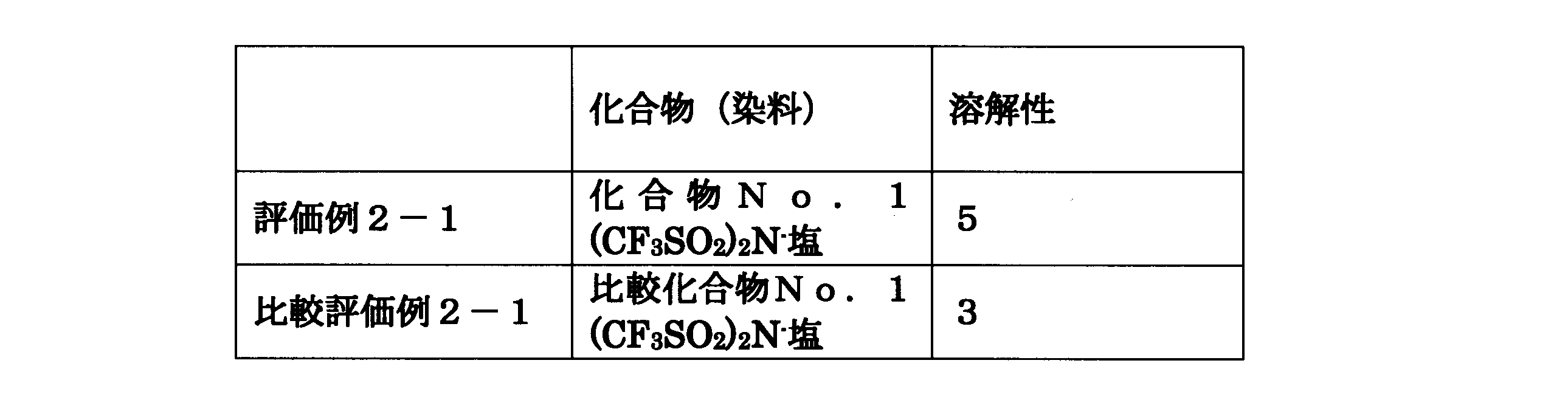
評価例2-1では、実施例2-2で得られた着色アルカリ現像性感光性組成物No.1の溶解性として、該組成物中の染料の溶解性を評価し、比較評価例2-2では、比較例2-2で得られた比較着色アルカリ現像性感光性組成物No.1の溶解性として、該組成物中の染料の溶解性を評価した。
<ステップ1>
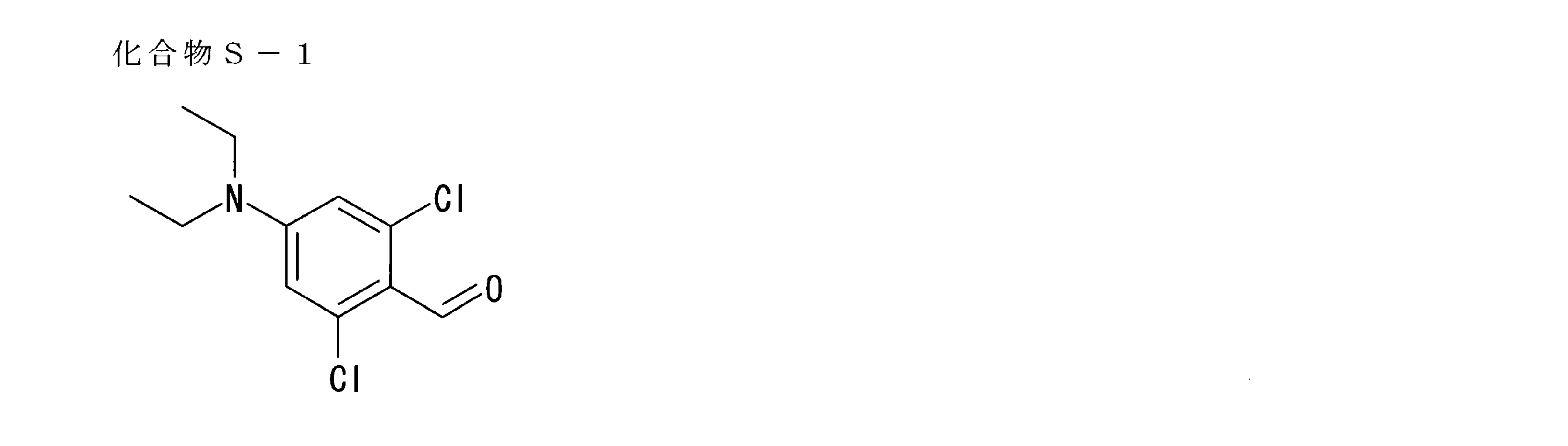
下記[化19]で表される化合物S-1の0.01mol、ジエチルアミノフェノール0.02mol及び硫酸0.03molを混合し、140℃で8時間撹拌した。反応液を水酸化ナトリウム水溶液に滴下し、有機物をトルエンで抽出して3回水洗後、有機層から溶媒を留去した。残渣をシリカゲルカラムクロマトグラフィー(展開溶媒:クロロホルム)で精製し、ロイコ体0.005mol(収率52%)を得た。
ステップ1で得られたロイコ体0.05mol、p-クロラニル0.75mol、酢酸0.25mol及び塩酸0.025molを混合し、60℃で1時間撹拌した。固体をろ別し、ろ液にクロロホルムを加え、水層を炭酸水素ナトリウム水溶液で中和した。ビス(トリフルオロメタンスルホニル)イミドカリウム0.005molを加えて塩交換後、水洗を行って有機層から溶媒を留去した。残渣をシリカゲルカラムクロマトグラフィー(展開溶媒:クロロホルム:酢酸エチル=1:1)で精製し、目的物0.014mol(収率27%)を得た。
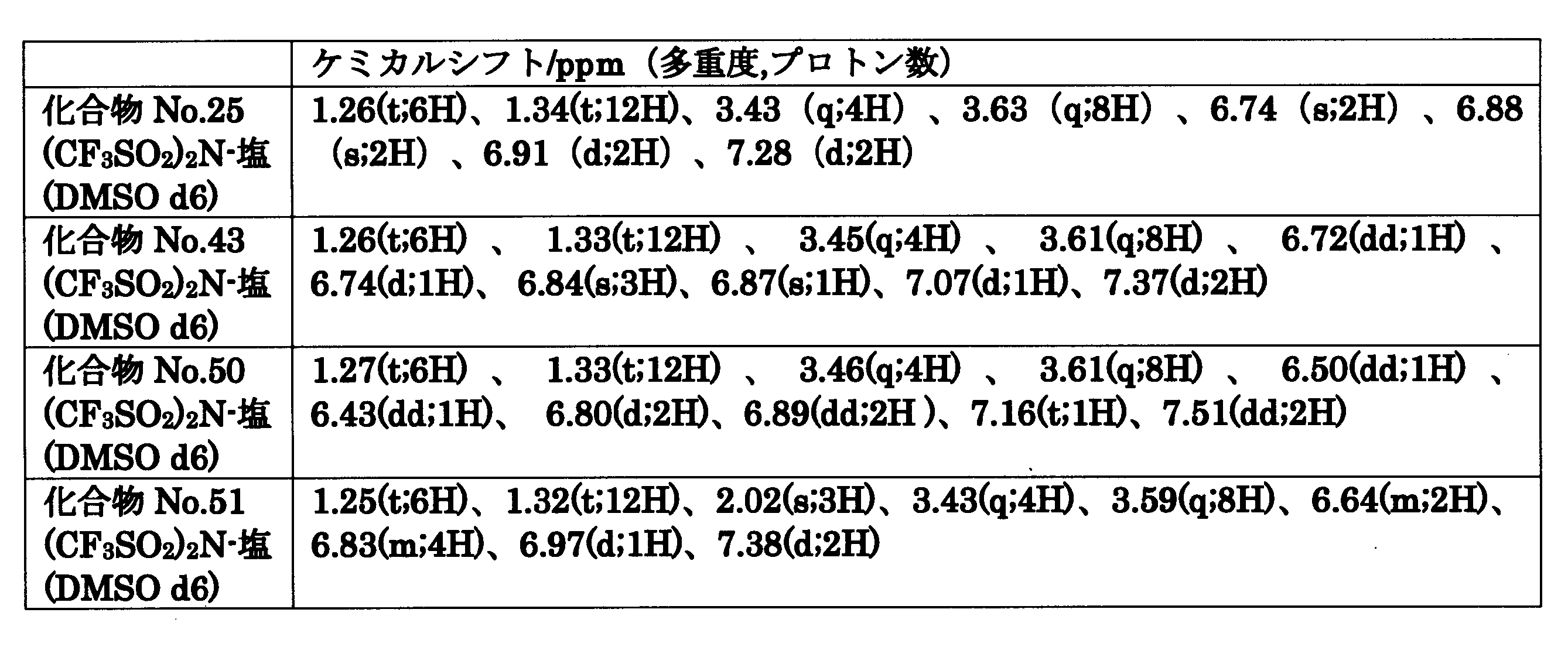
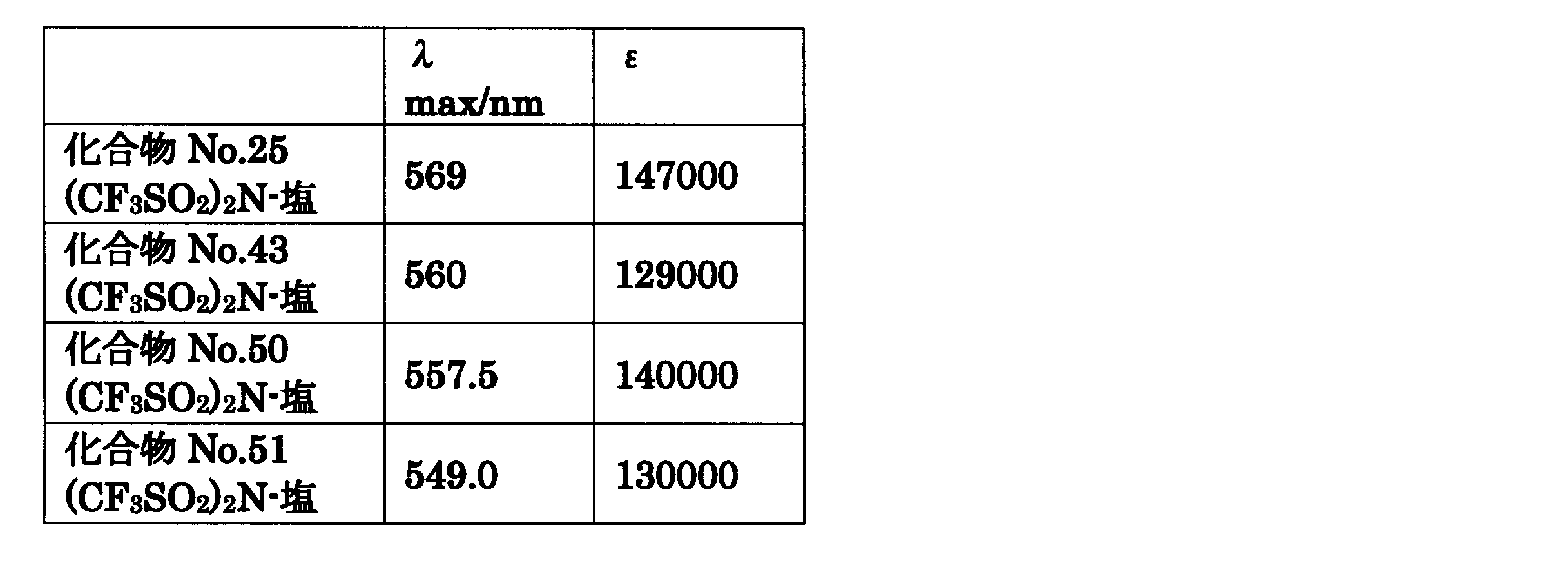
各種分析を行い、得られた化合物が目的の化合物No.25のビス(トリフルオロメタンスルホニル)イミド塩であることを確認した。分析結果を[表1]及び[表2]に示す。
実施例1-1の方法に準じて化合物No.43、No.50及びNo.51のビス(トリフルオロメタンスルホニル)イミド塩を合成し、各種分析を行い目的物であることを確認した。分析結果を[表1]及び[表2]に示す。
<ステップ1>アルカリ現像性感光性組成物の調製
(B)成分としてACA Z251(ダイセルサイテック社製)を30.33g及びアロニックスM-450(東亜合成社製)11.04g、(C)成分としてイルガキュア907(BASF社製)を1.93g、溶媒としてPGMEAを36.60g、並びに、その他の成分としてFZ2122(東レ・ダウコーニング社製)0.01gを混合し、不溶物が無くなるまで撹拌し、アルカリ現像性感光性組成物を得た。
(A)成分として[表3]記載の化合物のそれぞれ0.10g及びPGMEAを1.90g加え、撹拌して溶解させて染料液No.1~No.5並びに比較染料液No.1~No.2とした。
ステップ1で得られたアルカリ現像性感光性組成物の5.0gとステップ2で得られた染料液No.1~No.5並びに比較染料液No.1~No.2の1.0gを混合して均一になるまで撹拌し、着色アルカリ現像性感光性組成物No.1~No.5並びに比較着色アルカリ現像性感光性組成物No.1~No.2を得た。

実施例2-1~2-5で得られた着色アルカリ現像性感光性組成物No.1~No.5、比較例2-1~2-2で得られた比較着色アルカリ現像性感光性組成物No.1~No.2をガラス基板に410rpm×7秒の条件で塗工し、ホットプレートで乾燥(90℃、90秒)させた。得られた塗膜に超高圧水銀ランプで露光(150mJ/cm2)した。露光後の塗膜を、230℃×30minの条件で焼成した。焼成前後の色差(ΔEab*)を調べた。結果を[表4]に示す。

化合物No.1のビス(トリフルオロメタンスルホニル)イミド塩及び比較化合物No.1のビス(トリフルオロメタンスルホニル)イミド塩それぞれ0.1gに対しプロピレングリコール-1-モノメチルエーテル-2-アセテートを撹拌しながら滴下し完全に溶解した時の濃度(単位:質量%)を溶解度として評価を行った。結果を[表5]に示す。
よって、本発明の化合物及びこれを染料として用いた本発明の着色アルカリ現像性感光性組成物は表示デバイス用カラーフィルタに有用である。
Claims (7)
- 下記一般式(I)で表される化合物からなる染料(A)、エチレン性不飽和結合を有する重合性化合物(B)及び光重合開始剤(C)を含有する着色感光性組成物。

ハロゲン原子で置換されているか若しくは無置換の炭素原子数1~8のアルキル基又は
ハロゲン原子で置換されているか若しくは無置換の炭素原子数1~8のアルコキシ基を表し、
R11、R12、R13、R14、R15及びR16は、それぞれ独立に、水酸基、ハロゲン原子、シアノ基又はニトロ基を表すか、
シアノ基、ニトロ基、水酸基若しくはハロゲン原子で置換されているかあるいは無置換の炭素原子数1~8のアルキル基、
炭素原子数1~4のアルキル基、ハロゲン原子、シアノ基若しくはビニル基で置換されているかあるいは無置換のフェニル基又は
炭素原子数1~4のアルキル基、ハロゲン原子、シアノ基若しくはビニル基で置換されているかあるいは無置換のベンジル基を表し、
R1とR11、R2とR12、R5とR13、R6とR14、R9とR15及びR10とR16は、連結して6員環を形成していてもよく、
R11とR12、R13とR14、及びR15とR16は、連結して3~6員環の複素環を形成していてもよく、
R3とR4及びR7とR8は、単結合、酸素原子、硫黄原子、セレン原子、CR17R18、CO、NR19、PR20又はSO2を介して連結して環を形成していてもよく、
R4とR5、R6とR7は、連結して6員環を形成していてもよく、
Xは、単結合、酸素原子、硫黄原子、セレン原子、CR17R18、CO、NR19、PR20又はSO2を表し、
R17及びR18は、それぞれ独立に、水素原子、ハロゲン原子で置換されているかあるいは無置換の炭素原子数1~8のアルキル基又はハロゲン原子で置換されている若しくは無置換の炭素原子数1~8のアルコキシ基を表し、
R19及びR20は、それぞれ独立に、水素原子又はハロゲン原子で置換されているか若しくは無置換の炭素原子数1~8のアルキル基を表し、
Anq-はq価のアニオンを表し、qは1又は2を表し、pは電荷を中性に保つ係数を表す。) - 上記一般式(I)において、Xが酸素原子であることを特徴とする請求項1に記載の着色感光性組成物。
- 更に色材(但し、染料(A)を除く)の一種以上(D)を含有する請求項1又は2に記載の着色感光性組成物。
- 請求項1ないし3のいずれか1項に記載の着色感光性組成物の硬化物。
- 請求項4に記載の硬化物を少なくとも一部に具備してなる表示デバイス用カラーフィルタ。
- 下記一般式(II)で表される化合物。

ハロゲン原子で置換されているか若しくは無置換の炭素原子数1~8のアルキル基又は
ハロゲン原子で置換されている若しくは無置換の炭素原子数1~8のアルコキシ基を表し、
R11'、R12'、R13'、R14'、R15'及びR16'は、それぞれ独立に、水酸基、ハロゲン原子、シアノ基又はニトロ基を表すか、
シアノ基、ニトロ基、水酸基若しくはハロゲン原子で置換されているかあるいは無置換の炭素原子数1~8のアルキル基、
炭素原子数1~4のアルキル基、ハロゲン原子、シアノ基若しくはビニル基で置換されているかあるいは無置換のフェニル基又は、
炭素原子数1~4のアルキル基、ハロゲン原子、シアノ基若しくはビニル基で置換されているかあるいは無置換のベンジル基を表し、
R1'とR11'、R2'とR12'、R5'とR13'、R6'とR14'、R9'とR15'及びR10'とR16'は、連結して6員環を形成していてもよく、
R11'とR12'、R13'とR14'、及びR15'とR16'は、連結して3~6員環の複素環を形成していてもよく、
R3'とR4'及びR7'とR8'は、単結合、酸素原子、硫黄原子、セレン原子、CR17'R18'、CO、NR19'、PR20又はSO2を介して連結して環を形成していてもよく、
R4'とR5'、R6'とR7'は、連結して6員環を形成していてもよく、
X’は、単結合、酸素原子、硫黄原子、セレン原子、CR17'R18'、CO、NR19'、PR20'又はSO2を表し、
R17'及びR18'は、それぞれ独立に、水素原子、ハロゲン原子で置換されている若しくは無置換の炭素原子数1~8のアルキル基又はハロゲン原子で置換されている若しくは無置換の炭素原子数1~8のアルコキシ基を表し、
R19'及びR20'は、それぞれ独立に、水素原子又はハロゲン原子で置換されている若しくは無置換の炭素原子数1~8のアルキル基を表し、
Anq-はq価のアニオンを表し、qは1又は2を表し、pは電荷を中性に保つ係数を表す。
但し、R1'、R2'、R3'、R4'、R5'、R6'、R7'、R8'、R9'及びR10'のうち、少なくとも一つは水素原子でない。) - 上記一般式(II)において、X’が酸素原子であることを特徴とする請求項6に記載の化合物。
Priority Applications (3)
| Application Number | Priority Date | Filing Date | Title |
|---|---|---|---|
| KR1020157016275A KR102229645B1 (ko) | 2013-06-07 | 2014-05-30 | 착색 감광성 조성물 및 신규 화합물 |
| CN201480003605.4A CN104871045B (zh) | 2013-06-07 | 2014-05-30 | 着色感光性组合物和化合物 |
| JP2015521423A JP6417323B2 (ja) | 2013-06-07 | 2014-05-30 | 着色感光性組成物及び新規化合物 |
Applications Claiming Priority (2)
| Application Number | Priority Date | Filing Date | Title |
|---|---|---|---|
| JP2013-120708 | 2013-06-07 | ||
| JP2013120708 | 2013-06-07 |
Publications (1)
| Publication Number | Publication Date |
|---|---|
| WO2014196464A1 true WO2014196464A1 (ja) | 2014-12-11 |
Family
ID=52008109
Family Applications (1)
| Application Number | Title | Priority Date | Filing Date |
|---|---|---|---|
| PCT/JP2014/064411 Ceased WO2014196464A1 (ja) | 2013-06-07 | 2014-05-30 | 着色感光性組成物及び新規化合物 |
Country Status (5)
| Country | Link |
|---|---|
| JP (1) | JP6417323B2 (ja) |
| KR (1) | KR102229645B1 (ja) |
| CN (1) | CN104871045B (ja) |
| TW (1) | TWI624720B (ja) |
| WO (1) | WO2014196464A1 (ja) |
Cited By (7)
| Publication number | Priority date | Publication date | Assignee | Title |
|---|---|---|---|---|
| JP2017057235A (ja) * | 2014-03-06 | 2017-03-23 | 株式会社Adeka | 新規化合物及び着色感光性組成物 |
| JP2019090008A (ja) * | 2017-11-10 | 2019-06-13 | 東友ファインケム株式会社Dongwoo Fine−Chem Co., Ltd. | 着色硬化性樹脂組成物 |
| JP2020125455A (ja) * | 2019-02-05 | 2020-08-20 | 東友ファインケム株式会社Dongwoo Fine−Chem Co., Ltd. | 着色樹脂組成物 |
| US10875950B2 (en) | 2015-08-13 | 2020-12-29 | Fujifilm Corporation | Coloring composition, cured film, color filter, method for manufacturing color filter, solid-state imaging device, image display device, and polymer |
| JP2021116409A (ja) * | 2020-01-28 | 2021-08-10 | 保土谷化学工業株式会社 | キサンテン色素、該色素を含有する着色組成物、カラーフィルター用着色剤およびカラーフィルター |
| KR20210103852A (ko) | 2020-02-14 | 2021-08-24 | 동우 화인켐 주식회사 | 착색 수지 조성물 |
| TWI746456B (zh) * | 2015-08-13 | 2021-11-21 | 日商富士軟片股份有限公司 | 著色組成物、硬化膜、彩色濾光片、彩色濾光片的製造方法、固體攝影元件、影像顯示裝置及聚合物 |
Families Citing this family (7)
| Publication number | Priority date | Publication date | Assignee | Title |
|---|---|---|---|---|
| JP6824202B2 (ja) * | 2017-03-27 | 2021-02-03 | 東友ファインケム株式会社Dongwoo Fine−Chem Co., Ltd. | 着色樹脂組成物 |
| CN108663902B (zh) * | 2017-03-27 | 2023-05-09 | 东友精细化工有限公司 | 着色树脂组合物、滤色器和显示装置 |
| TWI748137B (zh) * | 2017-11-10 | 2021-12-01 | 南韓商東友精細化工有限公司 | 著色硬化性樹脂組成物、彩色濾光片及顯示裝置 |
| JP7339161B2 (ja) * | 2018-01-09 | 2023-09-05 | 株式会社Adeka | 組成物、硬化物、光学フィルタ及び硬化物の製造方法 |
| TWI889665B (zh) * | 2020-02-13 | 2025-07-11 | 南韓商東友精細化工有限公司 | 著色樹脂組合物、彩色濾光片及顯示裝置 |
| CN113341645B (zh) * | 2020-02-18 | 2026-02-03 | 东友精细化工有限公司 | 着色树脂组合物、滤色器及显示装置 |
| TWI818883B (zh) * | 2021-03-05 | 2023-10-11 | 日商旭化成股份有限公司 | 感光性樹脂積層體及其製造方法 |
Citations (1)
| Publication number | Priority date | Publication date | Assignee | Title |
|---|---|---|---|---|
| WO2010067078A2 (en) * | 2008-12-10 | 2010-06-17 | Wista Laboratories Ltd. | 3,6-disubstituted xanthylium salts as medicaments |
Family Cites Families (8)
| Publication number | Priority date | Publication date | Assignee | Title |
|---|---|---|---|---|
| US3932415A (en) * | 1972-04-17 | 1976-01-13 | Eastman Kodak Company | Pyrylium dyes having a fused rigidized nitrogen-containing ring |
| JP4266627B2 (ja) | 2001-12-06 | 2009-05-20 | 凸版印刷株式会社 | 感光性着色組成物並びにカラーフィルタ |
| US20060211792A1 (en) * | 2003-08-01 | 2006-09-21 | Laursen Bo W | Triangulenium fluorescent dyes and polymers comprising such dyes |
| JP2005300908A (ja) * | 2004-04-12 | 2005-10-27 | Konica Minolta Medical & Graphic Inc | 感光性組成物及び感光性平版印刷版材料 |
| KR100932581B1 (ko) * | 2005-05-23 | 2009-12-17 | 히다치 가세고교 가부시끼가이샤 | 감광성 수지 조성물, 감광성 엘리먼트, 레지스트 패턴의 형성방법 및 프린트 배선판의 제조방법 |
| WO2009107734A1 (ja) | 2008-02-27 | 2009-09-03 | 三菱化学株式会社 | カラーフィルター用着色樹脂組成物、カラーフィルター、有機elディスプレイおよび液晶表示装置 |
| JP5573435B2 (ja) | 2010-07-09 | 2014-08-20 | 東洋インキScホールディングス株式会社 | トリアリールメタン色素、およびその用途 |
| US9637565B2 (en) * | 2013-03-15 | 2017-05-02 | Uvic Industry Partnerships Inc. | Photoinitiating system for anionic polymerization |
-
2014
- 2014-05-30 KR KR1020157016275A patent/KR102229645B1/ko active Active
- 2014-05-30 JP JP2015521423A patent/JP6417323B2/ja active Active
- 2014-05-30 CN CN201480003605.4A patent/CN104871045B/zh active Active
- 2014-05-30 WO PCT/JP2014/064411 patent/WO2014196464A1/ja not_active Ceased
- 2014-06-06 TW TW103119803A patent/TWI624720B/zh active
Patent Citations (1)
| Publication number | Priority date | Publication date | Assignee | Title |
|---|---|---|---|---|
| WO2010067078A2 (en) * | 2008-12-10 | 2010-06-17 | Wista Laboratories Ltd. | 3,6-disubstituted xanthylium salts as medicaments |
Non-Patent Citations (2)
| Title |
|---|
| BO W. LAURSEN ET AL.: "Synthesis of Super Stable Triangulenium Dye", THE JOURNAL OF ORGANIC CHEMISTRY, vol. 74, no. 8, 2009, pages 3183 - 3185 * |
| RALF MENZEL ET AL.: "BAND SHAPE ANALYSIS OF THE ABSORPTION BANDS OF FOUR TRIPHENYLMETHANE DYES USING A SELF STARTING ROUTINE", JOURNAL OF MOLECULAR LIQUIDS, vol. 39, 1988, pages 279 - 298 * |
Cited By (10)
| Publication number | Priority date | Publication date | Assignee | Title |
|---|---|---|---|---|
| JP2017057235A (ja) * | 2014-03-06 | 2017-03-23 | 株式会社Adeka | 新規化合物及び着色感光性組成物 |
| US10875950B2 (en) | 2015-08-13 | 2020-12-29 | Fujifilm Corporation | Coloring composition, cured film, color filter, method for manufacturing color filter, solid-state imaging device, image display device, and polymer |
| TWI746456B (zh) * | 2015-08-13 | 2021-11-21 | 日商富士軟片股份有限公司 | 著色組成物、硬化膜、彩色濾光片、彩色濾光片的製造方法、固體攝影元件、影像顯示裝置及聚合物 |
| JP2019090008A (ja) * | 2017-11-10 | 2019-06-13 | 東友ファインケム株式会社Dongwoo Fine−Chem Co., Ltd. | 着色硬化性樹脂組成物 |
| JP7046777B2 (ja) | 2017-11-10 | 2022-04-04 | 東友ファインケム株式会社 | 着色硬化性樹脂組成物、カラーフィルタ及び表示装置 |
| JP2020125455A (ja) * | 2019-02-05 | 2020-08-20 | 東友ファインケム株式会社Dongwoo Fine−Chem Co., Ltd. | 着色樹脂組成物 |
| JP7555704B2 (ja) | 2019-02-05 | 2024-09-25 | 東友ファインケム株式会社 | 着色樹脂組成物 |
| JP2021116409A (ja) * | 2020-01-28 | 2021-08-10 | 保土谷化学工業株式会社 | キサンテン色素、該色素を含有する着色組成物、カラーフィルター用着色剤およびカラーフィルター |
| JP7527929B2 (ja) | 2020-01-28 | 2024-08-05 | 保土谷化学工業株式会社 | キサンテン色素、該色素を含有する着色組成物、カラーフィルター用着色剤およびカラーフィルター |
| KR20210103852A (ko) | 2020-02-14 | 2021-08-24 | 동우 화인켐 주식회사 | 착색 수지 조성물 |
Also Published As
| Publication number | Publication date |
|---|---|
| JPWO2014196464A1 (ja) | 2017-02-23 |
| TW201500849A (zh) | 2015-01-01 |
| CN104871045A (zh) | 2015-08-26 |
| KR102229645B1 (ko) | 2021-03-18 |
| CN104871045B (zh) | 2018-02-02 |
| TWI624720B (zh) | 2018-05-21 |
| KR20160016738A (ko) | 2016-02-15 |
| JP6417323B2 (ja) | 2018-11-07 |
Similar Documents
| Publication | Publication Date | Title |
|---|---|---|
| JP6417323B2 (ja) | 着色感光性組成物及び新規化合物 | |
| JP6192937B2 (ja) | 着色感光性組成物 | |
| JP6352653B2 (ja) | 新規化合物及び着色感光性組成物 | |
| CN106132929A (zh) | 肟酯化合物和含有该化合物的光聚合引发剂 | |
| JP6333727B2 (ja) | アルカリ現像性感光性組成物 | |
| WO2019088055A1 (ja) | 化合物、組成物、硬化物及び硬化物の製造方法 | |
| JP6062732B2 (ja) | 新規化合物及び着色感光性組成物 | |
| WO2016017537A1 (ja) | 新規重合開始剤及び該重合開始剤を含有するラジカル重合性組成物 | |
| JP6181491B2 (ja) | 着色感光性組成物 | |
| JP5914070B2 (ja) | 新規化合物及び着色感光性組成物 | |
| JP6498936B2 (ja) | 着色感光性組成物 | |
| JPWO2016009871A1 (ja) | 感光性組成物 | |
| JP2016079157A (ja) | 新規重合開始剤及び該重合開始剤を含有するラジカル重合性組成物 | |
| JP5916361B2 (ja) | 染料及び着色感光性組成物 | |
| JP2013116946A (ja) | 新規化合物、染料及び着色感光性組成物 | |
| TWI652315B (zh) | Novel compounds and color-sensitive photosensitive compositions |
Legal Events
| Date | Code | Title | Description |
|---|---|---|---|
| 121 | Ep: the epo has been informed by wipo that ep was designated in this application |
Ref document number: 14807095 Country of ref document: EP Kind code of ref document: A1 |
|
| ENP | Entry into the national phase |
Ref document number: 2015521423 Country of ref document: JP Kind code of ref document: A |
|
| ENP | Entry into the national phase |
Ref document number: 20157016275 Country of ref document: KR Kind code of ref document: A |
|
| NENP | Non-entry into the national phase |
Ref country code: DE |
|
| 122 | Ep: pct application non-entry in european phase |
Ref document number: 14807095 Country of ref document: EP Kind code of ref document: A1 |