WO2014175064A1 - 表示装置、利用者端末、表示装置の調整方法、および表示装置の制御方法 - Google Patents
表示装置、利用者端末、表示装置の調整方法、および表示装置の制御方法 Download PDFInfo
- Publication number
- WO2014175064A1 WO2014175064A1 PCT/JP2014/060213 JP2014060213W WO2014175064A1 WO 2014175064 A1 WO2014175064 A1 WO 2014175064A1 JP 2014060213 W JP2014060213 W JP 2014060213W WO 2014175064 A1 WO2014175064 A1 WO 2014175064A1
- Authority
- WO
- WIPO (PCT)
- Prior art keywords
- color
- color component
- gradation
- display device
- display
- Prior art date
- Legal status (The legal status is an assumption and is not a legal conclusion. Google has not performed a legal analysis and makes no representation as to the accuracy of the status listed.)
- Ceased
Links
Images







Classifications
-
- G—PHYSICS
- G09—EDUCATION; CRYPTOGRAPHY; DISPLAY; ADVERTISING; SEALS
- G09G—ARRANGEMENTS OR CIRCUITS FOR CONTROL OF INDICATING DEVICES USING STATIC MEANS TO PRESENT VARIABLE INFORMATION
- G09G3/00—Control arrangements or circuits, of interest only in connection with visual indicators other than cathode-ray tubes
- G09G3/20—Control arrangements or circuits, of interest only in connection with visual indicators other than cathode-ray tubes for presentation of an assembly of a number of characters, e.g. a page, by composing the assembly by combination of individual elements arranged in a matrix no fixed position being assigned to or needed to be assigned to the individual characters or partial characters
- G09G3/34—Control arrangements or circuits, of interest only in connection with visual indicators other than cathode-ray tubes for presentation of an assembly of a number of characters, e.g. a page, by composing the assembly by combination of individual elements arranged in a matrix no fixed position being assigned to or needed to be assigned to the individual characters or partial characters by control of light from an independent source
- G09G3/36—Control arrangements or circuits, of interest only in connection with visual indicators other than cathode-ray tubes for presentation of an assembly of a number of characters, e.g. a page, by composing the assembly by combination of individual elements arranged in a matrix no fixed position being assigned to or needed to be assigned to the individual characters or partial characters by control of light from an independent source using liquid crystals
- G09G3/3607—Control arrangements or circuits, of interest only in connection with visual indicators other than cathode-ray tubes for presentation of an assembly of a number of characters, e.g. a page, by composing the assembly by combination of individual elements arranged in a matrix no fixed position being assigned to or needed to be assigned to the individual characters or partial characters by control of light from an independent source using liquid crystals for displaying colours or for displaying grey scales with a specific pixel layout, e.g. using sub-pixels
-
- G—PHYSICS
- G09—EDUCATION; CRYPTOGRAPHY; DISPLAY; ADVERTISING; SEALS
- G09G—ARRANGEMENTS OR CIRCUITS FOR CONTROL OF INDICATING DEVICES USING STATIC MEANS TO PRESENT VARIABLE INFORMATION
- G09G2320/00—Control of display operating conditions
- G09G2320/02—Improving the quality of display appearance
- G09G2320/0242—Compensation of deficiencies in the appearance of colours
-
- G—PHYSICS
- G09—EDUCATION; CRYPTOGRAPHY; DISPLAY; ADVERTISING; SEALS
- G09G—ARRANGEMENTS OR CIRCUITS FOR CONTROL OF INDICATING DEVICES USING STATIC MEANS TO PRESENT VARIABLE INFORMATION
- G09G2320/00—Control of display operating conditions
- G09G2320/02—Improving the quality of display appearance
- G09G2320/0252—Improving the response speed
-
- G—PHYSICS
- G09—EDUCATION; CRYPTOGRAPHY; DISPLAY; ADVERTISING; SEALS
- G09G—ARRANGEMENTS OR CIRCUITS FOR CONTROL OF INDICATING DEVICES USING STATIC MEANS TO PRESENT VARIABLE INFORMATION
- G09G2320/00—Control of display operating conditions
- G09G2320/06—Adjustment of display parameters
- G09G2320/0666—Adjustment of display parameters for control of colour parameters, e.g. colour temperature
-
- G—PHYSICS
- G09—EDUCATION; CRYPTOGRAPHY; DISPLAY; ADVERTISING; SEALS
- G09G—ARRANGEMENTS OR CIRCUITS FOR CONTROL OF INDICATING DEVICES USING STATIC MEANS TO PRESENT VARIABLE INFORMATION
- G09G2340/00—Aspects of display data processing
- G09G2340/14—Solving problems related to the presentation of information to be displayed
-
- G—PHYSICS
- G09—EDUCATION; CRYPTOGRAPHY; DISPLAY; ADVERTISING; SEALS
- G09G—ARRANGEMENTS OR CIRCUITS FOR CONTROL OF INDICATING DEVICES USING STATIC MEANS TO PRESENT VARIABLE INFORMATION
- G09G3/00—Control arrangements or circuits, of interest only in connection with visual indicators other than cathode-ray tubes
- G09G3/20—Control arrangements or circuits, of interest only in connection with visual indicators other than cathode-ray tubes for presentation of an assembly of a number of characters, e.g. a page, by composing the assembly by combination of individual elements arranged in a matrix no fixed position being assigned to or needed to be assigned to the individual characters or partial characters
- G09G3/34—Control arrangements or circuits, of interest only in connection with visual indicators other than cathode-ray tubes for presentation of an assembly of a number of characters, e.g. a page, by composing the assembly by combination of individual elements arranged in a matrix no fixed position being assigned to or needed to be assigned to the individual characters or partial characters by control of light from an independent source
- G09G3/36—Control arrangements or circuits, of interest only in connection with visual indicators other than cathode-ray tubes for presentation of an assembly of a number of characters, e.g. a page, by composing the assembly by combination of individual elements arranged in a matrix no fixed position being assigned to or needed to be assigned to the individual characters or partial characters by control of light from an independent source using liquid crystals
- G09G3/3611—Control of matrices with row and column drivers
- G09G3/3648—Control of matrices with row and column drivers using an active matrix
Definitions
- the present invention relates to a display device and a user terminal including the display device.
- liquid crystal display devices that are thin, lightweight, and have low power consumption have become extremely popular.
- a typical mounting form of such a liquid crystal display device is, for example, a mobile phone, a smart phone, a notebook PC (Personal Computer), or the like.
- a color shift (a phenomenon in which a displayed color shifts from a color defined by a video signal) may occur due to a slow response speed of the liquid crystal.
- Patent Document 1 describes a display device that generates correction data for overdrive.
- Overdrive is a technique for mitigating the slow response speed of liquid crystals by temporarily applying a voltage higher or lower than a target to a pixel when display data changes.
- Patent Document 1 requires a frame memory in order to compare the display data of the frame before the change with the display data of the frame after the change.
- Japanese Patent Publication Japanese Patent Laid-Open No. 2005-141190 (published on June 2, 2005)”
- display data indicating white can be displayed in white (achromatic color) by adjusting the color component so that the data voltage for each color component (RGB) for the same gradation is different. It becomes like this.
- a display device that can suppress the occurrence of color blur can be realized.
- a picture element includes pixels of a plurality of color components, an adjustment setting unit that sets whether or not to perform color component adjustment, and the gradation of each color component in input data
- the input data of the input data is set so that the gradation of the second color component of the picture element is lower than the gradation of the first color component of the picture element so that the picture element having the same gradation is displayed as an achromatic color.
- a color component adjustment unit that selectively performs a first process for generating output data in which the gradation of each pixel is converted, and a gradation of the first color component when displaying an achromatic character on a substantially black background
- a background color setting unit that selectively performs a second process for setting a color having a higher gradation of the second color component as a background color, and image generation for generating the input data indicating a display image using the background color
- the background color setting unit is set to perform the color component adjustment. 2
- the color component adjustment unit performs the first process, and when it is set not to perform the color component adjustment, the background color setting unit does not perform the second process and the color
- the component adjusting unit does not perform the first process.
- the picture element includes pixels of a plurality of color components, and the picture elements having the same gradation of the color components in the input data are displayed as achromatic colors.
- the color component adjustment unit It is characterized in that the processing is not performed at least partially.
- a method for adjusting a display device is a method for adjusting a display device that generates input data indicating a display image using a set background color, wherein the picture element includes a plurality of color components. And a step of inspecting whether or not a picture element having the same gradation of each color component in the input data is displayed as an achromatic color on the display device, the inspection step When the pixel is determined not to be achromatic but to be displayed as a chromatic color with the second color component, the first of the pixels is displayed so that the pixel is displayed as an achromatic color.
- the display device performs a first process for generating output data obtained by converting the gradation of each pixel of the input data so that the gradation of the second color component of the pixel is lower than the gradation of the color component.
- a first setting step when displaying an achromatic character on a substantially black background on the display device, a color having a higher gradation of the second color component than the gradation of the first color component is set as a background color.
- a second setting step for setting the display device so as to perform the second process.
- the picture element includes a plurality of color component pixels, and a prediction step for predicting occurrence of color blur due to a change in the display image;
- the gradation of the second color component of the picture element is lower than the gradation of the first color component of the picture element, so that the picture element having the same gradation of each color component in is displayed as an achromatic color.
- a color component adjustment step that performs a first process for generating output data obtained by converting the gradation of each pixel of the input data, and in the color component adjustment step, it is predicted that a color blur will occur The first process is not performed at least partially.
- the present invention it is possible to display a picture element in which the gradation of each color component in the input data is the same gradation with an achromatic color. In addition, it is possible to prevent color bleeding from occurring in achromatic picture elements.
- FIG. 14 is a diagram showing a histogram for classifying gradations of pixels of a display image in still another embodiment of the present invention. It is a block diagram which shows the structure of the user terminal which concerns on further another embodiment of this invention. It is a block diagram which shows the structure of the user terminal which concerns on further another embodiment of this invention.
- FIG. 10 is a diagram illustrating a timing chart when an image is displayed in a crystal display device according to still another embodiment of the present invention when color bleeding is predicted to occur.
- FIG. 10 is a diagram illustrating a timing chart when an image is displayed in a crystal display device according to still another embodiment of the present invention when color blur is not predicted to occur.
- the picture element is a unit that displays each color including RGB pixels.
- the picture element display when the same data voltage is supplied to pixels of each color component of R (red), G (green), and B (blue) of a picture element, the picture element display does not appear white or gray achromatic color. For example, it may appear blue (as a chromatic color).
- the color component adjustment is performed so that the data voltage for each color component (RGB) for the same gradation is different.
- the gradation range is 0 to 255.
- FIG. 2 is a diagram showing the relationship between input gradation and output gradation in color component adjustment.
- digital gradation conversion is performed on digital display data indicating gradation.
- the input gradation is converted into the output gradation in each color component of the display data.
- the input gradation of R is converted into an output gradation with almost the same value.
- the G input gradation is subjected to gradation conversion at a lower rate than the R gradation.
- the input gradation of B is subjected to gradation conversion at a lower rate than that of G.
- the R maximum input gradation 255 is converted into an output gradation 255.
- the maximum input gradation 255 of G is converted to the output gradation 210, and the maximum input gradation 255 of B is converted to the output gradation 200.
- a data voltage corresponding to the output gradation is generated, and the data voltage is supplied to each pixel of RGB.
- the higher the output gradation the greater the data voltage supplied to the pixel.
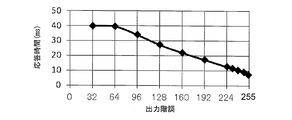
- FIG. 3 is a diagram showing the relationship between the output gradation and the response time of the liquid crystal.
- the unit of response time is milliseconds, and the smaller the response time value, the faster the response (the response speed is greater).
- the higher the output gradation the greater the data voltage supplied to the pixel. Therefore, as shown in FIG. 3, the response speed increases as the output gradation increases.
- the response speed of the liquid crystal is different for each color component. In the example shown in FIG. 2, the response speed of the R pixel> the response speed of the G pixel> the response speed of the B pixel.
- FIG. 4 is a diagram showing a state where white characters in a black background are scrolled as a typical example of color blur.
- the white characters “A” in the black background shown in FIG. 4A are scrolled downward in the order of time (b) and (c).
- the letter “A” is displayed in white on a black background.
- the response speed of the R pixel is fast and the response speed of the B pixel is slow. Therefore, as shown in FIG. “A” appears to be colored red as the R pixel reacts quickly.
- the response speed of the liquid crystal depends on the data voltage to be written and the voltage of the pixel before writing. That is, the response speed of the liquid crystal also depends on the output gradation of the previous frame of the frame in which the display image changes.
- FIG. 5 is a diagram showing the relationship between the output gradation and the response time of the liquid crystal.
- the series of diamond symbols shows the response time when changing from gradation 0 (black) to bright gradation (output gradation), and the series of square symbols is bright from gradation 32 (substantially black).
- the response time when changing to a gradation (output gradation) is shown. The shorter the response time, the greater the response speed (the liquid crystal response is faster).
- the gradation 32 slightly increased from the response speed when changing from gradation 0 to gradation a changes to gradation a. It can be seen that the response speed is larger.
- the G and B gradations are slightly raised from the R gradation in the background.
- the response speed of the G pixel and the B pixel is increased, so that the difference between the response speed of R and the response speed of G and B can be reduced. Therefore, the response speeds of the RGB color components can be made similar. Thereby, even when there is a change in the display image, it is possible to prevent the color blur of the picture element to be displayed in an achromatic color.
- FIG. 1 is a block diagram showing the configuration of the liquid crystal display device 1 of the present embodiment.
- the liquid crystal display device 1 includes a display unit 10, an adjustment setting unit 11, a background color setting unit 12, a display image generation unit 13 (image generation unit), a color component adjustment unit 14, and a display control unit 15.
- the liquid crystal display device 1 can be mounted on a user terminal such as a mobile phone, a smartphone, a notebook PC, a tablet terminal, an electronic book reader, or a PDA.
- the user terminal supplies display image data to the liquid crystal display device 1 as a host device.
- the display unit 10 includes a screen, and is configured by, for example, an oxide semiconductor liquid crystal display panel as an active matrix type liquid crystal display panel.
- An oxide semiconductor liquid crystal display panel is a liquid crystal display panel in which an oxide semiconductor-TFT is employed as a switching element provided corresponding to at least one of a plurality of pixels arranged two-dimensionally.
- An oxide semiconductor-TFT is a TFT in which an oxide semiconductor is used for a semiconductor layer.
- an oxide semiconductor for example, an oxide semiconductor (In—Ga—Zn—O) using an oxide of indium, gallium, and zinc is given.
- An oxide semiconductor-TFT has a large current flowing in an on state and a small leak current in an off state.
- the pixel aperture ratio can be improved and the refresh rate of the screen display can be reduced to about 1 Hz.
- the reduction of the refresh rate brings about a power saving effect.
- the improvement in pixel aperture ratio is an effect of brightening the display, or a power saving effect by reducing the amount of backlight when the display brightness is the same as that of a CG (Continuous Grain) silicon liquid crystal display panel. Bring.
- the adjustment setting unit 11 sets whether or not to perform color component adjustment based on an instruction input from the user or manufacturer.
- the degree of color component adjustment (the gradation conversion rate of each color component) can also be set based on an instruction input from the user or manufacturer.
- the adjustment setting unit 11 may be configured such that the user or manufacturer selects one from a plurality of color component adjustment setting values prepared in advance.
- the adjustment setting unit 11 outputs the color component adjustment setting to the background color setting unit 12 and the color component adjustment unit 14.
- the setting of color component adjustment includes information indicating whether or not to perform color component adjustment and information indicating the degree of each color component adjustment in the case of performing color component adjustment.
- the background color setting unit 12 sets a background color and a character color used in a specific display image based on the color component adjustment setting.
- the specific display image is an image of a predetermined menu screen or the like that displays achromatic characters on a substantially black background.
- the background color setting unit 12 can set a background color and a character color on a predetermined menu screen of the smartphone.
- the background color setting unit 12 sets a background color to substantially black and a character color to an achromatic color (white or gray) in a specific display image.
- the background color setting unit 12 When the background color is substantially black and the color component adjustment is set, the background color setting unit 12 performs gradation conversion more than the gradation b of the first color component having a large gradation conversion rate.
- a process (second process) for setting a color having a high gradation c of the second color component having a low rate as a background color is performed. For example, let us consider a case where color component adjustment is performed as shown in FIG. 2, that is, a case where R gradation conversion rate> G gradation conversion rate> B gradation conversion rate.
- the background color setting unit 12 sets, as the background color, a color having a G (second color component) gradation and a B gradation higher than the R (first color component) gradation in the background color.
- the difference between the lowest gradation (R) and the highest gradation (B) in the background color is preferably 20% or less of the entire gradation range (0 to 255).
- the difference between the lowest gradation and the highest gradation in the background color is 10% or less of the entire gradation range. If the maximum gradation in the background color is 20% or less of the entire gradation range, the background color appears substantially black.
- the background color setting unit 12 when it is set not to perform the color component adjustment, the background color setting unit 12 does not perform a process (second process) for changing the gradation of each color component in the background color.
- the background color setting unit 12 selectively performs a process (second process) for changing the gradation of each color component in the background color according to the display characteristics of the liquid crystal display device 1.
- the background color setting unit 12 outputs the set background color and character color to the display image generation unit 13.
- the display image generation unit 13 generates display data (input data) indicating a display image to be displayed on the display unit 10.
- display image generation unit 13 uses the background color and the character color specified from the background color setting unit 12 based on information such as a layout and a character string to be displayed. Generate a display image.
- the display image generation unit 13 outputs display data indicating the generated display image to the color component adjustment unit 14.
- the color component adjustment unit 14 adjusts the color component of the display image based on the color component adjustment setting.
- the color component adjustment unit 14 When it is set to perform color component adjustment, the color component adjustment unit 14 performs gradation of input display data (input data) so that a picture element indicating an achromatic color in the display data is displayed as an achromatic color. Perform conversion. Specifically, a process (first process) for generating output data obtained by converting the gradation of each pixel of the input data is performed. This first process is performed for each pixel of the entire display image. The first process is also performed on the background and characters of the display image. That is, the first process is performed for all color picture elements (all gradation pixels).
- the color component adjustment unit 14 does not perform the process (first process) for making the relationship between the input gradation and the output gradation different for each color component.
- input gradation output gradation.
- the color component adjustment unit 14 selectively performs the process (first process) for changing the relationship between the input gradation and the output gradation for each color component in accordance with the display characteristics of the liquid crystal display device 1.
- the color component adjustment unit 14 outputs display data (output data) to the display control unit 15.
- the display control unit 15 generates an analog data potential to be supplied to each pixel of the display unit 10 based on the received display data.
- the display control unit 15 supplies the generated data potential to the display unit 10.
- the display control unit 15 generates a drive signal for driving the display unit 10 and supplies the drive signal to the display unit 10.
- FIG. 6 is a diagram illustrating a flow of an adjustment method of the liquid crystal display device 1. Since display data indicating an achromatic color is displayed as an achromatic color, color component adjustment is set for the liquid crystal display device 1. In the unset state, the relationship between input gradation and output gradation is the same for each color component.
- the user or manufacturer displays the display data in which the gradation of each of the RGB color components is the same gradation (indicating an achromatic color) as an achromatic color on the liquid crystal display device 1 under the condition that the color component adjustment is not performed. It is inspected whether or not (S1).
- the user or manufacturer determines which color component appears to be colored. (S3). For example, when display data indicating an achromatic color is displayed in red, the user or manufacturer inputs which color component appears to be in the adjustment setting unit 11. When the mixed color of two color components (G, B) such as light blue instead of one color component appears to be colored, the fact that the two color components appear colored is input to the adjustment setting unit 11.
- G, B mixed color of two color components
- the adjustment setting unit 11 determines the output gradation rate of the second color component based on the output gradation rate of the complementary color component (first color component).
- the color component adjustment is set so as to decrease (S4).
- the color component adjusting unit 14 performs a process (first process) for converting the input data indicating an achromatic color into output data in which the gradation of the second color component is lower than the gradation of the first color component.
- the adjustment setting unit 11 sets the degree of color component adjustment.
- gradation conversion is performed so that the output gradation of R and G is lower than the output gradation of B which is a complementary color. Done.
- display data indicating an achromatic color is displayed in a blue (B) color
- the adjustment setting unit 11 Based on the color component that appears to be colored (second color component), the adjustment setting unit 11 performs processing (second processing) in which the background color setting unit 12 sets a color in which the gradation of each color component is not the same as the background color. (S5).
- the background color setting unit 12 sets a background color in a specific display image such that an achromatic character is displayed on a black background based on a color component (second color component) that appears to be colored.
- the background color setting unit 12 sets a color (second process) in which the gradation of the second color component that appears to be colored is higher than the gradation of the complementary color component (first color component). )I do.
- the user or manufacturer not only specifies the color component displayed with color to the adjustment setting unit 11 but also specifies the adjustment amount of gradation conversion of each color component and the adjustment amount of the background color. Also good.
- the user or manufacturer includes a camera or the like for checking whether or not the display on the liquid crystal display device 1 is displayed with color, specifying the color component displayed with color, and specifying the adjustment amount. The inspection device may be automatically performed.
- the adjustment setting unit 11 may set the adjustment amount of the background color gradation according to the adjustment amount of gradation conversion required in the color component adjustment.
- the G gradation in the output data is 45 (first adjustment amount) lower than the R gradation.
- the B gradation in the output data is 55 (first adjustment amount) lower than the R gradation.
- the G gradation in the background color is 10 (second adjustment amount) higher than the R gradation.
- the B gradation in the background color is 12 (second adjustment amount) higher than the R gradation.
- the background color setting unit 12 increases the gradation of the color component of the background color by the second adjustment amount corresponding to the magnitude of the first adjustment amount. Thereby, the difference of the response speed between several color components can be made smaller.
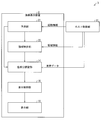
- FIG. 7 is a block diagram showing a configuration of the user terminal 3 of the present embodiment.
- the user terminal 3 (host device) includes a host control unit 31 and the liquid crystal display device 2.
- the user terminal 3 will be described as a smartphone having a touch panel.
- the host control unit 31 performs processes such as executing applications, receiving input from the touch panel, and generating display images on the user terminal 3 side.
- the host control unit 31 supplies display data indicating the display image to the liquid crystal display device 2 in order to display the display image on the liquid crystal display device 2.
- the host control unit 31 outputs activation information of a specific application that easily causes color bleeding to the liquid crystal display device 2.
- the activation information indicates that a specific application is being executed (operated) in the host control unit 31.
- the host control unit 31 outputs area information indicating an area (change area) in which the display image may change in the display image (screen) generated by the specific application to the liquid crystal display device 2.
- specific applications that are likely to cause color bleeding include, for example, a setting menu of the user terminal 3, an application that displays a list of mail folders, a list of mails, or a telephone directory, and an application that plays a moving image.
- a list of a plurality of items is displayed as a character string as in these examples, the screen (display image) is often used by scrolling.
- achromatic characters white or gray
- color blur may occur with scrolling.
- the display image continues to change, and accordingly, color blur may occur.
- FIG. 8 is a diagram showing a display image (screen) when the setting menu application is operated.
- the upper area 23a where the title “setting menu” and icons such as the remaining battery level are displayed is an area that does not scroll.
- the lower area 23b in which a plurality of menus are displayed is a scrollable area in order to display the menus arranged in the vertical direction. That is, the area 23a is an invariable area where the display image does not change (it is assumed that the change frequency is low), and the area 23b is a change area where the display image changes (it is assumed that the change frequency is high).
- FIG. 8 when a plurality of character strings are displayed as achromatic (white or gray) characters on a black background, there is a possibility that a color blur associated with scrolling may occur in the change area 23b.
- the host control unit 31 may output operation information indicating the presence / absence of a user operation on the user terminal 3 to the liquid crystal display device 2.
- color component adjustment when color bleeding is predicted to occur, color component adjustment is temporarily not performed. If it is not predicted that color blur will occur, color component adjustment as shown in FIG. 2 is performed as usual.
- the liquid crystal display device 2 includes a display unit 10, a prediction unit 21, a region specifying unit 22, a color component adjustment unit 14, and a display control unit 15.
- the configurations of the display unit 10 and the display control unit 15 are the same as those in the first embodiment.
- the prediction unit 21 When the prediction unit 21 receives the activation information from the host control unit 31, the prediction unit 21 detects that a specific application that easily causes color bleeding is operating in the host control unit 31. The prediction unit 21 predicts that color bleeding will occur when a specific application is operating. The prediction unit 21 notifies the region specifying unit 22 and the color component adjustment unit 14 that color bleeding is predicted to occur.
- the prediction unit 21 may receive operation information from the host control unit 31.
- the prediction unit 21 can detect that the display image changes based on the operation information. When the predicting unit 21 detects that the display image changes, the predicting unit 21 predicts that color bleeding occurs. In addition, since it is assumed that the display image does not change after a certain period of time has elapsed since the operation, the prediction unit 21 predicts that color bleeding will still occur within a predetermined period after the user's operation is lost. Alternatively, it may be predicted that no color blur will occur after a predetermined period of time has elapsed since the user's operation disappeared.
- the prediction unit 21 may receive a display update flag indicating that the display image changes from the host control unit 31 when the display image changes.
- the prediction unit 21 can detect that the display image changes based on the display update flag.
- the prediction unit 21 detects that the display image changes based on the reception of the display data. can do.
- the area specifying unit 22 receives area information from the host control unit 31. When it is predicted that color blur will occur in the prediction unit 21, the region specifying unit 22 specifies a change region in which the display image changes based on the region information. The area specifying unit 22 notifies the color component adjusting unit 14 of the specified change area.
- the color component adjustment unit 14 performs a process (first process) for changing the relationship between the input gradation and the output gradation for each color component with respect to the entire display image.
- FIG. 9 is a flowchart illustrating a control method for the liquid crystal display device 2.
- the prediction unit 21 determines whether or not a specific application is operating based on the activation information from the host control unit 31.
- the prediction unit 21 predicts that color blur occurs when a specific application is operating (S11), and does not predict that color blur occurs when the specific application is not operating.
- the color component adjustment unit 14 performs processing for changing the relationship between input gradation and output gradation for each color component with respect to the entire display image (first processing). (S12).
- the area specifying unit 22 specifies a change area in which the display image is assumed to change (S13). Then, the color component adjustment unit 14 performs a process (first process) for changing the relationship between the input gradation and the output gradation for each color component with respect to the invariable area excluding the change area in the display image. The color component adjustment unit 14 does not perform the first process on the change region (S14).
- the color component adjustment unit 14 temporarily disables the color component adjustment (first process) for the change area where the display image changes. Note that when the image is predicted to change in the entire display image, such as when a moving image is displayed on the entire screen, the color component adjustment (first processing) can be temporarily disabled in the entire display image.
- the color component adjustment unit 14 may be configured so as not to perform color component adjustment (first processing) at least partially when color bleeding is predicted to occur.
- the liquid crystal display device 2 detects that a specific application that easily causes color blur is operating, and predicts that color blur will occur based on this. Alternatively, it is predicted that color bleeding will occur based on the presence or absence of user operation.
- the color component adjustment (first processing) is temporarily not applied to the change region. For this reason, in the change region, when the display data of a certain pixel shows an achromatic color, the same data voltage is supplied to the RGB pixels of the pixel. Therefore, the response speed of each pixel of RGB becomes the same. Therefore, even when the display image changes, it is possible to prevent color bleeding from occurring.
- the color component adjustment is performed for the invariant region, the display quality can be maintained.
- the prediction unit 21 predicts the occurrence of color blur based on the activation information of a specific application, the presence / absence of an operation on the user terminal 3, or the display update flag, so the display images of the previous and subsequent frames are compared. There is no need. Therefore, it is not necessary to provide a frame memory for predicting the occurrence of color blur.
- the present invention is not limited to this, and the prediction unit 21 may detect a change in the display image by providing a frame memory and comparing the display images of the previous and subsequent frames.
- the block diagram showing the configuration of the liquid crystal display device of the present embodiment is the same as that shown in FIG. However, the prediction unit 21 receives display data indicating a display image instead of the activation information from the host control unit 31.
- the prediction unit 21 creates a histogram that classifies the gradation of each pixel of the display data.
- the prediction unit 21 obtains the contrast in the display image based on the histogram.
- the histogram may be created based only on the gradation of the pixel regardless of the color component. Alternatively, it may be created based on the average gradation of the RGB pixels included in the picture element. Further, a histogram for classifying the luminance of each picture element may be created based on the luminance of the picture element instead of the gradation.
- FIG. 10 is a diagram showing a histogram for classifying the gradation of each pixel of the display image.
- This histogram corresponds to, for example, a display image in which white characters are displayed on a black background as shown in FIG. Therefore, a high peak exists near the gradation 0 and a low peak exists near the gradation 255.
- a high peak near the gradation 0 corresponds to a pixel in the background portion.
- a low peak near the gradation 255 corresponds to a pixel in the character portion.
- the contrast in the display image is high. When the contrast is high, it can be predicted that the display image is likely to have a color blur consisting of a background and characters like the display image shown in FIG.
- the contrast for example, a ratio or difference between the frequency of gradations lower than a predetermined gradation and the frequency of gradations higher than a predetermined gradation may be obtained. Further, the ratio or difference between the gradations of two peaks in the histogram may be obtained as the contrast.
- the present invention is not limited to this, and a general method for obtaining a value representing contrast can be used.
- the prediction unit 21 predicts that color bleeding occurs when the obtained contrast is higher than a predetermined reference. For example, the prediction unit 21 predicts that color blur occurs if the contrast of the display image is higher than a predetermined first threshold, and does not predict that color blur occurs if the contrast is equal to or lower than the first threshold.
- the operations of the area specifying unit 22 and the color component adjusting unit 14 are the same as those in the second embodiment. Therefore, if the contrast of the display image is higher than a predetermined reference, it is predicted that color blur will occur. Therefore, the color component adjustment unit 14 does not apply the color component adjustment in the change region. Accordingly, when it is considered that the display image is likely to cause color blur based on the contrast, the color blur adjustment can be partially applied to prevent the occurrence of color blur.
- hysteresis may be provided in determining whether the contrast is higher than a predetermined reference.
- the prediction unit 21 does not predict that color blur will occur in the immediately preceding frame (display image)
- based on whether or not the contrast is higher than the first threshold whether or not the contrast is higher than a predetermined reference.
- the second threshold is lower than the first threshold.
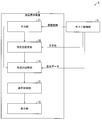
- FIG. 11 is a block diagram showing the configuration of the user terminal 5 of the present embodiment.
- the user terminal 5 includes a host control unit 31 and a liquid crystal display device 4.
- the host control unit 31 outputs character color information indicating the character color used in the display image of the application to the liquid crystal display device 4 together with the activation information of the specific application.
- the liquid crystal display device 4 includes a display unit 10, a prediction unit 21, a specific color setting unit 24, a color component adjustment unit 14, and a display control unit 15.
- the configurations of the display unit 10, the prediction unit 21, and the display control unit 15 are the same as those in the first embodiment.
- the prediction unit 21 notifies the specific color setting unit 24 that color bleeding is predicted to occur. Note that the prediction unit 21 can predict the occurrence of color blur by the method described in the above embodiment.
- the specific color setting unit 24 sets the color used as the character color in the display image as the specific color based on the character color information.
- the specific color includes a specific combination of gradations of RGB color components.
- the specific color setting unit 24 notifies the color component adjustment unit 14 of the specific color.
- the color component adjustment unit 14 removes the pixel that is a specific color and performs a process of changing the relationship between the input gradation and the output gradation for each color component with respect to the entire display image ( The first process is performed. Even when it is predicted that color blur will occur, the first process is not performed on the picture element having the specific color. For this reason, the color component adjustment is not applied to the character color in the display image, so that the character color does not blur. In addition, since color component adjustment is applied to images such as backgrounds other than characters, display quality can be maintained.
- the color component adjustment unit 14 performs the first process on the entire display image including the picture element of the specific color.
- the host control unit 31 may set a character color that is not used as the background color of the display image for a specific application.
- the specific color setting unit 24 may set the character color and the background color and output them to the host control unit 31.
- the host control unit 31 When the host control unit 31 generates the display image of the menu screen as shown in FIG. 8, it can prevent the occurrence of color blur by using the designated character color and background color.
- the color component adjustment unit 14 does not perform the first process for a plurality of specific color picture elements, and for a plurality of picture elements other than the specific color, The first process is performed. Thereby, a character of a plurality of colors can be used.
- FIG. 12 is a block diagram showing the configuration of the user terminal 7 of the present embodiment.
- the user terminal 7 includes a host control unit 31 and a liquid crystal display device 6.
- the host control unit 31 outputs display data to the liquid crystal display device 6 only when the display image is changed.
- the liquid crystal display device 6 includes a display unit 10, a prediction unit 21, a memory 25, a color component adjustment unit 14, and a display control unit 15.
- the configurations of the display unit 10 and the prediction unit 21 are the same as those in the first embodiment.
- the prediction unit 21 notifies the color component adjustment unit 14 that color bleeding is predicted to occur. Note that the prediction unit 21 can predict the occurrence of color blur by the method described in the above embodiment.
- the color component adjustment unit 14 When the color component adjustment unit 14 receives display data from the host control unit 31, it can determine that the display image changes. That is, the color component adjustment unit 14 does not receive display data for a frame period in which the display image does not change.
- the frame period corresponds to a period necessary for updating an image of one frame in the display unit 10. For example, when an image can be updated at a refresh rate of 60 Hz, one frame period corresponds to 1/60 seconds.
- the color component adjustment unit 14 displays display data that has not been subjected to the process (first process) for changing the relationship between the input gradation and the output gradation for each color component. Output to the display control unit 15. Further, the color component adjustment unit 14 performs a process (first process) for changing the relationship between the input gradation and the output gradation for each color component with respect to the entire display image. The color component adjustment unit 14 stores display data (output data) subjected to the first process (color component adjustment) in the memory 25.
- the color component adjustment unit 14 When the occurrence of color blur is not predicted by the prediction unit 21, the color component adjustment unit 14 performs processing for changing the relationship between input gradation and output gradation for each color component with respect to the entire display image (first processing). I do.
- the color component adjustment unit 14 outputs display data (output data) subjected to the first process (color component adjustment) to the display control unit 15 and the memory 25.
- the memory 25 stores display data input from the color component adjustment unit 14. The memory 25 continues to hold display data until display data is written from the color component adjustment unit 14 next time.
- the display control unit 15 causes the display unit 10 to display the display data received from the color component adjustment unit 14 in the frame period in which the display image changes.
- the display data received from the color component adjustment unit 14 is display data that has not been subjected to the first process.
- the display control unit 15 generates an analog data potential to be supplied to each pixel of the display unit 10 based on display data that has not been subjected to the first process in a frame period in which the display image changes. .
- the display control unit 15 supplies the generated data potential to the display unit 10.
- the display control unit 15 acquires display data on which the first process has been performed from the memory 25 in order to display the next frame after the frame whose display image has changed.
- the display control unit 15 causes the display unit 10 to display the display data subjected to the first process in a frame period after the first interval of the frame period in which the display image has changed (for example, the next frame period).
- the display control unit 15 acquires the display data on which the first process has been performed from the memory 25 until the display image changes, and the display on which the first process has been performed at every second interval longer than the first interval. Data is displayed on the display unit 10. That is, the display is refreshed every second interval.
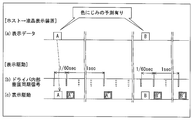
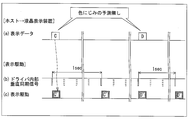
- FIG. 13 is a timing chart when an image is displayed on the liquid crystal display device 6 when color bleeding is predicted to occur.
- FIG. 13 shows a case where still image A and still image B are displayed in order.
- one frame of display data image A
- the display data is transferred from the host control unit 31 to the liquid crystal display device 6 next when the display content is updated to another image. It is assumed that color bleeding is predicted to occur during the period when images A and B are displayed.
- the display control unit 15 updates the display on the display unit 10 to the image A at a timing synchronized with the driver internal vertical synchronization signal of FIG. 13B (FIG. 3C).
- This image A is display data that has not been subjected to the first processing.
- the display control unit 15 displays the image A ′ subjected to the first process 1/60 seconds after the display of the image A.
- the display control unit 15 refreshes the display of the image A ′ on which the first processing has been performed at intervals of 1 second.
- the display control unit 15 displays the image B that has not been subjected to the first process in the frame in which the display image changes, and in the frame in which the display image does not change.
- An image B ′ that has been subjected to one process is displayed.
- the image A may be displayed a plurality of times. Thereafter, the image A ′ displayed and updated at 60 Hz may be displayed a plurality of times.
- the image A is displayed in a frame in which the display image changes, and then the image A ′ subjected to the first process at the first interval is displayed at least once (written to the pixel). Thereafter, the image A ′ subjected to the first processing is refreshed at every second interval longer than the first interval. As a result, the number of refreshes during a period when there is no change in the display image can be reduced.
- FIG. 14 is a timing chart when an image is displayed on the liquid crystal display device 6 when color bleeding is not predicted to occur.
- FIG. 14 shows a case where a still image C and a still image D are displayed in order.
- the image C ′ subjected to the first process is displayed in a frame in which the display image changes, and then the image C ′ subjected to the first process is refreshed at intervals of 1 second. Done.
- the image D may be refreshed 1/60 Hz after the frame (first image C ′) in which the display image changes, and then the image C ′ may be refreshed at intervals of 1 second.
- a display image that has not been subjected to the first process is displayed in a frame where the display image changes in order to prevent the occurrence of color blur. Thereafter, the display image is rewritten with the first processing at a short first interval.
- the subsequent refresh of the display image can be performed at a second interval longer than the first interval.
- display quality can be maintained even when the refresh rate is lowered to about 1 Hz. Therefore, the number of refreshes can be reduced and power consumption can be reduced.
- the display device (liquid crystal display device 1) according to the aspect 1 of the present invention includes an adjustment setting unit (11) that sets whether or not the pixel includes a plurality of color component pixels and performs color component adjustment, The gradation of the second color component of the pixel is higher than the gradation of the first color component of the picture element so that the picture element having the same gradation of each color component in the input data is displayed as an achromatic color.
- a color component adjustment unit (14) that selectively performs a first process for generating output data obtained by converting the gradation of each pixel of the input data so that the input data is low, and an achromatic character on a substantially black background.
- a background color setting unit (12) that selectively performs a second process of setting a color having a higher gradation of the second color component as a background color than the gradation of the first color component; and the background color An image generation unit (display image generation unit 13) that generates the input data indicating a display image using
- the background color setting unit performs the second process, and the color component adjustment unit performs the first process, and is set not to perform the color component adjustment.
- the background color setting unit does not perform the second process, and the color component adjustment unit does not perform the first process.
- the display device is the display device according to aspect 1, in which the color component adjustment unit after the conversion of the pixel in which the gradation of each color component is the same gradation in the input data in the first process.
- the background color setting unit converts the gradation of each pixel so that the gradation of the second color component after conversion of the pixel is lower than the gradation of the first color component by a first adjustment amount.
- the gradation of the second color component of the background color is set higher than the gradation of the first color component of the background color by a second adjustment amount corresponding to the first adjustment amount. There may be.
- the difference between the gradation of the first color component and the gradation of the second color component in the background color is within the entire gradation range.
- the composition which is 20% or less may be sufficient.
- the display device is the display device according to any one of the aspects 1 to 3, wherein the picture element in which the gradation of each color component is the same gradation under the condition that the first processing is not performed.
- the adjustment setting unit is set.
- the pixel is displayed as an achromatic color under the condition that the first process is not performed, the color If the component adjustment is not performed, a configuration set in the adjustment setting unit may be used.
- the picture element includes pixels of a plurality of color components, and the picture elements having the same gradation of the color components in the input data are displayed as achromatic colors.
- the color component adjustment unit It is characterized in that the processing is not performed at least partially.
- the occurrence of color blur is predicted, and when it is predicted that color blur will occur, the first color component and the second color component are subjected to different gradation conversion for the input data. Do not do some processing. Thereby, the difference in response speed between the pixel of the first color component and the pixel of the second color component is reduced. Therefore, the occurrence of color bleeding can be prevented.
- an area specifying unit that specifies a change area in which the display image changes and an invariant area in which the display image does not change (22), and when the color blur is predicted to occur, the color component adjustment unit performs the first process for the invariant area and does not perform the first process for the change area. May be.
- the color component adjustment unit when it is predicted that color blur will occur, is configured to specify a pixel of a specific color including a specific combination of gradations of each color component.
- the first processing may not be performed.
- the display device according to aspect 8 of the present invention may be configured such that, in the aspect 7, the specific color is an achromatic color.
- the display device has a configuration including the specific color setting unit (24) that sets a color used as a character color in the display image as the specific color in the above aspect 7 or 8. May be.
- the color component adjustment unit when it is predicted that color blur will occur, does not perform the first process on the frame in which the display image changes. It may be a configuration.
- the color component adjustment unit performs the first process on a frame in which the display image does not change, and performs the first processing in the frame in which the display image changes. After the first interval in which the display image that has not been subjected to one process is displayed, the display image that has been subjected to the first process is displayed at least once, and then the second interval that is longer than the first interval. It may be configured to include a display control unit (15) that refreshes a display image that has undergone one process.
- the display device is the display device according to any one of the above aspects 5 to 11, wherein the prediction unit has a specific application running on a host device that supplies the display image data to the display device. It may be configured to predict that a color blur occurs when it is detected.
- the display device is the configuration according to any one of the above aspects 5 to 11, wherein the predicting unit predicts that a color blur is generated when the display image is detected to change. May be.
- the display device according to aspect 14 of the present invention is the display device according to aspect 13, wherein the prediction unit is a user operation on a host device that supplies data of the display image to the display device, or a moving image on the host device. It may be configured to detect that the display image changes based on execution of reproduction.
- the display device is configured such that, in any one of the above aspects 5 to 11, the prediction unit predicts that color bleeding occurs when the contrast in the display image is higher than a predetermined reference. It may be.
- a user terminal (3) according to an aspect 16 of the present invention is a user terminal including the display device according to any one of the above aspects 5 to 11, and the user terminal displays the display as a host device.
- the apparatus may be configured to display a display image.
- a display device adjustment method is a display device adjustment method for generating input data indicating a display image using a set background color, wherein the picture element includes a plurality of color components. And a step of inspecting whether or not a picture element having the same gradation of each color component in the input data is displayed as an achromatic color on the display device, the inspection step When the pixel is determined not to be achromatic but to be displayed as a chromatic color with the second color component, the first of the pixels is displayed so that the pixel is displayed as an achromatic color.
- the display device performs a first process for generating output data obtained by converting the gradation of each pixel of the input data so that the gradation of the second color component of the pixel is lower than the gradation of the color component.
- a first setting step and when the display device displays an achromatic character on a substantially black background, a color having a higher gradation of the second color component than the gradation of the first color component is used as a background color.
- a second setting step of setting the display device is performed so as to perform the second process of setting.
- the picture element includes pixels of a plurality of color components, a prediction step for predicting occurrence of color blur due to a change in the display image, and input data
- the gradation of the second color component of the picture element is lower than the gradation of the first color component of the picture element, so that the picture element having the same gradation of each color component in is displayed as an achromatic color.
- a color component adjustment step that performs a first process for generating output data obtained by converting the gradation of each pixel of the input data, and in the color component adjustment step, it is predicted that a color blur will occur The first process is not performed at least partially.
- the liquid crystal display device is used as the display device.
- the present invention is not limited to the liquid crystal display device, and may be applied to a display device in which the response speed of pixels differs depending on the gradation of display data. Is possible.
- the present invention can be used for a display device, a user terminal, a display device adjustment method, and a display device control method.
- Liquid crystal display device (display device) 3 User terminal 11 Adjustment setting unit 12 Background color setting unit 13 Display image generation unit (image generation unit) 14 color component adjustment unit 15 display control unit 21 prediction unit 22 region specifying unit 24 specific color setting unit
Landscapes
- Engineering & Computer Science (AREA)
- Chemical & Material Sciences (AREA)
- Crystallography & Structural Chemistry (AREA)
- Physics & Mathematics (AREA)
- Computer Hardware Design (AREA)
- General Physics & Mathematics (AREA)
- Theoretical Computer Science (AREA)
- Control Of Indicators Other Than Cathode Ray Tubes (AREA)
- Liquid Crystal Display Device Control (AREA)
- Liquid Crystal (AREA)
Abstract
Description
以下、本発明に係る一実施形態について、詳細に説明する。
まず、複数の色成分(RGB)の出力バランスの調整を行う色成分調整について詳細に説明する。ここで、絵素はRGBの各画素を含み、色を表示する単位である。液晶表示装置において、絵素のR(赤)G(緑)B(青)の各色成分の画素に同じデータ電圧を供給した場合に、該絵素の表示が白またはグレーの無彩色に見えずに、例えば青く色付いて(有彩色として)見えることがある。すなわち、白を示す表示データ(R=255、G=255、B=255)をこの液晶表示装置で表示しても、白が表示されず青く色付いて表示されることがある。このような場合、本実施形態の液晶表示装置では、同じ階調に対する色成分(RGB)毎のデータ電圧を異ならせるように色成分調整を行う。なお、ここでは階調範囲は0~255であるとして説明する。
図4は、色にじみの典型的な例として、黒い背景の中の白い文字をスクロールさせた様子を示す図である。図4の(a)に示す黒い背景の中の白い文字「A」が、下にスクロールされる様子を時間順に(b)(c)に示す。スクロールする前である図4の(a)の画面では、黒い背景に文字「A」が白色で表示される。その後、スクロールによって文字「A」が下に移動すると、R画素の応答速度が速く、B画素の応答速度が遅いので、図4の(b)に示すように、下側に表示される文字「A」はR画素が速く反応して赤く色付いて見える。一方、元々文字「A」が表示されていた上側の箇所では、R画素は輝度が下がるのも速く、B画素は輝度が下がるのも遅いので、上側の文字「A」は青く色付いて見える。その後、R、G、Bの各画素の応答が十分に完了すると、図4の(c)に示すようにスクロール後の文字「A」が白色で表示される。
ここで、液晶の応答速度は、書き込むデータ電圧と書き込まれる前の画素の電圧とに依存する。すなわち、液晶の応答速度は、表示画像が変化するフレームの前フレームの出力階調にも依存する。
図1は、本実施形態の液晶表示装置1の構成を示すブロック図である。液晶表示装置1は、表示部10、調整設定部11、背景色設定部12、表示画像生成部13(画像生成部)、色成分調整部14、および表示制御部15を備える。
図6は、液晶表示装置1の調整方法のフローを示す図である。無彩色を示す表示データが無彩色として表示されるために、液晶表示装置1に対して、色成分調整の設定を行う。未設定状態においては、入力階調-出力階調の関係は各色成分において同じである。
このように、色成分毎に異なる階調変換を行う第1処理を実行することにより、無彩色を示す表示データを無彩色で表示することができる。また、背景色の各色成分を異なる階調にする第2処理を実行することにより、複数の色成分の間の応答速度の差を小さくすることができる。それゆえ、表示画像が変化したときに、無彩色の文字が色付いて表示されることを防止することができる。なお、本発明は、液晶表示装置に限らず、表示データの階調に応じて画素の応答速度が異なる表示装置に適用することが可能である。
本発明の他の実施形態について、以下に説明する。なお、説明の便宜上、上述の実施形態にて説明した部材と同じ機能を有する部材については、同じ符号を付記し、その説明を省略する。本実施形態では、色にじみの発生を予測し、色にじみの発生が予測された場合に色にじみの発生を防止する処理を行う。
図7は、本実施形態の利用者端末3の構成を示すブロック図である。利用者端末3(ホスト装置)は、ホスト制御部31、および液晶表示装置2を備える。ここでは利用者端末3は、タッチパネルを備えるスマートフォンであるとして説明する。
液晶表示装置2は、表示部10、予測部21、領域特定部22、色成分調整部14、および表示制御部15を備える。表示部10および表示制御部15の構成は実施形態1と同じである。
図9は、液晶表示装置2の制御方法のフローを示す図である。
このように、色成分調整部14は、色にじみが発生すると予測される場合、表示画像が変化する変化領域に対して、一時的に色成分調整(第1処理)を不適用とする。なお、動画を画面全体で表示する場合等、表示画像全体において画像が変化すると予測される場合は、表示画像全体において一時的に色成分調整(第1処理)を不適用とすることができる。色成分調整部14は、色にじみが発生すると予測される場合に、少なくとも部分的に色成分調整(第1処理)を行わない構成であればよい。
本発明のさらに他の実施形態について、以下に説明する。なお、説明の便宜上、上述の実施形態にて説明した部材と同じ機能を有する部材については、同じ符号を付記し、その説明を省略する。本実施形態では、表示画像のコントラストに基づいて、色にじみの発生を予測する。
本発明のさらに他の実施形態について、以下に説明する。なお、説明の便宜上、上述の実施形態にて説明した部材と同じ機能を有する部材については、同じ符号を付記し、その説明を省略する。本実施形態では、特定の色に対して色成分調整を行わないことで、色にじみの発生を防止する。
本発明のさらに他の実施形態について、以下に説明する。なお、説明の便宜上、上述の実施形態にて説明した部材と同じ機能を有する部材については、同じ符号を付記し、その説明を省略する。本実施形態では、表示画像が変化するフレーム期間について色成分調整を行わないことで、色にじみの発生を防止する。
本発明の態様1に係る表示装置(液晶表示装置1)は、絵素が複数の色成分の画素を含んでおり、色成分調整を行うか否かを設定する調整設定部(11)と、入力データにおける各色成分の階調が同じ階調である絵素が無彩色として表示されるように、該絵素の第1色成分の階調より該絵素の第2色成分の階調が低くなるように、上記入力データの各画素の階調を変換した出力データを生成する第1処理を選択的に行う色成分調整部(14)と、実質的に黒い背景に無彩色の文字を表示する場合、上記第1色成分の階調より上記第2色成分の階調が高い色を背景色として設定する第2処理を選択的に行う背景色設定部(12)と、上記背景色を用いて表示画像を示す上記入力データを生成する画像生成部(表示画像生成部13)とを備え、上記色成分調整を行うと設定されている場合、上記背景色設定部は上記第2処理を行い、かつ上記色成分調整部は上記第1処理を行い、上記色成分調整を行わないと設定されている場合、上記背景色設定部は上記第2処理を行わず、かつ上記色成分調整部は上記第1処理を行わないことを特徴としている。
3 利用者端末
11 調整設定部
12 背景色設定部
13 表示画像生成部(画像生成部)
14 色成分調整部
15 表示制御部
21 予測部
22 領域特定部
24 特定色設定部
Claims (18)
- 絵素は複数の色成分の画素を含み、
色成分調整を行うか否かを設定する調整設定部と、
入力データにおける各色成分の階調が同じ階調である絵素が無彩色として表示されるように、該絵素の第1色成分の階調より該絵素の第2色成分の階調が低くなるように、上記入力データの各画素の階調を変換した出力データを生成する第1処理を選択的に行う色成分調整部と、
実質的に黒い背景に無彩色の文字を表示する場合、上記第1色成分の階調より上記第2色成分の階調が高い色を背景色として設定する第2処理を選択的に行う背景色設定部と、
上記背景色を用いて表示画像を示す上記入力データを生成する画像生成部とを備え、
上記色成分調整を行うと設定されている場合、上記背景色設定部は上記第2処理を行い、かつ上記色成分調整部は上記第1処理を行い、
上記色成分調整を行わないと設定されている場合、上記背景色設定部は上記第2処理を行わず、かつ上記色成分調整部は上記第1処理を行わないことを特徴とする表示装置。 - 上記色成分調整部は、上記第1処理において、上記入力データにおいて各色成分の階調が同じ階調である絵素の変換後の上記第1色成分の階調より該絵素の変換後の上記第2色成分の階調が第1調整量低くなるように、各画素の階調を変換し、
上記背景色設定部は、上記第2処理において、上記背景色の上記第1色成分の階調より上記背景色の上記第2色成分の階調を、上記第1調整量に応じた第2調整量高くすることを特徴とする請求項1に記載の表示装置。 - 上記背景色における上記第1色成分の階調と上記第2色成分の階調との差は、全階調範囲の20%以下であることを特徴とする請求項1または2に記載の表示装置。
- 上記第1処理を行わない条件の下、各色成分の階調が同じ階調である上記絵素が有彩色として表示される場合、上記色成分調整を行うと上記調整設定部に設定されており、
上記第1処理を行わない条件の下、上記絵素が無彩色として表示される場合、上記色成分調整を行わないと上記調整設定部に設定されていることを特徴とする請求項1から3のいずれか一項に記載の表示装置。 - 絵素は複数の色成分の画素を含み、
入力データにおける各色成分の階調が同じ階調である絵素が無彩色として表示されるように、該絵素の第1色成分の階調より該絵素の第2色成分の階調が低くなるように、上記入力データの各画素の階調を変換した出力データを生成する第1処理を行う色成分調整部と、
表示画像の変化に伴う色にじみの発生を予測する予測部とを備え、
色にじみが発生すると予測された場合、上記色成分調整部は、上記第1処理を少なくとも部分的に行わないことを特徴とする表示装置。 - 色にじみが発生すると予測された場合、上記表示画像が変化する変化領域および上記表示画像が変化しない不変領域を特定する領域特定部を備え、
色にじみが発生すると予測された場合、上記色成分調整部は、上記不変領域については上記第1処理を行い、上記変化領域については上記第1処理を行わないことを特徴とする請求項5に記載の表示装置。 - 色にじみが発生すると予測された場合、上記色成分調整部は、各色成分の階調の特定の組み合わせからなる特定色の絵素に対しては、上記第1処理を行わないことを特徴とする請求項5に記載の表示装置。
- 上記特定色は、無彩色であることを特徴とする請求項7に記載の表示装置。
- 上記表示画像において文字色として使用されている色を上記特定色として設定する特定色設定部を備えることを特徴とする請求項7または8に記載の表示装置。
- 色にじみが発生すると予測された場合、上記色成分調整部は、上記表示画像が変化するフレームについて、上記第1処理を行わないことを特徴とする請求項5に記載の表示装置。
- 上記色成分調整部は、上記表示画像が変化しないフレームについて、上記第1処理を行い、
上記表示画像が変化するフレームにおいて上記第1処理がされていない表示画像の表示を行った第1間隔後に、上記第1処理がされた表示画像の表示を少なくとも1回行い、その後、上記第1間隔より長い第2間隔毎に上記第1処理がされた表示画像のリフレッシュを行う表示制御部を備えることを特徴とする請求項10に記載の表示装置。 - 上記予測部は、上記表示装置に上記表示画像のデータを供給するホスト装置において特定のアプリケーションが動作していることを検知すると、色にじみが発生すると予測することを特徴とする請求項5から11のいずれか一項に記載の表示装置。
- 上記予測部は、上記表示画像が変化することを検知すると、色にじみが発生すると予測することを特徴とする請求項5から11のいずれか一項に記載の表示装置。
- 上記予測部は、上記表示装置に上記表示画像のデータを供給するホスト装置に対する利用者の操作、または、上記ホスト装置での動画再生の実行に基づき、上記表示画像が変化することを検知することを特徴とする請求項13に記載の表示装置。
- 上記予測部は、上記表示画像におけるコントラストが所定の基準より高い場合、色にじみが発生すると予測することを特徴とする請求項5から11のいずれか一項に記載の表示装置。
- 請求項1から15のいずれか一項に記載の表示装置を備える利用者端末であって、
上記利用者端末は、ホスト装置として上記表示装置に表示画像の表示を行わせることを特徴とする利用者端末。 - 設定された背景色を用いて表示画像を示す入力データを生成する表示装置の調整方法であって、
ここで、絵素は複数の色成分の画素を含み、
上記入力データにおける各色成分の階調が同じ階調である絵素が、上記表示装置において無彩色として表示されるか否かを検査する検査ステップを含み、
上記検査ステップにおいて、上記絵素が、無彩色ではなく、第2色成分に色付いた有彩色として表示されると判断された場合、
上記絵素が無彩色として表示されるように、該絵素の第1色成分の階調より該絵素の上記第2色成分の階調が低くなるように、上記表示装置において上記入力データの各画素の階調を変換した出力データを生成する第1処理を行うよう、上記表示装置に対して設定する第1設定ステップと、
上記表示装置において実質的に黒い背景に無彩色の文字を表示する場合、上記第1色成分の階調より上記第2色成分の階調が高い色を背景色として設定する第2処理を行うよう、上記表示装置に対して設定する第2設定ステップとを実行することを特徴とする表示装置の調整方法。 - 表示装置の制御方法であって、
ここで、絵素は複数の色成分の画素を含み、
表示画像の変化に伴う色にじみの発生を予測する予測ステップと、
入力データにおける各色成分の階調が同じ階調である絵素が無彩色として表示されるように、該絵素の第1色成分の階調より該絵素の第2色成分の階調が低くなるように、上記入力データの各画素の階調を変換した出力データを生成する第1処理を行う色成分調整ステップとを含み、
上記色成分調整ステップにおいては、色にじみが発生すると予測された場合、上記第1処理を少なくとも部分的に行わないことを特徴とする表示装置の制御方法。
Priority Applications (2)
| Application Number | Priority Date | Filing Date | Title |
|---|---|---|---|
| CN201480022614.8A CN105144277B (zh) | 2013-04-26 | 2014-04-08 | 显示装置、使用者终端、显示装置的调整方法以及显示装置的控制方法 |
| US14/785,379 US9947276B2 (en) | 2013-04-26 | 2014-04-08 | Display device, user terminal, and method for adjusting display device |
Applications Claiming Priority (2)
| Application Number | Priority Date | Filing Date | Title |
|---|---|---|---|
| JP2013-094721 | 2013-04-26 | ||
| JP2013094721A JP6199071B2 (ja) | 2013-04-26 | 2013-04-26 | 表示装置、利用者端末、表示装置の調整方法、および表示装置の制御方法 |
Publications (1)
| Publication Number | Publication Date |
|---|---|
| WO2014175064A1 true WO2014175064A1 (ja) | 2014-10-30 |
Family
ID=51791644
Family Applications (1)
| Application Number | Title | Priority Date | Filing Date |
|---|---|---|---|
| PCT/JP2014/060213 Ceased WO2014175064A1 (ja) | 2013-04-26 | 2014-04-08 | 表示装置、利用者端末、表示装置の調整方法、および表示装置の制御方法 |
Country Status (4)
| Country | Link |
|---|---|
| US (1) | US9947276B2 (ja) |
| JP (1) | JP6199071B2 (ja) |
| CN (1) | CN105144277B (ja) |
| WO (1) | WO2014175064A1 (ja) |
Families Citing this family (7)
| Publication number | Priority date | Publication date | Assignee | Title |
|---|---|---|---|---|
| KR102504900B1 (ko) * | 2015-12-18 | 2023-02-28 | 엘지디스플레이 주식회사 | 액정 표시 장치 |
| CN106128369B (zh) * | 2016-08-31 | 2019-05-07 | 长沙丰灼通讯科技有限公司 | 一种降低电子墨水屏残影的界面处理方法 |
| EP3547099B1 (en) * | 2017-11-17 | 2023-12-06 | NTT DoCoMo, Inc. | Information processing device and information processing method |
| CN113012640B (zh) * | 2021-03-08 | 2022-07-12 | 京东方科技集团股份有限公司 | 显示面板及显示装置 |
| IT202300010182A1 (it) | 2023-05-19 | 2024-11-19 | Olon Spa | Forma solvata di trilaciclib di-cloridrato. |
| IT202300010824A1 (it) | 2023-05-29 | 2024-11-29 | Olon Spa | Forma solvata di trilaciclib di-cloridrato. |
| CN119628794B (zh) * | 2025-02-11 | 2025-04-29 | 广东九安智能科技股份有限公司 | 一种用于低功耗监控设备的图像传输方法 |
Citations (5)
| Publication number | Priority date | Publication date | Assignee | Title |
|---|---|---|---|---|
| JP2003255908A (ja) * | 2002-03-05 | 2003-09-10 | Matsushita Electric Ind Co Ltd | 液晶表示装置の駆動方法 |
| JP2005141190A (ja) * | 2003-10-16 | 2005-06-02 | Hitachi Ltd | 表示装置 |
| JP2006154414A (ja) * | 2004-11-30 | 2006-06-15 | Matsushita Electric Ind Co Ltd | 画像処理装置、その方法及び画像表示装置 |
| JP2009265114A (ja) * | 2008-04-21 | 2009-11-12 | Sharp Corp | 液晶表示装置 |
| WO2013035594A1 (ja) * | 2011-09-06 | 2013-03-14 | シャープ株式会社 | 表示装置およびその駆動方法 |
Family Cites Families (5)
| Publication number | Priority date | Publication date | Assignee | Title |
|---|---|---|---|---|
| US20050083353A1 (en) | 2003-10-16 | 2005-04-21 | Junichi Maruyama | Display device |
| KR101330396B1 (ko) * | 2010-06-25 | 2013-11-15 | 엘지디스플레이 주식회사 | 표시장치와 그의 콘트라스트 향상 방법 |
| US8754902B2 (en) * | 2011-06-03 | 2014-06-17 | Apple Inc. | Color-space selective darkness and lightness adjustment |
| US9311841B2 (en) * | 2011-09-07 | 2016-04-12 | Sharp Kabushiki Kaisha | Multi-primary colour display device |
| US9230344B2 (en) * | 2012-01-12 | 2016-01-05 | Christopher Joseph Vranos | Software, system, and method of changing colors in a video |
-
2013
- 2013-04-26 JP JP2013094721A patent/JP6199071B2/ja not_active Expired - Fee Related
-
2014
- 2014-04-08 US US14/785,379 patent/US9947276B2/en not_active Expired - Fee Related
- 2014-04-08 CN CN201480022614.8A patent/CN105144277B/zh not_active Expired - Fee Related
- 2014-04-08 WO PCT/JP2014/060213 patent/WO2014175064A1/ja not_active Ceased
Patent Citations (5)
| Publication number | Priority date | Publication date | Assignee | Title |
|---|---|---|---|---|
| JP2003255908A (ja) * | 2002-03-05 | 2003-09-10 | Matsushita Electric Ind Co Ltd | 液晶表示装置の駆動方法 |
| JP2005141190A (ja) * | 2003-10-16 | 2005-06-02 | Hitachi Ltd | 表示装置 |
| JP2006154414A (ja) * | 2004-11-30 | 2006-06-15 | Matsushita Electric Ind Co Ltd | 画像処理装置、その方法及び画像表示装置 |
| JP2009265114A (ja) * | 2008-04-21 | 2009-11-12 | Sharp Corp | 液晶表示装置 |
| WO2013035594A1 (ja) * | 2011-09-06 | 2013-03-14 | シャープ株式会社 | 表示装置およびその駆動方法 |
Also Published As
| Publication number | Publication date |
|---|---|
| US20160086553A1 (en) | 2016-03-24 |
| CN105144277B (zh) | 2018-04-24 |
| US9947276B2 (en) | 2018-04-17 |
| CN105144277A (zh) | 2015-12-09 |
| JP6199071B2 (ja) | 2017-09-20 |
| JP2014215559A (ja) | 2014-11-17 |
Similar Documents
| Publication | Publication Date | Title |
|---|---|---|
| JP6199071B2 (ja) | 表示装置、利用者端末、表示装置の調整方法、および表示装置の制御方法 | |
| JP6407509B2 (ja) | 制御装置および表示装置 | |
| JP6054417B2 (ja) | 制御装置、表示装置、および表示装置の制御方法 | |
| US8743152B2 (en) | Display apparatus, method of driving display apparatus, drive-use integrated circuit, driving method employed by drive-use integrated circuit, and signal processing method | |
| US20070252846A1 (en) | Character highlighting control apparatus, display apparatus, highlighting display control method, and computer program | |
| EP1494202A1 (en) | Display device, mobile terminal, and luminance control method in mobile terminal | |
| CN101019167A (zh) | 针对LCD视频/图形处理器的廉价运动模糊减小(eco-过激励) | |
| US8217880B2 (en) | Method for driving liquid crystal display apparatus | |
| JP2014139647A (ja) | 表示装置、表示装置の駆動方法及び電子機器 | |
| US20240105132A1 (en) | Dynamic backlight color shift compensation systems and methods | |
| CN115512662A (zh) | 图像显示方法、ddic芯片、显示屏模组及终端 | |
| CN114078425B (zh) | 控制装置、显示装置、控制方法和计算机可读记录介质 | |
| JP6199062B2 (ja) | 表示装置および表示方法 | |
| CN112368763A (zh) | 控制装置、显示装置以及控制方法 | |
| US12142219B1 (en) | Inverse pixel burn-in compensation systems and methods | |
| JP2010048958A (ja) | 画像処理装置、その処理方法および画像表示システム | |
| TWI734206B (zh) | 過驅動方法與系統 | |
| CN112313734A (zh) | 控制装置、显示装置以及控制方法 | |
| US12125436B1 (en) | Pixel drive circuitry burn-in compensation systems and methods | |
| WO2019239928A1 (ja) | 制御装置、表示装置および制御方法 | |
| JP6479401B2 (ja) | 表示装置、表示装置の制御方法、および制御プログラム | |
| JP2010128040A (ja) | 表示装置 | |
| JP2022160247A (ja) | 表示装置 | |
| CN108351543A (zh) | 聚合物网络型液晶显示装置及液晶显示方法 | |
| KR20160082889A (ko) | 데이터 변환장치와 이를 포함하는 표시장치 |
Legal Events
| Date | Code | Title | Description |
|---|---|---|---|
| WWE | Wipo information: entry into national phase |
Ref document number: 201480022614.8 Country of ref document: CN |
|
| 121 | Ep: the epo has been informed by wipo that ep was designated in this application |
Ref document number: 14788919 Country of ref document: EP Kind code of ref document: A1 |
|
| WWE | Wipo information: entry into national phase |
Ref document number: 14785379 Country of ref document: US |
|
| NENP | Non-entry into the national phase |
Ref country code: DE |
|
| WWE | Wipo information: entry into national phase |
Ref document number: IDP00201507475 Country of ref document: ID |
|
| 122 | Ep: pct application non-entry in european phase |
Ref document number: 14788919 Country of ref document: EP Kind code of ref document: A1 |