WO2014156672A1 - 含硫黄化合物の除去方法 - Google Patents
含硫黄化合物の除去方法 Download PDFInfo
- Publication number
- WO2014156672A1 WO2014156672A1 PCT/JP2014/056624 JP2014056624W WO2014156672A1 WO 2014156672 A1 WO2014156672 A1 WO 2014156672A1 JP 2014056624 W JP2014056624 W JP 2014056624W WO 2014156672 A1 WO2014156672 A1 WO 2014156672A1
- Authority
- WO
- WIPO (PCT)
- Prior art keywords
- sulfur
- hydrocarbon
- containing compound
- ppm
- nitrite
- Prior art date
- Legal status (The legal status is an assumption and is not a legal conclusion. Google has not performed a legal analysis and makes no representation as to the accuracy of the status listed.)
- Ceased
Links
Images
Classifications
-
- C—CHEMISTRY; METALLURGY
- C10—PETROLEUM, GAS OR COKE INDUSTRIES; TECHNICAL GASES CONTAINING CARBON MONOXIDE; FUELS; LUBRICANTS; PEAT
- C10G—CRACKING HYDROCARBON OILS; PRODUCTION OF LIQUID HYDROCARBON MIXTURES, e.g. BY DESTRUCTIVE HYDROGENATION, OLIGOMERISATION, POLYMERISATION; RECOVERY OF HYDROCARBON OILS FROM OIL-SHALE, OIL-SAND, OR GASES; REFINING MIXTURES MAINLY CONSISTING OF HYDROCARBONS; REFORMING OF NAPHTHA; MINERAL WAXES
- C10G29/00—Refining of hydrocarbon oils, in the absence of hydrogen, with other chemicals
- C10G29/20—Organic compounds not containing metal atoms
-
- C—CHEMISTRY; METALLURGY
- C10—PETROLEUM, GAS OR COKE INDUSTRIES; TECHNICAL GASES CONTAINING CARBON MONOXIDE; FUELS; LUBRICANTS; PEAT
- C10G—CRACKING HYDROCARBON OILS; PRODUCTION OF LIQUID HYDROCARBON MIXTURES, e.g. BY DESTRUCTIVE HYDROGENATION, OLIGOMERISATION, POLYMERISATION; RECOVERY OF HYDROCARBON OILS FROM OIL-SHALE, OIL-SAND, OR GASES; REFINING MIXTURES MAINLY CONSISTING OF HYDROCARBONS; REFORMING OF NAPHTHA; MINERAL WAXES
- C10G21/00—Refining of hydrocarbon oils, in the absence of hydrogen, by extraction with selective solvents
- C10G21/06—Refining of hydrocarbon oils, in the absence of hydrogen, by extraction with selective solvents characterised by the solvent used
- C10G21/12—Organic compounds only
- C10G21/27—Organic compounds not provided for in a single one of groups C10G21/14 - C10G21/26
Definitions
- the present invention relates to a method for removing sulfur-containing compounds, and more specifically, carbon disulfide and mercaptans contained in hydrocarbons are removed, and in a subsequent process, the content of the products obtained by distillation purification can be improved.
- the present invention relates to a method for removing sulfur compounds.
- hydrocarbon fractions by-produced in the process of producing naphtha and the like by cracking naphtha may be accompanied by a larger amount of components derived from sulfur compounds contained in the raw material than in the past.
- the C5 fraction mainly composed of hydrocarbons having 5 carbon atoms is accompanied by sulfur-containing compounds such as carbon disulfide, mercaptans, and dimethyl sulfide having a boiling point close to that of the C5 fraction, and particularly carbon disulfide and mercaptans. May be contained in large quantities.
- sulfur-containing compounds are mixed in isoprene, piperylene, dicyclopentadiene, etc. obtained by refining from the C5 fraction, and when producing rubbers and resins using these as raw materials, a polymerization reaction is performed. It is necessary to remove the sulfur-containing compound because it impedes or odors the product.
- Patent Document 1 Japanese Patent Application Laid-Open No. 2005-281602 discloses a method of removing carbon disulfide by bringing a hydrocarbon containing carbon disulfide into contact with a polyvalent amine and alkaline water.
- Patent Document 1 when application to an industrial process is considered, further improvement is demanded from the viewpoint that the facility cost for wastewater treatment increases. Moreover, it was insufficient for removing mercaptans contained in hydrocarbons.
- the present invention has been made in view of the prior art as described above, and provides a method for easily and efficiently removing sulfur-containing compounds, particularly carbon disulfide and mercaptans, from hydrocarbons containing sulfur-containing compounds. It is intended to provide.
- the present inventors brought carbon disulfide and mercaptans into contact with hydrocarbons containing carbon disulfide and mercaptans by contacting them with amide compounds and nitrites. The inventors have found that it can be easily removed, and have completed the present invention.
- the gist of the present invention is as follows.
- a method for removing a sulfur-containing compound comprising a step of bringing a crude hydrocarbon containing one or more sulfur-containing compounds selected from the group consisting of carbon disulfide and mercaptans into contact with an amide compound and nitrite.
- B A method for producing purified hydrocarbons, including the method for removing a sulfur-containing compound according to (A).
- sulfur-containing compounds contained in hydrocarbons particularly carbon disulfide and mercaptans
- hydrocarbons particularly carbon disulfide and mercaptans
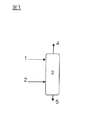
- FIG. 1 shows a schematic configuration of an apparatus used in the present invention.
- the sulfur-containing compound removal method of the present invention includes a step of bringing a crude hydrocarbon containing one or more sulfur-containing compounds selected from the group consisting of carbon disulfide and mercaptans into contact with an amide compound and nitrite.
- Crude hydrocarbons generally contain various sulfur-containing compounds in hydrocarbons, but in the present invention, carbon disulfide and mercaptans are targeted for removal among these sulfur-containing compounds.
- the crude hydrocarbon is not particularly limited, but is preferably a C4 fraction mainly containing a hydrocarbon having 4 carbon atoms or a C5 fraction mainly containing a hydrocarbon having 5 carbon atoms.
- These crude hydrocarbons are, for example, fractions produced as a by-product in the process of cracking naphtha to produce ethylene and the like.
- the method of the present invention is particularly effective for crude hydrocarbons mainly composed of C5 fraction, which have close boiling points to carbon disulfide and mercaptans and are difficult to separate from carbon disulfide and mercaptans. It is.
- Examples of the hydrocarbon having 4 carbon atoms contained in the C4 fraction include 1,3-butadiene, n-butane, isobutane, 1-butene, 2-butene, isobutene, and vinyl acetylene.
- examples of the hydrocarbon having 5 carbon atoms contained in the C5 fraction include isoprene, isoamylene, amylene, n-pentane, isopentane, piperylene, cyclopentane, cyclopentene, and cyclopentadiene.
- Examples of mercaptans which are a kind of sulfur-containing compounds include chain mercaptans and cyclic mercaptans.
- the number of carbon atoms of the mercaptans is preferably 20 or less, more preferably 1 to 15, and still more preferably 1 to 10.
- chain mercaptans examples include methyl mercaptan, ethyl mercaptan, normal propyl mercaptan, and isopropyl mercaptan.
- cyclic mercaptans examples include cyclopentyl mercaptan, cyclohexyl mercaptan, 2-methylcyclopentyl mercaptan, and 3-methylcyclopentyl mercaptan.
- ethyl mercaptan is particularly preferred as a sulfur-containing compound to be treated by the removal method of the present invention because it has a boiling point close to that of isoprene, which is one of the objects to be purified by distillation.
- Mercaptans may be contained in crude hydrocarbons in one or more kinds.
- the crude hydrocarbon to be treated in the present invention is not particularly limited as long as it is a hydrocarbon containing carbon disulfide and / or mercaptans, but the total of carbon disulfide and mercaptans is preferably 10,000 ppm. Hereinafter, it is more preferably 1,000 ppm or less, particularly preferably 500 ppm or less. Further, the total content of carbon disulfide and mercaptans is preferably 1 ppm or more. When the total amount of carbon disulfide and mercaptans is within the above range, the sulfur-containing compound can be efficiently removed.
- Examples of the amide compound used in the present invention include a chain amide compound and a cyclic amide compound.
- the number of carbon atoms of the amide compound is preferably 20 or less, more preferably 3 to 15, and further preferably 3 to 10.
- chain amide compounds include N, N-dimethylformamide, N-methyl-N-phenylformamide, N, N-diphenylformamide, N, N-dimethylacetamide, N-methyl-N-phenylacetamide, N, N- Diphenylacetamide, N, N-diethylformamide, N-ethyl-N-phenylformamide, N, N-diethylacetamide, N-ethyl-N-phenylacetamide and the like
- cyclic amide compounds include N-methylpyrrolidone, N-ethylpyrrolidone, N-methylpiperidinone, N-ethylpiperidinone and the like can be mentioned.
- a chain amide compound is preferable, and from the viewpoint of operability, a chain amide compound that is liquid at 50 ° C. and 1 atm is more preferable, and N, N-dimethylformamide is more preferable.
- the amide compounds may be used alone or in combination of two or more.
- nitrites used in the present invention include alkali metal nitrites and alkaline earth metal nitrites.
- Specific examples of the alkali metal nitrite include sodium nitrite and potassium nitrite, and specific examples of the alkaline earth metal nitrite include magnesium nitrite and calcium nitrite.
- alkali metal nitrites are preferable, sodium nitrite and potassium nitrite are more preferable, and sodium nitrite is particularly preferable.
- Nitrite may be used in a salt state, but from the viewpoint of solubility, when mixed with an amide compound, it may be dissolved in water and used as an aqueous solution. When nitrite is dissolved in water and then mixed with the amide compound, the nitrite is easily dissolved in the amide compound.
- the concentration of nitrite is not particularly limited as long as it is dissolved in water, but it is preferably 50% by weight or less, particularly preferably 20% by weight or less.
- the method of bringing the crude hydrocarbon containing carbon disulfide and mercaptans into contact with the amide compound and nitrite is not particularly limited, but (a) the crude hydrocarbon and amide compound containing carbon disulfide and mercaptans And (b) a method in which nitrite is mixed with an amide compound and then a carbon dioxide disulfide and a crude hydrocarbon containing a mercaptan are brought into contact with each other. From the viewpoint of the ability to remove mercaptans, the method (b) is preferred. Further, both the methods (a) and (b) may be either a continuous type or a batch type.
- the amount ratio between the amide compound and the crude hydrocarbon in the contacting step is not particularly limited, but is preferably a weight ratio (amide compound / crude hydrocarbon) of preferably 0.1.
- the ratio is 1/1 to 100/1, more preferably 0.5 / 1 to 50/1, and particularly preferably 1/1 to 10/1. If the quantitative ratio of the amide compound and the crude hydrocarbon is within the above range, the sulfur-containing compound can be sufficiently removed.
- the amount of nitrite used in the contacting step is not particularly limited, but is preferably 0.01 to 1,000 ppm, more preferably 0.1 to 100 ppm, and particularly preferably 0.5 to 50 ppm in the amide compound. .
- the amount of nitrite added is within the above range, the nitrite can be sufficiently dissolved in the amide compound, and the sulfur-containing compound can be efficiently removed.
- the amount ratio of nitrite to carbon disulfide is not particularly limited, but is preferably 0.01 / 1 to 100/1, more preferably 0.02 / 1 / in molar ratio (nitrite / carbon disulfide). 1 to 50/1, particularly preferably 0.03 / 1 to 30/1, and the amount ratio of nitrite to mercaptans is not particularly limited, but is preferably a molar ratio (nitrite / mercaptans). It is 0.1 / 1 to 100/1, more preferably 0.2 / 1 to 50/1, and particularly preferably 0.3 / 1 to 30/1. When the amount of nitrite added is in the above range, the sulfur-containing compound can be sufficiently removed.
- the temperature in the contacting step is not particularly limited, but is preferably 0 to 250 ° C, more preferably 10 to 200 ° C. If the contact temperature is too low, the sulfur-containing compounds may not be removed sufficiently. If the temperature is too high, unsaturated hydrocarbons in the crude hydrocarbon will undergo a polymerization reaction, etc., producing high molecular weight compounds and reducing product yield. May be invited. For example, when isoprene is contained in the crude hydrocarbon, if the temperature at the time of contact is too high, a dimer of isoprene and the like may be produced, and the yield of isoprene may be reduced.
- the contacting step may be performed at normal pressure or under a pressure of about 0 to 3 MPa.
- the contact time is not particularly limited, but is preferably 1 second to 300 minutes, more preferably about 1 minute to 180 minutes.
- the low boiling point sulfur-containing compound is volatilized through the distillation operation, preferably through the distillation step, and the high boiling point sulfur-containing compound is converted into a liquid or salt and separated as a residue, It is thought that carbon disulfide and mercaptans in the crude hydrocarbon are removed.
- FIG. 1 shows a preferred embodiment of the method for removing carbon disulfide and mercaptans of the present invention, but the present invention is not limited to this embodiment.
- a mixture of an amide compound and an aqueous nitrite solution is introduced from the pipe 1 at the upper side of the contact vessel 3, and a crude hydrocarbon containing carbon disulfide and mercaptans is introduced from the pipe 2 at the lower side.
- the hydrocarbon fraction is separated from the amide compound and nitrite by distillation, and the purified hydrocarbon having a reduced content of sulfur-containing compounds is removed from the top pipe 4 of the contact vessel 3. obtain.
- Separation conditions are not particularly limited, but when the C5 fraction is separated, purified hydrocarbons are obtained from the top pipe 4 through a distillation step of maintaining the liquid temperature at about 120 to 160 ° C. after the contacting step.
- the contact vessel it is preferable to use a pressure vessel equipped with a stirrer and a circulation device. After performing the above contact step in a pressure vessel, the pressure is released to obtain a purified hydrocarbon in which the content of carbon disulfide and mercaptans is reduced from the top pipe 4.
- Heterocyclic polar compounds such as aldehyde and pyridoxal; aromatic nitro compounds such as nitrobenzene, nitrotoluene, nitroxylene, nitromesitylene, dinitrobenzene and trinitroxylene; benzaldehyde, tolaldehyde, cuminaldehyde, phenylacetaldehyde, cinnamaldehyde, phthalaldehyde Aromatic aldehydes such as isophthalaldehyde and terephthalaldehyde; Among these, furfural, nitrobenzene, and benzaldehyde are preferable, and furfural is particularly preferable.
- the addition amount of these additives is preferably 0.01 to 30 parts by weight, more preferably 0.05 to 15 parts by weight with respect to 100 parts by weight of the amide compound.
- the crude hydrocarbon is brought into contact with the amide compound and nitrite, and then separated from the amide compound and nitrite, and then subjected to a distillation step to recover, so that the total content of carbon disulfide and mercaptans contained in the resulting purified hydrocarbon is contained.
- the amount is reduced, preferably 300 ppm or less, more preferably 100 ppm or less, particularly preferably 50 ppm or less, and to a value lower than the total content of carbon disulfide and mercaptans in the crude hydrocarbon.
- the crude hydrocarbon is a C4 fraction or a C5 hydrocarbon mainly comprising a C4 hydrocarbon.
- C5 fraction as the main component.
- the crude hydrocarbon is separated from the amide compound and the nitrite after the step of contacting the crude hydrocarbon with the amide compound and the nitrite, and the content of the sulfur-containing compound is determined.
- the method further includes a distillation step of recovering the purified hydrocarbon with reduced slag.
- the sulfur-containing compound content in the crude hydrocarbon is 1 ppm or more and 10,000 ppm or less, and the sulfur-containing compound content in the purified hydrocarbon is 300 ppm or less. And it is a value lower than the sulfur-containing compound content in the crude hydrocarbon.
- the method for producing a purified hydrocarbon according to the present invention preferably includes the above-described method for removing a sulfur-containing compound.
- Example 1 Crude C5 distillate containing 13.3 ppm carbon disulfide and 2.0 ppm ethyl mercaptan in a stainless steel pressure vessel equipped with a stirrer (composition: C4 (carbon number 4 hydrocarbon) 2.1%, normal pentane 22.
- Example 2 In a stainless steel pressure vessel equipped with a stirrer, a crude C5 distillate containing 149.6 ppm of carbon disulfide and 13.4 ppm of ethyl mercaptan (composition: isoprene 94.1%, 2-butyne 2.8%) is 8.6. 46.4 parts of a solution containing 96.1% dimethylformamide, 3.9% furfural, and 8.9 ppm sodium nitrite. The mixed solution was heated to 120 ° C. with stirring and held for 1 hour, and then the gaseous C5 fraction was withdrawn from the upper part of the container while maintaining the liquid temperature at 120 ° C. to 160 ° C.
- Example 3 9.6 of a crude C5 fraction containing 34.0 ppm carbon disulfide and 9.0 ppm ethyl mercaptan (composition: isoprene 94.1%, 2-butyne 2.8%) in a stainless steel pressure vessel equipped with a stirrer. 51.8 parts of a solution containing 96.1% of dimethylformamide, 3.9% of furfural and 3.3 ppm of sodium nitrite. The mixed solution of the two liquids was heated to 120 ° C. with stirring and held for 1 hour, and then the gaseous C5 fraction was extracted from the upper part of the container while maintaining the liquid temperature at 120 ° C. to 160 ° C.
Landscapes
- Chemical & Material Sciences (AREA)
- Oil, Petroleum & Natural Gas (AREA)
- Engineering & Computer Science (AREA)
- Chemical Kinetics & Catalysis (AREA)
- General Chemical & Material Sciences (AREA)
- Organic Chemistry (AREA)
- Production Of Liquid Hydrocarbon Mixture For Refining Petroleum (AREA)
Abstract
Description
(A)二硫化炭素およびメルカプタン類からなる群から選択される1種以上の含硫黄化合物を含む粗製炭化水素を、アミド化合物および亜硝酸塩と接触させる工程を含む、含硫黄化合物の除去方法。
(B)前記(A)に記載の含硫黄化合物の除去方法を含む精製炭化水素の製造方法。
カラム DB-1 長さ30m、内径0.32mm、膜厚0.25μm)
カラム温度 40℃で10分保持、その後毎分10℃で昇温し、250℃で3分保持
注入口温度 140℃
キャリアーガス ヘリウム(毎分流量1.17ml)
検出器 アジレント社製355化学発光硫黄検出器(SCD)
攪拌機付きステンレス製耐圧容器に、二硫化炭素を13.3ppm、エチルメルカプタンを2.0ppm含有する粗製C5留分液(組成:C4(炭素数4の炭化水素) 2.1%、ノルマルペンタン22.0%、イソペンタン20.1%、アミレン6.9%、イソアミレン7.4%、1,4-ペンタジエン1.5%、イソプレン15.6%、ピペリレン10.6%、シクロペンタン1.1%、シクロペンテン2.5%、シクロペンタジエン6.6%、C6(炭素数6の炭化水素) 3.6%)を69.0部、ジメチルホルムアミドを97.4%、フルフラールを2.6%、亜硝酸ナトリウムを0.7ppm含有する溶液を323.6部仕込んだ。この2液の混合溶液を撹拌しながら120℃に昇温し、1時間保持した後、液温を120℃~160℃に保ちながら容器上部よりガス状のC5留分を抜き出したところ、二硫化炭素を9.8ppm、エチルメルカプタンを1.3ppm含有する精製C5留分を67.6部得た。また、容器内には二硫化炭素、エチルメルカプタン共含有しない溶液が309.3部残留した。この結果、粗製C5留分に含まれる二硫化炭素の27.8%、エチルメルカプタンの36.3%を除去した。
攪拌機付きステンレス製耐圧容器に、二硫化炭素を26.9ppm、エチルメルカプタンを1.8ppm含有する粗製C5留分液(組成:C4(炭素数4の炭化水素) 2.1%、ノルマルペンタン22.0%、イソペンタン20.1%、アミレン6.9%、イソアミレン7.4%、1,4-ペンタジエン1.5%、イソプレン15.6%、ピペリレン10.6%、シクロペンタン1.1%、シクロペンテン2.5%、シクロペンタジエン6.6%、C6(炭素数6の炭化水素) 3.6%)を64.4部、ジメチルホルムアミドを97.4%、フルフラールを2.6%含有し亜硝酸ナトリウムを含有しない溶液を303.3部仕込んだ。この2液の混合溶液を撹拌しながら120℃に昇温し、1時間保持した後、液温を120℃~160℃に保ちながら容器上部よりガス状のC5留分を抜き出したところ、二硫化炭素を27.1ppm、エチルメルカプタンを1.8ppm含有するC5留分を63.9部得た。また、容器内には二硫化炭素、エチルメルカプタン共含有しない溶液が288.6部残留した。この結果、粗製C5留分に含まれる二硫化炭素は除去されず、エチルメルカプタンも0.8%除去されるに留まった。
攪拌機付きステンレス製耐圧容器に、二硫化炭素を149.6ppm、エチルメルカプタンを13.4ppm含有する粗製C5留分液(組成:イソプレン94.1%、2-ブチン2.8%)を8.6部、ジメチルホルムアミドを96.1%、フルフラールを3.9%、亜硝酸ナトリウムを8.9ppm含有する溶液を46.4部仕込んだ。この混合溶液を撹拌しながら120℃に昇温し、1時間保持した後、液温を120℃~160℃に保ちながら容器上部よりガス状のC5留分を抜き出したところ、二硫化炭素を19.2ppm、エチルメルカプタンを9.1ppm含有する精製C5留分を8.6部得た。また、容器内には二硫化炭素、エチルメルカプタン共含有しない溶液が42.1部残留した。この結果、粗製C5留分に含まれる二硫化炭素の87.2%、エチルメルカプタンの32.1%を除去した。
攪拌機付きステンレス製耐圧容器に、二硫化炭素を34.0ppm、エチルメルカプタンを9.0ppm含有する粗製C5留分液(組成:イソプレン94.1%、2-ブチン2.8%)を9.6部、ジメチルホルムアミドを96.1%、フルフラールを3.9%、亜硝酸ナトリウムを3.3ppm含有する溶液を51.8部仕込んだ。この2液の混合溶液を撹拌しながら120℃に昇温し、1時間保持した後、液温を120℃~160℃に保ちながら容器上部よりガス状のC5留分を抜き出したところ、二硫化炭素を8.3ppm、エチルメルカプタンを5.7ppm含有する精製C5留分を9.6部得た。また、容器内には二硫化炭素、エチルメルカプタン共含有しない溶液が45.2部残留した。この結果、粗製C5留分に含まれる二硫化炭素の75.6%、エチルメルカプタンの36.7%を除去した。
以上の結果を下表にまとめる。

2…側面下部配管
3…接触容器(耐圧容器)
4…頂部配管
5…底部配管
Claims (7)
- 二硫化炭素およびメルカプタン類からなる群から選択される1種以上の含硫黄化合物を含む粗製炭化水素を、アミド化合物および亜硝酸塩と接触させる工程を含む、含硫黄化合物の除去方法。
- 前記粗製炭化水素が、炭素数4の炭化水素を主成分とするC4留分または炭素数5の炭化水素を主成分とするC5留分である請求項1に記載の除去方法。
- 前記粗製炭化水素を、アミド化合物および亜硝酸塩と接触させる工程の後、アミド化合物および亜硝酸塩から分離し、含硫黄化合物の含有量が低減された精製炭化水素を回収する蒸留工程をさらに含む請求項1に記載の含硫黄化合物の除去方法。
- 前記粗製炭化水素を、アミド化合物および亜硝酸塩と接触させる工程の後、アミド化合物および亜硝酸塩から分離し、含硫黄化合物の含有量が低減された精製炭化水素を回収する蒸留工程をさらに含む請求項2に記載の含硫黄化合物の除去方法。
- 前記粗製炭化水素中の含硫黄化合物含量が1ppm以上10,000ppm以下であり、前記精製炭化水素中の含硫黄化合物含量が300ppm以下かつ該粗製炭化水素中の含硫黄化合物含量より低い値である請求項3に記載の含硫黄化合物の除去方法。
- 前記粗製炭化水素中の含硫黄化合物含量が1ppm以上10,000ppm以下であり、前記精製炭化水素中の含硫黄化合物含量が300ppm以下かつ該粗製炭化水素中の含硫黄化合物含量より低い値である請求項4に記載の含硫黄化合物の除去方法。
- 請求項3~6のいずれか1項に記載の含硫黄化合物の除去方法を含む精製炭化水素の製造方法。
Priority Applications (3)
| Application Number | Priority Date | Filing Date | Title |
|---|---|---|---|
| SG11201507927PA SG11201507927PA (en) | 2013-03-29 | 2014-03-13 | Method for removing sulfur-containing compound |
| KR1020157026029A KR20150139506A (ko) | 2013-03-29 | 2014-03-13 | 황 함유 화합물의 제거 방법 |
| JP2015508279A JPWO2014156672A1 (ja) | 2013-03-29 | 2014-03-13 | 含硫黄化合物の除去方法 |
Applications Claiming Priority (2)
| Application Number | Priority Date | Filing Date | Title |
|---|---|---|---|
| JP2013-072626 | 2013-03-29 | ||
| JP2013072626 | 2013-03-29 |
Publications (1)
| Publication Number | Publication Date |
|---|---|
| WO2014156672A1 true WO2014156672A1 (ja) | 2014-10-02 |
Family
ID=51623655
Family Applications (1)
| Application Number | Title | Priority Date | Filing Date |
|---|---|---|---|
| PCT/JP2014/056624 Ceased WO2014156672A1 (ja) | 2013-03-29 | 2014-03-13 | 含硫黄化合物の除去方法 |
Country Status (5)
| Country | Link |
|---|---|
| JP (2) | JPWO2014156672A1 (ja) |
| KR (1) | KR20150139506A (ja) |
| MY (1) | MY174613A (ja) |
| SG (1) | SG11201507927PA (ja) |
| WO (1) | WO2014156672A1 (ja) |
Citations (3)
| Publication number | Priority date | Publication date | Assignee | Title |
|---|---|---|---|---|
| JPS5040505A (ja) * | 1973-08-01 | 1975-04-14 | ||
| JPH10251660A (ja) * | 1997-03-11 | 1998-09-22 | Nippon Zeon Co Ltd | 共役ジエン類の重合防止方法 |
| JP2001340895A (ja) * | 2000-05-31 | 2001-12-11 | Ebara Corp | 汚水又は汚泥の消臭方法及びその装置 |
-
2014
- 2014-03-13 WO PCT/JP2014/056624 patent/WO2014156672A1/ja not_active Ceased
- 2014-03-13 KR KR1020157026029A patent/KR20150139506A/ko not_active Ceased
- 2014-03-13 JP JP2015508279A patent/JPWO2014156672A1/ja active Pending
- 2014-03-13 SG SG11201507927PA patent/SG11201507927PA/en unknown
- 2014-03-13 MY MYPI2015002433A patent/MY174613A/en unknown
-
2018
- 2018-02-28 JP JP2018035098A patent/JP6521124B2/ja active Active
Patent Citations (3)
| Publication number | Priority date | Publication date | Assignee | Title |
|---|---|---|---|---|
| JPS5040505A (ja) * | 1973-08-01 | 1975-04-14 | ||
| JPH10251660A (ja) * | 1997-03-11 | 1998-09-22 | Nippon Zeon Co Ltd | 共役ジエン類の重合防止方法 |
| JP2001340895A (ja) * | 2000-05-31 | 2001-12-11 | Ebara Corp | 汚水又は汚泥の消臭方法及びその装置 |
Also Published As
| Publication number | Publication date |
|---|---|
| SG11201507927PA (en) | 2015-11-27 |
| JP6521124B2 (ja) | 2019-05-29 |
| MY174613A (en) | 2020-04-30 |
| JPWO2014156672A1 (ja) | 2017-02-16 |
| KR20150139506A (ko) | 2015-12-11 |
| JP2018119151A (ja) | 2018-08-02 |
Similar Documents
| Publication | Publication Date | Title |
|---|---|---|
| US3436438A (en) | Process for the separation of conjugated diolefins | |
| JP2016536290A5 (ja) | ||
| WO2013069390A1 (ja) | (e)-1-クロロ-3,3,3-トリフルオロプロペンの製造方法 | |
| CN101759520B (zh) | 从烃类混合物中萃取精馏分离苯乙烯的方法 | |
| CN102516009B (zh) | 一种液相法制备异戊二烯的方法 | |
| JP2020513055A (ja) | ハロゲン化ブチルゴムの調製工程 | |
| CN108728155B (zh) | 一种复合溶剂及其应用 | |
| JP4552941B2 (ja) | アニリンの精製方法および製造方法 | |
| WO2018090507A1 (zh) | 一种2-氯-1,1,1,2-四氟丙烷和2-氯-3,3,3-三氟丙烯的分离方法 | |
| CN101838177B (zh) | 一种利用反应精馏的nmp法一段萃取精馏分离碳五馏分的方法 | |
| JP6521124B2 (ja) | 含硫黄化合物の除去方法 | |
| US9771290B2 (en) | Process for working up waste water from nitrobenzene preparation | |
| EP3010874B1 (en) | Co-extraction systems for separation and purification of butadiene and isoprene | |
| CN104718276B (zh) | 用于通过从含有机过氧化物的未加工的裂化汽油馏分回收高纯度苯来制备贫苯汽油的方法 | |
| CN102311304B (zh) | 一种萃取精馏分离苯乙烯的复合溶剂及应用 | |
| CN108137491B (zh) | 二甲亚砜的纯化方法 | |
| KR20140109400A (ko) | 선택성 용매를 사용하는 추출 증류 공정을 위한 공급 스트림으로서의 증기상의 정제된 조 c4 분획을 제공하는 방법 | |
| JP5087312B2 (ja) | ビス(クロロメチル)ナフタレンの製造方法。 | |
| US2387920A (en) | Manufacture of inhibitors | |
| PT95122B (pt) | Processo para a recuperacao de acido nitrico | |
| CN101003483A (zh) | 苯胺的精制方法和制造方法 | |
| JPH10251663A (ja) | 共役ジエン類の重合防止方法 | |
| TWI492933B (zh) | 抑制萃取精餾過程中乙烯基芳香族化合物聚合的方法 | |
| TWI545103B (zh) | Butadiene-containing compositions | |
| JP2005213419A (ja) | C5留分の水添方法およびオレフィン類の製造方法 |
Legal Events
| Date | Code | Title | Description |
|---|---|---|---|
| 121 | Ep: the epo has been informed by wipo that ep was designated in this application |
Ref document number: 14774863 Country of ref document: EP Kind code of ref document: A1 |
|
| ENP | Entry into the national phase |
Ref document number: 2015508279 Country of ref document: JP Kind code of ref document: A |
|
| ENP | Entry into the national phase |
Ref document number: 20157026029 Country of ref document: KR Kind code of ref document: A |
|
| NENP | Non-entry into the national phase |
Ref country code: DE |
|
| 122 | Ep: pct application non-entry in european phase |
Ref document number: 14774863 Country of ref document: EP Kind code of ref document: A1 |