WO2014155845A1 - 有機性排水の処理方法及び処理装置 - Google Patents
有機性排水の処理方法及び処理装置 Download PDFInfo
- Publication number
- WO2014155845A1 WO2014155845A1 PCT/JP2013/082782 JP2013082782W WO2014155845A1 WO 2014155845 A1 WO2014155845 A1 WO 2014155845A1 JP 2013082782 W JP2013082782 W JP 2013082782W WO 2014155845 A1 WO2014155845 A1 WO 2014155845A1
- Authority
- WO
- WIPO (PCT)
- Prior art keywords
- biological treatment
- aerobic
- aerobic biological
- water
- organic wastewater
- Prior art date
- Legal status (The legal status is an assumption and is not a legal conclusion. Google has not performed a legal analysis and makes no representation as to the accuracy of the status listed.)
- Ceased
Links
Images

Classifications
-
- B—PERFORMING OPERATIONS; TRANSPORTING
- B01—PHYSICAL OR CHEMICAL PROCESSES OR APPARATUS IN GENERAL
- B01D—SEPARATION
- B01D61/00—Processes of separation using semi-permeable membranes, e.g. dialysis, osmosis or ultrafiltration; Apparatus, accessories or auxiliary operations specially adapted therefor
- B01D61/02—Reverse osmosis; Hyperfiltration ; Nanofiltration
- B01D61/04—Feed pretreatment
-
- C—CHEMISTRY; METALLURGY
- C02—TREATMENT OF WATER, WASTE WATER, SEWAGE, OR SLUDGE
- C02F—TREATMENT OF WATER, WASTE WATER, SEWAGE, OR SLUDGE
- C02F9/00—Multistage treatment of water, waste water or sewage
-
- B—PERFORMING OPERATIONS; TRANSPORTING
- B01—PHYSICAL OR CHEMICAL PROCESSES OR APPARATUS IN GENERAL
- B01D—SEPARATION
- B01D2311/00—Details relating to membrane separation process operations and control
- B01D2311/04—Specific process operations in the feed stream; Feed pretreatment
-
- B—PERFORMING OPERATIONS; TRANSPORTING
- B01—PHYSICAL OR CHEMICAL PROCESSES OR APPARATUS IN GENERAL
- B01D—SEPARATION
- B01D2311/00—Details relating to membrane separation process operations and control
- B01D2311/26—Further operations combined with membrane separation processes
- B01D2311/2642—Aggregation, sedimentation, flocculation, precipitation or coagulation
-
- B—PERFORMING OPERATIONS; TRANSPORTING
- B01—PHYSICAL OR CHEMICAL PROCESSES OR APPARATUS IN GENERAL
- B01D—SEPARATION
- B01D2311/00—Details relating to membrane separation process operations and control
- B01D2311/26—Further operations combined with membrane separation processes
- B01D2311/2688—Biological processes
-
- C—CHEMISTRY; METALLURGY
- C02—TREATMENT OF WATER, WASTE WATER, SEWAGE, OR SLUDGE
- C02F—TREATMENT OF WATER, WASTE WATER, SEWAGE, OR SLUDGE
- C02F1/00—Treatment of water, waste water, or sewage
- C02F1/44—Treatment of water, waste water, or sewage by dialysis, osmosis or reverse osmosis
- C02F1/441—Treatment of water, waste water, or sewage by dialysis, osmosis or reverse osmosis by reverse osmosis
-
- C—CHEMISTRY; METALLURGY
- C02—TREATMENT OF WATER, WASTE WATER, SEWAGE, OR SLUDGE
- C02F—TREATMENT OF WATER, WASTE WATER, SEWAGE, OR SLUDGE
- C02F1/00—Treatment of water, waste water, or sewage
- C02F1/52—Treatment of water, waste water, or sewage by flocculation or precipitation of suspended impurities
- C02F1/5236—Treatment of water, waste water, or sewage by flocculation or precipitation of suspended impurities using inorganic agents
- C02F1/5245—Treatment of water, waste water, or sewage by flocculation or precipitation of suspended impurities using inorganic agents using basic salts, e.g. of aluminium and iron
-
- C—CHEMISTRY; METALLURGY
- C02—TREATMENT OF WATER, WASTE WATER, SEWAGE, OR SLUDGE
- C02F—TREATMENT OF WATER, WASTE WATER, SEWAGE, OR SLUDGE
- C02F1/00—Treatment of water, waste water, or sewage
- C02F1/66—Treatment of water, waste water, or sewage by neutralisation; pH adjustment
-
- C—CHEMISTRY; METALLURGY
- C02—TREATMENT OF WATER, WASTE WATER, SEWAGE, OR SLUDGE
- C02F—TREATMENT OF WATER, WASTE WATER, SEWAGE, OR SLUDGE
- C02F2103/00—Nature of the water, waste water, sewage or sludge to be treated
- C02F2103/32—Nature of the water, waste water, sewage or sludge to be treated from the food or foodstuff industry, e.g. brewery waste waters
-
- C—CHEMISTRY; METALLURGY
- C02—TREATMENT OF WATER, WASTE WATER, SEWAGE, OR SLUDGE
- C02F—TREATMENT OF WATER, WASTE WATER, SEWAGE, OR SLUDGE
- C02F2103/00—Nature of the water, waste water, sewage or sludge to be treated
- C02F2103/34—Nature of the water, waste water, sewage or sludge to be treated from industrial activities not provided for in groups C02F2103/12 - C02F2103/32
- C02F2103/346—Nature of the water, waste water, sewage or sludge to be treated from industrial activities not provided for in groups C02F2103/12 - C02F2103/32 from semiconductor processing, e.g. waste water from polishing of wafers
-
- C—CHEMISTRY; METALLURGY
- C02—TREATMENT OF WATER, WASTE WATER, SEWAGE, OR SLUDGE
- C02F—TREATMENT OF WATER, WASTE WATER, SEWAGE, OR SLUDGE
- C02F3/00—Biological treatment of water, waste water, or sewage
- C02F3/02—Aerobic processes
- C02F3/08—Aerobic processes using moving contact bodies
- C02F3/085—Fluidized beds
-
- C—CHEMISTRY; METALLURGY
- C02—TREATMENT OF WATER, WASTE WATER, SEWAGE, OR SLUDGE
- C02F—TREATMENT OF WATER, WASTE WATER, SEWAGE, OR SLUDGE
- C02F3/00—Biological treatment of water, waste water, or sewage
- C02F3/02—Aerobic processes
- C02F3/10—Packings; Fillings; Grids
-
- C—CHEMISTRY; METALLURGY
- C02—TREATMENT OF WATER, WASTE WATER, SEWAGE, OR SLUDGE
- C02F—TREATMENT OF WATER, WASTE WATER, SEWAGE, OR SLUDGE
- C02F3/00—Biological treatment of water, waste water, or sewage
- C02F3/02—Aerobic processes
- C02F3/10—Packings; Fillings; Grids
- C02F3/101—Arranged-type packing, e.g. stacks, arrays
-
- C—CHEMISTRY; METALLURGY
- C02—TREATMENT OF WATER, WASTE WATER, SEWAGE, OR SLUDGE
- C02F—TREATMENT OF WATER, WASTE WATER, SEWAGE, OR SLUDGE
- C02F3/00—Biological treatment of water, waste water, or sewage
- C02F3/02—Aerobic processes
- C02F3/10—Packings; Fillings; Grids
- C02F3/105—Characterized by the chemical composition
-
- C—CHEMISTRY; METALLURGY
- C02—TREATMENT OF WATER, WASTE WATER, SEWAGE, OR SLUDGE
- C02F—TREATMENT OF WATER, WASTE WATER, SEWAGE, OR SLUDGE
- C02F3/00—Biological treatment of water, waste water, or sewage
- C02F3/02—Aerobic processes
- C02F3/10—Packings; Fillings; Grids
- C02F3/105—Characterized by the chemical composition
- C02F3/106—Carbonaceous materials
-
- C—CHEMISTRY; METALLURGY
- C02—TREATMENT OF WATER, WASTE WATER, SEWAGE, OR SLUDGE
- C02F—TREATMENT OF WATER, WASTE WATER, SEWAGE, OR SLUDGE
- C02F3/00—Biological treatment of water, waste water, or sewage
- C02F3/28—Anaerobic digestion processes
- C02F3/2846—Anaerobic digestion processes using upflow anaerobic sludge blanket [UASB] reactors
-
- Y—GENERAL TAGGING OF NEW TECHNOLOGICAL DEVELOPMENTS; GENERAL TAGGING OF CROSS-SECTIONAL TECHNOLOGIES SPANNING OVER SEVERAL SECTIONS OF THE IPC; TECHNICAL SUBJECTS COVERED BY FORMER USPC CROSS-REFERENCE ART COLLECTIONS [XRACs] AND DIGESTS
- Y02—TECHNOLOGIES OR APPLICATIONS FOR MITIGATION OR ADAPTATION AGAINST CLIMATE CHANGE
- Y02W—CLIMATE CHANGE MITIGATION TECHNOLOGIES RELATED TO WASTEWATER TREATMENT OR WASTE MANAGEMENT
- Y02W10/00—Technologies for wastewater treatment
- Y02W10/10—Biological treatment of water, waste water, or sewage
Definitions
- membrane separators with fine pore sizes such as ultrafiltration (UF) membranes and reverse osmosis (RO) membranes, can remove high molecular weight organic substances and provide high quality treated water.
- UF ultrafiltration
- RO reverse osmosis
- membrane separators have a small pore size, if the concentration of the inflowing organic substance rises, the organic substance tends to accumulate on the membrane surface, the filtration resistance increases remarkably, and water passage becomes difficult. In such a case, it is effective for the stable treatment to install a biological treatment device in front of the membrane separation device and reduce the concentration of organic substances in the waste water prior to the membrane separation treatment.
- Patent Document 1 has the following problems. That is, the alkalinity generated during the anaerobic biological treatment remains even after the aerobic biological treatment, and the flocculant is consumed by this alkalinity, so the amount of flocculant added necessary for flocculation and solid-liquid separation Will increase. As a result, the amount of sludge generated in the process increases, the salt load on the RO membrane increases, and the amount of permeated water decreases.
- the present invention solves the problems of the method of Patent Document 1 above, reliably removes the alkalinity generated by anaerobic biological treatment, and reduces the amount of flocculant used for flocculation and solid-liquid separation. It is an object of the present invention to provide an organic wastewater treatment method and a treatment apparatus that can reduce the subsequent salt load on the RO membrane.
- the present inventors have used an aerobic biological treatment and controlled the pH condition to perform the treatment in a transient manner. It has been found that the alkalinity produced can be reliably removed by aerobic biological treatment.
- the present invention has been achieved on the basis of such knowledge, and the gist thereof is as follows.
- An anaerobic biological treatment process for anaerobically biologically treating organic wastewater an aerobic biological treatment process for aerobically biologically treating anaerobic biological treated water flowing out of the anaerobic biological treatment process, A solid-liquid separation step in which a flocculant is added to the aerobic biological treatment water flowing out from the aerobic biological treatment step for aggregation and then solid-liquid separation, and reverse osmosis for treating the separated water separated in the solid-liquid separation step
- the aerobic biological treatment step is a step of treating the aerobic organism transiently with aerobic microorganisms attached to a carrier under the condition of pH 5.5 to 6.5.
- a method for treating organic wastewater characterized in that it exists.
- the anaerobic biological treatment water is received in an aerobic biological treatment tank and aerobically biologically treated.
- Anaerobic biological treatment means for anaerobically biologically treating organic wastewater
- anaerobic biological treatment means for aerobically biologically treating anaerobic biological treated water flowing out from the anaerobic biological treatment means
- a flocculant addition means for adding a flocculant to aerobic biological treatment water flowing out from the aerobic biological treatment means
- a solid-liquid separation means for solid-liquid separation of the water added with the flocculant
- the solid-liquid separation means In an organic wastewater treatment apparatus having a reverse osmosis membrane separation means for treating the separated separated water, the aerobic biological treatment means comprises an aerobic substance attached to a carrier under the condition of pH 5.5 to 6.5.
- An organic wastewater treatment apparatus characterized by being a means for transient treatment with microorganisms.
- the aerobic biological treatment means is an aerobic biological treatment tank that receives the anaerobic biological treatment water and aerobically performs biological treatment
- the carrier is a sponge carrier.
- a membrane filtration device for membrane filtration of the separated water is provided, and the filtrate water of the membrane filtration device is treated by the reverse osmosis membrane separation means.
- Organic wastewater treatment equipment In any one of [7] to [11], a membrane filtration device for membrane filtration of the separated water is provided, and the filtrate water of the membrane filtration device is treated by the reverse osmosis membrane separation means.
- the alkalinity generated in the anaerobic biological treatment can be reliably removed by the aerobic biological treatment in which aeration is performed under acidic conditions, so that a flocculant addition necessary for subsequent aggregation and solid-liquid separation is added.
- the amount of generated sludge can be reduced and the salt load on the RO membrane can be reduced, so that efficient treatment can be performed.
- the present invention uses an organic wastewater as raw water, anaerobic biological treatment in an anaerobic biological treatment tank 1, and then aerobic biological treatment in an aerobic biological treatment tank 2.
- anaerobic biological treatment in an anaerobic biological treatment tank 1
- aerobic biological treatment in an aerobic biological treatment tank 2.
- the coagulant is added to the coagulation tank 3 and coagulated in the coagulation tank 3
- the coagulated water is solid-liquid separated in the solid / liquid separation tank 3, and the separated water is treated with the RO membrane separator 5.
- the aerobic biological treatment tank 2 is provided with a carrier, and is subjected to a biological treatment in a transient manner under conditions of pH 5.5 to 6.5 by aerobic microorganisms attached to the carrier.
- the organic wastewater to be treated is not particularly limited as long as it is an organic matter-containing wastewater that is usually biologically treated.
- examples thereof include electronic industrial wastewater, chemical factory wastewater, and food factory wastewater.
- the wastewater can be recovered and purified to a pure water level for reuse.
- these wastewaters are suitable as the wastewater to be treated of the present invention.
- organic wastewater examples include organic wastewater containing isopropyl alcohol, ethyl alcohol, and the like, organic nitrogen such as monoethanolamine (MEA) and tetramethylammonium hydroxide (TMAH), and ammonia nitrogen.
- organic waste water and organic waste water containing organic sulfur compounds such as dimethyl sulfoxide (DMSO) can be mentioned.
- Anaerobic biological treatment Any anaerobic biological treatment means for anaerobically biologically treating raw water may be used as long as it is excellent in organic substance decomposition efficiency, and a biological reaction tank of a known anaerobic biological treatment method can be used.
- the anaerobic biological treatment means is not particularly limited, but an anaerobic biological treatment means including an acid generation tank and a UASB (upward flow type anaerobic sludge blanket) type reaction tank is preferable because high-load operation is possible.
- an anaerobic biological treatment means including an acid generation tank and a UASB (upward flow type anaerobic sludge blanket) type reaction tank is preferable because high-load operation is possible.
- the aerobic biological treatment is performed in a transient manner by a biofilm system in which activated sludge is attached to a carrier and held.
- the transient treatment of the aerobic biological treatment does not require concentration management by sedimentation separation, return and withdrawal of sludge, and operation management is easy.
- the SS generated in the latter stage is aggregated and removed, a part of residual organic matter that cannot be removed by biological treatment can also be removed.
- the aerobic biological treatment method may be any microbial bed method such as a fixed bed method, a fluidized bed method, and a developed bed method.
- an aeration tank provided with oxygen gas supply means such as an air diffuser for supplying oxygen (air) into the tank and an aerator is used. be able to.
- the carrier activated carbon, various plastic carriers, sponge carriers and the like can be used, but a sponge carrier is preferable because microorganisms can be maintained at a high concentration.
- the sponge material is not particularly limited, but ester polyurethane is preferable.
- the aerobic biological treatment tank may be a single tank type or a multi-tank type, or a single tank type and a partition wall may be provided in the tank.
- the pH of the last biological treatment tank is adjusted to 5.5 to 6.5, preferably pH 5.8 to 6.3.
- the pH of the aerobic biological treatment tank on the front stage side may be about 6.5 to 8.0.
- the aerobic biologically treated water obtained by anaerobically biotreating raw water after anaerobic biological treatment is a solid-liquid solution that reliably removes microorganisms and macromolecular organic substances by a solid-liquid separation means at a later stage. Prior to separation, it is agglomerated.
- a normal flocculation apparatus is used for the flocculation treatment of the aerobic biological treatment water.
- the aggregation tank of this aggregation processing apparatus may be only one tank or two or more tanks may be provided in multiple stages.
- Examples of the inorganic flocculant used in the agglomeration treatment include iron-based flocculants such as ferric chloride and polyiron sulfate, and aluminum-based flocculants such as aluminum sulfate, aluminum chloride, and polyaluminum chloride. Is preferably an iron-based flocculant. These inorganic flocculants may be used individually by 1 type, and may use 2 or more types together.
- the pH is adjusted to a suitable pH for the inorganic flocculant used by adding a pH adjuster as necessary.
- a pH adjuster for example, it is effective to react at a pH of 5.5 or less with an iron-based flocculant, and it is effective to adjust the pH to 6.0 or higher after reacting at a pH of 5.0 or less with an aluminum-based flocculant.
- the amount of the flocculant added is not particularly limited as long as the necessary aggregating effect can be obtained.
- the alkalinity remaining in the anaerobic biological treatment can be increased by the aerobic biological treatment.
- the amount of FeCl 3 (38%) added is about 30 to 80 ppm (volume), which is significantly reduced compared to the conventional case.
- the amount of sludge generated by solid-liquid separation of the coagulated treated water can also be greatly reduced.
- the soluble organic matter and suspension in the biologically treated water are flocked by the coagulation treatment.
- an inorganic coagulant may be added in the first coagulation tank, and a polymer coagulant may be added in the second coagulation tank.
- the solid-liquid separation means of the agglomerated treated water obtained by agglomerating the aerobic biologically treated water is not particularly limited, such as a sedimentation tank, a flotation tank, a centrifuge, and the like.
- a pressure levitation tank particularly a coagulation pressure levitation tank
- membrane separation means such as an immersion membrane may be used for solid-liquid separation of aerobic biologically treated water.
- RO membrane separation treatment The separated water obtained by the solid-liquid separation is then treated with an RO membrane separator to remove dissolved organic substances and dissolved salts remaining in the separated water.
- the pH adjustment of the aerobic biological treatment tank and the pH adjustment during the flocculation treatment are performed by adding sodium hydroxide or hydrochloric acid to the aerobic biological treatment tank or the aerobic biological treatment water to be agglomerated. Was done.
- Example 1 Using the organic wastewater of the following water quality liquid crystal factory as raw water, treatment was performed with a treated water amount of 1.6 L / d. ⁇ Raw water quality> pH: 10 TOC: 100 mg / L TN: 20 mg-N / L PO 4 -P: 0.5 mg-P / L (Additional trace metals and minerals as nutrients)
- the raw water was first passed through an anaerobic biological treatment tank with the following specifications, and then into an aerobic biological treatment tank with the following specifications.
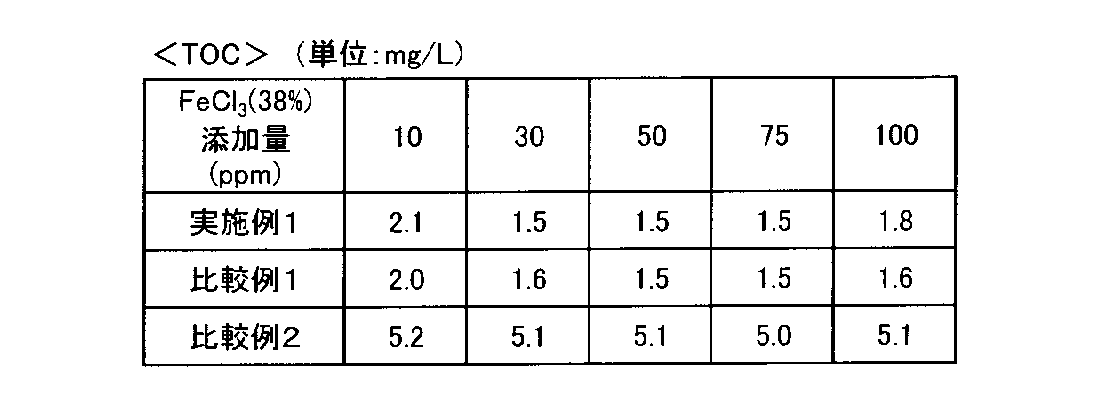
- Example 1 In Example 1, the MFF value and the TOC concentration were examined in the same manner except that the pH of the aerobic biological treatment tank was adjusted to 6.8 to 7.0. The results are shown in Tables 1 and 2.
- Example 2 In Example 1, the MFF value and the TOC concentration were examined in the same manner except that the pH of the aerobic biological treatment tank was adjusted to 4.8 to 5.0. The results are shown in Tables 1 and 2.
- Tables 1 and 2 show the following.
- Example 1 the addition of FeCl 3 30 mg / L resulted in a low MFF value of 1.1 and a TOC of 1.5 mg / L, both of which were good for supplying to the RO membrane.
- the TOC was not significantly different from that in the Example, but the MFF value was not lowered to 1.1 unless FeCl 3 was added to 75 mg / L. This is presumably because FeCl 3 was consumed by the alkalinity remaining in the aerobic biologically treated water, and aggregation was insufficient at 30 mg / L.
- Comparative Example 2 even when FeCl 3 100 mg / L was added, TOC remained about 5 mg / L and was not reduced by aggregation. This is presumably because the pH of the aerobic biological treatment tank is low, organic matter removal becomes insufficient, and low molecular organic substances contained in the liquid crystal factory effluent remain.
Landscapes
- Chemical & Material Sciences (AREA)
- Engineering & Computer Science (AREA)
- Water Supply & Treatment (AREA)
- Life Sciences & Earth Sciences (AREA)
- Hydrology & Water Resources (AREA)
- Environmental & Geological Engineering (AREA)
- Organic Chemistry (AREA)
- Chemical Kinetics & Catalysis (AREA)
- Microbiology (AREA)
- Biodiversity & Conservation Biology (AREA)
- Nanotechnology (AREA)
- Separation Using Semi-Permeable Membranes (AREA)
- Separation Of Suspended Particles By Flocculating Agents (AREA)
- General Chemical & Material Sciences (AREA)
- Materials Engineering (AREA)
- Inorganic Chemistry (AREA)
- Activated Sludge Processes (AREA)
- Purification Treatments By Anaerobic Or Anaerobic And Aerobic Bacteria Or Animals (AREA)
Abstract
Description
本発明において、処理対象となる有機性排水は、通常生物処理される有機物含有排水であれば良く、特に限定されるものではないが、例えば、電子産業排水、化学工場排水、食品工場排水などが挙げられる。例えば、電子部品製造プロセスでは、現像工程、剥離工程、エッチング工程、洗浄工程などから各種の有機物含有排水が多量に発生し、しかも排水を回収して純水レベルに浄化して再使用することが望まれているので、これらの排水は本発明の処理対象排水として適している。
原水を嫌気的に生物処理するための嫌気性生物処理手段としては、有機物の分解効率に優れるものであれば良く、既知の嫌気性生物処理方式の生物反応槽が使用できる。
本発明において、好気性生物処理は、活性汚泥を担体に付着させて保持する生物膜方式により一過式で処理を行う。なお、好気性生物処理の一過式処理は、汚泥の沈降分離や返送、引抜きによる濃度管理が不要で、運転管理が容易である。また、後段で発生したSSを凝集して除去する際、生物処理で除去しきれない残存有機物も一部除去できる。
原水を嫌気的に生物処理した後好気的に生物処理して得られる好気性生物処理水は、後段の固液分離手段で微生物体と高分子有機物質を確実に除去するために、固液分離に先立ち、凝集処理される。好気性生物処理水の凝集処理には、通常の凝集処理装置が用いられる。この凝集処理装置の凝集槽は1槽のみでも良く、2槽以上を多段に設けてもよい。
好気性生物処理水を凝集処理して得られる凝集処理水の固液分離手段としては、沈殿槽、浮上槽、遠心分離機等、特に限定されないが、生物処理水の凝集フロックは浮上分離しやすく、また沈殿槽に比べ、小さい面積の装置で良いことから、特に加圧浮上槽、とりわけ凝集加圧浮上槽がコンパクトで好ましい。また、好気性生物処理水の固液分離には浸漬膜等の膜分離手段を用いても良い。
固液分離により得られた分離水は、次いでRO膜分離装置で処理することにより、分離水中に残留する溶存有機物と溶存塩類を除去する。
下記水質の液晶工場の有機性排水を原水として、1.6L/dの処理水量で処理を行った。
<原水水質>
pH:10
TOC:100mg/L
T-N:20mg-N/L
PO4-P:0.5mg-P/L
(その他微量金属、ミネラルを栄養剤として添加)
<嫌気性生物処理槽>
槽容量:4L(直径10cm×高さ50cmの円筒状)
温度:30℃
ビール工場排水処理施設の嫌気グラニュールを種汚泥として0.8L、ポリプロピレン製円筒状担体(φ3mm×5mm)を1.6L投入し、2ヶ月馴養したもの
<好気性生物処理槽>
槽容量:4L
ポリウレタンスポンジ(3mm角)を40%の充填率で添加し、ビール工場排水処理施設の活性汚泥(MLSS約6,000mg/L)を種汚泥として投入して3週間馴養したもの
pH5.8~6.0
実施例1において、好気性生物処理槽のpHを6.8~7.0に調整したこと以外は同様に行って、MFF値及びTOC濃度を調べ、結果を表1,2に示した。
実施例1において、好気性生物処理槽のpHを4.8~5.0に調整したこと以外は同様に行って、MFF値及びTOC濃度を調べ、結果を表1,2に示した。

本出願は、2013年3月29日付で出願された日本特許出願2013-074167に基づいており、その全体が引用により援用される。
Claims (12)
- 有機性排水を嫌気的に生物処理する嫌気性生物処理工程と、該嫌気性生物処理工程から流出する嫌気性生物処理水を好気的に生物処理する好気性生物処理工程と、該好気性生物処理工程から流出する好気性生物処理水に凝集剤を添加して凝集させた後固液分離する固液分離工程と、該固液分離工程で分離された分離水を処理する逆浸透膜分離工程とを有する有機性排水の処理方法において、
該好気性生物処理工程が、pH5.5~6.5の条件下に、担体に付着した好気性微生物により一過式で処理する工程であることを特徴とする有機性排水の処理方法。 - 請求項1において、前記好気性生物処理工程におけるpH条件がpH5.8~6.3であることを特徴とする有機性排水の処理方法。
- 請求項1又は2において、前記好気性生物処理工程において、前記嫌気性生物処理水を好気性生物処理槽に受け入れて好気的に生物処理する方法であって、前記担体がスポンジ担体であり、該好気性生物処理槽の担体充填率が10~50%であることを特徴とする有機性排水の処理方法。
- 請求項1ないし3のいずれか1項において、前記凝集剤が鉄系凝集剤であることを特徴とする有機性排水の処理方法。
- 請求項4において、前記鉄系凝集剤が塩化第二鉄であり、その添加量がFeCl3(38%)の添加量として30~80体積ppmであることを特徴とする有機性排水の処理方法。
- 請求項1ないし5のいずれか1項において、前記分離水を膜濾過した濾過水を前記逆浸透膜分離工程で処理することを特徴とする有機性排水の処理方法。
- 有機性排水を嫌気的に生物処理する嫌気性生物処理手段と、
該嫌気性生物処理手段から流出する嫌気性生物処理水を好気的に生物処理する好気性生物処理手段と、
該好気性生物処理手段から流出する好気性生物処理水に凝集剤を添加する凝集剤添加手段と、
該凝集剤が添加された水を固液分離する固液分離手段と、
該固液分離手段で分離された分離水を処理する逆浸透膜分離手段とを有する有機性排水の処理装置において、
該好気性生物処理手段は、pH5.5~6.5の条件下に、担体に付着した好気性微生物により一過式で処理する手段であることを特徴とする有機性排水の処理装置。 - 請求項7において、前記好気性生物処理手段におけるpH条件がpH5.8~6.3であることを特徴とする有機性排水の処理装置。
- 請求項7又は8において、前記好気性生物処理手段は、前記嫌気性生物処理水を受け入れて好気的に生物処理する好気性生物処理槽であり、前記担体がスポンジ担体であって、該好気性生物処理槽の担体充填率が10~50%であることを特徴とする有機性排水の処理装置。
- 請求項7ないし9のいずれか1項において、前記凝集剤が鉄系凝集剤であることを特徴とする有機性排水の処理装置。
- 請求項10において、前記鉄系凝集剤が塩化第二鉄であり、その添加量がFeCl3(38%)の添加量として30~80体積ppmであることを特徴とする有機性排水の処理装置。
- 請求項7ないし11のいずれか1項において、前記分離水を膜濾過する膜濾過装置を有し、該膜濾過装置の濾過水が前記逆浸透膜分離手段で処理されることを特徴とする有機性排水の処理装置。
Priority Applications (2)
| Application Number | Priority Date | Filing Date | Title |
|---|---|---|---|
| KR1020157024824A KR102078434B1 (ko) | 2013-03-29 | 2013-12-06 | 유기성 배수의 처리 방법 및 처리 장치 |
| CN201380075163.XA CN105073653A (zh) | 2013-03-29 | 2013-12-06 | 有机性排水的处理方法及处理装置 |
Applications Claiming Priority (2)
| Application Number | Priority Date | Filing Date | Title |
|---|---|---|---|
| JP2013074167A JP5874672B2 (ja) | 2013-03-29 | 2013-03-29 | 有機性排水の処理方法及び処理装置 |
| JP2013-074167 | 2013-03-29 |
Publications (1)
| Publication Number | Publication Date |
|---|---|
| WO2014155845A1 true WO2014155845A1 (ja) | 2014-10-02 |
Family
ID=51622879
Family Applications (1)
| Application Number | Title | Priority Date | Filing Date |
|---|---|---|---|
| PCT/JP2013/082782 Ceased WO2014155845A1 (ja) | 2013-03-29 | 2013-12-06 | 有機性排水の処理方法及び処理装置 |
Country Status (5)
| Country | Link |
|---|---|
| JP (1) | JP5874672B2 (ja) |
| KR (1) | KR102078434B1 (ja) |
| CN (1) | CN105073653A (ja) |
| TW (1) | TWI633067B (ja) |
| WO (1) | WO2014155845A1 (ja) |
Cited By (3)
| Publication number | Priority date | Publication date | Assignee | Title |
|---|---|---|---|---|
| CN108658395A (zh) * | 2018-06-27 | 2018-10-16 | 贵州楚天环保有限公司 | 一种制药污水处理系统及工艺 |
| CN111285547A (zh) * | 2020-03-06 | 2020-06-16 | 上海东振环保工程技术有限公司 | 一种显影液废液处理方法 |
| CN118812106A (zh) * | 2024-09-18 | 2024-10-22 | 沃世诺科技(诸暨)有限公司 | 生活垃圾填埋场渗滤液全量化无害化处理系统及工艺 |
Families Citing this family (1)
| Publication number | Priority date | Publication date | Assignee | Title |
|---|---|---|---|---|
| CN104671499B (zh) * | 2015-02-01 | 2016-04-27 | 山西太钢不锈钢股份有限公司 | 冶炼综合污水深度处理分质回用方法 |
Citations (7)
| Publication number | Priority date | Publication date | Assignee | Title |
|---|---|---|---|---|
| JP2003094088A (ja) * | 2001-09-21 | 2003-04-02 | Ataka Construction & Engineering Co Ltd | 水処理装置 |
| JP2007175582A (ja) * | 2005-12-27 | 2007-07-12 | Kurita Water Ind Ltd | 有機物含有排水の処理装置及び処理方法 |
| WO2007086240A1 (ja) * | 2006-01-25 | 2007-08-02 | Kuraray Co., Ltd. | 固定化担体を利用した排水処理方法 |
| JP2008200639A (ja) * | 2007-02-22 | 2008-09-04 | Kurita Water Ind Ltd | 有機物含有水の生物処理方法 |
| JP2009297688A (ja) * | 2008-06-17 | 2009-12-24 | Kurita Water Ind Ltd | 有機物含有水の生物処理方法 |
| JP2010029767A (ja) * | 2008-07-28 | 2010-02-12 | Kurita Water Ind Ltd | 有機性排水の処理方法及び処理装置 |
| JP2010253397A (ja) * | 2009-04-24 | 2010-11-11 | Sumitomo Electric Ind Ltd | 膜分離活性汚泥処理装置 |
Family Cites Families (2)
| Publication number | Priority date | Publication date | Assignee | Title |
|---|---|---|---|---|
| JP2661093B2 (ja) * | 1988-02-01 | 1997-10-08 | 味の素株式会社 | 活性汚泥法による廃水処理方法 |
| JP4997724B2 (ja) * | 2005-08-02 | 2012-08-08 | 栗田工業株式会社 | 有機性排水の処理方法 |
-
2013
- 2013-03-29 JP JP2013074167A patent/JP5874672B2/ja active Active
- 2013-12-06 CN CN201380075163.XA patent/CN105073653A/zh active Pending
- 2013-12-06 KR KR1020157024824A patent/KR102078434B1/ko active Active
- 2013-12-06 WO PCT/JP2013/082782 patent/WO2014155845A1/ja not_active Ceased
-
2014
- 2014-02-25 TW TW103106258A patent/TWI633067B/zh active
Patent Citations (7)
| Publication number | Priority date | Publication date | Assignee | Title |
|---|---|---|---|---|
| JP2003094088A (ja) * | 2001-09-21 | 2003-04-02 | Ataka Construction & Engineering Co Ltd | 水処理装置 |
| JP2007175582A (ja) * | 2005-12-27 | 2007-07-12 | Kurita Water Ind Ltd | 有機物含有排水の処理装置及び処理方法 |
| WO2007086240A1 (ja) * | 2006-01-25 | 2007-08-02 | Kuraray Co., Ltd. | 固定化担体を利用した排水処理方法 |
| JP2008200639A (ja) * | 2007-02-22 | 2008-09-04 | Kurita Water Ind Ltd | 有機物含有水の生物処理方法 |
| JP2009297688A (ja) * | 2008-06-17 | 2009-12-24 | Kurita Water Ind Ltd | 有機物含有水の生物処理方法 |
| JP2010029767A (ja) * | 2008-07-28 | 2010-02-12 | Kurita Water Ind Ltd | 有機性排水の処理方法及び処理装置 |
| JP2010253397A (ja) * | 2009-04-24 | 2010-11-11 | Sumitomo Electric Ind Ltd | 膜分離活性汚泥処理装置 |
Cited By (3)
| Publication number | Priority date | Publication date | Assignee | Title |
|---|---|---|---|---|
| CN108658395A (zh) * | 2018-06-27 | 2018-10-16 | 贵州楚天环保有限公司 | 一种制药污水处理系统及工艺 |
| CN111285547A (zh) * | 2020-03-06 | 2020-06-16 | 上海东振环保工程技术有限公司 | 一种显影液废液处理方法 |
| CN118812106A (zh) * | 2024-09-18 | 2024-10-22 | 沃世诺科技(诸暨)有限公司 | 生活垃圾填埋场渗滤液全量化无害化处理系统及工艺 |
Also Published As
| Publication number | Publication date |
|---|---|
| TWI633067B (zh) | 2018-08-21 |
| KR20150134331A (ko) | 2015-12-01 |
| KR102078434B1 (ko) | 2020-02-17 |
| TW201500298A (zh) | 2015-01-01 |
| JP2014198289A (ja) | 2014-10-23 |
| JP5874672B2 (ja) | 2016-03-02 |
| CN105073653A (zh) | 2015-11-18 |
Similar Documents
| Publication | Publication Date | Title |
|---|---|---|
| JP5223219B2 (ja) | 有機性排水の処理装置 | |
| JP5315587B2 (ja) | 有機物含有排水の処理装置及び処理方法 | |
| KR101804555B1 (ko) | 고농도 유기오염물질 제거를 위한 하수 폐수 고도 처리 시스템 및 이를 이용한 하수 폐수 고도 처리방법. | |
| Mutamim et al. | Application of membrane bioreactor technology in treating high strength industrial wastewater: a performance review | |
| KR101467476B1 (ko) | 유기물 함유수의 생물처리방법 | |
| JP6727056B2 (ja) | 排水処理装置及び排水処理方法 | |
| JP4862361B2 (ja) | 排水処理装置及び排水処理方法 | |
| CN101274800A (zh) | 膜分离活性污泥装置 | |
| CN206069622U (zh) | 污水生物处理装置 | |
| CN103796957B (zh) | 有机排水的回收处理装置和回收处理方法 | |
| JP2012206040A (ja) | 有機物含有排水の処理方法及び有機物含有排水の処理装置 | |
| JP5874672B2 (ja) | 有機性排水の処理方法及び処理装置 | |
| JP5017854B2 (ja) | 有機物含有排水の処理装置及び処理方法 | |
| JP2014198290A (ja) | 有機性排水の処理装置及び処理方法 | |
| JP4997724B2 (ja) | 有機性排水の処理方法 | |
| JP2018176131A (ja) | アンモニア性窒素含有排水の脱窒処理装置及び脱窒処理方法 | |
| JP4655570B2 (ja) | 有機性窒素化合物を含有する排水の処理装置 | |
| JP5558866B2 (ja) | 水処理装置及び水処理方法 | |
| JP2011212585A (ja) | 有機物含有排水の処理方法及び装置 | |
| JP2022146502A (ja) | 有機排水の処理装置 |
Legal Events
| Date | Code | Title | Description |
|---|---|---|---|
| WWE | Wipo information: entry into national phase |
Ref document number: 201380075163.X Country of ref document: CN |
|
| 121 | Ep: the epo has been informed by wipo that ep was designated in this application |
Ref document number: 13879884 Country of ref document: EP Kind code of ref document: A1 |
|
| ENP | Entry into the national phase |
Ref document number: 20157024824 Country of ref document: KR Kind code of ref document: A |
|
| NENP | Non-entry into the national phase |
Ref country code: DE |
|
| 122 | Ep: pct application non-entry in european phase |
Ref document number: 13879884 Country of ref document: EP Kind code of ref document: A1 |