WO2014148559A1 - 光学フィルム、それを用いた偏光板および液晶表示装置 - Google Patents
光学フィルム、それを用いた偏光板および液晶表示装置 Download PDFInfo
- Publication number
- WO2014148559A1 WO2014148559A1 PCT/JP2014/057563 JP2014057563W WO2014148559A1 WO 2014148559 A1 WO2014148559 A1 WO 2014148559A1 JP 2014057563 W JP2014057563 W JP 2014057563W WO 2014148559 A1 WO2014148559 A1 WO 2014148559A1
- Authority
- WO
- WIPO (PCT)
- Prior art keywords
- group
- carbon atoms
- film
- cellulose acylate
- optical film
- Prior art date
- Legal status (The legal status is an assumption and is not a legal conclusion. Google has not performed a legal analysis and makes no representation as to the accuracy of the status listed.)
- Ceased
Links
- 0 *c(cc1*)cc(-[n]2nc(cccc3)c3n2)c1O Chemical compound *c(cc1*)cc(-[n]2nc(cccc3)c3n2)c1O 0.000 description 1
Images

Classifications
-
- G—PHYSICS
- G02—OPTICS
- G02B—OPTICAL ELEMENTS, SYSTEMS OR APPARATUS
- G02B1/00—Optical elements characterised by the material of which they are made; Optical coatings for optical elements
- G02B1/04—Optical elements characterised by the material of which they are made; Optical coatings for optical elements made of organic materials, e.g. plastics
-
- G—PHYSICS
- G02—OPTICS
- G02F—OPTICAL DEVICES OR ARRANGEMENTS FOR THE CONTROL OF LIGHT BY MODIFICATION OF THE OPTICAL PROPERTIES OF THE MEDIA OF THE ELEMENTS INVOLVED THEREIN; NON-LINEAR OPTICS; FREQUENCY-CHANGING OF LIGHT; OPTICAL LOGIC ELEMENTS; OPTICAL ANALOGUE/DIGITAL CONVERTERS
- G02F1/00—Devices or arrangements for the control of the intensity, colour, phase, polarisation or direction of light arriving from an independent light source, e.g. switching, gating or modulating; Non-linear optics
- G02F1/01—Devices or arrangements for the control of the intensity, colour, phase, polarisation or direction of light arriving from an independent light source, e.g. switching, gating or modulating; Non-linear optics for the control of the intensity, phase, polarisation or colour
- G02F1/13—Devices or arrangements for the control of the intensity, colour, phase, polarisation or direction of light arriving from an independent light source, e.g. switching, gating or modulating; Non-linear optics for the control of the intensity, phase, polarisation or colour based on liquid crystals, e.g. single liquid crystal display cells
- G02F1/133—Constructional arrangements; Operation of liquid crystal cells; Circuit arrangements
- G02F1/1333—Constructional arrangements; Manufacturing methods
- G02F1/1335—Structural association of cells with optical devices, e.g. polarisers or reflectors
- G02F1/133528—Polarisers
-
- G—PHYSICS
- G02—OPTICS
- G02B—OPTICAL ELEMENTS, SYSTEMS OR APPARATUS
- G02B1/00—Optical elements characterised by the material of which they are made; Optical coatings for optical elements
- G02B1/10—Optical coatings produced by application to, or surface treatment of, optical elements
- G02B1/14—Protective coatings, e.g. hard coatings
-
- G—PHYSICS
- G02—OPTICS
- G02B—OPTICAL ELEMENTS, SYSTEMS OR APPARATUS
- G02B5/00—Optical elements other than lenses
- G02B5/30—Polarising elements
- G02B5/3025—Polarisers, i.e. arrangements capable of producing a definite output polarisation state from an unpolarised input state
-
- G—PHYSICS
- G02—OPTICS
- G02B—OPTICAL ELEMENTS, SYSTEMS OR APPARATUS
- G02B5/00—Optical elements other than lenses
- G02B5/30—Polarising elements
- G02B5/3025—Polarisers, i.e. arrangements capable of producing a definite output polarisation state from an unpolarised input state
- G02B5/3033—Polarisers, i.e. arrangements capable of producing a definite output polarisation state from an unpolarised input state in the form of a thin sheet or foil, e.g. Polaroid
-
- C—CHEMISTRY; METALLURGY
- C09—DYES; PAINTS; POLISHES; NATURAL RESINS; ADHESIVES; COMPOSITIONS NOT OTHERWISE PROVIDED FOR; APPLICATIONS OF MATERIALS NOT OTHERWISE PROVIDED FOR
- C09K—MATERIALS FOR MISCELLANEOUS APPLICATIONS, NOT PROVIDED FOR ELSEWHERE
- C09K2323/00—Functional layers of liquid crystal optical display excluding electroactive liquid crystal layer characterised by chemical composition
- C09K2323/03—Viewing layer characterised by chemical composition
- C09K2323/035—Ester polymer, e.g. polycarbonate, polyacrylate or polyester
-
- G—PHYSICS
- G02—OPTICS
- G02F—OPTICAL DEVICES OR ARRANGEMENTS FOR THE CONTROL OF LIGHT BY MODIFICATION OF THE OPTICAL PROPERTIES OF THE MEDIA OF THE ELEMENTS INVOLVED THEREIN; NON-LINEAR OPTICS; FREQUENCY-CHANGING OF LIGHT; OPTICAL LOGIC ELEMENTS; OPTICAL ANALOGUE/DIGITAL CONVERTERS
- G02F2201/00—Constructional arrangements not provided for in groups G02F1/00 - G02F7/00
- G02F2201/50—Protective arrangements
-
- Y—GENERAL TAGGING OF NEW TECHNOLOGICAL DEVELOPMENTS; GENERAL TAGGING OF CROSS-SECTIONAL TECHNOLOGIES SPANNING OVER SEVERAL SECTIONS OF THE IPC; TECHNICAL SUBJECTS COVERED BY FORMER USPC CROSS-REFERENCE ART COLLECTIONS [XRACs] AND DIGESTS
- Y10—TECHNICAL SUBJECTS COVERED BY FORMER USPC
- Y10T—TECHNICAL SUBJECTS COVERED BY FORMER US CLASSIFICATION
- Y10T428/00—Stock material or miscellaneous articles
- Y10T428/31504—Composite [nonstructural laminate]
- Y10T428/31971—Of carbohydrate
Definitions
- the present invention relates to an optical film, a polarizing plate using the same, and a liquid crystal display device.
- An optical film such as a cellulose acylate film is used in various liquid crystal display devices as an optical member of a liquid crystal display device, for example, a support for an optical compensation film, a protective film for a polarizing plate, and the like.
- liquid crystal display device In addition to being used indoors, such as for TV applications, the liquid crystal display device has been increasingly used outdoors, for example, mainly for portable devices. Therefore, development of a liquid crystal display device that can withstand use at higher temperatures and higher humidity than before has been demanded. In addition, liquid crystal display devices are increasingly required to endure even under severe usage conditions in various applications, and a higher level of durability than ever has been required year by year.
- a specific compound is contained in the film in order to further improve the performance and solve various problems in the properties and production as an optical film.
- a gelling agent having a specific structure for gelling a cellulose acylate solution see Patent Document 1
- various humidity conditions at high temperatures high humidity, Organic acid with a specific acid dissociation constant for the purpose of improving the durability of polarizers that deteriorate due to low humidity
- Patent Document 2 specified at the 5th position for the purpose of suppressing fluctuations in optical properties that change with humidity Barbituric acid having a substituent of (see Patent Document 3) and the like have been proposed.
- the present invention provides the optical film with sufficient durability even under a severe use environment such as high humidity and low humidity at a high temperature.
- the required level of performance is increasing year by year due to the thinning of the optical film accompanying the thinning of displays in recent years.
- the hardness reduction by a plasticizer is mentioned.
- the present inventor needs not only to form a multilayer structure by applying a hard coat layer or the like from the viewpoint of workability, but also to have an appropriate hardness in the optical film itself. Clarified that there is.
- the adhesiveness between each layer when the optical film is made into a multilayer structure, particularly the adhesiveness with the hard coat layer is lowered, so that it is difficult to achieve both of them. Occurred.
- the present invention is an optical film that has improved durability, particularly high temperature and durability under high and low humidity conditions, hardness and adhesion, and maintains optical characteristics using the same. It is an object to provide a polarizing plate and a liquid crystal display device with improved durability including display unevenness.
- the present inventors have various compounds such as plasticizers, curing agents, ultraviolet absorbers, antioxidants, retardation modifiers, organic acids and the like.
- plasticizers such as plasticizers, curing agents, ultraviolet absorbers, antioxidants, retardation modifiers, organic acids and the like.
- the substituents of barbituric acid and the above three viewpoints were evaluated for each viewpoint, and these relations were superimposed as a single figure. As a result, a region satisfying any performance within a specific range was obtained. I found it. Based on this, a new compound was synthesized and confirmed, and the present invention was completed.
- each of R 1 and R 3 independently represents a hydrogen atom, an alkyl group having 1 to 20 carbon atoms, a cycloalkyl group having 3 to 20 carbon atoms, an alkenyl group having 2 to 20 carbon atoms or a carbon atom.
- R 5 represents a hydrogen atom, an unsubstituted alkyl group having 1 to 20 carbon atoms, a cycloalkyl group having 3 to 20 carbon atoms, an alkenyl group having 2 to 20 carbon atoms, or an aralkyl group represented by the following formula (1).
- the total number of ring structures present in R 1 , R 3 and R 5 is 1 or 2.
- L 5 represents an alkylene group having 1 to 20 carbon atoms.
- Ar 5 represents an aromatic group having 6 to 20 carbon atoms.
- R 5 in the general formula (I) is an unsubstituted alkyl group having 1 to 20 carbon atoms, a cycloalkyl group having 3 to 20 carbon atoms, or an aralkyl group represented by the formula (1).
- ⁇ 3> The optical film according to ⁇ 1> or ⁇ 2>, wherein R 5 in the general formula (I) is an aralkyl group represented by the formula (1).
- ⁇ 4> The optical film according to any one of ⁇ 1> to ⁇ 3>, wherein L 5 in the formula (1) is a group represented by the following formula (1-2).
- R 51 and R 52 each independently represent a hydrogen atom, an alkyl group having 1 to 19 carbon atoms, a cycloalkyl group having 3 to 19 carbon atoms, an alkenyl group having 2 to 19 carbon atoms, or Represents an aromatic group having 6 to 19 carbon atoms.
- n represents an integer of 1 to 20.
- Ar 5 in Formula (1) is an aromatic group having 6 to 20 carbon atoms which is unsubstituted or substituted with a substituent having a negative Hammett's substituent constant ⁇ p.
- ⁇ 1> to ⁇ 5> The optical film in any one of.
- ⁇ 7> The optical film according to any one of ⁇ 1> to ⁇ 6>, wherein R 3 and R 5 in the general formula (I) each have one aromatic ring structure.
- ⁇ 8> The optical film according to any one of ⁇ 1> to ⁇ 7>, wherein R 5 in the general formula (I) is Hammett's substituent constants ⁇ p and ⁇ m are both negative.
- ⁇ 9> The optical film according to any one of ⁇ 1> to ⁇ 8>, wherein the total acyl substitution degree A of the cellulose acylate satisfies the following formula.
- acyl group of the cellulose acylate is an acetyl group and the total acetyl substitution degree B is a cellulose acylate satisfying the following formula.
- the optical film comprises at least two layers, and further comprises a hard coat layer in a layer containing cellulose acylate and at least one compound represented by the general formula (I).
- the optical film in any one.
- a liquid crystal display device having at least the polarizing plate according to ⁇ 12> and a liquid crystal cell.
- a numerical range represented by using “to” means a range including numerical values described before and after that as a lower limit value and an upper limit value.
- a group that can have a substituent may have a substituent.
- an alkyl group is an alkyl group that may have a substituent
- an aryl group or an aromatic group is an aryl group or an aromatic group that may have a substituent.
- these substituents may be bonded to each other to form a ring.
- a plurality of groups with the same sign are present, or when a plurality of groups with the same sign are present as a result of a plurality of repetitions, these may be the same or different from each other.
- substituents and linking groups hereinafter referred to as substituents and the like
- substituents and the like when a plurality of substituents and linking groups (hereinafter referred to as substituents and the like) are specified simultaneously or alternatively, the respective substituents and the like may be the same or different from each other.
- the optical film of the present invention has improved durability, especially in high humidity and low humidity conditions at high temperatures, and improved hardness and adhesion, and has higher performance than conventional optical films. Demonstrate.
- the polarizing plate and the liquid crystal display device using the optical film of the present invention as a protective film for a polarizer in the polarizing plate have improved durability including optical characteristics and display unevenness.
- FIG. 1 is an example schematically showing the internal structure of the liquid crystal display device of the present invention.
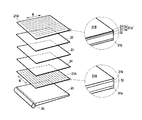
- FIG. 2 is an exploded perspective view schematically showing the internal structure of another liquid crystal display device of the present invention.
- the optical film of the present invention comprises at least one cellulose acylate film containing cellulose acylate and at least one compound represented by the general formula (I). Further, the cellulose acylate film may be composed of a plurality of layers, but the compound represented by the general formula (I) may be contained in any layer, and is contained in all layers. Also good. It should be noted that the thickest layer in the optical film, that is, the base layer, for example, when both surfaces of the thickest layer are laminated with a cellulose acylate film having a protective function, this center It is effective to include the compound represented by the general formula (I) in the base layer which is a layer of
- the cellulose acylate film or layer means that the resin component constituting the film or layer contains 50% by mass or more of cellulose acylate, and the content of cellulose acylate in the resin component is 60 mass% or more is preferable, 80 mass% or more is more preferable, 90 mass% or more is further more preferable, and 95 mass% or more is especially preferable.
- the upper limit of the cellulose acylate content is not particularly limited, but 100% by mass is practical.
- the optical film of the present invention includes, in addition to the cellulose acylate film as described above, as a resin component, it does not contain cellulose acylate, or even if it contains it, it is a multilayer structure with a layer of less than 50% by mass of the entire resin component May be formed.
- a functional layer specialized for a specific function, such as a hard coat layer.
- Other than the hard coat layer for example, an antiglare layer, a clear hard coat layer, an antireflection layer, an antistatic layer, an antifouling layer, a light scattering layer and the like can be mentioned.
- These functional layers may serve as a plurality of functions in one layer, but providing them on the hard coat layer is a preferred embodiment in the present invention.
- the optical film of the present invention is useful for various applications such as a polarizing plate protective film and a surface protective film disposed on an image display surface.
- the optical film of the present invention has high hardness and excellent adhesion between layers in the case of a cellulose acylate film and a layer other than cellulose acylate (preferably a hard coat layer). Therefore, it is suitable for use as a polarizing plate protective film.
- the cellulose acylate film is a film having a cellulose acylate ratio of 50% by mass or more in the resin component, and is a narrowly defined optical film in the present invention.
- the cellulose acylate film may be a single layer or a laminate of two or more layers.
- a two-layer structure or a three-layer structure is more preferable, and a three-layer structure is preferable.
- the cellulose acylate film of the present invention preferably has a three-layer structure of skin layer B / core layer / skin layer A.
- the skin layer A is a layer in contact with a metal support described later when the cellulose acylate film is produced by solution casting, and the skin layer B is a layer on the air interface opposite to the metal support.
- Skin layer A and skin layer B are also collectively referred to as a skin layer (or surface layer).
- the cellulose acylate film contains cellulose acylate and at least one compound represented by the following general formula (I).
- each of R 1 and R 3 independently represents a hydrogen atom, an alkyl group having 1 to 20 carbon atoms, a cycloalkyl group having 3 to 20 carbon atoms, an alkenyl group having 2 to 20 carbon atoms or a carbon atom.
- R 5 represents a hydrogen atom, an unsubstituted alkyl group having 1 to 20 carbon atoms, a cycloalkyl group having 3 to 20 carbon atoms, an alkenyl group having 2 to 20 carbon atoms, or an aralkyl group represented by the following formula (1).
- the total number of ring structures present in R 1 , R 3 and R 5 is 1 or 2.
- L 5 represents an alkylene group having 1 to 20 carbon atoms.
- Ar 5 represents an aromatic group having 6 to 20 carbon atoms. * Is a position connected to the ring structure of the general formula (I).
- the compound represented by the general formula (I) is present in the vicinity of the main chain of the cellulose acylate to reduce the free volume, and by hydrogen bonding with the cellulose acylate and further interacting with this hydrogen bond to approach.
- the ring structure portion of the barbituric acid compound contributes to the improvement or maintenance of hardness, for example, by filling in the space created by ⁇ -glucose of the adjacent polymer molecule and filling the free space.
- the compound represented by the general formula (I) is contained in the cellulose acylate film, thereby improving the durability of the polarizer provided with the optical film of the present invention, and thus display unevenness hardly occurs. Contributes to the provision of liquid crystal display devices.
- the compound represented by the general formula (I) greatly contributes to exhibiting high adhesion between the cellulose acylate film and the hard coat layer, which are easily deteriorated by light irradiation, over a long period of time.
- the number of carbon atoms of the alkyl group represented by R 1 and R 3 in the general formula (I) is preferably 1 to 10, more preferably 1 to 5, and still more preferably 1 to 3, and the alkyl group of R 1 and R 3 is methyl. Particularly preferred is a group or an ethyl group.
- the number of carbon atoms of the cycloalkyl group of R 1 and R 3 is preferably 3 to 10, and more preferably 5 or 6.
- Examples of the cycloalkyl group include a cyclopropyl group, a cyclopentyl group, and a cyclohexyl group, and a cyclohexyl group is particularly preferable.
- the alkenyl group of R 1 and R 3 preferably has 2 to 10 carbon atoms, and more preferably 2 to 5 carbon atoms.
- the carbon number of the aromatic group of R 1 and R 3 is preferably 6 to 12, and more preferably 6 to 10.
- the aromatic group of R 1 and R 3 may be an aromatic hydrocarbon group or an aromatic heterocyclic group, but is preferably an aromatic hydrocarbon group.
- As the aromatic hydrocarbon group a phenyl group and a naphthyl group are preferable, and a phenyl group is more preferable.
- R 1 and R 3 are each independently a hydrogen atom, an alkyl group having 1 to 20 carbon atoms, more preferably an aromatic group having a cycloalkyl group or a C 6-20 carbon atoms 3 to 20
- R 1 and R 3 is more preferably an alkyl group having 1 to 20 carbon atoms, a cycloalkyl group having 3 to 20 carbon atoms, or an aromatic hydrocarbon group having 6 to 20 carbon atoms, and any one of R 1 and R 3 Is most preferably an aromatic hydrocarbon group having 6 to 20 carbon atoms.
- each group in R 1 and R 3 may have the following substituent S.
- “20”, which is a preferable upper limit of the number of carbon atoms in the substituent S, is an upper limit value that satisfies the total number of carbon atoms defined by R 1 and R 3 .
- the upper limit “20” of the preferable carbon number of the substituent S substituted thereon is read as “19”, and in the case of a cycloalkyl group having 3 to 20 carbon atoms, The upper limit of “20” is read as “17”, and in the case of an alkenyl group having 2 to 20 carbon atoms, the upper limit of “20” is read as “18” and is an aromatic group having 6 to 20 carbon atoms. In this case, the upper limit “20” described is read as “14”. Note that, in cases other than R 1 and R 3 as well, when the total number of carbon atoms is defined, the same as above.
- an alkyl group preferably having 1 to 20 carbon atoms, eg, methyl, ethyl, isopropyl, t-butyl, pentyl, heptyl, 1-ethylpentyl, 2-ethylhexyl, benzyl, 2-ethoxyethyl, 1 -Carboxymethyl, etc.
- alkenyl groups preferably having 2 to 20 carbon atoms, such as vinyl, allyl, oleyl, etc.
- alkynyl groups preferably having 2 to 20 carbon atoms, such as ethynyl, 2-butynyl, phenylethynyl, etc.
- a cycloalkyl group preferably having 3 to 20 carbon atoms such as cyclopropyl, cyclopentyl, cyclohexyl, 4-methylcyclohexyl, etc.
- an aryl group preferably having 1 to 20 carbon atoms, eg
- the ring may be a saturated ring, an unsaturated ring, or an aromatic ring.
- 2-pyridyl, 4-pyridyl, 2-imidazolyl, 2-benzoimidazolyl, 2-thiazolyl, 2-oxazolyl, etc. alkoxy A group (preferably having 1 to 20 carbon atoms such as methoxy, ethoxy, isopropyloxy, benzyloxy, etc.), an aryloxy group (preferably having 6 to 20 carbon atoms such as phenoxy, 1-naphthyloxy, 3-methyl, etc. Phenoxy, 4-methoxyphenoxy, etc.),
- alkylthio group preferably having 1 to 20 carbon atoms, for example, methylthio, ethylthio, isopropylthio, benzylthio, etc.
- an arylthio group preferably having 6 to 20 carbon atoms, for example, phenylthio, 1-naphthylthio, 3-methylphenylthio, etc.
- acyl groups including alkylcarbonyl groups, alkenylcarbonyl groups, arylcarbonyl groups, and heterocyclic carbonyl groups, preferably having 20 or less carbon atoms, for example, acetyl, pivaloyl, acryloyl, metachloroyl, benzoyl , Nicotinoyl, etc.
- alkoxycarbonyl groups preferably having 2 to 20 carbon atoms, such as ethoxycarbonyl, 2-ethylhexyloxycarbonyl, etc.
- aryloxycarbonyl groups preferably having 7 to 20 carbon atoms, such as phenyl Xyloxycarbonyl, naphthyloxycarbonyl, etc.
- amino groups including amino groups, alkylamino groups, arylamino groups, heterocyclic amino groups, preferably having 0 to 20 carbon atoms such as amino, N, N-dimethylamino,
- the substituent S that R 1 and R 3 may have may further have the same or different substituent S.
- each group of R 1 and R 3 may have is preferably an alkyl group, an aryl group, an alkoxy group, an acyl group or a halogen atom, more preferably an alkyl group, an aryl group, an alkoxy group or an acyl group. .
- the cycloalkyl group having 3 to 20 carbon atoms and the alkenyl group having 2 to 20 carbon atoms in R 5 are synonymous with the cycloalkyl group and alkenyl group in R 1 and R 3 , respectively, and the preferred range is also the same.
- the unsubstituted alkyl group having 1 to 20 carbon atoms in R 5 is synonymous with the alkyl group in R 1 and R 3 except that it has no substituent, but preferably has 1 to 10 carbon atoms. 5 is more preferable, and 1 to 4 is more preferable.
- the aralkyl group in which R 5 is represented by the above formula (1) will be described below.
- the total number of carbon atoms in the aralkyl group represented by the formula (1) is preferably 21 or less, more preferably 7-20.
- the number of carbon atoms of the alkylene group in L 5 in the formula (1) is preferably 1 to 10, more preferably 1 to 6, further preferably 1 or 2, and particularly preferably 1.
- L 5 may have a substituent.
- substituent S examples of the substituent include substituent S.
- the substituent which the alkylene group of L 5 may be substituted is preferably an alkyl group, a cycloalkyl group, an alkenyl group or an aromatic group.
- a substituent alkylene group may be substituted and L 5 further substituents, for example may have a substituent group S.
- Examples of such a substituent include an alkyl group substituted with one or more alkylcarbonyl groups (see, for example, compounds (18) and (19) exemplified later), an alkyl group substituted with a benzoyl group, specifically, Includes a phenacyl group (benzoylmethyl group) (see the same compound (23)).
- L 5 is preferably a group represented by the following formula (1-2).
- R 51 and R 52 each independently represent a hydrogen atom, an alkyl group having 1 to 19 carbon atoms, a cycloalkyl group having 3 to 19 carbon atoms, an alkenyl group having 2 to 19 carbon atoms, or Represents an aromatic group having 6 to 19 carbon atoms.
- n represents an integer of 1 to 20.
- R 51 and R 52 are the same as R 1 and R 3 , respectively, and preferred ones are also the same.
- R 51 and R 52 are each independently preferably a hydrogen atom, an alkyl group having 1 to 19 carbon atoms, or an aromatic group having 6 to 19 carbon atoms, and at least one of them is preferable from the viewpoint of stability during film formation and durability.
- Is preferably a hydrogen atom.
- R 51 is preferably a hydrogen atom
- R 52 is preferably a hydrogen atom, an alkyl group having 1 to 19 carbon atoms, or an aromatic group having 6 to 19 carbon atoms
- R 51 is a hydrogen atom.
- R 52 is more preferably a hydrogen atom or an aromatic group having 6 to 19 carbon atoms, and it is particularly preferable that both R 51 and R 52 are hydrogen atoms.
- L 5 may be a branched alkylene group or a linear alkylene group in which at least one of R 51 or R 52 is an alkyl group having 1 to 19 carbon atoms, but is preferably a linear alkylene group.
- Suitable linear alkylene groups include alkylene groups in which R 51 and R 52 in the above formula (1-2) are all hydrogen atoms.
- n is preferably an integer of 1 to 10, more preferably an integer of 1 to 5, more preferably an integer of 1 to 3, and particularly preferably 1 or 2.
- the alkylene group of L 5 represented by formula (1-2) having particularly preferable n is preferably an alkylene group linked via 1 or 2 carbon atoms, that is, a methylene group or an ethylene group.
- Ar 5 is linked to the ring structure of the general formula (I).
- the aromatic group having 6 to 20 carbon atoms has the same meaning as the aromatic group in R 1 and R 3 , and the preferred range is also the same.
- the aromatic group of Ar 5 may have a substituent, and examples of the substituent include the substituent S.
- a substituent having a negative Hammett's substituent constant ⁇ p is preferable in that the entire R 5 can satisfy the Hammett's condition described later.
- substituents that the aromatic group may have preferred substituents are, for example, an optionally substituted alkyl group having 1 to 4 carbon atoms, a cycloalkyl group having 3 to 6 carbon atoms, Examples thereof include an alkoxy group having 1 to 6 carbon atoms and an amino group.
- a methyl group ( ⁇ p: ⁇ 0.17, ⁇ m: ⁇ 0.07), an ethyl group ( ⁇ p: ⁇ 0.15, ⁇ m: ⁇ 0.07), an n-propyl group ( ⁇ p: ⁇ 0.13, ⁇ m: ⁇ 0.06), n-butyl group ( ⁇ p: ⁇ 0.16, ⁇ m: ⁇ 0.08), cyclohexyl group ( ⁇ p: ⁇ 0.15, ⁇ m: ⁇ 0.05), Benzyl group ( ⁇ p: -0.09, ⁇ m: -0.08), phenethyl group ( ⁇ p: -0.12, ⁇ m: -0.07), phenyl group ( ⁇ p: -0.01, ⁇ m: 0.
- the substituent which the aromatic group may have is preferably one having no ring structure.
- Hammett's substituent constants ⁇ p and ⁇ m are the values described in Chemical Review, Vol. 91, pages 165 to 195 (1991).
- Hammett's rule is a method for determining the effect of substituents on the reaction or equilibrium of benzene derivatives.
- Substituent constants determined by Hammett's rule include a ⁇ p value and a ⁇ m value, and these values can be found in many general books.
- each substituent is limited or explained by Hammett's substituent constant ⁇ p.
- this is limited only to a substituent having a known value that can be found in the above-mentioned book. It does not mean that, even if the value is unknown in the literature, it also includes a substituent that is included in the range when measured based on Hammett's rule.
- a suitable aralkyl group represented by the above formula (1) at least one hydrogen atom of L 5 is substituted with a substituent S, and / or at least one hydrogen atom of Ar 5 is substituted.
- substituent S at least one hydrogen atom of L 5 is substituted with a substituent S
- Ar 5 at least one hydrogen atom of Ar 5 is substituted.
- examples thereof include a benzyl group or a phenethyl group which may be substituted with the above substituent having a negative group constant ⁇ p, more preferably an unsubstituted benzyl group or a phenethyl group, and particularly preferably an unsubstituted benzyl group.
- R 5 in the general formula (I) is preferably a group in which both Hammett's substituent constants ⁇ p and ⁇ m are negative.
- Examples of the group in which both Hammett's substituent constants ⁇ p and ⁇ m are negative include the substituents mentioned for the substituent that substitutes for the aromatic group of Ar 5 .
- Examples of such R 5 include an unsubstituted alkyl group having 1 to 4 carbon atoms, an unsubstituted cycloalkyl group having 4 to 6 carbon atoms, and an aralkyl group having 7 to 14 carbon atoms.
- methyl group, ethyl group, n-propyl group, n-butyl group, cyclohexyl group, benzyl group, phenethyl group, t-butyl group examples include isopropyl group ( ⁇ p: ⁇ 0.15, ⁇ m: ⁇ 0.04), and methyl group, ethyl group, n-propyl group, n-butyl group, cyclohexyl group, benzyl group, and phenethyl group are preferable.
- the aralkyl group having 7 to 14 carbon atoms may have a substituent as long as R 5 can maintain negative substituent constants ⁇ p and ⁇ m.
- R 1 , R 3, and R 5 contain 1 or 2 ring structures in total, and preferably contain 2 ring structures in total. In the compound represented by the general formula (I), only R 5 may contain one or two ring structures, and in addition to R 5 containing one ring structure, R 1 and R Any one of 3 may contain one ring structure. In the compound represented by the general formula (I), R 3 and R 5 preferably each contain one aromatic ring structure from the viewpoint of dissolution stability during film formation.
- the ring structure in “R 1 , R 3 and R 5 contain a total of 1 or 2 ring structures” includes the substituent of R 1 , R 3 or R 5 .
- a form in which the substituent of R 1 , R 3 or R 5 has a ring structure is also included.
- the ring structure is preferably a cyclic saturated hydrocarbon structure or an aromatic ring structure (aromatic hydrocarbon structure or aromatic heterocyclic structure), and at least one is preferably an aromatic ring structure.
- a condensed ring structure may be sufficient.
- the cyclic saturated hydrocarbon structure is preferably present as a cycloalkyl group having 3 to 20 carbon atoms. More specifically, it is more preferably present as a cyclopropyl group, a cyclopentyl group or a cyclohexyl group, and particularly preferably as a cyclohexyl group.
- the said ring structure is an aromatic ring structure, it is preferable that it is an aromatic hydrocarbon structure.
- the aromatic hydrocarbon structure preferably exists as an aryl group having 6 to 20 carbon atoms. More specifically, it is more preferably present as a phenyl group or a naphthyl group, and particularly preferably as a phenyl group.
- R 5 is an aralkyl group represented by formula (1) or a cycloalkyl group
- at least one of R 1 and R 3 is a group containing a cycloalkyl group or an aromatic group, preferably a cycloalkyl group Or a compound (2) in which the group containing an aromatic group is a cycloalkyl group or an aromatic group, R 5 is an unsubstituted alkyl group
- R 1 and R 3 are both groups containing a cycloalkyl group or an aromatic group
- a compound in which the cycloalkyl group or the group containing an aromatic group is preferably a cycloalkyl group or an aromatic group
- the molecular weight of the compound represented by formula (I) is preferably 250 to 1200, more preferably 270 to 800, still more preferably 270 to 600, and particularly preferably 280 to 480. If the molecular weight is 250 or more, volatilization from the optical film is suppressed, and if it is 1200 or less, the compatibility with the cellulose acylate is excellent, and thus the transparency of the optical film becomes good.
- ClogP of the compound represented by formula (I) is preferably ⁇ 4.0 to 10.0, more preferably ⁇ 2.0 to 6.0, still more preferably ⁇ 1.0 to 5.0, 0.0 to 5.0 is most preferable.
- logP means the common logarithm of the partition coefficient P (Partition Coefficient), and it is quantitative to determine how a chemical substance is distributed in the equilibrium of a two-phase system of oil (generally 1-octanol) and water. It is a physical property value expressed as a numerical value, and is expressed by the following formula.
- C oil represents the molar concentration in the oil phase
- C water represents the molar concentration in the aqueous phase.
- ClogP is used as the estimated value of logP.
- ClogP in this specification is C.I. Hansch, A.M.
- ClogP is, for example, C.I. Hansch & A. Leo, Substitute Constants For Correlation Analysis in Chemistry and Biology (John Wiley & Sons), A. J. et al. Leo. Calculating logPoch from structure. Chem. Rev. 93, 1281-1306 (1993).
- the compound represented by the general formula (I) can be synthesized by using a barbituric acid synthesis method in which a urea derivative and a malonic acid derivative are condensed.
- Barbituric acid having two substituents on N should be heated by mixing N, N'-disubstituted urea and malonic chloride or by mixing malonic acid and an activator such as acetic anhydride.
- an activator such as acetic anhydride.
- the malonic acid used for the condensation may be an unsubstituted one or one having a substituent. If malonic acid having a substituent corresponding to R 5 is used, a barbituric acid is constructed to construct the general acid of the present invention.
- a compound represented by the formula (I) can be synthesized. Further, when an unsubstituted malonic acid and a urea derivative are condensed, a 5-position unsubstituted barbituric acid is obtained. By modifying this, a compound represented by the general formula (I) of the present invention is synthesized. May be.
- combining method of the compound represented with general formula (I) of this invention is not limited above.
- the content of the compound represented by formula (I) in the cellulose acylate film is not particularly limited, but is preferably 0.1 to 50 parts by mass with respect to 100 parts by mass of cellulose acylate. More preferably, it is 2 to 30 parts by mass, still more preferably 0.3 to 15 parts by mass, and particularly preferably 0.3 to 10 parts by mass. By setting it as such content, the expression of the hardness and durability which are the effects of this invention will become sufficient, and also transparency of a film is maintained.
- 1 type may be used for the cellulose acylate used as the main component of a cellulose acylate film, and 2 or more types may be used for it.
- the cellulose acylate may be a cellulose acetate consisting only of an acetyl group as an acyl substituent, or a cellulose acylate having a plurality of different acyl substituents, or a mixture of different cellulose acylates. May be.
- Examples of the cellulose acylate raw material used in the present invention include cotton linter and wood pulp (hardwood pulp, softwood pulp), etc., and any cellulose obtained from any raw material cellulose can be used. May be.
- Raw material cellulose is, for example, Marusawa and Uda, “Plastic Materials Course (17) Fibrous Resin”, Nikkan Kogyo Shimbun (published in 1970) and JIII Journal of Technical Publication No. 2001-1745 (page 7). To page 8) can be used.
- acyl group of cellulose acylate may be used, or two or more types of acyl groups may be used.
- the cellulose acylate used in the present invention preferably has an acyl group having 2 or more carbon atoms as a substituent.
- the acyl group having 2 or more carbon atoms may be an aliphatic acyl group or an aromatic acyl group, and is not particularly limited. These are, for example, alkyl carbonyl esters, alkenyl carbonyl esters, aromatic carbonyl esters, aromatic alkyl carbonyl esters, and the like of cellulose, and these acyl groups may further have a substituent.
- acyl group examples include acetyl group, propionyl group, butanoyl group, heptanoyl group, hexanoyl group, octanoyl group, decanoyl group, dodecanoyl group, tridecanoyl group, tetradecanoyl group, hexadecanoyl group, octadecanoyl group, Examples include isobutanoyl group, tert-butanoyl group, cyclohexanecarbonyl group, oleoyl group, benzoyl group, naphthylcarbonyl group, cinnamoyl group and the like.
- an acetyl group, a propionyl group, a butanoyl group, a dodecanoyl group, an octadecanoyl group, a t-butanoyl group, an oleoyl group, a benzoyl group, a naphthylcarbonyl group, a cinnamoyl group, and the like are more preferable, and an acetyl group, A propionyl group and a butanoyl group (when the acyl group has 2 to 4 carbon atoms);
- the cellulose acylate used in the present invention preferably has an acyl group having 2 to 4 carbon atoms as a substituent.
- one of them is preferably an acetyl group
- the other acyl group having 2 to 4 carbon atoms is preferably a propionyl group or a butyryl group.
- These cellulose acylates can produce a solution having a preferable solubility, and in particular, a non-chlorine organic solvent (for example, alcohols such as methanol and ethanol) can be used to produce a good solution. Furthermore, it is possible to produce a solution having a low viscosity and good filterability.
- the acyl group of cellulose acylate is one kind of acetyl group from the viewpoint of excellent hardness improvement effect by the compound represented by the general formula (I).
- the cellulose acylate preferably used in the present invention will be described in detail.
- the ⁇ -1,4-bonded glucose unit constituting cellulose has free hydroxy groups at the 2nd, 3rd and 6th positions.
- Cellulose acylate is a polymer obtained by acylating part or all of these hydroxy groups with an acyl group.
- the degree of acyl substitution indicates the degree of acylation of the hydroxy group of cellulose located at the 2-position, 3-position and 6-position, and all the 2-position, 3-position and 6-position hydroxy groups of all glucose units are When acylated, the total acyl substitution degree is 3. For example, when all the glucose units are all acylated in all glucose units, the total acyl substitution degree is 1.
- the total acyl substitution degree is 1 when all of either the 6-position or the 2-position are acylated in each glucose unit in all hydroxy groups of all glucose. That is, the degree of acylation is indicated by 3 when all hydroxy groups in the glucose molecule are all acylated.
- the total acyl substitution degree (A) of the cellulose acylate used in the present invention is preferably 1.5 or more and 3.0 or less (1.5 ⁇ A ⁇ 3.0), preferably 2.00 to 2.97. Is more preferably 2.50 or more and less than 2.97, particularly preferably 2.70 to 2.95.
- the total degree of acetyl substitution (B) is as follows: 2.
- the hardness improvement effect by the compound represented by formula (I) is large. It is preferably 0 or more and 3.0 or less (2.0 ⁇ B ⁇ 3.0), more preferably 2.3 to 3.0, and even more preferably 2.60 to 3.0. It is more preferably 2.6 to 2.97, and particularly preferably 2.70 to 2.95.
- the cellulose acylate film of the optical film of the present invention is a laminate (multi-layer structure)
- the cellulose acylate film is different even if the total acyl group substitution degree (A) of the cellulose acylate in each layer is the same.
- a plurality of cellulose acylates may be mixed in one layer.
- an organic acid such as acetic acid or methylene chloride is used as an organic solvent as a reaction solvent.
- the catalyst when the acylating agent is an acid anhydride, a protic catalyst such as sulfuric acid is preferably used, and when the acylating agent is an acid chloride (for example, CH 3 CH 2 COCl), Basic compounds are used.
- the most common industrial synthesis method for mixed fatty acid esters of cellulose is to use cellulose mixed fatty acids containing fatty acids (acetic acid, propionic acid, valeric acid, etc.) corresponding to acetyl groups and other acyl groups or anhydrides thereof. This is a method of acylating with components.
- Cellulose acylate can be synthesized, for example, by the method described in JP-A-10-45804.
- the film of the present invention particularly the cellulose acylate film used in the present invention, preferably contains 5 to 99% by mass of cellulose acylate in the total solid content from the viewpoint of moisture permeability, and more preferably 20 to 99% by mass.
- the content is preferably 50 to 95% by mass.
- a polycondensation ester compound (polymer) and a polyhydric alcohol are used as retardation adjusting agents (retardation agents and retardation reducing agents) and plasticizers.
- retardation adjusting agents retardation agents and retardation reducing agents
- plasticizers plasticizers.
- Additives such as valent esters, phthalic acid esters, phosphoric acid esters, and the like, and ultraviolet absorbers, antioxidants, matting agents and the like can also be added.
- the compound group may be described by incorporating a “system” such as a phosphate ester compound in the above case. Means the same.
- retardation reducing agent a compound other than a phosphate ester compound or a known non-phosphate ester compound as an additive for a cellulose acylate film can be widely used.
- the polymer retardation reducing agent is selected from phosphoric acid polyester polymers, styrene polymers, acrylic polymers, and copolymers thereof, and acrylic polymers and styrene polymers are preferred.
- the low molecular weight retardation reducing agent which is a compound other than a non-phosphate ester compound is not particularly limited, but details are described in paragraph numbers 0066 to 0085 of JP-A-2007-272177.
- the compound represented by the general formula (1) described in paragraph Nos. 0066 to 0085 of JP-A-2007-272177 can be obtained by a condensation reaction of a sulfonyl chloride derivative and an amine derivative as described in the publication. it can.
- the compound represented by the general formula (2) described in Japanese Patent Application Laid-Open No. 2007-272177 is a dehydration condensation reaction between a carboxylic acid and an amine using a condensing agent (for example, dicyclohexylcarbodiimide (DCC)). It can be obtained by a substitution reaction between an acid chloride derivative and an amine derivative.
- a condensing agent for example, dicyclohexylcarbodiimide (DCC)
- the retardation reducing agent is more preferably an Rth reducing agent from the viewpoint of realizing a suitable Nz factor.
- Rth means retardation in the depth direction of the cellulose acylate film.
- examples of the Rth reducing agent include acrylic polymers and styrene polymers, and low molecular compounds represented by general formulas (3) to (7) described in JP-A-2007-272177. Among them, acrylic polymers and styrene polymers are preferable, and acrylic polymers are more preferable.
- the addition amount of the retardation reducing agent is preferably 0.01 to 30 parts by mass, more preferably 0.1 to 20 parts by mass, and particularly preferably 0.1 to 10 parts by mass with respect to 100 parts by mass of cellulose acylate. By setting the addition amount to 30 parts by mass or less, compatibility with the cellulosic resin can be improved, and a film excellent in transparency can be produced. When using two or more types of retardation reducing agents, the total amount is preferably within the above range.
- the optical film of the present invention preferably contains at least one retardation developer in order to develop a retardation value.
- the retardation developer is not particularly limited, and examples thereof include those composed of rod-like or discotic compounds and compounds exhibiting retardation development among the non-phosphate ester compounds.
- a compound having at least two aromatic rings can be preferably used as a retardation developer.
- the addition amount of the retardation enhancer composed of a rod-like compound is preferably 0.1 to 30 parts by mass, more preferably 0.5 to 20 parts by mass with respect to 100 parts by mass of cellulose acylate.
- the addition amount of the discotic compound contained in the retardation enhancer is preferably less than 3 parts by mass, more preferably less than 2 parts by mass, and particularly preferably less than 1 part by mass with respect to 100 parts by mass of cellulose acylate.
- the discotic compound is superior to the rod-shaped compound in Rth retardation expression, it is preferably used when a particularly large Rth retardation is required.
- Two or more retardation developers may be used in combination.
- the retardation developer preferably has a maximum absorption wavelength in the wavelength region of 250 to 400 nm, and preferably has substantially no absorption in the visible region. Details of the retardation enhancer are described on page 49 of the published technical bulletin 2001-1745.
- the plasticizer originally softens the resin component, and the use of the plasticizer lowers the hardness of the cellulose acylate film. For this reason, there is a need for a plasticizer that reduces the water content and moisture permeability with a small amount of addition without reducing the glass transition temperature (Tg) of the cellulose acylate as much as possible, but without reducing the hardness of the cellulose acylate film.
- Tg glass transition temperature
- the compound represented by the general formula (I) of the present invention can also be used as a plasticizer by being contained in an optical film, particularly a cellulose acylate film. That is, the effect of improving the durability including the control of the glass transition temperature and the reduction of moisture content and moisture permeability as described above can be obtained, and at the same time, the hardness of the cellulose acylate film can be increased. Furthermore, since the compound represented by the general formula (I) of the present invention can exert a hardness improvement effect even when used in combination with other commonly used plasticizers, a plurality of plasticizers are used in combination. It may be contained in an optical film or a cellulose acylate film.
- multi-ester plasticizers in which ester groups are close in position in the molecule are preferred.
- the multi-ester plasticizer include polyhydric alcohol polyhydric ester compounds (hereinafter referred to as polyhydric alcohol ester plasticizers), polycondensed ester compounds (hereinafter referred to as polycondensed ester plasticizers).
- carbohydrate compounds hereinafter referred to as carbohydrate derivative plasticizers
- these compounds are excellent in the expression of the plasticizer effect as described above.
- the plasticizer used in the present invention will be described below.
- the polyhydric alcohol ester plasticizer used in the present invention is an ester derived from a polyhydric alcohol having an alcohol part having two or more hydroxy groups.
- the alcohol of the alcohol part includes an ether bond other than the hydroxy group.
- Alcohols in which two or more hydroxy groups are substituted on a saturated hydrocarbon which may be interrupted through are preferable.
- the polyhydric alcohol which is a raw material of the polyhydric alcohol ester plasticizer is represented by the following formula (a).
- R ⁇ represents an m-valent organic group, and m represents a positive integer of 2 or more.
- the number of carbon atoms of the polyhydric alcohol is preferably 5 or more, and more preferably 5 to 20.
- examples of such polyhydric alcohols include sugar alcohols and glycols. Specifically, triethylene glycol, tetraethylene glycol, dipropylene glycol, tripropylene glycol, sorbitol, trimethylolpropane, and xylitol are preferable.
- the acid part of the polyhydric alcohol ester (the acyl part of the ester) is preferably an acid part derived from a monocarboxylic acid.
- examples of such acids include aliphatic monocarboxylic acids, alicyclic monocarboxylic acids, and aromatic monocarboxylic acids.
- Carboxylic acid is mentioned, and when alicyclic monocarboxylic acid and aromatic monocarboxylic acid are used, it is preferable at the point which improves moisture permeability and retention.
- the aliphatic monocarboxylic acid preferably has 1 to 32 carbon atoms, more preferably 1 to 20 carbon atoms, and particularly preferably 1 to 10 carbon atoms.
- acetic acid is contained, the compatibility with the cellulose derivative is increased, and it is also preferable to use a mixture of acetic acid and another monocarboxylic acid.
- Preferred examples of the aliphatic monocarboxylic acid include acetic acid, propionic acid, butyric acid, valeric acid, caproic acid, enanthic acid, caprylic acid, pelargonic acid, capric acid, 2-ethyl-hexanecarboxylic acid, undecylic acid, lauric acid, tridecyl Acids, myristic acid, pentadecylic acid, palmitic acid, heptadecylic acid, stearic acid, nonadecanoic acid, arachidic acid, behenic acid, lignoceric acid, serotic acid, heptacosanoic acid, montanic acid, melicic acid, and laccelic acid, undecylenic acid And unsaturated fatty acids such as oleic acid, sorbic acid, linoleic acid, linolenic acid and arachidonic acid.
- unsaturated fatty acids such as oleic acid,
- Preferred examples of the alicyclic monocarboxylic acid include cyclopentane carboxylic acid, cyclohexane carboxylic acid, cyclooctane carboxylic acid, and derivatives thereof.
- Preferred examples of the aromatic monocarboxylic acid include those in which an alkyl group is introduced into the benzene ring of benzoic acid such as benzoic acid and toluic acid, and two benzene rings such as biphenylcarboxylic acid, naphthalenecarboxylic acid, and tetralincarboxylic acid.
- benzoic acid is especially preferable.
- the molecular weight of the polyhydric alcohol ester plasticizer is not particularly limited, but is preferably 300 to 3000, and more preferably 350 to 1500. A higher molecular weight is preferable because it is excellent in suppressing volatilization from the optical film, and a smaller one is preferable in terms of moisture permeability and compatibility with the cellulose derivative.
- the polyhydric alcohol ester plasticizer is preferably, for example, a compound described in paragraph Nos. 0045 to 0049 of JP2012-234159A, and is preferably incorporated as a part of this specification.
- the polycondensed ester plasticizer is obtained by polycondensation of a divalent carboxylic acid compound and a diol compound.
- the polycondensed ester plasticizer is preferably obtained by polycondensation of at least one dicarboxylic acid represented by the following formula (b) and at least one diol represented by the following formula (c).
- X represents a divalent aliphatic group having 2 to 18 carbon atoms, a divalent aromatic group having 6 to 18 carbon atoms, or a divalent heterocyclic ring having 2 to 18 carbon atoms.
- Z represents a divalent aliphatic group having 2 to 8 carbon atoms.
- the divalent aliphatic group having 2 to 8 carbon atoms may be linear or branched.
- divalent carboxylic acid compound represented by the formula (b) examples include aliphatic carboxylic acids, aromatic or heterocyclic carboxylic acids, and preferably aliphatic carboxylic acids or aromatic carboxylic acids. Carboxylic acid.
- the diol compound includes aromatic or heterocyclic compounds in addition to the aliphatic compound represented by the above formula (c).
- polycondensation ester plasticizers obtained from at least one dicarboxylic acid having an aromatic ring (also called aromatic dicarboxylic acid) and at least one aliphatic diol having an average carbon number of 2.5 to 8.0 are provided.
- a polycondensation ester plasticizer obtained from a mixture of an aromatic dicarboxylic acid and at least one aliphatic dicarboxylic acid and at least one aliphatic diol having an average carbon number of 2.5 to 8.0 is also preferred.
- the number average molecular weight of the polycondensed ester plasticizer is preferably from 500 to 2000, more preferably from 600 to 1500, and even more preferably from 700 to 1200. If the number average molecular weight of the polycondensed ester is 500 or more, preferably 600 or more, the volatility is low, and the film failure and process contamination due to volatilization under high temperature conditions during stretching of the cellulose acylate film are excellent. Moreover, if it is 2000 or less, compatibility with a cellulose acylate will become high and it will be excellent in suppression of the bleed-out at the time of film forming and the heat-stretching.
- the average carbon number of the dicarboxylic acid component is preferably 5.5 to 10.0, more preferably 5.6 to 8. 0. If the average carbon number is 5.5 or more, a polarizing plate having excellent durability can be obtained. When the average number of carbon atoms is 10.0 or less, the compatibility with cellulose acylate is excellent, and the suppression of bleed-out is excellent in the process of forming a cellulose acylate film.
- aromatic dicarboxylic acid examples include phthalic acid, terephthalic acid, isophthalic acid, 1,5-naphthalenedicarboxylic acid, 1,4-naphthalenedicarboxylic acid, 1,8 -Naphthalenedicarboxylic acid, 2,8-naphthalenedicarboxylic acid, 2,6-naphthalenedicarboxylic acid and the like.
- phthalic acid, terephthalic acid, and 2,6-naphthalenedicarboxylic acid are preferable, phthalic acid and terephthalic acid are more preferable, and terephthalic acid is more preferable.
- the polycondensed ester plasticizer obtained from the diol compound and the dicarboxylic acid containing the aliphatic dicarboxylic acid contains an aliphatic dicarboxylic acid residue.
- the aliphatic dicarboxylic acid for synthesizing the polycondensed ester plasticizer include oxalic acid, malonic acid, succinic acid, maleic acid, fumaric acid, glutaric acid, adipic acid, pimelic acid, suberic acid, azelaic acid, sebacic acid, Examples include dodecanedicarboxylic acid and 1,4-cyclohexanedicarboxylic acid.
- the diol for synthesizing the polycondensed ester plasticizer include an aromatic diol and an aliphatic diol. In the present invention, the diol is preferably synthesized using at least an aliphatic diol.
- the polycondensed ester plasticizer preferably contains an aliphatic diol residue having an average carbon number of 2.5 to 7.0, more preferably an aliphatic diol residue having an average carbon number of 2.5 to 4.0. Contains groups. If the average carbon number of the aliphatic diol residue is less than 7.0, the compatibility with cellulose acylate is improved, due to bleeding out, increased heat loss of the compound, and process contamination during drying of the cellulose acylate web. Excellent suppression of occurrence of possible sheet faults. Further, the synthesis is easy if the average carbon number of the aliphatic diol residue is 2.5 or more.
- alkyl diols or alicyclic diols are preferable, for example, ethylene glycol, 1,2-propanediol, and 1,3-propanediol are preferable. More preferred are ethylene glycol and 1,2-propanediol.
- the terminal of the polycondensed ester plasticizer may be left as diol or carboxylic acid without being sealed (that is, the polymer chain length terminal is —OH or CO 2 H), and further, monocarboxylic acids or monoalcohols may be used. You may make it react and may implement what is called terminal sealing.
- the terminal of the polycondensation ester plasticizer by sealing the terminal of the polycondensation ester plasticizer, the cellulose acylate film is obtained that is not easily in a solid state at normal temperature, has good handling, and has excellent humidity stability and polarizing plate durability. be able to.
- the polycondensed ester plasticizer is preferably J-1 to J-38 described in paragraph numbers 0062 to 0064 of JP2012-234159A.
- Carbohydrate derivative plasticizer As the carbohydrate derivative plasticizer, monosaccharides or derivatives of carbohydrates containing 2 to 10 monosaccharide units, among which acylated ones are preferable.
- Examples of monosaccharides or carbohydrates comprising 2 to 10 monosaccharide units are preferably ribose, arabinose, xylose, lyxose, glucose, fructose, mannose, galactose, trehalose, maltose, cellobiose, lactose, sucrose, Sucralose, ⁇ -cyclodextrin, ⁇ -cyclodextrin, ⁇ -cyclodextrin, ⁇ -cyclodextrin, xylitol, sorbitol, more preferably arabinose, xylose, glucose, fructose, mannose, galactose, maltose, cellobiose, sucrose, ⁇ -cyclodextrin and ⁇ -cyclodextrin, particularly preferably xylose, glucose, fructose, mannose, galactose, maltose, cereal Biose, sucrose, xylitol, sorbitol.
- carbohydrate derivative plasticizer examples include maltose octaacetate, cellobiose octaacetate, sucrose octaacetate, xylose tetrapropionate, glucose pentapropionate, fructose pentapropionate, mannose pentapropionate, galactose pentaprote Pionate, maltose octapropionate, cellobiose octapropionate, sucrose octapropionate, xylose tetrabenzoate, glucose pentabenzoate, fructose pentabenzoate, mannose pentabenzoate, galactose pentabenzoate, maltose octabenzoate, cellobiose octabenzoate, sucrose Octabenzoate, xylitol pentabenzoate , Sorbitol hexabenzoate.
- the carbohydrate
- the carbohydrate derivative plasticizer compounds described in paragraph numbers 0030 to 0039 of JP2012-234159A are preferable.
- the plasticizer the contents described in paragraph numbers 0026 to 0068 of JP2012-234159A are preferably applied, and the contents described in the paragraph numbers are preferably included in a part of this specification. It is captured.
- the addition amount of these plasticizers is preferably 1 to 20% by mass with respect to cellulose acylate. If the content is 1% by mass or more, the effect of improving the durability of the polarizer can be easily obtained, and if the content is 20% by mass or less, bleeding out hardly occurs. A more preferable addition amount is 2 to 15% by mass, and particularly preferably 5 to 15% by mass. Two or more kinds of these plasticizers may be added. Also when adding 2 or more types, the specific example and preferable range of addition amount are the same as the above.
- the timing of adding these plasticizers to the cellulose acylate film is not particularly limited as long as it is added at the time of film formation. For example, you may add at the time of the synthesis
- the optical film of the present invention preferably contains an antioxidant.
- This antioxidant can be added to the cellulose acylate solution.
- known antioxidants such as 2,6-di-tert-butyl-4-methylphenol, 4,4′-thiobis- (6-tert-butyl-3-methylphenol), 1,1 '-Bis (4-hydroxyphenyl) cyclohexane, 2,2'-methylenebis (4-ethyl-6-t-butylphenol), 2,5-di-t-butylhydroquinone, pentaerythrityl-tetrakis [3- (3 , 5-di-t-butyl-4-hydroxyphenyl) propionate] and the like can be added.
- the addition amount of the antioxidant is preferably 0.05 to 5.0 parts by mass with respect to 100 parts by mass of cellulose acylate.
- the optical film of the present invention may contain an ultraviolet absorber from the viewpoint of preventing deterioration of a polarizing plate or liquid crystal.
- This ultraviolet absorber can be added to the cellulose acylate solution.
- the ultraviolet absorber those having excellent absorption ability of ultraviolet rays having a wavelength of 370 nm or less and less visible light absorption having a wavelength of 400 nm or more are preferably used from the viewpoint of good liquid crystal display properties.
- the ultraviolet absorber preferably used in the present invention include hindered phenol compounds, hydroxybenzophenone compounds, benzotriazole compounds, salicylic acid ester compounds, benzophenone compounds, cyanoacrylate compounds, nickel complex compounds, and the like. .
- the hindered phenol compounds include 2,6-di-t-butyl-p-cresol, pentaerythrityl-tetrakis [3- (3,5-di-t-butyl-4-hydroxyphenyl) propionate], N, N′-hexamethylenebis (3,5-di-t-butyl-4-hydroxy-hydrocinnamide), 1,3,5-trimethyl-2,4,6-tris (3,5-di-t-butyl- 4-hydroxybenzyl) benzene, tris- (3,5-di-t-butyl-4-hydroxybenzyl) -isocyanurate and the like.
- Benzotriazole compounds include 2- (2′-hydroxy-5′-methylphenyl) benzotriazole, 2,2-methylenebis [4- (1,1,3,3-tetramethylbutyl) -6- (2H— Benzotriazol-2-yl) phenol], (2,4-bis- (n-octylthio) -6- (4-hydroxy-3,5-di-t-butylanilino) -1,3,5-triazine, tri Ethylene glycol-bis [3- (3-tert-butyl-5-methyl-4-hydroxyphenyl) propionate], N, N′-hexamethylenebis (3,5-di-tert-butyl-4-hydroxy-hydrocinnamide) ), 1,3,5-trimethyl-2,4,6-tris (3,5-di-t-butyl-4-hydroxybenzyl) benzene, 2- (2′-hydroxy-3 ′, 5′-di) - -Butylphenyl) -5
- a matting agent may be added from the viewpoint of film slipperiness and stable production.
- the matting agent may be an inorganic compound matting agent or an organic compound matting agent.
- the inorganic compound matting agent is an inorganic compound containing silicon (for example, silicon dioxide, calcined calcium silicate, hydrated calcium silicate, aluminum silicate, magnesium silicate, etc.), titanium oxide, zinc oxide, aluminum oxide, barium oxide. Zirconium oxide, Strong oxide, Antimony oxide, Tin oxide, Tin / antimony oxide, Calcium carbonate, Talc, Clay, Calcined kaolin, Calcium phosphate, etc. are preferred, more preferably silicon-containing inorganic compounds and zirconium oxide. Since the turbidity of the acylate film can be reduced, silicon dioxide is particularly preferably used.
- the fine particles of silicon dioxide commercially available products having a trade name such as Aerosil R972, R974, R812, 200, 300, R202, OX50, TT600 (manufactured by Nippon Aerosil Co., Ltd.) can be used.
- the fine particles of zirconium oxide for example, those commercially available under trade names such as Aerosil R976 and R811 (manufactured by Nippon Aerosil Co., Ltd.) can be used.
- the organic compound matting agent is preferably a polymer such as a silicone resin, a fluorine resin, and an acrylic resin, and among them, a silicone resin is preferable.
- the silicone resins those having a three-dimensional network structure are particularly preferable.
- Tospearl 103 For example, Tospearl 103, Tospearl 105, Tospearl 108, Tospearl 120, Tospearl 145, Tospearl 3120 and Tospearl 240 (manufactured by Toshiba Silicone Co., Ltd.) A commercial product having a trade name can be used.
- an additive may be contained at the stage of mixing cellulose acylate and a solvent, or an additive may be added after preparing a mixed solution with cellulose acylate and a solvent. Further, it may be added and mixed immediately before casting the dope, which is a so-called immediately preceding addition method, and the mixing is used by installing screw-type kneading online.
- a static mixer such as an in-line mixer is preferable, and examples of the in-line mixer include a static mixer SWJ (Toray static type in-pipe mixer Hi-Mixer) (manufactured by Toray Engineering). Is preferred.
- Japanese Patent Application Laid-Open No. 2003-053752 mixes additive liquids having different compositions into the main raw material dope in a method for producing a cellulose acylate film.
- a method is described in which the concentration L, aggregation of matte particles, and the like are eliminated by setting the distance L between the tip of the addition nozzle and the start end of the in-line mixer to 5 times or less of the main raw material pipe inner diameter d.
- the distance (L) between the tip opening of the additive liquid supply nozzle having a composition different from that of the main raw material dope and the start end of the in-line mixer is 10 times or less the inner diameter (d) of the supply nozzle tip opening.
- the in-line mixer is a static unstirred in-tube mixer or a dynamic agitated in-tube mixer. More specifically, it is disclosed that the flow rate ratio of the cellulose acylate film main raw material dope / in-line additive solution is 10/1 to 500/1, preferably 50/1 to 200/1.
- the additive is also added to Japanese Patent Application Laid-Open No.
- 2003-014933 which is intended for a retardation film with little additive bleed-out, no delamination phenomenon, excellent slipperiness and excellent transparency.
- it may be added to the dissolution vessel, or an additive or a solution in which the additive is dissolved or dispersed between the dissolution vessel and the co-casting die may be added to the dope being fed.
- a mixing means such as a static mixer in order to improve the mixing property.
- the matting agent is particularly preferably contained in the cellulose acylate film in a proportion of 0.05 to 1.0% by mass.
- the haze of the cellulose acylate film does not increase, and when actually used in an LCD, it contributes to suppression of inconveniences such as a decrease in contrast and generation of bright spots. Further, it is possible to realize creaking and scratch resistance. From these viewpoints, it is particularly preferable to include them in a proportion of 0.05 to 1.0% by mass.
- the surface hardness is preferably high Knoop hardness by Knoop method using a Knoop indenter, and also preferably high pencil hardness.
- Knoop hardness can be measured with a hardness meter having a Knoop indenter as an indenter, for example, “Fucherscope H100Vp type hardness meter” manufactured by Fisher Instruments Co., Ltd.
- Pencil hardness can be evaluated by, for example, a pencil hardness evaluation method specified by JIS-K5400 using a test pencil specified by JIS-S6006.
- the compound represented by the general formula (I) of the present invention can increase the hardness of the cellulose acylate film such as Knoop hardness, and can be adjusted by the type or content of the compound represented by the general formula (I).
- the cellulose acylate film preferably exhibits a practically sufficient elastic modulus (tensile elastic modulus).
- the range of the elastic modulus is not particularly limited, but is preferably 1.0 to 5.0 GPa and more preferably 2.0 to 5.0 GPa from the viewpoints of manufacturability and handling properties.
- the compound represented by the general formula (I) of the present invention has an effect of improving the elastic modulus by hydrophobizing the cellulose acylate film by being added to the cellulose acylate film. This is an advantage in the invention.
- the absolute value of the photoelastic coefficient of the cellulose acylate film is preferably 8.0 ⁇ 10 ⁇ 12 m 2 / N or less, more preferably 6 ⁇ 10 ⁇ 12 m 2 / N or less, and even more preferably 5 ⁇ 10 ⁇ 12. m 2 / N or less.
- the photoelastic coefficient is measured and calculated by the following method unless otherwise specified.
- the lower limit value of the photoelastic modulus is not particularly limited, but 0.1 ⁇ 10 ⁇ 12 m 2 / N or more is practical.
- a cellulose acylate film is cut into 3.5 cm ⁇ 12 cm, and no load is applied.
- Retardation (Re) at each load of 250 g, 500 g, 1000 g, and 1500 g is measured with an ellipsometer (M150 [trade name], JASCO Corporation).
- the photoelastic coefficient is measured by measuring and calculating from the slope of the straight line of the Re change with respect to the stress.
- the moisture content of the cellulose acylate film can be evaluated by measuring the equilibrium moisture content at a constant temperature and humidity. Equilibrium moisture content was calculated by measuring the moisture content of the sample that reached equilibrium after standing at the above constant temperature and humidity for 24 hours, and dividing the moisture content (g) by the sample mass (g). It is.
- the moisture content of the cellulose acylate film at 25 ° C. and 80% relative humidity is preferably 5% by mass or less, more preferably 4% by mass or less, and even more preferably less than 3% by mass.
- the optical film of the present invention containing a cellulose acylate film is incorporated into a liquid crystal display device as a polarizing plate protective film by reducing the water content of the cellulose acylate film, the display unevenness of the liquid crystal display device under high temperature and high humidity Can be suppressed.
- the lower limit of the moisture content is not particularly limited, but 0.1% by mass or more is practical.
- Moisture permeability of the cellulose acylate film is determined according to the moisture permeability test (cup method) of JIS Z0208 by measuring the mass of water vapor passing through the sample for 24 hours in an atmosphere at a temperature of 40 ° C. and a relative humidity of 90% RH. It can evaluate by converting into the value per 1 m ⁇ 2 > area.
- Moisture permeability of the cellulose acylate film is preferably 500 ⁇ 2000g / m 2 ⁇ day , more preferably 900 ⁇ 1300g / m 2 ⁇ day , particularly preferably 1000 ⁇ 1200g / m 2 ⁇ day .
- the cellulose acylate film preferably has a haze of 1% or less, more preferably 0.7% or less, and particularly preferably 0.5% or less.
- a haze of 1% or less, more preferably 0.7% or less, and particularly preferably 0.5% or less.
- the haze is measured and calculated by the following method.
- the lower limit of haze is not particularly limited, but 0.001% or more is practical.
- a cellulose acylate film of 40 mm ⁇ 80 mm is measured according to JIS K7136 using a haze meter (HGM-2DP, Suga Test Instruments) in an environment of 25 ° C. and a relative humidity of 60%.
- the average film thickness of the cellulose acylate film is preferably 5 to 100 ⁇ m, more preferably 8 to 80 ⁇ m, and even more preferably 10 to 70 ⁇ m.
- the film thickness of the core layer is preferably 3 to 70 ⁇ m, more preferably 5 to 60 ⁇ m, and the film thicknesses of the skin layer A and the skin layer B are both 0. 0.5 to 20 ⁇ m is preferable, 0.5 to 10 ⁇ m is more preferable, and 0.5 to 3 ⁇ m is particularly preferable.
- the cellulose acylate film preferably has a width of 700 to 3000 mm, more preferably 1000 to 2800 mm, and particularly preferably 1300 to 2500 mm.
- the manufacturing method of the cellulose acylate film of this invention is not specifically limited, It is preferable to manufacture with the melt film forming method or the solution film forming method. Production by a solution casting method (solvent casting method) is more preferable. Examples of production of a cellulose acylate film using a solvent cast method are described in U.S. Pat. Nos. 2,336,310, 2,367,603, 2,492,078, and 2,492. No. 977, No. 2,492,978, No. 2,607,704, No. 2,739,069 and No. 2,739,070, British Patent No. 640731 and Refer to each specification of No. 736892, and Japanese Patent Publication Nos.
- the cellulose acylate film may be subjected to a stretching treatment.
- a stretching treatment refer to, for example, JP-A-62-115035, JP-A-4-152125, 4-284221, 4-298310, and 11-48271. can do.
- a solution casting method As a solution casting method, a method in which the prepared dope is uniformly extruded from a pressure die onto a metal support, and a method using a doctor blade in which the dope once cast on the metal support is adjusted with a blade is used.
- a method using a reverse roll coater that adjusts with a reverse rotating roll
- a method using a pressure die is preferred.
- the pressure die includes a coat hanger type and a T die type, and any of them can be preferably used.
- it can be carried out by various methods for casting a cellulose acylate solution known in the art. By setting, it is possible to form a cast film as in the conventional method.
- a laminating casting method such as a co-casting method, a sequential casting method, a coating method, etc. This is particularly preferable from the viewpoint of reducing production costs.
- a laminating casting method such as a co-casting method, a sequential casting method, a coating method, etc.
- a laminating casting method such as a co-casting method, a sequential casting method, a coating method, etc.
- a laminating casting method such as a co-casting method, a sequential casting method, a coating method, etc.
- a laminating casting method such as a co-casting method, a sequential casting method, a coating method, etc.
- a laminating casting method such as a co-casting method, a sequential casting method, a coating method, etc.
- a laminating casting method such as a co-casting method, a sequential casting method, a coating method, etc.
- a laminating casting method such as a co-casting method
- the casting dope for the first layer is first extruded from the casting giusa on the casting support, cast, and dried on the second layer without drying or drying. Extruding the casting dope for casting from the casting giusa, casting and laminating the dope sequentially up to the third layer if necessary, peeling off from the support at an appropriate time, and drying,
- This is a casting method for forming a cellulose acylate film.
- the core layer is formed into a film by a solution casting method, a coating solution is prepared to be applied to the surface layer, and the core layer is applied to each side or both sides simultaneously using an appropriate applicator. In this method, a liquid is applied and dried to form a cellulose acylate film having a laminated structure.
- the endlessly running metal support used to manufacture the cellulose acylate film includes a drum whose surface is mirror-finished by chrome plating and a stainless steel belt whose surface is mirror-finished by surface polishing (may be called a band) ) Is used.
- One or more pressure dies may be installed above the metal support. Preferably 1 or 2 groups. When two or more are installed, the amount of dope to be cast may be divided into various ratios for each die, or the dope may be fed to the dies from each of a plurality of precision quantitative gear pumps.
- the temperature of the dope (resin solution) used for casting is preferably ⁇ 10 to 55 ° C., more preferably 25 to 50 ° C.
- all solution temperatures in the process may be the same or may be different in each part of the process. If they are different, the temperature may be a desired temperature just before casting.
- the material of the metal support is not particularly limited, but is preferably made of SUS (for example, SUS316).
- the manufacturing method of a cellulose acylate film includes the process of peeling the film
- peeling method there is no restriction
- the stretching direction of the cellulose acylate film is preferably either the cellulose acylate film conveyance direction (longitudinal direction) or the direction orthogonal to the conveyance direction (lateral direction), but in the direction orthogonal to the cellulose acylate film conveyance direction (lateral direction). It is particularly preferable from the viewpoint of the subsequent polarizing plate processing process using the cellulose acylate film.
- the method of stretching in the transverse direction is described in, for example, JP-A-62-115035, JP-A-4-152125, JP-A-4284221, JP-A-298310, and JP-A-11-48271. Yes.
- the cellulose acylate film can also be stretched by conveying while holding the width of the cellulose acylate film with a tenter and gradually widening the width of the tenter. After the cellulose acylate film is dried, it can be stretched using a stretching machine (preferably uniaxial stretching using a long stretching machine).
- the transmission axis of the polarizer and the in-plane slow axis of the cellulose acylate film are used to suppress light leakage when the polarizing plate is viewed from an oblique direction. Need to be placed in parallel. Since the transmission axis of the roll film-like polarizer produced continuously is generally parallel to the width direction of the roll film, it is composed of the roll film-like polarizer and the roll film-like cellulose acylate film. In order to continuously bond the protective film, the in-plane slow axis of the roll film-shaped protective film needs to be parallel to the width direction of the cellulose acylate film. Therefore, it is preferable to stretch more in the width direction. The stretching process may be performed in the middle of the film forming process, or the original fabric that has been formed and wound may be stretched.
- the stretching in the transverse direction is preferably 5 to 100%, more preferably 5 to 80%, and particularly preferably 5 to 40%.
- unstretched means that stretching is 0%.
- the method for producing a cellulose acylate film includes a step of drying the cellulose acylate film and a step of stretching the dried cellulose acylate film at a glass transition temperature (Tg) of ⁇ 10 ° C. or higher. It is preferable from the viewpoint of expression of the foundation.
- the drying of the dope on the metal support involved in the production of the cellulose acylate film is generally applied with hot air from the surface side of the metal support (drum or belt), that is, the surface of the web on the metal support.
- Method, method of applying hot air from the back of the drum or belt contact the temperature-controlled liquid from the back of the belt or drum opposite the dope casting surface, and heat the drum or belt by heat transfer to control the surface temperature
- There is a back surface liquid heat transfer method and the back surface liquid heat transfer method is preferable.
- the surface temperature of the metal support before casting may be any number as long as it is not higher than the boiling point of the solvent used for the dope. However, in order to accelerate drying and to lose fluidity on the metal support, the temperature should be set to 1 to 10 ° C. lower than the boiling point of the lowest boiling solvent used. Is preferred. This is not the case when the cast dope is cooled and peeled off without drying.
- the thickness of the cellulose acylate film can be adjusted by adjusting the solid content concentration in the dope, the slit gap of the die cap, the extrusion pressure from the die, the metal support speed, etc. That's fine.
- the length of the cellulose acylate film obtained as described above is preferably wound at 100 to 10000 m per roll, more preferably 500 to 7000 m, and further preferably 1000 to 6000 m.
- the knurling width is preferably 3 mm to 50 mm, more preferably 5 mm to 30 mm, and the height is preferably 0.5 to 500 ⁇ m, more preferably 1 to 200 ⁇ m. is there. This may be a single push or a double push.
- the optical film of the present invention comprising a cellulose acylate film and the optical film of the present invention including the cellulose acylate film are In particular, it is suitable for use in a large screen liquid crystal display device.
- the film width is preferably set to 1470 mm or more.
- the polarizing plate protective film of the present invention is produced not only in the form of a film piece cut into a size that can be incorporated into a liquid crystal display device as it is, but also in a continuous form by continuous production, The optical film of the aspect wound up in roll shape is also contained.
- the polarizing plate protective film of the latter mode is stored and transported in that state, and is cut into a desired size and used when it is actually incorporated into a liquid crystal display device or bonded to a polarizer or the like. Similarly, it is cut into a desired size when it is actually incorporated into a liquid crystal display device after being bonded to a polarizer or the like made of a polyvinyl alcohol film or the like that has been made into a long shape. Used.
- a mode in which the roll length is rolled up to 2500 m or more can be mentioned.
- the hard coat layer optionally provided on the cellulose acylate film is a layer for imparting hardness and scratch resistance to the optical film of the present invention.
- a coating composition for forming a hard coat layer is applied onto a cellulose acylate film and cured, so that the cellulose acylate film adheres together with the compound represented by the general formula (I).
- a highly hard coat layer can be formed.
- mechanical performance such as mechanical, electrical and optical physical properties and chemical performance such as water and oil repellency can be imparted to the hard coat layer itself.
- the thickness of the hard coat layer is preferably from 0.1 to 6 ⁇ m, more preferably from 3 to 6 ⁇ m.
- the hard coat layer is preferably formed by curing a curable composition for forming the hard coat layer.
- the curable composition is preferably prepared as a liquid coating composition.
- An example of the coating composition contains a matrix-forming binder monomer or oligomer, polymers, and an organic solvent.
- a hard coat layer can be formed by curing the coating composition after coating. For curing, a crosslinking reaction or a polymerization reaction can be used.
- Examples of available matrix-forming binder monomers or oligomers include ionizing radiation curable polyfunctional monomers and polyfunctional oligomers.
- the polyfunctional monomer or polyfunctional oligomer is preferably a monomer capable of crosslinking reaction or polymerization reaction.
- the functional group of the ionizing radiation-curable polyfunctional monomer or polyfunctional oligomer is preferably a light, electron beam, or radiation polymerizable group, and among them, a photopolymerizable functional group is preferable.
- photopolymerizable functional group examples include unsaturated polymerizable functional groups such as (meth) acryloyl group, vinyl group, styryl group, and allyl group, and ring-opening polymerizable functional groups such as epoxy compounds. Of these, a (meth) acryloyl group is preferred.
- (Meth) acrylic acid diesters of alkylene glycol such as neopentyl glycol acrylate, 1,6-hexanediol (meth) acrylate, propylene glycol di (meth) acrylate
- (Meth) acrylic acid diesters of polyoxyalkylene glycols such as triethylene glycol di (meth) acrylate, dipropylene glycol di (meth) acrylate, polyethylene glycol di (meth) acrylate, polypropylene glycol di (meth) acrylate
- (Meth) acrylic acid diesters of polyhydric alcohols such as pentaerythritol di (meth) acrylate
- (Meth) acrylic acid diesters of ethylene oxide or propylene oxide adducts such as 2,2-bis ⁇ 4- (acryloxy-diethoxy) phenyl ⁇ propane and 2,2-bis
- urethane (meth) acrylates polyester (meth) acrylates, isocyanuric acid acrylates and epoxy (meth) acrylates are also preferably used as the photopolymerizable polyfunctional monomer.
- esters of polyhydric alcohol and (meth) acrylic acid are preferable, and polyfunctional monomers having three or more (meth) acryloyl groups in one molecule are more preferable.
- (meth) acrylate represents “acrylate or methacrylate”, “acrylic acid or methacrylic acid”, and “acryloyl or methacryloyl”, respectively.
- resins having three or more (meth) acryloyl groups such as relatively low molecular weight polyester resins, polyether resins, acrylic resins, epoxy resins, urethane resins, alkyd resins, spiroacetal resins, polybutadiene resins, polythiol polyene resins And oligomers or prepolymers such as polyfunctional compounds such as polyhydric alcohols.
- polyfunctional acrylate compounds having three or more (meth) acryloyl groups paragraph No. 0096 of JP-A-2007-256844 can be referred to.
- Urethane (meth) acrylates are, for example, polyurethanes obtained by reacting isocyanates with hydroxy group-containing compounds such as alcohols, polyols, and / or hydroxy group-containing (meth) acrylates, or if necessary.
- the urethane (meth) acrylate type compound obtained by esterifying a compound with (meth) acrylic acid can be mentioned.
- specific examples of specific compounds the description in paragraph No. 0017 of JP-A No. 2007-256844 can be referred to.
- isocyanuric acid (meth) acrylates because curling can be further reduced.
- examples thereof include isocyanuric acid diacrylates and isocyanuric acid triacrylates. Examples of specific compounds can be referred to paragraphs 0018 to 0021 of JP-A No. 2007-256844.
- an epoxy compound can be further used for reducing shrinkage due to curing.
- monomers having an epoxy group for constituting this monomers having two or more epoxy groups in one molecule are used, and examples thereof include JP-A Nos. 2004-264563 and 2004-264564. And epoxy monomers described in JP-A-2005-37737, 2005-37738, 2005-140862, 2005-140862, 2005-140863, 2002-322430 and the like. . It is also preferable to use a compound having both epoxy and acrylic functional groups such as glycidyl (meth) acrylate.
- the hard coat layer may contain a polymer compound.
- a polymer compound By adding a polymer compound, curing shrinkage can be reduced, and the viscosity adjustment of the coating solution related to the dispersion stability (cohesiveness) of the resin particles can be performed more advantageously.
- the polarity of the solidified product can be controlled to change the aggregation behavior of the resin particles, and drying unevenness in the drying process can be reduced, which is preferable.
- the polymer compound has already formed a polymer when added to the coating solution.
- the polymer compound include cellulose esters (for example, cellulose triacetate, cellulose diacetate, cellulose propionate, cellulose acetate Pionate, cellulose acetate butyrate, cellulose nitrate, etc.), urethanes, polyesters, (meth) acrylic acid esters (for example, methyl methacrylate / (meth) methyl acrylate copolymer, methyl methacrylate / (meta ) Ethyl acrylate copolymer, methyl methacrylate / butyl (meth) acrylate copolymer, methyl methacrylate / styrene copolymer, methyl methacrylate / (meth) acrylic acid copolymer, polymethyl methacrylate, etc.) , Resins such as polystyrene are preferred Ku used.
- curable composition An example of the curable composition that can be used for forming the hard coat layer is a curable composition containing a (meth) acrylate compound.
- the curable composition preferably contains a photoradical polymerization initiator or a thermal radical polymerization initiator together with the (meth) acrylate compound, and further contains a filler, a coating aid, and other additives as desired. May be. Curing of the curable composition can be carried out by allowing the polymerization reaction to proceed by irradiation with ionizing radiation or heating in the presence of a photo radical polymerization initiator or a thermal radical polymerization initiator. Both ionizing radiation curing and thermal curing can be performed.
- the curable composition that can be used for forming the hard coat layer is a curable composition containing an epoxy compound.
- the curable composition preferably contains, together with the epoxy compound, a photoacid generator that generates cations by the action of light, and further contains a filler, a coating aid, and other additives as desired. May be. Curing of the curable composition can be carried out by advancing a polymerization reaction by light irradiation in the presence of a photoacid generator.
- photoacid generators include ionic compounds such as triarylsulfonium salts and diaryliodonium salts, and nonionic compounds such as nitrobenzyl esters of sulfonic acids.
- Various known photoacid generators such as compounds described in “Organic Materials for Imaging” published by Bunshin Publishing Co., Ltd. (1997) can be used.
- an initiator uses a photoradical polymerization initiator or a thermal radical polymerization initiator, and a photocationic polymerization initiator together.
- a curable composition particularly suitable for the formation of the hard coat layer is a composition containing a (meth) acrylate compound as used in Examples described later.
- the curable composition is preferably prepared as a coating solution.
- the coating liquid can be prepared by dissolving and / or dispersing the above-described components in an organic solvent.
- the hard coat layer formed on the cellulose acylate film of the optical film of the present invention has high adhesion to the cellulose acylate film.
- the hard coat layer formed of the above-described suitable curable composition on the cellulose acylate film containing the compound represented by the general formula (I) has a curable composition represented by the general formula (I). Combined with the compound represented, it is formed with higher adhesion to the cellulose acylate film. Therefore, the optical film of the present invention having such a cellulose acylate film and a hard coat layer maintains the adhesion between the cellulose acylate film and the hard coat layer even by light irradiation or the like, and is excellent in light durability.
- the hard coat layer is preferably excellent in scratch resistance. Specifically, when a pencil hardness test as an index of scratch resistance is performed, it is preferable to achieve 3H or higher, and more preferable to achieve 4H or higher.
- the polarizing plate of the present invention has at least a polarizer and the optical film of the present invention.
- the polarizing plate of the present invention preferably has a polarizer and the optical film of the present invention on one side or both sides of the polarizer.
- the polarizer include an iodine polarizer, a dye polarizer using a dichroic dye, and a polyene polarizer.
- the iodine polarizer and the dye polarizer are generally produced using a polyvinyl alcohol film.
- the preparation methods of a polarizing plate are not specifically limited, It can manufacture by a general method.
- the cellulose acylate film of the optical film of the present invention is treated with an alkali and bonded to both surfaces of a polarizer prepared by immersing and stretching a polyvinyl alcohol film in an iodine solution using a completely saponified polyvinyl alcohol aqueous solution.
- a polarizer prepared by immersing and stretching a polyvinyl alcohol film in an iodine solution using a completely saponified polyvinyl alcohol aqueous solution.
- the adhesive used to bond the treated surface of the cellulose acylate film and the polarizer include polyvinyl alcohol adhesives such as polyvinyl alcohol and polyvinyl butyral, vinyl latexes such as butyl acrylate, and the like.
- the method of laminating the optical film of the present invention to the polarizer is preferably such that the transmission axis of the polarizer and the slow axis of the optical film of the present invention are substantially orthogonal, parallel or 45 °.
- the transmission axis of the polarizing plate and the slow axis of the optical film of the present invention are substantially orthogonal.
- being substantially orthogonal means that the direction of the main refractive index nx of the optical film of the present invention and the direction of the transmission axis of the polarizing plate intersect at an angle of 90 ° ⁇ 10 °, It is preferable to intersect at an angle of 90 ° ⁇ 5 °, and more preferable to intersect at an angle of 90 ° ⁇ 1 °.
- the measurement of the slow axis can be performed by various known methods, for example, using a birefringence meter (KOBRA DH, manufactured by Oji Scientific Instruments).
- the polarizing plate of the present invention is produced not only in the form of a film piece cut into a size that can be incorporated into a liquid crystal display device as it is, but also in a long shape by continuous production and wound up into a roll.
- the polarizing plate of the aspect (for example, roll length 2500m or more or 3900m or more aspect) is also included.
- the width of the polarizing plate is preferably 1470 mm or more.
- the specific configuration of the polarizing plate of the present invention is not particularly limited, and a known configuration can be adopted. For example, the configuration shown in FIG. 6 of JP-A-2008-262161 can be adopted.
- the present invention is preferably used as a display device using a polarizer.
- Examples of such display devices include antireflection applications for liquid crystal display devices and organic electroluminescence display devices. If a liquid crystal display device is demonstrated as an example, the liquid crystal display device of this invention will have a liquid crystal cell and the polarizing plate of this invention at least.
- the liquid crystal display device of the present invention when it has a polarizing plate, a first polarizing plate and a second polarizing plate described later, at least one is a liquid crystal display device of IPS, OCB or VA mode which is the polarizing plate of the present invention. It is preferable.
- the liquid crystal display device of the present invention preferably has a liquid crystal cell and a polarizing plate laminated on both sides of the liquid crystal cell and having an optical film on the surface opposite to the liquid crystal cell side. That is, the liquid crystal display device of the present invention has a first polarizing plate, a liquid crystal cell, and a second polarizing plate, and the optical film of the present invention is disposed on the opposite surface of the polarizing plate sandwiched between the polarizing plate and the liquid crystal cell. It is preferable to have.
- the liquid crystal display device having such a configuration is excellent in suppressing display unevenness and exhibits high display performance.
- the polarizing plate disposed on the viewing side has an optical film, particularly a cellulose acylate film, having a hard coat layer on the viewing-side optical film surface.
- the liquid crystal display device having such a configuration exhibits excellent light durability in addition to high display performance excellent in suppressing display unevenness.
- FIG. 1 shows a liquid crystal display device having polarizing plates 21A and 21B in which optical films 31a and 31b of the present invention made of a cellulose acylate film are disposed on both surfaces of a polarizer 32.
- FIG. 2 shows a liquid crystal display device in which a polarizing plate 21B arranged on the viewing side includes an optical film 31a ′ having a hard coat layer 311b on the viewing side surface of the polarizer 32 via a cellulose acylate film 311a. It is shown in the figure.
- FIG. 1 and 2 show the configuration of an example of the liquid crystal display device of the present invention
- the specific configuration of the liquid crystal display device of the present invention is not particularly limited, and a known configuration can be adopted. Further, the configuration shown in FIG. 2 of JP-A-2008-262161 can also be preferably employed.
- the precipitated solid was collected by suction filtration and washed with ethyl acetate.
- This solid sodium salt
- hydrochloric acid was added dropwise so that the pH was 1, thereby causing precipitation.
- the precipitated solid was collected by suction filtration and washed with water.
- the crude product was washed with isopropyl alcohol by heating, cooled to room temperature, collected by filtration, and dried under reduced pressure to obtain 43.1 g (yield 68%) of Exemplary Compound (1) as a white solid.
- Exemplified compounds (2), (9), (13) and (21) were modified in the following manner by the same method as exemplified compound (1) or the similar method described in the above literature, respectively. Synthesized.
- Synthesis of exemplary compound (2) Synthesis was performed in the same manner as exemplary compound (1) except that N-benzylurea was used instead of N-phenylurea.
- Synthesis of Exemplary Compound (21) Synthesis was performed in the same manner as Exemplary Compound (1) using urea instead of N-phenylurea and diethyl p-phenylbenzylmalonate instead of ethyl benzylmalonate.
- Example 1 Production and evaluation of cellulose acylate film (optical film) (Preparation of cellulose acetate)
- a cellulose acetate having a total acetyl substitution degree (B) of 2.87 was prepared.
- sulfuric acid (7.8 parts by mass with respect to 100 parts by mass of cellulose) was added as a catalyst, acetic acid was added, and an acetylation reaction was performed at 40 ° C.
- Optical film Preparation of single layer cellulose acylate film
- the following composition was put into a mixing tank and stirred to dissolve each component to prepare a cellulose acetate solution.
- Composition of cellulose acetate solution ⁇ Cellulose acetate having a total acetyl substitution degree (B) of 2.87 and a polymerization degree of 370 100.0 parts by mass A compound represented by the general formula (I) shown in Table 1 below or its peripheral compound 10.0 parts by mass Methylene chloride ( First solvent) 402.0 parts by mass Methanol (second solvent) 60.0 parts by mass ⁇ ⁇
- the cellulose acetate solution was cast using a band casting machine, dried at 100 ° C. to a residual solvent content of 40%, and then the film was peeled off. The peeled film was further dried at an ambient temperature of 140 ° C. for 20 minutes.
- the film thickness of the obtained optical film was 60 ⁇ m.
- each optical film shown in the following Table 1 was produced.
- the surface hardness of each of the optical films 101 to 105 and c01 to c03 produced in this way was measured.
- the direction of the minor axis of the indenter is relative to the transport direction (longitudinal direction; test direction in the pencil hardness test) when the cellulose acylate film is formed.
- the sample surface fixed to the glass substrate was measured with a Knoop indenter arranged in parallel under the conditions of a loading time of 10 seconds, a creep time of 5 seconds, an unloading time of 10 seconds, and a maximum load of 50 mN.
- the hardness was calculated from the relationship between the contact area between the indenter and the sample obtained from the indentation depth and the maximum load, and the average value of these five points was defined as the surface hardness.
- a sample surface fixed to a glass substrate according to the method of JIS Z 2251 using a “Fuscher scope H100Vp hardness tester” manufactured by Fischer Instruments Co., Ltd. is loaded for 10 seconds, creep time 5 seconds, unloading time. The measurement was performed for 10 seconds under an indentation load of 50 mN, and the hardness was calculated from the relationship between the contact area between the indenter and the sample obtained from the indentation depth and the maximum load.
- JIS Z 2251 is a Japanese Industrial Standard created based on ISO4545.
- the Knoop hardness of all directions was measured by rotating the Knoop indenter at 10 ° increments at the same indentation position, and measuring the Knoop hardness in all directions, and the minimum value was obtained.
- the orientation of the minor axis of the film coincided with the surface hardness measured by placing it in parallel to the transport direction (longitudinal direction; test direction in the pencil hardness test) during film formation of the cellulose acylate film.
- the unit is expressed in N / mm 2 .
- Knoop hardness is 225 N / mm 2 or more
- B Knoop hardness is 210 N / mm 2 or more and less than 225 N / mm 2
- C Knoop hardness is 190 N / mm 2 or more and less than 210 N / mm 2
- D Knoop hardness is 180 N / mm 2 or more and less than 190 N / mm 2
- E Knoop hardness is less than 180 N / mm 2
- a hard coat layer solution of the following curable composition was applied to the surface of a single layer optical film made of each cellulose acetate prepared above, and cured by irradiating with ultraviolet rays to form a hard coat layer having a thickness of 6 ⁇ m.
- An optical film with a coating layer was produced.
- Table 1 a single-layer optical film No. And corresponding optical film No. 1 with a hard coat layer. Common film No. It is indicated with In the following examples, a single-layer optical film corresponding to this was prepared, and the same number was assigned.
- Curing composition of hard coat layer solution ⁇ Monomer Pentaerythritol triacrylate / Pentaerythritol tetraacrylate (mixing mass ratio 3/2) 53.5 parts by weight UV polymerization initiator Irgacure TM 907 (Ciba Specialty Chemicals Co., Ltd.) 1.5 parts by mass Ethyl acetate 45 parts by mass ⁇ ⁇
- Comparative Compound 1 is an organic acid A described in JP2011-118135A
- Comparative Compound 2 is an oil gelling agent (33) described in JP2002-322294A.
- the optical films 101 to 105 with a hard coat layer of the present invention are all excellent in tensile modulus, hardness and adhesion as compared with the optical film with a hard coat layer using a comparative compound. It has been found that the compound represented by the general formula (I) of the present invention contributes to the improvement of the tensile modulus, hardness and adhesion of the optical film with a hard coat layer. The compound represented by the general formula (I) is likely to enter the gaps in the molecular chain of cellulose acetate, and effectively forms a hydrogen bond with the ester bond of cellulose acetate. Compared with the comparative compound 2 in the optical film c02, the optical films 101 to 105 of the present invention all show high hardness.
- the optical films 101 to 105 of the present invention all show high adhesion to the hard coat layer. This is because the compound represented by the general formula (I) has an alkyl group or a hydrogen atom at the 5-position of the skeleton, so that the absorption wavelength in the film is shortened. This is thought to be due to the suppression of deterioration.
- Example 2 Preparation and evaluation of cellulose acylate (optical film) -2- Optical films 121 to 129 of the present invention were produced in the same manner as in Example 1 except that the type of the compound represented by the general formula (I) was changed as shown in Table 2 below. Each characteristic was evaluated in the same manner as in Example 1.
- Example 3 In the same manner as in Example 1, except that the degree of substitution of cellulose acylate and the type of each additive (compound represented by formula (I)) were changed as shown in Table 3 below, Example 1 In the same manner, optical films 131 to 136 of the present invention were produced. Each characteristic was evaluated in the same manner as in Example 1. Each Knoop hardness value was compared with the Knoop hardness value of a film prepared without adding an additive, and evaluated according to the following criteria. The results are shown in Table 3 below.
- the optical films 131 to 136 of the present invention containing the compound represented by the general formula (I) are excellent in hardness and adhesion, but the compound represented by the general formula (I) is In particular, in combination with cellulose acetate having a high degree of total acetyl substitution (B), it has been found that it is effective in improving hardness and adhesion.
- Example 4 In the same manner as in Example 1, the type of cellulose acylate, the type of each additive (compound represented by the general formula (I)), and the film thickness of the cellulose acylate film were changed as shown in Table 4 below. Except for the above, optical films 141 to 144 and c41 to c43 were produced in the same manner as in Example 1. Each characteristic was evaluated in the same manner as in Example 1. However, in evaluating the surface hardness, the indentation load was changed according to the film thickness as described below.
- the surface hardness was measured in the same manner as described in Example 1 except that the optical film obtained above was subjected to an indentation load of 20 mN. The unit was expressed in N / mm 2 .
- the Knoop hardness value of each film was compared with the Knoop hardness value of a film prepared without adding an additive, and evaluated according to the following criteria.
- the film containing the compound of the present invention can exhibit preferable surface hardness and adhesion even when it is thinned.
- Example 5 Pencil hardness evaluation
- Each optical film with a hard coat layer whose adhesion was evaluated in Example 1 above was conditioned for 2 hours at 25 ° C. and a relative humidity of 60%, and then using a test pencil specified by JIS-S6006.
- the pencil hardness evaluation method specified by -K5400 the surface of the hard coat layer was repeatedly scratched with a pencil of each hardness using a weight of 500 g five times, and the hardness until one scratch was formed was measured.
- the scratches defined in JIS-K5400 are torn coating films and scratches on the coating film, and are described as not covering the coating dents. However, in this evaluation, the coating dents are also included. Judged as a wound.
- Example 6 Preparation and evaluation of polarizing plate protective film (optical film) and polarizing plate (C-1) Preparation of polarizing plate protective film (optical film) (preparation of cellulose acetate) The cellulose acetate used in Example 1 was used.
- ⁇ Composition of cellulose acetate solution ⁇ 100.0 parts by mass of cellulose acetate having a total acetyl substitution degree (B) of 2.87 and a polymerization degree of 370, Monopet (registered trademark) SB (plasticizer) manufactured by Daiichi Kogyo Kagaku 9.0 parts by weight SAIB-100 (plasticizer) manufactured by Eastman Chemical Co., Ltd. 3.0 parts by weight Methylene chloride (first solvent) 353.9 parts by weight Methanol (second solvent) 89.6 parts by weight n-butanol ( 3rd solvent) 4.5 parts by mass ⁇
- Monopet (registered trademark) SB manufactured by Daiichi Kogyo Kagaku is a benzoate ester of sucrose, and SAIB-100 manufactured by Eastman Chemical Co. is a mixed ester of acetic acid and isobutyric acid of sucrose.
- composition of matting agent solution ⁇ Silica particles having an average particle size of 20 nm (AEROSIL R972, Nippon Aerosil Co., Ltd.) 2.0 parts by weight Methylene chloride (first solvent) 69.3 parts by weight Methanol (second solvent) 17.5 parts by weight n-butanol (third solvent) 0.9 parts by weight 0.9 parts by weight of the above cellulose acetate solution ⁇
- AEROSIL R972 Nippon Aerosil Co., Ltd.
- Methylene chloride first solvent
- second solvent 17.5 parts by weight
- n-butanol third solvent
- UV absorber solution Composition of UV absorber solution ⁇
- the following ultraviolet absorber (UV-1) 20.0 parts by mass Methylene chloride (first solvent) 61.0 parts by mass Methanol (second solvent) 15.4 parts by mass n-butanol (third solvent) 0.8 parts by mass 12.8 parts by mass of the above-mentioned cellulose acetate solution prepared ⁇
- 1.3 parts by mass of the matting agent solution and 3.4 parts by mass of the UV absorber solution are mixed using an in-line mixer after filtration, and further 95.3 parts by mass of the cellulose acetate solution is added. And mixed to prepare a skin layer (surface layer) solution.
- the base layer dope prepared as described above and the skin layer (surface layer) dope on both sides of the dope were simultaneously poured onto a stainless steel casting support (support temperature -9 ° C). Cast uniformly from the slot. Stripped in a state where the residual solvent amount in the dope of each layer is about 70% by mass, fixed both ends in the width direction of the film with a pin tenter, and 1.28 in the lateral direction in a state where the residual solvent amount was 3-5% by mass. The film was dried while being stretched twice. Then, by conveying between the rolls of the heat treatment apparatus, it was further dried to obtain a cellulose acetate film 201 as an optical film of the present invention.
- the obtained cellulose acetate film 201 had a thickness of 60 ⁇ m and a width of 1480 mm.
- a cellulose acetate film C01 was produced in the same manner as in the production of the cellulose acetate film 201 except that the exemplified compound (1) was not added.
- the cellulose acetate film 211 obtained as an optical film of the present invention was produced by casting and drying so that the resulting cellulose acetate film had a thickness of 40 ⁇ m and a width of 1480 mm.
- a cellulose acetate film C11 was produced in the same manner except that the exemplified compound (1) was not added.
- cellulose acetate film 201 the resulting cellulose acetate film was cast and dried so that the film thickness was 25 ⁇ m and the width was 1480 mm, thereby producing a cellulose acetate film 221 as an optical film of the present invention.
- a comparative cellulose acetate film C21 was produced in the same manner except that the exemplified compound (1) was not added in the production of the cellulose acetate film 221.
- cellulose is used except that 12 parts by mass of the following polycondensation polymer (A), which is a polycondensation ester plasticizer, is added instead of Monopet (registered trademark) SB and SAIB-100.
- a cellulose acetate film 231 as an optical film of the present invention was produced.
- a cellulose acetate film C31 was produced in the same manner as in the production of the cellulose acetate film 231 except that the exemplified compound (1) was not added.
- Polycondensation polymer (A): Polyester composed of adipic acid and ethanediol (terminal is a hydroxy group) (number average molecular weight 1000)
- the surface hardness and the adhesion to the hard coat layer were evaluated for each produced cellulose acetate film. These evaluations were performed in the same manner as in Example 1.
- the adhesion with the hard coat layer was applied in the same manner as in Example 1 by applying and curing a hard coat solution having the above composition on the surface of each cellulose acetate film to form a hard coat layer having a thickness of 6 ⁇ m. And evaluated. Further, in this example, the pencil hardness as a hardness with a hard coat layer was also evaluated by the following method. The obtained results are summarized in Table 5 described later.
- these produced cellulose acetate films are also called a polarizing plate protective film below.
- the surface hardness was measured in the same manner as in Example 1. However, for the films 221 and C21, the indentation load was 20 mN according to the film thickness. Evaluation criteria were evaluated at the following stages.
- (C-2) Preparation of polarizing plate (saponification treatment of polarizing plate protective film)
- the polarizing plate protective film 201 made of the cellulose acetate film produced in (C-1) was immersed in a 2.3 mol / L sodium hydroxide aqueous solution at 55 ° C. for 3 minutes. It wash
- As the polarizer a commonly used polarizer as described in the above section [Polarizing plate] was used.
- a polarizer was produced by adsorbing iodine to a stretched polyvinyl alcohol film.
- the polarizing plate protective film 201 produced in (C-1) and subjected to the above saponification treatment was attached to one side of the polarizer using a polyvinyl alcohol-based adhesive.
- a commercially available cellulose triacetate film (Fujitac TD80UF, manufactured by Fuji Film Co., Ltd.) is also subjected to the same saponification treatment, and is opposite to the side on which the saponified polarizing plate protective film 201 is pasted using a polyvinyl alcohol adhesive.
- the commercially available cellulose triacetate film having been saponified was attached to the surface of the polarizer on the side.
- the transmission axis of the polarizer and the slow axis of the polarizing plate protective film 301 prepared in (C-1) and subjected to the saponification treatment were arranged in parallel. Further, the transmission axis of the polarizer and the slow axis of a commercially available cellulose triacetate film that had been saponified were arranged so as to be orthogonal to each other. Thus, the polarizing plate 201 of the present invention was produced.
- the saponification treatment and the polarizing plate were prepared in the same manner as described above, and the polarizing plates 211 to 231 of the present invention and the comparative polarizing plate protective films C01 to C31 were compared. Polarizing plates C01 to C31 were respectively produced.
- the polarizing plate durability test was performed as follows in a form in which the polarizing plate was attached to glass through an adhesive.
- the single plate orthogonal transmittance CT of the polarizing plate is measured in the range of 380 to 780 nm by the following method using an automatic polarizing film measuring device VAP-7070 manufactured by JASCO Corporation, and measured at a wavelength of 410 nm. Value was adopted.
- Two samples (5 cm ⁇ 5 cm) in which the polarizing plate of the present invention was attached to glass via an adhesive were prepared. At this time, the polarizing plate protective film of the present invention was attached so as to be opposite to the glass (air interface).
- the orthogonal transmittance was measured by setting the glass side of the sample facing the light source. Two samples were measured respectively, and the average value was defined as orthogonal transmittance CT. Then, after each polarizing plate was preserve
- Evaluation criteria of polarizing plate durability A: Change in orthogonal transmittance before and after aging is less than 0.6% B: Change in orthogonal transmittance before and after aging is 0.6% or more and less than 0.75% C: Orthogonal before and after aging Change in transmittance is 0.75% or more and less than 1.0% D: Change in orthogonal transmittance before and after aging is 1.0% or more
- the addition amount of the compound represented by the general formula (I) represents a part by mass with respect to 100 parts by mass of cellulose acetate in the base layer.
- the polarizing plate protective films 201 to 231 which are the optical films of the present invention containing the compound represented by the general formula (I) of the present invention are all effective in the deterioration of the polarizer over time. Suppressed.
- polarizing plate protection C01, C11, C21 and C31 which are comparative optical films not containing the compound represented by the general formula (I) of the present invention, are compared with the polarizing plate protective film of the present invention.
- the polarizing plate durability was inferior.
Landscapes
- Physics & Mathematics (AREA)
- General Physics & Mathematics (AREA)
- Optics & Photonics (AREA)
- Nonlinear Science (AREA)
- Chemical & Material Sciences (AREA)
- Mathematical Physics (AREA)
- Crystallography & Structural Chemistry (AREA)
- Polarising Elements (AREA)
- Liquid Crystal (AREA)
- Manufacture Of Macromolecular Shaped Articles (AREA)
- Laminated Bodies (AREA)
- Compositions Of Macromolecular Compounds (AREA)
- Health & Medical Sciences (AREA)
- Chemical Kinetics & Catalysis (AREA)
- Medicinal Chemistry (AREA)
- Polymers & Plastics (AREA)
- Organic Chemistry (AREA)
Abstract
Description
しかも、液晶表示装置は益々多様な用途で過酷な使用条件でも耐えることに対する要求が高まり、年々、従来よりも高いレベルの耐久性が求められるようになってきている。
例えば、溶液製膜方法ではセルロースアシレート溶液をゲル化させることを目的とした特定の構造を有するゲル化剤(特許文献1参照)、また、高温下での様々な湿度条件下(高湿、低湿)によって劣化する偏光子の耐久性向上を目的とした、特定の酸解離定数を示す有機酸(特許文献2参照)、湿度によって変化する光学特性の変動抑制を目的とした、5位に特定の置換基を有するバルビツール酸(特許文献3参照)などが提案されてきた。
また、本発明者らが鋭意検討した結果、従来光学フィルムの機能向上を目的としてフィルムに含有させていた化合物を、薄層化した光学フィルムに用いた場合、他の性能に影響を及ぼすことが分かった。例えば、可塑剤による硬度低下が挙げられる。また、本発明者は、薄層化した光学フィルムでは、加工性の観点から、ハードコート層等を施して複層構成とするだけでなく、光学フィルム自体で適切な硬度を持たせる必要性があることを明らかにした。ところが、硬度を向上させた場合では、光学フィルムを複層構成とした際の各層間の密着性、特にハードコート層との密着性が低下するため、これらを両立させるという、難易度の高い問題が生じた。
このため、改めてバルビツール酸の置換基と上記3種の観点を観点ごとに評価し、これらの関係を一つの図として重ね合わせた結果、特定の範囲に、いずれの性能をも満足する領域を見出した。これを基に、新たに化合物を合成して確認する作業を行い、本発明を完成させるに至った。
<1>セルロースアシレートおよび少なくとも1種の下記一般式(I)で表される化合物を含有する光学フィルム。

<2>一般式(I)におけるR5が、炭素数1~20の無置換アルキル基、炭素数3~20のシクロアルキル基または式(1)で表されるアラルキル基である<1>に記載の光学フィルム。
<3>一般式(I)におけるR5が、式(1)で表されるアラルキル基である<1>または<2>に記載の光学フィルム。
<4>式(1)におけるL5が、下記式(1-2)で表される基である<1>~<3>のいずれかに記載の光学フィルム。
<5>式(1)におけるL5が、Ar5と置換もしくは無置換のメチレン基またはエチレン基で連結するアルキレン基である<1>~<4>のいずれかに記載の光学フィルム。
<6>式(1)におけるAr5が、無置換、または、ハメットの置換基定数σpが負の置換基が置換した、炭素数6~20の芳香族基である<1>~<5>のいずれかに記載の光学フィルム。
<7>一般式(I)におけるR3およびR5が、それぞれ1個の芳香環構造を有する<1>~<6>のいずれかに記載の光学フィルム。
<8>一般式(I)におけるR5が、ハメットの置換基定数σpおよびσmが共に負である<1>~<7>のいずれかに記載の光学フィルム。
<9>セルロースアシレートの総アシル置換度Aが、下記式を満足する<1>~<8>のいずれかに記載の光学フィルム。
<12>偏光子と、偏光子の少なくとも一方の面に<1>~<11>のいずれかに記載の光学フィルムを有する偏光板。
<13><12>に記載の偏光板と液晶セルを少なくとも有する液晶表示装置。
<14>液晶セルの両側に偏光板を有し、偏光板の少なくとも一方が、<12>に記載の偏光板である<13>に記載の液晶表示装置。
<15>視認側に配置された偏光板の視認側表面にハードコート層を有する<13>または<14>に記載の液晶表示装置。
また、同じ原子に少なくとも2つの置換基を有する場合、隣接する結合原子が各々置換基を有する場合、これらの置換基は互いに結合して環を形成してもよい。
さらに複数の同符号の基が存在する場合や、複数の繰返しにより、結果として複数の同符合の基が存在する場合、これらは互いに同一であっても異なってもよい。
本発明の上記及び他の特徴及び利点は、適宜添付の図面を参照して、下記の記載からより明らかになるであろう。
本発明の光学フィルムは、セルロースアシレートおよび少なくとも1種の一般式(I)で表される化合物を含有する少なくとも1層のセルロースアシレートフィルムからなる。また、セルロースアシレートフィルムは、複数の層で構成されていてもよいが、一般式(I)で表される化合物はいずれの層に含まれていてもよく、全ての層に含まれていてもよい。なお、光学フィルムの複層の中で最も厚みのある層、すなわち基層について、例えば、最も厚みのある層の両面が、保護的な機能のセルロースアシレートフィルムで積層されたような場合、この中心の層である基層に一般式(I)で表される化合物を含ませるのが効果的である。
ハードコート層以外には、例えば、防眩層、クリアハードコート層、反射防止層、帯電防止層、防汚層、光散乱層等が挙げられる。これらの機能層は、一層で複数の機能を兼ねていてもよいが、ハードコート層上に設けるのが本発明においては好ましい態様である。
本発明において、セルロースアシレートフィルムは上記のように、樹脂構成成分に占めるセルロースアシレートの割合が50質量%以上のフィルムからなるもので、本発明における狭義の光学フィルムである。
セルロースアシレートフィルムは、前述のように、単層であっても、2層以上の積層体であってもよい。セルロースアシレートフィルムが2層以上の積層体である場合は、2層構造または3層構造であることがより好ましく、3層構造であることが好ましい。3層構造の場合は、1層のコア層(すなわち、最も厚い層であり、以下、基層とも言う)と、該コア層を挟むスキン層Aおよびスキン層Bとを有することが好ましい。すなわち、本発明のセルロースアシレートフィルムはスキン層B/コア層/スキン層Aの3層構造であることが好ましい。スキン層Aは、セルロースアシレートフィルムが溶液製膜で製造される際に、後述する金属支持体と接する層であり、スキン層Bは該金属支持体とは逆側の空気界面の層である。なお、スキン層Aとスキン層Bを総称してスキン層(または表層)とも言う。

R5は、水素原子、炭素数1~20の無置換アルキル基、炭素数3~20のシクロアルキル基、炭素数2~20のアルケニル基または下記式(1)で表されるアラルキル基を表す。ただし、R1、R3およびR5に存在する環構造の合計は1個または2個である。
また、一般式(I)で表される化合物は、セルロースアシレートフィルムに含有されることで、本発明の光学フィルムが設けられる偏光子の耐久性を向上させ、延いては表示ムラの生じにくい液晶表示装置の提供に貢献する。
さらに、一般式(I)で表される化合物は、光照射等によって劣化しやすいセルロースアシレートフィルムとハードコート層との高い密着性を、長期間に亘って発揮することに大きく貢献する。
R1およびR3のシクロアルキル基の炭素数は、3~10が好ましく、5または6がより好ましい。シクロアルキル基としては、例えば、シクロプロピル基、シクロペンチル基、シクロへキシル基が挙げられ、シクロヘキシル基が特に好ましい。
R1およびR3のアルケニル基の炭素数は、2~10が好ましく、2~5がより好ましい。
R1およびR3の芳香族基の炭素数は、6~12が好ましく、6~10がより好ましい。
R1およびR3の芳香族基は、芳香族炭化水素基であっても芳香族複素環基であってもよいが、芳香族炭化水素基であることが好ましい。芳香族炭化水素基としては、フェニル基、ナフチル基が好ましく、フェニル基がより好ましい。
ただし、置換基Sにおける好ましい炭素数の上限である「20」は、R1およびR3で規定されている総炭素数を満たす値が上限となる。
例えば、炭素数1~20のアルキル基の場合、これに置換する置換基Sの好ましい炭素数の上限の「20」は、「19」と読み替え、炭素数3~20のシクロアルキル基の場合、記載の上限の「20」は、「17」と読み替え、炭素数2~20のアルケニル基の場合、記載の上限の「20」は、「18」と読み替え、炭素数6~20の芳香族基の場合、記載の上限の「20」は、「14」と読み替える。
なお、R1、R3以外の場合においても、総炭素数が規定されている場合、上記と同様である。
置換基Sとしては、アルキル基(好ましくは炭素数1~20で、例えばメチル、エチル、イソプロピル、t-ブチル、ペンチル、ヘプチル、1-エチルペンチル、2-エチルヘキシル、ベンジル、2-エトキシエチル、1-カルボキシメチル等)、アルケニル基(好ましくは炭素数2~20で、例えば、ビニル、アリル、オレイル等)、アルキニル基(好ましくは炭素数2~20で、例えば、エチニル、2-ブチニル、フェニルエチニル等)、シクロアルキル基(好ましくは炭素数3~20で、例えば、シクロプロピル、シクロペンチル、シクロヘキシル、4-メチルシクロヘキシル等)、アリール基(好ましくは炭素数6~20で、例えば、フェニル、1-ナフチル、4-メトキシフェニル、2-クロロフェニル、3-メチルフェニル等)、ヘテロ環基(好ましくは炭素数0~20のヘテロ環基で、環構成ヘテロ原子が酸素原子、窒素原子、硫黄原子が好ましく、5または6員環でベンゼン環やヘテロ環で縮環していてもよく、該環が飽和環、不飽和環、芳香環であってもよく、例えば、2-ピリジル、4-ピリジル、2-イミダゾリル、2-ベンゾイミダゾリル、2-チアゾリル、2-オキサゾリル等)、アルコキシ基(好ましくは炭素数1~20で、例えば、メトキシ、エトキシ、イソプロピルオキシ、ベンジルオキシ等)、アリールオキシ基(好ましくは炭素数6~20で、例えば、フェノキシ、1-ナフチルオキシ、3-メチルフェノキシ、4-メトキシフェノキシ等)、
R5における炭素数1~20の無置換アルキル基は、置換基を有していないこと以外はR1およびR3におけるアルキル基と同義であるが、炭素数は1~10が好ましく、1~5がより好ましく、1~4がさらに好ましい。
式(1)で表されるアラルキル基の総炭素数は21以下が好ましく、7~20が好ましい。
ここで、L5は置換基を有してもよい。該置換基としては置換基Sが挙げられる。L5のアルキレン基が置換してもよい置換基は、アルキル基、シクロアルキル基、アルケニル基または芳香族基が好ましい。なお、L5のアルキレン基が置換してもよい置換基はさらに置換基、例えば置換基Sを有していてもよい。このような置換基としては、例えば、1以上のアルキルカルボニル基が置換したアルキル基(例えば、後に例示する化合物(18)および(19)参照。)、ベンゾイル基が置換したアルキル基、具体的にはフェナシル基(ベンゾイルメチル基)(同化合物(23)参照。)が挙げられる。
L5は、R51またはR52の少なくとも1つが炭素数1~19のアルキル基である分岐状アルキレン基でも直鎖状アルキレン基であってもよいが、直鎖状アルキレン基が好ましい。好適な直鎖状アルキレン基として上述の式(1-2)におけるR51およびR52が全て水素原子であるアルキレン基が挙げられる。L5が直鎖状アルキレン基の場合、Ar5は、このL5のアルキレン基の末端に結合している。
Ar5の芳香族基は置換基を有してもよく、該置換基としては置換基Sが挙げられる。
Ar5の芳香族基が有してもよい置換基のうちハメットの置換基定数σpが負の置換基が、R5全体が後述するハメットの条件を満たしうる点で好ましい。
ハメット則はベンゼン誘導体の反応または平衡に及ぼす置換基の影響を定量的に論ずるために1935年 L.P.Hammettにより提唱された経験則であるが、これは今日広く妥当性が認められている。ハメット則に求められた置換基定数にはσp値とσm値があり、これらの値は多くの一般的な成書に見出すことができるが、例えば、J.A.Dean編,「Lange’s Handbook of Chemistry」第12版,1979年(Mc Graw-Hill)や「化学の領域」増刊,122号,96~103頁,1979年(南光堂)に詳しい。なお、本発明において各置換基をハメットの置換基定数σpにより限定したり、説明したりしているが、これは前記の成書で見出せる、文献既知の値がある置換基にのみ限定されるという意味ではなく、その値が文献未知であってもハメット則に基づいて測定した場合にその範囲内に包まれる置換基も含む。
このようなR5は、例えば、炭素数1~4の無置換アルキル基、炭素数4~6の無置換シクロアルキル基、炭素数7~14のアラルキル基等が挙げられる。具体的には、メチル基、エチル基、n-プロピル基、n-ブチル基、シクロヘキシル基、ベンジル基、フェネチル基、t-ブチル基(σp:-0.20、σm:-0.10)、イソプロピル基(σp:-0.15、σm:-0.04)等が挙げられ、メチル基、エチル基、n-プロピル基、n-ブチル基、シクロヘキシル基、ベンジル基、フェネチル基が好ましい。なお、炭素数7~14のアラルキル基はR5が負の置換基定数σpおよびσmを維持できる置換基であれば有していてもよい。
上記環構造としては、環状飽和炭化水素構造または芳香環構造(芳香族炭化水素構造もしくは芳香族複素環構造)が好ましく、少なくとも1個は芳香環構造であるのが好ましい。また、縮環構造であってもよい。
また、上記環構造が芳香環構造である場合、芳香族炭化水素構造であることが好ましい。該芳香族炭化水素構造は、炭素数6~20のアリール基として存在することが好ましい。より具体的には、フェニル基、ナフチル基として存在することがより好ましく、フェニル基として存在することが特に好ましい。
(1)R5が式(1)で表されるアラルキル基、またはシクロアルキル基であり、R1およびR3の少なくとも1つがシクロアルキル基または芳香族基を含む基で、好ましくはシクロアルキル基または芳香族基を含む基がシクロアルキル基または芳香族基である化合物
(2)R5が無置換のアルキル基であり、R1およびR3が共にシクロアルキル基または芳香族基を含む基で、好ましくはシクロアルキル基または芳香族基を含む基がシクロアルキル基または芳香族基である化合物
分子量が250以上であれば、光学フィルムからの揮散が抑制され、1200以下であれば、セルロースアシレートとの相溶性に優れるため、光学フィルムの透明性が良好となる。
logPは、分配係数P(Partition Coefficient)の常用対数を意味し、ある化学物質が油(一般的に1-オクタノール)と水の2相系の平衡でどのように分配されるかを定量的な数値として表す物性値であり、次式で表される。
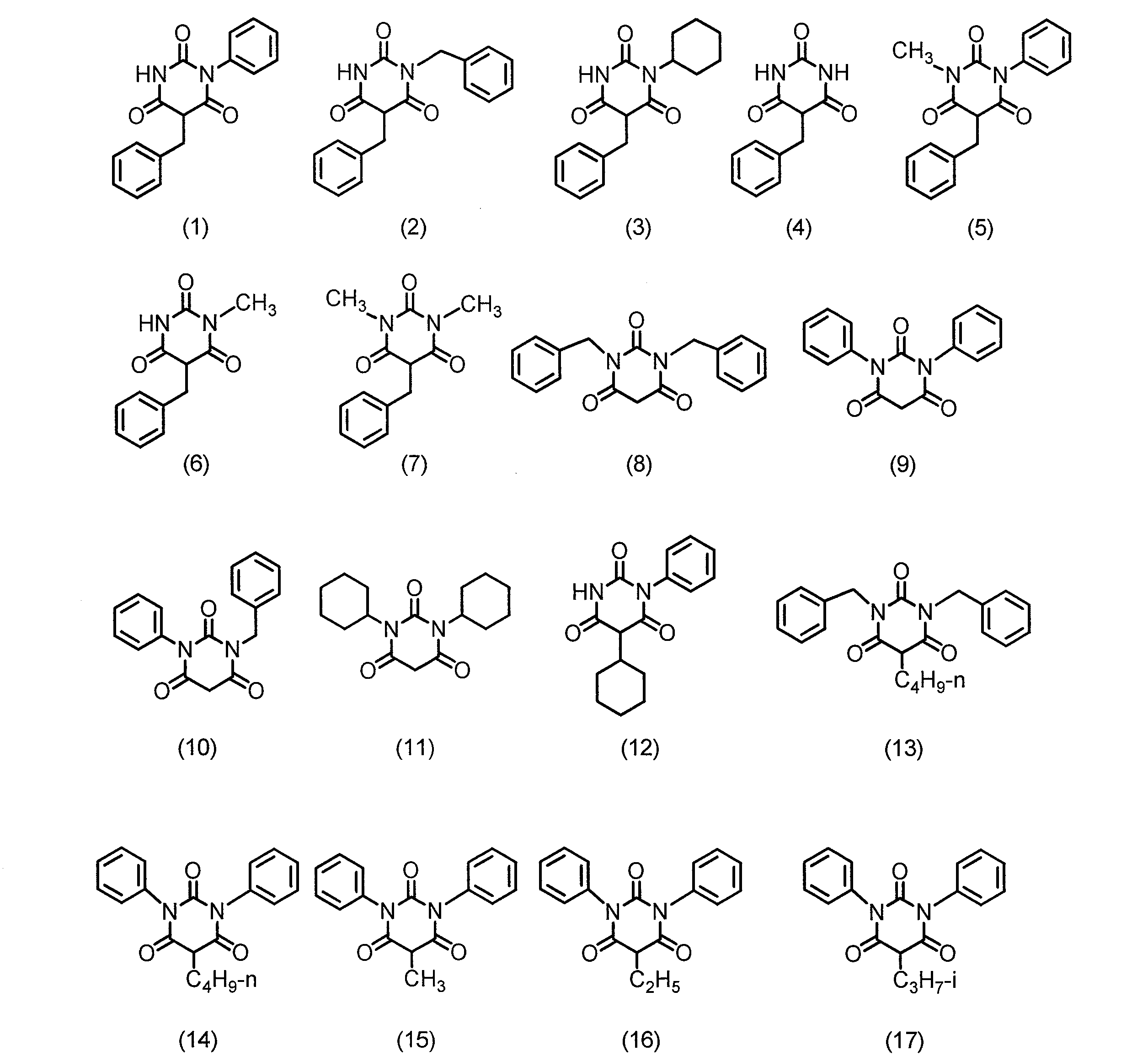

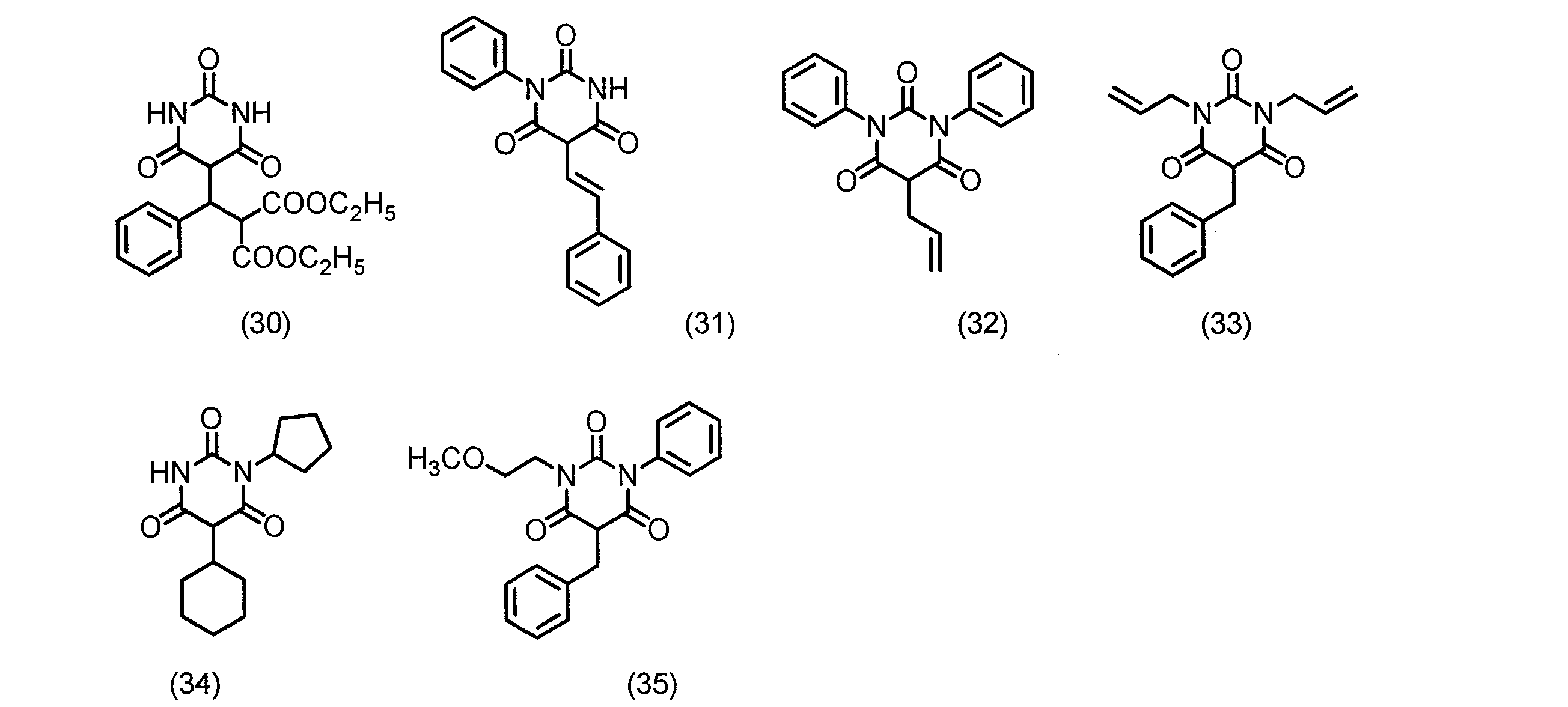
ここで、縮合に用いるマロン酸は、無置換のものでも置換基を有するものでもよく、R5に相当する置換基を有するマロン酸を用いれば、バルビツール酸を構築することにより本発明の一般式(I)で表される化合物を合成することができる。また、無置換のマロン酸と尿素誘導体を縮合させると5位が無置換のバルビツール酸が得られるので、これを修飾することにより本発明の一般式(I)で表される化合物を合成してもよい。
なお、本発明の一般式(I)で表される化合物の合成法は上記に限定されるものではない。
本発明において、セルロースアシレートフィルムの主成分となるセルロースアシレートは、1種を用いてもよいし、2種以上を用いてもよい。例えば、セルロースアシレートは、アシル置換基としてアセチル基のみからなるセルロースアセテートであっても、複数の異なったアシル置換基を有するセルロースアシレートを用いてもよく、異なったセルロースアシレートの混合物であってもよい。
本発明では、特に、セルロースアシレートのアシル基はアセチル基1種であるものが、一般式(I)で表される化合物による硬度改善効果に優れる点で、好ましい。
セルロースを構成するβ-1,4結合しているグルコース単位は、2位、3位および6位に遊離のヒドロキシ基を有している。セルロースアシレートは、これらのヒドロキシ基の一部または全部をアシル基によりアシル化した重合体(ポリマー)である。
アシル置換度は、2位、3位および6位に位置するセルロースのヒドロキシ基のアシル化の度合いを示すものであり、全てのグルコース単位の2位、3位および6位のヒドロキシ基がいずれもアシル化された場合、総アシル置換度は3であり、例えば、全てのグルコース単位で、6位のみが全てアシル化された場合、総アシル置換度は1である。同様に、全グルコースの全ヒドロキシ基において、各々のグルコース単位で、6位か、2位のいずれか一方の全てがアシル化された場合も、総アシル置換度は1である。
すなわち、グルコース分子中の全ヒドロキシ基が全てアシル化された場合を3として、アシル化の度合いを示すものである。
アシル置換度の測定方法の詳細については、手塚他,Carbohydrate.Res.,273,83-91(1995)に記載の方法やASTM-D817-96に規定の方法に準じて測定することができる。
本発明の光学フィルム中、特にセルロースアシレートフィルム中には、レターデーション調整剤(レターデーション発現剤およびレターデーション低減剤)や、可塑剤として、重縮合エステル化合物(ポリマー)、多価アルコールの多価エステル、フタル酸エステル、リン酸エステルなど、さらには、紫外線吸収剤、酸化防止剤、マット剤などの添加剤を加えることもできる。
なお、本明細書では、化合物群を標記するのに、例えば、リン酸エステル系化合物のように、「系」を組み込んで記載することがあるが、これは、上記の場合、リン酸エステル化合物と同じ意味である。
本発明ではレターデーション低減剤として、リン酸エステル系化合物や、セルロースアシレートフィルムの添加剤として公知の非リン酸エステル系の化合物以外の化合物を広く採用することができる。
本発明の光学フィルムは、レターデーション値を発現するために、少なくとも1種のレターデーション発現剤を含有することが好ましい。
レターデーション発現剤としては、特に制限はないが、棒状または円盤状化合物からなるものや、上記非リン酸エステル系の化合物のうちレターデーション発現性を示す化合物を挙げることができる。棒状または円盤状化合物としては、少なくとも二つの芳香族環を有する化合物をレターデーション発現剤として好ましく用いることができる。
レターデーション発現剤は、250~400nmの波長領域に最大吸収波長を有することが好ましく、可視領域に実質的に吸収を有していないことが好ましい。
レターデーション発現剤の詳細は公開技報2001-1745の49頁に記載されている。
光学フィルム、特にセルロースアシレートフィルムでは、可塑剤をセルロースアシレートに含有させると、セルロースアシレートフィルムの含水率や透湿度が低下し、セルロースアシレートフィルム中の水分によるセルロースアシレートの加水分解反応が抑制される。さらに、可塑剤は、高温高湿条件下におけるセルロースアシレートフィルム中から偏光子層への添加剤の拡散を抑制し、偏光子性能の劣化を改良することができる。このため、本発明においても可塑剤を使用することが好ましい。
このため、セルロースアシレートのガラス転移温度(Tg)をできるだけ下げずに、少量の添加で含水率および透湿度を低下する可塑剤が求められているが、セルロースアシレートフィルムの硬度低下を伴わずにこれらの性能を具備させ、かつ耐久性を向上させるには限界があった。
以下に本発明に用いられる可塑剤について説明する。
本発明に用いられる多価アルコールエステル系可塑剤は、アルコール部が2個以上のヒドロキシ基を有する多価アルコールから導かれるエステルであり、該アルコール部のアルコールとしては、ヒドロキシ基以外、エーテル結合を介して分断されてもよい飽和炭化水素にヒドロキシ基が2個以上置換したアルコールが好ましい。
多価アルコールエステル系可塑剤の原料である多価アルコールは下記式(a)で表される。
このような多価アルコールとしては、糖アルコールやグリコール類が挙げられる。
具体的には、トリエチレングリコール、テトラエチレングリコール、ジプロピレングリコール、トリプロピレングリコール、ソルビトール、トリメチロールプロパン、キシリトールが好ましい。
重縮合エステル系可塑剤は、2価のカルボン酸化合物とジオール化合物を重縮合して得られる。
重縮合エステル系可塑剤は、下記式(b)で表される少なくとも1種のジカルボン酸および下記式(c)で表される少なくとも1種のジオールを重縮合して得られることが好ましい。
式(c) : HO-Z-OH
一方、ジオール化合物も、上記式(c)で表される脂肪族化合物以外にも、芳香族もしくはヘテロ環の化合物が挙げられる。
また、2000以下であればセルロースアシレートとの相溶性が高くなり、製膜時および加熱延伸時のブリードアウトの抑制に優れる。
炭素数の平均が5.5以上であれば耐久性に優れた偏光板を得ることができる。炭素数の平均が10.0以下であればセルロースアシレートとの相溶性に優れ、セルロースアシレートフィルムの製膜過程でブリードアウトの抑制に優れる。
ジオール化合物と、脂肪族ジカルボン酸を含むジカルボン酸とから得られた重縮合エステル系可塑剤には、脂肪族ジカルボン酸残基が含まれる。
重縮合エステル系可塑剤を合成する脂肪族ジカルボン酸は、例えば、シュウ酸、マロン酸、コハク酸、マレイン酸、フマル酸、グルタル酸、アジピン酸、ピメリン酸、スベリン酸、アゼライン酸、セバシン酸、ドデカンジカルボン酸または1,4-シクロヘキサンジカルボン酸等が挙げられる。
重縮合エステル系可塑剤を合成するジオールとしては、芳香族ジオールおよび脂肪族ジオールが挙げられ、本発明においては、少なくとも脂肪族ジオールを用いて合成されることが好ましい。
脂肪族ジオール残基の平均炭素数が7.0より小さいとセルロースアシレートとの相溶性が改善され、ブリードアウト、化合物の加熱減量の増大、およびセルロースアシレートウェブ乾燥時の工程汚染が原因と考えられる面状故障の発生の抑制に優れる。また、脂肪族ジオール残基の平均炭素数が2.5以上であれば合成が容易である。
重縮合エステル系可塑剤は、特開2012-234159号公報の段落番号0062~0064に記載されているJ-1~J-38が好ましい。
炭水化物誘導体系可塑剤としては、単糖あるいは2~10個の単糖単位を含む炭水化物の誘導体、中でもアシル化されたものが好ましい。
炭水化物誘導体系可塑剤はピラノース構造あるいはフラノース構造を有することが好ましい。
なお、本発明では、可塑剤は、特開2012-234159号公報の段落番号0026~0068に記載の内容が好ましく適用され、該段落番号に記載の内容は、本明細書の一部に、好ましく取り込まれる。
本発明の光学フィルムは、酸化防止剤を含むことが好ましい。この酸化防止剤はセルロースアシレート溶液に添加されることができる。本発明において、公知の酸化防止剤、例えば、2,6-ジ-t-ブチル-4-メチルフェノール、4,4'-チオビス-(6-t-ブチル-3-メチルフェノール)、1,1'-ビス(4-ヒドロキシフェニル)シクロヘキサン、2,2'-メチレンビス(4-エチル-6-t-ブチルフェノール)、2,5-ジ-t-ブチルヒドロキノン、ペンタエリスリチル-テトラキス[3-(3,5-ジ-t-ブチル-4-ヒドロキシフェニル)プロピオネート]などのフェノール系あるいはヒドロキノン系酸化防止剤を添加することができる。さらに、トリス(4-メトキシ-3,5-ジフェニル)ホスファイト、トリス(ノニルフェニル)ホスファイト、トリス(2,4-ジ-t-ブチルフェニル)ホスファイト、ビス(2,6-ジ-t-ブチル-4-メチルフェニル)ペンタエリストールジホスファイト、ビス(2,4-ジ-t-ブチルフェニル)ペンタエリスリトールジホスファイトなどのリン系酸化防止剤を用いることが好ましい。酸化防止剤の添加量は、セルロースアシレート100質量部に対して、0.05~5.0質量部が好ましい。
本発明の光学フィルムは、偏光板または液晶等の劣化防止の観点から、紫外線吸収剤を含んでいてもよい。この紫外線吸収剤はセルロースアシレート溶液に添加されることができる。本発明において、紫外線吸収剤としては、波長370nm以下の紫外線の吸収能に優れ、かつ良好な液晶表示性の観点から、波長400nm以上の可視光の吸収が少ないものが好ましく用いられる。本発明に好ましく用いられる紫外線吸収剤は、例えばヒンダードフェノール系化合物、ヒドロキシベンゾフェノン系化合物、ベンゾトリアゾール系化合物、サリチル酸エステル系化合物、ベンゾフェノン系化合物、シアノアクリレート系化合物、ニッケル錯塩系化合物などが挙げられる。
これらの紫外線防止剤の添加量は、セルロースアシレートフィルムの全固形分中に質量割合で1ppm~1.0ppmが好ましく、10~1000ppmがさらに好ましい。
本発明の光学フィルムは、フィルムすべり性、および安定製造の観点からマット剤を加えてもよい。マット剤は、無機化合物のマット剤であっても、有機化合物のマット剤であってもよい。
無機化合物のマット剤は、ケイ素を含む無機化合物(例えば、二酸化ケイ素、焼成ケイ酸カルシウム、水和ケイ酸カルシウム、ケイ酸アルミニウム、ケイ酸マグネシウムなど)、酸化チタン、酸化亜鉛、酸化アルミニウム、酸化バリウム、酸化ジルコニウム、酸化ストロングチウム、酸化アンチモン、酸化スズ、酸化スズ・アンチモン、炭酸カルシウム、タルク、クレイ、焼成カオリンおよびリン酸カルシウム等が好ましく、更に好ましくはケイ素を含む無機化合物や酸化ジルコニウムであるが、セルロースアシレートフィルムの濁度を低減できるので、二酸化ケイ素が特に好ましく用いられる。
有機化合物のマット剤は、例えば、シリコーン樹脂、弗素樹脂およびアクリル樹脂等のポリマーが好ましく、中でも、シリコーン樹脂が好ましい。シリコーン樹脂の中でも、特に三次元の網状構造を有するものが好ましく、例えば、トスパール103、トスパール105、トスパール108、トスパール120、トスパール145、トスパール3120およびトスパール240(以上東芝シリコーン(株)製)等の商品名を有する市販品が使用できる。
更にはドープを流延する直前に添加混合してもよく、所謂直前添加方法でありその混合はスクリュー式混練をオンラインで設置して用いられる。具体的には、インラインミキサーのような静的混合機が好ましく、また、インラインミキサーとしては、例えば、スタチックミキサーSWJ(東レ静止型管内混合器Hi-Mixer)(東レエンジニアリング製)のようなものが好ましい。
(硬度)
セルロースアシレートフィルムは実用上十分な弾性率(引張り弾性率)を示すことが好ましい。弾性率の範囲は特に限定されないが、製造適性およびハンドリング性という観点から1.0~5.0GPaが好ましく、2.0~5.0GPaがより好ましい。本発明の一般式(I)で表される化合物は、セルロースアシレートフィルム中に添加されることにより、セルロースアシレートフィルムを疎水化することで弾性率を向上させる作用があり、その点も本発明における利点である。
セルロースアシレートフィルムの光弾性係数の絶対値は、好ましくは8.0×10⁻¹²m2/N以下、より好ましくは6×10-12m2/N以下、さらに好ましくは5×10-12m2/N以下である。セルロースアシレートフィルムの光弾性係数を小さくすることにより、セルロースアシレートフィルムを含む本発明の光学フィルムを偏光板保護フィルムとして液晶表示装置に組み込んだ際に、高温高湿下におけるムラ発生を抑制できる。光弾性係数は、特に断らない限り、以下の方法により測定し算出するものとする。
光弾性率の下限値は特に限定されないが、0.1×10⁻¹²m2/N以上が実際的である。
セルロースアシレートフィルムの含水率は一定の温湿度における平衡含水率を測定することにより評価することができる。平衡含水率は上記一定の温湿度に24時間放置した後に、平衡に達した試料の水分量をカールフィッシャー法で測定し、水分量(g)を試料質量(g)で除して算出したものである。
セルロースアシレートフィルムの25℃相対湿度80%における含水率は5質量%以下が好ましく、4質量%以下がさらに好ましく、3質量%未満がさらに好ましい。セルロースアシレートフィルムの含水率を小さくすることにより、セルロースアシレートフィルムを含む本発明の光学フィルムを偏光板保護フィルムとして液晶表示装置に組み込んだ際に、高温高湿下における液晶表示装置の表示ムラの発生を抑制することができる。含水率の下限値は特に限定されないが、0.1質量%以上が実際的である。
セルロースアシレートフィルムの透湿度は、JIS Z0208の透湿度試験(カップ法)に準じ、温度40℃、相対湿度90%RHの雰囲気中、試料を24時間に通過する水蒸気の質量を測定し、試料面積1m2あたりの値に換算することにより評価することができる。
セルロースアシレートフィルムの透湿度は、500~2000g/m2・dayが好ましく、900~1300g/m2・dayがより好ましく、1000~1200g/m2・dayが特に好ましい。
セルロースアシレートフィルムは、ヘイズが1%以下が好ましく、0.7%以下がより好ましく、0.5%以下が特に好ましい。ヘイズを上記上限値以下とすることにより、セルロースアシレートフィルムの透明性がより高くなり、光学フィルムとしてより用いやすくなるという利点がある。ヘイズは、特に断らない限り、下記方法により測定し算出するものとする。ヘイズの下限値は特に限定されないが、0.001%以上が実際的である。
セルロースアシレートフィルム40mm×80mmを、25℃、相対湿度60%の環境下で、ヘイズメーター(HGM-2DP、スガ試験機)を用いて、JIS K7136に従って測定する。
セルロースアシレートフィルムの平均膜厚は、5~100μmが好ましく、8~80μmがより好ましく、10~70μmがさらに好ましい。10μm以上とすることにより、ウェブ状のフィルムを作製する際のハンドリング性が向上し好ましい。また、70μm以下とすることにより、湿度変化に対応しやすく、光学特性を維持しやすい。
また、セルロースアシレートフィルムが3層以上の積層構造を有する場合、コア層の膜厚は3~70μmが好ましく、5~60μmがより好ましく、スキン層Aおよびスキン層Bの膜厚は、ともに0.5~20μmが好ましく、0.5~10μmがより好ましく、0.5~3μmが特に好ましい。
セルロースアシレートフィルムは、幅が700~3000mmが好ましく、1000~2800mmがより好ましく、1300~2500mmが特に好ましい。
本発明のセルロースアシレートフィルムの製造方法は、特に限定されるものではないが、溶融製膜法又は溶液製膜法により製造することが好ましい。溶液製膜法(ソルベントキャスト法)による製造がより好ましい。ソルベントキャスト法を利用したセルロースアシレートフィルムの製造例については、米国特許第2,336,310号、同第2,367,603号、同第2,492,078号、同第2,492,977号、同第2,492,978号、同第2,607,704号、同第2,739,069号および同第2,739,070号の各明細書、英国特許第640731号および同第736892号の各明細書、並びに特公昭45-4554号、同49-5614号、特開昭60-176834号、同60-203430号および同62-115035号等の各公報を参考にすることができる。また、セルロースアシレートフィルムは、延伸処理を施されていてもよい。延伸処理の方法および条件については、例えば、特開昭62-115035号、特開平4-152125号、同4-284211号、同4-298310号、同11-48271号等の各公報を参考にすることができる。
溶液の流延方法としては、調製されたドープを加圧ダイから金属支持体上に均一に押し出す方法、一旦金属支持体上に流延されたドープをブレードで膜厚を調節するドクターブレードによる方法、逆回転するロールで調節するリバースロールコーターによる方法等があるが、加圧ダイによる方法が好ましい。加圧ダイにはコートハンガータイプやTダイタイプ等があるが、いずれも好ましく用いることができる。また、ここで挙げた方法以外にも、従来知られているセルロースアシレート溶液を流延製膜する種々の方法で実施することができ、用いる溶媒の沸点等の違いを考慮して各条件を設定することにより、従来法と同様に流延製膜することができる。
セルロースアシレートフィルムの形成においては共流延法、逐次流延法、塗布法などの積層流延法を用いることが好ましく、特に同時共流延法を用いることが、安定製造および生産コスト低減の観点から特に好ましい。
共流延法および逐次流延法により製造する場合には、先ず、各層用のセルロースアセテート溶液(ドープ)を調製する。共流延法(重層同時流延)は、流延用支持体(バンドまたはドラム)の上に、各層(3層あるいはそれ以上でも良い)各々の流延用ドープを別のスリットなどから同時に押出す流延用ギーサからドープを押出して、各層同時に流延し、適当な時期に支持体から剥ぎ取って、乾燥しフィルムを成形する流延法である。
また、上記金属支持体の材質については特に制限はないが、SUS製(例えば、SUS316)であることがより好ましい。
セルロースアシレートフィルムの製造方法は、上記ドープから形成された膜を金属支持体から剥ぎ取る工程を含むことが好ましい。セルロースアシレートフィルムの製造方法における剥離の方法については特に制限はなく、公知の方法を用いた場合に剥離性を改善することができる。
セルロースアシレートフィルムの製造方法では、製膜された後に延伸する工程を含むことが好ましい。セルロースアシレートフィルムの延伸方向はセルロースアシレートフィルム搬送方向(長手方向)と搬送方向に直交する方向(横方向)のいずれでも好ましいが、セルロースアシレートフィルム搬送方向に直交する方向(横方向)であることが、後に続く該セルロースアシレートフィルムを用いた偏光板加工プロセスの観点から特に好ましい。
セルロースアシレートフィルムの製造方法では、セルロースアシレートフィルムを乾燥する工程と、乾燥後のセルロースアシレートフィルムをガラス転移温度(Tg)-10℃以上の温度で延伸する工程とを含むことが、レターデーション発現性の観点から好ましい。
本発明の光学フィルムにおいて、セルロースアシレートフィルム上に所望により設けられるハードコート層は、本発明の光学フィルムに硬度や耐傷性を付与するための層である。例えば、ハードコート層を形成するための塗布組成物をセルロースアシレートフィルム上に塗布し、硬化させることによって、上記一般式(I)で表される化合物と相俟ってセルロースアシレートフィルムと密着性の高いハードコート層を形成することができる。ハードコート層にフィラーや添加剤を加えることで、機械的、電気的、光学的な物理的な性能や撥水・撥油性などの化学的な性能をハードコート層自体に付与することもできる。ハードコート層の厚みは0.1~6μmが好ましく、3~6μmがさらに好ましい。このような範囲の薄いハードコート層を有することで、脆性やカール抑制などの物性改善、軽量化および製造コスト低減がなされたハードコート層を含む光学フィルムになる。
利用可能なマトリックス形成バインダー用モノマーまたはオリゴマーの例には、電離放射線硬化性の多官能モノマーおよび多官能オリゴマーが含まれる。多官能モノマーや多官能オリゴマーは架橋反応、または、重合反応可能なモノマーが好ましい。電離放射線硬化性の多官能モノマーや多官能オリゴマーの官能基としては、光、電子線、放射線重合性のものが好ましく、中でも光重合性官能基が好ましい。
ネオペンチルグリコールアクリレート、1,6-ヘキサンジオール(メタ)アクリレート、プロピレングリコールジ(メタ)アクリレート等のアルキレングリコールの(メタ)アクリル酸ジエステル類;
トリエチレングリコールジ(メタ)アクリレート、ジプロピレングリコールジ(メタ)アクリレート、ポリエチレングリコールジ(メタ)アクリレート、ポリプロピレングリコールジ(メタ)アクリレート等のポリオキシアルキレングリコールの(メタ)アクリル酸ジエステル類;
ペンタエリスリトールジ(メタ)アクリレート等の多価アルコールの(メタ)アクリル酸ジエステル類;
2,2-ビス{4-(アクリロキシ・ジエトキシ)フェニル}プロパン、2,2-ビス{4-(アクリロキシ・ポリプロポキシ)フェニル}プロパン等のエチレンオキシドあるいはプロピレンオキシド付加物の(メタ)アクリル酸ジエステル類;
等が挙げられる。
具体的には、(ジ)ペンタエリスリトールトリ(メタ)アクリレート、(ジ)ペンタエリスリトールテトラ(メタ)アクリレート、(ジ)ペンタエリスリトールペンタ(メタ)アクリレート、(ジ)ペンタエリスリトールヘキサ(メタ)アクリレート、トリペンタエリスリトールトリアクリレート、トリペンタエリスリトールヘキサトリアクリレート、トリメチロールプロパントリ(メタ)アクリレート、トリメチロールエタントリ(メタ)アクリレート、ジトリメチロールプロパンテトラ(メタ)アクリレート、EO変性トリメチロールプロパントリ(メタ)アクリレート、PO変性トリメチロールプロパントリ(メタ)アクリレート、EO変性リン酸トリ(メタ)アクリレート、1,2,4-シクロヘキサンテトラ(メタ)アクリレート、ペンタグリセロールトリアクリレート、1,2,3-クロヘキサンテトラメタクリレート、ポリエステルポリアクリレート、カプロラクトン変性トリス(アクリロキシエチル)イソシアヌレート、等が挙げられる。
本明細書において、「(メタ)アクリレート」、「(メタ)アクリル酸」、「(メタ)アクリロイル」は、それぞれ「アクリレートまたはメタクリレート」、「アクリル酸またはメタクリル酸」、「アクリロイルまたはメタクリロイル」を表す。
3個以上の(メタ)アクリロイル基を有する多官能アクリレート系化合物類の具体化合物としては、特開2007-256844号公報の段落番号0096等を参考にすることができる。
具体的な化合物の具体例としては特開2007-256844号公報の段落番号0017等の記載を参考にすることができる。
ハードコート層は、高分子化合物を含有していてもよい。高分子化合物を添加することで、硬化収縮を小さくでき、また、樹脂粒子の分散安定性(凝集性)に関わる塗布液の粘度調整をより優位に行うことができ、さらには、乾燥過程での固化物の極性を制御して樹脂粒子の凝集挙動を変えたり、乾燥過程での乾燥ムラを減じたりすることもでき、好ましい。
ハードコート層の形成に利用可能な硬化性組成物の一例は、(メタ)アクリレート系化合物を含む硬化性組成物である。硬化性組成物は、(メタ)アクリレート系化合物とともに、光ラジカル重合開始剤または熱ラジカル重合開始剤を含有することが好ましく、所望により、さらにフィラー、塗布助剤、その他の添加剤を含有していてもよい。該硬化性組成物の硬化は、光ラジカル重合開始剤または熱ラジカル重合開始剤の存在下、電離放射線の照射または加熱により重合反応を進行させることで実行できる。電離放射線硬化と熱硬化の双方を実行することもできる。光および熱重合開始剤としては市販の化合物を利用することができ、それらは、「最新UV硬化技術」(p.159,発行人;高薄一弘,発行所;(株)技術情報協会,1991年発行)や、チバ・スペシャルティ・ケミカルズ(株)のカタログに記載されている。
本発明の光学フィルムのセルロースアシレートフィルム上に形成されるハードコート層は、セルロースアシレートフィルムと高い密着性を有している。特に、一般式(I)で表される化合物を含有するセルロースアシレートフィルム上に上述の好適な硬化性組成物で形成されたハードコート層は、その硬化性組成物が一般式(I)で表される化合物と相俟って、セルロースアシレートフィルムとさらに高い密着性で形成される。したがって、このようなセルロースアシレートフィルムおよびハードコート層を有する本発明の光学フィルムは、光照射等によってもセルロースアシレートフィルムとハードコート層との密着性を維持し、光耐久性に優れる。
本発明の偏光板は、偏光子と本発明の光学フィルムとを少なくとも有する。本発明の偏光板は、偏光子と該偏光子の片面または両面に本発明の光学フィルムを有することが好ましい。偏光子には、ヨウ素系偏光子、二色性染料を用いる染料系偏光子やポリエン系偏光子がある。ヨウ素系偏光子および染料系偏光子は、一般にポリビニルアルコール系フィルムを用いて製造する。本発明の光学フィルムを偏光板保護膜として用いる場合、偏光板の作製方法は特に限定されず、一般的な方法で作製することができる。例えば、本発明の光学フィルムのセルロースアシレートフィルムをアルカリ処理し、ポリビニルアルコールフィルムをヨウ素溶液中に浸漬延伸して作製した偏光子の両面に完全ケン化ポリビニルアルコール水溶液を用いて貼り合わせる方法がある。アルカリ処理の代わりに特開平6-94915号公報、特開平6-118232号公報に記載されているような易接着加工を施してもよい。セルロースアシレートフィルムの処理面と偏光子を貼り合わせるのに使用される接着剤としては、例えば、ポリビニルアルコール、ポリビニルブチラール等のポリビニルアルコール系接着剤や、ブチルアクリレート等のビニル系ラテックス等が挙げられる。
本発明は偏光子を利用する表示装置用途として好ましく用いられる。
この様な表示装置として液晶表示装置や有機エレクトロルミネッセンス表示装置の反射防止用途等が挙げられる。
液晶表示装置を例として説明すると、本発明の液晶表示装置は、液晶セルと本発明の偏光板とを少なくとも有する。本発明の液晶表示装置において、偏光板、後述する第一偏光板および第二偏光板を有する場合には少なくとも一方が、本発明の偏光板であるIPS、OCBまたはVAモードの液晶表示装置であることが好ましい。
本発明の液晶表示装置は、好ましくは、液晶セルと、液晶セルの両側に積層され、液晶セル側とは反対側の面に光学フィルムを具備する偏光板とを有している。すなわち、本発明の液晶表示装置は、第一偏光板、液晶セルおよび第二偏光板を有し、偏光板それぞれと液晶セルとで挟持される偏光板面と反対面に本発明の光学フィルムを具備しているのが好ましい。このような構成を有する液晶表示装置は、表示ムラの抑制に優れ、高い表示性能を発揮する。
また、本発明の液晶表示装置は、好ましくは、視認側に配置された偏光板が視認側の光学フィルム表面上にハードコート層を有する光学フィルム、特にセルロースアシレートフィルムを有している。このような構成を有する液晶表示装置は、表示ムラの抑制に優れた高い表示性能に加えて、優れた光耐久性を発揮する。
なお、図1および図2に、本発明の液晶表示装置の一例についての構成を示したが、本発明の液晶表示装置の具体的な構成としては特に制限はなく公知の構成を採用できる。また、特開2008-262161号公報の図2に記載の構成も好ましく採用することができる。
下記の例示化合物(1)、(2)、(9)、(13)および(21)を合成した。
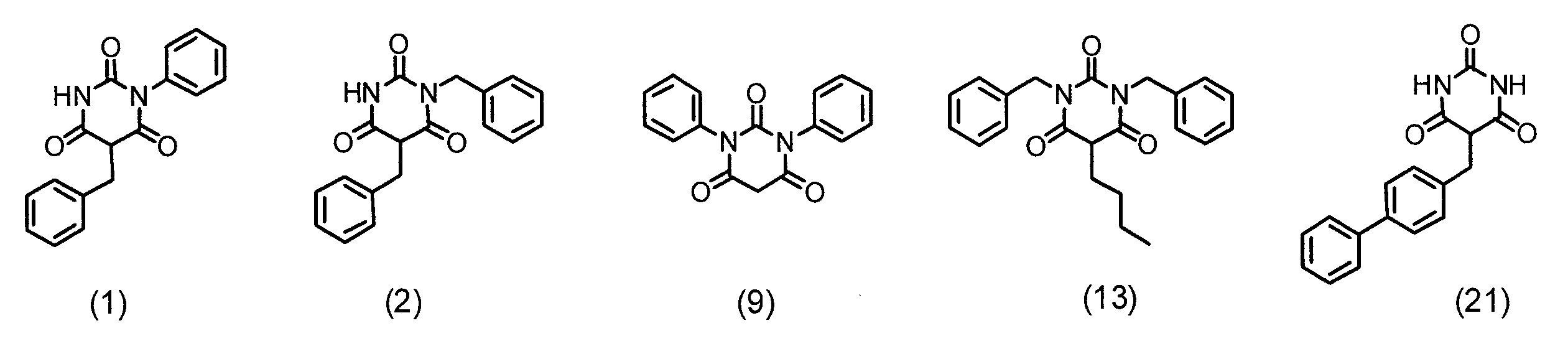
温度計、還流冷却管および撹拌機を付した300mlの三口フラスコにN-フェニル尿素27.2g(0.20mol)、ベンジルマロン酸ジエチル60.1g(0.24mol)、20%ナトリウムエトキシド/エタノール溶液102.1g(0.30mol)を仕込み、攪拌しながら加熱還流下で4時間攪拌を続けた。その後、エタノールを一部留去した後、室温まで冷却し、酢酸エチル100mLを加えた。析出した固体を吸引濾過して濾取し、酢酸エチルで洗浄した。この固体(ナトリウム塩)を水100mLに溶解させ、pH1となるように塩酸を滴下することで、析出させた。析出した固体を吸引ろ過して濾取し、水で洗浄した。さらにこの粗体をイソプロピルアルコールで加熱洗浄した後に室温まで冷却して濾取し、減圧乾燥することで、例示化合物(1)を白色固体として43.1g(収率68%)得た。
1H-NMR(300MHz、DMSO-d6)δ:3.34(2H)、4.08(m、1H)、7.00-7.48(m、10H)、11.52(br、1H)
融点:122℃
ClogP値:1.75
以下に合成した代表的化合物のデータを示す。
1H-NMR(300MHz、DMSO-d6))δ:3.32(2H)、4.09(s、1H)、4.70-4.91(m、2H)、76.92-7.30(m、10H)、11.50(br、1H)
融点:114℃
ClogP値:2.75
融点210℃
ClogP値:0.50
1H-NMR(300MHz、CDCl3))δ:3.13(s、3H)、3.50(m、3H)、3.75(t、1H)、7.10(m、2H)、7.26(m、3H)
ClogP値:0.98
1H-NMR(300MHz、DMSO-d6))δ:3.01(s、6H)、3.27(d、2H)、4.03(t、1H)、7.04(m、2H)、7.21(m、3H)
融点:115℃
ClogP値:1.16
1H-NMR(300MHz、DMSO-d6))δ:4.00(s、2H)、7.29(m、4H)、7.38-7.50(m、6H)
融点:247℃
ClogP値:2.92
1H-NMR(300MHz、DMSO-d6))δ:3.95(s、2H)、4.95(s、2H)、7.23-7.36(m、10H)
ClogP値:3.25
融点:205℃
ClogP値:1.93
(A)セルロースアシレートフィルム(光学フィルム)の作製および評価-1-
(セルロースアセテートの調製)
総アセチル置換度(B)2.87のセルロースアセテートを調製した。これは、触媒として硫酸(セルロース100質量部に対し7.8質量部)を添加し、酢酸を添加し40℃でアセチル化反応を行った。またアセチル化後に40℃で熟成を行った。さらにこのセルロースアセテートの低分子量成分をアセトンで洗浄し除去した。
下記の組成物をミキシングタンクに投入し、攪拌して各成分を溶解し、セルロースアセテート溶液を調製した。
セルロースアセテート溶液の組成
――――――――――――――――――――――――――――――――――
総アセチル置換度(B)2.87、重合度370のセルロースアセテート
100.0質量部
下記表1に記載の一般式(I)で表される化合物もしくはその周辺化合物
10.0質量部
メチレンクロライド(第1溶媒) 402.0質量部
メタノール(第2溶媒) 60.0質量部
――――――――――――――――――――――――――――――――――
このようにして製造した各光学フィルム101~105およびc01~c03の表面硬度を測定した。
フィッシャーインスツルメンツ(株)社製“フッシャースコープH100Vp型硬度計”を用い、圧子の短軸の向きをセルロースアシレートフィルム製膜時の搬送方向(長手方向;鉛筆硬度試験での試験方向)に対して平行に配置したヌープ圧子により、ガラス基板に固定したサンプル表面を負荷時間10秒、クリープ時間5秒、除荷時間10秒、最大荷重50mNの条件で測定した。押し込み深さから求められる圧子とサンプルとの接触面積と最大荷重の関係より硬度を算出し、この5点の平均値を表面硬度とした。
また、フィッシャーインスツルメンツ(株)社製“フッシャースコープH100Vp型硬度計”を用い、JIS Z 2251の方法に準じてガラス基板に固定したサンプル表面を負荷時間10秒、クリープ時間5秒、除荷時間10秒、押し込み荷重50mNの条件で測定し、押し込み深さから求められる圧子とサンプルとの接触面積と最大荷重の関係より硬度を算出した。なお、JIS Z 2251はISO4545を基に作成した日本工業規格である。
なお、評価が「C」以上であるとセルロースアセテートフィルムとしての硬度が高く、加工性の観点から十分に実用的である。
A:ヌープ硬度が225N/mm2以上
B:ヌープ硬度が210N/mm2以上225N/mm2未満
C:ヌープ硬度が190N/mm2以上210N/mm2未満
D:ヌープ硬度が180N/mm2以上190N/mm2未満
E:ヌープ硬度が180N/mm2未満
上記で作製した各光学フィルムから150mm×10mmのサンプルを切り出し、東洋ボールドウィン(株)製万能引張り試験機「STM T50BP」を用い、25℃、60RH%雰囲気下、引張速度10%/分で0.1%伸びと0.5%伸びにおける応力を測定し、その傾きから弾性率を求めた。なお、測定は各々直交する任意の2方向について行い、それらの相乗平均を求め、得られた値を引張り弾性率(単位:GPa)とした。
上記で作製した各セルロースアセテートからなる単層の光学フィルムの表面に下記の硬化性組成物のハードコート層溶液を塗布し、紫外線を照射して硬化させ、厚み6μmのハードコート層を形成したハードコート層付き光学フィルムを作製した。
なお、下記表1では、単層の光学フィルムNo.と、これに対応するハードコート層付き光学フィルムNo.に共通のフィルムNo.を付けて表している。
なお、以後の実施例でも単層の光学フィルムこれに対応するハードコート層付き光学フィルムを作製し、同様の番号を付けている。
ハードコート層溶液の硬化性組成
――――――――――――――――――――――――――――――――――
モノマー ペンタエリスリトールトリアクリレート/
ペンタエリスリトールテトラアクリレート(混合質量比3/2)
53.5質量部
UV重合開始剤 IrgacureTM907
(チバ・スペシャリティ・ケミカルズ(株)製) 1.5質量部
酢酸エチル 45質量部
――――――――――――――――――――――――――――――――――
上記で作製した各ハードコート層付き光学フィルム101~105およびc01~c03について、JIS K 5600に準処した碁盤目試験を行った。具体的には、硬化済みハードコート層付き光学フィルムをXeで48時間照射した。Xeの照射後のハードコート層に1mm間隔で縦横に11本の切れ込みを入れて1mm角の碁盤目を100個作った。この上にセロハンテープおよびマイラーテープを貼り付け、素早く剥がし剥がれた箇所を目視観察により密着評価した。なお、Xeの照射はスガ試験機株式会社製のスーパーキセノンウェザーメーターSX75を用いた。
密着性は下記基準で評価し、下記表1に結果を示した。評価が「B」以上であると、セルロースアセテートフィルムとハードコート層との密着性が高く、優れた光耐久性を発揮する。
A:剥がれ箇所0~30マス
B:剥がれ箇所31~50マス
C:剥がれ箇所51~65マス
D:剥がれ箇所66~80マス
E:剥がれ箇所81マス以上
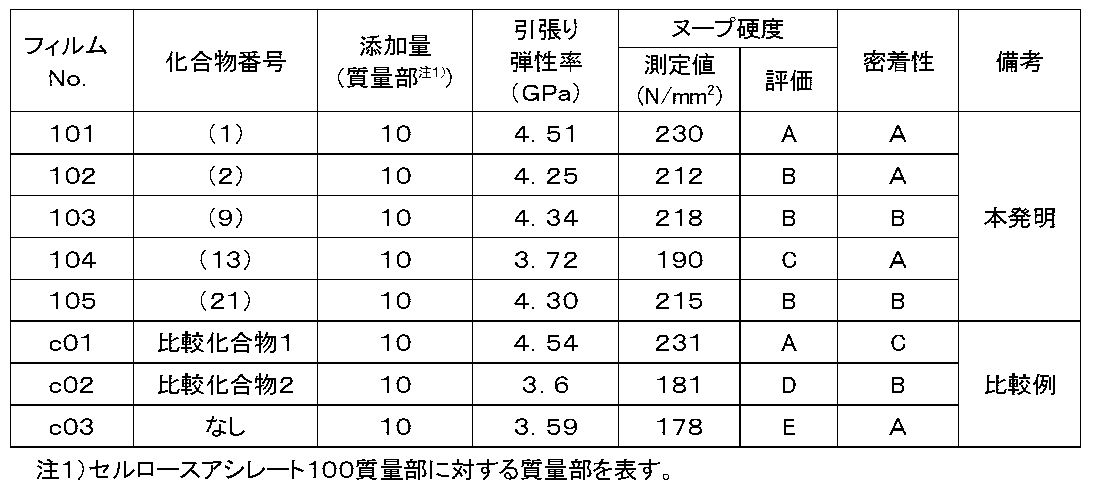

一般式(I)で表される化合物は、セルロースアセテートの分子鎖内の隙間に入り込みやすく、セルロースアセテートのエステル結合と効果的に水素結合を形成するため、硬度が向上したと考えられる。
光学フィルムc02における比較化合物2と比べると、本発明の光学フィルム101~105はいずれも高い硬度を示している。これは、一般式(I)で表される化合物が環構造を有することによってセルロースアセテートとの相溶性に優れ、さらに、水素結合の相互作用がより強まっているものと考えられる。
また、光学フィルムc01における比較化合物1に比べると、本発明の光学フィルム101~105はいずれもハードコート層との高い密着性を示している。これは、一般式(I)で表される化合物がその骨格の5位にアルキル基または水素原子を有していることによって、フィルム中での吸収波長が短波化しており、光照射によるセルロースアセテートの劣化が抑制されているためと考えられる。
(B)セルロースアシレート(光学フィルム)の作製および評価-2-
一般式(I)で表される化合物の種類を下記表2に記載のように変更したこと以外は実施例1と同様にして本発明の光学フィルム121~129を作製した。各特性の評価は実施例1と同様にして行った。
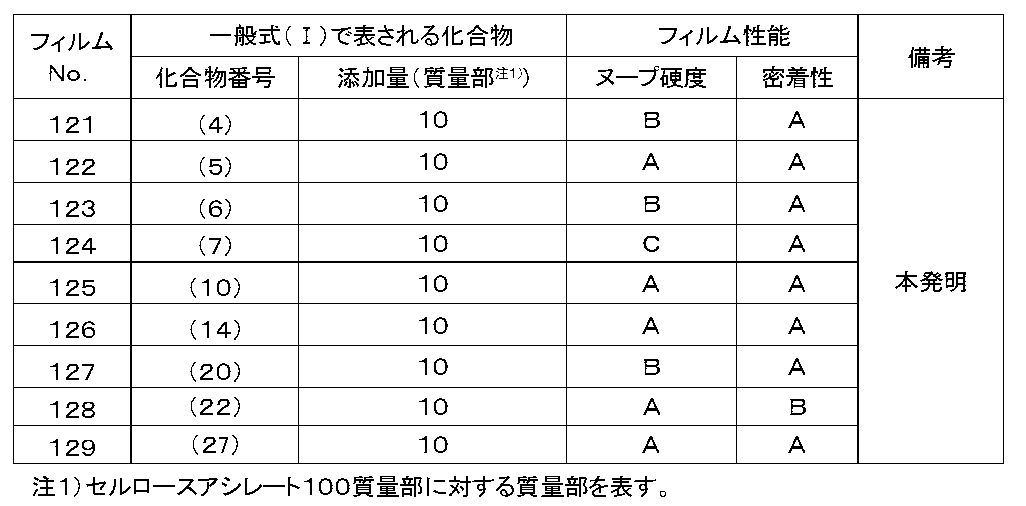
実施例1と同様にして、セルロースアシレートの置換度、各添加剤(一般式(I)で表される化合物)の種類とを下記表3に記載のように変更した以外は、実施例1と同様にして、本発明の光学フィルム131~136を作製した。
各特性の評価は実施例1と同様にして行った。
それぞれのヌープ硬度の値を、添加剤を加えずに作製したフィルムのヌープ硬度の値と比較して下記の基準で評価し、結果を下記表3に示した。
B:添加剤を加えなかった場合のヌープ硬度の値の1.05倍以上1.15倍未満
C:添加剤を加えなかった場合のヌープ硬度の値の1.00倍以上1.05倍未満
D:添加剤を加えなかった場合のヌープ硬度の値の1.00倍未満
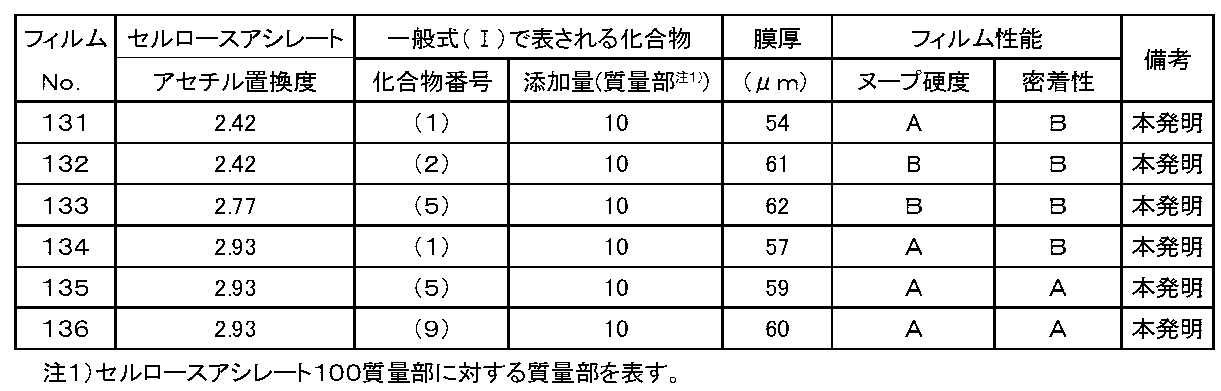
実施例1と同様にして、セルロースアシレートの種類、各添加剤(一般式(I)で表される化合物)の種類、セルロースアシレートフィルムの膜厚を下記表4に記載のように変更した以外は、実施例1と同様にして、光学フィルム141~144およびc41~c43を作製した。
各特性の評価は実施例1と同様にして行った。ただし、表面硬度の評価に際しては、下記のとおり、膜厚に応じて押し込み荷重を変更した。
上記で得られた光学フィルムを、押し込み荷重20mNとする以外は実施例1に記載の方法と同様にして、表面硬度を測定した。単位は、N/mm2で表した。
それぞれのフィルムのヌープ硬度の値を、添加剤を加えずに作製したフィルムのヌープ硬度の値と比較して、下記の基準で評価した。
B:添加剤を加えなかった場合のヌープ硬度の値の1.05倍以上1.15倍未満
C:添加剤を加えなかった場合のヌープ硬度の値の1.00倍以上1.05倍未満
D:添加剤を加えなかった場合のヌープ硬度の値の1.00倍未満
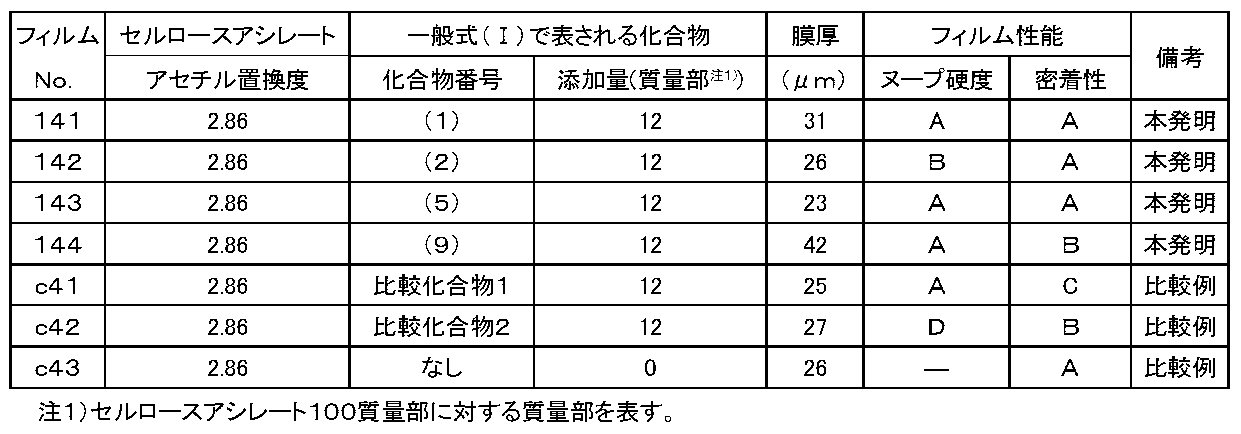
(鉛筆硬度評価)
上記実施例1で密着性を評価した各ハードコート層付き光学フィルムを、25℃、相対湿度60%の条件で2時間調湿した後、JIS-S6006が規定する試験用鉛筆を用いて、JIS-K5400が規定する鉛筆硬度評価法に従い、500gのおもりを用いて各硬度の鉛筆でハードコート層表面を5回繰り返し引っ掻き、傷が1本できるまでの硬度を測定した。なお、JIS-K5400で定義される傷は塗膜の破れ、塗膜のすり傷であり、塗膜のへこみは対象としないと記載されているが、本評価では、塗膜のへこみも含めて傷と判断した。実用上は、3H以上が好ましく、数値が高いほど、高硬度なため好ましい。その結果、本発明の一般式(I)で表される化合物を用いて作製された光学フィルム101~105はいずれも3Hと良好な値を示すことがわかった。
(C)偏光板保護フィルム(光学フィルム)および偏光板の作製と評価
(C-1)偏光板保護フィルム(光学フィルム)の作製
(セルロースアセテートの調製)
セルロースアセテートは、実施例1で調製したものを使用した。
・セルロースアセテート溶液の調製
下記の組成物をミキシングタンクに投入し、攪拌して各成分を溶解し、セルロースアセテート溶液を調製した。
セルロースアセテート溶液の組成
――――――――――――――――――――――――――――――――――
総アセチル置換度(B)2.87、重合度370のセルロースアセテート
100.0質量部
第一工業化学社製モノペット(登録商標)SB(可塑剤)
9.0質量部
イーストマン・ケミカル社製SAIB-100(可塑剤) 3.0質量部
メチレンクロライド(第1溶媒) 353.9質量部
メタノール(第2溶媒) 89.6質量部
n-ブタノール(第3溶媒) 4.5質量部
――――――――――――――――――――――――――――――――――
下記の組成物を分散機に投入し、攪拌して各成分を溶解し、マット剤溶液を調製した。
マット剤溶液の組成
――――――――――――――――――――――――――――――――――
平均粒子サイズ20nmのシリカ粒子(AEROSIL R972、
日本アエロジル(株)製) 2.0質量部
メチレンクロライド(第1溶媒) 69.3質量部
メタノール(第2溶媒) 17.5質量部
n-ブタノール(第3溶媒) 0.9質量部
調製した上述のセルロースアセテート溶液 0.9質量部
――――――――――――――――――――――――――――――――――
下記の組成物をミキシングタンクに投入し、加熱しながら攪拌して、各成分を溶解し、紫外線吸収剤溶液を調製した。
紫外線吸収剤溶液の組成
――――――――――――――――――――――――――――――――――
下記紫外線吸収剤(UV-1) 20.0質量部
メチレンクロライド(第1溶媒) 61.0質量部
メタノール(第2溶媒) 15.4質量部
n-ブタノール(第3溶媒) 0.8質量部
調製した上述のセルロースアセテート溶液 12.8質量部
――――――――――――――――――――――――――――――――――

・セルロースアセテート溶液の調製
下記の組成物をミキシングタンクに投入し、攪拌して各成分を溶解し、基層用ドープを調製した。
セルロースアセテート溶液の組成
――――――――――――――――――――――――――――――――――
総アセチル置換度(B)2.87、重合度370のセルロースアセテート
100.0質量部
第一工業化学社製モノペット(登録商標)SB(可塑剤)
9.0質量部
イーストマン・ケミカル社製SAIB-100(可塑剤) 3.0質量部
例示化合物(1) 4.0質量部
上記紫外線吸収剤(UV-1) 2.0質量部
メチレンクロライド(第1溶媒) 297.7質量部
メタノール(第2溶媒) 75.4質量部
n-ブタノール(第3溶媒) 3.8質量部
――――――――――――――――――――――――――――――――――
ドラム流延装置を用い、上記のように調製した基層用ドープと、その両側にスキン層(表層)用ドープとを3層同時にステンレス製の流延支持体(支持体温度-9℃)に流延口から均一に流延した。各層のドープ中の残留溶媒量が略70質量%の状態で剥ぎ取り、フィルムの幅方向の両端をピンテンターで固定し、残留溶媒量が3~5質量%の状態で、横方向に1.28倍延伸しつつ乾燥した。その後、熱処理装置のロール間を搬送することにより、さらに乾燥し、本発明の光学フィルムとしてのセルロースアセテートフィルム201を得た。得られたセルロースアセテートフィルム201の厚みは60μm、幅は1480mmであった。
このセルロースアセテートフィルム211の作製において、例示化合物(1)を添加しないこと以外は同様にしてセルロースアセテートフィルムC11を作製した。
このセルロースアセテートフィルム221の作製において、例示化合物(1)を添加しないこと以外は同様にして比較のセルロースアセテートフィルムC21を作製した。
このセルロースアセテートフィルム231の作製において、例示化合物(1)を添加しないこと以外は同様にしてセルロースアセテートフィルムC31を作製した。
得られた結果をまとめて後述の表5に示す。
なお、作製したこれらのセルロースアセテートフィルムは、以下において偏光板保護フィルムとも称す。
一般式(I)で表される化合物を加えずに作製した光学フィルムの表面硬度の値と比較した。
B:添加剤を加えなかった場合のヌープ硬度の値の1.05以上1.15未満
C:添加剤を加えなかった場合のヌープ硬度の値の1.00以上1.05未満
D:添加剤を加えなかった場合のヌープ硬度の値の1.00未満
各ハードコート層付きセルロースアシレートフィルムを、25℃、相対湿度60%の条件で2時間調湿した後、JIS-S6006が規定する試験用鉛筆を用いて、JIS-K5400が規定する鉛筆硬度評価法に従い、500gのおもりを用いて各硬度の鉛筆でハードコート層表面を5回繰り返し引っ掻き、傷が1本できるまでの硬度を測定した。なお、JIS-K5400で定義される傷は塗膜の破れ、塗膜のすり傷であり、塗膜のへこみは対象としないと記載されているが、本評価では、塗膜のへこみも含めて傷と判断した。実用上は、3H以上が好ましく、数値が高いほど、高硬度なため好ましい。その結果、本発明の一般式(I)で表される化合物を用いて作製されたフィルムはいずれも3Hと良好な値を示すことがわかった。
(偏光板保護フィルムの鹸化処理)
前記(C-1)で作製したセルロースアセテートフィルムからなる偏光板保護フィルム201を、2.3mol/Lの水酸化ナトリウム水溶液に、55℃で3分間浸漬した。室温の水洗浴槽中で洗浄し、30℃で0.05mol/Lの硫酸を用いて中和した。再度、室温の水洗浴槽中で洗浄し、さらに100℃の温風で乾燥した。このようにして、偏光板保護フィルム201に対して表面の鹸化処理を行った。なお、偏光子は上述の[偏光板]の項で説明したような常用されているものを用いた。
延伸したポリビニルアルコールフィルムにヨウ素を吸着させて偏光子を作製した。
前記(C-1)で作製し、上記の鹸化処理を行った偏光板保護フィルム201を、ポリビニルアルコール系接着剤を用いて、偏光子の片側に貼り付けた。市販のセルローストリアセテートフィルム(フジタックTD80UF、富士フイルム(株)製)も同様の鹸化処理を行い、ポリビニルアルコール系接着剤を用いて、鹸化処理した偏光板保護フィルム201が貼り付けてある側とは反対側の偏光子の面に、鹸化処理済みの上記市販のセルローストリアセテートフィルムを貼り付けた。
この際、偏光子の透過軸と、前記(C-1)で作製して鹸化処理済みの偏光板保護フィルム301の遅相軸とが平行するように配置した。また、偏光子の透過軸と鹸化処理済みの市販のセルローストリアセテートフィルムの遅相軸とは直交するように配置した。
このようにして本発明の偏光板201を作製した。
偏光板耐久性試験は偏光板をガラスに粘着剤を介して貼り付けた形態で次のように行った。
本発明において、偏光板の単板直交透過率CTは、日本分光(株)製自動偏光フィルム測定装置VAP-7070を用いて、以下の方法により380~780nmの範囲で測定し、波長410nmにおける測定値を採用した。
本発明の偏光板を、粘着剤を介してガラスの上に貼り付けたサンプル(5cm×5cm)を2つ作製した。この際、本発明の偏光板保護フィルムがガラスと反対側(空気界面)になるように貼り付けた。直交透過率測定はこのサンプルのガラスの側を光源に向けてセットして測定した。2つのサンプルをそれぞれ測定し、その平均値を直交透過率CTとした。
その後、フィルムの膜厚に応じた条件下で各偏光板を経時保存した後に同様の方法で直交透過率CTを測定した。経時前後の直交透過率CTの変化を求め、これを偏光板耐久性として下記基準で評価した。
経時前の直交透過率は、いずれも0.10%以下であった。下記の評価が「B」以上であると偏光板の耐久性が優れる。
なお、調湿なしの環境下での相対湿度は、0~20%RHの範囲であった。
得られた結果を表5に示した。
偏光板201、231、C01、C31:
80℃、相対湿度90%RHの環境下で168時間および336時間
偏光板211、C11:
80℃、相対湿度90%RHの環境下で120時間および240時間
偏光板221、C21:
60℃、相対湿度95%RHの環境下で500時間および1000時間
A:経時前後の直交透過率の変化が0.6%未満
B:経時前後の直交透過率の変化が0.6%以上0.75%未満
C:経時前後の直交透過率の変化が0.75%以上1.0%未満
D:経時前後の直交透過率の変化が1.0%以上

例示化合物(1)に代えて例示化合物(4)、(7)および(13)を用いたこと以外は実施例2と同様にして本発明の偏光板を製造した。これら偏光板について実施例2と同様にして耐久性を評価した。その結果、本発明の偏光板保護フィルムはいずれも経時での偏光子の劣化を抑制できた。
この結果、本発明の偏光板を使用することで、以上に示したような優れた性能の液晶表示装置が作製できる。
22 カラーフィルタ基板
23 液晶層
24 アレイ基板
25 導光板
26 光源
31a、31a’、31b 光学フィルム(偏光板保護フィルム)
311a セルロースアシレートフィルム
311b ハードコート層
32 偏光子
R 偏光方向
Claims (15)
- セルロースアシレートおよび少なくとも1種の下記一般式(I)で表される化合物を含有する光学フィルム。

式(1): *-L5-Ar5
式(1)中、L5は炭素数1~20のアルキレン基を表す。Ar5は炭素数6~20の芳香族基を表す。*は、一般式(I)の環構造に連結する位置である。 - 前記一般式(I)における前記R5が、炭素数1~20の無置換アルキル基、炭素数3~20のシクロアルキル基または前記式(1)で表されるアラルキル基である請求項1に記載の光学フィルム。
- 前記一般式(I)におけるR5が、前記式(1)で表されるアラルキル基である請求項1または2に記載の光学フィルム。
- 前記式(1)における前記L5が、下記式(1-2)で表される基である請求項1~3のいずれか1項に記載の光学フィルム。
式(1-2): -[C(R51)(R52)]n-
式(1-2)中、R51およびR52は、各々独立に、水素原子、炭素数1~19のアルキル基、炭素数3~19のシクロアルキル基、炭素数2~19のアルケニル基または炭素数6~19の芳香族基を表す。nは1~20の整数を表す。 - 前記式(1)における前記L5が、前記Ar5と置換もしくは無置換のメチレン基またはエチレン基で連結するアルキレン基である請求項1~4のいずれか1項に記載の光学フィルム。
- 前記式(1)における前記Ar5が、無置換、または、ハメットの置換基定数σpが負の置換基が置換した、炭素数6~20の芳香族基である請求項1~5のいずれか1項に記載の光学フィルム。
- 前記一般式(I)における前記R3およびR5が、それぞれ1個の芳香環構造を有する請求項1~6のいずれか1項に記載の光学フィルム。
- 前記一般式(I)における前記R5が、ハメットの置換基定数σpおよびσmが共に負である請求項1~7のいずれか1項に記載の光学フィルム。
- 前記セルロースアシレートの総アシル置換度Aが、下記式を満足する請求項1~8のいずれか1項に記載の光学フィルム。
1.5≦A≦3.0 - 前記セルロースアシレートのアシル基がアセチル基であり、総アセチル置換度Bが下記式を満足するセルロースアシレートである請求項1~9のいずれか1項に記載の光学フィルム。
2.0≦B≦3.0 - 前記光学フィルムが、少なくとも2層からなり、前記セルロースアシレートおよび少なくとも1種の前記一般式(I)で表される化合物を含む層に、さらにハードコート層を有する請求項1~10のいずれか1項に記載の光学フィルム。
- 偏光子と、該偏光子の少なくとも一方の面に請求項1~11のいずれか1項に記載の光学フィルムを有する偏光板。
- 請求項12に記載の偏光板と液晶セルを少なくとも有する液晶表示装置。
- 前記液晶セルの両側に偏光板を有し、該偏光板の少なくとも一方が、請求項12に記載の偏光板である請求項13に記載の液晶表示装置。
- 視認側に配置された前記偏光板の視認側表面にハードコート層を有する請求項13または14に記載の液晶表示装置。
Priority Applications (4)
| Application Number | Priority Date | Filing Date | Title |
|---|---|---|---|
| CN201480017353.0A CN105051577B (zh) | 2013-03-22 | 2014-03-19 | 光学膜、使用该光学膜的偏振片及液晶显示装置 |
| KR1020157025510A KR101745232B1 (ko) | 2013-03-22 | 2014-03-19 | 광학 필름, 이를 이용한 편광판 및 액정 표시 장치 |
| JP2015506830A JP6072225B2 (ja) | 2013-03-22 | 2014-03-19 | 光学フィルム、それを用いた偏光板および液晶表示装置 |
| US14/839,154 US9551813B2 (en) | 2013-03-22 | 2015-08-28 | Optical film, polarizing plate using same, and liquid crystal display device |
Applications Claiming Priority (2)
| Application Number | Priority Date | Filing Date | Title |
|---|---|---|---|
| JP2013-061113 | 2013-03-22 | ||
| JP2013061113 | 2013-03-22 |
Related Child Applications (1)
| Application Number | Title | Priority Date | Filing Date |
|---|---|---|---|
| US14/839,154 Continuation US9551813B2 (en) | 2013-03-22 | 2015-08-28 | Optical film, polarizing plate using same, and liquid crystal display device |
Publications (1)
| Publication Number | Publication Date |
|---|---|
| WO2014148559A1 true WO2014148559A1 (ja) | 2014-09-25 |
Family
ID=51580233
Family Applications (1)
| Application Number | Title | Priority Date | Filing Date |
|---|---|---|---|
| PCT/JP2014/057563 Ceased WO2014148559A1 (ja) | 2013-03-22 | 2014-03-19 | 光学フィルム、それを用いた偏光板および液晶表示装置 |
Country Status (5)
| Country | Link |
|---|---|
| US (1) | US9551813B2 (ja) |
| JP (1) | JP6072225B2 (ja) |
| KR (1) | KR101745232B1 (ja) |
| CN (1) | CN105051577B (ja) |
| WO (1) | WO2014148559A1 (ja) |
Families Citing this family (2)
| Publication number | Priority date | Publication date | Assignee | Title |
|---|---|---|---|---|
| KR102416575B1 (ko) * | 2017-07-04 | 2022-07-11 | 삼성디스플레이 주식회사 | 표시 장치 |
| CN110728078B (zh) * | 2019-11-14 | 2022-11-25 | 吉林大学 | 一种基于胶粘剂化学特性的粘接结构在全服役温度区间下的力学性能的预测方法 |
Citations (7)
| Publication number | Priority date | Publication date | Assignee | Title |
|---|---|---|---|---|
| JPS63121828A (ja) * | 1986-10-31 | 1988-05-25 | ミネソタ マイニング アンド マニュフアクチユアリング カンパニー | N,n’一置換バルビツル酸をもった第2高調波発生器 |
| JP2011118135A (ja) * | 2009-12-03 | 2011-06-16 | Fujifilm Corp | 偏光板保護フィルム、偏光板および液晶表示装置 |
| JP2011126968A (ja) * | 2009-12-16 | 2011-06-30 | Fujifilm Corp | セルロースアシレートフィルム、位相差フィルム、偏光板および液晶表示装置 |
| WO2012169629A1 (ja) * | 2011-06-10 | 2012-12-13 | 富士フイルム株式会社 | 剥離性積層フィルム、剥離性積層フィルムロール、それらの製造方法、フィルム、光学フィルム、偏光板、偏光板の製造方法、及び液晶表示装置 |
| WO2013168656A1 (ja) * | 2012-05-11 | 2013-11-14 | 富士フイルム株式会社 | 光学フィルム、偏光板、及び液晶表示装置 |
| JP2014059547A (ja) * | 2012-08-23 | 2014-04-03 | Fujifilm Corp | 偏光板及び液晶表示装置 |
| JP2014059548A (ja) * | 2012-08-23 | 2014-04-03 | Fujifilm Corp | 偏光板及び液晶表示装置 |
Family Cites Families (5)
| Publication number | Priority date | Publication date | Assignee | Title |
|---|---|---|---|---|
| EP1237017A1 (en) * | 2001-02-20 | 2002-09-04 | Fuji Photo Film Co., Ltd. | Polarizing plate protection film |
| JP4663906B2 (ja) | 2001-04-26 | 2011-04-06 | 富士フイルム株式会社 | セルロースアシレートフイルム |
| JP4330410B2 (ja) | 2003-09-22 | 2009-09-16 | 富士フイルム株式会社 | セルロースフィルム、偏光板および液晶表示装置 |
| CN100572427C (zh) * | 2004-04-26 | 2009-12-23 | 富士胶片株式会社 | 纤维素酰化物薄膜和纤维素酰化物颗粒的制造方法 |
| WO2015005398A1 (ja) * | 2013-07-09 | 2015-01-15 | 富士フイルム株式会社 | セルロースアシレートフィルム、それを用いた偏光板および液晶表示装置 |
-
2014
- 2014-03-19 WO PCT/JP2014/057563 patent/WO2014148559A1/ja not_active Ceased
- 2014-03-19 KR KR1020157025510A patent/KR101745232B1/ko active Active
- 2014-03-19 JP JP2015506830A patent/JP6072225B2/ja active Active
- 2014-03-19 CN CN201480017353.0A patent/CN105051577B/zh active Active
-
2015
- 2015-08-28 US US14/839,154 patent/US9551813B2/en active Active
Patent Citations (7)
| Publication number | Priority date | Publication date | Assignee | Title |
|---|---|---|---|---|
| JPS63121828A (ja) * | 1986-10-31 | 1988-05-25 | ミネソタ マイニング アンド マニュフアクチユアリング カンパニー | N,n’一置換バルビツル酸をもった第2高調波発生器 |
| JP2011118135A (ja) * | 2009-12-03 | 2011-06-16 | Fujifilm Corp | 偏光板保護フィルム、偏光板および液晶表示装置 |
| JP2011126968A (ja) * | 2009-12-16 | 2011-06-30 | Fujifilm Corp | セルロースアシレートフィルム、位相差フィルム、偏光板および液晶表示装置 |
| WO2012169629A1 (ja) * | 2011-06-10 | 2012-12-13 | 富士フイルム株式会社 | 剥離性積層フィルム、剥離性積層フィルムロール、それらの製造方法、フィルム、光学フィルム、偏光板、偏光板の製造方法、及び液晶表示装置 |
| WO2013168656A1 (ja) * | 2012-05-11 | 2013-11-14 | 富士フイルム株式会社 | 光学フィルム、偏光板、及び液晶表示装置 |
| JP2014059547A (ja) * | 2012-08-23 | 2014-04-03 | Fujifilm Corp | 偏光板及び液晶表示装置 |
| JP2014059548A (ja) * | 2012-08-23 | 2014-04-03 | Fujifilm Corp | 偏光板及び液晶表示装置 |
Also Published As
| Publication number | Publication date |
|---|---|
| KR101745232B1 (ko) | 2017-06-08 |
| US20150369960A1 (en) | 2015-12-24 |
| KR20150119386A (ko) | 2015-10-23 |
| CN105051577B (zh) | 2018-07-10 |
| US9551813B2 (en) | 2017-01-24 |
| JP6072225B2 (ja) | 2017-02-01 |
| JPWO2014148559A1 (ja) | 2017-02-16 |
| CN105051577A (zh) | 2015-11-11 |
Similar Documents
| Publication | Publication Date | Title |
|---|---|---|
| JP6138689B2 (ja) | セルロースアシレートフィルム、偏光板及び液晶表示装置 | |
| US9784897B2 (en) | Optical film, polarizing plate and liquid crystal display device | |
| JP6238415B2 (ja) | 光学フィルム、それを用いた偏光板および液晶表示装置 | |
| JP6059808B2 (ja) | 光学フィルム、それを用いた偏光板および液晶表示装置 | |
| JP6265559B2 (ja) | 光学フィルム、それを用いた偏光板および液晶表示装置 | |
| JP5731605B2 (ja) | セルロースアシレートフィルム、それを用いた偏光板および液晶表示装置 | |
| JP6072225B2 (ja) | 光学フィルム、それを用いた偏光板および液晶表示装置 | |
| JP6078490B2 (ja) | セルロースアシレートフィルム、偏光板保護フィルム、それを用いた偏光板および液晶表示装置 | |
| JP6140389B2 (ja) | セルロースアシレートフィルム、これを用いた偏光板および液晶表示装置 | |
| JP6249523B2 (ja) | 光学フィルムに用いるセルロースアシレートフィルム、それを用いた偏光板および液晶表示装置 | |
| JP6238419B2 (ja) | 光学フィルム、それを用いた偏光板および液晶表示装置 | |
| JP5693689B2 (ja) | セルロースアシレートフィルム、それを用いた偏光板および液晶表示装置 | |
| JP5649628B2 (ja) | セルロースアシレートフィルム、それを用いた偏光板および液晶表示装置 | |
| JP5767616B2 (ja) | セルロースアシレートフィルム、それを用いた偏光板および液晶表示装置、ならびに偏光板の偏光子の耐久性改良方法 |
Legal Events
| Date | Code | Title | Description |
|---|---|---|---|
| WWE | Wipo information: entry into national phase |
Ref document number: 201480017353.0 Country of ref document: CN |
|
| 121 | Ep: the epo has been informed by wipo that ep was designated in this application |
Ref document number: 14770941 Country of ref document: EP Kind code of ref document: A1 |
|
| ENP | Entry into the national phase |
Ref document number: 2015506830 Country of ref document: JP Kind code of ref document: A |
|
| ENP | Entry into the national phase |
Ref document number: 20157025510 Country of ref document: KR Kind code of ref document: A |
|
| NENP | Non-entry into the national phase |
Ref country code: DE |
|
| 122 | Ep: pct application non-entry in european phase |
Ref document number: 14770941 Country of ref document: EP Kind code of ref document: A1 |