WO2014115394A1 - 潤滑性アルミニウム塗装材 - Google Patents
潤滑性アルミニウム塗装材 Download PDFInfo
- Publication number
- WO2014115394A1 WO2014115394A1 PCT/JP2013/079587 JP2013079587W WO2014115394A1 WO 2014115394 A1 WO2014115394 A1 WO 2014115394A1 JP 2013079587 W JP2013079587 W JP 2013079587W WO 2014115394 A1 WO2014115394 A1 WO 2014115394A1
- Authority
- WO
- WIPO (PCT)
- Prior art keywords
- film
- resin
- coating material
- resin film
- aluminum
- Prior art date
- Legal status (The legal status is an assumption and is not a legal conclusion. Google has not performed a legal analysis and makes no representation as to the accuracy of the status listed.)
- Ceased
Links
Images

Classifications
-
- G—PHYSICS
- G11—INFORMATION STORAGE
- G11B—INFORMATION STORAGE BASED ON RELATIVE MOVEMENT BETWEEN RECORD CARRIER AND TRANSDUCER
- G11B33/00—Constructional parts, details or accessories not provided for in the other groups of this subclass
- G11B33/02—Cabinets; Cases; Stands; Disposition of apparatus therein or thereon
- G11B33/022—Cases
Definitions
- the present invention relates to a lubricious aluminum coating material that is mounted on an electronic device and used for an optical drive that irradiates an optical disc such as a compact disc (CD) with laser light and reads data by reflected light.
- an optical disc such as a compact disc (CD) with laser light and reads data by reflected light.
- An optical drive is a storage device for an optical disk that uses a laser beam to read recorded information, and a CD (compact disk) drive, a DVD (digital versatile disk) drive, a BD (Blu-ray disk) drive, and the like are known.
- a CD (compact disk) drive, a DVD (digital versatile disk) drive, a BD (Blu-ray disk) drive, and the like are known.
- data in the optical disk is read by a pickup lens that irradiates a laser beam onto an optical disk that is rotated by a spindle motor built in the optical drive and reads information from the reflected light.
- Various functional parts are provided inside the optical drive.
- movable parts for example, a module for rotating an optical disk, a module for inserting and removing a tray, a pickup module for irradiating a laser beam on the optical disk, and the like are provided.
- the electronic components include a unit that controls these modules, a unit that compresses / decodes data on the optical disc and generates a predetermined data string, and a unit that serves as an interface with a computer.
- An optical drive case is formed by combining an upper cover and a bottom cover.
- a molded product obtained by press-molding a metal plate is used as a case for storing these functional parts.
- a molded product obtained by press-molding a metal plate is also used for the traverse base in the optical drive.
- the amount of adhesion is 10 to 50 mg / m 2 in terms of Cr or Zr from at least one side of an aluminum base plate having an arithmetic average roughness Ra of 0.2 to 0.6 ⁇ m from the base plate side.
- An aluminum plate for electronic devices is disclosed in which a corrosion-resistant film containing Cr or Zr and a resin film containing 1 to 25% by mass of a lubricant with respect to the total resin film amount are sequentially formed.
- the hardness of the resin film is not controlled, and the resin film is deformed at a portion where the resin film is thick so that a portion between the corrosion-resistant film and the spherical terminal is partially formed.
- the conductivity may be locally reduced due to filling.
- the traverse base may tilt and come into contact with the tray outlet when an excessive force is applied to the tray when the optical disk is inserted and removed after assembly. If the tray outlet contacts the traverse base and the resin film is scraped off, the metal may contact the tray outlet and the tray may be deformed. For this reason, in recent years, wear resistance has been required for resin films for traverse bases.
- an object of the present invention is to provide an aluminum coating material that is excellent in slidability with a mold and can ensure good press formability.
- the present invention further desirably provides an aluminum coating material capable of ensuring uniform conductivity even under a light load. Furthermore, it aims at provision of the aluminum coating material excellent in a moldability and abrasion resistance.
- the inventors of the present invention diligently studied focusing on the surface characteristics of the resin film and the chemical film, and found that the profile of the convex portion formed on the chemical film and the surface of the resin film It has been found that when combined with the polar component of energy, the uniform casting property of the low-viscosity volatile press oil and the sliding property with the mold can be improved at the same time. Further, it has been found that when the thickness of the resin film is specified in addition to the profile of the convex portion and the polar component of the surface energy, uniform conductivity is exhibited without impairing moldability and slidability.
- the present invention has been made based on such findings, and the object of the present invention has been achieved by the following means.
- An aluminum coating material having a chemical film on at least one surface of an aluminum material and a resin film on the chemical film, wherein an arbitrary 0.8 mm square region on the surface of the chemical film is formed on the aluminum material.
- the ratio of the projected area occupied by (large area of the projected area) / (small area of the projected area) in the divided region equally divided into two in the rolling vertical direction is in the range of 1.0 to 3.2, and
- the aluminum coating material of the present invention has a low viscosity applied by uniform convex portions on the surface of the chemical conversion film, even if the aluminum material is thinned or the resin film does not contain a lubricant as in Patent Document 1.
- Volatile press oil is cast evenly on the surface of the resin film, and it has excellent slidability with the mold due to the polar component of the surface energy within a specific range. The material can be plastically deformed in an appropriate state to ensure good press formability. Therefore, the aluminum coating material of this invention is excellent in slidability with a metal mold
- FIG. 1 is a schematic diagram of a method for dividing the area occupied by the projected area.
- the lubricating aluminum coating material of the present invention has a chemical film on the surface of at least one surface of an aluminum material (hereinafter also referred to as an aluminum plate), and has a resin film on the chemical film.
- Aluminum plate Although the material of the aluminum plate used for this invention is not specifically limited, 5000 series aluminum alloy is suitable.
- the thickness of the aluminum plate is selected in accordance with the design of the optical drive, but is preferably in the range of 0.12 to 0.80 mm, and is preferably in the range of 0.15 to 0.64 mm from the viewpoint of sufficiently meeting the recent thinning. A range is preferred.
- the Vickers hardness of the aluminum plate is preferably 70 to 95. When the Vickers hardness of the aluminum plate is in the above range, the flatness after press molding and the appearance of the bent portion in press molding are excellent.
- the surface roughness (arithmetic average roughness Ra) is 0.15 to 0.45 ⁇ m. It is preferable to use the roll which has for the roll of the last pass in a cold rolling process.
- a method of adjusting the surface shape of a rolling roll grinding
- the surface shape of the aluminum plate is affected by the shape and distribution of oil pits and the crystal state of the aluminum surface layer.
- the arithmetic average roughness Ra of the surface roughness of the aluminum plate can be adjusted to a preferable range of 0.14 to 0.48 ⁇ m.
- the aluminum coating material of the present invention has a chemical conversion film on an aluminum plate. That is, a chemical conversion film is formed on the surface of the aluminum plate before the resin film is formed on the aluminum plate.
- a degreasing treatment it is preferable to perform a degreasing treatment in order to remove dirt on the surface of the aluminum plate and adjust the surface properties.
- the degreasing treatment for example, treatment with caustic soda, sodium phosphate, sodium silicate, or the like, so-called alkali cleaning is preferable.
- cleaning it sprays a predetermined
- acid cleaning for the purpose of removing smut generated by degreasing treatment, particularly alkali cleaning.
- the acid is not particularly limited, and examples thereof include sulfuric acid and nitric acid, and 0.5 to 5.0% by mass of sulfuric acid is particularly preferable.
- the non-chromate chemical conversion film is not particularly limited, but it is preferable to use a zirconium phosphate chemical conversion film or a zirconium-molybdenum chemical conversion film.
- the coating amount of Cr or Xr in the chemical conversion coating is measured by fluorescent X-ray, and is preferably 5 to 45 mg / m 2 in terms of Cr and 0.5 to 15 mg / m 2 in terms of Zr. preferable.
- the corrosion resistance may be inferior, and the Cr equivalent exceeds 45 mg / m 2 or the Zr equivalent exceeds 15 mg / m 2 .
- the color tone may be inferior.
- the thickness of the chemical conversion film is obtained by observing the cross section with a transmission electron microscope, preferably 5 to 100 nm, more preferably 8 to 50 nm.
- Such a chemical conversion treatment is performed by spraying a predetermined chemical conversion treatment solution on the aluminum plate or immersing the aluminum plate in the treatment solution at a predetermined temperature for a predetermined time.
- the shape of the chemical film surface (a) The surface roughness of the chemical film The chemical film was measured by measuring the surface with a stylus type surface roughness measuring instrument, and calculating the average value when 10 points were measured Rmax (cross-sectional curve)
- the maximum height is preferably 1.2 to 3.2 ⁇ m.
- Rmax is 1.2 ⁇ m or more, the convex portions of the chemical conversion film are present appropriately, and uniform conductivity is obtained.
- Rmax is 3.2 ⁇ m or less, the appearance quality of the bent part during press molding is further improved.
- the measurement low method of Rmax conforms to JIS B0601: '82 and JIS B0031: '82, and the measurement condition is a cut-off value of 0.8 mm.
- the arithmetic average roughness Ra according to the roughness curve is preferably 0.10 to 0.44 ⁇ m.
- the arithmetic average roughness based on the roughness curve is preferably obtained using a confocal microscope described later.
- the occupied area ratio of the convex part of the chemical conversion coating of the lubricating aluminum coating material of the present invention is in the range of 1.0 to 3.2.
- the occupation area ratio of the convex part is a divided area obtained by dividing an arbitrary 0.8 mm square area (0.8 mm ⁇ 0.8 mm) on the surface of the chemical conversion film into two equal parts in the rolling vertical direction of the aluminum plate.
- the occupation area ratio of the convex portions in the first divided region and the second divided region [ (Large area of convex part) / (small area of convex part)].
- the large area of the convex part is the area of the convex part on the side of the convex part of the first or second divided region, and the small area of the convex part is the first or second divided part. It is the area of the convex part on the side where the area of the convex part in the region is small.
- the “convex portion” refers to a portion higher than the arithmetic average roughness.
- the occupied area ratio of the convex portion is preferably 1.0 to 2.3, more preferably 1.0 to 1.8, with respect to the total area 100 of 0.8 mm square, in that the moldability is further improved. Is more preferable.
- the measurement of the “occupied area ratio of convex portion” of the chemical conversion film is obtained as follows. Using a “Confocal Microscope HD100” (trade name) manufactured by Lasertec Co., Ltd., an objective lens of 200 ⁇ , an arbitrary 0.8 mm square as shown in FIG. 1 on the surface of the chemical conversion film provided on the aluminum plate This area was set, the arithmetic average roughness was determined, and the three-dimensional image was observed with the higher part as the convex part. The entire 0.8 mm square region is further divided equally into 40 ⁇ 40, and a finely divided region is divided into a total of 1600 partitions. Each of the two equally divided regions is 20 (number of partitions in the rolling direction) ⁇ 40.
- a total of 800 subdivision areas (number of sections in the width direction) are provided.
- the number (n) of the divisions including the convex portions was obtained from all 800 divisions of the equal division.
- an area including a convex portion is obtained (formula (1)).
- This measurement is repeated for any other 20 locations in the 0.8 mm square region, and from Sa (large area of the convex portion) / Sb (small area of the convex portion) obtained at each of these locations, The arithmetic average was obtained, and this was defined as the final occupied area ratio [Sa (large area of convex part) / Sb (small area of convex part)].
- the area obtained here was set to S, the one with a larger area was set to Sa, and the one with a smaller area was set to Sb.
- the surface shape of the chemical conversion film is the surface roughness of the rolling roll in the final pass in the cold rolling process, the rolling reduction of the final pass in the cold rolling process, the viscosity of the rolling oil, the heat treatment conditions after cold rolling, and the alkali cleaning conditions.
- the pickling conditions and the chemical conversion treatment conditions are controlled as described above, and the conditions are adjusted according to the conditions of storage at room temperature after the chemical conversion treatment.
- the “occupied area ratio of the convex portion” is such that the surface roughness (arithmetic average roughness Ra) of the rolling roll is 0.45 ⁇ m or less, the rolling reduction of the final pass is 55% or less, and the viscosity of the rolling oil 5.8 cSt or less, the treatment time is lengthened among the heat treatment conditions, the treatment time is lengthened among the alkali cleaning conditions, and the treatment time is lengthened among the acid washing conditions after the alkali cleaning, and the chemical film formation conditions Of these, the processing time is lengthened, and among the conditions for storage at room temperature, the longer the processing time, the greater the tendency.
- the quality of the chemical conversion film may change and the surface energy of the chemical conversion film may be lowered while the chemical film is formed and coiled up and stored at room temperature.
- the surface energy of the chemical conversion film is 30 to 70 mN / m before applying the paint for forming the resin film.
- the storage period at room temperature may be within 12 months.
- the surface energy of the chemical conversion film can be measured in the same manner as the surface energy of the resin film described later.
- the aluminum coating material of the present invention has a resin film on the chemical conversion film. That is, a resin film is formed on the chemical conversion film.
- the resin film is formed by baking a paint in which a thermosetting resin and wax are dissolved or dispersed in an appropriate solvent.
- the surface of the resin film thus obtained comprises a polar component having a predetermined surface energy, as will be described later.
- thermosetting resin any thermosetting resin may be used.
- any thermosetting resin in particular, bisphenol type epoxy resin or bisphenol type modified epoxy synthesized by polycondensation of bisphenols and epihalohydrin. It is preferable to use a resin.
- Bisphenol-type epoxy resins and bisphenol-type modified epoxy resins have high adhesion to non-chromate films, and are excellent in corrosion resistance and solvent resistance.
- Bisphenols include 2,2-bis (4-hydroxyphenyl) propane (bisphenol A), 2,2-bis (4-hydroxyphenyl) butane (bisphenol B), 1,1-bis (4-hydroxyphenyl) Examples include ethane, bis (4-hydroxyphenyl) methane (bisphenol F), and bisphenol A is particularly preferable.
- a liquid epoxy resin having an average of one bisphenol skeleton in the molecular chain is prepared from bisphenols and epihalohydrin, and then this liquid epoxy resin and bisphenols are heated in the presence of a catalyst to undergo a polyaddition reaction. .
- the molecular weight of the resulting epoxy resin can be adjusted by synthesis conditions. The higher the purity of the liquid epoxy resin, the higher the mixing ratio (mass ratio) of the liquid epoxy resin and bisphenol, the higher the reaction temperature, and the longer the reaction time, the higher the molecular weight epoxy resin. can get.
- the number average molecular weight of the bisphenol type epoxy resin used in the present invention is preferably 3000 to 30000 in view of good moldability.
- the number average molecular weight is measured using gel permeation chromatography (GPC).
- the glass transition temperature (Tg) is preferably 80 ° C. to 110 ° C. from the viewpoint of improving the hardness of the resin layer.
- the glass transition temperature is measured using DSC.
- Bisphenol type epoxy resin may be appropriately synthesized, and commercially available products can be used.
- commercially available products include “JER1010” (trade name, manufactured by Mitsubishi Chemical Corporation), “JER1009” (trade name, manufactured by Mitsubishi Chemical Corporation), “Epicron 850” (trade name, manufactured by DIC Corporation), and “ “Epiclon 860” (trade name, manufactured by DIC Corporation), “Epiclon 1050” (trade name, manufactured by DIC Corporation), and the like.
- the skeleton of the bisphenol type epoxy resin can be modified with styrene, phthalic acid or phthalic acid esters, or can be made into a copolymer.
- a bisphenol type nitrile-modified epoxy resin having a nitrile group in the molecule can also be used.
- Bisphenols include 2,2-bis (4-hydroxyphenyl) propane (bisphenol A), 2,2-bis (4-hydroxyphenyl) butane (bisphenol B), 1,1-bis (4-hydroxyphenyl) Examples include ethane, bis (4-hydroxyphenyl) methane (bisphenol F), and bisphenol A is particularly preferable.
- thermosetting resin used in the present invention has an epoxy group or a hydroxyl group in the molecule, it can be mixed with a curing agent and cured by heating.
- a curing agent it is preferable to use urea resin, phenol resin, benzoguanamine resin, or the like.
- the compounding ratio of the bisphenol type epoxy resin or the above-mentioned bisphenol type modified epoxy resin and the curing agent depends on the number of equivalents of the sites (epoxy groups, groups such as phenolic hydroxyl groups), but the mass ratio is 97: 3. ⁇ 60: 40 is preferred.
- the curing agent urea resin examples include a compound obtained by condensing a urea compound and an aldehyde compound such as formaldehyde to form hydroxymethylol, and examples thereof include a butylated urea resin and a methylated urea resin.
- phenol novolak resin, o-cresol novolak resin, p-cresol novolak resin, t-butylphenol novolak resin, dicyclopentadiene cresol resin, polyparavinylphenol resin, bisphenol A type novolak resin, or modified products thereof Etc. are preferably used.
- benzoguanamine resin n-butylated benzoguanamine resin, iso-butylated benzoguanamine resin, methylated benzoguanamine resin and the like are preferably used.
- the benzoguanamine resin is preferable because it is excellent in flexibility and water resistance, and thus improves the workability and corrosion resistance of the cured coating film.
- methyl etherified melamine resin, butyl etherified melamine resin, and the like can also be used.
- Wax Wax is used as a component for imparting lubricity to the surface of the precoated aluminum plate.
- at least one of polyethylene wax, carnauba wax, and paraffin wax is preferably used.
- a polyethylene wax having a number average molecular weight of 600 to 12000 and a melting point of 80 to 130 ° C. is preferably used.
- As the polyethylene wax PTFE-modified polyethylene wax, oxidized high density polyethylene wax, mixed wax of polyethylene and PTFE, PTFE / polyethylene alloy wax, or the like may be used.
- Carnauba wax is a plant wax mainly composed of a higher fatty acid ester and has a melting point of 80 to 86 ° C.
- Paraffin wax is obtained by separating and extracting hydrocarbons having good crystallinity from a crude oil distilled under reduced pressure, and is mainly composed of linear hydrocarbons and has a melting point of 40 to 70 ° C.
- the content of the wax is 1 to 15% by mass, preferably 2 to 12% by mass with respect to the thermosetting resin. Further, it is preferable to use a wax having an average particle diameter of 1 to 5 ⁇ m. When the average particle diameter of the wax is within the above range, when coated in a wet state, the wax is difficult to dissolve in the solvent, and thus easily protrudes from the surface of the resin film.
- the number average molecular weight is measured using gel permeation chromatography (GPC).
- the melting point is measured according to JIS K7121.
- the average particle diameter is measured by a laser diffraction / scattering method.
- Additives Paints that form resin films include, for example, surfactants, fluidity regulators, leveling agents, anti-waxing agents, etc. used in ordinary paints to ensure coating performance and general performance as precoat materials. May be added as appropriate.
- the resin film of the present invention has a polar component of surface energy in the range of 0.1 to 3.6 mN / m.
- the polar component of the surface energy is within the above range, the slidability of the surface of the resin film is improved. That is, when the polar component exceeds 2.6 mN / m, the slidability of the surface of the resin film is inferior, and the mold and the resin film are rubbed and scratched at a part where the molding conditions are severe during press molding. The appearance quality of the molded product may be inferior.
- the polar component is less than 0.1 mN / m, no further effect on the slidability is recognized, resulting in an increase in cost.
- the polar component of the surface energy is preferably 0.2 to 2.6 mN / m, preferably 0.3 to 1.2 mN / m. More preferably.
- the polar component of the surface energy of the resin film is obtained by measuring the contact angle between pure water and the resin film of diiodomethane (CH 2 I 2 ) by the ⁇ / 2 method using a contact angle meter, and measuring 10 times.
- the arithmetic average value is obtained, and the polar component of the surface energy of the resin film surface is calculated by the following formula.
- the surface tension ⁇ lv of the water, the polar component ⁇ h l of the surface tension, and the dispersion component ⁇ d l of the tension are determined by two relational expressions of the contact angle ⁇ H of pure water and the contact angle ⁇ I of diiodomethane.
- the polar component of the surface energy of the resin film can be obtained by solving the following three simultaneous equations.
- ⁇ H contact angle of pure water
- ⁇ I contact angle of diiodomethane
- ⁇ s surface energy of resin film surface
- ⁇ d s dispersion component of surface energy of resin film surface
- ⁇ h s polar component of surface energy of resin film surface
- the polar component ⁇ h s of the surface energy of the resin film is adjusted by adjusting the surface energy of the chemical conversion film surface, the surface tension of the paint forming the resin film, and the baking condition of the paint.
- the surface energy of the chemical conversion film surface is as described above, and the surface tension of the coating is preferably 10 to 32 mN / m. Specifically, if the surface energy of the chemical film is reduced, the surface tension of the paint is reduced, or the baking temperature of the paint is shortened, the surface energy of the resin film surface tends to increase. is there.
- the surface tension of the paint can be measured with an automatic surface tension meter.
- the average film thickness of resin film is preferably in the range of 0.3 to 8.0 ⁇ m. Of these, when the average film thickness is in the range of 1.7 to 8.0 ⁇ m, the optical disk and the traverse base in the optical drive come into contact with each other because the wear resistance increases as the amount of wax contained in the coating film increases. However, since the initial performance can be maintained, durability is improved. On the other hand, when the average film thickness is in the range of 0.3 to 1.7 mm, the lubricity is excellent at low cost.
- the average film thickness of the resin film is more preferably in the range of 0.3 to 0.8 ⁇ m.
- the average film thickness is in the range of 0.3 to 0.8 ⁇ m
- the lubricity is excellent at low cost, and the conductivity is also excellent.
- this invention can provide the aluminum coating material which can ensure uniform electroconductivity even under a light load.
- the average film thickness is calculated by dividing the value measured by the mass method by the specific gravity of the dry coating film, or the cross section is observed with a transmission electron microscope, the film thickness is measured at 20 locations, and the average value is calculated. It can be done.
- the hardness of the resin film in the present invention is preferably in the range of 0.5 to 5 MPa as measured by the nanoindentation method. By setting it within this range, even when the film thickness of the resin film is in the range of 0.3 to 0.8 ⁇ m, the coating film is hardly deformed, has excellent conductivity, and can be suppressed at low cost.
- thermosetting resin and wax, and additives are added as appropriate, and a paint in which these are dissolved or dispersed in an appropriate solvent is applied onto the chemical conversion film formed on the aluminum plate, and the oven is heated at a predetermined temperature. It is baked and dried after being treated for a predetermined time.
- a solvent Water, ester, glycol ether, glycol, ketone, aromatic or aliphatic hydrocarbon, alcohol, etc. are mentioned.
- xylene, propylene glycol monomethyl acetate, and dibasic acid esters (such as dimethyl ester of adipic acid, glutaric acid, or succinic acid) are particularly suitable.
- the paint is prepared to have a solid content of 1 to 50% by mass.
- a method of continuously applying a resin film-forming paint using a roll coater using a coil is most suitable.
- the paint is baked in a baking furnace divided into 3 to 7 zones.
- the total baking time is preferably 10 to 60 seconds, more preferably 20 to 45 seconds.
- it may replace with a roll coater and may apply
- the baking temperature is preferably 200 to 290 ° C. at the highest plate temperature.
- polyethylene wax (trade name “High Wax 400P”, manufactured by Mitsui Chemicals, Inc.) is supplied to the roll by a top feed method, and a roll coater (2 rolls, (Natural rotation), the temperature was raised in an oven consisting of 4 zones, and the maximum reached plate temperature was baked and dried at 250 ° C. to produce an aluminum coating material.
- the conditions of the final pass of the aluminum plate (the surface roughness of the rolling roll, the compression ratio, and the viscosity of the rolling oil), the surface energy of the formed phosphate chromate conversion coating, and the surface tension of the paint are shown in Table 1 below.
- the paint containing 15 parts by mass of the company) and 2 parts by mass of polyethylene wax (trade name “CERAFLOUR950”, manufactured by Big Chemie Co., Ltd.) is supplied to the roll by the top feed method, and is coated with a roll coater (2 rolls, natural rotation). Then, the temperature was raised in an oven consisting of 4 zones, and the highest reached plate temperature was baked and dried at 250 ° C. to produce an aluminum coating material.
- the conditions of the final pass of the aluminum plate (the surface roughness of the rolling roll, the compression ratio, and the viscosity of the rolling oil), the surface energy of the formed zirconium-molybdenum-based chemical conversion film, and the surface tension of the paint are shown in Table 1 below. .
- the conditions of the final pass of the aluminum plate (the surface roughness of the rolling roll, the compression ratio, and the viscosity of the rolling oil), the surface energy of the formed phosphate chromate conversion coating, and the surface tension of the paint are shown in Table 1 below.
- a paint containing 5 parts by mass and 5 parts by mass of paraffin wax (trade name “155” manufactured by Nippon Seiwa Co., Ltd.) is supplied to the roll in a bottom-up manner, and is applied with a roll coater (2 rolls, reverse rotation). The temperature was raised in an oven consisting of a zone, and baked and dried at a maximum temperature of 250 ° C. to produce an aluminum coating material.
- the conditions of the final pass of the aluminum plate (the surface roughness of the rolling roll, the compression ratio, and the viscosity of the rolling oil), the surface energy of the formed phosphate chromate conversion coating, and the surface tension of the paint are shown in Table 1 below.
- a coating material containing 12 parts by mass and 0.5 parts by mass of polyethylene wax (trade name “High Wax 405MP”, manufactured by Mitsui Chemicals, Inc.) is supplied to the roll by a top feed method, and a roll coater (2 rolls, natural Rotation), the temperature was raised in an oven consisting of two zones, and the highest reached plate temperature was baked and dried at 250 ° C. to produce an aluminum coating material.
- the conditions of the final pass of the aluminum plate (the surface roughness of the rolling roll, the compression ratio, and the viscosity of the rolling oil), the surface energy of the formed phosphate chromate conversion coating, and the surface tension of the paint are shown in Table 1 below.
- the entire 0.8 mm square area is further divided equally into 40 ⁇ 40, and a subdivided area divided into a total of 1600 sections is set, and this area is divided into two equal parts perpendicular to the rolling direction.
- two divided areas of 800 sections of 20 (number of sections in the rolling direction) ⁇ 40 (number of sections in the width direction) were set.
- the area of the convex portion was obtained by multiplying the number of divisions (n) including the convex portion by the area of one compartment.
- the area obtained here was S, the larger area was Sa, and the smaller area was Sb.
- Tables 1 and 2 show the results of measuring the film thickness of the resin film of the produced aluminum coating material by the above-described measuring method.
- the aluminum coating materials produced in Examples 1 to 13 and Comparative Examples 1 to 4 were evaluated for slidability, formability, and conductivity by the following methods.
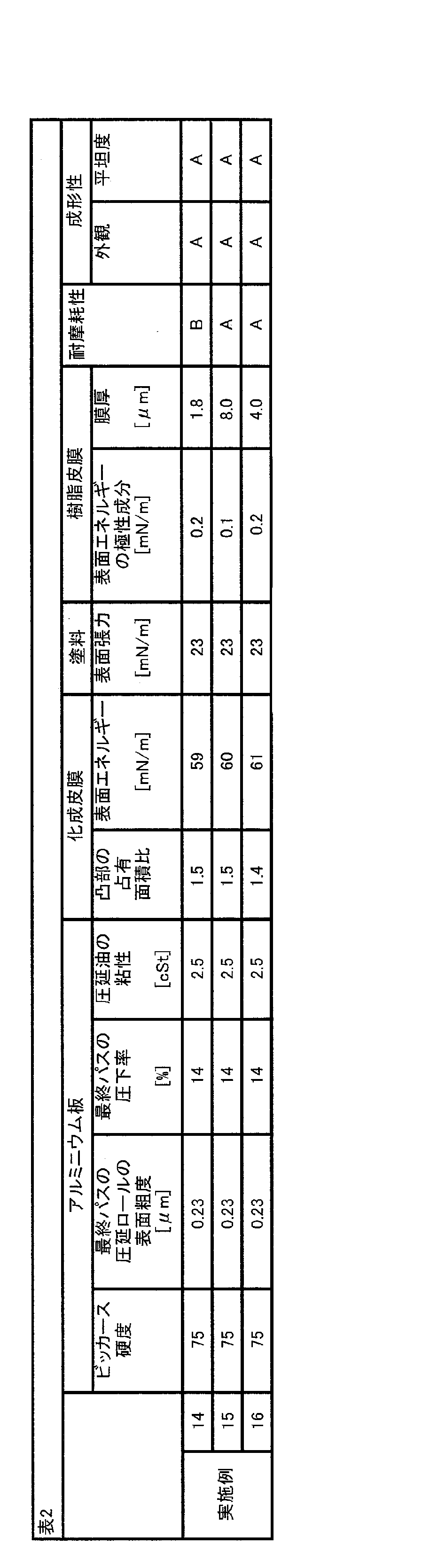
- the aluminum coating materials produced in Examples 14 to 16 were evaluated for formability and wear resistance by the following methods. In any evaluation item, A and B are acceptable levels, and C is unacceptable.
- a galling wound is not recognized in the vicinity of a bending part, and a coating-film crack is not recognized in a bending part.
- B Although no galling is observed in the part not subjected to the processing in the vicinity of the bent part, a crack in the coating film is slightly observed in the bent part.
- C A galling wound and a remarkable crack are recognized in the bending part in the part which has not received the process of the bending part vicinity.
- ⁇ Conductivity> The electrical resistance value when a steel probe having a tip radius of 5 mm was brought into contact with the resin coating surface of the aluminum coating material with a load of 50 gf was measured at 50 locations. The number of energizations in 50 measurements was counted. A and B are acceptable levels, and C is unacceptable. A: 50 times B: 40 times or more and 49 times or less C: 39 times or less
- ⁇ Abrasion resistance> Using an aluminum coating material, a Taber abrasion test was conducted, and the amount of abrasion after 500 tests was measured. A and B are acceptable levels, and C is unacceptable. A: Less than 10 mg B: 10 mg or more and less than 20 mg C: 20 mg or more
- each of the aluminum coating materials of Examples 1 to 13 has a chemical film on the surface of the aluminum material and a resin film on the chemical film, and the area occupied by the convex portions on the surface of the chemical film
- the ratio is in the range of 1.0 to 3.2
- the polar component of the surface energy of the resin film surface is 1.0 to 3.6 mN / m, and it has excellent slidability and good press moldability.
- Examples 7 to 8, 11 and 13 in which the average film thickness of the resin film is in the range of 0.3 to 0.8 ⁇ m are all excellent in slidability and moldability. In addition, it was excellent in conductivity.
- Examples 14 to 16 all had excellent wear resistance and good press moldability.
- the aluminum coating materials of Comparative Examples 1, 2, and 4 have poor convexity because the ratio of the convex area occupied on the surface of the chemical conversion film exceeds 3.2, and in particular, the appearance quality is particularly poor. there were.
- the ratio of the convex area occupied on the surface of the chemical film is in the range of 1.0 to 3.2, but the polar component of the surface energy of the resin film surface exceeds 3.6 mN / m. Therefore, slidability and moldability (appearance and flatness) were inferior.
Landscapes
- Laminated Bodies (AREA)
- Other Surface Treatments For Metallic Materials (AREA)
- Application Of Or Painting With Fluid Materials (AREA)
Abstract
Description
光学ドライブを内蔵するノートパソコン、ポータブルタイプの光学ドライブの普及に伴って、光学ドライブにも軽量化が求められ、アッパーカバーやボトムカバー、トラバースベースにアルミニウム板が使用されるようになってきた。
しかしながら、揮発性プレス油を用いて裸材のアルミニウム板を成形すると、高加工部で割れが発生し、金型との摩耗でかじり傷が付くという問題がある。これに対して金属板上に潤滑剤を含有する塗料を塗装したアルミニウム塗装材を用いることで、成形性が向上することが知られている。例えば、特許文献1には、算術平均粗さRaが0.2~0.6μmのアルミニウム素板の少なくとも片面に、素板側から、付着量がCrまたはZr換算で10~50mg/m2でCrまたはZrを含有する耐食性皮膜と、全樹脂皮膜量に対して1~25質量%の潤滑剤を含有する樹脂皮膜とが順次形成された電子機器用アルミニウム板が開示されている。
また、アッパーカバーやボトムカバーは、組み立て後に導電性を有している必要がある。しかしそれだけでなく、光学ドライブの薄型化に伴って、板バネが軽く接触するときにも導電性は均一であることが求められるようになっている。ところが、特許文献1に開示された電子機器用アルミニウム板では、樹脂皮膜の硬度が制御されておらず、樹脂皮膜の厚い箇所では樹脂皮膜が変形して耐食性皮膜と球状端子の間を部分的に埋めてしまい、導電性が局所的に低下することがあることもわかった。
さらに、トラバースベースは、組み立て後に、光ディスクを出し入れ時に、トレーに過剰な力がかかる場合、トレーが傾き、トレー出口と接触する場合がある。トレー出口とトラバースベースが接触し、樹脂皮膜が削れると、金属がトレー出口と接触し、トレーが変形する場合がある。このため、近年、トラバースベース用の樹脂皮膜に耐摩耗性が要求されるようになった。
装材の提供を目的とする。さらに、成形性と耐摩耗性に優れたアルミニウム塗装材の提供を目的とする。
(2)前記樹脂皮膜が、ビスフェノール型エポキシ樹脂またはビスフェノール型変性エポキシ樹脂と、尿素樹脂またはフェノール樹脂とによる硬化皮膜であることを特徴とする(1)に記載の潤滑性アルミニウム塗装材。
(3)前記樹脂皮膜が、ビスフェノール型ニトリル変性エポキシ樹脂の硬化皮膜であることを特徴とする(1)に記載の潤滑性アルミニウム塗装材。
(4)前記樹脂皮膜が、ビスフェノール型エポキシ樹脂又はビスフェノール型ニトリル変性エポキシ樹脂と、ベンゾグアナミン樹脂とによる硬化皮膜であることを特徴とする(1)または(3)に記載の潤滑性アルミニウム塗装材。
(5)前記樹脂皮膜の平均膜厚が、0.3~8.0μmであることを特徴とする(1)~(4)のいずれか1項に記載の潤滑性アルミニウム塗装材。
(6)前記樹脂皮膜の平均膜厚が、0.3~1.7μmであることを特徴とする(1)~(5)のいずれか1項に記載の潤滑性アルミニウム塗装材。
(7)前記樹脂皮膜の平均膜厚が、0.3~0.8μmであることを特徴とする(1)~(6)のいずれか1項に記載の潤滑性アルミニウム塗装材。
(8)前記樹脂皮膜の平均膜厚が、1.7~8.0μmであることを特徴とする(1)~(5)のいずれか1項に記載の潤滑性アルミニウム塗装材。
また、樹脂皮膜の膜厚を特定の範囲とすることで、鋼球を押し付けたときに所定の塗膜硬度を有する樹脂皮膜が変形しにくく、優れた導電性が得られる。
本発明の上記及び他の特徴及び利点は、適宜添付の図面を参照して、下記の記載からより明らかになるであろう。
本発明に用いるアルミニウム板の材質は、特に限定されるものではないが、5000系アルミニウム合金が好適である。アルミニウム板の板厚は、光学ドライブの設計に合わせて選択されるが、近年の薄肉化に十分応えられる点で、0.12~0.80mmの範囲が好ましく、0.15~0.64mmの範囲が好ましい。アルミニウム板のビッカース硬度は、70~95であることが好ましい。アルミニウム板のビッカース硬度が上述の範囲内にあると、プレス成形後の平坦度及びプレス成形での曲げ部外観に優れる。
アルミニウム板の表面形状は、本発明の潤滑性アルミニウム塗装材における化成皮膜の表面形状に影響するため、表面粗度(算術平均粗さRa)が0.15~0.45μmの算術平均粗さを有する圧延ロールを、冷間圧延工程における最終パスの圧延ロールに用いるのが好ましい。
なお、圧延ロールの表面形状を調整する方法としては、研磨又はショットブラスト、放電加工、レーザー加工等が挙げられる。また、冷間圧延工程における最終パスの圧下率を10~55%に調整し、圧延油の粘性を2.2~5.8cStに調整することが好ましい。更に、冷間圧延後に、焼鈍又は安定化熱処理を行うことが好ましい。アルミニウム板の表面形状は圧延ロールの表面形状の他に、オイルピットの形状や分布状態、アルミニウム表層の結晶状態の影響を受ける。
これらにより、アルミニウム板の表面粗度の算術平均粗さRaを0.14~0.48μmの好ましい範囲に調整することができる。
本発明のアルミニウム塗装材は、アルミニウム板上に化成皮膜を有している。すなわち、アルミニウム板上に樹脂皮膜を形成する前に、アルミニウム板の表面に化成皮膜が形成される。
化成皮膜を形成するに際して、アルミニウム板の表面の汚れを除去し、また表面性状を調整するために、脱脂処理を行うことが好ましい。脱脂処理は、例えば、カセイソーダ、リン酸ソーダ、ケイ酸ソーダ等によって処理、いわゆるアルカリ洗浄、が好ましい。このような洗浄による脱脂処理については、アルミニウム板に所定の表面処理液をスプレーしたり、アルミニウム板を処理液中に所定温度で所定時間浸漬したりすることによって施される。次に、脱脂処理、特にアルカリ洗浄により発生したスマットを除去する目的で酸洗浄を行うことが好ましい。酸としては、特に限定されるものではないが、例えば、硫酸、硝酸等が挙げられ、特に0.5~5.0質量%の硫酸が好ましい。
なお、化成皮膜の厚みとしては、断面を透過型電子顕微鏡で観察することにより得られ、5~100nmが好ましく、8~50nmがより好ましい。
(a)化成皮膜の表面粗さ
化成皮膜は、その表面を触針式の表面粗さ測定器で測定し、10箇所測定した時の平均値を算出したRmax(断面曲線の最大高さ)が1.2~3.2μmであることが好ましい。Rmaxが1.2μm以上であると、化成皮膜の凸部が適度に存在し、均一な導電性が得られる。一方、Rmaxが3.2μm以下であると、プレス成形時による曲げ部の外観品質に一段と優れる。Rmaxの測定低方法はJIS B0601:‘82、JIS B0031:‘82に準拠し、測定条件はカットオフ値0.8mmである。
また、粗さ曲線による算術平均粗さRaは、0.10~0.44μmであることが好ましい。粗さ曲線による算術平均粗さは後述するコンフォーカル顕微鏡を用いて求めることが好ましい。
本発明の潤滑性アルミニウム塗装材の化成皮膜の凸部の占有面積比は、1.0~3.2の範囲である。
ここで、凸部の占有面積比は、化成皮膜表面の任意の0.8mm角の領域(0.8mm×0.8mm)を、アルミニウム板の圧延垂直方向に2等分した分割領域である片側分割領域(第1分割領域ということがある。)ともう一方の片側分割領域(第2分割領域ということがある。)において、第1分割領域及び第2分割領域における凸部の占有面積比[(凸部の大きい面積)/(凸部の小さい面積)]である。なお、凸部の大きい面積とは、第1または第2分割領域のうちの凸部の面積の大きい側の凸部の面積であり、凸部の面積の小さい面積は、第1または第2分割領域のうちの凸部の面積の小さい側の凸部の面積である。また、「凸部」とは、算術平均粗さを基準にして、それよりも高い部分をいう。
成形性により一段と優れる点で、凸部の占有面積比は、0.8mm角の全面積100に対して、1.0~2.3であるのが好ましく、1.0~1.8であるのがさらに好ましい。
レーザーテック(株)製の「コンフォーカル顕微鏡HD100」(商品名)を用いて、対物レンズ200倍で、アルミニウム板上に設けられた化成皮膜表面に図1に示すような、任意の0.8mm角の領域を設定し、算術平均粗さを求め、それより高い部分を凸部として、三次元画像を観察した。この0.8mm角の領域全体を、さらに40×40に等分割、合計1600区画に分割した細分割領域を設定し、2等分割した領域の各々には20(圧延方向の区画数)×40(幅方向の区画数)の合計800区画の細分割領域を有することになる。このうち、2等分割した各々において、2等分割した領域の全800区画から凸部を含む区画の数(n)を求めた。この得られた区画数(n)に1区画の面積を掛け合わせることで凸部を含む面積が得られる(式(1))。この測定を、0.8mm角の領域の他の任意の20箇所について繰り返して行い、これらの各箇所で得られたSa(凸部の大きい面積)/Sb(凸部の小さい面積)から、この算術平均を求め、これを最終的な、凸部の占有面積比〔Sa(凸部の大きい面積)/Sb(凸部の小さい面積)〕とした。
本発明のアルミニウム塗装材は、化成皮膜上に樹脂皮膜を有している。すなわち、化成皮膜の上に樹脂皮膜が形成される。樹脂皮膜は、熱硬化性樹脂とワックス等とを適切な溶媒にこれらを溶解又は分散した塗料を焼付け塗装して形成される。このようにして得られる樹脂皮膜の表面は、後述するように、所定の表面エネルギーの極性成分を備える。
熱硬化性樹脂としては、どのような熱硬化樹脂でも構わないが、本発明においては、特に、ビスフェノール類とエピハロヒドリンとの重縮合により合成されるビスフェノール型エポキシ樹脂またはビスフェノール型変性エポキシ樹脂を用いることが好ましい。ビスフェノール型エポキシ樹脂やビスフェノール型変性エポキシ樹脂は、ノンクロメート皮膜に対する密着性が高く、耐食性や耐溶剤性にも優れる。
長い程、高分子量のエポキシ樹脂が得られる。本発明で用いられるビスフェノール型エポキシ樹脂の数平均分子量は、成形性が良好である点で、3000~30000が好ましい。数平均分子量は、ゲルパーミュエーションクロマトグラフィー(GPC)を用いて測定される。また、ガラス転移温度(Tg)は、樹脂層の硬度を向上させる点で、80℃~110℃が好ましい。ガラス転移温度はDSCを用いて測定される。
ワックスは、プレコートアルミニウム板の表面に潤滑性を付与するための成分として用いられる。本発明では、特に限定されるものではないが、ポリエチレンワックス、カルナウバワックス、パラフィンワックスの少なくとも1種が好適に用いられる。ポリエチレンワックスは、数平均分子量が600~12000であり80~130℃の融点を有するものが用いることが好ましい。ポリエチレンワックスとして、PTFE変性ポリエチレンワックスや酸化高密度ポリエチレンワックス、ポリエチレンとPTFEの混合ワックス、PTFE/ポリエチレン
アロイワックス等を用いてもよい。カルナウバワックスは、高級脂肪酸エステルを主成分とする植物ロウであり、80~86℃の融点を有する。パラフィンワックスは、原油の減圧蒸留留出油分から、結晶性の良い炭化水素を分離抽出したもので、直鎖状炭化水素が主成分であり、40~70℃の融点を有する。ワックスの含有量は、熱硬化性樹脂に対して1~15質量%、好ましくは2~12質量%である。また、ワックスは平均粒径が1~5μmのワックスを用いることが好ましい。ワックスの平均粒径が上述の範囲内にあると、ウエットの状態で塗装した場合、ワックスは溶剤に溶け難いために樹脂皮膜の表面から突出しやすい。これを焼付乾燥することにより、表面に突出している部分が溶融し、樹脂皮膜表面をワックスが覆うので、好適なワックスの分布を得ることができる。数平均分子量は、ゲルパーミュエーションクロマトグラフィー(GPC)を用いて測定される。融点の測定は、JIS K 7121に準じて測定される。平均粒径の測定は、レーザー回折・散乱法で測定される。
樹脂皮膜を形成する塗料は、例えば、塗装性能及びプレコート材としての一般的性能を確保するために通常の塗料において用いられる、界面活性剤、流動性調節剤、レベリング剤、ワキ防止剤等を適宜添加してもよい。
本発明の樹脂皮膜は、表面のエネルギーの極性成分が0.1~3.6mN/mの範囲内
にある。表面エネルギーの極性成分が上述の範囲にあると、樹脂皮膜の表面の摺動性が向上する。すなわち、極性成分が2.6mN/mを超えると、樹脂皮膜の表面の摺動性が劣り、プレス成形の際に成形条件の厳しい部分で金型と樹脂皮膜が擦れて傷が発生し、プレス成形品の外観品質が劣ることがある。一方、極性成分が0.1mN/m未満では、摺動性に関するそれ以上の効果が認められず、コストアップとなる。表面の摺動性がさらに向上し、摺動性により一層優れる点で、表面のエネルギーの極性成分は0.2~2.6mN/mであるのが好ましく、0.3~1.2mN/mであるのがさらに好ましい。
1+cosθ = 2×(γd s)1/2×((γd l)1/2/γlv)
+2×(γh s)1/2×((γh l)1/2/γlv)
θ:接触角(液滴法)
γs:樹脂皮膜表面の表面エネルギー
γd s:樹脂皮膜表面の表面エネルギーの分散成分
γd l:液体の表面張力の分散成分
γh s:樹脂皮膜表面の表面エネルギーの極性成分
γh l:液体の表面張力の極性成分
γlv:液体の表面張力
このため、下記3つの連立方程式を解くことで樹脂皮膜の表面エネルギーの極性成分を求めることができる。
1+cosθH = 2×(γd s)1/2×((21.8)1/2/72.8)
+2×(γh s)1/2×((51.0)1/2/72.8)
1+cosθI = 2×(γd s)1/2×((49.5)1/2/50.8)
+2×(γh s)1/2×((1.3)1/2/50.8)
θH:純水の接触角
θI:ジヨードメタンの接触角
γs:樹脂皮膜表面の表面エネルギー
γd s:樹脂皮膜表面の表面エネルギーの分散成分
γh s:樹脂皮膜表面の表面エネルギーの極性成分
具体的には、化成皮膜表面の表面エネルギーを小さくする、塗料の表面張力を小さくする、または、塗料の焼付条件のうち、昇温時間を短くすると、樹脂皮膜表面の表面エネルギーが大きくなる傾向にある。なお、塗料の表面張力は自動表面張力計によって測定できる。
樹脂皮膜の平均膜厚は、0.3~8.0μmの範囲が好ましい。
このうち、平均膜厚が1.7~8.0μmの範囲にあると、塗膜が含有するワックス量の増加に伴い、耐摩耗性に優れるため、光ディスクと光学ドライブ内のトラバースベースが接触しても初期の性能を維持できるので、耐久性が向上する。
一方、平均膜厚が0.3~1.7mmの範囲内にあると低コストで潤滑性に優れる。樹脂皮膜の平均膜厚は、0.3~0.8μmの範囲がより好ましい。平均膜厚が0.3~0.8μmの範囲内にあると、低コストで潤滑性に優れる上、さらに導電性にも優れる。このように樹脂皮膜の膜厚を0.3~0.8μmの範囲とすることで、鋼球を押し付けたときに所定の塗膜硬度を有する樹脂皮膜が変形しにくく、優れた導電性が得られる。従って、本発明は、軽荷重下でも均一な導電性を確保することのできるアルミニウム塗装材の提供できる。
平均膜厚の測定は、質量法で測定した値を乾燥塗膜比重で除して算出するか、または、断面を透過型電子顕微鏡で観察し、膜厚を20箇所測定し、平均値を算出するか等で行うことができる。
本発明における樹脂皮膜の硬度は、ナノインデンテーション法により測定された値が、0.5~5MPaの範囲にあることが好ましい。この範囲とすることで、樹脂皮膜の膜厚が0.3~0.8μmの範囲でも、塗膜が変形にくく、導電性にも優れ、しかも低コストに抑えることができる。
熱硬化性樹脂及びワックスと、これに添加剤を適宜加え、適当な溶媒にこれらを溶解又は分散した塗料を、アルミニウム板に形成された化成皮膜上に塗布し、所定温度のオーブン中で所定時間処理して焼付け乾燥する。溶媒に関する限定は特にないが、水、エステル、グリコールエーテル、グリコール、ケトン、芳香族もしくは脂肪族炭化水素、アルコール等が挙げられる。これらの中でも、具体的には、キシレン、プロピレングリコールモノメチルアセタートおよび二塩基酸エステル(アジピン酸、グルタル酸またはコハク酸のジメチルエステル等)が特に適切である。通常、塗料は1~50質量%の固形分となるように調製される。
焼付温度は、最高到達板温度が200~290℃が好ましい。
表1に示すビッカース硬度を有する5000系アルミニウム合金板(厚さ0.2mm)の両面を、アルカリ性脱脂液にて脱脂処理し、水洗し、2質量%硫酸で酸洗浄した後、水洗し、リン酸クロメート処理液にて化成処理した。次いで、形成したリン酸クロメート化成皮膜の片面に、ビスフェノールA型エポキシ樹脂(商品名「JER1010」、三菱化学株式会社製)90質量部と、尿素樹脂(商品名「ニカラック MX-280」、株式会社三和ケミカル製)10質量部と、ポリエチレンワックス(商品名「ハイワックス400P」、三井化学株式会社製)1質量部をそれぞれ含む塗料をトップフィード方式でロールに供給し、ロールコータ(2ロール、ナチュラル回転)で塗装し、4ゾーンからなるオーブンで昇温させて、最高到達板温度が250℃で焼付乾燥させて、アルミニウム塗装材を作製した。
アルミニウム板の最終パスの条件(圧延ロールの表面粗度、圧化率、および圧延油の粘度)、形成したリン酸クロメート化成皮膜の表面エネルギーおよび塗料の表面張力はそれぞれ下記表1に示した。
表1に示すビッカース硬度を有する5000系アルミニウム合金板(厚さ0.2mm)両面を、アルカリ性脱脂液にて脱脂処理し、水洗し、2質量%硫酸で酸洗浄した後、水洗し、ジルコニウム-モリブデン系処理液にてジルコニウム-モリブデン系化成処理した。次いで、形成したジルコニウム-モリブデン系化成皮膜の片面に、ビスフェノールA型エポキシ樹脂(商品名「JER1010」、三菱化学株式会社製)85質量部と、尿素樹脂(商品名「ユーバン10S60」、三井化学株式会社製)15質量部と、ポリエチレンワックス(商品名「CERAFLOUR950」、ビックケミー株式会社製)2質量部をそれぞれ含む塗料をトップフィード方式でロールに供給し、ロールコータ(2ロール、ナチュラル回転)で塗装し、4ゾーンからなるオーブンで昇温させて、最高到達板温度が250℃で焼付乾燥させて、アルミニウム塗装材を作製した。
アルミニウム板の最終パスの条件(圧延ロールの表面粗度、圧化率、および圧延油の粘度)、形成したジルコニウム-モリブデン系化成皮膜の表面エネルギーおよび塗料の表面張力はそれぞれ下記表1に示した。
表1に示すビッカース硬度を有する5000系アルミニウム合金板(厚さ0.2mm)の両面を、アルカリ性脱脂液にて脱脂処理し、水洗し、2質量%硫酸で酸洗浄した後、水洗し、リン酸クロメート処理液にて化成処理した。次いで、形成したリン酸クロメート化成皮膜の片面に、ビスフェノールA型変性エポキシ樹脂85質量部と、尿素樹脂(商品名「ベッカミンP-196-M」、株式会社DIC製)15質量部と、ポリエチレンワックス(商品名「ハイワックス200P」、三井化学株式会社製)5質量部と、カルナウバワックス(商品名「CERACOL601」、ビックケミー株式会社製)2質量部をそれぞれ含む塗料をボトムアップ方式でロールに供給し、ロールコータ(3ロール、ナチュラル回転)で塗装し、3ゾーンからなるオーブンで昇温させて、最高到達板温度が230℃で焼付乾燥させて、アルミニウム塗装材を作製した。
アルミニウム板の最終パスの条件(圧延ロールの表面粗度、圧化率、および圧延油の粘度)、形成したリン酸クロメート化成皮膜の表面エネルギーおよび塗料の表面張力はそれぞれ下記表1に示した。
表1に示すビッカース硬度を有する5000系アルミニウム合金板(厚さ0.4mm)の両面を、アルカリ性脱脂液にて脱脂処理し、水洗し、2質量%硫酸で酸洗浄した後、水洗し、リン酸クロメート処理液にて化成処理した。次いで、形成したリン酸クロメート化成皮膜の片面に、ビスフェノールA型ニトリル変性エポキシ樹脂(数平均分子量9000)85質量部と、ベンゾグアナミン樹脂(商品名「スーパーベッカミン
TD-126」 DIC株式会社製)15質量部と、パラフィンワックス(商品名「155」 日本精蝋株式会社製)5質量部をそれぞれ含む塗料をボトムアップ方式でロールに供給し、ロールコータ(2ロール、リバース回転)で塗装し、3ゾーンからなるオーブンで昇温させて、最高到達温度が250℃で焼付乾燥させて、アルミニウム塗装材を作製した。
アルミニウム板の最終パスの条件(圧延ロールの表面粗度、圧化率、および圧延油の粘度)、形成したリン酸クロメート化成皮膜の表面エネルギーおよび塗料の表面張力はそれぞれ下記表1に示した。
表1に示すビッカース硬度を有する5000系アルミニウム合金板(厚さ0.4mm)の両面を、アルカリ性脱脂液にて脱脂処理し、水洗し、2質量%硫酸で酸洗浄した後、水洗し、リン酸クロメート処理液にて化成処理した。次いで、形成したリン酸クロメート化成皮膜の片面に、ビスフェノールA型ニトリル変性エポキシ樹脂(数平均分子量8000)90質量部と、ベンゾグアナミン樹脂(商品名「ニカラック BL-60」 株式会社三和ケミカル製)10質量部と、ポリエチレンとPTFEの混合物(商品名「CERAFLOUR 996」 ビックケミー・ジャパン株式会社製)3質量部をそれぞれ含む塗料をボトムアップ方式でロールに供給し、ロールコータ(2ロール、リバース回転)で塗装し、3ゾーンからなるオーブンで昇温させて、最高到達温度が250℃で焼付乾燥させて、アルミニウム塗装材を作製した。
アルミニウム板の最終パスの条件(圧延ロールの表面粗度、圧化率、および圧延油の粘度)、形成したリン酸クロメート化成皮膜の表面エネルギーおよび塗料の表面張力はそれぞれ下記表1に示した。
表2に示すビッカース硬度を有する5000系アルミニウム合金板(厚さ0.4mm)の両面を、アルカリ性脱脂液にて脱脂処理し、水洗し、2質量%硫酸で酸洗浄した後、水洗し、リン酸クロメート処理液にて化成処理した。次いで、形成したリン酸クロメート化成皮膜の片面に、ビスフェノールA型ニトリル変性エポキシ樹脂(数平均分子量8000)90質量部と、ベンゾグアナミン樹脂(商品名「ニカラック BL-60」 株式会社三和ケミカル製)10質量部と、ポリエチレンとPTFEの混合物(商品名「CERAFLOUR 996」 ビックケミー・ジャパン株式会社製)3質量部をそれぞれ含む塗料をボトムアップ方式でロールに供給し、ロールコータ(2ロール、リバース回転)で塗装し、3ゾーンからなるオーブンで昇温させて、最高到達温度が250℃で焼付乾燥させて、アルミニウム塗装材を作製した。
アルミニウム板の最終パスの条件(圧延ロールの表面粗度、圧化率、および圧延油の粘度)、形成したリン酸クロメート化成皮膜の表面エネルギーおよび塗料の表面張力はそれぞれ下記表2に示した。
表1に示すビッカース硬度を有する5000系アルミニウム合金板(厚さ0.2mm)の両面を、アルカリ性脱脂液にて脱脂処理し、水洗し、2質量%硫酸で酸洗浄及び水洗をしないで、リン酸クロメート処理液にて化成処理した。次いで、形成したリン酸クロメート化成皮膜の片面に、ビスフェノールA型エポキシ樹脂(商品名「JER1010」、三菱化学株式会社製)88質量部と、尿素樹脂(商品名「ユーバン 10R」、株式会社三井化学製)12質量部と、ポリエチレンワックス(商品名「ハイワックス405MP」、三井化学株式会社製)0.5質量部をそれぞれ含む塗料をトップフィード方式でロールに供給し、ロールコータ(2ロール、ナチュラル回転)で塗装し、2ゾーンからなるオーブンで昇温させて、最高到達板温度が250℃で焼付乾燥させて、アルミニウム塗装材を作製した。
アルミニウム板の最終パスの条件(圧延ロールの表面粗度、圧化率、および圧延油の粘度)、形成したリン酸クロメート化成皮膜の表面エネルギーおよび塗料の表面張力はそれぞれ下記表1に示した。
このようにして作製したアルミニウム塗装材のリン酸クロメート化成皮膜の皮膜量(Cr換算量)またはジルコニウム-モリブデン系化成皮膜の皮膜量(Zr換算量)を蛍光X線分析装置により測定した。その結果、実施例1~4および比較例1~4はいずれもCr換算量が20mg/m2であり、実施例5~8はいずれもZr換算量が2mg/m2であり、実施例9および10は共にCr換算量が10mg/m2であった。
実施例11~16はいずれもCr換算量が30mg/m2であった。
作製したアルミニウム塗装材の樹脂皮膜を剥がして露出させたリン酸クロメート化成皮膜またはジルコニウム-モリブデン系化成皮膜の表面における「凸部の占有面積比」を測定した。
すなわち、レーザーテック(株)製の「コンフォーカル顕微鏡HD100」(商品名)を用いて、対物レンズ200倍で、化成皮膜表面に図1に示すような任意の0.8mm角の領域を設定し、算術平均粗さを求め、それより高い部分を凸部として、三次元画像を観察した。この0.8mm角の領域全体を、さらに40×40に等分割し、合計1600区画に分割した細分割領域を設定し、この領域を圧延方向に対して垂直方向に2等分した領域に分けた、20(圧延方向の区画数)×40(幅方向の区画数)の800区画の分割領域を2つ設定した。式(1)に示すように、この凸部を含む区画数(n)に1区画の面積を掛け合わせることで凸部の面積とした。なお、ここで得られる面積をSとし、面積の大きい方をSa、面積の小さい方をSbとした。
得られた結果を表1および2に示す。
アルミニウム塗装材の樹脂皮膜の表面エネルギーの極性成分を前述のようにして測定した。得られた結果を表1および2に示す。
作製したアルミニウム塗装材の樹脂皮膜の膜厚を前述の測定方法によって測定した結果を表1および2に示す。
いずれの評価項目も、A、Bが合格レベルであり、Cは不合格である。
バウデン式摩擦試験により、3/16インチ鋼球を用い、5Nでアルミニウム塗装材の表面を5回摺動させた後の動摩擦係数を測定した。
A:動摩擦係数が0.10未満
B:動摩擦係数が0.10以上0.20未満
C:動摩擦係数が0.20以上
アルミニウム塗装材をプレス成形し、プレス成形品の外観および平坦度を目視により評価した。いずれにおいても、A、Bが合格レベルであり、Cは不合格である。
A:曲げ部近傍にかじり傷は認められず、曲げ部に塗膜割れが認められない。
B:曲げ部近傍の加工を受けていない部分にかじり傷は認められないが、曲げ部にやや塗膜割れが認められる。
C:曲げ部近傍の加工を受けていない部分にかじり傷や曲げ部に著しい割れが認められる。
A:局部的な歪みが認められず、表面が平滑である。
B:局部的な歪みが僅かに認められる。
C:局部的な歪みが著しく認められる。
アルミニウム塗装材の樹脂皮膜表面に先端部半径が5mmである鋼製プローブを荷重50gfで接触させた時の電気抵抗値を50箇所測定した。50回の測定において通電した回数を計数した。A、Bが合格レベルであり、Cは不合格である。
A:50回
B:40回以上49回以下
C:39回以下
アルミニウム塗装材を用い、テーバー摩耗試験を実施し、500回試験後の摩耗量を測定した。A、Bが合格レベルであり、Cは不合格である。
A:10mg未満
B:10mg以上20mg未満
C:20mg以上
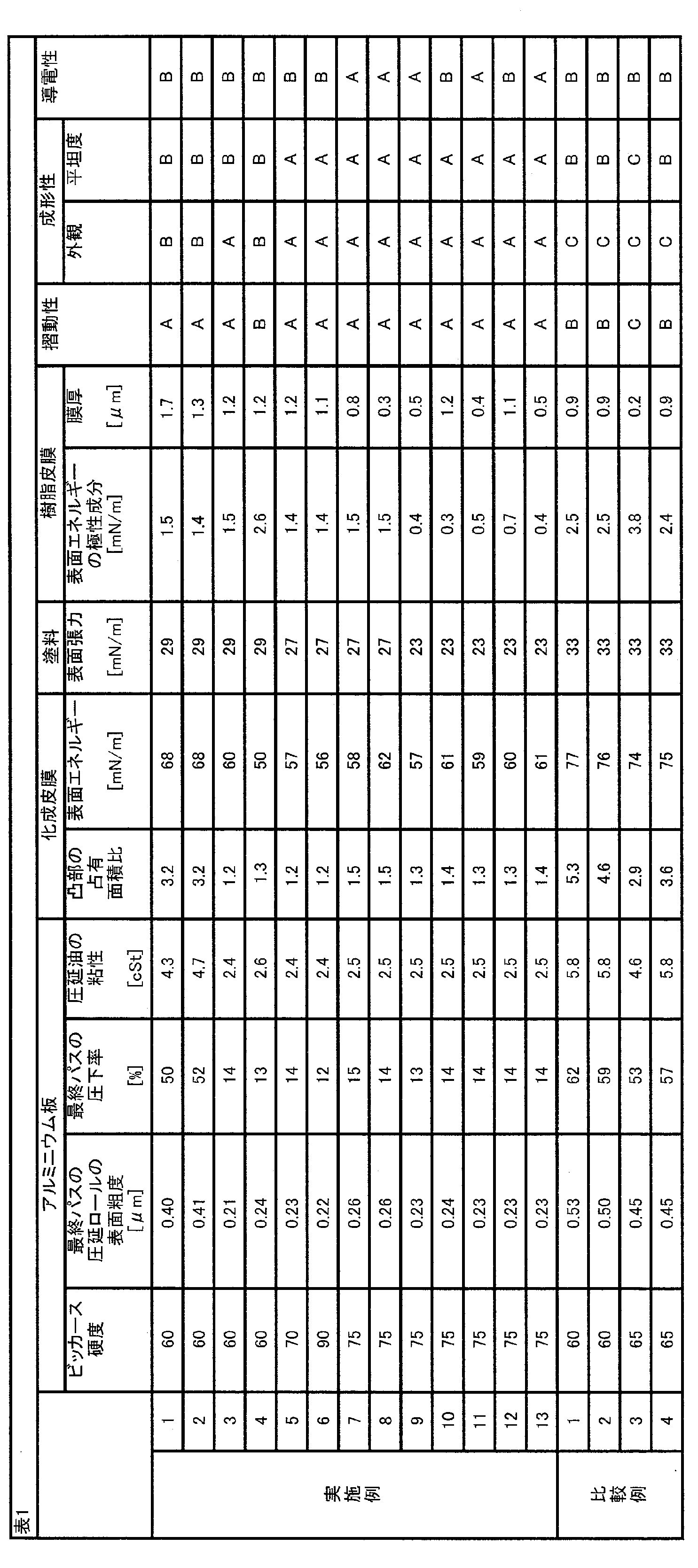
特に、実施例1~13のうち、樹脂皮膜の平均膜厚が0.3~0.8μmの範囲にある実施例7~8、11、13は、いずれも、優れた摺動性および成形性を保持しつつ導電性にも優れていた。
一方、表2に示されるように、実施例14~16は、いずれも、耐摩耗性に優れ、プレス成形性も良好であった。
2 第1分割領域
3 第2分割領域
4 細分割領域
Claims (8)
- アルミニウム材の少なくとも一方の面に化成皮膜と、該化成皮膜上に樹脂皮膜とを有するアルミニウム塗装材であって、前記化成皮膜の表面の任意の0.8mm角の領域を前記アルミニウム材の圧延垂直方向に2等分した分割領域における(凸部の大きい面積)/(凸部の小さい面積)である凸部占有面積比が1.0~3.2の範囲にあり、かつ、前記樹脂皮膜の表面エネルギーの極性成分が0.1~3.6mN/mであることを特徴とする潤滑性アルミニウム塗装材。
- 前記樹脂皮膜が、ビスフェノール型エポキシ樹脂またはビスフェノール型変性エポキシ樹脂と、尿素樹脂またはフェノール樹脂とによる硬化皮膜であることを特徴とする請求項1に記載の潤滑性アルミニウム塗装材。
- 前記樹脂皮膜が、ビスフェノール型ニトリル変性エポキシ樹脂の硬化皮膜であることを特徴とする請求項1に記載の潤滑性アルミニウム塗装材。
- 前記樹脂皮膜が、ビスフェノール型エポキシ樹脂又はビスフェノール型ニトリル変性エポキシ樹脂と、ベンゾグアナミン樹脂とによる硬化皮膜であることを特徴とする請求項1または3に記載の潤滑性アルミニウム塗装材。
- 前記樹脂皮膜の平均膜厚が、0.3~8.0μmであることを特徴とする請求項1~4のいずれか1項に記載の潤滑性アルミニウム塗装材。
- 前記樹脂皮膜の平均膜厚が、0.3~1.7μmであることを特徴とする請求項1~5のいずれか1項に記載の潤滑性アルミニウム塗装材。
- 前記樹脂皮膜の平均膜厚が、0.3~0.8μmであることを特徴とする請求項1~6のいずれか1項に記載の潤滑性アルミニウム塗装材。
- 前記樹脂皮膜の平均膜厚が、1.7~8.0μmであることを特徴とする請求項1~5のいずれか1項に記載の潤滑性アルミニウム塗装材。
Priority Applications (3)
| Application Number | Priority Date | Filing Date | Title |
|---|---|---|---|
| CN201380066622.8A CN104884673B (zh) | 2013-01-25 | 2013-10-31 | 润滑性铝涂布材料 |
| JP2014558441A JP6296662B2 (ja) | 2013-01-25 | 2013-10-31 | 潤滑性アルミニウム塗装材 |
| PH12015501409A PH12015501409A1 (en) | 2013-01-25 | 2015-06-18 | Lubricative aluminum coating material |
Applications Claiming Priority (2)
| Application Number | Priority Date | Filing Date | Title |
|---|---|---|---|
| JP2013012701 | 2013-01-25 | ||
| JP2013-012701 | 2013-01-25 |
Publications (1)
| Publication Number | Publication Date |
|---|---|
| WO2014115394A1 true WO2014115394A1 (ja) | 2014-07-31 |
Family
ID=51227198
Family Applications (1)
| Application Number | Title | Priority Date | Filing Date |
|---|---|---|---|
| PCT/JP2013/079587 Ceased WO2014115394A1 (ja) | 2013-01-25 | 2013-10-31 | 潤滑性アルミニウム塗装材 |
Country Status (5)
| Country | Link |
|---|---|
| JP (1) | JP6296662B2 (ja) |
| CN (1) | CN104884673B (ja) |
| MY (1) | MY172212A (ja) |
| PH (1) | PH12015501409A1 (ja) |
| WO (1) | WO2014115394A1 (ja) |
Cited By (1)
| Publication number | Priority date | Publication date | Assignee | Title |
|---|---|---|---|---|
| CN105296979A (zh) * | 2015-11-10 | 2016-02-03 | 俞虹 | 铝合金低温防腐保护剂及防腐方法 |
Families Citing this family (1)
| Publication number | Priority date | Publication date | Assignee | Title |
|---|---|---|---|---|
| CN113634598B (zh) * | 2021-06-29 | 2023-09-22 | 乳源东阳光优艾希杰精箔有限公司 | 提高铝箔表面自由能的铝加工用油及铝制品的制备方法 |
Citations (3)
| Publication number | Priority date | Publication date | Assignee | Title |
|---|---|---|---|---|
| JP2009196357A (ja) * | 2008-01-23 | 2009-09-03 | Furukawa-Sky Aluminum Corp | 導電性に優れた耐傷付け性プレコート金属板 |
| JP2010005545A (ja) * | 2008-06-27 | 2010-01-14 | Furukawa-Sky Aluminum Corp | 電子電気機器用プレコート金属板 |
| JP2010143137A (ja) * | 2008-12-19 | 2010-07-01 | Furukawa-Sky Aluminum Corp | 電子電気機器用プレコート金属板 |
Family Cites Families (3)
| Publication number | Priority date | Publication date | Assignee | Title |
|---|---|---|---|---|
| JP4237975B2 (ja) * | 2002-04-24 | 2009-03-11 | 株式会社神戸製鋼所 | 電子機器用アルミニウム板及びこれを用いた電子機器用成形品 |
| JP4091963B1 (ja) * | 2007-01-12 | 2008-05-28 | 古河スカイ株式会社 | アルミニウム電解コンデンサケース用樹脂被覆アルミニウム合金板材及びアルミニウム電解コンデンサケース、アルミニウム電解コンデンサ |
| JP5240489B2 (ja) * | 2007-05-31 | 2013-07-17 | 東洋製罐グループホールディングス株式会社 | 樹脂被覆アルミニウム合金板及びそれを用いた成形体 |
-
2013
- 2013-10-31 MY MYPI2015702384A patent/MY172212A/en unknown
- 2013-10-31 CN CN201380066622.8A patent/CN104884673B/zh active Active
- 2013-10-31 WO PCT/JP2013/079587 patent/WO2014115394A1/ja not_active Ceased
- 2013-10-31 JP JP2014558441A patent/JP6296662B2/ja active Active
-
2015
- 2015-06-18 PH PH12015501409A patent/PH12015501409A1/en unknown
Patent Citations (3)
| Publication number | Priority date | Publication date | Assignee | Title |
|---|---|---|---|---|
| JP2009196357A (ja) * | 2008-01-23 | 2009-09-03 | Furukawa-Sky Aluminum Corp | 導電性に優れた耐傷付け性プレコート金属板 |
| JP2010005545A (ja) * | 2008-06-27 | 2010-01-14 | Furukawa-Sky Aluminum Corp | 電子電気機器用プレコート金属板 |
| JP2010143137A (ja) * | 2008-12-19 | 2010-07-01 | Furukawa-Sky Aluminum Corp | 電子電気機器用プレコート金属板 |
Cited By (1)
| Publication number | Priority date | Publication date | Assignee | Title |
|---|---|---|---|---|
| CN105296979A (zh) * | 2015-11-10 | 2016-02-03 | 俞虹 | 铝合金低温防腐保护剂及防腐方法 |
Also Published As
| Publication number | Publication date |
|---|---|
| PH12015501409A1 (en) | 2015-09-14 |
| CN104884673A (zh) | 2015-09-02 |
| CN104884673B (zh) | 2018-04-03 |
| JPWO2014115394A1 (ja) | 2017-01-26 |
| MY172212A (en) | 2019-11-18 |
| JP6296662B2 (ja) | 2018-03-20 |
Similar Documents
| Publication | Publication Date | Title |
|---|---|---|
| KR101069025B1 (ko) | 프리코팅 금속판 및 프리코팅 금속판의 제조 방법 | |
| KR100952884B1 (ko) | 슬롯인 드라이브 케이스용 프레코트 금속판 | |
| JP6296662B2 (ja) | 潤滑性アルミニウム塗装材 | |
| JP2010005545A (ja) | 電子電気機器用プレコート金属板 | |
| JP2011083689A (ja) | 撥水性金属塗装材 | |
| CN102762313B (zh) | 导电性预涂铝合金板 | |
| CN101754666A (zh) | 导电性预涂铝合金板 | |
| JP4451911B2 (ja) | 樹脂被覆アルミニウム合金板の製造方法 | |
| CN101746092A (zh) | 电子电气设备用预涂层金属板 | |
| JP5237080B2 (ja) | 電子電気機器用プレコート金属板 | |
| JP2010228279A (ja) | 電気電子機器筐体用プレコートアルミニウム合金板 | |
| KR101657818B1 (ko) | 흑색수지 코팅 조성물 및 흑색수지 강판 | |
| JP2009196357A (ja) | 導電性に優れた耐傷付け性プレコート金属板 | |
| JP2023059205A (ja) | 金属板塗布用塗料 | |
| JP2005096405A (ja) | 高反射プレコートアルミニウム合金板 | |
| CN102991018A (zh) | 导电性预涂铝合金板 | |
| CN1971752A (zh) | 用于插槽驱动器盒的预涂金属片 | |
| JP2008094085A (ja) | 耐傷付け性と導電性に優れたプレコート金属板 | |
| JP7533427B2 (ja) | 冷間圧延鋼板 | |
| JP2006097127A (ja) | 耐傷付け性プレコート金属板 | |
| JP2008036847A (ja) | 耐傷付け性と導電性に優れたプレコート金属板 | |
| JP3990663B2 (ja) | 表面処理金属板、及びその製造方法、並びにこの製造方法に用いる潤滑樹脂と潤滑樹脂塗料組成物 | |
| JP7380963B1 (ja) | 被覆鋼板およびその製造方法 | |
| JP4221039B2 (ja) | ドライブケース用プレコート金属板 | |
| JP3499733B2 (ja) | ディスクシャッタ用アルミニウム材 |
Legal Events
| Date | Code | Title | Description |
|---|---|---|---|
| 121 | Ep: the epo has been informed by wipo that ep was designated in this application |
Ref document number: 13872712 Country of ref document: EP Kind code of ref document: A1 |
|
| ENP | Entry into the national phase |
Ref document number: 2014558441 Country of ref document: JP Kind code of ref document: A |
|
| WWE | Wipo information: entry into national phase |
Ref document number: 12015501409 Country of ref document: PH |
|
| NENP | Non-entry into the national phase |
Ref country code: DE |
|
| 122 | Ep: pct application non-entry in european phase |
Ref document number: 13872712 Country of ref document: EP Kind code of ref document: A1 |