WO2014111004A1 - 一类黄酮烷基胺类化合物、其制备方法和用途 - Google Patents
一类黄酮烷基胺类化合物、其制备方法和用途 Download PDFInfo
- Publication number
- WO2014111004A1 WO2014111004A1 PCT/CN2014/070561 CN2014070561W WO2014111004A1 WO 2014111004 A1 WO2014111004 A1 WO 2014111004A1 CN 2014070561 W CN2014070561 W CN 2014070561W WO 2014111004 A1 WO2014111004 A1 WO 2014111004A1
- Authority
- WO
- WIPO (PCT)
- Prior art keywords
- acid
- compound
- reaction
- flavonoid
- group
- Prior art date
- Legal status (The legal status is an assumption and is not a legal conclusion. Google has not performed a legal analysis and makes no representation as to the accuracy of the status listed.)
- Ceased
Links
Classifications
-
- A—HUMAN NECESSITIES
- A61—MEDICAL OR VETERINARY SCIENCE; HYGIENE
- A61K—PREPARATIONS FOR MEDICAL, DENTAL OR TOILETRY PURPOSES
- A61K31/00—Medicinal preparations containing organic active ingredients
- A61K31/33—Heterocyclic compounds
- A61K31/335—Heterocyclic compounds having oxygen as the only ring hetero atom, e.g. fungichromin
- A61K31/35—Heterocyclic compounds having oxygen as the only ring hetero atom, e.g. fungichromin having six-membered rings with one oxygen as the only ring hetero atom
- A61K31/352—Heterocyclic compounds having oxygen as the only ring hetero atom, e.g. fungichromin having six-membered rings with one oxygen as the only ring hetero atom condensed with carbocyclic rings, e.g. methantheline
-
- A—HUMAN NECESSITIES
- A61—MEDICAL OR VETERINARY SCIENCE; HYGIENE
- A61K—PREPARATIONS FOR MEDICAL, DENTAL OR TOILETRY PURPOSES
- A61K31/00—Medicinal preparations containing organic active ingredients
- A61K31/33—Heterocyclic compounds
- A61K31/395—Heterocyclic compounds having nitrogen as a ring hetero atom, e.g. guanethidine or rifamycins
- A61K31/40—Heterocyclic compounds having nitrogen as a ring hetero atom, e.g. guanethidine or rifamycins having five-membered rings with one nitrogen as the only ring hetero atom, e.g. sulpiride, succinimide, tolmetin, buflomedil
- A61K31/4025—Heterocyclic compounds having nitrogen as a ring hetero atom, e.g. guanethidine or rifamycins having five-membered rings with one nitrogen as the only ring hetero atom, e.g. sulpiride, succinimide, tolmetin, buflomedil not condensed and containing further heterocyclic rings, e.g. cromakalim
-
- A—HUMAN NECESSITIES
- A61—MEDICAL OR VETERINARY SCIENCE; HYGIENE
- A61K—PREPARATIONS FOR MEDICAL, DENTAL OR TOILETRY PURPOSES
- A61K31/00—Medicinal preparations containing organic active ingredients
- A61K31/33—Heterocyclic compounds
- A61K31/395—Heterocyclic compounds having nitrogen as a ring hetero atom, e.g. guanethidine or rifamycins
- A61K31/435—Heterocyclic compounds having nitrogen as a ring hetero atom, e.g. guanethidine or rifamycins having six-membered rings with one nitrogen as the only ring hetero atom
- A61K31/44—Non condensed pyridines; Hydrogenated derivatives thereof
- A61K31/445—Non condensed piperidines, e.g. piperocaine
- A61K31/4523—Non condensed piperidines, e.g. piperocaine containing further heterocyclic ring systems
- A61K31/453—Non condensed piperidines, e.g. piperocaine containing further heterocyclic ring systems containing a six-membered ring with oxygen as a ring hetero atom
-
- A—HUMAN NECESSITIES
- A61—MEDICAL OR VETERINARY SCIENCE; HYGIENE
- A61K—PREPARATIONS FOR MEDICAL, DENTAL OR TOILETRY PURPOSES
- A61K31/00—Medicinal preparations containing organic active ingredients
- A61K31/33—Heterocyclic compounds
- A61K31/395—Heterocyclic compounds having nitrogen as a ring hetero atom, e.g. guanethidine or rifamycins
- A61K31/435—Heterocyclic compounds having nitrogen as a ring hetero atom, e.g. guanethidine or rifamycins having six-membered rings with one nitrogen as the only ring hetero atom
- A61K31/47—Quinolines; Isoquinolines
- A61K31/473—Quinolines; Isoquinolines ortho- or peri-condensed with carbocyclic ring systems, e.g. acridines, phenanthridines
-
- A—HUMAN NECESSITIES
- A61—MEDICAL OR VETERINARY SCIENCE; HYGIENE
- A61K—PREPARATIONS FOR MEDICAL, DENTAL OR TOILETRY PURPOSES
- A61K31/00—Medicinal preparations containing organic active ingredients
- A61K31/33—Heterocyclic compounds
- A61K31/395—Heterocyclic compounds having nitrogen as a ring hetero atom, e.g. guanethidine or rifamycins
- A61K31/495—Heterocyclic compounds having nitrogen as a ring hetero atom, e.g. guanethidine or rifamycins having six-membered rings with two or more nitrogen atoms as the only ring heteroatoms, e.g. piperazine or tetrazines
- A61K31/496—Non-condensed piperazines containing further heterocyclic rings, e.g. rifampin, thiothixene or sparfloxacin
-
- A—HUMAN NECESSITIES
- A61—MEDICAL OR VETERINARY SCIENCE; HYGIENE
- A61K—PREPARATIONS FOR MEDICAL, DENTAL OR TOILETRY PURPOSES
- A61K31/00—Medicinal preparations containing organic active ingredients
- A61K31/33—Heterocyclic compounds
- A61K31/395—Heterocyclic compounds having nitrogen as a ring hetero atom, e.g. guanethidine or rifamycins
- A61K31/535—Heterocyclic compounds having nitrogen as a ring hetero atom, e.g. guanethidine or rifamycins having six-membered rings with at least one nitrogen and one oxygen as the ring hetero atoms, e.g. 1,2-oxazines
- A61K31/5375—1,4-Oxazines, e.g. morpholine
- A61K31/5377—1,4-Oxazines, e.g. morpholine not condensed and containing further heterocyclic rings, e.g. timolol
-
- A—HUMAN NECESSITIES
- A61—MEDICAL OR VETERINARY SCIENCE; HYGIENE
- A61K—PREPARATIONS FOR MEDICAL, DENTAL OR TOILETRY PURPOSES
- A61K31/00—Medicinal preparations containing organic active ingredients
- A61K31/33—Heterocyclic compounds
- A61K31/395—Heterocyclic compounds having nitrogen as a ring hetero atom, e.g. guanethidine or rifamycins
- A61K31/55—Heterocyclic compounds having nitrogen as a ring hetero atom, e.g. guanethidine or rifamycins having seven-membered rings, e.g. azelastine, pentylenetetrazole
-
- A—HUMAN NECESSITIES
- A61—MEDICAL OR VETERINARY SCIENCE; HYGIENE
- A61P—SPECIFIC THERAPEUTIC ACTIVITY OF CHEMICAL COMPOUNDS OR MEDICINAL PREPARATIONS
- A61P25/00—Drugs for disorders of the nervous system
- A61P25/04—Centrally acting analgesics, e.g. opioids
-
- A—HUMAN NECESSITIES
- A61—MEDICAL OR VETERINARY SCIENCE; HYGIENE
- A61P—SPECIFIC THERAPEUTIC ACTIVITY OF CHEMICAL COMPOUNDS OR MEDICINAL PREPARATIONS
- A61P25/00—Drugs for disorders of the nervous system
- A61P25/14—Drugs for disorders of the nervous system for treating abnormal movements, e.g. chorea, dyskinesia
-
- A—HUMAN NECESSITIES
- A61—MEDICAL OR VETERINARY SCIENCE; HYGIENE
- A61P—SPECIFIC THERAPEUTIC ACTIVITY OF CHEMICAL COMPOUNDS OR MEDICINAL PREPARATIONS
- A61P25/00—Drugs for disorders of the nervous system
- A61P25/14—Drugs for disorders of the nervous system for treating abnormal movements, e.g. chorea, dyskinesia
- A61P25/16—Anti-Parkinson drugs
-
- A—HUMAN NECESSITIES
- A61—MEDICAL OR VETERINARY SCIENCE; HYGIENE
- A61P—SPECIFIC THERAPEUTIC ACTIVITY OF CHEMICAL COMPOUNDS OR MEDICINAL PREPARATIONS
- A61P25/00—Drugs for disorders of the nervous system
- A61P25/28—Drugs for disorders of the nervous system for treating neurodegenerative disorders of the central nervous system, e.g. nootropic agents, cognition enhancers, drugs for treating Alzheimer's disease or other forms of dementia
-
- A—HUMAN NECESSITIES
- A61—MEDICAL OR VETERINARY SCIENCE; HYGIENE
- A61P—SPECIFIC THERAPEUTIC ACTIVITY OF CHEMICAL COMPOUNDS OR MEDICINAL PREPARATIONS
- A61P27/00—Drugs for disorders of the senses
- A61P27/02—Ophthalmic agents
- A61P27/06—Antiglaucoma agents or miotics
Definitions
- the present invention belongs to the field of medicinal chemistry, and relates to a novel class of flavonoid alkylamine compounds (I) and pharmaceutically acceptable salts thereof, a preparation method thereof, a pharmaceutical composition, and a preparation for treating and/or preventing a neurodegenerative disease
- vascular dementia Alzheimer's disease, Parkinson's disease, Huntington's disease, HIV-related dementia, multiple sclerosis, progressive lateral sclerosis, neuropathic pain, glaucoma Equal neurodegenerative diseases.
- Vascular Dementia is a type of cerebrovascular disease (including ischemic cerebrovascular disease, hemorrhagic cerebrovascular disease, acute and chronic hypoxic cerebrovascular disease, etc.)
- the main clinical manifestations of clinical syndromes with dysfunction include: cognitive ability, memory and social life decline, as well as emotional and personality changes, is a chronic progressive disease.
- Vascular dementia in Asian countries such as China and Japan is the first cause of senile dementia.
- cerebrovascular diseases are increasing, and the incidence of vascular dementia is gradually increasing, seriously affecting The quality of work and quality of the elderly and the heavy economic and spiritual burden on society and families. Therefore, VD has become an important research hotspot in the field of geriatrics and psychiatry.
- Vascular dementia is complicated by the pathogenesis, and there are no drugs that can block the development of the disease.
- clinical treatment is to improve blood circulation and brain metabolism in the brain, and strengthen brain nutrition.
- AD Alzheimer's disease
- AD Alzheimer's disease
- AD is a central nervous system degenerative disease characterized by progressive cognitive impairment and memory impairment. Its incidence is increasing year by year, becoming second only to the heart. High-risk diseases of vascular diseases and cancer have risen to the fourth place of death in developed countries such as Europe and the United States. According to the World Health Organization, 10% of the world's people over the age of 65 have mental retardation, one-half of them have dementia, and the incidence rate is over 50%. At present, there are more than 5 million patients with AD in China. There is no effective treatment for this disease. As China's population ages, the number will be even larger.
- AD Alzheimer's disease
- AD Alzheimer's disease
- the pathogenesis is complex, and its pathogenesis has not yet been fully elucidated.
- the patient found anatomy of the brain amyloid senile plaque (Senile Plaques, SP) and neurofibrillary Tangles (NFT) It is the most characteristic histopathological change in AD patients.
- many researchers have devoted themselves to revealing the pathogenesis of AD at the molecular and cellular levels, and have proposed various hypotheses such as: cholinergic neuronal damage, amyloid deposition, tau hyperphosphorylation, inflammation, and freedom. Base oxidation, metal ion imbalance, etc. Therefore, new therapeutic approaches and means to develop these pathogenesis will hopefully alleviate and improve the condition of AD patients.
- the present invention aims to disclose a novel class of flavonoid alkylamine compounds (I) and pharmaceutically acceptable salts thereof; another object of the present invention is to disclose the flavonoid alkylamine compounds (I) and their pharmaceutically acceptable Accepted salt preparation method;
- Still another object of the present invention is to disclose the use of the flavonoid alkylamine compound (I) and a pharmaceutically acceptable salt thereof for the preparation of a medicament for treating and/or preventing a neurodegenerative disease, including but not limited to vascularity Dementia, Alzheimer's disease, Parkinson's disease, Huntington's disease, HIV-related dementia, multiple sclerosis, progressive lateral sclerosis, neuropathic pain, glaucoma, and other neurodegenerative diseases.
- vascularity Dementia Alzheimer's disease, Parkinson's disease, Huntington's disease, HIV-related dementia, multiple sclerosis, progressive lateral sclerosis, neuropathic pain, glaucoma, and other neurodegenerative diseases.
- the chemical structure of the flavonoid alkylamine compound (I) provided by the present invention is:
- Ar O—Linker— ⁇ , (I) Where: Ar represents the knot shown below
- Substituent "-O-Linker-NIMV can be connected to any possible position of the B ring;
- the flavonoid alkylamine compound (I) proposed by the present invention can be produced by the following method:
- the base used in the reaction is: an alkali metal hydroxide, an alkaline earth metal hydroxide, an alkali metal carbonate, an alkaline earth metal carbonate, an alkali metal hydrogencarbonate, an alkaline earth metal hydrogencarbonate, d- an alkali metal salt of 8 alcohol, an organic tertiary amines or quaternary ammonium hydroxides (such as: triethylamine, tributylamine, trioctylamine, pyridine, N- methylmorpholine, N- methylpiperidine, triethylene two Amine, tetrabutylammonium hydroxide), preferably a base: potassium hydroxide, sodium hydroxide, potassium carbonate, triethylamine, pyridine or sodium methoxide; the solvent used for the reaction is: diethyl ether, tetrahydrofuran, NN-dimethylformamide, two methyl sulfoxide, dichloromethane, chloro
- the solvent used in the reaction ether, tetrahydrofuran, NN- dimethylformamide, dimethylsulfoxide, methylene chloride, chloroform, C 3 - 8 aliphatic ketone, benzene, toluene, acetonitrile, d - 8-ol, or a C 5 - 8 alkane, preferably solvents: NN- dimethylformamide, acetone, acetonitrile, tetrahydrofuran, ethanol or toluene; intermediate (3): moles of an organic amine compound (4) the feed ratio
- the ratio is 1.0: 1.0-10.0, preferably the molar ratio is 1.0: 1.0-5.0;
- the reaction temperature is room temperature to 150 ° C, preferably the reaction temperature is room temperature to 120 ° C;
- the reaction time is 1 to 72 hours, and the preferred reaction time is 2 ⁇ 24 hours.
- the base used for the reaction alkali metal hydroxides, alkaline earth metal hydroxides, alkali metal carbonates, alkaline earth metal carbonates, alkali metal bicarbonates, alkaline earth metal bicarbonates, alcohol 8 Alkali metal salt, organic tertiary amine or quaternary ammonium base (eg: triethylamine, tributylamine, trioctylamine, pyridine, N-methylmorpholine, N-methylpiperidine, triethylenediamine, Tetrabutylammonium hydroxide), preferably the base is: potassium hydroxide, sodium hydroxide, potassium carbonate, triethylamine, pyridine or sodium methoxide; the solvent used for the reaction is: diethyl ether, tetrahydrofuran, NN-dimethylformamide, dimethyl sulfoxide, dichloromethane, chloroform, C 3 - 8 aliphatic ketone, benzene, to
- the solvent used in the reaction ether, tetrahydrofuran, NN- dimethylformamide, dimethylsulfoxide, methylene chloride, chloroform, C 3 - 8 aliphatic ketone, benzene, toluene, acetonitrile, d - 8-ol, or a C 5 - 8 alkane, preferably solvents: NN- dimethylformamide, acetone, acetonitrile, tetrahydrofuran, ethanol or toluene; intermediate (6): moles of an organic amine compound (4) the feed ratio
- the ratio is 1.0: 1.0-10.0, preferably the molar ratio is 1.0: 1.0-5.0;
- the reaction temperature is room temperature to 150 ° C, preferably the reaction temperature is room temperature to 120 ° C;
- the reaction time is 1 to 72 hours, and the preferred reaction time is 2 ⁇ 24 hours.
- the corresponding flavonoids (1) are reacted with 1-substituted-4-haloalkylpiperazine (11) under solvent and basic conditions to obtain the corresponding flavonoid alkylamines (1). .
- the specific preparation method is as follows:
- the alkali used for the reaction is: alkali metal hydroxide, alkaline earth metal hydroxide, alkali metal carbonate, alkaline earth metal carbonate, alkali metal hydrogencarbonate, alkaline earth metal hydrogencarbonate, organic uncle Amines or quaternary ammonium bases (eg: triethylamine, tributylamine, trioctylamine, pyridine, N-methylmorpholine, N-methylpiperidine, triethylenediamine, tetrabutylammonium hydroxide), or d_ 8 alcohol, an alkali metal salt, preferably an alkali as: potassium hydroxide, sodium hydroxide, potassium carbonate, triethylamine, pyridine, or sodium methoxide; solvent used in the reaction: ether, tetrahydrofuran, NN- dimethylformamide, dimethyl sulfoxide, dichloromethane, chloroform, C 3 - 8 aliphatic ket
- the corresponding flavonoid compound (5) protected by the dibenzoate is used as a starting material, and reacted with 1-substituted-4-haloalkylpiperazine (11) under solvent and basic conditions.
- the corresponding flavonoid alkylamine compound (12) having a 6-hydroxyl group protected by a diphenylmethylidene group is obtained, and the obtained intermediate 12 is subjected to removal of the diphenylmethylidene protecting group under solvent and acidic conditions to obtain the corresponding flavonoid alkyl group.
- the base used for the reaction alkali metal hydroxides, alkaline earth metal hydroxides, alkali metal carbonates, alkaline earth metal carbonates, alkali metal bicarbonates, alkaline earth metal bicarbonates, alcohol 8 Alkali metal salt, organic tertiary amine or quaternary ammonium base (eg: triethylamine, tributylamine, trioctylamine, pyridine, N-methylmorpholine, N-methylpiperidine, triethylenediamine, Tetrabutylammonium hydroxide), preferably the base is: potassium hydroxide, sodium hydroxide, potassium carbonate, triethylamine, pyridine or sodium methoxide; the solvent used for the reaction is: diethyl ether, tetrahydrofuran, NN-dimethylformamide, dimethyl sulfoxide, dichloromethane, chloroform, C 3 _ 8 aliphatic ketone, benzene, to
- the reaction solvent used was: water, d_ 6 alcohols, NN- dimethylformamide, tetrahydrofuran, C 3 _ 8 aliphatic ketone, acetonitrile, dioxane, 14-, or dimethyl
- the preferred solvent for the sulfoxide is: water, methanol, ethanol, 1,4-dioxane, or acetone
- the acid used is: hydrogen chloride, hydrochloric acid, sulfuric acid, nitric acid, phosphoric acid, benzoic acid, d- 6 fatty acid, d- 6 alkane
- the base sulfonic acid, benzenesulfonic acid, or p-toluenesulfonic acid preferably the acid is: hydrogen chloride, hydrochloric acid, sulfuric acid, phosphoric acid, acetic acid, methanesulfonic acid; the mass fraction of the acid in the reaction system is 0.1%-100%, preferably the mass fraction
- the reaction temperature is
- a flavonoid (6 1 -substituted-4-haloalkylpiperazine (11) protected by a diphenylmethylidene group at the 7-hydroxyl group
- a flavonoid (6 1 -substituted-4-haloalkylpiperazine (11) protected by a diphenylmethylidene group at the 7-hydroxyl group
- a flavonoid (6 1 -substituted-4-haloalkylpiperazine (11) protected by a diphenylmethylidene group at the 7-hydroxyl group
- the flavonoid alkylamine compound (I) obtained by the above four methods contains an amino group in the molecule, and the amino group is basic,
- the pharmaceutically acceptable salt is prepared by any conventional acid salt formation method with any suitable acid: hydrochloric acid, hydrobromic acid, nitric acid, sulfuric acid, phosphoric acid, d- 6 fatty acid (eg: Formic acid, acetic acid, propionic acid, etc.), oxalic acid, benzoic acid, salicylic acid, maleic acid, fumaric acid, succinic acid, tartaric acid, citric acid, d- 6 alkylsulfonic acid (eg: methanesulfonic acid, B Base sulfonic acid, etc.), camphorsulfonic acid, benzenesulfonic acid or p-toluenesulfonic acid.
- any suitable acid hydrochloric acid, hydrobromic acid, nitric acid, sulfuric acid, phosphoric acid, d- 6
- the flavonoid alkylamine compound (I) and its pharmaceutically acceptable salt disclosed in the present invention were subjected to the following biological activity screening.
- the results of the assay indicate that all of the compounds disclosed in the examples of the present invention have a significant inhibitory effect on acetylcholinesterase, IC 5 . It is 0.2 ⁇ -5.0 ⁇ , and the corresponding compound corresponds to the core nucleus of ArOH (Ar is defined by the same chemical structure) IC 5 .
- PC12 cells were seeded in 96-well culture plates at a density of 1 x 10 5 mL/mL in DMEM medium containing 10% calf serum.
- the inoculation volume was 100 ⁇ 7 wells, and then cultured in a 37 ° C incubator containing 5% C0 2 .
- the concentration of the administration group of the corresponding compound was added (final concentration of 10- 5 mol / L, 10- 6 mol / L) 10 ⁇ 7? ⁇ , pre-incubated for 2 hours (the control group in the lesion were added 10 ⁇ 7 hole PBS, keep their volume equal).
- mice 25-30 g were randomly divided into: normal group, model group, high-dose and low-dose groups (5.0, 2.5 mg/kg), and 10 animals in each group.
- the test drug was administered by one-time intragastric administration.
- the blank group and the model group were given 0.5% CMC-Na in the vehicle, and the dosage volume was 0.1 ml/10 g .
- 45 min after the drug the normal group was intraperitoneally injected with normal saline, and the other groups of animals were given.
- Scopolamine (5 mg/kg) was injected at a dose of 0.1 ml/10 g . After 30 min of modeling, the mice were placed in a non-electrically stimulated Y-maze for behavioral testing.
- the test drug was administered intragastrically every day.
- the blank group and the model group were given 0.5% CMC-Na in the vehicle, and the administration volume was 0.1 ml/10 g, and the administration was continued for 32 days.
- the drug was administered daily.
- the model group and each administration group were intragastrically administered with 0.1 ml/10 g ethanol (15% w/v) for 24 consecutive days, and the ethanol was withdrawn to the ethanol washing period, and the drug continued to be administered; Animals are subjected to the platform test, and training or test experiments are carried out 45 minutes after the medicine.
- 3 ⁇ 41 ⁇ 2 Case 1 Linker represents (CH 2 ) m , and when R 5 is different, it means the preparation of H W3 ⁇ 4 arylalkylamine compound (I).
- R 5 when R 5 is different, it means the preparation of H W3 ⁇ 4 arylalkylamine compound (I).
- 2.0 mmol of the corresponding flavonoid compound (1), 30 ml is added.
- Acetonitrile, 7.0 mmol of anhydrous potassium carbonate and dibromoalkyl compound (2) 7.0 mmol, stirred under reflux and refluxed for 3.0 to 12.0 hours (the progress of the reaction was followed by TLC); after the reaction was completed, the filter cake was washed with a small amount of acetonitrile.
- the corresponding flavonoid alkylamine compound (1) was obtained in a yield of 50.0%-82.0%, and its chemical structure was confirmed by 1 H-NMR, 13 C-NMR and ESI-MS.
- the structure of the target prepared by the above general method is as follows:
- K2 represents a method for preparing H W3 ⁇ 4 linylamine compound (I) simultaneously with R 5 2.0 mmol of the corresponding flavonoid compound (6) protected with diphenylmethylidene at the 6,7-position hydroxyl group, 50 ml of acetonitrile, 3.0 mmol of anhydrous potassium carbonate and 2.5 mmol of 1-substituted-4-chloroantane were added to the reaction flask.
- Piperazine (11) heating under reflux, stirring reaction 5.0 ⁇
Landscapes
- Health & Medical Sciences (AREA)
- Chemical & Material Sciences (AREA)
- Medicinal Chemistry (AREA)
- Pharmacology & Pharmacy (AREA)
- Life Sciences & Earth Sciences (AREA)
- Animal Behavior & Ethology (AREA)
- General Health & Medical Sciences (AREA)
- Public Health (AREA)
- Veterinary Medicine (AREA)
- Epidemiology (AREA)
- Bioinformatics & Cheminformatics (AREA)
- Engineering & Computer Science (AREA)
- Neurosurgery (AREA)
- Biomedical Technology (AREA)
- Neurology (AREA)
- General Chemical & Material Sciences (AREA)
- Chemical Kinetics & Catalysis (AREA)
- Nuclear Medicine, Radiotherapy & Molecular Imaging (AREA)
- Organic Chemistry (AREA)
- Psychology (AREA)
- Ophthalmology & Optometry (AREA)
- Hospice & Palliative Care (AREA)
- Psychiatry (AREA)
- Pain & Pain Management (AREA)
- Pharmaceuticals Containing Other Organic And Inorganic Compounds (AREA)
Abstract
公开了式(I)的黄酮垸基胺类化合物及其药学上可接受的盐、其制备方法、药物组合物和在制备治疗和/或预防神经退行性相关疾病药物中的用途。所述神经退行性相关疾病包括但不限于血管性痴呆、阿尔茨海默氏症、帕金森症、亨廷顿症、HIV相关痴呆症、多发性硬化症、进行性脊髓侧索硬化症、神经性疼痛、青光眼。
Description
一类黄酮烷基胺类化合物、 其制备方法和用途
技术领域
本发明属药物化学领域, 涉及一类新型的黄酮烷基胺类化合物 (I)及其药学上可接受 的盐、其制备方法、药物组合物和在制备治疗和 /或预防神经退行性相关疾病药物中的用途, 包括但不限于血管性痴呆、 阿尔茨海默氏症、 帕金森症、 亨廷顿症、 HIV相关痴呆症、 多 发性硬化症、 进行性脊髓侧索硬化症、 神经性疼痛、 青光眼等神经退行性疾病。 背景技术
血管性痴呆 (Vascular Dementia, VD) 是由各种类型的脑血管疾病 (包括缺血性脑血管 病、 出血性脑血管疾病、 急性和慢性缺氧性脑血管疾病等) 所致的智能及认知功能障碍的临 床综合征, 其主要临床表现包括: 认知能力、 记忆力和社会生活能力的减退以及情感、 性格 的改变, 是一种慢性进行性疾病。 在中国、 日本等亚洲国家血管性痴呆是老年期痴呆的第一 位原因; 随着世界人口向老龄化的不断推进, 脑血管病日益增多, 血管性痴呆发病率有逐渐 上升的趋势, 严重影响老年人的工作和生活质量, 并给社会和家庭带来沉重的经济和精神负 担。 因此, VD 巳成为当今老年医学与精神医学领域中一个重要的研究热点。 血管性痴呆由 于发病机制复杂, 尚无能够阻断疾病发展的药物, 目前临床治疗以改善脑部血液循环和脑代 谢, 加强脑部营养为主。
近年来, 国内外研究表明, 在 VD患者表现认知功能损伤的同时也经常伴有胆碱能系统 的异常。 VD患者海马区 ChAT阳性神经元及纤维密度减低,脑内不同部位的 ChAT活性下降, 在 VD患者脑脊液中的 ACh浓度明显低于正常水平,并且其浓度降低的程度与痴呆的严重程 度呈正相关; 而脑缺血可以导致脑内乙酰胆碱酯酶活性上升; 同时, 也发现一些乙酰胆碱酯 酶抑制剂如: HuperzineA和 Revastigmine, 可以保护缺血造成的神经元损伤, 且可以促进脑 缺血后神经损伤和脑功能的恢复。 这表明乙酰胆碱酯酶抑制剂也可用于血管性痴呆的治疗。
阿尔茨海默症(Alzheimer's disease, AD, 老年痴呆症)是一种以进行性认知障碍和记忆 力损害为主的中枢神经系统退行性疾病, 其发病率呈逐年上升趋势, 成为仅次于心血管病和 癌症的高发性疾病, 在欧美等发达国家巳上升为死亡原因的第四位。 据世界卫生组织报告, 全球 65岁以上老人有 10%智力障碍, 其中二分之一发生痴呆, 八十五岁以上发病率近 50%。 目前, 我国 AD患病人数巳超过 500万, 这种疾病目前尚无有效治疗手段, 随着我国人口老 龄化进程的加快, 这个数字将更为庞大。 由于 AD临床表现为记忆能力、 定向能力、 思维和 判断能力减退, 以及日常生活能力降低, 甚至出现异常精神行为症状等, 使患者护理难度较
大, 给社会及家庭带来沉重负担, 因而, 研究开发新型老年痴呆治疗药物意义重大。 从市场 需求来看,世界市场研究和战略顾问公司新近完成的 "老年痴呆症报告"预测,到 2015年老 年痴呆症治疗药物的全球销售额将达 100亿美元; 在我国, 随着老年痴呆症发病率的迅速上 升, 这类药物的市场也快速膨胀。
AD属多种因素引起的疾病, 发病机理复杂, 至今还未完全阐明其发病机制, 患者死亡后 解剖发现脑部淀粉样老年斑(Senile Plaques, SP)和神经原纤维缠结(Neurofibrillary Tangles, NFT) 是 AD病人最具特征的组织病理变化。 近年来, 许多研究者致力于从分子和细胞水平 来揭示 AD的发病机理, 提出了多种假说, 如: 胆碱能神经元损伤、 淀粉样蛋白的沉积、 tau 蛋白过度磷酸化、 炎症、 自由基氧化、 金属离子失调等, 因此, 针对这些发病机制来发展的 新型治疗途径和手段, 将有希望缓解和改善 AD患者的病情。 目前临床上有效治疗 AD的药 物主要有两类: (1 ) 基于神经递质乙酸胆碱不足导致认知功能失调的胆碱能假说, 采用乙酰 胆碱酯酶抑制剂来提高病人脑内乙酞胆碱水平, 如: Tacrine、 DonepeziK Ravastigmine、 Galantamine; (2 ) 采用 N-甲基 -D-天冬氨酸 (NMDA) 受体抑制剂减少谷氨酸盐对神经细胞 的损伤, 如: Memantine Hydrochloride » 但这些药物存在作用靶点单一、 毒副作用较多、 对 AD患者的长期疗效欠佳等问题。
因此, 研究开发具有新型化学结构、 新型作用机制、 多作用靶点、 低毒副作用的抗神经 退行性疾病治疗药物不仅符合社会老龄化进程的迫切需求, 而且具有良好的市场前景。 发明内容
本发明目的在于公开一类新型的黄酮烷基胺类化合物 (I)及其药学上可接受的盐; 本发明另一目的在于公开该类黄酮烷基胺类化合物 (I) 及其药学上可接受的盐制备方 法;
本发明的又一目的在于公开包含该类黄酮烷基胺类化合物 (I )及其药学上可接受的盐 的药物组合物;
本发明再一目的在于公开该类黄酮烷基胺类化合物 (I )及其药学上可接受的盐在制备 治疗和 /或预防神经退行性相关疾病的药物中的用途,包括但不限于血管性痴呆、阿尔茨海 默氏病、 帕金森症、 亨廷顿症、 HIV相关痴呆症、 多发性硬化症、进行性脊髓侧索硬化症、 神经性疼痛、 青光眼等神经退行性疾病。
本发明所提供的黄酮烷基胺类化合物 (I) 的化学结构通式为:
Ri
Ar—O— Linker— Ν、 (I)
式中: Ar表示如下所示的结

取代基 "-O-Linker-NIMV可以连接在 B环任意可能的位置;
表示 H、 CH:12烷基; R2表示 CH:12烷基、 苄基、 取代苄基、 1,2,3,4-四氢吖啶 -9-基、 6-氯 -1,2,3,4-四氢吖啶 -9-基、 8-氯 -1,2,3,4-四氢吖啶 -9-基、 6,8-二氯 -1,2,3,4-四氢吖啶 -9-基、 或 N-脱甲基加兰他敏基; NR2也表示四氢吡咯基、 吗啉基、 哌啶基、 4-位被(^〜(:^烷基所取 代的哌啶基、 4-位被苄基或取代苄基所取代的哌啶基、 哌嗪基、 4-位被 d Cu烷基所取代的 哌嗪基、 4-位被苄基或取代苄基所取代的哌嗪基; 、 和 R5各自独立地表示 H、 Ci~Ci2 烷基、 或三氟甲基; 、 和 R5可以相同, 也可以不同; Linker表示 (CH2)m、 m表示 1-12; 取代基 "-O-Linker-NRiRz,,也可表示 2 6, m表示 1-12, 表示 H、 d~C12 烷基、 苄基或取代苄基; 上述术语 "取代苄基"是指被苯环上被 1-4个选自下组的基团所取 代的苄基: F、 Cl、 Br、 I、 d_4烷基、 d_4烷氧基、 三氟甲基、 三氟甲氧基、 硝基、 氰基, 这 些取代基可在苯环的任意可能位置。
本发明所提出的黄酮烷基胺类化合物 (I) 可通过以下方法制备得到:
( 1 )当 Linker表示 (CH2)m, R4和 R5不同时表示 H时:
ΗΝ 4
碱 R2 i
Ar— OH + X(CH2)mX Ar— 0_(CH2)mX Ar_0_(CH2)m— Ν'
a b R2
1 2 3 (I)
式中: X表示 Cl、 Br、 I; Ar、 、 R2、 m的定义与化学结构通式 (I) 相同。
以相应的黄酮类化合物 (1 ) 为起始原料, 在溶剂和碱性条件下与二卤烷基化合物 (2 ) 反应, 生成相应的芳氧烷基卤化合物(3 ), 所得中间体 3与有机胺类化合物(4)在溶剂中反 应, 得相应的黄酮烷基胺类化合物 (1)。
其具体制备方法描述如下:
所述步骤 a)中, 反应所用碱为: 碱金属氢氧化物、 碱土金属氢氧化物、 碱金属碳酸盐、 碱土金属碳酸盐、 碱金属碳酸氢盐、 碱土金属碳酸氢盐、 d— 8醇的碱金属盐、 有机叔胺类或 季铵碱类 (如: 三乙胺、 三丁胺、 三辛胺、 吡啶、 N-甲基吗啉、 N-甲基哌啶、 三乙烯二胺、 四丁基氢氧化铵), 优选碱为: 氢氧化钾、 氢氧化钠、 碳酸钾、 三乙胺、 吡啶或甲醇钠; 反应 所用溶剂为: 乙醚、 四氢呋喃、 NN-二甲基甲酰胺、 二甲基亚砜、 二氯甲烷、 氯仿、 C3— 8脂肪
酮、 苯、 甲苯、 乙腈或 C5— 8烷烃, 优选溶剂为: NN-二甲基甲酰胺、 丙酮、 乙腈、 四氢呋喃 或甲苯; 化合物 ( 1 ): 二卤烷基化合物 (2 ): 碱的摩尔投料比为 1.0: 1.0-10.0: 1.0-10.0, 优 选摩尔投料比为 1.0: 1.0-5.0: 1.0-5.0; 反应温度为室温〜 150°C, 优选反应温度为室温〜 120 °C ; 反应时间为 1〜Ί1小时, 优选反应时间为 2~24小时。
所述步骤 b)中, 反应所用溶剂为: 乙醚、 四氢呋喃、 NN-二甲基甲酰胺、 二甲基亚砜、 二氯甲烷、 氯仿、 C3— 8脂肪酮、 苯、 甲苯、 乙腈、 d— 8醇、 或 C5— 8烷烃, 优选溶剂为: NN- 二甲基甲酰胺、 丙酮、 乙腈、 四氢呋喃、 乙醇或甲苯; 中间体(3 ): 有机胺类化合物(4) 的 摩尔投料比为 1.0: 1.0-10.0, 优选摩尔投料比为 1.0: 1.0-5.0; 反应温度为室温〜 150°C, 优选 反应温度为室温〜 120 °C ; 反应时间为 1~72小时, 优选反应时间为 2~24小时。
(2)当 Linker表示 (CH2)m, R4和 R5同时表示 H时:
ΗΝ 4
碱 R2 Ri
Ar'-OH + X(CH2)mX *- Ar'— 0_(CH2)mX Ar'— 0_(CH2)m— Ν
a b R2
5 2 脱保护基
c *· Ar-0-(

式中: X表示 Cl、 Br、 I; Ar、 、 R2、 R3、 m的定义与化学结构通式 (I) 相同。
以 6,7-位羟基被二苯甲叉保护的黄酮类化合物(5)为起始原料, 在溶剂和碱性条件下与 二卤烷基化合物(2 )反应, 生成相应的芳氧烷基卤化合物(6), 所得中间体 6与有机胺类化 合物(4)在溶剂中反应, 得相应 6,7-位羟基被二苯甲叉保护的黄酮烷基胺类化合物(7), 中 间体 7在溶剂和酸性条件下脱除二苯甲叉保护基, 得相应黄酮烷基胺类化合物 (1)。
其具体制备方法描述如下:
所述步骤 a)中, 反应所用碱为: 碱金属氢氧化物、 碱土金属氢氧化物、 碱金属碳酸盐、 碱土金属碳酸盐、 碱金属碳酸氢盐、 碱土金属碳酸氢盐、 8醇的碱金属盐、 有机叔胺类或 季铵碱类 (如: 三乙胺、 三丁胺、 三辛胺、 吡啶、 N-甲基吗啉、 N-甲基哌啶、 三乙烯二胺、 四丁基氢氧化铵), 优选碱为: 氢氧化钾、 氢氧化钠、 碳酸钾、 三乙胺、 吡啶或甲醇钠; 反应 所用溶剂为: 乙醚、 四氢呋喃、 NN-二甲基甲酰胺、 二甲基亚砜、 二氯甲烷、 氯仿、 C3— 8脂肪 酮、 苯、 甲苯、 乙腈或 C5_8烷烃, 优选溶剂为: NN-二甲基甲酰胺、 丙酮、 乙腈、 四氢呋喃 或甲苯; 化合物 (5): 二卤烷基化合物 (2 ): 碱的摩尔投料比为 1.0: 1.0-10.0: 1.0-10.0, 优 选摩尔投料比为 1.0: 1.0-5.0: 1.0-5.0; 反应温度为室温〜 150°C, 优选反应温度为室温〜 120 °C ; 反应时间为 1〜Ί2小时, 优选反应时间为 2~24小时。
所述步骤 b)中, 反应所用溶剂为: 乙醚、 四氢呋喃、 NN-二甲基甲酰胺、 二甲基亚砜、 二氯甲烷、 氯仿、 C3— 8脂肪酮、 苯、 甲苯、 乙腈、 d— 8醇、 或 C5— 8烷烃, 优选溶剂为: NN- 二甲基甲酰胺、 丙酮、 乙腈、 四氢呋喃、 乙醇或甲苯; 中间体(6): 有机胺类化合物(4) 的 摩尔投料比为 1.0: 1.0-10.0, 优选摩尔投料比为 1.0: 1.0-5.0; 反应温度为室温〜 150°C, 优选 反应温度为室温〜 120 °C ; 反应时间为 1~72小时, 优选反应时间为 2~24小时。
所述步骤 c)中, 反应所用溶剂为: 水、 d— 6脂肪醇、 NN-二甲基甲酰胺、 四氢呋喃、 C3— 8脂肪 酮、 乙腈、 1,4-二氧六环、 或二甲基亚砜, 优选溶剂为: 水、 甲醇、 乙醇、 1,4-二氧六环、 或 丙酮; 所用酸为: 氯化氢、 盐酸、 硫酸、 硝酸、 磷酸、 苯甲酸、 d— 6脂肪酸、 d— 6烷基磺酸、 苯磺酸、 或对甲苯磺酸, 优选酸为: 氯化氢、 盐酸、 硫酸、 磷酸、 乙酸、 甲烷磺酸; 酸在反 应体系中的质量分数为 0.1%-100%, 优选质量分数为 10%-95%, 反应温度为 0~150°C, 优选 反应温度为室温〜 120 °C ; 反应时间为 30分钟〜 24小时, 优选反应时间为 1~8小时。
(3)当
 , R4和 R5不同时表示 H时:
/ ~~ \ 碱 / \
Ar-OH + X-(H2C)m N-R6 ► Ar-0-(H2C)m→ N-R6
1 1 1 (I)
式中: X表示 Cl、 Br、 I; Ar、 、 m的定义与化学结构通式 (I) 相同。
以相应的黄酮类化合物 (1 ) 为起始原料, 在溶剂和碱性条件下与 1-取代 -4-卤烷基哌嗪 ( 11 ) 反应, 得相应的黄酮烷基胺类化合物 (1)。
其具体制备方法描述如下: 反应所用碱为: 碱金属氢氧化物、 碱土金属氢氧化物、 碱金 属碳酸盐、 碱土金属碳酸盐、 碱金属碳酸氢盐、 碱土金属碳酸氢盐、 有机叔胺类或季铵碱类 (如: 三乙胺、 三丁胺、 三辛胺、 吡啶、 N-甲基吗啉、 N-甲基哌啶、 三乙烯二胺、 四丁基氢 氧化铵)、 或 d_8醇的碱金属盐, 优选碱为: 氢氧化钾、 氢氧化钠、 碳酸钾、 三乙胺、 吡啶、 或甲醇钠; 反应所用溶剂为: 乙醚、 四氢呋喃、 NN-二甲基甲酰胺、 二甲基亚砜、 二氯甲烷、 氯仿、 C3— 8脂肪酮、 苯、 甲苯、 乙腈或 C5— 8烷烃, 优选溶剂为: NN-二甲基甲酰胺、 丙酮、 乙 腈、四氢呋喃或甲苯;化合物(1 ): 1-取代 -4-卤烷基哌嗪(11 ) :碱的摩尔投料比为 1.0: 1.0-10.0: 1.0-10.0, 优选摩尔投料比为 1.0: 1.0-5.0: 1.0-5.0; 反应温度为室温〜 150°C, 优选反应温度 为室温 ~120°C ; 反应时间为 1~72小时, 优选反应时间为 2~24小时。
Ri
—O-Linker— Ν _ _ 」 ~~ \ _
(4)当 表示— °_( Η2(¾^^Ν— Rs , R4和 R5同时表示 H时:
Ar'-OH + X-(H2C), Ar'-0-(H2C),

式中: X表示 Cl Br I Ar m的定义与化学结构通式 (I) 相同。
以相应的 6 7-位羟基被二苯甲叉保护的黄酮类化合物(5 )为起始原料, 在溶剂和碱性条 件下与 1-取代 -4-卤烷基哌嗪 (11 ) 反应, 得相应的 6 7-位羟基被二苯甲叉保护的黄酮烷基胺 类化合物 (12 ), 所得中间体 12在溶剂和酸性条件下脱除二苯甲叉保护基, 得相应的黄酮烷 基胺类化合物 (1)。
其具体制备方法描述如下:
所述步骤 a)中, 反应所用碱为: 碱金属氢氧化物、 碱土金属氢氧化物、 碱金属碳酸盐、 碱土金属碳酸盐、 碱金属碳酸氢盐、 碱土金属碳酸氢盐、 8醇的碱金属盐、 有机叔胺类或 季铵碱类 (如: 三乙胺、 三丁胺、 三辛胺、 吡啶、 N-甲基吗啉、 N-甲基哌啶、 三乙烯二胺、 四丁基氢氧化铵), 优选碱为: 氢氧化钾、 氢氧化钠、 碳酸钾、 三乙胺、 吡啶或甲醇钠; 反应 所用溶剂为: 乙醚、 四氢呋喃、 NN-二甲基甲酰胺、 二甲基亚砜、 二氯甲烷、 氯仿、 C3_8脂肪 酮、 苯、 甲苯、 乙腈或 C5— 8烷烃, 优选溶剂为: NN-二甲基甲酰胺、 丙酮、 乙腈、 四氢呋喃 或甲苯;化合物(5 ) : 1-取代 -4-卤烷基哌嗪(11 ) :碱的摩尔投料比为 1.0 : 1.0-10.0: 1.0-10.0 , 优选摩尔投料比为 1.0: 1.0-5.0: 1.0-5.0; 反应温度为室温〜 150°C, 优选反应温度为室温〜 120 °C ; 反应时间为 1〜Ί1小时, 优选反应时间为 2~24小时。
所述步骤 b)中, 反应所用溶剂为: 水、 d_6脂肪醇、 NN-二甲基甲酰胺、 四氢呋喃、 C3_8 脂肪酮、 乙腈、 1 4-二氧六环、 或二甲基亚砜, 优选溶剂为: 水、 甲醇、 乙醇、 1 4-二氧六环、 或丙酮; 所用酸为: 氯化氢、 盐酸、硫酸、 硝酸、 磷酸、 苯甲酸、 d— 6脂肪酸、 d— 6烷基磺酸、 苯磺酸、 或对甲苯磺酸, 优选酸为: 氯化氢、 盐酸、 硫酸、 磷酸、 乙酸、 甲烷磺酸; 酸在反 应体系中的质量分数为 0.1%-100%, 优选质量分数为 10%-95%, 反应温度为 0~150°C, 优选 反应温度为室温〜 120 °C ; 反应时间为 30分钟〜 24小时, 优选反应时间为 1~8小时。
本发明的起始原料—— 6 7-位羟基被二苯甲叉保护的黄酮类化合物(5 1 -取代 -4-卤烷基 哌嗪(11 )可用本领域常见的技术制得, 包括但不局限于以下文献中所公开的方法: 1、 邓勇 等. CN 200810045869.2 2 Rodriguez-Franco, M.I. et. al. Bioorganic Medicinal Chemistry 2005 13, 6795-6802 3 Bolea, R. et. al. J. Med. Chem. 2011 54 8251-8270
按照上述四种方法所得之黄酮烷基胺类化合物(I)分子中含有氨基, 该氨基呈碱性, 可
与任何合适的酸通过药学上常规的成盐方法制得其药物学上可接受的盐,所述的酸为: 盐酸、 氢溴酸、 硝酸、 硫酸、 磷酸、 d_6脂肪羧酸(如: 甲酸、 乙酸、 丙酸等)、 草酸、 苯甲酸、 水 杨酸、 马来酸、 富马酸、 琥珀酸、 酒石酸、 柠檬酸、 d— 6烷基磺酸 (如: 甲基磺酸、 乙基磺 酸等)、 樟脑磺酸、 苯磺酸或对甲苯磺酸。
本发明所公开的药物组合物包括治疗有效量的一种或多种黄酮烷基胺类化合物(I)或其 药学上可接受的盐, 该药物组合物可进一步含有一种或多种药学上可接受的载体或赋形剂。 所述 "治疗有效量"是指引起研究者或医生所针对的组织、 系统或动物的生物或医药反应的 药物或药剂的量;所述"组合物 "是指通过将一种以上物质或组份混和而成的产品; 所述"药 学上可接受的载体"是指药学上可接受的物质、 组合物或载体, 如: 液体或固体填充剂、 稀 释剂、 赋形剂、 溶剂或包囊物质, 它们携带或转运某种化学物质。 本发明所提供的药物组合 物其理想的比例是, 黄酮烷基胺类化合物 (I) 或其药学上可接受的盐作为活性成分占总重 量比 10%〜99.5%, 其余部分为占总重量比 90%以下。
本发明所公开的黄酮烷基胺类化合物 (I)及其药学上可接受的盐进行了如下的生物活 性筛选。
(1)乙酰胆碱酯酶和丁酰胆碱酯麟制活性
向 96孔板中依次加入 1.0 mmol/L碘化硫代乙酰胆碱或碘化硫代丁酰胆碱(均购自 Sigma 公司) 30 μί、 ρΗ7.4的 PBS缓冲液 40 μί、 待测化合物溶液 20 (DMSO含量小于 1%)和 10 乙酰胆碱酯酶 (大鼠脑皮层 5%匀浆上清液, pH7.4的磷酸缓冲液作匀浆介质) 或丁酰 胆碱酯酶 (大鼠血清 25%上清液, pH7.4磷酸缓冲液作匀浆介质) 溶液, 加毕混匀后, 37°C 孵育 15min, 向各孔中加入 0.2%的 5,5'-二硫代-双 (2-硝基苯甲酸)(DTNB,购自 Sigma公司) 溶液 30 显色, 用酶标仪测定 405nm处各孔的光密度(OD值), 与不加待测样品的空白孔 比较, 计算化合物对酶的抑制率 (酶抑制率 (%)=(1-样品组 OD值 /空白组 OD值;) xl00%); 选 择化合物的五至六个浓度, 测定其酶抑制率, 并以该化合物摩尔浓度的负对数与酶的抑制率 线性回归, 求得 50%抑制率时的摩尔浓度即为该化合物的 IC5Q。 测定结果表明, 本发明实施 例公开的所有化合物对乙酰胆碱酯酶均具有显著抑制作用, 其 IC5。为 0.2 ηΜ-5.0 μΜ, 而相 应化合物所对应的母核—— ArOH (Ar的定义与化学结构通式相同) 的 IC5。均大于 100μΜ, 且阳性对照药物—— Rivastigmine对乙酰胆碱酯酶抑制的 IC5Q为 6.3 μΜ; 测定结果还表明, 本发明实施例中所公开的化合物对乙酰胆碱酯酶的抑制活性大大高于对丁酰胆碱酯酶的抑制 活性, 说明本发明所公开的化合物对乙酰胆碱酯酶具有一定的选择性抑制作用。
(2)化合物对 Η202诱导的 PC12细胞损伤的保护作用筛选
PC12细胞用含 10 %小牛血清的 DMEM培养液,以 l xlO5个 /mL密度接种于 96孔培养板
上, 接种体积为 100μΙ7孔, 随后放入含 5% C02的 37 °C恒温培养箱内培养。培养 24小时后, 给药组中加相应浓度的化合物(终浓度为 10— 5 mol/L, 10— 6 mol/L) 10μΙ7?ί,预孵育 2小时(对 照组与损伤组分别加 10μΙ7孔 PBS, 使其体积保持相等)。 PC12细胞孵育 2小时后, 在给药 组与损伤组中分别加入 ΙΟΟμΜ Η202损伤剂 10μΙ7?ί (对照组加 1(^L/?L PBS), 30分钟后, 将各组的培养液均换成无小牛血清的 RPMI 1640培养液继续放入恒温培养箱内培养 24小时, 培养液体积仍为 100μΙ7?ί。 继续培养 24小时后, 各组中加入 5 mg/mL ΜΤΤ 100μΙ7孔, 进行 活细胞染色。 待 3小时后, 各组中加入 100 % DMSO终止液 100μΙ7孔, 充分溶解混匀。 在 490 nm的波长下测定各组的 OD值, 测试结果重复 3次, 用 Duncan's test方法统计, 各组数 值表示为均数士 S.E.M. , 以对照组为 100%, 给药组及损伤组值以对照组的百分比表示。 测定 结果表明, 本发明实施例公开的所有化合物对过氧化氢诱导的 PC12细胞损伤均有显著的保 护作用, 且在 10— 5 mol/L浓度下的抗氧化活性均强于灯盏乙素苷元。
(3)化合物对东莨菪碱所致小鼠记忆获得障碍的影响
SPF级 ICR雄性小鼠, 25-30g, 随机分为: 正常组、 模型组、 受试药高、 低剂量组(5.0、 2.5mg/kg ) , 每组 10 只动物。 一次性灌胃给予受试药物, 空白组和模型组给予溶媒 0.5%CMC-Na, 给药体积均为 0.1ml/10g; 药后 45 min, 正常组小鼠腹腔注射生理盐水, 其余 各组动物均注射东莨菪碱(5mg/kg), 给药体积均为 0.1ml/10g; 造模 30 min后, 将小鼠放入 非电刺激 Y迷宫进行行为学测试。测试时将小鼠放于一臂末端,让其在迷宫内自由穿行 8min, 记录其进入各臂的次数和交替次数, 按照以下公式计算交替率: 交替率%= [交替次数 /(总进入 次数 -2;)]><100, 结果以均数 ±标准差表示, 组间差异采用单因素方差分析。 测定结果表明, 在 该实验条件下, 本发明实施例公开的所有化合物对东莨菪碱致小鼠获得性记忆障碍均具有剂 量依赖性的改善作用, 与模型组比较均有统计学差异(p<0.01 ), 且活性显著高于相同摩尔浓 度下的 Rivastigmine (p<0.01 )。
(4)化合物对乙醇 f¾小鼠记忆再现障碍的影响
SPF级 ICR雄性小鼠, 25-30g, 随机分为: 正常组、 模型组、 受试药高、 低剂量组(5.0、
2.5mg/kg)、 卡巴拉汀组(3mg/kg), 每组 10只动物。 每天灌胃给予受试药物, 空白组和模型 组给予溶媒 0.5%CMC-Na, 给药体积均为 0.1ml/10g, 连续给药 32天; 在给药 1~24天期间, 每日药后 30 min, 模型组和各给药组灌胃 0.1ml/10g乙醇 (15% w/v), 连续给予 24天, 撤掉 乙醇进入乙醇洗净期, 药物继续给予; 于给药的 31、 32 天进行动物跳台实验, 药后 45min 进行训练或测试实验, 训练时让小鼠置于跳台仪中, 轻放于平台上, 通电, 当动物从台上跳 下时以双足同时接触铜栅为触电, 视为错误反应, 小鼠受到电击后的正常回避反应为逃避到 平台上, 记录小鼠逃避至平台上的潜伏期, 并记录 5min 内的触电次数, 以此作为学习成绩。
24小时后进行测试, 记录小鼠第一次跳下受电击的时间 (潜伏期)及其 5 min内受电击的次 数 (错误次数), 以此作为记忆再现功能的评价指标。 测试结果以均数±标准差表示, 组间差 异采用单因素方差分析。 结果表明在该实验条件下, 本发明实施例公开的所有化合物对乙醇 所致小鼠记忆再现功能障碍均具有明显改善作用, 与模型组比较均有统计学差异 (p<0.01 )。 具体实施方式
通过下面的实施例可对本发明进行进一步的描述, 然而, 本发明的范围并不限于下述实 施例。 本领域的专业人员能够理解, 在不背离本发明的精神和范围的前提下, 可以对本发明 进行各种变化和修饰。
¾½例1 Linker表示 (CH2)m, 和 R5不同时表示 H W¾丽烷基胺类化合物(I)的制备通法 在反应瓶中加入 2.0 mmol相应的黄酮类化合物 (1 )、 30 ml乙腈、 7.0 mmol无水碳酸钾 和二溴烷基化合物(2) 7.0 mmol,升温回流搅拌反应 3.0〜12.0小时(反应进程用 TLC跟踪); 反应结束后, 趁热过滤, 少量乙腈洗涤滤饼, 滤液减压蒸除溶剂和过量的二溴烷基化合物, 残余物经柱层析纯化 (洗脱液: 二氯甲烷), 得芳氧烷基溴化合物 (3 ), 收率 45.3%-96.0%。 将上述芳氧烷基溴化合物 (3) 全量溶于 30 ml乙醇中, 加入 6.0 mmol有机胺类化合物 (4), 升温回流搅拌反应 6.0〜16.0小时(反应进程用 TLC跟踪); 反应结束后, 减压蒸除溶剂, 残 余物中加入 50 ml二氯甲烷, 依次用 20 ml 5%氢氧化钠水溶液和 20 ml去离子水洗涤, 有机 层经无水硫酸钠干燥后过滤, 减压蒸除溶剂, 残余物经柱层析纯化(洗脱液: 石油醚-乙酸乙 酯 =30: 1 v/v ) , 得相应的黄酮烷基胺类化合物 (1 ), 收率 78.0%-95.0%, 其化学结构均经 ' 13C-NMR禾 n ESI 标物结构如下:


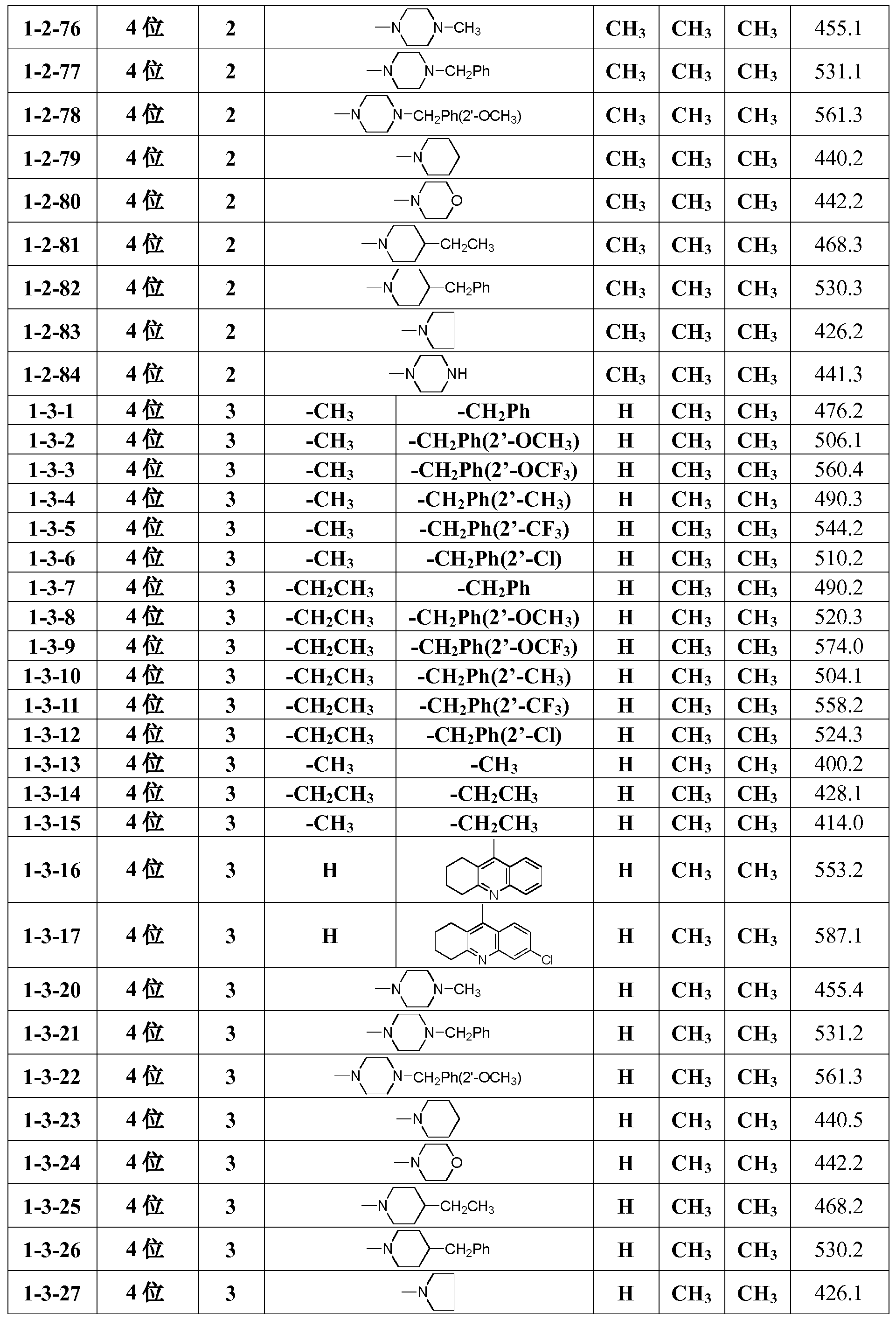


1-7-8 4位 7 -CH2CH3 -CH2Ph(2'-OCH3) CH3 CH3 CH3 590.3
1-8-1 4位 8 -CH3 -CH2Ph H CH3 CH3 546.4
1-8-2 4位 8 -CH3 -CH2Ph(2'-OCH3) H CH3 CH3 576.3
1-8-3 4位 8 -CH2CH3 -CH2Ph H CH3 CH3 560.1
1-8-4 4位 8 -CH2CH3 -CH2Ph(2'-OCH3) H CH3 CH3 590.2
1-8-5 4位 8 -CH3 -CH2Ph CH3 CH3 CH3 560.3
1-8-6 4位 8 -CH3 -CH2Ph(2'-OCH3) CH3 CH3 CH3 590.2
1-8-7 4位 8 -CH2CH3 -CH2Ph CH3 CH3 CH3 574.3
1-8-8 4位 8 -CH2CH3 -CH2Ph(2'-OCH3) CH3 CH3 CH3 604.2
1-9-1 4位 4 -CH3 -CH2Ph(2'-OCH3) H H CH3 506.2
1-9-2 4位 4 -CH2CH3 -CH2Ph(2'-OCH3) H CH3 H 520.4
1-9-3 4位 4 -CH3 -CH2Ph H H CH3 476.0
1-9-4 4位 4 -CH2CH3 -CH2Ph H CH3 H 490.1
1-9-5 4位 6 -CH3 -CH2Ph(2'-OCH3) H H CH3 534.3
1-9-6 4位 6 -CH2CH3 -CH2Ph(2'-OCH3) H CH3 H 548.2
1-9-7 4位 6 -CH3 -CH2Ph H H CH3 504.2
1-9-8 4位 6 -CH2CH3 -CH2Ph H CH3 H 518.2 注: 表中 和 共用一个单元格时, 表示取代基 " Ν "。
2 Linker表示 (CH2)m, R4和 R5同时表示 H W¾丽烷基胺类化合物(I)的制备通法 在反应瓶中加入 2.0 mmol相应的 6,7-位羟基被二苯甲叉保护的黄酮类化合物(5)、 30 ml 丙酮、 7.0 mmol无水碳酸钾和二溴烷基化合物 (2 ) 7.0 mmol, 升温回流搅拌反应 8.0〜18.0 小时 (反应进程用 TLC跟踪); 反应结束后, 趁热过滤, 少量丙酮洗涤滤饼, 滤液减压蒸除 溶剂和过量的二溴烷基化合物, 残余物经柱层析纯化(洗脱液: 二氯甲烷), 得芳氧烷基溴化 合物 (6), 收率 89.0%-98.6%; 将上述芳氧烷基溴化合物 (6) 全量溶于 30 ml乙醇中, 加入 6.0 mmol有机胺类化合物 (4), 升温回流搅拌反应 6.0〜16.0小时 (反应进程用 TLC跟踪); 反应结束后, 减压蒸除溶剂, 残余物中加入 50 ml二氯甲烷, 依次用 20 ml 5%碳酸氢钠水溶 液和 20 ml去离子水洗涤, 有机层经无水硫酸钠干燥后过滤, 减压蒸除溶剂, 残余物经柱层 析纯化 (洗脱液: 氯仿), 得相应的 6,7-位羟基被二苯甲叉保护的黄酮烷基胺类化合物 (7), 收率 65.0%-92.6%; 将所得化合物 7溶于 30 ml氯化氢含量为 10%-20%的乙醇溶液中, 室温 搅拌反应 3.0〜8.0小时 (反应进程用 TLC跟踪), 反应结束后, 减压蒸除溶剂, 残余物中加 入 50 ml二氯甲烷, 依次用 20 ml 5%碳酸氢钠水溶液和 20 ml去离子水洗涤, 有机层经无水 硫酸钠干燥后过滤, 减压蒸除溶剂, 残余物经柱层析纯化 (洗脱液: 石油醚-乙酸乙酯 =30:1 v/v) ,得相应的黄酮烷基胺类化合物(1),收率 43%-88%,其化学结构均经 ^-NMFL 13C-NMR 和 ESI-MS确证。 采用上述通法制备得到的目标物结构如下:


注: 表中 和 共用一个单元格时, 表示取代基 " Ν "。 錢例 3
 ,R4和 R5不同时表示 HB^m丽烷基胺类化合物 (I) 的制备通法
在反应瓶中加入 2.0 mmol相应的黄酮类化合物 (1)、 30 ml乙腈、 3.0 mmol无水碳酸钾 和 2.5 mmol 1-取代 -4-氯烷基哌嗪(11), 升温回流搅拌反应 6.0〜16.0小时(反应进程用 TLC 跟踪); 反应结束后, 趁热过滤, 少量乙腈洗涤滤饼, 滤液减压蒸除溶剂, 残余物经柱层析纯 化 (洗脱液: 石油醚-乙酸乙酯 =30:1 v/v), 得相应的黄酮烷基胺类化合物 (1), 收率 50.0%-82.0%, 其化学结构均经1 H-NMR、 13C-NMR和 ESI-MS确证。 采用上述通法制备得到 的目标物结构如下:


5-4-20 4位 4 -CH2Ph(4'-CH3) CH3 CH3 CH3 572.0
5-4-21 4位 4 -CH2Ph(2'-Cr3) CH3 CH3 CH3 626.3
5-4-22 4位 4 -CH2Ph(3'-Cr3) CH3 CH3 CH3 626.1
5-4-23 4位 4 -CH3 CH3 CH3 CH3 482.2
5-4-24 4位 4 -CH2CH3 CH3 CH3 CH3 496.2
5-4-25 3位 4 -CH2Ph H CH3 CH3 544.3
5-4-26 3位 4 -CH2Ph(2'-OCH3) H CH3 CH3 574.2
5-4-27 3位 4 -CH2Ph(4'-OCH3) H CH3 CH3 574.3
5-4-28 3位 4 -CH2Ph(3'-OCH3) H CH3 CH3 574.2
5-4-29 3位 4 -CH2Ph(2'-OCr3) H CH3 CH3 628.2
5-4-30 3位 4 -CH2Ph(3'-OCr3) H CH3 CH3 628.3
5-4-31 3位 4 -CH2Ph(2'-CH3) H CH3 CH3 558.3
5-4-32 3位 4 -CH2Ph(4'-CH3) H CH3 CH3 558.4
5-4-33 3位 4 -CH2Ph(2'-Cr3) H CH3 CH3 612.2
5-4-34 3位 4 -CH2Ph(3'-Cr3) H CH3 CH3 612.3
5-4-35 3位 4 -CH3 H CH3 CH3 468.3
5-4-36 3位 4 -CH2CH3 H CH3 CH3 482.2
5-4-37 3位 4 -CH2Ph CH3 CH3 CH3 558.2
5-4-38 3位 4 -CH2Ph(2'-OCH3) CH3 CH3 CH3 588.2
5-4-39 3位 4 -CH2Ph(4'-OCH3) CH3 CH3 CH3 588.0
5-4-40 3位 4 -CH2Ph(3'-OCH3) CH3 CH3 CH3 588.3
5-4-41 3位 4 -CH2Ph(2'-OCr3) CH3 CH3 CH3 642.3
5-4-42 3位 4 -CH2Ph(3'-OCr3) CH3 CH3 CH3 642.1
5-4-43 3位 4 -CH2Ph(2'-CH3) CH3 CH3 CH3 572.3
5-4-44 3位 4 -CH2Ph(4'-CH3) CH3 CH3 CH3 572.2
5-4-45 3位 4 -CH2Ph(2'-Cr3) CH3 CH3 CH3 626.2
5-4-46 3位 4 -CH2Ph(3'-Cr3) CH3 CH3 CH3 626.3
5-4-47 3位 4 -CH3 CH3 CH3 CH3 482.2
5-4-48 3位 4 -CH2CH3 CH3 CH3 CH3 496.3
5-5-1 4位 5 -CH2Ph H CH3 CH3 558.3
5-5-2 4位 5 -CH2Ph(2'-OCH3) H CH3 CH3 588.3
5-5-3 4位 5 -CH2Ph CH3 CH3 CH3 572.2
5-5-4 4位 5 -CH2Ph(2'-OCH3) CH3 CH3 CH3 602.1
5-6-1 4位 6 -CH2Ph H CH3 CH3 572.3
5-6-2 4位 6 -CH2Ph(2'-OCH3) H CH3 CH3 602.2
5-6-3 4位 6 -CH2Ph CH3 CH3 CH3 586.3
5-6-4 4位 6 -CH2Ph(2'-OCH3) CH3 CH3 CH3 616.3 錢例 4
,R1
—〇— Linker— N'
k2表示 , 和 R5同时表示 H W¾丽烷基胺类化合物(I) 的制备通法
在反应瓶中加入 2.0 mmol相应的 6,7-位羟基被二苯甲叉保护的黄酮类化合物(5)、 50 ml 乙腈、 3.0 mmol无水碳酸钾和 2.5 mmol 1 -取代 -4-氯烷基哌嗪(11 ), 升温回流搅拌反应 5.0〜
16.0小时 (反应进程用 TLC跟踪); 反应结束后, 趁热过滤, 少量乙腈洗涤滤饼, 滤液减压 蒸除溶剂, 残余物经柱层析纯化(洗脱液: 氯仿), 得相应的 6,7-位羟基被二苯甲叉保护的黄 酮烷基胺类化合物(12), 收率 70.0%-92.0%, 将所得化合物 12溶于 30 ml乙酸和 10 ml去离 子水的混合溶液中, 回流搅拌反应 2.0〜6.0小时 (反应进程用 TLC跟踪), 反应结束后, 减 压蒸除溶剂, 残余物中加入 80 ml二氯甲烷, 依次用 20 ml 5%碳酸氢钠水溶液和 20 ml去离 子水洗涤, 有机层经无水硫酸钠干燥后过滤, 减压蒸除溶剂, 残余物经柱层析纯化(洗脱液: 石油醚-乙酸乙酯 =30: 1 v/v), 得相应的黄酮烷基胺类化合物(1), 收率 68.5%-90.5%, 其化学 结构均经 ^-NMFL 13C-NMR和 ESI-MS确证。 采用上述通法制备得到的目标物结构如下:

β环上
化合物 ESI-MS
取代基 m 6
(+Q) m/z
的位置
6-1-1 4位 1 -CH2Ph 496.1
6-1-2 4位 1 -CH2Ph(2'-OCH3) 526.2
6-1-3 4位 1 -CH2Ph(4'-OCH3) 526.1
6-1-4 4位 1 -CH2Ph(3'-OCH3) 526.1
6-1-5 4位 1 -CH2Ph(2'-OCr3) 558.2
6-1-6 4位 1 -CH2Ph(3'-OCr3) 558.1
6-1-7 4位 1 -CH2Ph(2'-CH3) 488.2
6-1-8 4位 1 -CH2Ph(4'-CH3) 488.1
6-1-9 4位 1 -CH2Ph(2'-Cr3) 542.2
6-1-10 4位 1 -CH2Ph(3'-Cr3) 542.2
6-1-11 4位 1 -CH3 398.2
6-1-12 4位 1 -CH2CH3 412.2
6-2-1 4位 2 -CH2Ph 488.2
6-2-2 4位 2 -CH2Ph(2'-OCH3) 518.2
6-2-3 4位 2 -CH2Ph(4'-OCH3) 518.1
6-2-4 4位 2 -CH2Ph(3'-OCH3) 518.2
6-2-5 4位 2 -CH2Ph(2'-OCr3) 572.2
6-2-6 4位 2 -CH2Ph(3'-OCr3) 572.0
6-2-7 4位 2 -CH2Ph(2'-CH3) 502.1
6-2-8 4位 2 -CH2Ph(4'-CH3) 502.3
6-2-9 4位 2 -CH2Ph(2'-Cr3) 556.3
6-2-10 4位 2 -CH2Ph(3'-Cr3) 556.2
6-2-11 4位 2 -CH3 412.2
-2-12 4位 2 -CH2CH3 426.2-3-1 4位 3 -CH2Ph 502.2-3-2 4位 3 -CH2Ph(2'-OCH3) 532.3-3-3 4位 3 -CH2Ph(4'-OCH3) 532.2-3-4 4位 3 -CH2Ph(3'-OCH3) 532.1-3-5 4位 3 -CH2Ph(2'-OCr3) 586.2-3-6 4位 3 -CH2Ph(3'-OCr3) 586.2-3-7 4位 3 -CH2Ph(2'-CH3) 516.3-3-8 4位 3 -CH2Ph(4'-CH3) 516.2-3-9 4位 3 -CH2Ph(2'-Cr3) 570.2-3-10 4位 3 -CH2Ph(3'-Cr3) 570.3-3-11 4位 3 -CH3 426.2-3-12 4位 3 -CH2CH3 440.2-3-25 3位 3 -CH2Ph 502.1-3-26 3位 3 -CH2Ph(2'-OCH3) 532.2-3-27 3位 3 -CH2Ph(4'-OCH3) 532.1-3-28 3位 3 -CH2Ph(3'-OCH3) 532.2-3-29 3位 3 -CH2Ph(2'-OCr3) 586.0-3-30 3位 3 -CH2Ph(3'-OCr3) 586.1-3-31 3位 3 -CH2Ph(2'-CH3) 516.2-3-32 3位 3 -CH2Ph(4'-CH3) 516.1-3-33 3位 3 -CH2Ph(2'-Cr3) 570.3-3-34 3位 3 -CH2Ph(3'-Cr3) 570.1-3-35 3位 3 -CH3 426.0-3-36 3位 3 -CH2CH3 440.1-4-1 4位 4 -CH2Ph 516.2-4-2 4位 4 -CH2Ph(2'-OCH3) 546.3-4-3 4位 4 -CH2Ph(4'-OCH3) 546.2-4-4 4位 4 -CH2Ph(3'-OCH3) 546.3-4-5 4位 4 -CH2Ph(2'-OCr3) 600.1-4-6 4位 4 -CH2Ph(3'-OCr3) 600.3-4-7 4位 4 -CH2Ph(2'-CH3) 530.3-4-8 4位 4 -CH2Ph(4'-CH3) 530.2-4-9 4位 4 -CH2Ph(2'-Cr3) 584.3-4-10 4位 4 -CH2Ph(3'-Cr3) 584.1-4-11 4位 4 -CH3 440.2-4-12 4位 4 -CH2CH3 454.3-4-25 3位 4 -CH2Ph 516.0-4-26 3位 4 -CH2Ph(2'-OCH3) 546.4-4-27 3位 4 -CH2Ph(4'-OCH3) 546.2-4-28 3位 4 -CH2Ph(3'-OCH3) 546.1-4-29 3位 4 -CH2Ph(2'-OCr3) 600.2-4-30 3位 4 -CH2Ph(3'-OCr3) 600.0-4-31 3位 4 -CH2Ph(2'-CH3) 530.1-4-32 3位 4 -CH2Ph(4'-CH3) 530.1
6-4-33 3位 4 -CH2Ph(2'-Cr3) 584.2
6-4-34 3位 4 -CH2Ph(3'-Cr3) 584.2
6-4-35 3位 4 -CH3 440.0
6-4-36 3位 4 -CH2CH3 454.2
6-5-1 4位 5 -CH2Ph 530.3
6-5-2 4位 5 -CH2Ph(2'-OCH3) 560.3
6-5-3 3位 5 -CH2Ph 530.2
6-5-4 3位 5 -CH2Ph(2'-OCH3) 560.1
6-6-1 4位 6 -CH2Ph 544.3
6-6-2 4位 6 -CH2Ph(2'-OCH3) 574.4
6-6-3 3位 6 -CH2Ph 544.2
6-6-4 3位 6 -CH2Ph(2'-OCH3) 574.5 錢例 5
黄丽烷基胺类化合物(I)与酸成盐制备通法
在反应瓶中加入按照上述实施例 1-4所得之黄酮烷基胺类化合物(I) 2.0 mmol和丙酮 50 ml, 搅拌均匀后加入 6.0 mmol相应的酸, 升温回流搅拌反应 20分钟, 反应结束后冷却至室 温, 减压蒸除溶剂, 残余物用丙酮重结晶, 过滤析出的固体, 即得芳氧烷基胺类化合物 (I) 的盐, 其化学结构经 MR和 ESI-MS确证。
Claims
权利要求
类黄酮烷基胺类化合物或其药学上可接受的盐,其特征在于该类化合物的化学结构通式 (I) 所示:

结构单元:

取代基 "-O-Linker-NRjR '可以连接在 B环任意可能的位置;
表示 H、 CH:12烷基; R2表示 d~C12烷基、 苄基、 取代苄基、 1,2,3,4-四氢吖啶 -9-基、 6- 氯 -1,2,3,4-四氢吖啶 -9-基、 8-氯 -1,2,3,4-四氢吖啶 -9-基、 6,8-二氯 -1,2,3,4-四氢吖啶 -9-基、 或 N- 脱甲基加兰他敏基;
NR2也表示四氢吡咯基、 吗啉基、 哌啶基、 4-位被(^~012烷基所取代的哌啶基、 4-位被苄 基或取代苄基所取代的哌啶基、 哌嗪基、 4-位被 ~012烷基所取代的哌嗪基、 4-位被苄基或 取代苄基所取代的哌嗪基;
R3、 和 R5各自独立地表示11、 d C^烷基、 或三氟甲基; R3、 R4和 R5可以相同, 也可以 不同;
Linker表 (CH2)m、 m表 1-12;
0-(H7C)m— ( Ν- R6 一 一
取代基 "-0-Linker-NRiR2"也可表示 」 , m表示 1—12, 表示 H、 Ci~Ci2 烷基、 苄基或取代苄基;
上述术语 "取代苄基"是指被苯环上被 1-4个选自下组的基团所取代的苄基: F、 Cl、 Br、 I、 d_4烷基、 d_4烷氧基、 三氟甲基、 三氟甲氧基、 硝基、 氰基, 这些取代基可在苯环的任意可 能位置。
2. 如权利要求 1所述的黄酮烷基胺类化合物或其药学上可接受的盐,其特征在于选自如下化


—0-(H2C)„ N-R,
取代基 -C CH^-NRjRz或 ― v "'m ~T "6连接在 B环的 3位或 4位;
表示 H、 甲基、 乙基; R2表示甲基、 乙基、 苄基、 2-甲氧基苄基、 2-三氟甲氧基苄基、 2- 甲基苄基、 2-三氟甲基苄基、 2-氯苄基、 1,2,3,4-四氢吖啶 -9-基、 6-氯 -1,2,3,4-四氢吖啶 -9-基、 或 N-脱甲基加兰他敏基; NR2也表示四氢吡咯基、 吗啉基、 哌啶基、 4-乙基哌啶基、 4-苄 基哌啶基、 哌嗪基、 4-甲基哌嗪基、 4-苄基哌嗪基、 4-[(2-甲氧基;)苄基]哌嗪基;
R3表示 H或甲基; 表示 H或甲基; R5表示 H或甲基; 表示苄基、 2-甲氧基苄基、 3-甲 氧基苄基、 4-甲氧基苄基、 2-三氟甲氧基苄基、 3-三氟甲氧基苄基、 2-甲基苄基、 4-甲基苄基、 2-三氟甲基苄基、 3-三氟甲基苄基、 甲基、 或乙基; m表示 1-8。
3. 如权利要求 1-2任一项所述黄酮烷基胺类化合物或其药学上可接受的盐,其特征在于所述 的药学上可接受的盐为此类黄酮烷基胺类化合物与盐酸、 氢溴酸、 硝酸、 硫酸、 磷酸、 d— 6 脂肪羧酸、 草酸、 苯甲酸、 水杨酸、 马来酸、 富马酸、 琥珀酸、 酒石酸、 柠檬酸、 d— 6烷基 磺酸、 樟脑磺酸、 苯磺酸或对甲苯磺酸的盐。
4. 如权利要求 1-3任一项所述黄酮烷基胺类化合物或其药学上可接受的盐的制备方法,其特 征在于所述化合物的制备方法根据 Linker、 R4和 R5表示取代基的不同, 有以下四种方法: 一: 当 Linker表示 (CH2)m, R4和 R5不同时表示 H时:
R1
ΗΝ
碱 ,R1
Ar-OH + X(CH2)mX Ar-0-(CH2)mX Ar-0-(CH2)m-N
R2
1 2 3 (I)
式中: X表示 Cl、 Br、 I; Ar、 、 R2、 m的定义与化学结构通式 (I) 相同;
以相应的黄酮类化合物(1 )为起始原料, 在溶剂和碱性条件下与二卤烷基化合物(2 )反应, 生成相应的芳氧烷基卤化合物(3 ), 所得中间体 3与有机胺类化合物(4 )在溶剂中反应, 得 相应的黄酮烷基胺类化合物 (I);
二: 当 Linker表示 (CH2)m, R4和 R5同时表示 H时:
HN
碱 R2
Ar'-OH + X(CH2)mX Ar'-0-(CH2)mX . Ar'-0-(CH2)m-N
R2
5 2 6 脱保护基
—— - Ar-0-(

式中: X表示 Cl、 Br、 I; Ar、 、 R2、 R3、 m的定义与化学结构通式 (I) 相同; 以 6,7-位羟基被二苯甲叉保护的黄酮类化合物(5)为起始原料, 在溶剂和碱性条件下与二卤 烷基化合物(2 )反应, 生成相应的芳氧烷基 ¾化合物(6), 所得中间体 6与有机胺类化合物 (4)在溶剂中反应, 得相应 6,7-位羟基被二苯甲叉保护的黄酮烷基胺类化合物(7), 中间体 7在溶剂和 酮烷基胺类化合物 (I) ; 膽三: 当
 , R4和 R5不同时表示 Η时:

1 11 式中: X表示 Cl、 Br、 I; Ar、 、 m的定义与化学结构通式 (I) 相同;
以相应的黄酮类化合物 (1 ) 为起始原料, 在溶剂和碱性条件下与 1-取代 -4-卤烷基哌嗪 (11 ) 反应, 得相应的黄酮烷基胺类化合物 (I); 时表示 Η时:

式中: X表示 Cl、 Br、 I; Ar、 、 m的定义与化学结构通式 (I) 相同;
以相应的 6,7-位羟基被二苯甲叉保护的黄酮类化合物(5)为起始原料, 在溶剂和碱性条件下 与 1-取代 -4-卤烷基哌嗪 (11 ) 反应, 得相应的 6,7-位羟基被二苯甲叉保护的黄酮烷基胺类化 合物 (12 ), 所得中间体 12在溶剂和酸性条件下脱除二苯甲叉保护基, 得相应的黄酮烷基胺 类化合物 (I);
利用上述四种方法所得之黄酮烷基胺类化合物分子中含有氨基, 该氨基呈碱性, 可与任何合 适的酸通过药学上常规的成盐方法制得其药物学上可接受的盐。
5. 如权利要求 4所述黄酮烷基胺类化合物或其药学上可接受的盐的制备方法,其特征在于方 法一的步骤 a)中, 反应所用碱为: 碱金属氢氧化物、 碱土金属氢氧化物、 碱金属碳酸盐、 碱 土金属碳酸盐、 碱金属碳酸氢盐、 碱土金属碳酸氢盐、 C 醇的碱金属盐、 三乙胺、 三丁胺、 三辛胺、 吡啶、 N-甲基吗啉、 N-甲基哌啶、 三乙烯二胺、 或四丁基氢氧化铵; 反应所用溶剂 为: 乙醚、 四氢呋喃、 NN-二甲基甲酰胺、 二甲基亚砜、 二氯甲烷、 氯仿、 C3_8脂肪酮、 苯、 甲苯、乙腈或 C5_8烷烃;化合物(1 ) :二卤烷基化合物(2 ) :碱的摩尔投料比为 1.0 : 1.0-10.0: 1.0-10.0; 反应温度为室温〜 150°C ; 反应时间为 1~72小时;
方法一的步骤 b)中, 反应所用溶剂为: 乙醚、 四氢呋喃、 NN-二甲基甲酰胺、 二甲基亚砜、 二氯甲烷、 氯仿、 C3_8脂肪酮、 苯、 甲苯、 乙腈、 d_8醇、 或 C5_8烷烃; 中间体(3 ): 有机胺 类化合物 (4 ) 的摩尔投料比为 1.0 : 1.0-10.0; 反应温度为室温〜 150°C ; 反应时间为 1~72小 时。
6. 如权利要求 4所述黄酮烷基胺类化合物或其药学上可接受的盐的制备方法,其特征在于方 法二的步骤 a)中, 反应所用碱为: 碱金属氢氧化物、 碱土金属氢氧化物、 碱金属碳酸盐、 碱 土金属碳酸盐、 碱金属碳酸氢盐、 碱土金属碳酸氢盐、 d_8醇的碱金属盐、 三乙胺、 三丁胺、 三辛胺、 吡啶、 N-甲基吗啉、 N-甲基哌啶、 三乙烯二胺、 或四丁基氢氧化铵; 反应所用溶剂 为: 乙醚、 四氢呋喃、 NN-二甲基甲酰胺、 二甲基亚砜、 二氯甲烷、 氯仿、 C3_8脂肪酮、 苯、 甲苯、乙腈或 C5— 8烷烃;化合物(5) :二卤烷基化合物(2 ) :碱的摩尔投料比为 1.0 : 1.0-10.0: 1.0-10.0; 反应温度为室温〜 150°C ; 反应时间为 1~72小时;
方法二的步骤 b)中, 所用溶剂为: 乙醚、 四氢呋喃、 NN-二甲基甲酰胺、 二甲基亚砜、 二氯 甲烷、 氯仿、 C3— 8脂肪酮、 苯、 甲苯、 乙腈、 d— 8醇、 或 C5— 8烷烃; 中间体(6 ): 有机胺类化 合物 (4 ) 的摩尔投料比为 1.0 : 1.0-10.0; 反应温度为室温〜 150°C ; 反应时间为 1~72小时; 方法二的步骤 C)中, 所用溶剂为: 水、 d— 6脂肪醇、 NN-二甲基甲酰胺、 四氢呋喃、 C3— 8脂肪 酮、 乙腈、 1,4-二氧六环、 或二甲基亚砜; 所用酸为: 氯化氢、 盐酸、 硫酸、 硝酸、 磷酸、 苯 甲酸、 d— 6脂肪酸、 d— 6烷基磺酸、 苯磺酸、 或对甲苯磺酸; 酸在反应体系中的质量分数为
0.1%- 100%; 反应温度为 0~150°C ; 反应时间为 30分钟〜 24小时。
7. 如权利要求 4所述黄酮烷基胺类化合物或其药学上可接受的盐的制备方法,其特征在于方 法三中, 反应所用碱为: 碱金属氢氧化物、 碱土金属氢氧化物、 碱金属碳酸盐、 碱土金属碳 酸盐、 碱金属碳酸氢盐、 碱土金属碳酸氢盐、 三乙胺、 三丁胺、 三辛胺、 吡啶、 N-甲基吗啉、 N-甲基哌啶、 三乙烯二胺、 或四丁基氢氧化铵、 或 — 8醇的碱金属盐; 反应所用溶剂为: 乙
醚、 四氢呋喃、 NN-二甲基甲酰胺、 二甲基亚砜、 二氯甲烷、 氯仿、 C3— 8脂肪酮、 苯、 甲苯、 乙腈或 C5_8烷烃; 化合物(1 ) : 1-取代 -4-卤烷基哌嗪(11 ) : 碱的摩尔投料比为 1.0: 1.0-10.0: 1.0-10.0; 反应温度为室温〜 150°C ; 反应时间为 1~72小时。
8. 如权利要求 4所述黄酮烷基胺类化合物或其药学上可接受的盐的制备方法,其特征在于方 法四的步骤 a)中, 反应所用碱为: 碱金属氢氧化物、 碱土金属氢氧化物、 碱金属碳酸盐、 碱 土金属碳酸盐、 碱金属碳酸氢盐、 碱土金属碳酸氢盐、 C 醇的碱金属盐、 三乙胺、 三丁胺、 三辛胺、 吡啶、 N-甲基吗啉、 N-甲基哌啶、 三乙烯二胺、 或四丁基氢氧化铵; 反应所用溶剂 为: 乙醚、 四氢呋喃、 NN-二甲基甲酰胺、 二甲基亚砜、 二氯甲烷、 氯仿、 C3_8脂肪酮、 苯、 甲苯、 乙腈或 C5_8烷烃; 化合物 (5 ) : 1-取代 -4-卤烷基哌嗪 (11 ) : 碱的摩尔投料比为 1.0: 1.0-10.0: 1.0-10.0; 反应温度为室温〜 150°C ; 反应时间为 1~72小时;
方法四的步骤 b)中, 所用溶剂为: 水、 d— 6脂肪醇、 NN-二甲基甲酰胺、 四氢呋喃、 C3— 8脂肪 酮、 乙腈、 1,4-二氧六环、 或二甲基亚砜; 所用酸为: 氯化氢、 盐酸、 硫酸、 硝酸、 磷酸、 苯 甲酸、 d— 6脂肪酸、 d— 6烷基磺酸、 苯磺酸、 或对甲苯磺酸; 酸在反应体系中的质量分数为
0.1%- 100%; 反应温度为 0~150°C ; 反应时间为 30分钟〜 24小时。
9. 一类药物组合物, 其特征在于包含如权利要求 1-2任一项所述的黄酮烷基胺类化合物及其 药学上可接受的盐以及一种或多种药学上可接受的载体或赋形剂。
10. 如权利要求 1-3任一项所述的黄酮烷基胺类化合物或其药学上可接受的盐在制备治疗和 / 或预防神经退行性相关疾病药物中的用途, 这类神经退行性相关疾病为: 血管性痴呆、 阿 尔茨海默氏症、 帕金森症、 亨廷顿症、 HIV相关痴呆症、 多发性硬化症、 进行性脊髓侧索 硬化症、 神经性疼痛、 或青光眼。
Applications Claiming Priority (2)
| Application Number | Priority Date | Filing Date | Title |
|---|---|---|---|
| CN201310013990.8 | 2013-01-15 | ||
| CN201310013990.8A CN103087024B (zh) | 2013-01-15 | 2013-01-15 | 一类黄酮烷基胺类化合物、其制备方法和用途 |
Publications (1)
| Publication Number | Publication Date |
|---|---|
| WO2014111004A1 true WO2014111004A1 (zh) | 2014-07-24 |
Family
ID=48200206
Family Applications (1)
| Application Number | Title | Priority Date | Filing Date |
|---|---|---|---|
| PCT/CN2014/070561 Ceased WO2014111004A1 (zh) | 2013-01-15 | 2014-01-14 | 一类黄酮烷基胺类化合物、其制备方法和用途 |
Country Status (2)
| Country | Link |
|---|---|
| CN (1) | CN103087024B (zh) |
| WO (1) | WO2014111004A1 (zh) |
Families Citing this family (10)
| Publication number | Priority date | Publication date | Assignee | Title |
|---|---|---|---|---|
| CN103087024B (zh) * | 2013-01-15 | 2014-11-19 | 四川大学 | 一类黄酮烷基胺类化合物、其制备方法和用途 |
| CN109111400B (zh) * | 2017-06-23 | 2020-10-16 | 杭州百诚医药科技股份有限公司 | 苯基喹啉酮类和黄酮类衍生物的制备和应用 |
| CN107382947B (zh) * | 2017-07-21 | 2021-05-25 | 江苏省海洋资源开发研究院(连云港) | 一种槲皮素衍生物及其制备方法和应用 |
| CN109651321B (zh) * | 2019-01-31 | 2020-06-26 | 南阳师范学院 | 一种芹菜素-o-烷基胺类化合物、制备方法和应用 |
| CN109761945B (zh) * | 2019-01-31 | 2020-07-31 | 南阳师范学院 | 一种柚皮素-o-烷基胺类化合物、制备方法和应用 |
| CN109810115B (zh) * | 2019-03-21 | 2020-09-11 | 四川大学 | 异黄酮类化合物及其制备方法与应用 |
| CN110305087B (zh) * | 2019-07-10 | 2021-05-04 | 南阳师范学院 | 一种5,6-二甲氧基茚酮化合物及其制备方法和用途 |
| CN114599362B (zh) * | 2019-10-15 | 2025-02-11 | 杭州百诚医药科技股份有限公司 | 苯基喹啉酮类和黄酮类衍生物在制备治疗神经病理性疼痛的药物中的用途 |
| CN113135884B (zh) * | 2020-01-20 | 2023-03-10 | 西华大学 | 一种异色烯类化合物及其制备方法和用途 |
| CN113845504B (zh) * | 2021-10-29 | 2023-11-24 | 晨光生物科技集团股份有限公司 | 一种槲皮万寿菊素的酯化方法 |
Citations (3)
| Publication number | Priority date | Publication date | Assignee | Title |
|---|---|---|---|---|
| CN101337956A (zh) * | 2008-08-22 | 2009-01-07 | 四川大学 | 灯盏乙素苷元氨基甲酸酯类衍生物、其制备方法和用途 |
| CN102603698A (zh) * | 2012-02-15 | 2012-07-25 | 四川大学 | 一类野黄芩苷元氨基甲酸酯类衍生物、其制备方法和用途 |
| CN103087024A (zh) * | 2013-01-15 | 2013-05-08 | 四川大学 | 一类黄酮烷基胺类化合物、其制备方法和用途 |
Family Cites Families (3)
| Publication number | Priority date | Publication date | Assignee | Title |
|---|---|---|---|---|
| ES456574A1 (es) * | 1977-03-07 | 1978-02-16 | Rocador Sa | Procedimiento de obtencion de pentametil-carbamato de quer- cetina. |
| CN101870684A (zh) * | 2010-06-30 | 2010-10-27 | 贵阳医学院 | 治疗血管性痴呆的灯盏乙素苷元衍生物、其制备方法与用途 |
| CN102161647A (zh) * | 2011-03-07 | 2011-08-24 | 中国药科大学 | 异黄酮类肿瘤多药耐药逆转剂的制备方法及其用途 |
-
2013
- 2013-01-15 CN CN201310013990.8A patent/CN103087024B/zh not_active Expired - Fee Related
-
2014
- 2014-01-14 WO PCT/CN2014/070561 patent/WO2014111004A1/zh not_active Ceased
Patent Citations (3)
| Publication number | Priority date | Publication date | Assignee | Title |
|---|---|---|---|---|
| CN101337956A (zh) * | 2008-08-22 | 2009-01-07 | 四川大学 | 灯盏乙素苷元氨基甲酸酯类衍生物、其制备方法和用途 |
| CN102603698A (zh) * | 2012-02-15 | 2012-07-25 | 四川大学 | 一类野黄芩苷元氨基甲酸酯类衍生物、其制备方法和用途 |
| CN103087024A (zh) * | 2013-01-15 | 2013-05-08 | 四川大学 | 一类黄酮烷基胺类化合物、其制备方法和用途 |
Also Published As
| Publication number | Publication date |
|---|---|
| CN103087024B (zh) | 2014-11-19 |
| CN103087024A (zh) | 2013-05-08 |
Similar Documents
| Publication | Publication Date | Title |
|---|---|---|
| WO2014111004A1 (zh) | 一类黄酮烷基胺类化合物、其制备方法和用途 | |
| CN103113340B (zh) | 一类金雀异黄酮烷基胺类化合物、其制备方法和用途 | |
| EP3503879B1 (en) | Composition comprising (a) a dual agent acting as a 5-ht2a receptor antagonist and cyp2d6 inhibitor and (b) an nmda receptor antagonist for use in the treatment of diseases involving glucose | |
| CN105439876B (zh) | 2‑羟基查尔酮胺类化合物、其制备方法和用途 | |
| CN105481796B (zh) | 一类氨基甲酸查尔酮酯类化合物、其制备方法和用途 | |
| EP4032889A1 (en) | Benzodiazepine derivatives, compositions, and methods for treating cognitive impairment | |
| CN103073440B (zh) | 一类二苯乙烯氧烷基胺类化合物、其制备方法和用途 | |
| CN109651321B (zh) | 一种芹菜素-o-烷基胺类化合物、制备方法和应用 | |
| CN103420942B (zh) | 对乙、丁酰胆碱酯酶具有双重抑制活性化合物 | |
| CN109824637B (zh) | 一种茚酮查尔酮氨基甲酸酯类化合物及其制备方法和用途 | |
| CN109734614B (zh) | 3-羟基查尔酮曼尼希碱类化合物、其制备方法和用途 | |
| CN105622488B (zh) | 一种4‑环胺烷氧基‑3‑甲氧基肉桂酸酯类化合物、制备方法及其用途 | |
| CN106831799A (zh) | 羟基苯乙烯吡啶曼尼希碱类化合物、其制备方法和用途 | |
| CN101657440B (zh) | 异二聚体及其使用方法 | |
| CN105732479B (zh) | 一种4-环胺烷氧基-3-甲氧基肉桂酸苯酰胺类化合物、制备方法及其用途 | |
| CN105801448B (zh) | 一种4‑胺烷氧基‑3‑甲氧基肉桂酸苯酰胺类化合物、制备方法及其用途 | |
| CN110272349B (zh) | 一种2’-羟基-3苯基苯丙酮化合物及其制备方法和用途 | |
| CN106749188A (zh) | 一种n‑(苄基哌啶基)‑阿魏酰胺‑o‑烷基胺类化合物、制备方法及其用途 | |
| CN102743419A (zh) | 路路通总鞣质提取物的制备方法及其用途 | |
| CN106243035A (zh) | 一种基于他克林结构的硫化氢供体化合物及其制备方法与应用 | |
| CN105646289B (zh) | 一种4-氨基甲酸酯-3-甲氧基肉桂酸胺烷基酰胺类化合物及其制备方法和用途 | |
| CN109665969B (zh) | 3-甲氧基-4-羟基查尔酮双曼尼希碱类化合物、其制备方法和用途 | |
| CN109265332B (zh) | 一种多羟基查尔酮化合物及其用途 | |
| CN103387580B (zh) | 百部生物碱单体成分及其用途 | |
| CN108276332B (zh) | 一种双阿魏酰胺孪药类化合物及其制备方法和用途 |
Legal Events
| Date | Code | Title | Description |
|---|---|---|---|
| 121 | Ep: the epo has been informed by wipo that ep was designated in this application |
Ref document number: 14740474 Country of ref document: EP Kind code of ref document: A1 |
|
| NENP | Non-entry into the national phase |
Ref country code: DE |
|
| 122 | Ep: pct application non-entry in european phase |
Ref document number: 14740474 Country of ref document: EP Kind code of ref document: A1 |