WO2014084331A1 - ペンタフルオロスルファニルフタロシアニン誘導体およびその中間体 - Google Patents
ペンタフルオロスルファニルフタロシアニン誘導体およびその中間体 Download PDFInfo
- Publication number
- WO2014084331A1 WO2014084331A1 PCT/JP2013/082136 JP2013082136W WO2014084331A1 WO 2014084331 A1 WO2014084331 A1 WO 2014084331A1 JP 2013082136 W JP2013082136 W JP 2013082136W WO 2014084331 A1 WO2014084331 A1 WO 2014084331A1
- Authority
- WO
- WIPO (PCT)
- Prior art keywords
- group
- metal
- metalloid
- derivative
- general formula
- Prior art date
- Legal status (The legal status is an assumption and is not a legal conclusion. Google has not performed a legal analysis and makes no representation as to the accuracy of the status listed.)
- Ceased
Links
- 0 *c(cc1C#N)cc(Sc2ccccc2)c1C#N Chemical compound *c(cc1C#N)cc(Sc2ccccc2)c1C#N 0.000 description 2
Images





Classifications
-
- C—CHEMISTRY; METALLURGY
- C09—DYES; PAINTS; POLISHES; NATURAL RESINS; ADHESIVES; COMPOSITIONS NOT OTHERWISE PROVIDED FOR; APPLICATIONS OF MATERIALS NOT OTHERWISE PROVIDED FOR
- C09B—ORGANIC DYES OR CLOSELY-RELATED COMPOUNDS FOR PRODUCING DYES, e.g. PIGMENTS; MORDANTS; LAKES
- C09B47/00—Porphines; Azaporphines
- C09B47/04—Phthalocyanines abbreviation: Pc
-
- C—CHEMISTRY; METALLURGY
- C07—ORGANIC CHEMISTRY
- C07C—ACYCLIC OR CARBOCYCLIC COMPOUNDS
- C07C323/00—Thiols, sulfides, hydropolysulfides or polysulfides substituted by halogen, oxygen or nitrogen atoms, or by sulfur atoms not being part of thio groups
- C07C323/23—Thiols, sulfides, hydropolysulfides or polysulfides substituted by halogen, oxygen or nitrogen atoms, or by sulfur atoms not being part of thio groups containing thio groups and nitrogen atoms, not being part of nitro or nitroso groups, bound to the same carbon skeleton
- C07C323/31—Thiols, sulfides, hydropolysulfides or polysulfides substituted by halogen, oxygen or nitrogen atoms, or by sulfur atoms not being part of thio groups containing thio groups and nitrogen atoms, not being part of nitro or nitroso groups, bound to the same carbon skeleton having the sulfur atom of at least one of the thio groups bound to a carbon atom of a six-membered aromatic ring of the carbon skeleton
- C07C323/32—Thiols, sulfides, hydropolysulfides or polysulfides substituted by halogen, oxygen or nitrogen atoms, or by sulfur atoms not being part of thio groups containing thio groups and nitrogen atoms, not being part of nitro or nitroso groups, bound to the same carbon skeleton having the sulfur atom of at least one of the thio groups bound to a carbon atom of a six-membered aromatic ring of the carbon skeleton having at least one of the nitrogen atoms bound to an acyclic carbon atom of the carbon skeleton
-
- C—CHEMISTRY; METALLURGY
- C07—ORGANIC CHEMISTRY
- C07C—ACYCLIC OR CARBOCYCLIC COMPOUNDS
- C07C381/00—Compounds containing carbon and sulfur and having functional groups not covered by groups C07C301/00 - C07C337/00
-
- C—CHEMISTRY; METALLURGY
- C07—ORGANIC CHEMISTRY
- C07D—HETEROCYCLIC COMPOUNDS
- C07D487/00—Heterocyclic compounds containing nitrogen atoms as the only ring hetero atoms in the condensed system, not provided for by groups C07D451/00 - C07D477/00
- C07D487/22—Heterocyclic compounds containing nitrogen atoms as the only ring hetero atoms in the condensed system, not provided for by groups C07D451/00 - C07D477/00 in which the condensed system contains four or more hetero rings
-
- C—CHEMISTRY; METALLURGY
- C09—DYES; PAINTS; POLISHES; NATURAL RESINS; ADHESIVES; COMPOSITIONS NOT OTHERWISE PROVIDED FOR; APPLICATIONS OF MATERIALS NOT OTHERWISE PROVIDED FOR
- C09B—ORGANIC DYES OR CLOSELY-RELATED COMPOUNDS FOR PRODUCING DYES, e.g. PIGMENTS; MORDANTS; LAKES
- C09B47/00—Porphines; Azaporphines
- C09B47/04—Phthalocyanines abbreviation: Pc
- C09B47/06—Preparation from carboxylic acids or derivatives thereof, e.g. anhydrides, amides, mononitriles, phthalimide, o-cyanobenzamide
- C09B47/067—Preparation from carboxylic acids or derivatives thereof, e.g. anhydrides, amides, mononitriles, phthalimide, o-cyanobenzamide from phthalodinitriles naphthalenedinitriles, aromatic dinitriles prepared in situ, hydrogenated phthalodinitrile
- C09B47/0675—Preparation from carboxylic acids or derivatives thereof, e.g. anhydrides, amides, mononitriles, phthalimide, o-cyanobenzamide from phthalodinitriles naphthalenedinitriles, aromatic dinitriles prepared in situ, hydrogenated phthalodinitrile having oxygen or sulfur linked directly to the skeleton
Definitions
- the present invention relates to a pentafluorosulfanyl phthalocyanine derivative and its intermediate.
- Phthalocyanine has been used as a blue and green pigment. Phthalocyanine is also a functional dye used as a charge generator and a dye for magneto-optical disks because of its excellent physical properties. Furthermore, phthalocyanine is expected to be applied in various fields such as photosensitizers for photodynamic therapy and nonlinear optical materials. However, phthalocyanine derivatives generally have a problem of poor solubility in organic solvents. Therefore, Patent Document 1 and Non-Patent Documents 1 and 2 report phthalocyanines into which a trifluoromethyl group has been introduced for the purpose of improving solubility.
- an object of the present invention is to provide a phthalocyanine derivative excellent in solubility in an organic solvent.
- M is a hydrogen atom, a metal element, a metalloid element, a metal oxide, a metalloid oxide, a metal hydroxide, a metalloid hydroxide, a metal halide, or a metalloid halide
- Each R is independently a hydrogen atom, an alkyl ether group, an aryl ether group, an alkyl sulfide group, an aryl sulfide group, or a trifluoromethyl group
- R is a hydrogen atom, an alkyl ether, an aryl ether, an alkyl sulfide, an aryl sulfide, or a trifluoromethyl group
- a pentafluorosulfanylphthalonitrile derivative represented by: [7] (A) General formula (3):
- R is a hydrogen atom, an alkyl ether group, an aryl ether group, an alkyl sulfide group, an aryl sulfide group, or a trifluoromethyl group
- Hal is a halogen atom
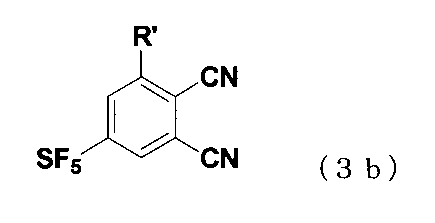
- One Hal of the halogen-containing pentafluorosulfanylbenzene derivative represented by the formula is converted to a cyano group, and the other Hal is converted to R ′ to give a general formula (3b):
- R ′ is an alkyl ether group, an aryl ether group, an alkyl sulfide group, an aryl sulfide group, or a trifluoromethyl group
- a step of preparing a pentafluorosulfanylphthalonitrile derivative represented by: ) Heating the pentafluorosulfanylphthalonitrile derivative and hydrogen, metal, metalloid, metal oxide, metalloid oxide, metal hydroxide, metalloid hydroxide, metal halide, or metalloid halide
- the manufacturing method of the phthalocyanine derivative as described in [3] including the process to carry out.
- [11] (A3) General formula (2c):
- R ′ is an alkyl ether group, an aryl ether group, an alkyl sulfide group, an aryl sulfide group, or a trifluoromethyl group
- a step of preparing a pentafluorosulfanylphthalonitrile derivative represented by: ) Heating the pentafluorosulfanylphthalonitrile derivative and hydrogen, metal, metalloid, metal oxide, metalloid oxide, metal hydroxide, metalloid hydroxide, metal halide, or metalloid halide
- the manufacturing method of the phthalocyanine derivative as described in [3] including the process to carry out.
- a phthalocyanine derivative having excellent solubility in an organic solvent can be provided.
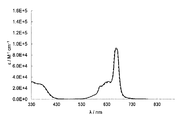
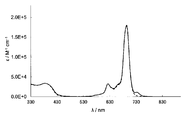
- UV / Vis spectrum of the phthalocyanine derivative obtained in Example 8 UV / Vis spectrum of the phthalocyanine derivative obtained in Example 9
- UV / Vis spectrum of the phthalocyanine derivative obtained in Example 10 UV / Vis spectrum of the phthalocyanine derivative obtained in Example 11
- UV / Vis spectrum of phthalocyanine derivatives for comparison Fluorescence spectrum of the phthalocyanine derivative obtained in Example 8
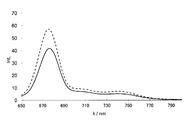
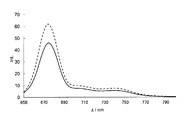
- Fluorescence spectrum of the phthalocyanine derivative obtained in Example 9 Fluorescence spectrum of the phthalocyanine derivative obtained in Example 10
- Fluorescence spectrum of the phthalocyanine derivative obtained in Example 11 Fluorescence spectra of comparative phthalocyanine derivatives
- ⁇ includes values at both ends.
- Phthalocyanine derivative Phthalocyanine is a cyclic compound having a structure in which four phthalimides are bridged by nitrogen atoms.
- the phthalocyanine derivative refers to phthalocyanine or phthalocyanine into which a substituent is introduced.
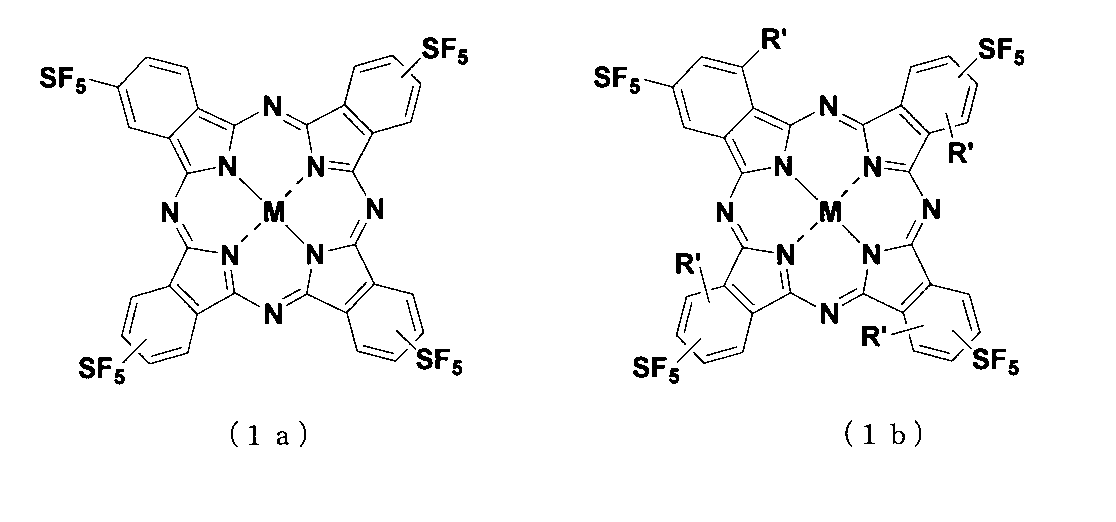
- the phthalocyanine derivative of the present invention is represented by the general formula (1).
- M is a hydrogen atom, a metal element, a metalloid element, a metal oxide, a metalloid oxide, a metal hydroxide, a metalloid hydroxide, a metal halide, or a metalloid halide.
- the metal element is an alkali metal, alkaline earth metal, transition metal, lanthanoid metal, or actinoid metal element.
- Specific examples include lithium, sodium, potassium, magnesium, calcium, scandium, yttrium, titanium, zirconium, chromium, manganese, molybdenum, iron, ruthenium, cobalt, rhodium, nickel, palladium, nickel, copper, zinc, aluminum, gallium. , Indium, tin, lanthanum, uranium and the like.
- the semi-metal element is an element having a property intermediate between a metal and a nonmetal, and examples thereof include boron, silicon, arsenic, germanium, and lead.
- the metal oxide is an oxide of the metal element. Specific examples include lithium oxide, magnesium oxide, calcium oxide, titanium oxide, chromium oxide, manganese oxide, molybdenum oxide, iron oxide, ruthenium oxide, copper oxide, zinc oxide, aluminum oxide, gallium oxide, lanthanum oxide, uranium oxide, etc. Is mentioned.
- the metalloid oxide is an oxide of the metalloid element. Specific examples thereof include boron oxide, silicon oxide, arsenic oxide, germanium oxide, lead oxide, and the like.
- the metal hydroxide is a hydroxide of the metal element. Specific examples thereof include aluminum hydroxide, indium hydroxide, thallium hydroxide and the like.
- the metalloid hydroxide is a hydroxide of the metalloid element. Specific examples thereof include boron hydroxide, silicon hydroxide, arsenic hydroxide, germanium hydroxide, lead hydroxide and the like.
- the metal halide is a halide of the metal element
- the metalloid halide is a halide of the metalloid element. Specific examples thereof include fluoride, chloride, bromide, and iodide.
- R each independently represents a hydrogen atom, an alkyl ether group, an aryl ether group, an alkyl sulfide group, an aryl sulfide group, or a trifluoromethyl group.
- the alkyl group is not particularly limited as long as the solubility of the phthalocyanine derivative in an organic solvent is not impaired, but a linear or branched alkyl group having 1 to 5 carbon atoms is preferable.
- the aryl group is not particularly limited as long as the solubility of the phthalocyanine derivative in an organic solvent is not impaired, but an aromatic group having 6 to 12 carbon atoms is preferable, and a phenyl group is more preferable.
- the aryl group may have a branched or straight chain substituent having 1 to 3 carbon atoms.
- an alkyl ether group, an aryl ether group, an alkyl sulfide group, an aryl sulfide group, or a trifluoromethyl group may be represented as R ′.
- phthalocyanine derivative 1b preferred embodiments are as follows.
- the phthalocyanine derivative of the present invention exhibits excellent solubility in an organic solvent, hardly aggregates in a solution state, and has dissolution stability.
- the organic solvent is not particularly limited, but ether solvents such as diethyl ether, diisopropyl ether, n-butyl methyl ether, tert-butyl methyl ether, tetrahydrofuran and dioxane; hydrocarbon solvents such as heptane, hexane, cyclopentane and cyclohexane Halogenated hydrocarbon solvents such as chloroform, carbon tetrachloride, methylene chloride, dichloroethane, and trichloroethane; aromatic solvents such as benzene, toluene, xylene, cumene, cymene, mesitylene, diisopropylbenzene, pyridine, pyrimidine, pyrazine, and pyridazin
- the phthalocyanine derivative of the present invention includes these isomers.
- the phthalocyanine derivative of the present invention may form a salt and may exist as a hydrate or solvate.
- the phthalocyanine derivative of the present invention has a salt form, hydrate, or solvate. Including things.
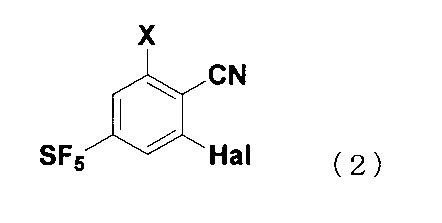
- halogen-containing pentafluorosulfanylbenzene derivative is represented by the general formula (2).
- Hal is a halogen atom.
- the halogen atom include a fluorine atom, a chlorine atom, a bromine atom, and an iodine atom. From the viewpoint of easy synthesis, a chlorine atom, a bromine atom, or an iodine atom is preferable, and an iodine atom is more preferable.
- X is a hydrogen atom, a halogen atom, or a cyano group.
- the halogen atom here is preferably a chlorine atom, a bromine atom, or an iodine atom, and more preferably an iodine atom.
- X is a halogen atom, it need not be the same as Hal.
- halogen-containing pentafluorosulfanylbenzene derivative of the present invention (hereinafter simply referred to as “halogen-containing derivative”) is useful as a raw material for the phthalocyanine derivative of the present invention. From this viewpoint, preferred embodiments of the halogen-containing derivative are as follows.
- Halogen-containing derivatives 2a and 2b can be obtained by reacting pentafluorosulfanylcyanobenzene with a halogen source in the presence of alkyl lithium (see Non-Patent Document 3). Further, when the halogen-containing derivative 2b is reacted with cyanide, a halogen-containing derivative 2c is obtained. The reaction scheme is shown below.
- the halogen source molecular halogen, N-halogen succinimide, and N-halogen saccharin can be used. From the viewpoint of reactivity, the halogen source is preferably a molecular halogen such as Cl 2 , I 2 , Br 2 , and more preferably I 2 .
- the halogen-containing derivatives 2a and 2b can be selectively synthesized. That is, when the halogen source is excessive, the halogen-containing derivative 2b can be synthesized.
- reaction temperature can be ⁇ 20 ° C. to ⁇ 78 ° C., preferably about ⁇ 78 ° C.
- the cyanide that can be used in the reaction between the halogen-containing derivative 2b and the cyanide is not particularly limited, and examples thereof include sodium cyanide, potassium cyanide, copper cyanide, zinc cyanide, and trimethylsilyl cyanide. Copper cyanide is preferable from the viewpoint of reactivity.
- the solvent that can be used in this reaction include dimethylformamide, dimethyl sulfoxide, and N-methylpyrrolidone, and dimethylformamide is preferable from the viewpoint of handleability. This reaction can be carried out at a temperature from 0 ° C. to the boiling point of the solvent, preferably 50 to 200 ° C.
- Pentafluorosulfanylphthalonitrile is a compound in which an SF 5 group is introduced into phthalonitrile.
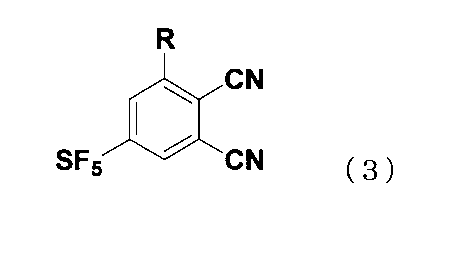
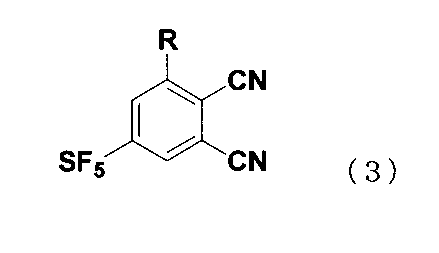
- the pentafluorosulfanylphthalonitrile derivative is pentafluorosulfanylphthalonitrile or a compound in which a group other than the SF 5 group is introduced into the compound, and is represented by the general formula (3).
- the pentafluorosulfanylphthalonitrile derivative of the present invention is also simply referred to as “phthalonitrile derivative”.
- R is a hydrogen atom, an alkyl ether, an aryl ether, an alkyl sulfide, an aryl sulfide, or a trifluoromethyl group.
- the alkyl group and aryl group are as described in the phthalocyanine derivative. Specific embodiments of the phthalonitrile derivative are shown below.
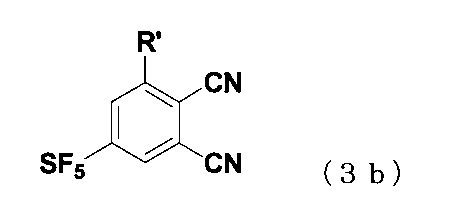
- R ′ represents an alkyl ether group, an aryl ether group, an alkyl sulfide group, an aryl sulfide group, or a trifluoromethyl group.
- the phthalonitrile derivative of the present invention is useful as a raw material for the phthalocyanine derivative of the present invention. From this point of view, preferred embodiments of the phthalonitrile derivative 3b are as follows.
- Rb is a chain or branched alkyl group having 1 to 3 carbon atoms.
- n represents the number of Rb and is an integer of 0 to 5.
- n is preferably 0 to 2, more preferably 0 to 1, and still more preferably 0.
- Rb is preferably a methyl group.
- the phthalonitrile derivative 3a can be obtained by reacting the halogen-containing derivative 2a with a cyanide.
- the reaction conditions and the like are as described in the section of halogen-containing derivatives.
- the phthalonitrile derivative 3b is obtained by converting the halogen atom of the above-mentioned halogen-containing derivative 2c to R ′.
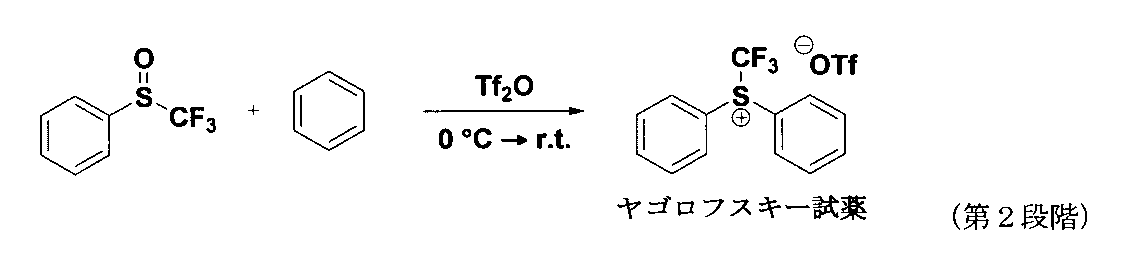
- phthalonitrile derivative 3b-1 (see Non-Patent Document 4) reacts with a Yagupolskii reagent, and phthalonitrile derivative 3b-2 (see Non-Patent Document 5) forms a thiophenol when reacted with a phenol.
- phthalonitrile derivative 3b-3 see Non-Patent Document 6 can be produced.
- the phthalocyanine derivative of the present invention comprises: (A) a step of preparing a phthalonitrile derivative represented by the general formula (3), and (B) the pentafluorosulfanyl phthalonitrile derivative and hydrogen, metal, metalloid, metal oxide, metalloid oxide, metal It can be produced by a method comprising a step of heating a hydroxide, a metalloid hydroxide, a metal halide, or a metalloid halide. The reaction scheme is shown below.
- Step (A) In this step, a phthalonitrile derivative represented by the general formula (3) is prepared as already described.
- Hydrogen, metal, metalloid, metal oxide, metalloid oxide, metal hydroxide, metalloid hydroxide, metal halide, or metalloid halide is also referred to as “center component” for convenience.
- the reaction conditions in this step may be conditions that are usually used for producing phthalocyanine.
- the molar ratio of the phthalonitrile derivative represented by the general formula (3) and the central component may be 3: 1 to 5: 1.
- the heating temperature is preferably 180 to 250 ° C.
- Solvents that can be used include, but are not limited to, ether solvents such as diethyl ether, diisopropyl ether, n-butyl methyl ether, tert-butyl methyl ether, tetrahydrofuran, and dioxane; hydrocarbon solvents such as heptane, hexane, cyclopentane, and cyclohexane Solvent: Halogenated hydrocarbon solvents such as chloroform, carbon tetrachloride, methylene chloride, dichloroethane, and trichloroethane; aromatics such as benzene, toluene, xylene, cumene, cymene, mesitylene, diisopropylbenzene, pyridine, pyrimidine, pyrazine, and pyr
- the reaction solution was cooled to ⁇ 78 ° C., and a solution obtained by dissolving 100 mg (0.44 mmol) of 4-pentafluorosulfanylcyanobenzene synthesized by the method described later in 2.0 ml of THF was slowly added dropwise.
- 2.0 ml of a THF solution of 122 mg (0.87 mmol) of iodine (manufactured by Nacalai Tesque) was slowly added dropwise and stirred at ⁇ 78 ° C. for 2 hours. Thereafter, the temperature was raised to room temperature, and after stirring at room temperature for 1 hour, 3.0 ml of water was added to stop the reaction.
- reaction solution was concentrated and extracted three times with diethyl ether.
- organic phase was washed with 1N HCl aqueous solution, sodium thiosulfate aqueous solution and saturated brine in this order, and dried over sodium sulfate.
- the reaction mixture was quenched with excess water and extracted with CH 2 Cl 2 .
- the CH 2 Cl 2 phase was concentrated and the residue was dissolved in a Hex (hexane) / CH 2 Cl 2 mixture and further dried over Na 2 SO 4 . After filtration, the filtrate was concentrated to obtain 61.0 g of a yellow crude product.
- the crude product was dissolved in a minimum amount of methanol at room temperature and dried in vacuo.
- the final product obtained was white crystals, the yield was 36.14 g, and the purity by GC analysis was 95%. It was confirmed by MS and NMR that the final product was 4-pentafluorosulfanylcyanobenzene.
- a nitrogen-substituted 100 ml eggplant flask was charged with 1.47 ml (8.73 mmol) of 2,2-6,6-tetramethylpiperidine and 10 ml of THF and cooled to 0 ° C.
- 6.42 ml (1.36 M, 8.73 mmol) of n-BuLi was slowly added dropwise and stirred at 0 ° C. for 30 minutes.
- the reaction solution was cooled to ⁇ 78 ° C., and a solution obtained by dissolving 500 mg (2.18 mmol) of 4-pentafluorosulfanylcyanobenzene in 5.0 ml of THF was slowly added dropwise.
- the Yagolovsky reagent was synthesized in the following two steps.
- FIGS. 1 to 4 show UV / Vis spectra of the phthalocyanine derivatives of the present invention obtained in Examples 8 to 11 in methylene chloride.
- FIG. 5 shows a UV / Vis spectrum of trifluoromethylphthalocyanine described in Patent Document 1 in methylene chloride. Table 1 shows the wavelength of each peak and the value of the molar extinction coefficient.
- the peak in the Q band is greatly red-shifted.
- a small peak appears in the vicinity of 730 nm, but it returns to one peak due to the addition of pyridine, which is considered to be due to protonation.
- the UV / Vis spectrum of phthalocyanine since the substituent at the ⁇ -position exerts a large effect, it is considered that the effect of the electron-donating group introduced at the ⁇ -position is greatly influenced also in the present invention.
- FIGS. 6 to 9 show the fluorescence spectra in methylene chloride of the phthalocyanine derivatives of the present invention obtained in Examples 8 to 11 above.
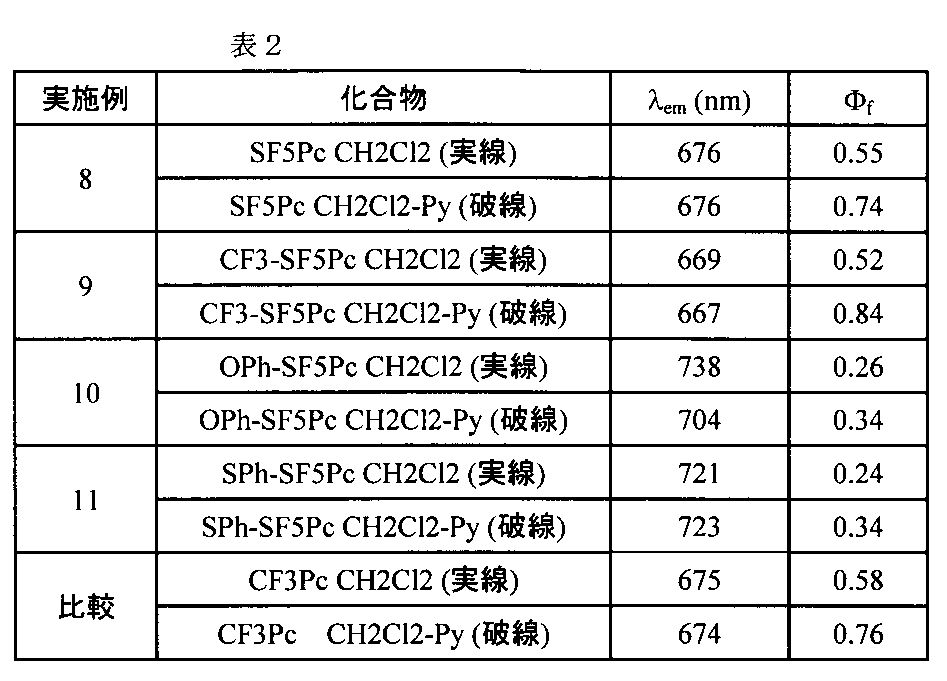
- FIG. 10 shows a fluorescence spectrum of trifluoromethylphthalocyanine described in Patent Document 1 in methylene chloride. The wavelength of each peak and the fluorescence quantum yield values are shown in Table 2.
- a phthalocyanine derivative into which fluorine has been introduced has a relatively high fluorescence quantum yield.
- the trifluoromethyl-pentafluorosulfanyl phthalocyanine obtained in Example 9 has a very large fluorescence quantum yield of 0.84 when pyridine is added. This tendency is presumed to be the effect of fluorine because it is common to phthalocyanines having a fluorine-containing functional group.
- the phthalocyanine derivatives obtained in Examples 10 and 11 having a pentafluorosulfanyl group which is an electron-withdrawing group and a phenoxy group or thiophenoxy group which is an electron-donating group tend to decrease the fluorescence quantum yield. .
Landscapes
- Chemical & Material Sciences (AREA)
- Organic Chemistry (AREA)
- Organic Low-Molecular-Weight Compounds And Preparation Thereof (AREA)
- Nitrogen Condensed Heterocyclic Rings (AREA)
Abstract
Description
[1]一般式(1):
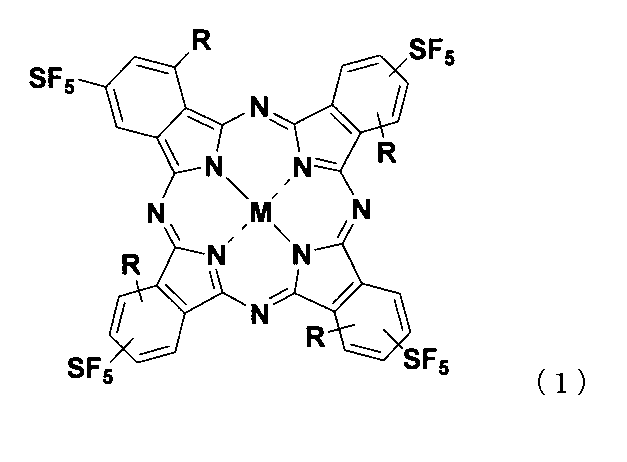
Rはそれぞれ独立に、水素原子、アルキルエーテル基、アリールエーテル基、アルキルスルフィド基、アリールスルフィド基、またはトリフルオロメチル基である)
で表される、フタロシアニン誘導体。
[2]前記Rが水素原子である、[1]に記載のフタロシアニン誘導体。
[3]前記Rが、アルキルエーテル基、アリールエーテル基、アルキルスルフィド基、アリールスルフィド基、またはトリフルオロメチル基である、[1]に記載のフタロシアニン誘導体。
[4]前記Rがトリフルオロメチル基、フェノキシ基、またはフェニルスルフィド基である、[1]に記載のフタロシアニン誘導体。
[5]一般式(2):

で表されるハロゲン含有ペンタフルオロスルファニルベンゼン誘導体。
[6]一般式(3):

で表されるペンタフルオロスルファニルフタロニトリル誘導体。
[7](A)一般式(3):
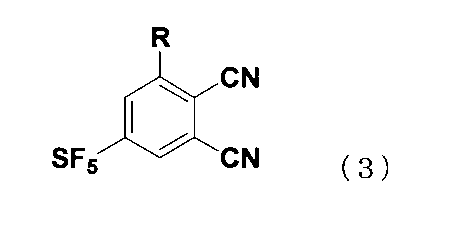
で表されるペンタフルオロスルファニルフタロニトリル誘導体を準備する工程、および
(B)前記ペンタフルオロスルファニルフタロニトリル誘導体と、水素、金属、半金属、金属酸化物、半金属酸化物、金属水酸化物、半金属水酸化物、金属ハロゲン化物、または半金属ハロゲン化物と、を加熱する工程を含む、[1]に記載のフタロシアニン誘導体の製造方法。
[8]前記工程(A)が、
一般式(2):
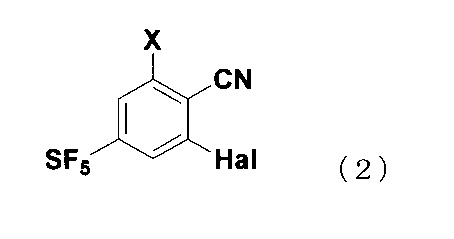
で表されるハロゲン含有ペンタフルオロスルファニルベンゼン誘導体のHalをシアノ基に変換し、かつXをRに変換する工程により、一般式(3)で表されるペンタフルオロスルファニルフタロニトリル誘導体を準備する工程である、[7]に記載の製造方法。
[9](A1)一般式(2a):
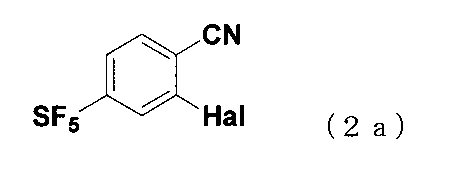
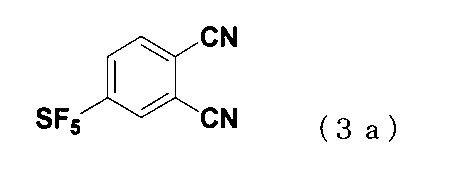
(B)前記ペンタフルオロスルファニルフタロニトリル誘導体と、水素、金属、半金属、金属酸化物、半金属酸化物、金属水酸化物、半金属水酸化物、金属ハロゲン化物、または半金属ハロゲン化物と、を加熱する工程を含む、[2]に記載のフタロシアニン誘導体の製造方法。
[10](A2)一般式(2b):

(B)前記ペンタフルオロスルファニルフタロニトリル誘導体と、水素、金属、半金属、金属酸化物、半金属酸化物、金属水酸化物、半金属水酸化物、金属ハロゲン化物、または半金属ハロゲン化物と、を加熱する工程を含む、[3]に記載のフタロシアニン誘導体の製造方法。
[11](A3)一般式(2c):
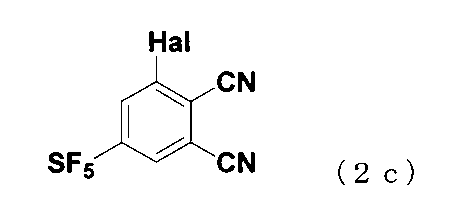

(B)前記ペンタフルオロスルファニルフタロニトリル誘導体と、水素、金属、半金属、金属酸化物、半金属酸化物、金属水酸化物、半金属水酸化物、金属ハロゲン化物、または半金属ハロゲン化物と、を加熱する工程を含む、[3]に記載のフタロシアニン誘導体の製造方法。
フタロシアニンとは、4つのフタル酸イミドが窒素原子で架橋された構造をもつ環状化合物である。本発明においてフタロシアニン誘導体とは、フタロシアニンまたは置換基が導入されたフタロシアニンをいう。


ハロゲン含有ペンタフルオロスルファニルベンゼン誘導体は、一般式(2)で表される。
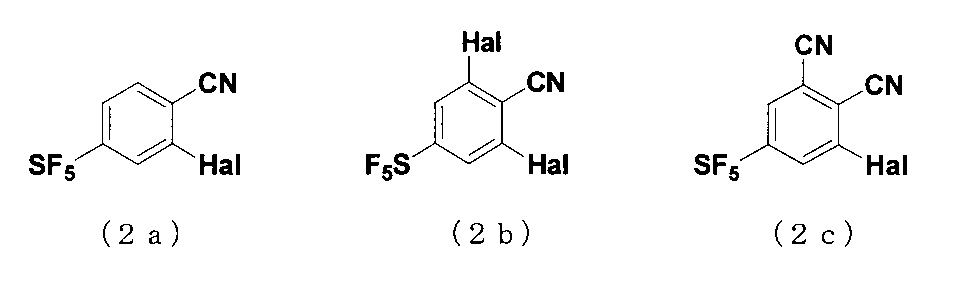

ペンタフルオロスルファニルフタロニトリルとは、フタロニトリルにSF5基が導入された化合物である。本発明において、ペンタフルオロスルファニルフタロニトリル誘導体とは、ペンタフルオロスルファニルフタロニトリル、または当該化合物にSF5基以外の基が導入された化合物であり、一般式(3)で表される。本発明のペンタフルオロスルファニルフタロニトリル誘導体を以下、簡潔に「フタロニトリル誘導体」ともいう。

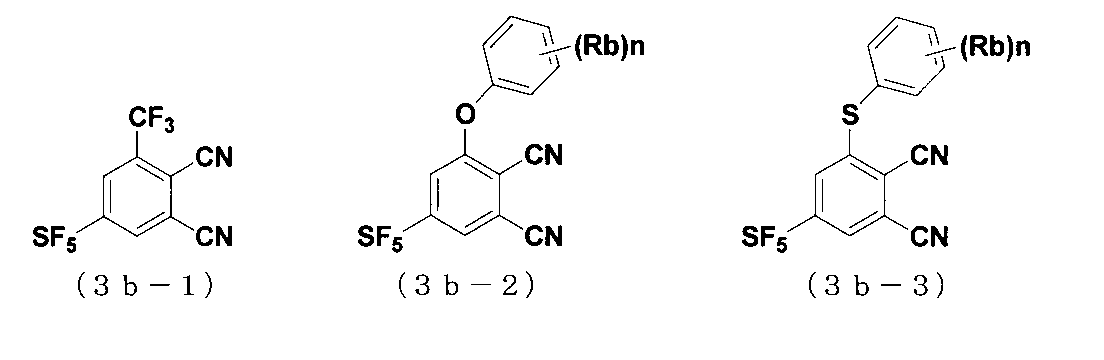
本発明のフタロシアニン誘導体は、
(A)一般式(3)で表されるフタロニトリル誘導体を準備する工程、および
(B)当該ペンタフルオロスルファニルフタロニトリル誘導体と、水素、金属、半金属、金属酸化物、半金属酸化物、金属水酸化物、半金属水酸化物、金属ハロゲン化物、または半金属ハロゲン化物と、を加熱する工程
を含む方法によって製造できる。
以下に、反応スキームを示す。

本工程では、既に述べたようにして一般式(3)で表されるフタロニトリル誘導体を準備する。
本工程では、一般式(3)で表されるフタロニトリル誘導体と、水素、金属、半金属、金属酸化物、半金属酸化物、金属水酸化物、半金属水酸化物、金属ハロゲン化物、または半金属ハロゲン化物とを加熱して、一般式(1)で表される、フタロシアニン誘導体を得る。
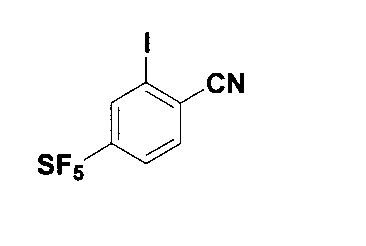
1H NMR (300MHz、 CDCl3): δ = 7.73 (d、 J = 8.4 Hz、 1H)、 7.87 (dd、 J = 8.4 Hz、 J = 1.5 Hz、 1H)、 8.29 (d、 J = 1.5 Hz、 1H)
19F NMR (282 MHz、 CDCl3): δ = -150.0 (quintet、 J = 150.6 Hz、1F)、 -168.1 (d、 J = 150.6 Hz、 4F)
冷却管、CaCl2チューブ、および撹拌装置を備えた500mlのフラスコを準備した。フラスコ内に、1-フルオロ-4-ペンタフルオロスルファニルベンゼン 73.4g(0.33mol、UBE America Inc.社製)、NaCN 32.5g(0.66mol)(Sigma-Aldrich社製)、乾燥DMSO(Sigma-Aldrich社製)300mlを仕込んだ。フラスコ内温度を100~105℃に昇温し合計で47時間加熱した。GC分析による転化率は約75%であった。
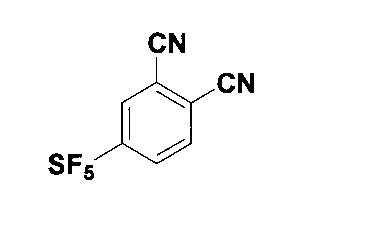
1H NMR (300MHz、 CDCl3): δ = 7.98 (d、 J = 8.7 Hz、 1H)、 8.15 (d、 J = 8.7 Hz、 1H)、 8.20 (s、 1H)
19F NMR (282 MHz、 CDCl3): δ = -151.6 (quintet、 J = 151.4 Hz、1F)、 -168.1 (d、 J = 151.4 Hz、 4F)
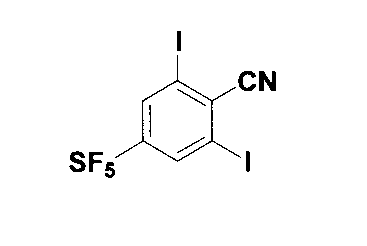
1H NMR (300MHz、 CDCl3): δ = 8.24 (s、 2H)
19F NMR (282 MHz、 CDCl3): δ = -150.8 (quintet、 J = 160.4 Hz、1F)、 -167.7 (d、 J = 160.4 Hz、 4F)

1H NMR (300MHz、 CDCl3): δ = 8.17 (d、 J = 1.65 Hz、 1H)、 8.50 (d、 J = 1.65 Hz、 1H)
19F NMR (282 MHz、 CDCl3): δ = -152.27 (quintet、 J = 159 Hz、1F)、 -167.72 (d、 J = 159 Hz、 4F)
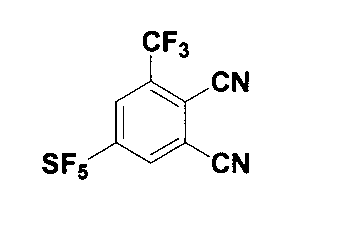
1H NMR (300MHz、 CDCl3): δ = 8.38 (s、 1H)、 8.39 (s、 1H)
19F NMR (282 MHz、 CDCl3): δ = -62.73 (s、3F)、 -153.2 (quintet、 J = 161.8 Hz、 1F)、 -167.8 (d、 J = 161.8 Hz、 4F)
ヤゴロフスキー試薬は以下の二段階で合成した。

1H NMR (300MHz, CD3COCD3): d 8.43 (d, J = 8.1 Hz, 2H), 8.13 (t, J =7.5 Hz, 1H), 8.00 (t, J = 8.1 Hz, 2H).
19F NMR (282 MHz、CD3COCD3): d -51.0 (s, 3F), -78.5 (s, 3F).

1H NMR (300MHz、 CDCl3): δ = 7.14 (d、 J = 8.1 Hz、 2H)、 7.36-7.41 (m、 2H)、 7.51 (d、 J = 8.4 Hz、 1H)、 7.55 (d、 J = 2.0 Hz、 1H)、 7.81 (d、 J = 2.0 Hz、 1H)
19F NMR (282 MHz、 CDCl3): δ = -151.7 (quintet、 J = 150.8 Hz、1F)、 -168.3 (d、 J = 150.8 Hz、 4F)
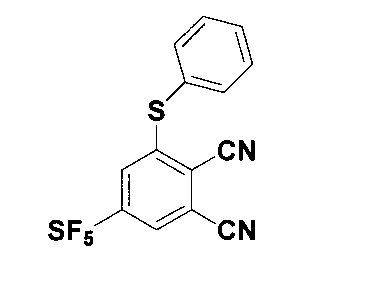
1H NMR (300MHz、 CDCl3): δ = 7.36 (d、 J = 1.4 Hz、 1H)、 7.52-7.61 (m、 5H)、 7.82 (d、 J = 1.4 Hz、 1H)
19F NMR (282 MHz、 CDCl3): δ = -151.6 (quintet、 J = 151.8 Hz、1F)、 -168.5 (d、 J = 150.6 Hz、 4F)

1H NMR (300MHz、 CDCl3): δ = 非対称体8.40~9.42 (m、 3H)、 対称体8.10 (d、 J = 8.4 Hz、 1H)、 8.25 (s、 1H)、 8.39 (d、 J = 8.4 Hz、 1H)
19F NMR (282 MHz、 d-acetone) : δ = 非対称体-144.3 (quintet、 J = 147.9 Hz、 1F)、 -164.3 (d、 J = 147.9 Hz、 4F)、 対称体-147.2 (quintet、 J = 149.5 Hz、 1F)、 -166.5 (d、 J = 149.5 Hz、 4F)
MALDI-TOF calculated forC32H12F20N8S4Zn [M-H+]- 1079.9 found 1082.11

1H NMR (300MHz、 CDCl3): δ = 8.83~8.87 (m、 4H)、 9.81~10.15 (m、 4H)
19F NMR (282 MHz、 d-acetone): δ = -59.22~ -61.68 (m、 12F)、 -146.65 ~- 147.81 (m、 4F)、 -164.52 ~ -166.71 (m、 16F)
MALDI-TOF calculated forC36H8F32N8S4Zn[M-H+]-1354.1 found 1352.05

1H NMR (300MHz、 CDCl3): δ = 7.01~7.47 (m、 20H)、 7.54~9.70 (m、 8H)
19F NMR (282 MHz、 CDCl3): δ = -144.3~-145.9 (m、 4F)、 -163.8~-165.0 (m、 20F)
MALDI-TOF calculated forC56H28F20N8O4S4Zn[M-H+]-1448.01 found 1447.88

1H NMR (300MHz、 CDCl3): δ = 7.50~7.77 (m、 20H)、7.87 (br、 8H)
19F NMR (282 MHz、 CDCl3): δ = -146.4~-147.5 (m、 4F)、 -165.8~-166.6 (m、 16F)
MALDI-TOF calculated forC56H28F20N8S8Zn[M-H+]-1511.92 found 1511.54

Claims (11)
- 一般式(1):

Rはそれぞれ独立に、水素原子、アルキルエーテル基、アリールエーテル基、アルキルスルフィド基、アリールスルフィド基、またはトリフルオロメチル基である)
で表される、フタロシアニン誘導体。 - 前記Rが水素原子である、請求項1に記載のフタロシアニン誘導体。
- 前記Rが、アルキルエーテル基、アリールエーテル基、アルキルスルフィド基、アリールスルフィド基、またはトリフルオロメチル基である、請求項1に記載のフタロシアニン誘導体。
- 前記Rがトリフルオロメチル基、フェノキシ基、またはフェニルスルフィド基である、請求項1に記載のフタロシアニン誘導体。
- 一般式(2):

で表されるハロゲン含有ペンタフルオロスルファニルベンゼン誘導体。 - 一般式(3):
で表されるペンタフルオロスルファニルフタロニトリル誘導体。 - (A)一般式(3):

で表されるペンタフルオロスルファニルフタロニトリル誘導体を準備する工程、および
(B)前記ペンタフルオロスルファニルフタロニトリル誘導体と、水素、金属、半金属、金属酸化物、半金属酸化物、金属水酸化物、半金属水酸化物、金属ハロゲン化物、または半金属ハロゲン化物と、を加熱する工程を含む、請求項1に記載のフタロシアニン誘導体の製造方法。 - 前記工程(A)が、
一般式(2):

で表されるハロゲン含有ペンタフルオロスルファニルベンゼン誘導体のHalをシアノ基に変換し、かつXをRに変換する工程により、一般式(3)で表されるペンタフルオロスルファニルフタロニトリル誘導体を準備する工程である、請求項7に記載の製造方法。 - (A1)一般式(2a):


(B)前記ペンタフルオロスルファニルフタロニトリル誘導体と、水素、金属、半金属、金属酸化物、半金属酸化物、金属水酸化物、半金属水酸化物、金属ハロゲン化物、または半金属ハロゲン化物と、を加熱する工程を含む、請求項2に記載のフタロシアニン誘導体の製造方法。 - (A2)一般式(2b):

(B)前記ペンタフルオロスルファニルフタロニトリル誘導体と、水素、金属、半金属、金属酸化物、半金属酸化物、金属水酸化物、半金属水酸化物、金属ハロゲン化物、または半金属ハロゲン化物と、を加熱する工程を含む、[3]に記載のフタロシアニン誘導体の製造方法。 - (A3)一般式(2c):


(B)前記ペンタフルオロスルファニルフタロニトリル誘導体と、水素、金属、半金属、金属酸化物、半金属酸化物、金属水酸化物、半金属水酸化物、金属ハロゲン化物、または半金属ハロゲン化物と、を加熱する工程を含む、請求項3に記載のフタロシアニン誘導体の製造方法。
Priority Applications (2)
| Application Number | Priority Date | Filing Date | Title |
|---|---|---|---|
| US14/648,202 US9580604B2 (en) | 2012-11-29 | 2013-11-29 | Pentafluorosulfanyl phthalocyanine derivatives and intermediates thereof |
| JP2014549905A JP6206977B2 (ja) | 2012-11-29 | 2013-11-29 | ペンタフルオロスルファニルフタロシアニン誘導体およびその中間体 |
Applications Claiming Priority (2)
| Application Number | Priority Date | Filing Date | Title |
|---|---|---|---|
| US201261731132P | 2012-11-29 | 2012-11-29 | |
| US61/731,132 | 2012-11-29 |
Publications (1)
| Publication Number | Publication Date |
|---|---|
| WO2014084331A1 true WO2014084331A1 (ja) | 2014-06-05 |
Family
ID=50827959
Family Applications (1)
| Application Number | Title | Priority Date | Filing Date |
|---|---|---|---|
| PCT/JP2013/082136 Ceased WO2014084331A1 (ja) | 2012-11-29 | 2013-11-29 | ペンタフルオロスルファニルフタロシアニン誘導体およびその中間体 |
Country Status (3)
| Country | Link |
|---|---|
| US (1) | US9580604B2 (ja) |
| JP (1) | JP6206977B2 (ja) |
| WO (1) | WO2014084331A1 (ja) |
Cited By (5)
| Publication number | Priority date | Publication date | Assignee | Title |
|---|---|---|---|---|
| WO2016136364A1 (ja) * | 2015-02-27 | 2016-09-01 | 富士フイルム株式会社 | 有機半導体デバイス用電極材料 |
| JP2017160185A (ja) * | 2016-01-11 | 2017-09-14 | 財團法人工業技術研究院Industrial Technology Research Institute | 芳香族スルフィドまたはその塩の製造方法 |
| US10184028B2 (en) | 2016-01-11 | 2019-01-22 | Industrial Technology Research Institute | Method for preparing a polymer |
| US10287396B2 (en) | 2016-01-11 | 2019-05-14 | Industrial Technology Research Institute | Polymer |
| TWI871448B (zh) * | 2020-03-25 | 2025-02-01 | 日商住友化學股份有限公司 | 著色樹脂組合物 |
Families Citing this family (1)
| Publication number | Priority date | Publication date | Assignee | Title |
|---|---|---|---|---|
| CN113130772B (zh) * | 2019-12-30 | 2022-05-06 | Tcl科技集团股份有限公司 | 纳米复合材料及其制备方法、溶液组合物和发光二极管 |
Citations (4)
| Publication number | Priority date | Publication date | Assignee | Title |
|---|---|---|---|---|
| JPH0641137A (ja) * | 1992-02-08 | 1994-02-15 | Nippon Nohyaku Co Ltd | フタロシアニン誘導体及びその製造方法並びにその中間体の製造方法 |
| JP2002309119A (ja) * | 2001-04-17 | 2002-10-23 | Ricoh Co Ltd | フタロシアニン化合物 |
| JP2002316989A (ja) * | 2001-04-17 | 2002-10-31 | Ricoh Co Ltd | フタロシアニン化合物 |
| JP2004137184A (ja) * | 2002-10-17 | 2004-05-13 | Ube Ind Ltd | ポルフィリン類金属錯体の製造方法 |
Family Cites Families (4)
| Publication number | Priority date | Publication date | Assignee | Title |
|---|---|---|---|---|
| JPH0439361A (ja) * | 1990-06-04 | 1992-02-10 | Nippon Shokubai Co Ltd | 新規フタロシアニン化合物,その製造方法及びそれらを用いてなる近赤外線吸収材料 |
| JPH05222047A (ja) * | 1992-02-14 | 1993-08-31 | Nippon Shokubai Co Ltd | 新規フタロシアニン化合物およびその製造方法 |
| JP2014051452A (ja) * | 2012-09-07 | 2014-03-20 | Nagoya Institute Of Technology | 3,5−ビス(ペンタフルオロスルファニル)−フェニル基を有するフタロシアニンの製造方法及び新規フタロシアニン |
| JP2014065670A (ja) * | 2012-09-25 | 2014-04-17 | Nagoya Institute Of Technology | トリフルオロメチルフタロニトリルの簡便な製造方法及びフタロシアニン誘導体 |
-
2013
- 2013-11-29 WO PCT/JP2013/082136 patent/WO2014084331A1/ja not_active Ceased
- 2013-11-29 JP JP2014549905A patent/JP6206977B2/ja not_active Expired - Fee Related
- 2013-11-29 US US14/648,202 patent/US9580604B2/en not_active Expired - Fee Related
Patent Citations (4)
| Publication number | Priority date | Publication date | Assignee | Title |
|---|---|---|---|---|
| JPH0641137A (ja) * | 1992-02-08 | 1994-02-15 | Nippon Nohyaku Co Ltd | フタロシアニン誘導体及びその製造方法並びにその中間体の製造方法 |
| JP2002309119A (ja) * | 2001-04-17 | 2002-10-23 | Ricoh Co Ltd | フタロシアニン化合物 |
| JP2002316989A (ja) * | 2001-04-17 | 2002-10-31 | Ricoh Co Ltd | フタロシアニン化合物 |
| JP2004137184A (ja) * | 2002-10-17 | 2004-05-13 | Ube Ind Ltd | ポルフィリン類金属錯体の製造方法 |
Cited By (7)
| Publication number | Priority date | Publication date | Assignee | Title |
|---|---|---|---|---|
| WO2016136364A1 (ja) * | 2015-02-27 | 2016-09-01 | 富士フイルム株式会社 | 有機半導体デバイス用電極材料 |
| JPWO2016136364A1 (ja) * | 2015-02-27 | 2017-12-28 | 富士フイルム株式会社 | 有機半導体デバイス用電極材料 |
| US10319928B2 (en) | 2015-02-27 | 2019-06-11 | Fujifilm Corporation | Electrode material for organic semiconductor device |
| JP2017160185A (ja) * | 2016-01-11 | 2017-09-14 | 財團法人工業技術研究院Industrial Technology Research Institute | 芳香族スルフィドまたはその塩の製造方法 |
| US10184028B2 (en) | 2016-01-11 | 2019-01-22 | Industrial Technology Research Institute | Method for preparing a polymer |
| US10287396B2 (en) | 2016-01-11 | 2019-05-14 | Industrial Technology Research Institute | Polymer |
| TWI871448B (zh) * | 2020-03-25 | 2025-02-01 | 日商住友化學股份有限公司 | 著色樹脂組合物 |
Also Published As
| Publication number | Publication date |
|---|---|
| US20150337135A1 (en) | 2015-11-26 |
| US9580604B2 (en) | 2017-02-28 |
| JPWO2014084331A1 (ja) | 2017-01-05 |
| JP6206977B2 (ja) | 2017-10-04 |
Similar Documents
| Publication | Publication Date | Title |
|---|---|---|
| JP6206977B2 (ja) | ペンタフルオロスルファニルフタロシアニン誘導体およびその中間体 | |
| US20130096319A1 (en) | Process for preparation of amisulpride | |
| CN110452141B (zh) | 一种无过渡金属催化合成二芳基硫醚类化合物的方法 | |
| CN110156550A (zh) | 一种使用苯酚及其衍生物为光催化剂进行氟烷基化的方法 | |
| CN109053505B (zh) | 一种非罗考昔重要中间体的合成方法 | |
| JP6968373B2 (ja) | ナフトビスカルコゲナジアゾール誘導体及びその製造方法 | |
| JP2014051452A (ja) | 3,5−ビス(ペンタフルオロスルファニル)−フェニル基を有するフタロシアニンの製造方法及び新規フタロシアニン | |
| JP6927975B2 (ja) | 重合性トリプチセン誘導体化合物 | |
| CN111574350B (zh) | 一种羟基环己基苯乙酮类光引发剂及其制备方法 | |
| WO2018159515A1 (ja) | ペンタフルオロスルファニル芳香族化合物の製造方法 | |
| CN103212339B (zh) | 一种季铵盐氟碳表面活性剂及其制备方法和应用 | |
| JP6489577B2 (ja) | α,α,α,α,β,β,β,β−オクタ(ペンタフルオロスルファニル)フタロシアニン化合物およびその中間体、ならびに製造方法 | |
| JP6247992B2 (ja) | ハロゲン化合物の製造方法 | |
| JP2014065670A (ja) | トリフルオロメチルフタロニトリルの簡便な製造方法及びフタロシアニン誘導体 | |
| JP5598533B2 (ja) | ヨウ素化芳香族化合物の製造方法 | |
| JP5403484B2 (ja) | アントラセン二量体骨格を有する新規なエポキシアクリレート化合物及びその製造法 | |
| KR20200139098A (ko) | 만곡된 방향족화합물 및 이의 제조방법 | |
| WO2019177049A1 (ja) | アニリン誘導体の製造方法 | |
| JP6635999B2 (ja) | カリウム塩の製造方法、及びカリウム塩 | |
| JP5858416B2 (ja) | キノイド型炭素架橋フェニレンビニレン化合物、及びキノイド型フェニレンビニレン化合物の安定化方法 | |
| JP3959994B2 (ja) | 4−フタロニトリル誘導体の製造方法 | |
| JP4336501B2 (ja) | 新規な4,4”−ジアルコキシターフェニル類 | |
| KR20240069893A (ko) | 고순도 9-페닐카바졸 유도체의 신규한 제조방법 | |
| CN108473431B (zh) | 2-氨基烟酸苄酯衍生物的制造方法 | |
| WO2007119402A1 (ja) | 原子移動ラジカルカップリング反応を用いる1,2-フェニルエタン系化合物の製造方法 |
Legal Events
| Date | Code | Title | Description |
|---|---|---|---|
| 121 | Ep: the epo has been informed by wipo that ep was designated in this application |
Ref document number: 13858765 Country of ref document: EP Kind code of ref document: A1 |
|
| ENP | Entry into the national phase |
Ref document number: 2014549905 Country of ref document: JP Kind code of ref document: A |
|
| WWE | Wipo information: entry into national phase |
Ref document number: 14648202 Country of ref document: US |
|
| NENP | Non-entry into the national phase |
Ref country code: DE |
|
| 122 | Ep: pct application non-entry in european phase |
Ref document number: 13858765 Country of ref document: EP Kind code of ref document: A1 |