WO2014069487A1 - 薄膜形成方法 - Google Patents
薄膜形成方法 Download PDFInfo
- Publication number
- WO2014069487A1 WO2014069487A1 PCT/JP2013/079322 JP2013079322W WO2014069487A1 WO 2014069487 A1 WO2014069487 A1 WO 2014069487A1 JP 2013079322 W JP2013079322 W JP 2013079322W WO 2014069487 A1 WO2014069487 A1 WO 2014069487A1
- Authority
- WO
- WIPO (PCT)
- Prior art keywords
- gas
- aluminum chloride
- thin film
- alcohol
- glass substrate
- Prior art date
- Legal status (The legal status is an assumption and is not a legal conclusion. Google has not performed a legal analysis and makes no representation as to the accuracy of the status listed.)
- Ceased
Links
Classifications
-
- C—CHEMISTRY; METALLURGY
- C23—COATING METALLIC MATERIAL; COATING MATERIAL WITH METALLIC MATERIAL; CHEMICAL SURFACE TREATMENT; DIFFUSION TREATMENT OF METALLIC MATERIAL; COATING BY VACUUM EVAPORATION, BY SPUTTERING, BY ION IMPLANTATION OR BY CHEMICAL VAPOUR DEPOSITION, IN GENERAL; INHIBITING CORROSION OF METALLIC MATERIAL OR INCRUSTATION IN GENERAL
- C23C—COATING METALLIC MATERIAL; COATING MATERIAL WITH METALLIC MATERIAL; SURFACE TREATMENT OF METALLIC MATERIAL BY DIFFUSION INTO THE SURFACE, BY CHEMICAL CONVERSION OR SUBSTITUTION; COATING BY VACUUM EVAPORATION, BY SPUTTERING, BY ION IMPLANTATION OR BY CHEMICAL VAPOUR DEPOSITION, IN GENERAL
- C23C16/00—Chemical coating by decomposition of gaseous compounds, without leaving reaction products of surface material in the coating, i.e. chemical vapour deposition [CVD] processes
- C23C16/44—Chemical coating by decomposition of gaseous compounds, without leaving reaction products of surface material in the coating, i.e. chemical vapour deposition [CVD] processes characterised by the method of coating
- C23C16/455—Chemical coating by decomposition of gaseous compounds, without leaving reaction products of surface material in the coating, i.e. chemical vapour deposition [CVD] processes characterised by the method of coating characterised by the method used for introducing gases into reaction chamber or for modifying gas flows in reaction chamber
- C23C16/45595—Atmospheric CVD gas inlets with no enclosed reaction chamber
-
- C—CHEMISTRY; METALLURGY
- C03—GLASS; MINERAL OR SLAG WOOL
- C03C—CHEMICAL COMPOSITION OF GLASSES, GLAZES OR VITREOUS ENAMELS; SURFACE TREATMENT OF GLASS; SURFACE TREATMENT OF FIBRES OR FILAMENTS MADE FROM GLASS, MINERALS OR SLAGS; JOINING GLASS TO GLASS OR OTHER MATERIALS
- C03C17/00—Surface treatment of glass, not in the form of fibres or filaments, by coating
- C03C17/22—Surface treatment of glass, not in the form of fibres or filaments, by coating with other inorganic material
- C03C17/23—Oxides
- C03C17/245—Oxides by deposition from the vapour phase
-
- C—CHEMISTRY; METALLURGY
- C03—GLASS; MINERAL OR SLAG WOOL
- C03C—CHEMICAL COMPOSITION OF GLASSES, GLAZES OR VITREOUS ENAMELS; SURFACE TREATMENT OF GLASS; SURFACE TREATMENT OF FIBRES OR FILAMENTS MADE FROM GLASS, MINERALS OR SLAGS; JOINING GLASS TO GLASS OR OTHER MATERIALS
- C03C17/00—Surface treatment of glass, not in the form of fibres or filaments, by coating
- C03C17/34—Surface treatment of glass, not in the form of fibres or filaments, by coating with at least two coatings having different compositions
- C03C17/3411—Surface treatment of glass, not in the form of fibres or filaments, by coating with at least two coatings having different compositions with at least two coatings of inorganic materials
- C03C17/3417—Surface treatment of glass, not in the form of fibres or filaments, by coating with at least two coatings having different compositions with at least two coatings of inorganic materials all coatings being oxide coatings
-
- C—CHEMISTRY; METALLURGY
- C23—COATING METALLIC MATERIAL; COATING MATERIAL WITH METALLIC MATERIAL; CHEMICAL SURFACE TREATMENT; DIFFUSION TREATMENT OF METALLIC MATERIAL; COATING BY VACUUM EVAPORATION, BY SPUTTERING, BY ION IMPLANTATION OR BY CHEMICAL VAPOUR DEPOSITION, IN GENERAL; INHIBITING CORROSION OF METALLIC MATERIAL OR INCRUSTATION IN GENERAL
- C23C—COATING METALLIC MATERIAL; COATING MATERIAL WITH METALLIC MATERIAL; SURFACE TREATMENT OF METALLIC MATERIAL BY DIFFUSION INTO THE SURFACE, BY CHEMICAL CONVERSION OR SUBSTITUTION; COATING BY VACUUM EVAPORATION, BY SPUTTERING, BY ION IMPLANTATION OR BY CHEMICAL VAPOUR DEPOSITION, IN GENERAL
- C23C16/00—Chemical coating by decomposition of gaseous compounds, without leaving reaction products of surface material in the coating, i.e. chemical vapour deposition [CVD] processes
- C23C16/22—Chemical coating by decomposition of gaseous compounds, without leaving reaction products of surface material in the coating, i.e. chemical vapour deposition [CVD] processes characterised by the deposition of inorganic material, other than metallic material
- C23C16/30—Deposition of compounds, mixtures or solid solutions, e.g. borides, carbides, nitrides
- C23C16/40—Oxides
- C23C16/403—Oxides of aluminium, magnesium or beryllium
-
- C—CHEMISTRY; METALLURGY
- C23—COATING METALLIC MATERIAL; COATING MATERIAL WITH METALLIC MATERIAL; CHEMICAL SURFACE TREATMENT; DIFFUSION TREATMENT OF METALLIC MATERIAL; COATING BY VACUUM EVAPORATION, BY SPUTTERING, BY ION IMPLANTATION OR BY CHEMICAL VAPOUR DEPOSITION, IN GENERAL; INHIBITING CORROSION OF METALLIC MATERIAL OR INCRUSTATION IN GENERAL
- C23C—COATING METALLIC MATERIAL; COATING MATERIAL WITH METALLIC MATERIAL; SURFACE TREATMENT OF METALLIC MATERIAL BY DIFFUSION INTO THE SURFACE, BY CHEMICAL CONVERSION OR SUBSTITUTION; COATING BY VACUUM EVAPORATION, BY SPUTTERING, BY ION IMPLANTATION OR BY CHEMICAL VAPOUR DEPOSITION, IN GENERAL
- C23C16/00—Chemical coating by decomposition of gaseous compounds, without leaving reaction products of surface material in the coating, i.e. chemical vapour deposition [CVD] processes
- C23C16/44—Chemical coating by decomposition of gaseous compounds, without leaving reaction products of surface material in the coating, i.e. chemical vapour deposition [CVD] processes characterised by the method of coating
- C23C16/54—Apparatus specially adapted for continuous coating
- C23C16/545—Apparatus specially adapted for continuous coating for coating elongated substrates
-
- C—CHEMISTRY; METALLURGY
- C03—GLASS; MINERAL OR SLAG WOOL
- C03C—CHEMICAL COMPOSITION OF GLASSES, GLAZES OR VITREOUS ENAMELS; SURFACE TREATMENT OF GLASS; SURFACE TREATMENT OF FIBRES OR FILAMENTS MADE FROM GLASS, MINERALS OR SLAGS; JOINING GLASS TO GLASS OR OTHER MATERIALS
- C03C2217/00—Coatings on glass
- C03C2217/20—Materials for coating a single layer on glass
- C03C2217/21—Oxides
- C03C2217/214—Al2O3
-
- C—CHEMISTRY; METALLURGY
- C03—GLASS; MINERAL OR SLAG WOOL
- C03C—CHEMICAL COMPOSITION OF GLASSES, GLAZES OR VITREOUS ENAMELS; SURFACE TREATMENT OF GLASS; SURFACE TREATMENT OF FIBRES OR FILAMENTS MADE FROM GLASS, MINERALS OR SLAGS; JOINING GLASS TO GLASS OR OTHER MATERIALS
- C03C2218/00—Methods for coating glass
- C03C2218/10—Deposition methods
- C03C2218/15—Deposition methods from the vapour phase
- C03C2218/152—Deposition methods from the vapour phase by cvd
- C03C2218/1525—Deposition methods from the vapour phase by cvd by atmospheric CVD
Definitions
- the present invention relates to a thin film forming method. Specifically, the present invention relates to a method for forming an alumina thin film on a glass substrate using atmospheric pressure CVD.
- Alumina thin films have excellent chemical and mechanical durability and have excellent electrical insulation properties, and are therefore widely used as surface coatings for improving durability and insulating coatings between conductive films. Moreover, when manufacturing a thin film solar cell, it is also used as an intermediate refractive index layer formed between a glass substrate forming a transparent substrate of the thin film solar cell and a tin oxide film forming a transparent conductive film.
- a sputtering method for forming an alumina thin film.
- the sputtering method is disadvantageous in terms of equipment cost because it requires a high vacuum, and when the spray method is used, it is difficult to form a dense film and it is difficult to control the film thickness on the order of several nm.
- the CVD method is suitable for industrial film formation because it can be formed under a wide range of pressure conditions from vacuum to atmospheric pressure, and the formed film is dense and the film thickness can be easily controlled. .
- Non-Patent Document 1 a mixed gas of aluminum chloride, carbon dioxide, and hydrogen is sprayed onto a heated substrate.
- the water generation reaction generally requires a high temperature of about 800 to 1000 ° C., and many glass substrates need to be heated to a higher temperature beyond the softening point, thereby obtaining a good alumina thin film. There are issues that cannot be solved.
- Non-patent document 2 proposes a method of forming an alumina thin film by CVD by directly supplying water vapor and aluminum chloride to a substrate of 600 ° C. or lower.
- water vapor and aluminum chloride are very reactive, and water vapor and aluminum chloride are used as raw materials for producing alumina fine powder by utilizing the high reactivity. Yes. Therefore, in the method of Non-Patent Document 2, a reaction between water vapor and aluminum chloride occurs before the raw material gas reaches the substrate, forming an alumina fine powder, which significantly reduces the film formation rate.
- the present inventors searched for various raw material systems. By using aluminum chloride and predetermined lower alcohols as raw materials, even when film formation was performed by atmospheric pressure CVD, It was found that a film forming process with a high film forming rate and almost no powder generation can be realized.
- the present invention has been made on the basis of the above-described knowledge, and is a method for forming an alumina thin film on a glass substrate by using an atmospheric pressure CVD method, and includes a raw material containing aluminum chloride and an alcohol having 4 or less carbon atoms.
- a thin film forming method is provided, wherein a gas is supplied onto a glass substrate maintained at a temperature of 500 ° C. or higher and 800 ° C. or lower to form an alumina thin film on the glass substrate.
- the source gas preferably further contains an inert gas.
- the source gas supplied onto the glass substrate may be a source gas in which the aluminum chloride and the alcohols are mixed in advance, and the gas containing the aluminum chloride and the alcohols A mixed gas formed by mixing a gas containing the gas immediately above the glass substrate may be used.
- a raw material gas in which the aluminum chloride and the alcohols are mixed in advance is referred to as a “premix raw material gas”, and the aluminum chloride-containing gas and the alcohol-containing gas are mixed immediately above the glass substrate.
- the mixed gas is referred to as “postmix raw material gas”.
- the molar ratio of alcohols to aluminum chloride (alcohol / aluminum chloride) in the premix source gas is preferably 1 or more and 6 or less, and 1.5 or more and 4. More preferably, it is 5 or less.
- the aluminum chloride concentration in the premix raw material gas is preferably 0.02 to 6 mol%.
- the moisture concentration in the raw material gas is preferably 2 mol% or less.
- the postmix source gas has an aluminum chloride-containing gas and an alcohol-containing gas in which the molar ratio of alcohol to aluminum chloride (alcohol / aluminum chloride) is 4 or more.
- a mixed gas formed by mixing at a ratio is preferable, and a mixed gas formed by mixing at a ratio of 4 to 50 is more preferable.
- the postmix source gas is preferably a postmix source gas in which an aluminum chloride-containing gas and an alcohol-containing gas are mixed at a ratio such that the aluminum chloride concentration is 0.02 to 6 mol%.
- the water concentration of the postmix raw material gas is preferably 2 mol% or less.
- the temperature of the said glass substrate to which source gas is supplied is 500 degreeC or more and 650 degrees C or less.
- the alcohol contained in the raw material gas is preferably at least one selected from the group consisting of methanol, ethanol, isopropanol, and butanol.
- the thickness of the alumina thin film formed on the glass substrate is preferably 10 to 100 nm.
- an alumina thin film can be formed on a glass substrate at a high film formation rate by using atmospheric pressure CVD, and a fine alumina thin film can be formed because almost no alumina fine powder is generated.
- a raw material gas containing aluminum chloride and an alcohol having 4 or less carbon atoms is maintained at a temperature of 500 ° C. or higher and 800 ° C. or lower using an atmospheric pressure CVD method.
- An alumina thin film is formed on the glass substrate.
- alumina thin film is formed by CVD, alumina generated by reacting water generated by the reaction of carbon dioxide and hydrogen with aluminum chloride. .
- the water generation reaction generally requires a high temperature of about 800 to 1000 ° C.
- alumina is formed by a chemical reaction between aluminum chloride represented by the following formula and alcohols (represented by ROH).
- AlCl 3 + 3ROH Al (OR) 3 + 3HCl
- Al (OR) 3 + AlCl 3 Al 2 O 3 + 3RC1 (2)
- the reaction (1) proceeds at 200 ° C. or higher.
- the reaction (2) proceeds gradually from around 300 ° C., and the raw material decomposition efficiency becomes almost 100% at 500 ° C. or higher, so that the raw material use efficiency is improved. Therefore, what is necessary is just to hold
- Non-Patent Document 2 in which water vapor and aluminum chloride are directly supplied and reacted, the reaction rate is very fast and fine alumina powder is generated in the gas phase.
- the reaction (2) above Hardly progresses on the substrate, so almost no alumina fine powder is generated.
- the reason why the glass substrate is held at a temperature of 800 ° C. or lower is that the atmospheric pressure CVD method is performed in a temperature range that does not greatly exceed the softening point of the glass substrate. Therefore, the upper limit of the holding temperature of the glass substrate of atmospheric pressure CVD method changes with glass substrates to be used. For example, when using a soda lime glass substrate, it is preferable to hold
- alumina means aluminum oxide (Al 2 O 3 ), and the aluminum oxide produced by the atmospheric pressure CVD method is usually amorphous alumina.
- the gas of aluminum chloride (AlCl 3 ) is generated by reacting a vaporized aluminum chloride, an aluminum compound such as metal aluminum or aluminum oxide, and a reactive chlorine compound such as chlorine or hydrogen chloride.
- Aluminum chloride gas is used.
- the alcohol having 4 or less carbon atoms used in the present invention means an organic compound having 4 or less carbon atoms having one or more alcoholic hydroxyl groups, and is preferably a compound having a relatively low boiling point than being used as a gas.
- the alcohol having 4 or less carbon atoms is preferably an alkanol having 4 or less carbon atoms represented by ROH (R is an alkyl group having 4 or less carbon atoms), and examples thereof include methanol, ethanol, isopropyl alcohol (IPA), and butanol. . Of these, methanol, ethanol, and IPA are particularly preferable because they generate particularly little alumina fine powder and are inexpensive. Two or more types of alcohols having 4 or less carbon atoms in the raw material gas may be used. Hereinafter, unless otherwise specified, alcohols having 4 or less carbon atoms are simply referred to as alcohols.
- the inert gas refers to a gas that does not have the possibility of inhibiting the alumina formation reaction and does not have the possibility of being decomposed or altered under conditions such as temperature in the alumina formation reaction.
- the inert gas may be composed of two or more components.
- the boiling point of the substance that becomes the inert gas is preferably lower than that of alcohols, and a substance having a boiling point of room temperature or lower is preferable.
- the inert gas include nitrogen gas, rare gases such as helium and argon, and air. Nitrogen gas is particularly preferable as the inert gas. Further, as will be described later, it is preferable to use an inert gas having a low water content as the inert gas.
- the aluminum chloride-containing gas is preferably a gas obtained by diluting an aluminum chloride gas with an inert gas.
- an aluminum chloride-containing gas is obtained by heating aluminum chloride in a container, introducing an inert gas into the container, and taking out the aluminum chloride gas diluted with the inert gas.
- the aluminum chloride-containing gas is preferably maintained at a temperature at which aluminum chloride does not condense in a transfer means such as a pipe.
- the alcohol-containing gas may be a gas alone, but the alcohol-containing gas is also preferably a gas obtained by diluting an alcohol with an inert gas.
- an alcohol-containing gas can be obtained by bubbling an inert gas through the alcohol in the container and taking out the alcohol gas diluted with the inert gas.
- the alcohol-containing gas is also preferably maintained at a temperature at which it does not liquefy in a transfer means such as a pipe.
- the premix source gas in the present invention is preferably a mixed gas obtained by mixing the aluminum chloride-containing gas and the alcohol-containing gas.
- This mixed gas may be further diluted with an inert gas. Since it is not preferable that the premix source gas reacts with the aluminum chloride and the alcohol before being supplied onto the glass substrate, the reaction between the two starts at 300 ° C. as described above in the transfer means such as in the pipe. It is preferably maintained at a low temperature and a temperature at which condensation such as aluminum chloride does not occur.
- the molar ratio of alcohols to aluminum chloride (alcohols / aluminum chloride) in the premix source gas is not particularly limited, and generation of fine alumina powder is suppressed. Is done. However, when the molar ratio is less than 1, the film formation rate is slow, and it is difficult to form a film at a practical speed. On the other hand, when the molar ratio is larger than 6, the film formation rate is slow, and it is difficult to form a film at a practical speed. This is considered to be because the amount of alcohols that do not contribute to the reaction increases to suppress the reaction represented by the formula (1). Therefore, the molar ratio of alcohol to aluminum chloride in the premix raw material gas is preferably 1 or more and 6 or less, and particularly preferably 1.5 or more and 4.5 or less.
- the aluminum chloride concentration in the premix raw material gas is preferably 0.02 to 6 mol%. If the aluminum chloride concentration is lower than 0.02 mol%, the film formation rate tends to be lowered to a level where it is not practical. On the other hand, when the aluminum chloride concentration is higher than 6 mol%, alumina fine powder is likely to be generated.
- the aluminum chloride concentration in the premix raw material gas is more preferably 0.02 to 2 mol%, and further preferably 0.02 to 1 mol%. Furthermore, when the amount of water in the premix raw material gas increases, alumina fine powder is likely to be generated by the reaction between aluminum chloride and water.
- the water content in the premix raw material gas is preferably 2 mol% or less, more preferably 1 mol% or less, and most preferably substantially zero.
- an inert gas having a low moisture content as well as reducing the moisture contained in the raw materials such as using alcohols having a low moisture content.
- the produced premix source gas is transferred to the vicinity of the glass substrate by transfer means such as piping, and is supplied onto the heated glass substrate from supply means such as a nozzle. Further, the premix source gas may be formed in the vicinity of the atmospheric pressure CVD apparatus or in the atmospheric pressure CVD apparatus. Furthermore, the aluminum chloride-containing gas and the alcohol-containing gas may be mixed in an ejection nozzle having a mixing means, and the generated mixed gas may be immediately ejected from the ejection nozzle. A plurality of supply means such as nozzles may be provided on the glass substrate. For example, when the area of the relatively moving glass substrate is large, the premix raw material gas can be supplied by arranging a plurality of nozzles in a direction perpendicular to the moving direction.
- the postmix raw material gas in the present invention is preferably a mixed gas produced by using the aluminum chloride-containing gas and the alcohol-containing gas and mixing the two gases immediately above the glass substrate.
- the mixing of both gases is preferably performed outside a transfer means such as a pipe.
- a transfer means such as a pipe.
- the gases can be mixed outside their transfer means.
- a plurality of supply means such as nozzles may be provided on the glass substrate.
- a plurality of the two nozzle combinations can be arranged in a direction perpendicular to the moving direction to supply the postmix raw material gas.
- the molar ratio of alcohols to aluminum chloride (alcohols / aluminum chloride) in the postmix source gas is not particularly limited, and generation of alumina fine powder is suppressed.
- the postmix source gas has a shorter mixing time of aluminum chloride and alcohols than the premix source gas, and in many cases the mixing zone is an open system, so that aluminum chloride and alcohols are in the reaction zone. It is easy to deviate without being supplied to (on a heated glass substrate). For this reason, it is preferable to relatively increase the proportion of alcohols, and it is preferable to mix the aluminum chloride-containing gas and the alcohol-containing gas so that the molar ratio is 4 or more.
- the upper limit of the molar ratio is preferably 50. Therefore, when using a postmix raw material gas, it is more preferable to mix the aluminum chloride-containing gas and the alcohol-containing gas so that the molar ratio of the alcohol to the aluminum chloride is 4 or more and 50 or less. It is more preferable to mix so that it becomes.
- the aluminum chloride-containing gas and the alcohol-containing gas are preferably mixed so that the aluminum chloride concentration in the postmix raw material gas is 0.02 to 6 mol%. If necessary, an inert gas can be further mixed to adjust the aluminum chloride concentration to the above range. If the aluminum chloride concentration is lower than 0.02 mol%, the film formation rate tends to be lowered to a level where it is not practical. On the other hand, when the aluminum chloride (AlCl 3 ) concentration is higher than 6 mol%, fine alumina powder tends to be generated.
- the aluminum chloride-containing gas and the alcohol-containing gas are more preferably mixed so that the concentration of aluminum chloride in the postmix raw material gas is 0.02 to 2 mol%, and 0.02 to 1 mol%.
- the glass substrate on which the alumina thin film is formed by the method of the present invention is not particularly limited, and various glass substrates can be used depending on the purpose of forming the alumina thin film.
- Specific examples of the glass substrate include glass plates made of soda lime silicate glass, aluminosilicate glass, borate glass, lithium aluminosilicate glass, quartz glass, borosilicate glass, alkali-free glass, and other various glasses. Can be used.
- the thickness of the glass substrate is not particularly limited, but is preferably 0.2 to 10 mm.
- the thickness of the glass substrate is 0. It is preferably from 2 to 6.0 mm from the viewpoint of strength and transmittance.
- a silica (SiO 2 ) film, titania (TiO 2 ) film, tin oxide (SnO 2 ) film, or the like is preferably formed in advance as an alkali barrier layer with a thickness of about 1 to 100 nm.
- an alkali barrier layer is formed in advance because the alkali component on the glass substrate, particularly the sodium component, may react with the reaction raw material and the film thickness may not be uniform. It is preferable.
- the thickness of the alumina thin film formed by the method of the present invention is preferably 10 to 100 nm, and more preferably selected from this range according to the purpose of forming the alumina thin film.
- the film thickness is preferably 10 to 50 nm.
- the film thickness is preferably 20 to 100 nm.
- the film thickness is preferably 50 to 100 nm.
- Example 1 An alumina thin film was formed on a glass substrate coated with a silica film having a thickness of 30 nm by an atmospheric pressure CVD method using an atmospheric pressure CVD apparatus (deposition width 150 mm).
- a stainless steel container containing aluminum chloride (AlCl 3 ) was heated to 150 ° C., and the aluminum chloride gas evaporated by sublimation was diluted with dry nitrogen gas to obtain an aluminum chloride-containing gas, which was conveyed to an atmospheric pressure CVD apparatus.
- a stainless steel container containing ethanol as an alcohol having 4 or less carbon atoms was bubbled with dry nitrogen gas at 25 ° C. to obtain an ethanol-containing gas, which was pressurized and conveyed to an atmospheric pressure CVD apparatus.
- the water content of these aluminum chloride-containing gas and ethanol-containing gas was substantially zero.
- the aluminum chloride-containing gas and the ethanol-containing gas were conveyed to a postmix type source gas supply means installed in an atmospheric pressure CVD apparatus.
- the postmix type raw material gas supply means includes an aluminum chloride-containing gas jet nozzle and an ethanol-containing gas jet nozzle, and has a structure in which both jetted gases are collided immediately after jetting.
- This source gas supply means was positioned immediately above the glass substrate in the atmospheric pressure CVD apparatus so that the flow of the mixed gas collided with the glass substrate surface. Further, the glass substrate was moved in one direction at a speed of 0.5 m / min so that an alumina thin film having a width of 150 mm could be uniformly formed on the glass surface.
- the number of moles of Al deposited per unit time on the glass substrate is calculated from the thickness of the formed alumina thin film, the conveyance speed of the glass substrate, and the width of the glass substrate, and the calculated value is applied to the glass substrate per unit time.
- Raw material deposition efficiency was evaluated by dividing by the amount (number of moles) of AlCl 3 sprayed. The results are shown in Table 1 below.
- the atmospheric pressure CVD apparatus was observed from the window of the side part of this apparatus, but generation
- the raw material gas supply means was taken out from the atmospheric pressure CVD apparatus and the state of adhesion of the alumina fine powder to the bottom surface portion was confirmed, and it was confirmed that almost no alumina fine powder was adhered.
- Example 2 AlCl 3 concentration, the molar ratio of alcohol with respect to alcohol concentration, AlCl 3 (alcohol / AlCl 3), and, as a condition showing a glass substrate temperature in Table 1, the alumina by atmospheric pressure CVD (Al 2 O 3 ) A thin film was formed.
- Tables 1 and 2 show the thin film formation rate, the raw material deposition efficiency, and the presence or absence of generation of alumina fine powder.
- IPA was used instead of ethanol as an alcohol having 4 or less carbon atoms
- Example 11 methanol was used instead of ethanol.
- water vapor (H 2 O) was supplied instead of alcohols having 4 or less carbon atoms.
- the values in the column of alcohol concentration and alcohol / AlCl 3 in the table below are the water vapor (H 2 O) concentration and the molar ratio of water vapor (H 2 O) to AlCl 3 .
- Example 5 to 9, and Examples 13 to 14 almost no alumina fine powder was generated.
- Example 4 where the substrate temperature was lower than 500 ° C., the film formation rate and the raw material deposition efficiency were low.
- Example 12 in which water vapor (H 2 O) was supplied instead of alcohols having 4 or less carbon atoms, a large amount of alumina fine powder was generated.
- Example 15 to Example 19 an atmospheric pressure CVD apparatus having the same configuration as the atmospheric pressure CVD apparatus described in Example 1 using the same postmix raw material as in Example 1 and having a film forming width of 300 mm was used. Also, instead of directly heating and vaporizing the stainless steel container containing aluminum chloride, it is diluted with dry nitrogen gas by blowing chlorine gas to a Hastelloy container packed with aluminum pellets heated to 300 ° C. to produce AlCl 3. A gas containing aluminum chloride was produced. In Example 19, alcohols having 4 or less carbon atoms were not supplied.
- AlCl 3 concentration, the molar ratio of alcohol with respect to alcohol concentration, AlCl 3 (alcohol / AlCl 3), and, the glass substrate temperature conditions shown in Table 3, were formed of alumina thin film by atmospheric pressure CVD It was.
- Table 3 shows the results of the film formation rate, raw material deposition efficiency, and the presence or absence of generation of alumina fine powder.
- the film formation rate was as high as 15 nm ⁇ m / min or more, and the material deposition efficiency was as high as 10% or more. Almost no alumina fine powder was generated.
- Example 20 to Example 26 In Examples 20 to 26, an atmospheric pressure CVD apparatus having a film forming width of 300 mm similar to that described in Example 1 was used. Also, instead of directly heating and vaporizing a stainless steel container containing aluminum chloride, a method of generating AlCl 3 by blowing chlorine gas to a Hastelloy container packed with aluminum pellets heated to 300 ° C. Manufactured. The aluminum chloride-containing gas and the ethanol-containing gas were mixed by a mixer installed in an atmospheric pressure CVD apparatus, and the mixed gas was ejected from a nozzle and supplied onto the substrate.
- AlCl 3 concentration, the molar ratio of alcohol with respect to alcohol concentration, AlCl 3 (alcohol / AlCl 3), and, the glass substrate temperature conditions shown in Table 4, were formed in the alumina thin film by atmospheric pressure CVD It was.
- Table 4 shows the results of the film formation rate, raw material deposition efficiency, and the presence or absence of generation of alumina fine powder.
- the film forming rate was as high as 15 nm ⁇ m / min or more, and almost no alumina fine powder was generated.
- the material deposition efficiency was 10% or more.
- Example 27 to Example 30 In Examples 27 to 30, an atmospheric pressure CVD apparatus having a film formation width of 150 mm similar to that described in Example 1 was used.
- the aluminum chloride-containing gas was supplied by heating a stainless steel container containing AlCl 3 to directly vaporize it and diluting with dry nitrogen gas.
- the aluminum chloride-containing gas and the alcohol-containing gas were mixed by a mixer installed in the atmospheric pressure CVD apparatus as in Examples 20 to 26, and the mixed gas was ejected from a nozzle and supplied onto the substrate. .
- AlCl 3 concentration, the molar ratio of alcohol with respect to alcohol concentration, AlCl 3 (alcohol / AlCl 3), and, the glass substrate temperature conditions shown in Table 5, were formed in the alumina thin film by atmospheric pressure CVD It was.
- Table 5 shows the results of the film formation rate, raw material deposition efficiency, and the presence or absence of generation of alumina fine powder.
- IPA was used as an alcohol having 4 or less carbon atoms instead of ethanol
- the film formation rate was as high as 15 nm ⁇ m / min or more, and the material deposition efficiency was as high as 10% or more. Almost no alumina fine powder was generated.
- the alumina thin film formed by the present invention has excellent properties such as a durable surface coat, an insulating coat between conductive films, and an intermediate refractive index layer formed between a glass substrate and a tin oxide film forming a transparent conductive film.
- the glass substrate with an alumina thin film obtained by the present invention is suitably used as a substrate for a thin film solar cell, a protective plate for a display device, a glass substrate for a semiconductor device, and the like.
Landscapes
- Chemical & Material Sciences (AREA)
- Materials Engineering (AREA)
- Engineering & Computer Science (AREA)
- Chemical Kinetics & Catalysis (AREA)
- General Chemical & Material Sciences (AREA)
- Organic Chemistry (AREA)
- Mechanical Engineering (AREA)
- Metallurgy (AREA)
- Geochemistry & Mineralogy (AREA)
- Life Sciences & Earth Sciences (AREA)
- Inorganic Chemistry (AREA)
- Chemical Vapour Deposition (AREA)
- Formation Of Insulating Films (AREA)
Abstract
常圧CVD法を用いて、ガラス基板上にアルミナ薄膜を形成する際の成膜レートの改善。 常圧CVD法を用いてガラス基板上にアルミナ薄膜を形成する方法であって、塩化アルミニウムおよび炭素数4以下のアルコール類を含む原料ガスを500℃以上800℃以下の温度に保持したガラス基板上に供給して該ガラス基板上にアルミナ薄膜を形成することを特徴とする薄膜の形成方法。
Description
本発明は、薄膜形成方法に関する。具体的には、常圧CVD法を用いて、ガラス基板上にアルミナ薄膜を形成する方法に関する。
アルミナ薄膜は優れた化学的、機械的な耐久性を持ち、また優れた電気絶縁性を持つことから、耐久性向上のための表面コートや導電膜間の絶縁コートとして広く用いられている。
また、薄膜系太陽電池を製造する際、該薄膜系太陽電池の透明基体をなすガラス基板と透明導電膜をなす酸化スズ膜との間に形成される中間屈折率層としても用いられている。
また、薄膜系太陽電池を製造する際、該薄膜系太陽電池の透明基体をなすガラス基板と透明導電膜をなす酸化スズ膜との間に形成される中間屈折率層としても用いられている。
アルミナ薄膜を形成する方法として、スパッタリング法、スプレー法、CVD法などがある。スパッタリング法は高真空を必要とするため設備コスト面で不利であり、スプレー法を用いた場合、緻密な膜形成を行いにくい、数nmオーダーでの膜厚コントロールが難しいなどの欠点がある。一方、CVD法は真空から大気圧まで幅広い圧力条件下で成膜が可能である上、形成された膜は緻密であり、膜厚コントロールが容易にできるなど工業的成膜に向いた手法である。
CVD法でアルミナ薄膜を形成する場合、従来、塩化アルミニウム、二酸化炭素、水素の混合ガスを加熱した基板に吹き付けることにより行われている(非特許文献1参照)。
この方法は、二酸化炭素と水素の反応(CO2+H2=H2O+CO)により発生する水と、塩化アルミニウムとを反応させてアルミを生成させるものである。しかし、上記の水生成反応には、一般的に800~1000℃程度の高温が必要であり、ガラス基板の多くは軟化点を超えてさらに高温まで加熱することが必要となり良好なアルミナ薄膜を得られない課題がある。
この方法は、二酸化炭素と水素の反応(CO2+H2=H2O+CO)により発生する水と、塩化アルミニウムとを反応させてアルミを生成させるものである。しかし、上記の水生成反応には、一般的に800~1000℃程度の高温が必要であり、ガラス基板の多くは軟化点を超えてさらに高温まで加熱することが必要となり良好なアルミナ薄膜を得られない課題がある。
600℃以下の基体に、水蒸気と塩化アルミニウムを直接供給して、CVD法により、アルミナ薄膜を形成する方法が、非特許文献2に提案されている。しかしながら、特許文献1に開示されているように水蒸気と塩化アルミニウムは非常に反応性が高く、反応性の高さを利用してアルミナ微粉を作製するための原料として水蒸気と塩化アルミニウムを使用している。従って非特許文献2の方法では、基体に原料ガスが到達する前に、水蒸気と塩化アルミニウムとの反応が起こり、アルミナ微粉を形成して成膜レートが大幅に低下する、形成されるアルミナ薄膜にアルミナ微粉が混入して緻密な膜が得られない、アルミナ微粉によりCVD装置の排気ノズルが閉塞するなど、生産上深刻な問題を引き起こす。なお、上記の現象は、特に大気圧など圧力の高い環境でCVD法を実施した場合に、顕著である。
「CVDハンドブック」、化学工学会編、1991、朝倉書房、p636-642
J.Electrochem.Soc.2005,Volume 152,Issue 5,Pages C288-C293.
本発明は、上述した従来技術における問題点を鑑み、常圧CVD法を用いて、ガラス基板上にアルミナ薄膜を形成する際の成膜レートの改善が課題となる。
本願発明者らは上記問題を解決するため、様々な原料系を探索したところ、塩化アルミニウムと所定の低級アルコール類とを原料として用いることにより、常圧CVD法により成膜を実施した場合でも、高い成膜レートで、かつ、粉発生がほとんど無い成膜プロセスが実現できることを見いだした。
本発明は、上記した知見に基づいてなされたものであり、常圧CVD法を用いてガラス基板上にアルミナ薄膜を形成する方法であって、塩化アルミニウムおよび炭素数4以下のアルコール類を含む原料ガスを500℃以上800℃以下の温度に保持したガラス基板上に供給して該ガラス基板上にアルミナ薄膜を形成することを特徴とする薄膜の形成方法を提供する。
本発明において、前記原料ガスはさらに不活性ガスを含むことが好ましい。
また、本発明において、ガラス基板上に供給する前記原料ガスは、前記塩化アルミニウムと前記アルコール類とが予め混合されてなる原料ガスであってもよく、前記塩化アルミニウムを含有するガスと前記アルコール類を含有するガスとが前記ガラス基板の直上で混合されてなる混合ガスであってもよい。以下、前記塩化アルミニウムと前記アルコール類とが予め混合されてなる原料ガスを「プレミックス原料ガス」といい、前記塩化アルミニウム含有ガスと前記アルコール類含有ガスとがガラス基板の直上で混合されてなる混合ガスを「ポストミックス原料ガス」という。
また、本発明において、ガラス基板上に供給する前記原料ガスは、前記塩化アルミニウムと前記アルコール類とが予め混合されてなる原料ガスであってもよく、前記塩化アルミニウムを含有するガスと前記アルコール類を含有するガスとが前記ガラス基板の直上で混合されてなる混合ガスであってもよい。以下、前記塩化アルミニウムと前記アルコール類とが予め混合されてなる原料ガスを「プレミックス原料ガス」といい、前記塩化アルミニウム含有ガスと前記アルコール類含有ガスとがガラス基板の直上で混合されてなる混合ガスを「ポストミックス原料ガス」という。
プレミックス原料ガスを使用する本発明においては、プレミックス原料ガス中の塩化アルミニウムに対するアルコール類のモル比(アルコール類/塩化アルミニウム)は1以上6以下であることが好ましく、1.5以上4.5以下であることがより好ましい。
また、プレミックス原料ガス中の塩化アルミニウム濃度は0.02~6モル%であることが好ましい。
さらに、原料ガス中の水分濃度は2モル%以下であることが好ましい。
また、プレミックス原料ガス中の塩化アルミニウム濃度は0.02~6モル%であることが好ましい。
さらに、原料ガス中の水分濃度は2モル%以下であることが好ましい。
ポストミックス原料ガスを使用する本発明においては、ポストミックス原料ガスは、塩化アルミニウム含有ガスとアルコール類含有ガスとが、塩化アルミニウムに対するアルコール類のモル比(アルコール類/塩化アルミニウム)が4以上となる割合で混合されてなる混合ガスであることが好ましく、4以上50以下となる割合で混合されてなる混合ガスであることがより好ましい。
また、ポストミックス原料ガスは、塩化アルミニウム含有ガスとアルコール類含有ガスとが、塩化アルミニウム濃度が0.02~6モル%となる割合で混合されてなるポストミックス原料ガスであることが好ましい。
さらに、ポストミックス原料ガスの水分濃度が2モル%以下であることが好ましい。
また、ポストミックス原料ガスは、塩化アルミニウム含有ガスとアルコール類含有ガスとが、塩化アルミニウム濃度が0.02~6モル%となる割合で混合されてなるポストミックス原料ガスであることが好ましい。
さらに、ポストミックス原料ガスの水分濃度が2モル%以下であることが好ましい。
本発明において、原料ガスが供給される前記ガラス基板の温度は500℃以上650℃以下であることが好ましい。
また、本発明において、前記原料ガスに含有されるアルコール類は、メタノール、エタノール、イソプロパノールおよびブタノールからなる群から選択される少なくとも1種であることが好ましい。
さらに、前記ガラス基板上に形成されるアルミナ薄膜の厚さは10~100nmであることが好ましい。
また、本発明において、前記原料ガスに含有されるアルコール類は、メタノール、エタノール、イソプロパノールおよびブタノールからなる群から選択される少なくとも1種であることが好ましい。
さらに、前記ガラス基板上に形成されるアルミナ薄膜の厚さは10~100nmであることが好ましい。
本発明によれば、常圧CVD法を用いて、ガラス基板上に、高い成膜レートでアルミナ薄膜を形成することができ、アルミナ微粉の発生がほとんど無いため、緻密なアルミナ薄膜を形成できる。
以下、本発明の薄膜の形成方法について説明する。
本発明のアルミナ薄膜の形成方方法においては、常圧CVD法を用いて、塩化アルミニウムおよび炭素数4以下のアルコール類を含む原料ガスを500℃以上800℃以下の温度に保持したガラス基板上に供給して該ガラス基板上にアルミナ薄膜を形成する。
上述したように、非特許文献1に記載の方法では、CVD法により、アルミナ薄膜を形成する際、二酸化炭素と水素との反応により発生する水と、塩化アルミニウムとを反応させてアルミナを生成させる。しかし、上記の水生成反応には、一般的に800~1000℃程度の高温が必要であった。
これに対して、本発明のアルミナ薄膜の形成方法では、下記式で示される塩化アルミニウムとアルコール類(ROHで表す)との化学反応によってアルミナを形成させる。
AlCl3 + 3ROH = Al(OR)3 + 3HCl (1)
Al(OR)3 + AlCl3 = Al2O3 + 3RCl (2)
上記の(1)の反応は、200℃以上で進行する。
一方、上記(2)の反応は、300℃付近から徐々に進行し、500℃以上で原料分解効率がほぼ100%になるため原料使用効率が向上する。そのため、常圧CVD法の実施時には、ガラス基板を500℃以上800℃以下の温度に保持すればよい。水蒸気と塩化アルミニウムを直接供給して反応させる非特許文献2に記載の方法では、反応速度が非常に速く、気相中にアルミナの微粉が発生するが、本発明では、上記(2)の反応が基板上で進行するため、アルミナ微粉はほとんど発生しない。
なお、ガラス基板を800℃以下の温度で保持するのは、ガラス基板の軟化点を大きく超えない温度域で、常圧CVD法を実施するためである。したがって、常圧CVD法のガラス基板の保持温度の上限は、使用するガラス基板により異なる。例えば、ソーダライムガラス基板を使用する場合、ガラス基板を650℃以下の温度で保持することが好ましい。
上述したように、非特許文献1に記載の方法では、CVD法により、アルミナ薄膜を形成する際、二酸化炭素と水素との反応により発生する水と、塩化アルミニウムとを反応させてアルミナを生成させる。しかし、上記の水生成反応には、一般的に800~1000℃程度の高温が必要であった。
これに対して、本発明のアルミナ薄膜の形成方法では、下記式で示される塩化アルミニウムとアルコール類(ROHで表す)との化学反応によってアルミナを形成させる。
AlCl3 + 3ROH = Al(OR)3 + 3HCl (1)
Al(OR)3 + AlCl3 = Al2O3 + 3RCl (2)
上記の(1)の反応は、200℃以上で進行する。
一方、上記(2)の反応は、300℃付近から徐々に進行し、500℃以上で原料分解効率がほぼ100%になるため原料使用効率が向上する。そのため、常圧CVD法の実施時には、ガラス基板を500℃以上800℃以下の温度に保持すればよい。水蒸気と塩化アルミニウムを直接供給して反応させる非特許文献2に記載の方法では、反応速度が非常に速く、気相中にアルミナの微粉が発生するが、本発明では、上記(2)の反応が基板上で進行するため、アルミナ微粉はほとんど発生しない。
なお、ガラス基板を800℃以下の温度で保持するのは、ガラス基板の軟化点を大きく超えない温度域で、常圧CVD法を実施するためである。したがって、常圧CVD法のガラス基板の保持温度の上限は、使用するガラス基板により異なる。例えば、ソーダライムガラス基板を使用する場合、ガラス基板を650℃以下の温度で保持することが好ましい。
本発明においてアルミナとは酸化アルミニウム(Al2O3)を意味し、常圧CVD法で生成する酸化アルミニウムは通常アモルファスアルミナである。
本発明において塩化アルミニウム(AlCl3)のガスとしては、塩化アルミニウムを気化させたもの、金属アルミニウムまたは酸化アルミニウム等のアルミニウム化合物と塩素や塩化水素等の反応性塩素化合物とを反応させて発生させた塩化アルミニウムガス、などが使用される。
本発明において使用される炭素数4以下のアルコール類としては、アルコール性水酸基を1個以上有する炭素数4以下の有機化合物を意味し、ガスとして使用することより比較的低沸点の化合物が好ましい。炭素数4以下のアルコール類としては、ROH(Rは炭素数4以下のアルキル基)で表される炭素数4以下のアルカノールが好ましく、メタノール、エタノール、イソプロピルアルコール(IPA)、ブタノールなどが挙げられる。このうち、メタノール、エタノールおよびIPAは、アルミナ微粉の発生が特に少なく、かつ、安価であることから特に好ましい。原料ガス中の炭素数4以下のアルコール類としてはその2種以上を使用してもよい。以下、特に言及しない限り、炭素数4以下のアルコール類を単にアルコール類という。
本発明において不活性ガスとは、アルミナの生成反応を阻害するおそれがなく、アルミナの生成反応における温度等の条件下で分解や変質等のおそれのないガスをいう。不活性ガスは2種以上の成分からなっていてもよい。不活性ガスとなる物質の沸点はアルコール類よりも低沸点であることが好ましく、室温以下の沸点を有する物質が好ましい。不活性ガスとしては、窒素ガス、ヘリウムやアルゴンなどの希ガス類、空気などが挙げられる。不活性ガスとしては特に窒素ガスが好ましい。また、後述のように、不活性ガスとしては水分の少ない不活性ガスを使用することが好ましい。
本発明において塩化アルミニウム(AlCl3)のガスとしては、塩化アルミニウムを気化させたもの、金属アルミニウムまたは酸化アルミニウム等のアルミニウム化合物と塩素や塩化水素等の反応性塩素化合物とを反応させて発生させた塩化アルミニウムガス、などが使用される。
本発明において使用される炭素数4以下のアルコール類としては、アルコール性水酸基を1個以上有する炭素数4以下の有機化合物を意味し、ガスとして使用することより比較的低沸点の化合物が好ましい。炭素数4以下のアルコール類としては、ROH(Rは炭素数4以下のアルキル基)で表される炭素数4以下のアルカノールが好ましく、メタノール、エタノール、イソプロピルアルコール(IPA)、ブタノールなどが挙げられる。このうち、メタノール、エタノールおよびIPAは、アルミナ微粉の発生が特に少なく、かつ、安価であることから特に好ましい。原料ガス中の炭素数4以下のアルコール類としてはその2種以上を使用してもよい。以下、特に言及しない限り、炭素数4以下のアルコール類を単にアルコール類という。
本発明において不活性ガスとは、アルミナの生成反応を阻害するおそれがなく、アルミナの生成反応における温度等の条件下で分解や変質等のおそれのないガスをいう。不活性ガスは2種以上の成分からなっていてもよい。不活性ガスとなる物質の沸点はアルコール類よりも低沸点であることが好ましく、室温以下の沸点を有する物質が好ましい。不活性ガスとしては、窒素ガス、ヘリウムやアルゴンなどの希ガス類、空気などが挙げられる。不活性ガスとしては特に窒素ガスが好ましい。また、後述のように、不活性ガスとしては水分の少ない不活性ガスを使用することが好ましい。
本発明において、塩化アルミニウム含有ガスは、塩化アルミニウムガスを不活性ガスで希釈したガスであることが好ましい。具体的には、例えば、容器中の塩化アルミニウムを加熱し、不活性ガスをその容器に導入して不活性ガスで希釈した塩化アルミニウムガスを取り出すことによって、塩化アルミニウム含有ガスが得られる。塩化アルミニウム含有ガスは、配管内等の移送手段内で塩化アルミニウムの凝縮が生じない温度に維持されていることが好ましい。
アルコール類含有ガスはアルコール類単独のガスであってもよいが、アルコール類含有ガスもまたアルコール類を不活性ガスで希釈したガスであることが好ましい。具体的には、例えば、容器中のアルコール類に不活性ガスをバブリングし、不活性ガスで希釈したアルコール類ガスを取り出すことによって、アルコール類含有ガスが得られる。アルコール類含有ガスもまた、配管内等の移送手段内で液化しない温度に維持されていることが好ましい。
アルコール類含有ガスはアルコール類単独のガスであってもよいが、アルコール類含有ガスもまたアルコール類を不活性ガスで希釈したガスであることが好ましい。具体的には、例えば、容器中のアルコール類に不活性ガスをバブリングし、不活性ガスで希釈したアルコール類ガスを取り出すことによって、アルコール類含有ガスが得られる。アルコール類含有ガスもまた、配管内等の移送手段内で液化しない温度に維持されていることが好ましい。
本発明におけるプレミックス原料ガスは、上記塩化アルミニウム含有ガスと上記アルコール類含有ガスを混合して得られる混合ガスであることが好ましい。この混合ガスはさらに不活性ガスで希釈してもよい。プレミックス原料ガスは、ガラス基板上に供給される以前に塩化アルミニウムとアルコール類が反応することは好ましくないので、配管内等の移送手段内で前記のように両者の反応が始まる300℃よりも低い温度、かつ塩化アルミニウム等の凝縮が生じない温度に維持されていることが好ましい。
本発明における原料ガスとして前記プレミックス原料ガスを使用する場合、プレミックス原料ガス中における塩化アルミニウムに対するアルコール類のモル比(アルコール類/塩化アルミニウム)は特に制限はされず、アルミナ微粉の発生は抑制される。しかし、上記モル比が1よりも小さい場合には、成膜レートが遅くなるため、実用的な速度で成膜することが困難となりやすい。一方、上記モル比が6よりも大きい場合にも、成膜レートが遅くなるため、実用的な速度で成膜することが困難となりやすい。これは、反応に寄与しないアルコール類の量が増加して前記式(1)で表される反応を抑制することによると考えられる。
したがって、プレミックス原料ガス中における塩化アルミニウムに対するアルコール類のモル比は1以上6以下であることが好ましく、特に1.5以上4.5以下であることが好ましい。
したがって、プレミックス原料ガス中における塩化アルミニウムに対するアルコール類のモル比は1以上6以下であることが好ましく、特に1.5以上4.5以下であることが好ましい。
プレミックス原料ガス中の塩化アルミニウム濃度は0.02~6モル%であることが好ましい。塩化アルミニウム濃度が0.02モル%より低いと成膜レートが実用性の無いレベルまで低下しやすい。一方、塩化アルミニウム濃度が6モル%より高いとアルミナ微粉が発生しやすくなる。プレミックス原料ガス中の塩化アルミニウム濃度は、0.02~2モル%であることがより好ましく、0.02~1モル%であることがさらに好ましい。
さらに、プレミックス原料ガス中の水分量が高くなると、塩化アルミニウムと水との反応によりアルミナ微粉が発生しやすくなる。このため、プレミックス原料ガス中の水分量は、2モル%以下であることが好ましく、1モル%以下であることがより好ましく、実質的にゼロであることが最も好ましい。このため、水分含量の少ないアルコール類を使用する等の原料に含まれる水分を少なくするとともに、使用する不活性ガスも水分含量の少ない不活性ガスを使用することが好ましい。
さらに、プレミックス原料ガス中の水分量が高くなると、塩化アルミニウムと水との反応によりアルミナ微粉が発生しやすくなる。このため、プレミックス原料ガス中の水分量は、2モル%以下であることが好ましく、1モル%以下であることがより好ましく、実質的にゼロであることが最も好ましい。このため、水分含量の少ないアルコール類を使用する等の原料に含まれる水分を少なくするとともに、使用する不活性ガスも水分含量の少ない不活性ガスを使用することが好ましい。
製造されたプレミックス原料ガスは、配管等の移送手段によりガラス基板の近傍に移送され、ノズル等の供給手段から加熱されたガラス基板上に供給される。また、プレミックス原料ガスの形成は、常圧CVD装置の近傍や常圧CVD装置内で行ってもよい。さらに、塩化アルミニウム含有ガスと上記アルコール類含有ガスとを、混合手段を有する噴出ノズル内で混合し、生成した混合ガスを直ちにその噴出ノズルから噴出させてもよい。
ノズル等の供給手段はガラス基板上に複数設けてもよい。たとえば、相対的に移動するガラス基板の面積が広い場合は、その移動方向に対して直角方向に複数のノズルを並べて、プレミックス原料ガスを供給することができる。
ノズル等の供給手段はガラス基板上に複数設けてもよい。たとえば、相対的に移動するガラス基板の面積が広い場合は、その移動方向に対して直角方向に複数のノズルを並べて、プレミックス原料ガスを供給することができる。
本発明におけるポストミックス原料ガスは前記塩化アルミニウム含有ガスと前記アルコール類含有ガスとを使用し、ガラス基板直上で両ガスを混合することにより生成する混合ガスであることが好ましい。両ガスの混合は配管等の移送手段の外で行われることが好ましい。例えば、塩化アルミニウム含有ガスを噴出させるノズルとアルコール類含有ガスを噴出させるノズルとをそれらノズルから噴出されたガスが衝突混合等で混合されるように近接して設置して、移送させた2つのガスをそれらの移送手段の外で混合させることができる。このような2つのガスの混合をガラス基板の近傍の解放空間で行い、混合により生成した原料ガスが直ちに加熱されたガラス基板上に供給されるように構成することにより、ガラス基板上にアルミナ薄膜を形成することができる。
プレミックス原料ガスを使用する場合と同様、ノズル等の供給手段はガラス基板上に複数設けてもよい。たとえば、相対的に移動するガラス基板の面積が広い場合は、その移動方向に対して直角方向に上記2つのノズル組み合わせを複数並べて、ポストミックス原料ガスを供給することができる。
プレミックス原料ガスを使用する場合と同様、ノズル等の供給手段はガラス基板上に複数設けてもよい。たとえば、相対的に移動するガラス基板の面積が広い場合は、その移動方向に対して直角方向に上記2つのノズル組み合わせを複数並べて、ポストミックス原料ガスを供給することができる。
本発明における原料ガスとしてポストミックス原料ガスを使用する場合、ポストミックス原料ガス中における塩化アルミニウムに対するアルコール類のモル比(アルコール類/塩化アルミニウム)は特に制限はされず、アルミナ微粉の発生は抑制される。しかし、ポストミックス原料ガスは、前記プレミックス原料ガスと比較して、塩化アルミニウムとアルコール類の混合時間が短く、また多くの場合混合域が開放系であるため、塩化アルミニウムやアルコール類が反応域(加熱されたガラス基板上)に供給されずに逸脱しやすい。このため、相対的にアルコール類の割合を多くすることが好ましく、上記モル比は4以上となるように塩化アルミニウム含有ガスとアルコール類含有ガスを混合することが好ましい。上記モル比が4よりも小さい場合には、成膜レートが遅くなるため、実用的な速度で成膜することが困難となりやすい。
一方、ポストミックス原料ガスを使用する場合、前記プレミックス原料ガスを使用する場合と比較して、過剰のアルコール類に起因する問題の発生は少ない。上記のようにアルコール類は反応域外に逸脱しやすいことより、過剰のアルコール類に起因する反応抑制のおそれは少ないからである。しかし、大過剰のアルコール類は成膜レートの向上やアルミナ微粉発生の抑制にはもはや寄与せず、大過剰のアルコール類の使用により生産コストが増加する。また、常圧CVD法を実施する雰囲気中に存在するアルコール類の増加により、形成されるアルミナ薄膜中にカーボンなどの不純物が発生しやすくなる。したがって、上記モル比の上限は50であることが好ましい。したがって、ポストミックス原料ガスを使用する場合、塩化アルミニウムに対するアルコール類のモル比が4以上50以下となるように塩化アルミニウム含有ガスとアルコール類含有ガスとを混合することがより好ましく、8~30となるように混合することがさらに好ましい。
一方、ポストミックス原料ガスを使用する場合、前記プレミックス原料ガスを使用する場合と比較して、過剰のアルコール類に起因する問題の発生は少ない。上記のようにアルコール類は反応域外に逸脱しやすいことより、過剰のアルコール類に起因する反応抑制のおそれは少ないからである。しかし、大過剰のアルコール類は成膜レートの向上やアルミナ微粉発生の抑制にはもはや寄与せず、大過剰のアルコール類の使用により生産コストが増加する。また、常圧CVD法を実施する雰囲気中に存在するアルコール類の増加により、形成されるアルミナ薄膜中にカーボンなどの不純物が発生しやすくなる。したがって、上記モル比の上限は50であることが好ましい。したがって、ポストミックス原料ガスを使用する場合、塩化アルミニウムに対するアルコール類のモル比が4以上50以下となるように塩化アルミニウム含有ガスとアルコール類含有ガスとを混合することがより好ましく、8~30となるように混合することがさらに好ましい。
塩化アルミニウム含有ガスとアルコール類含有ガスとは、ポストミックス原料ガス中の塩化アルミニウム濃度は0.02~6モル%となるように混合することが好ましい。必要によりさらに不活性ガスを混合して塩化アルミニウム濃度を上記の範囲に調整することもできる。塩化アルミニウム濃度が0.02モル%より低いと成膜レートが実用性の無いレベルまで低下しやすい。一方、塩化アルミニウム(AlCl3)濃度が6モル%より高いとアルミナ微粉が発生しやすくなる。塩化アルミニウム含有ガスとアルコール類含有ガスとは、ポストミックス原料ガス中の塩化アルミニウム濃度が0.02~2モル%となるように混合することがより好ましく、0.02~1モル%となるように混合することがさらに好ましい。
さらに、ポストミックス原料ガス中の水分量が高くなると、塩化アルミニウムと水との反応によりアルミナ微粉が発生しやすくなる。このため、ポストミックス原料ガス中の水分量が2モル%以下となるように、塩化アルミニウム含有ガスとアルコール類含有ガスと必要により不活性ガスとを混合することが好ましく、1モル%以下となるように混合することがより好ましく、全てのガスの水分量を実質的にゼロとして混合することが最も好ましい。このため、水分含量の少ないアルコール類を使用する等の原料に含まれる水分を少なくするとともに、使用する不活性ガスも水分含量の少ない不活性ガスを使用することが好ましい。
さらに、ポストミックス原料ガス中の水分量が高くなると、塩化アルミニウムと水との反応によりアルミナ微粉が発生しやすくなる。このため、ポストミックス原料ガス中の水分量が2モル%以下となるように、塩化アルミニウム含有ガスとアルコール類含有ガスと必要により不活性ガスとを混合することが好ましく、1モル%以下となるように混合することがより好ましく、全てのガスの水分量を実質的にゼロとして混合することが最も好ましい。このため、水分含量の少ないアルコール類を使用する等の原料に含まれる水分を少なくするとともに、使用する不活性ガスも水分含量の少ない不活性ガスを使用することが好ましい。
本発明の方法により、アルミナ薄膜を形成するガラス基板は、特に限定されず、アルミナ薄膜を形成する目的に応じて各種ガラス基板を用いることができる。
上記ガラス基板としては、具体的には、例えば、ソーダライムシリケートガラス、アルミノシリケートガラス、ボレートガラス、リチウムアルミノシリケートガラス、石英ガラス、ホウ珪酸ガラス、無アルカリガラス、その他の各種ガラスからなるガラス板を用いることができる。ガラス基板の厚さは特に限定されるものではないが、0.2~10mmであることが好ましい。
また、薄膜系太陽電池の透明基体をなすガラス基板と透明導電膜をなす酸化スズ膜との間に形成される中間屈折率層として、アルミナ薄膜を形成する場合は、ガラス基板の厚さは0.2~6.0mmであることが、強度および透過率の点から好ましい。
なお、ソーダライムシリケートガラス等のナトリウムを含有するガラスからなるガラス基板または低アルカリ含有ガラスからなるガラス基板の場合には、ガラスからのアルカリ成分の拡散を最小限にするために、ガラス基板上にシリカ(SiO2)膜、チタニア(TiO2)膜、酸化錫(SnO2)膜などを、アルカリバリア層として、1~100nm程度の膜厚で予め成膜しておくことが好ましい。また、成膜速度が遅い場合、ガラス基板上のアルカリ成分、特にナトリウム成分と反応原料が反応し、膜厚みが均一にならない可能性があることからも、アルカリバリア層を予め成膜しておくことが好ましい。
上記ガラス基板としては、具体的には、例えば、ソーダライムシリケートガラス、アルミノシリケートガラス、ボレートガラス、リチウムアルミノシリケートガラス、石英ガラス、ホウ珪酸ガラス、無アルカリガラス、その他の各種ガラスからなるガラス板を用いることができる。ガラス基板の厚さは特に限定されるものではないが、0.2~10mmであることが好ましい。
また、薄膜系太陽電池の透明基体をなすガラス基板と透明導電膜をなす酸化スズ膜との間に形成される中間屈折率層として、アルミナ薄膜を形成する場合は、ガラス基板の厚さは0.2~6.0mmであることが、強度および透過率の点から好ましい。
なお、ソーダライムシリケートガラス等のナトリウムを含有するガラスからなるガラス基板または低アルカリ含有ガラスからなるガラス基板の場合には、ガラスからのアルカリ成分の拡散を最小限にするために、ガラス基板上にシリカ(SiO2)膜、チタニア(TiO2)膜、酸化錫(SnO2)膜などを、アルカリバリア層として、1~100nm程度の膜厚で予め成膜しておくことが好ましい。また、成膜速度が遅い場合、ガラス基板上のアルカリ成分、特にナトリウム成分と反応原料が反応し、膜厚みが均一にならない可能性があることからも、アルカリバリア層を予め成膜しておくことが好ましい。
本発明の方法により形成するアルミナ薄膜の膜厚は10~100nmであることが好ましく、さらにこの範囲内からアルミナ薄膜を形成する目的に応じて適宜選択することがより好ましい。例えば、耐久性向上のための表面コートとしてアルミナ薄膜を形成する場合、膜厚は10~50nmであることが好ましい。導電膜間の絶縁コートとしてアルミナ薄膜を形成する場合、膜厚は20~100nmであることが好ましい。ガラス基板と透明導電膜をなす酸化スズ膜との間に形成される中間屈折率層としてアルミナ薄膜を形成する場合、膜厚は50~100nmであることが好ましい。
以下に、実施例を用いて本発明を詳細に説明する。ただし、本発明はこれに限定されるものではない。
(例1~12)
(例1)
常圧CVD法により厚み30nmのシリカ膜をコートしたガラス基板上に、常圧CVD装置(成膜幅150mm)を用いてアルミナ薄膜を形成した。
塩化アルミニウム(AlCl3)を入れたステンレス容器を150℃に加熱し、昇華によって気化した塩化アルミニウムガスを乾燥窒素ガスで希釈して塩化アルミニウム含有ガスとし、これを常圧CVD装置に搬送した。同様に、炭素数4以下のアルコール類として、エタノールを入れたステンレス容器を25℃で乾燥窒素ガスによりバブリングすることによりエタノール含有ガスとし、これを常圧CVD装置に加圧搬送した。なお、これら塩化アルミニウム含有ガス、エタノール含有ガスの水分量は、いずれも実質的にゼロであった。
塩化アルミニウム含有ガス、エタノール含有ガスは、常圧CVD装置内に設置されたポストミックス方式の原料ガス供給手段に搬送した。ポストミックス方式の原料ガス供給手段は、塩化アルミニウム含有ガス噴出ノズルとエタノール含有ガス噴出ノズルを備え、噴出された両ガスを噴出直後に衝突混合させる構造を有する。この原料ガス供給手段は常圧CVD装置内のガラス基板の直上に位置させ、混合ガスの流れがガラス基板面に衝突するようにした。また、ガラス基板を0.5m/minの速度で一方向に移動させて、ガラス面上に均一に幅150mmのアルミナ薄膜を形成できるようにした。
常圧CVD法により厚み30nmのシリカ膜をコートしたガラス基板上に、常圧CVD装置(成膜幅150mm)を用いてアルミナ薄膜を形成した。
塩化アルミニウム(AlCl3)を入れたステンレス容器を150℃に加熱し、昇華によって気化した塩化アルミニウムガスを乾燥窒素ガスで希釈して塩化アルミニウム含有ガスとし、これを常圧CVD装置に搬送した。同様に、炭素数4以下のアルコール類として、エタノールを入れたステンレス容器を25℃で乾燥窒素ガスによりバブリングすることによりエタノール含有ガスとし、これを常圧CVD装置に加圧搬送した。なお、これら塩化アルミニウム含有ガス、エタノール含有ガスの水分量は、いずれも実質的にゼロであった。
塩化アルミニウム含有ガス、エタノール含有ガスは、常圧CVD装置内に設置されたポストミックス方式の原料ガス供給手段に搬送した。ポストミックス方式の原料ガス供給手段は、塩化アルミニウム含有ガス噴出ノズルとエタノール含有ガス噴出ノズルを備え、噴出された両ガスを噴出直後に衝突混合させる構造を有する。この原料ガス供給手段は常圧CVD装置内のガラス基板の直上に位置させ、混合ガスの流れがガラス基板面に衝突するようにした。また、ガラス基板を0.5m/minの速度で一方向に移動させて、ガラス面上に均一に幅150mmのアルミナ薄膜を形成できるようにした。
上記構成の常圧CVD装置に前記塩化アルミニウム含有ガスとエタノール含有ガスを供給し、基板温度を600℃に保持したガラス基板の直上で両ガスを混合させて、該ガラス基板上に供給して、アルミナ薄膜を形成した。塩化アルミニウム含有ガス中のAlCl3濃度[モル%]、エタノール含有ガス中のアルコール類濃度[モル%]、および、混合ガスにおけるAlCl3に対するアルコール類のモル比(アルコール類/AlCl3)を下記表1に示した。
さらに、アルミナ薄膜の成膜レート(nm・m/min)を下記手順で測定した。
シリカ膜でコートしたガラス基板上に、予め耐熱性のマスク剤を薄く塗布し、アルミナ薄膜の形成後、リフトオフによりアルミナ薄膜の一部を取り除き、取り除いた箇所とアルミナ薄膜のエッジ部分の段差を触診式段差計(DEKTAK)により計測した。計測値にガラス搬送速度である0.5m/minを乗じることで成膜レートを計算した。
また、原料着膜効率(%)を下記手順で評価した。
形成したアルミナ薄膜の膜厚、ガラス基板の搬送速度、およびガラス基板の幅より、ガラス基板に単位時間当たりに着膜したAlのモル数を算出し、該算出値を単位時間当たりにガラス基板に吹き付けたAlCl3の量(モル数)で除すことにより原料着膜効率を評価した。
結果を下記表1に示す。
また、常圧CVD法実施時におけるアルミナ微粉の発生の有無を確認するため、常圧CVD装置を、該装置の側部の窓より観察したが、アルミナ微粉の発生は認められなかった。また、アルミナ薄膜の形成後、原料ガス供給手段を、常圧CVD装置から取り出し、底面部へのアルミナ微粉の付着状況を確認したところ、アルミナ微粉はほとんど付着していないことを確認した。
さらに、アルミナ薄膜の成膜レート(nm・m/min)を下記手順で測定した。
シリカ膜でコートしたガラス基板上に、予め耐熱性のマスク剤を薄く塗布し、アルミナ薄膜の形成後、リフトオフによりアルミナ薄膜の一部を取り除き、取り除いた箇所とアルミナ薄膜のエッジ部分の段差を触診式段差計(DEKTAK)により計測した。計測値にガラス搬送速度である0.5m/minを乗じることで成膜レートを計算した。
また、原料着膜効率(%)を下記手順で評価した。
形成したアルミナ薄膜の膜厚、ガラス基板の搬送速度、およびガラス基板の幅より、ガラス基板に単位時間当たりに着膜したAlのモル数を算出し、該算出値を単位時間当たりにガラス基板に吹き付けたAlCl3の量(モル数)で除すことにより原料着膜効率を評価した。
結果を下記表1に示す。
また、常圧CVD法実施時におけるアルミナ微粉の発生の有無を確認するため、常圧CVD装置を、該装置の側部の窓より観察したが、アルミナ微粉の発生は認められなかった。また、アルミナ薄膜の形成後、原料ガス供給手段を、常圧CVD装置から取り出し、底面部へのアルミナ微粉の付着状況を確認したところ、アルミナ微粉はほとんど付着していないことを確認した。
(例2~14)
AlCl3濃度、アルコール類濃度、AlCl3に対するアルコール類のモル比(アルコール類/AlCl3)、および、ガラス基板温度を下記表1、2に示した条件として、常圧CVD法によるアルミナ(Al2O3)薄膜の形成を行った。薄膜の成膜レート、原料着膜効率およびアルミナ微粉の発生の有無の結果を表1、2に示す。
なお、例10,例13、例14では、炭素数4以下のアルコール類として、エタノールの代わりに、IPAを使用し、例11では、エタノールの代わりにメタノールをそれぞれ使用した。また、例12では、炭素数4以下のアルコール類の代わりに水蒸気(H2O)を供給した。例12については、下記表中のアルコール濃度、アルコール/AlCl3の欄の数値は、水蒸気(H2O)濃度、および、AlCl3に対する水蒸気(H2O)のモル比である。
AlCl3濃度、アルコール類濃度、AlCl3に対するアルコール類のモル比(アルコール類/AlCl3)、および、ガラス基板温度を下記表1、2に示した条件として、常圧CVD法によるアルミナ(Al2O3)薄膜の形成を行った。薄膜の成膜レート、原料着膜効率およびアルミナ微粉の発生の有無の結果を表1、2に示す。
なお、例10,例13、例14では、炭素数4以下のアルコール類として、エタノールの代わりに、IPAを使用し、例11では、エタノールの代わりにメタノールをそれぞれ使用した。また、例12では、炭素数4以下のアルコール類の代わりに水蒸気(H2O)を供給した。例12については、下記表中のアルコール濃度、アルコール/AlCl3の欄の数値は、水蒸気(H2O)濃度、および、AlCl3に対する水蒸気(H2O)のモル比である。


例1~3、例5~9、例13~14は、いずれもアルミナ微粉の発生はほとんどなかった。また、それらのうち、例1~3、例5~6、例10~11、例13~14は、いずれも成膜レートが15nm・m/min以上と高く、原料着膜効率も10%以上と高かった。アルミナ微粉の発生はほとんどなかった。
基板温度が500℃よりも低い例4は成膜レートおよび原料着膜効率が低かった。炭素数4以下のアルコール類の代わりに水蒸気(H2O)を供給した例12では、アルミナ微粉が大量に発生した。
基板温度が500℃よりも低い例4は成膜レートおよび原料着膜効率が低かった。炭素数4以下のアルコール類の代わりに水蒸気(H2O)を供給した例12では、アルミナ微粉が大量に発生した。
(例15~例19)
例15~例19では、実施例1と同様のポストミックス原料を使用する実施例1に記載の常圧CVD装置と同様の構成の、成膜幅が300mmの常圧CVD装置を使用した。また、塩化アルミニウムを入れたステンレス容器を加熱して直接気化する代わりに、300℃に加熱したアルミニウムペレットを詰めたハステロイ容器に塩素ガスを吹き付けてAlCl3を生成させる方法で乾燥窒素ガスで希釈された塩化アルミニウム含有ガスを製造した。なお、例19では、炭素数4以下のアルコール類を供給しなかった。
AlCl3濃度、アルコール類濃度、AlCl3に対するアルコール類のモル比(アルコール類/AlCl3)、および、ガラス基板温度を下記表3に示した条件として、常圧CVD法によるアルミナ薄膜の形成を行った。薄膜の成膜レート、原料着膜効率およびアルミナ微粉の発生の有無の結果を表3に示す。
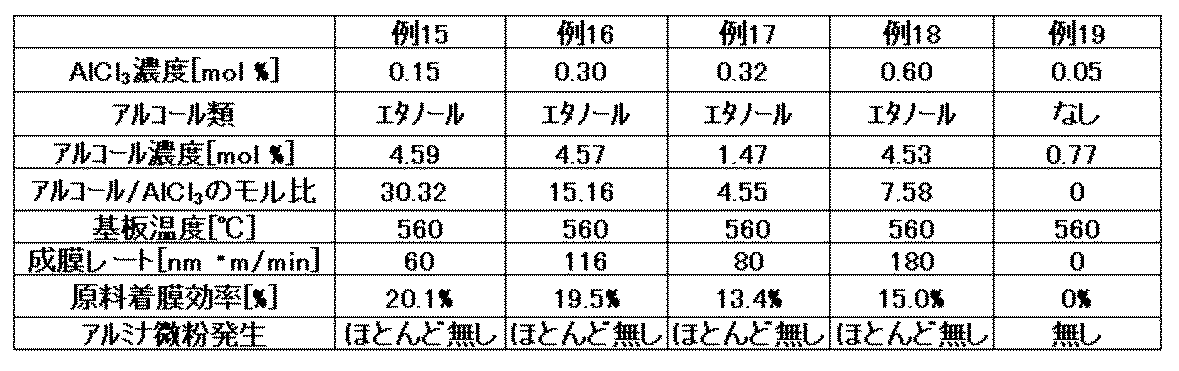
例15~18は、いずれも成膜レートが15nm・m/min以上と高く、原料着膜効率も10%以上と高かった。アルミナ微粉の発生はほとんどなかった。炭素数4以下のアルコール類を供給しなかった例19では、アルミナ薄膜は形成されなかった。
例15~例19では、実施例1と同様のポストミックス原料を使用する実施例1に記載の常圧CVD装置と同様の構成の、成膜幅が300mmの常圧CVD装置を使用した。また、塩化アルミニウムを入れたステンレス容器を加熱して直接気化する代わりに、300℃に加熱したアルミニウムペレットを詰めたハステロイ容器に塩素ガスを吹き付けてAlCl3を生成させる方法で乾燥窒素ガスで希釈された塩化アルミニウム含有ガスを製造した。なお、例19では、炭素数4以下のアルコール類を供給しなかった。
AlCl3濃度、アルコール類濃度、AlCl3に対するアルコール類のモル比(アルコール類/AlCl3)、および、ガラス基板温度を下記表3に示した条件として、常圧CVD法によるアルミナ薄膜の形成を行った。薄膜の成膜レート、原料着膜効率およびアルミナ微粉の発生の有無の結果を表3に示す。
(例20~例26)
例20~例26では、実施例1に記載したものと同様の成膜幅が300mmの常圧CVD装置を使用した。また、塩化アルミニウムを入れたステンレス容器を加熱して直接気化する代わりに、300℃に加熱したアルミニウムペレットを詰めたハステロイ容器に、塩素ガスを吹き付けてAlCl3を生成させる方法で、塩化アルミニウム含有ガスを製造した。
塩化アルミニウム含有ガス、エタノール含有ガスは、常圧CVD装置内に設置された混合器で混合し、混合したガスをノズルから噴出させて基板上に供給した。
AlCl3濃度、アルコール類濃度、AlCl3に対するアルコール類のモル比(アルコール類/AlCl3)、および、ガラス基板温度を下記表4に示した条件として、常圧CVD法によるアルミナ薄膜の形成を行った。薄膜の成膜レート、原料着膜効率およびアルミナ微粉の発生の有無の結果を表4に示す。
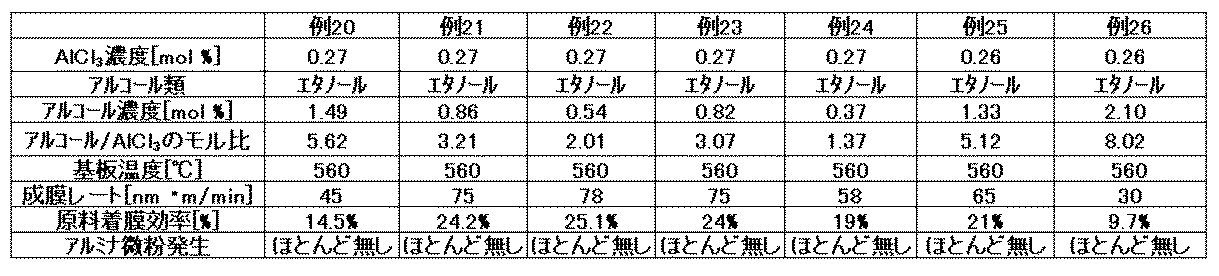
例20~26は、いずれも成膜レートが15nm・m/min以上と高く、アルミナ微粉の発生はほとんどなかった。さらに、例20~25は、いずれも原料着膜効率が10%以上であった。
例20~例26では、実施例1に記載したものと同様の成膜幅が300mmの常圧CVD装置を使用した。また、塩化アルミニウムを入れたステンレス容器を加熱して直接気化する代わりに、300℃に加熱したアルミニウムペレットを詰めたハステロイ容器に、塩素ガスを吹き付けてAlCl3を生成させる方法で、塩化アルミニウム含有ガスを製造した。
塩化アルミニウム含有ガス、エタノール含有ガスは、常圧CVD装置内に設置された混合器で混合し、混合したガスをノズルから噴出させて基板上に供給した。
AlCl3濃度、アルコール類濃度、AlCl3に対するアルコール類のモル比(アルコール類/AlCl3)、および、ガラス基板温度を下記表4に示した条件として、常圧CVD法によるアルミナ薄膜の形成を行った。薄膜の成膜レート、原料着膜効率およびアルミナ微粉の発生の有無の結果を表4に示す。
(例27~例30)
例27~例30では、実施例1に記載したものと同様の成膜幅が150mmの常圧CVD装置を使用した。塩化アルミニウム含有ガスは、AlCl3を入れたステンレス容器を加熱して直接気化させ乾燥窒素ガスで希釈して供給した。また、塩化アルミニウム含有ガス、アルコール類含有ガスは、例20~26と同様に、常圧CVD装置内に設置された混合器で混合し、混合したガスをノズルから噴出させて基板上に供給した。
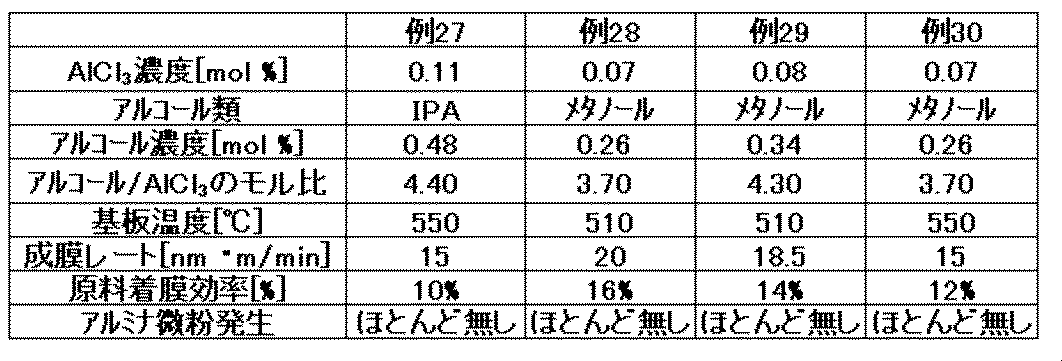
AlCl3濃度、アルコール類濃度、AlCl3に対するアルコール類のモル比(アルコール類/AlCl3)、および、ガラス基板温度を下記表5に示した条件として、常圧CVD法によるアルミナ薄膜の形成を行った。薄膜の成膜レート、原料着膜効率およびアルミナ微粉の発生の有無の結果を表5に示す。なお、例27では、炭素数4以下のアルコール類として、エタノールの代わりに、IPAを使用し、例28~例30では、エタノールの代わりにメタノールをそれぞれ使用した。
例27~例30では、実施例1に記載したものと同様の成膜幅が150mmの常圧CVD装置を使用した。塩化アルミニウム含有ガスは、AlCl3を入れたステンレス容器を加熱して直接気化させ乾燥窒素ガスで希釈して供給した。また、塩化アルミニウム含有ガス、アルコール類含有ガスは、例20~26と同様に、常圧CVD装置内に設置された混合器で混合し、混合したガスをノズルから噴出させて基板上に供給した。
AlCl3濃度、アルコール類濃度、AlCl3に対するアルコール類のモル比(アルコール類/AlCl3)、および、ガラス基板温度を下記表5に示した条件として、常圧CVD法によるアルミナ薄膜の形成を行った。薄膜の成膜レート、原料着膜効率およびアルミナ微粉の発生の有無の結果を表5に示す。なお、例27では、炭素数4以下のアルコール類として、エタノールの代わりに、IPAを使用し、例28~例30では、エタノールの代わりにメタノールをそれぞれ使用した。
例27~30は、いずれも成膜レートが15nm・m/min以上と高く、原料着膜効率も10%以上と高かった。アルミナ微粉の発生はほとんどなかった。
本発明により形成されたアルミナ薄膜は、耐久性表面コート、導電膜間の絶縁コート、ガラス基板と透明導電膜をなす酸化スズ膜との間に形成される中間屈折率層などとして優れた特性を有することより、本発明により得られたアルミナ薄膜付きガラス基板は、薄膜系太陽電池の基板、表示装置の保護板、半導体装置用のガラス基板などとして、好適に使用される。
なお、2012年10月31日に出願された日本特許出願2012-239864号の明細書、特許請求の範囲および要約書の全内容をここに引用し、本発明の明細書の開示として、取り入れるものである。
なお、2012年10月31日に出願された日本特許出願2012-239864号の明細書、特許請求の範囲および要約書の全内容をここに引用し、本発明の明細書の開示として、取り入れるものである。
Claims (15)
- 常圧CVD法を用いてガラス基板上にアルミナ薄膜を形成する方法であって、塩化アルミニウムおよび炭素数4以下のアルコール類を含む原料ガスを500℃以上800℃以下の温度に保持したガラス基板上に供給して該ガラス基板上にアルミナ薄膜を形成することを特徴とする薄膜の形成方法。
- 前記原料ガスがさらに不活性ガスを含む、請求項1に記載の薄膜の形成方法。
- ガラス基板上に供給される前記原料ガスが、前記塩化アルミニウムと前記アルコール類とが予め混合されてなる原料ガスである、請求項1または2に記載の薄膜の形成方法。
- 前記原料ガス中の前記塩化アルミニウムに対する前記アルコール類のモル比(アルコール類/塩化アルミニウム)が1以上6以下である、請求項3に記載の薄膜の形成方法。
- 前記原料ガス中の前記塩化アルミニウムに対する前記アルコール類のモル比(アルコール類/塩化アルミニウム)が1.5以上4.5以下である、請求項3または4に記載の薄膜の形成方法。
- 前記原料ガス中の塩化アルミニウム濃度が0.02~6モル%である、請求項3~5のいずれか一項に記載の薄膜の形成方法。
- 前記原料ガス中の水分濃度が、2モル%以下である、請求項3~6のいずれか一項に記載の薄膜の形成方法。
- ガラス基板上に供給され前記原料ガスが、前記塩化アルミニウムを含有するガスと前記アルコール類を含有するガスとが前記ガラス基板の直上で混合されてなる混合ガスである、請求項1または2に記載の薄膜の形成方法。
- 前記混合ガスが、前記塩化アルミニウム含有ガスと前記アルコール類含有ガスとが、前記塩化アルミニウムに対する前記アルコール類のモル比(アルコール類/塩化アルミニウム)が4以上となる割合で混合されてなる混合ガスである、請求項8に記載の薄膜の形成方法。
- 前記混合ガスが、前記塩化アルミニウム含有ガスと前記アルコール類含有ガスとが、前記塩化アルミニウムに対する前記アルコール類のモル比(アルコール類/塩化アルミニウム)が4以上50以下となる割合で混合されてなる混合ガスである、請求項8または9に記載の薄膜の形成方法。
- 前記混合ガスが、前記塩化アルミニウム含有ガスと前記アルコール類含有ガスとが、塩化アルミニウム濃度が0.02~6モル%となる割合で混合されてなる混合ガスである、請求項8~10のいずれか一項に記載の薄膜の形成方法。
- 前記混合ガスの水分濃度が2モル%以下である、請求項8~11のいずれか一項に記載の薄膜の形成方法。
- 前記ガラス基板の温度が500℃以上650℃以下である、請求項1~12のいずれか一項に記載の薄膜の形成方法。
- 前記原料ガスに含有されるアルコール類が、メタノール、エタノール、イソプロパノールおよびブタノールからなる群から選択される少なくとも1種である、請求項1~13のいずれか一項に記載の薄膜の形成方法。
- 前記ガラス基板上に形成されるアルミナ薄膜の厚さが10~100nmである、請求項1~14のいずれか一項に記載の薄膜の形成方法。
Priority Applications (1)
| Application Number | Priority Date | Filing Date | Title |
|---|---|---|---|
| JP2014544537A JPWO2014069487A1 (ja) | 2012-10-31 | 2013-10-29 | 薄膜形成方法 |
Applications Claiming Priority (2)
| Application Number | Priority Date | Filing Date | Title |
|---|---|---|---|
| JP2012239864 | 2012-10-31 | ||
| JP2012-239864 | 2012-10-31 |
Publications (1)
| Publication Number | Publication Date |
|---|---|
| WO2014069487A1 true WO2014069487A1 (ja) | 2014-05-08 |
Family
ID=50627389
Family Applications (1)
| Application Number | Title | Priority Date | Filing Date |
|---|---|---|---|
| PCT/JP2013/079322 Ceased WO2014069487A1 (ja) | 2012-10-31 | 2013-10-29 | 薄膜形成方法 |
Country Status (2)
| Country | Link |
|---|---|
| JP (1) | JPWO2014069487A1 (ja) |
| WO (1) | WO2014069487A1 (ja) |
Cited By (2)
| Publication number | Priority date | Publication date | Assignee | Title |
|---|---|---|---|---|
| CN106086814A (zh) * | 2016-06-17 | 2016-11-09 | 中山大学 | 一种玻璃面板镀膜层及其制备方法 |
| CN115427366A (zh) * | 2020-04-23 | 2022-12-02 | 皮尔金顿集团有限公司 | 制造涂覆玻璃制品的方法 |
Citations (4)
| Publication number | Priority date | Publication date | Assignee | Title |
|---|---|---|---|---|
| JPH01123074A (ja) * | 1987-11-06 | 1989-05-16 | Raimuzu:Kk | 気相化学反応原料の供給方法 |
| JPH03274279A (ja) * | 1990-03-24 | 1991-12-05 | Taiyo Yuden Co Ltd | 金属酸化物膜の製造方法 |
| JP2001039738A (ja) * | 1999-05-27 | 2001-02-13 | Nippon Sheet Glass Co Ltd | 導電膜付きガラス板とその製造方法、およびこれを用いた光電変換装置 |
| JP2004360038A (ja) * | 2003-06-06 | 2004-12-24 | Konica Minolta Holdings Inc | 金属酸化物を含有する薄膜形成方法 |
-
2013
- 2013-10-29 JP JP2014544537A patent/JPWO2014069487A1/ja active Pending
- 2013-10-29 WO PCT/JP2013/079322 patent/WO2014069487A1/ja not_active Ceased
Patent Citations (4)
| Publication number | Priority date | Publication date | Assignee | Title |
|---|---|---|---|---|
| JPH01123074A (ja) * | 1987-11-06 | 1989-05-16 | Raimuzu:Kk | 気相化学反応原料の供給方法 |
| JPH03274279A (ja) * | 1990-03-24 | 1991-12-05 | Taiyo Yuden Co Ltd | 金属酸化物膜の製造方法 |
| JP2001039738A (ja) * | 1999-05-27 | 2001-02-13 | Nippon Sheet Glass Co Ltd | 導電膜付きガラス板とその製造方法、およびこれを用いた光電変換装置 |
| JP2004360038A (ja) * | 2003-06-06 | 2004-12-24 | Konica Minolta Holdings Inc | 金属酸化物を含有する薄膜形成方法 |
Cited By (2)
| Publication number | Priority date | Publication date | Assignee | Title |
|---|---|---|---|---|
| CN106086814A (zh) * | 2016-06-17 | 2016-11-09 | 中山大学 | 一种玻璃面板镀膜层及其制备方法 |
| CN115427366A (zh) * | 2020-04-23 | 2022-12-02 | 皮尔金顿集团有限公司 | 制造涂覆玻璃制品的方法 |
Also Published As
| Publication number | Publication date |
|---|---|
| JPWO2014069487A1 (ja) | 2016-09-08 |
Similar Documents
| Publication | Publication Date | Title |
|---|---|---|
| JP6320303B2 (ja) | ガラス基材上にシリカ被膜を成膜するための化学的気相成長プロセス | |
| EP2761054B1 (en) | Deposition of silicon oxide by atmospheric pressure chemical vapor deposition | |
| JP6334782B2 (ja) | ガラス基板上にシリカコーティングを形成するプロセス | |
| CN1196760A (zh) | 在玻璃上形成氧化锡涂层的方法 | |
| US20080057321A1 (en) | Method of making a low-resistivity, doped zinc oxide coated glass article and the coated glass article made thereby | |
| US20150246845A1 (en) | Method for forming thin film | |
| AU2006288933B2 (en) | Deposition process | |
| JPWO2014069487A1 (ja) | 薄膜形成方法 | |
| CN101014547B (zh) | 沉积氧化铝涂层的方法 | |
| US20070264507A1 (en) | Method for depositing zinc oxide coatings on flat glass | |
| EP1730087A1 (en) | Process for the deposition of aluminium oxide coatings | |
| EP3417088B1 (en) | Chemical vapor deposition process for depositing a coating | |
| JP2017528599A (ja) | 酸化チタン被膜を堆積させるための化学蒸着方法 | |
| JP2011094218A (ja) | 酸化錫膜付き基体の製造方法 | |
| TW201429908A (zh) | 線上低輻射鍍膜玻璃的製造裝置及其製造方法 | |
| JP2020532647A (ja) | 酸化ケイ素コーティングを形成するための化学気相堆積プロセス | |
| WO2021214464A1 (en) | Method of making a coated glass article | |
| KR20130134584A (ko) | 폴리이미드 기재의 가시광선 투과율 향상 방법, 폴리이미드세라믹 기재, 폴리이미드세라믹fto 투명전도막 및 그 제조방법 |
Legal Events
| Date | Code | Title | Description |
|---|---|---|---|
| 121 | Ep: the epo has been informed by wipo that ep was designated in this application |
Ref document number: 13852092 Country of ref document: EP Kind code of ref document: A1 |
|
| ENP | Entry into the national phase |
Ref document number: 2014544537 Country of ref document: JP Kind code of ref document: A |
|
| NENP | Non-entry into the national phase |
Ref country code: DE |
|
| 122 | Ep: pct application non-entry in european phase |
Ref document number: 13852092 Country of ref document: EP Kind code of ref document: A1 |