WO2014046034A1 - 乾留炭の製造方法、高炉の操業方法、およびボイラの運転方法 - Google Patents
乾留炭の製造方法、高炉の操業方法、およびボイラの運転方法 Download PDFInfo
- Publication number
- WO2014046034A1 WO2014046034A1 PCT/JP2013/074821 JP2013074821W WO2014046034A1 WO 2014046034 A1 WO2014046034 A1 WO 2014046034A1 JP 2013074821 W JP2013074821 W JP 2013074821W WO 2014046034 A1 WO2014046034 A1 WO 2014046034A1
- Authority
- WO
- WIPO (PCT)
- Prior art keywords
- coal
- analysis data
- content
- raw coal
- carbonized
- Prior art date
- Legal status (The legal status is an assumption and is not a legal conclusion. Google has not performed a legal analysis and makes no representation as to the accuracy of the status listed.)
- Ceased
Links
Images

Classifications
-
- C—CHEMISTRY; METALLURGY
- C10—PETROLEUM, GAS OR COKE INDUSTRIES; TECHNICAL GASES CONTAINING CARBON MONOXIDE; FUELS; LUBRICANTS; PEAT
- C10L—FUELS NOT OTHERWISE PROVIDED FOR; NATURAL GAS; SYNTHETIC NATURAL GAS OBTAINED BY PROCESSES NOT COVERED BY SUBCLASSES C10G OR C10K; LIQUIFIED PETROLEUM GAS; USE OF ADDITIVES TO FUELS OR FIRES; FIRE-LIGHTERS
- C10L10/00—Use of additives to fuels or fires for particular purposes
- C10L10/02—Use of additives to fuels or fires for particular purposes for reducing smoke development
-
- C—CHEMISTRY; METALLURGY
- C10—PETROLEUM, GAS OR COKE INDUSTRIES; TECHNICAL GASES CONTAINING CARBON MONOXIDE; FUELS; LUBRICANTS; PEAT
- C10B—DESTRUCTIVE DISTILLATION OF CARBONACEOUS MATERIALS FOR PRODUCTION OF GAS, COKE, TAR, OR SIMILAR MATERIALS
- C10B57/00—Other carbonising or coking processes; Features of destructive distillation processes in general
-
- C—CHEMISTRY; METALLURGY
- C10—PETROLEUM, GAS OR COKE INDUSTRIES; TECHNICAL GASES CONTAINING CARBON MONOXIDE; FUELS; LUBRICANTS; PEAT
- C10L—FUELS NOT OTHERWISE PROVIDED FOR; NATURAL GAS; SYNTHETIC NATURAL GAS OBTAINED BY PROCESSES NOT COVERED BY SUBCLASSES C10G OR C10K; LIQUIFIED PETROLEUM GAS; USE OF ADDITIVES TO FUELS OR FIRES; FIRE-LIGHTERS
- C10L9/00—Treating solid fuels to improve their combustion
- C10L9/08—Treating solid fuels to improve their combustion by heat treatments, e.g. calcining
-
- F—MECHANICAL ENGINEERING; LIGHTING; HEATING; WEAPONS; BLASTING
- F27—FURNACES; KILNS; OVENS; RETORTS
- F27B—FURNACES, KILNS, OVENS OR RETORTS IN GENERAL; OPEN SINTERING OR LIKE APPARATUS
- F27B1/00—Shaft or like vertical or substantially vertical furnaces
- F27B1/10—Details, accessories or equipment specially adapted for furnaces of these types
- F27B1/16—Arrangements of tuyeres
-
- C—CHEMISTRY; METALLURGY
- C10—PETROLEUM, GAS OR COKE INDUSTRIES; TECHNICAL GASES CONTAINING CARBON MONOXIDE; FUELS; LUBRICANTS; PEAT
- C10L—FUELS NOT OTHERWISE PROVIDED FOR; NATURAL GAS; SYNTHETIC NATURAL GAS OBTAINED BY PROCESSES NOT COVERED BY SUBCLASSES C10G OR C10K; LIQUIFIED PETROLEUM GAS; USE OF ADDITIVES TO FUELS OR FIRES; FIRE-LIGHTERS
- C10L2290/00—Fuel preparation or upgrading, processes or apparatus therefore, comprising specific process steps or apparatus units
- C10L2290/02—Combustion or pyrolysis
-
- C—CHEMISTRY; METALLURGY
- C10—PETROLEUM, GAS OR COKE INDUSTRIES; TECHNICAL GASES CONTAINING CARBON MONOXIDE; FUELS; LUBRICANTS; PEAT
- C10L—FUELS NOT OTHERWISE PROVIDED FOR; NATURAL GAS; SYNTHETIC NATURAL GAS OBTAINED BY PROCESSES NOT COVERED BY SUBCLASSES C10G OR C10K; LIQUIFIED PETROLEUM GAS; USE OF ADDITIVES TO FUELS OR FIRES; FIRE-LIGHTERS
- C10L2290/00—Fuel preparation or upgrading, processes or apparatus therefore, comprising specific process steps or apparatus units
- C10L2290/60—Measuring or analysing fractions, components or impurities or process conditions during preparation or upgrading of a fuel
Definitions
- the present invention relates to a method for producing carbonized coal by carbonizing coal to produce carbonized coal, a method for operating a blast furnace, and a method for operating a boiler.
- Raw material coal contains mercury
- technologies to reduce the mercury content of raw coal are being studied.
- the raw coal is heat-treated at a predetermined temperature based on the mercury emission characteristics in the raw coal indicating the relationship between the heating temperature of the raw coal and the mercury emission amount in the raw coal.
- a method for producing low mercury coal for producing low mercury coal with a low mercury content is disclosed.
- Patent Document 1 discloses only a method for producing low-mercury coal based on the mercury emission characteristics of raw coal produced at Eagle Butte Mine, and produces low-mercury coal from raw coal produced at other mines.
- the data regarding the mercury emission characteristics of the raw coal is special data and needs to be acquired by experiments, the data acquisition operation itself is complicated, which may increase the manufacturing cost. It was.
- high-grade coal high-quality coal
- high-quality coal high-grade coal
- low-quality coal such as lignite, sub-bituminous coal, and bituminous coal
- the low-quality coal has a high water content and a low calorific value per unit weight compared to the high-quality coal. Therefore, the low-quality coal is dried or dry-distilled by heat treatment, thereby increasing the calorific value per unit weight. Charcoal is used. Since the low quality coal also contains mercury, the dry distillation coal may be required to reduce the mercury content.
- the present invention has been made to solve the above-described problems, and reduces the mercury content without performing complicated work, while excessively increasing the volatile content. It aims at providing the manufacturing method of the dry distillation coal which can manufacture the dry distillation coal which suppressed the reduction
- a method for producing carbonized coal according to the first invention that solves the above-described problem is a method for producing carbonized coal by carbonizing raw coal to produce carbonized coal, and includes industrial analysis data and elemental analysis data of the material coal.
- the calorific value A which is one of the industrial analysis data or is determined by Duron's formula based on the elemental analysis data, the fuel ratio B based on the industrial analysis data, and the carbon based on the elemental analysis data
- the dry distillation temperature T of the raw coal is derived by the calculation represented by the following equation (1).
- the temperature for carbonizing the raw coal is set based on the dry distillation temperature T of the raw coal.
- T t1 + aA + bB + cC + dD (1)
- t1 is an intercept
- a, b, c, and d are coefficients
- 450 ⁇ t1 ⁇ 475, 0.145 ⁇ a ⁇ 0.155, ⁇ 640 ⁇ b ⁇ ⁇ 610, 1600 ⁇ c ⁇ 1700 and ⁇ 540 ⁇ d ⁇ ⁇ 500 are satisfied.
- the operation method of the blast furnace according to the second invention for solving the above-described problem is the tuyere of blast furnace equipment using pulverized coal obtained by pulverizing the dry distillation coal produced by the method for producing dry distillation coal according to the first invention described above. It is characterized in that it is used as blast furnace blowing coal.
- the boiler operating method according to the third invention for solving the above-described problem is characterized in that the carbonized carbon produced by the carbonized coal producing method according to the first invention described above is used as fuel for the boiler.
- the calorific value obtained from the industrial analysis data and elemental analysis data of the raw coal and the Duron equation, the fuel ratio, the hydrogen content relative to the carbon content, the oxygen content relative to the carbon content Just by setting the temperature at which the raw coal is carbonized so as to be the carbonization temperature T of the raw coal obtained by substituting the amount into the above formula (1), the mercury content is reduced while the volatile content is contained. It is possible to produce dry-distilled coal that suppresses excessive reduction of the amount. Since the industrial analysis data and elemental analysis data of raw coal are not special data but the most basic data used as the quality of raw coal, complicated data such as obtaining data on mercury emission characteristics in raw coal No need to do work.
- the dry distillation coal itself has a reduced mercury content, the mercury content of the combustion exhaust gas generated by burning the dry distillation coal is greatly increased. Can be reduced. Since the dry distillation coal suppresses an excessive reduction in the content of volatile components, a decrease in ignitability of the dry distillation coal can be suppressed.
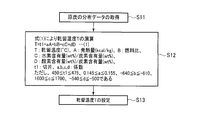
- the raw coal 11 as the raw coal is heated in a low oxygen atmosphere (oxygen concentration: 5% by volume or less) (eg, 110 to 200 ° C. ⁇ 0.1 to 1 hour). Then, the water is removed by drying (drying step S21), followed by heating (dry distillation temperature T ⁇ 0.1 to 1 hour) in a low oxygen atmosphere (oxygen concentration: 2% by volume or less) to dry distillation ( In the carbonization step S22), volatile components (for example, H 2 O, CO 2 , tar, Hg, etc.) are removed as dry distillation gas or dry distillation oil, and then in a low oxygen atmosphere (oxygen concentration: 2% by volume or less). The carbonized carbon 12 is produced by cooling (50 ° C. or lower) at (cooling step S23).
- a low oxygen atmosphere oxygen concentration: 5% by volume or less
- the water is removed by drying (drying step S21), followed by heating (dry distillation temperature T ⁇ 0.1 to 1 hour) in a low oxygen atmosphere (oxygen concentration: 2%
- the above-mentioned carbonization temperature T is set based on the following equation (1).
- T t1 + aA + bB + cC + dD (1)
- T represents the carbonization temperature (° C.)
- A represents the calorific value (arrival basis) (kcal / kg)
- B represents the fuel ratio
- C represents the hydrogen content (wt%) relative to the carbon content (wt%).
- H / C represents the hydrogen content (wt%) relative to the carbon content (wt%)
- D represents the oxygen content (wt%) (O / C) with respect to the carbon content (wt%)
- t1 represents the intercept (constant)
- Each d represents a coefficient.
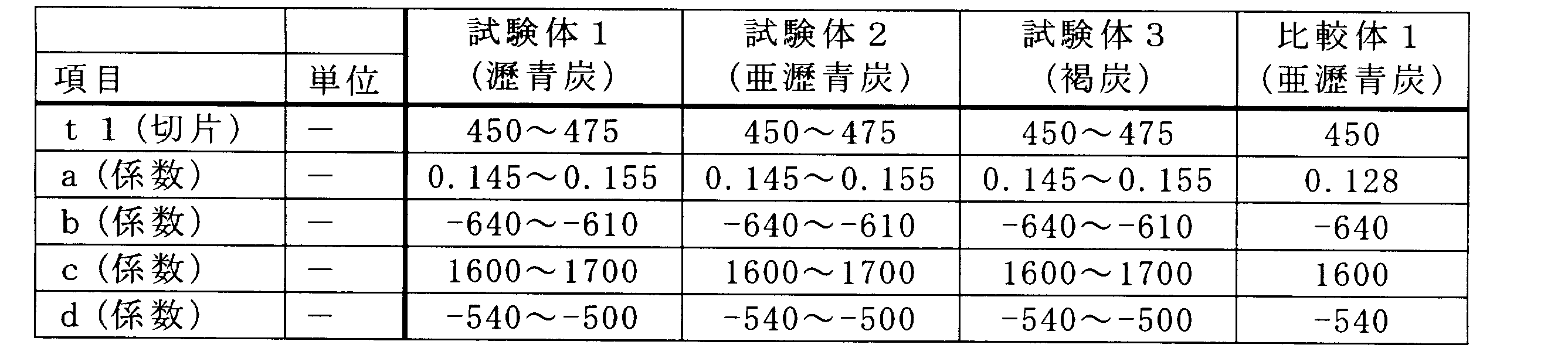
- t1, a, b, c, and d are set in the ranges shown in Table 1 below.
- t1, a, b, c, and d are 450 ⁇ t1 ⁇ 475, 0.145 ⁇ a ⁇ 0.155, ⁇ 640 ⁇ b ⁇ ⁇ 610, 1600 ⁇ c ⁇ 1700, ⁇ 540 ⁇ d ⁇ ⁇ 500 is satisfied.
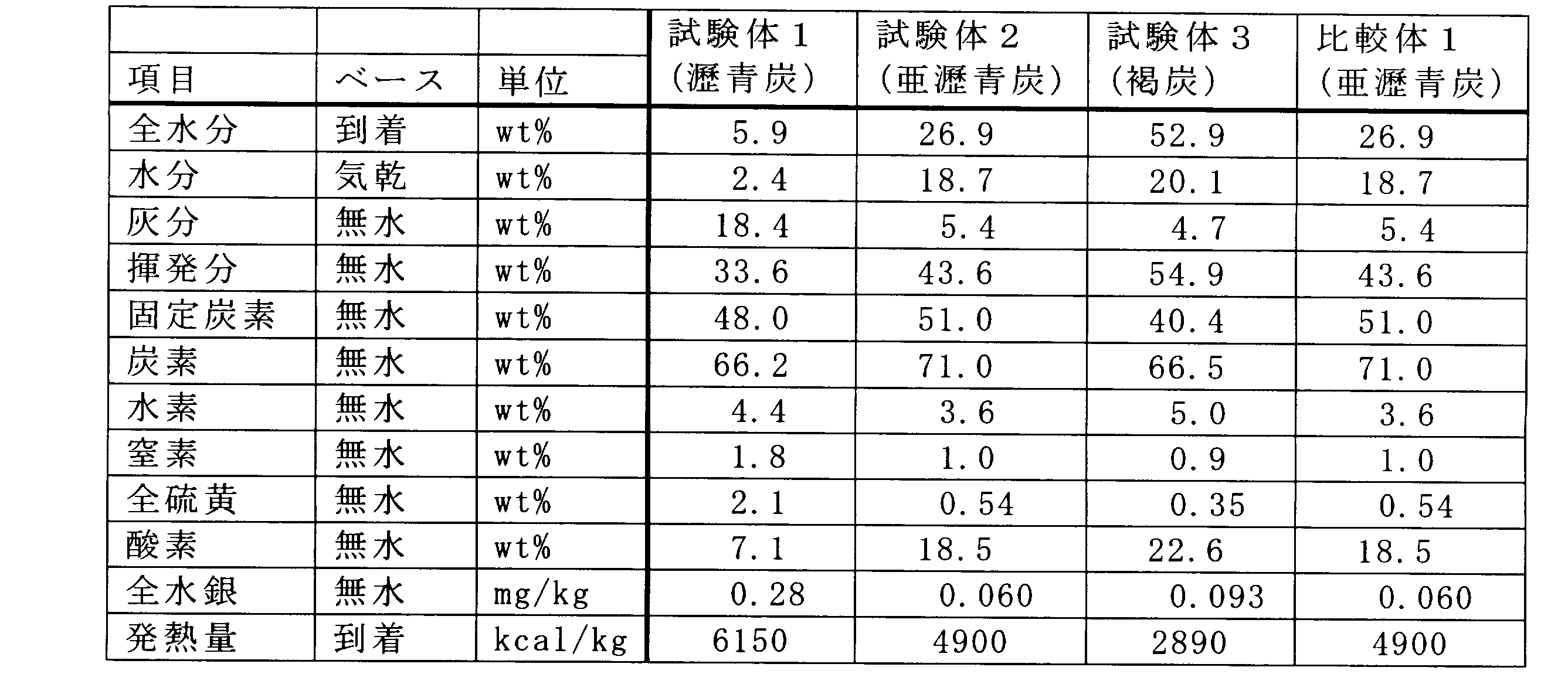
- the compositional analysis value of the raw coal wt% (wt%) of total moisture (arrival basis), wt% (wt%) of moisture (air-dry), wt% (wt%) of ash, and volatile weight % (Wt%) and weight% (wt%) of fixed carbon are not the special data, but are the most basic data used for the quality of raw coal, and are implemented when raw coal is produced and used. For example, it is data obtained by industrial analysis specified in JIS M8812 (2004).
- the total mercury content (mg / kg) is also not the special data, but the most basic data used for the quality of raw coal, which is implemented when raw coal is produced and used. For example, it is data obtained by elemental analysis specified in JIS M8813 (2004).
- the calorific value of the raw coal 11 is the data that is most basically used as the quality of the raw coal, and is carried out when the raw coal is produced or used, for example, as defined in JIS M8814 (2004). Data obtained by analysis.
- the fuel ratio of the raw coal 11 is a ratio of fixed carbon and volatile matter (fixed carbon wt% / volatile matter wt%) obtained by the above-described industrial analysis.
- the calorific value of the raw coal 11 described above is determined by using the weight% of each element (carbon, hydrogen, oxygen, sulfur) obtained by the elemental analysis specified in the above-described JIS M8813 (2004). It is also possible to obtain the following equation (2).
- H 81 W C +342.5 (W H ⁇ W O /8)+22.5 W S (2)
- H represents the calorific value
- W C represents the weight percent of carbon in the raw coal
- W H represents the weight percent of hydrogen in the raw coal
- W O represents the oxygen in the raw coal
- Wt% W S represents the wt% of sulfur in raw coal.
- Manufacturing Rukoto can. Since the industrial analysis data and elemental analysis data of the raw coal 11 are not special data but are the most basic data used as the quality of the raw coal 11, data relating to mercury emission characteristics in the raw coal 11 is acquired. This eliminates the need for complicated operations.
- the method for producing dry-distilled coal it is not necessary to analyze the mercury emission characteristics of various coals, and no complicated work is required, which is the most fundamental data used as the quality of raw coal.
- the mercury content is reduced by simply setting the temperature at which the raw coal 11 is carbonized so as to be the dry distillation temperature T of the raw coal derived from the above formula (1) using industrial analysis data and elemental analysis data.
- the carbonized coal By using the pulverized coal pulverized by pulverizing the carbonized coal produced by the method for producing carbonized coal according to the present embodiment described above as blast furnace blown coal that is blown into the tuyere of the blast furnace equipment, the carbonized coal itself is When using conventional pulverized coal as blast furnace-blown coal, which is made by simply pulverizing PCI coal that has not been treated to reduce the mercury content in the coal, because it has a reduced mercury content Rather, the mercury content of the flue gas produced by burning the carbonized carbon can be greatly reduced. Since the dry distillation coal suppresses an excessive reduction in the content of volatile components, a decrease in ignitability of the dry distillation coal can be suppressed.
- the carbonized coal produced by the method for producing carbonized coal according to the above-described embodiment as a boiler fuel, the carbonized coal itself has a reduced mercury content.
- the amount of mercury contained in boiler flue gas can be reduced compared to the case of using conventional coal as boiler fuel, which is obtained simply by dry distillation of raw coal that has not been treated to reduce the amount. . Since the dry distillation coal suppresses an excessive reduction in the content of volatile components, a decrease in ignitability of the dry distillation coal can be suppressed.
- t1, a, b, c, and d in the formula (1) are set to the numerical ranges shown in Table 4 below.
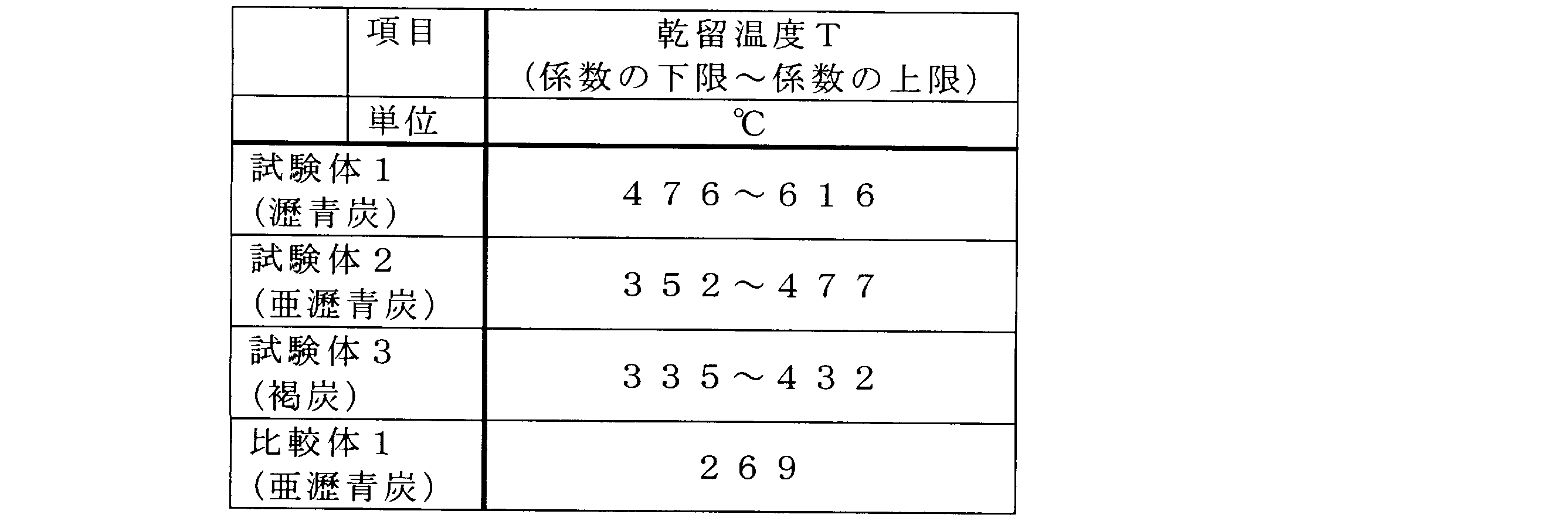
- Table 4 the same coal types and components as those of Specimen 2 are used, but as shown in Table 4 below, only coefficient a is a numerical value different from that of Specimens 1 to 3, and the above-described implementation is performed.
- the mercury content cannot be significantly reduced (to the target level) only by setting the coefficient a in the above formula (1) only outside the numerical range of a in the above embodiment.
- the dry-distilled coal is obtained based on the mercury content and the volatile content of raw coal and reduces the mercury content while suppressing excessive reduction of the volatile content.
- the intercept t1 and the coefficients a, b, c, d in the above equation (1) are 450 ⁇ t1 ⁇ 475, 0.145 ⁇ a ⁇ 0.155, ⁇ 640 ⁇ b ⁇ ⁇ 610, 1600 ⁇ c, respectively. ⁇ 1700, ⁇ 540 ⁇ d ⁇ ⁇ 500.
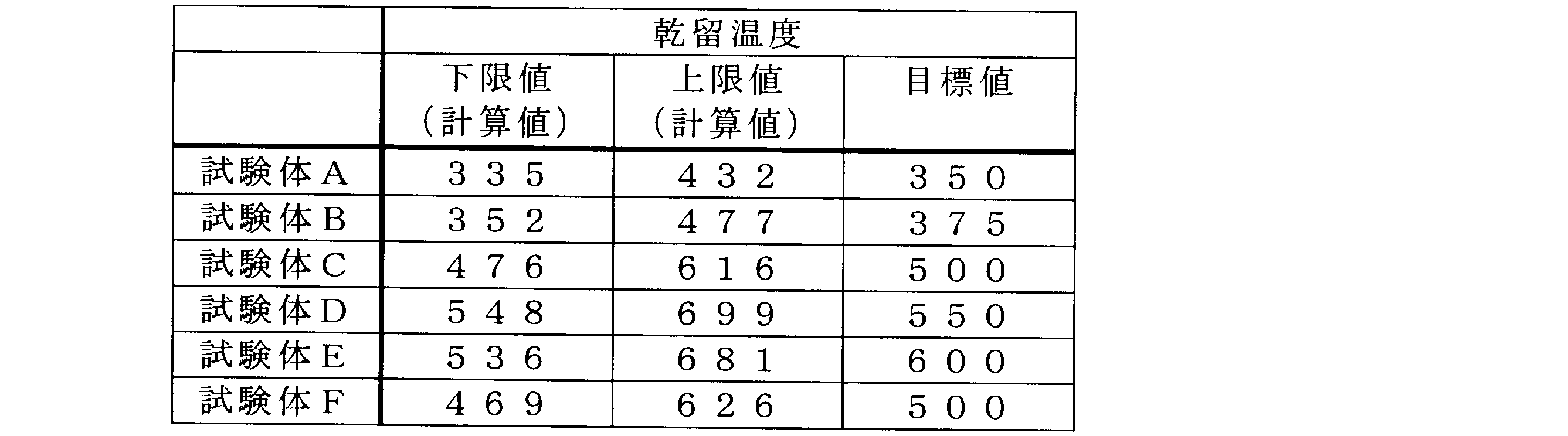
- Specimen A is brown coal, and as shown in Table 7 above, the carbonization temperature (target value) is derived from the calculation of the above equation (1) using industrial analysis data and elemental analysis data (calculation) Value).
- Specimen B is subbituminous coal, and as shown in Table 7 above, the carbonization temperature (target value) is derived from the calculation of the above formula (1) using industrial analysis data and elemental analysis data ( It became clear that it was included in the range of (calculated values).
- test body C is bituminous coal, and as shown in Table 7 above, the dry distillation temperature (target value) is derived from the calculation of the above formula (1) using the industrial analysis data and the elemental analysis data (calculation). Value).
- Specimen D is bituminous coal different from Specimen C, and as shown in Table 7 above, the dry distillation temperature (target value) is derived by the calculation of the above-described equation (1) using industrial analysis data and elemental analysis data. It became clear that it was included in the range of the dry distillation temperature (calculated value).
- Specimen E is bituminous coal different from specimens C and D, and as shown in Table 7 above, the dry distillation temperature (target value) is calculated by the above formula (1) using industrial analysis data and elemental analysis data. It became clear that it was included in the range of the derived carbonization temperature (calculated value).
- Specimen F is a bituminous coal different from Specimens C, D, and E, and as shown in Table 7 above, the dry distillation temperature (target value) is expressed by the above formula (1) using industrial analysis data and elemental analysis data. It became clear that it was included in the range of the dry distillation temperature (calculated value) derived by calculation.
- the dry distillation temperature (calculated value) derived by the calculation of the above formula (1) using the industrial analysis data and the elemental analysis data is the mercury content and the volatile content of the raw coal.
- the carbonization temperature (calculated value) includes the carbonization temperature (target value) that can be obtained based on the above, and that can reduce the mercury content while suppressing the excessive reduction of the volatile content. It was confirmed that by dry-distilling the raw coal, it was possible to obtain a dry-distilled coal with reduced mercury content while suppressing excessive reduction of the volatile content.
- the production method of carbonized coal, the operation method of the blast furnace, and the operation method of the boiler according to the present invention reduce the mercury content and suppress excessive reduction of the volatile content without performing complicated operations. Therefore, it can be used extremely beneficially in the steel industry, the power generation industry, and the like.
Landscapes
- Chemical & Material Sciences (AREA)
- Engineering & Computer Science (AREA)
- Oil, Petroleum & Natural Gas (AREA)
- Organic Chemistry (AREA)
- Combustion & Propulsion (AREA)
- Thermal Sciences (AREA)
- Physics & Mathematics (AREA)
- Materials Engineering (AREA)
- Mechanical Engineering (AREA)
- General Engineering & Computer Science (AREA)
- Solid Fuels And Fuel-Associated Substances (AREA)
- Investigating Or Analyzing Materials Using Thermal Means (AREA)
- Coke Industry (AREA)
- Carbon And Carbon Compounds (AREA)
- Manufacture Of Iron (AREA)
Description
T=t1+aA+bB+cC+dD ・・・(1)
ただし、前記t1が切片であり、前記a、前記b、前記c、前記dが係数であり、450≦t1≦475、0.145≦a≦0.155、-640≦b≦-610、1600≦c≦1700、-540≦d≦-500を満たしている。
本実施形態では、図1および図2に基づき具体的に説明する。
ただし、Tは乾留温度(℃)を示し、Aは発熱量(到着ベース)(kcal/kg)を示し、Bは燃料比を示し、Cは炭素含有量(wt%)に対する水素含有量(wt%)(H/C)を示し、Dは炭素含有量(wt%)に対する酸素含有量(wt%)(O/C)を示し、t1は切片(定数)を示し、a,b,c,dはそれぞれ係数を示す。

ただし、前記Hは発熱量を示し、前記WCは原炭中の炭素の重量%を示し、前記WHは原炭中の水素の重量%を示し、前記WOは原炭中の酸素の重量%を示し、前記WSは原炭中の硫黄の重量%を示す。
上述した実施形態に係る乾留炭の製造方法において、原料石炭として、瀝青炭、亜瀝青炭、褐炭に適用した場合に、上述の(1)式の演算により導出される乾留温度Tに基づき前記原料石炭を乾留する温度を設定することで、水銀含有量を低減する一方、揮発分の含有量の過度の低減を抑制した乾留炭を製造することができるかを確認するための試験1を行った。


上述した実施形態に係る乾留炭の製造方法において、原炭の水銀含有量および揮発分含有量に基づき求められ、水銀含有量を低減する一方、揮発分の含有量の過度の低減を抑制した乾留炭を得ることができる乾留温度(目標値)が、工業分析データおよび元素分析データを用い上述の(1)式の演算により導出される乾留温度(計算値)の範囲に含まれるかを確認するための試験2を行った。ただし、上述の(1)式における切片t1や係数a,b,c,dを、それぞれ450≦t1≦475、0.145≦a≦0.155、-640≦b≦-610、1600≦c≦1700、-540≦d≦-500とした。
12 乾留炭
S11 原炭の分析データ取得工程
S12 乾留温度演算工程
S13 乾留温度設定工程
S21 乾燥工程
S22 乾留工程
S23 冷却工程
Claims (3)
- 原料石炭を乾留して乾留炭を製造する乾留炭の製造方法であって、
前記原料石炭の工業分析データおよび元素分析データを取得し、
前記工業分析データの1つである、または前記元素分析データに基づきデュロンの式で求められる発熱量Aと、前記工業分析データに基づく燃料比Bと、前記元素分析データに基づく炭素含有量に対する水素含有量Cと、前記元素分析データに基づく炭素含有量に対する酸素含有量Dとを用い、以下の(1)式で表される演算により、前記原料石炭の乾留温度Tを導出し、
前記原料石炭の乾留温度Tに基づき前記原料石炭を乾留する温度を設定する
ことを特徴とする乾留炭の製造方法。
T=t1+aA+bB+cC+dD ・・・(1)
ただし、前記t1が切片であり、前記a、前記b、前記c、前記dが係数であり、450≦t1≦475、0.145≦a≦0.155、-640≦b≦-610、1600≦c≦1700、-540≦d≦-500を満たしている。 - 請求項1に記載された乾留炭の製造方法により製造された乾留炭を粉砕してなる微粉炭を高炉設備の羽口へ吹き込む高炉吹込み炭として利用する
ことを特徴とする高炉の操業方法。 - 請求項1に記載された乾留炭の製造方法により製造された乾留炭をボイラの燃料として利用する
ことを特徴とするボイラの運転方法。
Priority Applications (5)
| Application Number | Priority Date | Filing Date | Title |
|---|---|---|---|
| DE112013004609.1T DE112013004609T5 (de) | 2012-09-20 | 2013-09-13 | Verfahren zur Herstellung von verschwelter Kohle, Verfahren zum Betreiben eines Hochofens, und Verfahren zum Betreiben eines Dampferzeugers |
| US14/412,779 US20150197699A1 (en) | 2012-09-20 | 2013-09-13 | Method for producing carbonized coal, method for working blast furnace, and method for operating boiler |
| IN296DEN2015 IN2015DN00296A (ja) | 2012-09-20 | 2013-09-13 | |
| CN201380033019.XA CN104379709B (zh) | 2012-09-20 | 2013-09-13 | 干馏煤的制造方法、高炉的操作方法、及锅炉的运转方法 |
| KR1020157000443A KR101667501B1 (ko) | 2012-09-20 | 2013-09-13 | 건류탄의 제조 방법, 고로의 조업 방법, 및 보일러의 운전 방법 |
Applications Claiming Priority (2)
| Application Number | Priority Date | Filing Date | Title |
|---|---|---|---|
| JP2012206775A JP5967649B2 (ja) | 2012-09-20 | 2012-09-20 | 乾留炭の製造方法、高炉の操業方法、およびボイラの運転方法 |
| JP2012-206775 | 2012-09-20 |
Publications (1)
| Publication Number | Publication Date |
|---|---|
| WO2014046034A1 true WO2014046034A1 (ja) | 2014-03-27 |
Family
ID=50341347
Family Applications (1)
| Application Number | Title | Priority Date | Filing Date |
|---|---|---|---|
| PCT/JP2013/074821 Ceased WO2014046034A1 (ja) | 2012-09-20 | 2013-09-13 | 乾留炭の製造方法、高炉の操業方法、およびボイラの運転方法 |
Country Status (7)
| Country | Link |
|---|---|
| US (1) | US20150197699A1 (ja) |
| JP (1) | JP5967649B2 (ja) |
| KR (1) | KR101667501B1 (ja) |
| CN (1) | CN104379709B (ja) |
| DE (1) | DE112013004609T5 (ja) |
| IN (1) | IN2015DN00296A (ja) |
| WO (1) | WO2014046034A1 (ja) |
Families Citing this family (2)
| Publication number | Priority date | Publication date | Assignee | Title |
|---|---|---|---|---|
| KR102764422B1 (ko) * | 2019-06-12 | 2025-02-14 | 한국에너지기술연구원 | 석탄저탄장 소화 및 발화억제를 위한 슬러리 |
| CN113916297B (zh) * | 2021-10-18 | 2022-05-31 | 淮北矿业股份有限公司临涣选煤厂 | 一种煤炭计量与质量检验一体化智能管控系统 |
Citations (2)
| Publication number | Priority date | Publication date | Assignee | Title |
|---|---|---|---|---|
| JPS59204693A (ja) * | 1983-05-06 | 1984-11-20 | Hitachi Ltd | 低品位炭の改質装置 |
| JP2010523935A (ja) * | 2007-04-11 | 2010-07-15 | グレイト リバー エナジー | 高水分材料の品質を高め、それに含まれる有機及び/又は非有機材料を分離及び濃縮する装置及び方法 |
Family Cites Families (7)
| Publication number | Priority date | Publication date | Assignee | Title |
|---|---|---|---|---|
| JPS61213287A (ja) * | 1985-03-19 | 1986-09-22 | Kansai Coke & Chem Co Ltd | コ−クスのco2反応後強度推定方法 |
| JPH06207933A (ja) * | 1993-01-11 | 1994-07-26 | Nippon Steel Corp | 石炭乾留生成物の歩留まり推定方法 |
| US5403365A (en) | 1993-04-30 | 1995-04-04 | Western Research Institute | Process for low mercury coal |
| US20050095183A1 (en) * | 2003-11-05 | 2005-05-05 | Biomass Energy Solutions, Inc. | Process and apparatus for biomass gasification |
| CN1603833A (zh) * | 2004-02-27 | 2005-04-06 | 王玷 | 大型煤粉炉优化控制系统 |
| US7198655B2 (en) * | 2004-05-03 | 2007-04-03 | Evergreen Energy Inc. | Method and apparatus for thermally upgrading carbonaceous materials |
| JP5779836B2 (ja) * | 2010-01-22 | 2015-09-16 | 新日鐵住金株式会社 | 装入炭の発塵量の推定方法 |
-
2012
- 2012-09-20 JP JP2012206775A patent/JP5967649B2/ja not_active Expired - Fee Related
-
2013
- 2013-09-13 DE DE112013004609.1T patent/DE112013004609T5/de not_active Withdrawn
- 2013-09-13 KR KR1020157000443A patent/KR101667501B1/ko not_active Expired - Fee Related
- 2013-09-13 CN CN201380033019.XA patent/CN104379709B/zh not_active Expired - Fee Related
- 2013-09-13 WO PCT/JP2013/074821 patent/WO2014046034A1/ja not_active Ceased
- 2013-09-13 IN IN296DEN2015 patent/IN2015DN00296A/en unknown
- 2013-09-13 US US14/412,779 patent/US20150197699A1/en not_active Abandoned
Patent Citations (2)
| Publication number | Priority date | Publication date | Assignee | Title |
|---|---|---|---|---|
| JPS59204693A (ja) * | 1983-05-06 | 1984-11-20 | Hitachi Ltd | 低品位炭の改質装置 |
| JP2010523935A (ja) * | 2007-04-11 | 2010-07-15 | グレイト リバー エナジー | 高水分材料の品質を高め、それに含まれる有機及び/又は非有機材料を分離及び濃縮する装置及び方法 |
Also Published As
| Publication number | Publication date |
|---|---|
| KR101667501B1 (ko) | 2016-10-18 |
| JP2014062152A (ja) | 2014-04-10 |
| US20150197699A1 (en) | 2015-07-16 |
| CN104379709B (zh) | 2016-04-27 |
| JP5967649B2 (ja) | 2016-08-10 |
| IN2015DN00296A (ja) | 2015-06-12 |
| CN104379709A (zh) | 2015-02-25 |
| KR20150023677A (ko) | 2015-03-05 |
| DE112013004609T5 (de) | 2015-06-03 |
Similar Documents
| Publication | Publication Date | Title |
|---|---|---|
| MX2023008550A (es) | Pelotillas de biocarbono con índice de triturabilidad ajustable. | |
| EP2829589B1 (en) | Method for producing charcoal | |
| KR102163821B1 (ko) | 휘발성 물질이 포함된 바이오매스를 이용한 금속 산화물의 환원방법 | |
| JP6142765B2 (ja) | 焼結鉱の製造方法 | |
| JPWO2012023479A1 (ja) | 固体燃料、およびその製造方法、製造装置 | |
| TR2021021747A1 (tr) | Bi̇yokütleyi̇ kok kömür harmaninda kullanmak i̇çi̇n yöntem | |
| JP5967649B2 (ja) | 乾留炭の製造方法、高炉の操業方法、およびボイラの運転方法 | |
| JP6172095B2 (ja) | 植物系バイオマス由来の転炉用昇熱材の製造方法および使用方法 | |
| JP6079412B2 (ja) | 高炉用高強度コークスの製造方法 | |
| JP2010209212A (ja) | 焼結用燃料炭材の製造方法 | |
| JP6167851B2 (ja) | ヤシ核殻炭の製造方法 | |
| AU2013297837B2 (en) | Blast-furnace-blow-in charcoal and method for producing same | |
| WO2019111540A1 (ja) | 改質炭の製造方法 | |
| JP6597888B2 (ja) | 高炉操業方法 | |
| KR101634053B1 (ko) | 고로 취입탄의 조제방법 | |
| JP7397303B2 (ja) | 焼結鉱の製造方法 | |
| JP2004263256A (ja) | 高炉への原料装入方法 | |
| FI20245345A1 (en) | Production of fossil-free coke from lignin | |
| RU2380440C2 (ru) | Восстановительная смесь для выплавки ферросилиция | |
| Liu et al. | Feasibility investigation of integrated hydrothermal with pyrolysis processes for upgrading pinewood biochar: toward iron-steel sintering applications | |
| Pal et al. | On The Desulphurisation Of Assam Coal With Coke Oven Gas. | |
| CN106029911A (zh) | 高炉喷吹煤的制备方法、高炉喷吹煤及其利用方法 | |
| JP6348250B2 (ja) | 固体燃料の製造方法及び固体燃料 | |
| CN1667100A (zh) | 环保节能的燃煤添加剂 | |
| JPH03199288A (ja) | コークス製造法 |
Legal Events
| Date | Code | Title | Description |
|---|---|---|---|
| WWE | Wipo information: entry into national phase |
Ref document number: 201380033019.X Country of ref document: CN |
|
| 121 | Ep: the epo has been informed by wipo that ep was designated in this application |
Ref document number: 13839642 Country of ref document: EP Kind code of ref document: A1 |
|
| WWE | Wipo information: entry into national phase |
Ref document number: 14412779 Country of ref document: US |
|
| ENP | Entry into the national phase |
Ref document number: 20157000443 Country of ref document: KR Kind code of ref document: A |
|
| WWE | Wipo information: entry into national phase |
Ref document number: IDP00201500570 Country of ref document: ID |
|
| WWE | Wipo information: entry into national phase |
Ref document number: 1120130046091 Country of ref document: DE Ref document number: 112013004609 Country of ref document: DE |
|
| 122 | Ep: pct application non-entry in european phase |
Ref document number: 13839642 Country of ref document: EP Kind code of ref document: A1 |